GUNS LANDED AT HOWTH!

Clive Sulish

(Reading time main text: 7 mins.)

The above would have been the headline 100 years ago1. Well, not the main one, perhaps, which would have been MASSACRE AT BACHELOR’S WALK – TROOPS OPEN FIRE ON CIVILIANS – 4 DEAD, MANY WOUNDED2.

Then, probably, GUNS LANDED AT HOWTH! POLICE AND SCOTTISH OWN BORDERERS FACED DOWN — REPORTS OF 1,500 GERMAN RIFLES LANDED FROM AMERICAN YACHT.

JOINT OPERATION OF IRISH VOLUNTEERS, IRISH CITIZEN ARMY, CUMANN NA MBAN AND FIANNA ÉIREANN — DUBLIN CASTLE FURIOUS.

MAYOR SHOCKED AT CIVILIAN DEAD AND WOUNDED — DEMANDS INQUIRY.

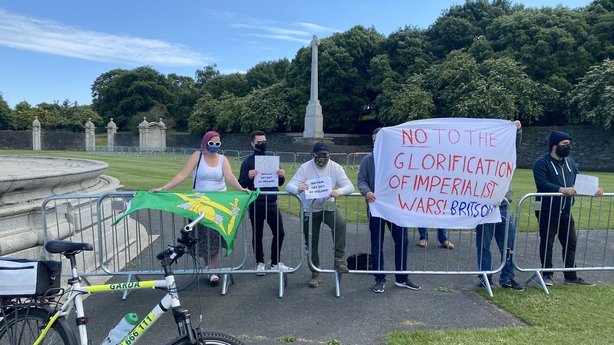
Speakers at a commemoration on the West Pier, Howth on Saturday 23rd July commented on all those features of the landing of 1,500 German rifles, single-shot Mauser Model 71 (M1871), their collection by the organisations of the broad revolutionary movement — and the army massacre that followed.

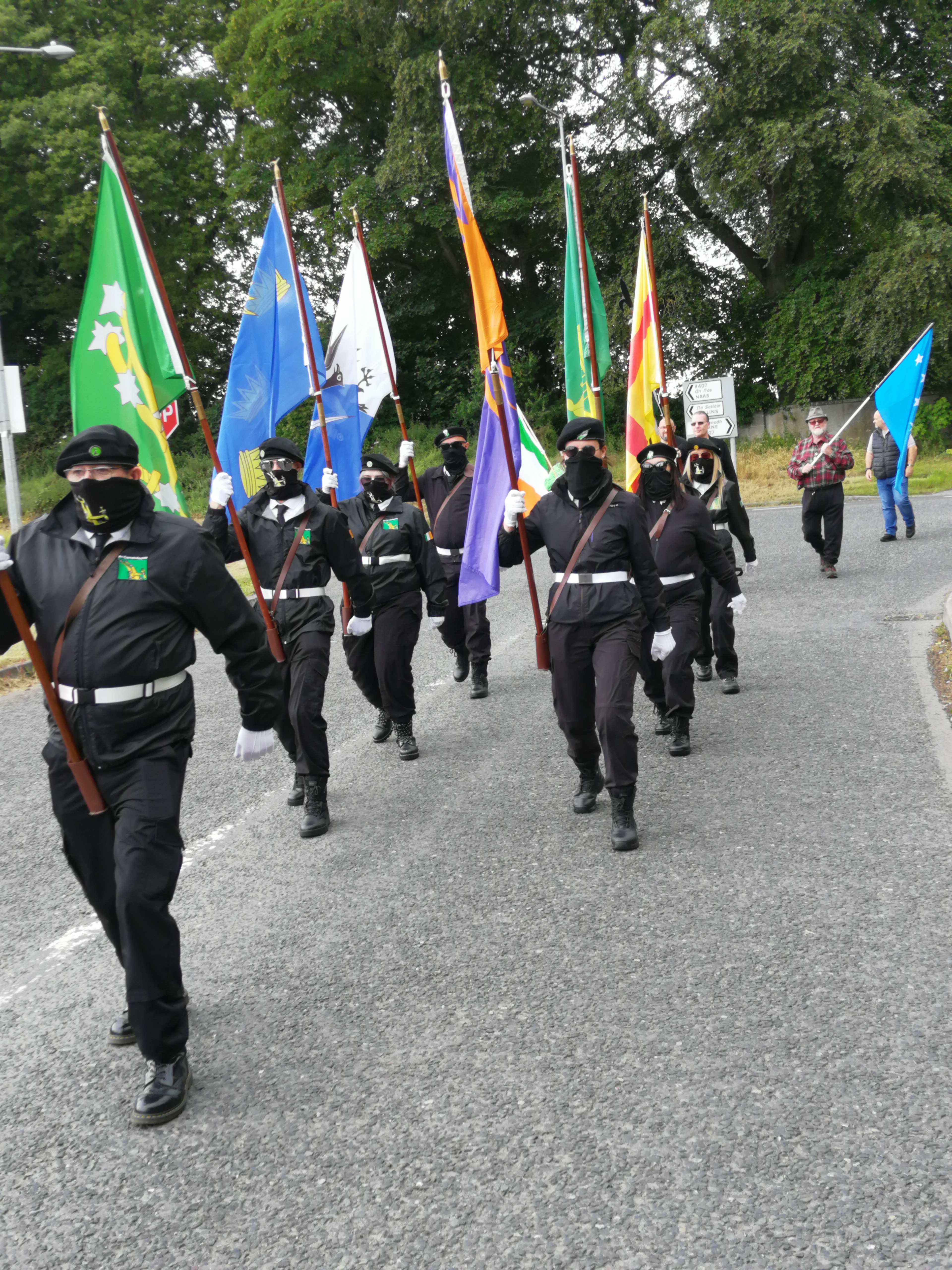
The event was organised by Irish Socialist Republicans and Anti-Imperialist Action organisations. A colour party of two men and two women led the march up to the pierhead where the event was held.

The Save Moore Street From Demolition campaign banner was displayed along the way.
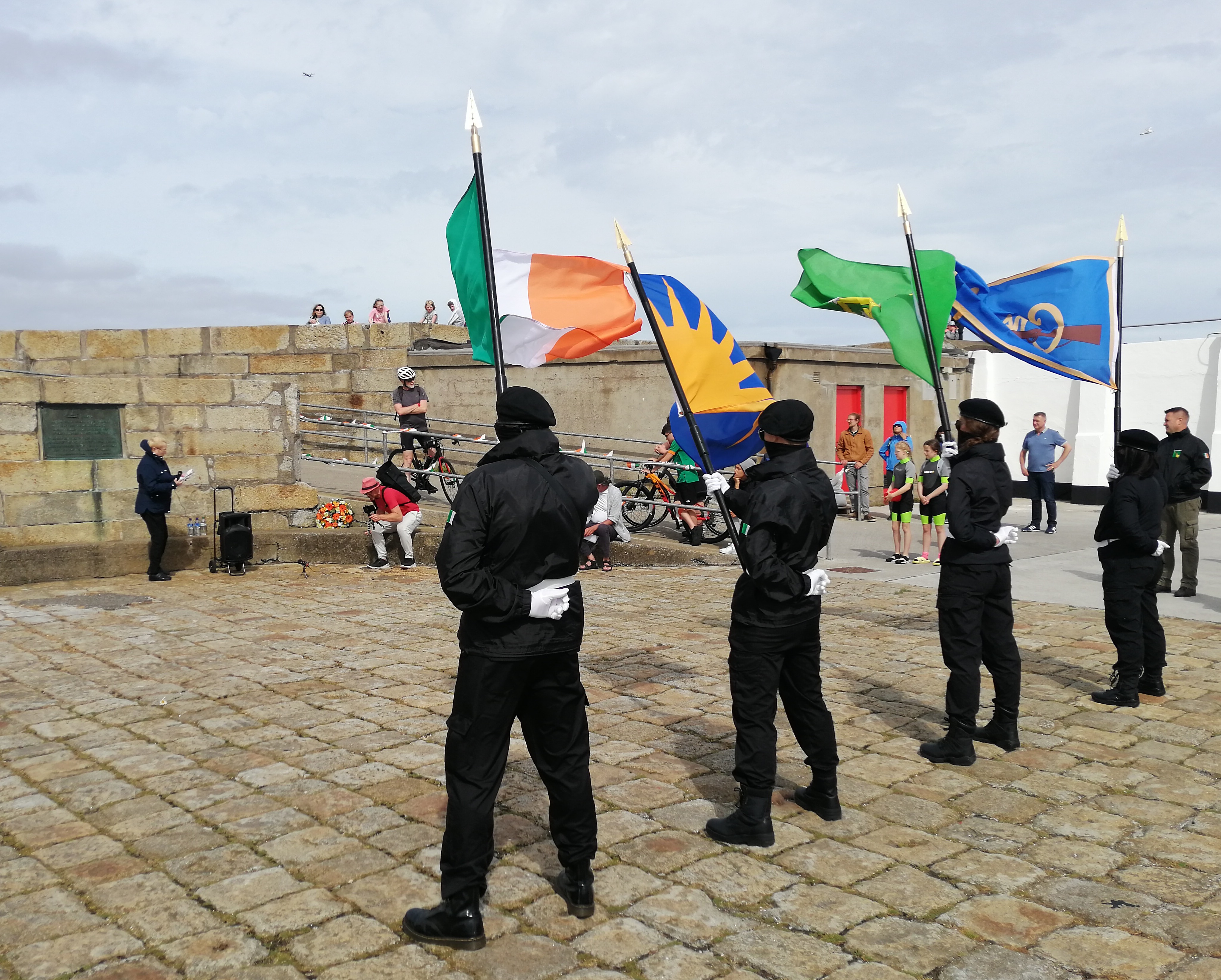
Event about to begin, Margaret McKearney in distance, colour party in foreground, mostly bystanders to the right, attendance out of shot behind and to right of camera person. (Photo: Rebel Breeze)

The event was chaired by Margaret McKearney, a veteran Republican from Tyrone once described by Scotland Yard as “the most dangerous woman in Britain” and who lost three brothers in the struggle (one in SAS ambush at Loughgall and another murdered by UVF).

McKearney recalled the need of Irish nationalists for weapons when the Loyalists were arming to prevent Home Rule3 being granted to Ireland and the Loyalists with British elite complicity had received a huge shipment at Larne.

Speakers, songs and a laying of a floral wreath were the main content of the event.

THREE SPEECHES – DETAILED, DIRECT AND DEFIANT

McKearney called Phillip O’Connor to speak, a historian and local resident with a particular interest in the revolutionary period in Howth4.

O’Connor began with a quotation from C.J. O’Connell in his Lordship of the World (1924) that “Every Nation, if it is to survive as a nation, must study its own history and have a foreign policy”.

Phillip O’Connor speaking at the event — the plaque at the pier head behind him. (Photo: Rebel Breeze)

The speaker went on to relate how our rulers demote and distort our nation’s history and how for various reasons even families and communities neglect to pass on that history to following generations.

O’Connor went on to relate the extensive instances of local people’s participation in our nation’s revolutionary history. He brought out names of local people who had been active in Cumann na mBan and the Irish Volunteers and the Sinn Féin party of the time.

The speaker also drew attention to the Irish Citizen Army unit in the locality – the only one outside Dublin – that went on to participate in the 1916 Rising in Dublin and in Fingal. Of course many of that spread of revolutionary organisations had participated in the Howth guns landing.

O’Connor concluded by repeating the quotation: “Every Nation, if it is to survive as a nation, must study its own history and have a foreign policy”.5

McKearney then called on Seán Doyle, a veteran socialist Republican who spoke on behalf of the Revolutionary Housing League, focusing on the housing crisis in Ireland and quoted Roger Casement1 at his trial in London in 1916:

Where all your rights become only an accumulated wrong; where men must beg with bated breath for leave to subsist in their own land, to think their own thoughts, to sing their own songs, to garner the fruits of their own labours…

then surely it is a braver, a saner and a truer thing, to be a rebel in act and deed against such circumstances as these than tamely to accept it as the natural lot of men. Doyle went on to recall James Connolly’s admiration for the struggle of the Land League and for Michael Davitt2.

However, Connolly, the speaker reminded his audience, had excoriated those who were outraged by the eviction of a tenant farmer but with “the working person locked out from his workplace or evicted from his home”, remained “at best silent if not critical.”

“We need to engender the same passion ourselves because the system does not care or share the plight of working people,” Doyle asserted and lashed “anyone who says he loves Ireland and can witness people dying on the street homeless while 180,000 houses are boarded up vacant”.

The speaker declared that the RHL would no longer remain silent, confined or recognise the ruling class’ self-serving laws or allow them to prosper, would no longer accept homelessness, nor “see our children rent an mortgage slaves for the rest of their lives”.

“We in the RHL believe that a roof over your head is not a commodity but an essential of life like water or oxygen. Houses make homes, make communities and a society we aspire to”. Doyle went on to call for a realisation “that pleading and appealing to a non-caring ruling class is futile.”
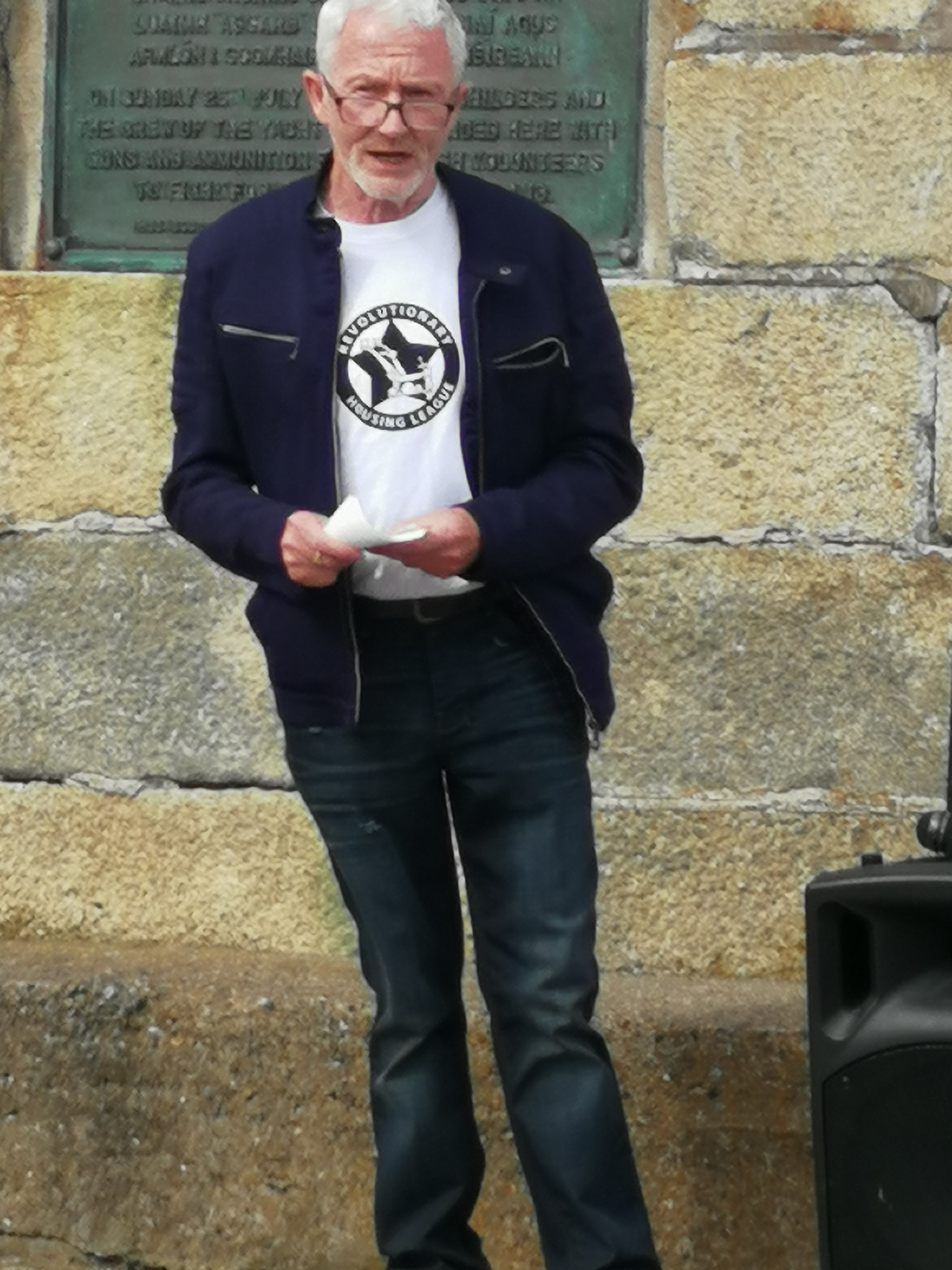
Seán Doyle speaking on behalf of the Revolutionary Housing League (Photo: Rebel Breeze)

Concluding, Doyle called on people to join the Socialist Republicans in action and quoted James Connolly6:We believe in constitutional action in normal times; we believe in revolutionary action in exceptional times. These are exceptional times, and called on people to “Build the Revolution!”

Cáit Trainor, an independent Republican activist from Armagh was called and stepped forward to give a rousing speech.

Reviewing as others had done the impelling of the arming of the Irish Volunteers by the arming of the Unionists against the prospective Irish “Home Rule”, Trainor went on to recall some of the other participants in the revolutionary movement of the time.

“Cumann na mBan with upwards of 1500 members was formed to assist the Volunteers, though some of the most radical women republicans, such as Helena Moloney and Constance Markievicz, elected to join the socialist Citizen Army instead, where they were given equal standing with the men.

“The Volunteers also had a ready-made youth wing, the Fianna Éireann, founded by Constance Markievicz7 in 1903 as an alternative to the ‘imperialist’ Boy Scouts. The Fianna were in fact to provide many of the most militant Volunteer activists.

“All of these groups would work together in the lead up to and including the 1916 rising, working together while maintaining their own autonomy with a unity of purpose.” “The Irish Volunteers had the men, the women and the youth, the next move was to secure the arms.”

Trainor referred to the arduous journey of guns-carrying yacht which included a stop in Holyhead to repair damaged sales after the Boat was hit with one of the worst storms to hit the area for decades.

The speaker attributed the success of the Howth landing to “the working together of various sections of Irish society.” “They came from varying religious backgrounds, not all were even Irish born and — even more surprising for the time — women took a leading role.”

Cáit Trainor speaking at the event on the Howth pier (Photo: Rebel Breeze)

Taking the 1916 Proclamation as an example, with its address to “Irishmen and Irish Women”, Trainor maintained that “Irish Republicanism has always been and remains to be a modern forward-thinking ideology in comparison with the outdated imperialist mindset of unionism.”

Cáit Trainor compared that address with the opening line of the unionist Ulster proclamation of 1913 that opens with “Whereas Ulstermen” and continued without any reference to women anywhere in the document.

Trainor stated that today Irish Republicanism needed to “get every section of society more involved in the struggle” and that “anyone who makes their home in Ireland must be encouraged to make their contribution and to be as passionate about Ireland and its success as an independent nation as anyone else.”

The speaker recalled Thomas Davis’ words: “It is not blood that makes you Irish but a willingness to be part of the Irish Nation.8

“Irish Republicanism”, stated Trainor “stands in stark contrast to the archaic outlook of British imperialists and Irish reactionaries by boasting of a diverse membership” bringing “fresh and original insights, talent and ingenuity” unlike the paradigm of “Christian, male and white”.

Trainor remarked that “Revolutions are a dirty business and revolutionaries must be armed to meet the might of their opponent” and that “the revolutionaries of today … come from the same tradition”, that “the cause and goal has not changed for any true Irish Republican.”

“Republicans in the early part of the last century did not set out to simply smash an orange state, or replace one flag for another; they were out for the Republic, an independent state for all the people, Republicans and the political prisoners who currently reside in prisons both north and South are out for the same thing9.

“It is an absolute travesty that the Republican prisoners are widely ignored by greater society, indeed most people would not even know they exist, believing falsely that with the signing of the GFA all prisoners were released and that political prisoners in Ireland were consigned to history.

“The media and constitutional nationalists along with pseudo socialist groupings like to skirt over the truth of the matter, they are more concerned with political prisoners in far-flung places around the world than political prisoners on their own doorstep.

“…. we understand that while Ireland remains occupied there will always be men and women willing to resist it, that this inevitably will ensure that political prisoners remain a reality in Ireland, and these prisoners will always have the decided and unfaltering support of Irish Republicans.

“Surrendering for seats in the enemies parliament isn’t a victory of any kind,” said Trainor, “it’s an utter defeat, the idea is to pacify with false power and notions of equality with your overlords, imperialists have used this strategy for centuries to quell rebellion and unbelievably it still works.”

Trainor dismissed the “alternatives to the Irish Republic” and condemned “reformism or British and Free State parliaments.”

(Photo: Rebel Breeze)

Pointing out that it was not an easy road for revolutionaries in the past no more than in the present, Trainor declared that “Revolutions are not won in the halls of parliaments but on the streets with the ordinary people”.

Coming back to the Howth landing of guns 100 years earlier, she said that “there is again an increase in militarism internationally and also nationally with unionist paramilitaries evidently armed and threatening violence.”

While constitutional nationalists sit on their laurels begging for British concessions unionist paramilitaries supported by unionist parties are organising again to secure their dominance and Irelands submission.

Cáit Trainor concluded with another quotation from Pádraig Pearse10: “The Orangeman11 with a gun is not as laughable as the nationalist12 without one”.

Living flowers in a pot are laid in remembrance of those who have given their lives in the struggle. (Photo: Rebel Breeze)

SONGS

Diarmuid Breatnach sang the ballad Me Old Howth Gun, written by James Doherty under the name of ‘Séamas McGallowgly’ and collected in 1921, with words that seemed extremely prescient for its time, with the civil war to come the following year:

…… There was glorious hope that we
Would set old Ireland free
But now you’re parted far from me, oh me old Howth gun.

Oh, the day will surely come,
Oh me old Howth gun,
When I’ll join the fighting men,
Oh me old Howth gun;
In some brave determined band
I will surely take my stand
For the freedom of my land,
Oh me old Howth gun.
Diarmuid Breatnach singing at the Howth event (Photo: Rebel Breeze)

Afterwards many people commented that they had not heard the song before and Breatnach replied that Pádraig Drummond had sent him the lyrics to learn for the event (which he had half-managed to do, he commented ruefully).

The event ended with the lowering of the colour party’s flags in honour of those who died for Irish freedom and, introducing it as “a fighting song, sung during the Rising”, Breatnach sang the first verse and chorus of Amhrán na bhFiann (The Soldiers’ Song).

End.

View of colour party with the harbour behind them (Photo: Rebel Breeze)

FOOTNOTES

1The guns were landed in Howth Harbour on 26th July 2014 by Erskine Childers and crew in his yacht The Asgard (which has its own room with the original yacht in the National Museum at Collins Barracks, Dublin).

2On their return from Howth, the revolutionary forces were confronted by a force of Dublin Metropolitan police but they were unsuccessful in having the rifles surrendered, as were also a unit of the British Army, the King’s Own Scottish Borderers. The latter were jeered by a Dublin crowd on their empty-handed return and at Bachelor’s Walk on the quays they opened fire on the crowd and bayoneted at least one victim. A woman and three men were killed and many wounded.

3A kind of partial autonomy that was on offer but within the British Commonwealth.

4See ROAD TO INDEPENDENCE – Howth, Sutton and Baldoyle play their part (2016) by Phillip O’Connor.

5The point about studying our history is often made at Irish Republican events but the one about having a foreign policy, though so important, is rarely if ever mentioned. Having a sound revolutionary foreign policy would have militated against the Provisional organisation’s seeking an accommodation with the leaders of US Imperialism 1970-1999 or expecting better of the World imperialist leaders at the “Paris Peace Conference” in 1919. Today the broad Republican movement has no coherent foreign policy except currently for Irish State neutrality.

6Roger Casement (1864-1916), of Anglo-Irish background, British diplomat (CMG) then Irish nationalist, member of the Gaelic League, poet, important role in organising the purchase of rifles that were transported to Howth and Wicklow. He was hanged in Pentonville Jail 3rd August, the last of the 1916 executions by the British.

7Thomas Davis (1814-1845), foremost among the Young Irelanders, publisher and contributor to The Nation, composer of A Nation Once Again, The West’s Awake and other notable songs and poems; his father was Welsh.

8James Connolly (1868-1916), revolutionary socialist, trade union organiser, journalist, historian, songwriter), Commandant of the insurrectionary forces in the 1916 Rising, executed by British firing squad.

9Constance Markievicz (nee Gore-Booth), (1868-1927), socialist Republican revolutionary, suffragist, founder member of the Irish Citizen Army and Cumann na mBan, fought as officer of the Irish Citizen Army in the 1916 Rising, sentenced to death (commuted), joined Sinn Féin, took the Republican side in the Civil War, founder member of Fianna Fáil. She was the first woman elected to Westminster Parliament (on abstentionist ticket), first Cabinet Minister in Europe (in the First Dáil) and first Minister of Labour in the world.

10There are currently around 60 Irish Republican prisoners in prisons on both sides of the British border.

11Pádraig Mac Piarais/ Patrick Pearse (1879-1916), writer, poet and journalist in English and Irish, educationalist, revolutionary Republican, Commander-in-chief of the 1916 insurrectionary forces, executed by British firing squad.

12British loyalists, followers of the anti-Catholic sectarian ideology of the Orange Order (founded 1796).

13At the time most Irish Republicans, despite the long existence of the Irish Republican Brotherhood, were seen as part of the broad nationalist spectrum but at its most militant end and were described as ‘advanced nationalists’.

Different view of colour party, against the lighthouse at the East Pierhead (Photo: Rebel Breeze)

USEFUL LINKS:

Revolutionary Housing League: https://www.facebook.com/JamesConnollyHouse

Anti-Imperialist Action: https://www.facebook.com/AIAI-For-National-Liberation-and-Socialist-Revolution-101829345633677

ÓRÁID — CATHAL BRUGHA — ORATION

Tá Rebel Breeze fíor-bhuíoch do Kerron Ó Luain as cead foillsithe a óráid ag comóradh scaoileadh marfach an tSaor Stát le Chathal Brugha a thabhairt dúinn. Rebel Breeze is most grateful to Kerron Ó Luain for permission to publish his oration on the occasion of the fatal shooting by the Free State of Cathal Brugha.

(Reading time: 11 mins.)

Óráid a tugadh ag Comóradh Chathail Uí Bhrugha, 7ú Iúil 2022, Baile Átha Cliath

Oration given at a Commemoration for Cathal Brugha, 7 July 2022, Dublin

Buíochas leis an gcoiste as an gcuireadh a thabhairt dom labhairt ag an ócáid stairiúil seo. Tá tábhacht ar leith go líonfar an bhearna maidir le stair an Chogaidh Chathartha, óir tá an stát tar éis na maidí a ligeadh le sruth.

Ba mhaith liom an chaint ghairid seo a thabhairt in ómós do Mhícheál Ó Doibhilin, an staraí a bhásaigh an tseachtain seo.

Rinne Mícheál neart oibre ar leithéidí Anne Devlin agus d’fhoilsigh sé neart saothair tríd Kilmainham Tales, a thug léargas ar ghnéithe den stair poblachtach a ligeadh i ndearmad.

Le linn 2016, agus comóradh céad bhliain ar Éirí Amach 1916 faoi lán seoil tháinig sé chuig mo bhaile dúchais, Ráth Cúil, áit ar thug sé caint ar Josie McGowan, a bhí mar bhall de Chumann na mBan, agus a mharaigh na póilíní in 1918.

Micheál Ó Doibhlin giving a talk on Irish women in the struggle, 1918 (Photo: D. Breatnach)

Thanks to the committee for the invitation to give this short talk. It’s important to mark events such as these to do with the Civil War since the State has not seen fit to do so.

I’d like to dedicate this talk to Mícheál Ó Doibhlin, the historian who died just this week.

Mícheál carried out a great deal of work on the likes of Anne Devlin and he published numerous works through Kilmainham Tales which provided an insight into lesser known aspects of republican history.

During 2016, with the hundredth anniversary of the 1916 Rising in full swing, he came to my hometown of Rathcoole, where he have a talk on Josie McGowan, who was the first member of Cumann na mBan to be martyred when she was killed by police in 1918.

I’d like to speak about Cathal Brugha first and then the impact of the Civil War/Counter-Revolution.

CATHAL BRUGHA – EARLY YEARS

In terms of the historical sources, it is not easy to find a wealth of material on Cathal Brugha online. Unlike Michael Collins, for example, there is not an abundance of accessible sources online pertaining to Brugha.

He is referred to in the Bureau of Military History sources such as the Witness Statements, and these have been digitised, but his private papers, held in UCD, await digitisation.

The recently published biography of Brugha by Daithí Ó Corráin and Gerard Hanley, entitled Cathal Brugha: “An Indomitable Spirit”, will hopefully go some way to popularising a fuller and more nuanced account of his life and politics.

Kerron Ó Luain ag caint ag an comóradh i Sr. an Ard-Eaglais, 7ú Iúil 2022 (Photo: D.Breatnach)

Cathal Brugha was born as Charles Burgess in Dublin in 1874. He was born into a middle-class family, his father a cabinet maker. Brugha was born into a large family, which was not unusual at the time. Perhaps less common, was that he came from a mixed Protestant and Catholic marriage.

There is a good chance his father was a Protestant Fenian during the 1860s and 70s.

The crucial politicising force of this mid-twenties was Conradh na Gaeilge. He joined Craobh an Chéitinnigh in Dublin in 1899. And it was through the Conradh he met his wife Kathleen Kingston whom he married in 1909.

It was in this Gaelic revivalist and republican milieu that he met the likes of Seán Mac Diarmada, Tom Clarke and Piaras Béaslaí, and this influenced his move towards militant republicanism.

It is worth noting, at this point, that six of the seven signatories of the 1916 Proclamation were members of Conradh na Gaeilge, as were fourteen of the sixteen men executed in the wake of the Rising.

Photo-portrait of Cathal Brugha in IRA uniform. (Photo sourced: Internet)

PREPARATION FOR RISING, PREPARATION FOR WAR — AND FURTHER

In 1908, Brugha joined the IRB. He was employed as a travelling salesman with a candlestick company during those years and so, like many within Fenianism before him, was able to disguise his organising and recruitment under the cloak of his business activities.

Brugha was later instrumental in the setting up of the Irish Volunteers and then the Howth Gun Running. He was second in command to Éamon Ceannt at the South Dublin Union (now James’s Street Hospital) during the 1916 Rising.

He held a detachment of the British Army at bay singlehandedly with his ‘Peter the Painter’ revolver and nearly died from the wounds, including a lacerated nerve, he sustained in the feat. For the remainder of his life he walked with a limp and had to have a special boot made so that he could walk.

In the wake of the 1916 Rising Brugha was central to the re-organisation of the Irish Volunteers, which during these years, along with the Irish Citizen Army, began to coalesce into the Irish Republican Army.

In terms of his rejection of the Treaty in 1921 and death during 1922, we get a snapshot of the trajectory of his politics in 1917.

He was central to the debates over the formation of the Sinn Féin constitution in 1917, and he clashed with the dual-monarchist Arthur Griffith over the insertion of the word “Republic” into the document, which Brugha ardently supported.

Later, at the outbreak of the Black and Tan War in 1918 another indication of his politics can be seen. Brugha, as President of the Dáil, and later as Minister of Defence, was anxious that the IRA would do nothing that might effect Ireland’s case at the Peace Conference underway in Paris.

These were not the actions of a militarist fanatic, as state and revisionist historians have often portrayed him, but the strategic calculations of a principled political republican.

His dedication to the cultural and linguistic revolution is a feature of his activities during 1919 — particularly during the reading of the 1919 Democratic Programme.

Rinneadh gach rud trí Ghaeilge an lá sin agus ba é Brugha a bhí chun cinn.

During that day all the business was conducted through Irish and Brugha was very forthright about that. He understood not only the political importance of announcing the advent of the Dáil at an international level, but in doing so through Irish.

Another indication of his desire to advance the Irish language was that his plan for Conradh na Gaeilge be given sanction by the newly emergent state. “It was essential”, he said “that the authority of Dáil Éireann should be placed behind the Gaelic League”.

Plaque over the spot where Cathal Brugha was fatally shot at the junction of Cathedral and O’Connell Streets. (Photo: D.Breatnach)

LESSONS OF HISTORY

It is our duty as historians and as republicans who want to learn from the mistakes of the past to analyse things as they were and not gloss over them.

Brugha was less advanced when it came to other social questions, such as that of the land.

When a loan scheme was set up by the Dáil in 1919-1920 Brugha viewed it as “a scheme that would be a perfectly sound business proposition, and offer a good field to Irishmen who desire to invest their money”.

This speaks to the class composition of much of that era’s Irish Republicanism – with over-representation from the lower-middle and middle classes and under-representation from the urban and rural working-class.

There was a consequent lack of a radical social programme that might have attracted the masses, particularly during 1922.

Liam Mellows, according to a recent publication by Conor McNamara, only really came towards socialism late in the day whilst imprisoned in Mountjoy Jail.

In a similar vein, the great socialist-republican Peadar O’Donnell, remarked that during the occupation of the Four Courts in July 1922 there existed a gulf between the republicans inside and the workers outside.

Hammam Hotel after Free State attack. (Photo sourced: Internet)

We can also point to a lack of militancy within the leadership of the labour movement, as we can to a lack of socialism within the republican movement.

However, and despite a climate of soviets springing up, land agitation and general strikes over the course of several years, socialism and republicanism failed to fully synthesise into an organised and militant socialist and anti-imperialist movement.

Nevertheless, this is not to take away from Brugha, Mellows or any of his comrades. The picture that emerges of Brugha is one of a dedicated and political Irish Republican. A man of principle, honour and integrity.

It isn’t the picture of a mindless militarist, or “a fanatic”, as a recent review of the above-mentioned book Indomitable Spirit in the Irish Independent characterised Brugha. Likewise, some historians have derided Brugha essentially as a man of “no politics”.

However, as JJ O’Kelly, better known as Sceilg, said of Brugha, he was “showered with intellectual gifts of a high order, coupled with an exquisite literary taste; was a good linguist, a powerful writer, a fluent and convincing speaker, a pleasing singer and exquisitely fond of good music”.

Previously, during a potential split in Craobh an Chéitinnigh in 1908 Brugha was seen as a force for reconciliation, rather than as an apolitical “splitter”.

At its core, the realisation that the Treaty represented a half-way house between Empire and Republic that was doomed to failure informed Brugha’s actions during 1921 and 1922.

The mainstream historical narrative is that the “militarists” couldn’t see sense and get behind the so-called “empty formulas” of the oath. But, harking back to his dispute with Griffith in 1917, I think Brugha knew the importance of the term “Republic”.

Brugha understood that the wording and principles laid down in such documents would influence the character of any Irish state which might emerge. Thuig sé, creidim, go gcuireadh na prionsabail a leagfaí síos ag an bpointe criticiúil cruth ar an stát a bhí le tíocht.

Brugha had also pushed for an Oath to the Republic to be adopted by the IRA in 1919. The context for him doing so was the long tradition of oaths stretching back through Fenianism and other oathbound secret societies.

Oathbound secret societies were common throughout Europe in opposition to feudal and absolutist monarchies from the Enlightenment era onwards.

But in Ireland such secret societies, whether agrarian, nationalist or republican, or an admixture of each, represented an opposition to colonialism and their oaths were a necessary offering of allegiance to the community and the Irish body politic rather than to the invader.

Brugha’s dedication to the Republic and rejection of imperialism was shown again during the Treaty debates of 1921 when he spoke thusly:

“if …. instead of being so strong, our last cartridge had been fired our last thinking had been spent and our last man was lying on the ground and his enemies howling around him and their bayonets raised, ready to plunge them into his body, that man should say – true to the traditions handed down – if they said ‘will you come into the Empire?’ he should say and he would say : ‘No, I will not!’

That is the spirit which has lasted the centuries and you people in favour of the Treaty know that the British Government and the British Empire will have gone down before that spirit dies in Ireland”.

CIVIL WAR/ COUNTERREVOLUTION

Civil War eventually began in 1922 with the shelling of the Four Courts with British guns by Free State forces. Again, busting the myth that he was only out for war, Brugha had actually been reluctant to enter the Republican garrison with Mellows, Rory O’Connor, and Joe McKelvey.

Likewise, Oscar Traynor; he and Brugha occupied Hamman Hotel and Buildings on Upper O’Connell street as a secondary garrison. As the Battle of Dublin raged the buildings occupied by Brugha went ablaze.

Free State soldiers shouted at him to surrender, to which he replied “níl aon chuimhneamh agam ar a leithéid a dhéanamh” (I have no notion of doing so). After asking his own garrison to surrender Brugha approached the Free State soldiers and was shot dead.

The Civil War has often been over-simplified into a cartoonish clash of “brother against brother” and “the Big Fellow” (Collins) versus “the Long Fellow” (De Valera). This negates the aspects of it which were clearly counter-revolutionary in nature, and it can just as easily be labelled the Counter-Revolution of 1922-23.

The results of the Counter-Revolution in which Brugha died and which deepened in the years after, especially during the 1920s, speak for themselves.

Free State troops preparing artillery emplacement for British field-gun at Nelson’s Pillar (now location of the Spire) in the Battle of Dublin, Civil War/ Counterrevolution July 1922. (Photo sourced: Internet)

Republican men carry the coffin of Cathal Brugha with an honour guard of Cumann na mBan. (Photo sourced: Internet)

The Counter-Revolution:

Sided with Empire over Republic. The acceptance of the Treaty meant the acceptance of White Dominion status along with Canada, Australia and New Zealand.

In doing so the counter-revolutionaries severed the nascent anti-colonial links with the Third World which had existed throughout the nineteenth and early twentieth centuries.

This move, according to Bill Rollston and Robbie McVeigh in their recent publication Anois ar Theacht an tSamhraidh: Ireland, Colonialism and the Unfinished Revolution, informs the nature and perseverance of Irish racism today.

It sided with Rich over Poor. The infamous quote from the good Catholic and Christian W.T. Cosgrave about “people being reared in work houses taking it in their minds to emigrate”, resonates here.

This is the mentality which laid the blueprint for how the State facilitated and turned a blind eye to the horrors of the industrial schools and laundries – horrors which were inflicted against women and children mainly from the urban and rural working class.

It sided with Partition over Unity. The nationalists of the North were abandoned to the mercy of the Orange state, despite knowledge among the emergent conservative republican elite like Cosgrave and Kevin O’Higgins of the pogroms which had been going on in Belfast between 1920-22.

The lame duck Border Commission of 1925 was never going to challenge the economic or political viability of the Six Counties

It sided with Anglophone Ireland over what was left of Irish speaking Ireland. There was over half a million, or 543,511 to be precise, native Irish speakers in the state in 1926. Today there are less than 10% of that, roughly 20,000.

The Free State in the 1920s implemented a symbolic cultural programme – state departments used the cúpla focail, schools were superficially Gaelicized, post boxes were painted green.

This was also a means of shoring up support for the State against republicans and other “subversives” in the 1920s and 30s by capturing and channelling one ideological aspect of the revolutionary years. But no radical social programme was devised.

Rather than re-distribute wealth and local power to the West, a symbolic and centralised pseudo-revival was implemented, while Conradh na Gaeilge, which Brugha had been so loyal to, went into rapid decline naively thinking that the conservative state would somehow act as a genuine custodian of the language revival.

Tá go leor leor samplaí den leanúnachas seo leis an impiriúlachas le fáil.

Other examples of a continuity and no real break with imperialism abound. In law, the Free State remained wedded to British common law over a potential new system.

Brehon Law had been mooted as having communal benefits different from the individualist and property focussed British law by cultural nationalists and by Marxists such as James Connolly. But this mode of thought was not considered.

In administration, according to historian J.J. Lee, 98% of civil servants from the old British colonial administration were kept on during the years of the early Free State.

In finance, Ernest Blyth’s conservative fiscal policies were carbon copies of Westminster’s and the punt was shackled to the sterling.

Even down to seemingly innocuous cultural traits such as dress – W.T. Cosgrave and his ilk adopted the top hat and coat-tails of the British once in office – there were continuities.

While this last point may seem minor, it was a signifier of the whole ideology and culture of the state – Conservative, Catholic, Anglophone, with only a veneer of Gaelic symbology.

Little wonder then that the State lurched from dependence on one empire from the 1920s into dependence on others in the 1960s and 70s in the form of the US empire and the emergent EU empire — via the policies of Foreign Direct Investment and the Common Agricultural Policy.

The legacy then of the counter-revolution still weighs heavily on our people.

It is our duty to analyse the different forces – be they political, class or cultural – which defeated the Republic in 1922-23 and to work towards defeating them and breaking fully with Empire, as Cathal Brugha sought to do.

An Phoblacht Abú!

Kerron Ó Luain, staraí, Ráth Cúil, Co. Átha Cliath.

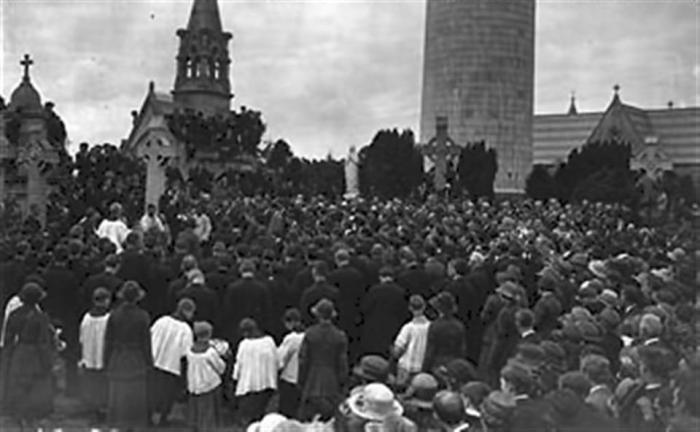
Section of the crowd at Cathal Brugha’s funeral in Glasnevin Cemetery. (Photo sourced: Internet)

CATHAL BRUGHA HONOURED AT SPOT WHERE FREE STATE SHOT HIM

Diarmuid Breatnach

(Reading time main text: 6 mins.)

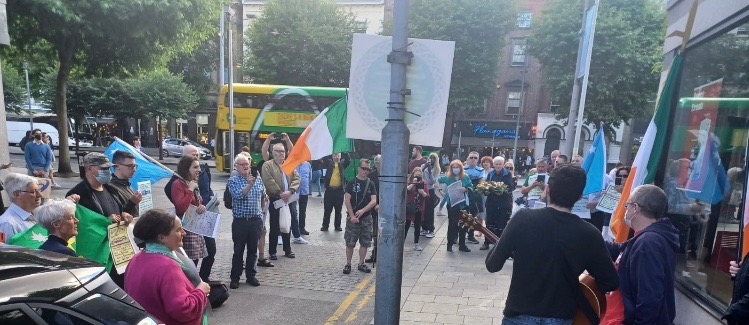
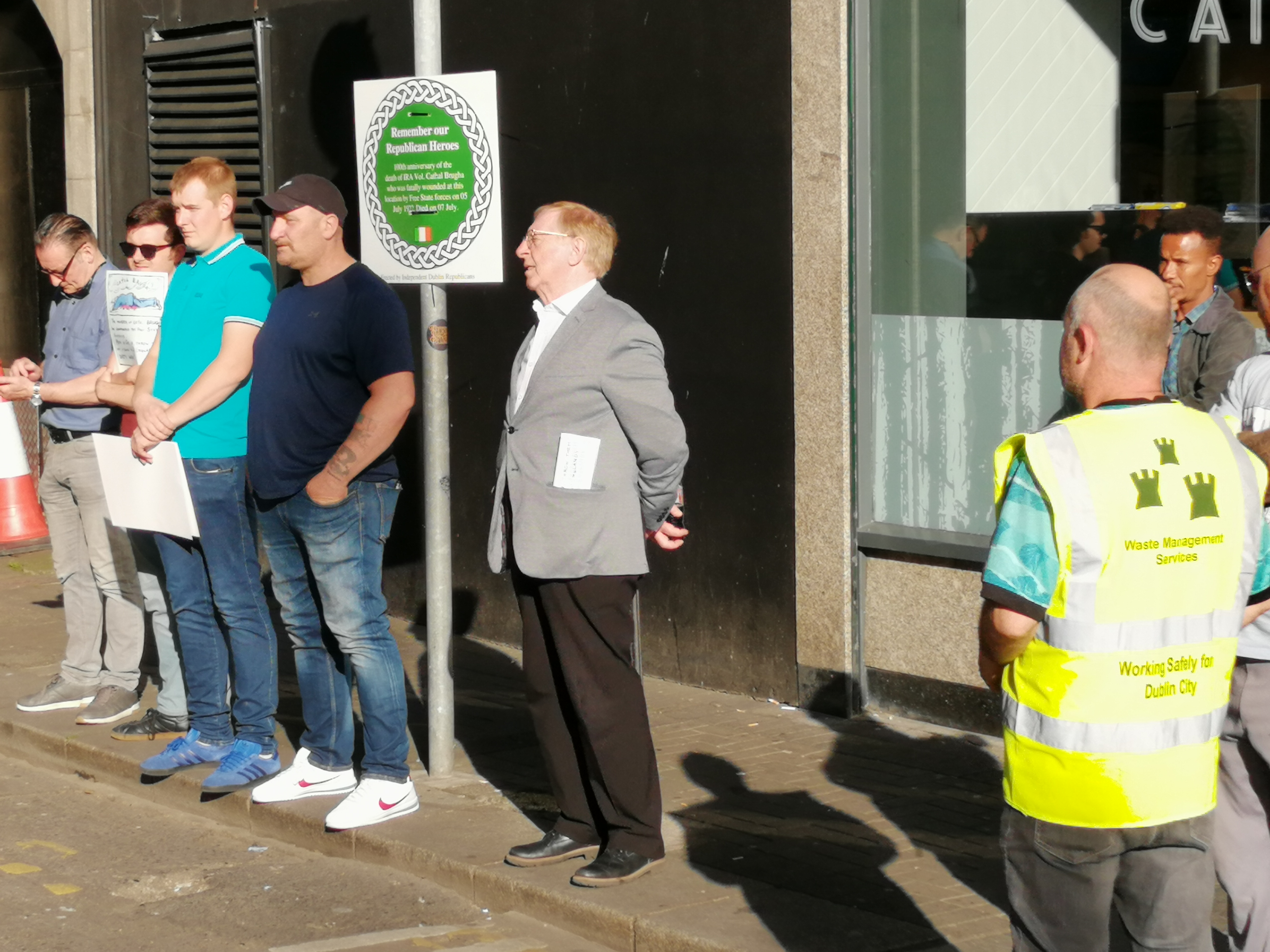
On the evening of 7th July, people passing on O’Connell Street, Dublin’s main street in the north city centre either stopped a while or passed with a glance at the crowd gather at the intersection with Cathedral Street, a narrow lane leading eastward.

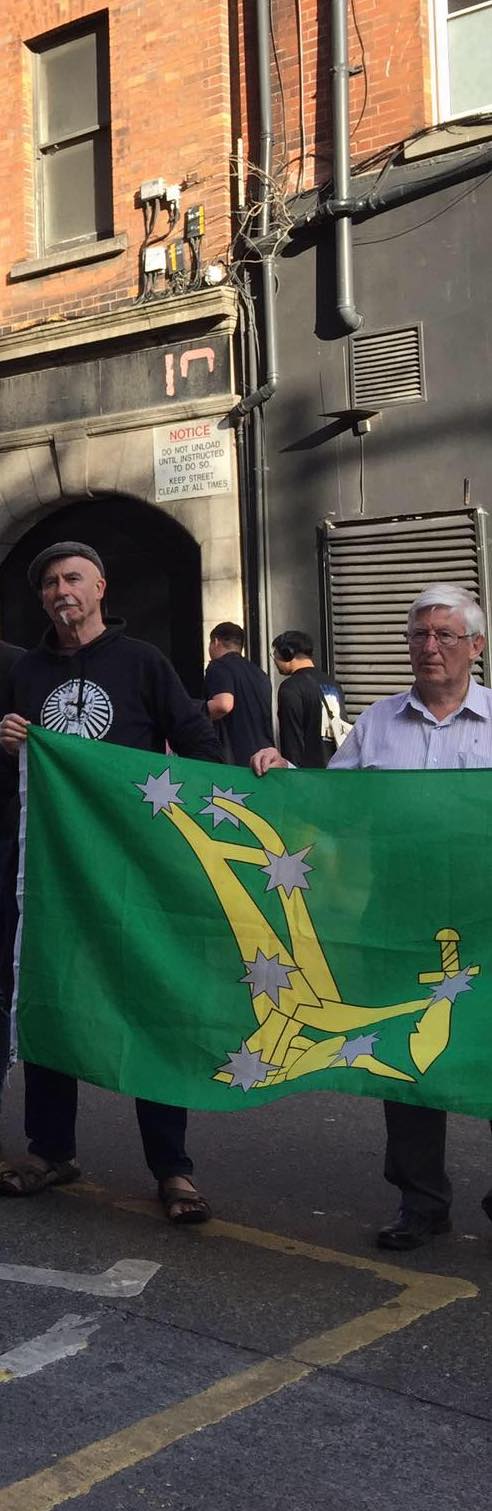
The Irish Tricolour and the Starry Plough flags (both versions1) held aloft gave a strong indication of the purpose of the gathering, which was to honour an Irish patriot shot down at that spot by Free State soldiers on 5th July 1922 and dying on the 7th.

A poster from the period with drawings thought to be by Constance Markievicz (Photo: D.Breatnach)

CATHAL BRUGHA RESUMÉ

Cathal Brugha was an Irish Republican, an Irish language activist, a soldier and politician. For a period in the Irish Republican Brotherhood, he joined the Irish Volunteers at the outset2 and was a lieutenant in charge of twenty Volunteers to receive with others the arms delivered to Howth Harbour in 1914.

In the 1916 Rising Brugha was second-in-command under Eamonn Ceannt at the South Dublin Union, now covered by James’ Hospital, where he received in excess of 25 wounds from bullets and grenade shrapnell and was not expected to live.

Surviving, Brugha was elected a Teachta Dála (member of parliament) for the abstentionist Sinn Féin coalition party in the UK General Election of 1918, serving until his death, first President of Dáil Éireann (the Irish Parliament) from January to April 1919, Minister of Defence from 1919 to 1922 and Chief of Staff of the IRA from 1917 to 1919.

Cathal Brugha, along with most Republican activists, was strongly opposed to the Anglo-Irish Agreement of 1921 which was supported by Michael Collins, Arthur Griffiths and others and joined the Republican opposition in the Dáil, resigning his government posts to do so.

A poster from the period with drawings thought to be by Constance Markievicz (Photo: D.Breatnach)

However, he and Oscar Traynor of the IRA both opposed the occupation of the Four Courts by IRA under Rory O’Connor but when it was bombarded by the Free State with British artillery on 28th June, Traynor ordered occupation of O’Connell Street buildings to divert some of the heat from the Four Courts.

The Free State Army bombarded the Republican positions in O’Connell Street with artillery and machine guns (as the British Army had done in 1916). Eventually the Republicans retreated apart from a small holding group which Brugha ordered to surrender but did not do so himself.

Approaching Free State soldiers with pistol in hand, he was shot by them in the leg, severing a femoral artery and died two days later in hospital. His widow Kathleen continued the Republican line as an activist and TD.

Mags Glennon, Chairing the event (Photo: D.Breatnach)

THE HONOUR CEREMONY

Mags Glennon, chairing the event, thanked people for coming, stressing the importance of remembering our history and listed briefly the important actions of and positions held by Cathal Brugha, before calling on Sean Óg to perform The Soldiers of ‘22,3 the five verses of which he sang, accompanying himself on guitar.

At intervals between speakers Sean Óg performed another two songs, Cathal Brugha and A Soldier’s Life4.

Joe Mooney brought a series of three posters for distribution, which were quickly taken up. These were copies from the period, condemning the Free State Army for the murder of Cathal Brugha, with drawings believed to be by Constance Markievicz.

A poster from the period with drawings thought to be by Constance Markievicz (Photo: D.Breatnach

MAIN ORATION

The main speaker was historian and author Kerron Ó Luain, who began speaking in Irish and returned to it on occasion, though the content of his talk was by far in English.

Ó Luain initially paid his respects to recently-deceased Mícheál Ó Doibhlin, a Dublin historian who had done much historical research to bring further into the light of today the contributions two Republican women in two different periods.

These were Anne Devlin of the United Irishmen (uprisings in 1798 and 1803) and Josephine McGowan, killed in 1918, the first Cumann na mBan martyr5. Ó Doibhlin had also assisted Ó Luain in the latter’s research into the insurrectionary history of his own area, Rath Cúil (Rathcoole)6.

Kerron Ó Luain speaking, Joe Mooney holding the microphone. (Photo: D.Breatnach)

Continuing to relate some brief facts about Brugha’s early life, born into a mixed-religion household, Ó Luain emphasised Brugha’s interest in the Irish language and his membership of the Gaelic League (Conradh na Gaeilge)7 in the same decade as its founding.

The speaker contrasted that aspect with the militarist image of Brugha often projected by hostile commentators. Brugha met his future wife at meetings of the Connradh and had been a strong advocate of the proceedings of the First Dáil being conducted mostly in Irish and of the Democratic Programme being first read and agreed in Irish.

The setting up of Sinn Féin to contest the 1918 UK General Elections had involved a coalition of many different elements Ó Luain said, including dual monarchism advocates such as the original founder Griffiths and even white Dominion aspirants, alongside Republicans such as Cathal Brugha.

Section of the crowd at the event. (Photo: D.Breatnach

These had been the lines along with the alliance had fractured when the British proposed the terms of the Anglo-Irish Treaty. British influence on the Free State was seen not only in its war on the Republicans but in the legal system adopted based on common law without any thought given to any of the principles of the native Brehon Law.

The British influence was evident also in the form of dress with some Free State politicians such as Cosgrave wearing a top hat and research has shown over 90% of the civil servants of the Free State had been employed by the previous British colonial administration.

The Free State adopted a formal position of support for An Ghaeilge, the Irish language, while doing nothing to support the struggling rural Irish-speaking areas, which were being drained by emigration, leading the inhabitants to want to acquire English for their future locations.

Some of the attendance. (Photo: D.Breatnach)
Another small section shot (Photo: D.Breatnach)

The number of Irish-speakers within the territory of the State has declined drastically since it was founded.

Unusually for an oration honouring an Irish martyr but very important historically, the speaker pointed out that Brugha was not a socialist Republican and had advocated land ownership whereas other Republicans such as Liam Mellows (executed by the Free State in 1922), Peadar O’Donnell and Frank Ryan in the 1930s had proclaimed the need for a socialist Republic.

In conclusion, the speaker said that Cathal Brugha was an honest courageous Republican with a genuine love of the Irish language and a staunch upholder of the truly independent Republic proclaimed in 1916 but yet to be achieved. He had been killed as part of the counterrevolution.

It is important for future efforts, Ó Luain stated, to be aware of the different strands in the Republican opposition to the status quo and to be clear on the desired future shape of society in the Republic.

View of many in the attendance at the event. (Photo: Cabra 1916-1921 Rising Committee)

OTHER REPUBLICAN MARTYRS OF THE BATTLE FOR DUBLIN 1922

Damien Farrell spoke on behalf of Dublin South Central Remembers and representing the McMenamy family from the area. Frank McMenamy had been asked to introduce the Roll of Honour on behalf of relative Ciaran McMenamy of F Coy, 1st Batt, anti-Treaty IRA (Ambulance Corp) but was unable to attend.

Ciaran was one of four brothers — Fergus, Manus and Francis — who fought in the revolutionary period 1916-23. Ciaran was part of the crew that tended Cathal Brugha and rushed him to hospital on the 5th July. When Brugha succumbed to his wounds, Ciaran was a pall bearer at his funeral.

Damien said that this most likely identified him for arrest which happened later and he was interned in the infamous Newbridge Camp and participated in the mass hunger strike of prisoners in 1923 against conditions.

Ciaran McMenamy contracted a cold that developed into consumption which secured his release to convalesce in the County Home in Kildare but this proved ineffective and Ciaran was eventually released from internment around Christmas 1923.

On the 26th of April 1924 Ciaran McMenamy died in 55 Pearse Square, a house connected to the family. For the past two years Dublin South Central Remembers have held remembrance events at the house, with the full permission and support of the current occupants (no relations) with the intention of having a plaque erected in time for his centenary in 2024.

Finnuala Halpin reading the Roll of Honour of the The Battle of Dublin 1922, in which her grandfather fought. (Photo: D.Breatnach)

Fionnuala Halpin read the roll of honour of those killed in The Battle of Dublin 1922, a battle in which her grandfather fought.

John Monks

William Clarke

Joe Considine

William Doyle

Francis Jackson

John Mahoney

Sean Cusack

Matthew Tompkins

Jack McGowan

Thomas Markey

Thomas Wall

Charles O’Malley

Cathal Brugha

Veteran Republican, hunger-striker and author Tommy McKearney placed a wreath in honour of the fallen on behalf of Independent Republicans and a minute’s silence was observed in their honour also.

COMMEMORATE THE CIVIL WAR MARTYRS OF YOUR AREA?

A number of different Republican organisations were represented at the event, along with many independent Republicans and historical memory activists, including walking history tour guides.

Poster and dedication floral wreath in honour of Cathal Brugha, Cathedral Street, Dublin city centre 7 July 2022 (Photo: Cabra 1916-1921 Rising Committee)

Mags Glennon asked people to keep in touch with the organisers and also to be aware of other commemorative events, offering to make available the commemorative posters with the local martyrs’ names incorporated into the design for display for others around the country.

End.

FOOTNOTES

1The original, with the design of plough in gold following the outline of the Ursa Mayor constellation in white stars, on a green background and the later Republican Congress version of the white stars alone on a light blue field.

2Formed in 1913.

3Composed by Brian Ó hUigínn, sung to the air of The Foggy Dew.

4A Soldier’s Life was originally composed by Young Irelander Thomas Davis (1814-1945) and recorded by The Wolfe Tones band; the composer of Cathal Brugha’s lyrics appears unknown and it was recorded by Declan Hunt.

5A rally held by women just off Dame Street in 1918 was batoned by members of the Dublin Metropolitan Police and she died of her injuries shortly afterwards. I have heard Ó Doibhlin relate her story and saw him becoming emotional as he did so. The DMP’s batons in September 1913 were also responsible for the deaths of at least three others, although one died in 1915.

6For a number of recent years Ó Doiblin has been noted, along with historian Liz Gillis and others, for research and exposition of information regarding the Burning of the Customs House on 25th May 1921, which corrected a number of common misapprehensions about that event.

7Founded by Protestant Douglas Hyde/ Dubhghlas de hÍde this month in 1893.

USEFUL LINKS

The Independent Republicans group do not appear to have a website or FB page but may be contacted through the Cabra 1916-1921 Rising Committee: https://www.facebook.com/cabra1916

The National Graves Association: https://www.facebook.com/NationalGravesAssociation

THE FIRST WORLD WAR DEAD SHOULD BE COMMEMORATED

Diarmuid Breatnach

(Reading time: 3 mins.)

Irish Republicans and revolutionary Socialists have traditionally been opposed to the commemoration of the dead in the “Great War”, WWI. Recently Michelle O’Neill, top Minister in the British colonial political regime in Ireland with the Lord Mayor of Belfast, both members of the Sinn Féin party, laid a wreath at the WWI memorial in Belfast, to the bewilderment of some and the disgust of others. But actually those emotions are misplaced, since the leadership of the Sinn Féin party were never Socialist and are no longer Republican.

The long-held position of Irish Republicans and Socialists that WWI should not be commemorated is however illogical and runs against history. The conflict was a hugely-important event in such areas as military, social conditions and mores, medicine, politics and economics.

The toll of WWI is around 40 million military and civilian casualties of which 20 million died. Of those, around 10 million were civilian dead. How can an event of such historical magnitude not deserve commemoration?

We should certainly commemorate the fact that a small group of monopoly capitalists, aristocracies and monarchies, in the course of an argument about how to divide up the world among themselves, sent millions of ordinary people, mostly workers, to kill one another to settle the argument. People who had no quarrel with one another and nothing to gain from killing one another; people whose real verifiable enemies were those very people who were mobilising and arming them before sending them forth to kill or be killed.

The conditions of the working classes at the time they were thrown into the killing arena should be commemorated. The lies that the war was fought for democracy and freedom of small nations should be exposed. The disciplinary court-martials and executions within the armies should be revealed, along with the treatment of conscientious objectors. The propaganda used for recruitment and to keep the home populations happy should be deconstructed and exposed. The fact that capitalism ends up as imperialism, which in turn causes war, should be made clear to all.

That wars are not alone fought for profits but that huge profits are made in the course of war is a grotesque fact that should become widely known.

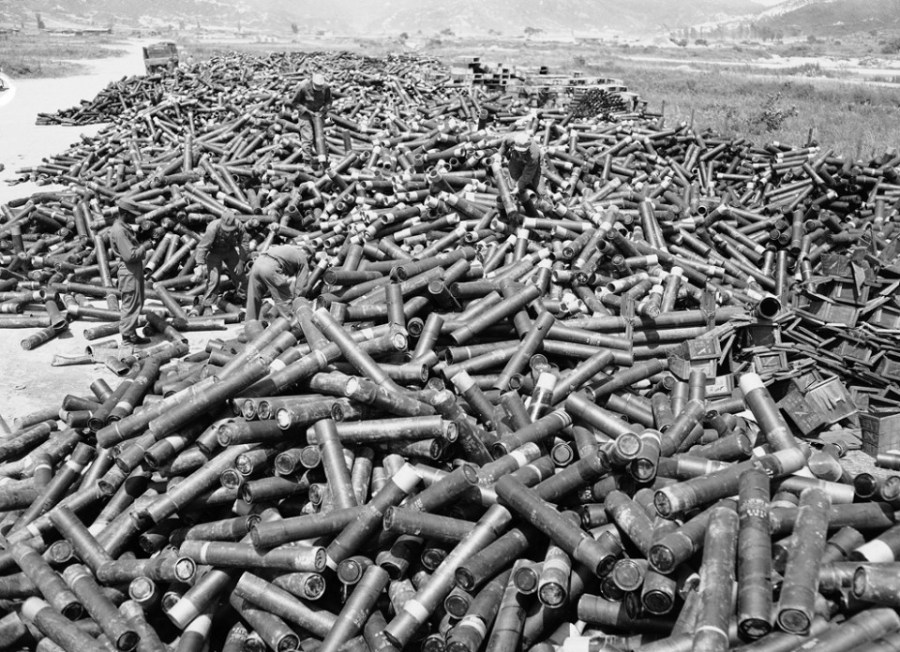
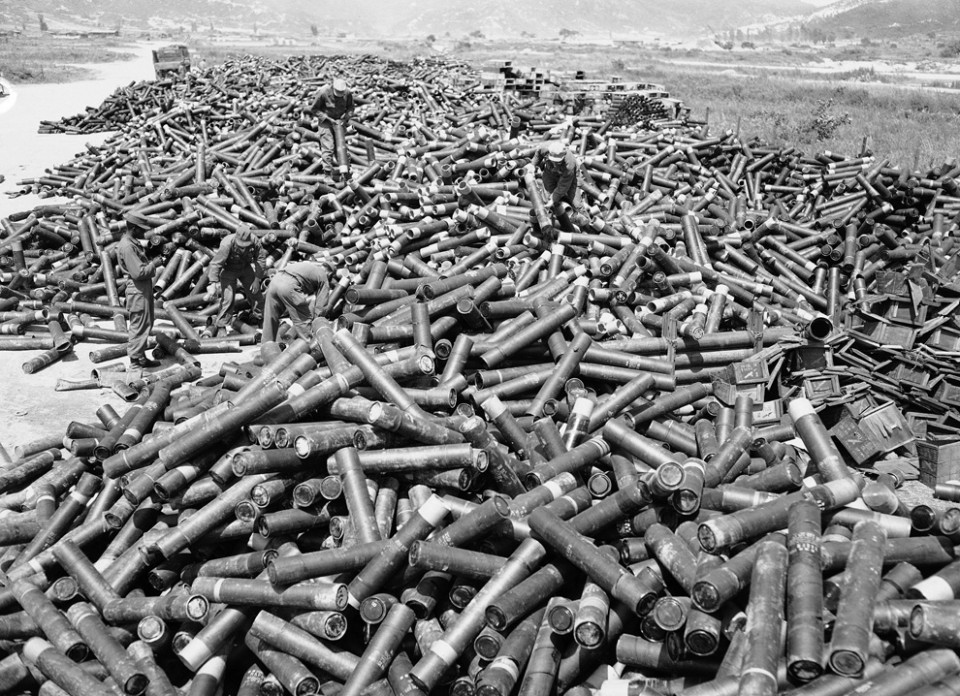
A pile of used artillery shells used in WWI — all manufactured and paid for, exploded, more ordered, paid for, fired ….. Part of the huge profits made during imperialist wars. (Photo sourced: Internet)

All of this was true of WWI and is true (to one extent or another) of the wars caused by imperialism today, whether in Somalia, Western Sahara, Palestine or Ukraine. But now, in addition to the huge death toll of WWI, we have the possibility of the destruction of human cities around the world — and even of ecological disaster — in yet another war.

We should expose the fact that far from encouraging us away from war, WWI commemorations are for the most part about concealing those salient facts and encouraging us to be proud of how our forebears were conned into killing one another. By whipping up reactionary nationalism1, their commemorations make us vulnerable to being conned into fighting further wars, to agree to be sent to other countries to kill or maim people like us in other countries – or to be maimed or killed by them.

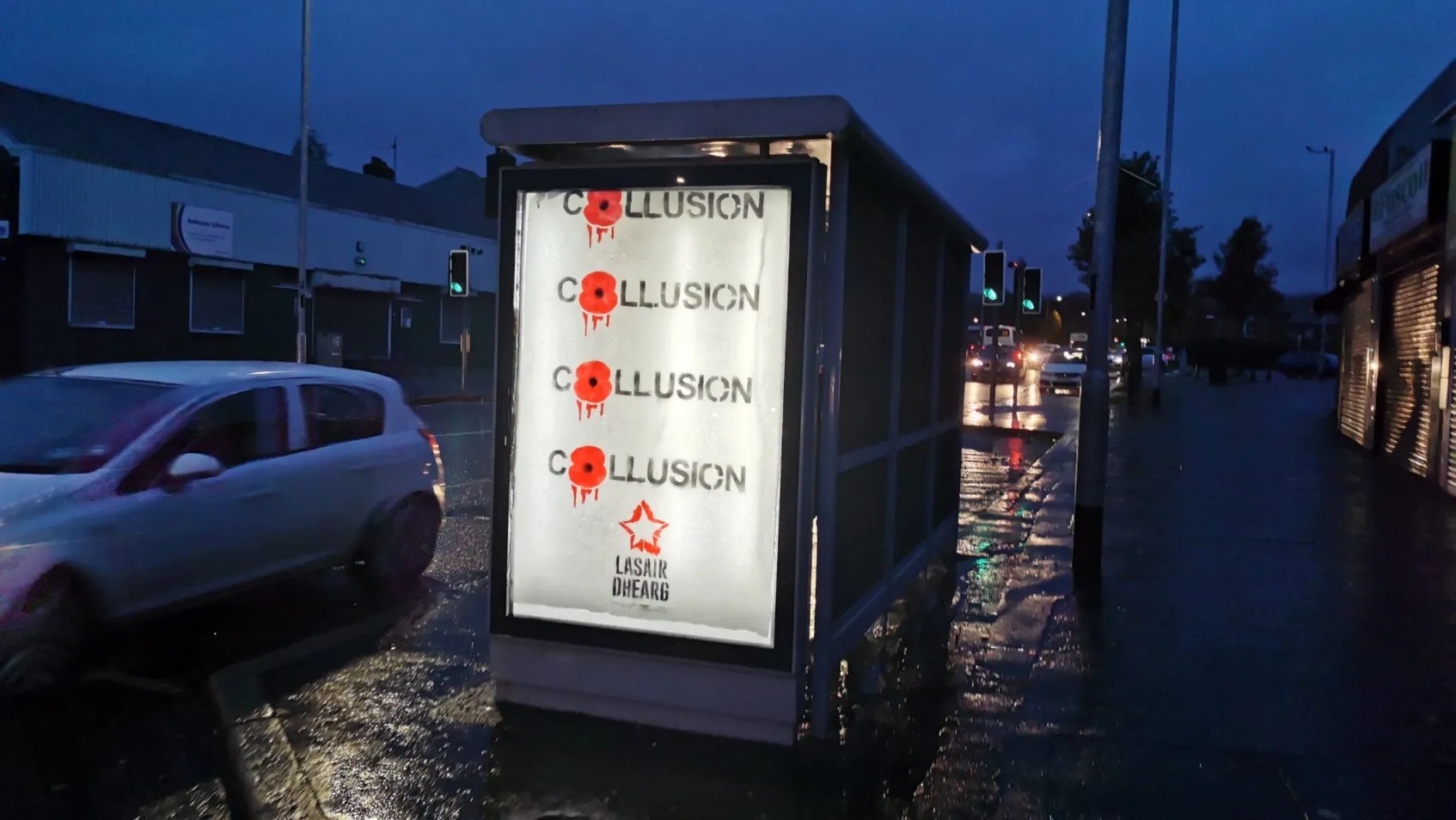
An innovative protest by the socialist Republican group Lasair Dhearg which however confines itself to pointing to the occupying British Army’s collusion with Loyalist murder gangs. (Photo sourced: Internet)

Commemorating the truth about imperialist wars past and present mean rejecting the wearing of the Poppy symbol. The Poppy is not about commemorating the dead in wars, as it is sold. This promotional emblem of the British Legion only commemorates the British soldiers who have been killed in wars – it does not commemorate all the soldiers of the colonies (for example Ireland) or the Commonwealth who died in the wars, not to mention all the civilian auxiliaries helping cook, clean, carry, dig, build etc for the British armed forces. The Poppy does not commemorate the dead soldiers of Britain’s allies, for example France, USA or Russia in the case of WWI. It does not commemorate the soldiers or auxiliaries of the hostile states who were killed, which might seem natural, until we ask ourselves why not, if the idea really is just to commemorate the dead soldiers in war. Most tellingly, the Poppy does not commemorate the millions of civilians who have been killed in wars – actually more than the total number of soldiers and a percentage of war deaths that is growing with every war.

The real role of the Poppy is to build social support for the imperialist British armed forces, including helping recruitment — so in other words, the emblem and its publicity is actually helping to build support for future armed conflicts.

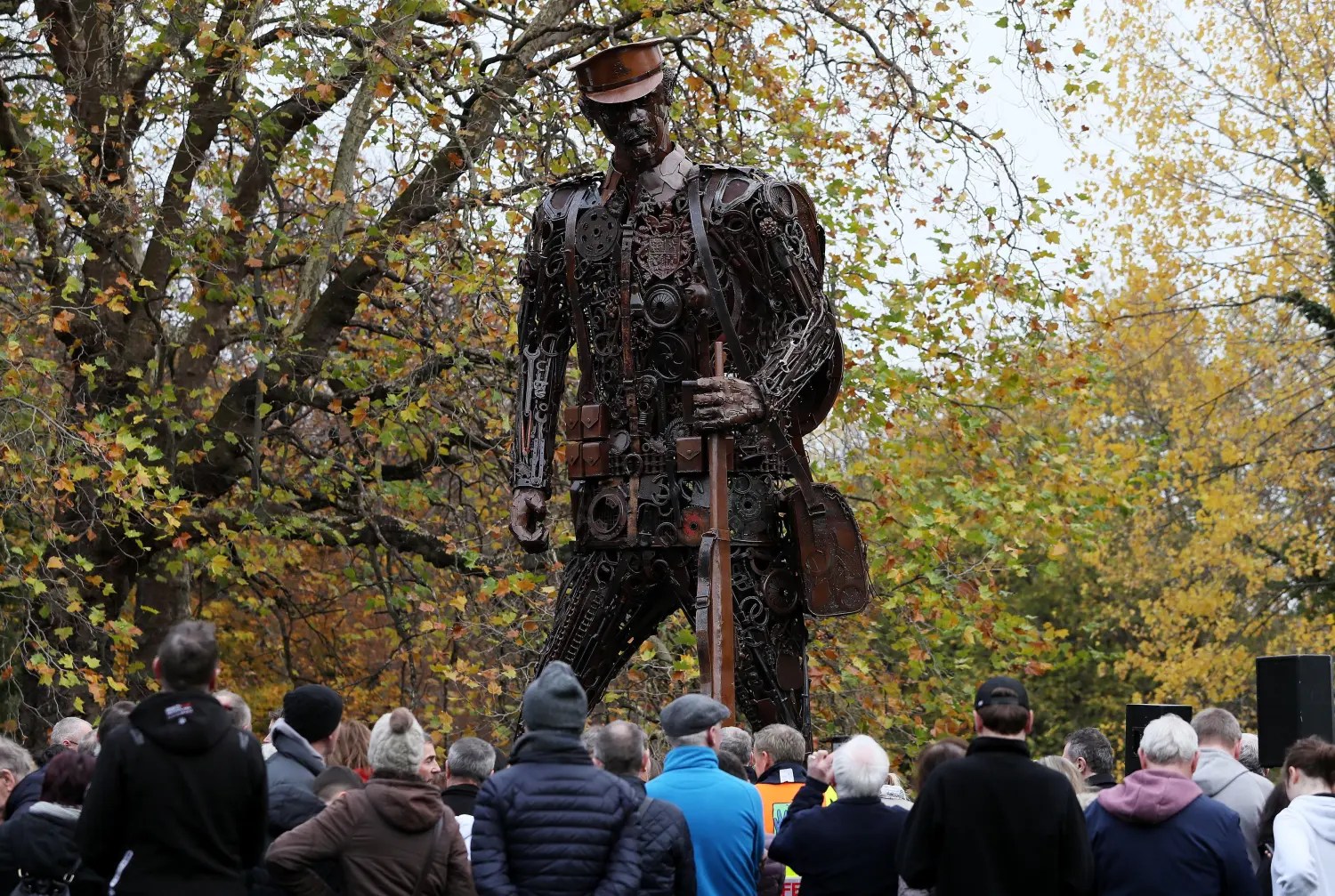
The WWI soldier sculpture made from scrap metal, pictured in Stephens Green, Dublin. Republicans protested its siting in a 1916 battleground, (Photo sourced: Internet)

Not addressing the nature of imperialist war and just boycotting any idea of commemoration leads to missed opportunities. A few years ago a sculpture of a WW1 British soldier constructed out of scrap metal was installed in Stephen’s Green, a recreational park in Dublin’s city centre. Some Irish Republicans staged a protest around it in which they castigated it being located there in what had been a 1916 Rising battleground. They were correct in the historical reference but was that all that could be said about that war? Would most of the tourists passing by relate to that 1916 reference or would the whole international horror of imperialist war not have engaged them more?

A small protest emphasising the nature of WWI commemorations at one such attended by SF representatives (the commemoration) in the Irish National (sic) War Memorial Gardens 10th July 2021 (Photo: RTÉ)

We should indeed commemorate WWI but we should do it in the framework laid out, of exposing what the wars are about, who they benefit, what class contains the main victims – and not just the dead but also the injured, many of them crippled for life.

That is not how the ruling elites commemorate war and it is not how Michelle O’Neill and Tina Black did it. Michelle O’Neill said that she did this symbolic act in order to demonstrate that she is going to be “a First Minister for everyone” – clearly meaning Nationalist and Unionist. Liberals may laud O’Neill for that but one cannot represent national liberation simultaneously with colonialism, republicanism at the same time as loyalism, democracy at the same time as reactionary sectarianism. Making a war wreath green does not change its nature. Sinn Féin will often seem to try to present themselves as all things to different groups of people but essentially they are serving Irish Gombeenism2 in the 26 Counties and English colonialism in the Six.

Sinn Féin members Tina Black and First Minister-in-waiting Michelle O’Neill as they approach the WWI memorial in Belfast to lay a wreath. (Photo sourced: Internet)

In addition, workers and lower middle-class people from the Protestant or Unionist community were also killed and maimed in imperialist war. How does concealing the reality of war help those people?

End.

FOOTNOTES

1I use the term in the sense that not all nationalism is reactionary.

2Native Irish foreign-dependent capitalism

“WOLFE TONE IS COMING BACK!” — BODENSTOWN 2022

Clive Sulish

(Reading time: mins.)

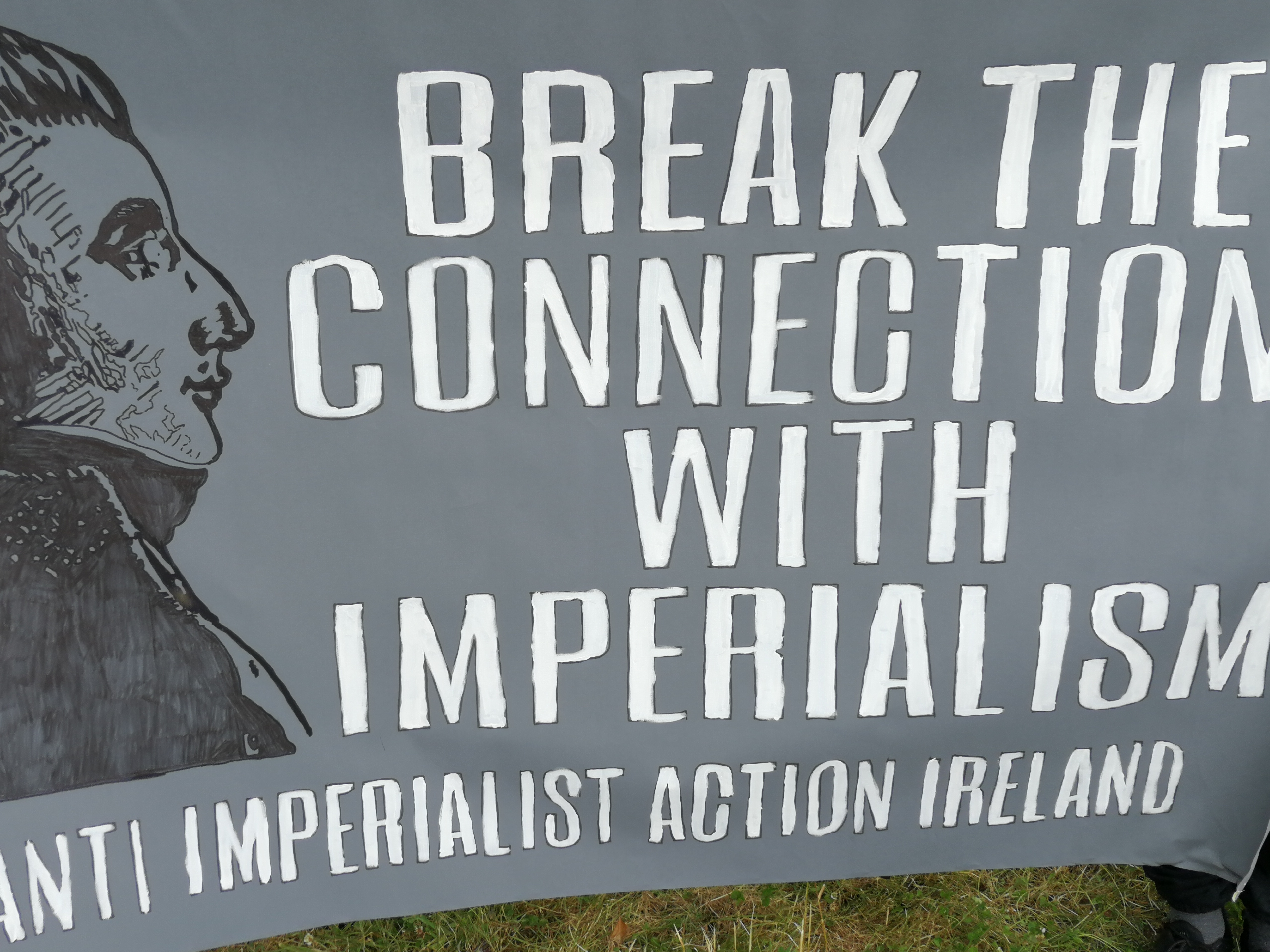
The “father of Irish Republicanism”, Theobald Wolfe Tone was honoured on Sunday afternoon at the Irish patriot’s final resting place, in Bodenstown churchyard in Co. Kildare, a place of annual pilgrimage for Irish Republicans. Irish Socialist Republicans and Anti-Imperialist Action Ireland convened the event including speakers, musicians, singers and colour party, in which the speeches drew on the past to comment on the present and on the future.

Colour Party flags against those permanently maintained there at the monument by the NGA. (Photo: Rebel Breeze)

WOLFE TONE AND THE RISINGS OF 1798

Theobald Wolfe Tone and others sought the extension of political participation from the Anglicans in Ireland to the Dissenters, i.e non-Anglican Protestants in addition to the Catholics. When efforts in this direction failed1 towards the end of the 18th Century he and others formed the United Irishmen. This was a secret revolutionary organisation, with a democratic, non-sectarian ideology, seeking assistance from republican France to rise against English control of Ireland.

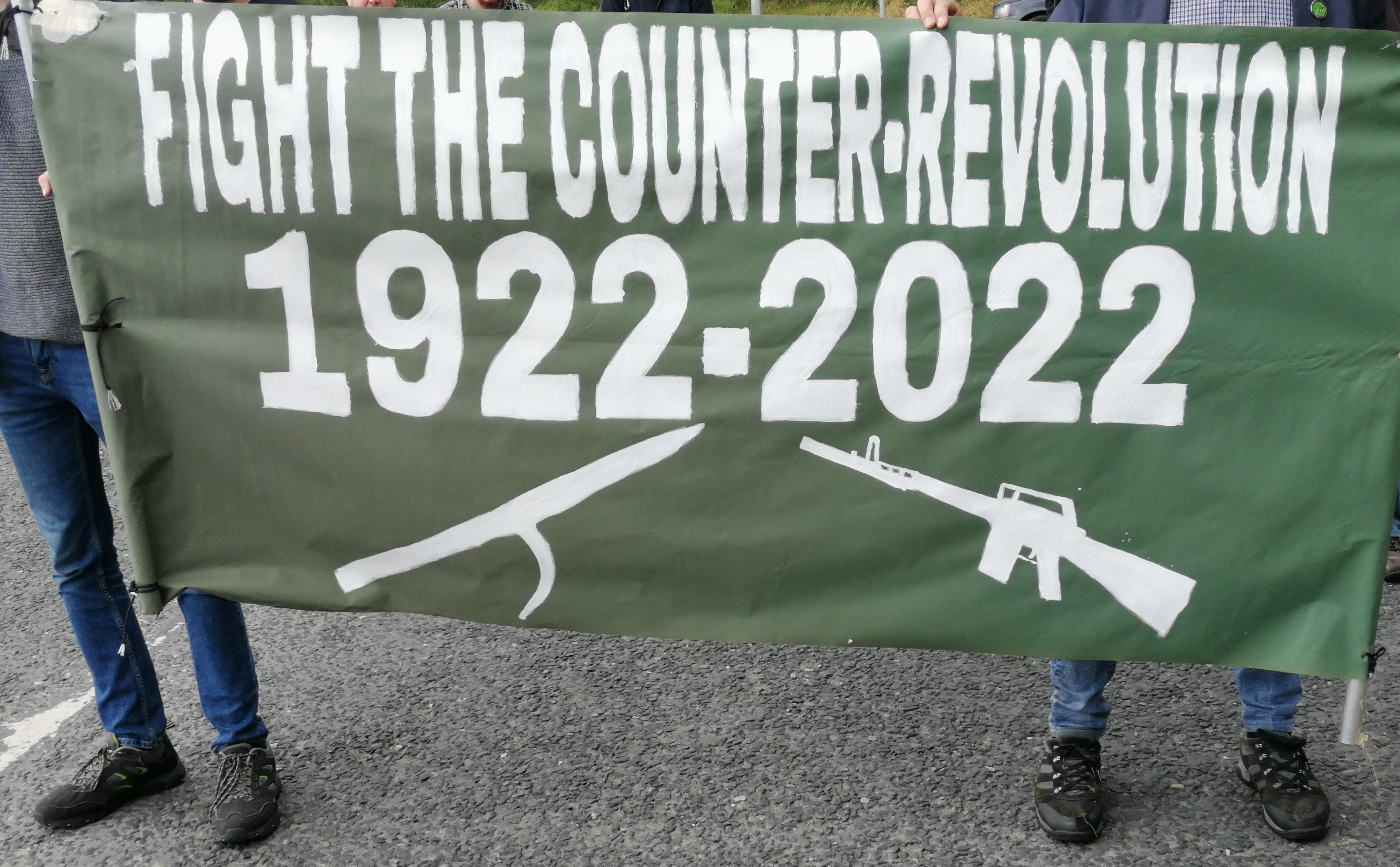
One of the banners carried on the march and at the rally (Photo: Rebel Breeze)

The English authorities occupying Ireland harried the Republican communities (including hanging some individuals), pushing them into uprising in 1798 when they were in some disarray, particularly after the arrest of most of the Leinster Directorate of the United Irishmen in Bridge Street, Dublin. The French ship in which Tone was being brought back to Ireland was captured by an English naval vessel and though Tone was in French Army uniform he was recognised, tried and sentenced to public hanging but apparently cheated the hangman by cutting his own throat, though he died slowly and painfully.

The initial engagements in Wexford and Antrim were successful for the insurgents but Wexford was soon left as the only area in which they had control of most of the county. A small French invasion force arrived too late in Mayo and though again initially successful, the combined French-Irish force was soon surrounded and defeated.

Tone’s body was brought to the small churchyard in Bodenstown and buried there; Young Irelanders leader Thomas Davis later wrote about his own pilgrimage there and composed the “In Bodenstown Churyard” song; since then the annual pilgrimage there has become an important point on the Irish Republican calendar and, at the high point of support for the Republican movement in the latter half of the last century, attended by thousands.

THE BODENSTOWN EVENT

Colour party leads off on the march to the Churchyard (Photo: Rebel Breeze)
One of the banners at the event (Photo: Rebel Breeze)

SPEAKERS

The rally was preceded by a small march led by a colour party to approach the cemetery, where it was joined by others to march into the cemetery. Opening the event, the MC welcomed everyone in Irish before continuing to speak in English, putting the event in its context of history since the late 18th Century onwards up to the present, referencing recent activity of supporters of the ISR, AIAI and the Revolutionary Housing League before going on to introduce the next speaker.

(Photo: Rebel Breeze)
Peter Rogers speaking seen from a distance (Photo: Rebel Breeze)

Irish historian Peter Rogers recounted briskly a list of prominent Republican speakers who had taken part in Wolfe Tone commemorations down through the decades (some later martyred). Rogers spoke about the importance of the tradition and its relevance today as in the past and also spoke of his own participation as a young man at such commemorations in the past. Among those who had spoken at the monument, Rogers mentioned James Connolly, Patrick Pearse and Liam Mellows.

Seán Doyle, member of the Irish Socialist Republicans/ AIAI and a housing activist spoke about what the capitalist system is doing to the people in Ireland, particularly in the housing crisis, with deaths on the streets while houses lie empty, along with long-time harm being suffered by the victims in physical and mental health, including suicides.

Sean Doyle speaking at the event (Photo: Rebel Breeze)

Doyle stated that any system of law or property that justifies that kind of situation must be done away with, that the health of society over-trumps the property rights of the few and encouraged those who agreed with that to join the Revolutionary Housing League.

The MC noted the importance of internationalism in Irish Republican history including that of the United Irishmen2 and noted the presence of Basque and Palestinian flags before calling forward a recent supporter of the ISR/ AIAI activities from Turkey.

The man was not easy to understand but the gist seemed to be the different ways in which resistance expressed itself apart from armed resistance. The Turkish speaker listed among those the celebration of historical memory, the retention of language, the combatting of fear.

The final speaker was a housing activist and urban geographer who has been doing some research into past housing struggles in Ireland, particularly alluding to past actions in Dublin which CATU (Community Action Tenants’ Union) is researching currently. Republicans had taken part in these and initiated many of them but he felt they did not get the credit they deserved. The speaker mentioned also the 1970s tenant rent strike movement in against Dublin City Council, which is hardly ever mentioned, in effect a mass movement. The speaker maintained that we need to understand the different categories of empty houses so that we can understand the causes and address them but ultimately the cause is the capitalist system. The speaker called for resistance and support for CATU and for such initiatives as James Connolly House.3

Urban geographer speaking on housing within the Irish capitalist system (Photo: Rebel Breeze)

CULTURAL PART OF THE PROGRAM

Music and lyrics are an important part of the Irish Republican tradition, the MC commented, before calling up singers to perform at intervals between speakers. Seán Óg accompanied himself on guitar singing the Irish Republican ballads Tone Is Coming Back Again and Soldiers of ‘22. The latter song was one of a number of references by speakers to the counterrevolution of 1922-1924, more usually referred to as the Civil War. The MC commented that the Tone Is Coming Back4 song is rarely heard these days and Soldiers of ‘225 not often enough.

Diarmuid Breatnach preceded his singing of The Plane Crash at Los Gatos (sometimes known as Deportees) by saying that the victims of imperialism are often civilian refugees fleeing repression, or migrants fleeing famine or simple poverty (as we Irish had done), these most vulnerable sections of society then being targeted by racists and fascists. Mexican seasonal labourers hired to bring in the fruit harvests are often hunted if they remain in the USA. In 1948 a USA plane delivering deported labourers to Mexico crashed with everyone on board killed. However the radio news only gave the names of the USA citizen crew and Woody Guthrie composed the song about the incident. Breatnach also mentioned the deaths of trafficked Latin American migrants more recently in the USA and those killed in Morocco while trying to get into the nearby Spanish colony, numbers similar to some recent deaths in the war in Ukraine which become front page news while the migrant deaths may not reach anywhere near there.

Coiste na mBan of the AIAI banner at the event (Photo: Rebel Breeze)

The MC, drawing the event to a close, commented that more people had attended the event this year than last but more were still needed to mobilise. He gave his thanks to the colour party, also larger this year and including people who were new to the role, commenting that five counties were represented there. Some of them are women and the MC mentioned as a progressive development the formation of Coiste na mBan (Women’s Committee) within the Anti-Imperialist Action Ireland organisation.

The event concluded with thanks to all present from the MC, also to the National Graves Association6 and the singing of Amhrán bhFiann.

Section of the rally in Bodenstown Churchyard seen from behind (Photo: Rebel Breeze)

End.

FOOTNOTES

1The English Crown was opposed and rallied opposition to the move among the MPs but self-interest also played a part, in that some landowners feared that power given to the pre-settler indigenous might result in their lands being repossessed.

2The United Irishman had strong links with Republicans in France and in the USA but also with the United Englishmen and United Scotsmen in which the Irish diaspora was active. Irish Republicans had also had links with the movement for liberation from Spanish rule in Latin America in the mid-19th Century and with the Basques and Catalans in the early 20th.

3James Connolly House was the revolutionary re-naming title of a building leased by the Salvation Army on Eden Quay, Dublin, left empty for nearly two years in the midst of a homelessness crisis. Earlier this year it was occupied by activists of the ISR-related Revolutionary Workers’ Union for some weeks before a court-authorised eviction of over 80 gardaí to remove two activists a couple of weeks earlier.

4A song which was part of the ’98 Cantata written in celebration of the hundredth anniversary of the Rising. The cycle contained ten songs and was revived again in 1948 on the 150th anniversary. Thomas Francis Mullan was born near Ardmore, Co. Derry in 1860. He taught in Derry and later became headmaster of Faughanvale PES. He collaborated with a Derry music teacher, Edward Conaghan, in the writing of a ’98 Cantata devised to commemorate the centenary of the Rising. He died in 1937.

5Some online sources claim the author is unknown while others give Brian Ó hUigínn as the author, which seems likely.

6The NGA is a voluntary organisation independent of any political party and of the State, from which it seeks no funding; it is the major organisation caring for graves and memorials of the struggle for Irish freedom and has the responsibility of caring for the Tone memorial, which it has renovated in the past to facilitate commemoration events.

USEFUL LINKS

Revolutionary Housing League: https://www.facebook.com/groups/1062927280980792

Rent strike Dublin Council tenants: https://dublininquirer.com/2022/06/22/fifty-years-on-a-tenants-union-is-putting-together-a-history-of-the-1972-rent-strike

“Civil War to Avert a Workers’ Republic” – Peadar O’Donnell Forum talk in Dublin

Diarmuid Breatnach

(Reading time: 2 mins.)

Historians and political activists gave talks in Dublin presenting a review of the conduct of what is more usually called the Irish Civil and its effect since on life in Ireland. All the speakers described that conflict as “a counterrevolution”, to overturn many of the gains made in the period of struggle immediately before it and to head off any possibility of yet further gains in Irish political, economical and social life, having a braking effect on such progress up to this very moment.

Liz Gillis speaking (Photo: D.Breatnach)
L-R: Fearghal Mac Bloscaidh, Mags Glennon, Ciaran Perry (Photo: D.Breatnach)

BACKGROUND

The event on 26th June, held in the function room of The Cobblestone, was organised by the Peadar O’Donnell Socialist Republican Forum, itself established in early 2013, the result of a number of meetings and seminars organised over the course of 2012. It combined communists and socialist Republicans to organise discussions on a number of issues, such as Irish state neutrality, Irish national independence, working-class programs in struggle etc.

(Photo: D.Breatnach)

SPEAKERS

Ciaran Perry, a socialist Republican and Independent Dublin City Councillor, also a local history activist, introduced the event. He talked about the importance of history and in particular local history, the traditions of struggle and how some of those had been weakened in the trade unions and communities over the years.

Reading the account of the Ballysheedy Massacre (Photo: D.Breatnach)

Perry introduced the MC for the meeting, Mags Glennon who is also a socialist Republican activist and history enthusiast.

Glennon introduced historian Fearghal MacBhloscaidh from Tyrone who began in Irish and then continued in English, his presentation laying out clearly his position that the Civil War was a planned counterrevolution, quoting Cabinet papers and correspondence and supplying figures on the arms and equipment supplied to the Free State ruling elite by the British. MacBhloscaidh also maintained that the De Valera Government, though supported by the wider Republican movement at the time, was also a counterrevolutionary measure when subjected to a class analysis.

Sorry, slightly out of focus Jimmy Doran (Photo: D.Breatnach)

A woman (whose name I did not catch) was called to stage. In a clear voice she read an account of of the horrific Ballyseedy Massacre. Free State soldiers, after torturing their Republican prisoners, brought nine of them out to a road barricade, in which they had placed a landmine which they exploded. One survived by some miracle but spent the rest of his life needing frequent medical intervention.

At intervals between speakers, Pól MacAdaim performed his music, singing accompanied by guitar. Among the songs he sang were Tipperary So Far Away and Take It Down From the Mast (in the chorus of which some members of the audience could be heard joining).

Pól Mac Adaim performing at the event (Photo: D.Breatnach)

Mags Glennon then introduced historian Liz Gillis from Dublin who talked about the reaction of women to the Treaty and to the Civil War. The vast majority of Cumann na mBan members rejected the Treaty and many actively supported the Republicans in the following conflict. Gillis also spoke about how the women, who had been active in the struggle in 1916 and briefly to the fore in public life with the elections of 1918 and the War of Independence, were driven back to almost invisibility by the Free State Government and also the De Valera government and the 1937 Constitution. Gillis lauded Kathleen Clarke whom she said continued to fight the struggle for the rights of women in representational politics and criticised the De Valera Constitution of 1937.

Mags next introduced Jimmy Doran, a communist and long-time trade union activist, who talked about the contribution of the organised Irish workers to the struggle against British colonialism and for the advance of the working class. Doran went on to comment on the trade unions’ history and current situation in the Irish state. I had to go to the toilet and when I returned stayed near the entrance so as not to distract the audience by retaking my seat near the front and unfortunately, due to the lack of a PA system and the acoustics of that location, I was unable to hear the rest of his presentation.

Poster for the event.
Supporters and organisers (Photo: D.Breatnach)

Although the meeting was thrown open to questions or contributions, little was forthcoming although there was a short debate on whether the Irish bourgeoisie prepare well into the future and whether they prepare better than their opponents in the Republican movement.

The proceedings ended with announcements of forthcoming events, thanks from Mags to the speakers, audience and to Pol Mac Adaim who ended the day on a musical note.

End.

Upcoming events:

USEFUL LINKS

https://www.facebook.com/people/Peadar-ODonnell-Socialist-Republican-Forum/100057585515589/

https://www.facebook.com/profile.php?id=100057585515589

Ciaran Perry: https://cieranperry.ie/

Fearghal Mac Bhloscaidh blog: https://blosc.wordpress.com/

Pol Mac Adaim: https://www.antiwarsongs.org/artista.php?id=9761&lang=en&rif=1#:~:text=Pol%20MacAdaim%20is%2038%20years,%2C%20Rock%2C%20Soul%20and%20Contemporary.

Ballyseedy massacre: https://stairnaheireann.net/2016/03/10/what-really-happened-at-ballyseedy/

Liz Gillis: https://www.champlain.edu/academics/champlain-abroad/champlain-abroad-dublin/faculty-and-staff-dublin/gillis-liz

Jimmy Doran: https://www.peoplesworld.org/authors/jimmy-doran/

FREE STATE SHELLING OF THE FOUR COURTS COMMEMORATED IN DUBLIN

Diarmuid Breatnach

(Reading time: 3 mins.)

A crowd gathered in Dublin today to commemorate the Free State opening fire on the Four Courts on 28th June 1922, an event that began what is usually called “the Civil War” which lasted until 1923 (with State assassinations until 1924). The UK supplied the cannons and shells used by the Free State’s “National Army” along with munitions, including small arms and ammunition, armoured cars, army lorries and even coastal naval vessels. The conflict has also been called a “counterrevolution” and “the UK’s proxy war” with more Republicans executed by the new Irish State1 in that conflict than had been by the British State over the whole 1916-1921 period.

Section of NGA march outside Croppies’ Acre (Photo sourced: Internet)

One hundred years ago this month, the IRA under the command of Rory O’Connor occupied and fortified the Four Courts complex, last occupied as a fighting post during the 1916 Rising. The Anglo-Irish Treaty partitioning the country and giving the Free State the status of a Dominion country had been narrowly accepted by the delegates to the First Dáil, the Irish Parliament previously banned by the UK State. However by far the majority of the military part of the Irish resistance – the IRA, Cumann na mBan and na Fianna, along with the remnants of the Irish Citizen Army – were opposed to the Treaty. The occupation of the Four Courts was seen by the Free State government as a challenge to its authority and by the British Government as a threat of anti-colonial struggle being renewed. Both parties were hostile to any radical republican, socialist or socialist-republican program.

Free State Army attacking the Republican garrison of the Four Courts with artillery, rifle and machine-gun fire. (Photo sourced: Internet)

On 28th June the Free State opened fire from British cannon on the Four Courts from Bridge Street on the south side of the river and the Civil War – or Counterrevolution – had begun. By the time the Republicans conceded defeat (and some assassinations continued even after it officially ended) perhaps around 1,300 had been killed. From January 1922 to April 1924, according to the Republican Roll of Honour, 426 anti-Treaty Volunteers had been killed, some 25 of these died fighting British and Northern Irish forces. Most anti-Treaty dead were IRA Volunteers, but some were Na Fianna members and four were women of Cumann na mBan2.

Poster commemorating one of the Republicans killed by the Free State (Photo: D.Breatnach)
One of the commemorative posters attached to lampposts (Photo: D.Breatnach)

On the Free State side just under 800 died, of whom 488 fell in enemy action, others due to accidents or illness, while seven were executed having deserted to the Republican side. “To this total should be added a small number of police, including four from the Civic Guard (later renamed Garda Síochána), four from the Criminal Investigation Department and two from the Citizens’ Defence Force, who were killed from 1922-19243.”

The NGA rally, the MC (Photo: D.Breatnach)
View of the crowd at the rally outside the Four Courts (Photo: D.Breatnach)

Dorney remarks on omissions in the Last Post record and concludes: “Even allowing for this, though, the total of anti-Treaty IRA dead in the Civil War is not likely to be much more than about 500, of whom 81 died before Free State firing squads and more than 100 were summarily executed in reprisals.”

(Photo: D.Breatnach)

Many Irish Republicans also emigrated to avoid repression or because they were being denied employment.

The Irish State today is a direct descendant, legally and in other ways, of the Free State of 1922 and all periods since.

Senior Garda officer taking notes while speakers are addressing the crowd (Photo: D.Breatnach)

The commemorative event in Dublin today was organised by the National Graves Association (Cumann Uaigheanna na Laochra Gael), an organisation which since its founding in 1926 has been maintaining the graves of Irish patriots, arranging for the installation of gravestones, plaques and monuments and also organising commemorative events.

Before marching to the Four Courts, participants formed up in groups in the road outside Croppies’ Acre, a public park over a mass grave of victims of the English state’s repression of the United Irishmen and their supporters in 1798, now across the road from the Collins Barracks National Museum. They were led by a lone piper and colour party, followed by people in double ranks flying Starry Plough flags and carrying banners of history and conservation groups, along with some other flags, including that of Cumann na mBan.

Section of the lineup waiting to start, outside Croppies’ Acre (Photo: D.Breatnach)

At the rally outside the Liffeyside of the Four Courts, the organisers had an MC with number of speakers to read out the 1922 Proclamation, the lyrics of The Soldiers of Twenty-Two4 and Tim Horgan to give a keynote oration. At least one floral wreath was laid in honour of those who fought there and a number of posters attached to lampposts commemorated the three Volunteers who were fatally wounded there: Thomas Wall, Joe Considine and Sean Cusack.

Reading the lyrics of Soldiers of Twenty-Two (Photo sourced: D.Breatnach)

It is almost certainly the case that it is the NGA which has erected the majority of patriotic struggle commemorative plaques around the country, with most of the remainder being organised by local authorities, local history groups and old comrades’ associations – a very small proportion being the work of the State. As stated on its website, the objectives of the Association have always been: to restore, where necessary, and maintain fittingly the graves and memorials of our patriot dead from every generation; to commemorate those who died in the cause of Irish freedom; to compile a record of such graves and memorials.

The NGA’s general alignment is unequivocal: “Only a 32 County Irish Republic represents the true aspiration of those who gave their lives for Irish freedom.5

Reading the 1922 Proclamation (Photo: D.Breatnach)

One might assume that every participant at the event today was of a definite political bent, yet not a single party or political organisation banner was to be seen on the march or at the rally. This is because participants were asked in advance not to bring any banners or placards of political organisational allegiance. As the Chairperson of the rally informed the audience, the NGA is not affiliated to any political party or organisation and furthermore does not accept contributions from any such nor from the State – in order to continue to guarantee the NGA’s independence. In fact, members of its governing body are not even permitted to belong to a political party. A senior Garda officer however, of least at Inspector rank, took down details in his notebook as the rally was addressed by speakers.

Main speaker, Tim Horgan (Photo: D.Breatnach)

Patriots of the United Irishmen, the Young Irelanders, the Fenians, the Land League, na Fianna Éireann, Irish Volunteers, Cumann na mBan, IRA, Official and Provisional IRA, the Irish National Liberation Army etc have all been commemorated by the NGA. According to Wikipedia, since its founding, the NGA has erected, or accepted into its care, over 500 monuments and memorials throughout Ireland.

One of the participants takes a rest
Banner of one of the groups attending (Photo: D.Breatnach)
Some of those in attendance (Photo: D.Breatnach)

A number of other Civil War/ Counterrevolution commemorative and discussion events will be taking place at least during this year, two of which will take place next week (see photos of leaflet).

The Gardaí remained at the scene as people dispersed. Passing by again shortly afterwards, we found the floral wreath had been removed.

End.

Lowering of the flags in honour of the martyrs (Photo: D.Breatnach)
Civil War/ Counterrevolution commemoration (image: photograph of flyer)

Forthcoming talk (image: photograph of flyer)

FOOTNOTES

1Official executions are usually listed as 81 or 83, these having been subjected to some kind of military judicial process (but without any jury). However, apart from IRA fighters killed in battle, a number of captured combatants were murdered (such as those of the Ballyseedy Massacre on March 7th 1923) while known activists were assassinated by Garda-Army squads operating from Oriel House. Often, the murdered had been tortured first.

2 The Republican Roll of Honour, The Last Post.

3 https://www.irishtimes.com/culture/heritage/what-was-the-real-death-toll-of-the-irish-civil-war-1.4858308

4https://www.youtube.com/watch?v=RKOSCuLtlAY for a rendition of this song. It author seems unknown.

5From Wikipedia entry

USEFUL LINKS

https://www.facebook.com/NationalGravesAssociation

http://www.nga.ie/

https://en.wikipedia.org/wiki/National_Graves_Association

Ballyseedy Massacre: https://www.irishtimes.com/culture/heritage/stories-of-the-revolution-ballyseedy-and-the-civil-war-s-worst-atrocity-1.2462070

Varadkar admitted those killed without trial had been murdered: https://www.thejournal.ie/free-state-executions-4387452-Dec2018/

Death toll: https://www.irishtimes.com/culture/heritage/what-was-the-real-death-toll-of-the-irish-civil-war-1.4858308

TRADITIONAL & UNESCO FESTIVAL CHANTS FOR CATALAN INDEPENDENCE

Diarmuid Breatnach

(Reading time: 2 mins.)

This year’s celebration of the Patum 2022 festival in Berga has sung and chanted for independence. With the square full of about 6,000 people on Thursday, the massive Catalan independence flag, the Estelada (with the white star in a blue triangle)1 was launched across the crowd as they sang the Catalan national anthem, Els Segadors2 (the Reapers).

With the song finished, some began to shout “independencia” (independence) and this was quickly taken up by the mass, revisiting the tradition of protest that existed before the pandemic. The Catalan independence movement has been somewhat becalmed of late, with serious divisions between the two main nationalist political parties and a lack of grass-roots activity.

Scene with traditional giant figures from the festival (Photo sourced: Internet)

The Patum festival is a traditional Catalan festival of great importance and is recognised by UNESCO as a Masterpiece of the Oral and Intangible Heritage of Humanity. “The fiesta coincides with Corpus Christi and includes a whole series of theatrical representations, characters and figures that fill the town of Berga every spring. It is a religious commemoration that dates back to the Middle Ages, which has managed to preserve both its religious and profane roots.

“La Patum de Berga has been held annually for centuries during Corpus Christi, and includes street entertainment and shows with different figures typical of these fiestas (giants, “big-heads”, eagles, guitas (dragons), plens (devils)). Fire and dance play a central role. The fiesta really gets underway on the Thursday of Corpus Christi, with the Ceremonial Patum. The salto de plens is the apotheosis of the fiesta. It represents an infernal orgy where fire devils jump to the rhythm of music. The following day is the Children’s Patum.”3

Scene with the giant Catalan independence flag during the singing and chanting at the festival on Thursday (Photo sourced: Internet)

Berga is in the Barcelona region but over 107km from the city (and about half-way to Andorra). The Patum Festival of this year 2022, which began Wednesday, June 15 and will last until Sunday, June 19, was expected to be even more crowded than usual after two years in a row without being able to celebrate it due to the pandemic.

end.

Video of the singing, chanting and the huge flag (you have to view this on Facebook; strangely I couldn’t find one on Youtube): https://www.facebook.com/salva.mateu/videos/966147484078737

FOOTNOTES

1The other Catalan nationalist flag commonly seen is the Vermelha, with a red star and no blue. The white X on a black background is also flown but more rarely, it draws on history also and signifies ‘death before surrender’.

2An anarchist, Emili Guanyavents won the competition to compose the national anthem lyrics in 1899 and based it upon a traditional historical cultural expression arising out of an uprising of Catalan rural workers in 1640 against the chief minister of Philip IV of Spain. The lyrics are, as might be expected, very militant and, since even the Catalan lanugage was banned, the song was of course banned during the four decades of the Spanish Franco dictatorship

3https://www.spain.info/en/calendar/fiesta-patum-berga/

SOURCES

https://www.spain.info/en/calendar/fiesta-patum-berga/

https://en.wikipedia.org/wiki/Els_Segadors

PICKET PROTESTS ONGOING INTERNMENT WITHOUT TRIAL AND EXTRADITION OF IRISH REPUBLICANS

The Dublin Committee of the Anti-Internment Group of Ireland held a picket yesterday to highlight the ongoing internment without trial of Irish Republicans and to protest the recent extradition of Liam Campbell to Lithuania, a country to which he has never been. The picket was held in Temple Bar, a tourist quarter of the Dublin’s south city centre.

(Photo source: Anti-Internment Group of Ireland)

Afterwards, the AIGI issued the following report (reposted with kind permission): “Tourists, Irish shoppers and young people socialising in Dublin city centre were interested to see the banners and placards against internment in Ireland, along with a banner against extradition of Irish Republicans. They also noted the various placards of the Anti-Internment Group of Ireland and the flags of Palestine and the Basque Country, in addition to the Starry Plough flag of the Irish Citizen Army, representing three of the many nations holding political prisoners.

(Photo source: Anti-Internment Group of Ireland)

Supporters distributed up to 200 leaflets and had a number of engagements with people wanting to know more. People were surprised and angry to learn that internment under another name continues in Ireland on both sides of the British Border.

A portable PA machine played resistance music and an AIGI speech from a previous public event which attracted some interest.

(Photo source: Anti-Internment Group of Ireland)

The AIGI’s Facebook page lists approximately 60 political prisoners held in Ireland, mostly in Portlaoise Prison in the Irish state and Maghaberry Jail in the British colony in the north-east of the country. All of those were convicted in special no-jury courts created for the purpose of sentencing political prisoners — i.e nearly always exclusively Irish Republicans. Frequently some charged and facing trial in those special courts are denied bail and are held in custody until their trial comes up, two or three years later and if then chance to be found ‘not guilty’, they will still have spent that time in jail. When granted bail on the other hand it is always under restrictive conditions that prevent them continuing their political activity: e.g night curfew, wearing an electronic tag, banned from attending political activities, etc.

Liam Campbell, an Irish Republican from Dundalk, Co. Louth, was extradited to Lithuania last week to face charges relating to trying to obtain arms in that country. Campbell says that he has never been in that country, which Lithuania and the Irish State both seem to accept yet, after a legal battle of almost 12 years up to the Irish Supreme Court, the Irish Republican was extradited. According to unconfirmed reports Campbell has been granted bail in Lithuania but under what conditions is currently unknown.

The group campaigning against what it sees as ongoing “internment by different names” developed from the campaign to free Marian Price around six years ago and, apart from monthly pickets, has also organised conferences and concerts and representatives have travelled to Belfast, Cork, Derry, Newry and Glasgow. The group has sent messages of solidarity to a Basque liberation group which was read out at the latter’s public event and also to the Mumia Al Jamal and Leonard Peltier campaigns in the USA, Munir Farooghi campaign in England (for which AIGI spoke at public meetings in Ireland), to prisoners in Turkey, Palestine and Latin America. Its street pickets, though legal, have frequently been subject to police harassment on both sides of the British Border — in the Irish state nearly exclusively by the plain-clothes political police, the Special Branch.

The picket yesterday in Temple Bar, view southward towards the Liffey River. (Photo source: Anti-Internment Group of Ireland)

The AIGI report concluded: The Anti-Internment Group of Ireland is a democratic group independent of any political party or organisation that holds monthly awareness-raising pickets, as well as a few special public events every year. It is organised by a democratic committee composed of people who attend our pickets and who would like to become involved in running the group.

NÍ NEART GO CUR LE CHÉILE. AN INJURY TO ONE IS AN INJURY TO ALL.

End.

Contact link for the Anti-Internment Group of Ireland: https://www.facebook.com/Anti-Internment-Group-Of-Ireland-581232915354743/

SIGNIFICANCE OF THE ISRAELI MURDER OF A JOURNALIST

Diarmuid Breatnach

(Reading time: 8 mins.)

On Wednesday (May 11th), a Palestinian journalist, Shireen Abu Akleh was shot dead by Israeli military with one shot to the head. At the time of her murder, she was wearing conflict protective clothing clearly marked “PRESS” but the bullet entered her head under the helmet. Ms. Abu Akleh’s murder has caused outrage around the world, which has been intensified by the Israeli military’s attack on mourners, even on the bearers of her coffin (one of whom has since died) and their attempt to blame the Palestinian resistance for killing the journalist.

(Credit photo: Ahmad Gharabi/ Getty)

WHY THE OUTRAGE THIS TIME, ABOUT THIS JOURNALIST?

Ms. Abu Akleh was a journalist of nearly 25 years’ experience, employed since 1997 by the Qhatari-based news agency Al Jazeera and her reports were familiar to millions in the Arab and wider Muslim world. She was with other journalists, one of whom was also shot but wounded in the back and is expected to recover, covering an Israeli Army raid into the refugee camp in Jenin in Palestine. Both Al Jazeera and Associated Press agencies insisted that the shooters were Israeli military and mapping on-the-spot investigation has discredited the Israeli version firstly that the killer was a Palestinian fighter and then latterly, that it might have been.

Shireen Abu Akleh lies dead or mortally wounded while her terrified colleague fears the same fate (Source: Internet)

“This is one person,” remarked a commentator, “ but hundreds are being killed in the Ukraine war!” Another commented that the Russians have shot journalists in the Ukraine.

Thousands and millions and thousands of millions of people are killed in wars and as a result of wars. Yes and in a way their very numbers makes that difficult to grasp. In the war in the Ukraine before the Russian invasion, 14,000 is the number of estimated dead. Since the invasion, 9,599–24,5991 civilians have been killed, such a wide disparity in estimates a reflection that the conflict is still ongoing and also of the propaganda battle being fought over almost every aspect of the conflict.

In Palestine, the conflict death toll began mostly from 1936 and rose to unknown numbers of Palestinians (due the huge expulsions and fleeing terror) in 1948 when the state of Israel was created, and between 2008 and 2020 alone the death toll is estimated at 5,8502, not counting of course this year and last, with another three added since Sunday, including Abu Akleh. The overall figure of Palestinian civilians killed between 1936 and 2020, with huge gaps where the numbers are unknown, is 2,816,410.3

All three of the latest of Israel’s victims (unless they’ve killed more before I finish writing and editing) were unarmed civilians. Unarmed civilians are the group most likely to be killed in war (10 million in WWI; 50–55 million in WWII, whilst 2,000,000 civilians is the estimate for the Vietnam War). Even though the killing of civilians is an automatic result of war, there are all kind of laws and conventions agreed by most states, including major warlike ones, against the deliberate killing of civilians. But it does seem as though some states have carte blanche in that regard, international law or not.

Israeli police attack funeral of Shireen Abu Akleh, including beating pall-bearers — one of the injured died later. (Photo credit: May Levin/ AP)

For many people, every killing of a Palestinian announced adds to that ongoing toll by Israel, year after year for nearly eight decades. That’s one important significance of the death of Shireen Abu Akleh – she comes to personalise, to give a face to the millions of victims of Israeli Zionism.

Another significance of this murder is that Abu Akleh is the most recent of at least 45 journalists killed by Israeli military since 2000 – that’s more than two per year. The UNESCO Observatory lists 22 journalists killed by Israeli military since 2002 and the case remains “unresolved” in 19 of Israel’s judicial investigation — with no investigation at all listed in two of them.

One of the nearly 50 journalists killed by the Israeli military since 2000 — Yasser Murtagh in 2018 (Photo: Reuters)

Raising the issue of Russian armed forces’ alleged deliberate killing of civilians and of reporters, whether true or not, just does not compare. The allegations might be true, of course — an invading army is likely to encounter opposition in the course of which some of its personnel may kill civilians by intention and without justification. Indeed, armies before now have killed even those of their own country, their own ethnic group. In the currently relentless onslaught of western commentary, often quoting Ukrainian or NATO sources without question, along with the banning of much alternative comment, it is — and will continue to be for some time – difficult to say which is true and which is not. But the two conflicts do not compare, neither in scale nor in length of existence, nor does the death toll of civilians including reporters.

WHATABOUTERY

When Russia invaded the Ukraine, anybody who raised the issue of Palestine with regard to the other conflict, e.g “what about the US/NATO support for Israel?” was accused of ‘whataboutery’. ‘Whataboutery’ is thought of as a device to distract from confronting the actual issues initially under discussion by introducing another different or tangential one.

Of course, people do such things and rational discussion is frequently undermined and even shattered by such practice. But, in this case, when US/NATO was saying that it was supporting the post-Maidan Ukrainian regime for reasons of democracy and self-determination, was it justified to point out its record of war and invasion in the Middle East and its support of Israeli Zionist aggression? It seems clear to me that it was but that would not in itself be proof that the Ukrainian regime was wrong. Was it right to point to the regime’s attacks on Russian-speakers and in particular on the Crimea and Donbas regions? It seems to me that it was, in that gave context to secessionist feeling in those areas to which the Russian regime could well want to give military support, whether that were for protection of ethnic kindred or for its own selfish reasons.

None of that “whataboutery” takes away from the tragedy of war in the Ukraine, of course not, but it is valid in considering motivation, given that the US, the leading power in NATO, is also the biggest supporter of the Zionist state and that the EU is not far behind. Palestine exposed that whatever the rights and wrongs in the conflict, NATO and the EU’s motives were not about justice and peace.

When international sporting and cultural organisations of the western capitalist world began to ban Russian teams and individuals from participation, were people justified in saying “Hey, what about Israel?” Surely they were, for that ongoing struggle in which Palestinian land has been ripped from the hands of its people, in which the latter are daily oppressed and from time to time massacred, in which they suffer military occupation, daily discrimination, ethnic cleansing, racism and apartheid – have they not been calling for decades for banning and boycotting Israeli and its sporting teams? And what was the response? They they were bringing politics into sport! And those who did show their solidarity in sports competitions were often penalised for doing so.

When states began to apply economic sanctions to Russia and to Russian individuals, were Palestinians and their supporters not justified in crying out “Hey, what about Israel?” Of course they were.

The strange thing is that those who accused others of “whataboutery” in the past for raising the issue of Palestine in the context of the war in the Ukraine have now begun to cry “what about the Ukraine?” in the context of the international outrage about the murder of Shireen Abu Akleh. Former critics of ‘whataboutery’ have themselves become ‘whatabouters’ now – and without even the shadow of the justification of their accused predecessors.

INTERNATIONAL’ OUTRAGE

It’s worth asking what we mean by “international” in the case of the outrage over the murder of Shireen Abu Akleh. That “international” includes a large part of the Arab world. It includes a large part of the non-Arab but Muslim word4. It includes a large part of the non-Arab, non-Muslim world in western Europe and in the USA and in many other parts too. Certainly the Irish public in general has empathised with the Palestinians for decades.5

But it does not include what the western media mean when they use the words “the international community” – the outrage does not encompass the ruling classes of the Western European countries, much less of the USA, nor even the ruling classes of much of the Arab and Muslim world. In this they are being to a degree, honest. Because those ruling classes have either supported the Israeli Zionists directly, or have supported the USA which keeps Israel alive. Only seven elected representatives of the USA’s Democratic Party – out of the 225 it has in the US Congress, quickly expressed condemnation of the killing and called for a quick and independent investigation. Not one of the 210 Republicans expressed condemnation at the time – even though Shireen Abu Akleh was a citizen of the USA!

Protest in Delhi at the Israeli murder of Shireen Abu Akleh — and clearly not by Muslims alone (Hindus and Sikhs seen here also). (Photo source: Internet)
Shireen Abu Akleh murder protest march passing through Grafton Street, Dublin, Ireland yesterday (Photo source: IPSC FB page)

Leaders of a few countries expressed regret but could not bring themselves to even say that she had been killed by the Israeli military. The authorities in Berlin banned an attempt to hold a vigil over the death of the Palestinian journalist, including it in their ban on any Palestinian solidarity events at this time of year, when people commemorate the Palestinian ‘Nakba’. That is what Palestinians call the ‘Catastrophe’ that resulted from the seizure of Palestine by the Israeli Zionists, the creation of its state and the mass expulsion of Palestinians.

It is worth noting too that the media we are reading, which at first either ignored this murder, downplayed it or repeated the Israeli lies that Shireen Abu Akleh had been shot, not by Israeli military but by Palestinian resistance fighters, is compiled by journalists too. On the one hand this points to the severe loss to the world when a journalist who exposes injustice is killed (or persecuted and jailed for extradition to another country, as in the case of Julian Assange). On the other, it points to what a large contingent of hired liars and prevaricators is included among the ranks of journalists, that they cannot even stand up for the truth and protest the murder of one of their own occupation or trade.

Source images: Internet

And it teaches us how much our sources of information are mediated and manipulated by the national and corporative news media. Years ago we were being told that social media would free us from their manipulation or at least provide a viable alternative – independent news and commentary sources would flourish and we could be our own media. Yet the bans and exclusions put in place by Youtube, Facebook, Twitter and governments have shown us what an illusion all that was – in terms of information, we are generally even more controlled and manipulated now than we were before the advent of social media.

Hopefully, those who did not know this already will have learned, both from the coverage of the war in Ukraine and from the murder of this journalist. Those who thought that there was any justice in Israel or generally in the western governments towards the Palestinians, will hopefully have been disabused of that illusion too. Shireen Abu Akleh cannot be brought back to life nor can she be replaced. What we can do is strive to pull down that State that killed her and to knock away all its props around the world.

End.

FOOTNOTES

1https://en.wikipedia.org/wiki/Casualties_of_the_Russo-Ukrainian_War

2According to the Coordination of Humanitarian Affairs (OCHA), some 5,600 Palestinians died between 2008 and 2020 while nearly 115,000 were injured. During the same period, around 250 Israelis have died while approximately 5,600 were injuredhttps://www.forbes.com/sites/niallmccarthy/2021/05/12/the-human-cost-of-the-israeli-palestinian-conflict-over-the-past-decade-infographic/

3https://en.wikipedia.org/wiki/Palestinian_casualties_of_war

4Because a great many non-Arab Muslims sympathise with the Palestinians, who mostly ascribe to the faith of Islam and to Muslim culture. However, some Palestinians are Christian, some of Jewish (in the sense that a minority of the population of Palestine was Jewish for decades before the Israeli Zionist occupation) and some of no religion. Shireen Abu Akleh was baptised a Christian; her funeral service was held in a Catholic church and her remains were taken to a Protestant cemetery.

5The Irish cannot fail but be struck too by some parallels with the British occupation of Ireland – the impunity of the Zionist occupiers, for example and the attempt firstly to blame the resistance for those killed by the British Army, followed by a fog of conjecture and holding their own inquiry; the attack on mourners, the seizing of the national flag and attacking people for displaying it (the display of the flag was officially illegal under Israeli law in 1967 and unbanned in 1993 but as seen, is still often objected to by Israeli police).

SOURCES

Conflict deaths in Palestine 2008-2020: https://www.forbes.com/sites/niallmccarthy/2021/05/12/the-human-cost-of-the-israeli-palestinian-conflict-over-the-past-decade-infographic/

Conflict Palestinian civilian deaths since 1936-2020: https://en.wikipedia.org/wiki/Palestinian_casualties_of_war

At least 45 Journalists killed by Israel since 2000: https://www.aljazeera.com/news/2022/5/12/infographic-the-journalists-killed-by-israeli-forces-since-2000

https://en.unesco.org/themes/safety-journalists/observatory/country/223793

https://www.aljazeera.com/news/2022/5/13/al-jazeera-condemns-israeli-attack-on-shireen-abu-aklehs-funeral

https://www.breakingnews.ie/world/pallbearers-drop-journalists-coffin-as-israeli-police-hit-mourners-with-batons-1304514.html

https://en.wikipedia.org/wiki/Shireen_Abu_Akleh#Early_life_and_education