ABOUT “GET THEM OUT”

Diarmuid Breatnach

(Reading time: 4 mins.)

Cycling along the Liffey quays some time back I saw a crowd waving Tricolour and other flags and heard a roar of “Get them out!” No mystery about the origin: the far-Right racists that crawled out into the light in recent years, targeting migrants.1

The same cry has been heard outside proposed IPAS centres and in other demonstrations that can mostly be characterised as anti-immigrant and anti-refugee.
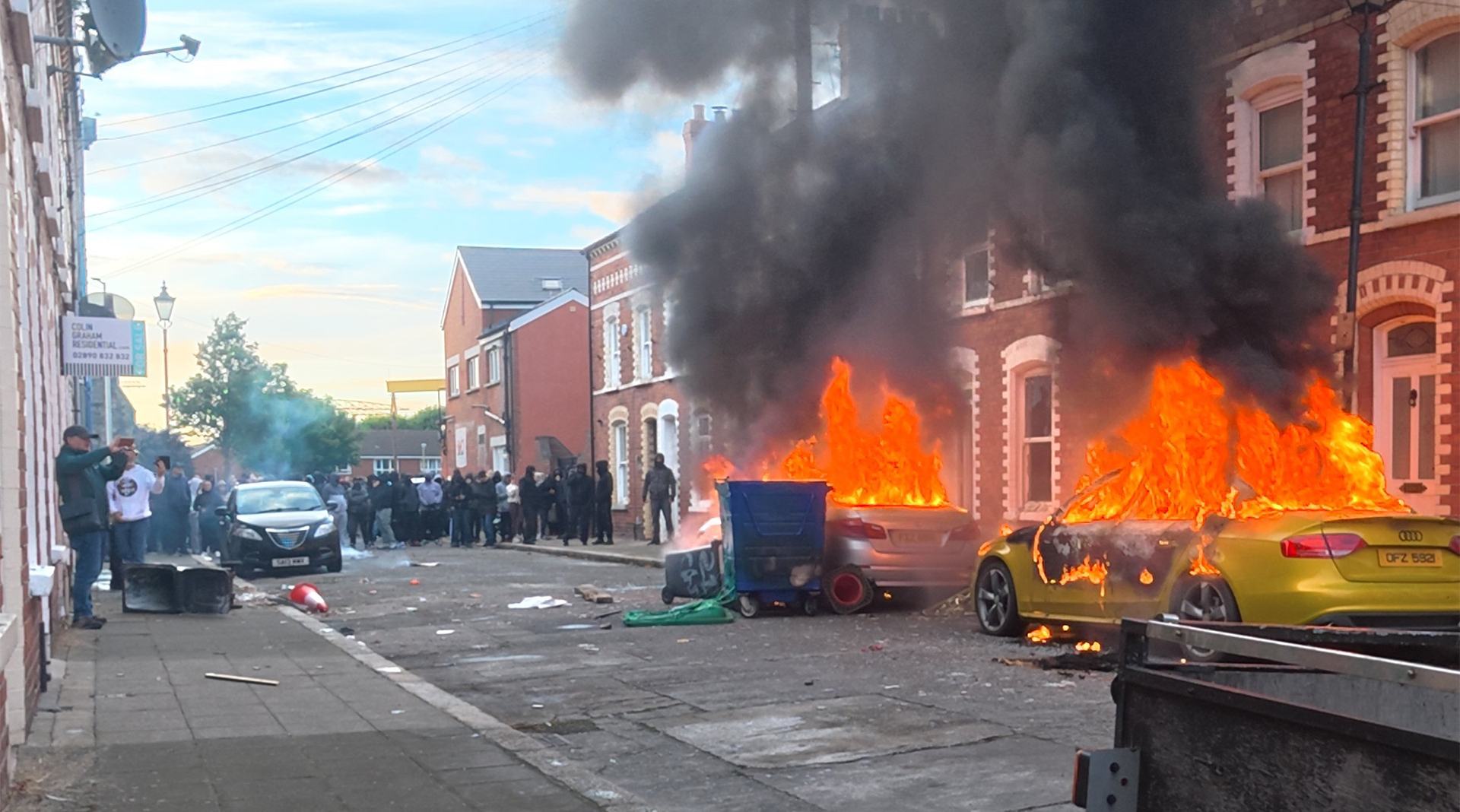
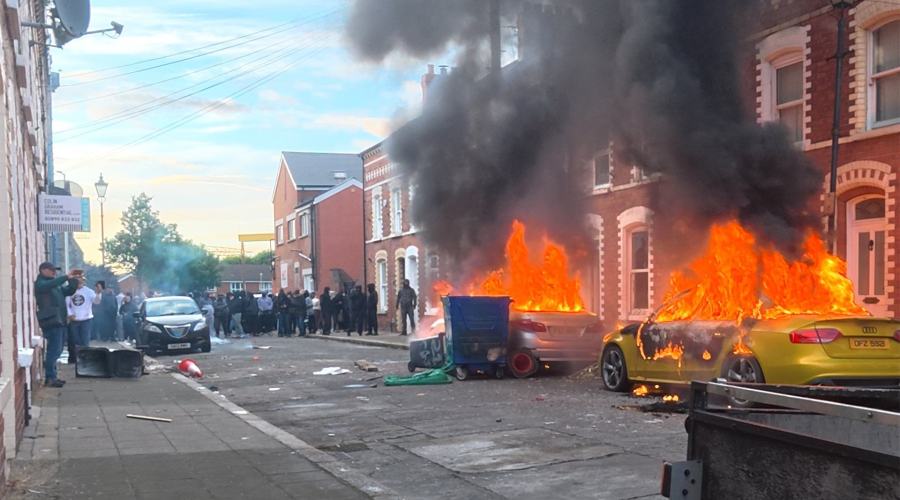
Scene with cars set alight by racist Loyalist mobs in Belfast on 6 June. At least three houses were also set ablaze. (Photo: Getty images)

But why should we be “getting them out”? In answer to that question all we get is lying propaganda. “They are getting housing instead of Irish people.” No, they are not. Some refugees are getting hostel accommodation and many are not, even though Ireland has signed up to accept some.

If refugees are getting such good treatment, why would so many be living in tents on streets, parks or along canal banks? And why are far-Right fascists threatening them and slashing their tents? Are they claiming that refugees are doing them out of living in tents themselves?

In fact we never had widespread affordable decent housing but high emigration made it less noticeable. All the same there were struggles in the 1960s and 70s led by the Dublin and Dun Laoghaire Housing Action Committees, involving occupations of houses and fighting evictions.

Another claim is that migrants are a threat to Irish women. Why would that be the case? Yet, every day in the mass media we read of cases of rape, sexual harassment and controlling behaviour of women — by Irish men!

The far-Right also claim that migrants are a threat to children (actually, they often claim that LGBT people are also, calling them ‘paedos’). Fact: the major threat to children in Ireland have been Irish institutions including the Catholic Church, which is strongly defended by the far-Right.

Sociological research shows that most sexual abuse of children happens in the family or friend circle and we regularly read in the media of those cases also – nearly always by Irish men.

Then there’s the “military-age single men” mantra – what does that even mean? Military age is usually understood to be between 17 and 45 years of age. It is in other words the age at which most men emigrate to work in other lands. The age at which most Irish emigrated!2

It’s also an age of most health and physical ability to travel, to work and to send money home, as hundreds of thousands of us Irish did, whether single or married, or the optimum age to risk the dangers of being a refugee trying to find somewhere safe for one’s family to follow.

Research shows that the “military-age single men” mantra is a recent addition to Irish far-Right discourse, some believing it an import from the far-Right in the USA, along with the racist “great white replacement” conspiracy theory, adapted here to “replacing the Irish” conspiracy theory).

Which reminds me that the arrival of migrants is often characterised as “an invasion.” Really? When we emigrated in the past or today for work or safety from persecution, were or are we invading England, Scotland, Wales, the USA, Canada, Australia, New Zealand? Or other countries?

We are not being invaded by refugees or migrant workers. But we have been invaded by British troops and colonial police, foreign multinationals, and US and NATO flights.

The far-Right in Ireland hate foreigners and their imagined ‘invasion’, but not it seems the reality of British troops occupying one-sixth of our country and patrolling it with their colonial and sectarian police force. Nor the reality of the RAF and the USAF violating our airspace.

Nor the foreign multinationals and vulture funds controlling our housing market, taking over Irish firms and public infrastructure and plundering our national resources.

Get them out? Well if migrants and their contribution to Irish society were to be ‘got out’, there would be a massive task facing the far-Right.

We should then get rid of the Tricolour, as it was presented to us by foreigners: revolutionary Republican women in Paris in 1948. We should also reject the Irish Republic flag, which was created on domestic material in the home of Constance Markievicz, who was born in London.

Yes, and she delivered it in 1916 to the GPO so that it was raised on the Princes Street corner of the GPO by a man who was born in Argentina. Of course, inside the GPO were Thomas Clarke and James Connolly, the first born in England and the second in Edinburgh (where he was raised too).

I do recall a racist recently denouncing the Save Moore Street From Demolition campaign for pointing out the foreign origins of those two signatories of the 1916 Proclamation and insisting that it was where their parents came from that mattered.

What then of Patrick and Willie Pearse, whose father was English or Tomás McDonagh, whose mother was English too? Or Thomas Davis, whose father was Welsh? Clearly there’s a massive job ahead with “getting them out”, all these foreign connections in our resistance history.

Many of our martyrs and heroes, writers, song composers, musicians, flags, songs, poems, literature, documents “contaminated” by migrants will need to dumped if the far-Right are honest in their slogans. But they are not, of course – they only use them to fool the masses.

“But who is he writing this for? The organised fascists won’t care and their followers won’t read it.” A good question – to whom we speak and write is as important as what we speak and write. I don’t write it for the organised fascists of course, the debate with them will inevitably be a physical one.

Nor do I write it for their deluded followers, who would hardly be reading articles in the Rebel Breeze blog. I write it for you and you and you, to use in your discussions with the deluded followers, those who are willing to listen because you are neighbours, workmates or families.

And if you already knew all this or I have not written it well enough or you fail in using it and other arguments you use, I’m sorry, I and you did our best. In the end, the argument will be resolved in the street and on barricades. And we need to get ready for that too.

End.

Note: If you found this article of interest, why not register with Rebel Breeze for free, so that you will be notified by email of subsequent articles. You can de-register any time you wish.

FOOTNOTES

1I wrote this quite some time ago but it never got posted for some reason or other. After the racist riots in Belfast seems a good time to dig it out and post it.

2Including myself, to London.
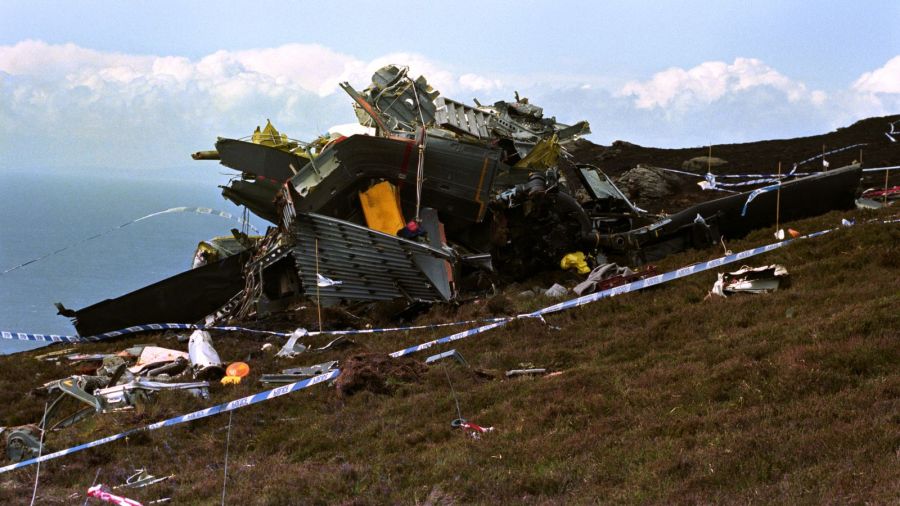
THE 1994 CHINOOK CRASH — AIRCRAFT MALFUNCTION, PILOT ERROR OR INTER-INTELLIGENCE ASSASSINATION?

Diarmuid Breatnach

(Reading time: 4 mins.)

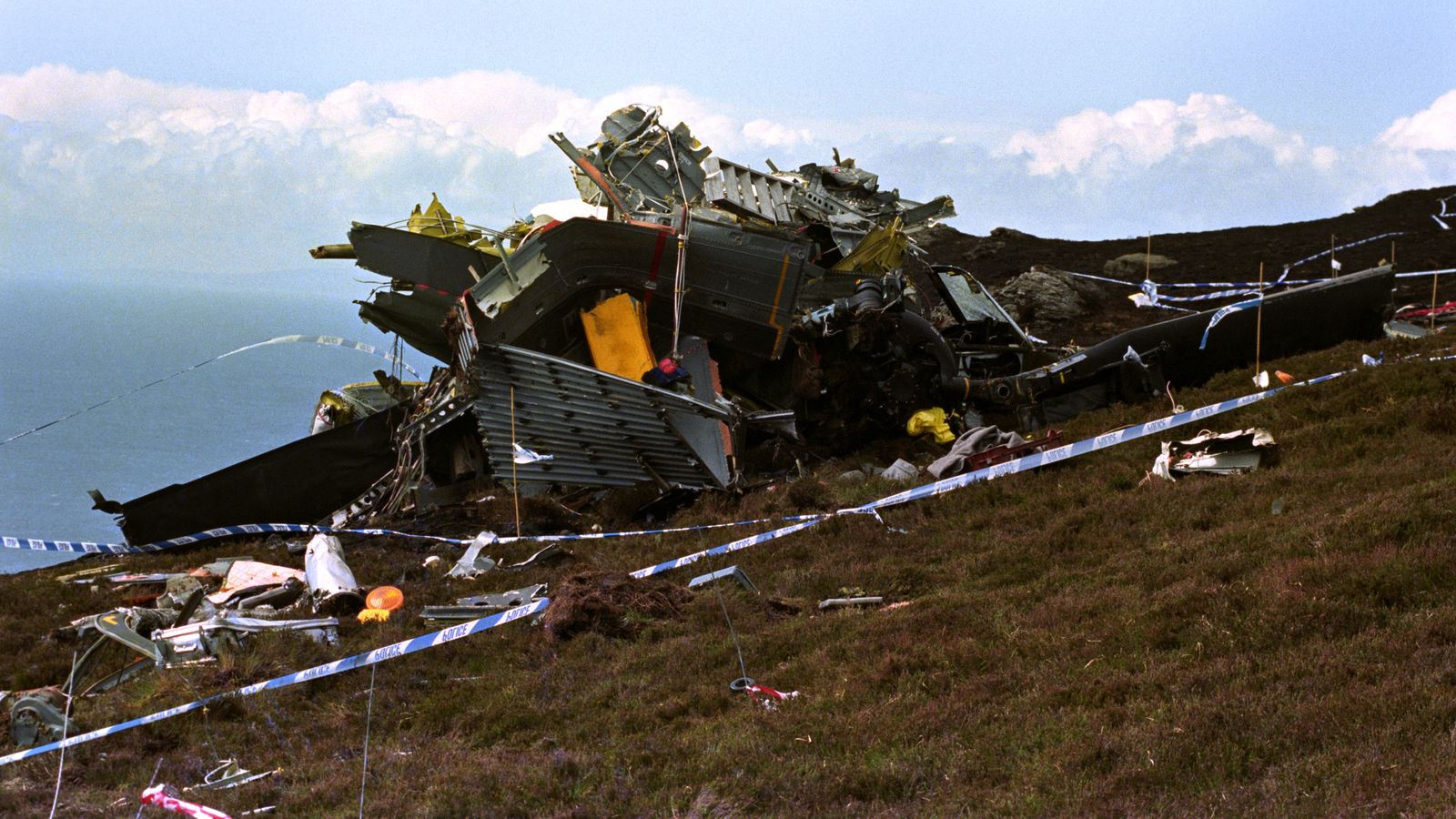
A group mainly of relatives of the deceased are seeking an official inquiry into the Chinook helicopter crash at the Mull of Kintyre, Scotland in 1994 killing 25 intelligence experts and four special forces crew on their way to a conference.

The crash wiped out almost all the top officers in command of intelligence gathering and operations in the occupied Six counties of Ireland from MI5, Army, RUC Special Branch and state Security Service.

Photo of the crashed Chinook helicopter on the Mull of Kintyre 1994. (Photo: Sky News)

The first crash inquiry failed to confirm pilot error which was then overruled by State reviewers who blamed the pilots on the basis of supposition without any evidence. After campaigning by a number of people including families of the deceased pilots, a 2011 inquiry exonerated the pilots.

The current campaign wants to focus on questions as to the reliability of the aircraft but an alternative and darker interpretation developed at the time, alleging that the different departments of British spooks, MI5 and MI6 had a fatal falling out over territory and policy.1

The remit of MI5 is of domestic ‘UK’ matters while that of MI6 is external. However, the Six Counties, though being under the rule of the UK, was also geographically part of a foreign country, Ireland — and the Irish State, just across the border, a government foreign to the UK.

In addition, the Republican armed resistance groups frequently had contacts abroad and many people with connections to other resistance organisations in the world; both parts of Ireland were visited by representatives along with many media agencies in the pursuit of their reporting work.

Whereas a resort to assassination as a result of rivalry or difference in objectives between different arms of a state’s security service is no doubt extreme, the existence of the rivalry itself is quite likely and the stakes in terms of funding, staffing and operational management can be high.

If the rivals are working towards opposing ends, that will raise the stakes much higher. The secrecy of the State’s reaction to the event did nothing to dispel such theories and the mismanaged attempt to blame the pilots only lent added credence to such suspicions and belief.

The fact of the collusion of British secret service with Loyalist murder squads in the 6-Counties colony is well known and has been documented by a number of investigations. Such collusion from the Royal Ulster Constabulary, especially its Special Branch, is well known too.2

Quite a few familiar with the British colonial security forces in the Six Counties believe that there was an ‘inner force’ inside the RUC with the support of MI5 and British Army Intelligence, all colluding with or even managing assassinations and Loyalist sectarian murder gangs.

The British ruling class had set their sights on achieving the cooperation of the Provisionals in a pacification process and MI6 was in favour of this initiative. It is posited that MI5, the Inner Force inside RUC and Army Intelligence opposed this, believing that they could defeat the IRA.

It was the clash of these radically different approaches (albeit with the same ultimate objective of ending Republican armed resistance) that is believed by some to have culminated in the assassination of the anti-pacification section in the Mull of Kintyre crash.

We may never know for certain and the Ministry of Defence (MoD) sealed key files relating to the 1994 Mull of Kintyre Chinook crash for 100 years, locking them away until 2094

‘HEROES’?

Sorcha Eastwood calls those who died ‘heroes’,3 confirming herself and the Alliance political party she represents as on the side of British colonialism and its violent repression of Irish resistance, repression in the forms of internment, no-jury trials, assassinations and sectarian murders.

Those features are the reality of colonial repression and were very much in evidence in the colonial war of three decades which was approaching an end at the time of the crash.

The leadership of the Provisionals had accepted that although they could not be beaten, nor could they win the war4 and so were ready to participate in a pacification process.

British Intelligence had compromised or recruited elements of that leadership at highest and medium levels and had targeted assassinations of the less malleable individuals.5 The leadership was heading for the process culminating in the Good Friday Agreement of 1998.

Up to 3,500 people had died violent deaths 1969-1994 as the hands of of British military, colonial police, colonial proxies and Irish Republican resistance.

There were no tears shed for the dead at Mull of Kintyre among the subjected population of the colonial entity nor in many quarters of the Irish community at home or abroad and resistance culture soon produced a dark mocking parody to the air of Paul McCartney’s ‘Mull of Kintyre’ song.6

Confirmed assassination and suspicious deaths by aircraft crash are not unknown, among UN Secretary-General Dag Hammarskjöld’s 1961 plane crash on his way to negotiate peace in the Congo,7 General Zia-ul-Haq8 and commander of Russian mercenary force Yevgeni Prigozhin.9

end.

Note: If you found this article of interest, why not register with Rebel Breeze for free, so that you will be notified by email of subsequent articles. You can de-register any time you wish.

FOOTNOTES

SOURCES

https://www.breakingnews.ie/ireland/truth-being-withheld-over-raf-chinook-disaster-families-say-1907193.html
https://www.theguardian.com/uk/2000/jun/14/northernireland.comment

1What is more often but inaccurately called ‘the Irish peace process’; inaccurate because it was not designed to address the underlying reasons for the conflict and approaching three decades later has not done so. It resulted in The Good Friday Agreement, signed in 1998.

2See for example the Stevens Inquiries, Barron Tribunal, Dirty War by Martin Dillona (1990), also Lethal Allies (2013) by Anne Cadwallader.

3https://www.breakingnews.ie/ireland/truth-being-withheld-over-raf-chinook-disaster-families-say-1907193.html

4The war against a major imperialist power was concentrated in a territory one-sixth of Ireland and with a population divided along sectarian lines.

5See the cases of Denis Donaldson and Scappaticci (British Intelligence code name Stakeknife) for example and there are well-founded suspicions of a number of others that were never publicly exposed. See also the elimination of Volunteers Jim Lynagh and Padraig McKearney and their unit in the Loughgall Ambush/ Massacre.

6‘Mull of Kintyre, oh Brits falling into the sea’ etc

7https://www.un.org/en/delegate/63-years-later-mystery-still-surrounds-death-dag-hammarskj%C3%B6ld

8https://www.latimes.com/archives/la-xpm-1988-08-25-mn-1417-story.html

9https://www.theguardian.com/world/2023/oct/05/hand-grenade-explosion-caused-plane-crash-that-killed-wagner-boss-says-putin

PEACE WITHOUT JUSTICE IN PALESTINE

Diarmuid Breatnach

(Reading time: 4 mins.)

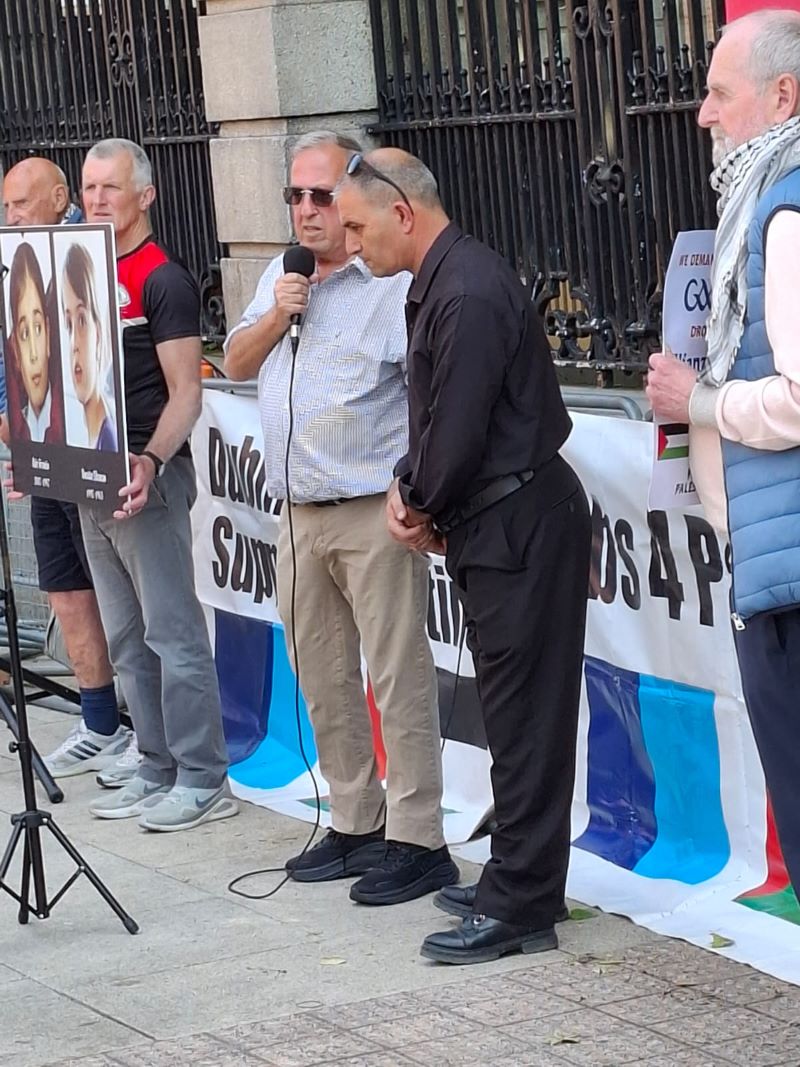
Two famous people addressed a crowd outside Leinster House, home of the Parliament of the Irish State on 25th May. Rami Elhanan, an Israeli graphic designer, and Bassam Aramin, a Palestinian scholar, had forged a remarkable friendship.

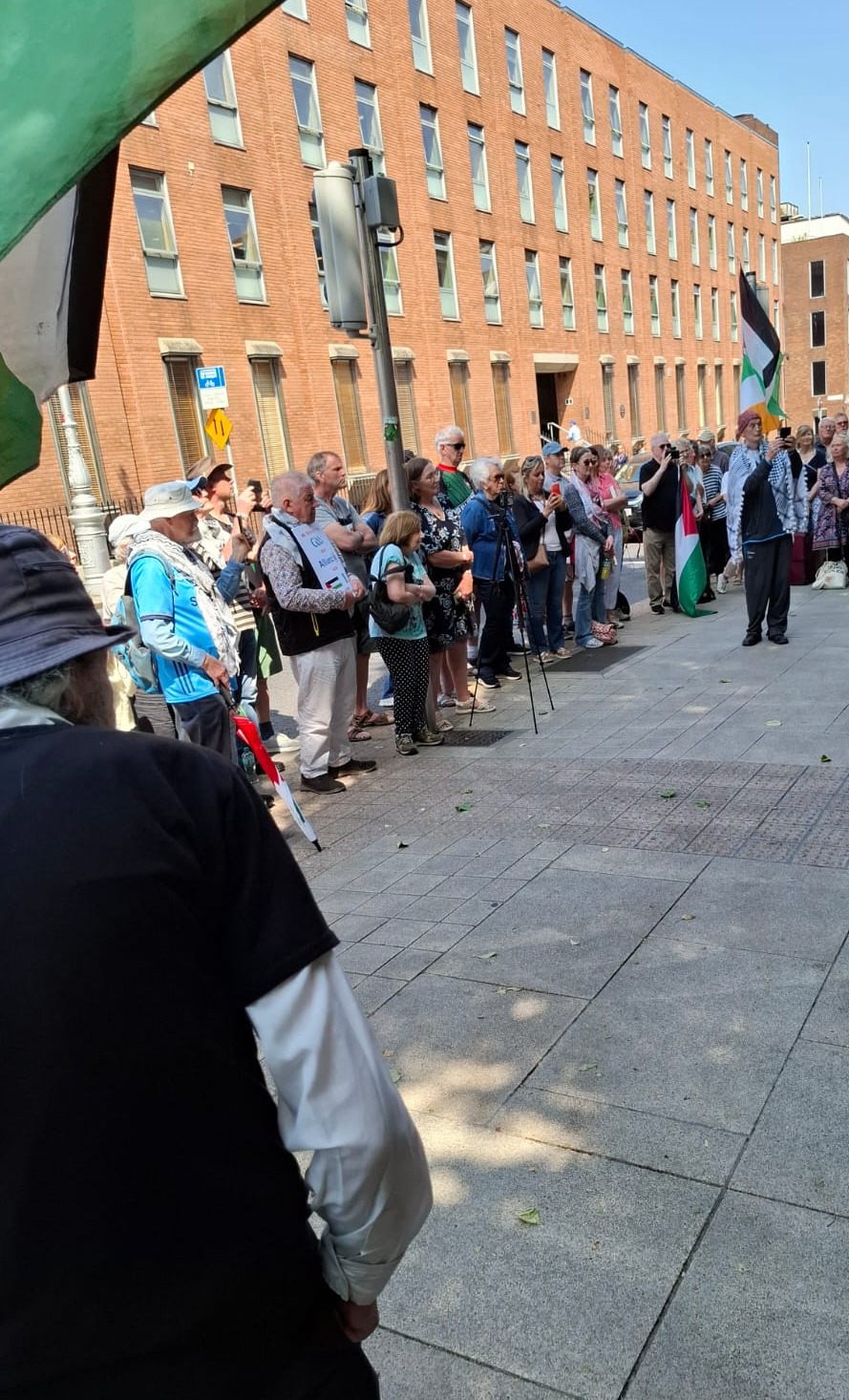
Section of participants in the Dubs for Palestine noontime event outside Leinster House 27 May 2026. (Photo: D.Breatnach)

Bassam Aramin, now a Palestinian scholar, had been sentenced to a 7-year term of imprisonment for throwing a grenade at Israeli soldiers when he was 17 and had lost his daughter later to a plastic bullet fired at short distance by an IOF soldier.

Rami Elhanan, an Israeli graphic designer, had also lost his daughter Smada but to a suicide bomber in 1997. Both men became advocates of peace and dialogue and friends to one another.

Their audience was the weekly Dubs for Palestine gathering outside Leinster House on Wednesdays 12 noon to about 1.00 pm, with speeches, songs and poetry and David Hickey as MC. This week’s was the 113th such weekly gathering and the duo had been invited to speak.

The broad group has of late been concentrating on parting the Gaelic Athletic Association1 from its sponsor and insurance underwriter, the former Nazi and since Zionist-friendly Allianz company, along with now campaigning for the Irish soccer team not to play the ‘Israeli’ team.

Rami Elhanan (L-R) and Basam Aramin addressing the Dubs for Palestine noontime event outside Leinster House 27 May 2026. (Photo: D.Breatnach)

Rami Elhanan referenced his descent from Holocaust survivors and outlined the different living standards of the Palestinian and Israeli Jewish communities, commenting on the sickness in Israeli society, that they did not want to know what is being done in their name to the Palestinians.

Basam Aramin’s contribution was against the Occupation and claimed that without that, Palestinians and Israelis could live in peace (it was not clear whether he was referring to the ‘Two State’ proposal2). David Hickey, the MC of the group presented them with an Arum Lily each.3

After their speeches had been applauded, they were asked to comment on the recent Leinster House debate and the Government’s refusal to endorse a boycott of Israel. Rami Elhanan replied that boycotts entrenched opposing sides and that continuing to talk was the answer.

Singer and activist Emma Browne, invited next to the microphone, sang Keep the Little Flame Alive, among the lyrics of which Faye, Dolores, Bernadine, Table grapes and gasoline, Homemade rifles, kitchen knives, Kept the little flame alive riposted the previous speakers.

Soon afterwards, Paul Lynch read a poem of a Palestinian father mourning the killing of his child. Poet and activist Dorothy Collin declared that in order to have peace there must be justice first and that we must support the oppressed in whatever way they choose to resist.

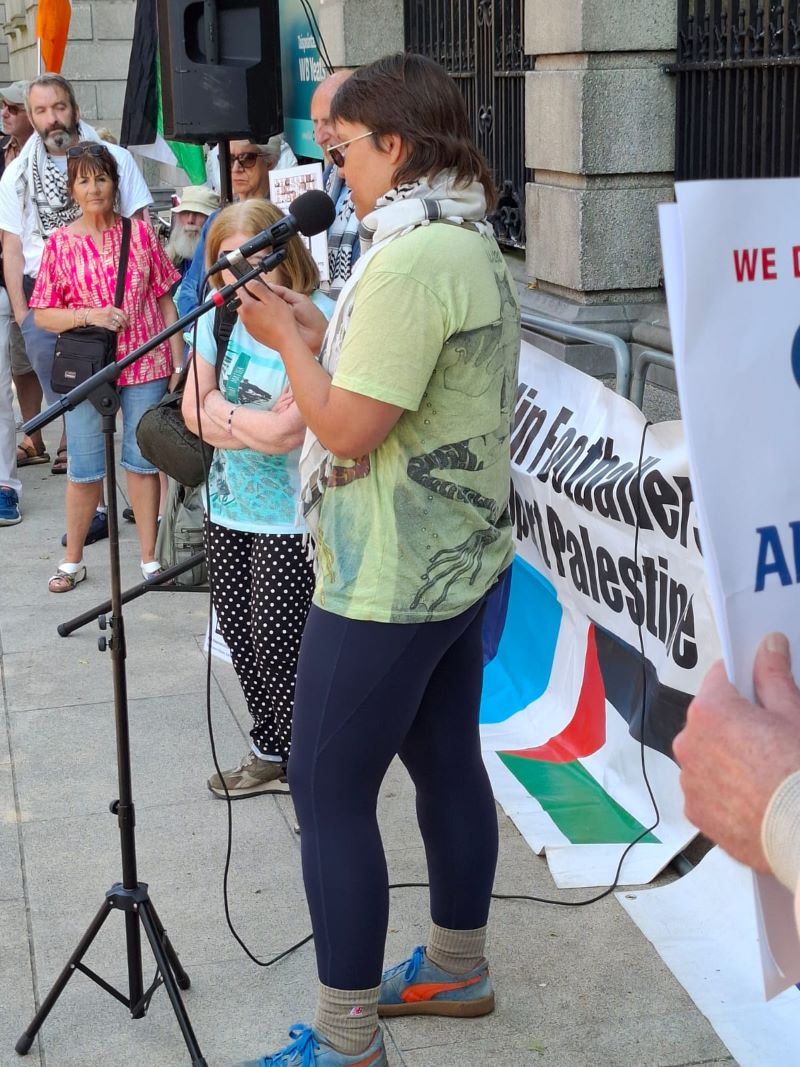
Áine Ruttley reading her poem while addressing the Dubs for Palestine noontime event outside Leinster House 27 May 2026. (Photo: D.Breatnach)

Áine Rutley also upheld our duty of solidarity and the right of the Resistance movement to choose its own methods, as did Jimi Cullen who then performed his own song composition The Freedom Fighter about a fighter from Gaza.

As I was called to the microphone, I commented that my views had already been well expressed in song and speech and that one of the forms of resistance is song, of which we had more than probably any other people in the world and sang An Dord Féinne,4 which is banned in Germany.

A little later the event came to an end with another song from Emma Browne, Never Again Is Now and with group chanting for Palestine, against Allianz and against playing the ‘Israeli’ team.

IN CONCLUSION

It is a popular proposition in certain circles that all social conflicts can be resolved by discussion, by understanding our opponents’ view. It is an attractive idea but flies in the face of history and of contemporary reality.

The interests of Occupied and Occupier are opposed and cannot be reconciled through understanding. The Occupier understands that the Occupied wish to be rid of them. The Occupied do understand that the Occupier wishes to continue appropriating their land and resources.

In this kind of situation one must win and the other lose. Far from understanding leading to peaceful resolution, the more the oppressed understand the nature of their oppressor, the more resolutely they are likely to resist and this is surely true of the Palestinians resisting the Zionist settlers.

The false proposition of resolving irreconcilable interests through discussion is usually of liberal or social-democratic origin when applied to anti-colonial, anti-imperialist and anti-racist struggles and though appearing even-handed, always ends up disempowering the victimised.

The journeys of both these men is extraordinary and interesting but it should not be presented as representative of the Palestinian struggle against Occupation, Theft and Genocide. Each father lost a child but the Palestinian is losing a lot more on top.

Furthermore, a just resolution can only come about through the total defeat of the Zionist forces and the dismantling of their State, so that if we really want that kind of resolution we are called to support the Palestinian side, unequivocally and resolutely.

Of course, in reality there is no question of real peace without justice, for ultimately the oppressed (unless wiped out) will rise in struggle again and again. The proposition of accommodation of opposites by discussion can only undermine or distract the struggle of the oppressed.

We cannot take the story of Bassam Aramin and Rami Elhanan, however remarkable, as even a metaphor for a just resolution nor allow ourselves to be seduced from resistance nor our struggle undermined by it.

End.

Note: If you found this article of interest, why not register with Rebel Breeze for free, so that you will be notified by email of subsequent articles. You can de-register any time you wish.

FOOTNOTES

1The management of the Gaelic games, including hurling and Gaelic football. The GAA has teams in every one of the 32 counties of Ireland, crossing the colonial border and is the biggest community sports association not only in Ireland but also in Europe and perhaps in the world.

2This proposal came out of the Oslo Accords, to give the Palestinians 20% of their land for peace with the Zionist settlers who would own the remaining 80%. Apart from its basic injustice the proposal was never realistic since Zionist settlers continued to construct settlements on additional land. Despite this, supporting that proposal is the formal position of most western imperialist states and the Irish State and of most parliamentary political parties.

3In Ireland these are often viewed as symbolic of the 1916 Easter Rising.

4Also known as Gráinne Mhaol and Óró Sé Do Bheatha ‘Bhaile, an Irish traditional song of some antiquity refashioned into an Irish resistance song by Patrick Pearse, a martyred leader of the 1916 Rising.

SOURCES

https://en.wikipedia.org/wiki/Apeirogon_(novel)

DUBLIN GERMAN EMBASSY PICKETED IN SOLIDARITY WITH ULM FIVE

Clive Sulish

(Reading time: 3 mins.)

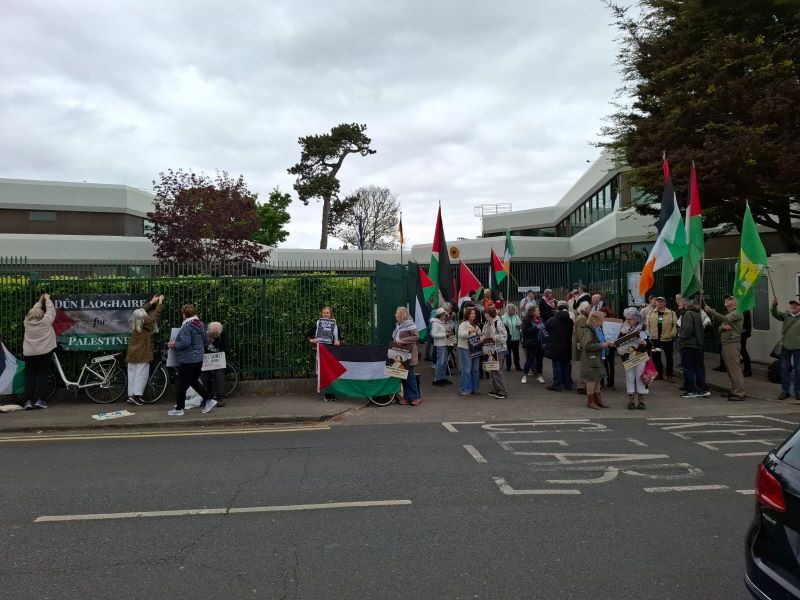
Outside the German Embassy in Dublin speakers denounced the German State’s repression of Palestine solidarity activists and their treatment as terrorists in solitary confinement in dispersed locations, increasing the visiting difficulties for relatives.

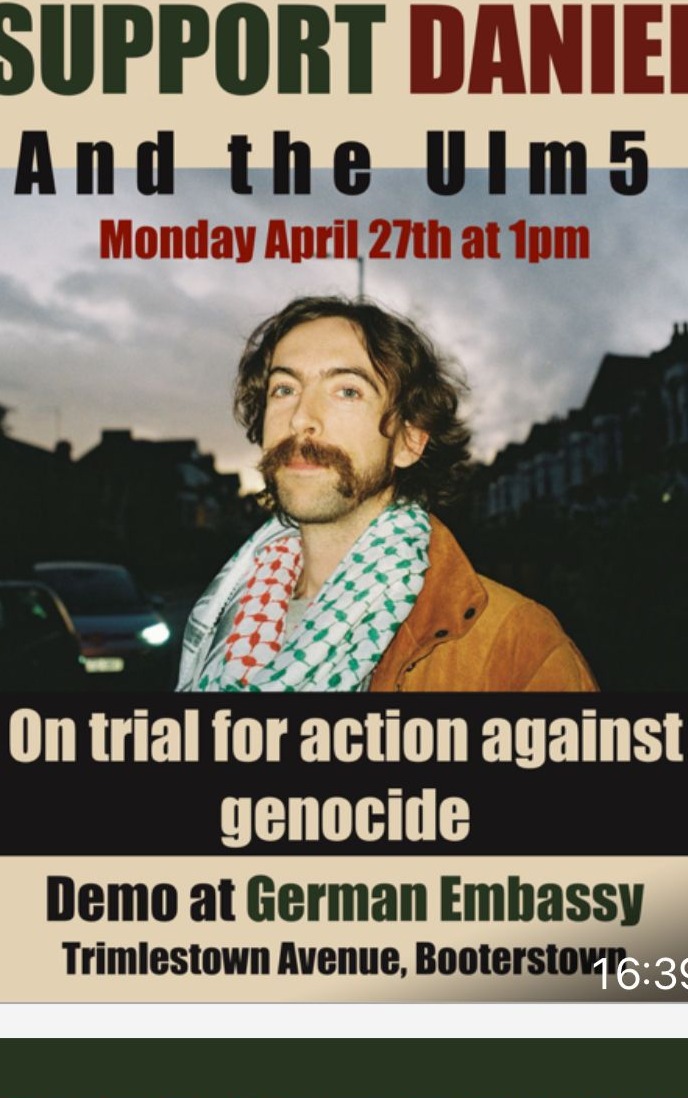
Organised by the broad group Dubs for Palestine, scores of people attended a lunchtime picket of the Embassy on Monday 27th April.1 In addition to the speeches and chants, songs were sung with particular relevance to the occasion and location.
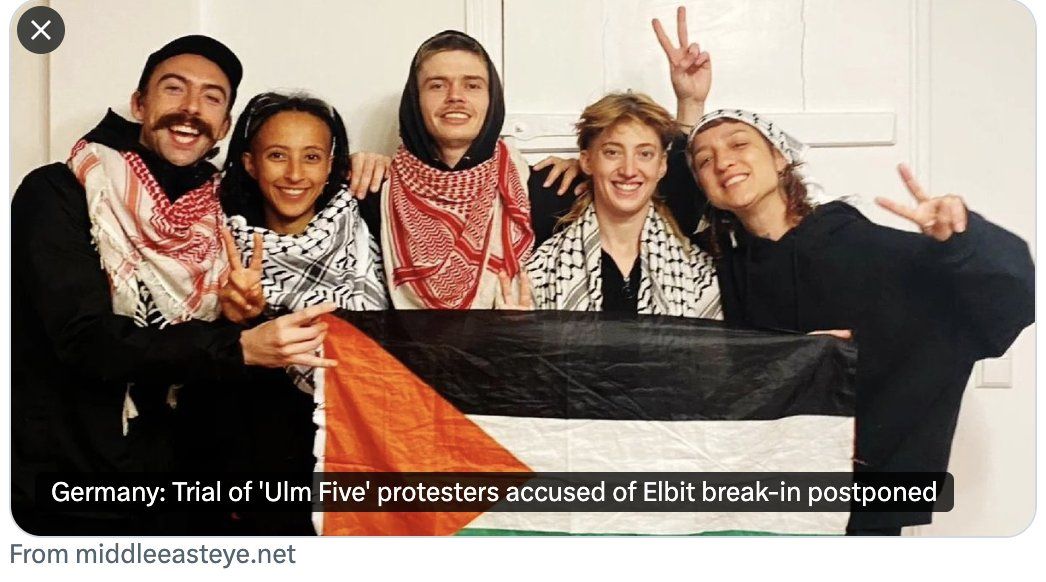
The focus of this rally was in support of a group of five activists that includes a young man formerly of Dún Laoire, Daniel Tatler-Devally and have become known as the Ulm Five. They were alleged to have broken into an Elbit Systems facility in Ulm, Germany and caused damage inside.


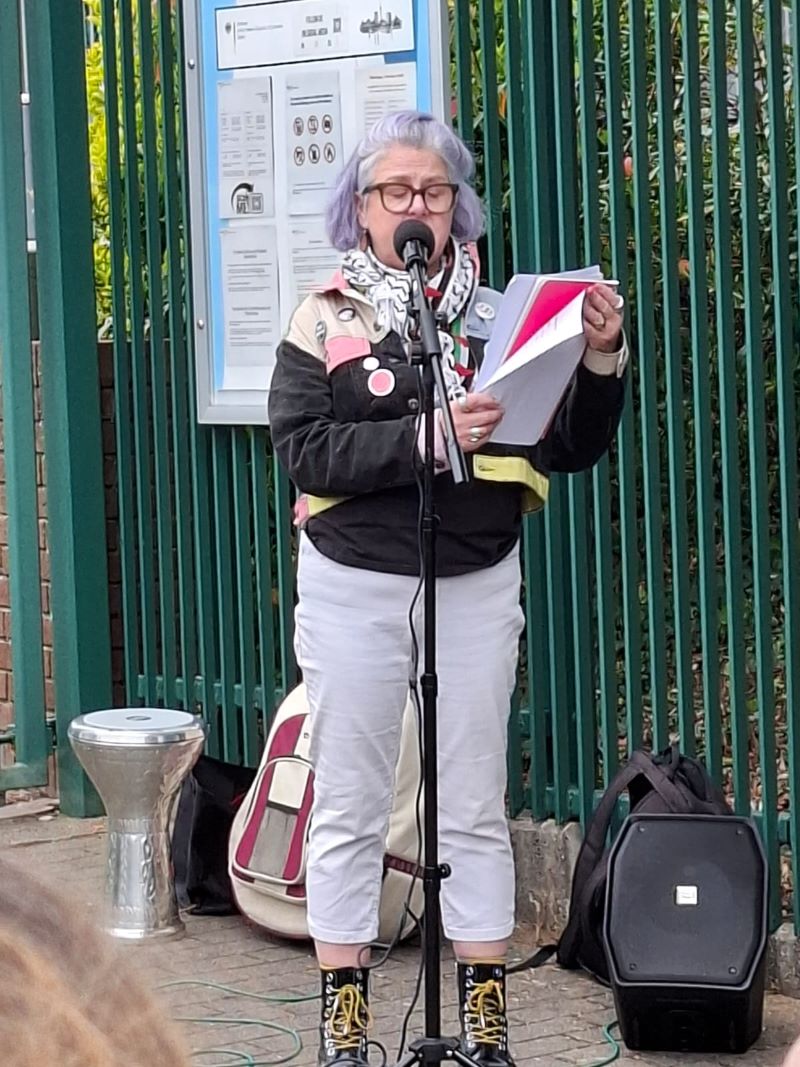
Lynn Treacy, of the Devally-Tatler family support grou, speaking outside gates of the German Embassy, Dublin on Ulm Five solidarity rally April 29th.
(Photo: R.Breeze)

Their action was in protest at the Israeli military systems company and its part in the genocide of Palestinians supported by the German state. One of the speakers was Daniel’s father, Conor Devally while Lynn Treacy, a friend of Daniel’s mother spoke on her behalf too.

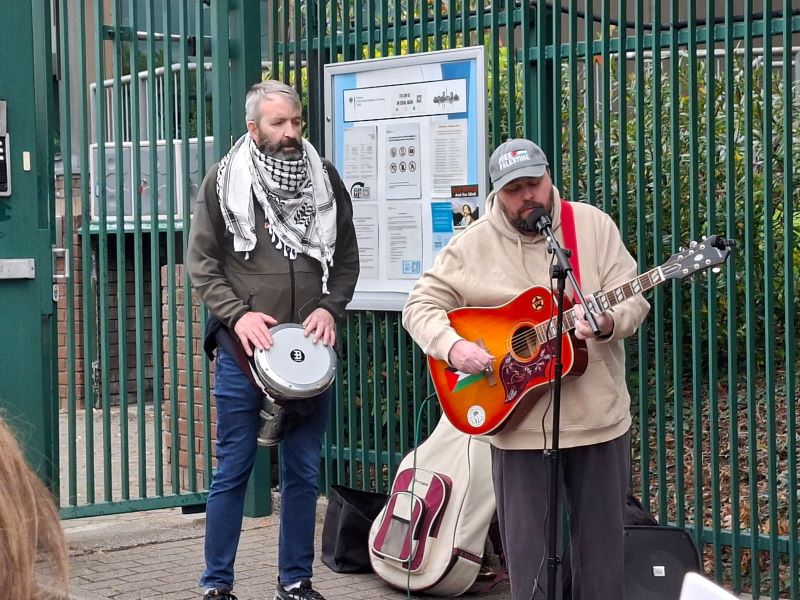
Jimi Cullen, accompanied by Dermot outside gates of German Embassy, Dublin on Ulm Five solidarity rally. (Photo: R.Breeze)

The activists are being treated as terrorists, in seven months of solitary confinement, separated and dispersed throughout different jails long distances apart. Their trial is scheduled for separate days over a period from April to July, also causing relatives and friends great difficulty.

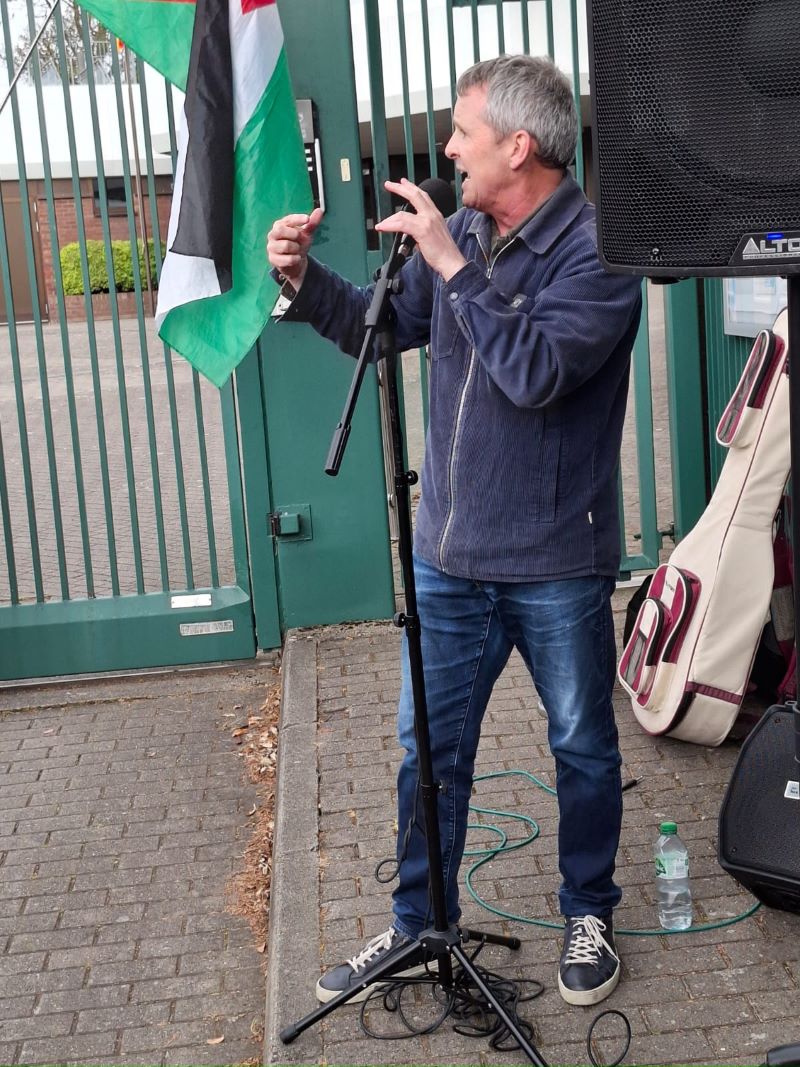
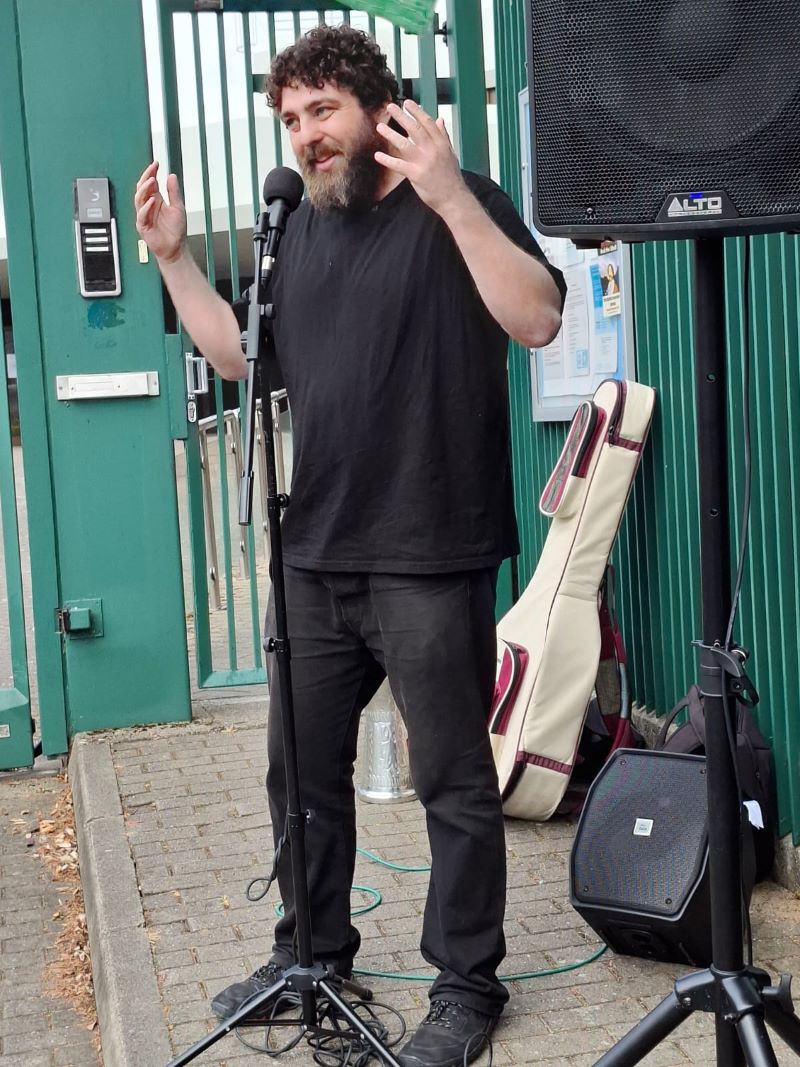
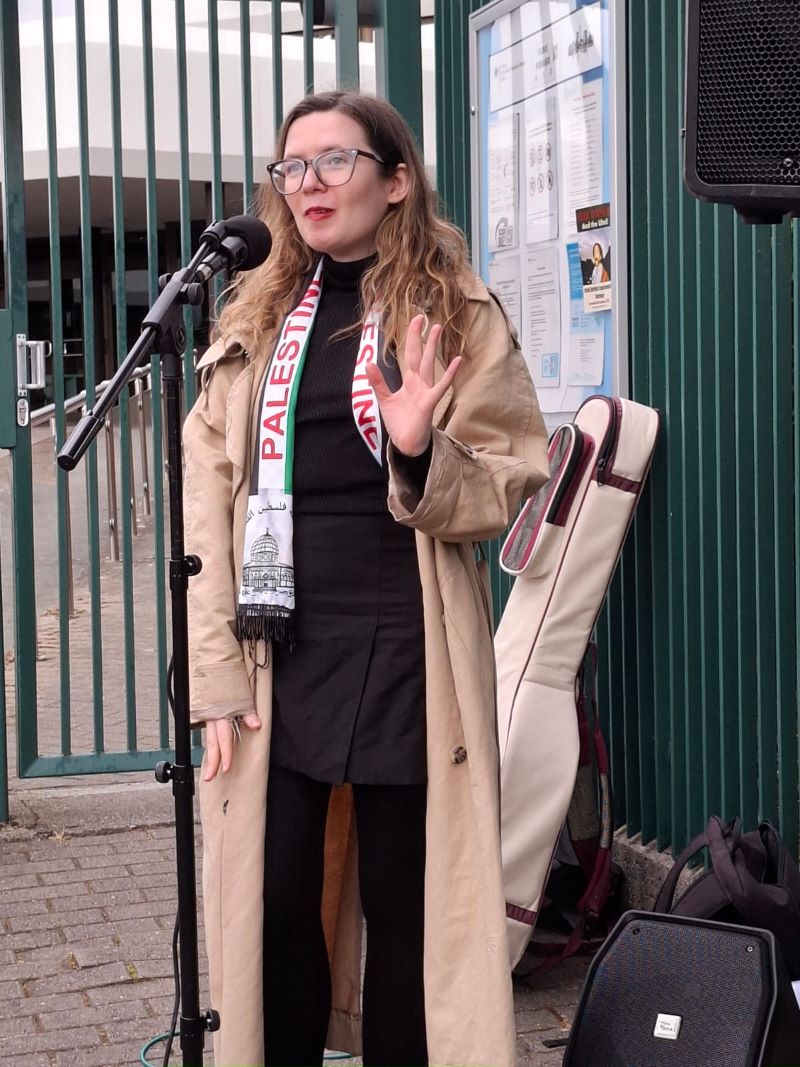
Jimi Cullen singing and playing guitar performed his own We Are All Palestinians, developed from the well-known chant on Palestine solidarity demonstrations, accompanied by Dermot Sheehan on drum.

Two prominent members of People Before Profit spoke, Richard Boyd Barrett TD and Eoghan Ó Ceannabháin, a political and cultural activist and noted singer in the sean-nós style. Raymond Deane, composer and founding member of the IPSC spoke too as did political activist and singer Diarmuid Breatnach.

Richard Boyd Barret speaking at Ulm Five solidarity rally at German Embassy April 29th. (Photo: R.Breeze)

Ó Ceannabháin spent some time demolishing the discourse that Germany has an excuse for its repression of pro-Palestine solidarity because of alleged guilt due to its perpetration of the Hollocaust. He pointed to its genocidal history in Namibia and its leadership of EU imperialism.

The PBP member and election candidate for a councillor vacancy in DCC told the rally of Germany’s banning not only some Palestinian solidarity chants2 but also the song known as ‘Óró Sé do Bheatha Abhaile’3 which he proceeded to sing, the participants joining the chorus with gusto.

Ó Ceannabháin at Ulm Five solidarity rally at German Embassy April 29th. (Photo: R.Breeze)

Diarmuid Breatnach pointed out that the German working class had a strong history of struggle and at one time led the world in socialist and social-democratic representation, even recording a vote of 4.8 million votes for the Communist Party in the midst of Nazi repression.
Hans Beimler, a communist trade union activist, Breatnach said, escaped from a Nazi concentration camp, went to Spain to fight in the Anti-Fascist War there and was killed. In his honour Breatnach sang two verses of The Peat Bog Soldiers4 followed by the ballad about Beimler.
Breatnach was accompanied on drum by Dermot Sheehan, a regular attendee at the weekly Wednesday Dubs for Palestine event outside Leinster House, seat of the parliament of the Irish State. An anti-Zionist Jewish activist spoke against Israeli Zionism and its support by Germany.

Naoise Dolan speaking at Ulm Five solidarity rally at German Embassy April 29th. (Photo: R.Breeze)

Speaking in German, Irish and English, Naoise Dolan, novelist, supporter of Palestine Action who was captured in piracy action by the IOF on the October 2025 Gaza aid flotilla, also spoke to denounce the attitude and actions of the German Government and Berlin police.

Ken Powell of Dubs for Palestine, who had acted as MC throughout, led the rally in chanting slogans of solidarity with Palestine including calling for the freedom of each of the Ulm Five by name before thanking all for their attendance and concluding the event.

end.

Early view of Ulm Five solidarity rally outside German Embassy April 29th as people are still arriving. (Photo: R.Breeze)

Note: If you found this article of interest, why not register with Rebel Breeze for free, so that you will be notified by email of subsequent articles. You can de-register any time you wish.

FOOTNOTES

1The day the trial began in Germany but however did not proceed due to the presiding judge refusing to allow the Defence lawyers to sit with their clients and the lawyers’ refusal to proceed under those restrictions

https://www.theguardian.com/world/2026/apr/27/pro-palestine-activists-face-trial-attack-israel-arms-factory-germany

2“From the River to the Sea, Palestine will be free,” which they claim is ‘anti-Semitic’; also “Globalise the Intifada.”

3An Dord Féinne is the actual title given by Patrick Pearse in his adaptation of a traditional song in Irish.

4A translation from the German song of the Communists in Nazi concentration camps which was eventually banned by the camp authorities under pain of death.

THE DICEMAN CAMETH

Diarmuid Breatnach

(Reading time: 4 mins.)

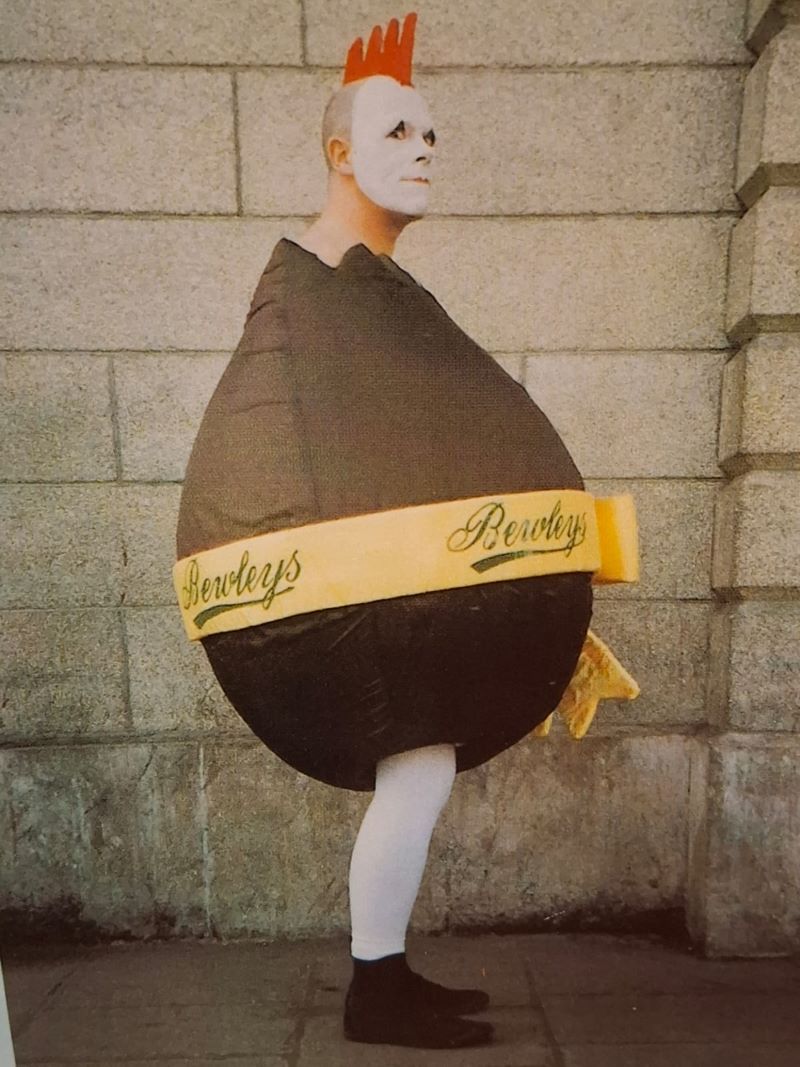
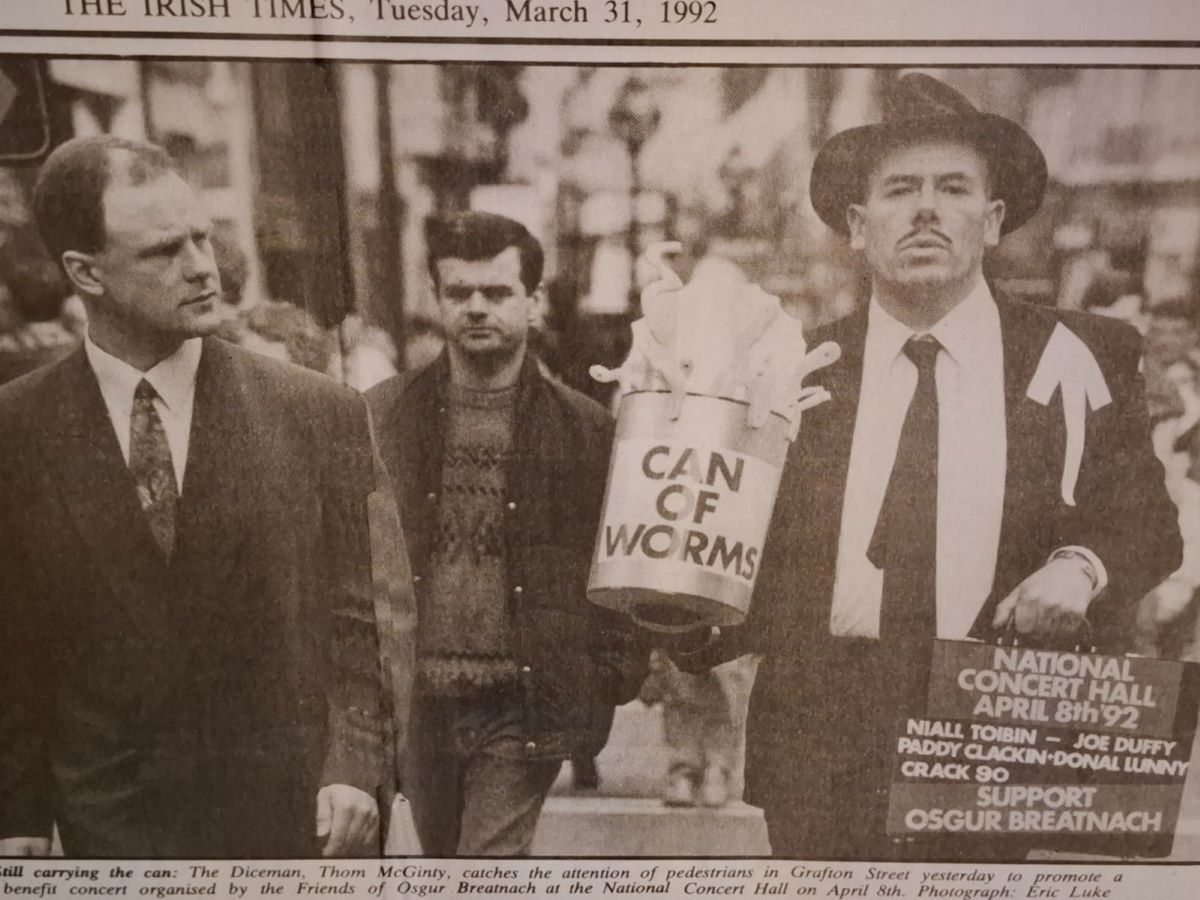
Alerted by a sibling to a short exhibition on the life of the Spice Man (Thom McGinty), a remarkable performance artist and character of Dublin streets particularly associated with Grafton Street, I was fortunate to view it on its final day.

The exhibition was part of the annual Phizzfest’s annual program and was staged in the Bohemians FC room above the Phibsborough shopping centre. The space was a moderately-sized room with a few installations, a film projector, panels of images and text displayed on the walls.

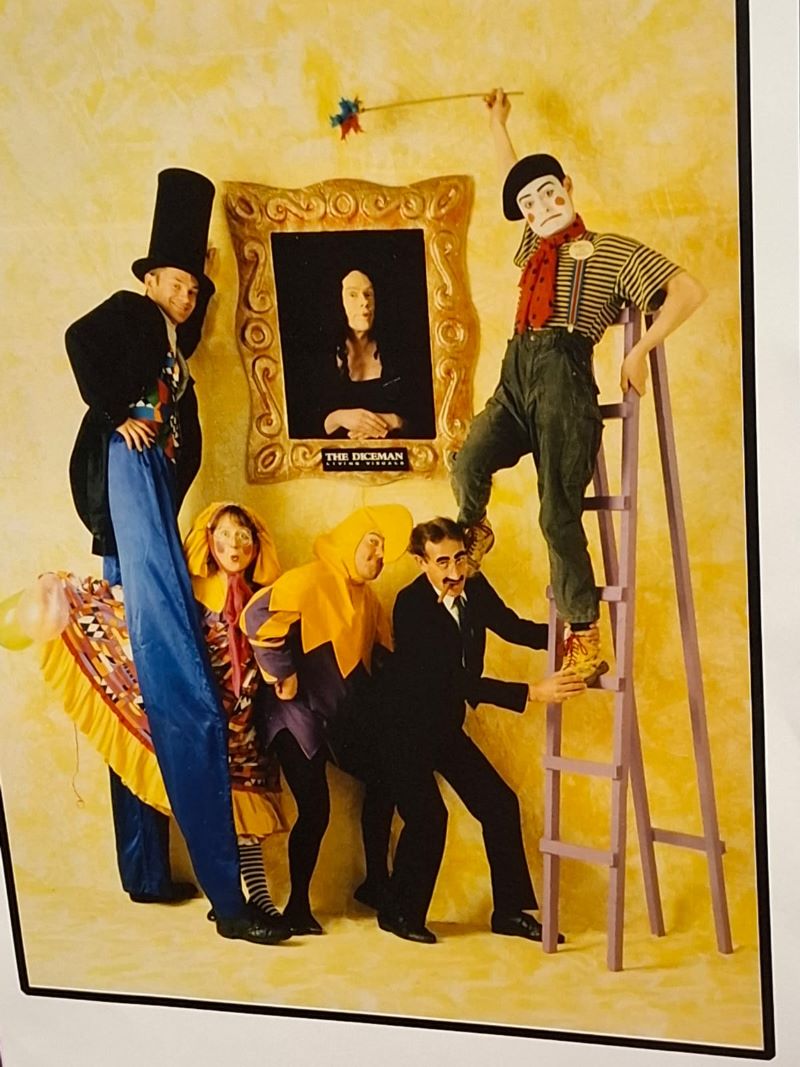
One of the panels at the exhibition.

Sadly the chatter of a number of people made it difficult – for me at least – to understand all the audio accompanying the film footage but some of the images were very interesting, in particular the reaction of Dublin adults and children to the Spice Man’s street performances.

When he spoke it was with a Scottish accent, having been born to a father from Donegal and mother from Wicklow and reared in a village outside Glasgow from where he recalled journeying on holidays to Baltinglass for family reunions.

He came to economically-depressed Ireland in 1976, trying his hand at a number of occupations before he found the one that both gave him success and defined him publicly.

Typically, his performance was silent, his movement stilled or gradual, slow but moving to avoid arrest.1 But his costume and makeup were something else. Though McGinty later initiated performances in social and political protest, his initial ones in Dublin were commercial promotions.

A gaming shop called The Dice Man was the first of these and the one that gave him the nickname by which he became known and found fame. It was one of the commercial promotions, ironically not a political one, that ended with his arrest.

The promoters of a run of The Rocky Horror show in Dublin hired Thom to promote their show which he did, walking the street in ‘horror’ facial makeup, a cerise basque, fishnet stockings and a thong. He was arrested.

McGinty was charged with acts contrary to public decency under Section 5 of the Summary Jurisdiction (Ireland) Amendment Act, 1871, and with breach of the peace. Thom protested that these were his working clothes and he had been contracted to wear them.

According to the arresting gardaí, complaints had been made that Thom’s buttocks were clearly visible, “and the only thing covering his genitals was a G-string.” He was bailed from Store Street Garda Station pending the trial but could not be released until he was given a raincoat to wear.

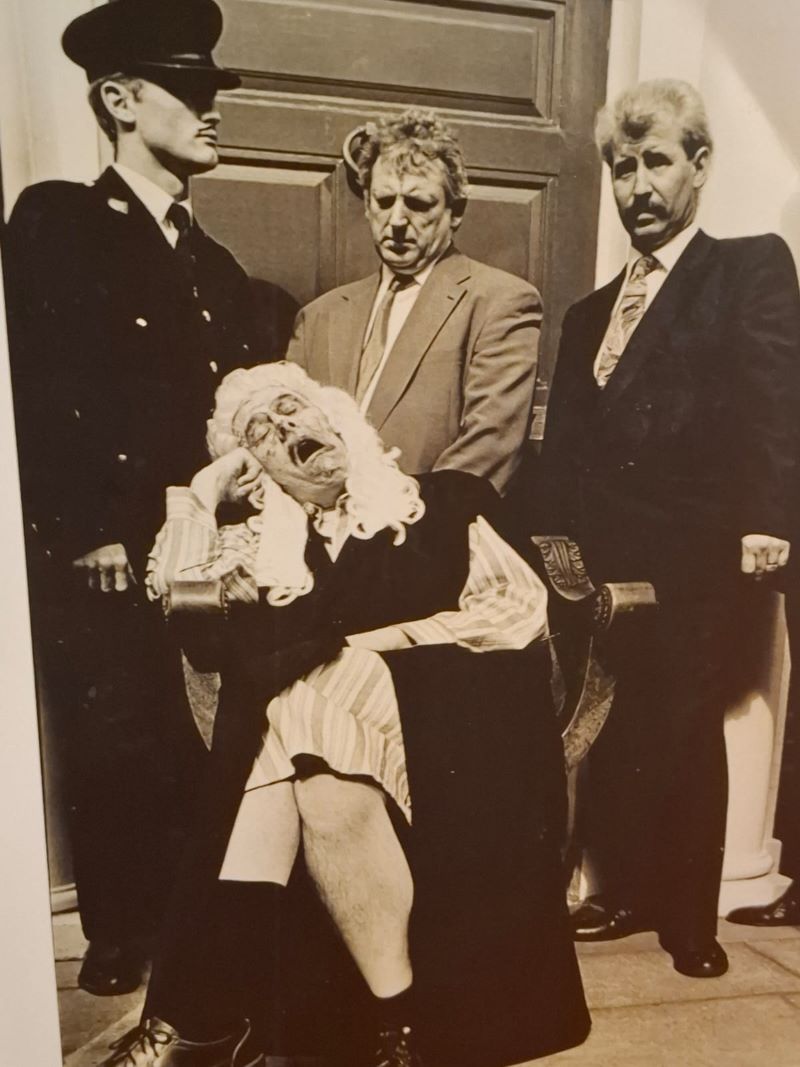
The Act, which is still on the statute books (according to the exhibition text) had sexual connotations and could be used against gay people. McGinty’s lawyer raised the ramifications of a conviction under this Act and the judge sentenced him to probation without recorded conviction.

The 1991 production of the Rocky Horror Show at the Bord Gáis Theatre could not have asked for better publicity and McGinty personally got exposure (!) internationally and offers of work abroad as a result, from which he always returned to Ireland.

Among social causes which Thom protested with performance was the financial penalty on the Union of Students in Ireland for breach of injunctions by publishing anti-pregnancy choice information in a case pursued by SPUC.2 Another was against restrictions on the sale of condoms.3

Thom’s performances and the causes espoused would have been of interest to me had I been living in Ireland at the time but they touched on my family in Dublin a number of times. Foremost was his support for the wrongly accused, framed and brutalised of the Sallins Mail Train robbery.

One of the panels at the exhibition.

It is nearly 50 years since three socialist Republicans were wrongly convicted and sentenced to nine and twelve years imprisonment. As a result of much campaigning, two of the accused, one of whom is a sibling of mine, were released with convictions revoked after 18 months in Portlaoise jail.

The third accused, who had absconded the day prior to the sentence, returned to Ireland and was immediately jailed, campaigners then switching to obtain his freedom, gained only ‘on humanitarian grounds’ after four years in jail and a hunger strike of 38 days.

Satirising the ‘sleeping judge’ in one of the Sallins trials (he was clearly seen sleeping but his co-judges and State denied it and then to embarrassment of State, he died days later). In suits, two of the framed, (l-r) Nicky Kelly and Osgur Breatnach. One of the panels at the exhibition.

A recent concert, packed both by audience and performers in the Vicar Street Dublin venue was organised by yet another sibling to promote a campaign for an inquiry into how that travesty of justice could be carried out by state police, Government and judiciary right up to the High Court.4

Thom was a strong supporter of liberal social rights such as the right to prevent pregnancy or birth and for gay and lesbian rights. His defence of framed Irish Socialist Republicans centred on their right to a fair trial and not to be brutalised, as did his support for the Birmingham Six.

One of the panels at the exhibition.

But he was far from being an Irish Republican. Dressed as the Grim Reaper with scythe, Thom also led a delegation of ‘Peace Train’5 people in protest to the offices of Provisional Sinn Féin where, in a twist of fate, it was another sibling of mine who had to receive him and to face the cameras there.

At the time, SF was the political party leading a struggle for Irish reunification and independence from British occupation and, though its leadership and much of the party’ base support was socially conservative, it was not that which focussed the attacks of two states and a statelet6 upon it.

And those armed and judicial attacks were backed by the imperialist and neocolonial-dominated liberal and social-democratic sector of society, the likes of the ‘Peace (sic) Train’ and ‘Peace Women’.7 I would have argued strongly with Thom I’m sure but regret very much his passing.

Thom McGinty (1952-20/21 February 1995)

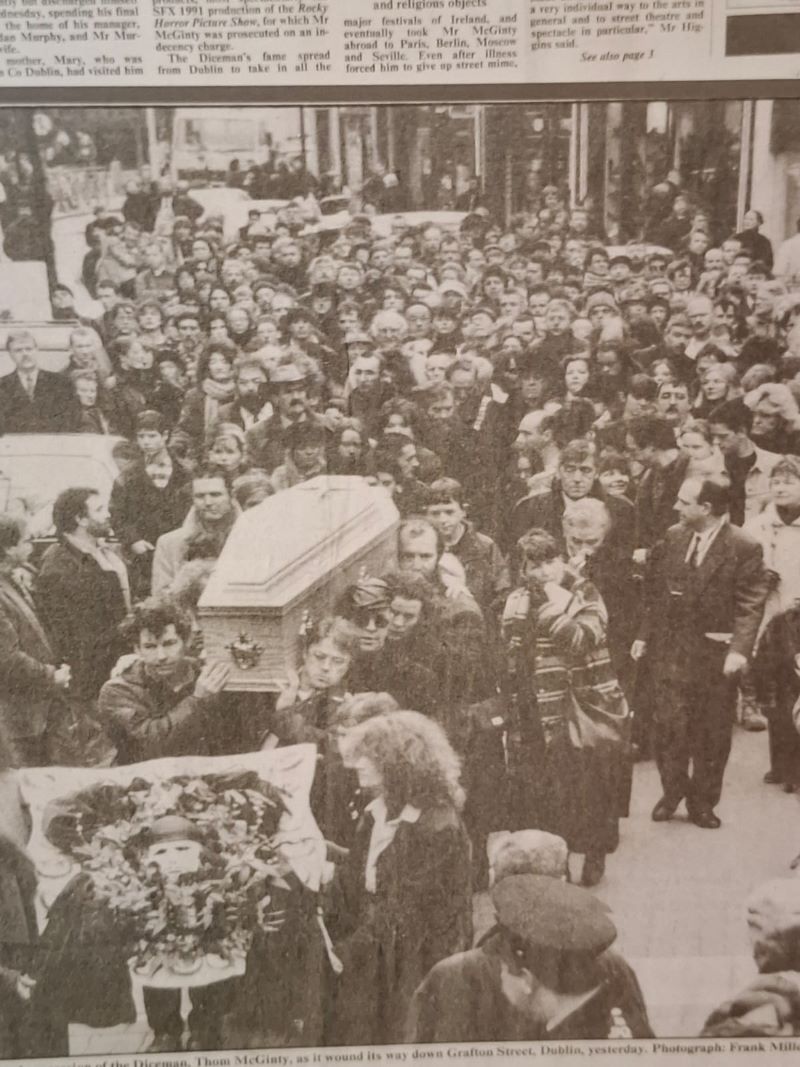
Thom McGinty’s funeral, from one of the panels at the exhibition.

end.

Note: If you found this article of interest, why not register with Rebel Breeze for free, so that you will be notified by email of subsequent articles. You can de-register any time you wish.

FOOTNOTES

SOURCES

Biography Thom McGinty: https://www.thejournal.ie/readme/the-dice-man-5007353-Feb2020/

The Sallins Mail Train frame-up and campaign: https://sallinsinquirynow.ie/

The ‘Peace People’ etc, Mairéad Corrigan/ Maguire: https://en.wikipedia.org/wiki/Mairead_Maguire

1On ‘loitering’ charges.

2Society for the Protection of the Unborn Child. After a long struggle ending pregnancy became legal within the Irish state but regulated under the Health (Regulation of Termination of Pregnancy) Act 2018, allowing for termination on request up to 12 weeks of pregnancy. Following a 2018 referendum, abortion services began on 1 January 2019, providing free access for residents.

3Following campaigning and public defiance of the law, restrictions on the sale of condoms were only finally removed in 1993 in the Irish state.

4https://sallinsinquirynow.ie/

5https://en.wikipedia.org/wiki/Peace_Train_Organisation The issue is not whether bombing the railway line was a useful activity or not but rather that its condemnation took the place of condemning and drawing attention to the British occupation of a colony in Ireland and the brutal repression of resistance to that occupation.

6Although it has the trappings of a state, the Northern Ireland (sic) Assembly is a UK colonial administration.

7

FOR NEUTRALITY AND SOVEREIGNTY – WITHOUT THE NATIONAL FLAG?

Diarmuid Breatnach

(Reading time: 3 mins.)

Last Saturday (26th April) in Dublin a march took place in support of Irish neutrality and in opposition to Irish Government attempts to remove an obstacle to joining some future imperialist military alliance.

The march was organised by the Irish Anti-War Movement, an organisation that flickers into life on occasion as desired by the leaders of the People Before Profit organisation, although some of its activists are not members of PBP. And not all marching by any means were members of either.

I have a regular commitment on Saturdays elsewhere until 1.30 and it’s at least 1.45 by the time I’m free. I caught up with the march as it began to wheel around Trinity College. At its destination1 I looked around to see how many flags were representative of the Irish nation.

I counted three Irish Tricolours and one other which was also combined with a Palestinian flag. I was carrying a Starry Plough flag (the original version of gold design on a green background).2 A total of four Irish national flags in a march of several hundred amidst lots of Palestinian flags.

The stupidity is almost beyond belief. The march was not organised primarily to express solidarity with Palestine but to call for Irish neutrality and for remaining outside NATO. However, one-sixth of the nation is inside NATO without even the pretence of democratic agreement.

The other five-sixths are what constitutes the Irish State, the one upon which the march was focused, to save the Triple Lock,3 to prevent the Gombeen Government from driving us into NATO or some other military alliance. But apparently to be done without symbolising the Irish nation.

Again, the stupidity stretches credulity. We have passed through a number of years in which the Far-Right and outright fascists, in order to disguise themselves as Irish nationalists, have appropriated primarily the Tricolour but also the Irish Republic flag which was created in 1916.

A situation was permitted to arise whereby to see many Irish Tricolours being carried was to suspect a far-Right event — and usually to have that suspicion confirmed as accurate. This occurred because the broad anti-fascist anti-racist movement in general allowed it to happen.4

The fault is primarily that of the Irish socialist Left and their dislike or distrust of nationalism and their association of the Tricolour with the Irish State. They fail to recognise it as a democratic, anti-colonial, anti-imperialist republican symbol of national sovereignty and resistance.

The design was presented to the Young Ireland movement by revolutionary women in Paris in 1848, the ‘Year of Revolutions’ in Europe. Its colours represent national revolutionary unity (White) between the indigenous Irish (Green) and the descendants of colonial settlers (Orange).

Unlike its presence among racist and homophobic gatherings, the Tricolour was completely appropriate for a march in support of Irish neutrality. But somehow this did not occur to the organisers of the march nor, apparently, to most of the participants.

There would be no need to exclude flags representing the socialist or anarchist movements nor indeed of struggles in other countries but on this march they should have been outnumbered by Irish Tricolour and Starry Plough flags.

The Republican movement, for all its faults, would not have failed in this representation. Sins of omission in politics can be as bad as those of commission and the almost absence of Tricolours on this march epitomises how badly some of the movement in defence of neutrality is being led.

The general absence of the Republican movement from this march, whatever their reasons, is to my mind another part of this problem.

End.

Note: If you found this article of interest, why not register with Rebel Breeze for free, so that you will be notified by email of subsequent articles. You can de-register any time you wish.

Additional source: https://www.irishtimes.com/ireland/2026/04/18/hundreds-demonstrate-in-dublin-to-demand-irelands-neutrality-be-protected/

1Molesworth Street, facing Leinster House, home of the parliament of the Irish State.

2Essentially the original design of the flag of the Irish Citizen Army, a workers’ defence militia during the 1913 Lockout which also fought in the 1916 Rising.

3A measure which does not permit the State to send more than 12 personnel abroad on a military mission unless with 1) a government decision, 2) a majority vote in the Irish Parliament and 3) a UN mandate. Recently leaders of the Coalition Goverment parties have been saying that a vote in the Parliament would not be necessary.

4This is not alone the fault of the PBP but also of the anarchists who did fight the fascists but also of the Republicans who, some notable attacks on the National Party aside, largely ignored the fascist and far-Right protests.

Irishman Among Activists Against Genocide Jailed by the German State

Diarmuid Breatnach

(Reading time: 3 mins.)

An Irishman, Daniel Tatlow-Devally is one of five people who allegedly damaged equipment in the Israeli arms company Elbit in Germany last year. They are charged under anti-terror legislation and kept in solitary confinement in separate jails.

Daniel’s mother complained that for a month friends and relatives were prevented from making any communication with the detained: “They thought we’d disowned them.” By the time the trials are expected to conclude, the five will have spent around around 11 months in custody.1

Two weeks ago Daniel’s father addressed the weekly Dubs for Palestine rally outside Leinster House in Dublin to raise awareness of his son’s situation and to ask for support. A protest at the German Embassy has been organised for Monday 27 April at 1pm.2

In recent years the German state has earned a reputation for repression of freedom of expression of pro-Palestine sentiments or criticism of the Israeli Zionist state, including banning demonstrations, classifying anti-Zionism as ‘anti-Semitism’ and arresting people for wearing the kiffiyeh.

A 2025 report “documents how German authorities systematically curtail freedoms of assembly, expression, academia, and art when it comes to anti-genocide protests and advocacy for Palestinian rights …

… from legal repression, criminalisation, and surveillance to delegitimizing dissent within the educational sector, arts, and media. Such measures …. form a pattern of political persecution that undermines democratic principles and international human rights obligations.

European legal expert Alice Garcia of the European Legal Support Centre (ELSC) cautioned that current practices in Germany are “unequivocally comparable to practices of authoritarian regimes.”

The Civic Space Report 2025 by the European Civic Forum identifies Germany as one of the most repressive EU states in relation to Palestine advocacy, highlighting the systematic misuse of public order laws and excessive use of executive and police power (European Civic Forum, 2025, p. 20).3

Their police have been widely accused of violence towards peaceful demonstrators and a video circulated widely on 28 August 2025 showing a Berlin police officer punching Kitty O’Brien twice in the face, causing her to bleed and the same officer snapped the humerus bone in their arm.4

O’Brien was charged with assault but the circulation of video of the incident caused the police to change the charge to ‘insulting the police’ by calling them “genocide supporters”.

Speaking on RTÉ’s News at One on 5 August, Kitty described their injuries after arriving home from hospital the previous day: “I have a broken nose, a broken humerus bone (with 11 screws holding the bone together), and potentially long-standing radial nerve damage.”5

Last year an independent protest took place outside the Dublin German Embassy about the treatment of Kitty O’Brien, other Palestine solidarity protesters and the German state’s collusion with the genocide of Palestinians by the ‘Israeli’ state, its biggest supplier of arms after the USA.

HISTORICAL GENOCIDE ‘GUILT’ USED TO JUSTIFY GENOCIDE TODAY

Ironically, Germany’s ruling class uses the Nazi history of its state’s genocide of Jews (also Roma, Disabled, Gays & Lesbians, Communists etc) as justification for its support for the Zionist state’s genocide of Palestinians today. But that ‘guilt’ also infected the Left resistance movement.

For many years large sections of the German Left would counter calls for solidarity with struggles of national liberation abroad with their support for anti-nationalismus (anti-nationalism), erroneously identifying that as the source of fascism, rather than just a factor exploited by fascists.

In the mid-19th Century and up until the 1930s, most observers expected Germany to be the first socialist state, so powerful were its communist and social-democratic movements. Even after the Communist Party had been banned by Hitler, it received around 4.8 million votes.

After the defeat of Nazism in the Anti-Fascist War (WWII) the USA recruited not only Nazi scientists but also Nazi intelligence agents for its anti-Soviet campaigns and built NATO as an imperialist military alliance and a specifically anti-communist alliance, with Germany at its heart.

The USA built military bases across Germany and, after the fall of the USSR, began to spread NATO membership in states eastward to encircle Russia.

The German state has hard economic motivation for supporting the Israeli state in addition to any ideological reasons; after the USA, Germany is the biggest arms supplier to the Zionist State6 and approved $7.8 million in arms exports to Israel during the USA and Israel’s strikes on Iran.7

Daniel can be written to:
Daniel Tatlow-Devally,
JVA Ulm,
Frauengraben 4,
89072 Ulm,
An Ghearmáin.

End.

Note: If you found this article of interest, why not register with Rebel Breeze for free, so that you will be notified by email of subsequent articles. You can de-register any time you wish.

Footnotes

1https://www.middleeasteye.net/news/germany-five-activists-held-alleged-elbit-systems-break-in-isolation-families-say

2The German Embassy’s address is 31 Trimleston Road, Booterstown in the south-eastern Dublin suburbs, about 10 minute’s walk from Booterstown train Station on the DART system. By BUS: Rock Road, Bellevue Avenue – Routes serving this stop: 4, 7, 7A, 8. CAR: No parking available on site – on-street parking (Pay & Display, max. 3Hrs).

3https://elsc.support/resource_ext/repression-of-palestine-solidarity-in-germany/

4https://www.rte.ie/news/2025/0905/1532044-irish-activist-berlin/

5Ibid.

6https://www.amnesty.org/en/latest/news/2025/11/germany-arms-transfers-to-israel-reckless-unlawful-and-risks-complicity-in-israels-international-crimes/

7The approvals ran from 28 February to 27 March and were disclosed in responses from the Economy Ministry to queries by The Left party.

Links

https://www.middleeasteye.net/news/germany-five-activists-held-alleged-elbit-systems-break-in-isolation-families-say

CALL FOR UNITY IN ACTION AT 1916 RISING COMMEMORATION

Clive Sulish

(Reading time: 3 mins.)

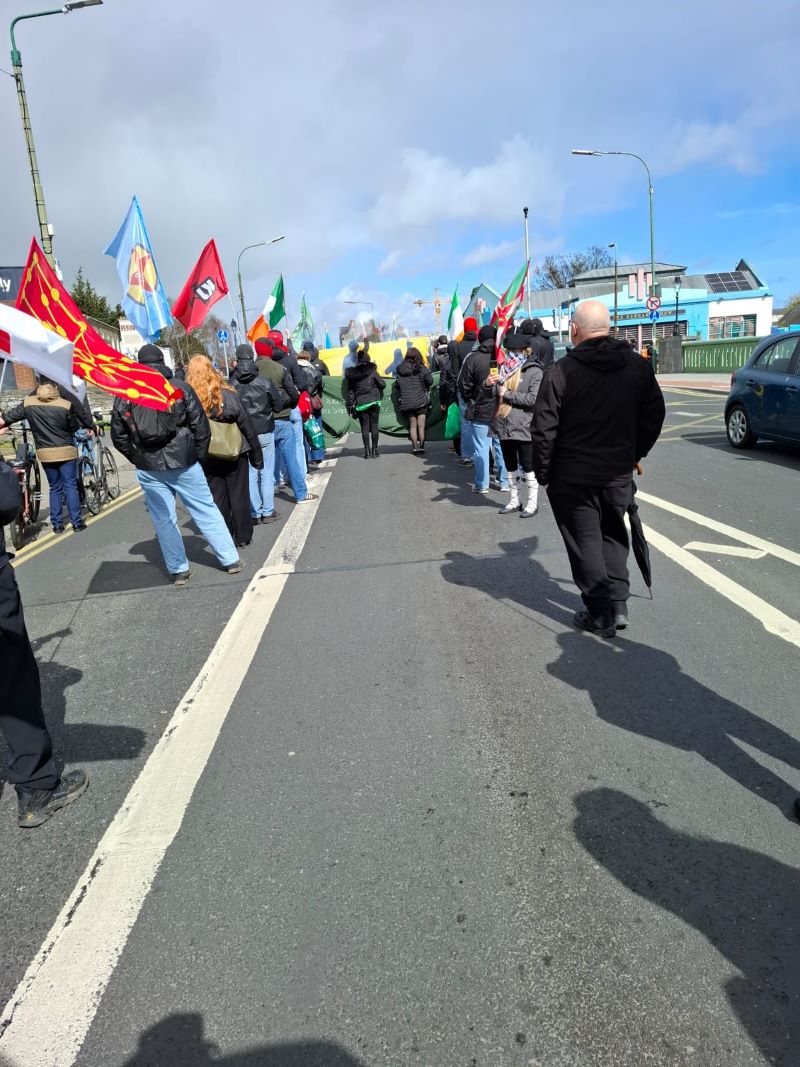
A call for unity of Irish Republicans in action to win Irish freedom and independence was made at a 1916 Rising commemoration in Dublin on Sunday, an event organised by the Anti-Imperialist Action Ireland organisation.

Section of the marchers looking back towards Phibsborough as they approach
Cross Guns Bridge from Phibsborough. (Photo: R.Breeze)

A relatively large number of people participated, including a number of delegations from organisations of struggle in the Spanish, Turkish, German and Italian states. Young people were particularly well represented.

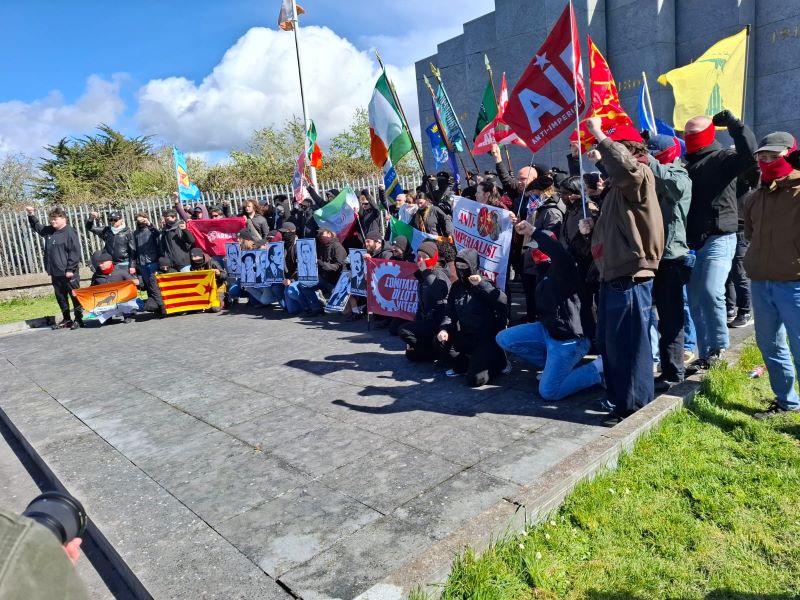
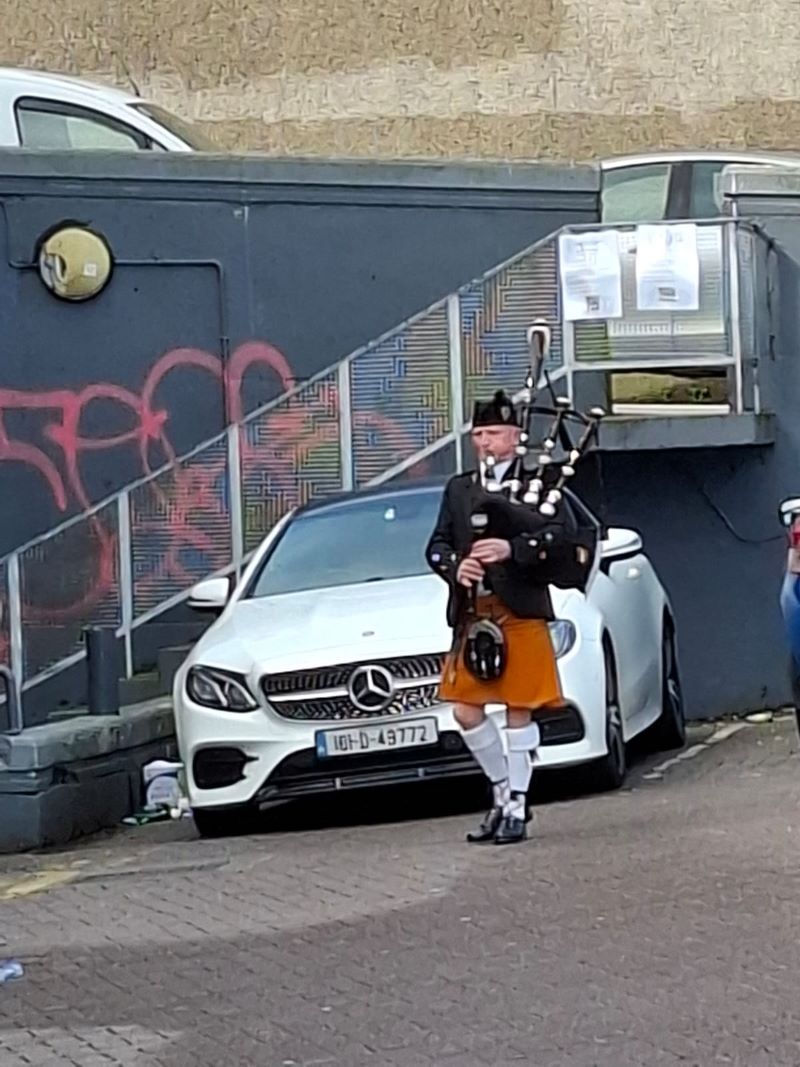
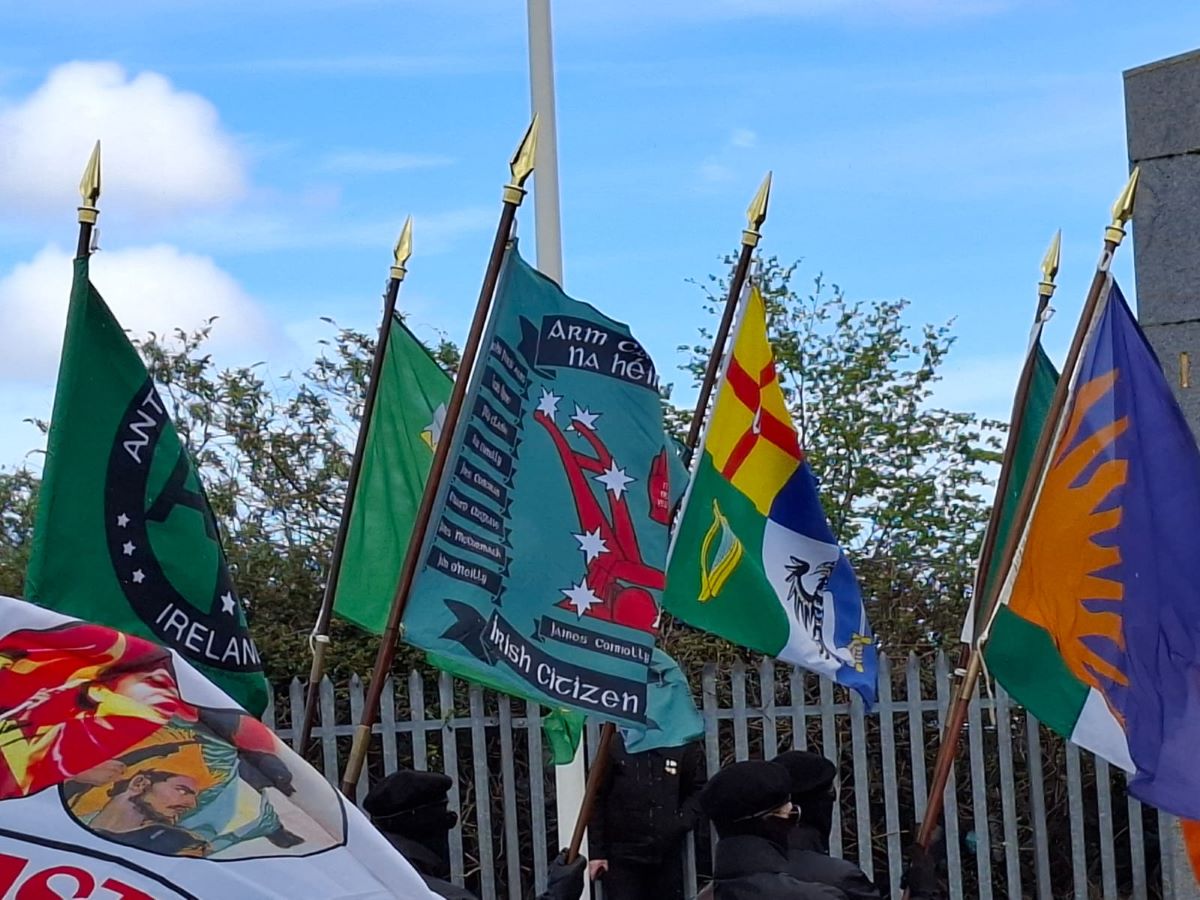
Participants met outside the Phibsborough shopping area on Dublin’s northside from which they were led by a lone piper, a colour party and a number of banners. Among them flew various flags of national and social struggle in Ireland, the Basque Country, Catalunya, Palestine, Turkey …

The lone piper in Phibsborough exercising his lungs and warming pipes and bag as he prepares to lead the procession towards Glasnevin. (Photo: R.Breeze)

The orders to the colour party, as is traditional, were all given in Irish.1 At Cross Guns Bridge, the march halted and, in what has become a tradition for the AIA, flares were lit in memory of the presence of Irish Volunteers there in 1916 and the murder of a civilian by British soldiers.

Proceeding along Finglas Road to the interest of passers-by and the odd ‘beep’ of solidarity from a passing vehicle, the march turned left outside the gates of the older Glasnevin Cemetery to cross over the railway pedestrian bridge to the St. Paul’s section of the Cemetery.

Section of the marchers approaching Cross Guns Bridge from Phibsborough, halting as flares are lit in memoriam. (Photo: R.Breeze)

Winding their way on a path through the headstones, what was now one thick column approached the monument to six Irish Republican armed uprisings, commissioned by the National Graves Association, where a representative of the AIA greeted them.

From the Monument, the AIA representative introduced the reason for the commemoration and listed in honour the Irish Republican Brotherhood, Irish Volunteers, Irish Citizen Army, Cumann na mBan and Na Fianna Éireann, different organisations that fought together in the Rising.2

Central: Flags of the colour party, from left to right: Flag of AIA, Irish Citizen Army (mostly concealed), a version of Irish Citizen Army, emblems of the four provinces of Ireland, the Tricolour (mostly concealed), the Gal Gréine (Sunburst).
The flag intervening from the left is of some participants in the Anti-Imperialist Front, a different organisation. (Photo: R.Breeze)

He called for delegates of different organisations to meet to decide a basis for unity, following which, going on to note that the AIA has long been prepared to work alongside others for shared objectives, he announced floral wreaths to be laid on behalf of the CPI and IDR.3

After the laying of those wreaths, another man was called to read the text of the 1916 Proclamation.

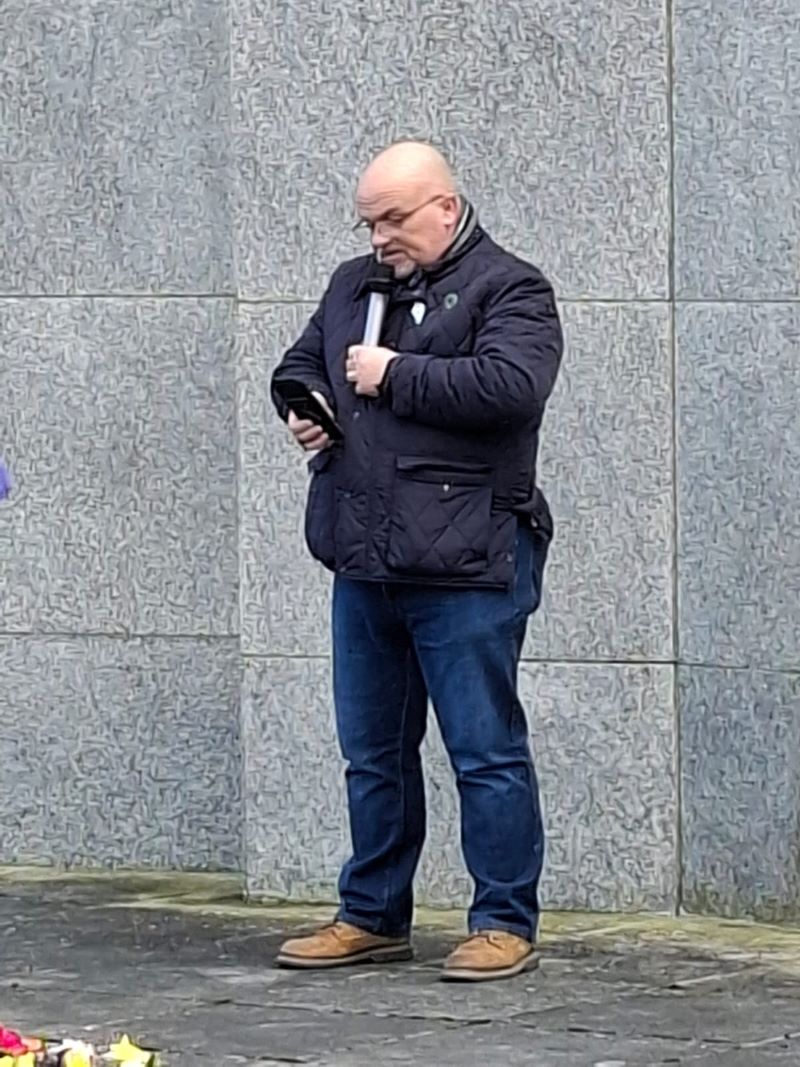
The keynote speaker, a veteran Irish Republican and former political prisoner, was then introduced. He began by reminding his audience of Irish Republican armed uprisings before 1916 going back to 1798 and forward up to the war in the occupied Six Counties.

The main speaker, veteran Irish Republican and ex-political prisoner, delivering the oration for the commemorative event. (Photo: R.Breeze)

The speaker made a number of points regarding the text of the 1916 Proclamation, the declarations of which remain to be fulfilled, in its address placing women on an equal standing with men, ‘cherishing the children of the nation equally’ and guaranteeing ‘civil and religious freedom to all.’

Drawing on the example of those of varying ideological positions who in the 1916 Rising united to “fight against the largest world empire in history”, the ex-prisoner called on Irish Republicans to find the means to unite in action today against imperialism and colonialism.

The speaker also highlighted that the objective of the Rising had been an independent democratic republic which is still to be achieved and that Republicans need to honestly confront the failures which, despite strong resistance, have weakened the struggle to date.

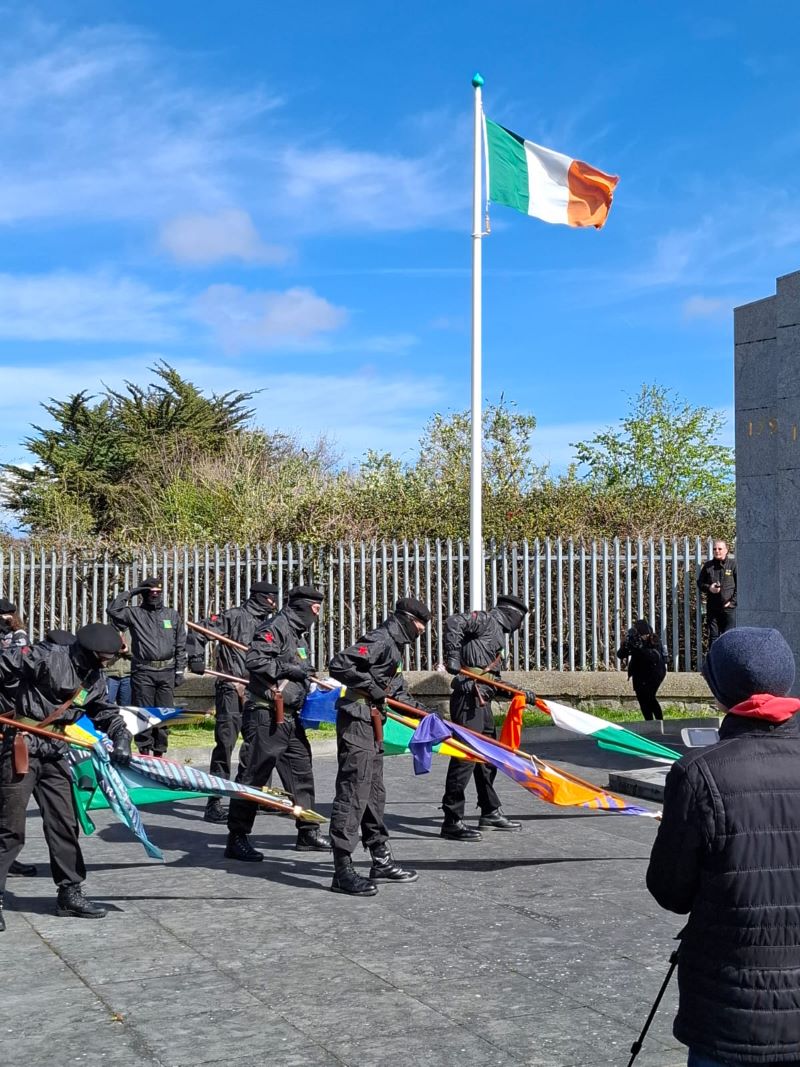
The piper played a slow air as the flags of the colour party were lowered and a few minutes’ silence observed – a traditional Irish Republican honouring of its martyrs in struggle. Announcing the end of the event the MC then called for the piper to play Amhrán na bhFiann4 to conclude.

A moment in the lowering of the colour party’s flags during the moments’ silence in honour and remembrance of fallen martyrs. (Photo: R.Breeze)

COMMENT

The attendance at this year’s event was numerous and encouraging, even discounting the numbers from abroad. The latter has been a feature of AIA commemorations for some years but has also grown visibly in numbers and in countries of origin.

In previous 1916 commemorations of the AIA, songs had been performed by singers but that feature was missing this year. Another missing feature was a part-address in the Irish language, au contraire to the main speaker’s call for the restoration of Irish as the nation’s spoken language.

In common with a great many commemorations by varied organisations at this spot, there was no mention of the independent National Graves Association, for whose work and the monument itself much thanks are due.

A large section of the participants chose to have their photo taken in a group with the monument behind them, their flags, banners and the portraits of the Seven Signatories of the Proclamation to the fore. (Photo: R.Breeze)

The call for unity in struggle is a common one in the Socialist and Republican movement though less verified in practice across their organisations. That said, on many occasions the AIA has put the desire into practice in joint action with other organisations and independent activists.

It is certain that without general unity in action across the resistance movement in Ireland, neither independence nor revolutionary change in society can be achieved.

In the city centre, at the GPO,5 site of the HQ of the Rising in 1916, the State held its own commemoration, with admittance to the area close to the podium by ticket only. According to reports, the speeches of the Taoiseach6 of the Coalition Government were received in silence.

This was in contrast to the speech of the new Uachtarán or President, a native Irish speaker and of broadly left-nationalist political outlook, which was enthusiastically applauded.

End.

Note: If you found this article of interest, why not register with Rebel Breeze for free, so that you will be notified by email of subsequent articles. You can de-register any time you wish.

FOOTNOTES

1However, no other instructions were given in the language, not even ‘dhá líne’ (i.e two lines) when the marchers were being instructed by stewards to separate into two columns.

2Omitted, as it often is, was the participation of the Hibernian Rifles unit, who though not part of the planned Rising joined it and acquitted themselves well in the GPO Garrison and in support of the City Hall Garrison.

3Communist Party of Ireland and Independent Dublin Republicans.

4This air and its lyrics are widely considered the National Anthem of Ireland but for the State, it is only the air of the chorus that is their National Anthem. Composed shortly before the Rising by Peadar Kearney and Patrick Heeney in English, it was sung during the Rising and widely adopted by the Republican movement afterwards. The lyrics were translated to Irish by Liam Ó Rinn in 1923 and, unusually, that version became dominant.

5The General Post Office, an imposing building in Dublin’s main thoroughfare,1 for which recently the Irish Government announced plans to remove the An Post (postal service) to develop in part as a shopping centre.

6Equivalent to Prime Minister. The Government is a coalition of formerly hostile parties Fine Gael and Fianna Fáil, from oppositional sides of the Irish Civil War (1922-1923) and supported by the Green Party and some Independents.

USEFUL LINKS

Anti-Imperialist Action Ireland: https://www.facebook.com/p/An-Phoblacht-Ab%C3%BA-61551946386300/

The National Graves Association: https://www.nga.ie/
https://www.facebook.com/NationalGravesAssociation/

MARCH TO MONUMENT, RALLY – INTERNATIONAL WORKING WOMEN’S DAY CELEBRATED IN DUBLIN

Diarmuid Breatnach

(Reading time: 5 mins.)

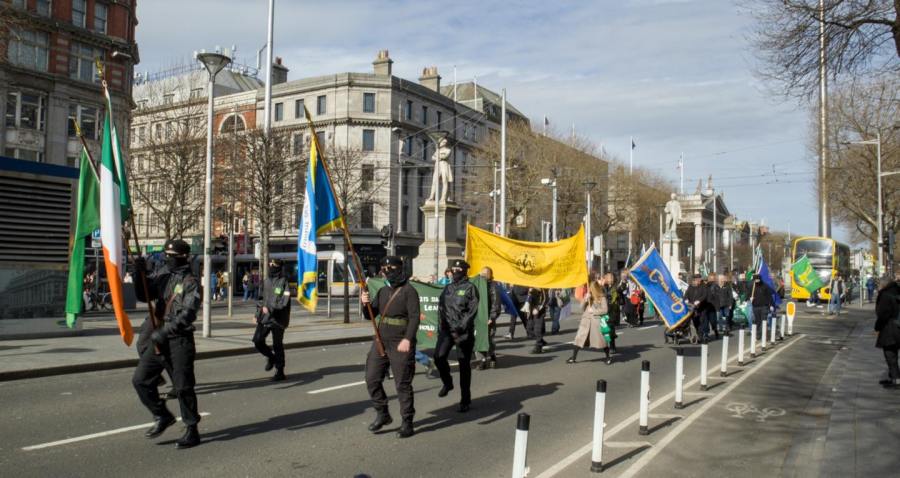
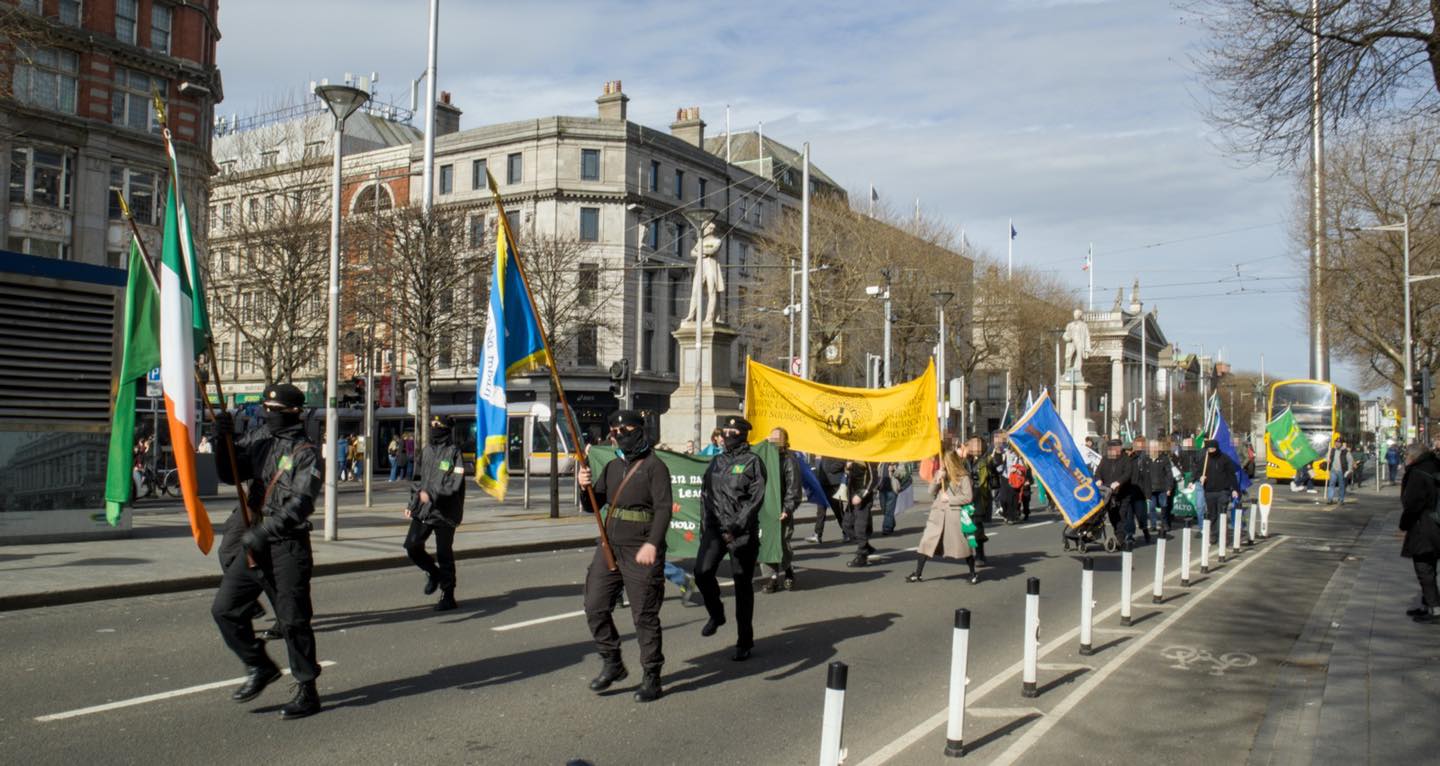
The recognised date known as International Working Women’s Day is March 8th and it was commemorated on that date with a march and revolutionary words and symbolism organised by Irish Socialist Republicans in Dublin.

The marchers gathered outside Wynn’s Hotel in Lower Abbey Street, to mark the founding there of the revolutionary Republican military women’s organisation, Cumann na mBan, on 2 April 1914. The organisation, with its own officers, was possibly the first of its kind for women in the world.1

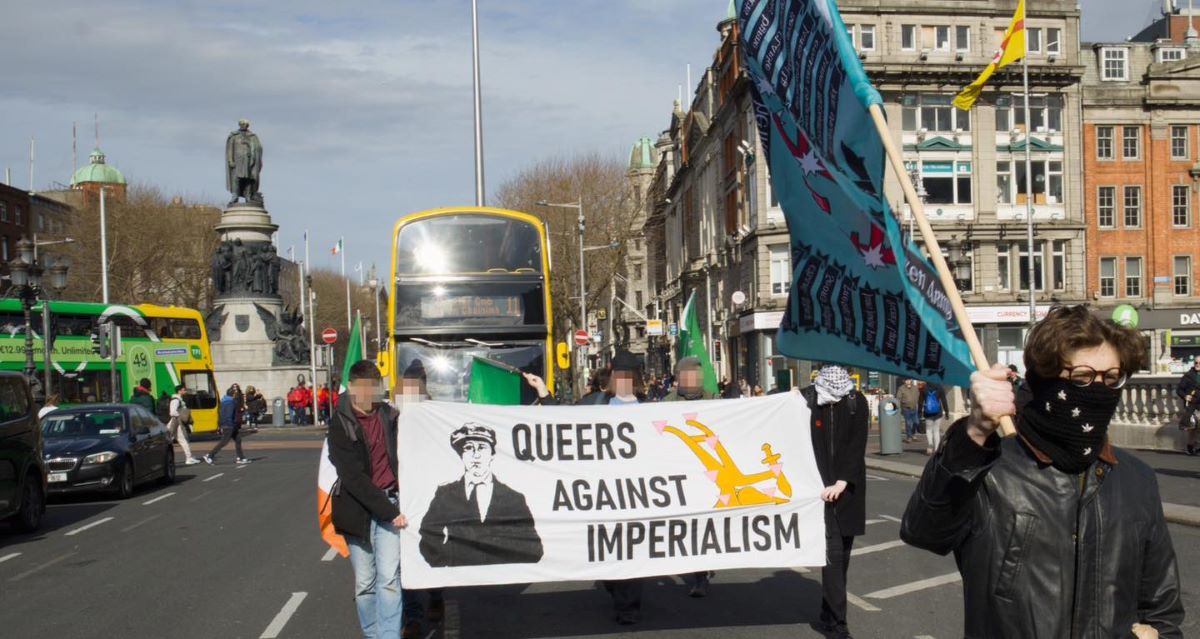
From there the march set off into O’Connell Street, then marching southward to cross the Liffey into D’Olier Street before turning left into Townsend Street, continuing to the statue of Constance Markievicz where the colour party’s flags were lowered in respect.

The march near the start in O’Connell St (photo credit: An Pobal Abú FB page)

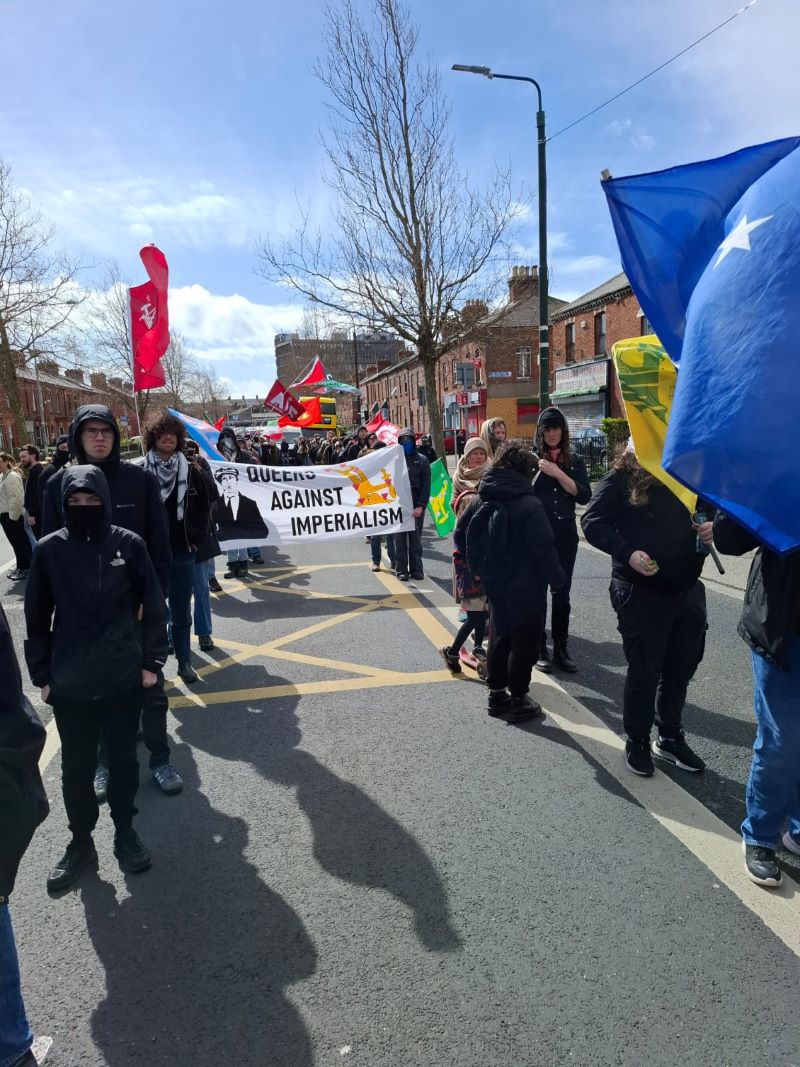
Throughout, chants of “Ní Saoirse go Saoirse na mBan”2 and “Britain out of Ireland” reverberated through the streets of Dublin as banners displayed the slogans “coinníonn na mná suas leath na spéire / women hold up half the sky” and “Queers Against Imperialism”.

Markievicz was an active member of Iníní na hÉireann, the Irish Citizen Army and of Cumann na mBan. She was part of the command of the Stephens Green/ College of Surgeons garrison in 1916 and elected MP on an abstentionist ticket in 1918 and Minister of Labour in the First Dáil in 1919.

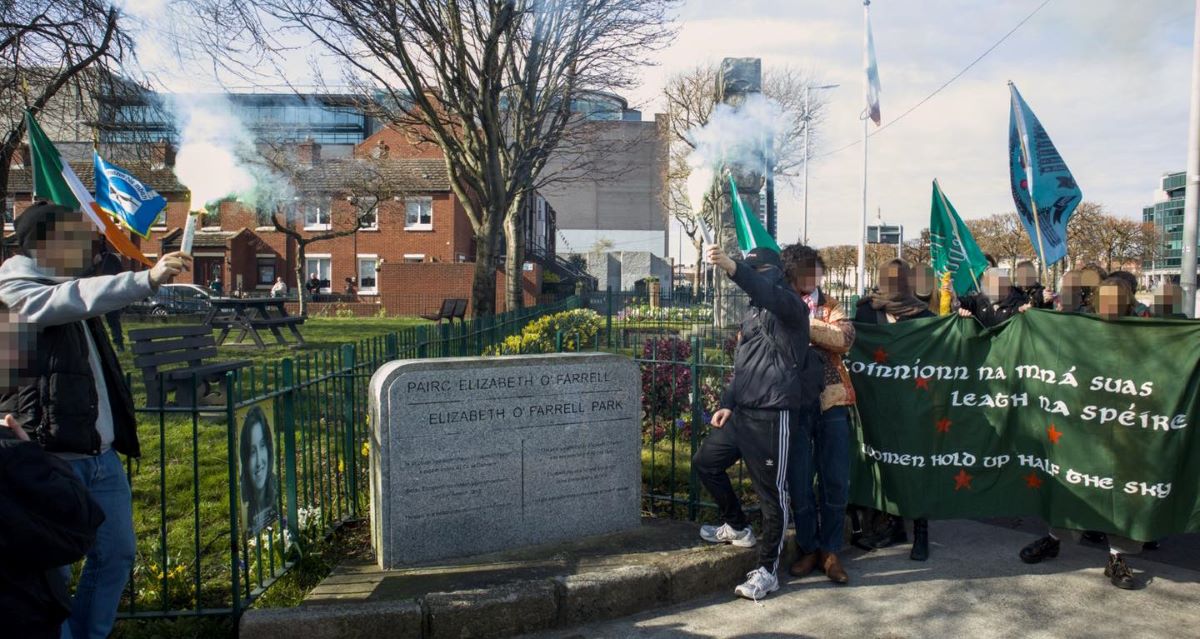
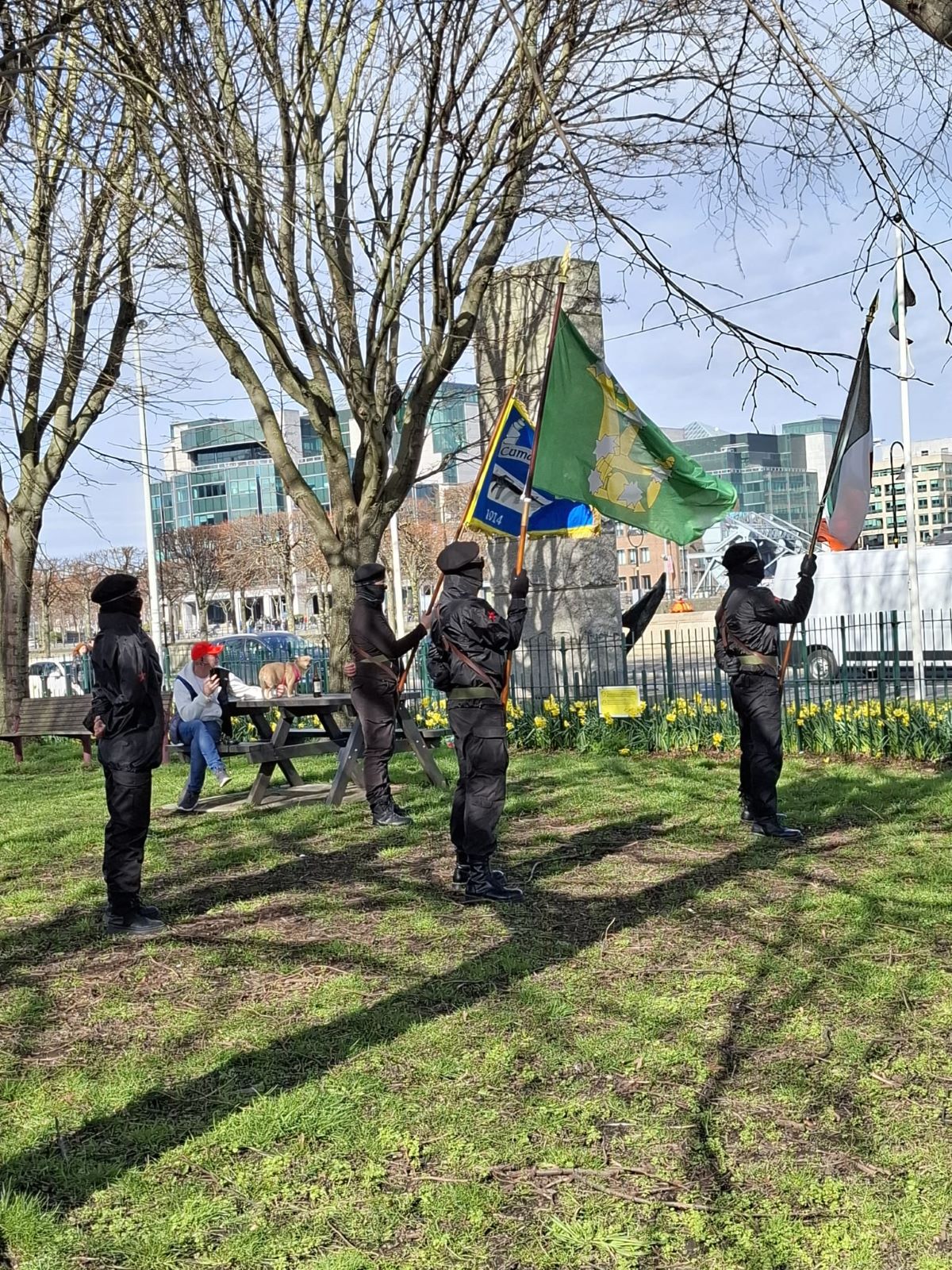
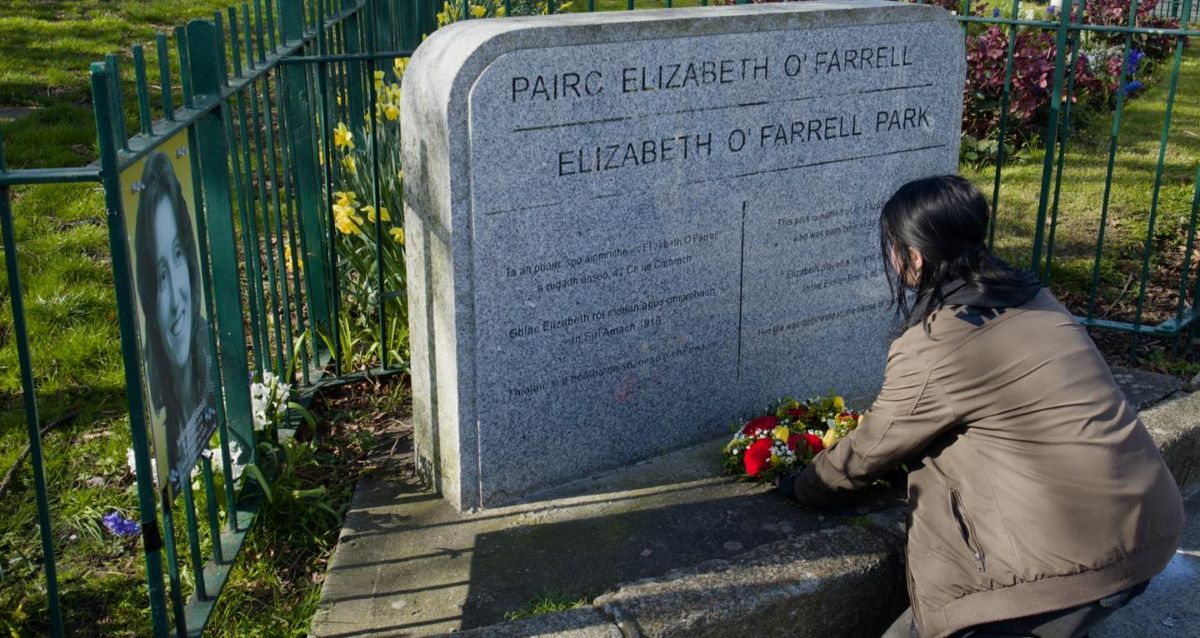
Continuing along Townsend Street and ending at Elizabeth O’Farrell park where a commemoration was held outside in honour of the role of women in the struggle for national liberation while the colour party took up position inside the park.

(Photo credit: An Pobal Abú FB page)

A woman read a speech on behalf of the AIA, tracing founding of International Women’s Day from when women in Russia in 1917 had led strikes and marches against the Tsar and WW1, later becoming known as the February Revolution, leading later to the October Socialist Revolution.

The speaker went on to speak of the role of women in the Republican struggle, from Cumann na mBan, the Irish Citizen Army and Armagh Gaol Republican prisoners, followed by a woman reading the 1916 Proclamation of Independence and the burning of two green flares.

(photo credit: An Pobal Abú FB page)

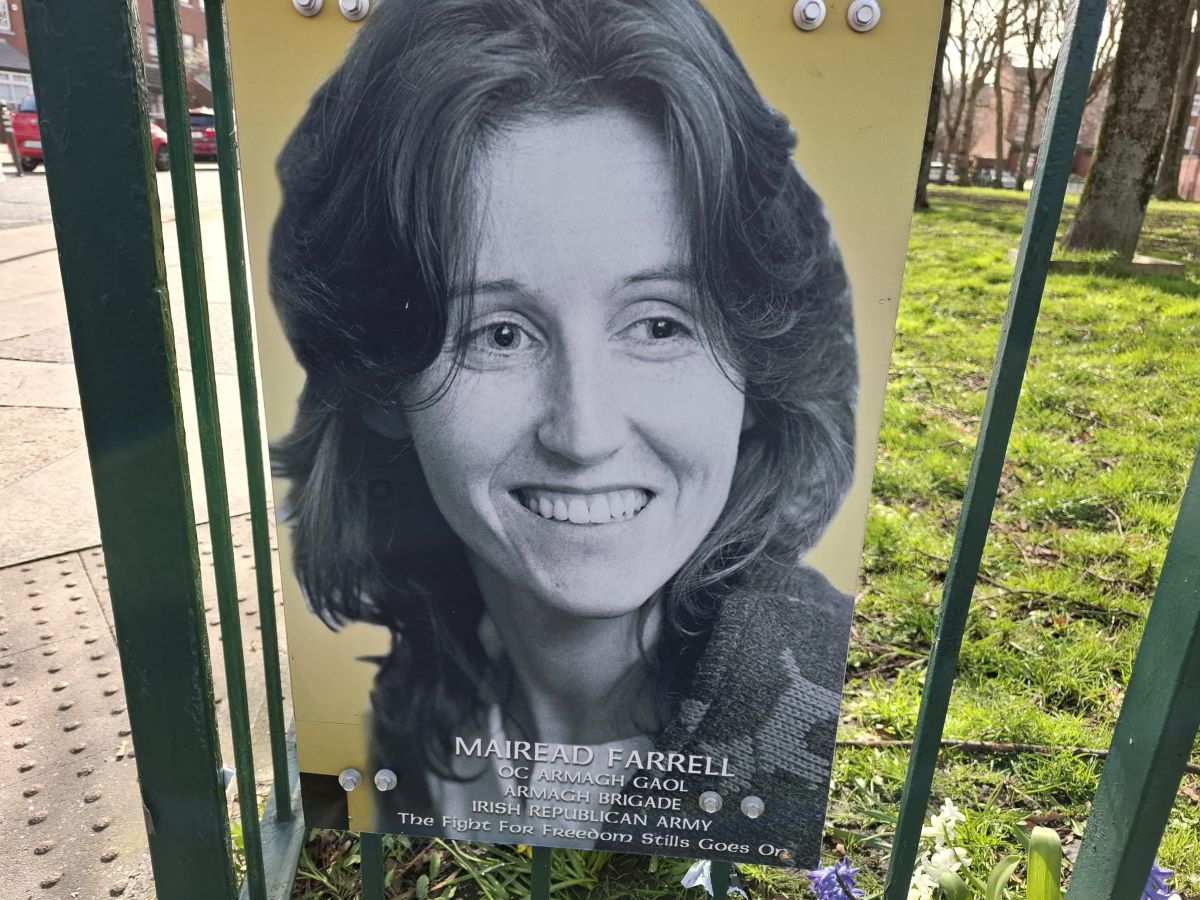
A new plaque of the Socialist Republican Mairéad Farrell was unveiled with the laying also of a commemorative wreath during a minute’s silence observed for all revolutionary women and gender oppressed people who gave their lives for national liberation and anti-imperialist struggle.

The Colour Party in Elizabeth O’Farrell Park (Photo: R.Breeze)

At the same time the colour party lowered their flags in respect, during which the command calls in Irish rang out in the area through the silence.

The area in which the Elizabeth O’Farrell and her life-long friend Julia Grenan3 grew up is a south Dublin docklands still largely working class area. It was in a yard in Lombard Street nearby, actually within sight of the park, that the IRB (Fenians) was founded on March 17th 1858.

Laying of the wreath (photo credit: An Pobal Abú FB page)

Elizabeth O’Farrell and Julia Grenan both participated in the 1916 Rising and, along with Winifred Carney, refused to join the earlier evacuation from the burning GPO building on the Friday, later participating in the final evacuation which ended in the central terrace in Moore Street.

When the leadership took the decision to surrender, O’Farrell went out to negotiate under a white flag even though a man had been killed under such a flag earlier in the very street. In 1922, along with almost the entirety of Cumann na mBan and the ICA, she rejected the Anglo-Irish Agreement.

(Photo: R.Breeze)

Many women were interned by the nascent neo-colonial Irish Government.

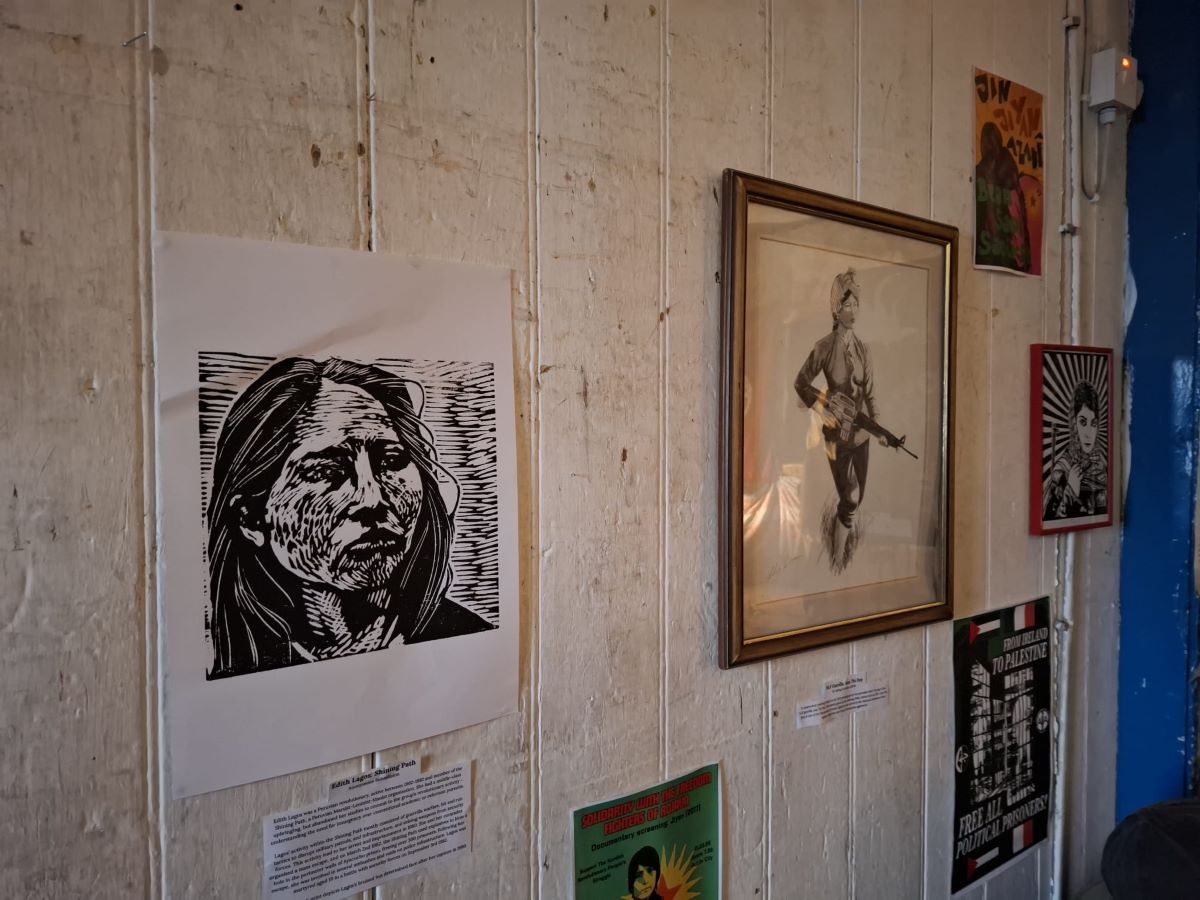
After the Elizabeth O’Farrell Park event, people gathered again at a recently-occupied social centre in Dublin, to view an exhibition of images in honour of the day and to watch an English-subtitled French-language film about women and the Omani Resistance, followed by a music session.4

Part of exhibition for International Working Women’s Day in the social centre (Photo: R.Breeze)

End.

Note: If you found this article of interest, why not register with Rebel Breeze for free, so that you will be notified by email of subsequent articles. You can de-register any time you wish.

Footnotes

1In its early years the organisation worked mainly as an auxiliary to the Irish Volunteers but asserted greater independence at a later stage. It coincided in time with the women in the Irish Citizen Army who shared equal status with male members and indeed in the case of some of them, such as Markievicz and Lynn, actually commanded men. Wynne’s Hotel was also where the decision to found the Irish Volunteers had been taken in 1913.

2Translated as ‘There can be no freedom until women are free.’

3And life partner, many have speculated – certainly they lived together until the end.

4The Hour of Liberation Has Arrived by Heiny Srour

Useful links

https://www.facebook.com/profile.php?id=61551946386300

https://en.wikipedia.org/wiki/The_Hour_of_Liberation_Has_Arrived

Yankee Bases: A Trojan Horse

Gearóid Ó Loingsigh

Reprinted from author’s substack 11 March 2026 and reformatted for Rebel Breeze

(Reading time: mins.)

Photo: US Military Base Qatar Under Iranian Attack 2026

On February 28th the Zionist regime of Israel and the USA commenced a lethal bombing campaign against Iran, choosing as their first target a school where more than 168 girls were murdered.

The Western press took its time in questioning the attack and the western governments never really did.

The press “explains” that the school was near a centre of the Revolutionary Guard, but they don’t explain that it was a cultural centre and a clinic and pharmacy all of which enjoy protection under the Geneva Conditions.

They tell us that these places “perhaps explain the attack.”[1] Well no, they don’t. They remain war crimes.

Iran’s response was robust. So robust that the western press and politicians condemned it and asked Iran to not attack the other states of the region (calling the Emirates countries or nations is a bit much).

They never asked the US or its attack dog, Israel, to cease its attacks.

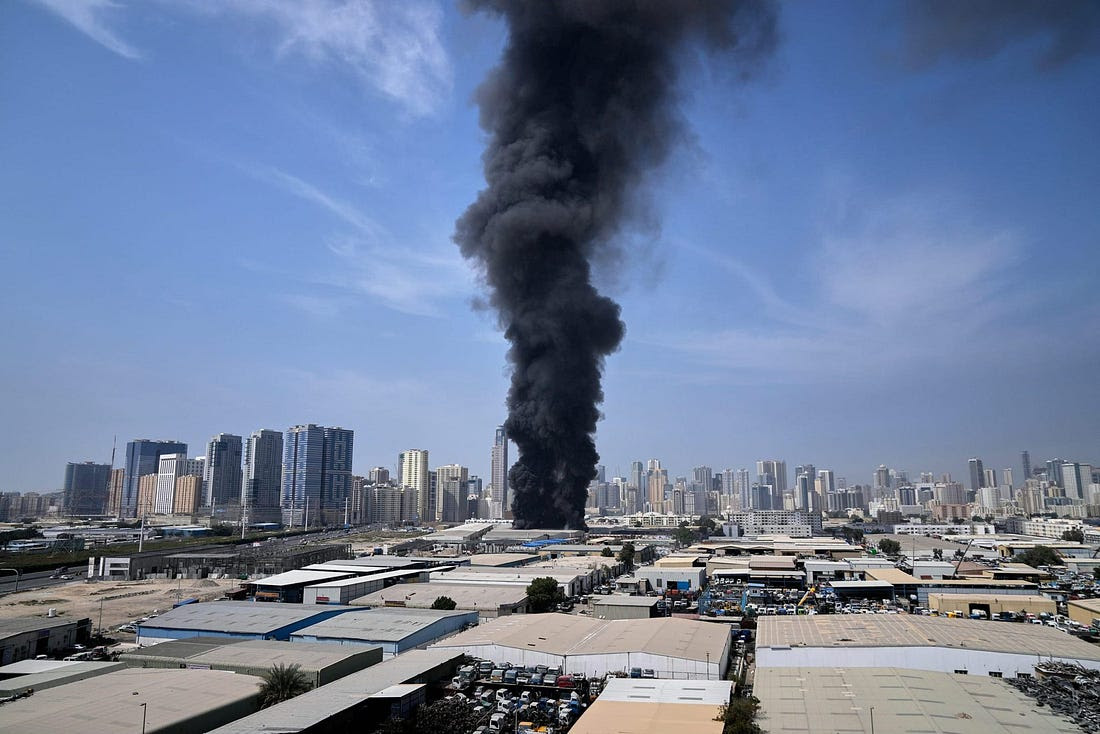
Iranian civilians are less important than investments in Dubai and other places. Iran attacked military bases, radar installations and hotels housing US soldiers who had transferred there given the possibility of an attack on their bases. The counterattacks uncovered some truths.

The first one is that the Arab monarchies of the region are nothing more than US lapdogs and the myths about their economies went up in smoke in seconds. They are not safe places to invest in and less so to live in as shown by the mass of tiktokers crying into the camera.

It is worth pointing out that many of them boasted about not paying taxes and one or other explicitly stated they had set up in the region in order not to pay taxes and now they want their respective governments to spend taxes that they not only didn’t pay but didn’t want to in order to rescue them.

It might be that Dubai and the other monarchies never fully recover.

Another truth that was revealed is the real role of US military bases. The Yanks like to say that it is to protect and defend the countries they are located in against attacks.

That myth also went up in smoke just like the myth of Dubai as a safe place for digital nomads, tiktokers, bankers and even drug traffickers like the Kinahans who have lived there openly for the last number of years.[2] They will all have to think of other places.

The military bases were not capable of defending the monarchies and moreover the US transferred a good part of its military capability to Israel and left them to their fate.

Recently the president of South Korea announced that the USA had transferred part of its defence system to Israel.[3] The presented lamented the situation but explained that there was little he could do, i.e. the USA decides everything.

In the case of Spain, President Sánchez said he would not allow the USA to use the shared military bases in the country to launch attacks on Iran. Trump’s response revealed the real role these bases play and the real authority over them.

He said they didn’t need them, but if they want to, no one is going to tell them no.[4] In many of the military bases, in law, it is the host country that commands and controls the base. The reality is otherwise and Trump showed it.

In others cases, particularly in Japan and some European countries it is the US that has formal control.

The bases are not there to defend the host countries but rather to defend US interests and to act as they see fit. The Arab monarchies have just learnt that lesson the hard way. Spain has yet to, but Trump has warned them that it is in practice he who decides what is done, where and how.

This brings us to the question of military bases in Colombia. Theoretically Colombia has authority over the bases and can limit what is done. In practice it is not so.

The supposedly progressive government of Gustavo Petro never did anything to expel the Yanks from the bases in the country. Nor is he going to do so in the few remaining months of his presidency.

The question is what will the new government that comes into office on August 7th do? For the moment it looks like the next president will be Iván Cepeda from the same political force as Gustavo Petro.

In the midst of tensions between Colombia and the USA Cepeda stated from Madrid that Colombia wasn’t a Yankee colony.[5] When he is president he will have ample time to prove it and can start on August 7th by ordering the north American troops out of the country.

The rest of the countries in the world should do the same.

It is clear that the bases are an extension of the USA and at all times serve it and nobody else.

End.

Note: You may wish to read other articles by Gearóid Ó Loingsigh on his substack https://gearoidloingsigh.substack.com/

Note: If you found this article of interest, why not register with Rebel Breeze for free, so that you will be notified by email of subsequent articles. You can de-register any time you wish.

NOTES

1] The Guardian (10/03/2026) Minab school bombing: what evidence is there that the US was responsible? Tess McClure. https://www.theguardian.com/global-development/2026/mar/10/iran-minab-school-bombing-shajareh-tayyebeh-primary-what-evidence-us-responsible

[2] Middle East Eye (08/03/2026) Investigation finds ‘notorious cartel leaders’ living openly in Dubai. https://www.middleeasteye.net/news/investigation-finds-kinahan-cartel-leaders-living-openly-dubai

[3] The Korea Times (10/03/2026) S. Korea regrets transfer of USFK air defense assets to Middle East, Lee says. Anna J. Park. https://www.koreatimes.co.kr/southkorea/defense/20260310/s-korea-regrets-transfer-of-usfk-air-defense-assets-to-middle-east-lee-says

[4] PBS (04/03/2026) Spain denies cooperating with US military operations in Middle East, contradicting White House. AP. https://www.pbs.org/newshour/world/spain-denies-cooperating-with-u-s-military-operations-in-middle-east-contradicting-white-house

[5] See