Revolutionary socialist & anti-imperialist; Rebel Breeze publishes material within this spectrum and may or may not agree with all or part of any particular contribution. Writing English, Irish and Spanish, about politics, culture, nature.
Some people are saying Maduro is a dictator and ruling undemocratically. Those people seem to be mostly from the imperialist media and the Right but still … The claim seems to rest on the fact that although his party won the 2013 general elections, Maduro now rules without the support of the majority of the legislature in Venezuela.
The Venezuelan Opposition leader Juan Guaidó declared himself President, quoting a Constitutional provision and quickly got the support of the US and European powers. Brazil’s neo-fascist President Bolsonaro is also vociferously backing Guadió. Cuba and Bolivia support Maduro, as does Russia and China. Well, we kind of get used to the European powers being on the same side as the US in international affairs, and of Russia being on the other. And Cuba and Bolivia are biased against the USA, having often accused their powerful neighbour of meddling in the affairs of countries in Latin America.
And as it happens, history supports their accusation. Since the decade after WW2 alone, the USA have intervened, directly by invasion or less directly (i.e by instigating coups), in the following Latin American countries:
Argentina (coup 1976 and subsequent support for right-wing dictator)
Brazil (coup1964 and subsequent support for right-wing dictator)
Chile (coup 1973 and subsequent support for right-wing dictator)
Costa Rica (coup-civil war 1948 and many measures since)
El Salvador (coup 1975 and civil war to 1992)
Guatemala (coup-civil war 1954)
Nicaragua (support for right-wing dictator and running terrorist group 1979-1990s)
Panama (assassination of President 1981 to support replacement, subsequently military invasion 1989)
Paraguay (coups 1954, 2012)
Peru (CIA-sponsored governments 1990-2000)
Uruguay (coup 1973)
Venezuela (coup 2002, supporting opposition to Chavez, ditto with Maduro, inciting military coup [unsuccessfully to date]).
Well even if these methods were subversive and undemocratic, perhaps the USA was intervening to support democracy? After all, isn’t that what its spokespersons say they want in Venezuela?
Well, sadly no. The regimes the USA has supported in power as well as those brought to power by coups, have been military dictatorships and right-wing governments, repressing democratic freedoms, jailing trade unionists or murdering them, banning opposition media, torturing detainees,making hundreds ‘disappear’, and generally, according to many human rights organisations, with appalling civil and human rights records.
In fact, some of the statements of US spokespersons recently revealed interests that had little to do with justice or human rights. A Guardian report (see References and Links) quotes the USA’s national security adviser John Bolton complaining about Russian support for Maduro: “This is our hemisphere. It’s not where the Russians ought to be interfering.” Apart from the fact that this sounds like the USA’s Latin American policy from the 19th Century, one can’t help wondering when in the 20th or so far in the 21st Century, the USA has ever limited its operations to ‘its own hemisphere’.
Apparently, on May 1st, the Venezuelan Opposition leader tried to stage a coup. He sent out a tweet calling on people to mobilise to unseat Maduro and, though at one point he said it would be peaceful, had himself photographed with a few armed men in Army uniforms. Some opposition people did mobilise and the Army, apparently still loyal to Maduro, confronted them and injured many (none apparently with live rounds, thankfully). Where was Guaidó? It’s not clear but certainly not among those confronting (or being confronted by) the Army.
The US Secretary of State Pompeo claimed publicly that Maduro had a plane ready to fly to Cuba when the coup attempt began but was talked out of it by Russia. Evidence for this? He didn’t produce any and Venezuelan officials accused him of trying to undermine the Venezuelan Army’s confidence in the regime.
Almost certainly there will be other attempts. The US feels it has a good chance of destabilising the regime and bringing in one more favourable to itself. And of course, there’s all that oil.
Do I support Maduro? I don’t know him or his practice well enough to do that. But I do know the USA and whatever they are up to there, I am against them. And I think we should all be.
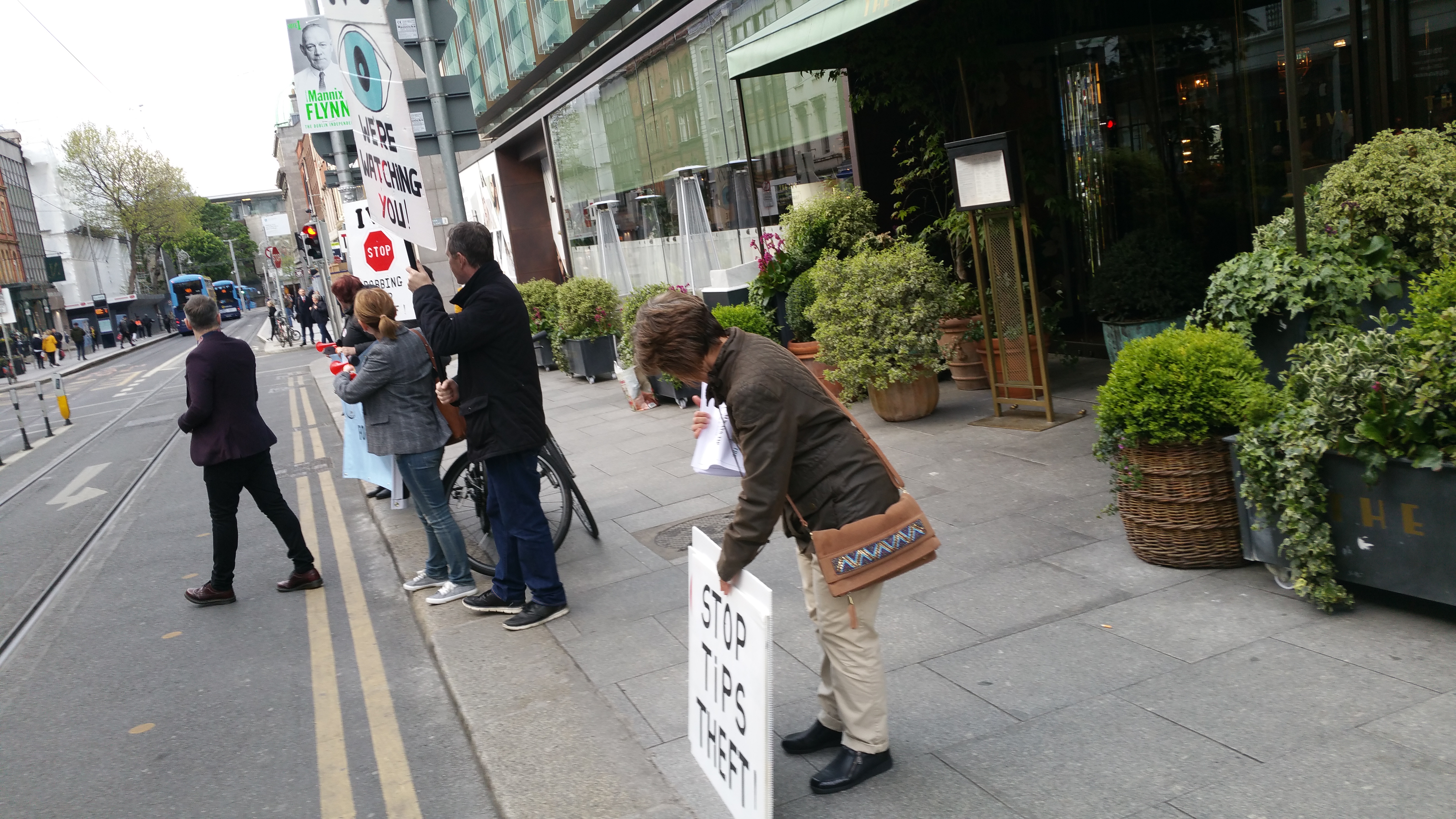
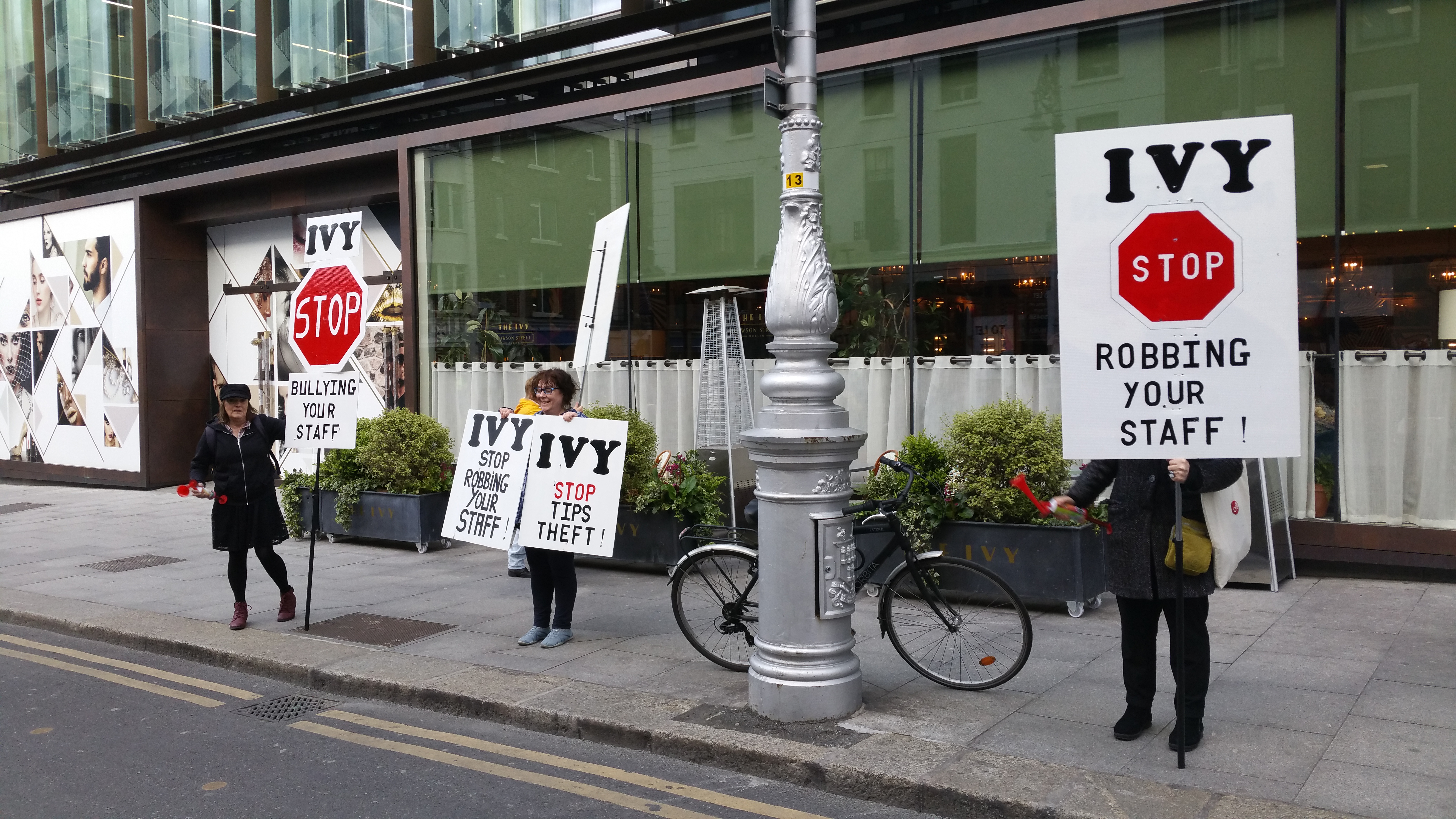
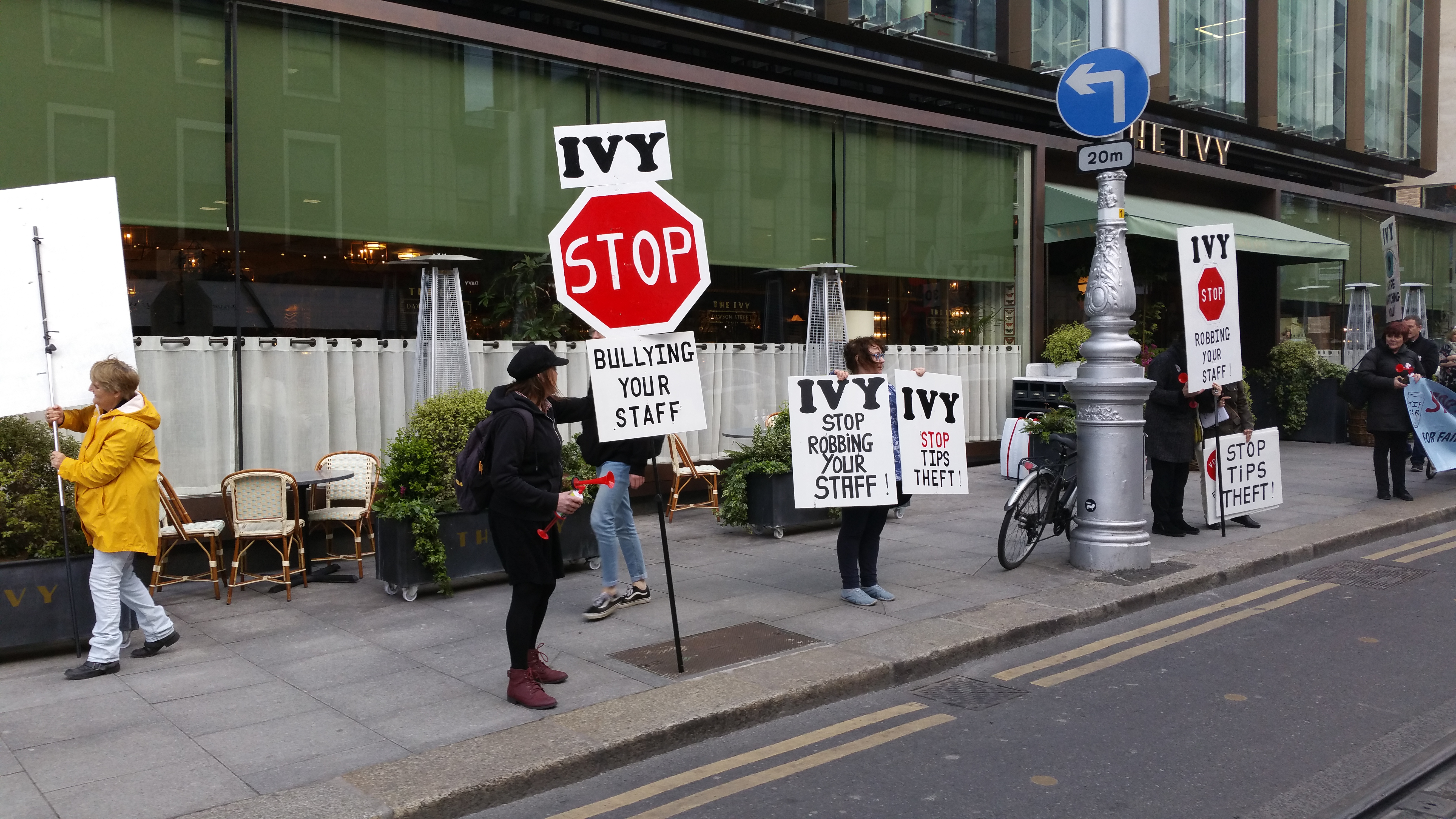
Supporters of staff at a prominent Dublin eatery protested yesterday over the management’s appropriation of some of the tips left by customers for the staff. They are able to do this quite easily when the customer pays the tip by credit card but when staff asked customers to leave their tips in cash, management accused them of “deplorable greed”. They have also dismissed two staff who are currently taking a case for unfair dismissal, accusing the management of sacking them for their unionisation of the staff.
View of some early protesters outside the Ivy Dawson Street restaurant (Photo: D.Breatnach)
The photographs taken here show a smallish group, including Independents for Change TD Joan Collins but more were coming later from the Mayday march on the north side of the river. A supporter claimed that the management offers an hourly rate above the minimum wage but then makes that difference up with tips.
Catering work in general is notoriously low-paid and with transitory staff, making it difficult for trade unions to organise them and relatively easy for management to hire and fire.
View of some early protesters outside the Ivy Dawson Street restaurant (Photo: D.Breatnach)
There have been a number of protests about the tips issue at Ivy, including one on which the Irish Times reported in March.
The report stated that a number of protestors who had booked tables in the restaurant began the protest and were then joined outside the restaurant by a group of 30 people led by Independent TD Joan Collins who held up placards stating “Stop tip theft”.
View of some early protesters outside the Ivy Dawson Street restaurant (Photo: D.Breatnach)
Ms Collins was reported as saying that she was aware of other Dublin restaurants who have are engaging in similar practices when it comes to tips and was quoted as saying that: “The Ivy are abusing the good nature of diners who are tipping staff well because and they are not aware that management are taking some of their tips”.
“Workers are hugely concerned as they are not earning a high hourly wage and they work hard for their tips only for a portion of it to go to the company,” she said.
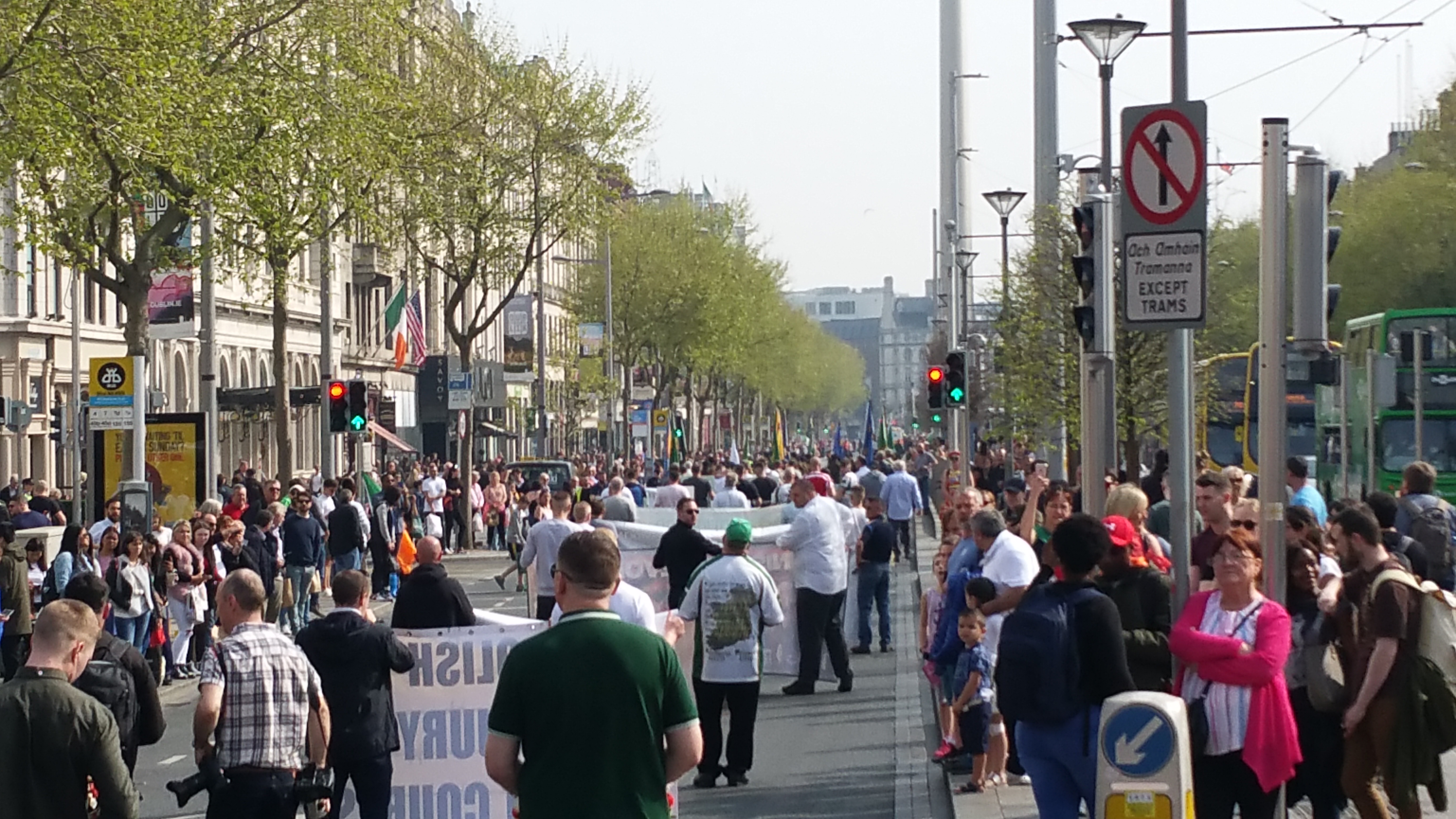
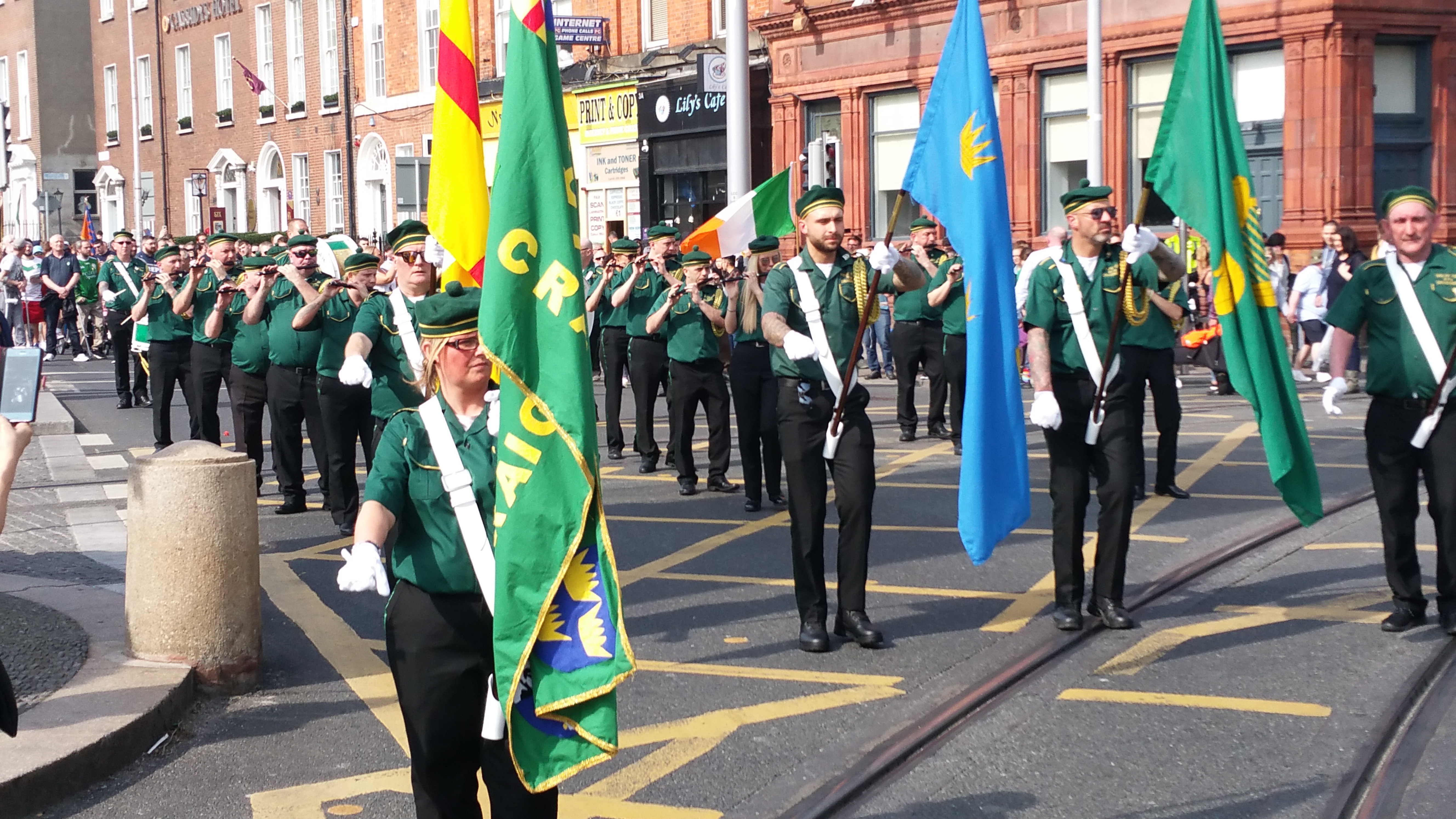
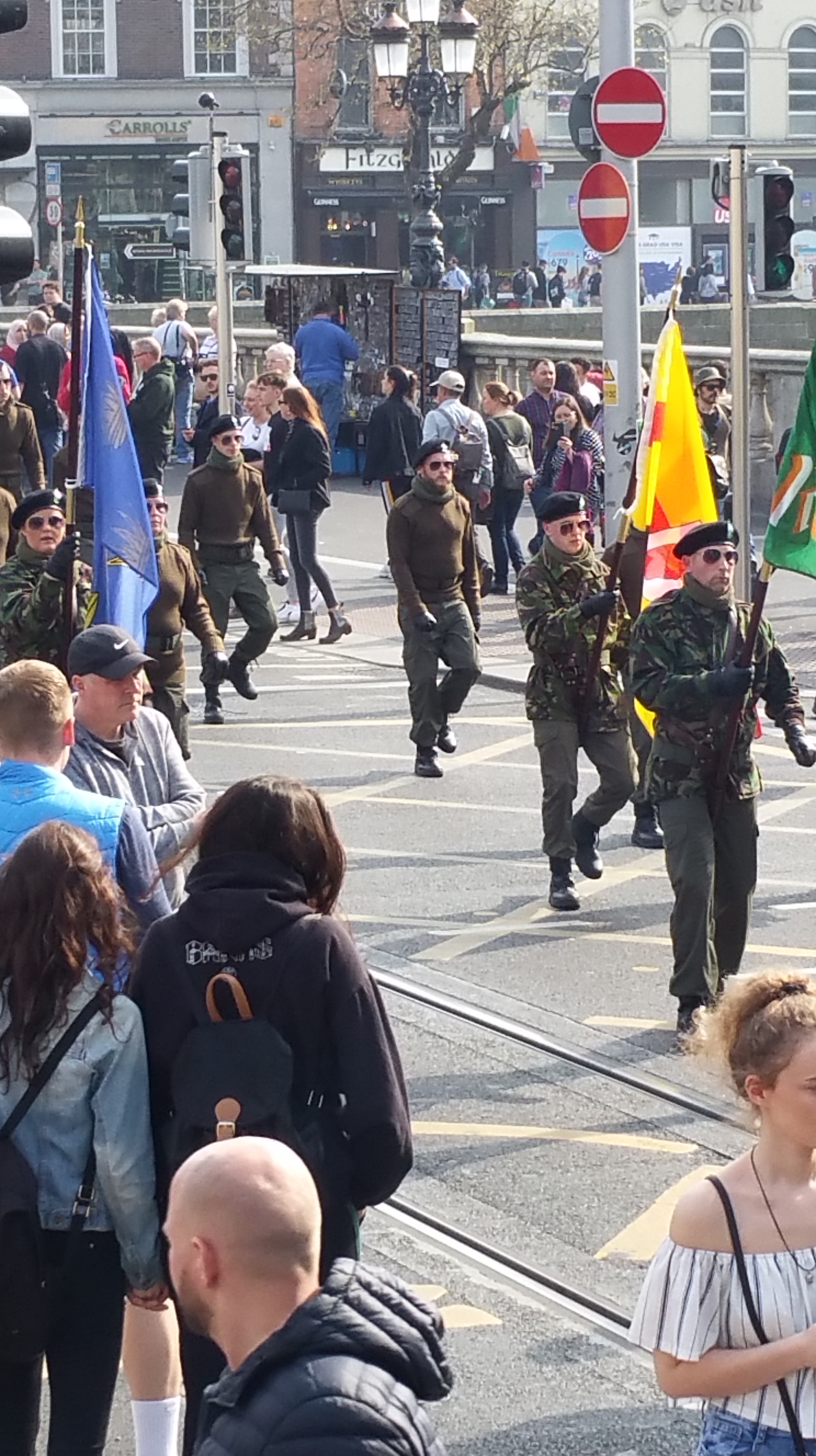
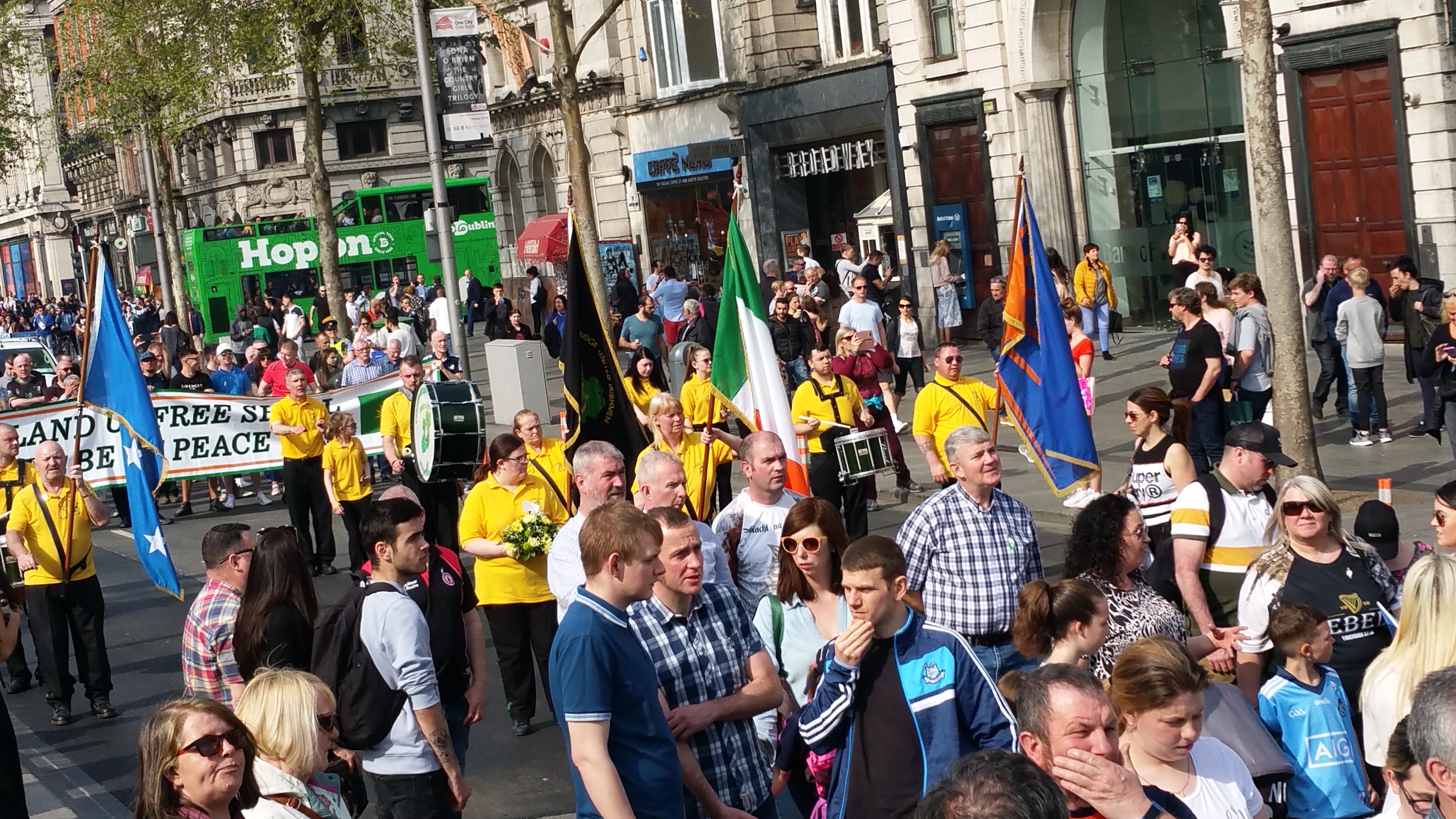
The Irish Republican organisation Saoradh staged a large demonstration of its support on Dublin’s O’Connell Street on Saturday afternoon (20th April). Republican marching bands and hundreds of supporters followed the traditional ‘colour party’ flags and lines of men and some women dressed in green-brown military-style clothing, black berets and dark sunglasses.
view section of parade proceeding south along east side of O’Connell St.
Beginning at the Garden of Remembrance, the procession, carrying large portraits of the executed martyrs of the 1916 Rising, wound its way down the main street past thousands of viewers, many of those taking photos and filming, down to the wall of Trinity College and the Bank of Ireland building, then back up Westmoreland street and up the west side of O’Connell Street to the GPO building, the site of the HQ of the Rising in 1916, for speeches as the ceremony of the commemoration.
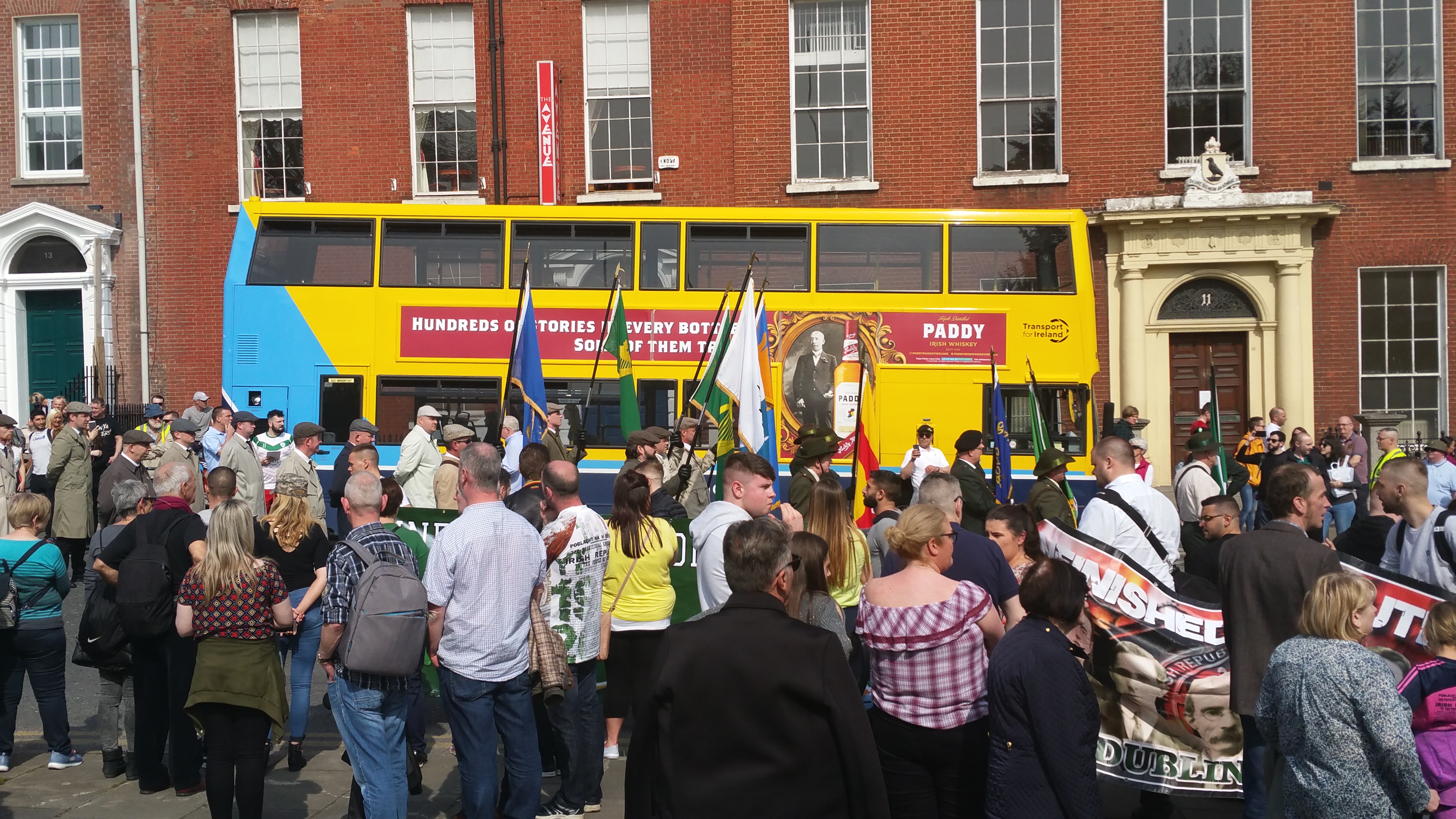
Parade forming up at Garden of RemembranceThe Wolfe Tone RFB from Craigneuk, Glasgow, at the Parnell St/ O’Connell St. junctionLong view of section of the parade proceeding south along the east side of Parnell Square.
The parade assembled at Dublin’s Garden of Remembrance and remained there for some time without the reason being clear, until the arrival of the participants dressed in green-brown military-style clothing, black berets and dark sunglasses, which many in the waiting crowd applauded. Presumably these were meant to represent the IRA but from the physical appearance of many it was clear that their active duty days, if they had them, were behind them. Presumably too, any organisation that did have an armed section would be reluctant to offer them up to the State for arrest on a parade and their all appearing at the last minute like that was also perhaps to reduce the opportunity for Garda harassment.
Another colur party but in War of Independence (1919-1921) period costume at the Garden of Remembrance, waiting to begin.
However, the uniformed Garda presence was in low numbers and although the Special Branch had officers there, they did not appear to be harassing Republicans for their names and addresses, as is their usual wont.
The route of the parade had been prepared placards bearing the words “The Unfinished Revolution” and “Saoradh” with tricolour flags attached at intervals to traffic sign and street light posts, including also at least one Palestinian flag. As the colour party and people in uniform lined up with banners and a band behind them and set off down towards the city centre, people joined in behind the band, with another band bringing up the rear.
TRAGEDY AND CONDEMNATION
The crowd appeared to contain many different elements, mostly men but quite a few women, some parents with small children and some teenagers, young men and older. Included among the attendance were a number of independent Republicans and socialists and a number expressed their decision to attend as having been influenced by the tragedy of the previous Thursday and the media campaign against ‘dissident’ Republicans, along with the apprehension that the Gardaí might take advantage of that to block or harass the paraders.
A scheduled Easter commemoration by a committee including apparently members of Saoradh to be held in Derry on Easter Monday had been cancelled as a result of a tragic incident. The armed British colonial police force in the Six Counties, the PSNI, had been carrying out house searches in the Galiagh and Creggan areas of Derry, allegedly for arms, to which youth had responded with stones and petrol bombs. During that incident, a gun was fired from the direction of the youth towards the colonial police but struck Lyra McKee, a young female reporter standing near them instead. Tragically the wound was fatal.
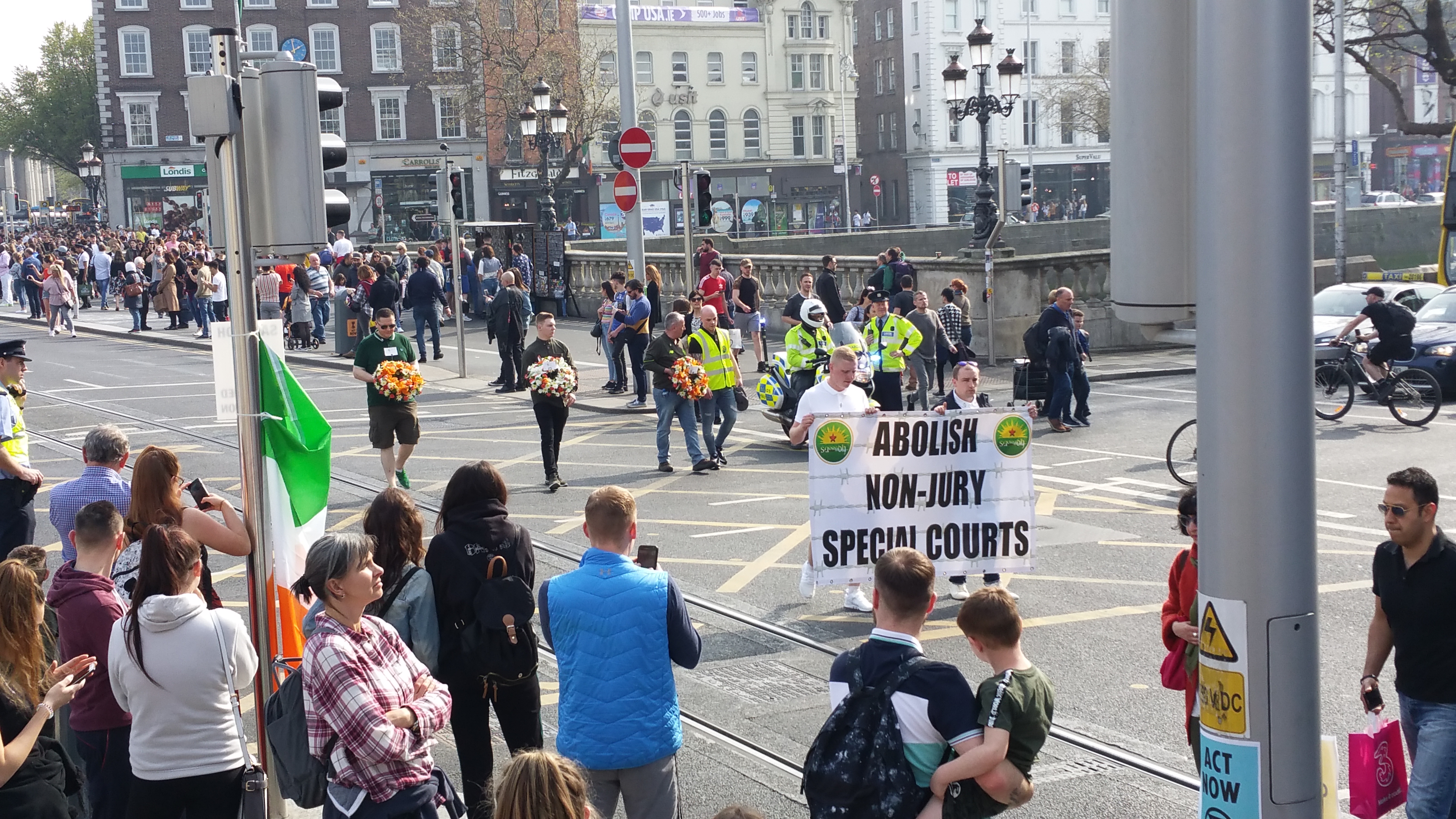
Section of banners coming back across O’Connell Bridge towards the GPO
Saoradh had issued a statement after the event expressing regret for the death and extending condolences to Lyra McKee’s family and friends but also putting the incident in the context of regular harassing raids by the PSNI on houses in ‘nationalist’ areas and the always likely result of resistance (see Links for full statement).
Possibly in reference to that tragedy, a very tall long-haired man stepped in front of a section of marchers with his hands in the air. Stewards quickly blocked him peacefully and diverted participants around him.
Past the objector and into O’Connell Street, both the east side pavement and the pedestrian middle reservation were thronged with people watching, photographing and filming. The parade passed on to O’Connell Bridge, into D’Olier Street, turned right towards the Bank of Ireland building and back up Westmoreland Street to the General Post Office, location of the HQ of the Rising in 1916, outside of which the 1916 Proclamation had been read on 24th April by Patrick Pearse with James Connolly by his side.
At the GPO, Saoradh party chairman Brian Kenna welcomed the participants.
Portraits of the executed 1916 martyrs being carried back across O’Connell Bridge
Section of the Coatbridge Unitedmen RFB, Glasgow, marching southward in O’Connell Street.
THE SPEECHES AND CEREMONY
At the GPO, Saoradh party chairman Brian Kenna welcomed the participants. Republican Easter Rising commemorations tend to follow an established pattern, no matter which organisation is involved: the reading of the Proclamation; messages of solidarity from Republican prisoners; a speech by a representative of the organisation; the lowering of the flags to a drum roll and their raising again, in honour of the fallen; the singing of Amhrán na bhFiann, the Irish National Anthem. In the past, a statement from the IRA was also read but in recent years this have not been customary, for a number of reasons.
The usual components of the ceremony were present on Saturday outside the GPO with a few variations: a poem by a supporter read out, “James Connolly, the Irish Rebel” sung by another and “Róisín Dubh” played on the uileann pipes. The James Connolly song, with some powerful imagery and an attractive slow air, gives no indication whatsoever of the man’s revolutionary socialism and seems to incorporate him into the IRA, instead of the Irish Citizen Army which he co-founded or even of the Irish Volunteers, with which he joined forces only weeks before the Rising.
In the distance at the GPO, Chairperson of Saoradh Brian Kenna, MC of the event
The RFB (Republican Flute Band) marching bands were from Scotland: The Wolfe Tone RFB Craigneuk and theCoatbridge Unitedmen RFB. One of the bands played “Take It Down From the Mast, Irish Traitors”, the lyrics of which deny the Tricolour to the Free Staters who waged the Civil War against the Republicans, the legitimate bearers of the flag. A participant remarked that the song was sung first against Free Staters, later against Fianna Fáil, later still against the “Stickies” and more recently against Sinn Féin.
In his speech on behalf of Saoradh, Dee Fennel from Belfastbegan by sending solidarity messages to Republican prisoners in Irish jails and to the relatives of all those who had fallen in the struggle against British imperialim. He said that the objectives set out in the 1916 Proclamation had not been achieved and referred to those participants in the struggle who had left it along the way, some to collude in upholding the two failed states of the divided nation.
(at right of photo) Dee Fennel of Saoradh delivering the main oration at the GPO
Referring to his own activism, Fennel recollected how four years previously he had spoken at an Easter commemoration as an independent Republican, i.e not a member of any political party. He had spoken of the need for Republican activists to engage more with one another and also in the struggles of communities, women and trade unions. Fennel said that as a result of a discussion among Republicans, some had formed Saoradh, building on “maturity and commitment” while others “retreated to their flags” and went on to list the wide areas of struggle in which he said Saoradh activists could be found.
Fennel also referred to the activity of the IRA and said that while British imperialism remains in possession of a part of Ireland and prevents the exercise of sovereignty of the nation, there will be some form of armed resistance and that this is borne out by history.
Referring to the harassment and persecution to which Fennel said Saoradh activists were being subjected, including “tens of thousands of stop-and-searches, hundreds of house raids”, he linked that to the PSNI raids in the Creggan area of Derry earlier that week and the tragic accidental killing of Lyra McKee when “a Volunteer fired shots at PSNI forces”. Going on to say that the IRA do make mistakes from time to time, and referring to two women killed by the Provisional IRA in error years before, Fennel said that the IRA should admit and apologise for their mistakes (NB: The New IRA did later issue an apology and express condolences), though he also said that no words could compensate for the feeling of loss.
In reference to Brexit, Fennel said that the discussion is being focused on what kind of Border is to be imposed, while Republicans object to any kind of Border whatsoever. He stated that as socialists they also object to “the increasingly neo-liberal EU” and concluded with a call for solidarity with Irish Republican prisoners “in Maghaberry, Portlaoise and Mountjoy” who “are in captivity for no other reason thantheir commitment to Republicanism and a 32-county, secular socialist Republic.”
Salute to the fallen as drums roll and flags are lowered slowly and then raised slowly.
TRADITION OF THE PAST AND CLAIM ON TOMORROW
Republican organisations tend to commemorate the Easter Rising not only as a historic event but also to highlight that for which the Rising was fought has yet to be achieved. But they also do so to show that they are here, present, working for those objectives and often, to promote their organisation, to attract support.
The display involved in this Easter commemoration was impressive (despite a media claim that the numbers were only “around two hundred”), particularly in view of the inevitable bad press following the death in Derry and the system politicians’ statements on what a social media poster dubbed “The Opportunist Condemnatory Bandwagon”. It also seemed to show an organisation not much harmed overall in Ireland by a recent split over an alleged lack of internal democracy.
end.
Floral wreath carriers re-crossing O’Connell Bridge in the parade on their way to the GPOFloral wreath from the Information Group of SwedenFloral wreaths deposited outside the GPO (at the window where the Cúchulainn sculpture symbolises the 1916 Rising.
April 24th is Republic Day, the date on which the 1916 Rising began and when Patrick Pearse read out the 1916 Proclamation. Back in 2014, Tom Stokes began a campaign to have this date acknowledged as the Irish national day. This year, it was celebrated in his absence.
The late Tom Stokes speaking at a Republic Day commemoration (Photo: D.Breatnach)
“Easter Monday is a moving date, different each year,” Tom Stokes had said. “St. Patrick’s Day is based on a religious feast day. The nation needs a fixed day and one to celebrate the Irish Republic.” Tom Stokes would have agree with those who might say that “the Irish Republic” was yet to be achieved, or that it was more aspirational than reality. As he spoke at each annual commemoration of the date, he railed against many of the faults of the Irish state and in particular on its treatment of women. He was a champion of Republican women of the past, for example Margaret Skinnider, Dr. Kathleen Lynne, Winnie Carney, Elizabeth O’Farrell and celebrated that some of the women had been lesbians, supported the right to choose abortion (though some Irish Republicans would have disagreed on the latter).
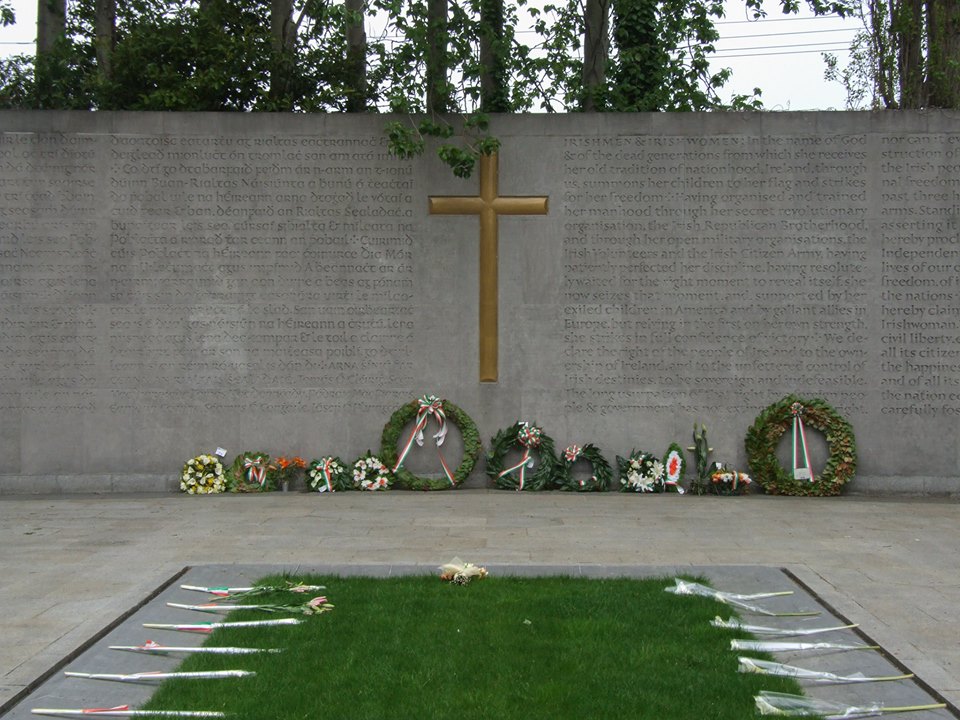
Banner leaning against the Arbour Hill monument wall. (Photo B. Hoppenbrouwers)
Tom Stokes died December last year but some people were determined that the celebration of Republic Day should carry on. On the 24th April 2019, some of them gathered in Arbour Hill, by the monument to the executed in the 1916 Rising, the words of the Proclamation etched in large letters, in Irish and in English, on to the stone wall overlooking the site.
The event was chaired by Pearse Brugha (incidentally a descendant of Cathal Brugha, the 1916 Rising veteran and subsequently part-organiser of the IRA, killed by a Free State soldier in the early days of the Irish Civil Wa)r.
Pearse Brugha chairing the event. (Photo B. Hoppenbrouwers)
Brugha welcomed the attendance and in particular members of the Stokes family, then went through the background to Tom Stokes’ campaign for the commemoration of Republic Day, saying that Tom had wished it to be a national holiday. Brugha then asked on the attendance for a minute’s silence in memoriam and called on Tom’s widow Anne Stokes and their son to lay floral wreaths on behalf of the family at the 1916 Rising Monument.
Next, Brugha presented Cormac Bowel and his young son Fionn, who approached playing Fáinne Geal an Lae (“The Dawning of the Day”) on their bagpipes, Cormac in Volunteer officer uniform and Fionn in traditional piping kilt. It was only Fionn’s second public playing, the attendance were told.
Cormac Bowel reciting the 1916 Proclamation. (Photo B. Hoppenbrouwers)Cormac Bowel and son Fionn approaching the monument while playing Fáinne Geal an Lae. (Photo B. Hoppenbrouwers)
A number of other parts of the ceremony followed.
Fergus Russell sang “The Foggy Dew” and Frank Allen, who had been involved with Frank Stokes in organising Republic Day commemorations, gave an oration praising Tom Stokes as a “true Republican” who believed passionately in equality and also as “a true internationalist, who would be just as likely to be found on a Palestine solidarity demonstration”. Allen also criticised heavily the Irish regime, as Stokes had done in his speeches.
Pat Waters played his own composition, “Where Is Our Republic?”, which he had composed at the request of Tom Stokes.
Cormac Bowell recited from memory the 1916 Proclamation and Fionn played a solo lament on the pipes.
Shane Stokes, speaking, also paid tribute to his father Tom Stokes and to the campaign to have a Republic Day on 24th April.
Fergus Russel singing The Foggy Dew. (Photo B. Hoppenbrouwers)Frank Allen speaking at the event. (Photo B. Hoppenbrouwers)Pat Waters performing his own compostition “Where Is Our Republic?” (Photo B. Hoppenbrouwers)Shane Stokes, a son of Tom Stokes, speaking at the event. (Photo B. Hoppenbrouwers)Very young piper Fionn Bowel playing a solo lament. (Photo B. Hoppenbrouwers)(Photo B. Hoppenbrouwers)
Pearse Brugha, who had been chairing the event throughout, also recited all three verses of the Soldiers’ Song and then sang the chorus, then thanked all for their attendance.
Among those in attendance were members of the 1916 Performing Arts club, activists of the Save Moore Street From Demolition campaign group and Niall Ring, Lord Mayor of Dublin. Also present were Dave Swift, historian and enacter; Las and Dónal Fallon, historians and authors; Brian O’Neill; Deirdre O’Shea; Jim Connolly Heron.
A woman dies; she was young, a tragedy. Where did this happen and when? In Derry on Thursday evening. How did she die? Apparently (and I say that advisedly, for I do not know the examining doctor‘s verdict nor has an inquest yet been held) by a gunshot to the head. And according to a number of witness statements, she did not have a gun herself and therefore the bullet came from someone else.
THE CONTEXT
All this and more has been reported in unanimity. What was the context? Ah, there we have to do some digging.
There was a riot going on at the time – there were petrol bombs and stones thrown at the police. Oh, why? Well, some of the early reports didn’t even try to answer that. But later, we were told: the police were searching houses for IRA arms. The police had “a tip-off”, some papers reported.
OK, now we’re getting somewhere. Reading between the lines, if we know enough about the general situation, we can reconstruct a probable narrative: British armed colonial police were searching the homes of Irish Republicans in ‘nationalist’ areas, just before their Easter commemoration, a commemoration during which they attacked another Republican group in Newry last year and one which was for decades banned under the Special Powers Act in the Six Counties – a ban enforced violently by the forerunners of the very police force carrying out those house searches on Thursday.
And it turns out, as admitted by senior PSNI command and reported in only some media outlets, including the Irish Examiner, that the purpose of the police raid was harassment: “PSNI officers were carrying out a search operation in the Creggan area of Derry aimed at disrupting dissident republicans ahead of this weekend’s commemoration of Irish independence.”
And we might know, though not from the general media, that the colonial police have been carrying out these raids on numerous occasions of late, as well as stopping cars of Republican activists and searching them, stopping people out walking and searching them too, as well as questioning them about where they are going and where they have been. Most people of course won’t know that – how could they?
So now that we have context, we might see the rioting as a justified response, even natural perhaps, of a colonised people to provocation and harassment by a militarised police force of a colonial occupation. And a colonial administration with a long history of atrocities by the occupying power. Or we might not – but context gives us the opportunity to interpret, while its absence leaves us bewildered or manipulated.
If we take the view that the people are justified in resistance, does that excuse the killing of the woman in question? No, not at all. But it does take us some way to understanding the situation and perhaps we wouldn’t want to see Irish Republicans as monsters then.
Lyra McKee’s death is a tragedy, as is the premature death of any innocent person and particularly a young person. The Six Counties too, that repressive backward statelet, can ill afford the loss of an LGBT campaigner.
Firing a gun in that situation was highly irresponsible and unnecessary. The shooter (or shooters) could not be sure of hitting a police officer and did, in fact, hit a totally innocent bystander. And if the police had fired back, the shooter(s) would have put everyone around them in mortal danger too.
CONDOLENCES AND CONDEMNATIONS
Saoradh, an Irish Republican organisation active in the area who were involved in preparing for the Easter Rising commemoration in Derry felt they had to cancel the event after the death. They issued a statement providing context for the riot and also extended condolences to the bereaved family and friends. Most media didn’t quote the relevant parts of the statement and some never even mentioned it.
On Saturday, their representative at their Easter Commemoration outside the GPO building in Dublin repeated the statement and amplified it, saying also that the IRA was not always right and, when they erred, they should apologise for it. The media didn’t report that either.
The media rushed, not to report the shooting and its context, but to condemn Irish Republicans who don’t agree with the Good Friday Agreement, i.e the ‘dissidents’. The BBC, in its first report on line, along with some others, called it a “murder”. Were they justified in saying that?
In law, not all homicides can be called murders. According to Wikipedia, Murder “…. is considered the most serious form of homicide, in which one person kills another with the intention to cause either death or serious injury unlawfully.” So there has to be intention to cause either death or serious injury to the victim. Are the BBC and other commentators really suggesting that the person or persons intended to kill a journalist? Apart from seriously inaccurate reporting, one might see those kind of claims as prejudicial to a fair trial for anyone arrested for the homicide.
THE CONDEMNATION BANDWAGON
And then, of course, jumping on to the condemnation bandwagon, we have the usual collection of hypocrites and opportunists. What would we expect from Unionist politicians? They have been running that colony with regular pogroms and armed repression for nearly a century – Irish Republicans are their enemies to the marrow. Arlene Foster couldn’t resist using the opportunity to praise their colonial police and to take a swipe at SF: “Those who brought guns onto our streets in the 70s, 80s & 90s were wrong. It is equally wrong in 2019.” Actually, at first it was usually the RUC with the guns on the street, wasn’t it? And then the British Army. But then after the Ballymurphy Massacre, Bloody Sunday …. well, you shoot at people long enough, they shoot back.
British Ministers and politicians had their condemnation to get in as well – well, the colony is theirs, isn’t it? The Republicans are their enemies too (and Theresa May must’ve been glad to be talking about something other than Brexit, for a change).
But then we had the Irish politicians also, including our own Taoiseach (Prime Minister), who presides over a State that is made secure for native and foreign capitalists by, among other things, persecution of Irish Republicans and sending them to jail through non-jury Special Courts. Mr. Varadkar is so supportive of the people of Derry, so sensitive to their needs, that whilst he condemns the Republicans, he praises the people of Derry for being “as strong as your walls.” Is he expressing Loyalist views or is he so ignorant of the people of Derry and their history?
Is Varadkar unaware that the Derry Walls belonged to the foreign occupation force? That the song that celebrates them is a triumphalist anti-Catholic sectarian and colonist song? That during the recent war in the Six Counties those walls were frequently a point of surveillance for the occupying military and that during the Bloody Sunday massacre, some British soldiers were up there with special rifles?
Oh yes and let’s not forget Nancy Pelosi, she too found a place on the bandwagon (well, to be fair, the others made room for her). This is long-standing career US Congresswoman who, although an outspoken opponent of the Iraq War and supporter of civil rights, blocked her party colleagues from going for impeachment of war criminal President Bush because “you never know what might come out”. She also voted for the Patriot Act, a huge attack on civil liberties in the USA and labeled Edward Snowdon “a criminal” for his whistle-blowing. And yes, after a briefing relating to a CIA agent destroying hundreds of hours of videotaping of torture in their US base in Guantanamo, she issued a statement saying that she eventually did protest the techniques (e.g “waterboarding”, euphemism for simulated drowning of prisoners under interrogation – DB) and that she concurred with objections raised by a Democratic colleague in a letter to the C.I.A. in early 2003. Yes you did, Nancy – but you waitedfour years to do so.
And what are we to say of Sinn Féin, they of association with the late Provisional IRA, putting their name to a joint statement of colony politicians? One would think that considering their past, they would hesitate to join the mob or to climb upon this particular bandwagon. One might think they would remember the innocent people the PIRA killed on occasion by accident, such as for example the Birmingham pub bombings where 21 people were killed and 182 injured or even, on some occasions, with intention.
Perhaps Michelle O’Neill did remember, perhaps she did hesitate, perhaps she wished to issue SF’s own statement. But climb aboard they did – and isn’t it all about climbing with them now?
The political parties that support the occupation said in joint statement: “Lyra’s murder (see that “murder” word again – DB) was also an attack on all the people of this community, an attack on the peace and democratic processes.”
“It was a pointless and futile act to destroy the progress made over the last 20 years, which has the overwhelming support of people everywhere.” (Oh, that was its purpose, was it? And this progress has been what, exactly? And towards what?– DB).
O’Neill was herself quoted as saying that the “murder” (that word again !) was “an attack on our peace process and an attack on the Good Friday Agreement.”
And “We will remain resolute in our opposition to the pointless actions of these people who care nothing for the people of Derry.”
I can’t say whether those people putting up a resistance to the colonial police care for the people of Derry or not but presumably they care for the people of their own neighbourhoods who are being harassed by the PSNI. And I remember in another city, Belfast, how the Loyalists had been threatening the Ardoyne area for many months and that in 2015, the PSNI blocked the Anti-Internment League from marching down to the city centre. Although the march eventually dispersed without incident, the heavy police presence in the area provoked some residents to remonstrate with them and, when the police began to arrest a woman, the area erupted in a riot. Who did SF blame? The local youth and the anti-internment marchers! And when a meeting was convened soon afterwards in a local venue for the march organisers and SF to explain their views, it was the latter that failed to attend.
* * *
Well, it must have been getting tight up there on the bandwagon but there’s always room hanging off the sides and if that doesn’t work …. why, one can run behind. And if not, not to worry, there’ll be another one along soon.
The campaign against continuing internment in Ireland had a visible presence in Dublin’s premier and busy shopping area, Henry Street on Saturday 6th April.
Photo: Dublin Anti-Internment Committee
Republicans and socialists from a number of organisations — and none — supported the picket, called by Dublin Anti-Internment Committee as part of its ongoing campaign to raise awareness that internment without trial of political activists continues in Ireland, though on a much-smaller scale.
Hundreds of leaflets were distributed to shoppers and sightseers and only one complaint was received – that there wasn’t a petition to sign!
DAIC member handing out leaflets to passing members of the public (Photo: Dublin Anti-Internment Committee
If any reminder were needed that internment is continuing in Ireland, it was provided recently with the case of former Republican prisoner Alan Lundy, who was recently jailed without charge and released some weeks later, being yet again detained and put straight into jail, again without trial or even charge.
IF YOU WANT TO HELP
If you live in Dublin and would like to help, why not join the DAIC at the next picket? These are roughly on a monthly basis. The DAIC is completely independent of any political party or organisation and organises itself in a democratic manner – however, it is a participative democracy, in that the people who attend public awareness-raising events are those who make the decisions at notified committee meetings.
If you don’t live in Dublin, you could share our posts from time to time ….
Photo: Dublin Anti-Internment Committee
HISTORICAL NOTES
The Proclamation of Independence was signed in what was then an Irish foods and coffee shop, No.21 Henry Street, about a week before the Rising.
During the actual Rising, the street saw much firing from British troops closing in on the GPO from both directions, east and west. An advance of British soldiers from the west was halted by a Volunteers’ ambush somewhere near where this picket was.
end.
Photo: Dublin Anti-Internment CommitteeThe plaque commemorating the signing of the 1916 Proclamation of Independence at No.21 Henry Street. (Photo: D.Breatnach)
This is an article about grammar, religion and politics. While the last two are often discussed in the same conversation, grammar is usually absent as a subject. But it has its place here.
SWEARING AND CURSING
“Don’t curse!” or “Don’t swear!” a parent or an elder might have said to us when we were children or teenagers. And particularly when we were teenagers we did exactly what we had been told not to, certainly the boys, in a mistaken sign of manhood. As a verse in the English folk song The Shoals of Herring has it, in fact:
“Well you’re up on deck, you’re a fisherman,
You can swear and show a manly bearing,
Take a turn on deck with the other fellows
As you hunt the bonny shoals of herring.”
A related admonition was against “taking the Lord’s name in vain”, which was a prohibition of blasphemy, the misuse of Yahweh’s name, taken from Exodus 20.7: “Thou shalt not take the name of the Lord they God in vain; for the Lord will not hold him guiltless that takes his name in vain.” 1
So most of us grew up thinking that swearing and cursing were the same thing and more or less careful about which company in which to use those words – or not. But we were mistaken, cursing and swearing are not the same thing at all.
We are familiar with swearing in some formal settings, such as courts of law, for example: “I swear by almighty God that the evidence I give shall be the truth, the whole truth ….”2 and also with swearing for entry into some organisations (frequently the armed forces).
“Bejaysus”, common in Dublin, is from “by Jesus” and “bedad” is probably a disguised “by God”. The Cockney’s “Blimey” was originally “May God blind me” (e.g “if I am not telling the truth”).
The use of “Bloody” in informal society was often a swearing upon the “blood of Christ” or, strangely sometimes, the blood of “Mary”, the mother of Christ in the religions of “the Book” (Bible, Talmud or Koran). Of course “bloody” could be used pejoratively in the sense of “blood-stained”3, in which case it was not swearing but might still raise objections in some quarters of society, or descriptive of a massacre as in “Bloody Sunday”4.
In fact, swearing is to call a divine Power to witness the truth of what we are saying (in courts of law, for example) and that we intend to carry out the expectations of the organisation (e.g in the armed forces). In swearing, we utter an “oath”. Nowadays, most people who are not highly religious probably attach little importance to the form of words, though some institutions persevere with them. But in older times and not even so long ago, most people viewed an oath as a very important thing.
To break an oath of allegiance in some countries and in some periods incurred severe penalties, including death. “Oath-breaker” was an epithet that might be attached to the name of an “outlaw”, one who had broken his oath of service to a Saxon, Norman or English Lord in the Middle Ages.
The required Oath of Allegiance to the British Crown, simultaneously to the Head of the Anglican Church, prevented many Catholics for centuries from entry into many professions and from being elected as a public representative. And the British Crown was itself particularly worried for centuries by alternative “oath-bound societies” that were seeking united workers’ actions, such as agrarian defence organisations and trade unions, or equality and improvement in social conditions, for example political organisations. Laws were passed against the dispensing and swearing of such oaths.
Representation of the three witches in Shakespeare’s “Macbeth”. throwing a curse. (Image sourced: Internet)
Cursing, although it may sometimes “take the Lord’s name in vain”, is something else completely. We know in Ireland of the “Curse of Cromwell” but more frequent probably was Mallacht na bPréacháin “the Curse of the crows”, which wished upon the victim a childless land, to be inherited only by the crows. Scread mhaidne was another ill-wish to lay upon someone, that he or she may die in agony, screaming into the morning. Ná feice tú Dia sounded less terrifying but might have been more frightening for a very religious person: “May you (never) see God!”.
Painting of Oliver Cromwell, an English Republican whose name became part of a curse in Ireland (including for Irish Republicans!). (Image sourced: Internet)
“Damn” and “Goddamn” are abbreviations of “May God damn …” (“you, her, it, them” etc) and to utter them in many circles in the USA is considered evidence of bad rearing. They are curses which are also oaths, in calling upon the Devine being to add power to the curse.
Typically, curses and oath-curses use the subjunctive in grammar and, although seemingly strange, this connects them to blessings and greetings. Go raibh maith agat (may you have good”) is the Irish for “thank you” and Go mba hé duit (“may it be [the same] for you”) is the reply to the Irish greetings Sé do bheatha or Móra duit.Slán abhaile (“Safe home”) is an abbreviation of Go dtéigh tú slán etc (“May you go safely home”). All of these are in the subjunctive form of speech. Vaya con Dios (“May you go with God”) is a castillian-language (Spanish) farewell wish we might come across in tales set in the south-west USA or in Latin America; that is also in the subjunctive. In fact “farewell” was “fare thee well” and probably originally, “May thee fare well”. Instead of the “Go to Hell” or “I hope you break your neck” one might hear today, centuries ago one would have heard “May you go to Hell” or “May you break your neck”.
This constant use of the subjunctive to wish well or ill upon others suggests to me that it was widely believed, at some stage in society, at least in most European societies, that one could make something happen by using a certain form of words. That form was the subjunctive; however, according to many who study language, the subjunctive is disappearing in European language and remains most in use preserved in everyday greetings and well-wishes – and the occasional curse.
It seems to me that the reason for this gradual disappearance is that we no longer believe we can make things happen by the way that we say them. We may wish them – and show the object person that we wish them – but we can’t make them happen. Nor can we expect a thing to happen with anything like a confidence that invoking a God will bring the wish, for good or ill, to fruition.
FENIANS
Earlier in this discussion I touched on oath-bound societies and the apprehension with which they were often regarded by those in power. Well, the Fenians were such an organisation. Formed on St. Patrick’s Day 1858, in Ireland as the Irish Republican Brotherhood and in the USA as the Irish Fenian Brotherhood, it was a popular movement until the Irish Civil War (1919-1922). Because of their revolutionary credentials and democratic program, they were accepted into the International Workingmen’s Association (the First Socialist International 1864-1889). As a true Republican organisation, they sought the separation of Church and State5 and in that, apparently incurred the wrath of Pope Pius IX (Giovanni Maria Mastai-Feretti, ruled from 1846 to his death in 1878). He excommunicated the Fenians.
Pope Pius IX (Photo source: Internet)
Although a significant number of Fenians (particularly in the leadership) were of Protestant background (Presbyterian, Anglican, Methodist, Unitarian), most of the Fenians had been brought up in the religious faith of the majority in Ireland, Catholicism. Not only would excommunication be painful to Catholic Fenians but could also lead to their being shunned by other Catholics who might otherwise have supported them. In the end this did not occur to anything like the extent that would have pleased the Catholic Church hierarchy or the British rulers of Ireland, as Irish Catholics have historically shown an ability to set to one side the teachings of the Church when they appear in contradiction to their struggle for national self-determination.
But obviously the public excommunication did the movement some harm and hurt many Fenians who were also strongly Catholic, such as John O’Mahony, co-founder in the USA, who left the Fenians as he approached his death so that he might be administered the last rites of the Church6.
John O’Mayony, c.1867, a Catholic Fenian, excommunicated by Pius IX (Source photo: Internet)
SCHOOL SOPHISTRY
In an Irish secondary school run by the Christian Brothers, we were taught that the opposition of the Catholic Church to the Fenians (and presumably to the subsequent Republican military organisations), rather than being due to their struggle for Irish independence, was the secret organisation’s dispensing and repetition of an oath of allegiance. Perhaps we were too ill-informed (I know that I was) to bring up the question of oaths given in other circumstances, such as in giving evidence in court or in military service, circumstances with which the Church appeared to have no problem.
Had one of us done so, our Christian Brother teachers might have replied that what was wrong was “taking the Lord’s name in vain” and explained that “in vain” did not, in the English at the time of translation of Bible texts, mean only “for no important purpose” but also “for no good purpose” and that would of course have included “for an evil purpose”.
Had we questioned what the “evil purpose” might have been in the case of the Fenians, we would have put our teachers in some difficulty.
What for example in the two versions of the Fenian Oath recorded, might be considered “evil”?
“I, A.B., do solemnly swear, in the presence of Almighty God, that I will do my utmost, at every risk, while life lasts, to make Ireland an independent democratic republic; that I will yield implicit obedience, in all things not contrary to the law of God, to the commands of my superior officers; and that I shall preserve inviolable secrecy regarding all the transactions of this secret society that may be confided to me. So help me God! Amen.”
“I, A.B., in the presence of Almighty God, do solemnly swear allegiance to the Irish Republic, now virtually established; and that I will do my very utmost, at every risk, while life lasts, to defend its independence and integrity; and, finally, that I will yield implicit obedience in all things, not contrary to the laws of God, to the commands of my superior officers. So help me God! Amen.”
Would a Christian brother have admitted opposition, not only by himself but by the Catholic Church, the dogma of which he was explaining, to the establishment of an “Irish Republic”, or even to “an independent democratic republic”? And if not, what then? The use of armed force, i.e violence? Since when has the Catholic Church hierarchy been against violence in or of itself? Did it not support some side in most inter-European wars and Spanish, French and Portuguese colonial wars? In fact, did the Catholic hierarchy not itself initiate some wars and did the Vatican not have its own army, as pointed out by Fr. Sean McManus in the USA7?
If the objection were not to “a democratic Republic”, against which Pius IX was definitely set, in that he opposed the separation of Church and State, then surely the only honest reply could have been: “The Catholic Church hierarchy in Ireland made a deal first with the British occupation that if they gave Catholics equal rights and let us build up our power here, we would not support their overthrow. Since then we made a similar deal with the Irish State and its rulers. And we intend to honour that deal.”
2In the courts of many countries one is now permitted to use the words “I affirm that the evidence I shall give …” and one may sometimes be asked by the presiding judge whether one is an atheist, or agnostic – presumably as otherwise the failure to “swear by Almighty God” might be regarded as suspect.
3“Bloody Queen Mary” was an example, Mary Tudor, Mary I Queen of England (1560-1558; ruled ’53-’58), who had nearly 300 Protestants burned at the stake for “heresy”. )
4In Irish history, three are generally recognised: Dublin 1913, Dublin 1920 and Derry 1972.
5Not all organisations dubbing themselves “Republican” do in fact uphold this principle and in fact it could be said that the Irish Republican movement from the early 20th Century until its end did not generally do so, in that it rarely confronted the Church on its social policies or interference in lay matters, except when the Church condemned Republican actions. Also a great many Republican commemorations included the officiating of a member of the Catholic clergy.
6See the Irish Echo article in Links & References.
(Lots of images but text reading time less than 5 minutes)
Diarmuid Breatnach
As Palestinians and their supporters around the world mark anniversaries of the Return to Palestine demonstrations and Land Day, Israeli snipers kill Palestinian children. Dublin marks the day with a solidarity rally and exhibitions and talks by internationally-recognised Palestinian cartoonist Mohammad Saba’aneh.
The Ireland-Palestine Solidarity Campaign organised a rally to mark the anniversary of the start of the Return to Palestine demonstrations last year and also Land Day. Sadly, marking a Palestinian anniversary usually involves marking the deaths of martyrs and this was no exception, as Israeli Occupation Force snipers killed four demonstrators, three of them 17 years of age.
Section of the Palestine solidarity rally at the Spire in O’Connell Street, as it was ending.
After the rally, of which I just caught the tail end because of the weekly Save Moore Street From Demolition campaign duty, I managed to catch the exhibition of noted Palestinian political cartoonist Mohammad Saba’aneh and to buy his book PALESTINE in black and white. Sadly, a prior appointment meant I had to miss his talk, which I would have loved to attend, especially as I dabble a little in cartoon-drawing myself.
The World (or its governments, including the Arab countries) ignores the oppression of Palestinians by the Israeli Zionists. Artist: Mohammad Saba’aneh.
Fortunately, Mohammad Saba’aneh was still there and was kind enough to autograph his book for me. When I took a photo of him with Fatin Al Tamimi, photographer and Chairperson of the IPSC, she insisted on taking a photo of me with him too – shukran.
Artist: Mohammad Saba’aneh and myself. (Photo: Fatin Al Tamimi with my camera phone)Photographer and Chairperson IPSC with Artist Mohammad Saba’aneh.
On Thursday, Saba’aneh had also given a talk at the National College of Art & Design, along with Tuqa Al Saraj, also a Palestinian artist but today based in Dublin.
Mohammad Saba’aneh was born in 1978 in Ramallah in occupied Palestine, where he still lives. He is a Palestinian painter and caricaturist who has been imprisoned by Israel because of his art. He has a daily cartoon in the Palestinian newspaper al-Hayat al-Jadida and his work features in publications across the Arab world.
A veritable cartoon strip. Artist: Mohammad Saba’aneh.
HELPING THE DEAF AND THE TRAUMATISED WITH CARTOONS
Saba’aneh used caricature with deaf students to help them adopt another language to express their feelings and with children who witnessed an Israeli assault to help them psychologically. He took part in many workshops designed for children to develop critical thinking. Saba’aneh was responsible for organizing an international fair at Mahmoud Darwish museum in 2014 in which more than 100 international artists participated. Freedom House chose one of his works in 2016 as one of the year’s most important photos. His first book was published in the US in April 2017.
Children in Israeli Zionist jails — one of my favourites. Artist: Mohammad Saba’aneh.
INTERNATIONAL WORK AND RECOGNITION
Saba’aneh is the Middle East representative for Cartoonist Rights Network International and the Palestinian ambassador for United Sketches, an international association for freedom of expression and cartoonists in exile and participated in many international publications such as The truth has more than one face in Europe and Sketch of Freedom in the US. He. He is the recipient of numerous awards, including the 2017 Marseille International Cartoon Festival Prix d’Or. Pulitzer–winning cartoonist Matt Wuerker described him as “an inspiration for cartoonists around the world.” Noted graphic journalist Joe Sacco has said of this work that it is a “gut punch that gets straight to the essence of the stark reality of Palestinian life under Israeli occupation.”
Life for children in Palestine under the Israeli Zionists. Artist: Mohammad Saba’aneh.
PROGRAM DATES:
Thursday 28th March – NCAD (Dublin), 7pm, Harry Clarke Lecture Theatre
Friday 29th March – TCD (Dublin), 3pm, Room LTEE1, Hamilton Building
Saturday 30th March – Dublin, 2.30pm, The Pearse Centre, 27 Pearse St
All of the above now over.
Monday 1st April – Waterford, 7.30pm, The Tower Hotel
Tuesday 2nd April – Limerick, 8pm, Perys Hotel
Wednesday 3rd April – Galway, 7pm, Black Gate Cultural Centre
Thursday 4th April – Maynooth University, 4pm, Venue TBC (Afternoon)
Thursday 4th April – Celbridge, 8pm, Celbridge Manor Hotel
End.
Judicial Justice under the Israeli Zionists. Artist: Mohammad Saba’aneh.
SOURCES:
Background information: Wikipedia and IPSC FB page
Artist: Mohammad Saba’aneh.A nod to Michaelangelo’s the “Birth of Adam”. Artist: Mohammad Saba’aneh.
The cost of NOT boycotting Israeli products. Artist: Mohammad Saba’aneh.Posters on railings outside Pearse House.Praise for Sen. Frances Black’s Bill to ban imports from the “Occupied Territories”. Artist: Mohammad Saba’aneh.
Artist: Mohammad Saba’aneh.Symbols in Palestinian cartoons. The Key for the right to return is somewhat of an irony, as when the Christian Spanish Monarchs expelled the Sephardic Jews from Al Andalus, many of them also took the key to their house with them.
Una historia de crímenes del fascismo espanol, si nos hacia falta recordarnos de nunca jamás dar les la oportunidad de alcanzar el poder de nuevo. Y nos demuestra además que el fascismo nunca fue vencido en el Estado espanol, sin hablar de haberlo despedido. Sin entender esa verdad no es posible arreglar las problemas del ahí.
He traducido este relato al inglés y subido separadamente.
Diarmuid Breatnach
El miedo asoló Cantalpino, donde las hordas falangistas mataron a una mujer y a 22 hombres; donde se robó y violó. La señora Alejandra cuenta la historia y sus ojos parecen mirar hacia dentro de si misma: “ Aquí asesinaron a muchos y a la Eladia Pérez, la Jaboneta, también. Fueron a buscar a su hijoGuillermo, a quien «pasearon» más tarde, y ella no quiso abrirles; así que el Cagalubias le disparó y la mató; luego la llevaron al cementerio y su cuerpo no cabía en la hoya y el Cagalubias le cortó la cabeza con la pala…los asesinos fueron gente del pueblo y forasteros, falangistas, curas, frailes y hostias. El cura, era de lo peor, daba la bendición a los «paseos»..También les cortaron el pelo al cero a unas cien mujeres y, lloviendo y todo, las sacaron en procesión, la música tocando y los falangistas gritando arribaespaña y vivafranco y… ¡me cago en la madre que los parió!..”
Alejandra sigue con su relato: “..A mi me hicieron muchas, a otras las violaron..A mi me violaron 5 falangistas, sacaron de la cama a mi marido, que en paz descanse, el pobre, y le plantaron una pistola en el pecho, y allí, delante de él, me violaron. Unos me tenían cogida por los brazos y otros, por las piernas, y aquí Santa Inés, a lo que quieran hacer, y las pistolas encima de la cama en presencia de mi Desiderio ¡El pobre Desiderio! Además nos robaron todo lo que pudieron..Si, si, eran de aquí, de Cantalpino. Por desgracia, esta violación no fue un hecho aislado. En Poveda de las Cintas, a pocos kilómetros de Cantalpino, la historia se repitió, esta vez con la mujer del secretario del ayuntamiento..”
El 24 de agosto de 1936 la sangre no paró en Cantalpino, la impunidad de los asesinatos animó a los franquistas. Esa misma tarde se presentaron en Villoruela, a menos de 10 kilómetros de Cantalpino, 3 falangistas acompañados por fascistas vecinos del pueblo: Detuvieron a las siguientes personas: Eustasio Ramos (51 años), Elías Rivas (43), los hermanos Leonardo (43), y Leoncio Cortés(41), Daniel Sánchez (35), Esteban Hernández (29) Francisco García (25) y Benigno Hidalgo (18).
Los fascistas dieron contestaciones de carácter criminal a los familiares de los detenidos cuando iban a buscarles a sus casas: A la mujer de Leonardo Cortés le preguntaron que dónde estaba su marido; ella respondió que no sabía y le contestaron: “No se preocupe, que aunque esté bajo tierra le encontraremos”. Daniel Sánchez había estado jugándose la vida para salvar la de otras personas con sus mulas y su carro para cruzar la riada de la era, sin tener en cuenta de qué color ni de qué partido eran. Cuando le fueron a buscar a casa les dijo la mujer: “Esperen ustedes, que se está quitando la ropa, está todo calado”; la contestación fue: “No se preocupe usted, que lo mismo le va a dar”. Cuando fueron a la casa de Esteban Hernández, les dijo su madre: “esperen, que no tiene calcetines”; la contestación fue: “no se preocupe, que no le van a hacer falta”. Cuando fueron a buscar a Benigno Hidalgo, les dijo su madre: “le tengo que poner una inyección”; “no se preocupe usted, se la vamos a poner nosotros”, le contestaron.
Una vez capturados, quedaron arrestados en el Ayuntamiento atados de pies y manos con cuerdas. Los componentes del Ayuntamiento convocaron una reunión y decidieron que los 8 detenidos debían ser fusilados. Así amarrados, los hicieron subir a un camión en Villoruela, ya pasada la medianoche, y los trasladaron al término de Salvadiós, un pueblo de la provincia de Ávila. Allí, en un cruce de caminos, los fusilaron y los dejaros tirados en una cuneta. Allí mismo los enterraron unos vecinos de Salvadiós. Los asesinos fueron 7 del pueblo, el que llevaba el camión y los 3 falangistas forasteros.
Dos de las mujeres de los detenidas, María Engracia Cortés y Angeles del Pozo, se fueron a pedir ayuda a las monjas del convento. Contaron a las monjas lo que estaba pasando y ellas contestaron que aquello era una cruzada, y que si no habían hecho nada por qué habían estado huyendo, a lo que muy acertadamente las vecinas citadas contestaron: “A Jesucristo también lo persiguieron y por nada lo crucificaron”.
Jaime Cortés, hijo de uno de los fusilados contaba que “..después del sufrimiento que causaron, los fascistas nombraron entre los vecinos del pueblo una guardia llamada cívica para controlar nuestras salidas de casa, las demostraciones de sufrimiento. Nos pasábamos las noches enteras llorando con mi madre y mis abuelos en la cocina..hace falta tener mucha paciencia y resignación para convivir toda una vida con los criminales que fusilaron a tu padre..tuvimos que pasar por calamidades y sufrimientos..he tenido siempre muy presente una frase que mi madre nos decía con mucha frecuencia: “Hijos, no quiero veros nunca con las manos manchadas de sangre”…los únicos motivos por los que los fusilaron tuvieron fueron la forma de pensar diferente al franquismo, es decir, por defender la libertad, los derechos de los trabajadores, la seguridad social y la educación..los fusilaron por defender el derecho más grande de toda persona: la libertad..”
Desde la fecha 15 de agosto de 1936 al 16 de junio de 1939 no existe ningún documento, ni libro de actas de los archivos de Villoruela ¿Quiénes fueron los que hicieron desaparecer dicha documentación? En el libro de actas de defunciones aparecen con fecha 13 de marzo de 1937 inscritos por el juez Iñigo de la Torre estos 8 fusilados como personas como desaparecidas.
Originales de Ángel Montoro en Jiminiegos36 y Foro por la memoria (Intervíu nº 177, 4-10 octubre 1979). Foto de Xavier Miserachs
A brief account of the fascist horror between Cantalpino and Villoruela (Salamanca) during the Spanish War, forwarded to me for translation from Castillian (Spanish). I will post the original separately.
Diarmuid Breatnach
Comment: If another reason were ever needed to ensure we crush fascism before it gets strong! Stories like this illustrate how fascism was not defeated, much less rooted out in the Spanish State and remains at its heart to this day. No progress can be made towards democracy in that state without taking that fact into account. DB.
(Translator’s note: Villoruela is a municipality located in the province of Salamanca, Castille and León, in western Spain).
Alejandra, the interviewee, who was raped in front of her husband, next to her while a gun was held to his chest.
Fear ravaged Cantalpino, where the Falangist hordes killed a woman and 22 men; where they robbed and raped. Mrs. Alejandra tells the story and her eyes seem to look inside herself: “They murdered many here and Eladia Pérez, the Jaboneta, too. They went looking for her son Guillermo, whom they “took for a walk” later, and she did not want to open for them; so the bastards shot and killed her; then they took her to the cemetery and her body did not fit in the hole and the bastards cut off her head with the shovel … the murderers were people from the town and strangers, Falangists, priests, friars and that kind. The priest was the worst, he gave his blessing to the “walks” .. They also cut the hair of about a hundred women to the scalp and, in the rain and everything, they took them in procession, the music playing and the Falangists shouting “Up Spain!” and “Long live Franco!” and … I shit on the mother who gave birth to them! “
Alejandra continues with her story: “… they did a lot to me, they raped others. Five Falangists raped me. They took my husband out of bed, may the poor man rest in peace, and they pushed a pistol against him, in the chest, and there, in front of him, they raped me. Some had me by the arms and others, by the legs, and here, Saint Ines, to what they wanted to do, and the guns on the bed in the presence of my Desiderio. Poor Desiderio! They also stole everything they could. Yes, yes, they were from here, from Cantalpino. Unfortunately, this violation was not an isolated incident. In Poveda de las Cintas, a few kilometers from Cantalpino, the story was repeated, this time with the wife of the secretary of the town hall .. “
On August 24, 1936 the blood did not stop in Cantalpino, the impunity of the murders encouraged the Francoists. That same afternoon they appeared in Villoruela, less than 10 kilometers from Cantalpino, 3 Falangists accompanied by fascist neighbors of the town: They arrested the following people: Eustasio Ramos (51 years old), Elías Rivas (43), the brothers Leonardo (43) , and Leoncio Cortés (41), Daniel Sánchez (35), Esteban Hernández (29) Francisco García (25) and Benigno Hidalgo (18).
The fascists gave criminal replies to the families of the detainees when they went to look for them at home: Leonardo Cortés’ wife was asked where her husband was; she replied that she did not know and they answered: “Do not worry, even though he were underground, we will find him”. Daniel Sanchez had been risking his life to save the lives of other people with his mules and his cart to cross the flood, regardless of what color or what party they were. When they went to look for him at home, the woman said to them: “Wait, he is taking off his clothes, he is all wet”; the answer was: “Do not worry, he will get it all the same”. When they went to Esteban Hernández’s house, his mother told them: “wait, he does not have socks”; the answer was: “Do not worry, he will not need them”. When they went to look for Benigno Hidalgo, his mother told them: “I have to give him an injection”; “Do not worry, we’re going to give it to him,” they replied.
Once captured, they were arrested at the City Hall tied hand and foot with ropes. The members of the City Council called a meeting and decided that the 8 detainees should be shot. So bound, they were put on a truck in Villoruela, after midnight, and they were moved to the end of Salvadiós, a town in the province of Ávila. There, at a crossroads, they were shot and left lying in a ditch. Right there they were buried by neighbors from Salvadiós. The murderers were 7 from the town, the one that drove the truck and the 3 outsider Falangists.
Two of the detainees’ wives, María Engracia Cortés and Angeles del Pozo, went to ask for help from the nuns of the convent. They told the nuns what was happening and the nuns answered that this was a crusade, and that if they had not done anything why had they had been fleeing, to which the neighbors correctly answered: “Jesus Christ was also persecuted and though had done nothing, was crucified. “
Jaime Cortés, the son of one of those shot, said that “after the suffering they caused, the fascists appointed among the townspeople a policeman, allegedly civic, to control our movements from home, the demonstrations of suffering. We spent the whole night crying with my mother and my grandparents in the kitchen .. it takes a lot of patience and resignation to live a lifetime with the criminals who shot your father .. We had to go through calamities and sufferings … I always remembered very well a phrase that my mother told us very often: “Children, I never want to see you with blood on your hands” … the only reasons for which they were shot were their way of thinking differently from the Franco regime, that is, to defend freedom, the rights of workers, social security and education … they were shot for defending the largest right of all person: freedom .. “
From the date August 15, 1936 to June 16, 1939, there is no document or record book of the Villoruela archives. Who were the ones who made that documentation disappear? In the book of death certificates for March 13, 1937 the entry inscribed by the judge Iñigo de la Torre these 8 people shot dead are listed as missing.
Originals by Ángel Montoro in Jiminiegos36 and Foro por la memoria (Intervíu nº 177, 4-10 October 1979). Photo by Xavier Miserachs