Deliveroo riders, treated as self-employed workers responsible for their own insurance, without sickness or holiday pay — but in reality employees. (Photo source: Internet)
Yet another repeat: the nth judicial victory of the riders against Deliveroo. On this occasion, the Superior Court of Justice of Madrid (TSJM) ratified the ruling in favor of 532 deliverers of the digital platform by recognizing them as employees and not as freelancers, as the Labor Inspection of the capital had ruled.
The TSJM dismissed the appeal filed by Roodfoods Spain S.L.U., the holding company of Deliveroo, against the ruling pronounced on July 22nd last year by Madrid’s Social Court No.19. Back then, the court had concluded that the distributors were workers of the company.
“In the provision of services by the deliverers affected by the process, during the period to which the liquidation act refers, labor conditions prevailed, which leads to the judgement of the demand”, states the text accessed by this media. (Trans: ??)
FIRST GREAT COLLECTIVE VICTORY OF THE RIDERS AGAINST DELIVEROO
Therefore, the TSJM insists on the relationship between the home delivery company and the riders: “The details or characteristics of an employment relationship concur when assessing the existence of habituality, periodic retribution, dependency and subject to orders and business instructions, alienation of benefits and risks and very personal nature of the provision of service”.
A Labor Inspection report estimated that the deliverers were false self-employed and that Deliveroo “covered up” an ordinary labor relationship with them. The General Treasury of Social Security took up the challenge and filed a lawsuit, which was decided by the judge. The oral hearing, held on May 2019, had the testimony of more than 500 riders.
Deliveroo Riders received judgement in their favour in Valencia, Spanish State, last year, displaying placards saying “WE WON” in Catalan on Deliveroo-type background. (Photo source: Publico.es)
The workers’ lawyer, Esther Comas, highlights the “importance” of the sentence. Not only because it affects 532 workers, “but because it makes a very exhaustive examination of the conditions of employees who, in turn, can be extrapolated to other colleagues in the same company and even from other platforms [Glovo and Uber Eats]”, the member of the Madrid Ronda Collective pointed out to Publico.
Also, the UGT union welcomed the decision of this court: “We consider this judgement very important since it summarises everything that we have been fighting for and which coincides, in its conclusions, with another ruling by the Madrid TSJ on Glovo’s working model,” UGT explained in a press release.
The collective fight of the riders adds another victory. In June 2019, Social Court No.5 of Valencia also ruled in favor of the delivery riders. Delivery riders in cities like Barcelona or Zaragoza await an oral hearing for the law to recognize them as employees, based on the judgements pronounced against Deliveroo and Glovo.
A rider for Just Eat, on similar arrangements to Deliveroo riders, treated as self-employed workers responsible for their own insurance, without sickness or holiday pay — but in reality employees. (Photo source: Internet)
And, despite the infinity of reports prepared by the Labor Inspectorate in different provinces, digital distribution platforms continue to operate without a regulation that guarantees the rights of their workers. Also, taking into account that the number of employees in the sector is around 14,337 people, UGT estimates that Social Security lose up to 76 million euros, according to the report on digital distribution platforms by Work, presented last September 6th.
“THERE ARE MORE OF US THAN THERE ARE OF THE BULLIES”
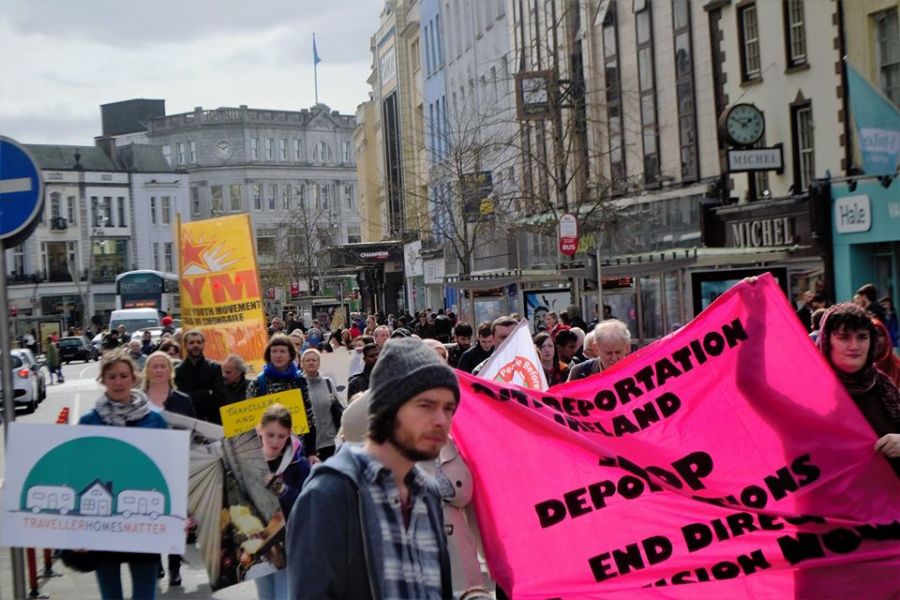
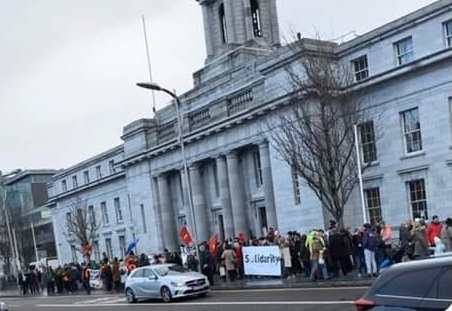
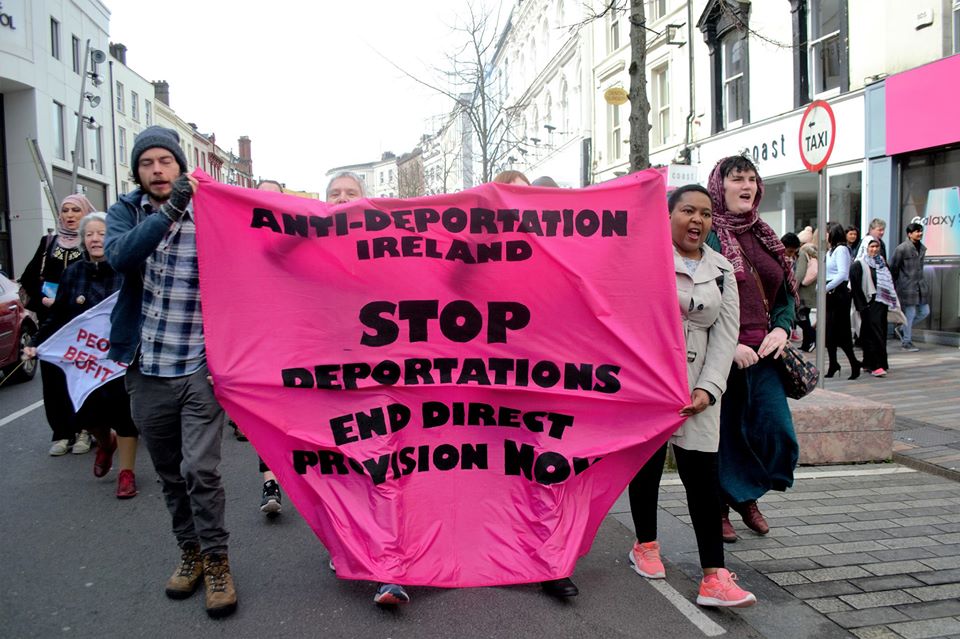
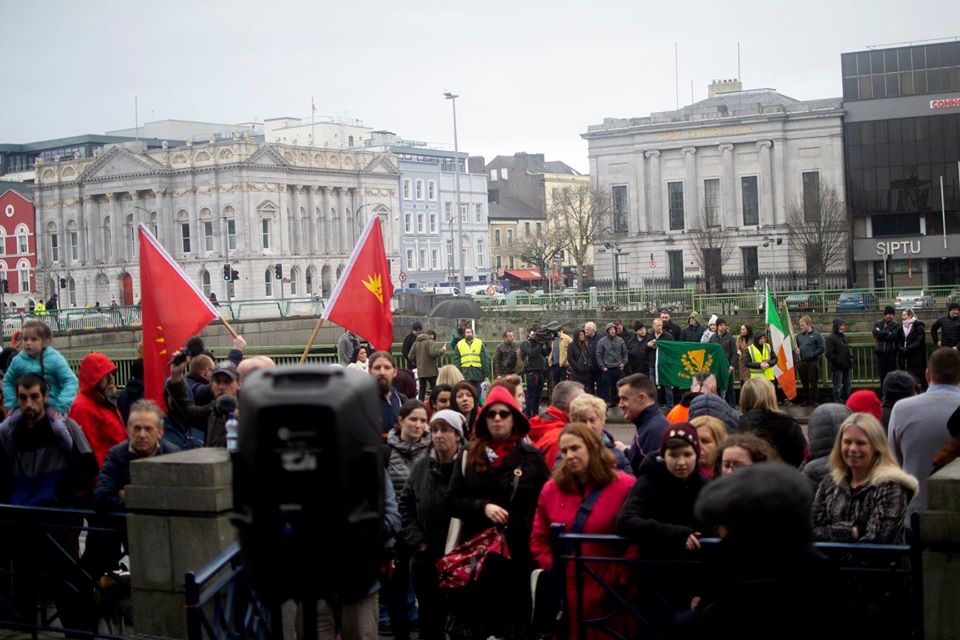
Learning of the intention of a far-Right coalition to hold a rally at Cork Town Hall on 4th December, a coalition of anti-racists and anti-fascists containing a range of Left and Irish Republican organisations, community and anti-deportation groups organised a counter-rally which dwarfed the numbers of the racists and fascists, who object to migrants, asylum seekers and LBGT people. Two TDs and a number of councillors also attended.
One of the organisers, Tracy Ryan, said that she had her two sons with her at the rally. “I’ve brought up my children to believe that everyone is equal and everyone deserves the same opportunities and chances in life,” she said.
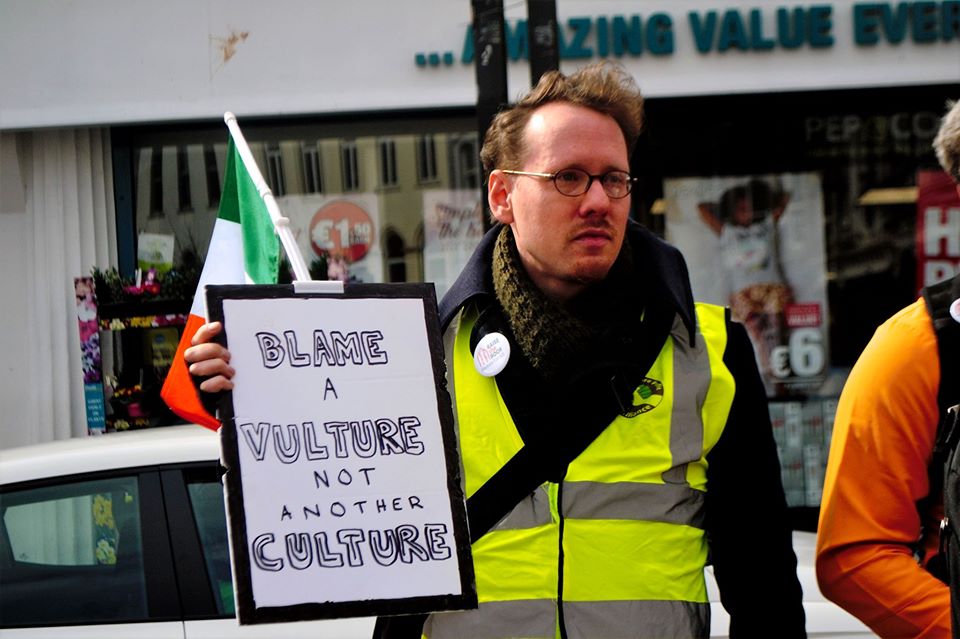
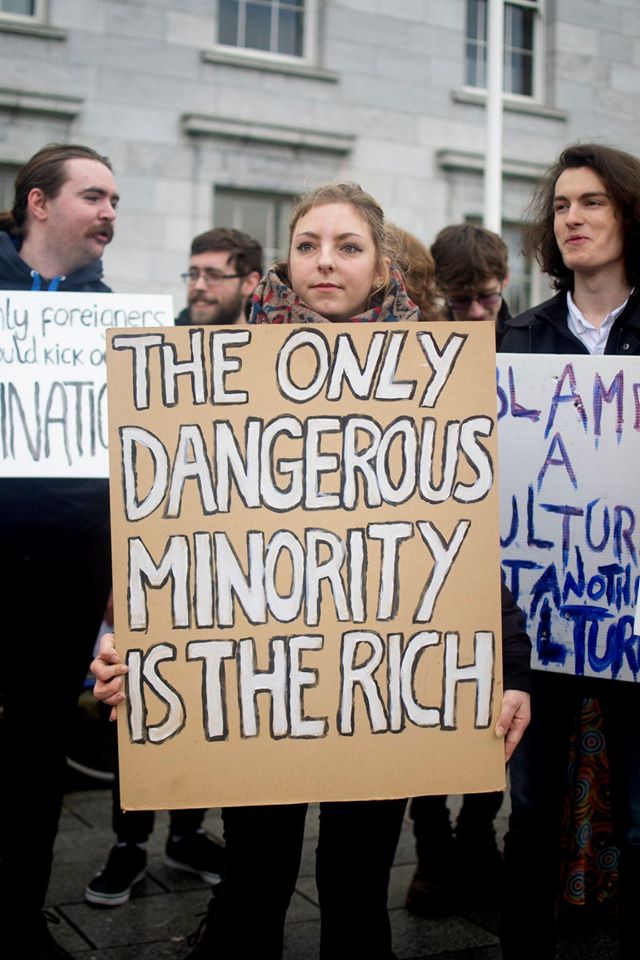
View of counter rally half hour before due to start (Photo: Students Against Racism)Placard displayed at counter-rally (Photo: Shamim Melekian)Anti-racist football club supporters at the counter-rally. (Photo: Shamim Melekian)
FREE SPEECH?
The specific rallying issue for the far-Right on this occasion, as it was in Dublin on 14th December last year (see https://rebelbreeze.wordpress.com/2019/12/15/dublin-counter-rally-outnumbers-racists-and-fascists/), was the legislation proposed by the Fine Gael Government against “hate speech”. The mixture of social conservatives, racists and fascists that make up the far-Right in Ireland have been complaining for some time that they are being denied freedom of speech, in particular since the most prominent member of their ranks, ex-journalist Gemma O’Doherty, had her two Youtube channels shut down by Google in 2019 after, according to Google, she broadcast racist statements and continued to do so after one of the channels was suspended for a week.
There is a wide variety of views on the proposed legislation outside of the far-Right, some socialists and Republicans remarking that “hate speech” is too wide a label and that they have seen such legislation used against themselves when they denounce prominent politicians or businessmen, the police or Loyalists. What unites all these groups demonstrating against the far-Right is not a defence of the Government’s proposed legislation but a determined opposition to allowing the far-Right to gain a foothold in Ireland, from which it may expand to introduce a fascist regime, reversing gains in social legislation, banning oppositional groups, terrorising minorities and restricting further the rights of unionised workers.
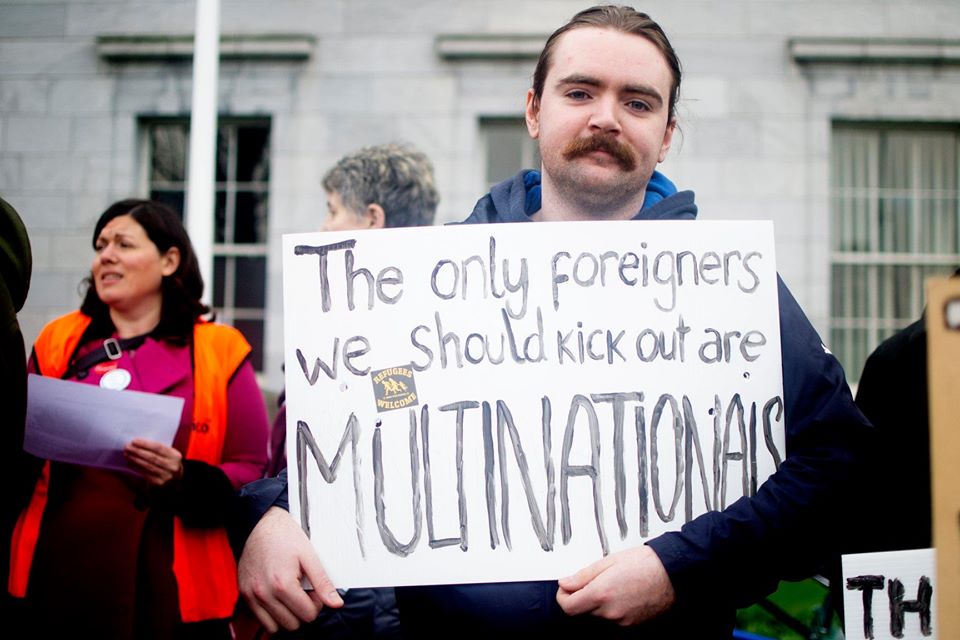
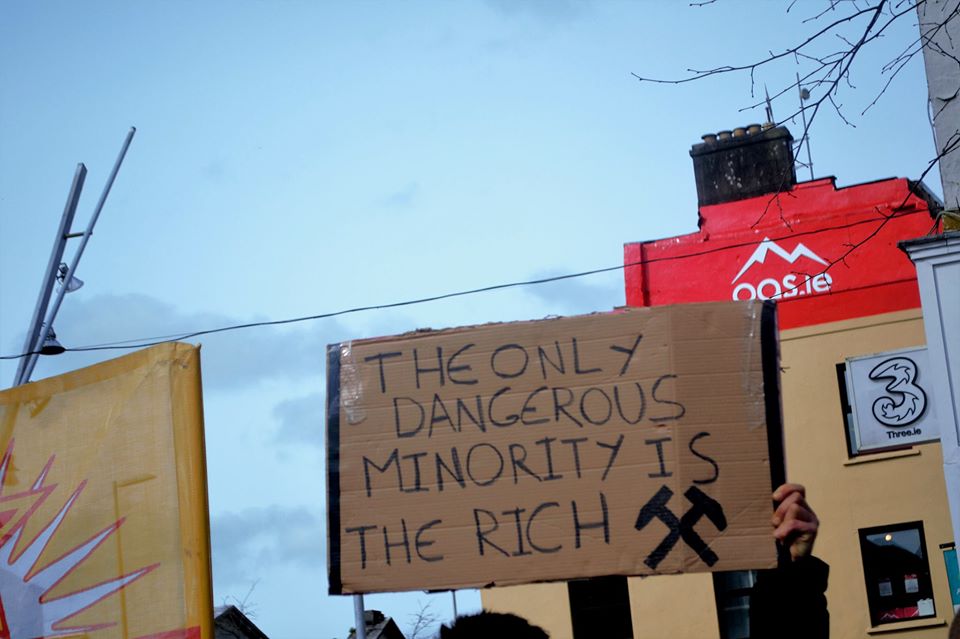
One of the groups on the counter-rally (Photo: Shamim Melekian)One of the many pointed placards on the counter-rally held by a supporter. (Photo: Shamim Melekian)
Opponents of the far-Right point out that they begin by seeking freedom of speech to attack minority groups and their political opponents but once they have established a base, move to physically removing their opposition and banning freedom of speech of anyone who disagrees with them.
“There are more of us than there are of the bullies”, said one of the organising group, speaking to news media the day before the counter-rally. Poet and community worker Kathy D’Arcy added: “We are one people, one human race, one unified city whose people are known throughout the world for kindness, friendliness, good humour and inclusiveness.”
Declan Power of Waterford, organiser of a much smaller rally of the far-Right over the same weekend, rejected the accusation that they were racists or had any other agenda than freedom of speech. However at the event Diarmuid Ó Cadhla, of a group called The People’s Convention, revealed that he wanted to limit migration and was against the Government’s policies which, he alleged, are for “globalisation and open borders”. Presumably this was a reference to one of the conspiracy theories of the far-Right, viz. that the EU allegedly has a policy of opening all borders to mass immigration and replacing the Irish with foreigners. Laughable as this may seem to some and flying against all the evidence as it does, it is believed by some on the far-Right and used to whip up fears and hatred of migrants.
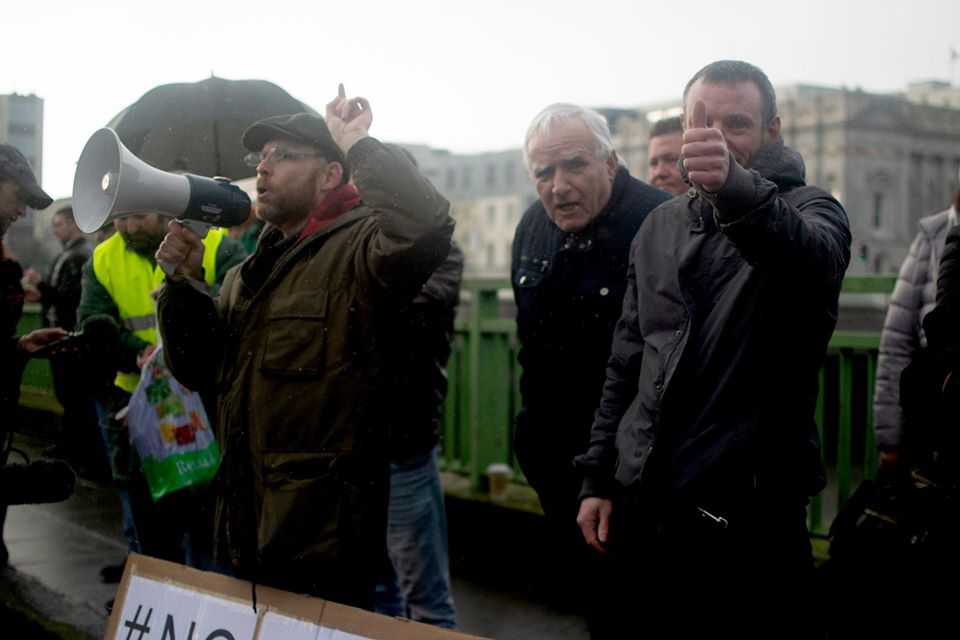
View of far-Right rally over section of counter-rally. (Photo: Shamim MelekianCloseup of some of the far-Right group in Cork (Photo: Shamim Melekian)Woman on counter-rally holds up a placard addressing the far-Right (Photo: Shamim Melekian)
HISTORY OF ANTI-RACIST MARCHES IN CORK
The rally on 4th January this year was far from being the first anti-racist demonstration in Cork: an anti-racist march took place in March last year and or five years before that, there had been an anti-racist march in Cork every year.
Speaking in advance of the anti-racist march last year, Joe Moore of Cork Says No to Racism pointed out that while racism still exists in Cork, it is “a small number of people who have racist views towards minority religions, asylum seekers Travellers and the Roma community.”
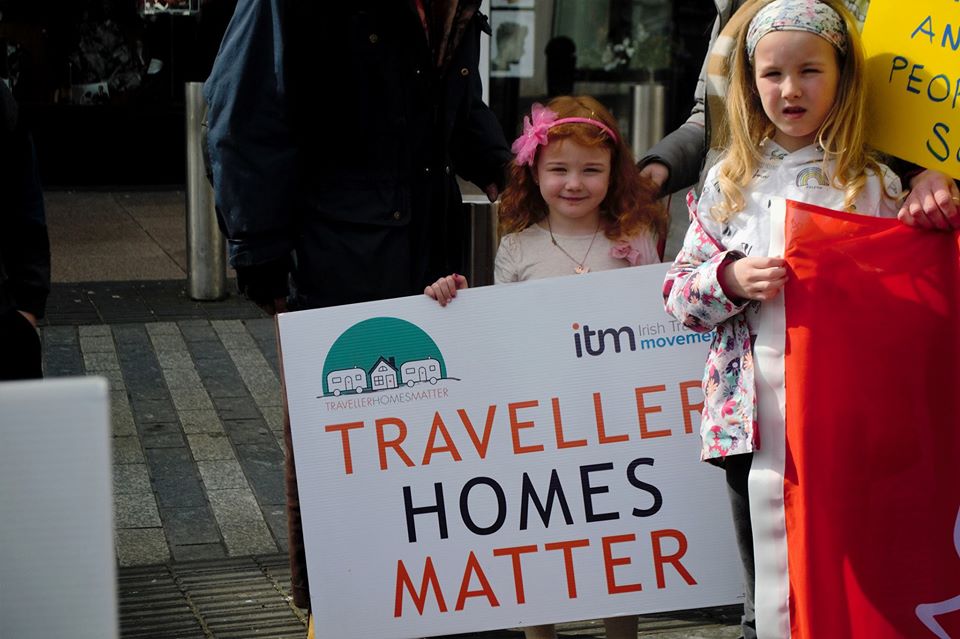
Mr. Moore also pointed out some gaps in State provision, stating that the school books for children contain no mention of the Traveller community in Ireland, which itself has housing and education issues.
There is also a history of fascism in 1930s Cork when the Blueshirt fascist movement was opposed by anti-fascists and socialists inside and outside the IRA. Ironically, while opposition to the Fine Gael Government’s proposed legislation is the purported rallying point for the far-Right, the Blueshirts were one of the three groups that joined to form the Fine Gael party (which is why many opponents of the party call them “Blueshirts” to this day).
Fascist salutes at a Blueshirt rally in 1934 in Charleville, Cork. (Photo source: History Ireland).
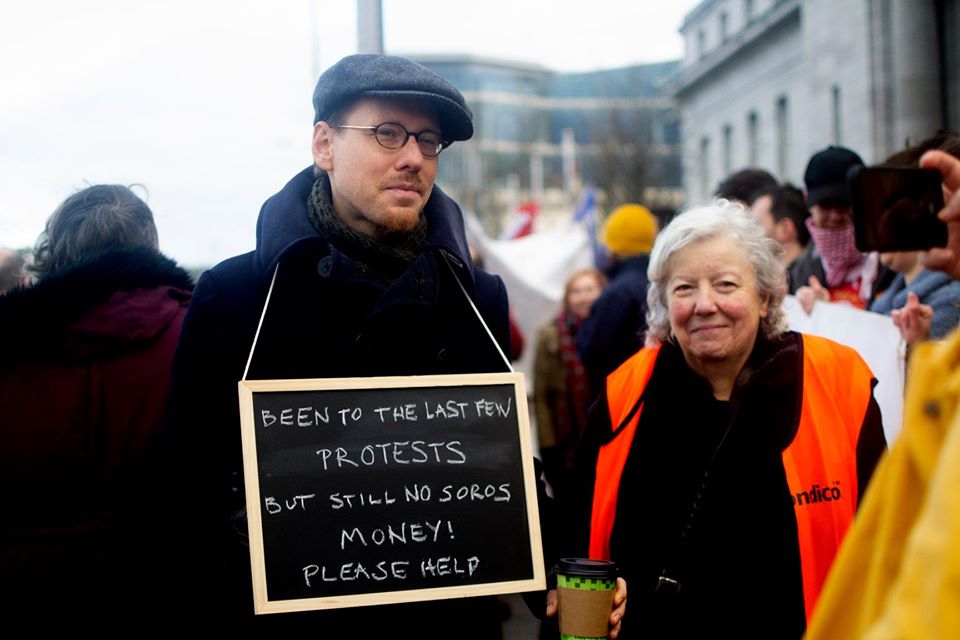
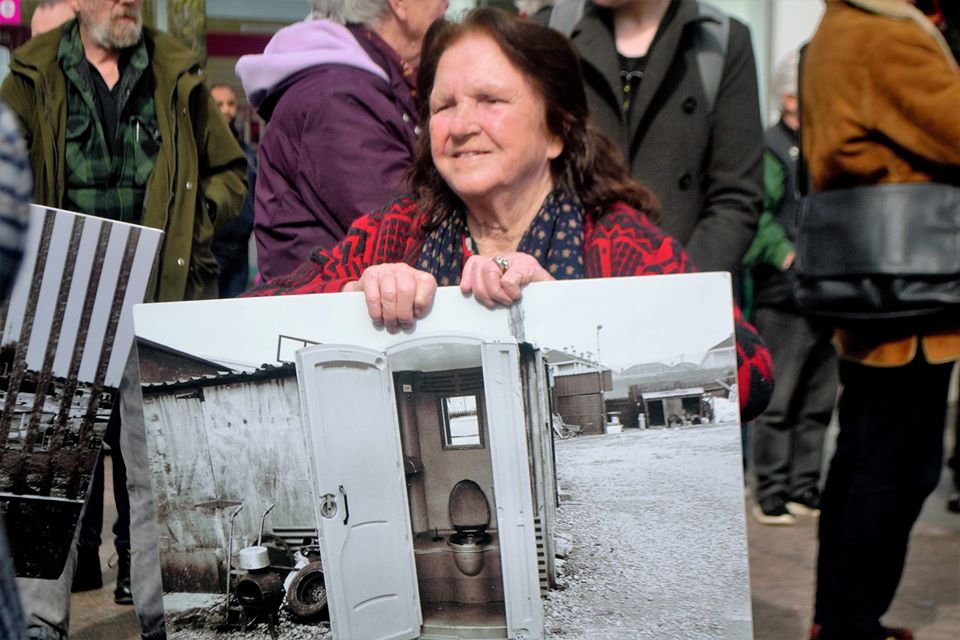
Counter-rally supporter mocks conspiracy theory that Soros Foundation is funding all the anti-racist and anti-fascist activists. (Photo: Shamim Melekian)(Photo: Shamim Melekian)Another pointed placard message on the counter-rally. (Photo: Shamim Melekian)Woman on counter-rally displaying presumably dire conditions on halting sites for Travellers. (Photo: Shamim Melekian)
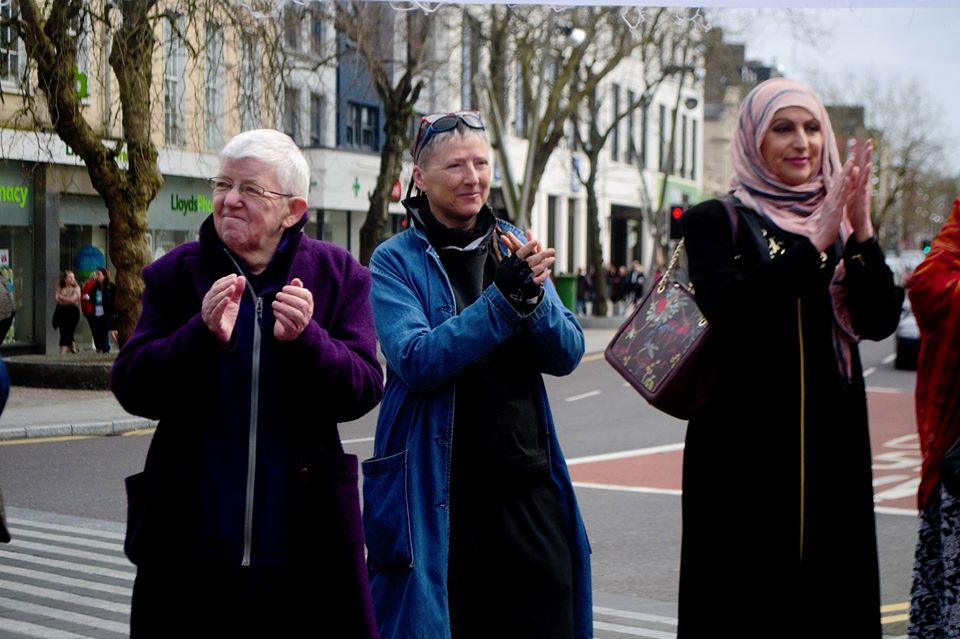
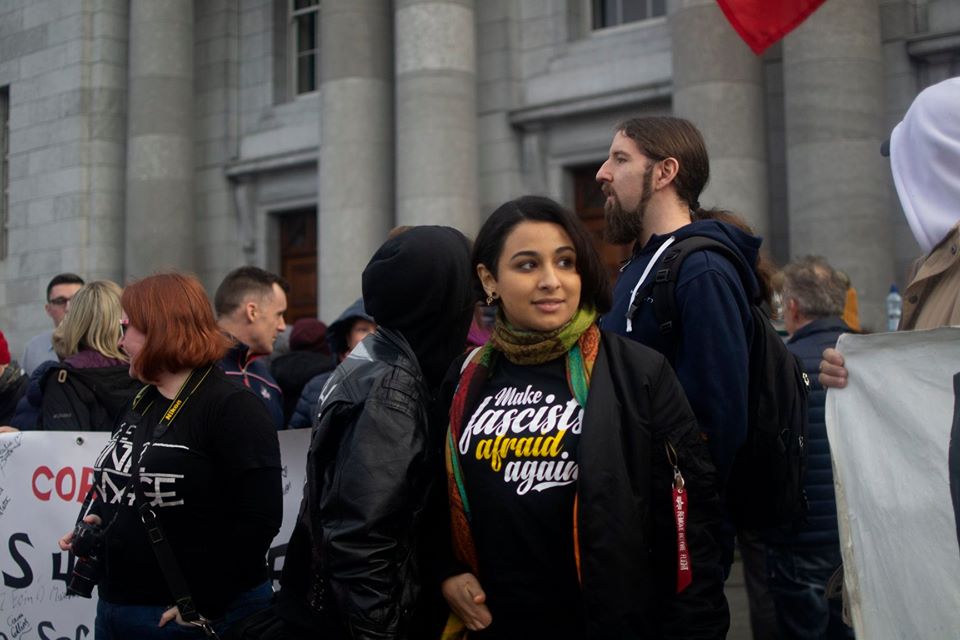
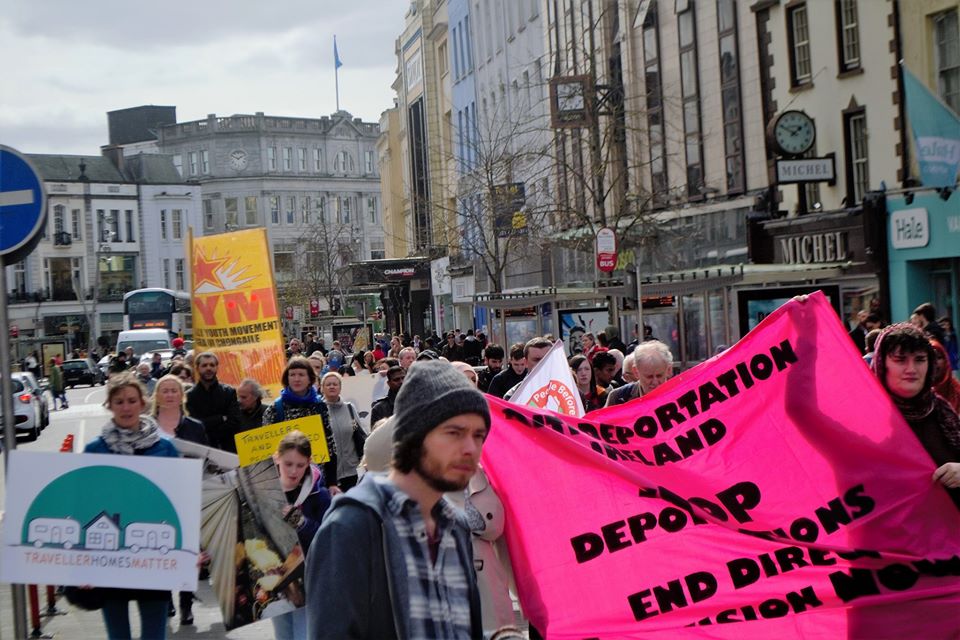
Women of varied ages and backgrounds applauding speaker at counter rally. (Photo: Shamim Melekian)Counter rally supporter sends pointed message on placard (Photo: Shamim Melekian)Young supporter of counter rally sports a T-Shirt display which might become very popular. (Photo: Shamim Melekian)Section of counter rally on the march through Cork city centre. (Photo: Shamim Melekian)
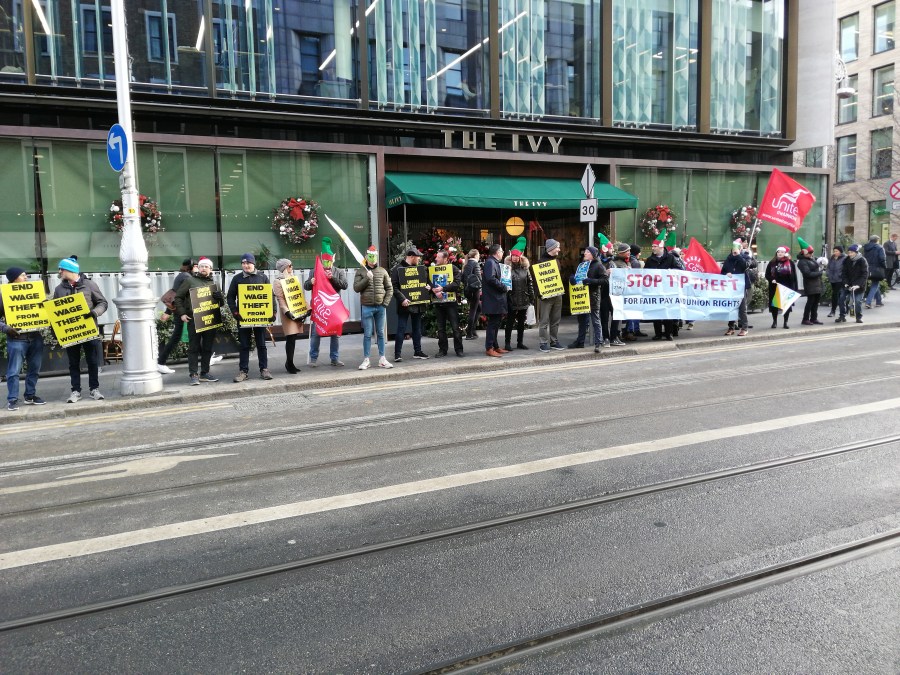
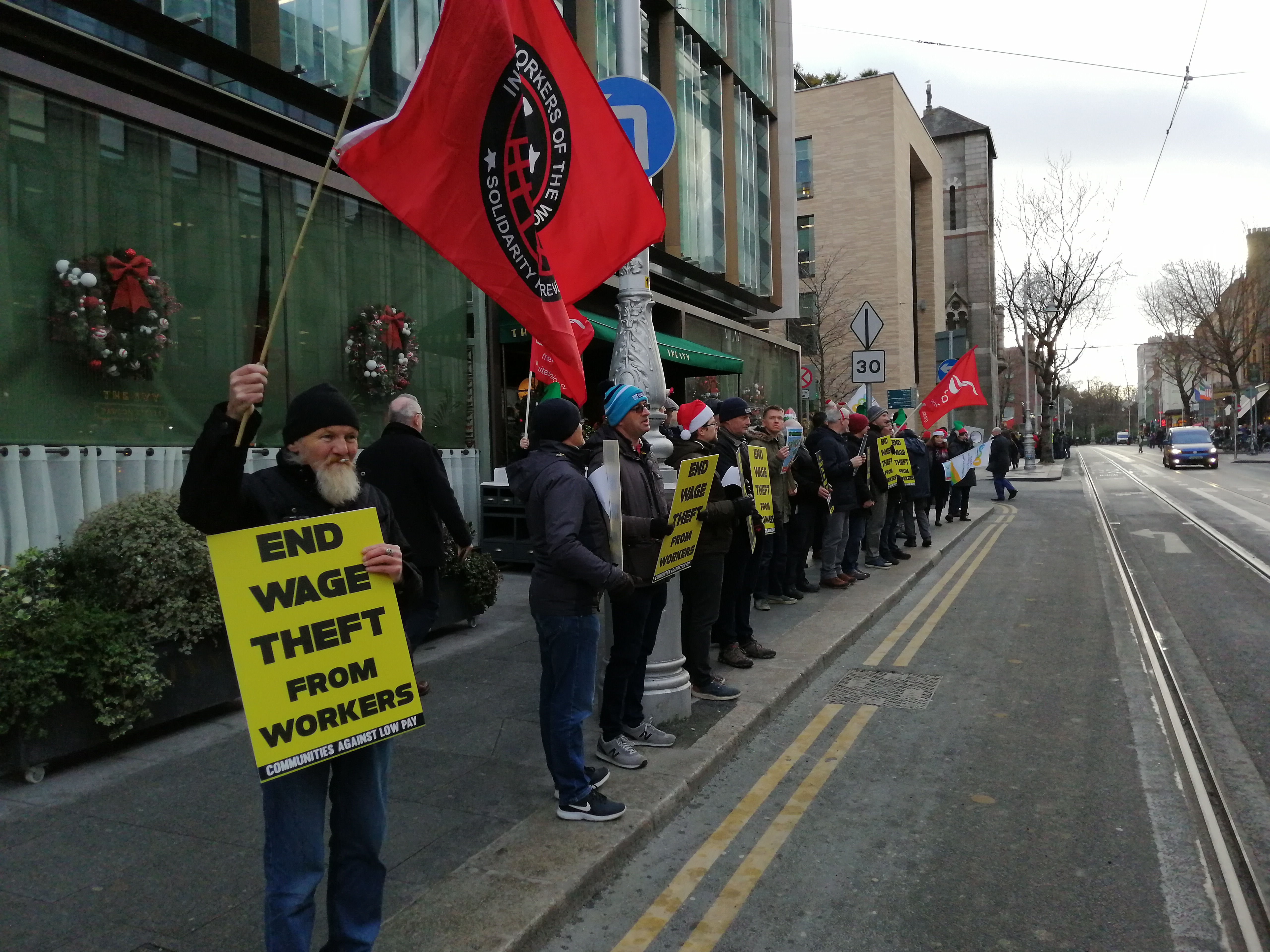
The Ivy Restaurant in Dawson Street Dublin, which steals part of its workers’ tips to make up their wages, continued to do so despite protests throughout 2019 and their only response to the campaigning has been to install and lower blinds whenever the protesters gather outside. Two members of staff were sacked for protesting the theft of tips (which customers assume are going to the staff) and trying to organise a trade union at their workplace.
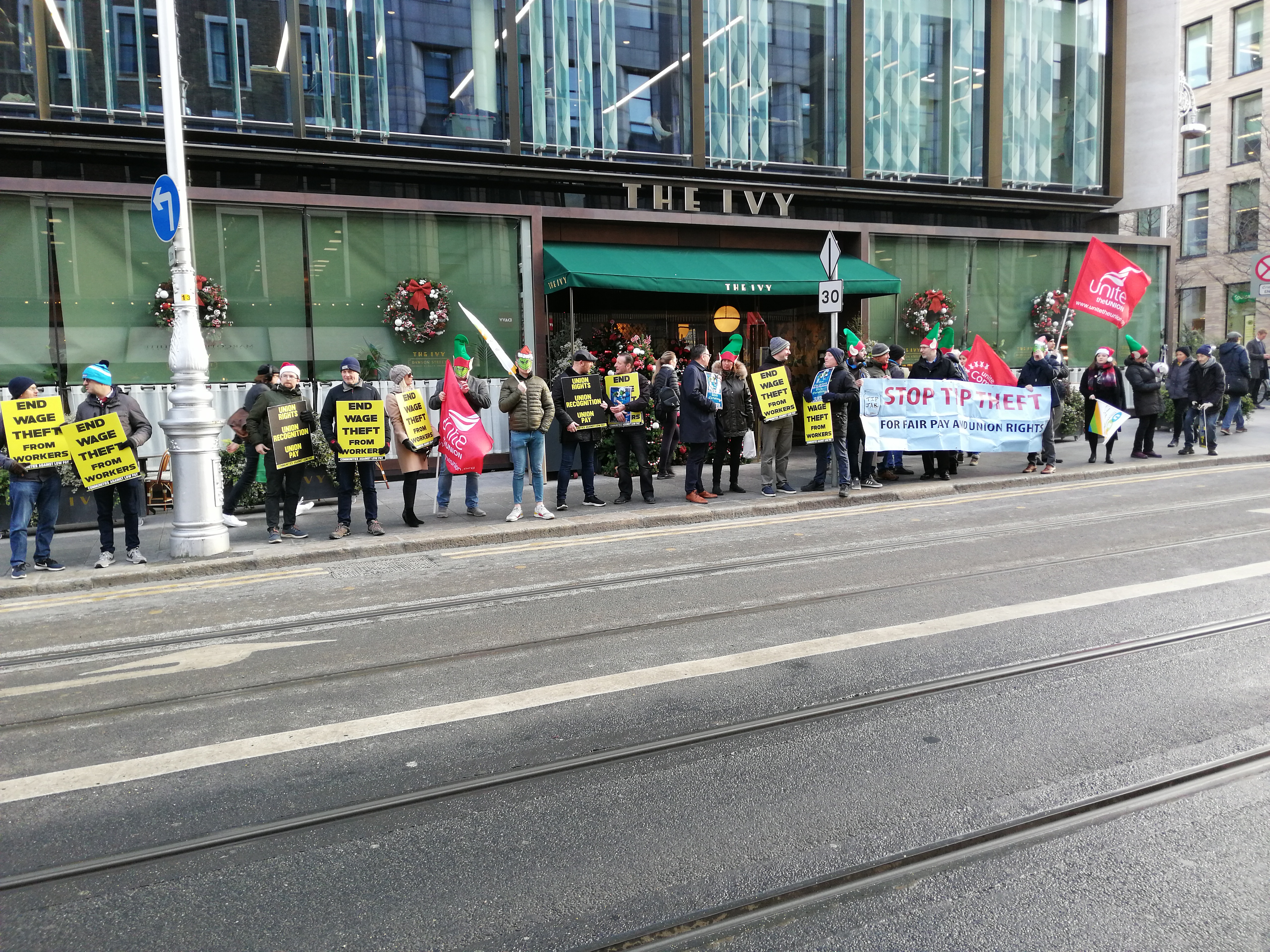
View northward along Dawson St. in front of the Ivy Restaurant (Photo: D.Breatnach)
The Stop Tips Theft Campaign has been focusing on the Ivy not only in order to rectify the injustices there but also in order to clamp down on the practice in some other eateries and to prevent it spreading.
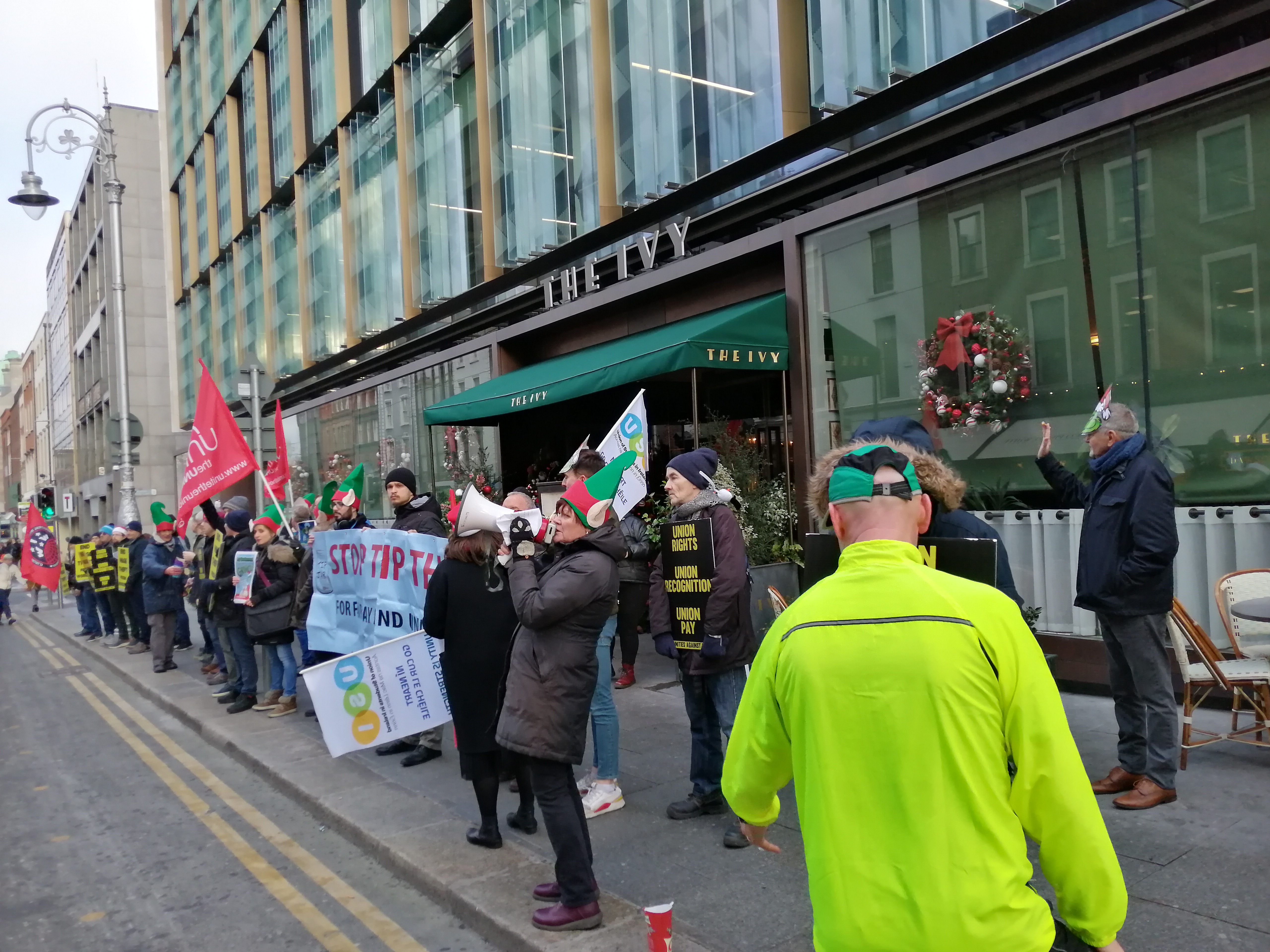
On 17th December 2019, the campaigners again picketed the restaurant for the last time for 2019, mixing serious calls for justice with songs with adapted lyrics and many wearing Christmas regalia.
It is scandalous that tips are being taken from these workers in what is now called the “hospitality sector”, who tend to the least-union-organised and also the worst paid and treated – which is exactly why the Ivy owners and management think they can get away with this.
(Photo: D.Breatnach)
End.
Joan Collins TD, a regular at these protests, with megaphone. (Photo: D.Breatnach)
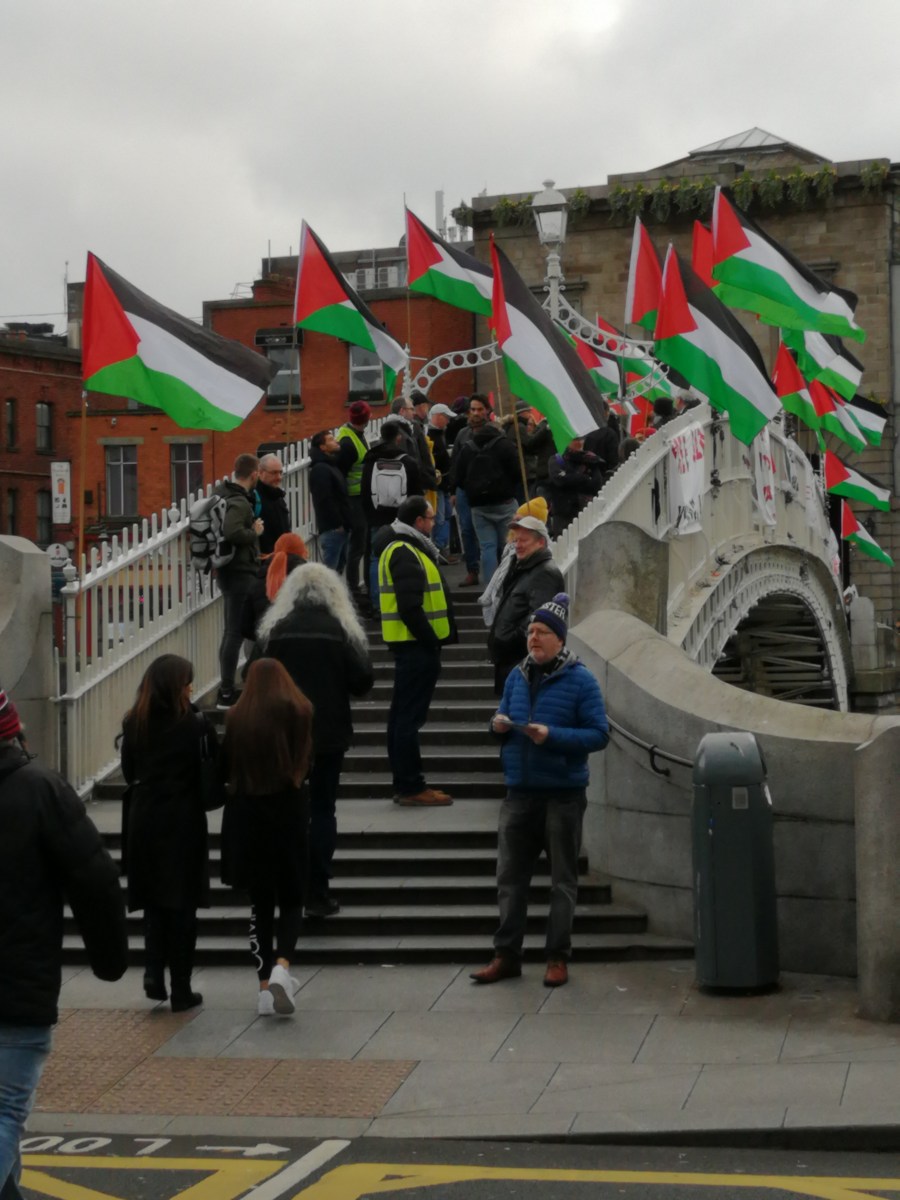
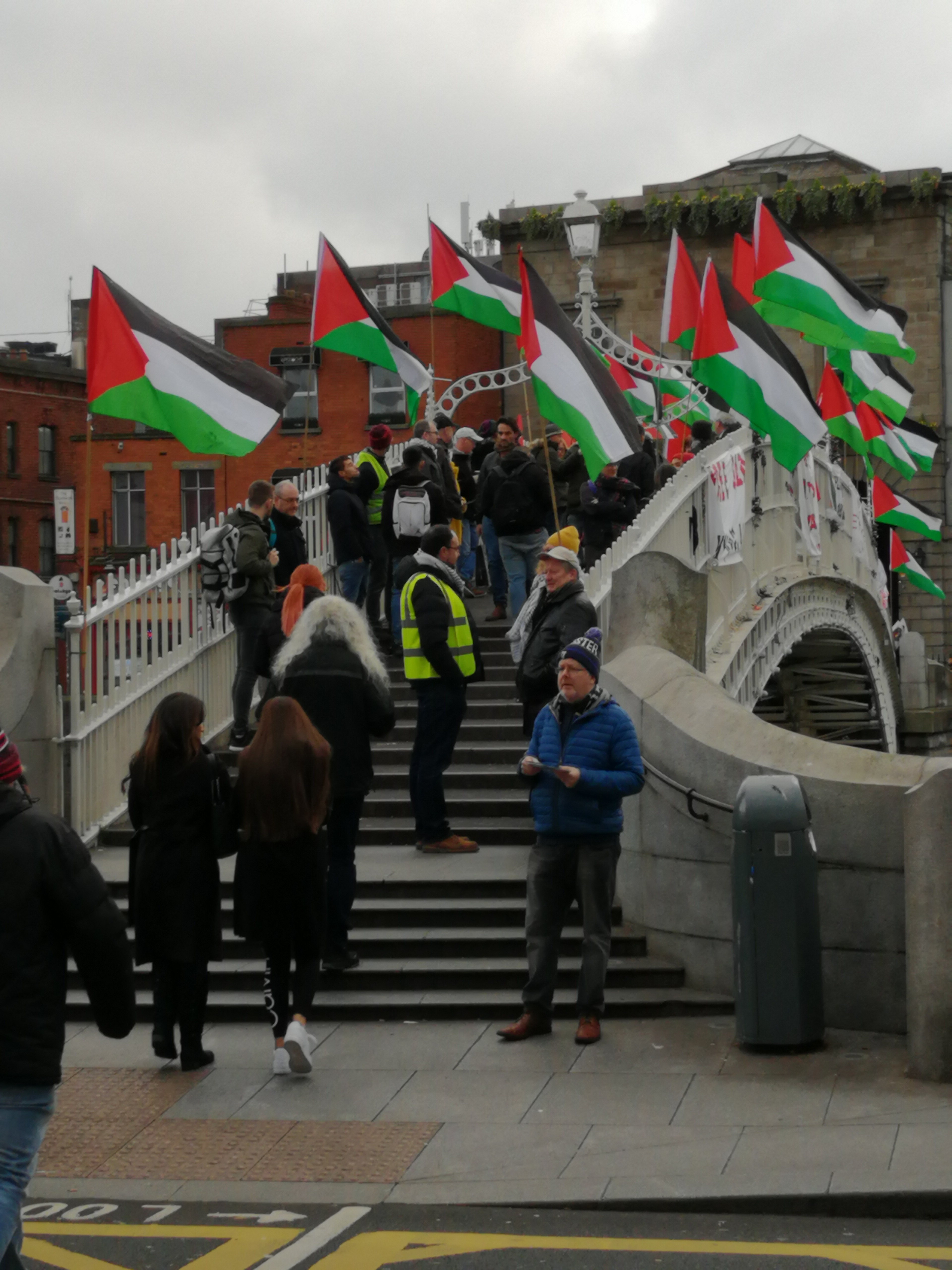
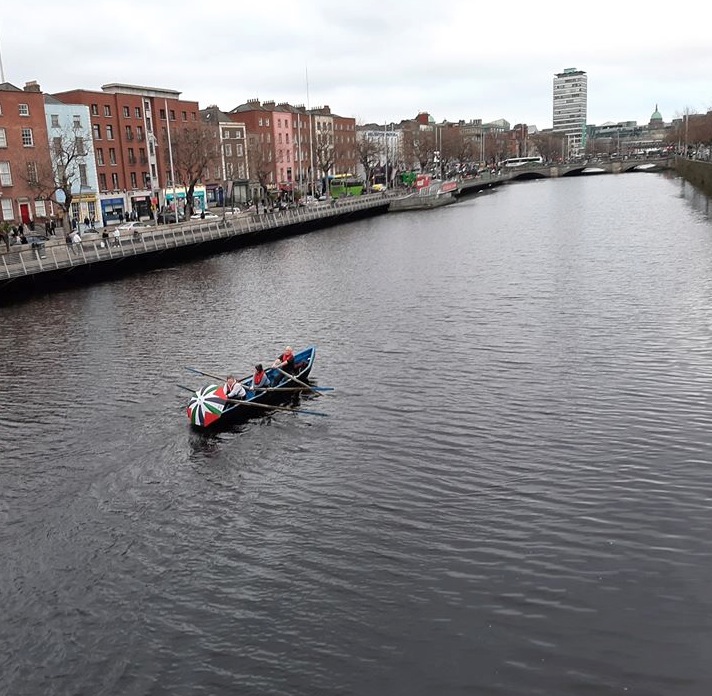
The iconic Halfpenny Bridge over the river Liffey in Dublin seemed to be flying on Palestinian flags on New Years’ Eve. The annual event organised by the Ireland Palestine Solidarity campaign was favoured with not only a dry but also mild day this year and supporters and passers-by clicked their cameras to capture the scene, in the midst of which an Irish currach showing Palestinian colours was rowed up and down the river nearby by three women.
Currach (traditional light Irish rowing boat) rowed downriver by three women in solidarity with the Palestinian people (Photo: D.Breatnach)
Communists, Socialists. Irish Republicans (both pro and anti-Good Friday Agreement) and generally democratic people lined both sides of the Bridge itself and spilled out at each end, which the IPSC had a busy stall on the south side, next to the Merchants’ Arch.
Yesterday brought to an end a year that was far from the worst in the long history of the bloody Zionist occupation of Palestine and the oppression of the Arab-Palistinian population. Even so, 149 Palestinians were killed during 2019 according to a statistical collection agency and 35 of those were children. During the same period 10 Israelis were killed, including two children. However, in December alone, nearly 45 Palestinians were killed by Israeli Zionists against no Israelis. The hugely disproportionate balance of death and injury in favour of Israeli Zionism has been a consistent pattern since the the beginning of the Occupation and makes any notion of there being a “war between two sides” deemed nonsense by many commentators who instead, see the conflict as vicious repression by the Israeli State and largely ineffective resistance by what is now a minority Palestinian population, controlled to a prison-like degree by a highly-militarised state.
A bridge of flags. (Photo: D.Breatnach)
USA SUPPORTING A RACIST STATE AND ILLEGAL OCCUPATION
2019 was also the year in which the USA Administration for the first time pronounced the Israeli settlements in what are termed “the occupied territories” to be no longer illegal, flying in the face of world opinion and many declarations of the United Nations. This comes after the introduction of the new Israeli citizenship law last year, pushed through by the right-wing and religious coalition with 62 votes against 55, which defines Israel as the nation-state of the Jewish people, completing the process of making it officially a racist and religious state, downgrading the political, civil and cultural rights of all other ethnic and religious communities within the territory it controls. The measure was widely criticised by human rights groups around the world and within Israel itself, as also by much of the Jewish world population.
Part of the Ha’Penny Bridge yesterday (Photo: D.Breatnach)
Solidarity with Palestinians is traditionally demonstrated in other places in Ireland too on New Year’s Eve as well as at various other times during the year: between yesterday and today, eight Irish cities and towns demonstrated publicly in support of the Palestinians. Some years ago the Israeli Ambassador to Ireland described Ireland as “the most anti-Semitic country in Europe”. Since what he really meant was “the most anti-ZIONIST country in Europe”, most Irish people took that comment as a compliment. It is the Zionists who try to equate Jewishness with Zionism and the Israeli State in order to further their ideological indoctrination and intimidate democratic opposition; in doing so, the put all Jewish people in danger of the backlash against the crimes of the Israeli State. Fortunately there have been – and continue to be – Jewish people, some of them quite prominent, who speak out against the crimes of Zionism but these are dubbed “self-hating Jews” by the Zionists, who heap insults upon them.
The IPSC continues to organise a number of Palestine solidarity events every year and welcomes wide participation.
end.
The Palestinian solidarity currach going upriver. (Photo: Mel Mac Giobúin) [cropped]
(Reading time: 1 minute; watching time: 3 minutes per video)
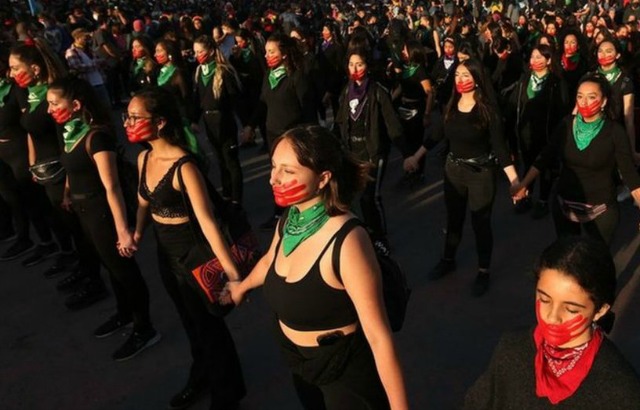
A choreographed protest against violence against women is sweeping the world. It was first seen on International Day Against Violence Against Women, 27th November in the centre of Santiago, the capital city of Chile. Organised by feminist group La Tesis, it formed part of the popular resistance to the the Sebastián Piñera regime and its repression, since accusations of rape and other sexual violence against the repressive forces have, according to a number of human rights agencies, amounted to 15% of the total (at least 70 separate cases in the first month of protests).
Source: Internet
The lyrics chanted were, in translation: Patriarchy is a judge who judges us for being born
and our punishment is the violence that you don’t see.
It’s femicide, impunity for my murderer,
it’s disappearance, it’s rape.
And it wasn’t my fault, where I was or how I was dressed.
The rapist is you. The rapist is you.
It’s the police, the judges, the State, the President.
The oppressive State is a macho rapist.
This was an extremely powerful and effective protest and caught the imagination of others, with videos spread by social media and also appeals across borders by feminist networks.
No doubt the continuation of the protest will take place in other contexts but it remain a powerful and innovative call.
As with other protests in Chile, those congregating in the area were attacked by forces of the State soon afterwards — the same forces against which the protest had been organised.
On what was an extremely cold day, faith groups joined with migrants and community groups, Irish Republicans, socialists, communists and anarchists to oppose a mobilisation by racists and fascists outside Leinster House, which houses the Oireachtas, the Irish Parliament. There were a couple of moments of surges towards the right-wingers but these were contained without arrests.
The anti-racist demonstrators responded to a call for the counter-rally and occupied the space from 12.00 noon on 14th December 2019, which left the racists and fascists having to face them from the other side of Kildare Street, at the junction with Molesworth Street but, in any case, they were outnumbered at about ten to one by the anti-racists and anti-fascists. The call came from SARF (Solidarity Alliance against Racism and Fascism), Islamic Foundation of Ireland, United Against Racism and Irish Network Against Racism (INAR).
The two opposing groups facing one another seen from the northern end of Kildare Street. The anti-fascists are to the left of photo. (Photo: D.Breatnach)
“FREE SPEECH”
The right-wing group had called for a rally to protest about the legislation proposed by the party in Government, Fine Gael, against “hate speech”. Ironically, Fine Gael are themselves a right-wing party which was formed in part out of the 1930s Irish fascist organisation, known colloquially as “the Blueshirts” (a name by which Fine Gael are known to this day by many). Earlier this year, Gemma O’ Doherty’s Youtube account was suspended and then terminated by Google because of its anti-migrant content, which gave the racists another issue: censorship of “free speech”.
Historically fascists, when their movement is weak, have often mobilised under the banner of “freedom of speech”. This has meant not only freedom to speak out against the government in power (which many anti-fascists would also wish for) but also the freedom to demonise targeted social, ethnic and religious groups and to call for their restriction, expulsion, jailing — or even death. Immediately upon gaining power, fascists restrict the freedom of speech of all others: not only of the social, ethnic and religious groups they targeted but also of their critics, the political opposition and trade unions. In this of course they are not so different from some socialist, communist or Irish Republican groups that rail against suppression and censorship only subsequently to silence criticism within their own ranks by threats, expulsions and censorship in the media they control. The point however is not to be fooled by the “free speech” demands of fascists and racists.
Section of the anti-racist mobilisation seen from a facing northward position. Beyond the irish Tricolour in the foreground, the Catalan estelada may be seen in the background, also Anarchist and Communist flags. (Photo: D.Breatnach)
All the same, this does not mean that we should support the proposed Fine Gael legislation either. “Anti-Hate Speech” legislation elsewhere was passed in capitalist states under the guise of protection of vulnerable minorities but then at times used for the protection of capitalists, royalty, government ministers and the police. If racist or homophobic incitement is the supposed target, why not specify that? Is hate itself necessarily a bad thing, if the hated object is racism, state suppression, exploitation?
Section of antifascist rally (left of photo) and most of racist rally (right) seen from facing southward position. Those wearing pink hi-viz vests are stewards. (Photo: D.Breatnach)
A BROAD RIGHT-WING, RACIST COALITION SHELTERING FASCISTS
The origin of this right-wing coalition seems to have coalesced around former anti-corruption journalist Gemma Doherty who, some time subsequent to being fired by her newspaper after she exposed some aspects of the financial dealings of the paper’s owner, apparently underwent a transformation into a rabid anti-immigration racist. People opposed to legislation legalising gay marriage and permitting greater access to abortion gathered around her, as did others against the State’s problematic child and family agency TUSLA and some others. Accordingly it is a broad but small, generally right-wing movement of many who feel a sense of their values being ignored or undermined. How disparate at times can be judged by their demonstration at the Department of Justice building a little over a month ago, when among their signage was a banner attacking TUSLA and abuses by the Catholic Church, while a woman among their number shook a set of rosary beads at the counter-demonstration!
Viewed from near the southern end of the crowds, the right-wingers across the street to the left of photo, anti-racists closer in foreground. (Photo: D.Breatnach)
The confusion was illustrated yesterday too when a woman among the right-wingers could be seen flying an estelada, a flag of Catalan independentists. From a number of people from among the counter-demonstrators who spoke to her, including Catalans and other people from the Spanish state, it appears that she equated the demonstration with demanding free speech, which she rightly stated was being denied by the Spanish state to many, including Catalan independentists.
Such groups are often believers in bizarre conspiracies (nor are they alone in that) and current among some of them is a belief that the EU plans to replace Irish people with migrants. For that reason the EU, which many Irish Republicans and socialists also oppose for very different reasons, is one of the targets of this right-wing coalition.
Organised fascists, who are currently a tiny group in the territory of the Irish state (but much larger, in the shape of Loyalists, in the British colony in Ireland, the Six Counties) find themselves generally isolated in society within the Irish state and no doubt threatened too. Therefore they try to infiltrate broader anti-government groups, as they did with a brief emergence of an Irish “Yellow Vest” movement, mostly in Dublin (see https://rebelbreeze.wordpress.com/2019/02/16/irish-yellow-vests-and-questions/) – in which they do not reveal their fascist project but present themselves as being against the Government, against corruption, for remedy of homelessness and as Irish patriots. And of course for free speech.
Nor are organised fascists the only opportunists, as a small number of politicians seeking election (or reelection) have been known to whip up fear of migrants and racist sentiment against Irish Travellers (originally a nomadic group). These offenders very recently have included an Independent TD (parliamentary delegate) from Galway and a Fine Gael candidate seeking election.
At some point of course, if they intend to come to power in society, fascists need to reveal some of their agenda but before they can do that they need to train some of their stormtroopers, public speakers and organisers and they need to command the street, at least in some areas. That was the reason for the 1930s rallies and attempted march on Dublin of the Blueshirts in Ireland, Mussolini’s Blackshirts March on Rome, the rallies and street-fighting of the Brownshirts in Germany and Moseley’s Blackshirts’ failed attempt to penetrate London’s East End. In the Spanish and Portuguese states, the fascists needed a military coup to aid them and, in the former case, the logistical and personnel assistance of the already-fascist states of Germany and Italy (a military coup was feared by the young Fianna Fáil government in 1930s Ireland too). In 2016, the need for a street presence was the reason for the attempted Dublin city centre launch of the European islamophobic organisation Pegida, which was defeated by mass mobilisation and physical opposition (for which some Irish Republicans are still being processed through the Irish courts).
Although Gemma O’Doherty and her supporters had been confronted before in Ireland, yesterday’s was the first large mobilisation against their racist anti-immigration message and it vastly outnumbered that of the racists.
Another view of both sides, mostly the anti-racists, from facing southward position. (Photo: D.Breatnach)
POLICE AND STEWARDS SAVE RACISTS AND FASCISTS FROM A TROUNCING
Generally the two opposing forces seemed content with shouting and chanting across the street at one another, apart from the occasional anti-fascist wandering over to verbally confront the opposition. The anti-racists who in the opinion of the police got too close to the racists were sent back by the police but one of the antifascists had to approach the Gardaí (Irish state police) to remove one of the racists who had embedded himself among the anti-fascists. This seemed dangerously like asking the police to deal with the fascists whereas police bias at least is generally against the antifascists. Surely the crowd could have easily expelled him (at least) unaided?
As has been the custom with them and their intention to appear patriotic, the racists and fascists were displaying a host of Irish tricolours but this time there were a number of these also among the antifascists, along with a number of green-and-gold Starry Plough flags, as well as some communist and anarchist flags.
However, when a small group among the right-wingers pulled out the blue-and-white version of the Starry Plough, flag of the Republican Congress of the 1930s, along with the Sunburst flag of the Fianna Éireann (Republican youth group of past generations) and began waving them, a section of Irish Republicans surged forward in outrage and for a few moments the stewards and the Gardaí struggled to contain them.
Those who had brandished those particular flags were clearly delighted with the reaction they had provoked. Since at previous demonstrations of the racists and fascists they had never displayed those particular flags and, since they only made an appearance later in their rally yesterday, it seems clear that they had displayed them solely for the purpose of provocation.
A little later there was another surge from a different point which was again contained.
It was understandable, given the broad composition of the anti-racist rally, that the organisers would wish to prevent physical fighting breaking out from among their ranks on this occasion. However, there is a danger of this kind of stewarding becoming collusion with the State – or at the very least being seen to be so by sections of anti-fascists.
MIGRANTS AND IRELAND
The bubble expansion of the Irish economy for an unexpectedly long period from the late 1980s to the beginning of this century, provided employment opportunities which could not be filled by the low level of the Irish population (a result of two centuries of heavy migration from Ireland to other countries). These employment opportunities, mostly in construction and services, tended to be availed of by migrants, mostly from European states with declining or stagnant economies but also by some from states in Africa, Latin America, the Middle East and China.
Although Ireland had seen foreign colonisation from Britain for centuries, it had only experienced small emigration from elsewhere, which also tended to restricted to certain periods, for example Huguenots at the end of the 17th Century and Italians in two waves, following each World War. The change in population composition in some areas at the end of the 20th Century was startling and difficult for some to which to accustom themselves (though welcomed by others). When combined with the subsequent bursting of the Irish economic bubble and cuts in public services, severe housing crisis and a health service failing spectacularly, migrants became a handy scapegoat for some people and a useful target for fascists.
Some of the migrant communities in Ireland were represented among the anti-fascists but apart from a sprinkling of black faces, were not so easy to identify. A Catalan estelada (yes, another one) revealed a small group of Catalans representing CDR Dublin and a representative of Asamblea Nacional de Catalunya Ireland also spoke from the PA system earlier in the day. Some Spanish were in evidence and a Basque Antifascist flag could also be seen but undoubtedly the largest migrant antifascist contingent was Italian. Many of these were supporters of the Sardine movement against Italian right-wing populist politician Salvini and which welcomes migrants. Perhaps a hundred strong, they sang antifascist songs, including of course the Bella Ciao and made speeches in Italian and in English.
Section of the Italian ‘Sardine’ movement supporters. (Photo: D.Breatnach)
THE FUTURE?
As increasingly around the world governments become more right-wing and fascist organisations mobilise, anti-fascists need to organise too. The thesis that fascism is capitalism in crisis seems well-proven which means that antifascists should not nor cannot rely on the forces of the capitalist State to prevent the growth of fascism or to protect the social and ethnic groups targeted by fascists and racists.
Although the Catholic Church in Ireland no longer has the power it had in the Irish state since its creation in the 1920s and the fascists cannot rely on its heavy backing as in the 1930s, there is no room for complacency in Ireland or anywhere else.
Mobilisation against the fascists and racists to deny them public spaces from which to recruit and to organise is essential. And a broad anti-fascist and ant-racist unity in action needs to be built, similar to what was seen yesterday although within that broad movement there also needs to be struggle against liberal ideology. But one cannot combat sickness purely by countering infection – care needs to be given to cultivation of a healthy body too. The Ireland body is sick: sick from cultural and physical colonialism, sick from territorial partition, from racist Loyalism and native gombeenism, from underdeveloped economy and plundered resources, from housing and health crises. While these remain unresolved we can expect at least sporadic outbreaks of fascist and racist infection and quite possibly an epidemic. It is not only in the struggle against fascism that unity is needed.
end
POSTSCRIPT
From information either not available to me or unconfirmed at the time, the blue-and-white Starry Plough which had been used to provoke anti-fascists was actually seized by the latter in the scrimmage. There was apparently another, which was allegedly seized by Republicans after the right-wingers had left for which two men were arrested and handcuffed.
According to reports, one of the right-wing women attempted to kick one of the arrested men while he was handcuffed and she was also arrested.
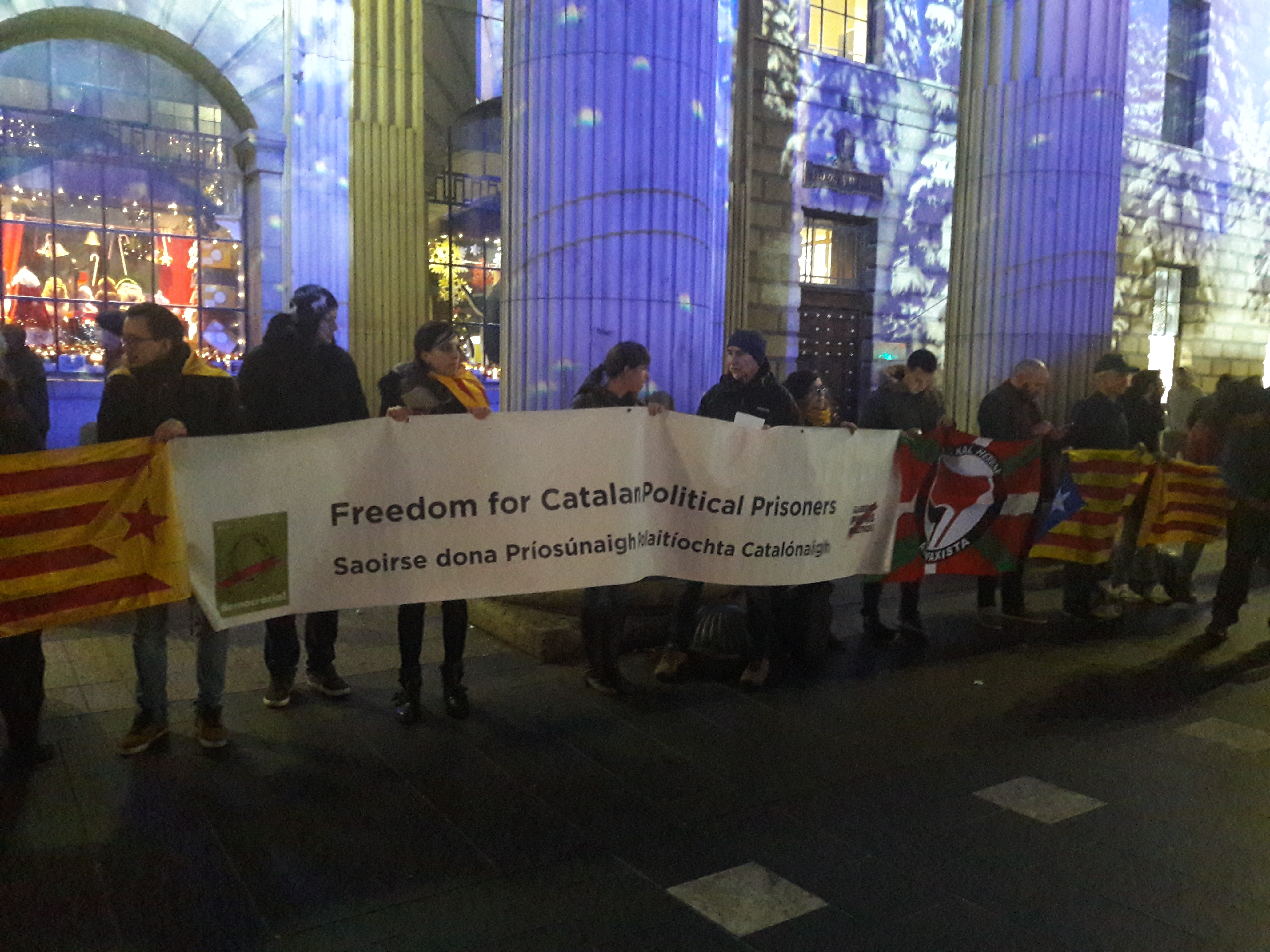
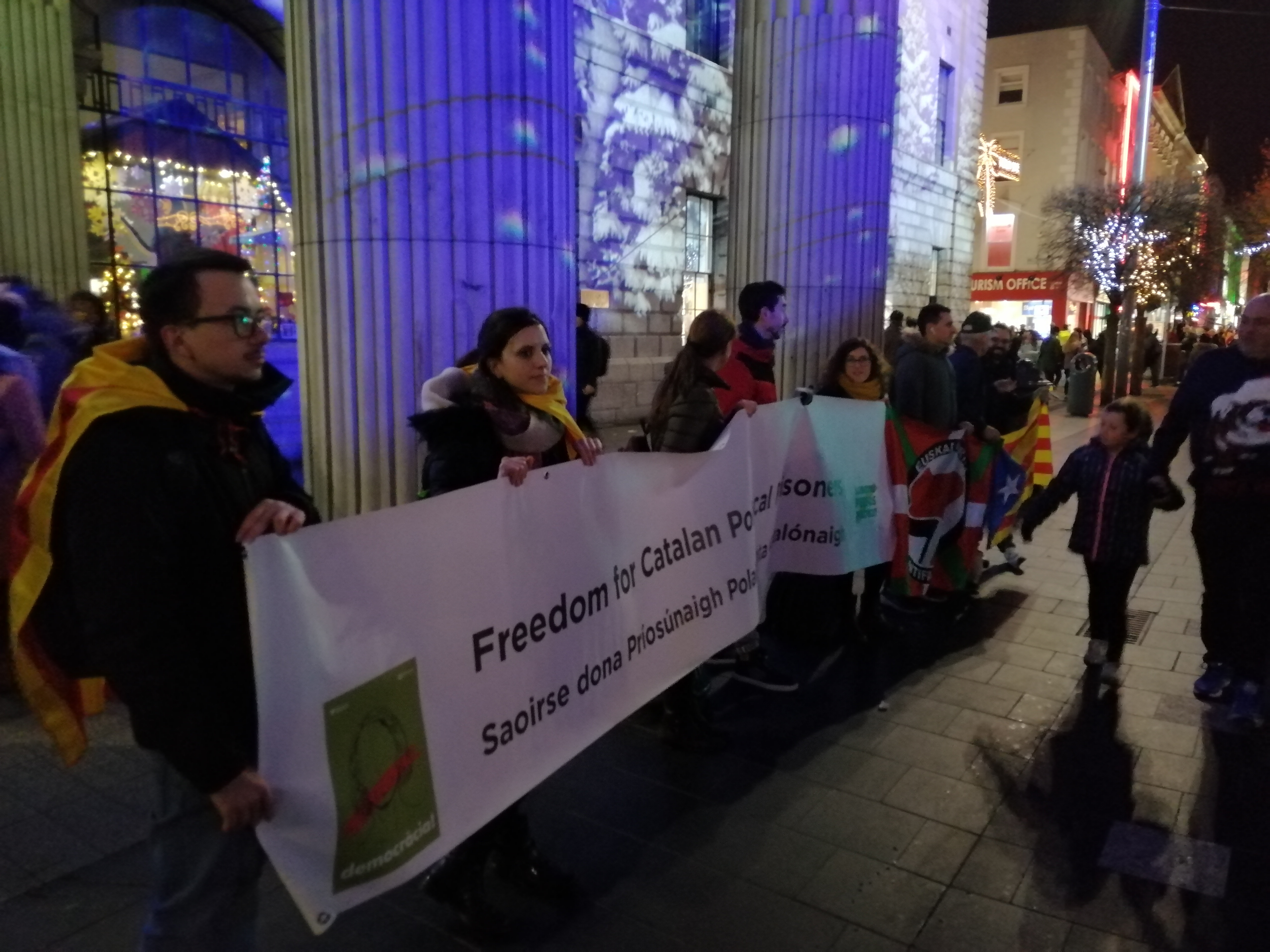
At little over a week’s notice, a protest picket took place on the evening of Friday, 6th December in Dublin City’s main street in protest at the lack of democracy of the Spanish Constitution. The date chosen was the same as the public holiday designated by the Spanish State to celebrate the adoption of the Spanish Constitution by majority in 1978.
(Photo: D.Breatnach)
The protest was organised by three Catalonia-solidarity organisations in Dublin: With Catalonia/ Leis an Chatalóin, ANC Ireland and CDR Dublin. Calling the Constitution “a forced marriage without right to divorce”, the organisers published a statement in advance explaining the background to the Constitution and calling on people to support the protest.
The statement explained that when General Franco, the fascist-military dictator of the Spanish state, died near the end of 1975, opposition of various kinds that had illegal under the dictatorship – trade union, anti-fascist, republican, national-independentist – had been building for some time and took encouragement from his death. But State repression intensified with attacks by police, military and by fascist gangs.
Centre view of picket on Friday with GPO Christmas Nativity scene in background (Photo: C.Pujol)
“In 1977 the regime proposed to legalise their opposition parties, the PSOE and the Communist Party – on condition those parties agreed to support the installation of Franco’s nominee as King and Head of State and to control their affiliated (illegal) trade unions, the UGT and Comisiones Obreras.” This was the price for prisoners being released but no action could be taken against the torturers and murderers of thousands during the Anti-Fascist War or the Dictatorship or against those who had stolen children, raped and plundered. The (republican!) party leaders agreed and recommended the 1978 monarchical and unionist Constitution to their members and affiliated trade unions. Amid a wave of repression the take-it or leave-it Constitution was agreed in the Parliament and then in Referendum on 6th December 1978 by a large majority throughout the Spanish state, except in the Basque Country.
The statement pointed out that while the Constitution guarantees the right to self-determination, tht can be only if the majority of the Spanish Parliament agrees. in 1919 when Ireland had a majority of pro-independence delegates elected, as Catalonia has now, the text recalled that they declared independence. The statement went out to point out the close parallels of Ireland 100 years ago and Catalonia today, as the British proclaimed the declaration illegal, banned the First Dáil (Irish Parliament) and jailed elected delegates it could catch.
Poster for the event (creation D.Breatnach & B.Hoppenbrouwers)
Although the Catalan Government has not yet been declared illegal, the statement pointed out that “seven of its Ministers and elected officers have been jailed for 13 years and others heavily fined (two grass-roots organisation leaders have also been jailed for nine years); 700 town mayors are to be judicially processed for allowing the Referendum on independence to go ahead in their towns on 1st October 2017, a Referendum when many polling stations witnessed a savage Spanish police attack that was seen around the world (but much of it not in the Spanish state, outside of Catalonia and the Basque Country). Opinion polls have shown that 70-80% of people in Catalonia want to have a referendum on independence, free from attack or threat but the Spanish State uses the excuse of the Constitution to deny them that opportunity.”
On the picket in Dublin a banner was displayed in Irish and English supporting Catalan political prisoners, along with a number of estelades (flags supporting Catalan independence), most of them of the red star variety (rather than the more common white star in a blue triangle). There was also a Basque Antifascist flag.
View of picket looking northwards (Photo: D.Breatnach)
As the protest drew to a close, outlining their reasons for supporting the protest, a number of individuals gave short video interviews; one in Irish and Marc Loan of CDR Dublin gave one in in English.
Carles Pujol of ANC Ireland thanked everyone for attending and said a few words about the need for the protest and referred also to the Catalan political prisoners in Spanish jails. Diarmuid Breatnach of WCLC spoke briefly about the appropriateness of the protest taking place in front of of the General Post Office building, which had been the HQ of the 1916 Easter Rising against British domination. He went on to point out some of the parallels between Catalan and Irish history and concluded by saying that Catalonia today is in the same situation as Ireland was a century before.
As the protest began to conclude, another picketbegan to assemble in solidarity with Irish Republican prisoners and there was some friendly interaction between both groups. However the Catalan solidarity protesters were heading off for a performance in Dublin by Els Pets, a long-standing Catalan band in a kind of folk-rock genre.
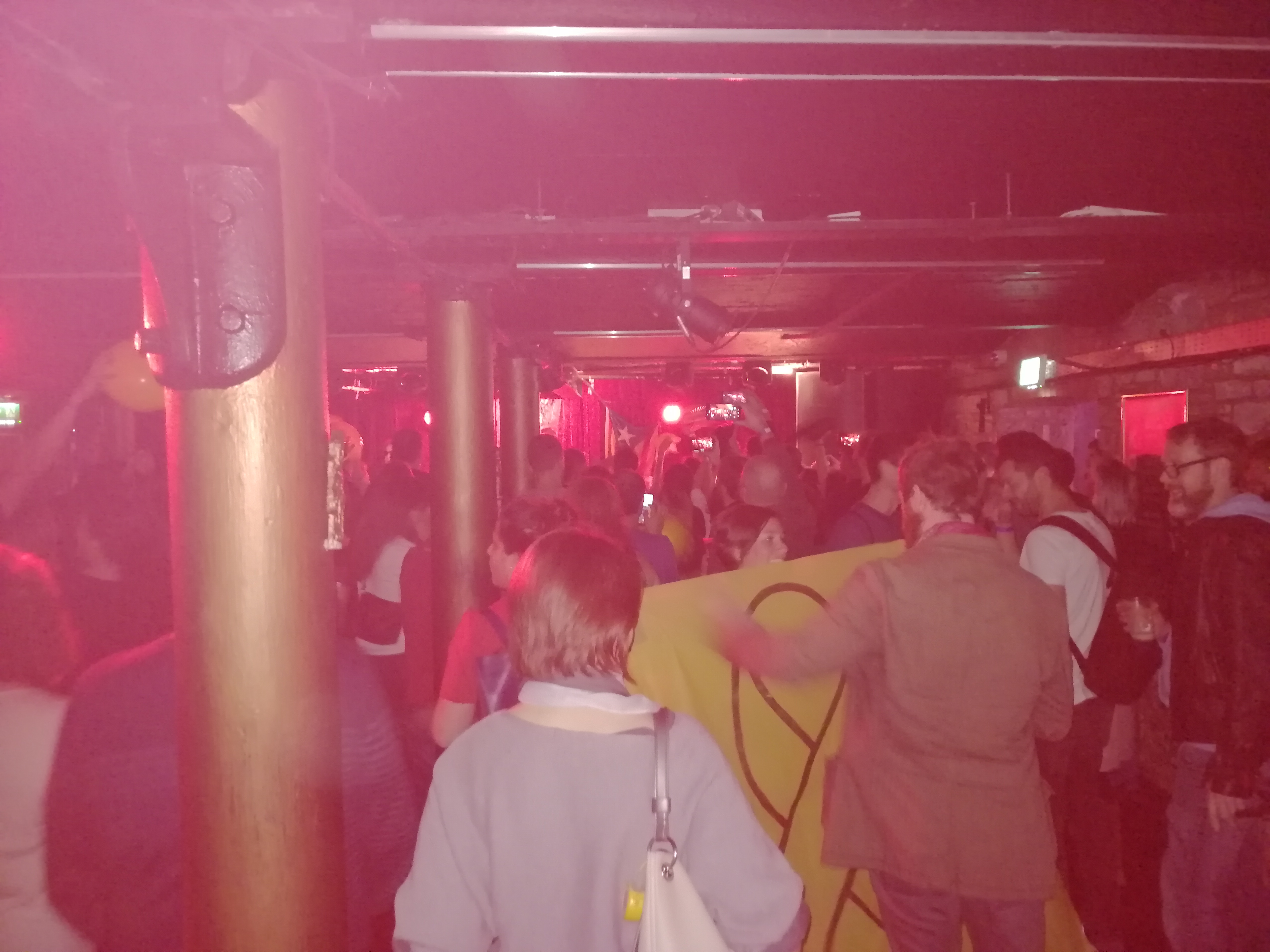
During the band’s performance, which was enthusiastically received by the mainly expatriate Catalan audience, a number of references were made from the stage to the aspiration for Catalan independence. At one point, a band member ironically sympathised with the Irish not having a king, saying “You don’t know what you’re missing.” The Spanish King is hated by many Catalans because of his personal position with regard to violent repression against Catalan Referendum voters in October 2017 but also because the monarchy was re-imposed on a Republican Catalonia by General Franco. When the satirical song “I want to be a King” was performed, members of the audience began to blow yellow balloons and to bounce them around the area (yellow is the colour designated for ribbons supporting Catalan political prisoners).
At the end of the concert, a number of supporters lined up with placards supporting the right to self-determination, also denouncing the Constitution and Spanish State repression.
The placard display at the end of the Els Pets concert. (Photo: C.Pujol)
Note:
The politically-independent organisations concerned have organised more than ten public Catalan solidarity events in Dublin this year, including a cultural day in the park, film showings, talks and protest pickets. In addition, there have been organisational meetings and external meetings with public representatives and participation in a Spanish-Embassy sponsored debate (which wasn’t!).
End.
Els Pets on stage. (Photo: D.Breatnach)No, it certainly is not! (Photo: D.Breatnach)Yellow ribbon banner in solidarity with the prisoners. (Photo: D.Breatnach)Estelada waving among the audience. (Photo: D.Breatnach)Yellow balloons time! (Photo: D.Breatnach)
When Basque independentists celebrated Gudari Eguna this year, the Day of the Basque Soldier, some of the celebrants were affiliates of the Abertzale (Basque pro-Independence) Left while others were supporters of the Basque Nationalist Party, nominally at least and often in reality, political enemies. However, it is not the same day for each.
Flagpole with the ikurrina, Basque national flag, at Sollube, scene of a battle between the Francoist forces and the Basque Gudari during the Antifascist War. This was erected probably by the PNV for their commemoration but commemorations are also held at the site by ‘dissidents’ of the Abertzale Left. (Photo source: D.Breatnach)A beech seedling (native tree, sacred in folklore, of reputed medicinal qualities, e.g in helping the body to resist infection) had been planted by ‘dissidents’ at the Sollube memorial and, although the surrounding protective netting had collapsed, was still alive. Subsequently Amnistia supporters returned and tidied up the area and left stone markers too. (Photo source: D.Breatnach)Mount of sollube: the Francoist forces had invaded from that far background direction, coming in from Nafarroa, which had been taken over to Franco by the Basque Carlists. (Photo source: D.Breatnach)
The PNV (Basque Nationalist Party) commemorates the execution of 42 Basque fighters in one jail by the Franco forces on 28th October in 1937, whilst the Abertzale Left carries out their commemoration a month earlier, on the 27th of September, anniversary of the last executions under Franco (and, officially, in the Spanish state since): ETA martyrs Juan Paredes Manot (Txiki) and Ángel Otaegi Etxeberria, along with three members of FRAP (Revolutionary Antifascist Patriotic Front) Jose Luis Sanchez Bravo, Ramón Garcia Sanz and Humberto Baena, all shot by firing squads in 1975 (despite world-wide protests and riots outside Spanish embassies).
For much of the Abertzale Left, Gudari Eguna commemorates not only the martyrs of the 27th September 1975 but also all those who fought for Basque independence during the Spanish Anti-Fascist War and all who fought for it since, in particular those martyred in the struggle.
But even in agreement on that date and that purpose, there are differences too. For some years now some commemorations have been by supporters of Amnistia Ta Askatasuna (Amnesty and Freedom), who denounce the “Officials” for dropping the demand for an amnesty for political prisoners but also criticise them on many other political and cultural grounds: ceasing to push for the everyday use of Euskera (the Basque language), making political pacts with social democrats, etc.
Increasingly, ATA and the “Officials” find themselves incapable of sharing a commemoration or a platform as the latter move further down the path of accommodation to the Spanish regime, social democracy and the PNV, commemorating police killed, apologising for the ‘crimes’ of the now-defunct Basque armed organisation ETA.
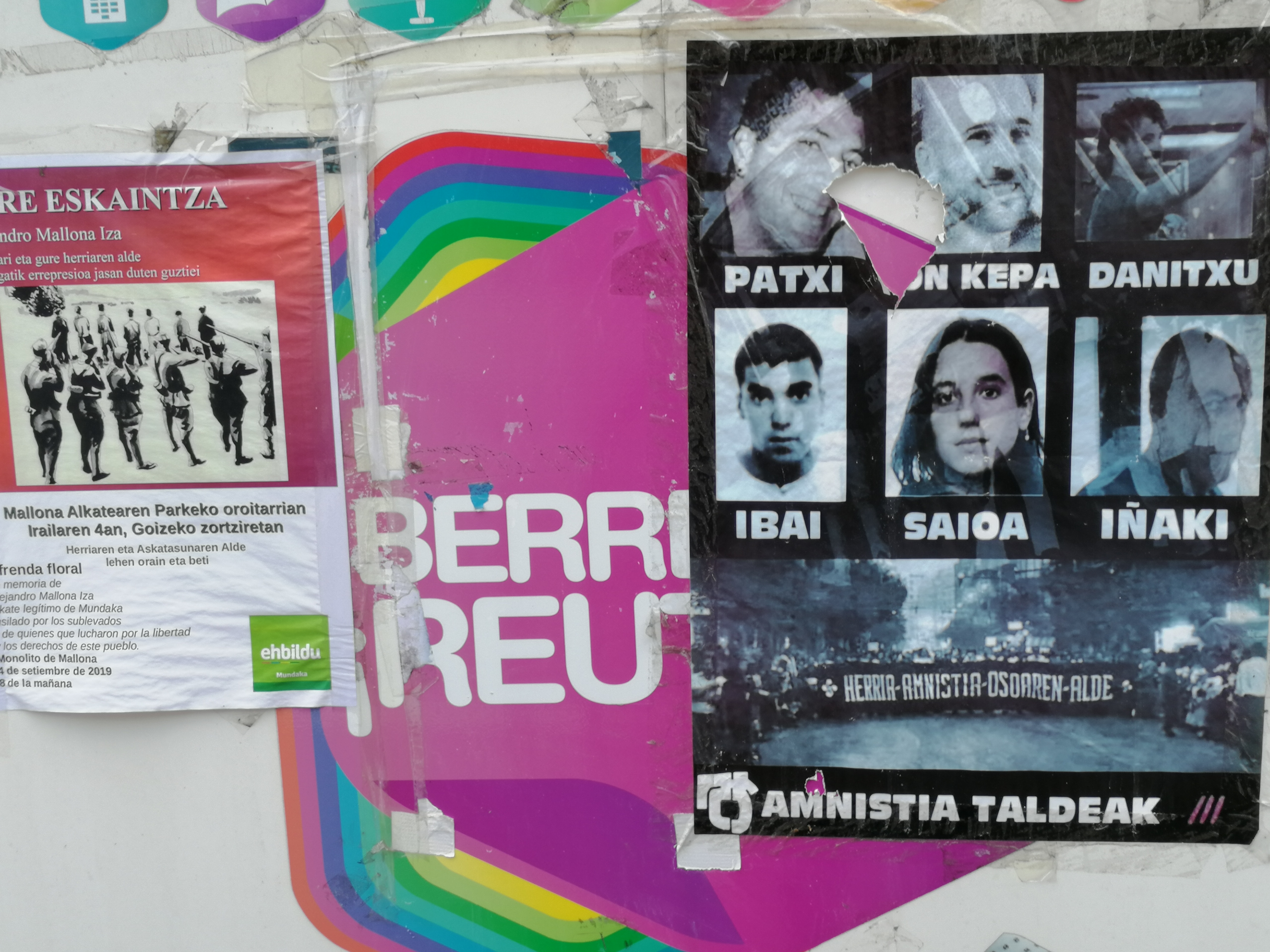
A poster of the “Officials” highlights two ETA martyrs, one killed by the Policía Nacional and the other by the Guardia Civil. (Photo source: D.Breatnach)A poster for Gudari Eguna of the ‘Official’ leadership, the party EH Bildu, next to a poster of the ‘dissident’ ATA listing six prisoners whose situation is being highlighted. (Photo source: D.Breatnach)
JARKI – A COMPARATIVELY NEW ORGANISATION REJECTING THE ABERTZALE LEFT “OFFICIAL” LEADERSHIP
In Ireland, though they themselves might reject that appellation, the equivalent to ATA would be called “dissident Republicans” and Basques are not as touchy about being counted part of the dissidencia. But one new group has emerged which does reject that term as descriptive of themselves, while at the same time very clearly against the positions of the “Officials” and resolutely for independence and socialism.
This group is called Jarki, (of various meaning: “Resist/ Stand fast/ Push back/ Commit”; the first letter is pronounced like the Spanish “j” or the Irish “ch”).
Among other posters of factions of the Abertzale Left proclaiming Gudari Eguna in the Basque Country this September, I had seen one, very large, side by side with a declaration of position against the subjugation of the Basque nation, for socialism and class struggle. Curiously, there had been no venue advertised for a commemoration ceremony to take place. Was this group, this Jarki, not intending to have one? I made discreet enquiries, someone spoke to someone ….. who perhaps spoke to someone else ….
Jarki poster for Gudari Eguna — note no venue details (Photo source: D.Breatnach)
On Gudari Eguna this year,
Text poster of Jarki’s alongside their image poster (Photo source: D.Breatnach)
27th September, I was met fairly early in the morning by my appointed guide. The mist gathered high upon the marshes and river and in the valleys as we drove higher, eventually coming out on a scenic site, the day cold but the climbing sun burning off the last of the mists. We rendezvoused with other carloads, then drove to another spot and parked. Asked to leave my mobile in the car, I accompanied my hosts on a long walk in unseasonal sun and heat to a field, where a temporary stage had been set up. It was to be a Gudari Eguna event organised by the Jarki organisation.
The security precautions were not excessive. This was taking place in the Spanish state, where fascism had never been defeated but had instead had a paint-over job in order to allow the Western states, after the death of Franco, to pretend it was a democracy. Until a few years ago, detentions of Basques had been like an epidemic, torture by police and army routine and just as routinely ignored by judges who sentenced the prisoners on the basis of their “confessions” or those of others to long years in jail. In contravention of EU and UN protocols for the treatment of prisoners, the political victims of the State had been dispersed to its furthest reaches, far from spouses, children, relatives and friends. And though the armed group ETA had ceased operation in 2012 and was now disbanded, persecution went on: that very month, 45 people of various organisations arrested in 2013, 2014 and 2015 for supporting the prisoners, including psychologists and lawyers, “supporting terrorism” according to the State, had been brought to trial1.
On the way to the rally, I saw many young men and women, in their middle-to-late teens or early twenties and also many others in ages ranging from late 50’s to 80s, also with a sprinkling of young adolescents. In other words, there were hardly any there of raising a family age. The sun was very hot now and I took off my jacket and tied it around my waist and, even so, was soon sweating.
I and one other were provided with a translator to Castillian (Spanish) for the speeches in Euskera – nobody else seemed to need one, a state of affairs that would not be matched in Irish Republican or Socialist circles with regard to our native language.
The heat beat down and I worried about getting sunburned, while at the same time very interested in what was going on. A large dragonfly wheeled above us, hovered a second then shot off. One of the folkloric Basque names for it translates as “Witch’s Needle” but it is important to recognise that in Basque society, sorgina or “witch” does not have the same negative connotations as can be found in much of western society, even today.
“THE STRUGGLE MUST CONTINUE — IN ONE FORM OR ANOTHER”
A man perhaps in his 60s took to the stage and recalled his years in guerrilla resistance (i.e in ETA), his capture and the killing of his comrades (one was executed on the spot by the Guardia Civil2). He went on to talk about his yearsbeing dispersed around Spanish jails throughout the territory of the State. Speaking about the historical memory of resistance, the man commented that it was necessary to keep that alive – both of the Antifascist War and of the resistance afterwards.
Euskal Herria3 was still divided and still not free, he continued and therefore the struggle had to continue in one form or another, despite the abandonment of the path of resistance by the current leadership of the Abertzale Left. Similarly the demand had to be maintained not only for an end to dispersal but for an amnesty for political prisoners.
After his speech, a young male bertxolari stepped forward to sing his composition. This is a cultural form of social and/ or political commentary, composed by those skilled in the art to fixed rules of rhyme, length of line and a selection of airs.4
He was followed by an elderly left-wing journalist who, apologising for her inability to speak in Euskara, did so in Castillian (Spanish). She referred to her family’s history of anti-fascist struggle, both in the War and in the resistance that followed the victory of the military-fascist forces. She too spoke about the need to continue resistance to unjust regimes and for the right to self-determination.
The journalist speaker was followed by the performance of another bertxolari, this time a young female.
Last to speak was a young woman, speaking on behalf of the Jarki organisation. She recalled the anti-fascist resistance in the Basque Country in ……….. (a nearby battle during the Anti-Fascist War) and elsewhere, also by ETA in the years following the victory of the military-fascist forces. While others might try to pacify the people and to wind down the resistance, the need for active participation in resistance is as great as ever, she said. The woman ended with the call “Gora Euskal Herria askatatua eta independentzia!” (“Long live a free and independent Basque Country!”), to which all the audience (myself included) responded with a roar of “Gora!”.
The young woman then led the audience with the song Eusko Gudariak (“Basque Soldiers”, similar in content to the Irish national anthem, the Soldiers’ Song), most of us who knew the words or not with raised fists, then a couple of women let out the irrintzi5 yell, raising goose pimples on my skin.
Obviously, given my presence, not all the attendance had been Jarki activists but on the other hand, not all its supporters had been able to come either, I was told on the long walk back to the caron tired leg muscles in the blistering unseasonal heat. I joked that if I’d had my mobile with me I’d have phoned an ambulance. Some cured sausage sandwiches and a few mouthfuls of ardoa (wine) from a traditional wineskin, kindly offered where the vehicles were parked revived me somewhat for the journey back to my pickup point that morning but thankfully, we also stopped on the way for lunch and a cold beer at a Basque bar (for which my attempts to pay were kindly but firmly refused by my other travelling companions).
“MOST OF THE RESISTANCE NEEDS TO BE AT STREET LEVEL”
Later, at an appointment with a Jarki activist, I asked what the relationship with other Basque organisations was, given that his group will not accept the appellation of “dissident” and others will. He told me that they enjoy friendly relationships with a number of other Basque political and cultural organisations that have also broken away from the “Official” leadership. Jarki is a revolutionary socialist organisation for an independent Basque country and in support of the Basque language, he told me. “Although we do not at the moment put forward electoral candidates, we are not necessarily against doing so as a tactic”, he added, speaking quietly. “But the ‘officialistas’ are only interested in the electoral path and we think most of the resistance needs to be at street level”.
The organisation expects a disciplined commitment from its members, for which it also recognises the need for political education, especially of the youth. There had been wide criticism of the lack of this kind of education within the Abertzale Left since the 1990s and earlier, right up to the present.6
“The national independence and socialism of the Basque Country is of benefit to the world and the independence and socialism of other countries is of benefit to our nation,” he said in reply to my question about the issue of internationalist solidarity. He admitted that the representative of Jarki at their Gudari Eguna commemoration had not mentioned that aspect.
Jarki call for rupture with the Spanish Constitution and demonstration on 6th December. (Photo source: Internet)
CALL FOR RUPTURE WITH THE SPANISH CONSTITUTION
A few days ago, while I was writing this long-overdue piece from contemporary notes, Jarki issued a national call to Basque society (translated by me from a Castillian version): “The Basque working-class people responds with rupture to the Spanish Constitution.”
The Spanish Constitution, despite not being accepted in the Basque Country7, is being imposed upon us. It is a document edited by the Francoists in a pact with the Spanish political parties. This document denies the self-determination of the peoples and besides accords to the military the role of guarantor of the union of Spain.
This Constitution designed the administrative separation of the provinces of the southern Basque Country.8
Faced with this imposition it is more important than ever that the working-class population of the Basque Country creates a revolutionary alternative which should be a political vision to lead the struggle for national construction and liberation and for socialism, the struggle for a united Basque Country, without classes.
For all those reasons we call for the organisation and mobilisation against the imposition, in which the Basque working-class population should follow its own path. Because of all that, we call for participation in the demonstration to take place on 6th December (Spanish Constitution Day) in Durango.
Although they wished to silence us, they will hear us. We have enough reasons. It is time to take to the streets. This people needs a revolutionary alternative.
End.
Poster by Jarki calling for demonstration against the Spanish Constitution (Photo source: Internet)
FOOTNOTES
1The day after 50,000 demonstrated for the right to support the prisoners and in solidarity with those on trial, Basque society was shocked when those charged admitted their “guilt” in exchange for walking free or a maximum sentence of five years’ jail for the “leaders” (instead of the up to 20 years normal from the Spanish court). The reverberations of that – the act of pleading ‘guilt’ itself but also permitting 50,000 to demonstrate in ignorance of the intention — are still travelling through the Abertzale Left and are likely to cost the “Official” leadership, who must have approved or perhaps even brokered the deal, very dearly. In contrast to the 45, another four, leaders of Askapena, Basque organisation for internationalist solidarity, charged with similar ‘crimes’, had fought the case earlier, for which they had won much respect and had beat the charges. Askapena, however, had quietly split from the Abertzale Left some years previously.
2The Guardia Civil is a militarised police force of the Spanish State with a very political role, the most active in the past against the Basque national movement and now similarly against the Catalonian. In addition the Spanish State has the Policía Nacional, also armed and active against movements for self-determination. Each region also has a separate police force, for example the Policía Foral in Nafarroa, the Ertzaintza in Euskadi, Mossos d’Esquadra in Catalonia, etc. And there are urban police forces too in every town or village.
3Meaning “the country where they speak Basque”, the term is now used to describe the whole Basque nation of seven provinces, three currently within the French state and four within the Spanish territory. “Euskadi”, the former term, now only describes the “Basque Authority” area of three provinces: Bizkaia, Alava and Gipuzkoa.
4This cultural form, at one time perhaps in danger of dying out, has become very popular and national competitions are broadcast on the Basque TV network. I have witnessed two bertxolari given pieces of paper laying out their respective roles (for example an Irish landlord and a Polish tenant) and, minutes later, engage in a battle of bertxos (verses) which had a Basque audience in roars of laughter and appreciation for the wit and skill of each. Close attention is paid by Basque listeners to bertxolari which, for a nation not culturally given to admiration for the song of the single voice (unless they can join to sing along), is truly remarkable. The Irish “comhrá beirte” is a similar performance art form but much less developed, certainly now, in Irish tradition.
5It is a long ullulating or yodelling cry, by males or females, said to be a call to war or to encourage Basques while fighting (it was also the name of a short-lived Basque resistance organisation functioning in the “French” Basque provinces). Such calls are common for communication of different kinds among mountain people, the sound carrying from one mountain to another and echoing but curiously enough it is also a feature of Arab culture in the desert and of some Native Americans. Example with a commentary in Castillian: https://www.youtube.com/watch?v=gcSaW6JUnUc
6That this has been neglected for decades in the Abertzale Left is a fact admitted even by many who remain within the “official” line.
7The Spanish Constitution was presented on a “take it or leave it” basis during the Transition period after the death of Franco, with much violence from police and fascist organisations and the fear of a return to the full-blown fascist dictatorship. The Spanish Communist Party with its huge and then militant trade union, Comisiones Obreras and the social-democratic PSOE, with its smaller Unión General de Trabajadores, were both legalised on condition they supported the monarchist and unitary state Constitution. In such circumstances it was hardly surprising that the referendum on 6th December 1978 brought in a huge majority for the Constitution – but not in the Basque Country, where it was rejected.
8Three of the four southern provinces, i.e those currently within the Spanish State, are under one regional government administration while the fourth, Nafarroa, has its own.
A Catalonian firefighter and trade unionist addressed a Dublin audience to talk about the independence for Catalonia movement and the role of the trade unions in it, the repression from the Spanish State and the how the firefighters found themselves between the rampaging Spanish police and referendum voters on the 1st of October 2017.
Panel and screen at the Dublin meeting. Oriol is seated in the middle.
With some words in Irish and then speaking in English, the Chair of the meeting, Marc Loan of CDR Dublin welcomed the mostly-Irish audience to the meeting in Club na Múinteoirí (Teachers’ Club) on 13th November and outlined how the presentation would go, before opening up to questions and contributions from the audience. The meeting was part of a short tour of Irish cities by a Catalonian firefighter and trade unionist, organised jointly by three Ireland-based organisations in solidarity with Catalonia: With Catalonia/ Leis an Chatalóin, ANC Ireland and CDR Dublin.
The room lights were dimmed and an electronic presentation operated by Carles Pujol of the Irish branch of the ANC (National Assembly of Catalonia) took the audience through dates in the history of Catalonia as a nation and its relationship with the Spanish Kingdom. Then the presentation switched to some dates in international recognition of the right to self-determination of peoples, before focusing on the fairly recent attempts of the Catalan Government to legislate for its needs, legislation reduced or eliminated by subsequent judgements of the Spanish court. And thence to the Referendum on Independence of 1st October 2017, at which point the Chair presented the guest speaker.
Section of audience in the meeting and presentation screen.
The Chair introduced the firefighter from Catalonia, a slim tanned man in his forties, with shaved and balding head and lively brown eyes. Oriol Duch had the previous day addressed an audience in Derry, hosted by Derry Trades Council and the day before that in Queen’s University Belfast, organised by Belfast ANC. Mr. Duch had worked at one job or another since the age of sixteen, had been a firefighter for 15 years and a member of his union, Intersindical CSC, for seven of those. From its website, Intersindical declares itself to be a class trade union, which is to say that it specifically excludes members of state repressive forces, senior officials of state departments or management officials of companies. Mr. Duch is employed as a firefighter at the Girona Airport, Catalonia but also volunteers for the firefighting service of the Catalan Government administration, the Generalitat.
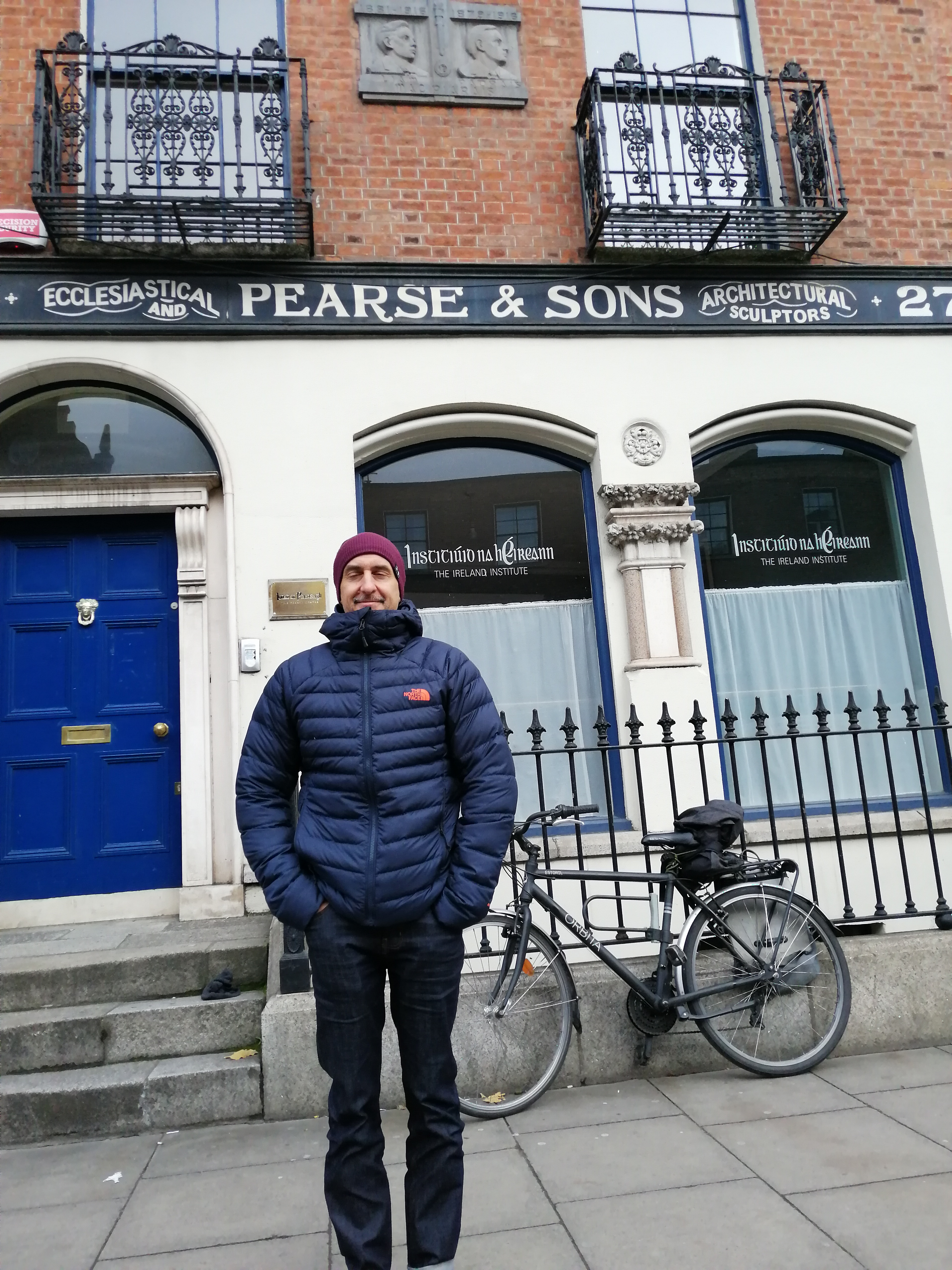
Oriol Duchs posing for a photograph outside the family and business home of the Pearse family, home of brothers Patrick and William, executed by British firing squads in 1916. (Photo: D.Breatnach)
“WE ARE NOT HEROES”
As Oriol Duch spoke about the involvement of the firefighters as a defensive screen for voters in the October 1st Referendum in Catalonia, the projection screen showed massive crowds marching and demonstrating for independence. Catalonian firefighters had taken part in uniform in a number of those demonstrations for the democratic right to self-determination and had organised a demonstration of their own (seen on the poster for the speaking tour). The firefighters had discussed what to do since the Spanish Government had threatened the Referendum organisers and social media was full of threats too from right-wingers, including Spanish police officers and Army members. They knew that among the masses coming out to vote, there would be vulnerable people including the elderly and children and decided that those who wished to would turn out voluntarily in their uniforms and stand between the Spanish police and the crowds wanting to vote.
Manus O’Riordan, whose father fought in the International Brigades at Gandesa, mentioned a song for Catalonia he had liked and sang his translation of it into English there and then. As the applause died down, an Irish voice called for the national song of Catalonia, a song of workers’ resistance, the Els Segadors (the Reapers), which all Catalans present sang, the whole audience standing in respect.
Bringing the meeting to a close, the Chair thanked the guest speaker, the panel and the audience for their attendance and contributions (a thanks separately expressed by Oriol Duchs too) and encouraged them to keep in touch with the three solidarity organisations. He also expressed the organisers’ gratitude to the Dublin Fire Brigade and to the Teachers’ Club.
Poster for the Catalan firefighter tour shows one of the events organised by Catalan firefighters in support of self-determination for Catalonia. (Poster design: CDR Dublin)
On the day, the firefighters distributed themselves around in a number of places, Oriol Duch told his audience, by ad hoc arrangements, the organisers arranging by texts to send firefighters to areas where they were felt to be needed. On the Sunday in question, as voters queued outside the polling stations, mostly schools closed for the day, convoys of police arrived with Spanish police in riot gear who charged into the buildings, breaking down doors and windows, to beat people and seize ballot boxes. They also attacked people waiting to vote with batons, boots and fists, Oriol Duch said, as the firefighters attempted to stand between the unarmed civilians and the police. Over 800 people that day had required medical treatment, he said (including a number of firefighters).
As the firefighter from Catalonia spoke, the presentation began to show scenes of Spanish police beating people with their truncheons, throwing others to the ground, kicking and punching them, pulling people by their hair and putting them in choke holds
“People have called the firefighters heroes but we do not see ourselves that way,” he said. “We were doing what we could to protect people and save lives, which is what we do in our job.”
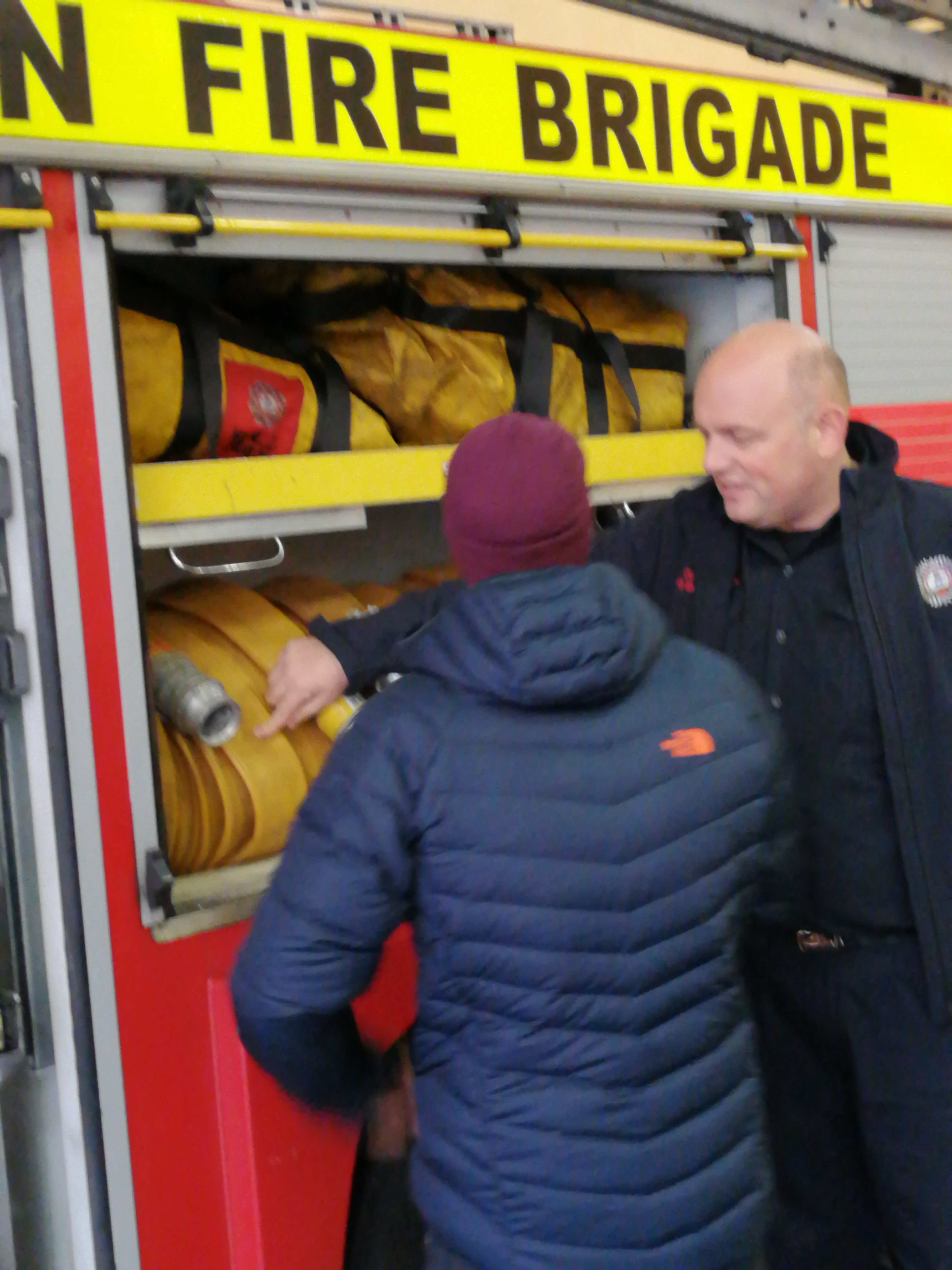
DFB officer showing Oriol some of the equipment in a DFB truck. (Photo: D.Breatnach)Carles Pujol, Oriol & Diarmuid Breatnach inside the Dublin Fire Brigade museum.
A MASS MOVEMENT FOR SELF-DETERMINATION
The Catalonian movement for independence is a mass movement that has been built especially by grassroots organisations, which have pushed the Catalan independentist political parties forward. Chief among these grassroots organisations is the National Assembly of Catalonia (whose former President, Jordi Sanchez, is one of the independentist activists jailed recently by the Spanish court). Firefighters for the Republic, of which Oriol is an active member, is a sub-group of the ANC.
Since the police attacks, others have come forward to direct mass resistance, in particular after the jail sentences of 9-13 years on seven elected public representatives and two leaders of grassroots organisations (ANC and Omnium Cultural) were announced in October. The “Catalan Tsunami” organisation contacted supporters through social media and masses followed their direction. For example, when the call to flood the Barcelona Airport with people had gone out, thousands had walked kilometres to get there and despite police violence, had effectively shut the airport down for hours. More recently, people had for a weekend closed by blockade one of two main motorways from the French State into the Spanish one, which passes through Catalonia (the other, passing through the Basque Country, was more recently shut down by Basques also — CS).
Oriol Duchs told the Dublin audience that the repression of peaceful people by the Spanish State included heavy jail sentences for “sedition” and police attacks on people in the street, “including firing rubber bullets, the use of which are banned in Catalonia but that is ignored by the Spanish police”. News media has reported that victims of rubber bullets fired at close range directly at people, contrary to instructions on their use, have caused a number of people recently to lose an eye. However, the police cannot control the masses of people, Oriol said.
After the applause for the Catalan firefighter had died down, the Chair opened the meeting to questions and comments from the audience.
Among the comments was that of an Irish woman who had been in Catalonia during the Referendum and talked about the frightening advance of the Spanish police in their riot gear and with their weapons. She disagreed with what Oriol Duchs had said in only one particular: “You ARE heroes”, she said, to applause and cheering from the audience.
An Irishman who had been there too as an international observer spoke about the police attack, which he said was fascist in nature. Another Irishwoman who had been there in a similar capacity said that she had witnessed much police violence but that the scenes depicted on the screen had reminded her just how violent those had been. She asked what people in Ireland could do to help.
From the panel the advice was to support Catalonia solidarity activities, to stay in touch through of the Catalonian solidarity organisations in Dublin, whilst from the floor an Irishman said that people should tell the elected public representatives what was going on and call for statements of support and interventions to the Spanish Government.
This brought about discussion of the posture of the Irish Government, as in recent Dáil questions to the Depart of Foreign Affairs, the responsible Minister of State had reiterated the Government line, that it was an internal matter for the Spanish State, that the rule of law had to be maintained and that the Spanish State is a democratic one with separation of judiciary and government executive. An intervention from the floor pointed out that one of the TDs (parliamentary delegates) had pointed out that in 1919 the First Dáil (Irish Parliament) had declared its independence of Britain and issued a call to the democratic nations of the world asking for recognition, although it was in violation of British constitution and law. The First Dáil had been declared illegal a few months later and its delegates hunted, arrested and jailed. “Catalonia today is Ireland 100 years ago,” he had said. Without the stance taken by that First Dáil, predecessors of all other parliaments of Ireland since, the present Government would not even exist nor would that Minister’s Department, the man commented..
“The struggle in Catalonia and the repression by the Spanish State is not ‘an internal matter for the Spanish State’”, Oriol Duch said. “It is a problem for Europe.”
Manus O’Riordan, whose father fought in the International Brigades at Gandesa, mentioned a song for Catalonia he had liked and sang his translation of it into English there and then. As the applause died down, an Irish voice called for the national song of Catalonia, a song of workers’ resistance, the Els Segadors (the Reapers), which all Catalans present sang, the whole audience standing in respect.
Bringing the meeting to a close, the Chair thanked the guest speaker, the panel and the audience for their attendance and contributions (a thanks separately expressed by Oriol Duchs too) and encouraged them to keep in touch with the three solidarity organisations. He also expressed the organisers’ gratitude to the Dublin Fire Brigade and to the Teachers’ Club.
Some of the attendance stayed around in the bar area to discuss for another hour or so.
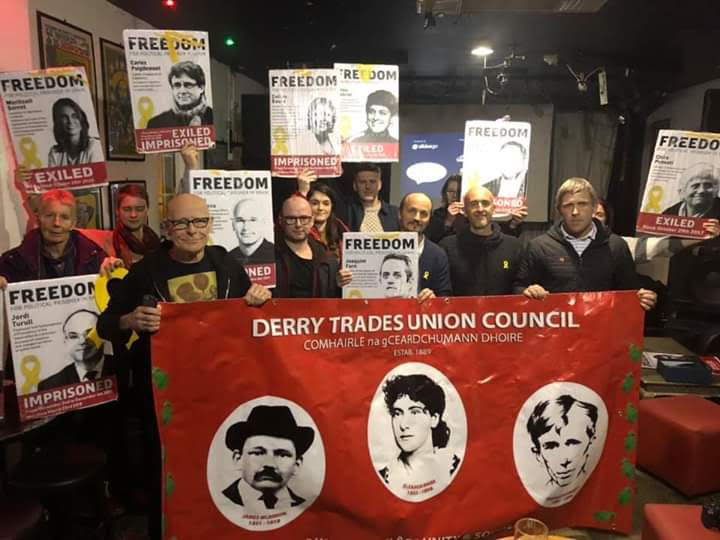
Oriol Duchs with Derry Trades Council and other Catalan solidarity supporters on 11th November. (Photo: C.Pujol)
POSTSCRIPT
According to information contained in a press statement issued more recently by the speaking tour organisers, Oriol Duchs the following day paid a fraternal visit to a fire station of the Dublin Fire Brigade, as well as to the DFB’s Training Centre and Museum and was given a conducted tour of all three facilities. Also in Dublin, the firefighter had visited Leinster House hosted by Independents For Change TD Thomas Pringle, where he had met TDs Maureen O’Sullivan (Ind4C), Aengus Ó Snodaigh (Sinn Féin) and Éamon Ó Cuív (Fianna Fáil) along with Senators Paul Gavan and Máire Devine (both Sinn Féin). In a related but separate building he had also met with TDs Gino Kenny and Richard Boyd Barrett (both members of Solidarity/ People Before Profit). Oriol Duchs also took part, shared with a Kurdish representative, in a seminar on international law organised by the Law faculty of Griffiths College, Dublin.
In Belfast on Monday he had spoken in Queen’s University Belfast without contact with any political representatives but in Derry had met Eamon McCann and Shaun Harkin, both members of Solidarity/ People Before Profit and public representatives on Strabane and Derry District Council, as well as Elisha McCallion, Sinn Féin MP for Foyle at Westminster,
He met too with Derry Trades Council which, indeed, had hosted his public meeting in that city. How was it then that, considering his publicity promotion as a trade unionist, member of a trade union that organised three general strikes in Catalonia since 2017, the press statement issued by the speaking tour organisers included no mention of engagement with Irish trade unionists in Dublin, in a city where so many Irish trade unions had their head offices?
“That was not for want of trying,” responded Diarmuid Breatnach, a member of With Catalonia/ Leis an Chatalóin, to the question. “We contacted a number of trade union organisations in Dublin in order to host a public meeting or to meet with Oriol privately. One trade union quoted us commercial hire prices and failed to respond afterwards, another promised a meeting but failed to make arrangements, a number simply did not reply. It was sad, really, not only for solidarity with Catalonia, for I think Irish trade unionists would have benefited much from the interaction with Oriol and his trade union.”
Hopefully they will display a different attitude to any future such visits.
End.
Oriol in Leinster House with Carles Pujol, Cnclr. Micheál Mac Donncha (left) and Senator Paul Gavan (right).
CATALAN SOLIDARITY
Oriol in meeting with TDs Richard Boyd Barrett and Gino Kenny, also present are Diarmuid Breatnach and Tina McVeigh from With Catalonia/ Leis an Chatalóin. (Photo: C.Pujol)
ORGANISATIONS IN DUBLIN (joint organisers of the speaking tour)
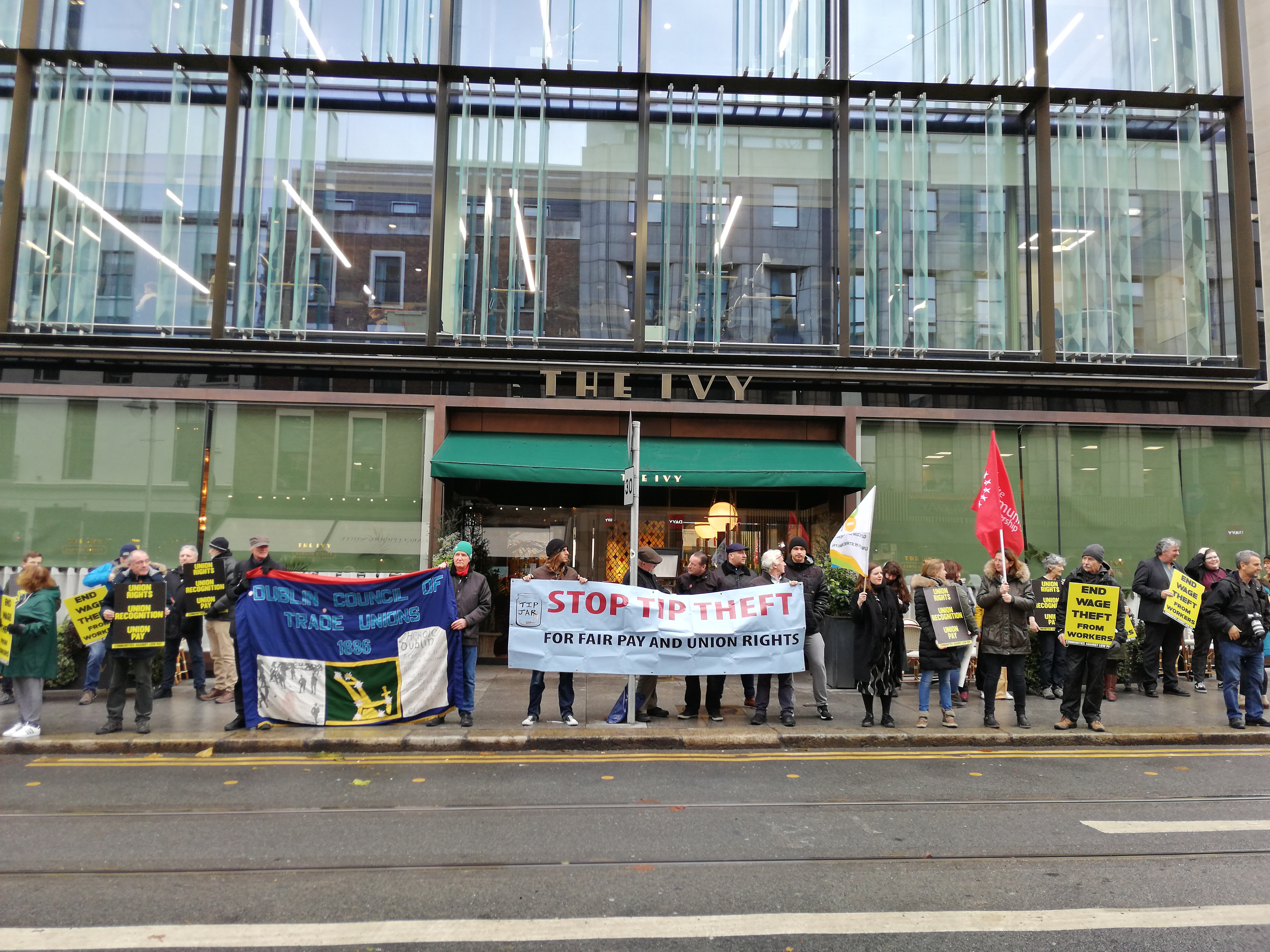
Section of the picketers showing Dublin Trades Council banner. (Photo: D.Breatnach)
The Ivy Restaurant management in Dublin’s Dawson Street at one o’clock this afternoon ordered the blinds to be pulled down on the windows. This is their usual response when demonstrators arrive to picket their restaurant, as they did today. The Ivy restaurant is part of a profitable chain and in Dublin at least is using tips paid to staff by customers to help make up the staff’s wages. Bluntly, stealing tips that were paid for service by customers who assumed they were in addition to wages already received (which, as everyone knows, are low enough in the “hospitality” trade).
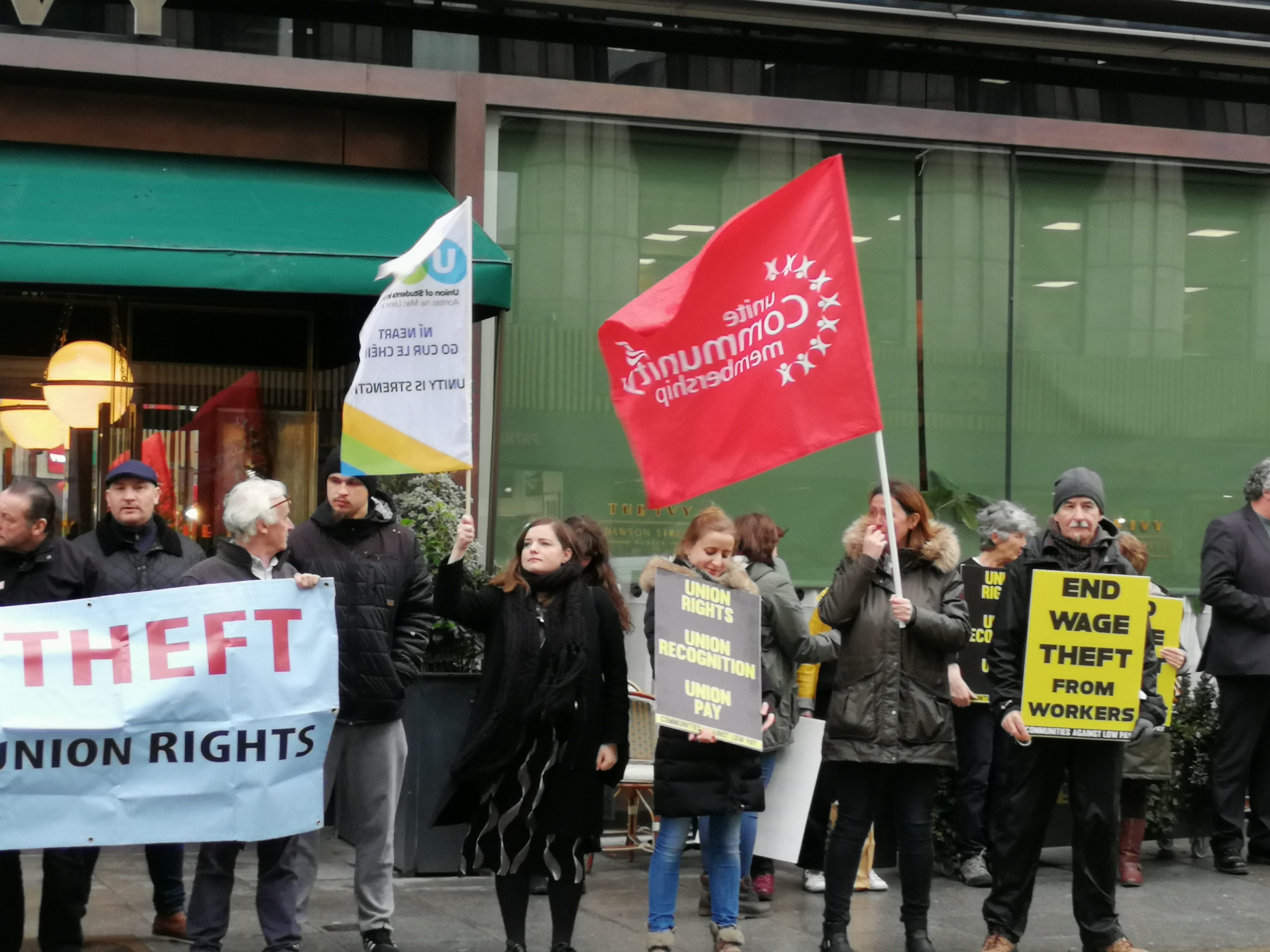
Some passing vehicles beeped in solidarity and many passers-by took photographs or video as the picketers lined up with placards and some banners and shouted:
“Eat your steak, eat your chips, pay the staff their well-earned tips.”
Also: “Pay the workers what they’re due!”
Section of picketers (Photo: D.Breatnach)
One observer enquired why the staff put up with it and did they have a union; he was informed that they had but two staff were sacked for organising the union and the remaining and replacement staff are frightened not only of losing their jobs but also of getting a bad reference for other work. Such staff are often migrants who are vulnerable, in need of work to buy food and pay rent and without a support network such as family in Ireland.
The sector has long been known as one of insecure work, few rights, low unionisation and low pay. However, the deduction of customers’ tips to incorporate them into staff wages seems a new low for this sector and the Ivy is by no means the only restaurant doing this. But here is where the battle has broken out and here it must be won, to encourage workers in this sector and to make it known to restaurant owners that this practice will not be tolerated.
The issue and the practice of the Ivy has been reported a number of times in the mainstream media and the solidarity protesters come every now and again, set up their placards, hand out leaflets to passers-by and shout their slogans. The Management draw the blinds. The picketers leave after about an hour (many to go back to work) and the blinds are lifted again. But the campaign has affected their business. And Unite the Union, which is supporting the sacked staff, is setting up a hospitality sector branch.
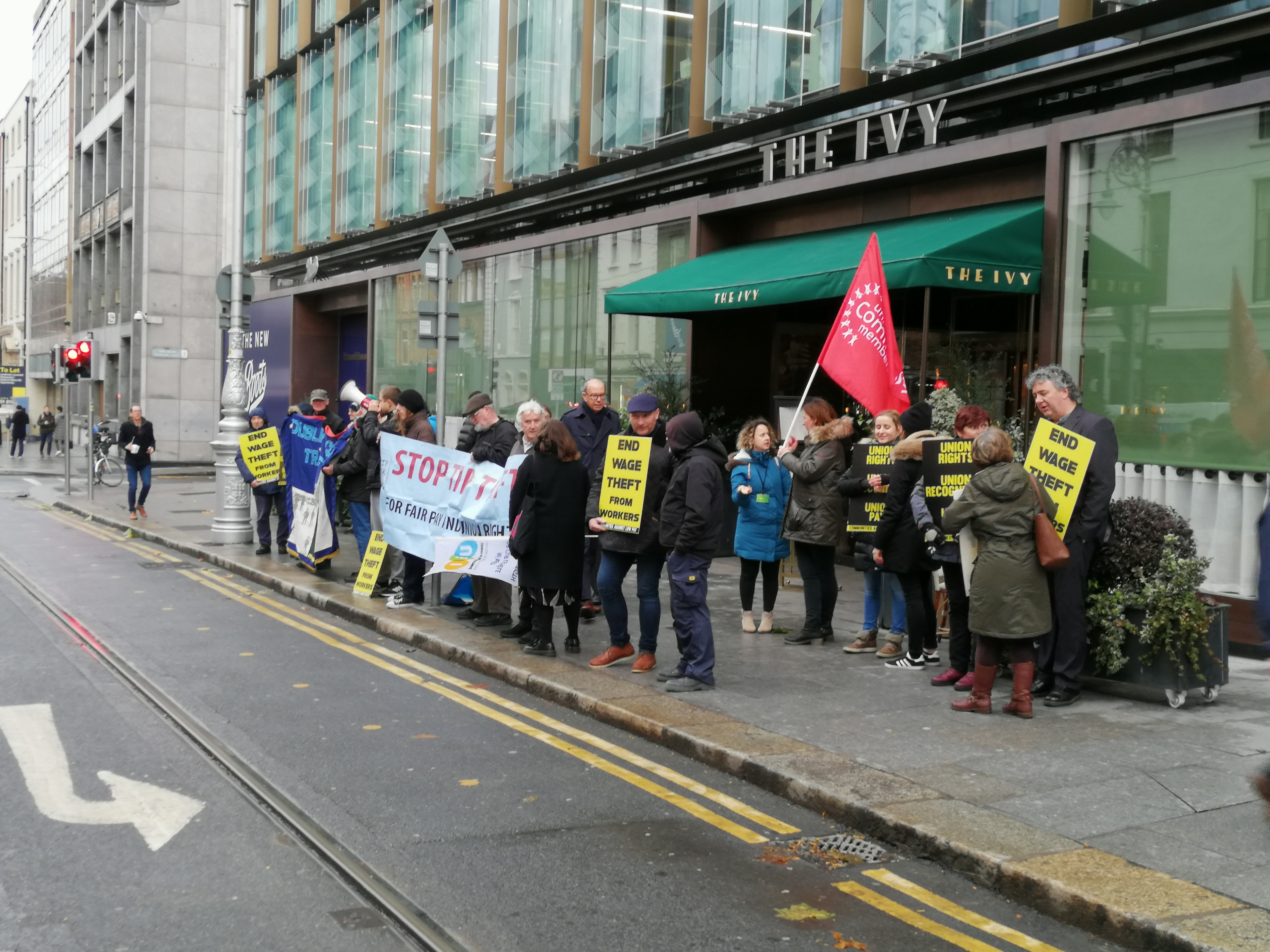
Section of picketers including both TDs (members of the Irish Parliament, the Dáil). (Photo: D.Breatnach)
Today a number of elected public representatives were on the picket line, including Cieran Perry, Independent DC Councillor and Independent TDs Thomas Pringle and Joan Collins.




















 rebelbreeze