BOMBING OF BASQUE TOWN OF GERNIKA COMMEMORATED IN DUBLIN

Clive Sulish

The bombing of Gernika during what is sometimes termed “The Spanish Anti-Fascist War” and more often “The Spanish Civil War”1 was commemorated in Dublin by a weekend of events organised by the Gernika 80 — then and now committee. The event featured a launch of a commemorative pamphlet, including talks by Spanish Civil War historian Enda McGarry and by Irish socialist, republican and civil rights activist Bernadette McAliskey; a ska music event; talks and a planting of a “Gernika Tree” at Glasnevin cemetery.2

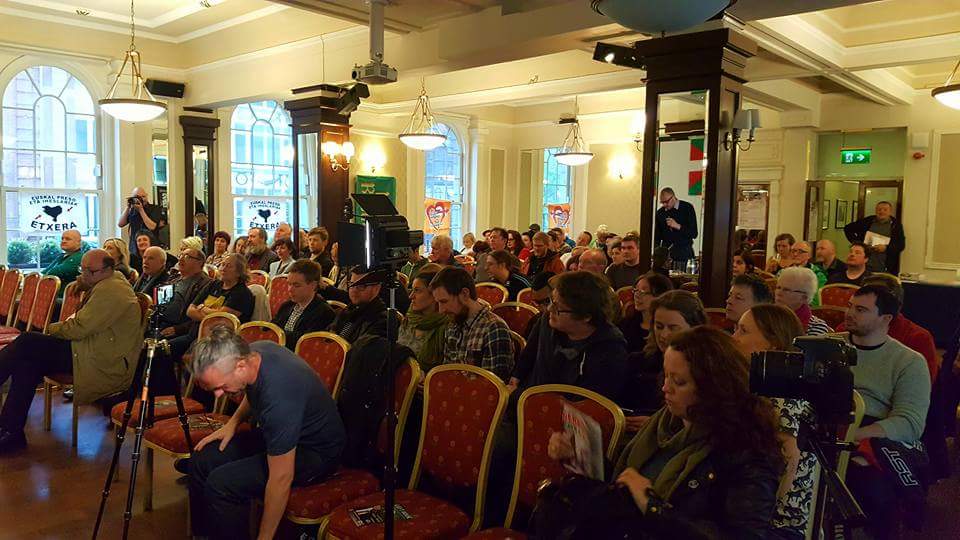
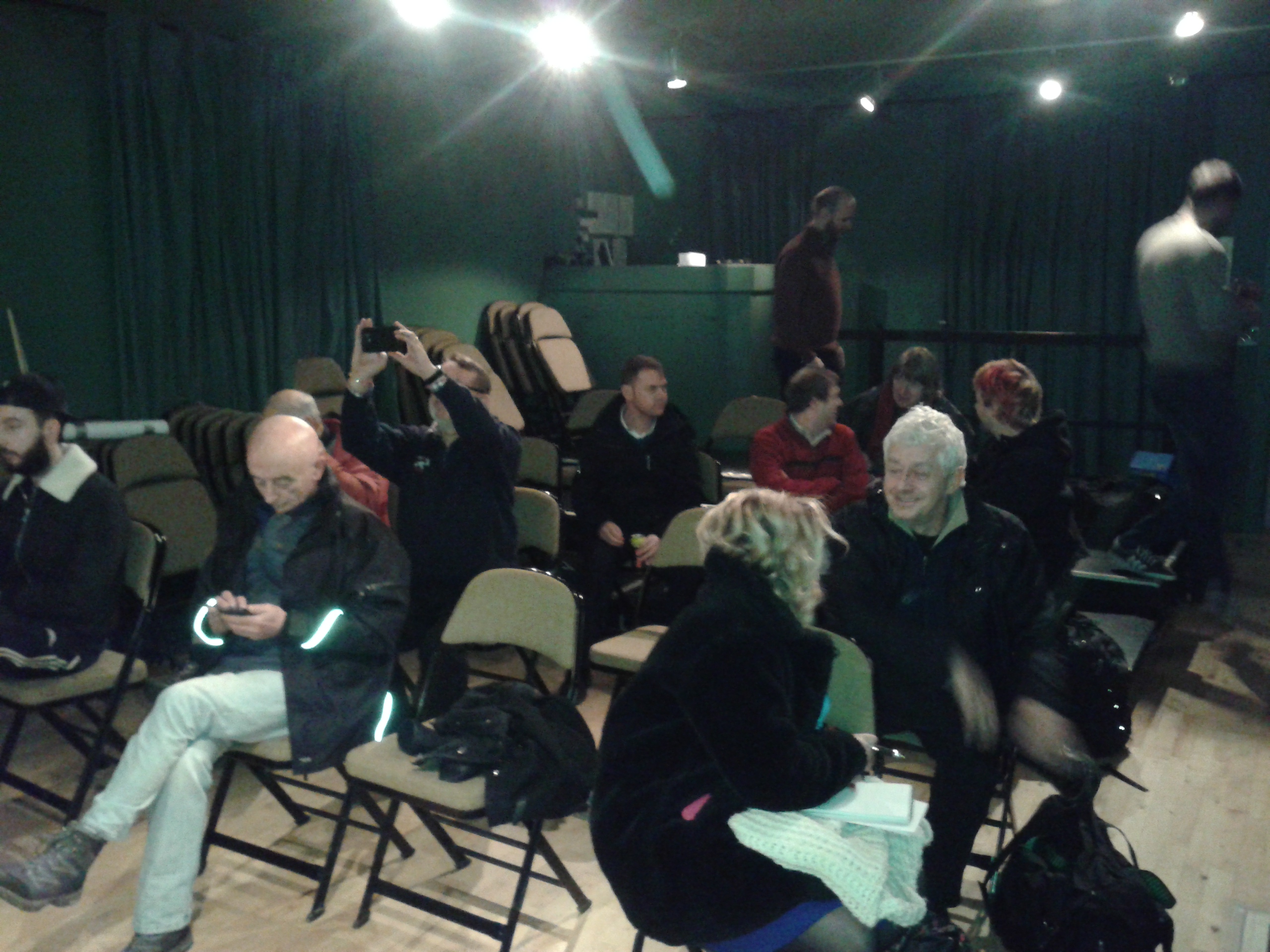
People in attendance at the talk in Wynne’s Hotel (chairperson’s reflection may be seen in the mirror).
(Photo source: Gernika 80 event page)

The pamphlet was on sale for €5 a copy in the large function room of the historic Wynne’s Hotel where the well-attended launch was held. The pamphlet has articles by Richard McAleavey, Enda McGarry, Stewart Reddin, Brian Hanley, Aoife Frances, Sam McGrath, Fin Dwyer, and Goiuri Alberdi.

Enda McGarry was first to speak and in a clear voice, with only an occasional glance at his notes, began by giving the background to the Gernika bombing – the military rebellion against the elected government of the Popular Front and the military campaigns that followed. General Mola was in charge of the fascist forces’ “Northern Front” while battles were taking place elsewhere, including in the suburbs of Madrid.

McGarry outlined the waves of air attack on 26th April 1937, the dropping of incendiary bombs and the strafing of running men, women and children by fighter planes and gave details of some of the horror experienced in the town. The bombing was one of the first aerial bombings of civilian population centres and Gernika, of particular historic-cultural importance to Basques, was hit on a market day. It had no anti-aircraft defences, not surprisingly, since it contained no features of significant military interest.

Going on to describe the lies told by the fascist leaders, McGarry related how in turn the communists, anarchists and Basque nationalists had been blamed for burning the town. Subsequently, apologists had tried to excuse the action by claiming that the Renteria bridge had been the target, in order to cut off the Basque nationalists’ retreat or lines of reinforcement from the northern Basque Country (i.e within the French state).

The speaker pointed out that this line of argument is still being peddled by some, including a fairly recent historian. Demolishing this falsehood by analysing the planes that were used, Heinkels, a Dornier, Junkers 52 bombers, Italian SM 79s and Messershmidt 109, along with the bombs and armament, McGarry showed how this could not be consistent with a bombing run to destroy a bridge. At Burgos airfield sat a number of planes that would have been ideal for destroying the bridge – Stukas, the most advanced dive bomber in general production of the time. They did not use them because neither was the Bridge the target nor pin-point bombing required – what those planning the attack wished to do was to carpet-bomb the area with high-explosive and incendiaries, then machine-gun civilians fleeing the bombing.

Ultimately, the historian continued, of course Generals Franco, Mola and other fascist military leaders were responsible. However McGarry believed that the Spanish fascist leaders, needing to crush Basque resistance but keep the conservative Catholic Carlist troops (from Navarra) and other right-wing Basques on board, would have been unlikely to agree to the destruction of Gernika (a holy historic place to the Carlists as well as to the Basque Nationalists). Oberstleutnant Wolfram Freiherr von Richthofen was the commanding officer of the Condor Legion, Nazi Germany’s “loan” of airforce to the Spanish fascist forces – he, along with others including commander-in-chief of the Luftwaffe, Herman Göring, wanted to use the Spanish conflict as a testing ground for warfare from the air and the tactic of terror-bombing a civilian population, which they later employed at Warsaw, Stalingrad and other cities.

The talk ended to strong applause and the chairperson of the meeting introduced Bernadette McAliskey, a long-time socialist and Irish Republican, campaigner for civil rights and in support of migrants.

The chairperson could also have alluded to her survival of an assassination attempt by Loyalist paramilitaries the “Ulster Freedom Fighters”, in which she was shot 14 times and her husband shot too, and that she had before that twice been elected a Member of the British Parliament. Of course McAliskey herself might have requested the omission of those details.

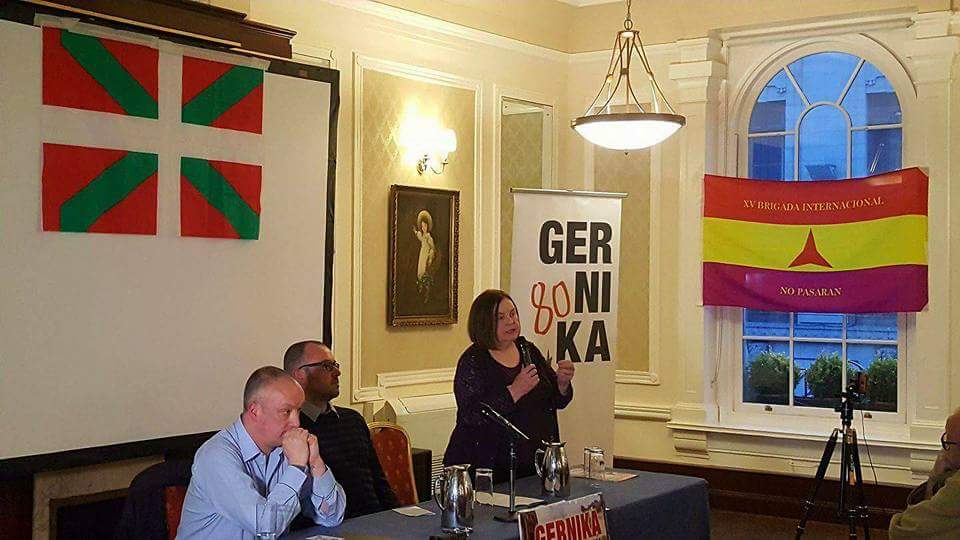
Bernadette McAliskey speaking; sitting R-L, Finn Dwyer, Enda McGarry. (Photo source: Gernika 80 event page)

McAliskey began by praising the inclusiveness of the pamphlet, which has contributions from many different writers. She then moved on to expounding what kind of people are fascists, a term she believed too widely applied, and what kind of people fascism serves. In a rather long discourse, entirely without notes, the speaker went on to analyse what Republicanism is, rejecting a definition which said the basic unit of a Republic is the State, insisting instead along with Thomas Paine that the basic unit is the individual. Believing otherwise, she declared, makes one a nationalist rather than a Republican, á la Gerry Adams.

At times one could be forgiven for assuming that McAliskey thought she was addressing liberals, saying for example that “we don’t think enough about what goes on in other countries”, or “we don’t think about what is happening to certain groups”, such as migrants, Travellers – those considered “non-people”; or when she declared that she had no understanding of what was going on in Syria because neither her background nor experience could help her to understand it. McAliskey seemed unconscious that this is a line which was also commonly disseminated in Britain about the war in the Six Counties.

But then, McAliskey would switch without warning, as in her mischievous assertion that one should deal with liberals by throwing them in at the deep end: “they either learn to swim or they no longer give you any trouble.” Or when later, she pointed out that those in power never give up their weapons, and that one day we might present ourselves to our exploiters and insist that they step aside, as “there are more of us than there are of you”, to which they will reply: “Maybe so, but we have the weapons.”

When Bernadette McAliskey finished her talk, to sustained applause and cheers, the chairperson invited questions, of which there were three and a comment. The first question was whether McAliskey thought Gerry Adams was a psychopath, to which she discoursed on the question of insanity and on the number of lies that were told by politicians such as Gerry Adams. One of the big lies was that the IRA had forced the British to the negotiating table, which McAliskey emphatically denied was true, insisting that the reality was that the IRA went to the negotiating table because they could fight no longer, the rate of attrition was too great.

The next question, by a woman who announced that she had a USA background, in the context of her declaring that racism is about white supremacy, was about how to make the Irish aware of their role in this supremacy. Bernadette said it was an important question and that the process by which the oppressed can become the oppressors was one observed on a number of occasions in history.

This reporter thought that the questioner’s statement about the nature of racism being white supremacy might also have been questioned, a proposition disproved for example by the experience of the Armenians under the Turks, Jews and Slavs under Nazism, the Irish in Britain or at home under British rule, Irish Travellers in Irish society, etc.

The last question enquired what Bernadette would say to Basques, as some had said to the questioner, that the Irish were “lucky to have a peace process”, given that we were now approaching the second decade after the Good Friday Agreement. McAliskey replied that Ireland did not have a peace process but rather a pacification process, and that the ‘new dispensation’ divided up the Six Counties between political parties along sectarian lines, with cuts to services being imposed by those in power and substantial unemployment and unfair treatment of the “other minorities”: migrants, Travellers …. And that jails in the Six Counties today contain “about as many political prisoners as they did when the Good Friday Agreement was signed but the prisoners with less politics than had their fathers.”

End.

FOOTNOTES

1Neither term sitting well with probably most Catalans and Basques, who do not consider themselves Spanish, having a different cultural identity, most aspects of which were suppressed by the victors of the War, the General Franco dictatorship regime but had been suppressed by others before them too.

2Gernika’s historic importance to the Basques before the bombing was based on the fact that Basque nobles met there to discuss their administration of Basque lands and it was there that a Spanish King had stood, under the ancient Basque oak tree, Gernikako Arbola, the “Gernika Tree”, promising to respect their rights to rule within their territory.

INTERNATIONAL WORKERS’ DAY IN DUBLIN


Clive Sulish

May 1st, International Workers’ Day was celebrated in warm sunshine in Dublin with a parade and rally organised by the Dublin Council of Trade Unions and a later event organised by the Independent Workers’ Union.

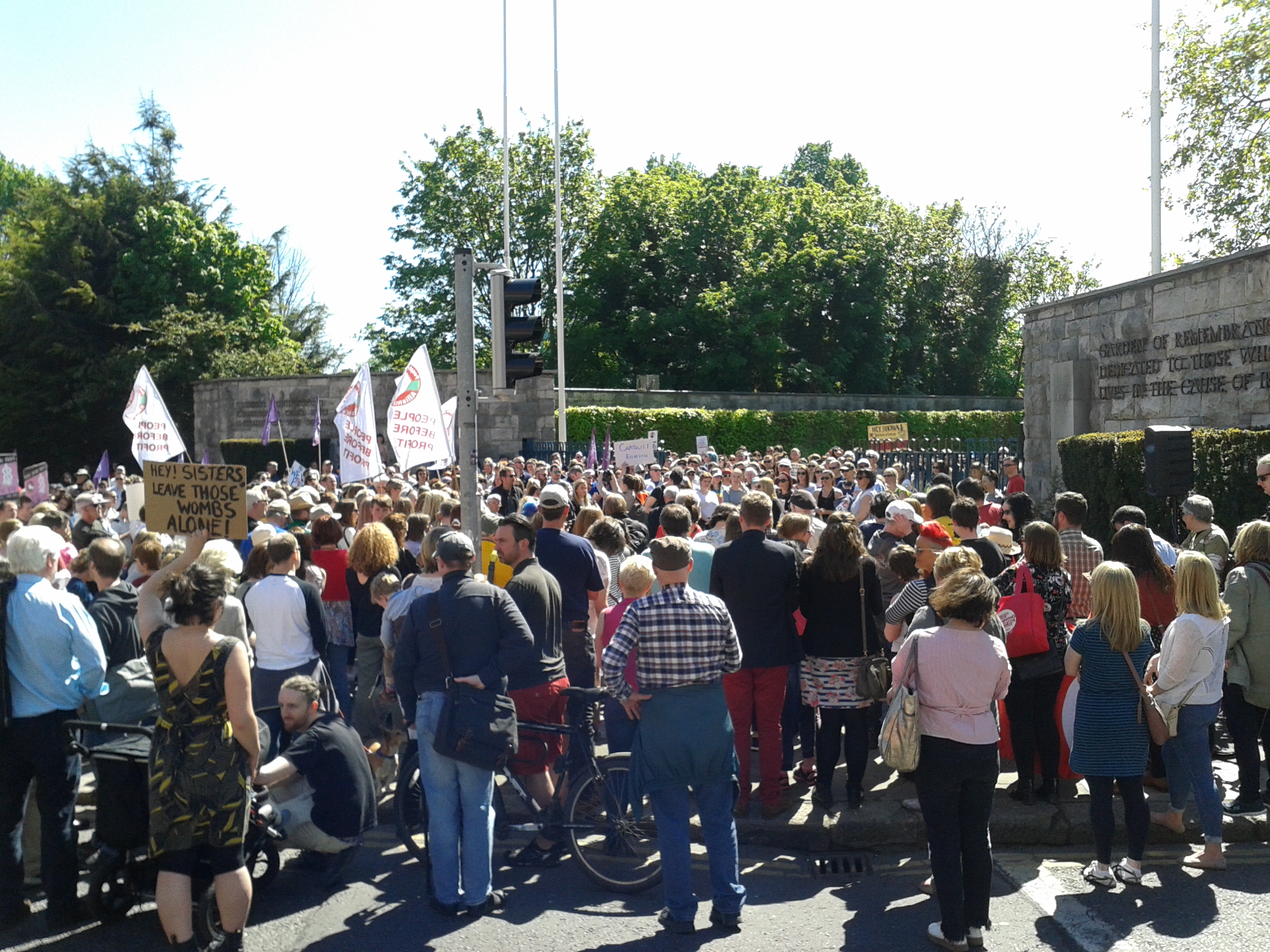
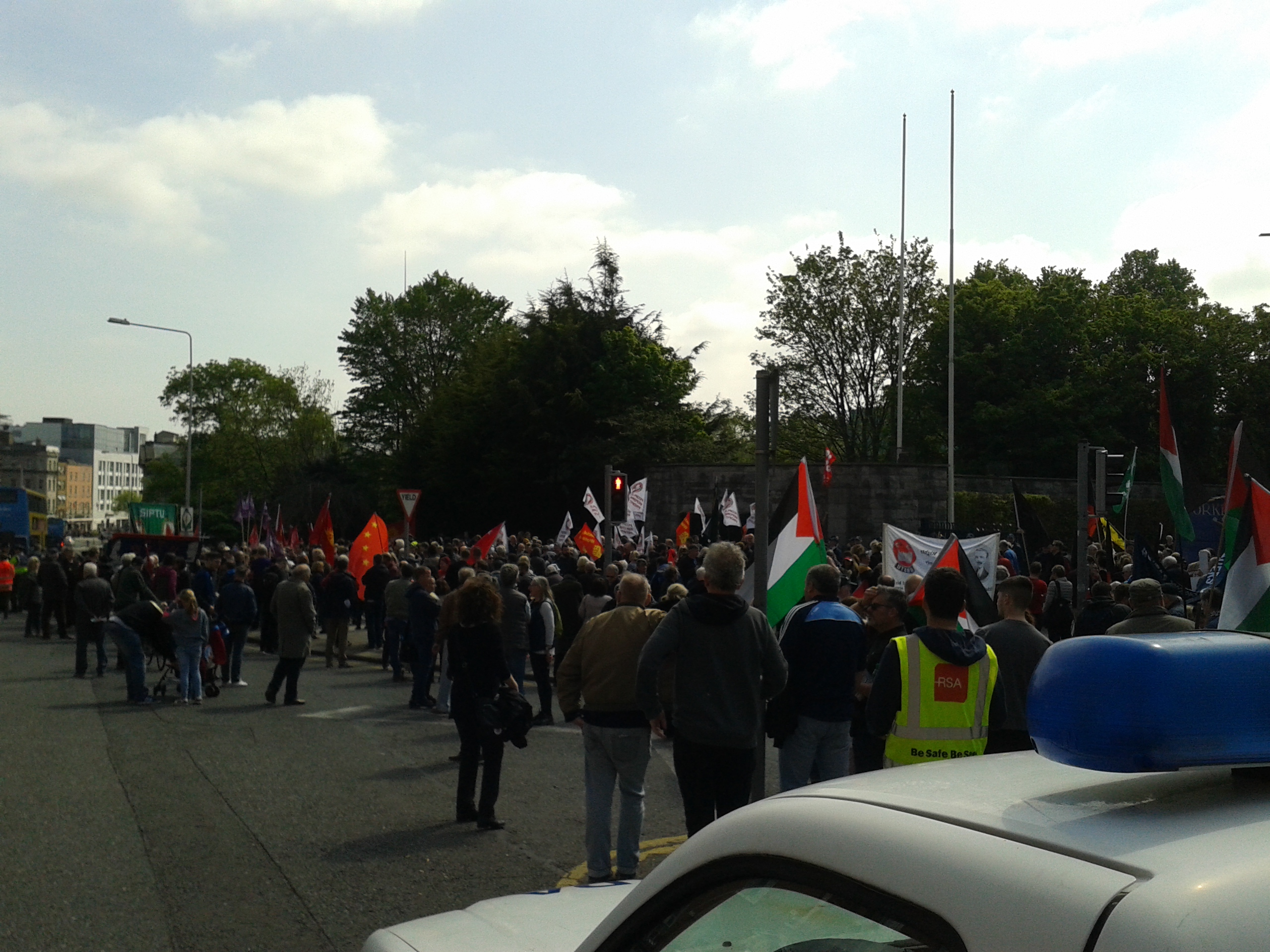
Crowd scene outside Garden of Remembrance, the starting point of the DCTU march

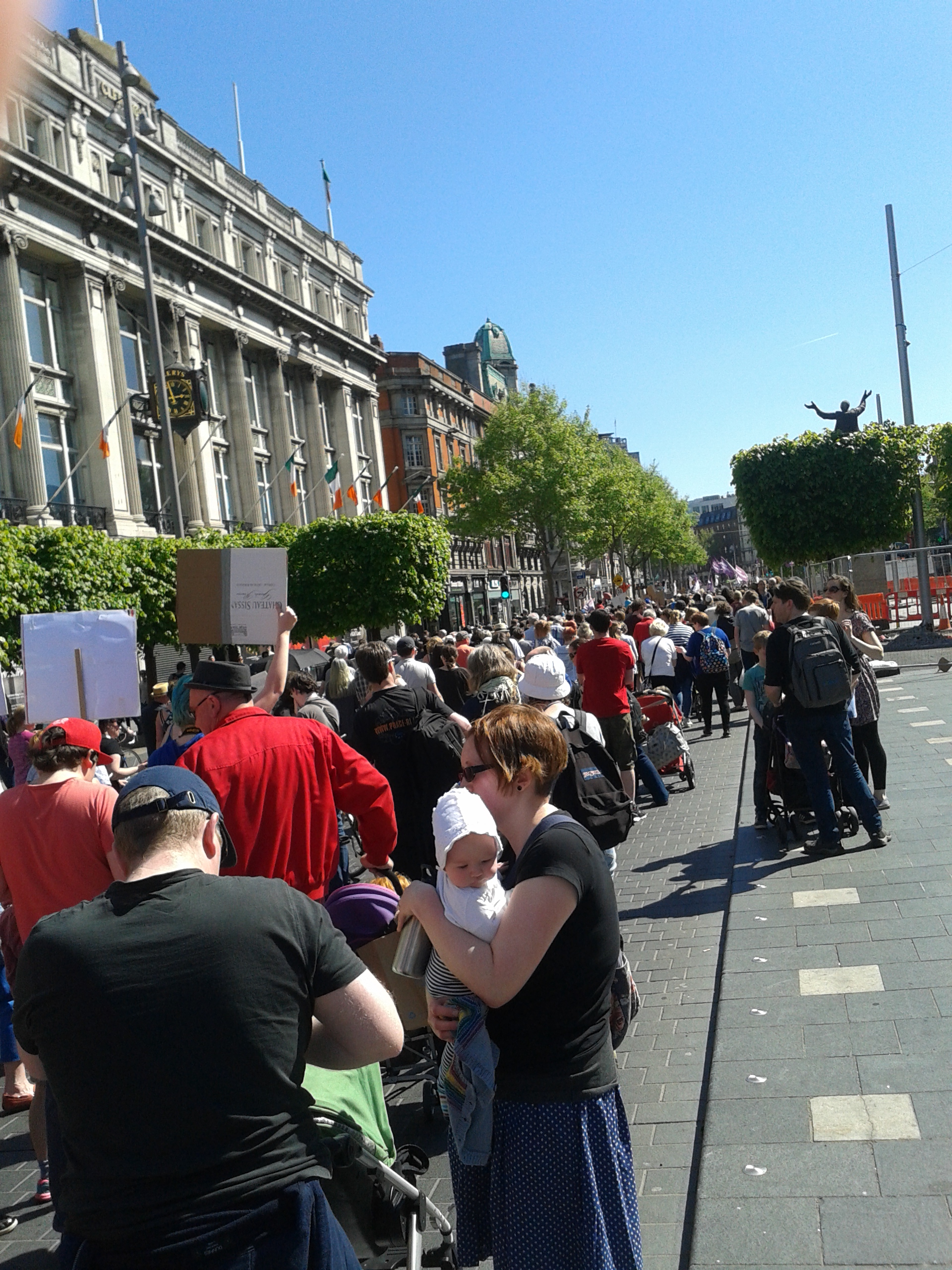
The DCTU-organised event met at the Garden of Remembrance at 2pm and set off at nearly 3pm, with numbers although still small by European standards nevertheless larger than has been seen for some time in Dublin, according to the organisers filling O’Connell Street, the city’s main street throughout its whole length (500 metres or 547 yards).

Seen on the parade were trade union banners, those of some political parties, also of campaigns and community groups.

As it has been doing for years, the parade ended in a rally in Beresford Place, in front of Liberty Hall, the very tall building owned by the SIPTU trade union, where the audience were addressed by speakers from trade unions and campaigns and NGOs.

Section of crowd at rally in Beresford Place

Curiously, soon after arrival the comparatively strong showing of Sinn Féin flags, the green one with their logo and the blue and white version of the Starry Plough, were nowhere to be seen.

Similar section with some banners noticeably missing

The issues of lack of affordable housing, of public land being sold for private housing and speculation, of precarious employment, of financial speculation and cuts in services were addressed by speakers, with a mention also of solidarity for the Palestinian prisoners on hunger strike. A number of speakers also addressed the treatment of migrants and in particular the conditions suffered by refugees in the Direct Provision hostels of the state’s welfare service.

Stage erected at Beresford Place, outside SIPTU’s offices
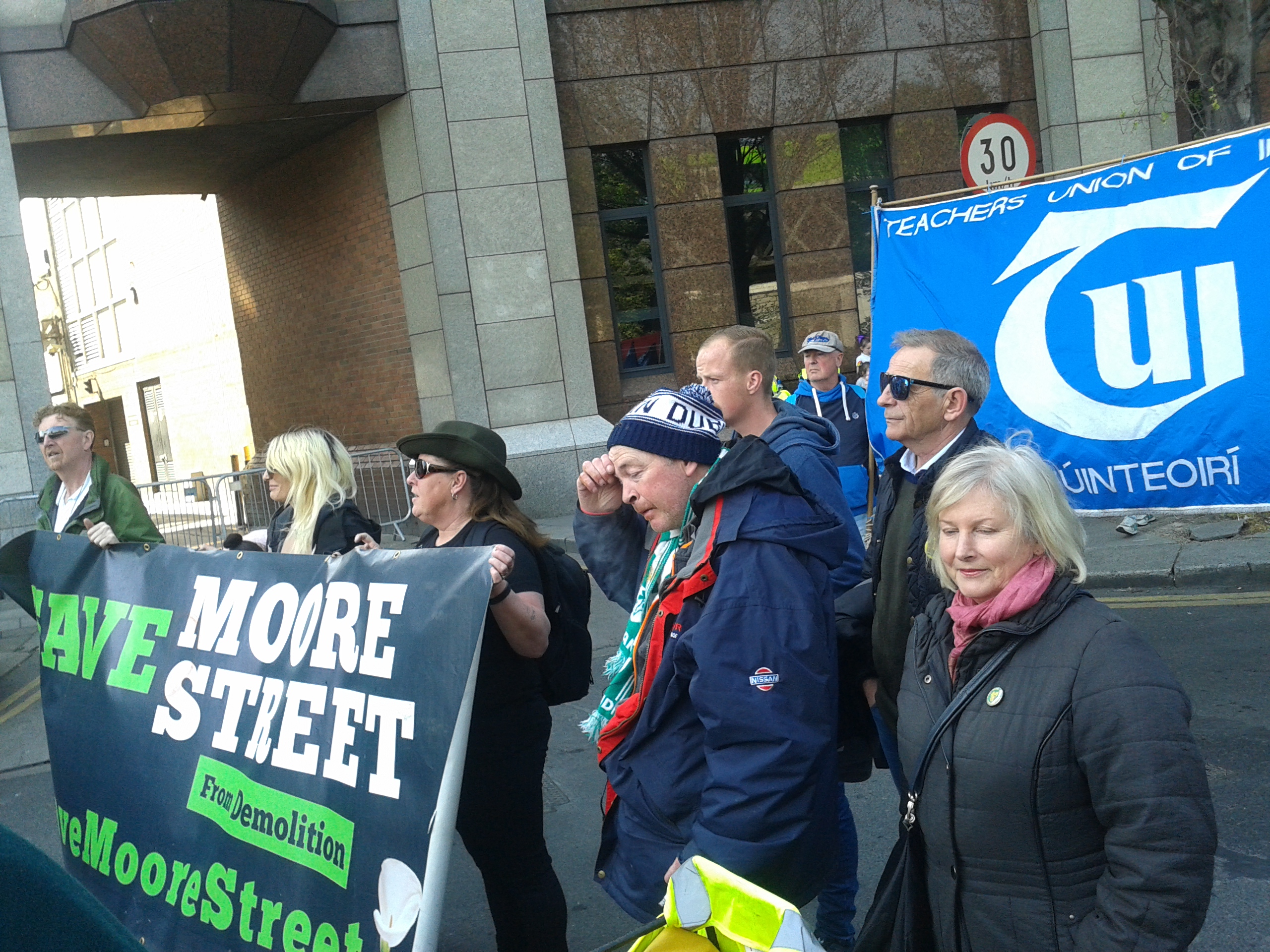
The Moore Street campaign banner was one of the campaign groups present on the parade and mentioned from the stage by the rally’s chairperson.
One of the speakers at the rally — she denounced the sale of private land including the deal done at O’Devaney Gardens estate in Dublin.

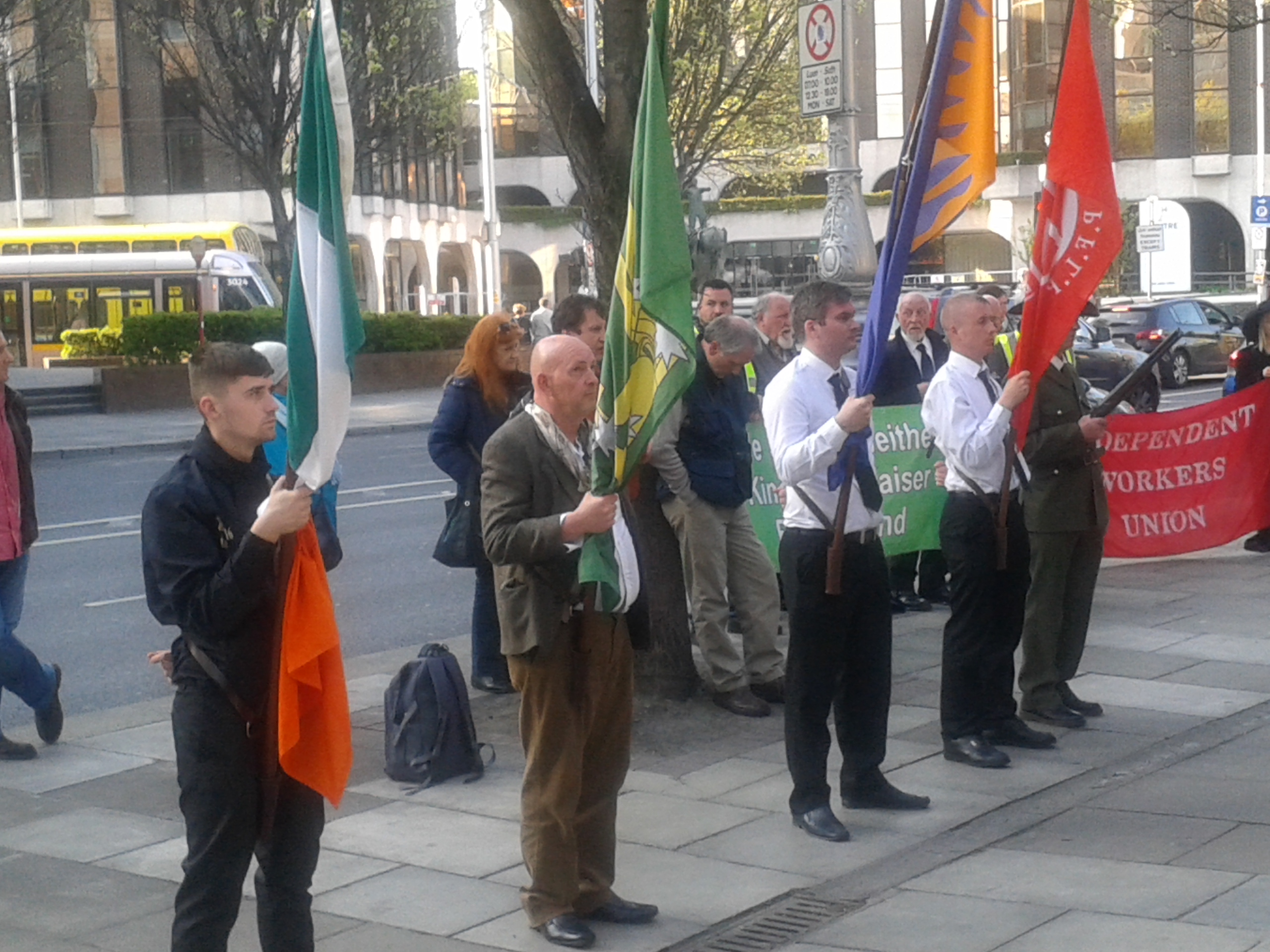
Somewhat later, the Independent Workers’ Union held their own event, marching with a colour party from their offices to James Connolly monument, also in Beresford Place and across the road from Liberty Hall.

IWU event colour party at Connolly Monument

Damien Keogh chaired the event and introduced veteran campaigner Sean Doyle who gave a short and to the point speech about the situation in which working people find themselves today and ending with a quotation from James Connolly, in which the revolutionary socialist castigated those who claimed to love Ireland but could tolerate seeing poverty and deprivation among its people. Doyle also sent solidarity greetings to the Palestinian political prisoners on hunger strike in Israeli jails.

Paul Bowman was then introduced and in a longer speech covered Connolly’s time in the USA, his membership of and activities of the IWW (“the Wobblies”); the Haymarket Incident in Chicago which led to the choosing of May 1st as International Workers’ Day and the state murder of the Haymarket Martyrs; the principles and attitude of the IWU today.

Another Moore Street campaign banner and supporters in period costume also participated in the IWU event
Some random tourists, one form London and the other from Madrid, who chanced to pass by and remained for the whole ceremony.

Damien then introduced Diarmuid Breatnach to sing “We Only Want the Earth” (an alternative title to the original of “Be Moderate”). Breatnach explained that the lyrics had been composed by James Connolly and published in a songbook of his in New York in 1907 without an air. As a consequence the lyrics have been sung to a variety of airs but Breatnach said he sings it to the air of “A Nation Once Again” (composed originally by Thomas Davis some time between 1841 and 1845). This arrangement provides a chorus and Breatnach invited the audience to join in the chorus with him, which they did.

We only want the Earth,

we only want the Earth,

And our demands most moderate are:

We only want the Earth!”

A wreath was laid at the monument on behalf of the IWU by Leanne Farrell.

The chairperson then thanked those in attendance, speakers and singer and invited all back to the offices of the IWU in the North Strand for refreshments.

End.

REPUBLIC DAY CELEBRATION HELD IN DUBLIN FOR EIGHTH CONSECUTIVE YEAR


Diarmuid Breatnach


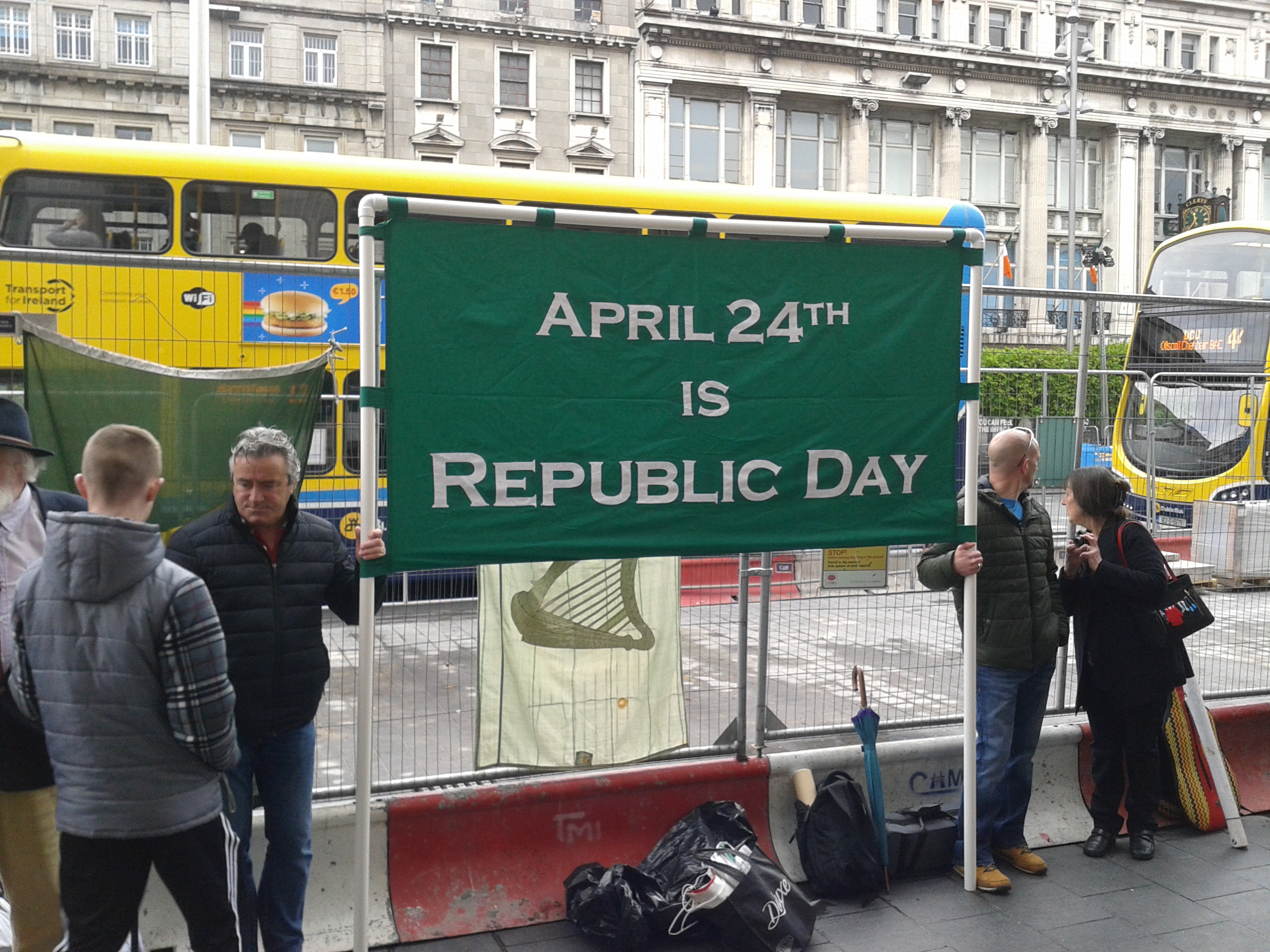
On Monday 25th April people gathered in front of the General Post Office building in Dublin city centre. The occasion was the commemoration and celebration of the reading of the Proclamation of Independence by Patrick Pearse outside that same building, shortly after the 1916 Rising had begun under his overall command. Standing nearby during the reading had been James Connolly, Commandant of the GPO Garrison and also commanding officer of the Irish Citizen Army. Both were executed by the British weeks later for their part in the Rising, along with another thirteen (twelve in Dublin, one in Cork) and months later Roger Casement was tried in civilian court in London and hung.


Tom Stokes, who has been a chief organiser of this event since 2010, opened the proceedings, addressing the crowd and the flag colour party. He reminded his audience that in 1917 it had been Republican women who had organised the 1916 commemoration, printing many copies of the Proclamation and pasting them around the city, also defying British military law to gather outside the GPO to mark the events.

Tom Stokes speaking at the event outside the GPO (photo: D.Breatnach)

Among the reasons for this given by Stokes was that many Republican men had but recently been released from British prisons and concentration camps but also that the women had a special stake in the Republic for which the Rising had taken place – they in particular stood to gain from its achievement the status of citizens and many other changes in their status as a result.

So it was appropriate, Stokes said, to have women take prominent roles in the event, starting with Evelyn Campbell, who accompanied herself on guitar while singing her compositions Fenian Women Blues and Patriotic Games.

Evelyn Campbell performing (photo: D.Breatnach)

Following that, Tom Stokes gave the main oration, outlining his vision of a Republic and castigating the Irish state for what it had produced instead, in particular attacking its treatment of women and declaring that abortion was a private matter in which the State had no right to interfere.

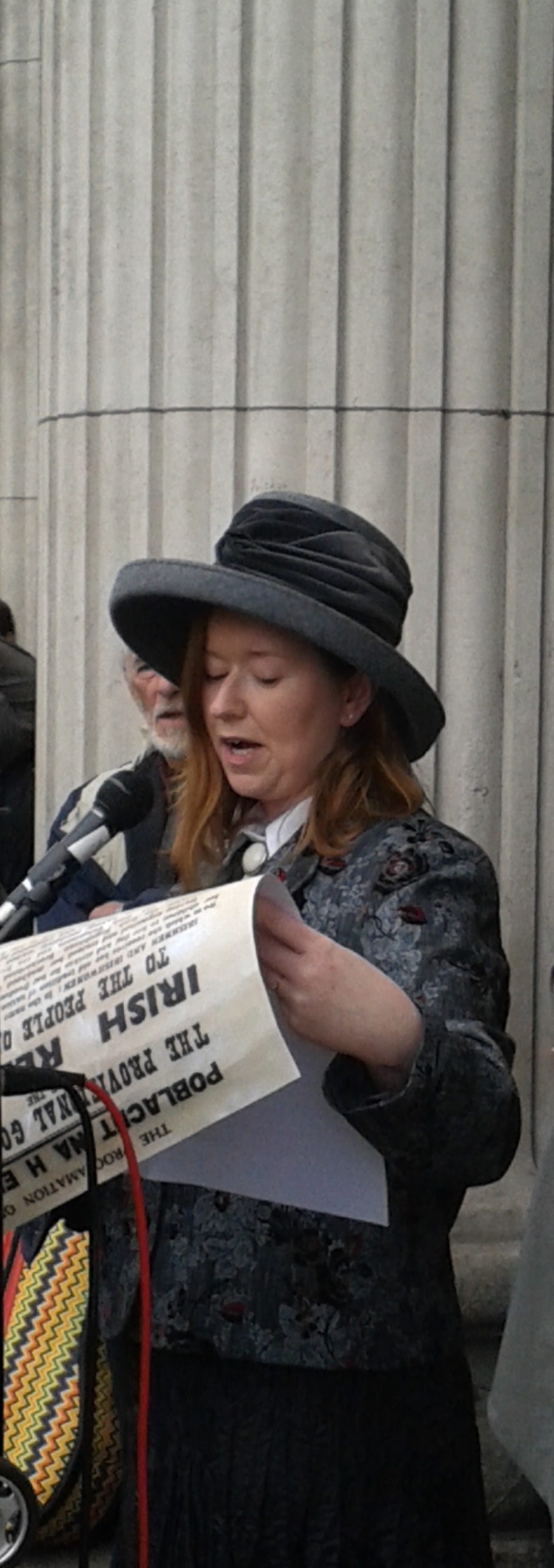
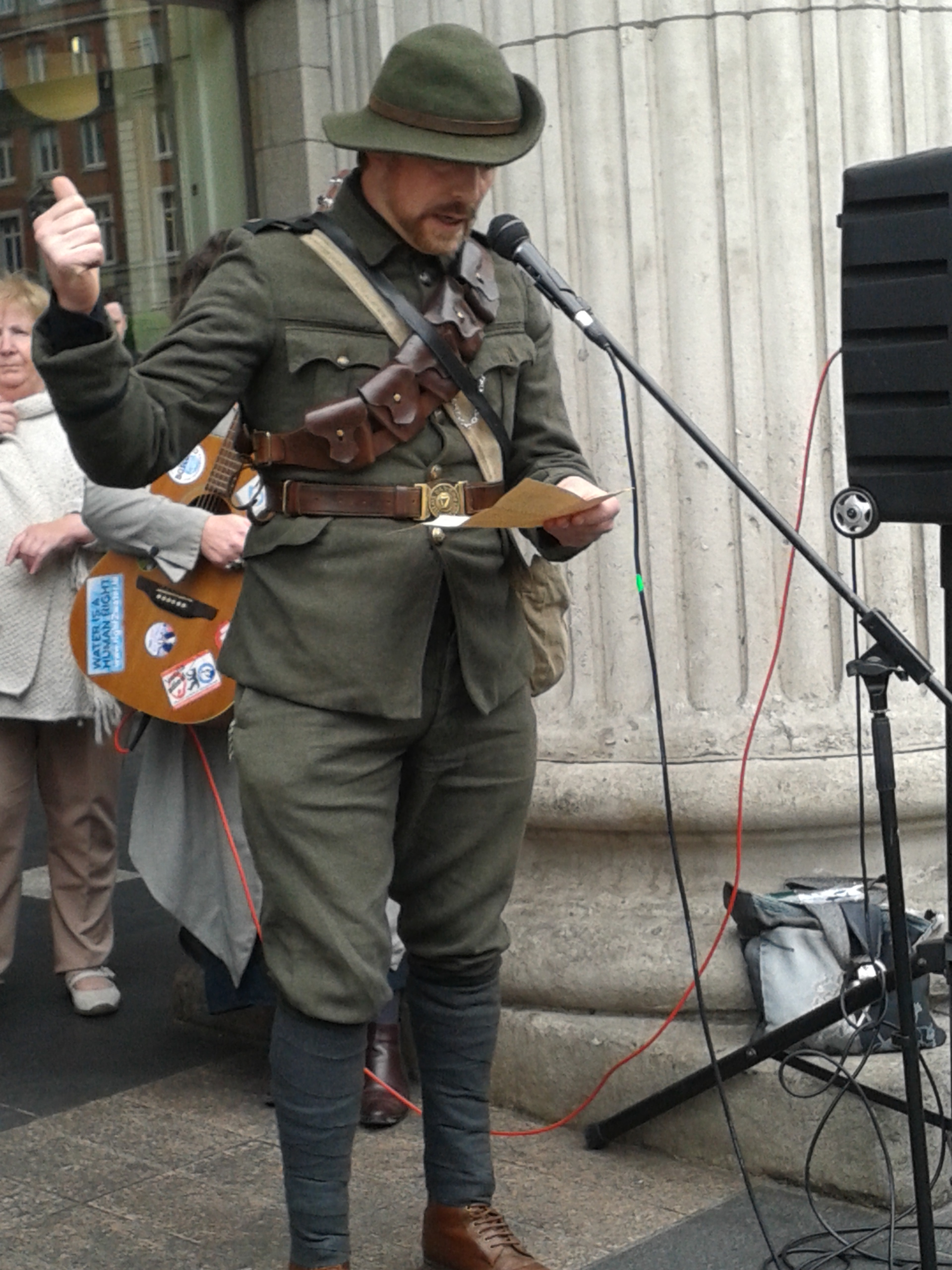
This was followed by Fiona Nichols, in period costume, reading the Proclamation and after that came Dave Swift in Irish Volunteer costume, reading a message given by a wounded James Connolly  (he had been injured Thursday of Easter Week by a ricochet in Williams Lane while on a reconnaissance mission).

Fiona Nichols reading the 1916 Proclamation.
(photo: D.Breatnach)

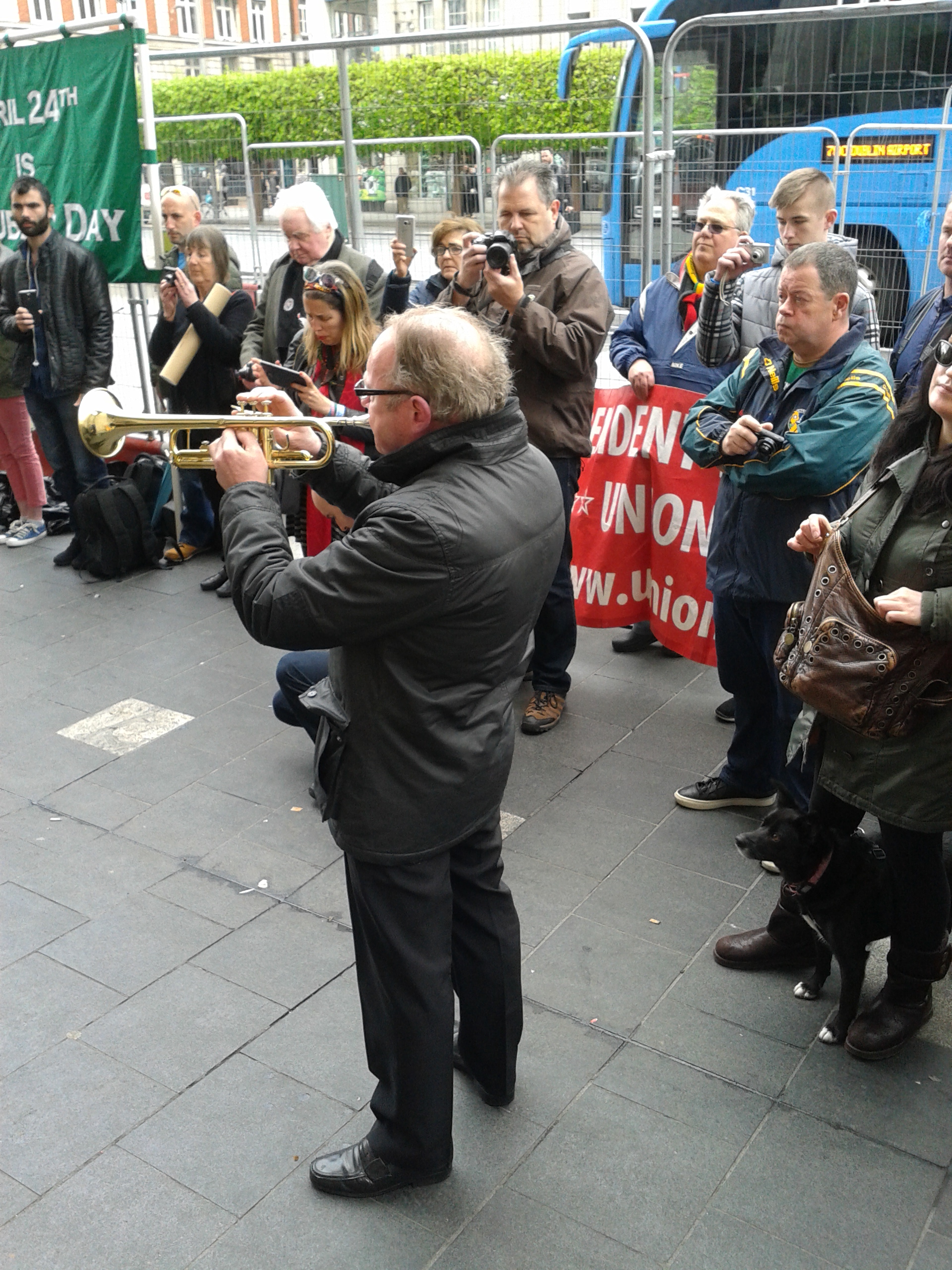
Cormac Bowell, in period Volunteer costume played an air on the bagpipes, Fergus Russel sang The Foggy Dew, Bob Byrne sounded The Last Post on the bugle and Evelyn Campbell came forward again, this time to accompany herself on guitar singing Amhrán na bhFiann.

Cormac Bowell playing at the event.
(photo: D.Breatnach

Tom Stokes thanked the performers and everyone else for their attendance and said he hoped to see them all again on the 24th April 2018, which will be a Tuesday. He said it was his wish that this day be an annual National Holiday and they had started the annual celebration because no-one else was doing it.

Some of those present marched to Moore Street with a Moore Street campaign banner, taking the GPO Garrison’s evacuation route on Friday of Easter Week through Henry Place, past the junction with Moore Lane and on to Moore Street, where Dave Swift, still in Irish Volunteer uniform, competing with the noise of construction machinery coming from the ILAC’s extension work, read the Proclamation before all dispersed, leaving the street to street traders, customers, passers-by and builders.


A chríoch.


Bugler Bob Byrne sounding The Last Post.
(photo: D.Breatnach)
Dave Swift reading Connolly’s statement after he had been wounded. (Photo: D. Breatnach)


RIVAL MANDARINS FIGHTING IN DUBLIN

Cycling through Griffith Park off the Mobhi Road, after a walk in the nearby Botanic Gardens, a flurry of wings and a flash of colours attracted my attention.  Three birds came down with a splash into the Tolka.

Rival males and female on a rock in the Tolka.
(Photo: D.Breatnach)

You don’t need to be any kind of expert to identify the Mandarin Duck, especially the males and that’s what two of those birds were.  The dowdier third one was the female.

I have often noted two male mallard ducks peacefully accompanying one female and wondered whether they had a menage-a-trois going or what the arrangement was.  But there was nothing like that going on with the Mandarins as the males made clear quite quickly.  After briefly circling around one another they were quickly into fisticuffs (or beak-and-wing-cuffs), scuffle-splashing, clucking insult or challenge, until the rival to the established male would take to the wing either for a break or to get next to the female.  In the latter case, the male would take to the air also, in pursuit.

The female?  She swam demurely apart waiting for the victor.

The female Mandarin Duck in the Tolka.
(Photo: D.Breatnach)

There was clearly one established male who for the moment was the dominant one but the rival kept coming back while I was watching and they were still at it when I left.  The established one has the psychological dominance factor on his side, which is a strong advantage but it is by no means a guarantee of success.  The rival might wear him down.  Or the established one might become injured.  Being a male and keeping one’s bird is not easy.

Rivals circling briefly in mid-water prior to another scuffle on the river.
(Photo: D.Breatnach)

According to Charles Darwin, genders of many species but many birds in particular have become colour-differentiated through part of the evolutionary process described as sexual selection (The Descent of Man and Selection in Relation to Sex, 1871).  This has reached amazing and one might say even bizarre though beautiful extremes with such birds as the peacock and the bird of paradise.

Darwin’s ideas make more sense than other explanations being proposed but it is nevertheless hard to credit that a female’s appreciation of colour, shape and behaviour would so impress upon the male the need to flaunt gaudy colour and shape in direct contravention of the need to survive predators by NOT calling such attention to himself.  Still, there is no other viable contender explanation around (as distinct from the Mandarin contender, who may still be biding his time or pressing his suit, which if the established male has anything to say about it, is all he is going to press).

Established male with female on rock and the rival that won’t give up. (Photo: D.Breatnach)

Aix galericulata is the Latin species name and the only other species in the Aix genus is the North American Wood duck.  A chromosome in the Mandarin makes hybridisation between the two impossible.

Mandarin Ducks originate in East Asia but have been kept in Europe in aviaries and in ponds and lakes.  Stephens Green used to have some, along with many other kinds of wildfowl, until the OPW allowed the Herring Gulls to take over to the extent that they have.  I have not seen them do it but would not be in the least surprised if the gulls ate the chicks of many of the waterfowl species until they died out or took off somewhere else.

However, there have been feral Mandarin populations in Ireland for some time, notably in Co. Down and in Wexford and pairs may be establishing themselves in other places, including in the Glasnevin/ Drumcondra area, based around the Tolka (and perhaps the Royal Canal).

The Mandarin is a perching duck and this kind have feet capable of grasping a branch.  They build their nests in hollows in trees which is good for the safety of the nesting female and the eggs.  But what of the chicks or ducklings?  As we know, ducklings take to the water long before they can fly.  So what can these ducklings in tree hollows, many feet from the ground, do?  They simply jump.  A veritable leap into the unknown.

When they hit the ground, which at first sight seems to ensure they have broken practically every bone in their little bodies or a least concussed themselves and messed up their insides, they bounce a little, get up and waddle to their mother.  Yes, she called them out, which is why they came.

One needs to see the process to believe and I have included some Youtube links.  It would seem at first that they need soft leaf litter or water in which to land but one of the links I have posted shows Mandarin ducklings jumping from a nestbox on to bare stone — and getting up, apparently unhurt.  It is difficult to understand, even with accounting for the relationship of weight to surviving a fall.  We probably know that we can drop lots of insect species on to the ground and they don’t get hurt but the principle goes farther — apparently a mouse can survive a fall from a great height (unless a hawk gets it on the way down, or a cat is waiting below); conversely a fall of four foot on to its feet can kill an elephant (so it is said — I have not actually tried this with elephants but I have inadvertently confirmed the mouse theory).

Often invasive species should not be welcomed as they upset the natural ecological balance.  The grey squirrel in the nearby Botanic Gardens, originally from the USA, may be cute but it is helping to wipe out the native red species.  And that’s just one of the invasive species of animal and plant that are causing problems in Ireland (see https://rebelbreeze.wordpress.com/2014/07/01/the-scent-of-intruders/).  On the other hand, the widely-distributed Red Valerian (also with white and pink varieties) does not seem to be causing any problems and it is difficult to see how the Mandarin can become a serious problem either.  But of course, one does not know for sure.  It can be stated that the populations so far established in Britain and in Ireland do not seem to have caused any ecological problems.  And it is true that we don’t have many dense woods in Ireland anywhere (thanks to certain human invaders in our history), least of all close to slow-flowing water, although some species have shown remarkable adaptability, witness in these climes the rat, fox, pigeon, herring gull and, of course, homo sapiens.

One of the curious things about the Mandarin is the name we have for it.  Apparently, it is a Portuguese word for the Chinese government bureaucrats in existence when the Portuguese first began to trade with them (before they and other Europeans decided to invade China and confiscate areas, in particular ports and islands).  How they became associated with the duck was not revealed in my short internet search.

However, in China and in Korea the mandarin duck is associated with fertility, good fortune and constancy in monogamy, so that it is often presented as a wedding gift, either as living pairs or symbolically in an ornament.  It is not currently considered an extermination-threatened species.

End.

Video links (second one is of merganser ducklings and is even more impressive):

https://rebelbreeze.wordpress.com/wp-admin/post-new.php

Other information sources:

Mandarin duck unlikely invader | Irish Examiner

21 Facts on Mandarin Duck – Tweetapedia – Living with Bird

https://en.wikipedia.org/wiki/Mandarin_duck

A VERBAL HANGING IN DUBLIN’S THOMAS STREET

Clive Sulish

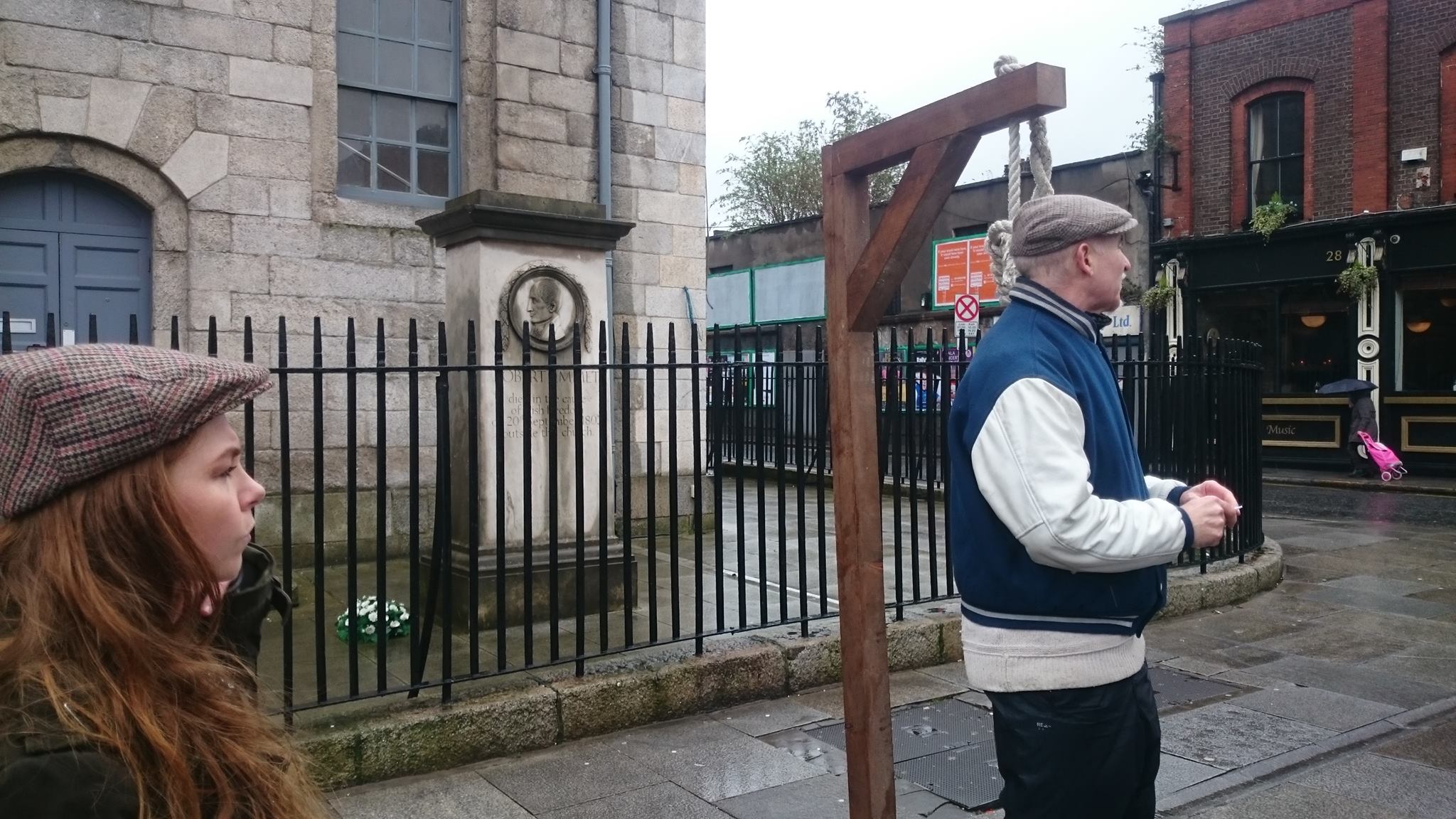
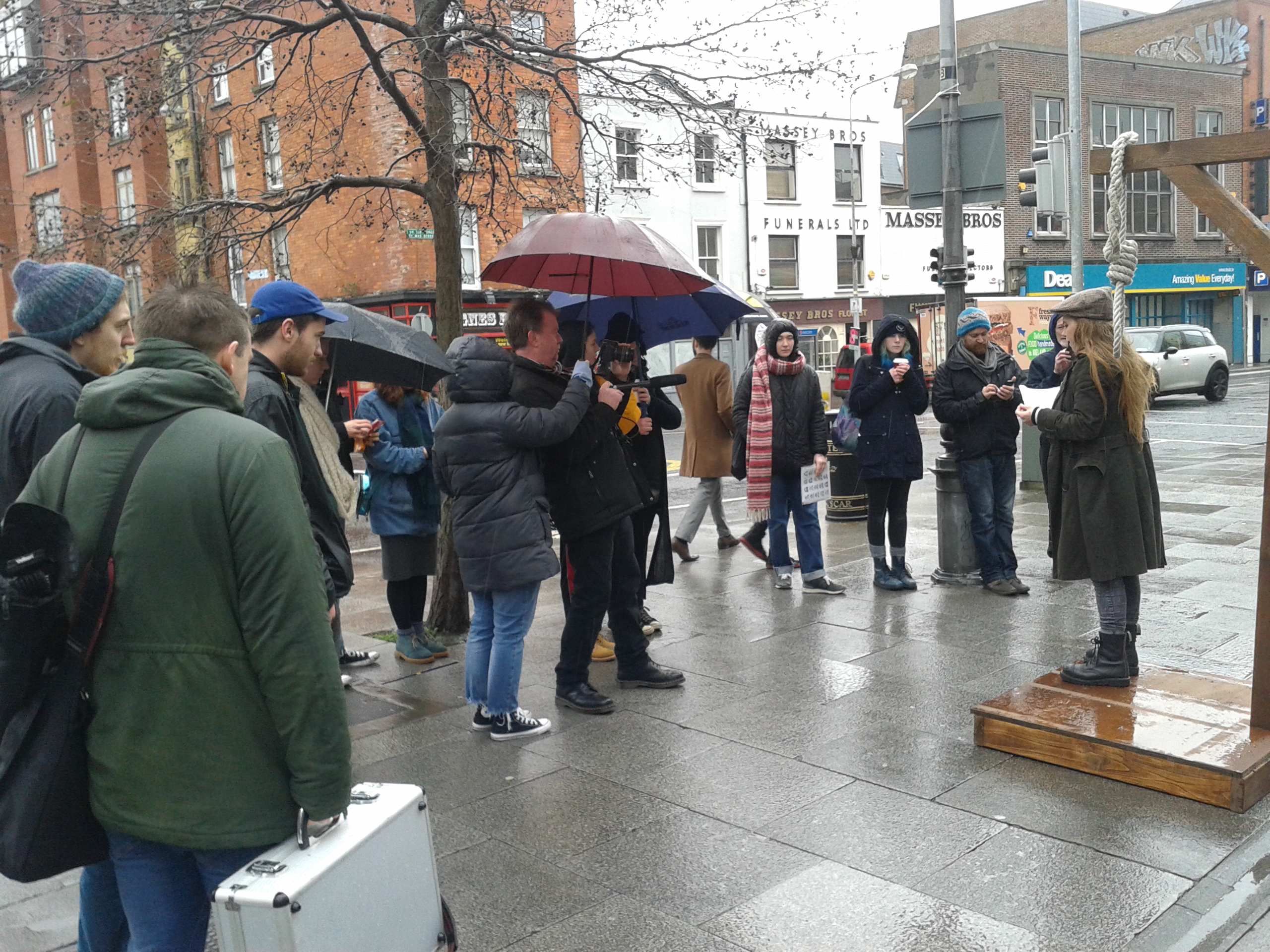
While eastbound drivers in Thomas Street on Friday 3rd March gawped, traffic slowed in the westbound lane to allow az small procession pushing a gallows, trundling along on wheels. There were surprisingly few witty comments, even the notoriously quick Dubliners too surprised to come up with a witty bon mot (or even a focal maith).

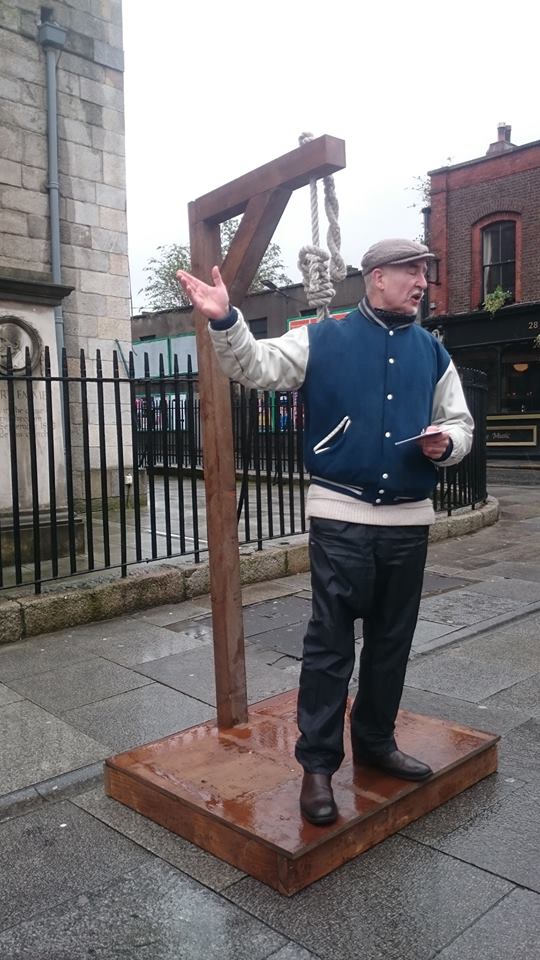
Diarmuid Breatnach outside St. Catherine’s Church, Thomas Street.
(Photo: /////)

The procession stopped at the Robert Emmet plaque, in the railing wall of the former Protestant St. Catherine’s Church, approximate place of execution of Robert Emmet on 20th December 1803.

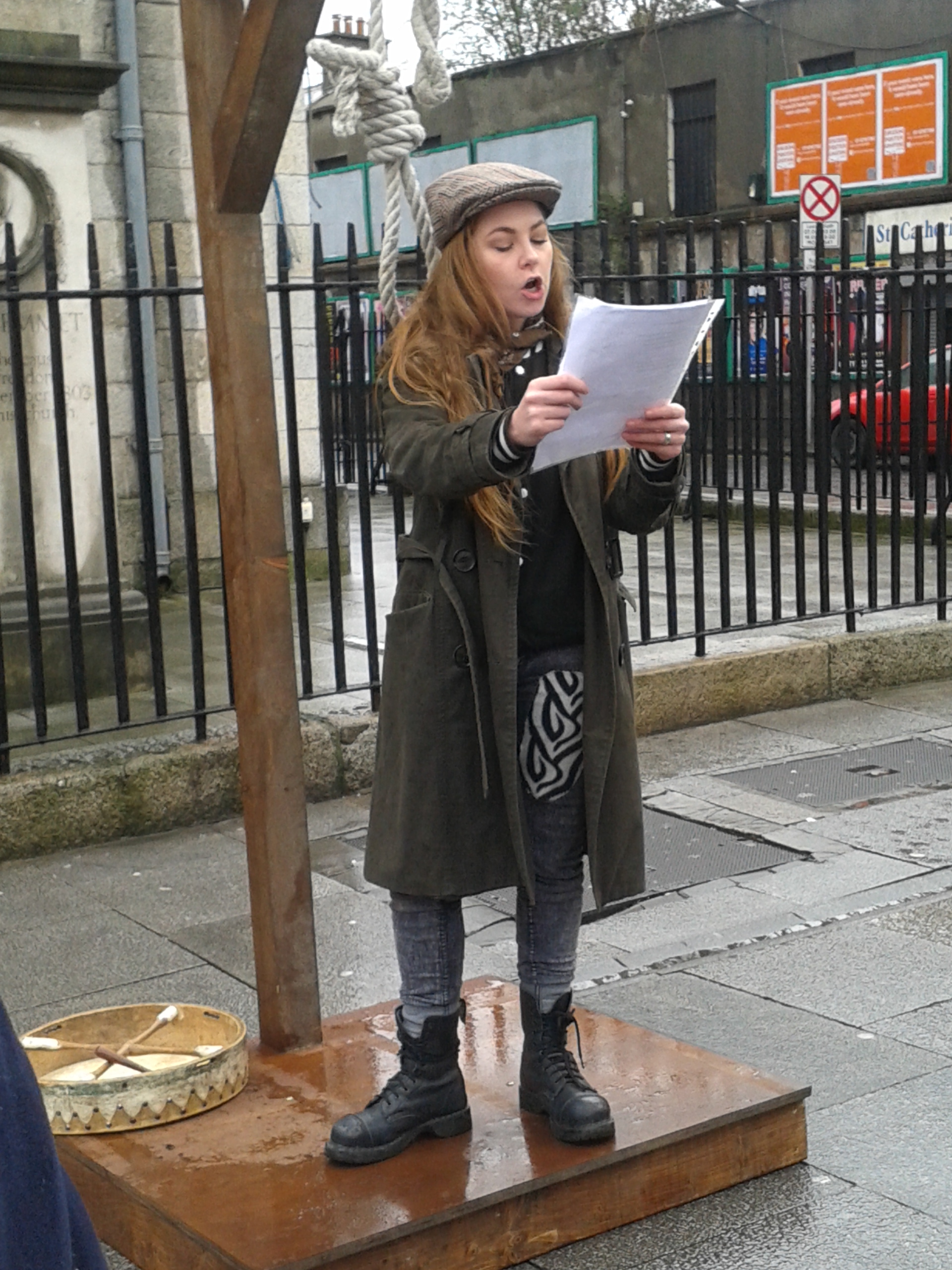
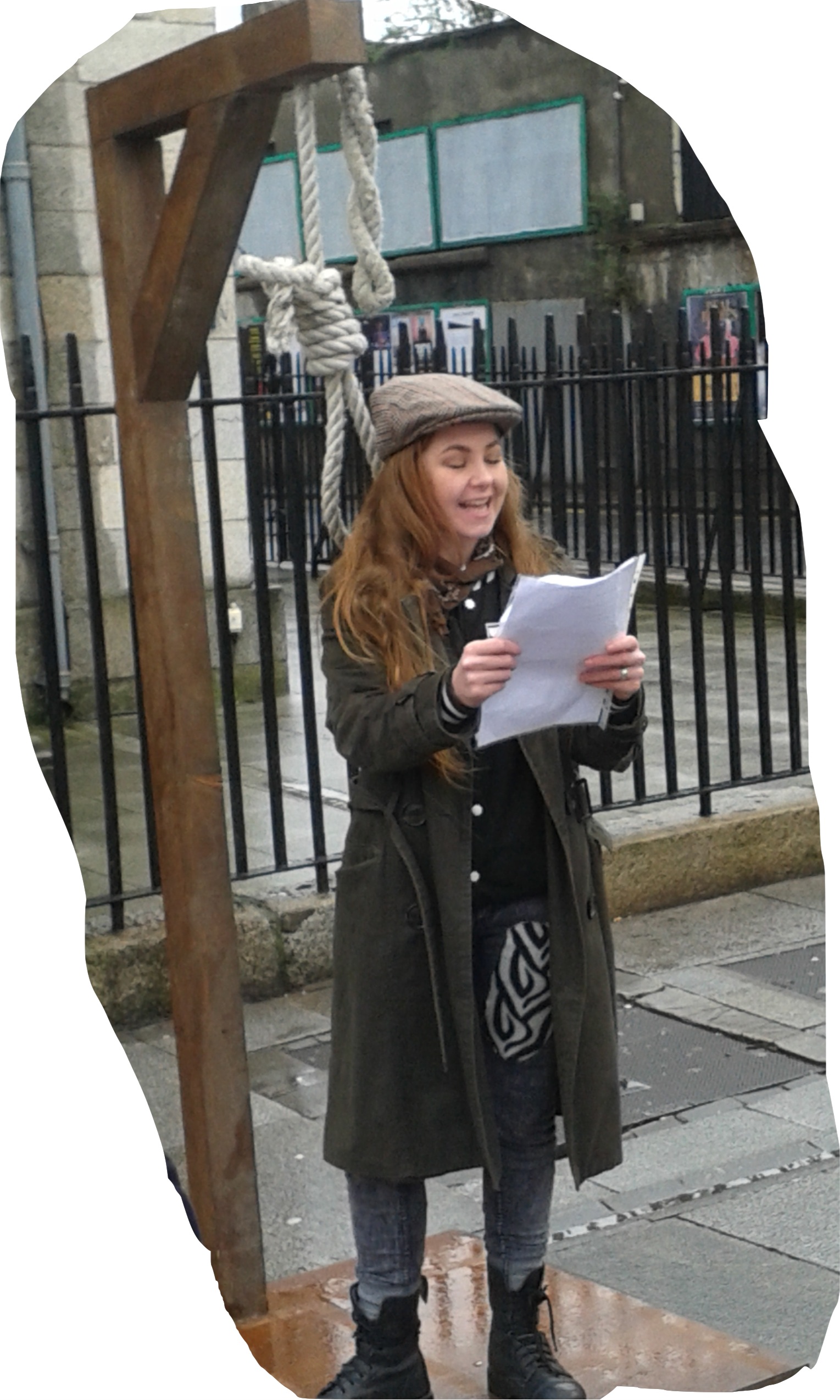
Elayne Harrington, aka Temperamental MiscElaynous performing her piece outside St. Catherine’s Church, Thomas Street.
(Photo: D.Breatnach)

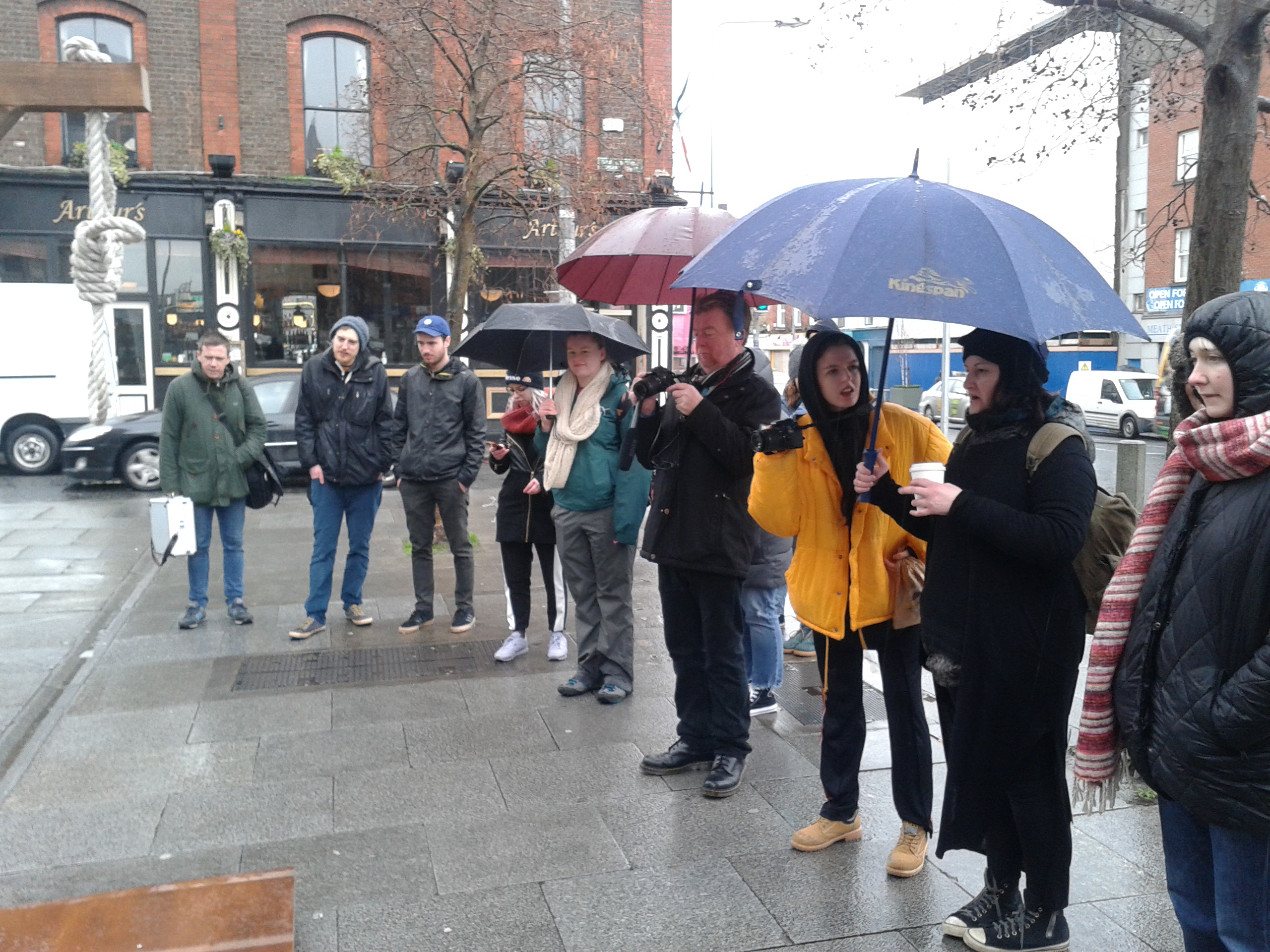
Despite continuous rain a small crowd had gathered on the pavement in front of the monument and the gallows, with a small platform less than a foot high, was placed facing them. Dublin artist Elayne Harrington, also known as the well-established street poet/ rapper artist from Finglas, Temperamental MiscElayneous, stood on the platform to announce that the event was to honour Robert Emmet and was a project as part of the Liberties Street Project, a continuation of the IPIP (In Public In Particular) program at the National College of Art and Design, Thomas Street, Dublin 8.

Harrington thanked people for attending despite the weather and, after outlining the program for the event, announced Diarmuid Breatnach, who took up position with the gallows and hanging noose just behind him.

Breatnach is best known as a co-founder of the Save Moore Street From Demolition campaign, maintaining a campaign table with a petition and leaflets on the market street for a few hours every Saturday but is also known as an acapella singer, particularly in Dublin traditional-folk circles.

Section of the crowd at the event outside St. Catherine’s Church, Thomas Street.
(Photo: D.Breatnach)

After thanking MiscElayneous for the invitation and the crowd for attendance, Breatnach proceeded to reiterate that the event was taking place very near the spot where, at the age of 25, Robert Emmet had been hung and then decapitated by the British colonial administration in 1803.

Harrington reminded him to stand on the low platform which Breatnach did, drawing a laugh from the crowd when he indicated the hanging noose and commented: “Me Ma always said I’d end up like this.”

Breatnach asked the audience to imagine the scene of the execution in 1803 and referred them to a painting of the scene available on the Internet, showing a huge crowd, with people looking out of windows in nearby buildings and mounted redcoats keeping the crowd back from the gallows. Many of in the crowd would have been supporters but the better-known would not have been there – they were in jail or in hiding.

The execution was carried out there, Breatnach said, because the whole Thomas Street and Liberties was known as a revolutionary area, which Breatnach went on to describe (see video below).

Elayne Harrington, aka Temperamental MiscElaynous performing her piece outside Stl Catherine’s Church, Thomas Street.
(Photo: D.Breatnach)

Executions, said Breatnach, have been carried out down through the ages on Irish people resisting invasion, colonialism and imperialism and fighting for social justice. The gallows have become an enduring image in Irish history and a number of songs (Breatnach mentioned ten from the 19th century up to the present) refer to it.

The state we have now, said Breatnach, set up in 1922, preferred shooting, which was the method by which it eliminated its opponents at the time, 81 of them in official executions. Hanging remained however in this state but the last execution was in 1954.

Breatnach stated that we are often taught history as a dead subject, something in the past to which we are largely unrelated but he believed history to be a living thing, in the stones of walls and streets, in the air and in the words people have left us. And in our songs.

Breatnach selected three songs that mentioned Robert Emmet: The Three Flowers, written early last Century by Norman G. Reddin (two verses); Bold Robert Emmet perhaps by Tom Maguire around 1916 but certainly published in 1934; and Anne Devlin in recent decades by Pete St. John. Breatnach sang the three songs one after the other with MiscElayneous accompanying on her bodhrán.

Diarmuid Breatnach outside St. Catherine’s Church, Thomas Street, talking about the radical revolutionary history of the area.
(Photo: ////)

During the applause which greeted the end of Breatnach’s performance, Elayne Harrington replaced him on the stage, thanked him and introduced herself as Temperamental Miscellaneous and spoke about her contribution, which was to be an extract of Emmet’s famous speech from the dock in the Green Street Courthouse, but re-worked into more modern Dublin idiom. Harrington then launched into a spirited rendition of her piece (see video below for the full performance).

No matter what words I utter, it’ll fail to change your mind and I wouldn’t have it any other way. You’ve made me a bed and I’ll lie in it. ………….

There’s plenty I could tell why my reputation should be kept clean from the utter lies and slander which’ve been lashed upon it. ……………

I wouldn’t dream that I could impress upon a court as trapped in its own self and corrupted, a fair impression of my character. …………………….

If merely dying was the case, after being deemed in the wrong and you in the right I’d take it on the chin and I wouldn’t breathe a word but that same law that not only wants to get rid of me also aims at filthying my name and sullying the memory of me. ……………..

In the hope that my memory won’t fade and that it might retain its honour among my brothers and sisters, I’ll stand up for myself and my integrity and weaken those charges against me. ……………

…. our cloths are entwined, mine and the martyred heroes of the gallows and battlefield, consecrated by sacrifice … for protection and guardianship of their homestead and their righteousness. ………..

This is what I hope: for my memory and name to serve those who live on by it being a source of empowerment …. witness the malignant malicious government that gains its false riches through sin alone, that treats a people as wolves to be domesticated and blooded to the taste of their fellows, to dance to their tune and to the death knell ……………..

Concluding the event, Harrington thanked the attendance and invited them to place small pots of growing flowers she had provided in front of the monument, which they did.

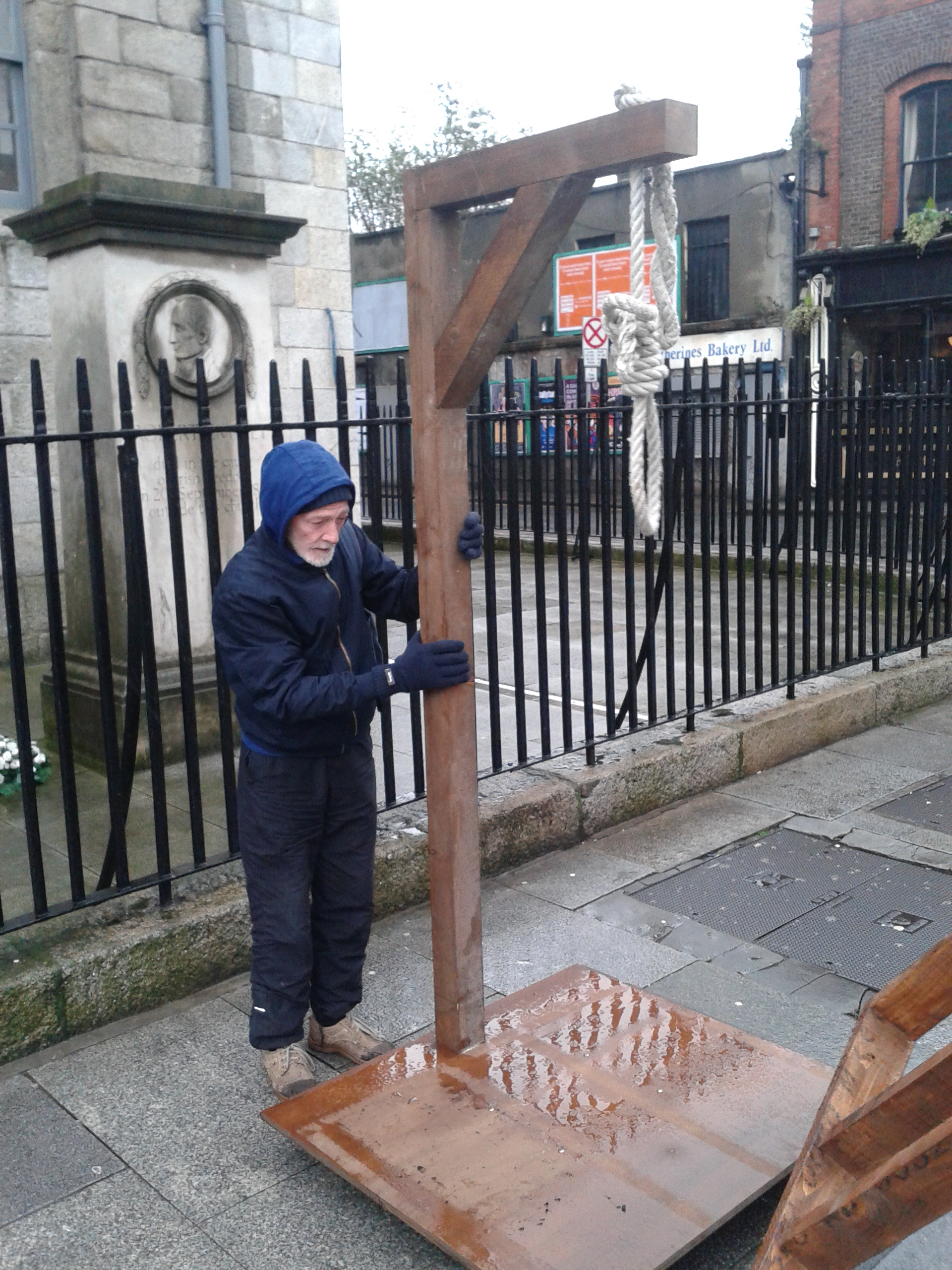
Stablising the scaffold outside St. Catherine’s Church, Thomas Street.
(Photo: D.Breatnach)

WHY THE EVENT?

What had led Elayne Harrington to choose this act as part of her course?

“I was interested in Robert Emmet and his uprising ever since I heard a Dublin tour guide dismiss Robert Emmet while briefly mentioning his uprising”, explained the rapper from Finglas.

“I came to think that although Emmet failed in his objective, he had attempted a brave and good thing and his speech was really impressive. His uprising attempt took place in the area where my college is and he was executed just down the road, so that’s how I came to think of this event.

“I’m thankful to my course tutor and fellow students for supporting me in this act and to another tutor who helped me with the construction of the gallows. I am grateful to Diarmuid Breatnach also, who has been very supportive and contributed to the performance and I was really glad that my Da was able to be here and help today too.”

Why did Harrington call this “the first of the verbal execution series”?

“I see this as an event that can be brought to other places – like the gallows I built, it is transportable” she says with a grin but then turns serious. “The performances can be adapted also to other occasions of which Irish history is full.”

We’ll be watching this space!

Elayne Harrington and section of audience outside St. Catherine’s Church, Thomas Street, looking eastward (in the direction of Dublin Castle, ten minute’s walk away).
(Photo: D.Breatnach)

VIDEO OF EVENT

(complete event outside St. Catherine’s)

https://www.youtube.com/watch?v=wJmb553yKf8


DUBLIN FIRE BRIGADE AMBULANCE PROTEST AT CITY HALL

Diarmuid Breatnach

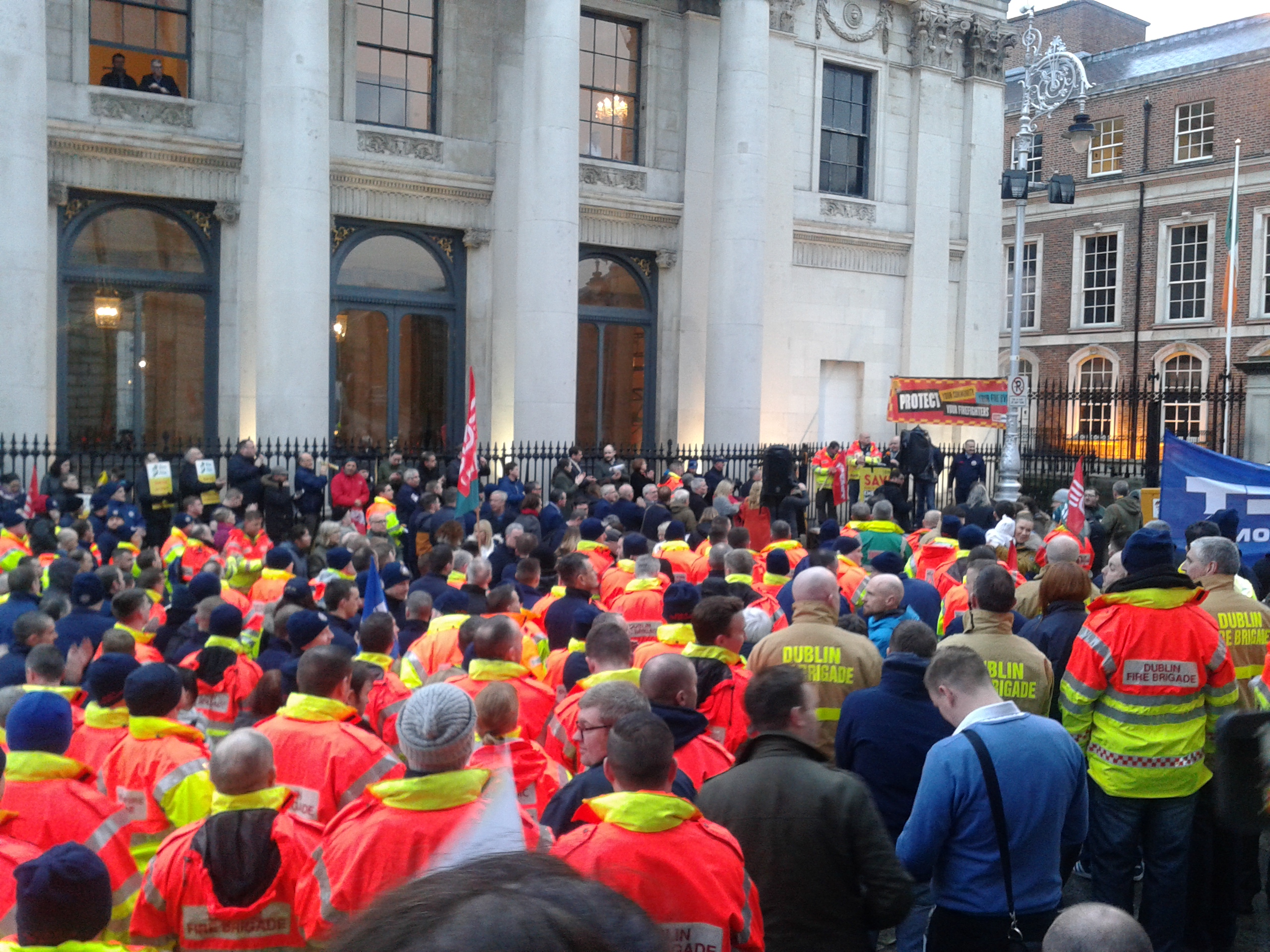
DUBLIN FIRE BRIGADE AMBULANCE SERVICE WORKERS PROTEST AT CITY HALL — hundreds of workers protest Dublin City Council Executive Officer’s plan to “outsource” their service.

Gathering to hear the speakers on Cork Hill, outside the side entrance of Dublin City Hall (left of photo).
(Photo: DBreatnach)

The monthly meeting of the elected representatives of Dublin City Council is often an occasion for protest, with placards and banners, of a number of campaigns protesting measures of the Council’s administrators or for calling on City Councillors for support ffor the campaigners’ objectives.

The March meeting of the Council on Monday night this week was no different in that respect but on this occasion, unusually, there were hundreds of protesters outside, the majority of them in uniform, filling the Cork Hill space in front of City Hall’s side entrance, up to the ceremonial entrance gates of Dublin Castle.

Several hundred thronged the area, most of them in either the dark blue of the Dublin Fire Brigade or in red-and-yellow or tan-and-yellow jackets, also bearing the legend “Dublin Fire Brigade”. Dotted among the crowd too were others in ordinary street clothes, presumably members of the public and a few with young children, probably relations to fire fighters or paramedics.

A young supporter of the fire-fighters’ struggle
(Photo: D.Breatnach)

The protest meeting was seeking the support of elected Dublin City Councillors in their dispute with the Chief Executive of the Council, Owen Keegan. The highest officer in the Council does not want the local authority responsible for funding the Dublin Fire Brigade’s ambulance service call-and-dispatch service and announced two years ago that it would be transferred from the Tara Street centre and put under the control of the HSE at their national control centre in Tallaght.

However, his plan ran into trouble not only with the fire-fighters themselves but with a large number of the elected public representatives and as a result a consultative forum was set up. Its eventual recommendations were not however what Keegan wished for, proposing instead a technological linkup between the HSE’s and the DFB ambulance services and as a result Keegan and other DCC senior management pulled out of the consultative forum in January. Brendan Kenny, second-in-command at DCC said that there was no point in continuing with the forum since it did not carry out the task it was set up to do but came up with different recommendations.


STRIKE NOTICE

View from the steps of City Hall (State Entrance gates to Dublin Castle to the extreme left of photo). (photo: D.Breatnach)

Since the intention of the City’s management was clearly to proceed with their plan, both the main trade unions affected, SIPTU and IMPACT, balloted their members for strike action and obtained an overwhelming majority in February: 93% to 7% in favour of strike action and 97% to 3% in favour of industrial action. On Monday SIPTU served strike notice on Dublin City Council management and IMPACT did likewise the following day.

The strikes are due to take place from 9am on Saturday, March 18th and Monday, March 27th.

The demonstration on Monday night was addressed by a number of speakers, including many elected Councillors. However, first to address them was SIPTU’s Brendan O’Brien who expressed regret that “SIPTU members in Dublin Fire Brigade have been forced into conducting these work stoppages” which he said was a result of his “members’ total commitment to providing the best emergency services possible to the residents of Dublin” and the intransigence of DCC management, headed by Owen Keegan.

Speaking to the press, he said that “These firefighters are withdrawing their labour to indicate, in the strongest manner open to them, their complete opposition to an attempt by senior management in Dublin City Council to break up the DFB Emergency Medical Service by removing its ambulance call and dispatch function.”

Before speakers addressed the crowd: top section of the crowd, approaching the State Entrance gates of Dublin City Castle
(photo: D.Breatnach)

Addressing the demonstration on Monday evening, O’Brien said that if the strikes were not sufficient to make DCC management see reason, “make no mistake, this fight will become a national one.”

A number of Councillors addressed the crowd, representing most of the political groupings on the Council. Christy Burke, ex-Lord Mayor (2015), representing a group of Independent councillors, stated that DCC management had refused to let them use the power in the nearby building for amplification for speakers. Burke drew cheers when he quipped that what the Management did not realise was that “the power is not in there, it is out here on the street.”

Burke also stated that the DFB Ambulance Service was working well and asked rhetorically “why fix something that isn’t broken”, a theme taken up by a number of other speakers. The Sinn Féin speaker made the point that she was representing the largest political party in the Council, totally supported the Fire Fighters and would be seeking legal advice on Keegan’s plan and the other speakers likewise promised support to the fire-fighters.


OTHER UNDERLYING ISSUES IN THE DUBLIN FIRE-BRIGADE AMBULANCE SERVICE PROTEST

Although speakers for the fire-fighters a number of times expressed support for the colleagues employed by the Health Servive Executive, their members must be concerned at the prospect of coming under the management of an organisation so under-funded and reportedly often mismanaged as has been the HSE for decades now.

Another element playing itself out here is the recurring conflict between many elected City Councillors and the unelected City Management. The political colouring of the public representation in the Council changed considerably with the local elections in 2014, when Sinn Féin with 16 seats and Independents with 12 became the groups most represented. Next in numbers of Councillors is Fianna Fáil with 9 seats, while Fine Gael and Labour each have 8 each and People Before Profit have 5. The remaining 5 are divided between the Greens, Anti-Austerity Alliance and United Left.

This struggle between many of the elected and the appointed few has broken out on a number of issues previously, most notably perhaps on the Moore Street Quarter issue, with Keegan and Jim Keoghan, formerly second-in-command and head of the Planning Department, proposing a deal with a property developer for a ‘land swap’ involving Council buildings on Moore Street, a plan which mobilised significant campaigning opposition and which was defeated by a large majority of Councillors voting in November 2014. The Councillors were however unable to prevent Keoghan’s “executive action” in agreeing a number of property speculator planning applications and the most controversial extension of the ‘giant shopping mall’ permission towards the end of last year.

This level of conflict between the elected Dublin public representatives and the appointed senior officials has perhaps not been seen since the War of Independence (1919-1921), when an Irish Republican and Labour majority on the Council, after the 1920 Local Government elections, found itself in recurring confrontation with officials appointed under a colonial administration.


BACKGROUND

According to Dublin Council’s website, “The Fire Brigade has provided the citizens of Dublin City and County with a fire and rescue service since 1862. This service was enhanced in1898 by the addition of an emergency ambulance service. In 2007 with 12 emergency ambulances DFB responded to 78,864 ambulance incidents, with the figure growing each year.

Dublin Fire Brigade provides an emergency ambulance service to the citizens and visitors of Dublin. Dublin Fire Brigade is the only Brigade in the country to provide an Emergency Ambulance Service. Dublin Fire Brigade operates 12 emergency ambulances with one ambulance operating from each full time station with the exception of Dun Laoghaire.

DFB’s Firefighters are trained to Paramedic level and are registered as practitioners with the pre-hospital Emergency Care Council (PHECC), meaning there are over 100 Paramedics available on a 24/7 basis in the event of a major emergency. All operational firefighters rotate between Fire and Rescue to Emergency Ambulance duties. Dublin Fire Brigade Ambulance Service has achieved accreditation under the ISO 9001/2000 Quality Management System.”

Lively ladies active in the Campaign for social housing Irish Glass Bottle site, Ringsend.
(photo: D.Breatnach)
Banner of campaign for social housing Irish Glass Bottle site, Ringsend.
(photo: D.Breatnach)


OTHER CITY HALL PROTESTS

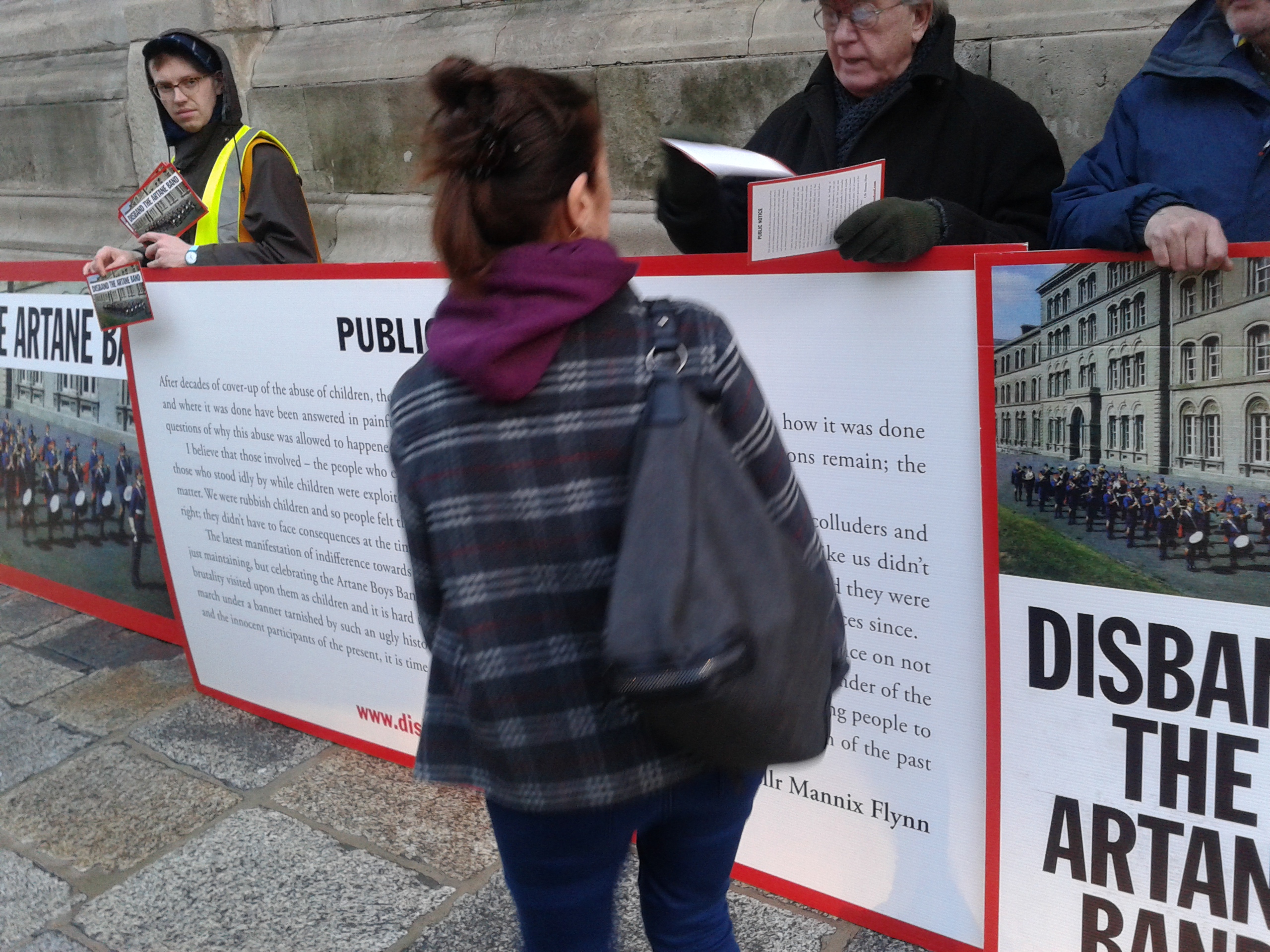
Also protesting outside City Hall (see photos) were lively and good-humoured campaigners for social housing on the former Glass Bottle company site in Ringsend and others calling for the renaming of the Artane Band (it is hoped to cover these campaigns in a little more detail in future reports).

Campaigners to rename the Artane Band because of the abuse that went on in the Artane Industrial School, which formed the original Artane Boys’ Band.
(photo: D.Breatnach)


UNSCIENTIFIC MYTH AND IGNORANCE ABOUT THE IRISH LANGUAGE

Clive Sulish

A most interesting and stimulating lecture was held on Wednesday night at Pearse House in Dublin. Hosted by Misneach, an Irish language campaigning organisation, the lecture was titled “Miotas agus Aineolas faoin nGaeilge” (“Myth and Ignorance about the Irish Language”).


What Colm Ó Broin, who described himself as an Irish language activist, has done is to take a number of frequently-expressed ideas hostile to or dismissive of the Irish language and to deconstruct them, analyse them and compare them with other languages and social situations. For the purpose of the lecture, he took around ten of those ideas, encapsulated in stock phrases well known to Irish speakers and campaigners – and probably to many others not within those categories.

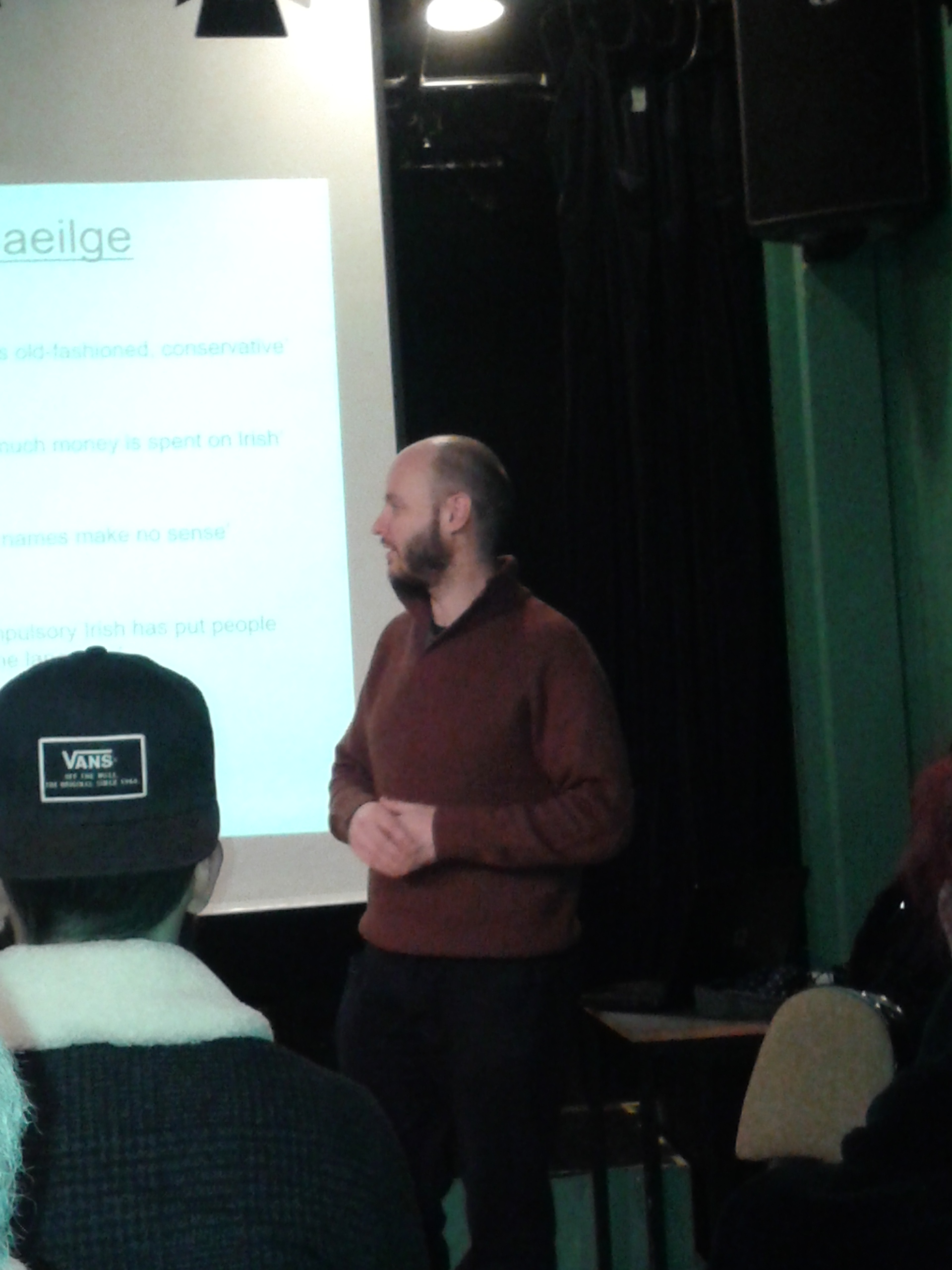
Some of the attendance at the lecture before its start

Over the years, we have heard and read these stock phrases and ideas expressed with tedious regularity, for example that the language is archaic or dead, is full of English words, that it is an expensive commodity, that Irish language schools are elitist, that the language is or was badly taught or that it was “beat into” people. Over the years, many speakers and activists have of course countered these ideas, sometimes by reasoned argument and sometimes by a trenchant phrase, such as: “What, was it only Irish that was bet into you then?” or “Was it only Irish that was taught with an overwhelming concentration on grammar to the exclusion of conversation?”

But Ó Broin has gone about this work scientifically, methodically. For the purpose of his lecture he took around ten of these propositions, deconstructed and exploded them, revealing their underlying lack of logic and scientific fact. For example, dealing with the proposition that the language is dead, Ó Broin produced a long list of living languages around the world – the vast majority, actually – that have less speakers than does Irish. On the allegation that Irish is full of English words, he produced pages of English-language words that are of French origin (leaving aside the easier and also huge list of words or Greek or Roman origin).

Colm Ó Broin, Irish language activist and presenter of the lecture

Having revealed the lack of scientific truth or logic as a basis for hostility or contempt towards the Irish language, Ó Broin turned to psychology as an explanation, finding fear and/or shame as the motivating factor. Turning back to history, he reminded his audience of the Statutes of Kilkenny of 1366, when the England-based descendants of the Norman Conquest of England dating from 1066, attacked the ‘gone native’ customs of the Irish-based descendants of the Norman Conquest of Ireland beginning in 1169 (though Ó Broin did not say so, the English Normans had gone quite ‘native’ themselves by then, integrating with the Saxon nobility and the Statutes were written in English, not French).

The Statutes forbade the Irish Normans (“the degenerate English” who had become “more Irish than the Irish themselves”) from playing Irish games and music, speaking Irish, submitting themselves to Irish law, adopting Irish cultural and social customs including marriage. It was the coloniser’s fear, fear of the Irish-Normans losing their allegiance to the English Crown, that was at the heart of that hostility.

Since the Irish who oppose the Irish language cannot be said to be “the coloniser”, something else must be at work there. Ó Broin twice in his lecture called on the state-funded or supported Irish-language organisations Foras na Gaeilge and Connradh na Gaeilge to undertake social research into what is behind this attitude among large sections of the public (according to opinion polls).

Some of the attendance at the lecture

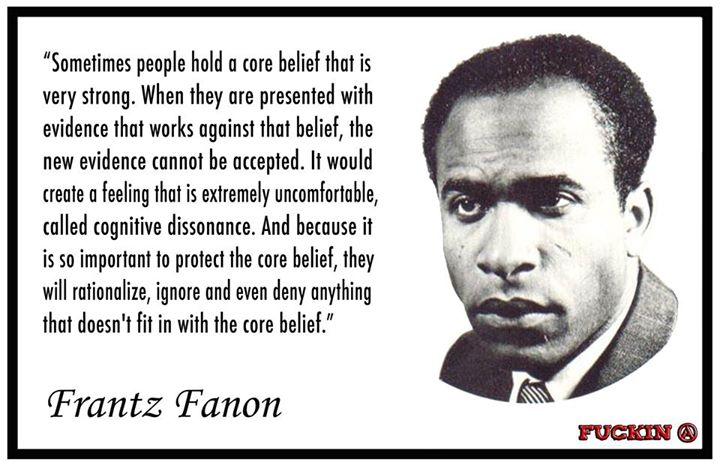
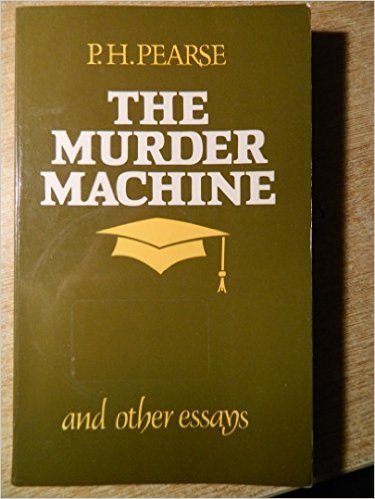
This would of course be useful work, especially if it led to the production of measures to counter such myths and ignorance. It is likely however that the answer has already been supplied, by for example the work Patrick Pearse (1879-1916) and Franz Fanon (1925-1961), though it would be useful to have more up-to-date validation. Fanon’s work focused on the coloniser’s view being culturally and psychologically internalised by the colonised individual and society and Pearse focused more on the mechanisms by which that was done through the educational system run by the coloniser. The idea is expressed succinctly, though in a different context, in the words of a popular nationalist song, Memory of the Dead by John Kells Ingram (1823 – 1907):

“He’s all a knave or half a slave

who slights his country thus …”.


franz-fanon-cognitive-dissonancecover-the-murder-marchine

The lecture was delivered by Ó Broin in Irish to an audience that contained Irish speakers and presumably all present could at least understand the language. My feeling was that this research and deconstruction needs to go out to the non-Irish-speaking public in this country. In response to a question, Ó Broin replied that he had in fact written some of it in English some years ago and that material had been posted on a website that no longer exists. Currently, his work exists only in Irish. It is to be hoped that he returns to putting this work out there among the people who perhaps most need it.

End.

HUNDREDS ATTEND MIDDAY WEEKDAY RALLY TO SUPPORT APOLLO HOUSE OCCUPATION

Diarmuid Breatnach


HUNDREDS ATTENDED AT APOLLO HOUSE in bitter cold from late morning today to indicate their support for the homeless people and housing activists in occupation of the building.  At the same time, a court refused to extend the

 Closer view of banner on Tara Street side of occupied Apollo House (Photo: D.Breatnach)
Closer view of “Homes Not Hostels” banner on Tara Street side of occupied Apollo House (Photo: D.Breatnach)

deadline by which it has ordered the occupiers to leave.

Banner suspended from the Tara Street side of Apollo House (Photo: D.Breatnach)

While they were there, representatives were attending court seeking an extension on the deadline given by a court order to leave the building by noon today.

Housing activist Rosie Leonard told the crowd that the alternative accommodation some Apollo House homeless people had been offered was totally unsuitable and that some were houses for people with addiction issues and that there were even bloodstains on the walls. They had asked for an extension as the State had not provided alternative accommodation but this had been refused.

In response, people cried “Shame!” and “We shall not be moved!”

Supporters linking arms around Apollo House from Townsend St, through Tara St to Poolbeg St. (Photo: D.Breatnach)
Supporters linking arms around Apollo House from Townsend St, through Tara St to Poolbeg St.
(Photo: D.Breatnach)

People were asked to link arms symbolically around the building, which many did and the line extended from Townsend Street/ Tara St. and the full length of Poolbeg Street.

PEOPLE QUEUE TO SIGN UP TO ACTIVELY SUPPORT

Shortly afterwards, announcements were made asking people willing to support the continued occupation to give their names to organisers and queues of people formed giving their names and phone numbers to put on a list.

People linked arms symbolically protecting Apollo House occupiers from Townsend St, through Tara St and here seen to western end of Poolbeg St. (Photo: D.Breatnach)
People linked arms symbolically protecting Apollo House occupiers from Townsend St, through Tara St and here seen to western end of Poolbeg St.
(Photo: D.Breatnach)

Speakers addressed the crowd at intervals and musicians, singers and percussionists also performed for the crowd. A group including a Vulture Capitalist, Banker and Woman & Child being evicted also performed for the crowd.

Chants included:
What do we want?
Homes not hostels!

Also: Is a doorway a bed?

No!
Is a mattress a bed?

No!

Since December 15th, the Home Sweet Home coalition of activists and homeless people has been occupying this building which state agency NAMA had repossessed from a property developer with unrepayable debts. The group is calling for NAMA to use the properties it has taken control of to house the homeless.

Rosie Leonard relaying court decision to cries of "Shame1" and chants of "We shall not be moved!"
Rosie Leonard relaying court decision to cries of “Shame1” and chants of “We shall not be moved!”
Percussionist, Guitarist, Acitivist (Photo: D.Breatnach)
Percussionist, Guitarist, Acitivist
(Photo: D.Breatnach)
Vulture Capitalist (Photo: D.Breatnach)
Vulture Capitalist
(Photo: D.Breatnach)
 (Photo: D.Breatnach)

(Photo: D.Breatnach)
 (Photo: D.Breatnach)

(Photo: D.Breatnach)

IRISH LANGUAGE CAMPAIGNERS CALL FOR URGENT ACTION — “10 years remaining for Irish as a living language in the Gaeltacht”

(English-language version below)

De réir ráiteas a d’eisigh craobh BÁC den dream Misneach inné (15/12/2016) d’éirigh go maith le hagóid Misneach  ar son Cearta Teanga lasmuigh de Theach Laighean. Bhailigh daoine i rith am lóin chun seasamh i gcoinne cur i gcéill na hairí Humphreys agus Kyne. Bhí neart tacaíochta don agóid ó dhaoine a d’imigh thar bráid, cuid mhaith acu a d’iarr leithscéil nach raibh mórán Gaeilge acu féin agus cúpla daoine ó thíortha i gcéin ina measc.


Map on Misneach banner illustrates the decline of areas where Irish is a living community language under the Irish state's administration. (Photo D.Breatnach)
Map on Misneach banner illustrates the decline of areas where Irish is a living community language under the Irish state’s administration. (Photo D.Breatnach)

D’ardaigh urlabhraí Misneach, Kerron Ó Luain, ceist an buiséad a pléadh i measc an chomhchoiste inniu:

Gheall Sean Kyne go dtabharfaí 1,000,000 euro breise don Ghaeilge ar Adhmhaidin ar RnaG níos luaithe. Is ardú 1% atá i gceist le sin. Ach, is méid suarach é 1% nuair a smaoinítear go gearradh 75% de bhuiséad Údarás na Gaeltachta agus 35% ó bhuiséad Foras na Gaeilge ó 2008.

D’fhógair an tAire McHugh i rith 2015 go mbeadh 1,000,000 euro breise do bhuiséad caipitil na Gaeilge chomh maith. Tá sé soiléir gur cleas atá sna fógraí seo. Gearrtar na deicheannaí de mhilliún ó bhuiséad ach, ar an láimh eile, fógraítear “airgead breise” de mhéid an-bheag amhail is gur dul chun cinn é. Is cleas é leis an bpobal Gaeilge a cheannach agus faraor tá an cuma ar an scéal go n-oibríonn an chleasaíocht seo.’

Chríochnaigh Ó Luain:

Arís tá Misneach ag glaoch ar na ceanneagraíochtaí Gaeilge gníomhú agus Lá Mór eile a eagrú. Tá sé feicthe ón ngluaiseacht a d’fhás i gcoinne príobháidiú a dhéanamh ar ár n-uisce, gurb é an t-aon chineáil cumhacht a dtugann na polaiteoirí aird ar bith air ná cumhacht na sluaite amuigh ar na sráideannaí.

Section of protest demonstration outside the Dáil (Photo D.Breatnach)

Má leantar ar aghaidh mar atá agus an pobal Gaeilge ina dtost caithfear milliúin euro chugainn anseo is ansiúd i mbealach soiniciúil ach ní dhéanfar aon dul chun cinn i ndáiríre. Agus gan ach 10 mbliain fágthaí ag an nGaeilge mar theanga pobal laethúil sa Ghaeltacht tá gníomh raidiciúil de dhíth láithreach.’

———————————————————————-

According to a statement of the Dublin branch of the Misneach organisation yesterday (15/12/2106),  a successful demonstration for Language Rights was held outside Leinster House. People gathered during lunchtime to highlight the hypocrisy of the government ministers charged with overseeing the language, Heather Humphreys and Sean Kyne. There was plenty of support from passers-by, including people who apologised for their own lack of Irish and a few people from abroad.

Spokesperson for Misneach, Kerron Ó Luain, alluded to the budget being discussed by the committee today:

Tongue-in cheek use of road traffic sign (Photo D.Breatnach)
Tongue-in cheek use of road traffic sign
(Photo D.Breatnach)

Sean Kyne apparently promised an additional million euro for the Irish language on RnaG’s Adhmhaidin programme this morning. That amounts to a 1% rise. Realistically, 1% is a pitiful amount when it is considered that 75% has been cut from the budget of Údarás na Gaeltachta agus 35% from that of Foras na Gaeilge since 2008.

Then Minister for the Gaeltacht, Joe McHugh, made a similar announcement in 2015 when he said that one million additional euros would go to the capital budget for the Irish language. It is patently obvious to all that this is a cynical ploy. Tens of millions are cut from the budget only for grand announcements of “additional funding” of pitiful amounts to be made afterwards as if this were progress. It is a ploy being adopted to buy off the Irish language community, and unfortunately it appears to be working.’

Ó Luain finished:

Misneach is once more calling on the chief Irish language organisations to mobilise towards another Lá Mór. It is evident from the movement which opposed the privatisation of our water that the only type of power politicians pay any heed to is the power of the people marching on the streets.

If the situation persists and the Irish language community remains silent, and accepting of token gestures of one million euro here and there, then no real progress will be made. With only 10 years left for Irish as a living community language in the Gaeltacht now is the time for radical action.’

(Photo D.Breatnach)
(Photo D.Breatnach)
Section of protest after some people had left (Photo D.Breatnach)