Main article by CHEMA MOLINA@CHEMAMOLINAA in Publico.es, translation and comment by Diarmuid Breatnach
(Reading time entire: 4 mins.)
The origin of the Bella Ciao song is uncertain and there are different theories about how this mythical popular song came about.
Over the years it has acquired a meaning closely related to the anti-fascist protest movements and in defence of democracy.
However, the Italian artist Laura Pausini refused to sing it during the El Hormiguero1 (show), reasoning that it is “very political”.
The piece has a clear political nature that goes beyond the success which the Money Heist series has given it and that has made it one of the most listened-to Italian songs in the world.
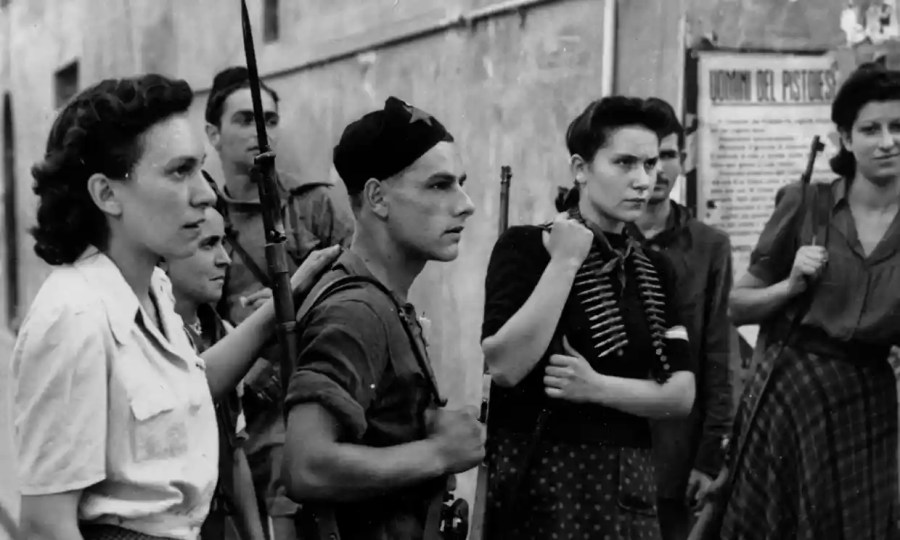
Italian partisans had already employed verses of this hymn against Mussolini’s fascism and the Nazi occupation during World War II.
Armed Italian anti-fascist Partisans in Pistoia, Tuscany (central Italy) Dec 1944 (Photo credit: Keystone/Getty Images)
Specifically, it was the partisans of the Maiella Brigade, in the Abruzzo region (east of Rome), and the Garibaldi Brigade, in the Marche area, a territory located between the Apennine mountains and the Adriatic Sea, who began to sing it, mixing traditional melodies with militant lyrics.
But there are other theories that suggest that the beginning of this song dates back to the 19th century.
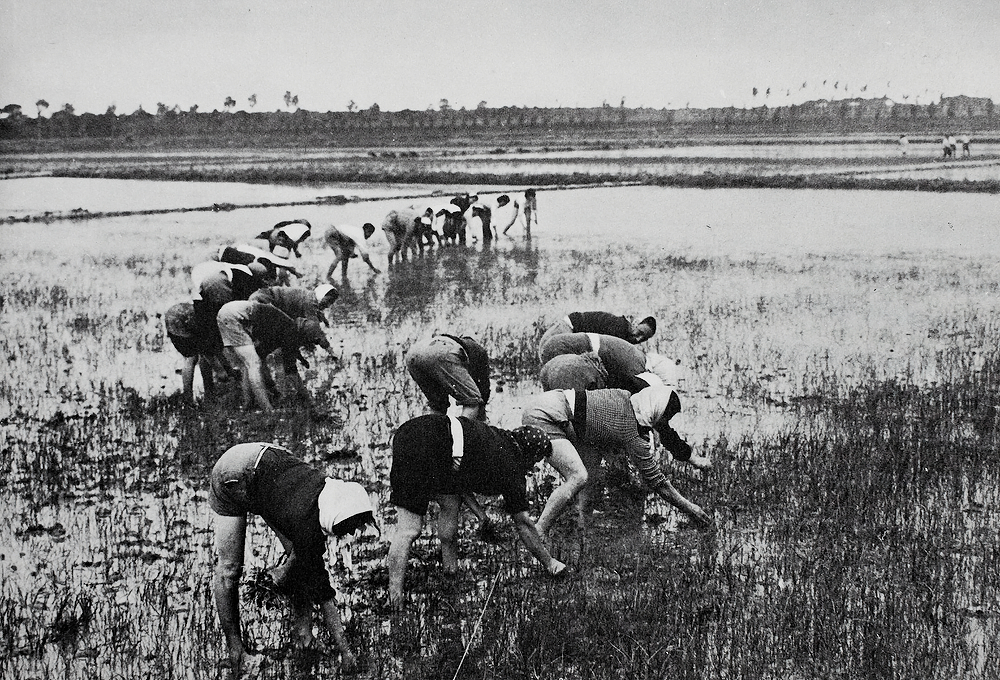
Line of Mondinas at their back-breaking work (Photo sourced: Internet)
The Mondinas, women who worked in the rice fields of northern Italy, recited the lyrics of this song as a sign of protest against the harsh working conditions they experienced every day.
In fact, the historian Cesare Bermani explains that the origin of Bella Ciao comes from a song called Fior di tomba (Flower of the grave) and that the poet Costantino Nigra had previously mentioned it in the second half of the 19th century.
One of the versions of this song reached the Mondinas of the provinces of Vercelli and Novara, both in the Piedmont region.
The Mondines’ (Italian female rice workers) song.
Another theory points out that the anthem could have Ukrainian roots. The musician Mishka Ziganoff, born in Odessa in 1889, moved to New York and composed a piece that could have been the origin of the start of the Bella Ciao air2.
Later, Italian migrants spread the air of this song when they returned to their country3.
Apart from its origin, the song began to become popular and to take on a political meaning due to the festivals organized by communist youth in different European countries. In the summer of 1947, the World Festival of Youth and Students took place.
There, the partisan version of the anthem was promoted, which later reached the Festival of the Two Worlds (also called the Spoleto Festival) in 1964.
The Bella Ciao show was performed at that event, organised by the Italian group Il Nuovo Canzoniere Italiano. The singer-songwriter Giovanna Marini, an artist who also helped to popularise the song, participated in the performance.
Bella Ciao has crossed borders and has been translated into many languages. In Spanish, one of the best known versions is that by the author Diego Moreno, who published his interpretation in 2014 on the album Bella Ciao! Adios Comandante!
COMMENT
THERE IS NO NEUTRAL POSITION ON FASCISMby Diarmuid Breatnach
The current controversy over a prominent Italian singer’s refusal to sing Bella Ciao at a kind of game show was predated by controversy over the origin of the song.
Most authorities now seem to refute the popular belief that it had been sung by Italian partisans, instead dating its emergencer as an antifascist song soon after WWII.
All are agreed however that it was predated by “Alla mattina appena alzata” a song with different lyrics of women rice-planting labourers, the Mondines, bewailing their extremely hard working conditions, their exploitation and expressing their hope in liberation.
Its origins therefore in women workers’ resistance is noble but so also is the antifascist sense in which it is usually sung today.
Woman Singing ‘Bella Ciao’ from window in Bologna Italy on Liberation Day 2020 (Photo credit FTimes)
Laura Pausini, when declining to sing the song, excused herself by saying that “it is very political”. Yes, it is and Pausini needs to realise that neither in the world of today nor in the past is there, nor has there ever been, a neutral position on exploitation of labour or on fascism.
The responses to Pausini recorded by Publico on Twitter were mostly negative towards her decision and rationale but also revealed a fair amount of confusion.
Laura Pausini in 2009 (Photo sourced: Internet)
The most common critical response was along the lines that anti-fascism is fundamental to democracy and therefore above politics, one commentator going so far as to state that Pausini is confusing position or stance on the one hand with ideology, on the other.
Fascism is a political ideology and so therefore is anti-fascism. Of course, anti-fascism is normally associated with the Left of the political spectrum but some conservative individuals and groups have been known in history to be actively anti-fascist too.
However that does not change the fact that anti-fascism is a political position whether ascribed to by revolutionary communists and anarchists, social-democrats or conservatives.
As the world capitalist system in crisis turns to making the workers pay more through rising costs of essentials and wage controls, along with cuts in state social services, the masses will resist. In many states, it is then that the ruling class turns to fascism to repress the resistance.
Neither Pausini nor anyone else can rise above that struggle. One may certainly attempt to be neutral but circumstances will not permit it, will certainly frustrate the attempt. Objectively one’s actions and words will either favour fascism or work against it.
End.
FOOTNOTES
1El Homiguero (“The Anthill”) is a Spanish television program with a live audience focusing on comedy, science and guest interviews running since September 2006 https://en.wikipedia.org/wiki/El_Hormiguero
2Without listening to the air, I am unable to venture an opinion on this. However, thinking about it, Bella Ciaodoes evoke Eastern European Jewish music to me. According to Wikipedia, Ziganoff was a Christian Roma from Odessa, Ukraine but well familiar with Yiddish and Klezmer music. https://en.wikipedia.org/wiki/Mishka_Ziganoff
3This is a well-known process of the dissemination of song airs and even lyrics by migrant workers or sailors (or even soldiers). For example the air of the ballad Once I Had a True Love may be found on an Alan Lomax collection of traditional songs from Extremadura, central-western part of Spain.
Propaganda is employed in wars and finds its most widescale application through the mass media. The belligerents want their own populations to support their war effort and to have other states support them.
IRISH REPORTING ON THE SPANISH CIVIL WAR
The hierarchy of the Catholic Church infamously mirrored the propaganda of their corresponding religious officials in the Spanish State in backing the fascist-military uprising against the elected Popular Front Government in 1936.
Irish newspapers and radio reporting on the whole followed the line of the Church hierarchy. The resulting conflict gave the Spanish state the greatest number of known mass graves in Europe and anywhere in the world, in fact, outside of Cambodia.
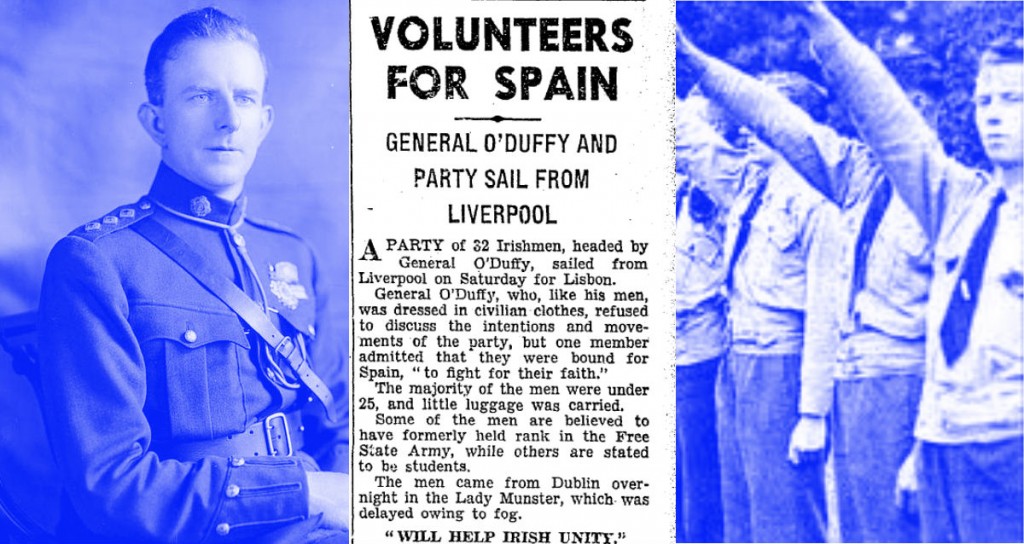
Clipping from Irish Press, not a fascist sympathising editorial line, November 1936 (Image sourced: Irish Newspaper Archives, Irish Press)
The Catholic hierarchy declared the fascist-military to be fighting a religious crusade against “Godless communism”, repeated propaganda of the fascist side, denounced real and imagined crimes of the Republican side.
They denied or ignored news of crimes of the fascists, which occurred from the first days and for years after Franco’s victory, in the course of which they denounced even priests who spoke out about the fascist crimes.
Whether the Spanish Republican Government had its own propaganda (I’m sure it did) or whether all its supporters were squeaky clean or not is besides the point. The overwhelmingly pro-fascist forces propagandaaffectedusin Ireland and most of it was fallacious.
Even the Irish Press, paper of De Valera who had banned the Blueshirts earlier: …. “These idealistic young men also saw their participation in the Spanish Civil War as helping to solve political divisions in Ireland and ultimately Irish unity. Interviewed in Dublin prior to his departure for Spain, Capt. P. Quinn from county Kilkenny, made the following statement: I believe that if an Irish Brigade succeed in reaching Spain, and there fights against Communism and all its terrors ….”
This had a practical effect in Ireland at the time and later, assisting religious and other fascists to attack socialists, communists and other progressives.
It helped create the atmosphere in which alternative writers were censored and hounded and the Irish State could actually expel an Irish citizen – Jimmy Grailton – for the crime of being a socialist community activist.
In turn, this anti-socialist, anti-communist atmosphere created a poisonous environment for social progress, whether championed by revolutionaries or social democrats.
It also helped create a wall shielding the ongoing endemic mental and physical – including sexual — abuse of women and children which seemed impermeable to control or even criticism for decades.
BRITISH WWI PROPAGANDA
The British imperial cant of “defence of small nations” or of “defending civilisation” in its war against Germany during WW1 while simultaneously suppressing the 1916 Rising and repressing many peoples around the world is well known.
The media related invented German atrocities, gave one-sided reporting, censored or demonised alternative views (I know, beginning to sound familiar).
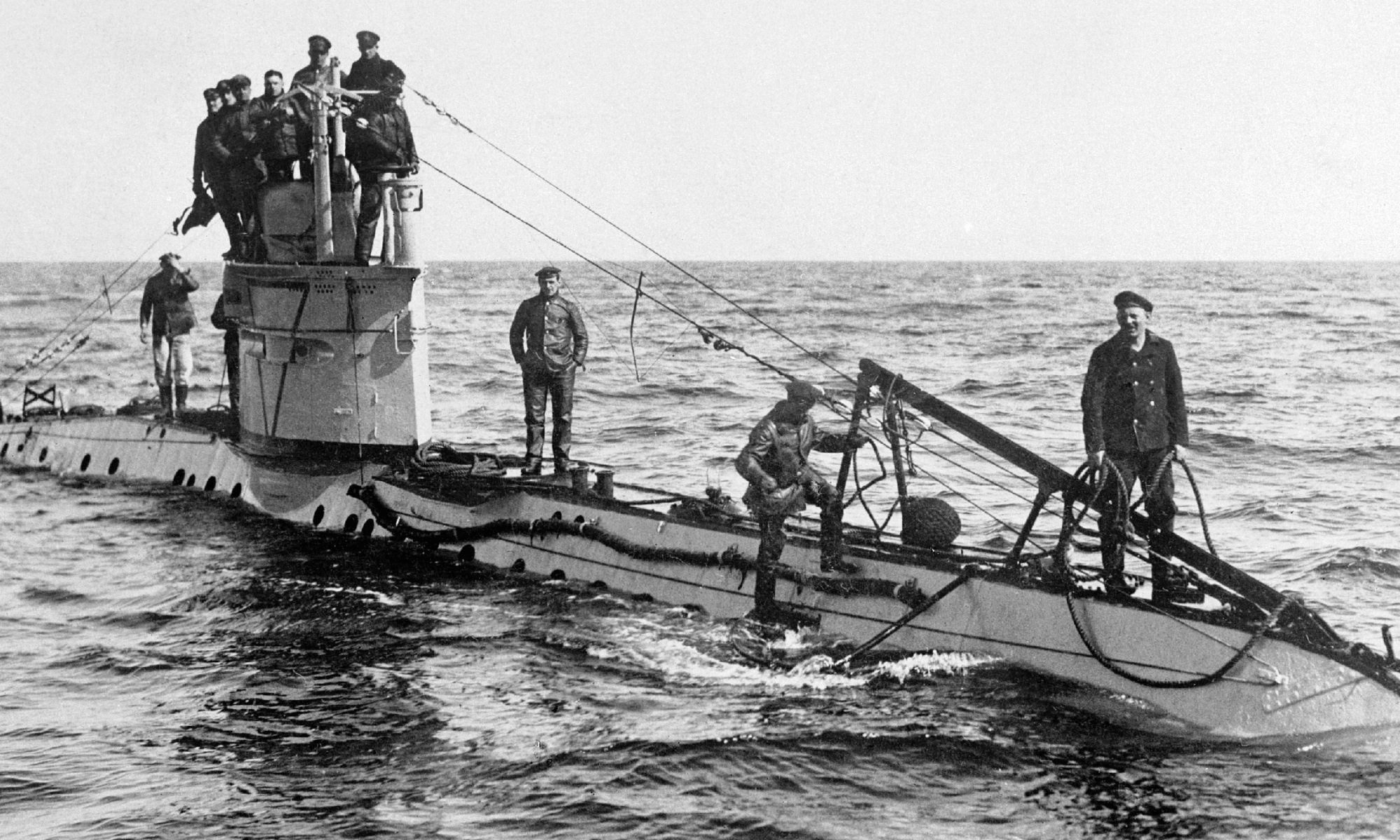
That is the general, well-established picture. However, I’d like to focus on a specific incident and how it was treated: the sinking by German submarine (U-Boat) of the Howth fishing trawlers St. Michan and Geraldine on 31st of March 1918, with the loss of five Irish lives.
A Howth fishing vessel in past years (Photo sourced: Internet)
No question of who’s in the wrong there, you’d think. The Irish unionist media (admittedly under war powers control) jumped to accuse the German Uboat crew of a “Howth atrocity”, an “Act of Murder” and that they “Shelled without warning”1.
I am grateful to Phillip O’Connor for his exploration of the incident) in his Road to Independence (2016) [Howth Free Press] on the involvement of Howth, Sutton and Baldoyle communities in the struggle for independence and social progress (and his source on the incident, Seán T. Rickard’s MA).
WAR CONTEXT OF INCIDENT
WWI was fought on land, air (even then) and sea. The British Navy was the most powerful in the world and imposed a naval blockade on Germany, bottling up the latter’s navy but also preventing supplies of any kind entering by sea. Unusually, the blockade included foods.
Germany took the position that Britain was trying to starve the German population and responded with its submarines attacking UK shipping which at the time included Ireland’s.
The British responded by concealing guns on merchant ships so that a German submarine surfacing and demanding surrender could in turn by sunk by the merchant ship in question. Indeed the British used fishing boats as mine-sweepers and even armed some too.
This had the effect of encouraging German Uboat captains on occasion to sink merchant ships without warning rather than run the risk of being sunk themselves.
However the U90, the submarine in question concerning the Irish trawlers in March 1918, appeared not to have been doing that and O’Connor quotes the case of the Greek ship SS Salaminia, of which the entire crew had been given time to get into lifeboats before being sunk.
Indeed, the eight captain and crew of the Michan all got into their “punt” and were picked up alive by a British Navy patrol. Tragically, the Geraldine had no additional boat, having set some of its crew ashore on Lambay Island to gather whelk for long-line hook-baiting.
Whether Captain Jess of the U90 believed the Geraldine was being defiant, playing for time or anything else is not known but his Uboat sank the vessel and there were no survivors.
The dominant newspapers in Ireland at the time condemned the German Uboat along the lines outlined above but also went further to make political capital out of it against the Republican movement.
They – and politicians they quoted – used the incident to attack Irish Republicanism, one going so far as to refer sarcastically to the Republicans’ “gallant allies”, lifting the quotation from the 1916 Proclamation of Independence.
There were rules of war agreed at the Hague Convention of 1907. Attacks on civilians are ruled as a war crime by the Geneva Convention but that was not composed and agreed until 1949.
However, its applicability to all the situations of conflict at sea were not codified until much later and, even then, are not binding on the signatories2.
It needs also to be noted that violations of humanitarian regulations and laws by most states have been documented during their wars with other states and in suppressing uprisings. The British did arm merchant ships during WW1 and also used them in a mine-sweeping capacity.
Also the Leinster, for example, sunk by German Uboat torpedoes on 10th October the same year as the Howth fishing boats, was carrying military personnel and armament and therefore in war terms a legitimate target.3
However, it is difficult to see how the fishing boats could be suspected of being armed merchantmen or even as ships supplying Britain and therefore equal to any ships attacked for breaching the Royal Navy blockade of Germany.
I am grateful to O’Connor for supplying me with the reference4 to the UK’s war-time restrictions obliging fishermen to ply their trade at 15 miles or further from its main ports, which included Dún Laoghaire and Dublin and therefore affected the Howth fishing fleet.
The U90’s captain may have suspected the British were using them as “spotters” for submarines in the area but even so, it is difficult to justify sinking without verifying radio equipment on board and especially without a dinghy to take the crew to safety ….!
German UC-1 class submarine surfaced with crew (Photo sourced: Internet)
In that respect it seems the U90 might have been in violation of agreed measures for the protection of civilians at sea in time of war by destroying civilian fishing vessels.
On the question of warning, although there were no survivors of the Geraldine, the available evidence is that the Captain of the U90 did warn before sinking shipping and had done so in a number of cases including another fishing boat on the same day.
But all was grist to the British war propaganda media and even, especially in the case of Ireland, to its colonial purposes in attacking its main anti-colonial opponents of the time, Irish Republicans.
Of course too, left unmentioned was the fact that the UK was attacking German civilians through blockading food imports5 and threatening and impounding any blockade-breaking ships (except those of the USA6).
Blockades and sanctions have cost many lives over the years – the UK blockaded the Spanish Republic during the Anti-Fascist War which did not impede Nazi Germany and Fascist Italy hugely supplying arms, aircraft and men to the military-fascist troops.
The USA imposed sanctions on Cuba for decades and Iraq for some years; in the latter case, by 1996 an estimated half million children had died as a result, a figure justified by Madeleine Albright, then USA Ambassador to the UN7.
Israel is permanently blockading Gaza in Palestine by land, air and sea – Egypt is participating too with its control over one gate. NATO sanctioned Russia which is now retaliating with some measures also.
Interestingly, O’Connor records that British war propaganda had little effect in 1918 on majority Irish opinion and even the Howth fishermen’s representative condemned the UK Admiralty for the mortal danger in obliging fishermen to ply their trade beyond 15 miles from shore8.
The UK General Election results in Ireland six weeks later would be a convincing illustration of how the vast majority of the population was thinking.
End.
FOOTNOTES
1It would be interesting to know whether it entered the heads of any editors that the British military had bombarded the city centre of Dublin with a number of land and sea-born artillery pieces just two years earlier, without any attempt of warning to the civilian population whatsoever.
3The Wikipedia entry on the sinking of the the Leinster, while acknowledging the nearly 500 military personnel on board, does not common on this negation of the ship’s civilian status. It does not mention the gun mounted on it either, which is noted in this record https://www.rmsleinster.com/sinking/sinking.htm
4See Appendix for details on this (thanks to Phillip O’Connor).
102. The declaration or establishment of a blockade is prohibited if: a) it has the sole purpose of starving the civilian population or denying it other objects essential for its survival.…
103. If the civilian population of the blockaded territory is inadequately provided with food and other objects essential for its survival, the blockading party must provide for free passage of such foodstuffs and other essential supplies.
6Vide O’Connor The Road to Independence (2016) [Howth Free Press]
To regulate the security risk of fishing around Ireland during the war the Admiralty thought it necessary to divide the coasts into security zones. These zones had various levels of regulation and protection. Areas were either licensed by special permit, which allowed fishermen to fish these areas under restriction or were simply designated as areas where fishing was prohibited. Orders directly issued by the Admiralty were passed on to the fishermen through the D.A.T.I. via Notices to Mariners (NA G/12 (1917) & G/20/5 (1918).
Fishing was generally prohibited several miles from headlands, as it was a favourite spot for lurking U-boats. It was also prohibited around minefields, which were used to protect the coast and divert traffic into safer zones for escorts. It was also prohibited around naval bases and near convoy meeting points. And traditionally it was always prohibited in sea-lanes where there was heavy sea traffic. It was prohibited in many areas between sunset and sunrise, (a term still used in modern Rules Of the Road) and also known as “dark hours”. If any security measure presented itself, fishing could also be prohibited at short notice for whatever reason by word of mouth on the local naval authority shoreside or naval authority at sea. The Admiralty also had the right to commandeer vessels and/or cargo space also at short notice. The Admiralty later ordered that if the fishermen sighted enemy submarines they were to stop their fishing activity and go immediately to inform the closest naval authority whether at sea or ashore. This made fishing more difficult, costly and dangerous and particularly annoying to Irish fishermen with national sentiments.
The Admiralty even warned that a failure to comply might lead them to be fired on by naval vessels. Immediately affecting Howth fishermen was the prohibition of fishing within fifteen miles of Kingstown. This area roughly to the NW of Kingstown and roughly a few miles off Howth Head was a favourite bait procurement ground for Howth fishermen but also fell within range of most of their local fishing grounds.
In March 1917 the following rules affected fishermen fishing the East coast of Ireland but in particular Howth fishermen were as follows:
All decked and motorboats fishing anywhere between Ballywalter, Co. Down, and Howth, or anywhere between Wicklow Head and Loop Head, must carry official permits to fish. Between Ballywalter, the Isle of Man, and Howth, such boats may fish by day and by night at any distance from land within the limits of their permits.
They are forbidden to be stopped in or to pass during dark hours through waters where no fishing is allowed.
Moored nets may be left out at night, provided that the head ropes are kept five feet or more below the surface.
(Department of Agriculture and Technical Instruction for Ireland. Notice to Fishermen. Effective 1 March 1917. Wt.-865. 250. 2/17)
Later rules came into effect in 1918 for the locality, one of which was fishing could only be conducted within daylight hours in this area.
The media informs us of the visit on the 22nd July of Mícheál Martin, Prime Minister of the Irish state, to the concentration camp where his uncle was a prisoner of the Japanese after the fall of Singapore in World War II.
Many Irish fought in the UK and British Commonwealth armies against Nazi Germany, Fascist Italy and Imperial Japan.
But there is another strong and ironic Irish connection to the fall of Singapore. The Lieut.-General Arthur Percival who surrendered the Singapore fortress to the Japanese Army in 942 had been Intelligence Officer (and torturer) for the Essex Rifles against the IRA in West Cork 1920-’21.
Major (then) Arthur Percival, C/O 1st Company Essex Regiment (later Intelligence Officer) in Ireland with senior officer of the colonial gendarmerie, the Royal Irish Constabulary, c.1920/21. (Image sourced: British Imperial War Museum)
PERCIVAL IN IRELAND
Percival served first as a company commander then as Intelligence Officer of the Essex Rifles in Kinsale, Co. Cork, where he “stood out for his violent, sadistic behaviour towards IRA prisoners, suspects and innocent civilians……
“He also participated in reprisals, burning farms and businesses in response to IRA attacks,” according to a USA historian. General Tom Barry, IRA commander in West Cork, said that Percival was “easily the most vicious anti-Irish of all serving British officers”1.
Two victims in particular were IRA Brigade Commander Tom Hales and Quatermaster Patrick Harte. Both reported being beaten and tortured with pliers to private parts and extraction of nails. Percival got an OBE for their capture; Harte died in a mental hospital in 1925.
Tom Barry recorded that after a number of ignored warnings, the IRA in Cork placed the Essex Rifles on the same status as the Black ‘n Tans and the Auxilliaries – they could depend on no mercy if captured.
Percival was also the man who unconditionally surrendered Singapore to a much smaller invading force of Japanese in 1942, thereby condemning thousands of soldiers and civilians to a terrible fate.
British Army prisoners of the Japanese after the surrender of Singapore (Image sourced: Internet)
LARGEST BRITISH SURRENDER IN HISTORY — AND TO LESSER NUMBERS
Singapore had been a British colonial possession since 18262. At the time of WWII the British considered it a strong fortress, a thick jungle and hills on the landward side and with huge 15” cannon facing out to sea against a possible naval invasion.
The British High Command considered no navy in the world could survive an assault on the island and no army capable of penetrating the thick jungle. Apparently no-one told the Imperial Japanese that for come through the jungle they did, marching or riding on bicycles.
The UK and Commonwealth troops on the landward side fought but were outgunned and badly commanded. After seven days of fighting, Percival decided to surrender unconditionally, with most of the 85,000 troops on the island not yet having engaged the 36,000 of the enemy.
The surrender of Singapore delivered 80,000 UK and Commonwealth troops, along with a million civilians, into captivity in the hands of the Imperial Japanese Army. Three days after the British surrender, the Japanese began the “Sook Ching” purge, killing thousands of civilians3.
The day before the surrender, Japanese soldiers also invaded the Victoria Hospital and murdered over 250 soldiers, doctors, male staff and patients.
Most of the soldiers taken captive had not been given a chance by Percival to even fire a shot at the advancing Japanese Army, to the contempt of their captors, led by officers with a strong military tradition and pride (not to say arrogance).
Whether that fact contributed to the cruel and inhumane treatment of the prisoners by their captors and guards is not certain but it seems to have done. In any case, many who died day by day and month by month building the Burma Railway would no doubt have preferred to die fighting.
Most of the civilians massacred would probably also have preferred to die fighting.
Around 30,000 Allied Prisoners of War of the Japanese died in captivity of cruel treatment including inadequate food, disease and overwork; working from statistics R.J. Rummel estimates a death rate of around 29% for POWs4. Huge numbers of civilians died similarly also.
Australian Russell Braddon, who wrote about his experiences in the Japanese concentration camp at Changi and on the slave-labour construction of the Burma railroad5, was extremely bitter about the surrender and the general Allied High Command management of the war in Malaya.
Many no doubt did so out of a desire to fight fascism — surely an admirable motivation6.
But once the War ended, any Irish remaining in the British armed forces anywhere could not claim to be doing anything else than helping the domination of many nations and millions of people by what was at the time the world’s biggest imperialist power (though soon to be eclipsed by the USA).
Mícheál Martin at Changi concentration camp where his uncle was a POW, now a museum (Photo: RTÉ)
If anti-fascism motivated his uncle and that is what Mícheál Martin appreciates about him, one would wonder why the police of the state which he leads protected fascists in Ireland and attacked antifascists on a number of occasions in recent years.
Of course there may be a more sinister aspect to Martin’s publicised visit. It may be a public expression of the desire among the Irish elite to be part of a western military alliance, either the US-NATO or an EU such, which would in the end amount to much the same thing.
And such an alliance in these times would not be fighting — even in part – against fascism but rather alongside it.
End.
FOOTNOTES
1Guerrilla Days in Ireland (1949 and many reprints since) by Tom Barry.
2Singapore became an independent republic on 9 August 1965.
3People from all ethnic groups were massacred but the Chinese most of all. Though the Japanese government years later paid some compensation to relatives of victims, it has never accepted responsibility for the events. Nor has the UK. “Since 1998, Singapore has observed Total Defence Day on 15 February each year, marking the anniversary of the surrender of Singapore. The concept of Total Defence as a national defence strategy was first introduced in 1984, which serves as a significant reminder that only Singaporeans with a stake in the country can effectively defend Singapore from future threats.” (Wikipedia)
5The Naked Island (1952) sold over a million copies. Russel Braddon (1921-1925) had a breakdown soon after the war and felt suicidal but, once recovered, became a successful writer of novels, articles and TV scripts. https://en.wikipedia.org/wiki/Russell_Braddon
6I met one of those, curiously enough a Corkman in a lodging house in London. Denis was a decent man, very big, who rarely talked about the war except sometimes when he had drink taken. Strangely, he never had a bad word to say against the Japanese – even the concentration camp guards.
The Truth Commission (CEV) in Colombia has just published its report on the Colombian conflict. As was to be expected it is a very detailed report and deals with many aspects of the conflict and therefore it is impossible to carry out a detailed criticism in just one article.
This article aims to deal with the document entitled Call for Peace and in later articles I will deal with some points in greater detail such as the regions, the business class and drug trafficking.
Of course, there are very positive aspects, such as the statistics compiled, some proposals that they make and also the stories of the victims that they included.
However, there are also some very problematic aspects on the ideological plane and how they present the conflict, the actors, motives and there is an underlying idea in the document that we should advance towards a new society — with changes — but a society that continues to be the same with regard the economy.
They discount any class struggle as not only as anachronistic but also as something which is undesirable, regardless of the methods used.
The document is full of adjectives, some of them emotive, something which is not a criticism as such, emotions have a place in this setting, but it is imbued with Christian references and the Catholic faith as such.
That is not that surprising given that the boss is a Jesuit priest, Francisco de Roux, s.j. But due to this, its starting point is based on suppositions not shared by everyone and that are very questionable.
President-elect of Colombia Gustavo Petro shakes hands with Francisco de Roux at the launch of the Report.
OH BROTHER!
They start off with the statement and question “We started off from the issue that has dogged humanity from the beginning: where is your brother?”
I don’t know whether this first part is true or not, but the question about the brother presumes we know and share this concept of brother. In the Catholic faith we are all theoretically brothers, though not in practice.
But the idea informs a concept taken from family therapy that the Colombian conflict is between siblings that love each other or at least can love each other, just as a woman can love the man who abuses her in their relationship or the man who can stop abusing her and love her as she deserves.
It is a deservedly highly questioned concept, but it is applied in many countries that have gone through peace processes and truth commissions. But it is not the case, this conflict is not between siblings, but rather between interests.
The conflict has names and surnames and moreover surnames of the great and good and its victims are everyone else. There are power relationships. There are also economic interests.
It is an insult to say that the powerful, such as Luís Carlos Sarmiento and the Santos family are the brothers of their employees, or that associations such as the cattle ranchers of FEDEGAN represent people that are the brothers of the displaced peasants.
Though the report does acknowledge the role of some business people in the conflict.
…what has been grievous for the pain and injustice for the victims is the finding that leading business initiatives paid paramilitary groups in order to displace and steal the land and territories from the communities and implant mining or agribusinesses, or within their enterprises they stigmatised the workers and are complicit in the murder of hundreds of trade unionists.1
Such people, responsible for the murder of hundreds of trade unionists are nobody’s brothers, other than their shareholders’. They killed them as part of a strategy to accumulate wealth, the most base reason for doing so.
The CEV’s position turns the businessman into our brother, though it does acknowledge that
… we did not carry out any specific study on the armed conflict and the economy, following four years of listening to the drama of the war, the Commission takes as given that if no major changes are made to the economic model of development in the country it will be impossible to prevent the repetition of the armed conflict which will reappear and evolve in an unpredictable manner.
But despite not carrying out any specific analysis of the conflict and the economy the CEV calls on businesses to avoid a resurgence in the armed conflict.
The state, society and in particular the business people behind the large industrial and financial projects should prioritise guaranteeing the welfare and dignified life of the people and communities without any exclusions, with a shared vision of the future to overcome the structural inequality that makes this country one of the most unequal countries in the world in terms of the concentration of income, wealth and land.2
It is part of the discourse that we are all brothers. Instead of criticising the call they make for a society where the welfare of the people is a priority for the businesses, we only have to ask a question. Where does this happen? In what countries does this occur?
They usually make clumsy references to Switzerland or Sweden, ignoring that it is not quite the case and the welfare programmes in Europe (those that are left) are the result of social struggles and are largely financed by the super-exploitation of the Global South.
It is an illusion and part of liberal mythology, that is usually sold during elections every four or more years depending on the country, but is not to be found anywhere in reality and couldn’t be — legally a company looks out for the welfare of its shareholders and nobody else.
The lack of an analysis of the economic model as a factor in the conflict is a serious weakness, something I will deal with in another article.
But in a conflict for land, where the landlords and business people murder peasants and trade unionists3, failing to analyse the context of the economic model is disingenuous.
AN OLD VERY BAD JOKE
The CEV, however, engages in another great act of untruthfulness when it repeats the old refrain of the business class and the state that paramilitaries are reactive i.e. they react to the presence of guerrillas.
It seems like a bad joke that at this stage a commission that supposedly seeks the truth repeats such a lie: a lie challenged at the time by many of the organisations that now praise the CEV, in the days when they didn’t receive as many cheques from USAID and the European Union.
It has also been shown that companies paid armed groups large amounts of money as indispensable operational costs to keep their projects active.
And the reality of economic actors that in despair at the guerrillas and in the face of insecurity, contributed to the creation of the Convivir [rural security cooperatives] and on other occasions sought out the paramilitaries to bring their security of terror.
Following that there were those who took advantage of the land abandoned in midst of the terror to buy land through frontmen and set up projects. And there were those who used money to place members of the armed forces at their disposal.4
When the bloodthirsty Carlos Castaño called his paramilitary organisation United Self-Defence Forces of Colombia, he did so for a reason: the need to present his barbarous acts as a necessary evil, that of self-defence.
Javier Giraldo, s.j. also a Jesuit has spent his entire life fighting against just such a lie. He has documented how the paramilitaries existed before the foundation of the guerrillas and they were not reactive, but rather they were a state policy.5
The problem with the focus that ignores the state and its role and says that we are brothers is that it asks for reconciliation on that basis, that we are brothers. De Roux in his presentation asked more than once “how did we do” and asked for reconciliation.
But this “We” doesn’t exist. As Javier Giraldo points out.
A similar effort must be made in order to translate the value of Christian reconciliation to the judicial/political arena. There must be a public clarification and admission of guilt, an explicit condemnation of the mechanisms, structures and doctrines which facilitate crimes, the implementation of corrective measures to stop them from being repeated and reparation to victims and society. These must all be dealt with head-on and unequivocally. The very nature of a political community makes this imperative: unless there is an explicit and profound social sanction of crimes, internalized by society’s members and engraved in society’s “collective memory,” such crimes are not truly delegitimated. Without these conditions, the Christian value of forgiveness becomes a perverse expression of its real essence: from a fraternal and creative act to an act which covers up the institutionalization of crime(bold not in original) and destroys the barriers which protect human dignity.6
THE GERMAN EXAMPLE – AN OLD ILLUSION
The CEV points to the case of Germany following the Second World War as an example to follow. It is usually a sign of the poverty of the arguments when someone refers to the Nazis in order speak ill of someone, like saying some such a leader is the new Hitler.
But it is also a sign of argument povery to a degree when they refer to the topic to speak of reconciliation and so forth in post-War Germany. However, that is what the CEV did.
Our German friends who accompany us in the Commission’s process have shown us how its people recovered its dignity and pride when, even decades after the genocide of Jews and the war crimes committed, took on board the suffering of the victims, the wound as part of the national psyche and accepted its collective responsibility.7
What they claim just isn’t true. First of all, the post-Nazi Germany was not a denazified country.
Various later personalities from that period held high positions of responsibility, amongst them Kurt Waldheim, an officer in the Nazi army who became Secretary General of the United Nations and also President of Austria; war criminal Adolf Heusinger who became President of the Military Committee of NATO8 and Johannes Steinhoff who was in charge of the Luftwaffe after the War.
Kurt Georg Kiesinger was a member of the Nazi party, and worked side by side with Nazi propagandist Goebbels and later between 1966 and 1969 he was the German Chancellor.
Another Nazi, Wernher von Braun, who designed the Nazis’ bombs and rockets earned a good wage in the USA in order to put one of the rockets on the Moon. None of them confessed or accepted their responsibility.
And let’s not forget that young member of the Hitler Youth, one Joseph Ratzinger who became head of the Catholic Church. Of course, being a young man, he bore a lesser responsibility than the others.
The Nazis’ anti-gay legislation was applied up to 1969 and between 1946 and 1969 50,000 people were tried under that law. And whilst the Nazis had high-ranking posts the Communists were banned from working in the public administration and they and other dissidents, such as pacifists, were pursued.
Even under the “Communist Clause” victims of the Nazis who were Communists were not compensated.9 They chose a very bad example — or perhaps De Roux is conscious of the example he chose.
However, what it is about is blending one myth with another. It is surprising that they don’t mention South Africa, maybe because it is easier to see the reality of its Truth Commission and it is a more realistic comparison than Germany after the War.
What they aim to say is that if the Germans could accept their collective guilt, why can’t Colombia do so? But such collective guilt does not exist, or at least not in the way De Roux and company mean.
Many Germans lost their lives in the struggle against the Nazis, it has been calculated that the Nazis murdered 288,000 members of the opposition, including before Hitler came to power.
It wasn’t all Germans who did it but amongst those who did, there are familiar household names, Siemens and Krupps, just to name two companies — both used slave labour in their factories and had close relations with the Nazi Party.
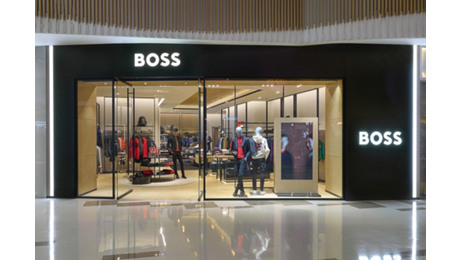
Or there is Hugo Boss, the Nazi Party member who made his fortune manufacturing the uniforms of the Nazi Party, later of the Wehrmacht and of course of the SS, which is why they looked so good.
Hugo Boss menswear shop in Dublin. The company founder was a close supporter of the Nazi regime and produced uniforms for the Nazi Party, Wermacht and SS. (Image sourced: Internet)
And of course, Bayer, the company that made Zkylon-B, the gas they used, still exists and is still rich. Following the war, 13 directors from the company were convicted of war crimes but were freed without serving their full sentences and took up their posts in the company.
The murderers continued in power with the tale of “collective guilt”. The Nazis were a political project of a sector of the German bourgeoisie to stop the rise of the Communists, any similarity to cattle ranchers declaring Puerto Boyacá the anti-capitalist capital10 is a mere coincidence, I suppose.
The reference to Germany as an example of reconciliation is a cheap tale. If Colombia goes down the same road, the surnames Mancuso, Uribe, Santo Domingo, Samper and Santos and the others will be the dominant surnames in the future, with their economic and social power intact.
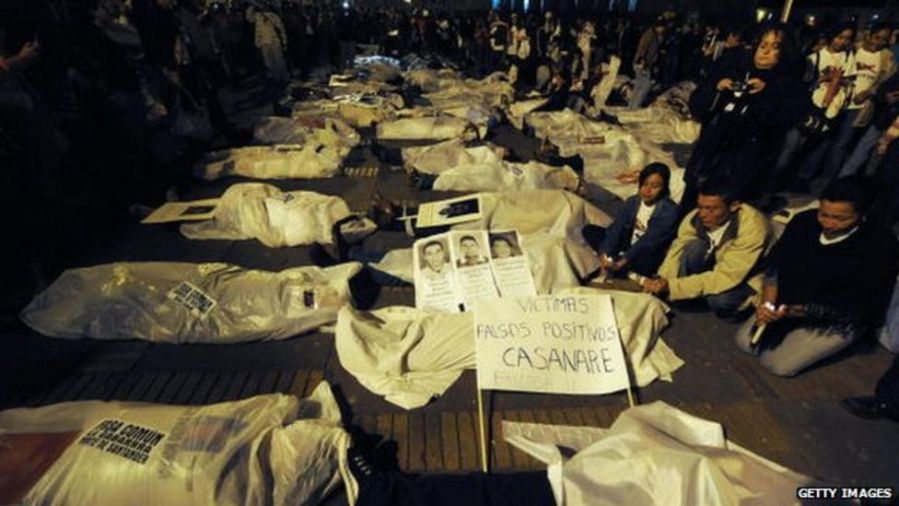
Protest about the army murders of civilians claimed as “positive” FARC guerrillas by relatives portraying the victims, Bogotá in 2009
THE “FALSE POSITIVES”
The CEV also deals with the issue of the “False Positives” and states something about the issue which is absolutely true that “If there had been ten, it would be very serious. If there had been one hundred, it would enough to demand a change of army. But there were thousands and it was monstrous.”11
But almost immediately it states that:
There was no law or written instructions that ordered it, but the soldiers who fired felt that they were doing what the institution wanted, due to the incentives and pressure that demanded immediate results with corpses, the publicity that they gave to those “killed in combat” and the protection given to the perpetrators.12
Yes, it is true that there was no law or written order that instructed them to do so. But we can’t expect criminals to leave us easy proof. There was no law, but there were incentives as they pointed out.
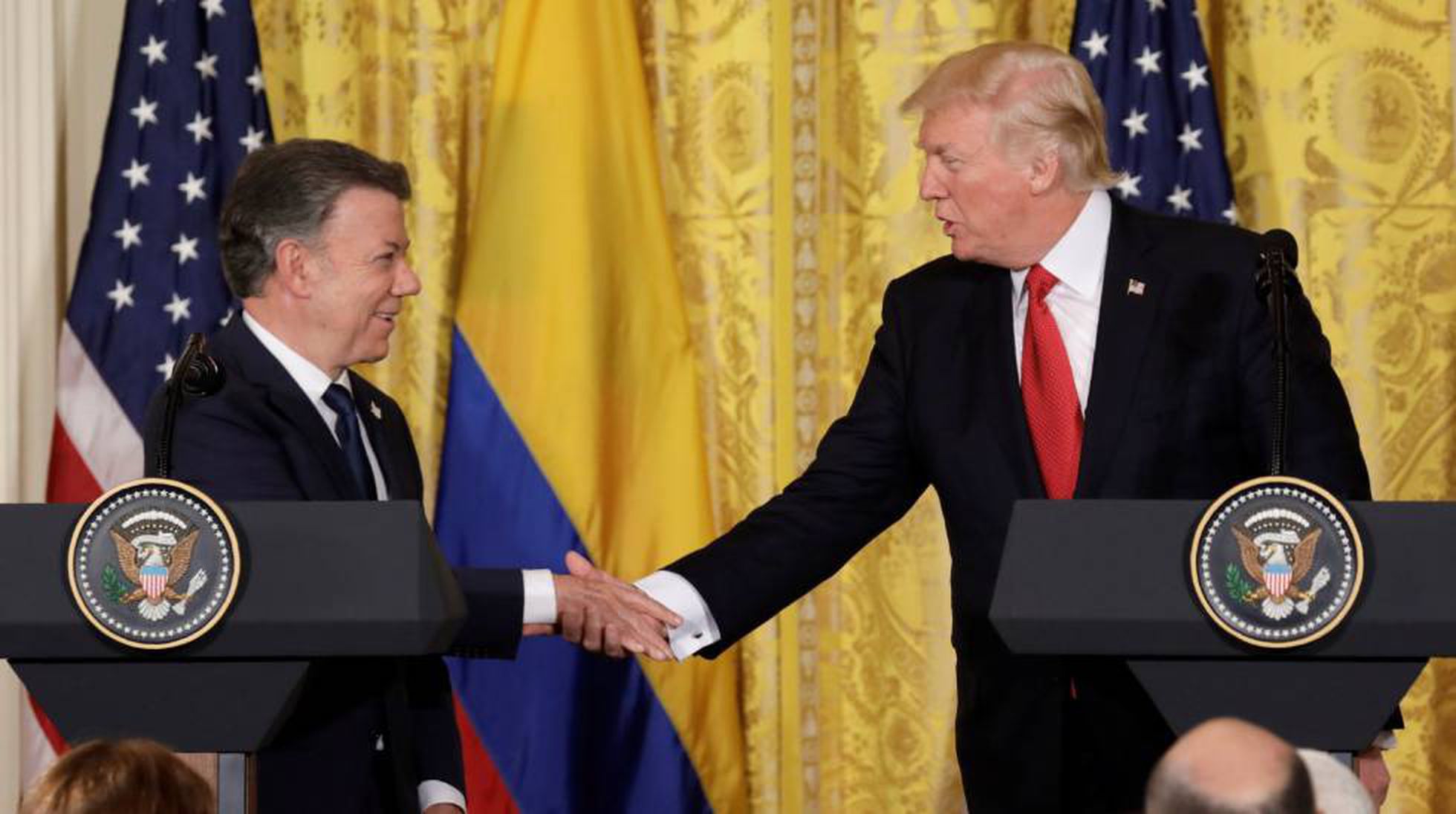
There were directives and a system for bonuses that encouraged the murder of civilians. Who authorised the payments? The then minister of Defence, Juan Manuel Santos. What does the document say about Santos?
The former president Santos – who was Minister for Defence from the end of 2006 to the end of 2008 – came to the Commission to contribute to the truth with his testimony, as ex-President and public servant, and he centred his intervention on the rigorous analysis of the False Positives to conclude asking for forgiveness from all the families and Colombia and invited the Armed Forces to ask the national and international community for forgiveness.13
It is not true, his intervention was not very rigorous and he ended by asking for forgiveness, as the CEV says, but at the same time he said he wasn’t to blame.
He took up Samper’s excuse regarding drug trafficking and said that it all happened behind his back and he lied on various occasions in his declaration to the CEV.14
Juan Manuel Santos, them President of Colombia shaking hands with Donald Trump, then President of the USA, in the White House 18 May 2017 (Image sourced: Internet).
IN CONCLUSION
Without a doubt the CEV will contribute to the knowledge of the conflict with its data, interviews and in some parts, its analysis. But the report as a whole will not be the truth about the conflict.
The CEV stated that “we don’t share the position, according to which, there are many truths that are equally valid regarding the same matter.”15
Yes, not all “truths” are equal, you have to analyse them, discuss them, contrast them with the facts and even look at who is enunciating them to see which perspective is closer to the truth, but in this case, it is not the “truth” of the CEV that is true.
Neither do I share the idea that any truth is of equal value no matter how powerful or well thought-of those who write that truth are.
3 “The Human Rights Information System of the National Trade Union School (ENS) recorded 15,430 violations of trade unionists’ rights to life, freedom and integrity in Colombia between 1 January 1971 and 29 September 2021. Around a fifth of the cases reported were murders: 3,288 trade unionists have been assassinated over the last five decades in Colombia.” https://www.equaltimes.org/colombia-has-signed-a-peace?lang=en#.YtXwJuzMI6E
9 Creuzberger, S. ‘Make life for communists as difficult as possible’ State-run anticommunism and ‘psychological warfare’ in the early years of the Federal Republic of Germany. Asian j. Ger. Eur. stud.2, 9 (2017). https://doi.org/10.1186/s40856-017-0020-7
10 The location was the birth place of the paramilitary model that arose in the 1980s and was avowedly right wing. There was a sign on the way in to it, that said “Welcome to Puerto Boyacá, Anti-Communist Capital of Colombia.”
Irish Republicans and revolutionary Socialists have traditionally been opposed to the commemoration of the dead in the “Great War”, WWI. Recently Michelle O’Neill, top Minister in the British colonial political regime in Ireland with the Lord Mayor of Belfast, both members of the Sinn Féin party, laid a wreath at the WWI memorial in Belfast, to the bewilderment of some and the disgust of others. But actually those emotions are misplaced, since the leadership of the Sinn Féin party were never Socialist and are no longer Republican.
The long-held position of Irish Republicans and Socialists that WWI should not be commemorated is however illogical and runs against history. The conflict was a hugely-important event in such areas as military, social conditions and mores, medicine, politics and economics.
The toll of WWI is around 40 million military and civilian casualties of which 20 million died. Of those, around 10 million were civilian dead. How can an event of such historical magnitude not deserve commemoration?
We should certainly commemorate the fact that a small group of monopoly capitalists, aristocracies and monarchies, in the course of an argument about how to divide up the world among themselves, sent millions of ordinary people, mostly workers, to kill one another to settle the argument. People who had no quarrel with one another and nothing to gain from killing one another; people whose real verifiable enemies were those very people who were mobilising and arming them before sending them forth to kill or be killed.
The conditions of the working classes at the time they were thrown into the killing arena should be commemorated. The lies that the war was fought for democracy and freedom of small nations should be exposed. The disciplinary court-martials and executions within the armies should be revealed, along with the treatment of conscientious objectors. The propaganda used for recruitment and to keep the home populations happy should be deconstructed and exposed. The fact that capitalism ends up as imperialism, which in turn causes war, should be made clear to all.
That wars are not alone fought for profits but that huge profits are made in the course of war is a grotesque fact that should become widely known.
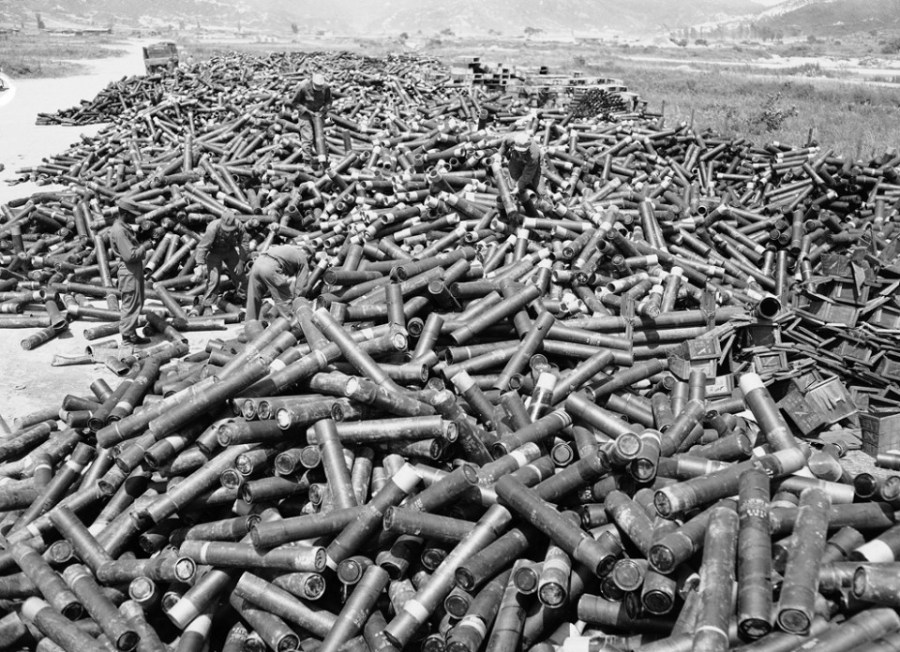
A pile of used artillery shells used in WWI — all manufactured and paid for, exploded, more ordered, paid for, fired ….. Part of the huge profits made during imperialist wars. (Photo sourced: Internet)
All of this was true of WWI and is true (to one extent or another) of the wars caused by imperialism today, whether in Somalia, Western Sahara, Palestine or Ukraine. But now, in addition to the huge death toll of WWI, we have the possibility of the destruction of human cities around the world — and even of ecological disaster — in yet another war.
We should expose the fact that far from encouraging us away from war, WWI commemorations are for the most part about concealing those salient facts and encouraging us to be proud of how our forebears were conned into killing one another. By whipping up reactionary nationalism1, their commemorations make us vulnerable to being conned into fighting further wars, to agree to be sent to other countries to kill or maim people like us in other countries – or to be maimed or killed by them.
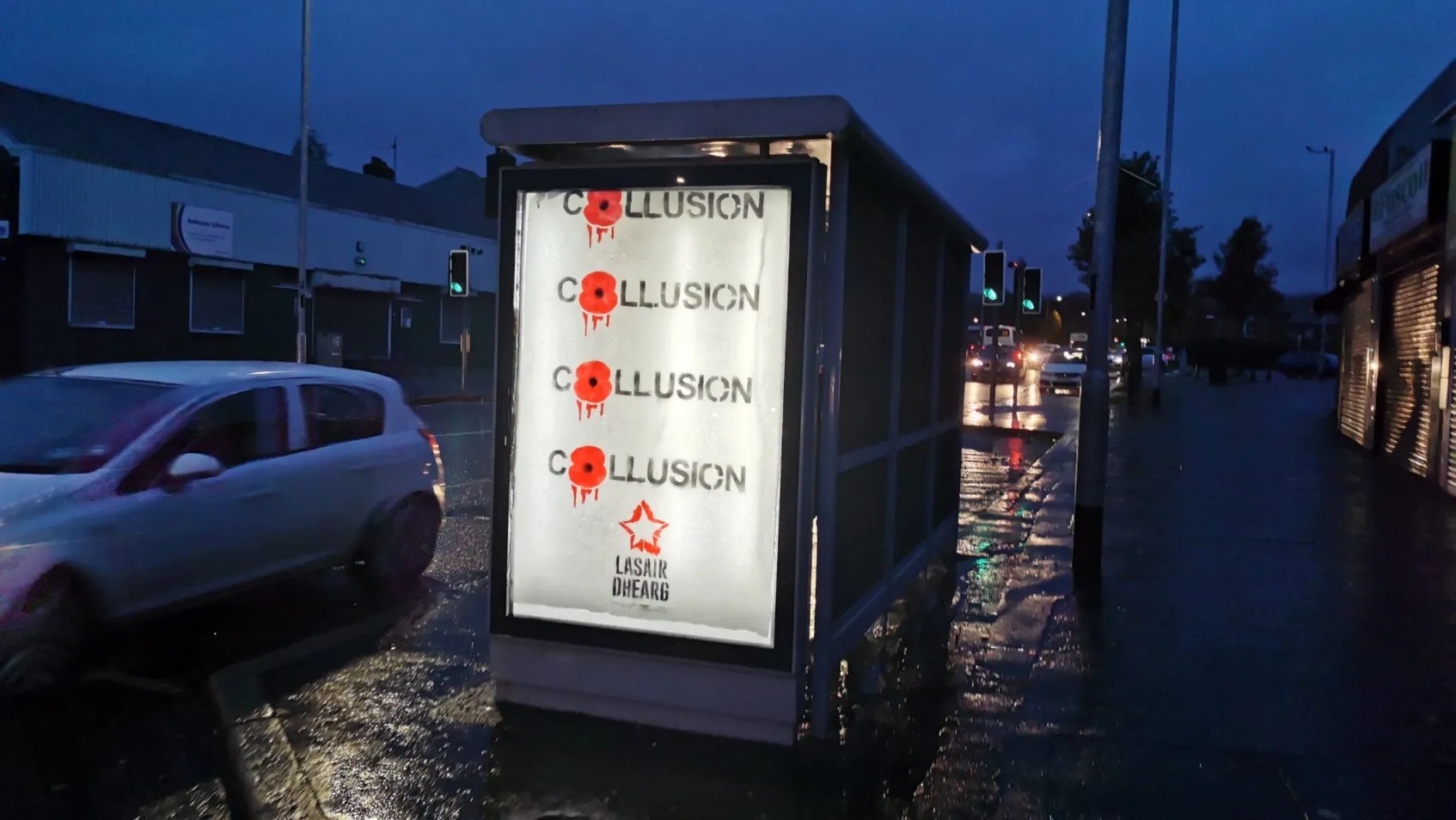
An innovative protest by the socialist Republican group Lasair Dhearg which however confines itself to pointing to the occupying British Army’s collusion with Loyalist murder gangs. (Photo sourced: Internet)
Commemorating the truth about imperialist wars past and present mean rejecting the wearing of the Poppy symbol. The Poppy is not about commemorating the dead in wars, as it is sold. This promotional emblem of the British Legion only commemorates the British soldiers who have been killed in wars – it does not commemorate all the soldiers of the colonies (for example Ireland) or the Commonwealth who died in the wars, not to mention all the civilian auxiliaries helping cook, clean, carry, dig, build etc for the British armed forces. The Poppy does not commemorate the dead soldiers of Britain’s allies, for example France, USA or Russia in the case of WWI. It does not commemorate the soldiers or auxiliaries of the hostile states who were killed, which might seem natural, until we ask ourselves why not, if the idea really is just to commemorate the dead soldiers in war. Most tellingly, the Poppy does not commemorate the millions of civilians who have been killed in wars – actually more than the total number of soldiers and a percentage of war deaths that is growing with every war.
The real role of the Poppy is to build social support for the imperialist British armed forces, including helping recruitment — so in other words, the emblem and its publicity is actually helping to build support for future armed conflicts.
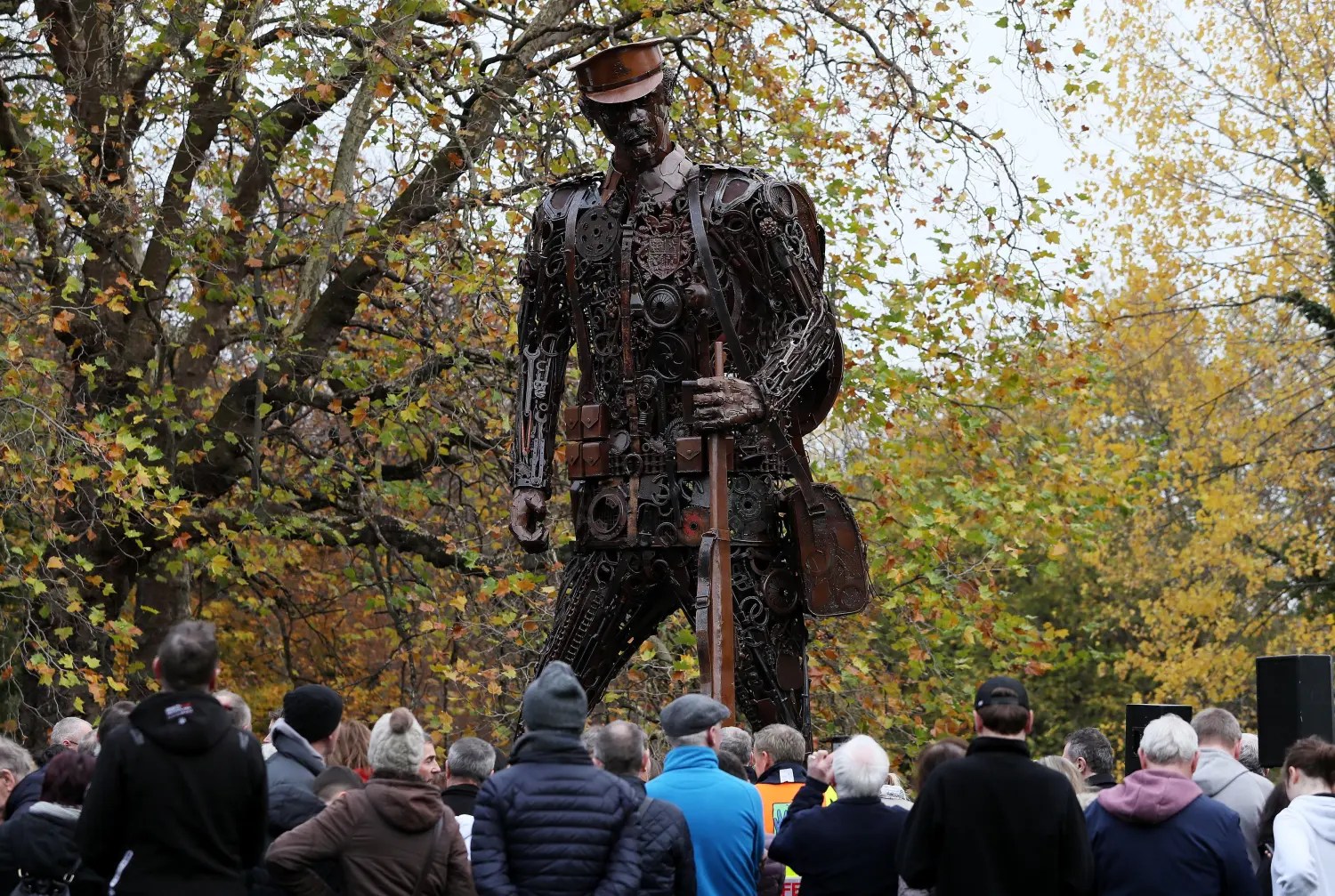
The WWI soldier sculpture made from scrap metal, pictured in Stephens Green, Dublin. Republicans protested its siting in a 1916 battleground, (Photo sourced: Internet)
Not addressing the nature of imperialist war and just boycotting any idea of commemoration leads to missed opportunities. A few years ago a sculpture of a WW1 British soldier constructed out of scrap metal was installed in Stephen’s Green, a recreational park in Dublin’s city centre. Some Irish Republicans staged a protest around it in which they castigated it being located there in what had been a 1916 Rising battleground. They were correct in the historical reference but was that all that could be said about that war? Would most of the tourists passing by relate to that 1916 reference or would the whole international horror of imperialist war not have engaged them more?
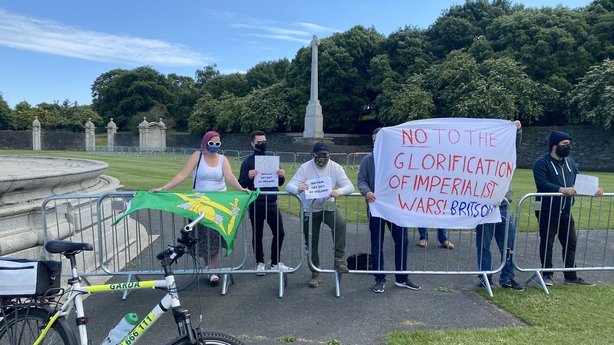
A small protest emphasising the nature of WWI commemorations at one such attended by SF representatives (the commemoration) in the Irish National (sic) War Memorial Gardens 10th July 2021 (Photo: RTÉ)
We should indeed commemorate WWI but we should do it in the framework laid out, of exposing what the wars are about, who they benefit, what class contains the main victims – and not just the dead but also the injured, many of them crippled for life.
That is not how the ruling elites commemorate war and it is not how Michelle O’Neill and Tina Black did it. Michelle O’Neill said that she did this symbolic act in order to demonstrate that she is going to be “a First Minister for everyone” – clearly meaning Nationalist and Unionist. Liberals may laud O’Neill for that but one cannot represent national liberation simultaneously with colonialism, republicanism at the same time as loyalism, democracy at the same time as reactionary sectarianism. Making a war wreath green does not change its nature. Sinn Féin will often seem to try to present themselves as all things to different groups of people but essentially they are serving Irish Gombeenism2 in the 26 Counties and English colonialism in the Six.
Sinn Féin members Tina Black and First Minister-in-waiting Michelle O’Neill as they approach the WWI memorial in Belfast to lay a wreath. (Photo sourced: Internet)
In addition, workers and lower middle-class people from the Protestant or Unionist community were also killed and maimed in imperialist war. How does concealing the reality of war help those people?
End.
FOOTNOTES
1I use the term in the sense that not all nationalism is reactionary.
A crowd gathered in Dublin today to commemorate the Free State opening fire on the Four Courts on 28th June 1922, an event that began what is usually called “the Civil War” which lasted until 1923 (with State assassinations until 1924). The UK supplied the cannons and shells used by the Free State’s “National Army” along with munitions, including small arms and ammunition, armoured cars, army lorries and even coastal naval vessels. The conflict has also been called a “counterrevolution” and “the UK’s proxy war” with more Republicans executed by the new Irish State1 in that conflict than had been by the British State over the whole 1916-1921 period.
Section of NGA march outside Croppies’ Acre (Photo sourced: Internet)
One hundred years ago this month, the IRA under the command of Rory O’Connor occupied and fortified the Four Courts complex, last occupied as a fighting post during the 1916 Rising. The Anglo-Irish Treaty partitioning the country and giving the Free State the status of a Dominion country had been narrowly accepted by the delegates to the First Dáil, the Irish Parliament previously banned by the UK State. However by far the majority of the military part of the Irish resistance – the IRA, Cumann na mBan and na Fianna, along with the remnants of the Irish Citizen Army – were opposed to the Treaty. The occupation of the Four Courts was seen by the Free State government as a challenge to its authority and by the British Government as a threat of anti-colonial struggle being renewed. Both parties were hostile to any radical republican, socialist or socialist-republican program.
Free State Army attacking the Republican garrison of the Four Courts with artillery, rifle and machine-gun fire. (Photo sourced: Internet)
On 28th June the Free State opened fire from British cannon on the Four Courts from Bridge Street on the south side of the river and the Civil War – or Counterrevolution – had begun. By the time the Republicans conceded defeat (and some assassinations continued even after it officially ended) perhaps around 1,300 had been killed. From January 1922 to April 1924, according to the Republican Roll of Honour, 426 anti-Treaty Volunteers had been killed, some 25 of these died fighting British and Northern Irish forces. Most anti-Treaty dead were IRA Volunteers, but some were Na Fianna members and four were women of Cumann na mBan2.
Poster commemorating one of the Republicans killed by the Free State (Photo: D.Breatnach)
One of the commemorative posters attached to lampposts (Photo: D.Breatnach)
On the Free State side just under 800 died, of whom 488 fell in enemy action, others due to accidents or illness, while seven were executed having deserted to the Republican side. “To this total should be added a small number of police, including four from the Civic Guard (later renamed Garda Síochána), four from the Criminal Investigation Department and two from the Citizens’ Defence Force, who were killed from 1922-19243.”
The NGA rally, the MC (Photo: D.Breatnach)View of the crowd at the rally outside the Four Courts (Photo: D.Breatnach)
Dorney remarks on omissions in the Last Post record and concludes: “Even allowing for this, though, the total of anti-Treaty IRA dead in the Civil War is not likely to be much more than about 500, of whom 81 died before Free State firing squads and more than 100 were summarily executed in reprisals.”
(Photo: D.Breatnach)
Many Irish Republicans also emigrated to avoid repression or because they were being denied employment.
The Irish State today is a direct descendant, legally and in other ways, of the Free State of 1922 and all periods since.
Senior Garda officer taking notes while speakers are addressing the crowd (Photo: D.Breatnach)
The commemorative event in Dublin today was organised by the National Graves Association (Cumann Uaigheanna na Laochra Gael), an organisation which since its founding in 1926 has been maintaining the graves of Irish patriots, arranging for the installation of gravestones, plaques and monuments and also organising commemorative events.
Before marching to the Four Courts, participants formed up in groups in the road outside Croppies’ Acre, a public park over a mass grave of victims of the English state’s repression of the United Irishmen and their supporters in 1798, now across the road from the Collins Barracks National Museum. They were led by a lone piper and colour party, followed by people in double ranks flying Starry Plough flags and carrying banners of history and conservation groups, along with some other flags, including that of Cumann na mBan.
Section of the lineup waiting to start, outside Croppies’ Acre (Photo: D.Breatnach)
At the rally outside the Liffeyside of the Four Courts, the organisers had an MC with number of speakers to read out the 1922 Proclamation, the lyrics of The Soldiers of Twenty-Two4 and Tim Horgan to give a keynote oration. At least one floral wreath was laid in honour of those who fought there and a number of posters attached to lampposts commemorated the three Volunteers who were fatally wounded there: Thomas Wall, Joe Considine and Sean Cusack.
Reading the lyrics of Soldiers of Twenty-Two (Photo sourced: D.Breatnach)
It is almost certainly the case that it is the NGA which has erected the majority of patriotic struggle commemorative plaques around the country, with most of the remainder being organised by local authorities, local history groups and old comrades’ associations – a very small proportion being the work of the State. As stated on its website, the objectives of the Association have always been: to restore, where necessary, and maintain fittingly the graves and memorials of our patriot dead from every generation; to commemorate those who died in the cause of Irish freedom; to compile a record of such graves and memorials.
The NGA’s general alignment is unequivocal: “Only a 32 County Irish Republic represents the true aspiration of those who gave their lives for Irish freedom.5“
Reading the 1922 Proclamation (Photo: D.Breatnach)
One might assume that every participant at the event today was of a definite political bent, yet not a single party or political organisation banner was to be seen on the march or at the rally. This is because participants were asked in advance not to bring any banners or placards of political organisational allegiance. As the Chairperson of the rally informed the audience, the NGA is not affiliated to any political party or organisation and furthermore does not accept contributions from any such nor from the State – in order to continue to guarantee the NGA’s independence. In fact, members of its governing body are not even permitted to belong to a political party. A senior Garda officer however, of least at Inspector rank, took down details in his notebook as the rally was addressed by speakers.
Main speaker, Tim Horgan (Photo: D.Breatnach)
Patriots of the United Irishmen, the Young Irelanders, the Fenians, the Land League, na Fianna Éireann, Irish Volunteers, Cumann na mBan, IRA, Official and Provisional IRA, the Irish National Liberation Army etc have all been commemorated by the NGA. According to Wikipedia, since its founding, the NGA has erected, or accepted into its care, over 500 monuments and memorials throughout Ireland.
One of the participants takes a rest
Banner of one of the groups attending (Photo: D.Breatnach)
Some of those in attendance (Photo: D.Breatnach)
A number of other Civil War/ Counterrevolution commemorative and discussion events will be taking place at least during this year, two of which will take place next week (see photos of leaflet).
The Gardaí remained at the scene as people dispersed. Passing by again shortly afterwards, we found the floral wreath had been removed.
End.
Lowering of the flags in honour of the martyrs (Photo: D.Breatnach)
Civil War/ Counterrevolution commemoration (image: photograph of flyer)
Forthcoming talk (image: photograph of flyer)
FOOTNOTES
1Official executions are usually listed as 81 or 83, these having been subjected to some kind of military judicial process (but without any jury). However, apart from IRA fighters killed in battle, a number of captured combatants were murdered (such as those of the Ballyseedy Massacre on March 7th 1923) while known activists were assassinated by Garda-Army squads operating from Oriel House. Often, the murdered had been tortured first.
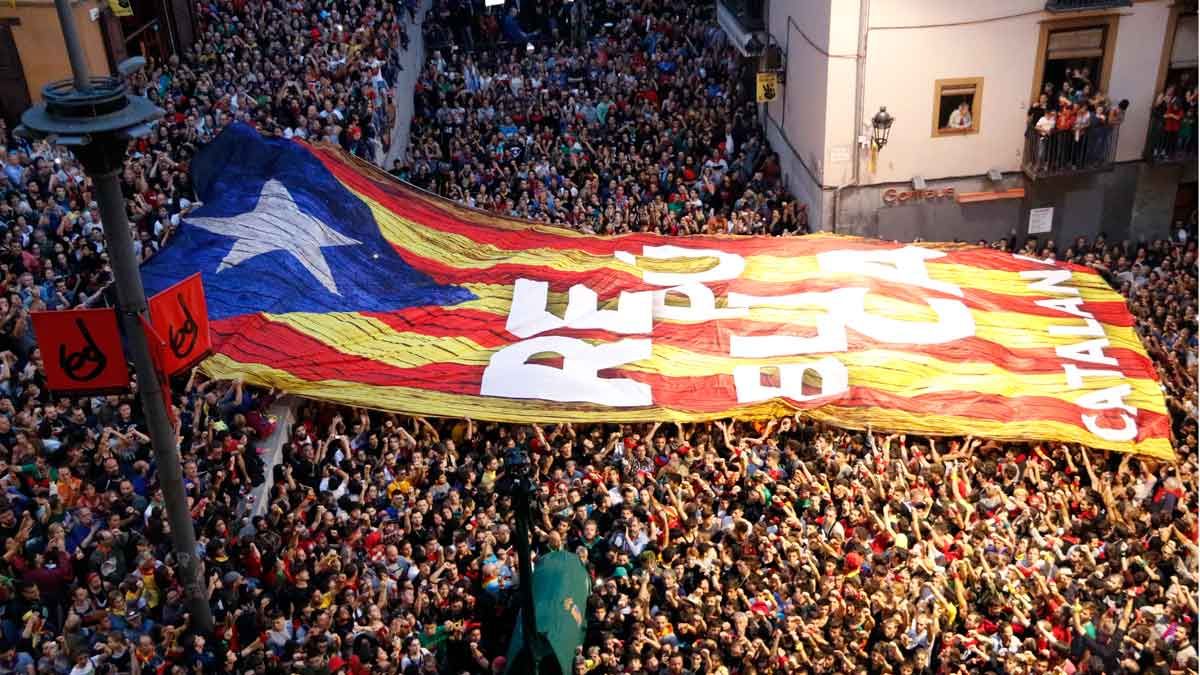
This year’s celebration of the Patum 2022 festival in Berga has sung and chanted for independence. With the square full of about 6,000 people on Thursday, the massive Catalan independence flag, the Estelada (with the white star in a blue triangle)1 was launched across the crowd as they sang the Catalan national anthem, Els Segadors2 (the Reapers).
With the song finished, some began to shout “independencia” (independence) and this was quickly taken up by the mass, revisiting the tradition of protest that existed before the pandemic. The Catalan independence movement has been somewhat becalmed of late, with serious divisions between the two main nationalist political parties and a lack of grass-roots activity.
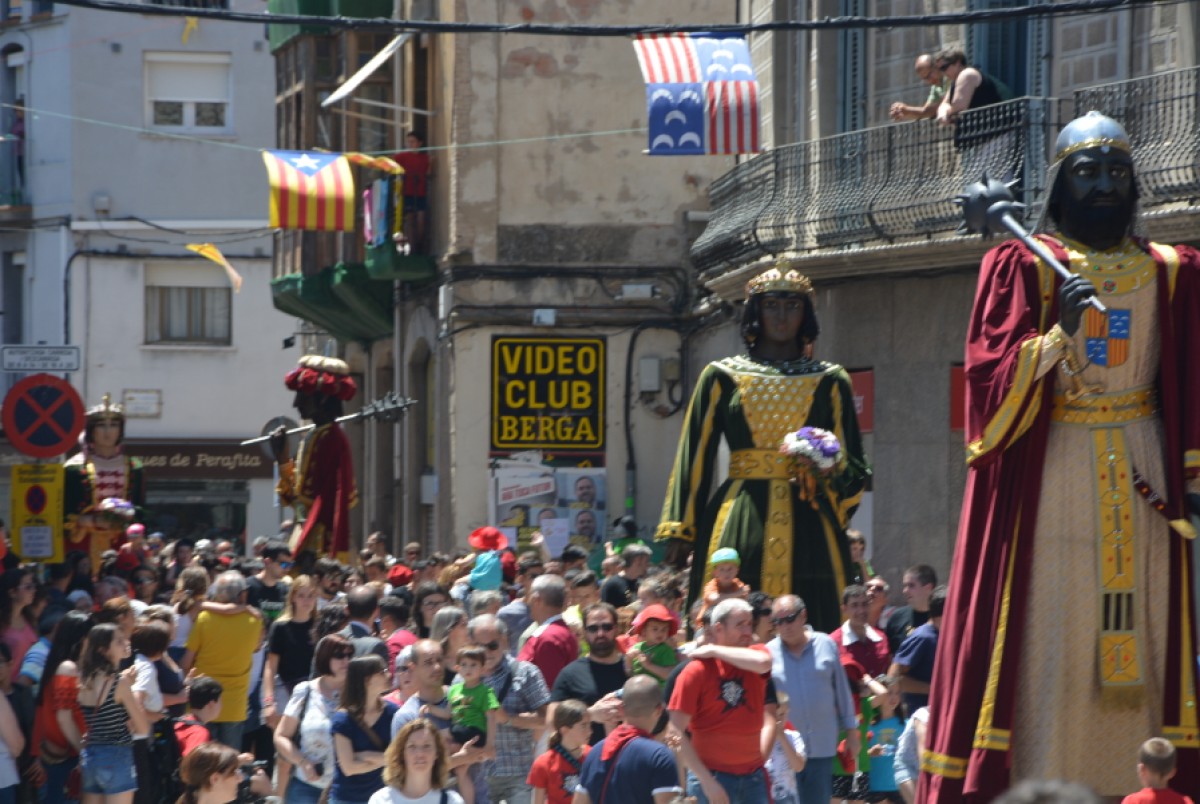
Scene with traditional giant figures from the festival (Photo sourced: Internet)
The Patum festival is a traditional Catalan festival of great importance and is recognised by UNESCO as a Masterpiece of the Oral and Intangible Heritage of Humanity. “The fiesta coincides with Corpus Christi and includes a whole series of theatrical representations, characters and figures that fill the town of Berga every spring. It is a religious commemoration that dates back to the Middle Ages, which has managed to preserve both its religious and profane roots.
“La Patum de Berga has been held annually for centuries during Corpus Christi, and includes street entertainment and shows with different figures typical of these fiestas (giants, “big-heads”, eagles, guitas (dragons), plens (devils)). Fire and dance play a central role. The fiesta really gets underway on the Thursday of Corpus Christi, with the Ceremonial Patum. The salto de plens is the apotheosis of the fiesta. It represents an infernal orgy where fire devils jump to the rhythm of music. The following day is the Children’s Patum.”3
Scene with the giant Catalan independence flag during the singing and chanting at the festival on Thursday (Photo sourced: Internet)
Berga is in the Barcelona region but over 107km from the city (and about half-way to Andorra). The Patum Festival of this year 2022, which began Wednesday, June 15 and will last until Sunday, June 19, was expected to be even more crowded than usual after two years in a row without being able to celebrate it due to the pandemic.
1The other Catalan nationalist flag commonly seen is the Vermelha, with a red star and no blue. The white X on a black background is also flown but more rarely, it draws on history also and signifies ‘death before surrender’.
2An anarchist, Emili Guanyavents won the competition to compose the national anthem lyrics in 1899 and based it upon a traditional historical cultural expression arising out of an uprising of Catalan rural workers in 1640 against the chief minister of Philip IV of Spain. The lyrics are, as might be expected, very militant and, since even the Catalan lanugage was banned, the song was of course banned during the four decades of the Spanish Franco dictatorship
Many public figures have been condemning the content of a video live-streamed from an Orange Order Hall in which people were singing lyrics mocking the murder of an Irishwoman on her honeymoon in Mauritius.
There is nothing new I can add to the condemnations of this disgusting exhibition. But what a great many of the condemnations lack is context; i.e they treat this exhibition as though it were some aberration from the norm of Loyalism – it was not, it was exactly in line with and an expression of the backwardness, sectarianism, right-wing racism, homophobia and general phobia that is the very essence of Loyalism.
BACKGROUND OF LOYALISM AND THE ORANGE ORDER IN IRELAND
The planters and settlers that English1 colonialism installed on Irish soil were intended to control the indigenous population along with those “gone native” descendants of the Norman conquerors. A number of attempts were made to correct those Normans who had been ‘corrupted’ by the Irish and had become “more Irish than the Irish themselves” and one of the most infamous attempts through law, the Statutes of Killkenny in 13662 laid out a long list of behaviours expected of the “degenerate English”, mostly in terms of things they were to cease doing: in sum they were to cease integrating with the indigenous people in custom, language and law.
Outside of the Pale3, the cities, such attempts failed in the main and the next big effort was the Plantations. Using the failure of the Norman Irish and Gaelic lords to adapt to the Reformation, now an English state religion, their lands were confiscated and parcelled out to big landlords who then rented them out to smaller landlords and small-holders – and none of those were to be Irish. In fact, they were required to be English-speaking, Protestant in religion and to build their towns and important buildings as strongholds4. And not to even employ native Irish, in case these should corrupt the settlements from within.
The intentions of the Plantations were made quite clear and the settlers were, from the outset to be a means for a tiny minority of feudal and financier elites to control and exploit the vast majority indigenous population through the use of a middle stratum which was to be separate from and considered superior to natives in religion, culture, custom, landholding, legal rights – and allegiance.
These plantations met with mixed success – one of the problems being the scarcity of labour against a prohibition to employ the natives – but the problem of a conquered but not reconciled native majority remained, even after its cultural, legal, political and military leadership had been eliminated. And then a section of the settlers themselves, many descendants of Cromwellian conquerors and their supporters, began to have aspirations to control their own markets. They attempted to expand the Irish Parliament – then open only to adherents of the State religion, the Anglican communion — to include representation from the larger group of dissenting Protestant sects5 and of the huge majority of Irish Catholics.
The attempt, under the leadership of the moderate and ultimately Crown-loyal Henry Grattan failed, through a mixture of sectarianism, fear of being eventually dispossessed of their stolen lands – and outright Crown bribery. The most determined of the Protestant patriots then turned to revolution and led the United Irishmen in the uprisings of 1798 and 1803, with a credo of unity for an independent and republican Ireland, regardless of religion6.
CREATION OF THE ORANGE ORDER
But the British ruling elite saw which way the wind was blowing, foreboding its overthrow in Ireland if its garrison population joined with the majority and, as well as making military and spying preparations, the British took important ideological and social action.
Created in 1795 as what might be seen today as a kind of independent Ku Klux Klan organisation to keep down the ‘uppitty native niggers’7, the Orange Order quickly became (as the Klan did in some areas too) a police force on its own dissidents. And, as the Klan enjoyed the tacit support of the patrician Southern US elite, the Orange Order has been supported by the settler elite in Ireland from its inception. This was formalised with the Order’s central control over all previously independent lodges in 1798, the year of the first United Irish uprising.
After the defeat of the United Irish uprisings, the Order became an active persecutor of any sign of resistance not only among the native Irish majority, the Catholics but also – and in some areas chiefly – a hunting down of any signs of Protestant allegiance to the United Irish or other ‘suspect’ behavour such as tolerance of Catholics. Those Protestant followers of “Unitedism” that did not emigrate to the USA and Canada had to keep their heads down or face the consequences, as did Roddy McCorley, hanged on Toombridge in Co. Antrim on 28th February 1800.
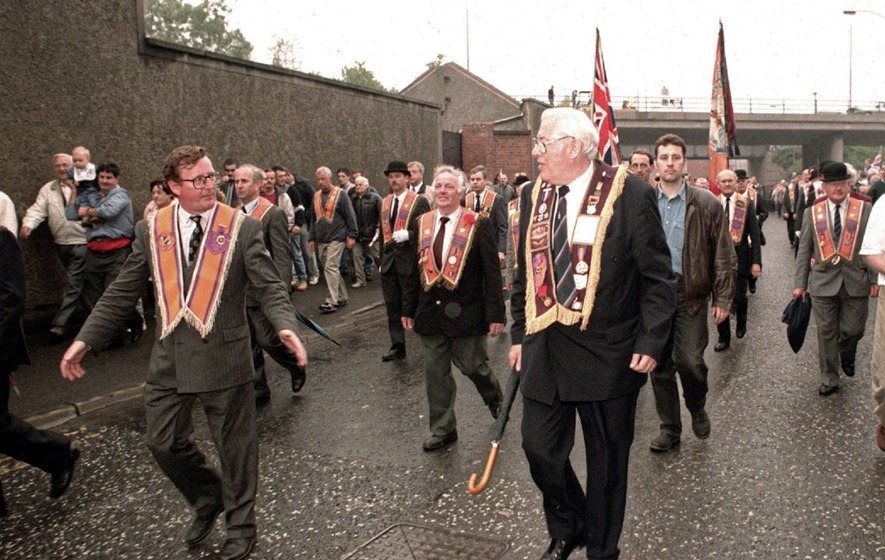
March 1995: Two future First Ministers of the colonial statelet on the sectarian Orange march along the Garvaghy Road: David Trimble (left), First Minister from 1998 to 2002, and the leader of the Ulster Unionist Party (UUP) from 1995 to 2005; Ian Paisley (right), leader of the Democratic Unionist Party (DUP) from 1971 to 2008 and First Minister from 2007 to 2008. (Sourced: Irish News)
REACTIONARY IN INSPIRATION AND TRADITION
The Orange Order drew its colour and other visual paraphernalia in association with William of Orange (1650 – 1702), who was crowned King William III by the British Parliament, the forces of which, along with his own Dutch ones, he led in the British civil war against those of King James II of England and the latter’s Irish and French allies. Orange was the colour of the Dutch royal family of Orange-Nasseau and therefore of the royalist party in Holland, in opposition to the republican party there8.
Following his defeat of the Jacobite forces in Ireland William III brought in the Penal Laws, the body of Anglican supremacy and anti-Catholic legislation which were to survive in greater or lesser form from 1695 to 1829.
Loyalists celebrate annually with sectarian triumphalist parades in the Six Counties the victory of the Williamite forces at the Battle of the Boyne on July 12th 16909. Loyalists imagine the Boyne victory was of the Protestant religion over Catholic “Papism”, unaware that the victory was celebrated by special mass in the Vatican and in some other Catholic cities. The Jacobite war in Ireland was part of the Nine Years’ War in Europe and forces of Protestant principalities and kingdoms could be found on either side, as could those of Catholic persuasion.
Loyalists attacking their own colonial police for eventually, in 2002, impeding their “right” to march in triumphalist sectarianism around Drumcree and to harass and terrify children attending a nearby Catholic school. (Sourced: Belfast Telegraph)
Their unequivocal message to their non-unionist neighbours is “This is our place, not yours. If you want to live here, accept what we give you and keep your heads down.” This fostered sectarianism has penetrated even trade unions, ensuring that wages and social conditions in the Six Counties have been the worst in the whole of the UK.
Mickey Hart and daughter Michaela celebrating the Gaelic football 2008 All-Ireland victory of Tyrone over Kerry (Sourced: Internet).
WHY THE LOYALIST MOCKERY OF THIS MURDER?
The video which directed such recent public attention on the behaviour of some Loyalists was of a song sung communally in which the lyrics mocked the murder of Michaela McAreavey who apparently surprised a thief in her Mauritius hotel room on 11th May. Probably not a single person celebrating that murder knew the woman or had any reason to hate her for anything she had done. What they knew was that she was the daughter of Micky Harte and that he was the manager of the Tyrone County Gaelic Football team10. Gaelic football11 is an Irish traditional sport and, since Loyalists eschew anything knowingly Gaelic, Harte is also probably of Catholic background; therefore almost certainly would have been his daughter Michaela too. Incredible though it may seem to many, that was enough to inspire that outpouring of hatred – a hatred that is always and has always been there in Loyalism.
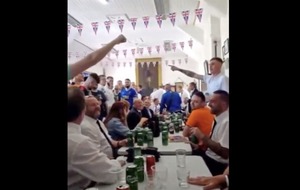
The scene in the Orange Hall with Loyalists singing in mockery of the murder of Michaela McAreavey (Sourced: Internet)
It seems clear that the song, the lyrics with which much of the audience in the video seem familiar, was sung in the Orange Hall in Dundonald12, Co. Down which, like Tyrone, is one of the Six Counties currently forming the British colony in Ireland.
According to media reports, “a spokesman for the Grand Orange Lodge of Ireland criticised the video and also confirmed that an investigation would now take place.“The video currently circulating on social media relating to the murder of Michaela McAreavey is utterly abhorrent and the Orange Institution condemns the content without reservation,” a statement read.“The behaviour of those involved and their actions have no place in our society and certainly do not reflect the ethos of our organisation.”
On the contrary, as people who live in or near areas where the Orange Order holds sway will know, the behaviour exactly “reflects the ethos of the organisation” and of the general ideology of Loyalism.
Dundonald Orange Hall photo on its FB page (Sourced: Internet)
The central ideology of the Orange Order has always been not only a phobic hatred of Catholics but also of anything that might smell of egalitarianism, equality or progressive social ideas. It and its adherents for generations have held triumphalist sectarian marches deliberately routed to march through predominantly Catholic residential areas and past Catholic churches, these marches escorted by the sectarian colonial gendarmerie13, often forced through against local opposition.
For decades, the Orange Order and Loyalism in general opposed equal treatment and civil rights for Catholics in terms of employment, housing, franchise, education and law. That breeding ground gave rise to the Loyalist terror murder squads, operating for decades in conjunction with colonial police and British Army14.
True to its reactionary origins, the Orange Order and Loyalism in general have a strong emotional attachment to British Royalty and to an ethos of British Empire and colonialism. But Loyalism has also opposed all progressive social innovations and legislation, even those emanating from its supposedly ideological homeland, the rest of the UK and, in many cases delayed its implementation in the colony for years15.
Loyalism has been a sectarian influence in the game of soccer not only in Ireland but in Britain, with a triple alliance of sectarianism and racism between fans of football clubs Linfield, Rangers and Chelsea.16 The racism and reactionary ideology of “Hillbillies17” in the USA are also attributed to origins in Irish Loyalism.
Loyalism has also been characterised by racist attitudes and attacks on ethnic minorities in parts of the Six Counties independently of religion. Loyalism lines up to oppose anything they feel that is supported by the hated “taigues” or “Fenians” (their codewords for Catholics), for e.g Palestinians, Basque nationalists, inquiries into killings by the British Army ….
Despite the scrambling of Unionism – the Orange Order, politicians, Linfield FC management — to disassociate itself from the disgusting exhibition of anti-Irish and anti-Catholic hatred expressed in their ‘humorous’ mocking of the murder of a young woman, the song and video were a completely cogent expression of Loyalism, the social prop of Unionism. They were a true reflection of the history and underlying ethos of the Orange Order and of the sectarian statelet created by the British ruling class as a garrison and permanent foothold in Ireland.
End.
FOOTNOTES
1Later one can talk of British colonialism and imperialism but in the beginning it was the English feudal and financier classes that set out to conquer their neighbours in Britain and across the sea in Ireland. The Crown was always primarily the English Crown, even when it became also formally that of Scotland and, later, of Ireland.
2i.e not even two centuries after the Norman invasion in 1169.
3The area of administration of the occupation, originally a fortified area with Dublin Castle at its centre.
4One can still see the pattern of settler towns with the buildings constructed around a square or “diamond” becoming easily converted into the walls of a fort, the main roads leading in and out fairly easily barricaded even with carts and waggons. Native Irish towns had no such construction, often running along a street or gathered around a crossroads, river bank, port etc.
5In particular the Presbyterians but also Methodists, Unitarians, “Quakers” (Society of Friends) and others.
6The unity of “Protestant (i.e Anglican), Catholic and Dissenter”.
7“Uppitty niggers” was a racist white term in the USA to describe Americans of African descent who were unwilling to be treated as second-class citizens or even worse. For such people to become thought of as “uppitty” frequently meant a range of punishments that included beating, jail and lynching. The Ku Klux Klan is a white Protestant supremacist and extremely right-wing organisation in the USA, formed after the defeat of the Confederacy and understood as having three distinct phases, the last one being also current. Despite a history of using extreme violence, it is not banned in the USA.
10 Mickey Harte (born 1952) is a Gaelic football manager from County Tyrone, Ireland who currently manages the Louth county team, having managed the Tyrone county team from 2002 and, at his resignation in 2020, was the longest-serving manager then active with the same team in inter-county competition.
11Gaelic football is one of four traditional sports regulated by the Gaelic Athletic Association/ Cumann Lúthchleas na hÉireann, with 2,200 clubs spread over all of Ireland and, with high community involvement is the largest amateur sporting association in the world
13Armed police force, formerly the Royal Irish Constabulary, later the Royal Ulster Constabulary, currently “Police Force of Northern Ireland.”
14See for example Lethal Allies – British collusion in Ireland (2013) by Anne Cadwaller. Loyalists killed the most people in one day during the 30 years’ war with the Dublin & Monaghan Bombings, 17 May 1974. Despite their self-promotion as fighters against the IRA, nearly all of their victims have been unarmed civilians, often randomly-chosen in Catholic residential areas.
15For example, the 1967 Sexual Offences Act only applied to England and Wales – it was resisted in Scotland and the Six Counties colony. Decriminalisation reached Scotland in 1980 and, after a complaint to the European Court of Justice and a judgement against the statelet in 1981, homosexuality in private was finally decriminalised in the Six Counties the following year – 15 years after its original decriminalisation in England. Similarly with lesbian and gay rights to civil marriage, introduced in England and Wales in 2013; in Scotland in 2014 but couples in the Six Counties had to wait until 2020, seven years after its introduction in England.
16Linfield FC is based in south Belfast in the British colony, Rangers FC in Glasgow and Chelsea FC in SW London. But there are also sectarian divisions among fans such as those of Rangers/ Celtic to be found also in Edinburgh between and Hibernian and Hearts (Midlothian) clubs and even between Everton and Liverpool as well as Manchester City and Manchester United.
17As in “Billies”, i.e followers of King Billy (William of Orange) who are living in the hills.
In an article by Virginia Harrison on May 16th, in a context of praising the resistance of Ukrainian forces in Mariupol and in which she stated that the Azov Regiment had in the past (italics mine) had “nationalist far-right affiliations” (as distinct from fascist), she went on to state the following: “The regiment …………….. was a militia formed to fight the Russians after the invasion of Ukraine in 2014 but has become a unit of the Ukrainian national guard.”
Apart from failing to inform readers when and how the Azov allegedly dropped their “far-right affiliations”, the Guardian journalist is claiming the unit was formed to resist a Russian “invasion of Ukraine in 2014”!
Donbas resistance fighters near Donetsk Airport May 26, 2014. (photo credit- AP/Vadim Ghirda). According to the accompanying text, the Ukrainians hit the defenders with airstrikes.
WHAT REALLY HAPPENED
Russia invaded Ukraine early this year, 2022. The armed conflict in Eastern Ukraine began in 2014, i.e eight years before the Russian invasion. Prior to the time of the Russian invasion in early 2022, over 14,000 people had already been killed in the conflict.
It was not Russia that began that conflict but the Ukrainian far-Right and fascist forces supported by a section of the Ukrainian oligarchy after it had overthrown another section in the “Maidan Revolution” (sic) in February 2014. Those forces began to impose a fascist and racist agenda, attacking LGBT people, left trade unionists, Roma, Greek Russian minorities and Russian-speakers in general. The new Ukrainian Government also removed any official status or support for Russian – even as a regional language — although the language is spoken by 29.5% of the population, or approximately one for every two speakers of Ukrainian1.
In response to the official and unofficial attacks of the Ukrainian Right, the residents of the Crimea held a referendum on 16th February 2014 in which 90% voted for secession and for incorporation into Russia, which in turn formally annexed the Crimea two days later on the 18th.
11 September 2014 — Funeral of Ukrainian officer — note not only Ukrainian flags but red-and-black of ideological followers of the fascist Stephen Bandera (Credit: Yurkevych-Andriy-pohoron)
At the same time, Russian-speakers began to organise themselves for defence in the Donetsk and Luhansk areas, heavily industrialised regions also known collectively as the Donbas. For eight years before the Russian invasion, Ukrainian government forces including in particular the fascist Azov Battalion, now incorporated into the Ukranian National Guard attacked the Russian-speakers who, in the course of this declared their intention to secede from the Ukraine and asked for support from Russia. A number of fierce battles in 2014-2015 ended with one third of the regions’ territory, its most urbanised part, occupied by two statelets calling themselves the Donetsk and Luhansk People’s Republics.
During this period Russia, Ukraine, France and Germany signed several versions of the Minsk agreements, which eventually stopped troop advances and reduced fighting significantly. But the Ukraine government never implemented the agreements and the governments of France and Germany failed to push for implementation from the new NATO-supported Ukrainian government.
April 2019 — Damage to Donetsk airport in the battle for its control by the Ukrainian armed forces and the Donbas resistance (Photo sourced: Internet)
The fighting became a trench war, with roughly 75,000 troops facing each other off along a 420-km-long front line cutting through densely populated areas. The territory became one of the world’s most landmine-contaminated areas, its heavy industry and economy ruined, destroyed many houses and public buildings and infrastructure and caused the relocation of millions. All of which occurred before any Russian invasion.
A female of the Donbas resistance as part of a guard force escorting Ukrainian prisoners in 2014.
WHAT THE GUARDIAN PRETENDS
The newspaper, while asking us to “Support the Guardian”, stated:
“The truth, they say, is the first casualty of war. With correspondents on the ground in Ukraine covering the war, as well as throughout the world, the Guardian is well placed to provide the honest, factual reporting that readers will need to understand this perilous moment for Europe, the former Soviet Union and the entire world. Free from commercial or political influence, we can report fearlessly on global events and challenge those in power.
“We believe everyone deserves equal access to accurate news. Support from our readers enables us to keep our journalism open and free for everyone, including in Russia and Ukraine.
“Support the Guardian from as little as €1 – it only takes a minute. Thank you.”
In its mission statement, The Guardian continues:
“Of course, in a serious age, the appetite for thoughtful, clever features beyond the news is possibly greater than ever. Our readers want to be nourished – by meaningful journalism about technology, economics, science, the arts – not fattened up with junk. They want useful, enjoyable reporting on how we live now, spotting trends, catching the mood, understanding what people are talking about – life-affirming, inspiring, challenging. We can be fun, and we must be funny, but it must always have a point, laughing with our audience, never at them. Their attention is not a commodity to be exploited and sold. ……………………
“We will give people the facts, because they want and need information they can trust, and we will stick to the facts. We will find things out, reveal new information and challenge the powerful. This is the foundation of what we do. As trust in the media declines in a combustible political moment, people around the world come to the Guardian in greater numbers than ever before, because they know us to be rigorous and fair. If we once emphasised the revolutionary idea that “comment is free”, today our priority is to ensure that “facts are sacred”. Our ownership structure means we are entirely independent and free from political and commercial influence. Only our values will determine the stories we choose to cover – relentlessly and courageously.”2
Great words, Katherine Viner, Editor-in-Chief – a pity that despite some good journalists on the staff and as correspondents, the Guardian regularly falls short of its own proclaimed ideals. Falsifying history, biased war reporting and obscuring fascist affiliations hardly matches your high moral tone.
End.
FOOTNOTES
12001 Census, quoted in https://en.wikipedia.org/wiki/Languages_of_Ukraine Also from the same source: “An August 2011 poll by Razumkov Centre showed that 53.3% of the respondents use the Ukrainian language in everyday life, while 44.5% use Russian. In a May 2012 poll by RATING, 50% of respondents considered Ukrainian their native language, 29% Russian, 20% consider both Ukrainian and Russian their mother tongue and 1% considered a different language their native language.”
2Katherine Viner, November 2017: “In a turbulent era, the media must define its values and principles” etc.
Written by Paul Antonopoulos, independent geopolitical analyst
(Reading time: 3 mins.)
Rebel Breeze preface: An interesting article (reprinted from South Front with thanks) about an ethnic minority rarely mentioned in the propaganda war from each of the antagonists and their supporters. Although some alternative media sources alluded to their being persecuted following the abrupt change of Ukrainian government in 2014 and the 8 years that followed in the Donbas region preceding the Russian invasion, the ethnic Greeks dropped out of site despite their large concentration particularly around Mariupol. This article reminds us of them and also of their history as a community in the Ukraine.
The surrender of the Azovstal Plant in Mariupol on May 20 was a major victory for Russian forces as they not only gained control of a major port city, but symbolically drove away the neo-Nazi Azov Battalion from their base. Although consumers of Western mainstream media were bombarded with allegations of war crimes perpetrated by Russian soldiers, such as the Mariupol Drama Theatre (in which local residents warned of a Ukrainian false flag operation days earlier), they had completely ignored the crimes and persecutions faced by non-Ukrainian speakers, including ethnic Greeks.
Mariupol and its surrounding villages are home to 100,000-120,000 ethnic Greeks, who are native Russian-speakers. Only a small number are currently proficient in either Crimean-Mariupolitan Greek or Modern Standard Greek. Mariupol is a city founded in 1778 by Crimean Greeks on the invitation of Catherine the Great to resettle lands that had been conquered from the Ottoman Turks and to escape persecution in the then Muslim-dominated Crimea. A second wave of Greek migrants arrived in the Azov region from Pontos to escape the Ottoman Turkish perpetrated genocide in 1913-1923.
Pontic Greek resistance to Turkish genocide (Photo sourced: Internet)
Yet, despite Greeks having first colonized Crimea in the 7th century BC, more than a millennium and a half before the Slavs arrived in the mid-10th century after the peninsula was conquered by Prince Sviatoslav I of Kiev, Ukrainian authorities refuses to recognize the Greeks as an indigenous group to Ukraine. Although the reality is that Crimea is now a part of Russia, Kiev continues to recognize it as occupied territory, and in turn the designation of Greeks as non-indigenous means that they could not access the same resources as other ethnic groups which have been labelled indigenous. This makes preserving language, culture and identity all the more difficult.
Pontic Greek dancers in traditional costumes (Photo sourced: Internet)
The fact that Mariupol Greeks are native Russian speakers and their villages voted in their majority to join the separatist Donetsk People’s Republic in 2014, saw them persecuted by the Ukrainian state and their Azov Battalion enforcers. It is recalled that on February 14, only 10 days before the Ukraine War began, one Greek was killed and another wounded in a shooting by the Azov Battalion because they were speaking Russian amongst themselves in the village of Granitne. Before the Russian operation began, this was the line of contact between Ukrainian and Russian forces, and like many of the other Greek villages, had voted to join the DPR.
Azov Battallion fighters in Ukraine (Photo sourced: Internet)
One woman from the Greek-majority town of Sartana, 17 kilometers northeast of Mariupol, told American journalist Patrick Lancaster that they were forced to endure Ukrainization and could not speak Russian in public unless they wanted to risk a fine.
Between the non-recognition as an indigenous minority, forced Ukrainization and even murder, the Greeks of Mariupol have suffered immensely under the Azov Battalion, yet Western media has remained near silent, or at the maximum they are non-critical of the racist policies of Kiev. Although Western audiences were bombarded with scenes from the battle of Mariupol, including the Greek government’s unverified claims that the Russian air force bombed Greek villages, there has been near silence now about the current situation in the port city and its surrounds.
As the overwhelming majority of Greeks are now in territory controlled by Russian forces, life has resumed as normal as possible for those living close to a warzone. Schools in Sartana are operating again and people are trying to resume business as normal. What is for certain though is that racist killings just for speaking Russian or any other language other than Ukrainian has come to an end.
With the Greeks of Mariupol now a part of the DPR, the Greek government finds itself in a conundrum as they promised to never abandon the autocephalous community but at the same time has agreed to nearly every anti-Russia sanction and demand made by Washington and Brussels. This makes the reopening of the Greek Consulate in Mariupol dependent on the goodwill of the DPR administration.
Only on May 31 it was announced that Greece’s East Germany-made ΒΜΡ-1 infantry fighting vehicles would be sent to Ukraine so Berlin can replace Greece’s fleet with German-made Marder armoured vehicles. As Athens continues its hostile policy, it lessens the chance of any Russian goodwill so that the Greek community can remain connected to the Greek State via the consulate.
The plan to transfer BMP-1’s to Ukraine once again created outrage in Greece as the announcement was not made by Greek Prime Minister Kyriakos Mitsotakis during his joint statement with German Chancellor Olaf Scholz, but rather by the German leader himself. Greeks lambasted the cowardliness of Mitsotakis of not having made the announcement himself – keeping in mind that over 70% of Greeks in a poll want Athens to have a neutral policy towards the war.
Despite the persecution of Greeks since 2014 whilst living under Kiev’s authority and the Azov Battalion, the Greek government has been near silent on this, only releasing periodical statements that hint towards Ukraine needing to improve minority rights and nowhere near to the same degree of their criticism of Russia.
Greece in the months leading up to the war was making strong attempts to have soft power influence in Mariupol, something that could have continued if there was an acceptance that the entirety of Donetsk was going to be under full Russian control. The harsh reality for Athens is that although the Greeks of Mariupol will be disconnected from Greece, they will live in a far safer environment and with respect to their identity and language, just as the Greeks in Russia’s Crimea, Stavropol Krai and Krasnodar Krai experience.