Two separate political prisoner solidarity pickets took place Saturday 13th in Dublin City centre, one on O’Connell Bridge and the other at the Instituto Cervantes, the cultural arm of the Spanish Embassy, on the one-way traffic system at Lincoln Place, linking Nassau Street and Westland Row.
The Basque political prisoner solidarity protest on O’Connell Street last Saturday, looking northward (Photo: C.Sulish)
The first, at 2pm on the pedestrian reservation on O’Connell Bridge, was the fourth weekly one organised by a broad coalition in solidarity with Patxi Ruiz, who had ended his hunger strike in a Spanish jail on its 31st day earlier in the week. The second picket, outside the Instituto Cervantes at 3pm, was organised by the Irish Republican group Saoradh, not only in solidarity with Basque prisoners but with all political prisoners, although Patxi’s struggle had given the original impulse for a picket at this time. In addition, Irish Republican prisoners in Port Laoise had on Friday embarked on a 72-hour solidarity fast.
Patxi Ruiz is one of around 200 Basque political prisoners serving sentences in the Spanish and French states, almost invariably, in jails far from their homes, their families and friends, if not too sick, elderly or too young, having to travel long distances to visit them. Ending the dispersal policy was one of Ruiz’s demands, the end of beatings by warders another. He also called for the automatic right to attend funerals of close family (he had been denied permission to attend his father’s funeral) and the resumption of family visits. It is not known whether any of those demands have been conceded but thought unlikely.
Poster produced in Derry for Patxi Ruiz solidarity mobilisation (Image source: Internet)
Although Ruiz is one of five prisoners who have publicly rejected the new path of their movement’s official leadership announced in 2012, his struggle was supported during the hunger-strike by protest mobilisations across the Basque Country, involving pickets, solidarity fasts and sit-ins, protest marches and car-cavalcades. After ten days the official leadership criticised his following through statements by the political parties Sortu and EH Bildu (the latter may be seen as a successor to Herri Batasuna). More recently, the leader of EH Bildu Arnaldo Otegi, generally seen as the main architect of the shift in 2012, publicly attacked the hunger-striker and his support movement, including the Amnistia group, accusing them of directing the whole thing against his party. Amnistia, whose full name translates as “Movement for Amnesty and Against Repression”, replied that they had more important things to focus on than damaging that party’s electoral chances, such as conditions in the prisons, the liberation of their nation and of the working class.
INTERNATIONAL SUPPORT
Plainclothes political police and uniformed Gardaí harassing protesters on O’Connell Bridge on June 6th.
Patxi Ruiz’s struggle found support internationally: a monster petition in Argentina, a rally in Italy, a mass picket in Barcelona and a number of public expressions of solidarity in Ireland. An ad-hoc coalition of four groups composed of Anti-Internment Group of Ireland, Dublin Basque Solidarity Committee and Anti-Imperialist Flying Column, all in Dublin, along with Derry Anarchists mobilised to support the prisoner’s hunger and thirst strike. A hunger strike can be sustained by a healthy individual for a number of weeks without irreparable harm, however going without fluids is not only painful but hastens collapse of a number of bodily organs. Fortunately Patxi Ruiz decided to end the thirst part of his strike on the 18th of May.
A Patxi Ruiz solidarity picket in Derry (Photo: Derry Anarchists)
“The method political prisoners choose to protest is their choice, not ours,” one of the organisers said in Dublin on Saturday; “our role is to support them and publicise their situation. We don’t have access to the mass media, so if we need to highlight something, what we have is our social media along with whoever shares our posts — and our presence on the street.”
Their first picket was on O’Connell Street in front of the GPO on May 23, the second by the Jim Larkin monument in the same street on the 30th and the last two on O’Connell Bridge in June, while in Derry people gathered at the Free Derry Corner monument every Saturday. Each week photos were taken, some sent to the Basque Country and some published on social media, with an update on the situation.
SECRET POLICE HARASSMENT IN DUBLIN
One of the secret policemen who was harassing the protesters on Saturday. (Photo credit: Clive Sulish)
During a number of those pickets, participants were approached by plainclothes Gardaí, of the political surveillance section colloquially known as “the Special Branch” and required to give their names and addresses. Although the Special Powers Act does give the Gardaí quite extensive powers to question and even detain suspects, they are supposed to have a reasonable suspicion that the suspects are committing – or about to commit — a crime. It is hard to imagine in this case that such reasonable suspicion existed in the minds of these Gardaí and much easier to believe that the purpose is a cross between intimidation and amassing files on people who are carrying out a peaceful protest and breaking no law. Meanwhile a vocal group of far-Right people demonstrating against pandemic restrictions have been staging protests in front of the GPO, reportedly without any interference by the Special Branch. A number of participants commented that the Irish Council for Civil Liberty should be doing something about this abuse of Garda powers.
One of the Special Branch officers questioning a protester who is holding a placard (Photo credit: Clive Sulish)
The secret political police were again very much in evidence at the second political prisoner solidarity picket on Saturday. Organised by the Irish Republican organisation Saoradh, it began at 3pm and soon collected a half-dozen of these gentlemen who proceeded to demand names and addresses from all present. Unable or unwilling to state which crime they suspected the picketers were committing or about to commit ensured that in the case of a couple of strong-willed individuals who understood the provisions of the quoted Act, the ‘Branch officer was unsuccessful. In a couple of other cases their inability to question in the Irish language left them also without success when confronted with some who were fluent and insisted upon their Constitutional right to have the whole exchange conducted “i nGaeilge”. Some of those problems the ‘Branch had encountered before with the picketers in O’Connell Street and on O’Connell Bridge.
Another view of one of the secret police at his harassment work. The building centre middle distance is Oriel House, interrogation, torture and murder-planning centre of the Irish Free State during the Civil War. (Photo credit: Clive Sulish)
Neither Gardaí nor protesters remarked upon the irony of the presence of Oriel House less than 100 metres away on the corner of Westland Row. The building, which operated as a police station during the Irish Civil War, was notorious for the torture inflicted on detainees within, as well as being used as an operations base for kidnapping and murder by the Free State Army and Gardaí.
IRISH REPUBLICAN PRISONERS IN PORTLAOISE ON 72-HOUR FAST
The protesters, who included some from the earlier protest on O’Connell Street, were spread following the curve of the pavement outside the Instituto, which was closed. A number of Basque flags were in evidence, along with a Palestinian one and a number of Irish ones too. Banners and placards completed the display.
One of the banners on the second picket. The non-jury special courts both sides of the Border are where Republicans are convicted on palry or non-existent evidence and sentenced to terms of imprisonment. (Photo credit: Clive Sulish)
Some time into the protest, the picketers gathered to hear a statement read out on behalf of the Irish Republican prisoners in Portlaoise prison, Co.Laois, Ireland. The statement had been published on social media earlier in the week as part of an announcement of a 72-hour fast of Republican prisoners en Portlaoise, commencing on Friday and expressed solidarity with Patxi Ruiz and other political prisoners arising from the struggles of the Basques, Catalans, Palestinians, Kurds and socialists in Turkey.
One of the banners on the Saoradh picket (Photo credit: Clive Sulish)
The Portlaoise prisoners’ statement went on to point out that they too are political prisoners as are those in Maghaberry and to denounce the strip-searching and sectarian abuse in the latter, along with the antiquated conditions in Portlaoise, as well as the special courts that are used to jail them on both sides of the Border. It also criticised people who campaign about faraway struggles without seeing those at home, along with some ex-prisoners who had signed a recent appeal in solidarity with Patxi Ruiz but who, according to the statement, did nothing about the current Irish political prisoners. (The End Internment Facebook page of the Anti-Internment Group of Ireland lists around 70 Irish Republican prisoners, mostly in Portlaoise or in Maghaberry).
View of the protest outside the Instituto Cervantes, cultural centre of the Spanish Embassy, Dublin. (Photo: C.Sulish)Solidarity with Patxi Ruiz placard in Irish on the 2nd picket last Saturday. (Photo credit: Clive Sulish).
A statement from the Saoradh group was read out too which, though shorter, covered much of the same ground. Both statements were applauded by those present and the protesters dispersed soon afterwards.
Mick Healy interviewed me about a number of my experiences in revolutionary work over the years and this is Part 1 (Part 2 will shortly be published), nearly all about some of my three decades in London. It contains a number of errors by me, for example the apartheid rugby team was South Africa’s one which were not called the “All Blacks”, that being New Zealand’s. Also I believe the giant Hunger Strikers solidarity march in London was to Michael Foot’s home, not Tony Benn’s. Still, here it is for what it’s worth with many thanks to Mick.
Diarmuid a long time political agitator was active in London from 1967, in interview part one, he talks about his involvement with Marxism-Leninism-Anarchism. His involvement in the Vietnam and Rhodesia solidarity campaigns, Anti-fascist mobilisation, solidarity Ireland, family squatting. In addition the campaign against the Prevention of Terrorism Act and the 1969 Peoples Democracy march from Belfast-Dublin.
I observed in Language Is a Treasure Chest 1 that it is full of wonders but that it has some horrors in it too. And I found it to be so again.
I was reading a novel in which the word “Cimarron” appeared and, doing some quick research on the word, I came across a 2004 query in an email website or page called Word Wizard:
What is the etymology of the word cimarron? I’ve always been told that it means “runaway slave” in Mexican Spanish. Can anyone verify this?
The reply is dated the same day:
From Greek. It refers to people who live in perpetual mist and darkness, akin to the ‘land of the dead’. Latin ‘Cimmerius’, Greek ‘Kimmerios’, Assyrian ‘Gimirri’ even the bible ‘Gomer’ Gen.10:2 and Esk. 38:6. In Western United States it refers to a stretch of land that gets rainfall when other near by areas are desert year round.
Apart from the topographical reference, I thought the expert’s explanation highly dubious. And in fact I happen to know something about the Spanish-language origins of the word.
The searcher replied:
Thanks, Jim. I just wonder what connection this word has to Hispanics of Mexican origin because it shows up in their surnames (although not as common as Lopez or Vargas or Garcia). Is it just Mexican in origin or did that also come from Spain? So the “runaway slave” theory has no foundation then?
The expert’s reply did come back with a Spanish-language connection and he may be on to something with the topography, though I think he has it the wrong way around (as we shall see).
The “runaway slave” theory is not so obsolete.
Mexico did not have slaves (Outlawed in 1810)but
American slaves who fled to Mexico had to pass
through lands with water, or else parish (sic).
When relating their tales of woe to the locals
the word ‘cimmaron’ arose to describe their flight
through the South West desert.
Very curiously, there was no further contribution to the discussion. I tried to leave my own but had to register, which I have done (though wondering if worth the trouble) and am now awaiting confirmation1.
A view of the Cimarron National Grassland, the largest piece of public land in Kansas, a 108,175-acre property in the southwestern part of the state. It was recovered from the Dustbowl ecological devastation by soil recovery and management practices. (Photo source: The Armchair Explorer – Kansas)
THE FOLK MEMORY WAS TRUE
Continuing with a little light online research I find that the Castillian-language (Spanish) origin is the explanation most often given, with rarely a reference to Greek or other classical or archaic languages. For example, in yourdictionary.com:
American Spanish cimarrón, wild, unruly ( from Old Spanish cimarra, thicket): probably origin, originally referring to the wild sheep (bighorn) found along its banks
(Latin America, of animals) feral (having returned to the wild)
Synonyms: alzado, bagual, feral
(Latin America, of people) rural; campestral
(Latin America, of plants) of a wild cultivar.
But …. what about the “runaway slaves”? Under the title Cimarron People, Wikipedia has this to say: The Cimarrons in Panama were enslaved Africans who had escaped from their Spanish masters and lived together as outlaws. In the 1570s, they allied with Francis Drake of England to defeat the Spanish conquest. In Sir Francis Drake Revived (1572), Drake describes the Cimarrons as “a black people which about eighty years past fled from the Spaniards their masters, by reason of their cruelty, and are since grown to a nation, under two kings of their own. The one inhabiteth to the west, the other to the east of the way from Nombre de Dios”. (location in Panama — DB)
While we may indulge ourselves in a sardonic smile at commissioned pirate Francis Drake talking about the cruelty of others, or about slave-owning by a country other than England in 1570, we remember also that at the time Spain was the main competitor with England in the rush to plunder the Americas – and had got there well before them.2 Both colonial powers were already plundering Africa for raw materials and slaves.
The meanings of animals having gone “feral” or “returned to the wild” would easily have been applied by the society of the time to escaped African slaves, a society which, despite evidence to the contrary including agriculture in Africa, would have considered indigenous inhabitants of Africa as people living in the “wild”. Once escaped and no longer under European control, they would be seen as “returning to the wild”.
So what happened to the Cimarron People? Their settlements were subject to punitive raids by the Spanish, killing people and burning crops, so that in the end they came to a treaty with their old enemy. The Wikipedia entry says no more except that the “Cimarrons” and the English quarreled (not surprising, given that they were of no further use to the latter). I believe some of their settlements in Florida were raided and burned by US “pioneers” and soldiers and that the remainder became part of the Seminoles, a native American tribe that resisted the USA in the longest and most costly of the USA’s wars against the indigenous people, the Native (North) Americans. The Seminole had many tribe members of part-African origin in their midst.
And here – a surprise: The word “Seminole” is derived from the Muscogee word simanó-li, which may itself be derived from the Spanish word cimarrón, meaning “runaway” or “wild one”!
So, in line with what that on-line searcher back in 2004 had heard, no doubt a folk belief, the word cimarronis, in Mexico (and in the USA), of Castillian (Spanish) language origin and is connected to escaped slaves of African origin.
Some of the sources for “cimarron” also give us “marron” or “marrón” which is also related to escaped slaves and, in English, became “Maroons”. The Maroons, escaped slaves who inhabited mountainous regions of Jamaica and elsewhere became a great problem to the English settlers (after they took the island from the Spanish) which they failed totally to quell, the Maroons emerging victorious in many military engagements. In the Cockpits area of Jamaica, I have read, there is a place called Nanny Town, which is believed to be one of the settlements of the Maroons; their chief was said to be a woman called “Granny Nanny”3, whether because of her former slave occupation or for other reason4. In the end, like the Spanish with the Cimarron People, the English had to treat with them. Sadly the treaty required the Maroons to return newly-escaped slaves, which they did and for which they received payment.
Marroons in treaty with the British, shown here in a reversal of the actual power relations in the “Pacification with Maroons on the Island of Jamaica, by Agostino Runias (1728-96). (Source image: Internet)
However if instead of being a voluntary escapee to go to a wild place you were forced by people or circumstance, well then, like Alexander Selkirk’s “Crusoe”, you’d be “marooned”!
Well then, what about the “cimarron strips” in the southwest of the USA? Could the word refer to strips of land “gone wild”? Or could the expert replying to the question in 2004 have been on to something?
If the slaves escaping through the desert from the USA to Mexico did indeed make their way through strips of watered land (not just for the water, as the expert speculates but for vegetation to conceal them), then there is a connection between escaped slaves and these strips of land. But not as the expert sees it, rather the other way around: since the escaped slaves, the “cimarrones” were travelling the strips, they would be called by those who knew about it (escapee hunters, escapee helpers and just observers), “cimarron strips”, i.e “those strips through which the runaway slaves travel.”
CHRISTIAN ETHNIC PREJUDICE
However, if the word comes from Castillian (Spanish) what were the origins of the word in that language?
Perhaps a year ago, I was reading a book that described the Spanish State as having been characterised, contrary to many other European states, by mass expulsions and exiles on a number of occasions throughout its history5. Naturally enough, first on the list of expulsions was the well-known example of the Moors and the Jews. Those who were not slaughtered by the forces of the “Christian Monarchs” of Ferdinand and Isabella in the “reconquest” were obliged to convert to Christianity or to leave “with only the clothes on their backs”. This also occurred in Portugal.
Those Jews who left were the Sephardim or Sephardic Jews, who spoke Ladino, an archaic kind of Iberian Romance6language with Aramaic and Hebrew words, along with the Moors, who spoke an Iberian-Arabic mixture or Arabic. The key of their houses or gates have been handed down to this day in families of both groups.7
Many converted, often referred to by Christians as “conversos” (Jews) or “moriscos” (Arabs) but were constantly under suspicion of reverting to their old religion even with the threat and constant trials and torture of the Spanish Inquisition. According to what I have read they too were sometimes called “marronos”, i.e in the eyes of the Spanish Christian ruling class, those who had been “domesticated” (Christianised) but had “returned to the their wild way”, (Moslem) i.e “gone feral”.
Forced conversions that had to appear genuine: “The Moorish Proselytes of Archbishop Ximenes”, Granada, 1500 by Edwin Long (1829–1891). (Image source: Internet)
Wikipedia on Marrones in Iberia confirms:The (Spanish) Inquisition was aimed mostly at Jews and Muslims who had overtly converted to Christianity but were thought to be practicing their faiths secretly. They were respectively called marranos and moriscos. However, in 1567 King Phillip II directed Moriscos to give up their Arabic names and traditional dress, and prohibited the use of Arabic. In reaction, there was a Morisco uprising in the Alpujarras from 1568 to 1571. In the years from 1609 to 1614, the government expelled Moriscos.
THE BUSH FROM THE NUT?
And is “ci” or “cy” in “cimarron” then merely a prefix? The word “marrón” exists as a colour in Castilian and a number of Romance languages and came into English as the colour “maroon”. Its development is taken as originating from the colour of the large ripe chestnut, rather than given to it later. Of course there are a number of words for colours or tints which have a botanical origin, “orange” being an obvious one.
Castanea Silva, the edible or Sweet Chestnut. (Image source: Internet)
Alright, then the nut and tree might have been associated with uncultivated or “wild” areas, similar to those to which the “cimarrons” would escape. But where did the “ci” suffix come from? Somewhere in the midst of what I have been researching I came across an explanation, derived from Latin, meaning “towering”, “high” etc. But can I find it now?
The online sources are telling me that the relevant pages are up for deletion and I can join the discussion. No thanks, I do not have anything like sufficient knowledge to enter a debate on that, nor the patience of an academic to research it thoroughly.
But “high” and “wild” could easily correspond, given that valleys and plains lend themselves more easily to cultivation, as a rule, than mountainy areas, which might remain wooded or with with thick undergrowth. And that might also give us the “bush” or “thicket” referred to in a number of references for “cimarron”, which in turn might describe the “cimarron strips”. In parts of Latin America (and for all I know, in all of them) such as Chile, a “cimarra” is also a thicket or densely-grown area. The article in the Language Journal (see reference) comments that the “arra” cannot be a Romance language word-ending but even if true it seems to me that the author (or authors quoted) might be unaware that among those from Iberia who colonised or settled in the Americas, Romance language speakers were not alone. There were also Basques who spoke Euskera/ Euskara and for evidence, they applied a number of toponomics and left family names from the Basque Country (Basque descendants make up to 10% of the population of some Latin American countries). And “-arra” would be a common enough suffix or word-ending in Euskera.8
Opening title for the weekly TV Western series Cimarron Strip, starring Stuart Whitman, Judy Gleeson, Percy Herbert and Randy Boone. Though popular, only a years’ worth of episodes were screened. (Image source: Internet)
OKLAHOMA PANHANDLE AND THE CIMARRON STRIP
In the 19th Century wars between the Mexican Republic, the USA and the Native Americans in the area, it was carved up with less and less left to the Native Americans. Prior to the American Civil War, white Texas wanted to join the Union as a slave state and due to a US federal law prohibiting slavery north of 36°30′ parallel north, white Texas surrendered a strip of land north of that latitude. The settlement (temporary of course), left a strip as “Neutral Territory” (one can only imagine the temptation for African slaves in Texas to make for there). After the Civil War big cattle ranchers moved in, disregarding treaties and named the area the Cimarron Strip.
Map of Oklahoma territory and “Neutral Strip” before the American Civil War. Image source: Wikipedia, Texas Panhandle.
But that was because the word Cimarron was already in the area, from the “Cimarron Cutoff” leading to a crossing of the Cimarron river. And yes, there was a popular 1967-1968 TV series called “Cimarron Strip”, starring Stuart Whitman. But, though I used to watch it, that is only faintly related to the story of the word that set me out on this journey.
End.
FOOTNOTES
1Which days later had still not arrived – perhaps the site is no longer in operation, which would explain the silence after those two posters.
2Columbus voyage to America 1641 and Spain’s first colonial settlement 1565 (now Florida); Mayflower expedition to America with English settlers 1587 (now Virginia). However, Europeans had founded settlements much earlier, as with the Norse in the 10th Century and very likely Irish monks in the 6th Century. But it was the English and Spanish who conquered most, the Dutch, French and Portuguese less. The descendants of the English settlers after gaining independence from England completed the seizure and colonisation of most of the North American continent, while English colonists remaining loyal to the English Crown seized land to form what is now Canada.
4All the folk tradition, albeit conflicting on some points, declares that she had not been a slave which leaves one to wonder how she might have reached Jamaica from Africa without having been enslaved.
5 I borrowed the book from the public library and cannot remember its title at the moment.
6“Romance languages” is the name give to the group on Indo-European languages such as Castillian (Spanish), Catalan, Galician, Portuguese, Romanian, Italian and French. They are sometimes called “Latin-based” or “Latin Languages” but there is some dispute about the origins and developments of these languages.
7 Ironically, the door or gate “key” is also a symbol of return for Palestinian refugees driven from their homes by Zionist massacres, threats and fear during the founding of the State of Israel.
8 Among toponomics of North America’s southwest Durango (Colorado and Mexico), Navarro and Zavala Counties (Texas) are perhaps the best known; while Aguirre, Arana, Bolívar (Bolibar), Cortazar (Kortazar), Duhalde, Echevarria (Etxebarria), García, Guevara (Gebarra), Ibarra, Larrazábal, Mendiata, Muzika, Ortiz, Salazar, Ugarte, Urribe and Zabala are but some among a host of family names of Basque origin from the American south-west to Latin America. And of course the country of Bolivia, from Simon Bolívar, a Basque surname from a Basque toponomic.
Excerpt on-line from Language journal, Linguistic Society of America, Leo Spitzer, Vol. 14, No. 2 (Apr. – Jun., 1938), pp. 145-147: https://www.jstor.org/stable/408879?seq=1
“Sinn Féin is not like other Irish political parties” goes the propaganda campaign against the party by media commentators and rival mainstream politiciansduring the elections. What nonsense! It is exactly like the other main Irish political parties – and that’s the problem.
Their opponents’ main objection seems to be that Provisional Sinn Féin was widely seen as the political wing of the armed resistance group Provisional IRA and, although the IRA have dissolved and decommissioned their weapons, the party still carries that mark in the eyes of its detractors (and, it must be said, fondly in the eyes of some of its supporters).
This propaganda campaign is acutely unhistorical. A few short lessons in Irish history might be of use here.
The Irish Labour Party was founded by, among others, the revolutionary socialist James Connolly and anarcho-sindicalist Jim Larkin. In 1913 both advocated arming union workers to resist armed police attacks. In 1916, the Irish Citizen Army they founded was part of the armed Rising and two of their leaders were among the 16 executed by British firing squads.
The party stayed neutral during the Civil War and was an opposition party to the Cumann na nGaedheal government. Since then, the Labour Party has been in Government only as a coalition partner – most times with the right-wing Fine Gael party. Except for it links with trade unions, the party has little claim to having “Labour” in its name and has turned away from everything if which its founders believed.
Fine Gael was formedin 1933 when two smaller groups joined Cumann na nGaedheal, which had been the governing party of the partitioned Free State from 1923 up until the merger. Michael Collins and his followers were the kind of people The founders of Cumann na nGaedheal were among the pro-Treaty and Free State supporters, i.e people who until then had been active in leading or supporting a campaign of armed resistance to the occupying British forces, including assassinations, ambushes and robberies. The Free State began the Civil War in 1922 by an artillery bombardment of Republican positions in Dublinand over the next few years carried out repression on the civilian population, torture, summary executions of prisoners of war as well as State executions – and assassinations. The victors handed the reins over to Cumann na nGaedheal in 1923.
The parties that joined Cumann na nGaedheal in 1933 were 1) the National Centre Party, essentially a big farmers’ quasi-fascist party and 2) the Army Comrades Association (the fascist “Blueshirts”). Of the mainstream Irish political parties, Fine Gael has stayed truest to its founders and base.
Fianna Fáil emerged from a split from Sinn Féin in 1926; interestingly, much of what is being said against Sinn Féin by establishment political commentators now – and worse — was said then about Fianna Fáil: “murderers”, “revolutionaries” (and even “Communists”!). The party first entered power in 1932, its leader De Valera having been — little more than a decade previously — a leader of the Republicans during the Civil War, opponents of the Treaty and of the Irish Government of the time. It freed the Republican prisoners locked up by the Cumann na nGaedheal government, also having a special police force (“Broy’s Harriers”) to persecute the Blueshirts, who aspired to taking power as had Fascists in Europe.
Cumann na nGaedheal (forerunner of Fine Gael) poster against Fianna Fáil during 1930s. (Image sourced: Internet)
By 1939, the Fianna Fáil government had introduced the savage repressive legislation of the Emergency Powers Act to intern republicans without trial and after a successful habeas corpus challenge by Seán McBride (one of the founders of Amnesty International), the Government brought in the Offences Against the State Act, was re-arresting Republicans and interning them without trial again (around 2,000). Two Republicans died on a hunger strike protest in Mountjoy Jail. Under Fianna Fáil the State executed six Republicans and some more are alleged to have died as a result of their treatment in the concentration camp.
In 1957, a Fianna Fáil government once again brought internment without trial into force, the colonial administration of the Six Counties having done the same the year previously. The last prisoner was released by FF in 1959.
Left: Cumann na nGaedheal poster urging votes against FF because of the party’s history. Right: Fianna Fáil poster appealing to the working class and small farmers. (Image sourced: Internet)
From having been seen as the main political party of Irish Republicanism, Fianna Fáil became in a short time the preferred party of the Irish capitalists (the “Gombeen” class) and has been in government more than any other party, more often indeed than the party that won the Civil War and set up the State.
JUST LIKE ANY OTHER IRISH PARTY
There is no historical basis for saying that Sinn Féin is very different from the other Irish mainstream political parties. It has traversed a similar path to all those others, perhaps most similarly to Fianna Fáil – it’s just a more recent arrival on the mainstream scene. It is already very like other main Irish political parties and is getting to be exactly like them.
Leader of the Sinn Féin party, Mary Lou McDonald, at the launch of the party’s manifesto. With no intention of overthrowing capitalism it promised reforms for working people. (Photo source: Internet)
That is not a compliment.
This is a party that, in recent decades, had a revolutionary Irish republican – or at least nationalist – position. It strongly opposed the partition of the country and the colonial occupation of one-sixth of the nation’s territory. With the latter came — naturally enough — opposition to the colonial police force, the Royal Ulster Constabulary but this was much more than an ideological opposition: the RUC was an armed force created specifically for the repression of Irish Republicans and acted consistently against the Catholic minority in the Six Counties, which SF sought to represent and among which it organised.
The colonial Statelet itself, with its gerrymandering of electoral boundaries, sectarian allocation of housing and employment and its Special Powers Act, was the sworn enemy of the Sinn Féin party. And when British troops were sent in 1969 to repress the civil rights uprising, of course Provisional Sinn Féin and Provisional IRA fought them too.
The Provisional IRA gave up armed struggle against the British in 1998 and, although it maintained its armed force for control of its community for some time afterwards, eventually dissolved its organisation. By then it had already decommissioned its weapons.
Martin McGuinness (right) of SF, formerly of the IRA, as Deputy Prime Minister of the British colony of the Six Counties. He partnered the Prime Minister Ian Paisley (left), a rabid religious sectarian, Christian fundamentalist and homophobe. They were dubbed “the Chuckle Brothers”. (Photo sourced: Internet)
In 2007 the SF party became part of the British colony’s administration in Stormont, with Martin McGuinness, former chief of the IRA in Derry, partnering Ian Paisley, notorious Loyalist religious sectarian and social bigot.
That same year the party agreed to support the armed and sectarian police force and in the reorganisation of the RUC had the name changed to “the Police Service of Northern Ireland”. The essence of the force, naturally, remains the same.
All the austerity measures inflicted on the working class by the administration since the party entered joint government of the colony have been approved by Sinn Féin MLAs.
Martin McGuinness publicly shaking hand of British colonial Queen when SF officially opposed the visit. However SF did not demonstrate against her visit and Gerry Adams later approved of it. (Photo sourced: Internet)
In 2011, despite an official SF policy of opposition to the visit of the Queen of England, Commander-in-Chief of the British Armed Forces, to the 26 Counties (the Irish state), leaders greeted her (one in person) and urged no protests be made against her visit.
In 2019, SF welcomed Prince Charles on a two-day visit to the colony and to the State; this man is not only son of the English Monarch but ceremonial commander-in-chief of the Parachute Regiment, authors of the massacres of Derry’s Bloody Sunday (14 dead) and Ballymurphy (11 dead) for which not a single soldier or commander has ever been tried. The SF Mayor of Derry, however, refused to meet him.
Gerry Adams shakes hands with Prince Phillip, titular head of the Parachute Regiment (the SF Mayor of Derry refused to meet him). (Photo sourced: Internet)
This year, 2020, the Six-County part of the leadership of Sinn Féin joined others in publicly seeking recruits for the PSNI, while the 26-County leadership withdrew from its previous position of seeking abolition of the repressive emergency powers of the Offences Against the State Act.
In the 26 Counties, SF long ago indicated its willingness to join in a governing coalition with some one of the other mainstream political parties: i.e capitalist, neo-colonial political parties.
On so many occasions, it has shown itself to be like the other parties and prepared to ditch formerly-declared principles for what it considered a political advantage, proving itself a “safe pair of hands” to the rulers of the system.
Yes, Sinn Féin is indeed a party like any other Irish mainstream political party: capitalist, neo-colonial, undemocratic and supporting State repression. As to the latter, why not? It won’t be SF that the State will be repressing — it’ll be Irish Republicans. And if SF ever get where they want to, into majority control of government – they’ll have plenty of opponents themselves to drag before those non-jury courts.
End.
L-R: PSNI Chief Constable Simon Byrne, Anne Connolly, Chairperson of the NI Policing Board, Gerry Kelly MLA, Deputy First Minister Michelle O’Neill and Deputy Chief Constable elect, Mark Hamilton at recruitment launch for the colonial police force.
“A man the ages will remember.” -Rev. Dr. Martin Luther King, Jr.
By Kevin Rooney (reprinted by kind permission of author).
Michael J. Quill and Martin Luther King at a trade union conference, USA, 1961, to which Quill had invited ML King. (Photo source: Internet)
Michael Joseph Quill was born in Gortloughera, near Kilgarvan Co. Kerry on 18 September, 1905. His parents were John Daniel Quill and Margaret (née Lynch). Fighting injustice seemed to be in his blood. He remembered: “My father knew where every fight against an eviction had taken place in all the parishes around”. His Irish-speaking family’s home served as headquarters for the No. 2 Kerry Brigade Of The Irish Republican Army during the War Of Independence Of 1919-1921. His uncle’s house was so well known for rebel activity, it is said that the Black and Tans in the area referred to the house as “Liberty Hall”; a reference to James Connolly’s ITGWU Union Headquarters in Dublin which was to prove prophetic.
IRISH REPUBLICAN ACTIVITY
While still a boy of 14, Michael was a dispatch rider for the IRA during the War of Independence. He served in 3rd Battalion of the No. 2 Kerry Brigade. Once on a scouting mission, he stumbled on a patrol of Black and tans asleep in a ditch. He stole all their ammunition without rousing them. He eventually graduated to carrying a rifle and organized a group of about thirty boys in the village into an IRA scout group, and drilled several times a week.
When the Civil War began in 1921, Quill joined the Republican side which opposed the Anglo-Irish Treaty that ended the War Of Independence. He took part in the re-capture of the town of Kenmare from The Free State Army in August of 1922, one of few Republican victories. He was said to have been involved in robbing a bank for the IRA during the war. He was much affected by the brutality and violence dished out by the Government Forces (Free Staters) to his Republican comrades in Kerry who were captured.
Michael J. Quill Centre, Kilgarvan, Co. Kerry, Ireland (Photo source: Internet)
The worst atrocity was the Ballyseedy massacre where eight Republican prisoners were killed by being tied to a landmine, which was then detonated. In March of 1923, at total of 23 Republican prisoners in Kerry were killed in similar manner, or summarily executed by shooting on different occasions. Another five were officially executed by firing squad. The most of any county.
His mother died in September 1923. The local priest refused to request a temporary amnesty so that Michael and his brother John could attend her funeral without risking arrest by National troops. It left a lasting bitterness in him toward the Catholic Church.
During the Wars, he met many prominent Republican leaders of the time who passed through his area; including Eamon de Valera, Liam Lynch, Tom Barry, Liam Deasy, Dan Breen, Erskine Childers among them. While still young, he conversed with these great minds.
EMIGRATION TO THE USA
After the war, Quill found opportunities limited for him as he had supported the losing side. He was also blacklisted after a sit-in strike with his brother John at a saw mill in Kenmare. He emigrated to the US, arriving on 16 March, 1926 in New York, where he stayed with an aunt on 104th Street in East Harlem (New York).
He hustled to make a living working a series of menial jobs which included what was called “bootlegging”: smuggling alcohol during Prohibition, during which time the sale of alcohol was illegal in the US. He worked passing coal and peddling roach powder and religious articles in Pennsylvania coal country. While there he wrote his father his observation that “the cows and pigs in Kerry were better housed and fed than were the miners’ children in America.”
Quill returned to New York and met a young Kerry woman named Maria Theresa O’Neill, known as Mollie who came from Cahersiveen. With the onset of the Great Depression she became unemployed and decided to return to Ireland. She and Quill maintained a patient long-distance courtship, keeping in touch with weekly letters.
Quill found employment with the IRT (Interborough Rapid Transit) railroad in 1929. He worked several jobs before becoming a ticket agent. The IRT, the largest transit company in New York attracted employment from many Irishmen; particularly Republican veterans of the Irish Civil War like Quill. There was a joke that IRT stood for “Irish Republican Transit”. Their advantage over other immigrant groups was that they already spoke English. Coming from mostly farm land, they were also able for the twelve to fourteen-hour days demanded of them seven days a week. About half of the employees were Irish.
Moving from station to station, he got to know many of the employees. Along with deplorable working conditions, Quill also observed discrimination based on racism and bigotry, which he hated. He said: “During those twelve hour nights we’d chat about the motormen, conductors, guards etc. whose conditions were even worse. They had to work a ‘spread’ of 16 hours each day in order to get 10 hours pay. Negro workers could get jobs only as porters. They were subjected to treatment that makes Little Rock (Arkansas) and Birmingham (Alabama) seem liberal and respectable by comparison. I also saw Catholic ticket agents fired by Catholic bosses for going to Mass early in the morning while the porter ‘covered’ the booth for half an hour. Protestant bosses fired Protestant workers for similar crimes, going to Church. The Jewish workers had no trouble with the subway bosses. Jews were denied employment in the transit lines”.
INFLUENCED BY CONNOLLY’S WRITINGS
While working a 12-hour overnight shift, Quill passed the time with reading to supplement his education, which had ended with National school. The main influence on his political thinking was James Connolly. Connolly had also organised unions in New York, where he lived for a few years before returning to Dublin where he was executed in 1916 for his part in the Easter Rising.
Michael J. Quill speaking at a conference with the image of James Connolly, whose writings he admired, on the wall behind him, uncomfortably perhaps next to the flag of the USA. (Photo source: Internet)
Quill’s second wife Shirley later wrote: “Connolly’s two basic theories were to guide Mike Quill’s thinking for the next three decades: that economic power precedes and conditions political power, and that the only satisfactory expression of the workers’ demands is to be found politically in a separate and independent labour party, and economically in the industrial union.” He then set about organizing a union. He stood on his soap box during lunch hour in power-houses and shops all over the city.
Quill recalled: “We were no experts in the field of labor organization, but we had something in common with our fellow workers; we were all poor, we were all overworked, we were all victims of the 84 hour week. In fact, we were all so low down on the economic and social ladder that we had nowhere to go but up.”
Quill and some of his fellow Irish immigrants became involved in Irish Worker’s Clubs that were established by James Gralton, and were affiliated with the American Communist Party. Gralton’s political views got him deported from Ireland in 1933 as an “undesirable alien”; even though he was born in Co. Leitrim because of pressure from the Catholic Church. This made him the only Irishman ever to be deported by the Irish government.
Quill didn’t find much difference in the attitude of Irish-American Organisations that were Catholic church-based. Quill recalled: “We went to the Friendly Sons of St. Patrick, but they would have nothing to do with the idea of organizing Irishmen into a legitimate union. We went to the Ancient Order of Hibernians, and they threw us out of their meeting hall. They wanted no part of Irish rebels or Irish rabble. That was the reception we got from those conservative descendants of Ireland’s revolutionists of a hundred years ago.”
Making no bones or apologies, he said “I worked with the Communists. In 1933 I would have made a pact with the Devil himself if he could have given us the money, the mimeograph machines and the manpower to launch the Transport Workers Union. The Communist Party needed me, and I needed them. I knew what the transit workers needed. The men craved dignity, longed to be treated like human beings. The time had come to get off our knees and fight back.”
FOUNDING A TRADE UNION
On 12 April 1934, Quill, along with six other Irishmen including Thomas H. O’Shea and Austin Hogan from Co. Cork, and Gerald O’Reilly from Co. Meath formed the Transport Workers Union of America (TWU). All seven including Quill were members of Clan na Gael, an Irish Republican organisation that succeeded the Fenian Brotherhood as the American branch of the Irish Republican Brotherhood (IRB). They were said to have initially applied the rules and practices of secrecy from that tradition. Quill was to remain a silent financial supporter of the Republican cause in Ireland his whole life.
Like Quill, they were all influenced by Connolly’s ideas and writings; in particular, Connolly’s 1910 pamphlet “The Axe To The Root” where he wrote specifically about a recent 1910 transit workers strike in New York that had failed, known as the New York Express Strike.
Connolly wrote: “It was not the scabs (strikebreakers, replacements) however, who turned the scale against the strikers in favour of the masters. That service to capital was performed by good union men with union cards in their pockets. These men were the engineers in their power-houses which supplied the electric power to run their cars, and without whom all the scabs combined could not have run a single trip.”
The very name of the union was a tip of the hat to James Larkin and James Connolly’s Irish Transport & General Workers Union (ITGWU). In fact the word “Transit” is more normally used than “Transport” regarding that industry in the US. Thomas H. O’Shea was the Union’s first president, followed by Quill, who would remain president for the remainder of his life.
The Union began with a membership of 400, then eventually represented all 14,000 IRT workers. An African-American porter named Clarence King was elected to the first TWU executive board. In 1937 there was a sit-down strike on the Brooklyn-Manhattan Transit (BMT); the second-largest Transit company in New York. Two BMT employees at the Kent Avenue Brooklyn station were fired for union activity. The 500 members of TWU in the company secured their re-instatement. It eventually represented all BMT employees as well.
Quill began to involve himself in city politics and was elected to the New York City Council in 1937 representing the American Labor Party. His whole career people loved or hated him, with no middle ground. He returned to Ireland to marry Mollie on 26 December 1937. They would return to New York to live, where she bore a son; John Daniel Quill, named after Michael’s father. Theirs proved to be an unhappy marriage of convenience. Quill filled this void first with drink, later with extramarital romance.
While in Ireland, he met with Michael O’Riordan from Co. Cork, who was headed to Spain to fight for the Spanish Republic in that country’s Civil War; which side Quill supported. Michael Lehane, the child of a neighbor from Kilgarvan, also went to Spain to fight fascism.
AGAINST ANTI-SEMITISM
In 1939, he organized a rally against anti-semitism in a heavily Irish neighborhood in The South Bronx attended by four thousand. This was in response to Father Charles Coughlin’s anti-semitic campaign preaching to New York’s Irish. Fr. Coughlin was born in Canada of Irish parents, but moved to the US. He began radio broadcasting in 1926 in response to a Ku Klux Klan anti-catholic attack on his church in Michigan, but moved into political commentary and also moved far to the political right. Fr. Coughlin’s sympathies to the fascism of Hitler and Mussolini got him removed from the air later in 1939.
Having little use for the church, this is how Quill summed up his personal philosophy: “I believe in the Corporal Works Of Mercy, the Ten Commandments, the American Declaration Of Independence and James Connolly’s outline of a socialist society. Most of my life I’ve been called a lunatic because I believe that I am my brother’s keeper. I organise poor and exploited workers, I fight for the civil rights of minorities, and I believe in peace. It appears to have become old-fashioned to make social commitments; to want a world free of war, poverty and disease. This is my religion.”
TESTIFYING AT MC CARTHY HEARINGS
In April of 1940, former TWU President and founder Thomas O’Shea; who had been earlier been ousted from the union testified against his former fellow union leaders including Quill. He alleged that the union was in complete control of the communist party and their goal was to promote revolution through strikes. Quill testified in the US House Of Representatives before the House Committee on Un-American Activities and denied these allegations, calling O’Shea a “stool pigeon.” He told Chairman Martin Dies: “You are afraid to hear the truth about our union. You can’t take it, but the American labour movement will live.”
Also in 1940, the city purchased the BMT and IRT. This put Quill in the path of every New York mayor from then on, beginning with Italian-American Republican Fiorello LaGuardia. Years ahead of his time, in 1944, Quill introduced a bill in the City Council to establish free childcare centers for working mothers. Also in 1944, he ended a TWU wildcat (unauthorised) strike in Philadelphia initiated by a racist reaction to a contract that secured promotions to conductor for eight black porters.
After World War II and the Holocaust, Quill said “We licked the race haters in Europe, but the millions of Jewish dead cannot be restored to life”. He was re-elected to the City Council also in 1945. His election campaign manager was Shirley Ukin, a fiery former communist born in Brooklyn Of Russian-Jewish parents with whom he began a longtime affair. She had worked with him in TWU from the beginning. In the late 40’s the union expanded to include airline workers, utility workers and railroad workers.
Also after the war, under pressure from the government on communists in the labor movement but mostly his own dissatisfaction and mistrust caused him to purge the communists out of the Union. In 1948 he secured a large increase for subway workers from Democratic Mayor William O’Dwyer, a native of Bohola, Co. Mayo.
In the 50’s he supported the candidacy of Democrat Robert F. Wagner for mayor. Wagner’s German-born father, a US Senator for New York (Democrat 1927-1949) had authored the Wagner Act Of 1935 that created the National Labor Relations Board (NLRB), which protected workers’ rights to organise and strike.
Quill’s past relationship with the communist party continued to be criticised. He was nicknamed “Red Mike”. Wagner was elected to three terms and his administration was able to come to collective bargaining agreements with the TWU.
IN THE US TRADE UNION MOVEMENT AGAINST RACISM
Mollie died August 16, 1959. In 1961 he married Shirley; his longtime girlfriend who had previously been married and divorced twice. She would later carry on his union work and write his biography. Also in 1961, Quill received a letter from twenty-five TWU members in Tennessee protesting the Union’s support for Civil Rights and de-segregation. He responded by inviting a prominent black Civil Rights leader to address the Union Convention, the Rev. Dr. Martin Luther King, Jr., whom he admired.
He introduced Dr. King as “The man who is entrusted with the banner of American liberty that was taken from Lincoln when he was shot 95 years ago.” This was indeed high praise as the only two pictures in Quill’s office were of President Abraham Lincoln and James Connolly. The two became friends. As far back as 1938, Quill made a statement much like Dr. King’s famous speeches: “If we, black and white, Catholic and non-Catholic, Jew and gentile, are good enough to slave and sweat together, then we are good enough to unite and fight together”.
In November 1965, John Lindsay was elected Mayor. The aristocratic Protestant Republican whose name he intentionally mispronounced as “Linsley” immediately rubbed Quill the wrong way. Quill quipped: “we explored his mind (Lindsay) yesterday and found nothing there.” This was amid the union negotiating a raise for its members due to inflation caused by the War in Vietnam, of which Quill was typically an early critic.
STRIKE!
The TWU had always threatened a strike that could cripple the city of New York, the largest in the US; a city of 8 million where many people’s commutes involve travel across rivers. Manhattan, the center of commerce is an island. Quill knew and stated that this was from where came the union’s power. Quill had seen many Mayors come and go and such a situation had always been averted.
Before he took office, Lindsay felt empowered and entitled to “call their bluff”. He felt such a strike was illegal as it would endanger public safety as transportation is a public utility. He also seemed to feel the union was incapable of pulling it off as history had shown. Irish-American newspaper journalist Jimmy Breslin observed: “[Lindsay] was talking down to old Mike Quill, and when Mike Quill looked up at John Lindsay he saw the Church of England. Within an hour, we had one hell of a transit strike.”
Lindsay was sworn in on 1 January 1966. The same day, 33,000 members of the TWU announced a strike and 2,000 members of the Amalgamated Transit Union (ATU) also joined them. This demonstrated James Connolly’s lesson from “Axe To The Root” put into action.
(Photo source: Internet)
A legal injunction was issued to stop the strike along with an order for the arrest of Quill and eight others: Matthew Guinan, Frank Sheehan, Daniel Gilmartin, Ellis Van Riper, and Mark Kavanagh of the TWU and John Rowland, William Mangus, and Frank Kleess of the ATU) effective at 1am January 4th.
Quill tore up the injunction and famously said in his thick Kerry accent: “The judge can drop dead in his black robes. I don’t care if I rot in jail. I will not call off the strike.” Only two hours after being imprisoned; Quill who was sixty years old and had health issues with his heart, suffered a heart attack and was sent to Bellevue Hospital. He had ignored all medical advice from his doctors and the strain of the battle was taking its toll. Ironically, he had to wait two hours for an ambulance because the strike had indeed brought the city to a grinding halt.
Right-wing newspaper Daily News headline and photo showing Mike Quill tearing up a court order. (Photo source: Internet)
15,000 workers picketed City Hall on 10 January. The strike ended on 13 January with a huge victory. The TWU had secured the workers a package worth $60 million. Hourly wages rose from $3.18 to $4.14 per hour. Quill seemed to be on the mend and was released from the hospital on 25 January. Quill died in his sleep of congestive heart failure on 28 January. Like ancient Irish High King Brian Boru, he had won his greatest victory at the cost of his own life. His coffin was draped in the Irish
Pickets during the January 1961 strike of the TWU. (Photo source: Internet)
tricolour.
Scene from TWU strike Jan 1966. Pickets during the January 1961 strike of the TWU. (Photo source: Internet)Pickets during the January 1966 strike of the TWU. (Photo source: Internet)
Upon his death, the TWU Express newspaper reported: “Mike Quill did not hesitate or equivocate. He died as he lived fighting the good fight for the TWU and its members.” His friend Rev. Dr. Martin Luther King said of him: “Mike Quill was a fighter for decent things all his life: Irish independence, labor organization, and racial equality. He spent his life ripping the chains of bondage off his fellow man. When the totality of a man’s life is consumed with enriching the lives of others, this is a man the ages will remember. This is a man who has passed on but who has not died.”
Aerial view of Michael J Quill cultural & sports centre in East Durham, NY, USA. (Photo source: Internet)
In 1987, The Michael J. Quill Cultural & Sports Centre was opened in the predominantly Irish-American hamlet of East Durham, NY featuring an authentic Irish cottage and the largest scale map of Ireland in the world. There is also a Michael J. Quill centre in Kilgarvan, Co. Kerry. In 1999, the MTA named the West Side bus garage the Michael J. Quill Depot. The TWU today has a diverse membership of over 100,000.
*Originally posted by K. Rooney September 23, 2018
POSTSCRIPT
by Diarmuid Breatnach
In 1964 the TWU offered the Irish Government to carefully remove Nelson’s Column in O’Connell Street. Quill wrote that the scale of the statue and its location would give the impression to visitors that the Irish looked up to Nelson and that it meant to them what the Statue of Liberty meant to US citizens. The TWU volunteered to pay for its removal and its replacement with a more appropriate one among which they included Pearse, Connolly or Larkin.
A British soldier stands guard over the shell of the GPO after the 1916 Rising behind him. Nelson’s Pillar is to the right of the photo. In 1966 a Republican explosion left only the stump, later removed by the State. (Photo source: Dublin Libraries)
The Irish Government passed the letter to Dublin Corporation (now DCC) who claimed that since the column was managed by a Trust, the Corporation had no power to remove it.
Two years later, the 50th anniversary year of the Easter Rising, a ‘dissident’ group of the IRA, Saor Éire, took matters into their own hands and demolished the structure, commonly known as Nelson’t Pillar.
End.
Plaque on the Manhattan depot named in honour of Michael J. Quill. Pickets during the January 1961 strike of the TWU. (Photo source: Internet)
(A talk given at a recent session of the monthly 1916 Performing Arts Club, published by permission of the author)
I want to say a few words on the subject of ‘Equality’ in particular as it pertains to racism. It is a word that is bandied about quite a bit lately and it is in danger of being misappropriated by some factions with their own agenda.
Now when we speak of equality, one of the most important points to remember is that true equality recognises difference but it apportions an equal value to all difference. Understanding equality therefore is an acceptance that we are not homogenous or in other words we are not all the same.
Also, Equality is not finite so granting rights to one group does not erode the rights of another or reduce their entitlements.
To achieve an egalitarian society is most likely a myth, as society itself, applies a hierarchy to almost every facet of our lives. However, it is the struggle for equality that is important. That struggle has enabled conditions to be put in place that level the playing field and assist the least advantaged to achieve better outcomes.
The introduction of relatively free access to education and the introduction of employment regulations and human rights laws are but some changes that have lessened disadvantage. By striving for equality, and there is a long way to go, we are creating an active democracy by attempting to give equal voice to those from all walks of life regardless of colour, class or creed.
Left photo background: Mixed far-right demonstration outside Dept. Justice, Dublin, early Nov. 2019 — note presence of Irish Tricolour flags to indicate exclusive ‘Irish nationalism’. Left foreground and right of photo: counter-demonstrators. (Source photo: D.Breatnach)
The antithesis of Republicanism
Now the last number of years has seen a rise in a type of neo- nationalism across the West and Ireland is not immune. This type of nationalism is the antithesis of Republicanism as it seeks to exclude. Republicanism on the other hand seeks to embrace and is inclusive regardless of colour or class.
Far right extremists attempts to engender a sense of unity and nationhood through demonising the ‘other’ and are utilising equality as a weapon.
They ignore the part the West played and continues to play in the perpetuation of poverty and war in Africa, Asia etc and how the consequences of their actions have a direct link to the numbers of refugees seeking asylum.
Instead they purport to speak for the disenfranchised ‘true national’ implying that their taxes are paying for the less deserving and they are ending up with an unequal share as a consequence.
There is a new narrative that promotes the idea that ‘equality and charity begins at home’ and ‘let’s look after our own first’. It hijacks the word ‘equality’ to engender a belief that the rights of the stereotypical national are being diminished.
Anti-Irish migrants racist cartoon, USA, 19th Century. (Source image: Internet)
Think of our recent presidential election. Peter Casey was trailing in the polls until his vitriolic tirade against Travellers. His support swelled, because he appealed to those who believe they are paying more than their fair share of tax but are still receiving less than, in their minds, an undeserving group such as Travellers. The implication being that there is an inequitable division and they have to wait longer for what is rightly their due.
Brexit is similar in that it developed a narrative around who is the true British person. Why should they allow ‘others’ into their country and use British taxes to house and feed the stranger resulting in longer waiting lists for housing, health etc for the indigenous population. And I emphasise again, the part the West has played in ravaging the countries from which many people now flee is ignored.
I just ask that when someone comes looking for your vote and is spouting the word ‘equality’, just pause a moment and consider how they are using that word. Instead of seeing the richness that our interaction with people of all shades of colour has given to our society, that was once so insular, are some candidates utilising the word equality as a form of discrimination and exclusion?
Fascism and ‘free speech’
The right to free speech is not without restraint and carries a duty of care. Implicit in any egalitarian society, which gives voice to diverse groups, is respect and tolerance. Fascism and racism therefore have no place in any society struggling for equality as their invective generates hate and creates division and discrimination. Unfortunately the rise in authoritarian leaders such as Trump, Bolsonaro, Orban has given licence (under the guise of freedom) to those who only spout hate.
Leaders of Italian and German fascism in the 1930s — their parties insisted on the right to free speech for them but once in power, imprisoned, tortured and killed their political opponents. (Source photo: Internet)
Racism
A comment I have often heard, by mainly white people, is that they never see colour, only the person. This is supposedly well meaning and a display of openness. However, the question has to be asked that if they don’t see black what do they see? In a perverse way they are actually racist as our colour is a signifier of who we are. To refuse to see a person’s colour be it black or any shade is a denial of a fundamental part of identity. Black people are some of the most disadvantaged carrying centuries of oppression and discrimination. If we refuse to see ‘black’ then how can we put conditions in place to alleviate the disadvantage that has accompanied colour?
Friends and Comrades, self-respecting people of all organisations and none, Irish or migrants, who understand what it is to resist colonialism and imperialism and exploitation of labour: this is an appeal to act in defence of our self-respect.
As you must all be aware by now, the current Government of the Irish State plans to hold an event honouring the Royal Irish Constabulary and the Dublin Metropolitan Police in Dublin on the 17th of this month. Some at least are probably already considering how to react to this shameful event; I hope you are and if so, that you will give my suggestions some consideration. If you have not yet decided to respond to this event then I hope all the more that you will consider what I have to say.
The need to protest this event in a large and unified way is great. It is a matter of our self-respect as a nation, as a colonised people (and colonised peoples) that never ceased resisting, as workers, as trade unionists, as Irish Republicans and all varieties of the Left in Ireland.
The RIC and the DMP were not only the eyes and ears of the English colonist regime but also its first rank arm of repression after the British Army; they were the enforcement bodies of the landlords and bosses.
RIC still on site after assisting an eviction — see the battering ram that was used by the bailiffs to demolish much of the wall. (Photo source: Internet)
ROYAL IRISH CONSTABULARY
Formed in 1822, the armed nationwide Irish Constabulary got the “Royal” appellation from Victoria, the Famine Queen herself, in recognition of that organisation’s role in the suppression of the Fenian uprising of 1867. During the evictions of poor peasants and agricultural labourers from their lowly cottages and huts, the RIC attended every one, having become the FIRST RANK force of repression in Ireland, the Army being relegated to their backup should it be required. The RIC was the ever-present force of repression during the Tithes War, the Great Hunger and the Land War and was the main force responsible for the suppression of the Young Irelanders in 1848. On 5th May 1882 in Ballina, Co. Mayo, there were children among the slain when the RIC opened fire on a demonstration celebrating the release of the Land League leader prisoners.
RIC constables assisting eviction of Thomas Considine and family, Moyasta, Co. Clare 1767. (Source photo: Internet)
During the 1916 Rising, the RIC again played its part in repression of the resistance movement, particularly outside Dublin and it was they who attacked the Kent house in Cork, killing one son and arresting two others, including Thomas Kent which the British colonial regime executed, being one of the Sixteen the British killed in reprisal for the Rising. The RIC was the principal organisation supplying the names of non-participants in the Rising to be arrested and interned in jails and concentration camps in Britain.
After the Rising, the RIC continued one of its main roles as the eyes and ears of the British occupation in Ireland, collecting information on anyone who sang patriotic songs, spoke for independence or against the landlords, joined an Irish cultural organisation, agitated for women’s suffrage, organised a trade union branch ….
It was largely due to this role that the armed Republican forces made the RIC its first target in the War of Independence and in fact, the very first shots of that war were fired at the RIC in Soloheadbeg, killing two of them – this very month, 21st January 1919, 101 years ago and only four days after the date upon which this quisling State plans to honour that force.
RIC assisting bailiffs carrying out an eviction. The defenders have blocked the door with thorn brush and are throwing hot water out on their attackers. (Source photo: Internet)
When the “Black and Tans” and “Auxiliaries”, the RIC Special Reserve and the RIC Auxiliary Division to give them their official titles, were dispatched in March 1920 at Churchill’s initiative to terrorise and murder Irish people, outside Dublin they became part of the of the RIC and from then on, the existing RIC became responsible not only for its prior crimes but for those of the ‘Tans and Auxies too, such as the many murders, including those of the Mayors of Cork and Limerick; the torture of suspects and violation of women; the burning of farmhouses and cooperatives and even of villages and towns: Tuam, Trim, Balbriggan, Knockcroghery, Thurles and Cork – among others.
In 1922, while the RIC ceased to exist in the ‘Free State’, they became the Royal Ulster Constabulary in the Six Counties, with their even-more murderous reserve, the B-Specials. The B-Specials were incorporated into the Ulster Defence Regiment in 1970 and the RUC was renamed the PSNI (Police Force of Northern Ireland) in 2001. Both organisations have been active in carrying out or in collusion with sectarian murders, acting as members or in collusion with Loyalist paramilitaries and under British intelligence operatives.
Bailiffs using battering ram to gain entry to evict a family in Ireland. The RIC are present to protect the bailiffs. (Photo source: Internet)RIC King Street barracks after attack during War of Independence. (Photo source: Internet)
DUBLIN METROPOLITAN POLICE
The DMP was the colonial police force specifically responsible for controlling Dublin, the capital city of the colony. During the 1913 Lockout it showed itself capable of serving Irish capitalists, whether native or of colonist background, without discrimination. Indeed the leader of the Dublin 400 capitalists out to break the Irish Transport and General Workers’ Union, was an Irish nationalist, Catholic and owner of The Irish Independent: William Martin Murphy.
Apart from any others this force of tall thugs may have killed or fatally injured with beatings in their cells, the DMP killed a number of workers during the eight months of the struggle, raided houses and sent many to jail. Two workers, James Nolan and John Burke, died of their injuries within days of the DMP’s baton charge on a street meeting in Eden Quay just by Liberty Hall on 30th August 1913. The following day, in what became known as Bloody Sunday Dublin 1913, the DMP was in action again on O’Connell Street and in Princes Street, mercilessly beating people there (including those already knocked down), during which they knocked unconscious Patsy O’Connor, a young Fianna boy of 16 giving first aid to one of the wounded. Patsy died two years later from his injuries at the age of 18.
The DMP in action on O’Connell St on Bloody Sunday 1913, the second day of police riots in Dublin, early during the Lockout. (Photo source: Internet)
In a rage at the defence by the residents of Corporation Flats of people fleeing the police charge on Eden Quay, the DMP returned there on the 31st, leaving hardly a door or stick of furniture unbroken or person unbeaten, including women and children.
The special political secret police in Dublin were the G Division of the DMP, spying and compiling files on active nationalists, republicans, socialists, suffragettes, Irish speakers, pacifists. After the Surrender of the 1916 Rising, it was they who came among the prisoners to identify them for the British Army, leading to many receiving death and jail sentences. During the 1916 Rising it appears that three DMP officers were killed by the Irish Citizen Army – while many hid in their cells.
Arrest of Jim Larkin by DMP, shortly before the rest of the DMP present attacked supporters and onlookers. (Photo source: Internet)
During the War of Independence, the DMP G Division spied on and targeted Irish Republicans and other dissident groups. The Irish Republican Army of course targeted this force and killed a number of them. On the day when the IRA mobilised in Dublin to eliminate the special British Army counterinsurgency intelligence network, the DMP and the Auxiliaries seconded to them had already murdered Conor Clune and Volunteers Peadar Clancy and Dick McKee in Dublin Castle.
Later that day, the DMP and RIC went down to attack the GAA and murdered 14 unarmed people, including two players on the field, also injuring 60-70 people.
Aftermath of DMP baton attack on Sinn Féin public meeting in front of ruins of Liberty Hall to arrest Cathal Brugha and George Snr. Plunkett. Inspector John Mills was struck on the head by a hurley and died later in Jervis St. Hospital. His assailant was a member of Na Fianna and he was never apprehended. Mills was the first DMP officer killed after 1916 and the blow was probably not intended to be fatal. A number were shot with intention to kill during the War of Independence. (Photo source: Internet)
AN ADEQUATE PUBLIC RESPONSE IS NECESSARY
It is not only appropriate but absolutely necessary, as a matter of self-respect, that we mobilise a public opposition to this disgusting honouring of the spies on our people and the murderers of our martyrs.
There are many ways that this can be done but I would humbly suggest that two in particular are necessary:
A mass public demonstration near the day of the ceremony (or at least near it) and near Dublin Castle (where the event is to be held);
An electronic petition something along the lines of “Self-Respect: Against honouring colonial spies and murderers of our martyrs”.
Although our people have achieved a number of successes in struggle over the years, we have often failed too. In particular we failed to give an adequate response to the visit of the British Queen (and Commander-in-Chief of the Paratroopers) to Dublin, or to Wall of Shame in Glasnevin Cemetery. There were some other visits of notable imperialists which also did not receive an adequate response.
Failure is not fatal and we can recover from it – but we cannot build on failure. We can only build on success. This public response needs to be a success and in order to achieve that it cannot be the response of one organisation or of two but needs to be a broad one in which anyone can take part who are not racists or fascists. In order to achieve that, the organising committee should be broad enough to include activists from across the oppositional spectrum who are not part of a party of government (or part of previous government) in either jurisdiction in Ireland. Such an organising committee should be able to include representatives of socialist and republican parties and collectives and also trade unionists.
A broad demonstration of that kind should be free of paramilitary displays which would represent only a section and quite probably alienate another. But all Irish and migrant community and trade union flags and banners should be permitted (with the exception of racist or fascist ones) and the broad banner on the front should spell the general theme of the demonstration.
I am conscious that I am nobody in particular to make this call but given that I think such a response is necessary and that I really want to see this, I make the call anyway and pledge myself to help.
The iconic Halfpenny Bridge over the river Liffey in Dublin seemed to be flying on Palestinian flags on New Years’ Eve. The annual event organised by the Ireland Palestine Solidarity campaign was favoured with not only a dry but also mild day this year and supporters and passers-by clicked their cameras to capture the scene, in the midst of which an Irish currach showing Palestinian colours was rowed up and down the river nearby by three women.
Currach (traditional light Irish rowing boat) rowed downriver by three women in solidarity with the Palestinian people (Photo: D.Breatnach)
Communists, Socialists. Irish Republicans (both pro and anti-Good Friday Agreement) and generally democratic people lined both sides of the Bridge itself and spilled out at each end, which the IPSC had a busy stall on the south side, next to the Merchants’ Arch.
Yesterday brought to an end a year that was far from the worst in the long history of the bloody Zionist occupation of Palestine and the oppression of the Arab-Palistinian population. Even so, 149 Palestinians were killed during 2019 according to a statistical collection agency and 35 of those were children. During the same period 10 Israelis were killed, including two children. However, in December alone, nearly 45 Palestinians were killed by Israeli Zionists against no Israelis. The hugely disproportionate balance of death and injury in favour of Israeli Zionism has been a consistent pattern since the the beginning of the Occupation and makes any notion of there being a “war between two sides” deemed nonsense by many commentators who instead, see the conflict as vicious repression by the Israeli State and largely ineffective resistance by what is now a minority Palestinian population, controlled to a prison-like degree by a highly-militarised state.
A bridge of flags. (Photo: D.Breatnach)
USA SUPPORTING A RACIST STATE AND ILLEGAL OCCUPATION
2019 was also the year in which the USA Administration for the first time pronounced the Israeli settlements in what are termed “the occupied territories” to be no longer illegal, flying in the face of world opinion and many declarations of the United Nations. This comes after the introduction of the new Israeli citizenship law last year, pushed through by the right-wing and religious coalition with 62 votes against 55, which defines Israel as the nation-state of the Jewish people, completing the process of making it officially a racist and religious state, downgrading the political, civil and cultural rights of all other ethnic and religious communities within the territory it controls. The measure was widely criticised by human rights groups around the world and within Israel itself, as also by much of the Jewish world population.
Part of the Ha’Penny Bridge yesterday (Photo: D.Breatnach)
Solidarity with Palestinians is traditionally demonstrated in other places in Ireland too on New Year’s Eve as well as at various other times during the year: between yesterday and today, eight Irish cities and towns demonstrated publicly in support of the Palestinians. Some years ago the Israeli Ambassador to Ireland described Ireland as “the most anti-Semitic country in Europe”. Since what he really meant was “the most anti-ZIONIST country in Europe”, most Irish people took that comment as a compliment. It is the Zionists who try to equate Jewishness with Zionism and the Israeli State in order to further their ideological indoctrination and intimidate democratic opposition; in doing so, the put all Jewish people in danger of the backlash against the crimes of the Israeli State. Fortunately there have been – and continue to be – Jewish people, some of them quite prominent, who speak out against the crimes of Zionism but these are dubbed “self-hating Jews” by the Zionists, who heap insults upon them.
The IPSC continues to organise a number of Palestine solidarity events every year and welcomes wide participation.
end.
The Palestinian solidarity currach going upriver. (Photo: Mel Mac Giobúin) [cropped]
When Basque independentists celebrated Gudari Eguna this year, the Day of the Basque Soldier, some of the celebrants were affiliates of the Abertzale (Basque pro-Independence) Left while others were supporters of the Basque Nationalist Party, nominally at least and often in reality, political enemies. However, it is not the same day for each.
Flagpole with the ikurrina, Basque national flag, at Sollube, scene of a battle between the Francoist forces and the Basque Gudari during the Antifascist War. This was erected probably by the PNV for their commemoration but commemorations are also held at the site by ‘dissidents’ of the Abertzale Left. (Photo source: D.Breatnach)A beech seedling (native tree, sacred in folklore, of reputed medicinal qualities, e.g in helping the body to resist infection) had been planted by ‘dissidents’ at the Sollube memorial and, although the surrounding protective netting had collapsed, was still alive. Subsequently Amnistia supporters returned and tidied up the area and left stone markers too. (Photo source: D.Breatnach)Mount of sollube: the Francoist forces had invaded from that far background direction, coming in from Nafarroa, which had been taken over to Franco by the Basque Carlists. (Photo source: D.Breatnach)
The PNV (Basque Nationalist Party) commemorates the execution of 42 Basque fighters in one jail by the Franco forces on 28th October in 1937, whilst the Abertzale Left carries out their commemoration a month earlier, on the 27th of September, anniversary of the last executions under Franco (and, officially, in the Spanish state since): ETA martyrs Juan Paredes Manot (Txiki) and Ángel Otaegi Etxeberria, along with three members of FRAP (Revolutionary Antifascist Patriotic Front) Jose Luis Sanchez Bravo, Ramón Garcia Sanz and Humberto Baena, all shot by firing squads in 1975 (despite world-wide protests and riots outside Spanish embassies).
For much of the Abertzale Left, Gudari Eguna commemorates not only the martyrs of the 27th September 1975 but also all those who fought for Basque independence during the Spanish Anti-Fascist War and all who fought for it since, in particular those martyred in the struggle.
But even in agreement on that date and that purpose, there are differences too. For some years now some commemorations have been by supporters of Amnistia Ta Askatasuna (Amnesty and Freedom), who denounce the “Officials” for dropping the demand for an amnesty for political prisoners but also criticise them on many other political and cultural grounds: ceasing to push for the everyday use of Euskera (the Basque language), making political pacts with social democrats, etc.
Increasingly, ATA and the “Officials” find themselves incapable of sharing a commemoration or a platform as the latter move further down the path of accommodation to the Spanish regime, social democracy and the PNV, commemorating police killed, apologising for the ‘crimes’ of the now-defunct Basque armed organisation ETA.
A poster of the “Officials” highlights two ETA martyrs, one killed by the Policía Nacional and the other by the Guardia Civil. (Photo source: D.Breatnach)A poster for Gudari Eguna of the ‘Official’ leadership, the party EH Bildu, next to a poster of the ‘dissident’ ATA listing six prisoners whose situation is being highlighted. (Photo source: D.Breatnach)
JARKI – A COMPARATIVELY NEW ORGANISATION REJECTING THE ABERTZALE LEFT “OFFICIAL” LEADERSHIP
In Ireland, though they themselves might reject that appellation, the equivalent to ATA would be called “dissident Republicans” and Basques are not as touchy about being counted part of the dissidencia. But one new group has emerged which does reject that term as descriptive of themselves, while at the same time very clearly against the positions of the “Officials” and resolutely for independence and socialism.
This group is called Jarki, (of various meaning: “Resist/ Stand fast/ Push back/ Commit”; the first letter is pronounced like the Spanish “j” or the Irish “ch”).
Among other posters of factions of the Abertzale Left proclaiming Gudari Eguna in the Basque Country this September, I had seen one, very large, side by side with a declaration of position against the subjugation of the Basque nation, for socialism and class struggle. Curiously, there had been no venue advertised for a commemoration ceremony to take place. Was this group, this Jarki, not intending to have one? I made discreet enquiries, someone spoke to someone ….. who perhaps spoke to someone else ….
Jarki poster for Gudari Eguna — note no venue details (Photo source: D.Breatnach)
On Gudari Eguna this year,
Text poster of Jarki’s alongside their image poster (Photo source: D.Breatnach)
27th September, I was met fairly early in the morning by my appointed guide. The mist gathered high upon the marshes and river and in the valleys as we drove higher, eventually coming out on a scenic site, the day cold but the climbing sun burning off the last of the mists. We rendezvoused with other carloads, then drove to another spot and parked. Asked to leave my mobile in the car, I accompanied my hosts on a long walk in unseasonal sun and heat to a field, where a temporary stage had been set up. It was to be a Gudari Eguna event organised by the Jarki organisation.
The security precautions were not excessive. This was taking place in the Spanish state, where fascism had never been defeated but had instead had a paint-over job in order to allow the Western states, after the death of Franco, to pretend it was a democracy. Until a few years ago, detentions of Basques had been like an epidemic, torture by police and army routine and just as routinely ignored by judges who sentenced the prisoners on the basis of their “confessions” or those of others to long years in jail. In contravention of EU and UN protocols for the treatment of prisoners, the political victims of the State had been dispersed to its furthest reaches, far from spouses, children, relatives and friends. And though the armed group ETA had ceased operation in 2012 and was now disbanded, persecution went on: that very month, 45 people of various organisations arrested in 2013, 2014 and 2015 for supporting the prisoners, including psychologists and lawyers, “supporting terrorism” according to the State, had been brought to trial1.
On the way to the rally, I saw many young men and women, in their middle-to-late teens or early twenties and also many others in ages ranging from late 50’s to 80s, also with a sprinkling of young adolescents. In other words, there were hardly any there of raising a family age. The sun was very hot now and I took off my jacket and tied it around my waist and, even so, was soon sweating.
I and one other were provided with a translator to Castillian (Spanish) for the speeches in Euskera – nobody else seemed to need one, a state of affairs that would not be matched in Irish Republican or Socialist circles with regard to our native language.
The heat beat down and I worried about getting sunburned, while at the same time very interested in what was going on. A large dragonfly wheeled above us, hovered a second then shot off. One of the folkloric Basque names for it translates as “Witch’s Needle” but it is important to recognise that in Basque society, sorgina or “witch” does not have the same negative connotations as can be found in much of western society, even today.
“THE STRUGGLE MUST CONTINUE — IN ONE FORM OR ANOTHER”
A man perhaps in his 60s took to the stage and recalled his years in guerrilla resistance (i.e in ETA), his capture and the killing of his comrades (one was executed on the spot by the Guardia Civil2). He went on to talk about his yearsbeing dispersed around Spanish jails throughout the territory of the State. Speaking about the historical memory of resistance, the man commented that it was necessary to keep that alive – both of the Antifascist War and of the resistance afterwards.
Euskal Herria3 was still divided and still not free, he continued and therefore the struggle had to continue in one form or another, despite the abandonment of the path of resistance by the current leadership of the Abertzale Left. Similarly the demand had to be maintained not only for an end to dispersal but for an amnesty for political prisoners.
After his speech, a young male bertxolari stepped forward to sing his composition. This is a cultural form of social and/ or political commentary, composed by those skilled in the art to fixed rules of rhyme, length of line and a selection of airs.4
He was followed by an elderly left-wing journalist who, apologising for her inability to speak in Euskara, did so in Castillian (Spanish). She referred to her family’s history of anti-fascist struggle, both in the War and in the resistance that followed the victory of the military-fascist forces. She too spoke about the need to continue resistance to unjust regimes and for the right to self-determination.
The journalist speaker was followed by the performance of another bertxolari, this time a young female.
Last to speak was a young woman, speaking on behalf of the Jarki organisation. She recalled the anti-fascist resistance in the Basque Country in ……….. (a nearby battle during the Anti-Fascist War) and elsewhere, also by ETA in the years following the victory of the military-fascist forces. While others might try to pacify the people and to wind down the resistance, the need for active participation in resistance is as great as ever, she said. The woman ended with the call “Gora Euskal Herria askatatua eta independentzia!” (“Long live a free and independent Basque Country!”), to which all the audience (myself included) responded with a roar of “Gora!”.
The young woman then led the audience with the song Eusko Gudariak (“Basque Soldiers”, similar in content to the Irish national anthem, the Soldiers’ Song), most of us who knew the words or not with raised fists, then a couple of women let out the irrintzi5 yell, raising goose pimples on my skin.
Obviously, given my presence, not all the attendance had been Jarki activists but on the other hand, not all its supporters had been able to come either, I was told on the long walk back to the caron tired leg muscles in the blistering unseasonal heat. I joked that if I’d had my mobile with me I’d have phoned an ambulance. Some cured sausage sandwiches and a few mouthfuls of ardoa (wine) from a traditional wineskin, kindly offered where the vehicles were parked revived me somewhat for the journey back to my pickup point that morning but thankfully, we also stopped on the way for lunch and a cold beer at a Basque bar (for which my attempts to pay were kindly but firmly refused by my other travelling companions).
“MOST OF THE RESISTANCE NEEDS TO BE AT STREET LEVEL”
Later, at an appointment with a Jarki activist, I asked what the relationship with other Basque organisations was, given that his group will not accept the appellation of “dissident” and others will. He told me that they enjoy friendly relationships with a number of other Basque political and cultural organisations that have also broken away from the “Official” leadership. Jarki is a revolutionary socialist organisation for an independent Basque country and in support of the Basque language, he told me. “Although we do not at the moment put forward electoral candidates, we are not necessarily against doing so as a tactic”, he added, speaking quietly. “But the ‘officialistas’ are only interested in the electoral path and we think most of the resistance needs to be at street level”.
The organisation expects a disciplined commitment from its members, for which it also recognises the need for political education, especially of the youth. There had been wide criticism of the lack of this kind of education within the Abertzale Left since the 1990s and earlier, right up to the present.6
“The national independence and socialism of the Basque Country is of benefit to the world and the independence and socialism of other countries is of benefit to our nation,” he said in reply to my question about the issue of internationalist solidarity. He admitted that the representative of Jarki at their Gudari Eguna commemoration had not mentioned that aspect.
Jarki call for rupture with the Spanish Constitution and demonstration on 6th December. (Photo source: Internet)
CALL FOR RUPTURE WITH THE SPANISH CONSTITUTION
A few days ago, while I was writing this long-overdue piece from contemporary notes, Jarki issued a national call to Basque society (translated by me from a Castillian version): “The Basque working-class people responds with rupture to the Spanish Constitution.”
The Spanish Constitution, despite not being accepted in the Basque Country7, is being imposed upon us. It is a document edited by the Francoists in a pact with the Spanish political parties. This document denies the self-determination of the peoples and besides accords to the military the role of guarantor of the union of Spain.
This Constitution designed the administrative separation of the provinces of the southern Basque Country.8
Faced with this imposition it is more important than ever that the working-class population of the Basque Country creates a revolutionary alternative which should be a political vision to lead the struggle for national construction and liberation and for socialism, the struggle for a united Basque Country, without classes.
For all those reasons we call for the organisation and mobilisation against the imposition, in which the Basque working-class population should follow its own path. Because of all that, we call for participation in the demonstration to take place on 6th December (Spanish Constitution Day) in Durango.
Although they wished to silence us, they will hear us. We have enough reasons. It is time to take to the streets. This people needs a revolutionary alternative.
End.
Poster by Jarki calling for demonstration against the Spanish Constitution (Photo source: Internet)
FOOTNOTES
1The day after 50,000 demonstrated for the right to support the prisoners and in solidarity with those on trial, Basque society was shocked when those charged admitted their “guilt” in exchange for walking free or a maximum sentence of five years’ jail for the “leaders” (instead of the up to 20 years normal from the Spanish court). The reverberations of that – the act of pleading ‘guilt’ itself but also permitting 50,000 to demonstrate in ignorance of the intention — are still travelling through the Abertzale Left and are likely to cost the “Official” leadership, who must have approved or perhaps even brokered the deal, very dearly. In contrast to the 45, another four, leaders of Askapena, Basque organisation for internationalist solidarity, charged with similar ‘crimes’, had fought the case earlier, for which they had won much respect and had beat the charges. Askapena, however, had quietly split from the Abertzale Left some years previously.
2The Guardia Civil is a militarised police force of the Spanish State with a very political role, the most active in the past against the Basque national movement and now similarly against the Catalonian. In addition the Spanish State has the Policía Nacional, also armed and active against movements for self-determination. Each region also has a separate police force, for example the Policía Foral in Nafarroa, the Ertzaintza in Euskadi, Mossos d’Esquadra in Catalonia, etc. And there are urban police forces too in every town or village.
3Meaning “the country where they speak Basque”, the term is now used to describe the whole Basque nation of seven provinces, three currently within the French state and four within the Spanish territory. “Euskadi”, the former term, now only describes the “Basque Authority” area of three provinces: Bizkaia, Alava and Gipuzkoa.
4This cultural form, at one time perhaps in danger of dying out, has become very popular and national competitions are broadcast on the Basque TV network. I have witnessed two bertxolari given pieces of paper laying out their respective roles (for example an Irish landlord and a Polish tenant) and, minutes later, engage in a battle of bertxos (verses) which had a Basque audience in roars of laughter and appreciation for the wit and skill of each. Close attention is paid by Basque listeners to bertxolari which, for a nation not culturally given to admiration for the song of the single voice (unless they can join to sing along), is truly remarkable. The Irish “comhrá beirte” is a similar performance art form but much less developed, certainly now, in Irish tradition.
5It is a long ullulating or yodelling cry, by males or females, said to be a call to war or to encourage Basques while fighting (it was also the name of a short-lived Basque resistance organisation functioning in the “French” Basque provinces). Such calls are common for communication of different kinds among mountain people, the sound carrying from one mountain to another and echoing but curiously enough it is also a feature of Arab culture in the desert and of some Native Americans. Example with a commentary in Castillian: https://www.youtube.com/watch?v=gcSaW6JUnUc
6That this has been neglected for decades in the Abertzale Left is a fact admitted even by many who remain within the “official” line.
7The Spanish Constitution was presented on a “take it or leave it” basis during the Transition period after the death of Franco, with much violence from police and fascist organisations and the fear of a return to the full-blown fascist dictatorship. The Spanish Communist Party with its huge and then militant trade union, Comisiones Obreras and the social-democratic PSOE, with its smaller Unión General de Trabajadores, were both legalised on condition they supported the monarchist and unitary state Constitution. In such circumstances it was hardly surprising that the referendum on 6th December 1978 brought in a huge majority for the Constitution – but not in the Basque Country, where it was rejected.
8Three of the four southern provinces, i.e those currently within the Spanish State, are under one regional government administration while the fourth, Nafarroa, has its own.
All kinds of socialists deride nationalism, as do some republicans. It is often seen as a recruiting base for fascism, for imperialism and the cause or justification for war. Indeed it has been all those things. And yet …. Perhaps the way in which nationalism has been viewed by the Left and Republicans is one-sided and its progressive potential overlooked. And perhaps taking a look at Basque, Catalan and Irish nationalism can demonstrate this.
James Connolly (Photo sourced: Internet)
Was James Connolly1 being reactionary when he upheld the rights of the Irish nation to separation from the United Kingdom, to self-determination? Was Thomas Davis being reactionary when he composed the words
Thomas Davis monument, statue and fountain, College Green/ Dame St, Dublin. (Photo: D.Breatnach)
Recently I began to question some of the criticisms of nationalism politically while at the same time I had struggled with them culturally for much longer. A few people may say that it matters nothing to them whether they are Irish, Italian or Iraqi. But most Irish people identify themselves quite strongly as “Irish”. I think that is primarily a cultural question. They have accents, sayings and history they share, character flaws and positive aspects, heroes, songs, poems, writers …. It is not the same for everyone but some of those aspects, in some kind of mix, are there for each person who identifies themselves as Irish. And of course, the sadly neglected Irish language. I don’t believe identifying oneself as Irish (or Icelandic, Iranian or Indonesian) makes one any less an internationalist.
“OK,” the socialist and the republican might say, especially the socialist, “but what does that matter? You can have regional cultures too. They do not detract from the fact that we are all socialists, fighting for the working class everywhere.”
And I would agree.
But the socialist is not finished. “It’s a different matter entirely when you elevate that cultural distinction to a political one, which is nationalism. That creed puts your nation above others and is a breeding ground for fascism and war and, in powerful nations, for imperialism.”
He has a strong case – but we’ll see.
Fascism is on the rise all across Europe and many other parts of the world and we see signs of its resurgence here in Ireland, with discourses against migrants, moslems and social freedoms on the rise. The fascists and the racists working among those discourses are indeed using nationalism as a cover and at the same time as some kind of a base. Recently, supporting Gemma Doherty, they were playing the Soldiers’ Song and Irish Republican ballads and they were waving the Tricolour. Some of them approached the antifa opposing them, asking questions like “Are we not all Irish?” 3
Now, as it happens, the national flag, the Tricolour, is not only about inclusiveness, i.e of a unity (white) between the descendants of colonists (orange) with those of the indigenous (green), but was also made by foreigners and presented by them to the Irish. It was in fact republican women of Paris, which was then amid revolution, who presented it to Thomas Francis Meagher in 1848.
The Irish tricolour flag, design presented to the Irish nation by French women revolutionaries in 1848. (Photo sourced: Internet)
Of the heroes and martyrs mentioned in the ballads, many were born outside of Ireland, including two of the signatories of the 1916 Proclamation of Independence: Tom Clarke and James Connolly. Constance Markievicz too was born in England, daughter of a colonist family in Ireland; Wolfe Tone and Henry Joy McCracken, Republican leaders and martyrs of the 1798 United Irish uprising, were descendants of French Protestants. Many too were the sons of a non-Irish parent, such as Thomas Davis, whose father was Welsh and Patrick and William Pearse, whose father was English., also Eamonn De Valera, son of a Cuban father. The man who organised the sea journey to Howth with German Mausers as illicit cargo for the Irish Volunteers in 1914, Erkine Childers, was English and his wife and one of his crew, Molly, was from the USA.
On the other hand, those who made the deal with the British ruling class after years of liberation struggle were Irish — in 1921 they paralysed the revolutionary struggle, agreed to the partition of the country and in 1922 set out, even using artillery on loan from the British, to slaughter their opposition, their former comrades who wished to continue the revolution. Childers, the English gun-runner to Howth, joined the IRA in the War of Independence and in the Civil War, during which the new Irish State executed him.
The conservative forces, political and religious, that were the base of the new state and gave rise to the Civil War, had a kind of nationalism but it was quite weak. Most of Ireland became part of the British Dominions4, owed allegiance to the British Crown and “God Save the King” continued to be played at state occasions even while the Tricolour waved overhead. And it was from that seedbed that Irish fascism sprung for the first time, in the form of the Army Comrades Association, popularly known as “The Blueshirts”.
Irish fascists, the “Blueshirts”, at Bluebell Cemetery 1934. (Photo sourced: Internet)
And because this fascism came from what was perceived as a State that had sold out the struggle to the foreign oppressing power, the Irish Republican movement found itself obliged to fight it and did so. From the most anti-communist right-wing Republicans to the most left-wing, they fought the fascists with publicity and physically, with fists and boots and, occasionally, with pistol shots. Socialists and democrats fought them too but it was the Republican-nationalist Government of Fianna Fáil5 that banned the Blueshirt march intended to lead to a coup and forced the organisation to back down, after which, despite enthusiastic support of the Catholic Church hierarchy, it did not again pose a serious threat of assuming state power.
Since those years and particularly since the end of WWII, Irish society has been on the whole anti-fascist in sentiment and the Irish Republican movement, with some exceptions, particularly so.
It seems to me, upon reflection, that although much of this sentiment is based on democratic and even socialist ideals, it is also, in part, a defence of Irish nationalism, a deep-seated wish for independence and self-determination, a memory that fascism in Ireland serves British domination.
And not only a memory but current reality: British Loyalism in Ireland, the militant force that garrisons and underpins colonial possession of the Six Counties (one-sixth of the area of Ireland) by Britain, is extremely reactionary. Apart from the numerous links with British (and even European) fascist groups over the years, Loyalism is deeply socially and politically reactionary. British Loyalism in Ireland is opposed to immigration, has been implicated in racist attacks on migrants, is opposed to any state recognition of the Irish language or civil rights for people of Catholic background, in addition to being against the struggles of the Palestinians, Basques, Catalans; also to gay rights and to the right to choose abortion.
SPAIN AND “THE RISE OF THE RIGHT”
In another part of Europe, there is a state which had experienced a military-fascist coup and war, after which it suffered four decades of fascist repression. Spain, after the death of the dictator Franco, went through a supposed Transition to democracy but the fascists remained in their positions of power which they handed down to their sons and daughters, these making room for a few social-democratic climbers at the table.
The November 10th elections this year in the Spanish State saw the rise, it is being widely said, of the far-right. It would seem so on the surface but one needs to understand that all the parties of the Right in the Spanish state have their origins in the Dictatorship: the allegedly “conservative” Partido Popular was created by followers of Franco; the allegedly “centre-right” Ciudadanos was formed by deserters of the Partido Popular, while the “ultra-Right” Vox was formed by deserters of Partido Popular and of Ciudadanos. There is in fact little political difference between those who vote for different parties of the Right and certainly none between those who voted for Ciudadanos before and those who have now voted for Vox. Most of the trumpeted “rise of the Right” in the Spanish territory is in fact a re-allocation of votes from one right-wing quasi-fascist Spanish party to another, rather than an increase of votes for fascism. Of course, that does not at all mean that there is no danger to popular and democratic forces but still …..
Map of voting results in the November elections in the Spanish state. (Image source: Wikipedia)
Viewing the rise of those votes for Vox and their pattern across the territory of the Spanish State, one can see that Catalonia and the Basque Country remain untouched, as any map of voting results will show. Basque and Catalan independentists tend to be proud of this, no doubt justifiably so but perhaps there is a danger here too. Do they think that at base, Basque and Catalan people are superior to those in the rest of the Spanish state? If so, they should think again …. and think deeply.
The Basque Country was, until the military-fascist coup, ruled by deeply conservative and Catholic elites. When Franco and the other Generals struck with German Nazi and Fascist Italian assistance in 1936, of the four Basque provinces within the territory, only two unequivocally decided to fight it: Bizkaia and Gipuzkoa. Alava’s resistance was half-hearted and in Nafarroa, the conservative Carlists wiped out three thousand socialists, anarchists and democrats and joined the fascist-military forces.
Until very recently, the Nafarroan regional government has been dominated by the UPN, a Basque version of the Partido Popular and, after a brief interval, they are in power again. The other three southern Basque provinces have a separate regional government which, for most of its existence, has been in the hands of the right-wing Basque Nationalist Party and the only time it has not, has been a brief period under the Basque version of the Spanish social-democratic party, the PSOE.
In 1936 the attempt to bring Catalonia into the fascist-military side was only prevented by a workers’ uprising and actual street battles. After the death of Franco Catalonia was also run, until very recently, by right-wing Catalan forces which, not so long ago, sent its regional police force, the Mossos d’Esquadra, to beat social and economic protesters off the streets and to shoot them at close range with rubber bullets, causing around a dozen young men and women to lose an eye.
On the other hand, the regional Government of Andalusia, now seen as a stronghold of the Vox party, has been ruled by the social-democratic PSOE from the moment the region had democratic elections after the Transition. However years of corruption and lack of concern for the fate of working people and high unemployment in the region has whittled away the electoral lead of the PSOE until this year, when Vox and Ciudadanos were able to combine and to take over the regional government.
FOR NATION, AGAINST FASCISM
Within both Catalonia and the Basque Country, independentist forces, which is to say, those of a nationalist and republican motivation, have evolved to be led by groups espousing left-wing ideology. Generally, the young activists and supporters are atheist or agnostic, anti-racist, liberal socially and environmentally conscious. But they also defend their language, enjoy their cultural expressions and either support independence or at least the right to self-determination. The opposition of these forces to fascism seems to me to rest on two pillars: 1) left-democratic ideology and 2) defence of the nation.
Similarly to the case of Ireland, those of unionist ideology and opposed to self-determination in Catalonia and the Basque Country tend to be on the Right with a fascist core and the major support for those fascists and unionists comes directly from the Spanish State through its police, military and judicial systems, as well as from fascist groups mobilised from outside Basque and Catalan territories. English and English-colonist nationalism tends to be based on colonial and imperialist history and thinking, to be reactionary and even fascist, features which it shares with Spanish nationalism, with the added factor that the forces creating and managing the Spanish state in its current form have been actually fascist and fascist-collusive.
A fairly recent Spanish fascist commemoration in Madrid, including Spanish colours and fascist salutes. (Photo sourced: Internet)
I have therefore come to the conclusion that Basque, Catalan and Irish people are no better than anyone else fundamentally, including the English and the Spanish, but that the conditions governing the development of their culture and their resistance to foreign occupation and domination have given rise to a different kind of nationalism. This nationalism tends to be progressive, democratic, inclusive and anti-fascist …. and is playing a progressive role in the world.
End.
FOOTNOTES
1James Connolly (1868-1916), born into the Irish diaspora in Edinburgh, is considered by many the foremost revolutionary socialist thinker in western Europe in his time but he was also a trade union organiser, founder of political parties, journalist, historian, author and song-writer. He was a co-founder of the Irish Citizen Army, the first worker’s army in the world, which also recruited women on an equal basis.
2A Nation Once Again, published in The Nation, by Thomas Davis (1814-1845), Irish Republican journalist and song-writer.
3Protest of racist campaigner Gemma Doherty against proposed restrictions on “hate speech” at the Irish Department of Justice, Stephens’ Green, Dublin at the beginning of November this year.
4This however changed in 1937 with De Valera’s new Bunreacht (Constitution) which declared the Irish State to be a Republic and the Articles 2 and 3 of which laid claim to the Six Counties (overturned in 1999).
5A 1926 split from Sinn Féin on the issue of occupying seats in the Dáil (the Irish Parliament), it grew quickly and was soon elected to government (1932) and, as the preferred party of the native Irish capitalist class, has been in government more years than any other Irish political party. Despite its Republican origins and rhetoric, it continued to support the capitalist-Catholic Church alliance of its predecessor until very recently, when it criticised abuses by the Church of those in its care and failure to pay adequate compensation.


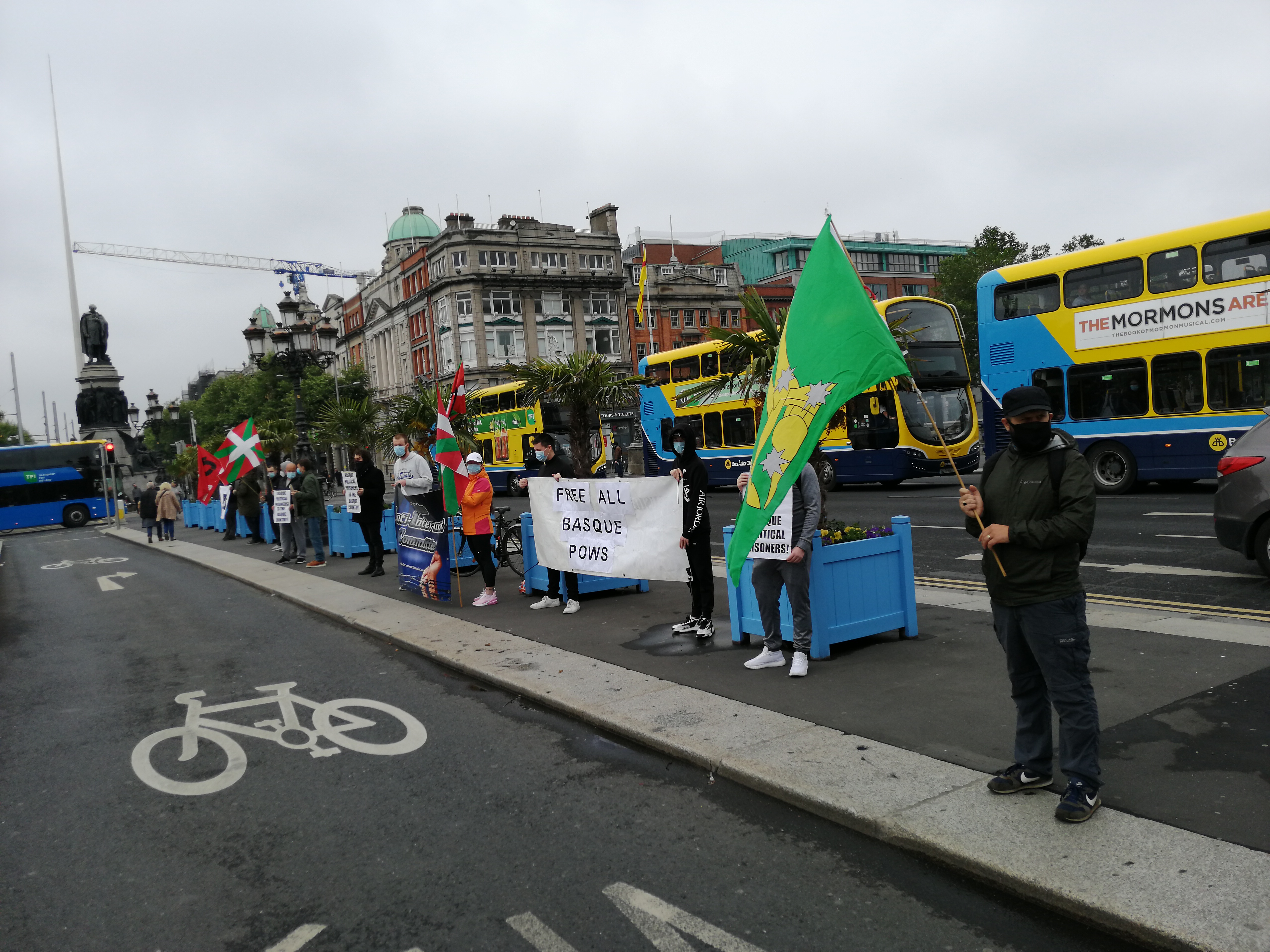
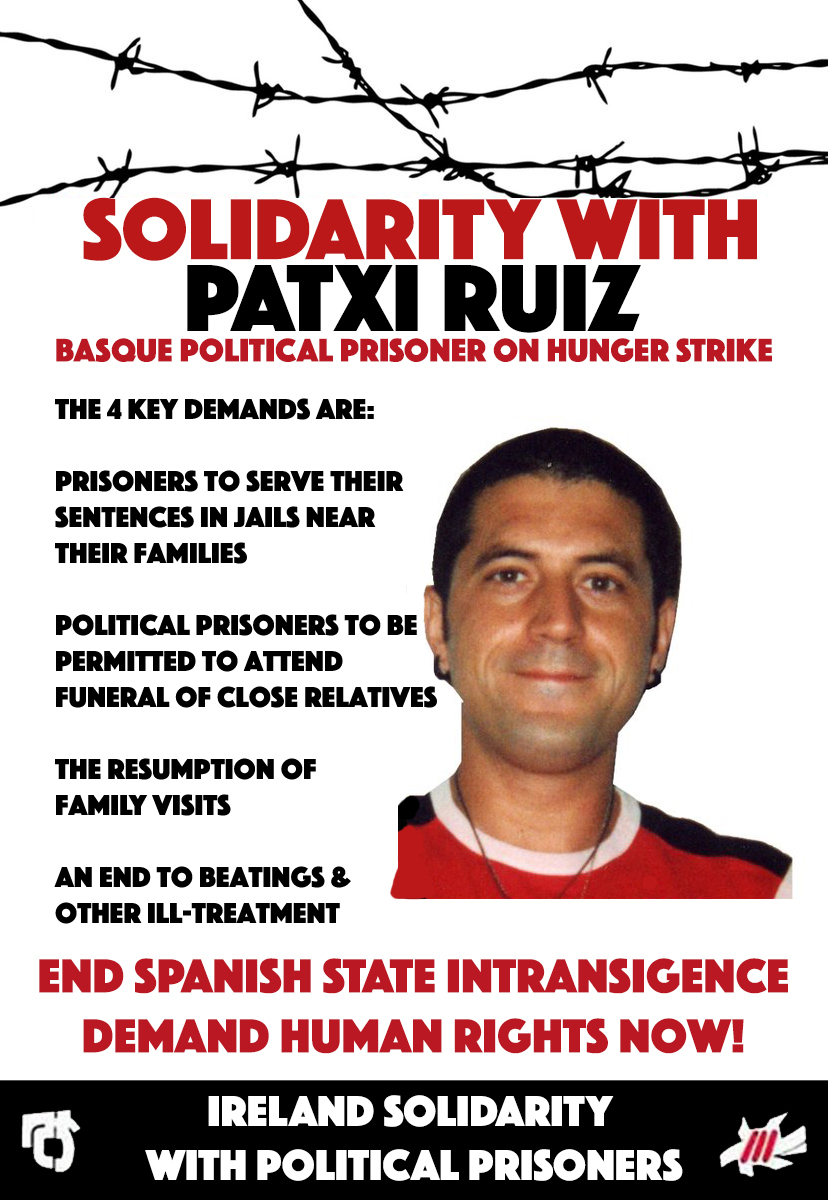
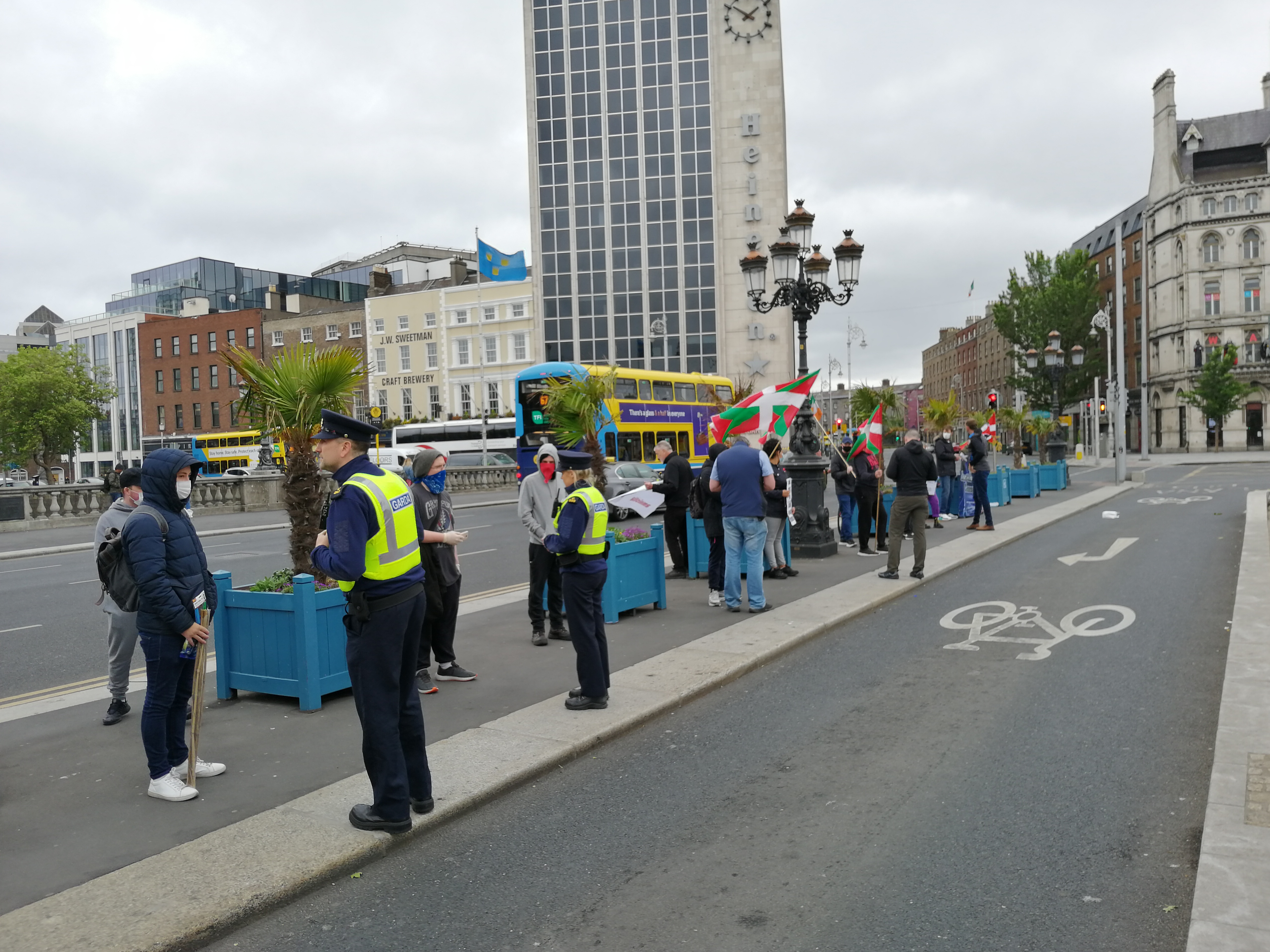

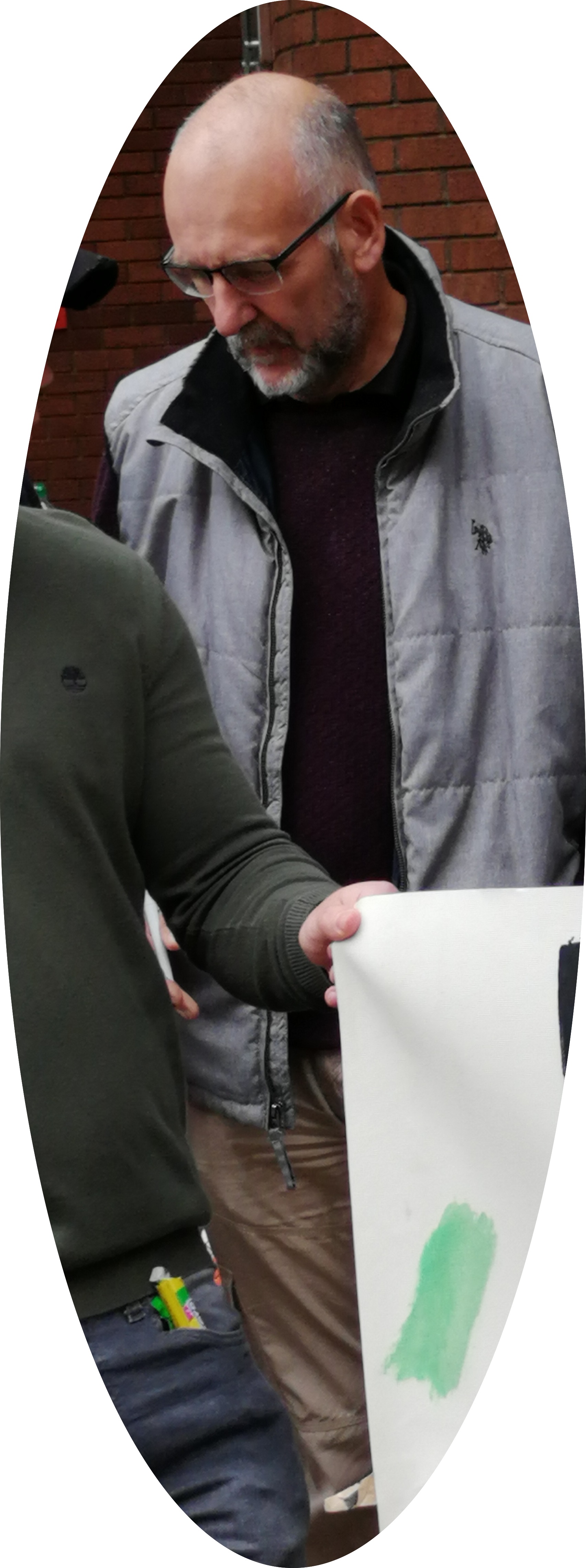
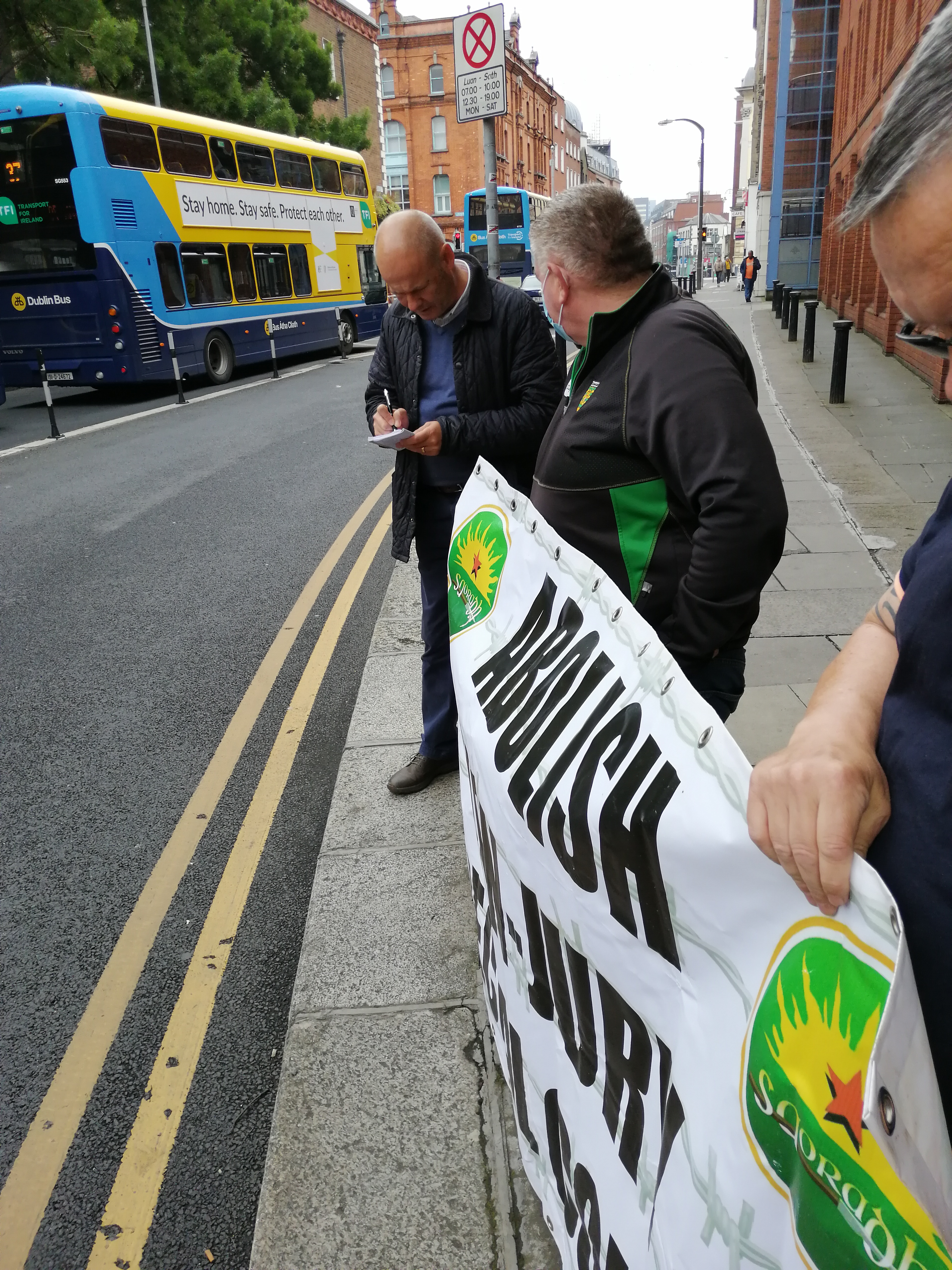


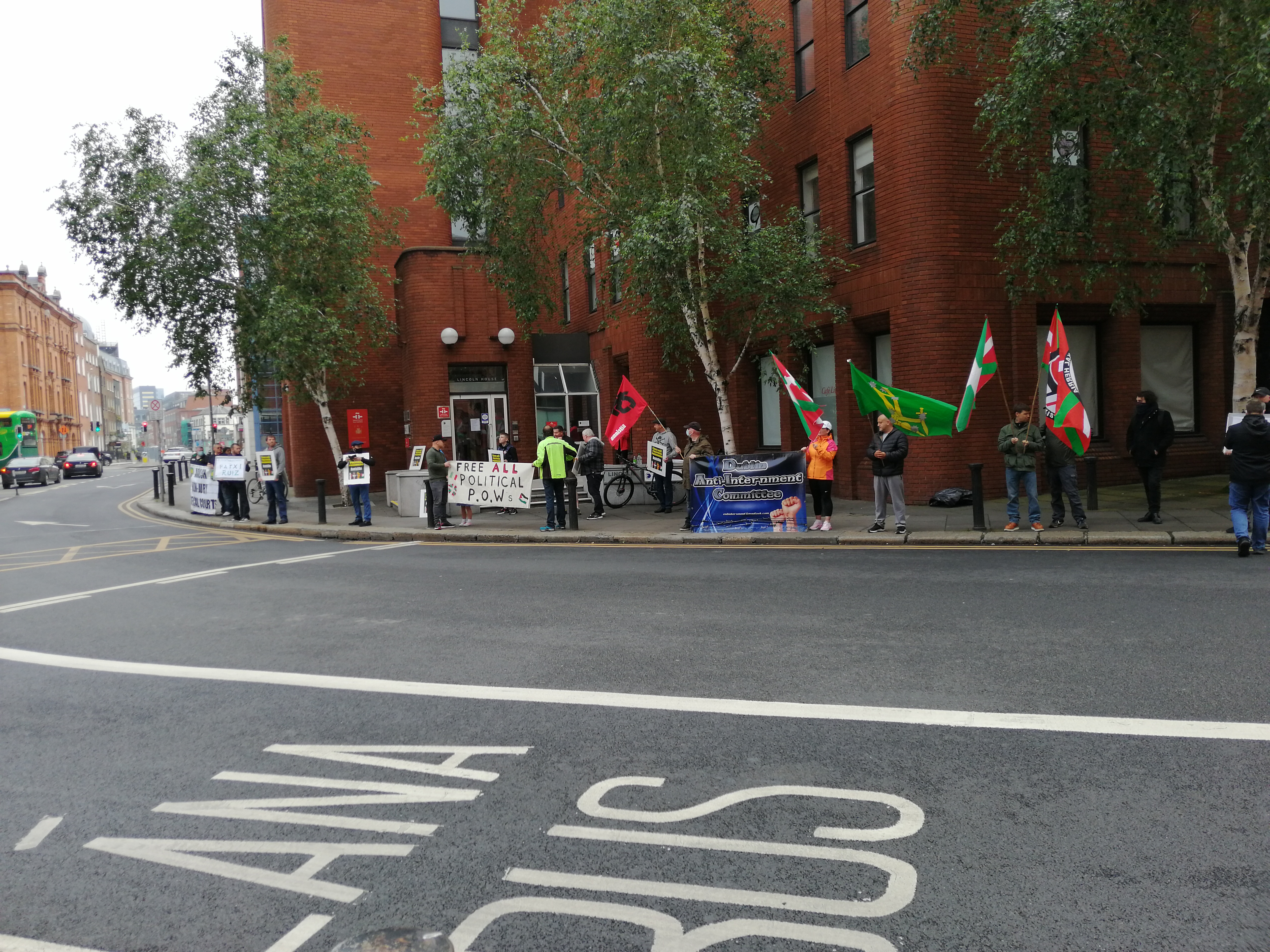


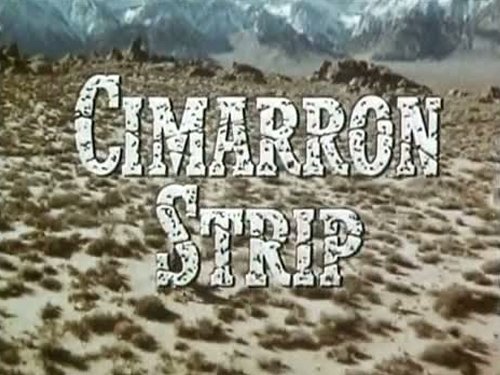
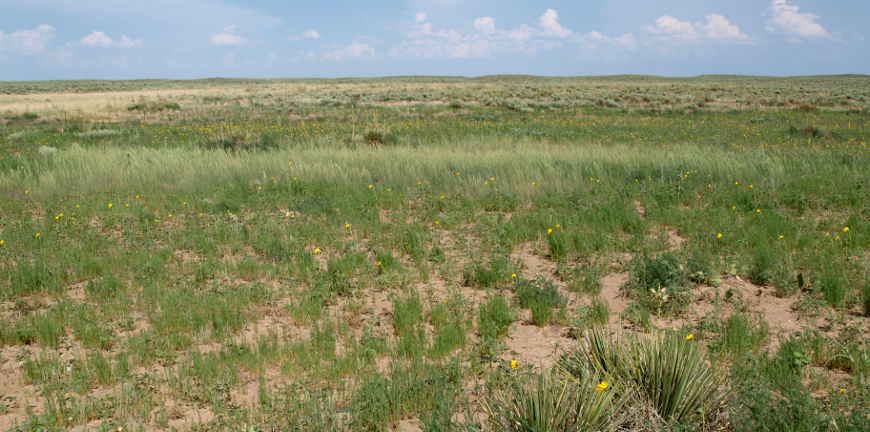


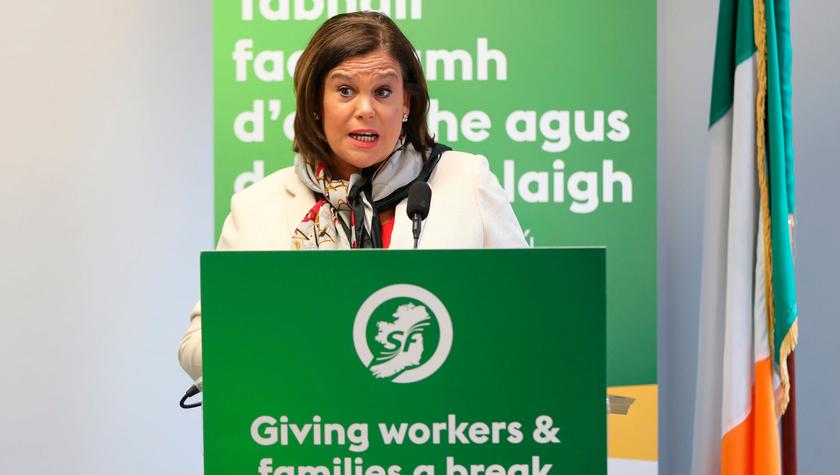

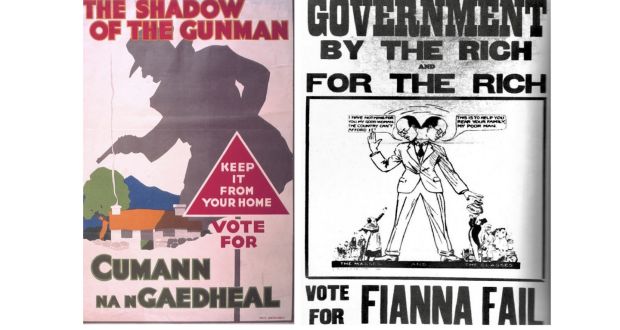
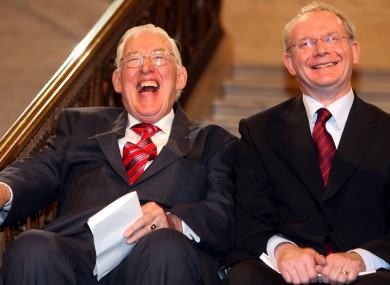


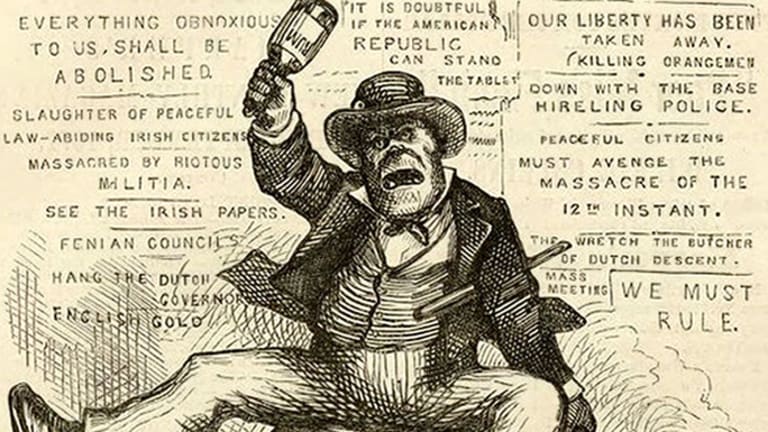
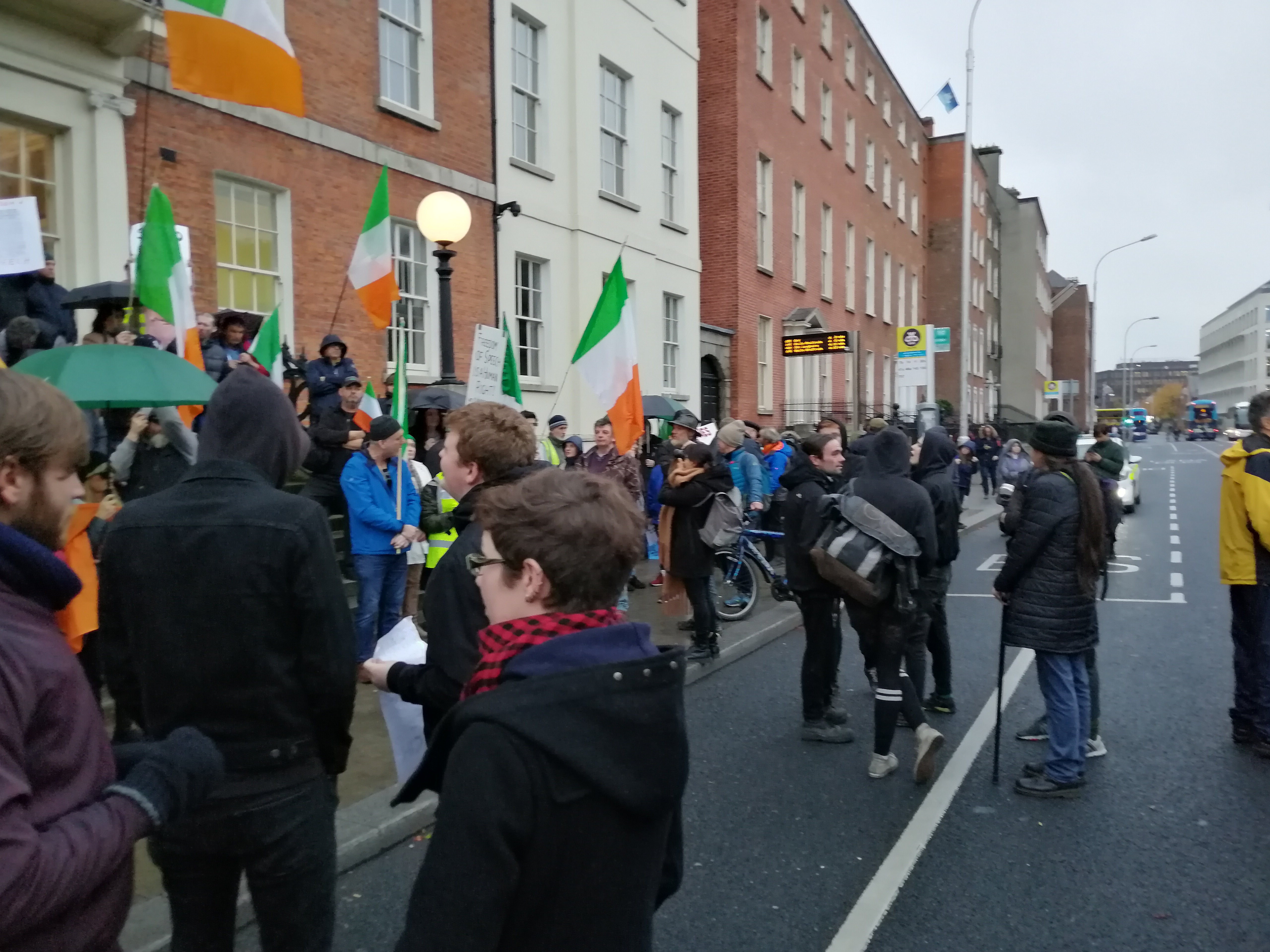
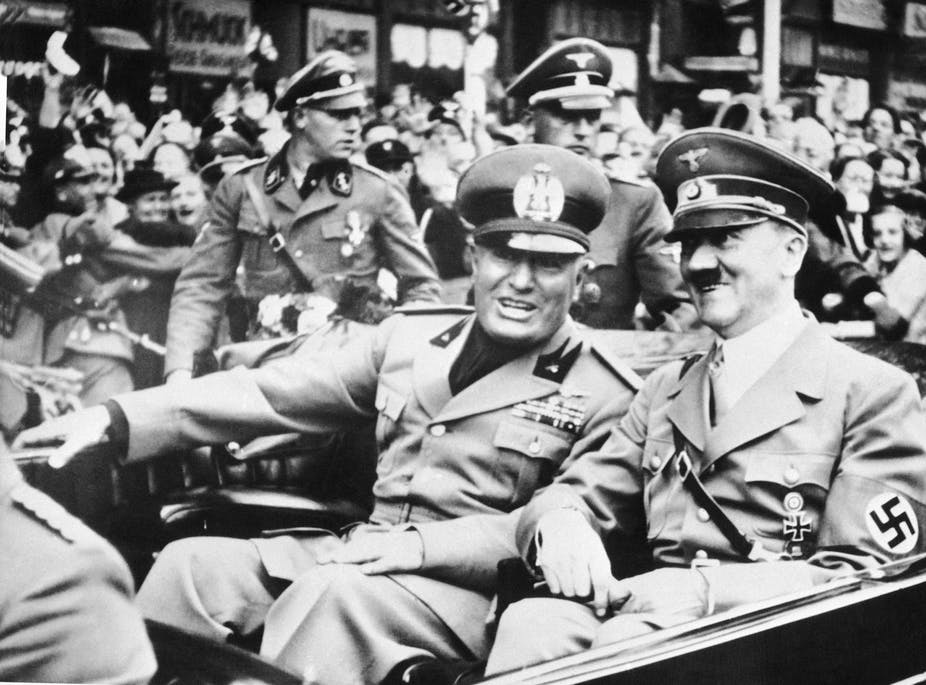


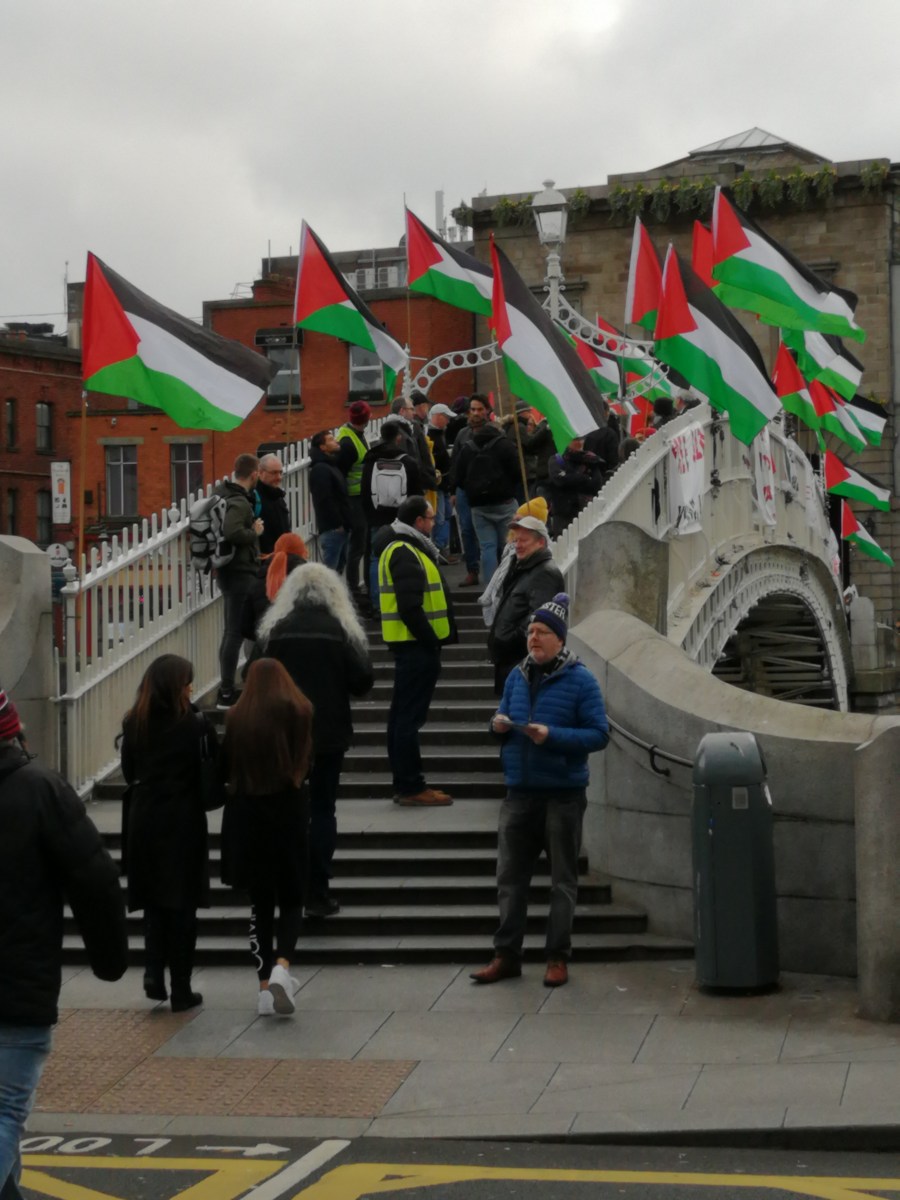

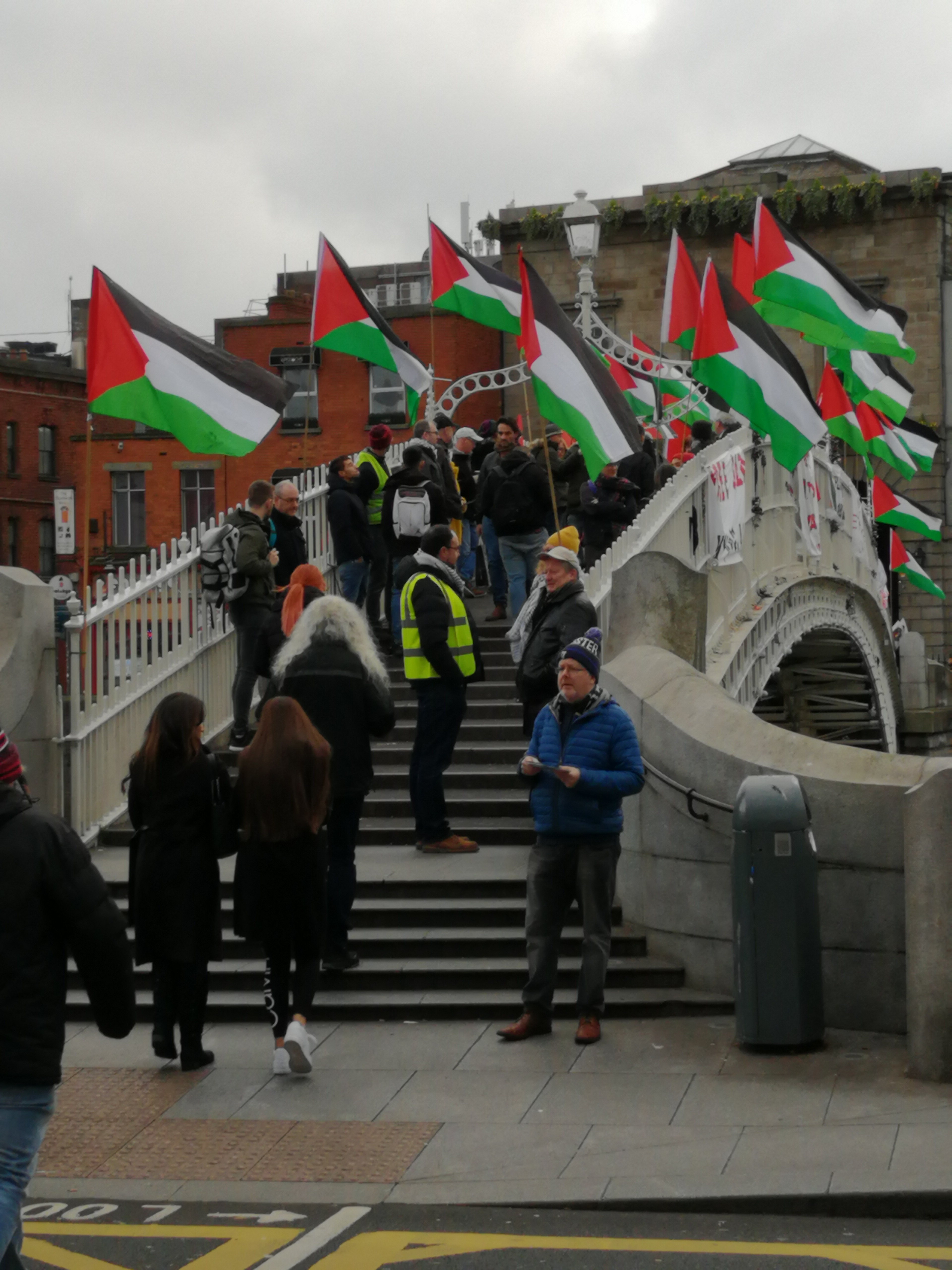

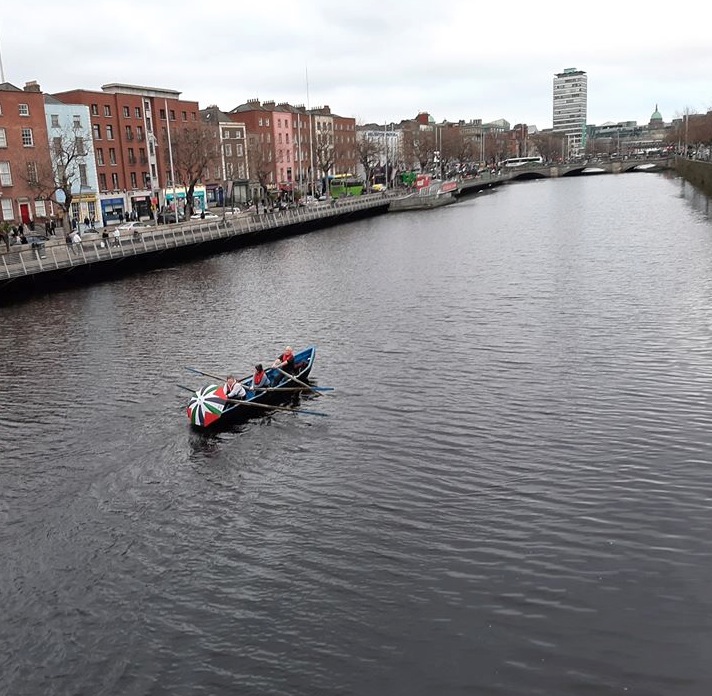


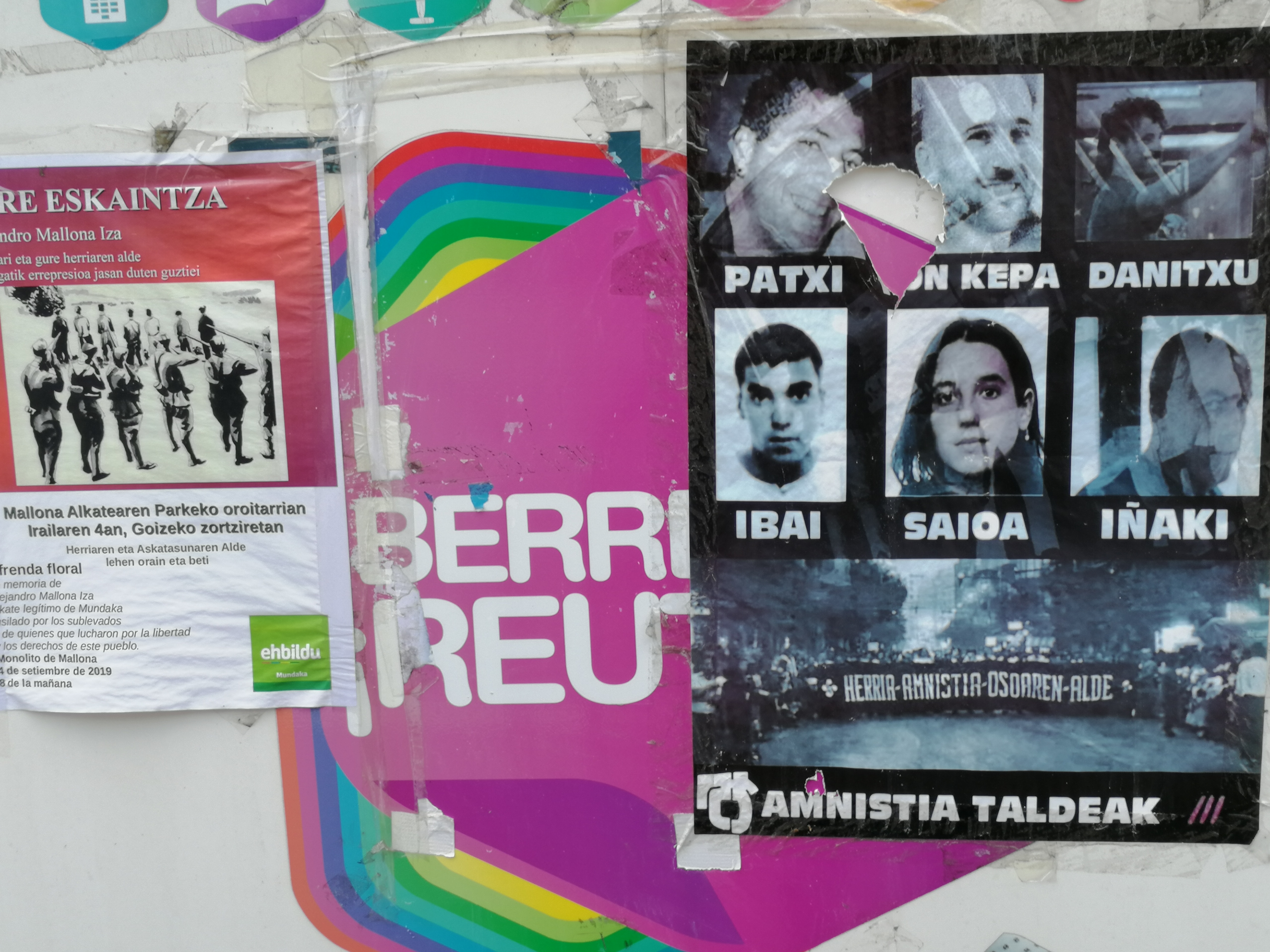


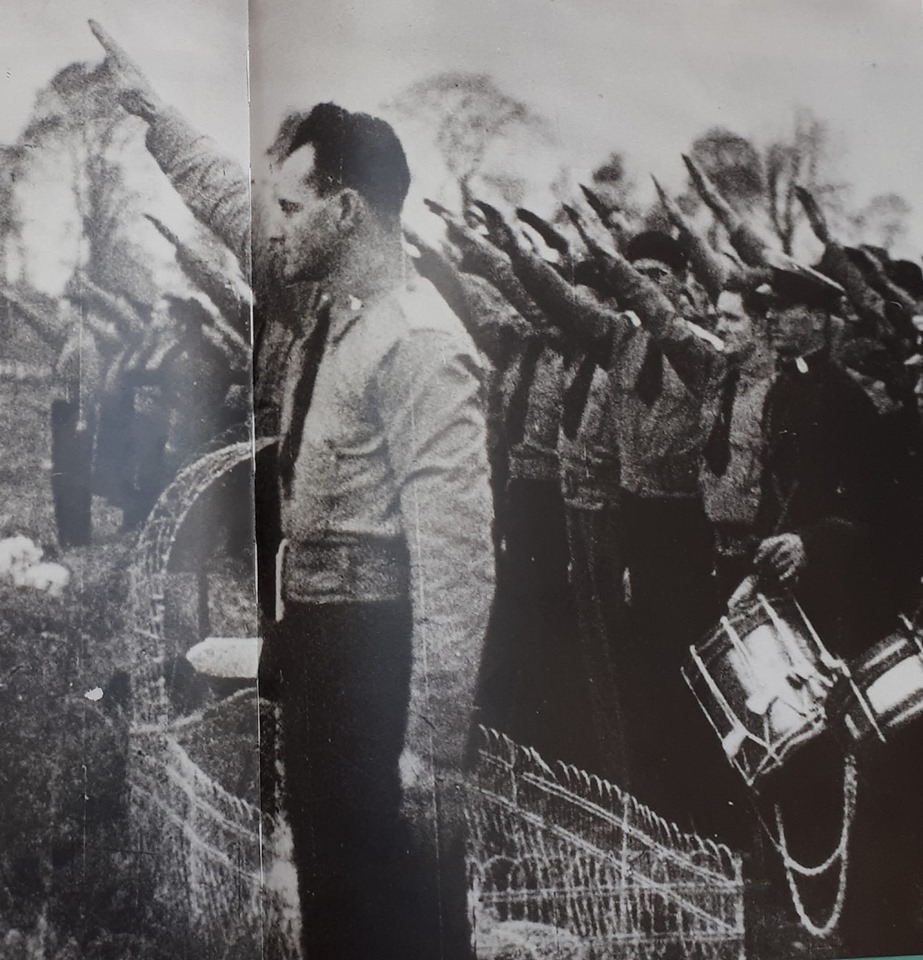

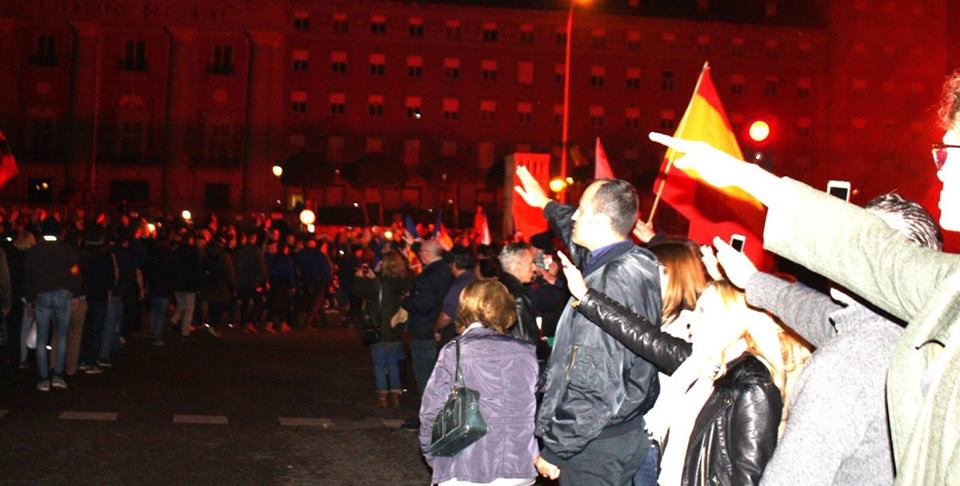
 rebelbreeze