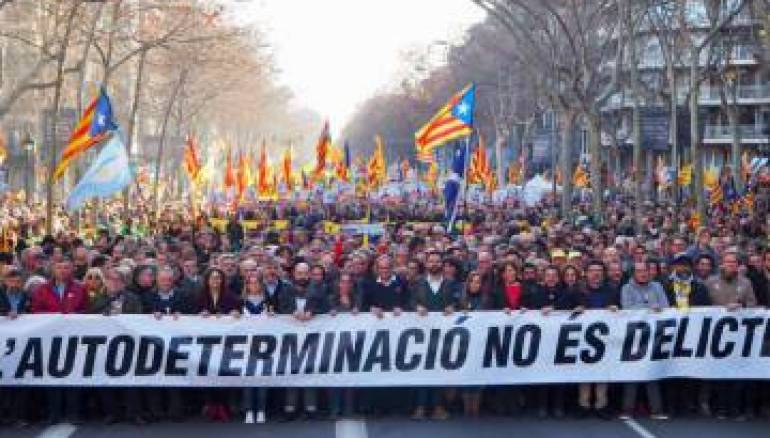
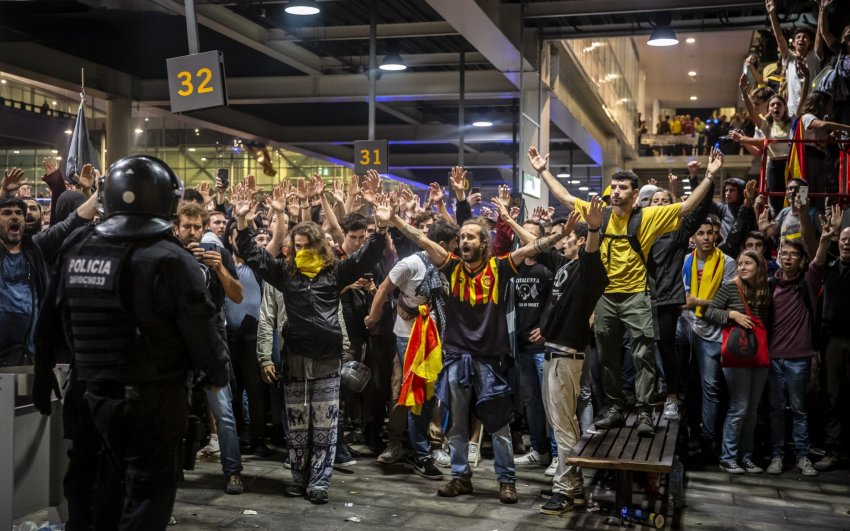
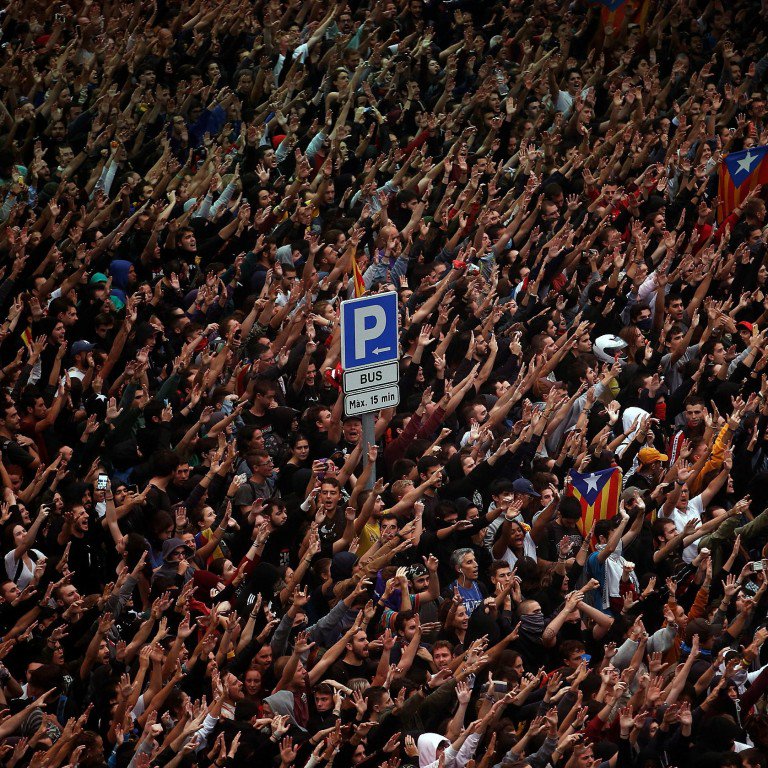
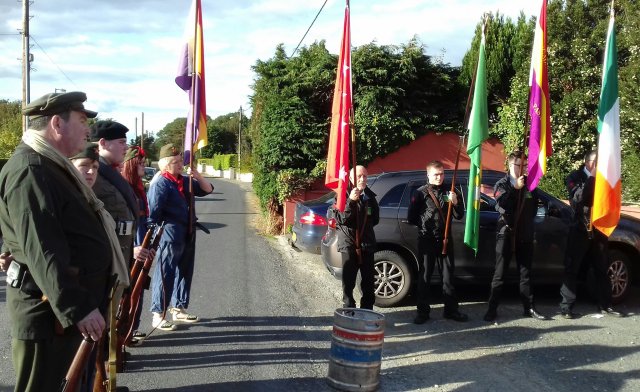
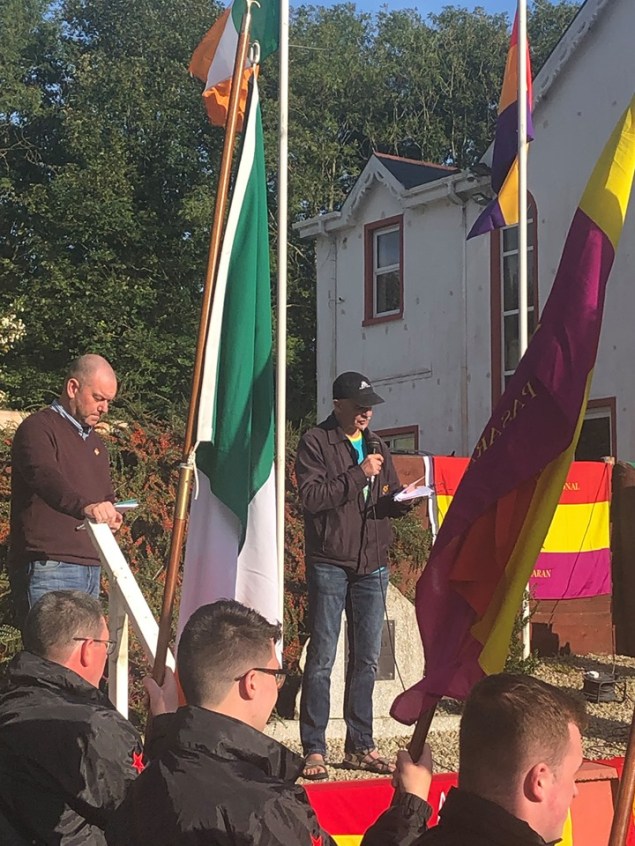
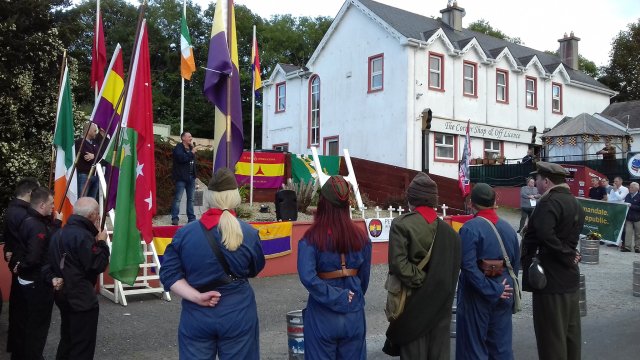
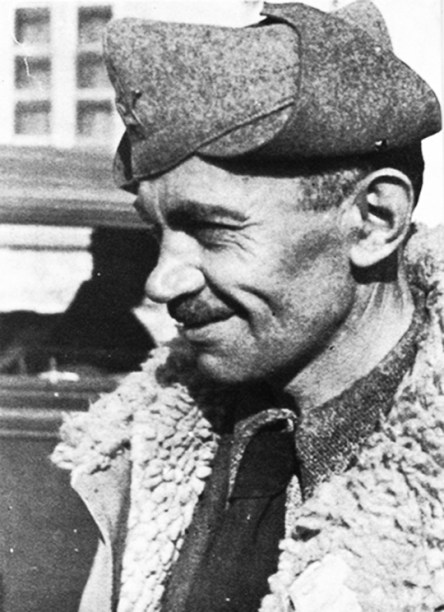
Paul Murphy speaking at his trial and that of others after the famous water protest at Jobstown against Minister Joan Burton (which led to his arrest and long trial before he and others were found not guilty by a jury). (Photo image: D.Breatnach)
Most people within the Irish state will now be aware that that socialist Paul Murphy, TD (member of Irish parliament, the Dáil), has left the Socialist Party and, with some others, intends to set up a new socialist organisation called RISE. His statement on his Facebook page was covered by a host of the capitalist media with little comment by most while left-wing chat room the Cedar Lounge had more comment than I found time or interest in reading.
A common reaction on the street was one of bewilderment at the splitting actions of left-wing parties. Elements of that were to be found in the relevant piece by Miriam Lord (see References), who comments on Dáil politics and politicians in her Irish Times column (though her sharpest treatment was of Brendan Ogle, who had mocked Murphy’s action).
I am myself, if a little surprised, not shocked nor indeed very engaged with the matter and consider it generally of little import on the prospect of a revolution in Ireland.
It strikes me, with little personal knowledge of him but based on material in the public domain, that Paul Murphy is in general a principled socialist politician and furthermore an activist who has not shirked from putting himself physically in the resistance line in Rossport, on the seas to Gaza, in Turkey against its government and in Dublin on water and housing protests. Furthermore, in the short period he was an MEP or supporting Joe Higgins when the latter had the seat, Murphy has had questions asked about the treatment of Basque political prisoners which few other politicians are willing to touch, lest they be associated with the armed liberation organisation ETA (now defunct).
However, I see no prospect of even one step towards revolution in the general conduct of any of the socialist organisations of any size in Ireland, splits or no. Of course it is helpful to have awkward questions asked of the Government in the Dáil and to gain media coverage of issues that would likely remain unmentioned, or to have their critical comments reported where yours or mine would never see the light of day. And Murphy remains in that ambit in Dáil, along with the Solidarity-PBP group — and Independents for Change are there also (now sadly missing Clare Daly and Mick Wallace, who have gone to the EU).
But that is not necessarily revolutionary work.
Meeting of the (First) International Workingmen’s Association. In Britain, the Fenians were accepted into the First International.
A TASK FOR SERIOUS REVOLUTIONARIES
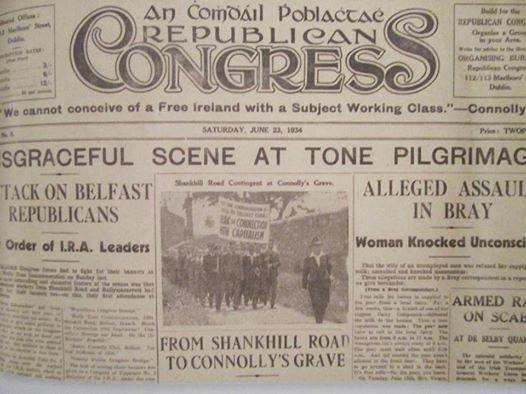
Front page of the newspaper of the short-lived Republican Congress in 1934
Without a conjunction of revolutionary Socialists with revolutionary Republicans, I can see no hope for revolution in Ireland and, without revolution, no hope of a solution to many of the ills in our society, whether in culture, economy, environment or government. In other words, in anything really. That conjunction was a project attempted in part by British socialists and some of the Fenians of the 1840s, later by Connolly and the Irish Citizen Army (1913-’16), later still by the Republican Congress (1934-’36). It remains the unfinished task for serious revolutionaries.
Neither the Socialist Party/ AAA/ Solidarity nor the Socialist Worker/ People Before Profit/ Solidarity formations have made any effort to take up that task (nor have the Republicans, lest my criticism be thought of one part of the equation only). Nor did the anarchist Worker’s Solidarity when it was an active force. The Communist Party of Ireland does not do so nor does the Workers’ Party. So great is the disdain of these formations for revolutionary Republicans that they refuse to even challenge the daily civil rights violations of the Gardaí and PSNI upon active Republicans, or their treatment in the non-jury special courts or jails on both sides of the Border. Indeed, in case they should somehow be accused of siding with these elements, they rarely even allude to the unfinished national liberations struggle of Ireland, nor to the colonial occupation of one-sixth of its territory, while instead fully prepared to support the just national liberation struggles of nations far away.
Interestingly therefore, from public comment, it appears that Murphy wanted more cooperation with “other elements on the Left” or “Left-leaning”, in which context was mentioned Sinn Féin, while the majority in the Socialist Party refused such a project. Some people will view this aspiration of Murphy’s as a laudable attempt to mould a fragmented Left into at least some kind of united action for Irish social and political progress. I do not.
I am not against a temporary alliance of revolutionaries with social democratic forces at certain points for certain objectives. But that does not include Irish political parties who are or have been part of Irish governments or, if possible even less, so a party that is part of the administration of a colonial occupying power. In the latter category I clearly place Sinn Féin and, in the former, the Labour Party, Fianna Fáil and Fine Gael.1 In addition, SF has clearly marked a path for itself to a future coalition partnership with a capitalist, pro-imperialist party or parties in Government.
It says something about the Irish socialists that an important question for them is whether or not to ally with a constitutional capitalist and colonial collaborationst party such as Sinn Féin, whereas the question of whether to ally with revolutionary Republicans is not even on the agenda for discussion.
End.
FOOTNOTES:
1One might make a temporary exception of the Greens, which have been in Government but once for a short while, admittedly shamefully so but with an honourable resignation.
When ETA, the armed Basque Left pro-Independence group) abandoned armed resistance and decommissioned its weapons, many wondered at the absence of public dissent among its ranks. A dissident trend did appear in the Basque pro-independence movement but it took longer than it had in Ireland; it is in existence now and growing.
In using the term “dissident”, a description not always accepted by those to whom it is applied, I mean those who disagree with the direction taken by the leadership of the organisation and who have therefore separated themselves from the organisation. It becomes a problematic term when it is implied that the “dissidents” have diverged from the original path – on the contrary, those who have left the organisation would say, it is the leadership which has left the path and it is those being called “dissidents” who remain on the “true path”.
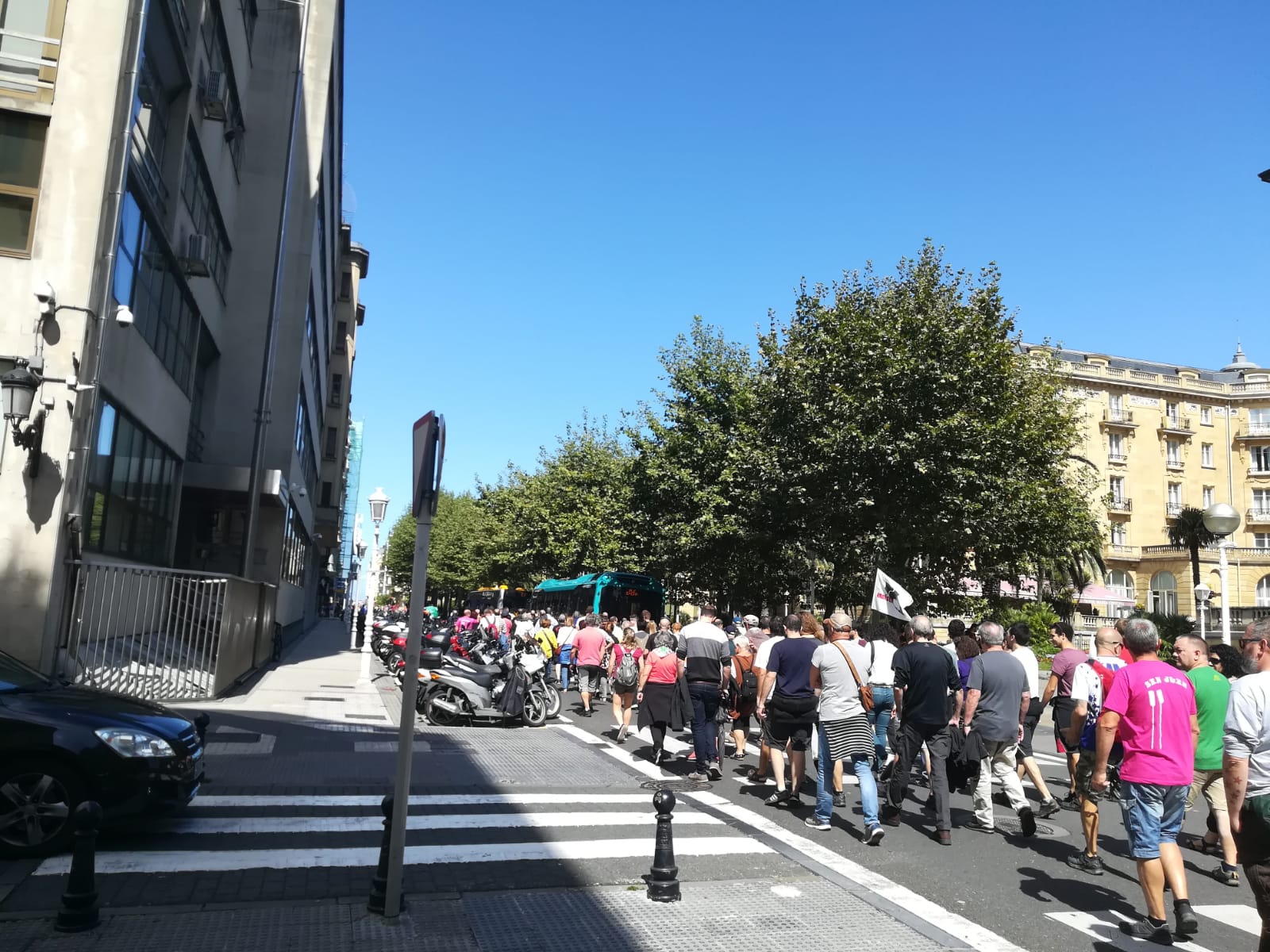
ATA demonstration in Donosti/ San Sebastian, 8th September 2019. (Photo source: Amnistia Garrasia FB page)
In the Basque pro-independence movement, as in the Irish Republican movement, the “dissidents” are in a minority but that should not be taken to mean that those who have remained within the “official” movement are in complete agreement with the leadership nor happy with the state of affairs within the movement. Indeed, within the Izquierda Abertzale (Basque Left pro-Independence movement), many are very unhappy indeed. Some do not agree with alliances with social democrats or attempted with the PNV (Basque Nationalist Party), others with complete disarmament, some with disarmament without concessions in return, yet others with particular decisions at various junctures (such as pleading guilty to “terrorism” when the work they had been doing was nothing of the sort, as happened recently in the mass trial of prisoner solidarity activists arrested back in 2013). Or with “apologising to the victims” as the Spanish State has been pressing on prisoners and detainees (the Spanish State of course apologises for nothing, neither the fascist-military uprising of Franco and company, nor the Dictatorship of almost four decades, nor executions, nor recent torture).
There were splits enough in the Irish Republican movement even soon after the Civil War but they also came thick and fast in the early 1970s, out of which grew the Provisionals (Sinn Féin and PIRA) and the IRSP and INLA, leaving Official Sinn Féin and OIRA as a rapidly-diminishing and eventually disintegrating remainder. Another split came about as a result of the electoral path of Provisional SF in 1986, out of which came Republican Sinn Féin. But it was the Good Friday Agreement and its effects which caused the most splits and desertions from the ranks of the Provisionals, leading to the creation of a number of organisations over time: éirigi, 32 County Sovereignty Movement, 1916 Societies, Saoradh and others.
POLITICAL PRISONERS, IRELAND & BASQUE COUNTRY
Most unfortunately, the number of Republican organisations led also to a number of political prisoner support groups and currently there are three main ones: Cabhair (RSF), Cogus (mainly 32 CSM) and Irish Republican Prisoners’ Welfare Association (mainly Saoradh).
In the Basque movement, the Izquierda Abertzale, although there were the abiding split has come over the issue of the Republican prisoners. The traditional line of the IA has always been that the prisoners, whether captured ETA volunteers or political activist victims of repression, are political prisoners. It follows that they should be released in any settlement of the Basque national question. But in the meantime, if prisoners, they should be kept in prisons near their homes so that they can be visited without too much difficulty by relatives and friends. That is not only a humane principle but is underwritten by EU and UN policy recommendations on the treatment of prisoners. The Spanish State, however, keeps its political prisoners dispersed throughout its territory, hundreds and even a thousand kilometres away from the family and friends of the prisoners (as does the French State). This is not only an additional punishment on the prisoners, one which was not a specified part of their sentence but also – and perhaps principally – on their relatives, children, partners and friends.
The organisation Amnistia (Gestoras pro Amnistia) was created in 1970 within the movement to agitate for a total amnesty for the prisoners. As is usual with the Spanish State, in 2002 it banned this organisation also as one “assisting terrorism”, threatened its activists with prison and the organisation ceased to exist publicly, their trial beginning in 2008. The State’s outlook was fully expressed in the infamous statement of the former judge and overseer of torture but so beloved of liberals, Baltazar Garzon: “Everything is ETA”.
The organisation of relatives of prisoners on the movement’s “official” list, Etxerat (Homeward) continued to exist and to organise visits, share information and agitate about the prisoners’ treatment but it is not a political organisation as such, which is difficult to combine with welfare work.
To carry out the specifically political work around the prisoners, the organisation Herrira (to the Homeland) was created some years ago. The Spanish State reacted in the usual manner and arrested a number of its activists – for “assisting terrorism”, of course. After that, it was noted that the official line had changed – while not specifically abandoning the call for amnesty, now only the call for and end to dispersalwasheard (along with of course the repatriation of seriously or terminally-ill political prisoners).
View from the rear of ATA demonstration in Donosti/ San Sebastian, 8th September 2019. (Photo source: Amnistia Garrasia FB page)
LEADERSHIP CHANGE IN LINE AND DISSIDENCE
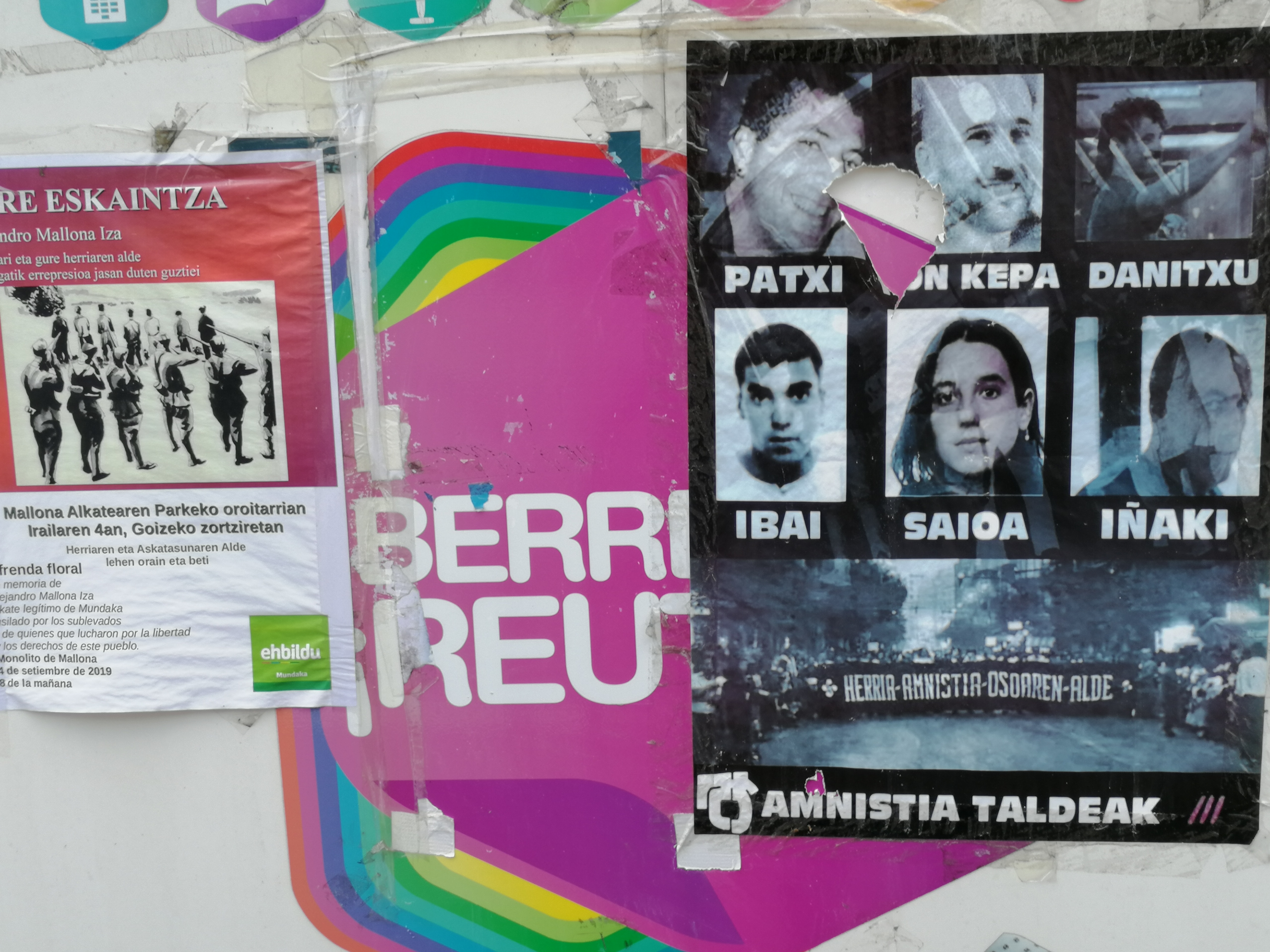
The change in line, the dropping of the demand for amnesty, led to the creation of a new Amnestia, but with the addition of Ta Askatasuna (and Freedom), this time in the hands of “dissidents”. The “oficialistas”, the current leadership of the main body of the pro-independence movement, Otegi, EH Bildu etc, say this is pure opportunism on the part of the dissidents, who are expressing their disagreement with the abandonment of armed struggle and dissolution of ETA by seizing on the issue of amnesty for political prisoners. They could be right, of course, at least in part. But unlike the leadership of SF and PIRA, the Basque “oficialistas” got no deal whatsoever for their prisoners.
Recently, a significant part of their youth section Ernai left the “oficialistas” and maintains a working relationship with the new ATA. Their issue was that they had prepared a position paper for discussion at the annual congress and the “oficialistas” had refused to permit it to be discussed, since it was critical of current leadership positions.
Another group, Jarki, is revolutionary, socialist, for independence, internationalist and in defence of the language and has been organising.
Apart from those three trends, there also exist anti-authoritarian, ecological etc trends that owe no allegiance to the official leadership of the movement. These are national in the sense that they are spread across the Basque Country and also in that they speak and write in Euskera (Basque language); they are also for social justice, feminist, anti-racist and anti-sexuality discrimination.
It remains to be seen to what degree these various trends will coalesce and whether the “official” movement will continue to see defections from its ranks.
SPEAKERS WARN OF RISING FASCISM, CALL FOR UNITY OF ANTI-FASCISTS
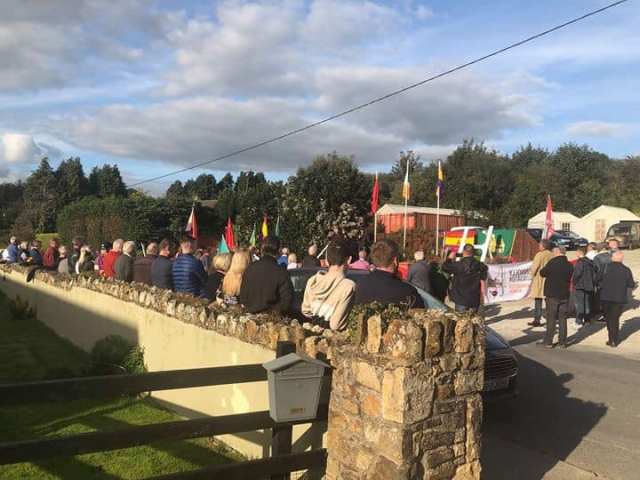
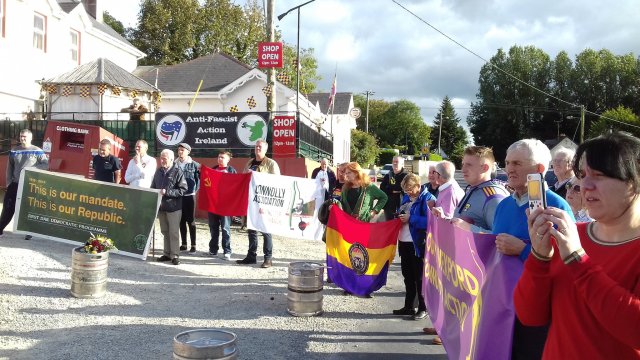
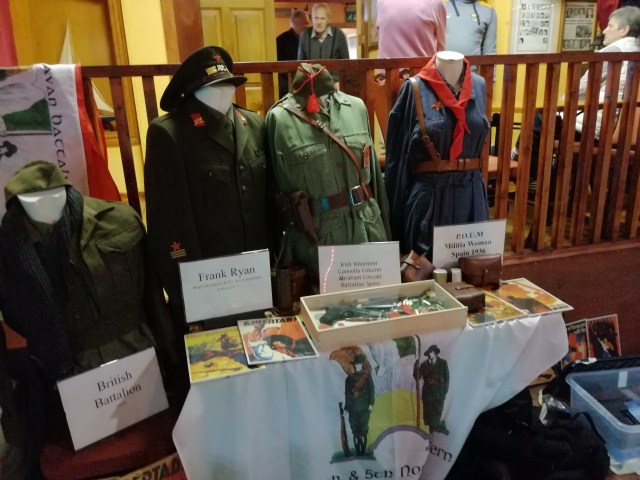
Flags of various kinds flew above a gathering in Monagear, Co. Wexford on Saturday 7th September, while a number of banners were visible among the crowd: Peter Daly Society, Connolly Association Manchester, Wexford Community Action, Anti-Imperialist Action Ireland, Friends of International Brigades Ireland, Éirigí, Connolly Column. Also in attendance was a group of young men and women dressed to represent the International Brigaders and the POUM1 milita, organised by the Cavan Volunteers group. The event had been organised by the Peter Daly Society with support from the Peadar O’Donnell Forum.
Long view of Peter Daly commemoration seen from the back (Photo source: Peter Daly Society)A reminder of even older struggles — banner inside the Monageer Tavern. (Photo source: D.Breatnach)
Monagear is a small village in the centre of Co. Wexford, a few kilometres north-east of Wexford town. Also known a Monageer, both words are, like most place-names in Ireland, from the original Irish language: Móin na gCaor, “the bogland of the berries” (probably of the Rowan or Mountain Ash, which in Irish is Crann Caorthainn). Not far from it are the historic place-names associated with the United Irishmen uprising of 17982 in that county, such as Boolavogue and Enniscorthy and indeed, a small commemoration garden in the village has memorial stones dedicated to that struggle and to others since.
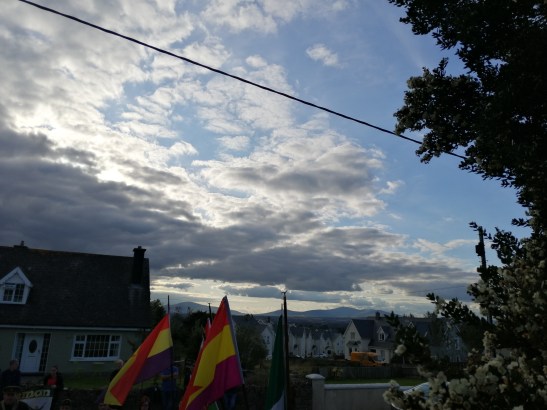
View in a cloud-darkened moment over the crowd, past the new houses in the village and to the hills and mountains in the distance. (Photo source: D.Breatnach)
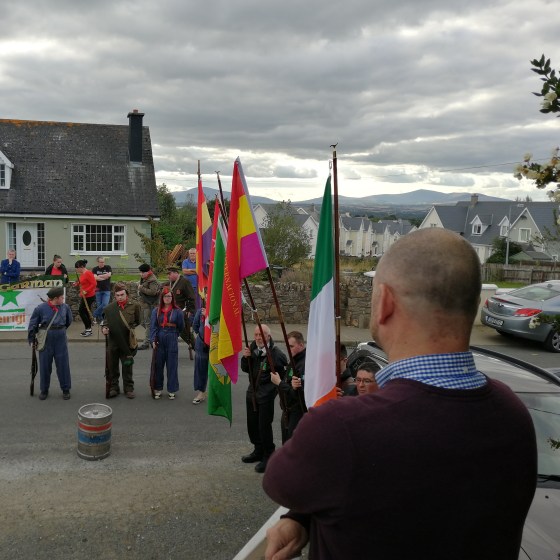
At a signal, the gathering of people with flags and banners, led by a colour party flying the Irish Tricolour, the flag of the 2nd Spanish Republic, a red starry flag and the Irish workers’ Starry Plough, moved in procession down into the village area and assembled outside the raised platform containing the tasteful simple memorial to Peter Daly, International Brigader killed in the War Against Fascism in the territory of Spain (1936-1939).
Steve McCann, Chairman of the Peter Daly Society, with another man beside him, opened the ceremony from the memorial platform by briefly outlining the history of the Peter Daly commemorations and of the Society (founded in 2011) which he said had from the beginning welcomed the involvement and participation of Irish Republicans, Communists, Socialists, Anarchists and plain anti-fascists. After outlining the program of speeches and songs for the day, he called Gearóid Ó Machaill to give the first speech, on behalf of the Friends of the International Brigades, Ireland.
Steve McCann addressing crowd with colour party and reenactment group visible below (Photo source: D.Breatnach)
“THE IRISH ARE NOT IMMUNE TO FASCISM”
Ó Machaill opened his speech in Ulster Irish, thanking the organisers for giving him the opportunity to speak there at the cradle of Peter Daly, Irish Republican, socialist, anti-fascist. Continuing, he said that the conditions that gave rise to fascism in the 1930s are very similar to those of today. Speaking of the Republican Congress of 1936-1938, he said it had worked to overcome divisions in the working class and in the anti-imperialist movement. But it had fallen apart in disunity, unfortunately and in Ireland today, the anti-fascist forces are as divided too.
The Irish were not immune to fascism and had a strong fascist movement in the 1930s, supported for awhile by the State, X said. In the years since the defeat of fascism around most of the world, attempts to set up a fascist movement in Ireland had been smashed, said Ó Machaill but cautioned against complacency.
In some other parts of the world, workers betrayed by social democracy and hurt by capitalism, turned to hard right parties and outright fascists and it was entirely possible that such fascists would become popular while leading a campaign against bankers and even imperialism, pushing a line of “Irish for the Irish”.
“We cannot afford the divisions and need to unite ….. as Republicans and Socialists did in preventing the attempted launch of Pegida in 2016,|” said the speaker.
Colour Party facing photographer, POUM and Brigader reenacters to the left. (Photo source: G. Ó Machaill)
MIGRANT DEPORTEES
Steve McCann introduced the man beside him as Diarmuid Breatnach and called him to sing the first song of the selection for the ceremony and to say a few words about its content. Breatnach pointed out that migrants are often a prime target of fascists and the song he was to sing was about migrants and their treatment. On 28th January 1948,a DC-9 transporting Latino illegal migrants and “guest workers” crashed in the Los Diablos region of California and all 32 on board were killed. The radio news reported the crash but only gave the names of the crew members and the Immigration Department guard, saying the others killed were “deportees”. The names of the dead were known in their localities and were printed in local newspapers but were not deemed worthy of mention on the radio.
Diarmuid Breatnach reading introduction before singing a song. Steve McCann is standing to the left of the photo on the stage. (Photo source: Ado Perry)
Wood Guthrie wrote a poem called “Deportee” about the tragedy which was put to music by Martin Hoffman, the song since called Deportees or Plane Wreck at Los Gatos. Breatnach then sang the song, the chorus of which says:
Goodbye to my friends,Farewell RosalitaAdios mis amigos, Jesús y Maria;You won't have a name When you ride the big airplane --All they will call you Will be “deportees”.
LESSON OF HISTORY – NOT LIBERALISM BUT ROBUST ACTION IS NEEDED
Mags Glennon was called to read a statement on behalf of Anti-Fascist Action. Moving on from the background to the fascist upsurge of the 1930s and the background of those who fought to defeat it, Glennon read: “Far-right parties have risen from minor subculture to government across Europe in recent years, showing the glaring need for principled and active opposition to fascist and far right forces. The most concerning aspect of this political resurgence is the support it has received from young people and large sections of the traditional working class, due to the abandonment of these people by social democrats, and other parties who claimed to ‘represent’ them. Well meaning liberalism has never defeated fascism. It never will.”
Reading from the statement, Glennon called for a “re-energising” of the struggle to defeat those “aiming to distract our communities and young people from fighting their real enemy. Where there are fascists we must oppose them.”
Glennon concluded by reading: “Appeals to the police, to parliament or to Google to censor fascists have no place in anti-fascist struggle. History has shown that robust action against fascists in Ireland has always sent them running back to the gutters to think again. Long may it continue. La lucha continua!”
POUM militia and International Brigader reenacters seen from behind, centre photo. (Photo source: G. Ó Machaill)
“MUST ORGANISE IN WORKING-CLASS COMMUNITIES”
The MC, Steve McCann, introduced the anti-fascist and community activist as well as Independent Dublin City Councillor, Ciaran Perry. Speaking without notes, Perry outlined the historical necessity of defeating fascism politically and physically.
Echoing a previous speaker’s comments, Perry too called for unity of the antifascist forces against fascism but also against capitalism and imperialism. He said that working-class communities, betrayed by social democracy and distracted by identity politics, had become prey to the propaganda of fascists.
Ciaran Perry speaking
Fascism is a facet of capitalism”, Perry said “and therefore the enemy of the working class. The working class should be our natural constituency.”
Going on to suggest that if fascists build bases in working class communities it is because of the failure of the Left, he called on socialists and antifascists go into those communities and to build their bases there.
ESCAPE FROM DACHAU AND DEATH IN SPAIN
Breatnach stepped forward to sing a combination of two songs from the German side of the anti-fascist struggle. The German political prisoners in the concentration camps were forbidden to sing socialist songs and had written their own, one of which became famous around the world was The Peat Bog Soldiers, lyrics written by Johann Esser, a miner and Wolfgang Langhoff, an actor and melody composed by Rudi Guguel.
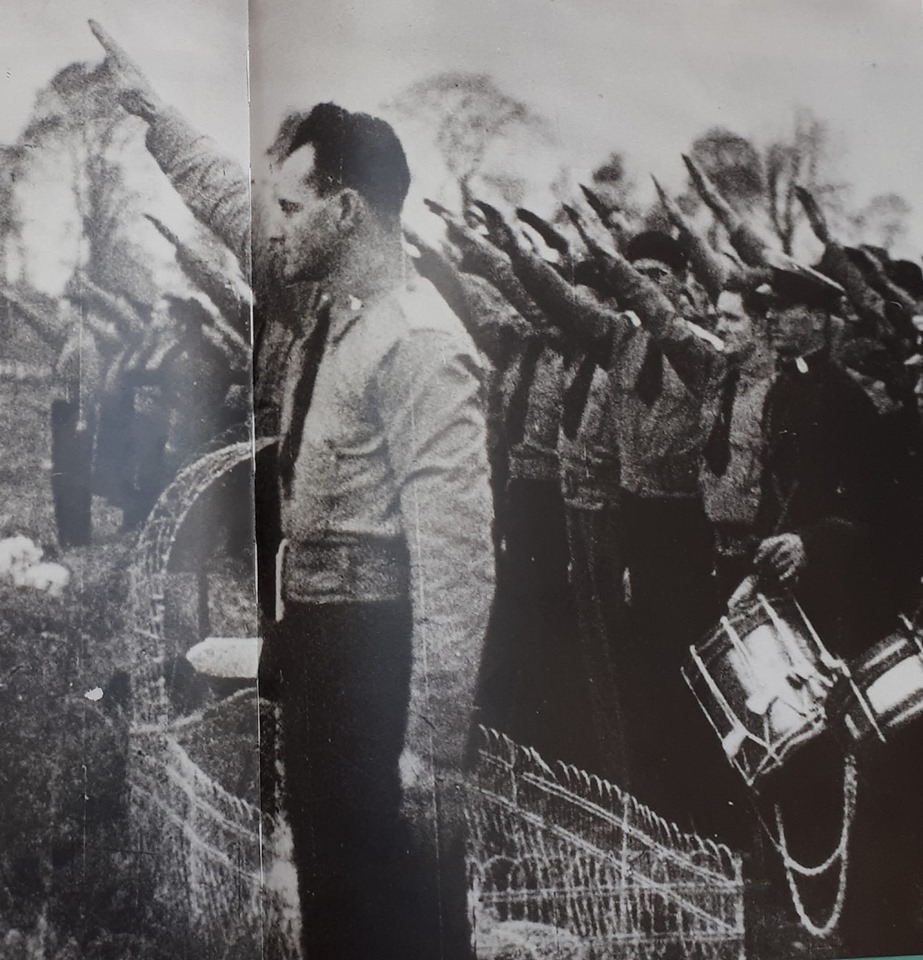
“Hans Beimler (1895-1936) was a WWI veteran, a Communist, a Deputy elected to the Reichstag in 1932,” said Breatnach. “In January 1933 Hitler came to power in Germany. The Communist Party was banned and in April 1933 Beimler was arrested and sent to Dachau extermination camp where, in May, he strangled his SA guard and, putting on the man’s uniform, escaped. He went to Spain where he was a Commissar with the International Brigades and was killed in the Battle of Madrid on 1st December 1936.”
He would sing two verses of the Peat Bog Soldiers, Breatnach explained, combined with the Hans Beimler song.
Photo of Hans Beimler, WWI veteran, Communist, escapee from Dachau, International Brigader, killed in the Battle of Madrid 1936. (Photo source: Internet)
“THE NORM WAS FOR ALL CAPTURED INTERNATIONAL BRIGADERS TO BE EXECUTED”
The sun sinking towards the west shone over the heads of the attendance on to the raised bed of the memorial stone and its flagpoles and, except when covered by clouds, into the eyes of those on the platform. Outside the nearby pub some locals gathered and behind those gathered around the monument, others in attendance lined a low wall while nearby other local people, mostly youth, congregated for a time. Occasionally a passing car drove carefully along the street past the crowd. House martins darted above, a wasp occasionally bothered the speakers and the smokey-blue soft curves of the Silvermine Hills and Knockmealdown Mountains rose to the west.
Harry Owens speaking from the platform (Monagheer Tavern to the right of photo)
The Chair of the event called Harry Owens to speak.
Harry ‘s speech traced the history of world events that had led up to the fascist coup and war in Spain. He also spoke about the kind of people the Brigadistas had been, quoting from their comrades, journalists and opponents. That Captain Frank Ryan had his life spared was unusual, he explained, as the tendency was for all anti-fascist officers to be executed and all International Brigaders of all ranks. Whilst the Spanish fascists wanted to execute them, the Italian soldiers tended to keep them alive in order to exchange them for Italian prisoners of the Republican side.
The death toll among officers and men in the International Brigades had been higher than the norm in warfare and the average in the Irish contingent higher still, Owens said. The food and armament supply conditions of the Republican side had been poor in many areas but almost to a man they had fought on until death, capture or demobilisation. It was their conviction, that they knew what they were fighting for and believed in it that accounted for that.
After Owens’ speech, Breatnach stepped forward to sing, without introduction, Viva la Quinze Brigada3(the song written by Christy Moore about the Irish who fought in the 15th International Brigade). The song mentions Peter Daly in the verse:
This song is a tribute to Frank Ryan,
Kit Conway and Dinny Coady too,
Peter Daly, Charlie Reagan and Hugh Bonner,
Though many died, I can but name a few.
Danny Doyle, Blazer Brown and Charlie Donnelly,
Liam Tumlinson, Jim Straney from the Falls,
Jack Nalty, Tommy Patton and Frank Conroy,
Jim Foley, Tony Fox and Dick O’Neill.
The words of Moore’s chorus rang out along the street:
“Viva la Quinze Brigada!
No Pasarán!” the pledge that made them fight;
“Adelante” is the cry around the hillside,
Let us all remember them tonight.
…. and concluded with the cry “Viven!” (“They live!”)
WREATHS, THE INTERNATIONALE AND AMHRÁN NA BHFIANN
McCann called for those who wished to lay wreaths on behalf of organisations and the following came to lay floral tributes: John Kenny, activist of the Peter Daly Society; Mags Glennon for Anti-Fascist Action; Seán Doyle for Anti-Imperialist Action Ireland (who had provided the colour party); Connolly Association Manchester; and Gary O’Brien for Éirigí. Messages of support had been received from the CPI, IRSP and the Connolly Association Manchester.
Closeup of Peter Daily memorial with floral tributes laid. (Photo source: Peter Daly Society)
McCann then called Breatnach forward to sing the Internationale, the international anthem of the working class, the lyrics of which Breatnach explained had been composed by Anarchist Eugene Pottier of the Paris Commune, in 1871, the first time the working class had seized a city. It had been written to the air of the Marsellaise but later put to its own melody by worker-composer Pierre de Gayter.
“It was written in French”, said Breatnach, “which is why I propose to sing the chorus once in French at the start but it has been translated into many languages. Youtube has a post with 95 translations ….. and there are at least three versions of it in English and people are welcome to sing along in any version they know,” Breatnach concluded before singing the French chorus, followed by two English verses and chorus.
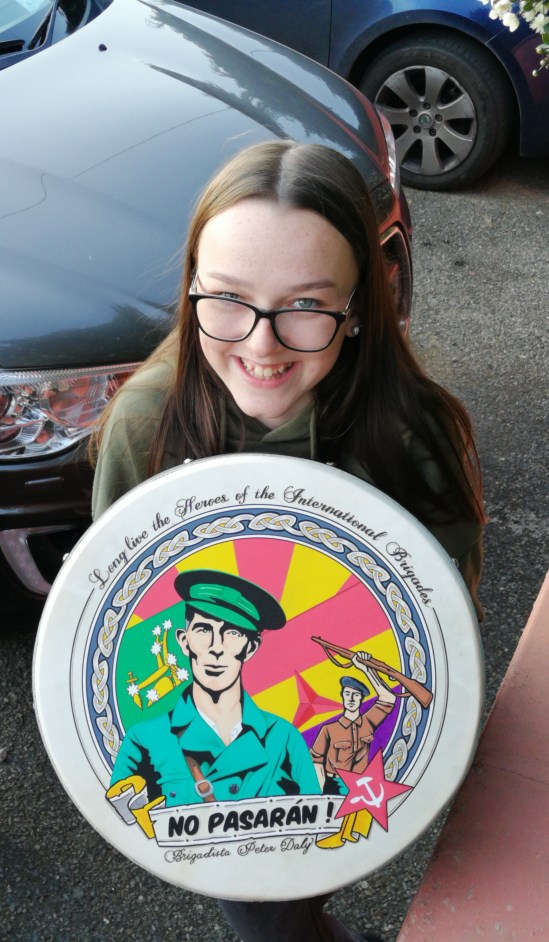
The MC Steve directed attention to a bodhrán decorated with a dedication to Peter Daly by Barry O’Shea which was displayed by Erin McCann and which would be raffled as a fund-raising exercise at the reception inside the pub.
Ciara McCann with the bodhrán decorated by Barry O’Shea (Photo source: D.Breatnach)
Steve McCAnn then called Marie Kenny Murphy and Marilyn Harris up on to the stage, where they played the Irish national anthem on flutes, with many people singing along in its Irish translation4:
Anocht a théim sa bhearna baoil,
Le gean ar Ghael chun báis no saol;
Le gunnaí scréach, faoi lámhach na bpiléar,
Seo libh, canaig’ Amhrán na bhFiann.
Section of crowd around monument (Photo source: G. O Machaill)
REFRESHMENTS, EXHIBITION, RAFFLE, SONG AND CONVERSATION
All the speakers had referenced the historical memory of the Anti-Fascist War on Spanish territory to the struggles of today and even of tomorrow and the selection of songs had been deliberately chosen to emphasise internationalism and workers’ solidarity from the past and needed today.
McCann thanked all the performers, speakers and participants and in particular welcomed the participation of the Connolly Association contingent from Manchester, encouraging them to attend again the following year. Inviting all to enter the local Monageer Tavern to view the Antifascist War memorabilia and to have some food, the MC brought the ceremony to an end.
Inside the local pub, the Monageer Tavern, food had been made available by the owners and the function hall was provided for the commemoration participants.
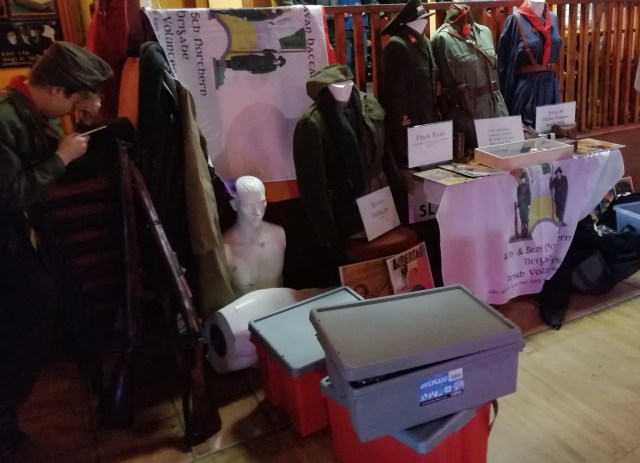
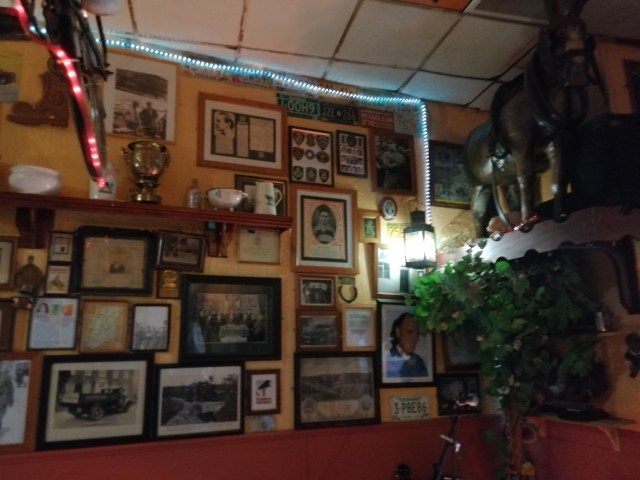
An interesting display of memorabilia of the Spanish Anti-Fascist War had been erected inside by the Cavan Volunteers history group. The walls of the function room on one side were also covered with permanent framed photographs and other images of Irish history, among which Joe Mooney, anti-fascist, community worker and activist of the East Wall History Group, spotted a photo of the Dublin docks with a docker well-known to his community in the foreground!
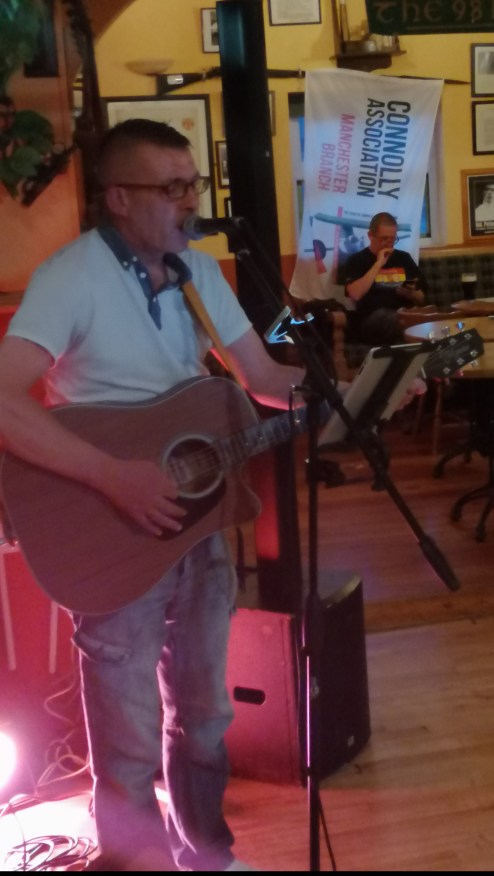
Music was provided by Tony Hughes with voice and guitar, singing a selection of songs including anti-racist and Irish Republican ballads, also Viva La Quinze Brigada.
Tony Hughes playing and singing at the event inside the Monageer Tavern (Photo source: D.Breatnach)Spanish Anti-Fascist War memorabilia organised by the Cavan Volunteer history and re-enactment group (Photo source: D.Breatmach)
When the raffle was held a search went on for the winning number ticket which eventually unearthed it in the possession of Helena Keane, seller of the tickets and who adamantly refused to take the prize. Another dip into the stubs brought Gearóid Ó Machaill’s ticket out, ensuring the decorated bodhrán would find a new home somewhere in the occupied Six Counties.
Section of the function room wall in the Monageer Tavern. (Photo source: D.Breatnach)Another section of the function room wall. (Photo source: D.Breatnach)(Photo source: Ado Perry)
FOOTNOTES
1The International Brigades were organised through the Comintern and Communist parties in various parts of the world but a number of International Volunteers came also through the mainly Trotskyist POUM, including Anarchists. One Irish volunteer went to join the Basque Gudaris and was killed fighting the fascists there.
2First Republican rising in Ireland, organised and led for the most part by Protestants, descendants of British colonists.
3Christy Moore called this “Viva la Quinta Brigada” (i.e the Fifth) but in later versions sang in English a line in the first verse calling it “the 15th International Brigade”. It appears that from different chronological perspectives one can call it either the Fifth or the Fifteenth but the mostly English-speaking brigade of the International Brigades is usually named the Fifteenth. Quinze is the Spanish word for “fifteen” and Viva la Quinze Brigada scans in the song while “decimoquinta Brigada” has too many syllables to fit.
4The Soldier’s Song was written originally in English by Peadar Kearney, an Irish Republican worker with socialist sympathies and put to music by worker-composer Patrick Heeny. It was translated to Irish by Liam Ó Rinn under the title Amhrán na bhFiann and published in 1923. Only the chorus became the anthem of the Irish State and that was not until later. The Irish-language version is the one most commonly sung at non-State occasions now.
PART THREE: THE ABSOLUTE NEED FOR UNITY – BUT HOW AND WHAT KIND? WITH WHOM?
PART FOUR: UNITY AGAINST REPRESSION
The national liberation war that began in 1969 in the Six Counties and ended in 1998 (though some armed incidents continue from time to time) began as a civil rights struggle and changed into a war of communal defence and of national liberation. The military part of the struggle for the most part took place in the occupied Six Counties. The political element of the struggle was waged all over Ireland (and abroad) but in the main consisted of support for the struggle in the Six occupied Counties.
Derry Monument and Mural of the Civil Rights struggle which preceded the armed struggle in the Six Counties. (Image sourced: Internet)
Fought in that way, the struggle was bound to lose. It could never win. How could anyone imagine that they could win a struggle fought against a world power in one-sixth of the country, where even the population there was divided against them? What could they have been thinking?
To my mind, there are only two possible sane replies to that question, which is that they believed: 1) that the British ruling class would get worn down by struggle and leave and/ or 2) that the Irish ruling class would intervene in some way to assist the struggle and make continued British occupation untenable.
1) ‘The British ruling class would get worn down and leave’: This theory must have depended on British repression being condemned abroad and being unpopular at home but had to rest fundamentally on the British having no great stake in continuing its possession of its colony there.
Anyone who thought that (and there were many who did and still many who do, not just Irish Republicans) made a fundamental error. Time and again the British ruling class has shown its determination to hang on to what might be considered its first colony, even as its ruling class’ composition changed from feudal-colonialist to capitalist-imperialist and as the world changed around it.
Mural in nationalist area in the Six Counties (Image sourced: Internet)
Even when the British ruling class, weakened by WW1 and facing an Irish guerrilla war with the support of the vast majority of Irish people, with national liberation uprisings breaking out across its Empire and with its repression in Ireland increasingly unpopular at home, entered into negotiations with the Irish resistance, it held on to a foothold, the Six Counties.
Subsequently, it had that colony managed in a permanent state of emergency laws, with institutionalised sectarian discrimination at all official levels and outbreaks of pogroms in the street and workplace.
That became even more exposed during the civil rights struggle and the national liberation war that followed when the British State compromised whatever good international reputation its Armed Forces had, its judiciary, its legal establishment, its media and its very legal framework.
Even now, when many believe that the Good Friday Agreement means that a 50% plus one vote in favour in the Six Counties will be sufficient to end Partition, they do not realise that such a decision will have to also obtain a majority in the British Parliament and be endorsed by the British Monarch. They are also forgetting the broken promises that surrounded Partition in the first place.
When analysing what holding on to the Six Counties has cost the British State in terms of reputation, military and financial contributions, one can only rationally assume that continuing to hold on to that foothold is of great importance to the British State. One may speculate as to the reasons underlying that but the central fact cannot be denied.
2) that the Irish ruling class would intervene in some way to assist the struggle and make continued British occupation untenable:
There was some basis for this belief in that a section of Fianna Fáil, a party that had emerged from a split in Sinn Féin in the 1930s and had become one of the mainstream parties in the Irish state, had retained some traditional commitment to seeking a united Ireland. However it was a thin enough basis on which to depend in a national liberation struggle since that section had no majority within the party itself, to say nothing of the foreign-dependent nature of the Irish native capitalist class, the Gombeens, as a whole.
British Army in Belfast 1969 (bayonets and guns pointed towards nationalist area). (Image sourced: Internet)
The question came to a trial of strength in the Arms Crisis of 1970, in which at least two Fianna Fáil Government Ministers were involved in secretly buying arms for the defence of nationalist areas in the Six Counties (since the IRA had insufficient weapons at the time) from rampaging Loyalist mobs and the Royal Ulster Constabulary (including the part-time B-Specials). The Ministers alleged that they had acted in the full knowledge of the rest of the Government. By the time the whole affair was over, two Ministers had been sacked and another two resigned in protest.
If it had not been clear before that the Gombeens, the native Irish capitalist class was no patriotic capitalist class but rather a neo-colonial one, it should have been clear after that. But the armed struggle in the Six Counties intensified, especially after the massacres of unarmed civilians carried out by British Paratroopers the following year, 1971 in Belfast and again in Derry in 1972. And the war lasted until 1998.
If, as had been demonstrated to be the case that the British ruling class were determined to hold on to the Six Counties and the Irish ruling class was not going to seriously challenge that possession, did the Republican movement have any other option than to fight on a war that they could not possibly win?
I am clear that they did.
Clearly, in order to have a chance of success, the war had to be extended to the other five-fifths of the country, which is to say into the territory under the control of the Irish native capitalist class. This class had seized power after the War of Independence 1919-1921 and had beaten and suppressed its opposition during the Civil War (1922-1923) and after and furthermore was supported by a powerful ally, the Irish Catholic Church. Since the founding of the first Irish Republican organisation, the United Irishmen of the late 1790s, the Catholic Church hierarchy had opposed Irish Republicanism; it had condemned four Irish priests who participated in the uprising of 1798, excommunicated the Fenians, had at first condemned the 1916 Rising and the War of Independence only to latch on to it at the end along with the Gombeen class.
The general Irish
population likely would not have supported or sustained an armed struggle in the 1970s against the Gombeen class but that class could have been fought politically, through agitation and mobilisation, on many social, political and economic fronts. Without going into the specific details of each, these were:
against the huge wastage of Irish youth through emigration
to remedy the shortage of affordable housing (which in part contributed to the above)
to end unemployment (also contributing hugely to emigration)
to raise the level of wages and lower wage earners’ taxation
for the right to divorce
for equality for women in law
for the right to contraception devices and medication for men and women
against decriminalisation and for equal rights for gay and lesbians
to halt the decline of the Irish language, in particular of the rural Irish-speaking areas
to improve services for the rural areas
to oppose the open-door policy for foreign multinationals to exploit Irish natural and human resources
to secularise the education service
and the health service.
to remove the privileged status of the Catholic Church within the state.
The Republican movement in general, with some exceptions, declined to take on any of those struggles. They did not organise in the trade union movement, left the social struggles to others and most of all, declined to take on the Catholic Church on any issue except its opposition to the national liberation struggle. Even there, it was happy to publicly avail of the services of members of the Church clergy who supported them. Republicanism was, from its very beginning, as well as anti-monarchist, about separation of Church and State but it was difficult to see that in the Irish Republican movement, particularly after the War of Independence.
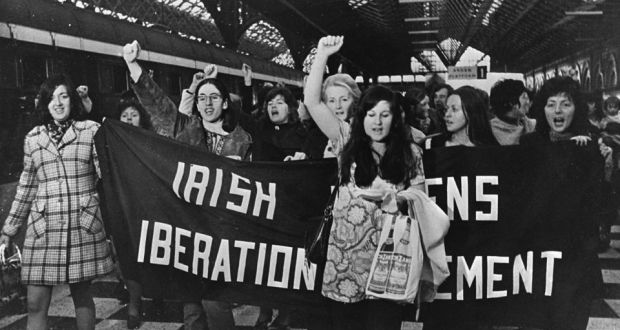
Irish women photographed at Connolly Station 1971, about to board train to Belfast to purchase contraceptives to bring back to the Irish state, illegal at the time. There was no right to abortion either or divorce and a husband’s signed permission was necessary to take out a hire purchase agreement. (Image sourced: Internet)
A full half of those fourteen points above (nos. 5,6, 7, 8, 12, 13 and 14) would have meant taking on the Church head-on and no doubt the hierarchy would have hindered the struggle over most of the others too, due to its strong links with the State and its ruling class.
Because of its tactical and no doubt ideological refusal to take up those struggles, the Republican movement could do little more in the 26-County state than to agitate for solidarity with the beleaguered nationalist population inside the British colony.
Though this could be effective for a time it could become a mass movement, nor survive a long struggle, without any remedy being sought to the issues facing the population within the state.
The wonder is not that the majority leadership of the Republican Movement threw in the towel on the military struggle in 1998 but that they had waited so long to do it. Of course, they never admitted the true nature of what they were doing: abandoning the armed struggle and revolution in total and instead, using their negotiating position to advance themselves politically – not in the economic, social and political struggle envisioned above but rather in a political struggle to find themselves a place among the Gombeen political class in the Irish state and as accomplices in the governing of the colonial state.
Diarmuid Breatnach is a veteran independent revolutionary activist, currently particularly active in committees against repression, in some areas of internationalist solidarity and in defence of historical memory.
Published by kind permission of Dublin Anti-Internment Committee from their Facebook page End Internment
INTERNATIONAL FLAVOUR ON IRISH ANTI-INTERNMENT PICKET
Clive Sulish
The Dublin Anti-Internment Committee was out again on Saturday 13 July (the day before Bastille Day, which marks the French Revolution, the taking of the Bastille prison in Paris in 1789 and the freeing of political prisoners by revolutionary forces).
The campaigners were out on their monthly picket to raise awareness that, as their leaflet headline says: INTERNMENT CONTINUES IN IRELAND BUT BY OTHER NAMES. When political activists (at the moment Irish Republicans) are arrested and refused bail, that is effectively internment without trial. When political ex-prisoners released under the Good Friday Agreement have their licenses revoked and are taken to jail without charge or hearing, that is also effectively internment.
The picketers lined up with their banners and some placards outside the St. Stephen’s Green Shopping Centre which is at the top of Grafton Street and facing the main entrance arch to the Stephen’s Green park. The official name of this monument is Fusiliers’ Arch as it carries the names of many of the Dublin Fusiliers who were killed in the Second Boer War fighting for the British; for the same reason it also widely known as Traitors’ Arch.
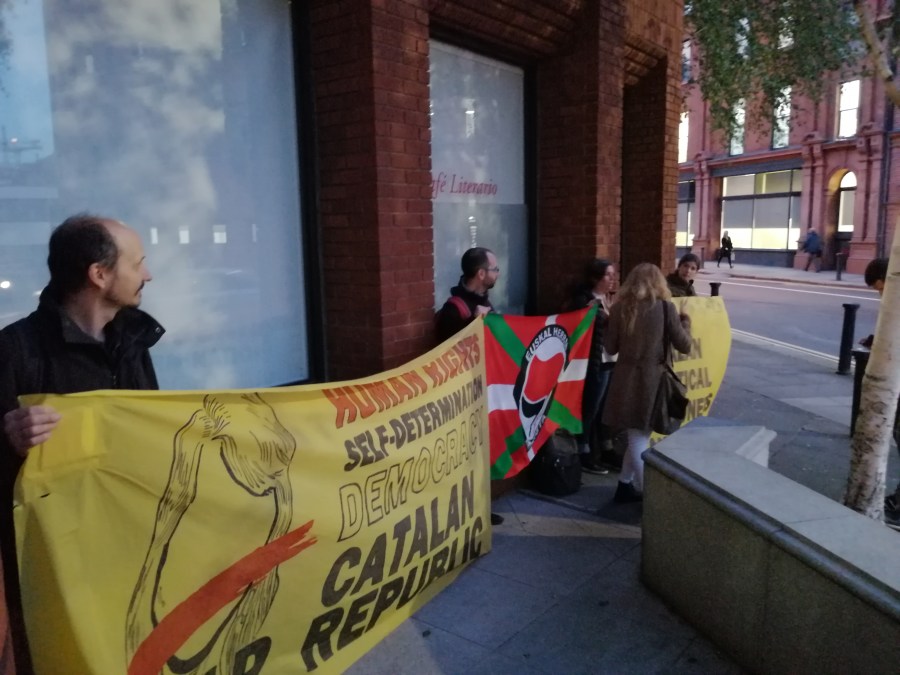
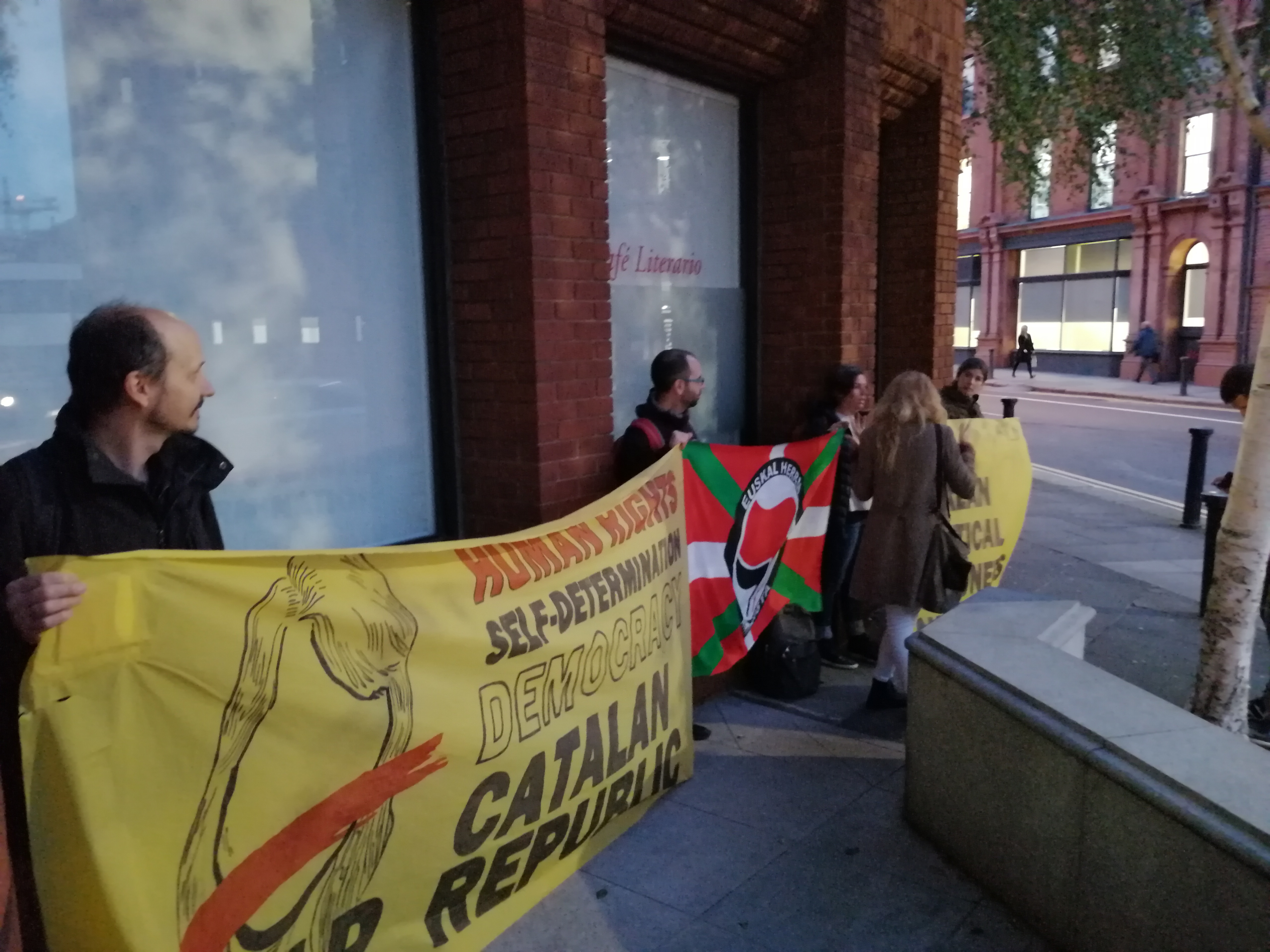
Stephen’s Green Shopping Centre in backgrounBasque couple joins the protestCatalan supporter inlcuded in photo with west side of Stephen’s Green Park in the backgroundDAIC supporter hands out leaflets to passers-by (part of Fusiliers’/ Traitors’ Arch in background)
Stephen’s Green also contains monuments to people who were political prisoners in their time: Ó Donnobháin Rosa, a Fenian who survived where many died as a result of the conditions of their long imprisonment; United Irishmen Emmet and Tone, both before execution and ICA officer Markievicz, who was an officer in the 1916 Rising Garrison here (and whose death sentence was commuted).
Just over a hundred years ago, this whole area was a battleground under the command of the Irish Citizen Army, the workers’ army created in 1913 to defend striking workers from the Dublin Metropolitan Police. Some of the structures here carry the marks of many bullet impacts.
The area chosen for the picket on Saturday is a very busy one with a constant flow of pedestrians shopping in Grafton Street and Stephen’s Green Centre, tourists and people relaxing walking through, going to and coming from the Green. Many leaflets were distributed.
The protester were joined today by the Abolish the Special Courts campaign and appropriately so, since many Republican activists are charged and taken before these courts where they may be denied bail and kept in jail until their trial so that in the unlikely event of their being found not guilty by these no-jury political courts a couple of years later, they will already have spent that time in jail anyway. The Special “Criminal” Courts are the Irish state’s equivalent of the Diplock Court in the Six County colony.
There was something of an international flavour to the picket on Saturday, with a Catalan comrade supporting the picket and distributing leaflets and briefly a Basque couple supporting it too.
The Dublin Anti-Internment Committee expects to be at another location in Dublin town in some weeks’ time and welcomes support from across the democratic spectrum.
DUBLIN AUDIENCE AT AFRI PUBLIC MEETING CHARMED AND INSPIRED BY FORMER MEMBERS OF USA ARMED FORCES WHO ARE ON TRIAL FOR BREACH OF SHANNON AIRPORT SECURITY ZONE.
Veterans for Peace Members Ken Mayers and Tarak Kauff,US-based anti-war campaigners, last Wednesday evening clearly impressed members of a Dublin audience by their dedication. Both men are awaiting trial in Ireland for exposing U.S. war crimes and the violation of Irish neutrality at Shannon Airport and are at liberty only within the jurisdiction of the Irish State on a combined bail of €5,000.
The bail was paid by anti-war campaigner Ed Horgan, a former army commandant and UN peace keeper and the sum is twice the amount of criminal damage they are accused of having caused to the airport’s perimeter fence, as well as unlawfully trespassing into a taxiway. They did so in order to inspect a US plane to ensure it was not carrying war material or personnel, in violation of Ireland’s Constitutional neutrality. Campaigners have long demanded that the Irish State itself carry out these inspections but despite evidence that the State’s neutrality is indeed being violated by US Planes landing at Shannon, successive Irish governments have insisted in taking USA Government denials on trust.
Tarak Kauff addressing the audience at the public meeting organised by Afri.
The public meeting was opened by Joe Murray, Coordinator of Afri and Emer Lynam, newly-elected Vice-Chairperson of Afri Ireland, introduced the speakers.
The elderly campaigners, in their “Veterans for Peace” sweatshirts, addressed the audience about the reasons for their actions and their commitment to opposing US militarism which they stated was a major cause of misery around the world, including to serving members of the military themselves (quoting a figure of 22 suicides per day), along with being a major cause of world pollution. Ken Mayers explained that the USA has 800 military bases around the world in addition to its 400 on its own territory, the infrastructure, fuel expenditure and waste of the total which he stated is a major cause of pollution. (This is presumably without even taking into account the use of nuclear-generated power and disposal of radioactive material, or depleted uranium projectiles, such as used in Iraq or the Agent Orange defoliant used in the Vietnam War.)
Both men belong to an organisation called Veterans for Peace which campaigns against the US militarisation of the economy, war, interference in the affairs of other states and for better treatment of veterans. Recently they also supported a campaign against concentration camps for migrants along the US-Mexico border.
13 DAYS IN JAIL THEN BAIL ON CONDITION THEY DON’T APPROACH ANY AIRPORTS
Ken Mayers, 82 years of age and Tarak Kauff 77, spent 13 days on remand in Limerick jail, where their toilet did not flush unless they poured buckets of water into it. Other than that, they said they were treated well and the other prisoners treated them “like celebrities”.
The reason for their bail being refused during that period was Garda objections that they would flee the jurisdiction. Tarak Kauff exposed the illogicality of this ‘fear‘ to the Dublin audience, explaining that they had taken their action at Shannon knowing that they would be arrested and wanting to use the trial to expose what was going on at Shannon airport: “For us not to attend that trial, they would have to physically drag us away from there!”
Ken Mayer of US Veterans for Peace, addressing the public meeting
They were eventually granted bail on condition they remain within the Irish state and having to surrender their passports, due to Garda objections again that they might flee, also not to approach any airports. On July 10th the High Court turned down their appeal against these conditions, though the judge said that he might review that decision if the case were to be moved to the Dublin District Court, where the waiting list was much longer. The defendants and their solicitor, Michael Finucane, will be seeking to have the case heard outside Clare, where it is believed a fair trial relating to a Shannon protest is unlikely. A trial date is expected in September or October.
“THEY POSTPONED MY HONEYMOON”
Ed Horgan took the floor after Mayers and Kauff to speak about the one million total of children killed in the Middle East as a result of war and sanctions and urged action to prevent further loss of children’s lives.
Then Emer Lynam opened the meeting to questions.
In reply to questions from the audience about the cost to themselves, Ken Mayers revealed he was due to be on his honeymoon by now with his bride.
Ken Mayers was born in New York City and grew up on Long Island. From Princeton University he entered the US military as a Second Lieutenant in the US Marine Corps, rising to Major until he left the organisation in 1966 in disgust with US foreign policy. In Berkeley University, California he gained a PhD in political science where, according to the AFRI event page, he became a peace and justice activist, which he has been ever since and six years on the Veterans For Peace (USA) Board of Directors, five of them as national treasurer.
Tarak Kauff, ex-military too and also from New York, said that he missed his wife and daughter but both were supportive of what he was doing, being activists also (see short letter from his wife in Links and References). According to Afri’s FB page, he’s a former U.S. Army paratrooper (1959 – 1962), a member of Veterans For Peace, the managing editor of VFP’s quarterly newspaper Peace in Our Times and was a member of the VFP National Board of Directors for six years. He has organized and led delegations of veterans to Okinawa; Jeju Island, South Korea; Palestine; Ferguson, Missouri; Standing Rock …. and Ireland.
Asked what kept them going, they stated the importance to act against injustice. Kauff in particular declared that “to resist is human” and that he wished to be fully human. He said that no-one could tell another what he or she could do but one only had have the courage to ask oneself that question …. and then the courage to act upon the answer.
Section of audience at the public meeting
“IRISH PEOPLE JUST COME UP AND SHAKE OUR HANDS, THANK US FOR WHAT WE ARE DOING”
Both expressed gratitude and a degree of amazement at the warmth of their welcome and appreciation by members of the Irish public. Kauff gave an instance of the Lisdoonvarna pub where the management would not accept payment for their food and drinks. “People just come up to us and shake our hands and thank us for what we’re doing,” the veteran said, “and we don’t get that in the USA.”
Donations from the public fund them and, at the moment, they live in student accommodation at Limerick University, rent free – though they will need to find alternative accommodation in September.
Emer Lynam, Vice-Chairperson Afri.
Asked about popular feeling in the USA, Ken Mayer explained that the US public are exposed to a systematic system of propaganda and misinformation. However their anti-war organisation is very wide with many members and that there were optimistic signs with popular protest about the treatment of migrants along the US-Mexican border and fuel pipeline resistance in New York State and in Standing Rock. However, a little later, Tarak Kauff said that the outlook was not promising but that not resisting was no choice — even if he knew the world was going to end next week, he would feel he had to resist in order to fulfill his human potential.
Earlier in their presentations, Kauff alluded to Ireland’s historic struggle to overthrow its powerful oppressor and called people to oppose the most powerful enemy in the world today – the US State. He said that a stance taken by the Irish Government today would have a strong progressive ripple-effect around the world.
RESISTANCE IN MUSIC AND SONG
Music for the evening was provided by veteran campaigner John Maguire who sang a song he had composed back at the first demonstration at Shannon airport, with a chorus that the audience soon got the hang of and joined in.
Musical accompaniment on the evening, l-r: Paul O’Toole, Nimal Blake, RoJ (Roger Whelan).
RoJ performed a song also of his own composition, accompanied by Paul O’Toole on guitar and Nimal Blake on cajón. Later, O’Toole also sang a song of his own, about the child who lost both his arms to US imperialist ‘smart-targeted’ bombing, then going on to sing one of Dylan’s numbers. Both RoJ and O’Toole are long-time professional performers and have produced CDs of their material.
All performers were warmly applauded.
The evening was a fund-raiser and it could be seen that the collection bucket, although covered, was stuffed with notes. Ken and Tarak also have a Fund Me appeal and Afri is also receiving some donations for them through the Internet.
End.
A line up of activists, military veterans and musicians
Dublin Castle, located in the south city centre, has been the centre of the British occupation of Ireland since 1171 until 1921 (and even after that, some would say).The site offers one-hour guided tours to the public for much of the day, at approximately an hour apart, seven days a week and last year claimed a visitor total of nearly half a million. As a Dubliner interested in history and a walking tour guide, I was well overdue to take an official guided tour of the place, which I did recently.
Overall the State Rooms Tour was interesting and I did learn some things but I was also aware of many gaps. Was this unavoidable in a tour of one hour covering more than eleven hundred years (given that Viking Dublin was also covered) of history? Of course – but in the choices of what to leave out, was there an ideology at play, one that sought to diminish the repressive history of the institution and the struggle against it?
An artist’s impression of Viking Dublin in 9th Century
The first presentation to us by the tour guide was of Viking Dublin, the settlement of which took place in the 7th Century. The Vikings had a confrontational occupation of England but this had not been the case here, we were told – the Vikings settled amongst us, intermarried, introduced personal and family names, place-names, etc.
Well, somehow the tour spiel had ignored the many battles between the Vikings and the natives in Ireland even after the settlement in Dublin (and other areas), leading up the famous Battle of Clontarf in 1014, fought on what is now the north side of Dublin city. The 12-hour battle was important enough to be recorded elsewhere in Europe and in a Viking saga. Yes, it had also been an inter-Irish battle, in particular between the King of Leinster and the High King of Ireland but Viking Dublin played an important part, as did Viking allies and mercenaries from Manx and the Orkneys – and its result had ended forever any possibility of a Viking takeover of Ireland.
A noticeable gap in Irish-Viking history of Dublin to omit it, one might say.
Nevertheless, the tour guide gave us interesting information about the Viking settlement and a map showed an artist’s impression of how it would have looked.
Down in the base of what had been the Powder Tower, it was interesting to see the stone work, to hear the guide talk about the foundation of the Viking wall below us and how the cement used to bind the stones was a mixture of sand, oxblood, horsehair and eggshells. To me it was also interesting to see the stone course lines of one pointed arch above a curved one but unsure what I was looking at — and we were a big group, the tour guide some distance away to ask.
Powder Tower base incorporating some of the original Viking wall.Two separate arch stone courses, one above the other in the base of the Powder Tower.
Down below the walkway, where water lay on the ground a couple of inches deep, some green plant was growing in the lights illuminating the work. This was above the route of the Poddle, I supposed, which once fed the Linn Dubh (black pool) and which now runs underneath Castle and city before emptying into the Liffey.
“BEYOND THE PALE”
The Normans reached Dublin in 1171 after landing in Wexford in 1169, our guide informed us but we were not told that in the process they defeated Irish resistance and the Dublin Vikings and, most curiously, there was no mention of the Pale. That would have been an interesting explanation to visitors of the origin of the expression “beyond the Pale” and what it implied1.
The guide did tell us later in the St. Patrick’s Hall (the State banquet room) that the paintings on the ceiling were to demonstrate to the Irish that all the civilising influences had come from the English to the Irish savages, that if the Irish were now civilised, their ranking was definitely below the English.
One of the ceiling paintings in St. Patrick’s Hall, where the Uachtarán is inaugurated and which is also the State’s banqueting hall
That might have been an appropriate time to mention of the Statutes of Killkenny 1366, nearly two centuries after the Norman invasion and how the Irish Normans had, outside Dublin, adopted ‘uncivilised’ Gaelic tongue, custom and even law, so that their cousins in England were now calling them “the degenerate English” who had become “more Irish than the Irish themselves”.
If the English Reformation got a mention I must have missed it but certainly there was nothing said about the imposition of the new religion on Ireland, colonists and natives alike and the many wars that resulted. Anglicanism had become the religion of the English State, with its monarch at the head of the Church but none of the Irish natives and most of the colonists did not wish to adopt that religion. So it led to many uprisings, first notably from the Irish Normans (Gall-Ghael), then by the Irish and a number of major wars, including the Cromwellian and Williamite ones, also to the Penal Laws. That State religion was the reason that Elizabeth I had founded Trinity College, so that the sons of the colonists would be educated in the “true faith”. Religion had been used by the coloniser to try to undermine unity among the inhabitants of Ireland and had been employed to physically divide the island in 1922, which had also led to a much more recent war of nearly three decades.
The Reformation and its effects seemed a quite significant portion to leave out of Irish history in general and of Dublin history in particular.
Apparently a Lord Lieutenant of Tudor times riding out of (or returning to) the Castle with his knights and soldiers to deal (or having dealt) with the troublesome Irish natives (a representation on display in the Castle).
As the Castle had briefly been acknowledged as being, among other things, a prison, it seemed strange to omit the escape after four years of captivity of Red Hugh O’Donnel and two O’Neill brothers in 1592 — particularly so since the whole experience had left O’Donnell with a seething hatred of the English occupation which only ended years later in a poisoned death in Spain at the hands of an English agent. Aodh Ruadh Ó Domhnaill, as he was known then to most of Ireland (and Scotland), fought the English occupation from 1591 to 1602. Apart from being an important part of the Castle’s history one would have thought it would make an exciting and interesting story for tourists.
Aodh Rua Ó Domhnaill monument (Photo source: Internet)
However, the story was omitted – but then so were the tortures carried out in the Castle, the severed heads erected on spikes on Castle walls and, although it was said that it took the English 400 years to conquer the rest of Ireland, this was apparently because “there were no roads and there were lots of bogs”!
Commenting on later medieval Dublin city, the guide told us about the many diseases that were endemic, due to lack of sanitation in the city, along with blood-letting being the major medical treatment. It was strange that she did not mention the effects of the Black Death or Bubonic Plaque, which travelled through Ireland in 1634. The plague, carried by fleas on the black rat, affecting almost alone the city populations, almost wiped out the English colony in Ireland.
Artist’s impression of medieval Dublin City (perhaps 17th Century?). The guide told us it would have been pretty smelly.
IRISH WOOD, FAKE STONE COLUMNS
Chapel main stained glass window, looking east
In the Chapel, the guide pointed out the names and coats of arms on each side as being those of Lord Lieutenants of Ireland, i.e the representatives of the English monarch in governing Ireland. There were of course no native Irish names among them and few even of the Gall-Ghael.
One that took my attention, near the doorway, was that of Cornwallis, dated 1798. Lord Cornwallis (“Cornwall’” in the traditional ballad The Croppy Boy) was in charge of the suppression of the United Irishmen uprising in 1798, at which he was successful but less so in the Thirteen Colonies of North America, which he lost to rebellious colonists, some of whom were relatives and friends of the beaten republicans in Ireland.
Among the other Lord Lieutenants of Ireland, Lord Cornwallis’ coat of arms; he was suppressor of the 1798 Rising in Ireland but lost the war against the 13 Colonies of North America.The ‘fake stone’ columns and one line of coats of arms of former Lord Lieutenants of Ireland.
In response to an enquiry as to whether there were any questions, I asked who were represented by the sculpted heads along the chapel wall on the outside. Some represented Christian saints and some kings, such as Brian Boru2, she replied. Is there a list available of who they all are? No, I was told, only of some of them and I could consult that later.
Amazingly, only the floor and walls in the chapel were stone. The columns, she told us, were Irish oak plastered over to look like stone.
Section of ceiling and columns in the Chapel.
MONARCHS AND PRESIDENTS
In her introduction to the tour, our guide had informed us that Lords, Kings, Queens and Presidents had visited the Castle. The creation of the role of President in the 1937 Constitution, she told us later, had been to replace that of the English Monarch. I had not been aware of that. She told us that he commanded the Army, which was news to me too (or I had forgotten) and it turns out to be true, though more so in form than in substance for, as she informed us, real power is vested in the Taoiseach (Prime Minister).
An extremely heavy chandelier in the Throne Room, mostly solid brass, with the emblems of the English Rose, the Scottish Thistle and the Irish Shamrock worked into it.The ceremonial throne upon which Queen Victoria had to be lifted.
In the Throne Room we were told that Queen Victoria had visited Ireland 1n 1849 and had to be lifted up to the Throne, as she was so small (bit of a deflater for the lines in the “Monto” song!3).
In her visit to Ireland the guide told us, the Monarch had been shocked by the scenes of hunger during the “Famine” (the Great Hunger) and that aid to the starving improved after her visit. Well, perhaps but the effects of the Great Hunger were covered in newspapers and appeals long before 1849 and the worst of the holocaust was over before then, the statistics of which the guide gave us; in our folk history Victoria is referred to as “the Famine Queen”.
The guide made much of the fact that Queen Elizabeth II (who might be known in a republic as: “Ms. Elizabeth Windsor”), had visited the Castle, had spoken in Irish at the reception banquet and how this was the first time an English monarch had spoken English at a State occasion, though Elizabeth I she told us knew a few Irish phrases.4 The guide attached no little importance to Elizabeth I’s gesture and to the whole visit as an act of reconciliation and we know that no less than the Irish President at the time, Mary Mac Aleese, had looked around mouthing “Wow!” when the monarch spoke five words in Irish: “A Uachtaráin agus a chairde … (“President and friends” …).
Such is the sycophancy of the Castle Irish mentality, that five words in the native language of a country being visited by a head of a foreign state should evoke such wonder and gratitude in their hearts. Forgetting that the very colonial regime of that state had for centuries worked to stamp out that language, barring it from all public arenas and educational institutions. One must wonder that a monarch whose armed forces are in occupation of one-sixth of the nation’s territory should be so honoured by the head of this state and other dignitaries from the areas of politics and visual, written and performing arts!5
I could have commented that during the Monarch’s visit, huge areas of the city centre had been barred to traffic by the police force of this “republic” in a huge negation of civil liberties; that police had been taking down posters against the visit and ripping even Irish tricololour flags from the hands of protester to stuff them in rubbish bins and truck; that Dublin City Council workmen had been removing anti-Royal graffiti while workers’ housing estates had been waiting for years for a cleanup service.
Guiding a small Latin American tour through the Castle grounds a few days before the scheduled banquet-reception, we were accosted by secret police who required us to state and prove our identities, state our reasons for being there (!) and the tour group to hand over their cameras for the agents to scroll through their histories. And the agents seemed surprised when I failed to agree with them that their actions had been reasonable.
I could have said that during Elizabeth Windsor’s reception banquet I had been with others in Thomas Street protesting her Castle reception and that at the corner with Patrick Street, we had been prevented by lines of riot Gardai from proceeding any further – not out of concern for her security but so that Her Majesty should not even hear any sound or see anything to disturb the serenity of her visit.
I did not say any of that – I still had a tour to finish and, besides, no doubt this is the Castle Tour Discourse, not to be blamed on one guide.
We were shown too the two banquet halls, the original and the one for state visits nowadays as the original was “too small”.6 And the sights of hunger outside the Castle walls in 1849 had not seemed to intrude on the guests enjoying the five-course meal served at Victoria’s welcoming banquet.
St. Patrick’s Hall, where the Uachtarán is inaugurated and which is also the State banquet room.
Seeming somewhat out of place, there was also an exhibition of Irish painting of the modernist school.
Portraits of the Presidents of the Irish State lined the corridor through which we passed to St. Patrick’s Hall (also the Irish State banquet room) and I could not help but contemplate that of the nine Presidents to date, one had been a founder of an organisation banned by the British occupation, another two had been soldiers against the British occupation but had since taken part in the suppression of their erstwhile comrades.
Portrait of Erskine Childers, one of the past Presidents of Ireland. His mother was a UStater, his father, also Erskine, was English and ran guns into Howth for the Irish Volunteers and later joined to fight for Ireland in the War of Independence. In the Irish Civil War he fought against the State, which captured and executed him.
Another was the son of an Englishman who became an Irish Republican and was executed by the Irish state and another had resigned after being insulted in the Dáil by a Minister of the Government.
Not surprisingly, perhaps, nothing was said about any of that, either.
NO CASTLE CATHOLICS OR COPS?
Coming into more modern times, the I916 Rising got a reference, unsurprisingly as a detachment of the Irish Citizen Army had besieged the Castle for a couple of days, mostly from the nearby City Hall; the ICA’s leader, ironically, had been brought a wounded prisoner from Moore Street and treated in the Castle too. That was James Connolly and he was mentioned — though the ICA was not, nor were we informed that he was a revolutionary socialist. We were told we could visit the room named after him in which he had been held and treated on a bed there. After the end of the guided tour I went there and although it was an experience to enter the room of course the actual display was disappointingly sparse.
View of the Connolly Room with the supposed hospital bed on which he was treated for gangrene and also courtmartialed prior to being taken to Kilmainham Gaol and shot. (Photo source: Internet)
As headquarters of the British occupation of Ireland and necessarily of repression of resistance, the Castle always had soldiers stationed or passing through there. But it also held a police force, the secret service of the Dublin Metropolitan Police. Usually unarmed with more than a truncheon up until 1916, the uniformed DMP maintained order and bourgeois public morality in Dublin but also repressed public resistance to the British occupation. Not only sex workers and drunks were arrested but so were singers of patriotic ballads, protesters and public speakers. During times of Fenian activity, the DMP also worked to counter the influence of Irish patriots in the city and the plain-clothes G Division was created in 1874 to recruit informers and hunt down active Fenians.
A section of the Fenians were however prepared to counter this with assassinations of informers, some DMP and attempts on the lives of senior DMP officials in the city7 during the mid 19th Century. In the early years of the 20th Century it was G Division which also spied on activists in the trade union and labour movement, nationalists, republicans, the Irish language movement and suffragettes and it was they who identified Irish insurgent prisoners captured by the British Army in 1916, ensuring the death sentence for many (though 14 were eventually executed in Dublin).
The DMP, mostly the uniformed officers, could in fact be credited with being the inspiration to form the Irish Citizen Army: the vicious and sometimes murderous attacks of the DMP on workers’ assemblies during the 1913 Dublin Lockout had decided James Connolly and Jim Larkin to call for the creation of the workers’ militia. During the Rising, it seems that three DMP were shot dead, all by members of the ICA, one of them being at the Dublin Castle entrance.
On Bloody Sunday 1920, during the War of Independence, two IRA officers and an Irish language enthusiast prisoners were tortured and killed in Dublin Castle by police, including the specially-recruited terrorists of the Auxiliary Division. In order to cover up their actions, the police staged photos which they claimed depicted the prisoners not properly guarded and then jumping their guards to seize their weapons, which is how they came by their deaths, according to the cover story.
Plaque commemorating the police murder of three prisoners on Bloody Sunday (erected by the independent National Graves Association).
Soon after that, G Division detectives were being killed in various parts of the city by Collins’ Squad and the Dublin IRA. In fact, a number of the officers and of British Army spies took up residence in the Castle itself, for protection.
After the creation of the Irish Free State in 1921, the independence movement split and in the following Civil War (1922-1923) the repression of the continuing resistance was mostly the work of the Irish National Army. However, when the Irish police force was established, the Gardaí Síochána, their Special Branch detectives were again based in Dublin Castle,8 though they are based elsewhere now.
First in the series of staged photos allegedly showing the three prisoners and their guards on Bloody SundayThe second of the staged photos to cover up the police murders, even more ridiculous than the first.
Since there was no mention of any this on our tour, a significant part of Castle history was being omitted.
CASTLE CATHOLIC IDEOLOGY?
There existed during the British occupation a social group — or perhaps more than one — that in the commentary of most Irish, perhaps, were referred to as “Castle Catholics”. This was not a reference to Catholics who owned a castle but to those of the native and Norman-Irish stock, i.e nearly all Catholics who, while maintaining their religion, bowed to the English occupation in everything else. And particularly the more elevated echelons among that group, for whom attendance at functions in the Castle were the high point of their social calendars and indeed their lives. Ag sodar i ndiaidh na n-uaisle9, as the Irish have it in their native tongue.
With some exceptions, I thought the tour and commentary, although interesting and of course catering to the expectations of foreign tourists, had more than a little of “Castle Catholic” or, better said, “Castle Irish” to it.
And it therefore lost a lot in the telling.
End.
FOOTNOTES:
1Effectively an English anti-Irish racist term: “The Pale” referred at first to the areas enclosed by the Normans by an earthworks surmounted by a wooden palisade, i.e the area of colonist control. “Beyond the Pale” were the areas still under control of the Irish clans, uncivilised in the viewpoint of the colonists and the expression survives in English today to describe something as being a horror.
2A missed opportunity to mention the Battle of Clontarf and the defeat of the Dublin Viking and Irish Leinster forces!
4Apparently Elizabeth I had a fair bit of linguistic ability, being fluent in English, Latin and French. It is believed by some that she knew more than a few phrases of Irish, having been taught by a tutor she recruited.
5Among them were the musicians The Chieftains and the poet laureate Heaney who had, some decades earlier written that “no glass was ever raised in our house to an English King or Queen”!
6There were 172 dinner guests at the banquet to welcome Elizabeth I of the UK.
7For a good atmospheric account of the struggle between the two forces, see The Shadow of the Brotherhood – the Temple Bar shootings by Barry Kennerc, Mercer (2010)
8An Irish Republican ballad of the early 1970s based on an earlier song had it thus:
“Oh the Special Branch in Dublin,
They’re something for to see:
They crawl out from the Castle
To inform on you and me.
But the day is coming soon me boys
And the rifles they will bark –
On Saturday 8th June, The Starry Plough Historical Society put on a remarkable event: an exhibition of photos from Aleppo with a real-time audio explanation of each by the photographer, community worker Antoine Makdis, speaking from Aleppo itself. Please note all but one of the images are photos taken by me of those being shown on the screen, hence the poor quality of the image but it is Antoine’s story of each that is of most importance.
Audience and presenter in Ireland in contact with Antoine Makdis in Aleppo. (Photo: D.Breatnach
Aleppo is a many-centuries-old city in the north of Syria which for five years was fought over in the war between Jihadists and the Syrian national army. Antoine Makdis is a Syrian community worker who also takes documentary photographs. The city was once the principal one in the region, being on the midway spot on Silk Road for caravans, between Mesopotamia and the Mediterranean but the development of the Suez Canal reduced its trade importance hugely. There was also political rivalry between Aleppo-based interests and those in Damascus, as to whether to gravitate towards allegiance with Iraq or with Egypt.
However, the city has nevertheless been famed for its antiquity and its ancient buildings, as well as for its edible produce and cuisine. Sadly, the city was riven by war between 2012 and 20161, suffering huge destruction to its ancient buildings and communal spaces and with high loss of life too.
This man was looking for where the remains of his shop were in the souq.
Aleppo won the “Islamic City of Culture” title in 2006. Its western suburbs contain “the Dead Cities” with remains of many cultures which have Unesco World Heritage status since 2011 under the title “Ancient Villages of Syria”. The city has the largest covered market-souq in the world and ancient buildings of worship, not only for Moslems but also for Christians and Jews.
This man and his mother took the long way home from their shopping. When Antoine asked them why, they replied that they “are walking their memories” through the souq.Shopkeepers selling their products at a higher price early in the day and dropping as time goes on, then sometimes giving away free at the end of day.For the first time, fish being sold again. This fishmonger is famous in Aleppo now.His shop was destroyed but instead of giving up, he runs a stall in front of the ruins.
Wikepedia: “Aleppo lies about 120 km (75 miles) inland from the Mediterranean Sea on a plateau 280 m (1,250 ft) above sea level, 45 km (28 miles) east of the Syrian-Turkish border checkpoint of Bab al-Hawa. The city is surrounded by farmlands to the north and west, widely cultivated with olive and pistachio trees. To the east, Aleppo approaches the dry areas of the Syrian Desert.”
Before the recent war in Syria the population of the city was 4.6 million, making it the most populous city in Syria but it is probably so no longer. According to some sources it is one of the cities in longest continuous human occupation, possibly since 6th millennium BC.
If I recall correctly, this is what remains of the popular children’s toy shop in the city.This is what remains of a popular square which had a tree and many couples met here first.Fans of a British soccer team. “What did you do during the war?” Antoine asked them. “We played football.”
DOCUMENTING THE EFFECTS OF WAR AND BEGINNINGS OF RECOVERY
After the fighting in the city ceased, Antoine walked around taking photos, documenting not only terrible damage but the efforts of people to recover and the voluntary work done by some people to help people recover the city.
The Dublin event was organised by the Starry Plough Historical Society. A screen displayed the photographs while a presenter conversed with Antoine Makdis on a link-up and the latter talked about each photo, why he took it and what it meant to him.
I think this is a photo of school being reopened. Many of us, like Antoine, were reluctant attenders at school but these kids really look forward to it after the war.This one also of kids going to school these days, I think.
“I wanted to show the world my beloved city Aleppo, through my eyes”, the photographer wrote in an introduction published on the event page. “This city that suffered a lot from the war and at the same time is cleaning the dust of battles from it’s magical robe to rise again as the oldest and most beautiful city in the world. That year, Aleppo started to recover after the unification of the parts of the city. And I started to publish these pictures on facebook, writing sometimes stories about the photos and most of the times keeping the picture taken unaccompanied by words.”
The event promotion on FB posted that it would be “… non-political, free to attend and open to all (respectful behavior to others is mandatory however).” At the time I questioned how anything could be non-political, to say nothing of photos taken in what was a war zone fought over definite political objectives. I do think I was correct in doubting that possibility and, at times, it was clear that Antoine was grateful for the Syrian National Army for ridding his city of the jihadists and that is entirely understandable.
Sadly, as the last photo was being discussed, I had to leave to attend another event and so was unable to participate in discussion with the photographer, or to thank and congratulate him for his work and what seemed to me a deep humanity underlying it.
Workers are hired to clear the rubble but funds to pay them only stretch to half a day. This worker does a full day, half for free, to help bring the city back to life.This man voluntarily cleans houses left filthy by the jihadists so that people can move back in, Antoine told us. Behind him, a building has collapsed spectacularly resembling geological strata pushed up at one end by tectonic plates movement.
This kid called his donkey by his brother’s name. He goes around collecting and delivering items and gives a lift to anyone who wants it.
ALEPPO WAR BACKGROUND
The uprising against Assad may have had genuine democratic or socialist component and it would not be surprising, given the history of the Syrian State, if they were suppressed with unreasonable force.
This woman, Antoine told us, lost her husband and had 12 children to care for. The street she had to go on to get food for the children was overlooked by snipers in combat each end of the street but she went each day. A hero.
In Aleppo, there had been a demonstration against Assad in August 2011, some months after they had occurred elsewhere in Syria. Syrian State forces had suppressed that demonstration with the loss of two lives. Two months later, there was a large pro-regime demonstration.
The jihadists began to attack Government forces and others with bombs the following year. In February two suicide car bombs hit security compounds, killing four civilians, 13 Army, 11 Police and injuring 235. Another bomb in March 2012 killed two police and one civilian and injured 30 residents of the area. In July the “Free Syrian Army” besieged the city and penetrated into a section so that the war was then fought house to house until it stabilised into war between the section held by the FSA and the other, held by the Syrian National Army, separated by a no-man’s land.
The FSA were by this time undoubtedly mostly jihadists, i.e followers of the call of “jihad” or religious war. Jihadists are operating in various parts of the world and have undoubtedly been funded by Western Powers, chiefly the USA, along with in many cases sections of the Saudi Arabian royal ruling class.
I am unsure whether this is the old dangerous or the new safer Aleppo road. The old one was often ambushed by the FSA and severed heads were sometimes left along it. Antoine lost two former school mates on that road.One of the many such sights on the old road.
The strategists of the USA have felt for years that it was necessary to have the rulers of a number of Middle Eastern states overthrown and replaced with regimes friendly to them.
The USA began seriously funding jihadists in Afghanistan to counter the Russian military and political presence there from the end of 1979 to early 1989 (they even sent them Rambo2!). Al Qaeda was created then by the USA, the organisation’s leadership drawing also on support from ruling circles in Saudi Arabia.
The CIA strategists developed a theory that religious zealots could be used to counter the influence of socialists and anti-imperialist democrats. Like Dr. Frankenstein’s monster, Al Qaeda later turned against it creator, the USA, of which the most spectacular incident was the hijacked airplane attacks on the Twin Towers and on the Pentagon in September 11, 2001.
“This is not a happy picture,” Antoine said. These children imagined themselves soldiers and had formed a platoon, with different ranks among them.
The monster has found a life of its own and has bred many offspring (the organisation variously known as ISIS/ ISIL/ Islamic State/ DAESH being the most notorious) and continues to be an ongoing danger to the people of the world. The various groups often fight among themselves for dominance and this was the case between ISIS in Syria and the imperialist-backed FSA.
Dr. Frankenstein has not entirely given up on his creation, believing it can be used in a controlled way from time to time wherever in the Middle East the political situation threatens the foreign interests of the USA.
End.
She wants to study to become an architect, to reconstruct her ruined home, the ancient building behind her.The lingerie shop is back in businessContrasting styles of womenWith the water supply damaged, people had to go to water tanks supplied. Here an Armenian Christian and an Arab chat while collecting water.With electricity supply reconnected, he can have light in his shop again.Each day these two take walks through once-familiar districts. The one on the right is developing Alzheimer’s and his friend talks to him about what they see.Antoine heard this child singing “Old Mac Donald” with some of the words in Arabic but he was too shy to be photographed. Cycling is the best way to get through most the rubble.A couple, perhaps newly-returned, walk through Aleppo carrying their baby between them.
2In the film Rambo III, the actor Sylvester Stallone plays a USA special forces fighter aiding the humble Afghanis in overthrowing the Russian occupation.
Ireland has broken off its love affair with the USA but the breakup’s been coming for a long time. Of course it was always a kind of mythical USA that was the love object, of film stars, rock n’ roll, friendly presidents, Irish-U.Stater politicians, of U.Stater tourists – never the real USA, good or bad. One could feel the tensions in the relationship during the Viet Nam War, though that was mostly to be seen in the youth and some lefties. But then came the lying scandals in the US Presidency of Nixon and Clinton and the naked warmongering throughout all, including the Bushes, Snr. and Jnr.
Looking southward from around the middle of the crowd in front of the Garden of Remembrance, Parnell Square, Dublin. (Photo: D.Breatnach)
Ireland, below the level of its Gombeen politicians, has split up with the USA (at the level of ITS politicians and millionaires [often the same thing]) but it has been a relatively civilised breakup and thankfully with no children (well, apart from the Irish illegal immigrants – sorry, undocumented visitors).
While some businesses in an Dún Beag might have turned a profit out the Fear Mór’s visit, having the Chief of the World Superpower drop in on us has cost us – around 10 million euro, according to the Irish Independent. Loads of extra Gardaí on the ground in Co. Clare and Limerick, in the air and on sea, does not come cheap (though I’m sure the overtime was welcome). All would have been bad enough if we had invited him but we hadn’t. Will the Irish Government present the US Presidency with an itemised bill? Probably not.
Blimp rising — taken from northern edge of rally. (Photo: D. Breatnach)
At the invitation of The Irish Examiner, a number of organisations and individuals had written letters to Trump for publication (see link below); most were critical and these included Amnesty International, Irish Council for Civil Liberties, Ireland Palestine Solidarity Campaign, National Union of Journalists, National Women’s Council of Ireland, National Union of Students; Brendan Ogle, Tara Flynn and Clare Daly. For entertainment value I’d pick out the IPSC’s and Tara Flynn’s (well, she is a comedian). The ICCL also had a newspaper advertisement criticising Trump, which was sponsored by the American Civil Liberties Union and figured logos of a number of other civil rights organisations.
There were protests in various parts of the country, including one to greet his arrival at Shannon airport (hopefully US munitions and troop carriers were pulled to one side so as not to hinder his landing). The Irish Times said there were about 200 protesters there so, on past reporting, there could have been anything between 300 and 1,000. It is not easy to get to Shannon airport unless one has a car, even from Galway the gaps between bus arrival times are substantial. And no train station.
(Photo: G.Guilfoyle)
DUBLIN RALLY
Dublin had a showy and packed anti-Trump rally, with a Baby Trump blimp floating above the crowd outside the Garden of Remembrance. An activist brought big letter placards which, with the help of volunteers from the crowd, spelled out anti-trump messages in English and in Irish. Indeed an interesting feature was a number of placards partly or completely in Irish.
(Photo: D.Breatnach)(Photo: G.Guilfoyle)
The theme of “welcome” or “fáilte” was of course played upon in reverse, in speech and placard, with more than a hinted reference to the old Bord Fáilte slogan inviting tourists to the land of “céad míle fáilte”.
On this placard play is made of the old “Céad míle fáilte” sentence (“a 100,000 welcomes”) but with a different twist.
The event was managed by Unite Against Racism which is, for the most part, People Before Profit, which in turn is really the Socialist Workers’ Party. A number of other left-wing party flags could be seen too. A group of Shinners were at the rally with their trademark flags (never go anywhere without the party’s flag) but no “dissidents” were present as a group, though I certainly noted some as individuals.
The speakers at the rally covered a number of themes, including of course misogyny, migrants, Palestine, war-making and imperialism. Liam Herrick of the ICCL was an unusual sight to see on an outdoors protest platform, speaking at the second part of the rally. Curiously, the rally organisers had sent a major part of the attendance off to march around the city centre for awhile and of course, when they got back, they had shed a great part of their numbers. A torrential downpour no doubt encouraged the desertions.
Glenda, “the woman of letters”, with some of her work.
Coming towards the end of the rally, a performer accompanied himself on guitar while he rendered some songs for the diminished attendance. Woody Guthrie’s “Plane Crash at Los Gatos” (also known as “Deportees”) would have been an apposite choice, a song about Mexican labourers being employed in the south-eastern US fruit harvests and then driven back across the Border. Guthrie was moved to sing about them when in 1948 a plane carrying mostly deported Mexicans crashed, killing all on board and though the names of the crew were given in the news reports, the Mexicans were referred to only as “deportees”.
At the rally, eventually Trump was deflated (the blimp, I mean), tethering weight bags emptied of water, placards were packed, flags furled …. and I went to get some shopping.
Forty-five years after the highest violent loss of life of any day in the Thirty-Years War in Ireland, survivors and relatives of victims of the Dublin and Monaghan bombing seem no nearer achieving justice. The identities of some of the Loyalist terrorists were known quite quickly after the bombing by Irish Army Intelligence and Garda Special Branch; British Intelligence penetration of some Irish State agencies had already been claimed by Irish Army intelligence and not long afterwards, Commissioner Ned Garvey was exposed as a British agent by a disgruntled British intelligence operative. Yet no arrests by the Royal Ulster Constabulary, no arrest warrants issued by the Irish Government and – incredibly – remains of bomb material were sent by Garvey’s superior to the British colony authorities for analysis. And consecutive British Governments refuse to hand over the relevant files or to disclose their contents.
View of section of the crowd at the commemoration. (Photo: D.Breatnach)
45th ANNIVERSARY COMMEMORATION IN DUBLIN
A crowd had gathered at the Dublin and Monaghan Bombings Monument in Talbot Street for some time before the event was due to start on the 17th May. Aidan Shields, whose mother Maureen was killed in in Talbot Street, acted as the master of ceremonies and, after saying a few words about the bombings and the campaign, outlined the course the proceedings would follow, apologising also to those who had to stand in the rain.
Irish Minister for Justice Charlie Flanagan spoke about the bombings and about the efforts he had made, on behalf of the Government, to have the British Government lift their embargo on the relevant files. He also used the opportunity to criticise by implication the armed Republican resistance in the British colony and to promote the Good Friday Agreement, seeking collaboration between different political parties in running the Six Counties, i.e the British colony. Although he said he shared the relatives’ frustration at the British Government still not disclosing the information about the bombing in their files, not once did he condemn them, nor criticise successive British governments, British Intelligence nor the administration of the colony and its police force.
Aidan Shields, MC of the event, whose mother Maureen was killed in the bombing. (Photo: D.Breatnach)
The Mayor of Dublin Niall Ring and Cathaoirleach of Monaghan Council, David Maxwell, also spoke at the event.
It was left to Noel Hegarty, a survivor of the bombing, in a poem (see References) and Pat Savage in his Song for Derek (which I’ve been unable to find on line) to place the blame for the attack and the lack of progress where it belonged.
Noel Hegarty reading his poem (see link for the words). (Photo: D.Breatnach)Pat Savage performing his Song for Derek (Photo: D.Breatnach)
Julieann Campbell, author and Derry Bloody Sunday relative – her uncle John Duddy was the first fatal victim of the Paratroopers on that day in 1972 — gave the oration for the ceremony. She talked about the loss through sudden death, the effect on relatives and how it is exacerbated when official lies are told about the deaths with secrecy used to make it harder for the relatives and survivors to get at the truth. She referred to one British file on Bloody Sunday that is embargoed for decades yet and turned to Minister Flanagan, asking him publicly to press the British for the release of that file also, a request which was applauded by the crowd.
Rachel Hegarty read one of her sonnets from her collection, May Day 1974, which she composed based on witness testimonies about the deceased and Ciarán Warfield performed a song about the bombing and the lack of justice obtained. Fr. Tom Clowe led those who wished to respond in a Christian prayer (the Rev. Trevor Sargent had injured himself the day before and was unable to attend). Cormac Breatnach played low whistle while floral wreaths were laid and again at the conclusion of the event.
Rachel Hegarty reading one of her poems about the victims (Photo: D.Breatnach)
THE BOMBING 45 YEARS AGO – THREE BOMBS IN DUBLIN AND ONE IN MONAGHAN
What might be considered the official Dublin City centre is the area surrounding O’Connel Street, just north of the river Liffey. The street runs north-south and is bisected at its middle by a thoroughfare running east-west. The eastern part is mostly Talbot Street, with a short continuation named North Earl Street. Crossing over O’Connell Street one now passes by the Spire, where once stood Nelson’s Column (until blown up by dissident Republicans in 1966) and continuing westward, one enters Henry Street. This street contains big stores such as Debenhams and Arnotts and is a higher-class shopping street than are the streets chosen to place two bombs, Talbot Street; could it have been decided that predominantly working and lower-middle class victims were less likely to create pressure on the Irish Government to find those responsible? The other bomb’s target street, Parnell, is also not one of high-end shopping.
Cormac Breatnach, playing at the event. (Photo: D.Breatnach)
There had been previous Loyalist bombings in Dublin, for example of the Wolfe Tone Monument in Stephens Green and the O’Connell Monument in Glasnevin Cemetery. None of those had caused deaths but a bombing in 1972 had killed a public transport worker and another, in 1973, had killed two and injured 185. No arrests were made in connection with either and in fact the Fianna Fáil government blamed Irish Republicans for the ’72 bombing, using the emotions engendered to push through more repressive legislation. That was an Amendment to the Offences Against the State Act, one which allowed the State to jail people on a charge of belonging to an illegal organisation, without any evidence other than the word of a Garda of Superintendent rank or higher and is regularly used to convict people today.
On the 17th May 1974four bombs exploded in Dublin and Monaghan – killing 33 people including a woman who was nine months pregnant.
Three car bombs exploded without warning in the capital shortly before 5.30pm on Friday 17 May 1974.
Two of the bombs went off on Talbot and Parnell Streets before a third blast exploded on South Leinster Street near Trinity College, 27 people died.
Shortly afterwards another bomb exploded outside a pub in Monaghan, killing seven people. Hundreds more were injured.
Wreckage in East Parnell Street after the bomb there (Photo source: Internet)
After the bombings, the most concrete result in Irish Government policy was that Irish Republicans being sought by the British began to be tried in the Irish State. The Criminal Law (Jurisdiction) Act 1976 allowed trial in the Republic for alleged crimes committed in the Six Counties, and vice versa, which facilitated Irish State cooperation with the British State against Republicans, overcoming the many failures in extradition cases up to that date.
This parallels somewhat the 1980s GAL terrorist campaign waged by the Spanish Government against Basque independentists in the northern Basque Country, part of the French State’s territory. After Spanish State-sponsored terrorist shootings and bombings of independentist Basques for some time on what it considers French soil, the French Government began to extradite refugees to the Spanish State. However it was 1984 before the Irish State actually extradited a Republican to the Six Counties, with the extradition of Dominic McGlinchey (who subsequently had his conviction overturned there). It is curious that this possible rationale for the Dublin/ Monaghan bombings does not seem to have been considered – after all, the 1972 bombings by British agents had resulted in a change in Irish law to the disadvantage of Republicans within the Irish State.
Juliann Campbell, niece of Derry Bloody Sunday fatal victim John Duddy, giving the oration at the commemoration. (Photo: D.Breatnach)
The Justice for the Forgotten campaign organises an annual commemoration on the date of the bombings but internationally and perhaps even in Ireland, this massacre is the least-known of all that took place during the recent 30 Years War. Arguably this is because a) the bombs were not placed by the IRA and the massacre was not therefore of much use in propaganda against them; b) the victims were mostly Irish and/or c) the perpetrators were Loyalists and British Intelligence operatives working together.
Overlooking the Talbot Street Monument of the Bombings, the tower of Connolly Train Station (formerly Amiens St. Stn.), from which British machine-gun bullets were fired at Irish insurgents during the 1916 Rising. (Photo: D.Breatnach)
SECRETS AND AVOIDANCE
It is interesting how coyly the media treat the whole question of British collusion with Loyalist death squads, including the Glenanne Gang’s involvement in the Dublin-Monaghan bombings, along with Irish State‘s lack of energy in pursuing the matter, including possible collusion and certain secrecy. There are sometimes ‘suspicions’, ‘concerns’, ‘inferences’, ‘allegations’ ….
And yet most of these matters are beyond speculation, established as facts through a number of different sources. Contrast that with how happy the media are to label the tragic but accidental shooting dead of Lyra McKee as a “murder”, even though legally and in fact, murder can only be when someone intends to kill the victim – which not even the press in its greatest hysteria has tried to suggest was the case.
The Justice for the Forgotten campaign has taken a civil case against the British State which appears to be playing its usual delaying game in situations like this. On 17th April they were due to respond to questions of the campaign’s lawyers but did not do so until eight days later, which resulted in the campaign’s lawyers not being able to proceed at the Belfast High Court on May 1st ….. The relatives will now have to wait until September.
The lack of energy and firmness in pursuing the issues and the disclosure of British files is not the only evidence of the Irish State’s lack of interest. It is also the case that much of the funding for the Justice for the Forgotten campaign was removed by the Irish Government some years ago; the campaign was obliged to leave its Gardiner Street office and remove much of their equipment and files to a portakabin in a supporter’s back garden.
Margaret Urwin speaking, main administrator/organiser in JFF (Justice for the Forgotten), underfunded organisation campaigning for disclosure and justice with regard to the Dublin and Monaghan bombings. (Photo: D.Breatnach)
The British are not the only ones sitting on secret files. Mrs. O’Neill had called on Leo Varadkar to release the files deposited by the McEntee Commission, which was charged with investigating the Garda inquiry of the time, an inquiry which has been heavily criticised over the years. “I personally ask the Taoiseach to consider this reasonable and fair request,” she had said. Martha O’Neill’s husband, Eddie, was killed in the bombing and her sons Billy, then aged seven and Eddie jnr. aged five, were badly injured but survived.
Last year, Fred Holroyd, a British Army Intelligence officer who was the liaison with the RUC for a number of years during part of the three decades of war in the Six Counties, offered to give evidence on British involvement in the bombings – but in a secret court. Holroyd is suing the British Ministry of Defence over sacking him and has spoken out about collusion between the British administration and Loyalist paramilitaries including those widely believed to be the Loyalist bombers responsible for the carnage on the 17th May 1974.
Another measure of the Irish Government’s lack of enthusiasm for going after the perpetrators of the bombings and their handlers can be seen in the fact that the first documentary to be made about the atrocity in the Irish capital cityand Monaghan town, was made not bythe State broadcaster, RTÉ but by the English company First Tuesday, Yorkshire TV. “Hidden Hand – The Forgotten Massacre” was broadcast on 6 July 1993. Not everyone who had TV in the state then had ITV – I believe it required a special aerial at the time – and if memory serves me correctly, Yorkshire TV offered simultaneous screening to RTÉ, which it declined. The program made a case that the British Army, the RUC and Loyalist paramilitaries could have been involved in a number of killings, including the Dublin-Monaghan bombings.
The failure of the Irish Government at the time to pursue the case energetically and in a correct manner was responsible for much more than leaving the injured and the the relatives of 33 murdered people without justice. It also left the Glenanne Gang, a Loyalist paramilitary Ulster Volunteer Force death squad that included serving members of the Royal Ulster Constabulary police force and the British Army’s Ulster Defence Force, free to carry out around another 120 sectarian murders in the Six Counties.
(Photo: D.Breatnach)
Year after year, the Dublin/ Monaghan commemoration is held and year after year, relatives call for truth and justice; the Irish politicians express regrets and say that they will ask the British Government for the files again, to be refused again. And there it is left, until the following anniversary.