Christmas shoppers on Saturday 17th in Dublin’s O’Connell Street, the city’s main boulevard, were interested to see a long picket line displaying banners, flags and placards.
The event was a jointly-organised public reminder of the continuing existence of political prisoners in Ireland and as a gesture of solidarity to the prisoners too.
The joint organisers were the Ireland Anti-Internment Campaign, the Irish Republican Prisoners Welfare Association and the Anti-Imperialism Action organisation. The attendance were mostly Irish Republicans but there were also some from the socialist/ anarchist traditions present.
Long line looking southward of joint Republican prisoners’ solidarity event (Photo: Rebel Breeze)
There are currently 40 Irish Republican prisoners in jails in Ireland, on both sides of the British Border. As a speaker noted at the end, all had been sentenced or refused bail by no-jury special courts of the Irish and British states.
The Irish Tricolour and the Starry Plough were displayed of course but also a Palestinian flag and two Basque ones; the latter attracted the attention of a number of young people from the Spanish state who were pleased and approached the picketers for discussion.
Section of the joint Republican prisoners’ solidarity event showing the Latuff cartoon on a banner (Photo: Rebel Breeze)Section of the joint Republican prisoners’ solidarity event showing couple of Basque flags and Palestinian one in the middle distance (Photo: Rebel Breeze)
Two banners called for and end to the extradition of Irish Republicans and one figured cartoonist Carlos Latuff’s illustration of solidarity between Irish and Palestinian political prisoners.
Leaflets of the IRPWA and of the IAIC were distributed to passers-by.
Section of the joint Republican prisoners’ solidarity event (Photo: Rebel Breeze)
As the event came to an end a representative of each organising group read out a short statement; both the IAIC and the AIA emphasised the need for unity in resisting repression and each along with the IRPWA called for support for Irish Republican prisoners.
End.
Section of the joint Republican prisoners’ solidarity event (Photo: Rebel Breeze)Section of the joint Republican prisoners’ solidarity event (Photo: Rebel Breeze)
First published in “Socialist Democracy” December 2022, republished here with kind permission of author.
The death of Vicky Phelan on November 14th was announced by the media. They were full of praise for a woman who was a victim in the cervical smear scandal.
She was one of over 200 women whose cervical smear tests were outsourced to a private US company, which gave back erroneous results.
Women who could have received treatment went on to develop cancer and in the case of Vicky Phelan die. But she didn’t just die. She was murdered.
Engels in his famous tract The Condition of the Working Class in England stated that
When one individual inflicts bodily injury upon another such that death results, we call the deed manslaughter; when the assailant knew in advance that the injury would be fatal, we call his deed murder.
But when society places hundreds of proletarians in such a position that they inevitably meet a too early and an unnatural death, one which is quite as much a death by violence as that by the sword or bullet; when it deprives thousands of the necessaries of life, places them under conditions in which they cannot live – forces them, through the strong arm of the law, to remain in such conditions until that death ensues which is the inevitable consequence – knows that these thousands of victims must perish, and yet permits these conditions to remain, its deed is murder just as surely as the deed of the single individual; disguised, malicious murder, murder against which none can defend himself, which does not seem what it is, because no man sees the murderer, because the death of the victim seems a natural one, since the offence is more one of omission than of commission.(1)
The Irish state has for a long time deprived its population of the necessaries, as Engels put it, of life in relation to health care. One of the first politicians to wreak havoc in the health system in pursuit of her ideology and profit was Mary Harney.
Mary Harney, former Health Minister who set up the Irish health service for privatisation – guilty of murder through neglect. (Photo sourced: Internet)
She and her party the Progressive Democrats were ideological in their commitment to the privatisation of health care. Under her rule and that of successive governments, the health service was privatised.
First, they ran it down, closing hospital wards and reducing the number of beds in the health service, paying Consultant Doctors extravagant salaries, allowing them to moonlight as private consultants, whilst there are now around one million people on public waiting lists.
The system is a shambles and compares poorly in terms of speed and quality of care to even Third World countries.
At the same time a private health care sector has arisen and expanded, all the time promoted by the state through tax breaks and discounts for the companies with affiliates being able to write off part of their private health insurance against tax.
In other words, a public subsidy to the health companies paid for through the taxes of many people who cannot afford to use these services. The Irish health service does not exist to provide health care but rather to generate profit. It is important to understand what this means in practice.
If profit is the motive, then the law of supply and demand takes over and prices and the quantity of services are calculated on the same or similar basis to the sale of a car. It also means that in order for some to be treated and live, others must die.
It is an intrinsic part of the system and they know it. For health care to be profitable some must not have full access to it, some must die in order for others to make profits. If everyone can access cancer treatment without problems then there is no need for private medicine.
This is not the situation in Ireland. Public services are run down in order to encourage private medicine and profit.
It is in this context that the Health Service Executive outsourced the testing of cervical smear tests not only to a private company, but to one in another jurisdiction. Money was to be made, and to hell with the consequences.
Dr David Gibbons, a former member of the screening programme, said he expressed concerns about the outsourcing of smear tests to the US in 2008 but they were dismissed.
Tony O’Brien, former head of the National Cancer Screening Service and Director General of the HSE until 2018 — another one of the guilty (Photo sourced: Internet)
Gibbons, chair of the cytology/histology group within the programme’s quality assurance committee, brought up his worries with Tony O’Brien, then chief executive of the National Cancer Screening Service and director general of the HSE until 2018, but they were not listened to.
Dr Gibbons resigned as a result. O’Brien defended the decision to outsource the testing saying that tests would have otherwise been left idle for a year or been examined by doctors “on their kitchen table”.(2)
Why would they lie idle for a year? Because they had decided not to spend money on it. Why would doctors end up examining them on their kitchen table? Because the facilities weren’t there.
When it all went wrong, they dragged their heels on informing the women, and this is where Vicky Phelan comes in.
She was diagnosed with cancer in 2014, but only informed of the false negative from the unapproved labs used by the HSE in 2011 and sued the US company and the HSE, but her case against the HSE was struck out.
The cat was out of the bag, however, but they continued to drag their heels on informing women that they may in fact have cancer and they stuck by their accountancy guns and continued to outsource the tests.
As Engels stated they know these victims will perish and yet permit the conditions to continue.
When she died, the great and good in Irish society expressed their praise for her. The murderers came back to the crime scene in a perverse act to say “It wasn’t me, I didn’t do it”. The Taoiseach, Micheál Martin stated on Twitter
Very saddened at the passing of Vicky Phelan, a woman of great courage, integrity, honesty & generosity of spirit. She will be long remembered as someone who stood up for the women of Ireland, & globally.(3)
The Tánaiste Leo Varadkar, for his part, was brazen in his Janus-like abilities.
Today Ireland has lost a woman of limitless courage, compassion and strength. I want to extend my deepest sympathies to Vicky’s family, particularly to her children on the loss of their incredible mother.
Vicky was a shining example of the power of the human spirit. Her fight to uncover the truth and the courage with which she faced her illness made her an inspiration to us all. We mourn her as a nation, as a society, and as individuals.(4)
Both of these men bear responsibility for what happened. To listen to them you would swear they were talking about some social justice warrior in a far-off land who stood up to a government that the Irish state is not on good terms with.
Condolences from murderers by neglect, Taoiseach Mícheál Martin and Tánaiste Leo Varadkar, presiding over the privatisation and degradation of the Irish health service. (Photo sourced: Internet)
Varadkar was a government minister in 2011 when Vicky Phelan was tested. He was Minister for Health when she was diagnosed with cancer and he was Minister for Social Protection when she was eventually informed about the mess up with her results.
Martin has been a T.D. in the Irish parliament (Dáil) since 1989 and has served as a minister on and off since 1997 and is the current Taoiseach.
They oversaw the dismantling of the health system, they made up the rules and implemented them. What happened to Vicky Phelan was on their watch. In other jurisdictions functionaries can be held liable for decisions they take, but not in Ireland.
They took decisions on the health service which affect the lives of millions, not just Vicky Phelan. Every year countless patients die in Ireland due to a lack of access to proper healthcare; Varadkar and Martin know this and yet they proceed with their actions.
In a criminal court case where a person carries out an act knowing it could result in the death of a person and decides to proceed nonetheless, they would be liable for that person’s death through recklessness.
Yet, politicians take decisions that kill people knowing that this is the likely outcome. They are guilty of what Engels termed social murder.
Vicky Phelan didn’t just die, Fine Gael and Fianna Fáil along with the Greens murdered her. No amount of praise from Vlad the Impaler a.k.a Leo Varadkar can hide the fact that he bears responsibility for death.
Vicky Phelan, cervical cancer campaigner, 1974-2022.
People may remember that McGeough and an assortment of other far-Rightists and fascists (such as Niall McConnell) were rosary-protesting a local Gay Pride march in the small Co. Tyrone town of Cookstown in September last year, the first ever in the town it seems. Michelle just walked up to Gerry and punched him in the face.
Well, not quite – she did say “Hello, Gerry” a second before she smacked him.
There was some confusion initially, as many thought Michelle was an antifascist or at least an LGBT rights supporter but it turns out that she and Gerry had history that had turned nasty in the branch of the Ancient Order of Hibernians of which Gerry had been a member – hence the knuckle complaint.
Anyway, this allegedly ex-Republican and definitely ex-Provo (both military and political wings — he had been on the Ard-Choiste, equivalent to Executive Committee) took his case to the courts of the British colony but failed as the judge in Dungannon took the view that the punch was a “one-off” (which is perhaps why some people prefer the old “one, two”).
It is remarkable how many of our native far right-wing and fascist stalwart fighters, constantly calling out the corrupt political system and the need to overthrow it, seek the endorsement of the State’s legal system, whether British colonial, as in the Six Counties, or Irish Gombeen, as in the Twenty-Six.
Gemma O’Doherty and John Waters for a while seemed to have season tickets for the High Court; Dee Wall “The Screaming Crutch” of QAnon was heard enough times threatening legal action, as was Right-Wing Ranter-in-a-Vehicle Carey; Ben Gilroy was a frequent (and ineffective) defence representative for people being evicted from their homes.
Gerry McGeough claimed in court that the assault was not merely an attack on him but was also an attack on the Virgin Mary. News & Views staff attempted to contact the Mary in question to hear her views but she failed to respond.
Actually, her main support organisation, the Irish Catholic Hierarchy, was keeping quiet on the matter too, although they are known to share Gerry’s view on the alleged sins of consenting LGBT adults.
It’s just that the ICH management board like to tone it down these days since their position of moral superiority has been eroded over the years, largely but not alone due to exposés of the sexual practices of many of the ICH’s employees with non-consenting minors.
Gerry claimed that on the occasion he had just been there in Cookstown to pray in public, as he does and that he should have the right to do so without being assaulted. Ah Gerry, now, really? News & Views investigative staff enquiries in the locality have found not one local who has ever seen Gerry praying there on any other day.
Which of course leads one to suspect that he and the other fascists and right-wingers were there to protest against the Gay Pride parade and using religion as a cover.
In fact, we recall Niall McConnell and other fascists and far Right-wingers on a number of occasions objecting to the right to pray in semi-public, when Muslims hired Dublin’s Croke Park to celebrate their Eid festival.
Which reminds us, on the occasion that Dublin Republicans Against Fascism organised a counter-protest in July 2020, women were accused of punching or slapping some of the fascists too.
And Niall McConnell, Fuehrer-of-Five of Síol na hÉireann1 took one of the women to court, requiring her to attend court a number of times and then failed to attend himself when the case was to be tried.
There does seem to be a thing about male fascists and women, come to think of it.
At the recent bust-up of the also fascist National Party’s congress at a luxury resort in Co. Fermanagh, the only injuries of consequence inflicted on the anti-fascists were on three female comrades, while five of the would-be stormtroopers – all male — ended up in hospital in exchange.
End.
FOOTNOTES
1The title means “Seed of Ireland” but ‘seedling’ might be a more accurate description and one suffering from damping-off or withering in recent times.
We see and often hear “viva la Quinta Brigada” but this is usually a mistake – the reference is not to the Fifth but to the 15th International Brigade. The word for fifteen in Spanish is “quince”1 whereas “quinta” means “fifth”. The brigade being referred to, the Fifteenth International Brigade, was one formed at the instigation of the Communist International (Comintern) in 1936 from volunteers from more than 55 countries2.
The estimates of numbers of participants in the International Brigades range from 40,000 to 59,000 with a death toll of around 10,0003 and of course many more injured.
Not all the Irish-born and Irish diaspora antifascists who fought4 in what is called the Spanish Antifascist (or Civil) War fought in the 15th Brigade5 but most of them did, whether in the British, Commonwealth or US Battalions (“Abraham Lincoln” and “Washington”, later combined), chiefly because these were the English-speaking battalions of the 15th International Brigade, which also included specific battalions for French, German, Italian, Spanish (from Mexico, Caribbean and Latin America) Czechoslovak, Hungarian and Polish languages6.
International Brigaders crossing the Ebro for the battle. The one in the bows of the boat appears to be Irish communist Michael O’Riordan, carrying the Senyera, the recognised Catalan flag of its time (red and yellow stripes without a star). O’Riordan survived the Civil War and returned to Ireland to lead the Communist Party of Ireland. (Image sourced: Internet)
The familiar songs in English were always about the 15th International Brigade, no other. So why and how has this mistake arisen of referring to the 5th?
The chief transmission of this error in recent time has been through that song with the wonderful lyrics and air created by the Irish balladeer and most famous folk performer, Christy Moore.
And he called his song “Viva La Quinta Brigada”. Recorded and performed under that title, with numerous videos repeating the error, even though he has himself corrected the reference in later performances.7 And in fact there are a number of Quinta Brigada versions of the Ay Carmela song on Youtube. So we can hardly blame all those people who are now singing the incorrect version, can we?
But before we arraign Comrade Christy Moore before a People’s Tribunal, it’s worth looking at the longer process of the error’s transmission. In fact, the incorrect wording was around long before Christy composed his song and it almost certainly informed his lyrics.
TRACING THE ERROR: THE AY CARMELA SONG AND SPIN-OFF
I remember thinking one time, when I became aware of the error in the title and refrain, that Christy should have consulted some Spanish-speaking people in Ireland. But I and my siblings are all Spanish-speaking and I recall even some of us singing a different song with a repeated line: Viva la Quinta Brigada, rumba la rumba la rumba la.
We were Spanish-speaking, yes and very sympathetic to the Republican side in that war — but at that time clearly not clued enough historically to detect the error,
That Rumba la rumba etc was a song in Spanish from the Republican side in the Civil/ Antifascist War, itself a spin-off or readaptation of a Spanish folk song about the crossing of the Ebro against Napoleonic troops in the 1800s. In this case the adaptation was fashioned to record the Republican forces’ crossing of the same river in attack on the advancing military-fascist forces in 1938.
The Battle of the Ebro was the largest ever fought on Spanish soil and lasted from 25th July to 16th November. The International Brigade song to the same air is generally known as Ay Manuela! and clearly refers to the International Brigade, not only by the lyrics in the final verse but by its alternative title, Viva La Quince Brigada!
Somewhere along the line someone made the error of replacing the Quince with Quinta. And so when Christy came to write his wonderful tribute to the Irish who went to the Spanish territory to fight against the fascist-military coup, the mistaken name had already been current for decades.
Re-enactment with partipants playing the parts of soldiers of the Spanish Republic advancing in the Battle of the Ebro. (Image sourced: Internet)
CORRECTING IT NOW
So no-one to blame for repeating the error and whoever caused it originally is long in the past. But we are here now and we know – so we have a responsibility not to perpetuate the error. We can do this quite simply in three ways:
Call the song “Viva la Quince8 Brigada” on all occasions
If we sing it, replace Quinta with Quince in the lyrics
Inform others about the correct version
End.
FOOTNOTES
1Fifteenth is “decimoquinta” in Castillian (Spanish) but, that being five syllables and therefore three too long for the song, “quince” (fifteen) must be sung instead.
2One of the many sources gives the figure of “55 Countries” but that probably means “55 states” and a number of states such as the UK, France, Belgium and Russia in Europe contain other nations, as do China, states in the Middle East, etc. In addition, many Jews also fought, one estimate putting them at one-quarter of the total of the “Brigadistas”.
3The very high casualty rate had a number of contributory factors but chief among them was the superiority of war-machines on the fascist-military side, in particular of aircraft, most of which were supplied, with pilots, by fascist Italy and Nazi Germany, while Britain and France blockaded Spain.
5Some fought as part of the POUM, largely Trotskyist antifascist organisation or may have fought in anarchist militia and one that we know of fought alongside the Basques (and gave his life there).
6There were other language groups but their numbers did not usually rate a whole battalion and they were integrated into battalions primarily of some other language.
7And even later still, amended the historically incorrect “the bishops blessed the Blueshirts in Dun Laoghaire
8Pronunciation guide for Quince: keen-the or keen-se.
9I’ve translated Ay! as Oh! but it’s more like Alas!, only hard to see that in the song’s context perhaps.
10I’ve translated Ay as Oh but it’s more like Alas, only hard to see that in the song’s context perhaps.
11The “Moors” were native North African troops raised by Spain’s Foreign Legion. Franco had been sent there by the Republican Government probably to get him out of the way after his ferocious suppression of the Asturias miners’ revolt. From there Franco’s troops were airlifted to the Canary Islands and from there to Andalucia in southern Spain, carving their way in the blood of mostly unarmed civilians.
El Ejército del Ebro, Rumba la rumba la rumba la. El Ejército del Ebro, Rumba la rumba la rumba la Una noche el río pasó, ¡Ay Carmela! ¡Ay Carmela! Una noche el río pasó, ¡Ay Carmela! ¡Ay Carmela!
The Army of the Ebro, rumba la rumba la, rumba la etc One night crossed the river, Oh9 Carmela, Oh Carmela!
Y a las tropas invasoras, Rumba la rumba la rumba la. Y a las tropas invasoras, Rumba la rumba la rumba la Buena paliza les dio, ¡Ay Carmela! ¡Ay Carmela! Buena paliza les dio, ¡Ay Carmela! ¡Ay Carmela!
And to the invading troops rumba la rumba la, rumba la etc Gave a good beating, Oh Carmela, Oh Carmela!
El furor de los traidores, Rumba la rumba la rumba la. El furor de los traidores, Rumba la rumba la rumba la Lo descarga su aviaciónes, ¡Ay Carmela! ¡Ay Carmela! Lo descarga su aviaciónes, ¡Ay Carmela! ¡Ay Carmela!
The fury of the traitors, rumba la rumba la, rumba la etc Is dropped from their ‘planes, Oh Carmela, Oh Carmela!
Pero nada pueden bombas, Rumba la rumba la rumba la. Pero nada pueden bombas, Rumba la rumba la rumba la Donde sobra corazón, ¡Ay Carmela! ¡Ay Carmela! Donde sobra corazón, ¡Ay Carmela! ¡Ay Carmela!
But bombs have no power, rumba la rumba la, rumba la etc Where exists excess of heart, Oh Carmela, Oh Carmela!
Contraataques muy rabiosos, Rumba la rumba la rumba la. Contraataques muy rabiosos, Rumba la rumba la rumba la Deberemos resistir, ¡Ay Carmela! ¡Ay Carmela! Deberemos resistir, ¡Ay Carmela! ¡Ay Carmela!
Ferocious counterattacks, rumba la rumba la, rumba la etc We must resist, Oh Carmela, Oh Carmela!
Pero igual que combatimos, Rumba la rumba la rumba la. Pero igual que combatimos, Rumba la rumba la rumba la Prometemos resistir, ¡Ay Carmela! ¡Ay Carmela! Prometemos resistir, ¡Ay Carmela! ¡Ay Carmela!
But as we fight, rumba la rumba la, rumba la etc We promise to resist, Oh10 Carmela, Oh Carmela!
Ay Manuela!/ Viva La Quince Brigada – International Brigades version in Spanish
Viva la quince brigada, -Rumba, la rumba, la rumba, la-, Viva la quince brigada, -Rumba, la rumba, la rumba, la-, Que sea cubierta de gloria Ay Manuela, ay Manuela! Que sea cubierta de gloria Ay Manuela, ay Manuela!
Long live the fifteen(th) Brigade -Rumba, la rumba, la rumba, la etc May it be covered in glory, -Rumba, la rumba, la rumba, la etc.
Luchamos contra los moros -Rumba, la rumba, la rumba, la-, Luchamos contra los moros -Rumba, la rumba, la rumba, la-, Mercenarios y fascistas Ay Manuela, ay Manuela Mercenarios y fascistas Ay Manuela, ay Manuela
We fight against the Moors11 -Rumba, la rumba, la rumba, la etc Mercenaries and fascists. -Rumba, la rumba, la rumba, la etc,
En el frente de Jarama -Rumba, la rumba, la rumba, la-, En el frente de Jarama -Rumba, la rumba, la rumba, la-, No tenemos ni aviones Ni tanques ni camiones Ay Manuela! No tenemos ni aviones Ni tanques ni camiones Ay Manuela!
On the Jarama front -Rumba, la rumba, la rumba, la etc We have neither planes, tanks or lorries, -Rumba, la rumba, la rumba, la etc
Ya salimos de España -Rumba, la rumba, la rumba, la-, Ya salimos de España -Rumba, la rumba, la rumba, la-, Pa luchar en otros frentes Ay Manuela ay manuela Pa luchar en otros frentes Ay Manuela ay manuela.
Now we are leaving Spain -Rumba, la rumba, la rumba, la etc To fight on other fronts -Rumba, la rumba, la rumba, la etc
Viva la quince brigada, -Rumba, la rumba, la rumba, la-, Viva la quince brigada, -Rumba, la rumba, la rumba, la-, Que sea cubierta de gloria Ay Manuela, ay Manuela Que sea cubierta de gloria Ay Manuela, ay Manuela.
Long live the fifteen(th) Brigade -Rumba, la rumba, la rumba, la etc May it be covered in glory, Oh Manuela, Oh Manuela! etc
Viva La Quince Brigada! Lyrics and musical arrangement by Christy Moore.
Ten years before I saw the light of morning A comradeship of heroes was laid: From every corner of the world came sailing The Fifteenth International Brigade.
They came to stand beside the Spanish people To try and stem the rising fascist tide; Franco’s allies were the powerful and wealthy – Frank Ryan’s men came from the other side.
Even the olives were bleeding As the battle for Madrid it thundered on, Truth and love against the force of evil Brotherhood against the fascist clan.
(Chorus) Viva la Quince Brigada! “No Pasarán“, the pledge that made them fight “Adelante!” is the cry around the hillside Let us all remember them tonight.
Bob Hilliard was a Church of Ireland pastor, From Killarney across the Pyrenees he came; From Derry came a brave young Christian Brother, Side by side they fought and died in Spain. Tommy Woods, age seventeen died in Cordoba, With Na Fianna he learned to hold his gun, From Dublin to the Villa del Rio, Where he fought and died beneath the blazing sun.
(Chorus) Viva la Quince Brigada! “No Pasarán“, the pledge that made them fight “Adelante!” is the cry around the hillside Let us all remember them tonight.
Many Irishmen heard the call of Franco, Joined Hitler and Mussolini too; Propaganda from the pulpit and newspapers Helped O’Duffy to enlist his crew. The word came from Maynooth, “support the Nazis” – The men of cloth failed again, When the Bishops blessed the Blueshirts down in Galway As they sailed beneath the swastika to Spain.
(Chorus) Viva la Quince Brigada! “No Pasarán“, the pledge that made them fight “Adelante!” is the cry around the hillside Let us all remember them tonight.
This song is a tribute to Frank Ryan Kit Conway and Dinny Coady too Peter Daly, Charlie Regan and Hugh Bonar, Though many died I can but name a few: Danny Boyle, Blaser-Brown and Charlie Donnelly, Liam Tumilson and Jim Straney from the Falls, Jack Nalty, Tommy Patton and Frank Conroy, Jim Foley, Tony Fox and Dick O’Neill.
(Chorus) Viva la Quince Brigada! “No Pasarán“, the pledge that made them fight “Adelante!” is the cry around the hillside Let us all remember them tonight.
The intensively mediated death of Elizabeth Windsor, accompanied by the relentlessly maudlin and invasive coverage of official mourning and her funeral, had an intensity that can only be described as imperial. Forced as it was into every corner of public discourse, this coercive atmosphere of state sorrow had a distinctly colonising thrust and meaning. Unleashed during a moment of total class warfare within her very disunited kingdom, it also marked an endpoint in the trajectory of her most obedient servants: the formerly Irish but now thoroughly British political party, Sinn Féin. During Windsor’s reign colonial chickens came home to roost as the woman who presided over British forces while they rampaged across the six counties of British-occupied Ireland then became over the past decade and a half the queen of foodbanks in her own country. (1) Her reign spanned a long period during which overt political violence in Ireland was…
I can’t tell you how relieved I was to hear of the prompt action of the Irish Government in closing down an alleged Chinese police station operating in Dublin’s Capel Street.
It’s very important to keep Ireland neutral.
If those Chinese had been allowed to get away with that, next you’d have some country thinking they could run their warplanes and prisoners through Shannon airport. Or some other country allowed to fly over Irish airspace in their military helicopters. Or thinking they could set up a militarised colony on Irish soil.
Donal O Ceallaigh walked free on Wednesday to congratulations of his supporters after four years under the threat of a ten-year jail sentence and/ or unlimited fine. He had been charged with “violent disorder” arising out events in February 2016.
The charging of antifascists with “violent disorder” was a first use by the State against political activists of this vicious piece of legislation with such a heavy penalty and for which the burden of proof seems very slight.
All that seems required is for the State to prove that a situation of violence occurred or was threatened in which the accused were present (minimum of three) and “that would cause a person of reasonable firmness present at that place to fear for his or another person’s safety.”1
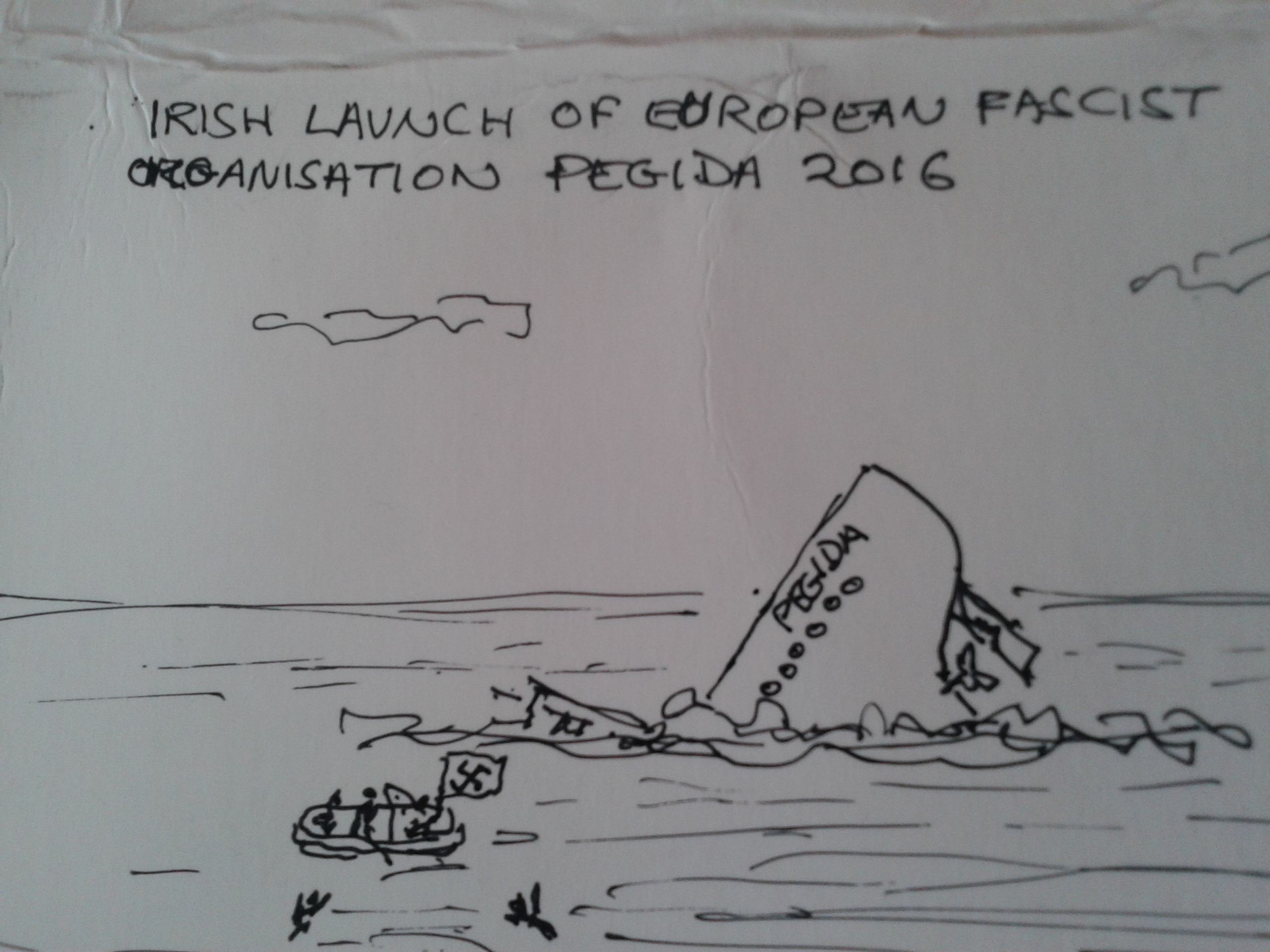
The background to the charges was the boast of fascist islamophobic organisation Pegida in 2016 that it would organise a public rally – and founding meeting – in every capital city in Europe and the rally they planned to take place outside the GPO on 6th February 2016.
In response, antifascists mobilised in Dublin with the intention of preventing Pegida’s launch.
IRELAND’S ANTIFASCIST RESPONSE
The mobilisation took a number of forms:
1) a large diverse group gathered outside the GPO, occupying the space well before the advertised time. A large proportion of these included religious and liberal organisations and individuals.
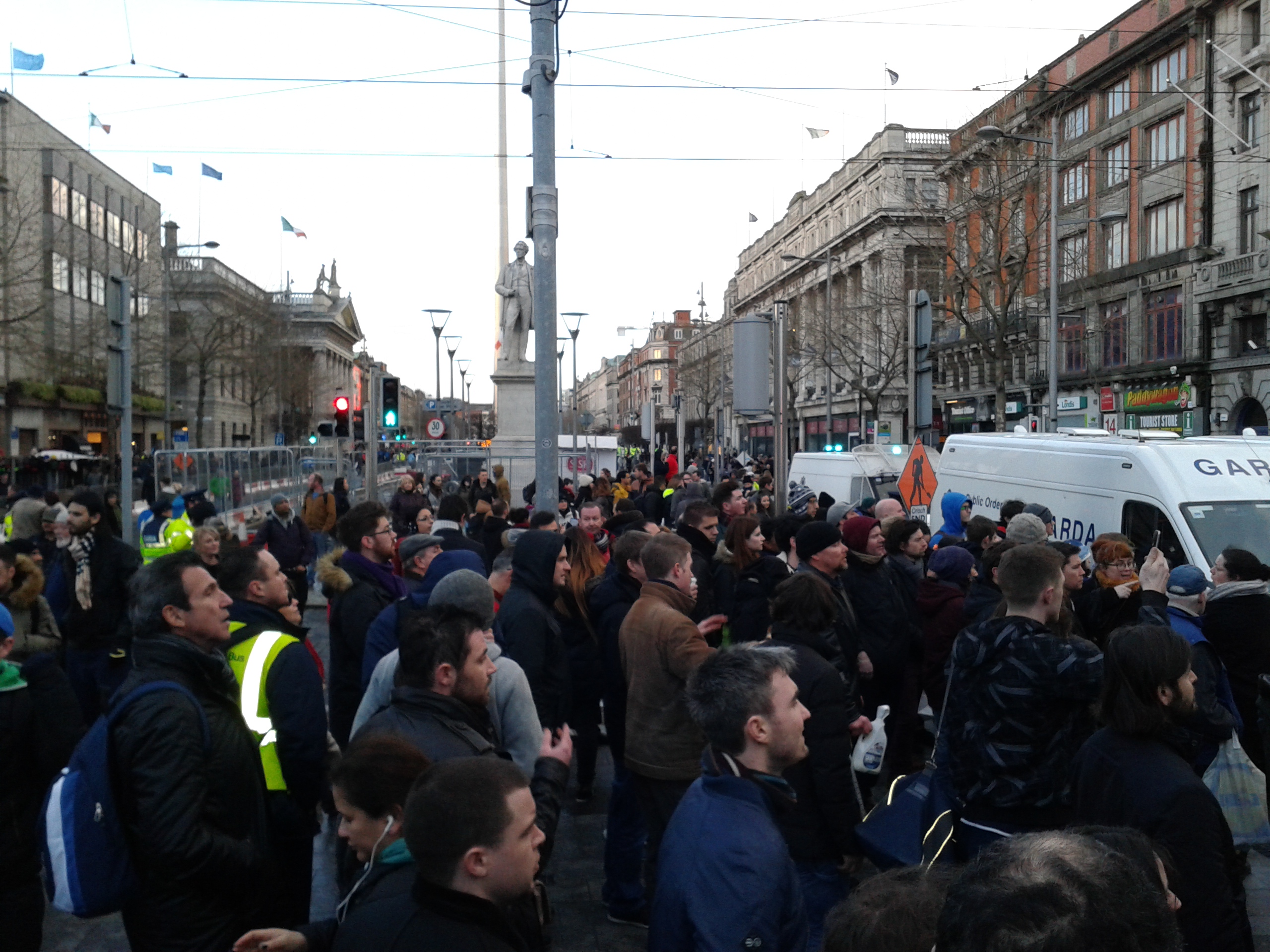
2) Another large group, of Republicans and Socialists of different organisations — and none — gathered in O’Connell Street, on the central pedestrian reservation and on the east side of the street.
3) Irish fascists arriving by Luas (tram system) were met on the tram itself by young antifascists.2
It appears that there were no confrontations between the GPO group and fascists which was fortunate, since some of the participants had publicly advocated non-violence and even encouraged bringing children to the event,3 no doubt in order to emphasise their pacifist nature.
The handful of known fascists of Irish background, whose intended movements were known in advance, apparently noticed or guessed the sympathies of some of the antifascist youth travelling in the Luas, addressed some unkind words to them and violence quickly resulted4.
The fascists concerned apparently abandoned their plan to attend the rally and some reportedly felt the necessity to attend A&E department in hospital instead.
There is no doubt that the longest-running conflict with the most people involved on both sides occurred around the east side of O’Connell Street and streets running off it, in particular North Earl Street and Cathedral Street.
The fascists who were involved there appeared to be all of East European origin. It seemed that they had not been spotted until some of them began to insult some women and when filmed, to make a negative comment along the lines of “your f..king communist filming”.
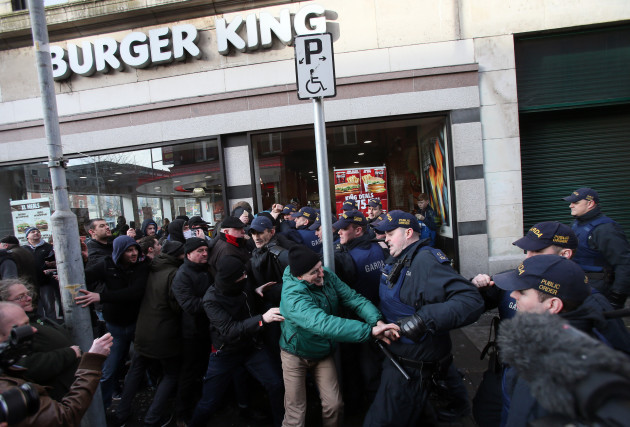
Once having identified themselves, a crowd of antifascists gathered around them and the situation developed quickly. The fascists were soon running, in the course of which one ran into a Euro-shop in North Earl Street with a number of anti-fascists behind.5
Some Gardaí lashed out with batons at people leaving the shop (which could clearly be seen on the police compilation of video footage shown in court), including an RTÉ cameraman.6
At least three of those fascists ran eastward down Talbot Street, which is a continuation of the short North Earl Street; two large white police vans appeared at the intersection with Marlsborough Street and the “robocops”, the Public Order Unit emerged.
The POU deployed with dogs in North Earl Street, clearing it and menacing both antifascists and shoppers.7
Shortly afterwards, word spread among the antifascists that some of the fascists were in a pub in the parallel Cathedral Street and had exchanged words with some antifascists who also happened to be in there;8 a crowd of antifascists flocked to the area concerned.
This area saw one of the sharpest confrontation between the Garda Public Order Unit and antifascists, with the former lashing out with drawn batons on largely unprotected hands and heads.
The Gardaí rescued the fascists from the pub and loaded them into one of their vans before driving off. A decoy Garda van was blocked in O’Connel Street by protestors and interested youth for a period but the fascists were spirited away to safety in another van.
Pegida had been prevented from holding their rally so the antifascists emerged victorious. The State actors sat down to decide how they would respond in the aftermath.
THE IRISH STATE SHARPENS ITS KNIVES
The first to be targeted by arrests were the antifascists in the confrontation on the LUAS tram. Visible in recordings of the CCTV camera which had remained uncovered throughout, they were identified, charged, convicted and heavily fined — as a deterrent, the judge made clear.
Next the Gardaí set about identifying antifascists active in the North Earl Street conflict and selected two Republicans from different organisations which, along with an independent antifascist from the pub in Cathedral Street, they charged with the serious offence of “violent disorder”.
This led to alarm in antifascist circles since, as outlined earlier the potential penalties with this charge are very high and it had never been used by the State before with regards to a situation of a political nature – in fact, it had hardly been used at all.
Two years after the events, one week to the day after he had been found “not guilty” on another political charge, Donal Ó Ceallaigh was charged with “violent disorder” in connection with the anti-Pegida protest too.
Through the intervening months and years, two of those charged with “violent disorder” separately agreed a deal to plead “guilty” to a lesser charge and avoid the danger of a ten-year sentence and this week at the commencement of the remaining two’s trial, another one did so.
Ó Ceallaigh then remained the only one of the original four on trial for “violent disorder”. His trial began on Monday 24th in Criminal Court No.7,9 six years after the events and four years after he was charged, with some supporters and his wife present in the public area.
TRIAL OF O’CEALLAIGH
Shortly after Ó Ceallaigh’s trial commenced, his defence counsel, Brian Gageby BL engaged by Sheehan & Partners, asked for a discussion in court in the absence of the jury and took the State’s witnesses through their process of protecting the chain of video evidence and identification of Ó Ceallaigh himself.
A compilation of six video clips was shown from: (1) the Euro Shop CCTV, (2) Garda cameras, the (1) TV cameraman’s footage (obtained by warrant) and (1) video taken by the shop’s security guard on his phone.
It emerged that 500 Gardaí have viewed the footage on an internal Garda system without identifying anyone on it.
The Garda officer responsible for ensuring identification then gave a convoluted account of how he had ended up going through associates of another activist to contacting another officer who had arrested Ó Ceallaigh in relation to water protests, who obligingly identified the activist.
That Garda said that he knew the defendant from a previous arrest and that it was he in a number of the videos, wearing a green hooded jacket and red scarf around his neck and that he has a tattoo there,10although only a very small portion of the man’s face is visible.
Another Garda who oversaw the identification claimed to have made his own statement a long time afterwards from memory alone but somehow included the exact times, in minutes and seconds on the video where the other’s statement had identified Ó Ceallaigh!
Defence counsel put it to him he could only have that precision from having written his statement to coincide with the other Garda’s, which he denied having done — of course that would have looked very much like conspiring to, as they say, “fit up” the defendant with regards to identification!
As Tuesday’s jury-less court session drew to a close, Defence counsel made two submissions to the Judge objecting to the challenged video identification evidence going to the jury, which Prosecution counsel defended and the judge retired to consider the arguments.
At resumption of the trial on Wednesday morning, the Judge announced her decision not to permit the challenged video evidence to go before the jury and the Prosecution counsel admitted that without that, effectively they had no evidence to place the activist at the scene.
The jury was then called in and the Judge directed them to return a verdict of “Not guilty”. Ó Ceallaigh was free to go and receive the embrace of his wife and congratulations of his supporters (and from some interested members of the public).
Though appearing glad he seemed to take it all quite calmly but admitted to the author that it had been “a bit of a strain”.
SUMMARY
As a result of the mobilisation and struggles on the day, Pegida was prevented from launching in Ireland, perhaps the only European country in which they failed to do so. This would have been important in any case but became especially so with the struggles around Covid to come.
The State had failed to protect the fascists’ “right” to hold their founding rally in Ireland and no doubt the Gardaí felt humiliated. They determined to recover ground and the State made a political decision of charging demonstrators with a very serious charge: “violent disorder”.
In that, the State hoped to establish a legal precedent with a view to its use against demonstrators in other situations in future. It did in fact establish the precedent in using the charge (and without an outcry from liberals and social democrats).
The State may have felt enough was gained for the moment in offering to accept a “guilty” plea to a lesser charge but when Ó Ceallaigh declined to accept the deal, they tried for a conviction, which would have given them the precedent they originally sought – but they failed.
However, many antifascist activists were punished and according to information received, 15,000 Euro in punitive fines was collected, not to speak of the worry and years spent in the shadow of the hanging sword.
Antifascists have hopefully learned the importance of going masked in similar situations and awareness of the role of CCTV cameras which are ubiquitous in the Dublin city area. The charge of “violent disorder” remains as a threat and punishment for demonstrators in future11.
The wording of the charge ensures that no actual violence need be used and the “fear” surrounding a situation remains open to subjective interpretation and even manipulation of witnesses by police.
The RTÉ’s camera footage – ironically in view of the fact of his assault by a Garda – was obtained by warrant which raises issues of concern with regard to press freedom and safety. If verified media’s film is to be used by the State, how then is the media to claim independence?
And if demonstrators know or believe that media footage of them is likely to be used by the State, are they likely to tolerate the presence of such camera operators? Will we not all be the poorer if the media cannot produce film and photos of events of a similar nature?
This is surely an issue on which the press, along with the respective trade unions should take a stand, if they truly believe in their independence and freedom and think it worth defending.
While there is no current evidence of a resurgent attempt to found Pegida in Ireland,12 a number of small fascist organisations have been founded in recent years, including Identity Ireland, the National Party, Irish Freedom Party and Síol na hÉireann.
History has shown that when the ruling capitalist class is in crisis, it suits it to use fascists as part of the repression of the people’s resistance struggles. Certainly there is something of a crisis in the capitalist system world-wide at the moment and repression is very much on the agenda.
Pegida does exist in Europe and as late as the 22nd, the Saturday before the trial in Dublin, planned to publicly burn the Koran in Rotterdam, Holland,13 to which the State there responded by arresting their leader and accusing Pegida of disseminating “hate speech”.14
End.
FOOTNOTES
1 The 1994 Public Order Act (see Sources) and this section at least uses even the same wording as the 1986 Public Order Act of the UK (see Sources).
2 That group was of Identity Ireland, led by Peter O’Loughlin, a long-time Irish fascist who apparently planned to be chairman of the Irish branch of Pegida. According to recollections of antifascists to the author, there were also much smaller groups of anti-fascists roaming the south city centre attempting to coordinate and collate information while searching for groups of fascists.
3 Pacifism in the face of potential fascist violence seems dangerously stupid to me but that pales into insignificance when compared to the criminal irresponsibility of putting children in danger of such attack.
4 This was one of the areas which the Gardaí used to bring charges against anti-fascists and footage from the LUAS CCTV was used against individuals. The antifascists involved seem to have been from Dublin soccer club supporters’ associations and those identified were fined within a relatively short period of time.
5 This site was one of those used by the Gardaí to charge a number of antifascists and footage from the security CCTV were used in evidence against the latter.
6 The management of the TV channel complained as did the cameraman. Quite some time later the Garda in question was found guilty of assault and, despite the viciousness of the assault on a clearly unthreatening person and his lack of remorse, was given a suspended sentence but remained in the police force without facing a disciplinary hearing.
7 “I was coming back from reconnoitring around the Connolly Monument in Beresford Place, in case fascists had gathered there. Cycling westward along Talbot St. I saw three young men running west; they appeared East European to me and had hair cropped very short. I assumed they were fascists but there appeared to be no-one in pursuit and three was too many for me so I passed them and at North Earl St. junction found a large crowd with Public Order Unit with barking dogs and batons drawn preventing people from entering the area. The crowd was of mixed shoppers, passers-by and anti-fascist demonstrations.” (Recollection of antifascist to author.)
8 This site too became one to attract police charges against at least one antifascist.
9 On Tuesday it was moved to No.12 instead, right next door, coincidentally, to the Special Criminal Courtroom where a trial is currently underway. The SCC was from its inception a no-jury political court for decades but recently began to try some high-profile criminal trials.
10 He does in fact but you’d need x-ray vision to see it through a scarf! There had been a mass campaign against the proposed additional water charges and the belief that the public water supply system in the Irish state was about to be privatised. Protesting in the context that water charges were already being paid through two different public taxes, hundreds of thousands marched and smaller groups mobilised to disrupt the installation of water meters outside people’s houses (the locations of those unused meters may still be seen around Dublin city in particular). Most arrests took place in this latter part of the struggle, though a number of defendants fought a successful battle to prevent the State convicting them of “kidnapping” a Government Minister while protesting against her ministerial visit to a school in Jobstown. The additional taxation and privatisation plan was abandoned in 2015 – at least for the moment.
11 Note that there have been many situations of actual violence by fascists wielding clubs in Ireland in recent years in which the State chose not to charge any of the perpetrators with “violent disorder” and in fact only with great reluctance charged one individual, Michael Quinn of the National Party with assault after widely-circulated video evidence refuted Garda public statements that no violence had occurred.
12 According to Anti-Fascist Action Ireland from people viewing the fascist communication traffic, the Eastern European fascists who participated on the day denounced the Irish fascists of Identity Ireland as cowards and declared they would never work with them again.
13 Religious book of greatest importance to Muslims, equivalent to the Bible for Christian and the Talmud for Jews.
That’s what she wrote — in response to a political statement I had written. And it was funny — but at the same time an expression of the gulf that separates people like her not only from people like me – but from reality too.
Her comment on a FB post was that the PSNI are not the same as the RUC, to which another woman had replied that the uniforms and the name are different but that’s all, the essence being still the same.
In turn, herself above had replied that anyone who thought that, didn’t understand the current realities and what the whole peace process is about.
To which I replied that I too agreed that all that happened was that the colonial gendarmerie had changed its name and uniform and what the pacification process (because let’s call it what it was and is) is about is holding on to the colony while dismantling the opposition.
And then she made that response, the “Oh. My. God!” — and quoth no more. I laughed but also recognised that her response, from her point of view (apart from the appeal to a nebulous deity, which I take as just an idiom to express shock), was entirely logical.
No, not her political position, which is entirely illogical – but her reaction, from where she stands, away on the other side of the chasm between us.
(Photo sourced: Internet)
AN UNBRIDGEABLE GULF BETWEEN WORLDS
She recognises the gulf that separates her world from mine and knows straight away that there is no bridge to cross it. There is no point in debate, not only because I may not be easily overcome in argument but because we don’t even agree on the reality of the world.
By which I mean the economic, political and philosophical reality of the world of humanity, rather than the physical world of gravity and weather.
In her world, I’m guessing, admittedly there were some horrible injustices in the history of “Northern Ireland” and then there was a horrible war which made things worse and now everything is changed (even “utterly”, perhaps!) and going in the right direction.
To call the “Northern Ireland” entity a colony is shocking to her, though she knows some people probably think that.
Seeing reality is useful for getting around but it can be very uncomfortable too. The Six Counties is of course a colony, taken by force and maintained by force since 1921.
PSNI raid and arrest of a pregnant woman in the Bone (‘nationalist’) area of Belfast March 2021 — this led to riot (Photo sourced: Internet)
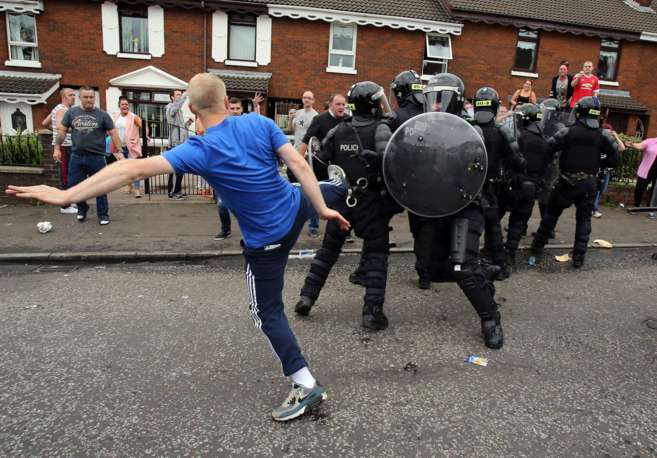
Residents objecting to PSNI in riot gear invasion of Roseapenna Street (‘nationalist’), West Belfast, August 2015 (Photo sourced: Internet)
The whole of Ireland was a colony even when it had its tiny minority parliament1 and it continued to be one when that Parliament, under massive bribery, voted to abolish itself in 1800 without the vast majority of the population in Ireland, native AND planter, having any say in the matter.
When the level of anti-colonial struggle in Ireland rose to a certain level and the rulers of the UK were beset by difficulties on most sides, a deal was done with an Irish client bourgeoisie and the country partitioned.
Whatever the status of the Irish State thereafter, the status of the Six Counties was clearly that of a colony. That is and was so, regardless of whether it is sectarian or not, whether there are civil rights or not. It is part of our nation held for the Crown by force of arms.
Those arms were again very much in evidence during the fairly recent 30 Years’ War – in the hands of the formal British Army, formal colonial police and informal proxy murder gangs.
And yes, the PSNI today is an armed colonial police force – and it would be that even if it had no history, if it were created today. But as it happens, it does have a history. It is a variant of the Royal Ulster Constabulary. And the RUC was a variant of the Royal Irish Constabulary2. And the RIC was a gendarmerie.
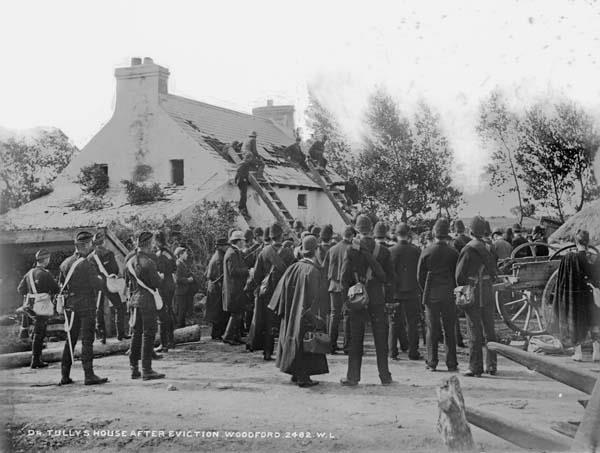
RIC and British soldiers supporting an eviction in Galway during the Land War (Photo sourced: Internet)
A COLONIAL POLICE FORCE WITH A LONG HISTORY
Perhaps my opponent has heard the term before. Maybe she associates it with Turkey … or even with the Spanish state. But such things belong to foreign and authoritarian states, right? Couldn’t possibly be to do with here!
States that have conquered nations within them, resisting from time to time, or regions that are otherwise difficult to manage, need to control them by army or police. The first becomes problematical over time and the second needs to be coordinated from the centre, not mainly local.
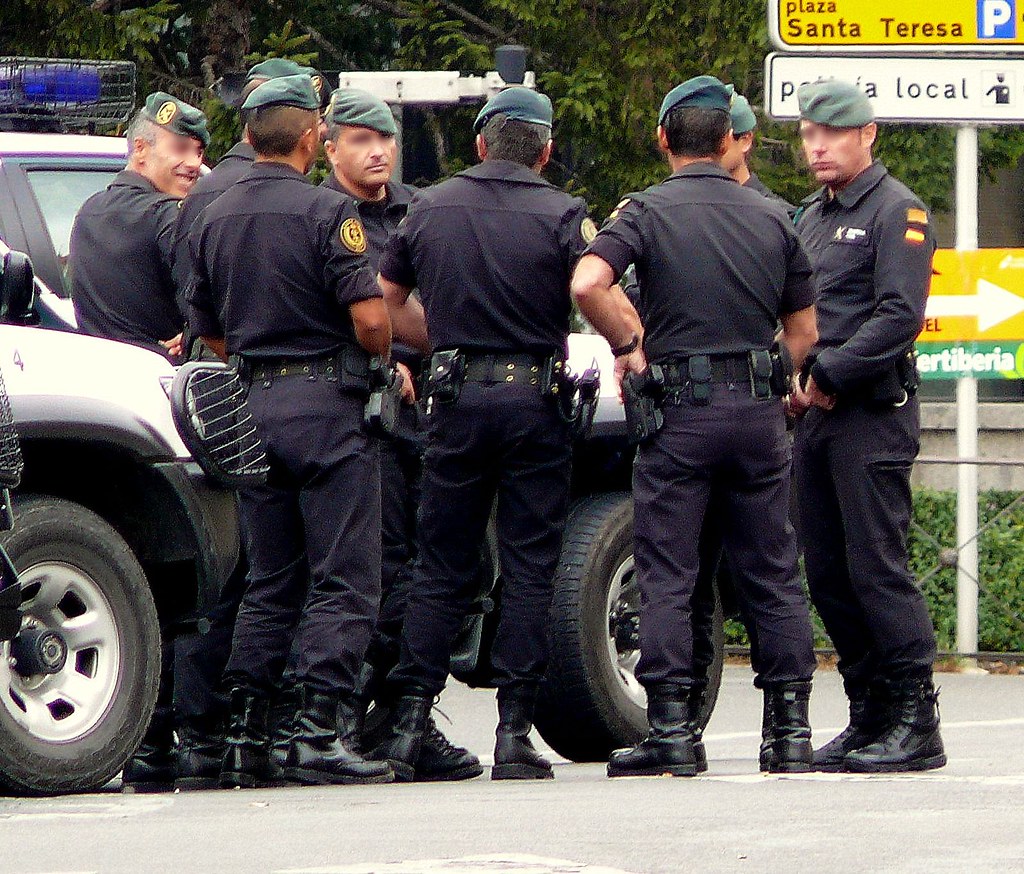
The solution some states have found is to have a central quasi-militarised police force: the Guardia Civil of the Spanish State, the Turkish Gendarmerie, the Caribieneri of the Italian State, the French Gendarmerie.
Gendarmerie of the Spanish State: Guardia Civil in modern uniform (Photo sourced: Internet)
These forces typically live in barracks and are directly answerable to the central State. The Royal Irish Constabulary was such a gendarmerie also. And nothing like it existed in Britain.
It was a colonial armed quasi-militarised police force to spy on and suppress the Irish by force.
What was left of the RIC in Ireland became the RUC after Partition and the RUC became the PSNI after some reforms. They don’t live in barracks but they do sally forth from them and they are armed – still keeping ‘the natives’ down since 1836.3
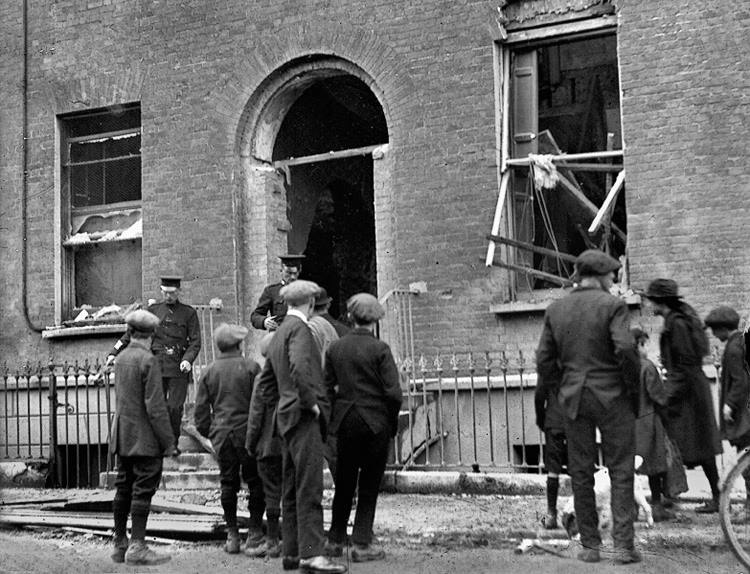
All-Ireland gendarmerie Royal Irish Constabulary in front of their barracks, King Street, Dublin, viewed by local people after a Republican forces attack during the War of independence 1919-1921 (Photo sourced: Internet)
PACIFICATION FOR NORMALISATION
Then there was my shocking description of the role of the ‘Process’ that she described as for peace and I for pacification. She is shocked even by the title I give it, a title suggesting it is not about justice but rather about maintaining control, by trickery or violence.
And I actually stated that is its purpose! Oh. My. God indeed!
Any process which starts from the basis of normalising the colony is doing just that: normalising the foreign occupation of a part of the nation taken by force and which has never been accepted by the conquered population. It is “about is holding on to the colony”, as I described it.
But what is fundamentally abnormal can never be normalised.
That attempt requires pacification, by repression and coercion or by deception – or by a combination of both. The Occupier has used all but, since the late 1990s, mainly deception. The masking and twisting of reality, the blowing of smoke in eyes.
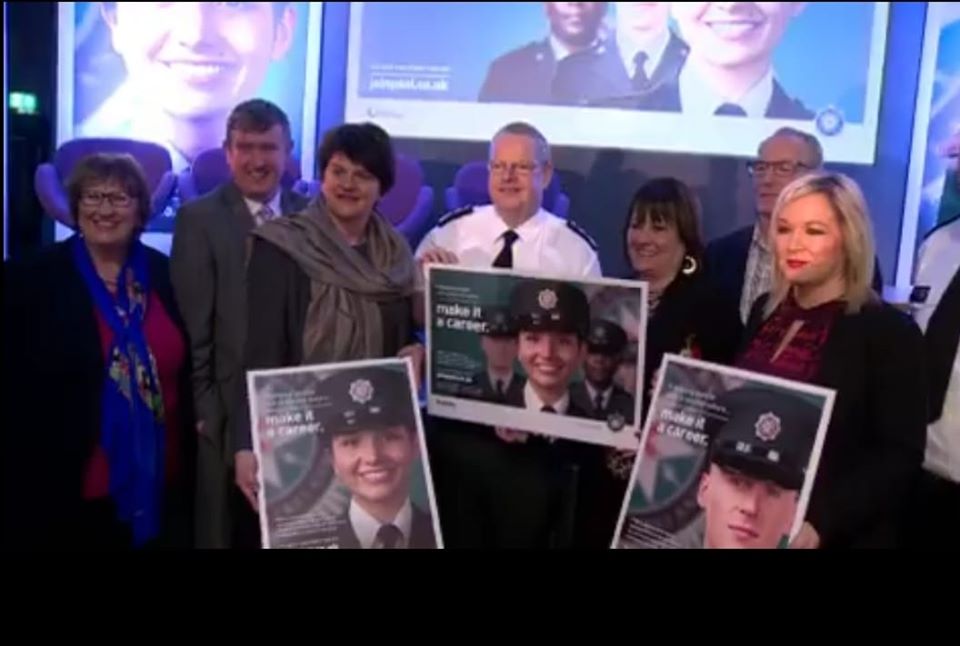
“Join the British Gendarmerie!” Recruitment drive for the PSNI supported by Unionists and Sinn Féin, February 2020 (Photo sourced: Internet)
Who is fooled? Mostly, those who want to be, some who see a workable future in the colony, under occupation.
The other deluded ones are those who are being deceived by their leaders, the latter who have given up not only the arms but any kind of struggle other than climbing into the elite.
Ultimately, the reality is so obvious that the deception is only possible when the deceived help it along themselves. Why do that? Because it’s comfortable, or seen as an alternative to hopelessness, or less frightening than the alternative – revolutionary struggle.
Oh. My. God! Yes indeed.
And yet we say, we who look at the reality, in the face of those who deny it, as Galileo is said to have muttered to his persecutors, who denied the world moved around the sun (rather than the reverse): “Eppur si muove”(“And yet it moves)”.4
We might also say, whether some find it shocking or just uncomfortable, something more mundane: Est quodcumque est. (It is what it is.)
end.
FOOTNOTES
1At various times Catholics were excluded from voting for representation in the Parliament and at all times from the Reformation onwards barred from being elected to the body or from holding high office. The vast majority of the Irish population were Catholics. Protestants other than Anglicans suffered discrimination too but not to the same degree.
3And they got the “Royal” in their name in 1867 for their role in suppression of the Fenian rising that year.
4Galileo di Vincenzo Bonaiuti de’ Galilei (15 February 1564 – 8 January 1642) was an Italian astronomer, physicist and engineer. He publicly ascribed to the theory of Copernicus before him that the sun’s position is static with the Earth revolving around it (heliocentrism) which had been attacked by the Protestant religions as contradicting the Christian Bible (Old Testament). But it was the Catholic Inquisition of which Galileo fell foul, firstly in 1616 when he was instructed not to hold that opinion. In 1633 he was forced to recant it after a long trial and lived under house arrest for the rest of his life.
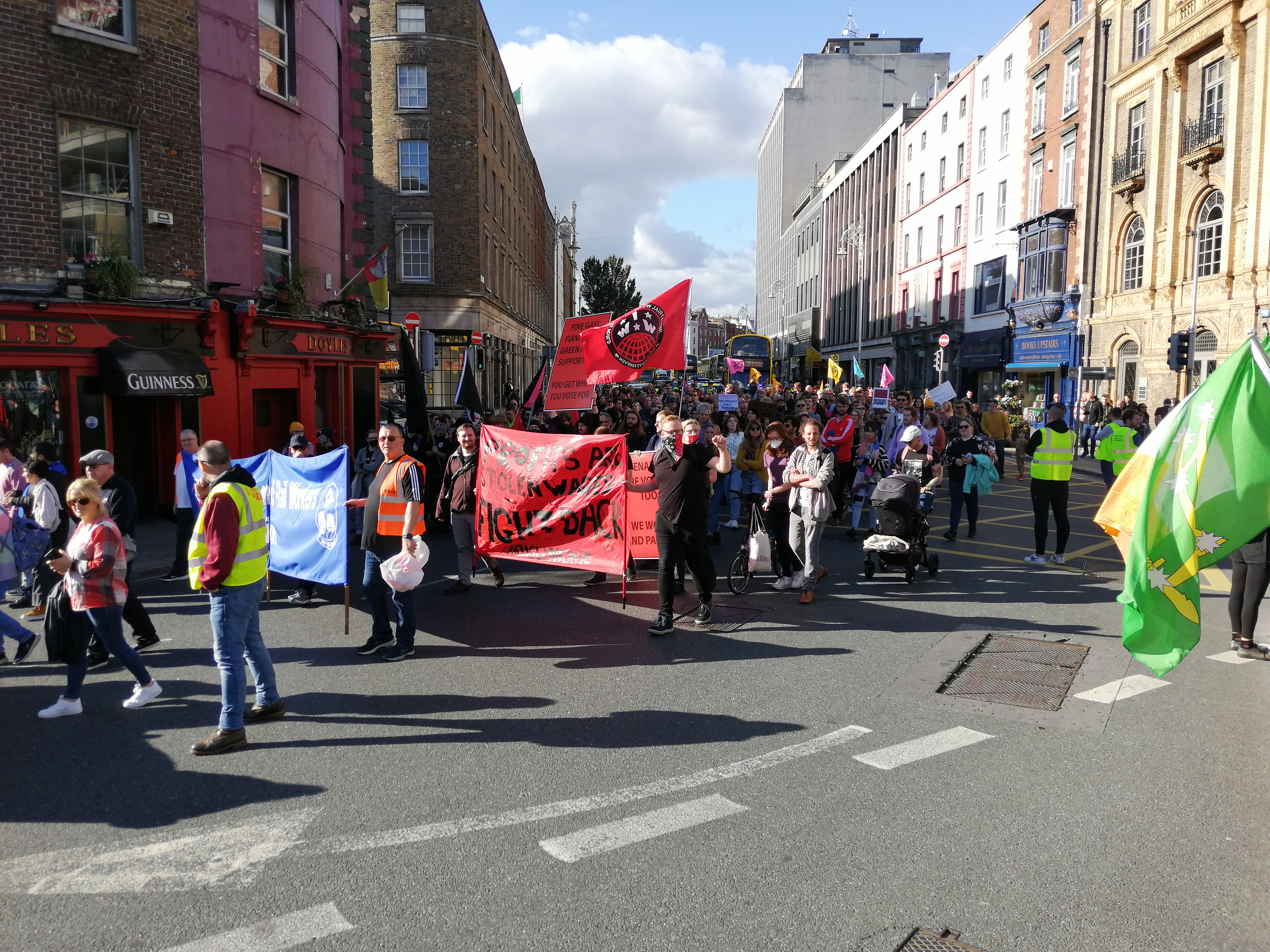
Many thousands marched through Dublin’s city centre yesterday in protest against the soaring cost of living, pushed in particular by rising energy costs. Most mass media avoided estimating numbers except the ridiculous ‘estimate’ of 3,000 by the Irish Times daily1.
As the Cost of Living Coalition convened a mass protest demonstration in Dublin, the Anti-Imperialist Action organisation called for a Revolutionary Bloc to meet at the James Connolly monument2 in Beresford Place.
In mid-July, statistics published showed the average cost of living had risen above 9%. The average figure conceals the higher percentage rise in daily consumables such as food and drink that will rise higher still with price hikes by energy supply companies.
Companies are raising their prices steeply across at least the western world in a trend that began, despite much media discourse, prior to the Russian invasion of the Ukraine. But Ireland emerges as the most expensive country in the EU with Dublin the most expensive city there by far3.
(Photo:Rebel Breeze)
SPEECHES FOR REVOLUTION & AGAINST REPRESSION
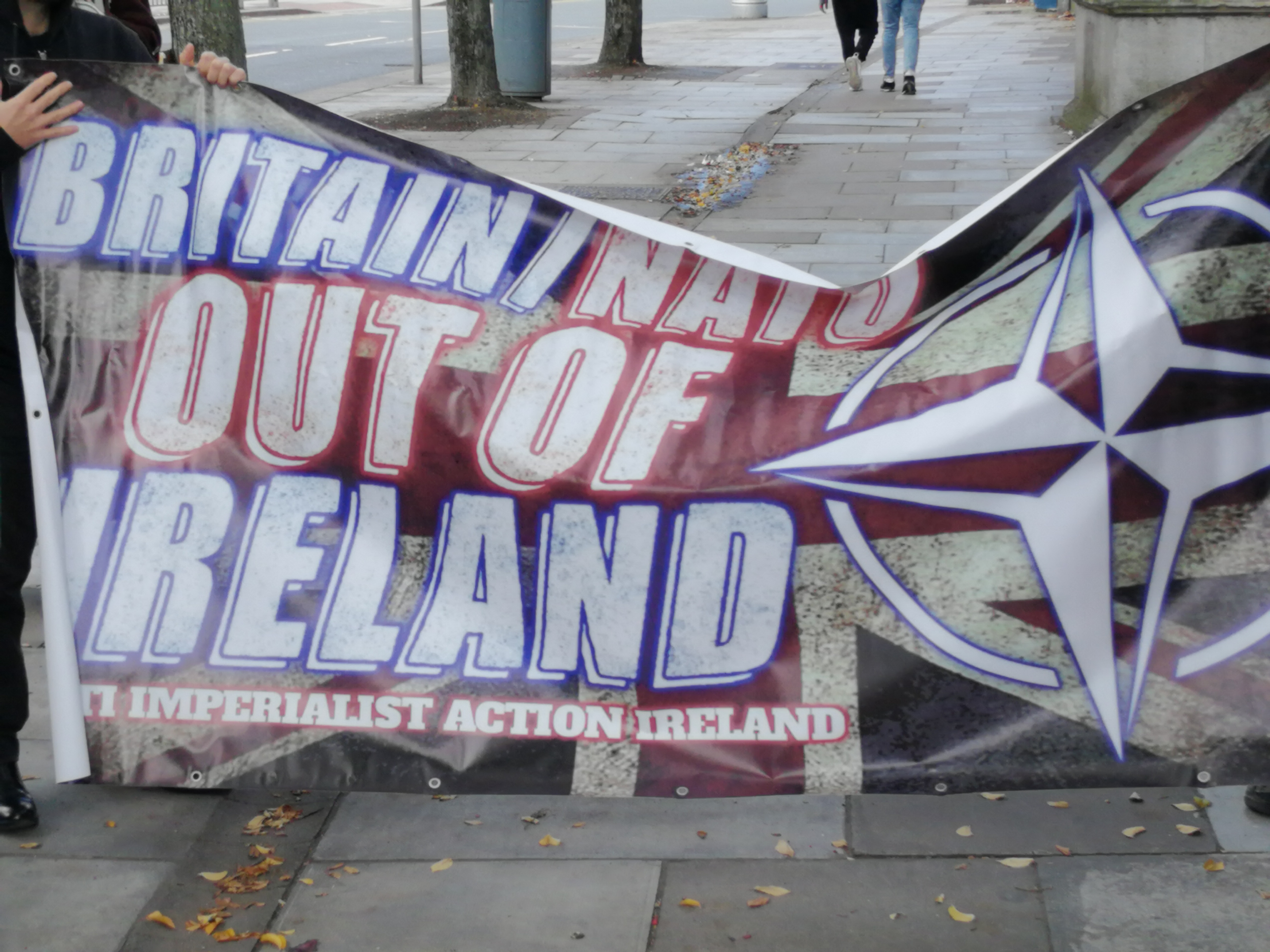
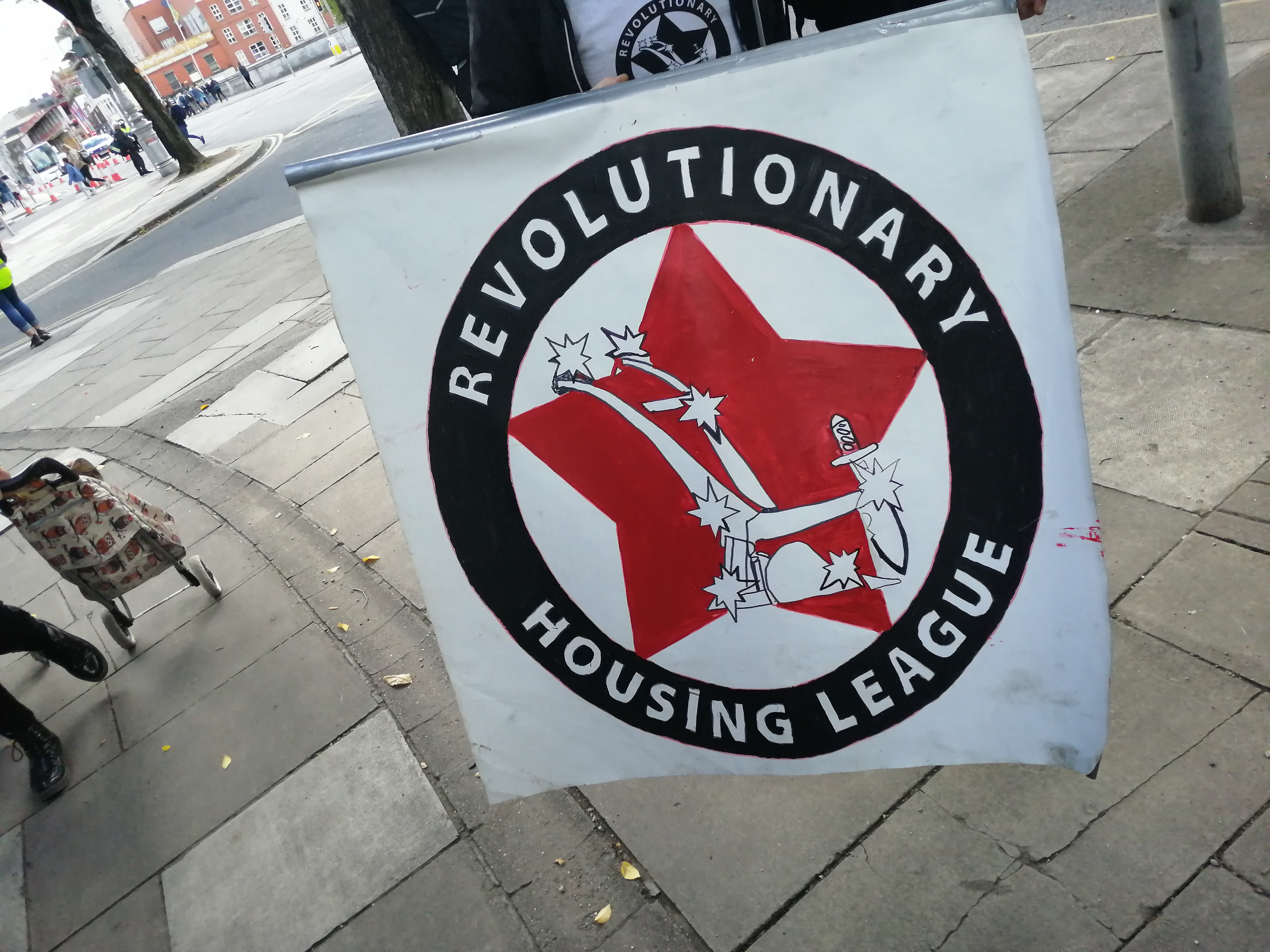
At the Connolly monument, people gathered with banners about the housing struggle and against NATO, along with placards and flags, of which latter the most common was the green-and-gold version of the “Starry Plough”, flag of the Irish Citizen Army4.
The cathaoirleach (chairperson) welcomed people, introduced the purpose of the meeting as being to protest the soaring cost of living and introduced the first speaker, from the Revolutionary Housing League. The RHL speaker outlined their program of direct action.
(Photo:Rebel Breeze)
“What can be more direct than to occupy empty buildings?” he asked those assembled. He recounted some of the recent actions of the RHL and said that they are attracting attention and support, ending by calling on others to get involved5.
The second speaker, introduced as a revolutionary socialist anti-imperialist, went through a list of ills brought by the capitalist system, including lack of housing, selling off our resources and infrastructure, disregard for our language, environmental destruction and danger of nuclear war.
For all said the speaker, the Irish national bourgeoisie are guilty, “the Gombeens, a class unable even to free their own country”. “We need broad fronts to fight all these attacks of class war”, he said “but they must be directed openly against capitalism and imperialism.”
(Photo:Rebel Breeze)
The final speaker, a socialist Republican, represented the newly-formed End State Repression campaign group. Those wanting to oppose rising prices, he emphasised, could not share their struggle with those intending to enter a coalition with Fiann Fáil or Fine Gael.
He also recalled how when protests against the bank bailouts and student fee hikes were getting going in 2010, they were met with state violence through the Gardaí. As the resistance builds, it will get attacked, he said but “we can’t allow them to drive us off the streets again.”
(Photo:Rebel Breeze)
Many drivers passing the rally in vehicles, private and of work – including public transport — sounded their horns in solidarity, giving rise to cheers from the protesters.
MARCH TO BLACKWATER
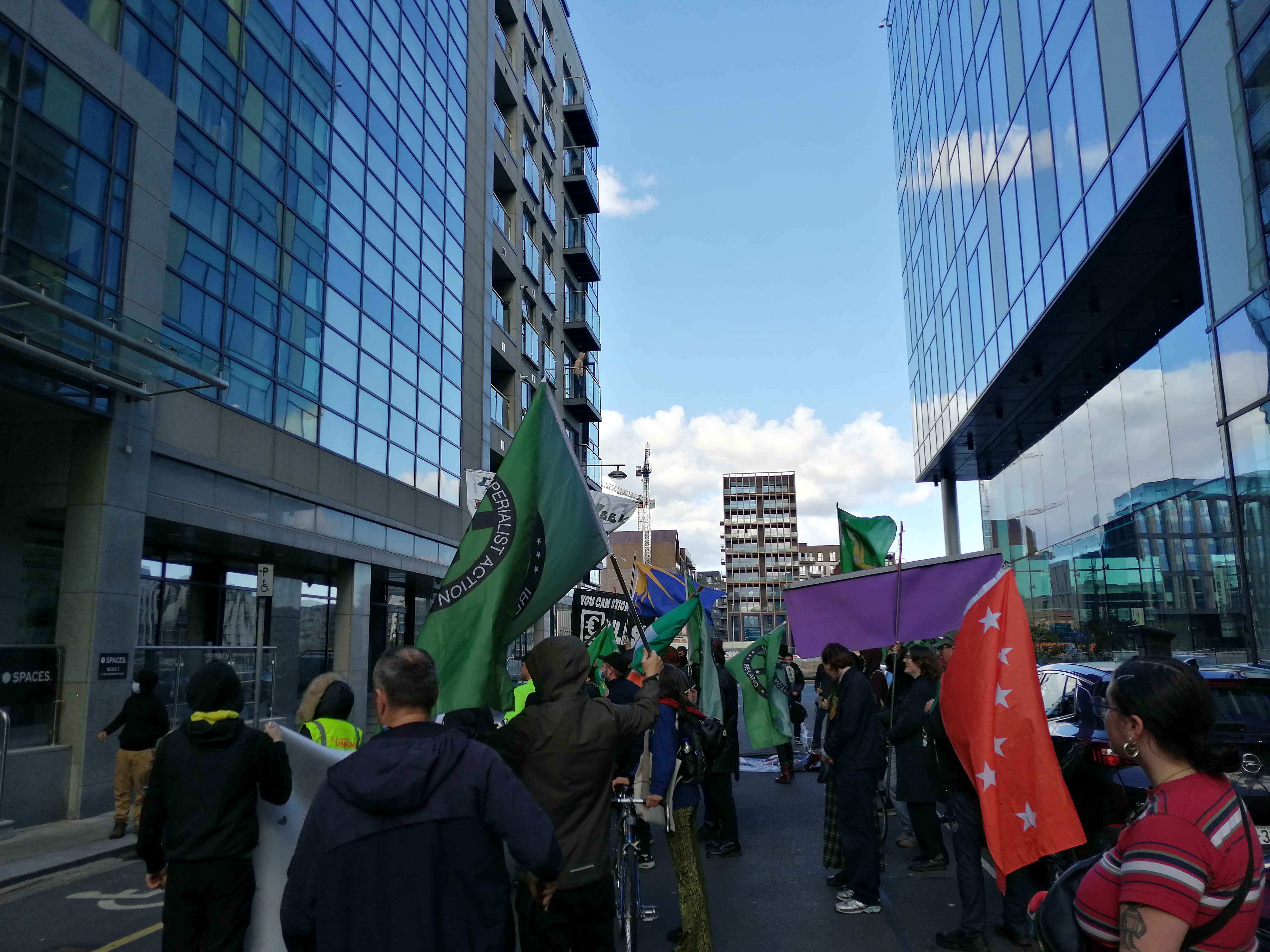
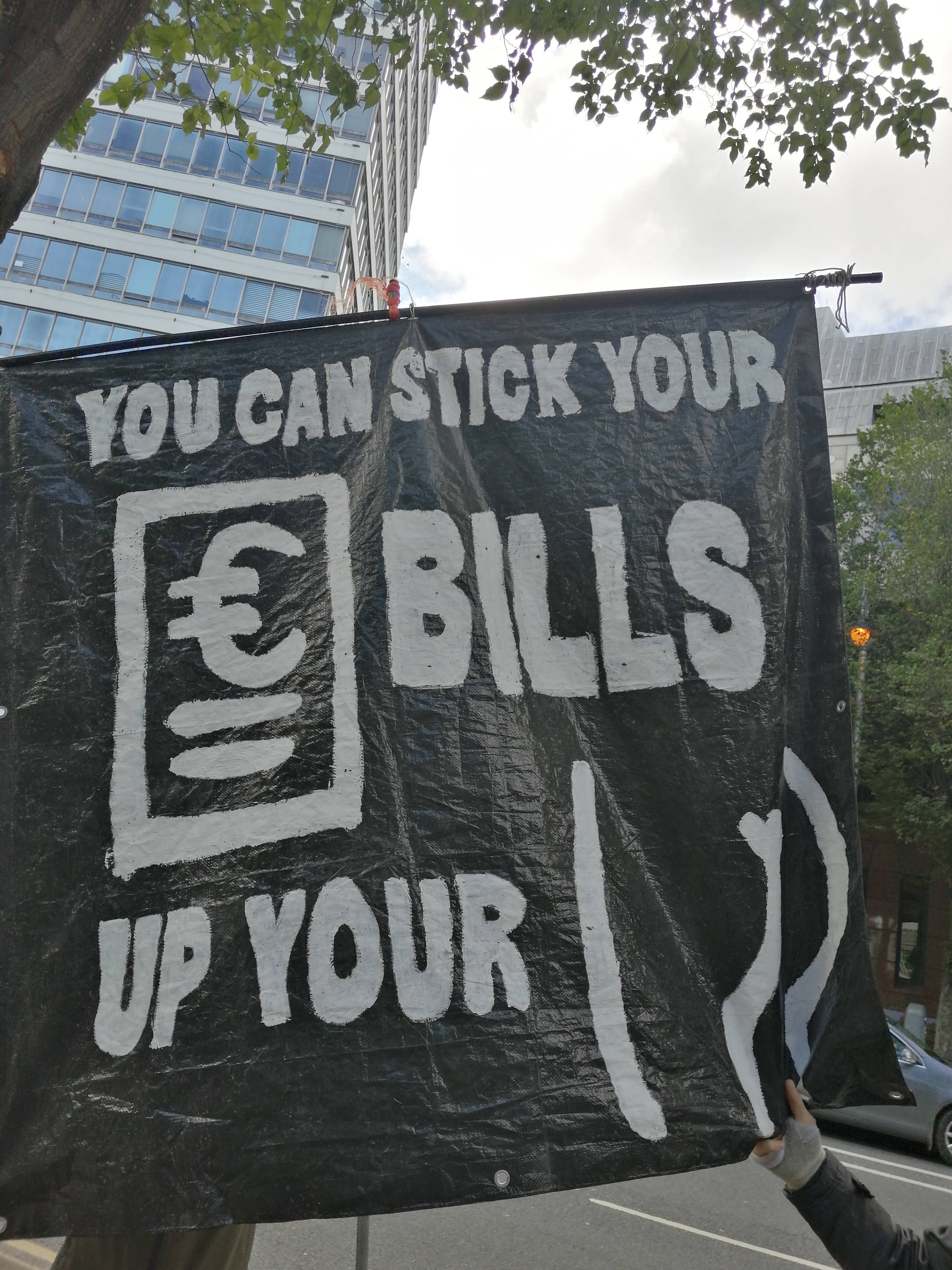
The assembled then set off in two lines along Custom House Quay, across Talbot Memorial Bridge and then eastward along the quays. On the way they shouted slogans including “One, two, three, four – Housing crisis no more!” and “Only solution: Revolution!”
Other slogans include “Whose streets? Our streets!” “Whose Republic? Our Republic!” and “High rent, high taxes – fight back!”
The marchers stopped upon reaching the offices Blackwater Asset Management Company which boasts its background in “coming from the following sectors, Police Force, Legal Profession, Defence Forces, Financial Services & Private Security sectors”.
(Photo:Rebel Breeze)
(Photo:Rebel Breeze)
The crowd expressed its disapproval of the actions of this company. A speaker assured all that any attack on housing activists will be met with resistance. Two songs were sung there too, including Connolly’s Be Moderate/ We Only Want the Earth.6
THE BLOC MEETS THE MAIN MARCH
The Bloc marchers passed through the high-rise apartment blocs in the area before going on to Pearse Street and marching to the junction with D’Olier Street, where they met the main march of many thousands7 rounding Trinity College and still coming down from O’Connell Street.
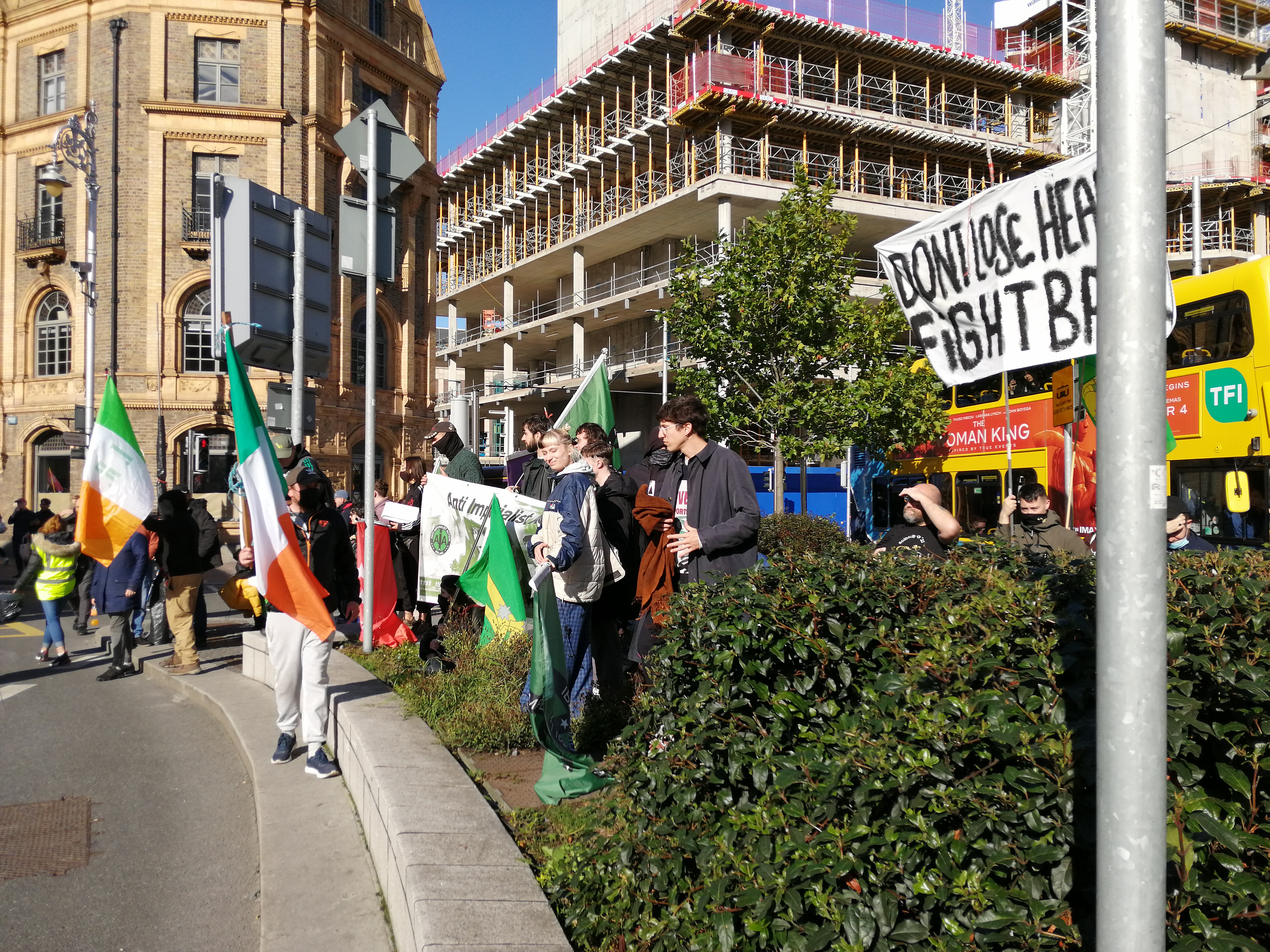
Here the revolutionary bloc displayed their banners and placards and chanted some slogans. Many in the crowd marching past gave signs of appreciation and people in an anarchist bloc shouted “Solidarity”, raising clenched fists, giving rise to equal response from the Bloc8.
Section of the main cost of living protest march in D’Olier Street and rounding junction with Pearse Street. (Photo:Rebel Breeze)
The large Sinn Féin9 section aroused shouts of “No Collusion! One Solution! Revolution!” from the Bloc. The earlier slogan of “1,2,3,4 – Housing crisis no more!” segued for awhile into “5,6,7,8 – Smash the Free State!”
The main Dublin march was organised by the Cost of Living Coalition of 30 organisations, including People Before Profit but also Sinn Féin, which is on a clear trajectory to enter Government in the near future but in coalition with traditional neo-liberal capitalist political parties.
Revolutionary Bloc meets main march at junction Pearse Street and D’Olier Street. (Photo:Rebel Breeze)
The CLC also includes trade unions which many accused of not mobilising for the protest.
Derry city saw a small protest against the rising cost of living also.
A far-Right march in Cork which was addressed by a representative of the fascist National Party attracted little more than 150. Ostensibly against the housing crisis, speakers of course attacked immigration despite it having no connection to the State failure to build affordable public housing.
A marcher in Dublin carrying a placard calling for an end to immigration until the housing crisis were solved gave rise to a chorus of “Home for All!” from the Revolutionary Bloc, calls echoed by some among the passing marchers.
Anarchist section in the main march indicating solidarity with the Revolutionary Bloc. (Photo:Rebel Breeze)
Gardaí on foot and in patrol cars tailing the main march were greeted, as they passed the Revolutionary Bloc, with shouts linking Drew Harris10, Commissioner of the police force of the Irish State, to the British Intelligence Service MI5.
A notable feature of both marches was the patience with the interruption to their journeys of private and public transport drivers and, indeed, the signs of support from many, including beeping of horns and hand signals such as the ‘thumbs-up’ and even the occasional clenched fist.
end.
(Photo:Rebel Breeze)
FOOTNOTES
1The Irish Times has a track record of drastically reducing the estimated numbers in reports of anti-government demonstrations, demonstrated most strikingly during the giant water protest marches. It gave the figure 3,000 in leading paragraph to its original twitter report but more recently amended that on line to “several thousand”. The Sunday Mirror reported 20,000 and supporters estimated between 15,000 and 20,000.
2The monument includes a representation in bronze of the Scottish-Irish revolutionary James Connolly, across the road from where he had his office in Liberty Hall (the two-storey building was destroyed by British shelling in 1916 and has since been replaced by a tall man-storey building, HQ of the SIPTU union. Connolly was one of 16 executed by the British in 1916 after the Rising that year.
4The ICA was formed to defend striking workers from police attacks during the 1913 Lockout in Dublin. It was based on trade union membership and took a prominent role in the 1916 Rising, with a much-reduced one in the War of Independence (1919-1921) and the ensuing Civil War (1922-1923). The ICA recruited women as well as men and some of the women held officer positions, possibly the first revolutionary organisation, certainly the first socialist-based one to do so.
6The lyrics were composed by James Connolly and published in hist Songs of Freedom in New York in 1907. The title was the ironic “Be Moderate” but has come to be known from the refrain as “We Only Want the Earth”. Furthermore, arranged to the air of “A Nation Once Again”, it provides a chorus of “We Only Want the Earth!”
7Most media would only state “thousands” or “many thousands”, but the Irish Times had the audacity to claim the ridiculously low number of 3,000! Estimates by participants varied from 10,000 to 20,000 (latter also figure of the Sunday Mirror).
8It seemed likely that had the Revolutionary Bloc been widely publicised earlier that it would have been supported by many individuals and at some other organisations.
9The former revolutionary republican party rarely mobilises its large membership for street protests as these days it is more concerned with votes in elections. However, SF is part of the Cost of Living Coalitionand SF’s President, Mary Lou MacDonald, was one of the scheduled speakers at the main march rally.
10Immediately prior to his current appointment, Drew Harris was Deputy Chief Constable of the sectarian British colonial gendarmerie, the Police Force of Northern Ireland which, until 2001, was the Royal Ulster Constabulary.