A number of solidarity demonstrations took place in Dublin City centre last week.
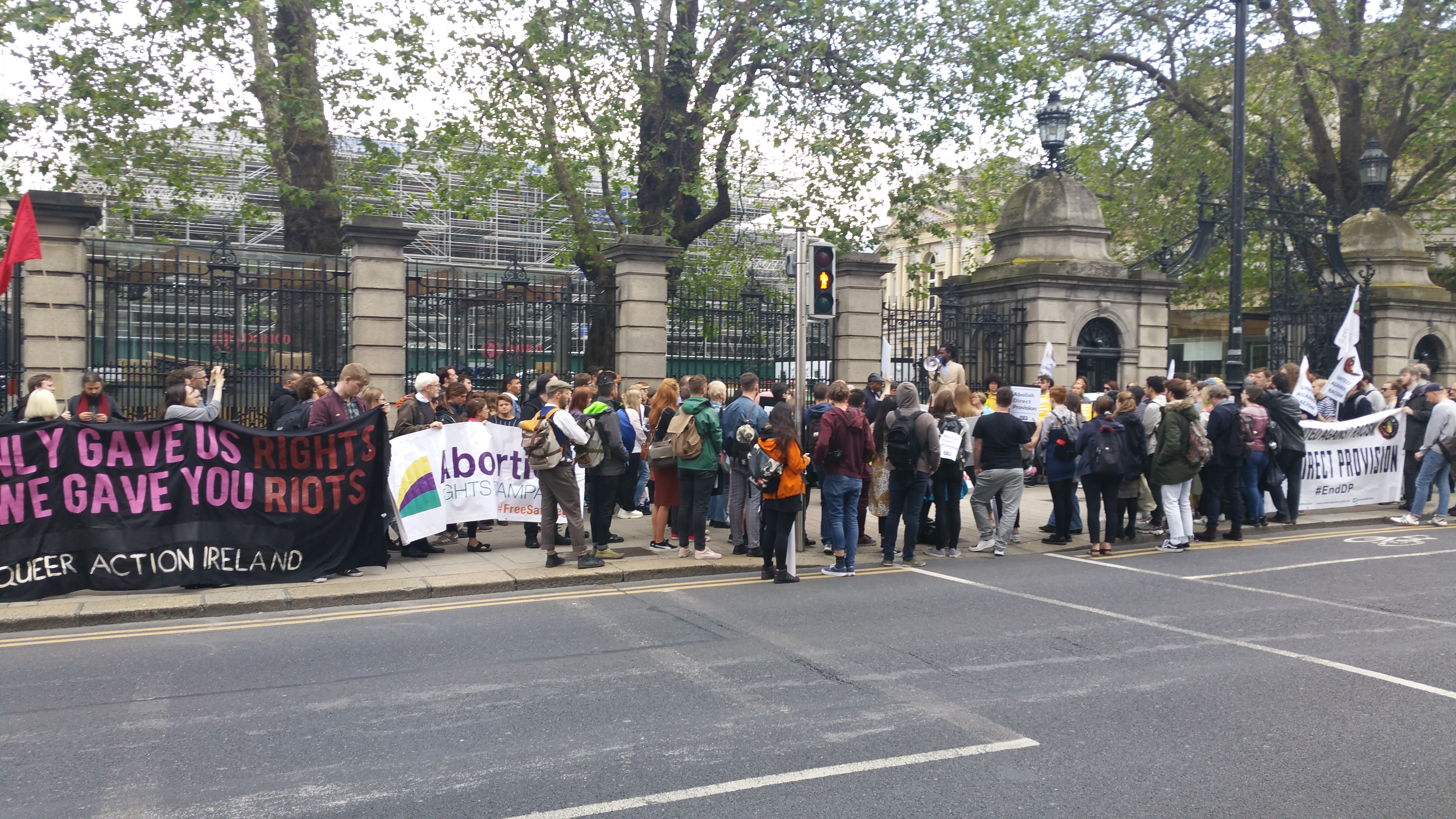
On the evening of 20th June, officially World Refugee Day, a rally calling for the closure of the Direct Provision Centres and to Stop Deportations was held outside the Dáil (Irish Parliament). A number of speakers, some of them refugees and asylum seekers, addressed the crowd. However, the amplification was so weak that only those very near them could hear what they said.
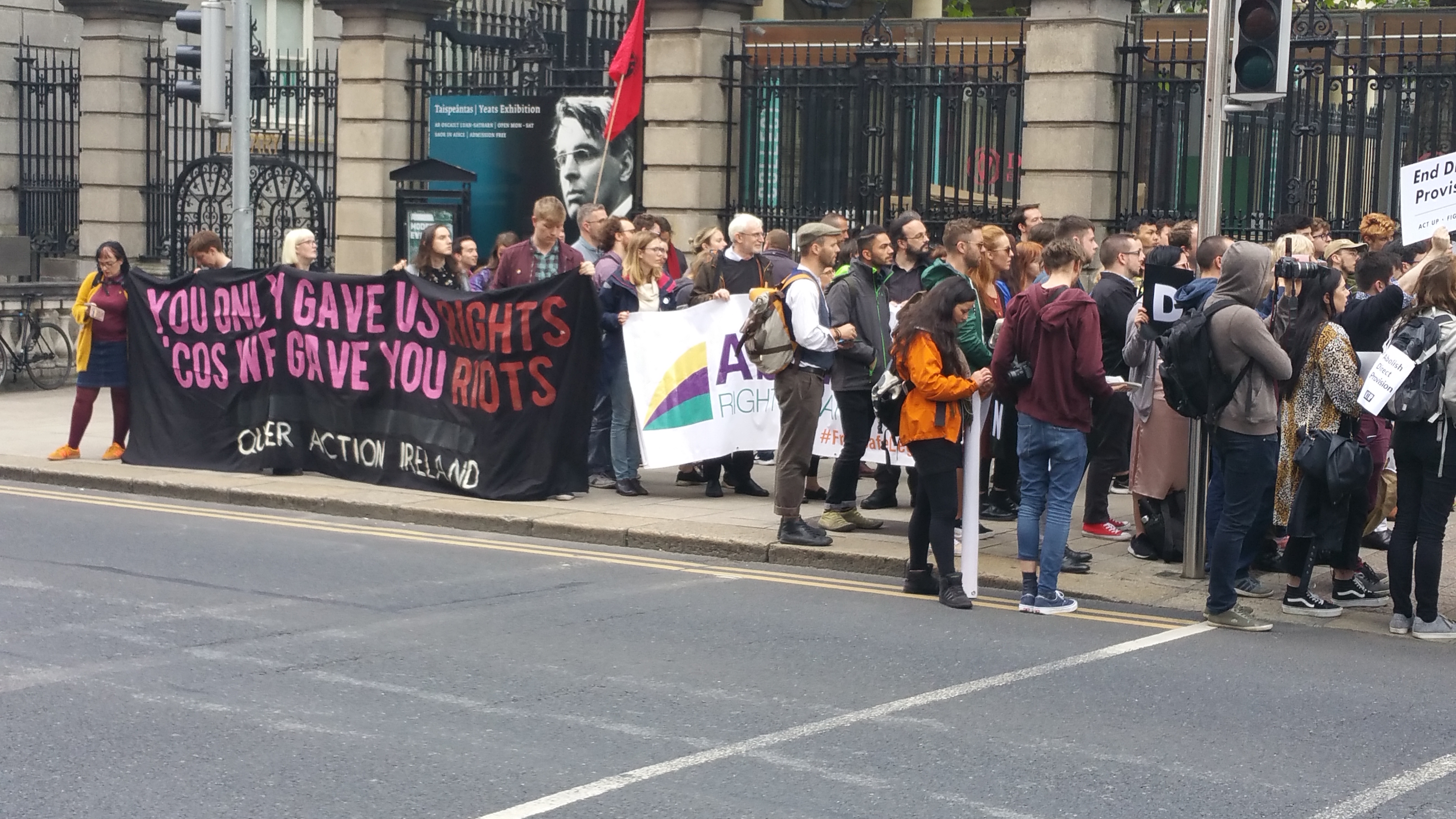
Demonstrators against the Direct Provision system and against deportations outside the Irish Parliament, the Dáil. (Photo: D.Breatnach)
Explanatory text from the organisers: “Despite the number of displaced people increasing year-on-year, the amount of people permitted to seek asylum in Europe has fallen by 10% since 2017. Thousands are forced to climb razor wire fences and entrust their lives to people smugglers as governments continue to close their doors. Accounts of overcrowded camps, lack of sanitation, and torture at the hands of police and militia groups from those who do manage to enter are growing more frequent.
“In Ireland, asylum seekers are forced to wait for years in privatised, isolated centres as the Department of Justice & Equality comes up with reasons to reject and deport them, where they are treated as cargo to be shipped ‘back to where they came from’.
Section of the crowd supporting the rally outside the Dáil, the Irish Parliament. (Photo: D.Breatnach)
“Mobilisation against direct provision — introduced as a ‘temporary solution’ in 2000 — has increased in recent years yet significant moves by our representatives to abolish it remain to be seen. Our newly elected MEPs similarly show little interest in confronting the EU’s dehumanising regulations.
“Join us as we demand action. For an end to direct provision and deportations. For freedom of movement for all and an end to Fortress Europe.”
Another section of the crowd supporting the rally against the Direct Provision centres and against deportations, under a heavy rain shower. (Photo: D.Breatnach)
Though a number of supporting organisations were listed — STUDENTS AGAINST DIRECT PROVISION, MOVEMENT OF ASYLUM SEEKERS IN IRELAND, MIGRANTS AND ETHNIC MINORITIES FOR REPRODUCTIVE JUSTICE, REFUGEE AND MIGRANT SOLIDARITY IRELAND, SAY NO TO DIRECT PROVISION IN IRELAND, UNION OF STUDENTS IN IRELAND — it seemed as though the core organisers were from the People Before Profit organisation.
The supporters were subjected to a number of very heavy rain showers but most remained until the scheduled end of the event.
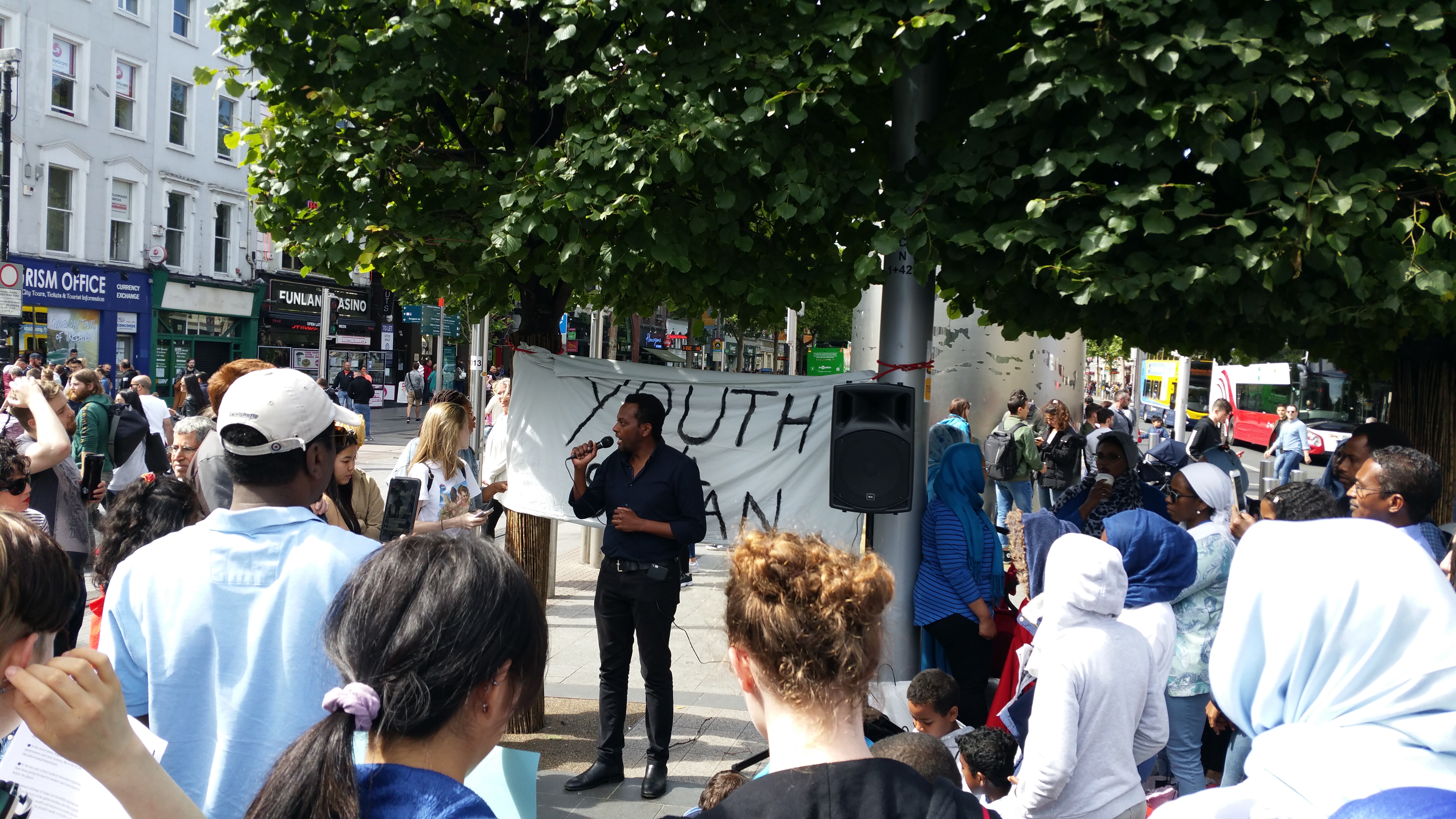
On Saturday afternoon, 22nd June, a rally in support of the Sudanese people was held on the central pedestrian reservation in O’Connell Street, Dublin city’s main street. They too were addressed by a number of speakers but it was not always possible to hear who they were or all that they had to say.
View of section of the crowd at the Sudanes solidarity rally in O’Connell Street. (Photo: D.Breatnach)
According to aid NGO, Concer, “Over 46.5% of the Republic of Sudan’s population is living below the poverty line and 5.5 million are in need of humanitarian assistance.” A war has been raging there since 2013 in which an estimated 400,000 people are estimated to have died.
According to Wikipedia: “More than 4 million people have been displaced, with about 1.8 million internally displaced and about 2.5 million having fled to neighboring countries, especially Kenya, Sudan, and Uganda.This makes it the world’s third-largest refugee population after Syria and Afghanistan. About 86% of the refugees are women and children.”
A view of another section of the Sudanese solidarity rally (Photo: D.Breatnach)
The core organisers of this event seemed to be a youth group of the Socialist Party although it also appeared that the Sudanese community had organised to support it through their own networks.
end.
One of the speakers at the Sudanese solidarity event (Photo: D.Breatnach)
Around 60 people viewed the film “My Land” on Sunday morning (23/ 06/ 2019) in the Irish Film Institute in Dublin, scheduled at the decidedly un-prime time of 11.30 am on a Sunday morning. “In this revealing documentary, Anthony Monaghan, an Irish filmmaker now living in the United States, takes a hard look at economic migration, mass evictions, and the growing homeless crisis that plague Ireland today. In search of answers, he travels the nation and interviews Irish people from all walks of life” (the description on the FB page for the event).
One of a number of versions of title photos for the film (Photo source: advertisement for the film)
The film opens focused on heavily-built man in shorts with a broad somewhat weathered face, wearing a straw stetson-type hat, brim turned up both sides and overall looking quite like a middle-aged man of the American Indigenous people. The rhythms of his speech and accent soon however reveal a mixture of western Irish and USA. The man parks his construction company pickup truck, gets out and we watch him walk on to a bridge, to look down upon a river, possibly the Missouri, where he stands looking for awhile before turning to the camera and beginning to speak.
Monaghan photo?
DEVASTATION OF RURAL AREAS
Anthony Monaghan is from Erris, County Mayo and went to work in England when he was 15 years of age as many others around his age did too, especially in that area with an absence of industries and therefore of employment. Later, he emigrated to the USA. Later still, he returned and took out a mortgage on a house but, as we learn later, the bank took it from him and he has now returned to Missouri USA, where he decided to make the documentary.
We hear the sound-track of Lovely Blacksod Bay, a song about the ‘return’ of the son of an emigrant to Mayo.
View of Termon, Blacksod Bay. The English version of the place-name comes from the irish original “An Tearmann”, meaning “the sanctuary” (several place-names of this kind in Ireland). (Photo: Internet).
Interspersed with beautiful scenery shots, interviewees talk about the problems of the Belmullet area, principally of lack of employment and consequent emigration. Included among those interviewed are Rose Conway-Walsh, Sinn Féin Senator from Bellmullet, Mayo, whose grown-up children had to move away. Another a former male emigrant who returned to the area in the early 1980s now sees his children moved away to work in England, his grandchildren there, returning twice a year, which brings excitement as they arrive and sadness as they leave. Another ‘returned’ migrant, a writer, came to the area from the Irish diaspora in London, brought as a child by his parents. He too had to emigrate for a while – now, back again, he expects his daughters to leave also.
As we accompany Monaghan to the local graveyard overlooking the sea, he points to the name of a brother on a headstone, a sibling who did not return alive from emigration.
The film shifts to a young woman, possibly Irish-UStater, accompanying herself on auto-harp while singing Noreen Bawn (Nóirín Bán), a sentimental song about tragedy in emigration.
John McGuinness, TD for Kilkenny-Carlow area, is also interviewed as is a FG member of the legal profession. Peter McVerry, of an NGO working with the homeless, also speaks, as does a local businessman.
The talk is of the devastation suffered by rural communities by unemployment and emigration, then the cutbacks on services to the areas, the closing of post offices, the isolation and vulnerability of the elderly, the long journeys to medical services ….
At a harbour, Monaghan talks to a man who fishes from a boat for a living, who says that kind of livelihood is gone, with big boats competing with the smaller ones. He sees no future for the younger generation making a living from the sea as he has done.
DUBLIN AND HOMELESSNESS
A homeless couple sleeping rough
The film shots switch to Dublin streets and homeless people sleeping rough or begging. Among the interviewed now are the same people as before but more are added, including actor-author and former homeless person Glen Gannon and radio broadcaster Marion Shanley who, with three children, had faced eviction from her home. Tony Walsh, former homeless man and organiser of a food-serving service to homeless and other persons in need was also interviewed, as was bankrupt property developer Tom Hardy, author of “Waiting for the Sheriff”. Along with those was a young Dubliner, currently homeless.
A number of people, including the young Dublin homeless man, point out the profits that are being made by landlords. Tom Hardy reels off statistics in the profits being made there and also by the vulture funds in “buying” mortgage debts from banks at knockdown prices which the banks would not offer their debtors. A woman talks about the horror of having to raise one’s children in the hotel rooms in which homeless services place them, where they are cramped and cannot cook food. She talks about what this is doing to the children and wonders psychological problems are in store for them in future. “Why don’t the Government declare a housing emergency?” she almost wails. Clearly it is a housing emergency but as Gannon points out, they won’t declare it. It is not in their interests to do so. And according to the woman quoted earlier, a tsunami of evictions is on the way.
McVerry commented that there is a section of the population in Ireland who are doing quite well and who have no stake in any radical change in society. A number of the interviewees made reference to the wealth of the country, including several who said it was the fifth wealthiest state in the EU. I failed to find confirmation of that particular statistic and istead found a wide variety of rankings. Of course, the wealth of a state is not necessarily reflected in its people or, to be more exact, among the majority. While the problems of lack of affordable decent housing and employment, along with emigration cause suffering among a large section of people, revealed in rising rates of suicide, the number of wealthy are rising fast, with 83,000 people in Ireland whose income exceeds more than one million dollars per year (see References at end of review). It’s hard to believe that the misery of the struggling does not have some relationship to the soaring wealth of a tiny minority.
“Homes not hostels” banner on the side of Apollo House, a protest occupation of some weeks in December 2016 which attracted much support and media attention. But the homeless crisis has got much worse since. (Photo: D.Breatnach)
SOLUTIONS
All the interviewees, to one degree or another, placed the blame for the situation on the Government. Most of them also blamed the banks and the vulture funds. Some pointed to vested interests of TDs who are rental landlords while other went as far as to allege corruption and in effect an integrated system of banks-landlords-vulture funds-district courts-TDs- Government.
Some of the interviewees alleged that the Irish are too accepting, too meek. One who did so was a Ginley (or McGinley), who said that the Irish had fought for the British and for the USA but had never fought for themselves. He seemed either ignorant or dismissive of the long Irish history of resistance and also of the fact that not only the Irish who fought in the British and US armies were not “fighting for themselves” but neither were the British and US working people alongside them!
Marion Shanley was one who upheld the Irish history of resistance and pointed out that in war, to which she hoped it would not come, incidents of suicide tended to almost disappear.
Given the size of the problems and the combination of political and financial interests, it was going to be interesting to see what solutions were advocated.
Anthony Monaghan wished to see some kind of combination of workers and business people to sort out the problems and hoped “the fighting Irish” would come to the fore.
TD McGuinness stated it was important for the politicians to come closer to the people and asked for greater leniency from the district courts in house repossession cases. Senator Conway-Walsh also wanted to see greater leniency from the courts but tighter legislation against vulture funds too. The homeless young Dubliner put forward the radical solution of having members of the Government spend a week in the conditions of homeless people.
Only Glen Gannon baldly put forward the clear solution, the only one possible, given the interlinking of financial and political interests: Revolution.
DANGERS
There is a vacuum of leadership, as a couple of interviewees remarked.
During his interview, the man I remembered as Ginley (or McGinley), referred to Ben Gilroy as a champion “of our own”, an electoral candidate who had been failed by the electorate and whose “vote was derisory” in the recent elections. However Gilroy (who was present at the screening, as were a number of interviewees), had in the past posted an islamophobic rant on social media and had shared leadership of the recently-defunct Irish Yellow Vests with a racist, anti-emigration, anti-gay and lesbian islamophobe.
This points to a possible danger, not only that we might continue to be driven downwards but that in desperation, we might turn to fascism and racism, as other people have done in difficult times. And in precisely those kinds of times, the ruling capitalist class has not usually been shy of finding their champions to push those kinds of ‘solutions’, splitting the working class and diverting attention from the real problems.
And one form of fascism has been indeed to seek the unity of workers and businessmen sought by Monaghan (though that should not of course be taken as a suggestion that he is himself a fascist). In such “unities” there is no question of which sector will be in command.
In a film about the Ireland of today, it was interesting to see no images or hear any reference to immigration other than that of the Irish diaspora. It could have been that the makers wanted to keep the narrative simple …. or there could have been another reason for it.
Anthony Monaghan said at one point that although he knew that was not possible, he’d like to go back 20 years. At the turn of the century, i.e twenty years ago, the false Irish economy bubble was about to burst.
SPIRITUALITY IN RESISTANCE
In one scene, the camera follows Anthony Monaghan going down into a holy well (St. Dervla’s) near his original home and blessing himself with some of the water there. Remarking that although he does not condone the scandals that have come out of the church in recent decades, he regrets the Irish turning away from the Catholic faith, which he feels sustained us in years past and bound us together.
One of Monaghan’s interviewees points out that the worst thing about the scandals in the Church was not the abuses themselves but the cynical covering them up by those in authority, exposing more people still to abuse and suffering.
Talking about Catholicism as a binding agent of the Irish while almost in the next breath about our martyrs and heroes of the past, ignores a very important part of that very history of resistance which Monaghan upholds. The Catholic Church, from the moment Penal Laws began to be lifted, worked might and main against that Irish resistance. Its leadership condemned the United Irishmen (in particular the few priests who joined them), the Land League actions, the Fenians and the IRA in nearly every period and in all of its manifestations. In addition, the founders of the United Irishmen were Protestants, as were nearly all the prominent people of the Young Irelanders; Protestants were to be found too among the founders of the Volunteers, the Fianna, Ininí na hÉireann and the Irish Citizen Army.
In fact, history was sorely missing in all the analyses, since no-one pointed out that the State had been set up in a counterrevolution, an alliance of Catholic Church and Gombeen capitalist class under the old master’s tutelage. There seemed to be no acknowledgement that the Irish state is a neo-colony, run by a Gombeen capitalist and political class, its natural resources to be plundered by foreign multinationals, its services to be sold to the same, its own natural industries to be run down.
Human beings do have a spiritual sense, whatever anyone may say against that – but that is not necessarily about religion, contrary though that statement may seem. A sense of who we are as Irish people, as workers, as human beings, as part of life on earth, can be both practical and spiritual. It can be conveyed in language, song, poetry, visual art …. and in a knowledge of living history.
In that respect, it was strange that in a film about Ireland made by a man from Erris, by the Belmullet Peninsula and a large part of which figures in the narrative and images, there were only five words in Irish to be heard. For Béal Muirthead is a Gaeltacht, an Irish-speaking area, though shrinking under pressure from English-speaking monoglots.
Pub in Erris with name (“Harbourside”) in Irish (Photo sourced: Internet)
IN CONCLUSION,
it was an interesting film from the point of view of presenting the issues and gathering some opinions about them.
But as well as who were interviewed, it was interesting to note who were not. No active revolutionaries — socialist, communist, republican …. no activists in recent or current movements of resistance. And no reference to the mass mobilisations against the water charges and the local battles resisting meter installation. Nor of the demonstrations protesting homelessness. Not even a mention of the titanic (or biblical Davidian) struggle in Rossport, Mayo, against Shell BP.
The last song I remember hearing on the film’s soundtrack was James Connolly, not the song about the revolutionary socialist and trade union organiser he was (see below) but instead one which portrays him as an “Irish rebel” out of context, without mention of class or of the Irish Citizen Army, of which he was the leader.
Dublin Castle, located in the south city centre, has been the centre of the British occupation of Ireland since 1171 until 1921 (and even after that, some would say).The site offers one-hour guided tours to the public for much of the day, at approximately an hour apart, seven days a week and last year claimed a visitor total of nearly half a million. As a Dubliner interested in history and a walking tour guide, I was well overdue to take an official guided tour of the place, which I did recently.
Overall the State Rooms Tour was interesting and I did learn some things but I was also aware of many gaps. Was this unavoidable in a tour of one hour covering more than eleven hundred years (given that Viking Dublin was also covered) of history? Of course – but in the choices of what to leave out, was there an ideology at play, one that sought to diminish the repressive history of the institution and the struggle against it?
An artist’s impression of Viking Dublin in 9th Century
The first presentation to us by the tour guide was of Viking Dublin, the settlement of which took place in the 7th Century. The Vikings had a confrontational occupation of England but this had not been the case here, we were told – the Vikings settled amongst us, intermarried, introduced personal and family names, place-names, etc.
Well, somehow the tour spiel had ignored the many battles between the Vikings and the natives in Ireland even after the settlement in Dublin (and other areas), leading up the famous Battle of Clontarf in 1014, fought on what is now the north side of Dublin city. The 12-hour battle was important enough to be recorded elsewhere in Europe and in a Viking saga. Yes, it had also been an inter-Irish battle, in particular between the King of Leinster and the High King of Ireland but Viking Dublin played an important part, as did Viking allies and mercenaries from Manx and the Orkneys – and its result had ended forever any possibility of a Viking takeover of Ireland.
A noticeable gap in Irish-Viking history of Dublin to omit it, one might say.
Nevertheless, the tour guide gave us interesting information about the Viking settlement and a map showed an artist’s impression of how it would have looked.
Down in the base of what had been the Powder Tower, it was interesting to see the stone work, to hear the guide talk about the foundation of the Viking wall below us and how the cement used to bind the stones was a mixture of sand, oxblood, horsehair and eggshells. To me it was also interesting to see the stone course lines of one pointed arch above a curved one but unsure what I was looking at — and we were a big group, the tour guide some distance away to ask.
Powder Tower base incorporating some of the original Viking wall.Two separate arch stone courses, one above the other in the base of the Powder Tower.
Down below the walkway, where water lay on the ground a couple of inches deep, some green plant was growing in the lights illuminating the work. This was above the route of the Poddle, I supposed, which once fed the Linn Dubh (black pool) and which now runs underneath Castle and city before emptying into the Liffey.
“BEYOND THE PALE”
The Normans reached Dublin in 1171 after landing in Wexford in 1169, our guide informed us but we were not told that in the process they defeated Irish resistance and the Dublin Vikings and, most curiously, there was no mention of the Pale. That would have been an interesting explanation to visitors of the origin of the expression “beyond the Pale” and what it implied1.
The guide did tell us later in the St. Patrick’s Hall (the State banquet room) that the paintings on the ceiling were to demonstrate to the Irish that all the civilising influences had come from the English to the Irish savages, that if the Irish were now civilised, their ranking was definitely below the English.
One of the ceiling paintings in St. Patrick’s Hall, where the Uachtarán is inaugurated and which is also the State’s banqueting hall
That might have been an appropriate time to mention of the Statutes of Killkenny 1366, nearly two centuries after the Norman invasion and how the Irish Normans had, outside Dublin, adopted ‘uncivilised’ Gaelic tongue, custom and even law, so that their cousins in England were now calling them “the degenerate English” who had become “more Irish than the Irish themselves”.
If the English Reformation got a mention I must have missed it but certainly there was nothing said about the imposition of the new religion on Ireland, colonists and natives alike and the many wars that resulted. Anglicanism had become the religion of the English State, with its monarch at the head of the Church but none of the Irish natives and most of the colonists did not wish to adopt that religion. So it led to many uprisings, first notably from the Irish Normans (Gall-Ghael), then by the Irish and a number of major wars, including the Cromwellian and Williamite ones, also to the Penal Laws. That State religion was the reason that Elizabeth I had founded Trinity College, so that the sons of the colonists would be educated in the “true faith”. Religion had been used by the coloniser to try to undermine unity among the inhabitants of Ireland and had been employed to physically divide the island in 1922, which had also led to a much more recent war of nearly three decades.
The Reformation and its effects seemed a quite significant portion to leave out of Irish history in general and of Dublin history in particular.
Apparently a Lord Lieutenant of Tudor times riding out of (or returning to) the Castle with his knights and soldiers to deal (or having dealt) with the troublesome Irish natives (a representation on display in the Castle).
As the Castle had briefly been acknowledged as being, among other things, a prison, it seemed strange to omit the escape after four years of captivity of Red Hugh O’Donnel and two O’Neill brothers in 1592 — particularly so since the whole experience had left O’Donnell with a seething hatred of the English occupation which only ended years later in a poisoned death in Spain at the hands of an English agent. Aodh Ruadh Ó Domhnaill, as he was known then to most of Ireland (and Scotland), fought the English occupation from 1591 to 1602. Apart from being an important part of the Castle’s history one would have thought it would make an exciting and interesting story for tourists.
Aodh Rua Ó Domhnaill monument (Photo source: Internet)
However, the story was omitted – but then so were the tortures carried out in the Castle, the severed heads erected on spikes on Castle walls and, although it was said that it took the English 400 years to conquer the rest of Ireland, this was apparently because “there were no roads and there were lots of bogs”!
Commenting on later medieval Dublin city, the guide told us about the many diseases that were endemic, due to lack of sanitation in the city, along with blood-letting being the major medical treatment. It was strange that she did not mention the effects of the Black Death or Bubonic Plaque, which travelled through Ireland in 1634. The plague, carried by fleas on the black rat, affecting almost alone the city populations, almost wiped out the English colony in Ireland.
Artist’s impression of medieval Dublin City (perhaps 17th Century?). The guide told us it would have been pretty smelly.
IRISH WOOD, FAKE STONE COLUMNS
Chapel main stained glass window, looking east
In the Chapel, the guide pointed out the names and coats of arms on each side as being those of Lord Lieutenants of Ireland, i.e the representatives of the English monarch in governing Ireland. There were of course no native Irish names among them and few even of the Gall-Ghael.
One that took my attention, near the doorway, was that of Cornwallis, dated 1798. Lord Cornwallis (“Cornwall’” in the traditional ballad The Croppy Boy) was in charge of the suppression of the United Irishmen uprising in 1798, at which he was successful but less so in the Thirteen Colonies of North America, which he lost to rebellious colonists, some of whom were relatives and friends of the beaten republicans in Ireland.
Among the other Lord Lieutenants of Ireland, Lord Cornwallis’ coat of arms; he was suppressor of the 1798 Rising in Ireland but lost the war against the 13 Colonies of North America.The ‘fake stone’ columns and one line of coats of arms of former Lord Lieutenants of Ireland.
In response to an enquiry as to whether there were any questions, I asked who were represented by the sculpted heads along the chapel wall on the outside. Some represented Christian saints and some kings, such as Brian Boru2, she replied. Is there a list available of who they all are? No, I was told, only of some of them and I could consult that later.
Amazingly, only the floor and walls in the chapel were stone. The columns, she told us, were Irish oak plastered over to look like stone.
Section of ceiling and columns in the Chapel.
MONARCHS AND PRESIDENTS
In her introduction to the tour, our guide had informed us that Lords, Kings, Queens and Presidents had visited the Castle. The creation of the role of President in the 1937 Constitution, she told us later, had been to replace that of the English Monarch. I had not been aware of that. She told us that he commanded the Army, which was news to me too (or I had forgotten) and it turns out to be true, though more so in form than in substance for, as she informed us, real power is vested in the Taoiseach (Prime Minister).
An extremely heavy chandelier in the Throne Room, mostly solid brass, with the emblems of the English Rose, the Scottish Thistle and the Irish Shamrock worked into it.The ceremonial throne upon which Queen Victoria had to be lifted.
In the Throne Room we were told that Queen Victoria had visited Ireland 1n 1849 and had to be lifted up to the Throne, as she was so small (bit of a deflater for the lines in the “Monto” song!3).
In her visit to Ireland the guide told us, the Monarch had been shocked by the scenes of hunger during the “Famine” (the Great Hunger) and that aid to the starving improved after her visit. Well, perhaps but the effects of the Great Hunger were covered in newspapers and appeals long before 1849 and the worst of the holocaust was over before then, the statistics of which the guide gave us; in our folk history Victoria is referred to as “the Famine Queen”.
The guide made much of the fact that Queen Elizabeth II (who might be known in a republic as: “Ms. Elizabeth Windsor”), had visited the Castle, had spoken in Irish at the reception banquet and how this was the first time an English monarch had spoken English at a State occasion, though Elizabeth I she told us knew a few Irish phrases.4 The guide attached no little importance to Elizabeth I’s gesture and to the whole visit as an act of reconciliation and we know that no less than the Irish President at the time, Mary Mac Aleese, had looked around mouthing “Wow!” when the monarch spoke five words in Irish: “A Uachtaráin agus a chairde … (“President and friends” …).
Such is the sycophancy of the Castle Irish mentality, that five words in the native language of a country being visited by a head of a foreign state should evoke such wonder and gratitude in their hearts. Forgetting that the very colonial regime of that state had for centuries worked to stamp out that language, barring it from all public arenas and educational institutions. One must wonder that a monarch whose armed forces are in occupation of one-sixth of the nation’s territory should be so honoured by the head of this state and other dignitaries from the areas of politics and visual, written and performing arts!5
I could have commented that during the Monarch’s visit, huge areas of the city centre had been barred to traffic by the police force of this “republic” in a huge negation of civil liberties; that police had been taking down posters against the visit and ripping even Irish tricololour flags from the hands of protester to stuff them in rubbish bins and truck; that Dublin City Council workmen had been removing anti-Royal graffiti while workers’ housing estates had been waiting for years for a cleanup service.
Guiding a small Latin American tour through the Castle grounds a few days before the scheduled banquet-reception, we were accosted by secret police who required us to state and prove our identities, state our reasons for being there (!) and the tour group to hand over their cameras for the agents to scroll through their histories. And the agents seemed surprised when I failed to agree with them that their actions had been reasonable.
I could have said that during Elizabeth Windsor’s reception banquet I had been with others in Thomas Street protesting her Castle reception and that at the corner with Patrick Street, we had been prevented by lines of riot Gardai from proceeding any further – not out of concern for her security but so that Her Majesty should not even hear any sound or see anything to disturb the serenity of her visit.
I did not say any of that – I still had a tour to finish and, besides, no doubt this is the Castle Tour Discourse, not to be blamed on one guide.
We were shown too the two banquet halls, the original and the one for state visits nowadays as the original was “too small”.6 And the sights of hunger outside the Castle walls in 1849 had not seemed to intrude on the guests enjoying the five-course meal served at Victoria’s welcoming banquet.
St. Patrick’s Hall, where the Uachtarán is inaugurated and which is also the State banquet room.
Seeming somewhat out of place, there was also an exhibition of Irish painting of the modernist school.
Portraits of the Presidents of the Irish State lined the corridor through which we passed to St. Patrick’s Hall (also the Irish State banquet room) and I could not help but contemplate that of the nine Presidents to date, one had been a founder of an organisation banned by the British occupation, another two had been soldiers against the British occupation but had since taken part in the suppression of their erstwhile comrades.
Portrait of Erskine Childers, one of the past Presidents of Ireland. His mother was a UStater, his father, also Erskine, was English and ran guns into Howth for the Irish Volunteers and later joined to fight for Ireland in the War of Independence. In the Irish Civil War he fought against the State, which captured and executed him.
Another was the son of an Englishman who became an Irish Republican and was executed by the Irish state and another had resigned after being insulted in the Dáil by a Minister of the Government.
Not surprisingly, perhaps, nothing was said about any of that, either.
NO CASTLE CATHOLICS OR COPS?
Coming into more modern times, the I916 Rising got a reference, unsurprisingly as a detachment of the Irish Citizen Army had besieged the Castle for a couple of days, mostly from the nearby City Hall; the ICA’s leader, ironically, had been brought a wounded prisoner from Moore Street and treated in the Castle too. That was James Connolly and he was mentioned — though the ICA was not, nor were we informed that he was a revolutionary socialist. We were told we could visit the room named after him in which he had been held and treated on a bed there. After the end of the guided tour I went there and although it was an experience to enter the room of course the actual display was disappointingly sparse.
View of the Connolly Room with the supposed hospital bed on which he was treated for gangrene and also courtmartialed prior to being taken to Kilmainham Gaol and shot. (Photo source: Internet)
As headquarters of the British occupation of Ireland and necessarily of repression of resistance, the Castle always had soldiers stationed or passing through there. But it also held a police force, the secret service of the Dublin Metropolitan Police. Usually unarmed with more than a truncheon up until 1916, the uniformed DMP maintained order and bourgeois public morality in Dublin but also repressed public resistance to the British occupation. Not only sex workers and drunks were arrested but so were singers of patriotic ballads, protesters and public speakers. During times of Fenian activity, the DMP also worked to counter the influence of Irish patriots in the city and the plain-clothes G Division was created in 1874 to recruit informers and hunt down active Fenians.
A section of the Fenians were however prepared to counter this with assassinations of informers, some DMP and attempts on the lives of senior DMP officials in the city7 during the mid 19th Century. In the early years of the 20th Century it was G Division which also spied on activists in the trade union and labour movement, nationalists, republicans, the Irish language movement and suffragettes and it was they who identified Irish insurgent prisoners captured by the British Army in 1916, ensuring the death sentence for many (though 14 were eventually executed in Dublin).
The DMP, mostly the uniformed officers, could in fact be credited with being the inspiration to form the Irish Citizen Army: the vicious and sometimes murderous attacks of the DMP on workers’ assemblies during the 1913 Dublin Lockout had decided James Connolly and Jim Larkin to call for the creation of the workers’ militia. During the Rising, it seems that three DMP were shot dead, all by members of the ICA, one of them being at the Dublin Castle entrance.
On Bloody Sunday 1920, during the War of Independence, two IRA officers and an Irish language enthusiast prisoners were tortured and killed in Dublin Castle by police, including the specially-recruited terrorists of the Auxiliary Division. In order to cover up their actions, the police staged photos which they claimed depicted the prisoners not properly guarded and then jumping their guards to seize their weapons, which is how they came by their deaths, according to the cover story.
Plaque commemorating the police murder of three prisoners on Bloody Sunday (erected by the independent National Graves Association).
Soon after that, G Division detectives were being killed in various parts of the city by Collins’ Squad and the Dublin IRA. In fact, a number of the officers and of British Army spies took up residence in the Castle itself, for protection.
After the creation of the Irish Free State in 1921, the independence movement split and in the following Civil War (1922-1923) the repression of the continuing resistance was mostly the work of the Irish National Army. However, when the Irish police force was established, the Gardaí Síochána, their Special Branch detectives were again based in Dublin Castle,8 though they are based elsewhere now.
First in the series of staged photos allegedly showing the three prisoners and their guards on Bloody SundayThe second of the staged photos to cover up the police murders, even more ridiculous than the first.
Since there was no mention of any this on our tour, a significant part of Castle history was being omitted.
CASTLE CATHOLIC IDEOLOGY?
There existed during the British occupation a social group — or perhaps more than one — that in the commentary of most Irish, perhaps, were referred to as “Castle Catholics”. This was not a reference to Catholics who owned a castle but to those of the native and Norman-Irish stock, i.e nearly all Catholics who, while maintaining their religion, bowed to the English occupation in everything else. And particularly the more elevated echelons among that group, for whom attendance at functions in the Castle were the high point of their social calendars and indeed their lives. Ag sodar i ndiaidh na n-uaisle9, as the Irish have it in their native tongue.
With some exceptions, I thought the tour and commentary, although interesting and of course catering to the expectations of foreign tourists, had more than a little of “Castle Catholic” or, better said, “Castle Irish” to it.
And it therefore lost a lot in the telling.
End.
FOOTNOTES:
1Effectively an English anti-Irish racist term: “The Pale” referred at first to the areas enclosed by the Normans by an earthworks surmounted by a wooden palisade, i.e the area of colonist control. “Beyond the Pale” were the areas still under control of the Irish clans, uncivilised in the viewpoint of the colonists and the expression survives in English today to describe something as being a horror.
2A missed opportunity to mention the Battle of Clontarf and the defeat of the Dublin Viking and Irish Leinster forces!
4Apparently Elizabeth I had a fair bit of linguistic ability, being fluent in English, Latin and French. It is believed by some that she knew more than a few phrases of Irish, having been taught by a tutor she recruited.
5Among them were the musicians The Chieftains and the poet laureate Heaney who had, some decades earlier written that “no glass was ever raised in our house to an English King or Queen”!
6There were 172 dinner guests at the banquet to welcome Elizabeth I of the UK.
7For a good atmospheric account of the struggle between the two forces, see The Shadow of the Brotherhood – the Temple Bar shootings by Barry Kennerc, Mercer (2010)
8An Irish Republican ballad of the early 1970s based on an earlier song had it thus:
“Oh the Special Branch in Dublin,
They’re something for to see:
They crawl out from the Castle
To inform on you and me.
But the day is coming soon me boys
And the rifles they will bark –
This month the shamrock is blooming all around. The cluster flower is not very prominent individually but together can produce a yellow-green carpet effect, yellow for the flowers and green for the leaves.
The flowering shamrock in short grass in Dublin north city centre (Photo: D.Breatnach)
Who is to say that the shamrock has a yellow flower? Why not the white clover? Well, amateur botanist and zoologist Nathaniel Colgan (1851-1919) once asked people from around Ireland to send him specimens of what they believed to be an Irish shamrock and identified the five most common plant species, of which the two most common were the yellow (flowering) clover followed by the white.A hundred years later, Dr Charles Nelson repeated the experiment in 1988 and found that yellow clover was still the most commonly chosen. According to Wikipedia, yellow clover is also the species cultivated for sale in Ireland on Saint Patrick’s Day and is the one nominated by the Department of Agriculture as the “official” shamrock of Ireland.
But sometimes, the yellow-flowered speciesTrifolium dubium (Irish: Seamair bhuí) can be found growing next to the white-flowered Trifolium repens (White Clover; Irish: Seamair bhán), although they never really intermingle.
White Clover and flowering Shamrock growing near one another in Glasnevin, Dublin. (Photo: D.Breatnach)
The clover family belong to a group of plants that have the ability to fix nitrogen in nodes around their roots and, as a result, provide nutrition for plants that need nitrogen.The plant, like the rest of its family, produces pods but in the shamrock’s case, the pods are tiny and contain only a single seed. Pods protect the development of seeds until they are ready to shed (or in some cases, like the gorse or furze, to explode!).
In cropped or mown lawns, or in poor soil, the shamrock hugs the ground. However, given conditions for growth but having to compete with other plants for sunlight, it will grow long stems reaching upwards.
Once flowering is over, probably in August, one can dig up a small section and transplant to flower box or pot in order to harvest sprigs of it for St. Patrick’s day on March 17th (a tradition that is nothing as old as people might think).
Closeup view of the flowering shamrock, Glasnevin, Dublin. (Photo: D.Breatnach)
But nobody planted the shamrock in the lawn – it got there by its own natural methods, possibly by wind or in animal excreta. Unlike the lawn on which it has set up its colonies, which was seeded on raked earth or, more likely, laid in grass turf rolls, it is in fact a part of wildlife in the city.
In 1998, An Post, the Irish postal service (through the Department of Post and Telegraphs? Through the Office of Public Works, which manages national monuments?), commissioned a series of ten paintings of 1916 Rising scenes from painter Norman Teeling. For a number of years, these were on display in the General Post Office, site of the Headquarters of the 1916 Rising. Subsequently they were removed and enquirers were informed that they had been taken into storage. Complaints were made by organisations and individuals but no information was forthcoming as to when, if ever, they would be replaced in the GPO or put on display elsewhere. Now, it seems they are up for sale. How can this be?
Wreaths laid at the GPO by ordinary people in one of the many commemorations of Irish martyrs for self-determination. (Photo: D.Breatnach)
THE MISSING PAINTINGS
A recent discussion about the paintings in question led to my being sent a link, where the opening information said that they had been put on display in the Green Gallery, St. Stephen’s Green:
Through perseverance and dedication to the cause, Dermot O’Grady of The Green Gallery has arranged for all 10 paintings to take pride of place in a stunning new 1916exhibition on the Top Floor. St. Stephens Green Ctr Dublin 2. Opened by none other than Pat Liddy himself, the paintings have found an important rebirth and are now able to be enjoyed by everyone once again.
However, a little further down the page, a notice declared that the exhibition had closed.
But elsewhere on the page, it had been announced that, as well as prints of the paintings, the original oil-paintings on canvas were for sale:
This suite of 10 paintings has now become available to the art market. As the original oil on canvas paintings and also, with permission of the artist, in Giclée print format.
How could this be? Had they not been purchased by the State?
A wikipedia search threw up two references to the series of paintings: one for the General Post Office and another for the 1916 Rising, with what seemed to be an excerpt from each. The GPO reference had the following:
An Post History and Heritage – The GPO Museum The 1916 Rising by NormanTeelinga ten-paintingsuite of events of the Easter Rising acquired for permanent ….
And the 1916 reference had this:
The Age, 27 April 1916 Press comments 1916–1996 The 1916 Rising by NormanTeeling a 10-painting suite acquired by An Post for permanent display at the …
So from both of these I should find the information I required, i.e what had happened to the paintings. Right?
But no, neither Wikipedia page had any reference in the text to the painting series nor to the painter! Had the pages once contained the quoted references and more but these had since been removed? However, in the External Links of the both Wikipedia pages I found the sentence “The 1916 Rising by Norman Teeling a ten-painting suite of events of the Easter Rising acquired for permanent display at the GPO.” But they are not, are they?
“Beginning of the siege”, one of the GPO 1916 series of ten paintings by Norman Teeling.
THE EXPLANATION?
A good investigative reporter would make enquiries of the painter, of the Green Gallery, of An Post, of the OPW …. but I am not such a reporter nor do I have the time to make those enquiries and perhaps, as has often been the case in the past, suffer long delays or even be given the run around.
A good investigative reporter would hold off writing until he had got to the bottom of the story or at least exhausted reasonable lines of investigation but, as has already been established, I am not one of those people. So I am putting it out there now, for some of you to make the necessary enquiries or, if you already know, to come back to me.
Had the State never in fact bought the paintings? Or if they had, were they now sold back to the painter or someone else? Had Teeling become frustrated with his paintings not being on display and bought them back from the State? If so, entirely understandable on his part.
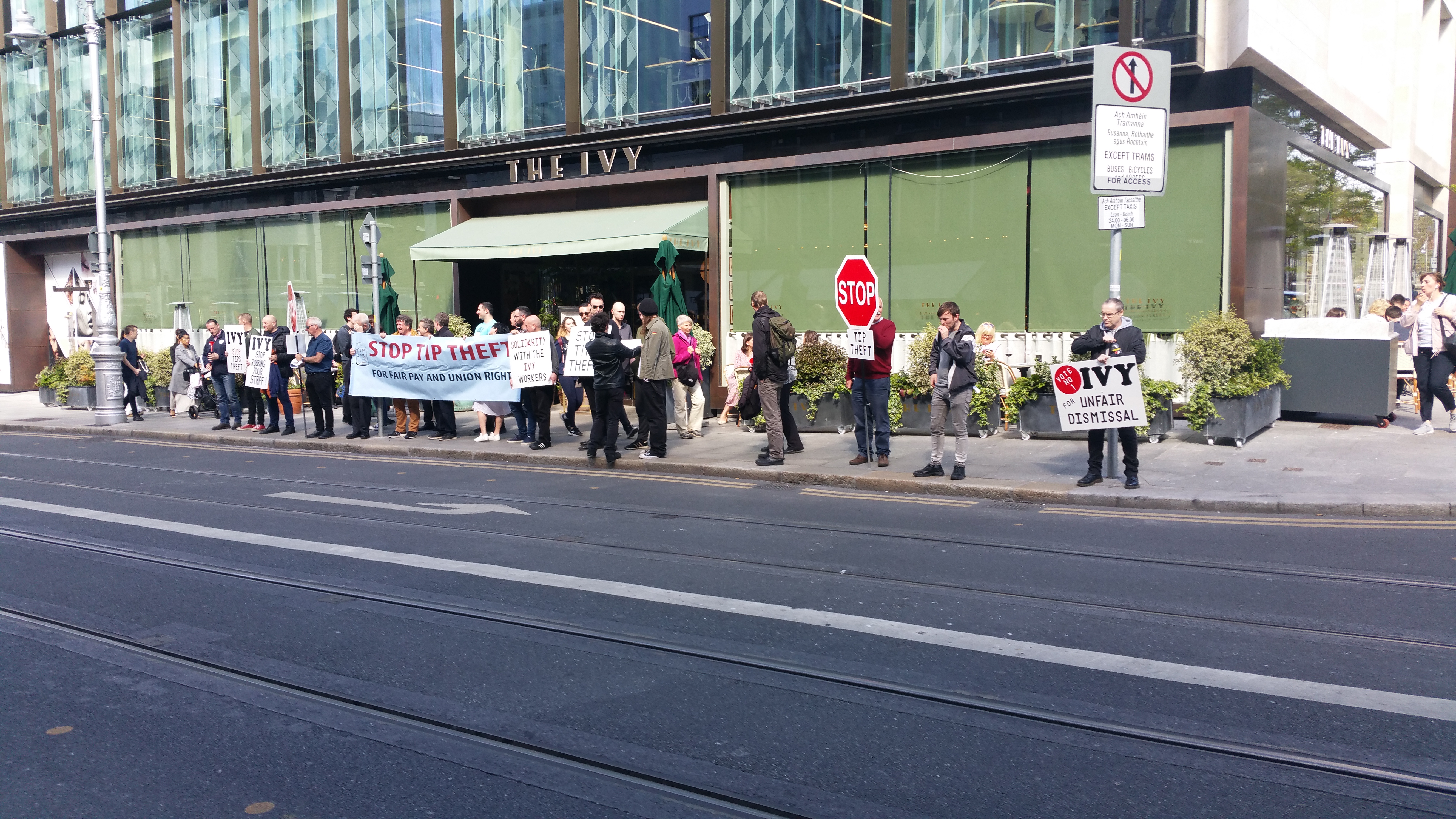
Solidarity protest picket lines up outside the The Ivy restaurant in Dublin city centre’s Dawson Street and, as management draw the blinds to hide the event from their customers, passers-by take photos and passing traffic sound horns in solidarity.
Solidarity protester with placard outside the Ivy Restaurant on Saturday. (Photo image: protester)
On Saturday afternoon (8th June) round a score of men and women participated in a picket outside the The Ivy restaurant in protest against management deducting a percentage of the waiting staff’s tips. The management are able to take this action when customers pay by bank card for their meals as well as the service charge. The protesters were also in solidarity with two sacked workers who protested the practice.
The business pays minimum wage every day except Sunday and staff expect to make a decent wage up from tips ….. but, much of the tips money is being taken by the management.
Picket line outside The Ivy restaurant on Saturday afternoon. (Photo: D.Breatnach)
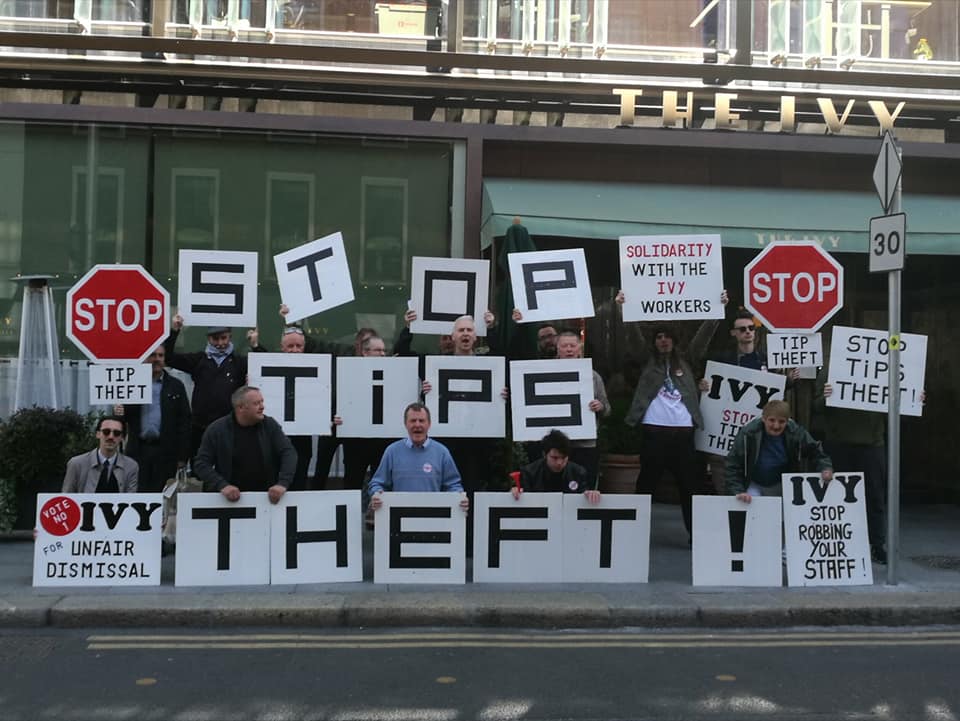
The protesters held up large placards bearing the slogans: “Ivy: stop robbing your staff!”, “Vote Ivy No.1 for unfair dismissal”; “Ivy, stop tip theft!”; “Solidarity with sacked workers” and also displayed a banner which, as well as reading “Stop tip theft” also called for “fair pay and union rights”. The picketers later also held up large letters to display the message STOP TIPS THEFT.
Dawson Street, in which the Ivy Restaurant is located, is an upper-class southside city centre street of mostly old architecture, filled with eateries, art galleries and bookshops and also containing the Mansion House, a historic building and the Lord Mayor’s business residence. It is one of two public bus routes from the south-east into the city centre and also contains a LUAS (tramline) stop.
Section of picket seen closer and front door of The Ivy (note the blinds!) (Photo: D.Breatnach)
Drivers of a number of passing private and public transport vehicles sounded their horns in solidarity while passing the picket while tourists and others took photos and promised to post them on social media. A number of tourists from the Spanish state asked about the protest and I when I explained, were fully supportive.
Since I participated in this protest myself, I was able to identify participants from a range of political allegiances and independents and they included a number of recently-elected Dublin City Councillors (a previous picket I wrote about included a TD – member of the Irish Parliament).
ONGOING STRUGGLE
This controversy has been going on for some time and has been reported in the Irish Times (see Links and References). Since the protests began, management of the once-highly-patronised restaurant had blinds installed so that they could shield their customers from the sight of the picketers but even so, they could not avoid hearing the bullhorns and the chanting outside.
Chants included “Shame, shame, shame on you; pay the workers what they’re due!”
Reports indicate that business at the restaurant in fashionable Dawson Street is down by as much as 40% on many days which bodes ill not only for the restaurant at present but also if the owners try to sell it, since the reputation associated with the business will be of a negative kind.
Catering workers through much of the world are typically unorganised into trade unions, have insecure employment, are often immigrants to the country and are particularly vulnerable to extra exploitation. Ireland is no exception to this rule and there are many examples of it in Dublin. Campaigners for better conditions of employment and pay for catering workers are aware that the Ivy is one among many but hope that breaking the tip-deducting practice at this high-visibility eatery will spread a beneficial effect around the rest of the industry.
Meanwhile the two workers sacked by The Ivy are awaiting their day in the Labour Court.
Ireland has broken off its love affair with the USA but the breakup’s been coming for a long time. Of course it was always a kind of mythical USA that was the love object, of film stars, rock n’ roll, friendly presidents, Irish-U.Stater politicians, of U.Stater tourists – never the real USA, good or bad. One could feel the tensions in the relationship during the Viet Nam War, though that was mostly to be seen in the youth and some lefties. But then came the lying scandals in the US Presidency of Nixon and Clinton and the naked warmongering throughout all, including the Bushes, Snr. and Jnr.
Looking southward from around the middle of the crowd in front of the Garden of Remembrance, Parnell Square, Dublin. (Photo: D.Breatnach)
Ireland, below the level of its Gombeen politicians, has split up with the USA (at the level of ITS politicians and millionaires [often the same thing]) but it has been a relatively civilised breakup and thankfully with no children (well, apart from the Irish illegal immigrants – sorry, undocumented visitors).
While some businesses in an Dún Beag might have turned a profit out the Fear Mór’s visit, having the Chief of the World Superpower drop in on us has cost us – around 10 million euro, according to the Irish Independent. Loads of extra Gardaí on the ground in Co. Clare and Limerick, in the air and on sea, does not come cheap (though I’m sure the overtime was welcome). All would have been bad enough if we had invited him but we hadn’t. Will the Irish Government present the US Presidency with an itemised bill? Probably not.
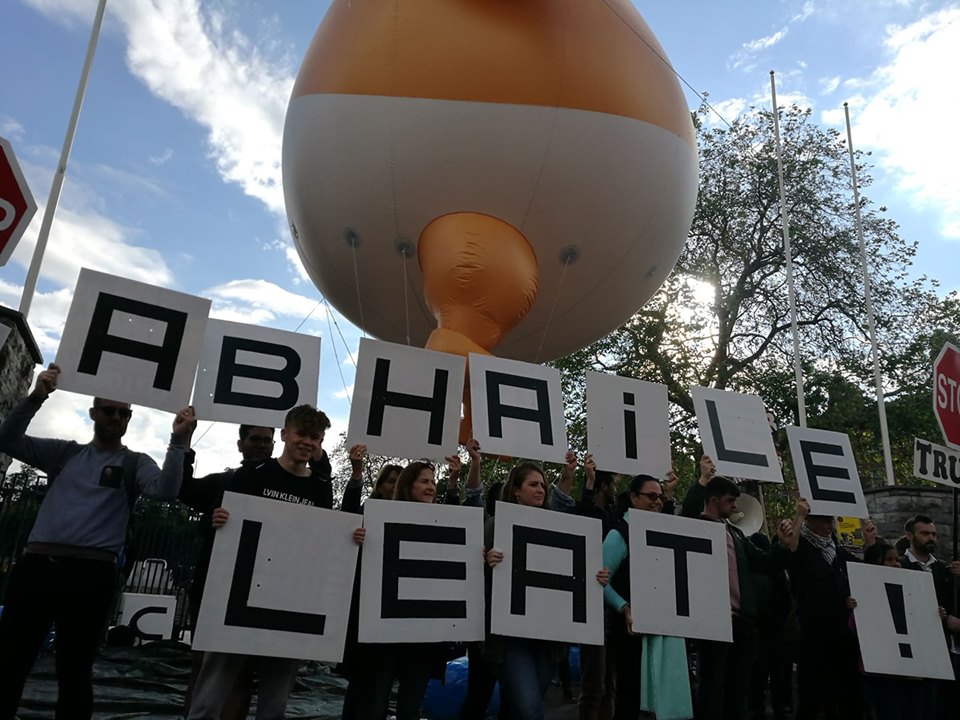
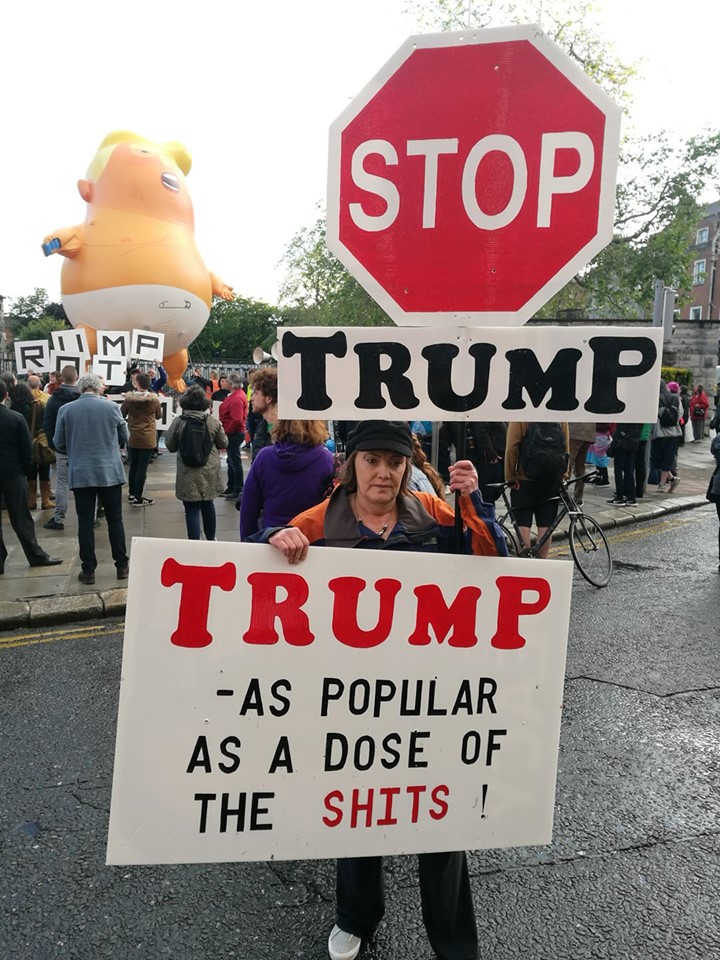
Blimp rising — taken from northern edge of rally. (Photo: D. Breatnach)
At the invitation of The Irish Examiner, a number of organisations and individuals had written letters to Trump for publication (see link below); most were critical and these included Amnesty International, Irish Council for Civil Liberties, Ireland Palestine Solidarity Campaign, National Union of Journalists, National Women’s Council of Ireland, National Union of Students; Brendan Ogle, Tara Flynn and Clare Daly. For entertainment value I’d pick out the IPSC’s and Tara Flynn’s (well, she is a comedian). The ICCL also had a newspaper advertisement criticising Trump, which was sponsored by the American Civil Liberties Union and figured logos of a number of other civil rights organisations.
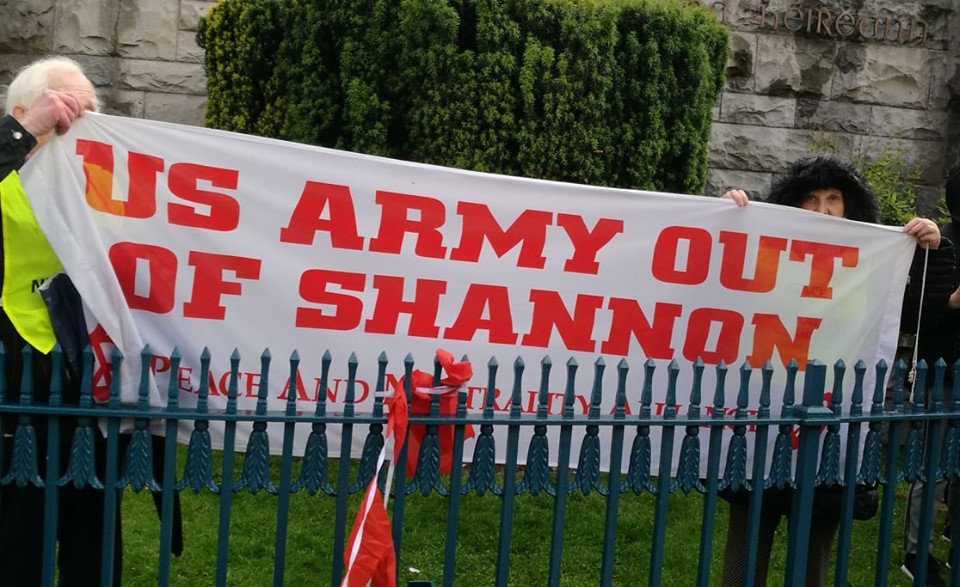
There were protests in various parts of the country, including one to greet his arrival at Shannon airport (hopefully US munitions and troop carriers were pulled to one side so as not to hinder his landing). The Irish Times said there were about 200 protesters there so, on past reporting, there could have been anything between 300 and 1,000. It is not easy to get to Shannon airport unless one has a car, even from Galway the gaps between bus arrival times are substantial. And no train station.
(Photo: G.Guilfoyle)
DUBLIN RALLY
Dublin had a showy and packed anti-Trump rally, with a Baby Trump blimp floating above the crowd outside the Garden of Remembrance. An activist brought big letter placards which, with the help of volunteers from the crowd, spelled out anti-trump messages in English and in Irish. Indeed an interesting feature was a number of placards partly or completely in Irish.
(Photo: D.Breatnach)(Photo: G.Guilfoyle)
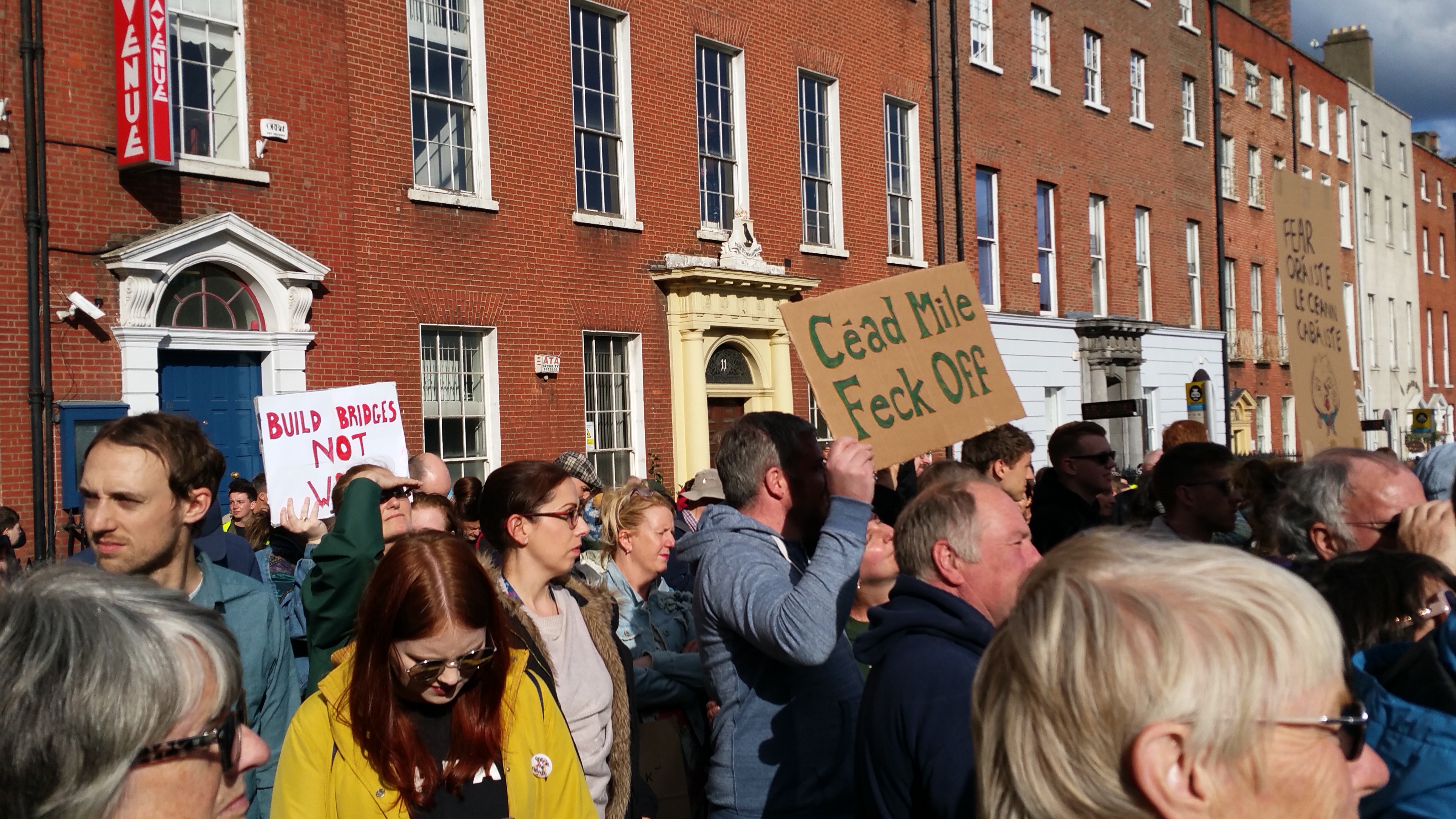
The theme of “welcome” or “fáilte” was of course played upon in reverse, in speech and placard, with more than a hinted reference to the old Bord Fáilte slogan inviting tourists to the land of “céad míle fáilte”.
On this placard play is made of the old “Céad míle fáilte” sentence (“a 100,000 welcomes”) but with a different twist.
The event was managed by Unite Against Racism which is, for the most part, People Before Profit, which in turn is really the Socialist Workers’ Party. A number of other left-wing party flags could be seen too. A group of Shinners were at the rally with their trademark flags (never go anywhere without the party’s flag) but no “dissidents” were present as a group, though I certainly noted some as individuals.
The speakers at the rally covered a number of themes, including of course misogyny, migrants, Palestine, war-making and imperialism. Liam Herrick of the ICCL was an unusual sight to see on an outdoors protest platform, speaking at the second part of the rally. Curiously, the rally organisers had sent a major part of the attendance off to march around the city centre for awhile and of course, when they got back, they had shed a great part of their numbers. A torrential downpour no doubt encouraged the desertions.
Glenda, “the woman of letters”, with some of her work.
Coming towards the end of the rally, a performer accompanied himself on guitar while he rendered some songs for the diminished attendance. Woody Guthrie’s “Plane Crash at Los Gatos” (also known as “Deportees”) would have been an apposite choice, a song about Mexican labourers being employed in the south-eastern US fruit harvests and then driven back across the Border. Guthrie was moved to sing about them when in 1948 a plane carrying mostly deported Mexicans crashed, killing all on board and though the names of the crew were given in the news reports, the Mexicans were referred to only as “deportees”.
At the rally, eventually Trump was deflated (the blimp, I mean), tethering weight bags emptied of water, placards were packed, flags furled …. and I went to get some shopping.
Forty-five years after the highest violent loss of life of any day in the Thirty-Years War in Ireland, survivors and relatives of victims of the Dublin and Monaghan bombing seem no nearer achieving justice. The identities of some of the Loyalist terrorists were known quite quickly after the bombing by Irish Army Intelligence and Garda Special Branch; British Intelligence penetration of some Irish State agencies had already been claimed by Irish Army intelligence and not long afterwards, Commissioner Ned Garvey was exposed as a British agent by a disgruntled British intelligence operative. Yet no arrests by the Royal Ulster Constabulary, no arrest warrants issued by the Irish Government and – incredibly – remains of bomb material were sent by Garvey’s superior to the British colony authorities for analysis. And consecutive British Governments refuse to hand over the relevant files or to disclose their contents.
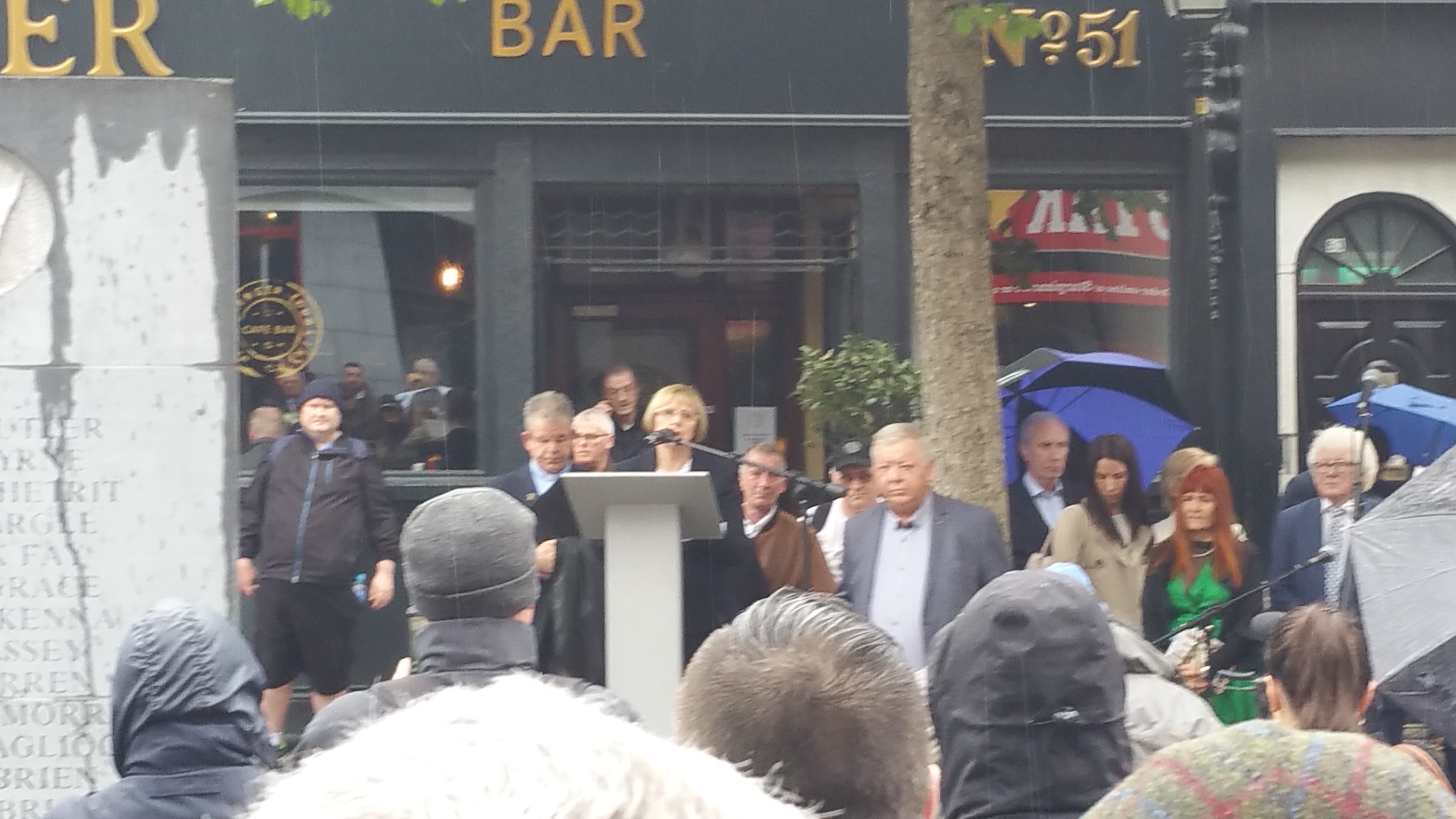
View of section of the crowd at the commemoration. (Photo: D.Breatnach)
45th ANNIVERSARY COMMEMORATION IN DUBLIN
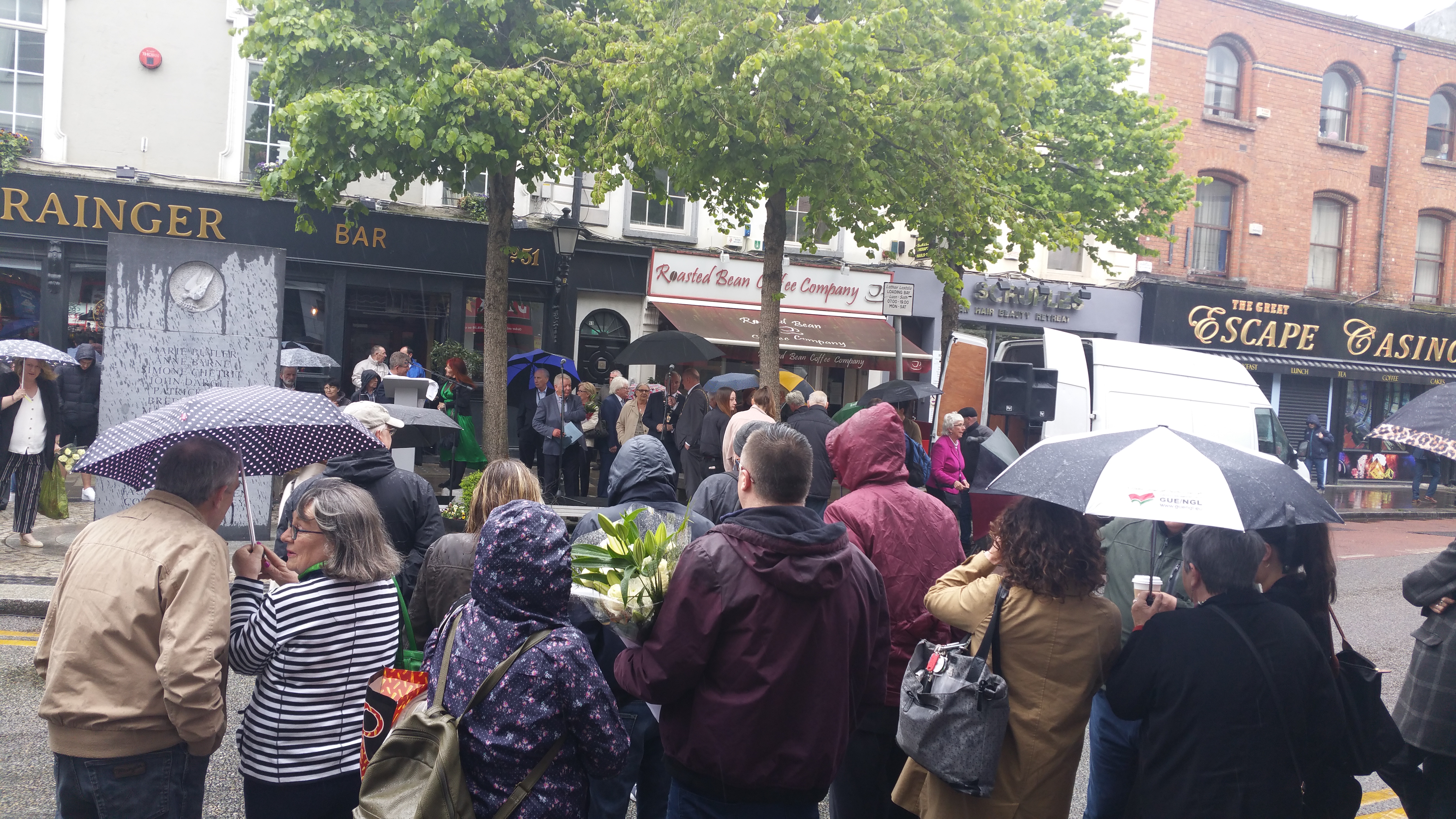
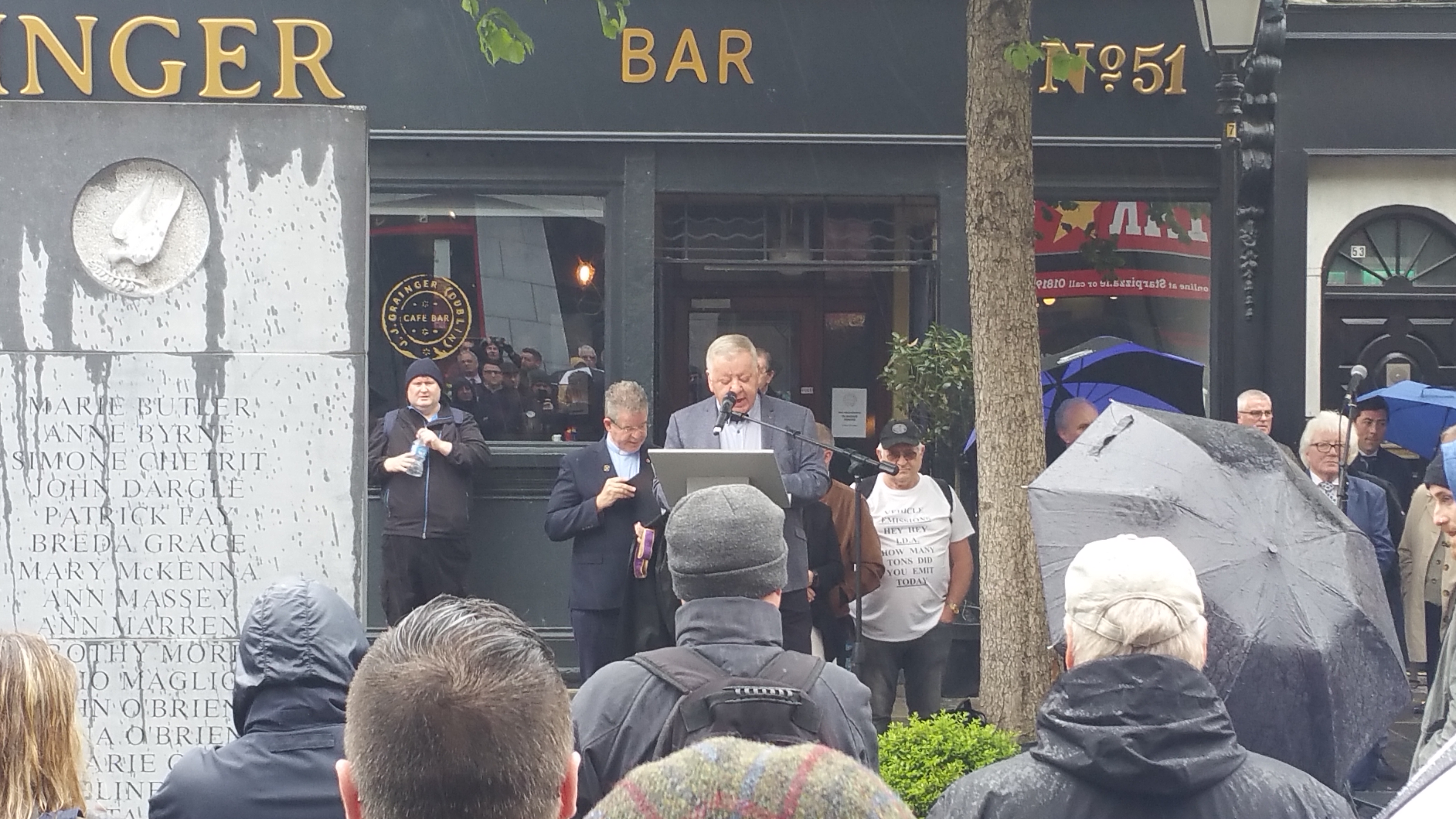
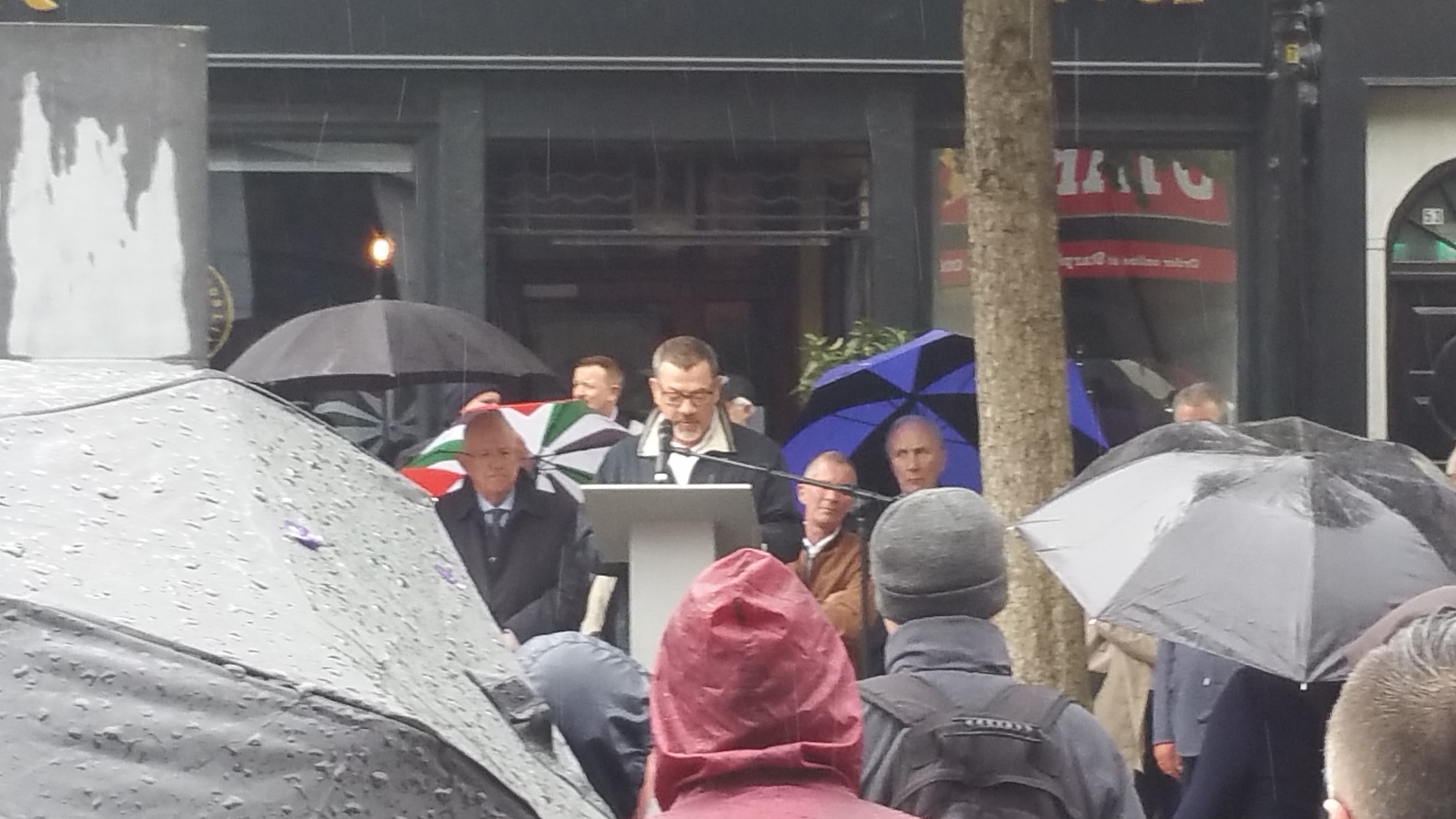
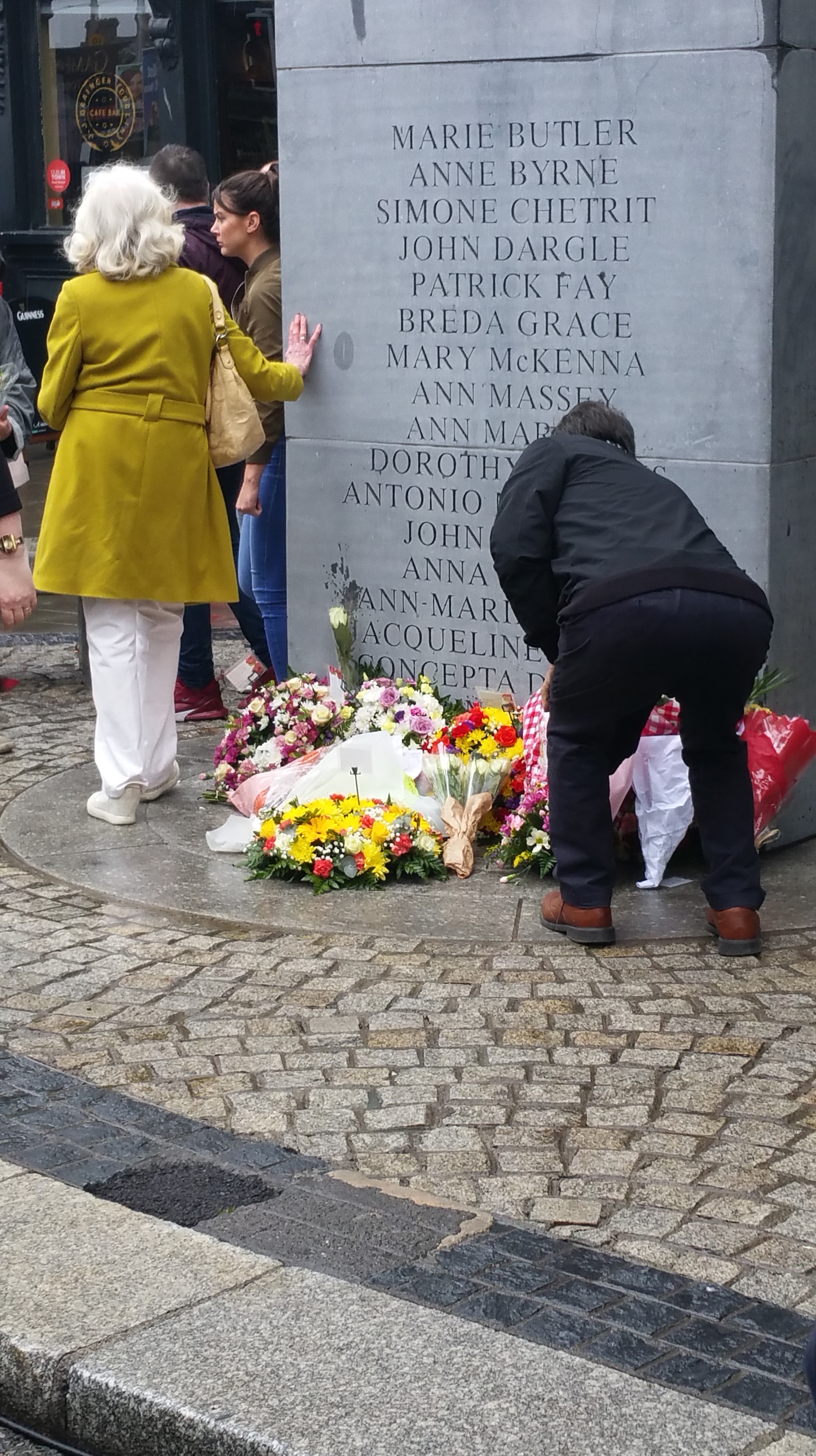
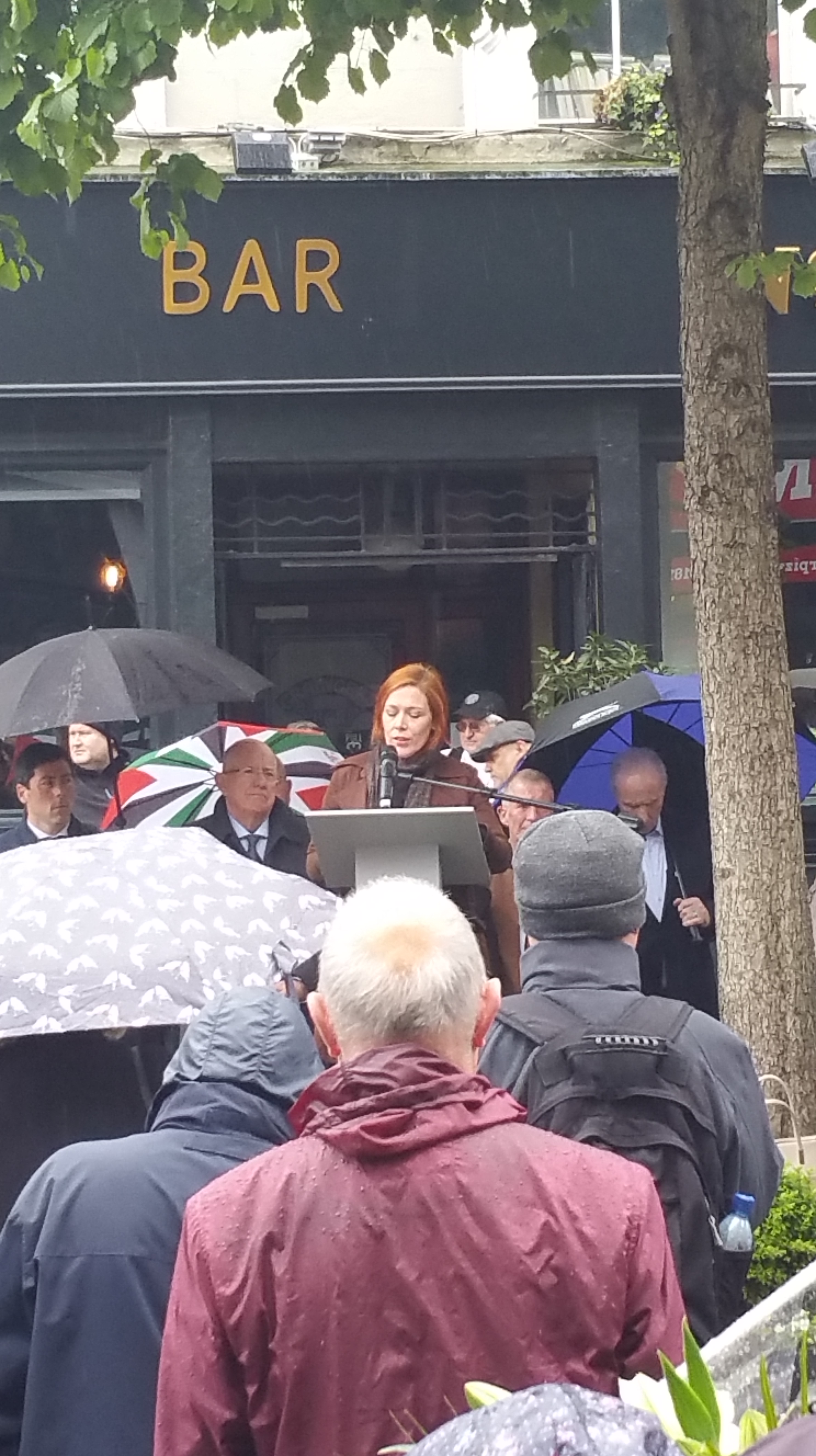
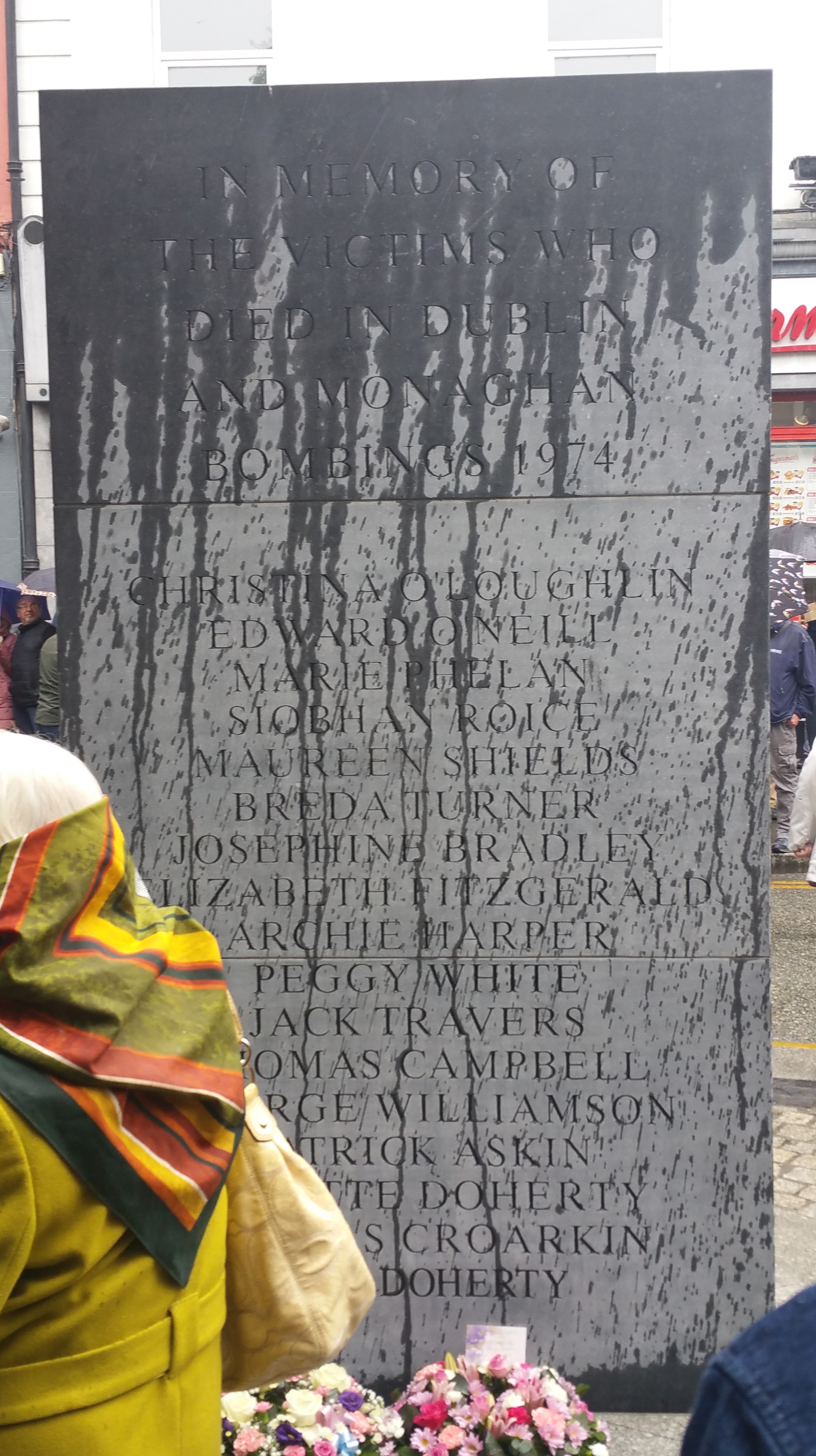
A crowd had gathered at the Dublin and Monaghan Bombings Monument in Talbot Street for some time before the event was due to start on the 17th May. Aidan Shields, whose mother Maureen was killed in in Talbot Street, acted as the master of ceremonies and, after saying a few words about the bombings and the campaign, outlined the course the proceedings would follow, apologising also to those who had to stand in the rain.
Irish Minister for Justice Charlie Flanagan spoke about the bombings and about the efforts he had made, on behalf of the Government, to have the British Government lift their embargo on the relevant files. He also used the opportunity to criticise by implication the armed Republican resistance in the British colony and to promote the Good Friday Agreement, seeking collaboration between different political parties in running the Six Counties, i.e the British colony. Although he said he shared the relatives’ frustration at the British Government still not disclosing the information about the bombing in their files, not once did he condemn them, nor criticise successive British governments, British Intelligence nor the administration of the colony and its police force.
Aidan Shields, MC of the event, whose mother Maureen was killed in the bombing. (Photo: D.Breatnach)
The Mayor of Dublin Niall Ring and Cathaoirleach of Monaghan Council, David Maxwell, also spoke at the event.
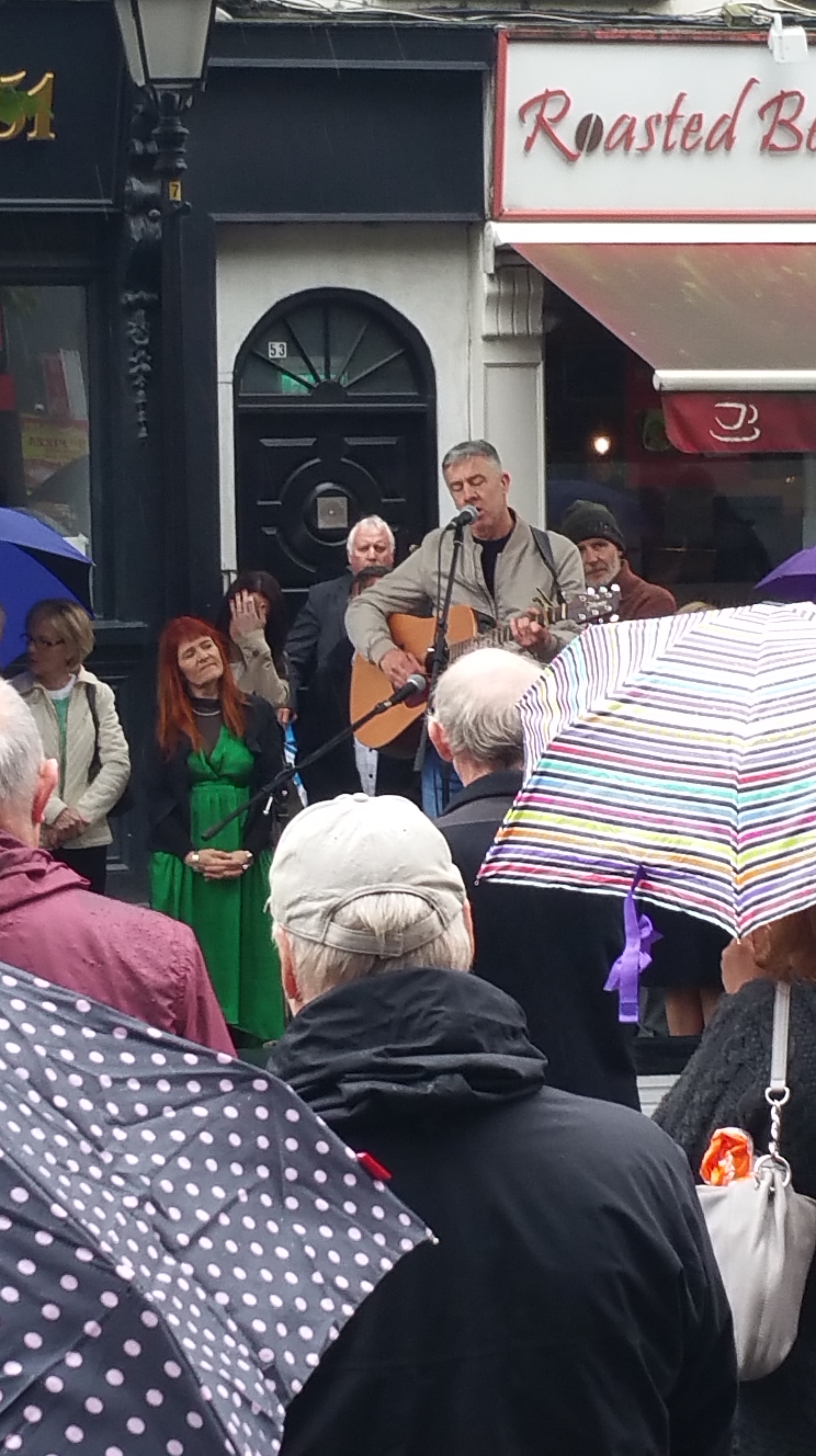
It was left to Noel Hegarty, a survivor of the bombing, in a poem (see References) and Pat Savage in his Song for Derek (which I’ve been unable to find on line) to place the blame for the attack and the lack of progress where it belonged.
Noel Hegarty reading his poem (see link for the words). (Photo: D.Breatnach)Pat Savage performing his Song for Derek (Photo: D.Breatnach)
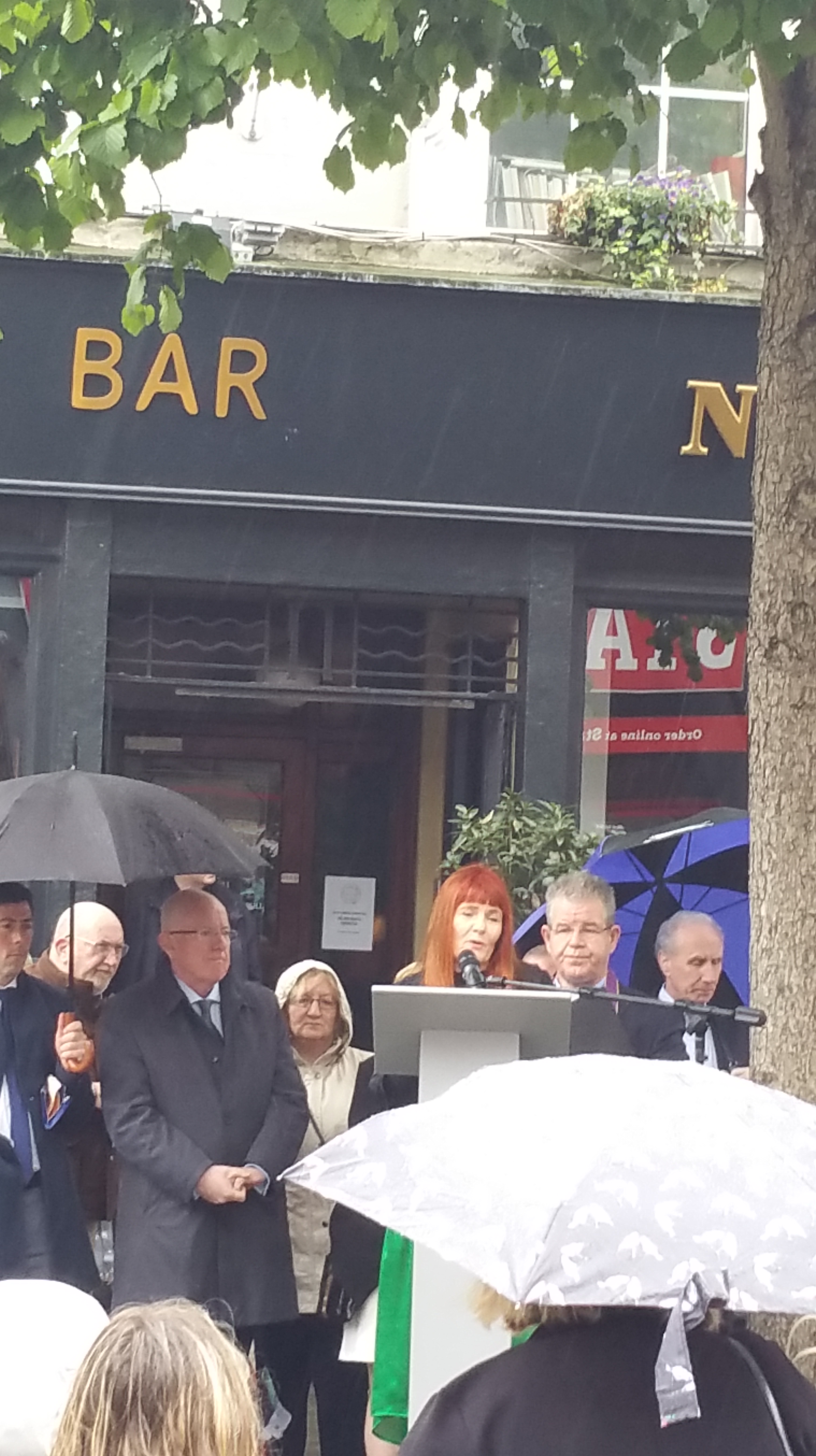
Julieann Campbell, author and Derry Bloody Sunday relative – her uncle John Duddy was the first fatal victim of the Paratroopers on that day in 1972 — gave the oration for the ceremony. She talked about the loss through sudden death, the effect on relatives and how it is exacerbated when official lies are told about the deaths with secrecy used to make it harder for the relatives and survivors to get at the truth. She referred to one British file on Bloody Sunday that is embargoed for decades yet and turned to Minister Flanagan, asking him publicly to press the British for the release of that file also, a request which was applauded by the crowd.
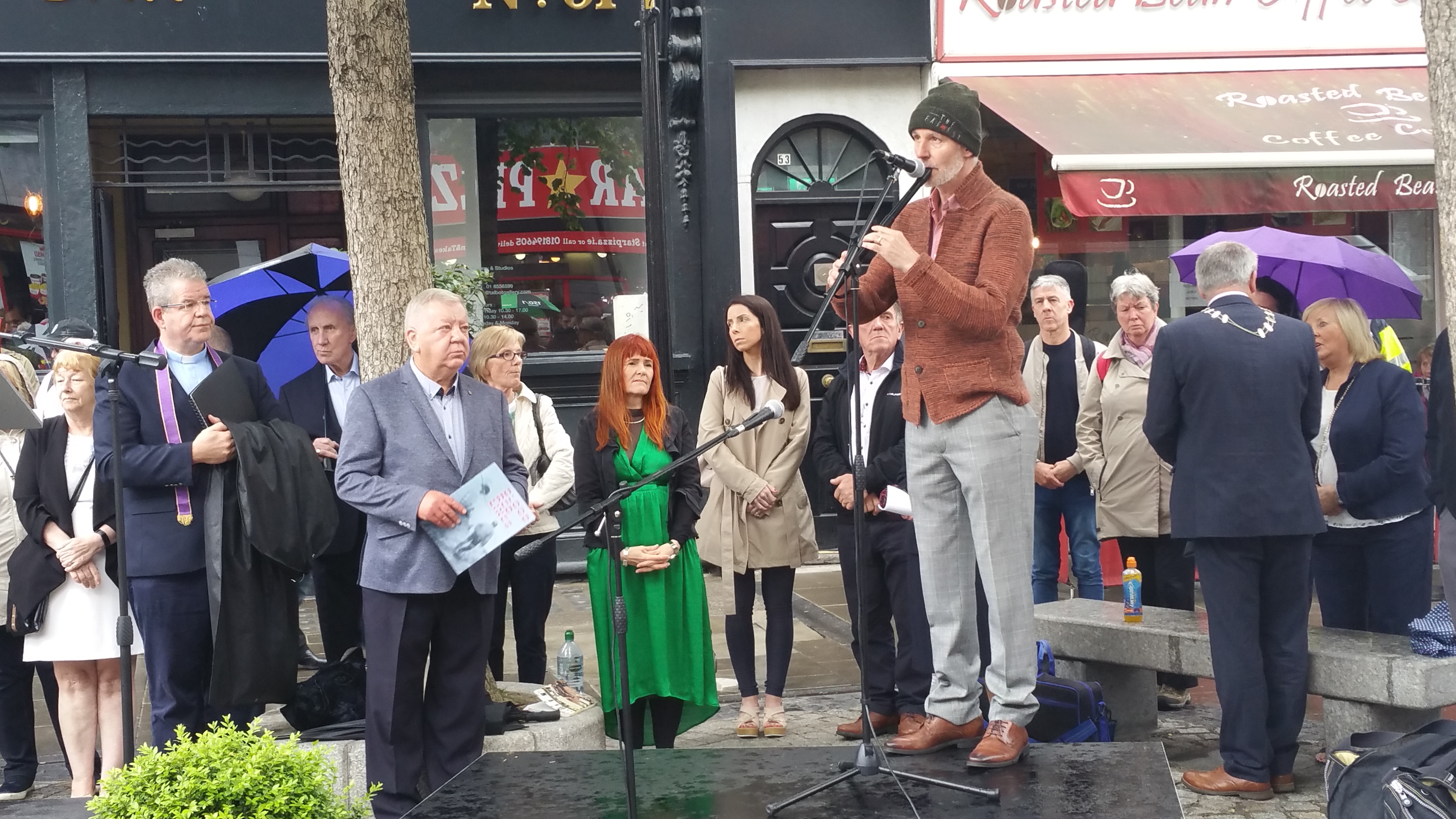
Rachel Hegarty read one of her sonnets from her collection, May Day 1974, which she composed based on witness testimonies about the deceased and Ciarán Warfield performed a song about the bombing and the lack of justice obtained. Fr. Tom Clowe led those who wished to respond in a Christian prayer (the Rev. Trevor Sargent had injured himself the day before and was unable to attend). Cormac Breatnach played low whistle while floral wreaths were laid and again at the conclusion of the event.
Rachel Hegarty reading one of her poems about the victims (Photo: D.Breatnach)
THE BOMBING 45 YEARS AGO – THREE BOMBS IN DUBLIN AND ONE IN MONAGHAN
What might be considered the official Dublin City centre is the area surrounding O’Connel Street, just north of the river Liffey. The street runs north-south and is bisected at its middle by a thoroughfare running east-west. The eastern part is mostly Talbot Street, with a short continuation named North Earl Street. Crossing over O’Connell Street one now passes by the Spire, where once stood Nelson’s Column (until blown up by dissident Republicans in 1966) and continuing westward, one enters Henry Street. This street contains big stores such as Debenhams and Arnotts and is a higher-class shopping street than are the streets chosen to place two bombs, Talbot Street; could it have been decided that predominantly working and lower-middle class victims were less likely to create pressure on the Irish Government to find those responsible? The other bomb’s target street, Parnell, is also not one of high-end shopping.
Cormac Breatnach, playing at the event. (Photo: D.Breatnach)
There had been previous Loyalist bombings in Dublin, for example of the Wolfe Tone Monument in Stephens Green and the O’Connell Monument in Glasnevin Cemetery. None of those had caused deaths but a bombing in 1972 had killed a public transport worker and another, in 1973, had killed two and injured 185. No arrests were made in connection with either and in fact the Fianna Fáil government blamed Irish Republicans for the ’72 bombing, using the emotions engendered to push through more repressive legislation. That was an Amendment to the Offences Against the State Act, one which allowed the State to jail people on a charge of belonging to an illegal organisation, without any evidence other than the word of a Garda of Superintendent rank or higher and is regularly used to convict people today.
On the 17th May 1974four bombs exploded in Dublin and Monaghan – killing 33 people including a woman who was nine months pregnant.
Three car bombs exploded without warning in the capital shortly before 5.30pm on Friday 17 May 1974.
Two of the bombs went off on Talbot and Parnell Streets before a third blast exploded on South Leinster Street near Trinity College, 27 people died.
Shortly afterwards another bomb exploded outside a pub in Monaghan, killing seven people. Hundreds more were injured.
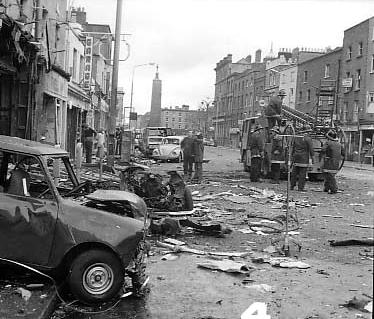
Wreckage in East Parnell Street after the bomb there (Photo source: Internet)
After the bombings, the most concrete result in Irish Government policy was that Irish Republicans being sought by the British began to be tried in the Irish State. The Criminal Law (Jurisdiction) Act 1976 allowed trial in the Republic for alleged crimes committed in the Six Counties, and vice versa, which facilitated Irish State cooperation with the British State against Republicans, overcoming the many failures in extradition cases up to that date.
This parallels somewhat the 1980s GAL terrorist campaign waged by the Spanish Government against Basque independentists in the northern Basque Country, part of the French State’s territory. After Spanish State-sponsored terrorist shootings and bombings of independentist Basques for some time on what it considers French soil, the French Government began to extradite refugees to the Spanish State. However it was 1984 before the Irish State actually extradited a Republican to the Six Counties, with the extradition of Dominic McGlinchey (who subsequently had his conviction overturned there). It is curious that this possible rationale for the Dublin/ Monaghan bombings does not seem to have been considered – after all, the 1972 bombings by British agents had resulted in a change in Irish law to the disadvantage of Republicans within the Irish State.
Juliann Campbell, niece of Derry Bloody Sunday fatal victim John Duddy, giving the oration at the commemoration. (Photo: D.Breatnach)
The Justice for the Forgotten campaign organises an annual commemoration on the date of the bombings but internationally and perhaps even in Ireland, this massacre is the least-known of all that took place during the recent 30 Years War. Arguably this is because a) the bombs were not placed by the IRA and the massacre was not therefore of much use in propaganda against them; b) the victims were mostly Irish and/or c) the perpetrators were Loyalists and British Intelligence operatives working together.
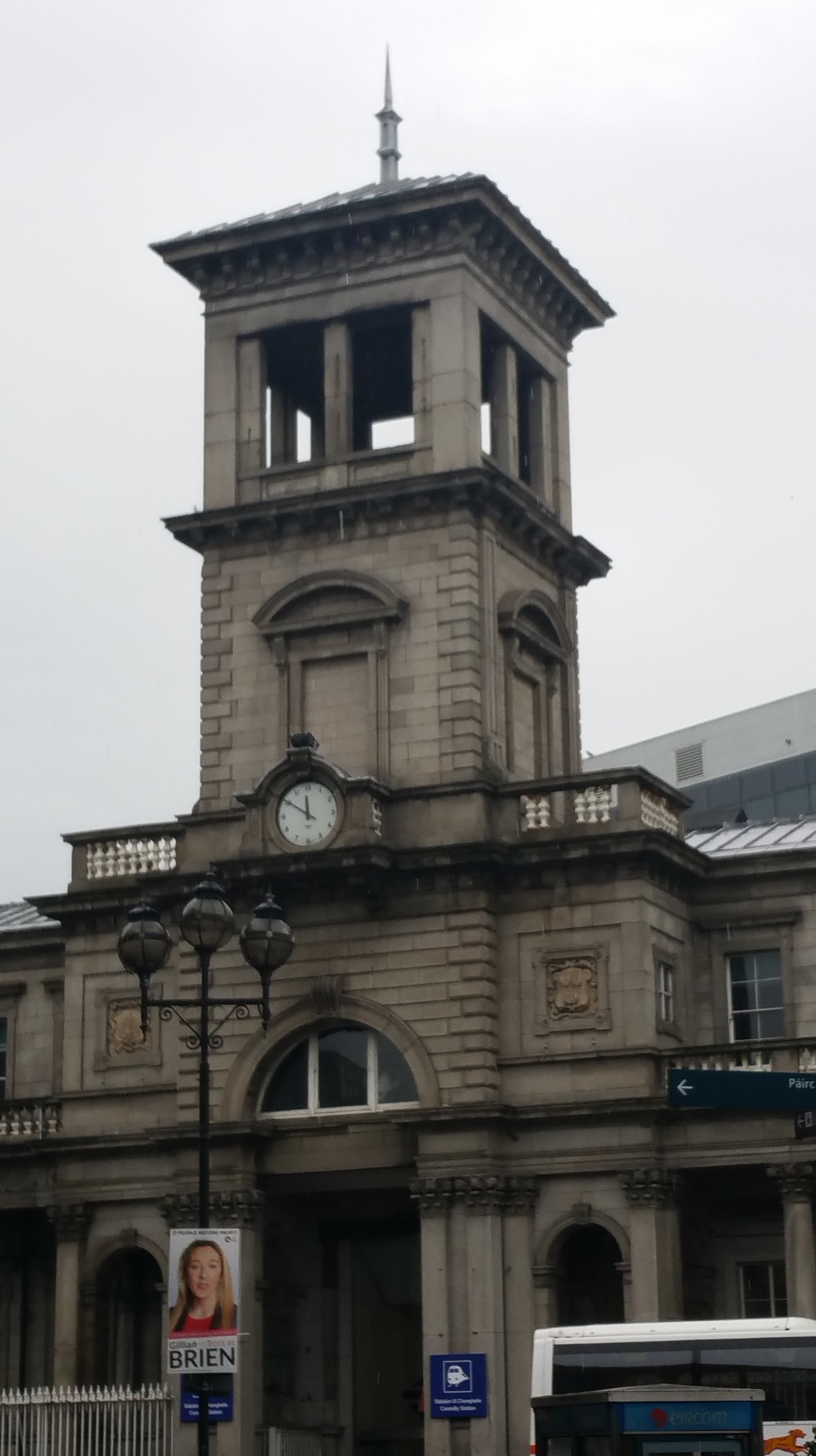
Overlooking the Talbot Street Monument of the Bombings, the tower of Connolly Train Station (formerly Amiens St. Stn.), from which British machine-gun bullets were fired at Irish insurgents during the 1916 Rising. (Photo: D.Breatnach)
SECRETS AND AVOIDANCE
It is interesting how coyly the media treat the whole question of British collusion with Loyalist death squads, including the Glenanne Gang’s involvement in the Dublin-Monaghan bombings, along with Irish State‘s lack of energy in pursuing the matter, including possible collusion and certain secrecy. There are sometimes ‘suspicions’, ‘concerns’, ‘inferences’, ‘allegations’ ….
And yet most of these matters are beyond speculation, established as facts through a number of different sources. Contrast that with how happy the media are to label the tragic but accidental shooting dead of Lyra McKee as a “murder”, even though legally and in fact, murder can only be when someone intends to kill the victim – which not even the press in its greatest hysteria has tried to suggest was the case.
The Justice for the Forgotten campaign has taken a civil case against the British State which appears to be playing its usual delaying game in situations like this. On 17th April they were due to respond to questions of the campaign’s lawyers but did not do so until eight days later, which resulted in the campaign’s lawyers not being able to proceed at the Belfast High Court on May 1st ….. The relatives will now have to wait until September.
The lack of energy and firmness in pursuing the issues and the disclosure of British files is not the only evidence of the Irish State’s lack of interest. It is also the case that much of the funding for the Justice for the Forgotten campaign was removed by the Irish Government some years ago; the campaign was obliged to leave its Gardiner Street office and remove much of their equipment and files to a portakabin in a supporter’s back garden.
Margaret Urwin speaking, main administrator/organiser in JFF (Justice for the Forgotten), underfunded organisation campaigning for disclosure and justice with regard to the Dublin and Monaghan bombings. (Photo: D.Breatnach)
The British are not the only ones sitting on secret files. Mrs. O’Neill had called on Leo Varadkar to release the files deposited by the McEntee Commission, which was charged with investigating the Garda inquiry of the time, an inquiry which has been heavily criticised over the years. “I personally ask the Taoiseach to consider this reasonable and fair request,” she had said. Martha O’Neill’s husband, Eddie, was killed in the bombing and her sons Billy, then aged seven and Eddie jnr. aged five, were badly injured but survived.
Last year, Fred Holroyd, a British Army Intelligence officer who was the liaison with the RUC for a number of years during part of the three decades of war in the Six Counties, offered to give evidence on British involvement in the bombings – but in a secret court. Holroyd is suing the British Ministry of Defence over sacking him and has spoken out about collusion between the British administration and Loyalist paramilitaries including those widely believed to be the Loyalist bombers responsible for the carnage on the 17th May 1974.
Another measure of the Irish Government’s lack of enthusiasm for going after the perpetrators of the bombings and their handlers can be seen in the fact that the first documentary to be made about the atrocity in the Irish capital cityand Monaghan town, was made not bythe State broadcaster, RTÉ but by the English company First Tuesday, Yorkshire TV. “Hidden Hand – The Forgotten Massacre” was broadcast on 6 July 1993. Not everyone who had TV in the state then had ITV – I believe it required a special aerial at the time – and if memory serves me correctly, Yorkshire TV offered simultaneous screening to RTÉ, which it declined. The program made a case that the British Army, the RUC and Loyalist paramilitaries could have been involved in a number of killings, including the Dublin-Monaghan bombings.
The failure of the Irish Government at the time to pursue the case energetically and in a correct manner was responsible for much more than leaving the injured and the the relatives of 33 murdered people without justice. It also left the Glenanne Gang, a Loyalist paramilitary Ulster Volunteer Force death squad that included serving members of the Royal Ulster Constabulary police force and the British Army’s Ulster Defence Force, free to carry out around another 120 sectarian murders in the Six Counties.
(Photo: D.Breatnach)
Year after year, the Dublin/ Monaghan commemoration is held and year after year, relatives call for truth and justice; the Irish politicians express regrets and say that they will ask the British Government for the files again, to be refused again. And there it is left, until the following anniversary.
I am rubbish at predicting broad election results. But the mass media is predicting, on early returns, a huge electoral swing in Ireland towards the Green Party — at least in the municipal elections.
(image source: Internet)
As I type these words the other candidates who failed to get elected as municipal councillors in the Irish state — or barely scraped through — will be licking their wounds. The Greens will be celebrating, of course, spouting their analysis of what this means, of a huge change in the Irish people, of climate change awareness ….
And the media will be parroting them.
MORE OF THE SAME
I don’t believe the voting results are because of any great change in the consciousness of the Irish electorate — in fact I think it’s basically more of the same.
Why then the electoral surge towards the Greens? I don’t think that climate change issues — or more accurately the public perception of them — are enough to explain it, though it will no doubt have influenced some voters. I think the fundamental reason is that the Greens are not Fianna Fáil, Fine Gael, Labour or Sinn Féin. True, they are tainted from partnership with FF in the past but that was only a couple of them and a lot of water has gone under the bridges of Irish rivers since then.
I wouldn’t trust the Greens in power as far as I could throw an iceberg but I think what I’ve said above is the reality.
The 26-County electorate has traditionally voted either FF or FG into power. The latter normally needed another partner to form a majority, which Labour opportunistically gave them and later the party always paid the price, while a few of its leaders got fat pensions out of it.
Apparently every Irish government since the intervention of Hunger Strike candidates in 1981 has been a coalition, which testifies to an electorate generally unconvinced by either main party. But since the bank bailout, the electorate seems to have been even more disenchanted, voting for outsiders in the race and hedging their bets between parties, like spreading the risk in investments.
In the 2011 General Election, the voters kicked out FF to the lowest vote in the party’s history along with wiping out its Green party partners and, apart from voting in a lot of independents (mostly left-wing ones), they gave most votes to the party most likely to dislodge FF, which of course was FG. And they spread the risk by giving Labour a lot of votes. Despite the hopes of the electorate this coalition basically gave us more of the same — privatisation of lucrative state services, mismanagement of others, expanding housing crisis and austerity measures.
So they put in a lot of SF in another year and what do they get? A party that votes in Dublin to hand over Council land to speculators because SOME ‘social housing’ will be built on it. Resignations of elected representatives through alleged internal party shenanigans. A party that has long ago lost interest in organising a base for anything except voting — a mirror, in fact, of FF in the past. And which, while playing sectarian politics in the Six Counties has supported — and implemented — austerity measures of the British State.
Media commentators will search for many reasons for this change — youth vote, middle-class vote, climate change consciousness and general environmental awareness. I think there is a more fundamental reason which the commentators would probably rather not acknowledge, since it questions, not the viability of this or that party, but the whole system.
I don’t believe the people have any great faith in the Green Party and this elections seems more of the same behaviour of the electorate. Change the faces every so often — and spread the risk.
Nor do I blame the electorate — for what visible and realistic alternative has presented itself?
DISCURSO DEL COMÍTE ANTI INTERNAMIENTO DE DUBLÍN PARA LA CONMEMORACIÓN DE PASCUA ABRIL 2019
A Chomrádaith agus a chairde, go raibh maith agaibh (“Companer@s y amig@s, gracias”) al Acción Anti-Imperialista de Irlanda por invitar al Comité de Anti-Internamiento de Dublín a hablar en este evento.
Tradicionalmente este es un tiempo cada año de conmemoraciones.
Conmemoramos en primer lugar a las mujeres, hombres y chicos que salieron a luchar contra un Imperio, el más grande jamás conocido y, en ese momento, el militar más poderoso del mundo. Algun@s lucharon solo por la independencia de Irlanda, much@s lucharon también por la justicia social y otr@s lucharon contra la guerra imperialista. El nuestro fue el primer alzamiento contra la carnicería de la Guerra imperialista y el mundo tuvo que esperar un año antes de que hubiera otro, en Rusia, y dos años antes del alzamiento espartaquista en Alemania.
Pero también conmemoramos a aquell@s much@s otr@s que lucharon y much@s que dieron su vida contra el invasor a través de los siglos, contra el colonizador, los ladrones de tierras, contra la monarquía inglesa por una República, contra los traidores de la causa de la independencia, contra los Gombeen (capitalistas nativos). Los gobernantes de nuestro propio Estado y los gobernantes coloniales de la colonia inglesa restante en suelo irlandés.
Es correcto y apropiado conmemorar los hechos heroicos y el sacrificio del pasado.
Pero no se trata solo del pasado; también se trata del presente y del futuro. A chomrádaithe (“companer@s), la lucha aún no está terminada y sus objetivos aún no se han alcanzado. Vivimos en un país dividido por una frontera británica y también dividido entre ricos y pobres, donde una pequeña minoría de explotadores vive de los trabajadores y de la clase media baja, convirtiendo la miseria de much@s en los euros y libras de unos pocos.
A medida que el fascismo asoma su fea cabeza y destapa sus sangrientos colmillos nuevamente por todo el mundo, nuestros gobernantes aquí en Irlanda también se vuelven cada vez más a la represión. Recordamos a los que están en juicio ahora por oponerse exitosamente al lanzamiento del fascista Pegida en Dublín en 2012. Y los partidarios del Sinn Féin Republicano atacados en Newry mientras conmemoraban el mismo Alzamiento de 1916 el año pasado, también en juicio ahora, una repetición de los ataques del RUC bajo la Ley de Poderes Especiales. Y las redadas en los hogares de much@s republican@s de otras organizaciones a lo largo del año. Y aquellos que languidecen en la cárcel después de la condena por cortes especiales sin jurado en ambos lados de la Frontera.
Parte del arsenal de la represión ha sido tradicionalmente el internamiento sin juicio. Y camaradas, tras el Alzamiento de 1916, hubo una gran ola de detenciones en Irlanda. Más de 3.500 hombres y mujeres fueron arrestados y se dictaron noventa sentencias de muerte, aunque más tarde todas menos 16 fueron conmutados. 1,852 mujeres y hombres fueron internados en campos de concentración y prisiones en Inglaterra y Gales.
Los británicos recurrieron nuevamente al internamiento durante la Guerra de la Independencia, al igual que los gobiernos irlandeses durante la Guerra Civil y en los años 30 y 40, y los británicos en los Seis Condados en los años 70. Eso fue internamiento masivo, pero el internamiento continúa hoy de forma más selectiva, a través de la revocación de la licencia para ex presos y la negativa de la libertad a fianza para otros. Tod@s l@s republican@s deben oponerse a esta práctica represiva y no solo l@s republican@s, sino también l@s socialistas y, de hecho, todas las personas democráticas. La historia muestra una y otra vez que lo que el Estado se sale con la suya contra un grupo, lo usa más tarde contra otro.
El Comité contra el internamiento de Dublín se esfuerza por celebrar un piquete mensual de información en diferentes partes de Dublín y un evento anual en Newry. No somos sectarios y somos independientes de cualquier partido u organización política, lo que significa que TODAS las organizaciones republicanas deben apoyar nuestros eventos, ya que el internmiento nos afecta a todos. O nos oponemos juntos a la represión estatal, camaradas … o vamos a la cárcel por separado.