WHAT IS THE POINT OF COMMEMORATIONS?

Diarmuid Breatnach

Summary: Fascism is mobilising across many parts of the world including the very Spanish state where it caused a war through a military-fascist coup and brought in four decades of a fascist dictatorship. The main point of commemorations of the anti-fascist resistance and of the International Brigades should be of raising the alarm and mobilising resistance anew. Why in some instances is this not happening?

What is the point of commemorations of the International Brigades? Or of the ‘Spanish Civil War’? Yes of course I believe these things should be commemorated but I still want to know what the point is.

I would think that most people would agree with two reasons:

  1. To remind us never to let fascism take over again

  2. To honour the memory of those who fought it, many who sacrificed their lives or their liberty or their health in the struggle against fascism.

I believe there is a third important reason though perhaps most people wouldn’t put it up there right away, though I doubt they’d disagree with it:

  1. To learn from the successes and mistakes of the past.

How is it then that one can go to an event to celebrate the the Irish International Brigaders but at the same time not hear a mention once in a number of hours about the mobilisation of fascist forces in Europe? How is it one cannot hear even a passing reference to the fascist forces that are stridently mobilising within the very Spanish state, at this moment? How is it that there is no mention of the Irish State bringing antifascists before the courts now for allegedly taking part in actions against the intended launch of the fascist Pegida organisation in February 2012?

Sure, we can all forget some very important point in a speech, forget to name somebody who should get a mention, etc. But all throughout the evening? And no placards or posters to challenge the rising fascism of today? That cannot be just a slip. Were it amnesia, it would be bad enough but if a tacit or tactical agreement not to remind us that would be worse, much worse.

Bob Doyle, the last of the Irish Brigaders to die, who is often mentioned at such events, would not have had it that way. In his nineties, I heard him speak a couple of times and he was always clear that the main point is to stop the fascists today. Frank Ryan, who regularly gets references at commemorative events (often without anyone mentioning he was IRA before he went out, as were many of the other Irish Brigadistas), would have agreed with Doyle, I’m sure.

TODAY FASCISM IS RISING IN THE SPANISH STATE – but then, it never went away.

          In the very territory where what is usually called the Spanish Civil War and less frequently the Spanish War Against Fascism (and other things)1 took place, Spanish fascists are openly organising, marching, threatening right now. A few weeks ago they were commemorating the dictator General Franco and Primo Rivera, founder of the Spanish fascist organisation, La Falange. Earlier in November they were provoking Catalans by having a rally in Barcelona. A little earlier still, they were provoking Basques by rallying in Altsasu, the town from which Basque youth got jail sentences of up to thirteen years arising out of a late-night pub brawl with off-duty Spanish policemen who provocatively went into an independentist bar and in which the most serious injury (if it was an actual result) was a damaged police ankle.2

Fascist organisation Falange women guard of honour for commemoration of the fascist founder of the Falange, Primo Rivera (Photo source: Internet)

All that would be bad enough if it were not that the Spanish State is actively tolerating them. Throwing fascist salutes, flying the Spanish fascist flag and shouting fascist slogans are all illegal under Spanish law; but the fascists brazenly do all these things and they do not get arrested!.
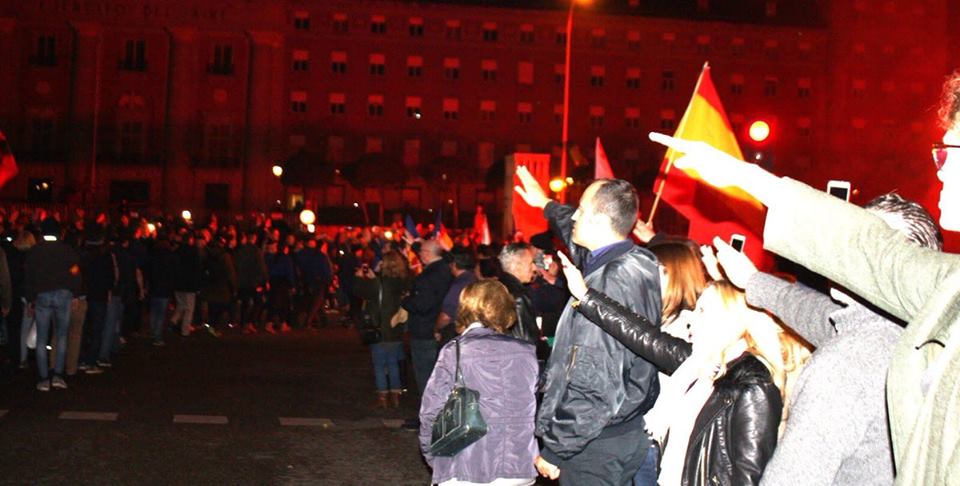
Fascist salutes and symbols at a recent fascist commemoration in Madrid (Photo source: Internet)

Of course, fascism was never defeated in the Spanish state. Fascism won there. We can shout “No Pasarán” (‘they shall not pass), the slogan for the defence of Madrid3 as much as we like but sadly, eventually sí pasaron (‘they did pass’), despite the enormous sacrifices of Castillians, Asturians, Andalucians, Basques, Asturians, Catalans and other peoples there, despite the bright internationalist spirit of the International Brigaders from well over 60 nations and states. And the victorious fascists tortured, shot, raped, humiliated, confiscated and stole food, valuables, businesses, imprisoned and half-starved the vanquished. And exported prisoners and jews to Nazi concentration camps.

Then the fascist regime consolidated their power, converting the schools to places of instruction in fascist and religious indoctrination, re-imposed a patriarchal ideology and ‘morality’ on girls and women, repressed languages other than Castillian, banned all trade unions except the fascist one, beat up and shot strikers and demonstrators, tortured independentist activists, shot some dead …. All of this went on for 40 years under General Franco.

During the first decade of that fascist reign of terror in the Spanish state, Fascism at first trampled over western and eastern Europe, North Africa, Asia …. until the tide began to turn, first in Eastern Europe and then in Asia and at last the fascist powers were defeated. Fascist leaders faced popular vengeance and Nuremberg and Tokyo Tribunals, executions and prison sentences. The societies they had sprung from were subjected to anti-fascist education. A great many of the guilty escaped but some were hunted down in following years.

During World War II on the other hand, Spanish fascism gave material and intelligence aid to the German and Italian fascist states and cooperated in hunts for the “French” (i.e Basque, Asturian, Catalan, Occitan and some Spanish anti-Nazi resistance, the maquis or maquisards4along the French-Spanish Border. It also sent back to the Nazis escaped prisoners, Jews and downed Allied airmen.

After the War, nothing happened to Spanish fascism (except that it sheltered hundreds of Nazi war-criminals, either permanently or on their way to South America, often with Vatican help). Fascism continued unimpeded in the Spanish state until ETA assassinated Carerro Blanco, Franco’s nominated successor and Franco himself died5 two years later.

Under internal pressure from Opus Dei and externally by European powers and especially by the USA, it was decided to modernise and rebrand the State6. The social democratic PSOE and its affiliated trade union the UGT were legalised under conditions and so were the Communist Party of Spain and its union, the Comisiones Obreras7. The conditions were that these would control their supporters (hence the trade unions) while the Transition was being carried through with repression; although republicans all, they would agree to the reimposition of a monarchy; that they – God forbid! — not go hunting fascists if they ever got into government; that they support the inviolability of the Spanish state union. The PSOE and the CPE agreed to the conditions and delivered, the latter even swallowing the fascist murder of five of its trade union lawyer members and serious injury to another four during the Transition and the PSOE swallowing the attack on the offices of the CGT.

The Transition took place in an atmosphere of hope and fear, repression against resistance: the new Spanish unionist and monarchical constitution was voted in, with regional autonomy to placate subjugated historical nations within the state; the new King, Juan Carlos de Borbón was installed. Ten years later, the Spanish State was admitted to the European Union8. That same year, the new Spanish Government under the PSOE was conducting fascist-police-military assassination squads against left-wing Basque independence activists9.

But all throughout those years and still, the fascists kept their plundered wealth. The fascist clergy, judges, civil servants, police, military and media all kept their positions and wealth. They just had to open up their ranks a little to let in the climbing social democrats and “communists”. Not one fascist was tried for any of the crimes carried out during the “Civil War” or during the Franco regime afterwards.

WHY THE FASCISTS ARE COMING BACK (but then, they never went away)

          Two things are exercising the Spanish fascists at the moment. First among these is the long struggle of the Spanish State to hold on to its forced union of the nations and regions conquered by monarchs of the Royal Houses of Spain and by fascist dictators, then maintained by both the mainstream constitutional political parties, the PP an the PSOE.

As a combination of factors combined with State repression to halt and disintegrate the southern Basque march towards independence, Catalonia took up its own struggle10. The independence movement there, which has left, right and centre elements but at base is popular and democratic and with wide support, has been steadily advancing. At institutional level, the ‘autonomous’ Catalan Government is a coalition of pro-independence forces (but with a numerous, strong, right-wing and Spanish-unionist opposition) and the majority of town councils have pro-independence majorities and Town Mayors. At grassroots level, the cultural organisation Omnium and especially the ANC (National Catalan Assembly) have organised massive independence demonstrations, a referendum on independence (disrupted with violence by the Spanish police11) and a protest General Strike. Some of the movement’s social and political leaders are in jail (four on hunger strike as this is published) and about to go on trial for their activism.

The union of the Spanish state is an article of faith for the Spanish fascists and reflected in the Spanish fascist slogan of España, Una, Grande y Libre!12 The “Una” is the forced unity, the denial of independence to the Basques and Catalans (or any others who might consider going for it).

But it is not only an article of faith for the fascists in the Spanish state, it also the case with regard to the Spanish ruling class. Catalonia and the southern Basque Country are two of the best-performing economic areas in the Spanish state and together account for a substantial part of the State’s exports and revenues, apart from land mass and extent of coast. Furthermore, the successful exit of these two regions would undoubtedly encourage similar plans among others, such as Valencia and the Balearic islands (which are also Catalan-speaking) and the Celtic nations of Galicia and Asturias. Uprisings might be the result in impoverished Andalucia and Extremadura …. None of that is a scenario which the Spanish ruling class is inclined to even consider and it has its Constitution to depend on, with legal punishment for any secession without a majority vote in its Parliament and the ultimate guarantor in the Spanish Armed forces.

All this is bad enough but a substantial section of the Spanish Left is also against any secession from Spanish State territory. The PSOE of course (which also means the UGT), since it takes its turn as the government of the Spanish ruling class, is one opponent but also the Spanish Communist Party (and the Comisiones union), much of the Trotskyist-Communist alliance of Izquierda Unida (the inappropriately-named ‘United Left’) and the populist Podemos, to which it gave unclaimed birth. For those, the argument against secession is about “the unity of the working class”13. That the “unity of the working class” against Spanish unionism, capitalism, imperialism and fascism might be achievable by agreeing to the right of secession and supporting it, while building a united front against all that is reactionary in the state, does not seem to have occurred to them. Of course their issue might be in reality about control.

DIGGING UP THE PAST

          The other issue exercising the fascists is the movement around the historical memory of the anti-fascist struggle and the effects of the 40 decades of Franco dictatorship.

Throughout the territory of the Spanish State, which currently includes the southern Basque and Catalan countries, there are graves of dead anti-fascists, usually unmarked and sometimes of many bodies together. The Catholic Church in most areas refused funeral services to the families of “los Rojos” (the Reds, i.e anyone who opposed the fascists) and the terror was such that often relatives were afraid for themselves and their children if they were too insistent with enquiries as to where their relative had been killed or buried. These burial sites are by roadsides, in quarries as well as in or near cemeteries and other places. Many of those were combatant and non-combatant prisoners who were executed, others fell in battle. Historical memory associations in different communities have been documenting the sites and trying to identify the occupants, an activity which fascists and some others consider as “causing divisions in society”.

Mass grave of executed anti-fascists in Burgos, one of many across the Spanish state.
(Photo source: Aranzadi, in El Pais newspaper — see Links).

In 2008 Judge Baltasar Garzón (since disbarred) ordered the opening up of 19 mass graves from that War14. Naive liberals and leftists (or perhaps those with very limited concerns) rushed to hail Garzón as a defender of democratic rights while ignoring his history as a judge presiding over repression of Basque independentists, including closure of newspapers and radio station, and prison sentences based on ‘confessions’ obtained through torture15. Despite Garzón’s repressive credentials there was an outcry from the Spanish right-wing and the exhumations were halted.

Also across the Spanish State’s territory there are plaques, monuments and street names dedicated to Franco and other fascist notables which in some areas have been the scene of protests. Most notable of all these sites is the mausoleum of General Franco and of Primo Rivera (founder of the fascist Falange), located within the Valle de los Caídos (‘Valley of the Fallen’). This monument, constructed in part by political prisoner labour,

covers over 3,360 acres (13.6km2) of Mediterranean woodlands and granite boulders on the Sierra de Guadarrama hills, more than 3,000 feet (910m) above sea level and includes a basilica, a Benedictine abbey, a guest house, the Valley, and the Juanelos four cylindrical monoliths dating from the 16th century. The most prominent feature of the monument is the towering 150-metre-high (500ft) cross erected over a granite outcrop 150 metres over the basilica esplanade and visible from over 20 miles (32km) away.” (Wikipedia).

The mausoleum, only 60 kilometres (just under 38 miles) from Madrid is the scene of many fascist ceremonies and demonstrations of adherence to the ideology of Franco and Rivera.
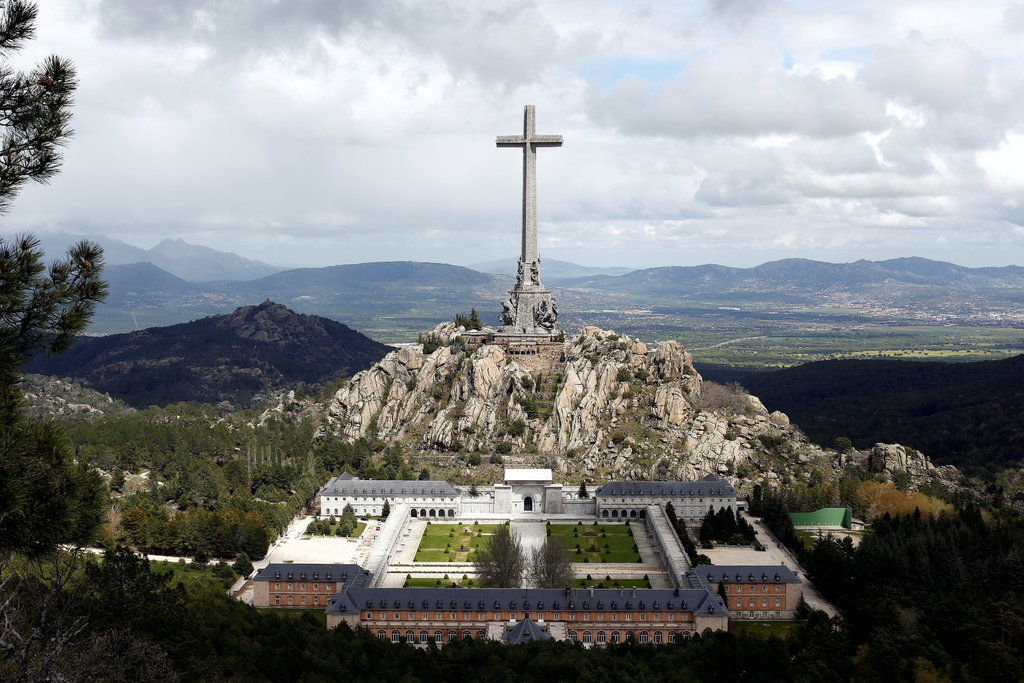
 

The Valle de los Caidos monument, containing the mausoleum with bodies of General Franco and Primo Rivera (Photo: Paul Hanna, Reuters, published in Washington Post — see Links)


For all of these reasons, varying forces on the Spanish Left and other antifascists spectrum have called for the removal of the cadavers of the two fascists to ordinary graves, the destruction of the mausoleums and the rededication of the whole area to the victims of fascism. When last in government, the PSOE committed itself to some of these objectives but did not carry them out. Now in government again, it has renewed that commitment which is another reason for Spanish fascist hysteria. The two main political parties of the constitutional Right (Partido Popular and Ciudadanos) combined with some smaller right-wing parties in abstaining from a recent Parliamentary motion “strongly condemning” the dictatorship and “any kind of exaltation” of the Franco regime. The motion was passed on 21st November 2918 with 97 votes of Spanish social democrats, Basque and Catalan independentists …. but there were 136 abstentions.

The Spanish Left has a serious difficulty in opposing fascism, committed as so much of the Left is to a central tenet of Spanish fascism, the current territorial integrity of the State. Also the Left in many other places besides the Spanish state is divided on how to respond to fascism in general; responses varying from replying with force by popular action to calling on the State to ban them, campaigning politically against them to generally ignoring their mobilisation.

Is it possible that some notion of preserving the ‘unity of the Left’ could be at the bottom of the silence about the growing fascism in the world and in particular within the Spanish state at some commemorative events?

THE WORTH OF COMMEMORATIONS

          The Friends of the International Brigades and other associations of what is often described as “historical memory” have done very important work in recovering the history of resistance to fascism. Not only that but also in tying that history not just to the territory of the Spanish state where battles were fought by the International Brigades but to places where those Volunteers came from in Ireland, England, Wales and Scotland. That work helps the people of those areas to locate themselves within the continuum of history and to emulate the ideals of those Volunteers should they choose to do so. The narratives of the sacrifice made and risk taken by the Volunteers counter the capitalist ethos of greed and of self-preservation above all else and suggest an alternative.

Such commemorations and monuments, if they are to survive and if they are to have real practical meaning, must also serve as calls to action, to mobilise to stop the rise of Fascism and to drive it back. And to support those who are fighting fascism, here, in the Spanish state and elsewhere. If we are to shout No pasarán! let us mean: Ésta vez no pasarán – y nunca jamás! (‘This time they shall not pass – and never again!)

end.

FOOTNOTES

1Although there people of fascist mentality everywhere in the Spanish state, they were outnumbered in most places by anti-fascists and without the logistical and manpower assistance of Nazi Germany and Fascist Italy, fascism could not have succeeded. Therefore many argue that it was not a civil war but instead a coup, a military uprising though supported by fascists both native and foreign. In the southern Basque Country and probably in Catalonia, some view it as a military invasion rather than a civil war. In Nafarroa (Navarra), because of the reactionary Carlist movement there, it did take on the character of a civil war and the Carlists murdered 3,000 leftists and republicans – when the Falange got there, there was no-one left for them to kill.

2A debate in the EU on a ban in all its membership against fascist symbols took place in December 2012 but has not yet resulted in a decision. A Catalan independentis MEP contributed to the discussion https://www.greens-efa.eu/en/article/press/eu-wide-ban-on-nazi-and-fascist-symbols-and-slogans/ with perhaps a rather tongue-in-cheek declaration that the Spanish Government had no interest in fascist symbolism; the truth is more complicated than that (see WHY THE FASCISTS ARE COMING BACK and DIGGING UP THE PAST sections).

3This slogan is said to have been coined for the crucial antifascist defence of Madrid by Dolores Ibarruri, known as “La Passionara” because of text she wrote in her youth and later her speeches too. She was a Basque and a member of the CPE. The slogan has been repeated many times since in different parts of the world but in Cable Street in 1936 it became a reality when an alliance of forces, chiefly Jewish and Irish community with some local Communist leadership, stopped 20,000-30,000 of Mosley’s “Blackshirts” and their escort of 7.000 police, along with all the mounted police in London, from marching through a predominantly immigrant Jewish quarter.

4Maquis” is dense scrub vegetation consisting of hardy evergreen shrubs and small trees, characteristic of Mediterranean coastal regions” (Internet description) which is where the ‘French’ rural anti-fascist or anti-Nazi Occupation resistance fighters camped and hid. “Maquisards” was the word describing those Resistance fighters in French but “the Maquis” was erroneously later applied to the fighters and their organisation.

51975.

6The Spanish State was not a member of the European Union and there was concern in many quarters about admitting an unreconstructed fascist dictatorship into membership. However, under USA patronage, it had joined NATO in 1982 and US air bases were being built across the territory. Opus Dei is a Catholic association mostly of people from professional and upper-middle classes and, in Spain, with right-wing views but with a technocratic approach rather than ideological which pitched them against the fascist Falange in the “democratisation” of the Spanish State.

7Both the PSOE (Partido Socialista Obrero de España) and the Unión General de Trabajadores had been illegal and persecuted under Franco, as had the more militant PCE (Partido Comunista de España) and the Commisiones Obreras trade union (in acronym in Castillian usually shown as CCOO). Those two trade unions are by far the most widespread in the Spanish state with the majority of members (except in the Basque Country and Galicia). The PSOE is one of the two mainstream political parties in the state, alternating with the right-wing Partido Popular.

8The Spanish State was admitted in 1986 but negotiations had been going on for some time.

9See GAL and BVE assassination squads operating in the Spanish and French states (1983-1987).

10Catalunya is an ‘autonomous’ region under the post-Franco Spanish Constitution, as are the two divisions of the southern Basque Country, Euskadi and Nafarroa (Navarre, Navarra). The Popular Front Government of the Spanish State had recognised the self-administering right of both Euskadi and Catalunya and they were important parts of the anti-fascist resistance; their autonomous status was revoked under the Franco dictatorship.

11On 1st October 2017, one of a number of Spanish police invasions of Catalunya last year.

12The “Grande” refers to imperial Spain and its colonies and the “Libre” to the Jewish-Masonic-Communist alleged conspiracy imagined by fascists (https://en.wikipedia.org/wiki/Una,_Grande_y_Libre).

13This argument has over the course of time been used by sections of social democrats, Communists, Trotskyist and Anarchists against liberation struggles in colonies and also in opposition to a boycott against South Africa or Palestine. The argument of class solidarity has been employed in a manner and in situations which have actually weakened the class struggle, bound the working class to their masters in common cause and also encouraged the growth of racism. As long ago as the mid-19th Century, Marx and Engels and others argued against this identification interest with the ruling class, encouraging the British workers in their own interest to support the Irish people in their liberation struggle against British colonialism.

15 And withdrawn immediately in the non-jury court by the detainees but to no avail.

LINKS

Irish Brigades Remembered: https://www.facebook.com/groups/1656646004567977/permalink/2269647039934534/

International Brigade Memorial Trust: https://en-gb.facebook.com/groups/7123291063/

Ahaztuak (“The Forgotten”), Basque historical memory association: http://ahaztuak1936-1977.blogspot.com/

Mass grave uncovered in Burgos, one of many across the Spanish state: https://elpais.com/elpais/2016/08/31/inenglish/1472638944_315923.html


AGAINST INTERNMENT AND SPECIAL COURTS!

Clive Sulish


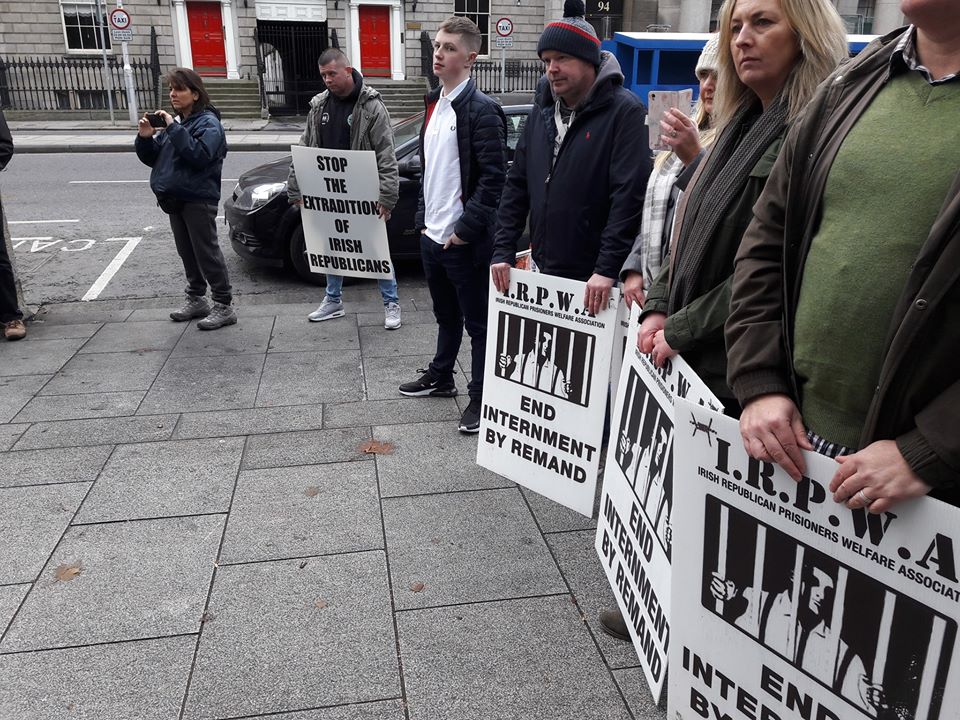
Tens of protesters against undemocratic state repression through internment and special courts gathered at the Wolfe Tone Monument in Dublin’s Stephen Green on Saturday before proceeding through the park to the Irish state’s Department of Justice building at 94 Stephen’s Green.


The sun shone weakly through at times on bare branches of deciduous trees and their autumn leaves, along with the dark green of the evergreen foliage of holly tree and invasive bay cherry.

Wolfe Tone Monument by Edward Delaney (d.2009) at an entrance to Stephen’s Green (image sourced: Internet)

The Wolfe Tone Monument stands in the approximate location of the Irish Citizen Army’s trenches in 1916, fired on by British soldiers with machine guns who had occupied the Shelbourne Hotel opposite, killing one of the Volunteers below. The statue had been blown up by British Loyalists in the 1970s and some of the surviving remnant had been added to in order to rebuild the statue (a fact generally not known or conveniently forgotten).

As is invariably the experience of Irish Republicans, they were under surveillance by some Gardaí in plain clothes and also from a marked police car. Some of the participants were also harassed by them and required to supply their names and addresses.

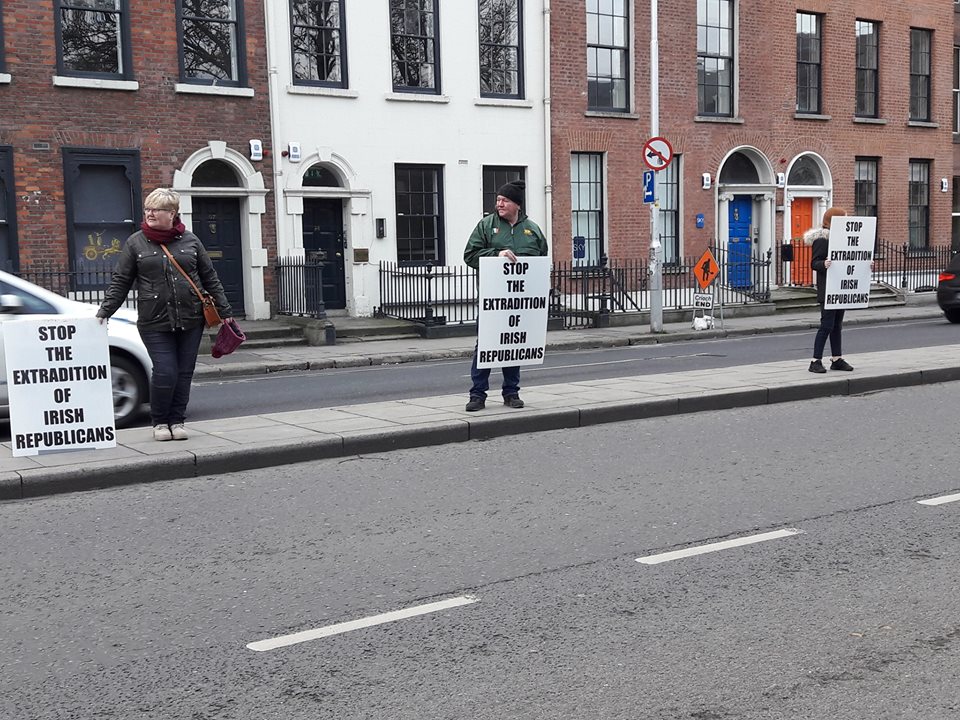
One of the placards held by protesters across the road from the Department of Justice. (Source image: Abolish the Special Courts campaign FB page)

The event, jointly organised by two fairly recent organisations on the Irish Republican scene, the Abolish the Special Courts campaign and the Irish Socialist Republicans organisation, was supported mostly by Irish Republicans, some independents and some belonging to a number of Irish Republican organisations other than the organisers: activists from the Irish Republican Prisoner and Welfare Association, Saoradh and the Dublin Anti-Internment Committee were also in attendance.

View of a section of the protesters in front of the Department of Justice with Stephen’s Green in the background (Source image: Abolish the Special Courts campaign FB page)

With their banners and placards the protesters stood on the median strip in the road opposite the Department of Justice, passing pedestrians and drivers slowing down to read the texts displayed, some drivers tooting their horns in support. Some, apparently visitors, took photos or video footage.

Later, supporters of the protest crossed the road to the pavement outside the Green to hear speakers. Ger Devereux of the Abolish the Special Courts thanked people for attending and introduced Brian Kenna from Saoradh to speak.


“NOT CONVICTED FOR ANY CRIME BUT FOR BEING …. IRISH REPUBLICANS”

Kenna gave a detailed and comprehensive account of how the Offences Against the State Act has facilitated the imprisoning of Irish Republicans not for any crime they have committed but for being just who they are – Irish Republicans. Observing that half those Republicans in jail in the Irish state are serving time on conviction of allegedly “being a member of an illegal organisation”, the speaker emphasised that the only ‘evidence’ necessary for the Department of Public Prosecutions to secure such a conviction under the Offences Against the State Act is the word of a Garda at the rank of Superintendent or above, along with some vague additional ‘evidence’ that could mean lots of different things.

Brian Kenna speaking to protesters on behalf of Saoradh organisation, across the road from the Department of Justice. (Source image: Abolish the Special Courts campaign FB page)

Brian Kenna warned that not only scheduled offences1 can be tried in the Special Criminal Courts as of now but should the DPP wish it, also other minor offences such as allegedly criminal damage or against public order and he believed that except for the existence of a few factors, including the presence of an MP among the accused, the Jobstown water-protesters would have been tried in the Special Courts, where convictions are the almost automatic result. Kenna called on all people to stand up against these undemocratic laws.

Devereaux then introduced Mandy Duffy, national Chairperson of the Irish Republican Prisoners Welfare Association.

One section of the protesters listening to speakers, Mandy Duffy, Chairperson of the IRPWA in the foreground. (Source image: Abolish the Special Courts campaign FB page)

“HUMILIATION, VIOLENCE AND ISOLATION”

Mandy Duffy spoke about the conditions under which Irish Republicans are being held in a number of prisons in Ireland on both sides of the Border. In Maghaberry in particular, which Duffy said was much more modern than Portlaoise (in the Irish state), Republican prisoners are guarded by a prison staff recruited from among Loyalists2, who hate Irish Republicans and are determined not only to keep them in jail but to make them suffer while they are there.

Duffy focused on the practice of continually strip-searching prisoners every time they are taken from the prison or returned as one of humiliation and of violence when the prisoner is non-compliant.3 The speaker also referred to unreasonable and additional punishments such as keeping prisoners in isolation.

A banner and two placards in front of the Department of Justice. (Source image: Abolish the Special Courts campaign FB page)

Mandy Duffy concluded by calling for solidarity with Irish Republican prisoners and in thanking those present for giving her their attention.

Devereux then called on Diarmuid Breatnach to speak on behalf of the Dublin Anti-Internment Committee.


“WE STAND TOGETHER OR WE GO TO JAIL SEPARATELY”

Diarmuid Breatnach addressing the protesters across from the Department of Justice, on behalf of the Dublin Anti-Internment Committee. (Image source: Abolish the Special Courts campaign FB page)

Diarmuid Breatnach began in Irish by thanking the organisers for the invitation to speak which he then repeated in English. Breatnach said that their Committee held pickets around Dublin mostly on a monthly basis and did so in order to raise awareness on the ground, among the public, that internment without trial continues in Ireland long after it was allegedly terminated by the British in the mid-1970s. He also reminded the protesters that people had resisted internment and protested it in Ireland and in many places around the world, including in Britain. In the Six Counties the Ballymurphy Massacre had been inflicted on people protesting internment in 1971 and again in 1972, the Bloody Sunday Massacre in Derry.

Stating that internment is essentially jailing people without a trial, Diarmuid Breatnach stated that returning a former Republican prisoner who is at liberty under licence to jail without any trial, as has happened for example to Tony Taylor, is effectively internment, albeit of a different kind. Refusing a Republican bail for no good reason when on a charge awaiting trial, which might take up to two years, is also internment of a different kind, the speaker said, stating that the only justifiable reasons for opposing bail are supposed to be a likelihood of the offence being repeated or the charged person absconding, for both of which credible evidence should be produced. Breatnach also drew attention to the recent decision of the European Court of Human Rights which castigated Turkey for their two years of preventive detention (or refusal of bail) of a Kurdish Member of the Turkish Parliament while awaiting trial, on the principle that the period of detention was unreasonably long and was being done deliberately for political reasons.

A small section of protesters across the road from the Department of Justice. (Source image: Abolish the Special Courts campaign FB page)

The speaker also referred to the unreasonable bail conditions when bail was granted, which included non-attendance at political demonstrations, pickets and meetings which, he said, made it clear what the whole intention of the repression was about.

Breatnach reiterated what an earlier speaker had said about the potential of these forms of repression being used against a wider section of opposition to the State and referred to recent arrests of Republicans who had allegedly mobilised against the launch of the fascist group Pegida in 2012. The speaker urged unity across the board against State repression because they either stood together now or later would “go to jail separately”.

Devereaux thanked the participants and encouraged them to keep in touch with the Abolish the Special Courts campaign and the street meeting broke up into informal groups as people began to collect placards, banners, etc getting ready to disperse.

End.

Another small section of the protesters with the Department of Justice in the background. (Source image: Abolish the Special Courts campaign FB page)


LINKS:

Dublin Anti-Internment Committee: https://www.facebook.com/End-Internment-581232915354743/

Abolish the Special Courts campaign: https://www.facebook.com/Abolish-The-Special-Courts-208341809705138/?

Socialist Republicans are a part of Anti-Imperialist Action Ireland:  https://www.facebook.com/AIAIreland2/

FOOTNOTES

1In Ireland this normally means ‘crimes’ which are associated by the State with subversive intent (source: http://www.citizensinformation.ie/en/justice/courts_system/special_criminal_court.html)

2The term “Loyalist” in an Irish context and especially in the occupied Six Counties means “British Loyalists” usually understood not only as those who support the Union with England but as those who do militantly and with bigoted hatred of Catholics (in particular Irish Catholics or people from that community who might well be atheists).

3There is a graphic and accurate depiction of this practice employed on non-compliant Irish Republicans on the “Dirty Protest” in the Steve McQueen film “Hunger” (2008). In the film, the prisoners were nearly naked already but in more ‘normal’ prison conditions, the practice also involved removing the prisoner’s clothes – by force if he or she is non-compliant.

WHAT ARE WORDS? “MILITANT” AND “DISSIDENT”

Diarmuid Breatnach

Recently someone objected to my use of the word “militant” to describe a movement with which I am in solidarity, saying that the word implied “violent”. My initial reaction was that I disagreed.

          I understand “militant” to mean “determined, assertive, courageous, not awed by confrontation” and that one could even be a “militant pacifist”.

But I decided to look up some dictionary definitions online. The first two or three did indeed include violence as a possibility but not necessarily integral. Another two came closer to my way of thinking:
“aggressively active (as in a cause) : COMBATIVE “(Miriam-Webster).

You use militant to describe people who believe in something very strongly and are active in trying to bring about political or social change, often in extreme ways that other people find unacceptable.
Militant mineworkers in the Ukraine have voted for a one-day stoppage next month.
…one of the most active militant groups.
Collins Dictionary.

The meaning of words shifts from language to language, culture to culture and across time. One of the most obvious and startling examples of this is the word “gay”, up to the 1970s probably understood in English by most people as meaning “happy, light-hearted” etc but now, the first interpretation in the English-speaking world would be “homosexual” (in a non-pejorative way).

Tramp” was a verb in the 19th Century to the extent that a famous marching song of the Union Army in the American Civil War was known as “Tramp, tramp, tramp”1. By the 20th Century its use as a verb was in decline but it was becoming better known as a noun, the meaning of which was understood variously as “vagrant” or even “beggar”.

And one could fill volumes with similar examples, I am sure.

“MILITANT”

          But returning to “militant”, was I the only one who understood its meaning in the way that I had? Well, apparently not, as Wikipedia showed, for example in descriptions of “militant trade unionists” and even a political organisation within the British Labour Party before its expulsion, calling its group “Militant Labour” and its newspaper “Militant”, probably drawing a parallel with those very same trade unionists2.

It would not take much pondering to guess that “militant” had some relation to “military” and apparently the word does indeed have such an origin, from Latin “miles”, ‘a soldier.3 But over the years, as with many other words, its meaning has changed.

But apparently, violence is again becoming associated with the word, more so than in the second half of the 20th Century. How did this happen? I am not sure but it appears to have been a spin-off from the more recent imperialist wars of, in particular, the United States. It seems that organisations resisting USA control or dominance in the Middle East, most of which were Muslim in religion, began to be termed “militant” in US and western reporting. Why this became so seems hard to fathom – it was not a word that these organisations applied to themselves — but it has had that spinoff effect on the word “militant”, so that “militant trade unionists” and “militant feminists”, for example, are now likely to be associated with violence, i.e the use of physical force.

How loaded and partisan usage of the word can become is well illustrated in the definition supplied by the Oxford living Dictionary: Favouring confrontational or violent methods in support of a political or social cause.
the army are in conflict with militant groups’.

The example given is very interesting. Conflict requires, one supposes, at least two parties and both sides are listed in that quoted phrase. But the impression given is one where “the army” is an authoritative, legitimate force which is being opposed by groups that are none of those things. One almost feels that the source of “the conflict” is the “militant groups” (especially with the current loading of ‘violence’ into definition of the word “militant”).

The ‘army’ is an armed organisation at the very least latently violent (training with deadly weapons) and in this context, almost certainly practicing violence by invasion. Yet it is portrayed as somehow neutral and the opposition as violent. This is further accentuated when the army and armed police are termed “security forces”. How could one be against security? Don’t we all want to be secure? Obviously quite a lot of people don’t want whatever security is being offered by these military and militarised forces and the question of “security for whom?” is hardly ever explored in such discourse, leaving us with the impression that the good guys are the army and police, deserving of our support, while whoever opposes them must be bad and we should line up against them.

As the meaning of words shifts, we have to decide whether to stick with the meaning we had and insist on its primacy, or to adapt and move with it. Up until the 1960s it was generally considered ill-mannered among white and black people to refer to people of noticeable African descent as “black” or as “negro” and Martin Luther King’s campaigning organisation was called the National Association for the Advancement of Coloured People. Back earlier, in the 18th and early 20th centuries, “negro” would have been acceptable to most. Nowadays, “coloured” or “negro” would generally be considered either offensive or ignorant and “black” is the word, unless one is to use the Africa-derived word, e.g Afro-American, Afro-Caribbean, etc.

And in a strange reversal, whether in self-mockery or appropriation, many Afro-Americans began in the 1970s and 80s describing themselves with the word “nigger”, a word long associated with racism4.

DISSIDENTS”

          Leaving those examples and dealing with Ireland, a number of organisations advocating Irish independence and unity and denying the legitimacy of the administrations of either side of the partition Border, would happily term themselves and one another “Irish Republicans”. That term came first to exclude the supporters of the Irish Free State, who waged a Civil War against those who would not accept the British terms, including Partition, of the 1921 Treaty. Not much over a decade later, it excluded also the Fianna Fáil party, which had split from Sinn Féin, got elected into government and at different times interned Republicans without trial, executed some and passed emergency-type legislation against them.

Subsequent splits in later years were still all described, along with various versions of the Sinn Féin party, as “Irish Republicans”. After the Good Friday Agreement was endorsed by what had been Provisional Sinn Féin and they subsequently became part of the administration of the British colony of the Six Counties, all those Irish Republicans who did not agree with them on that came to be called “dissidents” in the media and in much political discourse.

Those who are called “dissidents” however did not, for the most part, agree with the term. As far as they are concerned, they are sticking to the “official line” or at least the original one and it is the Provisional Sinn Féin (which now terms itself just Sinn Féin) which has diverged from the line and furthermore, departed from the ranks of Irish Republicans.

Let’s do a trawl for definitions similar to what I did with “militant” but this time for “dissident”.

Wiktionary:A person who formally opposes the current political structure, the political group in power, the policies of the political group in power, or current laws.

(Christianity) One who disagrees or dissents; one who separates from the established religion.”

Mirriam-Webster:disagreeing especially with an established religious or political system, organization, or belief

dissident elements in the armed forces”.

Collins:people who disagree with and criticize their government, especially because it is undemocratic.

Dissident people disagree with or criticize their government or a powerful organization they belong to”

Oxford:A person who opposes official policy, especially that of an authoritarian state.

a dissident who had been jailed by a military regime’”.

And one I hadn’t used before, but which caught my eye, Vocabulary.com: If you are a dissident, you are a person who is rebelling against a government. Dissidents can do their work peacefully or with violence.

Dissident is closely related to the word, dissent, which means objecting. People who are dissidents show their dissent5. Catholic priests who advocate allowing women into the priesthood could be called dissidents, as could the Puritans who left England to live in colonial America. As an adjective, a dissident member of a group is one who disagrees with the majority of members.”

Since it is not a religious movement, one who separates from the established religion” would seem non-applicable (though when one sees how many Republicans cling to certain practices like non-recognition of the court trying them, or refusal to stand in elections, it is tempting to think of those prohibitions as religious dogma rather than tactics for particular times and place).

Most Irish Republicans would consider themselves as in opposition to the “established (political) order” of the country, i.e Ireland partitioned, with one part run by an anti-Republican Irish ruling class and the other by a colonial ruling class. They would consider the relevant governments as “authoritarian” and “undemocratic”, certainly in their treatment of Irish Republicans by harassment, intimidation, detention, subjecting them to special emergency-type legislation, non-jury courts and prison.

In that sense of “dissident”6, the Sinn Party in its various encarnations has until recently always been a party of dissidents, first against a foreign monarchy subjecting Ireland without an Irish king (the party founded by Arthur Griffiths), then to a Republican party campaigning against British rule (the coalition that was the reformed post-Rising party 1918-1921), after that a party against the Irish Free State Government and the colonial administration of the Six Counties, subsequently a Republican socialist party opposing the same forces, then after a split, a Republican party with similar objectives but supporting an armed resistance to the the British occupation. To that can be added the existence of the Republican Sinn Féin party from a split and at least one other group of similar construction for a time but with more socialist emphasis.

Clearly (formerly Provisional) Sinn Féin can no longer legitimately describe itself as dissident, should it want to, as it is now party to that repressive colonial government to which it was previously vehemently opposed and also now straining to become part of a coalition in government of the Irish state.

Many people who left the SF party did so precisely because they opposed those policies and actions7 and on most terms could legitimately claim to be “dissidents” – if they wished to. Not just dissidents recently within the party but dissidents against the State and British colonialism.

Clearly then descriptions such as rebelling against a government” and disagree with and criticize their government, especially because it is undemocratic” are not going to be the problem and formally opposes the current political structure, the political group in power, the policies of the political group in power, or current laws” seems just tailor-made for Irish Republicans.

The objection to the appellation of “dissident” then must surely be based on either a misunderstanding of the meaning of the word or a concept of some kind of historical Irish Republican authority. If the latter, then the SF party can been seen as having gone against that authority and those Irish Republicans not following the SF path as being the true and loyal followers, faithful to that historical authority. This would be an entirely understandable attitude – but is it helpful? Aren’t the most important things the aims that Irish Republicans have and how they conduct themselves in working towards them, rather than whether they are called “dissidents” or not? After all, there is nothing fundamentally pejorative in the term.

There is no doubt that “dissidents” is a handy catch-all term to describe Republicans who belong to a number of political groups or who are independent activists (the latter of which Ireland and especially Dublin has a great many) but is it conferring some kind of implicit legitimacy on the collaborationist and now constitutionalist Sinn Féin party? And if so, legitimacy in the eyes of whom? Remember how one time there was an “Official Sinn Féin” (and IRA) and the “Provisional Sinn Féin (and IRA) who split from them? It was the latter that went on to gain dominance in the Republican movement while the “Official” organisation split again and shrank to a tiny remnant.

If I were to count myself among the ranks of Irish Republicans8, would I object to the term of “dissident”? I don’t think so.

End.

SOURCES AND REFERENCES

Meaning of “militant”:

https://en.oxforddictionaries.com/definition/militant

https://www.merriam-webster.com/dictionary/militant

https://www.collinsdictionary.com/dictionary/english/militant

https://en.wikipedia.org/wiki/Militant

https://en.wiktionary.org/wiki/militant

Tramp! Tramp! Tramp!: https://en.wikipedia.org/wiki/Tramp!_Tramp!_Tramp!

Meaning of “dissident”:

https://www.merriam-webster.com/dictionary/dissident

https://en.oxforddictionaries.com/definition/dissident

https://www.collinsdictionary.com/dictionary/english/dissident

https://en.wiktionary.org/wiki/dissident

https://www.vocabulary.com/dictionary/dissident

FOOTNOTES

1Coincidentally, the word “gay” is employed in its older sense in the lyrics of the song. A lot of interesting information is contained in the Wikipedia page on this song (see link in Sources and References).

2This was an organisation run by the entryist British Trotskyist organisation which later became the Socialist Party (like its great rival, the Socialist Workers Party, it too has an offshoot in Ireland).

3Through Latin into French and from there into English. However, the word may have been of an older root, possibly Celtic: “ ‘Míle’, word in Irish, meaning ‘a warrior, a champion, a hero’” given p.23 in How the Irish Invented Slang, Daniel Cassidy (2007).

4The term is not accepted equally among black people: I recall a black workmate of mine telling me that he had punched another black man who had referred to him as “nigger”.

5Actually, as Wiktionary tells us, it means more correctly “not in agreement” and comes from the Latin word for “to sit apart”

6Lest it be thought that I dissent from this opinion, let me put on record that this is one of the things about which I entirely agree with Irish Republicans. I suspect however that this definition is generally only used by media and mainstream commentators to describe regimes other than the ‘western democracies’.

7Some people had left that party already by that time, some because they perceived its direction and some because they objected to procedures within the party, especially those they considered undemocratic. Others left over time due to decisions to contest elections in the Irish state or to take their seats in the parliaments if elected, or because of rapprochement with the colonial police, over alleged harassment, party promotions or personal reasons.

8“Irish Republican” is a specific political designation and does not describe me, although I am Irish and I do aspire to a Republic of social equality. I am a revolutionary and a socialist as well as being anti-imperialism; I am many other things as well but that will do as a basic platform on which to seek others of like mind. In the course of struggles I do of course join in a front of one or the other of those tendencies but always with an eye to the full objective. Or so I try, at least.

RECENT HISTORY: DEEP SOUTH & DEEP NORTH

Report by Diarmuid Breatnach

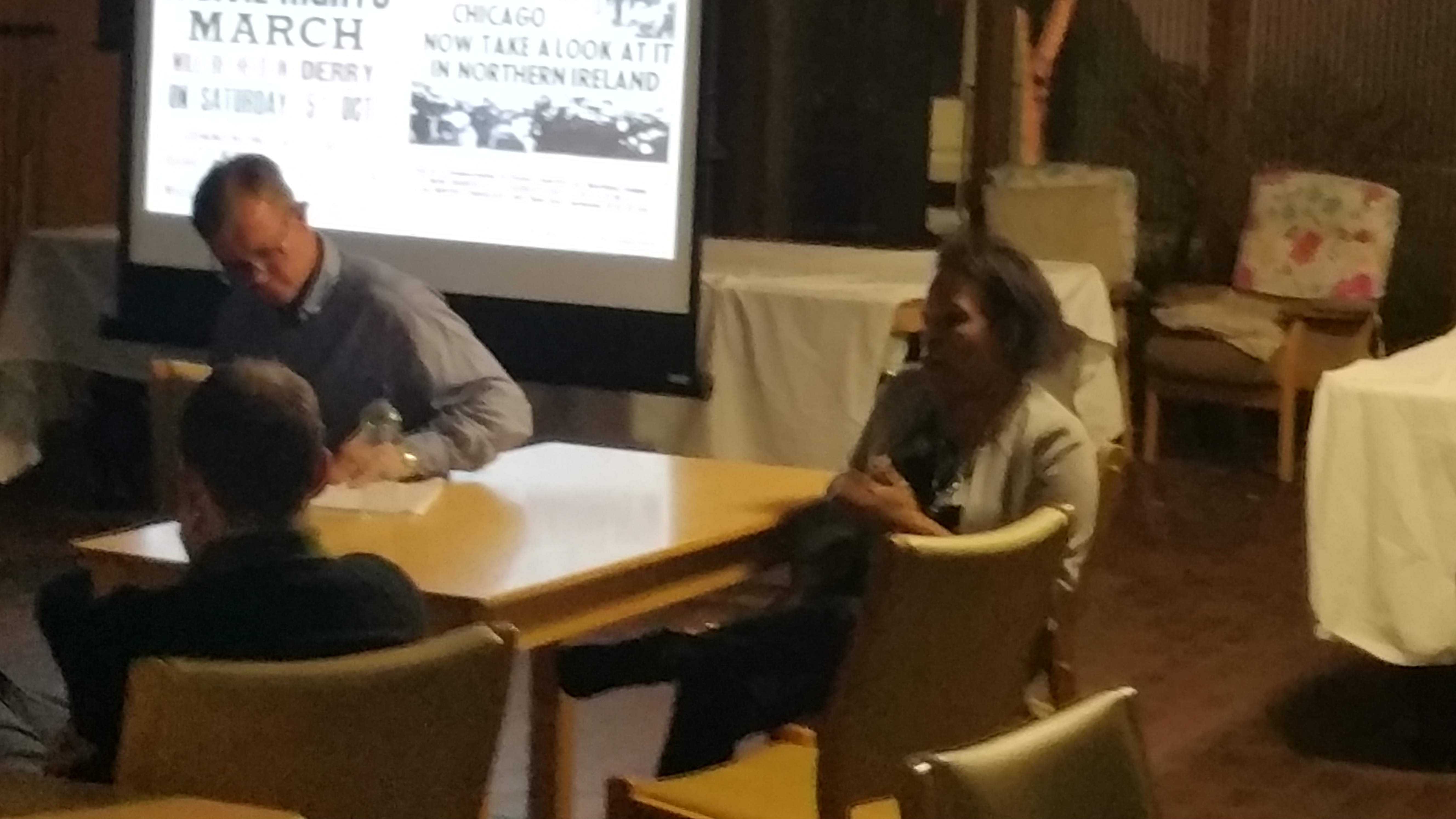
Two very interesting talks were given last night as part of a series of history talks at the Sean O’Casey Community Centre in East Wall, Dublin. The theme was black civil rights in the USA and Catholic civil rights in the Six Counties of Ireland (‘Northern Ireland’ according to some).

Joe Mooney of the East Wall History Society introduced the speakers and chaired the question-and-answer session afterwards.

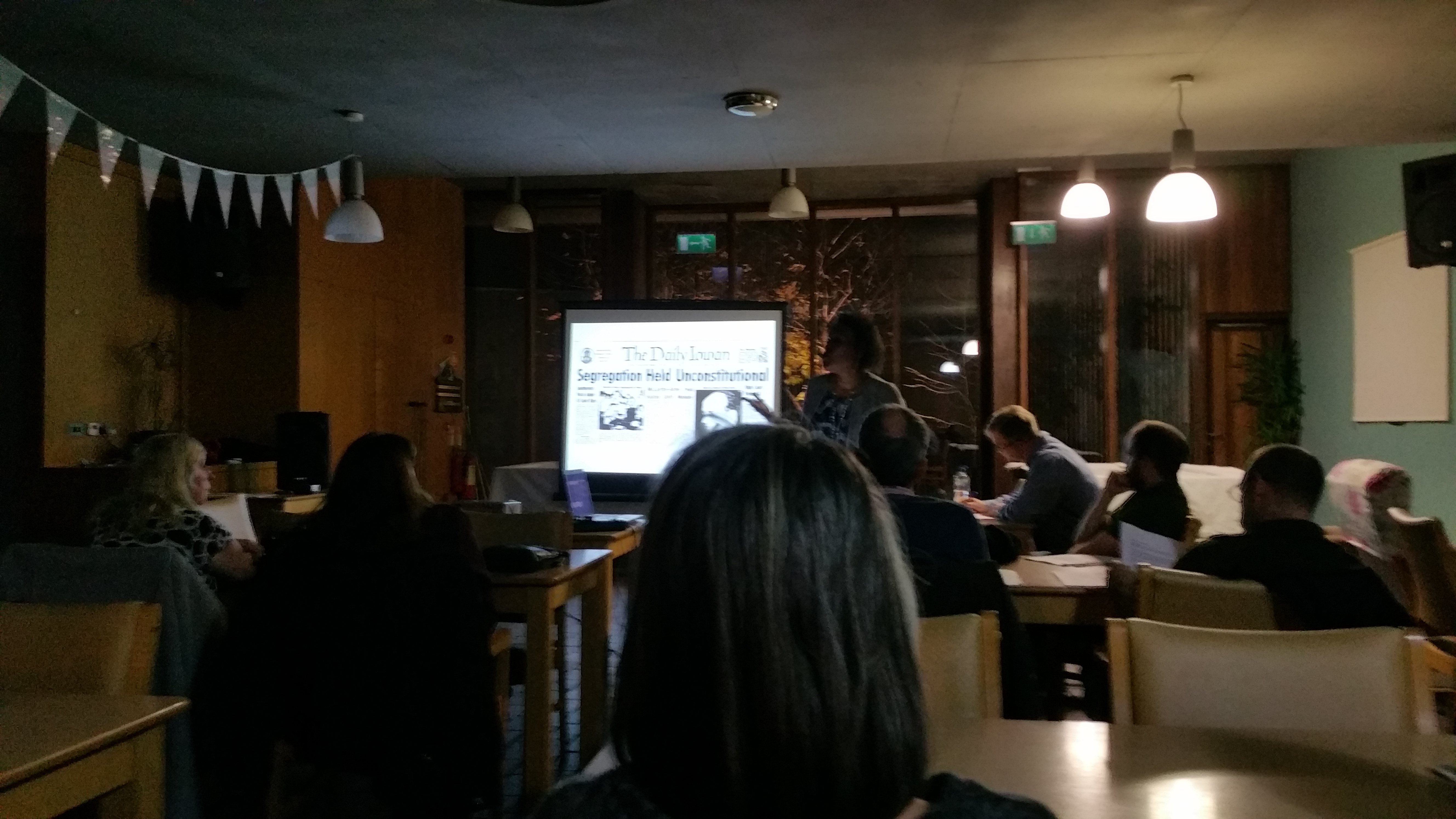
The session opened at 8pm and Cecilia Hartsell had a lot of ground to cover. She spoke on the history of the Civil Rights movement of blacks in the USA, going through the history of seminal events, illustrated with Powerpoint slides and recordings of two White House phone calls between President JF Kennedy and Ross Barnett, Governor of Mississippi and key figure trying to prevent the historic enrollment of James Meredith, a black man, into the University of Mississippi.

Cecilia Hartsell delivering her talk on the black civil rights movement in the USA

Recalling that in the first two years of his term, JF Kennedy had little to say about black civil rights but was focusing on other issues,Cecilia Hartsell somewhat undermined the (incorrect) image we tend to have in Ireland of Kennedy as an ardent civil rights fighter. In fact he was enforcing Federal legislation on equality and trying to go slowly, while the black campaigners were pushing the agenda along and white racist reaction was holding the USA up to international ridicule and opprobrium during the Cold War with the Soviet Union.

When Brian Hanley took the floor for his talk he fairly zipped along, which he does very well. Hanley undermined some myths or wrong impressions too. Early organisers of the civil rights marches and other events such as the Dungannon house occupation were Irish Republicans; Loyalists had killed four people before the first Civil Rights march. The rhetoric of SDLP and Labour Party notables was much more militant in the early years and Fine Gael was agitating more about issues of discrimination in the Six Counties than was Fianna Fáil, the party in government. And FF had been pushing a referendum to do away with the proportional representation electoral system at the same time that the PR system was among the demands of civil rights campaigners in the Six Counties.

Brian Hanley delivering his talk on the civil rights movement in the Six Counties.

In the session for questions, answers and contributions later, Hanley pointed out that the Southern Democratic Party was the pro-slavery party historically and, after the Civil War, anti-integration and civil rights, whereas the Republican Party was anti-slavery (debunking another false image we tend to have in Ireland).

Both historians made the point that a hundred years is not as long as some might think (this is especially true in ‘historical memory’).  The 1940s, when some historians would say, as Hartsell told us, is the date from which to date the renewed fight for black equality in the USA, as surviving black soldiers returned from WWII, was only 80 years from when Federal troops were withdrawn from the former Confederate states.  The partitioning of Ireland had been carried out less than 50 years before the Civil Rights protests broke out in the Six Counties, Hanley reminded his audience and many Catholics still lived who remembered vividly the fierce repression that had accompanied it.

It also emerged that albeit there were many similarities, there were also profound differences between the two movements. The black campaigners in the USA were saying that they were citizens of the USA State and demanding the same rights as other citizens, they often marched with the Stars and Stripes flag and even called for the intervention of US troops to defend their rights. The Catholics marching for civil rights in the Six Counties mostly saw themselves as Irish citizens and would never march with the Union Jack. Some did call for the intervention of British troops but many did not; it was mostly Irish troops they hoped would intervene.

The importance of the presence of news photographers at events and their covering in newspaper reports and on television broadcasts was an important factor in both struggles.

USA soldiers facing unarmed marchers for black civil rights.  (Source: Internet).

Cecilia Hartsell did not feel that the Black Power movement could have survived Southern racist repression in the 1940s, ’50s and early ’60s and most of the big gains on desegregation of education, public transport, eateries and voter registration and effective right to vote in the Southern States were won during those years with peaceful marches and pickets and legislation (which however were met by much racist violence, including a number of murders). By the time the Black Power movement was coming on to the political stage, so was the Vietnam War and huge changes were taking place in the US, including many mass violent struggles on race and other issues.

Section of march for civil rights in the Six Counties (Source: Internet).

TERMINOLOGY AND DEEPER MEANING

Wikipedia: “Though often used in history books to refer to the seven states that originally formed the Confederacy, the term “Deep South” did not come into general usage until long after the Civil War ended. Up until that time, “Lower South” was the primary designation for those states. When “Deep South” first began to gain mainstream currency in print in the middle of the 20th century, it applied to the states and areas of Georgia, southern Alabama, Florida, Mississippi, north Louisiana, and East Texas, all historic areas of cotton plantations and slavery. This was the part of the South many considered the “most Southern”.”

Later, the general definition expanded to include all of South Carolina, Georgia, Alabama, Mississippi, and Louisiana, and often taking in bordering areas of East Texas and North Florida. In its broadest application today, the Deep South is considered to be “an area roughly coextensive with the old cotton belt from eastern North Carolina through South Carolina west into East Texas, with extensions north and south along the Mississippi”.

Lower South” probably originally referred to its location on the typical north-orientated map of the USA. But I speculate that “Deep” has another meaning – a deeper psychological one, in fact. It suggests that this is a place difficult to understand for people not from there, which means most people. Different rules apply there, we might believe.

I speculate further that after the initial first years of the Civil Rights movement in the Six Counties, that area and the people living in it came to be seen as “different” too. Of course, it was different in that it was a colony (as had the whole country been only 50 years earlier) and that it was run along blatantly sectarian lines, the Catholics a minority there, unlike in the rest of Ireland. And of course, people in a different environment respond differently. But they were still people and the substantial Catholic minority were so clearly oppressed in a statelet into which the Irish ruling class had delivered them. For many people in the 26 Counties it became easier to think of them as somehow foreign in a foreign kind of land, hence my description as “Deep North”.

Cecilia Hartsell and Brian Hanley during the question-and-answer session.

THE SPEAKERS (as posted by EWHG)

Cecelia Hartsell is a researcher of American history. She has been a contributor to the RTE History Show and Radio Kerry on topics in U.S. history and frequently gives U.S. history talks for the Dublin Festival of History and in the Dublin Public Libraries. Cecelia has a Masters degree in U.S. history from Fordham University and a Masters degree in History from UCD.

Brian Hanley is an historian and author. He is currently a Research Fellow at the School of Classics, History and Archaeology, University of Edinburgh . He has lectured at a number of major Irish universities and was Historian in Residence at Dublin City Library and Archives . His books include “A Documentary History of the IRA, 1916-2005” (Dublin, Gill and MacMillan, 2010) with his most recent being “The impact of the Troubles on the Republic of Ireland, 1968-79: boiling volcano?” (Manchester University Press, 2018).

NEXT HISTORY TALK

There will be another talk in the series next week when Dr. Mary Muldowney will present a talk on “The 1918 Election – the Woman Who Stood for a Worker’s Republic.”

AUTUMN ART – review of exhibition by Eoin Mac Lochlainn

Diarmuid Breatnach


Deire-Fómhair (‘October’, also “End of Autumn’), an exhibition of art by Eoin Mac Lochlainn, was on show this afternoon in the Olivier Cornet Gallery in Great Denmark Street , Dublin and I went along to view it.  An installation and 24 paintings are listed.

Photo: D.Breatnach

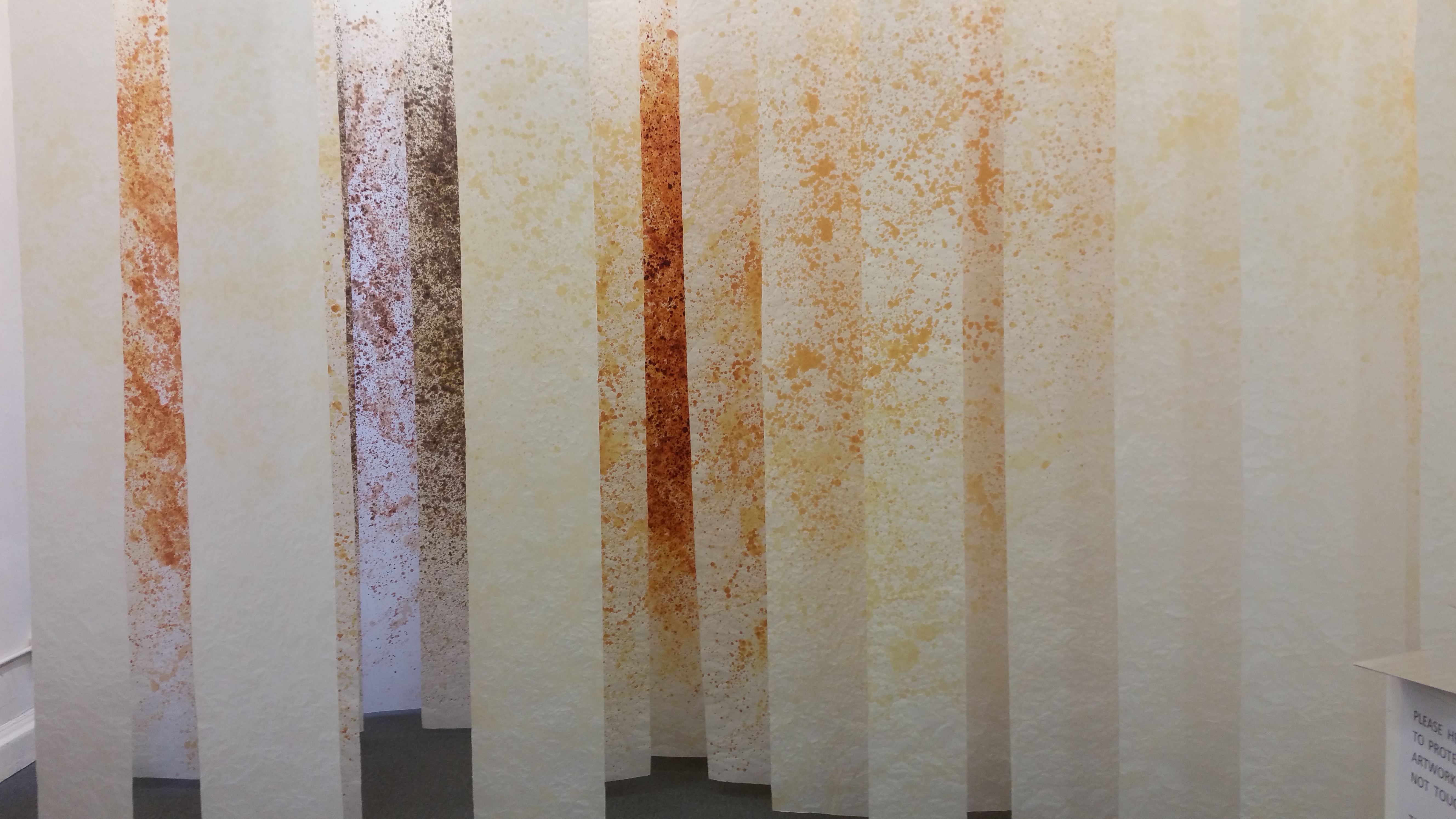
It is of course the installation that first catches the eye, mainly due to its size, secondarily its colours and viewing it one must, I think, come to the conclusion that the space is too small for it. Artists I suppose must use whatever exhibition spaces are available to them. Standing back as far as one can, the installation still does not reveal its full potential. But photographing in the gaps between the hanging pieces in the first row, one sees tree-trunks, dappled with slanting autumnal light through dying leaves, moss and lichen pattern on trunks and the autumn leaves themselves.

A view of almost the full width of the front of the installation (but please see the revealing subsequent photos).
Photo: D.Breatnach
Tree trunks appear in this and subsequent views of the installation.
Photo: D.Breatnach
Another view of tree trunks appears.
Photo: D.Breatnach


The installation is composed of 64 painted lengths of rice paper and is lit from behind with accompanying recorded bird song which adds to the ambience. In the leaflet accompanying the exhibition, the artist wrote:

This is a traditional paper which originated in ancient China and has been used for centuries for calligraphy, artwork and architecture. It is as white as alabaster, known for its strength and smooth surface, very delicate when wet but said to last for a thousand years – an enchanting medium with which to work.

Earlier views showed tree trunks in an autumnal light, perhaps surrounded by falling or fallen leaves. This is a different view again, the trunks covered in blotches as of alga and lichen or fungal colourations.
Photo: D.Breatnach
Photo: D.Breatnach


Photo: D.Breatnach
Viewing at an angle, the tall trunks appear, most perhaps in the receding distance. Photo: D.Breatnach


Around the wall are a number of watercolour paintings, mostly 15×19, some 12×12 and a few 20×20 and one, very different in style and composition, of 45×33. The latter looks older and by another painter and appropriately so, perhaps, since it is an interpretation of a painting by the German Romantic landscape painter Friedrich (1774-1840), “Solitary Tree”, painted probably (according to Google) in 1822, nearly two centuries ago.

Ó Lochlainn’s interpretation of Friedrich’s “Solitary Tree” (original painted two centuries earlier).

The subject seems to be an oak, its upper trunk dead but with leaves on branches spreading further down. It seems to have weathered many storms and perhaps a lightning strike years ago …. but it yet remains, stubbornly alive.

I do not know what motivated either Friedrich or Mac Lochlainn to take this image as their subject but in the leaflet, the latter has written:


Trees are a link between the past, the present and the future. The majestic stature, the long lifespan and the familiarity give them a monument-like quality but they also have a special aura that is difficult to define. Research has shown that within minutes of being surrounded by trees, our blood pressure drops, our heart rate slows and stress levels begin to reduce.

Less calming no doubt are the images of the watercolours which he titles Dóite (‘burned’ but also: ‘wasted, laid bare, destroyed’). The images are bleak, disturbing, of dead tree-trunks in a wasteland. In the accompanying leaflet, the artist notes:

I have been developing a body of work which explores the effects of climate change and in particular, reflects on the significance of trees.

One of the “Dóite” series, disturbing yet with a horrific beauty.
Photo: D.Breatnach

These images could also reflect the negative effects of acid rain, nuclear or chemical contamination or timber monoculture and the exposure of trees thereby to increased likelihood and intensity of infestation by invertebrates and fungi (as for example the latter is attacking pine plantations in the Basque Country).

The watercolour series titled Cosán Coille and Siúlóid Sléibhe are exquisite colour and tone in a way of which I think only watercolours can be. It is surprising then to learn that Mac Lochlainn’s previous work has been in oils and that he found the change exacting:

In recent years, I switched from oils to watercolours in order to have less of an impact on the environment.

The switch has been both challenging and rewarding – challenging to master the idiosyncrasies of the medium but very rewarding in discovering new possibilities and avenues of enquiry for my practice.

The smaller size of the paintings restrains one from being pulled into them, the way a larger painting might do but that does not prevent them from being beautiful, sometimes in an almost painful way.

One of either the Siúlóid Coille or Siúlóid Sléibhe series (I cannot remember).  Photo: D.Breatnach

Trees have been called “the lungs of the world” and were considered of great importance to the Celts; the Gaels peppered our place-names with references to them: abhall (apple), áirn (sloe, fruit of the blackthorn), beith (birch), caorthainn (rowan), coll (hazel), cuileann (holly), dair (oak), draighneán (blackthorn), fearnóg (alder), fuinnseog (ash), giúis (fir, pine, deal), iúr (yew), sail or saileach (willow),sceach (whitethorn, normally).1 They appear also in many of our folk-songs.

Prices of paintings range from 380 Euro to 1,200 and the gallery offers a service of payment by installment. The artist, Eoin Ó Lochlainn, who happens to be closely related to Patrick Pearse, has had numerous exhibitions in each year going back to 2013 and has won a number of awards. Collections of his artwork are held in AIB, Bank of Ireland, OPW, Revenue Commissioners, AXA Insurance, Foras na Gaeilge, Gael Linn, the Boyle Civic Collection, Wesley College, University of Limerick, Donegal County, Cló Ceardlann na gCnoc.

One wall with ten paintings hung, including examples of the Siúlóid Coille, Siúlóid Sléibhe and Dóite series.
Photo: D.Breatnach

USEFUL LINKS:

Fuller CV of artist: http://www.oliviercornetgallery.com/#/eoin-mac-lochlainn-artist-cv/4585927092

Artist’s Blog: https://emacl.wordpress.com/

Artist’s FB page: https://www.facebook.com/EoinMacL

Olivier Cornet Gallery: 087288261 or info@oliviercornetgallery.com

Tree Council of Ireland: https://treecouncil.ie/

Place-name database, Irish and English: https://www.logainm.ie/en/

FOOTNOTES

1Place-name examples: Abhallort (Oulart), Co. Wexford); Beith an Ghalláin (Behagulane, Carberry, Col Cork); Cill Áirne (Killarney); Doire (many, including Derry City and County; Áth na bhFuinnseog (Ashford, Co. Wicklow); Giúiseanna Boróimhe (Boroimhe Pines, Fingal); Iúir Chinn Trá (Newry, Cos. Armagh & Down); An Baile Sceathach (Ballyskeagh, Co. Galway); Saillí (Scilly, Kinsale, Co. Cork)

VIVA LA QUINZE BRIGADA

Clive Sulish


From Eoin O’Donnel’s filming and editing via Joe Mooney of East Wall History Group, a recording of Diarmuid Breatnach singing Christy Moore’s wonderful song Viva La Quinze Brigada (also known as Viva la Quinta Brigada which, however, is also the title of another song from the same conflict but in Castillian or Spanish language).  The Fifteenth Brigade of the Spanish Republican Army was also the Fifth International Brigade, the mostly English-speaking one.  It contained volunteers from English-speaking USA, Canada, Australia, Scotland, Wales, England and ireland but due to high Irish emigration, all those countries also contained Irish diaspora and they were to be found in the contingents from those countries.

The video also contains photos of the commemoration of Jack Nalty, resident of East Wall’s, the last Irishman to die in action during the Iberian Anti-Fascist War (usually known as the “Spanish Civil War”).  The day-long event on 28th September (anniversary of his death) included songs and poems, a march led by a lone piper, unveiling of a plaque, booklet launch and showing of two films. It was a celebration in particular of Jack Nalty’s life but more generally of the Irish who, against the position of their Government, the Church of the majority, the dominant media and even, for those in the IRA, against their own organisation’s orders, went to fight against a fascist military uprising against the elected Republican Government of the Spanish state.

It was also a celebration of antifascist resistance around the world and of the principle and practice of internationalist solidarity.

A plaque to the fallen of the Irish volunteers of the International Brigade (containing many names but by no means all of the Irish who fell there). The plaque is on the wall of the Theatre side of Liberty Hall, HQ of SIPTU, Dublin.
(Photo D.Breatnach).


THE RIGHT TO PROTEST: DUBLIN MEETING HEARS FROM REPUBLICAN AND CIVIL RIGHTS ACTIVISTS

Clive Sulish

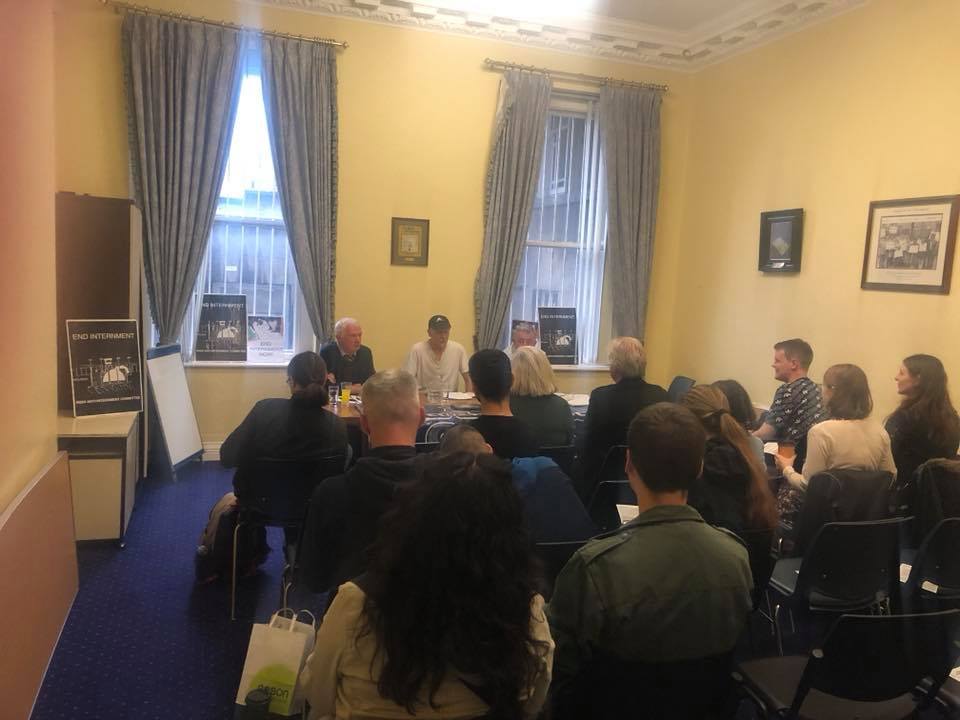
Liam Herrick, Executive Director of the Irish Council for Civil Liberties and Mallachy Steenson, Irish Republican and practicing lawyer, on Friday 7th June addressed a Dublin meeting on The Right to Protest, convened by the Dublin Anti-Internment Committee.


Section of audience and panel at Right to Protest meeting (Photo source: Dublin Anti-Internment Committee)


CHAIR’S INTRODUCTION:

The origins of the Anti-Internment Committee and the Right to Protest

Opening the meeting and speaking for the organisers, the Dublin Anti-Internment Committee, Diarmuid Breatnach welcomed the attendance, introduced the Committee and related how it had grown out of a previous committee, to have Marion Prices released from prison, which had been partially successful (she was released pending trial but her health was destroyed). She and a number of other former Republican prisoners who had been released under license under the Good Friday Agreement, such as Martin Corey and more recently Tony Taylor, had their licenses revoked and were brought to jail without a trial or the right to challenge whatever evidence the Secretary of State for Northern Ireland claimed to have against them. Some considered this a form of internment by some and the Anti-Internment Committee had been set up in June 2013.

Breatnach emphasised that the Dublin Committee had always been and remained — attempts at takeover and accusation notwithstanding — independent of any other organisation and committed to reaching decisions in a democratic manner and conducting themselves in a principled manner towards other organisations. The Committee organises the annual Anti-Internment rally in Newry and holds more-or-less monthly pickets in different parts of Dublin, which anyone is welcome to support, he told the audience.

Chair of meeting Diarmuid Breatnach speaking at Right to Protest meeting (Photo source: Dublin Anti-Internment Committee)

Although the Dublin Anti-Internment Committee updates a list of Republican prisoners in jail and also raises issues about the human rights of Republican prisoners such as right to education and art work, appropriate medical treatment, release from solitary confinement and on occasion about miscarriages of justice such as the Craigavon Two, nine years in jail now – nevertheless the true focus of the Committee is on issues of internment.

Introducing other areas of repression by the states on both sides of the Border which the Committee considers to be types of internment, Breatnach outlined the practice of refusing bail to the accused or of making bail conditional on the individuals removing themselves from all political activity. When the accused justifiably refused to accept these conditions, they were jailed, only perhaps to be found not guilty two or three years later, as had been the case with Stephen Murney. But still having effectively served a jail sentence.

“The right to protest is everywhere under attack” stated Breatnach and declared that maintaining that right was necessary for the winning and maintaining of a wide group of basic social and political rights, from practicing one’s sexuality or religion, or indeed criticising the Church, to forming a trade union, going on strike and marching against unjust laws or measures. Breatnach bemoaned the apparent inability of a number of Republican groups to unite in defence of this right and of Socialists in uniting with them even on this most basic of levels. “We can either stand together or fall separately” he said.

Internment is used by states against political opponents, said Breatnach, recalling that the British had used it in Ireland after the 1916 Rising, the new Irish state had used it during the Civil War and again during WWII under De Valera; the British in the Six Counties between 1971 and 1975.

Internment is a means of “removing unwanted members of the public”, Breatnach said, quoting the words of anti-insurgency specialist Brigadier Frank Kitson, who had been present during the repression of the Malayan resistance and also an operational Commander in Ireland from 1970-1972, years which Breatnach reminded his listeners were those covering the introduction of internment and the massacres of civilians in Ballymurphy and Derry.

Referring to the infamous “Heavy Gang” of the Gárda Síochána whose brutal methods had extracted false confessions on the Sallins Mail Train robbery from socialist republicans in the 1970s and from the family in the Kerry Babies case, Breatnach recalled the formation of the Irish Council for Civil Liberties at that time and that it had been a campaiging organisation unafraid to challenge the State on its repressive actions. Sadly over the years the organisation had fallen away from that path, he said and he was particularly glad to welcome Liam Herrick of the ICCL to speak at the meeting and in the hope that the organisation was returning to its roots.

LIAM HERRICK, ICCL: The Right to Protest and the work of the ICCL.

Liam Herrick, Executive Officer of the ICCL, speaking

After the applause, Liam Herrick thanked the Committee for having invited him to speak. He wished to list some of the efforts in which the Irish Council of Liberties was engaged and also to hear from the audience some of the problems they were encountering.

Briefly covering the early years of his organisation, Herrick related that it had been formed as a response to police repression, mostly of Republicans but also of some Socialists, and in particular due to the activities of the Gárda unit known as the “Heavy Gang”, by academics, activists and lawyers. It had taken up early cases of the ill-treatment of detainees, the use of the Offences Against the State Act, repression of protesters of the Ronald Reagan visit including the case of Petra Breatnach in 1984 and Water protests in the mid-1990s, also in the street-traders’ protests in which Tony Gregory was prominent.

The issue of the right to protest and State repression had come up again a number of times including in 2002 against the Anti-War Movement with the use of the OAS Act and in particular with the Reclaim the Streets protest in 2002, in which video recording of police actions had revealed the extent of police brutality without any arrests. Similar problems had been encountered by protesters at the 2004 EU Council meeting in Dublin, and water canons had even been imported by the State from the UK and widescale repression and had come up again at the Corrib Shell protests.

The ICCL had in 2014 published “Know Your Rights” booklet. And had called for a root and branch review of procedures for dealing with protests, noting that there existed a major gap in rights and policing process and has published a publication by the title of “Take Back the Streets” and has made submissions to the EU and the UN on how states should not just tolerate but manage and create conditions to facilitate the right to protest. The ICCL is part of a network which includes the ACLU in the US.

“If Notifications to the authorities are required should be minimal and reasonable”, Herrick said and gave the contrary example of African Jews who wished to protest against Israeli measures but were charged a 25,000 dollars as a cost of the application for permission.

Police should have a chain of command to deal with protests and be trained not only in weapons and control movements as they are at present but also in de-escalation, in engagement with protesters. Their internal Garda policies should be available to public access but are not.

Herrick said journalists should be facilitated in having access and only just employees of big media organisations but alternative media and individual bloggers whose coverage is often essential to understanding the incidents at an event (in the Reclaim the Streets event such sources were the only source on the Garda violence). There should be restrictions on the use of force as is law and police in Northern Ireland, whatever people might think about practice on the ground, Liam Herrick said. The PSNI every 6 months have to submit a report to the Policing Board which details incidents o the use of force. In the Irish state Gárdaí don’t have to make any report on the use of force which is remarkable in the European context – the use of pepper-spray would seem to be increasing here but no records are available..

Surveillance is an issue and of course can intimidate and have “a chilling effect on protest”, Herrick said. In England face recognition technology is being used which apart from questions about its accuracy, is intrusive. Also trapping of mobile phone activity in the vicinity of a protest. Data collection is an issue and there should be no database on protesters maintained; covert agents have been used and in some cases become personally involved with those they were surveilling – a recording procedure is needed. There needs to be an independent complaint process as the existing process in Ireland has been shown to be inadequate.

At the moment the ICCL is involved in discussions on Gárda reform and the following Friday would be producing a document on Human Rights Policing which people are welcome to read. The international perception is that the law and policy of the PSNI is good, without making any comment on their practice on the ground. The Gardaí should publish a report on their handling of protests every year including statistics (despite the problems on drink-driving statistics) on arrests and the use of non-lethal weapons.

The Gardaí in Ireland have a national security function and there needs to be a discussion on this – in many other countries a separate body is responsible for this. But no legal body is overseeing the operation of the Gardaí on national security or the powers they exercise.

Liam Herrick concluded to applause and Breatnach told the audience that questions could be asked of him and of the next speaker after the conclusion of the latter, then introducing Mallachy Steenson to welcoming applause.

MALLACHY STEENSON: Republicans and the Right to Protest

Mallachy Steenson speaking Section of audience and panel at Right to Protest meeting (Photo source: Dublin Anti-Internment Committee)

Mallachy quoted the right to protest under Article 41 of the Constitution of the State under which document however Republicans would not support.

Moving on to suppression of protests Steenson referred to the most frequently used being the Public Order Act, justification which depends on the subjective view of a cop and is therefore virtually unchallengeable. The result is usually a fine but the use of the Offences Against the State Act is much more serious. In the 1950s there were many arrests of Republicans under the section which prohibits a demonstration within a certain distance of the Dáil and Section 30 was widely used.

Steenson pointed out that almost any gathering of Republicans consitutes some kind of protest due to the basic opposition to the State of Republicans. Funerals are usually protests too, partly in solidarity with the family, partly with movement but also of making a stand and, in the case of the ten dead 1981 Hunger Strikers, in solidarity with their Five Demands.

Steenson believes that most of the protests that occur in the state will be allowed because the they don’t threaten the state from the “trendy liberal side”. For example the housing protests including activist occupations are permitted but when a house was occupied in Charlemont Street and in preparation for moving in a family three years earlier, armed police removed the occupiers.

“The State takes a different view of Republicans” Steenson declared. Referring to the 2016 Sinn Féin Easter 1916 commemorations, Steenson wondered whether they remember their history because the 76th anniversary of the Rising commemoration (1992) was banned and people on the platform arrested. The 66th anniversary commemoration had been beaten off the street in Dublin and people arrested for “membership”, including his own father and others.

“What we have is mostly controlled dissent”, Steenson said. “People remember the Birmingham Six” but are not aware that their campaigners here had their homes raided by police, their jobs visited by the Special Branch, threatened and often lost their jobs.

“What has happened in Ireland is a privatisation of dissent,” Steenson said. “They are funded by the State and he who pays the piper calls the tune.”

The only ones who could really carry out a successful protest in Ireland were the farmers who here, as in France, had no hesitation to block roads and motorways and dump slurry at the Dáil, Steenson declared. The only other really effective protest that hurts the State is the withdrawal of labour as in a general strike – which should have happened when the banks were bailed out — but the trade union movement in Ireland works hand in glove with the State.

“Republicans are well-used to surveillance” Steenson went on to say with a reference to “the new MI5 Garda Commissioner” who declared upon coming into office that the biggest threat to the State is the armed ‘dissident’ Republicans, which Steenson commented were no real threat to anyone except themselves.

“The State is built on the defeat of the Republic,” said Steenson and therefore naturally Republicans are its enemy. Referring to the water protests and their suggested victory, Steenson opined that the success was only due to Fianna Fáil changing sides and he believed that the USC (Universal Social Charge) should be the main object of protest which takes much more out of people’s pockets.

In 1972 the British Embassy in Dublin had been burned in protest at the Bloody Sunday massacre in Derry. Steenson declared that too was managed by the State, having a national Day of Mourning, allowing people to blow off their anger at the sacrifice of a building and listed other protests he believed had been managed or controlled by the State, including the medical cards for the elderly.

People should be able to go to protest without asking the State, Mallachy believed and asked what is a valid protest, referring to gathering protest against the expected visit of Trump while that of Clinton in Dublin passed quietly by without protest. “What is it about Trump?” asked Steenson. “If it’s about killing people, Clinton killed many more. If it’s about treatment of women, well we all know Clinton’s record on that.”

The real problem impacting on most working people is drugs, Steenson said, and the gangs involved in it. Families Against Drugs had been a big campaign but some of the activists were in it to get funding. “People should separate their political activism and their job,” Steenson declared. “We need to move away from having paid groups organise protests”, Mallachy said. “Most protests now are during the week,” he added, “because activists don’t want to interfere with their weekends.”

“We need to look at what is an issue and what is effective”, he said and talked about empty houses and the way housing protesters in the 1960s and ’70s not only occupied them but moved homeless families into them.

“During WWII we didn’t intern Germans or English here”, Steenson commented, “we interned Republicans.”

“Protests will be allowed as long as they don’t threaten the State”, Steenson said, coming to a conclusion and the only ones organising protests that threaten the State are Republicans. He posed the question whether democracy is any use to working people, because it had not brought them much.complained too about police being masked and said that in a normal society you would not have that, nor armed police everyday on the streets. He commented also on the degree of video surveillance used by the State which could track people from leaving the door of the building all the way home.

“Gardaí are there to protect the State, not to protect the citizen, whatever combination of political parties are in government,” he told his audience. “To them and to the State, Republicans are the enemy. That’s just the way it is.”

CONTRIBUTIONS AND QUESTIONS FROM THE AUDIENCE

After the applause following Steenson’s talk, Breatnach opened up the meeting to contribution or questions from the audience, asking them to keep them brief and telling them he was going to take questions in groups and the speakers could choose to which to reply.

Side view of section of the audience (Photo source: Dublin Anti-Internment Committee)

An audience members spoke about the level of repression from Lurgan RUC/PSNI and how eight people had been charged and their bail conditions were not to associate with one another but two of them live near one another.

A contribution declared that Drew Harris being appointed as Garda Commissioner was equivalent to a railroad to jail and related a case of an elderly woman being persecuted in Rossport.

Another directed a question specifically at Liam Herricks about treatment of people in some of the rural courts where protesters were being very badly treated.

Gardaí attacking protesters

An Ireland Palestine Solidarity Committee activist said that usually they don’t get much trouble from the Gárdaí but more often from the private sectors, from private security personnel when they protest at a business as part of the solidarity campaign. And the Bank of Ireland had closed their account, which caused the organisation considerable difficulty. He wondered whether this was the State’s influence under pressure from the Israelis or others, or instead the banking company under pressure from the same sources or from financial sources. Or whether it was part of the general “de-risking” measures people talked about. The Cuba support group had suffered a similar problem.

Relating his contribution to issues of surveillance, one person described a car journey from an event for about two hours across Dublin, after which he stopped at a fast food takeaway facility. He had felt followed earlier on and when the Garda came in behind him in the takeaway with the usual harassment, he confronted the officer and asked him how had followed him all that way. The Gárda pointed to cameras above on street poles and said: “We don’t have to follow you, they do.”

Another person related how “membership of an illegal organisation” is being frequently used to jail Republicans under the OAS on the word, without the need to display any proof, of a Gárda senior officer.

Garda detaining woman protester in Dunne’s Stores Anti-Apartheid strike
(Photo source: Internet)

He thought he had heard of one case where it had been used against a gang member and wanted to know were there any others that the speakers knew of?

Neither had heard of any and Mallachy commented that next year the OAS will be 40 years old. Liam Herrick referred to a piece of research carried out by Nuala Ní Fhaoláin at the UN.

A Polish and a Catalan separately expressed their solidarity with Irish people struggling against repression, briefly alluding to their own struggles and the Polish person mentioning the recent arrest and jailing of a comrade of his in Turkey.

Queens University Belfast students sit-down protest when prevented from marching, 1968.

As there were no further questions or contributions, Breatnach thanked people for their attendance, the speakers for the talks and audience members for their contribution and asked for contribution towards the rent of the room. “This is not the beginning of a broad campaign to defend human rights or if it leads to it, it will not by our Committee leading it,” said Breatnach, adding that no doubt they would be happy to contribute to such a campaign. Urging people present to keep in touch with internment issues through the End Internment Facebook page he stressed once again the need to unite across ideological divisions against State repression.

End.

POSTSCRIPT:

     A number of public meetings in Dublin about similar issues followed the one above in quick succession, no doubt coincidentally:

A meeting as part of the Anarchist Bookfair on Saturday 15th September on “State Violence and Cover-ups: Community Responses” heard from a speaker on police infiltration of campaigning groups; from Anne Cadwaller of the Pat Finucane Centre (also author of the “Lethal Allies” exposure) about colonial police and British Army collusion with Loyalist murder gangs; and from Hilary Darcy about what might be considered legitimate reforms to be pursued by revolutionaries.

A public meeting in Abolish the Special Criminal Courts campaign was held on 17th September and heard from international and Irish speakers.

The Justice Delayed Is Justice Denied group held a public meeting on 19th September, raising issues pertaining to the Ballymurphy and Derry Massacres, the Miami Showband Massacre and the Stardust Fire (report: https://rebelbreeze.wordpress.com/2018/09/24/justice-delayed/ )

Masked Police, Police with machine guns.

In addition five days after the Right to Protest meeting, masked Gardaí brandishing batons and pepper-spray cannisters assisted a masked “security team” in evicting housing campaigners carrying out a symbolic occupation of an empty building, drawing protest statements from Liam Herrick on behalf of the ICCL to be followed, most unusually, by Colm O’Gorman on behalf of Amnesty International. Five or six housing protesters were detained and at least one was injured..

A few days after that, Gardaí turned up with machine guns and a battering ram to a house where a couple were in dispute with their landlord, leaving when supporters of the couple arrived.

LINK:

Dublin Anti-Internment Committee: https://www.facebook.com/End-Internment-581232915354743/

Masked Gardaí and masked “security guards” at eviction of peaceful housing protesters soon after the Right to Protest meeting.
(Photo source: Irish Times)
1963 Alabama, 17-year-old black civil rights protester attacked by police and police dog. (Photo source: Internet)
1972, Derry, part of Bloody Sunday Massacre (Photo source: Internet)
Lone man confronting Chines Army tanks on their way to suppress protest in Tienamen Square, 1989
Massed Marikana Strikers at Lonmin Mine, South Africa, 2012– 40 were shot dead by police. (Photo source: Internet)


SPANISH POLICE RAIDS ON BARCELONA REMEMBERED A YEAR LATER IN DUBLIN

Diarmuid Breatnach

     On 20th September 2017 Spanish police raided Catalan Government offices in Barcelona, arrested some officials and representatives and also besieged the city’s offices of the CUP political party. A documentary film of the events, the spontaneous mobilisation of thousands of Catalans, the management of the event by “the two Jordis” and the CUP resistance was shown in Dublin on 22nd September to an appreciative audience and afterwards a panel of speakers contributed opinions and replied to questions.

Chair of the proceedings for the CDR (Photo: D.Breatnach)

The video, called 20 S – the Documentary follows many of the events of that day and its screening was organised by CDR Dublin. The CDRs, abbreviation for Comites de Defensa de la Republica, were set up after the Spanish police attacks on people voting in the Referendum on October 1st and arrests of independence activists afterwards and may be found in various places in Catlalunya and around the world.

Spontaneously thousands of Catalans gathered in Barcelona on 20th September a year ago to protest the raids but the leaders of the two grassroots organisations of Omnium and ANC respectively, Jordi Cuixart and Jordi Sanchez managed to keep the resistance peaceful while the CUP prevented entry to their offices. The leaders of the Catalan independence movement believe it important to maintain resistance active but peaceful in the face of Spanish police provocation and have been largely successful in maintaining this line to date. The police force invading the Catalan Government offices was the Spanish paramilitary police force of the Guardia Civil, while those besieging the CUP offices were the other Spanish State force of the Policía Nacional.

Panel of speakers (L-R): Liz Castro, Eva Fantova, Clare Boylan.
(Photo: D.Breatnach)

The film is remarkable in that parts of it follow both Jordis as they try to negotiate with the police and at the same time inform the crowd and keep it under peaceful. One can see that many in the crowd are reluctant to disperse when asked to by the Jordis. One also sees when they are shocked to learn from demonstrators that police have left firearms in one of the unattended Guardia Civil vehicles parked outside Catalan Government offices.

The viewer also sees the CUP leaders refusing to allow access to their offices to the Policía Nacional who claim they have search warrants but fail to produce them, despite which they remain besieging for hours, with CUP activists barricaded inside the building.

The film of the action is interrupted at times with later commentary from a number of independence activists, including journalists.

Poster for the event organised by CDR Dublin.

The film demonstrated the mass nature of the Catalan pro-independence movement and the nerve and skillful crisis management of a number of its leaders. The extremely prominent role of the leaders of Omnium (Omnium Cultural) and the ANC (Asamblea Nacional de Catalunya) demonstrated eloquently that despite the concentration of news media on the leaders of political parties, it is the grassroots organisations that really hold the mobilising power (a fact demonstrated once again the demonstrations and general strike in Catalunya in the celebration of the Diada on September 11th last year, the Catalan National Day and again this year when police estimates of the pro-independence demonstration in Barcelona put the attendance at one million marchers).

Aerial view of the Diada marchers for independence this year in Barcelona (Photo sourced: Internet)

Despite their clear activity to prevent violence towards the police and to manage the crowd, in October “the two Jordis” were among the Catalan pro-independence activists arrested for “Rebellion” and “Sedition” and have been kept in jail without bail since, awaiting trial (which might not now be held this year). Other Catalan activists, including elected representatives, are in exile.

The showing of the film was well received by the audience in the Pearse Library, Pearse Street and sustained applause broke out as the credits scrolled down the screen.

Section of crowd on one side of the auditorium. (Photo: D.Breatnach)

When the lights came on a representative of Dublin CDR introduced the panel:

Liz Castro, USA Journalist writing much on the Spanish state and Catalunya, Eva Fantova of the ANC (who had appeared in th film, particularly as a commentator) and Clare Boylan, Sinn Féin MEP (member of the European Parliament).

In questions directed towards them by the CDR representative and later by members of the audience, all the panel speakers were clear that they did not expect justice from the Spanish courts for the Catalan independentists and did not believe that a separation between Government and Judiciary existed in the Spanish State.

Both Fantova and Castro referred to the case of the youth from the Basque town of Altsasu who had been sentenced to nine years jail over a late night brawl in a bar with off-duty Spanish police in which the maximum injury was a fractured ankle. The youth had been detained without bail awaiting trial with the State Prosecutor seeking to have them tried under “anti-terror” legislation, with a possible sentence of 30 years jail. However, even under ordinary Spanish criminal law, they had still received nine years in jail. Meanwhile a group of men, two of which were members of State forces, accused of gang-raping a young woman and filming the act, were out on bail while they appealed their short sentences.

With regard to what could be expected from the new Prime Minister and the social-democratic PSOE currently in minority government, the ANC representative commented that the PSOE is a Spanish unionist party also and when in opposition supported the Spanish State and Government’s actions against the Catalan independence movement.

A member of the audience commented that after Franco’s death, the Spanish ruling class had brought both the PSOE and the Spanish Communist Party (PCE), both illegal under Franco, into the State under condition that they accepted the status quo, the union and the monarchy that was being imposed on the people in the state. Their importance was great since each of those parties controlled a large trade union, also previously banned, and together they constitute the vast majority of unionised workers in the Spanish state. Since then those parties worked to control the people’s resistance and prevent any serious change.

A number of questions about what might be expected from the European Union Parliament and from the Irish Parliament were directed towards Clare Boylan, as an MEP and as a member of the Sinn Féin party, which has 22 elected members in the Dáil, the Irish Parliament (out of a total of 158 seats). She said that both the main Spanish Parties belong to the two largest EU Parliamentary Groups, the PP to the Christian Democrats/ Conservatives and the PSOE to Social Democrats, which makes it difficult to get a motion against the Spanish Government agreed in the EU.

With regard to the Irish Government, Boylan expressed pessimism on having them declare in favour of Catalan independence, whatever their personal opinions might be, with no evident support showing among most of the governments of EU countries.

Asked about getting more coverage of the Catalan situation in the world’s media, Liz Castro expressed her puzzlement at the low level of interest generally outside of the Spanish state. Boylan reported that the Irish national broadcaster RTÉ had sent no-one to cover the Catalan independence Referendum of October 1st and when it had been attacked by the Spanish police, as she had been in Catalunya with party colleagues to monitor and to support the Catalan movement, RTÉ had been reduced to phoning her to ask what was happening.

A member of the audience commented that he had no faith in either the Irish Government or the EU and that the first had justified his lack of faith since its creation and that the second was dominated by neo-liberal parties. He did not believe that the lack of interest of the media had to do with lack of space since they managed to cover all kinds of irrelevant gossip about personalities. He said that we need to be our own media to the extent that we can, pointing out that Catalan solidarity organisations CDR Dublin and With Catalonia/ Leis an Chatalóin each have Facebook pages on which news is posted and Casals Catalá d’Irlanda, a cultural organisation, also has a Facebook page and we should be posting information to those pages and sharing some of the information from there on to our own personal pages. The video they had seen was also available on the internet and should be shared.  The ANC and Omnium had shown the importance of grassroots movements in Catalunya and we should replicate that in the small way that we can here in Ireland, he said. This contribution was greeted with applause.

The meeting concluded soon after, the speakers and audience being thanked for their attendance and contributions responding with applause for the organisers, the CDC Dublin and for the speakers.

End.

NOTE ON CATALAN POLITICAL PARTIES

The Catalan Govern (Government) is a pro-independence coalition of a left-republican party and a conservative party, both of which themselves are coalitions:

ERC (Esquerra Republicana de Catalunya – Republican Left of Catalonia) and JxCat (Junts per Catalunya – Together for Catalonia).

A further Catalan pro-independence party is the CUP (Canditura d’Unitat Popular – Popular Unity Candidature) in opposition but in support of the Government on independence and against the unionist opposition.

The Spanish unionist opposition to the Government is composed of a number of Catalan sections of parties of the Spanish conservative Right and social democracy:

Cs or Ciutadans (Partido del la Ciudadanía – Citizens’ Party) with currently the most seats; PSC (Partido Socialista de Catalunya – Socialist Party of Catlanunya), Catalan iteration of the PSOE, currently in government of the Spanish state; Partido Popular (Spanish right-wing party recently in government of the Spanish state).

There is also a coalition of groups including the Catalan version of Podemos the actual policy towards independence of which is difficult to nail down. In the Spanish state the Podemos (We Can) party has supported the right of self-determination but opposed its exercise in favour of independence, arguing instead for a social-democratic kind of Spanish federal republic.

LINKS FOR FURTHER INFORMATION

CDR Dublin: https://www.facebook.com/CDRDublin/

With Catalonia/ Leis an Chatalóin: https://www.facebook.com/WithCataloniaIreland/

For cultural information and events: Casal Catala d’Irlanda https://www.facebook.com/groups/CatalansIrlanda/

Catalan News (10-minute daily roundup on video): catalannews.com

EAST WALL REMEMBERS ANTI-FASCIST BRIGADISTA JACK NALTY

Clive Sulish

On the 80th Anniversary of his death in the Anti-Fascist War in ‘Spain’, the East Wall History Group organised a remembrance of a local man from that dockland Irish area who was the last Irishman to die fighting in the war against Franco and Spanish Fascism. The event was attended by relatives of that Irish antifascist fighter and of another, by a cross-section of Left and Irish Republicans, including historians and by a number of elected representatives from the Dublin City Council and the Dáil (Irish Parliament).

Crowd assembling outside school before event. (Photo: D.Breatnach)

Jack Nalty was the last Irish and one of the last International Brigaders to fight and die in that war. The rest of the Brigaders, those not held as prisoners by Franco’s forces, were withdrawn soon afterwards as the indigenous anti-fascist forces fought on, losing against the Spanish military coupists with their German Nazi and Italian fascist allies.

Those commemorating Jack Nalty met at the St. Joseph’s Co-Educational School on the East Wall Road at 1pm on Sunday (23rd September) and included a cross-section of members of organisations and independent activists, socialists, republicans, communists and anarchists and other members of the local community. At the front entrance of the School a number of relatives of Jack Nalty held a banner along with a son of an Irish International Brigader and the crowd was addressed by Joe Mooney, of the East Wall History Group.

Joe Mooney speaking at start of event, relatives of International Brigaders beside him holding the banner in the colours of the Spanish Republic (Photo: D.Breatnach)

Mooney told the crowd that John Nalty came to the area at the age of six from Galway and on 31st August 1908 entered the East Wall National School on the Wharf Road. Just over thirty years later, 23rd September 1938, he would die on a Spanish battlefield, shot down in a hail of fascist bullets as he engaged in one last heroic act.

A member of the IRA during the War of Independence, Jack was a Republican, Socialist and trade unionist”, Mooney said, “representing 600 oil workers in Dublin Port. But in 1936 when the Spanish Civil War — or Anti-Fascist War as it should more accurately be called1 – began, he volunteered for the International Brigades to join the fight against European fascism. He was badly wounded and came back to Ireland, but would again go into action and was killed at the Battle of the Ebro. Having being among the first Irish volunteers to travel to Spain, he would die on their last day as they were preparing to withdraw from combat.

Nalty’s unit had been called to retreat when it was realisted that two machine-gunners had been left behind and he went back to collect them. On their retreat they were fired at and Jack Nalty was killed.

Section of crowd lined up in front of house where Jack Nalty had lived (Photo: D.Breatnach)

Mooney also asked those present to remember not only Jack Nalty but the ‘comradeship of heroes’ from Dublin’s Docklands and North Inner City – Dinny Coady, Tommy Wood and others.

The crowd then set off in a march led by a piper to East Road to unveil a memorial plaque. Across the road from Jack Nalty’s former house, the crowd paused to hear Diarmuid Breatnach sing a few verses of Christy Moore’s tribute to the Irish “Brigadistas”: “Viva La Quinze Brigada”.2

UNVEILING THE PLAQUE

Joe Mooney unveiling the plaque not far from Jack Nalty’s former house (Photo: D.Breatnach)
The plaque (text difficult to read in photograph)
(Photo: D.Breatnach)

The plaque could not be attached to Jack Nalty’s house and was affixed a little further down the road. Joe Mooney siad a few words there and introduced James Nugent who gave a speech he had prepared and the plaque was unveiled. Nugent concluded by saying that “the history of the past helps us to understand the present and to create the future.”

Kate Nugent read a message from the daughters of Steve Nugent (sadly died 2017) who researched the story of his uncle Jack and Mary Murphy read a short post from Vicky Booth (granddaughter of Syd Booth, who was with Jack when he died).

(Photo: D.Breatnach)
Piper plays lament by plaque
(Photo: D.Breatnach)

Harry Owens gave a short tribute speech on behalf of Friends of the International Brigades and Manus O’Riordan, son of Irish communist and International Brigade Volunteer, sang the chorus of Amhrán na bhFiann (“The Soldiers’ Song”, Irish national anthem) and the Internationale.

Section of crowd a location of the plaque (Photo: D.Breatnach)
At the unveiling ceremony (Photo: D.Breatnach)
Also at the unveiling ceremony
(Photo: D.Breatnach)

Joe Mooney acknowledged the presence of elected representatives Mary Lou McDonald, Sean Crowe and Cieran Perry and asked people to march to the nearby Sean O’Casey Centre to see the art exhibition and see two short films.


Marching from the plaque site, heading for the SO’C Centre
(Photo: D.Breatnach)(Photo: D.Breatnach)
Section of the attendance relaxing at the Sean O’Casey Centre between the plaque event and the films to be shown, also examining the art exhibition [see photos at end of post]

Back at the Sean O’Casey Community Centre, two short films were shown. One was a school project film in which a descendant of Jack Nalty interviews the latter’s nephew about his famous uncle. The second was dramatic film in which a Spanish trumpet player joins the fight against the fascist military uprising by Franco and other generals and features also actors playing two Irish International Brigaders, O’Connor and Charlie Donnelly3. When the former trumpet player is shot he sees into the future ….

Eddie O’Neill talked about the pulling out of the International Brigades in October 1938 in a bid to have the “non-interventionist” Western democracies put pressure on Nazi Germany and Fascist Italy to have them withdraw too, which did not happen. They marched through Barcelona on 17th October and were addressed in an emotional rally by La Pasionara4 and Eddie asked Nerea Fernández Cordero to read an English translation.

Nerea on stage just after reading translation of La Pasionara’s farewell to the Brigaders
(Photo: D.Breatnach)
Eddie O’Neill at the SO’C Centre with concluding speech: “We can’t afford to forget.”
(Photo: D.Breatnach)

Nerea told the audience that she is from Extremadura (a province of the Spanish state next to the Border with Portugal) and her grandfather, Antonio Fernández had fought against Franco, been captured, escaped to the mountains but was in time recaptured. Upon his release he had married Nerea’s grandmother and lived a peaceful life. Nerea said that she was proud of her grandfather and those who fought Franco and that “ we know La Pasionara’s speech in Spanish by memory.”

Reading of translation of La Pasionara’s speech to English from Youtube:

At the event the newly published pamphlet “In Pursuit of an Ideal – from East Wall to the Ebroabout Jack Nalty was made available for the first time and copies are available from the organisers.

Eddie O’Neill recalled being in the Spanish state with a group from Friends of the International Brigades to commemorate those who fought against Franco during that war and afterwards searching for an appropriate pub in which to socialise. They found a pub with a Guinness sign and went there which however turned out to be one of the most fascist pubs in the area but undeterred, they continued to celebrate the memory of the antifascist fighters there. A lone man in suit and tie asked people as they passed him to use the toilet why they were commemorating people who had died so long ago but when they explained he said he could not understand English.

We can’t afford to forget,” O’Neill told his audience, “least of all when the forces of fascism are gathering again.”

To conclude the event O’Neill called on Diarmuid Breatnach who sang the whole of Christy Moore’s “Viva La Quinze Brigada”, calling on the audience to join him in the chorus, remembering those who fought and gave their lives in the struggle against fascism.

Eddie O’Neill close at right of photo at unveiling ceremony
(Photo: D.Breatnach)

AN ANNUAL EVENT?

The organisers are reputedly considering making this an annual event – it is to be hoped that they do so.

Another section of the crowd at the plaque unveiling.
(Photo: D.Breatnach)
Also at the plaque unveiling ceremony
(Photo: D.Breatnach)

POSTCRIPT: JACK NALTY – ATHLETE COMPETING FOR IRELAND

In publicity prior to the event, the East Wall History group posted the following:
“In addition to his political and trade union activity, Jack Nalty was also a busy athlete, a regular competitor and medal winner with the Dublin Harriers. In 1931 he represented his country at the International Cross Country Championship, held at Baldoyle. Fellow competitor Tim Smyth became the first Irishman to win this competition.

(The full Irish Group for the event held on 22nd March 1931 is listed as: Frank Mills, J. Behan, John Nalty, J.C. McIntyre, John Timmins, T. King, T. O’Reilly, Thomas Kinsella, Tim Smythe).

This British Pathe footage shows the runners in action. Somewhere in the group is John (Jack) Nalty, East Wall resident, Republican and hero of the International Brigades. (The Pathe footage is viewable on post on the East Wall History Group event — CS)

Ironically, the same year as the competition the future leader of Irish Fascism, General Eoin O’Duffy had become the President of the National Athletic and Cycling Association (NACA) , and apparently was an admirer of Jack Nalty as an athlete!”

(Photo: D.Breatnach)


FOOTNOTES


1Basques in the provinces of Bizkaia, Guipuzkoa and Alava say it was not a civil war there, i.e between different sections of Basque society — the fascist forces came from outside.  In the fourth southern Basque province of Nafarroa, where the Carlists took control, they wiped out around 2,000 antifascists but it was hardly a war. The Catalans also say that the fascist forces invaded them and that it was not a civil war but an antifascist one. In some other places in the Spanish state many also say that the presence of Nazi German and Fascist Italian military in such numbers invalidated the term “civil war”.

2Also known as “Viva La Quinta Brigada”, which is however also the title of a different song from the Anti-Fascist War. Both titles are correct for this song since the Irish were in the Fifth of the International Brigades but when added to the ten indigenous Brigades (Spanish, Basque, Catalan etc), that became the Fifteenth. Wikipedia quotes authors to report an estimate that “during the entire war, between 32,000 and 35,000 members served in the International Brigades, including 15,000 who died in combat; however, there were never more than 20,000 brigade members present on the front line at one time.”

3Charlie Donnelly was a poet and member of the Republican Congress. He went to Spain to fight against Franco, where he died in February of 1937 at the Battle of Jarama. He is also one of those 19 names mentioned in Christy Moore’s song (“Viva La Quinta Brigada” or “Viva La Quinze Brigada”).

4Isidora Dolores Ibárruri Gómez (9 December 1895 – 12 November 1989), born and brought up in the Basque Country to a Basque mother and Spanish father, founder-member of the Spanish Communist Party and known for her political writing and speeches. She wrote an article when quite young under the pen-name “La Pasionara” (the Passion Flower) and was known by that nickname throughout her life.

THE 43 DISAPPEARED MEXICAN YOUTH REMEMBERED OUTSIDE DUBLIN MEXICAN EMBASSY

Diarmuid Breatnach

People outside the Mexican Embassy in Dublin on Wednesday evening remember the 43 students and call for justice.

(Photo: D.Breatnach)
Names of the Disappeared being laid outside the Mexican Embassy
(Photo: D.Breatnach)

A short but moving event was held in Dublin yesterday evening (Thursday 26th September) to remember the 43 Mexican students made to “disappear” in Mexico by the authorities or in collusion with them on 26th September 2014. The students from the Ayotzinapa Rural Teachers’ College were kidnapped while they were taking part in an annual commemoration of the Tlatelolco Massacre (of 300-400 students and other civilians by police and military on 2nd October 1968, less than a fortnight before the opening of the Olympics in the city that year). They are widely believed to have been murdered and a supposed investigation by Mexican State authorities petered out without a result.

Names of the Disappeared being laid outside the Mexican Embassy
(Photo: D.Breatnach)
Some staff leaving the Mexican Embassy in Dublin
(Photo: D.Breatnach)
Names of the Disappeared being laid outside the Mexican Embassy
(Photo: D.Breatnach)

The event last night was organised by the Mexico Ireland Solidarity Collective (MISC) and Latin America Solidarity Centre (LASC). Sunflowers as a symbol of hope were placed in the railing of the Mexican Embassy in Raglan Road, Dublin and ribbons in the Mexican colours of green, white and red were also tied there. The names of the 43 “disappeared” students were laid on the pavement in front of the Embassy which, like the embassies of a number of other states, is located in a quiet upper-middle class area south of the Grand Canal. Few people passed the remembrance event and staff leaving the Embassy did not stop to talk to the gathering except for the last two who greeted them politely and took a photo of the display.

A spokesperson for MISC said that the event is organised every year so that the people are not forgotten.

People took turns to read the name of each of the 43 from their cards and the traditional “Presente!” was called out after each one, signifying that alive or dead, they are present with us, remembered.

A statement was read and some verses from Woody Guthries’s Plane Crash at Los Gatos were sung and then a long silence was observed, which ended with a call for “Justicia!”

end.

Placing the sunflowers for hope outside the Mexican Embassy
(Photo: D.Breatnach)

(Photo: D.Breatnach)
Reading a statement on the Disappeared outside the Mexican Embassy
(Photo: D.Breatnach)

Placing the sunflowers of hope
(Photo: D.Breatnach)
Protesters in Mexico demanding the authorities reveal what happened to the 43 students.
(Photo source: Internet)


LINKS FOR FURTHER INFORMATION

MISC (Mexico Ireland Solidarity Collective): https://www.facebook.com/mexicoirelandsolidaritygroup/

LASC (Latin American Solidarity Centre): https://lasc.ie/

https://www.facebook.com/latinamericasolidaritycentre/

Wikipedia page about the 43 disappeared: https://en.wikipedia.org/wiki/2014_Iguala_mass_kidnapping

Jacobin on line article about the 43 disappeared: https://jacobinmag.com/2018/09/ayotzinapa-massacre-missing-students-pena-nieto

Should you wish to contact the Mexican Embassy to register a protest, request the investigation to be pursued etc:
info@embamex.ie

Tel: (+353) 1 667 3105

FAX: (+353) 1 664 1013


Mr Miguel Malfavón, Ambassador

19 Raglan Road
Ballsbridge
Dublin 4
Ireland