TWO SHOUTS FOR STRUGGLE AND SOLIDARITY — Movement for Amnesty and Against Repression responds to attacks from official leaders of the Basque Liberation Movement

The Basque Movement for Amnesty and Against Repression came into being in solidarity with Basque political prisoners and against their perception of the consequences for the political prisoners of the leadership turning the Basque movement into an almost exclusively electoral one.  Recently the Amnesty movement, mobilising in support of Patxi Ruiz, Basque political prisoner on hunger strike (Day 24 as this published), came under public attack on three different occasions by the “official” leadership of the movement.  The two responses of the Movement for Amnesty and Against Repression are reproduced below in the sequence in which they were issued.

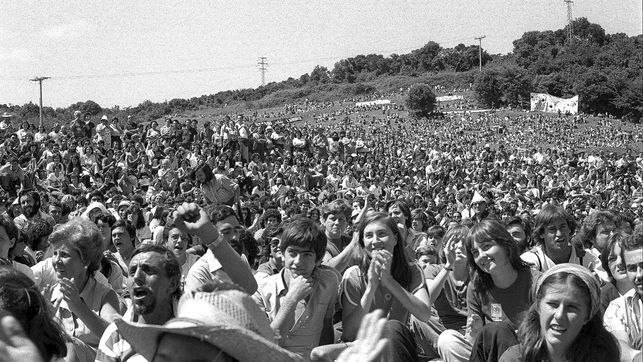
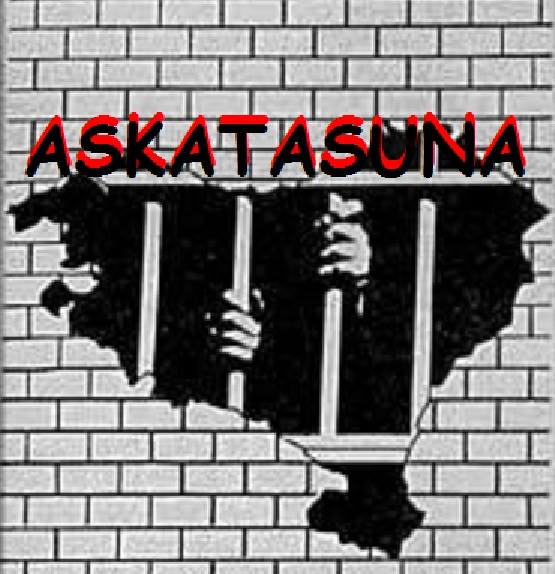
Image used on Amnistia movement’s web page.

COMMENT BY AMNISTIA ETA ASKATASUNA ON STATEMENTS ISSUED BY EH BILDU AND SORTU IN RELATION TO PATXI RUIZ

(Translation from statement in Castillian, section headings, explanatory notes and images inserted by D.Breatnach)

[Explanatory note: EH Bildu and Sortu are political parties of the official leadership of the Abertzale Left, quite similar to Sinn Féin (P), with which they have friendly relations. Amnistia is a Basque organisation in disagreement with the line of those parties firstly on political prisoners and subsequently on the change of trajectory].

In relation to the communiqués published by EH Bildu and Sortu regarding the situation of the Basque political prisoner Patxi Ruiz, the Pro Amnesty and Against Repression Movement wishes to express the following:

RESPECT FOR THE DECISIONS OF PATXI RUIZ

          According to EH Bildu, they are making the necessary arrangements so that the parliamentarian Bel Pozueta can visit Patxi Ruiz in the Murcia II prison. Sortu asks us to take responsibility to cover up its miseries (Trans?). Above all, and even more so in these hard times, we must respect Patxi’s wishes, who has made it clear that the political attitudes of EH Bildu and Sortu do not have his approval.

All the same, he recognises the right of everyone to report on his situation, but the pressure must be exercised in accordance with the political line that he supports. Patxi upholds confrontation with the enemy and we think that EH Bildu and Sortu are not taking advantage of the possibilities and position they possess to carry out such a confrontation.

Patxi Ruiz, Basque political prisoner, now 24 days on hunger strike, 12 of which were thirst strike too.
(Image sourced: Internet)

POPULAR PRESSURE

          There are a great many mobilisations and initiatives taking place in Euskal Herria (the Basque Country). On a number of occasions they are being carried out in breach of the prohibitions. We must also bear in mind that with the excuse of the pandemic those who trample us have suspended our political rights. Euskal Herria, however, knows how to react and respond to a situation as serious as that of Patxi, being the country in the world where the most mobilisations have been taking place since the lockdown began.

Without popular pressure, the media acting as dogs of the system would keep Patxi’s case hidden. It has become evident that without marking the matter prominently there is no way to put the issue on the table, and that all the institutional parties are more concerned with graffiti sprayed on a wall than about Patxi’s life.

For this reason, we must say that EH Bildu and Sortu have also immersed themselves in the campaign against those who are carrying out actions of popular pressure in support of Patxi, and that if Patxi has a minimal hope of remaining alive, it is from the same popular pressure that EH Bildu and Sortu are trying to stop. We find it contradictory that while they say they are working for Patxi, at the same time they are putting obstacles in the way of pressure initiatives in his support.
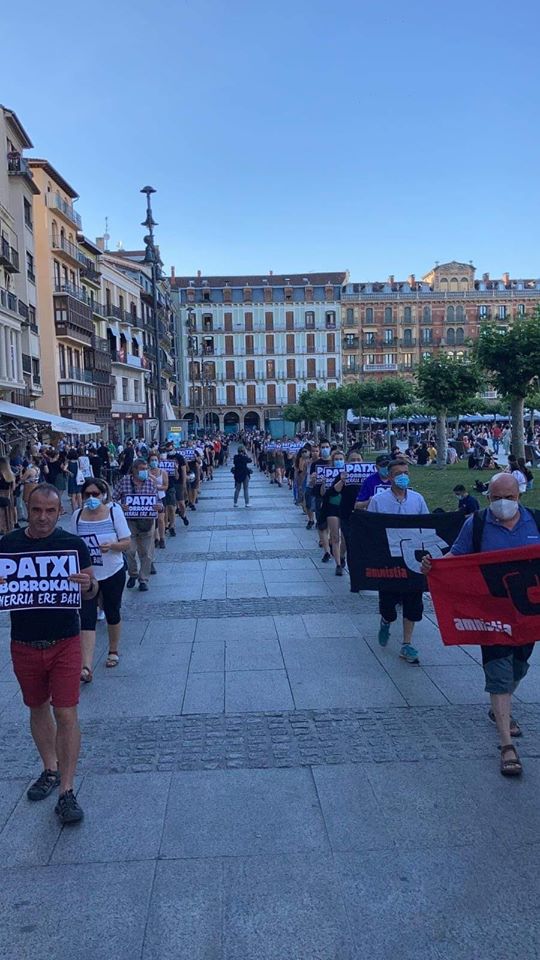
Patxi Ruiz Solidarity march in Irunea/ Pamplona 30th May 2020
(Source photo: Amnistia Garrasi)

POLICY OF INDIVIDUALLY-BASED EXITS FROM PRISON LEAVE REMAINING PRISONERS DEFENCELESS

          From 2014 until the present, the Pro Amnesty and Against Repression Movement has maintained that the policy of individual exits ruptured the unity among prisoners and, consequently, left them defenseless in the face of prison abuses, and we took that position based on this logic:

When an inmate accepts the so-called “individualized treatment” of the prison to advance his grade, at the same time he is agreeing to stop reporting injustices against other comrades. Should the prisoner express solidarity with his or her comrade, the path of progression through the grades is endangered.

(Translator’s note: The Spanish prison system sets different grades for prisoners according to which they may be released early on parole or not. The application of the system has included requirements such as expressing regret for past actions, undertaking not to break laws in future, not acting as a body within the jails, etc. For decades the Abertzale leadership and ETA rejected these requirements but after 2014 their policy changed towards advocating individual application for progression through the prison system grades).

Our movement has proceeded with absolute respect regarding the internal dynamics of the prison, but making an objective analysis, we can now see that the reading made from the beginning by the Pro Amnesty Movement was correct. Only practice confirms or denies theory, and the case of Murcia II shows that Patxi has been left facing the prison administration with absolutely no protection.

One political prisoner from Murcia II alone has taken a public position of solidarity with Patxi Ruiz and while Patxi dies, the other political prisoners prioritise their progression through the grades. It is incomprehensible to us, regardless of the ideological differences that currently exist, that the rest of the prisoners have not set in motion any pressure initiatives.

It is not up to our movement to enter into personal evaluations, knowing that particular situations may be determining factors, but we must emphasize that what happens in Murcia II is a consequence of the path outlined by EH Bildu in its document called “Basque Way for Peace”. EH Bildu and Sortu’s political line has a direct effect on Patxi’s situation.
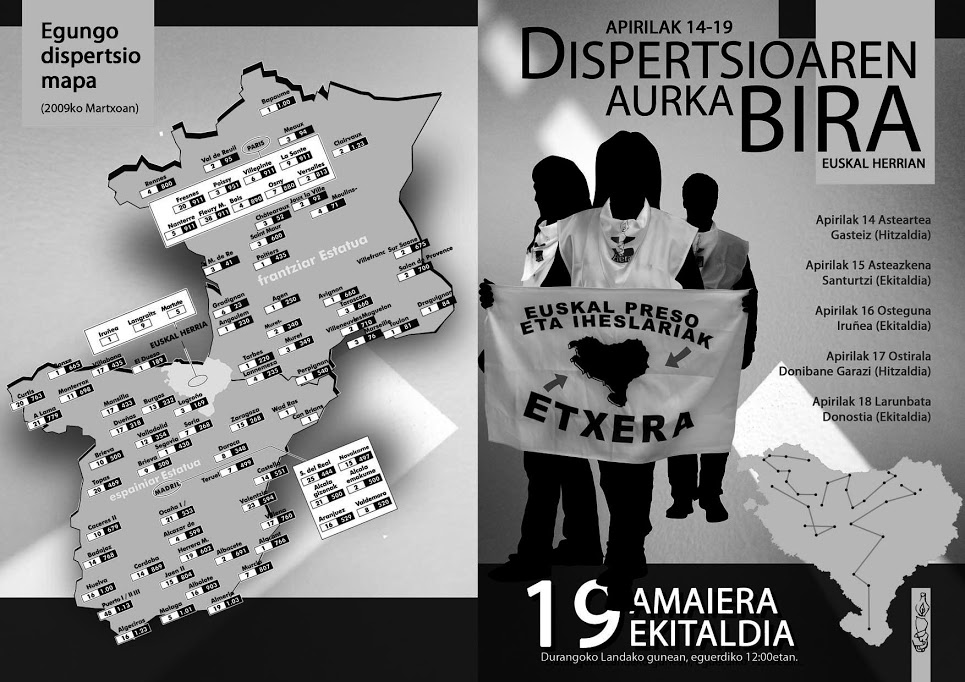
Map of prisons in the Spanish and French states through which political prisoners are dispersed as policy.
(Source: Internet)

ELECTORALISM

          In conclusion, it is not lost on us that all institutional parties are involved in an electoral campaign and that their political movements are made under this influence. The statements of EH Bildu and Sortu were published on the ninth and tenth day of Patxi’s hunger and thirst strike, when until now they have only mentioned Patxi in passing in order to criticize the direct action taken by people in his favour, and now to hold Patxi’s solidarity environment responsible for what may happen to him. It is not possible to sink lower. All their initiatives and declarations are purely for show and electoralist.

Institutional parties would have the people believe that only what professional politicians do is political, they would have the people believe that only what is done within the parameters set by the bourgeois system is political, disregarding the maturity of the working class.

From a revolutionary point of view, the Pro Amnesty and Against Repression Movement does not understand the point of being in bourgeois institutions if it is not to break them from within. For this reason and bearing in mind that Patxi may collapse at any time, we call on the people to urgently make real politics, that is, that which can condition and reverse the operations of the murderers who oppress us. In defence of Patxi’s life, advance the popular struggle!

In the Basque Country, on May 20, 2020.

Pro Amnesty and Against Repression Movement.
https://www.amnistiaaskatasuna.com/es/articulo/sobre-los-comunicados-publicados-por-eh-bildu-y-sortu-en-relacion-patxi-ruiz

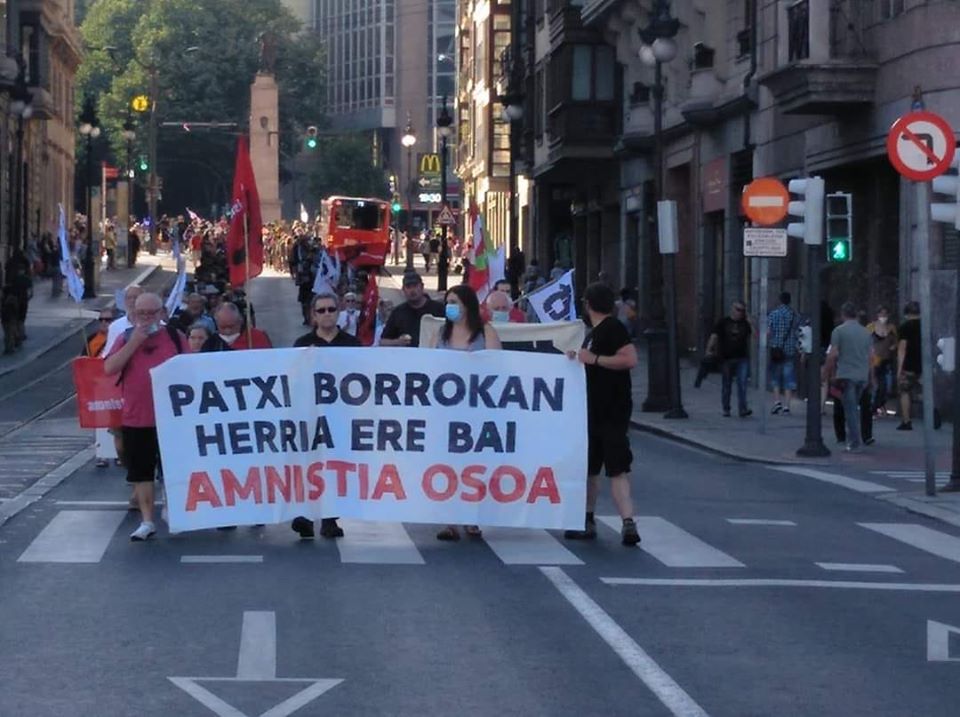
Patxi Ruiz Solidarity march in Bilbo/ Bilbao 30th May 2020
(Source photo: Amnistia Garrasi)
(Source image: Internet)

IN RESPONSE TO THE EEPK ATTACK ON THE PRO-AMNESTY MOVEMENT

Posted on Sat, 05/30/2020 – 11:46

(translation from Castillian published version, insertion of sub-headings, footnotes and images by D.Breatnach).

Unfortunately, once again and contrary to what we would like, we are obliged to respond to an attack against our movement. On this occasion it has been the EPPK1 that, while applauding the institutional parties that are part of the system, has launched an attack against the popular movement in an attempt to damage what they do not control.

It does not go unnoticed that the day chosen to publish this attack is the Day of Mobilisations that we have called in support of Patxi Ruiz. In addition to being an electoral movement with its mind set on the elections, the EPPK note, written in one of the Sortu offices, aims to weaken today’s mobilisations. Despite referring to us, we interpret the fact that they do not mention the name of the Movement for Amnesty and Against Repression as a symptom of political weakness. It is our custom to say things more clearly than that. Nothing would call for such action but seeing that they stand to lose hegemony in the street, they act from their gut instead of their head.

We recall other similar attacks that, far from strengthening unity among prisoners, have served to divide the EPPK itself. For example, the false accusation leveled against our movement by prisoners who were being tried in the Paris Court in 2015, had the effect of causing four other prisoners with long sentences to separate themselves from the EPPK. All four publicly criticised it, and things like that should make those who plan these attacks reflect on the consequences that actions of this type have on those inside (including many of the EPPK).

Dealing with the content of today’s EPPK statement, the first thing we should highlight is its lack of rigor. They say that we have used Patxi’s dramatic situation to criticize Sortu, EH Bildu, Etxerat, EPPK and Sare. We must say that these groups are not the navel of the world and that we have put all our strength into Patxi. But in addition to that, we have not mentioned in any statement either the EPPK, or Etxerat or Sare.

We have mentioned EH Bildu and Sortu, always to respond to the accusations hurled by them against the Pro Amnesty and Against Repression Movement. Like the EPPK now, the previous two have accused us of pushing Patxi Ruiz towards his death and, in the face of such petty statements as these, our position will always be firm. We will not accept attacks of this kind in the difficult situation we are experiencing, and less so from those who think only of the elections. We will not admit it from those who have not said anything about Patxi until after ten days, except when it was to criticise the actions in his support.

The position of the Pro Amnesty and Against Repression Movement has been, from the outset, to prioritise Patxi’s life over anything else. For this, we have maintained direct contact with the group that acts as the family’s representative, with the lawyers and with a group of professionals who work in different fields of medicine and who advise us.

All the decisions that we have made in these hard times, including the political initiatives that we have promoted, have been made taking into account and following the advice of these three groups. We ask for respect and responsibility from Sortu and from all the organizations that move in its orbit, towards us, towards the aforementioned groups and above all towards Patxi, who is the one who makes the decision to continue with the hunger strike. Of course, we can assure that we will be supporting Patxi to make the decisions that he makes regarding this issue.

ATTITUDE OF THE PRISONERS IN MURCIA II

          We must state that our movement has at no time made assessments of the personal attitudes of any member of the EPPK. We have not doubted the concern that the rest of the prisoners of Murcia II may have about Patxi’s situation. The Pro Amnesty Movement makes political evaluations and far from treating prisoners as if they were “unfortunates”, it treats them like the political militants they are.

For this reason, on May 20 we said that the fact that they had not moved in support of Patxi was a consequence of the “Basque Road to Peace” proposal by EH Bildu and Sortu. Specifically, we explained that entering the game of grade progressions2 left prisoners defenceless in prison, because if they took action they would lose the possibility of advancing in grades. To this we added that we have been warning about the consequences of this path for six years and that the only thing that confirms or denies theories is practice. This case confirms that our theory is correct, above opinions and objectively.

As a last point, it seems really audacious to say that if Patxi was taken to the hospital, it was because the members of the EPPK requested it from the prison management. Patxi was hospitalised on the eleventh day of the hunger and thirst strike, following kidney failure and following a judge’s order.

MEDIATION OFFERED BY SORTU

          On the night of May 14th, Sortu contacted the Pro Amnesty and Against Repression Movement through an intermediary. Sortu offered us to take advantage “under the table” of some contacts it has in Madrid to change Patxi’s situation. According to what we were told, the movement should give them the “green light” for this. They suggested that with the activism we promote, we could be pushing Patxi to continue with the hunger and thirst strike.

The group that looks after Patxi’s situation evaluated ​​the proposal, consulted with those around them and drew conclusions: the first is that Patxi does not want something like this and that his will must be respected. The second is that the only reason for asking for a “green light” can be is that in return we request to stop the street actions. The third is that those who made us the offer (we know how to distinguish them from the party bases), more than for Patxi’s life, are concerned about the consequences that his death can cause in the political situation.

The day after receiving the proposal, we replied that if they have a real option to avoid Patxi’s death, they would not need anyone’s “green light” to take the necessary approaches. Despite the fact that they asked us for confidentiality, on May 19th EH Bildu made public through an electoral note that it had offered us its means to help resolve Patxi’s situation and the next day Sortu, in a note in the same vein, accused us of pushing Patxi towards his death. By making this contact public and making serious accusations, they showed that their only intention was “to get rid of the body on top of them.” We know how to maintain discretion and appreciate the help offered when it is sincere, but we will not allow manipulations tailored to anyone’s partisan interests.

APPEAL TO EUSKAL HERRIA3

          In closing, we call on the Basque Country to continue supporting Patxi, to denounce the attacks against prisoners, and to continue pressing the fight for amnesty. Only the cessation of all kinds of oppression implicit in the political concept of amnesty will bring about a true peace based on justice. We are proud of the response given in Euskal Herria and of the internationalist support we have received.

In the Basque Country, on May 30, 2020.

Pro Amnesty and Against Repression Movement.

https://www.amnistiaaskatasuna.com/es/articulo/ante-el-ataque-del-eppk-al-movimiento-pro-amnistia
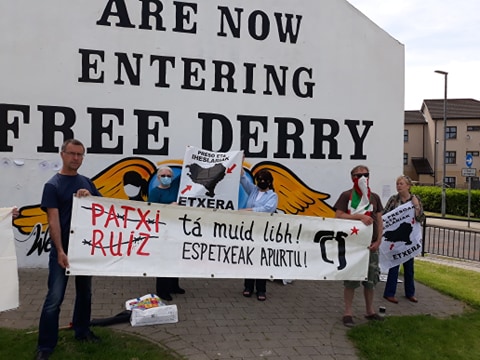
Patxi Ruiz Solidarity picket in Derry 30th May 2020
(Source photo: Derry Anarchists)
Patxi Ruiz Solidarity picket in Dublin 30th May 2020 (Source photo: Dublin Basque Solidarity Committee)

FOOTNOTES

1Basque Political Prisoners’ Collective, part of the Abertzale Left movement following the political line of the official leadership. Currently the vast majority of the Basque political prisoners are following its general line although a number of male and female prisoners have broken ranks to take actions in solidarity with Patxi and a number of ex-prisoners have also in his support.

2The Spanish penal system applies one of a number of grades to prisoners, according to which the conditions of imprisonment and possibility of early release on parole are decided. Formerly the EEPK, in line with the official leadership of the Abertzale Left movement, the decision was to maintain an attitude of political opposition to the system and to take collective decisions. When the position of the leadership on the overall struggle changed, so too did the recommendations to the prisoners, which was now to respond to the prison system as individuals and progress through the grades in what would be considered ‘good behaviour’ by the authorities.

3 “The Land Where the People Speak Euskera” (Basque native language), the name for the entire Basque Country, north and south.

RESPONSE OF THE BASQUE AMNESTY MOVEMENT TO ATTACK BY THE EPPK

IN RESPONSE TO THE EPPK ATTACK ON THE PRO-AMNESTY MOVEMENT

Posted on Sat, 05/30/2020 – 11:46

(translated from Castillian published version by D.Breatnach 31/ 05/2020).

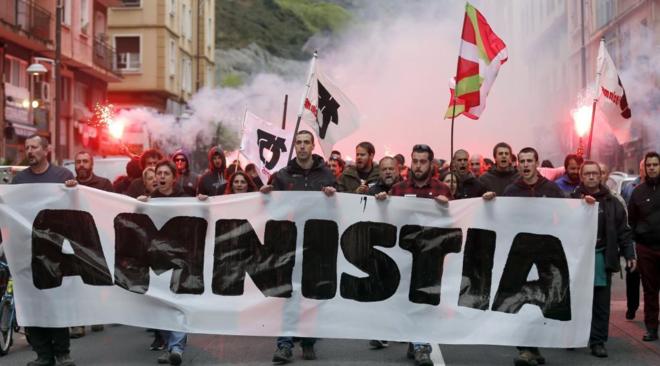
Amnistia demonstration (photo sourced: Internet).

Unfortunately, once again and contrary to what we would like, we are obliged to respond to an attack against our movement. On this occasion it has been the EPPK1 that, while applauding the institutional parties that are part of the system, has launched an attack against the popular movement in an attempt to damage what they do not control.

It does not go unnoticed that the day chosen to publish this attack is the Day of Mobilisations that we have called in support of Patxi Ruiz. In addition to being an electoral movement with its mind set on the elections, the EPPK note, written in one of the Sortu offices, aims to weaken today’s mobilisations. Despite referring to us, we interpret the fact that they do not mention the name of the Movement for Amnesty and Against Repression as a symptom of political weakness. It is our custom to say things more clearly than that. Nothing would call for such action but seeing that they stand to lose hegemony in the street, they act from their gut instead of their head.

We recall other similar attacks that, far from strengthening unity among prisoners, have served to divide the EPPK itself. For example, the false accusation leveled against our movement by prisoners who were being tried in the Paris Court in 2015, had the effect of causing four other prisoners with long sentences to separate themselves from the EPPK. All four publicly criticised it, and things like that should make those who plan these attacks reflect on the consequences that actions of this type have on those inside (including many of the EPPK).

Dealing with the content of today’s EPPK statement, the first thing we should highlight is its lack of rigor. They say that we have used Patxi’s dramatic situation to criticize Sortu, EH Bildu, Etxerat, EPPK and Sare. We must say that these groups are not the navel of the world and that we have put all our strength into Patxi. But in addition to that, we have not mentioned in any statement either the EPPK, or Etxerat or Sare.

We have mentioned EH Bildu and Sortu, always to respond to the accusations hurled by them against the Pro Amnesty and Against Repression Movement. Like the EPPK now, the previous two have accused us of pushing Patxi Ruiz towards his death and, in the face of such petty statements as these, our position will always be firm. We will not accept attacks of this kind in the difficult situation we are experiencing, and less so from those who think only of the elections. We will not admit it from those who have not said anything about Patxi until after ten days, except when it was to criticise the actions in his support.

The position of the Pro Amnesty and Against Repression Movement has been, from the outset, to prioritise Patxi’s life over anything else. For this, we have maintained direct contact with the group that acts as the family’s representative, with the lawyers and with a group of professionals who work in different fields of medicine and who advise us.

All the decisions that we have made in these hard times, including the political initiatives that we have promoted, have been made taking into account and following the advice of these three groups. We ask for respect and responsibility from Sortu and from all the organizations that move in its orbit, towards us, towards the aforementioned groups and above all towards Patxi, who is the one who makes the decision to continue with the hunger strike. Of course, we can assure that we will be supporting Patxi to make the decisions that he makes regarding this issue.

Image used on Amnistia movement’s web page.

ATTITUDE OF THE PRISONERS IN MURCIA II

          We must state that our movement has at no time made assessments of the personal attitudes of any member of the EPPK. We have not doubted the concern that the rest of the prisoners of Murcia II may have about Patxi’s situation. The Pro Amnesty Movement makes political evaluations and far from treating prisoners as if they were “unfortunates”, it treats them like the political militants they are.

For this reason, on May 20 we said that the fact that they had not moved in support of Patxi was a consequence of the “Basque Road to Peace” proposal by EH Bildu and Sortu. Specifically, we explained that entering the game of grade progressions2 left prisoners defenceless in prison, because if they took action they would lose the possibility of advancing in grades. To this we added that we have been warning about the consequences of this path for six years and that the only thing that confirms or denies theories is practice. This case confirms that our theory is correct, above opinions and objectively.

As a last point, it seems really audacios to say that if Patxi was taken to the hospital, it was because the members of the EPPK requested it from the prison management. Patxi was hospitalised on the eleventh day of the hunger and thirst strike, following kidney failure and following a judge’s order.

MEDIATION OFFERED BY SORTU

          On the night of May 14th, Sortu contacted the Pro Amnesty and Against Repression Movement through an intermediary. Sortu offered us to take advantage “under the table” of some contacts it has in Madrid to change Patxi’s situation. According to what we were told, the movement should give them the “green light” for this. They suggested that with the activism we promote, we could be pushing Patxi to continue with the hunger and thirst strike.

The group that looks after Patxi’s situation evaluated ​​the proposal, consulted with those around them and drew conclusions: the first is that Patxi does not want something like this and that his will must be respected. The second is that the only reason for asking for a “green light” can be is that in return we request to stop the street actions. The third is that those who made us the offer (we know how to distinguish them from the party bases), more than for Patxi’s life, are concerned about the consequences that his death can cause in the political situation.

The day after receiving the proposal, we replied that if they have a real option to avoid Patxi’s death, they would not need anyone’s “green light” to take the necessary approaches. Despite the fact that they asked us for confidentiality, on May 19th EH Bildu made public through an electoral note that it had offered us its means to help resolve Patxi’s situation and the next day Sortu, in a note in the same vein, accused us of pushing Patxi towards his death. By making this contact public and making serious accusations, they showed that their only intention was “to get rid of the body on top of them.” We know how to maintain discretion and appreciate the help offered when it is sincere, but we will not allow manipulations tailored to anyone’s partisan interests.

APPEAL TO EUSKAL HERRIA3

          In closing, we call on the Basque Country to continue supporting Patxi, to denounce the attacks against prisoners, and to continue pressing the fight for amnesty. Only the cessation of all kinds of oppression implicit in the political concept of amnesty will bring about a true peace based on justice. We are proud of the response given in Euskal Herria and of the internationalist support we have received.

Issued in the Basque Country, on May 30, 2020.

Pro Amnesty and Against Repression Movement.

https://www.amnistiaaskatasuna.com/es/articulo/ante-el-ataque-del-eppk-al-movimiento-pro-amnistia

Patxi Ruiz Romero, Basque political prisoner, now on hunger strike.
(Image sourced: Internet)


FOOTNOTES

1Basque Political Prisoners’ Collective, part of the Abertzale Left movement following the political line of the official leadership. Currently the vast majority of the Basque political prisoners are following its general line although a number of male and female prisoners have broken ranks to take actions in solidarity with Patxi and a number of ex-prisoners have also published a statement in his support.

2The Spanish penal system applies one of a number of grades to prisoners, according to which the conditions of imprisonment and possibility of early release on parole are decided. Formerly the EEPK, in line with the official leadership of the Abertzale Left movement, the decision was to maintain an attitude of political opposition to the system and to take collective decisions. When the position of the leadership on the overall struggle changed, so too did the recommendations to the prisoners, which was now to respond to the prison system as individuals and progress through the grades in what would be considered ‘good behaviour’ by the authorities.

3 “The Land Where the People Speak Euskera” (Basque native language), the name for the entire Basque Country, north and south.

IS THE BASQUE SLEEPING GIANT AWAKENING?

Diarmuid Breatnach

(Reading time: 15 mins.)

The Basque pro-independence movement, the Abertzale Left, fought the Spanish State for over four decades. in 2012 its leadership renounced armed struggle without any reciprocal agreement with the Spanish State, declaring its faith in an imagined “Basque peace process”, sought alliances with social democratic and capitalist-nationalist parties and publicly apologised for its past actions of resistance. The movement sank into general inactivity except on the electoral front. But in recent weeks there have been signs of awakening, though under a different leadership – or is the giant merely muttering and twitching in its sleep?

Map of the Basque Country showing the provinces; the three to the north-east are inside the French state, while the other and larger four are in the Spanish state. (Image source: Internet)

THE GIANT

          How does the description “Giant” fit a resistance movement in a total population of less than three million people? A nation divided between the Spanish and French states? Part of the answer is precisely in those features, also in its history during the Spanish Civil / Anti-Fascist War and “French” Maquis and earlier. Also in its long struggle in defence of its native language Euskera, almost certainly the oldest in Europe and perhaps the first to reach it in neolithic times.

This is a movement that carried out general strikes against the Franco dictatorship, ensured that three of its provinces rejected the 1978 Constitution of the Spanish State which, in atmosphere of fear and murderous repression and with the collusion of the newly-legalised social-democratic (PSOE) and communist (CPE) political parties, was voted in by a majority in every other region of the Spanish State (population another 35 million people).

The serpent of wisdom and the axe of armed struggle, symbol of ETA.
(Image sourced: Internet)

Inspired by the examples of the Algerian independence struggle and socialist Cuba, the Abertzale Left movement rose from the defeat of the nation in the Spanish Civil/ Anti-Fascist War and the terrible repression under the fascist dictator General Franco and in 1959, formed the ETA (Land and Freedom) organisation. The youth wing of the conservative Basque Nationalist Party conceded the Left-inclination in order to join with them. Enduring arrests and torture of its supporters, it was not until 1968 that ETA took an armed action; halted at a police checkpoint and determined not to be arrested, Txabi Etxebarrieta shot a policeman dead and was in turn killed himself by pursuing police.

Mural honouring Txabi Etxebarrieta, first ETA martyr. (Image sourced: Internet)

The first planned armed action carried out was also that year when an ETA squad shot dead Meliton Manzanas, head of the political police in the Basque Country, a notorious torturer of prisoners and a Nazi sympathiser in the past.

A woman dressed in the Basque national colours dances the aurresku, ceremonial honour dance, in commemoration of ETA martyrs. Organising or participating in such an event could easily lead to torture and a prison sentence under the “anti-terrorism” laws of the Spanish State.
(Image sourced: Internet)

A number of other actions were taken by ETA over the years, some of them spectacular but, like many armed resistance groups, some also questionable in value or even in justification from a revolutionary point of view. But in December 1973 an ETA squad in Madrid assassinated Admiral Carrero Blanco, General Franco’s nominated successor, an action which many credited with hastening the progress of the Transition of the Spanish State to nominal democracy. General Franco died without a strong agreed political replacement almost exactly two years later, in December 1975 and the Transition process ran from then until 1978.

Admiral Carrero Blanco, Franco’s intended replacement, assassinated by ETA in Madrid in December 1973.
(Image sourced: Internet)

The struggle continued after the Transition, since the new Constitution declared any breakaway from the unity of the Spanish State a crime unless a majority in the Spanish Parliament voted in favour. The military and police repression in the Basque Country was huge. In the 1980s the social-democratic (PSOE) Spanish Government was exposed as heavily implicated in a number of terrorist groups operating against Basques through kidnapping, torture, gun and bomb attacks (see GAL) and eventually the Minister of the Interior and a number of high-ranking officers were given jail sentences.

In 1983 mass demonstrations and armed actions by ETA brought about the abandonment of the Spanish State’s nuclear reactor at the picturesque coastal spot at Lemoiz, followed by a new Spanish government declaring a moratorium on all building of nuclear reactors.

1975 mass demonstration against nuclear reactor being built by the Spanish State at Lemoiz.
(Image sourced: Internet)

Another aspect of the struggle was against compulsory military service, which the Spanish State only ended in 2002. People not only evaded it but also protested publicly against it.

Many people in the Spanish state opposed being part of NATO in the 1986 referendum but the Basque Country was highly represented in the vote against, around double the vote of those in favour and along with Catalonia being the only regions with a majority voting “no”.1

Photo taken of me by my guide on my camera above the abandoned nuclear site at scenic Lemoiz, possiblt 2016. Not many people can claim to have halted a nuclear reactor building program.

The ideology of the movement which found expression in ETA was national liberationist and socialist and this was reflected to a greater or lesser degree in all its parts, whether military or civilian. The Abertzale Left during the period organised itself into one political party after another after each in turn was banned by the Spanish State and forbidden to field candidates in elections.

Women industrial workers in Basque anti-fascist armaments factory, Spanish Civil/ Anti-Fascist War, 1936. (Image sourced: Internet)

But the movement had a huge social following too, in youth movements, punk and heavy metal bands, social-cultural centres, pirate radio stations and promoters of Euskera as a spoken language (all leaders of the Abertzale Left were required to be able to speak the language and all public meetings were addressed in Euskera and Spanish or even Euskera alone). There was even a popular Abertzale style of haircut and dress. The Abertzale Left also had a sizeable trade union, LAB which, along with ELA, a union founded by the Basque Nationalist party, recruited the majority of unionised Basque workers2. Feminist, LBGT, linguistic, eco-friendly, anti-animal cruelty sectors all contained many people broadly in support of the Abertzale Left or at least of its stated objectives.

The movement also had newspapers, radio stations and internet sites and many of these were closed down by the Spanish State, alleging that they were “collaborating with terrorism”. Currently the Spanish State is moving towards the closure of the movement’s social-cultural centres, the Herriko Tabernak (People’s Taverns). This arises from a judgement by the National Court in 2011, a judgement corresponding to an infamous statement by Baltazar Garcón, at the time a prominent Judge of that Court, that “Everything is ETA”. The closures are to be carried out now although ETA ceased armed activity permanently in 2012 and disbanded itself a little later.

Annual January prisoners’ solidarity march, Bilbao, 2016. (Image sourced: Internet)

Repression by the Spanish State has included executions and clandestine assassinations and led to relatively huge numbers of Basque political prisoners, not all by any means military fighters and conviction with “confessions” extracted through torture during the five-day incommunicado period ensured a problem-free conveyor belt for the Spanish State. That conveyor belt delivered its victims to jails dispersed all over the Spanish state, nearly every one hundreds of kilometres and sometimes over a thousand from the prisoners’ homes. The financial, physical and mental strains on friends and relatives, including elderly and children having to travel such distances to visit their loved ones are hard to imagine, often facing abuse or harassment on the way or at their destination, apart from serious accidents on motorways (including fatalities). Many pickets and demonstrations are held in the Basque Country throughout the year and each January a monster march clogs the streets of Bilbao.

The issue of the prisoners has always been a big one for the Abertzale Left and despite dispersal the prisoners built an organisation within the jails, responding to their situation in a disciplined manner.

SLEEPING

          During the first decade of this century it was clear that ETA was not doing well and the Abertzale Left in general was facing many more years of struggle against an unyielding state with repression everywhere and hundreds of political prisoners in jails.

The leadership was attracted to the much-advertised pacification/ peace processes of South Africa, Palestine and Ireland. By any estimation the Palestine process soon collapsed and its rejection by most of Palestinian society was clearly indicated first by the Intifada and secondly by the electoral gains of Hamas, pushing Al-Fatah into second place. To undiscerning eyes the Irish and South African3 processes seemed to be doing well and both the ANC and Sinn Féin lent strong support to the Abertzale Left’s imagined “peace process”. Despite that support and that of such prominent imperialist figures as Tony Blair and Kofi Annan, the Spanish ruling class was not interested in playing and eventually the Abertzale Left’s leadership was left with nowhere to go. However, they persisted in trying to build alliances with the majority Basque National Party and with smaller nationalist-social-democratic groups; they succeeded with the second sector but failed with the first and seem condemned to second-party status electorally in a Spanish colony, a nation divided by the French-Spanish border.

However, in their search for acceptance by the above-mentioned sectors, the Abertzale Left not only renounced armed struggle but apologised for past actions, ended street confrontations and called on the prisoners to negotiate their progress individually through prison system grades to eventual parole. Some of Abertzale Left public representatives even attended events commemorating Guardia Civil and Ertzaintza (Basque police) killed by ETA in the past.

EH Bildu Mayor of Errenteria participates in commemoration of a Guardia Civil killed by ETA.
(Image sourced: Internet)

When the struggle for independence broke out again recently in Catalonia with the 2017 Referendum and the Spanish State responded with a violent Guardia Civil invasion and jailing of politicians and social activists, the Abertzale Left leadership noticeably declined to open up a second front of struggle.

STIRRING

          There were early but sporadic signs that not all movement was happy with the Abertzale Left’s new path. Askapena, an organisation set up within the Abertzale Left to work on internationalist solidarity, which at one time could list affiliated groups in Ireland, Germany, Italy4, Paris, Brittany, Barcelona, Madrid, Switzerland, Denmark, Sweden and a number of Latin American countries, broke quietly with with the Abertzale Left over its change of policies5. Notably also, when four members of Askapena were accused of “assisting terrorism” in 2010, they refused to apologise for their work and fought the case, being eventually cleared of all charges in 2016.6

In addition, many Basques were critical of the process, feeling that even if they were prepared to go down the new road, it had been handled badly by the leadership.

A leading Marxist theoretician of the movement, Inaki Gil, resigned from the national leadership years ago, though not from the movement; however he may well be persona non-grata in it now due to a published interview in which he criticised the decision of the 47 on trial in September last year to apologise for past actions of the Basque liberation movement, even after 50,000 had marched through Bilbao streets in their support two days earlier.

When Arnaldo Otegi — generally seen as the architect of the new road for the Abertzale Left7 – was arrested with others in 2009 and, while on pre-trial detention began a hunger strike only to end it soon afterwards, it did not reflect well on him. While he beat a charge of “glorifying terrorism”, he was convicted in 2011 for allegedly reorganising Batasuna, banned political party of the Abertzale Left and sentenced to ten years, reduced on appeal to six and walked free in 2016. In the meantime a Free Otegi campaign (2015) attracted some notable foreign support (including Desmond Tutu) but was criticised in the Basque liberation movement for highlighting the case of one political prisoner above many others8 (including those who were serving much longer sentences).

Arnaldo Otegi, leader of the official Abertzale Left.
(Image sourced: Internet)

Some years ago a new Basque political prisoner solidarity organisation came into being, calling itself ATA (Amnistia Eta Askatasuna – Amnesty and Freedom9). They enjoyed a good showing at their first demonstration but came under public attack not only by the Abertzale Left leadership but by a number of ETA members on trial in France. They were accused of using the prisoners as a stalking horse when what they really wanted was to attack the new line of the movement’s leadership. Censorship and condemnation in the Abertzale Left’s daily newspaper GARA followed.

Amnistia Ta Askatasuna demonstration Bilbo 2016.
(Image sourced: Internet)

Although their public support waned for awhile, in 2018 a youth group of the Abertzale Left was expelled after they had publicly denounced their annual conference managers for refusing to put their position paper forward for discussion; this youth organisation now collaborates with ATA. Last year, a new Basque revolutionary group called Jarki was formed and drew a sizable crowd to their commemoration of the annual Gudari Eguna (Basque Soldier Day)10.

ATA demonstration Donosti/ San Sebastian, September 2019.
(Photo: D.Breatnach)

However the issue of development remained in doubt and no-one could predict with confidence that the movement would be rebuilt along revolutionary lines under a new leadership.

WAKING

          The week before last, Basque political prisoner Patxi Ruiz embarked upon a hunger and thirst strike and although he abandoned the thirst component after 11 days he continues on the hunger strike. He took this action in protest against harassment and beatings by the prison administration and jailers and highlighted the fact that prisoners

Patxi Ruiz, Basque political prisoner, now on hunger strike.
(Image sourced: Internet)

were being refused virus-protection clothing or testing and that the jailers were not being tested either. He also wanted visits from his family to be permitted and prisoners allowed to attend funerals of family members (he had been refused permission to attend his father’s funeral). More recently he has demanded that prisoners be relocated to jails near their homes, a long-standing demand of the movement and which is entirely in accordance with model rules for prisons in the EU and the UN. Despite the official leadership of the Abertzale Left firstly ignoring the situation and then condemning his supporters, Ruiz’s struggle galvanised the mostly dormant Abertzale movement.

Patxi Ruiz solidarity march, Durango, Basque Country.
(Photo source: Amnistia Garrasi FB page)

Every day has seen small actions across the Basque Country, including protest pickets on bridges, beaches, town squares etc; solidarity fasts; slogans painted … Large solidarity marches have been held in Irunea/ Pamplona (Nafarroa province), Donosti/ San Sebastian (Guipuzkoa), Baiona (Bayonne), Bilbao and Durango (Bizkaia). ATA’s web page is full of developing news and the facebook page, which had fallen into silence, is active again.  Last Sunday in Pamplona/ Irunea, police attacked demonstrators with batons and fired rubber bullets at close quarters.Patxi Ruiz solidarity demonstration 24 May 2020 attacked by police with batons and rubber bullets

Patxi Ruiz solidarity march in Bayonne, northern Basque Country.
(Image source: Internet)

Some of the Basque prisoners who are part of the “official list” have begun taking solidarity action, refusing food or to leave their cells for periods in Almería, Brevia-Ávila, Castelló I, Córdoba, Huelva, Murcia (where Patxi is), Puerto III, Rennes, Sevilla II, Topas-Salamanca …. refusal to leave one’s cell also means forgoing family phone calls. Patxi had been expelled from the Abertzale prisoners’ collective in 2017 for speaking out against the new line of the official leadership which another four prisoners have repudiated also11.

Patxi Ruiz solidarity seaside picket, Plentzia, Basque Country.
(Image source: Amnestia Garrasi

However the mass of Basque political prisoners have so far remained quiet, “concentrating on moving through their grades while Patxi lies dying”, in a quotation from an ATA commentary which blamed this new lack of unity on the fragmentation engendered by the official leadership.

Patxi Ruiz solidarity seaside picket, Lekeito harbour Basque Country.
(Photo source: Amnistia Garrasi FB page)

A group of ex-prisoners has now also called for solidarity with Ruiz.

COULD NOT SINK LOWER”

          According to a public statement by ATA denouncing political parties Sortu and EH Bildu, the official Abertzale leadership made no comment until Patxi Ruiz was into his fifth day of hunger and thirst strike and then it was to mention him only in passing, while denouncing the spray-painting of political parties’ buildings by protesters and the burning of an ATM. On the 10th day the official leadership again released a statement, saying they were trying to organise one of their elected politicians to visit the prisoner but condemning the mobilisations across the Basque Country and accusing them of endangering Patxi Ruiz’s life. “They could not sink lower”, commented ATA, who also pointed out how late the official leadership had come to comment and that without the public-space protests, neither the media nor the official leadership would have taken any notice whatsoever.

What the future holds for Patxi Ruiz in the short-term is hard to predict, already weakened by ten days of thirst strike and now into his 16th day of hunger strike. What the near and medium-term future holds for the Basque movement is also an open question, depending to some extent on how ATA is able to capitalise on this upsurge and build an organisation or a network of coherence and unity, at least in action.

Patxi Ruiz solidarity march Bilbo 23 May 2020.
(Source image: Boltxe)

The official Abertzale leadership will do what they can to destroy any such movement but they have already yielded the streets, one of the main arenas of the movement in the past. Both groups are mutually exclusive and the advance of one in the wider Basque movement can only be at the expense of the other.

The Spanish State too will be watching developments and no doubt considering its own options of repression, although not so easily done as before, without even an ETA existence to justify their response to the public.

Meanwhile the Catalan independence struggle simmers on and if both should link up in mutual solidarity …..

end.

FOOTNOTES

2The main unions in the Spanish state, Unión General de Trabajadores and Comisiones Obreras were founded respectively by the PSOE and the CPE. Both are Spanish unionist and have the majority of unionised workers in every region of the Spanish state except the southern Basque Country and Galicia.

3While the people in South Africa have the vote and the ANC political party has done well out of the deal, going almost straight into Government, the mass of people struggle on low level income, high level violent crime, unemployment and badly-delivered services, while an ANC clique wallow in riches gained through corruption. Sinn Féin went first into the British colony’s government and now has the most elected parliamentary delegates from the February 2020 General Election in the Irish State; however over two decades after the Good Friday agreement the country is no nearer unification or nation-wide independence and is run by neo-liberal capitalist classes selling out the natural resources and services of the nation.

4Germany and Italy had a number of these; in Ireland the cities of Belfast, Dublin and Cork each had one.

5This organisation effectively ceased to exist due to the new line of the Abertzale Left. Although a number of foreign committee delegates did not disagree with the new line (some certainly did) nevertheless it began to fade away from then on.

6In marked contrast to the apology in September last year for previous actions of the movement by 47 members of a number of Abertzale Left organisations, including those against repression and in solidarity with prisoners, before they had even been tried by the court. This shameful action was taken two days after 50,000 had taken to the streets to support them and left deep hurt, bewilderment and shame throughout the movement. https://www.theguardian.com/world/2019/sep/16/mass-trial-of-basque-activists-in-spain-ends-with-plea-deal

7He had come into the political leadership with Joseba Permach of the Abertzale Left in 1997 after 23 members of the Batasuna leadership were jailed for seven years by the Spanish State. He was elected General Secretary of the political party Sortu in 2013.

8The Abertzale Left had never previously endorsed any campaign focusing on individual prisoners except in the case of terminally and seriously-ill prisoners, of which at one time there were as many as 15 who, even under Spain’s own prison regulations, should have been paroled home or to hospital.

9Though now it gives the translation as “Amnesty and Against Repression”. An Amnistia organisation had existed earlier but dissolved or reformed after banning by the Spanish State and one of the accusations of the Abertzale Left is that dissidents misappropriated the name.

USEFUL LINKS & FURTHER INFORMATION:

AMNESTIA ETA ASKATASUNA

Webpage: https://www.amnistiaaskatasuna.com/es (Spanish language version, also available in Euskera).

Facebook: https://www.amnistiaaskatasuna.com/es (Spanish and Euskera languages, lots of photos and videos)

JARKI: No media link available.

LEADERS AND LEADERSHIP

Diarmuid Breatnach

(Reading time: 10-15 minutes)

What makes leaders good or bad ones? How much power should a leader have? How should they conduct themselves? How do we know when they are no longer leading us well and what can we do about it? The following piece discusses these questions and seeks to answer them.


Most people think human beings need leaders and revolutionaries and insurgents in general are no exception. There are some political-social groups who state that they are autonomous and do not need leaders but it has been my experience even in some of those groups that they do indeed have leaders and that in general they act under that leadership. It seems to be a human trait for groups to accept leadership and to follow leaders and indeed all social animals we may observe have leaders. Nevertheless, the question of leadership historically has been fraught and that is as much the case for human society in its various stages as well as for revolutionary organisations.

Statue in the Louvre, Paris, of Spartacus, leader of the great slave uprising against Rome 73-71 BCE. He is here represented as a thinker.
(Photo sourced: Internet)

RESPONSES TO LEADERS – HEALTHY & UNHEALTHY

RESPECT

          If our leaders have proved their worth to our endeavours then of course we should respect them. We should not respect them because of their class or family background. It is what one does that makes one worthy of respect, not the social class in which one was raised. And if that class background gave certain advantages in education, in leisure time to study and learn, then those are advantages we value and seek for all, which is far from respecting someone merely because they were raised with those advantages.

As to family background, it seems to me that we are haunted with an old way of looking at human society. It might have seemed natural in ancient times to give the offspring of a valued leader special respect and even to choose the successor from among his/her offspring. It does seem to be the case that some talents and traits are inherited through genes and it is also true that such a family background can familiarise one with some principles of leadership. However, history has provided us with many examples of ineptitude, malice and even madness in leaders who have greatness in their family background. It has also provided us with examples of people who rose from obscurity and from a family background of no particular note to lead masses in historic deeds.

Since we speak of respect, we should talk now about what that means. Of course, when leaders seeks to lead us, to advocate some action or policy, we should listen for if we do not, how can we benefit from what they have to say to us? We listen with respect.

But respect is not the same as servility, nor blind acceptance. We should consider what we are being told and feel free to ask questions and to challenge what we may perceive as assumptions. Further, we should accept that others also have that right, even if we ourselves are convinced in the leaders’ words. Our leaders are not infallible and nor are we.

We said earlier that it is upon what we do that we earn respect and that is so for leaders too. Every judgement on what we do must inevitably be based to some extent on an action in the past, even if it as recent a past as earlier that week, the day before or an hour ago. But one’s past does not grant infallibility and one who took correct decisions in the past can all too easily take wrong ones today or tomorrow. History has also shown us many such examples. Therefore the expectation of any leaders or of their followers that we should accept what they say mainly on the basis of their having been correct in the past is completely unjustified — however emotionally satisfying it may be to some people — and we should resolutely reject the premise.

If we are entitled to question and even challenge leaders there also comes a time when that right should be put aside for awhile. At some point it is necessary to act and endless debate does not lead to action. Nor is the entitlement to question and challenge a justification for ceaseless exercise of that right and it is also the case that such practice will in time devalue future criticism and challenge, perhaps when they are valid and should be most needed. The point at which debate needs to come to an end and a decision made, by the accepted procedures of the group, is ruled by the necessities of the situation and not by simple declaration.

CONDUCT OF LEADERSHIP

          Firstly, led us observe that while it is an impossibility for everyone to lead simultaneously, everybody is capable of leadership at some time in some circumstance. Every time one of us suggests a course of action or expresses a criticism in a group, we are in effect offering leadership to others. The one who says “I think we should …” or “Why don’t we …..?” or “Maybe we could ….” are all offering leadership at that moment. Whether it would have been effective leadership or in any case is accepted or not is beside this point.

Spartacus statue in Sandinski, Bulgaria. Here his military leadership is emphasised.
(Photo sourced: Internet)

RESPONSIBILITY

          We all of us should take responsibility for our actions and their effect. In practice that means weighing up positive and negative aspects before action (should we have time to do so) and afterwards evaluating once again its negative and positive aspects. Should we be constantly hesitant or paralysed by fear of failure we cannot be effective in anything worthwhile, therefore it is necessary that we are prepared to risk making mistakes. Then we have a responsibility to learn from our mistakes which implies a responsibility to admit to them.

Leaders at any level must take responsibility not only for their own actions but for those of their followers also. The leader too must be prepared to make mistakes but should endeavour to ensure that they are not too serious, that the consequences are not too disastrous. This is a heavy responsibility which implies the need to think things through in advance and not to merely react or act mainly out of emotion. And yet, the leader must be prepared to be decisive when that is what the situation requires.

Too many individuals accept leaders as a means of abrogating their own responsibilities. All of us have responsibilities in any endeavour we join together: responsibility in sharing work, risk, and thought. If we leave consideration of the negative and positive aspects of a proposal to others, not only are we shirking our responsibilities but we are hardly justified in complaining later about the actions of our leaders.

SHARING LEADERSHIP

          Some leaders are seen to take on multiple responsibilities and many tasks. In capitalist endeavours this has been judged to be wasteful and ineffective in the long run, leading to inflexibility, slowness to react and “micro management”, among other faults. An insecure leader does not trust others and seeks to keep all tasks and initiatives under his/ her control. And yet, shit happens, as they say. Nothing can be completely controlled.

Louise Michel, life-long anarchist revolutionary and one of the leaders of the Paris Commune 1871 and other revolutionary initiatives later.
(Photo sourced: Wikipedia)

In revolutionary leadership this tendency to try to control everything by an individual or individuals has also been seen, with harmful consequences that include stifling initiative and learning among the group or organisation. Once this becomes established, the absence of the leader(s) mean the paralysis of the organisation and a similar effect occurs while waiting for them to make a decision. In addition, if they enemy subverts the leadership, the whole organisation and struggle becomes destroyed or at least greatly damaged.

Good leadership encourages the development of different areas by different individuals within the group and spreads participation in — and responsibility for — the decision-making. This model is often called collective leadership but within that itself there are different models too.

It would be very damaging if every individual were to act within an organisation according to how they might feel at different times and to represent the organisation externally without consulting the group. After matters are discussed and collective agreement has taken place, members of an organisation should not represent the organisation in a contrary way to what has been agreed. This is a difficult area with tensions between the right of expression of the individual and of responsibility to the organisation, one which I am unsure has ever been completely resolved.

Collective leadership is usually exercised through a committee or temporary working group and allows for different individuals taking a lead in different areas. One might note that person A regularly calls people to the overall task in hand and pushes for a monitoring of progress, while person B concentrates on developing a specific area, person C looks to the recording of decisions and person D to some external relations. There are of course formal positions in organisations and committees such as Chair, Secretary, Treasurer etc but even without formal elections one finds that successful groups develop areas of responsibility for separate individuals even without the existence of such elected offices. Furthermore, a particular responsibility may fluctuate between individuals at different times. A good argument exists for not entrenching anyone in specific roles over long periods of time. Rotation of roles and encouragement to take up new responsibilities can help broaden the experience and capabilities of members of the group or organisation and also prevent the growth of cliques and controlling leaderships.

Monument under continuing instruction to Crazy Horse, a chief of the Lakota Oglala, who with Sitting Bull led the struggle against the USA’s expansion and confiscation of his people’s traditional lands, including the great defeat of General Custer’s military invasion at the Battle of the Little Big Horn. He was murdered on 5th September 1877 in US Military custody. The statue is finished but the monument on land in Dakota includes the carving of the rock bluff seen in the distant background.
(Photo sourced: Internet)

WHAT TO WATCH OUT FOR

          Their are certain traits which may be observed repeated in unhealthy leadership and it is well to be aware of them, both for those who follow them and for people put in positions of leadership themselves. The following list does not include timidity, hesitation and prevarication, which are also bad traits of leadership.

The leaders

  • clearly enjoy issuing orders

  • direct others to do tasks they would not undertake themselves
  • monopolise speaking time

  • push for an end to debate without demonstrable necessity for the organisation

  • dismiss out of hand opinions opposed to theirs

  • expect agreement with whatever they say and resent question or challenge

  • regard question and challenge as treasonous, mutinous

  • hold grudges against those who have disagreed with them and seek to have them ignored, ostracised or demoted

  • seek or accept control over multiple areas of work

  • lie outright to their following

  • or do not tell their following the whole truth

  • call upon their past record in order to justify their actions or direction in the present

  • call upon their family background to justify their actions or decisions

  • surround themselves with a group who support them without question

  • accept flattery

  • flatter particular people (as distinct from commending when appropriate)

  • never commend any of their followers when deserved or choose only some to commend

  • criticise others unfairly or out of proportion to what is deserved

  • consider themselves entitled to special consideration above others in physical and emotional comforts

  • believe that rules that apply to the majority do not apply to them by virtue of their position or imagined personal superiority

Also, among the group or organisation, those who:

  • Always agree with the leaders or

  • Constantly disagree to no apparent concrete purpose

  • Constantly praise the leaders in private or in public

  • Praise a leader or leaders while ignoring or downplaying the contribution of others

  • Deny leaders have committed errors or wrongdoing in the face of evidence to the contrary

  • Make excuses for wrongdoing or errors of the leaders

  • Use the past record or family background of the leaders to justify actions in the present

  • or to imply that the leaders should be followed without weighing up their actions or what they advocate

  • criticise anyone who criticises the leadership rather than dealing with the point of that criticism
  • try to justify leaders having special consideration above others in terms of physical and emotional comfort

CONCLUSION

          The exploitation of working masses and their resistance to that has been going on since ancient slave societies and has led to outbreaks of revolt down through the centuries. The Paris Commune of 1871 was the first time that the working class succeeded in taking a city and holding it for a period, developing its own instruments of making decisions and carrying them out. At little over two months it was a short-lived experiment and fell to the bloody suppression of Prussian armed forces at the invitation of deposed royalty and dispossessed bourgeoisie.

It was not until 1917 that the working class was able once again to overthrow its oppressors and this time it did so not just in a city but in an entire state, also defeating invasions to overthrow its power. But where is that today? The Soviet Union collapsed in 1991 but had been crumbling within from long before that and, some would say, the working class had lost control in the early years immediately following the Revolution.

The question of leadership and how to handle it by everyone is an important one in an organisation but, for revolutionaries, is essential. It is essential not only for the conduct of the struggle but perhaps even more so for managing society after a revolution. The seeds of that management in the future must be sown in the present.

End.


POSTSCRIPT

          I base the above on my personal experience of decades, my reflection upon them and on reading of history.  My personal experience has been mostly in unpaid social-political struggles in trade unionism, housing, political groups on a number of fronts, solidarity committees, community and education groups but also employed in few NGOs for a shorter period.  I have been either a follower or part of leaderships and have erred in both on occasions while on others acted correctly.  I hope that I have learned from them all — and certainly from my mistakes.

In order to concentrate thinking on the general principles I have refrained from giving particular examples of recent leadership, which might have tended to give rise to discussion about individual cases rather than the principles as a whole.

SPANISH STATE BEGINS TO PLUNDER BANK ACCOUNTS OF THE PEOPLE’S TAVERNS

(Reading time: 2 minutes)

Diarmuid Breatnach

The Herriko Tabernak (People’s Taverns) are a feature of Basque Society, in particular in the Southern Basque Country, i.e the part under Spanish control. Founded by members of the Abertzale (pro-Independence) Left, run by supporters and frequented by sympathisers, they have been a place to have a drink and some pintxos, have a coffee and chat with friends, hold social events and large group meals, as well as occasional meetings. The Spanish State is now seizing their funds.

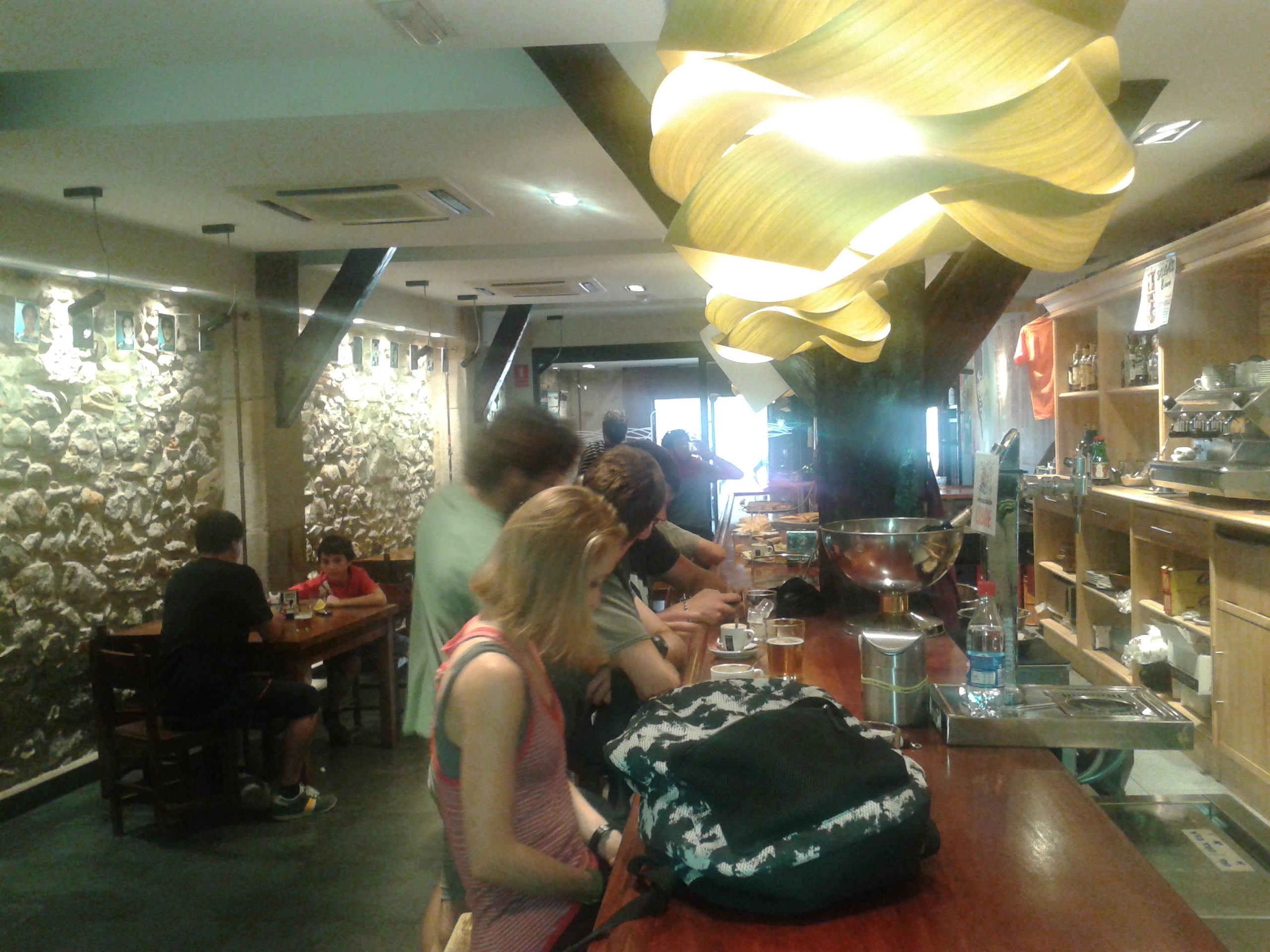
One of the Herriko Tabernak in Bilbo, this one in Errondabide, Casco Viejo; view from the back towards the entrance and street. Photo: D.Breatnach 2015)

          In 2016 the Audencia Nacional, the Spanish National Court, handed down a judgement that the funds of these taverns are forfeit, in what the Abertzale Left party Sortu called “the greatest political and economic plunder since the Civil War”. This is a reference to the wide-scale misappropriation of funds, machinery and land of the losers of that war by the victors, General Franco and his supporters. The wealth of many individuals and families in the Spanish State today can be traced back to that theft.

They will not be served alcohol! Parents often meet at the Herriko for a while after collecting their children from the Basque-language pre-schools.
(Photo: D.Breatnach 2015)

While a number of these taverns were closed down in the past, most kept going, supported by their loyal clientele and local communities. Although the punitive judgement of the Audiencia against the Herrikos was in 2016, its origin dates back further to the reign of one of the Audencia’s ex-judges, Baltazar Garzon, who infamously claimed that every aspect of Basque independent expression was linked to the armed organisation ETA. Baltazar, loved by liberals, claimed that “everything is ETA”, under which dictum homes were raided, activists tortured and jailed on their “confessions”, political organisations banned, social and cultural centres closed, along with newspapers, radio stations and social media.

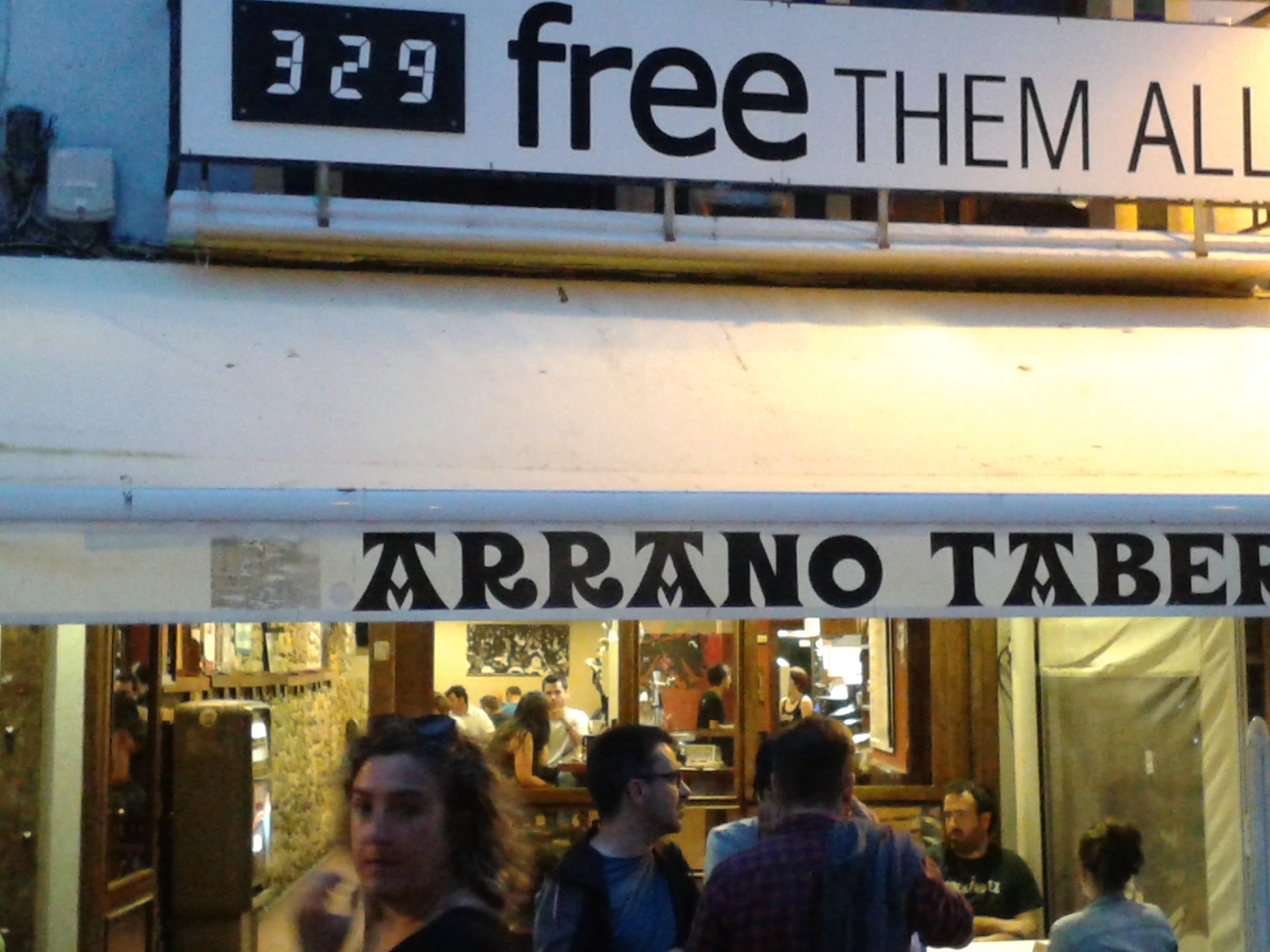
Arrano Herriko Taberna, Zarautz, Gipuzkoa province, southern Basque Country.  Banner above it calls for freeing of the officially-recognised Abertzale Left political prisoners.
(Photo: D.Breatnach, 2018)


Some modest afternoon pintxos available in the Errrondabide Herriko (Photo: D.Breatnach 2015)

EXPROPRIATION TAKES PLACE DURING A MILITARISED LOCKDOWN

          This expropriation is taking place, as commented the left-wing media Izquierda Diario, in the midst of an emergency pandemic lockdown in which more than 7,000 sanctions in little over a month have been applied by the military and police who are in charge of and patrol the streets. (Unlike Ireland and many other countries, people in the Spanish State are not permitted to take exercise outside their homes, whether maintaining social distances or not).

While the judicial apparatus cannot process the massive claims of illegal dismissals, unpaid wages, unpaid ERTEs” (temporary compensation for loss of earnings due to the pandemic) commented the Diario, “or thousands of resources for fines during these days for the restrictions of the pandemic, yes there is time to seize the money of more than 100 taverns.”

COMMENT

Cafe esnea and “Bring the prisoners home” serviettes, Herriko Taberna.
(Photo: D.Breatnach 2015)

          While it is true that in many areas there are privately-owned bars sympathetic to the movement and that also in many areas dissenters from the line of the Abertzale Left official leadership decline to use the Herrikos, nevertheless the disappearance of the latter must entail serious damage to the social and cultural base of the broad Basque independence movement.

end.

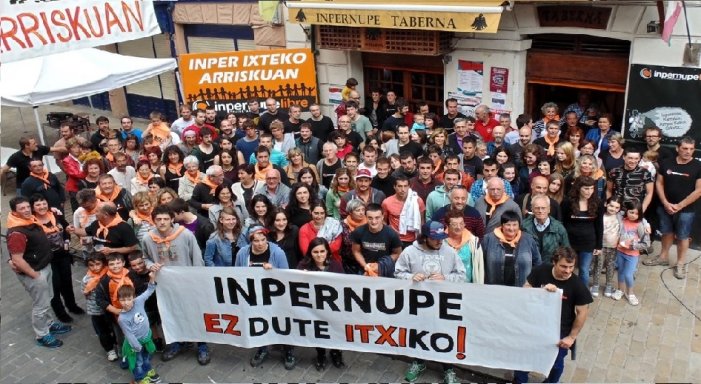
Protest against the original judgement by some supporters of the Herriko Taberna of Inpernupe, Zumaia (scene of some of the Game of Thrones footage), Guipuzkoa Province, Southern Basque Country.  Banner declares “Ipernupe will not close!” while another in background declares it is in danger of closing.
(Source photo: Izquierda Diario)

REFERENCE

http://www.izquierdadiario.es/En-Estado-de-Alarma-la-Audiencia-Nacional-incauta-las-cuentas-de-107-herriko-tabernas

Diarmuid Breatnach Political Agitator Part 1

Mick Healy interviewed me about a number of my experiences in revolutionary work over the years and this is Part 1 (Part 2 will shortly be published), nearly all about some of my three decades in London. It contains a number of errors by me, for example the apartheid rugby team was South Africa’s one which were not called the “All Blacks”, that being New Zealand’s. Also I believe the giant Hunger Strikers solidarity march in London was to Michael Foot’s home, not Tony Benn’s. Still, here it is for what it’s worth with many thanks to Mick.

irishrepublicanmarxisthistoryproject's avataririshrepublicanmarxisthistoryproject

Diarmuid a long time political agitator was active in London from 1967, in interview part one, he talks about his involvement with Marxism-Leninism-Anarchism. His involvement in the Vietnam and Rhodesia solidarity campaigns, Anti-fascist mobilisation, solidarity Ireland, family squatting. In addition the campaign against the Prevention of Terrorism Act and the 1969 Peoples Democracy march from Belfast-Dublin.

View original post

BASQUE TRAWLERS AGAINST A SPANISH BATTLECRUISER

Diarmuid Breatnach

(Reading time: 10 minutes)

The 5th of March is the anniversary of the naval Battle of Cape Machichaco (cabo matxitxakoko borroka, in Euskera/ Basque), which took place on 5 March 1937 off Bermeo (Bizkaia province, Basque Country), during the Spanish Anti-Fascist War, between the Spanish Military-Fascist heavy cruiser Canarias and four Basque Navy trawlers escorting a Republican convoy. The trawlers were protecting the transport ship Galdames, which was sailing to Bilbao with 173 passengers.

Looking from Cabo Matxitxako out to sea and to the French Border dividing the Basque Country.
(Photo: D.Breatnach)

(The following account of the battle is from Wikipedia; the section titles and comment are mine)

          On 4 March, four armed trawlers of the Basque Auxiliary Navy section of the Spanish Republican Navy, Bizcaia, Gipuzkoa, Donostia and Nabarra departed from Bayonne, France. Their intention was to defend Galdames‘s mail, passengers, machinery, weapons, supplies and 500 tons of nickel coins property of the Basque government.

The battlecruiser Canarias.
(Photo source: Internet)

Canarias sailed from Ferrol with Salvador Moreno as the captain, with orders to stop the transport ship. Galdames, which was steaming up with the lights and the radio switched off, and was unknowingly left behind by Bizcaya and Gipuzkoa.

FOUR CONVERTED TRAWLERS AGAINST A BATTLE CRUISER

          Next morning, while all the trawlers were watching for Canarias, Galdames rejoined them. Bizcaya‘s captain was Alejo Bilbao, Nabarra‘s Enrique Moreno Plaza from Murcia, and Gipuzkoa‘s Manuel Galdós. The trawlers had the intention of luring Canarias close to the Biscay coast to have the assistance of the coastal batteries.[

The first trawler to spot Canarias was Gipuzkoa, 30 kilometers (19 mi) north of Bilbao. The Basque trawler was hit on the bridge and the forward gun. Return fire from Gipuzkoa killed one Canarias seaman and wounded another. The armed trawler, with five fatalities and 20 injured aboard, managed to approach the coast, where the shore batteries forced Canarias to retreat.

Nabarra and Donostia tried to prevent Canarias from finding Galdames and engaged the cruiser.

The Nabarra during the Battle of Matxitxako, painting by David Cobb.
(Photo source: Internet)

Donostia withdrew from the battle after being fired on by Canarias, but Nabarra faced the enemy for almost two hours. She was eventually hit in the boiler and came to a stop; 20 men abandoned the sinking trawler, while other 29 were lost with the ship, including her captain, Enrique Moreno Plaza.

The transport Galdames, which was hit by a salvo from Canarias and lost four passengers, was eventually captured by the military-fascist cruiser.

Gipuzkoa arrived at Portugalete seriously damaged and Bizcaia headed for Bermeo, where she assisted the Estonian merchantman Yorbrook with a load including ammunition and 42 Japanese Type 31 75 mm mountain guns, previously captured by Canarias and released.

Port town of Bermeo, seen from Cabo Matxitxako.
(Photo: D.Breatnach)

Donostia sought shelter in a French port.

AFTERMATH

          The 20 survivors from Nabarra were rescued by the military-fascists and taken aboard Canarias. Instead of the expected hostility and mistreatment, they were given medical assistance, and both the cruiser commander, future Francoist Admiral Salvador Moreno and Captain Manuel Calderón interceded with Franco when the Basque seamen were sentenced to death in retaliation for the shooting of two crewmembers of the armed trawler Virgen del Carmen, captured by Republican sympathizers and diverted to Bilbao in December 1936. The survivors were eventually acquitted and released in 1938.

In contrast, one of the passengers aboard Galdames, Christian Democrat politician Manuel Carrasco Formiguera, from Catalonia, was imprisoned and executed on 9 April 1938.

Map/ diagram of the Battle
(Image source: Internet)

PERSONAL COMMENT

COURAGE, COWARDICE AND CRUELTY

           The story is one of incredible bravery of a number of converted trawlers and their Basque crews, in particular that of the Nabarra and her Captain from Murcia. One account I read related that her Captain consulted his crew and they agreed to fight to the death or the sinking of their ship. Their valour and stubbornness (two qualities which commentators often associate with the Basques) was of such magnitude as to impress  even their military-fascist opponents, to the extent of their interceding with Franco to save their lives.

It is also the story of the cowardice of at least the captain of the Donostia.

And of the bestiality of the military-fascists in the execution of a member of the Catalan Government returning to his country with his family, guilty of no crime but to serve his the administration of his elected republican government (one of hundreds of thousands of such crimes of the miiltary-fascists coupists and their victorious regime).

VISIT TO CAPE MATXITXAKO

           I visited the land part of the location on a number of occasions in recent years. Access by public transport is by a bus every hour but I was driven by friends.

Monument to the Battle of Matxitxako by sculptor Nestor Barrentxea, who is from the nearby port town of Bermeo.  (Photo source: Internet)

On a windy promontory on private land I saw one of the shore artillery battery sites (which has had nothing done to conserve it) and, close enough, the monument to the battle. Not far from there is a local bar-restaurant which is popular and a short trip by car, the iconic hermitage of Gastelugatxe.  Many tourists visit the area but I wonder how many get to hear of the story.

Thinking of the determination and courage of those crews, not even trained for war, in converted trawlers, facing a trained naval crew of a huge battle cruiser, I am not ashamed to say my eyes fill and my lip trembles.

Aerial view of the Matxitxako Cape. (I took my two photos from beside the building furthest to the right).
(Photo source: Internet)


end.

A LIFE CELEBRATED – SOCIALIST, REPUBLICAN, TRADE UNION ACTIVIST

Diarmuid Breatnach

(Reading time: 10 minutes)

A packed function room at Club an Múinteoirí (Teachers’ Club) in Dublin last night heard speakers, including Arthur Scargill and the Cuban Ambassador, praise some of the highlights of the life of irish activist Des Bonass (died 26 September last year). The meeting was chaired by Colm Kinsella of Unite.

          Strangely, up to yesterday afternoon, many socialist, Republican and trade union activists seemed unaware of the event, organised by Bonass’ branch of the trade union Unite. I only learned of it myself when Arthur Scargill and Nell Myles stopped at our weekly Save Moore Street From Demolition campaign stall earlier in the day and explained that he was in Dublin in order to speak at an event that evening.

Section of capacity crowd at event
(Photo: Labhrain Ní Dhúgáin)

The event was scheduled to begin at 7.30pm but by that time there were less than a dozen people present, arousing fear in some quarters that the attendance would be poor. As time went on, the side room leading off the main room was closed and the chairs removed. Some more people arrived and then as if by magic by 8.30 the room was packed, with extra seating being made available for people who arrived even after that.

IRISH TRADE UNIONISTS AND CUBAN AMBASSADOR

          John Douglas (former General Secretary of the Irish Congress of Trade Unions, currently General Secretary of Mandate trade union) spoke of how he had come to know Des Bonass when Douglas was a member of the Amalgamated Transport & General Workers’ Union (now part of UNITE), a section catering for bar workers which at the time represented a great many in the trade. He related how the bar workers would come off late shift and go to a union meeting around midnight, a meeting that sometimes would not finish until five a.m! Bonass had asked Douglas for a space to address the union members in support of the British miners, after which he had come away with buckets overflowing with financial contributions from the barmen.

John Douglas of MANDATE speaking.
(Photo: Labhrain Ní Dhúgáin)

Douglas also related that Bonass was in support of women’s right to choose abortion at a time when that would not have received popular support in Ireland and went on to speak about the strike against TESCO and how Bonass had brought Scargill to a number of picket lines around the city, raising their morale and drawing media attention.

Des Derwin (Executive Member of Dublin Council of Trade Unions and Vice-Chair of SIPTU Dublin District Council) gave what seemed a comprehensive list of the activities of Des Bonass down through the years, including how he had actively supported the struggles in the H-Blocks in the Six Counties and of the Palestinian people, as well as the struggle of the Dunne’s Stores strikers. Unknown to many, perhaps, Bonass had been a founder of People Before Profit and the Unemployed Workers’ Movement.

Des Derwin of SIPTU and DCTU.
(Photo: Labhrain Ní Dhúgáin)

When the Irish Labour Party conference had voted to go into coalition government, Bonass and Matt Merrigan had walked out together, after they had seen Noel Browne leave the room. The media thought Bonass and Merrigan had led a protest walkout, whereas they said they had followed Noel Browne. When Brown appeared in the lobby, the reporters asked him why he had led the walkout, which he adamantly denied, saying he had only left the conference to go to the toilet!

Subsequently Bonass and Merrigan had founded the Irish branch of the Socialist Labour Party. The Dublin Council of Irish Trade Unions had been another of his areas of activity and Bonass had been President of the organisation; he had also been active in Unite the union.

Also a supporter of internationalist causes, Bonass had been against such as the Chilean coup, for Nicaragua and Cuba, against the South African Apartheid regime and the invasion of Iraq.

Cuban Ambassador speaking at event.
(Photo: Labhrain Ní Dhúgáin)

          Hugo René Milanés, Cuban Ambassador to Ireland, expressed his gratitude to Des Bonass for the latter’s support for Cuba and in particular “against the Yanqui blockade” and for working for socialism throughout his life.

SCARGILL, BRITISH TRADE UNIONIST

          Arthur Scargill, ex-President of National Union of Mineworkers (Britain) spoke about Des Bonass’ support for the NUM, particularly those of South Wales, when they were in the big strike of 1984-’85 and how Bonass had agreed to receive money from the NUM to keep it safe from the British State’s sequestration. At first, the money had been couriered by Nell Myles, an NUM official (who was present at the meeting) and delivered to the ATGWU office in Parnell Square; on one occasion she had been mugged on her way but the money stolen was her personal money and not the union funds, which were safely delivered. Six months later, Scargill himself came to Dublin and Des Bonass accompanied him to a Dublin branch of a bank with a holdall stuffed full of a lot more money but the alarmed branch manager referred them to the bank’s head office, where the money was safely stored.

Scargill speaking
(Photo: Labhrain Ní Dhúgáin)

Des Bonass brought Arthur Scargill around to many Dublin pickets during the TESCO strike organised by the MANDATE union, which had been welcomed by the strikers and which had lifted their spirits. He had been happy to attend, Scargill said and related a journalist asking him about his reaction to a bomb threat against TESCO. To laughter and applause from the meeting’s audience, Scargill related his response to the journalist, that neither he nor the TESCO strikers could have anything to with any such bomb inside as they would never cross a picket line! Des Bonass had also got Scargill a spot on the popular Gay Byrne show, where he had been confronted with a Margaret Thatcher impersonator.

Bonass had been a founder of the Irish branch of the Socialist Labour Party which Scargill had founded in Britain as founded by James Connolly.

Paying tribute to the moral and practical support of the Irish people for the NUM’s struggle, Scargill said that their support in ratio to union members in Ireland had been the highest of all and went on to reveal that he and Nell both had Irish ancestry on both parental sides, referring also to the history of oppression of Irish people by the British State. Scargill talked about the financial contributions but also how Irish families had taken in miner’s children for holiday breaks, as British trade unionists had wanted to take in Irish children during the 1913 Lockout.

Later on in his speech, Scargill declared himself a firm follower of the “11th Commandment: Thou shalt not cross a picket line!” (loud applause) and went on to talk about the determination of the Thatcher Government to break the NUM and its leadership. Thatcher and Government personnel had claimed at the time that they had not intervened in the strike, which was allegedly between the NUM and the National Coal Board but Scargill stated that was a lie and the truth had emerged in documentation over the years, available on the Internet to anyone who wished to check it. “Unjust laws have to be broken” he said also because “if we hadn’t done that, women would not have the vote; we would not have trade unions!” He paid tribute to the Levellers, the Tolpuddle Martyrs and the Suffragettes.

Scargill emphasised that the best way to celebrate the life of Des Bonass and to honour his memory is to continue the struggle for the principles that Des Bonass upheld, then finished his speech to a standing ovation from those present.

Scargill and myself after the formal part of the evening.
(Photo: Labhrain Ní Dhúgáin)

Colm Kinsella then welcomed the last speaker, Ciarán Bonass. Ciarán announced that he was the son of Des Bonass and talked about what the family had learned from his father as they had also supported him in his activism. Thanking all the speakers and all others present on his family’s behalf, his mother Eileen and sisters Mairéad and Deirdre, along with in-laws and grandchildren, he ended his contribution to loud applause from the attendance.

Colm Kinsella announced that their branch of Unite was now named “the Des Bonass Branch of Unite” in Des Bonass’ honour, thanked all the speakers and the attendance and invited people to partake of refreshments while listening to labour and other songs performed by Richie Brown (of Unite) and friends.

End.

Des Bonass at European Day of Action Against Cuts protest 2010 (Photo: Paula Geraghty in Indymedia)

HAS FERRITER BEEN READING REBEL BREEZE?

Diarmuid Breatnach

(Reading time: 2 minutes)

On 15 February Ferriter’s column in the Irish Times expressed the opinion that comparison of Sinn Féin with Fianna Fáil in the 1930s only takes us so far. After looking at less of the overall history of the main Irish parties than I had in my article of 11 February in Rebel Breeze but adding some pieces I had not, what was his conclusion that differed so widely from mine? Well, that the military past was too new with SF!

Diarmaid Ferriter in Thinker pose
(Source: Internet)

But, actually, not true of Provisional SF with regard to FF, which came into government in 1932, less than two decades after the end of the Civil War and only six years after its split from Sinn Féin. De Valera, President of Fianna Fáil, had been a leader of the Republican side in the Civil War, from which side came the majority of Fianna Fáil’s supporters. By the time PSF gets into Government, it will be LONGER than two decades since Provisional IRA gave up its armed struggle!

On 11 February I posted an article of mine on Rebel Breeze and from there on to Facebook, making the point that, despite hostile media and politician claims to the contrary, Sinn Féin is very like the main Irish political parties – and that that is not a good thing. I traced the main elements of the parties’ history, how they had changed their positions and I elaborated the point that the main difference in their trajectories is that SF’s arrival on the neo-colonial capitalist political field was just more recent.

Meeting of Provisional Sinn Féin’s Ard-Choiste (national executive) in February 2020.
(Source photo: Niall Carson, AP, Internet)

It is worth noting (a point I had omitted in my piece) that nearly the entire Fianna Fáil government Cabinet in 1932 was composed of Civil War IRA men and that most of the remainder had been in Free State prison during that war.

It is said that imitation is the sincerest form of flattery but I can easily avoid being pleased by Ferriter substantially following my line of historical analysis. This is the man who, during the 2016 High Court hearing about the Government and property speculator plans for Moore Street, wrote a nasty attack on the demonstrators who had occupied the buildings and subsequently blockaded them against demolition. If he had been hoping to influence the High Court’s decision he failed – and spectacularly, because the judgement was that not only the buildings but the whole quarter is a 1916 historical monument.

Frank McDonald had also written an opinion piece during the trial against conservation and the demonstrators in the same newspaper (what WAS the Irish Times up to?) but after the judgement, he had the grace to apologise (sort of: he wrote that he had been in error).

But Ferriter? Nary a word.

End.

REFERENCES:

Piece by D. Breatnach in Rebel Breeze: https://rebelbreeze.wordpress.com/2020/02/11/despite-hostile-propaganda-sinn-fein-is-just-another-irish-political-party/

Piece by D. Ferriter in the Irish Times: https://www.irishtimes.com/opinion/diarmaid-ferriter-fianna-f%C3%A1il-s-trajectory-holds-lessons-for-sinn-f%C3%A9in-1.4173709?


FLAGS OF THE RISING OVER THE CITY CENTRE AND IN MOORE STREET

Diarmuid Breatnach

(Reading time: 7 minutes)

The Save Moore Street From Demolition group runs a campaign stall every Saturday on Moore Street; it was founded in September 2014 and is independent of any political party or organisation. In addition to the banner announcing its nature and purpose, the group displays four flags every week. Three of those are copies of flags that were flown during the 1916 Rising and all them in locations close by Moore Street, each also with a very strong migrant connection – all three also survived the conflagration resulting from British artillery bombardment.

The Irish Republic flag, made by Constance Markievicz (born in England), flew at the Princes Street front corner of the GPO, 1916. (Photo source: Internet)

1) The “Irish Republic” flag was made from drape material by Constance Markievicz (born in England) and was flown on top of the GPO at the Princes Street corner. She was a member of the Irish Citizen Army (see (3)) and third-in-command at the Stephens Green/ College of Surgeons garrison during the Rising.

Volunteer Markievicz was sentenced to death after the Surrender but her sentence was commuted to imprisonment. In the UK General Election of 1918, Markievicz was elected as a part of the Sinn Féin coalition on an abstentionist policy and became the first woman elected to Westminster, though she did not take her seat. In the later banned First Dáil of 1919, Markievicz was elected the first Minister of Labour in world history and one of very few female cabinet ministers of her time.

2) The Tricolour was also hoisted on the GPO but at the Henry Street corner by Eamon Bulfin, born and raised in Argentina. In addition, the Tricolour, based on the pattern of the French Republican Tricolour but signifying unity for Irish freedom between descendants of the native Irish on the one hand with descendants of English and Scottish colonists on the other, had been presented to the Young Irelanders by French revolutionary women in Paris, in 1848.

The Irish tricolour flag, granted to Irish revolutionaries by women in revolutionary Paris, 1848. The Irish Republic flag at the Princes Street front corner of the GPO, 1916. It was raised by Eamon Bulfin from Argentina and flew on the front Henry Street corner of the GPO. (Photo source: Internet)

Volunteer Bulfin was part of the Moore Street/ GPO Garrison surrender, was taken prisoner and later deported by the British back to Argentina. While there, Bulfin became the Latin American publicity correspondent for the Irish Republican movement, later returning to Ireland to participate in the War of Independence (1919-1921).

3) James Connolly, born and raised in Edinburgh but Commandant of the 1916 Rising, sent ICA men to hoist the Starry Plough, flag of the Irish Citizen Army, on top of Clery’s building, across from the GPO. The design is based on the star constellation of Ursa Mayor, the Great Bear, which in Ireland is known as “The Plough” and therefore an instrument or tool of labour. The original design in gold on a green background, with the seven stars in silver, includes the cutting tool, the share, in the shape of a sword; this is apparently an anti-war message, evoking the King James Bible passage in Isaiah II: “They shall beat their swords into ploughshares, and their spears into pruning-hooks; nation shall not lift up sword against nation, neither shall they learn war any more.” The 1916 Rising was the first rising against the imperialist First World War, preceding the next (in Russia) by nearly a year.

Design of the Starry Plough flag of the Irish Citizen Army, erected on top of Clery’s during the 1916 Rising on the orders of James Connolly, born and raised in Edinburgh and Commander-in-Chief of the Rising.
The Irish Republic flag at the Princes Street front corner of the GPO, 1916.
(Photo source: Internet)

The Irish Citizen Army included women in its membership and they fought alongside male members during the Rising, some of them as officers; Volunteer Winifred Carney entered the GPO with a Webley pistol in one hand and an Olivetti typewriter in the other and was in Moore Street at the surrender. A number of male ICA members fought in Moore Street and at least one was killed there.

During the Surrender, James Connolly, with a shattered ankle and gangrene, was carried from Moore Street to Dublin Castle where he received medical treatment, was tried by court martial and sentenced to death. Connolly was one of the last of the 14 executed in Dublin, shot in Kilmainham Jail while strapped to a chair on 12th May 1916.

4) The Cumann na mBan flag with its lovely colours and design was not seen during the Rising, although many of that organisation participated in the Rising, two of them in Moore Street to the end: Volunteers Elizabeth O’Farrell and Julia Grennan. Cumann na mBan was the first revolutionary female organisation in world history to have its own uniform, under its own officers, while participating in an uprising.

As always you can support the campaign by sharing their Facebook posts from time to time.

The Cumann na mBan flag was not flown during the 1916 Rising, though many of the organisation participated in it.
(Photo source: Internet)
People signing petition and talking to some of the activists at the SMSFD stall in January this year.  The Cumann na mBan flag is draped over the table.
(Photo source: Bart Hoppenbrouwers, SMSFD)

USEFUL LINKS:

https://www.facebook.com/save.moore.st.from.demolition/

https://www.facebook.com/groups/757869557584223/

https://www.facebook.com/SaveMooreStreet2016/