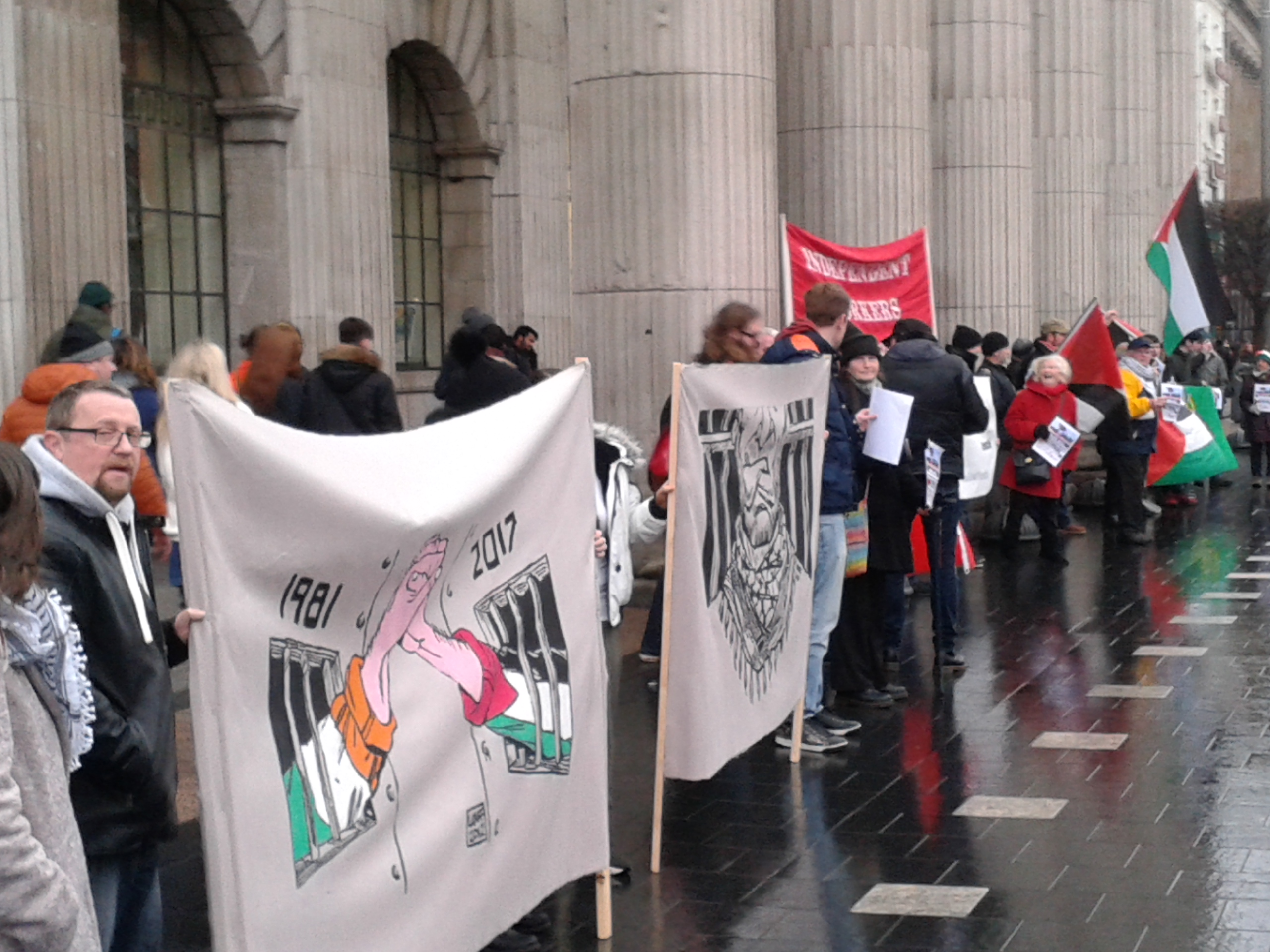
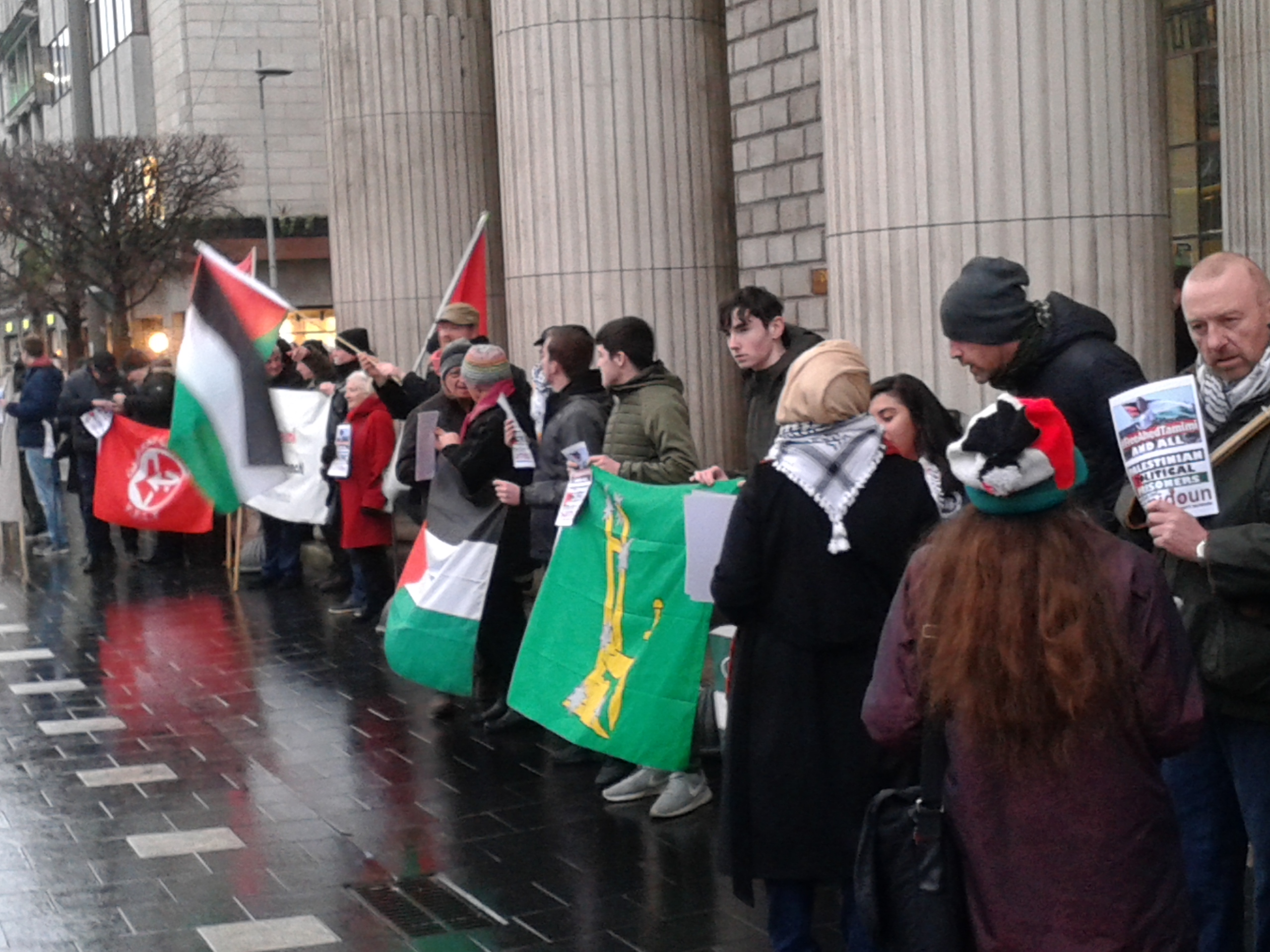
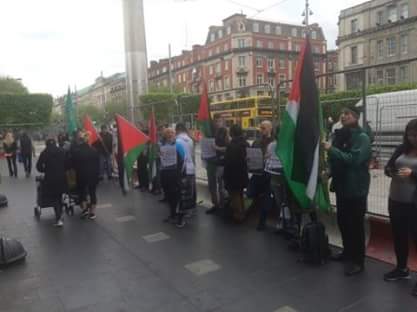
A wet Saturday afternoon saw a large crowd attend a protest picket organised by the Anti-Imperialist Action organisation; it was in specific solidarity with Palestinian Teenager Ehed Tamimi, jailed in December last year by the Israeli Zionist occupation — but also with all Palestinian political prisoners.
Ehed Tamimi solidarity protesters outside the GPO building, Dublin city centre (Photo: D.Breatnach)
Ehed Tamimi lives in Nabi Saleh, a West Bank village approximately 20 kilometres northwest from Ramallah. ADecember protest against further expansion of illegal Zionist settlement near Ehed’s home village attracted the Israeli Army who seriously injured a Palestinian, Ehed’s cousin Fadl al-Tamimi, by firing a rubber-coated steel bullet at close range into his face. Three female members of the Tamimi family, including Ehed, though unarmed, attacked the soldiers. After video of the incident circulated widely, the Israeli occupation force raided the Tamimi household and arrested Ehed. She was held without charge for thirteen days and then charged, along with her mother, with assault, incitement to violence and throwing stones. She remains in custody awaiting trial.
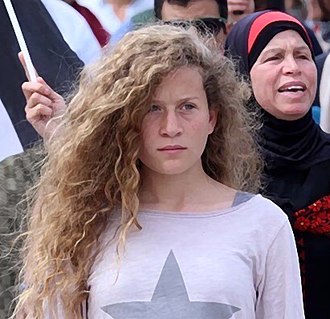
Photo of Ehed Tamimi taken on demonstration in 2016. (Source: Wikipedia)
The detention of Ehed, a minor in law, by the Israeli state violates a number of articles of the UN Convention on the Rights of the Child, including the right to remain with her family.
In past protests at her village, half the number of residents had been injured over a number of years and two killed by Israeli soldiers, including a member of the extended Tamimi family.
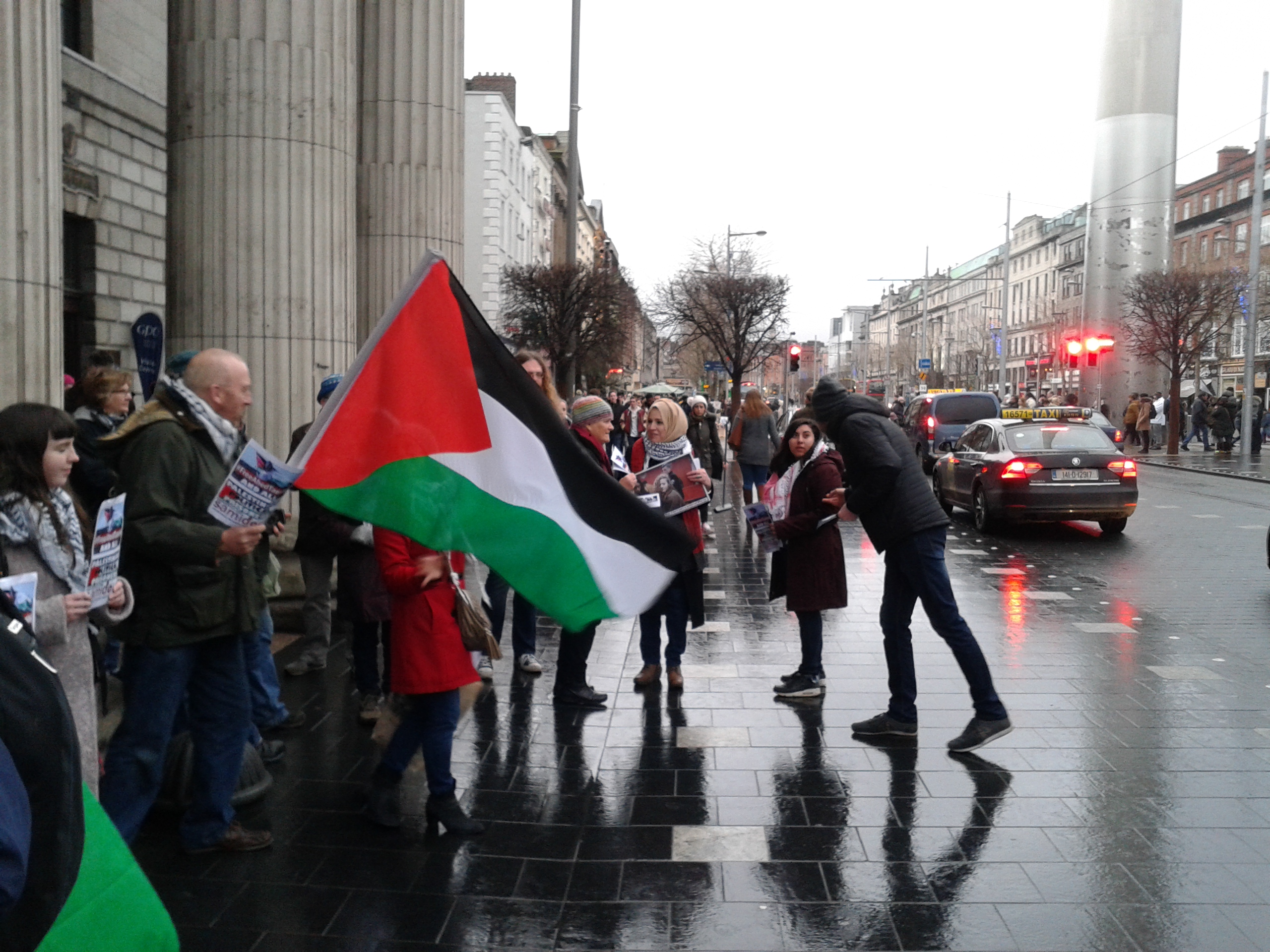
Photo of section of solidarity protest showing (centre photo, background) Fatin Tamimi, relative of Ehed and Chairperson of the IPSC. (Photo: D.Breatnach)
Born into an activist family, Ehed Tamimi is 17 years of age and has been in struggle against the Israeli Occupation Force more or less since she was she was able to walk. According to the British newspaper The Guardian, Ahed’s siblings—Waed, Mohammed, and Salem—and parents “have known only a life of checkpoints, identity papers, detentions, house demolitions, intimidation, humiliation and violence; she is part of the second generation of Palestinians to live under the occupation.”
Ahed gained international fame through being photographed or filmed confronting Israeli soldiers, her courage remarkable and pale features and long blond hair making her stand out among protesters. The first of these occasions to reach an international audience was when she was 11 years of age, in August of 2012 as she tried to prevent the arrest of her mother and later that year, waving her fist at an Israeli soldier twice her size as he arrested her older brother.
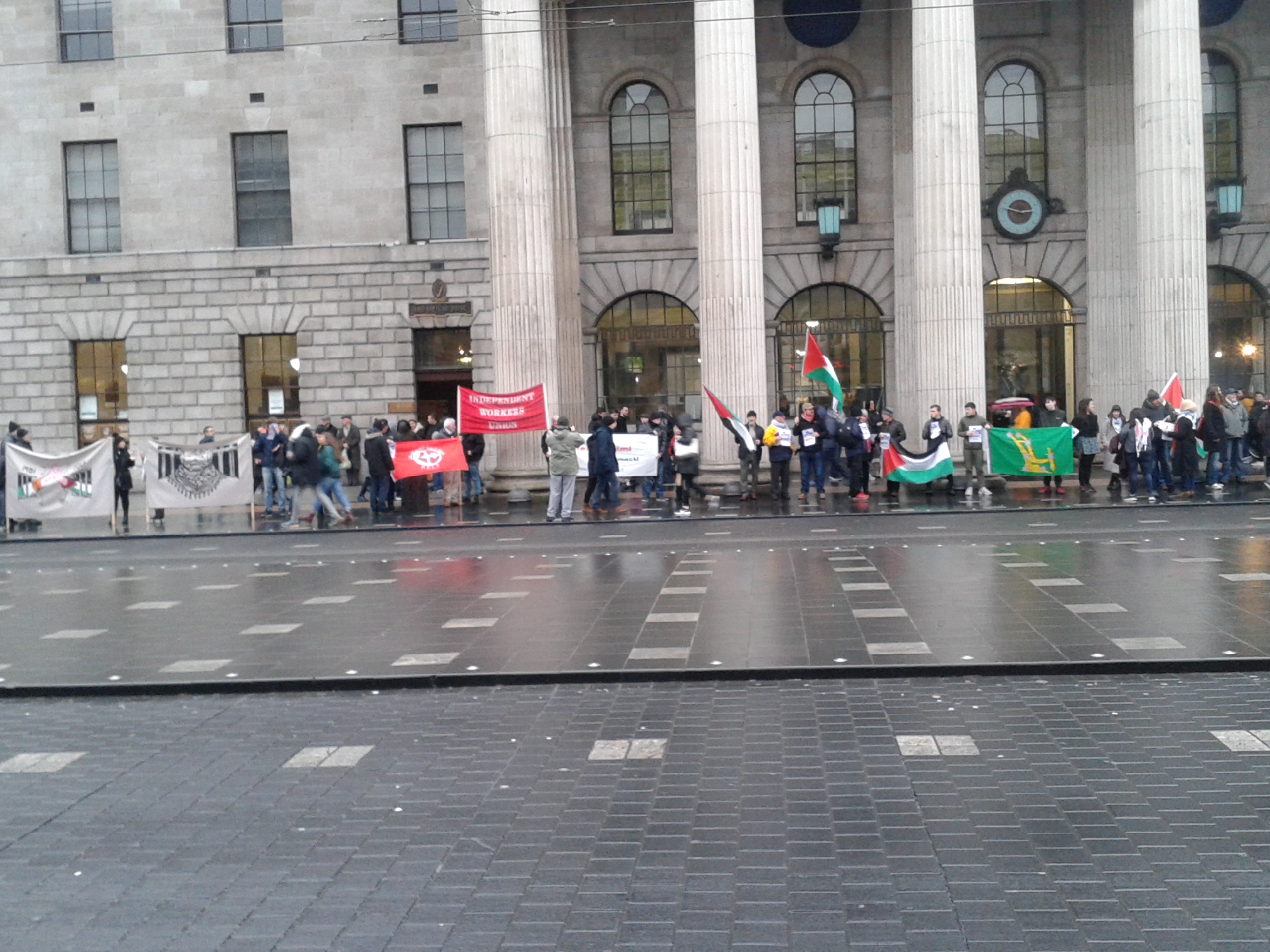
Photo from east side of O’Connell St. (Photo: D.Breatnach)
WIDE SUPPORT FOR PICKET
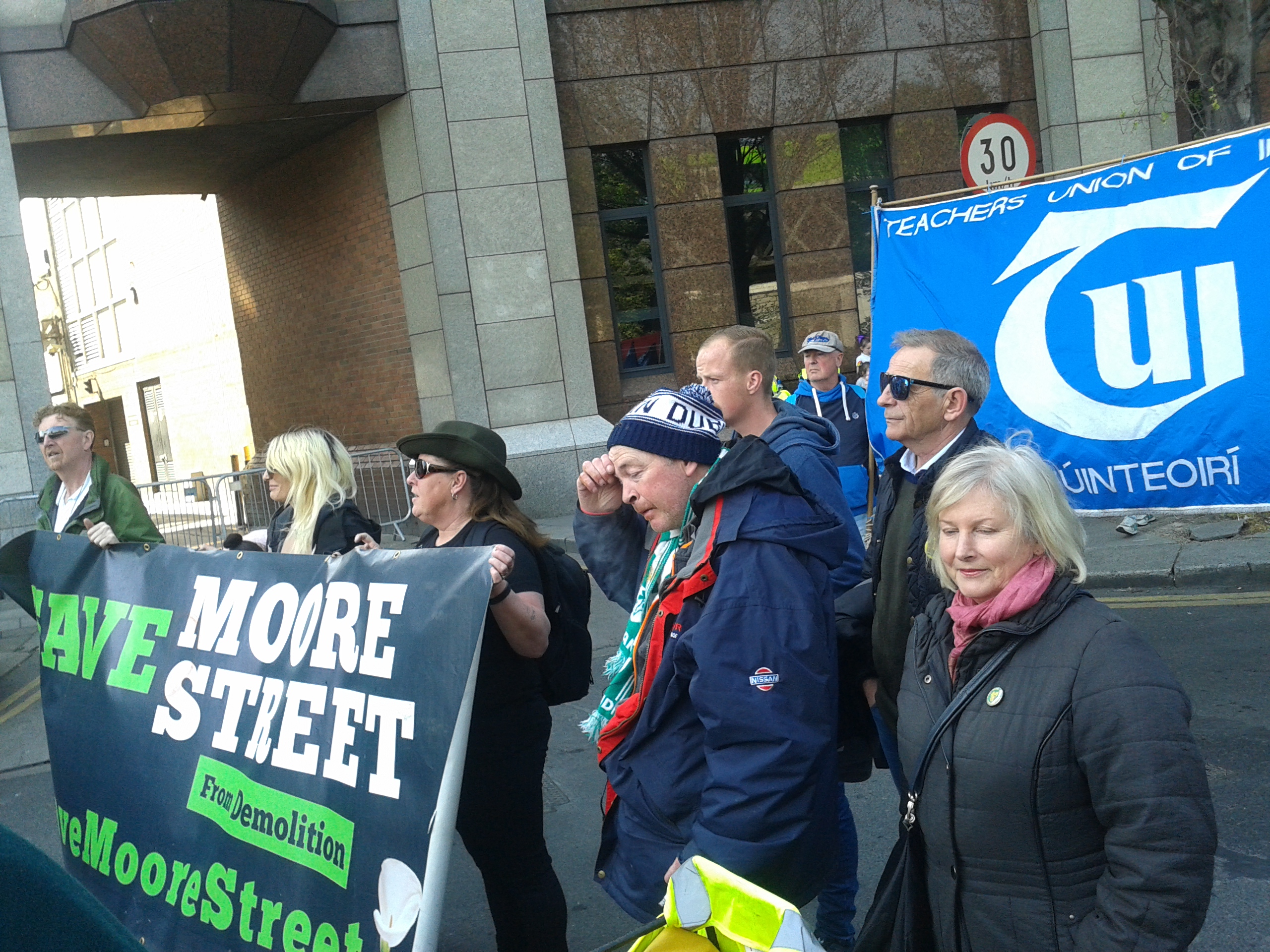
The Dublin picket on Saturday attracted the support of a wide section of the Republican and Socialist Left: the Independent Workers’ Union banner was in evidence as were a number of painted banners previously seen on pickets by the Dublin Anti-Internment Committee, along with independent Irish Republican activists. Fatin al-Tamimi, Chairperson of the Ireland Palestine Solidarity Committee and a number of that organisation’s activists were also present, some distributing IPSC leaflets, as were a number of activists associated with campaigns against the Water Charge, against the demolition of Moore Street and in support of ending homelessness. Fatin al-Tamimi, who although bearing the same family name is not related to Ehed’s family, will not in future be permitted by the Israeli state to visit her relatives (see item on Israel’s public blacklist below).
Section of protest (Fatin Tamimi, Chairperson of IPSC, can be seen centre right of photo with back to photographer. (Photo: D.Breatnach)
Among the passing shoppers and tourists a number indicated their support for the picket, many taking photos and some asking to be photographed among the protesters. Drivers of a number of passing vehicles also tooted their horns in support.
RELATED: ISRAEL PUBLISHES BLACKLIST OF PALESTINIAN SOLIDARITY ACTIVISTS ABROAD
The Israeli Government consolidated its secret blacklist of people to be barred from entry to territory controlled by the State into list of organisations which it made public on 6th January 2018. The Ireland Palestine Solidarity Committee was named as one of the 20 organisations, the leaders and activists of which will not be permitted entry to Israeli-controlled territory. The move was widely interpreted as a reaction to the increasing effectiveness of the Boycott, Divestment and Sanctions movement against the State and its anti-Palestinian policies. The publication was also seen by many as marking its further alienation from much of the rest of the world even as the USA, in President Trump’s order to relocate the US Embassy to the city, publicly endorsed the previous Israeli completion of its seizure of Jerusalem in June 1967 and its ongoing Israelisation and de-Palestination of the city.
Most of the organisations on the blacklist are European but a number are US-based. “The American Friends Service Committee, a Quaker organization honored with the 1947 Nobel Peace Prize for assisting and rescuing victims of the Nazis, is among the list of groups whose activists Israel has announced it will bar from entering the Jewish State. On Saturday it was revealed that the left-wing organization Jewish Voice for Peace was on the list.” Also on the list is the BDS South Africa organisation.
Let us suppose that the Minister of Justice of an Irish Government held a conference with representatives of the Gardaí, the Army and the judiciary. As a result of the conference the Government created a strike force and issued a 180-page report in which the main tendency was the need to eliminate an organisation called the Irish Resistance Movement.
The mass media hails this Report and highlights the danger of the IRM.
However, Left and alternative political activists have never heard of this IRM before but we find that a Traveller activist is named as the spokesperson, Irish socialist and republican organizations are listed as belonging to it, in addition to campaigns against homelessness, the Water Charge and some smaller ones for political prisoners, human rights, civil rights etc. Some of the names of independent political activists also appear on the list.
As proof of the existence of the IRM and who belongs to it, the report shows a crowd demanding the exoneration of the Jobstown defendants, which includes a person whom a large force of police later killed in an attack on himself and a few comrades. A number of ongoing trials still not concluded are also added for good measure.
Then, the Report also claims that the “IRM” contains internationalist solidarity organisations in solidarity with the Kurds fighting ISIS and with the Palestinians and is receiving arms training from ETA.
And the “IRM” is linked to a number of demonstrations which have shut down the centre of Dublin in protest against austerity measures, protest occupations of buildings, etc.
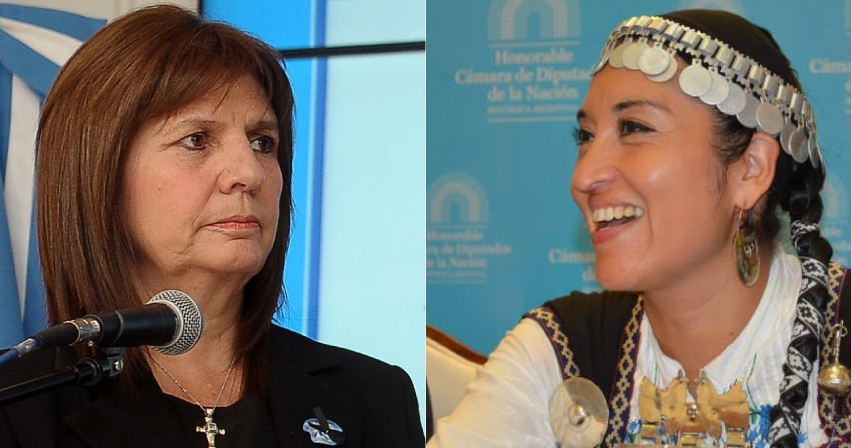
L-R: Minister of Security Patricia Bulrich and Mapuche historian and activist Moira Millán (photos: Internet)
What would we think?
We would probably conclude that the Government was preparing the ground for a massive attack on our organisations of resistance and on the right to protest.
If in addition to the publication of the Report, the Traveller’s spokesperson, which the Minister of Justice claims to be a spokesperson for “IRM”, two months ago had a the body of a mutilated vixen left on her doorstep, we might also think that the Government might be setting her up to be killed.
Demonstration in Argentina in protest at arrest and subsequent disappearance of Mapuche solidarity activist Santiago Maldonado on 1st August 2017. (Photo source: Latin American Media)
The preceding is an approximation of what is currently going on in Argentina. On December 29th 2017 Patricia Bulrich, Minister for Security of the Nation of the Cambiemos coalition Government of Argentina held such a conference with provincial security executives and issued a 180-page report on the danger of “RAM” (“Ancestral Mapuche Resistance”). This organisation has never before been heard of but Bulrich claimed in the Report and in a televised press conference that it is coordinating the activity of a huge number of organisations and is creating a great terrorist threat to the State.
“Resistance is not Terrorism! Freedom for all the Mapuche political prisoners”! (Photo of poster from Anarkismo.net)
Linked to “RAM” she gave a long list of organisations including those of original people and resistance in the areas of trade union, community, socialist and anarchist activity. Support for the Kurds was listed as evidence against some anarchist organisations and other organisations were alleged to be funding and publicising “RAM” while the Colombian FARC was alleged to be giving them military training.
Mapuche demonstration Patagonia January 2017 (Photo: Latin America Media)
The “RAM” may be a fake organisation but the State terror threatened is real.
The Minister publicly named Moira Millan, a Native People activist of the Mapuche, as the spokesperson of this “RAM”. This in the context of the recent killing of one Mapuche activist and the disappearance of Mapuche solidarity activist Santiago Maldonado in August 2017, which events led to demonstrations of Mapuche protest. Santiago was later found dead.
Millán lives in Patagonia, is a mother and in fact a member of two Mapuche organisations: The March of Native Women for Holistic Living and the Pillan Mahuiza Community. She writes and lectures on the history of the Mapuche, organises meetings in particular of Native women, gives traditional cooking classes, and speaks publicly on the rights of the Mapuche people. Millán has never been charged with any illegal let alone armed activity but last October, the mutilated body of a vixen was left on her doorstep. The message is both an insult — vixen in Spanish is “zorra” and is used as a moral and gender insult, particularly by the Right against female Left activists – as well as a death threat, i.e that her body will be next.
Millán’s reaction to the release of the Report and Bulrich’s press conference was quick and scathing:
“Yesterday, while I thanked the children who voted that the library of School No. 8 Luis Bernet of Parque Chacabuco should bear my name, the Minister of Security, Mrs. Patricia Bullrich, mentions me in her absurd and ridiculous report as the main spokesperson for RAM”, she said, adding that “the lady Minister – Bullrich — continues with her delirium tremens, inventing terrorists where there are none”.
“In her fevered dreams she sees herself, hooded, like the Ku Klux Klan, hunting Mapuches, assisted by the insipid and mediocre Governors of the South,” said Millán.
“Lie, lie but something will remain … ‘The lie has short legs’, says the popular saying: Are you coming for me, Mrs. Bullrich? Why are you afraid of us so much?” asked the Mapuche campaigner.
“Here I am, holding my truth as a weapon, and the wisdom of the Mapu as a shield; they have initiated ‘the hunger games’ and you believe that your government will win; make no mistake, we belong to a people that has been invaded, but never defeated”, concluded Millán.
(See further down for a way to take a few minutes to help)
Those who wish to express their concern at this demonisation of resistance, the killing of Santiago Maldonado and to lift the threat of incarceration or death on Moira Millan may wish to write to their local Argentinian Embassy, which is obliged to relate information back from their host countries on attitudes to Argentina.
Embassy of Argentina Dublin: 5 Ailesbury Drive Ballsbridge Dublin 4 Ireland
Minister of Security of the Nation of Argentina is currently blocked (for some reason). The Minister of Justice may be accessed through the Department’s page (see link), then use their email contact system: http://www.jus.gob.ar/contacto.aspx
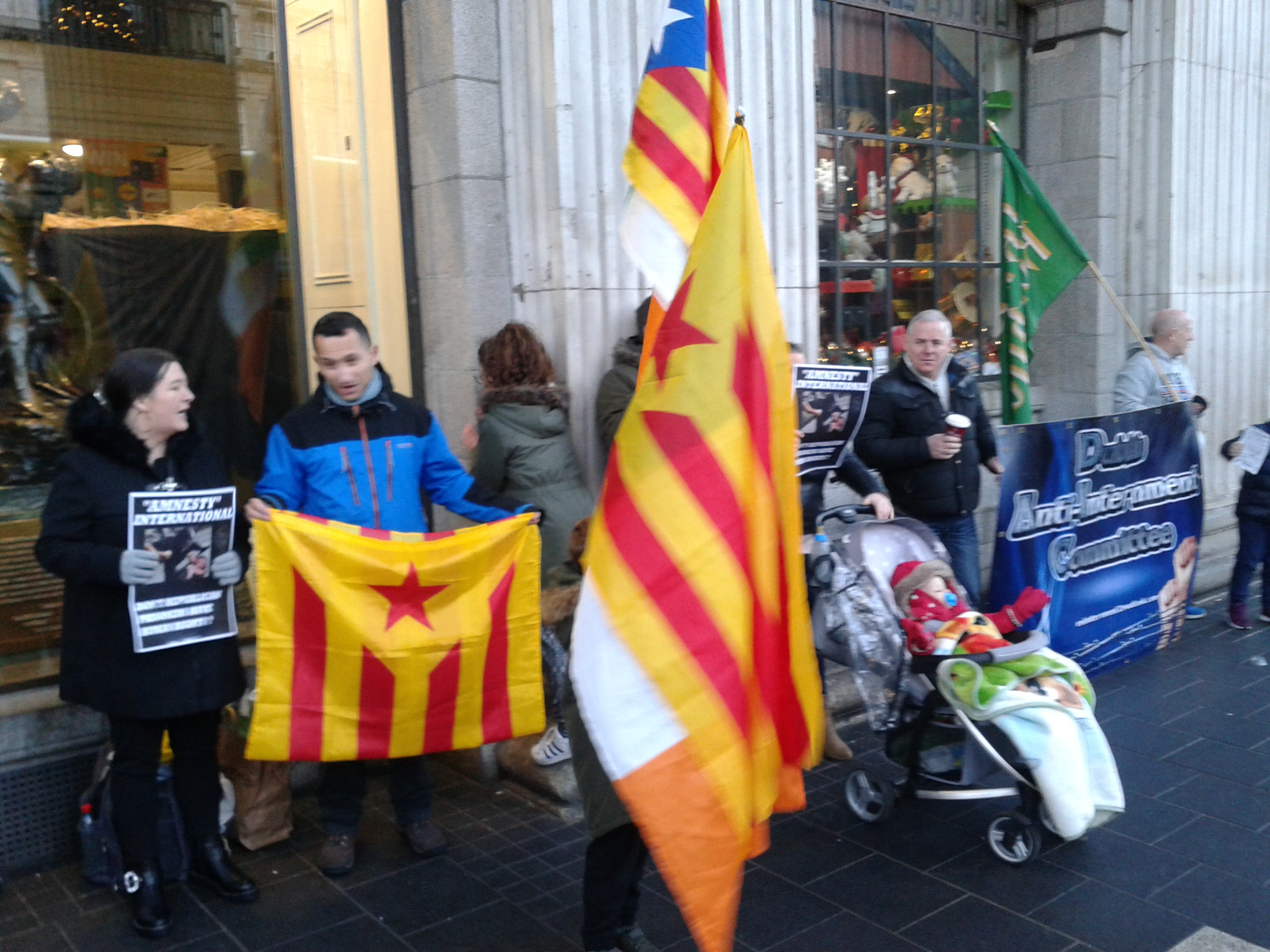
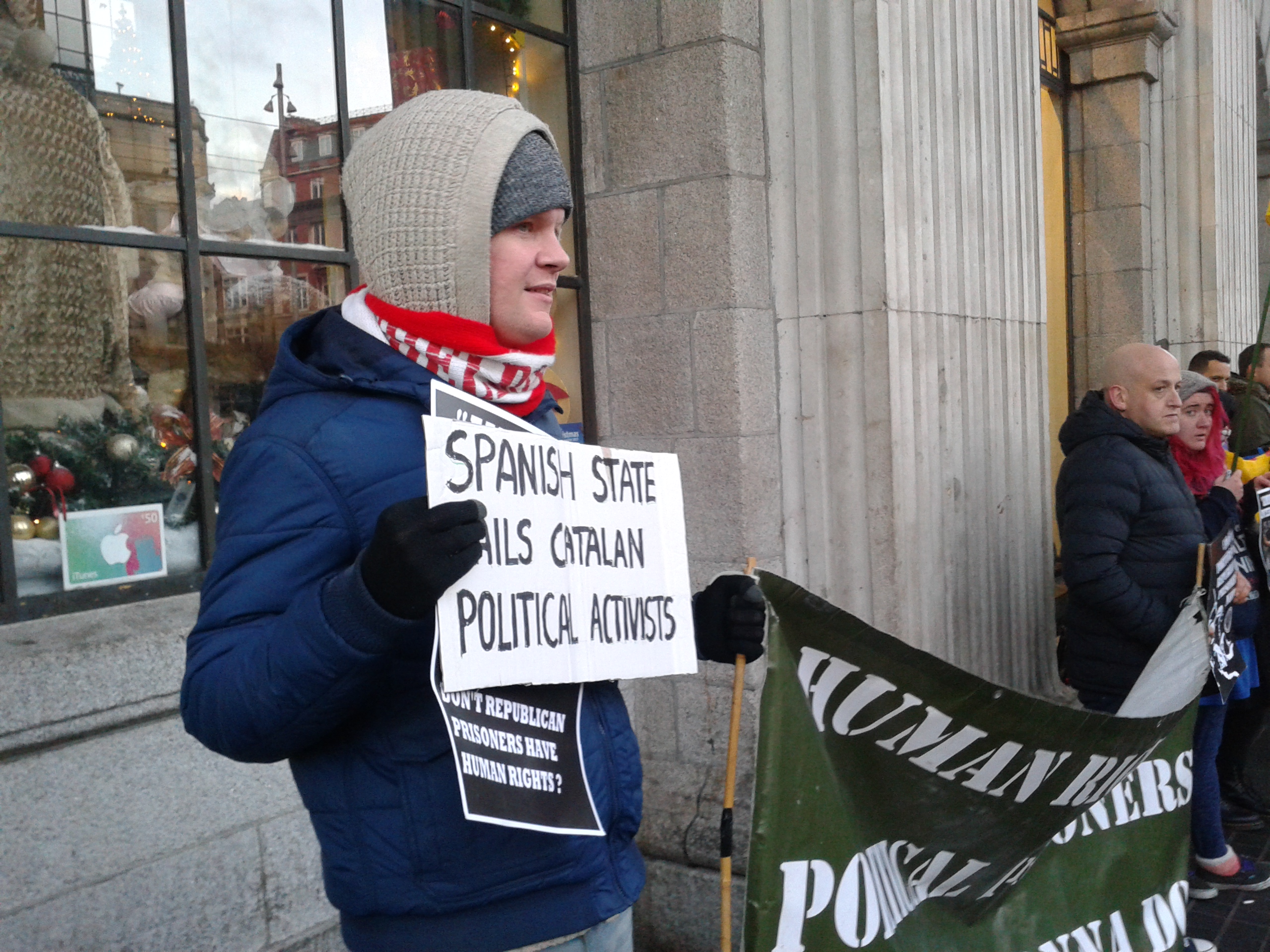
Catalan Esteladas flew next to Irish Tricolours at the GPO in Dublin on Saturday afternoon (25 November 2017). The occasion was a picket organised by the Dublin Anti-Internment Committee to protest the internment without trial of Irish Republicans and also of Catalan political activists for independence. Placards raised the issue of internment of Irish Republicans and their treatment once in jail, as well as criticising the lack of action of Amnesty International on this question. Some placards also declared that the “Spanish State jails Catalan political activists”.
Mix of Irish and Catalan flags outside the GPO building, O’Connell Street, Dublin (Photo: D.Breatnach)
Despite the seriousness of the issue and the bitter cold, the mood was upbeat, assisted by a music player broadcasting a range of songs, from Sifre’s “Something Inside So Strong”, through Warshaw’s “The Cry of the Morning” (sung by Christy Moore) to “Els Segadors”. Some protesters sang along to the songs and passers-by could be heard joining in too.
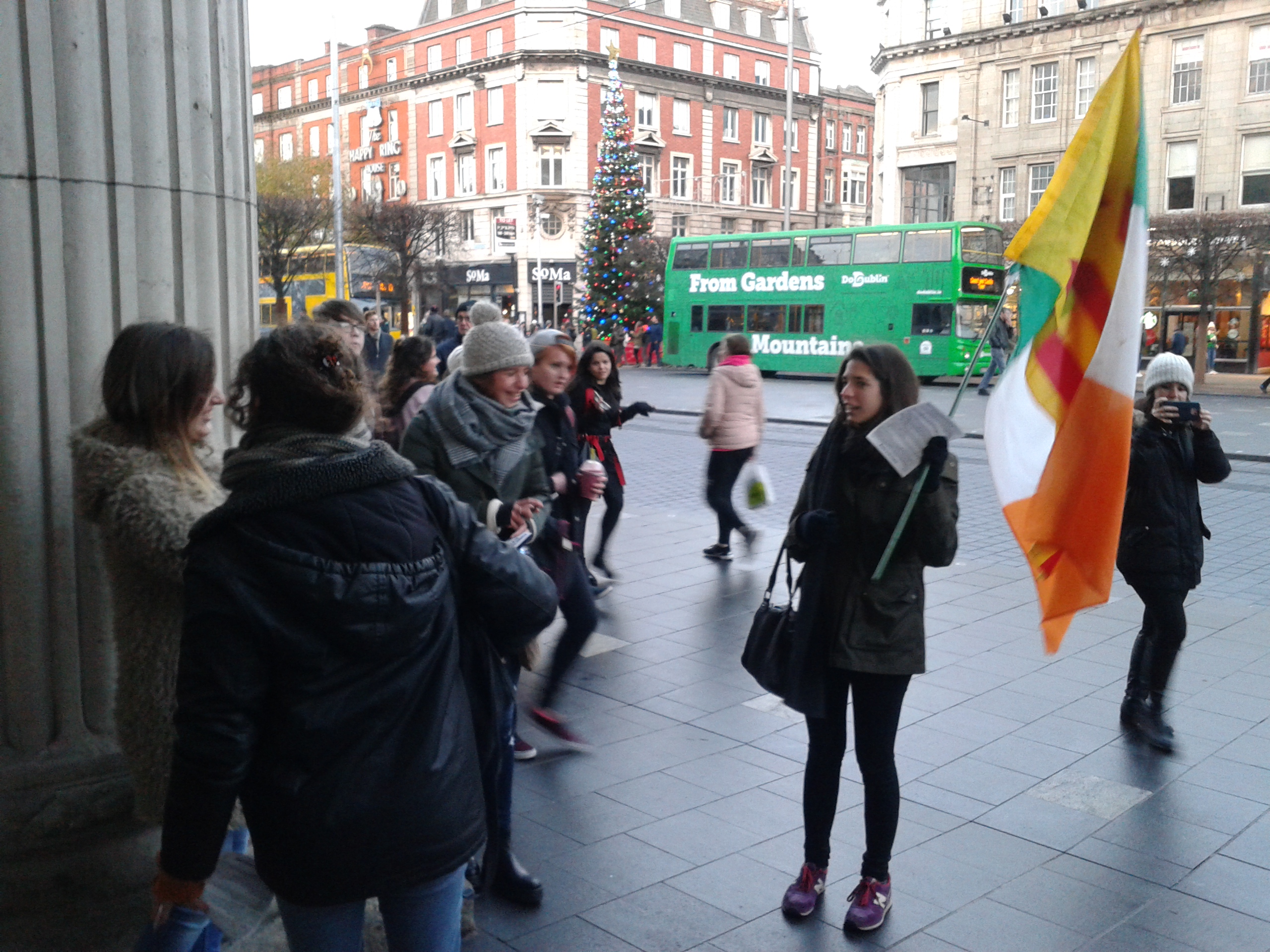
Many leaflets were distributed. A number of Catalan young women passers-by were excited to see the Estelada flags and were ecstatic when “Els Segadors” (“The Reapers”), the Catalan national anthem, was played.
Catalan and other young women passers-by reacting to the protest excitedly borrowed some joint flags to take photos of one another. (Photo: D.Breatnach)
Some people passing occasionally shouted “Viva Espaňa!” in hostility which gave rise to the response of “Viva la democracía! Viva la libertad!” On the other hand, other visitors passing by were very supportive, for example a young woman from Asturias (northern Spanish state) and an older man from Andalusia (southern Spanish state).
A spokesperson for the Committee briefly addressed the attendance at the end of the event, thanking them for attending to support Irish and Catalan political activists being jailed without trial. Referring to the few passers-by who shouted “Viva Espaňa!”, the spokesperson said that there is nothing wrong with pride in one’s country but queried why the sight of a Catalan flag brought that response and why the definition of Spanish nationhood for these people is bound up with the denial of the rights of another nation to determine its own future. The spokesperson declared that every nation has a right to determine its own future and to do so without threats and repression, pointing out that the Spanish State is attempting to jail the whole Catalan Government for carrying out their election promises and has jailed the leaders of two independence organisations without trial.
The spokesperson thanking the attendance once more, the event came to a close, flags were furled, banners rolled and placards put away for another occasion.
The Dublin Anti-Internment Committee was launched in 2013 and is independent of all political parties and organisations, holds regular pickets and people who support the civil and human rights of Irish Republican prisoners are welcome to attend.
This Autumn I made myself available to give talks in the southern Basque Country (i.e. in the Spanish state) on the situation of Irish political prisoners and a series was arranged for mid-October for nearly two weeks.
As well as having private conversations, I gave a total of five public talks to audiences ranging in size from ten to over forty. The composition of the audiences varied from youths to older middle-aged; in some places the latter predominated and in some, the former.
All the meetings I spoke at were arranged by an organisation called Amnistia Ta Askatasuna which calls for total amnesty for Basque political prisoners. This was also a demand of the whole movement and of the leadership of the Abertzale Left until fairly recently and the Gestoras pro-Amnistia organisation had been created under the Abertzale Left umbrella but then banned by the Spanish State. But the Abertzale Left’s leadership have now dropped this demand from public discourse, saying the conditions are not ripe for it and concentrating instead on the end of the dispersal. (More about this and the Basque prisoner situation later).
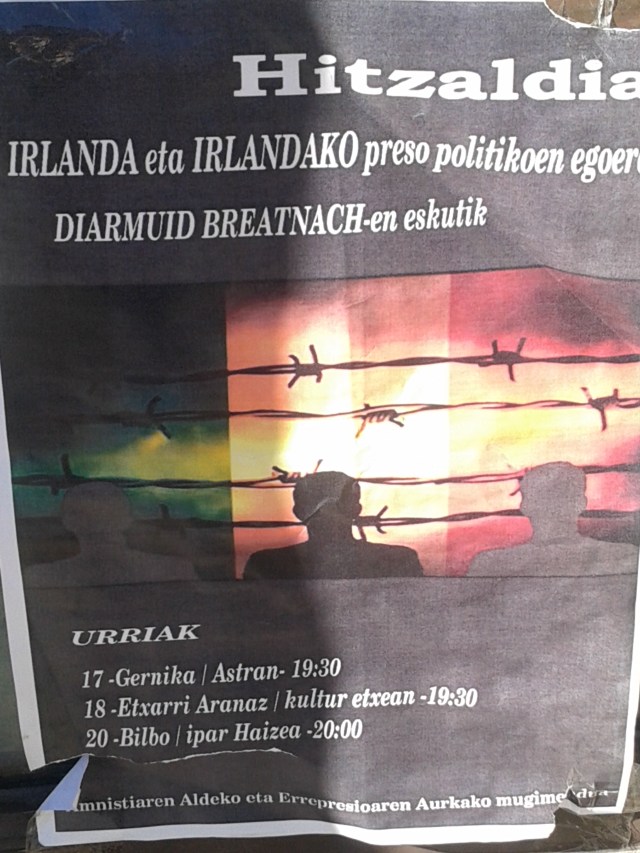
Poster on a wall advertising three talks in the southern Basque Country before the remaining two were confirmed. October 2017. (Photo: D.Breatnach)
I had not intended to confine my talks to those organised by ATA but it was they who organised the talks on dates that were offered, with the exception of one from an independent source that unfortunately clashed with one I had already accepted elsewhere.
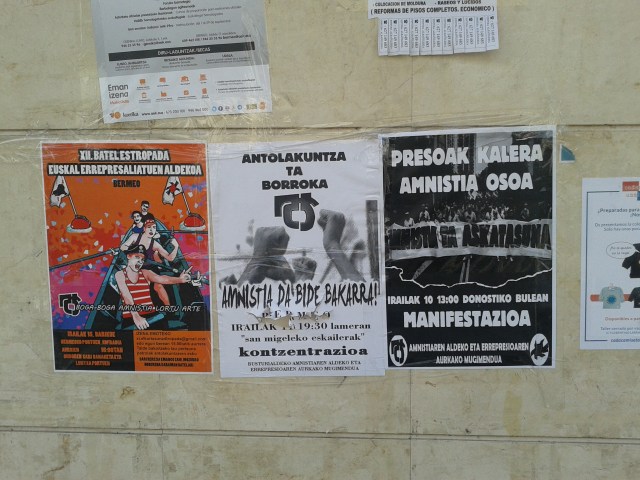
ATA posters share with other advertising on a wall in the southern Basque Country, October 2017 (Photo: D.Breatnach)
THE TALKS
The types of venues for the talks were community cultural centres (two), occupied buildings (two) and one local (a space for which the users’ association paid rent and used for their activities). Geographically, the talks were held in Gernika and two in Bilbao (Bizkaia province), Etxarri (Nafarroa) and Ibarra (Guipuzkoa province). There were none in Alava province (although earlier this year I gave interviews to Hala Bedi pirate radio there, in Gastheiz/ Vitoria). On this occasion also I gave a video interview to a rapper who also makes videos for Hala Bedi, though he is located in Bizkaia.
From conversations and discussion it became clear that all the older people in the audiences were veterans of the Basque struggle over decades and a number were ex-prisoners. Some had relatives in jail. The youths had come to political activity or thinking in recent years.
Talk in cultural centre in Ibarra, Guipuzkoa, southern Basque Country, October 2017. (Photo: ATA)
For the content of the talks I briefly reviewed the more distant history of political prisoners in Ireland, moving on then to the Good Friday Agreement and the release of
Torn poster advertising the talk in Ibarra, Guipuzkoa province, southern Basque Country, October 2017. (Photo: D.Breatnach)
most Irish Republican prisoners in the Six Counties under its terms. The re-arrest and jailing without charge of a number of these ex-prisoners was part of the talk, in which the specific examples given were of Marian Price, Martin Corey and Tony Taylor. I also dealt with the procedure of arrest on ridiculous charges and refusal of bail, or granting it under undemocratic and restrictive conditions, for which I used Stephen Murney as an example. These were all members of different organisations or none. Conviction on charges which the evidence does not support is also a category I mentioned, giving the Craigavon Two as an example there. Arrest on possession of arms charges is also a feature on both sides of the Border.
With regard to the 26 Counties, i.e the Irish state, I discussed the Special Court, Membership-of-an-illegal-organisation charges and charges of obtaining arms or having assisted terrorism. I mentioned the planned second Special Court in particular in the context of the State’s failure to convict most of the Jobstown protesters on charges that included “false imprisonment” (i.e kidnapping).
While noting that splits had occurred before in the Republican movement – the Provisionals themselves having emerged from such a split in 1970 – I noted that since the GFA, splits had multiplied and listed a number of the resulting organisations, including those that had existed already at that time.
Listing the number of Irish political prisoners (at the latest count then 79) and reminding the audience that the Irish had extended solidarity to Basque political prisoners, I asked the Basques for solidarity towards our political prisoners too. And I did so not only as a moral issue of internationalist solidarity but also in recognition that internationalist solidarity is one of the first casualties (i.e aspects to drop or weaken) by those who are seeking to surrender the struggle or even to become collaborators.
Talk in cultural centre in Etxarri, Nafarroa province, southern Basque Country, October 2017. (Photo: ATA)
QUESTIONS
I timed the talks to give sufficient space for – and encouraged — questions and comments, even critical ones.
It was interesting that the same questions tended to come up again and again:
Did the different Republican organisations cooperate with one another inside and outside the jails?
What were the conditions in the prisons like for the prisoners?
How are political prisoners in ill-health being treated?
Is there a dispersal issue with regard to political prisoners?
Did the population support the prisoners?
What were the conditions for their release under the Good Friday Agreement?
Did INLA prisoners sign the GFA release agreement?
Are there armed actions continuing in Ireland?
Are the youth involved in solidarity actions and campaigns?
What was the attitude of Sinn Féin towards the political prisoners?
Are prisoners “on the run” still in danger of arrest and imprisonment?
In one meeting, one of the smaller audiences and containing only youth, I was asked about the role of women in the national liberation struggle in Ireland today.
Talk in the occupied former Astra factory building, Gernika, Bizkaia province, southern Basque Country, October 2017. (Photo: ATA)
Some of the questions asked reflect the situation of the Basque political prisoners and also of the censored and inaccurate information about Ireland that reaches them, including through the Abertzale Left‘s (the “official” umbrella organisation) daily newspaper, GARA. At a number of times in the past spokespersons of the Abertzale Left’s organisations had claimed that there were no longer Irish political prisoners, a claim repeated in GARA. More recently, the tendency is to ignore their existence or to represent them as very few, without a program other than return to armed struggle and without a support base (i.e Sinn Féin’s line).
The new direction of the Abertzale Left’s leadership, which included a “permanent truce” and disarmament of their armed organisation ETA (formally declared in January 2011) was said at the time to have been agreed by the Basque political prisoners in their organisation EPPK. There have been persistent claims by friends and relatives of some prisoners and by some prisoners released in the last couple of years that they had not even been consulted.
A number of people to whom I spoke claimed that the prisoners’ collective no longer really exists, with prisoners left to act individually; some others said this was true to an extent but not completely. Certainly one feels a general air of disillusionment and uncertainty – and also of anger. And it is true that a small number of prisoners have formally denounced the leadership and left the collective.
Grafitti in Ondarroa, Bizkaia province, southern Basque Country, October 2017. (Photo: D.Breatnach)
From figures collected in 2003, up to 30,000 Basque activists out of a total population of less than three million) had been arrested, 8,170 were accused of being members of ETA and roughly half of those convicted and imprisoned. The prisoners’ relatives and friends’ organisation Etxerat (also under the Abertzale Left’s umbrella) in its July-September report of this year (2017) recognises 315 Basque political prisoners, of which 310 are dispersed through 61 prisons, with only two in 2 prisons in the Basque Country.
In 39 prisons in the Spanish state, 239 Basque political prisoners are being kept and 68 in twenty prisons of the French state. There are 212 (68.85%) Basque political prisoners in prisons at distances of between 600 and 1,100 km of the Basque Country; from a distance of 400 to 590 km from their country there are 67 (21.75 %) and between 100 and 390 km of home another 29 (9.40 %).
The strain on relatives and friends is considerable, road accidents are frequenton their journeys to visit prisonersand a number have been killed.
Twenty-one prisoners (21) are diagnosed as being seriously or terminally ill and according to the states’ own penal codes should have been released on parole to home or hospital but instead of reducing the number of sick prisoners the total is climbing (almost doubled in recent years). I accompanied ATA comrades to the port town of Ondarroa to participate in a demonstration organised by a broad platform calling for the release of terminally-ill Basque political prisoner Ibon Iparragirre.
Section of rally after demonstration in Ondarroa, Bizkaia, in solidarity with local seriously-ill prisoner Ibon Iparragirre, October 2017. (Photo: D.Breatnach)Stage of the rally after demonstration in Ondarroa, Bizkaia, in solidarity with local seriously-ill prisoner Ibon Iparragirre, October 2017. (Photo: D.Breatnach)
The Spanish state has rejected all the “peace process” (sic) overtures of the Abertzale Left leadership and says that ETA should just disappear and prisoners wishing to be pardoned and released must repent their previous actions, apologise to their “victims” and give information on their previous activities and comrades. It also says that all still at liberty and wanted for past illegal activities will continue to be pursued.
COMMENTS AND CONTRIBUTIONS
These too tended to be of a kind to come up again and again throughout the tour:
The situation in Ireland with regard to the liberation movement and prisoners is like that in the Basque Country or that which the latter will face as time goes on
The prisoners’ cause is being deserted by the Abertzale Left leadership
Their media and leadership had lied to the movement about the situation in Ireland
The leadership is only interested in penetrating the institutions and is neglecting the politics of the street
Otaegi and Adams are alike and McGuinness was a traitor when he asked people to inform on paramilitaries
The Abertzale Left did not of course comment on the talks – why would they? However, in Ibarra, I saw posters for the meeting torn down in areas where other political ones remained and according to my hosts, this was the work of the “oficialistas” (i.e followers of the leadership’s line) in the town. It was notable too that with a few exceptions, a number of people within the Abertzale Left but whom I know to be very critical of the change of direction, did not attend the talks held in their areas. Since some had previously attended a meeting at which I spoke a year ago and engaged in discussion critical of the Abertzale leadership, I took it that these either disapproved of the ATA organisers or did not wish, for whatever reason, to be seen attending a meeting held by the organisation.
At all the talks I was received with friendliness and courtesy and after some I had a meal in company in a txoko (Basque building — or part of one — owned or rented by a gastronomic association) or the home of my hosts for the evening. Although I invited criticisms with genuine interest in hearing them, none were voiced publicly, whether of the content of my talk or of the Irish people generally — although there were some questions as to why the people “in the south” had not supported more widely the “struggle in the north”. I explained that what they call “the north” is one-fifth or the country and also divided in its population; in addition the Republican movement had left the social and economic concerns of the people in the other four-fifths largely unaddressed and in fact had opposed some social reforms in earlier times. People in the 26 Counties had given a lot of support but without mobilising them on their own concerns and specific conditions this was likely to be a minority activity and to decline over time.
CATALUNYA: SOUTHERN BASQUE ATTITUDE TO THE STRUGGLE THERE
Inevitably, the struggle in Catalunya came into the discourse at some point – after all, I had arrived in Euskal Herria just under two weeks after the Referendum.
The Catalan national flags, the esteladas (both versions) were in evidence across the Basque Country as were some solidarity banners and posters. The two solidarity demonstrations I witnessed (and in which I participated but for a while – each having been called for the same evening as my talk locally) in Nafarroa and in Bizkaia appeared to have been called by the “official” movement and were fairly small and quiet. The largest, of over fifty people, did not even have a flag, placard or banner, which was puzzling.
Large image on the wall of the youth local in Errekalde, Bilbao, where they hosted one of the talks, October 2017. (Photo: D.Breatnach)
It was reported to me that some time back, the Abertzale Left had been close to the militant CUP (Catalan left-wing and independist popular movement) but now were moving closer to the Eskerra Republicana, often perceived as being less militant and closer to the Catalan bourgeoisie. Among the critics of the Abertzale Left leadership and others there seemed to be a doubt that the Catalan leadership was serious; however, both the “officials” and the “dissidents” had sent people to help the Catalans in their referendum.
After the Spanish police violence on October 1st there was a feeling that the Catalans were enduring what the Basques had endured for decades so why the great shock now? When two leaders of the Catalan movement were arrested and jailed without bail and called “political prisoners”, of course the Basques pointed to their own hundreds of political prisoners (and also to two Catalans who were ETA prisoners). The failure to declare a Republic on the promised day seemed to bear out those with a more cynical view but actions since then and the application of the repressive Article 155 of the Spanish Constitution are bound to raise feelings of respect and solidarity across the Basque national liberation movement, whether “official” or “dissident”.
IN CONCLUSION
It is clear that there is interest in the Irish situation and of that of the prisoners in at least some sections of the broad Basque national liberation movement. It is also clear that there is a substantial discomfort with the direction of the Abertzale Left’s leadership since 2011 (and for some since even earlier). Frustration is also evident as is a great concern for the political prisoners and a worry that they are being left without leadership, to come to their own arrangements with the Spanish state or to endure many more years in jail or die there (as Kepa De Hoyo did in August and as Ibon Iparragirre faces now).
This level of concern, disquiet and even distrust is not currently reflected in great numbers attending pickets or demonstrations organised by ATA, as numbers attending the talks showed in some areas but as the talks also showed, there is a network of support for ATA across the southern Basque Country. It was clear that a greater lead-up would have resulted in talks being hosted in further areas, including the province of Alava which was not included on this occasion. The general composition of the movement represented by ATA is healthy in its spread across generations, comprised of veterans (including ex-prisoners) and youth new to the struggle.
The pedestrian bridge at Ondarroa, scene of one of the “human walls” organised some years ago by Basque youth in resistance to the arrests of activists. Supporters placed the activist whom police were seeking in the middle and then packed the bridge with supporters, causing the police hours of work to carry out the arrest. I was told that the official leadership had ordered the cessation of these events. October 2017. (Photo: D.Breatnach)
From a personal point of view it was an interesting if somewhat hectic and stressful period but also one that increased my understanding of the reality.
From a political perspective I hope it helped build some links for solidarity between the struggles in each of the two nations and an awareness that pacification processes are not an alternative but only another face of repression. For the struggles in which so many have sacrificed so much to succeed, we need to raise our awareness of these processes. In these processes political prisoners, often seen by their populations as heroes and people to be cherished, are used by the repressive power as hostages and often too as bargaining counters, the temptation always there for some of those in struggle to use them in kind.
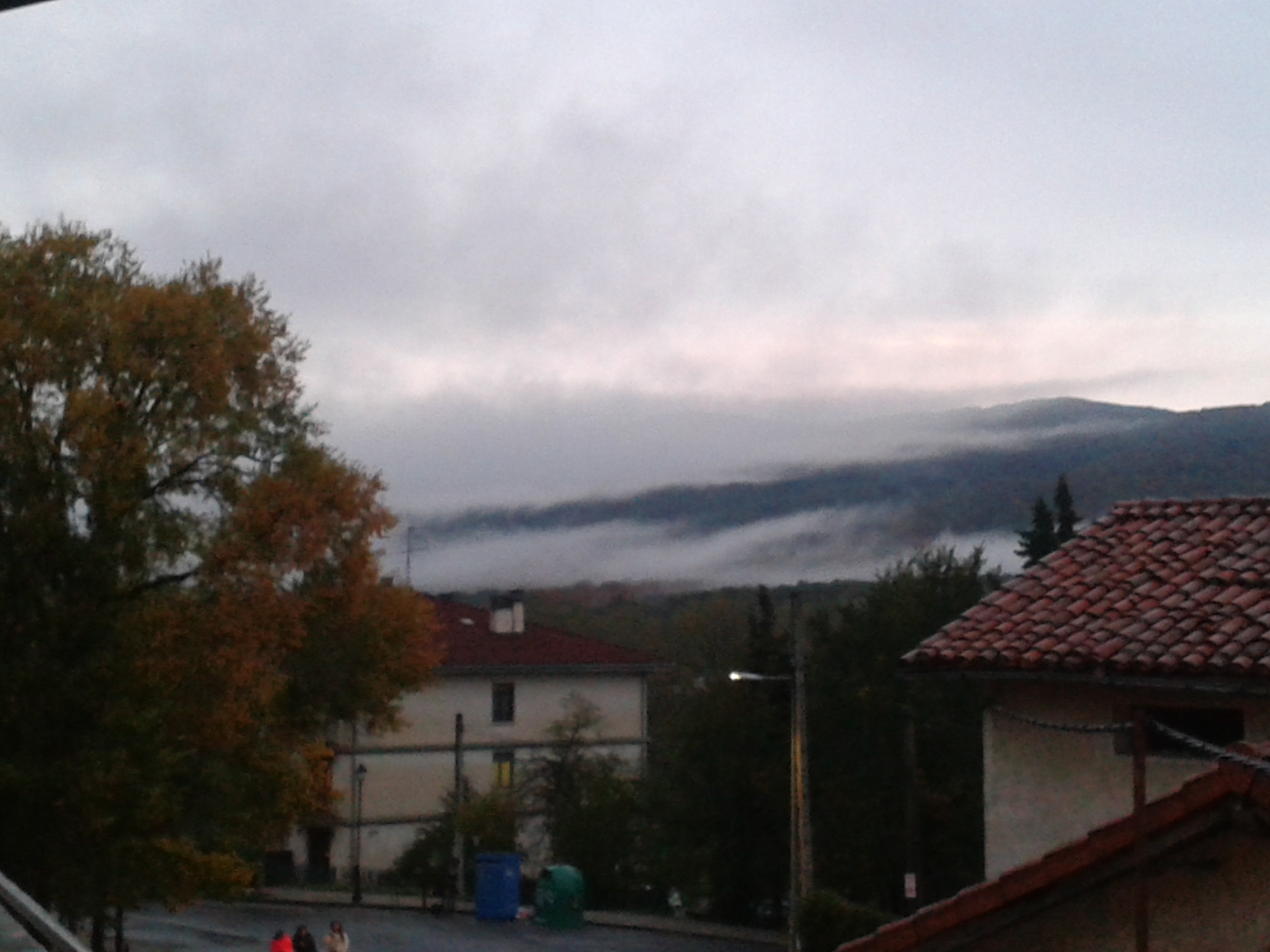
From Axpe de Busturia train station, Bizkaia, October 2017. (Photo: D.Breatnach)Morning view of misty mountains from a host’s house in Etxarri, Nafarroa province, October 2017. (Photo: D.Breatnach)Bermeo Harbour and some of the town from heights above, October 2017. Near the big building at 9 o’clock on the photo was the location of a Franco prison for Resistance women — I was told that Basque nuns locally brought food to the jail for them every day. (Photo: D.Breatnach)Part of the Bay of Bizkaia (Biscay), October 2017, from the site of a Basque Gudari artillery battery during the Anti-Fascist War. (Photo: D.Breatnach)
Reprinted with permission from Dublin Committee, Anti-Internment Committee, Ireland (posted on their FB page 9th September 2017.
DUBLIN COMMITTEE HOLDS PICKET TO HIGHLIGHT ONGOING INTERNMENT OF REPUBLICAN ACTIVISTS 9th September 2017.
On a Saturday afternoon alternating between showers and sunshine, the Dublin Anti-Internment Committee held their awareness-raising picket at the busy junction of Thomas Street and Meath Street.
Some of the picketers with banner
They erected banners at the junction and distributed leaflets, including some about the Craigavon Two.
Tourists(on their way to and from the Guinness brewery museum) and local people passing took leaflets with interest and good humour.
Dublin Commitee AIGI activist distributing leaflets in Meath Street to passers-by. (Photo source: AIGI)
Less welcome was the Special Branch Garda (police force of the Irish state) who wanted the picketers to give him their names and addresses. Several refused to do so. The Garda went away to his car, drove back heading west, halting in the middle of the road in order to photograph the picketers and blocking the traffic coming out of Meath Street as he did so. (There was no need, Garda, we’re posting our photographs on here ).
Left of photo: Special Branch (plainclothes political police) asking a protester his name and address. (Photo source: AIGI)
The Garda then carried out an illegal and somewhat dangerous U-turn, briefly turning on his blue light and drove eastwards at speed.
The Committee refuses to be intimidated, holding regular peaceful pickets in different parts of Dublin and will be holding another one soon.
(Photo source: AIGI)
A HISTORIC AREA
The Thomas Street area, bordering on the Liberties, has a long history and is represented “in song and story”. The United Irishmen at the end of the 18th Century enjoyed much support here.
Not ten minutes walk away eastward from where the picket took place today is Taylor’s Hall, the site of the “Back Lane Parliament” and down by the Liffey, in Bridge Street, is the site of Oliver Bond’s house, where most of the Leinster Executive of the United Irish were arrested in 1798.
In hiding, Edward Fitzgerald, one of the main leaders of the United Irishmen, was moved between houses in the area, one of them being No.158 Thomas Street, where on 19th May he was located by Major Sirr through paid informers. Fitzgerald was ill but grabbed a knife and jumped out of bed, wounding Captain Ryan and Major Swan, the latter mortally. Major Sirr (who, according to folklore, was wearing a steel vest) then came in with more soldiers and shot Fitzgerald in the shoulder which facilitated his overpowering and arrest. Fitzgerald died of his wound some weeks later (4th June 1798).
A little to the east along Thomas Street is where most of the fighting in the brief and aborted Emmet uprising took place in 1803. Lord Kilawarden was heading into town for his safety but ran into the insurgency, was dragged from his coach and piked. He was found later it is believed in Vicar Street, still alive but died soon afterwards.
Further west along the street is St. Catherine’s Church, outside which the scaffold was erected in 1803 and Robert Emmet was hung in public, his head being then struck off. It is said in Dublin folklore that his relations attended the execution and shed not one tear in public, determined not to give the Crown and its followers the satisfaction of witnessing their grief.
(Photo source: AIGI)Spotted by the picketers as they were leaving: Dublin City Council motto with appropriate comment by some passing citizen. (Photo source: AIGI)
A DEBATE to discuss the above question at the Teachers’ Club, Dublin, was organised by the United Ireland Association with Tommy McKearney and Clare Daly being the debaters on June 16th.
Tommy McKearney (Photo: Wikipedia)
Tommy McKearney is a long-time Republican, formerly of the Provisional IRA, 1980
Clare Daly (Photo source: Internet)
Hunger-Striker and ex-Republican prisoner. He was, along with Anthony McIntyre, a founder of the Republican Writers’ Group which, while not advocating armed struggle, was critical of the Good Friday Agreement, of Provisional IRA and in particular of Sinn Féin. He is currently an Organiser for the Independent Workers’ Union.
Clare Daly is a long-time Socialist, a former trade union shop stewart and has been a Teachta Dála (member of the Irish parliament) since 2011, formerly as a member of the Socialist Party and now a Left Alliance TD. She has visited Republican prisoners and raised issues about their treatment in court and in jail. Daly was also arrested for trespass at Shannon Airport, along with fellow-TD and partner Mick Wallace, protesting against the use of the airport by US military flights and for transporting of political prisoners of the US military to jails in various parts of the world.
TOMMY MC KEARNEY
Tommy McKearney spoke first and stated that there was an issue of defining Republicanism and that sometimes what was meant was the anti-monarchic Republicanism of France or the United Stated but he was going to discuss it in terms of a specific Irish-based ideology, i.e Irish Republicanism.
Mentioning a number of Left-Irish Republicans such as Fintan Lawlor and Wolfe Tone’s famous quotation about relying on the “men of no property”, Tommy developed a line of reasoning that sought to say that there was not a huge difference between Irish Republicanism and socialism and drew attention to the fact that James Connolly had founded a party by the title of the Irish Socialist Republican Party.
Going on to talk about the objective of Irish Republicans, Tommy stated that not only is a republic desirable for Ireland – it is necessary. Only a Republic that is based upon socialist principles can resolve the economic and political problems facing Ireland today on both sides of the colonial Border.
Referring to the British election results in the Six Counties, Tommy commented on the 238,915 votes and seven seats for Sinn Féin – an increase of 14,670 votes – and the rise of almost 67,000 votes for the DUP with their ten seats. Sinn Féin had been pushing a peace process which was not about peace but about normalisation; their claim to intend to bridge the sectarian divide was empty and the voting lines were drawn up along sectarian lines at least as deeply as before.
Tommy also speculated that the amount of votes cast for Sinn Féin, on a platform of refusing to take their seats in Westminster showed, among other things, the amount of people in the Six Counties who did not care to be represented in a British Parliament and presumably would want representation in a united Irish Republic. He called for an alliance of Left Republicans and Irish socialists and recalled that James Connolly had founded, as well as the Labour Party, the Irish Socialist Republican Party.
CLARE DALY
Clare was next and she in turn highlighted the difficult issue of defining the Left – did it mean the parties that defined themselves as Left, did it include the Labour Party – some would say yes, others no. For Clare it is not issue of the names we give parties or activists but of what we stand for. Clare said she stands for a socialist country and in that sense for a Republic.
Addressing the question for debate, Clare owned that maybe socialists had neglected the national question — maybe they had been put off by images of balaclavas and guns — but it could equally be said that Republicans had for decades neglected social questions such as women’s reproductive rights, women’s rights in general, gay rights …. However, in more recent times, Republicans were seen actively supporting those rights.
Over recent years, Clare said, we had seen the gains our parents fought for in terms of trade union rights and local authority and state services lost or undermined.
Clare said she saw herself as a citizen of the world but as she lived in Ireland that she stood for a Republic that was organised along socialist lines and gave equal rights to all. The real question, Clare stated, is how we are to achieve that and pointed to the swing to the Left in Britain with Jeremy Corbyn’s party receiving a big increase in votes, despite media hostility and predictions of failure. The Conservative Party could only rule now with the support of the DUP’s 10 Mps. Clare said that opportunities of a Left Front existed in Ireland too as was seen by the Right to Water mass marches with broad political party and some major trade union support.
CONTRIBUTIONS FROM THE AUDIENCE, RESPONSES FROM THE PANEL
Included in contributions from the audience were the following:
Sinn Féin had seven MPs to the DUP’s 10 and should consider abandoning their abstentionism and go to Westminster to assist Corbyn in voting legislation
While the Labour Party in Britain had moved to the Left, Sinn Féin in Ireland had moved to the right
Good debate from two good speakers but also two who had put themselves out there for what they believed – Tommy McKearney in armed struggle in the past and hard prison struggle and Clare Daly in protesting US military use of Shannon Airport and also visiting Republican prisoners in jail, along with a few other Tds.
We need more debates like these and also to focus on Republicans with regard to where they stood with regard to socialism.
The Irish Left as a whole has divorced itself from Irish Republicanism, probably in fear of being associated with nationalism and/ or armed struggle. In doing so, it has walked away from continual violation of human rights, e.g of Republican prisoners in the jails and of civil rights, the right to political dissent of Republican activists on both sides of the Border.
The Irish Left has neglected to confront British Imperialism and left the Republicans to confront the various visits of the British Queen and the recent one of Prince Philip, when major roads were shut and even civilians impeded in going about their business or even going to their local shops or to visit their relatives’ graves in Glasnevin and a megaphone wrested by an undercover policeman backed up by a riot squad from the hands of a person about to speak to a protest demonstration.
Republicans are socialists and to pose the two as different categories was ridiculous.
There should be a broad Left front in Ireland including the trade unions and Sinn Féin.
Among the responses from the panel were that people were hung up on condemning Sinn Féin and should welcome them into a broad Left mass movement on the model of the Right to Water and Right to change campaigns (this from Tommy McKearney)
The socialists might not have done very well opposing British imperialism but had opposed US imperialism, which is one of the imperialist powers in operation in Ireland (this from Clare Daly) and a major one in the world.
COMMENT
The contributor who said that “Republicans are socialists” seemed unaware that historically at least this certainly was not so. Seán Mac Diarmada, the Irish Republican executed on the same day as the socialist James Connolly, had been on record as saying that no-one should support socialism. During the War of Independence, some IRA units took actions to support landless labourers and poor farmers but others took action to repress these in favour of big farmers.
The IRA had a ban on Communists through the 1930s probably up to the 1960s. Sean South, prominent Limerick IRA Volunteer killed in the Bessborough RUC Barracks attack in 1957, was a conservative Catholic, anti-Communist member of the Knights of Columbanus and of An Réalt (Irish-speaking section of the Legion of Mary).
The broad Left front being advocated by a number of people seems to be a reformist social-democratic one and, while there is nothing necessarily counter-revolutionary about fighting for reforms, clarity is needed about whether what they are advocating is a social-democratic program or fighting for some reforms while at the same time openly organising with a revolution in mind.
Clare Daly has certainly fought hard against US Imperialism but others on the Left much less so. The mobilisation against Hillary Clinton’s visit to Dublin was not great and gave up in the face of police opposition before they even reached City Hall and there was no mobilisation at all against Obama’s visit to Dublin in May 2011 and it remains to be seen how much there will be if he comes this year, as he has reportedly promised to do. But the question of oppposing British imperialism is a crucial one since a) it is the main imperialist-colonial power at work in Ireland and b) because it is the main prop of US Imperialism in Europe and in the UN.
There would seem to be fertile ground for debate on the historical and current differences between Irish Socialists and Irish Republicans, as well as for discussing possible joint action and one hopes for many more debates and discussions of this nature with a broad attendance.
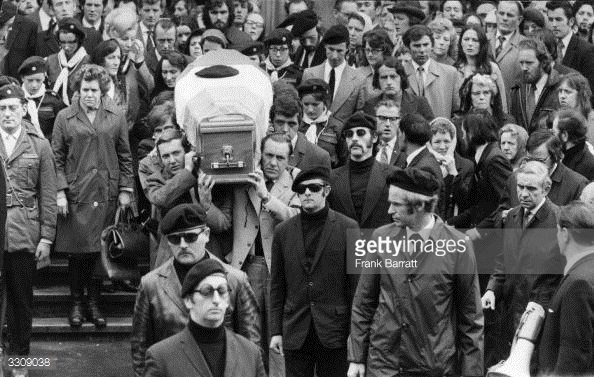
IRA Volunteer Michael Gaughan was killed in Parkhurst Jail on the Isle of Wight this month in 1974. He was killed on the 3rd June that year by force-feeding while on hunger strike. An honour guard of Provisional IRA had presided over his body’s removal by ferry to the mainland and from there to London, where the first of his three funeral processions was to take place.
Volunteer Michael Gaughan, the image most often associated with him. (Photo source: Internet)
Also on hunger-strike with Gaughan although in different jails in Britain were other Provisional IRA prisoners: Gerry Kelly, Paul Holmes, Hugh Feeney and fellow Mayoman Frank Stagg. They were acting in support of the struggle of Volunteers Dolours and Marion Price1 to obtain political status and to be transferred to a jail in Ireland. The prisoners’ demands were as follows:
The right to political status
The right to wear their own clothes
A guarantee that they would not be returned to solitary confinement
The right to educational facilities and not engage in penal labour
The setting of a reasonable date for a transfer to an Irish prison2
At the time I was a young and fairly inexperienced activist supporting an English-based Marxist-Leninist group.3
LONDON
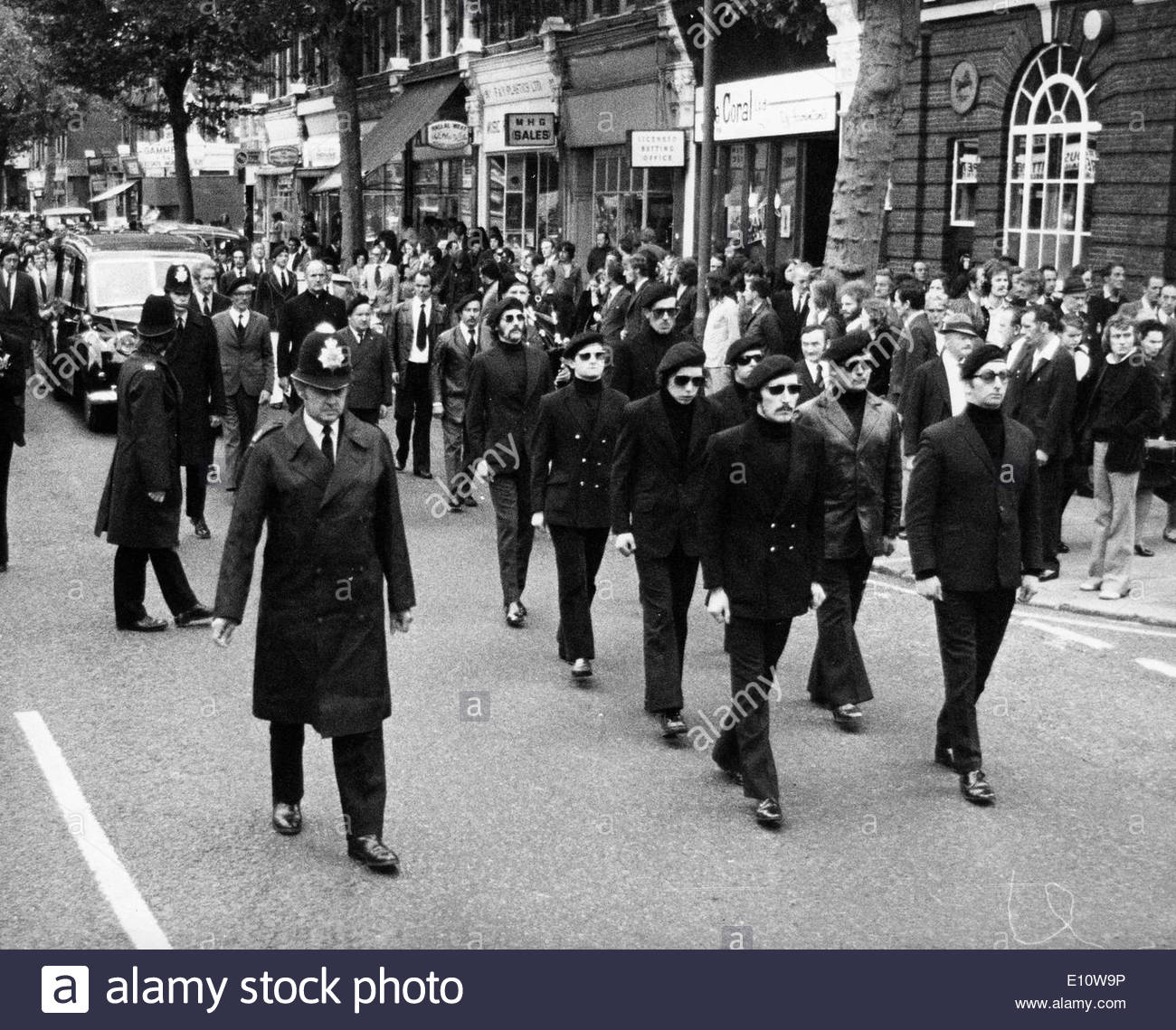
Vol. Gaughan’s funeral procession in Kilburn, London. (Photo source: Internet)
On the 7th a funeral procession was being organised by Provisional Sinn Féın in an area of strong Irish diaspora settlement in North-West London. I took a bus from my South-East London home by a part of the canal near Peckham (now filled in) to the Elephant & Castle and changed on to the London Underground metro system to travel to Kilburn, from where I walked up to the Cricklewood area. There in the forecourt of the Crown pub was where I had been told the funeral procession would gather and where I would also meet my comrades of the organisation.
After a little, preparations were being made for departure. A priest was to lead the procession, which I strongly disliked but obviously had no say in the arrangements. A lone piper would follow, a traditional feature of mourning where Irish resistance is involved. The coffin would be carried for a period on the shoulders of volunteers, before being transferred to the hearse and a senior comrade of my organisation approached me.
Another view of the funeral procession of Vol. Gaughan through Kilburn, London. (Photo source: Internet)
“Some representatives of British Left organisations are going to carry the coffin,” he said. “We’ve been asked if we’d like to take part. What do you think?”
He was asking me, I presumed, because I was the only Irish supporter of the organisation present, although it had an excellent record of supporting Irish resistance and prisoners and several of its comrades had gone to jail as a result.
He seemed not keen on the idea and I got the impression that he felt as I did that it was tokenism, distasteful posturing by the British Left. Tariq Ali (now a journalist but then a member of the now-defunct Trotskyist organisation in Britain, the International Marxist Group) was one of those hefting the coffin. I agreed with my comrade and said we should not (a decision I now regret) and so we didn’t. No organisation on the British Left at that time, in terms of commitment and actions in proportion to its size, deserved the honour more than our organisation.
From the forecourt of the Crown a long parade escorted Gaughan’s coffin from Cricklewood in West London along the main road to the Church of the Sacred Heart of Jesus in Quex Road church in Kilburn. It was a very Irish area then with nearly every pub being of mainly Irish clientele and it contained a dance hall where Irish bands played. Every shop and pub along the way was closed for the funeral and crowds lined the route. The atmosphere was very solemn with the laments being played by the piper very audible.
DUBLIN
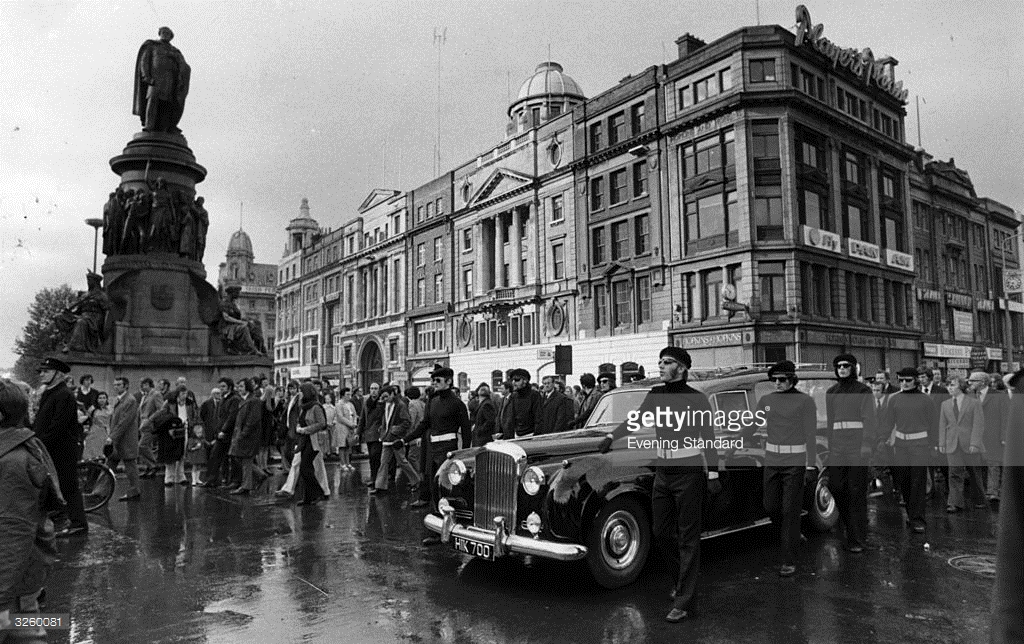
Michael Gaughan’s funeral procession approaching O’Connell Bridge, Dublin city centre. (Photo source: Internet)Another view of the Michael Gaughan funeral, Dublin
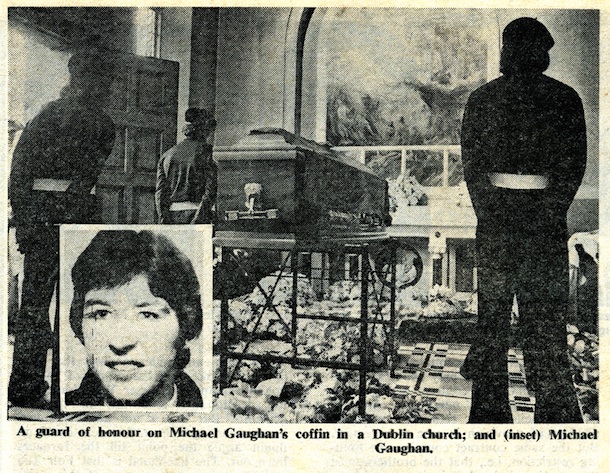
On the 8th of June 1974, the body of IRA Volunteer Michael Gaughan arrived in Dublin, where it was met by mourners and an IRA guard of honour. The body was brought to the Adam and Eve’s Franciscan church on Merchant’s Quay, where thousands filed past as it lay in state (no doubt under the watchful eyes of the Garda Special Branch).
Vol Gaughan lying in state with IRA honour guard in Dublin. (Photo source: Internet)
MAYO
On the following day, the 9thof June1974, Michael Gaughan’s funeral took place in Ballina, County Mayo.The funeral mass was held at St. Muiredach’s Cathedral, Ballina, procession then to Leigue Cemetery, Ballina. He was given a full republican burial and laid to rest in the Republican plot (where Frank Stagg, also killed by force-feeding, would join him after being reburied in November 1976 –see further below). Vol. Gaughan’s coffin was draped in the same Tricolour that had been used for Terence McSwiney’s funeral 54 years earlier (the same flag would later be used in the funeral of James McDade, IRA member killed in a premature explosion in Coventry). Gaughan’s funeral was attended by over 50,000 people, larger than the funeral of former Irish president Éamon de Valera.
FRANK STAGG
Frank Stagg, the image most frequently used. (Image source: Internet)
It was no doubt to avoid scenes such as this that the Irish state took certain steps when two years later, on 12th February 1976, a comrade of Gaughan’s, Vol. Frank Stagg, also from Mayo, was also killed in Wakefield Prison, Yorkshire, by force-feeding while on hunger-strike. Although much of this this took place during the IRA truce of 1975-January 1976, the British authorities refused to grant any of the demands. The Wikipedia entry says that “Stagg died on 12 February 1976 after 62 days on hunger strike” which, though not untrue is a lie by omission.4
The repatriation of the body of Frank Stagg at Shannon Airport from Wakefield Prison in Britain where he died on hunger strike on 12 February 1976.
The Irish Government had the flight carrying his coffin diverted from Dublin where a large crowd awaited it, to Shannon airport.
On arrival at Shannon, the Gardaí snatched the coffin and drove it straight to Ballina, Mayo under armed guard, to a cemetery near Stagg’s family home, where it was placed in a prepared grave into which wet concrete was then poured, six feet deep, instead of soil. And the site remained under guard until the concrete had set and for some time after.
Sean, one of Frank Stagg’s brothers, being assaulted at Shannon Airport by Gardai (Photo source: Internet)
Although those proceedings would have been in complete opposition to the wishes of the deceased, the State had obtained agreement for them from Frank Stagg’s widow and one of his brothers, the Labour Party’s Emmet Stagg. It was opposed by another two of Frank Stagg’s brothers and of course by the dead Volunteer’s comrades.
The first burial of Vol. Frank Stagg, managed by the State, contrary to his wishes of the deceased. One of his brothers, Emmet, who colluded in that operation, is on the back left, lowering the coffin. (Photo source: Internet)
In November of that year, a number of those comrades dug down near the grave, tunneled under the concrete, removed the coffin and re-interred it in the Republican plot, near to Michael Gaughan’s grave, where it rests today.
A simple but plaintive song about Michael Gaughan survivesin not uncommon use: Take Me Home to Mayo. There are a number of versions on Youtube; this one contains relevant images and film footage: https://www.youtube.com/watch?v=14-kuxsHjPg
National Graves Association memorial in the Republican Plot, Leigue cemetery, Ballina, to which the names of Vol.s Stagg and Gaughan were added. The NGA is a nationwide non-State-funded organisation caring for the graves and erecting memorials to Ireland’s patriot dead. (Photo source: Internet)
end
FOOTNOTES
1Although Gerry Kelly is a current Sinn Féin MLA, both the Price Sisters denounced the Good Friday Agreement and Sinn Féin; Marian was effectively interned for a period because of her politics and has not been active politically due to ill-health since her release in May 2013. On January 23rd of that year she was escorted from jail to attend the funeral of her sister, Dolours. Of the surviving hunger strikers of 1975-’76, Paul Holmes was the only other one to attend that funeral.
2The British promised to concede the demands after Gaughan’s death – they had already conceded them to Loyalist prisoners – but reneged on the promise. The Price Sisters did eventually win repatriation to jail in the Six Counties, Ireland. The struggle on the issue of repatriation, which the British authorities conceded to British prisoners in Irish jails but not generally in reverse, carried on for many years. It is UN and generally human rights policy that prisoners should serve their sentences in jails close to their family networks.
3I had previously been an unaffiliated Anarchist activist, then came to support the English Communist Movement (M-L), which later became the Communist Party of England (M-L), which I left some years later. It has since gone through a number of bigger changes and evolved into the current Revolutionary Communist Party of Britain (M-L), a much-changed organisation from the days referred to in this article.
4This is an important omission because the death of Vol. Stagg at the State’s hands after Gaughan’s brought about a change in policy of the British Medical Association, which afterwards recommended to its members that people in sound state of mind embarking on a hunger strike should not be forcibly fed even if they were heading for death. In consequence, the British State no longer has a policy of force-feeding prisoners on hunger-strike, since such would have to be supervised by medical personnel.
This is an interesting criticism of the Michael Collins historical biopic 1996. Written and directed by Neil Jordan, the film begins with the end of the Irish 1916 Rising, has the longest part focused on the War of Independence (1919-1921) and ends not long after the start of the Civil War (1922-1923). The film starred Liam Neeson as Michael Collins and included others such as Aidan Quinn playing Harry Boland, Alan Rickman as Eamon De Valera, Stephen Rea as Ned Broy, Julia Roberts as Kitty Kiernan, Gerald Mc Sorley as Cathal Brugha and Brendan Gleeson as Liam Tobin.
The video from Foras Teamhrach presents its criticism using clips from the film while commenting and also comparative clips from other films, which is a useful way of presenting a challenging view. Unfortunately neither the name of the author of the commentary nor of the commentator (possibly the one and same) appeared on the Youtube link, only the company name and the comments function was disabled (perhaps understandably).
Most of the points are well made but there are some omissions which might usefully be added to the criticism.
The GPO surrender scene
The video criticism points out that showing only the GPO makes the Rising look much smaller than it actually was; despite the countermanding order which reduced the forces in Dublin by perhaps as much as two-thirds, the Rising was fought by four major garrisons on the southern and three on the northern side of the Liffey, with other smaller outposts and individual actions. However, the narrator says nothing regarding the historical inaccuracy of portraying the surrender as occurring at the GPO.
In fact, the GPO had been abandoned on the Friday and the Surrender took place on the Saturday, following a decision made in the 1916 Terrace in Moore Street and around 350 insurgents there were the first to surrender following the order. This matters not just from a point of historical accuracy but because there is a struggle (now approaching two decades) to save this area from property speculators and State and Dublin Council Planning Department collusion.
Portrayal of De Valera
One does not have to be a supporter of De Valera’s philosophy and actions to rapidly come to the conclusion that his portrayal in Jordan’s film is so inaccurate as to seem to be someone else. Every person who took up arms in 1916 to fight the British Empire showed courage and those who continued to actively oppose the British occupation during the intense years of the War of Independence showed even more courage in doing so.
Collins, of a much more ebulient character than De Valera, according to witnesses, was more inclined to exhibitions of temper and shouting than was De Valera, whose manner was generally in accordance with his studious appearance – contrary to his behaviour in the Treaty discussion scene of the film. As to another aspect, when we review the record of his actions in preparation for the Rising through to the War of Independence and on through the Civil War and the early years under the Free State, De Valera cannot reasonably be accused of lacking courage. The shivering wreck as which he is portrayed during the Civil War in Jordan’s film runs counter to the historical record.
There is testimony from one or two participants that at a period during his command of Boland’s Mill, De Valera had something of a breakdown. This, if it occurred, could have been as a result of fear or instead of lack of sleep, or of being overwhelmed by responsibility or a number of causes and if this alleged episode is what inspired Jordan’s depiction it was certainly unfair to use it to characterise De Valera at other times. There are many criticisms that can fairly be thrown at De Valera but lack of courage is not one of them.
Portrayal of Cathal Brugha
And likewise with the portrayal of Cathal Brugha. Some of Brugha’s military and political history may help in evaluating the portrayal of this man in Jordan’s film.
One of fourteen children empoverished by the death of their Protestant father, Brugha joined the Gaelic League in 1899 and quickly became fluent, soon changing his name from Charles Burgess to Cathal Brugha. He and Kathleen Kingston, also an Irish language enthusiast, married in 1912 and had six children. Brugha joined the Irish Republican Brotherhood (IRB) and in 1913, the year they were formed, he became a lieutenant in the Irish Volunteers and led a group of Volunteers to land the arms smuggled into Howth by the Asgard in 1914.
In the Easter Rising of 1916 Brugha was second-in-command at the South Dublin Union under Commandant Éamonn Ceannt, scene of some of the fiercest fighting during the Rising. Overlooked in the evacuation on Thursday of Easter Week and, being badly wounded, he was unable to leave. Bleeding from 25 wounds (some of which had penetrated arteries) he continued to fire upon the enemy and when Eamonn Ceannt led a group to investigate who was still firing he discovered Brugha singing “God Save Ireland” surrounded by his own blood and with his pistol still in his hands.
Brugha was not expected to survive which may have saved him from the execution parties and he was discharged from hospital in August 1916 as “incurable”. However he recovered in 1917 though left suffering pain and with a permanent limp and preferred to cycle than walk.
Already in 1917 from his hospital bed, Brugha began to seek out Volunteers and Irish Citizen Army people who were willing to join the new armed resistance group and it seems that he, more than any other, should receive the main credit for the initial formation of that which became the IRA.
Brugha was so respected in the movement that he was elected speaker of Dáil Éireann at its first meeting on 21 January 1919 and it was he who read out the Declaration of Independence in Irish, which ratified ‘the establishment of the Irish Republic’. He was also appointed temporary President, a position in which he remained until de Valera tok his place.
Far from being a bloodthirsty zealot as he is portrayed in the film, Brugha reduced Collins’ ‘Bloody Sunday’ assassination list considerably since in his opinion, there was insufficient evidence against a number of people named on the list. Then again, at the outbreak of the Civil War, a reluctant Brugha only joined the fighting on the Republican (Anti-Treaty) side in order to relieve the pressure on the Four Courts garrison. Cathal Brugha led a detachment in occupying a number of buildings in O’Connell Street and later, having got his men safely away or surrendered, was shot and mortally wounded in debated circumstances by Free State troops (which were under the overall command of Collins).
Brugha had, according to some opinions, alienated a section of waverers at the Dáil debates on the Treaty, by a personal attack on Collins and the way his persona had been elevated (a common problem, the deification of leaders). This was no doubt a tactical mistake but there had been ongoing conflict between both men for some time. Although both had been members, Brugha had left the IRB after 1916 in the belief that their conflict with the Volunteer leadership had damaged the Rising. Collins’ rank in the organisation was supreme in Ireland and it seems that Collins used this at times to circumvent or undermine decisions of the Dáil, where Brugha outranked Collins and which the former believed to be the repository of democratic decision-making.
Collins as a guerrilla war leader
All Collins’ many talents and contributions to the War of Independence aside, his representation in the film as not only directing the whole armed struggle but also as teaching rural people how to wage a guerrilla war is a complete distortion of history that could only be undertaken by a propagandist for Collins.
It was Brugha who began to pull the scattered elements of the armed struggle together and laid the foundations for what became the IRA. It was Robinson, Breen, Tracey and Hogan who began the armed resistance of the War of Independence in Tipperary on 21 January 1919 in which two paramilitary policemen were killed. And they did so without permission from GHQ in Dublin.
As to rural guerrilla tactics, these were such as had been used for centuries or developed in the struggle and were certainly not taught by Dublin. What was taught by instructors sent by Dublin was weapon use and maintenance and personnel disposition for ambushes, moving in extended order through countryside and securing a line of retreat. One of the chief instructors in this kind of instruction was Ernie O’Malley and, in West Cork, the young Tom Barry used his British Army experience and other learning to do the same. The order to create Flying Columns might have come from Dublin but had been advocated already by fighters in Cork, Kerry and Tipperary and it was they and others who developed them in the field.
Collins’ special contribution was in organising intelligence, counter-intelligence and the assassination squad (which turned out to be a double-edged sword) and also, to an extent, supply of weapons. His contribution was notable but it did not lie in initial organising of guerrilla war, much less in rural guerrilla instruction.
The role of women in the struggle
Women are underrepresented in this narrative, as is usual in Irish history and Republican and nationalist narrative. Where women are shown, apart from the brief appearance of Markievicz at the non-existent GPO surrender (when instead she was at the College of Surgeons!), they are objects of romance (Kittie Kiernan) or auxilliaries working for Collins’ intelligence department.
There was a great opportunity lost there to show the women in action during the Rising in the many roles they undertook, including firing weapons, or in keeping the flame lit after the Rising and in particular in commemorating the Rising a year later, organising demonstrations, pickets, and funerals.
The Croke Park Bloody Sunday massacre scene
The film shows the ‘Tans or Auxies shooting down people with machine-gun on the GAA ground. As far as we have been able to establish it was the RIC who did it, although of course the other two were auxilliary forces of the RIC. Thankfully they did not fire with a machine-gun (the Army had one outside the grounds and an armoured car, it seems but did not open fire) or the carnage would have been a lot worse. When one examines the casualty list of those shot, just like more modern British massacres in Derry and Belfast, it is clear that the shooting was mostly disciplined, i.e hitting males of military age. Showing that kind of scenario would in the last analysis not only be more historically accurate but also more telling of the intent and cold-bloodedness.
And what of the three tortured and murdered in the Castle that day, Peadar Clancy, Dick McKee and Conor Clune? Yes, we know, one can’t show everything.
Go raibh maith agat to the individual who sent the video links to this blog.
1,500 Palestinian prisoners are in their third week of a hunger strike for dignity: their demands include rights to visits and increase in family visits, access to telephone calls to family and friends and end of solitary confinement. Visits are a particular issue since although the Israeli authorities permit visits every fortnight in theory, they require Palestinians in the occupied territories to obtain permits before permitting them entry to the Israeli state, which is where the prisoners are being held and these are often refused or delayed. Protests and other actions in solidarity with the Palestinian hunger strikers have been and are taking place around the world.
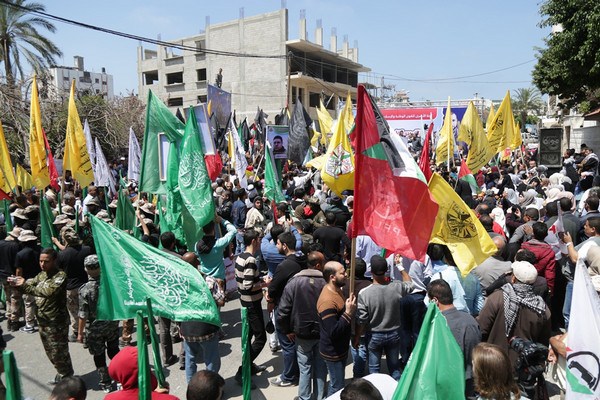
Demonstration in Gaza, joining different groups — worth watching to the end, seeing how the event grows and new flags join
IN IRELAND
The Ireland Palestine Solidarity Campaign have organised a number of events (see their FB page for some photos and reports). But in addition, various protests have been and are being organised by various other groups, campaigns and political organisations/ parties. Also messages of Palestinian solidarity have been incorporated into many other events, for example commemorating the Easter Rising of 1916 and the subsequent Executions by the British Occupation, or celebrating International Workers’ Day.
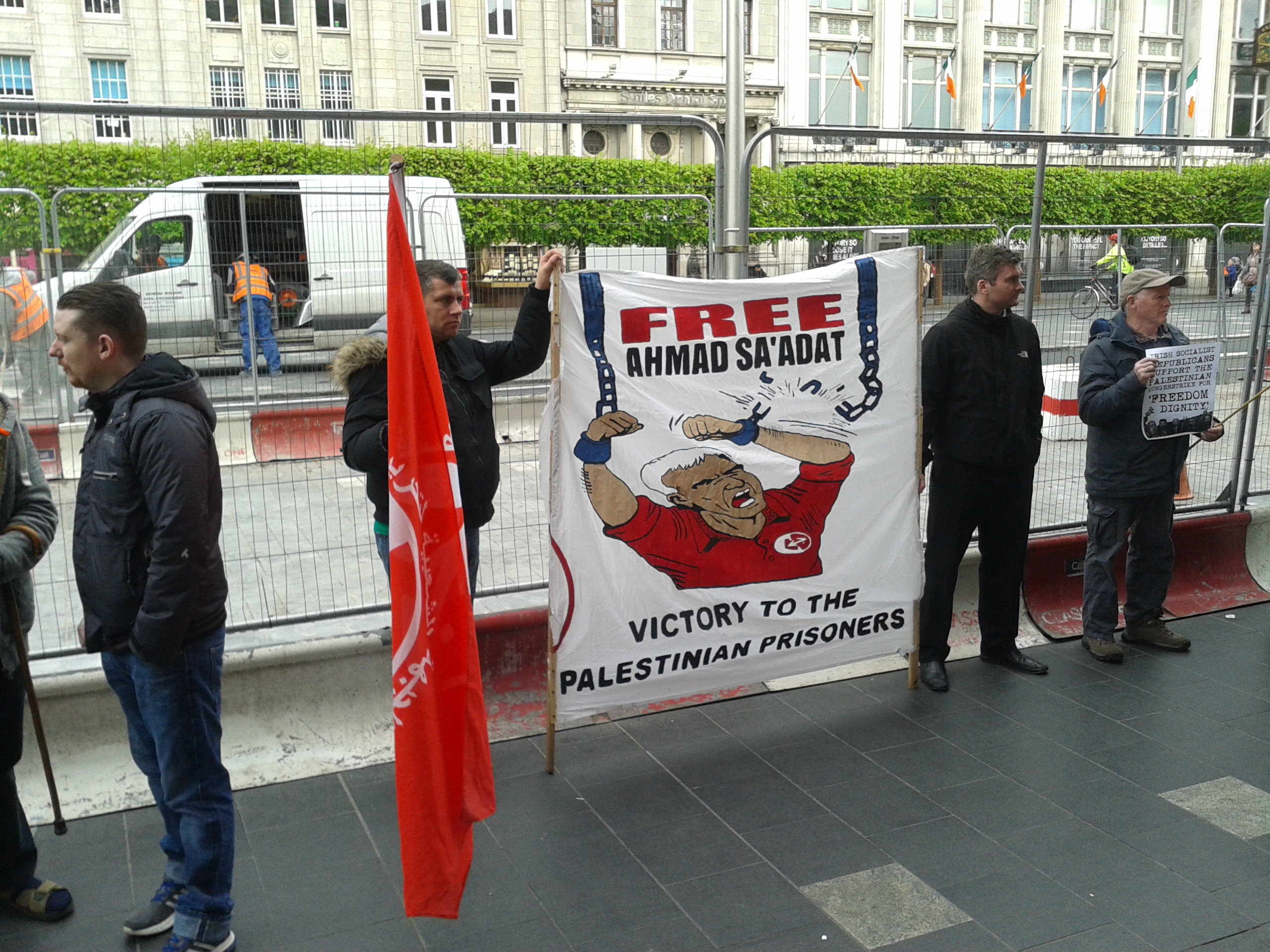
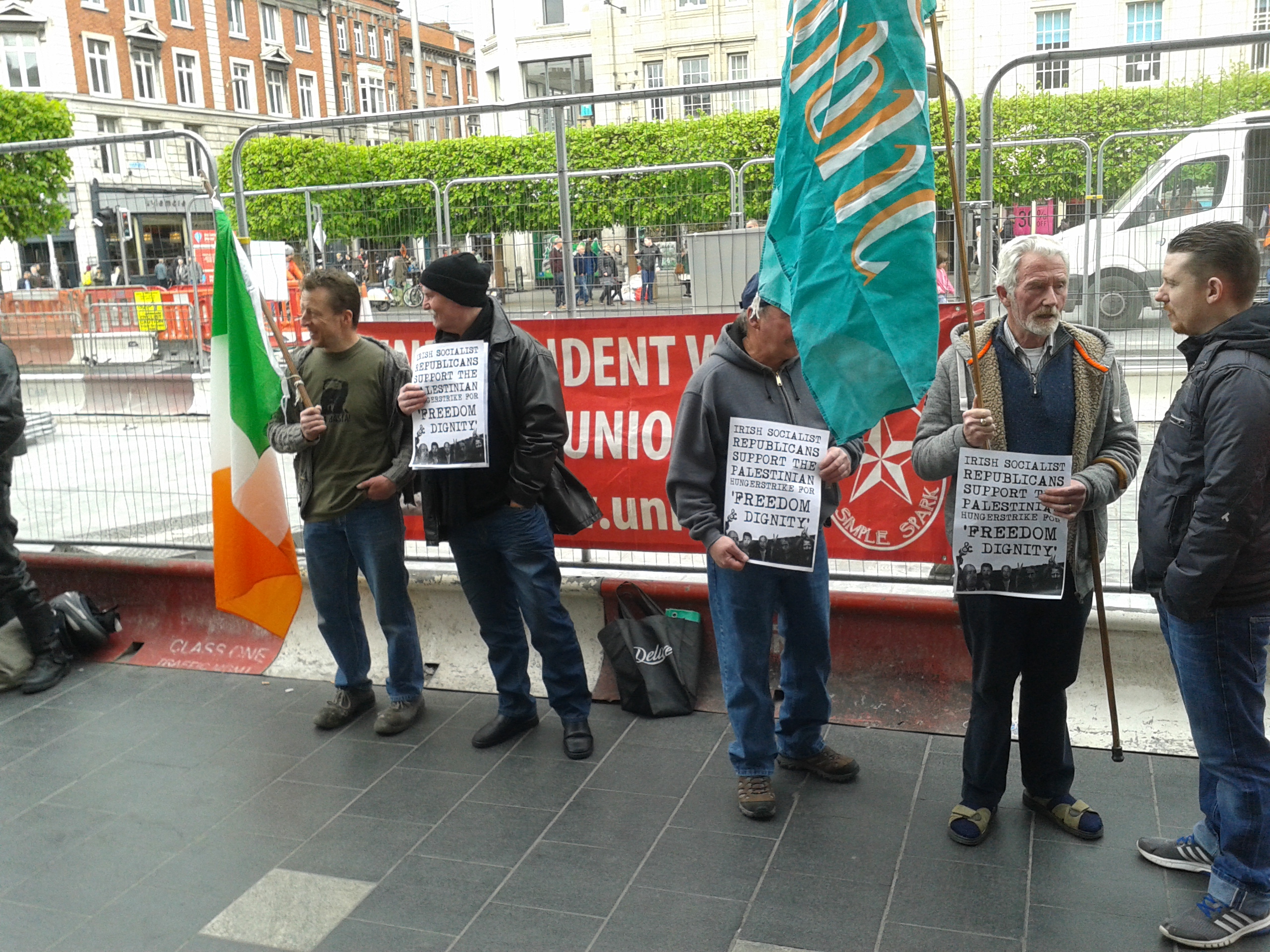
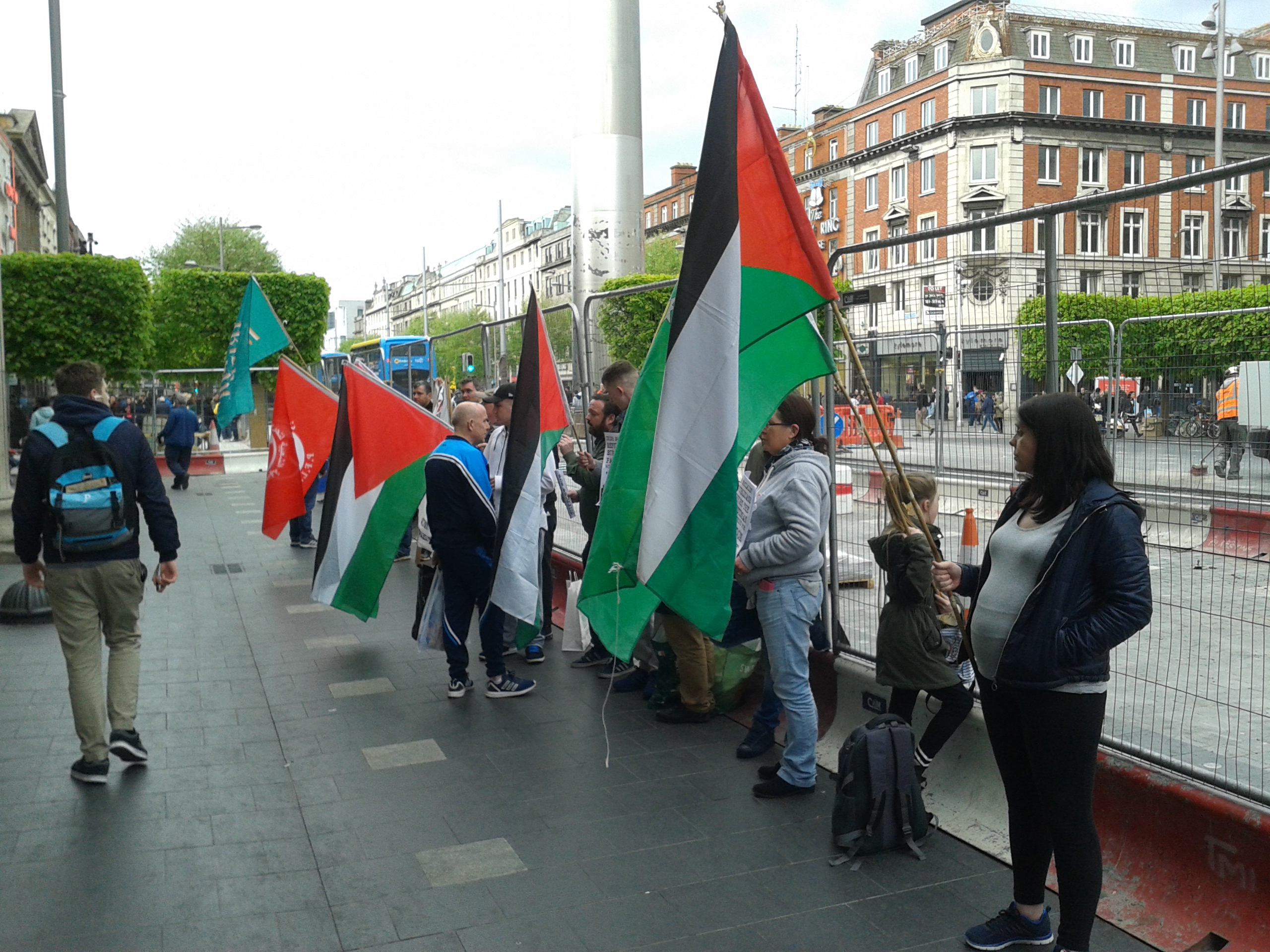
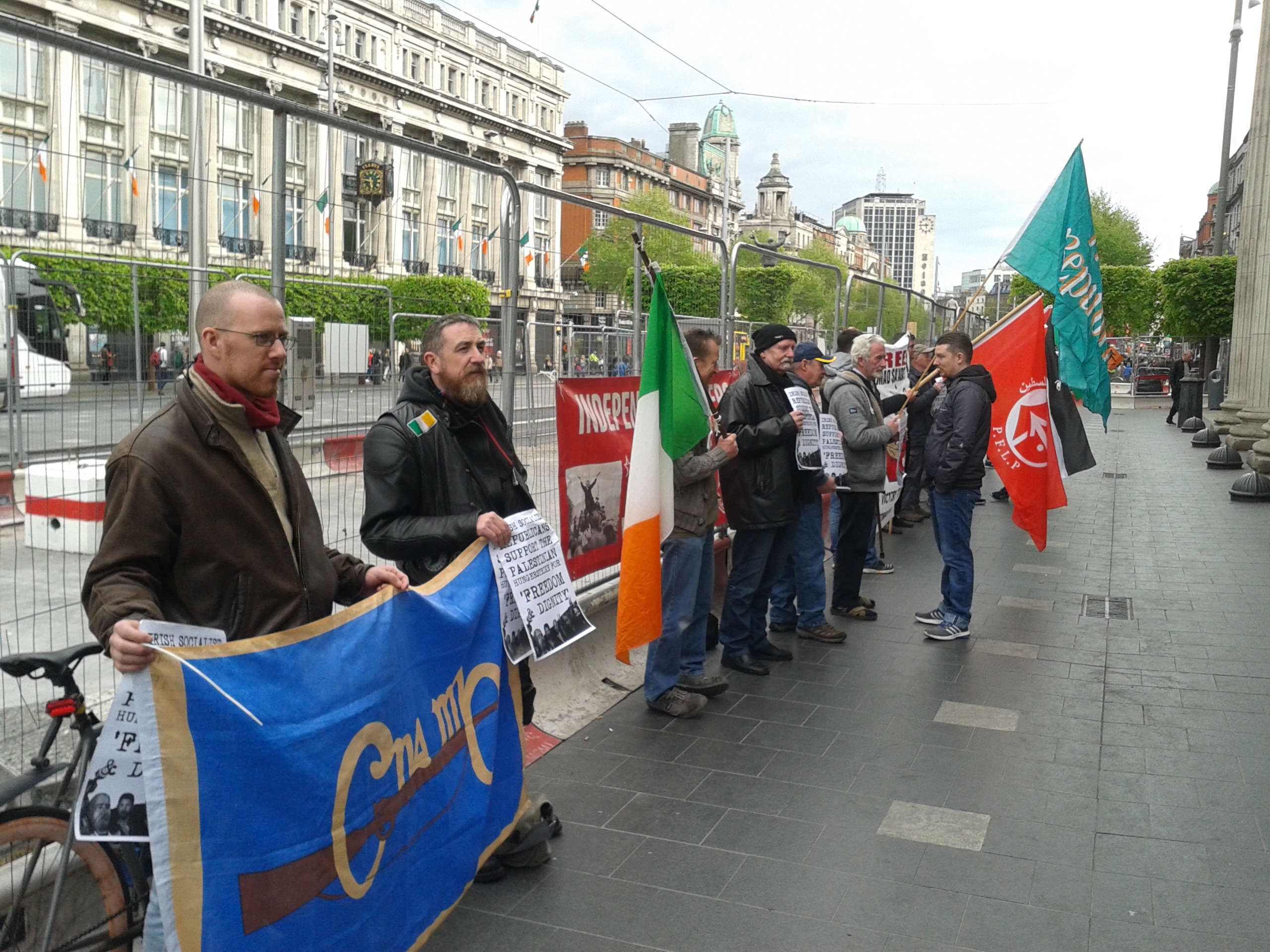
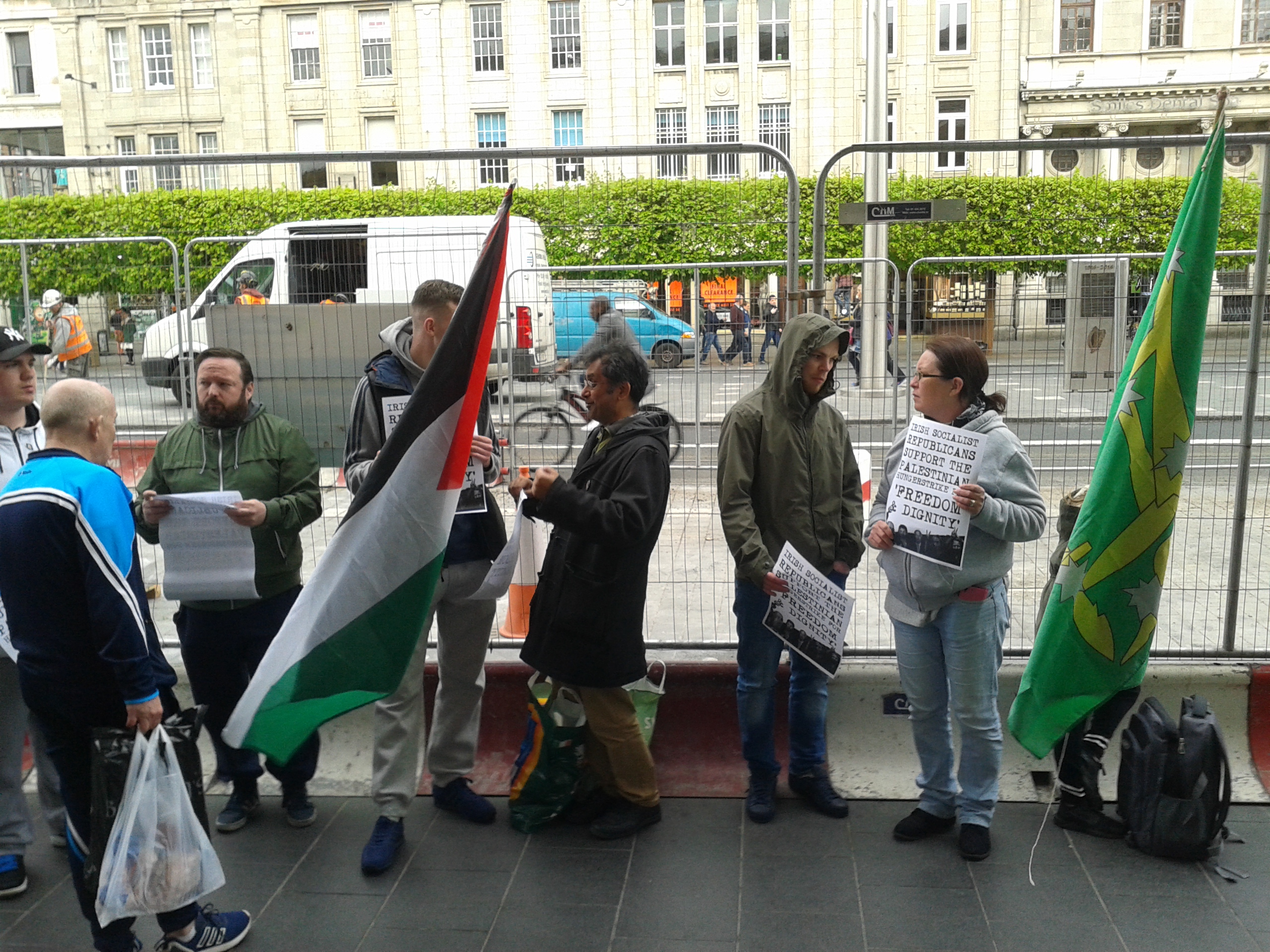
For example, the non-aligned Socialist Republicans for Palestine organised an event on 28th April in Dublin’s main street (photos below) on 28th April.
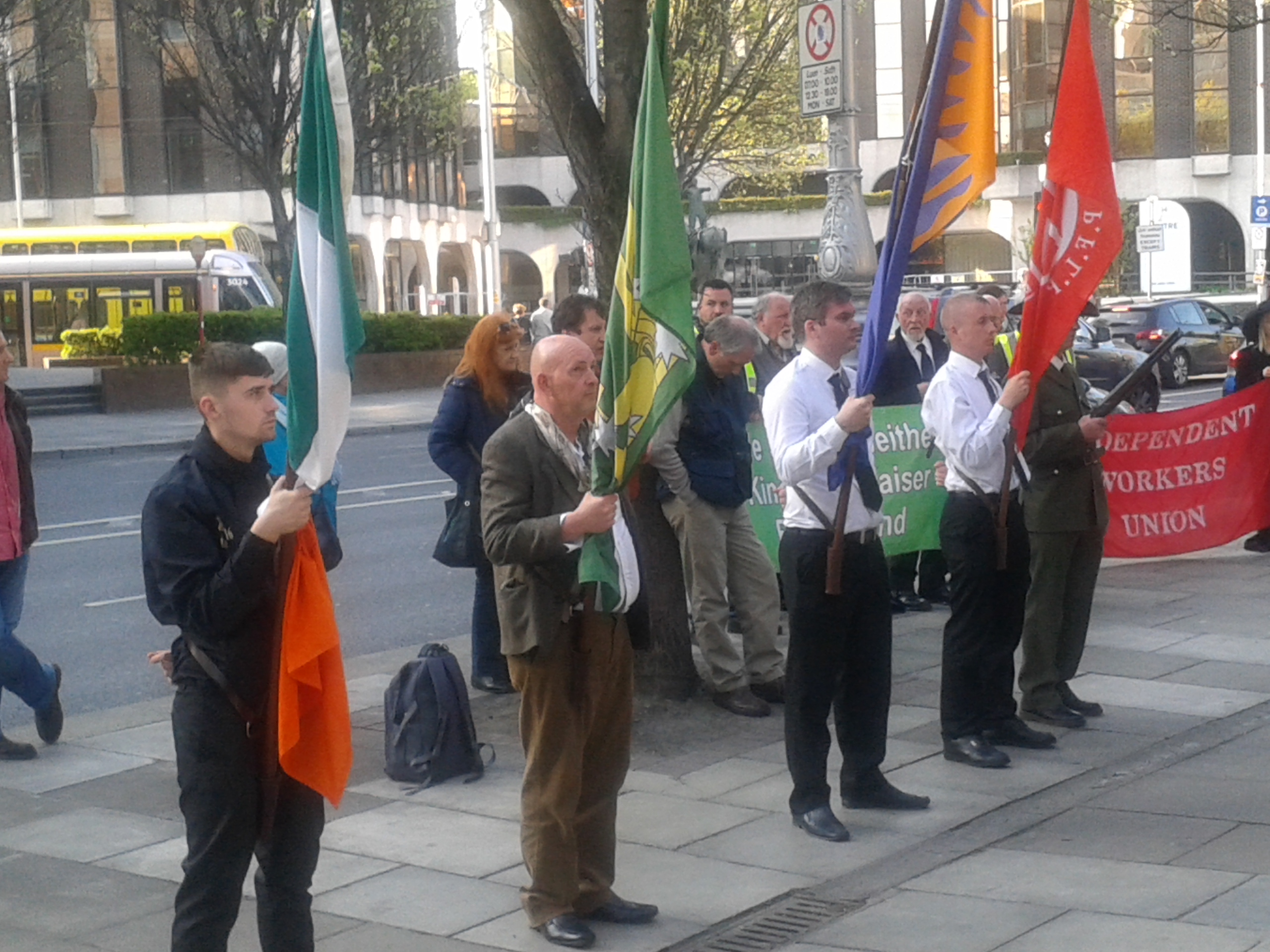
Line of solidarity protesters looking northwards from outside the GPO, O’Connell (main) Street, Dublin (Photo source: Socialist Republicans for Palestine)
Banner of Independent Workers’ Union (Photo: D.Breatnach)
Line of solidarity protesters looking souththwards from outside the GPO, O’Connell (main) Street, Dublin (Photo: D.Breatnach)
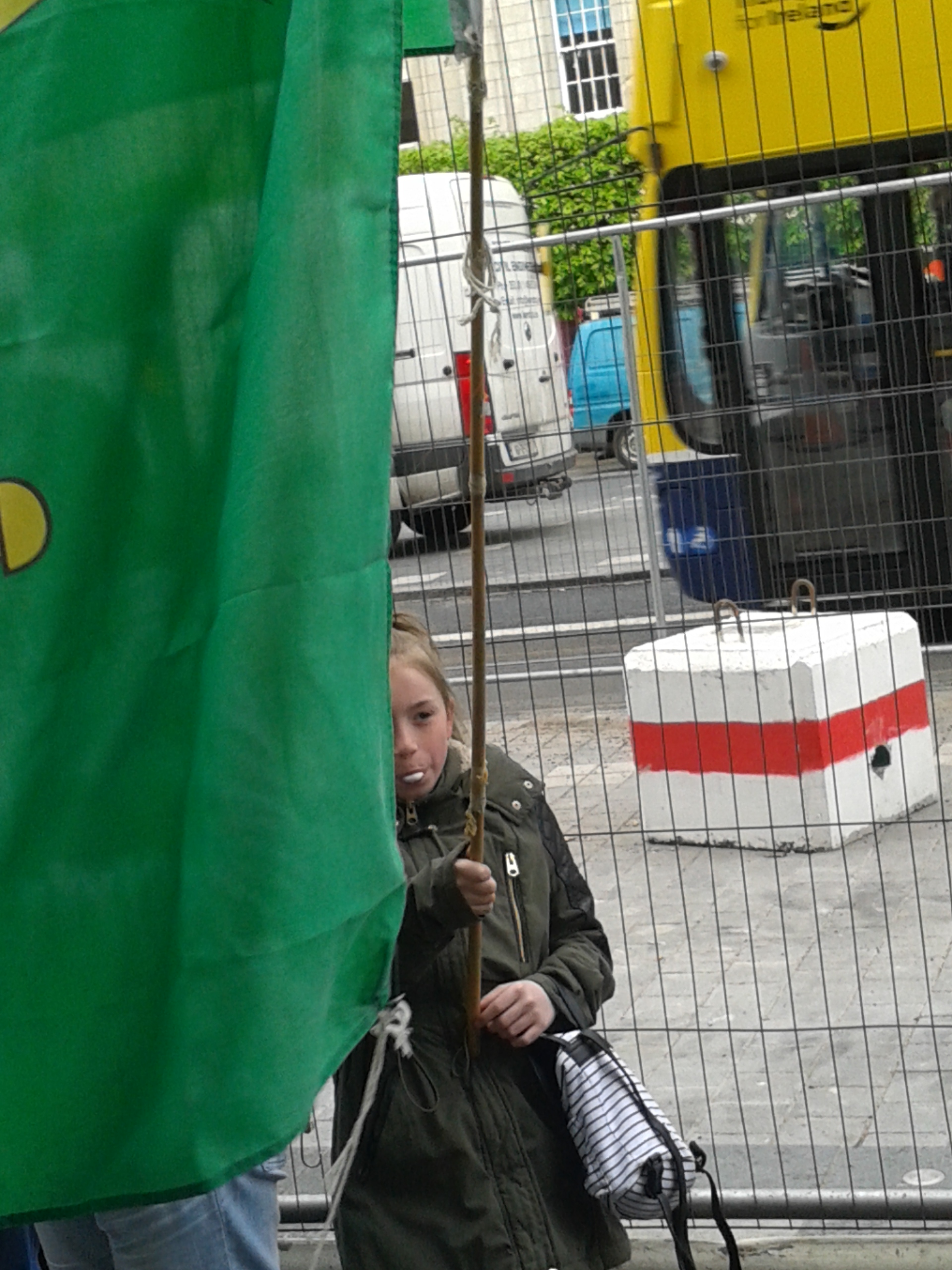
A young supporter holding the Starry Plough, flag of the Irish Citizen Army, a workers’ militia formed in Dublin in 1913.
Upcoming in Dublin:
Organised by Anti-Internment Group of Ireland (see End Internment Facebook page): protest in solidarity with Irish and Palestinian political prisoners at 2pm Saturday in Dublin, Henry St./ Liffey St. junction.
PALESTINE INSIDE THE JAILS
“On Thursday, repressive units continued to invade prisoners’ sections in Ramon prison following a raid on striking prisoners’ sections in Ashkelon prison on Tuesday, when striking prisoners were assaulted for refusing to stand up for inspection. Palestinian lawyer Karim Ajwa reprted that five prisoners were wounded in the face and head and taken to the prison clinic. Ajwa also said that internal disciplinary hearings were conducted against the hunger strikers and sanctions imposed on them as well as fines of 500 NIS ($125) each; he said that salt was also taken from the prisoners in an attempt to break the strike. After 11 days of denials, Ajwa finally obtained a legal visit with Nasr Abu Hmeid and Said Musallam, who also reported that the striking prisoners are boycotting medical examinations and that there are serious health concerns for the ill prisoners participating in the hunger strike.” (from Samidoun, see link)
POLITICAL SECTARIANISM IN PALESTINE
“Meanwhile, in Nablus, Palestinian former prisoners and long-term hunger strikers Khader Adnan and Mohammed Allan, as well as Palestinian Prisoners’ Committee coordinator Maher Harb, were attacked and then detained for several hours by Palestinian Authority security forces before being released, as they participated in a march to support the prisoners. The prisoners of the Popular Front for the Liberation of Palestine, the Democratic Front for the Liberation of Palestine and Islamic Jihad issued a message from Israeli prisons in support of Khader Adnan, denouncing “desperate attempts by some parties to incite against the activist Khader Adnan as a prelude to physical tageting,” and saying that Adnan is a symbol of unity and resistance who is threatened by the occupation.” (Samidoun)
IN THE COMMUNITIES IN PALESTINE
“As part of the protests on Thursday in support of the prisoners, Israeli occupation forces shot two Palestinians in the legs and wounded dozens more due to tear gas inhalation in al-Khalil on Thursday as Palestinian youth protested in support of hunger-striking Palestinian prisoners. In Issawiya, occupation forces dismantled the solidarity tent set up in the village in support of Palestinian prisoners on hunger strike, storming it and then confiscating the materials. In Shuafat refugee camp and Silwan, Israeli occupation forces attacked protesting Palestinian Jerusalemites supporting the hunger striking prisoners. One shop owner was reportedly seized by Israeli forces in the city of Jerusalem after Israeli occupation forces attempted to forcibly compel shop owners to break the strike and open their doors, which they refused.” (Samidoun)
In Gaza, the demonstrators in addition to supporting the prisoners on hunger strike called for “freedom for Georges Abdallah and Bagui Traore in French prisons. Georges Ibrahim Abdallah is the imprisoned Arab communist struggler for Palestine who has spent over 32 years in French prisons. …. Bagui Traoré is the brother of Adama Traoré, killed in French police custody on 19 July 2016. Bagui is the main witness of his brother’s death; since the killing of Adama, Bagui has been imprisoned, first sentenced to eight months in prison for allegedly hitting police and then accused of involvement in shooting towards police and gendarmes in the protests against the killing of Adama.” (Samidoun)
Gaza demonstration showing flags of mixed political allegiances (Photo: Samidoun)
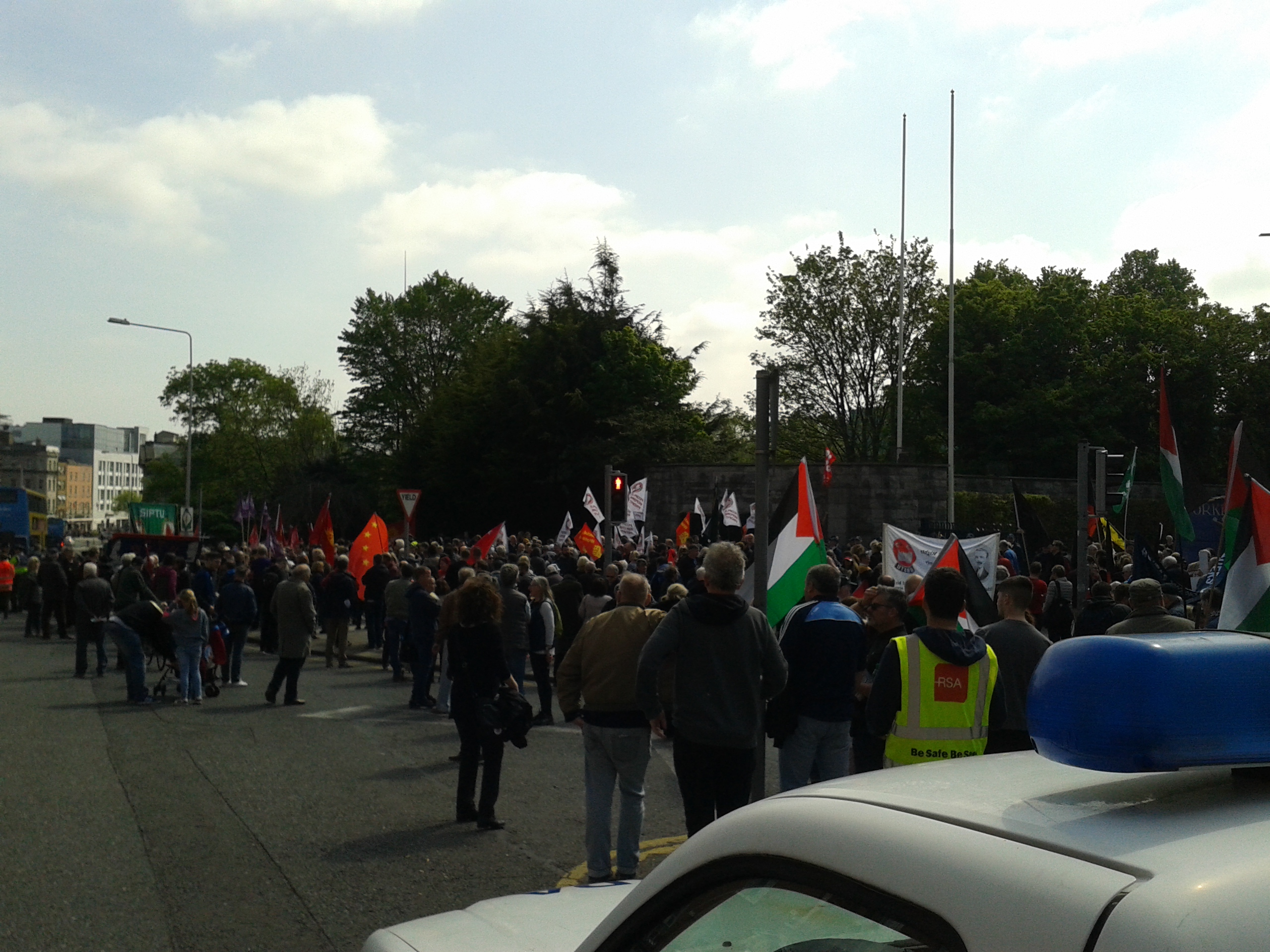
May 1st, International Workers’ Day was celebrated in warm sunshine in Dublin with a parade and rally organised by the Dublin Council of Trade Unions and a later event organised by the Independent Workers’ Union.
Crowd scene outside Garden of Remembrance, the starting point of the DCTU march
The DCTU-organised event met at the Garden of Remembrance at 2pm and set off at nearly 3pm, with numbers although still small by European standards nevertheless larger than has been seen for some time in Dublin, according to the organisers filling O’Connell Street, the city’s main street throughout its whole length (500 metres or 547 yards).
Seen on the parade were trade union banners, those of some political parties, also of campaigns and community groups.
As it has been doing for years, the parade ended in a rally in Beresford Place, in front of Liberty Hall, the very tall building owned by the SIPTU trade union, where the audience were addressed by speakers from trade unions and campaigns and NGOs.
Section of crowd at rally in Beresford Place
Curiously, soon after arrival the comparatively strong showing of Sinn Féin flags, the green one with their logo and the blue and white version of the Starry Plough, were nowhere to be seen.
Similar section with some banners noticeably missing
The issues of lack of affordable housing, of public land being sold for private housing and speculation, of precarious employment, of financial speculation and cuts in services were addressed by speakers, with a mention also of solidarity for the Palestinian prisoners on hunger strike. A number of speakers also addressed the treatment of migrants and in particular the conditions suffered by refugees in the Direct Provision hostels of the state’s welfare service.
Stage erected at Beresford Place, outside SIPTU’s officesThe Moore Street campaign banner was one of the campaign groups present on the parade and mentioned from the stage by the rally’s chairperson.One of the speakers at the rally — she denounced the sale of private land including the deal done at O’Devaney Gardens estate in Dublin.
Somewhat later, the Independent Workers’ Union held their own event, marching with a colour party from their offices to James Connolly monument, also in Beresford Place and across the road from Liberty Hall.
IWU event colour party at Connolly Monument
Damien Keogh chaired the event and introduced veteran campaigner Sean Doyle who gave a short and to the point speech about the situation in which working people find themselves today and ending with a quotation from James Connolly, in which the revolutionary socialist castigated those who claimed to love Ireland but could tolerate seeing poverty and deprivation among its people. Doyle also sent solidarity greetings to the Palestinian political prisoners on hunger strike in Israeli jails.
Paul Bowman was then introduced and in a longer speech covered Connolly’s time in the USA, his membership of and activities of the IWW (“the Wobblies”); the Haymarket Incident in Chicago which led to the choosing of May 1st as International Workers’ Day and the state murder of the Haymarket Martyrs; the principles and attitude of the IWU today.
Another Moore Street campaign banner and supporters in period costume also participated in the IWU eventSome random tourists, one form London and the other from Madrid, who chanced to pass by and remained for the whole ceremony.
Damien then introduced Diarmuid Breatnach to sing “We Only Want the Earth” (an alternative title to the original of “Be Moderate”). Breatnach explained that the lyrics had been composed by James Connolly and published in a songbook of his in New York in 1907 without an air. As a consequence the lyrics have been sung to a variety of airs but Breatnach said he sings it to the air of “A Nation Once Again” (composed originally by Thomas Davis some time between 1841 and 1845). This arrangement provides a chorus and Breatnach invited the audience to join in the chorus with him, which they did.
“We only want the Earth,
we only want the Earth,
And our demands most moderate are:
We only want the Earth!”
A wreath was laid at the monument on behalf of the IWU by Leanne Farrell.
The chairperson then thanked those in attendance, speakers and singer and invited all back to the offices of the IWU in the North Strand for refreshments.


















 rebelbreeze