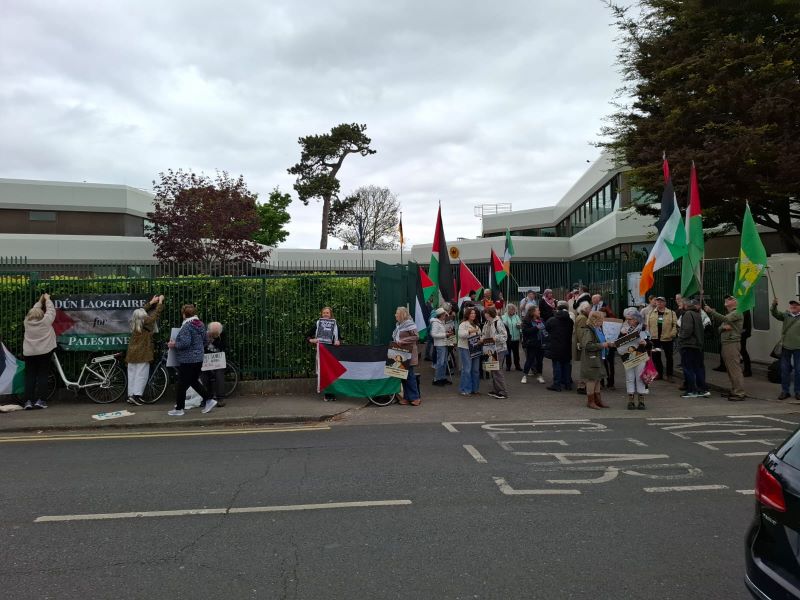
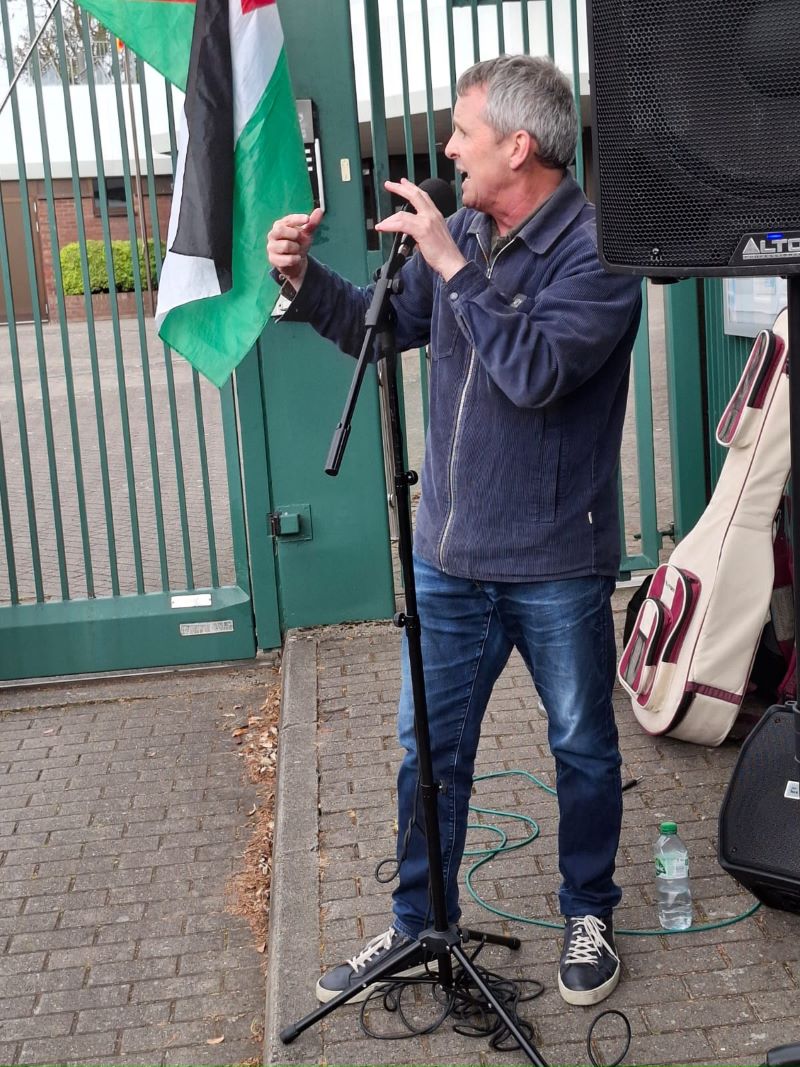
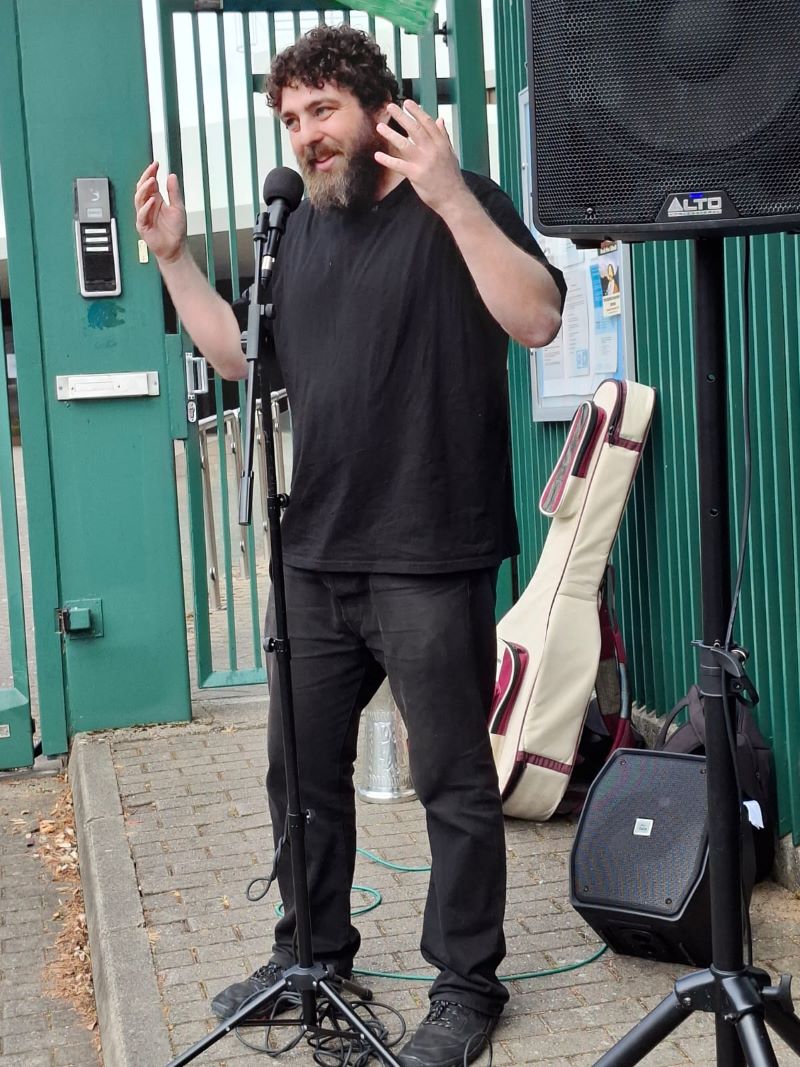
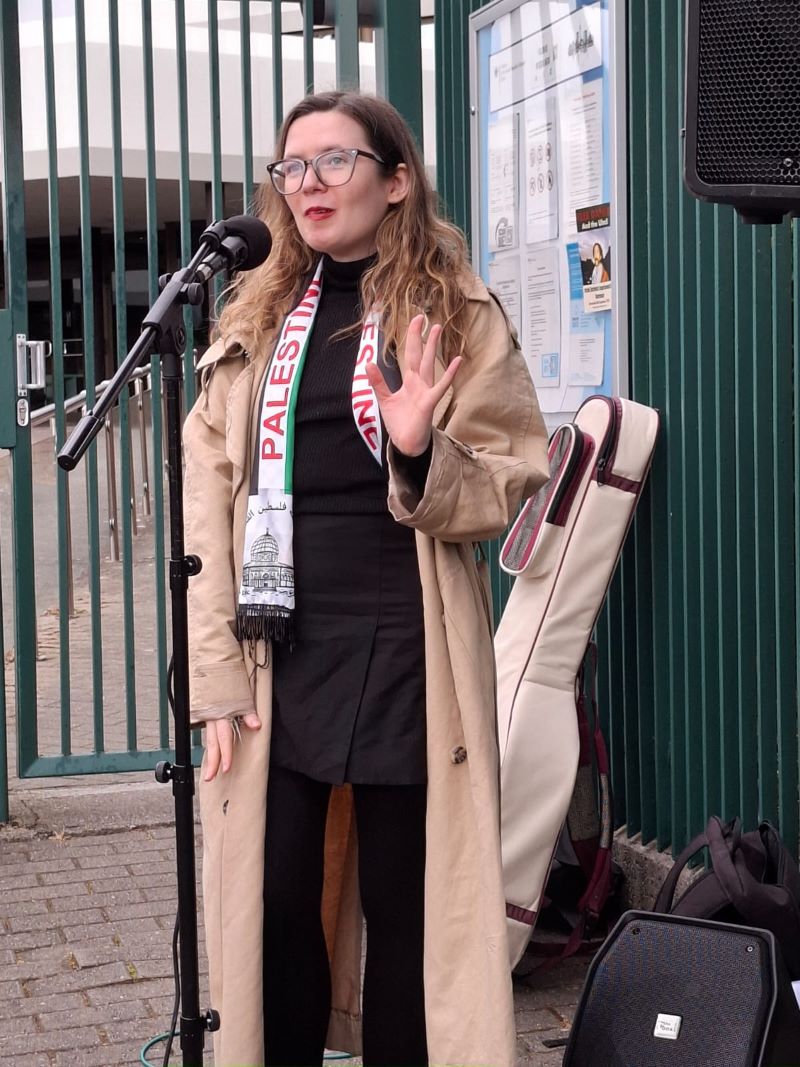
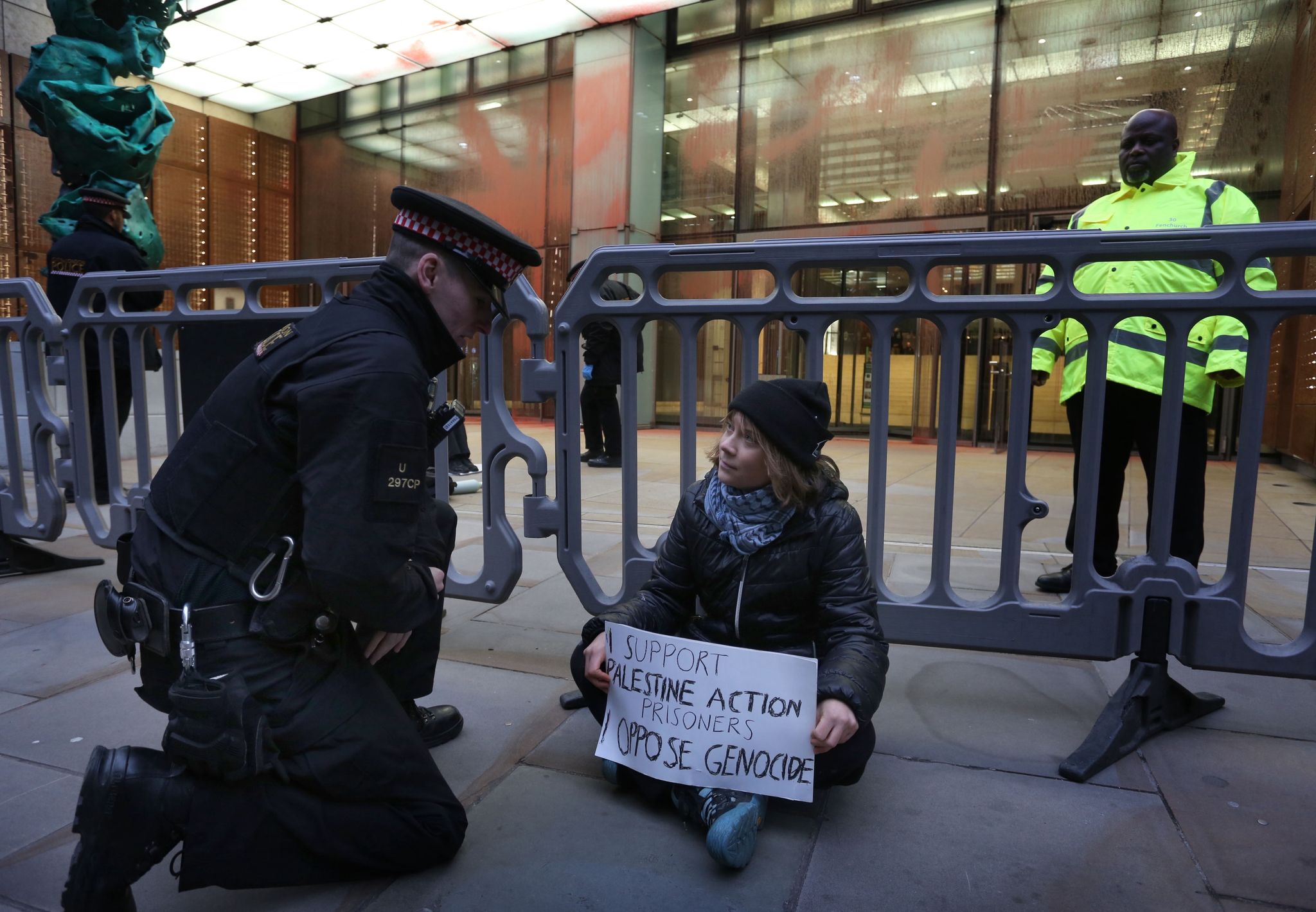
Outside the German Embassy in Dublin speakers denounced the German State’s repression of Palestine solidarity activists and their treatment as terrorists in solitary confinement in dispersed locations, increasing the visiting difficulties for relatives.
Organised by the broad group Dubs for Palestine, scores of people attended a lunchtime picket of the Embassy on Monday 27th April.1 In addition to the speeches and chants, songs were sung with particular relevance to the occasion and location.
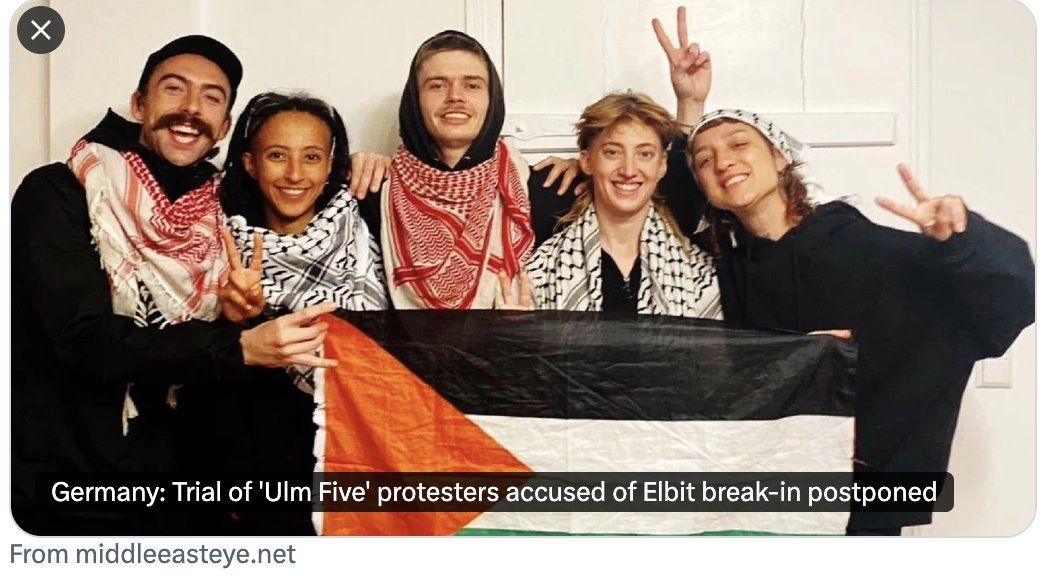
The focus of this rally was in support of a group of five activists that includes a young man formerly of Dún Laoire, Daniel Tatler-Devally and have become known as the Ulm Five. They were alleged to have broken into an Elbit Systems facility in Ulm, Germany and caused damage inside.
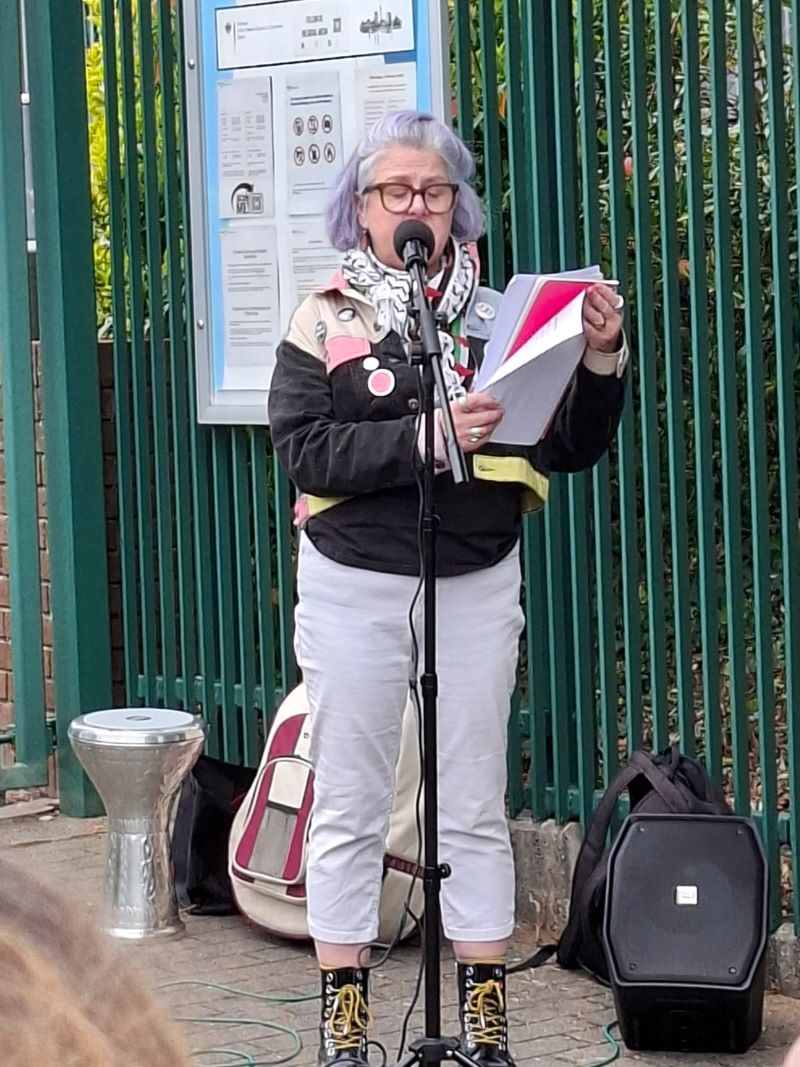
Lynn Treacy, of the Devally-Tatler family support grou, speaking outside gates of the German Embassy, Dublin on Ulm Five solidarity rally April 29th. (Photo: R.Breeze)
Their action was in protest at the Israeli military systems company and its part in the genocide of Palestinians supported by the German state. One of the speakers was Daniel’s father, Conor Devally while Lynn Treacy, a friend of Daniel’s mother spoke on her behalf too.
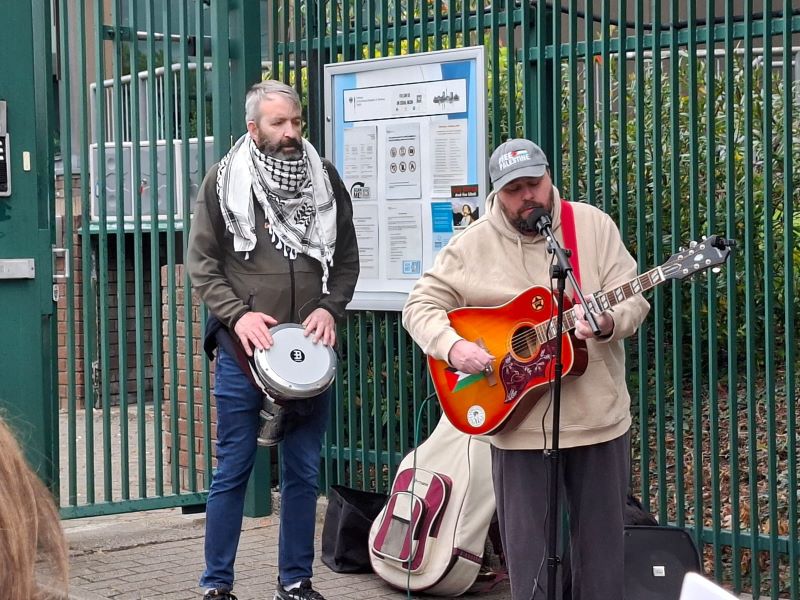
Jimi Cullen, accompanied by Dermot outside gates of German Embassy, Dublin on Ulm Five solidarity rally. (Photo: R.Breeze)
The activists are being treated as terrorists, in seven months of solitary confinement, separated and dispersed throughout different jails long distances apart. Their trial is scheduled for separate days over a period from April to July, also causing relatives and friends great difficulty.
Jimi Cullen singing and playing guitar performed his own We Are All Palestinians, developed from the well-known chant on Palestine solidarity demonstrations, accompanied by Dermot Sheehan on drum.
Two prominent members of People Before Profit spoke, Richard Boyd Barrett TD and Eoghan Ó Ceannabháin, a political and cultural activist and noted singer in the sean-nós style. Raymond Deane, composer and founding member of the IPSC spoke too as did political activist and singer Diarmuid Breatnach.
Richard Boyd Barret speaking at Ulm Five solidarity rally at German Embassy April 29th. (Photo: R.Breeze)
Ó Ceannabháin spent some time demolishing the discourse that Germany has an excuse for its repression of pro-Palestine solidarity because of alleged guilt due to its perpetration of the Hollocaust. He pointed to its genocidal history in Namibia and its leadership of EU imperialism.
The PBP member and election candidate for a councillor vacancy in DCC told the rally of Germany’s banning not only some Palestinian solidarity chants2 but also the song known as ‘Óró Sé do Bheatha Abhaile’3 which he proceeded to sing, the participants joining the chorus with gusto.
Ó Ceannabháin at Ulm Five solidarity rally at German Embassy April 29th. (Photo: R.Breeze)
Diarmuid Breatnach pointed out that the German working class had a strong history of struggle and at one time led the world in socialist and social-democratic representation, even recording a vote of 4.8 million votes for the Communist Party in the midst of Nazi repression.
Hans Beimler, a communist trade union activist, Breatnach said, escaped from a Nazi concentration camp, went to Spain to fight in the Anti-Fascist War there and was killed. In his honour Breatnach sang two verses of The Peat Bog Soldiers4 followed by the ballad about Beimler.
Breatnach was accompanied on drum by Dermot Sheehan, a regular attendee at the weekly Wednesday Dubs for Palestine event outside Leinster House, seat of the parliament of the Irish State. An anti-Zionist Jewish activist spoke against Israeli Zionism and its support by Germany.
Naoise Dolan speaking at Ulm Five solidarity rally at German Embassy April 29th. (Photo: R.Breeze)
Speaking in German, Irish and English, Naoise Dolan, novelist, supporter of Palestine Action who was captured in piracy action by the IOF on the October 2025 Gaza aid flotilla, also spoke to denounce the attitude and actions of the German Government and Berlin police.
Ken Powell of Dubs for Palestine, who had acted as MC throughout, led the rally in chanting slogans of solidarity with Palestine including calling for the freedom of each of the Ulm Five by name before thanking all for their attendance and concluding the event.
end.
Early view of Ulm Five solidarity rally outside German Embassy April 29th as people are still arriving. (Photo: R.Breeze)
Note: If you found this article of interest, why not register with Rebel Breeze for free, so that you will be notified by email of subsequent articles. You can de-register any time you wish.
FOOTNOTES
1The day the trial began in Germany but however did not proceed due to the presiding judge refusing to allow the Defence lawyers to sit with their clients and the lawyers’ refusal to proceed under those restrictions
2“From the River to the Sea, Palestine will be free,” which they claim is ‘anti-Semitic’; also “Globalise the Intifada.”
3An Dord Féinne is the actual title given by Patrick Pearse in his adaptation of a traditional song in Irish.
4A translation from the German song of the Communists in Nazi concentration camps which was eventually banned by the camp authorities under pain of death.
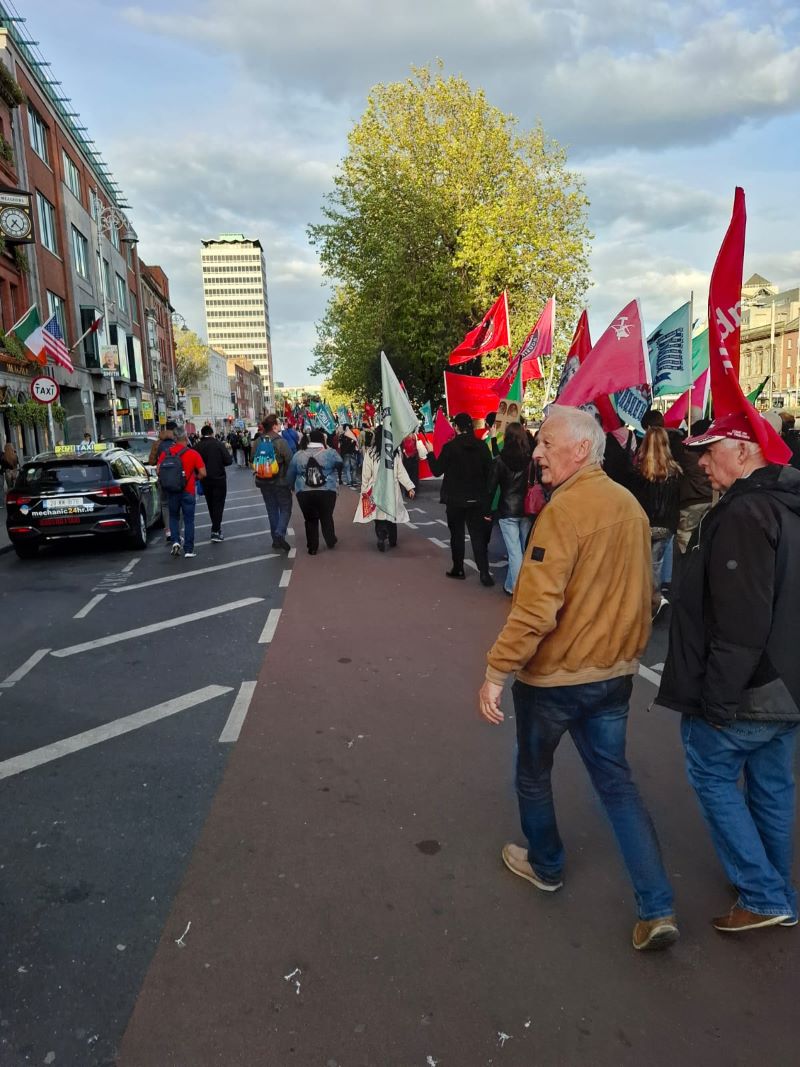
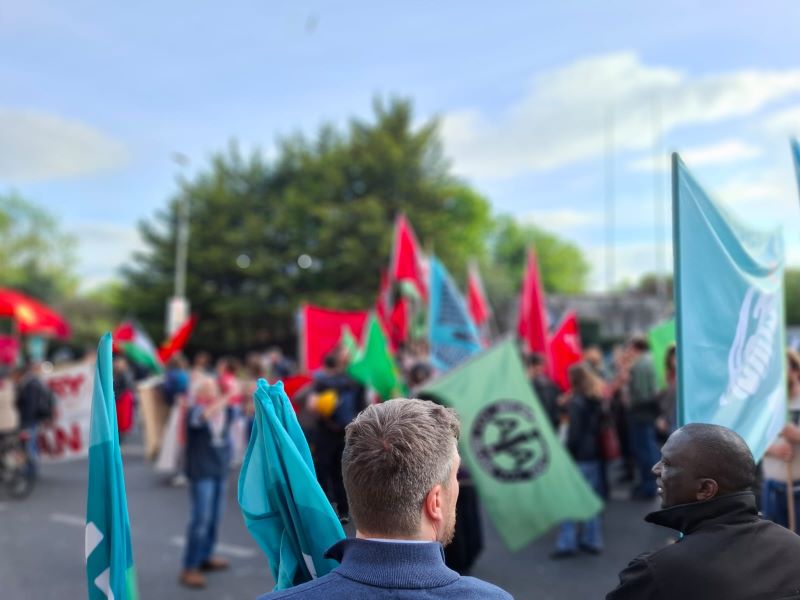
Composed of Socialist Republican, Communist and Anarchist contingents, along with independent activists of various tendencies, a broad Revolutionary Bloc marched among other groups and individuals in the annual May Day march in Dublin on May 1st.
Eden Quay, as the march turns off O’Connell Street, heading for Beresford Square, by the tall Liberty Hall building in the left background. (Photo: R.Breeze)
At intervals the banners of the Communist Party of Ireland, the Independent Workers’ Union and flags of the Anti-Imperialist Action contingents could be seen and a number of flags denoting specific groups or campaigns were on show but the Bloc was mainly identifiable by its slogans.
Led in call-and-answer almost non-stop from departure point at the Garden of Remembrance to Beresford Place in front of Liberty Hall,1 slogans called on workers to strike work and fight, to oust imperialist states and NATO from Ireland, for resistance unity, revolution and a socialist republic.
Section of the Revolutionary Bloc, centre image. (Photo: R.Breeze)
It was notable that an Irish Tricolour and a number of Starry Plough flags were visible among the Bloc and indeed one of the chants was against the appropriation of the Tricolour by ‘traitors’. They also called for funding for education and not for big corporations and for a hotel-free city centre.
At least one of the flags was of the Revolutionary Housing League and the march passed an empty building appropriated three years earlier by the RHL who were then evicted by a Garda force of 100 with helicopter and armed unit as backup. The building remains empty to this day.
People in Dublin stopped in the early Friday evening to watch and in the northern reach of O’Connell Street an elderly man stepped off the pavement to march along with the Bloc, though in silence while further along, two teenage girls in school uniform joined the Bloc also.
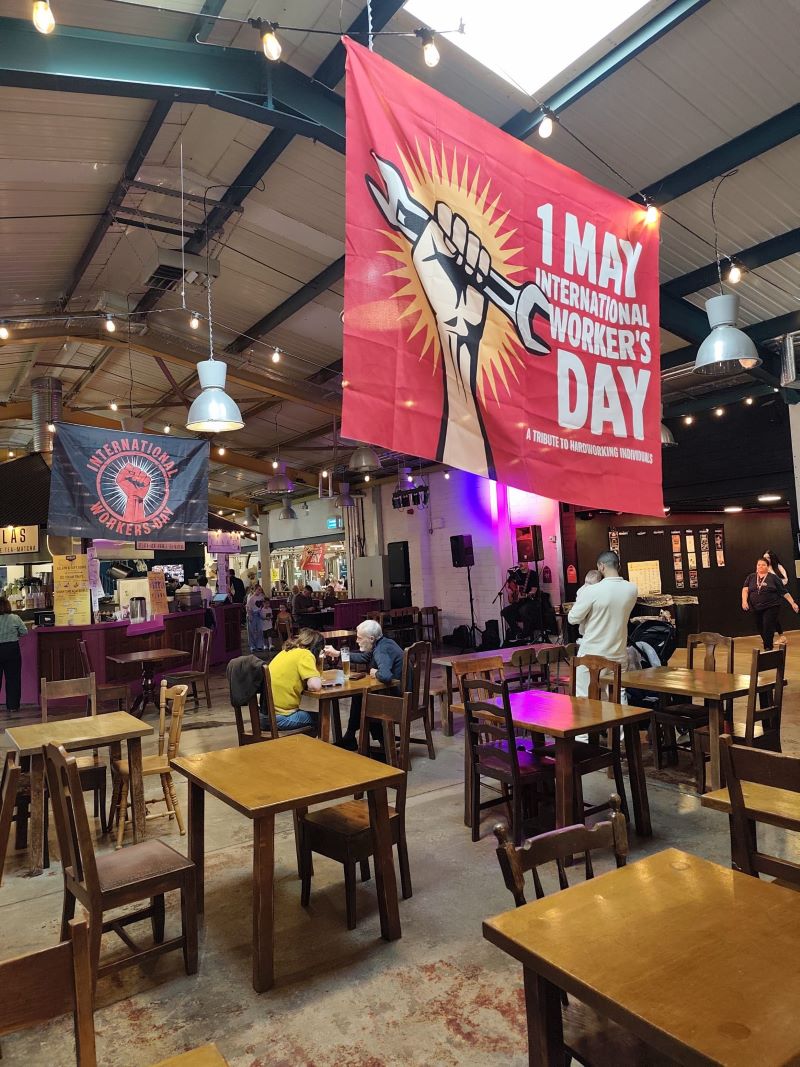
The Priory Market, Tallaght, Dublin prior to opening (Photo: Supplied by supporter)
Led by a long piper, the various contingents marched into Beresford Place, where a stage had been set up in front of the SIPTU2 headquarters building but most of the Revolutionary Bloc marched past to congregate for a group photo around the nearby monument to James Connolly.
Using the Bloc’s megaphone, one of the group then sang the Be Moderate song (also known as We Only Want the Earth) composed by James Connolly3 and, as the singer informed his listeners, published in the Songs of Freedom songbook by Connolly in New York in 1907.
As most of the Bloc dispersed, speeches were being made from the nearby stage and a group of mostly younger people from Turkey were assembling at the Connolly Monument also for a group photo.
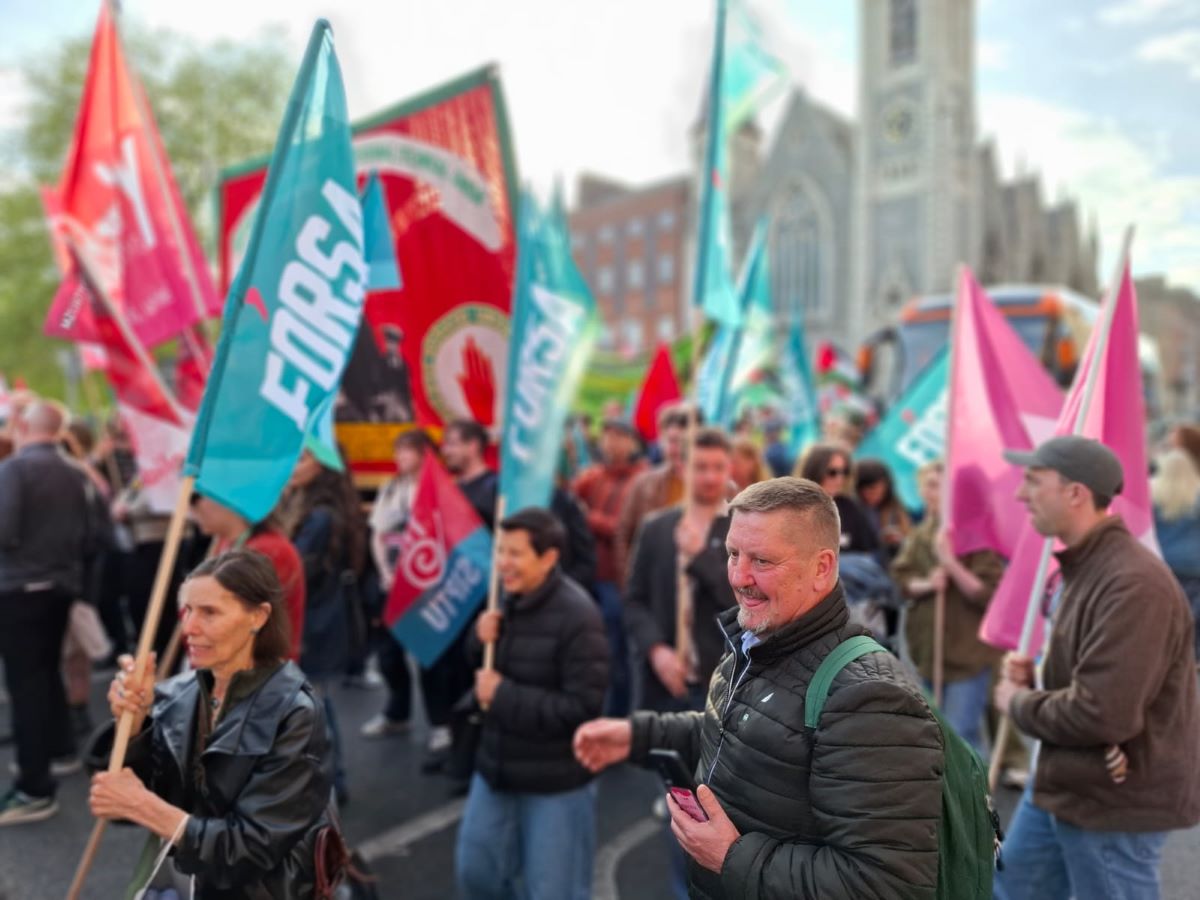
The May Day march and rally in Dublin is traditionally organised by the Dublin Council of Trade Unions. However the participation of union banners was low in numbers and those present mostly of the FÓRSA union.
Section of the march showing FORSA union flags being carried. (Photo: R.Breeze)
Distinct from other European states, the foremost struggle in Ireland for centuries has been on the national question which has entailed less development in the forces devoted to socialism, so that in general May Day does not bring out the numbers one can see in the capitals of the EU and UK.
However, Ireland’s long history of resistance to colonial occupation has entailed a greater history of insurrection than most European states and it has also produced a remarkable number of leaders of labour struggles among the Irish diaspora in Britain, the USA and Australia.
End.
Note: If you found this article of interest, why not register with Rebel Breeze for free, so that you will be notified by email of subsequent articles. You can de-register any time you wish.
FOOTNOTES
1A highly-visible very tall building on the site of the original Liberty Hall, HQ of the IT&GWU, now of SIPTU.
2One of the largest (possibly the largest) trade unions in Ireland, formed by amalgamation of other unions on the base of the Irish Transport and General Workers union, of which James Connolly had been an officer and for a period, its overall leader.
3James Connolly (5 June 1868 – 12 May 1916), born and raised in the Cowgate area of Edinburgh, revolutionary socialist activist-theoretician and Irish Republican, author, journalist, historian, union organiser, executed by the British occupation along with another 15 prominent insurrectionists of the Easter Rising.
Diarmuid Breatnach (slightly edited repost from 2014)
(Reading time:3 mins.)
In England it is called “Boxing Day” but in Ireland the 26th of December is “St. Stephen’s Day”. Despite the Christian designation it has long been the occasion in Ireland for customs much closer to paganism.
It was common for a group of boys (usually) to gather and hunt down a wren, a small songbird.
The wren can fly but tends to do so in short bursts from bush to bush and so can be hunted down by determined boys. The bird might be killed or kept alive, tied to a staff or in a miniature bower constructed for the occasion.
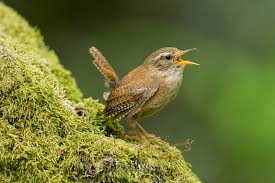
The Dreoilín singing on a mossy rock.
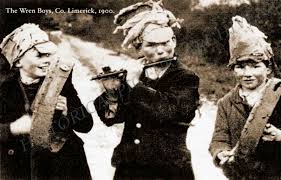
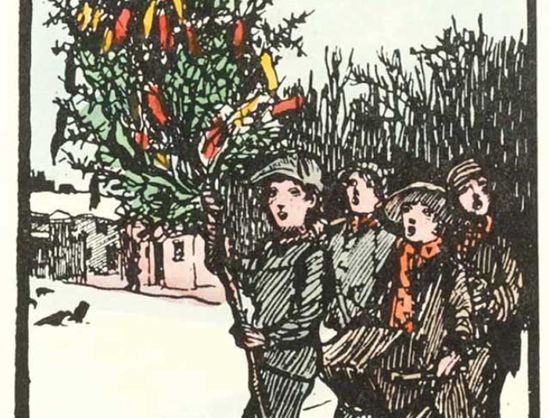
The Wren Boys would then parade it from house to house while they themselves appeared dressed in costume and/or with painted faces.
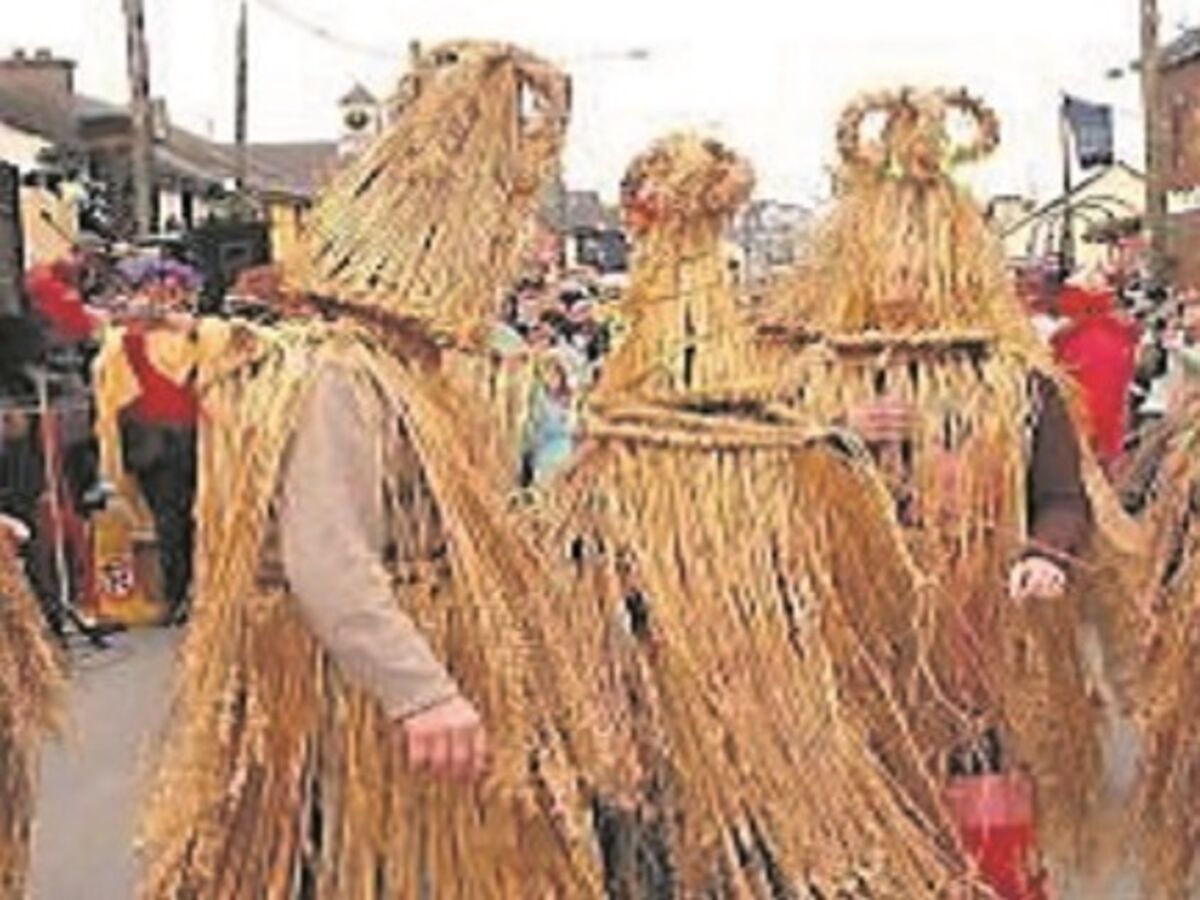
In some areas they might only carry staff or wands decorated with colourful ribbons and metallic paper while they might in other areas dress in elaborate costumes, some of them made of straw (Straw Boys) and these were sometimes also known as Mummers.
However a distinction should be drawn between these two groups. The Mummers in particular would have involved acting repertoires with traditional character roles and costumes, music and dance routines.
The simpler Wren Boys however might each just contribute a short dance, piece of music or song. In all cases traditional phrases were used upon arrival, the Mummers having the largest repertoire for in fact they were producing a kind of mini-play.
The origins of the customs are the subject of debate but a number of Irish folk tales surround the wren.
Straw Boys at a festival.
The bird is said in one story to have betrayed the Gaels to the Vikings, leading to the defeat of the former. There is a Traveller tradition that accuses the wren of betraying Jesus Christ to soldiers while another tradition has the bird supplying the nails (its claws) for the crucifixion of Jesus Christ.
Yet another tradition has the wren as King of the Birds, having used its cunning in a competition to determine who would be the avian King, hiding itself under the Eagle’s wind and flying out above the exhausted bird when it seemed to have won.
By the 1960s the Wren Boy custom was beginning to die out even in areas where it had held fast but it slowly began to be revived by some enthusiasts. Nowadays fake wrens are used.
Christmas Day in Ireland was traditionally a day to go to religious service and to spend at home with family or to go visiting neighbours.
It was not a day of presents or of lights or Christmas Trees, customs brought in by the English colonizers in particular from Prince Albert, the British Queen Victoria’s royal consort, who was German.
St. Stephen’s Day may have celebrated the turn of the season heralded by the Winter Solstice (the wren being a bird that on occasion sings even in winter) but moved to a Christian feast day.
In any case it produced colour and excitement at a time which did not have the religious and commercial Christmas season to which, in decades, we have become accustomed.
The lovely song The Boys of Barr na Sráide from a poem by Sigerson Clifford takes as its binding thread the boys in his Co. Kerry childhood with whom Sigurson went “hunting the wren” but follows also their fight against the invader and their subsequent emigration to England or the USA.
Drawing of Wren Boys out on their round.
I’ve been singing this song in private recently but also at the December gathering of the monthly 1916 Performing Arts Club in Dublin.
In this recording it is sung by Muhammed Al-Hussaini (then resident in London and part of the singing circle of Comhaltas Ceoltóirí na hÉireann, meeting in the Camden Irish Centre) in which I had the pleasure of participating on a visit to London in 2014 (see The London Visit on the blog).
There are recordings of others performing this song well but the unusual origin as well as its quality persuaded me to choose this one and, in addition the memory of participating in a singing circle with this lovely and modest singer in London, who greeted me in Irish.
Muhammed also plays the violin on this recording, accompanied by Mark Patterson on mandolin and Paul Sims on guitar.
Mummers from Fingal, north of Co. Dublin
Ends.
Note: If you found this article of interest, why not register with Rebel Breeze for free, so that you will be notified by email of subsequent articles. You can de-register any time you wish.
The photo with the recording shows some of the Limerick fighters of the Kerry IRA in the War of Independence (1919-1921) or perhaps in the Civil War (1922-1923)
There were lively scenes today outside Dublin’s British Embassy in solidarity with the hunger strikers in British jails awaiting trial on charges arising out of Palestine Action’s operations against the Israeli arms company, Elbit Systems UK.
Two of the six hunger strikers are in their 50th days without food and approaching the point where fatal seizures are possible or suffering irreversible damage to body systems. Their demands are release on bail, a fair trial, de-proscription of Palestine Action and the closure of Elbit Systems.
Early shot of hunger-striker solidarity protesters outside the British Embassy compound today. (Photo: R.Breeze)
There have been daily solidarity protests in Britain, including those led by the Irish Brigade1 in London amid general mass media silence but the arrest of Greta Thurnberg today on ‘terrorism’ charges may bring a focus on the hunger-strikes for a change.
Today also The National newspaper revealed that Barclay’s had asked the British Government to ban Palestine Action and already the question is being asked: How is it that was not admitted by the Government when Huda Ammori took the Palestine Action banning to judicial review?
(Greta Thurnberg about to be arrested earlier in Central London). Photo source: Internet)
The rally today, like that outside the British Embassy last week, was organised by the Peadar O’Donnell Socialist Republican Forum, while another solidarity rally in Dublin last week but on College Green, in the City Centre, was organised Communities for Palestine.
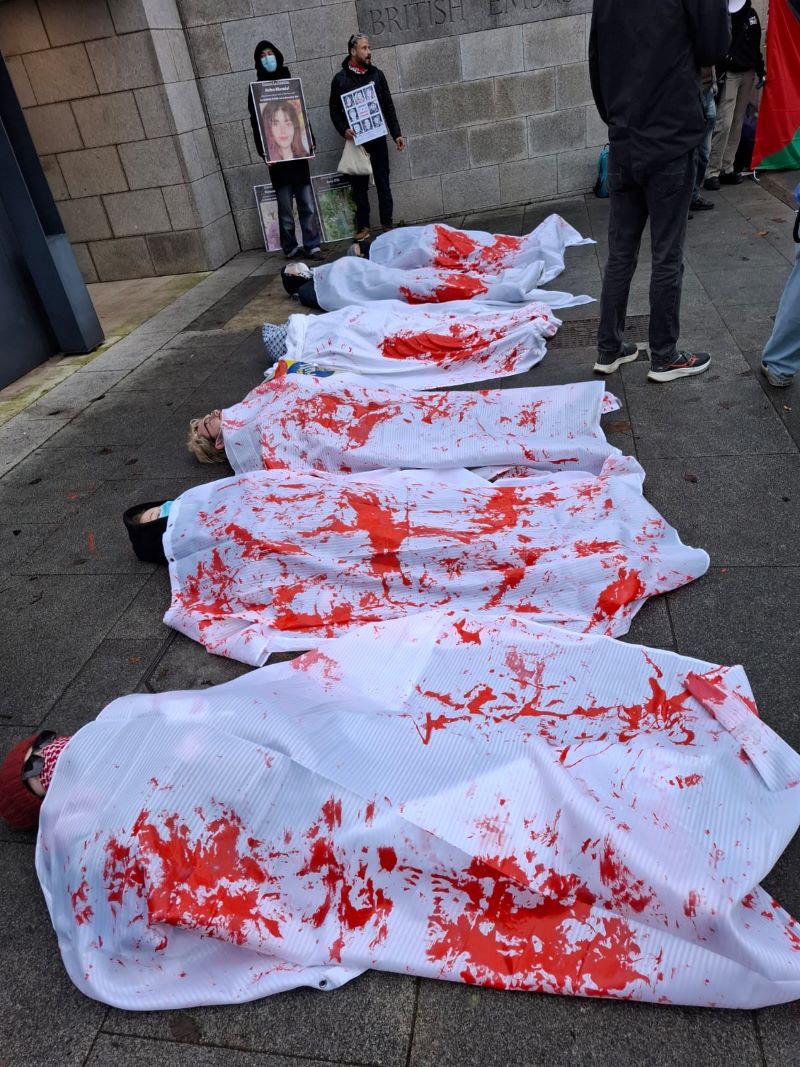
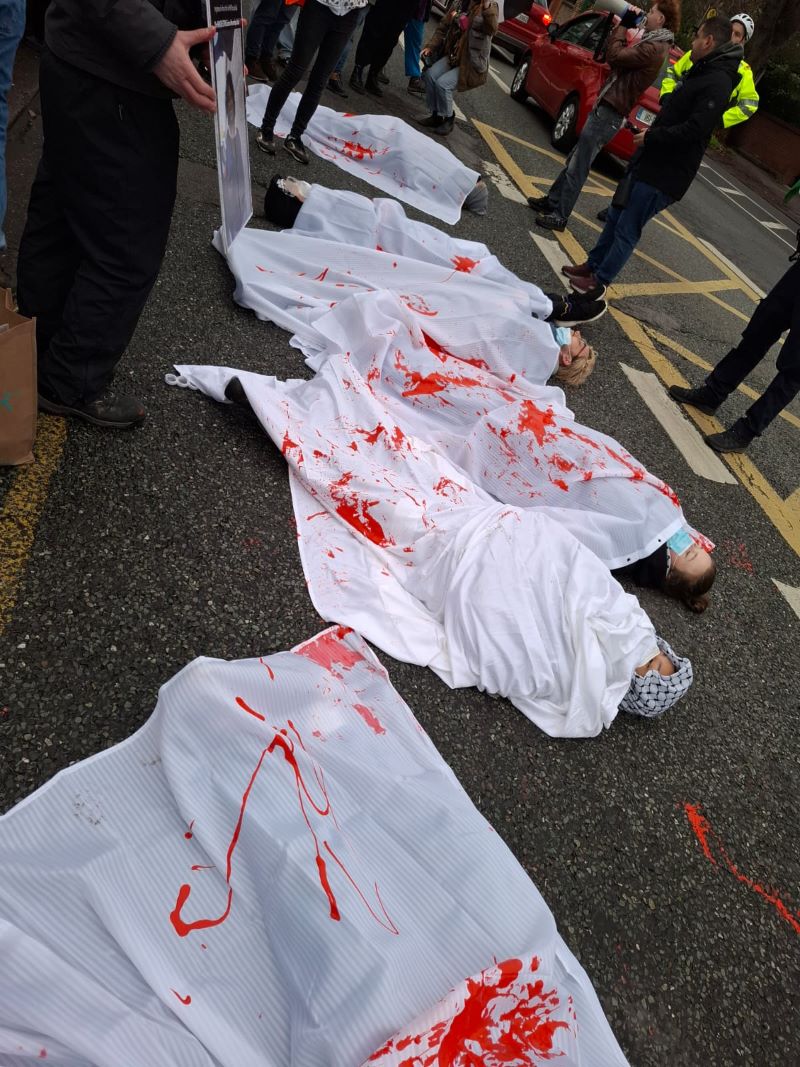
The ‘corpses’ in the road outside the British Embassy compound today. (Photo: R.Breeze)
The chants led outside the Embassy today included the usual ones heard on Palestine solidarity marches, including those referencing the Intifada, the occupation of Ireland and the Irish-language Saoirse don Phalaistín! But there were also new ones and additions to older slogans.
A new Four, Five and Six was added to a previous only One, Two and Three: One – We are the people; Two – We won’t be silenced; Three – Stop the bombing now, now, now! Four – Free our people; Five – Free our land; Six – Kick Zionism out, out, out!
Some other changed and new chants included: One, Two, Three, Four– Support the Filton 24! Five, Six, Seven, Eight – Israel is a terrorist state. We are all Palestine Action! Victory to the hunger-strikers! Brick by brick, wall by wall – all the colonies will fall!
Slogans also castigated British Government collusion in the Israeli genocide, Irish state collusion through militarisation of Shannon Airport and Gardaí collusion through their defence of the British Embassy.
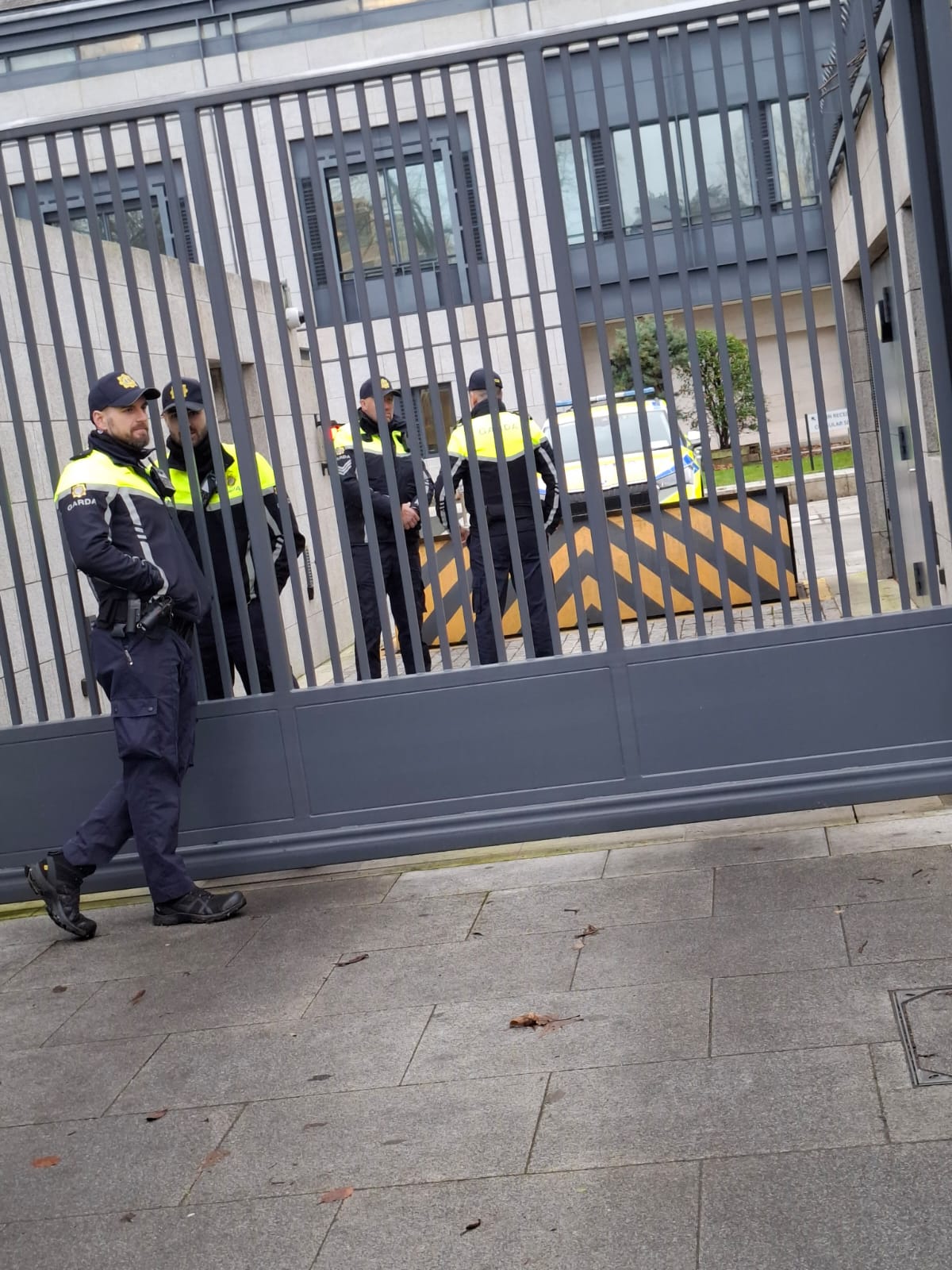
Numbers of Gardaí and one of their vehicles actually inside the British Embassy compound today. (Photo: R.Breeze)
On two occasions the MC asked demonstrators to line both sides of the road outside the Embassy, which is one of the main Dublin routes from and towards the South. Passing traffic frequently sounded their horns in solidarity, passengers often signing thumbs-up or with clenched fist.
But at one point, most of the demonstrators occupied the road, blocking traffic in each direction. The Gardaí moved quickly to break this up and were soon violently shoving demonstrators off the road, one in particular screaming with wild eyes so that he was twice seen restrained by colleagues.2
However part of the northbound road remained occupied in front of the Embassy entrance and at this point a new group of protesters arrived and, unpacking white curtain material, began to squirt red paint on it, then to lie down in the road under the material like massacre victims.
A number of speeches were made during the event and later a man called the crowd to remember also the 1981 hunger strikes in Ireland, for which he sang the Joe McDonnell3 Ballad, with its wonderful chorus lines: You dare to call me a ‘terrorist,’ while you look down your guns!4
Another man recounted the story told by Bobby Sands5 of the caged lark which would not sing for its captor and how that bird came to represent Sands himself, before reciting a poem of an Irish migrant in London in anguish as Bobby Sands lay dying.
The ‘corpses’ were moved from the road to immediately in front of the British Embassy compound today. (Photo: R.Breeze)
The current hunger-strikes are sometimes referenced as “the first coordinated hunger strikes in Britain” since those of the Irish Republicans in 1981. Of course, those strikes were not in Britain but in occupied Ireland and therefore currently part of the United Kingdom.
There are important differences of course. The Irish Republican hunger strikers were convicted, albeit by special non-jury courts, of armed resistance to British occupation; the current hunger strikers have not yet even been tried and none of the charges against them include armed action.
And the motivation of the Palestine Action accused is purely internationalist solidarity against a regime committing daily massacres in a programmed genocide.
Nevertheless, the British ruling class may yet come to regret the day they permitted anti-Zionism to become so strongly linked to anti-British colonialism, and anti-genocide internationalism so closely linked to the memory of Irish colonial resistance.
End.
Note: If you found this article of interest, why not register with Rebel Breeze for free, so that you will be notified by email of subsequent articles. You can de-register any time you wish.
FOOTNOTES
1An ad-hoc broad Palestine solidarity organisation composed of Irish migrants and diaspora in London.
2This may possibly be the same Garda who was seen wildly striking with his baton and pepper-spraying peaceful participants at a Palestine solidarity march to Dublin Port some weeks ago.
4And you dare to call me a terrorist, while you look down your guns! When I think of all the things that you have done: You have plundered many nations, divided many lands, You have terrorised their people, ruled with an iron hand – And you brought the stain of terror, to my land.
5Bobby Sands relinquished his elected post of Officer Commanding the Republican male prisoners in Long Kesh in order to lead the hunger strikes of 1981. On 5th May he was the first of the Ten to die.
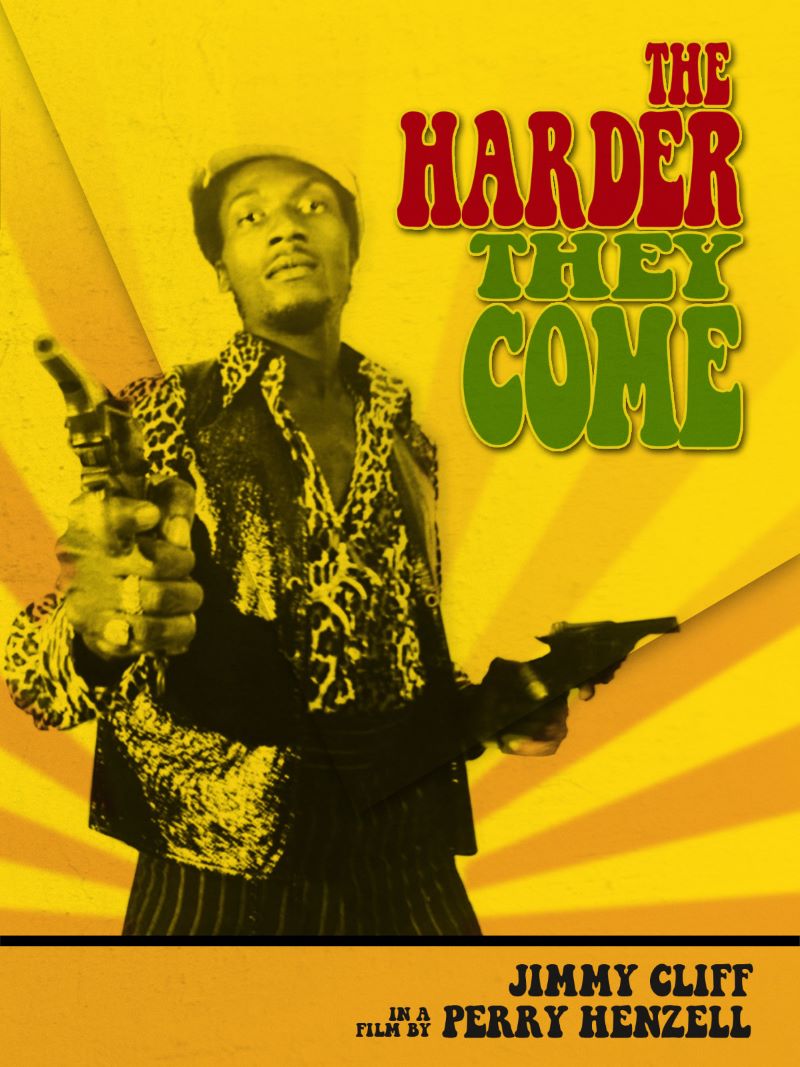
The death is announced on mass media today at 81 year of age of Jamaican reggae singer, songwriter and author Jimmy Cliff,1 famous for songs such as The Harder They Come and for his role in a film of the same title.
As is usual in such cases, tributes have been posted on social media and quoted in the western mass media, including by Ali Campbell of the UB 40 band who was reported to be ‘so sad’2 (which to be honest, seems a little strange as Jimmy Cliff lived to a good 81 years of age before he died).
I first heard a few of Jimmy Cliff’s nearly 30 recordings among the Caribbean community of SE London.
Jimmy Cliff grew up James Chambers in a family of nine in St. James in Jamaica, often mistakenly thought of as the largest Caribbean island (which it is not – that is in fact Cuba). Jamaica, like Trinidad & Tobago, another larger island and Barbados, were among the British colonies in the Caribbean.
The Caribbean islands and coastline3 were first European-colonised by the Spanish, then by the French, Dutch and British Empires, often in armed conflict against its indigenous people but also among themselves, also against slave uprisings and later against local struggles for independence.4
Since WWII the dominant imperialist power in the Caribbean is undoubtedly the United States of America, though France retains some colonial possessions and a few remain part of the British Commonwealth.
Today the Caribbean is in the news through a large force of US Naval forces posted there, along with nearby posting of bombers, along with the murder of over 80 small boat sailors, allegedly drug smugglers (without evidence and as though drug smuggling gets the death sentence).5
According to threats of President of the USA Trump, he intends to target Venezuela and its President Nicolás Maduro, whom he claims – without a shred of evidence — to be the leader of a drug cartel.
Migrant communities and the spread of Reggae
During the decades I spent in London I had a fair amount of contact with parts of the Caribbean immigrant and diaspora community, partly through working alongside some of its members, partly through socialising in SE London and through activity in resistance to fascism and racism.
I first came across Reggae music while living as a migrant in the SE London areas of Lewisham, New Cross and Peckham. There were large Irish and Caribbean communities there with some but not a great deal of interaction between both communities but little hostility between them either.
Both communities were subject to institutional racism and politicised communal racism as organised by the fascist National Front and British Movement, both of which had connections to British Loyalist paramilitary organisations in Scotland and in the Six Counties in Ireland.
I recall reading in a British 1950s sociological study on ‘deviant behaviour’ that ‘Teddy Boy’ gangs would target the post-War newly-arrived Caribbean immigrants (but also the ‘Micks’, i.e the Irish) and a Jamaican workmate told me about the gangs waiting for them on Childeric Rise.6
How he went out armed with a home-made knuckle-duster and how the police would come to the fighting, arresting mostly the Caribbean victims. “Them turn me away when dem see me,” a Caribbean migrant discussing racism told me, “but dem turn you away when dem hear you.”
In Caribbean shebeens7 or illegal ‘clubs’ in that SE London area, one could buy for a modest sum a plate of goat curry and rice, or a can of pale ale or Guinness, while listening to vinyl records of Bluebeat, Ska, Rock Steady, Reggae and, to a lesser extent, Calypso.8 And dance, perhaps.9
Jimmy Cliff composed songs and rode the rising Reggae tide, for a short while rivalling Bob Marley for most popular position. What launched him and the Reggae ship into wider seas was the film The Harder They Come based on the novel of the same name featuring Cliff’s own song.
The Harder They Come novel by Ekwueme Michael Thelwell charting the fictionalised career of a Jamaican who fails to succeed as a reggae singer and becomes a gangster is based on the real life of Jamaican folk hero and reggae star Rhygin.10
But the film’s hero was performed by Jimmy Cliff and his music played as soundtrack.
In Peckham I watched the film years later and enjoyed it but I also read the novel. The latter gives an interesting background of the hero growing up in his grandmother’s care in rural Jamaica, before he goes to Kingston, while the film opens only with the hero’s arrival in the city by bus.
Famous folk singer Bob Dylan is reported to have said that Jimmy Cliff’s 1969 song Vietnam was the best protest song he had ever heard. It is hard to credit that as a true statement; Pete Seeger, Dylan’s contemporary, many others and Dylan himself had composed many better.
Jimmy Cliff’s Vietnam song takes as its theme a US soldier in Vietnam writing about his impending return home at the end of his tour of military service in Vietnam and his desire for his girlfriend, followed by another missive to the soldier’s mother announcing her son’s death in Vietnam.
The tragic juxtaposition of youth, romantic love, violent death and parental bereavement is an inherent theme of war and of course works on our emotions. But the song says nothing about who sent the soldier there nor the reasons for the Vietnam War, though one line calls for its end.
The lyrics tell us nothing about the devastation of the US war upon the peoples of Vietnam, Laos and Cambodia, nor about the heroism of the people’s resistance.11 Not even about the huge protests of many people in the USA — particularly youth — and in much of the western world.
Jimmy Cliff in performance (Photo credit Alastair Wison/ PA)
However, Jimmy Cliff’s performance of the song 20 years ago in Jamaica brings the point of the anti-war movement much more into context as in his introduction to the song on stage he castigates Tony Blair and George Bush and names a number of other imperialist wars.
It was a great performance of Cliff’s at the end of his sixth decade of life and I hope you enjoy it here on video.
Note: If you found this article of interest, why not register with Rebel Breeze for free, so that you will be notified by email of subsequent articles. You can de-register any time you wish.
2Facebook · UB40 Featuring Ali CampbellSo sad James chambers has left a void in reggae music, his voice and influence was exemplary. He was a reggae pioneer, RlP Jimmy cliff.
6This rise gave on to the New Cross Road from terraced housing down below where a number of Caribbean families lived, in one house of which I shared a double room with another Irish migrant. Almost at the top of Childeric Rise itself was the entrance to The Harp Club Irish dance hall with an Irish pub on an opposite corner and another across the road.
7From the acknowledged Irish language word ‘síbín’, etymology uncertain but adopted as far away as the Caribbean and South Africa.
8Music mostly of Trinidad and Tobago, often accompanied by steel band instruments, based on folk dance music from a part of West Africa. https://en.wikipedia.org/wiki/Calypso_music
Currently the Palestinian Resistance is engaged in an important struggle to eliminate four Israeli-proxy militias. This type of militias of colonial and imperial powers have a long history, not least in Ireland from the 1800s to the present.
SETTLER AND NATIVE MILITIAS IN IRELAND
The British colonial occupation of Ireland had an army to quell native resistance but many settlers also organised themselves into armed bands (as in Palestine), such as the Hearts of Steel or Hearts of Oak in the late 18th Century in order to resist the big landlords.
The United Irishmen were successful in uniting a number of these, both native and settler bands such as the Whiteboys and Hearts of Oak, particularly in Antrim but the Peep O’Day Boys went mostly with the sectarian and royalist Orange Order.
The settlers also organised yeomanry militias which they labelled ‘Volunteers’, initially to defend against a feared invasion from Napoleonic France. Some of those contained Republican sympathisers and some quite the opposite.1
In response to the successful uniting efforts of the mostly Protestant-led United Irishmen, the Orange Order was founded by British loyalists and soon received official support in organising anti-Catholic pogroms and in exposing United supporters, especially among the Protestant communities.
LOW INTENSITY OPERATIONS AND “PSEUDO-GANGS”
During the three-decades war towards the end of the 20th Century mostly in the 6 Counties, the British Occupation also organised proxies such as the Ulster Volunteer Force and the Ulster Defence Association. These were recruited among the Protestant/unionist community.
But not only among civilians.
As has been a pattern among colonial possessions, the occupying power organised a gendarmerie, i.e an armed police force under central command of the occupying power. In Ireland that was the Royal Irish Constabulary which came to prominence in the suppression of the 1867 Fenian rising.
After the partition of Ireland by the British in May 1921, the RIC within the remaining direct colony of the Six Counties was renamed the Royal Ulster Constabulary2. British Intelligence used this force to channel intelligence, arms and recruits into the Loyalist gangs.
In addition, many members of the disbanded RUC’s semi-militia, the part-time B-Specials, were reorganised into the RUC Reserve of the colonial police or recruited into the British Army as the newly-formed Royal Ulster Regiment, from which the Loyalist militias could be supplied as before.
Brigadier Frank Kitson was a leading colonial counter-insurgency strategist who had served in Kenya and Malaya before he was sent to the Six County colony to coordinate the Loyalist militias and the official armed forces and gendarmerie, no doubt in coordination with MI5.
Kitson published Gangs and Pseudo-Gangs (1960) and Low Intensity Operations (19713) based on the experience of colonial resistance repression in Malaya and Kenya, going on to introduce these ideas organisationally in the occupation of the Six Counties.
Pseudo gangs give the occupying power deniability and, being generally from the occupied country,4 have local knowledge. They can carry on terrorism and assassinations at ‘a remove’ from the occupying power.5 In the case of criminal gangs, they have an existing organisation.
Such gangs may have family or other social relationships with some in the targeted community, introducing allegiances and communal fragmentation as has been occurring to some extent in Gaza. However, in Ireland, the gangs were all originating from the unionist community.
Frank Kitson (now Brigadier) in 1971 (Photo source: Internet)
Jeffrey Sluka summarises6 “… beginning in 1972, there has been a vicious, continuous campaign of sectarian assassination against Catholics in Northern Ireland waged by Loyalist paramilitary groups (the Ulster Defence Association [UDA] and Ulster Volunteer Force [UVF]) …
“… and their associated death squads (the Ulster Freedom Fighters [UFF], Red Hand Commandos, Protestant Action Force, etc.), who have killed nearly 700 innocent Catholic civilians – the largest category of casualties in the war.
“Thousands of other Catholics have survived Loyalist attempts to murder them.
“The existence of this campaign has never been publicly acknowledged by the British authorities, who have ignored it, downplayed it, and actively misrepresented it …
“… to influence the media and public in this regard, both at home and abroad, as an integral part of their counterinsurgency strategy.
“The official position of the British authorities is that there is no state terror in Northern Ireland, and certainly no death squads. When pressed, they admit that there is Loyalist terror against Catholics, but insist that they have nothing to do with it.
“When pressed with evidence such as the fact that hundreds of members of the Security Forces have been convicted of involvement with Loyalist paramilitaries, they claim that this collusion is informal – individual acts by rogue soldiers and policemen
“- and not a reflection of government policy or military strategy. All of these are political lies.”7
SEPOYS
The use of military forces recruited among the occupied people dates back further even than the Roman Empire and the British Empire used them extensively in India, where they called them ‘Sepoys’,8 which is what the Basque pro-independence people call the Basque Autonomous Police.9
In India, one of the most serious uprisings against British rule was sparked by a mutiny of its Sepoys.10
In Palestine, the ‘Zipaios’ equivalent are the police of the Fatah-controlled Palestine Authority. They are bad enough, brutally suppressing dissent, spying on and even attacking Palestine organisations in the West Bank, arresting and even killing critics.
The Royal Irish Constabulary in Ireland were a gendarmerie mostly composed of sepoys and of course there were many Irish regiments in the British Army and Irishmen also served in other British Army units, the Royal Navy and the Royal Air Force.
WORSE THAN SEPOYS
The militias in Gaza are however even worse. Based on criminal gangs and social groups, they have consistently looted aid trucks coming into Gaza before Israel closed all the gates, then selling the goods at high prices to the hungry population as Gaza starved and medicine became scarce.
According to reports there are currently four Zionist-linked militias in Gaza: Abu Shabab around Rafah in southern Gaza; Husam al-Astal in Khan Younis, Ashraf al-Mansi in Beit Lahia in the North, and Rami Heles in eastern Gaza.
Sourced from The Cradle based on Sky News investigation.
Their looting, supported by the Zionist state, was even used to try to blame on the Resistance, with Israeli spokespersons claiming that Hamas was stealing the aid. Conversely, as the Resistance strove to counter the proxy militias, the fighters were targeted by the Israeli Occupation Force.
Consequently it was almost impossible for the Resistance to suppress the proxy militias – until the current ‘ceasefire’. Now, able to operate to some extent more openly, the Resistance is settling accounts with the proxy militias. And it is very important that they do so.
Not only for what they have done, the plundering of emergency aid, attacks on displaced persons, torture and murder of famed journalist Salah al-Jafarawi.11 But because they are a serious infection, injected into Gazan society by the Zionazi occupation in order to cause serious harm to the society.
According to reports, undercover operatives of the Resistance have infiltrated the gangs and managed to appropriate a large number of weapons and vehicles of the gangs donated by the IOF or by the United Arab Emirates.12
Hamas advertised a truce for gang members to hand over their weapons and surrender themselves to the authorities, which some have done but many have not. The Resistance has operational clashes with the militias and has captured many. Some were publicly executed by gunshot.
Whether full-scale war returns to Gaza after this ‘ceasefire’ (full of IOF bombings, shelling and shooting) or not, their presence in Palestinian society cannot be tolerated, not by the civil government, nor by the broad community, nor by the armed resistance.
End.
Note: If you found this article of interest, why not register with Rebel Breeze for free, so that you will be notified by email of subsequent articles. You can de-register any time you wish.
APPENDIX:
A Sky News investigation has revealed that Israel is backing four Palestinian militias inside Gaza to weaken Hamas as part of what militia leaders call “Project New Gaza.” Hossam al-Astal, head of one of the groups, said the militias are coordinating their efforts to remove Hamas from power.
He claimed that Yasser Abu Shabab and Ashraf al-Mansi, leaders of other groups, have also joined the project. All four militias are reportedly positioned along the yellow line in areas under Israeli control.
Astal told Sky News his headquarters is only 700 meters from an Israeli military outpost and that an Israeli coordinator had agreed to establish a “Green Zone” free of shelling or gunfire. Footage reviewed by the outlet showed militia vehicles with Hebrew markings scratched off.
Astal admitted the group receives logistical support and ammunition from outside Gaza and has bought Hamas weapons on the black market. A senior fighter in the Abu Shabab militia also said Israel had enabled the smuggling of guns, cash, and vehicles.
The militias reportedly coordinate their movements with Israeli forces at Kerem Shalom to bring in supplies, while western powers are said to provide indirect material support. Two of the militia leaders are former Palestinian Authority security officers.
While the Mansi militia denied direct contact with the Israeli military, it acknowledged coordination with Israel’s District Coordination Office. Abu Shabab previously told Army Radio he was open to working with Israel, calling Trump’s ceasefire plan “a way to end the war.”
“Soon we will achieve full control of the Gaza Strip,” he told Sky News.
(Summarised by The Cradle online news updates on Telegram 26 October 2025).
FOOTNOTES
1The yeomanry militias deployed in Wexford, such as the North Cork, proved to be the most vicious and indisciplined of the Occupation’s forces and are noted in a number of songs in English and Irish: “… He led us on against the coming soldiers,And the cowardly yeomen we put to flight…” (Boolavogue, Patrick McCall, 1898);
“… Is go gcuirfeam yeomen ag crith in a mbrógaibh Ag díol a gcomhair ar Shliabh na mBan.” (Sliabh na mBan, believed byMícheál Óg Ó Longáin, 1798).
2Since then renamed the Police Service of Northern Ireland (sic).
3The same year that mass internment without trial was introduced by the British Occupation and that the Ballymurphy Massacre of protesting nationalist civilians was carried out by the Parachute Regiment.
4Sometimes even from the oppressed native community.
5They are more easily dispensed with too, should they be no longer needed or their relationship become too public.
6In his own chapter For God and Ulster: The culture of terror and Loyalist Death Squads in Northern Ireland in Death Squad: The Anthropology of State Terror, Ed. Jeffrey Sluka (200), USA.
8The term in Persian originally denoted ‘soldier’ but borrowed into Urdu and Hindi and under British rule, denoted native soldiers and their units in the British armed forces.
9The Ertzaintza. The Navarran police (‘Forales’) could also be called ‘Sepoys’ but are more usually called by other uncomplimentary names.
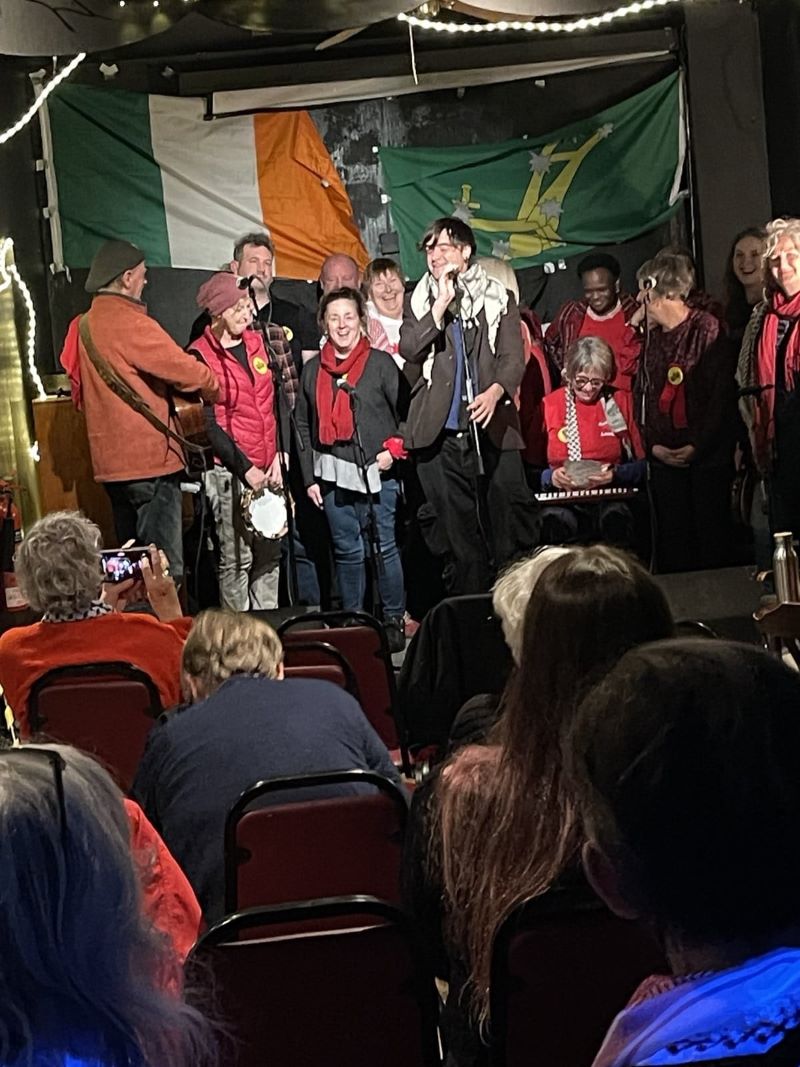
Thursday night (30th), with almost non-stop downpour of rain was a dreary and miserable one in Dublin. Not so however inside the Cobblestone’s back room where solidarity and resistance resounded in song, instrumental and spoken word.
The event organisers, Solidarity Sessions collective, an independent organisation founded late last year have declared a number of times that they wish to contribute to “creating a community of solidarity and resistance through culture.”
Certainly the flags on the stage of the Tricolour, Starry Plough and Palestine conveyed some of the context, as did posters of 1916 martyrs Connolly and Pearse with text pointing out that the first was a migrant and the second, son of a migrant.1
In addition a merchandise stall sold T-shirts figuring the Palestinian Resistance with funds raised going to Palestinian relief work on the ground. Solidarity Sessions have also donated to ‘buy’ a water truck from Uisce for Gaza and also donated to Streetlink Homeless Support in Dublin.
Mark Flynn performing at Solidarity Sessions No.3 in the Cobblestone. (Photo: R.Breeze)
The material performed on stage contributed much of solidarity and resistance also. This was the third event this year and the second at the Cobblestone pub, one other being at the International Bar and the fourth expected at the Peadar Brown pub on Southside’s Clanbrassil Street.
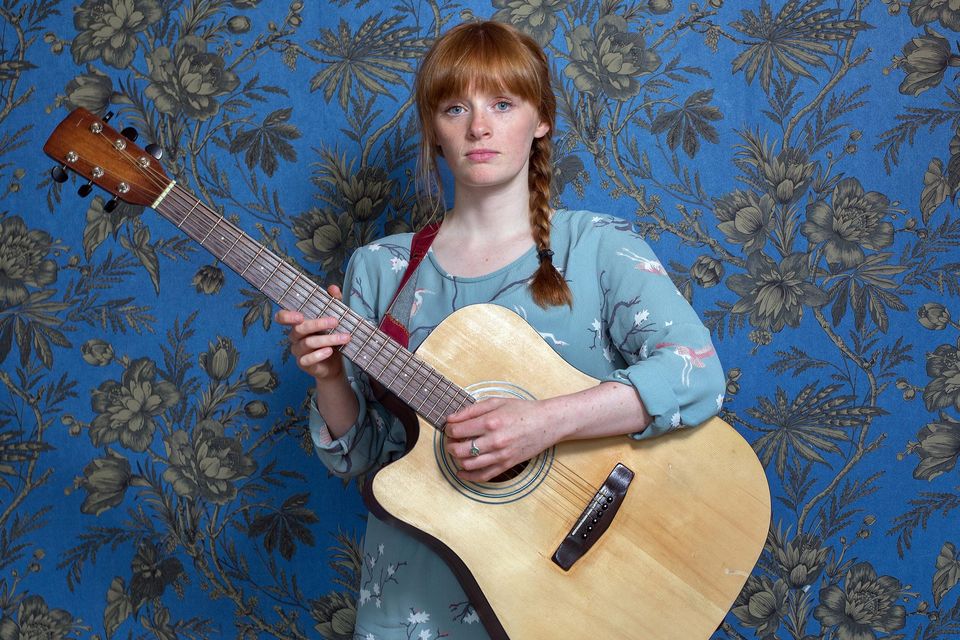
There was a lot of audience participation at times during the evening, with Alan Burke joined from the floor in the chorus of his spirited rendition of The Aul’ Triangle (to which he added a verse of his own) and Sive was accompanied on request by continuous refrain under her singing.
Mark Flynn was also backed by the audience in his adaptation of A Roving I’ll Go to a sailing to Portugal song he told his audience he had put together in minutes of a creative flash the like of which he ruefully admitted not having experienced since. Flynn also sang Bogle’s antiwar Waltzing Matilda.
Alan Burke performing at Solidarity Sessions No.3 in the Cobblestone. (Photo: R.Breeze)
The audience was extremely quiet during Dorothy Collin’s spoken word pieces about assassinations by the Zionist Occupation and Palestinian resistance, interrupting her performance with applause only after a haiku in Irish and at a point where she became visibly emotionally affected.
The Resistance Choir included in their performance an exuberant Bread and Roses, the lyrics originating in a speech at a mostly female textile workers’ strike in Massachusetts, USA in 1912 and Burke sang of an innocent miner framed on a murder charge and hanged – but pardoned posthumously.
Class struggle was also present in Burke’s singing My Name Is Dessie Warren, about a trade union activist with flying pickets2 during the 1970s construction workers’ strike in England. Some were tried under the Conspiracy Laws and jailed, including Ricky Tomlinson and Des Warren.3
The Resistance Choir about to perform at Solidarity Sessions No.3 in the Cobblestone, being introduced by the MC, Ru O’Shea. (Photo: R.Breeze)
ANNOUNCEMENTS
Three imminent resistance events were announced from the stage: Friday morning, due to appear in court4 were two Palestine solidarity activists attacked by Gardaí at Dublin Port and a good show of numbers in solidarity was requested.5
On Saturday a picket in solidarity with Irish Republican prisoners would be held outside Kilmainham Jail6 and on Sunday a demonstration to blockade Dublin Port was announced, people being requested to gather at The Point on the north Liffey quays.
Sive, who performed at Solidarity Sessions No.3 in the Cobblestone. (Photo sourced: Internet)
The organising collective, volunteers on door duty and the performers all donated their services free of charge. Further donations will be made to causes considered worthy, the collective assured their guests and supporters.
Ru O’Shea, MC for the evening, thanked all the performers who gave their services for free, the audience for their attendance, supporters staffing the door, the Cobblestone and sound engineer. The next Solidarity Sessions night will be at Peadar Brown’s on Thursday 4th December.
Ongoing “contributing to building a community of solidarity and resistance.” And outside, it had stopped raining for awhile.
End. Note: If you found this article of interest, why not register with Rebel Breeze for free, so that you will be notified by email of subsequent articles. You can de-register any time you wish.
FOOTNOTES
1James Connolly was born into the Irish diaspora in the poor area of Cowgate in Edinburgh and first came to Ireland as an adult in response to an invitation to found the Irish Socialist Republican Party. Subsequently Connolly went to the USA for a period before returning to Ireland (therefore 3 times a migrant). Patrick Pearse was born and raised in Dublin but his father was English. Both Pearse and Connolly were executed in Kilmainham Jail with another twelve by British bullets after their surrender of the 1916 Rising.
2‘Flying pickets’ operate in principle like the guerrilla ‘flying columns’, sending a large number of union picketers to specific locations chosen in secret, thereby reducing the opportunities for the police etc to mobilise at the spot in advance
3Ricky Tomlinson after release became a famous actor, mostly in comic roles. Warren developed Parkinson’s from forcible injections with restraining drugs and long periods in isolation in jail, dying not long after release. I remember the case and campaigns when I was working in England and a period afterwards when I was briefly active in the Construction Safety Campaign and read statistics about on average a construction worker killed weekly and one seriously injured daily on British construction sites.
4Yes, the Gardaí charging with criminal offences people they pepper-sprayed and batoned without warning.
6Kilmainham Jail was a British colonial prison in Dublin, also used for a while by the Irish Free State to imprison the Resistance during the Civil War/ Counterrevolution. It is now a very popular museum and holds the execution site of 14 prominent Irish Republicans after their surrender in 1916.
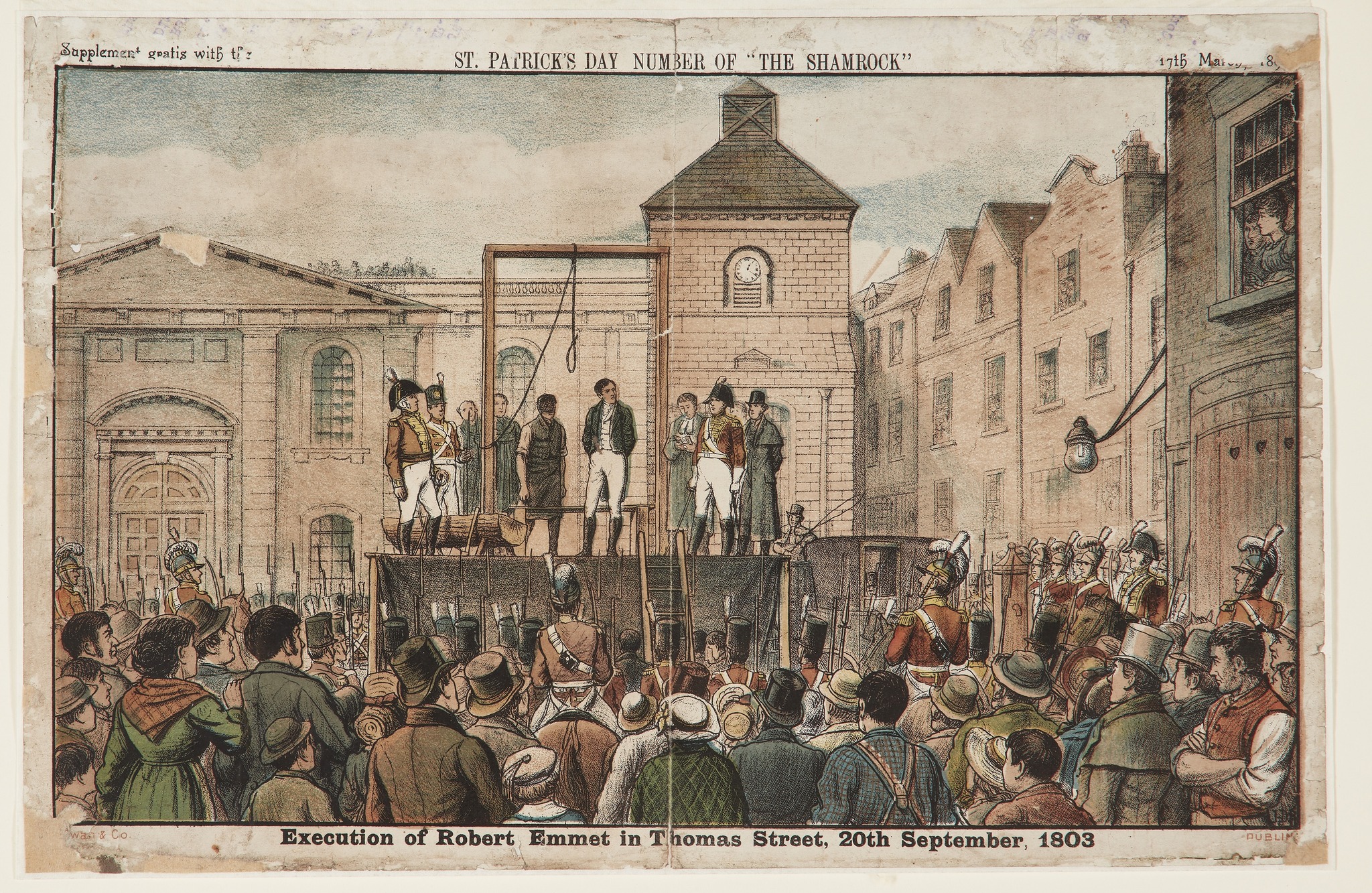
Dublin Political History Tours Facebook page reminds us of the 20th September anniversary of the public execution on of “Bold Robert Emmet, the darling of Erin”, leader of the unsuccessful Republican insurrection in Dublin on 23rd July 1803.
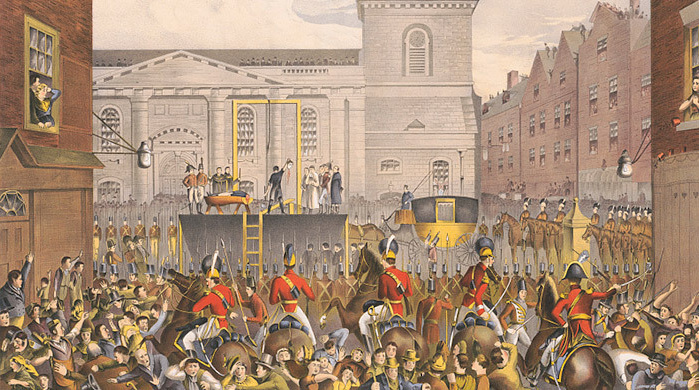
Coloured drawing: The executioner holds up Robert Emmet’s head to the crowd, sections of which demonstrate their repugnance of the act and are repressed English soldiers on horseback. (Sourced: Internet)
I reproduce the Dublin Political History Tours text (reformatted for R. Breeze):
On Saturday we passed by the anniversary of the execution by the English occupation forces of Robert Emmet, United Irishman. Emmet had been condemned to death for planning an insurrection for Irish self-determination which the English Occupation called ‘treason’.
Leaving behind in Kilmainham Gaol his comrade Anne Devlin, who had endured torture and death of family members without giving the authorities any information, Emmet was taken to the front of St. Catherine’s Church.2
(This building is) on Thomas Street in Dublin’s Liberties area on the west side of the city centre. The site chosen was sending a message to the populace of the area that had nationalist and republican sympathies.
There, in front of a huge crowd and many soldiers, Emmet was hanged and then beheaded, the executioner holding up the dripping head to the crowd. His body was later returned to the Gaol before being later buried in Bully’s Acres in the grounds of the Royal Hospital Kilmainham.
Emmet’s corpse was later disinterred in secret and reburied elsewhere by friends or family and, despite a number of sites being speculated, its current location is unknown.
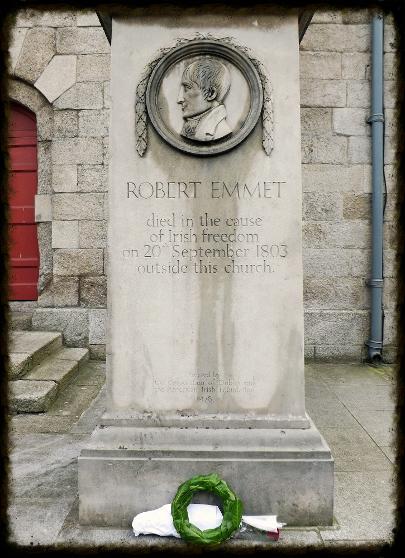
There is a monument to the execution inside the grounds of the St. Catherine’s building and a stone plaque on the wall outside it.
The monument inside the ground at the front of St. Catherine’s Church, Thomas Street, Dublin. (Source: Kilmainham Tales)
Robert Emmet was very popular in Ireland at the time and his memory is still. A statue in his honour stands in Dublin’s Stephens Green, a replica of another two at locations in the United States.
Anne Devlin endured three years in Kilmainham Gaol and according to Richard Madden (1798 – 5 February 1886), chronicler of the United Irishmen who sought her out, was followed everywhere in public by police.
(who were) observing anyone who she spoke to, as a result of which many were afraid to speak to her. Her body lies in Glasnevin Cemetery.
“Bold Robert Emmet” is a traditional ballad in the martyr’s honour and “Anne Devlin” also has a much more recent song in hers by Pete St.John.
(quoted passages end)
In the 1916 Proclamation of Independence, “the right of the people of Ireland to the ownership of Ireland” is proclaimed and that “six times in the past 300 years they have asserted it in arms”, probably referring to insurrections of 1641, 1689, 1798, 1803, 1848 and 1867.3
Historians have mostly dismissed the 1803 uprising as never likely to succeed but a minority have rated the preparations highly, including the innovations of signal rockets and folding pike handle for concealed personal carrying.
RH Madden, the first historian of the United Irishmen was of the opinion that the insurrection attempt was engineered by the English Occupation’s administration in Dublin Castle in order to justify continued repression of Irish republicanism and to eliminate some leaders.
Generally historians have tended not to give much credence to Madden on that issue but it is certain that the Occupation had a network of spies in operation in Ireland and that some had penetrated Emmet’s conspiracy.
Emmet on the scaffold with St. Catherine’s Church behind, the executioner beside him, the crowd in the street and many English soldiers, on foot and on horseback. The illustration was employed by Dublin Political History Tours but easily sourced on the Internet.
However it is not for the manner of the 1803 insurrection that Emmett has been fondly remembered in Ireland to this day 123 years later – and abroad for decades after his death4 – but for the calm manner in which he faced his enemies, including his executioner and for his eloquence at his trial.
Past insurrections contain lessons for us today and a serious evaluation should be attempted, perhaps with a number of submissions from historians of different opinions on the matter, to deal with questions around Emmet’s return from France and the planning of the insurrection in Ireland,.
For us today however, whether Republicans or more generally anti-colonialists and anti-imperialists, it is also necessary to revere the memory of revolutionary action for a democratic Irish Republican and to uphold his and Anne Devlin’s spirit of defiance in resistance.
End.
Note: If you found this article of interest, why not register with Rebel Breeze for free, so that you will be notified by email of subsequent articles. You can de-register any time you wish.
Statue monument of Robert Emmet in Washington DC, a copy of which stands in St. Stephens Green, looking across the road to his erstwhile homeand other copies stand in Emmetsburg, Iowa and Golden Gate Park, San Francisco, California.Those in the USA were all cast by the artist Jerome Connor between 1916 and 1919. (Photo sourced: Internet)Statue monument in Rathfarnham dedicated to Anne Devlin from Wicklow, a member of the United Irishmen conspiracy, tortured and jailed but never gave her captors any information. Sculptor: Clodagh Emoe(Gracies, Maria, for bringing this to my attention).
FOOTNOTES
1From Emmet’s famous speech from the dock of the courthouse in Green Street that not until then should his epitaph be written. I have no doubt that Emmet meant “nation-states of the world” because Ireland was in his time more than what we would understand today from the vague term of “country” – it was clearly, though under foreign occupation, already a nation with its own unique culture and a long history. She has yet to take that place to which Emmet referred and aspired for her.
2Note that was the Anglican St. Catherine’s Church, as a Catholic St. Catherine’s is also located not far away on Meath St. The Anglican church was closed in the 1960s but later reopened and reconsecrated as an Anglican Church. The interior seems very untypical of Anglican churches. Emmet was raised in the Anglican faith.
3Believed to refer to, in sequence: the Irish and Norman Irish clans in the Confederation’s uprising, the Williamite War’s, United Irishmen’s, Robert Emmets’, Young Irelanders’, the Fenians’. Coincidentally, the large monument to uprisings in Ireland erected by the National Graves Association in the St. Paul’s section of Glasnevin Cemetery also includes only six dates but they are of Republican risings only, beginning with 1798 and ending with 1916.
4I read somewhere that even in England Radicals would read Emmet’s speech as a high point of their events including formal dinners.
An Irish punk rock band, Mongolian throat-singers, a poet and Irish folk singers all performed at Solidarity Sessions No.2 to a good crowd in the International Bar, in in Dublin City centre Wicklow Street on Wednesday 17th..
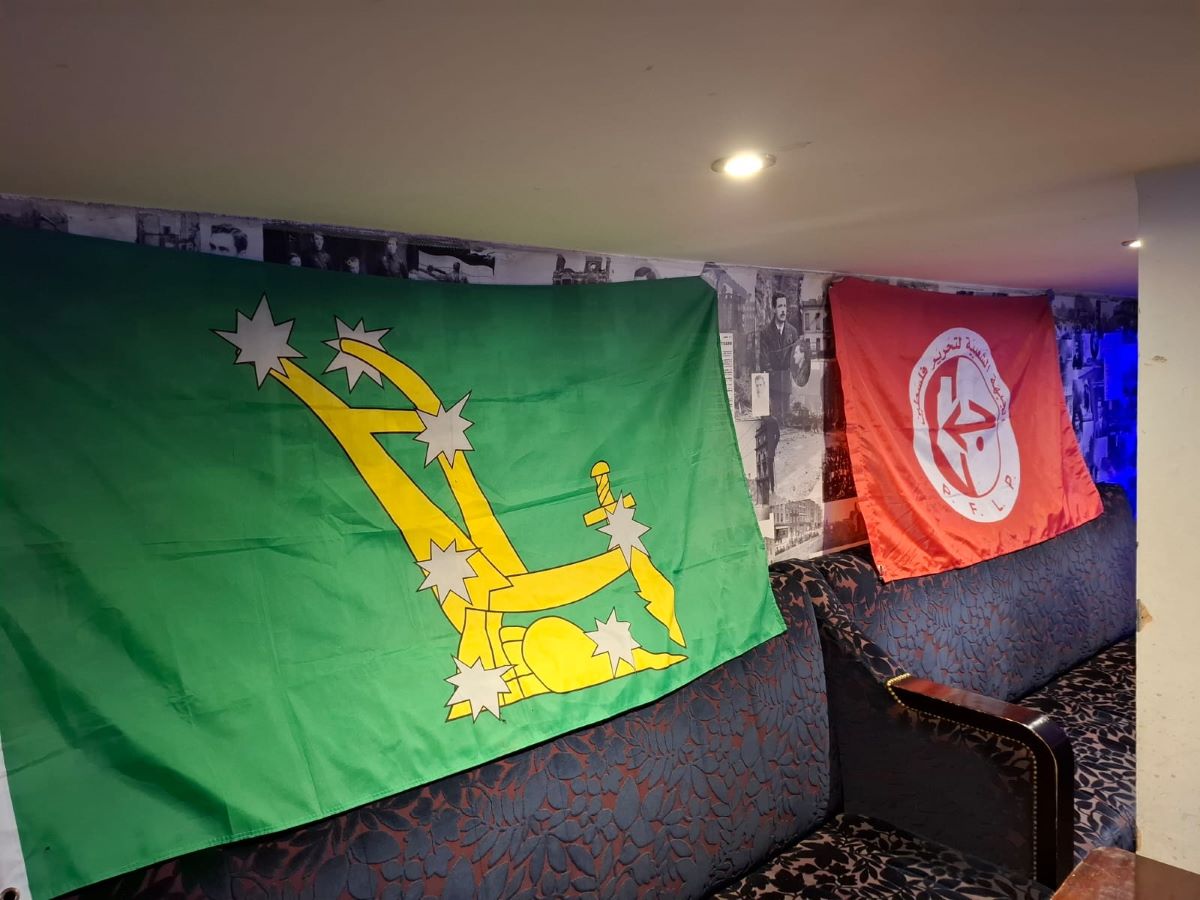
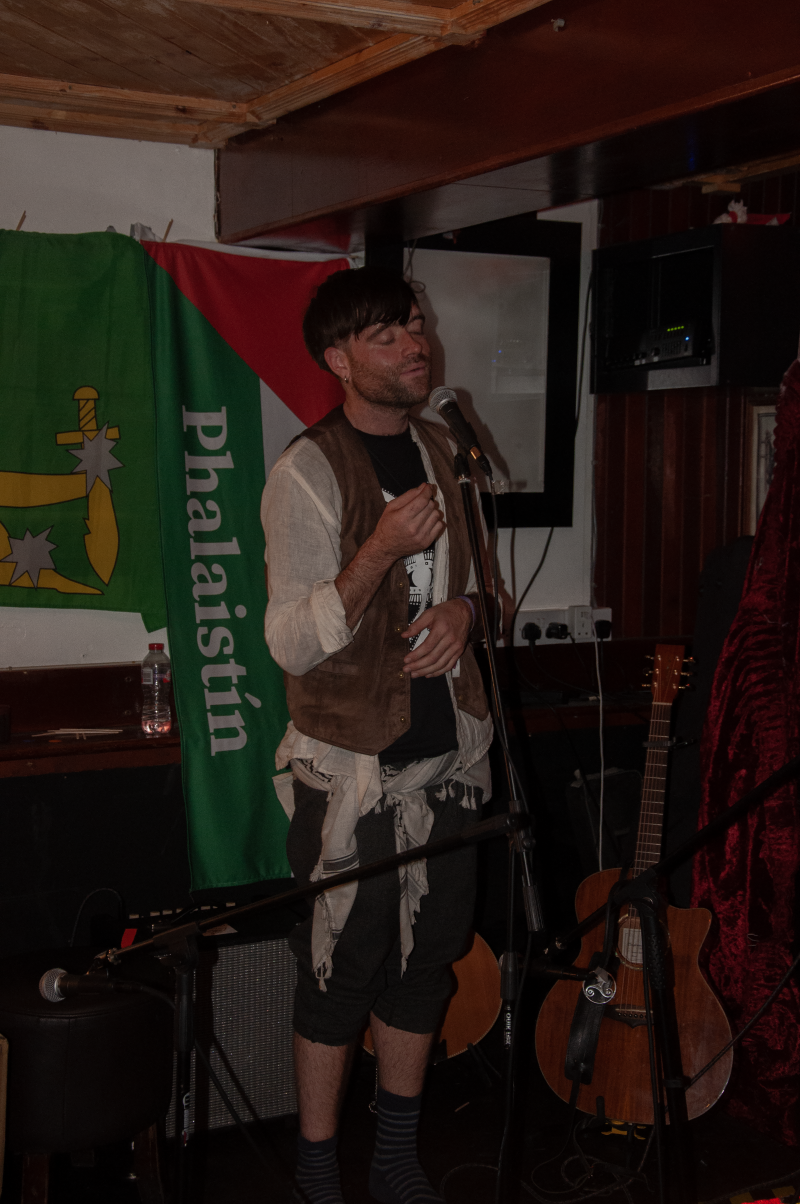
An Irish and international resistance theme in decor was presented by flags of the Starry Plough and Palestine with Saoirse don Phalaistín as stage backdrop, while flags respectively of Cumann na mBan and Basque Antifa concealed the original decor’s ubiquitous photos of Michael Collins.
Flesh B. Bugged performing (Photo: Dermo Photography)
A PFLP1 flag was also taped to a wall. Hand-written signs on the stairs leading to the basement venue, alternatively in Irish and in English, asked for quiet/ ciúnas for the performance/ racaireacht. The Irish language was present too in some of the performances to follow.
MC for the night, Jimi Cullen, himself a singer-songwriter activist told the crowd the purpose of the organising collective was “to build a community of resistance and solidarity with our struggles and with struggles around the world” through culture in a social atmosphere.
Before the crowd — a flag temporarily changing the decor. (Photo: R. Breeze)
Themes of love, nature and emigration were covered in song; however the dominant theme was resistance – to prison regimes, foreign occupation, fascism, class oppression, racial discrimination – and solidarity with the struggles of others, near and far.
Diarmuid Breatnach, singing acapella kicked off the night with a selection of songs from the Irish resistance tradition and a couple of short ones from the USA civil rights movement. Some of the melodies however, of particular interest perhaps to Back Home in Derry2, were his own originals.
Eoghan Ó Loingsigh, accompanying himself on guitar followed with more material from the same tradition, dedicating one to his late IRA father. A folk song Ó Loingsigh announced as ‘non-political’ performed acapella turned out to be very much political but on the issue of social class.
Áine Hayden followed with poems on a range of topics, from swimming in the Royal Canal during the Covid shut-down, deleting a personal relationship to a dedication to comedian and activist Mahmoud Sharab murdered with family in a “safe zone” tent by the Israeli Occupation Force.
Eoghan Ó Loingsigh performing (Photo: Dermo Photography)
The three performers were all introduced as activists as well as artists and the mostly-young crowd, apparently containing a strong representation of political and social activists, responded well to the performers with applause, yells of encouragement and often joining in on choruses.
More people arrived before, during and even after the break – including an elderly couple who had just arrived from the USA and could only pay in dollars but were admitted for free. Leaving later with thanks they promised a contribution to Palestine solidarity when they got home.
Before the crowd — a Cumann na mBan flag temporarily changing the decor. (Photo: Dermo Photography)
Also an activist, Ru O’Shea sang an Irish, Scottish, French and Italian selection, accompanied by bouzouki and guitar and performed a spoken word piece with a refrain of ‘Éire under attack’ before schooling the audience to sing the chorus of Robbie Burns’ Green Grow the Rushes Oh!
Áine Hayden performing (Photo: Dermo Photography)
Nomads were the next act. Composed of two Mongolian musicians playing violins in the style of the viola and a Dubliner modulating on a sound deck they were unusual enough but it was the amazing throat-singing of one of the Mongolians that had the audience enthralled.
It was amazing to learn that there are three different kinds of Mongolian throat-singing and then to hear them performed, one of which was a kind of whistling with a vibrating bass undertone wavering through it. The applause, particularly when they concluded, was rapturous and sustained.
Before the crowd — flags temporarily changing the decor. (Photo: R. Breeze)Ru O’Shea performing (Photo: Dermo Photography)
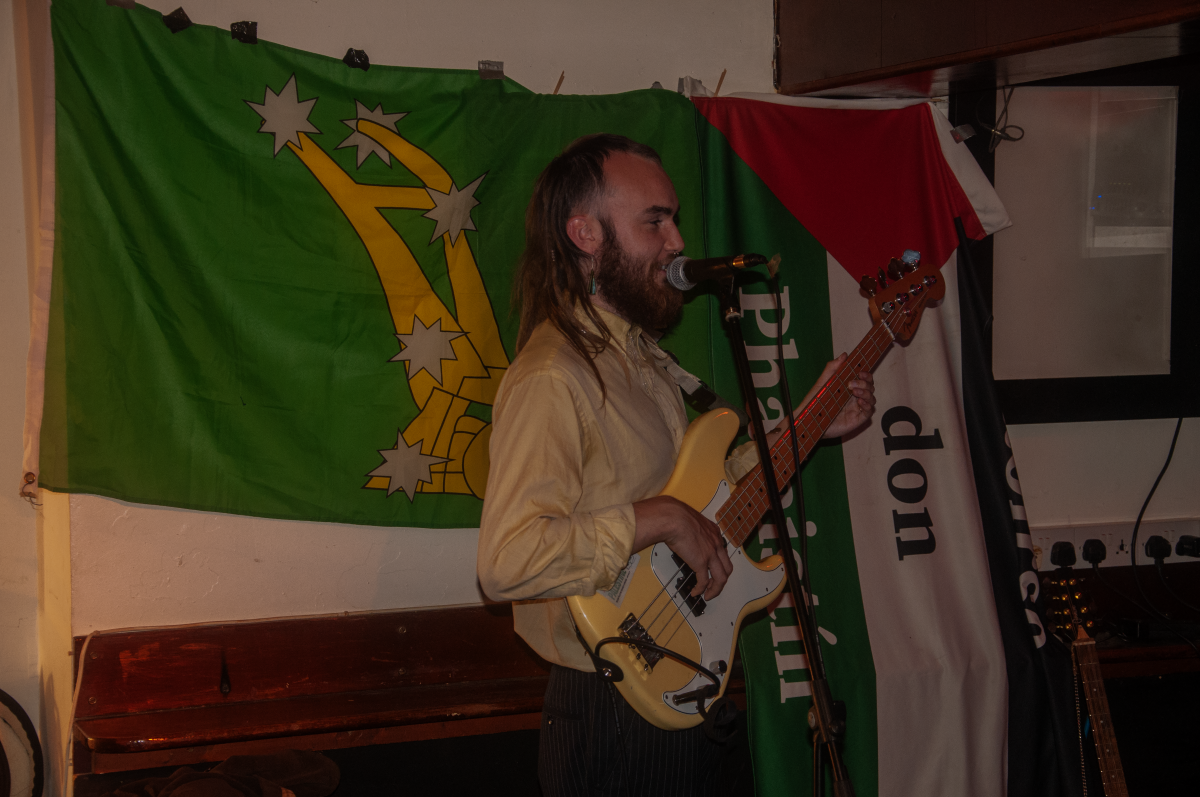
The evening’s entertainment concluded with Flesh B. Bugged, a punk rock Irish duo of bass guitar and drums with spoken voice pieces in Irish from the bass guitar player. Their volume and beat got some of the crowd up and dancing and the wider crowd responded well to them too.
MC Jimi Cullen went up on stage for the last time to thank venue, performers, audience, doorkeepers, poster designers Ríona and Azzy O’Connor, also Diarmuid for original artwork. At a prompt from the crowd Cullen also got a round of applause from the audience for his MCing.
The Mongolian musicians of Nomads performing (Photo: D.Breatnach)
Remarking they’d “had a great night” and encouraging his listeners to follow the organising collective on its Instagram page, Cullen told them that details of Solidarity Sessions No.3 and the collective’s decisions on recipients of donations from money raised would be posted on there.
Diarmuid Breatnach told the audience that each individual could help build a community of resistance through attending the Solidarity Sessions and encouraging others to attend. He welcomed any ‘competion’ from solidarity sessions around the country.
Bass guitarist of Flesh B. Bugged (Photo: Dermo Photography)
The downstairs area of the International Bar is not perhaps the best layout for this kind of event but it worked out well enough for the collective, audience and performers on the night. Their next event will be back at their launch venue,The Cobblestone, Smithfield on Thursday 30th October.
End.
Note: If you found this article of interest, why not register with Rebel Breeze for free, so that you will be notified by email of subsequent articles. You can de-register any time you wish.
The Mongolian throat-singer in Nomads (Photo: Dermo Photography)
FOOTNOTES
1People’s Front for the Liberation of Palestine, one of two specifically secular armed resistance organisations in Palestine.
2Irish mega folk singer Christy Moore had organised Bobby Sands’ poem into song to the melody of The Wreck of the Edmund Fitzgerald by Gordon Lightfoot.
Dublin city centre on Saturday saw two marches scheduled to start at the same time from the Garden of Remembrance, both of which were drenched by heavy showers, as were fans attending the Robbie Williams concert in nearby Croke Park stadium.
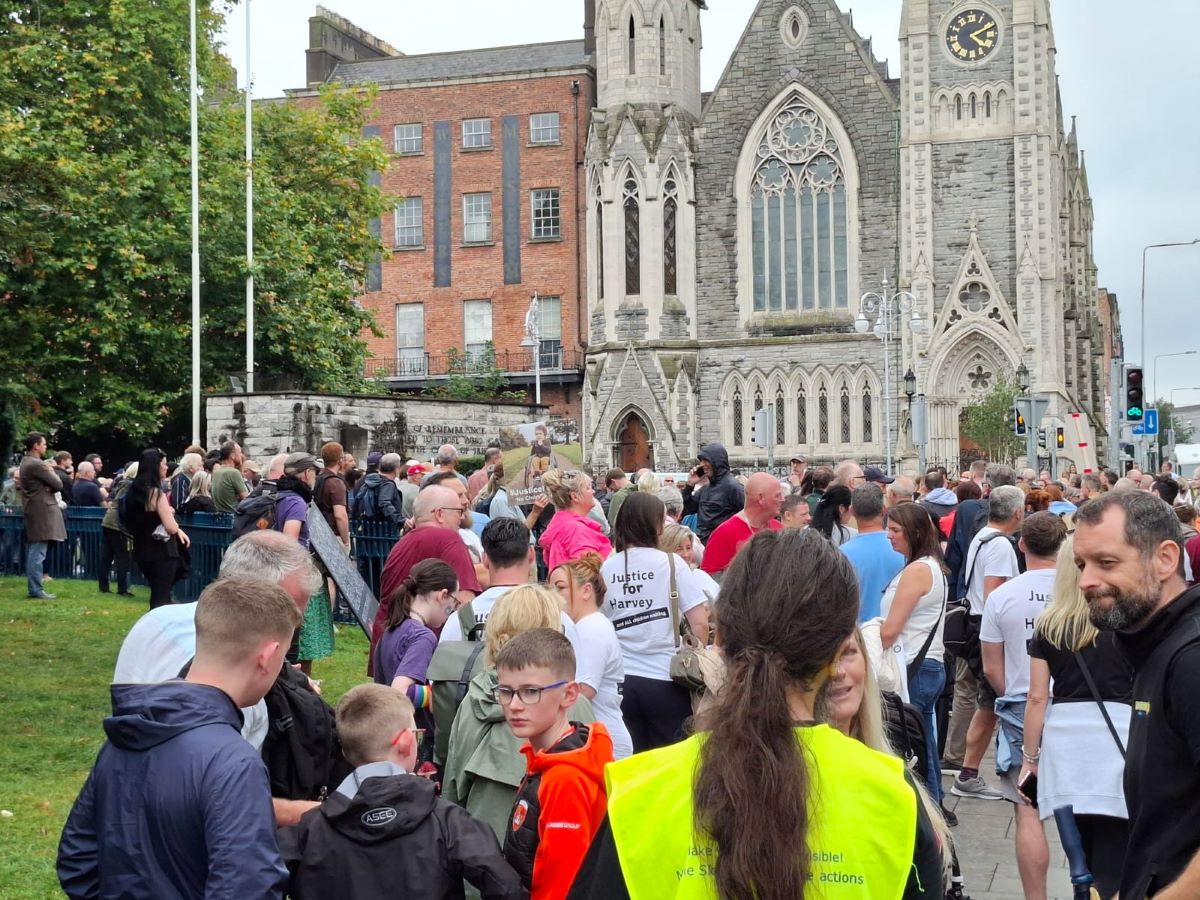
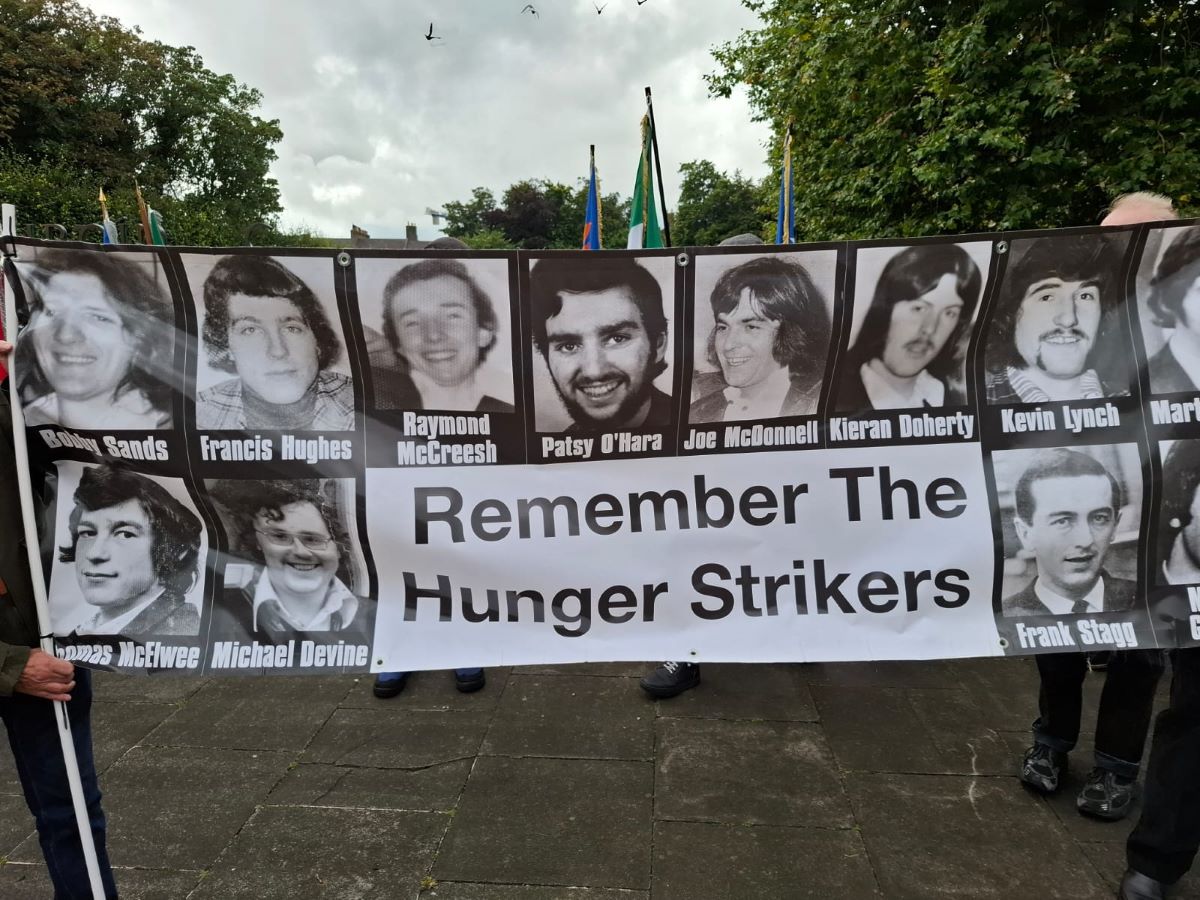
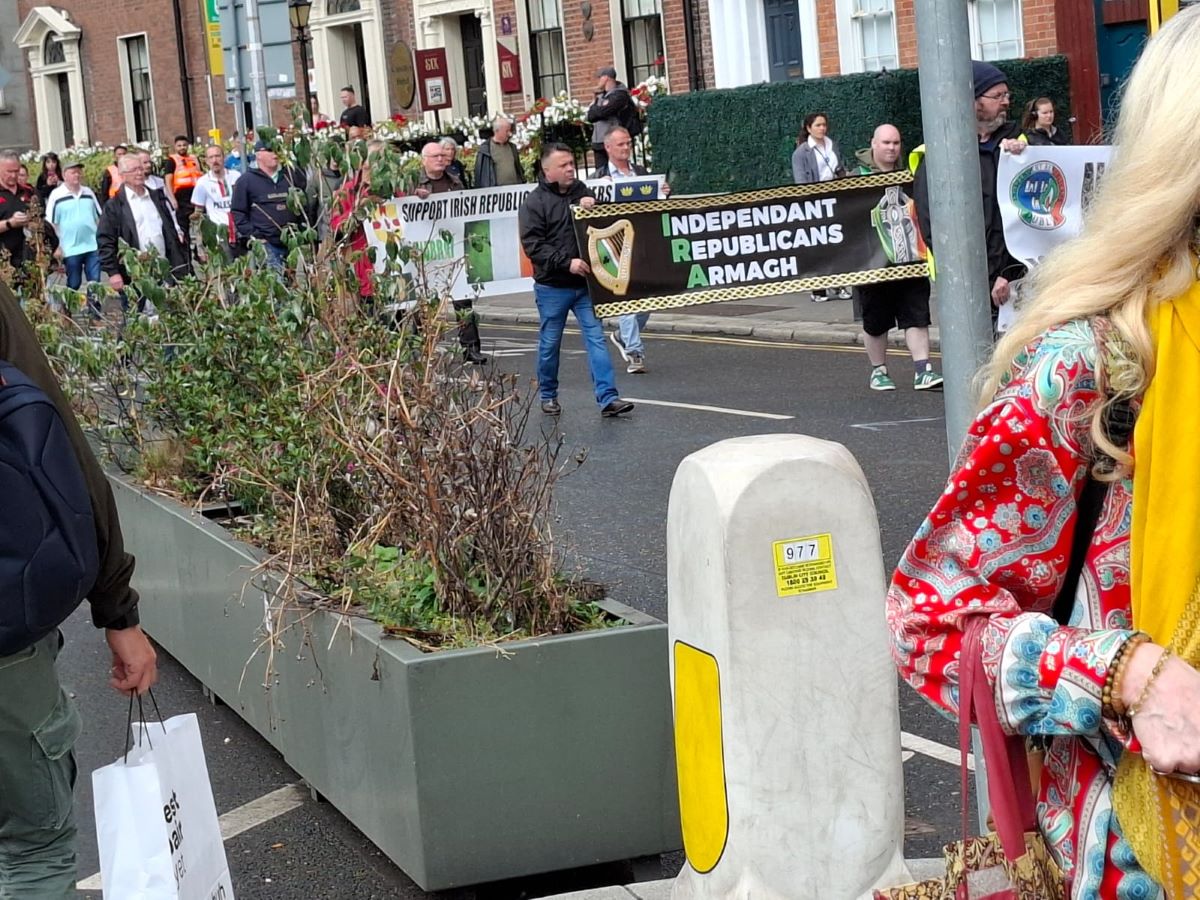
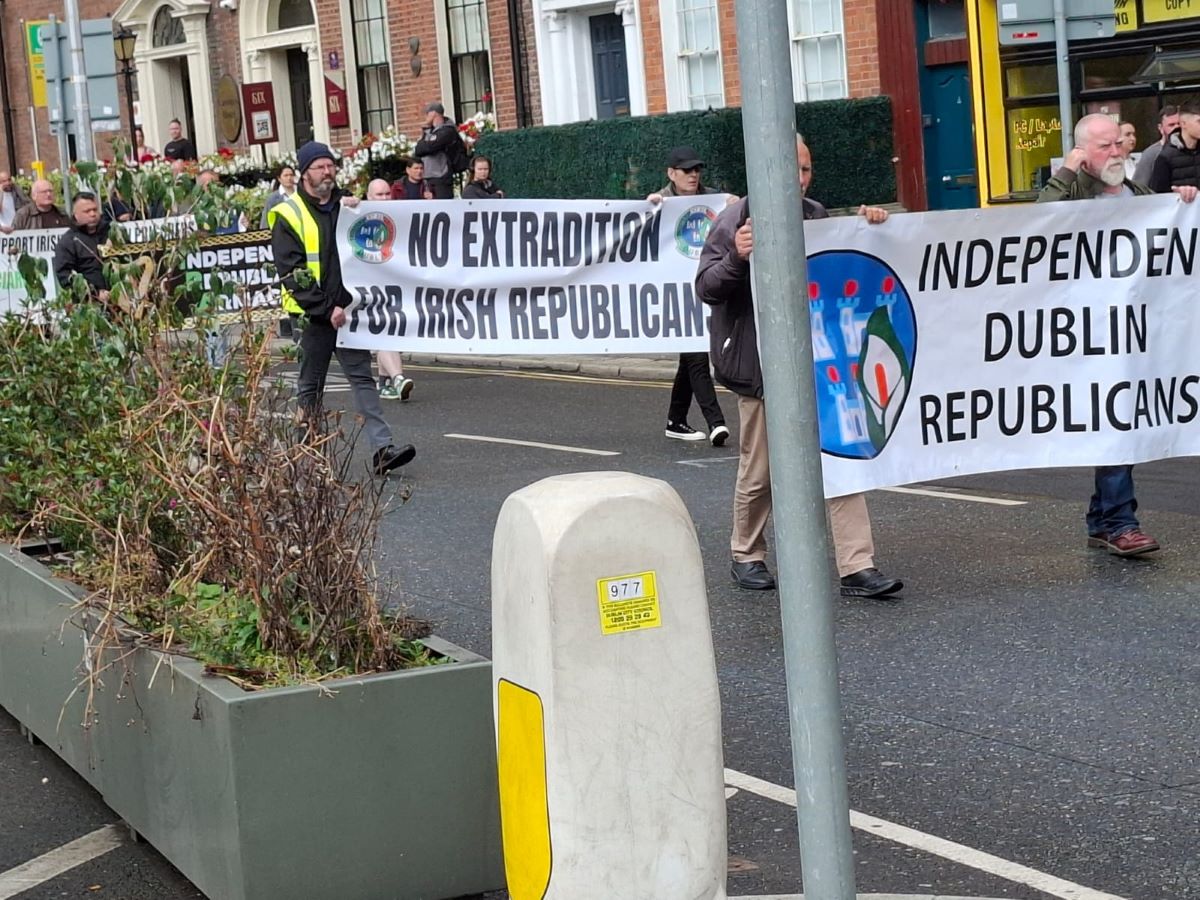
The first march to set off was the largest, the Harvey Morrison protest, the Hunger Strike Commemoration organised by Dublin Independent Republicans waiting for the space to clear in order to assemble theirs, with pipers, band and various banners forming up.
Supporters of both marches are mingled here though the majority are there for the Harvey Morrison march. (Photo: R.Breeze)
The Harvey Morrison protest was about the long wait the named boy had for appropriate treatment from the Irish health service for his condition of spina bifada and scoliosis. As he waited, his spine continued to curve causing him pain and though underwent surgery last year died on July 29th.
It emerged last year that Harvey had been removed from Children’s Health Ireland’s (CHI) urgent scoliosis surgery waiting list, without his family being informed. In 2017 Simon Harris declared that no child would wait for more than four months for scoliosis treatment.
Apart from those requiring specialist treatment for rarer medical conditions, people with much more common complaints face many hours in A & E before being seen by a doctor or having an X-ray taken, with an average of 500 people admitted to hospital on trolleys daily awaiting beds.1
Seven different speakers addressed them at their rally on Custom House Quay, being well received by the crowd with a small exception, which was when a participant shouted ‘Traitor!’at Mary Lou Mac Donald, President of the Sinn Fein party, before being told by march stewards to keep quiet.
Calling SF (and any in Government) politicians ‘traitor’ is a frequent position of those on the Far-Right2 in the Irish State, for racist reasons. Indeed, a number of Far-Right activists were spotted among the marchers but it seems they were unable to dominate the event.
THE HUNGER STRIKE MARTYRS COMMEMORATION
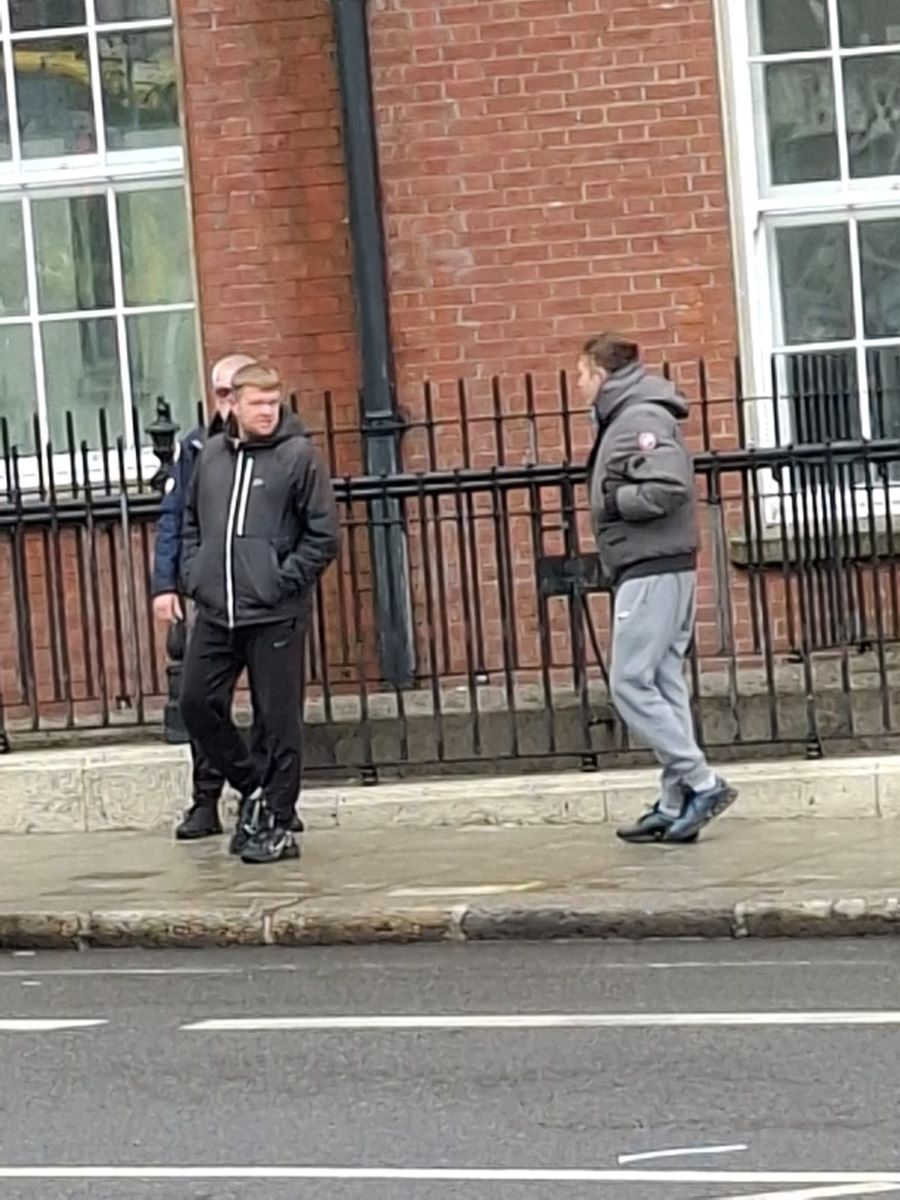
A handful of fascists were also observed watching the Hunger Strike martyrs’ commemoration gather and photographing them but when some of their targets began to photograph them in turn, they walked away, presumably to go and promote themselves and their lies on social media.
Fascists who had been filming the Hunger Strike Commemoration moving off as a camera turns on them. (Photo: R.Breeze)
Irish Republicans, who are opposed to (and by) the Far-Right, also call Sinn Féin ‘traitors’ but for the reason that they consider the party has left the struggle and colludes with the neo-colonial ruling class of the state and with the English occupation in the Six Counties.
The pipers prior to setting off on the march. (Photo: R.Breeze)
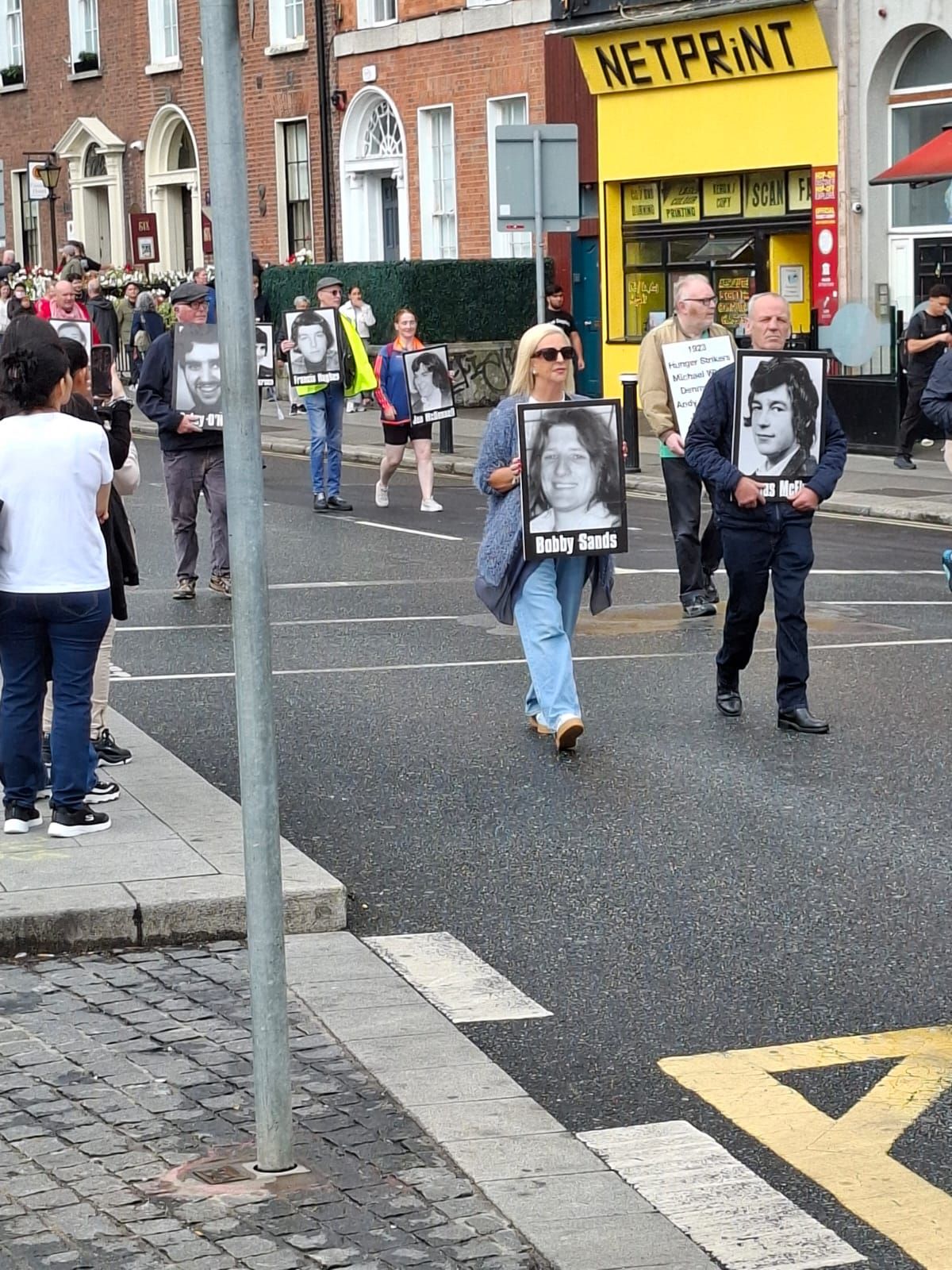
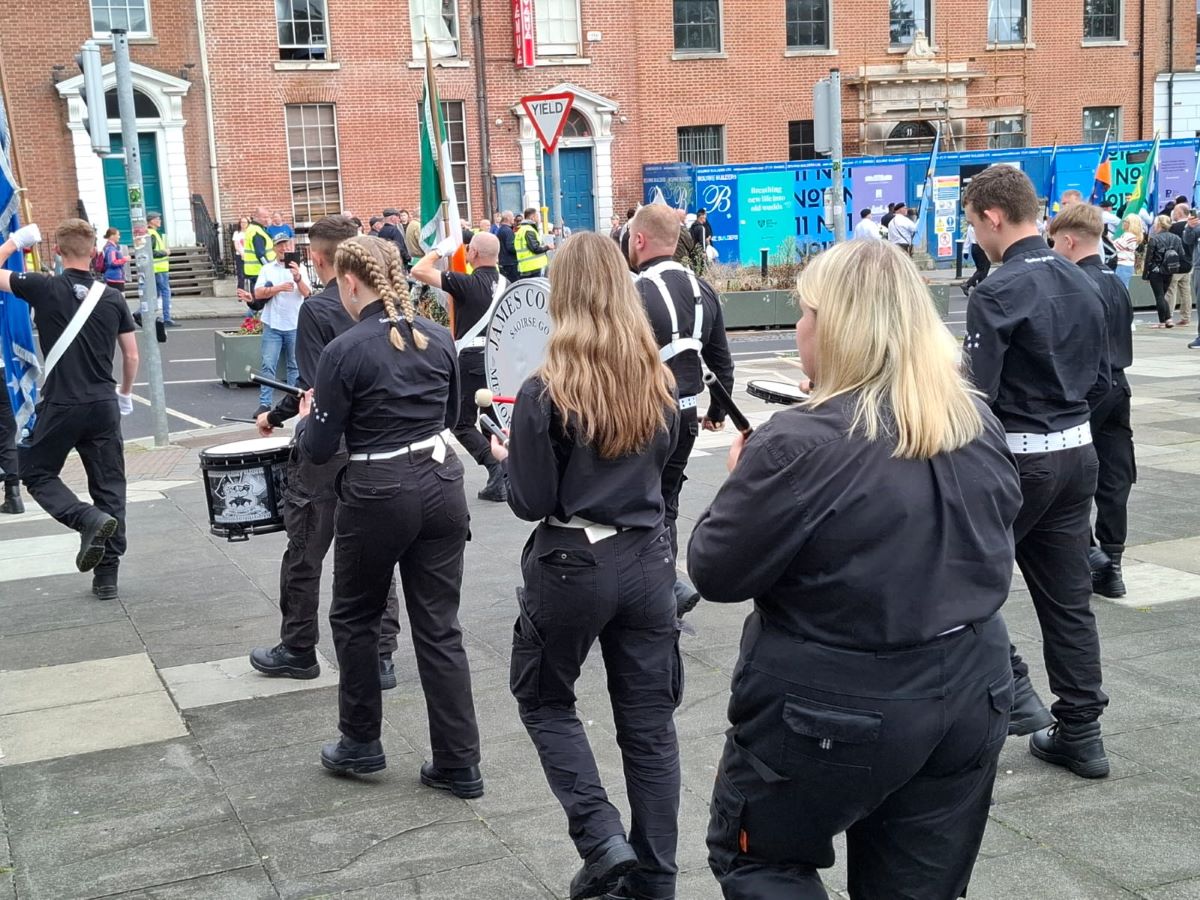
Two pipers led off the Hunger Strike commemoration organised by Independent Dublin Republicans followed by a full colour party and the James Connolly Republican Flute Band, from Derry. In traditional two lines style they marched through onlooking crowds in O’Connell Street.
The march crossed the Liffey into D’Olier Street, back up O’Connell Street and after a pause at the Government-threatened GPO, into Parnell Street, then around the western and northern sides of the Square and back into the Remembrance Garden for the commemoration ceremony.
The Hunger Strike Commemoration march proceeding down from the Garden of Remembrance and just about to enter Dublin’s main thoroughfare, O’Connell Street. (Photo: R.Breeze)
And it rained – it poured down rain. Which was bad enough on the audience but much much worse on the colour party in shirt and trousers, the RFB members and those holding the portraits of the ten hunger strike martyrs and a number of banners.
Dixie Elliot was introduced as the main speaker, well-known in Republican circles, former member of the Provisional IRA, an ex-POW and ‘Blanketman’.3
(Photo: R.Breeze)
Seemingly undeterred by the pouring rain, Elliot spoke at substantial length though whether through lack of projection or faulty amplifier, much of what he said was lost to many in the audience. From snatches he could be heard going through the history of the recent three decades’ war.
The targets of his condemnation were not alone the British occupation and the Irish State’s complicity but also the leadership of the Irish Republican movement who had abandoned the struggle and become part of the colonial administration in the Six Counties.
(Photo: R.Breeze) (Photo: R.Breeze)
Expressing solidarity with the Palestinian struggle and against imperialism, Elliot also condemned the far-Right in Ireland who claim to be ‘patriots’ in order to promote their racism and he counter-posed the example of Bobby Sands’ internationalism in his poem The Rhythm of Time.
The Connolly Memorial Republican Flute Band setting out on the march from Garden of Remembrance. (Photo: R.Breeze)
Both Elliot and the Chairperson called for solidarity with Irish Republican political prisoners and the framed Craigavon Two, convicted in a no-jury political Occupation court and still in jail 16 years later.
Finally chairperson Ado Perry thanked people for their attendance, the colour party and audience stood to attention and the piper played the air to the chorus of the song generally known as Amhrán na bhFiann (and of which the chorus melody is also the ‘National Anthem’ of the Irish State).
(Photo: R.Breeze)
CROKE PARK CONCERT
The Gaelic Athletic Association stadium in Croke Park was the venue for a Robbie Williams concert in Dublin and the fans were flocking into town in rainproof macs that the marchers could have done with. The previous weekend it had been the Manchester Gallaghers, i.e. Oasis there.
The finals in Gaelic football for men and women and in hurling have been played in Croke Park in previous weekends and now it seems it’s rock concerts season.
The far-Right protested the couple of occasions that the stadium was rented to celebrate the Muslim feast day of Eid. Apparently English musicians and bands playing there are are not problematic for them. But then nor are the banks and property speculators causing the housing crisis.4
End.
(Photo: R.Breeze) (Photo: R.Breeze) (Photo: R.Breeze)Main speaker, Dixie Elliot, speaking at rally in Garden of Remembrance at end of Hunger Strike Commemoration march. (Photo: R.Breeze)
3One of the Irish Republican ‘blanket protester’ prisoners who resisted the attempt of the colonial prison service to make them wear regulation prison uniform, wearing underwear and a blanket instead. This condition degenerated into the ‘no wash’ and ‘dirty protests’ which the prisoners sought to overcome with the hunger strikes of 1980 and 1981 when 10 prisoners died.