ANTI-FASCISTS CONFRONT FAR-RIGHT & FASCISTS IN DUBLIN CITY CENTRE

Diarmuid Breatnach

(Reading time: 6 minutes)

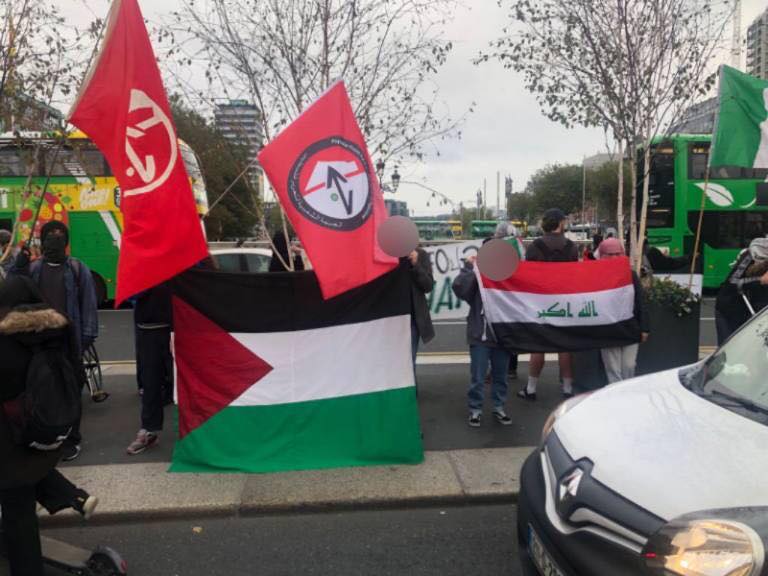
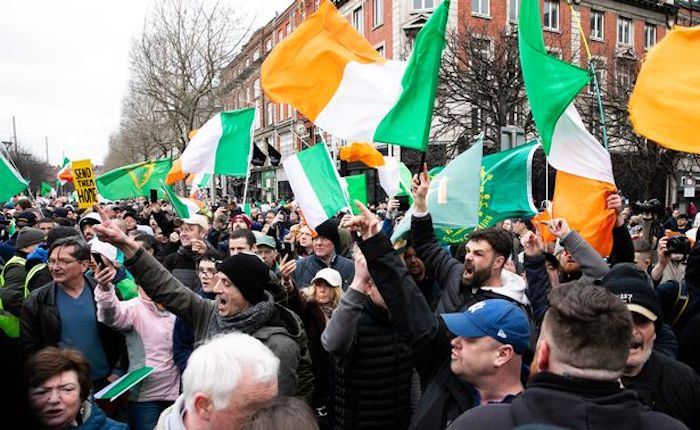
A far-right march containing known fascists and fascist organisations opposed to immigration or to providing housing for refugees confronted an antifascist counterprotest half its size in Dublin city centre’s main street on Monday.

The counter-protest was convened for 1pm by the United Against Racism organisation (a kind of liberal anti-racist and antifascist confederation set up by the People Before Profit party) in order to confront an advertised mobilisation of the far-Right on a broad racist platform.

The racists had been building for this ‘national’ march since early January.

A view of the west side of the anti-racist gathering some time before the arrival of the anti-immigration march. (Photo: D.Breatnach)

The antifascists gathered on the central pedestrian reservation while a group of less than 20 strutted in front of the GPO waving Tricolours,1 an Erin go Bragh flag2 and, most unusually, a Cumann na mBan3 flag. Did they know or care that one of the founders of that organisation was a migrant?4

Or that the Tricolour was presented to us in 1848 by women revolutionaries in Paris? The far-Right in Ireland is replete with ironies, whether ignorant of them or aware while manipulating their ignorant followers in neglected cross-generational families and communities.

Among the anti-racist gathering, at first there were red, rainbow and some Palestinian flags but not one specifically Irish one apart from a white Starry Plough on a red background, until a little later when a number of Irish Tricolours made their appearance among the anti-racists.

East side of the anti-racist gathering some time before the arrival of the anti-immigration march. (Photo: D.Breatnach)

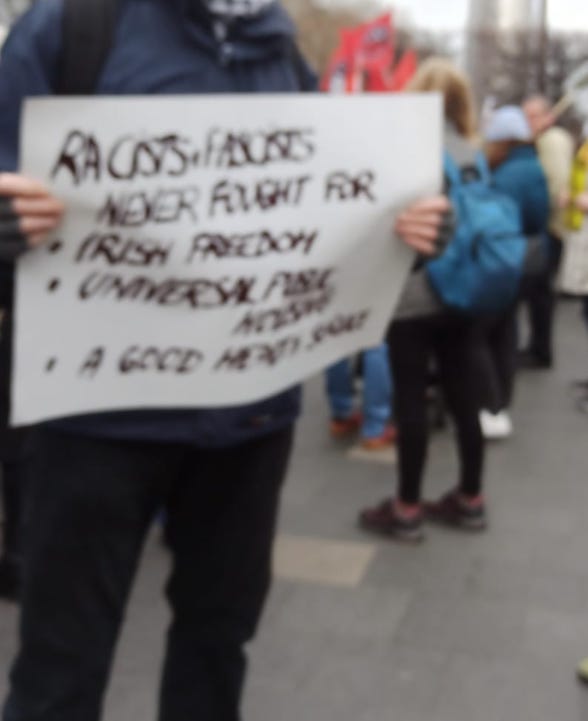
This gives the unfortunate appearance that it’s the far-Right that cares about the national struggle and not the antifascists, which is untrue since the fascists have never lifted a finger for Irish freedom and unity (as pointed out by one of the placards displayed by the anti-racists).

It seemed strange that the anti-racists had not occupied the space directly in front of the GPO, thereby not only denying it to the far-Right but also giving them a position with a safe rear and only exposed from the front and flanks, as distinct from the central reservation, open on all sides.

Many Garda Public Order Unit vehicles had been seen at the Garden of Remembrance where the far-Right were rallying along with two mounted Garda, with another two of those outside the GPO and many police in ordinary uniform, along with a few POU there also.5

A strong turnout of Gardaí lined up in front of the GPO with their backs to the fascists and facing the antifascists, a formation clearly anticipating antifascists moving against the far-Right. A number of shouts were traded between the opposing forces.

Early view of section of the anti-racist demonstrators showing in the background a section of the far-Right demonstrators outside the GPO before they left to join their rally at the Garden of Remembrance. (Photo: D.Breatnach)

A senior Garda officer approached an anti-fascist and obliged her to remove her mask, an action that exposed her not only to Garda photographers but also to media and far-Right snaps and video.

Unlike a number of other occasions prior to and during the Covid emergency, the police restrained the fascists from crossing the road or even engaging in sustained exchanges. After awhile, the latter departed to join the others at their rally at the Garden of Remembrance

The antifascist gathering listened to speeches (or ignored them and chatted among themselves) and a number of a cappella songs about Irish emigration and anti-racism, regularly joining in slogans of “Say it loud and say it clear – Refugees are welcome here!” and “Fáilte – roimh theifigh!”

Another slogan6 shouted was “When refugees are under attack – Stand up, fight back!”

THE FASCIST MARCH

Word reached the antifascists that the far-Right had finally got into their march and the whole anti-racist gathering moved to face the east side of O’Connell Street, where stewards packed them in tighter and tighter and Gardaí lined up facing them with arms linked.

Photo taken of section of anti-racist protesters on east side of central reservation shortly before arrival of anti-immigration marchers – note the Gardai linked arms against the anti-racists, possibly out of habit before they reversed their positions as the far-Right protesters approached. The flag centre photo is of the Second Spanish Republic during the Spanish Antifascist War. (Photo: D.Breatnach)

A little later, perhaps conscious of the size of the far-Right march, the Gardaí turned their backs to the anti-racists and faced the street upon which the racists were going to march. The POU also deployed around the area and both mounted police moved across on to the central reservation.

The far-Right began to proceed southward along the street a couple of feet only away from the anti-fascists, from which the slogans in support of refugees were chanted in unison but there were also individual comments flying back and forth, along with gestures, between both groups.

Their stewards were clearly keen to keep them moving, however. At one point a large group of the far-Right mounted the central reservation and approached the antifascists aggressively but between the Gardaí and their own stewards they soon resumed their march south.

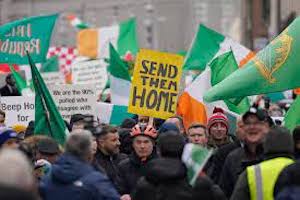
The anti-immigration marchers pause in order to hurl abuse at the anti-racist counter-protesters, some of who respond in kind. (Photo sourced: Internet)

It became clear that the racist march outnumbered the counter-protest in the order of around two to one. When banners of the National Party and the Irish Freedom Movement were seen (and placards of Síol na hÉireann)7 a roar of “Nazi scum off our streets!” emerged from the anti-racists.

There were also some cries of “MI5!” at those. Some large placards bearing the legend “Ireland is full” drew the reply: “No it’s not – you don’t know your history or your geography!”8

A racist and a fascist trope side by side: The “Replacement” conspiracy theory originated in white European settler colonies in fear of being replaced by the indigenous people, while fascists regularly demand freedom of speech for racism and lies but shut down all freedoms when they get into power. (Photo sourced: Internet)

The march passed and according to information received made its way to Custom House Quay for a rally. The antifascists were then called on to the street to march to the Garden of Remembrance in a move that puzzled some (one suggestion was that it was to “disinfect” the site!).

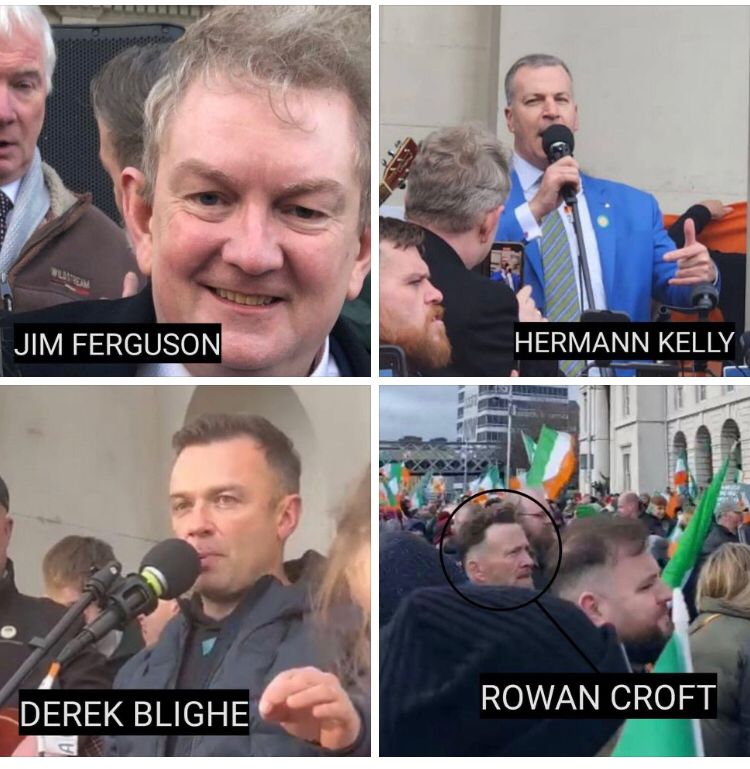
Later and photos from Anti-Imperialist Ireland confirmed the sighting of a number of known fascists at the racist rally, including Derek Bligh (IF), Jim Ferguson, Herman Kelly (IFM) and Rowan Croft, all with connections to British Loyalism and British Intelligence.

Four prominent fascists from different groups who were present (some as speakers) at the anti-refugee and immigration rally on Monday. (Photo source: AIA)

EVALUATION

The question must be asked how a minority of far-right and fascist parties in Ireland can outnumber the vastly numerically superior anti-fascist mass in the country at a public (and publicised) event? Clearly the counter-protest organisers failed to mobilise the wide anti-fascist masses.

View of section of the anti-immigration march. (Photo sourced: Internet)

Or the wide anti-fascist movement failed to respond to the call. Where were the Irish Republican forces, the specifically antifascist organisations, the anti-fascist trade unionists – and the broad masses that they can mobilise?

Some of those may say that they don’t trust the UAR group, that they’re not serious about confronting fascists, etc. That may be but it would be a poor and shameful excuse for allowing a successful fascist attack on an antifascist gathering.

On the other hand, when the UAR was being founded, it deliberately excluded those forces – Republicans, antifascist activists, anarchists – who had already been confronting the far-right in Dublin and had been in a number of clashes with the fascists.

A placard displayed by a migrant solidarity demonstrator. (Photo: D.Breatnach)

This is a most serious situation in which the democratic masses to be as the racists and fascists mobilise their thugs and feel the wind behind their sails while simultaneously the State surreptitiously encourages them and the capitalist system seeks to make the workers pay for its crisis.

The racist march took place in the context of a recent fascist mobilisation in the city centre burning cars and public transport and ongoing burning of buildings across the country earmarked – or just believed to be earmarked – for housing of refugees.

Government Ministers can claim shock and anger at such fascist mobilisations but how is it that the wave of arson attacks is being permitted? And how is it that communications of the culprits are not being monitored by the State’s intelligence services?

How is that there is not one case of Garda or property security being on hand and apprehending the arsonists?

We need not believe any nonsense about insufficient personnel because the private security industry employs over 30,000 people across a broad range of sectors9 and the Gardaí can mobilise 100 with helicopter back-up to evict a handful of housing activists occupying an empty building.10

The State is clearly allowing the fascists a loose rein whilst at the same time permitting an atmosphere favouring repression to build up – repression which as is usually the case will be used not against the fascists but against the antifascists and against the Left resistance in general.

We are being given warnings and it is up to all of us whether we act upon them. If we don’t not only we but our children will pay the price.

End.

FOOTNOTES

1The green, white and orange flag that became the ‘national’ flag of the Irish State.

2Anglicisation for pronunciation of Éirinn go Brách (Ireland for ever!), the slogan in gold on a green background, usually also bearing the emblem of the harp in gold was a common flag seen among gatherings of the Fenians (Irish Republican Brotherhood) in Ireland, Britain and the USA during the second half of the 19th and early 20th centuries.

3Possibly the world’s first female republican military organisation, it was founded in 1914 as an auxiliary to the male Irish Volunteers founded the year before; around 40 of them participated in the 1916 Rising. Later the organisation developed more independence.

4Constance Markievicz: A founding member of Fianna Éireann, Cumann na mBan and the Irish Citizen Army, she took part in the Easter Rising in 1916, when Irish republicans attempted to end British rule and establish an Irish Republic.

5And some in ordinary street clothes, clearly the political ‘undercover’ police (now officially the Special Detective Unit but still widely known among political activists (and some of its own officers) by their former name of “the Special Branch”).

6https://en.wikipedia.org/wiki/Slogan

7Three of the prominent fascist and racist organisations recently founded in Ireland, though not much of “Síol” has been seen for many months.

8Presumably a reference to the fact that in 1845 Ireland had a population of over 8 million and was not “full” even then while the population today is around 7 million.

9“and has an estimated annual turnover in excess of €960 million” https://www.cpsa.ie/en/organisation-information/8018a-the-private-security-authority

10On two occasions in Dublin alone, against the Revolutionary Housing League occupations of empty buildings on Eden Quay in June 2022 and on Berkeley Road in July last year. https://rebelbreeze.com/tag/revolutionary-housing-league/

SOURCES

March and counter-demonstration: https://www.irishtimes.com/ireland/social-affairs/2024/02/05/anti-immigrant-march-and-counter-protest-in-dublin-see-300-gardai-deployed/

https://www.thejournal.ie/anti-immigration-protest-dublin-6291088-Feb2024

Fascist speakers at Monday’s rally: https://anti-imperialist-action-ireland.com/blog/2024/02/06/dont-be-fooled-by-britains-far-right-in-ireland/

Far-Right arson of buildings and riots: https://www.dublinlive.ie/news/arsonists-burning-buildings-set-house-28568335

https://www.breakingnews.ie/ireland/dublin-riots-taoiseach-receives-mixed-messages-on-far-right-thugs-and-uncontrolled-immigration-1583306.html

https://www.breakingnews.ie/ireland/man-charged-in-connection-with-dublin-riots-1585211.html

Gardaí available in large numbers when evicting housing activists: https://rebelbreeze.com/tag/revolutionary-housing-league/

6,000 March to Commemorate Derry’s Bloody Sunday and in Solidarity with Palestine

Diarmuid Breatnach

(Reading time: 7 mins.)

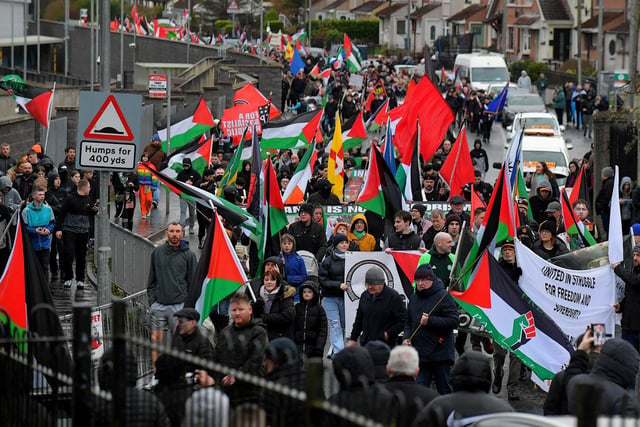
Led by four Republican marching bands and containing a number of organisations, around 6,000 people supported the annual march in Derry on Sunday commemorating the 1972 massacre by the British Parachute Regiment in the city.

This year a special focus on solidarity with Palestine had been called for by the organisers of the Bloody Sunday massacre commemoration and Palestinian flags mixed with ones of Irish Republican organisations decorated the march route.

The march begins at the Creggan Heights, overlooking Derry, a steep walk up from the Bogside, the city’s centre near the river and winds its way down (with a great view of the Foyle river and surrounding area) but then up Westland Street again and along Marlborough Terrace.

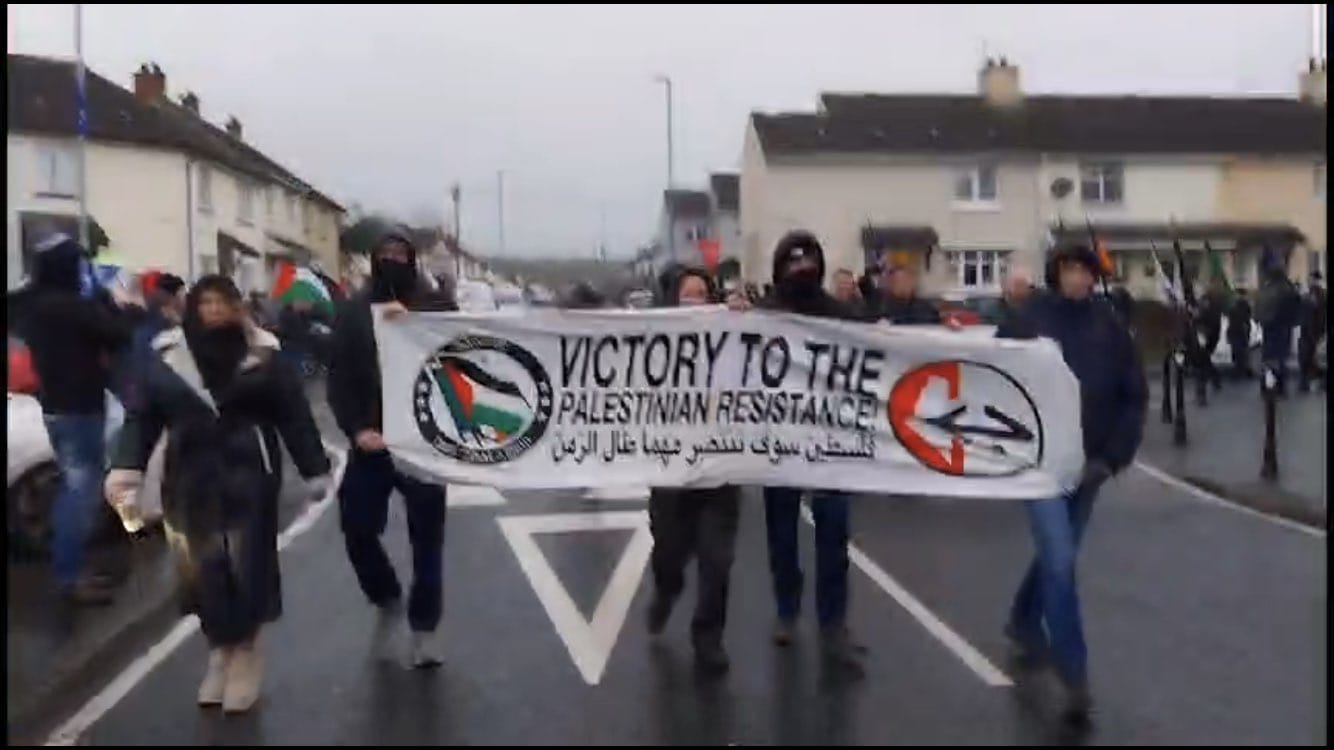
Rear banner of the AIA contingent on the Bloody Sunday commemoration march Sunday. (Photo source: AIA)

For a number of years this commemoration has taken place in heavy rain and high winds, or snow, or sleet but it was dry this year – until the march started! However after a short period of strong gusts driving rain it stopped for the rest of the march.

Down Creggan Road to the Bogside once more and past the Bloody Sunday and H-Block memorials to the rally at Free Derry Corner where Kate Nash, one of the main organisers of the march for years and a sister of one of those murdered in the massacre, welcomed the marchers.

The Bloody Sunday 52nd commemoration march makes it way along Lone Moor Road towards the Brandywell on Sunday afternoon. (Photo: George Sweeney via Derry News.)

RALLY AND SPEAKERS

Nash condemned the punitive EU/ UK/ USA cutting of funds to the UNRWA organisation carrying out relief and educational work in Gaza following an Israeli State intelligence allegation1 and also called for no Irish politicians to attend the annual US Presidential St. Patrick’s Day event.2

Kate Nash’s brother Willie was murdered by the Parachute Regiment during the massacre and her father was wounded by fire while trying to reach his fallen son. Kate called for a minute’s silence for the dead and wounded that day but also for those in Gaza, in particular the children.

Kate Nash also mentioned the Noah Donohoe case as being close to everyone’s heart.

The names of the dead and wounded by the Parachute Regiment were read out by Damian Donaghy,3 son of Damian Donaghy one of the survivors on that day. Paddy Nash performed the civil rights anthem “We Shall Overcome” which was popular among marchers of the time.

Section of the rally to the right as facing Free Derry Corner with a mural based on an iconic photograph from the massacre. (Photo: D.Breatnach)

Kate Nash introduced Huda Ammori, a Manchester-based Palestinian activist and one of the Elbit Eight,4 who said she felt at home in Derry because of the people’s solidarity with Palestine.5 The State in Britain failed to convict all but one of any charges arising out of direct action against the arms company.

Ammori drew parallels between the Irish and Palestinian struggles against colonialism and stated that her grandfather had been assassinated for rising up against the British colonisation of Palestine in 1936, when it was a British “Mandate”.

Mural on a wall in the Bogside, Derry; the words “don Phalaistín” are obscured by a vehicle. (Photo: D.Breatnach)

AIA Short Video with Music Bloody Sunday Derry 2024 AIA Video.MP4 (viewable on FaceBook)

“The British signed away the land of Palestine in 1917,” Amori told the rally, “they colonised our lands and then they armed and trained the Zionist militia to commit a Nakba, to displace over 750,000 Palestinians in 1948, over half the indigenous population.”

Huda Ammori said weapons were used on Palestinians in Gaza and then marketed as ‘battle-tested’. She also praised those who had taken direct action in Derry against arms firms (e.g Raytheon).

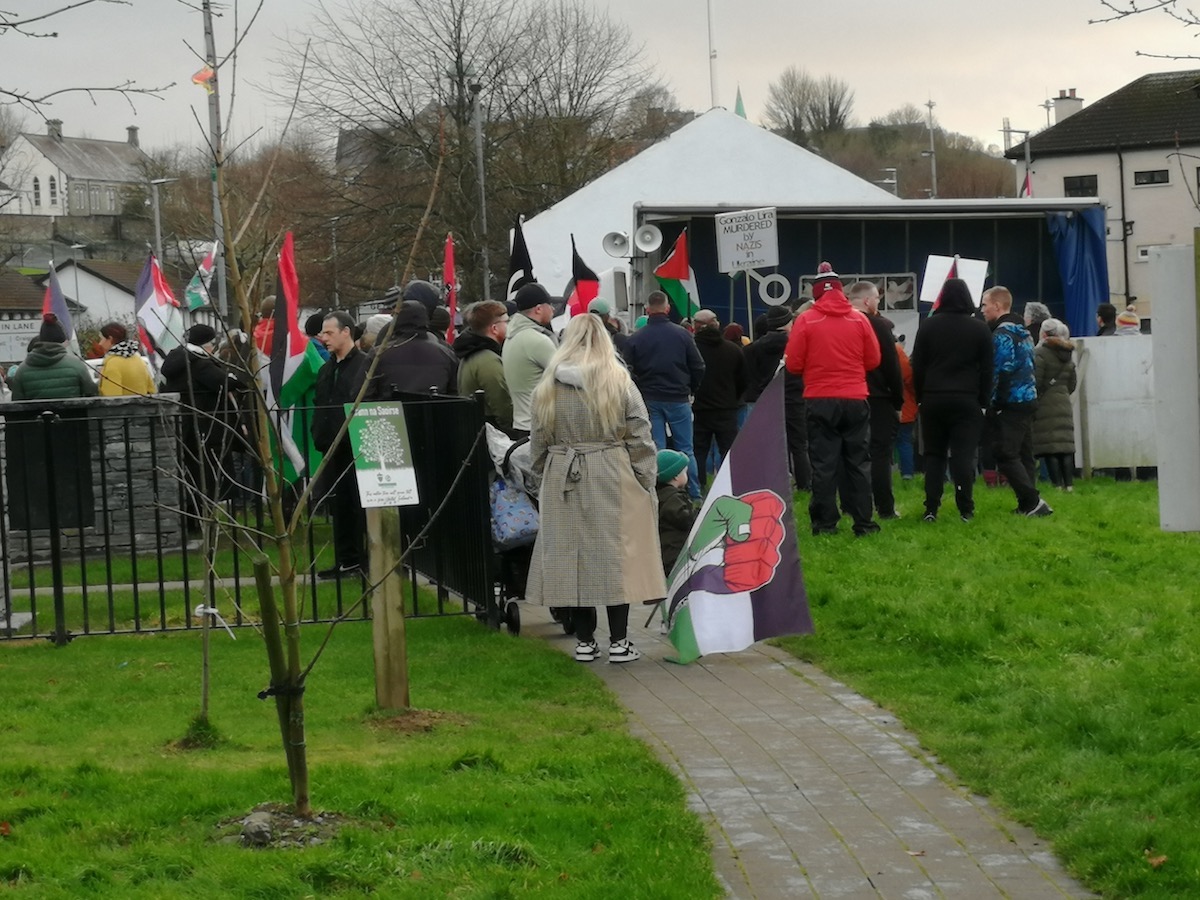
Section of crowd gathering in front of the stage for the rally. (Photo: D.Breatnach)

Geraldine Doherty, niece of Gerard Donaghy, youngest of the Bloody Sunday victims, also spoke from the platform, saying it was ‘sad’ but ‘heartwarming’ to see so many people attending the march.

“More than half a century since British troops committed this massacre on these streets, innocent children like my murdered uncle Gerard and hundreds of others as well are still being denied justice”, she said and denounced the British State attempting to prevent the trial of legacy cases being tried.

Doherty spoke of the remaining “trauma for Derry and for Ireland” from which many families have never recovered, with long-term post-traumatic damage such as depression, addiction and divided families.

“But while the people of Derry were battered and imprisoned, we were never broken,” she said to cheers from the rally participants. “Derry has rediscovered its … voice and we are using that voice to oppose the murder of children and women and men, and we stand with the people of Palestine.”

Section of crowd to the left of the stage at the rally. (Photo: D.Breatnach)

ON THE MARCH

Over the years since I returned to Ireland, I have marched in that commemoration many times, either as an individual or as a member of a solidarity committee and this year was glad to be welcomed as part of the Socialist Republican contingent, with Anti-Imperialist Action.

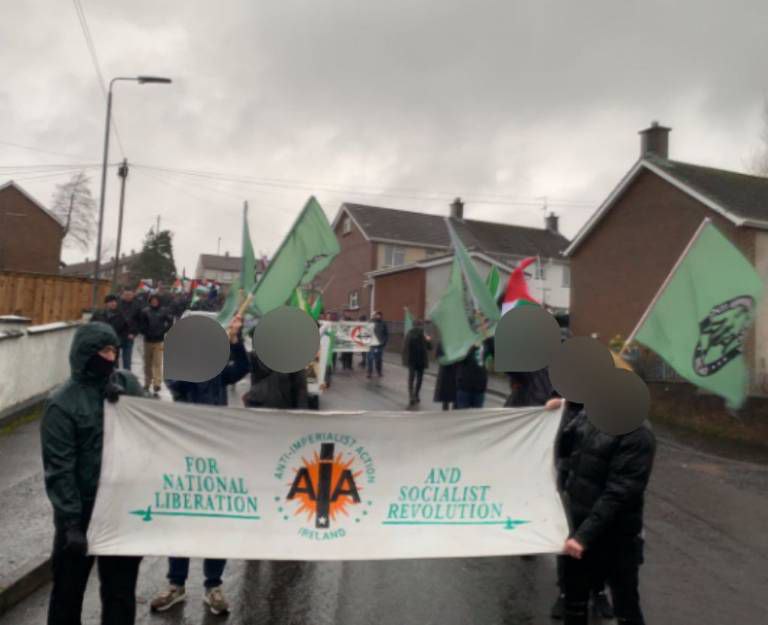
The bloc carried two banners: the one at the front was a new one in which the AIA called for anti-imperialist revolution and socialism, while at the rear the banner celebrated the Palestinian resistance. In between the banners marchers carried flags and placards.

New banner of the AIA in the organisation’s contingent on the march on Sunday. (Photo: D.Breatnach)

In the bloc men and women marched with a flags of the AIA, the Starry Plough, Palestine and Cumann na mBan. From the contingent on many occasions could be heard slogans of solidarity with Palestine and some equally applicable to that nation’s resistance or to Ireland’s.

In the face of occupation – Resistance is an obligation!” and “No justice – No peace!” were in the latter category while “From the River to the Sea – Palestine will be free!”, “Free, free – Palestine!” and “Saoirse don – Phalaistín!” were specifically supporting the Palestinian struggle.

Most Republican organisations and some Irish socialist organisations attend the annual event, along with campaign groups and on occasion solidarity groups from abroad or Irish ones in solidarity with struggles abroad. Sinn Féin no longer attends but some supporters would as individuals.

Giant Palestinian flag displayed below the Derry Walls above the rally below. (Photo: D.Breatnach)

THE MARCH ROUTE AND HISTORY

The Bloody Sunday march covers the same route as the anti-internment march in January 1972 when the British Paratroopers murdered 14 unarmed marchers and injured so many others. Preceded by the Ballymurphy Massacre in August 1971, it was followed by another in Springhill in July ‘72.

The British military claimed that the Derry victims had been armed and fired first and an inquiry tribunal headed by Lord Justice Widgery exonerated the Army and blamed the victims although the Derry Coroner, an ex-British Army officer had called it “sheer unadulterated murder”.

In 1998, presumably as part of the Good Friday Agreement deal, the British State began a new inquiry which however did not deliver a published verdict until 2010,6 stopping short of accusing the Army of murder but exonerating all the victims except one about which it was equivocal.

At that point, Sinn Féin’s Martin McGuinness said that the march should not be continued; however not one British soldier had even been charged, to say nothing of the commanders and Government Ministers who had either given the orders or arranged the cover-up – or both.

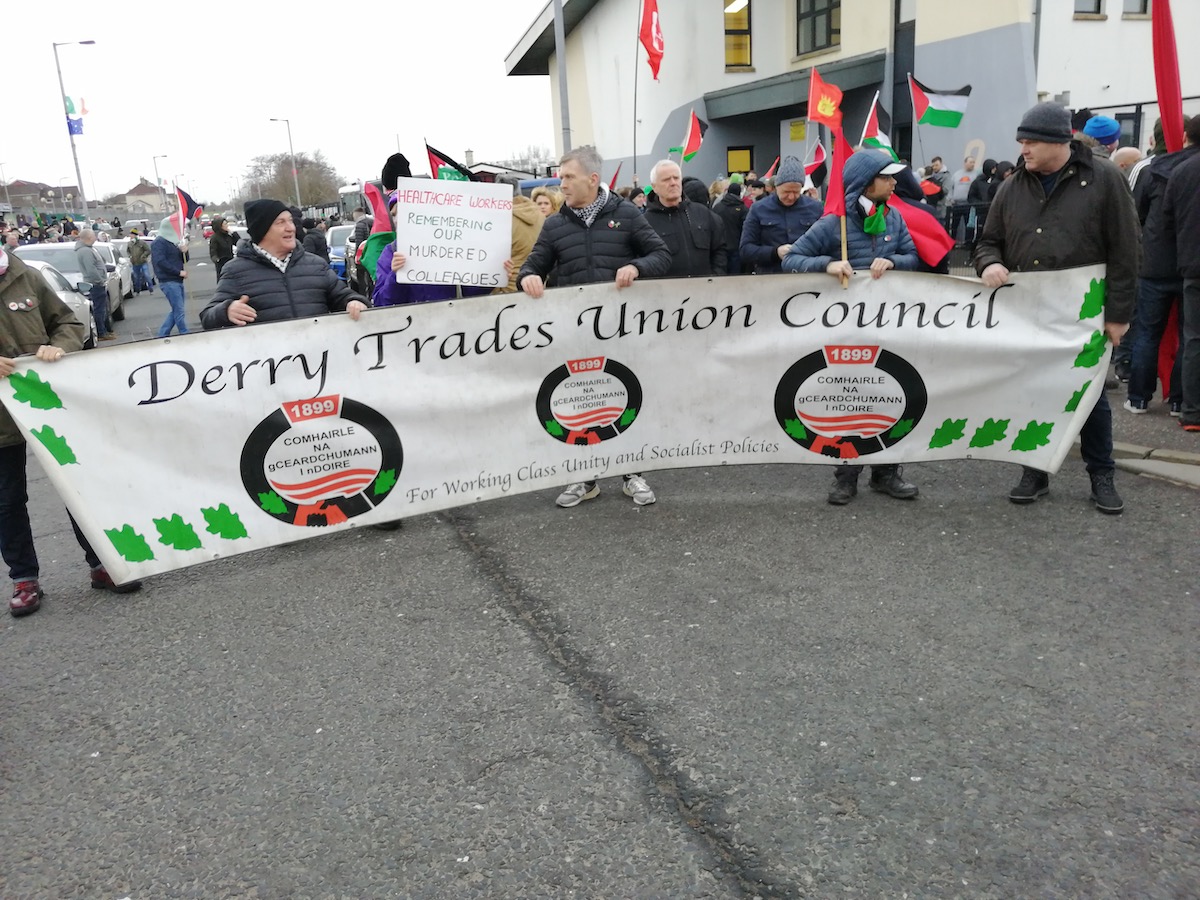
Banner of the organisation combining representation of trade unions in Derry. (Photo: D.Breatnach)

A small group of veterans of the original march and relatives, Kate Nash prominent among them, however decided to keep the march going and have done so every year, often in the face of accusations and disparaging remarks from supporters of Sinn Féin and others.

In 2022, the Massacre’s 50th anniversary, 20,000 marched in it while the Bloody Sunday Trust, an institution and museum supported by the colonial state and Sinn Féin, organised a small “memorial walk” and indoors event in the Guild Hall – the only one reported by the mass media.7

An independent group, badly needed since the Coiste na nIarchimí is controlled by the Provisionals. (Photo: D.Breatnach)
Display below Derry Walls created by the Saoradh Irish Republican organisation, according to their social media. (Photo: D.Breatnach)

Although veterans of the massacre and of the annual commemoration often meet one another only once a year at the commemoration, some having come from abroad, there are always new young people to be seen among them and hundreds come out to watch the march.

The march is an important commemoration of a massacre by British colonialism which still holds the colony of the Six Counties, a reminder no doubt inconvenient to unionists, neo-colonialists and those who have left the struggle, either through lack of will or for personal advancement.

In its championing and giving voice to other conflicts too, the commemoration march and other related events during the week are a strong expression of internationalist solidarity.

Wreath of the Bloody Sunday Commemoration Committee among others at the Bloody Sunday Monument. (Photo source: Bloody Sunday Commemoration Committee)

End.

FOOTNOTES

1The Israeli state intelligence agency reported that 12 out of 13,000 employees of UNRWA in Gaza had been implicated in the 7th October Palestinian raid following which at least some, possibly all, were sacked by UNRWA, apparently without any hearing or appeal process. The US, UK, Germany, Italy followed this up by suspending all funding to the relief organisation catering for 2 million people in dire circumstances. 

2Traditionally, leading politicians of the main Irish political parties, both mainstream and Sinn Féin, have sent representatives to celebrate St. Patrick’s Day with US Presidents, many of whom are of Irish descent. This year a campaign has arisen calling on them not to do so but spokespersons of Fine Gael, Fianna Fáil and Sinn Féin have insisted they will attend, which the SDLP has declared it will not. 

3Not to be confused with the family of Gerard V. Donaghy (20 February 1954 – 30 January 1972), sometimes transcribed as Gerald Donaghey, a native of the Bogside, Derry who was murdered by members of the 1st Battalion, Parachute Regiment on Bloody Sunday.

4Eight activists of British-based Palestine Action, a direct action organisation, who as a result of their actions against the Israeli-based military technology company Elbit in Britain, were charged with a total of 12 charges which included criminal damage, burglary and encouraging criminal damage. The trial, which commenced on November 13th, related to a series of actions taken during the first 6 months of Palestine Action’s existence from July 2020 to January 2021. In December last year, one activist was convicted on one charge by 10-2 majority, two were completely cleared and jury failed to reach a majority verdict on the rest of the charges on six remaining activists.

5That would be true of the majority ‘nationalist’ population of the city but not so much of the unionist minority, where support for Israel is more dominant, due in part to susceptibility to British propaganda and also simply out of sectarian hostility to anything favoured by the ‘nationalist’ community.

6At a cost of nearly £200m (€227.7m), half of which went in legal fees, a lawyer’s bonanza, to arrive at a decision that just about everyone in Ireland knew and many abroad knew already and which established no safeguards against a similar massacre being carried out by British military in future.

7Browser searches throw up report after media report, including Al Jazeera’s, of “hundreds” attending the early event, without a mention of the many THOUSANDS who marched later in the day.

SOURCES

https://www.derryjournal.com/news/people/when-im-in-derry-i-feel-like-i-am-home-palestinian-activist-tells-bloody-sunday-rally-4496030

Elbit Eight trial and verdict: https://www.palestineaction.org/elbit-eight-verdicts/

The Saville Bloody Sunday Inquiry: https://en.wikipedia.org/wiki/Bloody_Sunday_Inquiry

Cost of: https://www.irishexaminer.com/news/arid-30477561.html

CHRISTMAS LIGHTS AND POLITICAL PRISONER SOLIDARITY

Clive Sulish

(Reading time: 4 mins.)

Among Christmas shopping crowds in Dublin’s city centre, the calls for freedom of political prisoners rang out, while the Irish, Palestinian and Basque flags fluttered in the wind among festive lights and projected light-show.

The Ireland Anti-Internment Campaign was holding its annual political prisoner solidarity picket in the busy O’Connell street, supported by socialist Republican groups and independent activists.

View of picket line looking southward. (Photo: Rebel Breeze)

December is a traditional month in Ireland for focus on Republican prisoners. However, the IAIC campaign has always made a point of remembering political prisoners elsewhere too, with Palestinian and Basque flags erected on its regular pickets.

This year the Campaign had especially requested Palestinian flags and these were present, both the national flag and that of the Peoples Front for the Liberation Palestine, fluttering alongside Basque flags and the green-and-gold Starry Plough.1

In addition, one of the IAIC’s banner displayed a large copy of an image depicting a Palestinian’s arm extended through prison bars to grasp the hand of an Irish Republican prisoner’s hand also from nearby bars, from the original by political cartoonist Carlos Latuf,.

A black banner had been rigged with lights to spell “Saoirse”, the Irish word for “freedom” and the picketers set up in a line with other banners and flags facing the GPO building.2

Political prisoners sometimes have their family visits cancelled as a punishment and during the Covid pandemic prevention period it was used as an excuse to prevent Republican prisoners’ family visits. (Photo: Rebel Breeze)

SHOUTS

A speaker using a megaphone informed passers-by that internment without trial had not ceased in Ireland and that Republicans were being charged and then refused bail by non-jury courts on both sides of the British Border, spending two years in jail regardless of their trials’ outcomes.

All the Republican prisoners, the IAIC speaker said, had been convicted in non-jury special courts. Palestinians were also being convicted in special courts, he said, military courts and many were in jail – in “administrative detention”, i.e interned without ever having been convicted or tried.

Over 3,000 had been arrested in Israeli Army raids since October 7th,3 the speaker said through the megaphone, bringing the overall number of Palestinians in jail to over 7,000.4

(Photo: Rebel Breeze)

The recent exchange of prisoners between the Zionist state and the Palestinian resistance had resulted in liberty for 240 Palestinians, of which 1075 were children and 68 women.

There was regular chanting from the picket line including: “From Ireland to Palestine – Free all political prisoners!” “When there is occupation – Resistance is an obligation!” and “Free political prisoners – Free them now!”

At one point some kind of religious procession was briefly enacted in front of the GPO building and an elderly woman in apparent religious garb approached the picketers shouting something at them which they largely ignored, maintaining their solidarity slogans.

(Photo: Rebel Breeze)

In addition to interested people taking photos or filming video of the protest on their devices, some approached the participants to ask questions and to receive a leaflet, after which a number actually joined the protest line for a while (some until the end).

Occasional passing traffic also sounded their horns in solidarity.

The pavement in front of the GPO showing shoppers and people queuing for food distribution. (Photo: Rebel Breeze)

STATEMENT

As the end of the event’s allocated period approached, a representative of the IAIC asked the participants to gather around and spoke about how resistance brings repression and oppression brings resistance, resistance being the “crime” for which political activists are jailed.

The participants were thanked for their support, whether independents or activists of Ireland Anti-Imperialist Action and Saoirse Don Phalaistín organisations.

The event ended with the acapella singing of “The H-Block Song” by Diarmuid Breatnach, in an adaptation of the original air to the lyrics of what is “still a good song” he said, composed by a man who, along with his party, “no longer supported Republican prisoners”.6

(Photo: Rebel Breeze)

The lyrics recall the struggle of Republican prisoners in the late 1970s against the removal of their ‘Special Category’ political status, which began with refusal to wear prisoner uniform. The struggle escalated to the “no-wash protests” and to hunger strikes in 1980 with ten martyrs in 1981.

As the protesters collected their flags and wrapped up their banners, the nature of current Irish society was underlined by the queues forming up across the road for free food being distributed by charitable organisations.

Early view of picketers, looking northward. (Photo: Rebel Breeze)

INDEPENDENT AND OPEN DEMOCRATIC ORGANISATION

The IAIC is “an independent organisation and open democratic organisation” of ten years’ existence and although it has held events for specific cases such as the framed Craigavon Two,7 its main activity has been regular public pickets in Dublin to highlight ongoing internment in Ireland.

The Campaign group encourages participation by democratic people in its regular pickets, regardless of political organisation affiliation or none and, according to one of the organisers, expects to hold its next one in Dublin in January or February.

The IAIC expects also to take part again in the annual Bloody Sunday Commemoration march in Derry on Sunday 29th January 2024.

end.

Unintentionally impressionistic image, photo taken from the east side of O’Connell Street (Photo: Rebel Breeze)

APPENDIX: ANNIVERSARY OF HANGING OF IRISH REPUBLICAN

Though not mentioned in the discourse, the above event took place within days of the anniversary of the British colonial execution of an Irishman in revenge for his killing of an ex-Republican who had turned informer.

James Carey, in the midst of a ‘witness protection program’ provided as a reward for his betrayal of his comrades in giving evidence in court to ensure the jailing of some and hanging of five others, was killed in a gunfight with Pat O’Donnell.

Carey had been a leading member of the National Invincibles’ (a split from the Fenians) cell in Dublin, and had given the signal for the fatal stabbing of British Under-Secretary Burke and Chief Secretary Lord Frederick Cavendish in Phoenix Park on 6th May 1882.

However, Carey turned “Queen’s Evidence” to testify ensuring the conviction of his former colleagues and even gloated in court at their fate. His reward, but for O’Donnell, would have been a new life with pension under an assumed name with wife and children in the South African colony.

O’Donnell was an independent Republican from the Irish-speaking Gweedore area in Donegal but had been to the USA, where he had cousins who were prominent in the “Molly Maguires”, an Irish-led resistance organisation among miners in the USA.

O’Donnell was hanged on 17th December 1883 but is commemorated in the satirical song “Monto” and also in the serious “Ballad of Pat O’Donnell”. His home town of Gweedore also holds a monument in his honour.

end.

FOOTNOTES

1Flag of the Irish Citizen Army, the first workers’ army in the world, founded to protect workers from the police during the Dublin Lockout/ Strike of 1913.

2The General Post Office, iconic building on Dublin’s O’Connell Street, which was the HQ of the leadership of the 1916 Rising, left a shell by fire from British artillery bombardment but rebuilt later.

3https://en.wikipedia.org/wiki/Mass_detentions_in_the_2023_Israel%E2%80%93Hamas_war

4https://www.hrw.org/news/2023/11/29/why-does-israel-have-so-many-palestinians-detention-and-available-swap

575% had not been convicted of any crime https://en.wikipedia.org/wiki/2023_exchange_of_Israeli_hostages_for_Palestinian_prisoners

6Francis Brolly (1938-1920) of Provisional Sinn Féin, composed the song which was released in 1976. PSF abandoned the struggle in the imperialist-promoted pacification process towards the end of the last century and most of their prisoners were released under licence. However those who made public their disagreement with the colonial occupation and the pacification process were on occasion returned to jail while new “dissidents” were charged and refused bail in special no-jury courts, with tacit support of the PSF.

7Quoted from the FB page at https://www.facebook.com/profile.php?id=100063166633467

Commemorating the Newport Rising of November 4, 1839

Today marks 184 years since the greatest armed rebellion in 19th-century Britain when Chartist workers fought bloody gun battles with the police and army in the heart of industrial Wales, writes STEPHEN ARNELL

A sketch of the huge crowd in Newport in 1839 as it surrounded the Westgate Hotel hoping to free captive Chartist comrades (via the People’s History Museum).

“Come hail brothers, hail the shrill sound of the horn
For ages deep wrongs have been hopelessly borne
Despair shall no longer our spirits dismay
Nor wither the arms when upraised for the fray;
The conflict for freedom is gathering nigh:
We live to secure it, or gloriously die.”
— Chartist song of the South Wales miners

UNLIKE our friends across the channel in France, the inhabitants of Britain appear a remarkably supine people in the main, usually preferring well-organised demonstrations to anything that whiffs of pre-planned armed revolt, no matter how righteous the cause.

Yes, there have been mass meetings, marches and spontaneous events that took a wrong turn and descended into riots, but we seem singularly ill-equipped by nature to contemplate anything more serious.

But this would be doing this island race a disservice; to paraphrase the emperor Tiberius, there was a time when the British were not a people “fit to be slaves.”

There’s a long and storied history of the working classes attempting to seek redress from a variety of wrongs, including poll taxes (the Peasants’ Revolt, 1381), government corruption (Jack Cade’s Rebellion, 1450), religion (the Pilgrimage of Grace, 1536) and the later Pentrich Rising in Derbyshire of 1817, a muddled affair which aimed to cancel the national debt and repeal the Corn Laws.

1839’s Newport Rising was a more coherent and dangerous challenge than Pentrich, in possessing both a specific democratic political manifesto and its unprecedented scale.

That’s not to say the revolt was a carefully co-ordinated business that worked to a timetable with a pre-planned outcome, but the numbers involved, the potential for encouraging similar risings and the essential justice of the Chartist cause gave Lord Melbourne’s Whig government a serious jolt.

Newport had its origins in both national and local events.

The House of Commons rejection of the People’s Charter of 1838 calling for universal male suffrage, secret ballots, salaries for MPs, equal constituencies, and the end of the property qualification for voting on July 12 1839, and the following conviction and imprisonment in Monmouth of the Chartist leader Henry Vincent for conspiracy and unlawful assembly, stoked the fires of rebellion in industrial southern Wales, a stronghold for the movement.

Combined with this were reasons that directly concerned the rising’s leader, John Frost (1784-1877), namely his six-month imprisonment resulting from a dispute regarding his uncle’s will with Newport town clerk Thomas Prothero, and the wealthy political enemies he made on the way to becoming mayor of the Monmouthshire burgh.

A sketch of Chartist leader John Frost on trial at Monmouth after the uprising.

Despite this, Frost was supposedly reluctant to lead a full-scale armed uprising, and doubtful of its prospects, but the zeal of his supporters forced his hand and preparations were made for the march on Newport.

On Monday November 4 1839, Frost led 4,000 followers to the town, his group including allied coalminers, who armed themselves with home-made pikes, bludgeons, and firearms.

The authorities in Newport got wind of the march and detained several known Chartists at the Westgate Hotel in the town centre. This added impetus to Frost’s mission which was presumably to take over the town in the hope of starting a nationwide insurgency.

At 9.30am, a crowd of anything from 8,000 to 20,000 Chartists (ironically including Allan Pinkerton, later founder of the infamous US strikebreaking detective agency known as “the Pinkertons”) filled the square in front of the hotel, demanding the release of their comrades.

The mayor had gathered a mixed force of around 60 soldiers of the 45th Regiment of Foot and 500 special constables to defend the Westgate, all equipped with weaponry superior to the relatively small number of Chartists possessing guns.

To this day no-one knows for sure who fired the first shot, but a heated exchange between the two sides began, with the engagement lasting approximately half an hour. The result was a total rout for the Chartists.

Up to 24 rebels were slain, with around 50 injured. Four of the defenders were wounded, as was the mayor of Newport Thomas Phillips (later knighted by Queen Victoria), when the attackers briefly succeeded in entering the building. So ended the greatest armed rebellion in 19th-century Britain.

In comparison, the better-known Peterloo Massacre of August 1819 saw 18 people killed and as many as 700 injured when army regulars, special constables and local yeomanry charged peaceful demonstrators calling for parliamentary reform.

Weapons from the Newport Rising are displayed in the local museum.

Unlike the French, with the storming of the Bastille, the March on Versailles and the Paris Commune, the Newport Chartists appeared to lack the killer instinct of their Gallic counterparts, which may say something of the passive British national character relating to the ruling class.

The leaders of the rising were convicted of treason and were sentenced to be hanged, drawn and quartered, the last in England and Wales to be condemned with this ghoulish form of execution.

Their sentences were commuted by Queen Victoria to transportation for life to Tasmania. Frost was given an unconditional pardon in 1856 and returned briefly to Newport, where he received a rapturous welcome.

His two co-conspirators were also pardoned, but both opted to stay in Australia. Watchmaker William Price continued to ply his trade, but without success and died in poverty; in contrast, collier Zephaniah Williams (who at one point had planned to escape) discovered coal in Tasmania and became one of the richest men in the colony.

Note: the last people to be hanged, drawn, and quartered for treason in Britain are said to be David Tyrie in 1782, and in 1798, Father James Coigly; both were convicted of spying for the French (the Bourbon and revolutionary regimes respectively).

In 1977, John Frost Square, in Newport city centre, was named in the Chartist’s honour. But in 2013, Kenneth Budd’s mosaic in the square commemorating the Chartists was demolished at the behest of the Labour-run Newport council, prompting widespread outrage (from the likes of actor Michael Sheen and former Archbishop of Canterbury Rowan Williams) and public demonstrations.

Kenneth Budd’s mosaic, sadly demolished in 2013.

In November 2019 a new mural by Budd’s son Oliver was unveiled, consisting of four panels on the site of the former public toilets on Cefn Road, Rogerstone.

Comedian Jack Whitehall is a descendant of Welsh lawyer Thomas Jones Phillips, one of the chief opponents of the Newport Rising. Taking no pride in this fact, in 2019 he commented on BBC1’s Who Do You Think You Are, “What’s next? I suppose probably go and visit a mine our ancestor shut down or maybe an orphanage he burned to the ground.”

The Newport Rising also features in a graphic novel published in 2019, Newport Rising, written and illustrated by local artist Josh Cranton; the book was launched at the Westgate Hotel, which unlike Budd’s original mural still stands, recently reincarnated as a “live music, performance, arts and heritage venue.”

https://morningstaronline.co.uk/article/commemorating-newport-rising-november-4-1839

Stephen Arnell is a writer and cultural commentator. His book The Great One: The Secret Memoirs of Pompey the Great is out now.

COMMENT (No Irish need apply for mention):

Rebel Breeze is grateful for this article about an instance in the long history of workers’ resistance to various features of capitalism.

The article would not have been diminished and might even be thought to be enhanced by mentioning the Irish diaspora’s contribution to the Chartists, both in rank-and-file membership and in leadership, with Bronterre O’Brien and Fergus O’Connor in the latter category.

Or to mention that despite the spying for the French charge against Fr. Ó Coigligh, the last man hanged, drawn and quartered by the civilised British Establishment, the real reason was his membership of and participation in the United Irishmen, an Irish revolutionary Republican organisation.

That organisation had also ‘infected’ the short-lived United Scotsmen and even shorter-lived United English, though in the latter case contributing to the leadership and organisation of the Spithead Naval Mutiny.

Revolt of the English sailors, On each ship they went to tackle, vintage engraved illustration. Journal des Voyage, Travel Journal, (1880-81).

Of course, such references might have tempted the writer to compare revolutionary uprisings in Britain with those in Ireland, rather than in France.

But then, the Communist Party of Great Britain, which owns The Morning Star where the article was published, has never been too fond of the Irish struggle for independence or the means we felt justified in employing.

end.

CROWD PACKS FOURTH DUBLIN PALESTINE SOLIDARITY RALLY DESPITE CONSTANT RAIN

Diarmuid Breatnach

(Reading time main text: 5 mins.)

The roar of Palestinian solidarity slogans outside the Irish Parliament, Leinster House on Wednesday night must surely have reached the ears of the elected representatives as they debated a motion that “Israel has a right to defend itself”.

The motion is widely seen as part of a narrative, under the cover of self-defence, endorsing the Israeli State in its decades of racism, apartheid, genocide and war crimes and takes place during the Zionist state’s genocidal bombardment of Gaza.

Solidarity colours in the rain (Photo: D.Breatnach)

The rally, the third since last Saturday week1 organised by the Ireland Palestine Solidarity Campaign, attracted many hundreds willing to stand in persistent rain, listen to contributions from speakers and chant slogans, these led by voices in both Irish and Middle Eastern accents.

In fact, a strong trend increasing over recent years has been the presence of Palestinian voices at such rallies, both in speaking and in leading slogan chants, which the rally organisers have not hesitated to facilitate.

View late in the rally (Photo: D.Breatnach)

SLOGANS, SONG AND POEM

On Wednesday evening, some slogans were in Arabic also, such as I think “Tahya Filistina!” (long live Palestine) but sadly not the equivalent in Irish, such as “An Phalaistín abú!” or an alternative, for example: “Saoirse don Phalaistín!” However, one placard in Irish was present (see photos).

(Photo: D.Breatnach)

The slogans in English ran the usual range of call and answer: “Free, free – Palestine! From the river to the sea Palestine will be free! One, two, three, four – occupation no more; five, six, seven, eight – Israel is a terrorist state! (I prefer “Israel is a fascist state!” myself).

In our thousands, in our millions – we are ALL Palestinians! Boycott — Israel! Irish Government – shame on you!

In 2009, as yet another Gaza bombardment came to an end, I had composed a poem I called The New Wailing Wall. On Wednesday I got it printed in a photocopying shop on my way to the event, by which time it was raining fairly heavily but I was glad to be permitted to read it out at the rally.2

A Palestinian woman sang in Arabic a “song of sadness”, i.e a lament the rhythm of which a lot of people got into, clapping in time. In Irish singing we often don’t like this, as it tends to drown out the words and the musical detail but it seemed to work well enough there.

Later she told me that she very rarely sings but felt she had to give voice to her feelings – and I know some of what she means.

Seen from behind, Palestinian woman singing a lament in Arabic at the rally (Photo: D.Breatnach)

MOTION DEBATED

Inside the home of the Irish Parliament,“the Dáil”3 a motion of support for the Zionist state proposed by the Government had run into problems even before Israel’s bombing of the hospital in Gaza, after which they intensified; the Government insists it will not condemn Israel to any degree.

It is likely that a majority-agreed motion amendment will pass but however will neither assert the right of the Palestinians to their land nor to resistance, nor to the return of refugees, much less condemn Zionism; it should be a cause of shame to all parties and individuals who support it.4

Section of the rally crowed after an hour (some had gone home) in front of the gates of Leinster House (Photo: D.Breatnach)

Expel the Israeli Ambassador!”

In the street outside Leinster House, there were many calls for the expulsion of the Israeli Ambassador (Out! Out! Out!)

Truly that seems the most effective solidarity move of which we are capable currently.5 Sadly there seems no chance that the Government would even consider doing so.

Even among the Opposition, Sinn Féin these days looks unlikely to support such a move. This is so even though the party’s President, Mary Lou called for the expulsion of the Russian Ambassador in April last year6 and a decade ago, Gerry Adams, for the expulsion of the Israeli Ambassador.7

Some solidarity demonstrators as far back as Molesworth Street while most are in front of Leinster House (Photo: D.Breatnach)
Rally supporters refuse to be squashed up on the pavements and spill over into the road. Once again the Gardaí have failed to close a road to avoid accidents and Dublin Bus has failed to instruct drivers to take alternate routes; the roof of a trapped bus may be seen in the far background. (Photo: D.Breatnach)

Colombia threatened to expel8 the Israeli Ambassador but the leaderships of the EU and the UK are securely tied to the war-chariot of the USA and there’s never any doubt about what the US wants, which is total support for its safe9 Middle Eastern foothold – Israel.

Colombia told the ambassador to behave himself or leave, after the Zionist publicly criticised Colombia’s President comparing the Israeli state’s discourse about and treatment of the Palestinians to that of the Nazis towards the Jews10 (but Israel is Colombia’s main weapons supplier).

A sentiment increasingly finding favour (Photo: D.Breatnach)

OUTLOOK FOR THE FUTURE

In the immediate future, the Zionist authorities have said they intend to invade Gaza to clear out “Hamas”, in which they will of course include all Palestinian armed resistance. Of course, solidarity demonstrations will continue or even intensify.

If Israel invades, it is difficult to imagine that the Palestinian guerrilla resistance movement, including Hamas, Islamic Jihad and PFLP11, will allow that without putting up a fierce struggle.

(Photo: D.Breatnach)

Israel has the tanks and planes but fighting on the ground in ruined urban landscapes, when every pile of rubble may hide a tunnel, a bomb or a rocket-launcher, is a different game.The 5-months-long Battle of Stalingrad comes to mind and an Al Jazeera contributor came to the same conclusion.12

Also, other elements such a Hizbollah may open up new fronts, in particular in the Golan Heights and Lebannon, as the PFLP has urged. Imperialism and complicit Arab regimes are extremely worried about a flame reaching their combustible possessions in the region.

Massive solidarity demonstrations marched through Yemen, Lebanon and Jordan and even the collaborator military regime in Egypt was obliged to open the Rafah crossing gates for humanitarian aid to reach Gaza (with which the Zionists and the US had to reluctantly agree).

Huge solidarity and protest demonstrations have also taken place in Athens, London and other European cities, while the French government banned any such demonstrations. Texas in the USA also saw a huge demonstration and 500 Israeli protesters were arrested demonstrating in Israel.

However the regimes have weathered such storms before and may do so this time again.

Possibly the West Bank will rise up too, although Al Fatah still has a lot of influence there, despite its discrediting by corruption, nepotism and signing the Oslo Accords and with its leadership deeply compromised as a result.13

The Palestinian Authority goons (there are 80,000 of them) fired on demonstrations demanding action in solidarity with Gaza, and in Jenin killed a 12-year-old girl and seriously wounded a first-year university student. 14

The military command of Al Fatah told collaborator Abbas to step down15 but their objective is still the discredited and impossible two-state “solution”.

The 2-State idea was bad in 1993 but …
… even worse in 2019 (Source image: Carnegie Council)

This “solution”, which the US and the rest of the Western states support, proposed to give the Palestinians less than 40% of their territory, the worst and least-watered, chopped into sections with narrow corridors through the Israeli lands and always under the guns of Israel.16

A Palestinian state would have neither true environmental, population, political nor civil control. Never a good choice instead of a secular state of Palestine for all, even this colonial option is clearly unworkable, sabotaged by the Zionists themselves with their settlements dotted all over it.

It is shameful to even propose it as any kind of solution.17

In the longer term, Israel’s consolidation of partnerships with a number of Arab states may have been harmed by the Zionists’ savagery and racist discourse towards the Palestinians but how deeply is difficult to predict.

Whether the Palestinian resistance and particularly Hamas is strengthened or weakened in the eyes of the Palestinian mass likewise remains to be seen.

The mostly imperialist western states of Europe and America show no sign of weakening their allegiance to the world imperialist leader, the USA and therefore, once they get over their weak criticisms of Israel’s genocide, will continue to support the Zionist state into the future.

Like many other problems on this Earth, workable solutions depend on changing some fundamental features in the world order.

end.

A historical reference to the Balfour Declaration of the Imperial Conference of British Empire leaders in 1926 giving European Jews rights to the British Mandate territory of Palestine, where approximately 10% of the population were Middle Eastern Jews at the time, the rest being Palestinian Muslims and Christians. (Photo: D.Breatnach)
The rally, though thinning, is still ongoing behind photographer after perhaps two hours. Gardaí have FINALLY closed Kildare Street and a Dublin Bus has managed to turn around and exit. This has been the pattern in a number of Palestine solidarity rallies so far, when the Gardaí must have known the attendance would be large and the street should be closed for safety and traveler convenience sake. (Photo: D.Breatnach)

FOOTNOTES

1Another, last Monday week, had been organised by the Irish Anti-War Movement (effectively the People Before Profit political party).

2https://rebelbreeze.com/2015/03/03/poem-the-new-wailing-wall/

3That is its name but there are those who refuse to call it that, saying that only an all-Ireland parliament deserves that title, such as the one founded during the War of Independence 1919-1921.

4https://www.irishtimes.com/politics/oireachtas/2023/10/18/government-and-opposition-parties-fail-to-agree-wording-of-dail-motion-on-gaza/

5An on-line petition recently launched calls for the Zionist Ambassador’s expulsion: https://www.change.org/p/expel-the-zionist-ambassador-from-ireland?

6https://vote.sinnfein.ie/mary-lou-mcdonald-td-reiterates-call-for-expulsion-of-russian-ambassador/

7https://www.irishexaminer.com/news/arid-30636814.html

8It was reported that Colombia HAD expelled him and that was repeated at the rally but according to reports from there reaching now, he was only threatened with expulsion if he didn’t shut up.

9Probably the only state in the Middle East, because of its colonialist nature, that is safe from either national liberation uprising or Muslim fundamentalist revolution.

10This is a parallel so obvious that it occurs to a great many people across the globe but it is one that the Israeli authorities rejects and which it condemns as “anti-semitic” with the backing of many different authorities in the West.

11Peoples’ Front for the Liberation of Palestine

12https://www.aljazeera.com/news/2023/10/18/analysis-will-gaza-be-israels-stalingrad

13One of the initiatives of the waves of “Peace (sic) Processes” around the world in the 1990s and early 2000s.

14https://www.aljazeera.com/news/2023/10/18/palestinian-authority-cracks-down-on-protests-over-israel-gaza-attacks

15Ibid.

16https://www.carnegiecouncil.org/media/series/ethics-online/the-failure-of-the-two-state-solution-hope-for-palestinian-youth

17And the history of the Zionist colonisers shows that even with that, they would be forever pushing further, grabbing more land, killing more Palestinians in flare-ups (think the history of the European colonisation of the indigenous Americans in what is now the USA).

SOURCES

https://www.change.org/p/expel-the-zionist-ambassador-from-ireland?

https://vote.sinnfein.ie/mary-lou-mcdonald-td-reiterates-call-for-expulsion-of-russian-ambassador/

Gerry Adams’ call for expulsion of Israeli Ambassador in 2014: https://www.irishexaminer.com/news/arid-30636814.html

Motion discussions: https://www.irishtimes.com/politics/oireachtas/2023/10/18/government-and-opposition-parties-fail-to-agree-wording-of-dail-motion-on-gaza/

Possible changes in the West Bank polity: https://www.aljazeera.com/news/2023/10/18/palestinian-authority-cracks-down-on-protests-over-israel-gaza-attacks

Two-state ‘solution’: https://www.carnegiecouncil.org/media/series/ethics-online/the-failure-of-the-two-state-solution-hope-for-palestinian-youth

COLLUSION & DELUSION IN REPRESSION OF THE PALESTINIANS

Diarmuid Breatnach

(Reading time: 5 mins.)

As smoke rose over the homes and shops of Gaza, an unseasonal October brought sunshine on to the streets of Dublin city centre and the crowds with Palestinian flags outside Leinster House, the home of the parliament of the Irish State.

As the sound of explosions, wailing of ambulances and of people rang around the streets of Gaza, the call-and-answer of solidarity rang out in Kildare Street: In our hundreds, in our millions – We are all Palestinians! From the river to the sea – Palestine will be free!

The Dublin rally was one of a number of Palestine solidarity events organised in Ireland after the unprecedented attack on Israel by Hamas’ military wing, the Al Qassam Brigades on Saturday and the Zionist State’s bombardment of civilian structures and people in Gaza.

Small section of the rally (Photo: D.Breatnach)

The Zionist State, which also controls Palestine’s water supply to Gaza, as well as exit from and entry to the enclave, has cut off water and electrical power as well as barred entry to everything including food, medicine and heating gas.

The Dublin rally was called at very short notice by the Irish Anti-War Movement (IAWM), a broad front organisation formed by the People Before Profit party around 2003 to oppose the imperialist war against Iraq waged by the Coalition of states led by the USA.1

Section of the solidarity rally earlier (Photo: D.Breatnach)

A branch of the Student’s Union of Ireland also supported the rally, which had a high percentage of Middle Eastern people present, presumably mostly Palestinians. The flags in evidence were mostly national Palestinian, some of the PFLP,2 a couple of Starry Ploughs and one Tricolour.3

Speakers from the Palestinian community, IAWM and PBP condemned the decades of attacks by the Israeli state on the Palestinians in general and on those in the Gaza enclave in particular, going back to the expulsion of 700,000 Palestinians4 as the Zionist state was founded in 1948.

Starry Plough flag can be seen centre distance next to some PLPF flags (Photo: D.Breatnach)

Richard Boyd-Barret TD (PBP) spoke as did also Ibrahim Halawa from Dublin, who was a prisoner of the Egyptian regime for four years without trial. Halawa said that awareness-raising and education served the ignorant but that action is required from those who know the real situation.

Some of the orators spoke about the right to resistance of the Palestinians, some about being against killing and war (but blaming the Zionist state for causing it), some about the plight of the Palestinian civilians, particularly in Gaza and one referred to the thousands of political prisoners.

Woman carries home-made giant placard spray-painted “Victory to the Palestinians!” (Photo: D.Breatnach)

MIND THE LANGUAGE!

A number of speakers referred to the “International Community” and when one listens to them in context it becomes clear that this imagined “community” is one of capitalism and imperialism.

It is not the community of workers, much less the community of people struggling for freedom. In Ireland, the overwhelming majority of people have over decades seen through the Zionist propaganda and switched from being pro-Israeli State to being pro-Palestinian.

We should take more care with the words we use lest we reinforce capitalist-imperialist dominance in the world of concepts in addition to their dominance over the physical world. Another trap is the term “illegal” and Boyd-Barret used it in reference to Russia’s invasion of eastern Ukraine.

Banner seen at the rally (Photo: D.Breatnach)

Who makes the international laws by which something is ‘legal’ or ‘illegal’? It is of course the imperialists who do so on the international scale while the capitalists define legality within their states; by their standards the actions of Israeli Zionism are lawful but of Palestinians, illegal.

All the speeches and all the slogans chanted were in English, as were the words on banners. I participated in some Irish conversation near where I was standing but saw only one placard in Irish. The fact that this is normal is part of the problem in this neo-colonial state.

A lone placard in the Irish language seeks “Freedom for Gaza” (Photo: D.Breatnach)

Eoghan Ó Ceannabháin, from an Irish speaking-family from Connemara and himself an Irish speaker, also spoke in English as he introduced the song he was about to sing, in the same language as the lyrics of Patrick Galvin’s Where Is Our James Connolly?

Eoghan is a PBP supporter and a fine singer, particularly in sean-nós5 style and has an amazing range. It was good to hear references to James Connolly at such a rally, something that all too rarely happens, nor is the flag of his Irish Citizen’s Army often seen at internationalist events either.6

CONDEMNATION IN COLLUSION, CONFUSION AND ILLUSION

The imperialist states that united in condemnation of the attack by the Izz ad-Din al-Qassam Brigades, Hamas’ military wing, were joined by leaders of neo-colonial states such as the Irish one. Naturally also by parties competing to lead the neo-colonial Executive, such as Sinn Féin.

Media reports noted Mary Lou Mac Donald’s condemnation of Hamas as a change in Sinn Féin policy7. Indeed it is such a change but is generally in line also with the party’s trajectory of presenting itself as a safe pair of hands for management of the neo-colonial state.

Sinn Fein President Mary Lou McDonald and Micheál Martin, leader of Fianna Fáil and currently Tánaiste. (Images sourced: Internet)

Mícheál Martin, Tánaiste (Vice-Premier), who earlier had condemned Hamas, stated that the Government’s position is to support the “two state solution”, more correctly “the two-state illusion” and this, if not already SF’s position on Palestine will no doubt soon be so.

This is the position of all the imperialist and capitalist states, also of social-democratic and liberal groups. It is worth taking a minute to look at this “solution” which in the first place was totally undesirable and which since conceived has been undermined by the Zionists themselves by their colonial expansion.

If it could even be implemented now it would leave the Palestinians with in reality a colonial-type Bantustan-status client of the Israeli Zionist state8, owning less than 40% of their land area and most of their good land and water taken by Zionist settlers.

In addition, their territory would be fragmented, linked by “corridors” through areas of Israeli dominance. In any case, as of 2021, in a poll by the Palestinian Centre for Policy and Survey Research most Palestinians were against the two-state solution.9

Since this is not in the least a practicable solution, why does Mícheál Martin and Joe Biden, among many others10 keep saying it’s their preferred solution?

Biden, because it allows US imperialism to pretend that it supports some kind of solution other than total Zionist appropriation and expansion. Mr. Martin? For the same reason or just because his Gombeen class follows the world imperialism leader’s lead.

The only real solution, i.e the only one both just and capable of bringing peace, is the one that we hardly ever see or hear even mentioned: a secular republic with equal citizenship for all, return of refugees and reparations to the dispossessed Palestinians.

(Photo: D.Breatnach)

The Zionists will not accept the loss of their Zionist empire; US imperialism (and other imperialisms) won’t accept the loss of their only safe strategic foothold in the Middle East – free from the dangers of either Islamic fundamentalist or national liberationist revolution.

US imperialism, now sending an aircraft carrier against the Palestinian people who have neither air force nor navy, is the main financial and political prop supporting the Zionist state. But whatever they thought, I heard no speaker in Dublin call for the necessary defeat of US imperialism.

end.

Scene earlier of the rally as people keep arriving (Photo: D.Breatnach)

FOOTNOTES

1The IAWM seems to have no permanent existence but can be revived in order to organise events such as today’s from time to time. There is nothing wrong with a party creating a broad front on a specific issue but when it is a front of the Party rather than a people’s front, it will of course suffer when the party’s activists, limited in number, are organising on other issues and cannot keep the ‘broad front’ going, much less expand it.

2The Popular Front for the Liberation of Palestine, a secular socialist organisation fighting for Palestinian national liberation; it has consistently been the 2nd-largest of the groups comprising the Palestine Liberation Organisation.

3The Starry Plough was the flag of the Irish Citizen Army, the first workers’ army in the world and usually signifies socialist Irish republicanism. The Plough painted in gold follows the shape of the Ursa Mayor constellation on a green background, the seven stars in white or silver. Another version appeared in the 1930s, the Ursa Mayor shape in white stars on a light blue background.

Obviously people carry Palestinian flags to show solidarity with Palestine but would it not be useful to carry Irish flags at such an event to demonstrate the solidarity of the Irish movements for national liberation and social progress with the corresponding movements in Palestine?

4That figure represented over half the pre-WWII Arab population (Muslim and Christian) of Palestine.

5Literally “old-style”, a traditional style of singing with ornamentation having a number of regional variations, nearly always unaccompanied and solo-voiced.

6James Connolly was a Scottish-Irish socialist revolutionary, writer, journalist, trade union organiser and historian, one of the Seven Signatories of the 1916 Proclamation, Dublin Commandant in the 1916 Rising, one of the 16 executed by British firing squads. He was a co-founder of the Irish Citizen Army to defend the strikers and locked-out workers in 1913 from vicious police attacks, the first workers’ army in the world, which also recruited women, some of whom were officers. The ICA fought alongside other progressive organisations in the Rising.

7And one which cut across the quoted posts of a number of the party’s TDs, including those of Chris Andrews (see Irish Times report in Sources).

8A real irony since Israel is a kind of colony, a state founded by Zionist settlers with imperial support.

9See Wikipedia entry

10Including China – a sad disillusionment for those who somehow still believe it to be a socialist state.

SOURCES

https://edition.cnn.com/middleeast/live-news/israel-hamas-gaza-attack-10-09-23/index.html

https://www.irishtimes.com/world/middle-east/2023/10/09/sinn-fein-leader-mary-lou-mcdonald-condemns-hamas-attack-on-israel-as-truly-horrific/

https://www.breakingnews.ie/world/eu-reverses-announcement-that-it-was-immediately-suspending-palestinian-aid-1537029.html

https://en.wikipedia.org/wiki/Two-state_solution

https://www.hrw.org/report/2021/04/27/threshold-crossed/israeli-authorities-and-crimes-apartheid-and-persecution

SOCIALIST REPUBLICANS HONOUR “THE FATHER OF IRISH REPUBLICANISM”

Clive Sulish

(Reading time: 5 mins)

A broad group of socialist Republicans gathered at the grave of Theobald Wolfe Tone on Sunday 2nd July to honour his memory and to reiterate their commitment to an independent and socialist Ireland outside of imperialist military alliances.

Wolfe Tone’s grave in the Bodenstown Church graveyard has been a place of pilgrimage for Irish Republicans at least since the days of Thomas Davis1 of the Young Irelanders of the 1840s, who wrote of his own visit to the grave and composed the song “In Bodenstown’s Churchyard”.

The late 1960s saw huge numbers of people in attendance at annual commemorations there near the village of Sallins, Co. Kildare, including not only Sinn Féin2, who led them, but many political and social organisations, GAA clubs, along with many non-aligned people.

Over the years, the voluntary and unfunded National Graves Association has improved the site comprehensively and sensitively, leaving the ruins of the Protestant church as they are but building a stage attached to one side, fronted with plaques and commemorative flag stones.

Commemorations currently are usually organised around a Sunday near the date of the patriot leader’s birthday on 20th June but have to be managed between different groups wishing to hold their own commemorations.

Speeches, songs and Garda harassment

The Annual Wolfe Tone commemoration organised by the Wolfe Tone Commemoration Committee took place over the weekend with members of a number of groups and Independent Republicans in attendance.

A Socialist Republican Colour party led the march up from the bottom of the road, turning in to the graveyard through a side gate and taking up positions in front and to one side of the monument, at ordú scíthe (parade rest) position but with flags held high.

Colour party in front of Wolfe Tone monument, Bodenstown Churchyard (Photo: Rebel Breeze)

Behind the colour party followed a crowd carrying banners bearing the legends “Irish Republicans against NATO”, “We serve Neither King nor Kaiser but Ireland” and an assortment of flags including green-and-gold Starry Ploughs, Irish Tricolour, Palestinian and Basque national flags.

The event was chaired by a young Socialist Republican who spoke about the importance of the event before introducing a representative of a midland Republican commemoration group who read a short message of solidarity.

This was followed by a socialist republican accompanying himself on guitar singing The Three Flowers.3

The main oration was delivered by veteran Independent East Tyrone Republican Margaret McKearney who linked the past with the present, including the current housing crisis, the British occupation and the Irish State’s push to join PESCO and NATO military alliances.

Musician performing The Three Flowers at the Wolfe Tone monument (Photo: Rebel Breeze)
Veteran Republican from Tyrone delivering the oration at the commemoration event (Photo: Rebel Breeze)

There was a clear message at the event that the push towards NATO will be energetically resisted at every turn by the people of Ireland.

Wreaths were laid and a minute’s silence was observed, while the colour party lowered the flags in memory of all those who paid the ultimate sacrifice in the ongoing struggle for Irish Freedom. The event was brought to a close with the musician playing and singing Amhrán na bhFiann.

A handful of Gardaí4 in uniform and in plainclothes (Special Branch, the political police) were parked outside the graveyard watching people arriving and leaving but at that point having no direct interaction with those attending the event.

Part of long tail-back cause by Garda checkpoint very near to Bodenstown Churchyard after the commemoration event (Photo: Rebel Breeze)
Gardaí in uniform and Special Branch in plain clothes harassing and attempting to intimidate people who had attended the commemoration event (Photo: Rebel Breeze)

However, once the event concluded, the Gardaí set up a checkpoint at the bottom of the road and began to harass and attempt to intimidate drivers of vehicles, stopping them, asking for identification, where they were from etc, causing a long tailback.

This is part of the regular harassment of Irish Republicans by police on both sides of the British Border.

The Father of Irish Republicanism”

Theobald Wolfe Tone (1763-1798) was formally a member of the Church of Ireland5 congregation (Anglican), in his time the dominant religious group in England-occupied Ireland but also one of the smallest.

No-one could be elected to the Irish Parliament unless of that congregation.

In the early 19th Century a section of the Irish bourgeoisie, nearly all Anglican or of the other Protestant churches, “dissenters”, wished to develop the Irish economy free of interference, control, patronage and bribery associated with being an English colony.

Many of them understood the need for a strong base in the population, for which they recognised the need to include representation for the majority population in the country, the Catholics, along with the most populous of the Protestants, the Presbyterians.6

When the liberal but pro-English Crown Henry Grattan brought the issue to a vote in the Westminster Parliament, his motion failed due to many MPs’ sectarianism or vested interests, a situation which continued for decades afterwards.7

That seemed to point to revolution as the only logical way forward.

Theobald Wolfe Tone was one of the founders of the Society of United Irishmen in October 1971, the first broad Republican organisation in Ireland, which soon developed a comprehensive revolutionary agenda, for Irish independence and a Republic based on universal male suffrage.8

In order to accomplish a successful uprising, they invited assistance from Republican France and planned a simultaneous uprising across Ireland, with particular concentration on Antrim (largely Presbyterian and Anglican), Wexford and Wicklow, Midlands and Mayo (largely Catholic).

Colour party leading a march towards the Wolfe Tone monument (Photo: Rebel Breeze)

Spies and informers working for the English occupation betrayed some of their plans and most of the Leinster Directorate of the United Irishmen, including Wolfe Tone, were arrested, a disaster for uprising plans in Dublin but also for overall leadership in Leinster.

The 1798 Rising had initial great success in the south-east, particularly in Wexford but was quickly and bloodily suppressed in the Midlands and in Antrim. Mayo rose when a too-small detachment of French soldiers arrived under Humbert in Kilalla but they were outnumbered and beaten.

Tone was was unapologetic at his trial, was sentenced to death by hanging but appears to have attempted to take his own life while awaiting execution, surviving for a few days in great pain before dying on 19th November 1798 as British and Orange loyalist repression swept the country9.

Wolfe Tone Monument by Edward Delaney (d.2009) at S.E entrance to Stephen’s Green, Dublin city centre (image sourced: Internet)

Many leaders of the United Irishmen are honoured in song, writing and in commemorative events to this day but Theobald Wolfe Tone is still the most widely remembered of them all.

End.

The Colour Party and some of the participants line up for a group photo by the monument (Photo: AIA)

FOOTNOTES

1Thomas Davis (1814-1845), journalist, author of the song A Nation Once Again and other works, also co-founder of The Nation newspaper.

2Prior to its split resulting in Provisional Sinn Féin and the later split resulting in the Irish Republican Socialist Party.

3Composed by Norman G. Reddin, a Republican ballad honouring the memory of three United Irish leaders, Robert Emmet, Michael Dwyer and Wolfe Tone. Both Tone and Emmet were sentenced to execution, the latter carried out in 1803 on Thomas Street in Dublin. Dwyer was transported to exile in Australia where he was later accused of planning an uprising in New South Wales for which he was twice imprisoned and tried but exonerated, became Police Chief in Liverpool, Sydney in 1813 but was imprisoned again in 1825 for alleged non-payment of a £100 debt, contracted dysentery, was released again and died very soon afterwards.

4Police force of the Irish State.

5A branch of the Church of England, the state religion of the UK of which their Monarch is the titular head (in addition to being the commander-in-chief of the Armed Forces).

6“Catholic, Protestant and Dissenter”, as Wolfe Tone famously called the alliance.

7In May 1808 Grattan proposed emancipation in the House of Commons, with certain qualifications, but his motion was defeated by 281 votes to 128. In June 1812 the Commons accepted, by 225 votes to 106, a motion in favour of considering Catholic claims. An emancipation Bill, introduced in February 1813, received a second reading but was lost in committee by a narrow margin. Frustration at this lack of progress led to the formation of the Catholic Association in 1823 (of which Wolfe Tone was an active member). Parliament passed an Act to restrict the Association’s activities two years later.

8Very few radical or revolutionary individuals, not to mention movements of the 18th (or even much of the 19th or early 20th) Centuries proposed universal female suffrage, one reason why the 1916 Proclamation of Irish Independence is such a remarkable document, beginning its address with the words “Irishmen and Irish women”.

9Which many, in particular Protestants, fled the country to escape, some settling in the United States and in Canada. The great Catholic emigration from Ireland did not occur until the Great Hunger of the mid-19th Century and later.

USEFUL LINKS

https://www.parliament.uk/about/living-heritage/evolutionofparliament/legislativescrutiny/parliamentandireland/overview/catholic-emancipation/

Gardaí Arrest Republican Denouncing the Monarchy & British Occupation

Clive Sulish

(Reading time main text: 3 mins.)

An organisation by the name of Anti-Imperialist Action yesterday held an anti-monarchist march and rally in Dublin, including a mock execution of royalty, where their speaker was arrested by Gardaí.

The protesters met first at the James Connolly monument in Beresford Place and after some words marched up Abbey Street to Dublin’s main street and to the General Post Office building to hold their anti-monarchy rally.

Royalty and guillotine beside James Connolly monument at start of event (Photo: AIA)

At the GPO the gathering of socialist republicans, socialists and anarchists had grown. As the mock-up guillotine carried out mock execution of the dummy representing royalty, a large force of Gardaí arrested the speaker. Participants then went to Store Street Garda station to demand his release.

At Store Street the protesters were met by a line of Gardaí1 drawn up in front of the entrance to the police station. In speeches and slogans, the protestors denounced the police for the arrest of the speaker at the GPO, also denouncing the monarchy and the State.

Line of Gardaí barring entrance to Store Street Garda Station (Photo:Rebel Breeze)

View of protesters outside Store Street Garda Station (Photo: Rebel Breeze)

Some speakers criticised also the national broadcaster RTÉ which was devoting four hours to the coronation.

The most frequent chants were: When Republicans are under attack – stand up, fight back!2 One, Two, Three, Four – Occupation no more; Five, Six, Seven Eight – Smash the Free State!3 Brit King – Guillotine! No democracy – under a monarchy! No democracy – in the Free State4!

One of the protesters, accompanying himself on guitar, sang the Republican ballad popularly known as “Come Out Yez Black ‘n Tans”, the attendance joining in on the chorus. They displayed a banner with a slogan from Liberty Hall5 in WW1: We serve neither King nor Kaiser but Ireland.

Using a loudhailer, another protester read out James Connolly’s6 1911 denunciation of the monarchy. Yet another speaker quoted Garda Commissioner Drew Harris’ recent words saying the Gardaí were the “biggest gang”, the protester calling them “an MI5-directed gang”.

Eventually news of the release of the arrested man reached the protestors and they marched up Talbot Street with Starry Plough7 flags and a Basque Ikurrina flying, back to the GPO, outside of which they held an impromptu rally.

Along with portraits of Irish hunger-strike martyrs of 1981 there was a portrait of Palestinian martyr Khader Adnan carried also in recognition of the international role of British imperialism and its Head of State.

Many looked on in interest while some applauded them, both in Talbot Street, where a taxi driver enquired the reason for the protest and wished them well and also outside the GPO. Gardaí arrived and stood across from the building to watch the protesters but in smaller numbers than before.

The protestors return to the GPO for an impromptu rally in place of the planned one interrupted by the Garda attack and arrest of speaker (Photo: Rebel Breeze)

Another speaker said the protesters were “health workers, working to rid Ireland of a dangerous disease affecting politicians, media and State forces, a disease that makes them go to their knees in front of royalty and a foreign state, extending their tongues to lick a certain part of the anatomy.”

Interest from the pedestrian reservation in O’Connell Street across from the GPO, including much smaller number of uniformed Gardaí (Photo: Rebel Breeze)

The speaker said they were working “to rid Ireland of this dangerous disease, to enable the people to stand up straight once more, to claim their Republic, celebrate their history and speak out against foreign domination and monarchy”.

He drew attention also to arrest of a Republican speaker outside the iconic GPO, headquarters of the 1916 Rising8 and which still bears the scars of British bullets9.

Reference was also made a number of times by protesters to the arrests of English Republicans in London who were prevented by from holding a protest against the monarchy.

The victim of the police attack returned from police custody and briefly spoke thanking those who had demanded his release; people who had stopped to listen applauded and the group dispersed without further arrest.

End.

Photo taken at GPO before police attack (Photo: AIA)

Footnotes:

1Police force of the Irish State.

2This seems adapted from a slogan often chanted by Irish socialist groups.

3This too seems an adaptation but from the Palestine solidarity movement.

4The new state of 26 Counties (missing six, which are in the British colony) and which fought a Civil War against the Republicans was called “the Free State” and though the name was changed (and to a ‘republic’) Irish Republicans and many nationalists in the British colony call it the “Free State” in irony and in negation of its legitimacy.

5Liberty Hall is a very tall building housing SIPTU but the trade union’s ancestor, the ITGWU had purchased the previous building on the same site which was destroyed by the British during the 1916 Rising. The slogan “We serve neither …” etc had been displayed across the front earlier during WWI.

6Revolutionary socialist leader, trade union organiser, writer and historian who brought the Irish Citizen Army to participate in the Rising, during which he was made Dublin Commandant, afterwards being shot by British firing squad.

7Originally flag of the Irish Citizen Army, the first workers’ Army in the world, formed to defend the workers in 1913 Lockout against police attacks and which also took part in the 1916 Rising.

8The rising 24-29 April 1916 was the first against world war and contained many other ‘firsts’ – six different organisations played a prominent part in it, including women. The Rising is regarded as leading to the War of Independence 1919-1922.

9One of many buildings in Dublin that bear the scars of conflict, this one is an imposing building in the city’s main thoroughfare, O’Connell Street. With the building in flames from British artillery on Easter Friday, the garrison, including five of the Seven Signatories of the Proclamation of Independence (which was read out at the start of the Rising) relocated to nearby Moore Street, where the decision was taken to surrender.

Useful link and Reference:

https://twitter.com/AIAIreland/status/1654886335130263552?ref_src=twsrc%5Egoogle%7Ctwcamp%5Eserp%7Ctwgr%5Etweet

https://www.reuters.com/world/uk/police-arrest-republican-leader-smith-ahead-king-charles-coronation-group-says-2023-05-06/

Anti-Fascist Event in Gernika Pays Homage to a Basque-Nicaraguan Revolutionary

Clive Sulish

(Reading time: 9 mins.)

Kontxi Arana, code name “Rita”, was a fighter of the Basque armed organisation ETA and also of the Sandinista movement. A ceremony of homage to her memory on 22nd April was also the occasion of an antifascist conference with representatives from a number of European countries.

The event took place in Gernika, the SW Basque town infamously bombed by German and Italian Nazi and Fascist squadrons during the Spanish Civil/ Ant-Fascist War, the act which inspired the Catalan painter Picasso´s famous piece on the event (which he called by its Spanish name, “Guernica” (sic)). The venue was the disused Astra factory, formerly manufacturer of handguns.

The Origins and Nature of Fascism

The day-long anti-fascist conference began with a talk on the origins and basic nature of fascism by Iñaki Gil de San Vincente, Marxist theoretician and veteran of the Basque Left Patriotic Movement from which leadership of however he has broken for a number of years.

Speaking in Castillian, he declared the essential nature of fascism to be authoritarianism, deriving from the development of the bourgeois family. The central authority figure in that family, later reproduced in other social classes including the working class is the Father, represented in capitalist society by the employer and the Church.

It is an authority to which all are required to submit: patriarchical, homophobic and intolerant of criticism or deviation.

De San Vincente spoke at length about this development and about early descriptions of fascism, for example by Clara Zetkin and Lukacs and described it as a production of capitalism and imperialism and therefore represented today most clearly in the actions of US Imperialism and the NATO over which it exercises hegemony.

The speaker also highlighted the development of NATO and its recruitment of Nazis as well as the development of its Vatican route for Nazis to leave Europe and enter Latin American countries where they would form fascist centres.

This talk was followed by a representative of Ezkerraldea Antifaxistako (Antifascist Left) who, speaking mostly in Castilian, outlined the history of the development of fascism in the Spanish state following the military-fascist uprising and the four decades of dictatorship, and how the organisation he represented responded to that.

The final speaker of the morning session was from Mugimendu Socialistako (the Socialist Movement – organisation with a large membership, according to a participant) who spoke entirely in Euskera (Basque language). Although simultaneous translation was provided into Castilian (Spanish), the volume of such was too low to be understood by many.

Morning session of the anti-fascist conference in Gernika (Photo: DRAF)

According to a participant, the content of that speaker´s contribution was similar to that of the previous speaker, although he mentioned the existence of Frente Obrero (Workers´Front), a Basque organisation which, despite its name, is a fascist organisation. The existence of that latter group appeared to be news to many present.

These talks were followed by a break and, upon resumption, there were some contributions from the floor and some responses from the panel, after which all repaired to the green outside the Astra building to where the ceremony of respect to the memory of Kontxi “Rita” Arana was to take place.

Kontxi Arana: A leading Basque liberation fighter who also joined the Sandinistas in the liberation struggle of Nicaragua

A Basque woman of the independent Patriotic Left movement blew the traditional cow or bull horn to summon attention, while the speaker in the Basque language introduced the program and speakers along with a short history of this internationalist anti-imperialist and anti-fascist fighter.

Kontxi Arana was an active member of the Basque armed liberation organisation ETA who avoided capture while on operations in the Spanish State but was arrested in the French state and exiled to an island, from which she and others escaped. Sometime later she surfaced in Nicaragua, where she had joined the Sandinista armed liberation movement.

Around the end of the 1990s, the leadership of the Basque Patriotic Left asked some exiles to return to the Basque Country to help push the pacification process and release of prisoners but the Spanish State refused to play, though they did not arrest Kontxi (however according to reports arrangements were not well organised to support her).

Most of the crowd present at the Gernika commemoration and homage to Kontxi “Rita” Arana, with the Astra building in the background and the railway line fence just visible in the left background.

The homage to her memory

A man formerly of the official patriotic Left movement spoke in Spanish about the need for internationalist solidarity, through which however mistakes can be made (e.g. in supporting corrupt leadership) which however does not alter the importance of such solidarity, without which the revolution cannot advance.

This was followed by a man from Dublin Republicans Against Fascism who briefy explained in Castilian (Spanish) the history behind Christy Moore´s “Viva La Quince Brigada“, which the Dubliner then sang in its original English.

Dublin Republicans Against Fascism representative singing Christy Moore’s Viva La Quinze Brigada.

The homage event concluded with red carnations being laid by members of the audience in front of a portrait of Kontxi “Rita” Arana. Two ex-political prisoners played the ´txistu´ (Basque three-hole flute), one of them also beating a rhythm on a small drum (´tamborina´). A young woman stepped forward and danced the ´aurresku´, a traditional honour dance.

Crowd queuing to lay red carnations in front of a portrait of Kontxi Arana

This dance was traditionally danced by a male, then by male dancers, then by male and female dancers until today, when it may be performed by any of those combinations or by a lone female, as in this case, and often enough in ordinary clothing as was the case on this occasion, though she did wear dancing shoes laced to the ankles.

The young woman performing the honour Aurresku dance in one of the high kicks of the dance with, to the far right, the ex-political prisoner txistulari (players of the Basque flute). In the immediate background, participants and organisers. (Photo: DRAF)

The musicians then played the air of The Internationale, which most could be heard singing in Euskera, followed by Eusko Gudariak (“Basque Soldiers”), the Basque national resistance song, similar to the Soldiers’ Song/ Amhrán na bhFiann of Ireland in content. Many had raised clenched fists as the songs were sung.

Suddenly, a wild high-pitched yodelling cry rang out from a female throat, the Irrintzi, traditional Basque battle-cry which probably echoed around the mountains in olden days.

All the audience then repaired to the Astra building where a hot meal was served to all on long tables with a bottle of wine to share among each group of several people (those present had purchased tickets to the event either in advance or upon attendance).

Afternoon session: Presentations from Turkish, Irish and Catalan antifascists.

The afternoon session started a little late as people straggled in. The chairperson, speaking in Euskera, introduced the theme of the session which was for antifascists from Turkey, Ireland and Catalonia to describe the situation with regard to fascism in their countries and how it was being confronted.

Turkey

Two people from the Turkish-based revolutionary organisation Anti-Imperialist Front presented their contribution while using a video of images, some subtitled in Castilian but where not, spoken by the woman in English while her comrade translated simultaneously into Castilian.

Overall, the presentation was about the development of state fascism in Turkey and the failed military coup of 2016. The DHKP/C organisation had resisted this on the streets but a major struggle with the Erdogan government took place in trials and in the jails.

Through hunger strikes and physical resistance in the jails, hundreds of martyrs had lost their lives, said the speaker but had remained undefeated. Also martyred had been members of the Group Yorum music group which has played revolutionary songs heard by millions.

Another struggle was carried out through public hunger strikes by elderly relatives seeking the uncovering of mass graves in the bodies of fighters, their sons, had been thrown by the Turkish military.

As a result two mass graves had been eventually disinterred, permitting the remains of fighters of the DHKP/C and of the PKK (Kurdish patriotic socialist organisation) to be returned to their families for respectful re-burial.

The Turkish speakers concluded by stating the necessity for anti-fascism to be anti-imperialist and calling for internationalist solidarity and victory to peoples’ struggles.

Section of audience at afternoon session of the anti-fascist conference in Gernika, Basque Country.

Ireland

The next speaker was from Dublin Republicans Against Fascism, explaining that eight centuries of occupation of his country by England has ensured that the dominant struggle had been one of national liberation and that all armed struggles since 1798 had been led by Republicans of various kinds: 1801, 1848, 1867, 1882 and 1916.

The Irish State that came into being after the War of Independence in 1921 had been a client of the UK, conceding over one-fifth of its national territory as a direct colony. The armed forces of the State had formally executed over 80 of the IRA and instituted a wave of repression including kidnappings, torture, murders including of prisoners.

In keeping with the rise of fascism across 1930s Europe, Ireland saw the Blueshirt movement, led by former police chief Eoin O’Duffy. The Republican movement and socialists fought these on the streets, the speaker said.

The Dubliner recounted briefly the history of Irish Republicans and socialists going to fight Franco in the Spanish state and the Irish diaspora fighting the British fascists, the Blackshirts, in British cities and in defence of Eastern European Jews in famous Battle of Capel Street in the East End of London against over 7,000 police.

He went on to recount some more recent successful physical attacks by joint Republican groups against fascist organisations, the Pegida group in 2016 and even more recently the National Party. Recently too, Republican ex-prisoners had released a video stating the opposition of Republicanism to fascism with a growing list of signatures.

In conclusion, the speaker said that Ireland’s history made it difficult for fascism to advance in Ireland (except in the Loyalist areas) but as long as capitalism exists so too does the danger of fascism, particularly if the progressive forces do not fight effectively against the attacks of Capital on working people.

Catalonia

The representative of the Anti-Repression Platform of Catalonia, speaking in Castilian (Spanish), explained their organisation had come into existence after the repression of the Independence Referendum in 2017 and the subsequent frame-ups and allegations of terrorism against the Committees for the Defence of the Republic.

The speaker alluded to the jailing of the revolutionary socialist rapper Pablo Hasel and comrades who were charged with terrorism merely for expressing and organising solidarity for those being repressed.

“Don’t try to frighten us with threats of a fascist party getting into government”, he said in a reference to the growth of the Spanish fascist party Vox, because we have had a fascist government in the Spanish state since 1939!” (The year that the military-fascist forces defeated the Second Republic and founded four decades of dictatorship).

The Catalan went on to denounce the social-democratic party PSOE (currently in coalition government with Podemos Unitas), pointing out that it has had more political prisoners in jail and fatal victims than any other party in Spanish government (he was probably including the sponsoring the GAL terrorists of the 1980s).

“There has not been a year in which there were no political prisoners in the Spanish state”, he went on to say but also denounced the current Catalan Government, led by the allegedly pro-independence and leftist ERC party and its repression of socialists and independence activists.

He pointed out that fascists would make no distinction between communists and anarchists and asked “so then why should we?” He declared that all who resist repression now, regardless of before, are welcome to take part in their organisation.

The panel at the afternoon session: from left to right: speakers from Catalonia and Ireland, Basque chairperson, Turkish speakers and translator.

Prisoners on hunger-strike

The chairperson of the panel thanked the speakers and drew together elements from each of their presentations.

He went on to announce the declared intention of a small group of Basque political prisoners to embark on a hunger strike and to outline solidarity events being organised. The prisoners concerned are in the non-compliance minority of Basque political prisoners with a regime that forbids them referring to themselves as political prisoners.

The prison authorities intended to make the prisoners share a cell with other political prisoners who are however in compliance, intending to undermine the resistance of the small group and also posing the danger of conflicts within the cell. (A few days later news came that the hunger-striking prisoners had won their demands).

Amnistia organisation solidarity poster announcing forthcoming hunger-strike of political prisoners, now over because they won their demand.

Summary

The conference in its organisation and content of contributions drew anti-fascism together with imperialism and internationalist solidarity, all from an anti-capitalist perspective. It also drew connections between solidarity with political prisoners and resistance to repression.

All of the Basque organisations represented are in opposition to the trajectory of the leadership of what had been the Basque Left Patriotic movement, now represented by the EH Bildu party led by Otegi (with daily newspaper GARA, its trade union organisation LAB) and many of the older people were ex-supporters of that leadership.

That included some prominent ones such as Inaki Gil de San Vincente and the speakers and organisers of the conference and of the homage to the memory of Kontxi “Rita” Arana. The younger participants might have included ex-members or had come into political consciousness in opposition to that leadership.

Taken together, they are what many call ‘dissidents’ though some reject that term, saying that they are in fact sticking to the original line of independence and socialism and that it is the official leadership and their followers who have deviated. Their numbers are comparatively small at the moment but they are growing.

end.

USEFUL LINKS

Speaking at the Conference:

Boltxe: https://www.boltxe.eus/

Inaki Gil de San Vincente:

Socialist Movement (Socialist Councils) of the Basque Country: LANGILE KAZETA (gedar.eus)

Antifascist Left: Ezkerraldea Antifaxistasta
https://www.facebook.com/profile.php?id=100069359823294

???

Anti-Imperialist Front (Turkey): https://anti-imperialistfront.org/

Dublin Republicans Against Fascism: https://www.facebook.com/profile.php?id=100067893558778

Anti-Repression Platform of Barcelona: https://twitter.com/antirepreBCN
Plataforma Antirepressiva de Barcelona | Barcelona | Facebook

More to come later

Others in Ireland:

Dublin Basque Solidarity Committee: https://www.facebook.com/dublinbasque

Anti-Fascist Action: https://www.facebook.com/afaireland/

Republicans Against Fascism: https://www.facebook.com/profile.php?id=100090617432158

There are also other local antifascist groups and organisations that include antifascist activity in their programs

Republican Fighter Killed by the Irish State Commemorated in Talbot Street, Dublin

Diarmuid Breatnach

(Reading time: 5 mins.)

An event was held on a busy Saturday afternoon in Dublin’s city centre to commemorate IRA volunteer Patrick O’Brien, killed by soldiers of the Irish State.

The event included bagpipe airs, a colour party, speeches and a resistance song.

A colour party with Irish Tricolour and the flags of the four provinces, led by a lone piper marched into and a short distance westward up Talbot Street towards where a crowd waited beside a memorial sign that had been erected shortly earlier. The colour party took up station on the opposite side of the road.

Led by a piper playing Irish airs, the colour party (i.e carrying the flags – the Irish Tricolour and those of the four provinces of Ireland) approaches as the start of the commemoration. (Photo: D.Breatnach)

Among the airs being played on the short march were Thomas Moore’s Let Erin Remember and The Wearing of the Green or The Rising of the Moon, the same traditional air to both different songs referring to the 1798 Rising.

THE SHORT LIFE OF A LOYAL REPUBLICAN

Framed portrait photo of Vol. Patrick O’Brien on display at the commemoration (Photo: D.Breatnach)

Gina Nicoletti, chairing the event, recounted to the crowd a short history of Volunteer Patrick O’Brien who was born on 17 August 1898 in the townland of Woodlands near Castledermot in County Kildare to a local agricultural working couple.

The O’Brien family had 16 children, all of whom survived and ten of whom lived with Patrick and his parents in a three-room house at the time of the 1911 Census.

An obituary published in a Republican newspaper on the anniversary of his death suggests that Patrick moved to Dublin in 1915, joining the Irish Volunteers in December of that year aged 17. He took part in the 1916 Easter Rising under the command of Edward Daly.

Evading capture in 1916 and returning home, O’Brien joined the local Irish Volunteers company in Castledermot but returned to Dublin in May 1917 and became attached to E Company, 3 Battalion, Dublin Brigade, Irish Volunteers, which was based on the south side of the city.

Sean Óg sings The Foggy Dew while accompanying himself on guitar and centre of photo is Gina Nicoletti, who chaired the event. (Photo: D.Breatnach)

An active IRA member during the War of Independence, Vol. O’Brien took the anti-Treaty side in the IRA split in March 1922.

In a response to a renewal of executions of IRA men by the Free State government, Liam Lynch (IRA Chief of Staff) issued the ‘Amusements Order’ on 13 March 1923 banning all cinema, theatre and sports events “at a time of national mourning” with action threatened against non-compliance.

At midnight on 23 March 1923, Patrick took part in an operation to blow up the Carleton Picture House, O’Connell Street (then near the Parnell Monument opposite the Savoy Cinema). The cinema had closed an hour before a landmine at the front entrance shattered the glass of several windows.

There were no injuries but newspaper articles reported that the sound of the explosion was heard several miles away. Accounts of what happened afterwards were gathered from one of the IRA unit, Volunteer Joseph Doody in his pension application.

The unit unexpectedly encountered Free State soldiers coming from the Parnell Monument who opened fire on them and another patrol was approaching from the southern end of O’Connell Street and the unit retreated through Findlater Place and out to Marlborough Street.

In the running firefight in Talbot Street, O’Brien was hit by at least four bullets (three in his left leg and one in his right leg). He fell wounded on the pavement between Speidel’s pork butchers and the Masterpiece Picture Palace at 99 Talbot Street and died about 30 minutes after arrival at hospital.

The colour party lowers the flags in honour of a martyr as the piper plays a lament (Photo: D.Breatnach)

Patrick O’Brien was 24 and his death certificate listed his occupation as an employee of a railway company. His address was 28 Cadogan Road, Fairview which is a cul de sac of Victorian redbrick houses close to Annesley Bridge and opposite the Sean Russell statue.

Only three weeks before Patrick’s death, the Free State CID1 had raided no. 43 Cadogan Road and captured the press used to print the Sinn Féin2 paper An Phoblacht along with eight people who were on site. A number of prominent IRA families lived in the vicinity, including the Brughas.

Patrick O’Brien was buried in the Republican Plot, Glasnevin Cemetery and a volley was fired over his grave, presumably following the funeral in the cover of darkness as the IRA could not have risked such a public display during the burial, in a time of martial law.

The colour party raise the flags again in symbolism of the struggle carrying on after honouring a martyr (Photo: D.Breatnach)

Despite the hard repression by the Irish State on combatants, their relatives and friends, O’Brien’s family were proud of Patrick as displayed in an anniversary notice placed in The Nationalist & Leinster Times.

The Irish Independent reported on 27 March 1923 that at the inquest of Patrick’s death, his brother James told those present:

“[My brother] … belonged to the IRA since 1915 being then about 15 years of age. He had never changed his principles since then. He always intended to die as he did … rather than change his principles as he swore allegiance to the Republic in 1916.”

FLORAL WREATH, SONG AND SPEECH

A representative of Anti-Imperialist Action was called upon and stepped forward to attach a green, white and orange floral wreath to the pole beneath the commemorative sign.

The plaque/ placard commemorating Vol. Patrick O’Brien attached in Talbot Street by Independent Republicans with the floral wreath from Anti-Imperialist Action attached below it (Photo: D.Breatnach)

Seán Óg accompanied himself on guitar singing The Foggy Dew, a popular Republican ballad about the 1916 Rising composed by Fr. Charles O’Neill.

Dublin City Councillor Cieran Perry gave a fairly short speech stressing the importance of these acts of remembrance upholding traditions of resistance in the Dublin working class, also denouncing the fake patriots who stir up racist divisions and hostility in the community.

Perry’s speech also listed some of the crimes of the Irish state, facts underlined when Joe Mooney read out the list of 70 IRA Volunteers formally executed by the Irish state along with those killed in battle or after they surrendered, or were abducted, tortured and murdered in Dublin 1922-’23.

Cnclr. Cieran Perry speaking at the commemoration. (Photo: D.Breatnach)

TRAFFIC AND PEOPLE

Traffic was light along the narrow Talbot Street during the event and slowed down to ease past the crowd that had spilled from the pedestrian pavement into the street. A few minutes’ eastward of the spot is the plaque commemorating the killing of Sean Treacy by the British in November 1920.

There was a substantial number of people in support of the event on both pavements of the one-way street but others gathered too, whether out of curiosity or in sympathy. Some of those present consisted of visitors from other countries, whether as students, tourists or workers.

The crowd grew and spilled on to Talbot Street. [The plaque to Vol. Sean Treacy killed by British soldiers in 1920 is high on the front of a building just beyond the tree on the right of photo] (Photo: D.Breatnach).

Not for the first time I thought that having leaflets to distribute summarising the event and the reason for it would be useful. I spent a little time explaining some aspects of the event and its history to a couple of visitors from Sweden who seemed very interested.

The uniformed Gardaí kept away from the event, though no doubt the plain-clothed political Special Branch had a few of their own in the vicinity to collect faces and try to match names.

THE ORGANISERS: INDEPENDENT REPUBLICANS

The commemorative event was organised by a group by the name Independent Republicans which has been doing great work in conserving and promoting historical memory associated with events such as the 1916 Rising, the War of Independence and the Civil War.

The Irish Free State came to power as an instrument of British imperialism which clothed, armed and otherwise supplied the state’s National (sic) Army. Independent Republicans have collected the names of 70 Irish Republicans killed in Dublin by that Army.

The group has also devoted time and effort to researching the backgrounds and circumstances of death of many on that list, a substantial undertaking for which we owe them a great debt. Their erection of ‘plaque’ signs around the city at the spot where the fighters fell is also great work.

The commemorative plaque/ placard to Vol. Patrick O’Brien’s memory being erected shortly before the start of the event (Photo: D.Breatnach)

On Easter Saturday (8 April) Independent Republicans will be holding a 1916 Rising commemoration in Dublin city centre, details below.

Anti-Imperialist Action will be holding theirs on Easter Sunday (9 April), details below.

End.

FOOTNOTES:

1Criminal Investigation Department, based at Oriel House, where police detectives and some soldiers of the Free State organised operations against Republicans including raids, assassinations, abductions and torture.

2This is not the party of the same name today. Sinn Féin began as a dual-monarchy Irish nationalist party, adopting Republicanism later in 1918. Those who later supported the anti-Republican status of the country and partition by England left the party and another large number left to join the Fianna Fáil party upon the latter’s founding. Briefly in the 1960s the party espoused socialism but split at the end of the decade and Sinn Féin under the Provisionals briefly adopted socialism again during the 1970s. The party of that name today is neither socialist nor even Republican.

SOURCES & FURTHER INFORMATION

https://sammcgrathdublin.medium.com/dublin-poster-campaignto-remember-republicans-killed-in-civil-war-baa3651bba83