COPS, COMMISSIONER AND REPRESSION

Diarmuid Breatnach

(Reading time main text: 9 mins.)

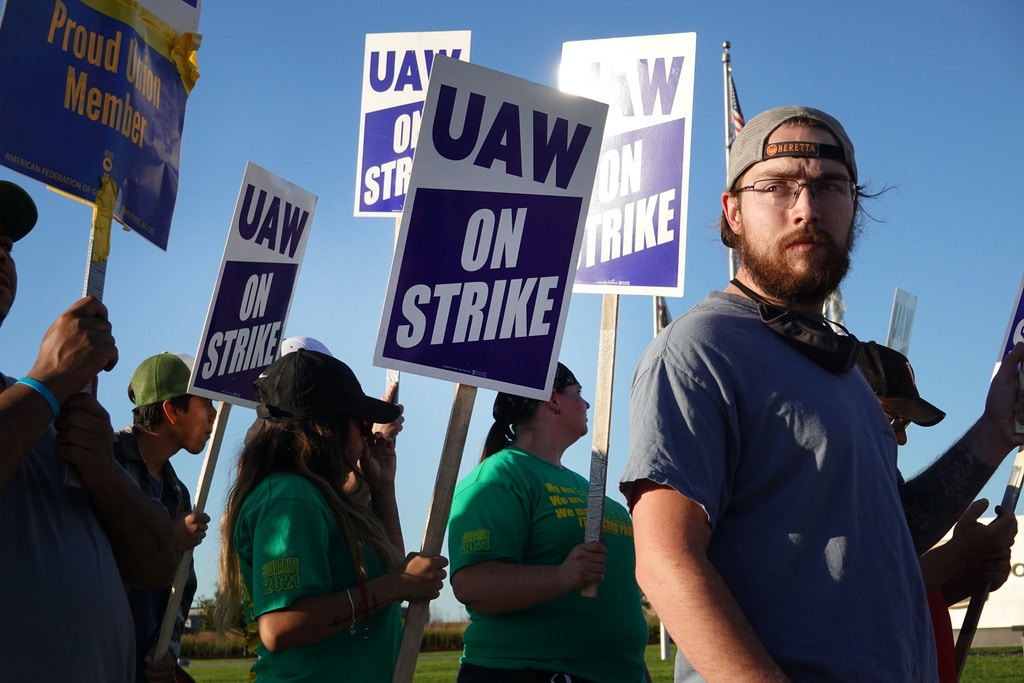
Currently the Garda Representative Association is in a public struggle with the body’s most senior officer and nearly 99% in a high-participation poll of GRA members voted as having no confidence in Drew Harris, the Commissioner.1

The real issue for the GRA (Garda Representative Association) is that they enjoyed the rosters adopted by the Garda Síochána during the Covid pandemic and don’t want to abandon them. Of course not. Four days off after four days on shift must be nice and would we all had that.

But for that, the Gardaí would be required to work 12-hour shifts on their four days on and they are not complaining about that all – they are clamouring to do it. The workers’ movement fought hard for the 8-hours day and in in 1886 Anarchists in Chicago were martyred in that struggle.2

Not so long ago in the West, 12-hours was a usual shift for a worker though for six days (“seventy hours was his weekly chore”).3 There is a well-known close association of fatigue with harmful incidents (as remarked upon by James Connolly)4 — and also with shoddy work.

Most Gardaí working 12-hour shifts will adapt themselves to the long hours by taking care to stretch themselves as little as possible but always being available for short energetic work, i.e evictions, intimidating industrial pickets, batoning protest marches and conducting raids.5

Minister McEntee & Commissioner Drew Harris speaking recently (Photo cred: Niall Carson/ PA)

Justice Minister Helen McEntee says that she will not interfere in the dispute though at the same time expressed support for Harris and mildly criticised the threatened strike action by the GRA. Naturally the ruling class does not want to alienate their first line of physical defence.

But Sinn Fein TD Pearse Doherty last Thursday attacked the Government and Fine Gael in particular over what he called a “hands off” approach to the dispute by the Justice Minister. According to SF the Gardaí are a service valued and needed by communities.

This benevolent SF attitude to the Gardaí even extends to “specialist groups”.

Doherty and his party leaders now choose to forget that Irish Republicans, including thousands of their own supporters when it was a Republican party, have been spied upon, harassed, threatened, raided, beaten up, framed and perjured against in order to see them jailed.

Sinn Féin’s attitude to the Gardaí is a clear illustration of its change from revolutionary opposition to accommodation with the Gombeen capitalist system — and when in government they will use the Gardaí against any resistance to the system as currently they are using the PSNI.

GARDAI – A LONG REACTIONARY HISTORY

The Gardaí, as the first line of physical defence of the Irish Gombeen class has a long anti-working class, anti-Republican and anti-Left history. The intelligence branch CID worked with the National (sic) Army in identifying Republicans to kidnap, torture and murder.6

ANTI-REPUBLICAN

After the defeat of the Irish Republican Movement by the State forces armed and equipped by British imperialism, the Irish neo-colonial state used the Gardaí to harass Republicans.

Eoin O’Duffy, the second Garda Commissioner (1922-1933) of the Irish State, hounded Irish Republicans and socialists during the Civil War and after, one of the causes of political emigration from Ireland and in 1932 (still in his post) founded the Irish fascist Blueshirt organisation.7

Eoin O’Duffy reviewing his fascist “Blueshirts” in the 1930s – he founded them while still the second Garda Commissioner of the Irish State (1922-1933). (Photo sourced: Internet)

O’Duffy and his Blueshirts attempted to prepare a coup against the De Valera government of Fianna Fáil and after partial suppression by the government, went on to combine with another two reactionary political organisations to form the Fine Gael Party in 1933.8

Ned Broy, appointed third Garda Commissioner (1933-1938) created the Special Branch9 (nicknamed “Broy’s Harriers”10 after a Bray dog hunting pack) to repress the fascist movement. However, he filled the unit with ex-military who had been anti-Republican during the Civil War.

Subsequently, “Broy’s Harriers” also carried out repression against the Republican movement opposed to De Valera and Fianna Fáil.

In the long line of Garda Commissioners that followed, all have presided over repression of the Irish Republican and Left movements, as well as against Travellers and LGBT11 people and even in persecution of people providing contraception prevention.

Some Commissioners have resigned or retired in controversy: Patrick McLaughlin (1978-1983), retired in the wire-tapping scandal and Patrick Callinan (2010-2014`), over the phone-tapping GSOC and penalty points corruption scandal.

Noirin O’Sullivan (2014-’17) during the breath-testing corruption and persecution of Garda whistleblower controversy, resigned the post and disturbingly, walked into a job as Director of Strategic Partnerships for Europe at the International Association of Chiefs of Police.

Then Garda Commissioner Martin Callinan speaks privately to then Deputy Commissioner Noirin O’Sullivan; she succeed him when he resigned in controversy, herself resigning in a separate controversy not long afterwards (Photo cred: Eamonn Farrell in The Journal)

Republican prisoner solidarity pickets are frequently harassed and subject to attempted intimidation and individual activists are followed, stopped and questioned etc.

The no-jury political Special Criminal Court regularly jails Republicans on charges of “membership of an illegal organisation”, sending people to jail largely on the word of a Garda officer at the rank of Superintendent and above, who never reveal their alleged sources.

In 1976, the Irish State tried to smash the Irish Republican Socialist Party by pinning the Sallins Mail Train Robbery on them, though they knew the robbery wasn’t theirs. Forty homes were raided and false confessions beaten out of victims by the special Garda “Heavy Gang” unit.12

Three innocent activists were sentenced to 12 years in jail as a result and some of the special unit went on to frame others with false confessions also, including Joanna Hayes and family in the “Kerry Babies” case, as outlined in the Crimes and Confessions RTÉ series.

The last time the Gardai took unofficial industrial action by phoning in ‘sick’ was during the “blue flu” of 1998, when however their Special Branch remained very active indeed.

Foiling an attempted robbery by a Real IRA unit, the Special Branch Gardaí shot and killed Volunteer Ronan McLoughlin in the back while he was driving away from them. Despite the victim posing no threat to anyone when he was killed, the Gardaí were judged ‘innocent’.13

ANTI-PROGRESSIVE, ANTI-WORKING CLASS

The long-overdue second inquest into the fatalities of the 1981 Stardust Fire is underway as this piece is being written and in 1983, Garda Special Branch raided the launch of Christy Moore’s vinyl LP An Ordinary Man to seize the record after Stardust owners objected to a song in it.14

Over the years of the State the Gardaí have attacked protests and demonstrations, including with particular infamy those of the 1981 Hunger Strikes solidarity march15 and Regain the Streets in 200216 in Dublin and the Corrib Pipeline protests17 against British Petroleum in Mayo.

Gardaí also harassed and assaulted some of the since-famous Dunne’s Stores anti-apartheid strikers and again the more recent Debenhams sacked workers’ pickets.18

Video online of Gardaí using Covid restrictions to harass picketing sacked Debenhams workers. Later they used violence to remove picketers so Debenhams, defaulting on redundancy payments owed to workers, could remove stock from their closed stores.

The Gardaí have on numerous occasions displayed their tolerance of fascists, even to the extent of tolerating abuse from them and flagrant violation of Covid19 regulations.19 Conversely Gardaí have threatened and attacked antifascist counter demonstrators on many occasions.

In February 2016 a mass mobilisation of anti-fascists and anti-racists prevented the fascist islamophobic organisation Pegida from launching itself in Dublin. Gardaí attacked the antifascists and batoned an RTÉ cameraman in the face.

Gardaí threatening antifascists after the latter had been attacked by armed fascists on Custom House Quay and Gardaí had then attacked the antifascists, pushing and shoving them on to Butt Bridge. (Photo: Rebel Breeze)

On a number of occasions outside the GPO, Gardaí witnessed fascist assaults on opponents without even taking names of perpetrators but on 22nd August 2020 they went much further in showing their true colours as armed fascist thugs attacked a counter protest on Custom House Quay.

The Gardaí briefly separated the combatants and then the Public Order Unit attacked the unarmed antifascists, threatening them with raised batons and pushing and shoving them away on to Butt Bridge. Later they lied to the media, pretending that no serious violence had occurred.20

Three weeks later, on 12th September, an LGBT activist and a couple of friends were observing a rally of the fascist National Party when they were mobbed, threatened and shoved and one was struck on the head with a wooden club which had a Tricolour wrapped around it.

The Gardaí again lied to the media and said there had been no violent incidents. However video of the attack and of a Garda confronting the victim with blood streaming from her head and waving her away, circulated widely and the Gardaí had to change their story.

Ms Izzy Kamikaze being pushed by Gardaí down Kildare Street after being struck on the head with a club by a fascist (Photo sourced: Internet )

It took the victim to swear out a formal complaint and a month’s delay before the specific wooden club assailant was charged. Last year he pleaded guilty and was sentenced to three years prison.21

In the face of criticisms about their failure to prevent random violent assaults in Dublin’s city centre this year, the Gardaí claimed that they did not have enough personnel to prevent them. However it seems they can always find huge numbers to repress people’s resistance.

Early in June 2022, 100 Gardaí, including an armed unit and a helicopter, took part in the eviction of two activists of the Revolutionary Housing League, who had taken over for the homeless a large empty property on Eden Quay, Dublin. (That building remains empty at the time of writing).22

Garda vehicles in their eviction operation against a building occupied by the Revolutionary Housing League in Berkely Road 11 July this year (Source: RHL)

In early July this year, a similarly large number of Gardaí with a helicopter in attendance blocked two ends of Berkely Road in Dublin in order to evict four RHA activists holding a three-storey empty building in which they had recently housed some homeless people.23

Gardaí have acted against a number of housing campaign actions, in one documented case sending an armed response unit. While acting against housing activists, they have at the same time permitted illegal evictions without intervening (except against protesting housing activists).24

On yet others, masked Gardaí have colluded with masked thugs to evict housing activists.25

Masked Gardaí working with masked private thugs in carrying out an eviction in Dublin 2018. (Photo sourced: Internet)

Although Gardaí were nearly invisible on the huge anti-extra-water-tax demonstrations, they were present and active on many of the smaller and more local anti-water-privatisation protests opposing the water meter installations for Denis O’Brien’s Uisce Éireann, assaulting and arresting people.

During the long decades of church sexual predation and other abuse by members of (mostly) Catholic Church institutions, complaints to the Gardaí were routinely ignored. Indeed, the Gardaí often seized escaped victims in order to return them to the institutions.26

It is old news that the Gardaí have abused their power against members of the public but less known is that members have done so for sexual advantage or in the course of their personal domestic relationships. Of course this is not surprising since abuse of power reaches everywhere.27

Terence Wheelock’s28 relatives and their supporters are not the only ones accusing the Gardaí of having killed someone in their custody and Vicky Conway (recently deceased) quoted the figure of an annual average of 15 deaths around Garda custody from 2017 to 2021.29

Corruption in the Gardaí has come to light a number of times, including most recently the false reporting of drink-driving checks and the failure to charge a number of people who were actually found to be driving “under the influence”.

In the course of the above a number of whistleblowers within the Gardaí were intimidated, harassed and in one case an attempt was made to frame a prominent one for abuse of a child.30

CURRENT STRUGGLE BETWEEN THE GRA AND THE COMMISSIONER

Irish Republicans have long held a particular enmity towards Drew Harris, given his previous employment as Assistant Commissioner of the colonial gendarmerie in the Six Counties.31 They regularly refer to him as of MI5, the British Intelligence department operating in the UK.

This is understandable and, in fact, it is less natural that other sections of the Irish polity seem to have had no issue with Harris’ provenance. But in fact, the State’s own senior Gardaí have long been in service, and not always indirectly, to British imperialism, witness Edmund Garvey.32

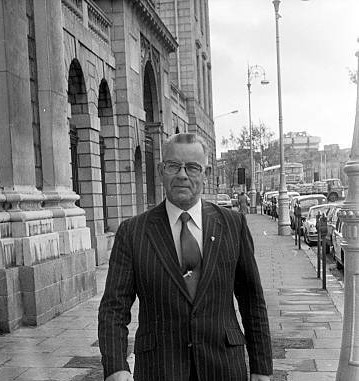
Former Garda Commisioner Edmund Garvey outside the Four Courts 11/10/1978. (Part of the Independent Newspapers Ireland/NLI Collection). (Photo by Independent News and Media/Getty Images)

The revolutionary Left, socialist republican or just socialist, have no reason to side with the Garda Representative Association in their campaign for a different roster or against Drew Harris. Nor of course do we owe Harris any support either.

Unlike Sinn Féin, our position should be opposition to all of the State’s repressive institutions.

Chief among those institutions and regularly confronting us in repression or exercising its power against working class communities is the Gardaí Síochána, with its long anti-working class, anti-democratic, anti-Republican and anti-Socialist reactionary history.

End.

FOOTNOTES

1https://www.irishtimes.com/crime-law/2023/09/13/huge-majority-of-rank-and-file-gardai-vote-no-confidence-in-garda-commissioner/

2And in that struggle, as is usually the case, the police defended the established capitalist authority and attacked the workers https://en.wikipedia.org/wiki/Haymarket_affair

3The Larkin Ballad about the 1913 Lockout.

4Competent investigators, for instance, have found that the greatest number of accidents occur at two specific periods of the working day – viz., in the early morning and just before stopping work at evening. In the early morning when the worker is still drowsy from being aroused too early from his slumbers, and has not had time to settle down properly to his routine of watchfulness and alertness, or, as the homely saying has it, “whilst the sleep is still in his bones”, the toll of accidents is always a heavy one.

After 9 a.m. they become less frequent and continue so until an hour after dinner. Then they commence again and go on increasing in frequency as the workers get tired and exhausted, until they rise to the highest number in the hour or half-hour immediately before ceasing work. How often do we hear the exclamation apropos of some accident involving the death of a worker: “He had only just started”, or “he had only ten minutes to go before stopping for the day”? And yet the significance of the fact is lost on most.

https://www.marxists.org/archive/connolly/1915/rcoi/index.htm (Chapter V – Belfast and its Problems)

5Especially on Irish Republican homes

6Their centre of operations during the Civil War and for some time afterwards was Oriel House, in Dublin.

7In 1936 the Blueshirts also recruited volunteers for Franco’s fascist-military coup against the elected Popular Front government in Spain.

8https://en.wikipedia.org/wiki/Fine_Gael#:~:text=Fine%20Gael%20was%20founded%20on,the%20legacy%20of%20Michael%20Collins.

9Now known as the Special Detective Unit; however the “Special Branch” name had a history in Britain, where Scotland Yard formed its Special Irish Branch in 1833 to spy on the Fenian movement among the huge Irish diaspora in the cities of Victorian Britain – and several of its members were Irish. Police services in a number of British present and ex-colonies have also carried on the “Special Branch” name, as far apart as the Six Counties colony and the British Bahamas.

10https://en.wikipedia.org/wiki/Eamon_Broy

11The latter until homosexuality was de-criminalised.

12https://sallinsinquirynow.ie/

13And McLoughlin’s inquest was delayed for decades.

14 The LP included Moore’s They Never Came Home which alleged that fire exits were chained shut, a matter with which the current inquest is dealing and about which I do not wish to say more at this point. The following account discussing the banning does not mention the Branch raid but I know of it from people who were present: https://theblackpoolsentinel.com/2021/01/11/christy-moore-and-the-stardust-tragedy/

15The marchers were frustrated that they were being prevented from even reaching the British Embassy in Merrion Road, attempted to push through and a battle ensued. Many were injured on both sides but the police baton-charged the whole crowd and even threatened journalists, though most subsequent media reports were either supportive of the Gardaí or blaming both sides; this brief report and photo being the exception: https://www.reportdigital.co.uk/reportage-photo-garda-baton-charging-national-h-blocks-committee-protest—18-jul-image00138214.html

16https://www.rte.ie/archives/category/society/2017/0425/870082-reclaim-the-streets-protest/

17https://www.theguardian.com/world/2013/aug/10/shell-pipeline-protests-county-mayo
https://www.irishexaminer.com/news/arid-30317773.html

18Indeed in one afternoon, uniformed Gardaí hassled the Dunne Stores picketers in Henry Street under Covid19 pandemic regulations, although all were masked and maintaining social distancing, while around the corner the far-Right were demonstrating mask-less and packed together, without the least interference from the Gardaí. A 100 yards or so down the road, the plain-clothes Special Branch (SDU), the political police, were harassing an anti-internment and political prisoner solidarity picket.

19Occasionally Garda patience snapped and one can see the incredulity in the reaction of the Far-Rightists on those occasions, as they had become so used to doing nearly anything they wanted.

20https://rebelbreeze.com/2020/08/31/there-will-be-another-day/

21https://the-beacon.ie/2021/06/21/national-party-member-pleads-guilty-to-assault-on-lgbtqia-activist-izzy-kamikaze/

22https://rebelbreeze.com/2023/07/14/helicopter-and-massive-gardai-numbers-for-what/

23https://www.dublinlive.ie/news/dublin-news/four-arrested-after-building-occupied-27305837

24https://www.irishlegal.com/articles/watchdog-raises-concerns-over-garda-conduct-at-eviction

25https://www.dublinlive.ie/news/dublin-news/garda-chief-under-pressure-after-15145154

26https://en.wikipedia.org/wiki/Garda_whistleblower_scandal

27https://www.newstalk.com/news/domestic-and-sexual-violent-complaints-against-gardai-on-the-rise-gsoc-1473416#:~

28https://rebelbreeze.com/2023/08/26/protesting-death-of-youth-at-hands-of-garda/

29https://www.irishtimes.com/crime-law/2022/07/15/at-least-228-fatalities-in-or-following-garda-custody-over-past-15-years-figures-show/

30https://www.irishexaminer.com/news/arid-30799234.html

31Previously the Royal Ulster Constabulary (and RIC before that), the PSNI is the armed colonial (and sectarian) police force of the UK State.

32Ned Garvey was ‘outed’ as a British Intelligence ‘asset’ (code name ‘Badger’) by disaffected MI6 handler Fred Holroyd. Garvey denied he was an agent for the British but the Barron Report found that that Holroyd had visited Garvey in his office in 1975 and that he had not made his superiors aware of this. The incoming FF government in 1978 sacked Garvey as having no confidence in him but as a result of not following disciplinary procedures Garvey was able to sue the State and retain his pension. While Garvey was Assistant to Patrick Malone, Garda Commissioner during the British Intelligence/ Loyalist Dublin and Monaghan Bombing in 1974 bomb remains were sent to the Six Counties for forensic analysis. No-one was ever even arrested for the bombing, never mind convicted and the widely-suspected British proxy Glennane Gang went on to murder many more, mostly civilians (see Cadwaller, Lethal Allies).

SOURCES

https://www.irishtimes.com/crime-law/2023/09/13/huge-majority-of-rank-and-file-gardai-vote-no-confidence-in-garda-commissioner/#:~

Helen McEntee and GRA: https://www.breakingnews.ie/ireland/mcentee-will-not-direct-gardai-on-when-to-work-amid-roster-dispute-1533439.html

Sinn Féin want McEntee proactive on Garda dispute: https://www.breakingnews.ie/ireland/sinn-fein-condemns-governments-hands-off-approach-on-policing-1532379.html

https://www.breakingnews.ie/ireland/six-gardai-suspended-from-the-force-for-over-four-years-1533424.html

https://www.garda.ie/en/about-us/our-history/garda-commissioners-since-1922/

Eoin O’Duffy: https://en.wikipedia.org/wiki/Eoin_O%27Duffy

Ned Broy and “Broy’s Harriers”: https://en.wikipedia.org/wiki/Eamon_Broy

https://en.wikipedia.org/wiki/Garda_whistleblower_scandal

https://www.newstalk.com/news/domestic-and-sexual-violent-complaints-against-gardai-on-the-rise-gsoc-1473416#:~

Gardaí and the Far-Right and Fascists: https://rebelbreeze.com/2020/08/31/there-will-be-another-day/
https://the-beacon.ie/2021/06/21/national-party-member-pleads-guilty-to-assault-on-lgbtqia-activist-izzy-kamikaze/

Gardaí supporting evictions, attacking housing activists: https://www.irishlegal.com/articles/watchdog-raises-concerns-over-garda-conduct-at-eviction
https://www.dublinlive.ie/news/dublin-news/garda-chief-under-pressure-after-15145154
https://www.irishlegal.com/articles/watchdog-raises-concerns-over-garda-conduct-at-eviction
https://rebelbreeze.com/2023/07/14/helicopter-and-massive-gardai-numbers-for-what/

Garda violence at Reclaim the Streets protest: https://www.rte.ie/archives/category/society/2017/0425/870082-reclaim-the-streets-protest/

Garda violence and corruption at Corrib Pipeline struggle: https://www.irishexaminer.com/news/arid-30317773.html
https://www.theguardian.com/world/2013/aug/10/shell-pipeline-protests-county-mayo
PLAQUE UNVEILED ON DUBLIN HOME OF JAMES CONNOLY

Diarmuid Breatnach

(Reading time: 5 mins.)

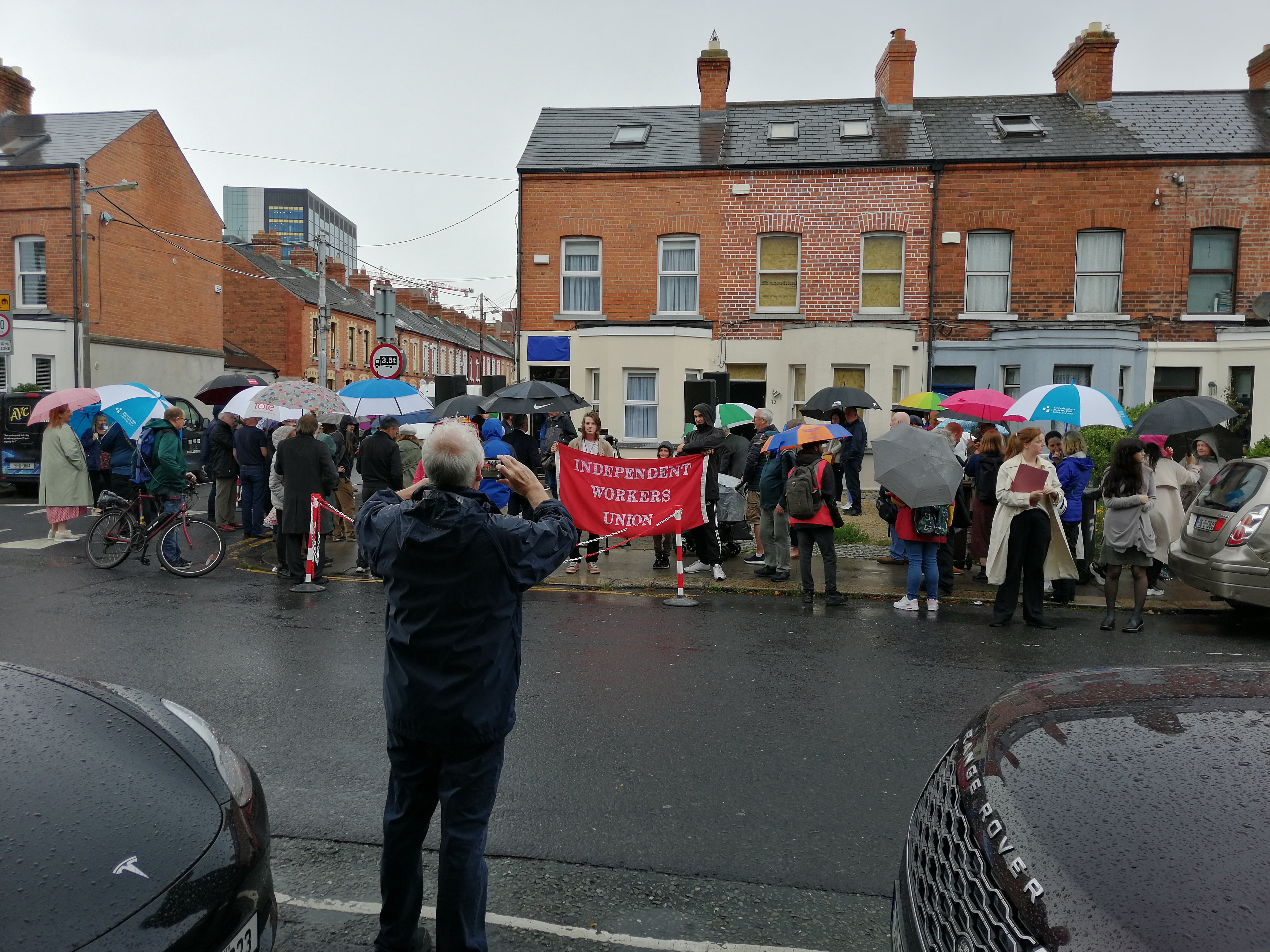
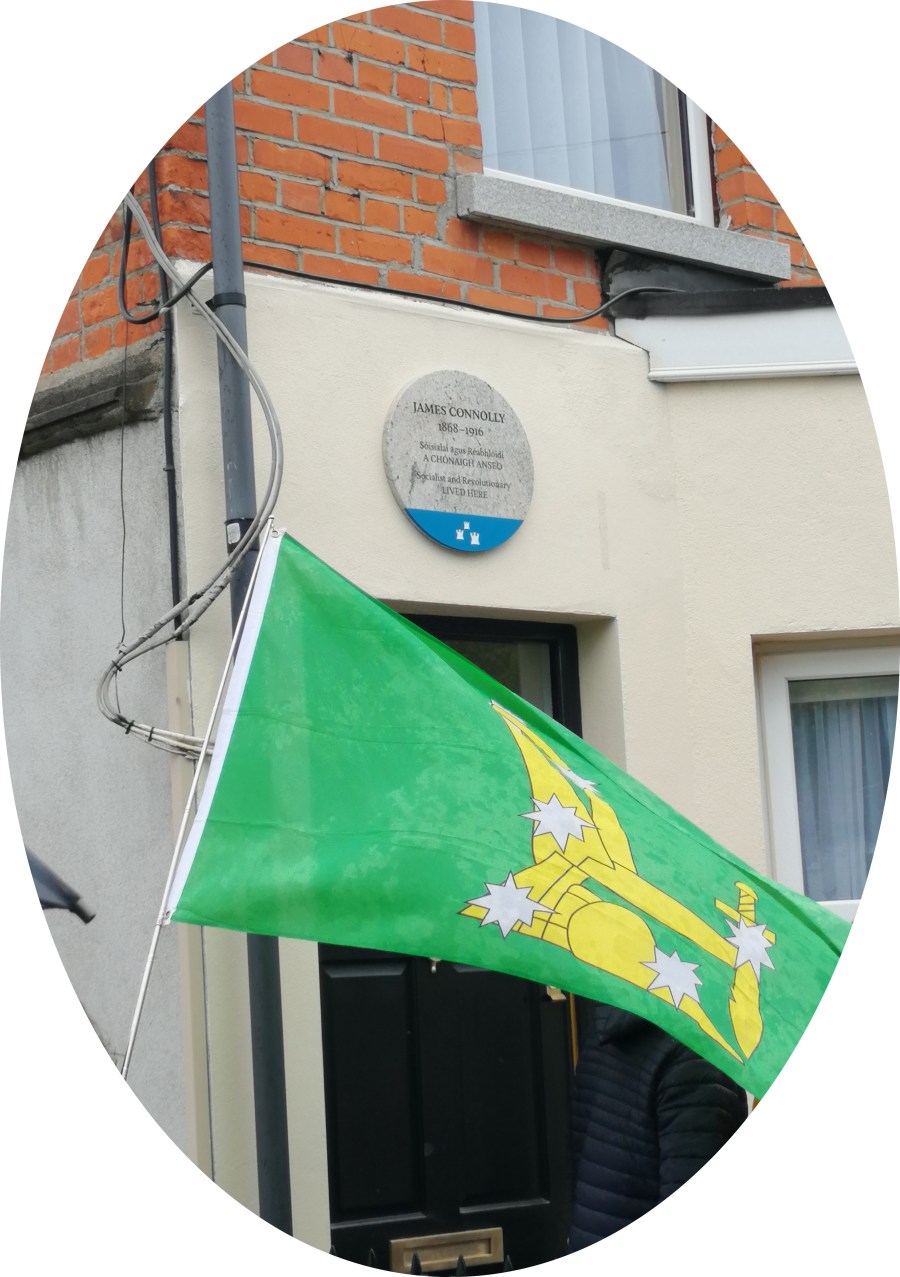
A new plaque commemorating James Connolly was unveiled on the morning of 31st July on 70 South Lotts, the house to which he returned from New York with his wife Lillie and children in 1910 and lived there until May 1911.

(Photo: D.Breatnach)

Connolly was born and reared in Edinburgh, left school at 10 and worked with his older brother John for the local authority as a carter, lied about his age and name to join the British Army, in which he first saw Ireland and where he met Lillie Reynolds; they were married soon afterwards.

Like his brother, Connolly became a militant socialist and trade unionist and returned to Ireland at the request of socialists to form the Irish Socialist Republican Party, the first socialist party in Ireland but left for the USA when the party failed to recruit significant numbers.

The ISRP’s office was in Middle Abbey Street, across the road from the premises of the Irish Independent, owned by Irish nationalist William Martin Murphy who was to become an arch-enemy from the Lockout and strikes of 1913 onwards1.

Connolly was a historian and journalist as well as a socialist, trade union organiser and a revolutionary. A report in Breaking News on the unveiling infers that he reluctantly committed to the Rising with the Volunteers; in fact, he had been pushing them to rise for months!

Unveiling speeches

The event started late and in rain. Dáithí De Róiste2, Dublin’s current Lord Mayor, opened the proceedings and commented that the plaque on the house was a reminder that Connolly lived a life in some ways like many ordinary Dubliners, living in a Dublin house and walking city streets.

Dublin Mayor Dáithí De Róiste speaking at the event. (Photo: D.Breatnach)
Historian Conor McCabe, who did the research for the plaque, speaking outside No.70. (Photo: D.Breatnach)

Historian Dr Conor McCabe, of Queen’s University Belfast, proposed the plaque as his research established the background that Connolly was living at the address around the time that his most famous work, Labour In Irish History, was first published in book form.

In deference to those in attendance standing in the persistent rain, Conor McCabe kept his speech very short. This was not the case with every speaker.

Joe Cunningham, General Secretary of Siptu3, an amalgamation with other unions of Jim Larkin’s ITGWU which Connolly had led for six years, commented in his speech that it was Connolly who ensured that the interests of working people were incorporated in the 1916 Proclamation4.

Also that, at the ceremony of raising an Irish flag over Liberty Hall5 in April 1916, had declared that “The cause of labour is the cause of Ireland, the cause of Ireland is the cause of labour.”6

Section of crowd in front of No.70 waiting for event to begin. (Photo: D.Breatnach)

Dublin City Council Commemorations & Naming Committee was responsible for the placing of the plaque, in consultation with the house occupants and its chairman, Councillor Mícheál Mac Donncha7 welcomed suggestions from the public for commemoration of people and events.

Sinn Féin Councillor Mac Donncha also commented that James Connolly was a personal hero of his.

Jim Connolly Heron, great-grandson of James Connolly, was called to say a few words and invited family members present to join him in front of the house while he spoke and commented also on the importance of commemorative plaques in protecting historical sites.

He did so in reference to the plaque on a house in Moore Street that had disappeared and come to light in a property developer’s office, raising concerns that had led to the long Moore Street conservation struggle.8

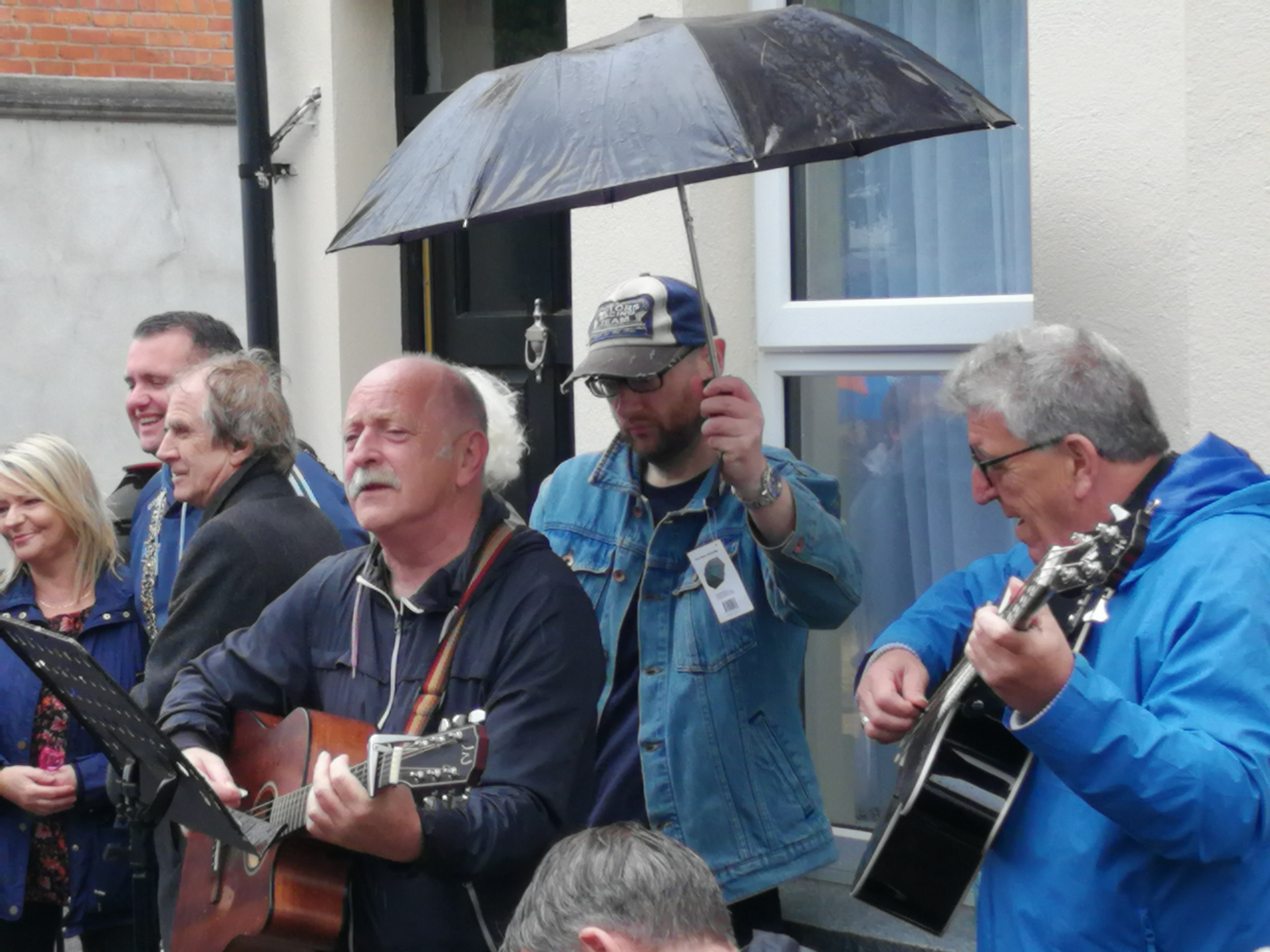
Music and song for the event was performed by The Pullovers ballad group but the amplification system had been removed by then which was a pity as it was needed for the music.

Ballads were performed at the event by The Pullovers band. (Photo: D.Breatnach)

The 1913 Lockout

James Connolly and family returned to Dublin when Jim Larkin9 offered Connolly a post in the young breakaway Irish Transport and General Workers’ Trade Union, which he took up in 1910. Three years later the union was in a fight for its life.

It is sometimes wrongly claimed that the 1913 Lockout was an attempt by employers in Dublin to prevent workers from joining a trade union but there were other unions operating in Dublin during the period and they were accepted by most of the employers.

Apart from the ITGWU recruiting large numbers of ‘unskilled’10 manual workers, it pursued its objectives militantly, using sympathetic solidarity action by other workers to increase the effectiveness of the workers who were in industrial dispute with their employer.

In August 1913 a combination of around 200 employers presented their workforce with a declaration to sign which committed them to having nothing to do with the ITGWU. En masse, the workers refused to sign, were locked out while others struck work and were locked out too.

Right from the beginning the Dublin Metropolitan Police11 attacked the workers on behalf of the employers and in a baton charge on Eden Quay on 30th August fatally wounded two workers, also beating strikers and onlookers the following day in O’Connell Street (‘Bloody Sunday 1913’)12.

As a direct response, Connolly and Larkin set up the Irish Citizen Army as militant response to police attacks, dedicated also to Irish independence and their flag was the gold Starry Plough on a green background,13 which they flew over the Clery’s building in 1916.14

The only Starry Plough flag unfurled at the event, brought by a member of the attendance. (Photo: D.Breatnach)

Comment

The only Starry Plough to be seen at the event was one unfurled during the event independently of the organisers and speakers.

Many who claim to admire Connolly or even to follow his teachings do so on occasion in words but never in action and if Connolly were alive and acting as he did when he was, most of the speakers at the unveiling event would call, if not for his shooting, certainly for his jailing.

SIPTU is much larger than the ITGWU was but it and other unions are much less effective; as a result of the lack of active resistance by the leadership, union membership in Ireland is at an all-time low in modern times. Nor would Connolly have ever agreed to the partition of Ireland.

The Irish Labour Party, which Connolly and Larkin formed in order to give the working class a voice in municipal affairs, has been in coalition government a few times, always capitalist and most often with the right-wing Fine Gael, when they have joined in attacks on the working class.

Joan Burton, while Tánaiste15 of the Labour-Fine Gael coalition government in 2014, complained about working class people being able to afford video-phones and tried to get people jailed for organising an effective protest against her in Jobstown.16 She too attended the unveiling today.

Joan Burton, who attended the event. (Photo: D.Breatnach)

Fianna Fáil is a party of the Gombeen client class and has been in government more often than any other, whereas Sinn Féin in its current incarnation is seeking to replace it with more of the same.

It is a tribute to the memory of James Connolly held so dearly among the working people that these types, so far from Connolly in their reality, are obliged to pay public homage to the man and to his principles while their daily practice is in opposition to all that he stood for.

End.

FOOTNOTES

1An editorial in his newspaper, The Irish Independent (still one of two main newspapers of the state), after a number of British executions of a number of 1916 leaders, called for continued executions of leaders prior to the execution of Connolly and Mac Diarmada, the last of the 14 to be executed in Dublin (Kent was shot in Cork and Casement hanged in London).

2Fianna Fáil elected councilor.

3The largest union in Ireland, owner of the current Liberty Hall which stands on the ground of the original union building.

4There is no record that this is the case but it is a natural and widely-held assumption. It is a fact that the Proclamation was printed in Liberty Hall.

5Cunningham said it was “the Irish flag” which most would think a reference to the Tricolour. However that flag had not yet been accepted by the majority as the primary flag of the nation, which really occurred after the 1916 Rising. The flag raised instead by teenager Molly O’Reilly at Connolly’s request had the golden harp on a green background, the essential flag of Irish Republicans from the 1790s until the 1916 Rising.

6This was not a random statement by Connolly but rather a strategic one; on an earlier occasion he had observed that of all social classes in Ireland, the working class remained “the incorruptible inheritors of the fight for Irish freedom”. Connolly wrote that in his foreword to his work Labour in Irish History, clearly indicating that only the working class could be trusted to lead the national struggle through to successful conclusion.

7A prominent member of one of the groups campaigning for Moore Street Battlefield conservation, the Save Moore Street Trust, of which Mac Donncha is Secretary.

8That occurred at the beginning of this century and the struggle has been ongoing since.

9Like Connolly, also a migrant and member of the Irish diaspora but from Liverpool. He founded the Irish Transport & General Workers’ Union after his departure from the British-based National Union of Dock Labourers, for which for a time he had been chief organiser in Ireland. Most of the NUDL’s members in Ireland left to join the ITGWU but in Belfast there was a division along sectarian lines.

10This is the general appelation for work not requiring long periods of training. However, anybody who has been employed in work of this category soon learns that such work requires skill to achieve the objectives set, to pace oneself and to guard against injury. This is the reason those recruiting for such ‘unskilled’ work prefer ‘experienced workers’, a code for ‘skilled’.

11A police force of the period for Dublin City, most of its members being without firearms, unlike the armed all-Ireland colonial gendarmerie of the Royal Irish Constabulary (of which the Police Service of Northern Ireland is a descendant body). DMP minimum height requirements were 5ft 9” in a city where many working people were of low stature; this disparity gave substantial momentum to the swing of a truncheon.

12The event wrongly named as leading to the death of two workers, whose deaths were caused by the previous day’s police attack on Eden Quay, just by Liberty Hall. However, a previously healthy Fianna Éireann boy, Patsy O’Connor, who was clubbed in the O’Connell Street police riot while he administered first aid to a victim, suffered frequent headaches thereafter and died in 1915 at the age of 18.

13The design has seven stars in the Ursa Mayor configuration, with the design of a plough following the stars and a sword as the ploughshare. There is also a plainer version flown by the Republican Congress of the 1930s, the outline of the Ursa Mayor constellation in white or silver stars alone on a blue background.

14The flag survived the shell explosions and raging fires along the southern half of O’Connell Street and is currently in the Military History Museum, Collins Barracks, Dublin, along with a number of other flags flown by the insurgents during the Rising.

15Title of the Deputy Prime Minister in the Irish government.

16A number of activists from different organisations, including Paul Murphy TD (member of the Irish parliament) were arrested in raids some time later and among the charges was “kidnapping” Burton. The untruthfulness of a number of witnesses for the Prosecution including a senior Garda officer were exposed (ironically by video taken by protesters) and the jury acquitted all the defendants of all charges.

end.

REFERENCE

https://www.breakingnews.ie/ireland/plaque-unveiled-at-james-connollys-former-home-in-east-dublin-1509431.html

ORATION at GRAVESIDE of INNOCENT MAN PUBLICLY HANGED IN BRITAIN

(Reading time: 14 mins.)

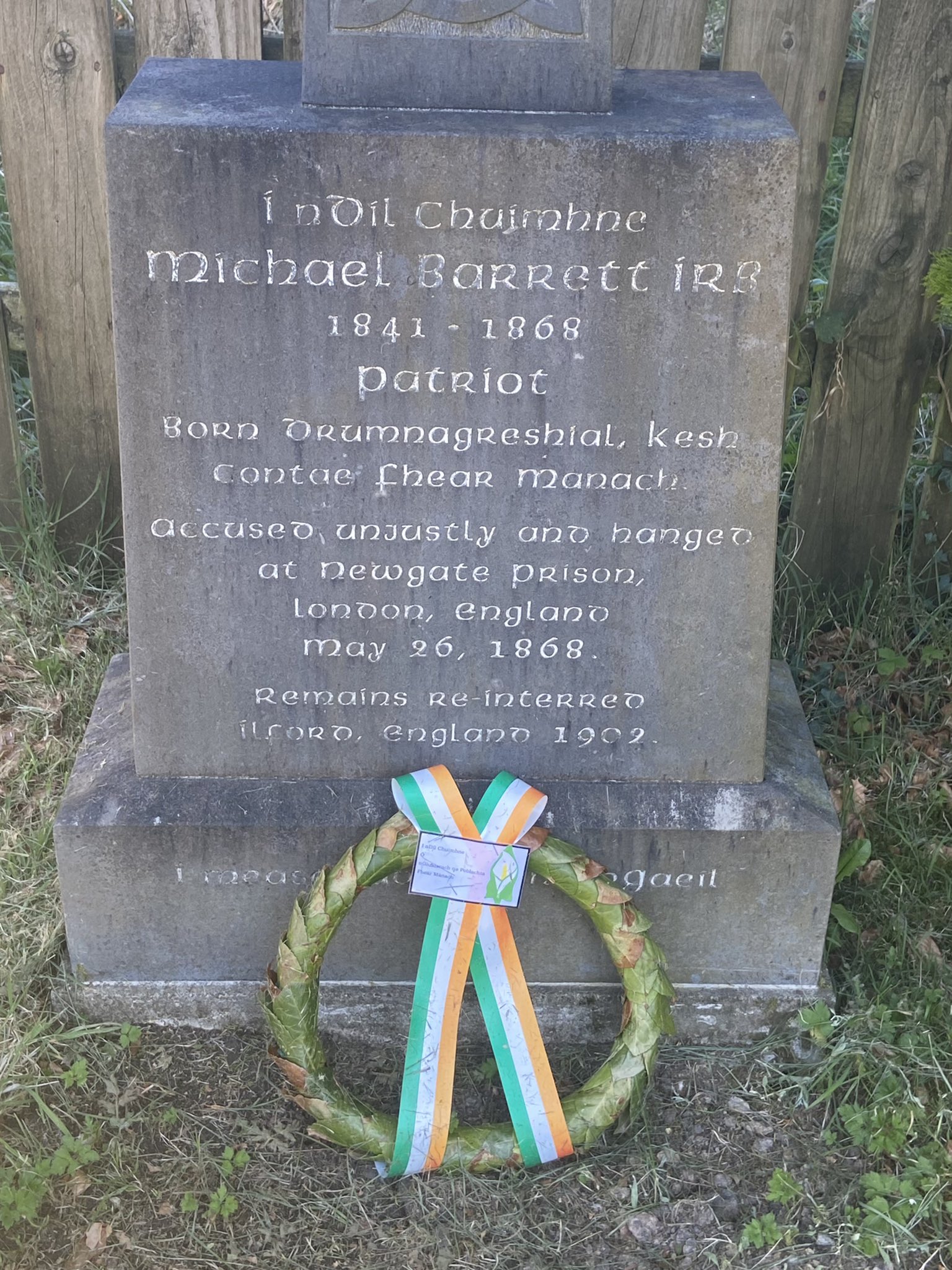
Pat Reynolds gave this oration in East London Cemetery on Sunday 21st May 2023 for Michael Barrett, the last man publicly hanged in Britain

A cháirde agus a chomrádaíthe,

Tá fáilte go leor romhaibh chun chruinnithe i gcuimhne Michael Barrett inniu. Welcome friends and comrades to this commemoration today for Michael Barret and Patrick O’Donnell. I have been asked to speak of Michael Barret and the movement he represented.

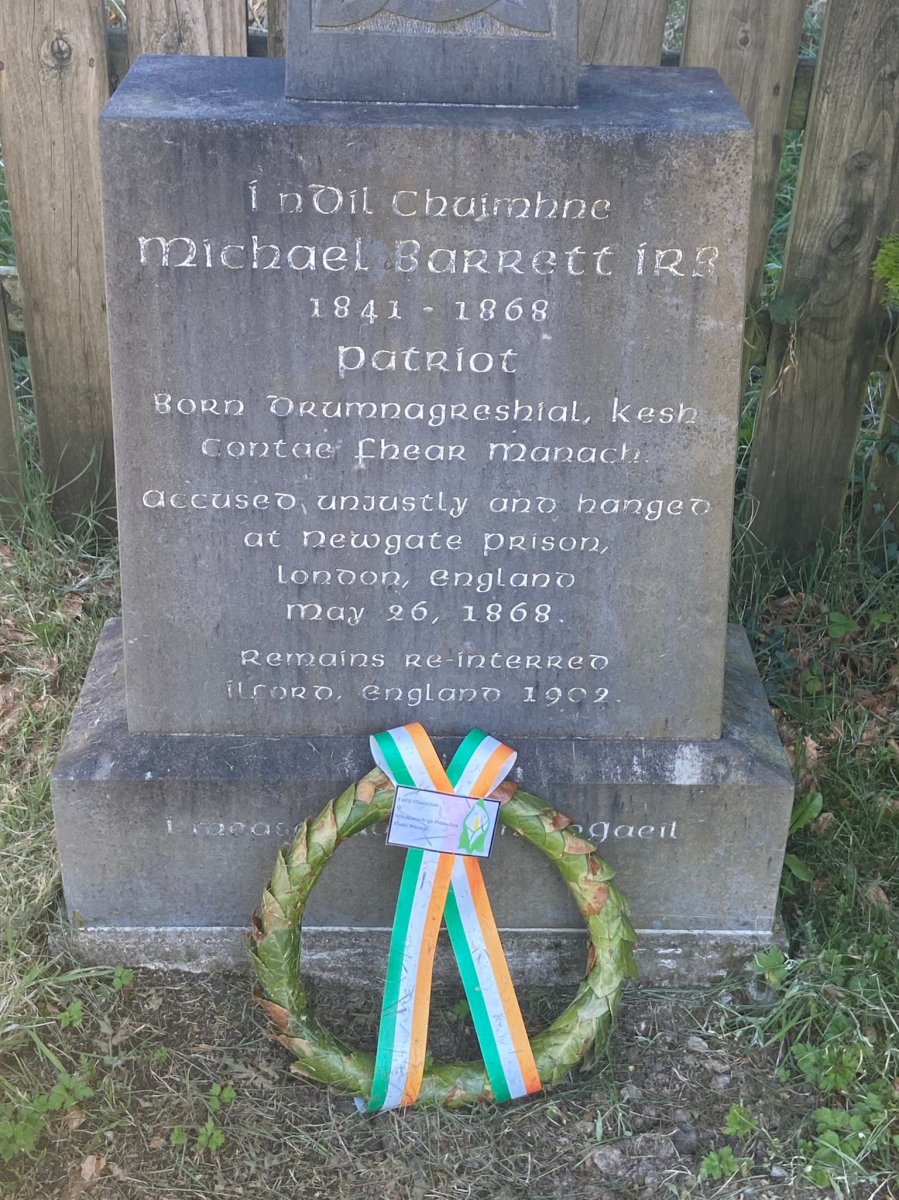
Michael was born in Ederney in the Maguire County of Fermanagh in 1841 and was judicially hanged though innocent by the British Government in 1868 at Newgate Prison, where the Old Bailey now stands.

Newgate prison was closed in 1903 and his remains with others were interred here in this cemetery. He was the last person to be publicly hanged in Britain.

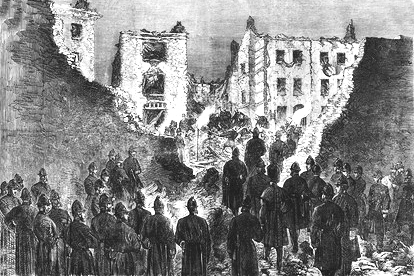
A Fenian bombing took place on 13th December 1867 to try and rescue O’Sullivan Burke the Fenian who planned the successful prison van escape in Manchester.

Contemporary newspaper drawing (Sourced: Wikipedia)

The bombing blew a huge hole in the wall and demolished nearby tenement buildings, killing 12 people and injuring many others. It led to a huge State-engineered backlash in Britain against the Fenians and put their cause back some 10 years.

Michael Barret, who had gone to Glasgow to work was an innocent man and was in Glasgow at the time of the incident.

False evidence given by a police informer Patrick Mullaly who was given a free passage to Australia implicated Barrett, but he had compelling evidence that he was in Glasgow at that time. After two hours the jury declared him guilty.

One of the trial lawyers Montagu Williams stated of Barrett:

On looking at the dock, one’s attention was attracted by the appearance of Barrett, for whom I must confess I felt great commiseration. He was a square built fellow, scarcely five feet eight in height and dressed like a well-to-do farmer.

This resemblance was increased by the frank, open, expression on his face. A less murderous countenance than Barrett’s I have not seen. Good humour was latent in his every feature and he took the greatest interest in the proceedings’.

Barrett ended his speech from the dock thus:

I am far from denying, nor will the force of circumstances compel me to deny my love of my native land. I love my country and if it is murderous to love Ireland dearer than I love my life, then it is true, I am a murderer.

If my life were ten times dearer than it is and if I could by any means, redress the wrongs of that persecuted land by the sacrifice of my life, I would willingly and gladly do so.’

The Daily Telegraph the next day stated that Barrett had:

Delivered a most remarkable speech, criticising with great acuteness evidence against him, protesting that he had been condemned on insufficient grounds, and eloquently asserting his innocence.’

Michael Barrett monument detail, Co. Fermanagh (Sourced: Internet)

In Fermanagh his aged mother had walked many miles to appeal to the local Tory MP Captain Archdale, a noted Orangemen, who rejected her. Barrett was hanged in front of 2,000 jeering people singing Rule Britannia. The following day Reynolds’ News recorded that;

Millions will continue to doubt that a guilty man had been hanged at all; and the future historian of the Fenian panic may declare that Michael Barrett was sacrificed to the exigencies of the police, and the vindication of the good Tory principle, that there is nothing like blood.’

His hangman was the notorious Calcraft who had botched the hanging of the Manchester Martyrs, Allen, Larkin and O’Brien.

There is a huge difference between an accident leading to deaths by patriots fighting tyranny and the deliberate actions of the imperialists, which is why patriots have to be always careful to avoid civilian deaths.

There are many similarities between the Clerkenwell bombing and the Birmingham bombing of 1974.

In both cases they set back the cause of Irish freedom for many years, deeply harmed the Irish community in Britain and was used by the State for repressive measures against the community and to divide off the Irish community from the English working classes.

Disraeli brought in the Habeas Corpus Act and created the Special Branch. Of interest is that their first definition of Irishness was ‘Persons who were born in Ireland or whose recent forebears came from Ireland.” Back in the 1980s the GLC adopted the same definition.

We also had the Birmingham Six case with the ‘appalling vista’ of Lord Denning the Appeal Judge, who later regretted that the six innocent men were not hanged. For Gladstone it set him on his mission ‘to pacify Ireland’.

I ask you two questions today, what kind of people and community gave rise to patriots like Michael Barrett and the Manchester Martyrs, and the second question, what kind of regime or government would hang knowingly innocent men.

To understand the Fenians we have to understand the colonisation of Ireland and in particular the Great Starvation of Ireland An Gorta Mór. Over one and a half million people were starved to death by British imperialism and another two million forced to emigrate to Britain and the USA.

There was no famine in Ireland at this time, and it is imperialistic propaganda to call it such. It was clearly genocide in a land overflowing with food.

The potato crop made up under 25% of the agricultural produce of Ireland, but at this time Ireland was part of the UK where the potato crop was about 5% of the total produce of the UK. I know of no country where there was famine because of a 5% failure of the crops.

Michael Davitt back in 1904 called the Great Starvation a ‘Holocaust’ as did others. Ken Livingstone drew some comparison between the Great Starvation and the experience of the Jewish community during the Second World War.

Hitler named his strategy ‘The Hunger Plan’ where he starved Poles and Jews and others groups of food, and these victims are included in the Holocaust figures including also his starvation of the Warsaw Ghetto.

The shipment of food grown by the people of Ireland to Britain during the Great Starvation was a clear decision by the British government to starve the Irish people.

The Nazi Governor in Poland Hans Frank wrote of the starvation of Jews ‘that we sentence 1.2 million Jews to die of hunger should be noted only marginally’.

The economic theory of laissez-faire is a total invention, within years they could spend millions in Crimea, a place most English had never heard of.

I recall the great Irish writer Frank O’Connor stating ‘Famine is a useful word when you do not wish to use words like ‘genocide’ or ‘extermination’, and again ‘It was not that the people were too simple to realise the Dachau-like nightmare of their circumstances’.

He goes on ‘The word famine itself is a question begging for its meaning ‘an extreme and general shortage of food’, and to use it of a country with a vast surplus of food, cows, sheep, pigs, poultry, eggs and corn, is simply to debase a language’.

O’Connor went further: ‘Irish historians who are firmly convinced that the Famine was all a mistake in the office, explain it in terms of an economic theory called laissez-faire. This is another cock that won’t fight.

Anyone who can believe that the British government maintained a garrison of 100,00 men in Ireland for the purpose of not interfering in trade and industrial affairs attaches some meaning to the word history that escapes me’.

The Great Starvation of the Irish people was a daily planned strategic intervention by the English government which is borne out by the evictions and forced migrations which followed and by the white supremacist and racist beliefs held in England at that time, which has largely been ignored by the historians.

The failure of the Young Ireland movement in the 1848 rebellion led to the deportation of their leaders and a flight of others to France and the USA. From this came the Fenian movement and the Irish Republican Brotherhood set up in the USA and Ireland in 1858.

There was of course also the French Revolution of 1848 which inspired people all over the world and which also inspired the Fenians.

The American Civil War of 1861-65 was to inspire the Irish in the USA. Over 30,000 Irishmen were to lose their lives in War the vast majority fighting for the Union and for the abolition of Slavery.

Revisionists question whether the Irish were really fighting for the abolition of Slavery, yet the same historians in hindsight claim that the British and Irish who fought in the 2nd World war were fighting against fascism and the Nazis.

The Irish men who died firing against slavery are entitled to the same respect from history.

The 1867 rebellion in Ireland did not really take off. Frantz Fanon stated: ‘Each generation must, out of relative obscurity, discover its mission, fulfil it, or betray it’. The Fenians took a more measured road and passed it on to the next generation, but not without a fight.

In the USA they invaded the British Canadian Dominion twice in 1867 with about 700 Fenian soldiers, veterans of the American Civil War. They held a convention in in 1867 with 6,000 armed men present.

In Britain the Fenians massed near Chester Castle in an attempt to seize the guns there and get them to Ireland via Holyhead for the Fenian Rising. As in the USA they were betrayed by spies and with Chester Castle reinforced by soldiers, the raid was called off in February 1967.

In September Colonel Kelly was arrested in Manchester and was released when Fenians attacked the prison coach which later led to the Manchester Martyrs, Allen Larkin and O’Brien who were innocent men framed up by the English government.

The impact of the Manchester Martyrs in Ireland was huge with some 17 monuments put up in their honour and with the Catholic Church forced to backtrack on their anti-Fenian stance and allow masses and commemorations to be widely held in Ireland.

Michael Barrett is part of this sacrifice of the Irish abroad to Irish freedom made within a year of each other. My call is for Michael Barrett to be included within the Manchester Martyrs’ history and commemoration.

By the 1870s the Irish had moved to parliamentary means to move their fight for liberation onwards. You will notice that the fight for Irish freedom goes in flows, a rebellion often followed by political and parliamentary activity along with agitation. Both means were effective for their times.

In Ireland we had Michael Davitt and the Land League, again we have the huge contribution from Britain to this effort from Davitt. We also had the bombing campaign in Britain by O’Donovan Rossa and Tom Clarke from 1880-87, the Invincibles in Dublin and the execution of Lord Cavendish in 1882.

We have the great Irish Literary and Gaelic revival. Again, the Irish Literary Society was founded in Southwark, SE London in the 1880s which spread to Dublin, Belfast and Cork.

We had the Gaelic League and the GAA as part of this revival which led on to the 1916 Rising and the founding of the nation.

What kind of regime or government could knowingly judicially murder innocent men like Michael Barrett and the Manchester Martyrs? We know the history of British colonisation of Ireland and British Imperialism.

This is the same British Imperialism which would in 1919 lead to the Amritsar massacre in India. But let us stay in 1860s iwith this colonial Empire.

In 1865 the Jamaican people rose up against British colonial rule in Jamaica which left 400 dead in a colonial reign of state terrorism. They hung the leader Paul Bogle and 14 others and executed seven women and prosecuted George William Gordon who had nothing to do with the Rebellion.

They executed him. The Fenians at the time raised funds to help the survivors bring action against the English government. You see here a long history of hanging both Irish and Black people across their colonies.

Today I salute the Irish in Britain who marched in the 1980’s against apartheid in South Africa and who today march with the Palestinian people following a noble Fenian internationalist tradition.

British rule in Ireland was based on Imperialism, White Supremacy and Racism. This was first formulated by Gerald of Wales in 1187 some 700 years before they hanged Barrett and the Manchester Martyrs.

Gerald in his books Topography of Ireland and Conquest of Ireland used racism to justify the conquest of Ireland and portrayed the Irish as inferior, backward, inhuman, uncivilised, feckless and lazy.

This was a litany of manufactured racist lies when Ireland had been the ‘Island of Saints and Scholars’ and the seat of learning in Western Europe bringing enlightenment to Europe during the Dark Ages.

Gerald’s views were published across Europe and held sway until around 1650 for about 500 years. This first racialisation of the Irish did not require any religious framework.

When Henry 8th split with Rome in 1534 the racist code used for conquest in Ireland was then overlaid with a state-sponsored sectarian religious code.

Irish scholars were driven out of Oxford where they were a dominant force and Henry sought to build up his fleet to destroy Irish fleets on the south coast to control trading in Irish sea ports and towns.

There followed the Plantation of Elizabeth 1st who knighted Gilbert the mass murderer of Munster who later founded a British colony in Newfoundland.

Later on, we had the Cromwellian conquest of Ireland with large-scale massacres at Drogheda and Wexford, widespread smaller massacres and the forced transporting of Irish slaves to the Caribbean.

Revisionists deny this history and seem to wrongly believe that these people were on some kind of ‘Cromwell Tours of the Caribbean’. For the record these forced transported people were not indentured people.

It is of interest that Gerald of Wales’ views on the Irish were not held of African people from 1200 onwards but were lifted from the Irish situation and applied to African people on the advent of enslavement to justify what the European colonial powers were doing.

So now Africans can be perceived in the same way as the Irish, as backward, inferior, childlike and have their freedoms taken away.

Let us now look at racism and the White Supremacist views of British Imperialism in the 1800s which gave rise to the great Starvation, the Manchester and London hangings of innocent men.

Robert Knox in The Races in 1850 described the Celts as an inferior race which became part of the ‘scientific’ racism of the day, with Knox updating Gerald of Wales.

Even Engels came out with his racist views of the Irish ‘The race that live in these ruinous cottages in measureless filth, and stuck in this atmosphere penned in, as if on purpose, this race must have reached the lowest stages of humanity’, instead of seeing what British imperialism and racism had done to the Irish people at home and abroad.

John Bedoe in his Races of Britain in 1862 views the Irish as Africanoid and having African roots, and again as ‘European Negroes’. Punch portrayed the Irish as apes and monsters, even Parnell, and the Irish as Aboriginals and on the same level as gorillas.

Charles Kingsley on visits to Ireland in the 1860’s states ‘I am haunted by the human chimpanzees I saw’ and ‘to see white chimpanzees is dreadful’. A new Gorilla at London Zoo is called ‘Paddy’ and the ‘Irish Yahoo’ is seen as the missing link between man and gorilla.

The Irish are described ‘as half naked savages who retain a vast amount of their primitive savagery to this day’.

We can see how scientific racism is now applied equally to Black and Irish for the purpose of colonisation and oppression.

In this context we can see the mindset of the British establishment who committed genocide against the Irish people, and who over centuries had murdered Irish people at random. We can see how the same regime of government can hang innocent people at home and abroad.

Michael Barrett, a self-educated man emerges from this dunghill of White Supremacy and pure racism as a heroic figure, like the Manchester Martyrs a true patriot as shown in his speech from the dock. He should be remembered with the Manchester Martyrs and not separated from their heroic end.

Barrett, a Christlike figure and a Cúchulainn who died on behalf of his people and for his political beliefs.

He was part of an Irish tradition in Britain of being in the forefront of democratic rights for liberty justice and freedom, not just for the Irish but also the British people.

We see in the Chartist movement of the 1840s being led by Irishmen Fergal O’Connor and Bronterre O’Brien that fight for liberty and the rights of man.

Also the leadership of Donegal man Doherty leading the workers of Lancashire and the ongoing links in the trade union movement to today from leaders like Mick Lynch inspired by James Connolly to Pat Cullen of the RCN.

We see it in the gift of The Red Flag song from a County Meath man and The Ragged Trousered Philanthropists novel by Noonan to the British working class.

In honouring Michael Barrett today, we stand full square for a United Ireland as proclaimed in the Fenian and 1916 Proclamations and for working class liberty in Britain.

I will finish today by reading the Fenian Proclamation of 10th February 1867 from the Irish People to the World. In it we can see what the 1916 Proclamation borrowed and built on. It is also what Michael Barrett lived and in the end died for.

  1. Fenian Proclamation, 1867

Proclamation of the Irish Republic, issued February 10th, 1867, by the Irish Republican Brotherhood.

  1. I.R.
    — PROCLAMATION! —

THE IRISH PEOPLE TO THE WORLD

We have suffered centuries of outrage, enforced poverty, and bitter misery. Our rights and liberties have been trampled on by an alien aristocracy, who, treating us as foes, usurped our lands and drew away from our unfortunate country all material riches.

The real owners of the soil were removed to make room for cattle, and driven across the ocean to seek the means of living, and the political rights denied to them at home, while our men of thought and action were condemned to loss of life and liberty.

But we never lost the memory and hope of a national existence. We appealed in vain to the reason and sense of justice of the dominant powers. Our mildest remonstrances were met with sneers and contempt. Our appeals to arms were always unsuccessful.

Today, having no honourable alternative left, we again appeal to force as our last resource. We accept the conditions of appeal, manfully deeming it better to die in the struggle for freedom than to continue an existence of utter serfdom.

All men are born with equal rights, and in associating together to protect one another and share public burthens, justice demands that such associations should rest upon a basis which maintains equality instead of destroying it.

We therefore declare that, unable longer to endure the curse of Monarchical Government, we aim at founding a Republic based on universal suffrage, which shall secure to all the intrinsic value of their labour.

The soil of Ireland, at present in the possession of an oligarchy, belongs to us, the Irish people, and to us it must be restored.

We declare also in favour of absolute liberty of conscience, and the complete separation of Church and State.

We appeal to the Highest Tribunal for evidence of the justice of our cause. History bears testimony to the intensity of our sufferings, and we declare, in the face of our brethren, that we intend no war against the people of England —

our war is against the aristocratic locusts, whether English or Irish, who have eaten the verdure of our fields — against the aristocratic leeches who drain alike our blood and theirs.

Republicans of the entire world, our cause is your cause. Our enemy is your enemy. Let your hearts be with us. As for you, workmen of England, it is not only your hearts we wish, but your arms. Remember the starvation and degradation brought to your firesides by the oppression of labour.

Remember the past, look well to the future, and avenge yourselves by giving liberty to your children in the coming struggle for human freedom.

Herewith we proclaim the Irish Republic.

THE PROVISIONAL GOVERNMENT

THE 1st of May, INTERNATIONAL WORKERS’ DAY OF STRUGGLE

Diarmuid Breatnach

(Reading time: 5 mins.)

Revolutionary greetings on the First of May! It is International Workers’ Day, for recalling of the struggles of working people down the centuries past and of resolution to carry the struggle forward until we succeed in building and defending a socialist society.

On that Mayday too we are aware that in some parts of the world, those wishing to mark the date in public will be subject to intimidation or worse: arrest, baton charge or being fired upon. Possibly even trial and death sentence.

HISTORY OF MAYDAY

The day dates from an incident in Chicago 1886, USA, when trade unions and socialist groups of various kinds organised a campaign in many cities of the USA to exchange the common 10-hour1 working day for the 8-hour day. May 1st was set for the start of the campaign

On May 3rd in Chicago, a city central to the campaign for an eight-hour working day, a demonstration as part of the campaign took place outside the McCormick Harvesting Machine company. The police opened fire on striking workers, killing one of them and injuring many.

The anarchists and anarcho-syndicalists organised a demonstration for May 4th to protest the killing of workers. When the police advanced on the peaceful crowd ordering dispersal, a bomb was thrown at them and police opened fire on the crowd, some of whom returned fire.

Some of the police are believed to have shot some of their colleagues by mistake.

Sixty police were injured and one killed; the police chief gave his opinion that more than that number of demonstrators were injured. The media was mostly hostile and many demonstrators wounded would have feared to attend hospital for fear of arrest or worse by police.

Contemporary engraving of the seven originally sentenced to death (Image: Wikipedia)

Subsequently, amidst a wave of police repression, including raids on union halls and people’s homes, eight Anarchists were framed, charged with conspiracy to murder and convicted. One of them was sentenced to 15 years in jail.

The sentences of Schwab and Fielden were commuted to life imprisonment. Linng took his own life in jail but August Spies, Albert R. Parsons, Adolph Fischer and George Engel were hanged by the Chicago State authorities.

Artist’s impression of the hanging of the four (Image: Wikipedia)

In 1889 the (Second) International Workingmen’s Association, a federation of trade unions and socialist organisations, agreed that in memory of that struggle and its martyrs, the First of May should be marked by all socialists around the world as International Workers’ Day.2

The site of the incident was designated a Chicago landmark in 1992 and a sculpture made in 1893 was dedicated there in 2004. In addition, the Haymarket Martyrs’ Monument was designated a National Historic Landmark in 1997 at the defendants’ burial site in Forest Park.

THE FIRST OF MAY BEFORE THAT

In European agricultural society the First of May was celebrated firstly as a pagan festival and later as an allegedly secular one or named for a Christian saint. It celebrated the coming of summer, of growing of crops and of livestock.

Industrial workers originated in agricultural societies or, in the case of early miners, were located near to such. It was natural that they should participate in such festivals and also even generations later create their own around a similar calendar.

European settlers in the USA, many of them from agricultural societies3, brought those traditions with them. That was probably one of the reasons for the date of the Chicago demonstration, although certainly there had been others on other dates.

MAYDAY IN IRELAND

My father took me as a child on my first Mayday march in Dublin. He was an active member of the NUJ and some members of his union and of others participated in a small march through the city centre led by a brass band.

Returning to Ireland in 2003 after decades working in England and marching there on May 1st, I was disappointed by the very small size of Mayday demonstrations in Dublin, though I participated in some and on at least one occasion as part of a Basque contingent.

The oppositional movement to the status quo in Ireland, because of our history of anti-colonial struggle, is dominated by Irish Republicanism. And though all of that movement’s parts would claim to be socialist too, the First of May is not of great importance in their annual calendar.

This is unfortunate because the mass of Irish workers who are not members of the Republican movement need leadership for their class and also, as it happens, most Irish Republicans are workers. And practically all immigrants are workers too.

While fighting for an independent Ireland, do we as workers want to exchange one group of exploiters for another? And is a struggle for an independent Ireland even remotely winnable without enlisting the working class fighting as a class in its own class interests?

James Connolly thought not and our history since his day has certainly attested to the correctness of his view.

NATIONAL HOLIDAY?

On 1st of May for years I took the day off work – unpaid, of course and went into the centre of London, the city in which I was living and working. My destination was usually Hyde Park Corner and if I was then in an organisation I met up others and if not, just joined in as an individual.

Thousands of people met there to rally and perhaps to march and I was aware that around the world not just thousands, or hundreds of thousands but millions were marking that day also. As a day to recall struggles in their own particular countries and in solidarity with others around the world.

Generally the various organisations and tendencies marched with those of their own affiliation but in the same demonstration, with the exception of the Workers’ Revolutionary Party, which on at least one occasion marched in as everyone was leaving.

The WRP was an extremely internally dictatorial and externally politically sectarian trotskyist organisation that at one time up to the mid 1980s was probably the largest socialist organisation,4 certainly outside the ranks of the Communist Party of Great Britain.

The latter organisation, with the support of some other socialists, many of them left social-democrats, began to push for Mayday to become a national holiday, an objective they achieved in 19785 (followed by the Irish State 15 years later)6.

So now I could go to the demonstrations and not lose pay. Great, right?

No, not really. For a start, the holiday was no longer on May 1st but instead on the nearest Monday to the date. More importantly, people tended to treat it as a holiday rather than a day of international workers’ solidarity. Of course people are entitled to holidays but the essence of the day was gone.

And rather than being larger, the demonstrations grew smaller.

Sculpture made in 1893 known as The Haymarket Martyrs’ Monument (Photo: Wikipedia)

A DAY TO RECALL AND AVOW WORKERS’ STRUGGLE

This is not a day for class collaborationists, politicians or union leaders who try to undermine the struggles, water down demands and act as the ruling class’ police on union activists. It is a date for those at minimum in support of militant resistance.

The essence of the day is what we need to keep. A day upholding our struggle, that of the working class against its exploiters, native and foreign. A day remembering our long history of struggle, of victories and defeats, of sacrifices and why the colour of the workers’ flag is red.

It is a day to remember our internationalist duty of solidarity, not as charity or altruism but as partners in struggle across the world, as on a picket line or demonstration we would shield the person beside us and strike out at the company goon, fascist or policeman attacking us.

And rightfully expect the same from those next to us as we ourselves are the subject of assault.

End.

Current mural in Portugal

Footnotes

1That was for a six-day week and 14-hour days were not unknown and in rural areas, even a seven-day week.

2Five years later, U.S. Pres. Grover Cleveland, uneasy with the socialist origins of Workers’ Day, signed legislation to make Labor Day—already held in some states on the first Monday of September—the official U.S. holiday in honour of workers. Canada followed suit not long afterward.

3That would certainly have included most Irish, Italians, Sicilians and East Europeans in the 19th and early 20th Centuries.

4The WRP was the result of a split in socialist organisations and by the mid-1980s was disintegrating in many smaller organisations. It exists still in name but as shade or sliver of its earlier form.

5May Day became an official public holiday all across the UK in 1978 with provisions for it being made in the Banking and Financial Dealings Act. Prior to that time it had been a holiday only in Scotland. The May Day Bank Holiday was instituted by Michael Foot, then the Labour Employment Secretary to coincide with International Labour Day.

6In the Irish State, the first Monday of May became a public holiday following the Public Holiday Regulations 1993 Act. The holiday was first observed in 1994.

Sources

https://en.wikipedia.org/wiki/Haymarket_affair

https://www.britannica.com/topic/May-Day-international-observance

One of the songs of the time for an 8-hour day, recorded by Pete Seeger: https://www.youtube.com/watch?v=KVWigCuq83w

FOUNDING OF FIRST WORKERS’ ARMY IN THE WORLD COMMEMORATED IN DUBLIN

Clive Sulish

(Reading time: 8 mins.)

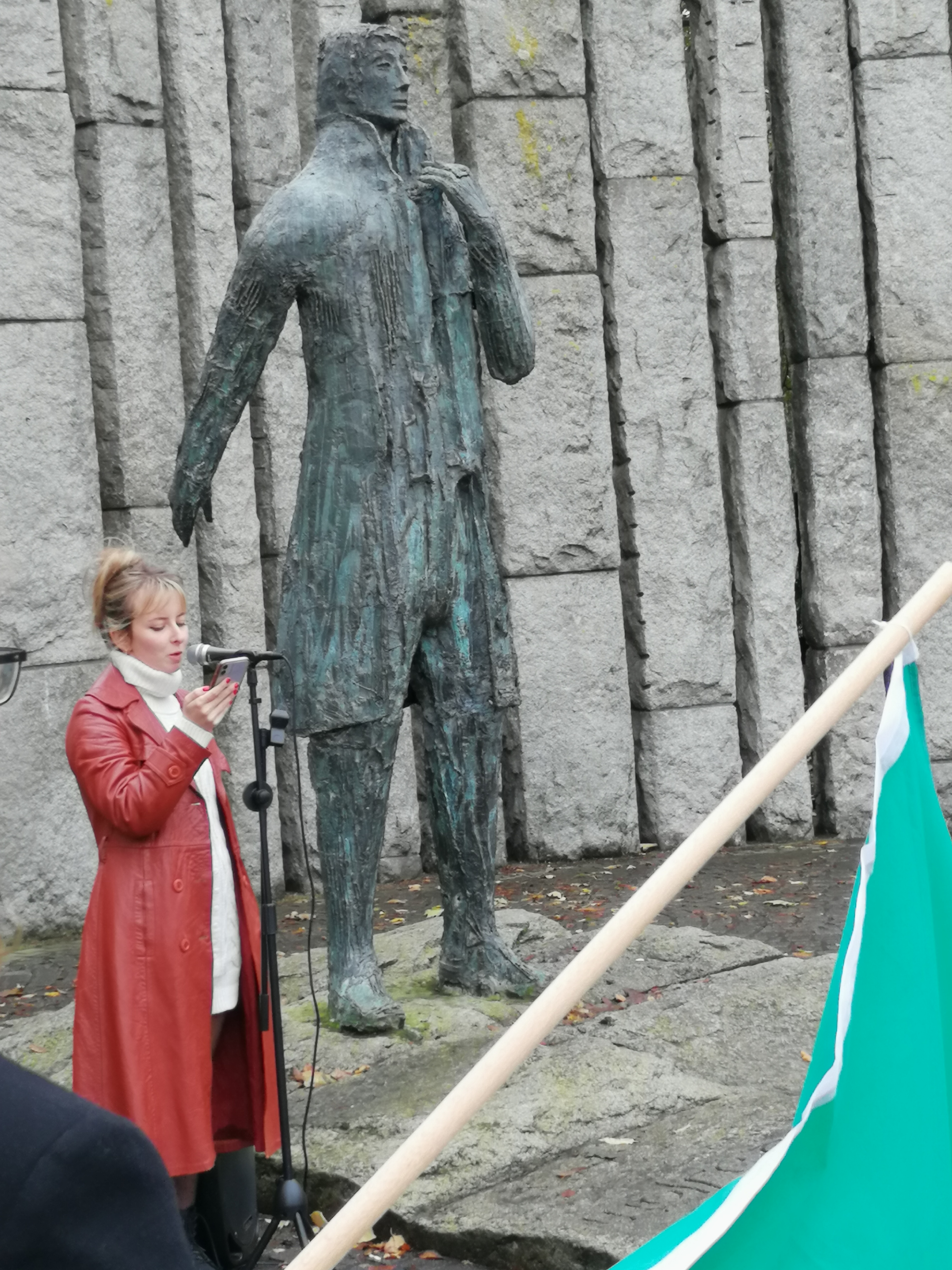
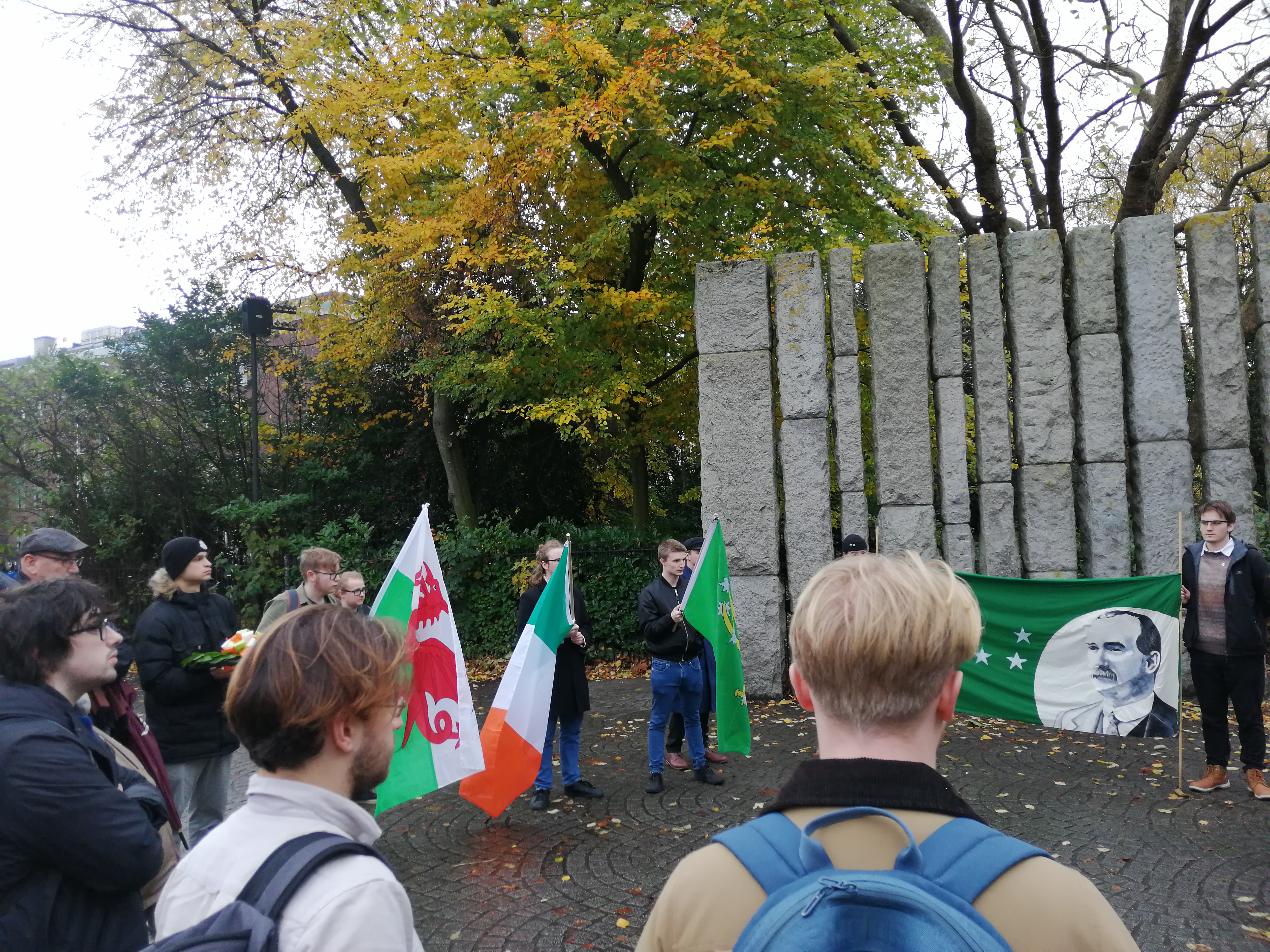
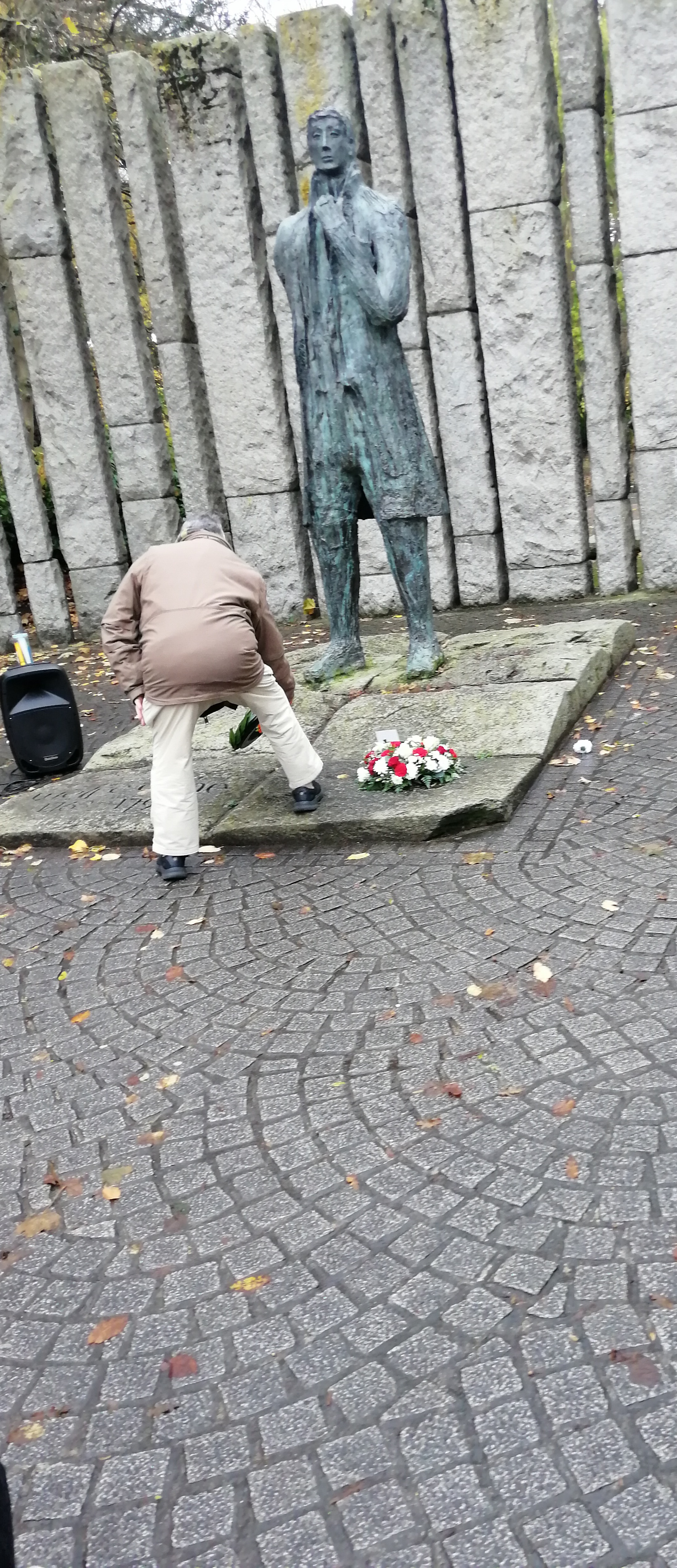
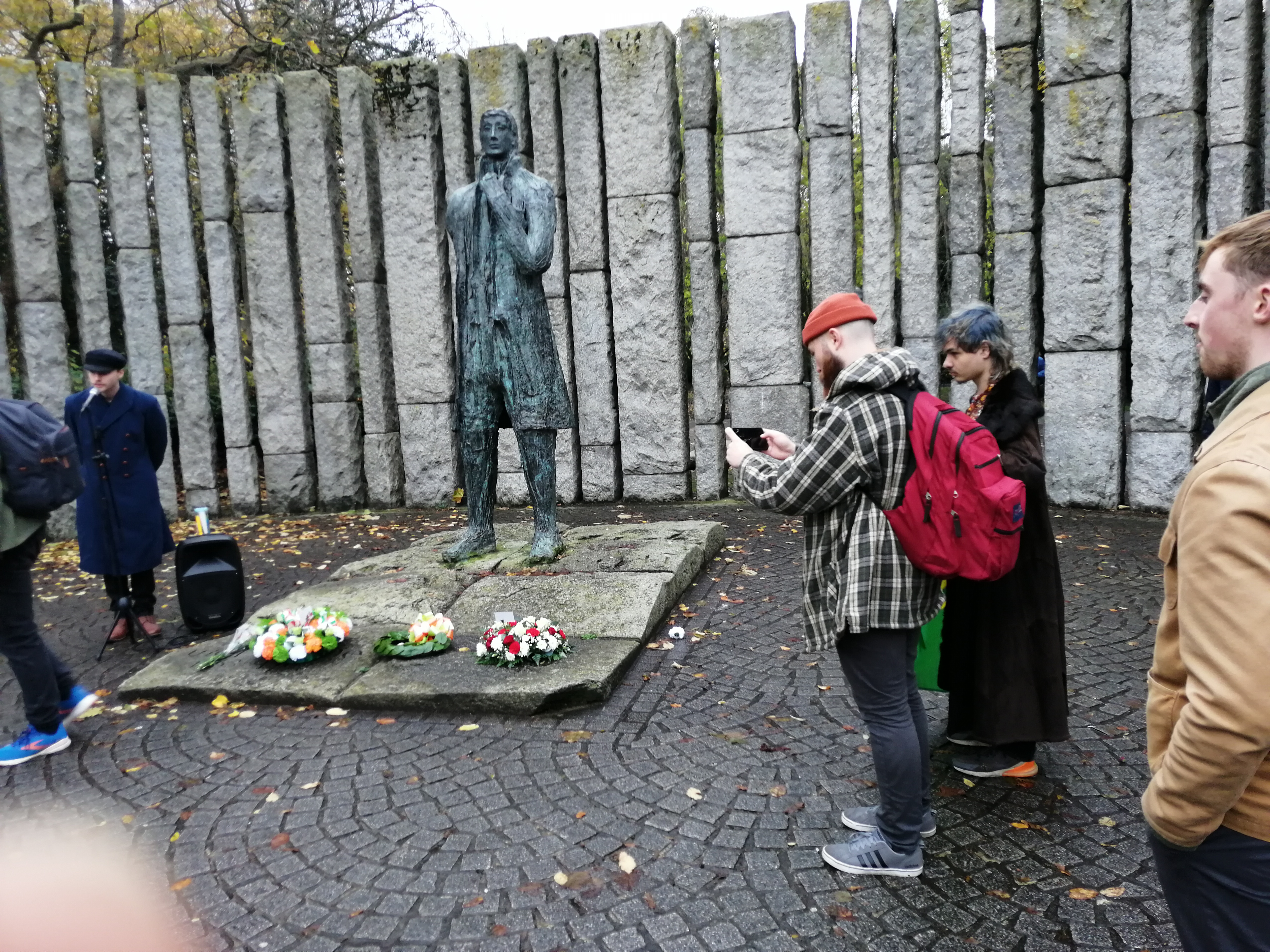
The founding of the Irish Citizen Army, the first workers’ army in the world1, was commemorated in Dublin at the site of Wolfe Tone monument in Stephens Greeen, in song and speech on 23rd November 2022.

Organised by the Connolly Youth Movement, the other participating organisations represented were the Irish Communist Party, Independent Workers Union, Lasair Dhearg2 and Welsh Socialist Republican Solidarity (Ireland) – the Irish branch of the Welsh Underground Network.

In addition, a number of independent activists were also present.

CYM speaker beside the Wolf Tone Monument (by Edward Delaney) which was blown up by Loyalists in 1969; it was recast and the surviving head incorporated. (Photo: Rebel Breeze)

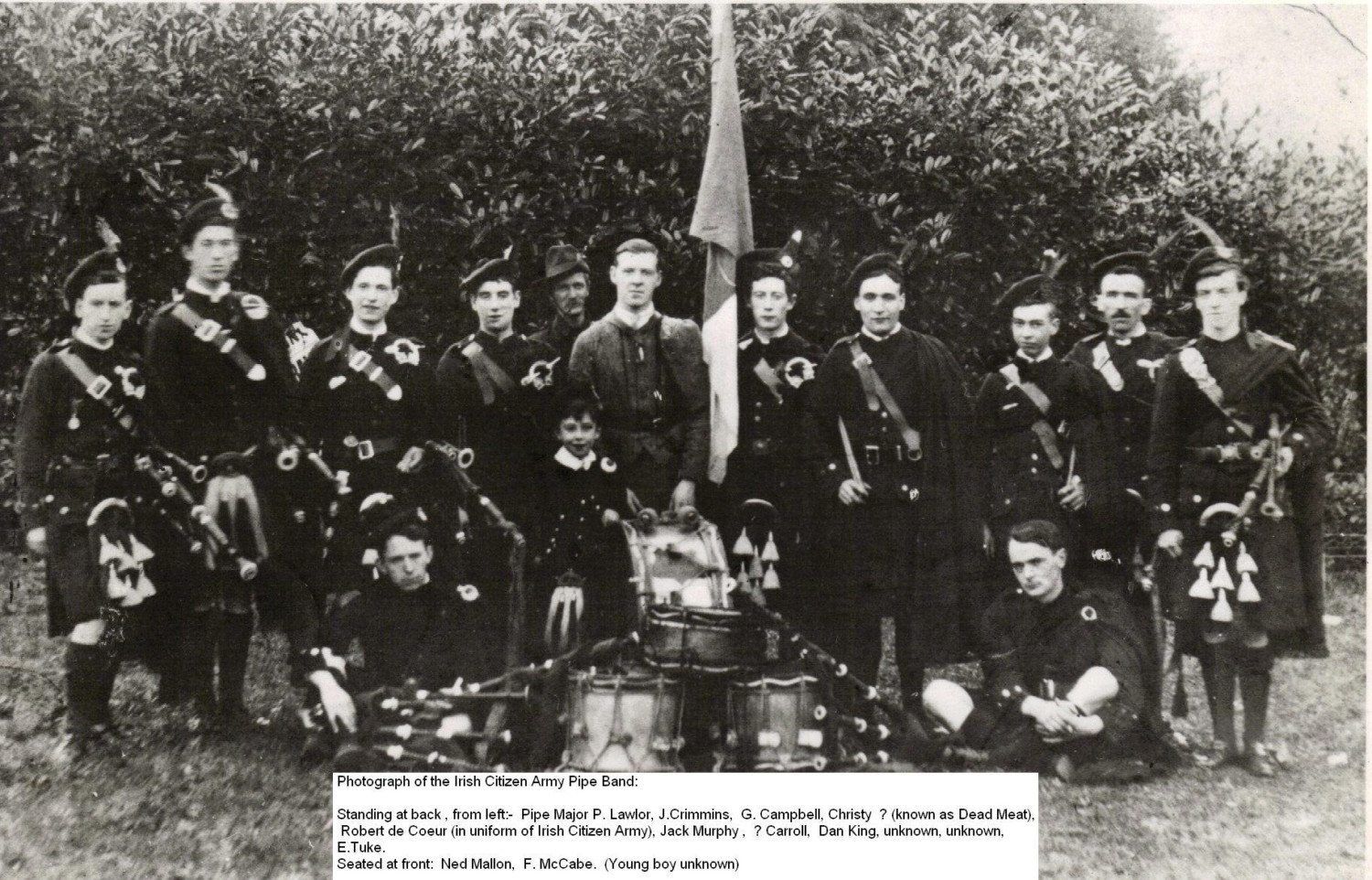
THE IRISH CITIZEN ARMY

The Irish Citizen Army was founded on 23rd November 1913 on a call from Jim Larkin and James Connolly, both leading the Irish Transport and General Workers’ Union in its titanic struggle against the federation of Dublin Employers’ plan to break and disperse the union.

The call for the formation of the ICA arose due to the attacks of the Dublin Metropolitan Police on the workers and their supporters; already in August 1913 the DMP had killed two workers by truncheon blows and injured many, including a youth who would die later as a result.

The ICA’s initial organiser was the writer and dramatist Seán O’Casey, later succeeded by Boer War veteran Jack White.3 In addition to requiring its recruits to be union members, the ICA enrolled women as well as men and some of the former were officers commanding both genders4.

While the ITGWU was defeated in the eight months of the Lockout, it was not smashed and came back stronger in a relatively short period. The ICA faded away then but was reorganised over following years and approximately 120 took part as a unit in the 1916 Rising, alongside other units.5

SPEECHES AND SONG

A small crowd had gathered at the advertised location, the Wolfe Tone Monument in Stephen’s Green and the chairperson of the event called people to order.

Diarmuid Breatnach, an independent activist, was asked to sing one of Connolly’s compositions, ironically titled Be Moderate, often referred to instead by its refrain, “We only Want the Earth”.

An older man with a Dublin accent, Breatnach told his audience that Connolly published the lyrics in New York in 1907, going on to sing the five verses to the air of Thomas Davis’ A Nation Once Again6, using the chorus part to repeat the refrain that “ … we only want the Earth!”7

A representative of the Independent Workers’ Union, a young man with an Ulster accent, spoke about the need for workers to have a trade union and for that union not to align itself with employers or with the State.

In order to truly represent the interests of the workers, the union needs to be independent, he maintained and also democratic in its decision-making.

In conclusion, the speaker said that the IWU is the union that is needed and called on people present to join it and to support it.

“MAKE THE VISION A REALITY”

Amy Margaret, a young woman, also with an Ulster accent, delivered a speech on behalf of the organisers of the event, the Connolly Youth Movement.

“The Citizen Army was a direct response to the brutality carried out by the RIC and Dublin Metropolitan Police during the Dublin Lockout” she said; “the police killed two workers, injured hundreds more with baton charges, and frequently ransacked the tenements where strikers lived.”

“The Citizen Army fought back with some succes” she continued “and as one pointed out, a hurley has a longer reach than a baton. It was in the Citizen Army that the working-class stood up to the RIC and employers,” she continued.

“The same RIC that torched farmer’s homes during the Land war, the same employers who often owned the slums where workers lived; it was here at Stephen’s Green (and elsewhere in the city) that the Citizen Army stood up to the British Empire, alongside comrades in the Irish Volunteers.”

She told her audience that when, during a dockers’ strike in 1915, scabs were imported and police harassed picketers, Connolly sent a squad of the ICA with fixed bayonets to the scene, resulting in the dispute’s resolution with “a considerable increase in wages to the dockers concerned”.

“The Citizen Army was not simply workers armed with guns,” the speaker said, “but also armed with culture” and referred to weekly concerts in Liberty Hall (the ITGWU’s HQ) and to the dramatic acting history of Seán Connolly and whistle-playing of Michael Malin, both 1916 martyrs

“What the ICA stood and fought for in their own words, “… is but one ideal – an Ireland ruled and owned by Irish men and women, sovereign and independent, from the centre to the sea.”

“Connolly was clear however that such a Republic would have no place for the “rack-renting, slum-owning landlord” or the “profit-grinding capitalist”, but should rather be a “beacon-light to the oppressed of every land”.

“The most fitting tribute for the ICA then is to make that Republic a reality. To do so we must learn from the past and their examples. We can learn from them to never be cowed by the odds against us, we can learn from their comradeship to each other.

We can learn from how they combined political, economic and cultural methods to advance the cause of a worker’s republic. But more importantly we must be able to learn from their shortcomings.

After the Rising and the loss of its leadership the ICA began to devolve into a social club and whilst some members played an important role during the Tan War, the ICA was not the revolutionary workers’ army it once was.

Therefore we must build a truly mass movement – not just a committed core of activists, and we must build a movement not reliant upon key personalities so that it can function no matter what.

We all know that things must change in Ireland, and so we reaffirm the principle that the Citizen Army stood by; only the Irish working class is capable of waging the revolutionary struggle necessary to change things; not capitalists and landlords.

Helena Molony of the ICA, said, “We saw a vision of Ireland, free, pure and happy. We did not realise that vision. But we saw it.”

As the socialist-republican youth of today, we commit ourselves to make that vision a reality and to build a Republic that the men and women of the Citizen Army would gladly call their own.”

Some of the gathering at the Wolfe Tone Monument (out of shot to the right) to commemorate the creation of Irish Citizen Army (Photo: Rebel Breeze)


MARKIEVICZ: “RESOLUTION, COURAGE AND COMMITMENT

Breatnach was called back to the microphone and talked about the lessons to be learned from Constance Markievicz, co-founder of Na Fianna Éireann, the Irish Citizen Army and of Cumann na mBan, born in Britain “as were a number of our national and class heroes”, he said.

“Constance was born into a settler landlord family, the Gore-Booths”, he told the audience and her experience of witnessing deprivation, along with her sister Eva, during the Great Hunger, had a strong effect on both, inclining them to social reform and they became also suffragettes.

The speaker said that in that latter aspect and as a poet Eva became well-known particularly in England but Constance was better known as a revolutionary and for her allegiance to the working class and to the Irish nation.

He reminded his listeners that Markievicz was artistic and apt to strike poses; O’Casey, founder of the ICA had been hostile to her and co-founder of Cumann na mBan and wife of Tom Clarke of the IRB, Kathleen Clarke, had found her irritating.

Breatnach said that Markievicz was 3rd in 1916 garrison command at Stephen Green and had been accused not only shooting dead there a member of the DMP but of exulting in it; however according to witness accounts she had not even been present when the officer was killed.8

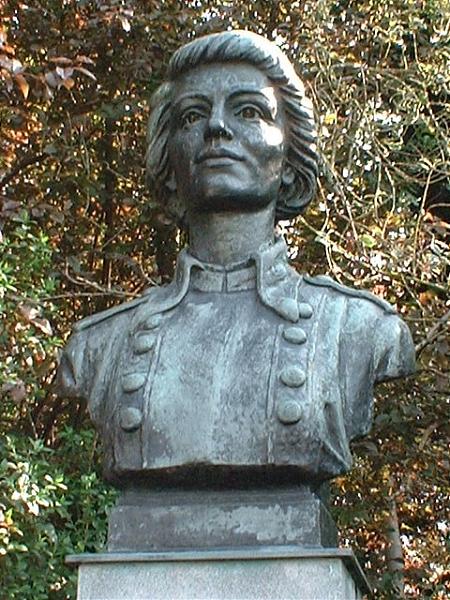
Bust of Volunteer Markievicz in Stephen’s Green (Photo: Rebel Breeze).

A British officer at her court-martial after the surrender of the 1916 Rising had claimed that she begged for her life at the court-martial but the official British records published later gave the lie to that and her own account that she demanded equal treatment with the executed leaders rings true.

“Her life as an example,” Breatnach continued, “teaches us not to judge people only by their background or indeed by their idiosyncrasies but primarily by their resolution, courage and commitment, all of which Constance Markievicz had by the bucket-load.”

The speaker also reminded those present that the very Wolfe Tone monument beside which he stood had been blown up in a number of British Loyalist bombings of the city during the 1970s, a number of which would soon be commemorated on the December anniversary of one of them.

The Irish State had prosecuted not a single one of the perpetrators, not even for the Dublin and Monaghan bombings, with the highest death toll9 of any one day during the recent 30 Years War. Instead, they had used the 1972 bombing to pass emergency legislation to attack Irish Republicans!10

Speaking briefly as a historical memory conservation activist, primarily active in the campaign to save the Moore Street market and 1916 battleground from speculators, Breatnach remarked that it was fortunate that the area behind him was a public park.

Otherwise it would all have been a prime target for property speculators. People sometimes express surprise that Irish governments do so little to protect areas of insurrectionary history. He stated however that this was natural since it was not their history but that of the struggling people.

“The history of the Irish ruling class is of a foreign-dependent one”, Breatnach stated, “rather than that of a national bourgeoisie willing to fight for independence. The last time Ireland had such a bourgeoisie was in 1798, mostly led by descendants of settlers and planters.”

“This is why Connolly pointed out that the Irish working class are the true inheritors of the Irish struggle for freedom. National independence and socialism are two different objectives but interdependent in Ireland and for the struggles to succeed they must be led by the working class.”

CONCLUDING

Wreaths were laid on behalf of a number of organisations, including Lasair Dhearg and the chairperson thanked all for their attendance, leaving people to their various ways into the mild autumn-like afternoon.

End.

(Cropped photo: Rebel Breeze)

(Photo: Rebel Breeze)

FOOTNOTES

SOURCES

1Clearly not the first army composed of workers, since these are the members of most armies; nor the first to fight for the workers, as did some for the Paris Commune in 18th March-28th May1871. However, the ICA was founded specifically for the defence of workers, the first in the world to be so, though its constitution was largely Irish nationalist.

2Socialist and anti-fascist Irish Republican organisation mostly represented in Belfast. The name means “Red Flame”.

3A number of Irish were veterans of the Boer War, the British against Dutch colonists in South Africa, most like White were on the British side but some fought for the Boers, to the extent of forming an Irish Brigade for the purpose. Later, a number from both groups ended up fighting alongside one another in the 1916 Rising (and no doubt against others who remained in the British Army).

4This too was a ‘first’ to the credit of the ICA.

5The Irish Volunteers, Cumann na mBan, Na Fianna Éireann, the Hibernian Rifles and of course the Irish Republican Brotherhood, the chief architects of the Rising, its members fighting as members of other units, chiefly the Volunteers and the Fianna (the membership of both those organisations was exclusively male though its couriers were often female but Tom Clarke’s wife, Kathleen Clarke, was the IRB’s liaison from Dublin with the sister organisation in the USA.

6James Connolly (1868-1916) did not prescribe any air for the lyrics and they have been sung to several. A Nation Once Again was composed by leading member of the Young Irelanders, Thomas Davis (1814–1845) and published in 1844, for many years considered a candidate for Irish national anthem.

7“For our demands most moderate are: we only want the Earth!”

8Breatnach also said that least two and probably three members of the DMP were killed during the Rising, each one in an area under the control of the ICA, who no doubt remembered well the force’s actions during the 1913 Lockout.

91974: 33 male and female civilians and a full-term unborn baby.

10The Amendment to the Offences Against the State Act, including the introduction of the no-jury Special Courts, essentially for trying Irish Republicans with a much lower quality of evidence required to convict, including the unsupported word of a senior Garda officer.

BELLA CIAO – ORIGINS AND CONTROVERSY

Main article by CHEMA MOLINA@CHEMAMOLINAA in Publico.es, translation and comment by Diarmuid Breatnach

(Reading time entire: 4 mins.)

The origin of the Bella Ciao song is uncertain and there are different theories about how this mythical popular song came about.

Over the years it has acquired a meaning closely related to the anti-fascist protest movements and in defence of democracy.

However, the Italian artist Laura Pausini refused to sing it during the El Hormiguero1 (show), reasoning that it is “very political”.

The piece has a clear political nature that goes beyond the success which the Money Heist series has given it and that has made it one of the most listened-to Italian songs in the world.

Italian partisans had already employed verses of this hymn against Mussolini’s fascism and the Nazi occupation during World War II.

Armed Italian anti-fascist Partisans in Pistoia, Tuscany (central Italy) Dec 1944 (Photo credit: Keystone/Getty Images)

Specifically, it was the partisans of the Maiella Brigade, in the Abruzzo region (east of Rome), and the Garibaldi Brigade, in the Marche area, a territory located between the Apennine mountains and the Adriatic Sea, who began to sing it, mixing traditional melodies with militant lyrics.

But there are other theories that suggest that the beginning of this song dates back to the 19th century.

Line of Mondinas at their back-breaking work (Photo sourced: Internet)

The Mondinas, women who worked in the rice fields of northern Italy, recited the lyrics of this song as a sign of protest against the harsh working conditions they experienced every day.

In fact, the historian Cesare Bermani explains that the origin of Bella Ciao comes from a song called Fior di tomba (Flower of the grave) and that the poet Costantino Nigra had previously mentioned it in the second half of the 19th century.

One of the versions of this song reached the Mondinas of the provinces of Vercelli and Novara, both in the Piedmont region.

The Mondines’ (Italian female rice workers) song.

Another theory points out that the anthem could have Ukrainian roots. The musician Mishka Ziganoff, born in Odessa in 1889, moved to New York and composed a piece that could have been the origin of the start of the Bella Ciao air2.

Later, Italian migrants spread the air of this song when they returned to their country3.

Apart from its origin, the song began to become popular and to take on a political meaning due to the festivals organized by communist youth in different European countries. In the summer of 1947, the World Festival of Youth and Students took place.

There, the partisan version of the anthem was promoted, which later reached the Festival of the Two Worlds (also called the Spoleto Festival) in 1964.

The Bella Ciao show was performed at that event, organised by the Italian group Il Nuovo Canzoniere Italiano. The singer-songwriter Giovanna Marini, an artist who also helped to popularise the song, participated in the performance.

Bella Ciao has crossed borders and has been translated into many languages. In Spanish, one of the best known versions is that by the author Diego Moreno, who published his interpretation in 2014 on the album Bella Ciao! Adios Comandante!

COMMENT

THERE IS NO NEUTRAL POSITION ON FASCISM by Diarmuid Breatnach

The current controversy over a prominent Italian singer’s refusal to sing Bella Ciao at a kind of game show was predated by controversy over the origin of the song.

Most authorities now seem to refute the popular belief that it had been sung by Italian partisans, instead dating its emergencer as an antifascist song soon after WWII.

All are agreed however that it was predated by “Alla mattina appena alzata” a song with different lyrics of women rice-planting labourers, the Mondines, bewailing their extremely hard working conditions, their exploitation and expressing their hope in liberation.

Its origins therefore in women workers’ resistance is noble but so also is the antifascist sense in which it is usually sung today.

Woman Singing ‘Bella Ciao’ from window in Bologna Italy on Liberation Day 2020 (Photo credit FTimes)

Laura Pausini, when declining to sing the song, excused herself by saying that “it is very political”. Yes, it is and Pausini needs to realise that neither in the world of today nor in the past is there, nor has there ever been, a neutral position on exploitation of labour or on fascism.

The responses to Pausini recorded by Publico on Twitter were mostly negative towards her decision and rationale but also revealed a fair amount of confusion.

Laura Pausini in 2009 (Photo sourced: Internet)

The most common critical response was along the lines that anti-fascism is fundamental to democracy and therefore above politics, one commentator going so far as to state that Pausini is confusing position or stance on the one hand with ideology, on the other.

Fascism is a political ideology and so therefore is anti-fascism. Of course, anti-fascism is normally associated with the Left of the political spectrum but some conservative individuals and groups have been known in history to be actively anti-fascist too.

However that does not change the fact that anti-fascism is a political position whether ascribed to by revolutionary communists and anarchists, social-democrats or conservatives.

As the world capitalist system in crisis turns to making the workers pay more through rising costs of essentials and wage controls, along with cuts in state social services, the masses will resist. In many states, it is then that the ruling class turns to fascism to repress the resistance.

Neither Pausini nor anyone else can rise above that struggle. One may certainly attempt to be neutral but circumstances will not permit it, will certainly frustrate the attempt. Objectively one’s actions and words will either favour fascism or work against it.

End.

FOOTNOTES

1El Homiguero (“The Anthill”) is a Spanish television program with a live audience focusing on comedy, science and guest interviews running since September 2006 https://en.wikipedia.org/wiki/El_Hormiguero

2Without listening to the air, I am unable to venture an opinion on this. However, thinking about it, Bella Ciaodoes evoke Eastern European Jewish music to me. According to Wikipedia, Ziganoff was a Christian Roma from Odessa, Ukraine but well familiar with Yiddish and Klezmer music. https://en.wikipedia.org/wiki/Mishka_Ziganoff

3This is a well-known process of the dissemination of song airs and even lyrics by migrant workers or sailors (or even soldiers). For example the air of the ballad Once I Had a True Love may be found on an Alan Lomax collection of traditional songs from Extremadura, central-western part of Spain.

SOURCES

Original Publico article: https://www.publico.es/sociedad/origen-bella-ciao-tema-laura-pausini-rechazo-cantar-hormiguero.html?

https://en.wikipedia.org/wiki/Mishka_Ziganoff

The Mondines (women workers): https://en.wikipedia.org/wiki/Mondina

Pausini controversy: https://www.wantedinrome.com/news/italy-laura-pausini-refusal-to-sing-bella-ciao.html

The Hormiguero show: https://en.wikipedia.org/wiki/El_Hormiguero

The Money Heist (La Casa de Papel): https://en.wikipedia.org/wiki/Money_Heist

Colombia: Paramilitaries, Businesses and the “Truth”

Text by Gearóid Ó Loingsigh (images and video chosen by Rebel Breeze)

29 July 2022 (first published in English in Socialist Democracy)

The Colombian Truth Commission’s (CEV) report Findings and Recommendations aims to be a text that reveals a truth, that up to now was hidden or partially hidden from Colombian society.

It is true that in Colombia, after decades of a conflict that began before many of those actually alive were born, along with propaganda from the media, the churches and political parties, there are many aspects that are not well known to everyone.

That is not to say that it is a document that reveals or uncovers these truths. If we look at the issue of paramilitaries and how the CEV treats it, various problems with this commission are evident.

It comes out with some truths about the paramilitaries that initially give one hope about the content of the Report.

Paramilitarism is not just an armed actor – understood as private armies with terror strategies aimed at the civilian population – but rather a network of interests and alliances also associated with economic, social and political projects that managed to impose an armed territorial control through terror and violence and also through mechanisms to legitimate it, the establishment of rules and norms.(1)

It is true that the paramilitaries are about more than just massacres, but the CEV not only fails to explain what the interests at stake are, but it gets it back to front about who is in charge and who serves.

It inverts the roles many times and though it acknowledges the role the State played, or still plays, the State is presented almost as just another victim of the paramilitaries.

The CEV accepts that the USA played a role in the 1960s.

The recommendations of US missions that visited the country during the administration of Alberto Lleras Camargo (1958-1962) led to Decree 1381 of 1963, Decree 3398 of 1965 and National Defence Law 48 of 1968, through which the involvement of civilians in the armed conflict was institutionalised.(2)

But it doesn’t explore this role that much further, it would seem as if various north American governments played no further role than that, that they have not been the one constant factor in the history of the conflict, as if their support to all the Colombian governments, the training of the Colombian military in the School of the Americas did not count for anything, and of course there is Plan Colombia which is dealt with by the report.

Neither do they explore the role of the state that passed those laws. It would seem as if the laws appeared through magic. They accept that paramilitaries enjoyed legal status for a long time, but they put no names to the matter, nor who benefitted from those laws or what were the interests of the presidents and congresspeople involved in passing those laws and decrees.

We are told of how Virgilio Barco suspended the legality of the paramilitaries in 1989, but according to the CEV it was revived in practice through the rural security cooperatives known as the Convivir.(3)

It is dubious to say that the Convivir were the paramilitaries in practice and not paramilitaries de jure, as it is not the case that these cooperatives were corrupted.

It was always the intention to legalise the paramilitaries through this figure and in that, President Cesar Gaviria and his Minister for Defence, Rafael Pardo both of whom signed the degree that brought them to life, played an important role as did President Samper who implemented the decree during his government.

These people are not spoken of as promotors of paramilitaries.

To the CEV the paramilitaries are a type of loose cannon, independent of the State, with a life of their own. The ills of the country are the result of the actions of this loose cannon and how it infiltrates the state, the institutions, including the military and how it co-opts spaces.(4)

Thus, the institutionalisation – through various governments – of armed groups legally at the service of private interests, as well as their legitimation from the 1960s show not only the tolerance but also the promotion by state of the outsourcing of public security (bold not in the original). The legal cover and political legitimation have allowed for the maintenance and expansion of the paramilitaries, structures that were co-opted by paramilitary bosses.(5)

To the CEV, the paramilitaries were an outsourcing of security to private bodies that went wrong. Dr. Frankenstein thought he was creating life and his creation turned into a monster despite his wishes.

Paramilitaries are referred to in this manner throughout the document, they exist and act with the approval of named sectors, but the responsibility does not lie with any known person. They are incapable of saying that Samper and Gaviria legalised the paramilitaries.

Samper was fully aware of what the Convivir were and defended them tooth and nail during his government, and lashed out at those who denounced the Convivir as paramilitary structures.

Ernesto Samper, President of Colombia from 1994 to 1998, representing the Liberal Party. Secretary General of the Union of South American Nations (UNASUR) 2014-2017. He defended the Convivir and later pretended the paramilitary terrorism had been done behind his back. (Photo sourced: Internet)

Samper never put an end to the Convivir, rather it was the Constitutional Court that declared that they couldn’t use arms reserved for the State’s military, so the paramilitaries had no need to use this cover any more if they couldn’t obtain arms legally.

The paramilitaries were a state policy as can be seen from the laws and decrees enacted, in the promotions of military officers involved in massacres and also in the persecution of social actors, human rights organisations and in a number of cases the systematic murder of witnesses.

The CEV talks about these things but does not connect them together as a state policy. It shamelessly accepts the excuses of Uribe that everyone lied to him, the face Santos put on of it wasn’t me, or the “it was all done behind my back” of Samper.

A real truth commission would try to tell us not only what happened but who did it (with full names) and also why.

The same complacent attitude it takes with the State is extended to the business people. It talks of interests but does not put a name to them. But thanks to the decades long work of social organisations we can put a name to many of the cases.

The CEV doesn’t do that and goes on with its tale of some sectors. But these same sectors have been more honest than the CEV. The CEV names the cattle rancher’s association in Puerto Boyacá, Acdegam, as a key player in the founding of the paramilitary groups.(6)

But it does not mention the role played by Texaco. Carlos Medina Gallego in his book Autodefensas, Paramilitares y Narcotráfico in Colombia describes the birth of this group.

The USA-based petroleum company was present in the meeting that set up the paramilitary murder group. (Image sourced: Internet)

The process in the region began with the creation of a private army or paramilitary group alongside the army to jointly combat the subversives.

This group was set up during the military mayorship of Captain Oscar Echandía, in a meeting which, in addition to the Mayor, was attended by representatives of the Texas Petroleum Company, members of the Cattle Ranchers Committee, political leaders, the Civil Defence, members of the armed forces and other special guests.(7)

Neither does it mention the National Federation of Cattle Ranchers, Fedegan. The president of Fedegan, however did acknowledge the role they played. In 2006, in an interview given to Cambio magazine, he said that they had paid paramilitaries, as had others such as flower and rice growers amongst others.(8)

National Federation of Cattle Ranchers in Colombia — part of the group that set up the paramilitary murder group — their president admitted in 2006 that they had paid paramilitaries, as had some large agricultural interests. (Image sourced: Internet)

Around the same time, 10,000 cattle ranchers, traders and industrialists signed a letter acknowledging and justifying their financing of the paramilitaries.(9)

The CEV describes paramilitarism as something unstable and changeable in nature and that “it has had diverse actors, motives and modus operandi, which leads to difficulties when it comes to trying to come up with a static definition.”(10)

Yes, it is true that the paramilitaries have changed over time, as has the army, the state, the political parties, the guerrillas and even society. Nothing stands still, but that doesn’t mean we can’t come up with an approximation of what it is, taking into account the variables.

That is what the study of history, politics and also any branch of knowledge is about. So, the CEV doesn’t describe the paramilitaries as a state policy, not because it is a changing phenomenon, but rather because it doesn’t want to.

It deals with various paramilitary forms and leaves out one very clear telling example: the AAA (American Anti-Communist Alliance).

One of the founders of the Triple A (American Anti-communist Alliance) paramilitary terrorists, at the time Lt-Col. Harold Bedoya of the Charry Solano Battalion, later Commander of the Colombian Armed Forces. (Photo sourced: Internet)

The AAA was a paramilitary structure founded by the commanders of the Charry Solano Battalion, amongst them Lieutenant Colonel Harold Bedoya, who would later become the Commander of the armed forces.

The existence of such a paramilitary structure operating within the battalion was public knowledge as five soldiers reported it to the presidency, the Procurator, the Organisation of American States and the news was even published in the Mexican press. This structure is not mentioned in the CEV report.

Another paramilitary structure that is dealt with partially in the Report is the 07 Naval Intelligence Network. However, it does not delve into the reality of the Network and the significance of its activity as a state policy.

2017 video

The case of the 07 Naval Intelligence Network based in Barrancabermeja that operated in part of Bolívar and Cesar stands out due to the seriousness of it. According to the ordinary criminal justice system, the network functioned as a powerful “death squad” with logistical means, personnel trained to kill and was responsible for dozens of murders, forced disappearances and massacres whose victims were mainly trade unionists, politicians, community leaders and activists.  The network financed paramilitaries using secret funds.(11)

But the network was the paramilitary structure par excellence. Despite the CEV’s quote, they do not go into great detail as the issue cannot be dealt with and conclude that it was just some functionaries and not the military unit as such.

The Network murdered at least 68 people, though some estimates put the figure of 430. The soldiers implicated were exonerated by the commander in chief of the official armed forces of the state, General Fernando Tapias. To the CEV this is just another case of rotten apples.

But, can 60 years of violence be explained as the result of the actions of some soldiers, some politicians, some business people? We are talking about tens of thousands of dead, tortured, disappeared and the outcome follows from the actions of some… and not from a state policy?

the paramilitary phenomenon has maintained a role in components of the state such as the armed forces, security and intelligence agencies, collegiate state bodies (Congress, assemblies and councils), judicial institutions and oversight bodies, as well as economic sectors such agri-industrial, extractive industries, public servants and candidates in elections. It has also permeated sectors of the church and the media. Without the close link between this body of sectors and the armed paramilitaries, this phenomenon would not have unleashed the deep wounds that it inflicted nor would it have lasted as long.(12)

Colombian paramilitaries working with the army and paid by big growers, these in “the Banana Bloc” in Colombia (Photo: Huffington Post)

There are no policies here, no state-backed dirty war but rather a compendium of massacres carried out by blood thirsty types that co-opted everyone else, i.e. Colombia is an open-air lunatic asylum.

Politicians and functionaries were another sector that was widely implicated in the paramilitary plan to “penetrate all political power: mayors, councillors, deputies, governors, congress people from the zones that we managed […] ultimately, regional powers that together guaranteed a national power for the self defence groups”. The relationship between politics and paramilitaries went in both directions as many politicians and functionaries in turn sought out the commanders of the paramilitary groups to benefit from their armed power.(13)

In this repugnant discourse, the paramilitaries are the ones who penetrate the state and some politicians seek them out, the paramilitaries are not a counter-insurgency strategy of the state nor a policy to implement “development” projects they want, but rather the excuse is “the paramilitaries made us do it”.

It comes across like crying children trying to blame the other for breaking the window, but they are not broken windows, rather tens of thousands of broken bodies. And the CEV does not want to blame who it should. It accepts that the State played a role, but limits it to individual behaviour and private interests but not part of a strategy.

Not even the genocide committed against the Patriotic Union (UP) is seen as a state policy, once again the State is a victim of the paramilitaries. The CEV describes it in the following terms.

It was during the attempts at a democratic aperture and the peace policies of the government of Belisario Betancur (1982-1986). It is in this context the paramilitary network from Puerto Boyacá sought to contain the democratic and peace initiatives through systematic violence (persecution, extermination and displacement) against members of left wing political groups such as the Patriotic Union and the Communist Party, trade unionists and social leaders.(14)

The reality is that no one expected the UP to be successful and the oligarchy took fright and responded as it always does: with violence. The extermination of the UP was not an attempt to contain supposed democratic measures from President Betancur, but rather an attempt to suppress a left-wing political group.

The CEV forgets that Betancur allowed the military to attack and burn the Palace of Justice in 1985, which was only a few metres from the Presidential Palace. He was not a just man whose peace initiatives were undermined by the unjust.

Lastly, we should look at how they describe the business people.

The economic agents were a key part of the paramilitary web. Some national and international business people, local and regional economic powers and productive sectors supported them in different ways because they had interests in the war.(15)

We shouldn’t be surprised that the CEV, led by the favourite child of the bourgeoisie reaches such conclusions. De Roux wrote an executive summary of the report before he even formally took up the job of President of the CEV.

In March 2017, shortly before he began working for the CEV he wrote a column in the El Tiempo newspaper with a simple headline I ask for forgiveness.(16) The column makes various assertions, amongst which the following stand out:

I incur in a generalisation when I write that the paramilitaries were financed by businesspeople. When, in truth, some paramilitary groups were financed by businesses, whilst the majority of women and men to whom we owe the production of goods and services in this country did not finance the paramilitaries.(17)

That is to say, as the CEV report does, that it was only some of them.  He continues with another assertion that some of them did it as a response to guerrilla violence, repeating one of the great lies of the business associations and the State about the nature of paramilitarism.

Gustavo Petro, newly-elected President of Colombia (R) shaking hands with Francisco de Roux (L), who outlined the executive summary of the Truth Commission’s Report in his column before the latter was even published. (Image sourced: Internet)

Others out of rage, following the kidnapping and payment of the ransom, supported the AUC to attack the kidnappers. Others did so because they didn’t trust the state’s security forces.(18)

And lastly, this little gem which reduces the dirty war to the behaviour of just some.

I must also acknowledge that I have been unfair when I have generalised about soldiers and police officers in Colombia. I admit that I have an intellectual and emotive abhorrence of weapons on all sides. I am a follower of Jesus who once and for all separated God from all wars and preached efficient non-violence. But I know there have been many and increasing numbers of men and women in the Armed Forces who see service to the homeland as a service to the dignity and rights of every human being and the collective good of peace.(19)

A question arises. Given that De Roux through his column outlined an executive summary of the future report of the CEV, why did he not save us time, money and the effort by writing, on his own, a report 100% to his liking? It would have had the advantage of not selling false hopes to the victims of the conflict.

End.

Notes

(1) CEV (2022) Hallazgos y Propuestas. CEV p.296

(2) Ibíd., p.303

(3) Ibíd., pp 304 y 305

(4) Ibíd., p.299

(5) Ibíd., p.305

(6) Ibíd., p.310

(7) Medina Gallego, C. (1990) Autodefensas, Paramilitares y Narcotráfico en Colombia. Editorial Documentos Periodisticos. Bogotá p.173

(8) El Cambio No 704 diciembre 2006/enero 2007 Diez Preguntas (Entrevista con José Félix Lafaurie) p.48

(9) El Espectador (17/12/2006) La hora de los ganaderos, p. 2A

(10) CEV (2022) Op. Cit. P.296

(11) Ibíd., p.502

(12) Ibíd., p.299

(13) Ibíd., pp. 345 & 346

(14) Ibíd., p.310

(15) Ibíd., p. 350

(16) Francisco de Roux (01/03/2017) Pido perdón https://www.eltiempo.com/archivo/documento/CMS-16832051

(17) Ibíd.,

(18) Ibíd.,

(19) Ibíd.,

The Colombian Truth Commission and its Truths

Gearóid Ó Loingsigh

(01/07/2022)

(Reading time: 11 mins.)

The Truth Commission (CEV) in Colombia has just published its report on the Colombian conflict. As was to be expected it is a very detailed report and deals with many aspects of the conflict and therefore it is impossible to carry out a detailed criticism in just one article.

This article aims to deal with the document entitled Call for Peace and in later articles I will deal with some points in greater detail such as the regions, the business class and drug trafficking.

Of course, there are very positive aspects, such as the statistics compiled, some proposals that they make and also the stories of the victims that they included.

However, there are also some very problematic aspects on the ideological plane and how they present the conflict, the actors, motives and there is an underlying idea in the document that we should advance towards a new society — with changes — but a society that continues to be the same with regard the economy.

They discount any class struggle as not only as anachronistic but also as something which is undesirable, regardless of the methods used.

The document is full of adjectives, some of them emotive, something which is not a criticism as such, emotions have a place in this setting, but it is imbued with Christian references and the Catholic faith as such.

That is not that surprising given that the boss is a Jesuit priest, Francisco de Roux, s.j. But due to this, its starting point is based on suppositions not shared by everyone and that are very questionable.

President-elect of Colombia Gustavo Petro shakes hands with Francisco de Roux at the launch of the Report.

OH BROTHER!

They start off with the statement and question “We started off from the issue that has dogged humanity from the beginning: where is your brother?”

I don’t know whether this first part is true or not, but the question about the brother presumes we know and share this concept of brother. In the Catholic faith we are all theoretically brothers, though not in practice.

But the idea informs a concept taken from family therapy that the Colombian conflict is between siblings that love each other or at least can love each other, just as a woman can love the man who abuses her in their relationship or the man who can stop abusing her and love her as she deserves.

It is a deservedly highly questioned concept, but it is applied in many countries that have gone through peace processes and truth commissions. But it is not the case, this conflict is not between siblings, but rather between interests.

The conflict has names and surnames and moreover surnames of the great and good and its victims are everyone else. There are power relationships. There are also economic interests.

It is an insult to say that the powerful, such as Luís Carlos Sarmiento and the Santos family are the brothers of their employees, or that associations such as the cattle ranchers of FEDEGAN represent people that are the brothers of the displaced peasants.

Though the report does acknowledge the role of some business people in the conflict.

…what has been grievous for the pain and injustice for the victims is the finding that leading business initiatives paid paramilitary groups in order to displace and steal the land and territories from the communities and implant mining or agribusinesses, or within their enterprises they stigmatised the workers and are complicit in the murder of hundreds of trade unionists.1

Such people, responsible for the murder of hundreds of trade unionists are nobody’s brothers, other than their shareholders’. They killed them as part of a strategy to accumulate wealth, the most base reason for doing so.

The CEV’s position turns the businessman into our brother, though it does acknowledge that

we did not carry out any specific study on the armed conflict and the economy, following four years of listening to the drama of the war, the Commission takes as given that if no major changes are made to the economic model of development in the country it will be impossible to prevent the repetition of the armed conflict which will reappear and evolve in an unpredictable manner.

But despite not carrying out any specific analysis of the conflict and the economy the CEV calls on businesses to avoid a resurgence in the armed conflict.

The state, society and in particular the business people behind the large industrial and financial projects should prioritise guaranteeing the welfare and dignified life of the people and communities without any exclusions, with a shared vision of the future to overcome the structural inequality that makes this country one of the most unequal countries in the world in terms of the concentration of income, wealth and land.2

It is part of the discourse that we are all brothers. Instead of criticising the call they make for a society where the welfare of the people is a priority for the businesses, we only have to ask a question. Where does this happen? In what countries does this occur?

They usually make clumsy references to Switzerland or Sweden, ignoring that it is not quite the case and the welfare programmes in Europe (those that are left) are the result of social struggles and are largely financed by the super-exploitation of the Global South.

It is an illusion and part of liberal mythology, that is usually sold during elections every four or more years depending on the country, but is not to be found anywhere in reality and couldn’t be — legally a company looks out for the welfare of its shareholders and nobody else.

The lack of an analysis of the economic model as a factor in the conflict is a serious weakness, something I will deal with in another article.

But in a conflict for land, where the landlords and business people murder peasants and trade unionists3, failing to analyse the context of the economic model is disingenuous.

AN OLD VERY BAD JOKE

The CEV, however, engages in another great act of untruthfulness when it repeats the old refrain of the business class and the state that paramilitaries are reactive i.e. they react to the presence of guerrillas.

It seems like a bad joke that at this stage a commission that supposedly seeks the truth repeats such a lie: a lie challenged at the time by many of the organisations that now praise the CEV, in the days when they didn’t receive as many cheques from USAID and the European Union.

It has also been shown that companies paid armed groups large amounts of money as indispensable operational costs to keep their projects active.

And the reality of economic actors that in despair at the guerrillas and in the face of insecurity, contributed to the creation of the Convivir [rural security cooperatives] and on other occasions sought out the paramilitaries to bring their security of terror.

Following that there were those who took advantage of the land abandoned in midst of the terror to buy land through frontmen and set up projects. And there were those who used money to place members of the armed forces at their disposal.4

When the bloodthirsty Carlos Castaño called his paramilitary organisation United Self-Defence Forces of Colombia, he did so for a reason: the need to present his barbarous acts as a necessary evil, that of self-defence.

Javier Giraldo, s.j. also a Jesuit has spent his entire life fighting against just such a lie. He has documented how the paramilitaries existed before the foundation of the guerrillas and they were not reactive, but rather they were a state policy.5

The problem with the focus that ignores the state and its role and says that we are brothers is that it asks for reconciliation on that basis, that we are brothers. De Roux in his presentation asked more than once “how did we do” and asked for reconciliation.

But this “We” doesn’t exist. As Javier Giraldo points out.

A similar effort must be made in order to translate the value of Christian reconciliation to the judicial/political arena. There must be a public clarification and admission of guilt, an explicit condemnation of the mechanisms, structures and doctrines which facilitate crimes, the implementation of corrective measures to stop them from being repeated and reparation to victims and society. These must all be dealt with head-on and unequivocally. The very nature of a political community makes this imperative: unless there is an explicit and profound social sanction of crimes, internalized by society’s members and engraved in society’s “collective memory,” such crimes are not truly delegitimated. Without these conditions, the Christian value of forgiveness becomes a perverse expression of its real essence: from a fraternal and creative act to an act which covers up the institutionalization of crime (bold not in original) and destroys the barriers which protect human dignity.6

THE GERMAN EXAMPLE – AN OLD ILLUSION

The CEV points to the case of Germany following the Second World War as an example to follow. It is usually a sign of the poverty of the arguments when someone refers to the Nazis in order speak ill of someone, like saying some such a leader is the new Hitler.

But it is also a sign of argument povery to a degree when they refer to the topic to speak of reconciliation and so forth in post-War Germany. However, that is what the CEV did.

Our German friends who accompany us in the Commission’s process have shown us how its people recovered its dignity and pride when, even decades after the genocide of Jews and the war crimes committed, took on board the suffering of the victims, the wound as part of the national psyche and accepted its collective responsibility.7

What they claim just isn’t true. First of all, the post-Nazi Germany was not a denazified country.

Various later personalities from that period held high positions of responsibility, amongst them Kurt Waldheim, an officer in the Nazi army who became Secretary General of the United Nations and also President of Austria; war criminal Adolf Heusinger who became President of the Military Committee of NATO8 and Johannes Steinhoff who was in charge of the Luftwaffe after the War.

Kurt Georg Kiesinger was a member of the Nazi party, and worked side by side with Nazi propagandist Goebbels and later between 1966 and 1969 he was the German Chancellor.

Another Nazi, Wernher von Braun, who designed the Nazis’ bombs and rockets earned a good wage in the USA in order to put one of the rockets on the Moon. None of them confessed or accepted their responsibility.

And let’s not forget that young member of the Hitler Youth, one Joseph Ratzinger who became head of the Catholic Church. Of course, being a young man, he bore a lesser responsibility than the others.

The Nazis’ anti-gay legislation was applied up to 1969 and between 1946 and 1969 50,000 people were tried under that law. And whilst the Nazis had high-ranking posts the Communists were banned from working in the public administration and they and other dissidents, such as pacifists, were pursued.

Even under the “Communist Clause” victims of the Nazis who were Communists were not compensated.9 They chose a very bad example — or perhaps De Roux is conscious of the example he chose.

However, what it is about is blending one myth with another. It is surprising that they don’t mention South Africa, maybe because it is easier to see the reality of its Truth Commission and it is a more realistic comparison than Germany after the War.

What they aim to say is that if the Germans could accept their collective guilt, why can’t Colombia do so? But such collective guilt does not exist, or at least not in the way De Roux and company mean.

Many Germans lost their lives in the struggle against the Nazis, it has been calculated that the Nazis murdered 288,000 members of the opposition, including before Hitler came to power.

It wasn’t all Germans who did it but amongst those who did, there are familiar household names, Siemens and Krupps, just to name two companies — both used slave labour in their factories and had close relations with the Nazi Party.

Or there is Hugo Boss, the Nazi Party member who made his fortune manufacturing the uniforms of the Nazi Party, later of the Wehrmacht and of course of the SS, which is why they looked so good.

Hugo Boss menswear shop in Dublin. The company founder was a close supporter of the Nazi regime and produced uniforms for the Nazi Party, Wermacht and SS. (Image sourced: Internet)

And of course, Bayer, the company that made Zkylon-B, the gas they used, still exists and is still rich. Following the war, 13 directors from the company were convicted of war crimes but were freed without serving their full sentences and took up their posts in the company.

The murderers continued in power with the tale of “collective guilt”. The Nazis were a political project of a sector of the German bourgeoisie to stop the rise of the Communists, any similarity to cattle ranchers declaring Puerto Boyacá the anti-capitalist capital10 is a mere coincidence, I suppose.

The reference to Germany as an example of reconciliation is a cheap tale. If Colombia goes down the same road, the surnames Mancuso, Uribe, Santo Domingo, Samper and Santos and the others will be the dominant surnames in the future, with their economic and social power intact.

Protest about the army murders of civilians claimed as “positive” FARC guerrillas by relatives portraying the victims, Bogotá in 2009

THE “FALSE POSITIVES”

The CEV also deals with the issue of the “False Positives” and states something about the issue which is absolutely true that “If there had been ten, it would be very serious. If there had been one hundred, it would enough to demand a change of army. But there were thousands and it was monstrous.”11

But almost immediately it states that:

There was no law or written instructions that ordered it, but the soldiers who fired felt that they were doing what the institution wanted, due to the incentives and pressure that demanded immediate results with corpses, the publicity that they gave to those “killed in combat” and the protection given to the perpetrators.12

Yes, it is true that there was no law or written order that instructed them to do so. But we can’t expect criminals to leave us easy proof. There was no law, but there were incentives as they pointed out.

There were directives and a system for bonuses that encouraged the murder of civilians. Who authorised the payments? The then minister of Defence, Juan Manuel Santos. What does the document say about Santos?

The former president Santos – who was Minister for Defence from the end of 2006 to the end of 2008 – came to the Commission to contribute to the truth with his testimony, as ex-President and public servant, and he centred his intervention on the rigorous analysis of the False Positives to conclude asking for forgiveness from all the families and Colombia and invited the Armed Forces to ask the national and international community for forgiveness.13

It is not true, his intervention was not very rigorous and he ended by asking for forgiveness, as the CEV says, but at the same time he said he wasn’t to blame.

He took up Samper’s excuse regarding drug trafficking and said that it all happened behind his back and he lied on various occasions in his declaration to the CEV.14

Juan Manuel Santos, them President of Colombia shaking hands with Donald Trump, then President of the USA, in the White House 18 May 2017 (Image sourced: Internet).

IN CONCLUSION

Without a doubt the CEV will contribute to the knowledge of the conflict with its data, interviews and in some parts, its analysis. But the report as a whole will not be the truth about the conflict.

The CEV stated that “we don’t share the position, according to which, there are many truths that are equally valid regarding the same matter.”15

Yes, not all “truths” are equal, you have to analyse them, discuss them, contrast them with the facts and even look at who is enunciating them to see which perspective is closer to the truth, but in this case, it is not the “truth” of the CEV that is true.

Neither do I share the idea that any truth is of equal value no matter how powerful or well thought-of those who write that truth are.

End.

FOOTNOTES

1 CEV (2022) Convocatoria a la PAZ GRANDE p. 39 https://www.comisiondelaverdad.co/hay-futuro-si-hay-verdad

2 Ibíd., p.56

3 “The Human Rights Information System of the National Trade Union School (ENS) recorded 15,430 violations of trade unionists’ rights to life, freedom and integrity in Colombia between 1 January 1971 and 29 September 2021. Around a fifth of the cases reported were murders: 3,288 trade unionists have been assassinated over the last five decades in Colombia.” https://www.equaltimes.org/colombia-has-signed-a-peace?lang=en#.YtXwJuzMI6E

4 Ibíd., p.39

5 Giraldo, J. (2004) Cronología de hechos reveladores del Paramilitarismo como política de Estado. http://www.javiergiraldo.org/spip.php?article75

6 Girald, J. (1996) Colombia, The Genocidal Democracy. Common Courage Press. Maine p.44 http://www.javiergiraldo.org/IMG/libros/Colombia_The_Genocidal_Democracy.pdf

7 CEV (2022) Op. Cit. P.45

8 Ayuso, M. (10/01/2016) Adolf Heusinger: la historia del general nazi que acabó dirigiendo la OTAN https://www.elconfidencial.com/alma-corazon-vida/2016-01-10/adolf-heusinger-la-historia-del-general-nazi-que-acabo-dirigiendo-la-otan_1132337/

9 Creuzberger, S. ‘Make life for communists as difficult as possible’ State-run anticommunism and ‘psychological warfare’ in the early years of the Federal Republic of Germany. Asian j. Ger. Eur. stud. 2, 9 (2017). https://doi.org/10.1186/s40856-017-0020-7

10 The location was the birth place of the paramilitary model that arose in the 1980s and was avowedly right wing. There was a sign on the way in to it, that said “Welcome to Puerto Boyacá, Anti-Communist Capital of Colombia.”

11 CEV (2022) Op. Cit. P.26

12 Ibid

13 Ibid., p.28

14 Ó Loingisgh, G. (12/06/2021) Santos Whitewashing His Image, Washing His Hands http://www.socialistdemocracy.org/RecentArticles/RecentColombiaSantosWhitewashingHisImageWashingHisHands.html

15 CEV (2022) Op. Cit. P.42

DEATH OF A RETIRED WARRIOR

Diarmuid Breatnach

(Reading time: 12 mins.)

In mid-April (2022) Gardaí, the police force of the Irish State, broke down the door of Mick Plunkett’s home. They would not have been able to claim he resisted their entry or arrest (the usual explanation for injuries on the detained individual) – he was already dead.

To be fair to them, this time they were forcing entry in response to concerns from people that Plunkett had not been seen and wasn’t answering calls.

Still, Mick Plunkett’s door had been forced by police a number of times before – by the Special Branch, at least once by the Garda ‘Heavy Gang’ and another time by the special ‘anti-terrorist’ Paris police.

Mick was born into a working class family of ten siblings in Dún Laoghaire, in Kelly’s Avenue in the small area of council houses built for rent to the seaward side of the town’s main road.

These however did not overlook the sea itself, a view reserved for the big houses and hotels, later somewhat ruined by the DART wires and towers).

Dún Laoghaire1, long-imagined as a area in which only the affluent or at least comfortably-off lived, nevertheless contained such council (formerly ‘Corporation”) houses in the nearby bottom of York Road, also Cross Avenue, Glasthule, Carriglee Gardens, Monkstown Farm and Sallynoggin areas.

As many of that era, especially among manual workers, Mick’s father died relatively young which left his widow Lilly to care for ten children with all siblings able to work and find employment contributing to the care of the rest.

Mick followed his father Oliver into a skilled manual worker trade, trained and qualified as a gas fitter-plumber and, by reputation, a good one; later he would often carry out repair jobs for neighbours free of charge or in exchange for fish caught nearby or by trawlers that docked in the harbour.

“We saw and ate fish that many other people never saw,” said one of his sisters at his funeral reception in the evening.

Amidst the student and youth upsurge of the 1960s around the world, of which Ireland was also a part, many Irish youth of the time became rapidly politicised.

The Vietnam War, Black struggles in the USA and South Africa, Civil Rights in the British colony, lack of sufficient housing in the Irish state (just as today!) were issues that engaged lively interest and which to people like Plunkett, called for solidarity and, in Ireland, direct action.

At his funeral, Niall Leonach2, formerly of the IRSP, related how Plunkett, at the age of 17, had resisted the neglect of the young apprentices by his union and won improvements by organising a sit-in at the union’s office.

April 1991 article Evening Mail on conditions in the Glasthule Housing Estate (Source image: CATU)

HOUSING AND HISTORY

The Dublin and Bray Housing Action Committees were campaigning for an end to slums and for affordable rental housing around the city and Dún Laoghaire soon had its own Housing Action Committee too.

Nial Leonach, former comrade of Plunkett’s told the mourners at Mount Jerome that a large public housing building program was initiated as a result of this campaigning, a program that not only replaced derelict inner city tenements but created large new housing areas such as that in Ballybrack in south county Dublin.

The Housing Action campaigns not only squatted homeless families, they also fought evictions, held marches and public meetings. And in at least one case, became involved in a struggle for historical building conservation.

A Dún Laoghaire IRSP public agitation and information post pictured in the IRSP’S Newspaper (Source image: CATU).

The Dún Laoghaire group joined with conservationists wishing to save Frescati House, a large derelict building on acreage of the property planned by Roches Stores to demolish and convert into a shopping centre.

The original building dated from 1739 but had been purchased by the largest landowning family in Ireland at the time, the Fitzgeralds and had wings added and the grounds planted with exotic shrubs.

The house had been the childhood residence and favoured retreat of Edward Fitzgerald3, a much-loved leader of the first Irish Republican revolutionary movement, the United Irishmen, as late as 1797, the year before their Rising.

The figures heading the campaign were not only conservationists but fairly conservative too (Desmond Fitzgerald, son of a father of the same name who was Minister in a number of Fine Gael governments, was its chairperson).

But it was of course the activist supporters of the DHAC who occupied the building in protest at plans for demolition and were subjected to a baton-wielding police attack to evict them.4

Niall Leonach told the crowd in the Mount Jerome chapel that the criminal charges against the arrested were serious but that Plunkett’s stratagem of issuing a subpoena for Liam Cosgrave5 to appear as witness for their defence got the charges lowered.

The politician had been part of the conservation campaign, the more serious charges were dropped and, on the lesser ones, the penalties were lower-scale fines.

Much of DHAC soon became the Markievicz Cumann of Sinn Féin6, then a very socialist Irish Republican party, particularly in Dublin.

The Civil Rights campaign in the British colony of the Six Counties became a focus for activity and Leonach told his audience that Plunkett had been particularly affected by the colonial police killing of a child by indiscriminate fire from machine-guns at a nationalist housing estate, the Divis Flats.

In 1969 the IRA, the military wing of Sinn Féin, was caught unprepared and largely unarmed to face the pogroms in the British colony, which was one of the reasons for the 1970 split in the party, out of which emerged the Provisional IRA and Provisional Sinn Féin.

Plunkett and others in the Markievicz Cumann, the three Breatnach brothers for example7, viewing the Provos as socially conservative, remained in what was now known as “Official Sinn Féin” but tried to change their party’s direction.

Failing in that, they split, along with others such as the charismatic Séamus Costello8 and formed the Irish Republican Socialist Party in 1974.

It seems clear that the ruling elite of the Irish State viewed the IRSP and the associated INLA as a threat and decided to go beyond the standard and regular harassment, intimidation and petty and medium arrests9 with which they had been treating all Irish Republicans and some socialist activists.

FRAMED IN DUBLIN AND IN PARIS

On 31st March 1976 the Cork-Dublin mail train was stopped near Sallins, Co. Kildare by armed men who netted around £200,000.10 The State decided to believe, at least officially that the operation had been carried out by the INLA.

As a result armed police raided the homes of 40 members of the IRSP and their families. The Gardaí beat up their victims and obtained “confessions” from a number of them – however, some who gave self-incriminating statements could not have been present and their prosecutions were dropped.11

Eventually, a trial in the political Special Criminal Court proceeded against Plunkett and another three IRSP members: Osgur Breatnach, Nicky Kelly and Brian McNally.

Poster supporting the four framed and on trial for the Sallins Mail Train Robbery, depicting Mick Plunkett on far right of images. (Source image: Internet)

After many abuses of the legal system and the longest judicial procedure in the State, three of the four were convicted on the basis of their tortured “confessions” which they had denied.

Forensic “evidence” was provided against the only one who had refused to sign a “confession” – an alleged lock of Plunkett’s hair12 was claimed to have been found at the scene of the robbery; that was insufficient and Plunkett was finally discharged.

The others were released after years of campaigning13 and were paid a financial compensation but an official enquiry into the arrests, trials and convictions was never held and currently a campaign for such is underway.14.

Mick Plunkett remained politically active but after his arrest in the vicinity of an armed training camp was charged with “membership” and scheduled to appear before the Special Criminal Court.

Plunkett, knowing the chances of acquittal in no-jury “the Special” were next to nil, decamped to France.

In Paris he and Mary Reid, a poet-activist and also formerly of the IRSP, shared accommodation. In the summer of 1982, their door was kicked down by armed police of the new special “anti-terrorist” French unit.

Both were arrested, along with another Irishman Stephen King and charged with possession of automatic weapons and explosives. This followed the bombing of a delicatessen in the Jewish quarter of the city which was later revealed to have had police complicity.

Plunkett, Reid and King were accused of being part of an Irish-Palestinian cell, a figment of the special unit’s imagination.

All three denied the charges, the accusation and the existence of such a cell, insisting that if any weapons and explosives had been found in their accommodation, it had been planted there by the police.

Niall Leonach commented to the mourners in Mount Jerome that Plunkett had gone from being involved in the greatest miscarriage of justice in the Irish state to being accused in the greatest miscarriage of justice in the French State’s modern history.

Fortunately for the Irish accused, the special police unit was in serious conflict with the main police force and that helped bring to public view the fact that the armaments had, indeed, been planted on the accused by the “anti-terrorist” police unit.

All three were released after nine months in jail and Mary Reid’s nine-year-old son Cathal had been taken into care.

The whole case was by then such as to convince the Irish State authorities to refrain from severely embarrassing their French counterparts by requesting Plunkett’s extradition to face his charges in the Special Criminal Court.

FRANCE – OCTOBER 05: Michael Plunkett, Mary Reid, Stephen King in Vincennes, France on October 05th , 1983. (Photo by Eric BOUVET/Gamma-Rapho via Getty Images). Note poster of the Sallins Trial behind them.

Working in London at the time, I read the news about the arrests of Irish political activists in Paris and was shocked to see names I recognised.

I remembered the last time I had seen Mick; I had been back in Dún Laoghaire on holiday and with four of my brothers we set off in Mick’s brother Jimmy’s rowing boat from a pier, Mick himself in it too. We had fishing rods and lines and began to fish as we cleared the harbour.

Hours later as the sun dropped to the west, we turned back with our varied catch. Once inside between the piers it was quite dark; a large ship entering the harbour appeared to be bearing down on us and we couldn’t find our flashlight.

The incident provided more excitement than we had wished for but seemed to give extra taste to the pints in the local pub afterwards.

Mick found happiness for a time with Tracy out of which union came their daughter Natacha. After the Good Friday Agreement Mick felt safe to return to Ireland but Tracy remained in Paris with their daughter, Natascha visiting him and his extended family by arrangement on occasion.

Plunkett seemed to have retired from political activity and had also withdrawn from social contact with many of his former contacts. His health deteriorated significantly but nevertheless his death came as something of a shock to many.

Mick Plunkett’s coffin at the funeral parlour, officiated by his daughter Natacha. (Photo: D.Breatnach)

Many came to pay their respects at the funeral parlour where his coffin lay and to watch the wonderful collection of photos collected by his ex-partner, Tracy.

His daughter Natacha was there to receive condolences and to offer shots of Irish whisky over the coffin (where tobacco roll-ups were also placed irreverently on the crucifix attached to the woodwork – Mick was reportedly an atheist).

Natacha was also at the cremation service in Mount Jerome cemetery with her mother Tracy, where Plunkett’s coffin was covered in the blue version of the Starry Plough flag15 before being removed from the hearse, carried by relations.

The Seamus Costello Memorial Committee, in uniform and white gloves, providing a small ceremonial guard of honour.

Mick’s nephew Karl chaired the event and in turn called Jennifer Holland to give a short talk on Mick and his times followed by Niall Leonach, former General Secretary of the IRSP and close comrade of Plunkett’s, for a longer oration on Mick’s background and activism.

Karl provided many personal anecdotes from his association with his uncle and from within family stories, many of them amusing and some hilarious.

He did not however avoid the political and recounted that many of them were kept unaware of the reasons for Mick’s absence and his apparent inability to travel back to Ireland even to visit.

It was by going through some papers in his mother’s room that he came across the IRSP pamphlet on the Sallins case and was shocked; confronting his mother, the story began to be told.16

Recollecting the family’s trip to Paris to present two children for baptism in Notre Dame Cathedral which Mick attended, Karl spoke about their warm reception there and being touur-guided around by Plunkett, who had acquainted himself with much of the city’s history.

One wonders whether that included the “Wall of the Communards” where in 1871, revolutionaries of the Paris Commune were summarily executed by French firing squads under the command of Marshall Patrice McMahon.

The Marshall was a descendant of Irish “Wild Geese” refugees from Williamite-controlled Ireland. Plunkett would hardly have been unaware of that history and its irony for the Irish.

The hearse carrying Mick Plunkett’s coffin arrives at Mt. Jerome cemetery, escorted by guard of honour supplied by the Seamus Costello Memorial Committee (the photo is from their FB page).

SOCIAL, SONG AND FLAG

Later that evening in a large reserved section of the Rochestown Lodge Hotel (formerly the Victor Hotel) just above the large Sallynoggin housing estate, mourners and celebrants gathered to eat, drink and talk.

Some had not seen one another for decades.

Among the many reminiscences of the social and music scene in Dún Laoghaire in the later decades of the last century, including the remark that “our harbour is a marina now”, one of Mick’s sisters spoke of raids by the Special Branch on their family home.

Children would be ordered or pulled out of bed and the mattresses and beds tipped over, allegedly searching for weapons.

Strangely perhaps, there was no performance of musicians or singers or even sing-alongs at the event, though the traditional song The Parting Glass was sung to Plunkett’s daughter Natacha and a small unexpecting audience on the covered patio outside.

Later inside, by which time some had left and following a query about a ceramic badge of the Starry Plough worn by one those remaining, a whole length of the original green-and-gold version of the flag was unfurled, causing much interest and queues forming asking to be photographed behind it.

And a little later, a man sang Patrick Galvin’s Where Is Our James Connolly? to much applause.

Securing the Starry Plough flag to the coffin on the shoulders of relatives of Mick Plunkett, about to be carried into Mt. Jerome’s chapel for a non-religious remembrance event. (Photo: D.Breatnach)

This was fitting for as the mourners had been reminded in Mount Jerome, Connolly17 had been a great inspiration to Mick Plunkett’s political activism and to the IRSP too.

But not only that: a hostel in Dublin city centre empty for many years and very recently occupied by socialist Republicans had been named Connolly House and had that very day witnessed a rally held outside it to resist a threatened Garda operation to evict the occupants.

It seemed to me that something other than the remembrance of a retired fighter alone had happened at the Plunkett memorial events, something more than the appropriate marker of a past and finished period in Irish history, as had been suggested by Holland in her oration.

It seemed to me that the history of struggle in Ireland for national self-determination and social justice had to an extent been re-invoked, that it appeared to some extent as the ghost of struggles past but also as the gaining substance of struggles present and, in particular, yet to come.

I think Mick would have been pleased and, in any case, in defiance of the declarations of Fukuyama and such idealogues, history is nowhere near finished or dead. As some have commented, it is not even past.

End.

FOOTNOTES

1A harbour town seven miles south of Dublin city centre, in Dublin County but administered by DL-Rathdown Council for some years now.

2Which I heard pronounced as “Lennox”.

3He is more usually referred to as “Lord Edward Fitzgerald” which, apart from being somewhat historically inaccurate, does him a service. He was a republican, renounced his title and his sister Lucy said of him some years after his death in prison that “He was a paddy and no more; he desired no other title than this.”

4The Wikipedia entry on Frescati House and the campaign makes no mention at all of this sit-in, Garda attack or the subsequent court cases, of which there is ample documentary evidence. Hopefully someone will undertake its appropriate updating.

5Liam Cosgrave was a Fine Gael politician, son of the Leader of the Irish parliamentary Opposition from 1965 to 19873 and Taoiseach (Prime Minister) from 1973 to 1977, W.T Cosgrave.

6The Sinn Féin party has gone through many metamorphises, from being a reformist dual-monarchy party, to revolutionary republican to constitutionalist. Constance Markievicz was a socialist Republican who took part in the 1916 Rising as an officer in the Irish Citizen Army – the name of a socialist revolutionary woman chosen for the cumann (‘association’, a branch of the SF party at the time) indicated an inclination towards revolution, feminism and socialism.

7Osgur, Caoilte and Oisín.

8Séamus Costello (b. 1939) was murdered by the Official IRA in Dublin on 5th October 1977.

9An example of the medium-seriousness was the charge of “membership of an illegal organisation” under the Amendment to the Offences Against the State Act, introduced in 1972 which required only the unsupported word of a Garda officer at rank of superintendent or above for conviction and a virtually automatic jail sentence of one to two years.

10€237,389.81 –without taking into account inflation — for today’s value

11Notably John Fitzpatrick, who years later publicly challenged the State to charge him with the offence to which he had “confessed” – there was no response.

12If it had been Plunkett’s hair, it had to have been planted by the Heavy Gang, since Mick had been nowhere near that scene and, in fact, the robbery had been carried out by the Provisional IRA. In addition, without the later development of DNA testing, all a sample of hair could tell, apart from its natural colour, was the blood-type of its owner and millions may share that.

13Some of those involved at the time, whether as victims or as campaigners, were present at some of the funeral events too, including Osgur Breatnach, Nicky Kelly, Caoilte and Peetera Schilders-Bhreatnach.

14https://sallinsinquirynow.ie/

15The flag with a design in the shape of the constellation known as Ursa Mayor was of the Irish Citizen Army, formed to defend the workers during the strike and 8-month lockout of 1913 and later fought in the 1916 Rising. Originally the design was of the constellation in white or silver overlaid by the depiction of a plough in gold, with sword as the plough-share and all on a green background. A later version was the plain blue one with Ursa Mayor outlined in white stars. That version was the one in use by the short-lived Republican Congress of the 1930s and was for many years later, probably up to the end of the century, the main one displayed and therefore familiar to Republicans and socialists (even for years flown by the Irish Labour Party) but has now been largely supplanted by the original green version.

16This is not at all an unusual experience in Ireland and, whether by desire to protect the young, pain of reminiscence or even disapproval, much of our history has been concealed from generations for a time or even completely lost.

17James Connolly, revolutionary socialist, trade union organiser, historian, journalist, song-writer and one of the Seven Signatories of the 1916 Proclamation of Independence, was tried by British military court for his leading role in the Rising and executed by firing squad.

SOURCES & FURTHER READING

https://rip.ie/death-notice/michael-mick-plunkett-glasthule-dublin/494040

Edward Fitzgerald a republican: https://www.irishtimes.com/culture/heritage/praise-the-lord-and-pass-the-egalitarianism-1.1534895

Frescati House (with the curious omission at the time of access of the DHAC sit-in, police attack and subsequent trials): https://en.wikipedia.org/wiki/Frescati_House

Call for enquiry into the Sallins case: https://sallinsinquirynow.ie/

Civil and human rights criticism of the Special Criminal Court: https://www.iccl.ie/2022/international-call-for-end-to-special-criminal-court/

Mary Read & Paris frame-up: https://en.wikipedia.org/wiki/Mary_Reid_(activist)
https://www.irishtimes.com/news/socialist-republican-and-poet-with-a-big-heart-1.349096
https://www.rte.ie/brainstorm/2020/0325/1126344-1982-irish-republicans-france-mitterrand-vincennes/

https://en.wikipedia.org/wiki/Sallins_Train_robbery
Sallins frame-up: https://www.rsvplive.ie/news/irish-news/1976-sallins-robbery-saw-nicky-25971809
https://www.thewhistleblower.ie/booking
https://extra.ie/2022/01/17/news/irish-news/hunger-striker-nicky-kelly

A WORKERS’ UNION IS ITS DEMONSTRATED STRENGTH

Diarmuid Breatnach

(Reading time: 13 mins.)

Arising out of a recent discussion, I was thinking about what makes a workers’ union – when is an organisation a union and when is it not. And what does it have to do to prove that it is a union, as well as can what once was a union become defunct as a union while still not being defunct as an organisation. In the present time of low union activity as well as in higher activity periods, there are some fundamentals worth considering.

Picketers in the 2019 Stop & Shop strike (USA) in the rain in Natucket after their management forced them off company property. The workers won a victory in 11 days. (Photo credit NickleenF)

DEFINITIONS

Searching for definitions on line as to what constitutes a trade union, I came across the following:

Oxford on-line English Dictionary: an organized association of workers in a trade, group of trades, or profession, formed to protect and further their rights and interests.

Citizens Information: A trade union is an organisation that protects the rights and interests of its members. Members are employees in a particular sector or job, for example, teaching or nursing.

A trade union can:

  • Be an important source of information for employees
  • Provide employees with protection on employment issues
  • Negotiate with the employer for better pay and conditions

A trade union must have a negotiating licence in order to negotiate on employee wages and other conditions of employment.

The Irish Congress of Trade Unions (ICTU) is the single umbrella organisation for trade unions, representing a range of interests of ICTU members, both in Ireland and in Northern Ireland. ICTU also run the website unionconnect.ie to facilitate people to join a union.

Companies Registration Office (registration as a Friendly Society1): Trade unions are registered under the Trade Union Acts 1871-1990. Trade unions are established to represent workers in their relations with employers or to act as representative bodies for particular interest groupings.

In order to register a trade union, the grouping involved, which must consist of at least seven people, must draw up a set of rules governing the operation of the union. The rules must as a minimum contain the matters required to be provided for by the First Schedule of the Trade Union Act 1871. The rules, together with the prescribed application form and fee are submitted to the Registrar for examination and, once the rules are found to be in accordance with statute, the union is registered.

Registration as a trade union does not guarantee that a union will receive a negotiation licence; this is a matter for the Minister for Enterprise, Trade and Employment in which the Registrar of Friendly Societies has no function. Application form is available by emailing rfs@enterprise.gov.ie.

Wikipedia: A trade union (or a labor union in American English), often simply referred to as a union, is an organization of workers who have come together to achieve common goals, such as protecting the integrity of their trade, improving safety standards, and attaining better wages, benefits (such as vacation, health care, and retirement), and working conditions through the increased bargaining power wielded by solidarity among workers. Trade unions typically fund the formal organization, head office, and legal team functions of the trade union through regular fees or union dues. The delegate staff of the trade union representation in the workforce are made up of workplace volunteers who are appointed by members in democratic elections.

The trade union, through an elected leadership and bargaining committee, bargains with the employer on behalf of union members (rank and file members) and negotiates labour contracts (collective bargaining) with employers. The most common purpose of these associations or unions is “maintaining or improving the conditions of their  employment“.[1] This may include the negotiation of wages, work rules, occupational health and safety standards, complaint procedures, rules governing status of employees including promotions, just cause conditions for termination, and employment benefits.

Unions may organize a particular section of skilled workers (craft unionism),[2] a cross-section of workers from various trades (general unionism), or attempt to organize all workers within a particular industry (industrial unionism). The agreements negotiated by a union are binding on the rank and file members and the employer and in some cases on other non-member workers. Trade unions traditionally have a constitution which details the governance of their bargaining unit and also have governance at various levels of government depending on the industry that binds them legally to their negotiations and functioning. ……………………………

A modern definition by the Australian Bureau of Statistics states that a trade union is “an organization consisting predominantly of employees, the principal activities of which include the negotiation of rates of pay and conditions of employment for its members.”[6]

Yet historian R.A. Lesson, in United we Stand (1971), said:

Two conflicting views of the trade-union movement strove for ascendancy in the nineteenth century: one the defensive-restrictive guild-craft tradition passed down through journeymen’s clubs and friendly societies, … the other the aggressive-expansionist drive to unite all ‘labouring men and women’ for a ‘different order of things’.

Karl Marx described trade unions thus: “The value of labour-power constitutes the conscious and explicit foundation of the trade unions, whose importance for the … working class can scarcely be overestimated. The trade unions aim at nothing less than to prevent the reduction of wages below the level that is traditionally maintained in the various branches of industry. That is to say, they wish to prevent the price of labour-power from falling below its value” (Capital V1, 1867, p.1069).

We can note, across these definition from different sources, some constants: Trade unions (henceforth referred to by me as “unions” or “workers’ unions”) are

  • representative associations
  • of workers
  • that represent them in negotiations with employers

So, they have to be representative of workers (employers have their own formal associations) and they must, in general represent their worker-members. Well, few would debate the first condition and for the moment we can accept the second (though we will return to discuss this further).

I would argue however that there is another essential qualification which has not been mentioned even though for some it may be taken for granted: A union must be able to call a significant number of workers in a significant workplace, company or industry into industrial action and does so when necessary (whether that be strike, sit-down, go-slow, ban on certain kinds of work, etc.). In stating that I can quote for the moment no authority or source and yet I am adamant that if the association is not able to do so, it is not a union. I base my definition on experience and logic.

THREAT AND NEGOTIATION

We note that the “negotiation” with employers is mentioned in most if not all definitions. Present in every successful negotiation of workers with employers is a threat, that of action by the workers which will reduce or postpone the profits of the employers. This in turn is mediated by the threat of the employer to dismiss or otherwise penalise workers, to starve them into submission or to unleash private or State violence upon them2. The main reason for non-State employers to be in business of whatever kind is to make a profit and a substantial one at that and, in the case of an employer failing to avail of opportunities to do so, other employers, i.e other capitalists, will move in, outcompete and even take over the company3.

State companies have a responsibility to the ruling class to keep systems going, e.g public transport to deliver employees to work for private businesses, power supply to run the private enterprises, water and refuse collection to manage sanitation of working areas and reduce infections of the workforce, etc. So in successful negotiation with a State employer, the threat of workers’ action must be present also.

The threat may be implicit only but cannot remain effective if unrealised forever and every once in a while, employers will test it by a refusal (or procrastination) to accede to the demands of a union. In such a situation, the “negotiation” is ended or at least halted while both sides test the ability to resist of the other. If the employers are resolute and have enough resources but the workers are either not resolute or their resources are insufficient, the employers will win.

If the workers are resolute enough and are well-resourced and their action costs the employers enough so that the latter consider it better in the long run to accede to the demands, the workers will win. However, even when the workers are defeated in one battle, the action may have hurt the employers and next time there is a confrontation, they may be prepared to concede more. Even in failure in some cases, the threat of action has been shown to be a real one.

Picketers in the successful 2019 strike at the Stop & Shop chain by the United Food & Commercial Workers (USA & Canada). The Teamsters’ union instructed their members to respect the picket lines. After protracted negotiations failed, the strike began on 11 April 2019 and ended on April 21, 2019, after the company and the striking workers reached a tentative agreement, which preserved health and pension benefits and raised employee pay. The 11-day strike cost the company $224 million in lost sales and $90–100 million in lost profits. The tentative agreement was viewed by the union as a “powerful victory”.
In August 2019, Ahold Delhaize reported the 11-day strike resulted in a $345 million loss in sales, with an estimated 1 in 10 customers not coming back to the store as a regular customer after the strike. (Photo sourced: Internet) https://en.wikipedia.org/wiki/2019_Stop_%26_Shop_strike

If however over a number of years the unions do not exercise their muscle while at the same time enduring reductions in the working conditions and living standards of their members, the workers, they become more and more unions in form but not in content and the employers will pay less and less attention to their demands. Indeed, the only threat perceived by the employers in such situations is that the ineffective unions may be replaced by another or others more effective or lose control of their members to “unofficial” or “wildcat” action. Better the devil that they not only know but can manage, than the one they don’t.

I repeat: A union must be able to call a significant number of workers in a significant workplace, company or industry into industrial action and does so when necessary (whether that be strike, sit-down, go-slow, ban on certain kinds of work, etc.). In that respect, the crucial condition is not whether the organisation is more or less democratic, or socialist, or egalitarian, more or less environmentalist etc, though of course all those attributes are desirable. It must be effective, able to threaten and make good its threat.

Therefore calling an organisation a “union” does not of itself make it one and indeed an organisation may conversely be a workers’4 union without calling itself one, providing it is able to call a significant number of workers in a significant workplace, company or industry into industrial action and does so when necessary.

So I have extended the definition of a union: an organisation consisting predominantly of employees to defend the interests of its members and improve their remuneration and conditions of work and that is able to call a significant number of workers in a workplace, company or industry into industrial action and which does so when necessary.

Workers of the United Auto Workers on strike picket the John Deere Harvester Works facility on Oct. 14, 2021, in East Moline, Illinois.
 Photo: Scott Olson/Getty Images

But what is a “significant number of workers in a significant workplace, company or industry”? Though this is more open to interpretation, it is nevertheless determined by two things, one of which is its ability to call an effective number of workers in the designated workplace into industrial action and the other is the relative size of the workplace, company or industry concerned. Of course, the workplace may be a shop or small garage or small farm, employing say around 50 people, in which all the workers are able to strike and do so, forcing the employer to accede to their demands or at least a significant (yes, that word again) number of them. The workers’ organisation in that case I would submit qualifies as a union on all grounds except one: the workplace is not a significant one in terms of industry or agriculture. It may go on from that initial success to extend to other workplaces but until it does so, it is a union only in the specific sense of that particular workplace.

However, if the organisation were to represent the majority of workers in one necessary part of a company’s production, willing to exercise its power and able to adversely affect the company’s output and profits, then that organisation would qualify as a union, according to my definition, even though it might represent only a small fraction of the total workforce.

Or if the one workplace in which the workers’ organisation is active is an extended one, for example a chain of stores or a major utility company. Or, as is sometimes the case, the workers’ organisation were to represent workers across an entire industry (“industrial unionism”), or groups of them in a number of different industries ( “general unionism”) or seeking to recruit all workers (“syndicalism”).

WHEN IS A UNION NOT A UNION?

It is important (and I would contend, crucial) also to define what a union is not. It is not

  • an organisation set up by a State and controlled by it
  • an organisation set up by employers
  • or the worker organisation’s offices, officers and other employees

Unions” set up by the State

States have set up “unions”, for example in the case of corporate states, i.e fascism and when they have done so, have banned real workers’ unions.

In Nazi Germany, workers’ unions were abolished. On 2nd May 1933, (after the large annual May Day marches), their leaders were arrested, their funds confiscated and strikes declared illegal. Workers lost the right to negotiate wage increases and improvements in working conditions and all workers had to join the German Labour Front (DAF) run by Dr. Robert Ley. Within two years, under various pressures, 20 million workers had joined DAF but they had no independent rights.5

Italian fascists waged war on the unions between 1920 and 1922 when Mussolini took power, burning trade union offices, and beating and torturing trade unionists. In Turin, the key industrial centre, fascist squads celebrated Mussolini coming to power by attacking trade union offices and killing 22 trade unionists”6.

“The Pact of Vidoni Palace in 1925 brought the fascist trade unions and major industries together, creating an agreement for the industrialists to only recognise certain unions and so marginalise the non-fascist and socialist trade unions. The Syndical Laws of 1926 (sometimes called the Rocco Laws after Alfredo Rocco) took this agreement a step further as in each industrial sector there could be only one trade union and employers organisation. Labour had previously been united under Edmondo Rossoni and his General Confederation of Fascist Syndical Corporations, giving him a substantial amount of power even after the syndical laws, causing both the industrialists and Mussolini himself to resent him. Thereby, he was dismissed in 1928 and Mussolini took over his position as well.

“Only these syndicates could negotiate agreements, with the government acting as an “umpire”. The laws made both strikes and lock-outs illegal and took the final step of outlawing non-fascist trade unions. Despite strict regimentation, the labour syndicates had the power to negotiate collective contracts (uniform wages and benefits for all firms within an entire economic sector).”7

In Spain the communists, anarchists and social democrats had organised trade unions which supported the Popular Front Government and mobilised against the military-fascist coup in 1936. Following the victory of the military and fascists the State, under General Franco, jailed or executed many of the trade union leaders and members and declared their unions illegal.

The Franco regime set up the “vertical union” (i.e controlled from above) officially known as the Organización Sindical Obrera (OSE); industrial resistance was illegal and in any case extremely difficult to organise, due to the defeat of the republican and socialist forces and the massive repression of all democratic and socialist trends.8

Union resistance under fascism

However, when workers of various kinds of socialist thinking joined these state unions either through being forced to do so or in conscious infiltration, many maintained their old allegiances and worked to subvert fascist rule and control of the workers.

“On 5 March 1943, workers at the giant FIAT Mirafiori car plant in Turin walked out on strike. As it became clear the dictatorship could not repress the strike it spread within Northern Italy, involving one hundred thousand workers. Mussolini was forced to grant pay rises and better rations, but in conceding he struck the death knell for the regime.”9

In 1947, eight years after the victory of the military-fascists, metal workers in the Basque province of Bizkaia went on strike in spite of repression by the authorities and a clandestine trade union movement began to organise. “Another historic year in the incipient union movement was 1951, when there were strikes and demonstrations in Barcelona, Madrid and the Basque Country in the early part of the year. These were mainly spontaneous, although the clandestine unions which had grown up since 1947 did support and take part in them. An important role was also played by the Spanish Communist Party PCE, and Roman Catholic workers’ groups.” “In a context of socio-economic change in Spain in the late 1950s, as industrialisation accelerated …. there was a significant growth in the Spanish working class. In 1962 miners and industrial workers began to hold strikes all over the country.”10

The two main trade unions in the Spanish state today, the CCOO (Comisiones Obreras) and the UGT (Unión General de Trabajadores), the first originally under Communist Party direction and the smaller second under the social democratic PSOE (Partido Socialista Obrero de España) grew out of that resistance (although the UGT had been in existence prior to the military-fascist uprising). Activists had infiltrated the vertical union and workers began to elect militants to represent them in demands to the employers – this in particular was the origin of the Comisiones Obreras.

Employer-led ‘unions’:

Employers have also set up “unions” in order to undermine an existing union or in order to prevent a real union from organising workers in their enterprises.

These have been called “company unions”11 or “yellow unions”, the latter possibly after the French Fédération nationale des Jaunes de France (“National Federation of the Yellows of France”) which was created by Pierre Biétry in 1902.12

Up to the mid 1930s, ‘company’ or ‘yellow’ unions were quite common in the USA and after the Ludlow Massacre13, John D. Rockefeller had one created to improve his company’s image and to resist the struggles of mineworkers and of the United Mineworkers’ Union in Colorado; he called it the Employee Representation Plan.14

“In 1935, the National Labor Relations Act (also known as the Wagner Act) was passed, dramatically changing labour law in the United States. Section 8(a)(2) of the NLRA makes it illegal for an employer “to dominate or interfere with the formation or administration of any labor organization or contribute financial or other support to it.” Company unions were considered illegal under this code, despite the efforts of some businesses to carry on under the guise of an ‘Employee Representation Organization.’”15

Japan has company unions that are not in the RENGO federation of independent unions and the company ones appeal to an ideology of loyalty towards one’s paternalistic employer.16

In the 1930s, unions in Mexico organized the Confederation of Mexican Workers (Confederación de Trabajadores de México, CTM). The state of Nuevo Leon, however, coordinated its workers into sindicatos blancos (“white unions”), company unions controlled by corporations in the industrialised region.

Naturally a “union” of this type is unwilling and indeed unable to call a significant number of workers in a workplace, company or industry into industrial action to defend the interests of its members and improve their remuneration conditions of work (my definition of a workers’ union). Therefore I contend that they are not workers’ unions.

UNIONS INACTIVE IN STRUGGLE TODAY

But there are unions that have built themselves up in membership (and incidentally by union dues revenue) by proving themselves willing and able to call their members out in action to enforce their demands of the employers – but who have not been doing so for some time. We are increasingly seeing these in Western Europe at least and often the reason quoted is that state legislation is making it harder for the unions to organise, or to take action effectively. And rather than jail for union activists as in the past, the threat of the State is sequestration of union funds. The union leaders, officers and clerical support staff view such threats as extremely serious, evoking the possibility of the demise of the trade union or at the very least its inability to maintain its functions and payment for its superstructure of staffing, buildings and equipment.

Those are of course real threats with some states proving their ability to carry them out in the past and consequently union leaders draw back from struggles that might result in such an eventuality – or even attempt to smother them. The union leadership become, in effect, the firefighters of the employers. When they reach that position, they are not really the union any more. The union is not the organisation’s offices, officers and other employees. Its leaders are forgetting that back in the history of this or of many other unions, its organisers and members maintained only a rudimentary bureaucracy while they fought for the gains to be wrenched from the employers — organisers and even ordinary members faced sacking, police baton charges, strike-breaker violence, deportation, transportation, jail, torture and even death. When safeguarding the superstructure of the union outweighs defending and advancing the members’ interests, it is time for the union leadership to retrace its steps – or vacate the spot.

A union may fail to be recognised as such by the employers and/ or the State but (based on my definition) that does not affect its status as a union, so long as it is an organisation consisting predominantly of employees to defend the interests of its members and improve their remuneration and conditions of work and able to call a significant number of workers in a workplace, company or industry into industrial action and does so when necessary.

To be sure, an employer refusing to recognise the right of the union to represent its employees and to negotiate on their behalves does represent an additional challenge. But we should not forget that all workers’ unions once faced that initial obduracy but nevertheless in time became accepted by the employers. And it required a long process for some of those unions, with unsuccessful industrial action and many sacrifices as part of it.

The opposition of the State, acting in the first place for the capitalist class it represents and secondly in its own interests as an employer, is another serious obstacle for unions. Currently in most of Europe and certainly in Ireland, the State does not outlaw unions but it does place many restrictions around them and, in some cases, removes their protections.

The protection received by a union that is recognised by the State exists mostly in exemption from some legal procedures such as being sued for causing loss of profits for a company and exemption from arrest for picketing (“loitering”, “obstruction”, etc). However, the laws of none of the European states exempt workers from arrest for persistently obstructing the entry of strike-breakers or goods to a workplace where the workers are on strike. In most European countries, picketing, boycott and blockade in solidarity by “non-involved” unions – i.e “secondary picketing” etc — is against the law to a greater or lesser degree. Well, such laws are made by the capitalist class to protect themselves and then processed through a parliament where most of the elected public representatives are supporters of that same class. To receive legal protection from capitalist laws the union must be recognised by the capitalist State which entails meeting the necessary requirements in order to be registered as “a friendly association” and receiving “a negotiation licence”.

However, while these provisions affect very deeply the ease or otherwise of the organisation, they do not in my opinion have anything to do with whether it is or is not a workers’ union.

Another hurdle to get over for “recognition” is that of acceptance by the Irish Trade Union Congress. A union not recognised by the ITUC will receive no support from that body in application to the State for a “negotiation licence” and members of other “recognised” unions will be encouraged to cross any picket line of an “unrecognised” union. That is obviously a serious situation for a young union that is “unrecognised” but again, it does not define whether or not it is a union.

Say what the State, employers or the ITUC leadership may say, the reality remains that a union is an organisation consisting predominantly of employees to defend the interests of its members and improve their remuneration and conditions of work and that is able to call a significant number of workers in a workplace, company or industry into industrial action and which does so when necessary. Not whether it is — or is not — recognised or facilitated by those other bodies.

Funeral of James Byrne, shop steward of the Irish Transport & General Workers’ Union, who died as a result of his hunger strike in protest at imprisonment during the 1913 Lockout (Photo sourced: Internet). The workers were defeated in an 8-month struggle but the union recovered and bounced back. The ITGWU has gone through a number of changes resulting in the largest union in Ireland today, SIPTU. But is it carrying out its responsibilities as a union today, to say nothing of living up to its inheritance?

As the unions in many states have become more and more passive (in the Irish state particularly through the years of “social partnership”17) they have lost much of their accreditation in reality. As they fail further to justify their existence they will be replaced and for example the British-based union Unite is moving into the Irish arena. But the new union, despite its local leaders speaking militantly at rallies of some campaigns and investing some of its effort into building support in the community, is demonstrating the same reluctance to take determined action against the employers, whether private or State. Should that state of affairs continue then that too will fall and be replaced.

But by what and when?

End.

FOOTNOTES

1A friendly society has nothing necessarily to do with being friendly but is is a mutual association for the purposes of insurance, pensions, savings or cooperative banking. It is a mutual organisation or benefit society composed of a body of people who join together for a common financial or social purpose.

2While some readers may be surprised or even dismissive of reference to “private or State violence”, there can hardly be a state which does not at least on occasion – some more often than others — employ police or judicial violence against striking workers. In the past in many countries and perhaps in particular in the USA, companies employed private security staff or company police to act against worker disobedience, in addition to agencies such as the Pinkerton not only to gather intelligence on union organisers but to attack them physically or to prepare cases for their conviction of law-breaking in court. In some parts of the world companies – often with their HQs in the “West” — continue to employ their own security staff against union organising, sometimes with fatal results for the union organisers.

3This applies even if the company should still be making a profit but is not maximising it. The company’s shareholders and investors, including institutions such as banks, trust funds, pension funds etc will begin to desert the company to a competitor offering a higher return on investments and said company may even engage in a “hostile takeover” bid, by bringing sufficient numbers of shareholders to vote in favour of its takeover. This is one of the laws of the operation of capitalism and one reason why it there is little point in appealing to the individual consciences of capitalists.

4Sometimes workers’ unions have called themselves by other names, including “society” and “association” in order to circumvent anti-trade union legislation for example.

5https://www.bbc.co.uk/bitesize/guides/zxs2pbk/revision/8#:~:text=Trade%20unions%20were%20abolished.,which%20was%20run%20by%20Dr.

6https://www.counterfire.org/articles/opinion/19778-why-fascists-hate-trade-unions

7https://en.wikipedia.org/wiki/Economy_of_Fascist_Italy

8https://en.wikipedia.org/wiki/Spanish_Syndical_Organization

9https://www.counterfire.org/articles/opinion/19778-why-fascists-hate-trade-unions

10https://www.surinenglish.com/lifestyle/201809/14/september-1964-birth-what-20180914090919-v.html

11To be confused with a genuine employee’s union built up within a particular company, for example in a power-generating monopoly or state service company, whether privatised or not.

12https://en.wikipedia.org/wiki/Company_unions (“Yellow” in opposition to the “Red” of socialism; however “yellow” also exists as a pejorative description of cowardice)

13Massacre by company guards and the National Guard of strikers and their children on 20 April 1914 during the Great Colorado Coal Strike, after which the workers took up arms. It was the subject of a song composed and sung by Woody Guthrie and others, e.g Jason Boland and Andy Irvine.

14Ibid.

15 Ibid,

16Despite this and generally not recruiting part-time workers, membership of workers’ unions in Japan stood at 18.5% in 2010 https://en.wikipedia.org/wiki/Labor_unions_in_Japan

171983-???? In 2010: “Following 23 years of social partnership the Irish trades unions (ICTU) entered the new decade seriously weakened and with union employee density down to 31% compared to a density highpoint of 62% in the early 1980s preceding the series of seven corporatist social pacts.[2] Union penetration is highly imbalanced with a density approaching 80% in the public sector and around 20% in the larger private sector.”

SOURCES AND REFERENCES

Definitions of workers’ union:

https://www.citizensinformation.ie/en/employment/employment_rights_and_conditions/industrial_relations_and_trade_unions/trade_unions.html

https://www.cro.ie/Society-Union/RFS-Trade-Unions

Unions under fascism:

https://www.bbc.co.uk/bitesize/guides/zxs2pbk/revision/8#:~:text=Trade%20unions%20were%20abolished.,which%20was%20run%20by%20Dr.

https://en.wikipedia.org/wiki/Spanish_Syndical_Organization

https://en.wikipedia.org/wiki/Economy_of_Fascist_Italy

https://www.counterfire.org/articles/opinion/19778-why-fascists-hate-trade-unions

Yellow unions:

https://en.wikipedia.org/wiki/Company_union

https://www.theguardian.com/commentisfree/2013/feb/18/boots-defeat-meek-unions

Social Partnership: https://en.wikipedia.org/wiki/Social_Partnership