Scuffles broke out and people were pushed to the ground by Gardaí as an unidentified man, later assumed to be an undercover Special Branch officer, grabbed a megaphone from the hands of a person chairing the protest. Yes, the public disorder and assaults were all the work of the Gardaí.
Garda blockade on Glasnevin Road, Dublin
An ad-hoc group called Socialist Republicans Against Royal Visits had organised the protest, also with the intention of marking 12th May, anniversary of the execution in 1916 by British firing squad of James Connolly, revolutionary socialist, as well as the death after 59 days on hunger strike of Francis Hughes in 1981.
Today Prince Charles of the British Royal Family, also Admiral of the Fleet, Field Marshal, Marshal of the Royal Air Force, Colonel-in-Chief of the Parachute Regiment (perpetrators of the Ballymurphy and Derry massacres), was due to visit Glasnevin Cemetery.
Participants in the event met this morning at Phibsboro Shopping Centre and marched along Phibsborough Road towards Glasnevin cemetery, carrying banners, flags and two floral sprays. Led by a banner carrying the legend which Connolly had erected over Liberty Hall during WW1, “We Serve Neither King nor Kaiser”, they passed over Cross Guns Bridge on the Royal Canal and on towards Glasnevin Cemetery, heading for the Hunger Strike Memorial there. However they found their way barred by a metal screen and blackout material, fronted by Riot police and other Gardaí with mounted police also being brought up.
Some participants and Police at Garda barrier
The marchers were not allowed to proceed and uninvolved members of the public were also prevented by police from proceeding along the pavement. After awhile, Dáithí Ó Riain, chairing the proceedings began to hand a megaphone to Diarmuid Breatnach who was about to speak when a man in plainclothes rushed forward and grabbed the megaphone. At no point did he identify himself nor give a reason for wishing to take the appliance except to say “Because I say so.”
Mounted Police visible at edge of barricade
Participants came forward to defend the speaker being assaulted and the police charged in, knocking people to the ground and twisting people’s hands and bending fingers back until they succeeded in forcibly removing the megaphone.
As participants demanded to have the megaphone returned and the police continued to refuse, Breatnach addressed onlookers to explain what had just happened and to say that “this is the kind of democracy that exists in this country …… when people want to peacefully protest and it doesn’t suit the State that they do so. When you hear of disturbances at a demonstration this is most likely how they started, with a police attack on people.”
Overhead, a helicopter kept circling the area for a period of hours.
Section of participants showing the man in plainclothes who later grabbed the megaphone (dark clothes 3pm position on right of photo)
A number of speakers addressed the participants and bystanders and congratulated them on not allowing themselves to be provoked by the police assault and a chant of “Shame!” was taken up against the police, in addition to the crowd singing two verses of “Take It Down From the Mast Irish Traitors” directed at the Gardaí.
Dáithí Ó Riain, chairperson of the event speaking after the police attack.
The floral sprays were laid at the corner of the wall of the cemetery since further progress was prevented by the Gardaí.
After some time, the protesters marched back to Phibsboro Shopping Centre where they held a short street meeting, to be addressed briefly by a number of speakers and to hear a reading of James Connolly’s last statement before his execution, after which they dispersed.
During the event, Sean Doyle and Ger Devereaux engaged with a radio program explaining the reasons for the protest and the commemoration, in addition to dealing with the statements of callers denouncing the participants. The police attack occurred during the radio interview so listeners got to hear more of what went on than was expected.
A speaker on behalf of the organisersAnother view of the police and their barrierBreatnach, who had the megaphone wrenched from his hand at Glasnevin after a struggle, addressing a short meeting afterwards in Phipsborough
LINKS:
Sean Doyle and Ger Devereaux interviewed live on radio from demonstration:
The play about the Irish miners in Pennsylvania and their exploitation and the secret society they formed to resist, written by US-Irishman John Kearns and directed by Dara Carolan, received its Irish premiere tonight/ last night (Wednesday) in Liberty Hall.
Wonderful banner honouring the Molly Maguires, designed by Jer O’Leary, pictured on Liberty Hall Theatre staircase. (Photo: D.Breatnach)
In the Pennsylvania coalmines of the 1870s, Irish miners resisted their exploitation as workers and the racism they experienced as Irish Catholics to form a trade union. But when their efforts seem to avail them little, drawing on their Irish experience of peasant resistance societies fighting landlords and their agents, some went on to form a secret society: the Sons of Molly Maguire, also known as the “Mollies”.
They suffered unsafe conditions (one fall in a mine with only one exit trapped and killed 110 miners), high prices in the company store and felt they were being cheated even on the agreed wages. Eventually miners began to carry out retribution on informers and on mine-owners’ agents and their property.It seems the “Mollies” used the Ancient Order of Hibernians as a cover but that may also have been political and racial propaganda against them.
The mine-owners engaged the Pinkerton Detective Agency who inserted one of their agents, a CatholicUlsterman called McPartland, among the miners and he gave information on the men leading to their arrest and then gave evidence against them in court.
As the Irish Echo review in the US stated: The play employs an “… effective blending of pageant, mime, kitchen sink realism, and even flights of poetry”. It also has some moments of high drama. An interesting feature from a US playwright is the use of appropriate Irish language phrases at times, reminding us that an Ghaeilge would have been the mother language of many of those migrant Irish while nearly all would have had at least a nodding acquaintance with it.
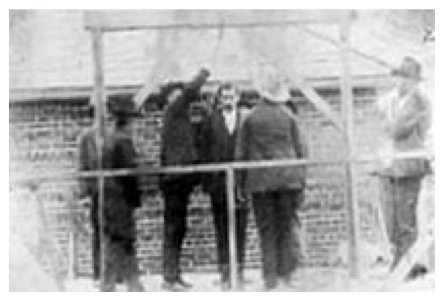
Photo said to be of hanging of one of the Molly Maguires (Photo source: Internet)
One phrase used a number of times was “Ní thuigeann an sách an seang” of which I had no previous recollection. Looking it up, I noted a number of meanings, of which the prevalent was along the lines ofthe equivalent in English of “No one knows where the shoe pinches, but he who wears it.” But a deeper examination which I found on another site (see link) gives a darker interpretation, which seems more in line with the play: “It is about more than a misunderstanding by the corpulent of the cadaverous. One variant is, “Ní thuigeann an sách an seang, nuair a bhíonn a bholg féin teann.” This literally means, the well-fed one does not understand the slender one, when his stomach is usually taut. In other words, the well-fed do not understand hunger.
“Another variant is, “Ní mhothaíonn an sách an seang.” The verb ‘mothaigh’ can be translated as either ‘feel’ or ‘hear.’ Use either English transitive verb and it suggests that the satiated simply do not care about the starved.”
There is certainly a wealth of meaning to be found in many of the pithy phrases in the Irish language.
Molly Maguire Executions marker. Schuylkill County Prison (Photo source: internet)
Twenty “Mollies” were hanged (including at least some innocent men) between 1877 and 1879 and this is sometimes said to be the largest known mass hanging of any specific group in the USA – it was not. Nor was the hanging of ten “Mollies” on the 21st June 1877 the largest hanging of one group in one day. The dubious honour for most men hanged of any group and on one day goes to the 38 Dakota Native Indians who were hanged on December 26, 1862. However, the Dakota were hanged by the US military and the “Mollies” were tried in civil courts, so the Mollies can claim the most judicially executed in the USA of one group as well as on one day.
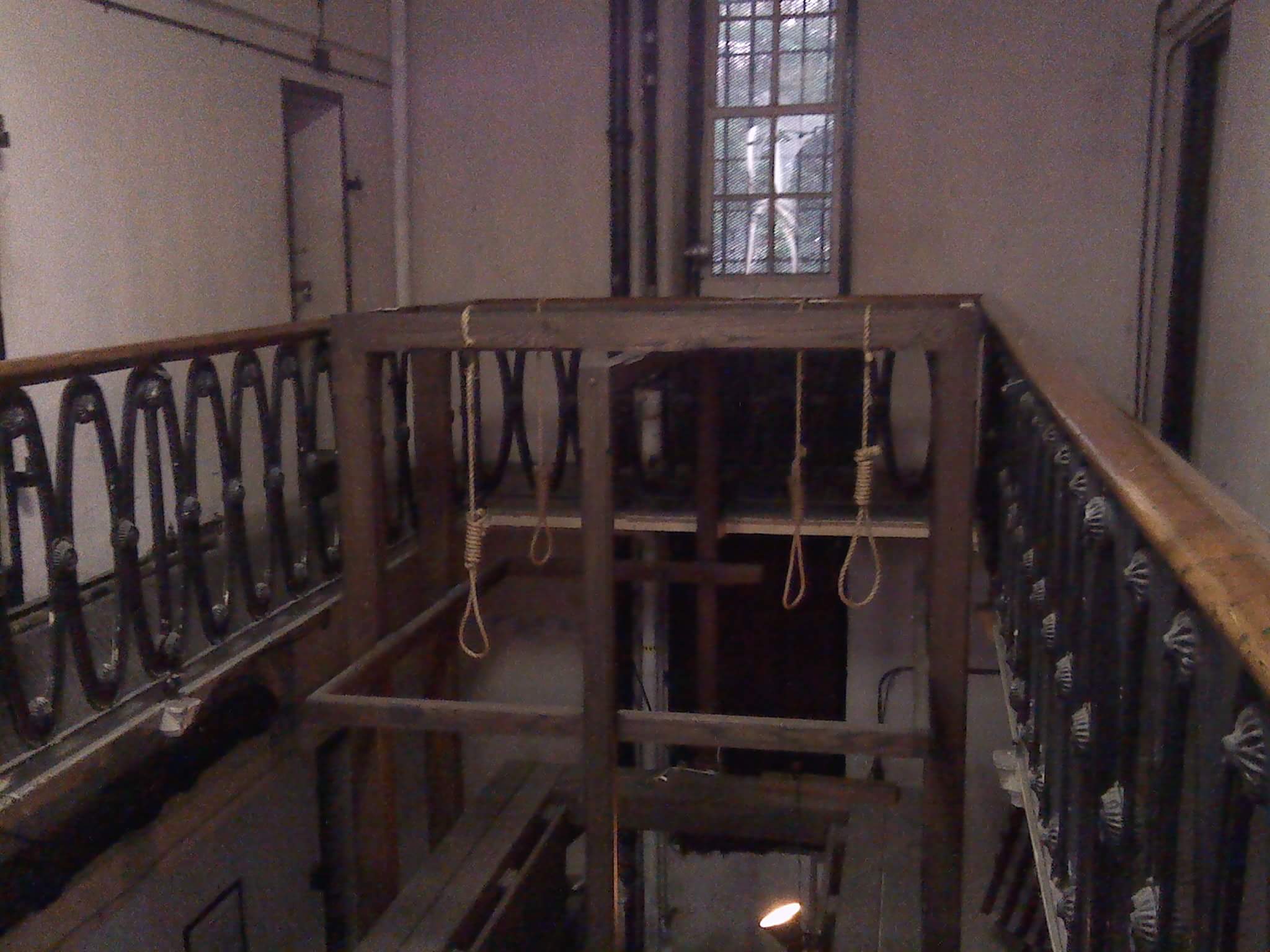
Hanging place perhaps in Mauch Chunk jail, Pennsylvania, USA. (Photo source: Internet)
The play’s showing in Liberty Hall was its first on an Irish stage for John Kearns‘ play “Sons of Molly Maguire” but it has previously been performed at the Midtown International Theatre Festival in New York. John Kearns is the Treasurer and Salon Producer for Irish American Writers and Artists. He is the author of the short-story collection, Dreams and Dull Realities and the novel, The World, along with plays including “In the Wilderness”and “In a Bucket of Blood”.
The play received an enthusiastic reception from the audience. Raging you missed it? Don’t worry – you can still catch it tomorrow/ today, that is Thursday 11th May as part of Mayfest at the Liberty Hall Theatre.
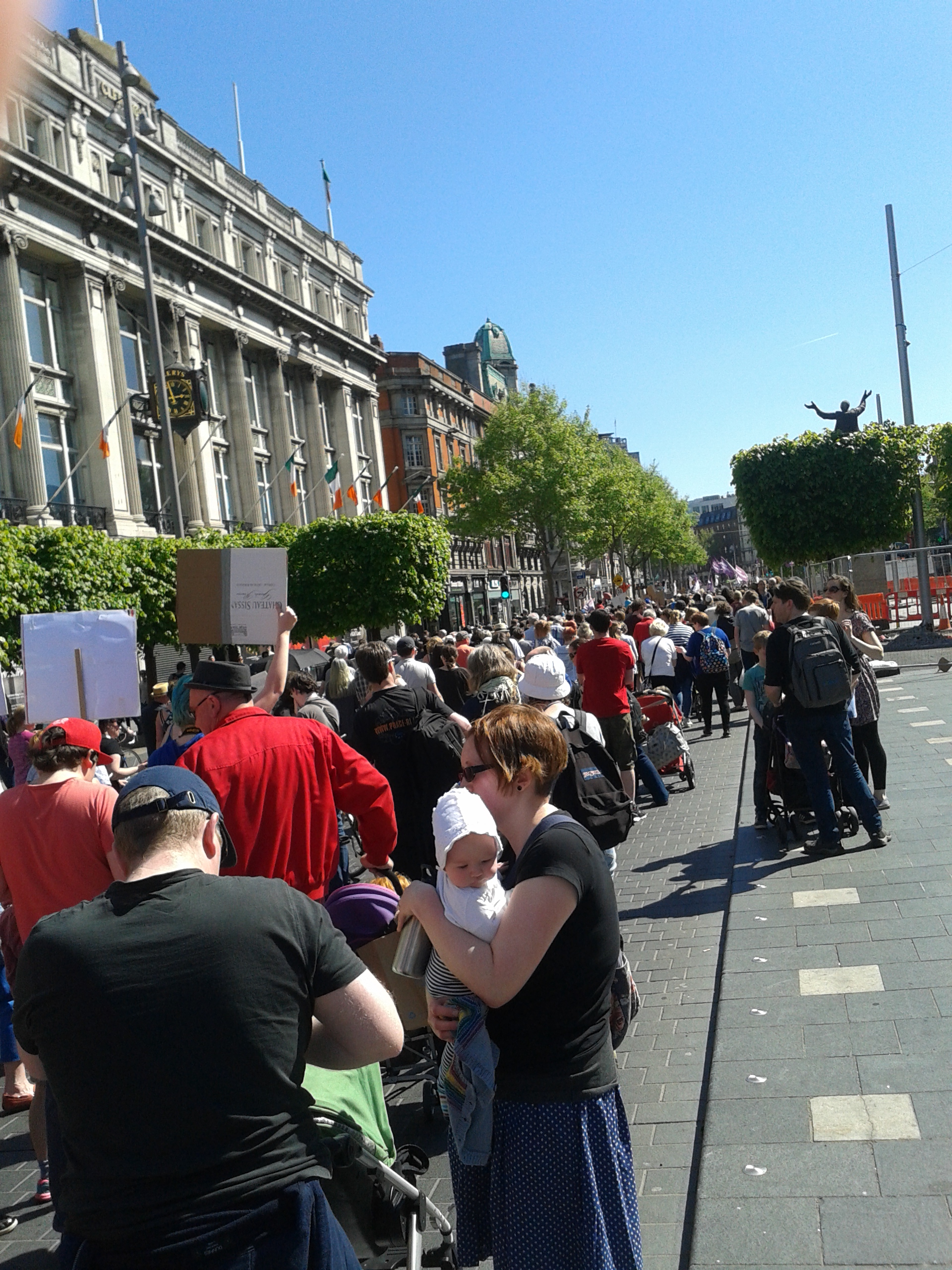
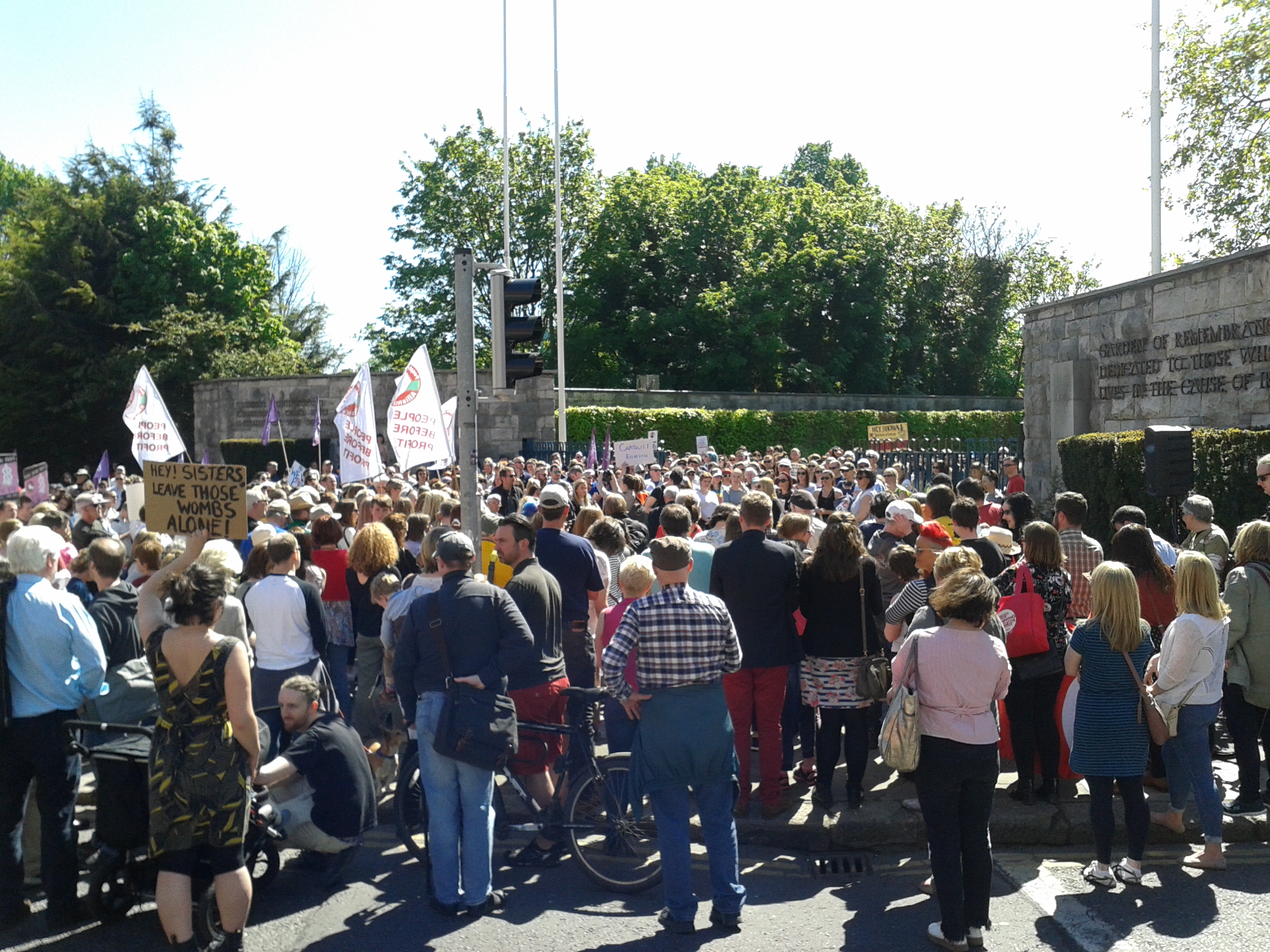
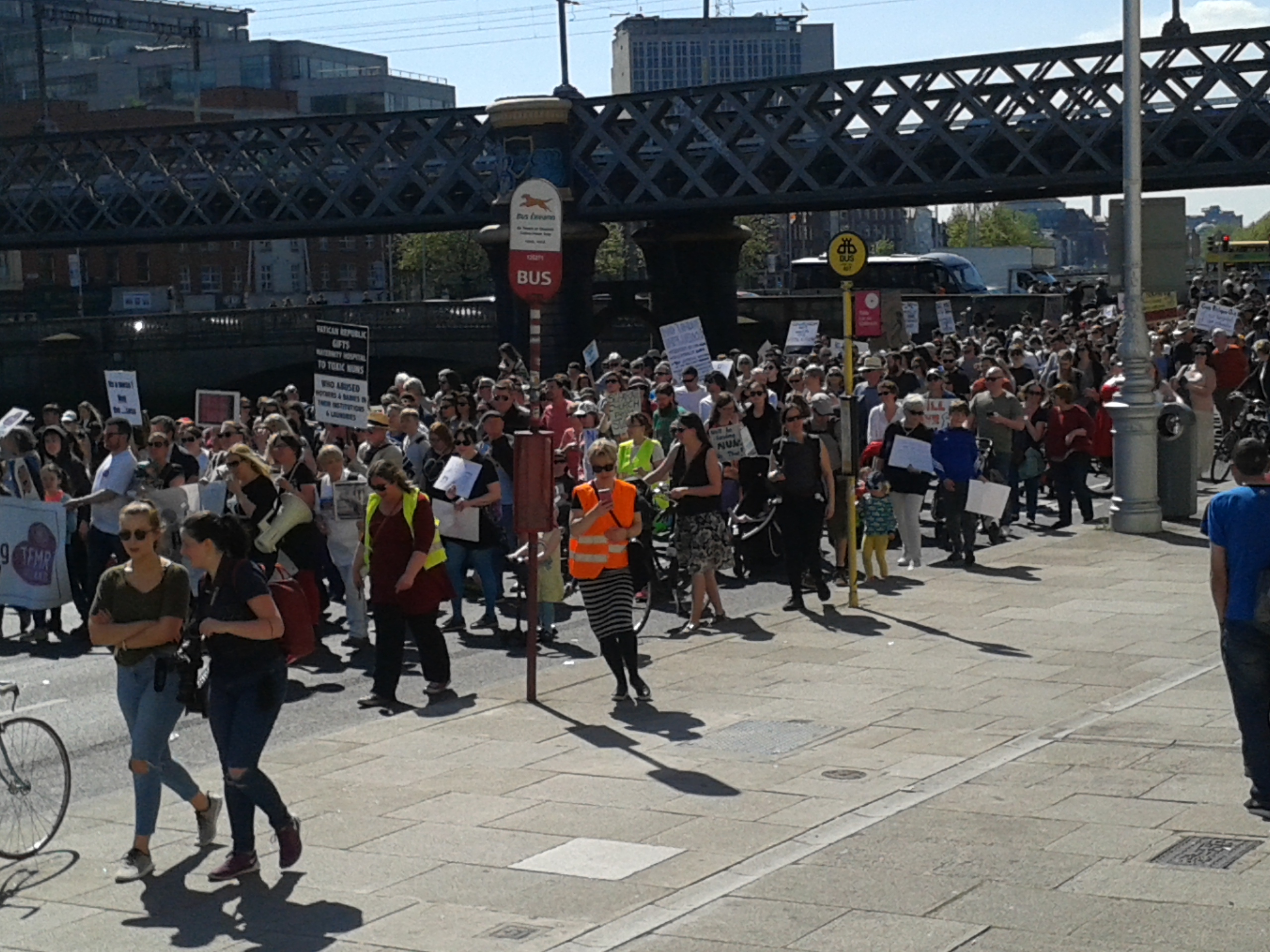
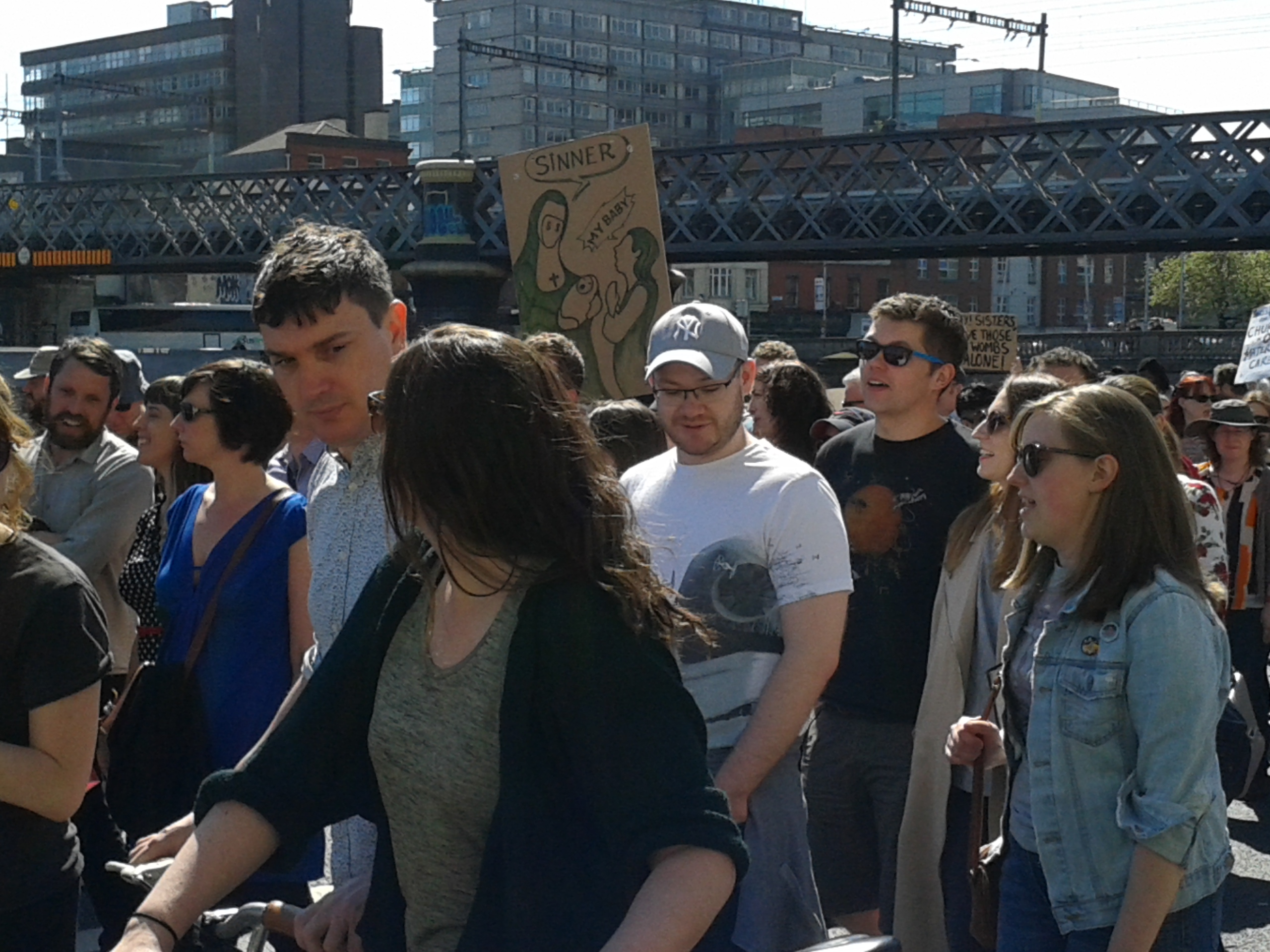
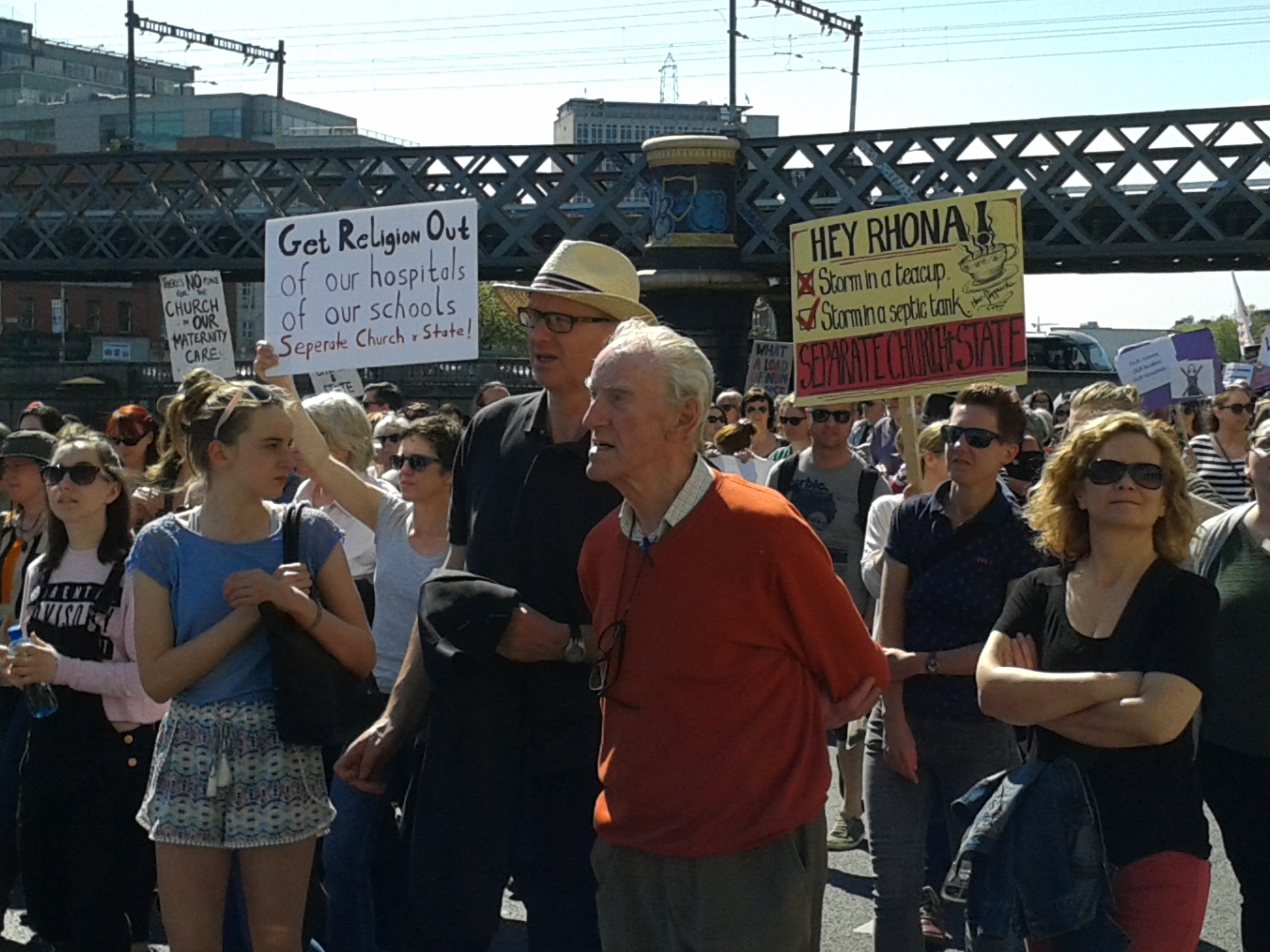
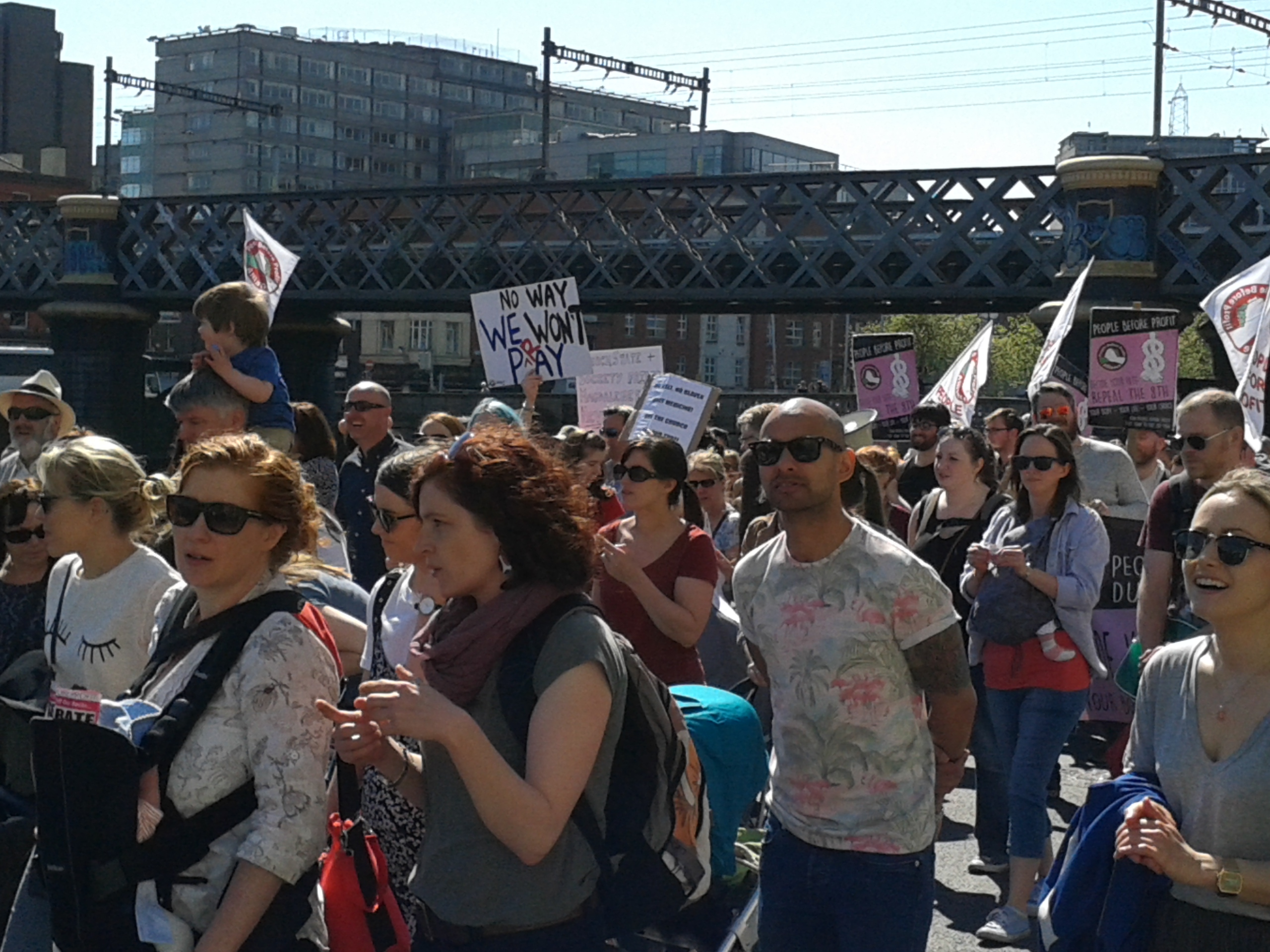
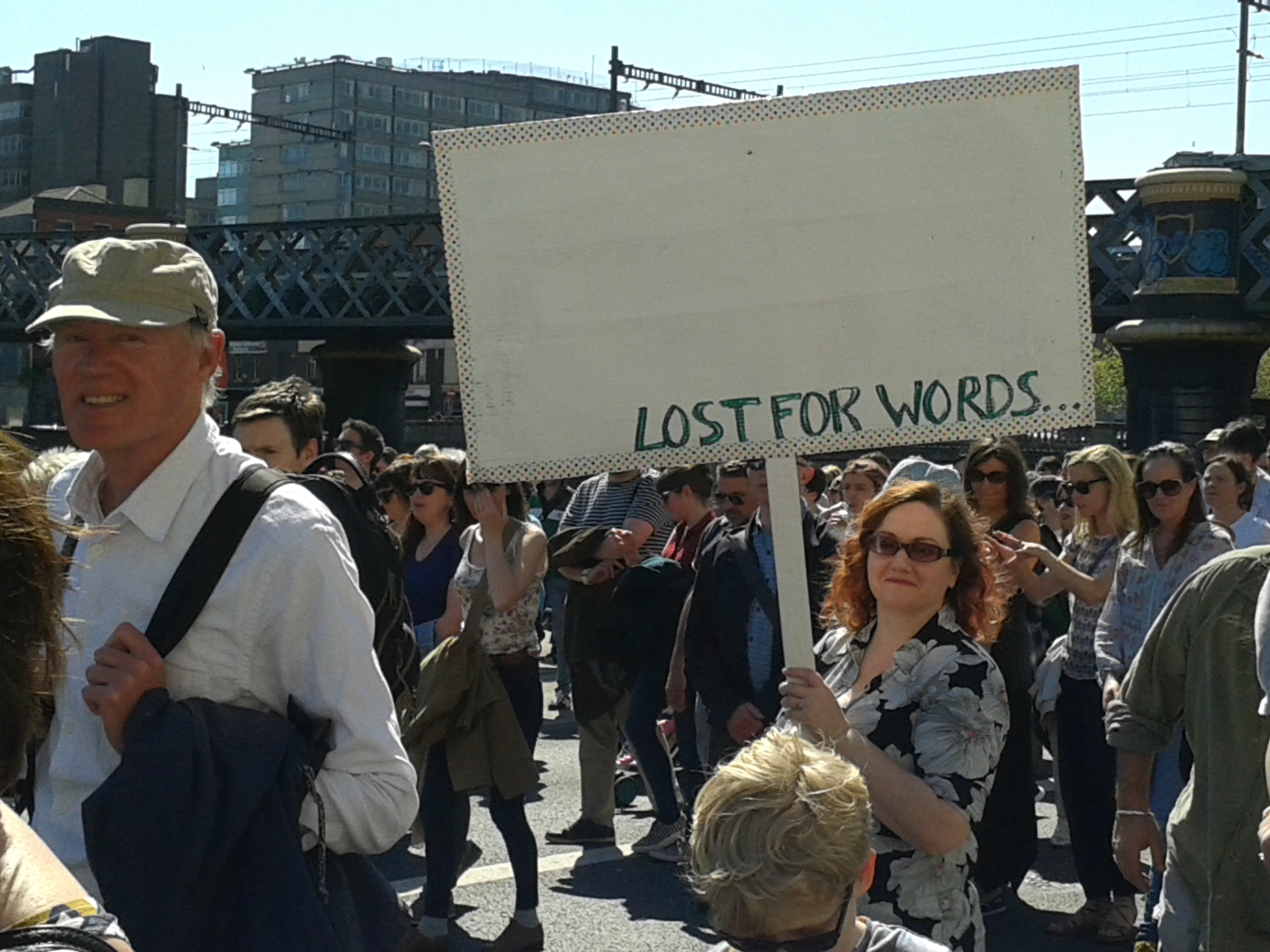
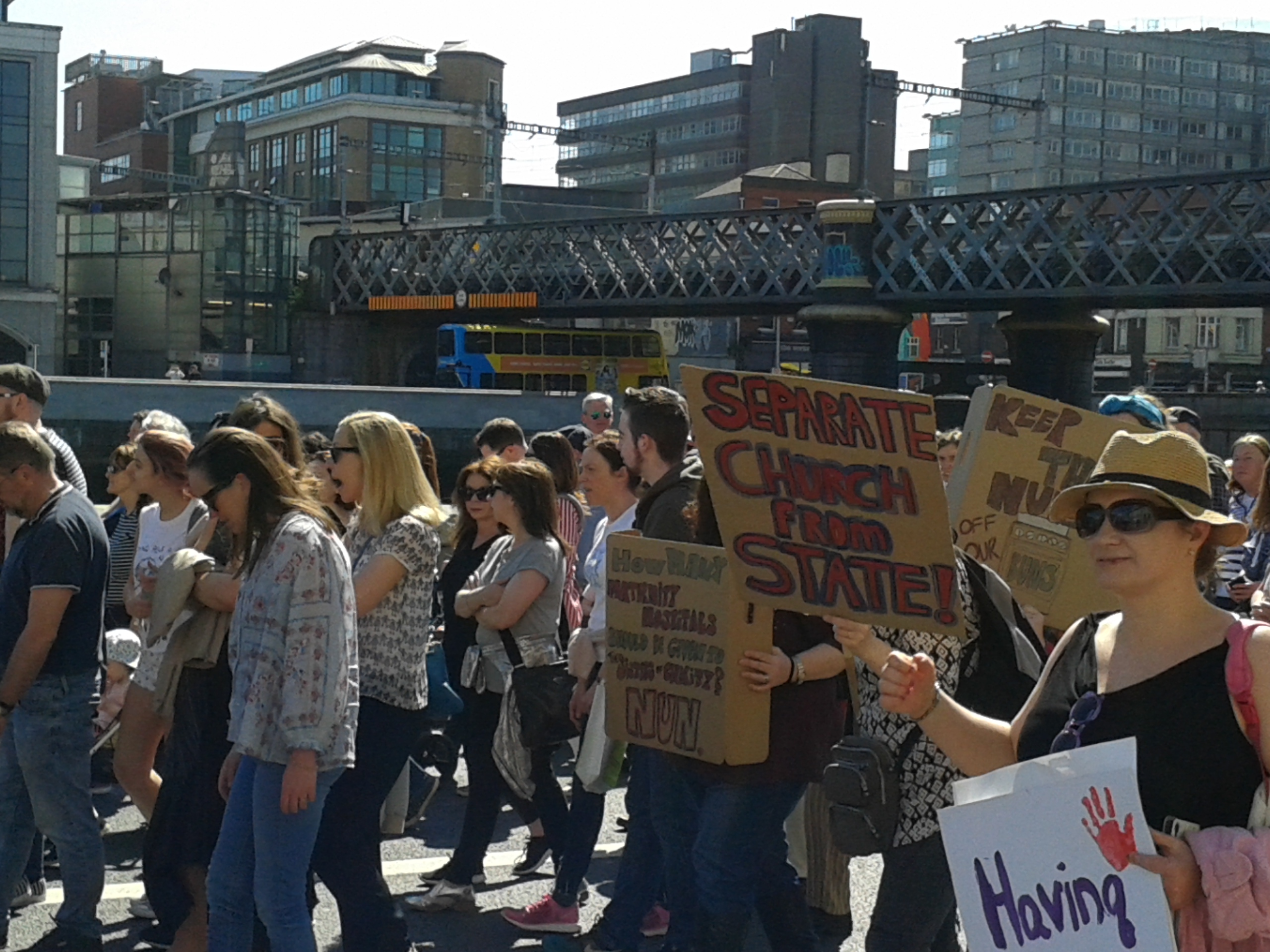
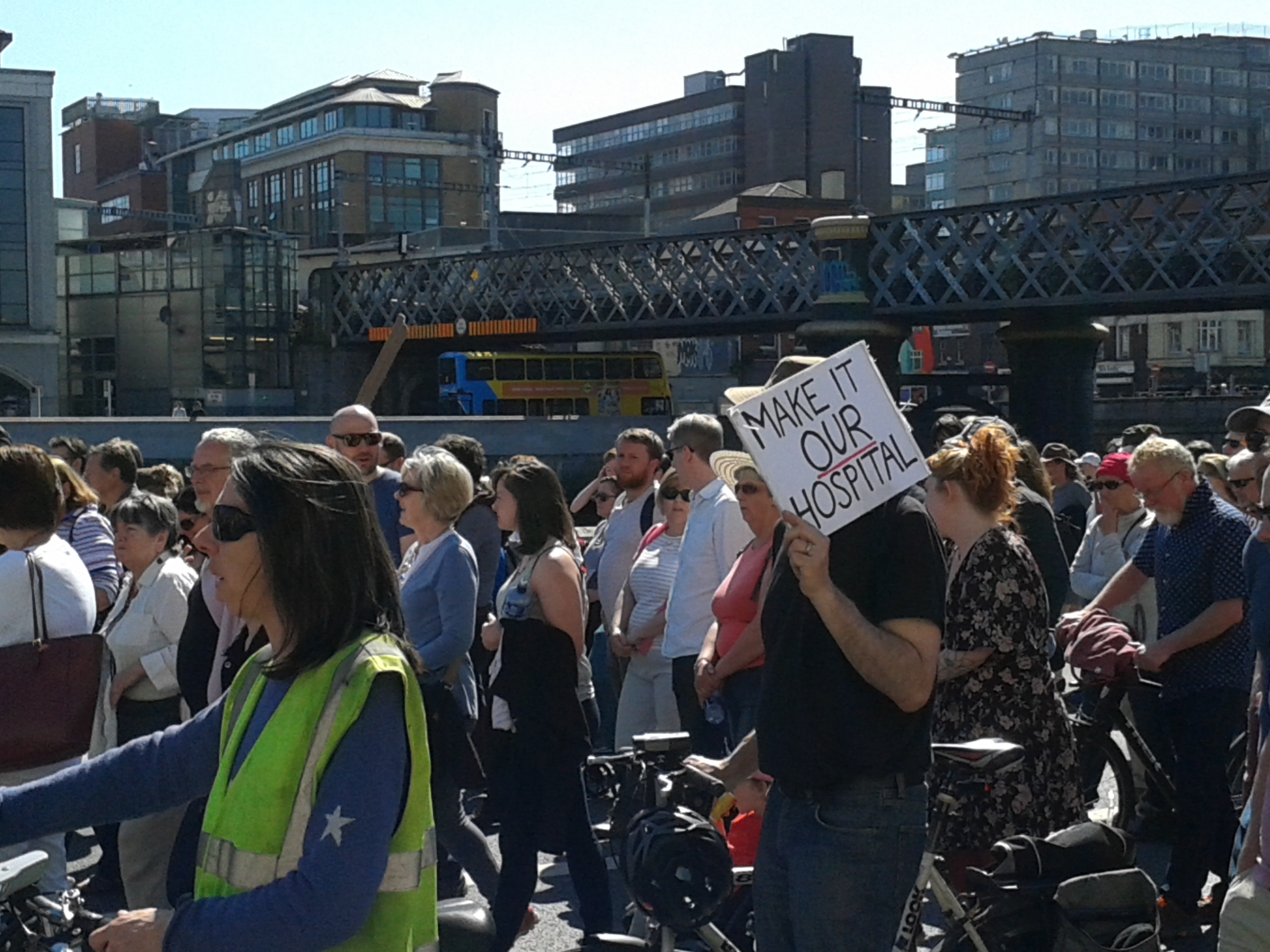
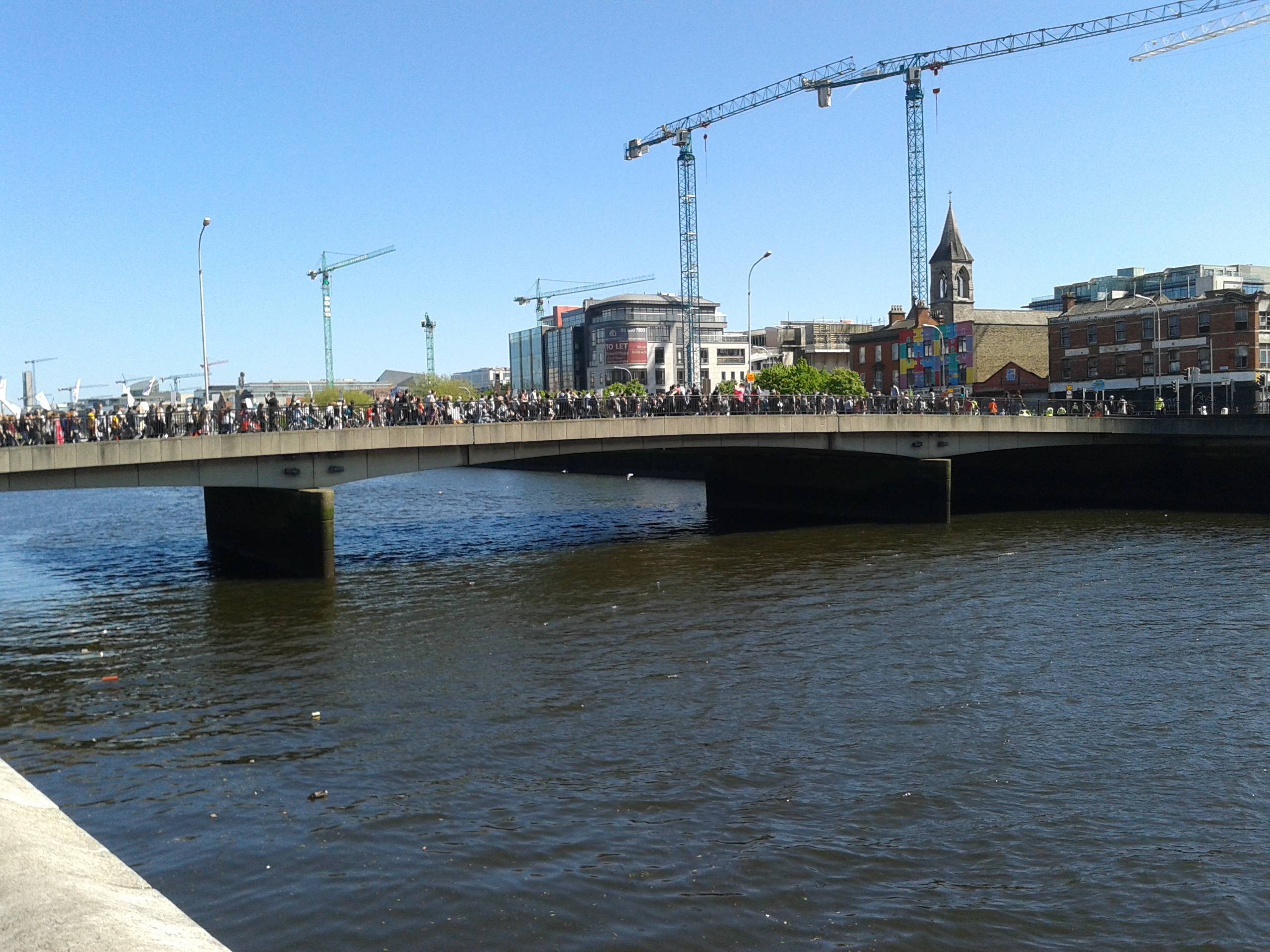
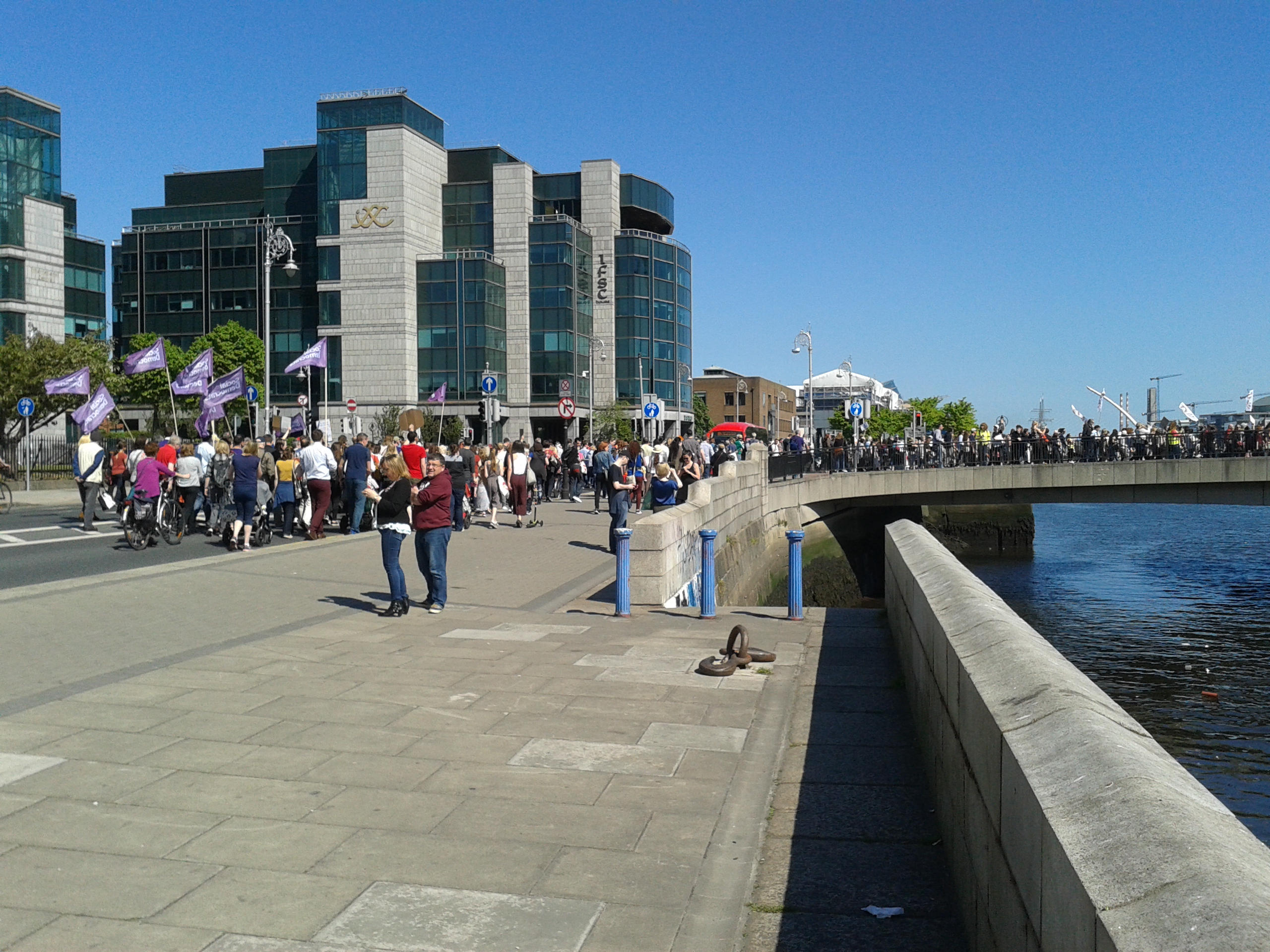
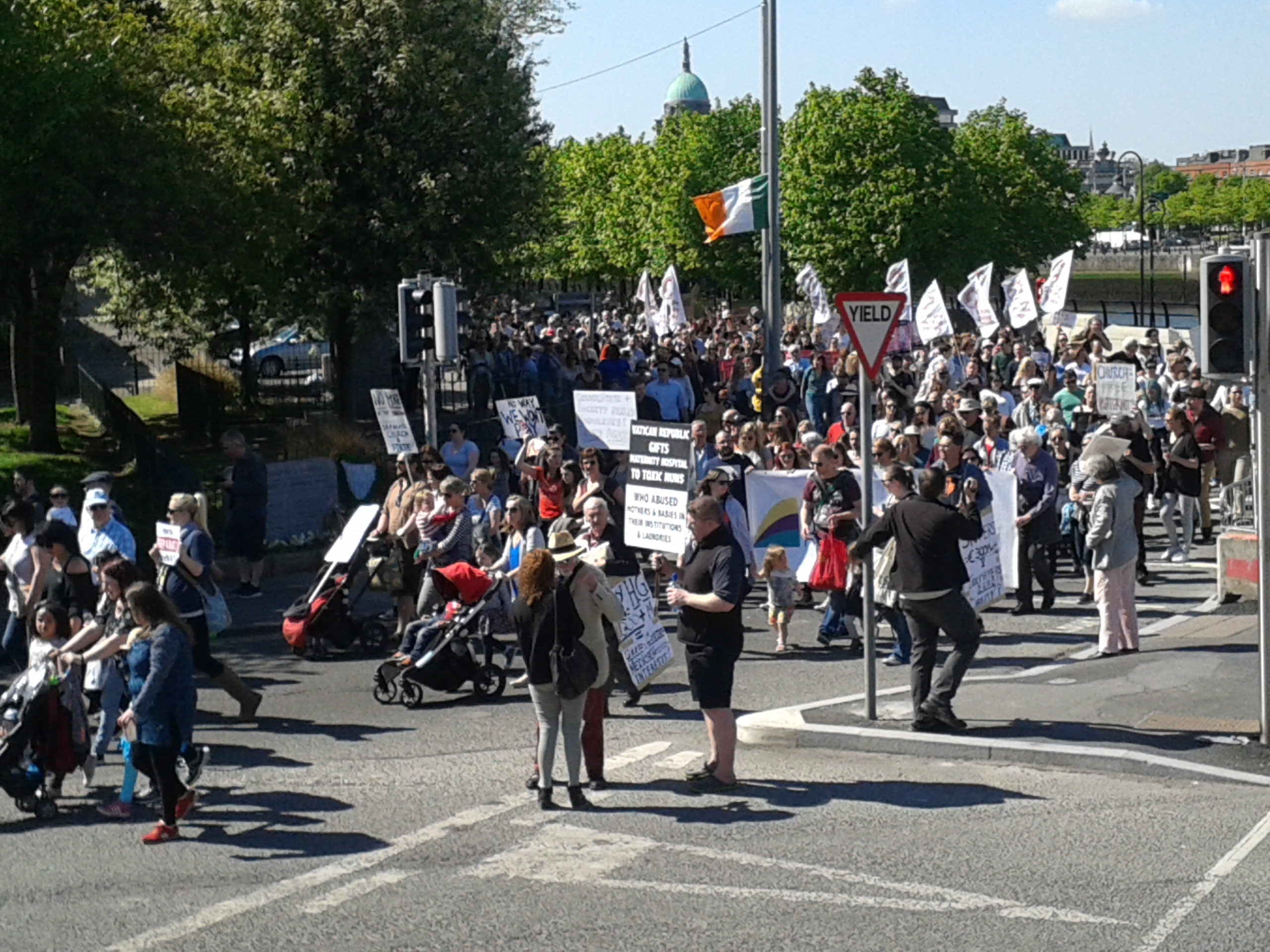
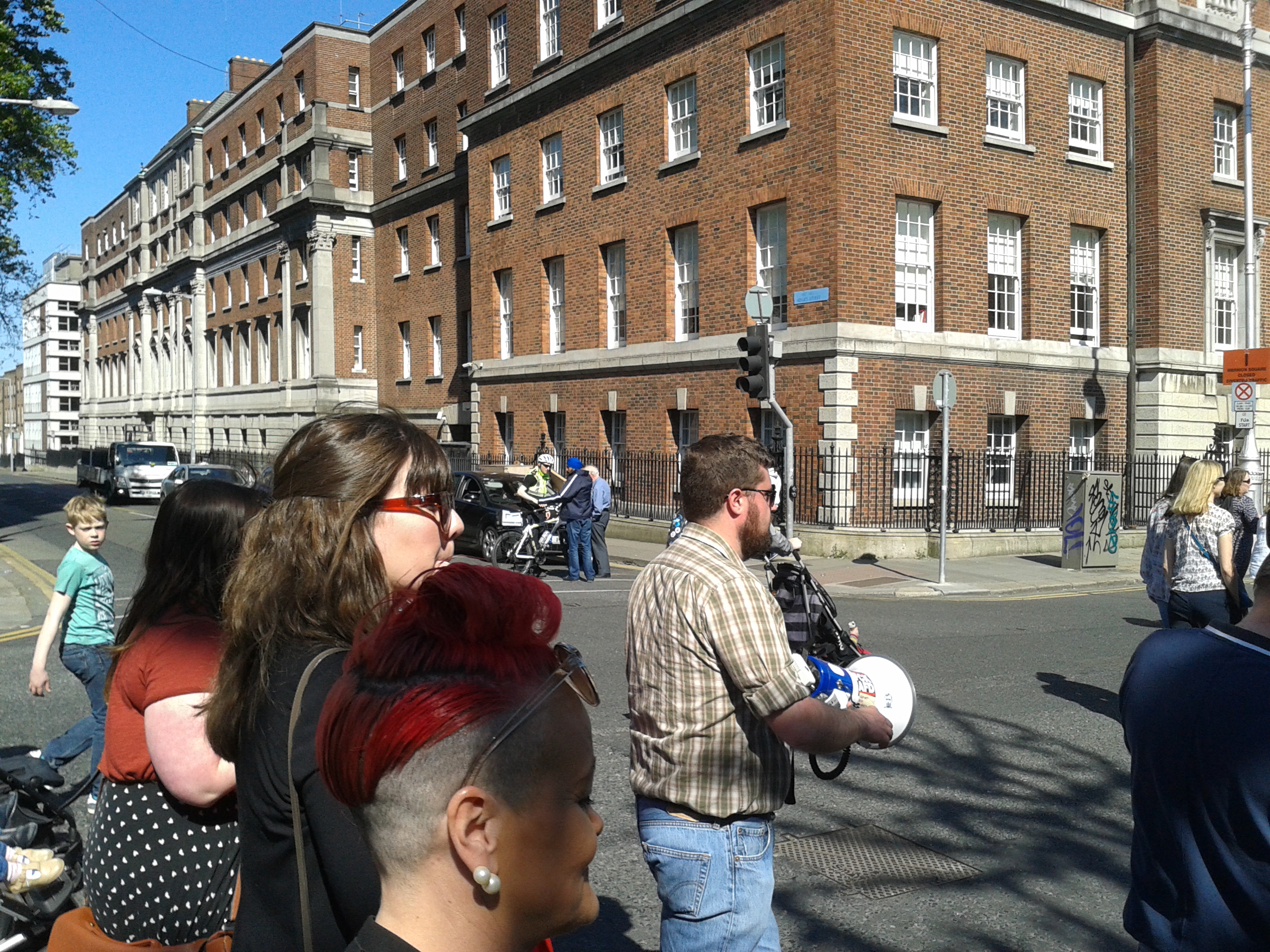
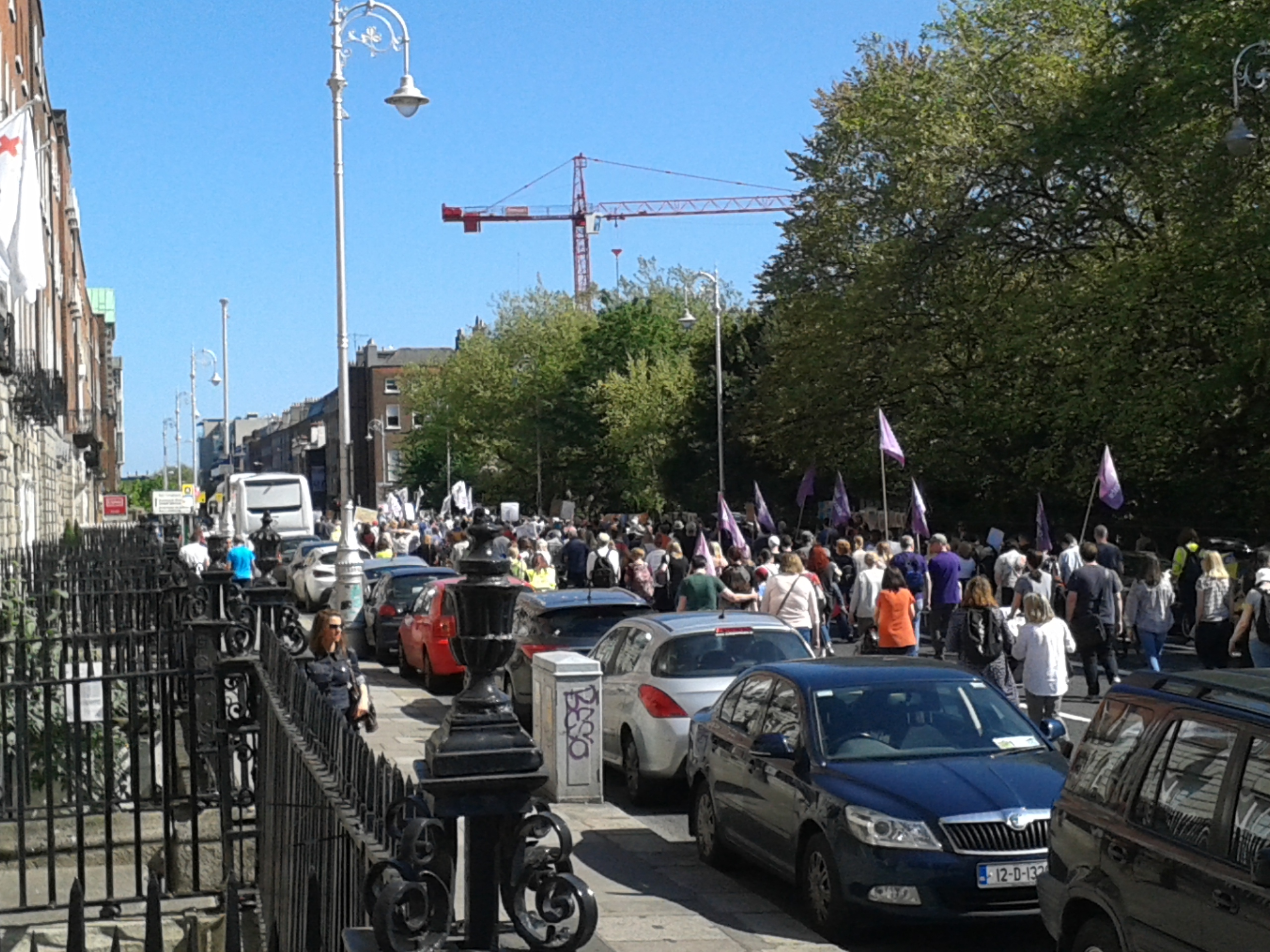
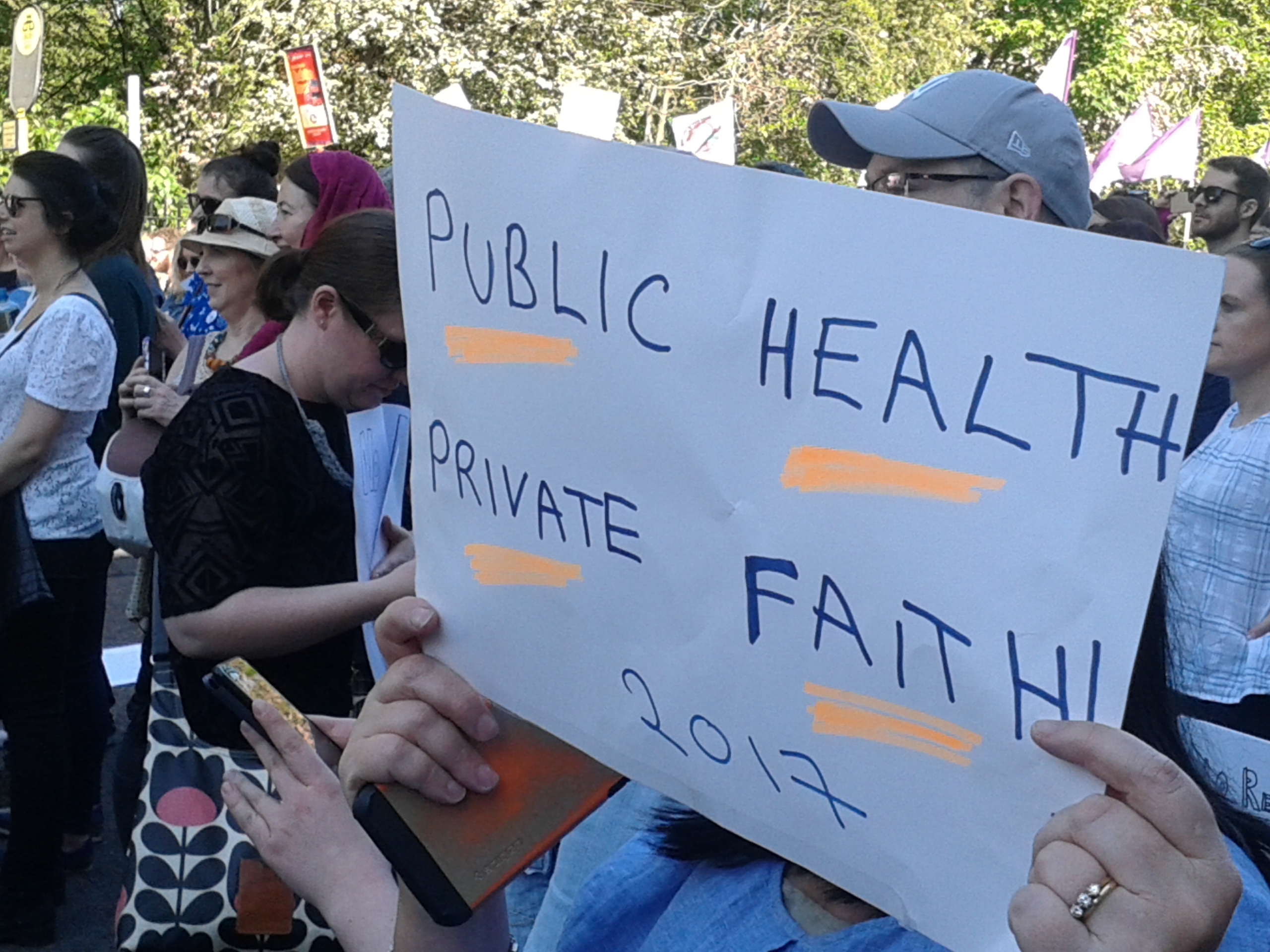
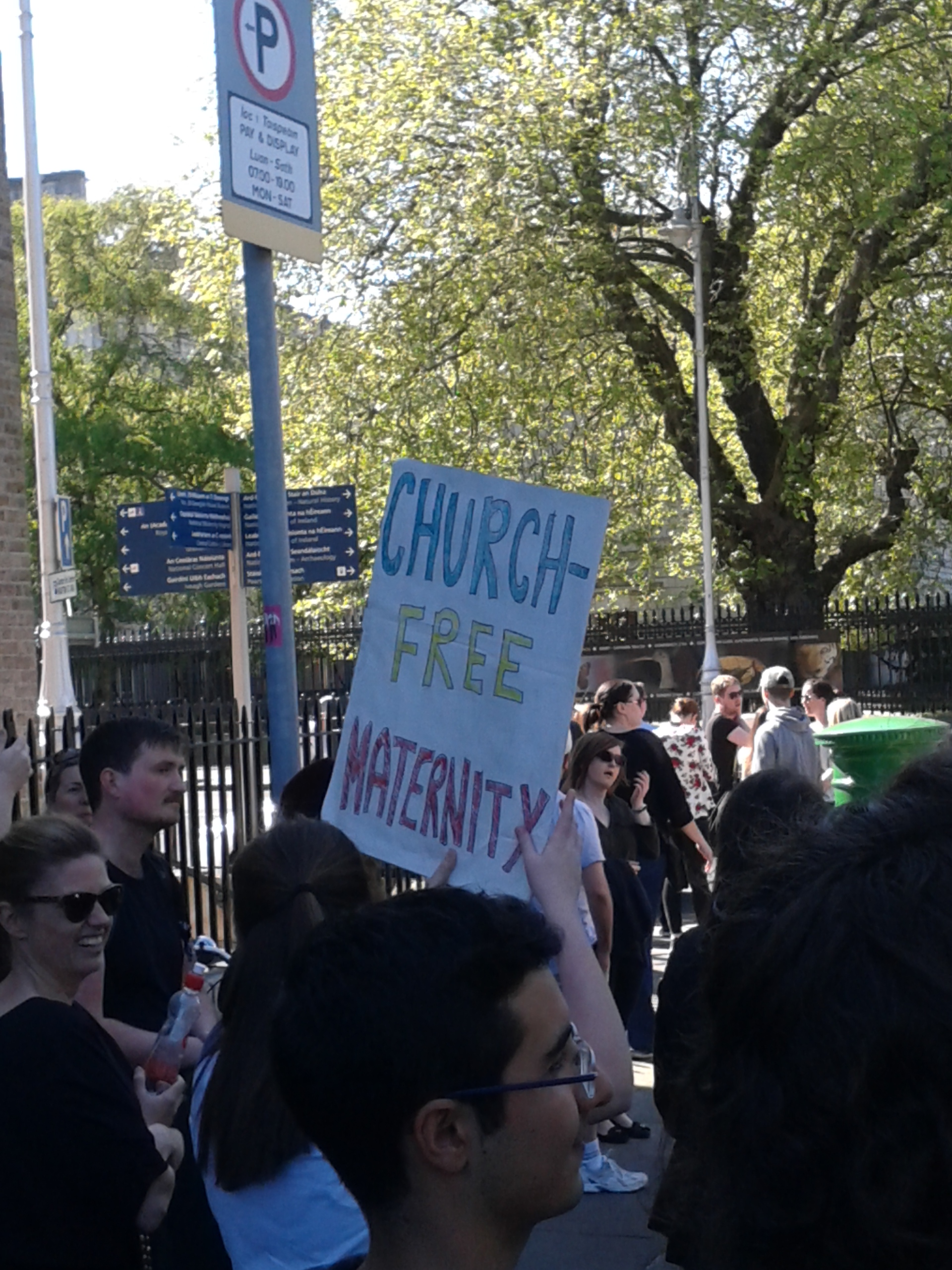
Tens of hundreds, mostly women but also containing some men and couples with children, gathered in bright sunshine today at the Garden of Rembrance and then marched through O’Connell Street in Dublin’s city centre. They continued along the northside quays and across Talbot Memorial Bridge, up past Pearse Station (where Constance Markievicz was welcomed by a huge crowd upon her release from British jail in 1917), then past Hollis St. Hospital to end at the south side of Merrion Square.
Marching along O’Connell Street. (Photo: Rebel Breeze)Rally to start at Garden of Remembrance (Photo: Rebel Breeze)
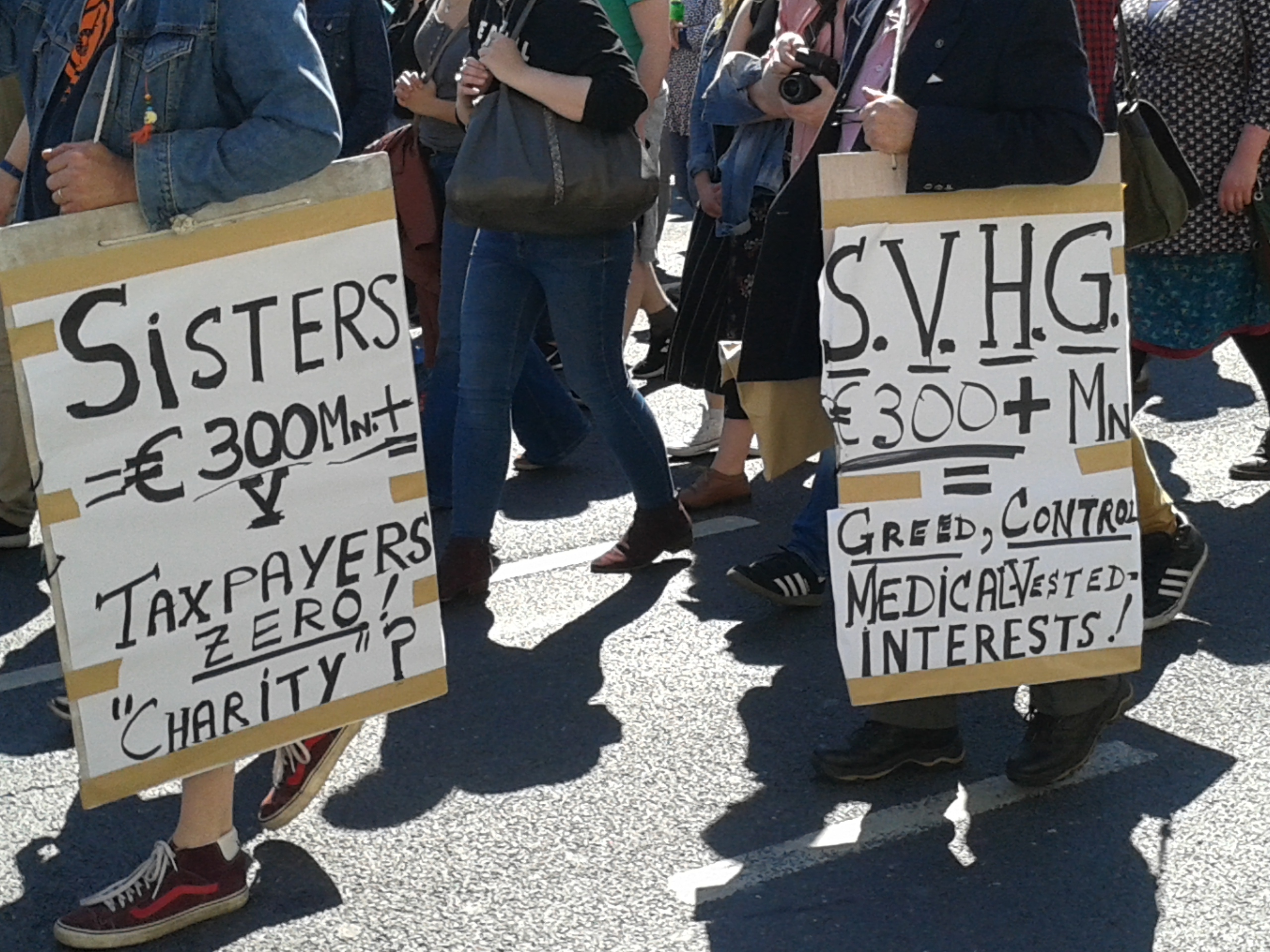
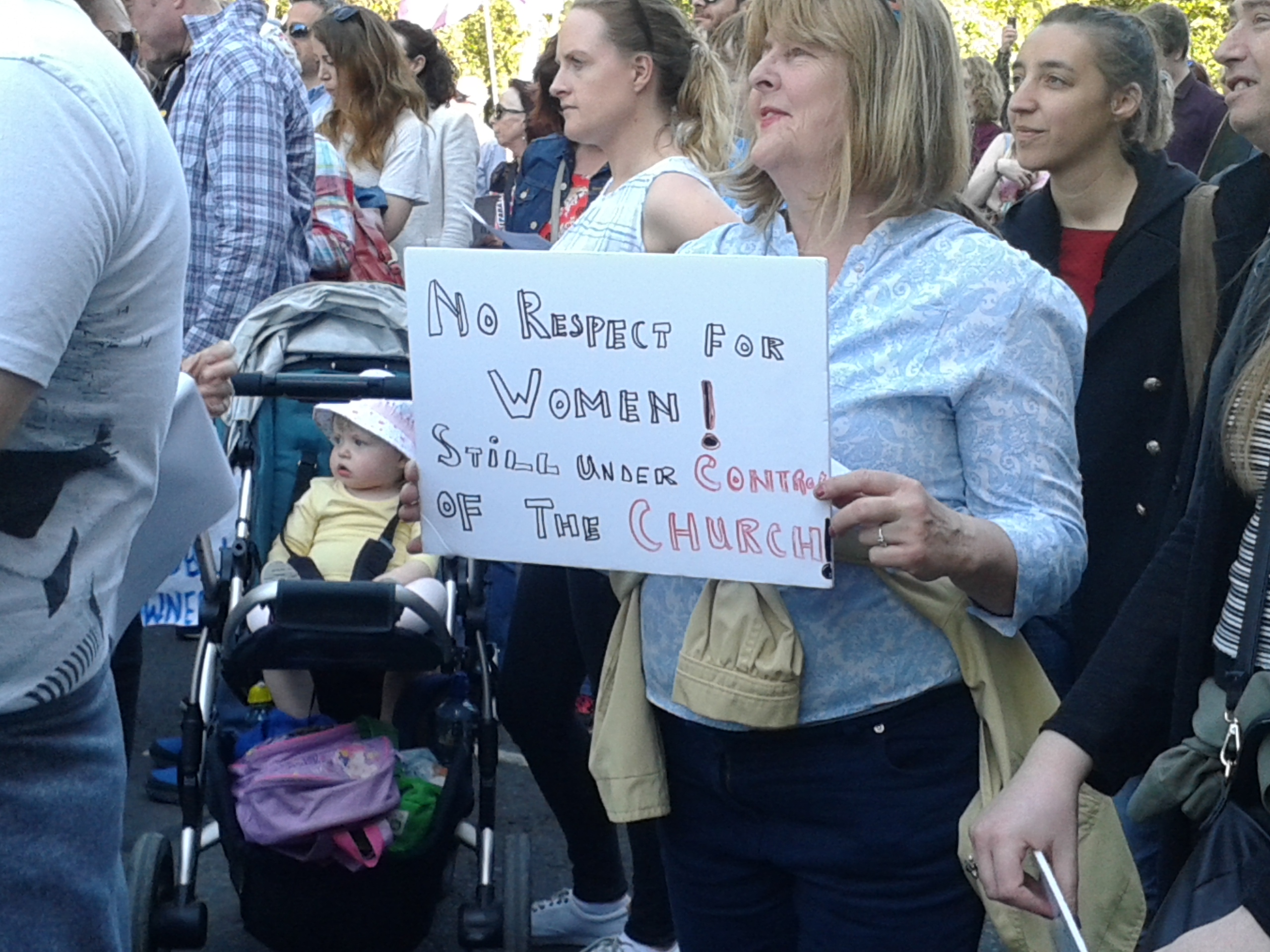
The event was organised by a coalition of Parents for Choice, Uplift, the National Women’s Council of Ireland and Justice for Magdalenes “to send a loud clear message to Health Minister Simon Harris”. The march was part of the ongoing protests against the ownership of the new National Maternity Hospital being given to the religious order the Sisters of Charity but also, as at least one speaker made clear, about the long history in the 26-County state of health services being provided by a combination of Catholic Church and State. Some others on the demonstration made the point that hospitals should be publicly owned and controlled.
Heading east under railway bridge at Butt Bridge. (Photo: Rebel Breeze)
A petition containing 103,700 signatures – on 50 meters of paper was carried by protesters- demanding that the €300m taxpayer-funded hospital be taken into public ownership. The viral petition had been hosted by campaign organisation Uplift and was printed on 50 feet sheets of card, which was laid out like a path on the approach to the rally’s stage.
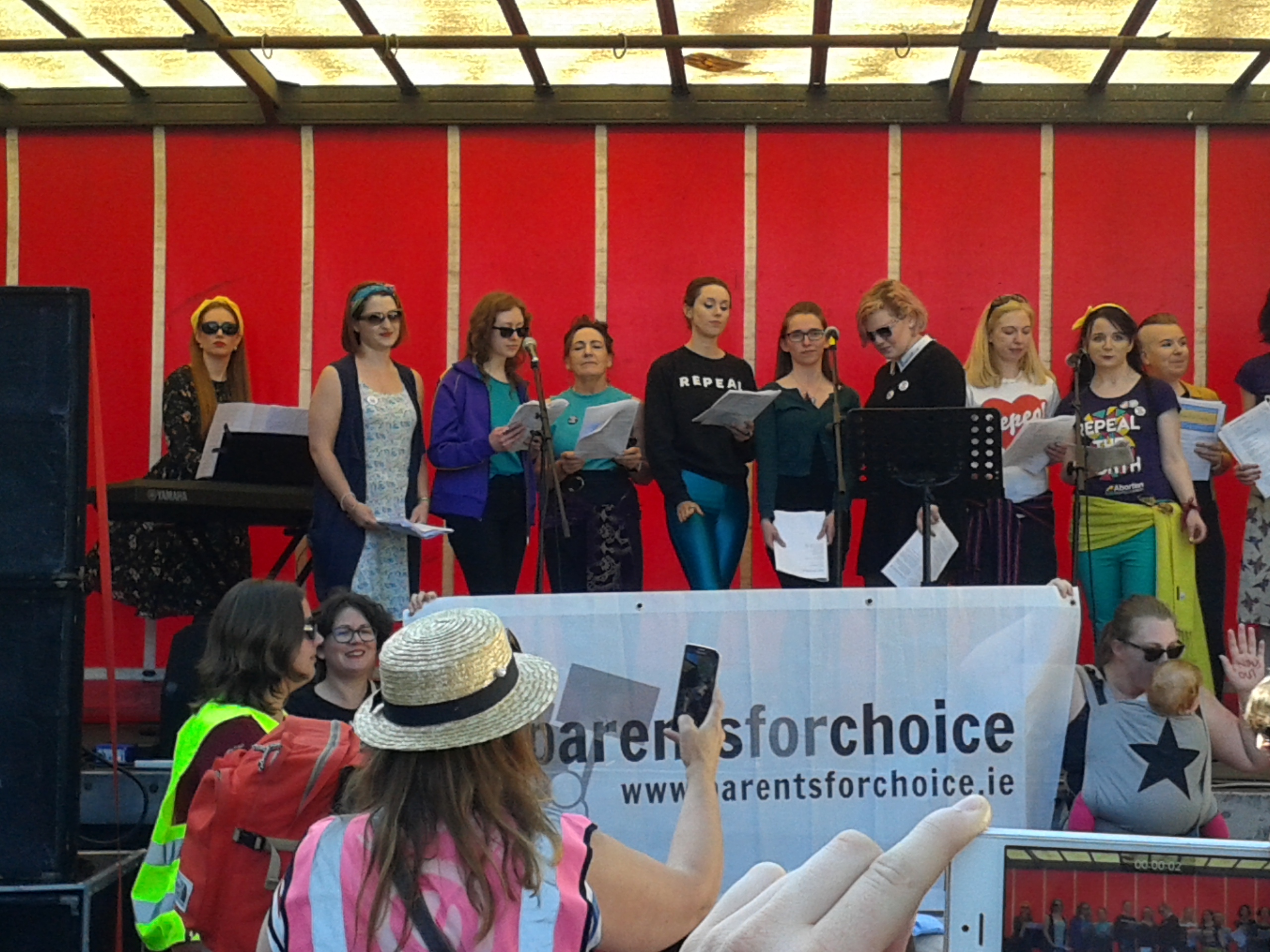
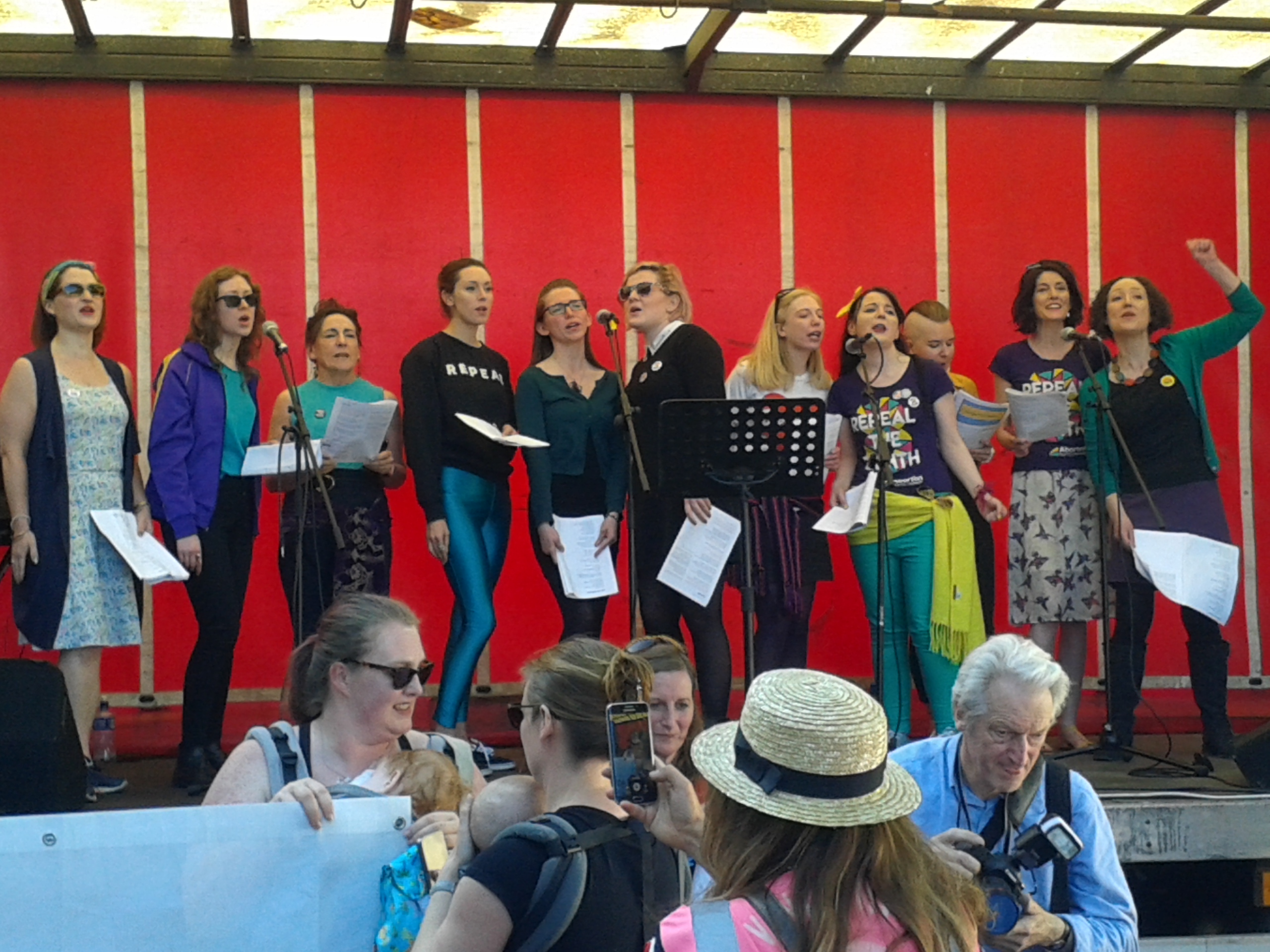
An all-women group called the Repeal Choir sang a number of songs before the speeches at the rally; one of their number announced that they had been formed only a few weeks earlier and they sang with gusto.
(Photo: Rebel Breeze)(Photo: Rebel Breeze)(Photo: Rebel Breeze)(Photo: Rebel Breeze)(Photo: Rebel Breeze)Crossing Talbot Memorial Bridge (Photo: Rebel Breeze)End of march approaching Talbot Memorial Bridge (Photo: Rebel Breeze)Lombard St. and quay junction. (Photo: Rebel Breeze)
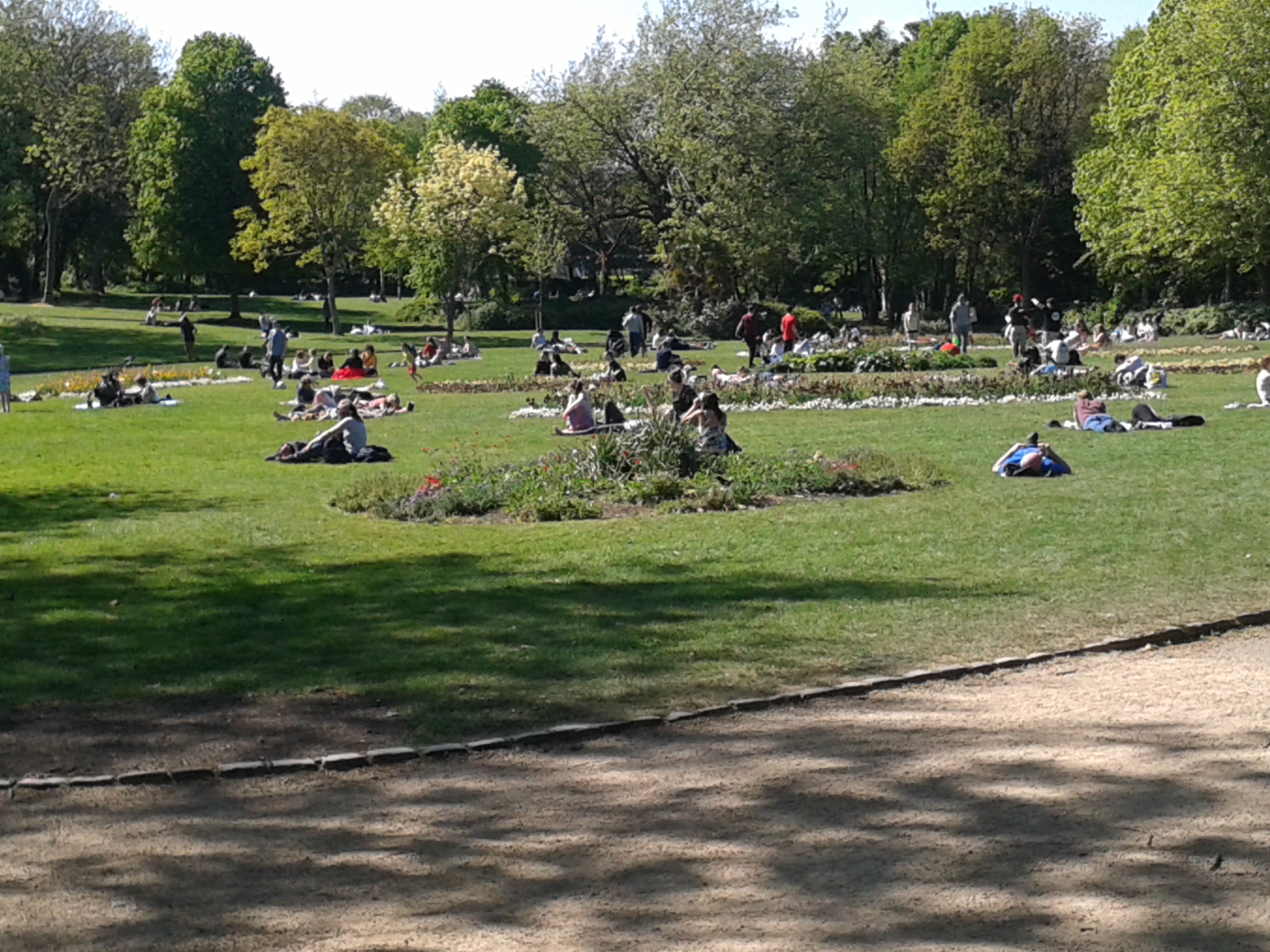
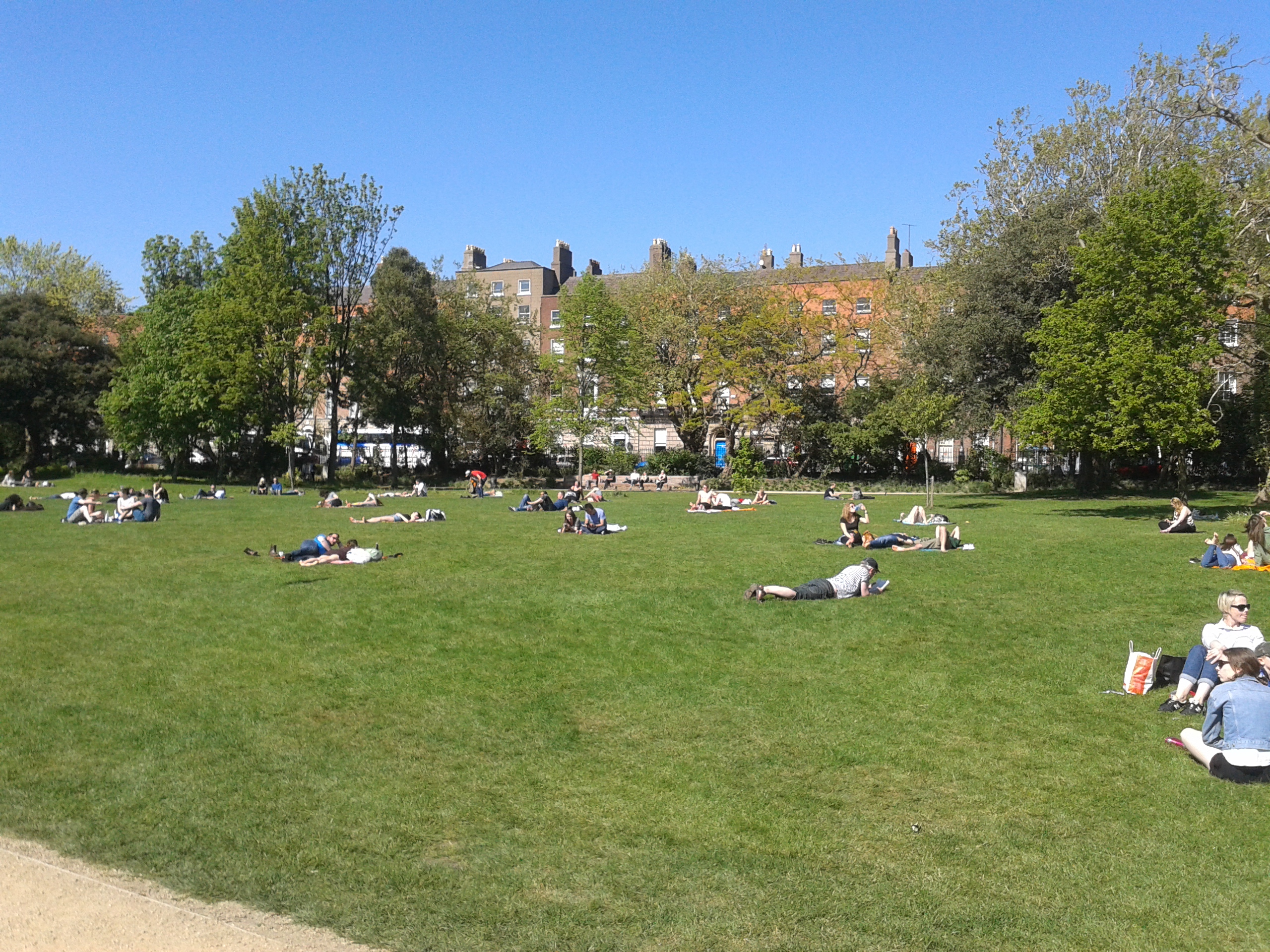
Hollis St and its Hospital. (Photo: Rebel Breeze)Not on the march — sunning themselves in Merrion Square park (Photo: Rebel Breeze)Not on the march — sunning themselves in Merrion Square park (Photo: Rebel Breeze)Not on the march — sunning themselves in Merrion Square park (Photo: Rebel Breeze)Hollis St. Hospital front facing Merrion Square. (Photo: Rebel Breeze)(Photo: Rebel Breeze)
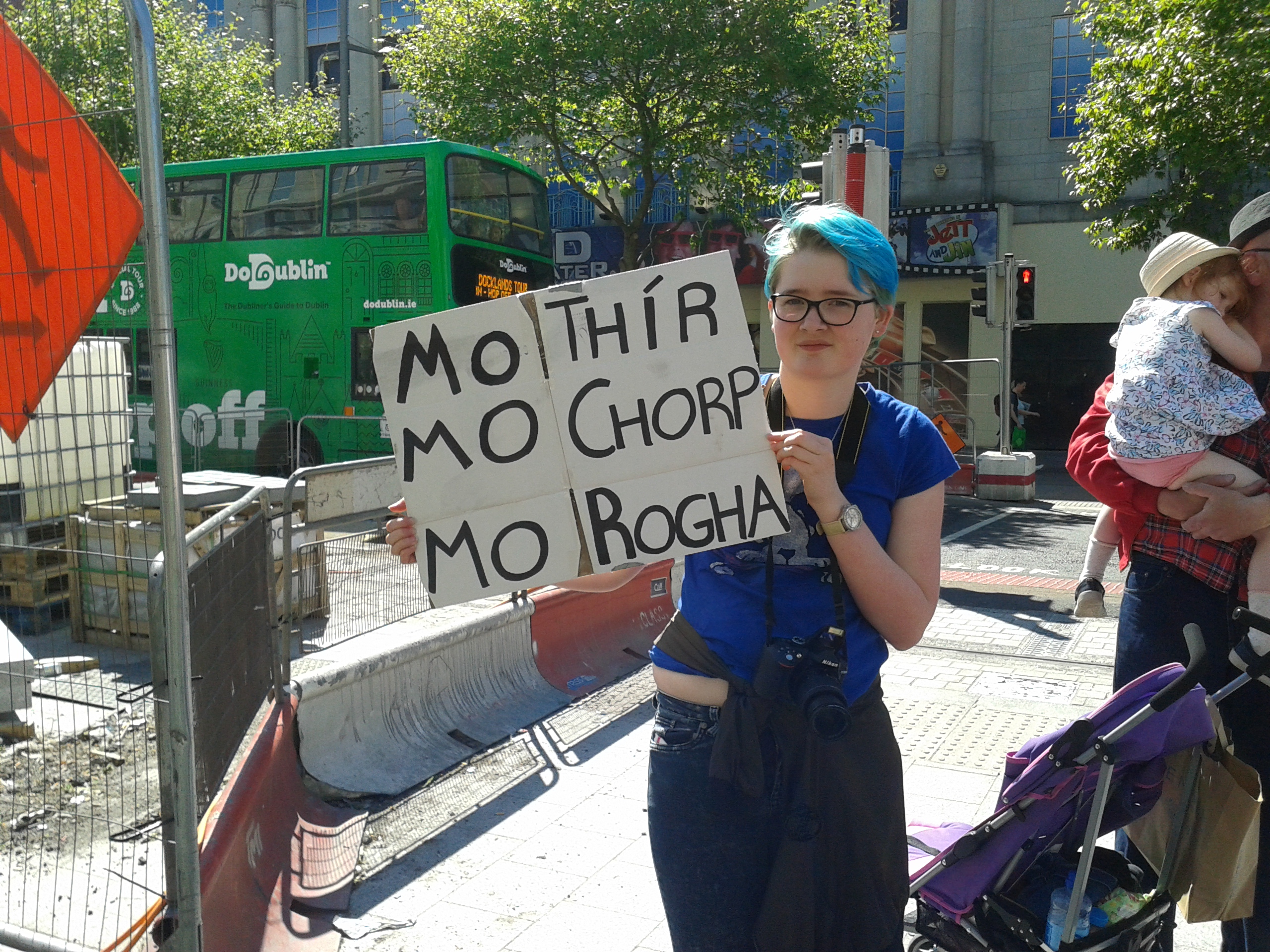
(Photo: Rebel Breeze)The only placard in Irish on the march (Photo: Rebel Breeze)(Photo: Rebel Breeze)(Photo: Rebel Breeze)The Repeal Choir (Photo: Rebel Breeze)
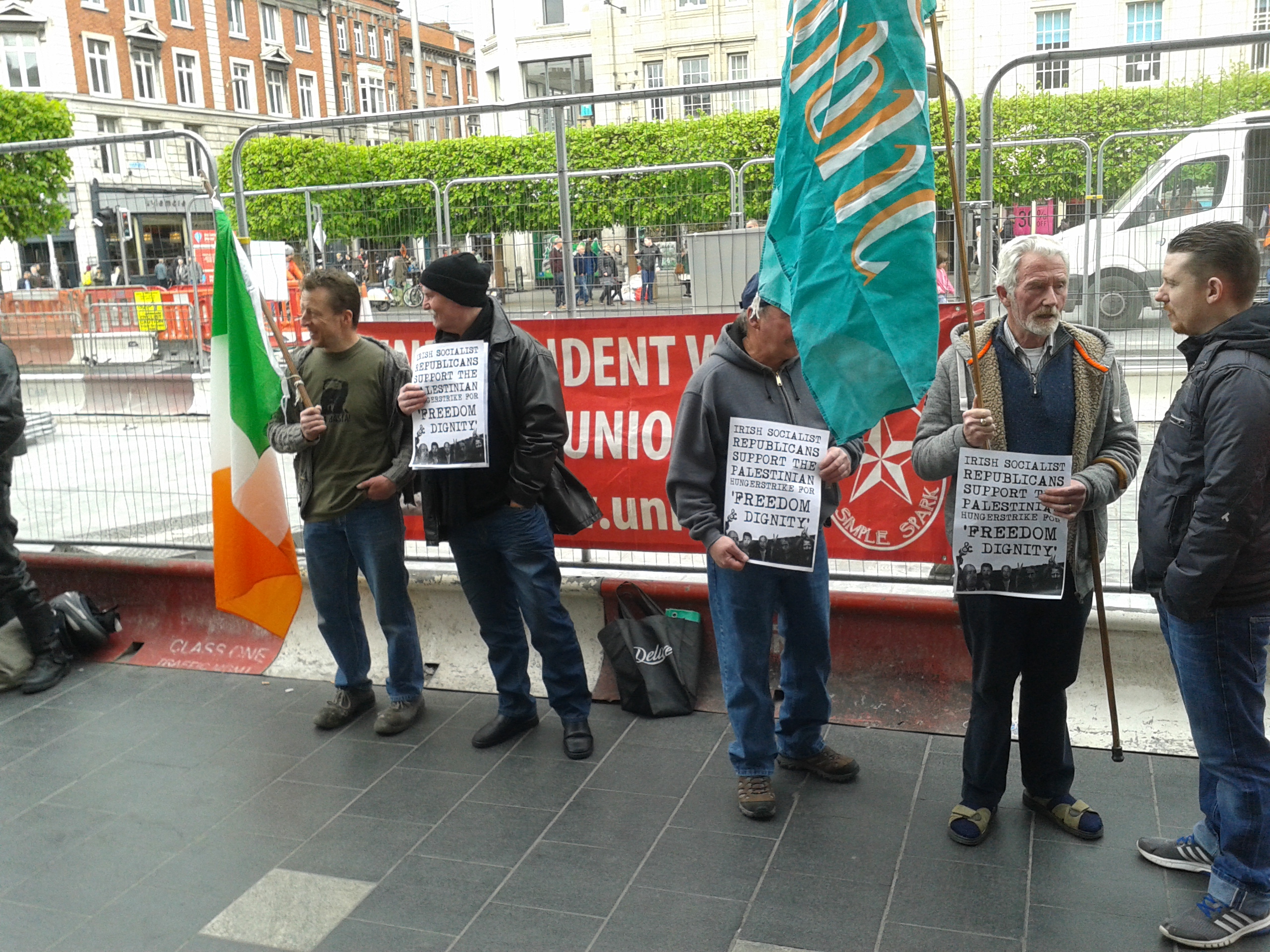
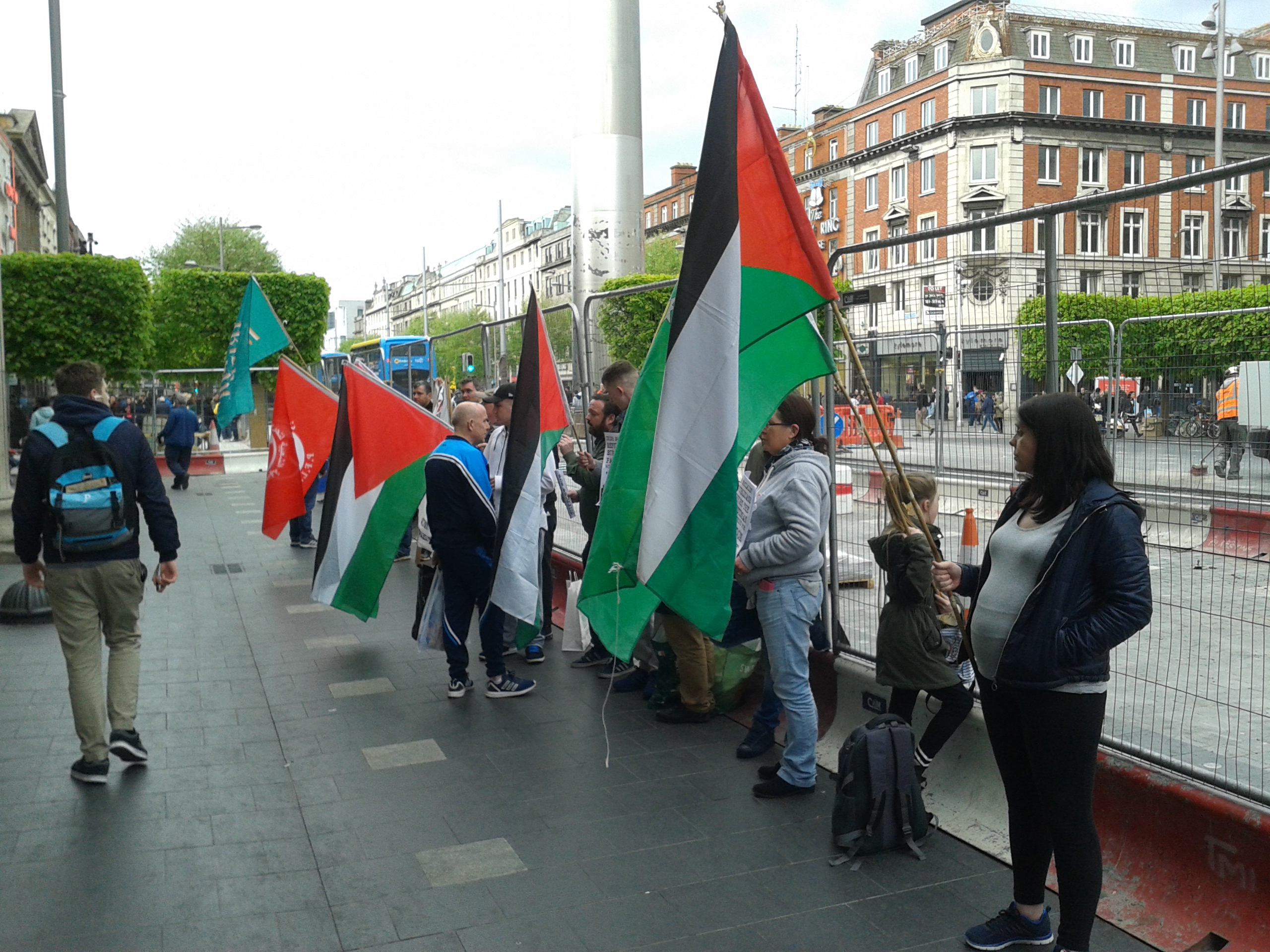
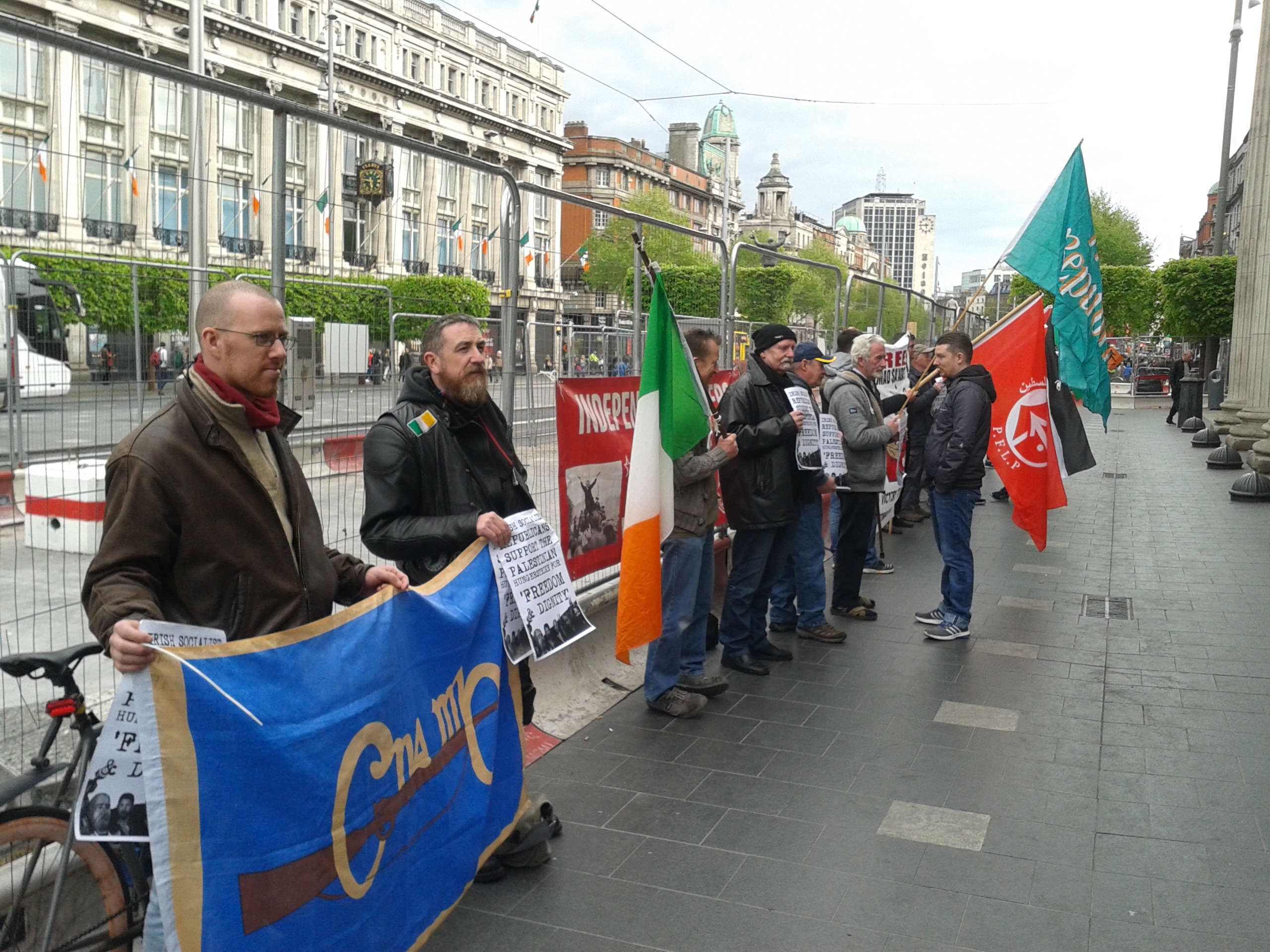
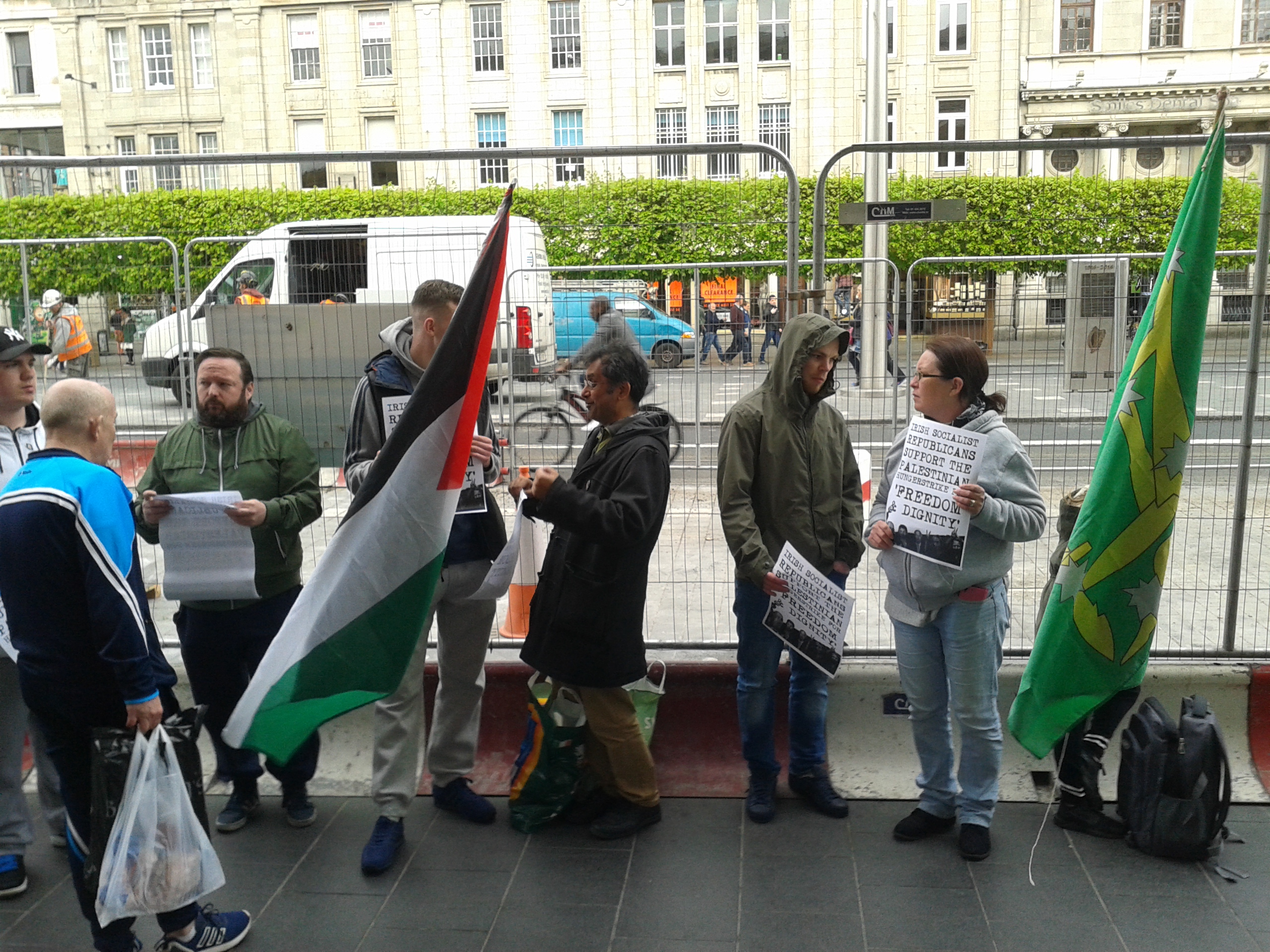
1,500 Palestinian prisoners are in their third week of a hunger strike for dignity: their demands include rights to visits and increase in family visits, access to telephone calls to family and friends and end of solitary confinement. Visits are a particular issue since although the Israeli authorities permit visits every fortnight in theory, they require Palestinians in the occupied territories to obtain permits before permitting them entry to the Israeli state, which is where the prisoners are being held and these are often refused or delayed. Protests and other actions in solidarity with the Palestinian hunger strikers have been and are taking place around the world.
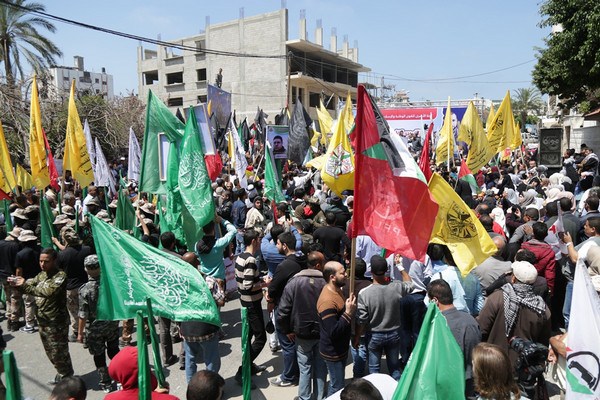
Demonstration in Gaza, joining different groups — worth watching to the end, seeing how the event grows and new flags join
IN IRELAND
The Ireland Palestine Solidarity Campaign have organised a number of events (see their FB page for some photos and reports). But in addition, various protests have been and are being organised by various other groups, campaigns and political organisations/ parties. Also messages of Palestinian solidarity have been incorporated into many other events, for example commemorating the Easter Rising of 1916 and the subsequent Executions by the British Occupation, or celebrating International Workers’ Day.
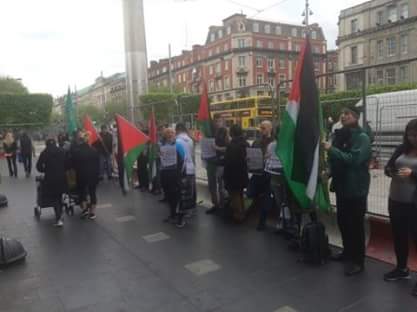
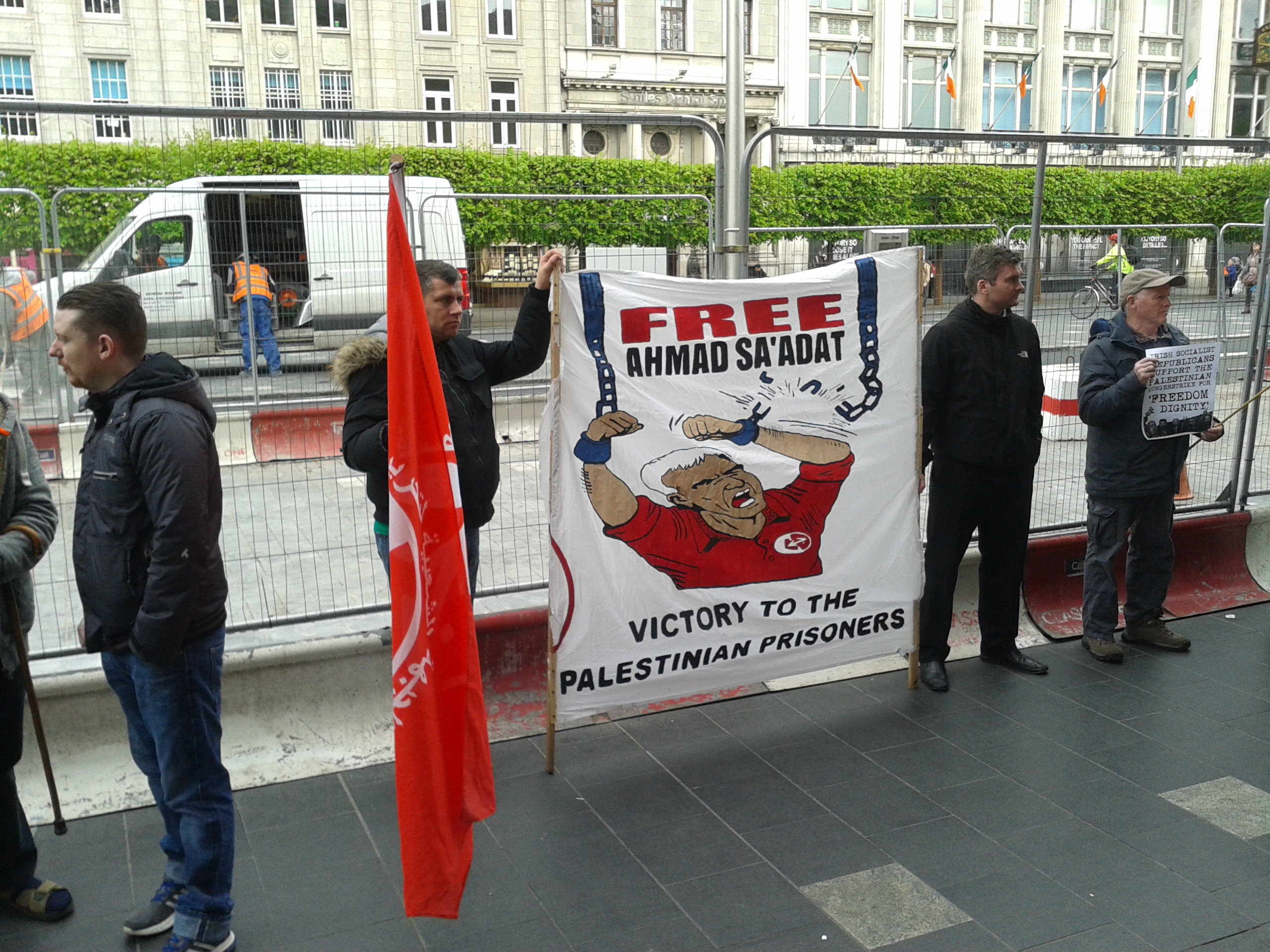
For example, the non-aligned Socialist Republicans for Palestine organised an event on 28th April in Dublin’s main street (photos below) on 28th April.
Line of solidarity protesters looking northwards from outside the GPO, O’Connell (main) Street, Dublin (Photo source: Socialist Republicans for Palestine)
Banner of Independent Workers’ Union (Photo: D.Breatnach)
Line of solidarity protesters looking souththwards from outside the GPO, O’Connell (main) Street, Dublin (Photo: D.Breatnach)
A young supporter holding the Starry Plough, flag of the Irish Citizen Army, a workers’ militia formed in Dublin in 1913.
Upcoming in Dublin:
Organised by Anti-Internment Group of Ireland (see End Internment Facebook page): protest in solidarity with Irish and Palestinian political prisoners at 2pm Saturday in Dublin, Henry St./ Liffey St. junction.
PALESTINE INSIDE THE JAILS
“On Thursday, repressive units continued to invade prisoners’ sections in Ramon prison following a raid on striking prisoners’ sections in Ashkelon prison on Tuesday, when striking prisoners were assaulted for refusing to stand up for inspection. Palestinian lawyer Karim Ajwa reprted that five prisoners were wounded in the face and head and taken to the prison clinic. Ajwa also said that internal disciplinary hearings were conducted against the hunger strikers and sanctions imposed on them as well as fines of 500 NIS ($125) each; he said that salt was also taken from the prisoners in an attempt to break the strike. After 11 days of denials, Ajwa finally obtained a legal visit with Nasr Abu Hmeid and Said Musallam, who also reported that the striking prisoners are boycotting medical examinations and that there are serious health concerns for the ill prisoners participating in the hunger strike.” (from Samidoun, see link)
POLITICAL SECTARIANISM IN PALESTINE
“Meanwhile, in Nablus, Palestinian former prisoners and long-term hunger strikers Khader Adnan and Mohammed Allan, as well as Palestinian Prisoners’ Committee coordinator Maher Harb, were attacked and then detained for several hours by Palestinian Authority security forces before being released, as they participated in a march to support the prisoners. The prisoners of the Popular Front for the Liberation of Palestine, the Democratic Front for the Liberation of Palestine and Islamic Jihad issued a message from Israeli prisons in support of Khader Adnan, denouncing “desperate attempts by some parties to incite against the activist Khader Adnan as a prelude to physical tageting,” and saying that Adnan is a symbol of unity and resistance who is threatened by the occupation.” (Samidoun)
IN THE COMMUNITIES IN PALESTINE
“As part of the protests on Thursday in support of the prisoners, Israeli occupation forces shot two Palestinians in the legs and wounded dozens more due to tear gas inhalation in al-Khalil on Thursday as Palestinian youth protested in support of hunger-striking Palestinian prisoners. In Issawiya, occupation forces dismantled the solidarity tent set up in the village in support of Palestinian prisoners on hunger strike, storming it and then confiscating the materials. In Shuafat refugee camp and Silwan, Israeli occupation forces attacked protesting Palestinian Jerusalemites supporting the hunger striking prisoners. One shop owner was reportedly seized by Israeli forces in the city of Jerusalem after Israeli occupation forces attempted to forcibly compel shop owners to break the strike and open their doors, which they refused.” (Samidoun)
In Gaza, the demonstrators in addition to supporting the prisoners on hunger strike called for “freedom for Georges Abdallah and Bagui Traore in French prisons. Georges Ibrahim Abdallah is the imprisoned Arab communist struggler for Palestine who has spent over 32 years in French prisons. …. Bagui Traoré is the brother of Adama Traoré, killed in French police custody on 19 July 2016. Bagui is the main witness of his brother’s death; since the killing of Adama, Bagui has been imprisoned, first sentenced to eight months in prison for allegedly hitting police and then accused of involvement in shooting towards police and gendarmes in the protests against the killing of Adama.” (Samidoun)
Gaza demonstration showing flags of mixed political allegiances (Photo: Samidoun)
Lawyers for the Minister of Heritage (also of Arts and Gaeltacht) were supposed on Friday (28th April 2017) to lay out the legal terms nature of their Appeal Court action against the Moore Street National Monument judgement given on March 18th last year from the High Court. Instead, they came asking for another extension in order to consider taking her case to the Supreme Court.
Apparently over 13 months was not long enough to consider on what grounds and what court to which to take her case! All along the line the Minister has delayed and gone right up the deadline (and arguably beyond it at least once), then asking for yet more time. Meanwhile the buildings in the historic Moore Street quarter deteriorate further.
There are three main villains in this ongoing drama: the property speculators, Dublin Council’s Planning Department and the Irish State, the latter in the particular manifestations of the Department of Heritage and successive governments.
THE STATE
It might be obvious to some but others may need to have it pointed out that Heather Humphreys, the Minister in question, is not acting alone – she has the Fine Gael-Labour Coalition Cabinet supporting her. Nor is it a matter of those two political parties alone either – Fianna Fáil, another major political party, is on record as wanting the Minister to continue with her appeal; apparently the right of a High Court Judge to declare that prime speculation property is a national monument, with all the protection that implies, cannot be left unchallenged.
Senator Peadar Tóibín, Sinn Féin’s representative on the Minister’s Consultative Forum on Moore Street (on which all the members were chosen by her Department), supports the Forum’s Report, including the recommendations that the man who won the court case against the Minister drop his defence of that judgement and that the three major villains in the piece, the Heritage Department, Dublin Council’s Planning Department and the property speculators negotiate over the future of the 1916 Battleground site, with a smaller and even more exclusive Advisory Committee to oversee the negotiations (but without any statutory powers). Whatever the chosen individuals and parties have said prior to their entering the Minister’s Consultative Group, not one member has dissented from those recommendations.
For over 90 years the State did nothing to mark the importance of Moore Street as a 1916 Battleground or that the Surrender was decided here, that Volunteers and civilians fell to British bullets in that street and surrounding laneways, including The O’Rathaille who famously wrote a dying farewell letter to his wife in the lane now named after him. Nothing to mark that of the 16 executed, six had spent their last days of freedom in Moore Street. Or that of the seven Signatories of the Proclamation, five had been in that street until the surrender.
NGA plaque on No.16 Moore Street (Photo source: D.Breatnach)
In 1966, the voluntary and non-state-funded National Graves Association put one of their small commemorative plaques on the front of No.16 Moore Street and it was the removal of this plaque by a property speculator in 2001that gave rise to the NGA starting the campaign to save Moore Street, into which over the years others outside the NGA came to play major roles.
THE PLANNING DEPARTMENT OF DUBLIN CITY COUNCIL
The Planning Department’s pet property speculator was Joe O’Reilly of Chartered Land and TG4’s program Iniúchadh Oidhreacht na Cásca in 2007 traced the process by which this speculator was given extraordinary special facilities even over other speculators. The Planning and Property Development Department’s chief officer is, since a change in the law some years ago, empowered to grant planning applications without reference to the Councillors, the elected representatives. He is also incidentally the Assistant Chief Officer of the Council’s management executive. Jim Keoghan (now retired from DCC) has used that executive power to approve most property speculators’ application for “development” in Moore Street and indeed it was Dublin City Council that oversaw the destruction of most of the centuries-old street market quarter and its replacement by the ILAC Shopping Centre, Dunne’s Stores and Debenhams.
Throughout all these “developments” in the Moore Street area the street traders have had meagre shelters and poor lighting provided by Dublin City Council but no heating, toilet facilities, changing rooms or convenient water supplies for cleaning or flowers maintenance; they are obliged to renew their licenses yearly, licenses which are bound by all kinds of petty restrictions.
Famous photograph taken presumably from GPO roof, showing how busy the market used to be just a few decades ago. Even then, conditions for the street sellers were hard with no alleviation by Dublin City Council. (Photo source: Internet)
As the modern-day battle for Moore Street intensified, Dublin City Council installed not one but two full-time Market Inspectors on the street, which had previously functioned well with one Inspector visiting in the morning and evening. These market inspectors have no role in preventing antisocial behaviour or in monitoring the quality of the food on sale and their main activity seems to consist of telling stall-holders what they may not sell1, or that they are placing merchandise beyond the strict limits of their stall area (in a street which now holds at maximum fifteen stalls, where once before there were many times that number), or that they have continued trading some minutes beyond their official closing time. And they are not permitted to sell on Sundays while, of course, the supermarkets bracketing them, Lidl and Dunnes, face no such restrictions.
These rules have been there for years – it is the degree of enforcement that has changed. One could be forgiven for thinking that some high officials in Dublin City Council want to drive the traders out and, indeed, traders who are now in their third and fourth generations on the street see no-one in their families willing to take over the enterprise when they retire.
THE PROPERTY SPECULATORS
The small shopkeepers are not without their own problems in the street. Most of them are on annual contracts (or even shorter, such as three months), subject to having their business in the street closed at the wish of the property speculators. The ILAC extension currently underway at the south end of the building resulted in the eviction of around ten businesses, most of which received no alternative site. Even the presence of a narrow vegetable produce rack outside a shop can bring down a threat or an actual fine from the Market Inspectors, while ugly hoardings approved by Dublin City Council squeeze the street and restrict the flow of pedestrians.
The ILAC shopping centre was jointly owned by property speculators Chartered Land and Irish Life. As outlined by the TG4 program, Joe O’Reilly of Chartered Land, like many banks and speculators, over-extended himself and Government agency NAMA took over his debts, however paying him €250,000 a year to “manage” them. Subsequently, NAMA approved Chartered Land to sell its debt on to Hammerson, a huge British-based property speculator and vulture capitalist concern.
Exposé by The Daily Mail of €200,000 being paid by NAMA to Joe O’Reilly, of Chartered Land. (Photo source: Internet)
Chartered Land had been granted planning permission for a giant “shopping mall” of nearly seven acres (2.3 hectares), extending from O’Connell Street westwards to Moore Street and from parts of Parnell Street southwards to Henry Street. The planning permission entailed the demolition of every building within those limits, excepting only No.s 14-17, which the State had by then accepted were of historical importance and had granted them preservation status. The laneways and streets were also to disappear. In the meantime the State did nothing to oblige Mr. O’Reilly to maintain the buildings which they had stated were of preservation status.
The giant shopping ‘mall’ intended acreage in dark blue and the existing ILAC spread in green (which has buried a number of streets and laneways of the old street market quarter). Famous photograph taken presumably from GPO roof, showing how busy the market used to be just a few decades ago. Even then, conditions for the street sellers were hard with no alleviation by Dublin City Council. (Photo source: Internet)
The State bought the four houses in question in the latter half of 2015 and planned to demolish houses on each side of the four until in January of 2016 a legal challenge by Mr. Colm Moore and an occupation of the buildings by activists for five days, followed by five-week blockade, brought about a respite. The speculators attached themselves to the case as having an interest to defend.
While the case dragged on, the Minister’s officers and legal team endeavoured to undermine the historical importance of the quarter, arguing that the Moore Street area was not a battleground (instead “the whole of Dublin was a battleground”) and that no other building there other than the four with preservation status was of historical importance. This included the rest of the terrace and even No.10, which had been the first HQ of the Rising after the evacuation of the GPO, and which had been run as a temporary hospital by Volunteer Nurse Elizabeth O’Farrell, caring for nearly twenty wounded men (including a British soldier found in Moore Street).
“Sailor” Simon Betty, front man in Ireland for Hammerson, may find the waters choppier than expected. (Photo source: Internet)
The Save Moore Street From Demolition group (whose campaign stall has been on the street every Saturday since September 2014) raised the alarm and called an emergency demonstration in January 2016, after which people occupied the buildings for five days until the High Court Judge ordered no demolition until Mr. Moore’s case had been heard. Subsequently, with heavy machinery heard at work on the site and the contractors and Minister refusing inspection to campaigners, the Lord Mayor, Councillors or TDs, campaigners blockaded the site and allowed no workers to enter; this was led by a new, broad group that had arisen from the occupation: Save Moore Street 2016.
Minister of Arts, Heritage and Gaeltacht, orchestrating the destruction of our 1916 heritage. (Photo source: Internet)
On March 18th 2016, the 100th anniversary year of the Rising, the High Court Judge delivered his verdict in the case brought by Mr. Moore, declaring that the quarter bounded by Moore Lane, Henry Place, O’Rahilly Parade and Moore Street, including the backyards and those aforementioned lanes and street, is a national historical 1916 monument. The campaigners lifted their blockade.
The Minister took her time deciding whether to appeal the judgement and at the deadline, announced that she would, with the support of the Cabinet and other departments. Then she set up her Consultative Forum, from which she excluded the most active of the campaigners, including the Save Moore Street From Demolition campaign which has just passed its 136th consecutive Saturday on the street collecting over 80,000 petition signatures and distributing leaflets. Also excluded have been the Save Moore Street 2016 campaign group, a broad alliance of people from different organisations and none that arose out of the occupation and blockade of the buildings in early 2016.
Meanwhile, Jim Keoghan of Dublin City Council, in one of his last major acts of office before retirement, in the summer of 2016 extended the planning permission for the giant ‘shopping mall’, despite the fact that it was due to run out in March 2016, despite the High Court judgement, in the face of opposition by the majority of elected City Councillors and despite the fact that it had been conclusively shown in court that the speculator had carried out no substantial work on the buildings as required by the planning permission conditions.
WHERE TO FROM HERE?
And so to where we are today. The Minister has her extension (unspecified length but one supposes up to six weeks) but may not decide to take her case to the Supreme Court and may use the delay instead for other purposes, including setting up her select Advisory Committee, as in the Recommendations of the Report of her Consultative Group. If the case goes to the Supreme Court, a date for hearing will need to be set. If the Minister should continue instead to Court of Appeal, the case date has been set for mid-December this year 2017, which also means it is bound to continue on into 2018.
Meanwhile most of the buildings steadily and visibly deteriorate, prey to speculator neglect and Irish weather. The four buildings now in Government hands have been subject to restoration work with some visible inappropriate results, the whole of the work carried out without independent archaeological and restoration expert assessment or oversight, the Government ‘expert’, Gráinne Shafrey, being the same person who argued for the Minister in the High Court that the other buildings in the street were of no historical importance.
For progress to take place at the moment, the first step is for the Minister to drop the appealand that should be the minimum demand of all who genuinely care for the historic buildings, laneways and street market. When that has been done, we can move on to consultation on the most appropriate way to save and restore the buildings, rejuvenate and expand the street market. And to how that process shall be democratically and transparently controlled.
No foreseeable change of Government seems likely to bring any relief to this situation, given the stand taken in the Minister’s Consultative Forum by the representatives of the four main political parties. Other than the continuing legal action, the real hope resides where it has done from the start – with the wishes of the majority of people and the energy, commitment and at times daring of the active campaigners outside the corridors of power or, one might say, instead on the streets of power.
End.
Historical background notes:
On 28th April 1916, with the GPO and many other buildings in O’Connell Street in flames, the garrison of the GPO and HQ staff of the Rising for an independent Irish Republic evacuated their building and sought to break out of the British Army’s tightening encirclement. They made their way along Henry Place, encountering heavy British fire at the junctions of Moore Lane and Moore Street from British barricades at the Parnell Street ends and from the Rotunda tower, suffering a number of casualties as a result. In Moore Street the major part of the evacuation tunneled from house to house along the No.s10-25 terrace and a number of other houses too. Another section mounted an unsuccessful charge on the British barricade at the end of the street.
On Saturday 29th April, after a number of civilians were shot down in the street by British gunfire, the decision was taken by the insurgents’ leadership to surrender and Volunteer Nurse O’Farrell went out under a white flag of truce to seek terms from the British. None being available, Patrick Pearse and James Connolly surrendered their forces unconditionally and over the next few days the forces in other strongholds in the city and in Wexford surrendered (or evacuated their fighting posts and went into hiding). Nearly 100 death sentences were handed out by British military courts of which fifteen were confirmed and carried out (and a further one in London by civilian court); the executed included six who had spend their last days of freedom in Moore Street houses, including five of the seven signatories of the Proclamation: Thomas Clarke, Patrick Pearse, James Connolly, Joseph Plunkett, Seán Mac Diarmada. Most other prisoners were sentenced to prison or concentration camps in Britain and many others were arrested and interned without trial.
Moore Street was at the time part of a whole centuries-old street market quarter of which most of the rest lies buried under the ILAC Shopping Centre, constructed in the later 1970s. For sixteen years a struggle has been going on for the preservation and restoration of this historical quarter.
Note about the author:
Diarmuid Breatnach is an independent political and social activist who has been campaigning for Moore Street for years, including in September 2014 being a co-founder and active member of the Save Moore Street From Demolition campaign group and is a member too of the Save Moore Street 2016 campaign. He has written a number of articles, given talks and presentations on the Moore Street issue (including to the Minister’s Consultative Group). Breatnach also writes on history in general (among other subjects), conducts history walking tours and has publicly called on Dublin City Council to give Moore Street its correct Irish version of the street name, i.e Sráid an Mhúraigh rather than the “Sráid Uí Mhórdha” which Dublin City Council has named it.
1In 2016, the centenary of the 1916 Rising, they were forbidden from selling Easter Lillies and Easter Rising commemorative products from their stalls, unless they purchased a special license to do so.
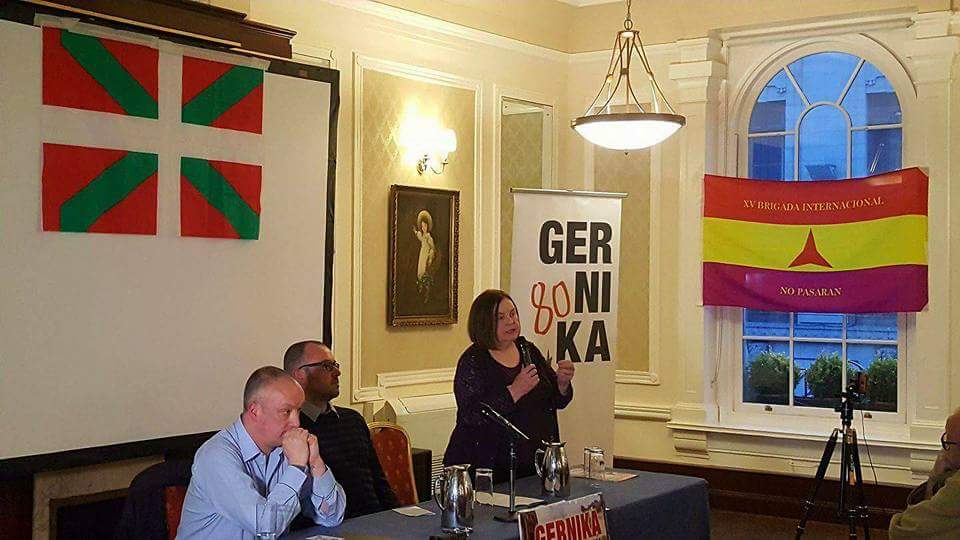
The bombing of Gernika during what is sometimes termed “The Spanish Anti-Fascist War” and more often “The Spanish Civil War”1 was commemorated in Dublin by a weekend of events organised by the Gernika 80 — then and now committee. The event featured a launch of a commemorative pamphlet, including talks by Spanish Civil War historian Enda McGarry and by Irish socialist, republican and civil rights activist Bernadette McAliskey; a ska music event; talks and a planting of a “Gernika Tree” at Glasnevin cemetery.2
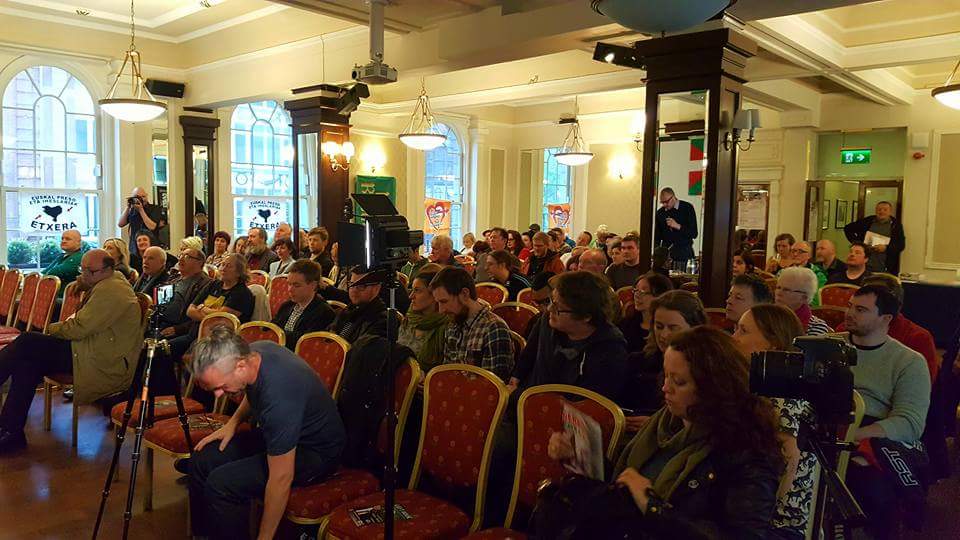
People in attendance at the talk in Wynne’s Hotel (chairperson’s reflection may be seen in the mirror). (Photo source: Gernika 80 event page)
The pamphlet was on sale for €5 a copy in the large function room of the historic Wynne’s Hotel where the well-attended launch was held. The pamphlet has articles by Richard McAleavey, Enda McGarry, Stewart Reddin, Brian Hanley, Aoife Frances, Sam McGrath, Fin Dwyer, and Goiuri Alberdi.
Enda McGarry was first to speak and in a clear voice, with only an occasional glance at his notes, began by giving the background to the Gernika bombing – the military rebellion against the elected government of the Popular Front and the military campaigns that followed. General Mola was in charge of the fascist forces’ “Northern Front” while battles were taking place elsewhere, including in the suburbs of Madrid.
McGarry outlined the waves of air attack on 26th April 1937, the dropping of incendiary bombs and the strafing of running men, women and children by fighter planes and gave details of some of the horror experienced in the town. The bombing was one of the first aerial bombings of civilian population centres and Gernika, of particular historic-cultural importance to Basques, was hit on a market day. It had no anti-aircraft defences, not surprisingly, since it contained no features of significant military interest.
Going on to describe the lies told by the fascist leaders, McGarry related how in turn the communists, anarchists and Basque nationalists had been blamed for burning the town. Subsequently, apologists had tried to excuse the action by claiming that the Renteria bridge had been the target, in order to cut off the Basque nationalists’ retreat or lines of reinforcement from the northern Basque Country (i.e within the French state).
The speaker pointed out that this line of argument is still being peddled by some, including a fairly recent historian. Demolishing this falsehood by analysing the planes that were used, Heinkels, a Dornier, Junkers 52 bombers, Italian SM 79s and Messershmidt 109, along with the bombs and armament, McGarry showed how this could not be consistent with a bombing run to destroy a bridge. At Burgos airfield sat a number of planes that would have been ideal for destroying the bridge – Stukas, the most advanced dive bomber in general production of the time. They did not use them because neither was the Bridge the target nor pin-point bombing required – what those planning the attack wished to do was to carpet-bomb the area with high-explosive and incendiaries, then machine-gun civilians fleeing the bombing.
Ultimately, the historian continued, of course Generals Franco, Mola and other fascist military leaders were responsible. However McGarry believed that the Spanish fascist leaders, needing to crush Basque resistance but keep the conservative Catholic Carlist troops (from Navarra) and other right-wing Basques on board, would have been unlikely to agree to the destruction of Gernika (a holy historic place to the Carlists as well as to the Basque Nationalists). Oberstleutnant Wolfram Freiherr von Richthofen was the commanding officer of the Condor Legion, Nazi Germany’s “loan” of airforce to the Spanish fascist forces – he, along with others including commander-in-chief of the Luftwaffe, Herman Göring, wanted to use the Spanish conflict as a testing ground for warfare from the air and the tactic of terror-bombing a civilian population, which they later employed at Warsaw, Stalingrad and other cities.
The talk ended to strong applause and the chairperson of the meeting introduced Bernadette McAliskey, a long-time socialist and Irish Republican, campaigner for civil rights and in support of migrants.
The chairperson could also have alluded to her survival of an assassination attempt by Loyalist paramilitaries the “Ulster Freedom Fighters”, in which she was shot 14 times and her husband shot too, and that she had before that twice been elected a Member of the British Parliament. Of course McAliskey herself might have requested the omission of those details.
Bernadette McAliskey speaking; sitting R-L, Finn Dwyer, Enda McGarry. (Photo source: Gernika 80 event page)
McAliskey began by praising the inclusiveness of the pamphlet, which has contributions from many different writers. She then moved on to expounding what kind of people are fascists, a term she believed too widely applied, and what kind of people fascism serves. In a rather long discourse, entirely without notes, the speaker went on to analyse what Republicanism is, rejecting a definition which said the basic unit of a Republic is the State, insisting instead along with Thomas Paine that the basic unit is the individual. Believing otherwise, she declared, makes one a nationalist rather than a Republican, á la Gerry Adams.
At times one could be forgiven for assuming that McAliskey thought she was addressing liberals, saying for example that “we don’t think enough about what goes on in other countries”, or “we don’t think about what is happening to certain groups”, such as migrants, Travellers – those considered “non-people”; or when she declared that she had no understanding of what was going on in Syria because neither her background nor experience could help her to understand it. McAliskey seemed unconscious that this is a line which was also commonly disseminated in Britain about the war in the Six Counties.
But then, McAliskey would switch without warning, as in her mischievous assertion that one should deal with liberals by throwing them in at the deep end: “they either learn to swim or they no longer give you any trouble.” Or when later, she pointed out that those in power never give up their weapons, and that one day we might present ourselves to our exploiters and insist that they step aside, as “there are more of us than there are of you”, to which they will reply: “Maybe so, but we have the weapons.”
When Bernadette McAliskey finished her talk, to sustained applause and cheers, the chairperson invited questions, of which there were three and a comment. The first question was whether McAliskey thought Gerry Adams was a psychopath, to which she discoursed on the question of insanity and on the number of lies that were told by politicians such as Gerry Adams. One of the big lies was that the IRA had forced the British to the negotiating table, which McAliskey emphatically denied was true, insisting that the reality was that the IRA went to the negotiating table because they could fight no longer, the rate of attrition was too great.
The next question, by a woman who announced that she had a USA background, in the context of her declaring that racism is about white supremacy, was about how to make the Irish aware of their role in this supremacy. Bernadette said it was an important question and that the process by which the oppressed can become the oppressors was one observed on a number of occasions in history.
This reporter thought that the questioner’s statement about the nature of racism being white supremacy might also have been questioned, a proposition disproved for example by the experience of the Armenians under the Turks, Jews and Slavs under Nazism, the Irish in Britain or at home under British rule, Irish Travellers in Irish society, etc.
The last question enquired what Bernadette would say to Basques, as some had said to the questioner, that the Irish were “lucky to have a peace process”, given that we were now approaching the second decade after the Good Friday Agreement. McAliskey replied that Ireland did not have a peace process but rather a pacification process, and that the ‘new dispensation’ divided up the Six Counties between political parties along sectarian lines, with cuts to services being imposed by those in power and substantial unemployment and unfair treatment of the “other minorities”: migrants, Travellers …. And that jails in the Six Counties today contain “about as many political prisoners as they did when the Good Friday Agreement was signed but the prisoners with less politics than had their fathers.”
End.
FOOTNOTES
1Neither term sitting well with probably most Catalans and Basques, who do not consider themselves Spanish, having a different cultural identity, most aspects of which were suppressed by the victors of the War, the General Franco dictatorship regime but had been suppressed by others before them too.
2Gernika’s historic importance to the Basques before the bombing was based on the fact that Basque nobles met there to discuss their administration of Basque lands and it was there that a Spanish King had stood, under the ancient Basque oak tree, Gernikako Arbola, the “Gernika Tree”, promising to respect their rights to rule within their territory.
May 1st, International Workers’ Day was celebrated in warm sunshine in Dublin with a parade and rally organised by the Dublin Council of Trade Unions and a later event organised by the Independent Workers’ Union.
Crowd scene outside Garden of Remembrance, the starting point of the DCTU march
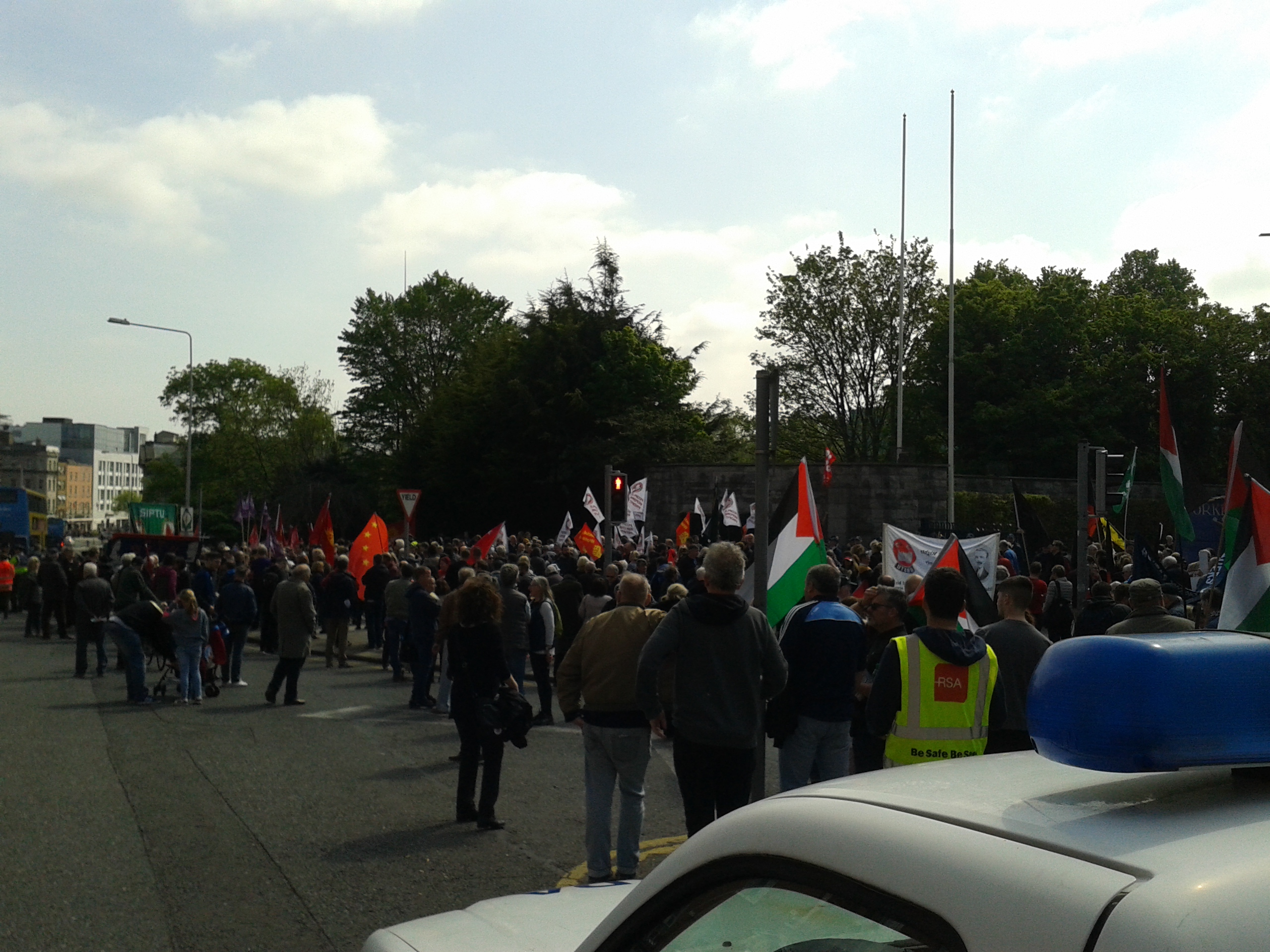
The DCTU-organised event met at the Garden of Remembrance at 2pm and set off at nearly 3pm, with numbers although still small by European standards nevertheless larger than has been seen for some time in Dublin, according to the organisers filling O’Connell Street, the city’s main street throughout its whole length (500 metres or 547 yards).
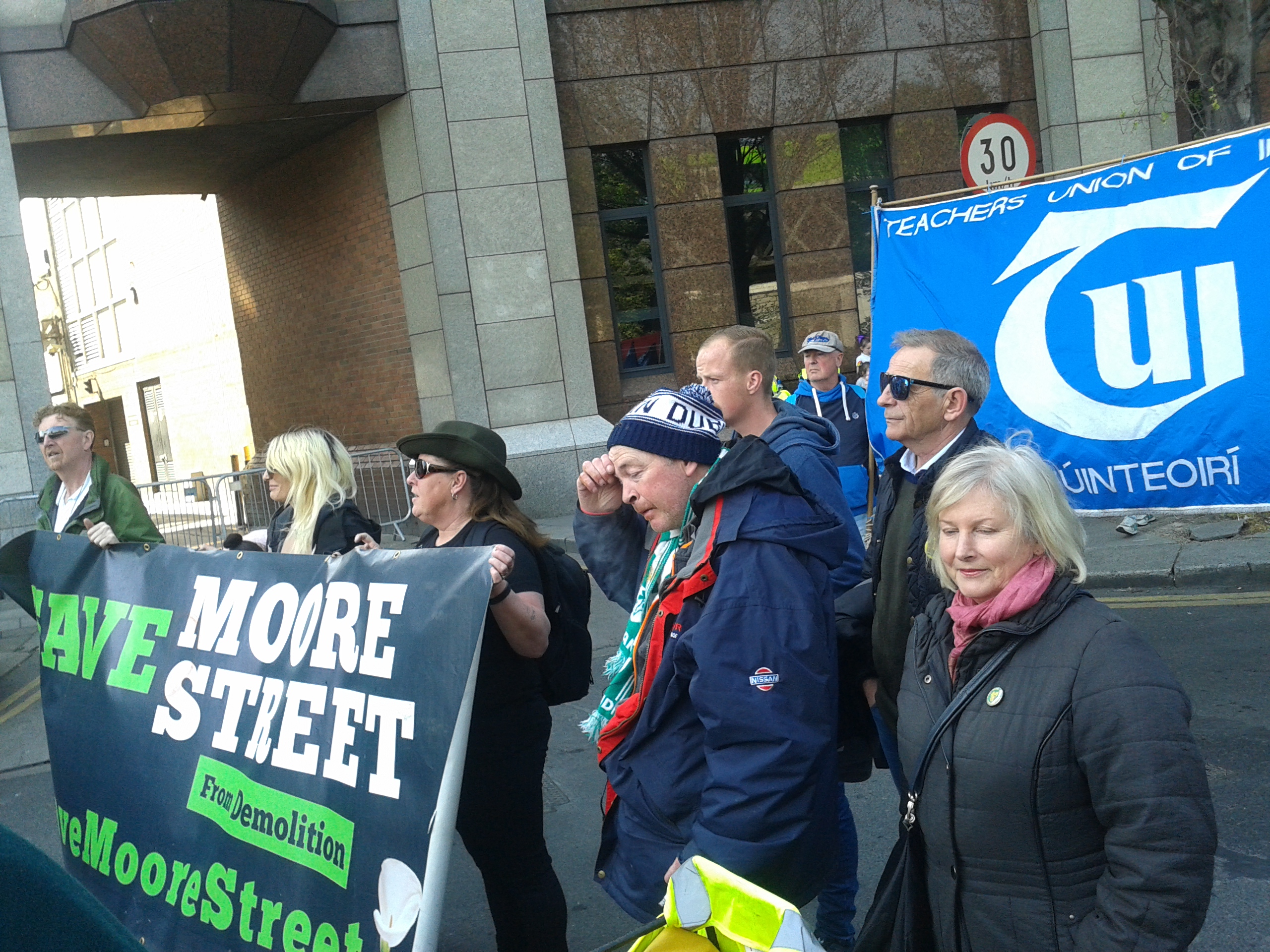
Seen on the parade were trade union banners, those of some political parties, also of campaigns and community groups.
As it has been doing for years, the parade ended in a rally in Beresford Place, in front of Liberty Hall, the very tall building owned by the SIPTU trade union, where the audience were addressed by speakers from trade unions and campaigns and NGOs.
Section of crowd at rally in Beresford Place
Curiously, soon after arrival the comparatively strong showing of Sinn Féin flags, the green one with their logo and the blue and white version of the Starry Plough, were nowhere to be seen.
Similar section with some banners noticeably missing
The issues of lack of affordable housing, of public land being sold for private housing and speculation, of precarious employment, of financial speculation and cuts in services were addressed by speakers, with a mention also of solidarity for the Palestinian prisoners on hunger strike. A number of speakers also addressed the treatment of migrants and in particular the conditions suffered by refugees in the Direct Provision hostels of the state’s welfare service.
Stage erected at Beresford Place, outside SIPTU’s officesThe Moore Street campaign banner was one of the campaign groups present on the parade and mentioned from the stage by the rally’s chairperson.One of the speakers at the rally — she denounced the sale of private land including the deal done at O’Devaney Gardens estate in Dublin.
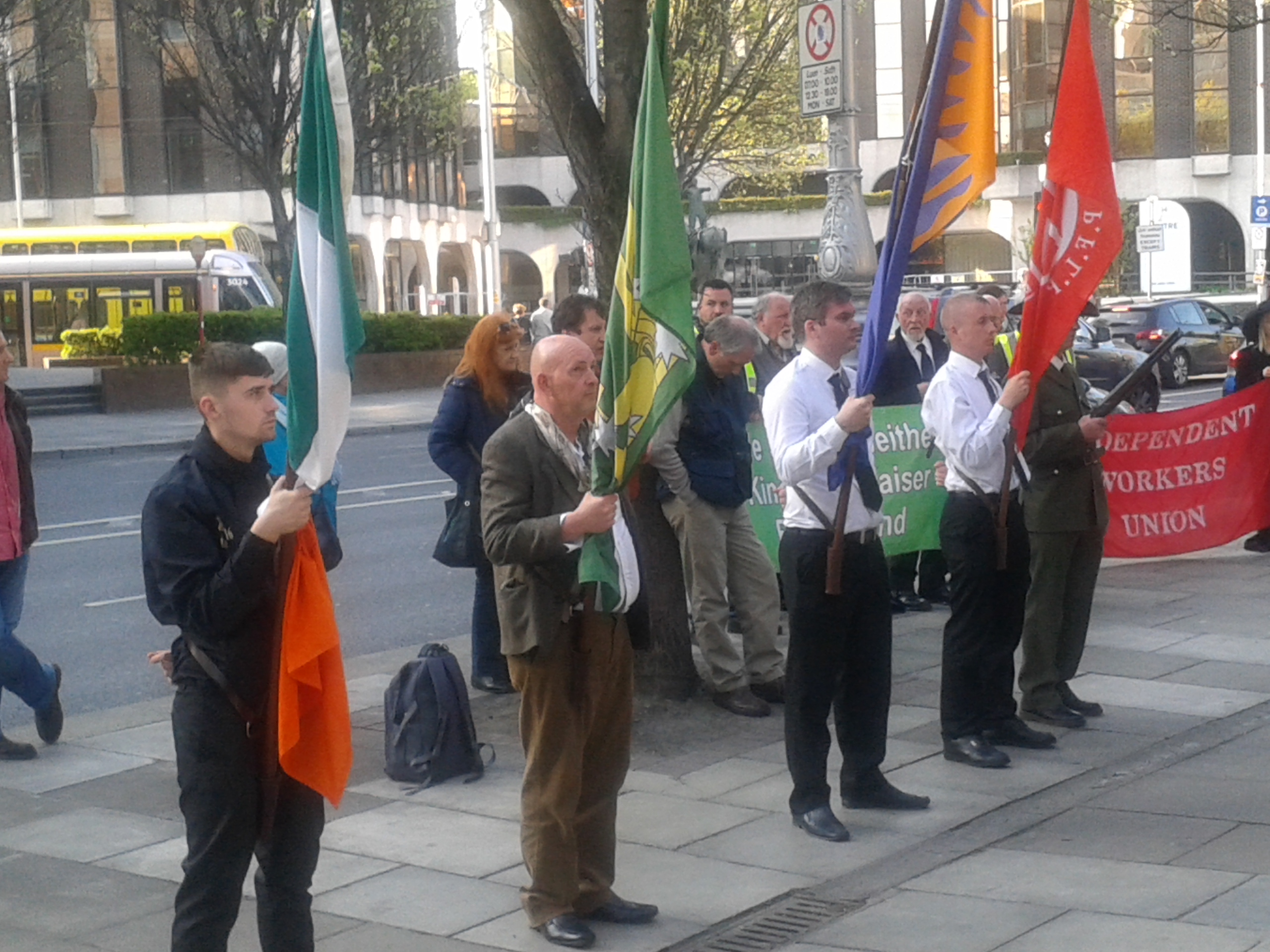
Somewhat later, the Independent Workers’ Union held their own event, marching with a colour party from their offices to James Connolly monument, also in Beresford Place and across the road from Liberty Hall.
IWU event colour party at Connolly Monument
Damien Keogh chaired the event and introduced veteran campaigner Sean Doyle who gave a short and to the point speech about the situation in which working people find themselves today and ending with a quotation from James Connolly, in which the revolutionary socialist castigated those who claimed to love Ireland but could tolerate seeing poverty and deprivation among its people. Doyle also sent solidarity greetings to the Palestinian political prisoners on hunger strike in Israeli jails.
Paul Bowman was then introduced and in a longer speech covered Connolly’s time in the USA, his membership of and activities of the IWW (“the Wobblies”); the Haymarket Incident in Chicago which led to the choosing of May 1st as International Workers’ Day and the state murder of the Haymarket Martyrs; the principles and attitude of the IWU today.
Another Moore Street campaign banner and supporters in period costume also participated in the IWU eventSome random tourists, one form London and the other from Madrid, who chanced to pass by and remained for the whole ceremony.
Damien then introduced Diarmuid Breatnach to sing “We Only Want the Earth” (an alternative title to the original of “Be Moderate”). Breatnach explained that the lyrics had been composed by James Connolly and published in a songbook of his in New York in 1907 without an air. As a consequence the lyrics have been sung to a variety of airs but Breatnach said he sings it to the air of “A Nation Once Again” (composed originally by Thomas Davis some time between 1841 and 1845). This arrangement provides a chorus and Breatnach invited the audience to join in the chorus with him, which they did.
“We only want the Earth,
we only want the Earth,
And our demands most moderate are:
We only want the Earth!”
A wreath was laid at the monument on behalf of the IWU by Leanne Farrell.
The chairperson then thanked those in attendance, speakers and singer and invited all back to the offices of the IWU in the North Strand for refreshments.
On Monday 25th April people gathered in front of the General Post Office building in Dublin city centre. The occasion was the commemoration and celebration of the reading of the Proclamation of Independence by Patrick Pearse outside that same building, shortly after the 1916 Rising had begun under his overall command. Standing nearby during the reading had been James Connolly, Commandant of the GPO Garrison and also commanding officer of the Irish Citizen Army. Both were executed by the British weeks later for their part in the Rising, along with another thirteen (twelve in Dublin, one in Cork) and months later Roger Casement was tried in civilian court in London and hung.
Tom Stokes, who has been a chief organiser of this event since 2010, opened the proceedings, addressing the crowd and the flag colour party. He reminded his audience that in 1917 it had been Republican women who had organised the 1916 commemoration, printing many copies of the Proclamation and pasting them around the city, also defying British military law to gather outside the GPO to mark the events.
Tom Stokes speaking at the event outside the GPO (photo: D.Breatnach)
Among the reasons for this given by Stokes was that many Republican men had but recently been released from British prisons and concentration camps but also that the women had a special stake in the Republic for which the Rising had taken place – they in particular stood to gain from its achievement the status of citizens and many other changes in their status as a result.
So it was appropriate, Stokes said, to have women take prominent roles in the event, starting with Evelyn Campbell, who accompanied herself on guitar while singing her compositions Fenian Women Blues and Patriotic Games.
Evelyn Campbell performing (photo: D.Breatnach)
Following that, Tom Stokes gave the main oration, outlining his vision of a Republic and castigating the Irish state for what it had produced instead, in particular attacking its treatment of women and declaring that abortion was a private matter in which the State had no right to interfere.
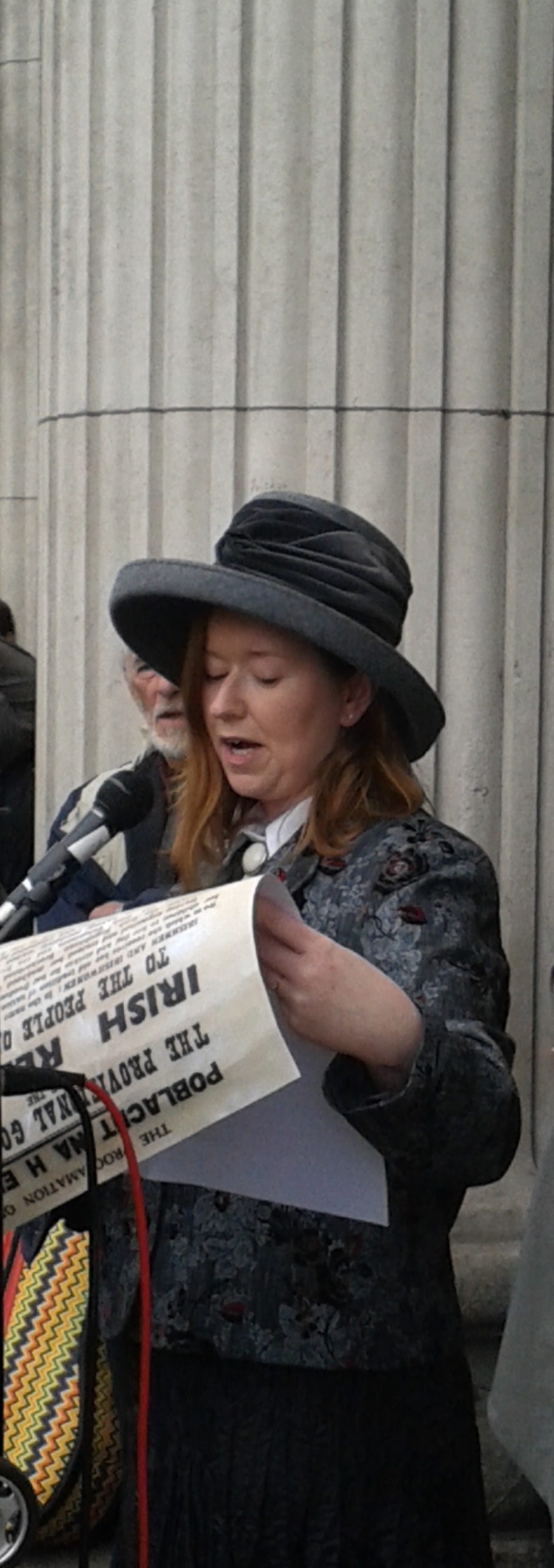
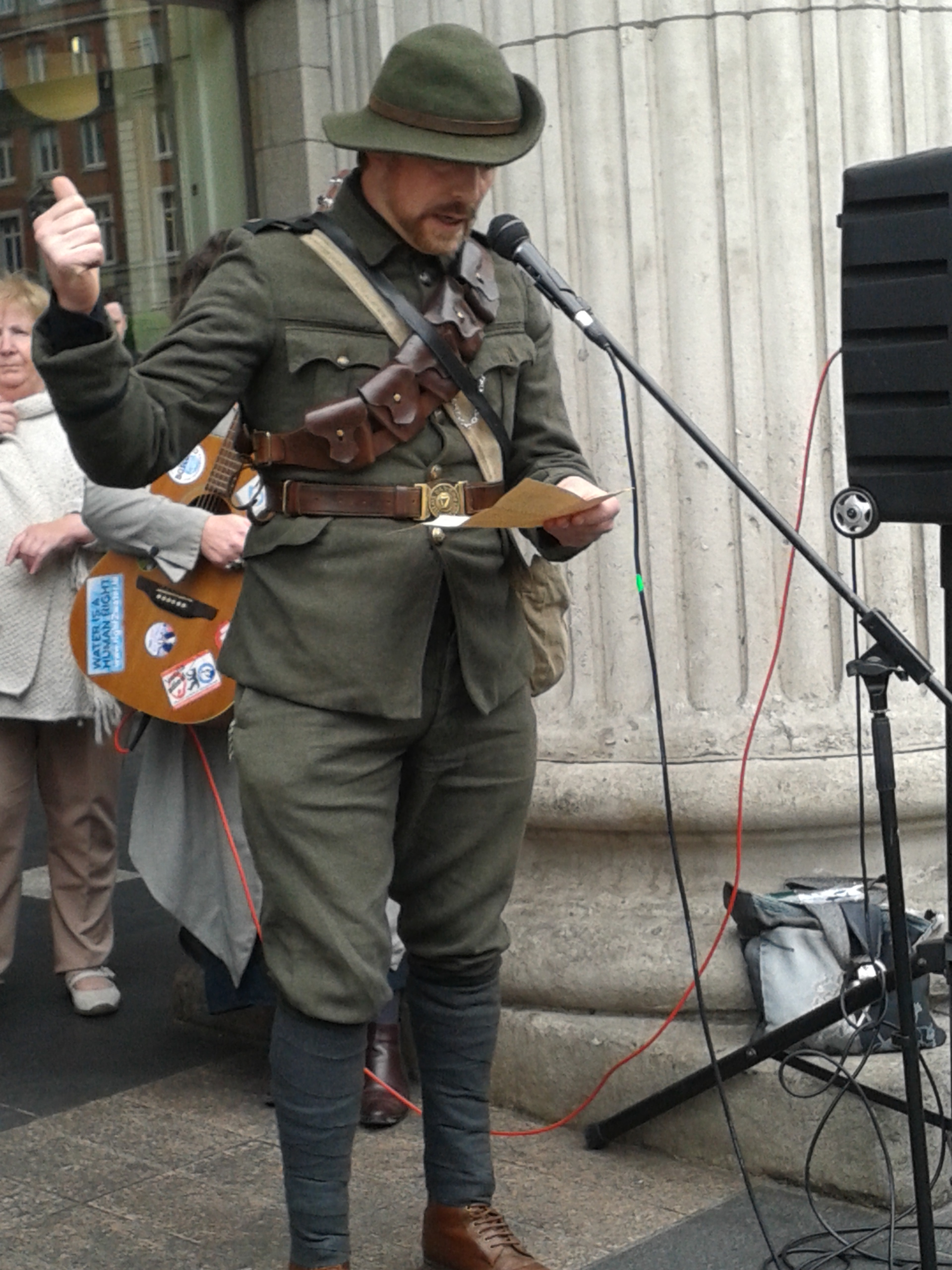
This was followed by Fiona Nichols, in period costume, reading the Proclamation and after that came Dave Swift in Irish Volunteer costume, reading a message given by a wounded James Connolly (he had been injured Thursday of Easter Week by a ricochet in Williams Lane while on a reconnaissance mission).
Fiona Nichols reading the 1916 Proclamation. (photo: D.Breatnach)
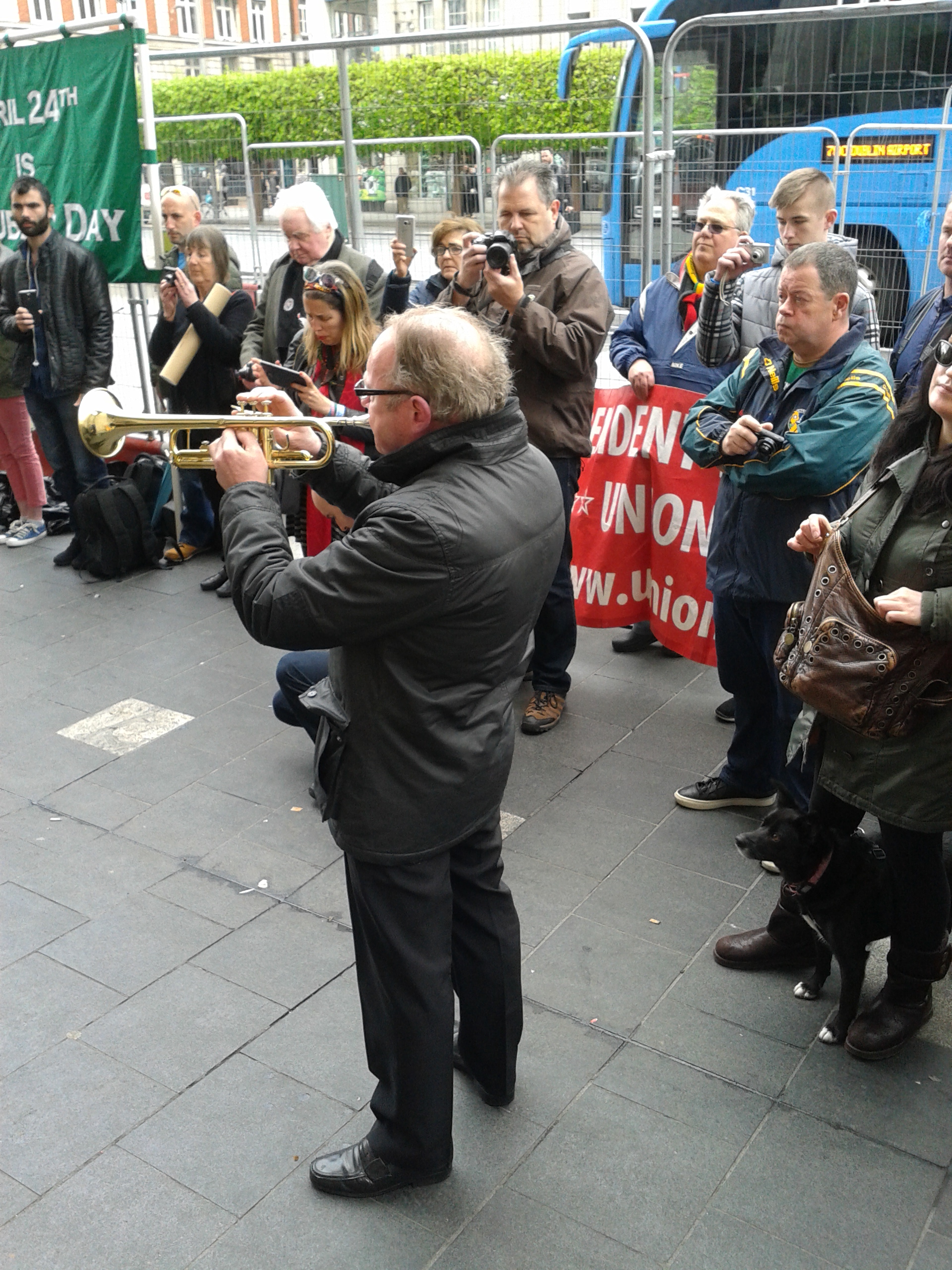
Cormac Bowell, in period Volunteer costume played an air on the bagpipes, Fergus Russel sang The Foggy Dew, Bob Byrne sounded The Last Post on the bugle and Evelyn Campbell came forward again, this time to accompany herself on guitar singing Amhrán na bhFiann.
Cormac Bowell playing at the event. (photo: D.Breatnach
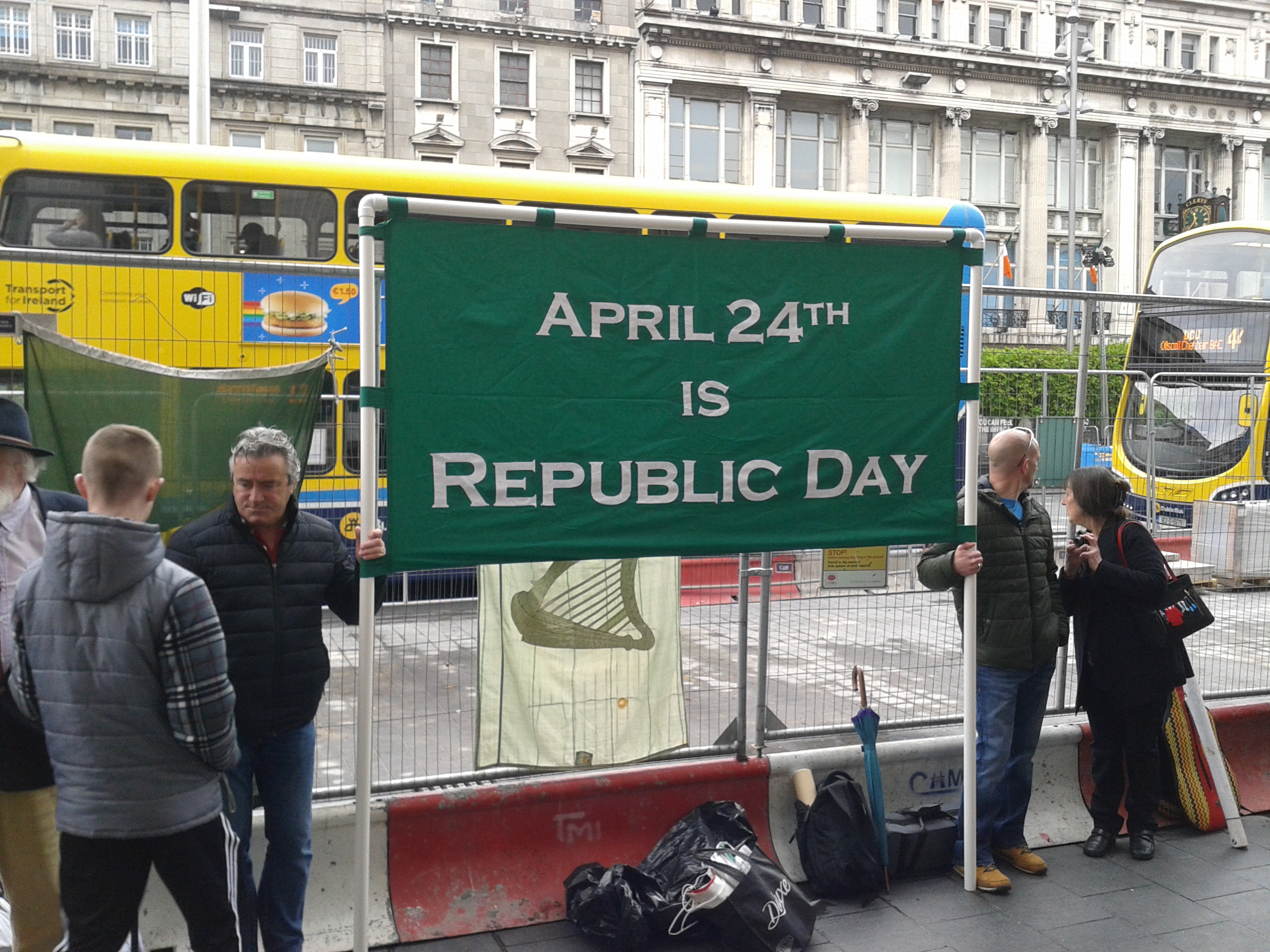
Tom Stokes thanked the performers and everyone else for their attendance and said he hoped to see them all again on the 24th April 2018, which will be a Tuesday. He said it was his wish that this day be an annual National Holiday and they had started the annual celebration because no-one else was doing it.
Some of those present marched to Moore Street with a Moore Street campaign banner, taking the GPO Garrison’s evacuation route on Friday of Easter Week through Henry Place, past the junction with Moore Lane and on to Moore Street, where Dave Swift, still in Irish Volunteer uniform, competing with the noise of construction machinery coming from the ILAC’s extension work, read the Proclamation before all dispersed, leaving the street to street traders, customers, passers-by and builders.
A chríoch.
Bugler Bob Byrne sounding The Last Post. (photo: D.Breatnach)(photo: D.Breatnach)(photo: D.Breatnach)(photo: D.Breatnach)(photo: D.Breatnach)Dave Swift reading Connolly’s statement after he had been wounded. (Photo: D. Breatnach)
We Irish are said to have long memories and to be unforgiving. The English, it has been said, can’t remember their history while we Irish can’t forget it.
Look around the former and current Empire and I think you’ll find it’s not just the Irish who remember and won’t let the English forget: the Scots, the Welsh, Australian Aborigines, Sub-Saharan Africans, West Africans like Kenya and Nigeria, the Tasmanians (ok, all wiped out but others remember for them), Jews and Palestinians, Arabs, French-Canadians, Indians, Bengalis and Pakistanis, Afghans, Iraqis, Kurds, Egyptians, Greeks, Cypriots, First People and American Indians (before the ‘settler regime’ took over), South African indigenous people, Afrikaners (who — whatever their own sins — saw at least a third of their women and children die in British concentration camps), ‘English’ Caribbean (slave) Islands like Barbados, Trinidad and Jamaica, Malaya, Singapore, Hong Kong, other parts of China in the Opium War …..
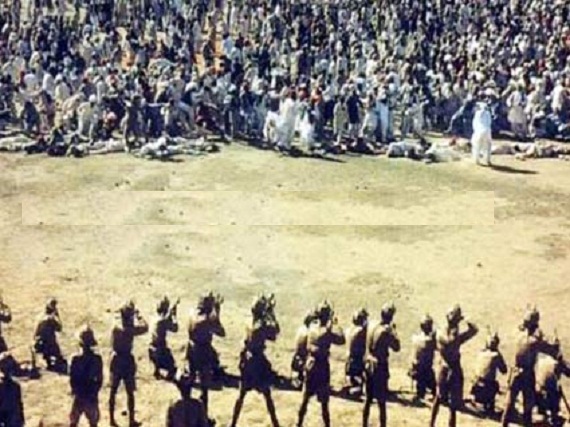
Royal Marine Commando holds up heads removed from the bodies of alleged communist resistance in MalayaArtist’s impression of 1841 Massacre of Australian Aborigines at Myall Creek (Image source: Internet)Photo presumably before British troops opened fire at the Jallian Wala Bagh (Amritsar) Massacre, India 1919. (Image source: Internet)
‘Very well, yes’ the British ruling class and their ‘educators’ and pundits admit when pushed hard enough – ‘there’s a lot of forgetting to be done, so best get on with it. After all, that’s all in the distant past.’
There’s a problem though with forgetting ill deeds of the distant past – it eases the doing of new ill-deeds and makes their denying easier: “We British are a civilised people and our soldiers wouldn’t do things like that, nor would our leaders let them.” History teaches us that they would, again and again and not only would their leaders let them, they’d order them to and then lie and cover up, occasionally offering up one or two minor actors as a sacrifice if public opinion persists clamorously (and even then not too many in case the lower ranks should rebel and spill the bloody beans).
There’s another problem with forgetting about ill-deeds of the past: it’s not all so distant and some of it is still going on. Part of Ireland is still occupied by the British, i.e it is a colonial possession. And the iniquities of its rule there led a substantial part of the population to rebel at the end of the 1960s, which the British and their colonial administration moved to repress, which in turn led to a war of nearly thirty years. One could (although it is rarely done) call it a colonial war. And that war caused the deaths of many: Irish guerrillas, British soldiers, armed colonial police, colonial paramilitaries, republican political activists, defence lawyers and uninvolved civilians. The toll included over sixty children.
And repression of Republican activists continues today on the streets in the Six Counties (‘Northern Ireland’ for the geographically ignorant) and with over 30 Republican political prisoners in jails of the colony.
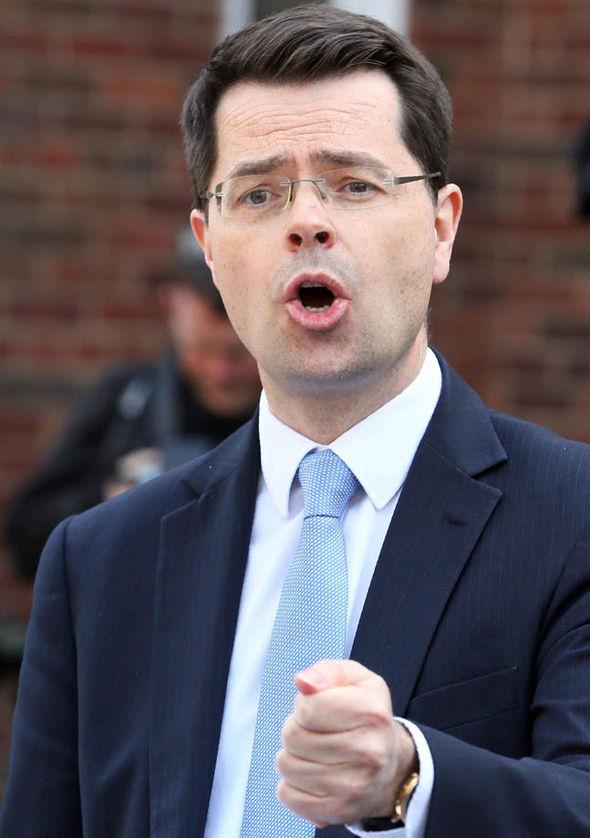
Mr. James Brokenshire, Secretary of State for ‘Northern Ireland’ (a post that would perhaps in the past have been “British Governor for …..”), who took the post last July, wants some more public forgetting. And, as is common with colonial advocates of forgetting, he is not only “economical with the truth” (a phrase famed after use by a British politician trying to prevent some other truths entering the public arena)1 but goes for outright lies.
James Brokenshire, Secretary of State for Northern Ireland (sic). (Image source: Internet)
Writing in the Daily Telegraph, Mr Brokenshire was complaining about cases being pursued against British soldiers and colonial police who were stationed in the Six Counties. He said: “It is also clear the current focus is disproportionately on those who worked for the state – former members of the Armed Forces and the RUC.”
In addition, Mr. Brokenshire praised the “vast majority” of police and the armed forces who served “with great courage, professionalism and distinction”. He added: “We are in danger of seeing the past rewritten.”
No, Mr. Brokenshire, it is you and yours who are trying to see to the rewriting of the past but there is little danger that it will happen in the heads and hearts of your system’s victims, nor in those of many other victims and their descendants further afield — despite your historians, pundits, politicians, media and your domestic tools and allies.
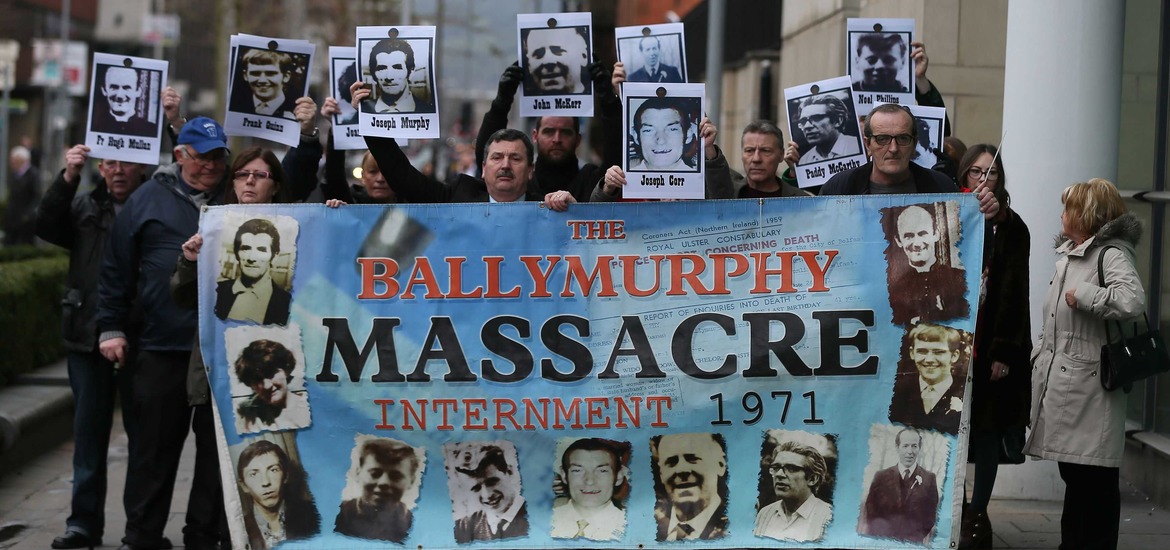
Families of Ballymurphy Massacre victims reacted angrily and refuted some of Brokenshire’s lies: “25,000 people have been through the courts and there are only three soldiers among them. Of these three soldiers, they were given lenient sentences, released early and brought back into the army to finish off their service. …. the statistics show that pro-State forces and their agents are responsible for 41% of deaths not the 10% they keep putting out there ….”
Group of Ballymurphy Massacre campaigners. (Image source: Internet)
As proof of the disproportionately heavy burden of the investigations of 3,500 violent deaths falling upon British military services and colonial police, BBC News on line informed readers that London law firm Devonshire said it was representing between 10 and 15 former soldiers facing prosecution for a number of killings, including those on Bloody Sunday.
Presumably we are supposed to gasp in shock: “As many as fifteen!!” However, just to really shock us, the firm said there could be as many as 1,000 cases. It seems they may know more than Mr. Brokenshire, who claims the killings were mostly done by Republicans.
Barra McGrory QC, the director of public prosecutions for NI, recently told the BBC a number of cases had been coming to court due to inquests and referrals from the Attorney General for Northern Ireland.
He said: “We have taken decisions in three army cases recently, one was not to prosecute and in the other two prosecutions have been initiated.”
TARGETING AND KILLING UNARMED CIVILIANS
The Bloody Sunday killings by the British Army occurred in 1972 – cold-blooded executions of fourteen unarmed civilians on a protest demonstration. Around twenty were also injured, some by gunshot wound. In the colonial tradition of lies following murder, the first official British enquiry found that the dead were armed guerrillas and the soldiers only returning fire.
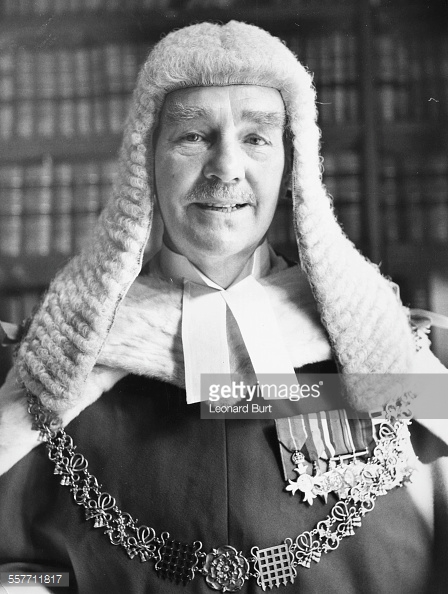
Lord Justice John Widgery — despite abundant eyewitness accounts to the contrary, his Tribunal in April 1972 found the unarmed victims had been IRA and that the soldiers had only fired in self-defence. “Nothing washes whiter than Widgery white” was a common piece of Irish graffiti at the time. (Image source: Internet)
The City Coroner, Hubert O’Neill, a retired British officer however found it to have been “sheer, unadulterated murder” in 1973. The British establishment nevertheless continued with their lies and found a way to deal with unwelcome coroners’ courts – they changed the law to prevent them apportioning blame and suspended many of the cases indefinitely.2
The Saville enquiry (1998-2004)3found that all but one of the victims was unarmed and the remaining dead man was recently cleared too. Saville’s findings included that two identified British soldiers had lied under oath (as many as that!) and, without explicitly blaming him, threw a cloud of doubt over the local leader of the Paras, Lieutenant Colonel Derek Wilford, accusing him of “deliberately disobeying” his superior officer, a Brigadier.4 No explanation was given as to how, if that were the case, he came to receive the Order of the British Empire decoration later that year “in recognition of distinguished service in Northern Ireland during the period 1st February 1972 to 30th April 1972” (i.e excluding the Bloody Sunday date by two days, true but for an officer who that same year had allegedly deliberately disobeyed a senior officer and caused the deaths of 14 civilians …..!).
Col. Derek Wilford OBE, photographed in Belgium where he now lives upon the publication of the Saville Report in 2010. (Photo: Daily Mail)
APOLOGIES, LIMITED BLAME AND NO CHARGES
Wilford’s senior officers all escaped blame, despite their decision to deploy the Parachute Regiment in Derry that day and their part in the coverup, including the wholesale hiding and destruction of evidence.5
When the Saville Enquiry Report was finally published in 2010 (six years after the conclusion of the Inquiry), then Prime Minister of Britain David Cameron apologised to the families of the victims but to date none of the soldiers who shot unarmed civilians has been charged with murder. Even worse, no British Army officer has been even charged with ordering murder and covering it up. Worst of all, no British Government Minister or official has been held responsible for the murders nor was the Widgery Tribunal, which first exonerated the Army and blamed the victims, condemned for a lying cover-up in the face of a mountain of evidence from civilian witnesses and a number of journalists. No media outlet has been charged with nor voluntarily admitted collusion in the cover up.
Mayor General Robert Ford (left of photo). He ordered the Paras into Derry despite their having killed eleven civilians 5 months earlier — but the Saville Inquiry exonerated him. (Image source: Internet)
Major General Robert Ford, in charge of land forces of the British Army at the time and in overall charge of their allocations in Derry that day, escaped any blame from the Saville Enquiry. Yet the allocation of the 1st Parachute Regiment to a Derry march against Internment had been his decision – only five months after they had shot and killed another eleven civilians over three days in another part of the Six Counties – the Ballymurphy suburb of Belfast.
The killings then too were of unarmed civilians protesting against internment (“Operation Demetrius”). As they would five months later, the soldiers, their commanding officers and politicians claimed they were “returning fire” from the IRA. A number of their victims had multiple wounds (one was shot fourteen times) and one received a second shot after being brought inside the Paras’ barracks, according to the victim before he died. As at Derry five months later, a number were shot while going to the aid of victims (including a priest, which makes the action of Fr. Daly — later Bishop — on Bloody Sunday in Derry even more heroic). One victim died of a heart attack after a soldier put a gun in his mouth and pulled the trigger – the gun had no round in the chamber but the victim didn’t know that. The inquests of the victims have still to be held, nearly half a century later.
Yes, one sees why Mr. Brokenshire wishes to have all this information buried with the victims, not to speak of other information that might yet emerge. And yet the 14 dead of Bloody Sunday in Derry and the 11 of the Ballymurphy Massacre are only some of the unarmed victims of the British Army and the RUC, not to mention the Loyalist death squads run by British occupation forces’ Intelligence units. There are the children and adults killed or maimed for life by plastic bullets fired at short range, sometimes without even being in the area of a disturbance; the children and adults killed by British or colonial forces’ gunfire; the captured Republican fighters executed on the ground or given no chance to surrender when ambushed; the joy-riding youths shot to death. Yes, Mr. Brokenshire has good reason to see all this swept under the carpet and one can understand why a number of British service personnel (supported by those in some foreign forces) would demonstrate in protest at their “persecution” as they did on April 14th in Belfast.
The investigations to which Mr. Brokenshire objects, by the way, are being conducted, not by any impartial organisation but by the Legacy branch of the Police Service of Northern Ireland. For the unaware, the PSNI is also a colonial police force, the progeny of the disbanded Royal Ulster Constabulary, containing many of that force and like its predecessor, sectarian and repressive of Republican activists. The RUC also contained the B-Specials, a kind of part-time official armed Loyalist militia, implicated in many killings and largely absorbed into the Ulster Regiment of the British Army. Officers of the full-time RUC are also implicated in many killings.6
A TIME TO FORGET
A criminal who has paid restitution and repented is entitled to get on with his or her life without being confronted with their crimes of the past. This is not what we have here – this is a criminal gang wanting us to forget while it carries on robbing, threatening, killing and destroying human lives.
Come the day when British Imperialism is dead, no longer even twitching, no pulse and no brainwaves, well then it might be time to forget. But maybe not – there might still be other imperialist and colonial powers around and as they learn from one another, so should their victims and resisters share their memories and experiences.
On that glorious day when such systems no longer trouble humanity, then, at last we can forget? I don’t think so, not even then. For what history teaches us about imperialism and colonialism and capitalism, it is teaching us about humanity, its economics and philosophies. As long as we exist, it will never be time to forget those lessons.
A chríoch.
FOOTNOTES
1Said by Sir Richard Armstrong in 1986 in the trial, the failed British attempt to prevent the publication in Australia of the “Spycatcher” memoirs of MI5 former Assistant Director Peter Wright and co-author Paul Greengrass. https://en.wikipedia.org/wiki/Spycatcher. However, the phrase was originally documented from the 18th Century liberal-conservative philosopher and orator Edmund Burke.
2Which is why some recent inquests on people killed by British and colonial forces are giving rise to criminal investigations so long after the actual deaths.
3Which many believe to be part of the Good Friday Agreement deal or at least given as a ‘sweetener’
4No investigation was apparently carried out into whether Wilford had been ever charged by the Army with “deliberately disobeying” a senior officer in an event which led to unarmed civilian deaths. In fact, Wilford had been awarded military decoration shortly afterwards. It seems that Wilford out of loyalty to the Paratroop Regiment and perhaps some other considerations, agreed to “carry the can” during the Enquiry. Wilford was always outspoken in defence of the soldiers under his command but later claimed that the Army had distanced itself from him, so that when he retired he was only one rank higher than that which he held at the time. He retired on full pension of that rank, however.
5“Over 1,000 army photographs and original army helicopter video footage were never made available (to the Enquiry — DB). Additionally, guns used on the day by the soldiers that could have been evidence in the inquiry were lost by the MoD. The MoD claimed that all the guns had been destroyed, but some were subsequently recovered in various locations (such as Sierra Leone and Beirut) despite the obstruction.” (Wikipedia)
6Although here the statistics are skewed by the few tried being made to resign just prior to being charged (presumably in exchange for gentler treatment by the courts or threat of worse) so that they did not appear as serving RUC officers when convicted.
Not Al Fatah, the Palestinian Authority or the PLO, according to this journalist, who concludes that today it is Hamas as shown by their elections. Israel, the West and Egypt tried to negate this decision by squeezing Gaza and bombarding it, where the IOF have no troops on the ground but failed so far. In the West Bank, Israel was able to subvert the elections through the arrest of Hamas representatives elected and through recognising unelected bodies such as the PA. Today Al Fatah is running a Prisoners’ hunger-strike.
D.Breatnach comments: Despite the Palestinians being a mostly secular one politically, they voted in Hamas because of the corruption and collusion of Al Fatah including its shameful agreement to the Oslo Accord 1 in 1993 as part of a whole swathe of “peace (sic) processes” which swept through South Africa and Ireland in the 1990s. Observers of the reality of Irish politics will find this article of interest and will surely see some parallels.
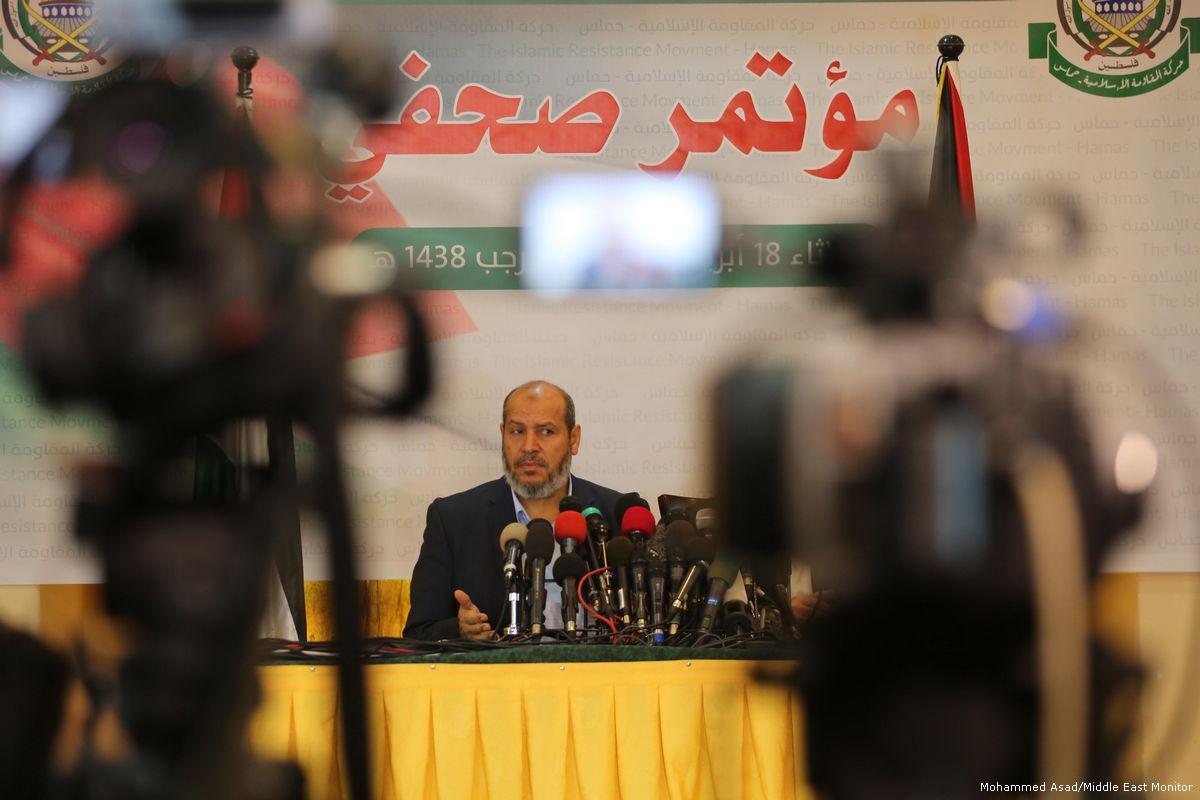
Dr. Khalil al Hayyah, representing Hamas at a press conference today on the question of talks with Al Fatah. (Photo source: Mohamed Asad, MEMO)
Motasem Al Dalloul, 13th February 2017.
The main Palestinian secular movement, Fatah, which dominates the Palestine Liberation Organisation (PLO) accused regional powers on Sunday evening of supporting its Islamic rival Hamas to carry out a coup against the umbrella body and the Palestinian Authority which it controls. The reason given is that such regional powers are trying to ease, or lift, the Israeli-led, internationally-backed, siege on the Gaza Strip.
In several official press releases, Fatah named Turkey and Qatar. They claimed that these two countries are planning to help Hamas and its supporters in the occupied Palestinian territories and diaspora to supersede the PLO and the PA.
According to Fatah spokespeople, Turkey is hosting a pro-Hamas conference for Palestinians in the diaspora, the preparations for which are going ahead without the PLO’s knowledge. However, a spokesman for the organising committee, Ziad Al-Aloul, has said several times that PLO members are among the organisers.
Fatah has also accused Turkey of supporting a military coup against the PA in the Gaza Strip, which has been under siege for more than ten years, simply because the government in Ankara sent its minister of energy and other officials to conduct a study on how they can help to solve the electricity crisis in the coastal enclave. The accusation is really unbelievable, not least because the Turkish delegation met with PA officials in the West Bank before entering the Gaza Strip. In fact, Turkey has been cooperating with the PA in the West Bank regarding a fuel grant for Gaza’s sole electricity plant.
Qatar stands accused by Fatah of the doing the same thing as Turkey, possibly because it is the only international state which has faithfully fulfilled its pledges made during the International Donor Conference held in Cairo in the wake of the 2014 Israeli military offensive on Gaza. The conference aimed to collect donations to rebuild the Gaza Strip.
Since the Cairo conference, Qatar has rebuilt thousands of homes destroyed by the Israelis during the offensive, and built thousands of new homes for the poor and homeless in Gaza. On Saturday, the latest batch of Qatari-built properties were handed over officially by a representative of the Gulf State. Mohamed Al-Emadi also announced a commitment to build a new hospital in the southern Gaza city of Rafah.
These are the Turkish and Qatari acts that Fatah, which dominates the PLO, apparently regards as illegitimate efforts to help Hamas to supersede the PLO and the PA. The movement has overlooked the simple fact that every single Turkish or Qatari donation for the Palestinians in Gaza is handed over to the beneficiaries either through the PA or directly from official Turkish and Qatari bodies working in the territory.
The latest remarks by Al-Emadi have complicated the situation even more for Fatah, the PLO and the PA, which are more or less considered to be the same body. He is the man responsible for the supervision of the reconstruction projects in Gaza. Qatari representative told the IsraeliWalla website that his country has offered to pay all of the costs needed to help solve the Gaza electricity crisis, but the leader of the PA, Fatah and the PLO, President Mahmoud Abbas, rejected Qatar’s offer. Fatah denied this and said that Al-Emadi and his government are working to support Hamas in Gaza; the movement cited the $100m grant for the new hospital in Rafah as “evidence”.
All of this leads me to wonder if the PLO and PA have any legitimacy any more. I am also wondering about Hamas’s role in the Gaza Strip.
Is the PLO the sole, legitimate representative of the Palestinian people as claimed by the UN and Arab League in 1974? The Palestinian people in the occupied Palestinian territories and the diaspora have never recognised the PLO as any such thing. The designation arose when the late Yasser Arafat went to the UN holding an olive branch in his hand. Both of these international bodies recognise Israel, which is a state built on about 78 per cent of historic Palestine; the Palestinians have been waiting for almost 70 years to fulfil their legal right to return to their land. In 1993, the Israeli occupation state also recognised the PLO as the sole, legitimate representative of the Palestinian people after signing the now notorious Oslo Accords.
Regarding Hamas, which swept Fatah — and thus the PLO and Ramallah-based PA — out of the Gaza Strip in 2007, having won the previous year’s elections, there has been no clear-cut evidence that it represents more than half of the Palestinians in occupied Palestine. Hamas refused to take part in the first Palestinian parliamentarian elections in 1996, when Fatah, its allies and a number of independent candidates won all the seats. However, in the following ten years, Hamas — whose roots in Gaza go back to the early 1970s and in the West Bank to the 1980s — won most of the elections for student councils and professional syndicates in both territories.
It became very clear that Hamas is the real and legitimate representative of the Palestinians in the territories in 2006, when the Islamic movement achieved an overwhelming victory in the municipal and parliamentary elections in both the West Bank and the Gaza Strip. Fatah, the PLO and the PA, as well as Israel, the UN and the Arab League, have always refused to recognise the subsequent Hamas-led Palestinian Authority which has been the de facto government in Gaza ever since.
Supported by Israel and backed by the most effective Arab states and the international community, Fatah, the PLO and the PA have tried to topple Hamas. They could do this in the West Bank, where Israel arrested most of the democratically-elected Hamas MPs and mayors, but in Gaza, where there is no Israeli existence on the ground, Hamas could sweep Fatah out and control the Palestinian institution.
Since then, the internal political division has been dominating the Palestinian political process. Hamas and Fatah have met together several times in various countries, but they have been unable to reconcile their differences. That is why, to all intents and purposes, the Gaza Strip controlled by Hamas has been under a strict Israeli, Egyptian and international siege supported tacitly by the Fatah, PLO and PA.
As a result, any national or international effort to facilitate a better life for the Palestinians in Gaza is considered to be “aggression” against Fatah, the PA and the PLO from their point of view. Such is the involvement of the secular Fatah in the stranglehold on Gaza that Qatar’s Al-Emadi, during his current visit to the Strip, said that the construction of a seaport and an airport under international observers are still proposed as solutions for the Gaza crisis should Israel, the world and Fatah agree.
According to the Assistant Professor of US and Middle East History at Syracuse University, Osama Khalil, in a four-year-old study, the PLO is a “shield and a cudgel against internal and external foes and competitors.” He added: “What remains of the PLO today — its name, its international status, and the few vestiges of its bureaucratic institutions, offices, and titles — have and continue to be used by a small, unelected, and unrepresentative clique to further their own agendas.”
It is fairly obvious to most reasonable people, therefore, that the PLO has little, if any, claim to be the “sole, legitimate representative” of the Palestinian people. Its leaders appear to be representing the interests of nobody but themselves.





















 rebelbreeze