The leaders of the Nigerien coup of 31st July, breaking the bondage of the country to its neo-colonial French masters, may be applying lessons from French history all the same.
Not from the Liberté, Egalité et Fraternité of the French Revolution of 17891, however.
No, instead they may be remembering the history of the Paris Commune on 18th March 1871, the first city in the world to come under a revolutionary socialist regime.2
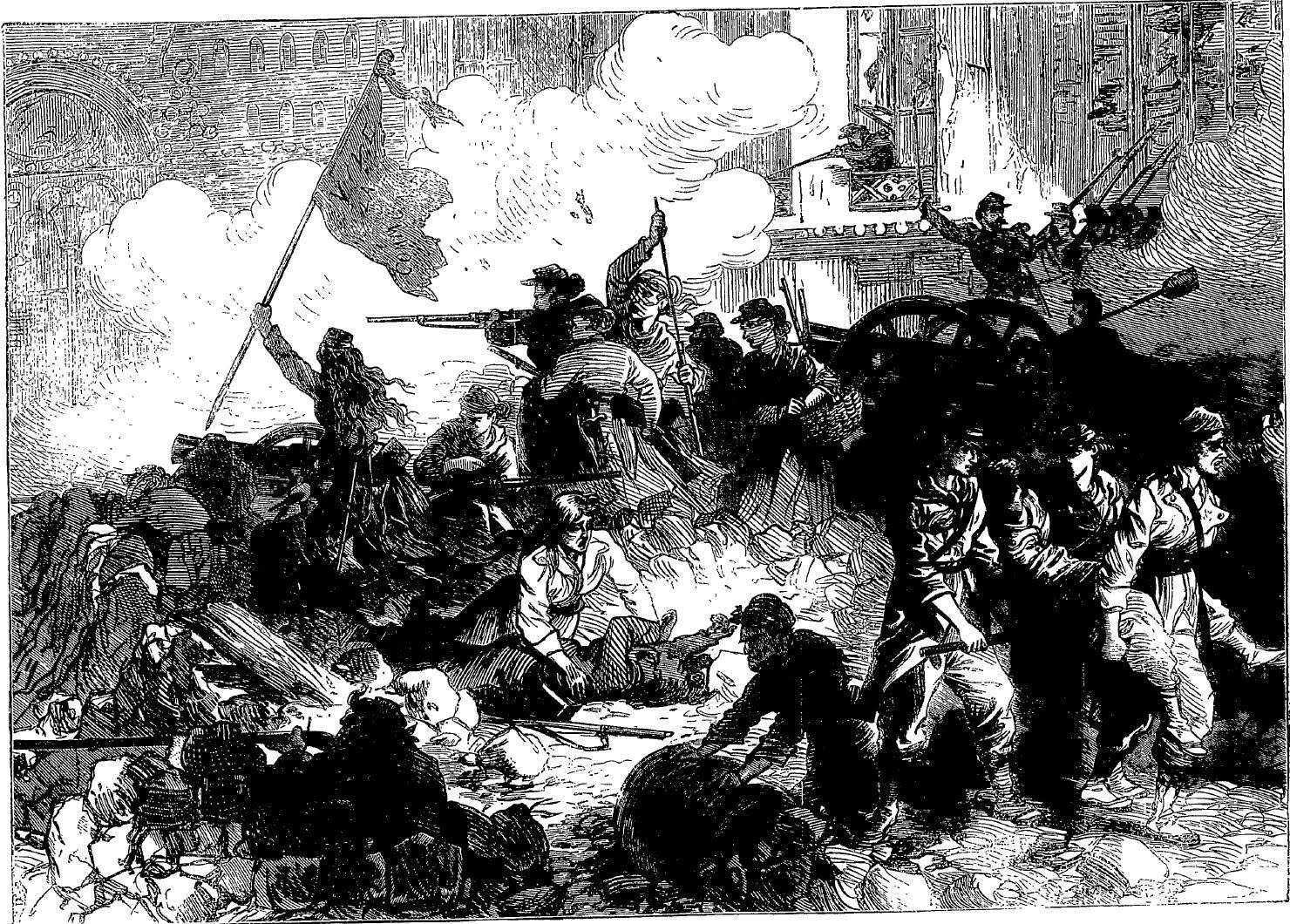
The final battle in defence of the Paris Commune 1871 (Image sourced: Internet)
In the midst of a crisis impelled by the defeat of France by Prussia under Bismark and Paris being under siege, along with crushing armistice terms for France accepted by Chief Executive Adolphe Thiers, Paris was experiencing much social and political unrest.
The authorities under the leadership of Thiers moved to disarm the people by removing canon that had been paid for by popular subscription. Crowds refused to allow this and protests grew into insurrection as soldiers of the National Guard3 joined the demonstrators.
The Communards overthrew the authorities in Paris but failed to prevent many of their enemies leaving the city.
Advised by General Vinoy, Thiers ordered the evacuation to Versailles of all the regular forces in Paris, some 40,000 soldiers, including those in the fortresses around the city; the regrouping of all the army units in Versailles; and the departure of all government ministries from the city.
Thiers set up his government in Versailles where he and his advisors plotted the retaking of Paris and the defeat of the Commune, which showed all the signs of becoming permanent.
However, Thiers lacked sufficient armed forces to fight through the Prussians. In the end he reaffirmed their crushing armistice terms in defeat and begged the Prussians to allow his armed forces (partly composed of released POWs) through the Prussian encirclement to attack Paris.
Bismark agreed and the French troops under Marshall Mahon4 (who had himself escaped from Paris) were given safe conduct towards Paris and through the besieging Prussians so that they could attack the city.
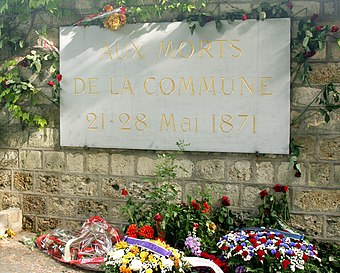
After fierce fighting but often under inefficient military leadership, the Commune was defeated by French troops on 28th May 1871, with wounded defenders bayoneted and prisoners executed en masse or, in the cases of some leaders, tried and executed or exiled.5
Plaque in Paris at the scene of many of the French executions of Communards (Image sourced: Internet)
NIGER TODAY
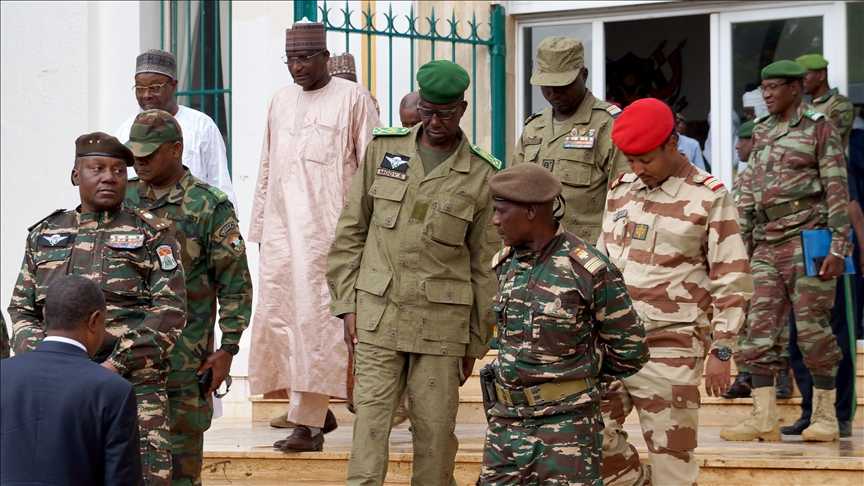
The Niger coup leaders today are holding the former elected President, Mohamed Bazoum, the neo-colonial puppet of the French, along with his family, under house arrest. Western leaders call for their release, which no doubt seems humanitarian, but the coup leaders refuse.
Nigerian military including coup leaders and civilian administrators (Photo sourced: Internet)
Certainly the coup leaders are treating their captives better than have been many leaders of former regimes overthrown by coup or invasion.
General Franco’s regime tortured and murdered around 200,000 civilians in his military-fascist coup 1936-1939, most of them after the war in Spain.
Nationalist elected President Patrice Lumumba of the Congo was murdered in 1961 by the Belgian-USA puppet Moise Tshombe’s forces.
When South Vietnam’s USA-friendly President Ngô Đình Diệm began to show tendencies towards independence in 1963, he was murdered in a coup by General Dương Văn Minh with CIA collusion. Salvador Allende was murdered in the 1976 CIA-masterminded coup in Chile.
National leader of Iraq Saddam Hussein6 (2006) and Muammar Ghadaffi of Libya (2011) were murdered by internal but USA-allied forces.
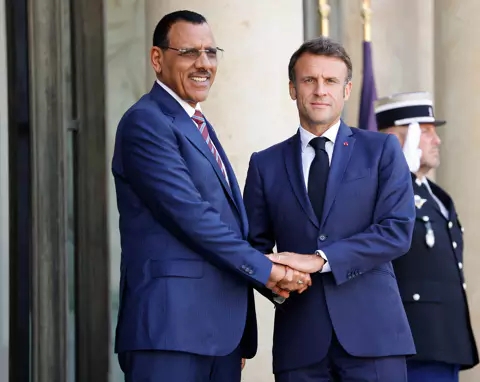
MohamedBazoum, deposed President of Niger and Emmanuel Macron, President of France, photographed in happier days for them both (Photo cred: Ludovic MARIN / AFP)
Mohamed Bazoum is alive and under house arrest with his wife and son, reportedly with canned food but without electricity and running water, though he is permitted regular contact with the West and recently met with the premier of Chad on 31st July.
Although Niger is a land extremely rich in natural resources including oil, gold and uranium being exploited by foreign companies, 80% of the population ruled under Bazoum’s presidency have never had electrity or domestic running water.
Despite demands from the Western powers, the coup leaders, perhaps remembering the history of the Paris Commune, refuse free Mohamed Bazoum, perhaps to act as a figurehead to lead a western-supported army back to ‘liberate’ Niger and to ‘restore democracy’.
End.
FOOTNOTES
1 These principles were of course not applied to France’s colonies, as the sad history of Haiti demonstrates. The African slaves there took the principles seriously but Napoleon waged war upon them and eventually, through the treachery of captains of Toussaint L’Ouverture, leader of the successful slave insurrection, delivered L’Ouverture and his family to end their days in French dungeons. Haiti was returned to French rule, where it remained until eventually overthrown again but under French neo-colonial, later USA neo-colonial dominion where it remains today.
prohibition of fines imposed by employers on their workmen.
3 The National Guard had defended Paris while the French Army was in the field and became the army of the Commune.
4 Patrice de Mac Mahon, of part of the Mac Mathúna/ Mac Mahon clan from Ireland emigrated to and settled in France (14 members of the family served in the army).
5 The national forces killed in battle or quickly executed between 10,000 and 15,000 Communards, though one unconfirmed estimate from 1876 put the toll as high as 20,000. Fifteen thousand were tried, 13,500 of whom were found guilty. Ninety-five were sentenced to death, 251 to forced labor, and 1,169 to deportation (Wikipedia).
6 Saddam Hussein at least had a trial and the question is not whether, if one agrees with a death penalty, he deserved to die but that it was the ‘justice of the victor’, in this case that being the USA, certainly guilty of many more murders and tortures than was Hussein. Ghadaffi was murdered most painfuly without any trial by his captors.
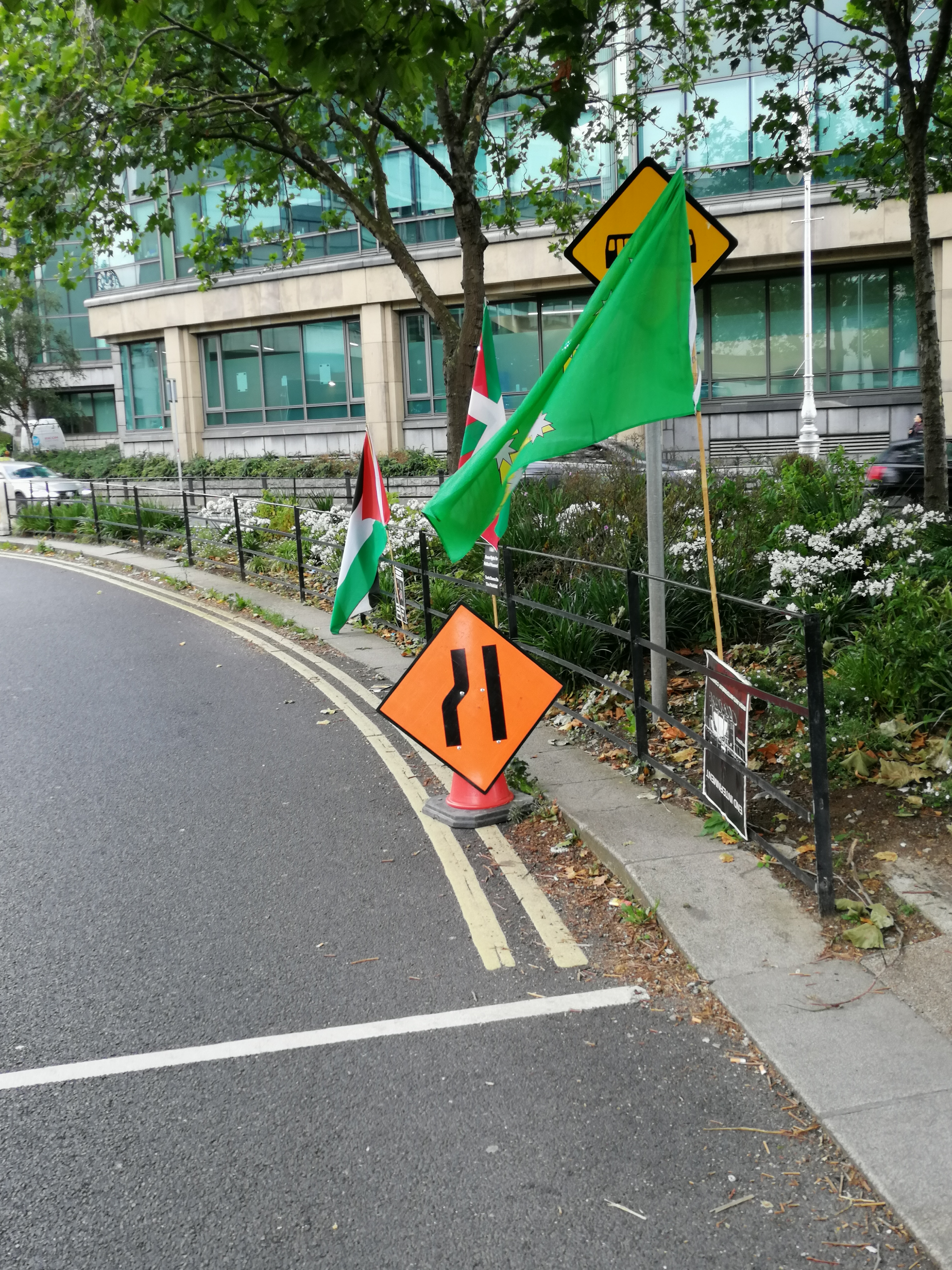
Socialist republicans and communists gathered on a traffic island in Dublin’s city centre to mark the International Day of the Prisoner. They flew flags to represent prisoners in Ireland (‘Starry Plough’), the Basque Country and Palestine.
They also displayed a number of placards.
(Photo: IAIC).
The choice of location, apart from being passed by road traffic in three directions, was because of the presence there of the Universal Links on Human Rights memorial sculpture with an eternal flame, commissioned by the Amnesty International organisation.
A plaque near the sculpture bears the following words: “The candle burns not for us but for all those whom we failed to rescue from prison. Who were tortured. Who were kidnapped. Who disappeared. That is what the candle is for.”
Plaque in the ground on the approach to the sculpture. (Photo: IAIC).
Somewhat ironically, one of the placards carried the words: “Amnesty International, do Irish Republican prisoners not have human rights too?” Irish Republicans have long complained that the organisation in question does not raise any issues with regard to Irish political prisoners.
Some have indicated as a possible reason or part-reason the location of the head office of Amnesty International being based in London, capital city of the occupying power. Its interventions on Ireland even during three decades of war in the colony have been very few indeed.
Other placards displayed referred to political prisoners from the liberation wars in India and in the Philippines, the innocent Craigavon Two still in jail and ongoing internment through refusal of bail to Republicansappearing before the no-jury special courts in both administrations.
Some leaflets were distributed about ongoing internment in Ireland through long remands in custody of Republican activists. Between convicted and awaiting trial there are close to 50 political prisoners in jails in Ireland between both administrations.
The Universal Links sculpture by Tony O’Malley (welding by Jim O’Connor) commissioned by Amnesty International. (Photo: IAIC)
The Zionist Israeli state holds 5,000 political prisoners (almost all Palestinian), of which over 1,132 are not even charged (‘administrative detention’). There are 33 female Palestinian political prisoners and 160 child prisoners. Philippines has 803 political prisoners.
The Spanish and French states hold between them around 170 Basque political prisoners.
The event to mark International Day of the Prisoner was organised by the Ireland Anti-Internment Campaign and a spokesperson gave a short explanation on video of the reason for the event with the human rights sculpture in the background.
End.
Some of the flags displayed (Photo: IAIC).Passer-by in conversation with a leafleter. (Photo: IAIC). (Photo: IAIC).
The media has alerted us to a military coup taking place in an African country most of us won’t even have heard of: Niger.
Apparently Niger had a democratically-elected leader overthrown by the coup and many states, including France and the US, are very concerned about this. Naturally so. Military juntas are surely no fit replacement for democracy.
Map of much of Africa showing Niger in green and surrounding states (Source: Wikipedia)
But it turns out that the USA and France have other reasons to be concerned apart from questions of democracy: both states have military stationed there, the USA including in fact a major military installation producing and operating drones, some of which are armed.
But why are they there? Well, to defend Niger against fundamentalist Muslim jihadists. That’s good, right? Helping the Nigerien people. It’s true that some unkind (and possibly ungrateful) people accuse the US of having given birth to the islamist fundamentalists originally, but, well …
We learned just recently two very strange facts, side by side: 1) Niger is one of the poorest countries in the world and 2) it is the seventh-largest exporter of a highly-valuable material: uranium.
Niger also has gold mines (two years ago 18 people were killed in a mine collapse) but curiously, Niger has no gold reserves at all. France, on the other hand, which has no gold mines whatsoever had 2,437 tonnes of the metal in their reserves at the end of the second quarter of this year.
Uranium is valuable because it is used in the production of nuclear power which, in turn, in many parts of the world, is used to generate electricity. France being one of those countries, where 80% of its uranium comes from … Niger. And 20% of the EU’s electricity likewise.
Hmm. So there might be reasons apart from restoring democracy for France being so upset at the coup, especially when the coup leaders say they want to break with France.
Urban scene in Niger, exact location and date unknown (Source: Internet)
But going back to this country being one of the poorest in the world, at least they must have plenty of generated power, right? Well, no. It turns out that 80% of the people have no electricity supply whatsoever. Democratic government or not, that can’t be right, can it?
Anyway, France has ordered the coup leaders to reinstate the deposed president with a deadline of last Sunday or it would take stern action. The deadline has passed quietly without an invasion or other attack.
Niger was a colony of France and became independent in 1960 so it’s kind of strange that France has such a grip on the country still.
Another five states border Niger including Mali and Burkina Faso, also ex-French colonies, also under recent military coup juntas. Their leaders have said any attack on Niger would be considered an attack on them.
Algeria was also a French colony and fought a very hard liberation struggle for independence, since when it has friendly relations with Russia. Algerian armoured vehicles have moved to the border with Niger, in what will be understood as a warning to other states not to invade.
Chad is another ex-French colony in the region but it made some threatening noises against the military coup leaders in Niger; Senegal too is an ex-French colony loyal to France.
Senegal’s political opposition leader Ousmane Sonko is on hunger strike in jail and his lawyer Juan Branco, extradited from Mauritania is in jail too for defending Sonko but nobody seems to be shouting about Senegal’s lack of democracy – not that we can hear, at least.
The west-friendly (some say neo-colonial) state of Nigeria, the leading state in the pro-western African alliance COWAS has imposed sanctions and threatened to invade Niger if the previous regime is not reinstated. Nigeria is huge and with extremely valuable resources, including oil.
In 1995, in defence of British Petroleum’s operations, Nigeria hanged peaceful environmental activists in the Delta region, the Ogoni Nine. As many as 4 in 10 Nigerians live below the national poverty line with 133 million living in poverty, according to its own national statistics.
Regarding Africa and coups, we Irish have cause to remember the Congo where Irish UN peacekeeping soldiers were killed, after a military uprising in a province against the elected patriot Patrice Lumumba was carried out in support of Belgian mining interests, supported by the USA.
And Uganda’s military rule under Idi Amin was generally OK with the western powers until he began to throw his weight around against the British, who had trained and supported him, so they had to bring him down.
Supporters in Niger of the military coup there demonstrating. (Photo sourced: Internet)
Elsewhere, for example in Latin America, military coups in many countries including Brazil, Chile and Argentina have been supported by the western powers or indeed instigated by them. As in what is now Iran, when the British overthrew the Shah in 1941 to replace him with his son.
Dictatorship from 1965 in Indonesia was widely seen by the western powers as necessary to stop the spread of socialist and national liberation ideas and, as in most such coups, the toll in massacres and torture by the new regime was huge. None such in Niger though, at least so far.
If we were citizens of Niger would we think ourselves better off under a military junta rather than a democratically-elected President? We might initially be more concerned as to whether the riches of our country were to be used to lift us from such poverty.
To give us education, hospitals, medicines, food, work, clean water, refuge from heat, power … or instead extracted and shipped out to some other country.
And what would we think of France, possibly backed by other NATO countries and their client states, coming to invade our land and bring back the old state of affairs?
End.
Niger’s National Council for the Safeguard of the Homeland Colonel-Major Amadou Abdramane, center, is greeted by supporters as he arrives for rally at the Stade General Seyni Kountche in Niger’s capital city Niamey, on August 6, 2023.(Photo cred.: Rebecca Blackwell, AP)
Original Breaking News article: DAVID YOUNG, PA (with commentary in italics by Diarmuid Breatnach)
The rededication of a memorial to the National Army soldiers killed in the Civil War enables their memory to be rehabilitated, a ceremony in Dublin has heard.
Defence Forces Chief of Staff Lieutenant General Sean Clancy paid tribute to the some 810 soldiers killed serving on the Free State side in the 1922-2023 conflict as he addressed the event at Glasnevin Cemetery on Sunday.
Descendants of some of those who died, representative of all four provinces, were invited guests at the ceremony, among them relatives of Michael Collins, the commander in chief of the National Army who under direction by Churchill, gave the orders that began the Irish Civil War and who was killed in 1922.
Taoiseach Leo Varadkar and Tánaiste Micheál Martin, the leaders of Fine Gael and Fianna Fáil, the two main parties forged from the divisions of the Civil War, also attended the rededication of the National Army Monument.
Sinn Féin TD Matt Carthy also attended the military commemoration, as did Dublin Lord Mayor Daithí de Róiste.
This neatly brought together political parties of the neo-colonial and neo-liberal Irish State with opposing histories: Varadkar to represent the pro-British and fascist neo-colonial origins of Fine Gael; Mícheál Martin and De Róiste representing Fianna Fáil, the allegedly Republican but in reality Irish Gombeen split from the previous iteration of Sinn Féin; Carthy for the current neo-colonial, neo-liberal and colonial servant Sinn Féin.
Taoiseach Varadkar (Fine Gael) and Tánaiste Martin (Fianna Fáil) unveiling monument to soldiers of the ‘Free State’ killed in the Civil War 1922-1923. (Photo cred: Brian Lawless/ PA)Matt Carthy TD, who represented his party Sinn Féin at the unveiling and dedication of the monument to soldiers of the Free State killed in the Civil War 1922-1923. (Photo sourced: Internet)
Prior to the ceremony, there was no monument in the country specifically dedicated to the soldiers of the National Army who fought against the anti-Treaty side in the Civil War.
Weeks after the war ended, on August 3rd, 1923, the Oireachtas passed legislation that led to the creation of the modern-day Defence Forces, Óglaigh na hÉireann. That is, the defence forces of the neo-colonial ruling class who created the Irish state.
The rededication event for the forgotten fallen of the National Army, which had already robbed the Irish language version name of the IRA, adopted the name Óglaigh na hÉireann during the Civil War, took place on the Sunday prior to the centenary of that date.
“It is appropriate then, in the spirit of real inclusiveness, of ethical remembering, and with a full desire to deal with some of the more uncomfortable aspects of our shared history, that we remember some of 810 uniformed members of Óglaigh na hÉireann who gave their lives in the service of the State during the tragic and critical period at the foundation of our democracy,” Lt Gen Clancy told the ceremony.
It is necessary, in order to bury any idea of achieving the Republic declared at the start of the 1916 Rising, that we honour some of the 810 men we recruited to bury that Republic in 1922, kitted out in uniforms, armed and transported by our ancient enemy. We wish to pass over quickly over not only the kidnappings, torture, murders, killing of disarmed prisoners and even sexual assaults by this fine body of men – the precursors to the current army of the Irish State – but also their terrorising of major part of the country with raids on homes and internment of men and women. Although this fine body of men were fighting to establish a neo-colony not even covering the whole of Ireland, we make no apology for calling them what they clearly were not, Óglaigh na hÉireann, i.e “Warriors of Ireland”.
The monument in Glasnevin to soldiers of the Free State killed during the Civil War – apart from the Free State Army having appropriated the name in Irish of the IRA, the legend claims they “died for their country”, a clearly inaccurate statement since at best they were fighting for the government and state of the 26 Counties, which excludes the UK colony of the Six Counties (‘Northern Ireland’ sic). (Photo cred: PA)
“For far too long there has been no memorial of any kind, nor any complete listing of the National Army war dead.” Understandably.
“Indeed, this year represents perhaps the last real opportunity to rectify that.”
As we prepare to commit this armed force to NATO at some point in the future and to PESCO in the nearer future, it is important to take a further step in legitimising this armed force of the neo-colonial state.
The remains of some 180 of the 810 soldiers who died serving in the National Army are buried at the plot in Glasnevin Cemetery. Uncomfortably close to graves of many of their victims.
“Sources at the archives show that the average soldier buried here was in his early 20s, was unmarried and from a working-class background,” said Lt Gen Clancy. In other words, the typical recruitment profile of lower-rank soldiers in capitalist and imperialist armies.
“Many had previously served in the IRA during the War of Independence, some even in the 1916 rising, many others had served in the British Army, underlying yet again how complex is the weave of Irish history.”
Actually, “many” is a questionable though vague estimate of the numbers who had “served in the IRA during the War of Independence”, though some had, including some of the most vicious, such as Major-General Paddy Daly, torturer and murderer.
The chief of staff highlighted the “poignant example” of two young Belfast-born Dublin-raised brothers – Frederick (18) and Gerald McKenna (16) – who were buried in Glasnevin after being killed together in action in Cork in August 1922 only a month after joining the National Army.
Aye, two men born in Belfast, a city which the Free State was fighting to ensure remained a direct colony of the United Kingdom.
“Whatever the often very legitimate reasons our forebears may have had for forgetting in the intervening 100 years, I think it’s appropriate now that I as the 32nd Chief of Staff of Oglaigh na h Eireann should finally take this opportunity to rehabilitate their memory,” said Lt Gen Clancy.
Especially as I try to establish a legitimate background to the armed force of an illegitimate State preparing to enter foreign imperialist wars and suppression of legitimate uprisings.
After all, we have great experience in all that, as the history behind this monument shows.
In all areas of endeavour and no less in revolutionary work it is essential to review our actions (and those of others) periodically in order that we may draw lessons to improve the success of future activity.
Irish history provides an abundance of material to revise.
The most recent period worthy of intensive review in my opinion is the three-decade war, mostly in the Six Counties but also having repercussions within the territory of the Irish State, in Britain and even further abroad.
An article in the July issue of An Phoblacht Abú1, monthly hard-copy newspaper of the Anti-Imperialist Action organisation, discusses the psychological and organisational problems arising from the way that three-decade struggle came to an end and its effects on the resistance movement.
That period in Ireland commenced with a struggle for democratic civil rights, not one of the demands of which were for more than was already well established in the rest of the ‘UK’. But it soon changed into a guerrilla war with huge numbers of political prisoners and jail struggles.
The movement experienced a number of splits and changes of leadership but for most of of the time it was led by the Provisional organisation’s leadership although changes took place inside its own leadership too.
Ruairí Ó Brádaigh, President Provisional Sinn Féin 1970-1983, speaking at GPO rally 1976. He led an unwinnable war. (Photo cred: Pat Langan/ Irish Times)
Some of the Provisional IRA leadership following the 1970s split: Martin McGuinness, Dáithí Ó Conaill, Sean Mac Stiofáin, IRA press conference 1972, Derry. (Photo cred: LarryDoherty)
The period ended with that leadership not only abandoning armed struggle but being coopted with its structures into joint management of the colonial occupation and preparing for joint management of the neo-colonial Irish state, a number of smaller splits in the movement a much disillusion.
The An Phoblacht Abú article concentrates on building or rebuilding trust in leadership through measures such as clear communication, discussion, organisational restructuring, collective solidarity, open discussion, transparent communication and education.
The article does not say this but in my opinion one of the basic educational needs is to acknowledge that in the circumstances, what happened was inevitable (and to consider how different circumstances might be constructed in future).
UNWINNABLE
It is essential in my view to acknowledge that the struggle, as it was waged, was bound to lose. Yes, unwinnable: an unassisted armed struggle against a world imperialist power fought primarily in one-fifth of our territory where the population is deeply divided – how could we think otherwise?
Clearly, the Provisional leadership did think otherwise. Assuming they were not insane or very stupid, on what could their belief have been based?
I can see only two rational possibilities:
1) They believed the British had no essential need to retain the 6-Co. Colony and would abandon it if put under enough pressure, or
2) that the Irish ruling class, through its government, would step in and join the struggle.
If they believed the first, their analysis was not historically-based. Since its invasion and occupation of Ireland in the mid-12th Century, the British ruling class has repeatedly gone to enormous efforts to suppress Irish self-determination.
When they had the opportunity to leave in 1921 they had cultivated a client bourgeoisie, then instigated a civil war and partitioned the land, leaving themselves a firm foothold in the country.
Their initial response to a call for simple civil rights in the late 1960s was violent suppression on the streets, abolition of habeas corpus and introduction of internment without trial – and army massacres.
If the previous lessons of history were not clear to the movement’s leadership, then those events up to 1972 should have made them crystal clear.
If the Republican leadership believed the Irish ruling class would step up, they failed to draw the lessons of history since at least 1921 and to understand the neo-colonial nature of the Gombeen class, amply illustrated in the preceding 50 years of the Irish State.
As embarked upon and fought, the war could not be won but a strugglewas potentially winnable.
However, to have a chance of winning, the struggle would have to be over the whole 32 Counties. And to engage the maximum number of people, it would have to take up the social, cultural, economic and political deficits across the Irish state and across the colony.
The social rights of women and LBG2 people were widely-acknowledged deficit areas, yet the Republican movement did not seriously address them. Of course, doing so would have put the Movement in direct opposition to the Catholic Church hierarchy and its followers.
Why should that be a problem? Hadn’t the Hierarchy been pro-British occupation since the late 1800s3 and anti-Republican since the 1790s? Wasn’t it one of the cornerstones of the neo-colonial Irish State, its social prop and social control mechanism?
Yes but the problem was that some of the leadership themselves were in that ideological ambit and were in any case afraid to disaffect many of their followers. A natural fear, of course. Yet only in that way could the struggle go forward across the Irish state’s territory.
It was left to campaigners mostly outside the Republican Movement, including social democrats and liberals, to fight for the rights to contraception, divorce, equality for women, LGB rights. And later, to take on the huge institutional abuses of the Catholic Church in Ireland.
Those issues affected directly well over half the population of the Irish state and the the leadership lacked the interest or the courage4 to take part in their struggles, never mind lead them, which it left to mostly non-revolutionary leaderships.
There were many other issues that affected people in the 32 Counties which a revolutionary leadership could take up and, I would argue, should have taken up.
The latter includes emigration, rights of the Irish diaspora (particularly in Britain), foreign penetration of the Irish economy, foreign land ownership, housing shortage, industrial struggles, academic freedom, Irish language rights, Church control of education and the health service …
Some of those issues were taken up for a while by the movement in parts of the 26 Cos. prior to the split in the Republican Movement but were progressively dropped as the armed struggle in the 6 Cos. took off.
When years later the Provisional leadership got interested in social democratic reformism, they found they could hardly make any headway in the unions against the Labour Party and the remains of the Workers’ Party – because of the Provos’ earlier overwhelming neglect of that area of struggle.
SUMMARY
The struggle in the Six Counties could not be won precisely because it was primarily confined to that area and also one in which a powerful enemy had seduced a huge section of the population.
When the leadership acknowledged the unwinnability of the struggle as being waged, instead of changing their methods and aims of struggle to take in the whole 32 Cos, they decided on capitulation and getting the most possible out of it for themselves.
A change in the top leadership of Sinn Féin and the IRA: Gerry Adams and Martin McGuinness photographed in 1987. They recognised they could not win and set about managing abandoning it while getting something out of the system for the leadership. (Photo: PA)
The leadership of the Republican movement was unwilling to widen the struggle because they believed that it was unnecessary to do so and/ or they were unwilling to overcome their own ideological indoctrination and/or lacked the courage to confront prejudices among their following.
Some of the social struggles have now been won or hugely progressed but without the leadership of the Republican Movement, in fact by leaderships of mostly reformist trends.
Due to leaving the industrial struggle to social democrats, the trade union movement has degenerated hugely and is in a poor state to take on any substantial economic or rights struggle, to say nothing of a revolutionary one.
The surviving Republican movement seems unwilling to acknowledge those historical facts and its failure thus far in leadership. Admission of the facts is necessary in order to commence to repair the movement and to prepare for a struggle with a prospect of success.
End.
FOOTNOTES
1Page 9, entitled COMRADESHIP – GUARD AGAINST BETRAYAL; I intend to review the July issue of the newspaper separately some time soon.
2I have omitted the T from LGB because it is only comparatively recently that the transexual issue has gained wide acknowledgement, whereas the Gay, Lesbian and even Bi-Sexual issue were widely known about at the time under discussion.
3The Irish (settler) Parliament passed an act giving middle-class and higher Catholics the right to vote in 1793.
(This article is reprinted from Socialist Democracy by kind permission of the author Gearóid Ó Loingsigh)
(Reading time: 3 mins.)
The USA has announced that it will supply cluster bombs to Ukraine as part of its support for the war against Russia.
On one level the move is not surprising, on another it reveals some fundamental truths about the course of the war and US intentions.
They are banned by international treaty, one which has not been signed by Russia or Ukraine, and of course, neither has it been signed by the US. The US has always dragged its feet on the question of the banning of certain types of weapons.
Cluster bombs, are simply put bombs that break up into smaller components leaving small explosive devices scattered over a large area of land. They are a
…conventional munition that is designed to disperse or release explosive submunitions each weighing less than 20 kilograms, and includes those explosive submunitions…
These weapons are designed for use against massed formations of troops and armour or broad targets, such as airfields. Cluster submunitions, however, sometimes fail to explode on impact and can kill or maim civilians who later come into contact with them. These unexploded submunitions may remain dangerous for decades.(1)
Cluster bomb capsule (Photo sourced
They have all the potential to leave Ukraine like the US left Cambodia and Laos in the 1970s.
According to Cluster Munition Monitor 23,082 casualties were confirmed by the year 2021, with around 18,426 resulting from unexploded munitions.
Biden has a long and chequered history on the use of the weapons.
His ambassador to the UN had condemned their use by Russia, stating they had no legitimate place on the battlefield, though two days later the State Department censored the official transcript of her intervention to remove the phrase.
Biden had criticised the use of and access to such weapons in the past. (2)
Whilst it is all very interesting and even of humanitarian concern that the US would wish to turn Ukraine in another Laos and Cambodia, though unlike Kissinger they will be telling no lies about their bombs, it is of greater interest what it says about the war.
Biden’s official reason is that Ukraine is running out of munitions and they need the cluster bombs. We have been told from the word go that this war is winnable, i.e. that Ukraine can win it.
This of course ignores that Ukraine is not the only warring party fighting Russia; NATO is part of the war, although it is not putting many boots on the ground, though it clearly has had a hand in some operations.
Every week we hear announcements that the counter offensive will smash Russia, almost there, one more push, the Russians have run out of weapons, their army is demoralised and deserting etc. Now it turns out that Ukraine needs these weapons or else.
These weapons are very useful in halting advances by your enemy, they are not as necessary in situations where your enemy is routed, unless you think it may regroup and retake the initiative.
Ireland has wholeheartedly supported the war in Ukraine, confirming to those who wish to see that it is not a neutral country. It has had little to say on the issue of these banned weapons.
They will make parts of Ukraine uninhabitable and make agriculture a dangerous profession as sowing and reaping become potentially life-threatening activities. If Biden will go to these lengths, what else will he do?
Children view unexploded cluster bomb sub-munition near their village, Laos, 2019 (Photo cred: Sarah Bronstein)
Despite the media talking about Putin’s willingness to use nuclear weapons, it really has to be asked whether the US is willing to go that far as well.
What then of the former leftists running round chanting victory for NATO, or as they would put it for Ukraine? None of them have said much either on Biden’s choice of weaponry. Is there no length to which the US will go that marks a turning point for them? The answer is no.
Should Biden propose facilitating large scale rocket attacks on Moscow they are as likely to cheer them on as to remain silent. What they will not do, ever, is oppose the escalation of the war. Modern day Kautskys.
A broad group of socialist Republicans gathered at the grave of Theobald Wolfe Tone on Sunday 2nd July to honour his memory and to reiterate their commitment to an independent and socialist Ireland outside of imperialist military alliances.
Wolfe Tone’s grave in the Bodenstown Church graveyard has been a place of pilgrimage for Irish Republicans at least since the days of Thomas Davis1 of the Young Irelanders of the 1840s, who wrote of his own visit to the grave and composed the song “In Bodenstown’s Churchyard”.
The late 1960s saw huge numbers of people in attendance at annual commemorations there near the village of Sallins, Co. Kildare, including not only Sinn Féin2, who led them, but many political and social organisations, GAA clubs, along with many non-aligned people.
Over the years, the voluntary and unfunded National Graves Association has improved the site comprehensively and sensitively, leaving the ruins of the Protestant church as they are but building a stage attached to one side, fronted with plaques and commemorative flag stones.
Commemorations currently are usually organised around a Sunday near the date of the patriot leader’s birthday on 20th June but have to be managed between different groups wishing to hold their own commemorations.
Speeches, songs and Garda harassment
The Annual Wolfe Tone commemoration organised by the Wolfe Tone Commemoration Committee took place over the weekend with members of a number of groups and Independent Republicans in attendance.
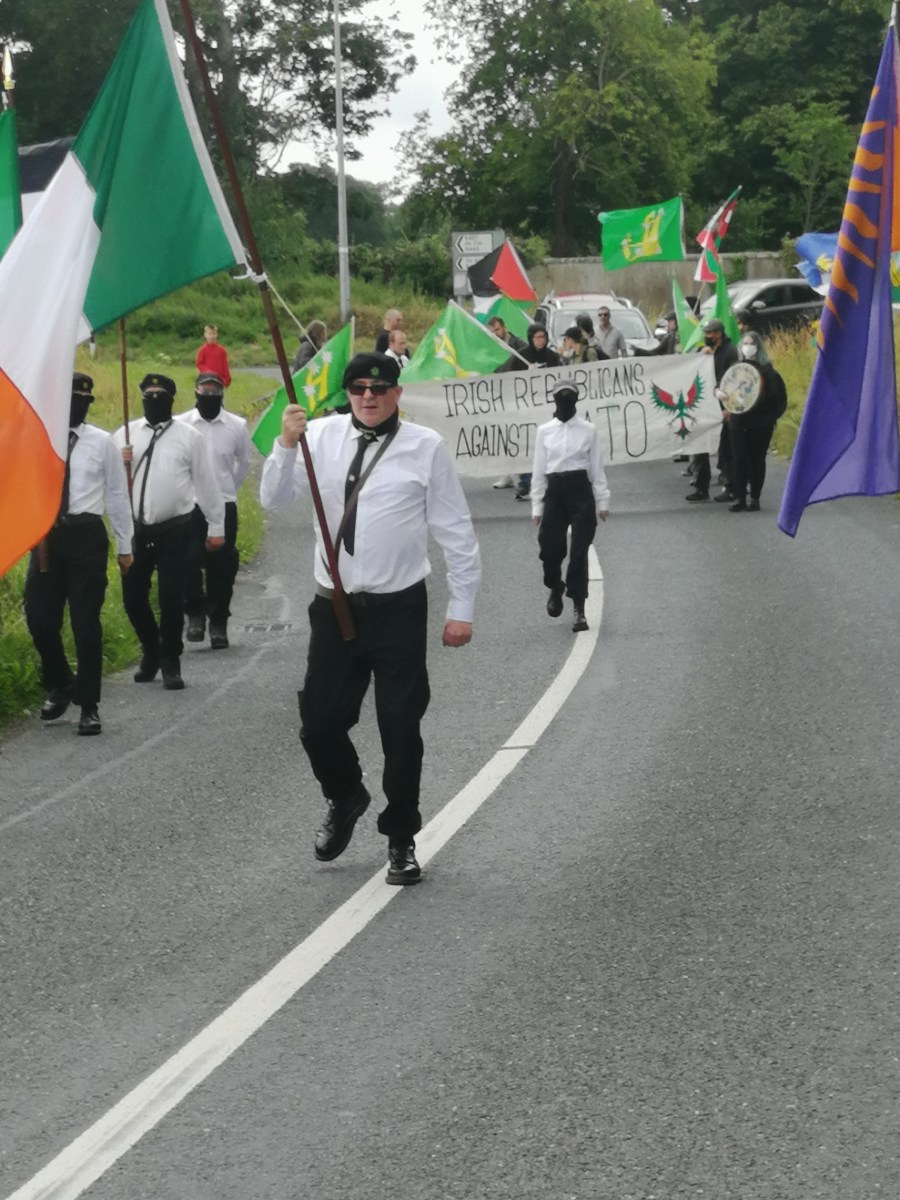
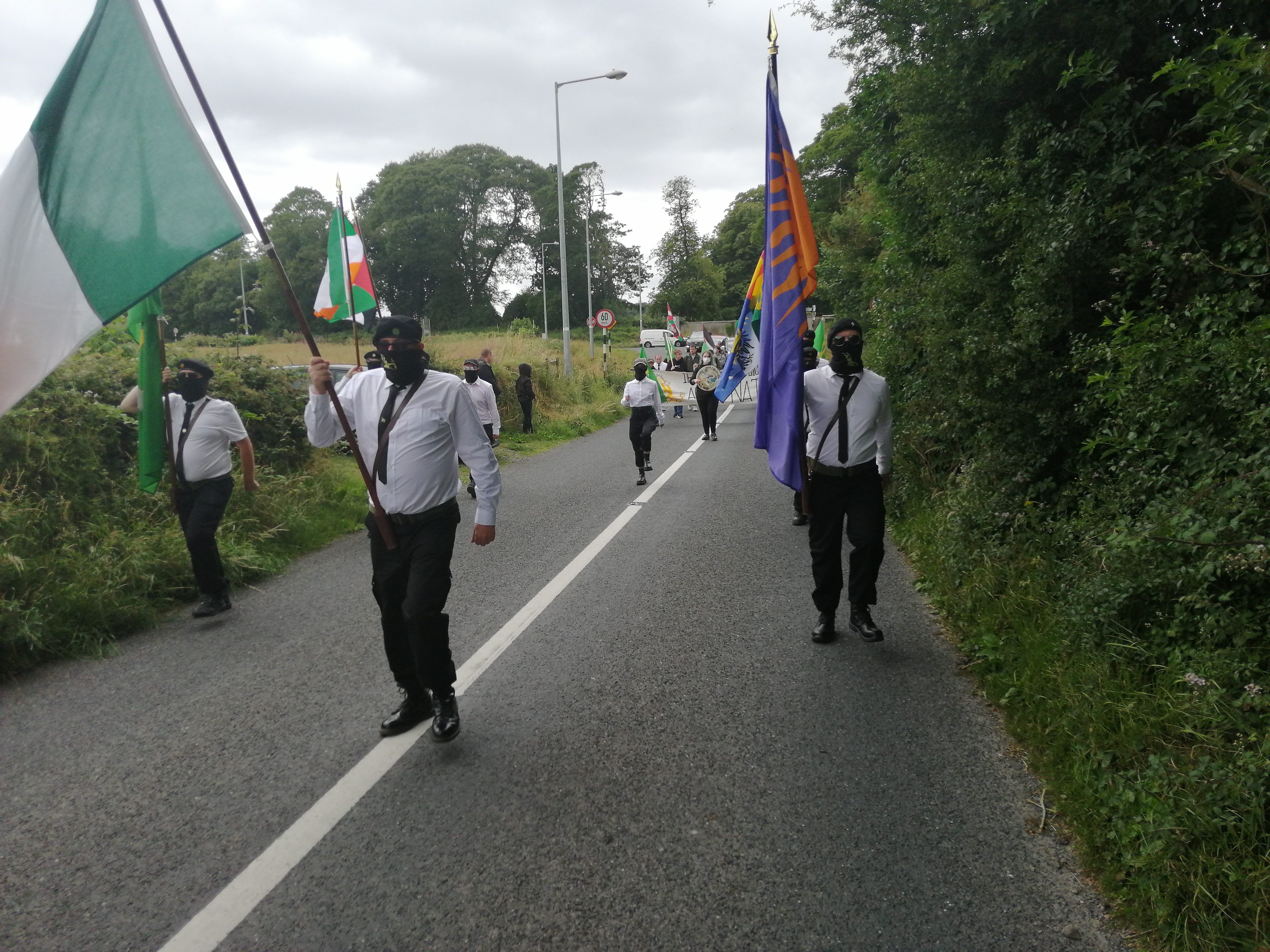
A Socialist Republican Colour party led the march up from the bottom of the road, turning in to the graveyard through a side gate and taking up positions in front and to one side of the monument, at ordú scíthe (parade rest) position but with flags held high.
Colour party in front of Wolfe Tone monument, Bodenstown Churchyard (Photo: Rebel Breeze)
Behind the colour party followed a crowd carrying banners bearing the legends “Irish Republicans against NATO”, “We serve Neither King nor Kaiser but Ireland” and an assortment of flags including green-and-gold Starry Ploughs, Irish Tricolour, Palestinian and Basque national flags.
The event was chaired by a young Socialist Republican who spoke about the importance of the event before introducing a representative of a midland Republican commemoration group who read a short message of solidarity.
This was followed by a socialist republican accompanying himself on guitar singing The Three Flowers.3
The main oration was delivered by veteran Independent East Tyrone Republican Margaret McKearney who linked the past with the present, including the current housing crisis, the British occupation and the Irish State’s push to join PESCO and NATO military alliances.
Musician performing The Three Flowersat the Wolfe Tone monument (Photo: Rebel Breeze)Veteran Republican from Tyrone delivering the oration at the commemoration event (Photo: Rebel Breeze)
There was a clear message at the event that the push towards NATO will be energetically resisted at every turn by the people of Ireland.
Wreaths were laid and a minute’s silence was observed, while the colour party lowered the flags in memory of all those who paid the ultimate sacrifice in the ongoing struggle for Irish Freedom. The event was brought to a close with the musician playing and singing Amhrán na bhFiann.
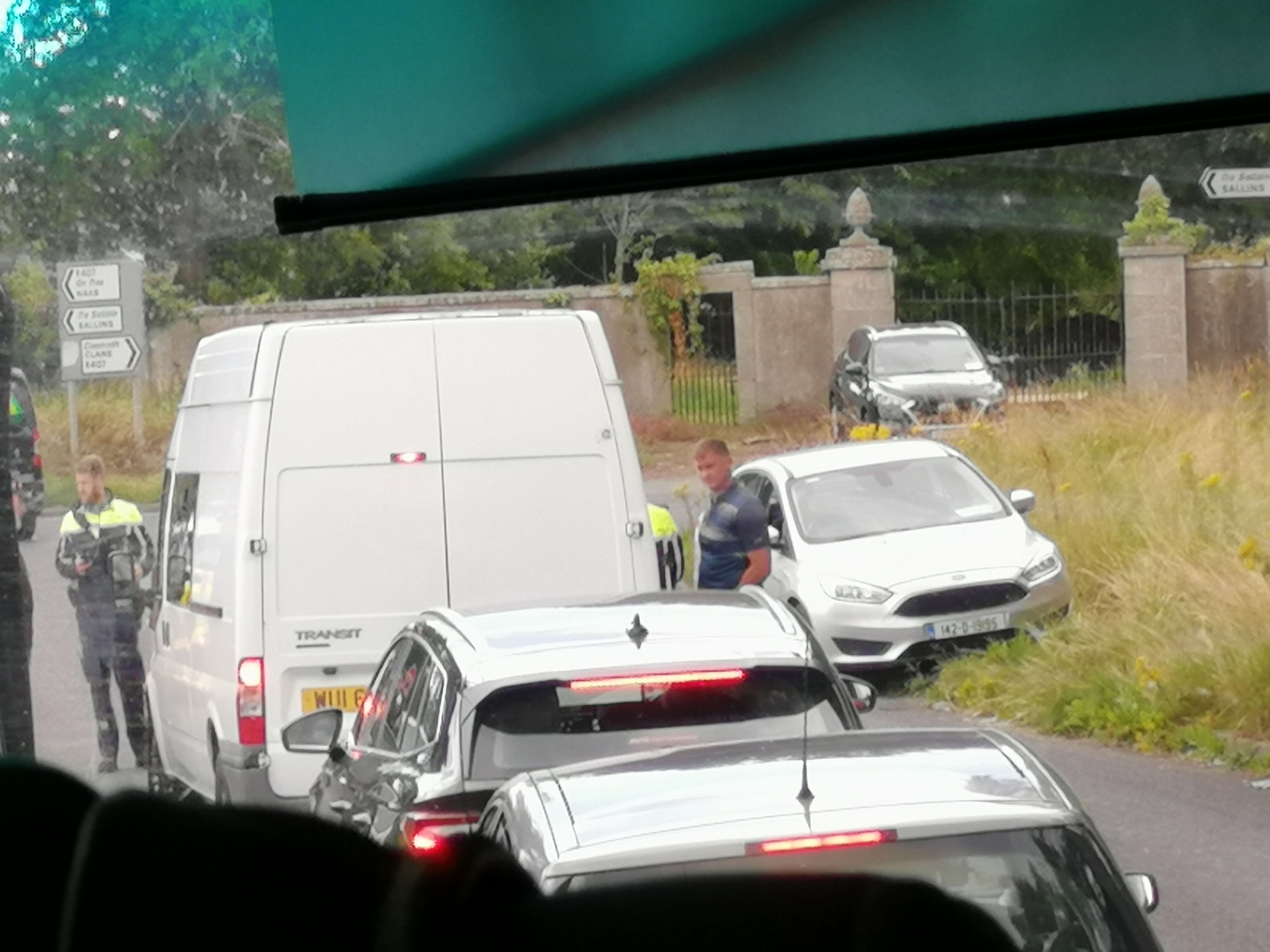
A handful of Gardaí4 in uniform and in plainclothes (Special Branch, the political police) were parked outside the graveyard watching people arriving and leaving but at that point having no direct interaction with those attending the event.
Part of long tail-back cause by Garda checkpoint very near to Bodenstown Churchyard after the commemoration event (Photo: Rebel Breeze)Gardaí in uniform and Special Branch in plain clothes harassing and attempting to intimidate people who had attended the commemoration event (Photo: Rebel Breeze)
However, once the event concluded, the Gardaí set up a checkpoint at the bottom of the road and began to harass and attempt to intimidate drivers of vehicles, stopping them, asking for identification, where they were from etc, causing a long tailback.
This is part of the regular harassment of Irish Republicans by police on both sides of the British Border.
“The Father of Irish Republicanism”
Theobald Wolfe Tone (1763-1798) was formally a member of the Church of Ireland5 congregation (Anglican), in his time the dominant religious group in England-occupied Ireland but also one of the smallest.
No-one could be elected to the Irish Parliament unless of that congregation.
In the early 19th Century a section of the Irish bourgeoisie, nearly all Anglican or of the other Protestant churches, “dissenters”, wished to develop the Irish economy free of interference, control, patronage and bribery associated with being an English colony.
Many of them understood the need for a strong base in the population, for which they recognised the need to include representation for the majority population in the country, the Catholics, along with the most populous of the Protestants, the Presbyterians.6
When the liberal but pro-English Crown Henry Grattan brought the issue to a vote in the Westminster Parliament, his motion failed due to many MPs’ sectarianism or vested interests, a situation which continued for decades afterwards.7
That seemed to point to revolution as the only logical way forward.
Theobald Wolfe Tone was one of the founders of the Society of United Irishmen in October 1971, the first broad Republican organisation in Ireland, which soon developed a comprehensive revolutionary agenda, for Irish independence and a Republic based on universal male suffrage.8
In order to accomplish a successful uprising, they invited assistance from Republican France and planned a simultaneous uprising across Ireland, with particular concentration on Antrim (largely Presbyterian and Anglican), Wexford and Wicklow, Midlands and Mayo (largely Catholic).
Colour party leading a march towards the Wolfe Tone monument (Photo: Rebel Breeze)
Spies and informers working for the English occupation betrayed some of their plans and most of the Leinster Directorate of the United Irishmen, including Wolfe Tone, were arrested, a disaster for uprising plans in Dublin but also for overall leadership in Leinster.
The 1798 Rising had initial great success in the south-east, particularly in Wexford but was quickly and bloodily suppressed in the Midlands and in Antrim. Mayo rose when a too-small detachment of French soldiers arrived under Humbert in Kilalla but they were outnumbered and beaten.
Tone was was unapologetic at his trial, was sentenced to death by hanging but appears to have attempted to take his own life while awaiting execution, surviving for a few days in great pain before dying on 19th November 1798 as British and Orange loyalist repression swept the country9.
Wolfe Tone Monument by Edward Delaney (d.2009) at S.E entrance to Stephen’s Green, Dublin city centre (image sourced: Internet)
Many leaders of the United Irishmen are honoured in song, writing and in commemorative events to this day but Theobald Wolfe Tone is still the most widely remembered of them all.
End.
The Colour Party and some of the participants line up for a group photo by the monument (Photo: AIA)
FOOTNOTES
1Thomas Davis (1814-1845), journalist, author of the song A Nation Once Again and other works, also co-founder of The Nation newspaper.
2Prior to its split resulting in Provisional Sinn Féin and the later split resulting in the Irish Republican Socialist Party.
3Composed by Norman G. Reddin, a Republican ballad honouring the memory of three United Irish leaders, Robert Emmet, Michael Dwyer and Wolfe Tone. Both Tone and Emmet were sentenced to execution, the latter carried out in 1803 on Thomas Street in Dublin. Dwyer was transported to exile in Australia where he was later accused of planning an uprising in New South Wales for which he was twice imprisoned and tried but exonerated, became Police Chief in Liverpool, Sydney in 1813 but was imprisoned again in 1825 for alleged non-payment of a £100 debt, contracted dysentery, was released again and died very soon afterwards.
5A branch of the Church of England, the state religion of the UK of which their Monarch is the titular head (in addition to being the commander-in-chief of the Armed Forces).
6“Catholic, Protestant and Dissenter”, as Wolfe Tone famously called the alliance.
7In May 1808 Grattan proposed emancipation in the House of Commons, with certain qualifications, but his motion was defeated by 281 votes to 128. In June 1812 the Commons accepted, by 225 votes to 106, a motion in favour of considering Catholic claims. An emancipation Bill, introduced in February 1813, received a second reading but was lost in committee by a narrow margin. Frustration at this lack of progress led to the formation of the Catholic Association in 1823 (of which Wolfe Tone was an active member). Parliament passed an Act to restrict the Association’s activities two years later.
8Very few radical or revolutionary individuals, not to mention movements of the 18th (or even much of the 19th or early 20th) Centuries proposed universal female suffrage, one reason why the 1916 Proclamation of Irish Independence is such a remarkable document, beginning its address with the words “Irishmen and Irish women”.
9Which many, in particular Protestants, fled the country to escape, some settling in the United States and in Canada. The great Catholic emigration from Ireland did not occur until the Great Hunger of the mid-19th Century and later.
A recent article appearing briefly on breakingnews.ie was packed with some of the typical anti-Russian propaganda of the current western mass media but also, unintentionally, revealed the purpose of the US/NATO proxy war in Ukraine.
Whether one is pro-NATO, pro-Russia or of some other position, it can be instructive to dissect this mass media propaganda to which we are subjected daily in western states.
Let’s take the headline first, which serves not just as an ‘attractor’ or ‘hook’ to draw the reader but also as a statement in itself and, in this case, very definitely as propaganda.
“NATO prepares military plans to defend against bruised but unbowed Russia” is the headline. So straightaway we are being told that NATO needs to defend itself against Russia, which is turning truth completely on its head.
Firstly, where in the world is the Russian Federation attacking NATO? In Ukraine? But then the Ukrainian state is not actually in NATO, is it? Unless what is meant is US/NATO’s plans to get the Ukrainian state into NATO, of course, which they’re generally vague about.
But if not there, where? Nowhere, of course.
Who threatens whom?
As to reversing reality, one look at a map of Europe with NATO states indicated makes it clear that it is not NATO that needs to defend itself but Russia — and bears out the Russian line that one of the reasons they went to war was to stop their encirclement by NATO.
Map of European states currently in NATO (Image sourced: Internet)
Then, we need to consider that NATO is not a country or one region in the world that could need defence. No, it is a military alliance of European states with the United States. And if it ever was a defensive alliance, that ‘reason’ for its existence disappeared with the fall of the USSR in 1991.
Far from scrapping NATO or even freezing its expansion then, US/NATO started collecting former USSR states into its alliance until nearly every state on Russia’s eastern borders had joined the alliance or was friendly towards it and hostile towards Russia.
The former Ukrainian regime was friendly towards Russia until the coup in 2014 by pro-NATO elements, which are the regime now in power and responsible for a decade of cultural attacks on – and artillery bombardment of – the ethnic Russian population of the Donbas area.
Moldovan troops in joint NATO military exercise in Ukraine, 2017. (Image sourced: Internet)
Only a propaganda-blinded fool or a liar could deny that Russia has been and is under threat from US/ NATO, rather than the reverse.
We could do with looking at the record of states in invasion of – and interference in – other countries.
The USA is the founder and leader of NATO; since the end of WWII, the USA has beeninvolved in 34 armed actions against smaller nations, not including coups and proxy wars. This includes initiating 81% of all global armed conflicts from 1945 to 2001.
The United Kingdom is a major NATO member and, with direct involvement in 35 armed conflicts since WWI, has exceeded the USA’s tally by one and France’s tally of 33, also an important NATO member, by two.
How many Russian Federation armed conflicts since it came into existence? Thirteen, mostly on or around its own state’s territory, whereas the armed conflicts of the USA, UK and France were mostly outside their own territories and far from their borders.
So who has more reason to fear attack from whom?
“What we see in general is that the Russians are careful around NATO. They are not seeking a conflict with NATO. I think that is a sign that they are very, very busy,” the article quotes NATO Chairman, Dutch Admiral Rob Bauer saying. “Busy” with what, is he inferring?
Nuclear weapons
“NATO, as an organisation, does not provide weapons or ammunition to Ukraine and has sought to avoid being dragged into a wider war with nuclear-armed Russia,” states the article.
True, as far as that goes but how many NATO states are supplying the Ukrainian state with military equipment? It would be quicker to list how many are not supplying it!
In that quoted sentence, there is almost an admission that were it not for Russia’s nuclear weapons, the US/ NATO forces would be willing to intervene directly to attack and invade Russia.
Indeed, they may still do so. NATO Chairman, Admiral Rob Bauer, in briefing the press, “laid out the biggest revamp to the organisation’s military plans since the Cold War” (of course for purely defensive reasons!).
“US President Joe Biden and his Nato counterparts are set to endorse a major shake-up of the alliance’s planning system at a summit in the Lithuanian capital, Vilnius, next week,” we are told.
“About 100 aircraft take to the skies in that territory each day, and a total of 27 warships are operating in the Baltic and Mediterranean Seas, with those numbers set to rise. In new plans, NATO aims to have up to 300,000 troops ready to move to its eastern flank within 30 days.”
Of course, weapons and military transport require funding (a big source of profits for the arms industries). “In 2014, NATO committed to move towards spending 2% of GDP on their military budgets by 2024” (2014 was the year of the US/NATO-inspired coup, 8 years before the invasion).
“At their July 11-12 summit, the leaders will set the 2% figure as a spending floor, rather than a ceiling to aim for.”
“Russia bruised but unbowed”
When wishing to force the enemy to surrender, it may be sufficient to bombard it from the air and sea. But in order to extract its riches, the situation requires either invading troops on the ground or a compliant regime.
In this context it is significant that Admiral Baur commented that of Russia’s ground forces, around “94% is now engaged in the war in Ukraine”, meaning that the state’s principal ground defence forces are already engaged in war and presumably taking casualties.
But Russia’s armed forces are “bruised but by no means bowed” in the war in Ukraine, commented Admiral Bauer, which looks very much like an admission that pushing Russian forces into a proxy war in the Ukraine was intended to sap Russia’s military strength.
So that Russia can be invaded, carved up into US/NATO dependencies, its rich natural resources plundered for the benefit of western imperialist states? No, surely not, the USA, UK and France would never go to war for imperialist plunder, would they?
Recently the Taoiseach1 of the Irish State criticised people protesting the Government’s plans to slide the state into external military alliances of “misappropriating” the Irish Tricolour and, incredibly, even of “weaponising” it.
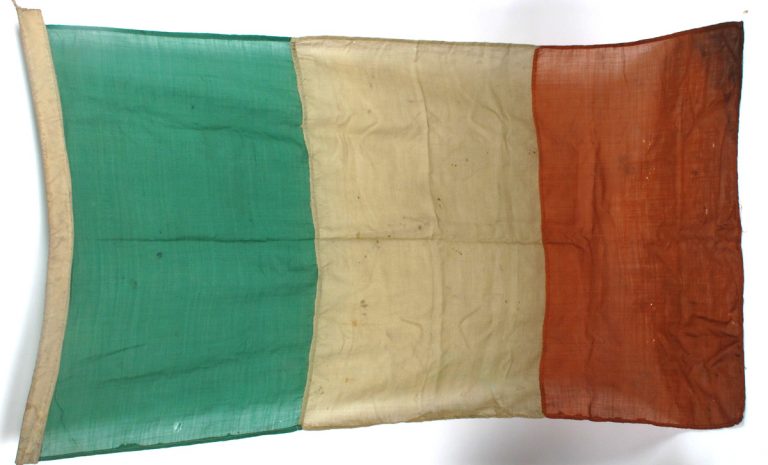
The Irish tricolour was a weapon from the moment it was sewn – a psychological weapon, laden with political meaning, sewn by French revolutionaries, presented to and flown by Irish Republican revolutionaries from generation to generation.
Painting by Philoppoteaux depicting the revolutionaries of the French 1848 Revolution outside the Paris Town Hall and Lamartine rejecting the Red Flag in favour of the French Republican one. Women participants in this revolution presented the Irish Tricolour sewn in silk to Young Irelanders including Thomas Francis Meagher (Source photo: Wikipeda) [When Paris rose again in 1871 under the Paris Commune, the preference was for the Red flag.]
Prior to the advent of the Tricolour, the Irish Republican flag was typically the gold harp on a green background2 but when a group of Young Irelanders went to Paris in solidarity with the revolution of 1848 there, the Tricolour sewn in silk was presented to them by revolutionary French women.
The symbolism of the Tricolour was firstly in its form; the French Revolution adopted a tricolour in opposition to the monarchist Fleur-de-Lison a blue background and different tricolours became popular as flags of new republics.
In the Irish Tricolour, the ancient Irish and the Norman-Irish, basically Catholics, were represented symbolically by green, with orange for the settlers (after William of Orange) of one sect or another of the Protestant faith; the colour white, symbolised peaceful national unity in an Irish Republic.
And it presented an equal unity, as opposed to the unity of Scotland and Ireland with England but under the clear domination of the latter, as represented in the Union Jack, which incorporates the St. Andrew’s and St. Patrick’s crosses with the English one of St. George.
THE TRICOLOUR UNFURLED IN IRELAND
The Irish Tricolour we know was first unfurled by Thomas Francis Meagher “of the Sword” at the Wolfe Tone Club in Wexford on 7th March 1848 and in Dublin in Lower Abbey Street on 13th April 1848.
Meagher’s nickname was due to his renunciation of the Gombeens of his day trying to deny the right to resort to arms if necessary to win freedom3.
Meagher and other Young Irelanders were arrested around the failed uprising of 1848, just after the worst year of the Great Hunger and, after wide-scale international and domestic protests at the sentences of execution, transported to penal colonies, from which many escaped.
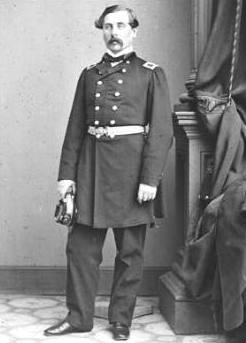
Taking his Republicanism and inclusivity seriously, both in Ireland and abroad, Meagher raised and commanded the Irish Brigade (composed of five regiments4) in the United States, fondly nicknamed Mrs. Meagher’s Own, to fight for the Union against the Confederacy and slavery.
As the years of struggle progressed, the Tricolour took its place among the ranks of Irish Republicans alongside the older Harp on Green or, for some Fenians, the gold or orange Sunburst on a blue background and so it was in the 1916 Rising when it began to be the most chosen.
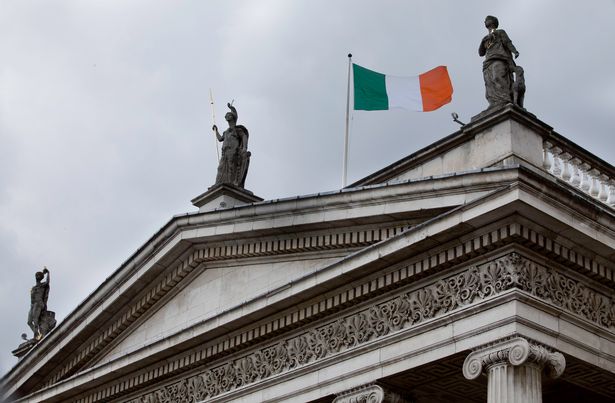
Other flags were flown during the 1916 Rising also but the Tricolour was one of two erected on the roof of the GPO, headquarters of the Rising and became the most prominent during the War of Independence (1919-1921).
The Irish Tricolour in modern times flying over the General Post Office building in Dublin City’s main street (Source photo: Internet)
During the Irish Civil war by the British-supported, armed and provisioned Free State Army against the Republican movement (1922-1923), it was flown by both sides. Even after the defeat of the Republican movement and repression, it was not immediately named the state’s flag.
Though it was displayed by the Free State when joining the League of Nations in 1923, and denounced by the Republican movement as an usurpation, it did not seem that the new state was too attached to it5 and some Irish ships flew the British Red Ensign until 1939 and WW2.
The first time the Tricolour was formally adopted by the Irish State was in the 1937 Bunreacht (Constitution) which was brought in by De Valera’s Fianna Fáil6 Government and even then it was under a pretence of Republicanism with claim laid to the whole of Ireland.
Display of the Tricolour was suppressed in the Six Counties colony from 1922 and officially banned under the Flags and Emblems Acts (1954). Many a battle was fought with the colonial police by people asserting their right to display it, the Act not being repealed until 1987.7
“A FLAG OF INCLUSIVITY, MISAPPROPRIATED BY A MINORITY”
One must agree with Varadkar that the flag signifies inclusivity and was misappropriated by fascists and other racists in recent years but it is shameful of him to attribute similar exclusivity to Republicans, who in many cases fought those same fascists to which he referred.
Leo Varadkar, current Taoiseach of the Irish Government, who accused protesters for Irish neutrality of “weaponising” the Irish Tricolour (Source photo: Internet)
Not only fought them in recent years but also back in the 1930s, when Irish fascists were called the Blueshirts. Surely Varadgar is familiar with the latter’s history also, since they were one of three reactionary groups that joined to create Fine Gael – yes, Varadkar’s own political party.
And the first Irish Republicans, the United Irishmen, sought the unity of “Catholic, Protestant (Anglican) and Dissenter (other Protestant sects)” for an independent Republic, an ideology carried on by all Republican groups thereafter and given expression in the 1916 Proclamation.
But this is not the first time that people in authority have tried to equate Irish Republicans with fascists, as a few years ago Garda Commissioner Drew Harris issued a press statement in which he accused Republicans of having organised a far-Right demonstration — which he later recanted.
One would think Drew Harris, ex-Assistant Commissioner of the British colonial police force, the PSNI8, well-known for their sectarianism and collusion with the colonial brand of fascism, the Loyalists, would be able to distinguish between Irish Republicans and fascists with ease.
Varadkar is ridiculous in accusing Republicans of “weaponising” the Tricolour since it wasalways an ideological weapon from the moment of its creation and then eventually used by the State to try, with monumental lack of success, to deny it to Republicans.
But Varadkar is right in that the Irish Tricolour has been misappropriated by a minority; but rather than Republicans, that minority is the Gombeen ruling class, foreign-dependent, neo-liberal, selling out the country’s resources and networks to foreign capitalist monopolies.
And causing homelessness, or rent and mortgage hopelessness, emigration and austerity for the vast majority of the people in the Irish state, both native and immigrant, for the benefit of a tiny minority of parasites incapable of even developing a viable Irish national economy.
Republican groups, like all groups are minorities but so are the elites, though even smaller. But in representation? Republicans, whatever faults they may have from time to time clearly represent a much larger and wider section of society than do the Gombeens.
This has been evidenced by the militant opposition of wide Irish society to triple water taxation and privatisation, repugnance for the celebration of British occupation forces and the wide opposition to joining a military alliance, all projects pushed by the Gombeens in different governments.
The Irish Tricolour has been commented upon in a number of Irish Republican songs, sometimes even in the song title: White, Orange and Green and Green, White and Gold.
Probably it is most appropriately referenced in the chorus of a song directed at the Gombeens, the very minority who have misappropriated it:
Take it down from the mast, Irish Traitors, It’s the flag we Republicans claim; It can never belong to Free Staters For you’ve brought on it nothing but shame9.
End.
The Irish Tricolour that was flown over the GPO in 1916 (Source photo: 1916 Rebellion Tours)
FOOTNOTES
1 Currently Prime Minister of the Coalition Government of Fianna Fáil, Fine Gael and the Greens.
2 Flag of the Society of United Irishmen, who led insurrections in 1798 and 1803.
3 Daniel O’Connell’s son intended to force a motion of that kind on the Irish Repeal Association founded by his father and also sought to have the motion passed without debate. O’Meagher said that while he did not exalt violence, neither would he allow his sword to be taken from him in case it should be needed. He and others such as Thomas Davis left the Association at that point and became known as “the Young Irelanders”, first mockingly and later with pride.
4 Including the 69th New York Infantry or “Fitghting 69th”. 7,715 men served in the brigade, 961 were killed or mortally wounded and around 3,000 were wounded. (Wikipedia The Irish Brigade)
5 A 1928 British document said: The government in Ireland have taken over the so called Free State Flag in order to forestall its use by republican element and avoid legislative regulation, to leave them free to adopt a more suitable emblem later. (Wikipedia)
6 The party was a split from the losers of the Civil War of which De Valera had been leader, formed in order to participate in elections for Government and presented itself as Republican. The 1937 Bunreacht also laid claim in Articles 2 & 3 to the whole of Ireland which were removed in
7 During a period of direct rule by the British Government.
8 The colonial gendarmerie, formerly the Royal Ulster Constabulary for the Six Counties, preceded by the Royal Irish Constabulary for the whole of Ireland.
9 Soldiers of ‘22 by Brian Ó hUigín, acclaiming the Republican resistance to the counter-revolution of the Free State during the Civil War.
A packed public meeting in Dublin city centre on Saturday listened to and applauded prominent people speaking against the Irish State becoming part of military alliances, whether PESCO1 (“NATO by stealth”2) or NATO itself.
The high-profile panel of speakers chaired by Irish MEP Clare Daly featured fellow MEP Mick Wallace, Sevim Dagdalen (MP Die Linke), Medea Benjamin (founder of Code Pink) and Anne Wright (ex-US Army Major and opponent of the US-Iraq War).
Celebrated anti-imperialist rapper Lowkey was also a speaker as was Yanis Varoufakis (ex-Syrza)3 who addressed the meeting by recorded video from abroad and applauded the Irish for their long resistance to colonialism and urged them to be proud of their state’s neutrality.
Yanis Varoufakis’ recorded speech video screened at the Neutrality Who Cares meeting on Saturday (Photo: Rebel Breeze)
BACKGROUND
There is a constitutional impediment to the Irish state’s participating in a war partnership with another state and during WW2 the state’s official position was neutrality.
However, it was always a pro-Allied neutrality with British downed airmen allowed to cross over into UK territory and US servicemen often crossing the UK border to visit the ‘south’, while German downed airmen were interned for the duration of the War.
The impediment is not absolute and is usually referred to as the ‘Triple Lock’, listing the three conditions which would enable to government to send more than 12 troops overseas:
In recent years some politicians and public commentators have floated the idea that the Irish state could rejoin the British Commonwealth and, since the war in the Ukraine, a discourse has arisen that the State needs to join an external military alliance in order to protect itself from Russia.
Sevim Dagdalen, Die Linke party MP, speaking at the Neutrality Who Cares meeting on Saturday (Photo: Rebel Breeze)
The Irish Times/Ipsos poll in April, amid criticisms of not following best practice in its design and even accusations of trying to steer respondents towards favouring joining some external military alliance, delivered two thirds clearly against the Irish state doing any such thing.
Russophobic propaganda has speculated on the activities of Russian trawlers in the Irish Sea. This is entirely a whipped-up alarm and discussion without the slightest foundation in fact since Russia has never presented the slightest threat, militarily or politically, to the Irish people.
On the other hand, Britain has invaded and occupied Ireland for over 800 years and is still in possession of one-fifth of its territory and has substantial economic and financial interests in the country as, more recently, have the USA and European Union states.
The UK’s Royal Navy frequently enters Irish national waters and the State has regularly permitted its ships, along with warships of other NATO countries, to dock in Irish harbours. And also the Royal Air Force, it has recently emerged, to patrol Irish territorial air space.
As part of this false alarm and discourse, the Irish Government5 recently founded the Consultative Forum on International Security Policy which was scheduled to meet last week in Cork and Galway, then for two days in Dublin Castle.
The President of the State, Michael D. Higgins, in an unusual intervention during an interview with the Examiner expressed concern at what he perceived as the “drift towards NATO” and criticised the composition of the speakers and chairperson of this organisation as being pro-NATO.
Michael D commented on “the admirals, the generals, the air force, the rest of it” and described its chair Louise Richardson, as a person “with a very large DBE – Dame of the British Empire”.
President Higgins apologised later for what he said was “a throway remark” about Richardson but did not withdraw his remarks about the overall composition of the Forum which has indeed been criticised by others, including Richard Boyd Barrett TD6 and Senator Frances Black.
THE DUBLIN MEETING
Varoufakis referred to Ireland as though the nation had won its independence, as was the case with every speaker that followed (with the exception of Lowkey).
A member of the audience was heard to remark ironically to another that he was grateful he had attended as heretofore he hadn’t been aware of Ireland’s ‘independence’.
Lowkey, the British-based rapper, tore the illusion of Irish state neutrality to tatters by recounting the use of Irish airports not only for US Army flights under Air America through Shannon, but also airlines run by the CIA and others using other airports in Irish state territory.
Lowkey, anti-imperialist rapper from London, speaking at the meeting in Dublin. (Photo: Rebel Breeze)
The rapper exposed the ‘neutrality’ of the Irish government in training soldiers going to fight in Ukraine and also in its continued support for the Israeli State and was cheered when he declared that, as an Iraqi, he was proud that his country had “kicked the ass of the British”.
In a masterful exercise in research-backed criticism, Lowkey went on to strip the pretence of independence and impartiality from the Government-founded “Consultative Forum”, exposing the imperialist and even NATO background of the main panel members and its chairperson.
All the members of the Neutrality Who Cares panel were effective speakers and made useful points although it was curious to hear one of them denouncing “Russian fascists” without commenting on the fascist units in the Ukrainian regime’s national army.
Medea Benjamin, founder of Code Pink, speaking at the Neutrality Who Cares meeting on Saturday (Photo: Rebel Breeze)
It was Lowkey who drove the sharpest and longest nails into the verbal crucifixion of the Irish Government’s drive towards NATO and who brought the loudest cheers from his mostly Irish audience.
Even celebrated speaker Daly did not come very close, though she too exposed the propaganda of the Government and pro-NATO cheerleaders. The MEP debunked the excuse of protecting underground communication cables, pointing out that 25% of them are out of action regularly.
The Irish MEP also lampooned the idea of any underwater cable being protected by NATO, considering where the responsibility for the blowing up of the Nord Stream gas pipeline lies!7
Finally she warned the audience to be on the look out for an attempt to remove the Triple Lock under some kind of excuse as a first step to permit the Government to enter a military alliance.
Clare Daly MEP speaking at the Neutrality Who Cares meeting on Saturday (Photo: Rebel Breeze)
A PART OF IRELAND ALREADY IN NATO
It was left to a youth member of the audience in the Q&A section, reading a statement on behalf of the Anti-Imperialist Action organisation, to point out that a part of Ireland is already in NATO, viz. the Six Counties, occupied by Britain and a part of the United Kingdom.
The youth called for a broad front to unite around opposition to becoming part of an external military alliance and imperialism (see full statement in appendix). Small flyers advocating the same course of action had been distributed inside the meeting earlier.
The People Before Profit party also distributed leaflets against joining NATO to people attending the meeting.
Indeed, it is hard to see why the presence of NATO in a part of Ireland should be so markedly missing from the panel’s speeches. Since it cannot have been accidental we must ponder what the rationale for its omission could have been.
Do those on the panel agree with the colonial occupation of a part of Ireland? That seems hard to believe, at least of some of them. Or perhaps they believe its discussion would be a distraction from the neutrality issue and if so, how can that be?
Or is it that they seek the support of sections of Irish society who are comfortable with the continued occupation and partition of Ireland? If so, they are seeking to build the movement against Irish membership of NATO in terms they think acceptable to timid sections of the middle class.
When resolute action becomes necessary or when reaction starts to bite, those sections will fade out of the anti-NATO movement. For practical as well as for ideological reasons, the campaign must appeal to the working class on an unashamedly anti-colonial and anti-imperialist basis.
Protest banner at Government’s Forum for International Security meeting in Cork while Tánaiste (Deputy Prime Minister, on far left of photo) was speaking (Photo sourced: Internet)
Wherever the Government’s Forum has gone, it has encountered public opposition. It was picketed at its Cork and Galway venues, while inside the former, an anti-NATO banner was unfolded and many in the audience denounced the Government’s direction.
Even after the protesters had been hustled out, another stood up to denounce the chairperson’s speech before he too was manhandled away.
In Dublin Castle, venue for the Forum on Monday and Tuesday with a long history as administrative centre of British occupation, people against NATO, war or militarism and for Irish independence displayed banners and placards of protest and flew national flags.
Protesters inside a Dublin Castle courtyard against the Government Forum on International Security held inside the complex this week. (Source photo: Anti-Imperialist Action)
AIA Tweet featuring National TV broadcaster RTÉ quoting Irish Government leaders’ ridiculous comments on the display of Irish Republican flags by protestors outside main pedestrian entrance to Dublin Castle in the city centre.
IN CONCLUSION
The general mass media silence on the Neutrality Who Cares meeting in Dublin and in downplaying the protests against the Forum at all its locations is part of the Irish Gombeen class drive to join NATO, despite the well-known opposition of the wide Irish population.
It is not forgotten that when tens of thousands thronged Dublin streets marching against triple water service taxation and privatisation, how the mass media reported participation merely by “several thousand” or even “hundreds”.
Nevertheless the comments of the President of the State and remarks by some journalists in the mass media do reveal that even in their own sections, the Gombeens do not have it all their own way. In the general population, however, the mood is clearly for non-militarisation of Ireland.
If the anti-NATO movement remains active and militant and adopts a generally broad anti-imperialist stance, going to most sections of society but especially to the working class, the Gombeens’ drive towards participation in PESCO and NATO will be decisively defeated.
End.
FOOTNOTES
1Permanent Structured Cooperation is the strange name of this proposed European Union-wide military alliance.
3Syriza is a Left social-democratic coalition party that was elected to government in Greece in 2015 on a promise to implement necessary social and economic reforms in the teeth of EU and other imperialist resistance. However, once the EU and the ECB began to tighten the screws, the resistance of the party’s leadership disintegrated. Varoufakis had been appointed finance minister and to give him his due, he tried to rally his cabinet colleagues around a program of non-compliance with EU diktats but was unsuccessful. Although it remains the main social-democratic opposition in Greece, the party has continued to slide in popularity in elections since.
4Irish UN peacekeeping forces exceeding 12 personnel have been sent overseas with those three conditions satisfied to many conflicts around the world, most notably Lebanon, where they have suffered some casualties and to the Congo, where they suffered many.
5The Irish Government is a coalition of two traditional main oppositional parties, Fianna Fáile and Fine Gael, with the Green Party. The Labour Party does not have a noticeably different position on external military alliance and Sinn Féin recently dropped their decades-long opposition to Irish membership of NATO and the EU.
6Barrett is a Teachta Dála (member of the Irish parliament) and member of the People Before Profit left-wing political party. Frances Black, with a successful career in singing, is an independent Senator in the same parliament who has sponsored a Bill to ban products from the illegal Israeli settlements. The Control of Economic Activity (Occupied Territories) Bill 2018 was passed in full by the Senate in 2018, and passed its first vote in Dáil Éireann in early 2019. It was then sent for detailed scrutiny in the Oireachtas Select Committee on Foreign & Affairs and Trade. This review took place over several months, hearing from expert testimony and input, and in December 2019 the Committee also voted in favour of the bill. Since then the Government is delaying bringing it forward.
7Although direct proof is not yet available, circumstantial evidence points towards US armed forces’ responsibility and journalist Seymour Hersh (Pullitzer Prize winner for exposing the US military massacre in Mai Lai, Viet Nam and its subsequent attempted cover-up) has confirmed the US military’s responsibility on the basis of inside knowledge from his contacts.
APPENDIX
Text of statement read out during Q&A period of Neutrality – Who Cares public meeting in Dublin 24 June 2023:
Anti Imperialist Action Ireland hold the revolutionary position that Britain, NATO and any other imperialist power is not welcome in Ireland. Anti-Imperialist Action have been active in opposing all forms of imperialism in Ireland and have been to the fore in opposition to NATO.
NATO is a great threat to Ireland and the Irish People, and in realisation of that, we urge and call on everyone here to vocally oppose the presence of NATO in Ireland whether you be an anti-war activist, a Socialist Republican, an anti-Fascist, a trade unionist, or just against the presence of a foreign power in Ireland, get behind this position and ensure that your sons and daughters aren’t sent off to be slaughtered in illegal wars of conquest.
While all the focus has been about the push towards NATO for the 26 Counties we cannot forget that the Six Counties are already occupied by NATO by virtue of Britain’s illegal occupation. Only a militant broad front of progressive forces all across the 32 counties can make a firm stand against NATO’s presence in Ireland. Everyone has a part to play in such a broad front which Anti-Imperialist Action and others are working hard to establish.