A BASQUE SELECTION

Diarmuid Breatnach

October 12th: The old town was heaving, full of people, mostly but not all on the younger end of the adult spectrum, standing, sitting, mostly in groups, talking, laughing, drinking, eating …. Some kind of festival? Not really …. a football match. Ah, that explains the shirts in football team colours. There’s the red stripes on white colours of Athletic Bilbao (and this isn’t Bilbao, not even Biskaia province), there’s the blue-on-white Real Sociedad colours (and this isn’t Donosti/ San Sebastian, or even the Guipuzkoa province). But wait a minute – there’s a lot of Deportivo Alaves shirts too (also blue-and-white) …. well, this is Vitoria/ Gastheiz, capital city of the the Alava province.

But there’s some red shirts too – CA Osasuna, from Naffaroa, the fourth province of the Southern (i.e within the Spanish state) Basque Country1. Over there’s a few CD (Club Deportivo) Vitoria, and a couple of women (not surprisingly — it’s an all-female team playing in the women’s league) wearing SD (Sociedad Deportiva) Lagunak yellow shirts. They can’t all be playing today, can they?

In a way, they are.

This occasion is a friendly match between Venezuela and the Basque Country (i.e not part of any official competition as otherwise it would be forbidden by FIFA, the international regulatory body for soccer)y and it is promoted by Euskadiko Futbol Federarkundea, the Basque Football Federation. FIFA, although it recognises Scotland, Wales and ‘Northern Ireland’ as having ‘national teams’, does not recognise either the Basque Country or Catalonia as having them. Where is the logic in that? Well, since FIFA only recognised Palestine with the creation of the Palestine Authority controlled by Israel and agreed by the Western powers2, one can hardly avoid coming to the conclusion that FIFA decides its policies on what area or nation can have their own selection and participate in FIFA championships in accordance with the relevant occupying state – no matter how right or wrong that decision might be.

Many shirts being worn here are green and bear the words Euskal Selekzioa (Basque Selection), the campaign for which in football is the cutting edge of the broader campaign for Basque national teams in many other sports, including surfing. It is of course not just about sport but is also political.

The Basque-Venezuelan game was to be played in Alaves’ Mendizorrotza stadium in Vitoria-Gasteiz and my friends talked casually about attending, though no hard arrangements seemed to have been made. I didn’t press the matter.
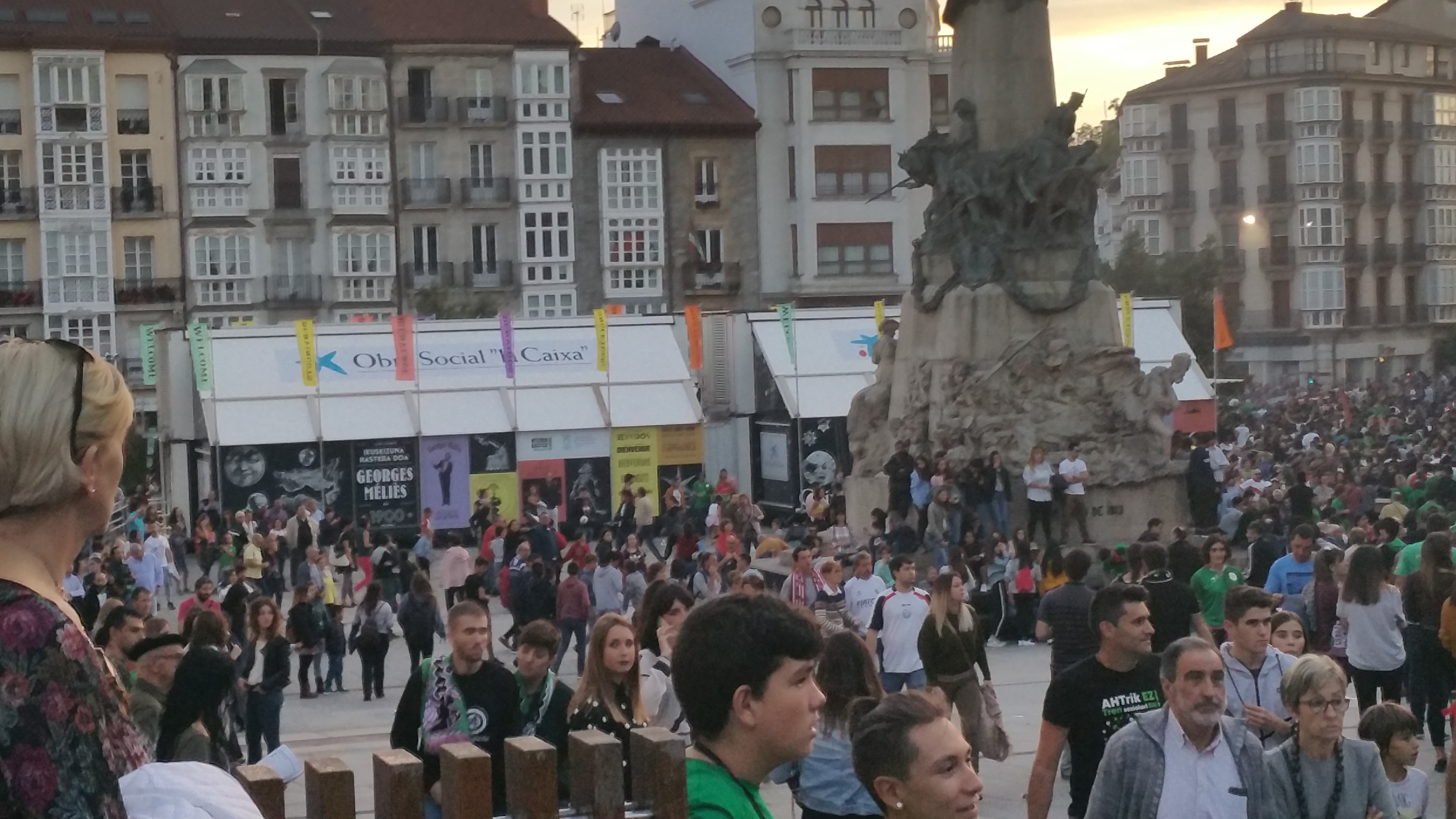
View of left of the crowd in the large square in the old town, showing a part of the monument.
(Photo: D.Breatnach)

Venezuela is rated 32nd in world soccer by FIFA, which is actually quite high and only two points behind the Ireland team, currently at 30th. So the opposing team is a big deal. The whole of the Basque Country, including Nafarroa and the parts held by the French State, is only around three million and they will play only players born in the Basque Country, unlike Ireland which features players from its diaspora. Ireland has had high emigration but so has the Basque Country, particularly to Latin America, the USA and Canada. Venezuela, by the way, has a population of nearly 32 million.

View of centre of the crowd in the large square.
(Photo: D.Breatnach)

In 2016, their last international, the Basque country beat Tunisia 3-1 in Bilbao and before that have beaten Peru 6-0 and Bolivia 6-1. They lost 1-0 to Wales in 2006 but beat Uruguay 2-1 in 2003.

View of section of the crowd on the balcony overlooking the large square in the old town.
(Photo: D.Breatnach)

The main square of the lower old town, the Casco Viejo3, was full of people, some chanting and red flares burning with an occasional firework going off. The ikurrina, the Basque flag, waving in many places, draped over balconies etc. The square is called alternatively Plaza de la Virgen Blanca or simply La Plaza Vieja. We met up with an ex-prisoner (political) who was complaining about the impressive monument in the main square which commemorates the Battle of Vitoria, fought on June 21, 1813, between the retreating French forces of Jose Bonaparte and the English forces under the Duke of Wellington. The English won the battle. I gathered the ex-prisoner’s objection was not so much that it commemorated the defeat of the French but rather that it celebrated the ‘independence’ of the Spanish monarchy, which had done the Basques no favours since the battle and much to the contrary. We drank lager here in plastic containers and street cleaners were already out sweeping up discarded and cracked containers.

Another view of the crowd, this one more to the right of the large square in the old town.
(Photo: D.Breatnach)

The captain of the Basque team, Aritz Aduriz, is the Spainish team’s oldest goalscorer, which might seem an irony but if he wants to play international world football, he has to play for a team recognised by FIFA. His home team is Athletic Bilbao, and his team-mates Inaki Williams and Inigo Martinez were also lined up to play, as was Real Sociedad’s Asier Illarramendi. And all of those have in the past played for the Spanish ‘national’ team.

Some political demonstrators moving through the crowd. The small flag held up is of the political prisoners’ relatives organisation Etxerat, the design showing the outline of the Basque country with two arrows indicating movement inwards from the French and Spanish states, i.e calling for the ending of the dispersal of prisoners throughout the states, far from their homes. (Photo: D.Breatnach)

Walking through the upper old town, we mingled and stopped here and there for a small serving of lager serving (zurito) or wine (txupito). The ex-prisoner got talking about language, philosophy, politics, religion, ancient civilization. I lasted longer than the others in discussion and debate with him4 but his intensity was wearing me down a little in the end. He apologised for that but then had another appointment and took off. By this time we had eaten and were relaxing in the high part of the Casco, on a slope down from the level of the fortress. Attending the game seemed somehow to have disappeared off the agenda and a little later we headed down through areas mostly quiet now to the parked car and drove off.

View of stairs leading from the large square to the upper part of the old town.
(Photo: D.Breatnach)

A crowd of 53,000 however attended the stadium to watch the game and who knows how many others saw it televised. It had been a friendly match in official status and in fact, with one yellow card earned, no reds and no injuries. The goals scored by the Venezuelans might have been the most elegant but Euskal Herria, the Basque Country, were the victors, the score of 4-2 in their favour, with Aduriz having been one of the scorers.
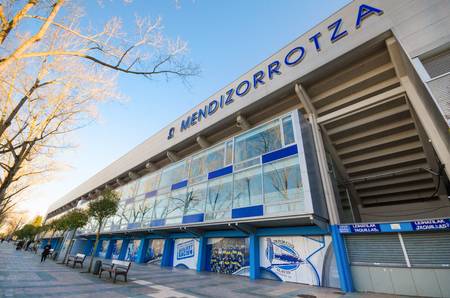
View of Gastheiz/ Vitoria’s football stadium
(Photo source: Internet)

End.

FURTHER INFORMATION

List extant Basque soccer clubs (each one also a link to its own history): https://en.wikipedia.org/wiki/Category:Football_clubs_in_the_Basque_Country

Ditto list of defunct Basque soccer clubs: https://en.wikipedia.org/wiki/Category:Defunct_football_clubs_in_the_Basque_Country

CA Osasuna, not listed in Wikipedia as a Basque club, presumably due to divisions fostered between Nafarroa and the other three southern Basque Country provinces: https://en.wikipedia.org/wiki/CA_Osasuna

Basque selection information: https://en.wikipedia.org/wiki/Basque_Country_national_football_team

Article about Basque and Catalan national selections:

http://theinsideleft.com/basque-catalonia-national-football-teams-catalan-barcelona-athletic-bilbao/

Match highlights (commentary in Euskera; Basque Country in green shirts, Venezuela in maroon) https://www.ngolos.com/videos/2018-10-12-basquecountry-venezuela

Background on Basque soccer in an international context, including some of them playing for “la Roja”, the Spanish State’s “national” team: https://www.bbc.com/sport/football/45834955

FOOTNOTES

1There are divisions fostered between Nafarroa (Navarra/ Navarre) and the other three southern Basque provinces of Bizkaia, Guipuzkoa and Alava. Nafarroa has its own ‘autonomous’ regional government in the post-Franco arrangement, while the other three are jointly in the other ‘autonomous’ region of Euskadi. Iruña/ Pamplona, capital city of Naffaroa, was the seat of the medieval kingdom of Nafarroa (Navarra), the royal family of which once laid claim to the monarchies of both the French and Spanish kingdoms (the latter being a source of three wars, the Carlist Wars). During the emergency caused by the military coup-insurrection of Generals Franco, Mola and others against the democratically-elected Republican Government of the Spanish state, the Catholic ultra-conservative Carlists seceded Nafarroa and massacred three thousand dissidents (Republicans, Basque Nationalists, Leftists) and fought on the fascist side.

After the “Civil War”, the Partido Popular (extremely right-wing main Spanish party) controlled Nafarroa but was recently ousted by Nafarroa Bai, a coalition of pro-independence Basque parties. The Basque Nationalist Party (PNV) has been the main power in the other three southern Basque provinces.

At one time Euskera was the main language of the whole of the current Basque Country (southern and northern, i.e in the French state), was banned under Franco and is now the majority first and second-level educational medium in Euskadi, where it is given at least nominal equal status in civic administration with Castillian/ Spanish. This is not the case in Nafarroa, which has three different linguistic-rights zones: Castillian, Castillian-Euskera and Euskera. ñ

2Palestine has yet to qualify for the World Cup in soccer. With Israeli restrictions on travel in and out of the territory for Palestinians, along with internal restrictions and repression, the odds are stacked against them ever qualifying, unless they field a team raised exclusively from their huge diaspora, including the refugee population.

3All the southern Basque main cities and many towns have these and their name is always the same, even though it is in Castillian. Typically they have narrow streets winding through four-to-eight-storey houses in which shop windows mix with bars and apartment entrances, often with balconies overhead. They are usually the most lively areas of the city with many places serving coffee, beer, wine and pintxos (good Basque ready-prepared food) and sometimes restaurants, often in the rear or upstairs room of a tavern.

4In Castillian, which I sometimes feel guilty about – I only know a few words in Euskera. Sometimes I encourage the company to speak “euskeraz”, i.e in Basque, leaving me out for a while.

SEX AND THE NOVEL DETECTIVE

Diarmuid Breatnach

Most modern criminal detectives have sex – I know this from reading, thankfully not from personal experience.


          The older set, Holmes, Inspector Maigret, Nero Wolfe, Miss Marple – they didn’t. Holmes was into a barely-concealed opium habit and Wolfe had an obsession with orchids; Poirot was obsessive-compulsive and probably fetish-obsessed with his patent-leather shoes. Miss Marple, who first appeared in a novel published in 1930, reflected her times even when the times passed her (Nemesis was published as late as 1971) and as to a suggestion of sex: “Good God! What kind of a degenerate are you? A woman detective having sex? And a pensioner?”

In modern times we might reflect that “of course there was her live-in maid … and that succession of young women she trained as maids ….”

Not only did they not have sex on paper, they were all single except for Maigret, so there was an absence of potential sexual activity to distract one. Maigret of course was French so like many middle-class men of his time would have had not only a wife but a mistress too but …. we don’t talk about that.

Yet sex is one of the most basic driving instincts – it governs procreation of species and, working in tandem with natural selection, rules on evolution of all species. How come it was left out?

The characters reflect their times and their class, of course, as well as what was expected of their class, sometimes with a little added taste of the unexpected – but not in sex. Yes, we know that DH Lawrence’s sexually-explicity (and trans-class) Lady Chatterly’s Lover was published two years before Agatha Christie Miss Marple’s first appearance in a novel, in Murder at the Vicarage (1930) – but Lawrence was published in Italy. Sniff! — those Continentals! A year later Chatterly was published again in France and – interestingly – in Australia. But all that publishing was done privately. In 1960, when an unexpurgated edition was finally published in the “United Kingdom”1, Penguin, the publishers, were subjected to a famous obscenity trial but, when they won, sold three million copies. It was still banned in the Irish State, of course but we weren’t alone – the USA, Canada, Australia, India and Japan all banned it too.

Romantic and gothic novels of the time didn’t have sex either, except in the mention of a child born out of wedlock, though the suggestion of or even history of rape was there at times. Sexual feelings of the heroine (and sometimes of the hero) were conveyed through descriptions of a blushing cheek, longing looks, palpitating heart and breast (but no mention of nipples!), feeling faint in the head …. all above-board and more importantly, all above the waist (though still allowing the reader’s imagination to eroticise, of course).

The most important point to grasp here I think is that something being published does not necessarily reflect the dominant social mores – it is its acceptance by society and its popularity that tells us most. There has always been material around that transgressed socially-dominant sexual standards but those standards were still dominant – and the material may even have worked as a pressure-release valve, as for example with the huge numbers of sex-workers, female and male, that walked the streets or entertained in special houses in sexually-repressed Victorian Britain, particularly in London.

The 1960s brought about a huge jump in tolerance of explicit sexuality, partly fueled by a decade of expanding consumerism and a push for more of the same and partly by the rise of the youth and student movement and its challenge to hierarchical values and control.

THE NEW DETECTIVES

          But for decades already, the new criminal detectives had arrived – or at least their advance skirmishers. One of the most influential, beating the later pack of the 1960s by a good three decades, Dashiel Hammett was hugely influential with the creation of what became known as the “hard-boiled” genre of detective stories and also in the “talking detective” style, in which the central character is also the narrator.

Hammett, a left-wing activist who got blacklisted as well as a popular crime fiction writer, had been employed by the Pinkerton Detective Agency2 and wrote many published stories but only five novels, all between 1929 and 1934 (even though he lived to 1961): Red Harvest, The Dain Curse, The Maltese Falcon, The Glass Key and the The Thin Man3.

Paperback cover for a Dashiel Hammmett novel, Red Harvest (pub. 1952), this one showing the dangerous gun-toting males (detectives? gangsters?) but also typically the heterosexual male erotic object of the female, dressed in bodily-revealing attire.
(Source: Internet)

Raymond Chandler, who acknowledged his debt to Hammett, had The Big Sleep published in 1939, based on a couple of short stories (he’d been writing those for decades). He banged them out pretty regularly after that: Farewell My Lovely (1940), The High Window (1941), The Lady in the Lake (1942); then a break until The Little Sister (1949), another gap until The Long Goodbye (1953) and Playback in 1958, a year before he died.4 at the age of 71.

Cover for Raymond Chandller’s paperback novel, The Big Sleep (pub. 1939), this one showing only part of the presumed detective, the ‘femme fatale’ prominently portrayed, holding a gun but dressed in bodily-revealing attire and ‘already’ in bed.
(Source: Internet)

The gap in the 1940s is easily explained by the film scripts for Double Indemnity along with And Now Tomorrow (both 1944), The Unseen (1945), The Blue Dahlia (1946). Strangers On A Train was produced in 1951.

James M. Cain (1892-1977) published The Postman Always Rings Twice in 1934 and, as well as short stories, another fourteen novels during his lifetime. Among those was Double Indemnity which, like Postman etc, was made into a film.

Mickey Spillane published his first novel, I, the Jury in 1947 and went on to publish another twelve before he died in 20065.

Cover for a Mickey Spillane novel, Kiss Me Deadly (pub. 1952), this one showing the iconic ‘femme fatale’, holding a gun but dressed in bodily-revealing attire.
(Source: Internet)

The new private detectives novels between the 1920s and the 1960s introduced detectives who had or were tempted by hetero sex but, however graphically the allure might be described, the sex was never described in detail. These novels also featured the femme fatale, the attractive and sexy woman who was also dangerous – capable of murder and treacherous. The detective was more likely to have the sex-interest woman jailed or even killed, or walk out on her, than claim her as the prize. And yes, the detectives in this genre were all male.

These novels featured violence – not just the violence to the homicide victim but regular knockouts with a pistol butt across the head, graphic physical fights with fists and feet (and even teeth!), shootouts … the detective characters not only suffered violence but engaged in it too (particularly Mickey Spillane’s Mike Hammer).

During the 1940s and ’50s the novels were paperbacks, low-priced, produced on cheap paper to a size that could fit into a man’s jacket or coat pocket (and some handbags or, in the USA, “purses”). This form of private detective and some other kind of publishing came to be called “pulp fiction”, from cheap magazines of short stories, i.e destined to be turned back into paper pulp soon after reading).6

The covers (or “jackets”) of “pulp fiction” novels were often lurid, portraying violence and heterosexual sex. Women dressed in revealing deshabille, often with seductive expression and posture, tended to share the cover with a “hunky” type of man, with a gun visible in the hand of either. Sometimes a dead body, male or female, lay on the ground too.

This kind of writing was baptised “Noir”, i.e “black”, mainly reflecting the dark sides of the detective’s character and especially of his clients and of surrounding society, cynical, corrupt, characters often morally-flawed, doomed, dogged by ill-luck and bad choices.7 Production in film of that writing came to be called “film noir”, the content reflected in low-light shots in black & white filming, which later transferred (with some difficulty) even to colour film. But still, the sex was never graphic in the writing and was more pruriently hinted at than witnessed by the reader.

Film ‘Noir’: Still photo from opening sequence of the film production (1941) of Chandler’s novel The Maltese Falcon. Typically, the ‘hard-boiled’ private detective is in his pokey office and the heterosexual male’s ‘sex interest’ has already arrived to ask for his help.  (Image sourced: Internet)

The writing could be elegant in descriptions and it could also be tight; dialogue was very important, with the detective and his adversaries dueling in verbal repartee, which the detective usually won in the verbal category but for which he often paid physically.

Of course, some cities in the United States had seen a lot of violence in reality, in particular during the ill-fated years of alcohol Prohibition (1920-1933) and the attendant rise of crime syndicates seeded in the working class immigrant communities of Irish, Jews, Italians, Sicilians …. Reading about such events as arrests, trials and mobster shoot-outs in newspaper reports provided also an audience for the material in the form of short stories, novels and later films. That audience grew during the succeeding decades and is still a wide one today, with a diversification of sub-genres and detectives in countries other than the USA or Britain, usually also in translation from their native languages.

But … back to sex and the detective. As the years rolled on past the 1960s towards the end of that millennium, the sexual activity of the private detectives became not only implicit but often explicit (with the possible exception of the Nordic detective novels). And we now had some female protagonists too: police detectives, uniformed police officers, private detectives and forensic pathologists. And if none of the main characters were ever gay, lesbian, transgender or transvestite, such characters did appear, usually treated more gently than in the past and at times actual second-line “good guy” actors in the stories.

It appeared that all previous sexual taboos in the detective story – all legal ones at any rate – had been broken.

Well, not all. Not masturbation.

Not even modern private detectives masturbate. Which is truly remarkable, when one considers, according to all research, how common that activity is in the non-detective population.

End.

REFERENCES & SOURCES:


For dates of authors’ birth and deaths, also of bibliography, Wikipedia entries on the authors.

Also: https://en.wikipedia.org/wiki/Pulp_magazine

Other:

Particularly for the footnote on Rebel Frontier: https://subjectguides.library.american.edu/dashiellhammett

FOOTNOTES

1I somehow doubt it would have got far in the Six Counties (“Northern Ireland”)

2 See Rebel frontier [electronic resource (video)] : organized labor vs. the Anaconda Copper Company / Network Ireland Television. New York, N.Y. : Films Media Group, [2006], c2004.1 streaming video file (66 min.) : Martin Sheen – impersonating the voice of author Dashiell Hammett – narrates this compelling docudrama on immigrant labor and anti-war politics in 1917. As a young employee of the Pinkerton Detective Agency, Hammett spied for the Anaconda Copper Mining Company in Butte, Montana, during the height of labour struggles there. AU STREAMING MEDIA http://digital.films.com/PortalViewVideo.aspx?xtid=35494.

3 The Maltese Falcon, The Glass Key and the The Thin Man were made into films.

4All based on earlier short stories, except the last, which was based on an unpublished screenplay.

5A number of others, based on previously-unpublished material or short stories, were published posthumously.

6Even after the pulp fiction heyday ended in the 1950s, paperback novels are still being produced in roughly the same size, albeit with somewhat better quality paper pages and covers.

7“Noir” also came to be a literary descriptive term and is often used to describe a certain kind of writing today.

“BOOKS – AND A MEETING-SPACE FOR SOCIAL AND POLITICAL GROUPS”.

Diarmuid Breatnach

Book-cases line the walls, filling up with biographies, histories, political and social theory from anarchist, marxist, feminist and Basque independentist perspective – and some classical literature. On the low central table are children’s illustrated stories and puzzles. One can see samples in the window too.

Maribel and Diarmuid outside the shop while it was being prepared for opening.

          An alternative Left bookshop has opened in the iconic town of Gernika (Guernica in Spanish and in the title of Picasso’s famous painting of the town’s

Maribel and Inigo outside the shop while it was being prepared for opening.

bombing and strafing by the Luftwaffe and Italian air force in 1937). Going by the title of Inuri Gorria (“Red Ant”), the bookshop is a medium-sized (as these things go) one-level shop situated on one of the town’s main streets, with passing one-way traffic of private and public transport. Virtually next door is one of those open-front fruit shops and further down the same street, past bars and other businesses, is the nearby Herriko Taberna (literally “Peoples’ Tavern”. That is one of the many such social centre-taverns run by the official Basque pro-independence Left1 but of which many were ordered closed by the Spanish state in recent years on unsubstantiated accusations that they were linked to the armed organisation ETA, which is now dissolved). Once the people running the ‘Herriko’ and the trend represented by the new bookshop were strongly united but no longer, due to the change in direction adopted by the leadership of the Abertzale (pro-national ndependence) Left in recent years. Of course both trends will still attend at some events, particularly demonstrations about Basque political prisoners.

The Inuri Gorria bookshop opened officially on 12th October, which is a bank holiday in the whole Spanish state; called el Dia de la Hispanidad, it celebrates the spreading of the Castillian language as a result of the conquest of much of the Americas by the Spanish Kingdom in the 15th and 16th Centuries. Not surprisingly, it is also the official day for celebrating the armed forces of the State. Also unsurprisingly, the celebrations are opposed by anti-imperialists throughout the territory of the Spanish state and in particular perhaps by those nations still seeking independence. 2 No doubt many in the Gernika area were glad to have something progressive to celebrate on that date, which they did by gathering at the opening to view the books and eat some pintxos, later repairing to a local bar which displays photos of political prisoners from the local area (as does the Herriko). On this occasion some who would still count themselves members of the “oficialistas”, though likely from an internal critical position, attended also.  There was also a Basque traditional festival in the town with many dressing in traditional clothing and taking part in cultural activities.

Closeup of evening of day of traditional Basque festival in Gernika.
(Photo: D.Breatnach)
Evening of day of traditional Basque festival in Gernika. The banner may have been attached by the ‘official’ independence movement leadership.
(Photo: D.Breatnach)

“The material I have here is of an alternative Left and feminist political kind”, said the owner, Maribel Egizabal, when I dropped in again some days later. “I have children’s books and games, of an educational kind about values, sections on feminism and about women, alternative philosophy, social movements, ethnic minorities and racism, city life, ecology, the history and culture of the Basque Country.”

One of the books she stocks is a local history of the nearby Busturia area dealing with the effects of the Anti-Fascist War (1936-1939), a substantial piece of work which she herself had a major part in researching and writing3, produced by one of the groups in which she is active, Laia, a local history group. The history of that period and of the executions and repression that followed the victory of the fascist troops is very much a sharp issue today and not only in the Basque Country but throughout the Spanish state.

Monument in Gernika to George Steer, English journalist and author who broke the Gernika bombing story for the London Times (and put the blame where it was earned).  (Photo: D.Breatnach)

The material in Inuri Gorria is mostly in the Euskera and Castillian (Spanish) languages but there are also some 2nd-hand books in French and English and Maribel hopes to add additional material in those languages. “With regard to political philosophy, I stock material in anarchist, marxist, feminist and independentist traditions. I don’t want to just sell books”, she told me “but to also provide a meeting-space for discussion and learning by social and political movements of the people.”

Maribel is a straight-talking woman with a long history in the feminist, Basque independentist and socialist movements, in different organisations, including the Basque internationalist solidarity organisation of Askapena, also Askagintza, an organisation working with people with drug addiction issues as well as the local history group alluded to above. “Inuri Gorria will be interested in material dealing with struggles around the world as well as in the Basque Country,” she tells me, “including of course struggles of other nations within this state such as Catalunya and of movements and organisations within the Spanish Left.”

The shop being prepared on the day I first called.  (Photo: D.Breatnach)

When I dropped by a third time, the day before my return to Dublin, Maribel was buoyant at the interest in the shop and its material being shown, especially by younger people.

“They are particularly interested in political theory,” she told me enthusiastically. It has long been remarked that the Abertzale Left movement was lacking in political education of its youthful following. No doubt the repression and banning of a succession of the movement’s youth organisations played a part in this but that does not explain the lack of educational materials, study and discussion groups, lecture series etc.4

View of front window display after shop up and running.
(Photo: D.Breatnach)

Gernika is worth a visit on its own and is connected by public train and bus services to Bilbao (also a longer-distance bus service to Bilbao and other areas). The town centre is attractive and hosts the Peace Museum (low charge and well-worth a visit) documenting life before the Anti-Fascist War, during it, including the town’s infamous bombing (which the Fascists tried to blame on the ‘Reds’5) and the ensuing occupation by fascist Spanish, colonial Moroccan and Italian fascist troops. Higher up, the ‘Gernika Tree’ and some of its offspring stand near the Gernika Assemby House (Gernikako Gazteen Etxebizitza/ Casa de Juntas de Gernika), built in 1826 to succeed several other buildings nearby. It was there the lords of Bizkaia (whose original member, according to Basque legend, was a Gael) from medieval times assembled to discuss issues and that the monarchs of the Spanish Kingdom affirmed the Basque rights or Fueros until abrogated in 1876. Entry is free and guided tours are offered by arrangement (but as generally the case with many buildings in the southern Basque Country, it will close between 2pm and 4pm.)

The Inurri Gorria bookshop will normally open 10am-12noon and 4.30-8pm on weekdays and 10-12noon on Saturdays, remaining closed on Sundays but of course may be in use on other occasions by some of the organisations and movements Maribel alluded to.

Contact details:

Inurri Goria,

Juan Kalzada 14,

48300 Gernika,

Basque Country,

The Spanish State.

FB page: https://www.facebook.com/maribel.egizabal.5

Tel: 9443 46988

end.

FOOTNOTES

1Their currrent political parties are Sortu (and the pro-independence social-democratic coalition EH Bildu).

2Ironically, migrants of Latin American origin may be seen celebrating the day also: it is the one day in Spanish calendar that they may feel specifically includes them.

3Busturia 1937-1977 – represión y resistencia de un pueblo (‘repression and resistance of a people’), Maribel Egizabal & Unai Serrano, Busturia (2018), IBSN 978-84-697-8677-2.

4The Abertzale Left is not the only movement one can accuse of such neglect of the political education of youth, one finds the same generally in the Irish Republican movement (both in the Provisionals and in the various splits since).

5Calling all the opponents of the military coup “Rojos” (‘Reds’) was a propaganda policy of the coupist military leaders and fascists (and copied elsewhere, as sometimes in The irish Independent); in fact their opposing broad movement included democratic anti-fascists and constitutionalists, trade unionists, Basque and Catalan nationalists and Republicans as well as Communists and Anarchists. It seems clear that without the intervention of Nazi Germany and Fascist Italy, aided by the “Non-Interventionist” policy of France and the UK, the popular forces would have defeated the military and fascist insurrection.

A BASQUE COUNTRY REGION – BIODIVERSITY AND CULTURE

Diarmuid Breatnach

          People visit the Basque Country for different reasons — among the touristic reasons are cuisine, folk culture and beach-type tourism including surfing. For some there may be business reasons and possibly on the other end of the spectrum from them there is the political aspect – interest in and solidarity with their struggle for independence and to a lesser extent perhaps, socialism. Eco-tourism and archaeological interest are probably not high on the list for most people but I’d suggest it would be worthwhile to include sites dealing with such aspects in any itinerary.

Many Basques would tell you that their country has a long way to go in environmentally-friendly practices – or at least in those less harmful to the environment; if true, it serves to illustrate just how far behind the desirable are the practices common in Ireland. Everywhere in Basque village or town, one sees the recycling containers in their five different colours for paper, plastic, metal, glass and organic waste. One frequent complaint is about timber-production forestation practices and though much of the Basque country is green with trees, many of those trees are conifers or, even worse, Basques will say, eucalypts in mono-cultural acres. The latter are indeed widespread and are said to suck the moisture out of the soil so that after they are felled, little else can grow there.

Environmentally-friendly timber production is less intensive and more diverse in species, less harmful to biodiversity of plant and animal life and more protective of the soil from erosion, flooding and desiccation. But to business — and therefore mainstream political interests — it is slower in turnover of profit. The perils of this concentration on early profit gain have been underlined this year with the infestation of the main crop pines, the “Monterey pine” (Pinus radiata) by the ‘Mycosphaerella dearnessii’ fungi and ‘Mycosphaerella pini’, said to have originated in Central America, which turns the foliage (needles) brown, eventually leading to the destruction of the tree.

Pines infected by fungi in the southern Basque Country (Photo: El Correo)

That all said, at grassroots (forgive the unintended pun) and often municipal level, there is great interest and support for biodiversity in the Basque Country and discussion around the subject is much more socially widespread than one would find in Ireland or in most of Britain (though perhaps not in some other parts of Europe). There are many national parks and reserves of great beauty and even city Basques tend to have a culture of collecting edible fungi in the woods in the autumn and of hill-walking or mountain-climbing at various times of the year. And small farms can be found dotted throughout the countryside.

Education about the environment for adults, children and even tourists is taken seriously and, apart from schools, centres promoting environmental care can be found in many areas. One such site of interest is the bio-diversity and heritage centre of Madariaga, the Ekoetxea, in the Axpe de Busturia area between the towns of Bermeo and Gernika These are interesting towns in themselves of the coast of Bizkaia (Biscay) province and Gernika was of course made famous by its bombing by the Nazi Luftwaffe, in the service of the fascist generals (Franco et al) in 1937, during what probably most people call the the Spanish Civil War and others, the Iberian Anti-Fascist War. Bus and train services connects both towns and pass through Busturia, both services having a stop or station in Axpe. The bus and train services run at mostly half-hourly intervals, the train all the way to Bilbao, on a single track for much of the line, up and down trains alternating.

I dropped in to a charming tavern in Axpe named after the Basque flower, Eguzkilore: literally “Sun Flower”. This is not the “sunflower” which Van Gogh famously painted, so named because it turns to follow the sun through its journey across the sky; the Basque flower (Carlina acaulis) is a member of the thistle family and is thought to resemble an idealised image of the sun. Dried specimens are often found hanging over the front door of Basque houses as a good-luck symbol, quite probably a remnant of pagan sun-worship (like the Irish “St. Bridget’s Cross” and indeed the traditional Basque symbol of the lauburru is very like that Irish symbol too and interestingly, the Basque tradition related to me was that it was borrowed from the Iberian Celts).

Dried Eguzkilore attached to the outside of a Basque house near the front door (Image sourced: Internet).

The Eguzkilore tavern is owned by a friendly young couple, a Catalan woman and Basque man: he of course speaks Euskera and Castillian (Spanish) fluently, whereas she is fluent in Catalan, Castillian and English, speaks Euskera well and smatterings of other languages. Although I know from experience that their cuisine is excellent, I ordered only a simple kafe esnea there and after finishing it and a chat, set off up the road to the Madariaga Ekoetxea (“eco-house”), an easy walk of perhaps fifteen minutes. Turning left at the roundabout at the crest of the hill the centre was easily visible by the clock-bell tower and the taller viewing tower.

This latter was a defensive construction quite similar to the keeps constructed in Britain and Ireland by the Norman invaders, livestock quartered below and people living on floors above; one of the staff told me that it had been inhabited until the 1930s. Now the floors have been ripped out except for the top one, accessible by a short journey in a lift and once there one can view around something like 160 degrees: steep hills close by beyond the road, land sloping away towards Gernika and distant mountains on another side, beach of the estuary and some marshlands on another.

A view of estuary and marshlands from the Tower observatory — it was a rainy day and the photograph is taken through glass
(Photo: D.Breatnach)
Closeup view of estuary and marshlands from the Tower observatory — it was a rainy day and the photograph is taken through glass
(Photo: D.Breatnach)
A view of river/ inlet mouth and headland eastward from the Tower observatory — it was a rainy day and the photograph is taken through glass (Photo: D.Breatnach).
The view southward from the Tower observatory is not so appetising but shows the steepness of the hills there. From those wooded slopes owls hooting may be heard night after night.
(Photo: D.Breatnach)

The Tower was in fact the last part of the centre which I experienced. It was a showery Sunday in mid-October and the centre was fairly quiet, less that ten vehicles in the car park and nobody but a receptionist immediately available upon entering the building. I used my limited Euskera in addressing her, which is my practice in the Basque Country, and which is usually – but not always – appreciated. The native language has become “politicised” here (as some say it has also in the case of Irish in Ireland), which is another way of saying that it was banned under the Franco dictatorship, that people of a Spanish unionist turn of mind often resent it and native speakers, learners and independentists want to encourage its spread and use in everyday life. Of course in a cultural type of centre in the Basque Country I would not expect any negative response and I was answered politely in Euskera with a quick conversion to Castillian when my limited store of Euskera ran out.

WATER AND BIODIVERSITY

I had seen a small charge advertised outside but there was none on that day or perhaps that time of year to see two standard exhibitions, one on water and the other on biodiversity. The one on water informs visitors that water is a circulatory system: 1) most of it falls from the air in rain or humidity, some of it on to land and some on to lakes or on to the sea; 2) some of that which falls on land is taken up by soil and vegetation and excess runs off into streams, rivers and lakes; 3) some also soaks through permeable or semi-permeable strata of soil and rock and forms underwater reservoirs and lakes. 4) The excess runs out in underground rivers and streams, emerging eventually to empty into seas and lakes, where 5) the sun heats up the top layers again, creating clouds, many of which precipitate on to land, renewing the circle.

Photo panel of rock and limestone deposit formations in a Basque cave.

The diagrams, photos and videos demonstrated this process well and attractively and there were samples of varieties of sandstone and limestone to examine at close quarters. For me, the photos of underground caves formed by the water wearing away the limestone and the various and sometimes fantastic formations caused by chemical-rich water dripping for millenia were the most impressive along with the few examples of invertebrates adapted to life without light and mammals using natural caves were the most interesting, while others might have found the supplying of water to the public of greater interest (and certainly this is an important issue in many countries and not least so in Ireland).

Photo panel of troglodyte spider eating something.
Sleeping bat hanging from stalactite in cave.


One of the fantastic shapes created by decades or even centuries of chemically-laden drips. (Photo: D.Breatnach)
Photo panel of cave chambers with humans present for scale.

The section dedicated to bio-diversity is divided into different parts, including a room with video screens showing different types of humans (ethnic, gender, possibly sexuality, culture, age) and others dealing with plant, fungi and animal life. Passing through a type of broad corridor with explanations of what is a definition of biodiversity in many languages, one enters a brightly-lit room seemingly constructed entirely of panels, each one of an animal: birds, mammals, fish, reptiles, insects and other invertebrates. Not only the walls but floor and ceiling appear constructed of the panels, a vibrant bright room somewhat evoking the effect of stained glass with light shining through, a church celebrating the diversity of animal life, perhaps.

A kind of foyer before the rest of the exhibition (Photo: D.Breatnach)
The room “made of” panels of bio-diverse life, like stained glass: ceiling and two walls.
(Photo: D.Breatnach)
Floor in the illuminated panels room.
(Photo: D.Breatnach)

Walking onwards, one finds a hall filled with large cubes, standing haphazardly upon one another, each carrying the image of an animal or plant. The names of the species are given in Euskera, Castillian and Latin. I find myself at times wishing to see the names in English and then chiding myself for the unreasonableness of this wish. There are images of plants to be seen too, some of plants which we are informed are native to the country and one found only there.

The “Life Cube Hall” (as I think of it).
(Photo: D.Breatnach)

ATTRACTIONS IN THE WIDER AREA

A slim informational folded leaflet is available in a number of languages, one version being in English and French, not only about this centre but about a network of them managed by the “Basque Government” (i.e the Government of three of the southern Basque provinces, Biskaia, Gipuzkoa and Alava). These are visited every year by 100,000 people, the booklet informs us, 25,000 of which are schoolchildren; the ekoetxea which I visited receives 2,000 schoolchildren out of a total of 45,000 visitors annually.

Dragonfly and Water-Scorpion panel. The first lives in the water as infant, hunting prey , before its metamorphosis to flying hunter. The second lives always in the water, usually in the higher reaches, also hunting. Its “tail” does not sting people but its proboscis can, though not seriously.
(Photo: D.Breatnach)
A view of the ‘Cube Life Room’ between cubes. (Photo: D.Breatnach)

Another, more substantial booklet available in English which shows signs of translation probably from Castillian gives more information on the Urdaibai Biosphere Reserve, the wider area in which the Madariaga Ekoetxea is located. This booklet advertises nature trails for hiking or biking, restaurants for Basque cuisine, a cave occupied by prehistoric humans, the Gernika Tree and General Assembly building and museum, markets and folk festivals, cider and wine-houses, painted forest, hermitages, bird-watching and sea activities including surfing and whale and dolphin-watching. Strangely (or not), in its caption about Gernika, it has nothing to say about the bombing of the town in 1937 nor, in its references to human habitation and culture of the wider area, nothing either to say about the Spanish Civil (i.e Anti-Fascist) war or about the occupation of the area by the fascist troops and the repression that followed, nor about the suppression of their language under Franco.  

An information panel tells visitors that there are 3,335 different mammal, bird, fish, reptile, amphibian, fungi and plant species etc. in the the Urdaibai reserve and that 85 are in danger of extinction or are of special interest.  Some panels showing examples of these would be welcome as would more about the wildlife native to the area (like what species are the owls one can hear hooting at intervals through the night from the forested hill above Axpe, for example).

End

FURTHER INFORMATION:

Eguzkilore plant: 

https://en.wikipedia.org/wiki/Carlina_acaulis

Ekoetxea Urdaibai: info@urdaibai@ekoetxea.eus 0034 946 870 402

Madariaga Ekoetxea: http://www.ingurumena.ejgv.euskadi.eus/informacion/madariaga-tower-basque-biodiversity-centre/r49-madaria/en/

The Monterey Pine and fungal infection: https://en.wikipedia.org/wiki/Pinus_radiata

The Pine infection in the Basque Country (article in Castillian): 

https://www.diariovasco.com/gipuzkoa/pinos-gipuzkoa-heridos-20180607001828-ntvo.html


Extant and Extinct mollusc shells.
(Photo: D.Breatnach)


Different species’ seeds containers.
(Photo: D.Breatnach)
European Mink cube.
The centuries-old clock tower; the clock is on the other side but the bell rings out the hour. Also visible are the solar panels.
(Photo: D.Breatnach)
The Madariaga Tower (Photo: D.Breatnach)
The estuary and trees (Photo: D.Breatnach)

SPANISH POLICE RAIDS ON BARCELONA REMEMBERED A YEAR LATER IN DUBLIN

Diarmuid Breatnach

     On 20th September 2017 Spanish police raided Catalan Government offices in Barcelona, arrested some officials and representatives and also besieged the city’s offices of the CUP political party. A documentary film of the events, the spontaneous mobilisation of thousands of Catalans, the management of the event by “the two Jordis” and the CUP resistance was shown in Dublin on 22nd September to an appreciative audience and afterwards a panel of speakers contributed opinions and replied to questions.

Chair of the proceedings for the CDR (Photo: D.Breatnach)

The video, called 20 S – the Documentary follows many of the events of that day and its screening was organised by CDR Dublin. The CDRs, abbreviation for Comites de Defensa de la Republica, were set up after the Spanish police attacks on people voting in the Referendum on October 1st and arrests of independence activists afterwards and may be found in various places in Catlalunya and around the world.

Spontaneously thousands of Catalans gathered in Barcelona on 20th September a year ago to protest the raids but the leaders of the two grassroots organisations of Omnium and ANC respectively, Jordi Cuixart and Jordi Sanchez managed to keep the resistance peaceful while the CUP prevented entry to their offices. The leaders of the Catalan independence movement believe it important to maintain resistance active but peaceful in the face of Spanish police provocation and have been largely successful in maintaining this line to date. The police force invading the Catalan Government offices was the Spanish paramilitary police force of the Guardia Civil, while those besieging the CUP offices were the other Spanish State force of the Policía Nacional.

Panel of speakers (L-R): Liz Castro, Eva Fantova, Clare Boylan.
(Photo: D.Breatnach)

The film is remarkable in that parts of it follow both Jordis as they try to negotiate with the police and at the same time inform the crowd and keep it under peaceful. One can see that many in the crowd are reluctant to disperse when asked to by the Jordis. One also sees when they are shocked to learn from demonstrators that police have left firearms in one of the unattended Guardia Civil vehicles parked outside Catalan Government offices.

The viewer also sees the CUP leaders refusing to allow access to their offices to the Policía Nacional who claim they have search warrants but fail to produce them, despite which they remain besieging for hours, with CUP activists barricaded inside the building.

The film of the action is interrupted at times with later commentary from a number of independence activists, including journalists.

Poster for the event organised by CDR Dublin.

The film demonstrated the mass nature of the Catalan pro-independence movement and the nerve and skillful crisis management of a number of its leaders. The extremely prominent role of the leaders of Omnium (Omnium Cultural) and the ANC (Asamblea Nacional de Catalunya) demonstrated eloquently that despite the concentration of news media on the leaders of political parties, it is the grassroots organisations that really hold the mobilising power (a fact demonstrated once again the demonstrations and general strike in Catalunya in the celebration of the Diada on September 11th last year, the Catalan National Day and again this year when police estimates of the pro-independence demonstration in Barcelona put the attendance at one million marchers).

Aerial view of the Diada marchers for independence this year in Barcelona (Photo sourced: Internet)

Despite their clear activity to prevent violence towards the police and to manage the crowd, in October “the two Jordis” were among the Catalan pro-independence activists arrested for “Rebellion” and “Sedition” and have been kept in jail without bail since, awaiting trial (which might not now be held this year). Other Catalan activists, including elected representatives, are in exile.
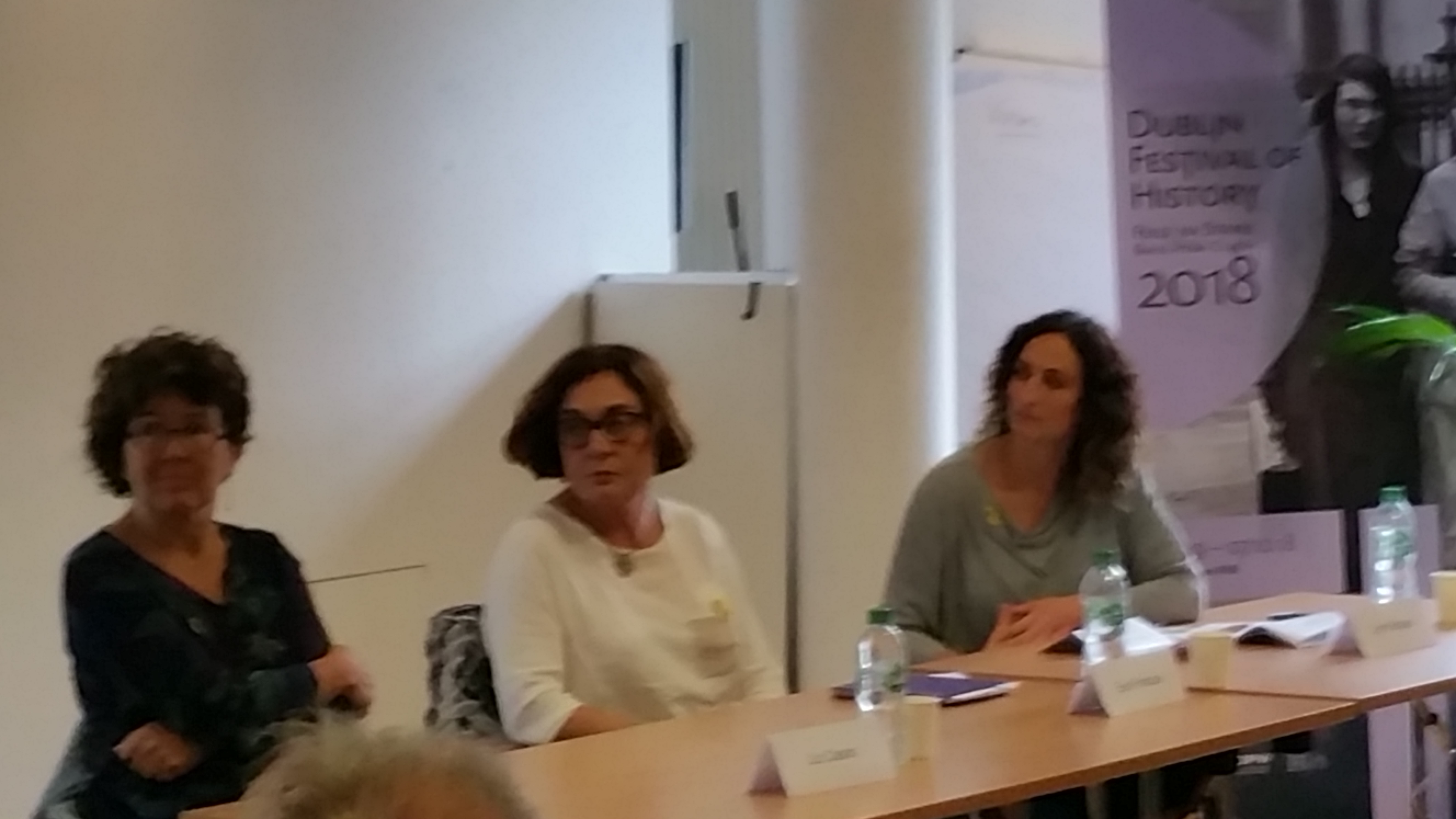
The showing of the film was well received by the audience in the Pearse Library, Pearse Street and sustained applause broke out as the credits scrolled down the screen.

Section of crowd on one side of the auditorium. (Photo: D.Breatnach)

When the lights came on a representative of Dublin CDR introduced the panel:

Liz Castro, USA Journalist writing much on the Spanish state and Catalunya, Eva Fantova of the ANC (who had appeared in th film, particularly as a commentator) and Clare Boylan, Sinn Féin MEP (member of the European Parliament).

In questions directed towards them by the CDR representative and later by members of the audience, all the panel speakers were clear that they did not expect justice from the Spanish courts for the Catalan independentists and did not believe that a separation between Government and Judiciary existed in the Spanish State.

Both Fantova and Castro referred to the case of the youth from the Basque town of Altsasu who had been sentenced to nine years jail over a late night brawl in a bar with off-duty Spanish police in which the maximum injury was a fractured ankle. The youth had been detained without bail awaiting trial with the State Prosecutor seeking to have them tried under “anti-terror” legislation, with a possible sentence of 30 years jail. However, even under ordinary Spanish criminal law, they had still received nine years in jail. Meanwhile a group of men, two of which were members of State forces, accused of gang-raping a young woman and filming the act, were out on bail while they appealed their short sentences.

With regard to what could be expected from the new Prime Minister and the social-democratic PSOE currently in minority government, the ANC representative commented that the PSOE is a Spanish unionist party also and when in opposition supported the Spanish State and Government’s actions against the Catalan independence movement.

A member of the audience commented that after Franco’s death, the Spanish ruling class had brought both the PSOE and the Spanish Communist Party (PCE), both illegal under Franco, into the State under condition that they accepted the status quo, the union and the monarchy that was being imposed on the people in the state. Their importance was great since each of those parties controlled a large trade union, also previously banned, and together they constitute the vast majority of unionised workers in the Spanish state. Since then those parties worked to control the people’s resistance and prevent any serious change.

A number of questions about what might be expected from the European Union Parliament and from the Irish Parliament were directed towards Clare Boylan, as an MEP and as a member of the Sinn Féin party, which has 22 elected members in the Dáil, the Irish Parliament (out of a total of 158 seats). She said that both the main Spanish Parties belong to the two largest EU Parliamentary Groups, the PP to the Christian Democrats/ Conservatives and the PSOE to Social Democrats, which makes it difficult to get a motion against the Spanish Government agreed in the EU.

With regard to the Irish Government, Boylan expressed pessimism on having them declare in favour of Catalan independence, whatever their personal opinions might be, with no evident support showing among most of the governments of EU countries.

Asked about getting more coverage of the Catalan situation in the world’s media, Liz Castro expressed her puzzlement at the low level of interest generally outside of the Spanish state. Boylan reported that the Irish national broadcaster RTÉ had sent no-one to cover the Catalan independence Referendum of October 1st and when it had been attacked by the Spanish police, as she had been in Catalunya with party colleagues to monitor and to support the Catalan movement, RTÉ had been reduced to phoning her to ask what was happening.

A member of the audience commented that he had no faith in either the Irish Government or the EU and that the first had justified his lack of faith since its creation and that the second was dominated by neo-liberal parties. He did not believe that the lack of interest of the media had to do with lack of space since they managed to cover all kinds of irrelevant gossip about personalities. He said that we need to be our own media to the extent that we can, pointing out that Catalan solidarity organisations CDR Dublin and With Catalonia/ Leis an Chatalóin each have Facebook pages on which news is posted and Casals Catalá d’Irlanda, a cultural organisation, also has a Facebook page and we should be posting information to those pages and sharing some of the information from there on to our own personal pages. The video they had seen was also available on the internet and should be shared.  The ANC and Omnium had shown the importance of grassroots movements in Catalunya and we should replicate that in the small way that we can here in Ireland, he said. This contribution was greeted with applause.

The meeting concluded soon after, the speakers and audience being thanked for their attendance and contributions responding with applause for the organisers, the CDC Dublin and for the speakers.

End.

NOTE ON CATALAN POLITICAL PARTIES

The Catalan Govern (Government) is a pro-independence coalition of a left-republican party and a conservative party, both of which themselves are coalitions:

ERC (Esquerra Republicana de Catalunya – Republican Left of Catalonia) and JxCat (Junts per Catalunya – Together for Catalonia).

A further Catalan pro-independence party is the CUP (Canditura d’Unitat Popular – Popular Unity Candidature) in opposition but in support of the Government on independence and against the unionist opposition.

The Spanish unionist opposition to the Government is composed of a number of Catalan sections of parties of the Spanish conservative Right and social democracy:

Cs or Ciutadans (Partido del la Ciudadanía – Citizens’ Party) with currently the most seats; PSC (Partido Socialista de Catalunya – Socialist Party of Catlanunya), Catalan iteration of the PSOE, currently in government of the Spanish state; Partido Popular (Spanish right-wing party recently in government of the Spanish state).

There is also a coalition of groups including the Catalan version of Podemos the actual policy towards independence of which is difficult to nail down. In the Spanish state the Podemos (We Can) party has supported the right of self-determination but opposed its exercise in favour of independence, arguing instead for a social-democratic kind of Spanish federal republic.

LINKS FOR FURTHER INFORMATION

CDR Dublin: https://www.facebook.com/CDRDublin/

With Catalonia/ Leis an Chatalóin: https://www.facebook.com/WithCataloniaIreland/

For cultural information and events: Casal Catala d’Irlanda https://www.facebook.com/groups/CatalansIrlanda/

Catalan News (10-minute daily roundup on video): catalannews.com

EAST WALL REMEMBERS ANTI-FASCIST BRIGADISTA JACK NALTY

Clive Sulish

On the 80th Anniversary of his death in the Anti-Fascist War in ‘Spain’, the East Wall History Group organised a remembrance of a local man from that dockland Irish area who was the last Irishman to die fighting in the war against Franco and Spanish Fascism. The event was attended by relatives of that Irish antifascist fighter and of another, by a cross-section of Left and Irish Republicans, including historians and by a number of elected representatives from the Dublin City Council and the Dáil (Irish Parliament).

Crowd assembling outside school before event. (Photo: D.Breatnach)

Jack Nalty was the last Irish and one of the last International Brigaders to fight and die in that war. The rest of the Brigaders, those not held as prisoners by Franco’s forces, were withdrawn soon afterwards as the indigenous anti-fascist forces fought on, losing against the Spanish military coupists with their German Nazi and Italian fascist allies.

Those commemorating Jack Nalty met at the St. Joseph’s Co-Educational School on the East Wall Road at 1pm on Sunday (23rd September) and included a cross-section of members of organisations and independent activists, socialists, republicans, communists and anarchists and other members of the local community. At the front entrance of the School a number of relatives of Jack Nalty held a banner along with a son of an Irish International Brigader and the crowd was addressed by Joe Mooney, of the East Wall History Group.

Joe Mooney speaking at start of event, relatives of International Brigaders beside him holding the banner in the colours of the Spanish Republic (Photo: D.Breatnach)

Mooney told the crowd that John Nalty came to the area at the age of six from Galway and on 31st August 1908 entered the East Wall National School on the Wharf Road. Just over thirty years later, 23rd September 1938, he would die on a Spanish battlefield, shot down in a hail of fascist bullets as he engaged in one last heroic act.

A member of the IRA during the War of Independence, Jack was a Republican, Socialist and trade unionist”, Mooney said, “representing 600 oil workers in Dublin Port. But in 1936 when the Spanish Civil War — or Anti-Fascist War as it should more accurately be called1 – began, he volunteered for the International Brigades to join the fight against European fascism. He was badly wounded and came back to Ireland, but would again go into action and was killed at the Battle of the Ebro. Having being among the first Irish volunteers to travel to Spain, he would die on their last day as they were preparing to withdraw from combat.

Nalty’s unit had been called to retreat when it was realisted that two machine-gunners had been left behind and he went back to collect them. On their retreat they were fired at and Jack Nalty was killed.

Section of crowd lined up in front of house where Jack Nalty had lived (Photo: D.Breatnach)

Mooney also asked those present to remember not only Jack Nalty but the ‘comradeship of heroes’ from Dublin’s Docklands and North Inner City – Dinny Coady, Tommy Wood and others.

The crowd then set off in a march led by a piper to East Road to unveil a memorial plaque. Across the road from Jack Nalty’s former house, the crowd paused to hear Diarmuid Breatnach sing a few verses of Christy Moore’s tribute to the Irish “Brigadistas”: “Viva La Quinze Brigada”.2

UNVEILING THE PLAQUE

Joe Mooney unveiling the plaque not far from Jack Nalty’s former house (Photo: D.Breatnach)
The plaque (text difficult to read in photograph)
(Photo: D.Breatnach)

The plaque could not be attached to Jack Nalty’s house and was affixed a little further down the road. Joe Mooney siad a few words there and introduced James Nugent who gave a speech he had prepared and the plaque was unveiled. Nugent concluded by saying that “the history of the past helps us to understand the present and to create the future.”

Kate Nugent read a message from the daughters of Steve Nugent (sadly died 2017) who researched the story of his uncle Jack and Mary Murphy read a short post from Vicky Booth (granddaughter of Syd Booth, who was with Jack when he died).

(Photo: D.Breatnach)
Piper plays lament by plaque
(Photo: D.Breatnach)

Harry Owens gave a short tribute speech on behalf of Friends of the International Brigades and Manus O’Riordan, son of Irish communist and International Brigade Volunteer, sang the chorus of Amhrán na bhFiann (“The Soldiers’ Song”, Irish national anthem) and the Internationale.

Section of crowd a location of the plaque (Photo: D.Breatnach)
At the unveiling ceremony (Photo: D.Breatnach)
Also at the unveiling ceremony
(Photo: D.Breatnach)

Joe Mooney acknowledged the presence of elected representatives Mary Lou McDonald, Sean Crowe and Cieran Perry and asked people to march to the nearby Sean O’Casey Centre to see the art exhibition and see two short films.


Marching from the plaque site, heading for the SO’C Centre
(Photo: D.Breatnach)(Photo: D.Breatnach)
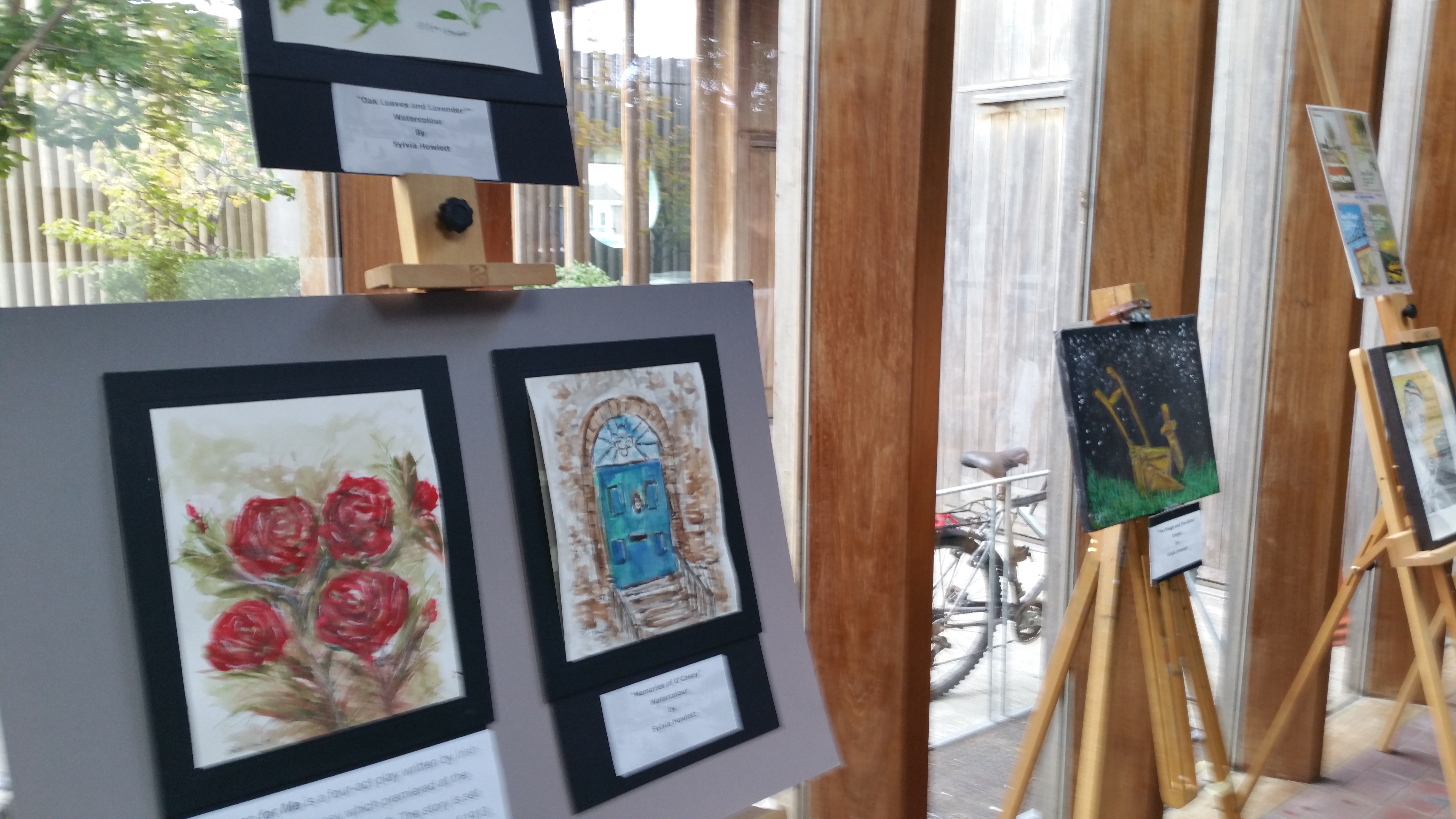
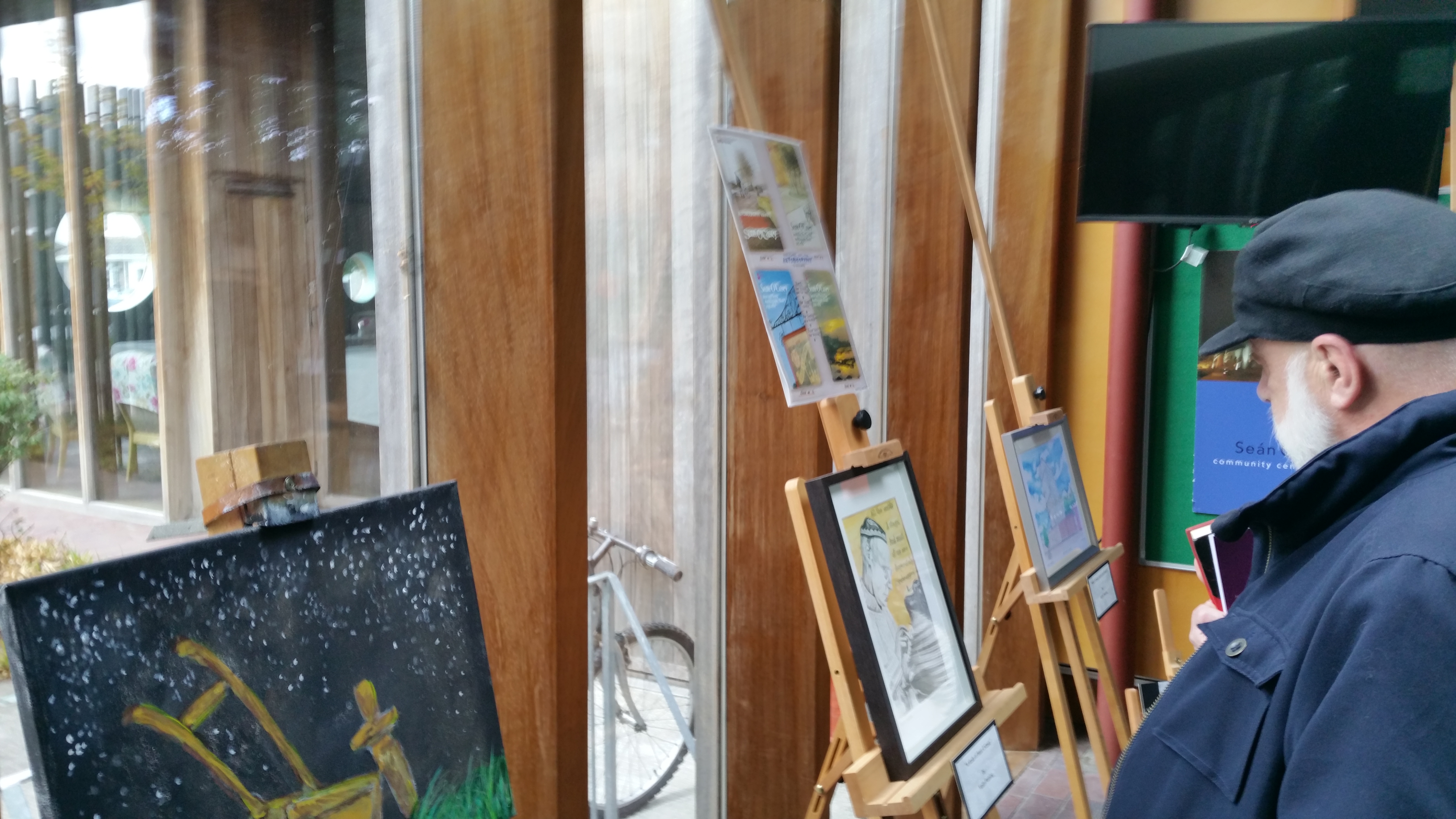
Section of the attendance relaxing at the Sean O’Casey Centre between the plaque event and the films to be shown, also examining the art exhibition [see photos at end of post]

Back at the Sean O’Casey Community Centre, two short films were shown. One was a school project film in which a descendant of Jack Nalty interviews the latter’s nephew about his famous uncle. The second was dramatic film in which a Spanish trumpet player joins the fight against the fascist military uprising by Franco and other generals and features also actors playing two Irish International Brigaders, O’Connor and Charlie Donnelly3. When the former trumpet player is shot he sees into the future ….

Eddie O’Neill talked about the pulling out of the International Brigades in October 1938 in a bid to have the “non-interventionist” Western democracies put pressure on Nazi Germany and Fascist Italy to have them withdraw too, which did not happen. They marched through Barcelona on 17th October and were addressed in an emotional rally by La Pasionara4 and Eddie asked Nerea Fernández Cordero to read an English translation.

Nerea on stage just after reading translation of La Pasionara’s farewell to the Brigaders
(Photo: D.Breatnach)
Eddie O’Neill at the SO’C Centre with concluding speech: “We can’t afford to forget.”
(Photo: D.Breatnach)

Nerea told the audience that she is from Extremadura (a province of the Spanish state next to the Border with Portugal) and her grandfather, Antonio Fernández had fought against Franco, been captured, escaped to the mountains but was in time recaptured. Upon his release he had married Nerea’s grandmother and lived a peaceful life. Nerea said that she was proud of her grandfather and those who fought Franco and that “ we know La Pasionara’s speech in Spanish by memory.”

Reading of translation of La Pasionara’s speech to English from Youtube:

At the event the newly published pamphlet “In Pursuit of an Ideal – from East Wall to the Ebroabout Jack Nalty was made available for the first time and copies are available from the organisers.

Eddie O’Neill recalled being in the Spanish state with a group from Friends of the International Brigades to commemorate those who fought against Franco during that war and afterwards searching for an appropriate pub in which to socialise. They found a pub with a Guinness sign and went there which however turned out to be one of the most fascist pubs in the area but undeterred, they continued to celebrate the memory of the antifascist fighters there. A lone man in suit and tie asked people as they passed him to use the toilet why they were commemorating people who had died so long ago but when they explained he said he could not understand English.

We can’t afford to forget,” O’Neill told his audience, “least of all when the forces of fascism are gathering again.”

To conclude the event O’Neill called on Diarmuid Breatnach who sang the whole of Christy Moore’s “Viva La Quinze Brigada”, calling on the audience to join him in the chorus, remembering those who fought and gave their lives in the struggle against fascism.

Eddie O’Neill close at right of photo at unveiling ceremony
(Photo: D.Breatnach)

AN ANNUAL EVENT?

The organisers are reputedly considering making this an annual event – it is to be hoped that they do so.

Another section of the crowd at the plaque unveiling.
(Photo: D.Breatnach)
Also at the plaque unveiling ceremony
(Photo: D.Breatnach)

POSTCRIPT: JACK NALTY – ATHLETE COMPETING FOR IRELAND

In publicity prior to the event, the East Wall History group posted the following:
“In addition to his political and trade union activity, Jack Nalty was also a busy athlete, a regular competitor and medal winner with the Dublin Harriers. In 1931 he represented his country at the International Cross Country Championship, held at Baldoyle. Fellow competitor Tim Smyth became the first Irishman to win this competition.

(The full Irish Group for the event held on 22nd March 1931 is listed as: Frank Mills, J. Behan, John Nalty, J.C. McIntyre, John Timmins, T. King, T. O’Reilly, Thomas Kinsella, Tim Smythe).

This British Pathe footage shows the runners in action. Somewhere in the group is John (Jack) Nalty, East Wall resident, Republican and hero of the International Brigades. (The Pathe footage is viewable on post on the East Wall History Group event — CS)

Ironically, the same year as the competition the future leader of Irish Fascism, General Eoin O’Duffy had become the President of the National Athletic and Cycling Association (NACA) , and apparently was an admirer of Jack Nalty as an athlete!”

(Photo: D.Breatnach)


FOOTNOTES


1Basques in the provinces of Bizkaia, Guipuzkoa and Alava say it was not a civil war there, i.e between different sections of Basque society — the fascist forces came from outside.  In the fourth southern Basque province of Nafarroa, where the Carlists took control, they wiped out around 2,000 antifascists but it was hardly a war. The Catalans also say that the fascist forces invaded them and that it was not a civil war but an antifascist one. In some other places in the Spanish state many also say that the presence of Nazi German and Fascist Italian military in such numbers invalidated the term “civil war”.

2Also known as “Viva La Quinta Brigada”, which is however also the title of a different song from the Anti-Fascist War. Both titles are correct for this song since the Irish were in the Fifth of the International Brigades but when added to the ten indigenous Brigades (Spanish, Basque, Catalan etc), that became the Fifteenth. Wikipedia quotes authors to report an estimate that “during the entire war, between 32,000 and 35,000 members served in the International Brigades, including 15,000 who died in combat; however, there were never more than 20,000 brigade members present on the front line at one time.”

3Charlie Donnelly was a poet and member of the Republican Congress. He went to Spain to fight against Franco, where he died in February of 1937 at the Battle of Jarama. He is also one of those 19 names mentioned in Christy Moore’s song (“Viva La Quinta Brigada” or “Viva La Quinze Brigada”).

4Isidora Dolores Ibárruri Gómez (9 December 1895 – 12 November 1989), born and brought up in the Basque Country to a Basque mother and Spanish father, founder-member of the Spanish Communist Party and known for her political writing and speeches. She wrote an article when quite young under the pen-name “La Pasionara” (the Passion Flower) and was known by that nickname throughout her life.

SPEAKING TRUTH TO POWER – REALLY?

Diarmuid Breatnach

Again and again we come across activists, journalists, musicians and other artists who are lauded for “speaking truth to power”. They are often praised for that, even idolised. “Speaking truth to power” seems to be brave thing to do. And an important thing. But is it really?

First of all, let us think of who are those usually thought of as “Power”: governments, big companies, military dictators, church leaders, powerful individuals in the media or in the arts …..

Why is it considered a good thing to speak truth to them? It may well be brave to do so and often is. People who spoke the truth in certain situations throughout history and currently have had their careers destroyed, been the subject of all kinds of horrible allegations, been marginalised, lost their families and friends, been framed on charges, jailed as a result or just automatically, tortured, killed and “disappeared”. Yes, we could hardly deny the courage of many of those who chose to take that step. But whether it’s an important thing to do is another thing completely.

What? A courageous act against power not important? What can I be suggesting!

Let’s look at those in power again, taking for examples a government, a military dictatorship and the CEO of a powerful company. In our example, we set out to “speak truth” to them.

For the government, we send them an email, or a letter because there are too many Ministers and Secretaries to address verbally – unless of course we are in some kind of privileged position. They in turn ignore us or send us a dismissive reply (possibly tailored to be quoted) or they have us subjected to surveillance, just in case we should turn out to be a real problem in future. And any government in the world is capable of putting citizens under surveillance.

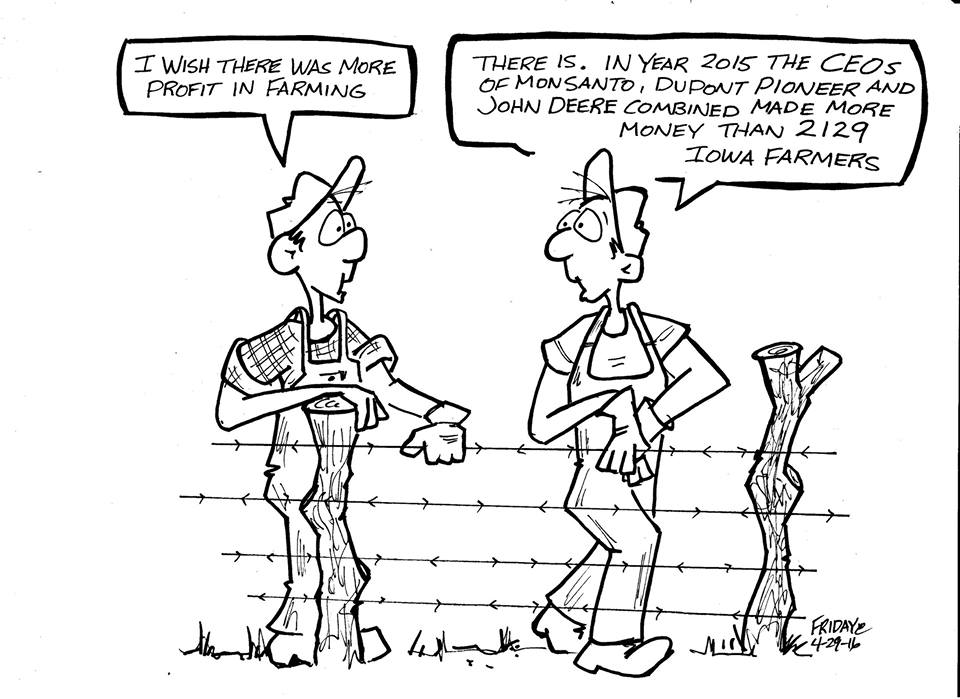
(Cartoon strip source: Internet)

We send the military dictator a letter and he has us arrested, detained for torture and questioning. Or we accost him when he is somewhere in public …. and his security guards shoot us dead. Or arrest us for torture and questioning.

With regard to the CEO, we send him an email. He ignores it but may have us put under surveillance – just in case. And he’ll have our employment and tax records, families and friends checked out too. Like governments, the CEOs of big companies can easily put people under surveillance and run background checks on them. And CEOs likely last longer in the power position than most governments. Or he might reply dismissively. Or he might have his legal services people threaten us with legal action which, as well as shutting us up, would cost us a lot of money we don’t have, probably bankrupting us.

This is the illusion of liberals and social-democrats but the reality is very different.
(Image sourced: Internet)
(image source: Internet)

In the military dictator’s case, we are out of the picture. In the case of the other two, nothing further may happen if we shut up now. But if not, well …. there’s that list of bad outcomes I listed above. Brave? Certainly – but to what effect? Have we changed anything?

Some people think we can change the essence of the way those in Power think by Speaking the Truth to them. If only we can say it powerfully enough. Nonsense. Those in the Power have already chosen who they want to be, what side they are on and understood the basic dynamics or been taught them along the way. Many choices made have confirmed them in their roles and ideology.  Furthermore they know that to break ranks with their own is a dangerous thing to do which can result in bad outcomes for them too and also expose them to painful and even fatal thrusts from their competitors or rivals. Remember the 1983 film Trading Places? Remember how the main hero falls at first, is shunned, loses his privileges, friends and associates? Unlike the film’s ending, there is no coming back from there.

If those CEOs and company owners ever took a progressive step it was because they were shown it would increase their profitability or at very least were shown it wouldn’t hurt it ….. or they were forced to do so by people’s resistance. Not ever by having “Truth Spoken” to them. Unless it was the truth of resistance (and we’ll come back to that).

I don’t see the point of Speaking Truth to Power … except in very exceptional situations. For example, if we are being sentenced in court, even if the public gallery has been cleared or packed with cops (which has happened even in this state on occasion), we might wish to raise a clenched fist and yell “Death to Fascism!” before the guards jump on us and bundle us to the cells, giving us a few punches on the way.

Or being tortured, if we are capable of it (and while we are still capable) we might want to shout something similar or just plain “Fuck you!” Or in front of a firing squad, to shout “Long live the revolution!” before the order comes to “Fire!”

Will it do any good, make any difference? Without an audience apart from those in Power, almost certainly not. It might affect some soldiers or police in the firing squad or some jailers but such results are usually negligible. But in doing so, we assert our humanity, our spirit against them and it is for ourselves alone, at that moment, that we Speak Truth to Power. Otherwise, there is no point, none at all.

I don’t want to Speak Truth to Power and what’s more, question why anyone else would. Is he or she suffering from some kind of liberal illusion that such words make a difference, can convert or subvert Power? Or from an inflated ego that convinces him or her that they have the gift, the eloquence, the importance to make Power change? Or that somehow, by force of their excellent will, they can overcome history and change reality?

Or even worse, are they signaling to the Power that they are articulate, eloquent even with “alternative” credentials and that they are worth recruiting by the Power?

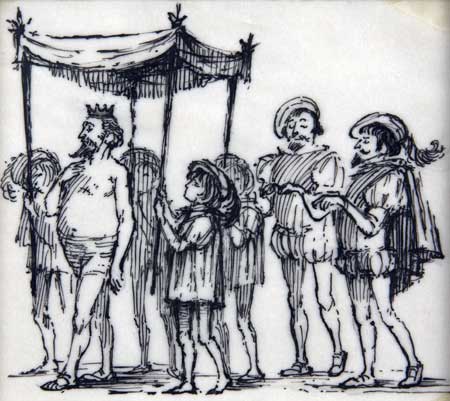
The Naked Emperor. In Hans Christian Andersen’s subversive tale, an undoctrinated child remarks that, contrary to royal propaganda, the Emperor is naked and the people can then admit this to themselves. The child spoke Truth — but to the People.
(image source: Internet)
Speaking truth among the people. (Cartoon source: Internet)

I repeat: I don’t want to Speak Truth to Power. I want to Speak Truth alright … but to the PowerLESS! I want to expose the Powerful to the people. I want to show them the long list of the crimes of the Power and that it is unreformable. But I don’t want to just read the people a horror story; I want to show them how I think the monster can be killed. I want to show the people that THEY CAN DO IT! The people can grasp power with which to overthrow the Power. I want to show the people what their forebears have done in rebellions, uprisings, revolution, creation of resistance organisations, art, discovery of science, production ….. I want to share what I think with them, argue with them, encourage them, criticise them. And the only time I want to Speak Truth to Power is when they, the People, are listening, or reading what I am saying. Because then, it’s not to Power, in reality, that I’ll be Speaking Truth; the important audience is not Power at all.

So, Speaking Truth to the People is the thing to do. And will those who do so be safe from painful outcomes, that list given earlier? Having careers destroyed, being the subject of all kinds of horrible allegations, being marginalised, losing families and friends, being framed on charges, jailed as a result or just automatically, tortured, killed and “disappeared”? Alas, no, each of those is a distinct possibility: all have happened even to the people of our small island and nearly all of them fairly recently. Some very recently and even ongoing.

There is no safe way to Speak Truth. But at least this way, there is a chance that Speaking Truth will have some effect, will make a difference. It might even make a big difference. We hope so.

And the final Truth is that words, for all their power on people’s minds, don’t change the real world. People do that, through action.

End

(image source: Internet)

Spanish Minister would rather free Catalan political prisoners on bail but is totally against independence

Diarmuid Breatnach

This is a short report of very interesting interview of Spain’s Foreign Minister, Josep Borrell, who is both a Catalan and a convinced Spanish unionist.

He says that
§ he would rather have the Catalan political prisoners released on bail;
§ Catalonia is a nation, not a region (but does not have the right to self-determination in violation of the Spanish Constitution);
§ there is no automatic international right to national self-determination and
§ Scotland does not have the legal right to hold a referendum without the permission of the UK Parliament (for which he provides a very convincing argument).


Comment:

Borrelll is no friend of Catalan independence (he would hardly have been chosen by the Spanish Government as its Foreign Minister if he were) and has made some very disparaging remarks about the movement (liking it to “an infection”) and some individuals. He is no democrat either. However it is interesting that he is prepared to express a difference from Spanish Government policy.

His remark about Scotland will not be liked by many Catalan independentists who are fond of quoting Scotland and the referendum there as a model. But I think he is correct, both in his explanation and the situation at the time. It seems to me that the British conceded a referendum, expecting it to fail. It did fail but the result was closer than they expected. But, like self-determination of the occupied Six Counties of Ireland, any vote in favour would have to be ratified by the UK Parliament.

The main difference between the UK and the Spanish State on this is that the UK allowed a referendum but expected it to lose. The Spanish State will not permit a referendum because they know it would succeed.

The Catalan activists, politicians and intellectuals need to stop looking elsewhere for easy examples for comparison. They would be much better served, in my opinion, by examining the general history of imperialist-colonialist states against the struggles of subjugated nations and of course the history of the state in which they find themselves.

No imperialist or colonialist state has ever given up what it considered its property without resorting to violence.  When that desire for separation and independence comes from a part of what it considers its own base, the resistance is even stronger and violence highly predictable.  And the history of the Spanish State itself?  Violent acquisition of all of its neighbouring lands –until Portugal broke away and stopped at the French border (another major thief).  Violent suppression of peasants and workers and the overthrow of two democratically-elected Republican governments, followed by violent repression.  War conducted against the Basque independentists.  The Spanish state will use much more violence than it did on October 1st last year, repressing the Referendum on Catalan independence.  The only questions are § when and
§ will the Catalans be prepared for it.

End

http://www.thenational.scot/news/16835507.spains-foreign-minister-calls-for-government-to-bail-political-prisoners/?ref=fbshr

FASCISTS MARCH DEMANDING SPANISH UNITY

Death threat, fascist salute and Franco’s version of the Spanish flag, all illegal and displayed with impunity at this demonstration against Catalan independence and many other fascist events. (Photo credit: EFE/ Enric Fontcuberta 4651#Agencia EFE)

Some 2,000 people (according to the Urban Police) demonstrated this Sunday in Barcelona to reject any negotiation with Catalan sovereignty and in support of the unity of Spain.

(Translation from Catalan newspaper report — see link below end translation — by D.Breatnach)

The protest, called by real estate entrepreneur and former Guardia Civil (spanish state police — Trans) member Juan Manuel Opazo with the support of the ultra-royalist party Vox, crossed the Avenida del Paralelo under the slogan “No [pacts] with either terrorists or separatists.” Sixty associations and movements such as the Catalan Civic Convivencia, the Catalan Association of Victims of Terrorism, Catalonian Employers or Somatemps supported the event.

At the top of Avenida Mistral the demonstration came in sight of an anti-fascist protest called by anti-fascist movements and booing booing was exchanged from both sides. The Mossos (Catalan Police) kept both groups apart.

The march ended on Avenida María Cristina, where the Parliament is situated. Many of there asked the Spanish Prime Minister, Pedro Sánchez, to not negotiate “with separatists” and to convene elections.

Coaches from 30 cities throughout Spain, such as Alicante, Malaga, Bilbao or Valladolid, among others, brought supporters to the protest.

Photo: Unionist march supporters give the fascist salute and threaten shooting at the anti-fascists and carry Spanish fascist symbols.


COMMENT (D. Breatnach):

The comparatively small size of the march and the fact that it was only possible by bussing in supporters from other parts of the state may be taken as an indication of how small the support base is for this far-right variety of Spanish unionism.

The monster march for independence Diada (Catalan National Day) on Tuesday will provide a useful comparison: one million marchers are expected.

The list of organisations supporting the march gives the lie to their frequent representations as “concerned citizens” who are “opposed to terrorism” etc, particularly the Catalan chapter of the “Association of Victims of Terrorism”, an organisation which for years has been hounding Basque independentist organisations with the assistance of the Spanish courts. To outsiders it might seem like a legitimate organisation held together in solidarity against terrorism but it is well known to be an extremely right-wing organisation, composed of ex-military and Spanish police (and no doubt serving members too) and their relatives. Some of them were indeed victims of armed Basque actions but it has to be acknowledged that was in a war which the Spanish state first launched against the Basques themselves, not only during Franco’s time but for decades afterwards too.

The impunity of fascists breaking the laws against fascist symbols, gestures, slogans and against threats, which has often been remarked upon throughout the Spanish state, was once again demonstrated. On the other hand even rap words, a poster, video or a verbal argument with police officers coming from a left-wing or independentist perspective can and have resulted in prison sentences.

Spanish unionism has a number of types and the one displayed in the reported march is the most extreme – the type that led to the creation of the fascist Falange, a military uprising, massacres of surrendered prisoners and civilians, rapes and other tortures and Franco’s dictatorship. But this could not exist on its own. With the collusion of the leaderships of the social-democratic PSOE and the Communist Party of Spain – and their respective trade unions – after the death of Franco, torture and all kinds of undemocratic laws and court rulings continued with the addition of death squads to force a rejected monarchy on the people and the obligatory unity of the state in the Constitution now in force. All of this together is what now confronts the Catalan independentist movement. But it also confronts any Spanish democrat and should call them to mobilise against Spanish unionism which is inextricably bound up with fascist ideology.

Report translated from: http://www.elpuntavui.cat/politica/article/17-politica/1464111-unes-2-000-persones-marxen-a-barcelona-per-la-unitat-d-espanya.html


CATALAN NATIONAL RESISTANCE DAY IN DUBLIN

Diarmuid Breatnach


Section of the Diada celebration outside the GPO looking northwards (Photo: D.Breatnach)

Catalans made a good showing Sunday in Dublin to mark their national day, La Diada. The official date is actually the 11th but this was the closest weekend day to it, when people would not be at work. In Catalunya, of course, it will be celebrated on Tuesday.

The event was organised by the ANC (Catalan National Assembly) in Ireland and was supported by a number of other organisations, including representation from CDRs in Ireland (Committee for the Defence of the Republic), Casals Catala (Catalan cultural association) and the Irish Catalan solidarity organisation, With Catalonia/ Leis an Chatalóin.  It took place outside the iconic General Post Office (HQ of the Irish rebels in 1916 and which still bears the marks of British bullets and artillery shell fragments) in O’Connell Street (Dublin’s main street).

(Photo: D.Breatnach)

The two independentist flags, the Estelada and the Vermelha were both very much in evidence, along with a banner in Irish and English, streamers calling for “Libertat”, T-Shirts of various kinds displaying identification with the Catalan national movement and/or solidarity with political prisoners. In addition there was a Basque Antifa flag flown. The event was held in a friendly atmosphere with a number of supporters having brought their children and, whether by design or happenstance, there were no speakers. The Els Segadors (The Reapers), the Catalan national anthem was of course sung as were a couple of others and a number of tunes were played on the gralla (Catalan reed instrument with a loud sound).

Catalan woman with the “gralla” musical instrument
(Photo: D.Breatnach)

Last year the Diada was celebrated in a number of Catalan cities and with up to a million participating through the streets of Barcelona in a demonstration for Catalan self-determination, in a lead-up to the Independence Referendum carried out on October 1st, in defiance of Spanish Government prohibition and which was savagely attacked by Spanish police. The ANC there, a grass-roots organisation, was the major organiser of the Diada, which is no doubt a major reason why its President, Jordi Sanchez i Picanyol, was arrested by the Spanish Government and, along with others, faces charges of “rebellion” and has been in jail without bail since October.

Subsequently the Catalan Government, an independentist coalition, declared the Catalan Republic and then immediately suspended it. The elections in December returned a majority once again for independence.

Catalans in Dublin have also promised to commemorate the Catalan referendum of October last year.

(Photo: D.Breatnach)


Photo shows another view of section of the demonstration and a supporter flies the flag of the Basque Antifascist movement.
(Photo source: donated by Catalan supporter)


This year the Diada demonstration in Barcelona, convened under the slogan “Fem la República Catalana” (“Let’s Build the Catalan Republic”) is expected to attract at least a million participants and there will be demonstrations in other Catalan towns too and many other cultural events in addition to marches and rallies. Although the event is organised well and people participate peacefully, the Spanish Government is reputedly sending 6,000 Spanish police – a move which will inevitably be seen – at least by Catalans — as provocative or intimidatory. And indeed evoke memories of Catalans trying to vote in the Referendum last October being batoned by Spanish riot police, as well as dragged, kicked, punched and shot at with rubber bullets (banned in Catalonia).

As the Diada was part of the build-up in the Catalan national movement last year, so it will be this year, although there is currently no plan for another referendum (Catalan political leaders have offered to hold another one but the Spanish Government has replied that would only be permitted if it did not lead to independence but instead to some greater extension of autonomy). Nor is there a prospect of elections this year. Meanwhile, the jailed cultural and political activists await trial without bail, others are in exile and hundreds more face charges. And the the aspiration for independence remains unsatisfied.


(Photo: D.Breatnach)

ORIGINS OF THE DIADA

Dates to celebrate the nation, except when they are those of patron saints, are usually chosen to commemorate an important event in the history of the nation – and not always a happy one. The Diada is one of the latter, commemorating the fall of Barcelona in 1714 to the forces of the French Royal House, the Borbons, after a 14-month siege, with the subsequent removal of Catalan laws and national rights. In a struggle between different pretenders to the Spanish Crown, the Catalans had chosen the losing side. The Irish, having made a similar ill-starred choice twice when the British Parliament overthrew its King, first with Charles I (Stuart) and later with James II (also Stuart), may well sympathise.

Spanish dictator Primo de Rivera banned the commemoration and subsequently, with the inauguration of the Second Spanish Republic in 1931, the Catalans opted to side with it while gaining national autonomy from the Government. However the military uprising against that Republic became what is usually known as the Spanish Civil War and Catalans fought to resist Franco. When Catalonia fell and Franco’s dictatorship was installed, the Catalan language was banned as were any demonstrations of independent Catalan national feeling, which however did not totally prevent some gestures of defiance annually on that day. The Diada has now been celebrated publicly in Catalunya every year since 1976, the first September since the death of Franco.

(Photo: D.Breatnach)


LINKS:

ANC: https://www.facebook.com/IrlandaPerLaIndependenciaDeCatalunya/

CDR: https://www.facebook.com/CDRDublin/

Casals Catala Irlanda: https://www.facebook.com/casalcatalairlanda/

With Catalonia/ Leis an Chatalóin: https://www.facebook.com/WithCataloniaIreland/

Daily 10-news video of news from Catalonia: http://www.catalannews.com/

“Freedom!”
(Photo: D.Breatnach)
People holding bunting of “Si” flags, the answer the majority gave in the referendum to the question of whether they wished a Catalan Republic or not (Photo: D.Breatnach)
One of many Catalan independence caped crusaders outside the General Post Office. (Photo: D.Breatnach)
In the background: children social and climbing — but not social climbers!
(Photo: D.Breatnach)
View from the pedestrian central reservation (Photo: D.Breatnach)
(Photo: D.Breatnach)
Passer-by (tourist) asking what the event is about. (Photo: D.Breatnach)