Revolutionary socialist & anti-imperialist; Rebel Breeze publishes material within this spectrum and may or may not agree with all or part of any particular contribution. Writing English, Irish and Spanish, about politics, culture, nature.
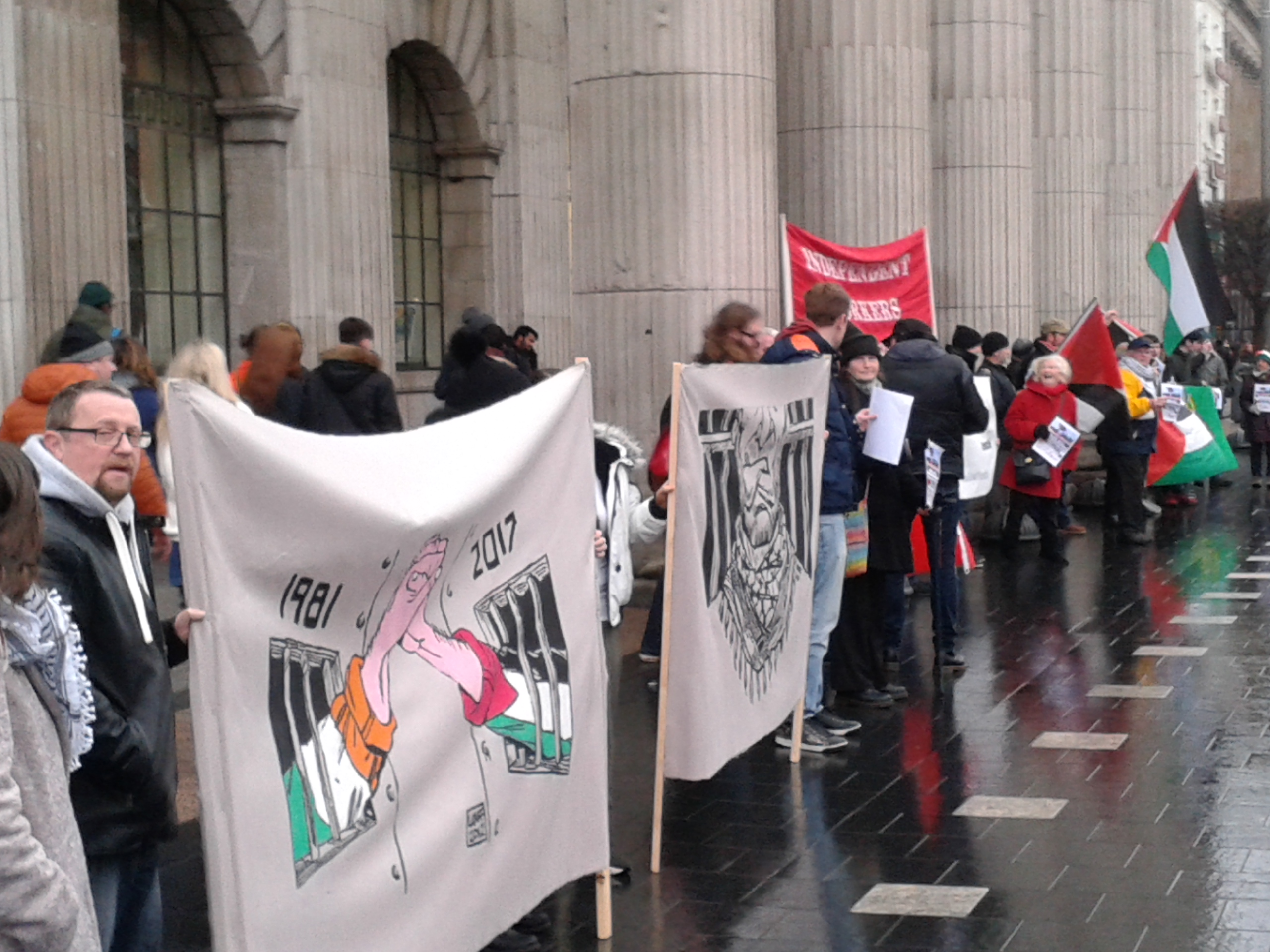
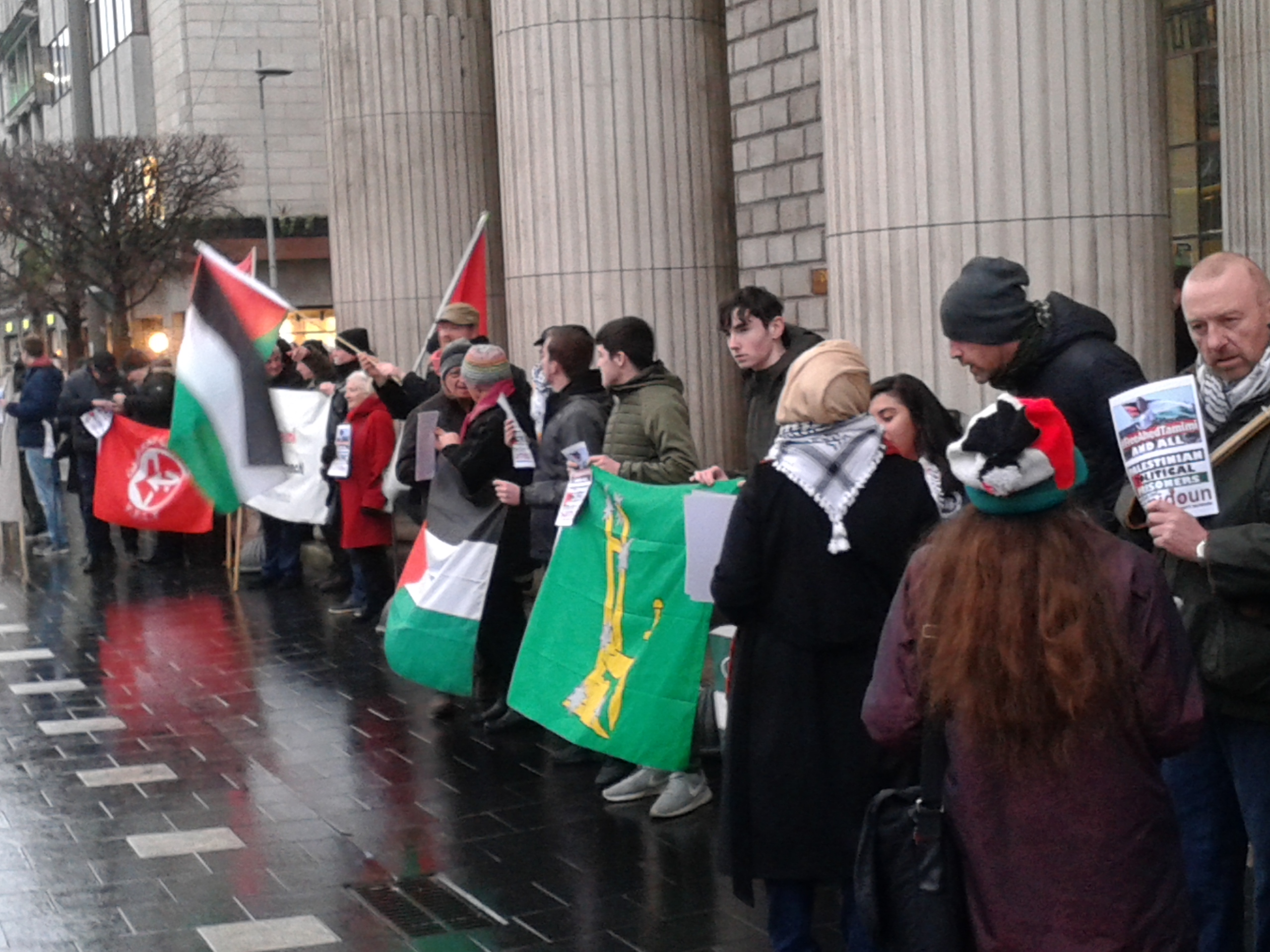
A wet Saturday afternoon saw a large crowd attend a protest picket organised by the Anti-Imperialist Action organisation; it was in specific solidarity with Palestinian Teenager Ehed Tamimi, jailed in December last year by the Israeli Zionist occupation — but also with all Palestinian political prisoners.
Ehed Tamimi solidarity protesters outside the GPO building, Dublin city centre (Photo: D.Breatnach)
Ehed Tamimi lives in Nabi Saleh, a West Bank village approximately 20 kilometres northwest from Ramallah. ADecember protest against further expansion of illegal Zionist settlement near Ehed’s home village attracted the Israeli Army who seriously injured a Palestinian, Ehed’s cousin Fadl al-Tamimi, by firing a rubber-coated steel bullet at close range into his face. Three female members of the Tamimi family, including Ehed, though unarmed, attacked the soldiers. After video of the incident circulated widely, the Israeli occupation force raided the Tamimi household and arrested Ehed. She was held without charge for thirteen days and then charged, along with her mother, with assault, incitement to violence and throwing stones. She remains in custody awaiting trial.
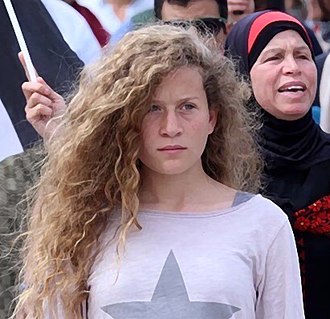
Photo of Ehed Tamimi taken on demonstration in 2016. (Source: Wikipedia)
The detention of Ehed, a minor in law, by the Israeli state violates a number of articles of the UN Convention on the Rights of the Child, including the right to remain with her family.
In past protests at her village, half the number of residents had been injured over a number of years and two killed by Israeli soldiers, including a member of the extended Tamimi family.
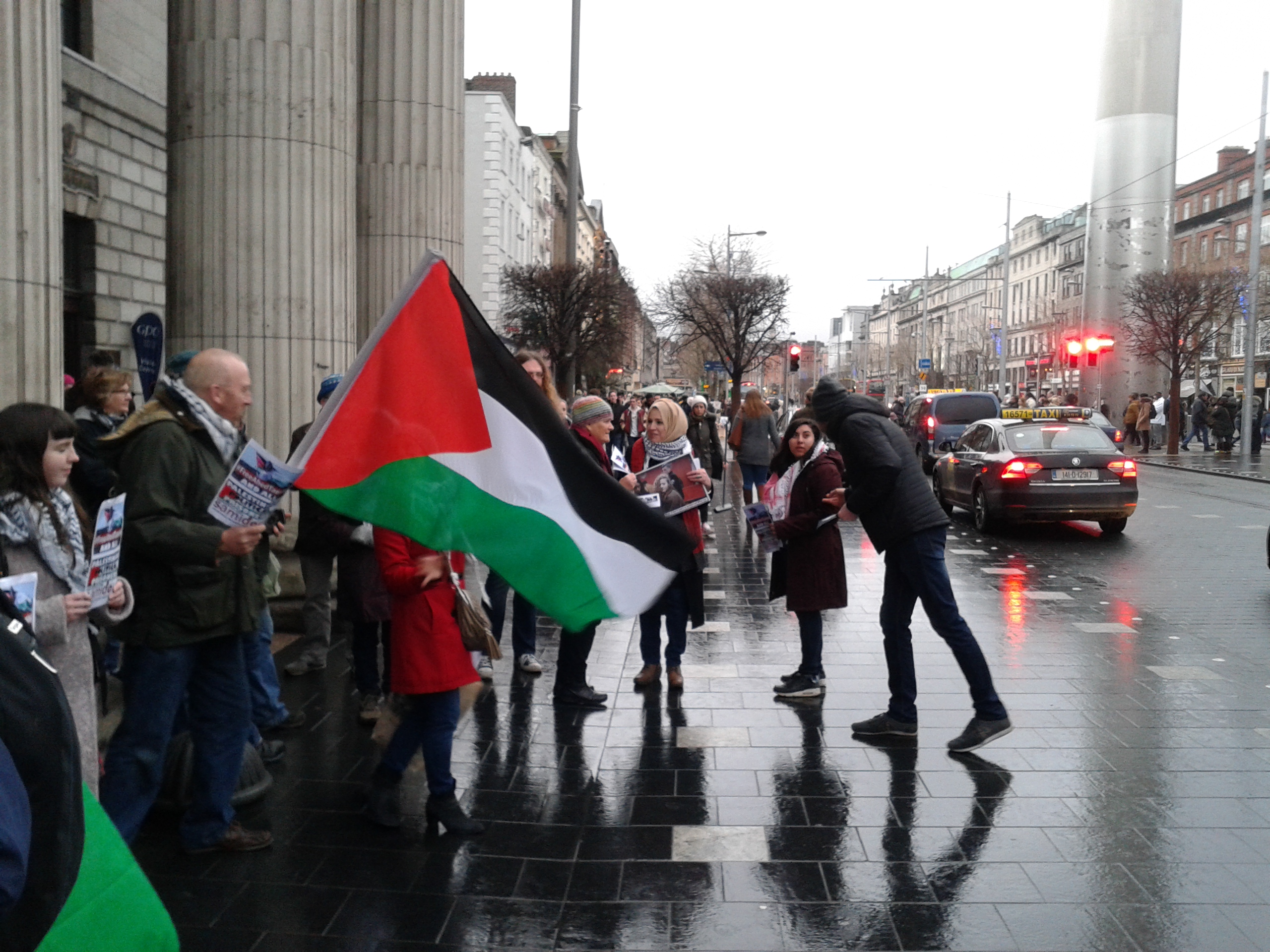
Photo of section of solidarity protest showing (centre photo, background) Fatin Tamimi, relative of Ehed and Chairperson of the IPSC. (Photo: D.Breatnach)
Born into an activist family, Ehed Tamimi is 17 years of age and has been in struggle against the Israeli Occupation Force more or less since she was she was able to walk. According to the British newspaper The Guardian, Ahed’s siblings—Waed, Mohammed, and Salem—and parents “have known only a life of checkpoints, identity papers, detentions, house demolitions, intimidation, humiliation and violence; she is part of the second generation of Palestinians to live under the occupation.”
Ahed gained international fame through being photographed or filmed confronting Israeli soldiers, her courage remarkable and pale features and long blond hair making her stand out among protesters. The first of these occasions to reach an international audience was when she was 11 years of age, in August of 2012 as she tried to prevent the arrest of her mother and later that year, waving her fist at an Israeli soldier twice her size as he arrested her older brother.
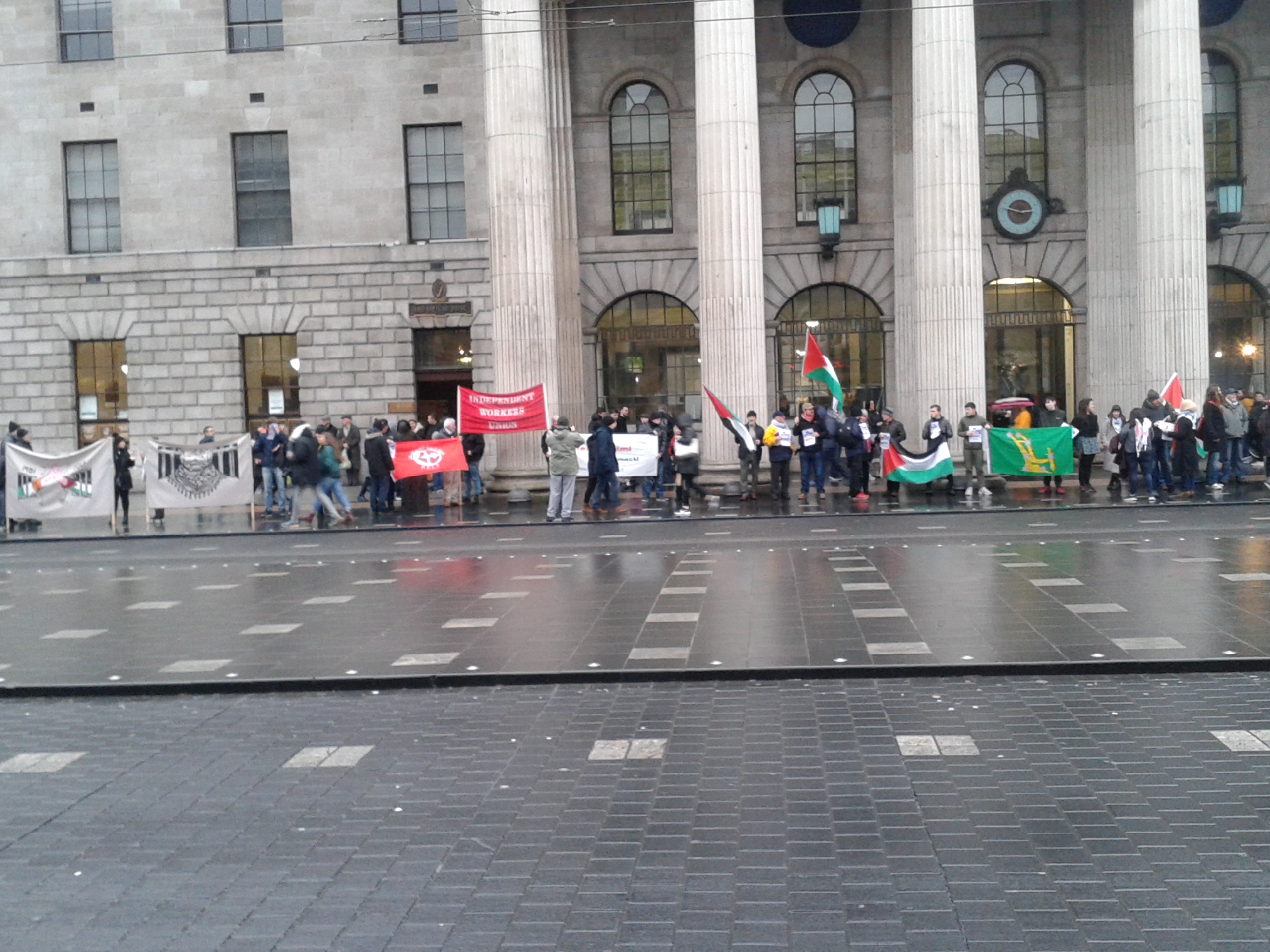
Photo from east side of O’Connell St. (Photo: D.Breatnach)
WIDE SUPPORT FOR PICKET
The Dublin picket on Saturday attracted the support of a wide section of the Republican and Socialist Left: the Independent Workers’ Union banner was in evidence as were a number of painted banners previously seen on pickets by the Dublin Anti-Internment Committee, along with independent Irish Republican activists. Fatin al-Tamimi, Chairperson of the Ireland Palestine Solidarity Committee and a number of that organisation’s activists were also present, some distributing IPSC leaflets, as were a number of activists associated with campaigns against the Water Charge, against the demolition of Moore Street and in support of ending homelessness. Fatin al-Tamimi, who although bearing the same family name is not related to Ehed’s family, will not in future be permitted by the Israeli state to visit her relatives (see item on Israel’s public blacklist below).
Section of protest (Fatin Tamimi, Chairperson of IPSC, can be seen centre right of photo with back to photographer. (Photo: D.Breatnach)
Among the passing shoppers and tourists a number indicated their support for the picket, many taking photos and some asking to be photographed among the protesters. Drivers of a number of passing vehicles also tooted their horns in support.
RELATED: ISRAEL PUBLISHES BLACKLIST OF PALESTINIAN SOLIDARITY ACTIVISTS ABROAD
The Israeli Government consolidated its secret blacklist of people to be barred from entry to territory controlled by the State into list of organisations which it made public on 6th January 2018. The Ireland Palestine Solidarity Committee was named as one of the 20 organisations, the leaders and activists of which will not be permitted entry to Israeli-controlled territory. The move was widely interpreted as a reaction to the increasing effectiveness of the Boycott, Divestment and Sanctions movement against the State and its anti-Palestinian policies. The publication was also seen by many as marking its further alienation from much of the rest of the world even as the USA, in President Trump’s order to relocate the US Embassy to the city, publicly endorsed the previous Israeli completion of its seizure of Jerusalem in June 1967 and its ongoing Israelisation and de-Palestination of the city.
Most of the organisations on the blacklist are European but a number are US-based. “The American Friends Service Committee, a Quaker organization honored with the 1947 Nobel Peace Prize for assisting and rescuing victims of the Nazis, is among the list of groups whose activists Israel has announced it will bar from entering the Jewish State. On Saturday it was revealed that the left-wing organization Jewish Voice for Peace was on the list.” Also on the list is the BDS South Africa organisation.
Let us suppose that the Minister of Justice of an Irish Government held a conference with representatives of the Gardaí, the Army and the judiciary. As a result of the conference the Government created a strike force and issued a 180-page report in which the main tendency was the need to eliminate an organisation called the Irish Resistance Movement.
The mass media hails this Report and highlights the danger of the IRM.
However, Left and alternative political activists have never heard of this IRM before but we find that a Traveller activist is named as the spokesperson, Irish socialist and republican organizations are listed as belonging to it, in addition to campaigns against homelessness, the Water Charge and some smaller ones for political prisoners, human rights, civil rights etc. Some of the names of independent political activists also appear on the list.
As proof of the existence of the IRM and who belongs to it, the report shows a crowd demanding the exoneration of the Jobstown defendants, which includes a person whom a large force of police later killed in an attack on himself and a few comrades. A number of ongoing trials still not concluded are also added for good measure.
Then, the Report also claims that the “IRM” contains internationalist solidarity organisations in solidarity with the Kurds fighting ISIS and with the Palestinians and is receiving arms training from ETA.
And the “IRM” is linked to a number of demonstrations which have shut down the centre of Dublin in protest against austerity measures, protest occupations of buildings, etc.
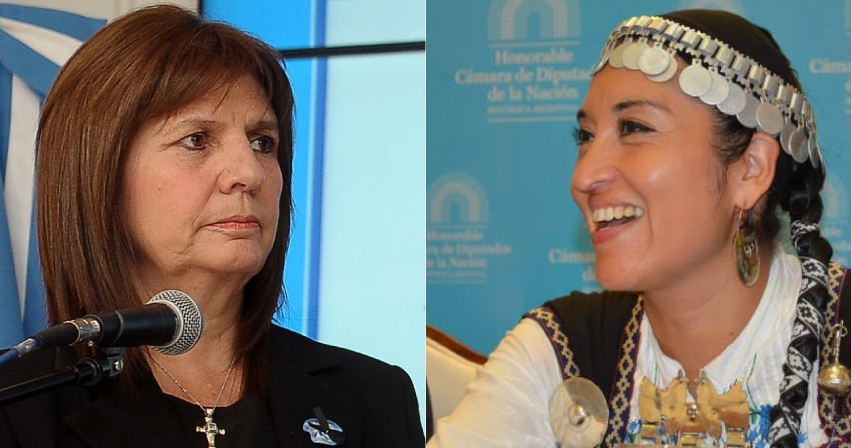
L-R: Minister of Security Patricia Bulrich and Mapuche historian and activist Moira Millán (photos: Internet)
What would we think?
We would probably conclude that the Government was preparing the ground for a massive attack on our organisations of resistance and on the right to protest.
If in addition to the publication of the Report, the Traveller’s spokesperson, which the Minister of Justice claims to be a spokesperson for “IRM”, two months ago had a the body of a mutilated vixen left on her doorstep, we might also think that the Government might be setting her up to be killed.
Demonstration in Argentina in protest at arrest and subsequent disappearance of Mapuche solidarity activist Santiago Maldonado on 1st August 2017. (Photo source: Latin American Media)
The preceding is an approximation of what is currently going on in Argentina. On December 29th 2017 Patricia Bulrich, Minister for Security of the Nation of the Cambiemos coalition Government of Argentina held such a conference with provincial security executives and issued a 180-page report on the danger of “RAM” (“Ancestral Mapuche Resistance”). This organisation has never before been heard of but Bulrich claimed in the Report and in a televised press conference that it is coordinating the activity of a huge number of organisations and is creating a great terrorist threat to the State.
“Resistance is not Terrorism! Freedom for all the Mapuche political prisoners”! (Photo of poster from Anarkismo.net)
Linked to “RAM” she gave a long list of organisations including those of original people and resistance in the areas of trade union, community, socialist and anarchist activity. Support for the Kurds was listed as evidence against some anarchist organisations and other organisations were alleged to be funding and publicising “RAM” while the Colombian FARC was alleged to be giving them military training.
Mapuche demonstration Patagonia January 2017 (Photo: Latin America Media)
The “RAM” may be a fake organisation but the State terror threatened is real.
The Minister publicly named Moira Millan, a Native People activist of the Mapuche, as the spokesperson of this “RAM”. This in the context of the recent killing of one Mapuche activist and the disappearance of Mapuche solidarity activist Santiago Maldonado in August 2017, which events led to demonstrations of Mapuche protest. Santiago was later found dead.
Millán lives in Patagonia, is a mother and in fact a member of two Mapuche organisations: The March of Native Women for Holistic Living and the Pillan Mahuiza Community. She writes and lectures on the history of the Mapuche, organises meetings in particular of Native women, gives traditional cooking classes, and speaks publicly on the rights of the Mapuche people. Millán has never been charged with any illegal let alone armed activity but last October, the mutilated body of a vixen was left on her doorstep. The message is both an insult — vixen in Spanish is “zorra” and is used as a moral and gender insult, particularly by the Right against female Left activists – as well as a death threat, i.e that her body will be next.
Millán’s reaction to the release of the Report and Bulrich’s press conference was quick and scathing:
“Yesterday, while I thanked the children who voted that the library of School No. 8 Luis Bernet of Parque Chacabuco should bear my name, the Minister of Security, Mrs. Patricia Bullrich, mentions me in her absurd and ridiculous report as the main spokesperson for RAM”, she said, adding that “the lady Minister – Bullrich — continues with her delirium tremens, inventing terrorists where there are none”.
“In her fevered dreams she sees herself, hooded, like the Ku Klux Klan, hunting Mapuches, assisted by the insipid and mediocre Governors of the South,” said Millán.
“Lie, lie but something will remain … ‘The lie has short legs’, says the popular saying: Are you coming for me, Mrs. Bullrich? Why are you afraid of us so much?” asked the Mapuche campaigner.
“Here I am, holding my truth as a weapon, and the wisdom of the Mapu as a shield; they have initiated ‘the hunger games’ and you believe that your government will win; make no mistake, we belong to a people that has been invaded, but never defeated”, concluded Millán.
(See further down for a way to take a few minutes to help)
Those who wish to express their concern at this demonisation of resistance, the killing of Santiago Maldonado and to lift the threat of incarceration or death on Moira Millan may wish to write to their local Argentinian Embassy, which is obliged to relate information back from their host countries on attitudes to Argentina.
Embassy of Argentina Dublin: 5 Ailesbury Drive Ballsbridge Dublin 4 Ireland
Minister of Security of the Nation of Argentina is currently blocked (for some reason). The Minister of Justice may be accessed through the Department’s page (see link), then use their email contact system: http://www.jus.gob.ar/contacto.aspx
Among the many spurious difficulties about learning Irish quoted by people there are some genuine ones.
A PRONOUNCEMENT
A problem with learning Irish, according to some people, is the spelling of Irish words. When this difficulty is expressed by English-speakers, I am tempted to ask them to pronounce the English word “Ghoti”. It was a word invented by George Bernard Shaw and unless they are familiar with it, they will be unable to pronounce it correctly. Shaw took the “f”-sound from “gh” in words like “enough”; the “i” sound from the “o” in “women” and the “sh” sound from the “ti” in words like “mention” — hence the correct pronunciation is “fish”. Shaw invented the word to illustrate how illogical – or at least unpredictable – is the pronunciation of many English words. Perhaps he was replying to someone who was accusing the Irish language, an Ghaeilge, of having a similar problem; I don’t know but would like to think so.
In fact, the vowel sounds in Irish can be entirely predicted from the written word with the exception of the “A”, which has something of a narrow range of possible pronunciations and some vowel combinations. In English, combinations of vowels produce different sounds to that of each individual letter also and with a greater variety and less predictability than is the case in Irish: take the different pronunciations of the ‘a’ in ‘cat’, in ‘day’, ‘rain’, ‘contraindicated’ (true, the latter is a compound word).
Where a long vowel is indicated in Irish by an accent, the “síne fada” (“sign of length”, unlike in Castilian, for example, where the accent indicates only where the stress falls in the word), the sound to make when reading it is unmistakeable.
To illustrate, the á will produce a sound like “aw” in English (as in “law”); the ó a sound like “oe” in “toe”; ú like “oo” in “loot”; í like “ee” as in “fee” and é like “ay” as in “bay”. These will not vary, no matter where they appear in the word.
“But hang on”, the observant complainer may protest, “you mean to tell me that é is pronounced “ay”, like the letter “A” in English? And that í is pronounced “ee”, like the letter “E” in English also? Why is Irish so contrary?”
“Well,” I may reply, “I’m very glad you asked me that. Because in many other languages, the letter “I” is also pronounced like “ee” in English and the letter “A” — which in English is pronounced “ay” as you pointed out — in many other languages, probably most, is pronounced “ah”. In this case, my friend, it is the English language which is being contrary!
Furthermore, English has made a broad vowel into a slender one.”
“Huh?”
Yes, they don’t commonly teach about broad and slender vowels in the schools now, yet the difference between them affects not just Irish pronunciation but also English, Castilian, Italian and other languages. Why is it, for example, that the “G” in “Gerry” is pronounced differently from the same letter in “Gary”? Why is that the “C” in “Cede” and “Citrus” is pronounced differently from the same letter in “Cat, Cot” and “Cut”? The answer has everything to do with broad and slender vowels.
In Irish, a, o and u are broad vowels and i and e are slender (the same in English except that y can also be a slender vowel, e.g in words like ‘only, why‘ etc). The most notable effect of the different pronunciations effected in Irish by whether a vowel is slender or not is with the letter ‘S‘, viz: Sorcha, Saidhbhín, Súil but Sinéad, Seán.
Now, the problem with the pronunciation of the name of the vowel “a” in English is that “ay” is a slender vowel sound while the letter itself is a broad vowel. In Irish that letter is pronounced “ah” as it is in many other languages around the world (perhaps all). When we speak the vowels, our mouths make a horizontal shape for slender vowels and tend towards a vertical one for broad (try it and see). Which shape does “ay” make? Yes, horizontal, the shape of a slender vowel!
“Ok,” says the complainer, “but what about the consonants? You can’t tell me that reading them and pronouncing them is not complicated!”
Actually, the complainer here does have a point. It is over-emphasised, perhaps, but the point does have some validity.
The pronunciation of the consonants in Irish is pretty straight-forward, with the variations in the “S” according to slender or broad vowels either side (discussed above) and to some extent the same effect on the “D” and “T”. And the double “L” and “N” in Irish followed by a slender vowel have the same pronunciation as the “ll” and the “ň” in Castilian respectively, which is to say theyare like “n’y” and “l’y”, for example “bainne” (“milk”) is pronounced “ban-yeh” and “sailleach” (“fatty”) is pronounced “sal-yach”.
A learner can soon get used to these peculiarities in Irish or in other languages. But what about all the consonants followed by a “h”?
Irish does not have all the consonant letters that English has – we don’t have the J, K, Q, V, W, X Y or Z. We don’t really have a H either, come to that, as we’ll see in a moment. The sound of Q in Englishcan be reproduced in Irish as “cua” or “cui” in Irish andwe can make the sounds of some of those ‘missing’ letters by employing an effect on consonants called lenition, in Irish “séimhiú” (softening). During the last two centuries, this was shown by a dot on top of the consonant to be lenited but is now indicated by a H after the consonant in question. All the other ‘missing’ consonant sounds with the exception of the Z are available in this way – not only those but in fact another two not available in English: the Irish “ch” and “gh”.
Lenited consonant at the beginning of a word
Consonant sound equivalent in English
B
Bh + i, e
V
Bh + a,o,u
W
C
Ch
Ch as in “loch”
D
Dh + i, e
Y (not as a vowel)
Dh + a,o,u
Gh (sound not available in English)
F
Fh
Mute (no sound)
G
Gh
Gh (sound not available in English)
L
Cannot be lenited
M
Mh + i, e
V
Mh + a,o,u
W*
N
Cannot be lenited
P
Ph
F
R
Cannot be lenited
S
Sh
H
T
Th
H
* In some Irish dialects the Mh will be pronounced as “V” whether followed by a slender or broad vowel.
Ok, so the lenited consonants do introduce some complication to reading-pronunciation but hardly an insuperable one. To balance that, we have the more reasonable vowel letter A pronunciation than does English (i.e as a broad vowel instead of a slender one) and the ability to read the pronunciation of vowels off a text. Also, to compare with English, some sounds in English are shown by combining consonants, such as ‘tch in ‘catch’, ‘ph’ as in ‘pharmacy’, ‘sh’ in ‘shake’ and ‘th’ in ‘think’.
And what about the ‘ch’ combination in English – it’s not pronounced the same in the words ‘chant’ and ‘character’ or ‘chaos’. Add to that the ‘h’ in ‘rhetoric’ or ‘rhythm’ seems to have no role in pronunciation at all and that the ‘w’ will be heard at the beginning of a word and may or not be heard in the middle (compare ‘award’ with ‘lower’). The ‘w’ will not be heard at all at the end of a word but instead governs the pronunciation of the vowel before it (‘raw’, ‘row’, ‘few’)!
This governing of the pronunciation of the vowel before it also happens with ‘gh’ in ‘dough’ or ‘rough’ – but note that in each of those cases the pronunciations of the ‘gh’ are completely different! In order to indicate the sound of the Irish ‘ch’ in loan words, English uses “gh” yet again, as in ‘lough’ and ‘bragh’ (in “Erin (sic) go bragh”) and “Drogheda”. Confusing, isn’t it?
Although pleading the feature of the pronunciation of consonants as a difficulty in learning the Irish language does have some validity it is overdone – particularly when the complainant is an English-speaker. It seems to me that the difficulty is magnified by those who do not wish to go to the trouble of learning the language but want to have a good excuse for not doing so.
Among the many spurious difficulties about learning Irish quoted by people there are some genuine ones.
TO BE OR …. SOMETHING ELSE
Much of what happens in English requires the use of the verb “to be”, which is a highly irregular verb so that the past tense singular was and plural were do not resemble each other much and resemble the infinitive to be or present tense for different persons (am, is, are)not at all. However the child learning to speak English as a mother or environmental tongue, i.e the language spoken around her outside the home, will in time get over the difficulty.
But when the adult English-speaker comes to learn Gaeilge (Irish), she will encounter in that language no equivalent usage to that of the verb “to be” in English. Instead, she will find the verbs “Tá” and “Is”. Furthermore, the verb “tá” will have other uses too.
Stock adult education class photo (Source: Internet)
For example, “I am a man” will be “Is fear mé” but “I am tired” will be “Tá mé tuirseach”. And “Tá”, with a set of prepositional pronouns, is used also to correspond to the verb “Have” in English: for example “Tá rothar agam” = “I have a bike”. And furthermore, when feelings are conveyed, “Tá” is used too but with another set of prepositional pronouns: “Tá fearg orm” = “I am angry” (lit. “I have anger on me”). Physical feelings too, eg: “I am thirsty” will be “Tá tart orm” (literally, “I have a thirst on me”, a phrase that appears in English spoken in Ireland even by people who have not spoken Irish in generations).
Now, before the complainer about Gaeilge can throw up his or hands in exasperation and exclaim “You see?”, let us examine another European language.
Castilian (Spanish) has exactly the same division between the verbs estar and ser: Estoy cansado (“I am tired”) but soy un hombre (“I am a man”). And furthermore, the use of another verb, tener (“to have”), to correspond to the use of the verb “to be” in English. As an example of the latter, tengo sed (literally “I have thirst”) = “I am thirsty”. Further, the verb “to make” in Castilian, hacer, will be used to describe the weather, as in “Hace frio” (lit. “It makes cold”) = “It is cold”.
Castilian is I believe the mostly widely-spoken European language after English but also the language with the most speakers in the world after Mandarin Chinese. Well over 400 million people speak Castilian as their first language and it has official status in 21 states spanning three continents.1
Not many people are going around whining about Castilian/ Spanish being difficult to learn (or if there are, they’re being ignored) so clearly, this problem of the different verbs in use in one language to an equivalent use of only one verb in English is not such a big problem at all.
So, if some people don’t want to learn Gaeilge, they need to find a different excuse; otherwise, as they say in coarse English (but not i nGaeilge or in Castellano) – suck it up!
The text on my mobile gave me a little jolt. Treating a gentle query from a friend as a summons, I headed off to the Song Central session in Chaplin’s bar, just across from the Pearse Street Garda station (outside which on some on some occasions I’ve protested until they released some person or persons they had arrested on a demonstration on which I have been – and on one memorable occasion, even on a walking history tour I was conducting as part of an anti-G8 Dublin program).
So, get ready, jump on the bike — it’ll be maybe a quarter of an hour? Intention to stay in for the night blown away, I head for the shower and shave, then reheat and consume most of the Dublin coddle.
Wheeling the bike out into the hall, I hear a squelching kind of sound. Oh no! But yes – flat tire (and of course, the rear one, with the gears on the wheel)! Fair enough, it’s bus or walk.
So where’s the snow from this “Code Orange” weather warning? And how could you trust anything from the colour orange anyway? Walking across from Liberty Hall to Butt Bridge, I do actually see some snow, slabs of it apparently having fallen off the roof of a car from some snowy region out of town. Young people pounce on it delightedly and, normally, I’d be in there myself, snowball fighting given half a chance. But the session ….
It’s a long time since I’ve attended the monthly Song Central, as I was reminded by people I had not seen in quite a while. This session was started by Alan Stout around seven years ago, in a kind of split from the Bray monthly session a number of years ago (but a friendly split and the Bray parent is still going strong). As in the Bray session, you may play an instrument but only as accompaniment to a song. And it’s still popular – sometimes it’s a job to get a seat.
It’s a kind of Republic of Song with a wide allegiance: religious-type Christmas songs partnered Christmas social comment in which Jesus is a revolutionary; comic songs balance the serious, Irish trad and folk meet pop and Blues, new and self-composed songs intersperse those made familiar by well-known singers and bands. Most singing is unaccompanied and in English but a couple were sung i nGaeilge.
Remembering Christmas I abandoned my plan to sing The Glencoe Massacre (“Cruel is the snow that blows round Glencoe” — a nod to the much-heralded no-show snow) and opted instead for Arthur McBride, which is actually set in Christmas Day. Later I sang They’re Stealing Our Water, which I had debuted in that session maybe two years earlier and for which one of the participants had given me a better line than I had originally composed. The song goes to the air of The Sea Around Us by Dominic Behan and the chorus is the same, except for the last lines: “But we’ve still got our Gombeens and a bank guarantee and they’re trying to steal our own water!”
It’s always a risk to slip a different line into a well-known chorus because the crowd are likely to sing the one they know and not the one you’ve composed. Which did happen a bit but eventually they got it.
I heard some really good singing and some fair singing, as well as a couple of songs I’d not heard before. The session was due to finish earlier than usual in consideration of adverse weather warning (those Orangeys again!) but there were still some people there as I left. It is always a joy to attend so why don’t I do it more often? The answer is that I don’t know but in a month’s time, although I don’t plan to, it may be that once again I will give it a miss.
So on my way to the bus stop of course I pass Bowes’ pub in Fleet Street (Sráid na Toinne!) and I drop in there for a half or a pint and to listen to some trad from the Sunday night session. But what’s this? No musicians! Apparently they play 7-10pm now (but later on bank holidays) and are off playing for some more hours of the night at “the Apollo Sessions”, the barman tells me. But where would that be? Hardly in Apollo House, no longer occupied to highlight homelessness and guarded by a security firm.
Elucidation unforthcoming, it’s onward to the bus stop in Westmoreland Street where I am fortunate to get a bus almost straight away. On the top deck, a chat in Castillian (Spanish) with a Filipino woman, her Spanish partner and a lively and chatty child. And so, home … to reheat and finish the remains of that coddle.
ln the Six Counties, the British colony in Ireland, the sectarian lines are drawn. The Good Friday Agreement did nothing to eliminate them, contrary to the praises of many and perhaps even the wishes of some who supported it. The majority section of the population has a badge of professed faith to identify it, Protestantism, while the other has its own badge, Catholicism. But each section also has other symbols of its own.
Politically, each section has a number of divisions within it but each has its majority representation: the Democratic Unionist Party for the Protestants and Sinn Féin for the Catholics. Both of these parties have overcome others to rise to prominence over their respective sections – the DUP deposed the Ulster Unionist Party and Sinn Féin overtook the Social Democratic and Labour Party. Both Sinn Féin and the DUP display the symbols of their respective sections and employ them to sectarian electoral advantage.
Apart from professed religion as a signifier, each section also has its own visible symbols: the Tricolour and Harp for the Catholics, the Union Jack and Crown for the Protestants. And to this has now been added language: Irish for the Catholics and Ulster Scots/ English for the Protestants.
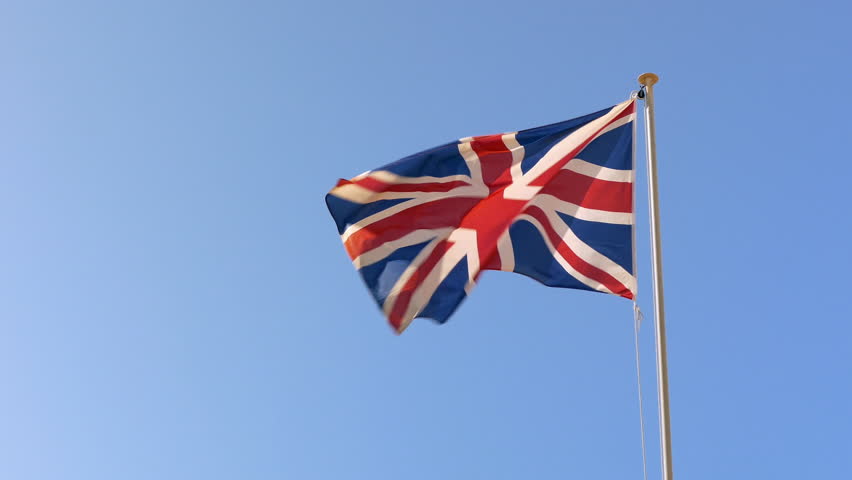
The Irish Tricolour, a flag of the Irish Republican movement and official flag of the Irish State. (Image sourced on Internet)Flag of the United Kingdom, colloquially known as the “Union Jack” (it has other less neutral names too). (Image sourced on Internet)
There are other symbols too but they are of minor importance, for example for the Catholics flying the Palestinian flag in solidarity with Palestinians and, just because they must oppose anything the Fenians do, the Israeli flag for the Protestants. Soon we may see the Catholics adopt the Catalan Estelada flags and the Protestants, the flag of the Spanish State. But would Unionist Protestants fly the flag of a Catholic country? Yes, it’s quite possible – they already fly one of a Jewish state.
Coat Arms UK (black & white), itself a symbol of UK authority and power, displaying a number of other symbols within it, including the Irish Harp within the shield. Note the symbolic Crown above all. (Image sourced on Internet)United Irishmen Harp Motif (Image sourced on Internet)
The opposing sections are in this discussion described as “Catholic” and “Protestant”, as though religion were really the issue – however it is not. Some commentators like to speak in term of “nationalists and unionists”, with the more extreme wing of the latter described as “Loyalists”. That particular sub-group of Unionism is more likely to refer to Catholics as “Taigues” or “Fenians”.
There are religious differences in doctrine and in temporal supremacy between both religions: Catholics believe in the immaculate conception of Mary, the mother of the Christ figure and Protestants do not, though she is seen as a saint in their churches also. Perhaps more relevantly, for Catholics the Pope is, notionally at least, the supreme temporal religious authority while for Anglican Protestants, it is the ruling British Monarch (other British-based Protestant sects acknowledge only their own vicars, their reading of the Christian Bible or their own consciences). Currently, that monarch is Queen Elizabeth II Windsor and lest she be considered just some kind of figurehead, albeit with untold (literally!) riches quite apart from public funds allocation and properties, it is well to remember that she is also Commander-in-Chief of the British Armed Forces.
Back in the day, the Pontiff (the Pope) also controlled a fair share of armed force and also brokered deals between the monarchs of different kingdoms. And in that respect, we’ll shortly come to some great ironies with regards to the Six Counties but first there are other matters to deal with.
RELIGION AS A QUESTION OF STATE POWER
Henry VIII of England disestablished the power of the Pontiff in English-ruled domains and made himself head of the Church, which of course required a split in the Christian Church, and the whole process has since become known as the English Reformation. That happened in the 16th Century; Henry’s daughter Elizabeth I continued this policy in the 17th Century and also extended the power of England and the territories under its domain. Of course, none of this was done by those monarchs alone; powerful feudal and commercial interests were involved also. Being Head of the Church of England allowed Henry to dissolve monasteries and confiscate their lands, filling the coffers of the Crown and of the faithful – faithful to the Crown.
Unfortunately for Ireland, a large part of the country was in the possession of England at this time, though not without resistance. And the original “English” colonists, the Gall-Ghael (“foreign Gael” in Irish), the Normans who had invaded from a colonised Wales with their mercenaries, wanted to stick to their earlier religion, continuing to acknowledge the Pontiff as their spiritual leader. They held their lands through conquest of arms under English monarchs (though the first had been a French Norman) but their loyalty to the British Crown was somewhat shaky. In 1366, nearly two centuries after their conquest of the Irish lands they held, the English Normans called them “the degenerate English” and accused them of having become “more Irish than the Irish themselves”.1
And what of “the Irish themselves”? They too were of the old faith, although their earlier Celtic Christian Church had been more than a little lax in its application of Roman doctrine, especially in laws and mores around marriage, justice and the status of women. The Roman Church was feudal and Irish society still ran along clan lines.
An uneasy alliance was formed between the Gael and the Gall-Ghael which emerged first for the English king Charles I against Cromwell, in the middle of the 17th Century and later again near the end of that century for King James II against King William III (of Orange). On each occasion the Irish alliance lost.
BATTLE, SECTARIAN LINES AND IRONIES
And here we come to ironies. William of Orange was a Protestant and the victory of his forces at the Battle of the Boyne is considered by Unionists a victory of Protestant forces over Catholic. Actually, there were some Catholics among William’s force and some Protestants among the opposing James II forces but that is not the irony. Nor is the fact that William of Orange was a homosexual and that Rev. Ian Paisley, who founded the Democratic Unionist Party and led it until his death in 2014, led a campaign against decriminalisation of homosexuality under the slogan “Save Ulster from Sodomy!”
No, the irony is even greater than those two facts and it is this: William’s armed forces were part-financed by the Vatican, in other words through the Pontiff himself. Although in Ireland the conflict took on the shape of Catholics fighting for freedom to practice their religion (and even Gael and Gall-Ghael holding on to their respective powers), against Protestants forcing their religion and colonial power on others, it was part of a European-wide conflict known to historians as The Nine-Years War. A coalition of forces composed of Austria, the Holy Roman Empire, the Dutch Republic, Spain, England and Savoy, styling itself the League of Augsburg, drew up to oppose Louis XIV of France. And James found himself on the side of France and against his own Parliament.
The Pontiff, as leader of the Holy Roman Empire, was very much a member of the League of Habsburg as was the Kingdom of Spain and Savoy – all under Catholic rule. When news of William’s defeat of James’ forces at the Battle of the Boyne on 1st July 1690 reached the Vatican, a Te Deum mass of praise was celebrated there and similar demonstrations of praise were practiced in the Spanish Kingdom also. That war in Ireland had fundamentally little to do with religion in reality but everything to do with English state and colonial power and European power struggles.
And of course this is not only an irony for the Protestants, who annually celebrate the Boyne victory on the 12th of July in their most sectarian and anti-Catholic manner, but for the Catholics too, who see James as defending their Catholic faith, of which the Pope was the spiritual leader. Nor is that the only irony in connection with Ireland and the Vatican: it was a Pope, Adrian IV, who issued a Papal Bull (something like a warrant) in 1155 legitimising invasion and conquest of Ireland by Henry II of England. Pope Adrian IV, aka Nicholas Breakspear, was the only English Pontiff ever, true but he was a Pope and he must have had substantial support in Rome to issue such a document.
RELIGION
One of the characteristics of republicanism in the late 18th Century, apart from the abolition of the monarchy, was the separation of Church and State. Freedom of conscience and worship were important principles in the French and American revolutions. The United Irishmen also adhered to those principles with an even greater motivation, which was that the majority of the Irish population was excluded from participation in government, military and civil profession by a religious bar.
The Unitedmen were defeated, crushed. Their Protestant (Anglican) and Dissenter (Presbyterian) leaders and supporters were executed or exiled2 and the remnants for the most part became dominated by sectarian anti-Catholicism. And Irish nationalism, including republicanism, came to contain a strong Catholic bias (notwithstanding the continuing presence of Protestants and true Republicans in the movement).
Despite the fact that the Irish (and English) Catholic Church hierarchy has been publicly and energetically hostile to Irish Republicanism from the 1780s onwards, the majority of the Irish Republican movement of the early 20th Century observed the practices of the Catholic faith and never broke from its religious allegiance nor sought to overcome the dominance of the Church in society. As a result the Republican movement was unable, had it wanted to, to tackle many of the social injustices in the Irish State’s education, health, intellectual, literary, art, gender and sexuality policies and legislation, where the Church held sway.
Liberty of conscience and worship remains an important civil right, a democratic demand. People are entitled to practice their concept of religion or to abstain from it and their choices in this regard should not influence people’s participation in society as a whole. The Catholic Church is losing its power in the Twenty-Six Counties and that is reflected too in the Six. The Presbyterian churches are likewise losing influence. However, faith congregation membership continues to be a communal marker and to be used by the DUP and SF to hold their respective voting blocs together.
If separation of Church and State is an important principle of Republicanism then Republicans should actively campaign for that end. No school that bases its intake of pupils on the practice or belief of any religion should receive State support. But in the unlikely event that Sinn Féin should embark on a campaign to apply that principle, they would find themselves losing their voting block, for that is how their block is identified in the Six Counties: as Catholics, baptised in Catholic church, attending Catholic services to some degree or other and being educated in Catholic Schools.
The Unionists are of course just as careful to look after their own sectarian voting block and at least as sectarian. But they don’t claim to be Republicans.
THE ESSENCE OF THE SYMBOLS
Symbols of course do not merely stand for what they are themselves but, in being a symbol, for something else also. A sculpture or drawing of a lion may represent the animal but when used as a symbol, frequently stands for monarchy and power: for examples, the lion on the coat of arms of the United Kingdom and the lions at base of Nelson’s Column in Trafalgar Square, London. And symbols can also change their symbolic meaning and come to mean something else than was originally intended. The cross symbolised martyrdom for early Christians, later came to symbolise Christianity itself, later still the Holy Roman Empire and the Crusades, the Spanish Inquisition …. For the Ku Klux Klan in the southern states of the USA, the burning cross symbolises the power of their organisation and white anglo-saxon ethnic supremacy.
The Irish Tricolour flag was presented to Thomas Francis Meagher of the Young Irelanders by women revolutionaries in Paris in 1848, the Year of Revolutions in Europe (but not really in Ireland, where the fight had been knocked out of the remaining survivors of the Great Hunger 1845-1849). Reputedly the flag’s colours signified peace (White) between the traditions of the Gael (Green) and the descendants of those who had fought for William (Orange). The Unionists see it, however, firstly as a symbol of rebellion against the Crown (not without reason, given its historical use) and secondly as a flag of a Catholic Ireland.
The Harp is an Irish symbol of some antiquity and was reputedly flown on standards in ancient medieval times in Ireland. The Norman and English invaders appropriated it firstly as symbol of a conqueredIreland and incorporated it into their colonial standards and flags. Revolutionary republican grandchildren and great-grandchildren of Cromwellian settlers then appropriated the harp as the symbol of the republican United Irishmen, with the motto “It is newly strung and shall be heard”. After the defeat of the Unitedmen (whose leaders were nearly all Protestant), the Harp became a rather suspect symbol for Unionists, mostly Protestants and besides, it is the official symbol of the Irish State (the only state in the world with a musical instrument as its national symbol). However, it remains within the arms of the United Kingdom, representing the Six Counties colony still in British/ English possession.
“Easter Lilly” design, traditionally produced as a paper ‘flag’ and worn pinned to clothing with a straight pin. More recently also produced in enameled metal. (Image sourced on Internet)
The “Easter Lilly” emblem is a symbolic representation of a white lilly with an orange centre, with a green leaf as a background. It was developed by Irish women Republicans in the second decade of the 20th Century to commemorate those who died fighting for Irish national freedom, in particular during the 1916 Easter Rising. For decades it was produced as a simple paper representation for the Irish Republican movement and sold on streets or pubs in the lead-up to Easter Monday, when the Rising would be commemorated. In more recent times it has been worn for up to a week each side of Easter Monday and it has also been produced as a metal badge or pin, which some Republicans wear all year around.
The flag of the United Kingdom, commonly known as the “Union Jack”, embodying a design composed of the symbols of the Crosses of Saints George, Andrew and Patrick, represents the union of the nations through their respective patron saints3: Scotland and Ireland under the rule of England and its Royal Family. It was a forced, not a voluntary union and is therefore a reactionary symbol but Unionists in the Six Counties view it as a symbol of the union with England which they wish to maintain.
Paper “Remembrance Poppy” produced for the British Royal Legion (Image sourced on Internet)
The Crown represents the English Royal Family and UK State power. Since it is the same State that imposes its rule on the other nations of Ireland and the British Isles, it is fundamentally a reactionary symbol, also representing the reactionary institution of monarchy.
The Poppy, a cloth representation of the red flower, is worn by many British people in the lead up to Armistice Day, November 11th and sometimes for days afterwards. Many British people apparently believe that the purpose of this symbol is to commemorate the dead in wars or to support veterans and their families. In fact as research has shown, the primary purpose of commemorating ‘Remembrance Day’ and the Poppy is to gather public support behind the Armed Forces of the UK. Unionists seemingly see wearing it as proof of their political allegiance to Britain, England or the Crown – or all three.4
In the most recent history of the Six Counties, the symbols listed above have been those of the respective communities, with the added fact that Crown and Union Jack have also been symbols of the colonial statelet itself.
Recently two other symbols have been promoted, also with sectarian allegiances: Irish and Ulster Scots. Neither of these two languages is spoken by the majority of either community, for whom English (with some words specific to Ulster) is the majority language.
THE IRISH, ENGLISHAND ULSTER SCOTS LANGUAGES
Irish or an Ghaeilge, one of the languages of the Goidelic branch of the Celtic languages group, was the language of the people living in Ireland before it was invaded by England and remained the majority language in Ireland until the end of the19th Century. It continues as a community language5 in all provinces of Ireland including Ulster but there in parts of Co. Donegal, the northernmost county of Ireland (and not part of the Six Counties despite the statelet being called “Northern Ireland”).
Irish died out as a community language in the Six Counties from its last refuge, the Sperrin Mountains, sometime in the early decades of the 20th Century (the 1911 Census recorded a majority of Irish speakers in that region but also, interestingly, in the Protestant Sandy Row area of Belfast City). However, some Irish speakers survived and others learned the language so that it continued to exist in the colony after the partition of Ireland in 1921. During the recent 30 years’ war, Irish enjoyed a resurgence and to some extent became a badge of resistance to colonial rule.
English is, more than most, a language composed of a number of different languages. Given that it sounds like and is classified as a Germanic language, it is surprising that its major component is of French language origin with the minor component based on Saxon German. English developed in what became England over a period including the defeat of the Romanised Celtic tribes of the area by the Saxons and Angles and the subsequent conquering of the Saxons themselves by the French-speaking Normans.
A century after their victorious invasion of England, the Normans invaded Ireland. In most of the area they conquered in Ireland, the Normans soon came to adopt many local customs, including the speaking of Irish so that less than two centuries later, their England-based colleagues referred to them as “the degenerate English” who had become “more Irish than the Irish themselves.”6
Although the invaders failed to enforce the Statutes of Kilkenny, over the following centuries they managed through eviction of natives and plantation of colonists, as well as the exclusively official use of English and legal repression of the Irish language, to make Irish a minority language and to reduce it, as a community language, to a number of reservations in certain parts of the country.
Ulster Scots is a dialect of Scots, in turn a dialect of German spoken by Saxon colonisers of the Scottish Lowlands (the reason the dialect became known as “Lallands”). The Scottish colonists of Irish lands given to them by James I, Oliver Cromwell and English bankers brought the language into Ulster where it developed into “Ulster Scots”. That too gave way to English over time except in some pockets, without any serious effort to revive its fortunes. Until, that is, agitation began in recent times for rights for Irish speakers and for the teaching of Irish, when some Unionists, seeking an “Ulster”7 “Protestant” equivalent with which to oppose any benefits for Irish, began agitation for the preservation and teaching of Ulster Scots.
However, the real competitor with Irish for dominance in the Six Counties (as also in the Twenty-Six, the Irish State) is of course English.
“PARITY OF ESTEEM”
“Parity of esteem” is a concept that was put forward by Sinn Féin within the atmosphere of the Good Friday Agreement.
To many people at the time, including myself, it seemed like something between “soft” Republicanism and a token demand, something to represent to the party’s following that it was doing something for them in the Six Counties. Sinn Féin would have claimed it was much more than that – and it was.
When some critics of SF or of the Peace (sic) Process claimed that sectarianism was being institutionalised, was being “copper-fastened”, I wondered how that was. Obviously, people in Catholic areas would vote Sinn Féin but how was that any different other than how they would have voted previously, viz. Nationalist or SDLP?
But in the past, except for the brief “power-sharing” agreement8 which the Loyalists had so effectively sunk, no political representative on a Catholic voting base had even come close to carving up the Six Counties on a community proportional basis. Now Sinn Féin have done so – not just in local authorities but in the government of the statelet itself (present difficulties excepted). That is what SF has achieved, after some years of civil rights agitation, Catholic communal resistance to repression and nearly three decades of armed struggle – a sharing out of the spoils of office. Power-sharing. Parity of esteem. A sectarian carving out of areas of influence.
And every power-base must have its symbols. Recently the Irish Language has become one such. Obviously the Irish language is entitled to support and its speakers have civil language rights. Clearly the sectarian opposition of Unionist politicians to concessions in this direction is fundamentally wrong. Of course a Language Act is needed so that Irish speakers can use it to push for their rights where the institutions oppose and block them. But that is not why SF has come so late into this struggle. It’s another symbol of their ethnic power-base and another stick with which to beat the Unionists.
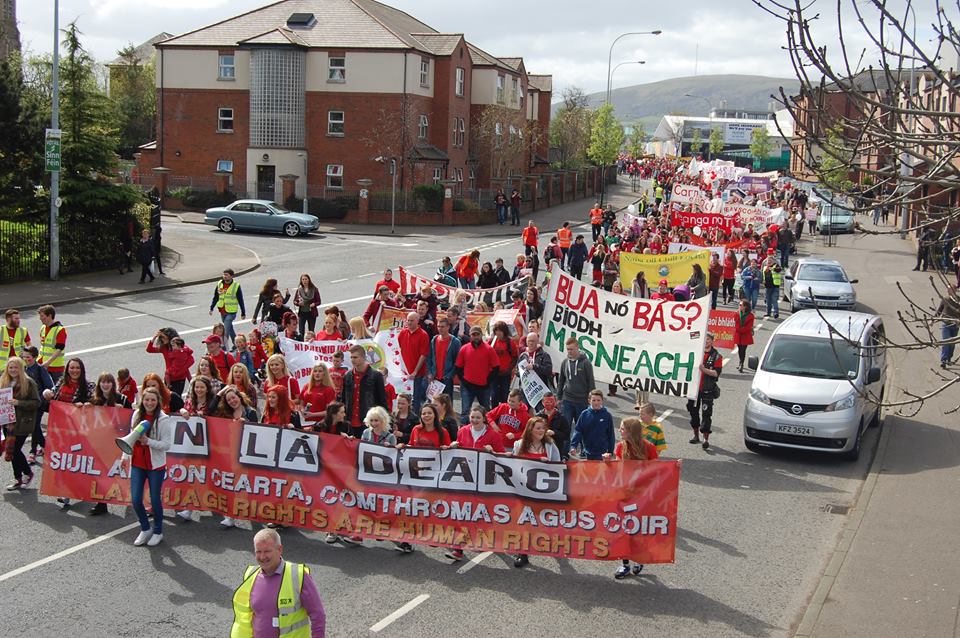
A view of a section of the “Dearg le Fearg” protest demonstration in Belfast in 2014, demanding State recognition of and facilities for the conservation and dissemination of the Irish language. (Image sourced on Internet)
And of course there are Irish language speakers and campaigners who are Sinn Féin members. They made clear you knew that during the huge demonstration in favour of Irish language rights, the Dearg le Fearg9 demonstration of 2014 in Belfast, when they were the only political party displaying a banner in violation of an understanding that no political party would do so.
But what does Sinn Féin do in order to forward the language among its own members and activists? Are its public speakers obliged to be competent Irish speakers? Are its Ard-Choiste (Executive Committee) meetings conducted through Irish? Its cumann (branch) meetings? Its Ard Fheis (annual congress)?10 No, none of those. Is the party even running an Irish language instruction program to overcome this deficit at some point in the future? No.
Apart from some enthusiasts among its activists and a vague nationalist emotional attachment, Sinn Féin as a party is not really interested in the language. In the Six Counties, it is interested in a sectarian carve-up which will keep it at the power table and the Irish language has now become useful for that. Just as, in the Twenty-Six Counties state, it is interested in coming to power in a different kind of power-sharing.
THE EASTER LILLY AND THE “REMEMBRANCE” POPPY
And the latest symbol to be sullied by joining this war of symbols is the Easter Lilly. In times past the Easter Lilly, commemorating in particular the dead who fell fighting for freedom in the 1916 Rising, was worn by many in the Twenty-Six Counties state who were not Republicans. In the latter decades of the last century, few wore it apart from Republicans and, in the Six Counties, it was asking for trouble from the colonial police or Loyalists (often the same thing) to display it. The Flags and Emblems (Display) Act (1954-1987) there empowered any police officer to decide it was likely to lead to “a breach of the peace” and to remove it by force; conviction of a breach of the Act was punishable by a fine of up to £500 (sum equal to about £15,300 in 2017) or up to five years in prison.11
The Act, the repeal of which was one of the demands of the Civil Rights movement of the late 1960s, was finally repealed in 1987 but of course, any signifier identifying a person as a Republican or even a Catholic in the Six Counties is at the very least an invitation to less favourable treatment by the authorities and at worse to harassment and assault by Loyalists or colonial armed forces personnel.
It is of course right that people should have the right to wear the Easter Lilly but to pose it as an equal right to wearing the Remembrance (sic) Poppy is to devalue the Lilly, to putting an anti-imperialist and Irish Republican history emblem on the same level as an imperialist military-glorifying one. But that is exactly what Sinn Féin is now doing12. And Leo Varadkar, Taoiseach (Prime Minister) of the Irish state, recently publicly agreed with that notion.13
And is that not the same project as those of the “Museum of Free Derry”14 and of the Glasnevin Cemetery Trust15, one on each side of the Border, commemorating dead British colonial force members side-by-side with their victims and those who fought against them? As though they are of the same worth to commemorate? As though the objectives of each were (are) of equal value?
What more effective way to undermine the power of an anti-imperialist and anti-colonialist symbol than to equate it with its opposite?
THE IMPORTANCE OF SYMBOLS
I once heard an organiser of a British-based left-wing party, himself of Irish parents, declaim against Irish political commemorations in London as “only of symbolic importance”. How little he understood of human beings to say that! Outside of urgent situations, natural surroundings and chemical reactions, symbols are the only things that convey meaning to human beings.
This page is covered in printed symbols, which we have learned to decipher into words which, in turn are symbols to convey meaning by association. If I write the letters h,o,u,s,e joined together, or say “house”, a symbol in sound, the listeners construct the shape of a house inside their heads, based on the culture and structures to which they have been exposed in their lives, to understand what I mean. If I write or say instead “tent”, they will visualise something else. If I write or say “party” the listener may struggle between visualising a festive occasion or a political party but should I have preceded that word with another, “house”, confusion disappears and the only question is whether the listener’s experience or understanding of a “house party” is the same as mine.
A nod of the head is a symbolic gesture which in most cultures signifies some level of agreement, a shake of the head its opposite. We understand symbolic hand gestures, shrugs, grimaces, smiles, winks, the lift of an eyebrow, bodily posture. Shapes of body or posture can convey sexual availability and induce arousal, or convey threat and give rise to fear. Symbols haunt our dreams, according to Jung and Freud, communications from our subconscious. Symbols are crucial to conveying and understanding meaning.
WHAT IS RIGHT AND WHAT IS NOT
It is right and proper that people should uphold the symbols of anti-imperialist and anti-colonial historical resistance, including the Irish Tricolour (although more appropriate to my thinking is the Starry Plough of the Irish Citizen Army16). Another symbol of that resistance, the Easter Lilly, is equally valid. It is right and proper that people should
“The Starry Plough”, design of the flag of the Irish Citizen Army, first produced 1914. (Image sourced on Internet)
value the cultural and political history embodied in the symbol of the Irish Harp. It is a matter of great cultural world importance that the Irish language survive and flourish. These are important symbols and, in the case of the language, an important thing in itself. These are not things to be equated with symbols of oppression, colonialism and imperialism.
The Union Jack, the Crown and the Poppy deserve to be shunned by all progressive people, because of the values they symbolise and the continuing effect of those things today. The English language, on the other hand, is worthy of a place in a bilingual Irish society.
Let Republicans and others promote the wearing of the Easter Lilly and the display of flags of historic Republican resistance. Let them never place them in the same context or on equal status with the symbols of imperialism and colonialism. Let many promote the use of the Irish language and rights for its speakers but let it not be used as a crude political weapon, much less to further the prospects of a party which actively colludes with and shares in colonial rule by an invader and has done nothing in reality to promote the language even among its own ranks.
End.
FOOTNOTES
1The Statutes of Kilkenny sought to halt this “degeneracy” with 35 Actsforbidding the “intermarriage between the native Irish and the native English, the English fostering of Irish children, the English adoption of Irish children and use of Irish names and dress.[7] Those English colonists who did not know how to speak English were required to learn the language (on pain of losing their land and belongings), along with many other English customs. The Irish pastimes of “hockie” and “coiting” were to be dropped and pursuits such as archery and lancing to be taken up, so that the English colonists would be more able to defend against Irish aggression, using English military tactics.[8]
“Other statutes required that the English in Ireland be governed by English common law, instead of the Irish March law or Brehon law[9] and ensured the separation of the Irish and English churches by requiring that “no Irishman of the nations of the Irish be admitted into any cathedral or collegiate church … amongst the English of the land”.[10]
“………. Statute XV, which forbade Irish minstrels or storytellers to come to English areas, guarding against “the Irish agents who come amongst the English, spy out the secrets, plans, and policies of the English, whereby great evils have often resulted”.[11]https://en.wikipedia.org/wiki/Statutes_of_Kilkenny
2 e.g William Orr, Edward Crosbie, Wolfe Tone, Edward Fitzgerald, Edward Hayes, Henry Joy McCracken, Henry Munroe, William Aylmer, Thomas Addis Emmet, Bagenal Harvey, Joseph Holt, Napper Tandy, Robert Emmet ….
3 Ireland has in fact three patron Christian saints: Patrick, Bridget and Columcille.
5 By use of the term “community language” here I mean a language used by a community settled on an area, as distinct from say a community of people separated by distance but united by use of a language, or a language used by a few families separated from one another by a majority not speaking that language.
7 A misnomer constantly repeated not only by Unionists but also by British public commentators: the province of Ulster has nine counties, of which three are in the Irish state and six in the British statelet.
8 The Sunningdale Agreement of 1973, which proposed power-sharing between Protestant and Catholic communities in the shape of the Northern Ireland Assembly and Executive, was overthrown by the Loyalist action of the Ulster Workers’ Council (and Ulster Army Council) strike of 1974, including armed intimidation of Catholic areas, with British Army troops and RUC police standing by (or in the latter case openly colluding) .
9 Literally “Red with Anger”, a campaign of demonstrations organised both sides of the Border, against administrations of both states, by Irish language campaigners and speakers. Connradh na Gaeilge (the Gaelic League, an organisation part-funded by the Irish state) took part in organising this but it was only one of many much more grass-roots organisations across the country involved. It had been agreed that political party representatives would not be speakers (this was violated in some instances) and that political party banners would not be displayed (violated by Sinn Féin on the Belfast demonstration).
10 This is very different from comparable movements for national independence in Catalunya and the Basque Country, where their own national languages dominate their political discourse, despite repression (until the 1980s) and lack of state support.
A lively demonstration was held in Dublin on Saturday 18th November against the Irish Government’s policy towards asylum seekers. A coalition including United Against Racism organised the demonstration, seeking the right to work for asylum seekers and the end of Direct Provision.
Children’s placard photographed at end rally in Dame Street. END DIRECT PROVISION!
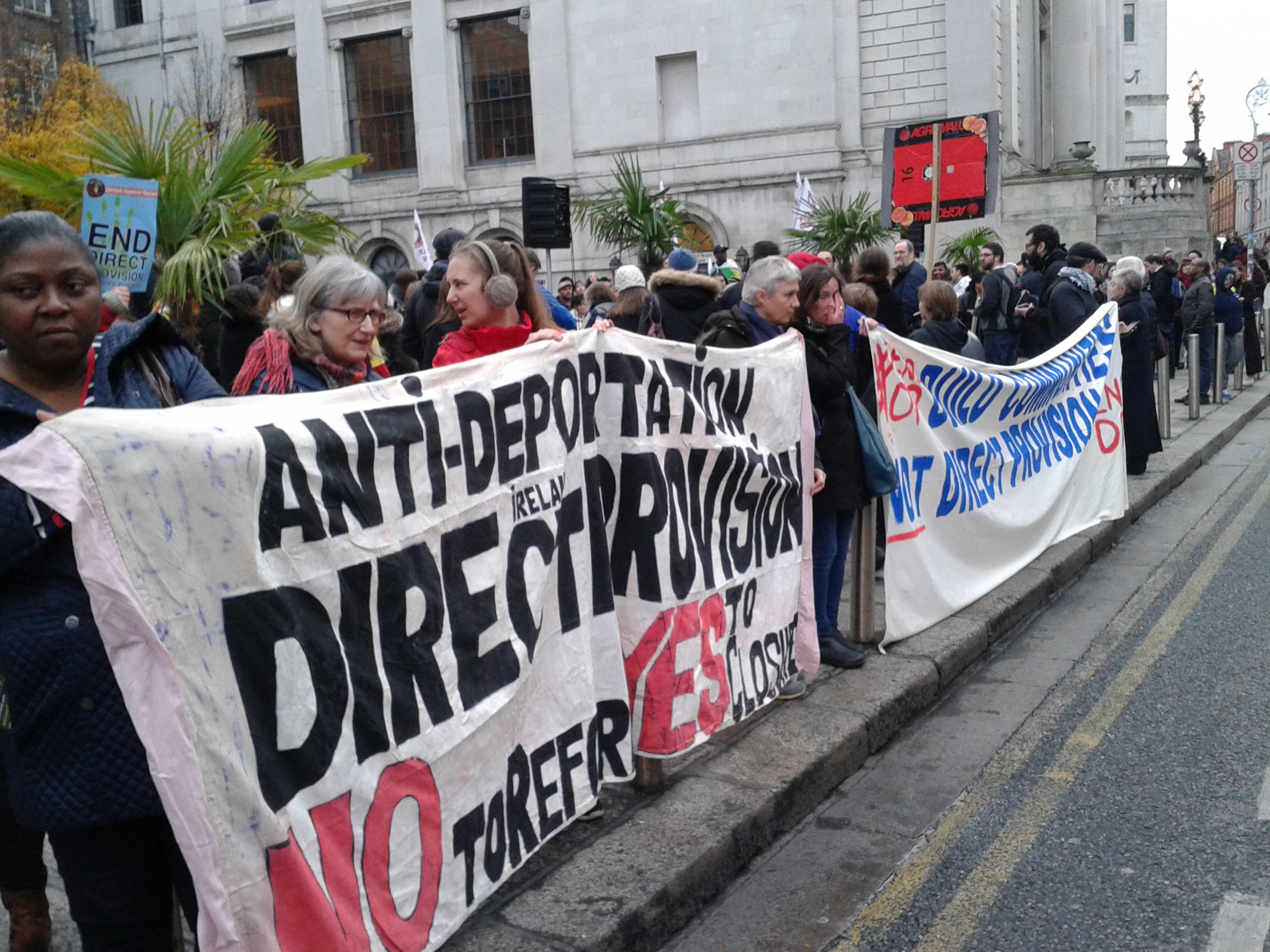
Direct Provision was introduced as a “temporary measure” in 200 but is still being used approaching two decades later. In the Irish state asylum seekers, i.e those who seek to live here to escape persecution or danger to their lives in their homelands, are obliged to live in centres while waiting years for their applications to be processed. In the meantime they are not permitted to seek employment, receive €21.60 a week and may not even prepare food to cook food in the centres where they have to live.
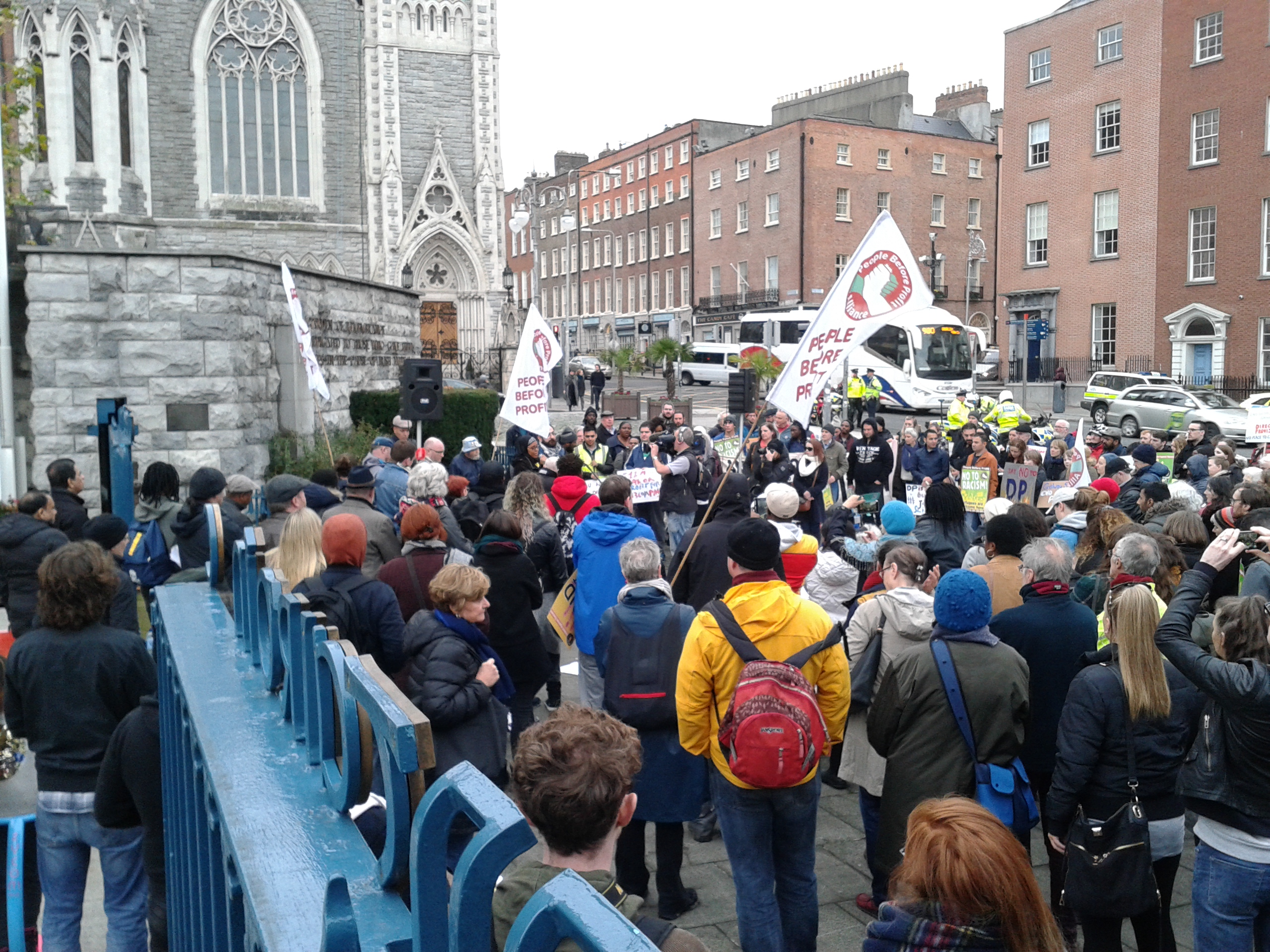
A view of the rally outside the Garden of Remembrance before marching (Photo: D.Breatnach)
Children of asylum seekers are obliged to live in these conditions and, when they reach 18 years of age, are denied access to third-level education.
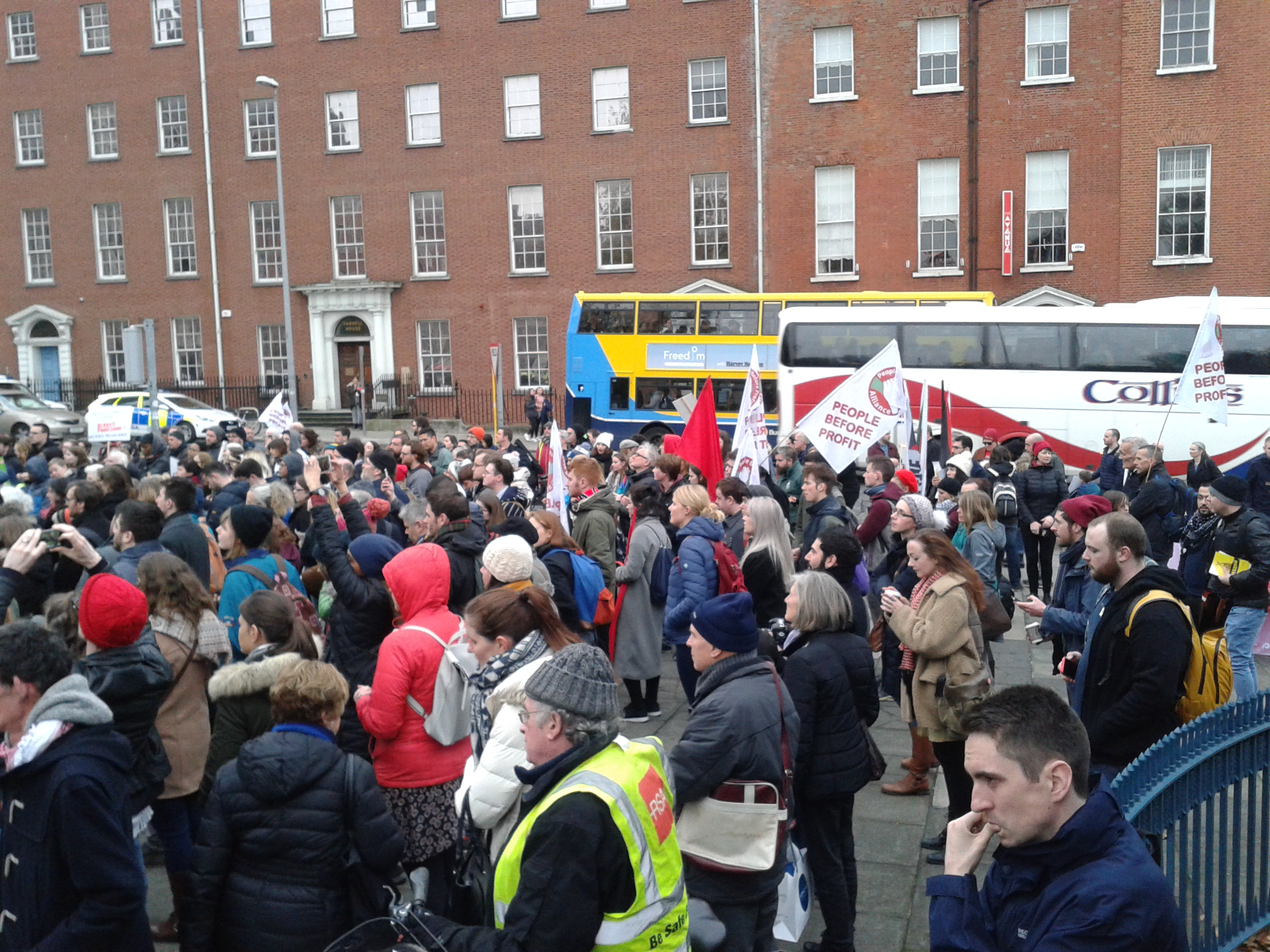
Another section of the rally before commencement of the march. (Photo: D.Breatnach)
The protest march started at Dublin’s Garden of Rembrance and proceeded down O’Connell Street, heading along Dame Street towards the plaza by the side of City Hall and in front of Dublin Castle, where speakers addressed the crowd. Along the way some drums were beaten and they shouted slogans including “One Race – the Human Race!” “We want the right to work!” “End deportations!”
Another slogan was the call of “Amandla” (“Power”, in Zulu and Xhosa), responded to by “Owetu!” (“to us”); this call-and-response was well-known in the struggle against the apartheid regime in South Africa.
The crowd comes on to the street to march. (Photo: D.Breatnach)
In the last ten years, according to a media report in July of this year, 44 people have died in direct provision, at least two of them confirmed as suicides. However, the causes of death of fifteen of those were listed as “unknown”, according to The Catholic newspaper, which obtained the figures under a Freedom of Information application to the Reception and Integration Agency, which runs the centres. At the time, the Department of Justice, under which the RIA operates, pointed out that most of the deaths occurred outside the centres but avoided clarifying that in effect this means that they die in hospital.
Veteran anti-war campaigner Margaretta D’Arcy was on the march, seen here in Dame Street. (Photo: D.Breatnach)
Also in July, a report into what children in Direct Provision Centres think of their accommodation was published. The Child Law Clinic at University College Cork carried out the research, speaking to children in the direct provision system aged between 8-17 years of age. Many complained of the food and some also complained that they did not use the communal relaxation areas as young male refugee and asylum seekers congregated there – apparently there are no children-safe areas available.
Justice Minister Charlie Flanagan (who had but recently taken over from Frances Fitzgerald) welcomed the report but Tanya Ward of the Children’s Rights Alliance said that it is of “deep concern” that some children feel unsafe in direct provision centres.
Some Ireland Palestine Solidarity Campaigners seen at the concluding rally. (Photo: D.Breatnach)
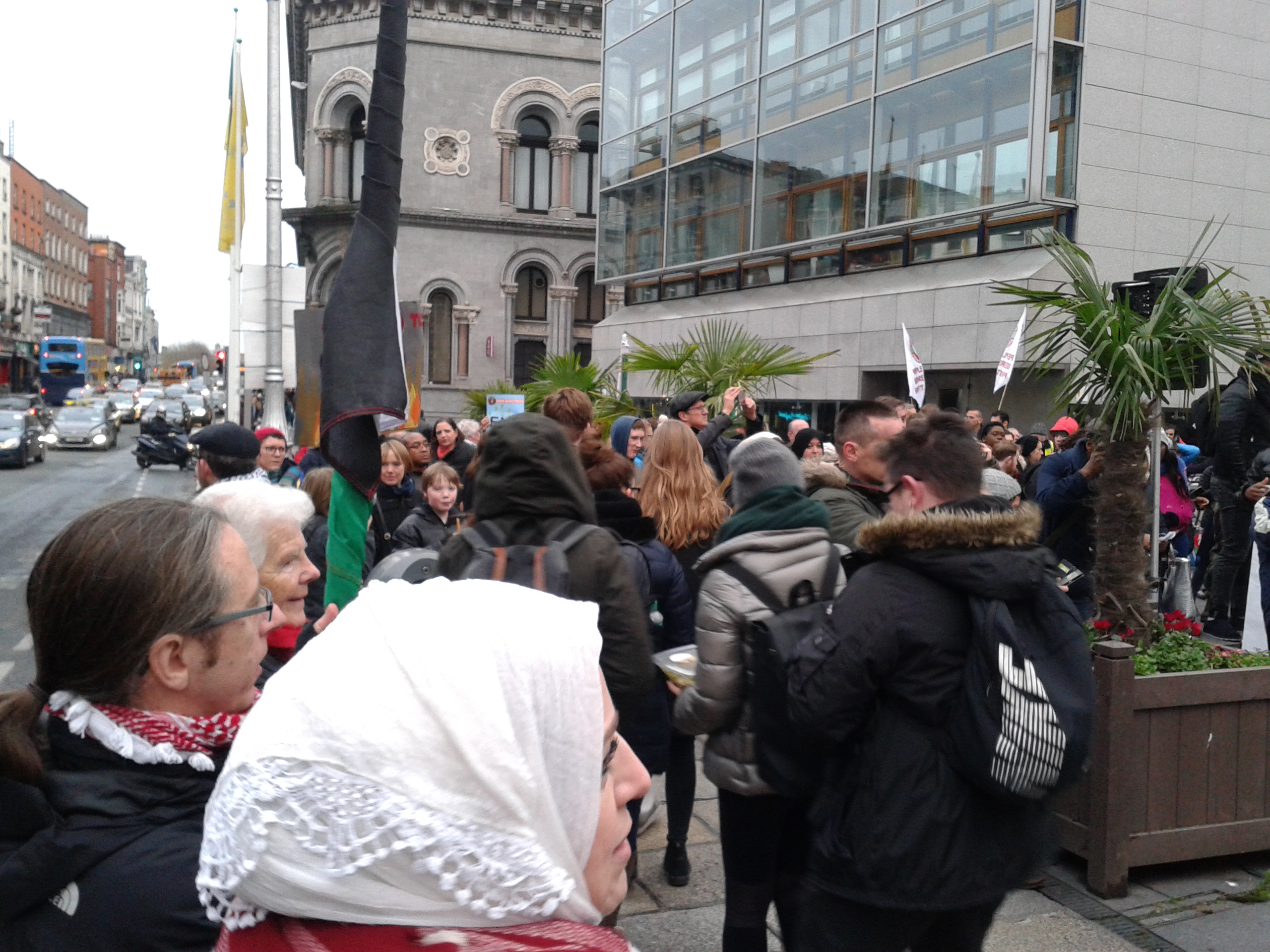
At the end of the march, Dame Street, by the side of City Hall and in front of Dublin Castle. (Photo: D.Breatnach)
Liberals have a nostalgia for John F Kennedy, many of whom believe he was assassinated by the CIA for defying their pressure to invade Cuba.
Even if this entirely plausible scenario were true (the question is academic since the CIA has committed many, many crimes, which the obsession with Kennedy’s assassination only serves to distract from), that Kennedy’s spat with the CIA was due to its warmongering is purely illusory. As Youssef El-Gingihy explains[1]:
“The Kennedys may have fallen out with the CIA over Cuba, but this was more a question of methodology than ideology. For both parties, the ultimate prize remained the overthrow of the Castro regime…JFK authorized multiple CIA ops against Cuba in 1963. True, Operation Mongoose had been disbanded and they ordered the FBI to clamp down on the more extreme groups such as Alpha 66. However, the Kennedys were merely transferring the Cuban project under their…
We knew about gays but we didn’t call them that. That was in our primary school days. Our mammies or das or others had warned us boys about them. We were never to accept sweets from strangers. They were men, older, probably shabby, hanging around in public toilets (when we had public toilets in streets). They would try to see your mickey, try to touch it (they were only interested in boys, which went to show how totally deviant they were). They’d give you sweets or even money. Just for that? It was enough! We thought no further but when we had to use those public urinals, kept as far away as we could from any men (a habit we continued into adulthood) and tried to cover our mickies with our hands and sometimes got some of the urine on them as a result.
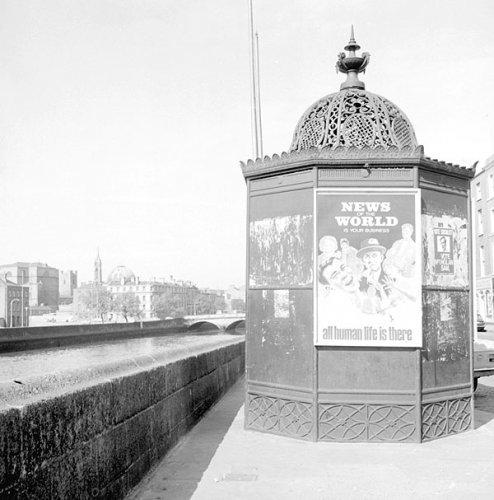
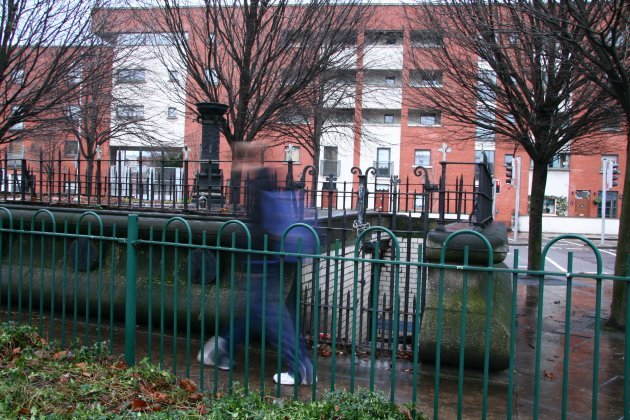
Old-style urinal formerly on Ormonde Quay, Dublin, photographed in 1969. One of the types of places where the “Brownies” supposedly lurked. (Image source: Internet)Locked underground toilet in Kevin Street, Dublin, one of many such now all closed or demolished. (Image source: Aoife Barry, the Journal)
We didn’t call them “gays” then but there were other names in our vernacular dictionaries: brownies, dirty men, homos ….. They were always predators and always male. Girls didn’t have to worry, apparently – those dirty men would not be tempted at all. It was the normal men girls had to worry about.
Was there such a thing as female homos? But if they wanted to play with your mickies that would be normal wouldn’t it? And nice even if sinful. Ah, chance would be a fine thing! But girls or women doing it with one another? How? And sure, what for?
Did we know any homos? Well, we were kind of getting to hear about poor Oscar Wilde. He would have been our fifth national Nobel prizewinner for literature and the fourth from our capital city. If not for …. well …. Poor man, he was misguided. And duped. But a lovely writer.
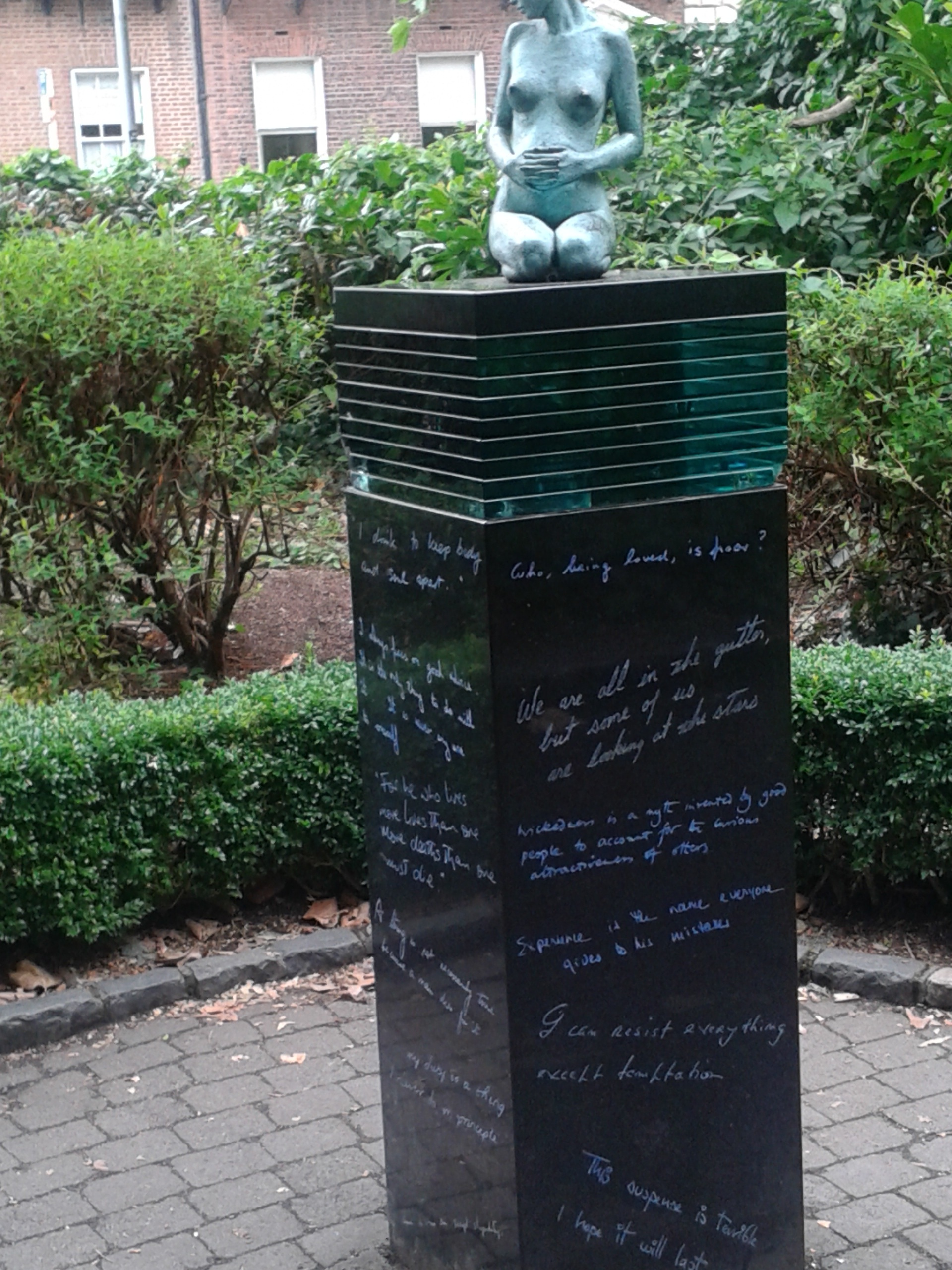
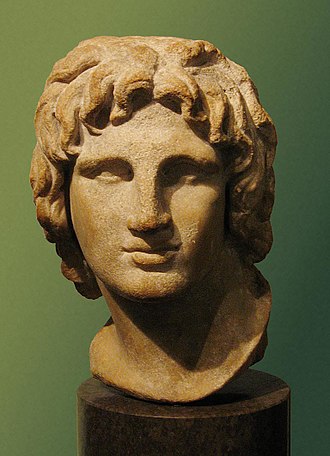
Oscar Wilde quotations, part of his monument in Merrion Square, Dublin. (Image source: D.Breatnach)Head sculpture of a youthful Alexander the Great, from the Hellenistic period. (Image source: Internet)
Our elders, well a great many of them, knew that many famous men had been homosexual – but they didn’t tell us. We knew quite a bit about the military exploits of Alexander, the Macedonian but nobody told us he was homosexual. If we’d known, we’d have asked ourselves whether he went to conquer the world in order to hang around public toilets in foreign lands, waiting to touch boy’s mickies. William of Orange was a homo too but then we had enough reason to hate him already. Wait – William …. Willy …. willies ….. nah, coincidence!
There was another William they might have known about,King William Rufus (1087 – 1110), son of William the Conqueror, openly homosexual. And probably assassinated by order of his brother, King Henry II, not for being gay but to get the kingdom. Well, what would you expect of the English! OK, Norman-English. Whatever.
Mícheál Mac Liamóir as Iago in Orson Well’s production of Shakespeare’s “Othello”. (Image source: Internet)
They surely knew, educated adults and anyone around the theatre, that Mícheál Mac Liamóir was “a practicing homosexual”. An Englishman who became Irish, including a fluent speaker and writer in the Irish language, he lived with his lover Hilton Edwards in Harcourt Terrace. Edwards was another Englishman converted to Ireland. But sure they were English, so our elders only sniffed and turned a blind eye, grateful for the culture of the Abbey and Gate theatres, the formation of An Taidhbhearc and fame on English language stage and screen.
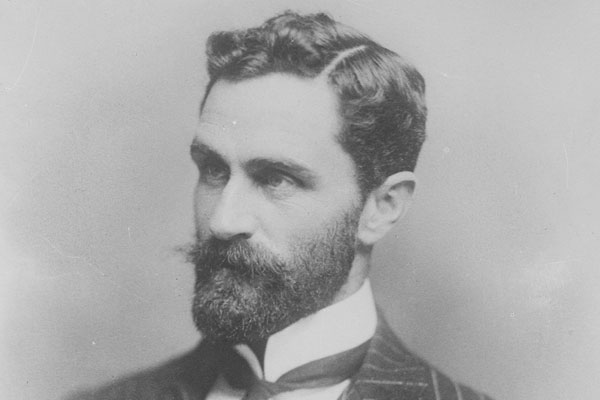
We knew Roger Casement could not be homosexual (even though he was a Protestant) because he was an Irish patriot. The English would do anything to tarnish his reputation and they had forged “the black diaries” to say disgusting things about him1, before they hanged him, not for homosexuality but for “treason” to the Crown. That’s the English Crown, of course. The one on top of the Arms of the Union, with the Lion and the Unicorn below, and below them the shield bearing the Thistle of Scotland, the Rose of England and the Harp of Ireland. You can see the design on the front page of the London Times, or on the roofs of the Bank of Ireland and Customs House buildings in Dublin.
Roger Casement, projected by British espionage service as a homosexual in order to undermine the campaign for clemency on charge of treason. (Image sourced: Internet)
But did we know any homosexuals personally? Perhaps some did. There was a lad at school who liked to knit and listen to opera and whose manner was quite feminine. Probably he was/ is, we thought years later but at the time he was just a boy who was like a girl. There was another one, son of a famous actor, a bit of a bully with a gang around him. He turned out to be gay but I at least never suspected. Then there was a certain barber who seemed quite effeminate but would do his best to cut your hair to any fashionable style which you required.
As we came into our teens, our vision broadened a little and we came upon more sinister knowledge. There were now rumours of homosexual Christian Brothers and priests. Seeing as these two groups, along with the Jesuits, directly controlled most of secondary education in the Irish state, nearly all of us Catholics were going to pass into their hands at some point. Hopefully their educational hands only. They didn’t have to hang around public toilets. They’d have us for six or seven hours a day, five days a week. Not to speak of the residential schools (too many people didn’t).
We knew in general and we knew of specific instances, by rumour or by experience. We resolved not to be victims ourselves and the strong succeeded. The weak? Well ….. Sauve qu’il peut, as they say (or I think they do) in France.
And we didn’t talk of it to our elders. Why? Well ….. hard to say. Would they have believed us? Did we have proof? Would it only have showed how dirty our minds were?
In my teens, a youth selling newspapers in Dún Laoghaire told me of a brawny sailor who one evening wanted to entice him into an alley away from company in order “not to embarrass the girls”. So, homosexuality was not confined to the creepy men hanging around toilets, or to the effeminate and arty, or to the clergy and Catholic brotherhoods. Burly sailors? Dear God!
And now a disturbing but exciting knowledge also came to us. We learned that there were indeed homosexual women – they were called ‘Lesbians’. And almost unbelievably, if you managed to get hold of a copy of the Kinsey Reports (or reviews of them), lesbianism appeared to be even more common than male homosexuality! Disturbing in a number of ways …. women preferring to have sex with women than with men? For some of us, it was difficult enough already to get physically intimate with a girl without some of them preferring other women! Then, a second thought, disturbing in a different way: imagine seeing them together … doing it! Double female nakedness!
As we grew older, we came to know gay men personally. Of course we did. Some of us, the better ones, acknowledged them our equals, did not avoid the subject nor deny them our company. Some of us, while accepting their company, avoided any mention of their preferences; we treated them as heterosexuals, knowing they were not. And some of us avoided them or worse, inflicted violence on them. We found out that some indeed did hang out around toilets but not to feel the mickies of little boys but to make assignations with adult males. Where else could they meet? It was illegal and religiously prohibited too.
Then came gay liberation agitation in the 1970s. Decriminalisation in 1993. And finally, equal rights to wed in 2015. Incredibly almost, that same Ireland of our childhood voted by majority in every county but one in the Irish State of the Twenty-Six Counties, that gays should have the right to marry people of their own gender. In May 2015, Ireland became the first state to legalise on a national level same-sex marriage by popular vote. The New York Times hailed the victory as putting Ireland at “the vanguard of social change”.
A badge in the Irish language calling for a vote in favour of the right to same-sex marriage in the Irish state referendum of 2015. (Image source: D.Breatnach)
We have come a long way, in that respect at least. But oh, the victims of intolerance strewn along each side of the route of our progress!
Generations in Ireland will grow now, hopefully, without the spectre of the Brownie.
End
Footnotes:
1 Roger Casement (1864-1916) was an Irish patriot and Protestant, also a poet and an enthusiast for Irish culture. In 1916, in preparation for the Easter Rising in Ireland, he came in a German submarine to assist in the unloading of German armament, including 20,000 rifles. The German boat, disguised as a Norwegian, was discovered and its captain scuttled it outside of Cork. The IRA Volunteers who went to meet the boat and Casement at its rearranged landing place, of which they had just learned, drowned as their car went off the road into the sea.
Casement was apprehended after landing. He was tried for treason in wartime and a substantial campaign arose to save his life. He had earned fame and a knighthood (CMG) a decade earlier through exposing ill-treatment of indigenous people in the African Congo under Belgian Royal control and in Putamayo in Perú by rubber-exploitation commercial interests.
Extracts from the “Black Diaries” were circulated by the British espionage service to undermine popular support for clemency for Casement. Those Diaries (as opposed to his other diaries of his travels abroad)gave details of his allegedlysexual interludes with men abroad and the extracts circulated substantially undermined the campaign for clemency. Casement was hanged in Pentonville Prison on 3rd August 1916, the last of the 1916 executions, the only one not by firing squad or to take place in Ireland.
The authenticity of the “Black Diaries” continues to be the subject of controversy. Although Wikipedia notes that a handwriting expert concluded by comparison with his other diaries that the entries were genuinely Casement’s, he is the only handwriting expert to have been permitted to examine the original, nor have samples been subjected to modern forensic testing. And the British espionage service did have a reputation for forging documents.