Diarmuid Breatnach


Diarmuid Breatnach

Gearóid Ó Loingsigh
(01/11/2020)
(Reading time: 2 mins.)
On October 31st two people died, one known around the world for his cinema roles, Seán Connery, who played James Bond and many better and less well known roles. The other death was that of the Colombian liberal politician Horacio Serpa. No sooner had he died the liberals and NGOs and all the former revolutionaries began to write and comment on the life of Serpa with a script that not even Connery could convincingly play.
So, just who was Horacio Serpa and what was his role in Colombian politics? His body hadn’t time to go cold and they were already rewriting the history of the country. The headline on El Espectador said it all, Remembering an Authentic Liberal. i Of course part of the problem depends on what you understand as a liberal, as in the current times when they talk of liberals and the Liberal Party one can barely recognise that it is and always has been the party of a sector of the Colombian oligarchy, that it is the party that gave us legalised paramilitaries, it is the party of massacre after massacre and of course they talk about it as if it wasn’t Liberal Party that gave us the health reform Law 100 (the liberal senator Uribe was the the speaker to the motion on the law, but the law was a proposal from the entire Liberal Party), nor that it was the party that gave us the infamous economic aperture of 1990.
So, for starts, Horacio Serpa who was the Minister of the Interior, under Samper, a government which deepened the aperture, was a neoliberal politician. In the midst of the political poverty of the current Colombian left, such as statement comes across like a grenade thrown or a burst of gunfire against Serpa’s good name. But, how are we to describe a minister in a neoliberal government as anything else? They say we shouldn’t and part of the problem is there are those who forget who President Samper was and what his government’s policies were. Worse still, they forget their own criticisms of that government. So let’s remind ourselves. Serpa was a neoliberal. Of course, he was a neoliberal speaking out both sides of his mouth, capable of calming the angels whilst defended the devils tooth and nail. A man of the right wing at the service of the oligarchy who with his populist discourse made himself out to be a progressive. Once again, some will say he wasn’t right wing. Is there another type of Minister of the Interior? Not only was he Minister of the Interior under Samper and champion in defending him against accusations of links to drug traffickers, but also he would later be Uribe’s ambassador to the Organisation of American States.
As we are in Colombia and politicians like Serpa are very deft, there is no lack of supposed lefties who will talk about how Serpa helped them. So in order to see what he was really like we should deal with some examples when Serpa did the exact opposite. In his passage through the Procurator General’s office he did nothing for the disappeared from the Palace of Justice. It was not at all surprising given his own role in that. The then Procurator Carlos Jiménez Gómez drew up a report and formerly denounced to
… the House Commission of Accusations President Belisario Betancur and his Minister of Defence, Miguel Vega Uribe for violating the Constitution and the Law of Nations now known as International Humanitarian Law.
The Procurator Jiménez’s denunciation with precise hard-hitting proof in hand was shelved through a motion presented by the representatives Carlos Mauro Hoyos, Horacio Serpa and Darío Alberto Ordoñez, arguing that “it was a typical act of government in the most important area under the remit of the President of the Republic namely to uphold public order and re-establish it wherever it has broken down”.ii
That is Horacio Serpa, the man who ensured that there would be no investigation of the events. A friend and accessory after the fact of criminals. It is worth pointing out that two of those who suppressed the accusation would later hold the office of procurator, Hoyos was the successor to the whistleblower Jiménez Gómez and Serpa then replaced Hoyos and thus the truth was buried underneath the ruins of the palace and the manoeuvres of Serpa and company.
But some claim he was a friend of the workers and an enemy of paramilitaries. Leave aside that he served in governments that actively promoted paramilitaries, those of Samper and Uribe and lets look at when workers reached out to his office to seek protection. After the 1995 massacre of palm workers in San Alberto, Cesar, the workers met with Horacio Serpa who was the Minister of the Interior at the time. In their oral history published in 2018, the workers narrate how Serpa told them “there was nothing that could be done as the paramilitary project was very big, and upon finishing the meeting and when we were heading towards the door he said ‘lads it is best that you be careful, because in this country if you stick your head above the parapet it will get knocked off.”iii Of course, he didn’t want to do anything to protect the workers of the palm company Indupalma, whilst at that exact time both he and his government maintained a military base within the plantation to protect the company’s assets. That is Horacio Serpa, loyal friend of the oligarchy, traitor speaking out both sides of his mouth to the workers, a defender of criminals such as the murderers behind the events of the Palace of Justice and a man capable of placing an entire battalion at the disposition of a company in order to protect it and not lift a finger to protect the workers in that company.
So, on October 31st, one of the greats died who we will remember fondly, with admiration, someone who contributed positively to our lives. Rest in Peace, Seán Connery.
End.

i El Espectador (31/10/2020) Remembranza de un liberal auténtico https://www.elespectador.com/noticias/politica/muerte-de-horacio-serpa-un-liberal-autentico/
ii Llano, H (16/11/2015) Palacio de justicia: mentiras públicas y verdades desaparecidas https://razonpublica.com/palacio-de-justicia-mentiras-publicas-y-verdades-desaparecidas/
iii Centro Nacional de Memoria Histórica (2018) Y A La Vida Por Fin Daremos Todo… Bogotá: CNMHp. 242
Geoff Cobb
(Reading time text: 2 mins.)
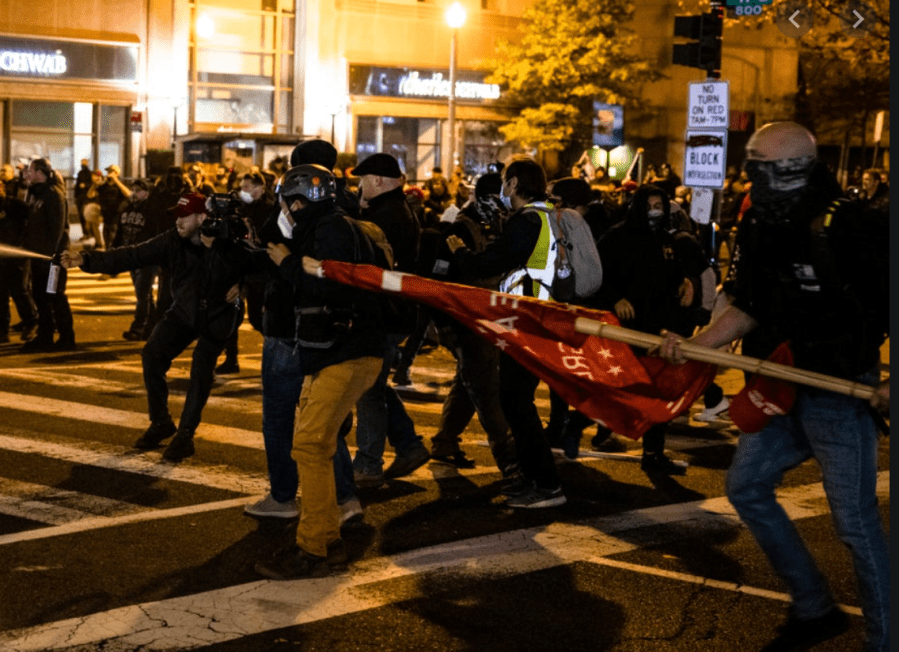
The ugly violent pattern that has become a norm for far-right thugs again repeated itself Saturday night in the America’s capital city as thousands of pro-Trump extremists descended on the city to support their leader’s fraudulent claim that President-elect Joe Biden stole the recent presidential election. Saturday night’s violence surprised few and was merely a repeat of scenes that repeatedly took place this summer and autumn in other liberal cities such Portland, Oregon, Seattle, Washington and the San Francisco Bay Area.

Many infamous hate-group street-brawlers showed up Saturday including The Proud Boys, American Guard, Oath Keepers, and Groypers. These groups mingled in daytime with other Trump enthusiasts who carried flags and banners reading, “Trump 2020: Keep America great”, “Trump 2020: No more bullshit”, “All aboard the Trump train!” and “Trump 2020: Pro- life, pro God, pro-gun”, while Trump’s faithful shouted “USA! USA!”, “We want Trump! We want Trump!” and “Four more years! Four more years!”
The crowd’s wishes were answered when Trump himself emerged from the White House in his limousine to raucous applause, cheers, waving and whistles from hundreds of supporters lining both sides of the street. They raised fists in salute, took pictures with phones and held signs that included “Best prez ever” and “Stop the steal.” Some supporters ran excitedly behind the presidential motorcade chanting, “We want Trump! We want Trump!” and “Four more years! Four more years!”

Far right-wing celebrities egged on the crowd including notorious Info Wars rabble rouser Alex Jones and Enrique Tarrio, chairman of the extremist Proud Boys group who gained nationwide notoriety when Trump famously acknowledged them during a Presidential debate claiming they should “stand down and stand by.” Jack Posobiec, who promoted the infamous “Pizzagate” conspiracy was also part of the march.
Trump has still not conceded, denying the validity of the results of the presidential election, adding to the sullen and vengeful mood of the marchers. Many of his aggrieved supporters were not only there to protest. They were there for violence and waited until nightfall to swing into action. Large menacing throngs of Proud Boys and other violent pro-Trump brawlers combed downtown streets and commenced an orgy of violence including punching, shoving, kicking and stabbing protesters, while Metro Police seemingly ignored the brawlers and focused on restraining the Anti-Trump demonstrators. According to the Washington Post twenty people were arrested, including four charged with gun possession. One person was stabbed and had to be hospitalized.
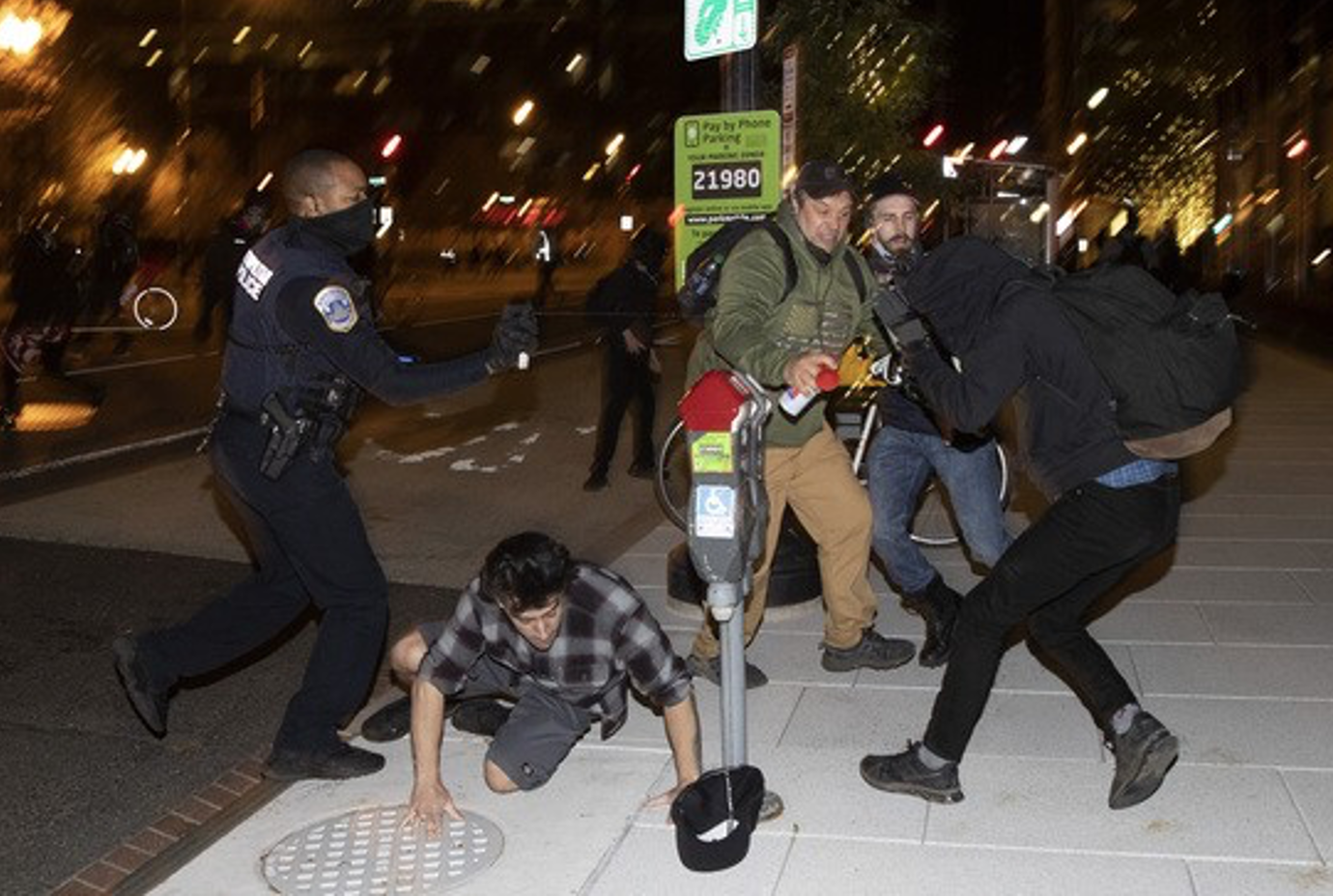
Instead of condemning the violence Trump’s tweet seemed to revel in it: ANTIFA SCUM ran for the hills today when they tried attacking the people at the Trump Rally, because those people aggressively fought back. Antifa waited until tonight, when 99% were gone, to attack innocent #MAGA People. D.C. Police, get going — do your job and don’t hold back!!!
Trump retweeted a misleading video posted by right-wing pseudo-journalist Andy Ngo, depicting a Trump supporter being knocked out from behind by an antifascist protester. “Human Radical Left garbage did this,” Trump wrote. “Being arrested now!” However, Ngo’s video was deceptively edited to blame antifascists for the violence. Another unedited video clearly shows that the Trump supporter started the altercation by punching and shoving a protester who had been using a bullhorn, then brawling with a number of other protesters, before finally receiving a knockout sucker punch.
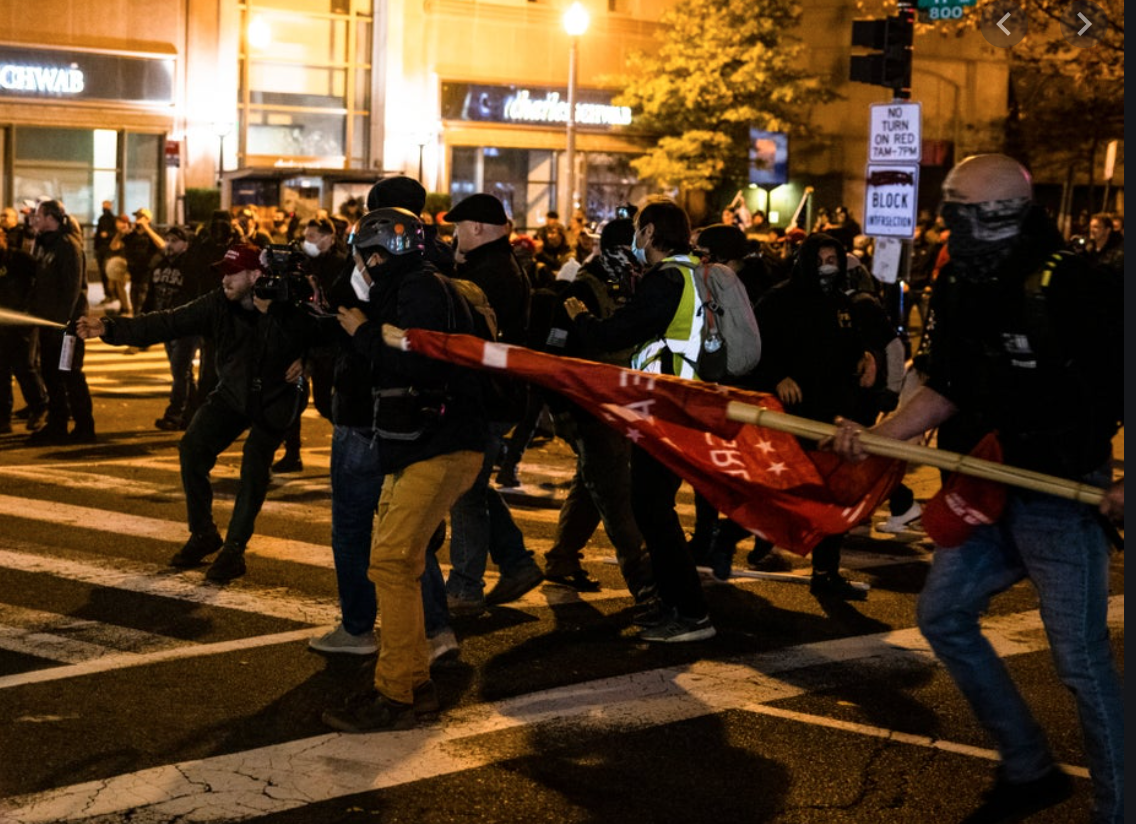

The Proud Boys instigated other acts of violence, deliberately attacking people who voiced opposition. The cops intervened but directed their attention at the protesters, not at the Proud Boys, who had clearly instigated the violence. Melees broke out in the middle of intersections where protesters sometimes gathered. At other times, gangs of pro-Trump rally-goers chased protesters down and beat them up. In one horrifying instance, Proud Boys knocked out a black female and left her unconscious in the street.
One of the victims wounded in the melees was journalist Talia Jane, who was stabbed from behind in the ear. Jane was also punched by an assailant who simply approached her and knocked her down. She got treated and continued reporting the rest of the night with a bandage wrapped round her head. Other journalists were harassed and even chased. MSNBC reporter Ellison Barber was chased by Trump thugs who chanted ‘fake news, fake news. ”
During the evening, a crowd of pro-Trump thugs were filmed destroying six large Black Lives Matter signs on the front of the Laborers International Union of North America building, near McPherson Square, while police stood by and failed to intervene. They then stomped on and destroyed other BLM signs.
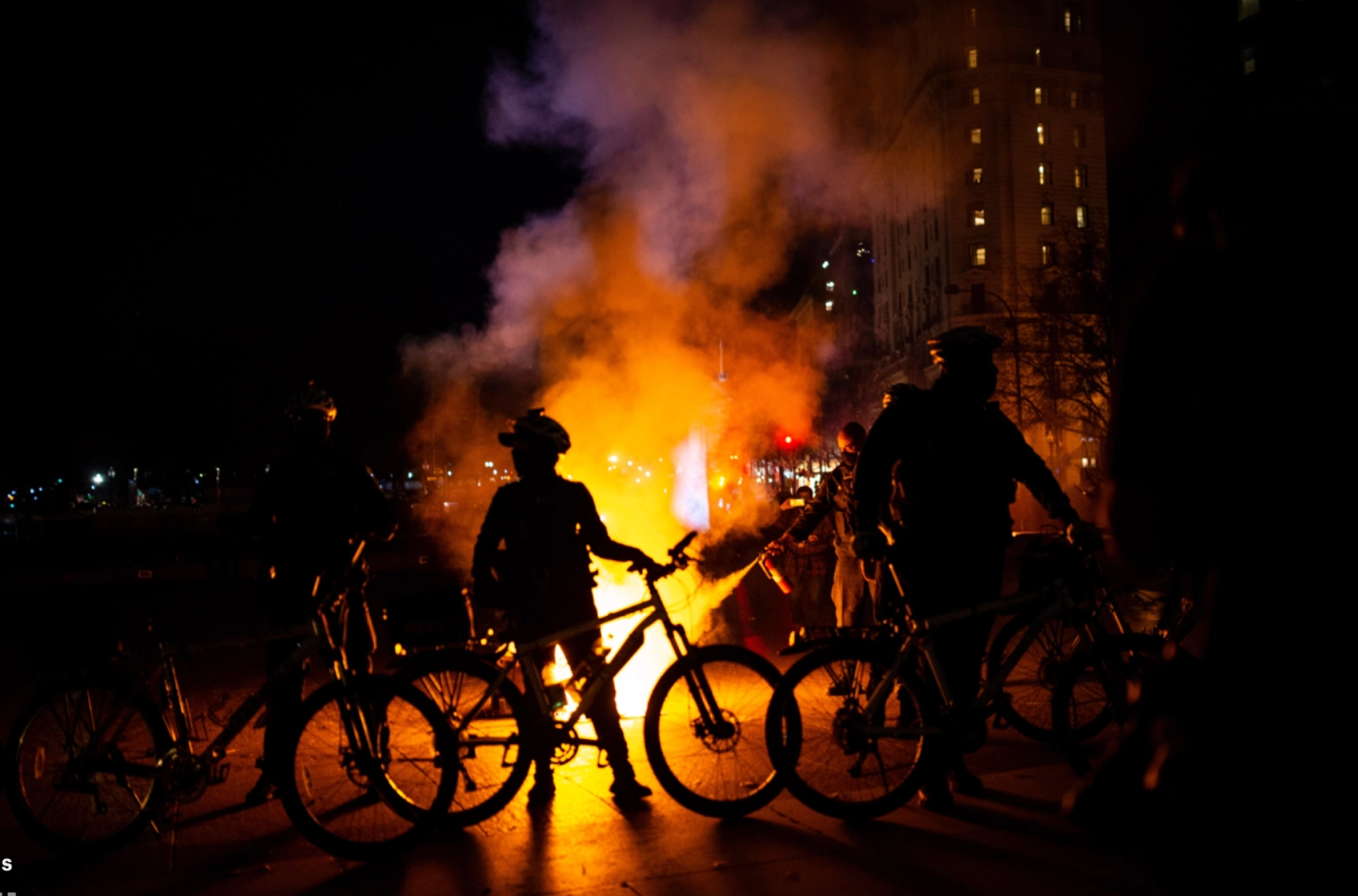
Amazingly Trump and his supporters in the media have blamed such violence not on right wing extremists and brawlers, but on Antifa and sadly, millions of Americans have believed this false narrative. Hopefully, the new administration will crack down on these thugs and end the orgy of violence on the streets of America’s cities.
End.
Rebel Breeze postcript, from Wikipedia: Gavin McInnes co-founded Vice magazine in 1994, but he was pushed out in 2008 due to “creative differences”. After leaving, he began “doggedly hacking a jagged but unrelenting path to the far-right fringes of American culture”, according to a 2017 profile in the Canadian Globe and Mail.[43] The Proud Boys organization was launched in September 2016, on the website of Taki’s Magazine, a far-right publication for which white nationalist Richard B. Spencer had once served as executive editor.[5] It existed informally before then as a group centered around McInnes, and the first gathering of the Brooklyn chapter in July 2016 resulted in a brawl in the bar where they met. The name is derived from the song “Proud of Your Boy” originally created for Disney’s 1992 film Aladdin but left out following story changes in production and later featured in the 2011 musical adaptation. In the song the character Aladdin apologizes to his mother for being a bad son and promises to make her proud. McInnes interprets it as Aladdin apologizing for being a boy. He first heard it while attending his daughter’s school music recital. The song’s “fake, humble, and self-serving” lyrics became a running theme on his podcast. McInnes said it was the most annoying song in the world but that he could not get enough of it.

Diarmuid Breatnach
(Reading time: 7 mins.)
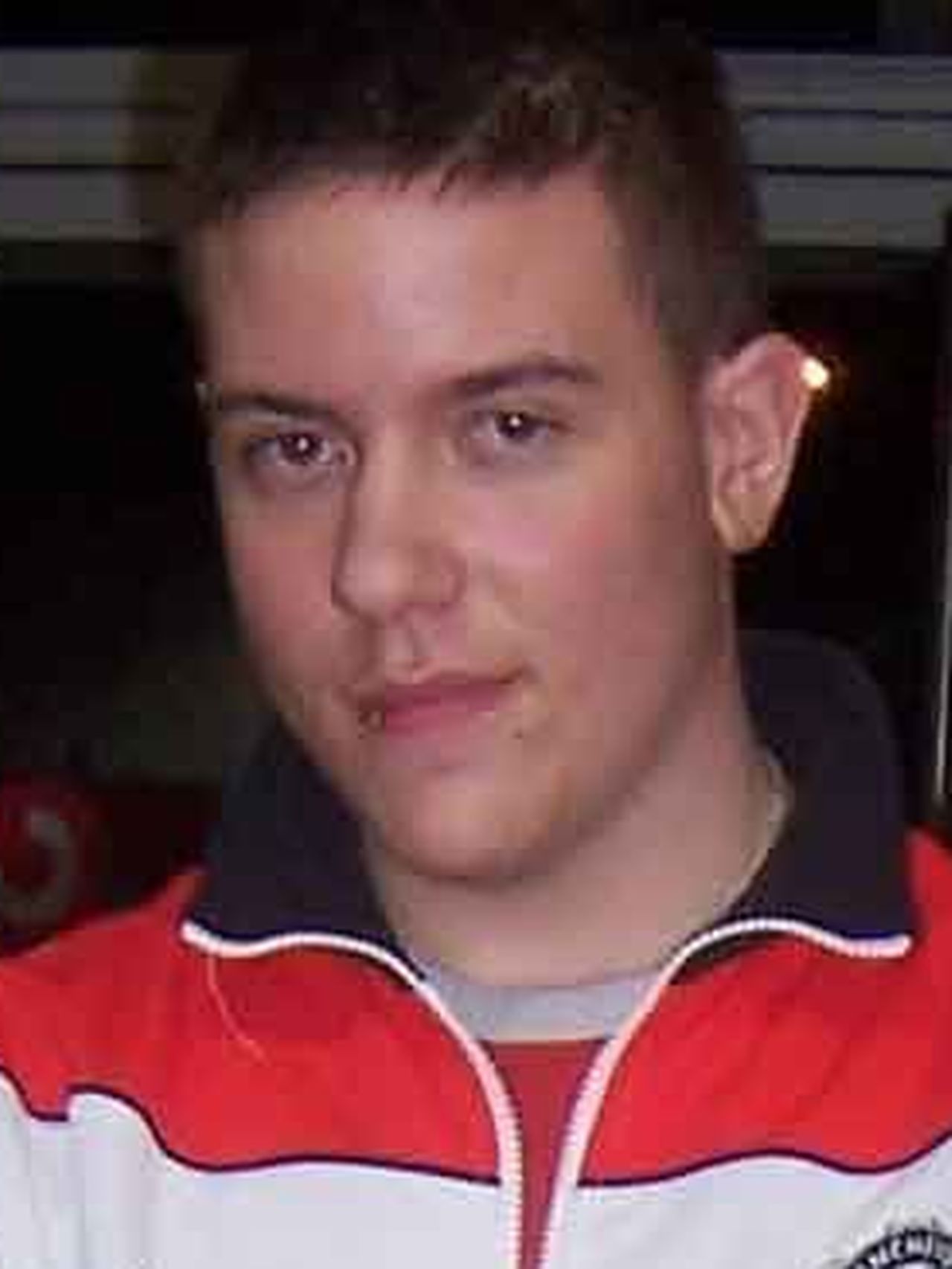
On a wall near the Madrid Metro station of Legazpi, there is a plaque. Those who stop to look at it will learn that it commemorates the antifascist Carlos Palomino, who on 11th November 2007 was fatally stabbed by a career Spanish soldier who was also a neo-nazi “skin” (or “skinhead”). The plaque placed by antifascists on the station entrance has been defaced by fascists a number of times but was always restored; it was also destroyed but soon replaced. In May 2016 Madrid’s City Council erected a plaque on No.145 Paseo de las Delicias where Carlos Palomino died while being given emergency aid. The plaque states:
Here was murdered on 11th November 2007 Carlos Javier Palomino Muñoz, of 16 years of age, a fighter against fascism and racism.

MURDERED BY A SERVING SOLDIER AND NEO-NAZI
A Google search featuring the name “Carlos Palomino” throws up the Mexican heavyweight boxer – one needs to refine the search to come up with the antifascist youth. Palomino was 16 years of age when he went with friends to counter-protest the fascist organisation Democracia Nacional that was holding an anti-immigrant demonstration at Usera, a south Madrid district of noted migrant habitation, particularly of Latin American and Chinese background.
The antifascists boarded the metro carriage at Legazpi station on Line 3, unaware at first that 23-year-old Josué Estébanez de la Hija, a neo-nazi “skin” and professional member of the Spanish military, was on board, on his way to participate in the fascist demonstration. Seeing the youth and identifying them as antifascists, Estébanez drew a knife he was carrying, the blade of which was 25 centimetres (nearly 10”) long and held it concealed behind his back.
Not noticing the knife but becoming aware that Josué Estébanez was wearing a Three-Stroke sweatshirt, known as a label worn by neo-fascists, Carlos began to remonstrate with Estébanez, who then stabbed him fatally. Another youth was gravely injured and lost two-thirds of a finger to the knife attack1.
Josué Estébanez then fled the carriage and the station, pursued by antifascists, who caught him and were administering a severe beating when a passing police patrol rescued but also detained him. Carlos’ mother and Movement Against Intolerance were the civil society prosecutors (a provision in the Spanish legal system which is more typically availed of by organisations of the Right) at Estébanez’s trial. During two years of legal procedure Josué did not once express regret for what he had done until the last moment of the trial, having been found guilty and about to be sentenced.
Metro video footage produced during the Madrid trial clearly showed the sequence of events in the carriage and contradicted the neo-nazi’s claim of self-defence. During the trial Estébanez pretended he had not been on his way to the demonstration but instead was going to meet friends but failed to produce corroborating evidence. He denied being a fascist but the video record showed him giving the nazi salute and shouting “Heil Hitler!” His attempts to deny his neo-nazi sympathies were not aided by the number of fascist organisation in Spain and across Europe that publicly declared in his support.2

Josué Estébanez was from Galdako3 in Biskaia province in the Basque Country, a country where the majority had a long tradition not only of antifascism but also of resistance to service in the Spanish military. It would be interesting to know how he came to enlist in a military career and to be a neo-nazi, though both things are probably not unconnected. According to a press report, his neighbours in Galdako didn’t know he was in jail until the news reached them and hadn’t even known he was in the Army. His mother had not seen him for some time.
Estébanez’s defence team sought a total of nine months’ jail, six on conviction for reckless manslaughter and three for causing grievous bodily harm to a second person. The family prosecution sought 37 years’ imprisonment and compensation, while the civic association joining in the prosecution, Alto Arenal or Movement Against Intolerance asked for 30 years’ jail as a “hate crime”.
Josué Estébanez was sentenced to 26 years in prison and to pay a compensation of 150,000 euros (not a cent of which was ever paid). On 22nd April 2010, the Spanish Supreme Court confirmed the sentence.
THE MOTHER
Carlos Palomino’s mother, Mavi Muñoz attended all days of the trial of her son’s murderer, accompanied by her own mother and other family. When on the very last day, just before sentencing Estébanez turned to her and apologised for the suffering he had caused her, she replied: “I wish you all the worst.”
Mavi became an antifascist activist and founded the Association of Victims of Racism and Homophobia4 and entered the organisation Mothers Against Repression, of which she has been made the honorary president.

When the Madrid city council at last erected the plaque to commemorate her son’s murder, she was there and, among other events, attends the annual demonstration in remembrance of her son. Every year a public demonstration is held on the 11th November in Madrid to honor the memory of Carlos Palomino and to reaffirm resolute opposition to fascism and often fountains are dyed red.
On the 10th anniversary of his murder, the demonstration in Madrid easily exceeded a thousand and antifascist demonstrations were held in many other parts of the Spanish state. Mavi Muñoz sent the following message that year:
“Let his blood not have been (shed) in vain”
“Now more than ever, on this tenth anniversary, not only for Carlos, but for all those who have fallen at the hands of fascism, I pray that their blood has not been shed in vain. That blood has been shed for defending a better world, I believe that there is a better world, but we have to find it, we have to fight for it, and there is no fight without sacrifices. I ask the anti-fascist movement of today, the anti-fascism of now, to commit itself, that the fight continues, that we do not allow ourselves to be stepped on, that we realize that the fascists are advancing, that we cannot allow that. Our motto is They will not pass! and it’s time to put it into practice. We have to reorganize and restructure all of us, because there are many more of us and we can handle them. We have to show it and not allow them (to spill) more of our blood. We are not going to allow one more of us to fall. And to each attack there must be an effective response.”
13th CARLOS PALOMINO ANNIVERSARY COMMEMORATION WEDNESDAY 11th
Many hundreds turned out in Madrid on the evening of the 11th of this month for the annual commemoration of Madrid’s latest antifascist martyr in a march convened by Friends and Relations of Carlos and supported by other organisations, including the Madrid Antifascist Coordination. They rallied outside the Atocha Metro station – it was in Atocha that a lawyers working for the trade union movement led by the Communist Party were massacred by fascists in 1977 — one of the many attacks on the Left and democratic forces of the “Transition”, to ensure that post-Franco Spain remained in the hands of the same people but in a “democratic” form.

This week the marchers proceeded from Atocha in columns, maintaining social distancing, with his image on placards and led by a banner declaring “Carlos vive, la lucha sigue” (“Carlos lives, the struggle continues”). The march passed through Paseo de las Delicias, where Carlos Palomino had died.

Then they lined the route through which a small group passed, holding up a placard recording the murder, along with his image on another placard, with red flares burning (see video) to bursts of applause and cheering.
MADRID
Madrid is a city of wide disparities. There are the imposing buildings, monuments and fountains of an imperial past for example around Puerto del Sol and la Plaza de España on the one hand and on the other, areas like Valences, more on the outskirts, with its radical traditions, mixed ethnic population, the Rayo Vallecano football team with it anti-fascist ultras, the Bukaneros (of which Carlos was one). Carlos lived with the Palomino family there. Even down a few minutes walk from the Plaza de España, one finds small areas like the Cuchilleros where the ambience is more antifascist and tolerant of difference in sexual preference; there are many areas like that in Madrid, close to the city centre (if Madrid can be said to have just one city centre).
The city is split politically between extremes of Right and Left. The Right are the political heirs (and often the actual descendants) of the victors of the fascist-military uprising in 1936, their current fortunes often the prizes awarded by the Dictator, General Franco. On the other hand, the Anarchists and Communists of various types – the heirs of those who lost. Madrid was successfully defended against the fascist-military coup in 1936 but then besieged by land and bombarded from the air. Franco had airplanes and pilots from Nazi Germany and Fascist Italy, along with land transport vehicles and armaments, while the European states blockaded the elected government of the Spanish state.
No pasarán!, “they shall not pass”, was the cry for the defence of Madrid in 1936 (and actually at the Battle of Cable Street in London’s East End that year too). But sí pasaron, they did pass. The city fell on 28th March 1939 and, like in all other conquered Spanish, Basque and Catalan cities, the hunt began for “the Reds” — i.e antifascists of any kind. Huge numbers found their end against blood-spattered walls.
But still the resistance did not end. On 5th August 1939, the JSU, a communist youth organisation assassinated Isaac Gabaldon, Commander of the paramilitary police force, the Guardia Civil, after which 51 female and male antifascists, the “Thirteen Roses and the 38 Carnations”, were shot by firing squads (see article on that elsewhere on Rebel Breeze). In the 1970s the antifascist workers’ movement forced the post-Franco “Transition” for fear of revolution.
The antifascist resistance still lives in Madrid today.
End.
FOOTNOTES
1The knife was identified as an Army one by the family prosecution but by the trial had disappeared.
2Brenton Tarrant, mass murderer of 51 innocent Muslims in New Zealand in March 2019, had names of some of his heroes marked on his weaponry, among which was that of Josue Estébanez. Unlike his hero in Spain, Tarrant admitted to all charges but like him, expressed no regret during his trial; he was sentenced to natural life in prison.
3As I was writing this today the news came of the arrest of two supporters of the Amnistia movement against repression (not part of the official Left Abertzale leadership), one of whom is from Galdako.
4The title seems a reply to the right-wing Association of Victims of Terrorism, which counts many military and police and their relatives as members.
SOURCES AND FURTHER INFORMATION
Erection of the plaque: https://www.diagonalperiodico.net/libertades/30374-placa-para-recordar-carlos-palomino.html
The murder and trial: https://es.wikipedia.org/wiki/Asesinato_de_Carlos_Palomino
Commemoration in Madrid on Wednesday (reports, photos, videos):
Was a hero of mass murderer in New Zealand: https://elpais.com/ccaa/2019/03/15/madrid/1552645383_279994.html
Estébanez neighbours in Galdako and studying law and pottery in jail: https://www.elespanol.com/reportajes/20181116/asesino-neonazi-carlos-palomino-josue-derecho-alfareria/352744736_3.html#img_12
Geoffrey Cobb
(Reading time: 8 mins.)
If people know anything about the Lakota nation, known to Americans as the Sioux, then it is the 1876 Battle of the Little Bighorn, in which the Lakota dealt the United States Army a humiliating defeat, completely destroying the Seventh Cavalry of General George Custer. This battle, however, was merely one chapter in the continuing struggle of the Lakota people against the ongoing colonialism practiced by the United States government.

The Lakota, a semi-autonomous people whose reservations occupy huge Areas of North and South Dakota have defined themselves over generations by stubbornly clinging to their culture, language and values against the forces of cultural assimilation wielded against them by the United States government.
In the 1860s, conflict arose as settlers entered the Lakota homeland, which covered a huge swath of the American Great Plains. A nomadic people, the Lakota lifestyle centered around hunting the massive herds of bison. The Lakota signed treaties protecting their homeland in 1851 and 1868, but the United States government broke them before the ink was even dry. After the disaster at Little Big Horn, the American army hungered for revenge and it responded with a campaign of terror, beginning with the Wounded Knee massacre, in which soldiers slaughtered hundreds of Native people, including women and children.

The sovereignty of the Lakotas depended on bison, and the American government embarked on a program of systematic extermination of these herds, In a three-year period, hunters butchered more than three million bison, close to 3,000 animals a day. Their food source gone, the Lakota were forced to end their armed struggle and live on reservations, which was often the poorest and most desiccated land.

The Lakota were to experience even worse horrors than the destruction of their traditional way of life. Their very culture was targeted for extermination. The American government mounted a nearly 100 year-long calculated assault on the Lakota as the state tried to force them to assimilate. The government banned the Sundance, the Lakota’s most sacred ceremony, with its days of fasting and ritual bloodletting and they were forbidden to openly practice their religion. However, perhaps most devastating to the Lakota psyche were the boarding schools, in which generations of Indians were forced to assimilate into white culture. Lakota children were severely beaten for even speaking their native tongue. As a result, many Lakota began to doubt the worth of their indigenous culture and lack of cultural pride still is an issue haunting many Lakota today.
The Lakota still struggle to cope with the attempts to destroy their culture. Their reservations are the scenes of grinding poverty. The Lakota have tragically high rates of unemployment, alcoholism, drug addiction, family abuse and suicide. There is a severe housing shortage on the reservations, which has magnified the effects of the covid pandemic on the Lakota.
Lakota culture, though, proved difficult to exterminate and their faith survived. Central to that faith is the belief that nature is our mother and that humans should live in harmony with nature. This belief manifested itself in 2014 when the Dakota access pipeline was announced. The 3.78 billion dollar underground oil pipeline was intended to run for 1,172-mile-long (1,886 km) across Lakota lands. The Lakota immediately objected to the project because it not only threatened the Missouri River, their water supply, but also would destroy sites of cultural, historic and religious significance to the Lakota.

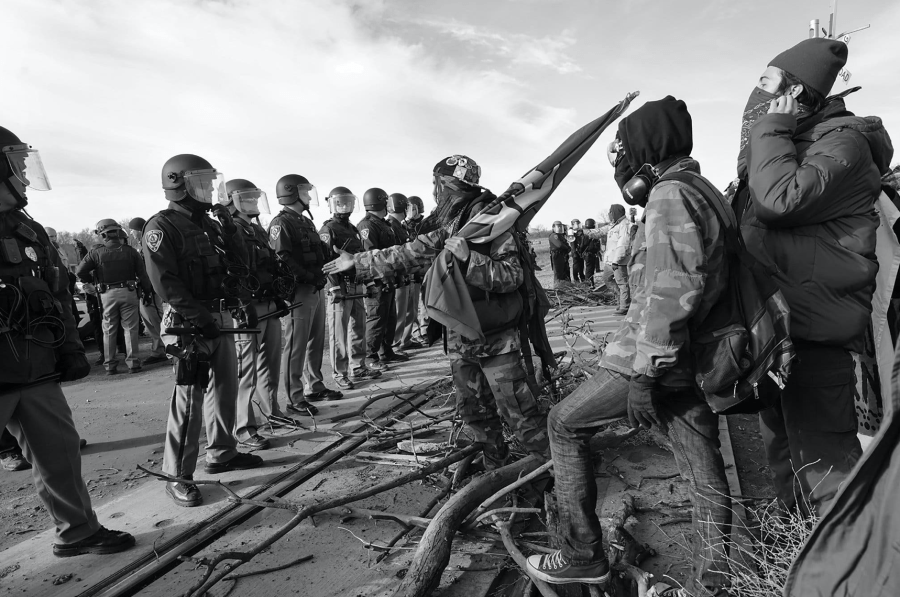
In the Spring of 2016, The Lakota mobilized to protest the pipeline, but it seemed like David fighting Goliath. The protests, which lasted months through sub-zero winter temperatures, were organized by Lakota teenagers on the Standing Rock Reservation. In the vanguard of the protesters were women who defied mace attacks, arrests and strip searches. The police used teargas, bulldozers and “military-style counterterrorism measures” to suppress the protesters, but the Standing Rock protests attracted tens of thousands of Native Americans from across the continent, becoming the largest Native American demonstration against the government in over a century. The rallying cry of the protestors in Lakota was “Mni wichoni! Water is life!” The protests became a cause célèbre, drawing media attention from around the world, as international environmentalists supported the Lakota defiance.
President Donald Trump supported construction of the pipeline and spoke out in favor of crushing the Native American protestors, but in a shocking decision on August 5, 2020, a district court ruled in favor of the Lakota. ” Mike Faith, the chairman of the Standing Rock Sioux Tribe, expressed delight at the verdict, “Today is a historic day for the Standing Rock Sioux Tribe and the many people who have supported us in the fight against the pipeline.”
Trump, though, was not finished in his battle with the Lakota and would continue disrespecting them. Trump deliberately chose to target the Lakota by celebrating the July 4th holiday of American Independence at an inflammatory site: Mt. Rushmore, where massive heads of American presidents were carved into mountains the Lakota hold sacred. “Wherever you go to connect to God, that’s what the Black Hills are to the Lakota,” said Nick Tilsen, a member of the Oglala Lakota tribe and the president of NDN Collective, an Indigenous activist group. Prospectors seized the land during a gold rush in the 1870s, violating the Fort Laramie Treaty of 1868, which recognized the Black Hills as Lakota property. In 1980, A Federal Judge sided with the Native Americans in a suit to reclaim the Black Hills but awarded them a monetary settlement in lieu of the land. The Lakota, offended by the decision, have never touched the money.

The statues were carved by a white supremacist with strong ties to the Ku Klux Klan. Harold Frazier, the chairman of the Cheyenne River Sioux Tribe, called the monument a “brand on our flesh” that needed to be removed. He said,” Visitors look upon the faces of those presidents and extol the virtues that they believe make America the country it is today. Lakota see the faces of the men who lied, cheated and murdered innocent people whose only crime was living on the land they wanted to steal.” Washington and Jefferson were both slave owners, and Lincoln ordered the hanging of 38 Lakota men in Minnesota after an uprising of 1862. Theodore Roosevelt once said, “I don’t go so far as to think that the only good Indians are dead Indians, but I believe nine out of every ten are.”
Trump’s arrival again spurred Lakota protests and at least fifteen activists were arrested for blocking the highway leading to Mount Rushmore. One of the activists, Michael Patrick O’Connor, said he came because he wanted to express his outrage at the desecration of his people’s sacred lands and his frustration at a president who has failed the people of America. “I couldn’t find any reason not to be up here,” he said. “I felt like I owed it to the grandmas and grandpas, owed it to the people who suffered before us to do something and to come here because our people were gathering.”

Good Voice Elk, a spiritual advisor for the Lakota, was among the older protestors. He said this was by no means his first protest. “I grew up in protests,” he said. “The seventies were really bad, and those kids, now they are the leaders.” Protesters ranged in age from senior citizens to children as young as 10. One girl was brought by her father from the Ute Mountain tribe in Colorado so she could experience Indigenous communities coming together.
Nick, Tilsen, the leader of the non-violent protest, has been singled out for retribution by local officials. He is facing felony charges that bring his potential prison sentence to 17 years. Tilsen is just the latest victim in the American government’s attempt to crush Lakota resistance. Despite the heavy-handed response to the protests, it’s hard to imagine the tenacious Lakota giving up anytime soon.
End.
USEFUL LINKS
Defend, Develop, Decolonise collective: https://ndncollective.org/
Clive Sulish
(Reading time text: 5 mins.)
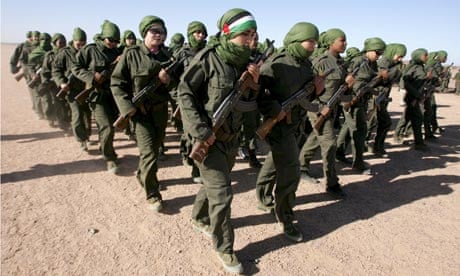
After a military invasion by the Moroccan Kingdom into the “buffer zone” in Western Sahara, the Polisario Front, liberation and resistance organisation of the Saharawi, gave the MINURSO (UN) mission in Western Sahara 12 hours to leave the territory. Meanwhile the Polisario also retaliated against the Moroccan occupation with an attack against the Wall, while young Saharawi confronted occupation forces in a number of localities.
According to sources close to Polisario, the Saharan People’s Liberation Army, in response to the Moroccan invasion, undertook artillery strikes against Moroccan military targets along the Moroccan military wall that cuts through Western Sahara. The targets of the attacks were the following Moroccan military bases and surveillance points along the wall: Moroccan military base No.23 (Mahbes), Moroccan military base No.4 (Hauza), Surveillance Point No.71, Moroccan military base No.17 (Oust), surveillance point No.172, Moroccan military base Nos. 17 and 18. A press release from the Saharan People’s Liberation Army added that its fire on Moroccan military positions led to human casualties and material losses for the Moroccan Army and that Moroccan soldiers fled some of their positions along the Moroccan Wall.
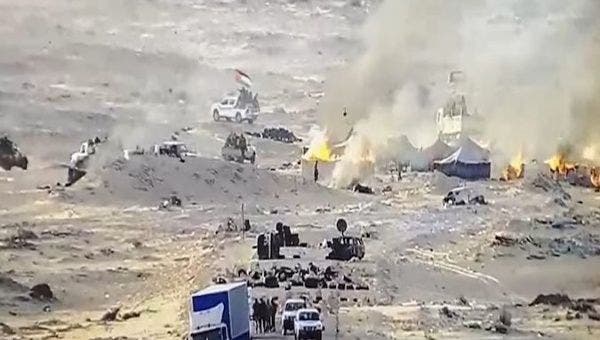
The Polisario also alleged that Moroccan forces had attacked Saharawi civilians who had gone to protest peacefully at the first breach of the buffer zone, at Guerguerat, civilians which subsequently the Polisario had evacuated safely. Subsequently Moroccan military had breached the zone at another three points, it alleged.
The General Secretary of the Polisario Front, Brahim Ghali, gave a press statement in which he announced the retaliatory attacks against what he called a violation of the 1991 ceasefire, “repeatedly violated by Morocco” but which, with the invasion of the buffer zone, “has now gone past the point of no return”.

“DIFFICULT TO RESTRAIN THE YOUTH”
Over the years since 1991, as no progress towards independence seemed to be made, the Polisario leadership has at times found it difficult to restrain its youth from returning to armed struggle. And Moroccan police have carried out much repression of peaceful protest demonstrations, plain-clothes officers beating even women and children in the street. At a conference in Dublin last year (see Rebel Breeze report link below) representatives of the Saharawi people spoke about the human rights abuses by the Moroccan authorities in Western Sahara and about the discrimination and deprivation of the Saharawi people in a number of important areas of life.
At the above conference, despite reference by a number of people to a “Western Saharan peace process”, in reply to a direct question from the floor, the European representative of the Polisario, Mr. Mohamed Belsat, tacitly admitted that no such process existed and talked about the Polisario’s difficulty in restraining the Saharawi youth.

A source close to Saharan activists from the city of El Aaiún confirmed that dozens of young Saharauis in the El Inach Matalaa and Tatan districts were confronting Moroccan gendarmerie and police patrols during the early hours of Friday evening. According to the sources, these protests against the occupation and support for the start of war against the regime have shifted and hardened in the Ghiyadet, Bucraa and Lahum districts. The source consulted stated that as of Friday night, the riots against the occupation administration in the city of El Aai ún were continuing.
BACKGROUND
The Spanish colony of Western Sahara (also known in the past as “Spanish Sahara”) was abandoned by the Spanish State in 1975; instead of decolonising it and facilitating a referendum on independence, the Spanish State’s evacuation cleared the stage for two neighbouring states to invade the country: the Kingdom of Morocco and Mauritania.
The Saharawi people formed the Polisario Front guerrilla organisation to resist the invasion and occupation of their land and also formed a government in exile, the Saharawi Arab Democratic Republic, in Tindouf in Algeria. Mauritania relinquished the territory it occupied and any claim to Western Sahara in 1979 but Morocco continues to pursue its annexation and its attendant repression of the Saharawi people.
“Western Sahara has been described as the last colony in Africa and has been illegally occupied by Morocco since 1975. Morocco is obliged under international law and as a member of the UN to allow a vote of self-determination for the people of the territory. Yet for 35 years 165,000 Saharawi people have lived in refugee camps in Southern Algeria, ethnically cleansed from their own country. Morocco built a 2,700km wall visible from Google earth to stop the Saharawi people returniing to their country.” (From press release at the launch of Western Sahara Ireland Action group in November 2010).
Formally the UN considers that the Saharawi people have the right to self-determination and recognises the Polisario Front as the legitimate representative of the Saharawi people. In 1991 the UN brokered a ceasefire and established a mission on the territory. However over the years the UN has failed to take any action and many people have wondered at the point of its mission there. Interestingly, it is the only UN permanent mission that does not have a human rights watch brief. At the same time, the Moroccan authorities put a media blanket over Western Sahara to prevent reports of repression, including torture, emerging or, if leaked out, being investigated by journalists.
In addition, the ceasefire agreement authorised Morocco to administer two-thirds of the country and most of the Atlantic coastline, which has facilitated its plunder of Western Sahara’s natural resources and by others, including by EU states. One of the big member states of the EU, France is a big supporter of its former colony, the Kingdom of Morocco and the US has also tacitly to date supported Morocco.
A referendum was supposed to be held after 1991 but it kept getting blocked as Morocco disputed the terms under which it would take place. About 85,000 voters were identified by the UN in 1991, nearly half of which were in the Moroccan-controlled parts of Western Sahara, with the others scattered between the Tindouf refugee camps, Mauritania and other places of exile. The Polisario accepted this voter list, as it had done with the previous list presented by the UN (both of them originally based on the Spanish census of 1974), but Morocco refused and, as rejected voter candidates began a mass-appeals procedure, insisted that each application be scrutinised individually. This brought the process to a halt once more.
The ceasefire agreement of 1991 also provided for a buffer zone in Western Sahara which, in effect, protects the Moroccan wall from Saharawi attack but was supposed to protect the Saharawi also from further Moroccan incursion. This zone by Morocco’s Wall was to be patrolled by the UN but it was that same zone which the Moroccan Army has now invaded; the Polisario have obviously lost patience with the state of affairs, retaliated against Morocco’s troops on the Wall and ordered the UN Mission to leave the country.

SOURCES & USEFUL LINKS
https://www.facebook.com/groups/256377861125569
“THE LAST COLONY IN AFRICA” — REPRESENTATIVES SPEAK IN DUBLIN
Diarmuid Breatnach
(Note: It was intended to post this on the anniversary of MacSwiney’s death but technical problems prevented that.)
(Reading time text: 15 mins.)
Terence MacSwiney, Lord Mayor of Cork died in Brixton Prison, London, on October 25th 1920: it was the 74th day of his hunger strike. His struggle brought international attention not only to his sacrifice but also to an Ireland in the second year of its War of Independence, a political and guerrilla war against the occupying power, the British State.
Between 1917 and 1981, twenty-two Irish people died on hunger strike against the injustice of British occupation of Ireland.1
HEROISM AND SELF-SACRIFICE
MacSwiney exhibited heroism and self-sacrifice in a number of steps he took before he embarked on his fatal hunger-strike. He did so first of all in putting his liberty and very life in jeopardy in opposing the colonial occupation and domination of his land. He took a second step towards endangering his liberty and life by joining the Irish Republican Brotherhood, an organisation dedicated at the time to the overthrow of British rule in Ireland.
Thirdly, he took the trend further still by not only joining the Irish Volunteers in 1913 but by being one of the founders of the Cork Brigade. Fourthly, MacSwiney opposed Redmond’s offer of the Volunteers to the British imperialist Army and stood with the dedicated minority in the subsequent split.
Fifthly, he joined the IRA after the 1916 Rising.
His sixth step was to take the Lord Mayor position in which his predecessor, Tomás Mac Curtain, had recently been murdered by Crown forces. Seventh, he embarked on his hunger-strike to the end.

That trajectory reminds us all that the path of revolution is a dangerous one, requiring courage and sacrifice, though not necessarily always to that same degree.
PACIFICISM
Because he chose in the end to offer up his life in a hunger-strike to the death, Terence MacSwiney is often held up as the ideal example of pacifism and especially so when a particular phrase of his is quoted: It is not those who can inflict the most but those who can endure the most who will conquer.
Of course, the reality is that both are absolutely necessary. No struggle can be won by endurance alone, no more than a struggle can be won merely by inflicting damage upon the enemy.
There are genuine pacifists and fake ones. I don’t agree with either but I have some respect for those who put their liberty and even their lives at risk in a pacifist struggle. For the others, the social democrats and liberals who enjoin us to have all our resistance be peaceful, while they support the violence of the ruling class and their states at home and abroad, we should have nothing but contempt. It would indeed suit our enemies if we set out to endure every attack and made them pay nothing in return!
Those who remind us only of that quotation from MacSwiney, or of the one from that other hunger-striker and poet Bobby Sands, that “Our revenge will be the laughter of our children”, choose to forget – and try to make us forget – a very important fact about Sands and MacSwiney: each was a revolutionary soldier. Each was arrested because he was known to be a member of an armed force of resistance – the IRA.
INTERNATIONALIST SOLIDARITY
For some people, internationalist solidarity is almost all, ensuring that they don’t become any danger to the State in which they live or to its ruling class.
For some others, internationalist solidarity is something kind of extra, to be indulged in now and again.
I think both those tendencies are wrong. We need to confront our own ruling class and State, not only for the benefit of our own working class but also as a contribution to the world. But at the same time we need to pay attention to questions of solidarity with other struggles around the world.
And that can serve as a barometer too – for I have noticed in a number of organisations that when the leadership was heading towards giving up on revolution, inconvenient internationalist solidarity was one of the first things they threw out the window.
MacSwiney’s hunger strike drew the eyes of much of the world to his struggle and to that of his people. In India, the Nehru and Gandhi families made contact with MacSwineys and those connections were maintained for decades afterwards. It is said that Ho Chi Minh was working in a hotel in London when he heard of MacSwiney’s death and remarked that with such people as that, Ireland would surely win her freedom. In Catalonia, people fought daily battles with the Spanish police outside the British Legation in Barcelona. The story reached the Basque Country too and the example of Cumann na mBan was taken a little later to create the female section of the Basque Nationalist Party.
Photo Ho Chi Minh


In Britain too, there was great solidarity, a fact not often spoken about; 30,000 people walked in his funeral procession from the jail to St. George’s Cathedral in Southwark. Who were these people? Certainly many were of the Irish diaspora, the longest-established and largest ethnic minority throughout most of Britain’s history. But there were English socialists too.
At that time, the London Borough of Poplar – not far from the area where the anti-fascist Battle of Cable Street was fought, the anniversary of which we celebrated recently — was in dispute with the Government, who were expecting the rates to be collected there to be on the rental value, which meant the poor East London borough had to pay more than rich boroughs of West London.
The Councillors were planning to refuse to set the expected rates and were threatened with jail, whereupon their leader, George Lansbury said they would be proud to go to the same jail where MacSwiney was being kept. British socialists of that kind marched in the funeral procession (besides, at least two of the Poplar Councillors bore Irish surnames: Kelly and O’Callaghan).
In my opinion, it is a great pity that the leaders of the Irish struggle for independence did not work on building links with the British working class. In 1920 the British ruling class was in serious trouble – it had thousands of military conscripts wanting demobilisation after WWI but the British didn’t want to let them go as they felt they would need them to suppress risings in many parts of the British Empire. The working class in industry was building a strike movement and in 1919 the Government had sent soldiers to shoot strikers in Liverpool and to threaten strikers in Glasgow. The great coal strike of 1925 was not far off, nor was the General Strike of 1926.
If the leaders of the Irish independence struggle had made those connections, not only might the history of Ireland have turned out differently but that of the very world.
The preceding is a very close approximation to the speech I gave on the 25th October 2020 by the Hunger Strike Memorial in Glasnevin Cemetery at the Terence MacSwiney commemoration organised by Anti-Imperialism Action Ireland.

FUNERALS AND FUNERAL PROCESSIONS IN DIFFERENT COUNTRIES
The working class Irish, who had had some scuffles with the police during vigils at the jail, were there in their thousands at the funeral procession in London in their Sunday best, with the middle class represented too. Some of the Irish women could be identified at a distance, wearing their traditional shawls of Irish city and countryside. The Mayor of Poplar was not the only town mayor to walk in the procession. British socialists took part as did visitors from abroad and the world media was well represented. Aside from the procession, huge crowds lined the South London streets as the cortege passed.
World media interest was intense. The funeral procession, the vast majority walking, travelled the 3.5 miles (nearly 6 kilometres) from Brixton jail northwards to the cathedral where McSwiney’s body was to be received for requiem service the following day.

The church where Terence Mc Swiney’s body was laid out under IRA guard of honour, with 30,000 filing past was St. George’s, on the south side of the river, near Southwark Bridge. It had been formally opened in 1848, known as “the year of revolution” in Europe and Ireland had its own contribution with the Young Irelanders’ brief rising. St. George’s was the first Catholic Cathedral of London until the Catholic Westminster Cathedral opened up in 1903. The English Catholics, who were a very small minority in their country had not dared challenge the anti-Catholic restrictions for generations but under the influence of large Irish Catholic congregations became more assertive; however that did not mean that the mostly aristocratic English Catholics were eager to rub shoulders with their largely plebeian Irish brethren and also, north of the river were the main desirable areas. So in 1903 they built the Catholic Cathedral in Westminster and left St. George’s to the Irish plebs on the south side of the Thames.
The Bishop of Westminster in 1920, Cardinal Francis Bourne, head of the Catholic Church of England and Wales, did not comment publicly on the hunger-strike but let it be known in private that he considered it suicide. The London inquest however, at the insistence of his widow Muriel and the evidence of the Governor of Brixton Jail, had recorded the cause of death as heart failure. A week after MacSwiney’s funeral mass in Southwark, Bourne conducted a mass in Westminster for Catholic British Army officers killed in Ireland.


The next day after the removal of the body from Brixton Jail, Bishop William Cotter of Portsmouth gave the Solemn Requiem with Bishop Amigo, Archbishop Daniel Mannix of Melbourne, and Archbishop Anselm Kennealy of Simla, India, in attendanc. It was a ticket-only even; six of those who had tickets were a close group of men, all wearing long coats – once inside they stripped these off and revealed their IRA uniforms. After the previous Republican guardians departed, McSwiney’s body was guarded by six men in the uniform of the army to which he had belonged and of which he had co-founded its Cork element. The Bishop of Southwark might or might not have been pleased but it would not be for long.2 Certainly Peter Emmanuel Amigo, originally from Gibraltar, Bishop of Southwark from 1904 to 1949, had pleaded publicly for MacSwiney’s release before he should die, writing to politicians at Westminster petitioning his release. In a telegram to prime minister David Lloyd George on September 5th, Bishop Amigo warned: “Resentment will be very bitter if he is allowed to die.”
After the service a large entourage accompanied the body in its coffin to Euston Station for the train journey to Hollyhead. From there it was to go on to Dublin, to be received by the people of the Irish capital and then onwards to his home city and final resting place. But it was not to be.
The train left Euston station early with many police on board. At Hollyhead the grieving relatives and friends were informed that the boat they had engaged would take them and the body instead to Cork. The funeral party protested, produced their contract of shipment — to no avail. Porters were called to remove the coffin but were resisted and left. The police were summoned and, manhandling the protesting mourners, seized the coffin (sadly it was not the only kidnapping of an Irish rebel’s body in history, one of the other occasions being by the Irish State with Vol. Michael Gaughan’s body in 1974).
The British authorities feared fueling the fire of patriotic fervour already burning in Dublin at the news of MacSwiney’s death and the impending execution by hanging of Volunteer Kevin Barry. The funeral party were determined to travel to Dublin as arranged and had to engage another ship, which they finally succeeded in doing. While McSwiney’s body travelled on to Cork, the reception was held in Dublin, a city in official mourning declared by the First Dáil and in the midst of an urban guerrilla war against a foreign military occupation.
Mourners in Boston, Chicago, Melbourne, Newcastle upon Tyne, and Manchester held symbolic funerals with empty caskets.
When the Rathmore dropped anchor in Cobh harbour, the coffin containing MacSwiney’s body was transferred to the Mary Tave tug to travel on to Cork to deliver the body to a waiting funeral party. The deck was packed with Auxies, murderers of his predecessor, the final indignity.

A special meeting of Cork Corporation was convened where councillors (those not “on the run”) expressed their condolences and raw emotion at losing the City’s Lord Mayor.
The Deputy Lord Mayor Councillor Donal Óg O’Callaghan, revealing that he had received death threats, issue a defiant statement, decrying that despite Terence’s death, the merit of Republicanism would still linger and pass on:
“The only message that I on behalf of the Republicans of Cork give today over the corpse of the late Lord Mayor is that Cork has definitely yielded its allegiance to the Republic, that the people of Cork will continue that allegiance unswervingly and that those of us who man the Municipal Council will attempt as far as in us lies to follow the noble and glorious lead of the two martyred Republican Magistrates.
“The Republican hold on the Municipal Chair of Cork ceases only when the last Republican in Cork has followed Tomás MacCurtain and Terence MacSwiney into the Grave. Death will not terrorise us”.
After a funeral service in Cork Cathedral a massive crowd accompanied his coffin to the cemetery, with Republican organisations and ordinary citizens in the procession. The occupation authorities had banned marching in uniform or even in military fashion, or display of flags.
Nationalists under colonial occupation of European powers (including nations within Europe) would be taking inspiration from the Irish struggle for decades. The war of resistance in Ireland would continue, with Cork County and City seeing more than its share. The special terrorist units of the British and their regular army would burn the City on the night of 11th-12th December of that same year. Irish Republicans in Britain would concentrate on supplying intelligence and arms to the struggle at home, in addition to organising some prison escapes. Some British socialists would continue solidarity activities on a publicity level and liberals and social democrats would protest the British reprisals on the Irish civilian population.
But the body of Terence McSwiney had come home.
End.
MacSwiney’s Free, composed and performed by Pat Waters, with video footage:
Footage London & Cork funeral processions Terence MacSwiney:
Terence MacSwiney Cork funeral only footage:
FOOTNOTES
1Some, like MacSwiney and the ten in 1981, died of the depletion of the body through the hunger-strike while some were killed by force-feeding, like Thomas Ashe in 1917, Michael Gaughan in 1974 and Frank Stagg in 1976. Others survived hunger strike and force-feeding but their bodies (and sometime their minds) suffered for the rest of their lives, such as the Price sisters (1973-1974).
2Part of that journey was marked in reverse by the Terence MacSwiney Commemoration Committee with a march in 1989. The idea as far as I can recall had been Brendan O’Rourke’s, an Irish solidarity activist and at that time Manager of the Lewisham Irish Community Centre, the Management Committee of which I was Chairperson and with a few others, Brendan and I led that Commemoration Committee.
The march, supported by Irish Republicans and some English socialists, rallied at Kennington Park, on the lookout for National Front or police attack but knowing that in Brixton itself, an area of high Afro-Caribbean settlement, both those misfortunes were unlikely. We were led by a Republican Flute Band from Scotland and applauded by people as we marched past the police station (the State garrison of the area) and through the centre of Brixton. The march proceeded without incident up Brixton Hill to the entrance of the road leading in to the Jail, held a moment’s silence there and marched down to the centre of Brixton Town, ending there for people to proceed to a reception at Fr. Matthew Hall.
It was the last such march as we could not get another band from Scotland to lead us. We were independent of Provisional Sinn Féin and Scottish RFB members told us that the bands had been told, unofficially of course, that participating in our events would adversely affect their chances of being invited to play at annual events in the Six Counties, which for those bands was the high point of their annual calendar.
SOURCES:
https://www.irishtimes.com/culture/heritage/the-three-funerals-of-terence-macswiney-1.4387267
https://www.stgeorgescathedral.org.uk/about/history/
https://www.irishexaminer.com/news/spotlight/arid-40070420.html
Geoffrey Cobb
(Reading time: 3 mins)
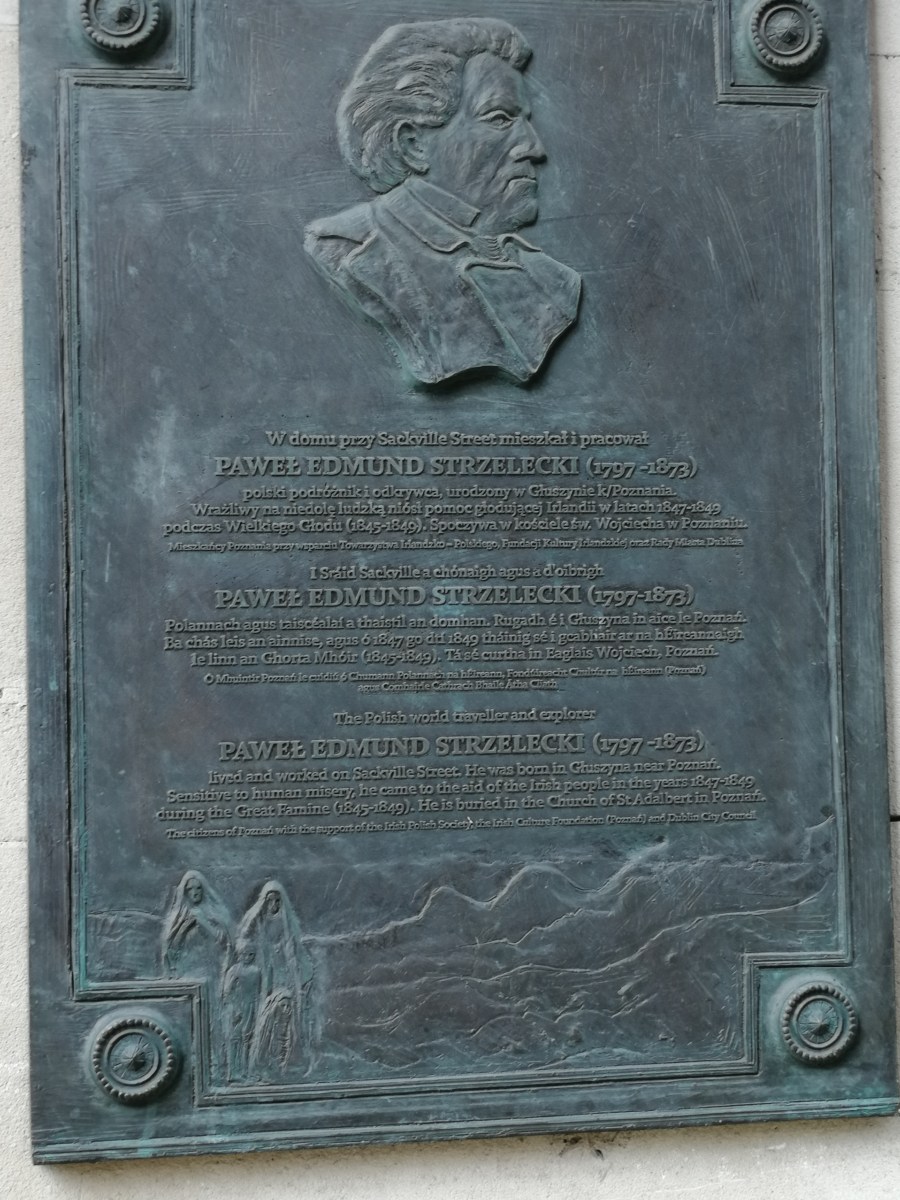
In London in 1847 (i.e the worst year of the Great Hunger — Editor Rebel Breeze), though images of the suffering and starvation in Ireland appeared in newspapers, few upper class British people were moved to help. One exception to this indifference was a Polish count who became a naturalized British subject, Paul (Pawel) Strzelecki. A new exhibit at the Royal Irish Academy in Dublin: A Forgotten Polish Hero in the Great Irish Famine, Paul Strzelecki’s struggle to save thousands, honours this selfless Pole who helped feed at least 200,000 starving people in the west of Ireland. Created by Nikola Skowska-Moroney at the Polish Embassy in Dublin, the exhibition will be part of a nationwide tour at various venues throughout the country.
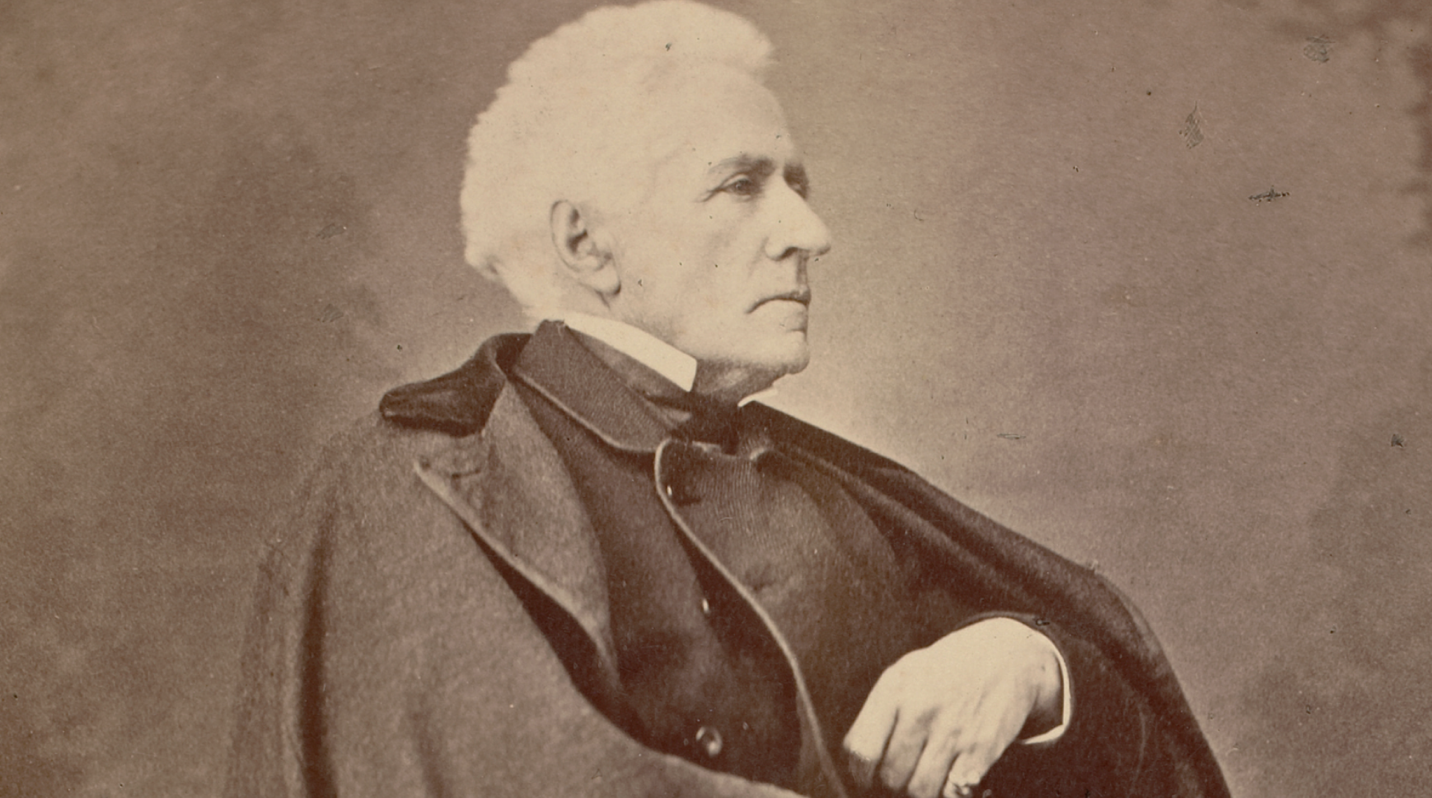
Strzelecki was not only a great humanitarian, but also a fascinating character in his own right. Born into a minor aristocratic family, he served in the Prussian army and had his heart broken when the family of the young woman he had fallen in love with refused his offer of marriage on account of his modest means. Crushed, he decided to leave Poland and traveled the world, visiting Africa, North and South America before traveling to Polynesia and Australia. He became a self-taught scholar in geography, geology and anthropology and corresponded with Charles Darwin. In Australia, he climbed the continent’s highest peak, naming it for the great Polish revolutionary Tadeusz Kosciuszko and explored Tasmania. He became a British subject in 1845 and published his Physical Description of New South Wales and Van Diemen’s Land, for which he received the Founder’s medal of the Royal Geographical Society.
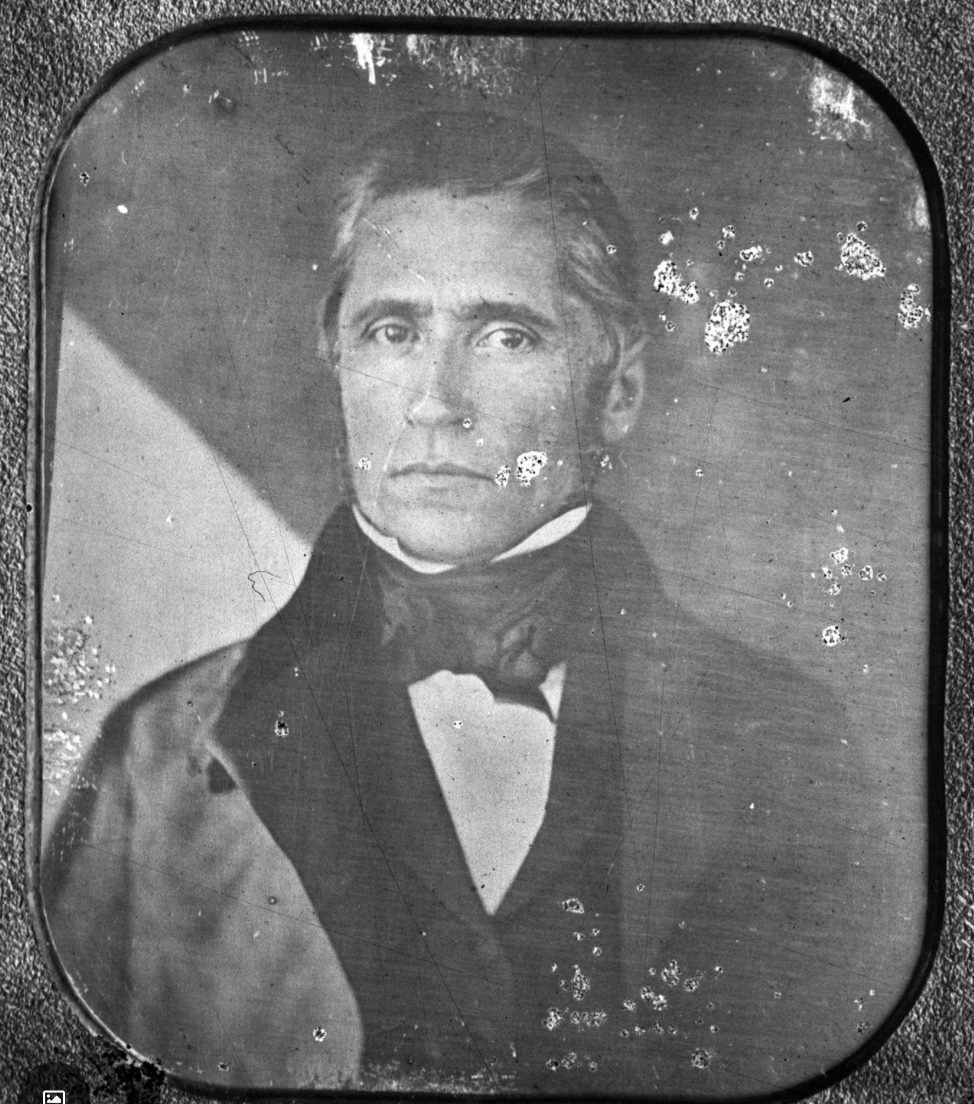
In 1845, he returned to London where he became friendly with Samuel John Lloyd, an associate of the powerful banker Baron Lionel de Rothschild. The two bankers, moved by the suffering of the Irish, founded the British Relief Association, which collected money for famine relief. Strzelecki volunteered to go to Ireland as an unpaid agent of the B.R.A. Traveling across the famine stricken land, Strzelecki was shocked by the suffering and death he saw around him. In Co. Mayo, Strzelecki organized soup kitchens and gave cash to relief committees. He focused much of his relief work on children. Strzelecki decided to stay in Ireland because, unlike others, he correctly predicted that famine would return to Ireland the following year. The B.R.A. named Strzelecki as agent for all of Ireland and he helped the hungry until the organization’s funds were depleted. He then returned to London where he pled for further funds and explained that humanitarianism must take precedence over every other consideration. In 1849, he again returned to Ireland where he tried to feed the hungry.
Strzelecki also helped many Irish families to emigrate to Australia and the United States. His efforts were recognized by the Crown and he was knighted in 1849. For many years Strzelecki’s heroism was forgotten, but the Polish Embassy in Ireland has sponsored the exhibition to remind Ireland of this great Polish humanitarian. Hopefully, Strzelecki’s story will resonate both with the Irish and with the many Polish people who now call Ireland home and bond the two groups closer together.
End.
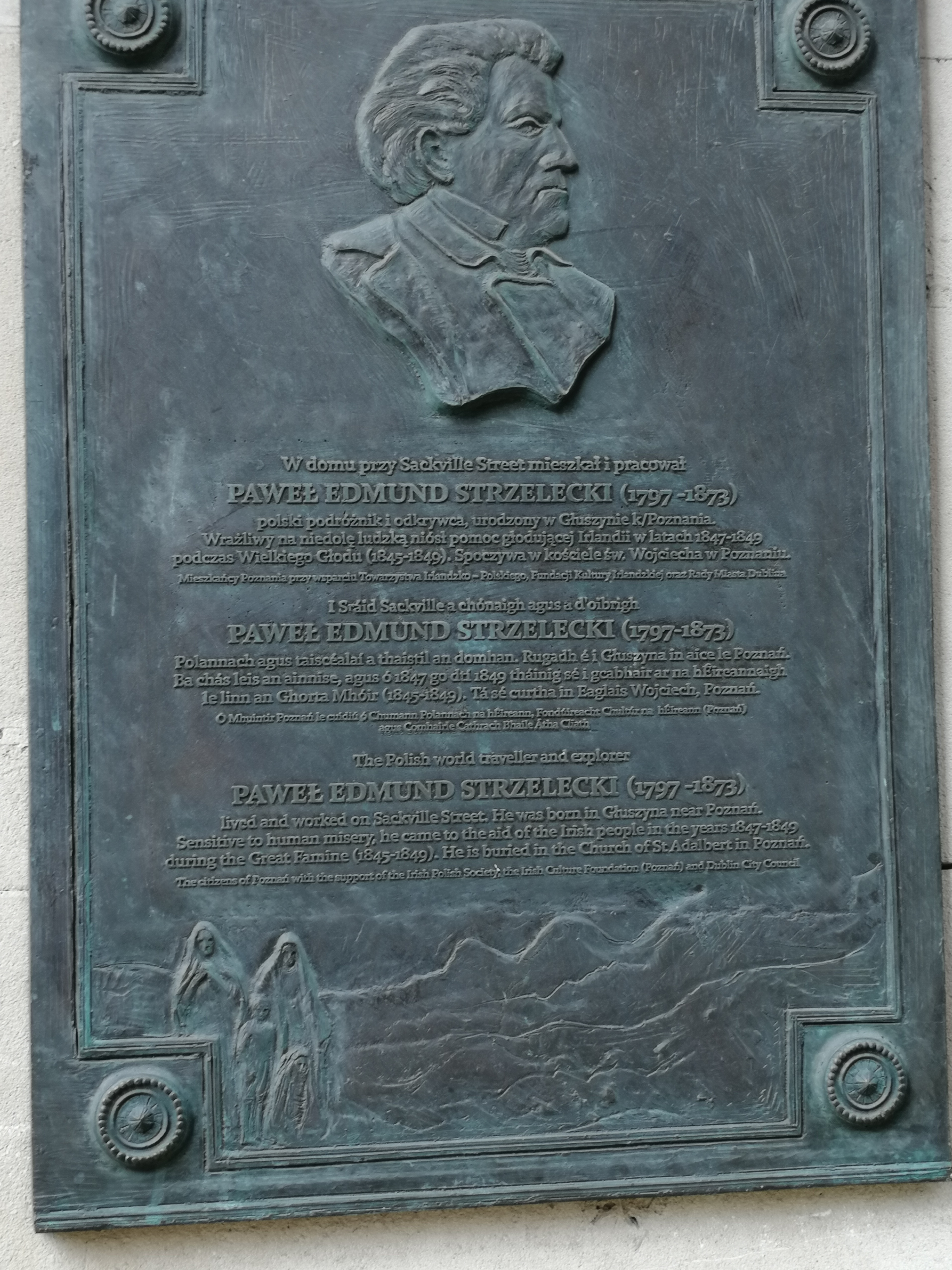
Postscript from Editor Rebel Breeze: There is a plaque in Dublin commemorating this man on the side of the Clery’s building in Sackville Place, at the corner with O’Connell Street. Do our readers know of any other such plaques or monuments to him, for example in Mayo?

Diarmuid Breatnach
(Reading time: 5 mins.)
In the midst of an arrest operation on Wednesday of 21 people for alleged misuse of public funds to assist the Catalan independence movement, the Spanish State issued a statement alleging that Russia had offered the movement 10,000 Russian soldiers to aid their struggle. It wasn’t the only Russian connection to the Spanish police operation, which they had named Operación Volkhov.
The arrests this week form part of measures by the State against Catalan independence activists since 2017. That year, a coalition of pro-independence political parties and a huge grassroots movement in Catalonia pushed for a referendum to vote for or against an independent Catalan republic, which the pro-Spanish union opposition called on people to boycott. The Spanish State sent its police to raid Catalan regional government offices, confiscate ballot papers, search for ballot boxes (unsuccessfully) and, on the day of the Referendum itself on October 1st, to storm polling stations and beat up voters.
Since then, the Spanish State has jailed seven Catalan politicians and two leaders of grassroots movements on charges of sedition, charged senior Catalan police officers with disobedience (recently acquitted), charged activists with possession of explosives (turned out to be fireworks), other Catalan politicians – including the former President — are in exile, the current President of the regional government has been banned from holding office, 700 local town mayors are under investigation and others are facing charges arising out of strikes and acts of civil disobedience such as blocking streets and a motorway (for which one activist was charged with terrorism). The raid this week comes in addition to all those legal processes.
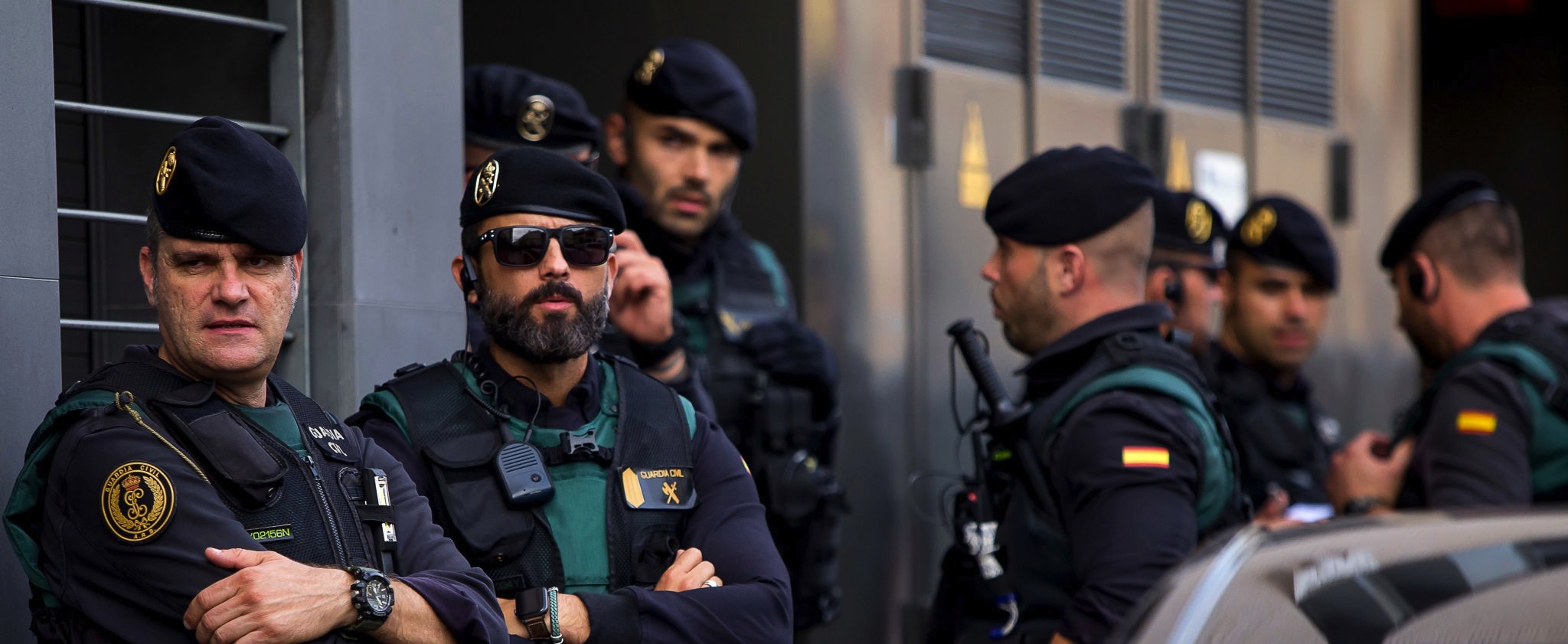
There is something of an irony in charging Catalan activists with misuse of public funds in pursuance of independence, given that independence is what many of the Catalan public desire but even more ironic considering the rampant corruption endemic in Spanish political circles and the Monarchy itself, the former King Juan Carlos resigning amidst allegations of financial corruption and being allowed to flee the country ahead of an investigation.
Whatever about the charges of misuse of public funds it is unlikely that most political observers will take the allegations of an offer of Russian military intervention seriously and not only because it comes from Guardia Civil intelligence, a police force maintaining the fascist Franco dictatorship for four decades and, according to many, especially Basques and Catalans, not much changed since. The notion that Russia would risk a war with the EU and the US-dominated NATO, in order to help free a nation of 7.5 million people nowhere near its own territory, must be laughable.
For those facing charges, under investigation, in exile or already in jail, the situation is not humorous. And then there is the sinister name of the police operation. During WW2, General Franco, dictator of a neutral Spain sent fascist volunteers to aid the Axis in Europe, many of them fighting on the Russian front. Franco had quite recently led a successful military-fascist uprising against the Spanish left-wing Popular Front Government, for which he had been aided by Nazi German and Fascist Italian armament and men. His victory was followed by a repression that left Spain with more mass graves than anywhere else other than Cambodia. The Spanish volunteers to fight Soviet communism formed the Blue Division – blue, from the colour of the Falangist shirts and uniforms.
SPANISH FASCISTS ON THE VOLKHOV FRONT
Among the Nazi German forces in the Volkhov region were the men of the Blue Division and it seems they carried out a successful night crossing of the Volkhov River on 18th October 1941. A subsequent Red Army advance in January 1942 failed ultimately because not all the components of the operation had advanced according to plan. In August 1942 the Blue Division was transferred north to take part in the Siege of Leningrad, on the south-eastern flank of the German Army.
However in February of that 1943, operations on the Volkhov Front formed Part of the Red Army plan to first break the siege of Leningrad and then trap Nazi forces in encirclement. According to what seems a Spanish-sympathetic Wikipedia account of the battle at Krasny Bor, in the vicinity of Volkov, the Blue Division fought stubbornly from 10-13 February 1943. On February 15, the Blue Division reported casualties of 3,645 killed or wounded and 300 missing or taken prisoner, which amounted to a 70–75% casualty rate of the troops engaged in the battle. The remnants were relieved and moved back towards the rear.
Red Army casualties were much higher and, although forces attacking well-fortified positions backed by good artillery and tanks, all of which the Nazis had, can expect to lose three attackers for every one defender, Russian analysis later blamed bad leadership, ineffective use of artillery and clumsy use of tanks for their losses.
A Spanish police force evoking today the memory of Spain’s fascist troops in WW2 might seem ominous but to those who believe that the Spanish ruling class and their police force have never ceased to be fascist, the only surprise will be its effrontery. To the Guardia Civil, the fighting in the vicinity of Volkhov in October 1941 might seem the finest hour of the Blue Division but they might do well to remember that effectively it also met its end there in 1943: the Division ceased to exist and was reformed as the Blue Legion, soon afterwards to be disbanded, some soldiers absorbed into the Waffen SS and others withdrawn home.
RUSSIAN TROOPS FOR CATALONIA?
Fast forwarding to the present, the Russians, at least in their Embassy in Madrid, treated the allegation of their offering troops to support Catalan independence as a joke. The following post in Spanish appeared on their electronic notice and comment board (translated):
Note: The information that appeared in the Spanish media about the arrival of 10,000 Russian soldiers in Catalonia is incomplete. It is necessary to add a further two zeros to the number of soldiers and the most shocking thing of all this conspiracy: the troops were to be transported by “Mosca” and “Chato” planes assembled in Catalonia during the Civil War and hidden in a safe place in the Catalan Sierra (mountain range) until they received the encrypted order to act through these publications.

End.
SOURCES:
Police operation name, raid and arrests: https://english.vilaweb.cat/noticies/spains-paramilitary-police-names-newest-raid-after-ww2-fascist-victory/
History of the Volkhov Front, WW2: https://en.wikipedia.org/wiki/Volkhov_Front
Battle of Krasny Bor: https://en.wikipedia.org/wiki/Battle_of_Krasny_Bor#Soviet_Union_–_Leningrad_Front
Russian Embassy humorous comment: https://spain.mid.ru/es_ES/-/replica-de-la-embajada-sobre-la-informacion-aparecida-en-los-medios-espanoles-sobre-la-llegada-de-10-mil-soldados-rusos-a-cataluna?redirect=https%3A//spain.mid.ru/
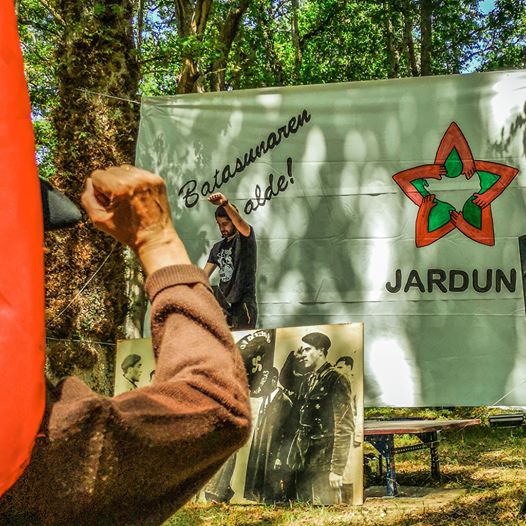
Entrevista de Andoni Baserrigorri a Jardun
Sorprendió a mediados de agosto de este año tan atípico, la presentación en el Albertia que organiza Eusko Ekintza, este año también Jarki, de la iniciativa Jardun.
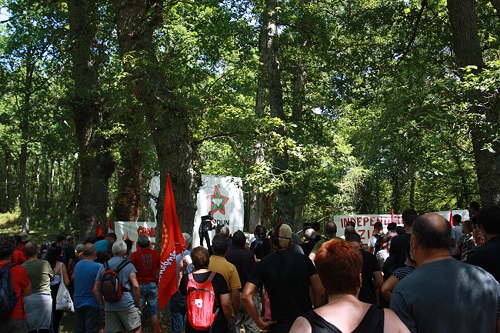
Ha pasado dos meses y he tenido una conversación de un representante de Jardun para que nos explique en qué consiste esta iniciativa, cuales son sus objetivos y si ha logrado avanzar en este mes escaso
Bueno… la verdad que fue sorprendente, la noticia de la aparición de este iniciativa… la primera pregunta es obvia… ¿Qué es Jardun?
Jardun es un proyecto político nuevo que surge en forma de coordinadora para llenar un vacío que existe en la izquierda independentista revolucionaria de Euskal Herria. Pretende agrupar a todos los militantes y organizaciones nacionales y locales que luchan por una Euskal Herria independiente, socialista, euskaldun y reunificada. Entendiendo que la independencia pasa por la conformación de un estado socialista vasco. Entendemos que para la consecución de dichos objetivos es necesario que cada organización que conforma Jardun, dentro de su espacio de actuación pero respetando su autonomía, funcionen enmarcadas dentro de una estrategia común que sea la plasmación de un proyecto político que responda a las necesidades de la clase trabajadora de Euskal Herria. Tenemos como principios el internacionalismo, la defensa del medio ambiente, la amnistía y la consecución de una sociedad sin clases y sin opresión de género que van todas de la mano, pues, el no luchar contra todas las opresiones puede perpetuar alguna de ellas y eso para nosotros no es una opción.
Se trata de una iniciativa que han lanzado Eusko Ekintza y Jarki… Un poco, ¿Qué tipo reflexiones habéis hecho común para llegar a estar conclusiones que comentas?
Lo que nos ha llevado a configurar la coordinadora Jardun es que las dos organizaciones que lo hemos conformado advertíamos que había una carencia en cuanto a una alternativa revolucionaria en Euskal Herria. Llevamos algo más de un año reuniéndonos y reflexionando conjuntamente ante el estado de colapso en que se encontraba el movimiento revolucionario vasco. Esto unido a la situación de desmovilización y alienación generalizada en la que se encuentra sumido Euskal Herria y al cierre del ciclo político anterior hace necesario poner en marcha un proyecto político independentista con perspectiva de clase y coherente. Pero más allá de la reflexión de por qué han ocurrido las cosas que han ocurrido durante décadas y han desembocado en la actual situación, lo que nos ha impulsado a dar este paso es la necesidad de ofrecer al Pueblo Trabajador Vasco una alternativa política integral, con vocación para avanzar de una manera real hacia los objetivos mencionados anteriormente. Para ello, necesitamos dotarnos de los instrumentos políticos y organizativos necesarios. Y es por eso que debemos tener la verdadera determinación y el convencimiento de que los objetivos son posibles si conseguimos activar a los sectores más concienciados del Pueblo Trabajador Vasco.
¿Hasta ahora que respuesta ha tenido vuestra iniciativa por los diferentes colectivos de Euskal Herria y que no están de acuerdo con las posiciones de la Izquierda Abertzale, llamémosla “oficial”
En estos momentos Jardun se compone de Eusko Ekintza y la organización revolucionaria Jarki a nivel nacional y de las iniciativas populares Bultza Herri Ekimena en la zona de Bilbo y Askatasun Haizea Herri Ekimena en Busturialdea. Seguimos buscando burkides para este proyecto y estamos encontrando gran receptividad por parte de diferentes grupos con los que estamos abriendo conversaciones y eso es ilusionante y muestra del la linea seguir. Sin duda en los próximos meses y años más grupos se sumarán a Jardun ampliando la base de este nuevo proyecto por la independencia y el socialismo dentro de una izquierda independentista renovada.
En el caso de Eusko Ekintza, ha tenido recientemente una experiencia unitaria, que por decirlo de una manera suave habrá salido trasquilada, me refiero a su experiencia dentro de Herritar Batasuna, en el caso de Jarki, es un colectivo nuevo de reciente aparición. ¿Han tenido muchas dificultades para llegar a acuerdos? ¿Han puesto encima de la mesa que tipo de comportamientos no van a aceptar para que esto vaya a buen puerto?
Las dos organizaciones tenemos recorridos diferentes, cada uno desde su propia realidad, pero nos une la voluntad de articular una alternativa lo suficientemente amplia y plural, dentro de las líneas rojas que nos marcamos, para que el movimiento revolucionario de este país pueda ir creciendo hasta convertirse en una fuerza política determinante de cara a conseguir la independencia y el socialismo. Para ello sobran los dirigentismos, los sectarismos, el buscar enemigos entre los burkides más cercanos a tu proyecto o el intentar construir una alternativa política a la reacción o a la contra de lo que hacen el resto de fuerzas políticas existentes en Euskal Herria. Nosotros luchamos contra la opresión nacional y social de los estados español y francés, el capital y sus gestores socio-políticos.
¿A que perfil militante va dirigida esta iniciativa?
A individuos y organizaciones nacionales, sectoriales o locales que compartan, las bases ideológicas y organizativas recogidas en el documento “Txinparta” (que es el documento base de trabajo para las organizaciones que conformamos Jardun), y que quieran sumarse, de una manera estratégica, para construir un verdadero movimiento capaz de avanzar de una manera real desde la sinceridad, la lealtad y el trabajo conjunto.
De los agentes vascos que se mueven en las coordenadas revolucionarias y abertzales que citáis… ¿Pensáis que se sumara alguno más, aparte de los que ya han dicho públicamente, en redes que aplauden la iniciativa? ¿Os vais a dirigir a ellos?
Además de los grupos que ya te hemos citado, continuamos y continuaremos reuniéndonos con toda nuestra determinación con diferentes grupos y colectivos para que Jardun siga creciendo en los próximos meses y años.
Supongo que con la Izquierda Abertzale “oficial” no tenéis ningún contacto y que no estará interesada en esta iniciativa
Evidentemente si nosotros estamos construyendo esta iniciativa es porque constatamos que el espacio socio-político del socialismo independentista revolucionario no está ni estructurado ni representado hoy en día. La militancia de Sortu ha hecho su propia elección política y nosotros no tenemos nada que decir al respecto puesto que no somos, ni parte, ni disidencia de lo que hoy en día se define como Izquierda Abertzale.
Ya para terminar… Destruir es muy fácil, construir es muy complicado… ¿Pensáis que esta iniciativa abrirá por fin un periodo en el cual haya una herramienta organizativa en nuestro pueblo para lograr sus objetivos históricos de Independencia y Socialismo?
Precisamente para eso constituimos Jardun, pero a la vez somos muy realistas en que construir una alternativa independentista y socialista amplia, eficiente y potente no se consigue de la noche a la mañana. Por eso, es muy importante ir avanzando de una manera firme, con las cosas claras y sin crear falsas imágenes de lo que no se es, pero haciendo llegar a todo el Pueblo Trabajador Vasco lo que sí somos por encima de los cordones sanitarios, bloqueos mediáticos y el boicot que algunos pretenden promover contra esta alternativa ilusionante.
Bueno… pues nada más. Estaremos atentos y atentas a los siguiente pasos que se vayan dando y que ojala conduzcan a ese objetivo…que nuestro pueblo entre vosotros y muchos más se organice y logre sus objetivos históricos
Sí, los objetivos históricos de nuestro pueblo y de nuestra clase.
 rebelbreeze