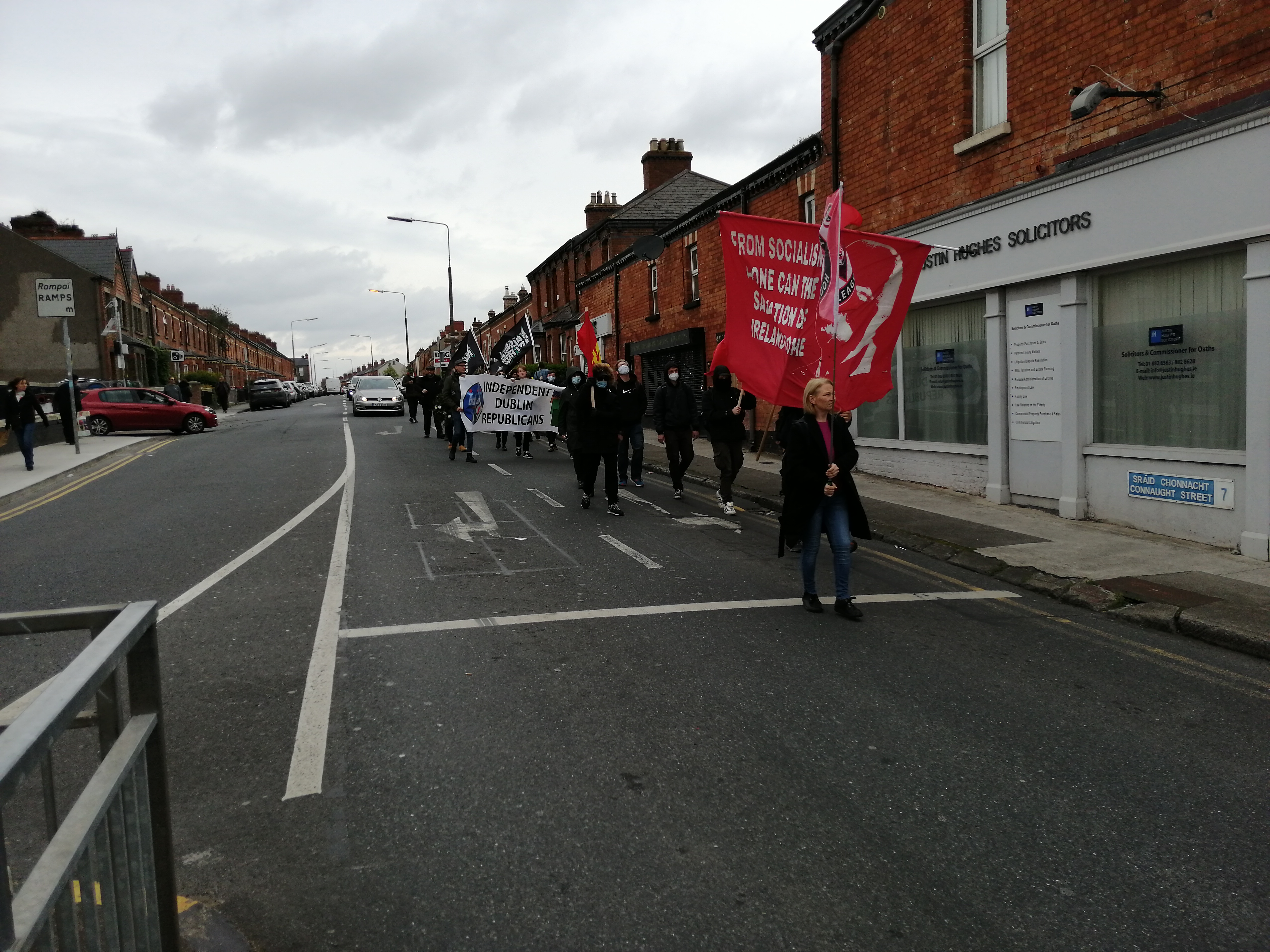
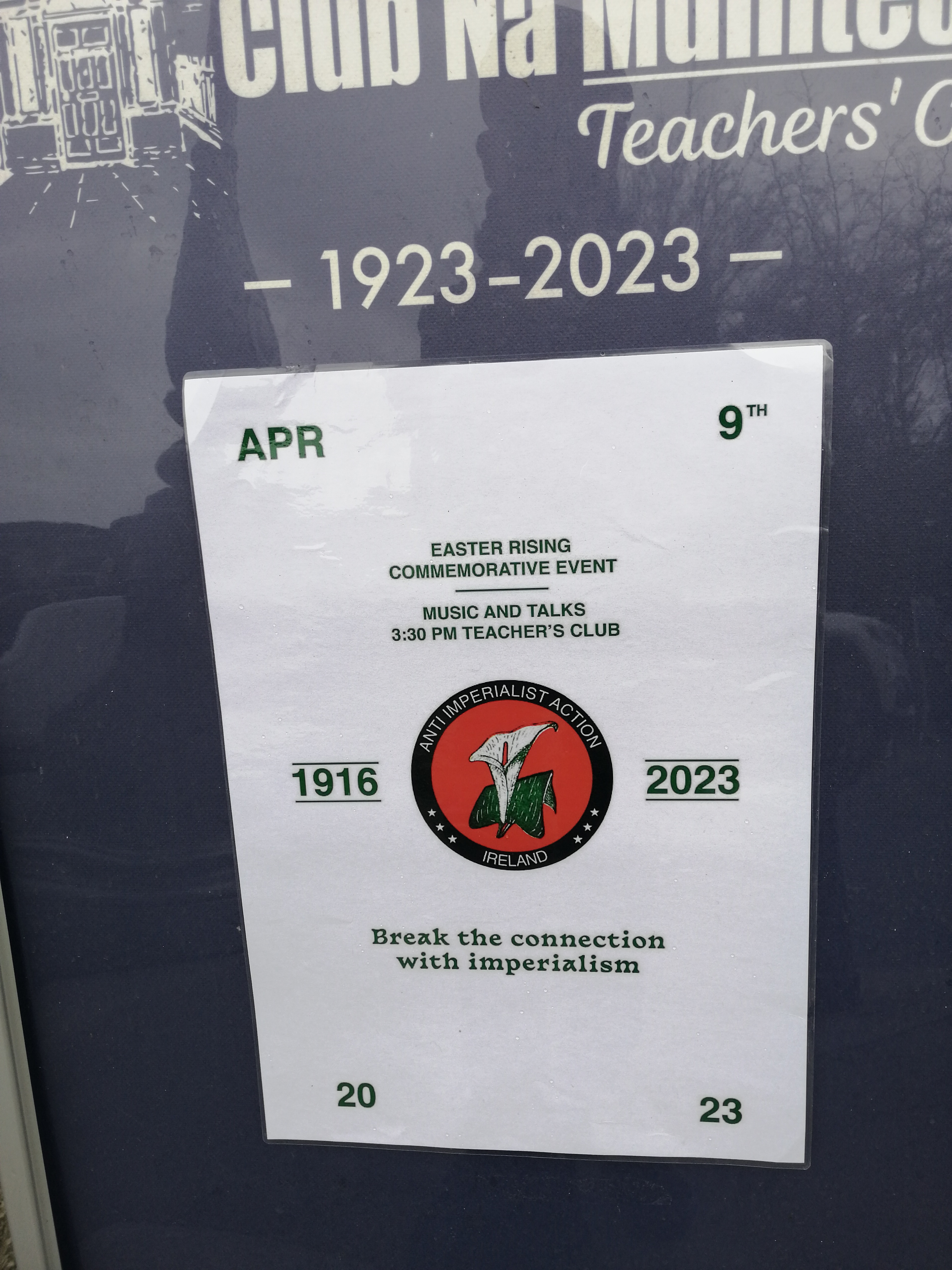
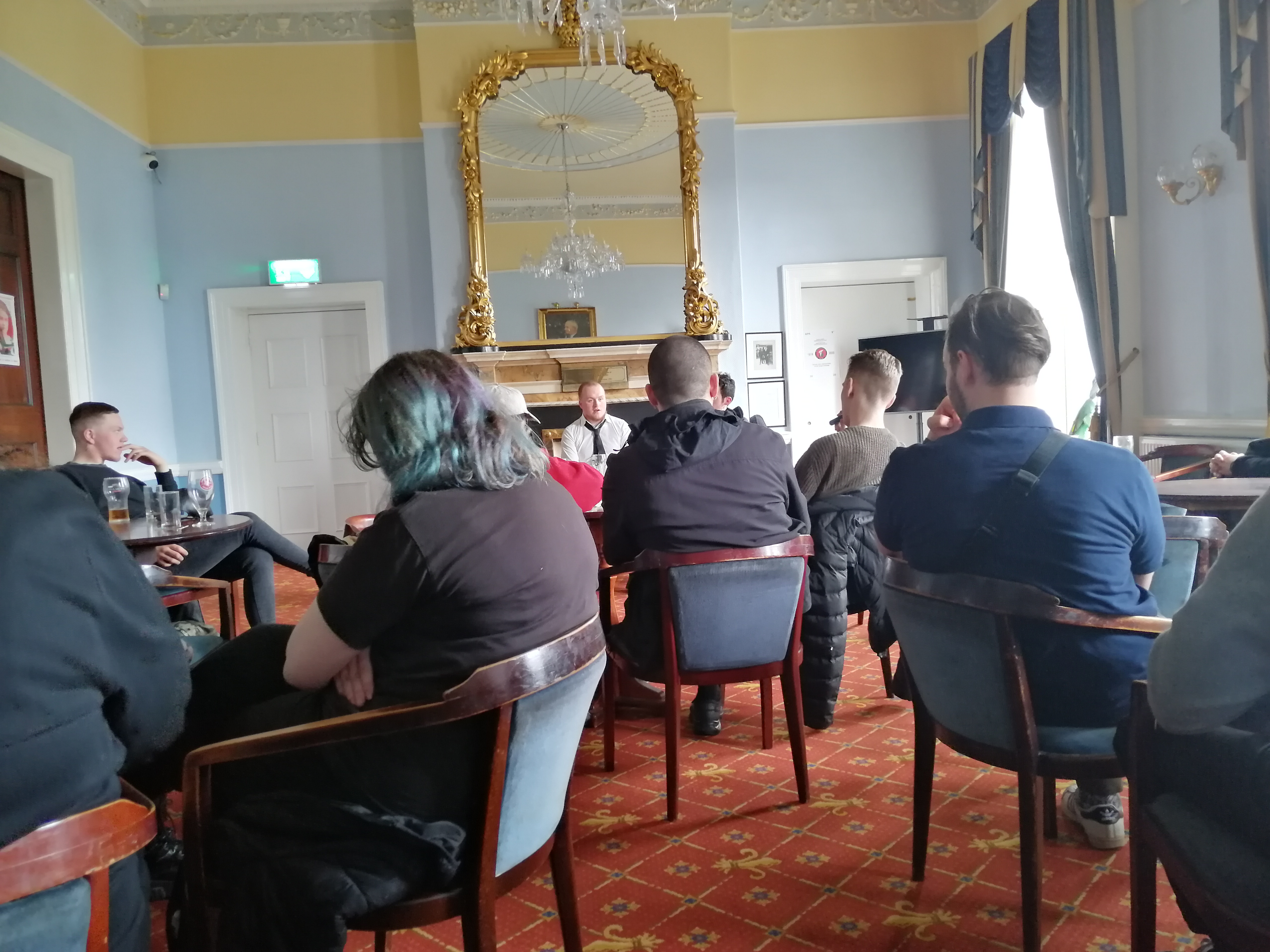
BASQUES AGAINST NATO AND EU – Interview with Herri Ekimena organisation.

Oscar DíazTranslation from Castilian Spanish by D.Breatnach
(Reading time main piece: 10 mins.)

1. What is Herri Ekimena?

Herri Ekimena is an initiative that emerged in March 2022. A series of organizations began to get together due to concern about the offensive of Atlanticist imperialism in Ukraine, in addition to the blatant manipulation of the media to get us to support their war strategy.

We also observed that, in a context of capitalist crisis and with the excuse of the war against Russia, economic measures were being imposed that resulted in greater impoverishment of the working class.

That is why we took to the streets at that time with the slogan “NATO and the EU condemn us to war and misery”, to turn the official discourse around a little and point to these two organizations as the main ones responsible for the increase in international tensions, as well as for the oppression of the working classes of the imperialist bloc itself.

Also in the month of June of that 2022 we called a demonstration in Bilbo, “against the imperialism of NATO and the EU” and calling for the end of the Russophobia that is still being promoted.

In parallel to the NATO summit that was held in Madrid, we also carried out a 48-hour poster campaign in Gernika, a city with great anti-fascist symbolism that the Ukrainian Nazis tried to appropriate, citing it in a speech before the Spanish Parliament by Zelensky himself.

After a short break, we resumed the fight in the streets at the end of the year, with the “Free Euskal Herria out of NATO and the EU” campaign. In March we held a massive demonstration in Bilbo, together with Askapena1 and the Bardenas Ya2 collective.

View of demonstration against NATO and war in Bilbao, June 2022. (Photo source: Bultza Herri Ekimena)

This demonstration was exciting to us as we saw that the work that had been done was already bearing fruit and that the anti-imperialist spirit that has historically characterized Euskal Herria was projected in the streets.

We are currently in a restructuring process in order to be more effective, and give new impetus to the anti-imperialist struggle in the streets, which is where this game is truly played.

2. Why combine anti-fascist and anti-imperialist slogans?

The imperialist offensive, which has to do with the systemic crisis of capitalism and the rise of new economic powers, is being accompanied by a general reduction of rights and freedoms.

Those in power fear popular revolts, like those that have been taking place in the French State in recent months.

In Euskal Herria we know well what emergency laws or illegal practices are employed to put an end to dissent, but these types of measures are spreading and becoming normalized throughout Europe. Concentration camps for migrants, deportations without any type of legal guarantee, electronic anklet tags are also normalized…

And also in the case of the countries bordering Russia, imperialism is responsible for waving old supremacist and anti-Slavic flags, such as is happening in Ukraine or Poland.

We see therefore that capitalism, in its most decadent phase, has little scruple when it comes to reactivating liberticidal policies or inciting openly Nazi military and paramilitary shock forces.

So in effect, we believe that the anti-imperialist struggle and the anti-fascist struggle are inseparable parts of the same struggle for our rights and freedoms.

3. A few years ago one could see Donbass flags in the stands of Atlethic3. Why mix football and politics?

Through various institutions, including football clubs, they want to force down our throats the supposed “depoliticization of public spaces.” It is false, because they are the first to try to control absolutely all areas of our lives that we may become submissive and uncritical people.

The media bombardment is constant, generating false debates among humble people about insecurity, occupying empty properties… They thus try to legitimize, by action or omission, measures of social control and police repression that are very, very worrying.

So when someone puts a poster on the street to denounce any injustice, or puts up a banner, or paints graffiti… They are calling into question that false normality that they want to impose on us.

Banner displayed by Athletic Bilbao FC fans during a match. The text is difficult to see in its entirety but in general it is clearly in solidarity with the Donbas region against attack from the Kiev administration.

It is sad — but this situation also reflects the weakness of the system in terms of political legitimacy. Who explicitly supports them? Who is not fed up with everything that is happening? So they are afraid of the flame that starts a prairie fire.

Sports venues do not escape this logic of imposing false normality, even if the laws have to be twisted or passed directly through the triumphal arch.

A Donetsk flag, for example, ruins their photo and calls into question the story that people agree with what they do. So they impose fines of €3,000 just for displaying the flag of a People’s Republic.

Let’s hope that in not many years we will be able to analyze all this as the blows of a dying regime, but for now it is up to us to organize the response and popular solidarity. Repression should not be normalized, nor should people who step forward feel alone.

4. Is EH Bildu4 being favorable to NATO?

We do not believe that the social base of EH Bildu is in favor of NATO. That is, if we asked EH Bildu voters if they were in favor of NATO, surely 99% would say no. The problem is that, for its leaders, opposing Atlanticist imperialism is not currently on the list of priorities.

Regarding the issue of the war in Ukraine, Arnaldo Otegi5 has openly positioned himself in favor of Ukrainian “sovereignty” and against the Russian “occupation.” Is Ukraine now a sovereign state? Or is it rather a puppet of NATO in its offensive against Russia?

Doesn’t Russia have the right to defend itself from NATO attacks? What about the thousands of people killed in Donbass since 2014? Should Russia have been obliged to watch this genocide impassively?

Have the self-determination processes in Donetsk, in Lugansk, in Crimea … not been practical exercises of sovereignty? In this context, we can say that the speech of some EH Bildu leaders has favored and continues to favor the interests of NATO.

Their support for the State Budget deserves special mention, which includes a 25% increase in military spending. A measure imposed precisely by NATO to approach 2% of GDP in 2029, which is truly outrageous.

So… perhaps it is harsh to say that EH Bildu is in favor of NATO so let us put it another way: What is EH Bildu doing to make Euskal Herria break with NATO? What teaching are they carrying out among their social base and at a public level to create a truly anti-imperialist consciousness?

Very little or nothing, we believe, that is the reality.

5. Will it be possible to continue to see reliable information about Ukraine in the Basque Country and the Spanish state now that military juntas have been formed in African countries that have expelled French embassies? They are very different countries and thousands of kilometers away…

The events that are taking place in the SAHEL area are complex processes, and surely have many sides that make it difficult for us to equate them with the decolonization processes that we have known historically.

But we would be committing a mistake if, due to these supposed “imperfections” with respect to the theoretical manual, we stopped supporting countries that are fighting for nothing less than to expel their occupiers (since those are true occupiers who try to impose themselves by force of weapons thousands of kilometers from their borders) and also to gain control of their enormous natural resources.

How can it be that in extraordinarily rich countries, like Niger or Gabon, the majority of the population survives in absolute poverty? We will have to carefully observe all these processes, but in anti-imperialist Euskal Herria we can only rejoice and tell them that they are not alone.

In this land that, to a degree, also knows what it is to fight against armed occupiers and various collaborators, we know very well that solidarity is the love between people.

Regarding the quality of the information that we are able to receive in Euskal Herria or in the Spanish state, we believe that right now it is below minimum.

It is pathetic to see how, every time an event occurs that could undermine the hegemony of Atlantic imperialism, the mainstream media wait to receive instructions before even reporting the event.

The control of capital over the big media is a reality, so we must promote and support alternative means of information and communication. And also to fight openly in the streets, so that they have no choice but to report our demands.

6. Couldn’t the creation of a multipolar world be dangerous on a war level?

Yes, in fact it already is. We had been talking for years about the end of Yankee hegemony and the economic rise of countries like Brazil, Russia, India, China and South Africa, the so-called BRICS.

Perhaps we thought that this change of orientation of world hegemony was going to be a calm process, without any surprises…

But nothing could be further from the truth. While it is true that Yankee imperialism is mortally injured (which we believe it is), the truth is that it seems willing to kill as it dies.

Currently it has restructured NATO in a few months, has de facto absorbed the European Union and is reconfiguring its alliance policy on a global scale. It is increasingly easier to identify “which side” the different states are on, which can be the prelude to a conflict on a planetary scale.

We have been able to verify this recently with Morocco. NATO and the EU buy Morocco and abandon the Sahara to its fate.6 What should the Sahrawis do if Algeria, Russia or China offer them help to win their rights and survive as a people?

Of course there may be geopolitical interests in this aid from emerging powers, but it is necessary to analyze whether the agreements, commercial exchanges, donations and aid are produced with mutual respect for sovereignty and benefit the currently oppressed nations.

Of course, from a revolutionary point of view we have to be exacting, and not give a blank cheque to these emerging powers.

In this entire process of multipolarity, whether we like it or not, which is already making its mark upon world geopolitics, there is a class struggle that we must not ignore.

But this critical stance cannot lead us to fall into ninism and evade our own historical responsibility: to combat Atlanticist imperialism from the very heart of the beast.

7. You say “Euskal Herria free from NATO.” And what about the rest of the Spanish state?

We say Euskal Herria should be free outside NATO, but also outside the EU. We believe that this contribution is important, since for many years consideration of leaving the EU has been a kind of taboo, also in Euskal Herria.

Some thought that the EU might even support a possible independence process in Euskal Herria, just as was thought in Catalonia.

“A Free Basque Country out of NATO and the EU”.

But the EU has definitively been revealed as a capitalist lobby, as an instrument at the service of elites with a more than dubious past, even with regard to their support for Nazism.

Úrsula von der Leyen, Josep Borrell… are faithful representatives of the EU of Capital, authoritarian and totally committed to the interests of the US. That is why we say that neither the nation nor as a class have a future within the EU.

We make this statement from Euskal Herria, which is our area of struggle. But of course it extends to the entire Spanish State, as well as to the French State and all the peoples of Europe.

A future in freedom is not possible belonging to these criminal organizations, neither in Euskal Herria nor anywhere else.

8. What do you think of the military administration by Margarita Robles of the PSOE/UP government?7

Margarita Robles is a pit bull of Spanish politics, a woman who knows perfectly the ins and outs of the State from the offices to the sewers. Not for nothing has she been in positions of power for more than 30 years, originally in the shadow of Belloch, later of Rubalcaba…

At first it may have been surprising to see her at the head of a Ministry like the Defense Ministry, she who comes from the judiciary and who, even in relation to the conflict between Euskal Herria and the Spanish State, had adopted a dialogue profile at certain times.

We are missing a lot of information (I wish that we in Herri Ekimena knew what was going on in the Ministry of Defense, haha), but Margarita Robles is probably dedicating herself to doing in the Spanish military what she also did in her day in the Ministry of Justice and Interior.

That was to send the most archaic elements to the refrigerator in a non-traumatic way to perfectly adapt to the current standards and guidelines of NATO and the EU. Change a minimum so that everything remains absolutely the same.

Can anyone imagine Spanish generals standing up for Spanish national sovereignty in the face of Atlanticist imposition? This could happen in the French State, in fact it would not be unreasonable for something like this to happen.

In the Spanish State it is much more unlikely, but it is the responsibility of politicians like Mrs. Robles that nothing should deviate from the script written by Washington and Brussels.

In this regard, it is worth highlighting the role of the PSOE in what has been the process of integration of the Spanish State into imperialist structures. In addition to Felipe González, we could mention Javier Solana (who became Secretary General of NATO), Josep Borrell8

Whether it is a matter of affinity, or a matter of pragmatism, the truth is that it appears that the PSOE generates a lot more trust among the imperialist powers than any other political party at the level of the State.

9. There were elections this past July 23, 2023. Did any of the political forces propose the departure of NATO from the Spanish state?

We are not aware that this was the case. As we have said before, this government is responsible for the largest increase in military spending in history, and faithfully complies with NATO and EU mandates.

“No to NATO – Out of Bardenas!”

Vice President Yolanda Díaz has publicly supported sending weapons to Ukraine and, as far as we know, no party that supports the government has opposed these shipments as a matter of principle.

We remember that these are weapons that are being used by Nazi soldiers to bomb and murder, not alone Russian soldiers but also the civilian population of Donbass. So we have to organize and fight in the streets, because if we don’t, things will remain exactly the same or worse.

This is the reason for existence of Herri Ekimena, to activate the popular struggle against the imperialism of NATO and the EU. We are working at it and, if all goes well, there will be good news in this regard in the coming weeks.

SOURCE

http://oscar-elbloquedeleste.blogspot.com/

FOOTNOTES

1Askapena was the internationalist solidarity arm of the broad Basque national liberation organisation but split from it many years ago in concern at the deviation from the path of resistance by the leadership under Arnaldo Otegi.

2Bardenas Ya is an organisation campaiging against the military installation in Bardenas, Nafarroa (Navarre).

3Athletic Bilbao FC, whose fans and many of its players have a strong anti-fascist and pro-Basque independence tradition.

4EH Bildu is the political party of the current compliant ‘official’ leadership of the Basque national movement, replacing the Herri Batasuna of the past.

5Leader of EH Bildu who has led the party into what many consider its collaborationist current stance.

6Western Sahara was a Spanish colonial possession and it abandoned it without decolonisation, which allowed Morocco and Mauritania to invade and occupy it against the wishes of the Saharawi people. As a result of the national liberation struggle of the Polisario Front, Mauritania withdrew but Morocco remained in occupation and carrying out repression against the resistance. Shortly before Trump’s departure from the USA’s presidency, he agreed to endorse Moroccan defiance of the UN-recognised Sahawarwi resistance to occupation in exchange for Morocco reversing its long anti-Zionist policy and formally recognising the Zionist occupation of Palestine, which the Moroccan Kingdom has done.

7The recent coalition Government of the Spanish State, the social-democratic PSOE with the Left-social democratic alliance of Unidas Podemos. Currently, the PSOE is endeavouring to form a government in coalition with a somewhat reconfigured Left-social democratic coalition called Sumar.

8All three have been PSOE politicians, Felipe González a prime minister and widely believed head of the GAL anti-Basque terrorist gang. Borrell was President of the European Parliament (2004-2007) and Minister of Foreign Affairs of the Spanish Government from 2018 to 2019. He attacked Catalan self-determination which he characterised as part of a disease, despite his own Catalan origin and he is now the Foreign Minister of the European Union.
NEW NAME FOR THE GARDAÍ & FAR-RIGHT’S CONTRIBUTION TO TOURISM

News & Views No.7 Diarmuid Breatnach (Reading time: 3 mins.)

Change of Name for Irish Police

The Chief Commissioner of the police force of the Irish state is reputedly “quietly pleased” with the change of name for the force he commands. “It describes the work we actually do” he commented at a press conference earlier today.

There were suggestions that the widely-supported name-change might be held up by bitterness at a recent vote of no-confidence by members of the force against the Commissioner, formerly senior officer in a colonial police force and of MI5 membership but this was not to be.

“He’s used to changes in the names of forces where he comes from,” commented a senior officer. “Besides the new one fits better than the earlier name for the force” he continued but seemed flustered when asked was he referring to the Royal Irish Constabulary.

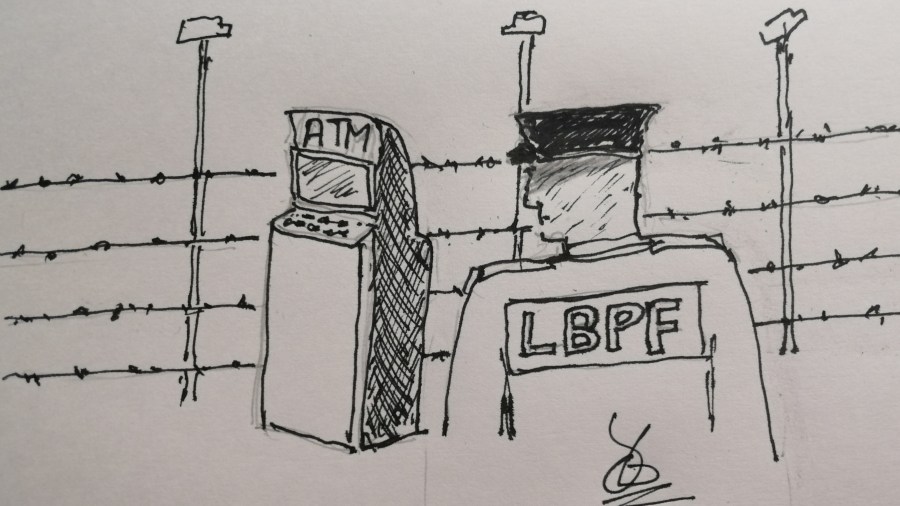
Others have remarked that the new name gives a much more rounded perspective than the earlier suggestion of Landlord’s Protection Force. “The excellent mobilisation to guard ATMs in the recent Bank of Ireland give-away crisis has justified the new name,” commented the Justice Minister.

“The mobilisation was even more remarkable given that no crime was actually being committed”, said the Minister.

The force will henceforth be known as The Landlords and Bankers Protection Force (with apostrophes ruled out of order). The new insignia or emblem will resemble a tall apartment block with a bank on the ground floor, carrying also the acronym LBPF.

Far-Travelling Rightists

The reported words of a Clare TD this week struck a chord among some far-Rightists. Cathal Crowe TD complained that tourists arrive by coach at the Cliffs of Moher, take selfies against the sights, climb back in and are driven off to Dublin, with no benefit all to the local economy.

“Why not flip the model?” he asked, suggesting that tours could be based in the West and set out from there to take in the sights elsewhere.

“We’ve been doing the kind of tourism recommended by Crowe for a long time”, exclaimed far-Right activist Dara O’Flaherty, “organising protest trips up to Dublin from Galway instead of tours the other way around. But of course we don’t get credit for it,” he concluded bitterly.

O’Flaherty blamed “freemasonry in the travel industry” for the lack of acknowledgement they receive.

Andy Heaseman, from Dublin but currently based in Mayo, stated that he has travelled on his own and with others to Dublin, down to Limerick and Cork “and not only by public transport and shared car”, he claimed “but also by boat – until it crashed,” he concluded with a sad face.

Niall McConnell has also visited Dublin as well as other spots with Farright Protest Tours, while Herman (‘Monster’) Kelly has been to Dublin, Limerick and Ballyjamesduff, though being obliged to leave each town shortly after his arrival.

Niall Nine Lies McConnell used to descend from his Donegal fastness to pray the Catholic Rosary on streets in Dublin and elsewhere, in close proximity to Muslims or people whose lives violate his ideas of gender and sexuality but who somehow continue to defy him.

McConnell was baptised “Nine Lies” for among other things, informing a European gathering of fascists that immigrants outnumbered the Irish-born in Ireland. He’s been taking a break and, “as a devout Christian, most emphatically not a Black Sabbatical” as he pointed out to our reporter.

The title “most travelled Farrighter” must surely go to Dublin-based Phil Dwyer, who claims to have been to every protest against migrants, Muslims, mask-wearing during Covid epidemic, Covid vaccines and anyone not 100% male or female-orientated according to genitalia.

Phil, also known affectionately as “Kick the Dog” gained the nickname “Lederhosen” for recruiting ‘real Irish men’ for hill-walking together, organising such activities to counter the feminising effect he believes female primary school teachers are having on Irish boys.

Phil “Kick the Dog” Dwyer was a recruiter of “heavies” for attacks on antifascists until expelled from the National Party for publicly violating the grave of a female victim of male violence. Dwyer is capable of carrying on his noble crusade even in a taxi home after having a skinful.

Farright Protest Tours (Ireland) on their website recently challenged anyone to name a place to which their service had not travelled or a democratic right which they had not opposed.

The successful respondent will be presented with a copy of the 1930s My Struggle, translated from the original into English and signed by the Austrian author.

End.

SOURCES

https://www.dublinlive.ie/news/gardai-defend-sending-officers-clear-27533946

https://www.breakingnews.ie/ireland/growing-problem-of-instagram-tourism-at-cliffs-of-moher-td-claims-1516047.html

LEGACY of ARGENTINIAN STATE FASCISM

A heart-breaking story with courage and a heart-warming ending.

Report by Luciana Bertoia from Pagina 12 published through arrangement with Publico.es
Translation by D.Breatnach

The last time Julio Santucho saw his wife, Cristina Navajas, was on June 14, 1976. Appointed as head of international policy for the Revolutionary Workers’ Party (Partido Revolucionario de los Trabajadores), he had to leave Argentina for six months.

They had been married for almost five years then and had two children: Camilo, three years old, and Miguel, who had not yet turned one. The three accompanied him to the Retiro terminal, where he took a bus to Sao Paulo and then arrived in Rome.

In the terminal, Cristina had Miguel in her arms and Camilo by the hand. When saying goodbye to him, she insisted on a promise:

I only ask you one thing. If something happens to me, you have to take the boys with you. They shouldn’t stay with your mom, with my mom, or with other comrades. They have to stay with you.

But, Cris, we’ve been living in hiding for a long time, and nothing has ever happened to us.

“Now it’s different,” she cut him off.

One day before a month had passed since Julio’s departure, Cristina was kidnapped by the Dictatorship. She was in the apartment at 735 Warnes Avenue, where her sister-in-law Manuela Santucho lived.

Another comrade from the PRT-ERP, Alicia D’Ambra, also lived with them. All three were kidnapped that day. The oppressors left Cristina’s two sons, Camilo and Miguel, and Manuela’s son, Diego, in the apartment.

Cristina managed to ask a neighbour to call her mother, Nélida Navajas. When the phone rang, Nélida had to ask where the boys were. For security reasons, she did not know their address.

When she arrived, she heard the screams of the two youngest, Miguel and Diego, from the street. Camilo was asleep.

Nélida found her daughter’s bag on the ground. Inside was a series of letters that she had written to Julio, waiting to receive an address to to which to send them. She had started writing the last one on Saturday, July 10, but had finished it the next day:

“Miguel is much better, he hardly coughs anymore, but he is more of a bandit and wilder every day. Cami is calmer and doesn’t give me work, the only thing is that he is getting clingy to me. He asked again which house we are going to, which house is this, etc.

Now the one who is not well is me, I do not know if I am pregnant,” she told her husband.

Julio found out about the kidnappings the next day, when he called to greet his brother-in-law on his birthday.

Refugee from Argentinian Dictatorship accompanied by a son as he attends a press conference about his reunion with another son, abducted by the regime, 43 years ago. (Photo: Enrique Garcia Medina/ EFE)

That day he spoke ten times with his mother-in-law. He would not hesitate to return to Buenos Aires to collect his children, but the PRT sent two comrades who, pretending to be a couple , took the children out and abroad to their father.

Forty-six years later, Julio managed to meet his third child, the baby that Cristina had while she was kidnapped in the Pozo de Banfield, after having gone through Coordinación Federal and Orletti Automotive (places of detention of the fascist regime – Trans.).

He is the 133rd grandchild found by the Grandmothers of the Plaza de Mayo (group of women who began the campaign to trace those made missing by the fascist regime – Trans.)

In an interview with Página 12, Julio Santucho relates how he was reunited with his youngest son, now a 47-year-old adult.

How was the search?

The main heroine in this story is Cristina, who for eight or nine months was pregnant in the most inhumane conditions: mistreatment, torture, bad food. She put up with all of this with willpower and finally gave birth to our son.

My son began to question his (new family – Trans.) relationship based on references from those close to the family. A sister who lived with him for 20 years told him “these are not your parents.”

From the way he was treated by the appropriator who raised him, he came to realise that he was not his father.

In 2019, he began to search, although stopped during the pandemic and then resumed. He had a birth certificate from another province. Finally this year he managed to have his DNA tested.

We searched but we had no approximation or probability of discovering my son. It was an exceptional case: he was born in the Pozo de Banfield, but police doctor Jorge Bergés did not sign the certificate. He surprised us.

What is it like to meet a son who is 46 years old?

It is good. The bad thing is that they took 46 years from us. It is a victory for the human rights organizations that have fought for this and it is a defeat for the dictatorship. They wanted to steal my son but I, later than ever, got him back.

My mother-in-law, Nélida Navajas, joined the Abuelas (Grandmothers’ group – Trans.) to look for her grandson. Abuelas is an irreplaceable institution, it is an enormous benefit to society because it is precisely the place where people who have doubts can recover their identity.

In July 1976, you lost much of your family and now, another July but 47 years later, you have your son back.

You strike a chord. On July 13, Cristina, Manuela and Alicia were kidnapped. She was a comrade that I also knew because she worked in the party schools.

On the 19th, six days later, they killed my brother “Roby” (Mario Roberto Santucho, leader of the PRT-ERP), and later my brother Carlos.

It was a tragic week for the family. We are not better-off than others. All the 30,000 disappeared were brave, generous and devoted themselves to a fight for the well-being of society and humanity.

What could he know about Cristina during her captivity?

There are testimonies like that of Adriana Calvo. The Santuchos were visited by all the mothers that were in the Pozo de Banfield. Adriana asked to spend a day with them.

She had her baby in her arms and so as not to worry her Cristina did not tell her that she had had a child and that it had been taken from her.

Adriana, afterwards, spoke at the trial of Cristina’s tremendous generosity in not telling her anything so she wouldn’t worry about her because they could take the baby away from her. Do you realise how far thinking about the welfare of others went?

They were screwed. But they told her: “We are Santucho, we don’t have any possibility of leaving, but they are going to release you.”

And then there is that scene that Adriana recounts: when the officers arrived, all the women made a human wall – led by Manuela, Cristina and Alicia – and the men had to leave without being able to take their baby from her.

They were in a concentration camp. They knew they could shoot them all at that moment.

And now how is the reunion going?

Some ask me about the appropriator of my son, all I say is that I hope that Justice intervenes. For now, this is all like walking on clouds. We talk to my son every day, we see each other often. Now we have the commitment to make a video call to my granddaughters. Let’s go little by little.

Joy is infinite. Besides, we have time. I am 78 years old. My father died at 89. I have a brother in Santiago del Estero who is 101, another who is 96. If they don’t kill us Santucho, we live a long time. So I look forward to enjoying my son for a few more years.

End.

ADDITIONAL NOTES by D. Breatnach

The Argentinian dictatorship lasted from 1976 to 1983 and apart from banning dissenting newspapers and organisations, detained, tortured and killed thousands.

But not only that, very young children and babies were abducted and given to couples who supported the regime to raise as their own. This was also done by other dictatorships, including the Spanish Franco regime of four decades.

In a time when a week-old military coup in Niger is threatened with invasion by France and by some western-allied African states, it is well to remember how other military dictatorships have been viewed by western states.

The lack of democratic elections and opposition parties did not matter to the western states who in fact fully supported the Argentinian and many other coups and dictatorships.

The military dictatorship of Argentina only became a problem to the UK’s ruling class when Argentina’s military invaded the British colony of the Malvinas/ Falkland Islands in 1982, the same year that the USA stopped supporting the junta for the first time.

SOURCE MAIN STORY

https://www.publico.es/internacional/julio-santucho-dictadura-me-quiso-robar-mi-hijo-recupere.html?

Meloni skirts around the word ‘neofascist’ on the anniversary of the Bologna Massacre

Opposition leader Elly Schlein accused the prime minister of “historical revisionism” over her ambiguous language.

08/03/2023 PUBLICO / EFE (Translated by D.Breatnach)

Italian Prime Minister Giorgia Meloni completely avoided using the word ‘neofascist’ in her message marking the 43rd anniversary of the Bologna Massacre, a terrorist attack by a far-Right organization that killed 85 people.

Meloni did not go to Bologna to participate in the commemoration.

“43 years have passed but, in the heart and conscience of the nation, the violence of that terrible explosion still resonates with all its force,” said the leader of the Executive and the ultra-right party Brothers of Italy.

Giorgia Meloni, the Prime Minister of Italy. (Photo: Fabio Frustaci / EFE)

In her message, she asked to “get to the truth about the massacres that marked Italy in the postwar period,” an ambiguous phrase that makes no direct reference to the far-right groups that carried out the massacre on 2nd August 1980.

The absence of specific terms in Meloni’s speech to refer to the attack has prompted opposition leader Elly Schlein, a progressive, to accuse Meloni of promoting “historical revisionism.”

“We are here in Bologna together with the families of the victims of the massacre to reiterate that we do not accept any further attempts to rewrite history. The judicial evidence already makes it clear that it was a neo-fascist massacre and also with subversive intent,” Schlein said.

In the message shared by the president, Sergio Mattarella, to commemorate the date, he did refer to “the neo-fascist matrix of the massacre.” Likewise, he recalled that in the subsequent trials “ignoble deviations, in which secret associations and treasonous agents of the state apparatus participated,” came to light.

Meloni has ruled out any anti-democratic nuance of her formation, but she maintains as a symbol of the Brothers of Italy the so-called “tricolor flame”, emblem of the youth organisation of the old and post-fascist Italian Social Movement (MSI) in which she was a member of her youth.

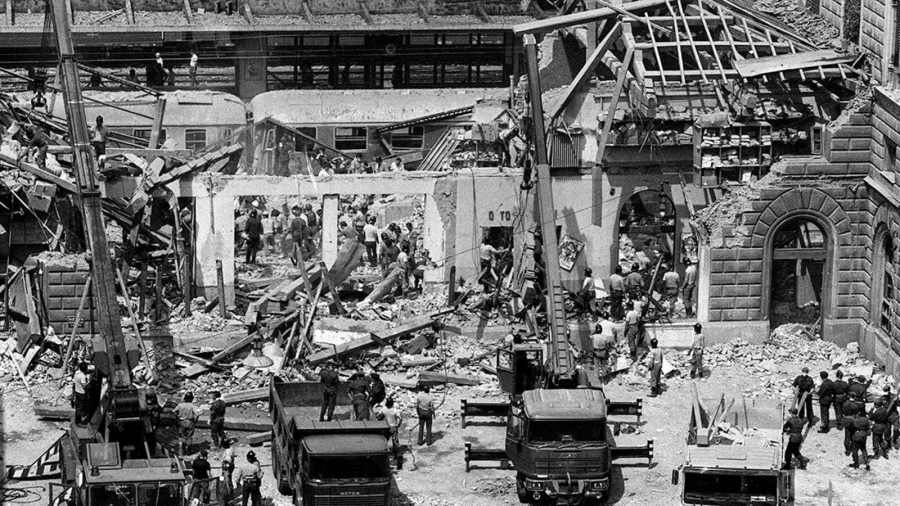
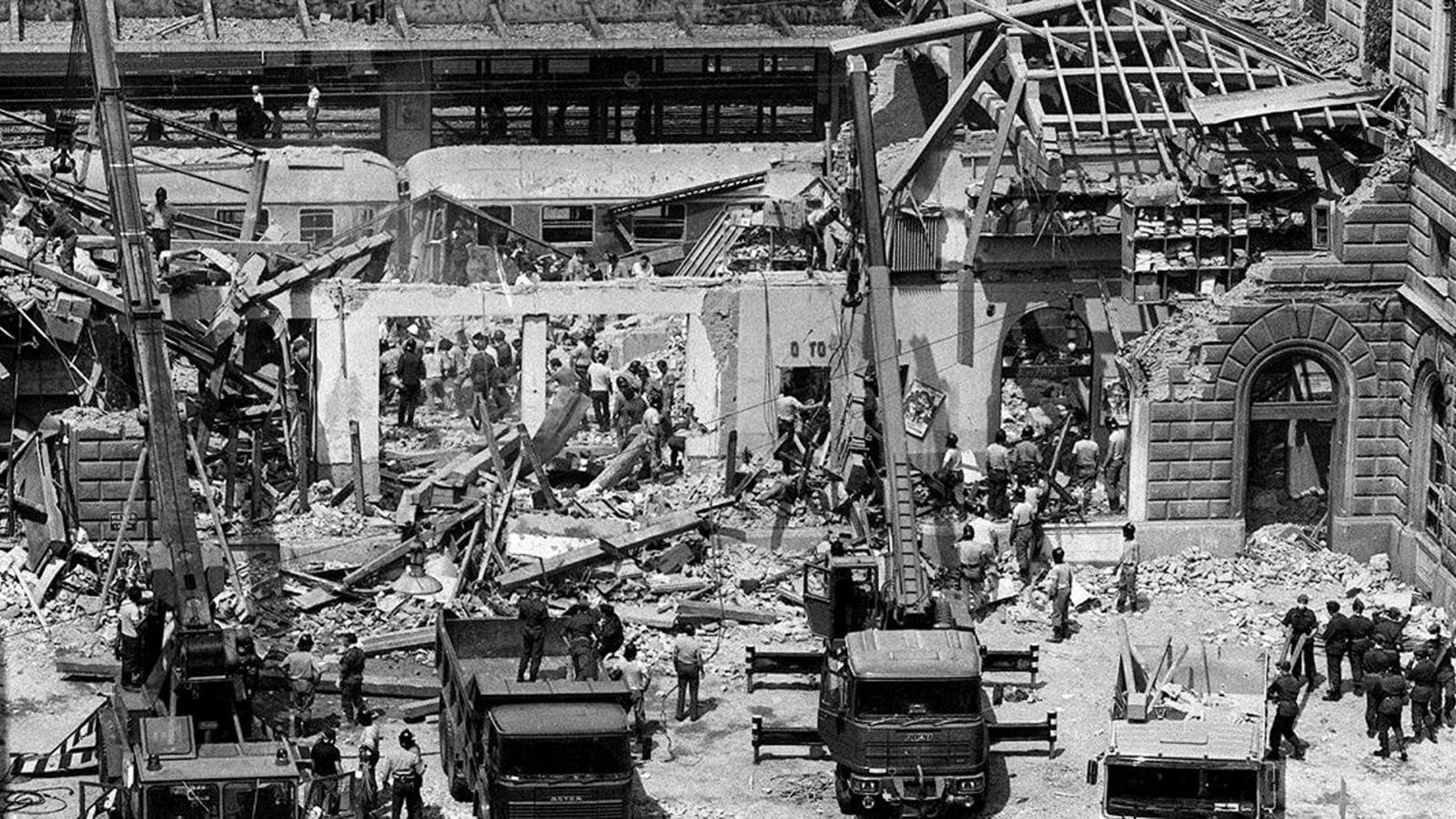
The Bologna Train Station, Italy, following the fascist explosion on 2nd August 1980 (Photo sourced: Internet)

The Bologna Massacre

The Bologna massacre was the most serious terrorist attack in Italy after World War II, in which 85 people died and more than 200 were injured and extreme right-wing militants belonging to the organization Armed Revolucionary Nuclei were convicted for it.

Comment by D.Breatnach: However, parts of the Italian State were implicated in the bombing and/or coverup too, with elements in the Italian police, judiciary and secret service but also with suspicions of CIA/NATO involvement. It seemed that the purpose of that bombing and others in the period was to create fear and confusion in which the State could return to fascism.

IRISH STATE PREPARES TO INCREASE REPRESSION

Diarmuid Breatnach

(Reading time: mins.)

While the Gardaí face accusations of treating far-Right violence too lightly, the State plans to increase the maximum sentence for assault on members of the force to 12 years in jail, nearly double the current maximum of seven years.1

Minister for Justice Simon Harris was seeking approval today for the increase as amendments to the Criminal Justice (Miscelaneous Provisions) Bill which has passed all stages in the Irish Parliament and is now going through the Seanad.

Irish Government Minister for Justice, Simon Harris (Photo sourced: Internet)

The increase in maximum sentence lumps emergency services such as paramedics and firefighters with State repressive forces of police, prison officers and armed forces.

This is a disguising measure since forces of repression are not the same as those of emergency services, even if in the event of a disaster all may be employed together. The State expects increased resistance from working people and therefore feels a need for increased repression.

According to some media reports there have been complaints that the Gardaí have been failing to respond adequately to crimes committed by fascists and other far-Rightists, including threatening behaviour and arson.2

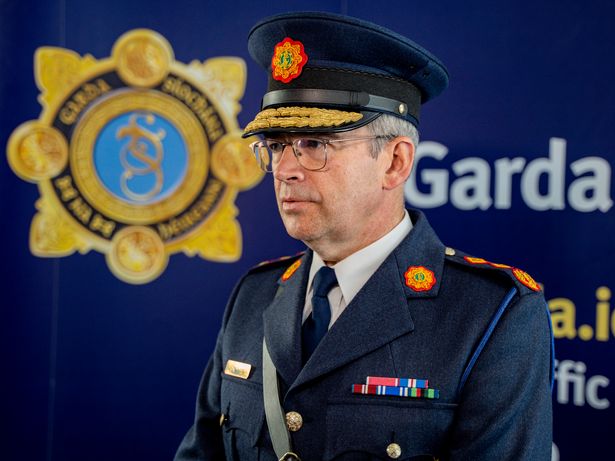
Garda Commissioner Drew Harris, former British colonial police (PSNI) Assistant Commissioner3 responded that getting tough with the far-Right would be playing into their hands and that the Garda response is measured appropriately.

One must wonder how permitting threats of violence, acts of assault and arson against refugees and their supporters can be considered appropriately measured from any viewpoint other than that of the perpetrators.

Much harder Garda responses have been seen through the years to striking workers, water-meter and housing protesters, Irish Republican events and – yes – antifascist counter-protests against fascists and other far-Rightists.

Not giving the fascists the confrontation they’re allegedly looking for might disappoint some of them but on the other hand many will be encouraged and get to feel that they can do more or less what they like without repercussions from the Gardaí.

According to Saturday’s Irish Times, some of the criticism of Garda tolerance of far-Right crimes comes from confidential sources within the force itself.

The discourse that policing these protests is ‘complex’ is a distraction from the fact that vulnerable people who are harming no-one are entitled to live without fear of violence to their person or to their meagre belongings, about which there is nothing ‘complex’ at all.

Having to live on the street due to the failings of the State is bad enough without being subjected to additional threats.

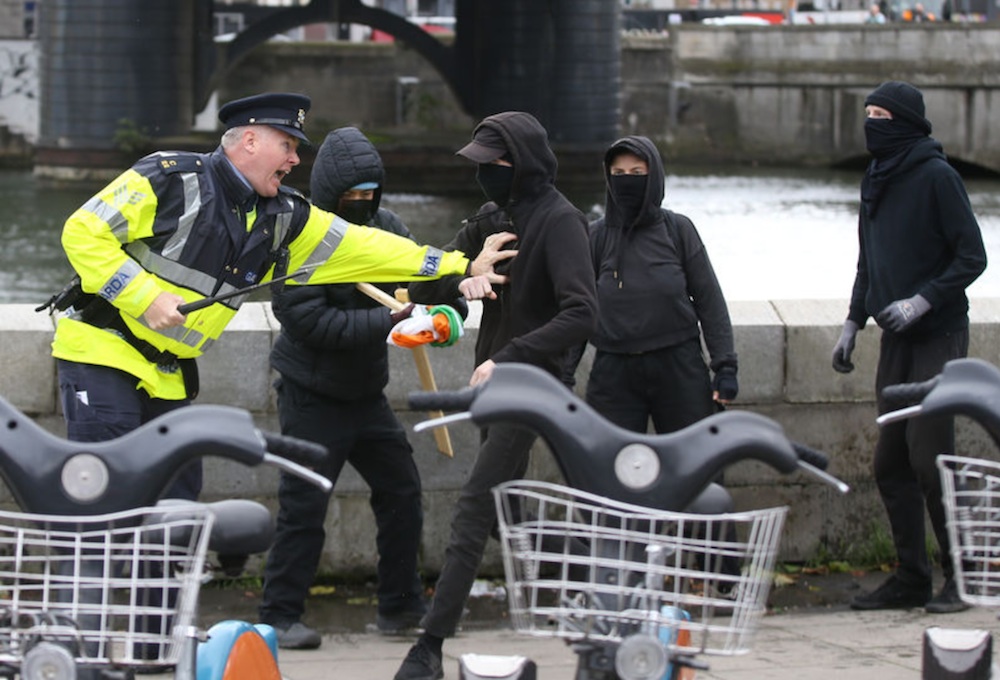
On a number of occasions Gardaí have attacked and threatened antifascists confronting the far-Right, revealing where the general sympathies of the State lie, despite condemnations of the far-Right by Government Ministers, politicians and the Garda Commissioner.

Garda not going lightly here but then it’s directed at ANTI-fascists counter-protesting Irish Yellow Vests on Custom House Quay, after they were attacked by fascists armed with metal and wooden clubs, many disguised as flags (note the captured Tricolour) 22 August 2020.(Photo: Rebel Breeze)
Garda Commissioner Drew Harris (Photo sourced: Internet)

Historically, capitalism has turned to fascism to suppress the resistance of the working class to being made to pay for crises in the system. And fascists have often enough been found within the police force themselves.

Indeed, in Ireland it was the ex-Commissioner of the police, Eoin O’Duffy, who led the fascist Blueshirts, while the religous sectarian, racist and murderous nature of the colonial police in the Six Counties is a long established fact.

The police are the first physical force agency of the State and the armed forces its second. Increasing the penalty for assaults on these means the State is anticipating an increase of assault charges in days to come, quite probably as people defend themselves from police attack.

In fact, it is well known that if the police assault people, they regularly charge their victims with assault, so that the police can explain the injuries of their victims as inflicted in ‘self-defence’ or in measures taken against a person ‘resisting arrest’.

End.

FOOTNOTES

1Sentences for assaults on gardaí to rise, Irish Times, 23 May 2023.

2https://www.irishtimes.com/crime-law/2023/05/20/why-are-gardai-so-passive-when-policing-the-far-right/

3Far right ‘not growing’ says Garda Commissioner, Conor Lally, Irish Times 23 May 2023.

SOURCES

https://www.irishtimes.com/politics/2023/05/23/maximum-sentence-for-assaulting-gardai-to-increase-under-plans-due-before-cabinet/#:~:text=The%20maximum%20sentence%20for%20assaulting,Minister%20for%20Justice%20Simon%20Harris. Irish Times, 23 May 2023.

https://www.irishtimes.com/crime-law/2023/05/20/why-are-gardai-so-passive-when-policing-the-far-right/?, Conor Lally, Irish Times, 20 May 2023.

https://www.irishtimes.com/ireland/dublin/2023/05/23/far-right-not-growing-says-garda-commissioner-as-number-of-protests-halves/

A Basque Town Remembers Its Bombing by Fascists

Diarmuid Breatnach

(Reading time: 3 mins.)

On 26 April 1937, the Basque town of Gernika was bombed during the Spanish Anti-Fascist/ Civil War on the orders of leaders of the military-fascist coup against the elected Government of the Second Spanish Republic. 

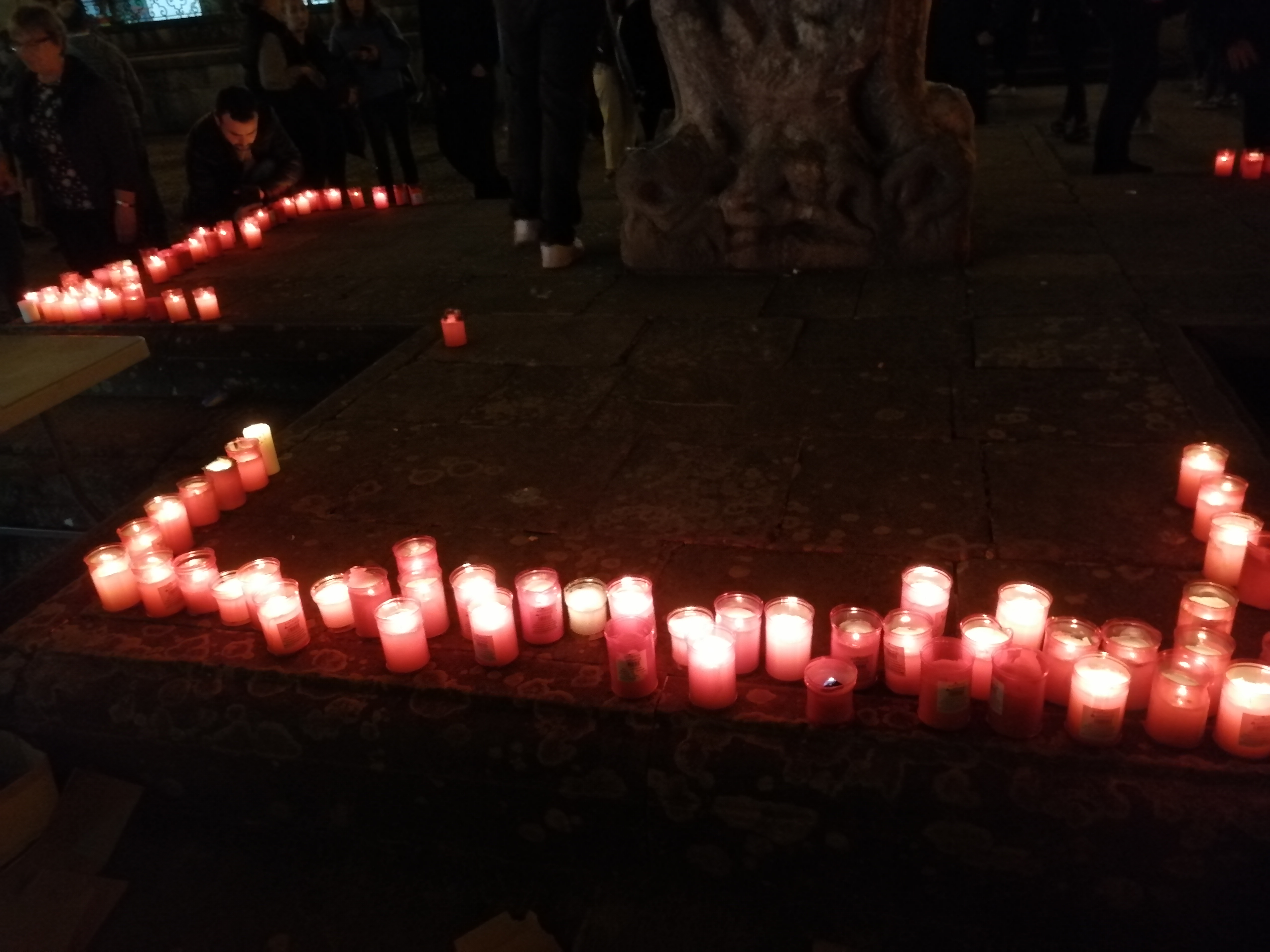
The townspeople remember this in an annual candlelit procession.

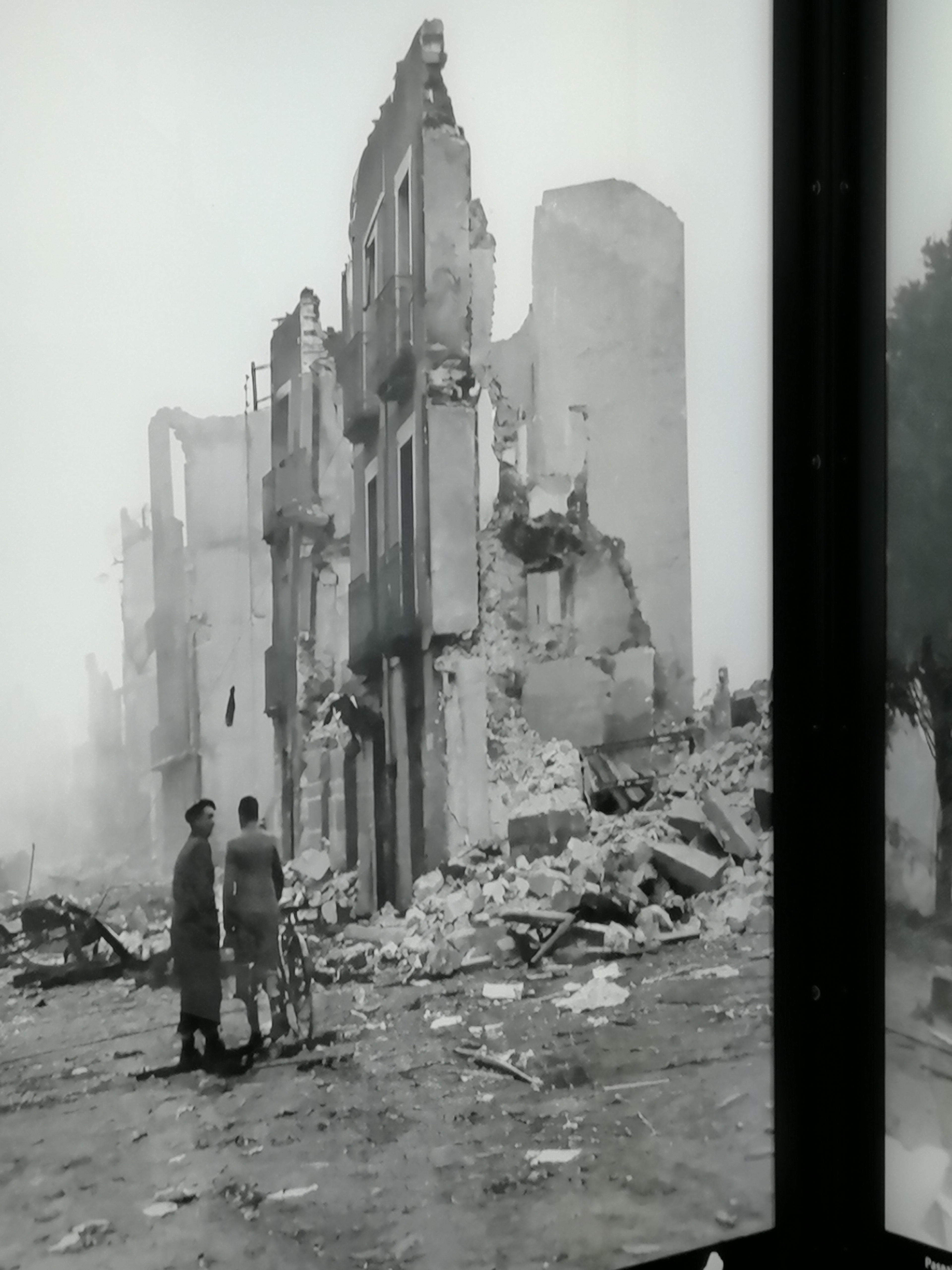
In the foreground, panels in Gernika with contemporary photos of the bombing destruction; in the background the stage in front of the Kultur Etxea (the Culture Building) with performance. (Photo: D.Breatnach)

Wikipedia gives the numbers of dead as between 150 and 1,650, a huge variance reflecting the politicisation of the historical event very much still in the present.1 The military-fascists were the victors and a four-decade fascist dictatorship ensued, never overthrown but amended in the 1980s.

Another source agrees with the higher figure and points out that a third of the town’s population then of 5,000 inhabitants, were either killed or injured.2

A tradition has grown to mark the bombing with the sounding of a siren at 4pm, the time when the bombing began. The siren sounded this year is a survivor from the Astra handgun factory of the time which strangely, was recently discovered in Catalonia and returned to the town Council.

In the evening, outdoors theatre presentations are held and the town centre is circled in procession by people carrying lit candles, led by a group carrying a giant Basque flag. I was fortunate (and honoured) to be invited by a Basque friend this year to participate in both events.

Four young women ballet dance as part of the performance. (Photo: D.Breatnach)

BOMBING AND LIES

The actual bombing was carried out by external fascist allies, the Nazi German Luftwaffe’s Condor Legion and the Fascist Italian Aviazione Legionaria, under the code-name “Operation Rügen”. It was one of theearliest cases of the mass-bombing by air planes of an urban population.3

It has remained infamous for that reason but also because the Catalan artist Pablo Picasso made a famous painting about the atrocity, though he called it by the Spanish-language name for the town: “Guernica”. Planes also carried out strafing runs over fleeing civilians, shooting them down.

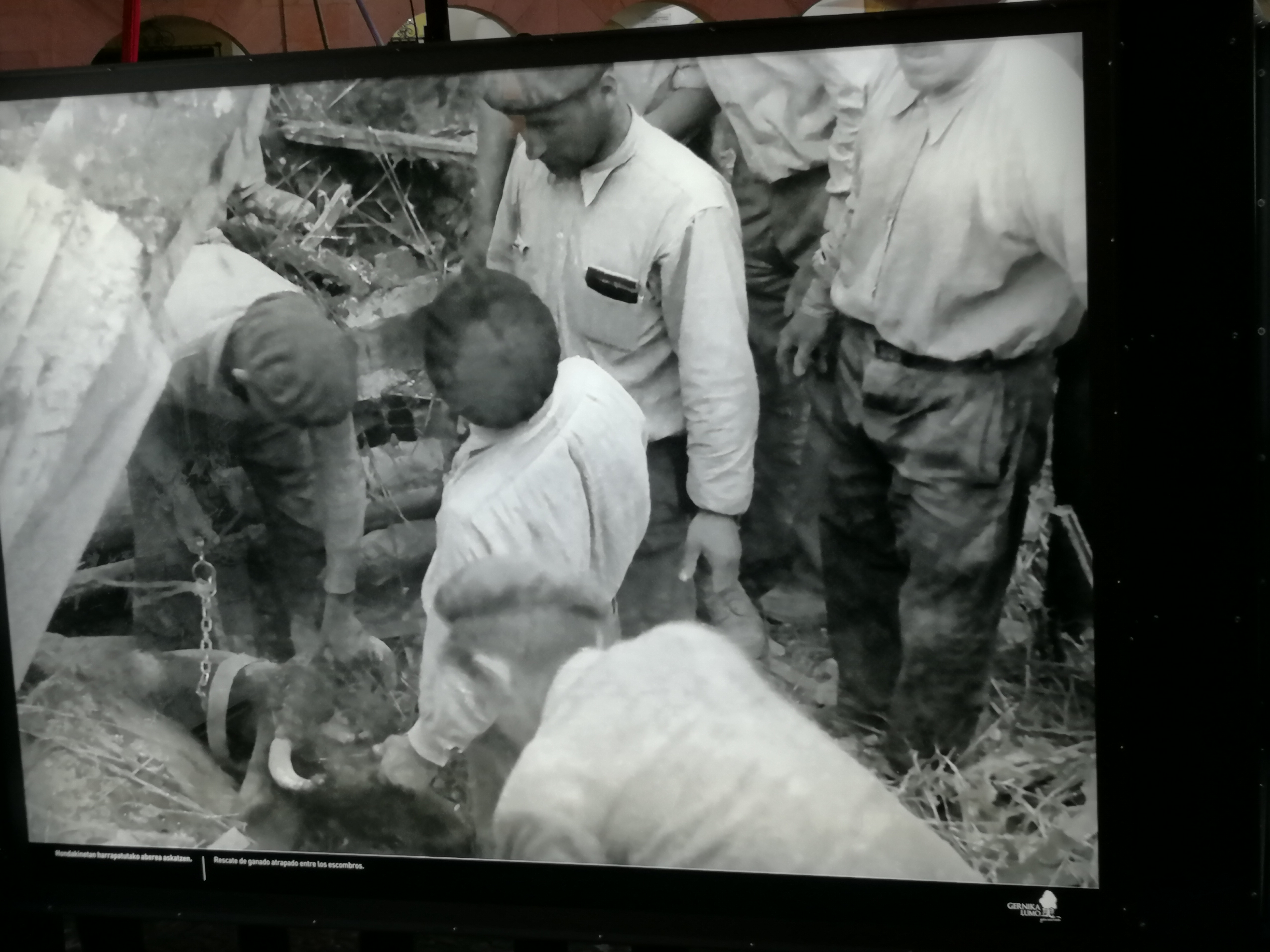
Gernika bombing panel.

As has become a regular facet of fascism, the military-fascists lied, denying culpability. In a more specific kind of fascist lying, they tried to blame the damage on arson by their opponents, i.e by antifascists. An English journalist reporting on the war for the London Times went to investigate.

He was George Steer and provided evidence from bomb fragments and eye-witnesses that the bombing was by fascist planes.

Gernika bombing panel.

Despite the known active support of the fascist countries for the military uprising, the western powers promoted ‘non-intervention’, even blockading assistance to the embattled Republic. The Soviet Union and socialist Mexico were the Republic’s only external allies.

Historians since have argued about whether there was a straightforward military rationale for the bombing or whether it was a question of terrorising the Basque people. It is undeniable that the 26th was a market day and that Gernika was of particular national historical importance to the Basques.

Gernika bombing panel.

Gernika is in the Basque province of Bizkaia, which had joined in with the Second Spanish Republic in opposition to the military-fascist coup attempt, as had Gipuzkoa and Alava provinces – the latter however was taken quite early by fascists.

The remaining Basque province inside the Spanish State (there are another three inside the French state) was Nafarroa (Navarre) where the national Carlist movement was reactionary and joined the fascists, their militias murdering around 1,000 Nafarroan Republicans and Socialists.

Gernika bombing panel.

The military-fascist uprising, supplied hugely with armaments, transport and personnel supplies overwhelmed the isolated Second Republic and all the areas that had stood by the Republic were placed under military occupation, followed by the worst repression of all.

Gernika and surrounding areas were occupied by Spanish, Italian and German troops and the whole Spanish state, after April 1939, entered four decades of dictatorship under General Franco. After a while, resistance broke out in strikes and in armed guerrilla struggle.

Gernika Bombing panel.

But to commemorate the bombing of Gernika in a broad appropriate and popular act only became possible some years after the death of Franco in 1975.

ANNUAL COMMEMORATION

In addition to the public performance of theatre, dance and music, the people bring candles or collect them let and walk in procession around the town, led by a group holding a spread giant Ikurrina (Basque flag).

Small section of the audience. (Photo: D.Breatnach)
The audience become part of the performance as they collect candles to begin the procession around the town. (Photo: D.Breatnach)
Section of the parade near the start of the procession. (Photo: D.Breatnach)
These young women stood there with lit candles at the beginning of the procession, perhaps signifying renewal. (Photo: D.Breatnach)

People in various parts of the Spanish State had been pushing for recovering historical memory, commemoration of events and disinterment of mass graves, whether secretly or in the open. In 2017 a number of groups working in historical memory got together in the Gernika Lumo area.

Their intention was to coordinate their efforts so that Gernika would become a focus for considering aspects of justice and peace, not just in the Basque Country but internationally. Among their objectives was the relocation of Picasso’s “Guernica” painting to Gernika itself.4

While the current annual commemoration then has been developing for only five years, work has been going on by constituent groups and others for years before that and, of course, the inspirational events occurred 86 years ago in what some consider the opening stages of WW2.

These commemorative events would be of great importance in any conceivable period but are more so in the current one of the rise once more of fascism across the world.

End.

Unfolding the giant Basque flag. (Photo: D.Breatnach)
Half-way around the town centre. (Photo: D.Breatnach)
A male dancer in traditional costume performs the honour dance, the ‘aurresku’, caught here in one of the high kicks that are part of the dance. (Photo: D.Breatnach)
The female dancer in traditional costume also dances the aurresku but not caught performing the high kick here. (Photo: D.Breatnach)
Some of the candles returned after the procession. (Photo: D.Breatnach)

FOOTNOTES

1“But, based on the testimony of medical personnel in Guernica on the day and in nearby hospitals that received casualties, the Basque government estimated that 1,645 people were killed and a further 889 injured in the attack.” https://www.lse.ac.uk/canada-blanch/Assets/Documents/media/media2017/27Apr17BBC.pdf

2https://www.zinnedproject.org/news/tdih/bombing-of-guernica/

3It is often quoted as the first such case but it wasn’t: On 29 March 1936, Italian Fascist planes bombed the Ethiopian city of Harar. Seeing Gernika as the first may represent a Eurocentric viewpoint. Coincidentally, journalist George Steer covered that war also.

4The painting is permanently on exhibition in Madrid, 422 km. away.

SOURCES & FURTHER READING

https://en.wikipedia.org/wiki/Bombing_of_Guernica

https://en.wikipedia.org/wiki/George_Steer

Link commemoration committee: ​​​​ https://guernicagernikara.eus/memoriaren-lekuko/gernika-lugar-de-la-memoria/

https://www.deia.eus/bizkaia/2023/03/31/gernika-perfila-actos-aniversario-bombardeo-6632888.html

FASCIST-LED MOB THREATENS MIGRANT ENCAMPMENT IN CITY CENTRE

Clive Sulish

(Reading time: mins.)

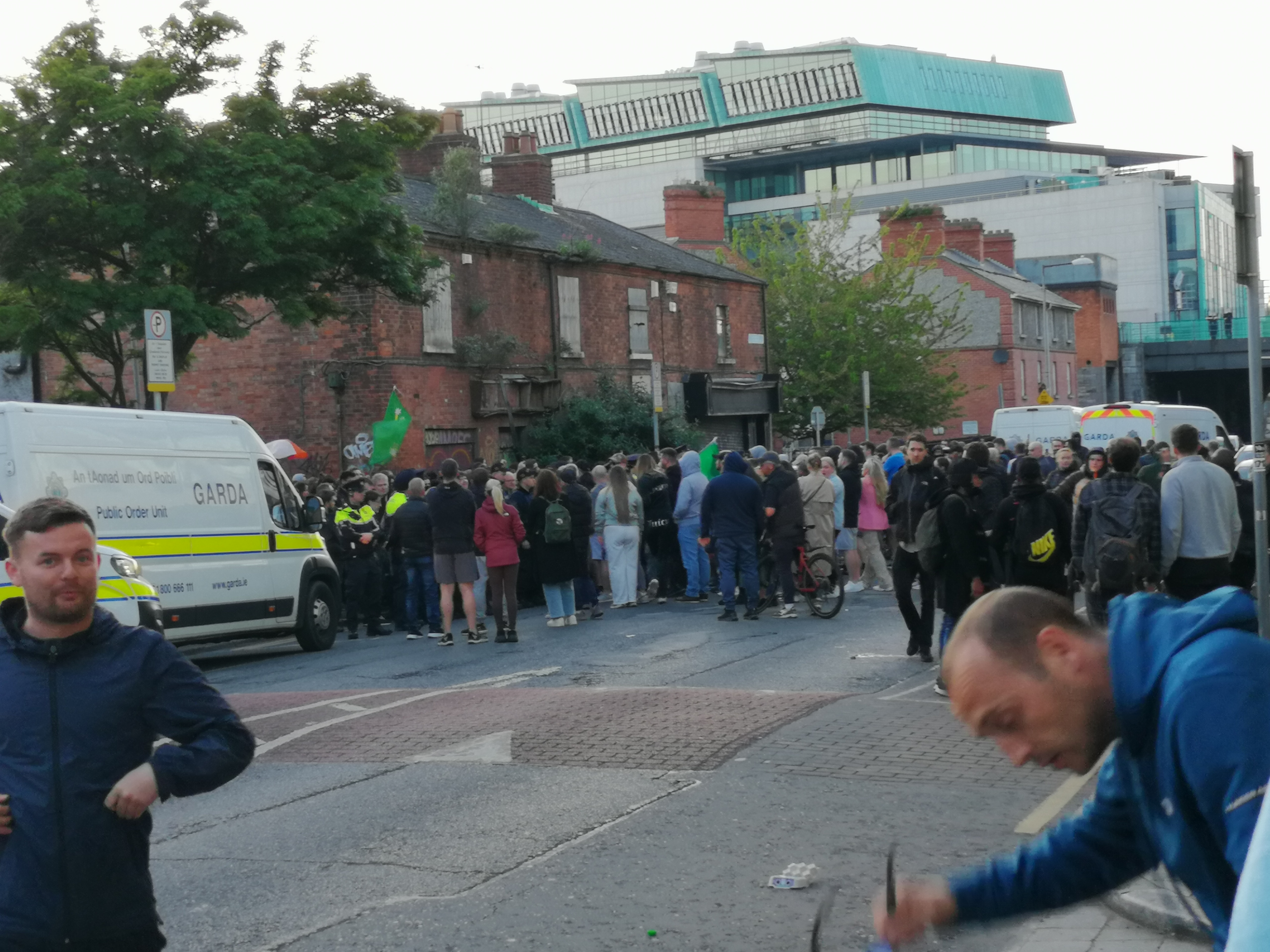
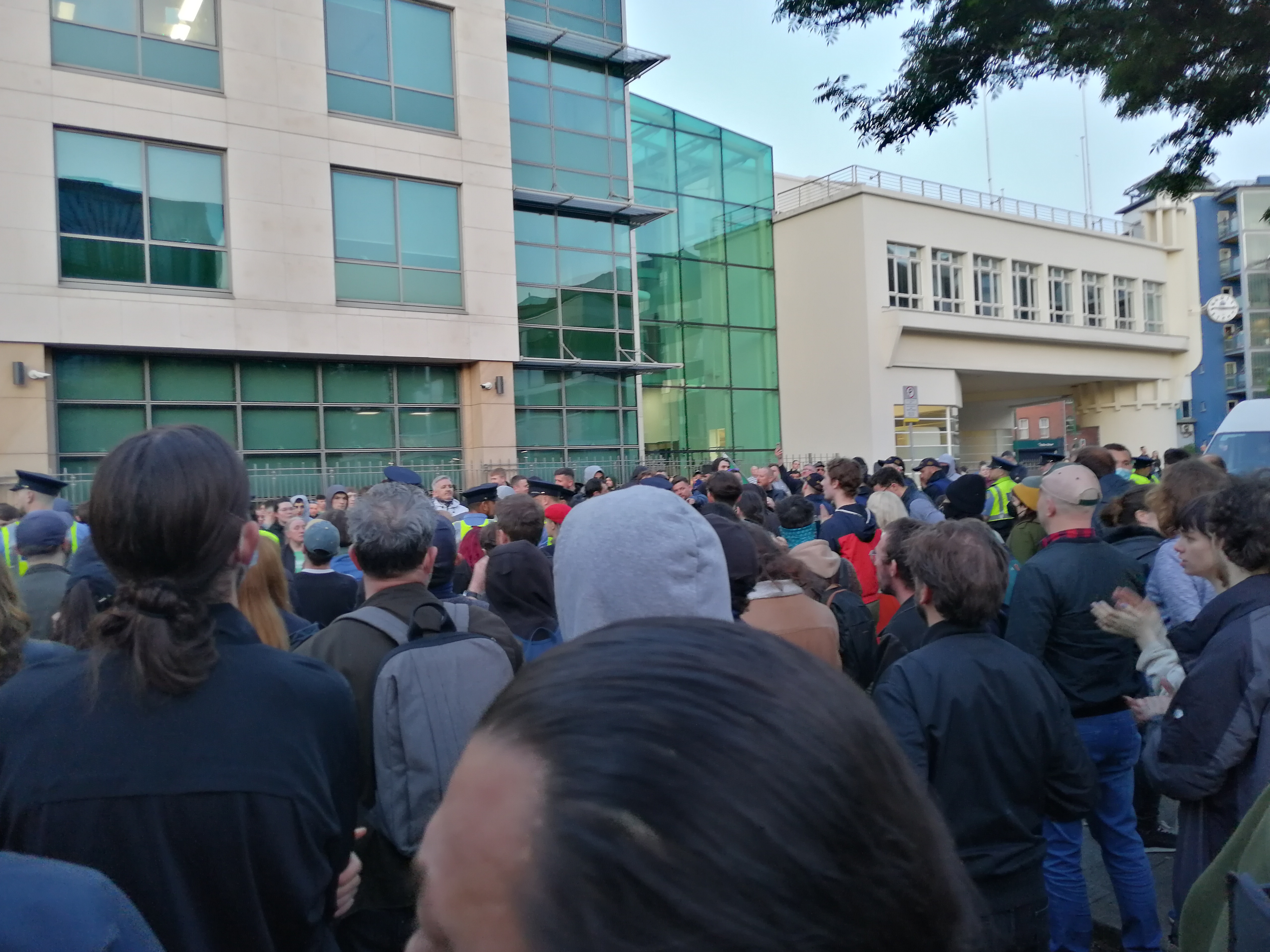
On Thursday evening fascist Phillip Dwyer and a number of other known fascists led a mob in threatening migrants encamped in the Mount Street/ Fenian Street/ Sandwith Street area on the north reaches of Dublin City Centre.

Dwyer, formerly of the fascist National Party and some of his cohorts had been there the previous night too but in smaller numbers, when he was met with opposition.

Migrants have for some time been camped out in that area near the International Protection Office of the Irish State which has a brief to help refugees. Those living in the tents say that little is being done in reality to help refugees and their encampment is an illustration of this.

On Thursday night Phillip Dwyer had brought a mob to at least intimidate the refugees but was faced off by antifascists. He had declared his intention to return.

On Friday in Sandwith Street, a number of people in ordinary clothes could be seen in confrontation with another group, with yellow-jacketed Gardaí and dark blue Public Order Unit between them. An Irish Tricolour and green Starry Plough waved on one side and a lone tricolour on the other.

The view some time after the arrival of fascists and supporting mob. The antifascists are where the green Starry Plough flag may be seen, in a short laneway and in a group in front of the lane’s mouth.
(Photo: Rebel Breeze)

Local people and some passers-by watched.

People who received a callout for antifascist support but arrived late experienced difficulty in getting into the antifascist sector, which was where the Tricolour and Starry Plough could be seen, due to the police line between there and the confronting mob.

It seemed that neither antifascists nor fascists would be permitted to get in this way. (Photo: Rebel Breeze)

For many antifascists it was a novel experience to be facing the backs of the Public Order Unit, normally drawn out against them, often with batons drawn (none of that seen on this occasion).

The dominant chanting was from the antifascist side, mostly of “Say it Loud and Say it Clear: Refugees are welcome here”, interspersed at times with “Homes for Need, not for Greed!” and another.

Section of antifascists before moving, Gardaí further away and hostile mob further still. (Photo: Rebel Breeze)

Though these slogans outline socialist positions they don’t directly address what the fascists were doing and some slogans need to be developed for that, for example pointing out that the fascists are dividing working people and assisting capitalism.

It was difficult to make out what the mob were shouting but individuals at times threw accusations of paedophilia at the migrants and antifascists. This is a common lie by fascists in Ireland and there has not been a single case among this refugee group to justify the accusation.

Section of antifascists before moving, Gardaí further away and hostile mob further still. (Photo: Rebel Breeze)
Section of antifascists before moving, viewed from short laneway mouth, Gardaí further away and hostile mob further still. The new block of expensive apartments is in the left background. (Photo: Rebel Breeze)

The refugees camped around there are actually causing nobody any harm, except perhaps embarrassment for the IPO and the Irish State. Journalists for the Cork Examiner and the Irish Times have both written sympathetic pieces about them recently (probably to the ire of Dwyer).

The area includes working-class flats complexes and higher-market-end housing, including a newly-completed block nearby where the rents are reportedly 2,000 euro a month for one-bedroom-units and 3,000 per month for two bedrooms.

And it is said that some low-rent units were promised but never delivered.

Of course, the Fascists and their followers don’t mobilise against that problem, caused by failure of the State to supply quality affordable housing units lest they compete with the property speculators, big landlords and financiers, although that would make general housing sense.

Fascists are an arm of the capitalist class, not its enemy and for their followers, it’s infinitely easier to pick on vulnerable refugees and other migrants than the rich and their State.

Antifascists kettled by Gardaí after agreement to move. (Photo: Rebel Breeze)

Some investigation carried out locally ascertained that although some local people were being fooled by the far-Right discourse, others blamed the Government. Some also said that a lot of the anti-refugee crowd were just in it for the fight and were not even locals.

However one should not underestimate the potential for fascists to mobilise disadvantaged people to split the working people as fascism and racism has done in the past.

Rear section of antifascists after kettling by Gardaí. (Photo: Rebel Breeze)

A light moment occurred when one of the mob threw a plastic water bottle at the antifascists. As the missile arced towards them, a hand rose out of the crowd and caught the bottle in the air, followed by applause, congratulatory for the catcher and derisory at the thrower.

Since the refugees had been moved earlier there seemed little reason for the anti-fascists to remain except to shout slogans at the opposition and perhaps to deny them a feeling of victory. However, they would have to leave at some point.

A couple of individuals who seemed to be in some kind of leadership role began to discuss with the police their desire for everyone to leave together. At last, to the relief of many, the crowd began to move in the direction of Pearse Street. But not for long, as they were stopped by some POU.

The antifascists were now strung out along the pavement and much more vulnerable than they had been in their previous position in the small lane entrance. Police vans moved up, ostensibly for protection but the actual result was the kettling of the antifascists for a while.

Dissatisfaction was expressed among the crowd – a lot!

The Gardaí might present it as a protective measure but in effect it was part of the kettling of the antifascists for a period after agreement to leave. (Photo: Rebel Breeze)

Eventually they began to move again, and a local elderly man wished the antifascists well and “safe home”. One of the antifascists was heard to reply: “Thank you; go raibh maith agat!”

The route was through a narrow passage under a railway bridge and on to Pearse Street, heading for Tara Street but strung out and not at all in good defensive form, with members of the mob regularly screaming hatred at them from a metre or two away.

The temptation to knock out one individual nearby who was spitting at antifascists was strong but apart from the danger of arrest, that might have sparked a general assault with the whole group exposed and badly strung out along the pavement.

It is clear that the fascist and far-right threat which was so much in evidence during the Covid Lockdown and which received a couple of important setbacks since has not disappeared and the National Party has planned a rally for Custom House Quay today.

Responses to fascist threats will need to be more widespread and probably better organised in future.

Subsequently the revolutionary Housing League issued a brief statement that they had opened up an empty building in Dublin to accommodate the displaced (again!) refugees. It was learned today that some antifascists were assaulted as their group dispersed.

Misguided people from disadvantaged working class communities the followers of the mob may be but there is no excuse for harassing and threatening vulnerable people who are living rough on the street.

End.

Anti-Fascist Event in Gernika Pays Homage to a Basque-Nicaraguan Revolutionary

Clive Sulish

(Reading time: 9 mins.)

Kontxi Arana, code name “Rita”, was a fighter of the Basque armed organisation ETA and also of the Sandinista movement. A ceremony of homage to her memory on 22nd April was also the occasion of an antifascist conference with representatives from a number of European countries.

The event took place in Gernika, the SW Basque town infamously bombed by German and Italian Nazi and Fascist squadrons during the Spanish Civil/ Ant-Fascist War, the act which inspired the Catalan painter Picasso´s famous piece on the event (which he called by its Spanish name, “Guernica” (sic)). The venue was the disused Astra factory, formerly manufacturer of handguns.

The Origins and Nature of Fascism

The day-long anti-fascist conference began with a talk on the origins and basic nature of fascism by Iñaki Gil de San Vincente, Marxist theoretician and veteran of the Basque Left Patriotic Movement from which leadership of however he has broken for a number of years.

Speaking in Castillian, he declared the essential nature of fascism to be authoritarianism, deriving from the development of the bourgeois family. The central authority figure in that family, later reproduced in other social classes including the working class is the Father, represented in capitalist society by the employer and the Church.

It is an authority to which all are required to submit: patriarchical, homophobic and intolerant of criticism or deviation.

De San Vincente spoke at length about this development and about early descriptions of fascism, for example by Clara Zetkin and Lukacs and described it as a production of capitalism and imperialism and therefore represented today most clearly in the actions of US Imperialism and the NATO over which it exercises hegemony.

The speaker also highlighted the development of NATO and its recruitment of Nazis as well as the development of its Vatican route for Nazis to leave Europe and enter Latin American countries where they would form fascist centres.

This talk was followed by a representative of Ezkerraldea Antifaxistako (Antifascist Left) who, speaking mostly in Castilian, outlined the history of the development of fascism in the Spanish state following the military-fascist uprising and the four decades of dictatorship, and how the organisation he represented responded to that.

The final speaker of the morning session was from Mugimendu Socialistako (the Socialist Movement – organisation with a large membership, according to a participant) who spoke entirely in Euskera (Basque language). Although simultaneous translation was provided into Castilian (Spanish), the volume of such was too low to be understood by many.

Morning session of the anti-fascist conference in Gernika (Photo: DRAF)

According to a participant, the content of that speaker´s contribution was similar to that of the previous speaker, although he mentioned the existence of Frente Obrero (Workers´Front), a Basque organisation which, despite its name, is a fascist organisation. The existence of that latter group appeared to be news to many present.

These talks were followed by a break and, upon resumption, there were some contributions from the floor and some responses from the panel, after which all repaired to the green outside the Astra building to where the ceremony of respect to the memory of Kontxi “Rita” Arana was to take place.

Kontxi Arana: A leading Basque liberation fighter who also joined the Sandinistas in the liberation struggle of Nicaragua

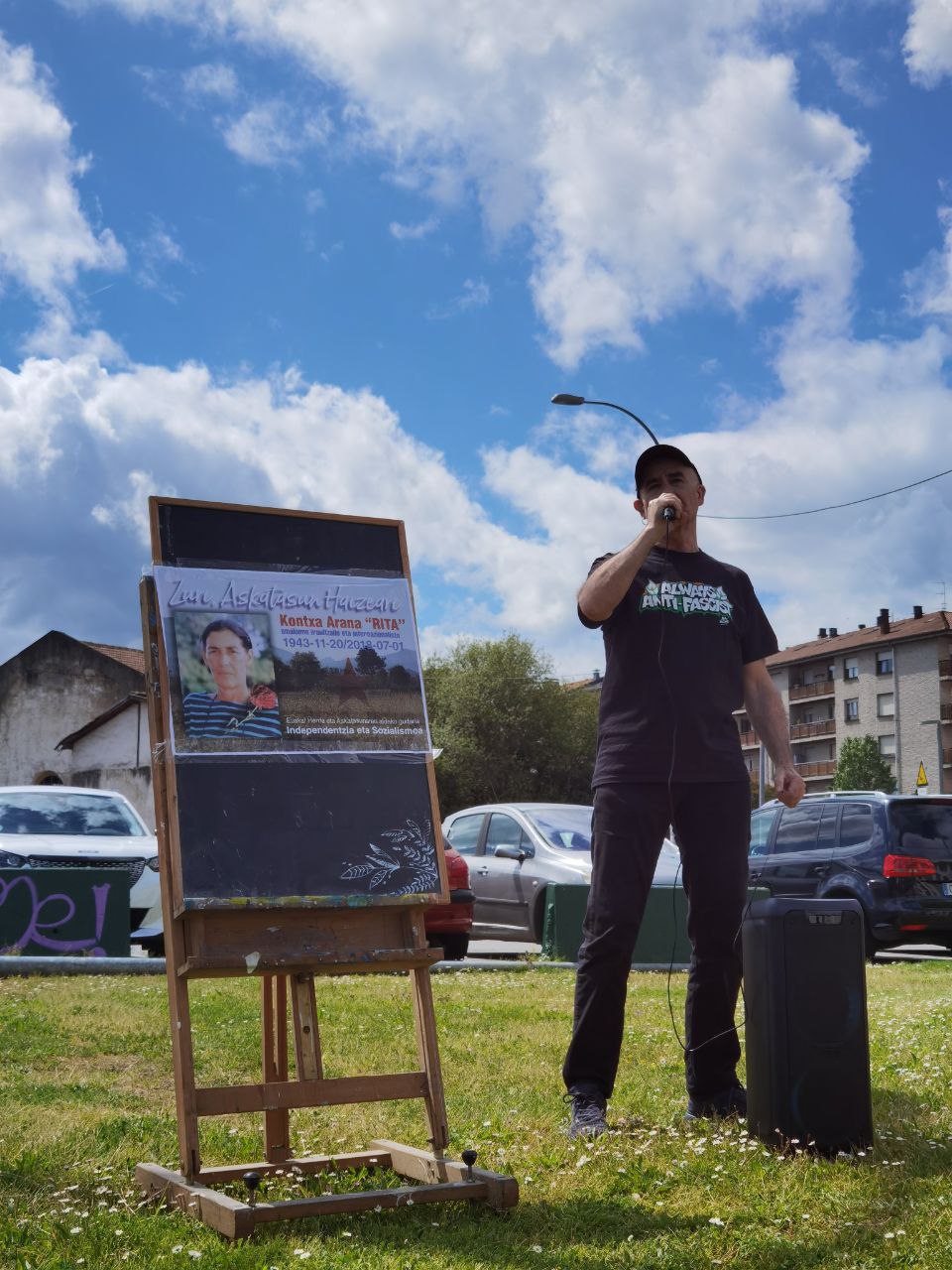
A Basque woman of the independent Patriotic Left movement blew the traditional cow or bull horn to summon attention, while the speaker in the Basque language introduced the program and speakers along with a short history of this internationalist anti-imperialist and anti-fascist fighter.

Kontxi Arana was an active member of the Basque armed liberation organisation ETA who avoided capture while on operations in the Spanish State but was arrested in the French state and exiled to an island, from which she and others escaped. Sometime later she surfaced in Nicaragua, where she had joined the Sandinista armed liberation movement.

Around the end of the 1990s, the leadership of the Basque Patriotic Left asked some exiles to return to the Basque Country to help push the pacification process and release of prisoners but the Spanish State refused to play, though they did not arrest Kontxi (however according to reports arrangements were not well organised to support her).

Most of the crowd present at the Gernika commemoration and homage to Kontxi “Rita” Arana, with the Astra building in the background and the railway line fence just visible in the left background.

The homage to her memory

A man formerly of the official patriotic Left movement spoke in Spanish about the need for internationalist solidarity, through which however mistakes can be made (e.g. in supporting corrupt leadership) which however does not alter the importance of such solidarity, without which the revolution cannot advance.

This was followed by a man from Dublin Republicans Against Fascism who briefy explained in Castilian (Spanish) the history behind Christy Moore´s “Viva La Quince Brigada“, which the Dubliner then sang in its original English.

Dublin Republicans Against Fascism representative singing Christy Moore’s Viva La Quinze Brigada.

The homage event concluded with red carnations being laid by members of the audience in front of a portrait of Kontxi “Rita” Arana. Two ex-political prisoners played the ´txistu´ (Basque three-hole flute), one of them also beating a rhythm on a small drum (´tamborina´). A young woman stepped forward and danced the ´aurresku´, a traditional honour dance.

Crowd queuing to lay red carnations in front of a portrait of Kontxi Arana

This dance was traditionally danced by a male, then by male dancers, then by male and female dancers until today, when it may be performed by any of those combinations or by a lone female, as in this case, and often enough in ordinary clothing as was the case on this occasion, though she did wear dancing shoes laced to the ankles.

The young woman performing the honour Aurresku dance in one of the high kicks of the dance with, to the far right, the ex-political prisoner txistulari (players of the Basque flute). In the immediate background, participants and organisers. (Photo: DRAF)

The musicians then played the air of The Internationale, which most could be heard singing in Euskera, followed by Eusko Gudariak (“Basque Soldiers”), the Basque national resistance song, similar to the Soldiers’ Song/ Amhrán na bhFiann of Ireland in content. Many had raised clenched fists as the songs were sung.

Suddenly, a wild high-pitched yodelling cry rang out from a female throat, the Irrintzi, traditional Basque battle-cry which probably echoed around the mountains in olden days.

All the audience then repaired to the Astra building where a hot meal was served to all on long tables with a bottle of wine to share among each group of several people (those present had purchased tickets to the event either in advance or upon attendance).

Afternoon session: Presentations from Turkish, Irish and Catalan antifascists.

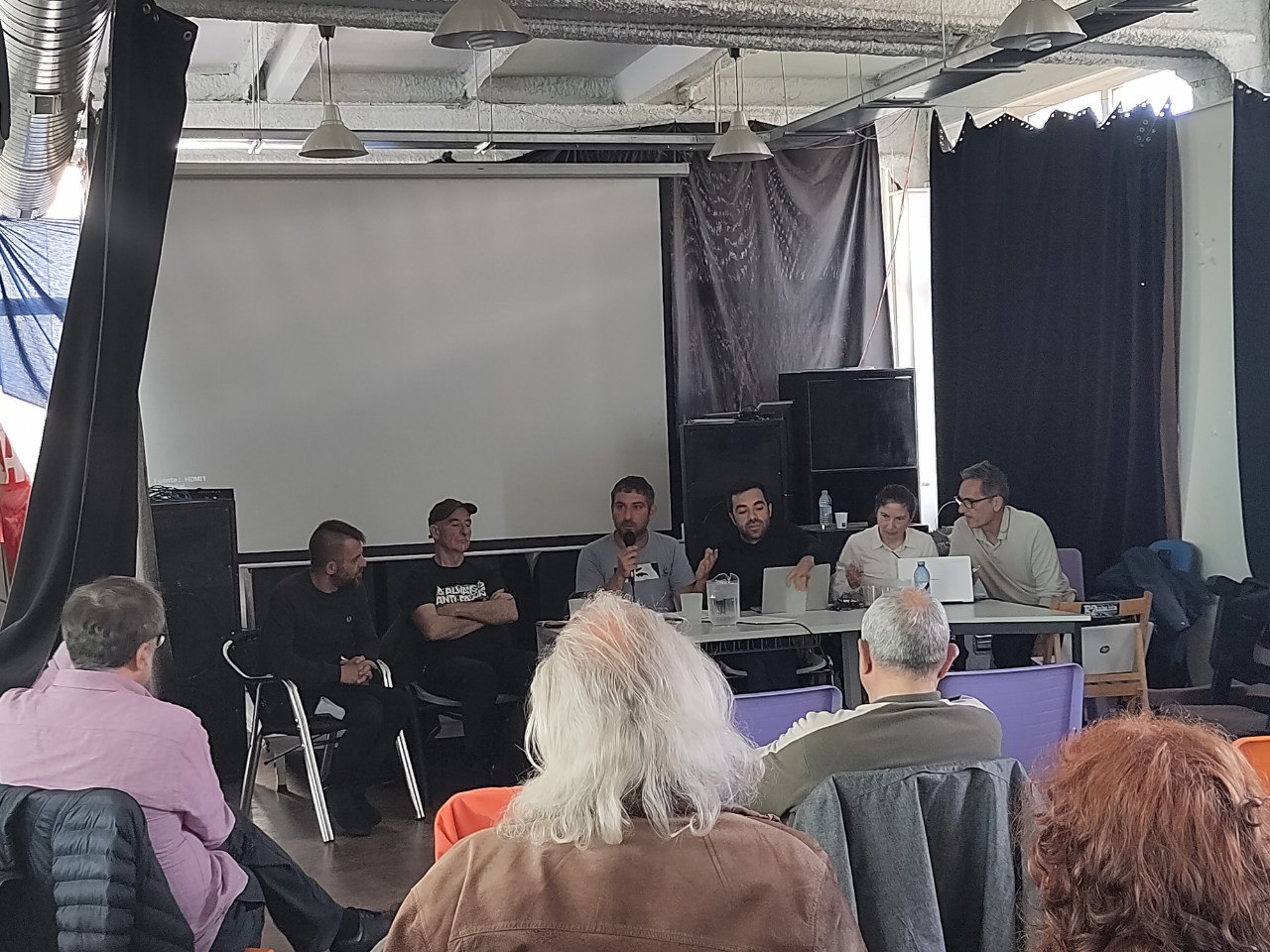
The afternoon session started a little late as people straggled in. The chairperson, speaking in Euskera, introduced the theme of the session which was for antifascists from Turkey, Ireland and Catalonia to describe the situation with regard to fascism in their countries and how it was being confronted.

Turkey

Two people from the Turkish-based revolutionary organisation Anti-Imperialist Front presented their contribution while using a video of images, some subtitled in Castilian but where not, spoken by the woman in English while her comrade translated simultaneously into Castilian.

Overall, the presentation was about the development of state fascism in Turkey and the failed military coup of 2016. The DHKP/C organisation had resisted this on the streets but a major struggle with the Erdogan government took place in trials and in the jails.

Through hunger strikes and physical resistance in the jails, hundreds of martyrs had lost their lives, said the speaker but had remained undefeated. Also martyred had been members of the Group Yorum music group which has played revolutionary songs heard by millions.

Another struggle was carried out through public hunger strikes by elderly relatives seeking the uncovering of mass graves in the bodies of fighters, their sons, had been thrown by the Turkish military.

As a result two mass graves had been eventually disinterred, permitting the remains of fighters of the DHKP/C and of the PKK (Kurdish patriotic socialist organisation) to be returned to their families for respectful re-burial.

The Turkish speakers concluded by stating the necessity for anti-fascism to be anti-imperialist and calling for internationalist solidarity and victory to peoples’ struggles.

Section of audience at afternoon session of the anti-fascist conference in Gernika, Basque Country.

Ireland

The next speaker was from Dublin Republicans Against Fascism, explaining that eight centuries of occupation of his country by England has ensured that the dominant struggle had been one of national liberation and that all armed struggles since 1798 had been led by Republicans of various kinds: 1801, 1848, 1867, 1882 and 1916.

The Irish State that came into being after the War of Independence in 1921 had been a client of the UK, conceding over one-fifth of its national territory as a direct colony. The armed forces of the State had formally executed over 80 of the IRA and instituted a wave of repression including kidnappings, torture, murders including of prisoners.

In keeping with the rise of fascism across 1930s Europe, Ireland saw the Blueshirt movement, led by former police chief Eoin O’Duffy. The Republican movement and socialists fought these on the streets, the speaker said.

The Dubliner recounted briefly the history of Irish Republicans and socialists going to fight Franco in the Spanish state and the Irish diaspora fighting the British fascists, the Blackshirts, in British cities and in defence of Eastern European Jews in famous Battle of Capel Street in the East End of London against over 7,000 police.

He went on to recount some more recent successful physical attacks by joint Republican groups against fascist organisations, the Pegida group in 2016 and even more recently the National Party. Recently too, Republican ex-prisoners had released a video stating the opposition of Republicanism to fascism with a growing list of signatures.

In conclusion, the speaker said that Ireland’s history made it difficult for fascism to advance in Ireland (except in the Loyalist areas) but as long as capitalism exists so too does the danger of fascism, particularly if the progressive forces do not fight effectively against the attacks of Capital on working people.

Catalonia

The representative of the Anti-Repression Platform of Catalonia, speaking in Castilian (Spanish), explained their organisation had come into existence after the repression of the Independence Referendum in 2017 and the subsequent frame-ups and allegations of terrorism against the Committees for the Defence of the Republic.

The speaker alluded to the jailing of the revolutionary socialist rapper Pablo Hasel and comrades who were charged with terrorism merely for expressing and organising solidarity for those being repressed.

“Don’t try to frighten us with threats of a fascist party getting into government”, he said in a reference to the growth of the Spanish fascist party Vox, because we have had a fascist government in the Spanish state since 1939!” (The year that the military-fascist forces defeated the Second Republic and founded four decades of dictatorship).

The Catalan went on to denounce the social-democratic party PSOE (currently in coalition government with Podemos Unitas), pointing out that it has had more political prisoners in jail and fatal victims than any other party in Spanish government (he was probably including the sponsoring the GAL terrorists of the 1980s).

“There has not been a year in which there were no political prisoners in the Spanish state”, he went on to say but also denounced the current Catalan Government, led by the allegedly pro-independence and leftist ERC party and its repression of socialists and independence activists.

He pointed out that fascists would make no distinction between communists and anarchists and asked “so then why should we?” He declared that all who resist repression now, regardless of before, are welcome to take part in their organisation.

The panel at the afternoon session: from left to right: speakers from Catalonia and Ireland, Basque chairperson, Turkish speakers and translator.

Prisoners on hunger-strike

The chairperson of the panel thanked the speakers and drew together elements from each of their presentations.

He went on to announce the declared intention of a small group of Basque political prisoners to embark on a hunger strike and to outline solidarity events being organised. The prisoners concerned are in the non-compliance minority of Basque political prisoners with a regime that forbids them referring to themselves as political prisoners.

The prison authorities intended to make the prisoners share a cell with other political prisoners who are however in compliance, intending to undermine the resistance of the small group and also posing the danger of conflicts within the cell. (A few days later news came that the hunger-striking prisoners had won their demands).

Amnistia organisation solidarity poster announcing forthcoming hunger-strike of political prisoners, now over because they won their demand.

Summary

The conference in its organisation and content of contributions drew anti-fascism together with imperialism and internationalist solidarity, all from an anti-capitalist perspective. It also drew connections between solidarity with political prisoners and resistance to repression.

All of the Basque organisations represented are in opposition to the trajectory of the leadership of what had been the Basque Left Patriotic movement, now represented by the EH Bildu party led by Otegi (with daily newspaper GARA, its trade union organisation LAB) and many of the older people were ex-supporters of that leadership.

That included some prominent ones such as Inaki Gil de San Vincente and the speakers and organisers of the conference and of the homage to the memory of Kontxi “Rita” Arana. The younger participants might have included ex-members or had come into political consciousness in opposition to that leadership.

Taken together, they are what many call ‘dissidents’ though some reject that term, saying that they are in fact sticking to the original line of independence and socialism and that it is the official leadership and their followers who have deviated. Their numbers are comparatively small at the moment but they are growing.

end.

USEFUL LINKS

Speaking at the Conference:

Boltxe: https://www.boltxe.eus/

Inaki Gil de San Vincente:

Socialist Movement (Socialist Councils) of the Basque Country: LANGILE KAZETA (gedar.eus)

Antifascist Left: Ezkerraldea Antifaxistasta
https://www.facebook.com/profile.php?id=100069359823294

???

Anti-Imperialist Front (Turkey): https://anti-imperialistfront.org/

Dublin Republicans Against Fascism: https://www.facebook.com/profile.php?id=100067893558778

Anti-Repression Platform of Barcelona: https://twitter.com/antirepreBCN
Plataforma Antirepressiva de Barcelona | Barcelona | Facebook

More to come later

Others in Ireland:

Dublin Basque Solidarity Committee: https://www.facebook.com/dublinbasque

Anti-Fascist Action: https://www.facebook.com/afaireland/

Republicans Against Fascism: https://www.facebook.com/profile.php?id=100090617432158

There are also other local antifascist groups and organisations that include antifascist activity in their programs

FOR A SOCIALIST REPUBLIC, AGAINST THE FREE STATE, ENGLAND AND NATO

Diarmuid Breatnach

(Reading time main text: 6 mins.)

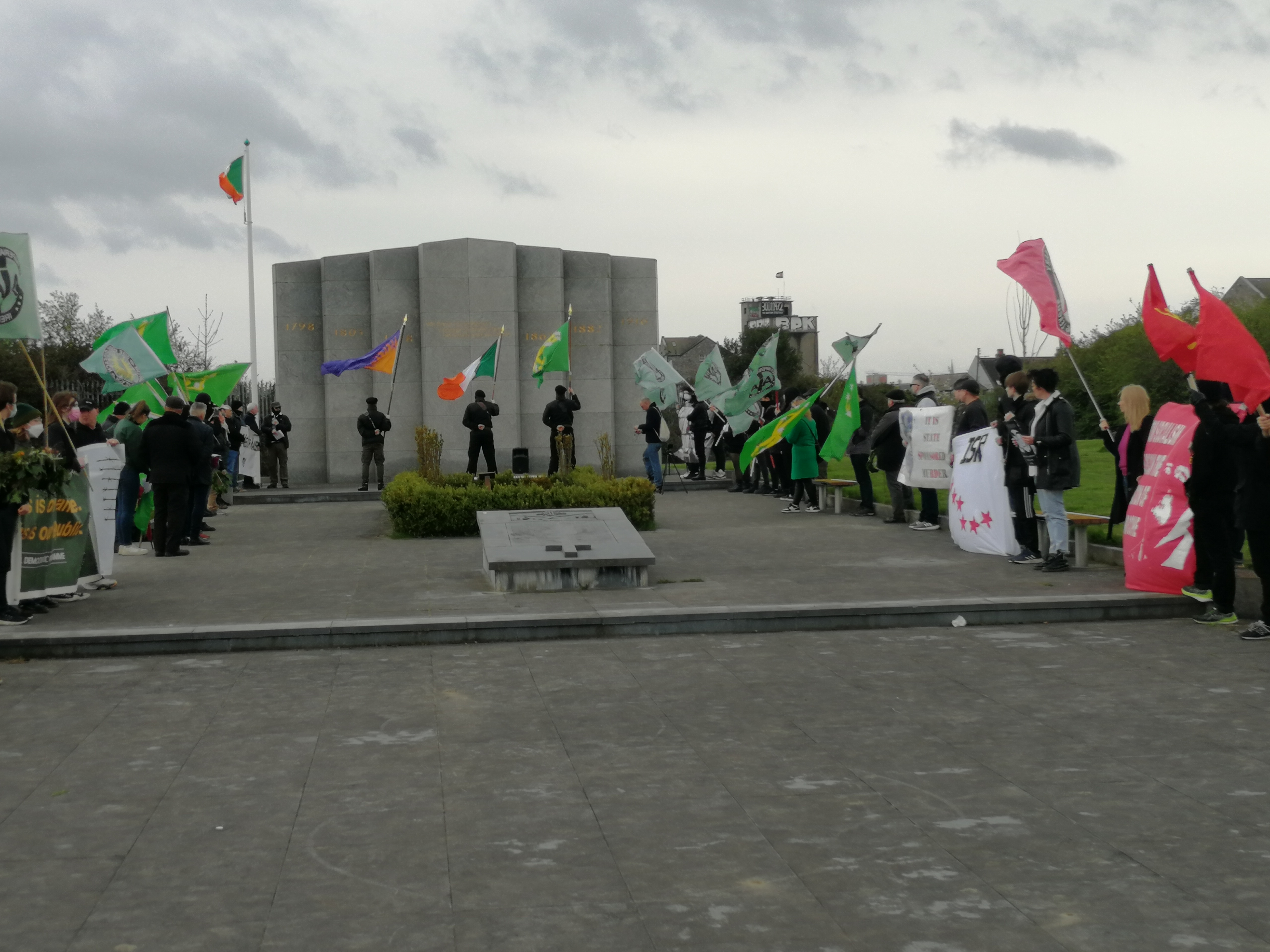
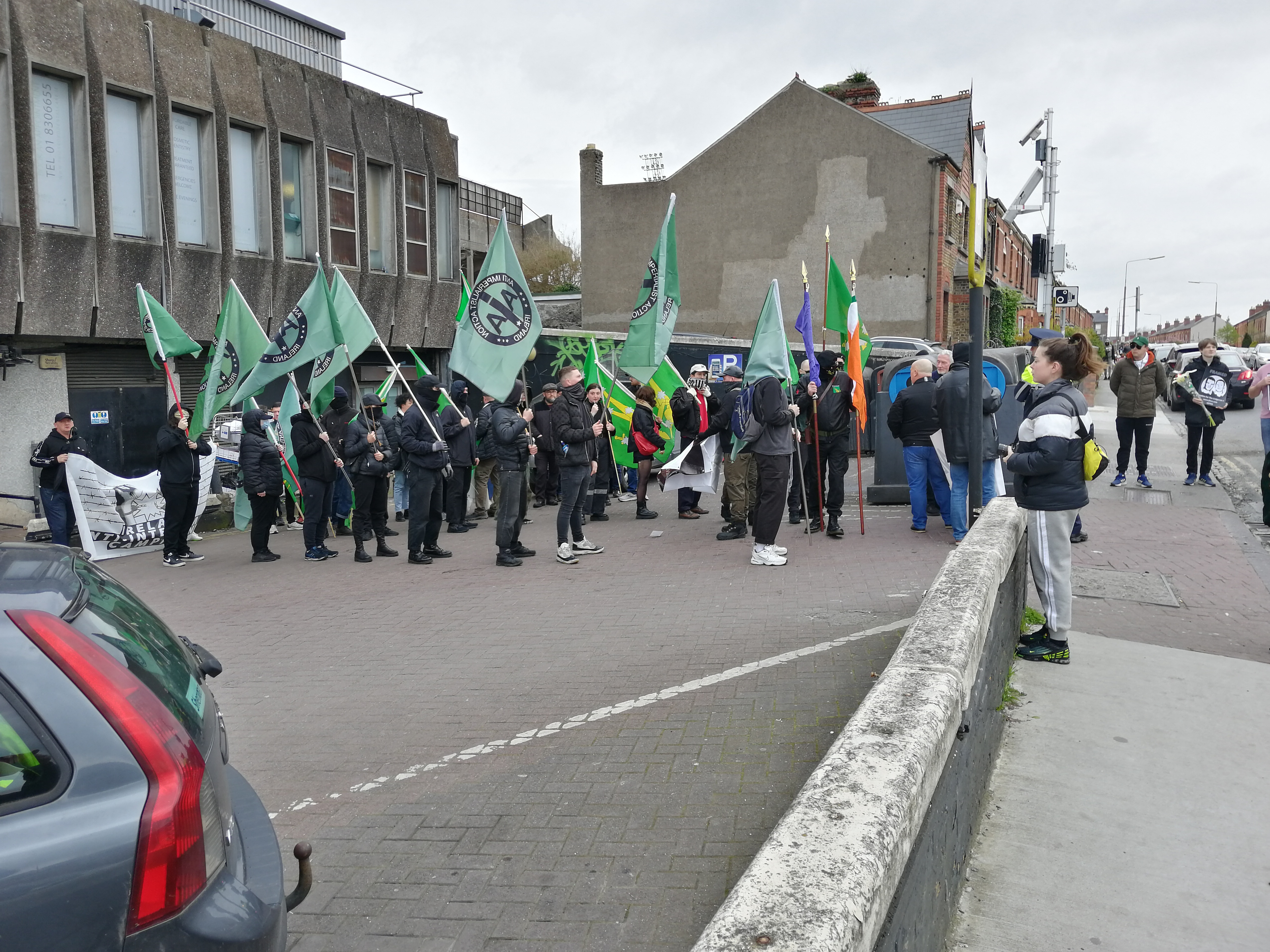
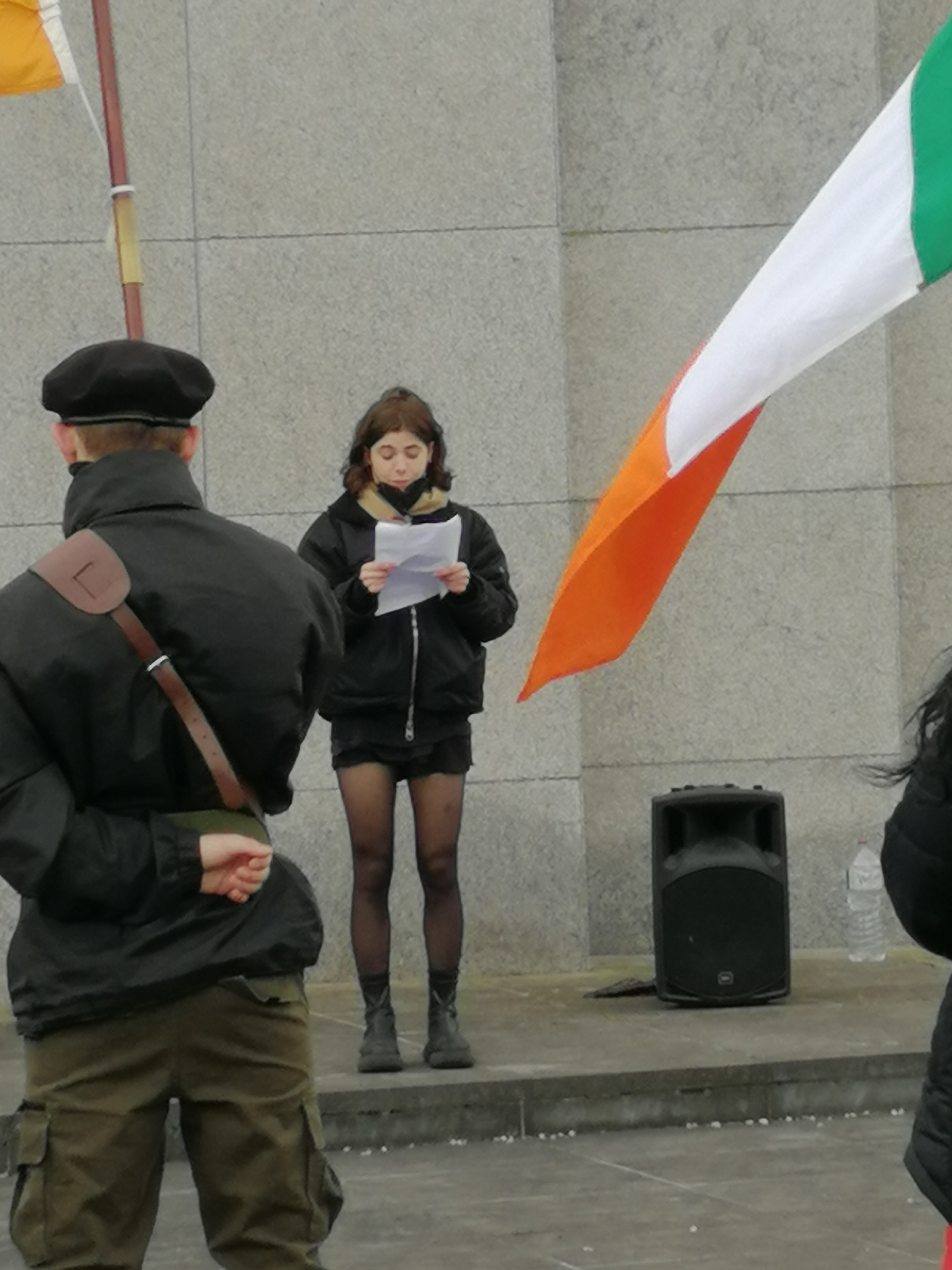
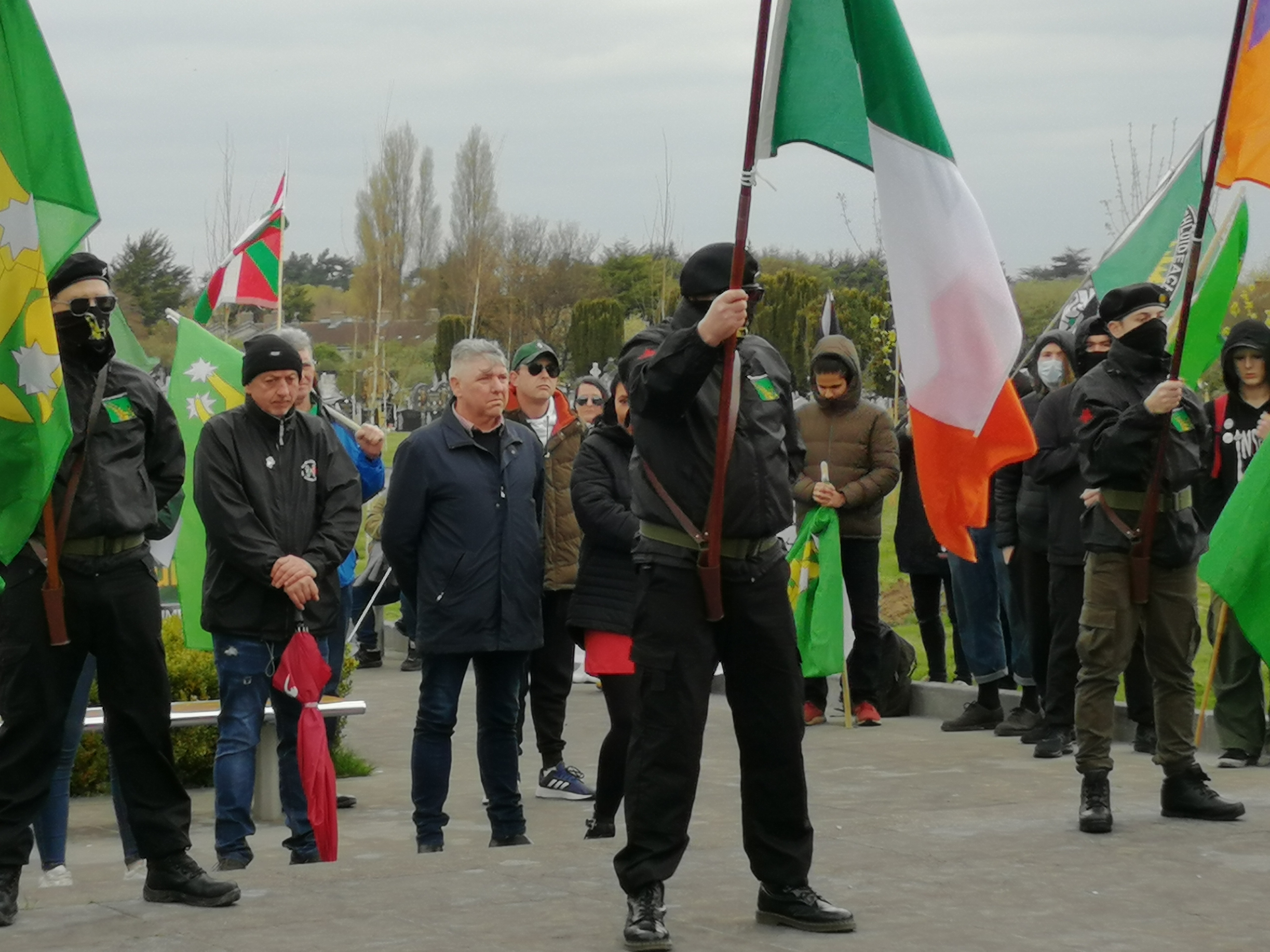
On Sunday participants in a 1916 Rising Commemoration organised by the Irish organisation Anti-Imperialist Action were harassed by police as they gathered to march to the Irish Citizen Army Republican plot in Glasnevin Cemetery.

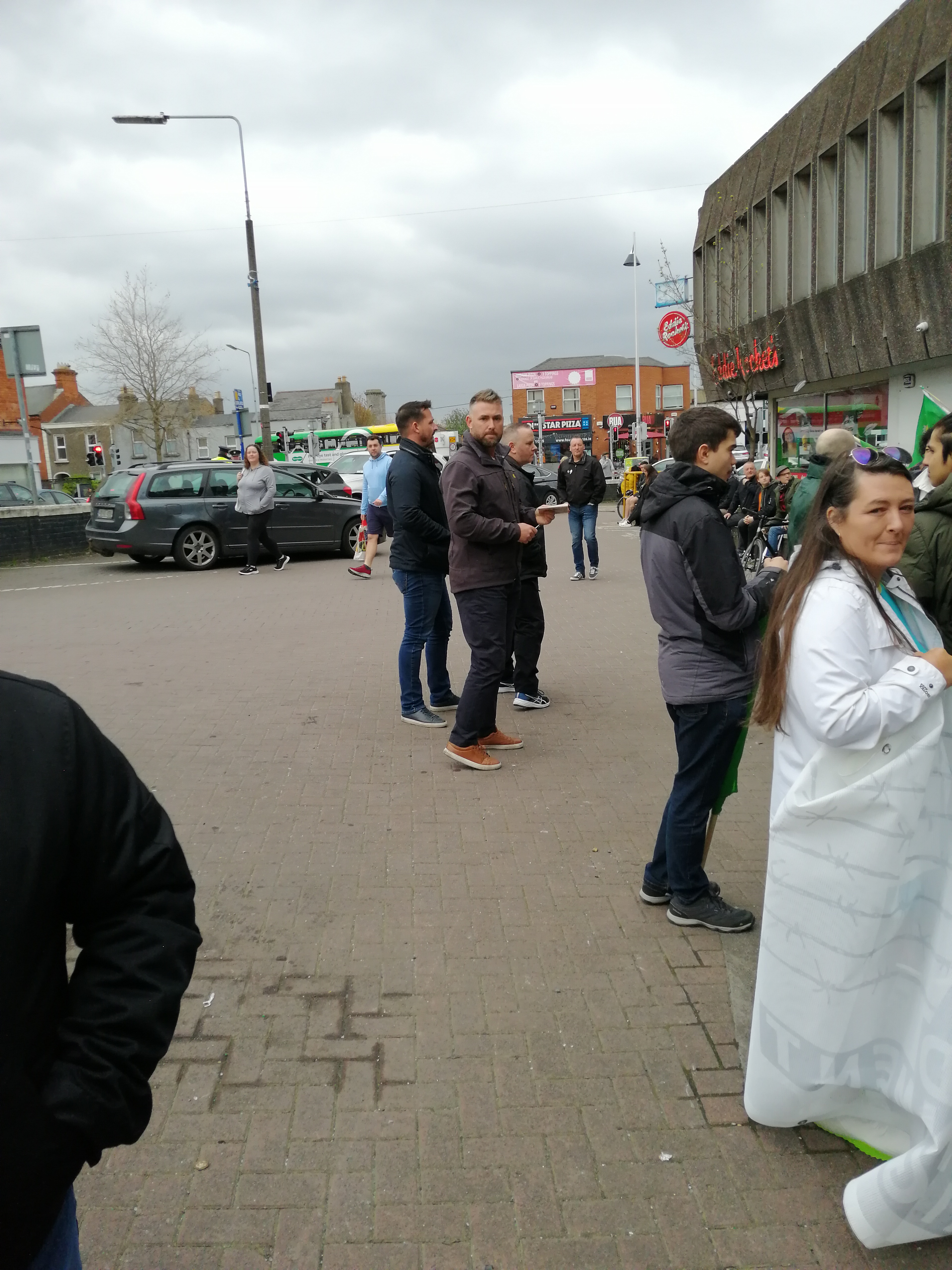
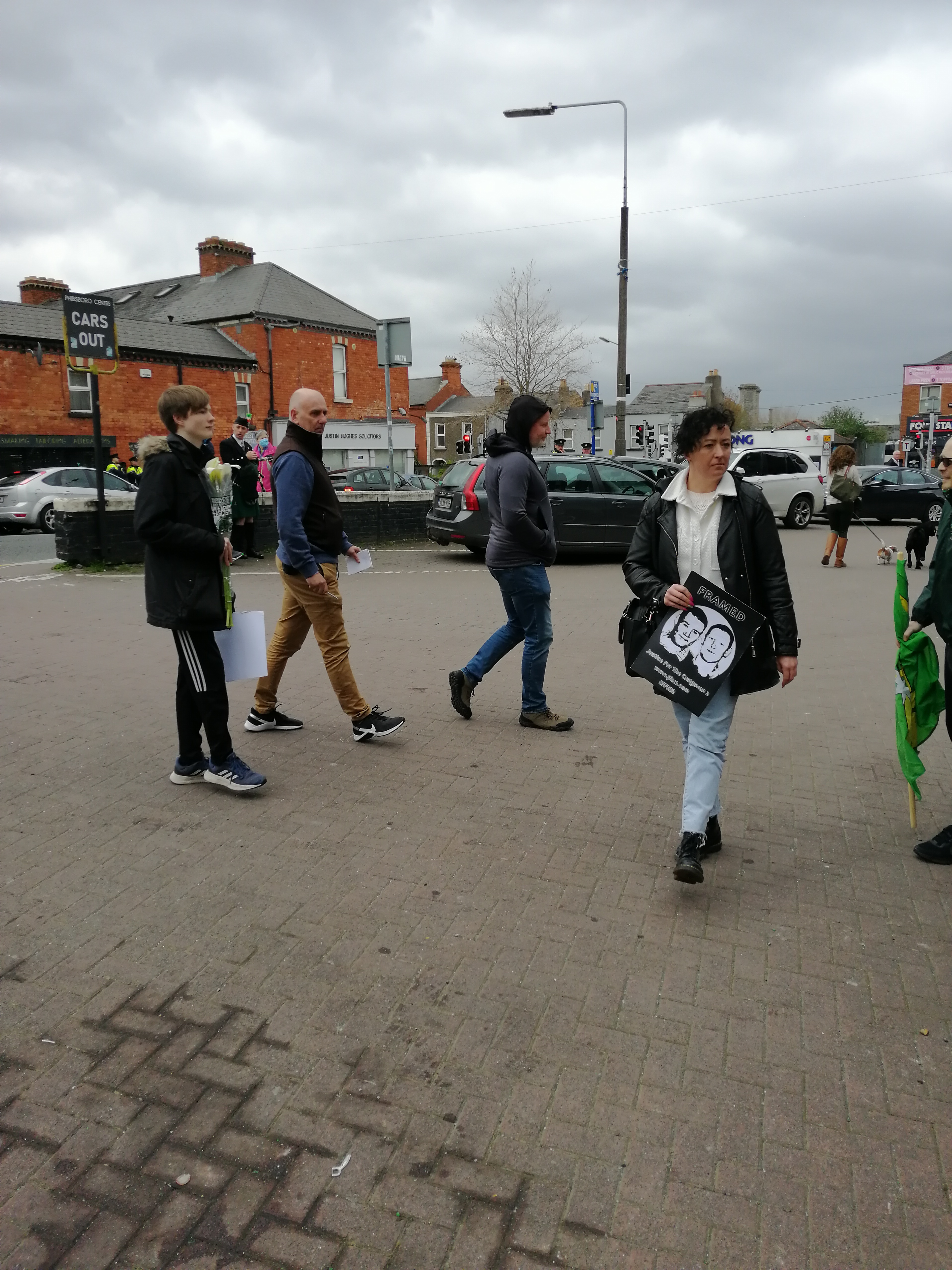
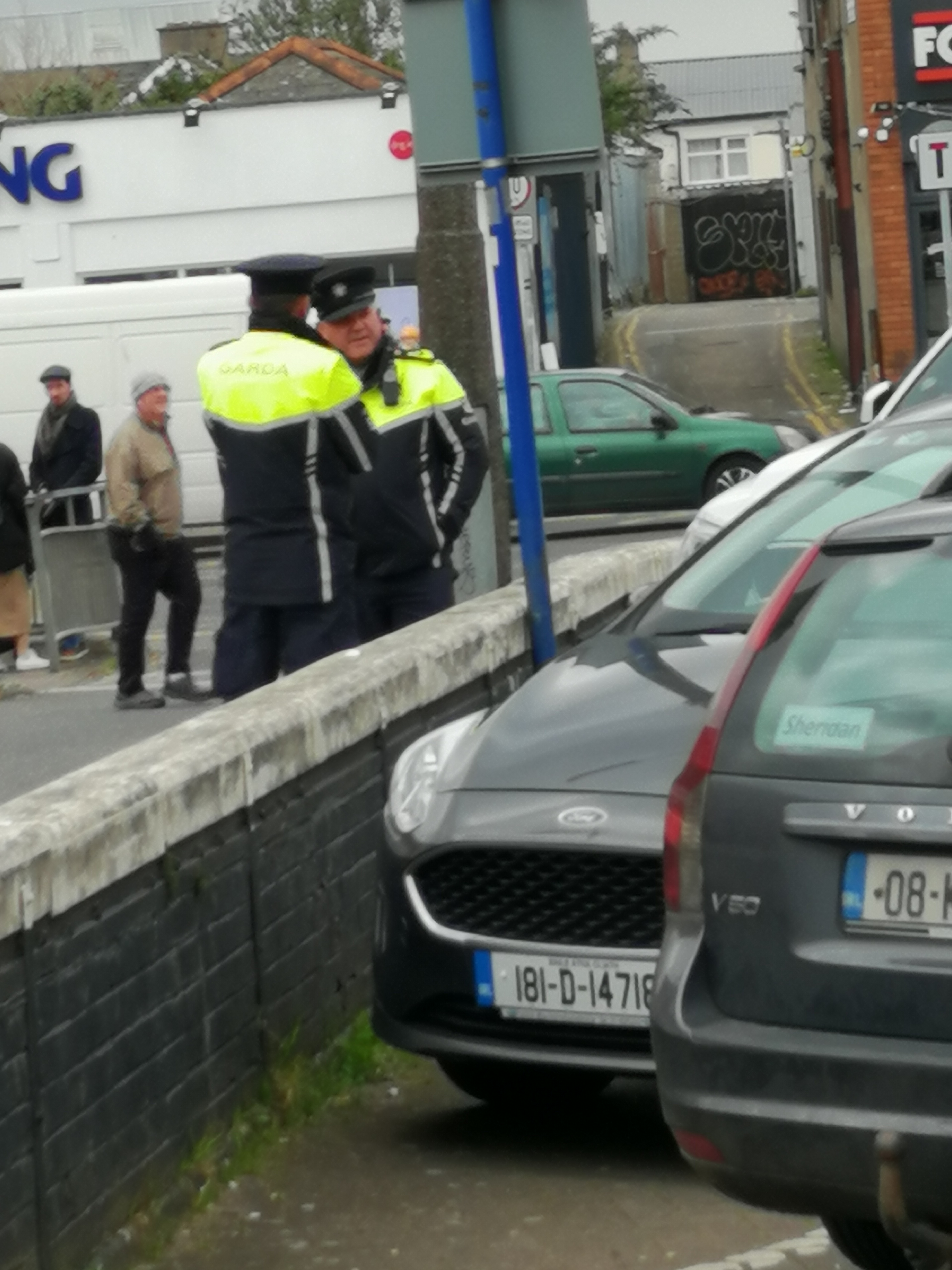
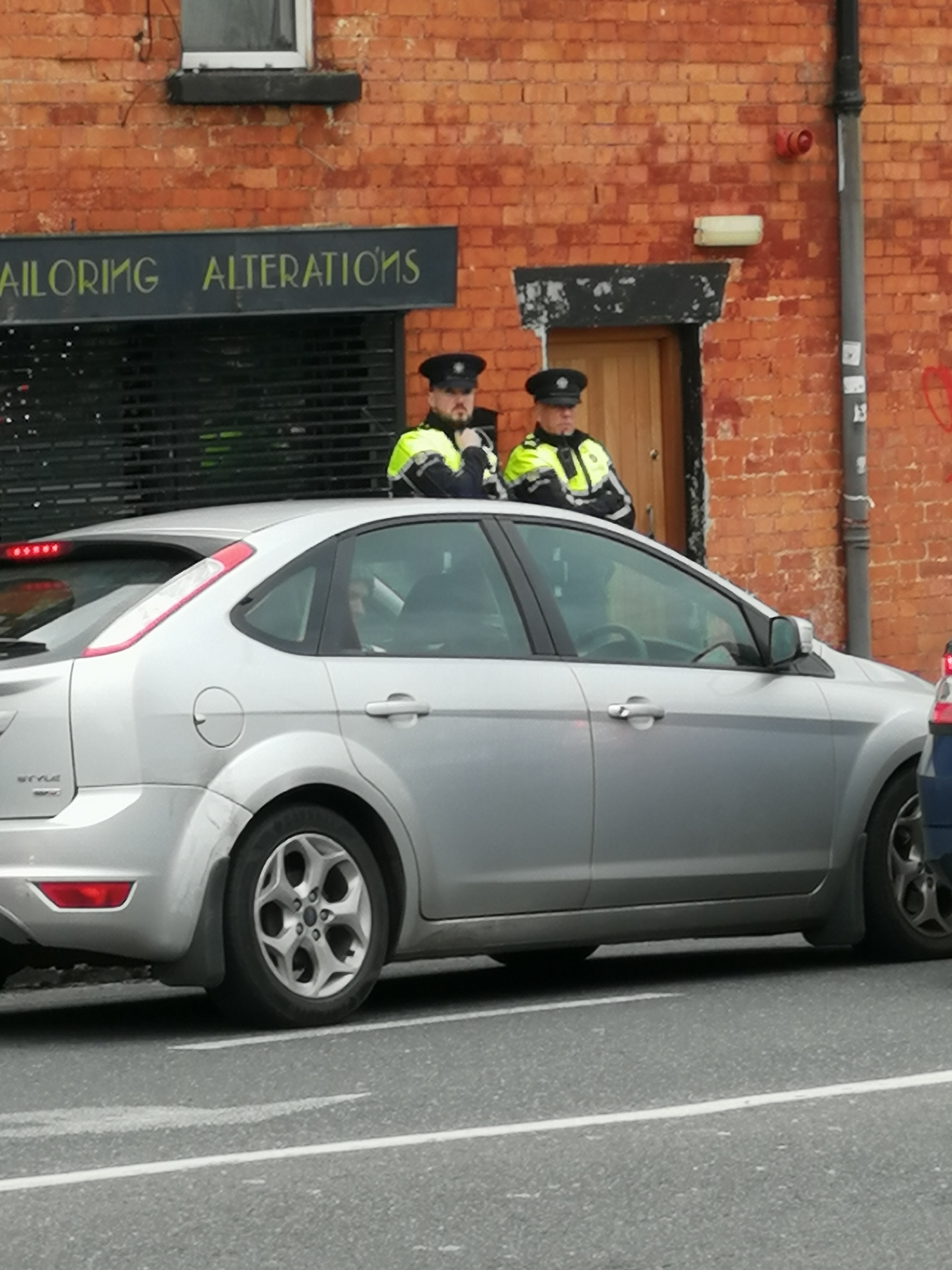
Six political police in plain clothes walked among those gathered beside Phibsborough shops demanding names and addresses of the participants, most of whom were fairly young. Four uniformed Gardaí also stood nearby and a Public Order Unit van parked at the cemetery entrance.

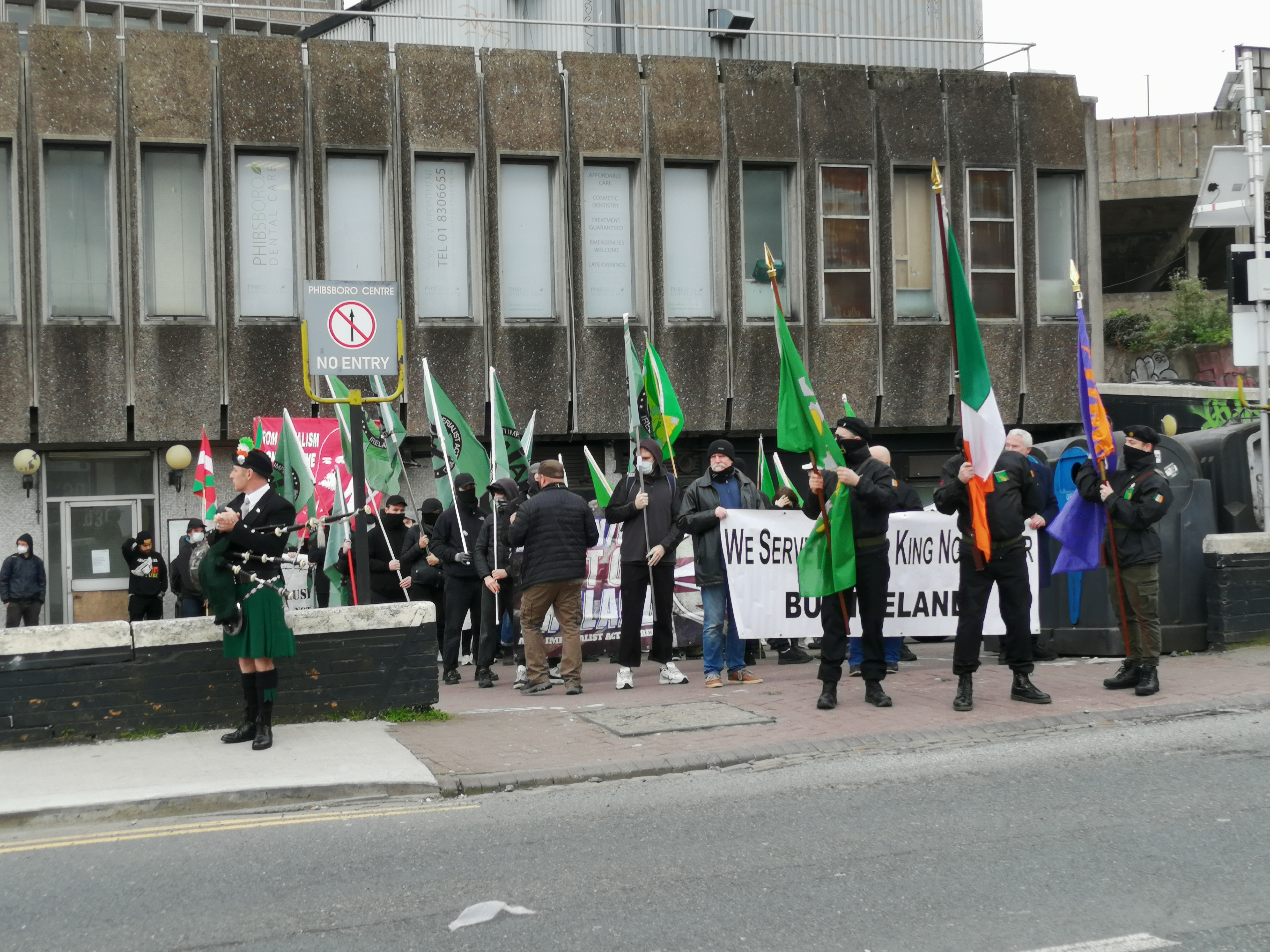
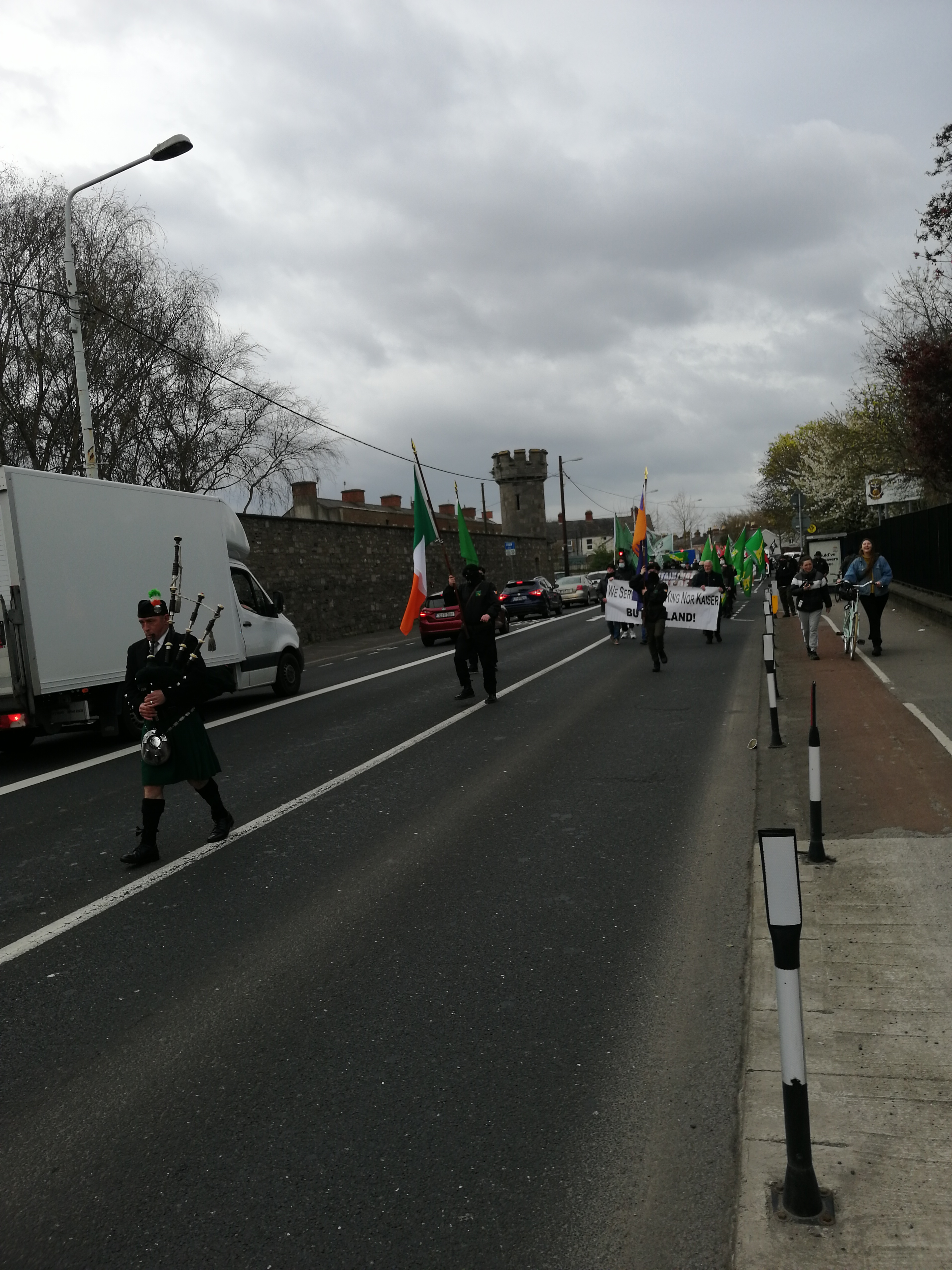
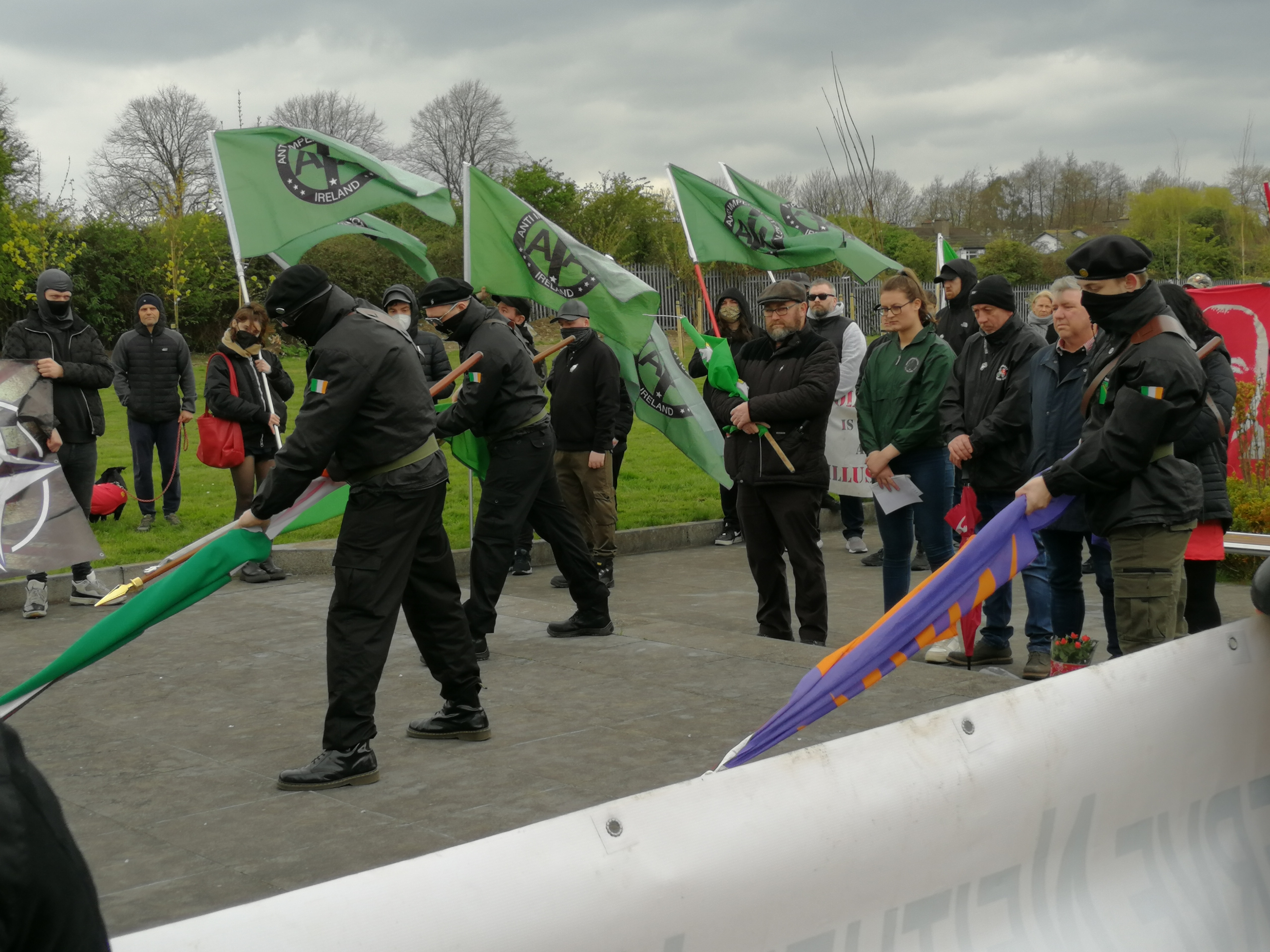
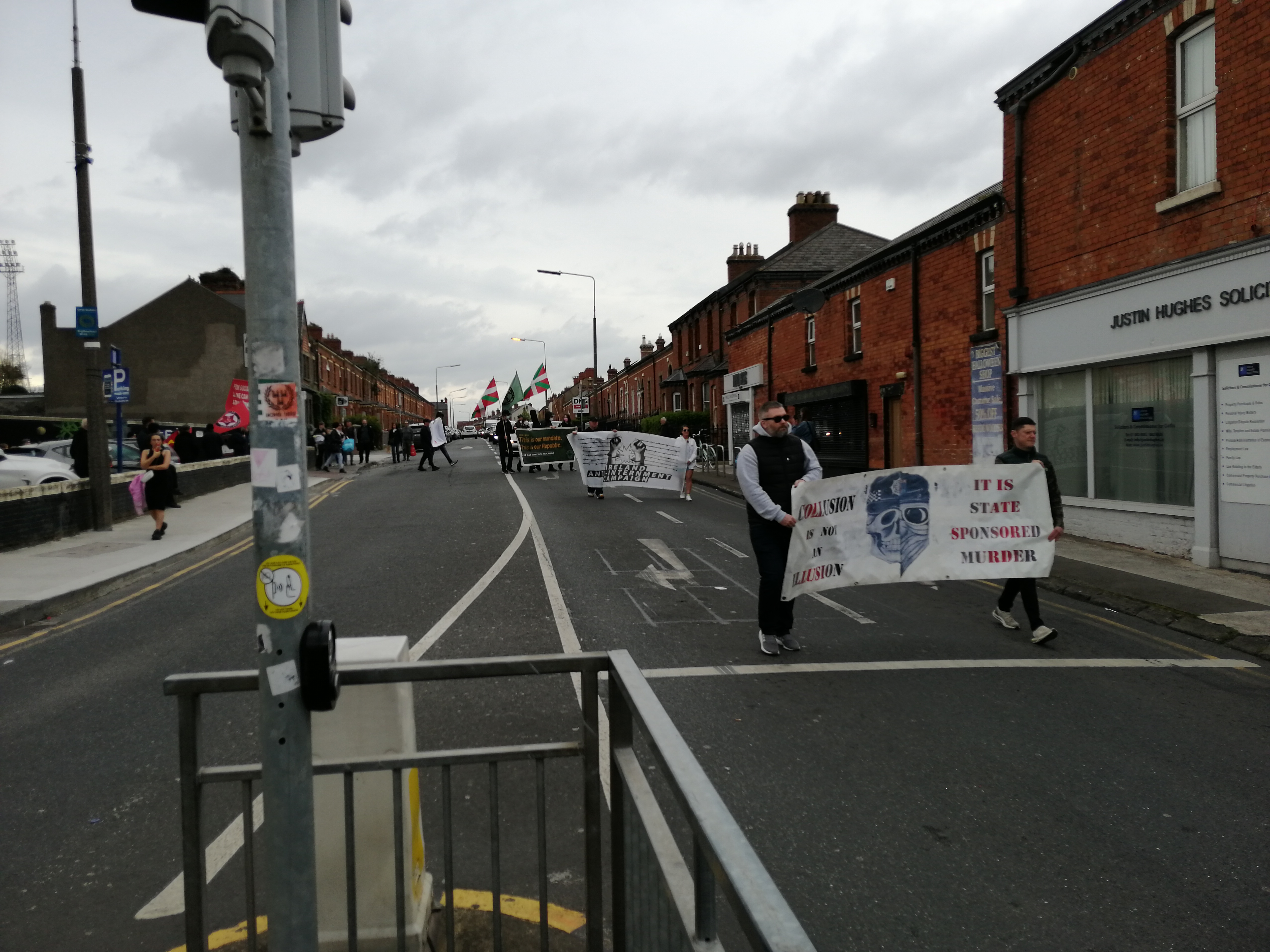
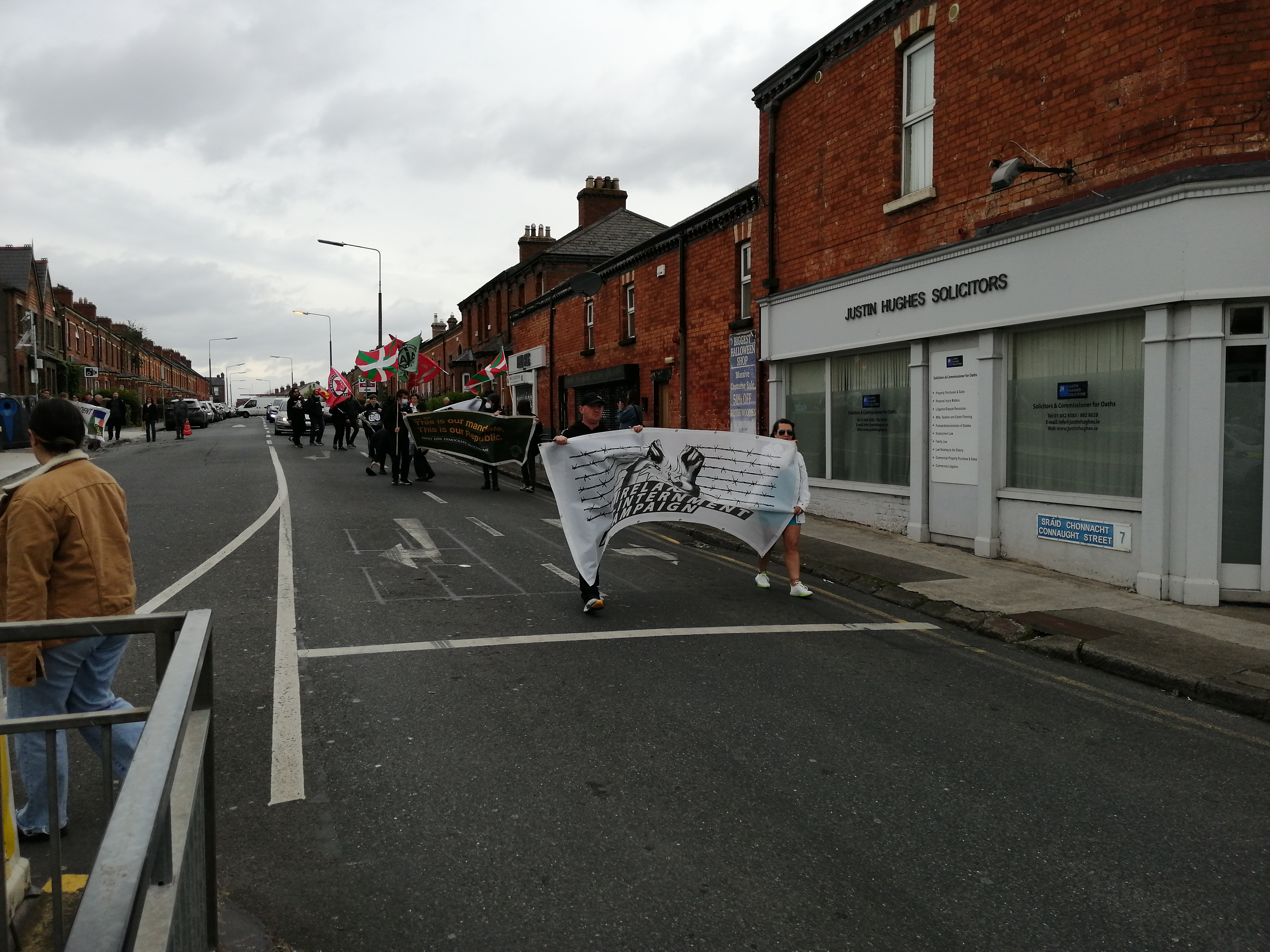
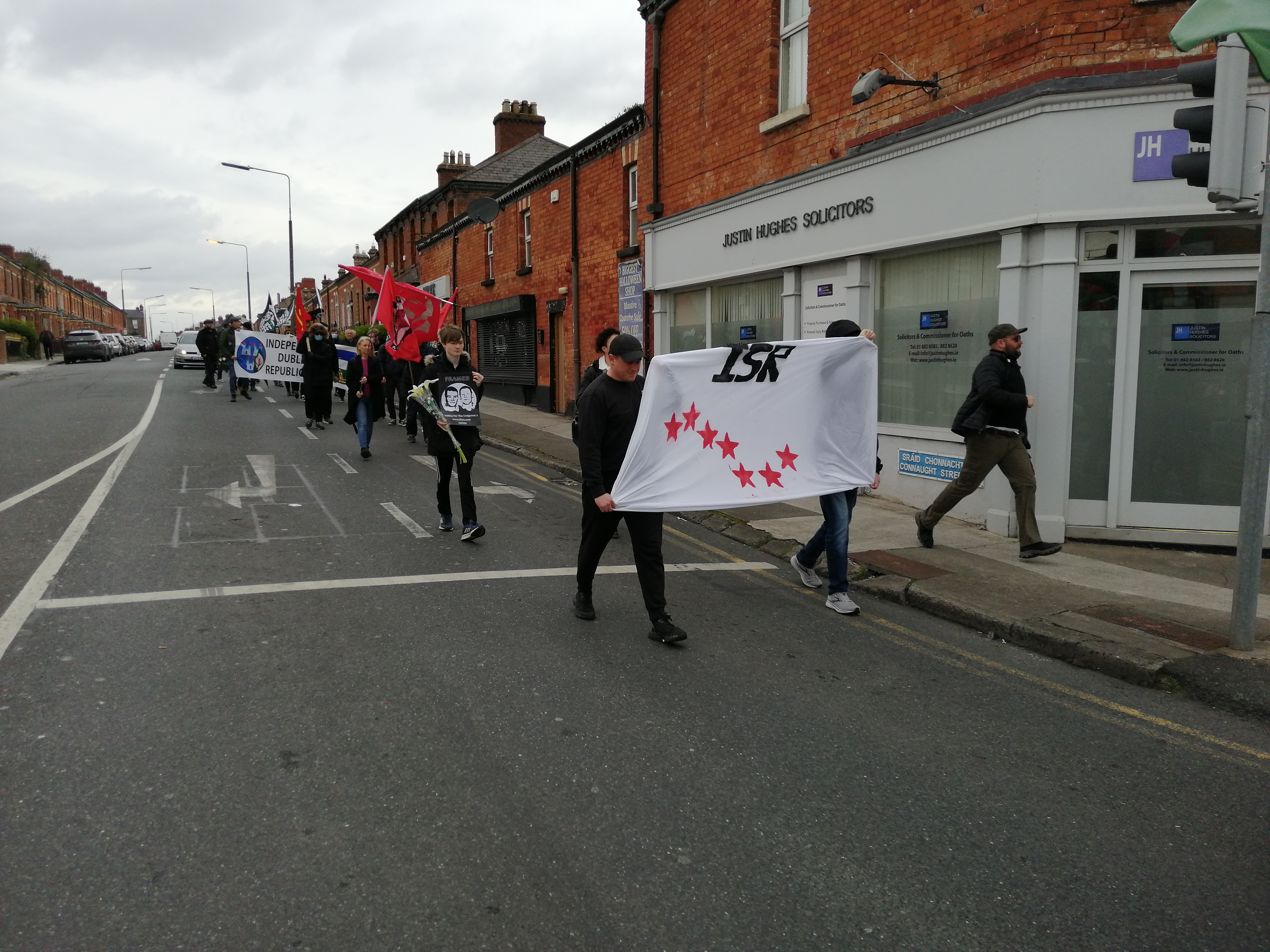
The participants declined to be intimidated and set off on their march, led by a lone piper playing Irish marching airs, followed by a colour party with different banners interspersed among the marchers, among which fluttered many flags.

Organisers had learned that the coach carrying members of the Republican Flute Band from Scotland that was to lead the parade had been prevented by police there from taking the ferry to Ireland.

Centre photo: Four of the six plainclothes political police violating the civil rights of the peaceful people commemorating the Easter Rising. (Photo: D.Breatnach)
Centre photo, another two plainclothes political police. The bald man joked while he harassed people. (Photo: D.Breatnach)
(Photo: D.Breatnach)

Historical background

In 1916 a broad alliance the Irish Volunteers, Irish Citizen Army, Cumann na mBan, na Fianna Éireann and Hibernian Rifles1 took part in a Rising organised by the Irish Republican Brotherhood against British rule in Ireland and against world war.

Due to a number of unfortunate circumstances, the leader of the Volunteers cancelled the Rising which however went ahead a day later than planned and was for the most part confined to Dublin, where a third of the numbers in the original plan took part and fought for a week.

The occupying British Army shelled the city centre from a gunship in the river Liffey and also from artillery on land. Explosions and resulting fires destroyed much of the city centre including the General Post Office in the main street, which had been the headquarters of the insurrection.2

After a week with the city centre including the GPO in flames, the rebel garrison evacuated to Moore Street where the following day, surrounded and vastly outnumbered, the decision was taken to surrender.3 A British military court passed death sentences on nearly a hundred prisoners.

All but fifteen of those sentences were commuted to long jail periods but the seven Signatories of the 1916 Proclamation4 and another seven were shot by British firing squad in Dublin, a fifteenth in Cork and after trial months later a sixteenth was hanged in Pentonville Jail, London.

At Easter 1917 Irish Republican and Socialist women commemorated the 1916 Rising; ever since then Irish Republicans and sometimes Socialists in Ireland and in many parts of the diaspora have commemorated the Rising, whether legally5 or otherwise, in jail or at liberty.

The War of Independence began in 1919 with many of the Rising’s survivors participating6.

(Photo: D.Breatnach)

The Parade on Sunday – local and national historical memory marked

At Cross Guns Bridge over the Royal Canal the parade halted and flares were lit in memory of events there in 1916.

Marching along the Cabra Road, the wall and a watchtower of the north side of Glasnevin Cemetery on the left of photo. (Photo: D.Breatnach)

On Easter Monday 1916 a small group of Irish Volunteers had marched from Maynooth along the canal bank to join the Rising in Dublin and found guarding the bridge two Irish Volunteers who advised them to wait until the following day to go into the city centre.

The Maynooth group spent the night in Glasnevin and the following day marched into the GPO, passing an empty Cross Guns Bridge on the way. Back towards Phibsborough, British artillery had blown a barricade and killed Seán Healy, a Fianna member at the Nth. Circular Road crossroads.

Later, the Dublin Fusiliers unit of the British Army blockaded the bridge, preventing people from crossing it in either direction. They shot dead a deaf local man who failed to heed their challenge because he did not hear it.

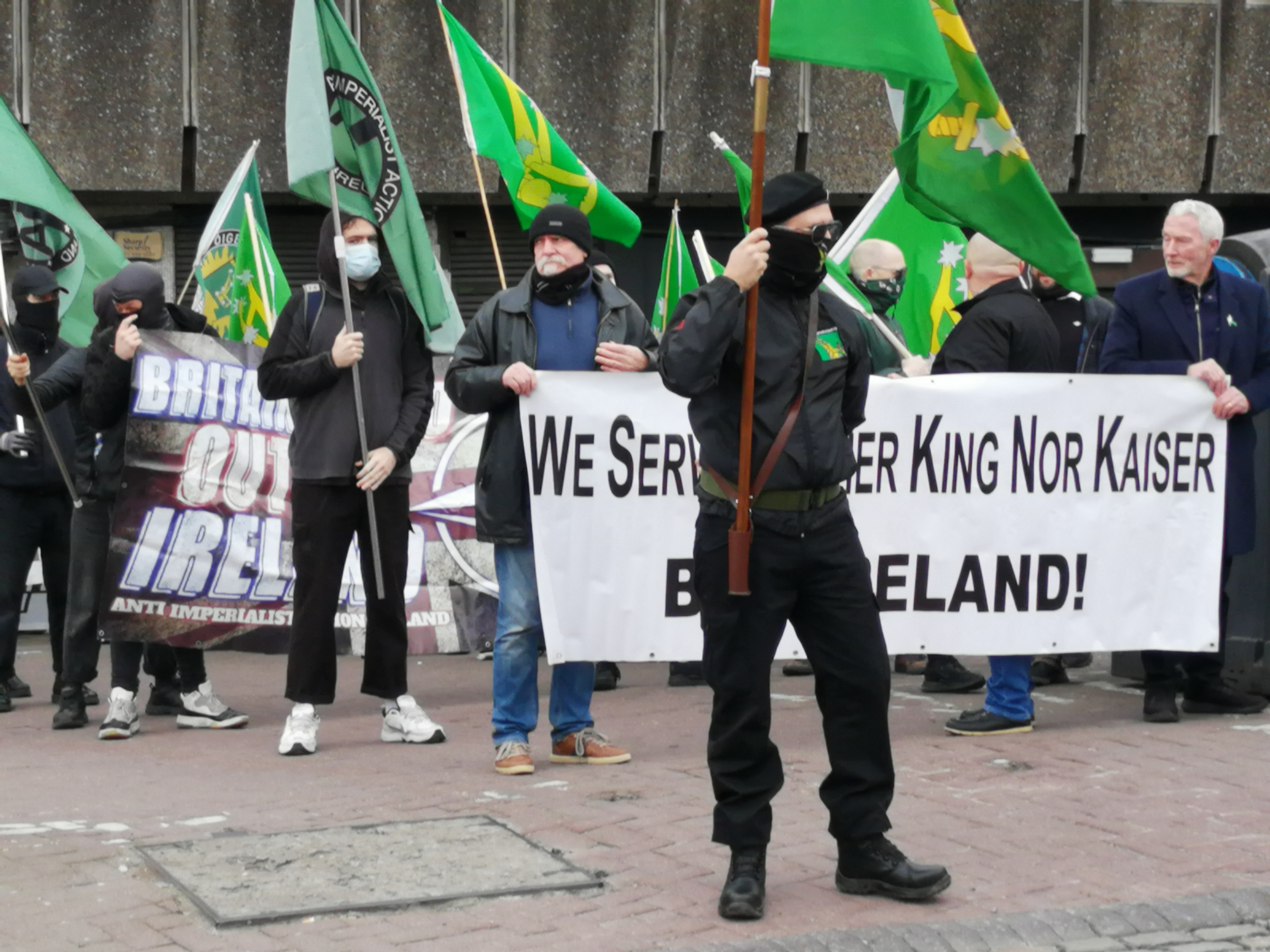
We Serve Neither King nor Kaiser but Ireland declared one banner carried last Sunday, Britain/NATO Out of Ireland another, This Is Our Mandate7, Our Republic and Collusion Is No Illusion, It Is State-Sponsored Murder were another two.

A large banner also declared alongside the image of James Connolly that Only Socialism Can Be the Solution for Ireland. Some organisations also carried their own banners, such as those of Dublin Independent Republicans, Ireland Anti-Internment Campaign and Irish Socialist Republicans.

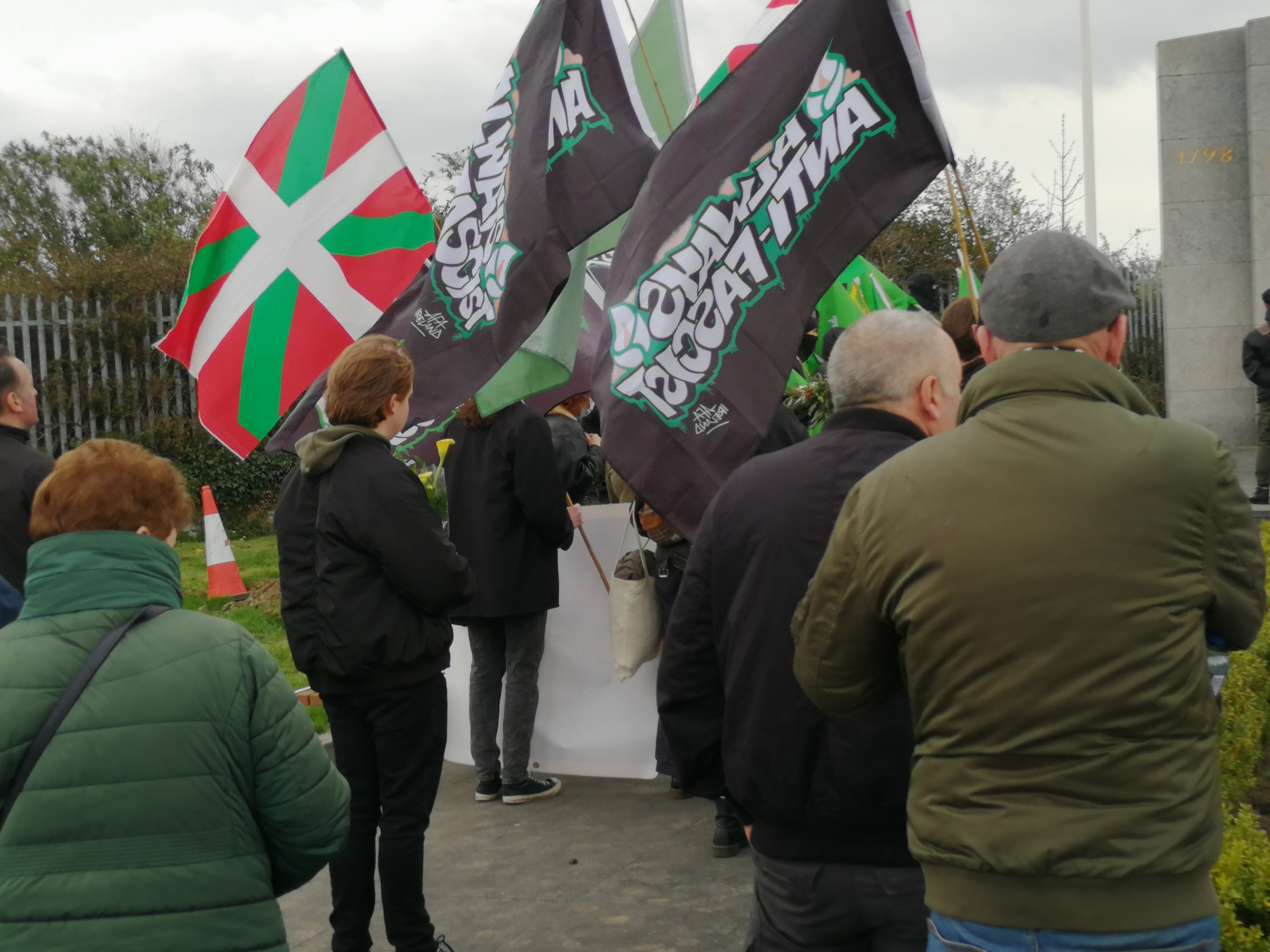
Flags fluttering included those bearing the logo of the organising group Anti-Imperialist Action and others bearing the slogan “Always Anti-Fascist”, green-and-gold Starry Ploughs, a couple of Ikurrinak (Basque flags) and another two of Red with Hammer & Sickle in yellow.

Basque and antifascist flags (Photo: D.Breatnach)

At the Monument: speeches and songs

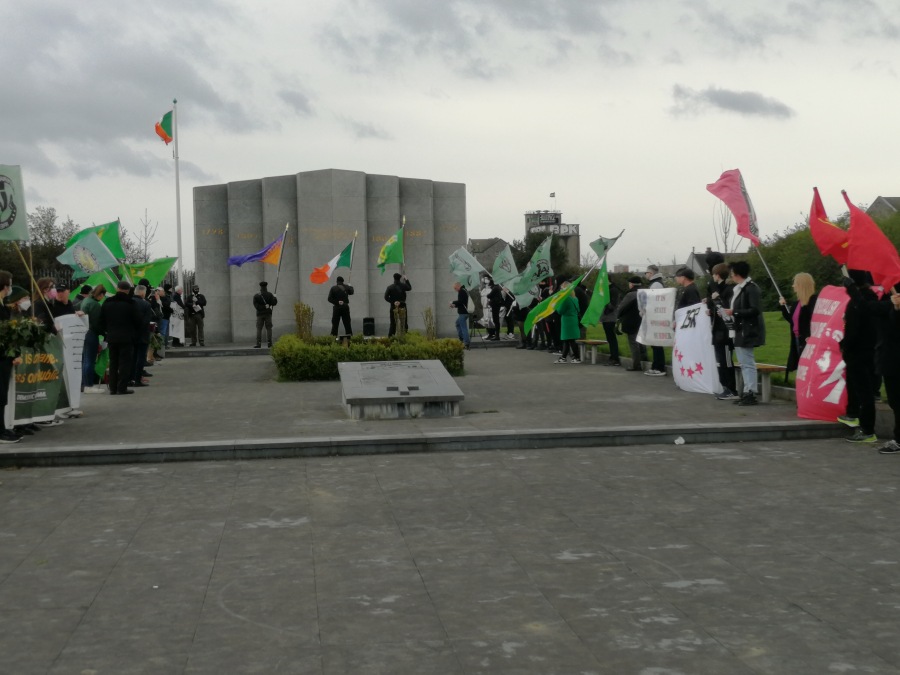
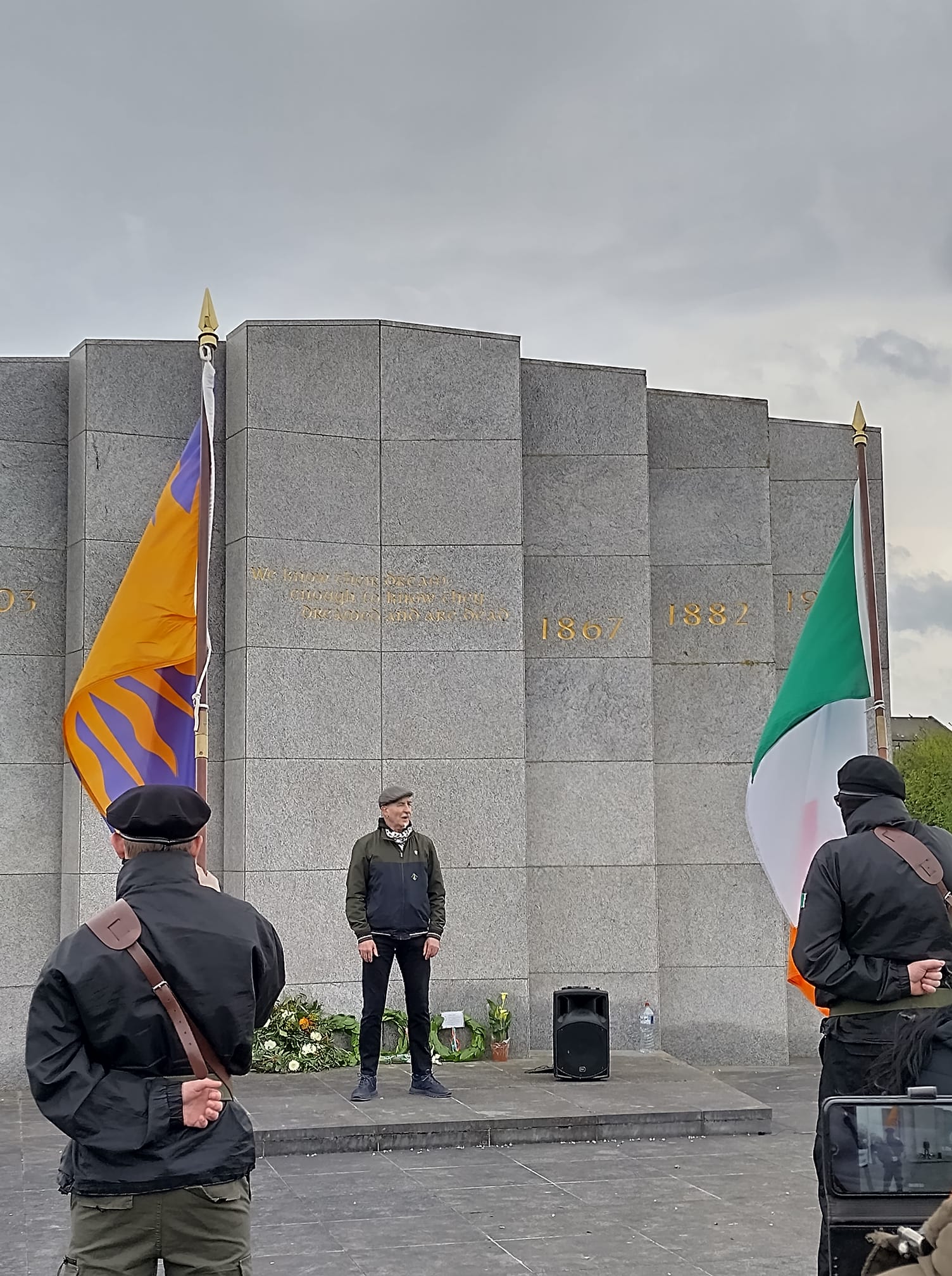
At the monument (Photo: D.Breatnach)

Glasnevin Cemetery (Reilig Ghlas Naíonn) covers over 120 acres in North Dublin city and is in two parts, each with Republican Plots separated by the Cabra Road and contains the graves of both famous and ordinary people.

On the north side there is also access to the Botanic Gardens, both on the south banks of the Tolka river. The imposing Monument to numerous Republican uprisings and the Irish Citizen Army Republican plot is on the south side, across the pedestrian bridge over the railway line.

(Photo: D.Breatnach)

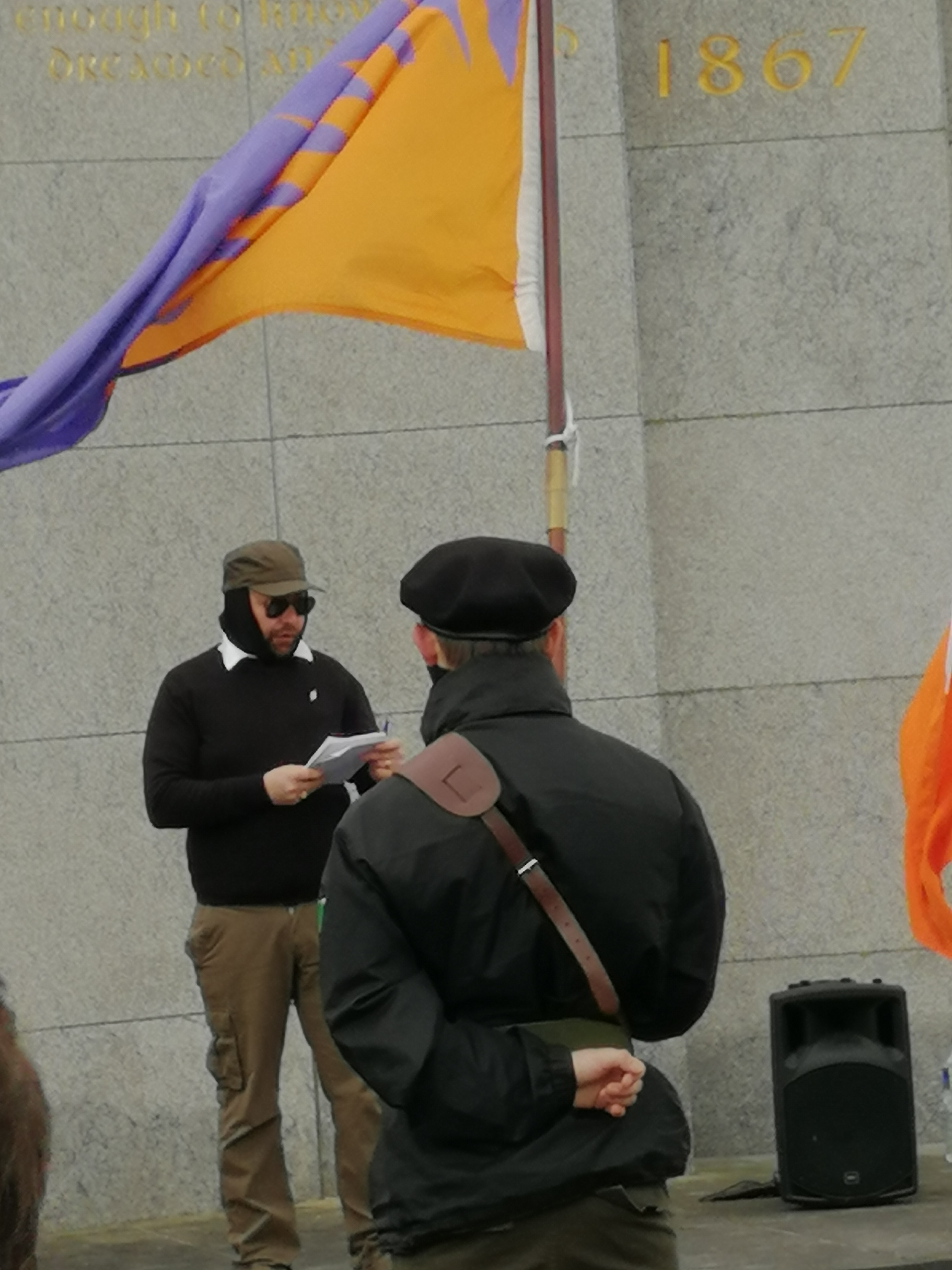
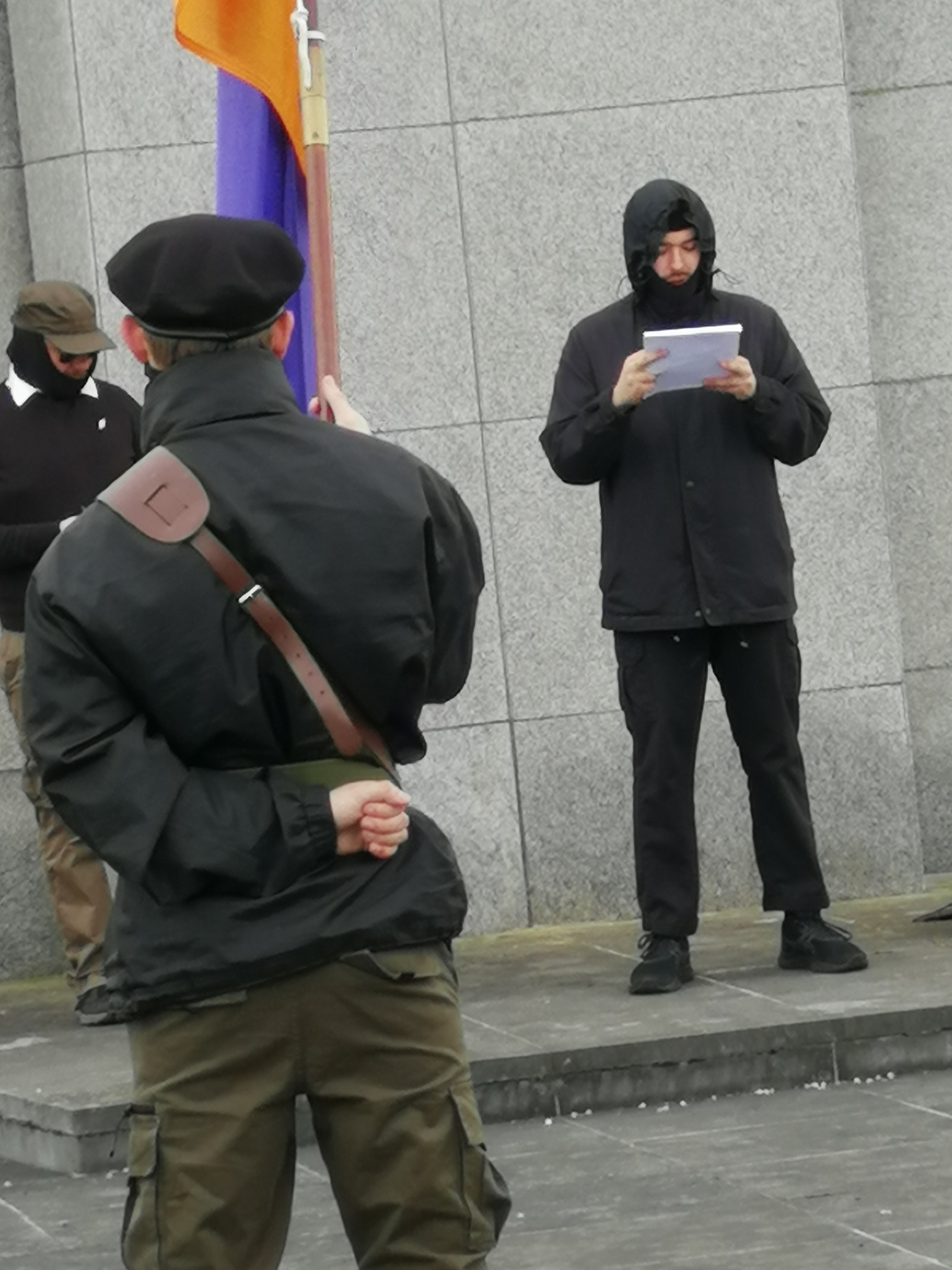
A man chaired the event for Anti-Imperialist Action and spoke briefly, introducing people for readings (all of which were from James Connolly) and for orations. The presentations of these were evenly divided between men and women, three of those being of young people.

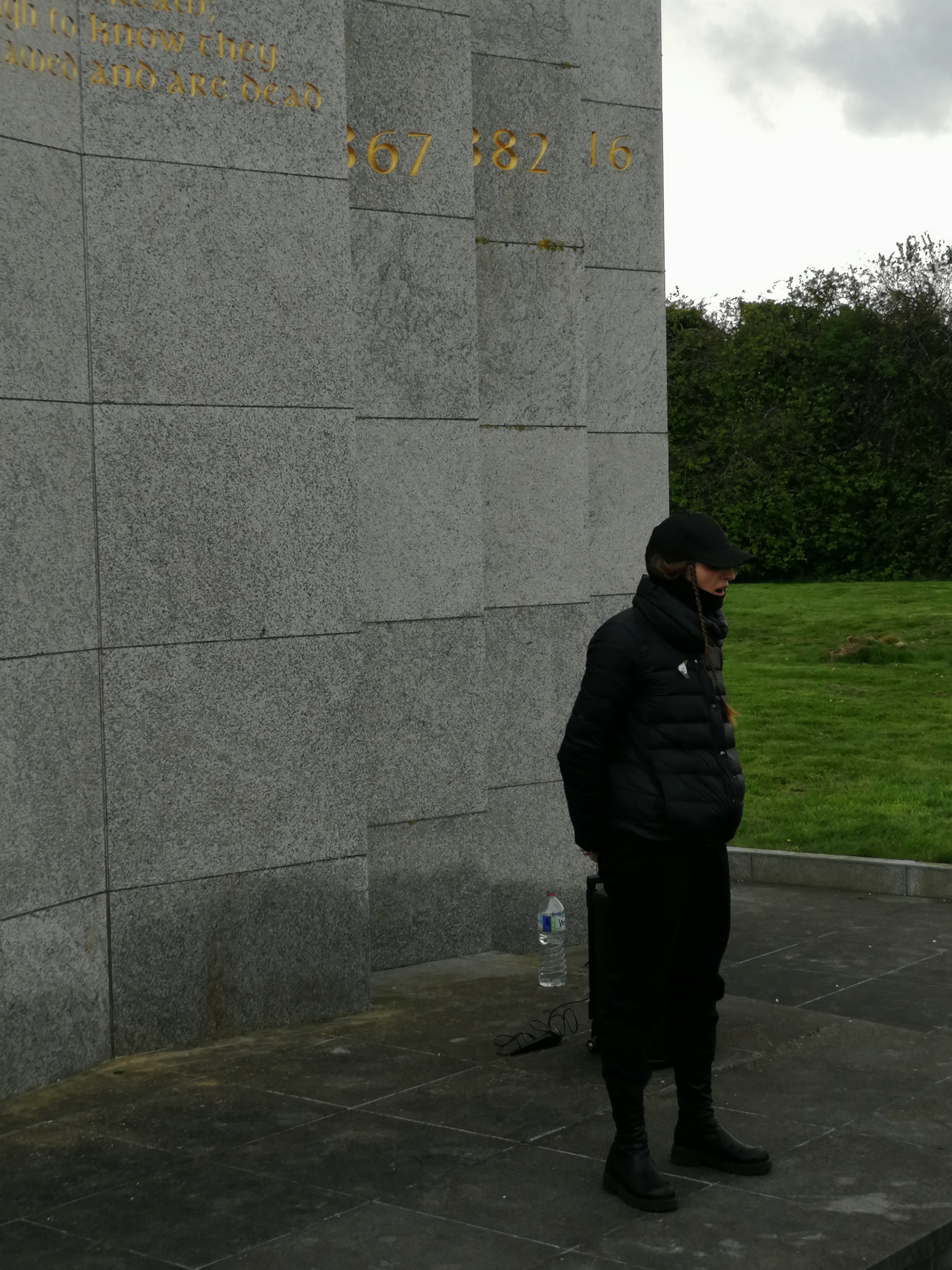
Three songs were sung: a woman sang The Foggy Dew (by Charles O’Neill) and Erin Go Bragh (by Peadar Kearney), while a man sang Patrick Galvin’s Where Is Our James Connolly? Two women read out pieces by James Connolly and another read out the 1916 Proclamation.

Person chairing the event (Photo: D.Breatnach)

The words of the chairperson and of those giving orations were different but there were common themes: upholding the historic Irish spirit of resistance, the importance of the working class in history and the objective of a socialist Republic encompassing the whole of the Irish nation.

These words were balanced by denunciation of US and British imperialism and the colonial/ NATO occupation of the Six Counties by the latter; the Irish client regime; the special no-jury courts8 of both administrations in Ireland and repression by police forces and occupation army.

One of the singers (Photo: D.Breatnach)
One of the readers (Photo: D.Breatnach)

Also denounced were those political parties that had abandoned the struggle for the Republic and instead had become part of the colonial and neo-colonial administrations or, in the latter case, were on their way to becoming so.9

Floral tributes were laid by representatives of a number of announced organisations and then others came forward to lay floral tributes also. The colour party lowered flags for a minute’s silence in homage and salute before slowly raising them again and the piper played Amhrán na bhFiann.

The other singer
Lowering of the colour party flags in homage to the fallen in the struggle (Photo: D.Breatnach)
Colour party raises flags again in symbolism of the struggle continuing (Photo: D.Breatnach)

The chairperson thanked all for attendance, listing organisations by name and cautioning all to stay close together as they left, due to the threatening presence of Gardaí and in particular the Public Order Unit. In the event, the celebrants exited the cemetery and dispersed without incident.

End.

(Photo: D.Breatnach)

FOOTNOTES

1A small unit, an armed wing of a split from the more socially conservative USA version of the Ancient Order of Hibernians, their participation in the Rising was notable.

2Photos of much of the destruction are available on the Internet and accessible by search browser.

3The terrace they occupied still stands and is the object of a historical memory and conservation struggle against property speculator plans approved by the municipal city managers and Government political parties (see smsfd.ie).

4A remarkable document, the text of which is available from many postings on the Internet.

5Irish women commemorated it in public in contravention of British WWI martial legislation in 1917 and 1918 and for decades the public commemoration of the 1916 Rising (and even the flying of the Irish Tricolour) was forbidden in the British colony of the Six Counties with attendant colonial police attacks on any attempt to do so.

6Sometimes inaccurately called “the Tan War” (reference to a special colonial police auxiliary force that became known as the “Black n’ Tans”), the war saw the birth of the IRA and lasted from 1919-1921. A British “peace” proposal opened deep divisions in the nationalist coalition and was followed by a Civil War 1922-1923, in which the pro-Treaty government and armed forces were armed and supplied by the British to defeat the Republicans in a campaign of repression and jailing, military actions, kidnapping and torture, murder of prisoners, assassinations and over 80 formal executions.

7Also displaying text referring to the First Dáil’s Democratic Program of 1919.

8The Diplock court in the colony and the Special Criminal Courts in the Irish State, political special courts in all but name, with low proof bar and abnormally high conviction rate and refusal of bail while awaiting trial.

9References to 1) the 1930s split from the Sinn Féin party, the Fianna Fáil political party that became a preferred Government party of the foreign-dependent Irish ruling bourgeoisie and 2) to the Provisional Sinn Féin party who endorsed the British pacification plan in 1998 and embarked on the road to becoming a party of reformist nationalism in the colony and is heading for neo-colonial (and neo liberal capitalist) coalition government at the moment.

(Photo: D.Breatnach)

THOUSANDS MARCH IN BILBAO AGAINST NATO, WAR AND FASCISM

Manifesto of the organisers: Askapena1, NATOren eta EBren Aurkako, Herri Ekimena and Bardenas Ya
(Translated from Castilian version by D.Breatnach)

(Reading time total: 6 mins. including Comment)

We began the previous manifesto talking about emergencies. We said that it was essential to reclaim an anti-imperialist and internationalist Euskal Herria2.

And that urgency, that need, is what has brought together comrades from all corners of Euskal Herria here today. Well done all of us!

Capitalism is going through a systemic crisis. They speak to us of a “extraordinary period” but the truth is rather that we find ourselves in a permanent crisis. As we have supposedly departed one, they have already placed us in another.

As of 2020, moreover, we have entered a phase of exceptionality in which States take advantage to impose economic, social and disciplinary policies that point towards a war scenario. Therefore, we cannot separate the capitalist decomposition from the increase in repression and censorship.

Banner reading “Condemning us to war and misery” and section of the anti-NATO march in Bilbao 11 March. (Photo sourced: organisers)

The rise of fascism that is taking place throughout Europe is a direct consequence of the bourgeoisie’s fear of losing the control it exercises over an increasingly exploited and angry population.

In the field of international relations, we are also witnessing the increasing loss of hegemony of the Empire that has controlled the world practically without opposition for the last 30 years.

The bloc led by the United States and NATO, far from accepting the end of its historical cycle, seems determined to increase armed conflicts. In addition to giving a boost to the arms industry, they intend to hinder the growth of emerging powers such as China or Russia.

For this phase of confrontation, they have finally achieved the support of the lobby led by Ursula Von der Layen, the “gardener” Borrell3 and company.

NATO and the EU, together with the Zionist entity that redoubles its attacks on the Palestinian people, are today the main props of this dark period in history.

As far as NATO is concerned, we have to understand that its role goes beyond being a mere military organization. It is true that it is mainly the army of the bourgeoisie (and it is demonstrating this in Donbass, as it has also demonstrated in Yugoslavia, Libya or Syria).

But it has the superior function of being the military arm against anyone who opposes the policies of capital. Today these translate into the over-exploitation and precarity of the working class (especially women and people of colour).

And changes in labour rights to deprive us of material concessions wrested through class struggle, change of laws to increase the repression of those struggles, etc.

A clear example of this is the latest General Budget of the Spanish State, supported by all the social democratic parties4.

The budget supports the deterioration of the material conditions of working peoples to benefit NATO, giving it more control capacity and recognizing their right to appropriate civil infrastructures to defend the interests of the bourgeoisie.

The support for these militaristic policies, at the dawn of a world war, is a real shame and demonstrates the total lack of commitment of the leadership of these parties to the future of the Working Peoples of the world.

In Euskal Herria we are well aware of what NATO represents:

in addition to the military training industrial estate in Las Bardenas or the military exercises carried out at the Araka base (Gasteiz), we have recently witnessed blatant support from the Government of Gasteiz for war industries such as SENER or SAPA.

Nor can we forget the historical support of NATO, through the Gladio network, to the Spanish and French States in their legal and illegal repression5 against the struggle in Euskal Herria.

If we add to this the economic and social exception measures imposed on us by Brussels (private pension funds, increase in the retirement age, dismantling of public health) …

It becomes increasingly clear to us that neither as a nation nor as working class do we have a future within NATO or the EU. The need to destroy these instruments of domination by the bourgeoisie, as well as the Spanish and French States, is more than evident if we aspire to build a future in freedom.

These are not good times, of course not. The situation is becoming more and more complicated throughout the world. And that is why we here today are calling for the activation in each town and each neighborhood of the anti-imperialist Euskal Herria.

Thirty-seven years ago we said “NO to NATO!”6

Today, we not only reaffirm this rejection, but we once again make an urgent call to join forces with the rest of the working peoples and oppressed nations of the world to stop the imperialist offensive promoted by this criminal organization along with its allies in the European Union.

From Chile to Donbass, passing through Laos, Mali or Vietnam…

LONG LIVE THE STRUGGLE OF THE WORKING PEOPLE!

AN ANTI-IMPERIALIST BASQUE COUNTRY!

Front of march heading towards the Bridge across the Nervión river and the old city (Photo sourced: organisers)

COMMENT: A GIANT STEP FORWARD

Diarmuid Breatnach

(Reading time: One min.)

The estimated 2,000 turnout in support of this demonstration must have exceeded the expectations of the organisers and greatly encouraged them. Two thousand is not a huge number in the highly-politicised Basque Country, even with a total population of less than three million, north and south.

But this is a nation which has for decades been under a political leadership, the surviving members of which have now taken the road of pacificaction, of accommodation to capitalism and the Spanish and French states, of social-democratic ‘opposition’.

This movement had a united national political leadership, an armed guerrilla movement, a daily newspaper, a trade union and smaller affiliated groups; it had café/bars/social centres throughout the southern provinces.

Though in decline and fragmented with the leadership’s embracing of the pacification process (through which, unlike the Provos, they did not even gain the release of their hundreds of imprisoned comrades), it still exercises a heavy influence on politics in the Basque Country.

That is today the ambit of Otegi, EH Bildu and Geroa Bai and neither did their parties participate in Saturday’s demonstration nor as an individual any of senior responsibility in their structures, though certainly individuals in their social and cultural sectors were seen in the march.

In that context and after 25 years of pacification, 2,000 in open attendance is a giant step forward for the Basque resistance. ‘Tús maith, leath na hoibre‘, it is said in Irish: ‘A good beginning is half the work’ and indeed, a beginning is how the organisers view the event.

“Dissident” groups such as Amnistia ta Askatasuna, Amnistia Garrasia, Tinko and Jardun have arisen in the last decade and youth have been very prominent in these and others disparate groupings, which is important for any revolutionary movement.

The photos and videos of Saturday’s demonstration show older and mature faces too, veterans of the struggle and also those active during the pacification period and this too is important, for it brings a certain continuity to the movement and the awareness of mistakes made in the past.

More than 50 organisations in the Basque Country supported the call for this demonstration.

The road ahead will not be easy (when has it ever been for the Basque nation or the working class in general?) but a giant step forward has been taken.

End.
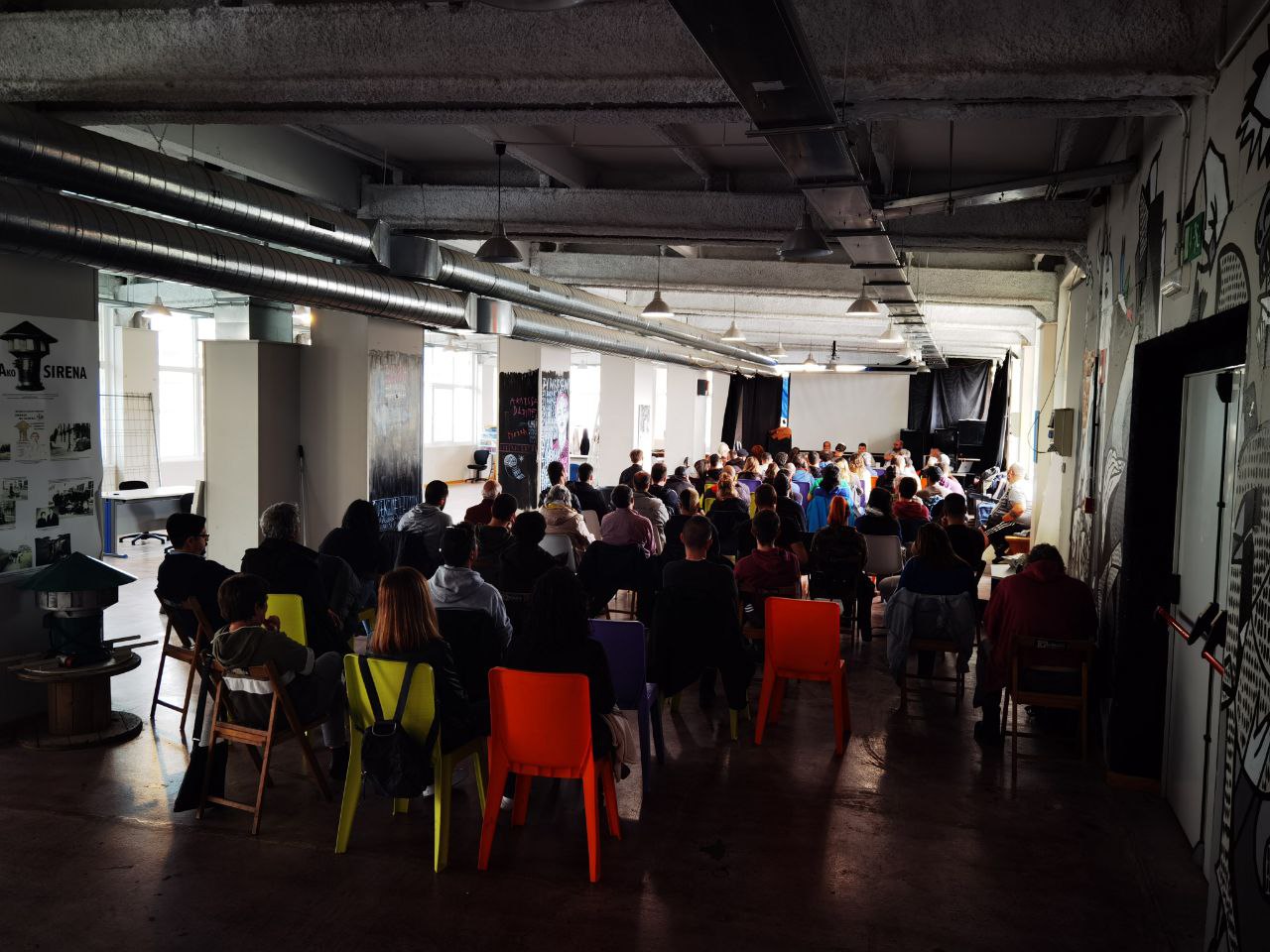
FOOTNOTES

1Askapena is the internationalist arm of the Basque movement for independence and was responsible for a number of years for maintaining a network of Basque solidarity organisations (which in some cases it founded) in Mexico and across a number of European cities, including Belfast, Dublin and Cork. In 2011 five of its leading activists were arrested on charges of supporting the guerrilla organisation ETA, through Askapena’s solidarity with political prisoners. The five defended their right to work with prisoner and internationalist solidarity and were finally acquitted in 2016 earning much admiration for their stance (in stark contrast to the 47 activists in a number of prisoner support organisations who apologised for their activity in a Spanish court in September 2019 in exchange for non-custodial sentences for the majority).

2The current Basque name for their nation, “the Basque-speaking country”, replacing the former “Euskadi”, now used to refer only to the three-province ‘autonomous’ region of Bizkaia, Araba and Gipuzkoa.

3Josep Borrell, Foreign Minister of the EU Parliament who has described the EU as “a garden”. A Catalan member of the PSOE, hostile to Catalan independence who after five minutes stormed out of an English-language interview by Tim Sebastian on the German TV program Conflict Zone regarding the struggle in Catalonia.

4This is a reference not only to the social-democratic coalition government of the PSOE and Podemos but also of the Basque EH Bildu and Catalan ERC, the votes of which MPs supported the Budget.

5A reference not only to banning of parties, organisations and demonstrations but also to routine torture and the kidnapping and assassinations of the State-sponsored GAL of the 1980s.

6In the 1986 Referendum on whether the Spanish state should join NATO, the southern Basque Country gave a majority vote against, the only region to do so (though the vote against was high in some regions), the total vote being 52.54% in favour.

SOURCES