(Report by Jardun Koordinadora translated by Dublin Basque Solidarity Committee)
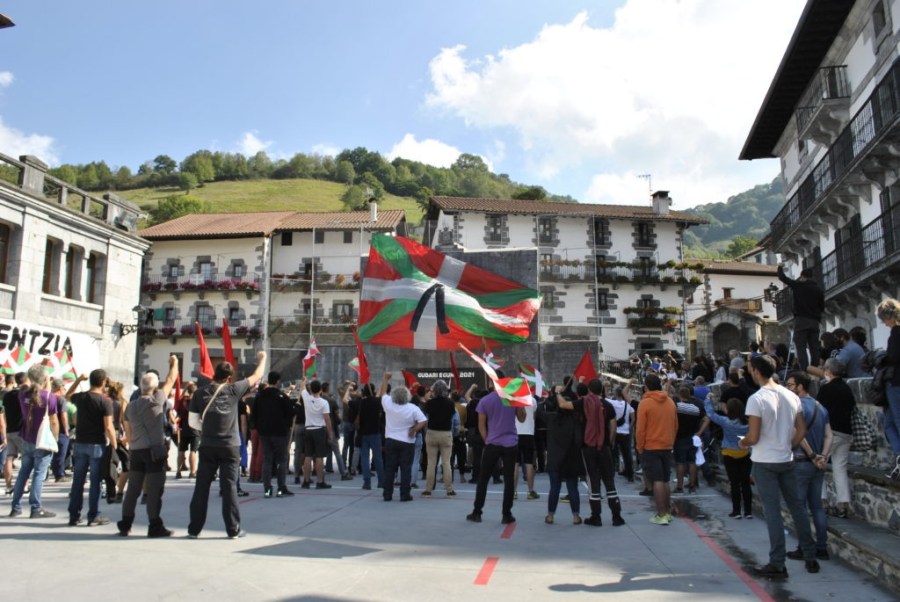
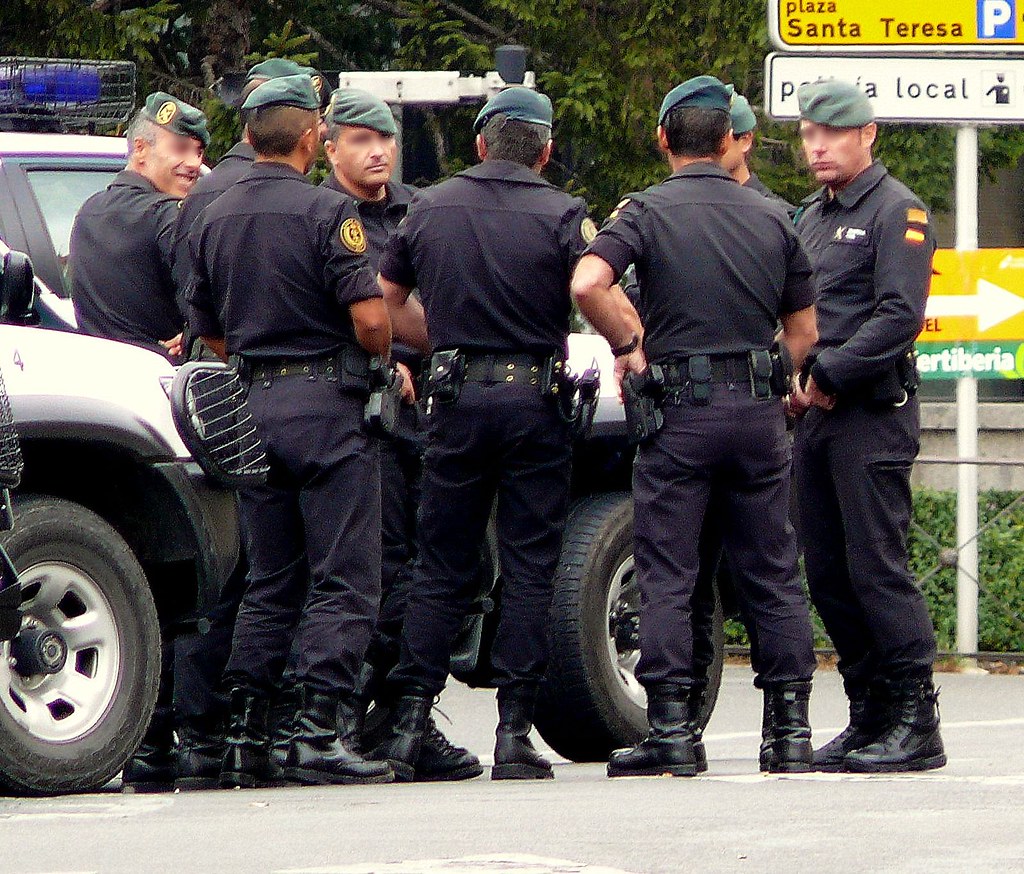
The atmosphere was tense on September 25, 2021 in Leitza due to the presence from the early hours of the morning of the Civil Guard and the secret police. To this must be added the checkpoint and identification by the GAR (Guardia Civil “anti-terrorist” Rapid Response Organisation – Translator) of many of those attending the political event organized by the revolutionary organization JARKI. In the same way, the Civil Guard had no problem in stopping and subjecting to identification those who traveled by bus organized from Bilbao and Gernika. This was not the only episode of police repression since several JARDUN activists from Leitza complain of having been followed by the secret police over recent days.
One of the posters for the event (Photo source: Jardun Koordinadora)
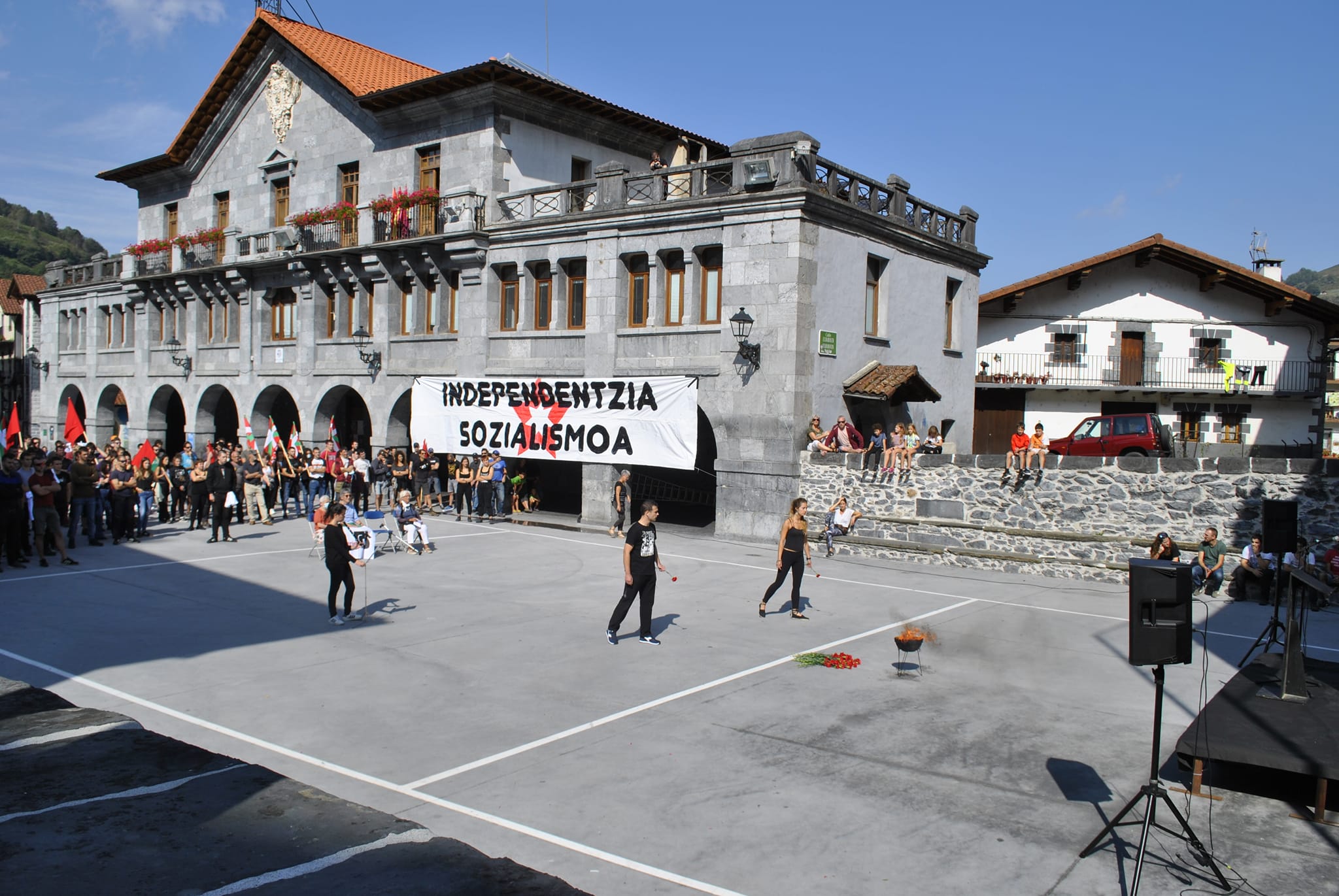
The event organized by the revolutionary organization JARKI gathered hundreds of people in Leitza square. Once the flame was lit, to the sound of the adarras and the txalapartaris (traditional ox horns blown and wooden percussion instrument played – Trans.), the act began, under a gigantic ikurriña (flag of the Basque Country – Trans.). Next, the dantzaris exhibited the “agintariena” (see Notes) while a gust of wind snapped the rope securing the ikurriña and two young people had to climb the pediment to hold it for the rest of the act. Later, two bertsolaris took the stage asserting with their verses independence, socialism and amnesty, as the legitimacy of the fight of the gudaris (volunteer liberation fighters).
Dancing the Aurresku, the honour dance and presenting red flowers to the memory of the martyrs of the Basque struggle for independence and socialism. (Photo source: Jardun Koordinadora)
To conclude the ceremony, a member of JARKI read a statement in reference to the commemoration of Gudari Eguna. The statement among many other things vindicated the struggle for memory of Euskal Herria, and of those who have given all in for it, thus legitimizing their struggle and the celebration of this day. He also mentioned the presence of ‘dogs’ in different uniforms that act with total impunity, making it clear that there is no type of coexistence between the oppressed and the oppressors. To the revolutionary organization JARKI this underlines a clear principle: confronting who is oppressing you and who is keeping you under their control is not an option, but a necessity.
End of the event, singing the Internationale and the Eusko Gudariak (Photo source: Jardun Koordinadora)
The act ended with the singing of the Internationale and the Eusko Gudariak.
The Gudari Eguna (Day of the Soldier) originally celebrated the Basques who fell fighting the fascist-military coup in the ‘Spanish’ Anti-Fascist War or who were executed when captured or died as a result of their prison conditions. The martyrs in the struggle against the Franco dictatorship and after required that they also be included in the Gudari Eguna celebrated in October but since the Basque Nationalist Party dominates that commemoration and excludes the later martyrs, the patriotic left movement has changed the date to the last weekend in September and celebrates all the Basque martyrs. The last weekend in September was chosen because of the Franco regime’s execution of two ETA and three FRAP volunteers on 27th September 1975.
Jarki is a revolutionary socialist organisation for Basque independence. Statement on who Jardun are: “It is an image that includes a group of organizations fighting for the achievement of the Basque socialist state, operating under common agreed ideological bases and minimums. JARDUN is a meeting place for different organizational frameworks, a movement that promotes their collaboration. To this end, it provides a common framework for the adoption, coordination and decision-making of the various organizations that make it up. Therefore, at different levels, it is a tool for solidarity between militancy, organizations and groups within it. Using these coordination frameworks, the ACTION will be made up of sectoral organizations with specific functions and well-defined roles to carry out in a sector-specific way. The aim of this sectoral framework is to promote the efficiency of the organizations, which, in turn, incorporate the Basque Country Workers’ Alternative in the field in which they work. In this way, all the organizations that make up JARDUN work within the framework of the same objective and strategic line, each of which deals autonomously with its own line of work.As long as we understand that the workers are the subject of the struggle for an independent, socialist and united Basque state. So, when we talk about the Basque Country Workers’ Alternative, we are talking about a comprehensive political alternative that meets the needs of the Basque Country Workers. Its aim is to reach all areas of Basque society as a tool for activating and organizing the critical pro-independence and socialist masses in the Basque Country. In other words, the Basque Workers’ Alternative must be a tool for confrontation that will lead us to a break with the states. Ultimately, JARDUN must be the organizational framework for the Basque Revolutionary Workers. In order to achieve the strategic goals of the Basque Revolutionary Workers, which must carry out the Basque socialist revolution, it must be a comprehensive alternative that must provide the means to carry out the necessary struggles.”
Leitza is a town in northern Nafarroa (Navarra), one of four provinces of the Basque nation within the Spanish state.
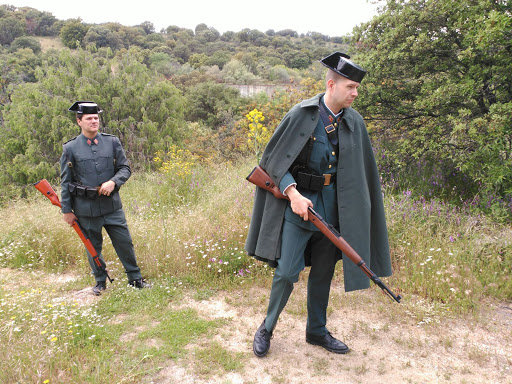
The Guardia Civil are a Spanish state-wide gendarmerie or militarised police force, armed and living in barracks. They were the physical backbone of Franco’s dictatorship and continued in a repressive political role following the “Transition to democracy”.
The Agintariena is a ‘dance’ which resembles a short military parade with ‘arms’ to music; two lines of dancers march while a flag-bearer proceeds between them. At a particular point the dancers all go down on one knee with heads bent while the flag-bearer waves the flag over them all, seemingly in blessing over the fallen in battle. A mass example in a festival can be seen in the video clip https://www.youtube.com/watch?v=kfoTmQZC_gs with the irrintzi (traditional ullulating call) thrown in for good measure.
Bertxolaris are performers of a traditional format of expression in song and rhyme on any theme. Competitions among these are held in the Basque Country in which the performers must extemporise rhyming verses on a given theme; these receive great public interest.
“dogs in uniform” — “txakkurak” (dogs), a pejorative slang name given for generations to the police in the Basque Country.
The Internationale is a song of revolutionary socialist struggle with lyrics written by an Anarchist activist in the Paris Commune of 1871 and put to music later by Marxist; it has been translated into a great many languages with examples in every populated continent. Eusko Gudariak (Basque Soldiers) is a Basque national anthem (in theme somewhat like the Irish national anthem “The Soldiers’ Song”). It was reputedly sung by ETA martyr Juan Paredes Manot (Txiki) while being executed by Guardia Civil firing squad in 1975, even continuing while mortally wounded by the first volley.
(Changed headline andtranslated from article in Publico.es by D.Breatnach)
(Reading time main text: 7 mins.)
Franco’s repression in Fregenal de la Sierra executed more than 80. Now, a second excavation seeks to recover the bodies of those who did not come to light in 2012, when the skeletons of 43 victims were recovered. The remains found indicate cruelty towards women, disrespecting them even after they were shot.
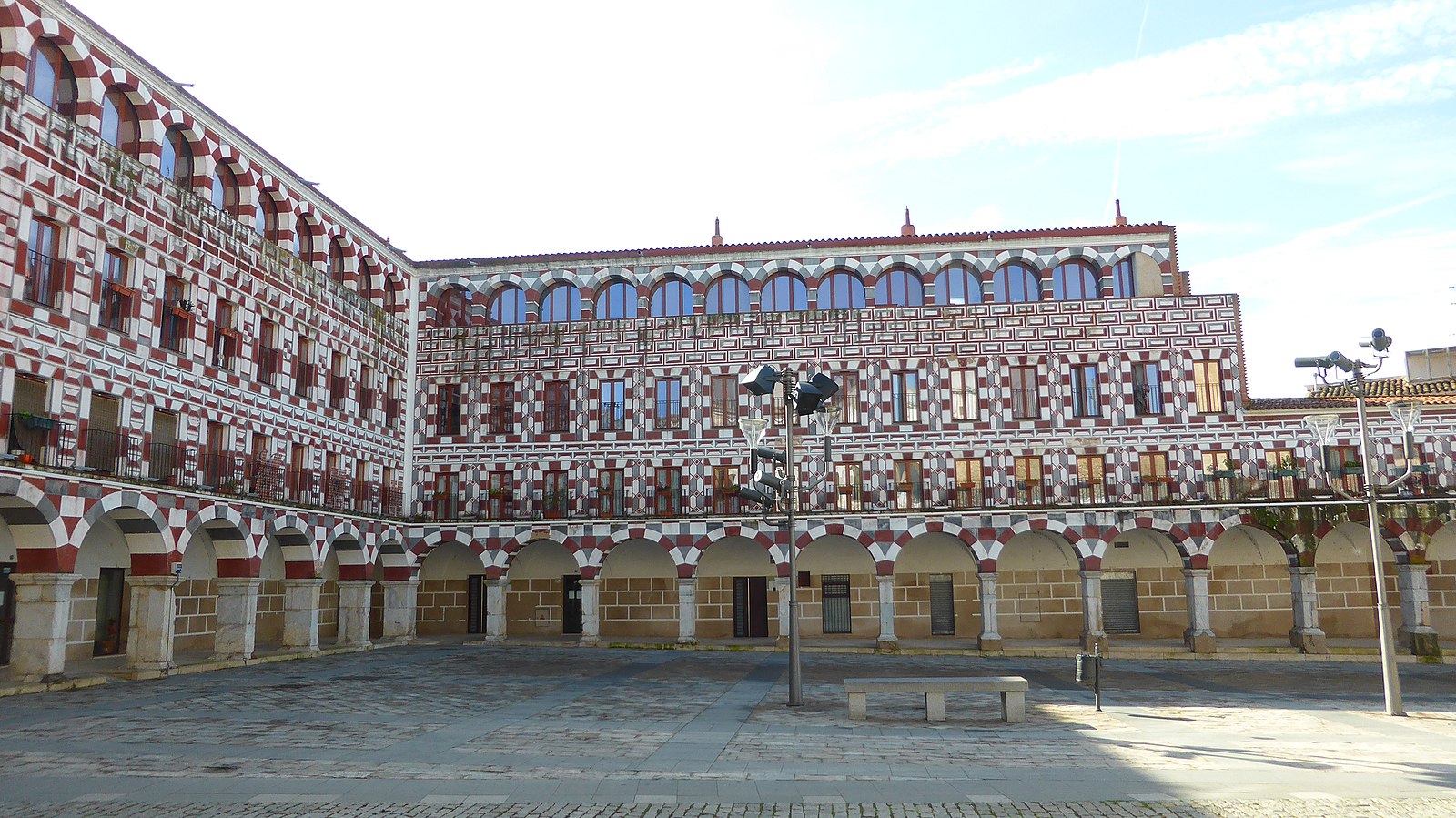
Central plaza Badajoz, probably influenced by its Moorish heritage — what the tourists are advised to see of Badajoz. (Photo credit: Stephen Colebourne via Wikipedia)
When they gave her the jacket of her son, who had just been shot, she lost her speech. She was like this for two and a half years, in silence, until she died. The father, a lifelong labourer, said on his deathbed that he bequeathed his little house to his five children. “You only have four,” one of the witnesses told him. “Until they give me the body of my son, I still have five,” replied the man. They were the mother and father of Juan Serrano García, shot in September 1936 in Fregenal de la Sierra (Badajoz1), when the rebels tricked him into returning: “They said that all those who had not committed crimes of blood, would be free of reprisals,” adds Andrés Serrano, representative of the Association of relatives of the executed from the town and Juan’s nephew.
His body was found in 2012 in a mass grave in the town’s cemetery along with 42 other bodies, although many more are still waiting in the ground. At that time, there were seven graves opened. Now, five more are uncovered to try to account for the more than 80 murdered by Franco’s troops of which there is a record. Among the bodies there is an unusually high percentage of women for the situation, points out Laura Muñoz-Encinar, archaeologist and forensic anthropologist at the Institute of Heritage Sciences (Incipit), attached to the Higher Centre for Scientific Research (CSIC), and who is participating in the exhumation.
The forced and almost physical silence of Juan’s mother testifies to the decades and decades of internal repression of the thousands of victims of the Franco regime. So much so, that Serrano learned about the story of his uncle obliquely from his mother, the political one of the family. She did not tell him directly: “An anthropologist friend wanted to interview her for a job, so I took the opportunity and told him to ask her about what happened in the Civil War. I hid in a room next to the terrace, where they were and thus I was able to hear first-hand and for the first time in my life about the execution of my uncle, the hardships my grandparents went through and the stigmatization my family suffered for being, for everyone else, ‘reds’ “, related the historical memorialist at 68 years of age.
Massacre by the fascist-military in the Bullring in Badajoz 1936, artist unknown (image sourced on Internet)
They were in a hurry to kill them
The case of Juan, a militant in the UGT2 and of socialist sympathies, assassinated at the age of 21, is just one more. In Fregenal, more than eight dozen people who were related to politics and social struggle during the Republican period were executed. Located in Badajoz, many townspeople joined “The Column of 8,000”, coming from the north of Huelva, to flee from the fascist barbarism between the air raids. The troops took Fregenal on September 18 and three days later Juan returned to the town together with another comrade. They thought that nothing would happen to them, because they had not committed any blood-crime.
“They arrived at 10:30 in the morning and at 11:15 they were both arrested. They were taken to jail, and no matter how hard my grandparents tried to intervene with some powerful people from the town to save him from being shot, on September 22 he was murdered”, relates Serrano. The same thing happened a few meters away, in those days, in the town square: “They shot about four people in the center of town; it was an exemplary shooting. They wanted to increase the fear that there was already,” he says.
That same September 22nd, Juan’s parents had already guessed the worst. They knew that their son had been detained and that the Francoists had no mercy. Their suspicions were confirmed when, a few hours later and for greater confirmation, they were given the jacket that their son had been wearing. According to Serrano, the rebel soldiers also told them that they should stop searching, that they already knew where he was, and not to bother people, referring to the people to which they had gone to ask for compassion for their young son.
The first exhumation: 43 bodies
More than 70 years later, the team to which Laura Muñoz-Encinar, the archaeologist belongs, arrived. It was 2010 and they couldn’t start the excavation for two years. After the surveys and a research project approved by the Ministry of the Presidency, they excavated seven mass graves. “There were men and women. They were from young to very advanced ages. Among the seven women we found, one of them had a full-term fetus of between 7 and 9 months,” explains the Incipit scientist.
A bullet found in the mass graves excavation in Fregenal de la Sierra this year. (Photo credit: Laura Muñoz-Encinar)
The change of central government in 20113 meant the cancellation of the funding allocation related to the investigation of what happened during the Civil War and the Dictatorship, so they had to wait nine long years until they were able to return to the town. Muñoz-Encinar explains that “During this time almost all the children of the victims, of which there were many, have died. There is only one daughter living, María Lobo Villa. The Francoists executed her mother, three uncles and a grandfather. Now, mainly, grandchildren and great-nephews and great-nieces remain. “
In that excavation they found the body of a woman buried between two men, something recurring according to the expert. Once again, and as always, they got the worst of it. This is demonstrated by what happened to Antonia Regalado Carballar, known as “La chata carrera” (“the flat racer”?-DB). A 22-year-old political activist, this woman transgressed the traditional roles of the patriarchal culture of the time. “They detained her and took her to the cemetery. There they physically and psychologically abused her, and several of them raped her. After killing her, said the undertaker, they put her in the ditch between the bodies of two men,” Muñoz-Encinar explains further. Serrano adds what the rebels who were there said, as the gravedigger recalled, “As men tempt you, there you have men for your whole life.” They haven’t found her body yet.
This type of symbolism, highly contemptuous for all victims and sexualized in the case of women, is not an isolated event. “In the current excavation we have already found a body face down. In a Judeo-Christian culture like ours, the placement of the bodies responds to a ritual of elevating the soul to heaven, that is why the bodies are placed face up and with the limbs stretched , and not doing it like that is a post-mortem humiliation”, the archaeologist explained.
Killed without trial years after the War
She herself points out that all the remains already found and those they are still looking for were civilian victims of extrajudicial repression, executed on the basis of the war party in force from 1936 to 1948. That is that, almost ten years after the end of the war, it was still possible to execute civilians without the need to bring them through a judicial procedure. That is what happened in Fregenal de la Sierra in 1946 to a party of guerrillas4. This is how Muñoz-Encinar relates it: “We know that they were fighting in the mountains, that they were pursued, until one night they entered a brothel. There they were betrayed and, after a scuffle, they were arrested. They were murdered, their bodies were exhibited in the street entrance to the cemetery and then put in a grave.” Also victims of extrajudicial repression years after the Civil War ended, the team of experts does not know if their bodies will be in the five graves they are currently studying and in which they have already found three bodies.
Human remains uncovered in 2012 excavations in Fregenal de la Sierra, Badajoz. (Photo credit: Laura Muñoz-Encinar)
End report.
COMMENT:
By Diarmuid Breatnach
The Spanish state territory holds more mass graves than any country in the world with the exception of Cambodia. Most of their occupants were killed during the Spanish Antifascist struggle with or without a military court hearing outside of conflict zones, that is to say, either in the rear areas of the fascist-military forces, i.e areas already safely conquered. In some of the areas, there had been little or no military resistance whatsoever but that did not halt the arrests and executions. And after the conclusive defeat of the Republic, the executions continued. Many victims, perhaps even the majority, had never even fired a gun in defence of the Republic but were considered enemies of the fascist State through their support for the Republic, their political ideology, social attitude or sexual orientation.
Photograph taken of massacred bodies in Badajoz before they were burned and buried (Photo sourced: Internet)
The punishment was not always a death sentence but people died also in prison due to massive overcrowding, disease, inadequate food or clean drinking water, water for washing or inadequate medical care.
Despite the frequent assertion that the 1936 military-fascist uprising against the elected Republican Government was to “restore Christian values” and was supported by most of the Spanish Catholic Church hierarchy, rape of women and girls was frequent, whether they were afterwards shot or not. This was widely attested in evidence by victims, witnesses and even some war reporters.
Those who survived or did not go to jail faced constant harassment, confiscation and theft of land, animals and produce; fines and public humiliation, in particular the women who were force-fed laxatives and then paraded in nightclothes or underclothes through the neighbourhood, sometimes to the doors of the Catholic church, unable to control their bowels as they walked.
Babies were also taken from murdered supporters of the Republic and later from working class women (who were told their baby had been stillborn) and given to childless fascist couples. Children of the “Reds5” were taunted at school and insulted by teachers.
After its sharpest form abated the repression nevertheless continued throughout the nearly four decades of the Dictatorship and it was extremely dangerous to even speak of disinterring the mass graves and reburying the victims in dignity, not to speak of honouring them as antifascist martyrs. Even after the death of Franco and the Transition to an alleged democracy, many kept silent to protect their families. Schools suppressed the history6. Murderers and torturers were not prosecuted. Thieves kept what they had taken. The ruling class consisted for the most part of supporters of the fascist-military uprising and their descendants and they thronged the civil service, military, police, judiciary, church hierarchy, media (State and private), the education system – along with many businesses and a number of political parties.
More recently, the work of generations of those keeping the historical memory alive, investigating, speaking, marking areas, even disinterring on their own initiatives, is bearing fruit. The Law of Historical Memory, passed through the Spanish Parliament under a social-democratic Government in 2007 helped for a little while but then fell into disuse under the PP Government, though it was not abolished.
Its renovation in 2020 by the PSOE-Unidas Podemos coalition has spurred more excavation bu the Law and its renovation had been preceded by the work over decades by volunteers of historical memory associations in many different parts of the State, such as the Basque Country, Catalonia, Asturias, Galicia, Andalucia and Madrid. The associations have been assisted by forensic experts working voluntarily. This work has helped create the political-social-cultural atmosphere in which in October 2019 the long-promised removal of the remains of the Dictator General Franco and the leader of the fascist Falange, Primo Rivera, took place from their fascist mausoleum in the Valle de Los Caidos7 (“Valley of the Fallen”, a fascist monument constructed with prisoner labour and a shrine for Spanish fascists).
Nevertheless the renovated Historical Memory Law, or its program posted by the Government, has been criticised by relatives and other historical memory activists, because it rules out any reparations. They are bitter that most of the known torturers, murderers and rapists died natural deaths without having faced even a trial and their accusers8 and that not only do their families hang on to their ill-gotten gains but that the State does not acknowledge its duty to the victims. The State itself, or one of its departments, is also engaged in a judicial-political struggle to recover from organisations and families some properties, including national monuments and one of them of UNESCO World Heritage status. Some local authorities face prosecution and reductions in allocation of central funds because they are holding on to commemorative signs exalting Franco or someone of his supporters.
Of course, the fascists and most varieties of the Right in the Spanish polity are angry at these events and link them to the struggle for Catalan independence as fatal to the Spanish State; they demonstrate and threaten a coup or some kind of repercussion, retired Army senior officers sign declarations and some rattle their sabres in public, the spokesperson of the Franco Foundation reminds the current King Felipe that it is entirely due to Franco that his father became monarch (which is true and Juan Carlos also swore allegiance to that regime, an oath which he never recanted).
Even some liberals are uneasy, feeling that “it’s reopening old wounds”, to which the relatives of the victims and others reply: “the wounds have never closed.”
2Unión General de Trabajadores, a general workers’ union allied to the social-democratic PSOE party. The union was outlawed by Franco and many of its supporters suffered imprisonment or even execution or murder without trial. It is one of the largest unions in the Spanish state today and the PSOE is one of the traditional parties of government.
3In that year’s General Election the right-wing Partido Popular won a landslide victory against the PSOE and the political climate changed considerably. Both the PP and the PSOE support the unionist and monarchist Spanish Constitution but the PP contains a harder Right, including supporters of the Franco regime and memory and outright fascists, some of which have split off at times to form the right-wing Ciudadanos and fascist Vox parties.
4Guerrilla struggle persisted in parts of the Spanish state after the defeat of the Republic, in some cases for decades.
5To sustain the fiction that they were fighting against “Communism”, (no doubt believed by many), those leading the fascist-military uprising constantly referred to their enemies as “Reds”. Some of course were but the Republic was also supported by Basque, Catalan and Galician nationalists, democrats, social-democrats, revolutionary socialists, anarchists, libertarians and anarcho-syndicalists. The foreign press mostly referred to them as Republicans (sometimes as “Government supporters”) and the fascist-military side as Nationalists (sometimes as “rebels”). Communists, revolutionary socialists and anarchists predominated among the foreign volunteers who joined the Republican forces through the International Brigades and other routes (for example, Orwell, a member of the Independent Labour Party, fought with the mostly Trotskyist POUM) but they also included socialist Republicans from Ireland for example along with simply dedicated antifascists.
6Indeed, writing a review of the city history this very year, the author skips from 1921 to the 1970s, missing out the entire Antifascist War and the Massare of Badajoz, in an article featuring photos of the bullring where much of the massacre took place! https://www.hoy.es/opinion/peldanos-historia-20210110005509-ntvo.html
7An event covered in detail on Spanish TV in the style of a state funeral.
8Notable exceptions were Melitón Manzanas, Commander of the Political-Social Brigade of the Guardia Civil, a notorious torturer and Nazi collaborator, assassinated by the Basque armed group ETA in San Sebastian/ Donosti in 1968 and Admiral Carrero Blanco, Franco’s nominated successor, also assassinated by ETA in Madrid in 1973. Manzanas was awarded posthumously the Medal of Civic Merit by the Aznar Government in 1998 as “a victim of terrorism”.
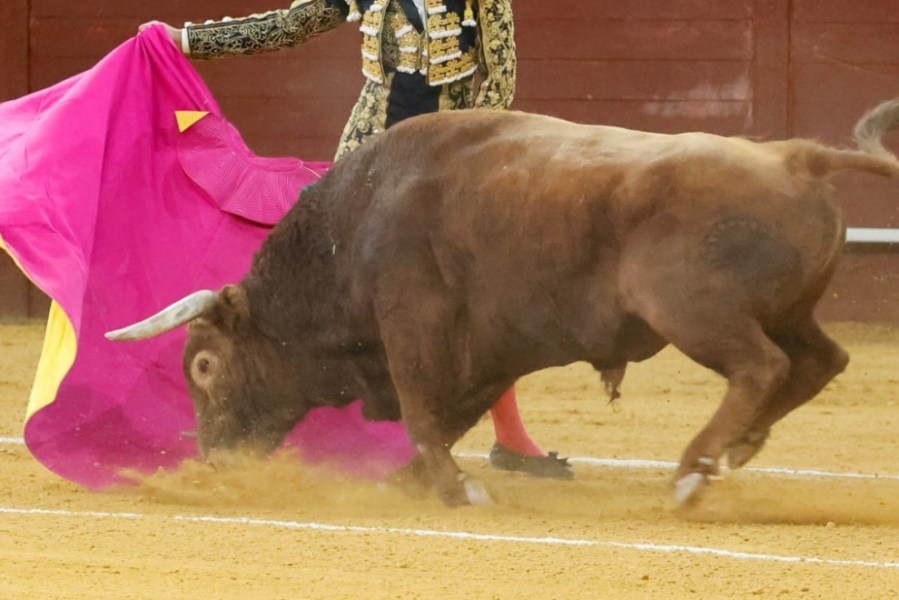
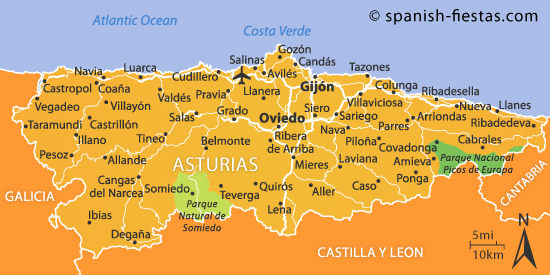
Fascist supporters of bullfighting in Asturias thought they were having fun by naming two bulls due to be killed “Feminist” and “Nigerian” respectively. But their racist and sexist joke-jibes backfired on them in Gijón (Xixón), cultural centre and largest city of Asturias, the celtic nation in the north of the Spanish state.
Map of Asturias.
Bullfighting is generally supported by a traditionalist conservative constituency in Spain, including fascists, who often project it as integral to their image of Spain. On the other hand, the practice is opposed by large sections of the Left and those who want independence for their nations from Spain, such as Catalonia (banned some years ago) and three southern provinces of the Basque Country (where it was suspended for years but limited fights permitted again recently).
BULLFIGHTING IS ENDED IN GIJÓN
Translation by D.Breatnach from Publico.es report
The El Bibio de Gijón bullring will no longer host the traditional Begoña bullfighting fair, as the City Council will not renew the licence of the bullring because it considers that bulls cannot be used to “deploy an ideology contrary to the human rights”.
“The bullfighting festival is over,” said the mayor of Gijón, Ana González, in statements to journalists, after stating that what happened in the last running of the fair this year, where two of the bulls from Daniel Ruiz’s cattle ranch were named “Feminist” and “Nigerian”, has caused great discontent among feminist and animalist associations and has precipitated a decision that was already in the pipeline.
“A city that believes in the equality of women and men, that believes in integration, in doors open to all cannot allow this type of thing,” said the Councilor before stating that “several lines have been crossed”.
Bullfight in Las Ventas (Photo credit: EFE)
González explained that the idea was to end the licence of the El Bibio bullring and later put an end to it, as contemplated in the resolutions of the PSOE congresses but these events have advanced the decision. For this reason, the Consistory will not grant a third extension of the concession signed in 2016 nor will it issue a new call, despite the fact that the payment of the successful bidder represents 50,000 euros per year for the city council.
“The bullfighting fair is over because it seems that too many things were hidden,” explained the Councilor, who argued that if the world of bullfighting is what was seen in the last run of the fair “it does not contribute much to a city like Gijón “.
“The Mayor indicated that in recent years the bullfighting was “clearly challenged” and that there were more and more voices calling for an end to the bullfighting fair in Gijón, a demand that has now been met.
“The names given to these two bulls which were fought by Morante de la Puebla last Sunday, August 15, in Gijón, generated controversy on social networks and have aroused complaints from feminist and animalist associations.”
As Limerick and Waterford county teams prepared to face one another in the GAA hurling semi-final at Croke Park stadium, anti-internment protesters and campaigners lined up outside Dublin’s General Post Office, in the city centre, to mark the 50th Anniversary on the introduction of internment without trial in the British colony of the Six Counties. Their placards, leaflets and speakers denounced the continuing practice of interning political activists in Ireland today.
Seen at the anti-internment event in Dublin today (Photo crdt: Sean Hogan)
The event was organised by the Anti-Internment Group of Ireland, an independent and non-affiliated campaigning organisation and the supporters included a mixture of socialist Irish Republicans and anarchists. The heavy and persistent rain of the morning held off and Dublin city centre was thronged as GAA hurling supporters added to the usual shoppers. The banners and placards of the picketers drew considerable interest from those passing and here and there people stopped to discuss with them.
Some young Basque girls were curious but also delighted to see their nation’s flag, the ikurrina, being flown at the event and stopped to engage one of the picketers in discussion. Also in evidence was the flag of Amnistia, Basque organisation around solidarity with its political prisoners and against repression, along with the flag of Palestine.
Flag of the Amnistia organisation (solidarity with their political prisoners) in the Basque Country seen on the anti-internment event in Dublin today (Photo crdt: Sean Hogan)
Around 200 leaflets were distributed to passers-by, discussions were held and contacts were made with people interested in supporting the work of the Anti-Internment Group Ireland.
After some time in a picket line and distributing leaflets, a representative of the organisers, speaking in Irish and in English, welcomed the attendance and introduced a speaker from the Anti-Imperialist Action organisation.
One of the leafleters outside the GPO at the anti-internment event in Dublin today (Photo: C.Sulish)
SPEAKERS
Speaking in Irish as some passers-by stopped to listen, the young man said they were there to commemorate the introduction of internment and mindful of the existence of political prisoners all over the world. The were also protesting the extradition to Lithuania of Liam Campbell to face trial in a country in which he had never previously set foot.
The organisers’ representative then spoke in English about the history of repression in the Six Counties colony, how from the moment the nationalist community there stood up to demand equal rights and justice the State had responded with violence. Since the people raised the level of their resistance in response, the State in turn raised the level of its violence higher again, in a rising spiral of violence.
The nationalist community in the Six Counties had marched for civil rights and had been met with the violence of the colonial police and of the Loyalists — the speaker said — but they had continued to resist. Internment without trial was introduced to break that resistance but, knowing that would also lead to increased resistance, the State had prepared the Paratroopers to shoot unarmed civilians dead. They had done that in Ballymurphy on the very day that internment had been introduced1, he reminded his audience and later had shot dead two unarmed Cumann na mBan Volunteers (Republican women’s organisation) who were alerting people to the raiding parties of the British Army. At the start of the following year, the British Army murdered unarmed civilians again, this time in Derry2.
That year 1972, the speaker stated, had the highest death toll of any year during the three decades of the war3 and Loyalists were also bombing streets nearby in Dublin, again in 1973, killing workers. In 1974 Loyalists and British intelligence bombed the Dublin city centre again and Monaghan, killing the highest number of people killed in one day during the war4. That year too, the IRA bombed pubs in England and killed people and the State brought in the repressive Prevention of Terrorism Act against the Irish community. They jailed a score of innocent people on extremely serious charges5 and one of them, Giuseppe Conlon, died in jail6.
The speaker went on to say that although there had been hard repression before, the introduction of internment without trial and the follow-up massacres by the British Army had lit a fuse to a chain-reaction of violence for decades to follow.
Pointing out that internment consists of jailing people without trial, the speaker stated that the practice continues today, by refusing bail to political activists awaiting trial in the non-jury courts on both sides of the British Border. The Anti-Internment Group of Ireland will continue striving to expose this reality and he called on people to support the monthly pickets in the city centre and to follow the End Internment page on Facebook.
ONGOING AGITATING AGAINST INTERNMENT
As the applause died down people began to pack away flags, banners, placards and leaflets and to catch up socially among themselves or to engage with passers-by who had stopped to listen and/ or to ask questions.
Organisers of the event said they hope to hold another picket at some venue in the city centre in a month’s time – when scheduled, the event will be announced on the End Internment FB page.
End.
Leafleter right foreground, person reading leaflet left foreground, picket line of the anti-internment event in Dublin today. (Photo: C.Sulish)
(Photo: S.Hogan)
(Photo: S.Hogan)View of the picket with a passer-by expressing solidarity with the picketers (far right of photo). (Photo: C.Sulish)
FOOTNOTES
1Between 9-11 August, British paratroopers caused the deaths of 11 unarmed civilians in Ballymurphy.
213 people were shot dead by British paratroopers on Bloody Sunday in Derry as they protested against internment and a 14th died later of his wounds.
3The period from August 1971 to the end of the year saw a huge jump to 136 violent deaths (including British and colonial armed forces) and the following year, 1972 is counted the most violent year of the conflict overall with 479 people killed (including 130 British soldiers) and 4,876 injured.
5The Birmingham Six, Guildford Four, Maguire Seven, Giuseppe Conlon and Judith Ward. All were eventually cleared after long years of campaigning around them and failed court appeals.
6Giuseppe Conlon, hearing that his son Gerry had been arrested for the Guildford Pub Bombings, came to London to help him in 1974 and was swept up into the police net to become one of the innocent framed victims. Giuseppe Conlon was not a healthy man and died in his 7th year in jail, before the verdicts on the other framed prisoners were finally overturned. His son Gerry, also an innocent man in jail, was not permitted to attend his father’s funeral.
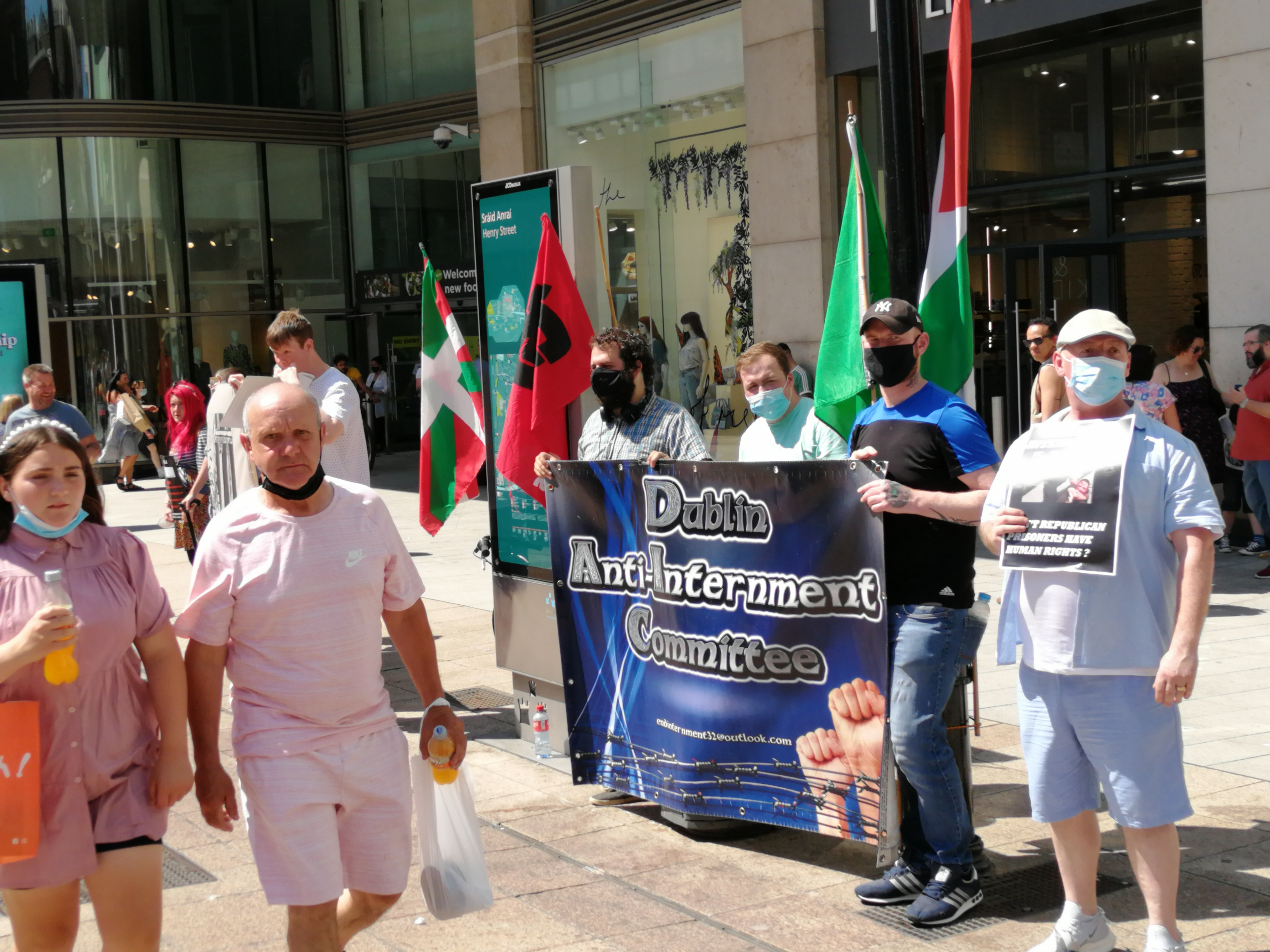
A group of mixed political background held a picket this afternoon in Henry Street, one of the main shopping streets in Dublin’s city centre. The picket was protesting the continuing internment in Ireland of political activists and also expressing solidarity with political prisoners in different parts of the world – a Palestinian flag and a couple of Basque ones flew alongside the Irish ones. There are over 60 political prisoners in Irish jails both sides of the British Border.
Many people were out shopping or just enjoying the sun on what must have been the hottest day of the year so far. Up to 200 leaflets were distributed and passers-by occasionally stopped to discuss with the picket supporters.
Section of the picket displaying the banner of the organising group held by supporters. Also in the photo from left to right: Basque national Ikurrina; Basque Amnistia organisation; Irish Starry Plough; Palestinian flag. (Photo: C. Sulish)
MESSAGE OF SOLIDARITY TO CAMPAIGNERS FOR MUMIA ABU JAMAL
Near the end of the picket, a representative of the Anti-Internment Committee of Ireland was recorded voicing a message of solidarity for Mumia Abu Jamal, to send to an upcoming conference on Mumia and other political prisoners.
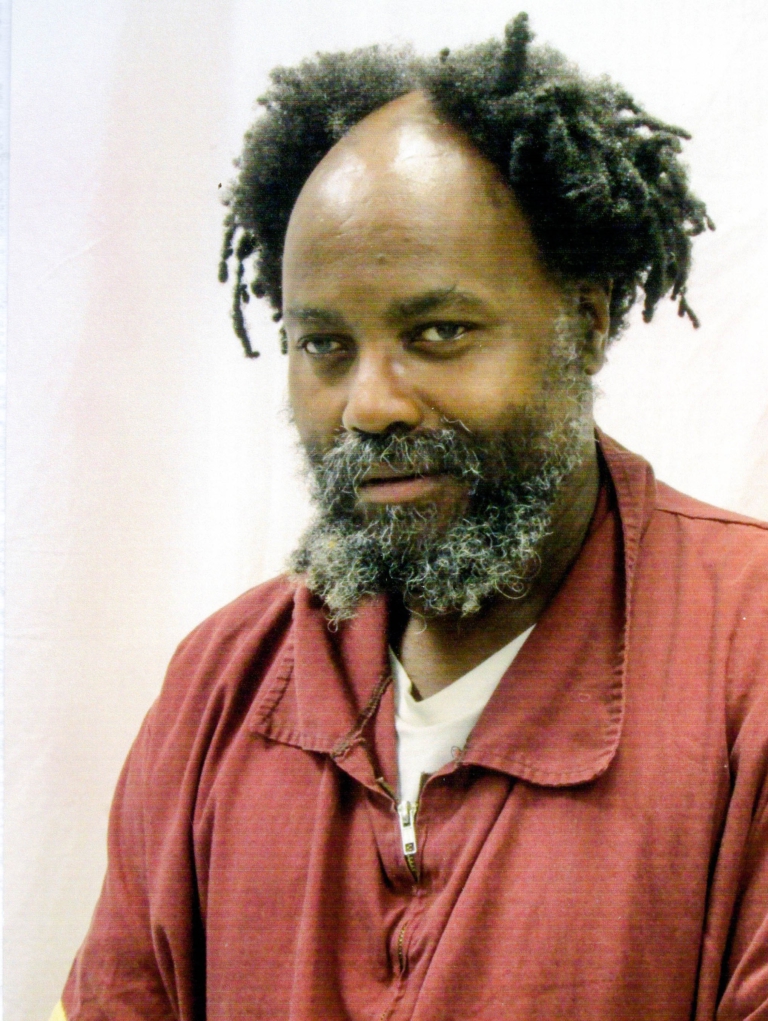
Mumia Abu Jamal in 2019 (Photo sourced: Liberation New)
Mumia is a political prisoner, a black United States activist and author who was awaiting execution but is now in his 40th year in jail. He was a popular broadcaster in 1981 when he went to the assistance of his brother, who was being harassed by a white police officer. As the incident came to an end the cop was dead of gunshot wounds and Mumia was shot in the stomach.
There are so many questions about the scenario the Prosecution laid out and which got Mumia convicted of murder and sentenced to death, which was later commuted to imprisonment for life. His gun had five bullets missing but Mumia was never tested to see whether he had fired the gun nor were the tests on the bullets in the police officer conclusively proven to come from there. The crime scene was not preserved and the police were in and out of it, with Mumia’s gun while Mumia was in hospital, undergoing an emergency operation. Photos taken of the scene by an independent press photographer did not show the presence of the taxi of a witness against Mumia, who claimed he was parked there. Not to mention the later confession of a man who claimed to have killed the police officer on behalf of other police as a contract kill (the decision not to use him as a witness divided Mumia’s legal team and two lawyers resigned as a result).
As the spokesperson of the Anti-Internment Committee said, even if people believe that he fired the shots that killed the police officer, after 40 years Mumia should be freed on humanitarian grounds. The USA is allegedly the country leading the world in democracy, as the spokesperson commented, but holds a great many political prisoners, some of them for many, many years in jail.
MORE EVENTS TO COME
Eastward view of picketers in Henry Street, Dublin, facing Liffey Street (Photo: C. Sulish)
Pandemic permitting, the AIGI intends to hold pickets on approximately a monthly basis to protest continuing internment and in solidarity with political prisoners, such events being advertised on our social media. The organisation is independent of any political party or organisation and all who oppose the jailing of activists without trial or wish to support political prisoners are welcome.
Two of the picketers with placards (Photo: C. Sulish)
Westward view of picketers in Henry Street, Dublin, facing Liffey Street (Photo: C. Sulish)
The undemocratic non-jury Special Criminal Court was renewed for another year in the Dáil yesterday evening with the lowest abstentions or vote against it ever. All Sinn Féin’s TDs (members of the Irish parliament) absented themselves and FG, FF, Greens and Labour all voted for another year’s renewal, with the Social Democrats abstaining. Seven votes were cast against it, the lowest ever since it was brought in as part of the Offences Against the State Act in 1972.
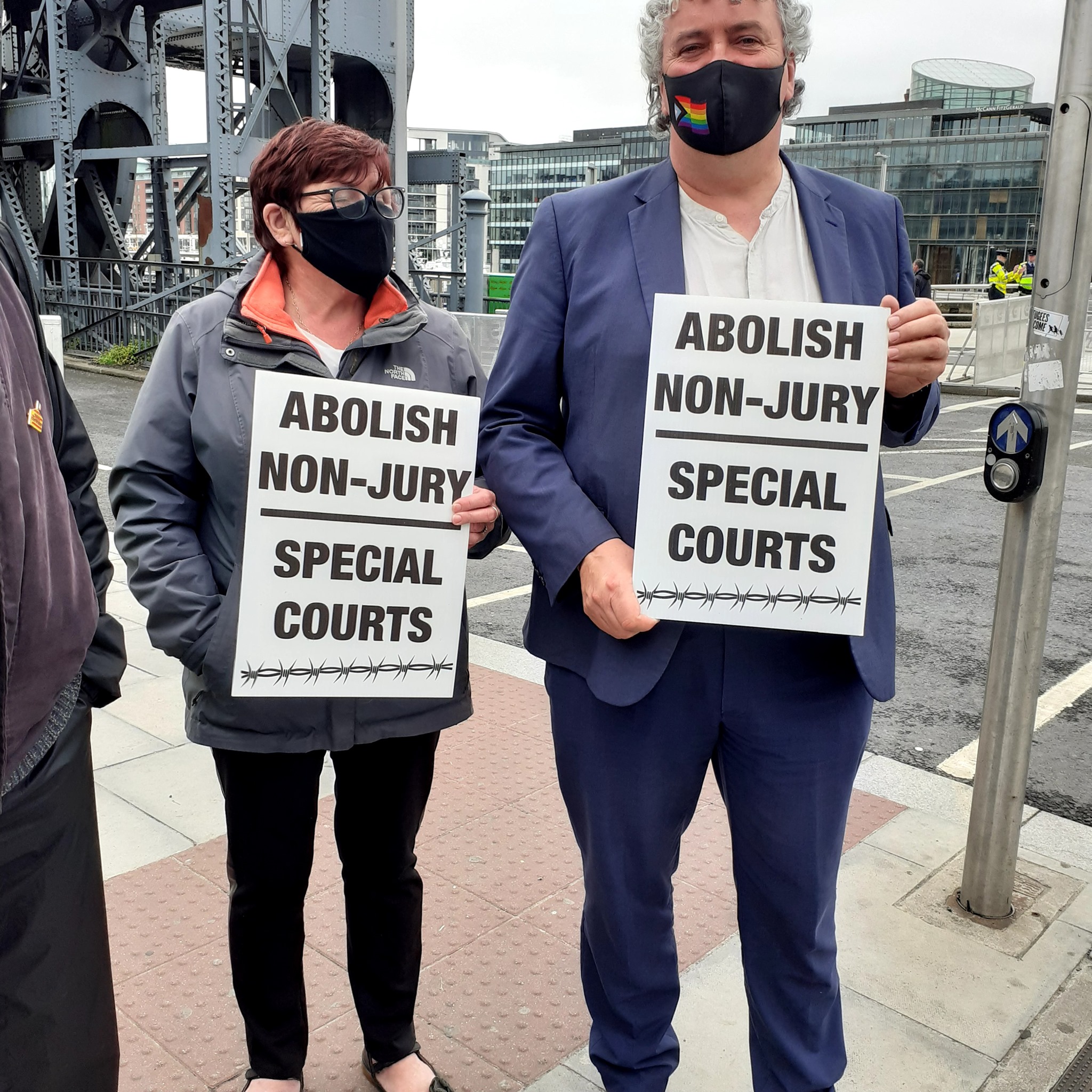
Voting against renewal were the five PBP/Solidarity TDs (Bríd Smith, Richard Boyd Barrett, Gino Kenny, Mick Barry, Paul Murphy) and the two left-wing Independent TDs: Joan Collins and Thomas Pringle. Sinn Féin, who abstained in 1920 for the first time after decades of opposition, just didn’t attend at all this time. In 1920 they said that they were awaiting a review of the Act promised by the Justice Minister – but without any explanation of what in the review could possibly convince them to keep the Act in place. The Social Democrats, whose amendment to bring the Special Court to an end by a deadline of June 29th next year was rejected, abstained in the vote.
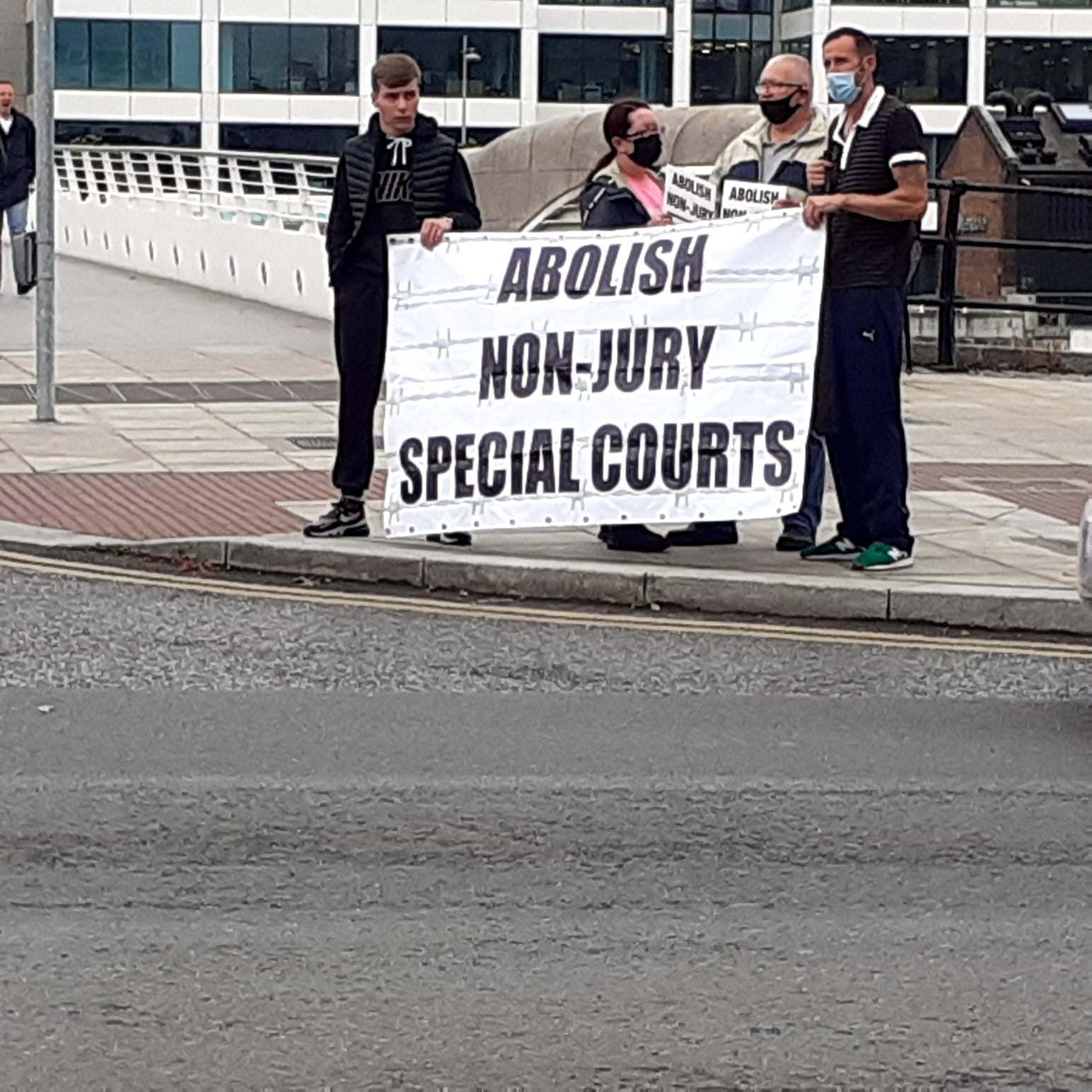
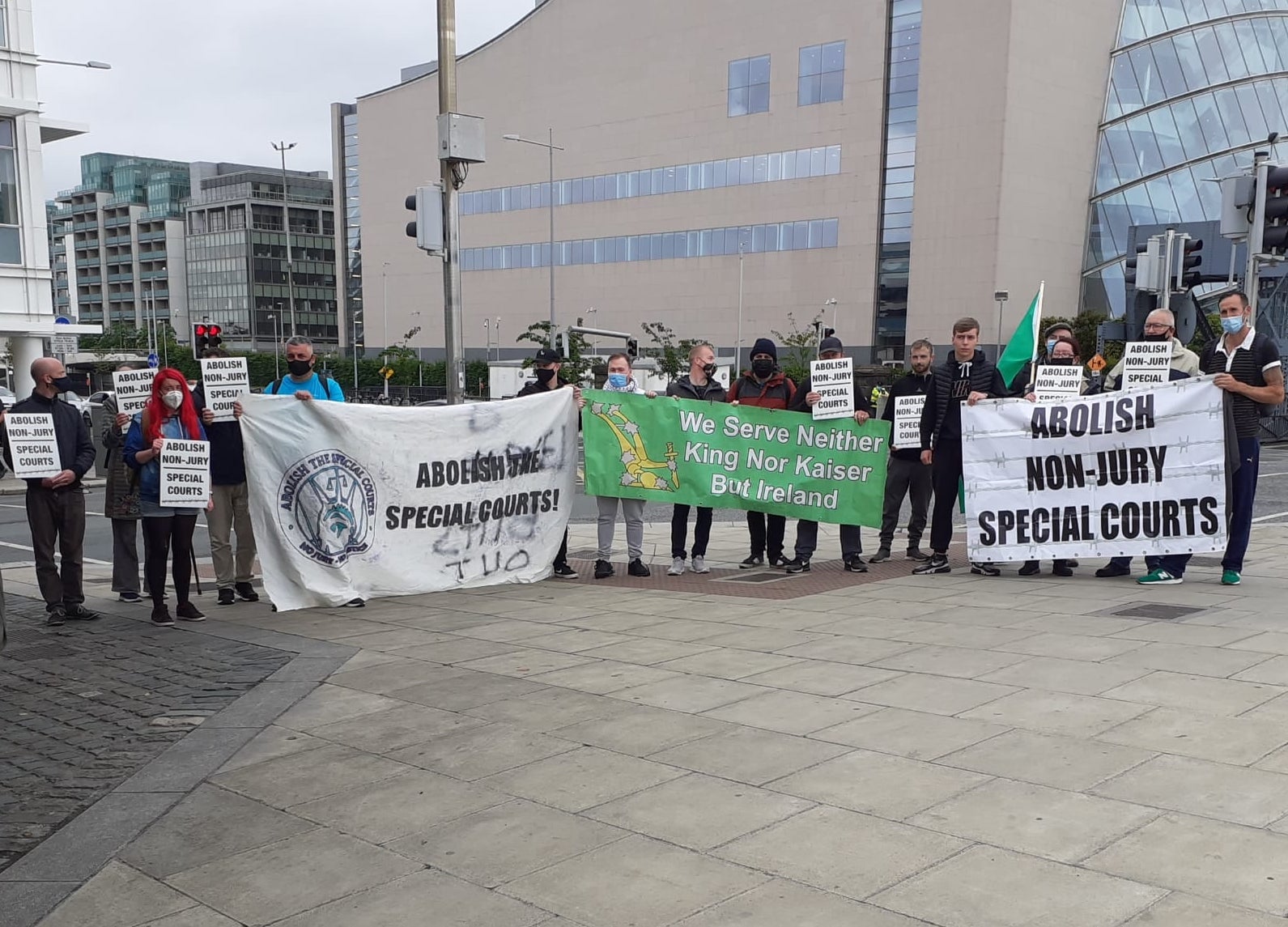
Section of picketers with banner (Photo: Abolish the Special Courts)
SINNFÉIN ABANDONS DECADES OF OPPOSITION TO THE SPECIAL CRIMINALCOURT
Since the Acts’ inception, Sinn Féin has voted against the annual renewal – until last year, when they abstained and this year, absented themselves from the Dáil before the vote. For some years now, the party has been reshaping itself to take part in a coalition government with one of the government parties. Supporters of the party who believe this a necessary disguise to enter the corridors of power and that the party will then return to its Republican past will find that for whatever principle the party gives up voluntarily, a further one will be extracted by pressure. Those who crawl into government will never be able to stand up in it later.
James Geoghegan, FG’s candidate for the forthcoming by-election in Dublin Bay East, taking a swipe at SF’s candidate Lynn Boylan, said “When it comes before both the Dáil and Seanad, what will Sinn Féin and Senator Lynn Boylan do? Will they abstain yet again, which undermines the laws in place to keep our citizens and democratic institutions safe?
“If Senator Boylan wishes to be a senior legislator and member of Dáil Eireann, she must show her support for the institutions of the State and do all in her power to protect the public from criminality and the threat of terrorism.”
Note that Geoghegan has no difficulty in equating support for “democratic institutions” with supporting their very negation, such as jury-less trials.
Voting display in the Dáil (sourced from Abolish the Special Courts)
Sinn Féin party leaders may think that in not opposing the SCC’s renewal, they are abandoning only some Republican principles, as Republicans have been the main victims of the Special Criminal Court to date but in fact they are also colluding in a major attack on civil and human rights, as pointed to by the opposition of civil and human rights organisations to the SCC.
OPPOSITION OUTSIDE THE DÁIL
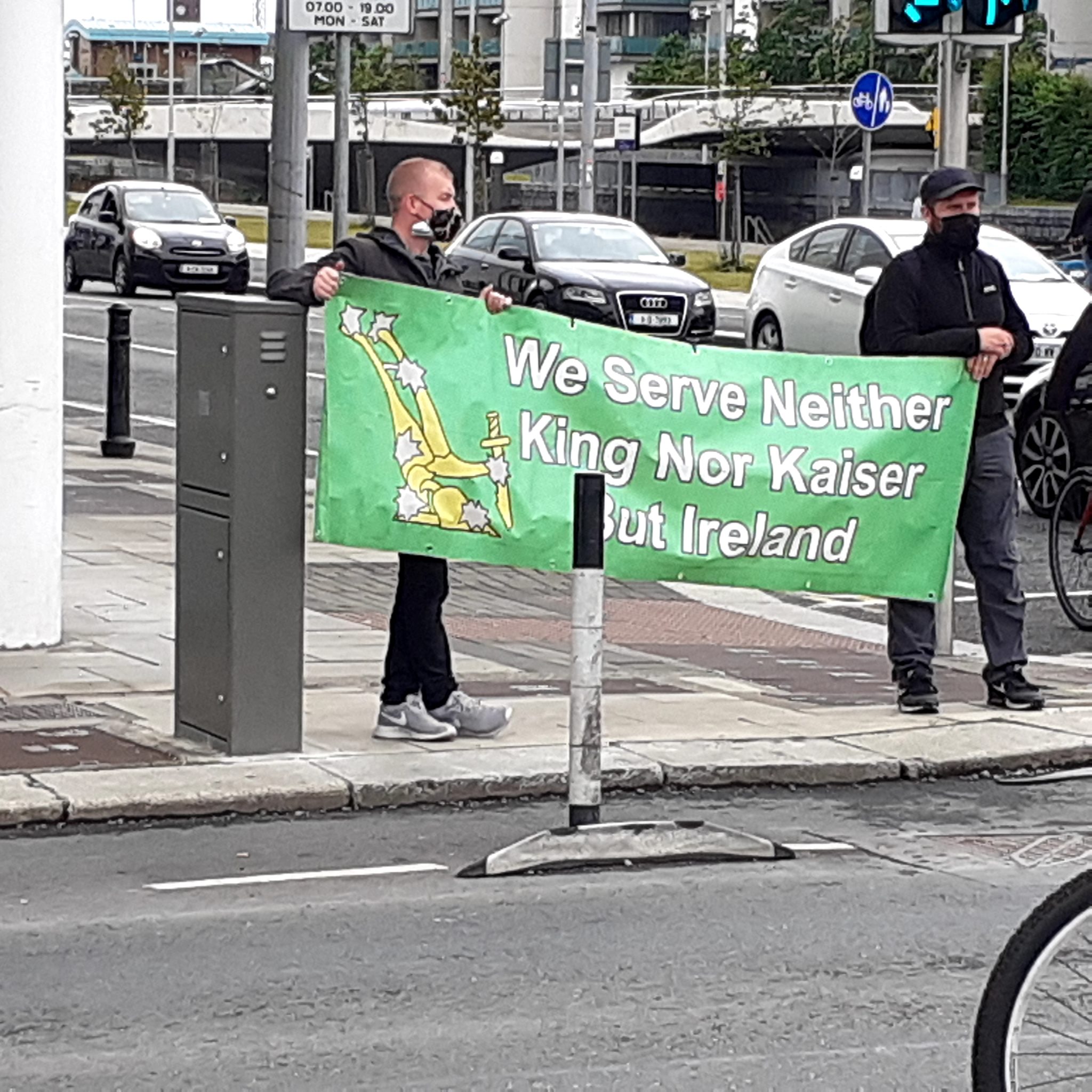
Picket group at intersection just before Garda barrier. (Photo: Anti-Imperialist Action)
Outside the Dáil, which has been held in the Convention Building on the Dublin quays since the Covid 19 measures, a protest picket took place before the vote. The demonstration was organised by the Abolish the Special Courts campaign and supported by a mixed attendance of Republicans, Socialists and Anarchists.
A number of passing motorists, particularly in company vans and lorries, blew their car horns in solidarity in passing, some also extending a clenched fist or “thumbs up” sign out of their window.
Left Independent TDs Thomas Pringle and Joan Collins joined the picketers for a while and Richard Boyd Barrett chatted with them in passing too; all three posed for a photo while holding a placard against the SCC before returning to the Dáil to speak and vote against the juryless court.
Independent left TDs (Irish MPs) Joan Collins and Thomas Pringle joined the picket for a while. (Photo: Abolish the Special Courts)
The Abolish the Special Courts campaign was launched in 2017 and a public meeting the campaign group organised in Dublin in 2018 heard about a number of then recent cases of unjust convictions in the non-jury courts. Since then the campaign group has organised protests against the SCC.
Group of picketers near the Samuel Beckett Bridge (Photo: Anti-Imperialist Action)
IRISH STATE TERRORIST LEGISLATION ASSISTED BY BRITISH TERRORISM
The Special Criminal Court, as stated earlier, is part of the Offences Against the State Act (OAS) 1939, which is sometimes described as the Irish State’s anti-terror legislation. However, the setting up of the Special Criminal Court and the infamous Amendment to the OAS which allows convictions of “membership of an illegal organisation” solely on the unsupported word of a Garda at superintendent rank or higher, was in fact passed on a wave of hysteria after a terrorist bombing in 1972 by British Intelligence terrorists.
Aftermath of the 1972 car bomb explosion by British agents to have the Dáil vote in favour of the SCC and the Amendment to the Offences Against the State Act. Two public transport workers were killed here. (Photo sourced: Internet)
On the evening of December 1st, 1972, a car bomb exploded near Liberty Hall in Dublin and although there were no fatalities in that explosion, many were injured. A second bomb a short time later at Sackville Place, off O’Connell Street, killed Mr George Bradshaw (29), a bus driver, and Mr Duffy (24), a bus conductor.
The indications had been that Fine Gael and Labour were both going to vote against the Fianna Fáil proposals but in the panic after the the explosions, which were blamed against all logic on the IRA, the opposition to the Acts collapsed and they passed.
THE PRETENCE OF “TEMPORARY PROVISIONS”
The Acts must be voted upon annually because, as with much emergency legislation across the world, the myth is propagated that the provisions are temporary; however these “temporary measures” have now been in place for 82 years! To give another example, the specifically anti-Irish emergency legislation introduced to Britain in 1974, the annually-renewable Prevention of Terrorism Act, was only abolished 15 years later to be replaced by the Prevention of Terrorism Act 1989 (again “Temporary Provisions”) which in turn was replaced by the Terrorism Act 2000.
The powers this Act provide the police have been controversial, leading to noted cases of alleged abuse, and to legal challenges in British and European courts. The stop-and-search powers under section 44 of the Act have been ruled illegal by the European Court of Human Rights.
That Act was strengthened by the Prevention of Terrorism Act 2005, which was then replaced by Section 1 of the Terrorism Prevention and Investigation Measures 2011. All repressive legislation in Britain has now ceased even the pretence of being temporary.
A similar trajectory has been followed by “emergency” legislation in the Six Counties statelet, from the very creation of the administration in 1921 (with the Emergency Powers Act of 1920), a new Act in 1926, amended in 1964 and replaced by the Civil Contingencies Act 2004, providing unlimited powers of harassment for the colonial police along with refusal of bail, undemocratic bail conditions and easy convictions for the non-jury Diplock Courts.
Section of picketers with banner proclaiming a slogan of the Irish Transport & General Workers Union during WW1 (Photo: Abolish the Special Courts)
NON-JURY COURTS
Historically, on occasion juries have been misled and have also been complicit in unjust verdicts, convicting innocent people (there are infamous cases such as the Irish-related ones in Britain in the 1970s, the Birmingham Six, Guildford Four, Maguire Seven, Giuseppe Conlon and Judith Ward). But much less so than non-jury courts. The right to be tried by a jury empaneled by random selection is considered across the world a fundamental democratic right and, furthermore, is one that has been fought for across the centuries, first to win the actual right, then to apply it across classes and finally to apply it to women and ethnic minorities.
The Six County colony has the Diplock non-jury courts and the Irish State has the SCC, both emergency and undemocratic measures in two states that are supposed to be democracies. Both courts regularly remand accused in custody without bail or impose undemocratic restrictions on the few occasions when bail is granted, such as having to be indoors by a specific time daily, prohibition from attending political meetings, etc. At trial, the required burden of proof on the Prosecution is very light indeed, ensuring an unnaturally high rate of convictions.
Richard Boyd Barrett TD of PBP/Solidarity, holding placard, supporting the picket. (Photo: D.Breatnach)
The Irish Council of Civil Liberties, which was founded in 1976 by people concerned about the increase in repressive powers of the Irish State, has stated that the court “continues to represent the single biggest denial of fair trial rights in our legal system”. The SCC has also been condemned by Amnesty International and the Human Rights Commission of the United Nations.
Whereas apologists for these undemocratic and repressive measures argue that non-jury courts are necessary because jurors might be intimidated, they fail to produce evidence of this having happened. However, there is hard evidence of unjust convictions by the Special Criminal Court.
In 2017 Michael Connolly, who had already spent 14 months in prison had his SCC conviction for alleged membership of the IRA overturned and a retrial ordered, during which he was found “not guilty”. Assistant Commissioner of the Gardaí Michael O’Sullivan was judged to have been “careless” in producing a single piece of “evidence” twice as the basis of his belief of the man’s guilt, which made it appear that there were two pieces of evidence, which the SCC considered sufficient to convict.
In 1986 the Special Criminal Court found Osgur Breatnach, Brian McNally and Nicky Kelly guilty of robbing a mail train near Sallins, Co. Kildare. They were innocent but had “confessed” after beatings in Garda custody, which the Prosecution claimed they had inflicted upon themselves and which the SCC accepted despite vigorous denials and the fact that Breatnach had been in a cell on his own. The three were sentenced to between nine and 12 years but their convictions were later overturned and they were paid compensation by the State in acknowledgement of their innocence. “Whistleblower”, a multi-media work on the unjust convictions organised by musician Cormac Breatnach, a brother of one of the victims of the SCC, has won Irish and international awards –but the SCC continues in operation and to be supported by TDs year after year.
SHAME!
This year and last were the worst years in the existence of the undemocratic court, with lowest votes ever recorded against it. As the Abolish Special Courts campaign succinctly summarised the vote in the Dáil: “Shame on those who used to support the abolition of non-jury special courts who now vote in favour of it, abstain or don’t show up to vote at all.”
End.
Line-up of protesters for a photo as picket draws to a close (Photo : Anti-Imperialist Action)
E. Conde NOTICIAS DE NAVARRA (translation by D.Breatnach)
Never could a coffee have been so bitter. This Wednesday the First Section of the Provincial Court of Navarra is to judge a Guardia Civil officer, belonging to the Citizen Security Unit of the Command of Navarra, accused by the Prosecutor’s Office and the private prosecution of the crime of illegal detention by a public official after he arrested a waitress at a gas station, with whom he argued because the coffee was not to his liking. They ask for him to be fined a sum of 2,160 euros and that he be disqualified for nine years from his post. In addition, they demand that he compensate the victim with 1,000 euros for moral damage.
The events occurred around 10:30 p.m. on July 27, 2019 when the defendant, a Guardia Civil since 2005, in command of a unit arrived with his colleague at the Acciona service station on the A-12, in the area of Legarda. There they went into the café and ordered some coffees. According to the Prosecutor’s Office, “since he did not like the coffee, he argued with the waitress and manager, who was serving the rest of the customers.”
Neither the complaint form nor her driver’s license was acceptable to him
He did not restrict himself to mere protest. He requested the complaint sheet, arguing with her to give it to him immediately. The defendant considered that said sheet was not the corresponding one and asked for her National ID and the woman gave him her driving license. The Guardia insisted that this sheet was not the correct one and considered her driving licence identification insufficient.
The waitress continued working, but the defendant called her, made her step outside away from where the customers could see what was happening and “with abuse of authority, telling her that she was disrespectful”, proceeded to arrest her at around 10:45 p.m. and to put her in the patrol car. She was taken to the Puente la Reina barracks, and handcuffed as a detainee. She was held until 2:00 am, when a statement was taken and she was released. As a result, the victim suffered from anxiety.
During the investigation of the case there was an attempt to resolve the matter by the criminal mediation procedure but as this was unsuccessful, it goes to trial. In principle, any possibility of agreement is ruled out since the officer, if convicted of said crime, would be disqualified from any similar job for a relevant period of time.
COMMENT
by Diarmuid Breatnach
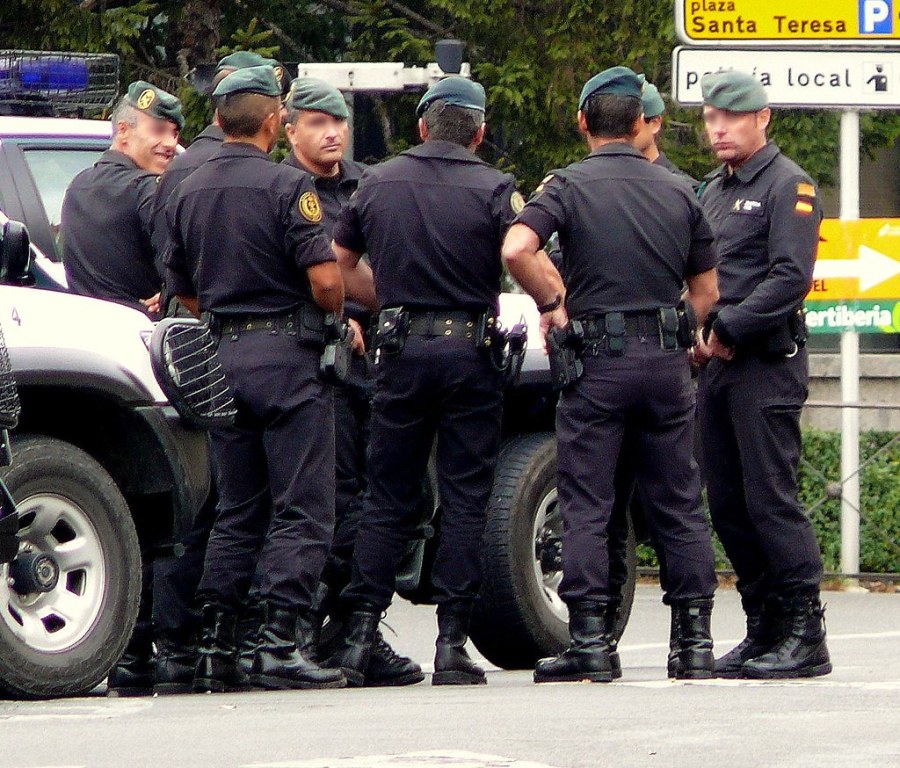
The case is an extreme example of a common aspect of the Guardia Civil – arrogance, a sense of entitlement and impunity and lack of respect for issues of justice or ordinary people. Contempt and hostility towards socialists, LGBT and aspirations of the nations within the state are common too but, although this took place in Nafarroa, in one of the Basque regional autonomies, the report does not reveal whether this played a part.
The Guardia Civil is one of two “national” police forces of the Spanish State and the oldest police force of the kingdom. It is a gendarmerie, an armed police force with military organisation and role in addition to a civil one, such as the Gendarmerie of the French state, Carabinieri of the Italian state and the Royal Irish Constabulary all over Ireland until 1921 and its remnant, the Police Force of Northern Ireland (British colony) today. The force is quartered in barracks for accommodation with police station facilities, cells etc.
GUARDIA CIVIL AND FASCISM
When the fascist-military coup was launched against the republican Popular Front Government of the Spanish state in 1936, the Guardia Civil split evenly between those who remained loyal to the Government and those who defected to the fascist-military, with those loyal becoming the Guardia Republicana. However, that percentage was in the lowest order of police force loyalty to the republican Government, with elected government loyalty in other police forces at around 70% of membership. After the defeat of the republican forces, the superior officer of the Guardia Republicana, General José Aranguren was tried by Francoist military court, sentenced to death and executed in Barcelona.
Often thought to be of Franco prisoners during the Civil War, in fact this photo is of prisoners of the Guardia Civil during the suppression of the Asturias Miners’ Strike in 1934 by General Franco during the right-wing period of the Republican Government, which was overturned in the 1936 elections of the Popular Front. (Photo sourced: Internet)
In the areas conquered by the fascist-military forces and in the whole state after the defeat of the republican forces, the Guardia Civil were one of the chief forces seeking out and rounding up former supporters of the republican Government along with communists, socialists, anarchists, republicans, Basque, Catalan and Galician nationalists. Most of the detainees were brought before military courts and either sentenced to death, to penal servitude or to heavy fines and confiscations of property. Some never made it to court, being summarily executed. Rapes were also recorded and infants of murdered parents were trafficked to fascist childless families.
In the nations that had shown wishes for independence or autonomy, such as Catalonia and the southern Basque Country (of which Navarre is a part), along with other areas where antifascist resistance had been strong such as some areas of Madrid, the Guardia Civil was a constant and visible force of surveillance and repression of the civil population in terms of culture, morality and politics.
Guardia Civil searching country area during the later decades of the Franco regime. (Photo sourced: Internet)
During times of guerrilla conflict, the Guardia at times killed prisoners and routinely tortured detainees during interrogation (the Wikipedia entry says that they were accused of “heavy-handedness”!). Colonel Tejero of the Guardia Civil led 200 of that force in a failed attempted coup in 1981 which included an armed invasion of the Spanish Parliament. Several Guardia including very high-ranking officers were convicted of organising the fascist murder squads of the 1980s (GAL etc) run by the Spanish PSOE Government.
The Guardia until recently was the primary police force acting against the Basque national resistance and numerous of their detainees over decades have testified to being tortured, humiliated (including sexually) and threatened almost immediately after arrest, during their transportation by the Guardia to the force’s barracks in Madrid, where the torture etc continued up to the five days incommunicado detention permitted under Spanish State “anti-terrorist” legislation. The treatment usually produced “confessions” which were then used to secure a conviction and long prison sentence. The European Court of Human Rights has a number of times found the Spanish State guilty of not investigating allegations of torture by detainees and a number of human rights organisations such as Amnesty International have condemned the impunity of the torturers.
Guardia Civil in action in Catalonia during the Referendum on independence there on 1st October 2017. (Photo sourced: Internet)
The Guardia Civil frequently break up demonstrations and in 2017 both they and the Policía Nacional invaded Catalonia in force, the Guardia Civil seizing ballot boxes in the Catalonia Independence Referendum and beating voters and people protesting their actions (also firing rubber bullets which are banned by the regional Government).
Since 2020, actions against Basque and Catalan independence campaigners have been carried out mostly by their autonomous regional police forces (Ertzaintza and Forales in the Basque autonomous regions and Mossos d’Escuadra in Catalonia) but, if charged with “terrorism” or “security crimes”, detainees were delivered to the Guardia Civil who then took them to Madrid for interrogation.
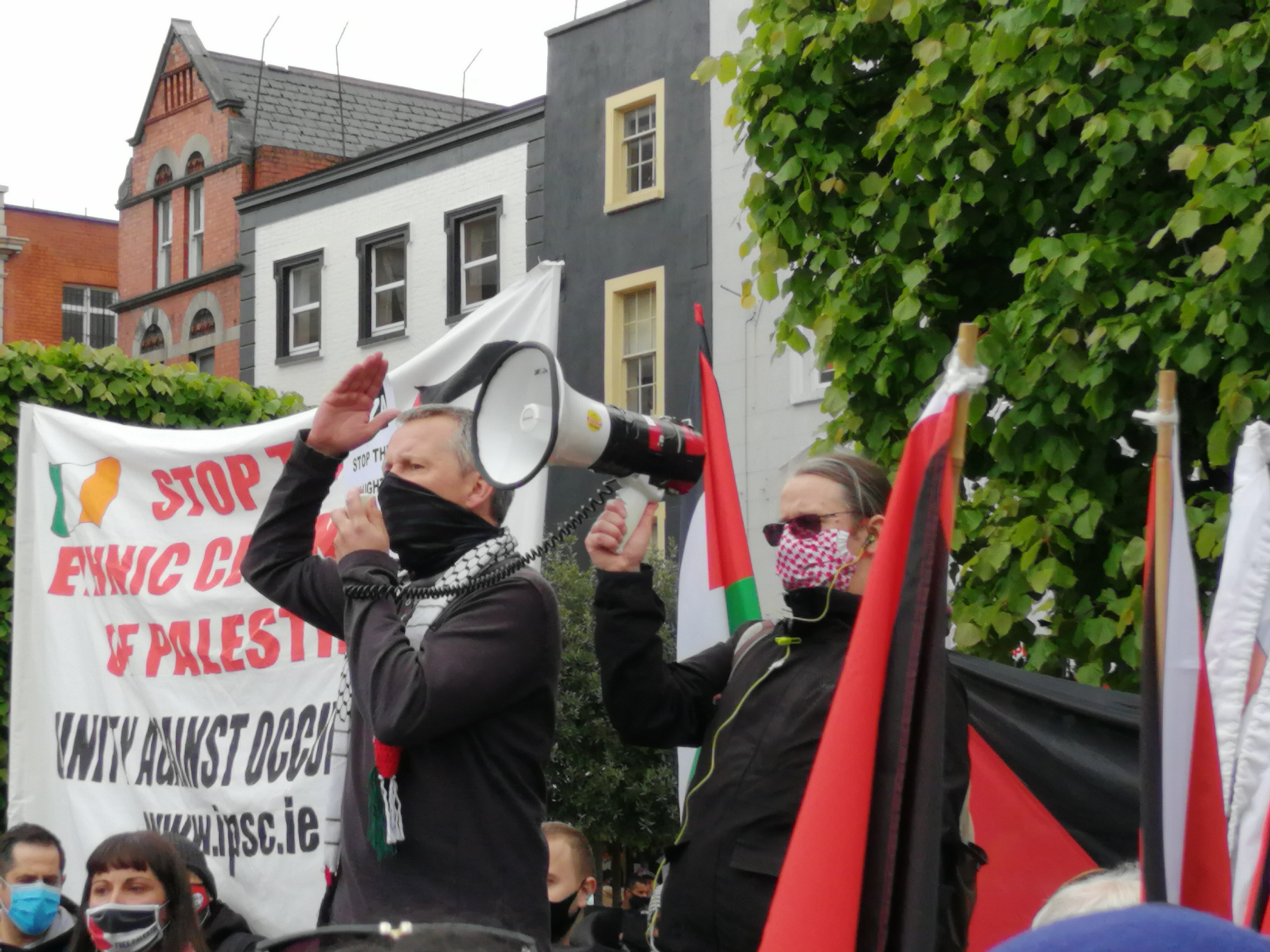
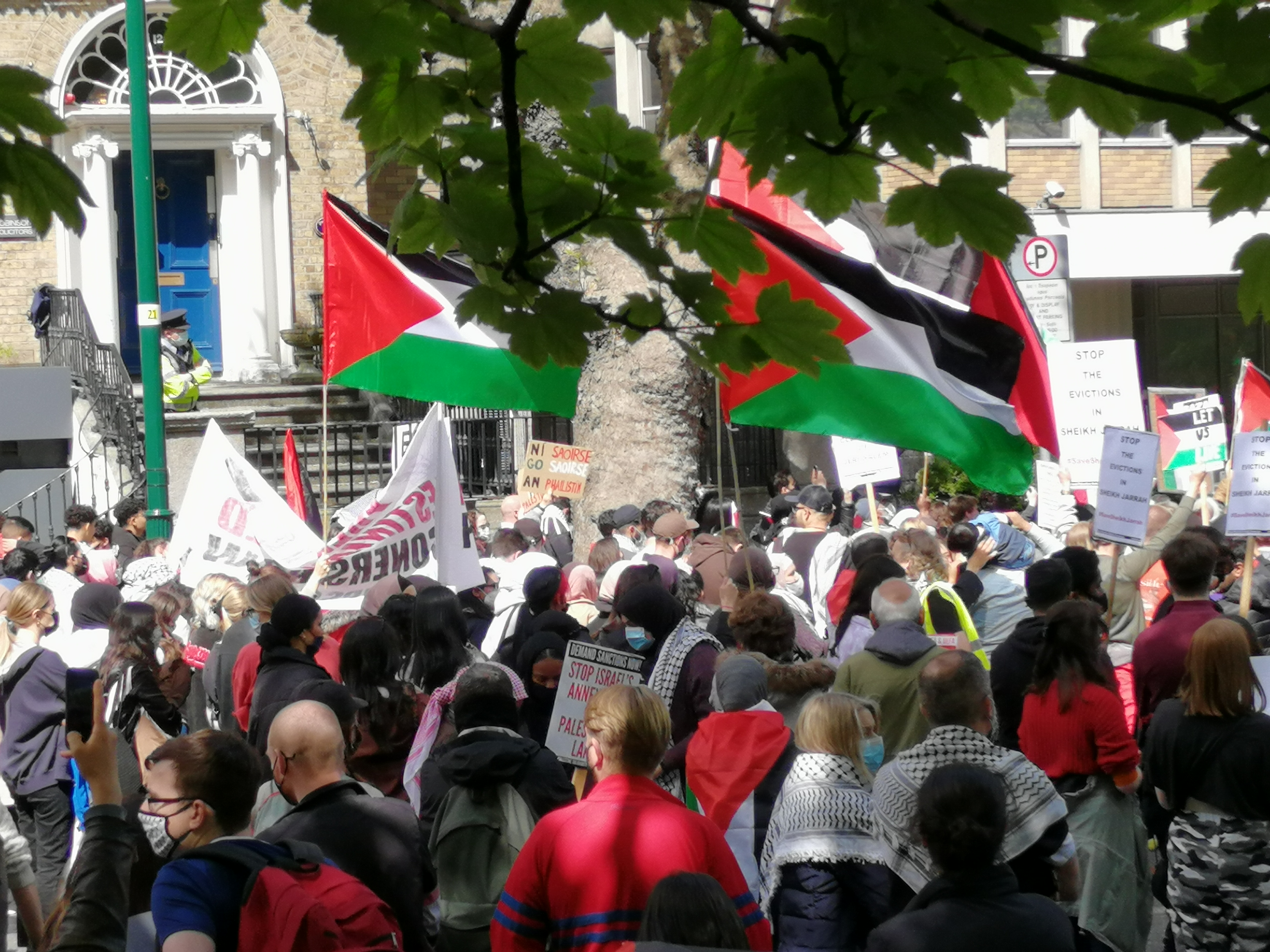
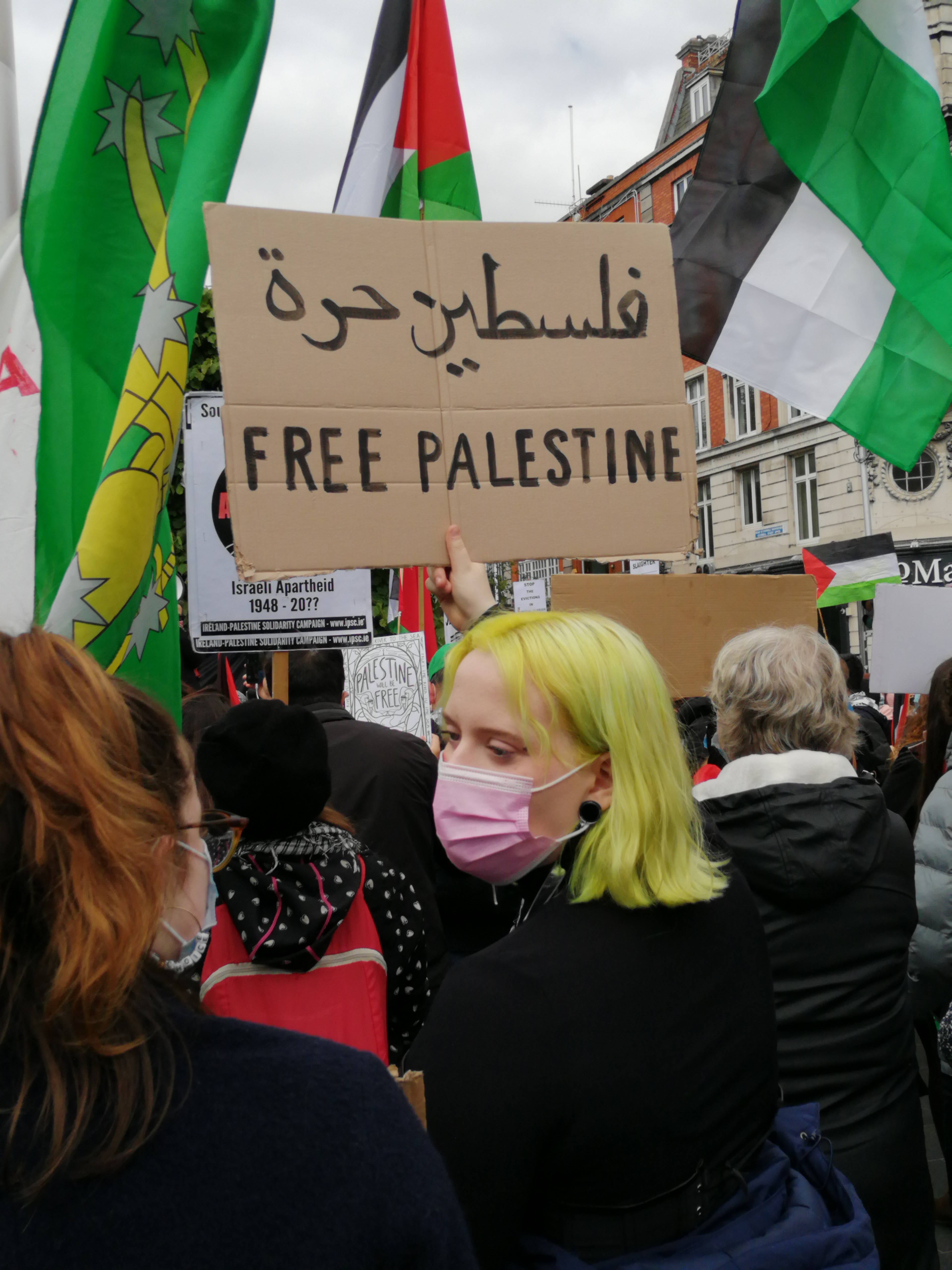
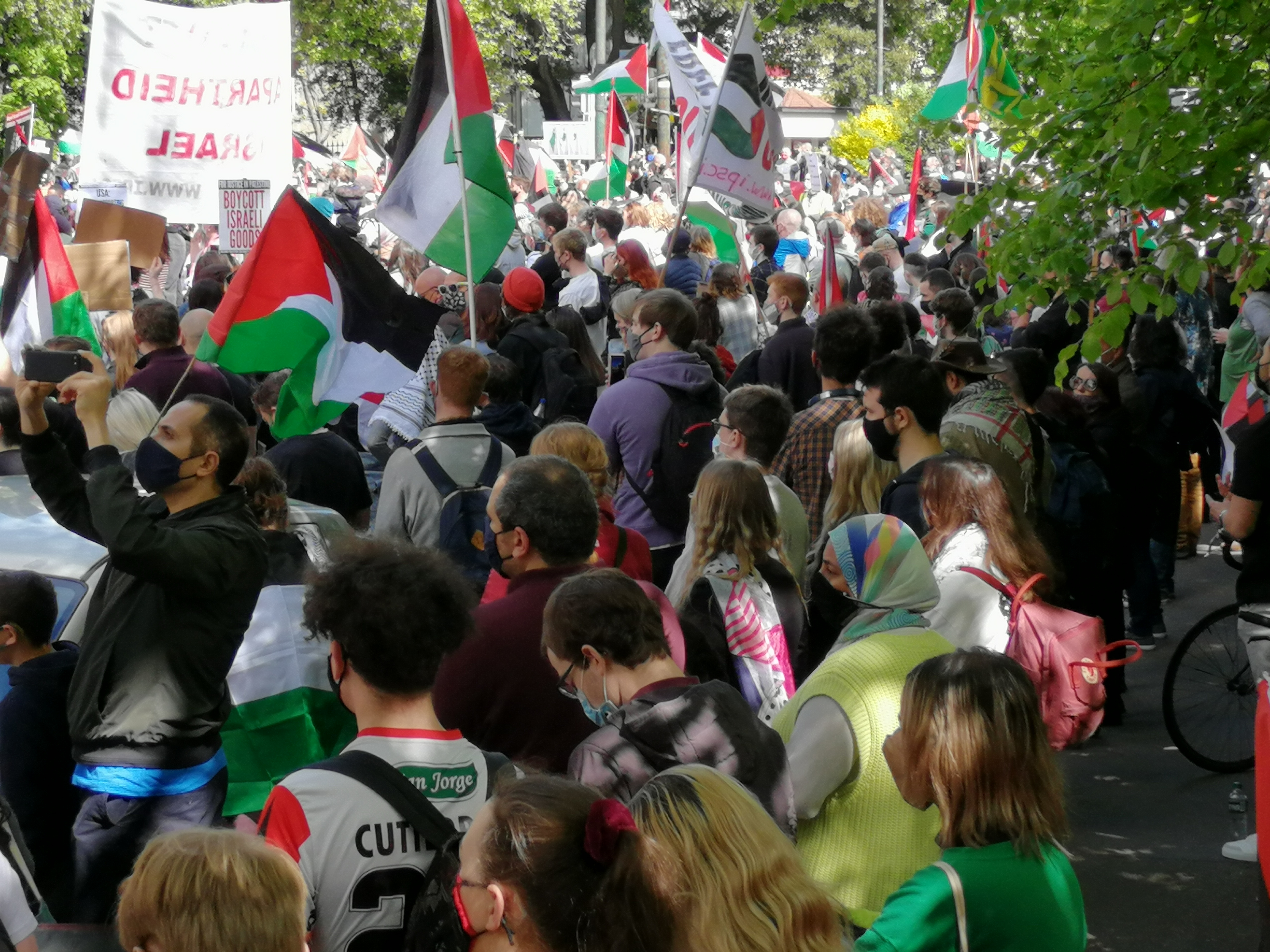
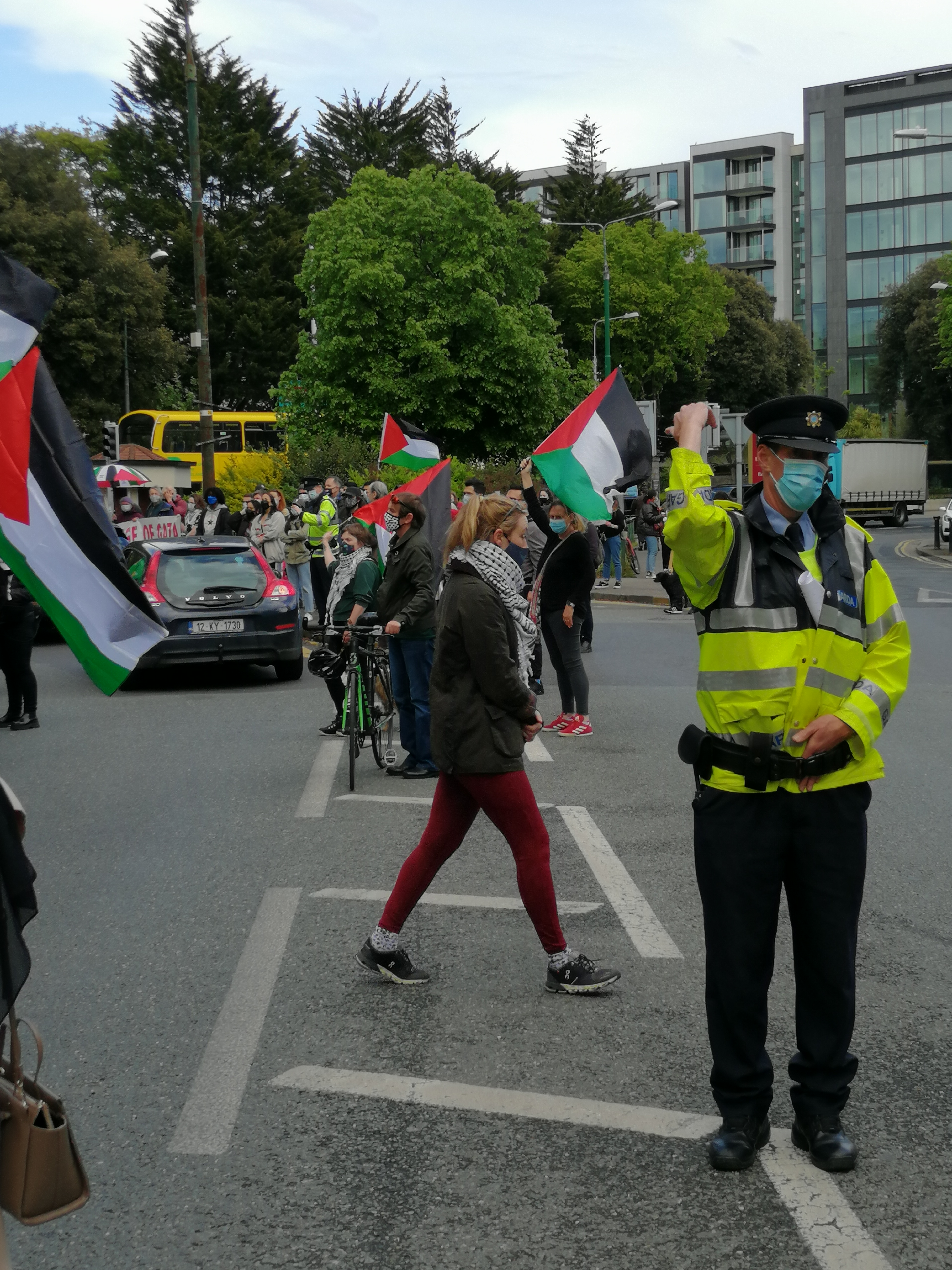
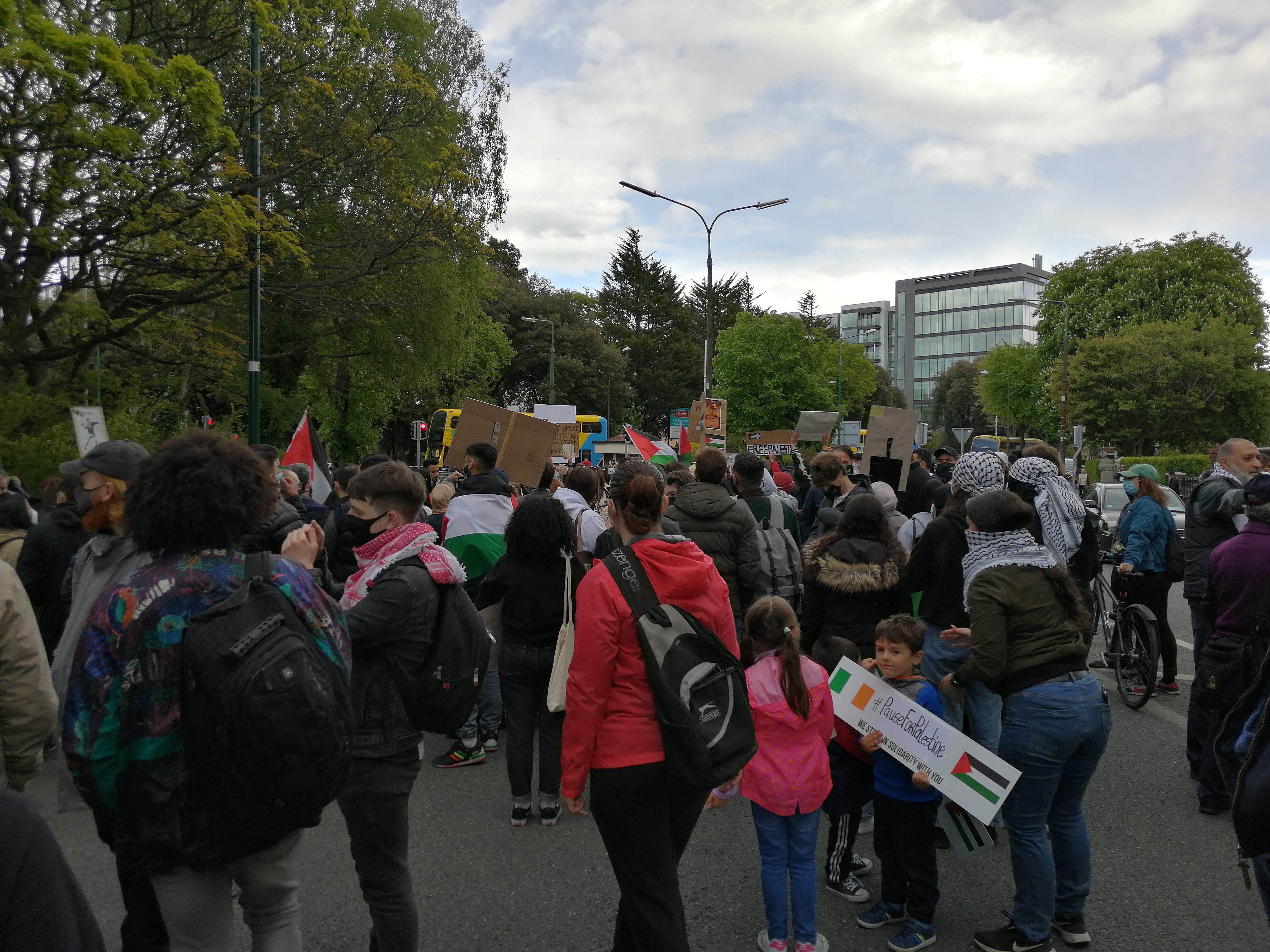
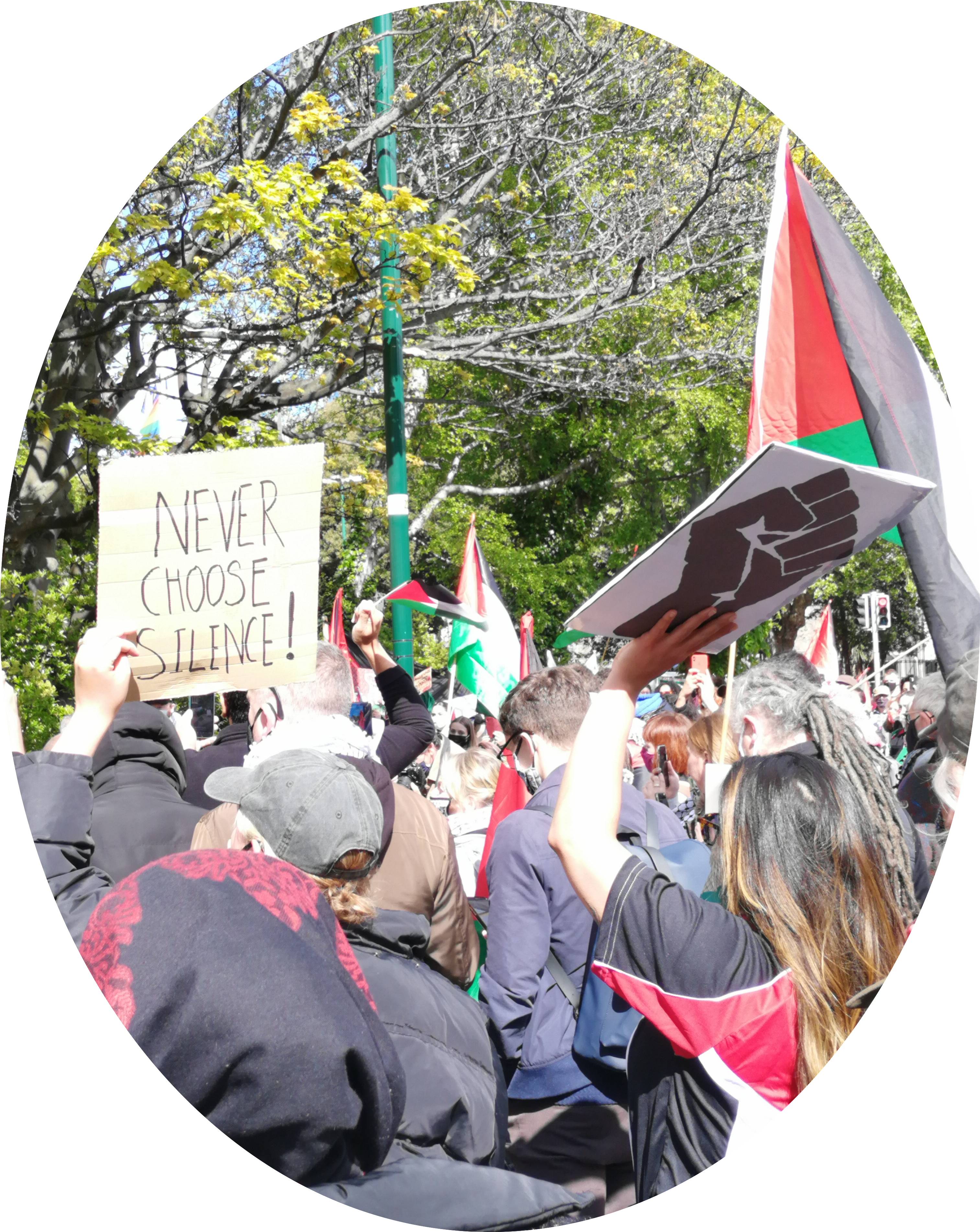
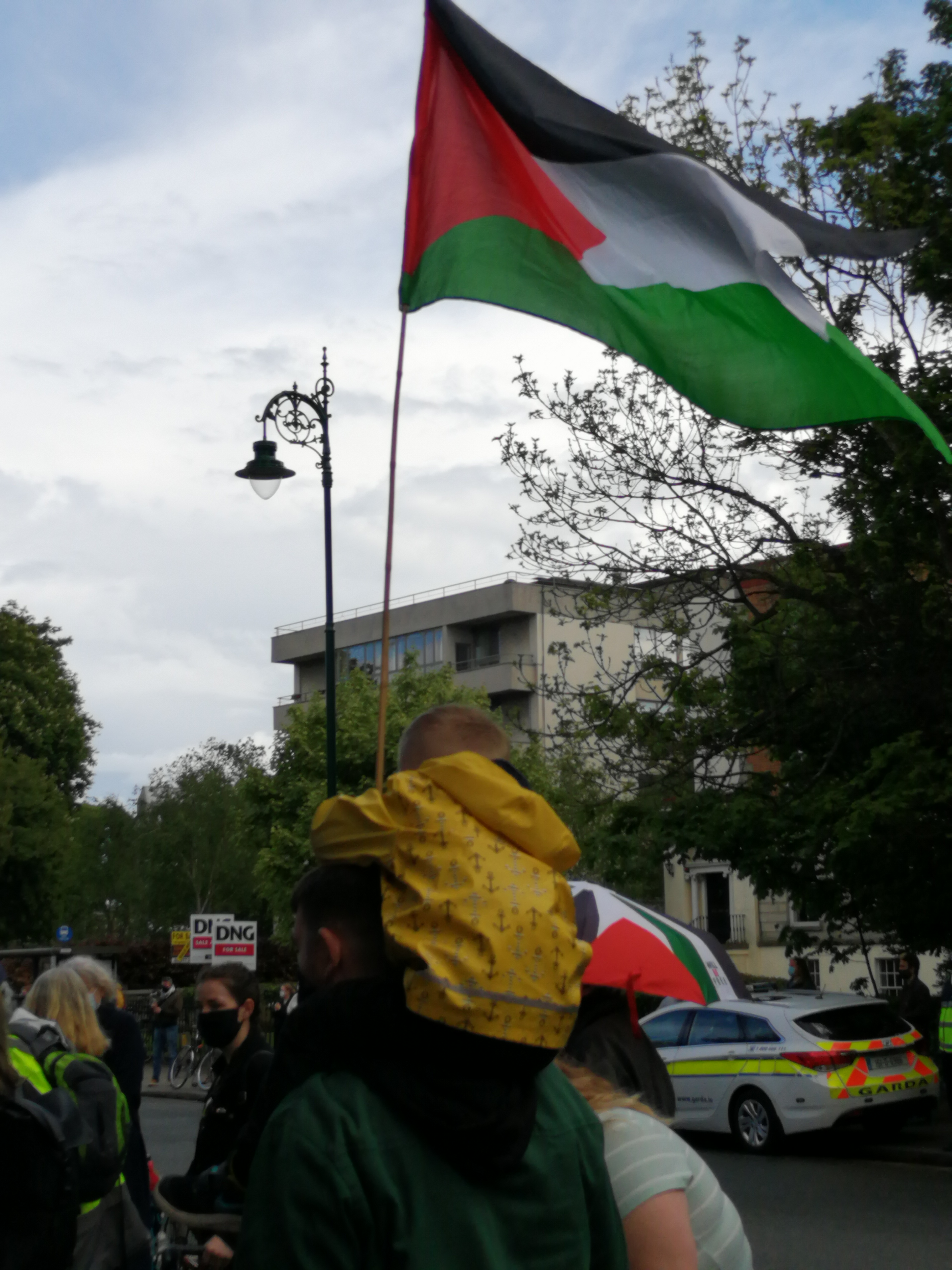
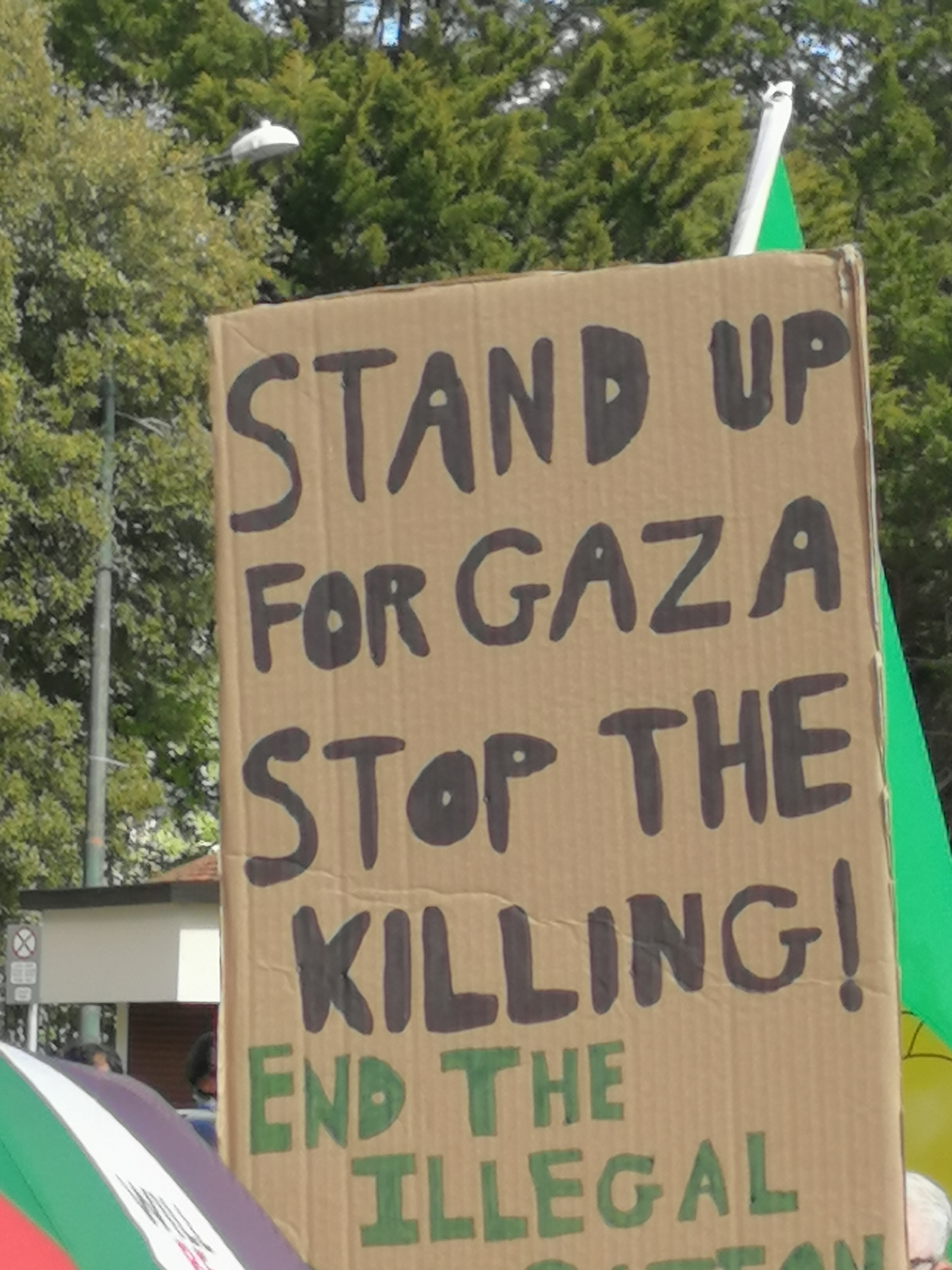
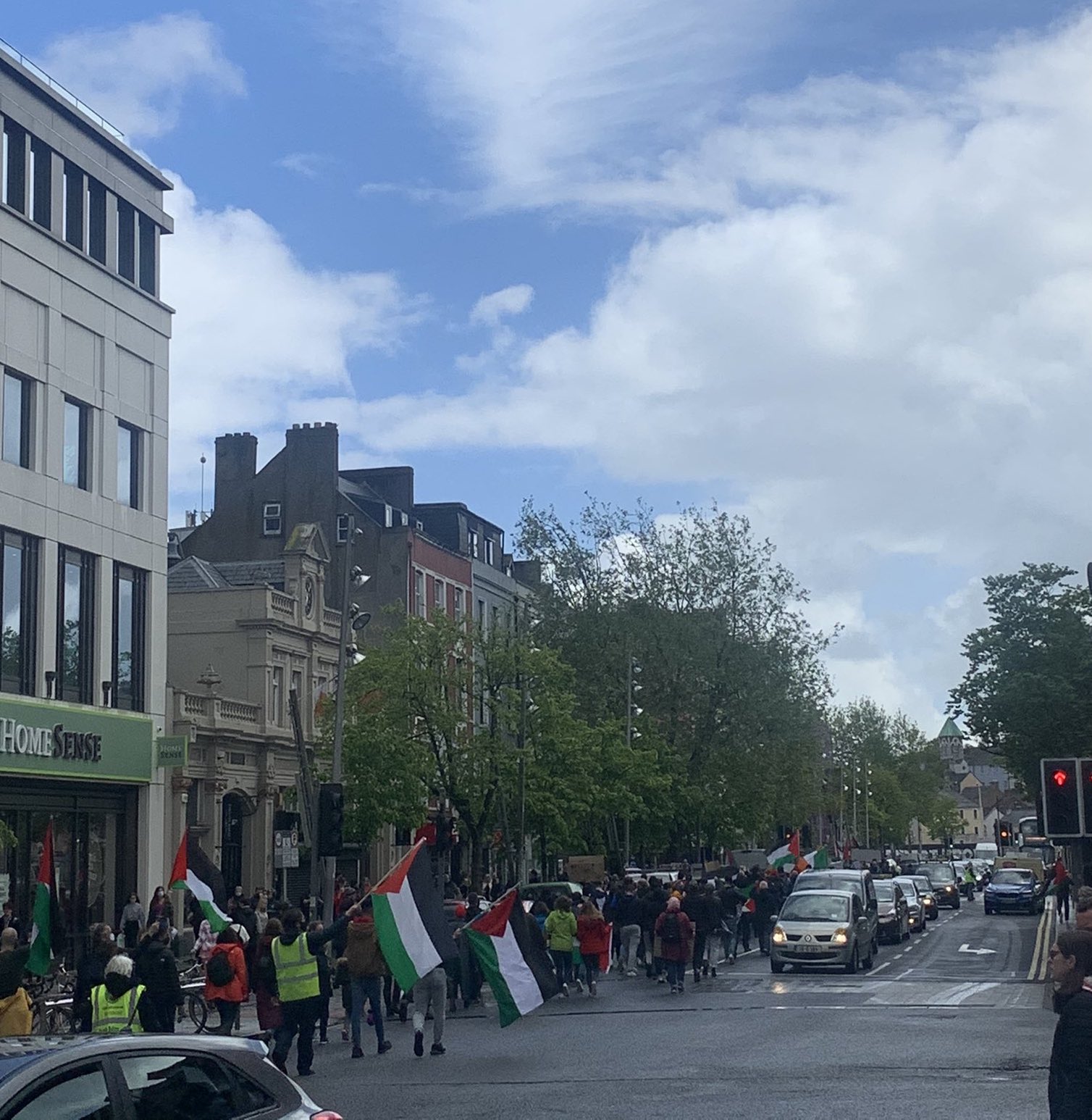
Thousands rallied in the centre of Dublin today, Saturday 22nd May, to express their solidarity with the Palestinian people and their outraged opposition to the murderous attacks on them by the Israeli State. From O’Connell Street they marched across O’Connell Bridge, into Dawson Street and from there straight along Mount Street, across the Grand Canal and on to the Israeli Embassy. Speakers emphasised that the ceasefire, even if it holds, is in essence temporary, since the Israeli occupation has led to war after war and must inevitably lead to another, stating the need therefore to work for an end to the apartheid and similar policies of the Israeli state.
The event was organised by the Ireland Palestine Solidarity Campaign, which had an acapella singing group perform a few songs at the Spire and a number of speakers before they set off on the 3 km march and more speakers outside the Embassy too. Conservative estimates put the number on the march at over 5,000. The slogans shouted for the most part were: “Free, free Palestine!” “One, two, three four – Occupation no more!”; “Five, six, seven, eight – Israel is a terrorist state!” and “Boycott Israel!” “From the river to the sea, Palestine will be free” was another slogan.
(Photo: D.Breatnach)
The ceasefire is now in place since early yesterday (Friday). The current war began with two offensives by the Israeli Zionists on Palestinians in Jerusalem: the first by Israeli settlers harassing and threatening Palestinian residents in the Sheik Jarrah district that they are going to have them evicted because “all of Jerusalem should be Jewish only”; the other nearby in the vicinity of Al Aqsa mosque, where Israeli police harassed Muslims coming to celebrate the religious festival of Eid (this year on May 12th– 13th), culminating in an armed invasion of the temple by Israeli police firing rubber-tipped bullets and stun grenades at the devotees. However the dates fell close also to the anniversary of the Nakba, the Castastrophe of 15 May 1948, the founding of the Zionist state, massacres of Palestinians and expulsion of more than 700,000 refugees whose descendants are in many parts of the world today, forbidden by the Israeli authorities to return.
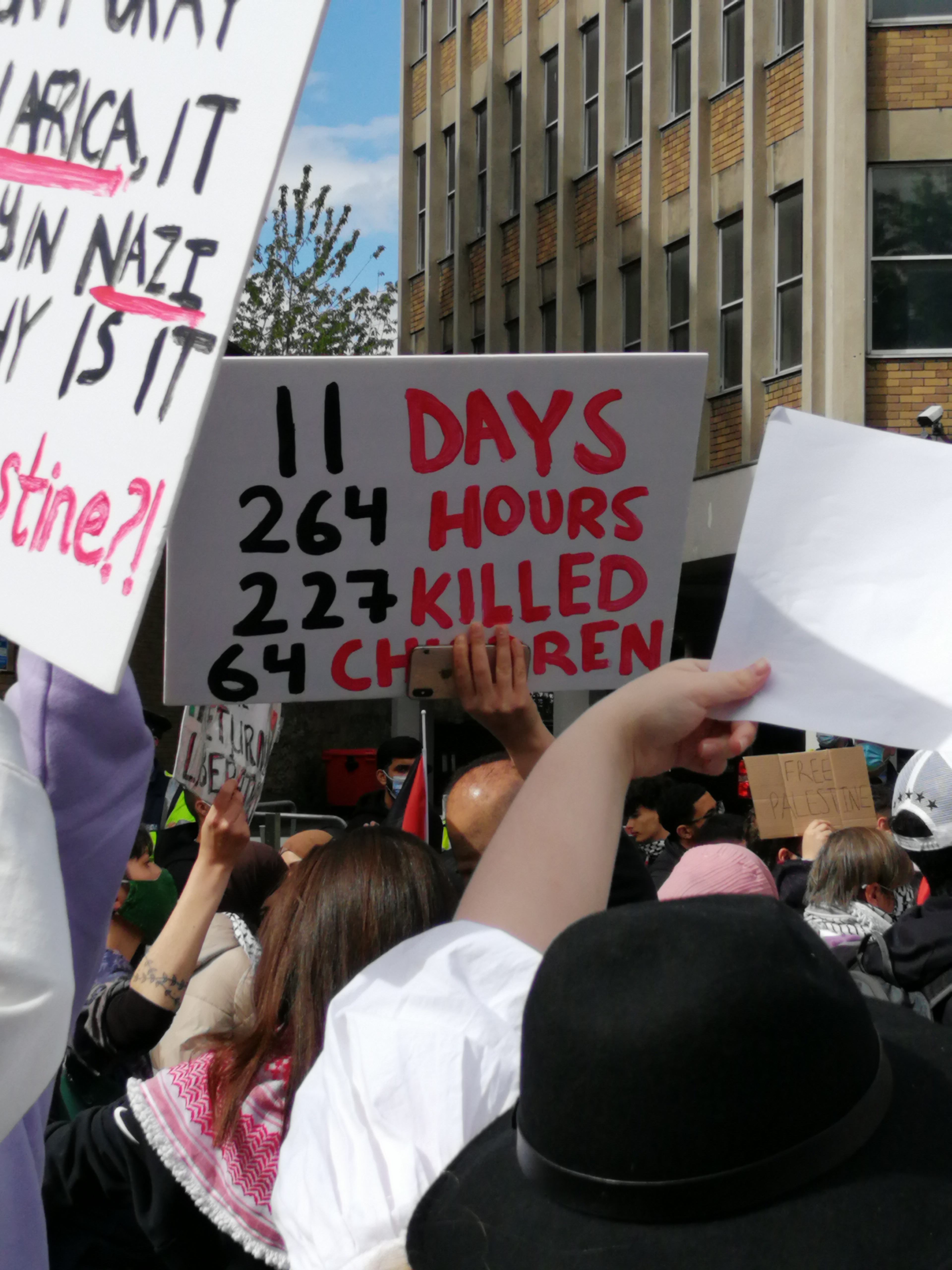
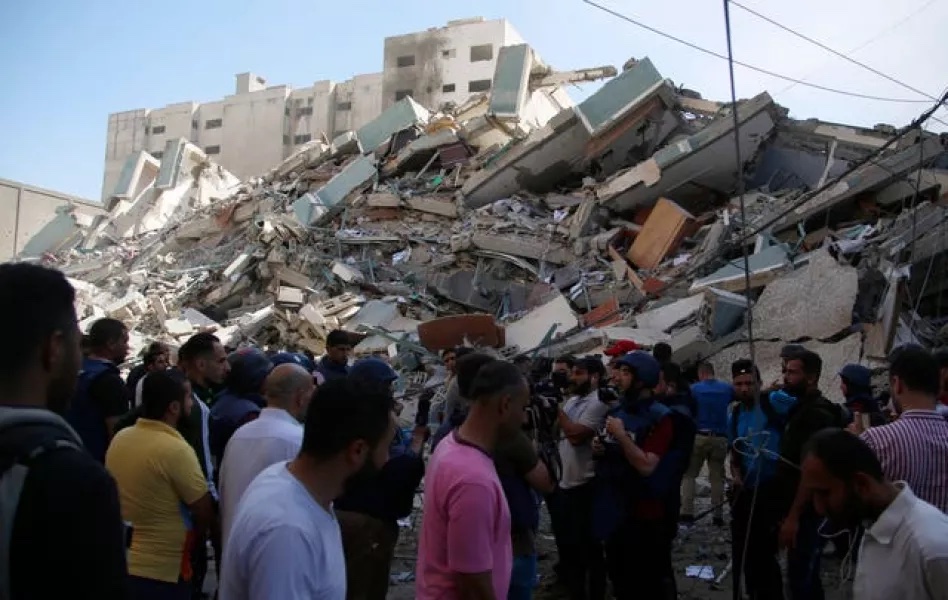
In the 11 days of war just past at least 232 Palestinians, including 65 children, have been killed by the Israeli forces, whilst on the Israeli side, despite hundreds of home-made Palestinian rockets fired at Israel, 12 people, including two children, have been killed. Many buildings in the Palestinian enclave of Gaza have been destroyed or part-destroyed, including hospitals and medical centres and there is major disruption to electrical service and water supply in a city which often experienced power and water flow cuts even in what passed for “normal” times in Gaza. Those killed were mostly in Gaza but Israeli forces killed 11 unarmed civilians in the West Bank also and wounded many, as they came on to the streets in solidarity with those in Gaza and in Jerusalem.
Street events in solidarity with Palestine were also held in cities and towns across Ireland, including Cork, Limerick, Galway, Belfast, Derry and in fact in most counties.
Section immediately in front of the Spire, O’Connell Street during rally and before march (Photo: D.Breatnach)
POLICE
The police on this occasion did not carry out harassment of demonstrators1 but in at least one instance, in Northumberland Road, stopped a section of the march to wave through traffic across it, putting uninvolved pedestrians crossing on a green light in danger. This occurred despite two marchers attempting to block the traffic, the Garda calling one a pejorative name and ordering him to stand aside.
Section of the march near just entering Northumberland Avenue, the front of the march away in the distance (Photo: D.Breatnach)
This was a job for official stewards and in fact, there were far too few of these. I saw perhaps around 20 getting instructions from the Chief Steward before the march at the Spire, some of whom seemed inexperienced but around 50 stewards were needed for a march this size, with a core of around 30 experienced. Stewards could be seen at times enforcing the rule to wear masks, as some young people removed them to shout slogans but once the middle of the march neared the Canal it was rare to see a steward.
A section of the crowd facing back from above photo, approaching along Mount Street towards the Bridge over the Grand Canal (Photo: D.Breatnach)
FAR-RIGHT
A Far-Right group calling themselves “Rise Up Eireann” (sic — who apparently don’t even know the official name of their country) had called for events in various parts of Ireland and had advertised the GPO as being one of the venues.
With apparent lack of awareness they scheduled theirs in Dublin for the same time as the Palestine solidarity rally, 2pm. No far-Right group was seen but one individual, a prominent QAnon activist posted a video of the Palestine solidarity marchers while voicing her disgust that the cops were not batoning or even harassing the demonstrator as they allegedly do to demonstrators demonstrating “for our civil rights.”2.
SPEAKERS
Speaker after speaker at the event pointed out that Israeli massacres and other onslaughts are often followed by ceasefires and back to “normal” oppression and theft of land, until the next war. As long as Israel is an apartheid occupying state, war is inevitable and so is oppression. Some speakers urged those present to encourage people in their social, educational, community and trade union groups to sign up to boycott, divestment and sanctions against Israel. A much more specific direction was given by Richard Boyd Barrett TD, who urged people to write emails to their TDs (parliamentary representatives) in advance of Tuesday’s debate in the Dáil, asking them to vote in favour of the “Occupied Territories” Bill.3
Richard Boyd Barrett TD speaking at the Spire prior to the march (Photo: D.Breatnach)
Aisling Micklethwaite, Vice-Chair of IPSC spoke in place of Fatin Al Tamimi, the Chairperson of the IPSC, who could not be present. (Photo: D.Breatnach)
A young Palestinian speaker from a Jerusalem district spoke with passion and made an interesting point, that a demonstration such as this one would be labelled “terrorist” by the Israelis and people would be liable to be shot with live rounds as well as with less lethal projectiles and gas.
Clara McCormack, Trinity BDS Campaign addresses the crowd outside the Israeli Embassy, Dublin (Photo: D.Breatnach)
It is a terrible statistical fact that in Israeli attacks on Gaza, one quarter have been children. Outside the Israeli Embassy the crowd grew quiet as a child read out the names of the children killed in Gaza, which was followed by a call for a minute’s silence in respect. The crowd was so big that out on one of the fringes, they did not hear the call and were chanting slogans.
Other speakers included a Palestinian young woman Ola at the Spire and Mags O’Brien of SIPTU outside the Embassy, where Martin Quigley, former Chairperson of the IPSC launched into a denunciation of Israel and of the Biden and the USA’s role in Palestine.
YOUTH & STARRY PLOUGH
As with other Palestine solidarity marches recently, a significant part of the whole consisted of Palestinians and other Arabs, among which the youth were particularly noticeable with young women very much to the fore and vociferous. One group of young Arab women shouted slogans non-stop from O’Connell Street to Northumberland Road, where I parted company with them to take up another position and could hear them chanting still as they marched on.
One would hope these youth have opportunities to become organised and gain experience to be leaders of the future.
Starry Plough seen during rally in front of the Israeli Embassy after march (Photo: D.Breatnach)
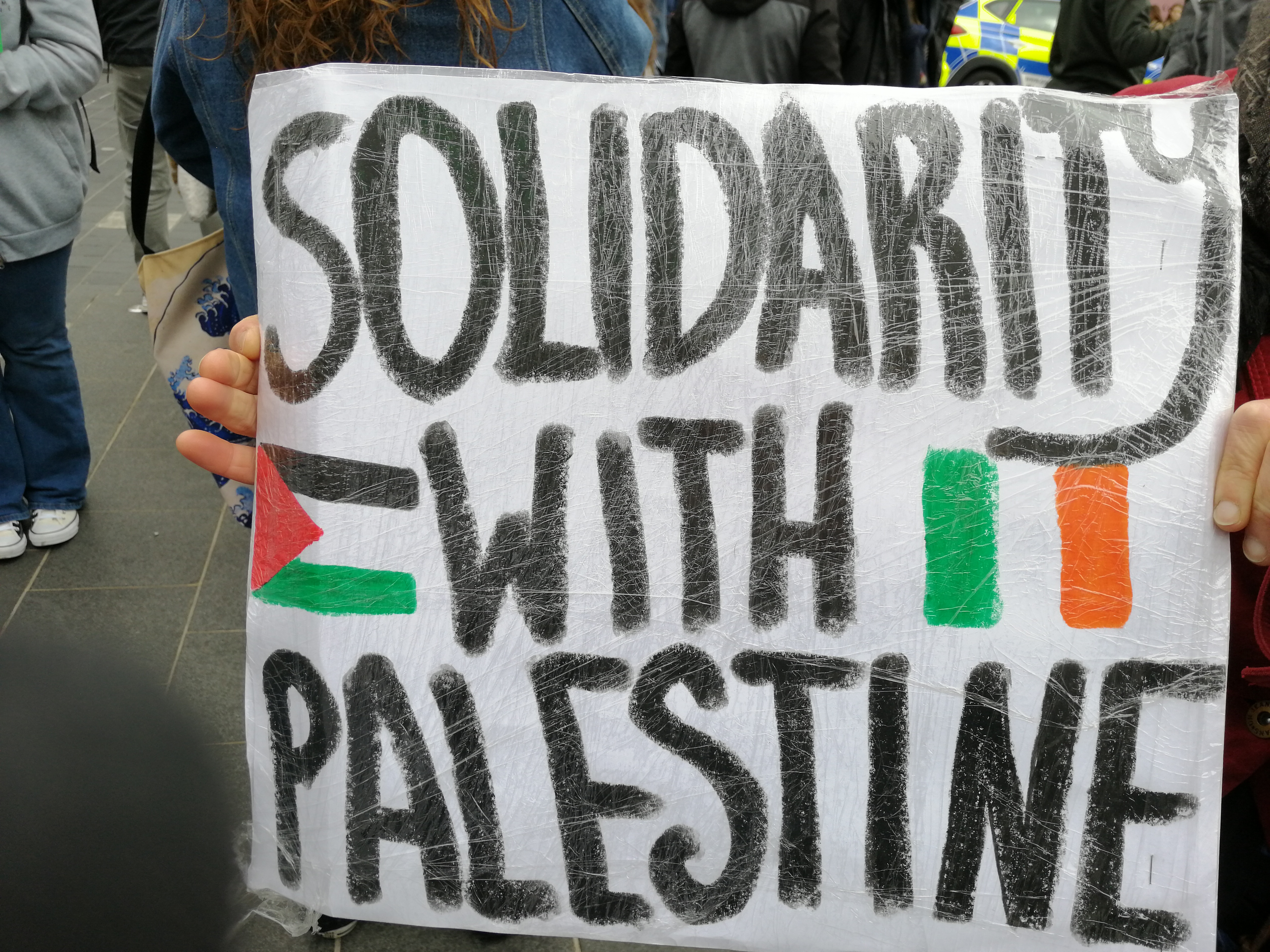
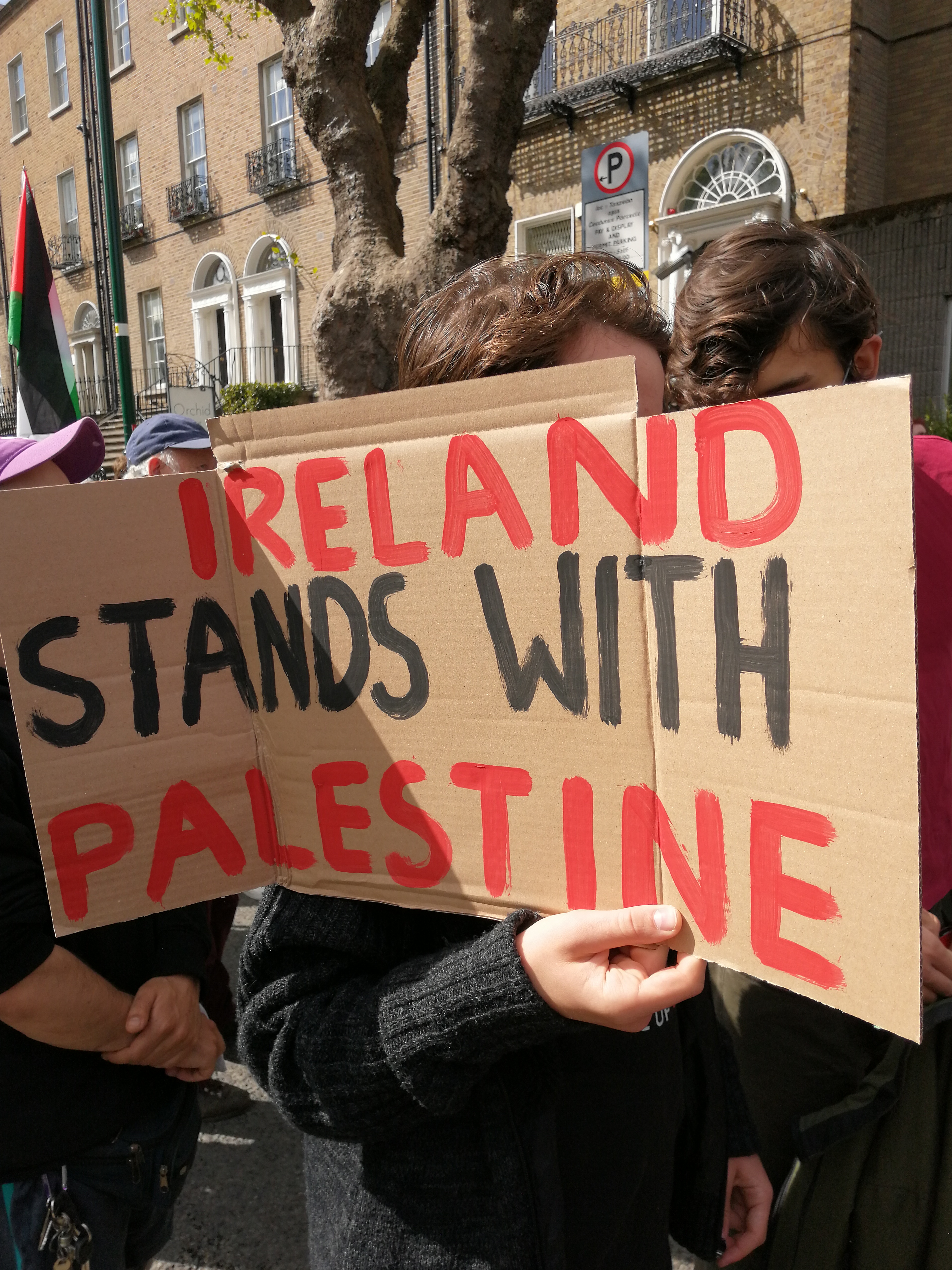
I brought two flags, a “Starry Plough”4 and one in Palestinian national colours, a friend carrying the ‘Plough most of the time. There was I heard only one other on the march. It is natural and proper that we carry and fly the Palestinian national colours but it seems to me that we should carry indications of Irishness too, to represent Ireland in solidarity with Palestine. This was represented in some placards but flags are more visible and it would be good to see more of them on Palestine solidarity demonstrations.
The Starry Plough flag also aroused interest with many asking what it represented and it was good to be able to tell them that it was the flag of the army of the Irish Citizen Army, the first working class army in the world, one which recruited women and that some of them were officers.
End.
Palestinian from Jerusalem speaking during rally in front of the Israeli Embassy after march (Photo: D.Breatnach)
Section crowd to left of Zionist Embassy (Photo: D.Breatnach, balancing on spiked railings because cops occupied the nearby steps to houses across the street)
Section middle crowd in front of Zionist Embassy (Photo: D.Breatnach)
PLACARDS & BANNERS
(Photo: D.Breatnach)
(Photo: D.Breatnach)
(Photo: D.Breatnach)
(Photo: D.Breatnach)
(Photo: D.Breatnach)(Photo: D.Breatnach)
On one side of the placard while ….. (Photo: D.Breatnach)
1Prior to last Saturday (15th) the Irish police threatened the IPSC with intervening to stop the march and huge fines for responsible individuals under Covid19 legislation; luckily the Trinity BDS Campaign took on the risk of repercussions and called the demonstration instead. On Tuesday, for a smaller march, the Gardaí kept the Pembroke Road open despite the danger of rush-hour traffic to the crowd, then continually urged demonstrators in towards the Embassy, forcing them into close contact with others and, when this was pointed out to them, just shrugged.
2In actual fact, Far-Right groups seemed to enjoy complete impunity for months as they held rallies, pickets and marches, without wearing masks or socially distancing, including at the GPO, while nearby, people picketing is solidarity with political prisoners and Debenhams picketers were harassed by Gardaí. Also, at a Yellow Vests rally in August 2020 a mob organised by the fascist National Party attacked unarmed counter-protesters with iron bars and wooden clubs while the Gardaí, instead of arresting them, attacked the victims and drove them off the quay with raised batons and violent shoves (see “There Will Be Another Day” article on the Rebel Breeze blog). A few weeks later, the cops allowed members of the NP to attack a handful of women opponents in Kildare Street and to club one of them, then again drove the victims back. On both occasions the Gardaí told press afterwards that there had been no violence but in the second case had to amend their statement hours later and weeks later charge a fascist individual with the assault.
3Under international law, it is illegal for Israel or Israeli settlers to sell products from the Occupied territories in Palestine, since they are even by UN law illegally occupied. However, the products are exported and sold in many parts of the world including all over Europe. The “Occupied Territories” Bill, if passed into Irish law, would make it an offence to import or re-sell products from those territories and would have an economic as well as a political impact. Although the Bill was framed in 2018 and supported by all political parties except Fine Gael, the Government has dragged its heels about bringing it before the Dáil to be discussed and Tuesday’s will be its Third Reading after which, with enough votes in favour, it will become law.
4“The Starry Plough” is modeled on the shape of the Ursa Mayor constellation. The original version has a green field with a plough in gold following the shape of the constellation, with the seven stars in white or silver. The plough has a sword in the position of the ploughshare. The later version, from the Republican Congress, is on a blue field with the the seven stars only in white (or silver) following the shape of Ursa Mayor and no other feature.
East side O’Connell Street during rally and before march (Photo: D.Breatnach)
Middle section of central pedestrian reservation O’Connell Street during rally and before march (Photo: D.Breatnach) Where the far-right group had planned to set up, west side O’Connell Street and front of GPO during Palestinian solidarity rally and before march (Photo: D.Breatnach)Section of rally in front of the Israeli Embassy after march (Photo: D.Breatnach)
A rally today outside the Israeli Embassy in Dublin heard Palestinian speakers and an Irish socialist TD (Member of the Irish Parliament) denounce Israel’s attacks on Palestinians, its slaughter of civilians including children and women, call for sanctions against Israel and for its Ambassador to be expelled. The rally was jointly organised by Ireland Palestine Solidarity Campaign and Trinity BDS Campaign in solidarity with the Palestinians and with the general strike organised in Palestine.
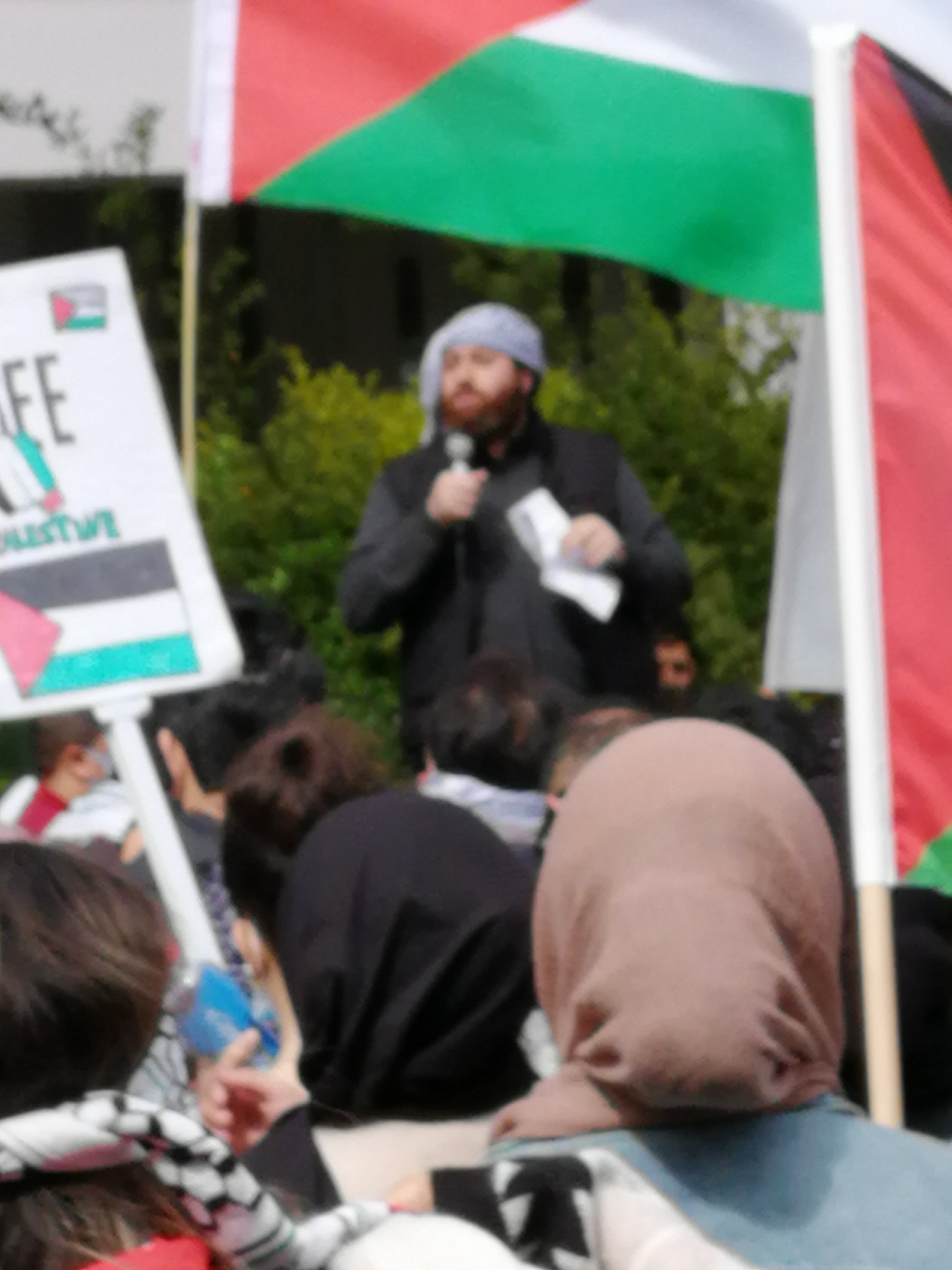
Fatin Al Tamimi, Chair of the IPSC, opened the meeting, welcoming people and, to loud cheers, declared that she is “a Palestinian and proud to be a Palestinian”. Fatin went on to list the numbers of Palestinians dead and injured, the numbers of those who were women and children and called the Israeli regime “racist, apartheid” and murderous and called for the boycott of Israeli goods, alluding to the famous 1970s Dunne’s Stores workers’ strike in support of boycott of South African goods during the white minority apartheid regime. Fatin’s pauses were punctuated by demonstrators chanting “Free, free Palestine!” and “Boycott Israel!” At one point she said that she had children born here but they would also always be Palestinian and she hoped one day to go back and to welcome all the Irish supporter to a free Palestine, which brought a tremendous cheer from the crowd.
Fatin Al Tamimi, Chairperspon of the IPSC, opening the rally. (Photo: D.Breatnach)
She introduced Wesam Ahmed, from Al Haq, the main Palestine human rights organisation, who spoke through an audio link from Palestine.
Dr. Ibrahim Natil, a DCU academic also spoke, as did Zayd, representing Trinity BDS Campaign.
All the speakers called for stepping up of solidarity action, boycott, divestment and sanctions but also for action by the Irish government, both in their current temporary membership of the United Nations Security Council and in the EU.
Richard Boyd Barrett TD told the crowd that he and Gino Kelly and Paul Murphy had all tackled Mícheál Martin in the Dáil (Irish Parliament) earlier during Taoiseach’s Questions and Martin had claimed he had criticised Israel while also criticising the rockets fired by Hamas. Boyd Barrett said that we had to get rid of this discourse of equivalence because there is no equivalence between the positions of the Israeli Zionists and the Palestinians, neither in terms of justice nor in power, military or otherwise.
Fatin Tamimi also called for solidarity with all the Palestinian political prisoners
Dr. Ibrahim Natil speaking (Photo: D.Breatnach)
Zayd of Trinity BDS Campaign speaking. (Photo: D.Breatnach)
GARDA HARASSMENT CONTINUES
The Irish police, the Gardaí continued to display on Tuesday the hostility they had exhibited in advance of last Saturday’s demonstration, when they threatened the Ireland Palestine Solidarity Campaign that if they went ahead with their advertised rally the Gardaí would intervene and threatened the organisers with €5,000 fines and possible jail sentences. Fortunately the Trinity BDS Campaign group had stepped in and held the rally, which turned into a march supported by several thousand.
A Garda beckons traffic on. Gardaí kept the road open despite the inevitable crowd spillover on to the street and then pressured people into crowding closer, despite that clearly going against Covid19 transmission precautions. (Photo: D.Breatnach)
The Gardaí began on Tuesday by telling supporters as they arrived that they were required to spread out to social distancing but were soon ushering people in towards one another. A woman next to me complained to a Garda that he was moving her into close proximity with other people and violation of social distancing — the Garda shrugged. As they continued to urge people to push in towards the already crowded space, the Gardaí continually urged traffic to come through and kept repeating to rally supporters that “The road is open”. Indeed it was and the question is why was it open? Clearly forcing traffic through put people in danger of vehicle impact or Covid19 infection; the safest measure and easily enough done would have been to divert the traffic before it reached the rally. But no — the Palestinian solidarity supporters were to be shown that the Gardaí are not to be gainsaid.
Standing the line. Some women took their position on the white line dividing the traffic lanes, declining to be pushed into the crowd by the Gardaí. (Photo: D.Breatnach)
PLACARDS
I find it interesting to collect some photos of the placards displayed at these events and in particular, some of the homemade ones. These are interesting in a number of ways, some humorous, some very pointed, some quite artistic but they are all also individual expressions and a kind of commitment, to make something in advance to bring to the demonstration or rally.
(Photo: D.Breatnach)
There was one in Irish but sadly the only one I could find. Will there be more at the next demonstration? If the Irish language is not audible and visible in the progressive sector of society, how are we to expect it to survive, never mind thrive?
A SPACE FOR THE YOUTH
As the rally came to an end, one could observe Palestinian and some other youth, many in their teens coming together to chat but also to chant slogans. I have seen this before and it appears that this point in events is their space — but it is a dangerous one with the event formally ended and the organisers dispersing, making it easier for repressive moves to be made against them or also to be led into acts which may end in their arrest. Of course it is the organisers dispersing, adults socialising etc that also allows them to make it their space.
The youth need a space of their own but one which is also safe and in which they can be helped to consider consequences and effective action. Generally political organisations do not give the youth that space and, when they do, tend to confine them to following the line of the leaders, who are generally much older.
Young people at the end of the rally. (Photo: D.Breatnach)
More young people at end of rally (Photo: D.Breatnach)
If organisations do not provide those spaces and assist the youth in self-organising, the likelihood is that others will and, in the case of Palestinians or Arabs in general, those others may be Islamic fundamentalists.
RALLY AGAIN NEXT SATURDAY, 2pm at the Spire, Dublin.
(Photo: D.Breatnach)
POSTSCRIPT COMMENT:
There is a slight sense of futility in what speakers ask us to do because justified as the calls are, there seems little hope of convincing most of our politicians of breaking radically with the western imperialist alliance, even though Ireland is not, generally speaking, itself an imperialist country. And yes, we can continue boycotting but how much of the stock in the supermarkets continues to be from Israel? And when it is, if one supermarket comes under heavy pressure, the management will often just temporarily remove the products from the targeted shop while they continue to be sold in the others. And once the pressure is off, the produce might be back on the shelves. And even if they’re not …. What can we actually DO that will make a real difference?
In one way, nothing, since the USA is the main backer of the Zionist state and the USA is the world’s major superpower. But in another way, we are making a difference, though it is not easy to see sometimes. Despite our rulers, Ireland has become the most pro-Palestinian country in Europe. Out of that may come great things in the future.
But it seems to me that there is more that we could do. Many Irish trade unions formally support the Palestinians — could they not put a motion in their annual conferences calling on the Government to expel the Ambassador? Could they not at least put a pro-Palestinian poster on each workplace union noticeboard and also advertise each solidarity march? I know that the unions are not anything like the fighting organisations they once were but that above is surely not asking too much.
end.
(Photo: D.Breatnach)Section of the crowd seen from above (Photo: D.Breatnach)I wish I had got a closeup photo of this placard but couldn’t see it again as the crowd broke up (Photo: D.Breatnach)I thought I had caught the whole placard but clearly did not — I thought the whole text said that “Resistance is made in Palestine” and “We stand with Palestine” but on another’s page saw that what is said was “Courage is made in Palestine” and “we stand with you”. (Photo: D.Breatnach)
The only one i nGaeilge, is trua a rá. (Photo: D.Breatnach)
You can probably work out that “occupation” is the word partly missing in the photo. (Photo: D.Breatnach)
(Photo: D.Breatnach)
(Photo: D.Breatnach)
(Photo: D.Breatnach)
(Photo: D.Breatnach)
Someone is sure to grab that for a quotation (Photo: D.Breatnach)
The oppression of the Palestinians led to an outbreak of active resistance recently in Jerusalem, to which the Israeli Army reacted with increased repression, timed to harass Palestinian Muslims during the period of Ramadan.
At the height of devotees attending the Al-Aqsa mosque, this escalated into attacks on worshippers within the temple itself. At the same time, Israeli Zionist settlers threatened dozens of Palestinian families with eviction from their homes in East Jerusalem.
Reacting to these events, one of the Palestinian organisations fired home-made rockets into officially Israeli territory, to which the Israeli armed forces responded in turn with drone missiles and missiles from its air force jets on Gaza.
The Zionist military fired on protesting Palestinians in the West Bank with live ammunition. The death toll has climbed to 200 Palestinians, according to Gaza’s Health Ministry, including 59 children and 35 women, with 1,305 people wounded. Ten Israelis have been killed, two of them children.
The casualty figures once again show the gross disproportion between what the Palestinians and their Zionist masters experience: in civil and human rights, citizenship, in land ownership, electricity and clean water supply, heating, fishing, education facilities, building materials …
… in freedom to travel inside and outside the state, in depth and breadth of surveillance, in arms and defence capability, in states that support them.
And in city structural damage: despite the many home-made rockets launched against the zionists, there has yet been no significant damage in Israeli towns, while their armed forces have effected large-scale structural damage in Gaza and bodies are still being pulled from the rubble.
In only one area perhaps do the Palestinians have the advantage over the Israeli Zionists: in support among the people around the world.
Israeli Zionist missiles strike the tower housing many media services, including Associated Press and Al Jazeera, which drew broad criticism from the mass media for a change. But families also lived here. Everyone was given ten minutes to get out. The Israeli Occupation Force has not yet bothered to explain its rationale for targeting this building. (Photo source: Internet)
PALESTINIAN SOLIDARITY MARCH DEFIES POLICE THREATS
Responding to these attacks on Palestinians, the Ireland Palestine Solidarity Campaign, the main organiser of Palestinian solidarity action in Ireland, called for solidarity demonstrations and in particular advertised a solidarity rally to take place in Dublin’s city centre for 2pm on Saturday 15th May.
The organisation asked those in attendance to comply with measures against Covid19 infection, to wear masks, maintain social distancing and comply with stewards’ instructions.
However the IPSC was contacted by the Irish police force, the Gardaí, who told them not to go ahead with the event, that if they did they would intervene to stop it and also made threats of €5,000 fines and prison against the organisers.
In a later public statement the Gardaí declared that they “have no role in permitting or authorising marches or gatherings. There is no permit/ authorisation required for such events”!
But there is apparently an ability and power to intimidate and threaten progressive organisations to deter them from organising solidarity events.
Or to kettle socialist and socialist republican Mayday marchers and demand all their names, addresses and dates of birth before threatening them with arrest if they did not disperse.
Or to threaten Debenham workers and their supporters, assaulting some of them while escorting KPMG forces in to evaluate stocks during pandemic restrictions.
A Palestinian policeman stands among the rubble of the tower in Gaza recently occupied by families and media agencies. (Photo source: Internet)
The predicament of the IPSC exposed the vulnerability to this kind of intimidation of a broad organisation that seeks to win friends in ruling circles. The leaders and organisers are placed in a position of not only personal but also of organisational vulnerability.
Even should they be prepared to defy the State to fine and/or imprison them, would they also be prepared to damage their organisation or to lose some friends they are cultivating in the circles of political influence?
What was one of the strengths of a broad organisation thus becomes a weakness; a more radical or even revolutionary organisation, with less influence in influential circles can decide on defiance, risk fines and jail with however perhaps less possibility of influencing official opinion and ultimately, action.
Fortunately in this case one such organisation did step forward and took up the baton: the Trinity College BDS group expressed its solidarity with the IPSC on its treatment by the Gardaí and called their own rally for the exact same place and time as the original one called by the IPSC.
Video of rally at end of demonstration, near Israeli Embassy
Despite concern over Covid19 transmission and Garda threats – and the extremely short notice and much smaller circle of contacts of the TC BDS group — the response was magnificent, both in internationalist solidarity and in maintenance of the right to organise such progressive events.
Before the appointed hour, people began to gather in large numbers at the Spire in O’Connell Street, Dublin’s main street and north city centre.
After being addressed by a number of speakers, they set off in a march towards the Israeli Zionist Embassy near Ballsbridge, beyond the south city centre. As they marched their numbers grew until, approaching the Embassy, they numbered several thousand.
Along the way, bystanders applauded the marchers and passing vehicles blew their horns in solidarity.
A section of the Dublin rally in solidarity with Palestine photographed outside the GPO in the city’s main street before they set off on the 5.5km march to the Israeli Embassy (Photo credit: PA, Breaking News)
Marchers shouted slogans of solidarity with the Palestinians, calling for the freedom of Palestine and the expulsion of the Israeli Ambassador as a mark of the Irish people’s objection to what is being done to the Palestinians.
Near the Embassy, a number of speakers addressed the crowd and after dispersing, a number of demonstrators boarding public transport to return home were congratulated by the drivers.
LESSONS FOR US
The situation regarding calling and holding the demonstration in Dublin outlined some of the weaknesses of a broad organisation when it faces repression from the State and the greater resilience of a smaller organisation in being able to defy the State.
It may be necessary in future to maintain support for both types of organisation, each being appropriate for particular situations.
Also demonstrated was the necessity to openly defy unjust laws and prohibitions at times and particularly around the right to organise, to protest and to show solidarity, which the demonstrators did so well on Saturday.
Such situations also reveal the difficulty for the Gardaí in carrying out repressive actions and they are reduced to threatening individuals.
THE FAR-RIGHT MARCHES TOO – FOR WHAT?
Meanwhile, a couple of hundred of the far-Right also marched in Dublin, allegedly in defence of civil liberty. Not in solidarity with the Palestinians’ civil liberties and not in defence of our civil liberty to organise to show solidarity with people in other struggles.
No, they marched in defence of the right to defy health protection regulations, in proclaiming the Covid19 pandemic to be a) a hoax or b) greatly exaggerated and in claiming that wearing masks damages one’s health and even intelligence(!).
They were insisting that vaccinations are a) dangerous to one’s health or b) means of injecting nano-machines into people’s bloodstream in order to control them.
A clip posted by Ireland Against Fascism showed one of the QAnon Saturday screechers for months outside the GPO, Dolores Webster, aka Dee Wall, lately self-declared “digital journalist” (don’t laugh) posting her reactionary propaganda.
In apparent total ignorance of the actual reality (but when has that mattered?), she broadcasted a claim by video from her studio (her car), accompanied by the strains of Abba from the headphones of her head-bobbing passenger.
She claimed that the “scum in the Dawl” had allowed the Palestinian solidarity march to go ahead to distract from the alleged general removal of freedom and in particular from the far-Right group Irish Yellow Vests to hold their rally on May 1st!
When all the Covid19 precautionary restrictions are removed, what will these elements have to march about? The will need to return to the topics that engaged many of them in the recent past: racism, anti-immigrants, islamophobia, homophobia and anti-socialism, along with their false patriotism.
None of that is welcome of course but at least it will be without this false concern for “civil rights and freedom” and closer to the reality of what the far-Right in general – and fascists in particular — stand for.
SUPERPOWER BACKING AND IMPUNITY
The current atrocities of the Zionist State, which it carries out with impunity, along with its history, starkly reveals the effect of its main backing power, the USA, and the imperialist alliance dominated by that Power.
The USA backs Israel with military aid to the tune of $10 Million daily, which is aside from other direct and indirect aid. Israel is the only state in the Middle East which is not only very friendly to the USA but totally dependent on the support of that superpower.
For the ruling class of the USA, Israel is the only state in the Middle East which is totally safe forever from fundamentalist Muslim revolution or from left-wing anti-imperialist revolution and is therefore an extremely important factor in the USA’s plans to totally dominate the Middle East.
Solidarity marcher in Dublin on Friday with a home-made placard (Photo Credit: PA, Breaking News.ie)
This imperialist alliance finds reflection not only in the action/ inaction of governments in Europe, for example but also in the reporting of the mass media.
One of the latter’s tropes is the constant emphasis on the numbers of Palestinian missiles fired, without revealing their general ineffectiveness in delivering destruction, in total contrast to the Israeli missiles. Another is their constant repetition of a lie, that “Hamas seized power in Gaza”.
The truth is that Hamas swept the board in the 2006 elections for the Palestinian Authority. The “seizing” that was done was by Al Fatah, which usurped the results in the West Bank and installed themselves there; they tried to do the same in Gaza and, in a short fierce struggle, were beaten.
But the Western powers decided that Hamas was illegitimately in power, seized funds due to it and supported its blockading – by both Israel and Egypt.
No explanation is offered in the general mass media as to how a generally politically-secular Palestinian public would turn from its decades of allegiance to Fatah to vote for the fundamentalist Muslim Hamas.
The main reason was Fatah’s surrender of the goals of Palestinian independence and freedom and the return of the refugees, in exchange for running a colonial administration with opportunities for living off bribery and corruption and Fatah’s settling down to that status quo.
CASTING A GIANT DARK SHADOW
It was not only in Dublin and in towns across Ireland that Palestine solidarity demonstrations were held on May 15th but by people across much of the world, generally in opposition to the wishes of their governments and ruling elites.
It is worth thinking about how this has come about, in particular in contradiction to a mass media hostile to the Palestinians.
Palestinians come to view the remains of the tower block that was home to families and that housed a number of media agencies. (Photo source: Internet)
The Zionist state of Israel was declared in 1948, its anniversary actually only three days ago – May 14th, the first states to recognise it being the USA and the USSR. In Ireland at the time, there was general support for the new state which continued to the “June War” of 1967 and somewhat beyond.
The general Irish population were horrified by the history of the Nazi-organised Holocaust and sympathised with the Jewish survivors.
Irish nationalists and even Republicans empathised with the Zionist civil and armed struggle against the British (who, ironically, had begun the process of Zionisisation of Palestine).
The 1966 film Cast a Giant Shadow purporting to show that struggle, starring Kirk Douglas and a cameo appearance by Frank Sinatra, was widely enjoyed and cheered in cinemas across Ireland.
Though some of the film’s characters were based on real-life counterparts, the general narrative was a grotesque distortion, hiding the massacres of Palestinians and the expulsion of thousands as the Zionist state was created.
Many Irish language supporters admired how the new state had brought the Hebrew language, for centuries only spoken in religious contexts, back into everyday usage.
Solidarity marcher in Dublin on Friday with a home-made placard and a thought-provoking message (Photo Credit: Sam Boal, The Journal)
Yet, by a few years ago, general pro-Palestinian sympathy across Ireland had become so strong that Israel’s Ambassador to Ireland declared the country “the most anti-semitic in Europe”. That of course is the Zionists term for anyone who supports the Palestinians or criticises the Israeli state harshly.
Only a few days ago, the current Ambassador accused some politicians of spewing hate towards Israel. He was responding not only to Left and Sinn Féin TDs who criticised the actions of Israel towards the Palestinians, but also to the Tánaiste (Deputy Prime Minister equivalent) Leo Varadkar!
Varadkar had commented that Israel’s actions are “indefensible” and Government Minister for Foreign Affairs Simon Coveney said at an EU conference that the EU had “fallen short” and failed to project its influence in agreeing a position in against illegal activity by the Israelis against Palestinians.
Palestinian solidarity march in Cork on Saturday (Photo source: Internet)
The fact that establishment right-wing/ conservative politicians feel obliged to take a public stand, however ineffectively, against actions of the Israeli Zionists is a strong indication of how much Irish public opinion has changed over decades.
Implicitly such stands reflect against the Zionists’ biggest international backer and world superpower, the USA. Since the Cast a Giant Shadow film, the state’s shadow of which we are aware now is indeed frighteningly giant and very dark.
In response, the natural cultural and historical feelings of the Irish people have stirred in sympathy with the oppressed Palestinians – and in defiance of threatened police repression at home.