Garda Armed Support Unit patrol car, one of a great many seen driving around many parts of Dublin including the city centre. (Image source: Internet)
Last year, a Garda shot dead a man sitting inside a car who was harming himself with a Stanley knife. In June 2019 the Department of Public Prosecution decided not to even charge the Garda who fired the shot. What does this mean?
Since the evidence from witnesses (including his own colleagues) is that Garda A fired a deliberate shot at close range that killed Mark Hennessy through a closed window and that the man was not at that moment posing a threat to anyone (apart from himself), never mind a lethal one — how can we view this as anything but an on-the-spot execution by a Garda? Since we are told that Gardaí are not authorised to carry out executions (and the State has abolished the death penalty), what can this be but MURDER?
It is useful to remember too that the founders of the Irish State deliberately resolved to set up the Garda Síochána as an primarily unarmed police force (in direct opposition to the armed colonial police forces that had suppressed Irish people in the past and continued to do so in the Six occupied Counties).
Not even charged? For the moment, we need to forget about the fact that all the evidence points to the victim having murdered a child and hidden her body. Killing the man could not bring her back (in fact might even have prevented her body being found but luckily the location was written on a piece of paper inside the car).
How can this killing be justified? What possible legal reason can be given? Dubious though it may be, the Gardaí who shot Mac Lochlainn (see below) at least claimed he had pointed a gun at them (interestingly, the officer who fired the fatal shot was himself killed a few years later in what was described as a firearm accident involving a colleague). Well, in fact, in the Mark Hennessy killing NO REASON WHATSOEVER WAS GIVEN. The DPP just “decided not to prosecute”.
Garda of the Armed Response Unit with machine gun. (Image source: Internet)
If a Gardaí can decide when someone needs to die and act upon that decision, anyone might be a victim in future: political activist, whistleblower, personal enemy, mistaken identity ….
Unlikely? Why?
There have been a number of questionable killings by Gardaí, including the shooting dead of Real IRA Volunteer Ronan Mac Lochlainn on May 1st 1988. Mac Lochlainn was driving away from a Garda Special Branch ambush of a robbery team when he was shot dead by the Gardaí. The matter was not seriously investigated until 20 years later when the investigators decided for whatever reason to clear all the Gardaí involved, leaving many important questions unanswered.
Another incident that might have ended fatally occurred in 2005 between two drunken senior Gardai who got into a fight and pulled guns on one another! A personal quarrell ….
Armed Gardaí Detectives after a raid. (Image source: Internet)
One can see on any day in Dublin the vehicles of the Garda Armed Response Unit driving around the city. Nor do they restrict themselves to the duties for which one might imagine Gardaí would need to carry arms. They have been seen stopping cars in traffic incidents, driving through busy streets, surveilling political demonstrations and even on one occasion last year stopping to caution people demonstrating against internment in Temple Bar.
In 2014 they turned up at a protest against Irish Water in Clonmell. On another occasion last year they turned up to dispute between a private landlord and two of his tenants in Dublin and at a separate housing occupation action in Cork. Last year also they attended a farmers’ protest in Limerick.
Is the Irish public being subjected to an armed Gardaí normalisation process? Why are the DPP not being made to justify their decisions not to prosecute Garda perpetrators of homicide? How long before another unjustifiable killing?
On 15 February Ferriter’s column in the Irish Times expressed the opinion that comparison of Sinn Féin with Fianna Fáil in the 1930s only takes us so far. After looking at less of the overall history of the main Irish parties than I had in my article of 11 February in Rebel Breeze but adding some pieces I had not, what was his conclusion that differed so widely from mine? Well, that the military past was too new with SF!
Diarmaid Ferriter in Thinker pose (Source: Internet)
But, actually, not true of Provisional SF with regard to FF, which came into government in 1932, less than two decades after the end of the Civil War and only six years after its split from Sinn Féin. De Valera, President of Fianna Fáil, had been a leader of the Republican side in the Civil War, from which side came the majority of Fianna Fáil’s supporters. By the time PSF gets into Government, it will be LONGER than two decades since Provisional IRA gave up its armed struggle!
On 11 February I posted an article of mine on Rebel Breeze and from there on to Facebook, making the point that, despite hostile media and politician claims to the contrary, Sinn Féin is very like the main Irish political parties – and that that is not a good thing. I traced the main elements of the parties’ history, how they had changed their positions and I elaborated the point that the main difference in their trajectories is that SF’s arrival on the neo-colonial capitalist political field was just more recent.
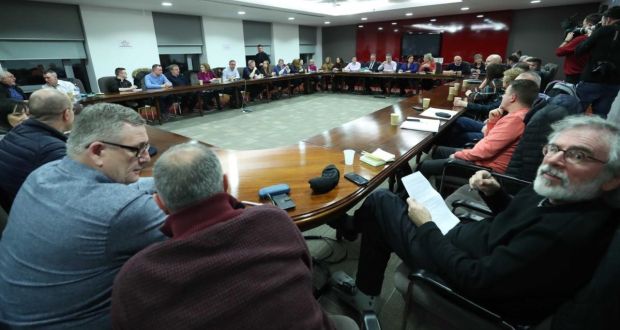
Meeting of Provisional Sinn Féin’s Ard-Choiste (national executive) in February 2020. (Source photo: Niall Carson, AP, Internet)
It is worth noting (a point I had omitted in my piece) that nearly the entire Fianna Fáil government Cabinet in 1932 was composed of Civil War IRA men and that most of the remainder had been in Free State prison during that war.
It is said that imitation is the sincerest form of flattery but I can easily avoid being pleased by Ferriter substantially following my line of historical analysis. This is the man who, during the 2016 High Court hearing about the Government and property speculator plans for Moore Street, wrote a nasty attack on the demonstrators who had occupied the buildings and subsequently blockaded them against demolition. If he had been hoping to influence the High Court’s decision he failed – and spectacularly, because the judgement was that not only the buildings but the whole quarter is a 1916 historical monument.
Frank McDonald had also written an opinion piece during the trial against conservation and the demonstrators in the same newspaper (what WAS the Irish Times up to?) but after the judgement, he had the grace to apologise (sort of: he wrote that he had been in error).
(Para el informe en castellano haz clic en el enlace)
(Translated from Castillian by D.Breatnach)
(Reading time: 3 minutes)
MADRID 02/15/2020 1:57 PM ALEJANDRO TORRÚS
At last. The remains of 247 victims of Franco that have lain in a warehouse in Valladolid for over two years will be buried this Sunday in a memorial constructed within the Carmen cemetery. This will be the end of a long process that began in 2016 with the exhumations of communal graves in the cemetery itself, paralyzed since for a long time by the insistence of UGT to install a bust of Pablo Iglesias Posse. Finally, there will be a memorial, there will be the names of the more than 2,650 fatalities of the province, the 247 bodies recovered and there will be no bust of the founder of UGT and the PSOE.
(Trans: UGT is one of two main Spanish trade unions and is connected to the social democratic PSOE; both were banned — along with many other organisations — during the Franco Dictatorship but since then the PSOE has been in government more than any other party. Valladolid is about halfway between Madrid and the Bay of Biscay).
3) Letter sent by Julián Carlón to his wife and children from the Valladolid prison.- ALEJANDRO TORRÚS
“We want this tribute to be an act of democratic recognition and historical justice to all those who defended the Second Republic regardless of the party in which one was active,” explained Julio del Olmo, president of the Association for the Recovery of Historical Memory (ARMH) of Valladolid, responsible for the exhumation and custody of the bodies, to Público.
Memorial built in the Carmen cemetery, just a few meters from the location of the graves of the victims of the Dictatorship. (Photo: Valladolid ARMH)
The event will begin at 12.00 noon this Sunday and will include participation of relatives of the victims, the Valladolid writer Gustavo Martín Garzo, musical performances and the presence of the Mayor of Valladolid, Óscar Puente and the Secretary of State for Democratic Memory, Fernando Martínez.
However, the tribute comes too late for many victims. For example, for Saturnina, who passed away a few weeks ago. Her perseverance and struggle and that of her husband facilitated the ARMH in identifying the place where the graves were in the cemetery and proceed to their exhumation. Saturnina was only a child when Franco’s forces shot her father, Julián Carlón, on October 1, 1936.
Saturnina, in fact, barely knew anything about her father. He was four years old when he was taken. “I only remember the day he was taken and the place where he was buried, which my uncle told me about,” she confessed tearfully to this newspaper in September 2019. “I don’t even know how he was killed. I just know he was taken away, that he never came back and that, from that day, there were only tears in my home. My mother never told me about my father because of fear,” she said. However, thanks to the indications of a relative, Saturnina kept a memory of the exact place where the bodies were buried after their execution.
Saturnina & Avilio at home September 2019. Saturnina was 4 years of age when the Francoist forces took her father away and shot him. (Photo: Torrus)
REMAINS OF THREE WOMEN AND TWO MEN IDENTIFIED
To date, the Valladolid ARMH has managed to identify “with total security” five of the 247 bodies recovered. These are of three women and two men: Lina Franco Meira; Republican Army sergeant Francisco González Mayoral; the Mayor of Casasola de Arión, Mateo Gómez Díez; and mother and daughter María Doyagüez and María Ruiz Doyagüez.
“Of the four graves with the 247 bodies that we have found, we have only been able to certify those five people to almost 100%. Of many others, we can be almost certain that they correspond to one group or another of those shot, but we cannot name each skeleton. We lack the means and it is a tremendously complicated process,” laments Del Olmo, who, however, points out that the remains of the victims will be well preserved so that, if possible, they continue working on identifications.
Letter from Julián Carlón in Valladolid Prison to his Wife & Children. (Photo: A. Torrús)
Cases such as that of Lina Franco Meira, which has been identified, are exceptional when 81 years have elapsed since the end of the Civil War. Her bones could be identified thanks to a DNA test sample of one of her daughters, 93 years old. An exceptional case of longevity that has allowed name and surname to be given to some bones and, in addition, allows us to believe that among the rest of those sharing her grave are her other 14 neighbors of the town of Castromocho (Palencia) that were taken along with Lina Franco to Valladolid to be executed and buried.
“SO THAT FRANCO AND AMNESIA DO NOT WIN”
Franco’s forces not only killed Lina Franco and more than 2,000 people in this province (Castille-Léon). They also tried to erase their names, their life stories and their struggles. Now, 84 years after the coup, a memorial will recover their names and try to spread their fight in defence of Republican values. The challenge, however, continues and consists in being able to identify as many of them as possible so that Franco and amnesia do not win the battle.
I observed in Language Is a Treasure Chest 1 that it is full of wonders but that it has some horrors in it too. And I found it to be so again.
I was reading a novel in which the word “Cimarron” appeared and, doing some quick research on the word, I came across a 2004 query in an email website or page called Word Wizard:
What is the etymology of the word cimarron? I’ve always been told that it means “runaway slave” in Mexican Spanish. Can anyone verify this?
The reply is dated the same day:
From Greek. It refers to people who live in perpetual mist and darkness, akin to the ‘land of the dead’. Latin ‘Cimmerius’, Greek ‘Kimmerios’, Assyrian ‘Gimirri’ even the bible ‘Gomer’ Gen.10:2 and Esk. 38:6. In Western United States it refers to a stretch of land that gets rainfall when other near by areas are desert year round.
Apart from the topographical reference, I thought the expert’s explanation highly dubious. And in fact I happen to know something about the Spanish-language origins of the word.
The searcher replied:
Thanks, Jim. I just wonder what connection this word has to Hispanics of Mexican origin because it shows up in their surnames (although not as common as Lopez or Vargas or Garcia). Is it just Mexican in origin or did that also come from Spain? So the “runaway slave” theory has no foundation then?
The expert’s reply did come back with a Spanish-language connection and he may be on to something with the topography, though I think he has it the wrong way around (as we shall see).
The “runaway slave” theory is not so obsolete.
Mexico did not have slaves (Outlawed in 1810)but
American slaves who fled to Mexico had to pass
through lands with water, or else parish (sic).
When relating their tales of woe to the locals
the word ‘cimmaron’ arose to describe their flight
through the South West desert.
Very curiously, there was no further contribution to the discussion. I tried to leave my own but had to register, which I have done (though wondering if worth the trouble) and am now awaiting confirmation1.
A view of the Cimarron National Grassland, the largest piece of public land in Kansas, a 108,175-acre property in the southwestern part of the state. It was recovered from the Dustbowl ecological devastation by soil recovery and management practices. (Photo source: The Armchair Explorer – Kansas)
THE FOLK MEMORY WAS TRUE
Continuing with a little light online research I find that the Castillian-language (Spanish) origin is the explanation most often given, with rarely a reference to Greek or other classical or archaic languages. For example, in yourdictionary.com:
American Spanish cimarrón, wild, unruly ( from Old Spanish cimarra, thicket): probably origin, originally referring to the wild sheep (bighorn) found along its banks
(Latin America, of animals) feral (having returned to the wild)
Synonyms: alzado, bagual, feral
(Latin America, of people) rural; campestral
(Latin America, of plants) of a wild cultivar.
But …. what about the “runaway slaves”? Under the title Cimarron People, Wikipedia has this to say: The Cimarrons in Panama were enslaved Africans who had escaped from their Spanish masters and lived together as outlaws. In the 1570s, they allied with Francis Drake of England to defeat the Spanish conquest. In Sir Francis Drake Revived (1572), Drake describes the Cimarrons as “a black people which about eighty years past fled from the Spaniards their masters, by reason of their cruelty, and are since grown to a nation, under two kings of their own. The one inhabiteth to the west, the other to the east of the way from Nombre de Dios”. (location in Panama — DB)
While we may indulge ourselves in a sardonic smile at commissioned pirate Francis Drake talking about the cruelty of others, or about slave-owning by a country other than England in 1570, we remember also that at the time Spain was the main competitor with England in the rush to plunder the Americas – and had got there well before them.2 Both colonial powers were already plundering Africa for raw materials and slaves.
The meanings of animals having gone “feral” or “returned to the wild” would easily have been applied by the society of the time to escaped African slaves, a society which, despite evidence to the contrary including agriculture in Africa, would have considered indigenous inhabitants of Africa as people living in the “wild”. Once escaped and no longer under European control, they would be seen as “returning to the wild”.
So what happened to the Cimarron People? Their settlements were subject to punitive raids by the Spanish, killing people and burning crops, so that in the end they came to a treaty with their old enemy. The Wikipedia entry says no more except that the “Cimarrons” and the English quarreled (not surprising, given that they were of no further use to the latter). I believe some of their settlements in Florida were raided and burned by US “pioneers” and soldiers and that the remainder became part of the Seminoles, a native American tribe that resisted the USA in the longest and most costly of the USA’s wars against the indigenous people, the Native (North) Americans. The Seminole had many tribe members of part-African origin in their midst.
And here – a surprise: The word “Seminole” is derived from the Muscogee word simanó-li, which may itself be derived from the Spanish word cimarrón, meaning “runaway” or “wild one”!
So, in line with what that on-line searcher back in 2004 had heard, no doubt a folk belief, the word cimarronis, in Mexico (and in the USA), of Castillian (Spanish) language origin and is connected to escaped slaves of African origin.
Some of the sources for “cimarron” also give us “marron” or “marrón” which is also related to escaped slaves and, in English, became “Maroons”. The Maroons, escaped slaves who inhabited mountainous regions of Jamaica and elsewhere became a great problem to the English settlers (after they took the island from the Spanish) which they failed totally to quell, the Maroons emerging victorious in many military engagements. In the Cockpits area of Jamaica, I have read, there is a place called Nanny Town, which is believed to be one of the settlements of the Maroons; their chief was said to be a woman called “Granny Nanny”3, whether because of her former slave occupation or for other reason4. In the end, like the Spanish with the Cimarron People, the English had to treat with them. Sadly the treaty required the Maroons to return newly-escaped slaves, which they did and for which they received payment.
Marroons in treaty with the British, shown here in a reversal of the actual power relations in the “Pacification with Maroons on the Island of Jamaica, by Agostino Runias (1728-96). (Source image: Internet)
However if instead of being a voluntary escapee to go to a wild place you were forced by people or circumstance, well then, like Alexander Selkirk’s “Crusoe”, you’d be “marooned”!
Well then, what about the “cimarron strips” in the southwest of the USA? Could the word refer to strips of land “gone wild”? Or could the expert replying to the question in 2004 have been on to something?
If the slaves escaping through the desert from the USA to Mexico did indeed make their way through strips of watered land (not just for the water, as the expert speculates but for vegetation to conceal them), then there is a connection between escaped slaves and these strips of land. But not as the expert sees it, rather the other way around: since the escaped slaves, the “cimarrones” were travelling the strips, they would be called by those who knew about it (escapee hunters, escapee helpers and just observers), “cimarron strips”, i.e “those strips through which the runaway slaves travel.”
CHRISTIAN ETHNIC PREJUDICE
However, if the word comes from Castillian (Spanish) what were the origins of the word in that language?
Perhaps a year ago, I was reading a book that described the Spanish State as having been characterised, contrary to many other European states, by mass expulsions and exiles on a number of occasions throughout its history5. Naturally enough, first on the list of expulsions was the well-known example of the Moors and the Jews. Those who were not slaughtered by the forces of the “Christian Monarchs” of Ferdinand and Isabella in the “reconquest” were obliged to convert to Christianity or to leave “with only the clothes on their backs”. This also occurred in Portugal.
Those Jews who left were the Sephardim or Sephardic Jews, who spoke Ladino, an archaic kind of Iberian Romance6language with Aramaic and Hebrew words, along with the Moors, who spoke an Iberian-Arabic mixture or Arabic. The key of their houses or gates have been handed down to this day in families of both groups.7
Many converted, often referred to by Christians as “conversos” (Jews) or “moriscos” (Arabs) but were constantly under suspicion of reverting to their old religion even with the threat and constant trials and torture of the Spanish Inquisition. According to what I have read they too were sometimes called “marronos”, i.e in the eyes of the Spanish Christian ruling class, those who had been “domesticated” (Christianised) but had “returned to the their wild way”, (Moslem) i.e “gone feral”.
Forced conversions that had to appear genuine: “The Moorish Proselytes of Archbishop Ximenes”, Granada, 1500 by Edwin Long (1829–1891). (Image source: Internet)
Wikipedia on Marrones in Iberia confirms:The (Spanish) Inquisition was aimed mostly at Jews and Muslims who had overtly converted to Christianity but were thought to be practicing their faiths secretly. They were respectively called marranos and moriscos. However, in 1567 King Phillip II directed Moriscos to give up their Arabic names and traditional dress, and prohibited the use of Arabic. In reaction, there was a Morisco uprising in the Alpujarras from 1568 to 1571. In the years from 1609 to 1614, the government expelled Moriscos.
THE BUSH FROM THE NUT?
And is “ci” or “cy” in “cimarron” then merely a prefix? The word “marrón” exists as a colour in Castilian and a number of Romance languages and came into English as the colour “maroon”. Its development is taken as originating from the colour of the large ripe chestnut, rather than given to it later. Of course there are a number of words for colours or tints which have a botanical origin, “orange” being an obvious one.
Castanea Silva, the edible or Sweet Chestnut. (Image source: Internet)
Alright, then the nut and tree might have been associated with uncultivated or “wild” areas, similar to those to which the “cimarrons” would escape. But where did the “ci” suffix come from? Somewhere in the midst of what I have been researching I came across an explanation, derived from Latin, meaning “towering”, “high” etc. But can I find it now?
The online sources are telling me that the relevant pages are up for deletion and I can join the discussion. No thanks, I do not have anything like sufficient knowledge to enter a debate on that, nor the patience of an academic to research it thoroughly.
But “high” and “wild” could easily correspond, given that valleys and plains lend themselves more easily to cultivation, as a rule, than mountainy areas, which might remain wooded or with with thick undergrowth. And that might also give us the “bush” or “thicket” referred to in a number of references for “cimarron”, which in turn might describe the “cimarron strips”. In parts of Latin America (and for all I know, in all of them) such as Chile, a “cimarra” is also a thicket or densely-grown area. The article in the Language Journal (see reference) comments that the “arra” cannot be a Romance language word-ending but even if true it seems to me that the author (or authors quoted) might be unaware that among those from Iberia who colonised or settled in the Americas, Romance language speakers were not alone. There were also Basques who spoke Euskera/ Euskara and for evidence, they applied a number of toponomics and left family names from the Basque Country (Basque descendants make up to 10% of the population of some Latin American countries). And “-arra” would be a common enough suffix or word-ending in Euskera.8
Opening title for the weekly TV Western series Cimarron Strip, starring Stuart Whitman, Judy Gleeson, Percy Herbert and Randy Boone. Though popular, only a years’ worth of episodes were screened. (Image source: Internet)
OKLAHOMA PANHANDLE AND THE CIMARRON STRIP
In the 19th Century wars between the Mexican Republic, the USA and the Native Americans in the area, it was carved up with less and less left to the Native Americans. Prior to the American Civil War, white Texas wanted to join the Union as a slave state and due to a US federal law prohibiting slavery north of 36°30′ parallel north, white Texas surrendered a strip of land north of that latitude. The settlement (temporary of course), left a strip as “Neutral Territory” (one can only imagine the temptation for African slaves in Texas to make for there). After the Civil War big cattle ranchers moved in, disregarding treaties and named the area the Cimarron Strip.
Map of Oklahoma territory and “Neutral Strip” before the American Civil War. Image source: Wikipedia, Texas Panhandle.
But that was because the word Cimarron was already in the area, from the “Cimarron Cutoff” leading to a crossing of the Cimarron river. And yes, there was a popular 1967-1968 TV series called “Cimarron Strip”, starring Stuart Whitman. But, though I used to watch it, that is only faintly related to the story of the word that set me out on this journey.
End.
FOOTNOTES
1Which days later had still not arrived – perhaps the site is no longer in operation, which would explain the silence after those two posters.
2Columbus voyage to America 1641 and Spain’s first colonial settlement 1565 (now Florida); Mayflower expedition to America with English settlers 1587 (now Virginia). However, Europeans had founded settlements much earlier, as with the Norse in the 10th Century and very likely Irish monks in the 6th Century. But it was the English and Spanish who conquered most, the Dutch, French and Portuguese less. The descendants of the English settlers after gaining independence from England completed the seizure and colonisation of most of the North American continent, while English colonists remaining loyal to the English Crown seized land to form what is now Canada.
4All the folk tradition, albeit conflicting on some points, declares that she had not been a slave which leaves one to wonder how she might have reached Jamaica from Africa without having been enslaved.
5 I borrowed the book from the public library and cannot remember its title at the moment.
6“Romance languages” is the name give to the group on Indo-European languages such as Castillian (Spanish), Catalan, Galician, Portuguese, Romanian, Italian and French. They are sometimes called “Latin-based” or “Latin Languages” but there is some dispute about the origins and developments of these languages.
7 Ironically, the door or gate “key” is also a symbol of return for Palestinian refugees driven from their homes by Zionist massacres, threats and fear during the founding of the State of Israel.
8 Among toponomics of North America’s southwest Durango (Colorado and Mexico), Navarro and Zavala Counties (Texas) are perhaps the best known; while Aguirre, Arana, Bolívar (Bolibar), Cortazar (Kortazar), Duhalde, Echevarria (Etxebarria), García, Guevara (Gebarra), Ibarra, Larrazábal, Mendiata, Muzika, Ortiz, Salazar, Ugarte, Urribe and Zabala are but some among a host of family names of Basque origin from the American south-west to Latin America. And of course the country of Bolivia, from Simon Bolívar, a Basque surname from a Basque toponomic.
Excerpt on-line from Language journal, Linguistic Society of America, Leo Spitzer, Vol. 14, No. 2 (Apr. – Jun., 1938), pp. 145-147: https://www.jstor.org/stable/408879?seq=1
“Sinn Féin is not like other Irish political parties” goes the propaganda campaign against the party by media commentators and rival mainstream politiciansduring the elections. What nonsense! It is exactly like the other main Irish political parties – and that’s the problem.
Their opponents’ main objection seems to be that Provisional Sinn Féin was widely seen as the political wing of the armed resistance group Provisional IRA and, although the IRA have dissolved and decommissioned their weapons, the party still carries that mark in the eyes of its detractors (and, it must be said, fondly in the eyes of some of its supporters).
This propaganda campaign is acutely unhistorical. A few short lessons in Irish history might be of use here.
The Irish Labour Party was founded by, among others, the revolutionary socialist James Connolly and anarcho-sindicalist Jim Larkin. In 1913 both advocated arming union workers to resist armed police attacks. In 1916, the Irish Citizen Army they founded was part of the armed Rising and two of their leaders were among the 16 executed by British firing squads.
The party stayed neutral during the Civil War and was an opposition party to the Cumann na nGaedheal government. Since then, the Labour Party has been in Government only as a coalition partner – most times with the right-wing Fine Gael party. Except for it links with trade unions, the party has little claim to having “Labour” in its name and has turned away from everything if which its founders believed.
Fine Gael was formedin 1933 when two smaller groups joined Cumann na nGaedheal, which had been the governing party of the partitioned Free State from 1923 up until the merger. Michael Collins and his followers were the kind of people The founders of Cumann na nGaedheal were among the pro-Treaty and Free State supporters, i.e people who until then had been active in leading or supporting a campaign of armed resistance to the occupying British forces, including assassinations, ambushes and robberies. The Free State began the Civil War in 1922 by an artillery bombardment of Republican positions in Dublinand over the next few years carried out repression on the civilian population, torture, summary executions of prisoners of war as well as State executions – and assassinations. The victors handed the reins over to Cumann na nGaedheal in 1923.
The parties that joined Cumann na nGaedheal in 1933 were 1) the National Centre Party, essentially a big farmers’ quasi-fascist party and 2) the Army Comrades Association (the fascist “Blueshirts”). Of the mainstream Irish political parties, Fine Gael has stayed truest to its founders and base.
Fianna Fáil emerged from a split from Sinn Féin in 1926; interestingly, much of what is being said against Sinn Féin by establishment political commentators now – and worse — was said then about Fianna Fáil: “murderers”, “revolutionaries” (and even “Communists”!). The party first entered power in 1932, its leader De Valera having been — little more than a decade previously — a leader of the Republicans during the Civil War, opponents of the Treaty and of the Irish Government of the time. It freed the Republican prisoners locked up by the Cumann na nGaedheal government, also having a special police force (“Broy’s Harriers”) to persecute the Blueshirts, who aspired to taking power as had Fascists in Europe.
Cumann na nGaedheal (forerunner of Fine Gael) poster against Fianna Fáil during 1930s. (Image sourced: Internet)
By 1939, the Fianna Fáil government had introduced the savage repressive legislation of the Emergency Powers Act to intern republicans without trial and after a successful habeas corpus challenge by Seán McBride (one of the founders of Amnesty International), the Government brought in the Offences Against the State Act, was re-arresting Republicans and interning them without trial again (around 2,000). Two Republicans died on a hunger strike protest in Mountjoy Jail. Under Fianna Fáil the State executed six Republicans and some more are alleged to have died as a result of their treatment in the concentration camp.
In 1957, a Fianna Fáil government once again brought internment without trial into force, the colonial administration of the Six Counties having done the same the year previously. The last prisoner was released by FF in 1959.
Left: Cumann na nGaedheal poster urging votes against FF because of the party’s history. Right: Fianna Fáil poster appealing to the working class and small farmers. (Image sourced: Internet)
From having been seen as the main political party of Irish Republicanism, Fianna Fáil became in a short time the preferred party of the Irish capitalists (the “Gombeen” class) and has been in government more than any other party, more often indeed than the party that won the Civil War and set up the State.
JUST LIKE ANY OTHER IRISH PARTY
There is no historical basis for saying that Sinn Féin is very different from the other Irish mainstream political parties. It has traversed a similar path to all those others, perhaps most similarly to Fianna Fáil – it’s just a more recent arrival on the mainstream scene. It is already very like other main Irish political parties and is getting to be exactly like them.
Leader of the Sinn Féin party, Mary Lou McDonald, at the launch of the party’s manifesto. With no intention of overthrowing capitalism it promised reforms for working people. (Photo source: Internet)
That is not a compliment.
This is a party that, in recent decades, had a revolutionary Irish republican – or at least nationalist – position. It strongly opposed the partition of the country and the colonial occupation of one-sixth of the nation’s territory. With the latter came — naturally enough — opposition to the colonial police force, the Royal Ulster Constabulary but this was much more than an ideological opposition: the RUC was an armed force created specifically for the repression of Irish Republicans and acted consistently against the Catholic minority in the Six Counties, which SF sought to represent and among which it organised.
The colonial Statelet itself, with its gerrymandering of electoral boundaries, sectarian allocation of housing and employment and its Special Powers Act, was the sworn enemy of the Sinn Féin party. And when British troops were sent in 1969 to repress the civil rights uprising, of course Provisional Sinn Féin and Provisional IRA fought them too.
The Provisional IRA gave up armed struggle against the British in 1998 and, although it maintained its armed force for control of its community for some time afterwards, eventually dissolved its organisation. By then it had already decommissioned its weapons.
Martin McGuinness (right) of SF, formerly of the IRA, as Deputy Prime Minister of the British colony of the Six Counties. He partnered the Prime Minister Ian Paisley (left), a rabid religious sectarian, Christian fundamentalist and homophobe. They were dubbed “the Chuckle Brothers”. (Photo sourced: Internet)
In 2007 the SF party became part of the British colony’s administration in Stormont, with Martin McGuinness, former chief of the IRA in Derry, partnering Ian Paisley, notorious Loyalist religious sectarian and social bigot.
That same year the party agreed to support the armed and sectarian police force and in the reorganisation of the RUC had the name changed to “the Police Service of Northern Ireland”. The essence of the force, naturally, remains the same.
All the austerity measures inflicted on the working class by the administration since the party entered joint government of the colony have been approved by Sinn Féin MLAs.
Martin McGuinness publicly shaking hand of British colonial Queen when SF officially opposed the visit. However SF did not demonstrate against her visit and Gerry Adams later approved of it. (Photo sourced: Internet)
In 2011, despite an official SF policy of opposition to the visit of the Queen of England, Commander-in-Chief of the British Armed Forces, to the 26 Counties (the Irish state), leaders greeted her (one in person) and urged no protests be made against her visit.
In 2019, SF welcomed Prince Charles on a two-day visit to the colony and to the State; this man is not only son of the English Monarch but ceremonial commander-in-chief of the Parachute Regiment, authors of the massacres of Derry’s Bloody Sunday (14 dead) and Ballymurphy (11 dead) for which not a single soldier or commander has ever been tried. The SF Mayor of Derry, however, refused to meet him.
Gerry Adams shakes hands with Prince Phillip, titular head of the Parachute Regiment (the SF Mayor of Derry refused to meet him). (Photo sourced: Internet)
This year, 2020, the Six-County part of the leadership of Sinn Féin joined others in publicly seeking recruits for the PSNI, while the 26-County leadership withdrew from its previous position of seeking abolition of the repressive emergency powers of the Offences Against the State Act.
In the 26 Counties, SF long ago indicated its willingness to join in a governing coalition with some one of the other mainstream political parties: i.e capitalist, neo-colonial political parties.
On so many occasions, it has shown itself to be like the other parties and prepared to ditch formerly-declared principles for what it considered a political advantage, proving itself a “safe pair of hands” to the rulers of the system.
Yes, Sinn Féin is indeed a party like any other Irish mainstream political party: capitalist, neo-colonial, undemocratic and supporting State repression. As to the latter, why not? It won’t be SF that the State will be repressing — it’ll be Irish Republicans. And if SF ever get where they want to, into majority control of government – they’ll have plenty of opponents themselves to drag before those non-jury courts.
End.
L-R: PSNI Chief Constable Simon Byrne, Anne Connolly, Chairperson of the NI Policing Board, Gerry Kelly MLA, Deputy First Minister Michelle O’Neill and Deputy Chief Constable elect, Mark Hamilton at recruitment launch for the colonial police force.
The Save Moore Street From Demolition group runs a campaign stall every Saturday on Moore Street; it was founded in September 2014 and is independent of any political party or organisation. In addition to the banner announcing its nature and purpose, the group displays four flags every week. Three of those are copies of flags that were flown during the 1916 Rising and all them in locations close by Moore Street, each also with a very strong migrant connection – all three also survived the conflagration resulting from British artillery bombardment.
The Irish Republic flag, made by Constance Markievicz (born in England), flew at the Princes Street front corner of the GPO, 1916. (Photo source: Internet)
1) The “Irish Republic” flag was made from drape material by Constance Markievicz (born in England) and was flown on top of the GPO at the Princes Street corner. She was a member of the Irish Citizen Army (see (3)) and third-in-command at the Stephens Green/ College of Surgeons garrison during the Rising.
Volunteer Markievicz was sentenced to death after the Surrender but her sentence was commuted to imprisonment. In the UK General Election of 1918, Markievicz was elected as a part of the Sinn Féin coalition on an abstentionist policy and became the first woman elected to Westminster, though she did not take her seat. In the later banned First Dáil of 1919, Markievicz was elected the first Minister of Labour in world history and one of very few female cabinet ministers of her time.
2) The Tricolour was also hoisted on the GPO but at the Henry Street corner by Eamon Bulfin, born and raised in Argentina. In addition, the Tricolour, based on the pattern of the French Republican Tricolour but signifying unity for Irish freedom between descendants of the native Irish on the one hand with descendants of English and Scottish colonists on the other, had been presented to the Young Irelanders by French revolutionary women in Paris, in 1848.
The Irish tricolour flag, granted to Irish revolutionaries by women in revolutionary Paris, 1848. The Irish Republic flag at the Princes Street front corner of the GPO, 1916. It was raised by Eamon Bulfin from Argentina and flew on the front Henry Street corner of the GPO. (Photo source: Internet)
Volunteer Bulfin was part of the Moore Street/ GPO Garrison surrender, was taken prisoner and later deported by the British back to Argentina. While there, Bulfin became the Latin American publicity correspondent for the Irish Republican movement, later returning to Ireland to participate in the War of Independence (1919-1921).
3) James Connolly, born and raised in Edinburgh but Commandant of the 1916 Rising, sent ICA men to hoist the Starry Plough, flag of the Irish Citizen Army, on top of Clery’s building, across from the GPO. The design is based on the star constellation of Ursa Mayor, the Great Bear, which in Ireland is known as “The Plough” and therefore an instrument or tool of labour. The original design in gold on a green background, with the seven stars in silver, includes the cutting tool, the share, in the shape of a sword; this is apparently an anti-war message, evoking the King James Bible passage in Isaiah II: “They shall beat their swords into ploughshares, and their spears into pruning-hooks; nation shall not lift up sword against nation, neither shall they learn war any more.” The 1916 Rising was the first rising against the imperialist First World War, preceding the next (in Russia) by nearly a year.
Design of the Starry Plough flag of the Irish Citizen Army, erected on top of Clery’s during the 1916 Rising on the orders of James Connolly, born and raised in Edinburgh and Commander-in-Chief of the Rising. The Irish Republic flag at the Princes Street front corner of the GPO, 1916. (Photo source: Internet)
The Irish Citizen Army included women in its membership and they fought alongside male members during the Rising, some of them as officers; Volunteer Winifred Carney entered the GPO with a Webley pistol in one hand and an Olivetti typewriter in the other and was in Moore Street at the surrender. A number of male ICA members fought in Moore Street and at least one was killed there.
During the Surrender, James Connolly, with a shattered ankle and gangrene, was carried from Moore Street to Dublin Castle where he received medical treatment, was tried by court martial and sentenced to death. Connolly was one of the last of the 14 executed in Dublin, shot in Kilmainham Jail while strapped to a chair on 12th May 1916.
4) The Cumann na mBan flag with its lovely colours and design was not seen during the Rising, although many of that organisation participated in the Rising, two of them in Moore Street to the end: Volunteers Elizabeth O’Farrell and Julia Grennan. Cumann na mBan was the first revolutionary female organisation in world history to have its own uniform, under its own officers, while participating in an uprising.
As always you can support the campaign by sharing their Facebook posts from time to time.
The Cumann na mBan flag was not flown during the 1916 Rising, though many of the organisation participated in it. (Photo source: Internet)People signing petition and talking to some of the activists at the SMSFD stall in January this year. The Cumann na mBan flag is draped over the table. (Photo source: Bart Hoppenbrouwers, SMSFD)
“A man the ages will remember.” -Rev. Dr. Martin Luther King, Jr.
By Kevin Rooney (reprinted by kind permission of author).
Michael J. Quill and Martin Luther King at a trade union conference, USA, 1961, to which Quill had invited ML King. (Photo source: Internet)
Michael Joseph Quill was born in Gortloughera, near Kilgarvan Co. Kerry on 18 September, 1905. His parents were John Daniel Quill and Margaret (née Lynch). Fighting injustice seemed to be in his blood. He remembered: “My father knew where every fight against an eviction had taken place in all the parishes around”. His Irish-speaking family’s home served as headquarters for the No. 2 Kerry Brigade Of The Irish Republican Army during the War Of Independence Of 1919-1921. His uncle’s house was so well known for rebel activity, it is said that the Black and Tans in the area referred to the house as “Liberty Hall”; a reference to James Connolly’s ITGWU Union Headquarters in Dublin which was to prove prophetic.
IRISH REPUBLICAN ACTIVITY
While still a boy of 14, Michael was a dispatch rider for the IRA during the War of Independence. He served in 3rd Battalion of the No. 2 Kerry Brigade. Once on a scouting mission, he stumbled on a patrol of Black and tans asleep in a ditch. He stole all their ammunition without rousing them. He eventually graduated to carrying a rifle and organized a group of about thirty boys in the village into an IRA scout group, and drilled several times a week.
When the Civil War began in 1921, Quill joined the Republican side which opposed the Anglo-Irish Treaty that ended the War Of Independence. He took part in the re-capture of the town of Kenmare from The Free State Army in August of 1922, one of few Republican victories. He was said to have been involved in robbing a bank for the IRA during the war. He was much affected by the brutality and violence dished out by the Government Forces (Free Staters) to his Republican comrades in Kerry who were captured.
Michael J. Quill Centre, Kilgarvan, Co. Kerry, Ireland (Photo source: Internet)
The worst atrocity was the Ballyseedy massacre where eight Republican prisoners were killed by being tied to a landmine, which was then detonated. In March of 1923, at total of 23 Republican prisoners in Kerry were killed in similar manner, or summarily executed by shooting on different occasions. Another five were officially executed by firing squad. The most of any county.
His mother died in September 1923. The local priest refused to request a temporary amnesty so that Michael and his brother John could attend her funeral without risking arrest by National troops. It left a lasting bitterness in him toward the Catholic Church.
During the Wars, he met many prominent Republican leaders of the time who passed through his area; including Eamon de Valera, Liam Lynch, Tom Barry, Liam Deasy, Dan Breen, Erskine Childers among them. While still young, he conversed with these great minds.
EMIGRATION TO THE USA
After the war, Quill found opportunities limited for him as he had supported the losing side. He was also blacklisted after a sit-in strike with his brother John at a saw mill in Kenmare. He emigrated to the US, arriving on 16 March, 1926 in New York, where he stayed with an aunt on 104th Street in East Harlem (New York).
He hustled to make a living working a series of menial jobs which included what was called “bootlegging”: smuggling alcohol during Prohibition, during which time the sale of alcohol was illegal in the US. He worked passing coal and peddling roach powder and religious articles in Pennsylvania coal country. While there he wrote his father his observation that “the cows and pigs in Kerry were better housed and fed than were the miners’ children in America.”
Quill returned to New York and met a young Kerry woman named Maria Theresa O’Neill, known as Mollie who came from Cahersiveen. With the onset of the Great Depression she became unemployed and decided to return to Ireland. She and Quill maintained a patient long-distance courtship, keeping in touch with weekly letters.
Quill found employment with the IRT (Interborough Rapid Transit) railroad in 1929. He worked several jobs before becoming a ticket agent. The IRT, the largest transit company in New York attracted employment from many Irishmen; particularly Republican veterans of the Irish Civil War like Quill. There was a joke that IRT stood for “Irish Republican Transit”. Their advantage over other immigrant groups was that they already spoke English. Coming from mostly farm land, they were also able for the twelve to fourteen-hour days demanded of them seven days a week. About half of the employees were Irish.
Moving from station to station, he got to know many of the employees. Along with deplorable working conditions, Quill also observed discrimination based on racism and bigotry, which he hated. He said: “During those twelve hour nights we’d chat about the motormen, conductors, guards etc. whose conditions were even worse. They had to work a ‘spread’ of 16 hours each day in order to get 10 hours pay. Negro workers could get jobs only as porters. They were subjected to treatment that makes Little Rock (Arkansas) and Birmingham (Alabama) seem liberal and respectable by comparison. I also saw Catholic ticket agents fired by Catholic bosses for going to Mass early in the morning while the porter ‘covered’ the booth for half an hour. Protestant bosses fired Protestant workers for similar crimes, going to Church. The Jewish workers had no trouble with the subway bosses. Jews were denied employment in the transit lines”.
INFLUENCED BY CONNOLLY’S WRITINGS
While working a 12-hour overnight shift, Quill passed the time with reading to supplement his education, which had ended with National school. The main influence on his political thinking was James Connolly. Connolly had also organised unions in New York, where he lived for a few years before returning to Dublin where he was executed in 1916 for his part in the Easter Rising.
Michael J. Quill speaking at a conference with the image of James Connolly, whose writings he admired, on the wall behind him, uncomfortably perhaps next to the flag of the USA. (Photo source: Internet)
Quill’s second wife Shirley later wrote: “Connolly’s two basic theories were to guide Mike Quill’s thinking for the next three decades: that economic power precedes and conditions political power, and that the only satisfactory expression of the workers’ demands is to be found politically in a separate and independent labour party, and economically in the industrial union.” He then set about organizing a union. He stood on his soap box during lunch hour in power-houses and shops all over the city.
Quill recalled: “We were no experts in the field of labor organization, but we had something in common with our fellow workers; we were all poor, we were all overworked, we were all victims of the 84 hour week. In fact, we were all so low down on the economic and social ladder that we had nowhere to go but up.”
Quill and some of his fellow Irish immigrants became involved in Irish Worker’s Clubs that were established by James Gralton, and were affiliated with the American Communist Party. Gralton’s political views got him deported from Ireland in 1933 as an “undesirable alien”; even though he was born in Co. Leitrim because of pressure from the Catholic Church. This made him the only Irishman ever to be deported by the Irish government.
Quill didn’t find much difference in the attitude of Irish-American Organisations that were Catholic church-based. Quill recalled: “We went to the Friendly Sons of St. Patrick, but they would have nothing to do with the idea of organizing Irishmen into a legitimate union. We went to the Ancient Order of Hibernians, and they threw us out of their meeting hall. They wanted no part of Irish rebels or Irish rabble. That was the reception we got from those conservative descendants of Ireland’s revolutionists of a hundred years ago.”
Making no bones or apologies, he said “I worked with the Communists. In 1933 I would have made a pact with the Devil himself if he could have given us the money, the mimeograph machines and the manpower to launch the Transport Workers Union. The Communist Party needed me, and I needed them. I knew what the transit workers needed. The men craved dignity, longed to be treated like human beings. The time had come to get off our knees and fight back.”
FOUNDING A TRADE UNION
On 12 April 1934, Quill, along with six other Irishmen including Thomas H. O’Shea and Austin Hogan from Co. Cork, and Gerald O’Reilly from Co. Meath formed the Transport Workers Union of America (TWU). All seven including Quill were members of Clan na Gael, an Irish Republican organisation that succeeded the Fenian Brotherhood as the American branch of the Irish Republican Brotherhood (IRB). They were said to have initially applied the rules and practices of secrecy from that tradition. Quill was to remain a silent financial supporter of the Republican cause in Ireland his whole life.
Like Quill, they were all influenced by Connolly’s ideas and writings; in particular, Connolly’s 1910 pamphlet “The Axe To The Root” where he wrote specifically about a recent 1910 transit workers strike in New York that had failed, known as the New York Express Strike.
Connolly wrote: “It was not the scabs (strikebreakers, replacements) however, who turned the scale against the strikers in favour of the masters. That service to capital was performed by good union men with union cards in their pockets. These men were the engineers in their power-houses which supplied the electric power to run their cars, and without whom all the scabs combined could not have run a single trip.”
The very name of the union was a tip of the hat to James Larkin and James Connolly’s Irish Transport & General Workers Union (ITGWU). In fact the word “Transit” is more normally used than “Transport” regarding that industry in the US. Thomas H. O’Shea was the Union’s first president, followed by Quill, who would remain president for the remainder of his life.
The Union began with a membership of 400, then eventually represented all 14,000 IRT workers. An African-American porter named Clarence King was elected to the first TWU executive board. In 1937 there was a sit-down strike on the Brooklyn-Manhattan Transit (BMT); the second-largest Transit company in New York. Two BMT employees at the Kent Avenue Brooklyn station were fired for union activity. The 500 members of TWU in the company secured their re-instatement. It eventually represented all BMT employees as well.
Quill began to involve himself in city politics and was elected to the New York City Council in 1937 representing the American Labor Party. His whole career people loved or hated him, with no middle ground. He returned to Ireland to marry Mollie on 26 December 1937. They would return to New York to live, where she bore a son; John Daniel Quill, named after Michael’s father. Theirs proved to be an unhappy marriage of convenience. Quill filled this void first with drink, later with extramarital romance.
While in Ireland, he met with Michael O’Riordan from Co. Cork, who was headed to Spain to fight for the Spanish Republic in that country’s Civil War; which side Quill supported. Michael Lehane, the child of a neighbor from Kilgarvan, also went to Spain to fight fascism.
AGAINST ANTI-SEMITISM
In 1939, he organized a rally against anti-semitism in a heavily Irish neighborhood in The South Bronx attended by four thousand. This was in response to Father Charles Coughlin’s anti-semitic campaign preaching to New York’s Irish. Fr. Coughlin was born in Canada of Irish parents, but moved to the US. He began radio broadcasting in 1926 in response to a Ku Klux Klan anti-catholic attack on his church in Michigan, but moved into political commentary and also moved far to the political right. Fr. Coughlin’s sympathies to the fascism of Hitler and Mussolini got him removed from the air later in 1939.
Having little use for the church, this is how Quill summed up his personal philosophy: “I believe in the Corporal Works Of Mercy, the Ten Commandments, the American Declaration Of Independence and James Connolly’s outline of a socialist society. Most of my life I’ve been called a lunatic because I believe that I am my brother’s keeper. I organise poor and exploited workers, I fight for the civil rights of minorities, and I believe in peace. It appears to have become old-fashioned to make social commitments; to want a world free of war, poverty and disease. This is my religion.”
TESTIFYING AT MC CARTHY HEARINGS
In April of 1940, former TWU President and founder Thomas O’Shea; who had been earlier been ousted from the union testified against his former fellow union leaders including Quill. He alleged that the union was in complete control of the communist party and their goal was to promote revolution through strikes. Quill testified in the US House Of Representatives before the House Committee on Un-American Activities and denied these allegations, calling O’Shea a “stool pigeon.” He told Chairman Martin Dies: “You are afraid to hear the truth about our union. You can’t take it, but the American labour movement will live.”
Also in 1940, the city purchased the BMT and IRT. This put Quill in the path of every New York mayor from then on, beginning with Italian-American Republican Fiorello LaGuardia. Years ahead of his time, in 1944, Quill introduced a bill in the City Council to establish free childcare centers for working mothers. Also in 1944, he ended a TWU wildcat (unauthorised) strike in Philadelphia initiated by a racist reaction to a contract that secured promotions to conductor for eight black porters.
After World War II and the Holocaust, Quill said “We licked the race haters in Europe, but the millions of Jewish dead cannot be restored to life”. He was re-elected to the City Council also in 1945. His election campaign manager was Shirley Ukin, a fiery former communist born in Brooklyn Of Russian-Jewish parents with whom he began a longtime affair. She had worked with him in TWU from the beginning. In the late 40’s the union expanded to include airline workers, utility workers and railroad workers.
Also after the war, under pressure from the government on communists in the labor movement but mostly his own dissatisfaction and mistrust caused him to purge the communists out of the Union. In 1948 he secured a large increase for subway workers from Democratic Mayor William O’Dwyer, a native of Bohola, Co. Mayo.
In the 50’s he supported the candidacy of Democrat Robert F. Wagner for mayor. Wagner’s German-born father, a US Senator for New York (Democrat 1927-1949) had authored the Wagner Act Of 1935 that created the National Labor Relations Board (NLRB), which protected workers’ rights to organise and strike.
Quill’s past relationship with the communist party continued to be criticised. He was nicknamed “Red Mike”. Wagner was elected to three terms and his administration was able to come to collective bargaining agreements with the TWU.
IN THE US TRADE UNION MOVEMENT AGAINST RACISM
Mollie died August 16, 1959. In 1961 he married Shirley; his longtime girlfriend who had previously been married and divorced twice. She would later carry on his union work and write his biography. Also in 1961, Quill received a letter from twenty-five TWU members in Tennessee protesting the Union’s support for Civil Rights and de-segregation. He responded by inviting a prominent black Civil Rights leader to address the Union Convention, the Rev. Dr. Martin Luther King, Jr., whom he admired.
He introduced Dr. King as “The man who is entrusted with the banner of American liberty that was taken from Lincoln when he was shot 95 years ago.” This was indeed high praise as the only two pictures in Quill’s office were of President Abraham Lincoln and James Connolly. The two became friends. As far back as 1938, Quill made a statement much like Dr. King’s famous speeches: “If we, black and white, Catholic and non-Catholic, Jew and gentile, are good enough to slave and sweat together, then we are good enough to unite and fight together”.
In November 1965, John Lindsay was elected Mayor. The aristocratic Protestant Republican whose name he intentionally mispronounced as “Linsley” immediately rubbed Quill the wrong way. Quill quipped: “we explored his mind (Lindsay) yesterday and found nothing there.” This was amid the union negotiating a raise for its members due to inflation caused by the War in Vietnam, of which Quill was typically an early critic.
STRIKE!
The TWU had always threatened a strike that could cripple the city of New York, the largest in the US; a city of 8 million where many people’s commutes involve travel across rivers. Manhattan, the center of commerce is an island. Quill knew and stated that this was from where came the union’s power. Quill had seen many Mayors come and go and such a situation had always been averted.
Before he took office, Lindsay felt empowered and entitled to “call their bluff”. He felt such a strike was illegal as it would endanger public safety as transportation is a public utility. He also seemed to feel the union was incapable of pulling it off as history had shown. Irish-American newspaper journalist Jimmy Breslin observed: “[Lindsay] was talking down to old Mike Quill, and when Mike Quill looked up at John Lindsay he saw the Church of England. Within an hour, we had one hell of a transit strike.”
Lindsay was sworn in on 1 January 1966. The same day, 33,000 members of the TWU announced a strike and 2,000 members of the Amalgamated Transit Union (ATU) also joined them. This demonstrated James Connolly’s lesson from “Axe To The Root” put into action.
(Photo source: Internet)
A legal injunction was issued to stop the strike along with an order for the arrest of Quill and eight others: Matthew Guinan, Frank Sheehan, Daniel Gilmartin, Ellis Van Riper, and Mark Kavanagh of the TWU and John Rowland, William Mangus, and Frank Kleess of the ATU) effective at 1am January 4th.
Quill tore up the injunction and famously said in his thick Kerry accent: “The judge can drop dead in his black robes. I don’t care if I rot in jail. I will not call off the strike.” Only two hours after being imprisoned; Quill who was sixty years old and had health issues with his heart, suffered a heart attack and was sent to Bellevue Hospital. He had ignored all medical advice from his doctors and the strain of the battle was taking its toll. Ironically, he had to wait two hours for an ambulance because the strike had indeed brought the city to a grinding halt.
Right-wing newspaper Daily News headline and photo showing Mike Quill tearing up a court order. (Photo source: Internet)
15,000 workers picketed City Hall on 10 January. The strike ended on 13 January with a huge victory. The TWU had secured the workers a package worth $60 million. Hourly wages rose from $3.18 to $4.14 per hour. Quill seemed to be on the mend and was released from the hospital on 25 January. Quill died in his sleep of congestive heart failure on 28 January. Like ancient Irish High King Brian Boru, he had won his greatest victory at the cost of his own life. His coffin was draped in the Irish
Pickets during the January 1961 strike of the TWU. (Photo source: Internet)
tricolour.
Scene from TWU strike Jan 1966. Pickets during the January 1961 strike of the TWU. (Photo source: Internet)Pickets during the January 1966 strike of the TWU. (Photo source: Internet)
Upon his death, the TWU Express newspaper reported: “Mike Quill did not hesitate or equivocate. He died as he lived fighting the good fight for the TWU and its members.” His friend Rev. Dr. Martin Luther King said of him: “Mike Quill was a fighter for decent things all his life: Irish independence, labor organization, and racial equality. He spent his life ripping the chains of bondage off his fellow man. When the totality of a man’s life is consumed with enriching the lives of others, this is a man the ages will remember. This is a man who has passed on but who has not died.”
Aerial view of Michael J Quill cultural & sports centre in East Durham, NY, USA. (Photo source: Internet)
In 1987, The Michael J. Quill Cultural & Sports Centre was opened in the predominantly Irish-American hamlet of East Durham, NY featuring an authentic Irish cottage and the largest scale map of Ireland in the world. There is also a Michael J. Quill centre in Kilgarvan, Co. Kerry. In 1999, the MTA named the West Side bus garage the Michael J. Quill Depot. The TWU today has a diverse membership of over 100,000.
*Originally posted by K. Rooney September 23, 2018
POSTSCRIPT
by Diarmuid Breatnach
In 1964 the TWU offered the Irish Government to carefully remove Nelson’s Column in O’Connell Street. Quill wrote that the scale of the statue and its location would give the impression to visitors that the Irish looked up to Nelson and that it meant to them what the Statue of Liberty meant to US citizens. The TWU volunteered to pay for its removal and its replacement with a more appropriate one among which they included Pearse, Connolly or Larkin.
A British soldier stands guard over the shell of the GPO after the 1916 Rising behind him. Nelson’s Pillar is to the right of the photo. In 1966 a Republican explosion left only the stump, later removed by the State. (Photo source: Dublin Libraries)
The Irish Government passed the letter to Dublin Corporation (now DCC) who claimed that since the column was managed by a Trust, the Corporation had no power to remove it.
Two years later, the 50th anniversary year of the Easter Rising, a ‘dissident’ group of the IRA, Saor Éire, took matters into their own hands and demolished the structure, commonly known as Nelson’t Pillar.
End.
Plaque on the Manhattan depot named in honour of Michael J. Quill. Pickets during the January 1961 strike of the TWU. (Photo source: Internet)
I write to say how much I admired your attempt to have the Royal Irish Constabulary and the Dublin Metropolitan Police honoured in Ireland. It was never going to be easy to propose such a ceremony in a country that was occupied by les Anglais for nearly eight centuries and a part of which it is still occupying. But you did not flinch! It took real courage and I empathise with you on its failure (temporary, I hope).
Royal Irish Constabulary assisting landlord in relocation of a tenant in Co. Clare. (Photo sourcede: Internet)
Perhaps it was a little too soon. But as you know, I’m sure, once the unthinkable has been proposed, it is no longer unthinkable; then some day ….
It must be particularly galling for you to see the response of the “swinish multitude”, as your own orator Edmund Burke would have had it, result in the pushing into No.1 slot in the ITunes charts of that odious song of Dominic Behan’s, performed by that rabble-rousing folk group, the Wolfe Tones. To see that disgusting song enter the current Irish charts at No.33 –- and from there reach the No.1 played in the British and Irish charts! But go straight to No.1 in Scotland! Not to mention doing well in the USA and in Canada …..
How hurtful also to see the proliferation of mocking cartoons, videos and memes (all over social media, it seems). And coming up to the anniversary of the introduction of that great band of public servants, too: the RIC Special Reserve and the Auxiliaries.
But as I said earlier, it took courage to attempt what you did – something lacking in your silent partners in government, Fianna Fáil, who remained silent until they could see how the public wind would blow. Someone could get hurt in the rush to disassociate! It is the fate of courageous individuals such as yourself, if I may borrow a phrase from a popular science fiction series, “to boldly go where no-one has gone before.” Even if it looks like no-one follows.
Crowd gathering around gallant RIC Inspector felled by a hurley stick in Dublin 1917. (Photo sourcede: Internet)
Would that we had men of your calibre here in France! The legitimacy of the Vichy Government (1940-1945) was denied by ‘Free France‘ during WWII and by all subsequent French governments after that. They maintained that the Vichy government was an illegal one run by traitors – hard to believe, I know but look it up on Wikipedia! A group of us have been trying to get German soldiers and the Vichy police honoured for some time now but can we find even one politician of any stature who would risk his reputation in the attempt? No, we seem to have no Monsieur Flanagans here in France, c’est dommage!
We have a network of people with similar interests in a number of other countries, including Russia, Poland, Vietnam and Algeria – you may smile when you see the network’s acronym: RIC! Of course the letters stand for other words in our case: Rehabilitation of Invader Collaborators. Whether it was the Russians or Poles who aided the German invaders, or the Algerians who aided our French occupation or the Vietnamese who aided the US invaders, they all have something in common: they did a difficult job, hated by most of their compatriots.
Bandying around words like “concentration camps”, “torture”, “massacres”, “rape” and “executions” does not conceal the truth that ultimately these men (and women, it must be said) were obeying orders. Some of those words I hear have been bandied around about the RIC and DMP too, including those of “spies”, “informers”, “shoneens” and “Castle Catholics”. One must admit that the Irish have a capacity for les bon mots, however one might disdain what they mean – while not mincing words they certainly know how to weave them, if you’ll pardon the mixed metaphors.
Perhaps some day when you can be spared from your Ministerial duties (or when you have retired, far away be the day!), you could come and address the annual general meeting of our RIC – it would be a great honour for us.
DMP teaching people respect for the law, Dublin 31 August 1913. Note some agitators are continuing to cause trouble even lying down. (Photo sourced: Internet)
When, some day in the future, the Irish public recognises how deserving the RIC and DMP are of State honouring, the logical consequence will be of course to honour the Black and Tans and the Auxilliaries, who were sent specifically by Churchill to work in support of – and closely with – those two bodies of fine men. And once that has been accepted it should not be difficult to have the successors of the RIC in Northern Ireland honoured too: the Royal Ulster Constabulary and the B-Specials. Of course, there will be some die-hards who will mutter “sectarianism”, “brutality” and “Loyalist murder gang collusion” but one can never quite get rid of those bitter people, can one? God knows, the English tried!
Speaking of bitter words, I hear some Irish people are saying that as Minister for Justice, rather than honouring “traitors” and “murderers” (sic) you should be pursuing the English to disclose their secret papers regarding the murder of 33 people in the Dublin and Monaghan Bombing by alleged British agents in 1974. How unkind! Some people just can’t forget and move on, can they? Do they not realise that those bombers, whoever they were, were just obeying orders too?
And even bitterer! Some have been heard to say that if Michael Collins were alive he’d have had you shot, given that he had enough RIC, ‘Tans and Auxiliaries shot himself. One can understand some bitterness but that is really nasty, given that Collins can be said to be one of the founders of your own party. And who can truthfully say what Collins would or would not have done? He certainly surprised a lot of Republicans in 1922 when he borrowed British cannon to open fire on Republican positions in Dublin!
When the day comes in the future for Irish rehabilitation for those noble collaborators of foreign occupation, the Royal Ulster Constabulary and Dublin Metropolitan Police, then hopefully the Blueshirts, that fine body of men, co-founders of your own party Fine Gael, can be rehabilitated too. And who knows, some day even reconstituted and formally brought into government? It is not beyond the bounds of possibility, even though the sympathisers of those kinds of politics are very few at the moment ….
And then there’s the man they called “Lord Haw Haw”, William Joyce, of similar ideology — was he not an Irishman also? Did he not carry out his orders too? Of course, that might not go down too well with les Anglais due to his broadcasts in English from Nazi Germany — even though he was an informer against the IRA for the British during the War of Independence. Or perhaps precisely because of it: the English can never quite forgive one they consider theirs, once he turns against them, can they? One must be careful sometimes – after all, les Anglais still have quite some influence in the world, especially in your own country, n’est ce pas?
“THERE ARE MORE OF US THAN THERE ARE OF THE BULLIES”
Learning of the intention of a far-Right coalition to hold a rally at Cork Town Hall on 4th December, a coalition of anti-racists and anti-fascists containing a range of Left and Irish Republican organisations, community and anti-deportation groups organised a counter-rally which dwarfed the numbers of the racists and fascists, who object to migrants, asylum seekers and LBGT people. Two TDs and a number of councillors also attended.
One of the organisers, Tracy Ryan, said that she had her two sons with her at the rally. “I’ve brought up my children to believe that everyone is equal and everyone deserves the same opportunities and chances in life,” she said.
View of counter rally half hour before due to start (Photo: Students Against Racism)Placard displayed at counter-rally (Photo: Shamim Melekian)Anti-racist football club supporters at the counter-rally. (Photo: Shamim Melekian)
FREE SPEECH?
The specific rallying issue for the far-Right on this occasion, as it was in Dublin on 14th December last year (see https://rebelbreeze.wordpress.com/2019/12/15/dublin-counter-rally-outnumbers-racists-and-fascists/), was the legislation proposed by the Fine Gael Government against “hate speech”. The mixture of social conservatives, racists and fascists that make up the far-Right in Ireland have been complaining for some time that they are being denied freedom of speech, in particular since the most prominent member of their ranks, ex-journalist Gemma O’Doherty, had her two Youtube channels shut down by Google in 2019 after, according to Google, she broadcast racist statements and continued to do so after one of the channels was suspended for a week.
There is a wide variety of views on the proposed legislation outside of the far-Right, some socialists and Republicans remarking that “hate speech” is too wide a label and that they have seen such legislation used against themselves when they denounce prominent politicians or businessmen, the police or Loyalists. What unites all these groups demonstrating against the far-Right is not a defence of the Government’s proposed legislation but a determined opposition to allowing the far-Right to gain a foothold in Ireland, from which it may expand to introduce a fascist regime, reversing gains in social legislation, banning oppositional groups, terrorising minorities and restricting further the rights of unionised workers.
One of the groups on the counter-rally (Photo: Shamim Melekian)One of the many pointed placards on the counter-rally held by a supporter. (Photo: Shamim Melekian)
Opponents of the far-Right point out that they begin by seeking freedom of speech to attack minority groups and their political opponents but once they have established a base, move to physically removing their opposition and banning freedom of speech of anyone who disagrees with them.
“There are more of us than there are of the bullies”, said one of the organising group, speaking to news media the day before the counter-rally. Poet and community worker Kathy D’Arcy added: “We are one people, one human race, one unified city whose people are known throughout the world for kindness, friendliness, good humour and inclusiveness.”
Declan Power of Waterford, organiser of a much smaller rally of the far-Right over the same weekend, rejected the accusation that they were racists or had any other agenda than freedom of speech. However at the event Diarmuid Ó Cadhla, of a group called The People’s Convention, revealed that he wanted to limit migration and was against the Government’s policies which, he alleged, are for “globalisation and open borders”. Presumably this was a reference to one of the conspiracy theories of the far-Right, viz. that the EU allegedly has a policy of opening all borders to mass immigration and replacing the Irish with foreigners. Laughable as this may seem to some and flying against all the evidence as it does, it is believed by some on the far-Right and used to whip up fears and hatred of migrants.
View of far-Right rally over section of counter-rally. (Photo: Shamim MelekianCloseup of some of the far-Right group in Cork (Photo: Shamim Melekian)Woman on counter-rally holds up a placard addressing the far-Right (Photo: Shamim Melekian)
HISTORY OF ANTI-RACIST MARCHES IN CORK
The rally on 4th January this year was far from being the first anti-racist demonstration in Cork: an anti-racist march took place in March last year and or five years before that, there had been an anti-racist march in Cork every year.
Speaking in advance of the anti-racist march last year, Joe Moore of Cork Says No to Racism pointed out that while racism still exists in Cork, it is “a small number of people who have racist views towards minority religions, asylum seekers Travellers and the Roma community.”
Mr. Moore also pointed out some gaps in State provision, stating that the school books for children contain no mention of the Traveller community in Ireland, which itself has housing and education issues.
There is also a history of fascism in 1930s Cork when the Blueshirt fascist movement was opposed by anti-fascists and socialists inside and outside the IRA. Ironically, while opposition to the Fine Gael Government’s proposed legislation is the purported rallying point for the far-Right, the Blueshirts were one of the three groups that joined to form the Fine Gael party (which is why many opponents of the party call them “Blueshirts” to this day).
Fascist salutes at a Blueshirt rally in 1934 in Charleville, Cork. (Photo source: History Ireland).
Counter-rally supporter mocks conspiracy theory that Soros Foundation is funding all the anti-racist and anti-fascist activists. (Photo: Shamim Melekian)(Photo: Shamim Melekian)Another pointed placard message on the counter-rally. (Photo: Shamim Melekian)Woman on counter-rally displaying presumably dire conditions on halting sites for Travellers. (Photo: Shamim Melekian)
Women of varied ages and backgrounds applauding speaker at counter rally. (Photo: Shamim Melekian)Counter rally supporter sends pointed message on placard (Photo: Shamim Melekian)Young supporter of counter rally sports a T-Shirt display which might become very popular. (Photo: Shamim Melekian)Section of counter rally on the march through Cork city centre. (Photo: Shamim Melekian)
Friends and Comrades, self-respecting people of all organisations and none, Irish or migrants, who understand what it is to resist colonialism and imperialism and exploitation of labour: this is an appeal to act in defence of our self-respect.
As you must all be aware by now, the current Government of the Irish State plans to hold an event honouring the Royal Irish Constabulary and the Dublin Metropolitan Police in Dublin on the 17th of this month. Some at least are probably already considering how to react to this shameful event; I hope you are and if so, that you will give my suggestions some consideration. If you have not yet decided to respond to this event then I hope all the more that you will consider what I have to say.
The need to protest this event in a large and unified way is great. It is a matter of our self-respect as a nation, as a colonised people (and colonised peoples) that never ceased resisting, as workers, as trade unionists, as Irish Republicans and all varieties of the Left in Ireland.
The RIC and the DMP were not only the eyes and ears of the English colonist regime but also its first rank arm of repression after the British Army; they were the enforcement bodies of the landlords and bosses.
RIC still on site after assisting an eviction — see the battering ram that was used by the bailiffs to demolish much of the wall. (Photo source: Internet)
ROYAL IRISH CONSTABULARY
Formed in 1822, the armed nationwide Irish Constabulary got the “Royal” appellation from Victoria, the Famine Queen herself, in recognition of that organisation’s role in the suppression of the Fenian uprising of 1867. During the evictions of poor peasants and agricultural labourers from their lowly cottages and huts, the RIC attended every one, having become the FIRST RANK force of repression in Ireland, the Army being relegated to their backup should it be required. The RIC was the ever-present force of repression during the Tithes War, the Great Hunger and the Land War and was the main force responsible for the suppression of the Young Irelanders in 1848. On 5th May 1882 in Ballina, Co. Mayo, there were children among the slain when the RIC opened fire on a demonstration celebrating the release of the Land League leader prisoners.
RIC constables assisting eviction of Thomas Considine and family, Moyasta, Co. Clare 1767. (Source photo: Internet)
During the 1916 Rising, the RIC again played its part in repression of the resistance movement, particularly outside Dublin and it was they who attacked the Kent house in Cork, killing one son and arresting two others, including Thomas Kent which the British colonial regime executed, being one of the Sixteen the British killed in reprisal for the Rising. The RIC was the principal organisation supplying the names of non-participants in the Rising to be arrested and interned in jails and concentration camps in Britain.
After the Rising, the RIC continued one of its main roles as the eyes and ears of the British occupation in Ireland, collecting information on anyone who sang patriotic songs, spoke for independence or against the landlords, joined an Irish cultural organisation, agitated for women’s suffrage, organised a trade union branch ….
It was largely due to this role that the armed Republican forces made the RIC its first target in the War of Independence and in fact, the very first shots of that war were fired at the RIC in Soloheadbeg, killing two of them – this very month, 21st January 1919, 101 years ago and only four days after the date upon which this quisling State plans to honour that force.
RIC assisting bailiffs carrying out an eviction. The defenders have blocked the door with thorn brush and are throwing hot water out on their attackers. (Source photo: Internet)
When the “Black and Tans” and “Auxiliaries”, the RIC Special Reserve and the RIC Auxiliary Division to give them their official titles, were dispatched in March 1920 at Churchill’s initiative to terrorise and murder Irish people, outside Dublin they became part of the of the RIC and from then on, the existing RIC became responsible not only for its prior crimes but for those of the ‘Tans and Auxies too, such as the many murders, including those of the Mayors of Cork and Limerick; the torture of suspects and violation of women; the burning of farmhouses and cooperatives and even of villages and towns: Tuam, Trim, Balbriggan, Knockcroghery, Thurles and Cork – among others.
In 1922, while the RIC ceased to exist in the ‘Free State’, they became the Royal Ulster Constabulary in the Six Counties, with their even-more murderous reserve, the B-Specials. The B-Specials were incorporated into the Ulster Defence Regiment in 1970 and the RUC was renamed the PSNI (Police Force of Northern Ireland) in 2001. Both organisations have been active in carrying out or in collusion with sectarian murders, acting as members or in collusion with Loyalist paramilitaries and under British intelligence operatives.
Bailiffs using battering ram to gain entry to evict a family in Ireland. The RIC are present to protect the bailiffs. (Photo source: Internet)RIC King Street barracks after attack during War of Independence. (Photo source: Internet)
DUBLIN METROPOLITAN POLICE
The DMP was the colonial police force specifically responsible for controlling Dublin, the capital city of the colony. During the 1913 Lockout it showed itself capable of serving Irish capitalists, whether native or of colonist background, without discrimination. Indeed the leader of the Dublin 400 capitalists out to break the Irish Transport and General Workers’ Union, was an Irish nationalist, Catholic and owner of The Irish Independent: William Martin Murphy.
Apart from any others this force of tall thugs may have killed or fatally injured with beatings in their cells, the DMP killed a number of workers during the eight months of the struggle, raided houses and sent many to jail. Two workers, James Nolan and John Burke, died of their injuries within days of the DMP’s baton charge on a street meeting in Eden Quay just by Liberty Hall on 30th August 1913. The following day, in what became known as Bloody Sunday Dublin 1913, the DMP was in action again on O’Connell Street and in Princes Street, mercilessly beating people there (including those already knocked down), during which they knocked unconscious Patsy O’Connor, a young Fianna boy of 16 giving first aid to one of the wounded. Patsy died two years later from his injuries at the age of 18.
The DMP in action on O’Connell St on Bloody Sunday 1913, the second day of police riots in Dublin, early during the Lockout. (Photo source: Internet)
In a rage at the defence by the residents of Corporation Flats of people fleeing the police charge on Eden Quay, the DMP returned there on the 31st, leaving hardly a door or stick of furniture unbroken or person unbeaten, including women and children.
The special political secret police in Dublin were the G Division of the DMP, spying and compiling files on active nationalists, republicans, socialists, suffragettes, Irish speakers, pacifists. After the Surrender of the 1916 Rising, it was they who came among the prisoners to identify them for the British Army, leading to many receiving death and jail sentences. During the 1916 Rising it appears that three DMP officers were killed by the Irish Citizen Army – while many hid in their cells.
Arrest of Jim Larkin by DMP, shortly before the rest of the DMP present attacked supporters and onlookers. (Photo source: Internet)
During the War of Independence, the DMP G Division spied on and targeted Irish Republicans and other dissident groups. The Irish Republican Army of course targeted this force and killed a number of them. On the day when the IRA mobilised in Dublin to eliminate the special British Army counterinsurgency intelligence network, the DMP and the Auxiliaries seconded to them had already murdered Conor Clune and Volunteers Peadar Clancy and Dick McKee in Dublin Castle.
Later that day, the DMP and RIC went down to attack the GAA and murdered 14 unarmed people, including two players on the field, also injuring 60-70 people.
Aftermath of DMP baton attack on Sinn Féin public meeting in front of ruins of Liberty Hall to arrest Cathal Brugha and George Snr. Plunkett. Inspector John Mills was struck on the head by a hurley and died later in Jervis St. Hospital. His assailant was a member of Na Fianna and he was never apprehended. Mills was the first DMP officer killed after 1916 and the blow was probably not intended to be fatal. A number were shot with intention to kill during the War of Independence. (Photo source: Internet)
AN ADEQUATE PUBLIC RESPONSE IS NECESSARY
It is not only appropriate but absolutely necessary, as a matter of self-respect, that we mobilise a public opposition to this disgusting honouring of the spies on our people and the murderers of our martyrs.
There are many ways that this can be done but I would humbly suggest that two in particular are necessary:
A mass public demonstration near the day of the ceremony (or at least near it) and near Dublin Castle (where the event is to be held);
An electronic petition something along the lines of “Self-Respect: Against honouring colonial spies and murderers of our martyrs”.
Although our people have achieved a number of successes in struggle over the years, we have often failed too. In particular we failed to give an adequate response to the visit of the British Queen (and Commander-in-Chief of the Paratroopers) to Dublin, or to Wall of Shame in Glasnevin Cemetery. There were some other visits of notable imperialists which also did not receive an adequate response.
Failure is not fatal and we can recover from it – but we cannot build on failure. We can only build on success. This public response needs to be a success and in order to achieve that it cannot be the response of one organisation or of two but needs to be a broad one in which anyone can take part who are not racists or fascists. In order to achieve that, the organising committee should be broad enough to include activists from across the oppositional spectrum who are not part of a party of government (or part of previous government) in either jurisdiction in Ireland. Such an organising committee should be able to include representatives of socialist and republican parties and collectives and also trade unionists.
A broad demonstration of that kind should be free of paramilitary displays which would represent only a section and quite probably alienate another. But all Irish and migrant community and trade union flags and banners should be permitted (with the exception of racist or fascist ones) and the broad banner on the front should spell the general theme of the demonstration.
I am conscious that I am nobody in particular to make this call but given that I think such a response is necessary and that I really want to see this, I make the call anyway and pledge myself to help.