SPANISH CONSTITUTION DENOUNCED IN DUBLIN

Clive Sulish

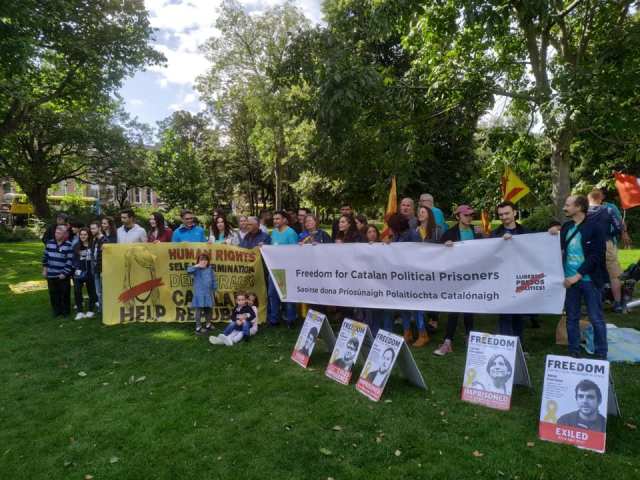
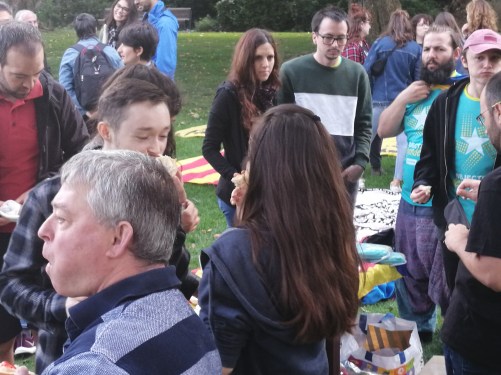
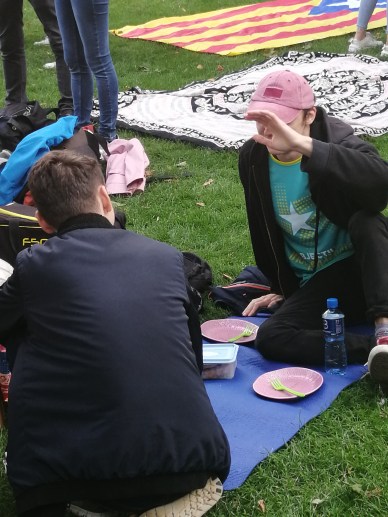
At little over a week’s notice, a protest picket took place on the evening of Friday, 6th December in Dublin City’s main street in protest at the lack of democracy of the Spanish Constitution. The date chosen was the same as the public holiday designated by the Spanish State to celebrate the adoption of the Spanish Constitution by majority in 1978.

(Photo: D.Breatnach)

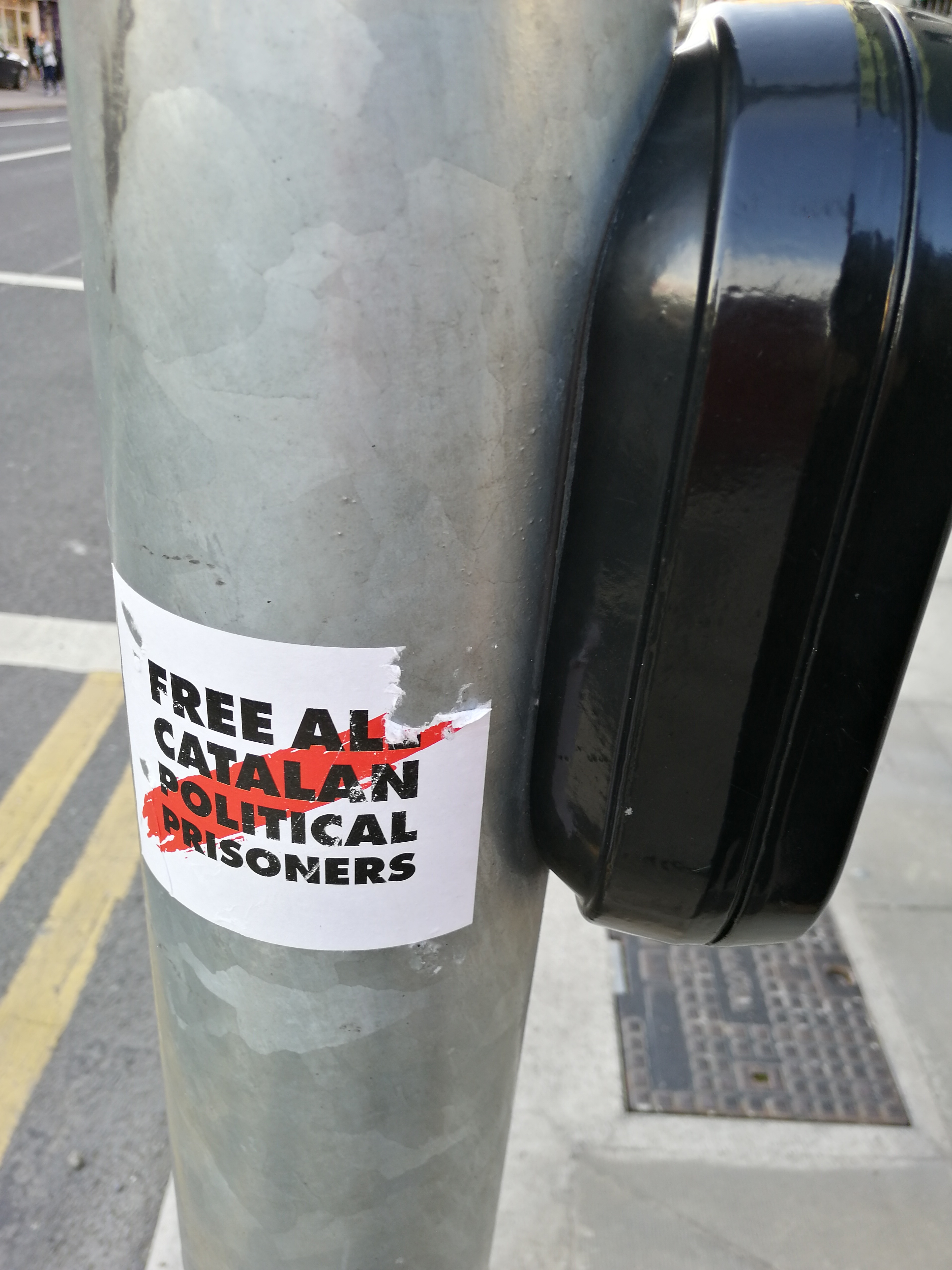
           The protest was organised by three Catalonia-solidarity organisations in Dublin: With Catalonia/ Leis an Chatalóin, ANC Ireland and CDR Dublin. Calling the Constitution “a forced marriage without right to divorce”, the organisers published a statement in advance explaining the background to the Constitution and calling on people to support the protest.

The statement explained that when General Franco, the fascist-military dictator of the Spanish state, died near the end of 1975, opposition of various kinds that had illegal under the dictatorship – trade union, anti-fascist, republican, national-independentist – had been building for some time and took encouragement from his death. But State repression intensified with attacks by police, military and by fascist gangs.
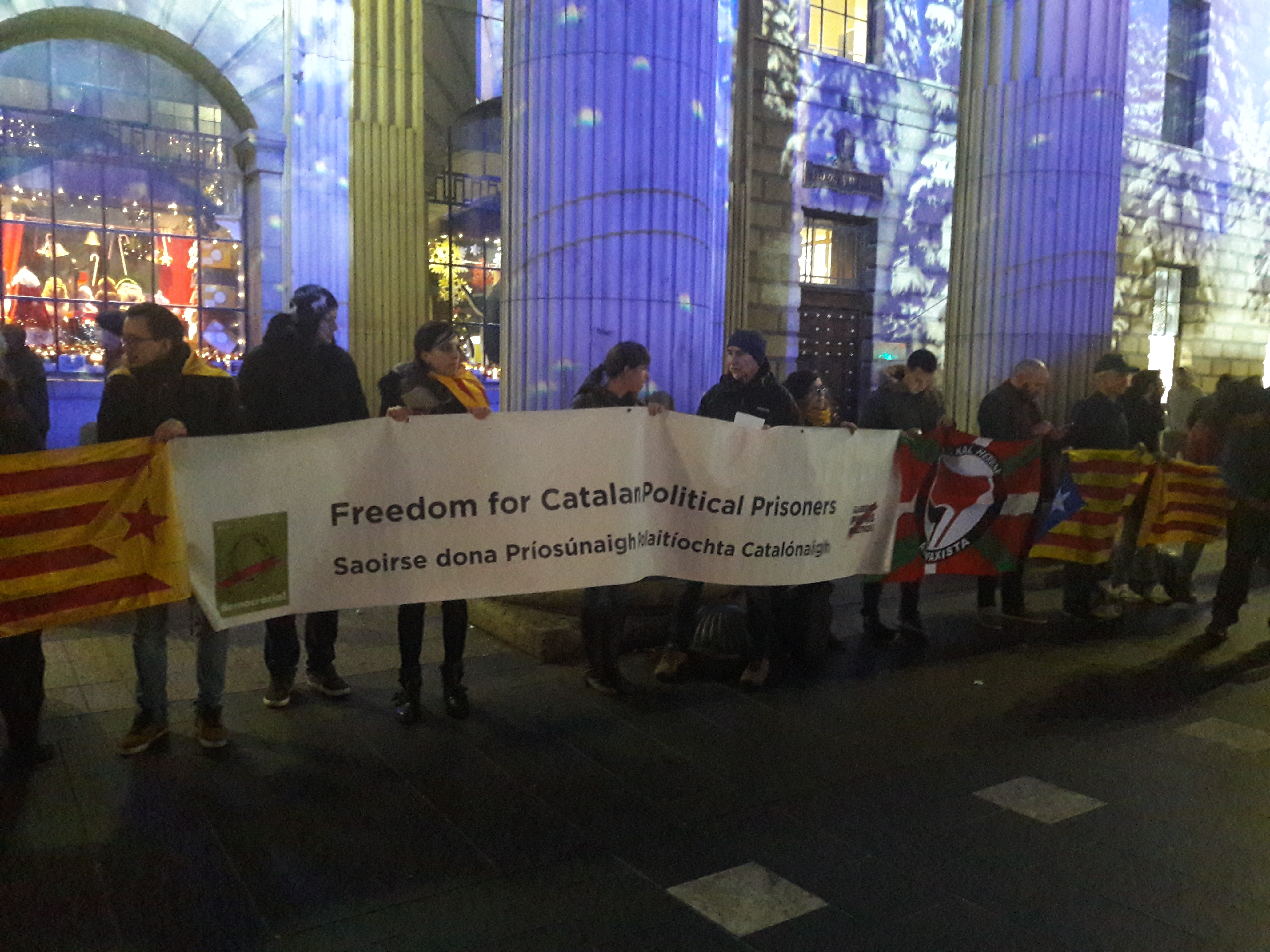
Centre view of picket on Friday with GPO Christmas Nativity scene in background
(Photo: C.Pujol)

“In 1977 the regime proposed to legalise their opposition parties, the PSOE and the Communist Party – on condition those parties agreed to support the installation of Franco’s nominee as King and Head of State and to control their affiliated (illegal) trade unions, the UGT and Comisiones Obreras.” This was the price for prisoners being released but no action could be taken against the torturers and murderers of thousands during the Anti-Fascist War or the Dictatorship or against those who had stolen children, raped and plundered. The (republican!) party leaders agreed and recommended the 1978 monarchical and unionist Constitution to their members and affiliated trade unions. Amid a wave of repression the take-it or leave-it Constitution was agreed in the Parliament and then in Referendum on 6th December 1978 by a large majority throughout the Spanish state, except in the Basque Country.

The statement pointed out that while the Constitution guarantees the right to self-determination, tht can be only if the majority of the Spanish Parliament agrees. in 1919 when Ireland had a majority of pro-independence delegates elected, as Catalonia has now, the text recalled that they declared independence. The statement went out to point out the close parallels of Ireland 100 years ago and Catalonia today, as the British proclaimed the declaration illegal, banned the First Dáil (Irish Parliament) and jailed elected delegates it could catch.

Poster for the event (creation D.Breatnach & B.Hoppenbrouwers)

Although the Catalan Government has not yet been declared illegal, the statement pointed out that “seven of its Ministers and elected officers have been jailed for 13 years and others heavily fined (two grass-roots organisation leaders have also been jailed for nine years); 700 town mayors are to be judicially processed for allowing the Referendum on independence to go ahead in their towns on 1st October 2017, a Referendum when many polling stations witnessed a savage Spanish police attack that was seen around the world (but much of it not in the Spanish state, outside of Catalonia and the Basque Country). Opinion polls have shown that 70-80% of people in Catalonia want to have a referendum on independence, free from attack or threat but the Spanish State uses the excuse of the Constitution to deny them that opportunity.”

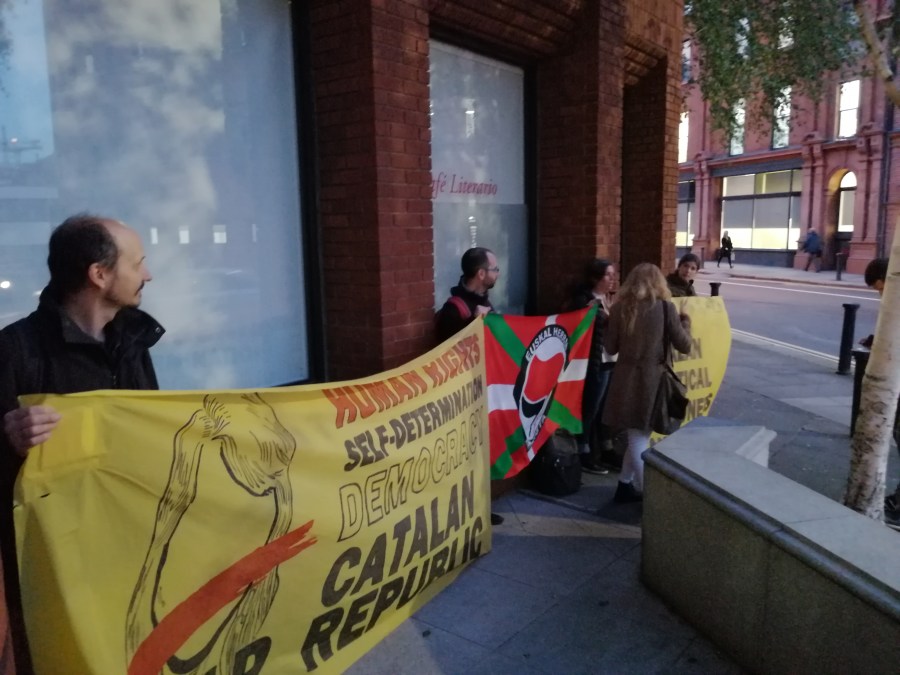
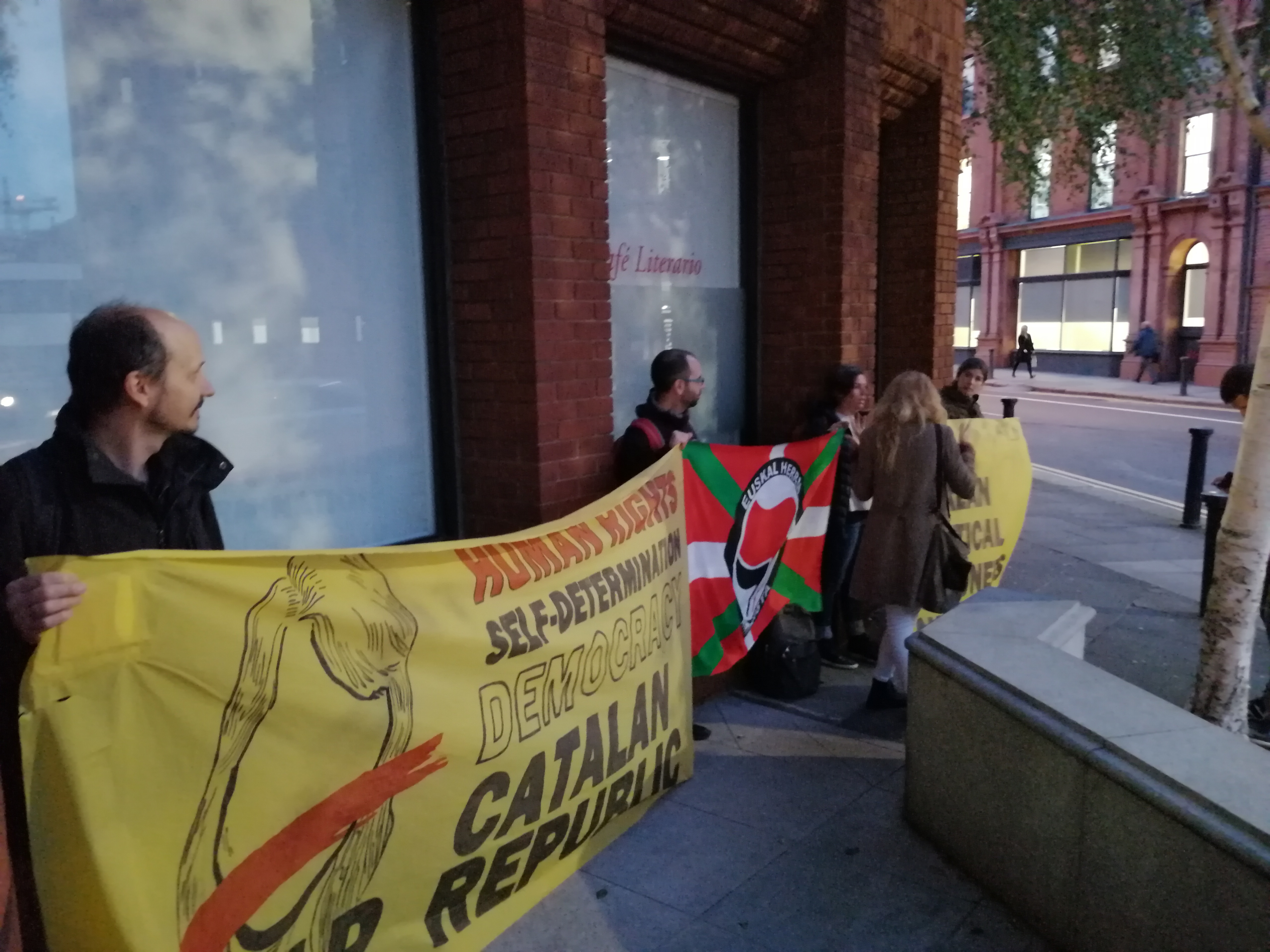
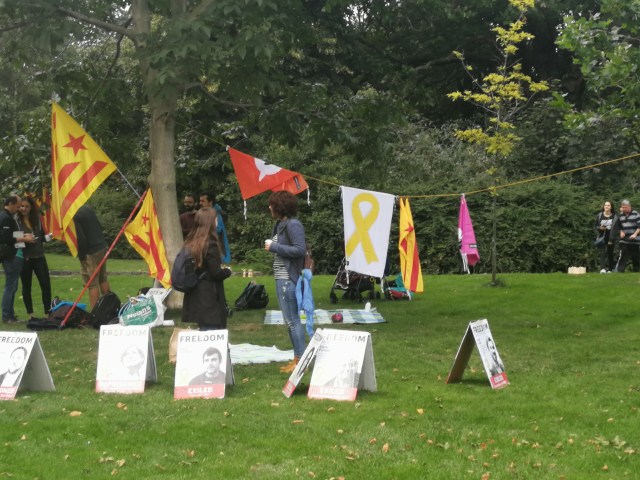
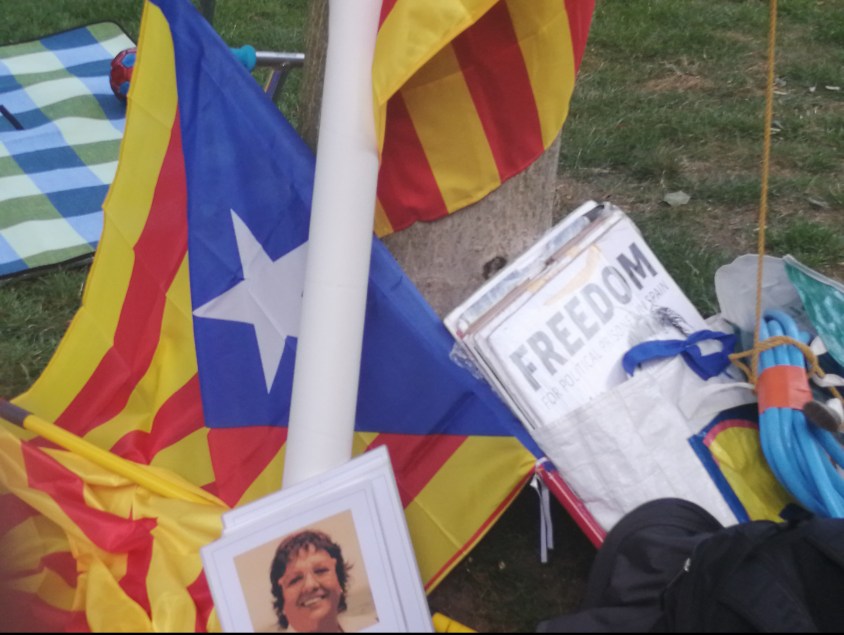
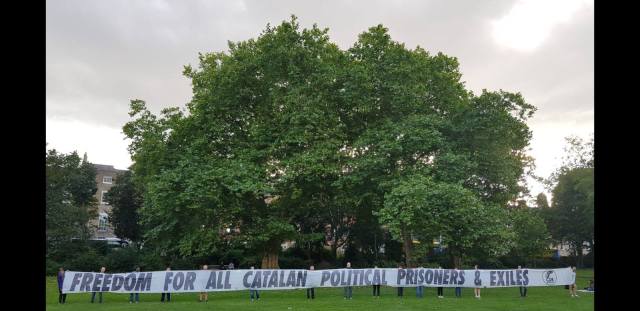
On the picket in Dublin a banner was displayed in Irish and English supporting Catalan political prisoners, along with a number of estelades (flags supporting Catalan independence), most of them of the red star variety (rather than the more common white star in a blue triangle). There was also a Basque Antifascist flag.
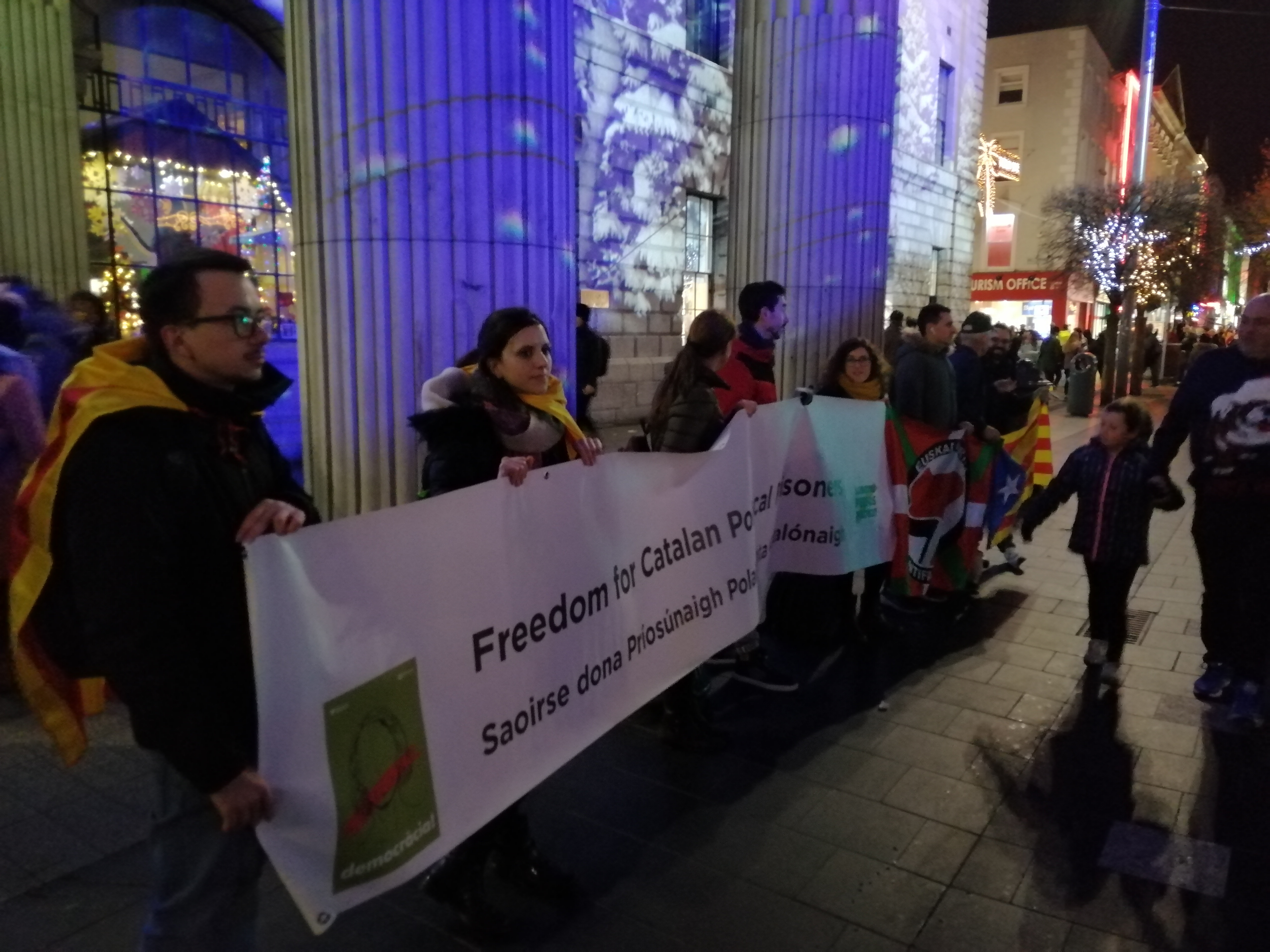
View of picket looking northwards
(Photo: D.Breatnach)

As the protest drew to a close, outlining their reasons for supporting the protest, a number of individuals gave short video interviews; one in Irish and Marc Loan of CDR Dublin gave one in in English.

Carles Pujol of ANC Ireland thanked everyone for attending and said a few words about the need for the protest and referred also to the Catalan political prisoners in Spanish jails. Diarmuid Breatnach of WCLC spoke briefly about the appropriateness of the protest taking place in front of of the General Post Office building, which had been the HQ of the 1916 Easter Rising against British domination. He went on to point out some of the parallels between Catalan and Irish history and concluded by saying that Catalonia today is in the same situation as Ireland was a century before.

VIDEO INTERVIEWS

http://https://drive.google.com/file/d/1BFayV3T0pS6DbrEzbVYq1NGbxEFgxUSH/view?usp=sharing

https://drive.google.com/file/d/1B7p1S14TiPD4Zy1R-HBJaGl-D7i9KpEV/view?usp=sharing

THE CONCERT

          As the protest began to conclude, another picket began to assemble in solidarity with Irish Republican prisoners and there was some friendly interaction between both groups. However the Catalan solidarity protesters were heading off for a performance in Dublin by Els Pets, a long-standing Catalan band in a kind of folk-rock genre.

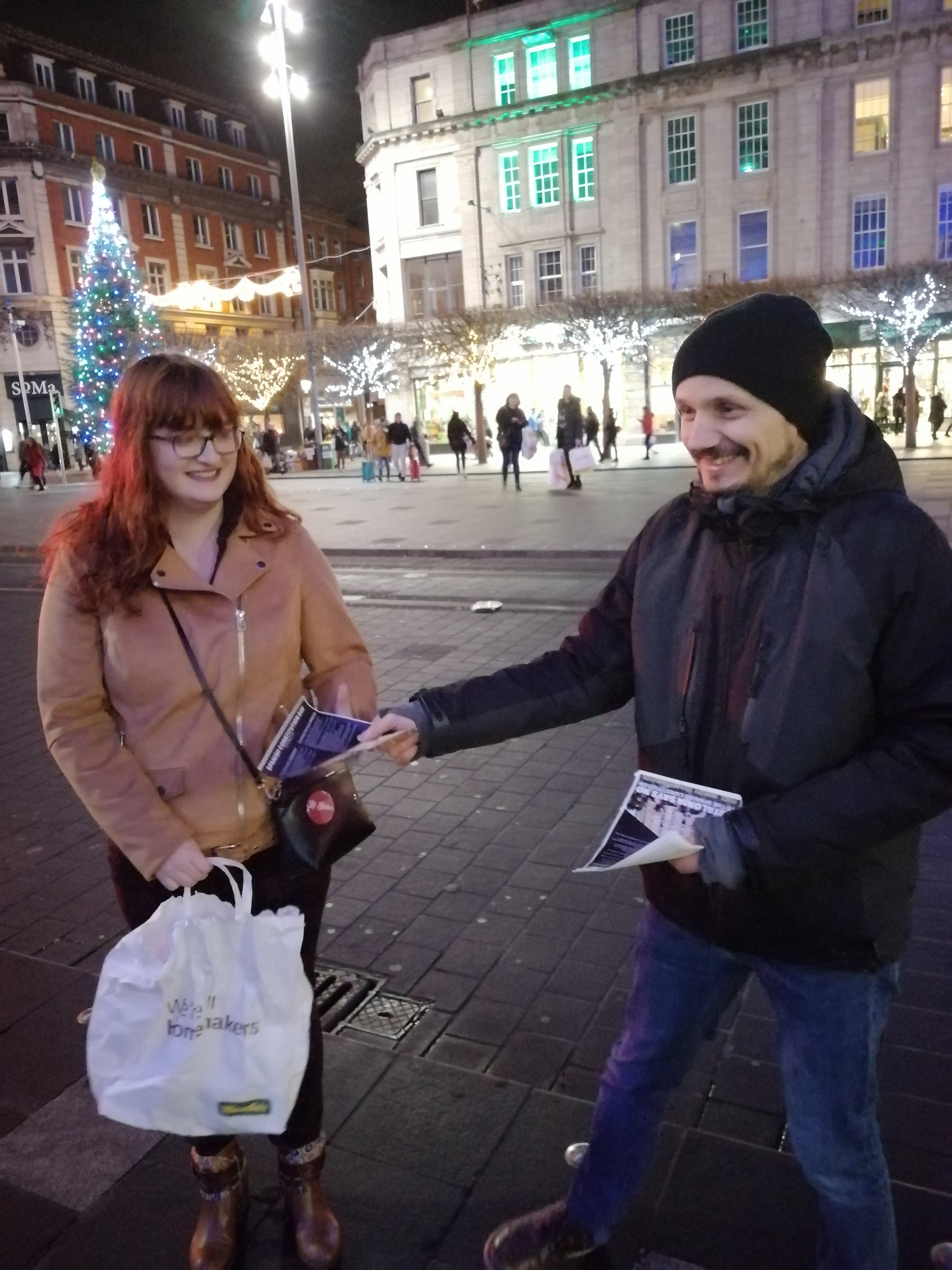
(Photo: D.Breatnach)
Leafleting passers-by (Photo: D.Breatnach)


(Photo: D.Breatnach).


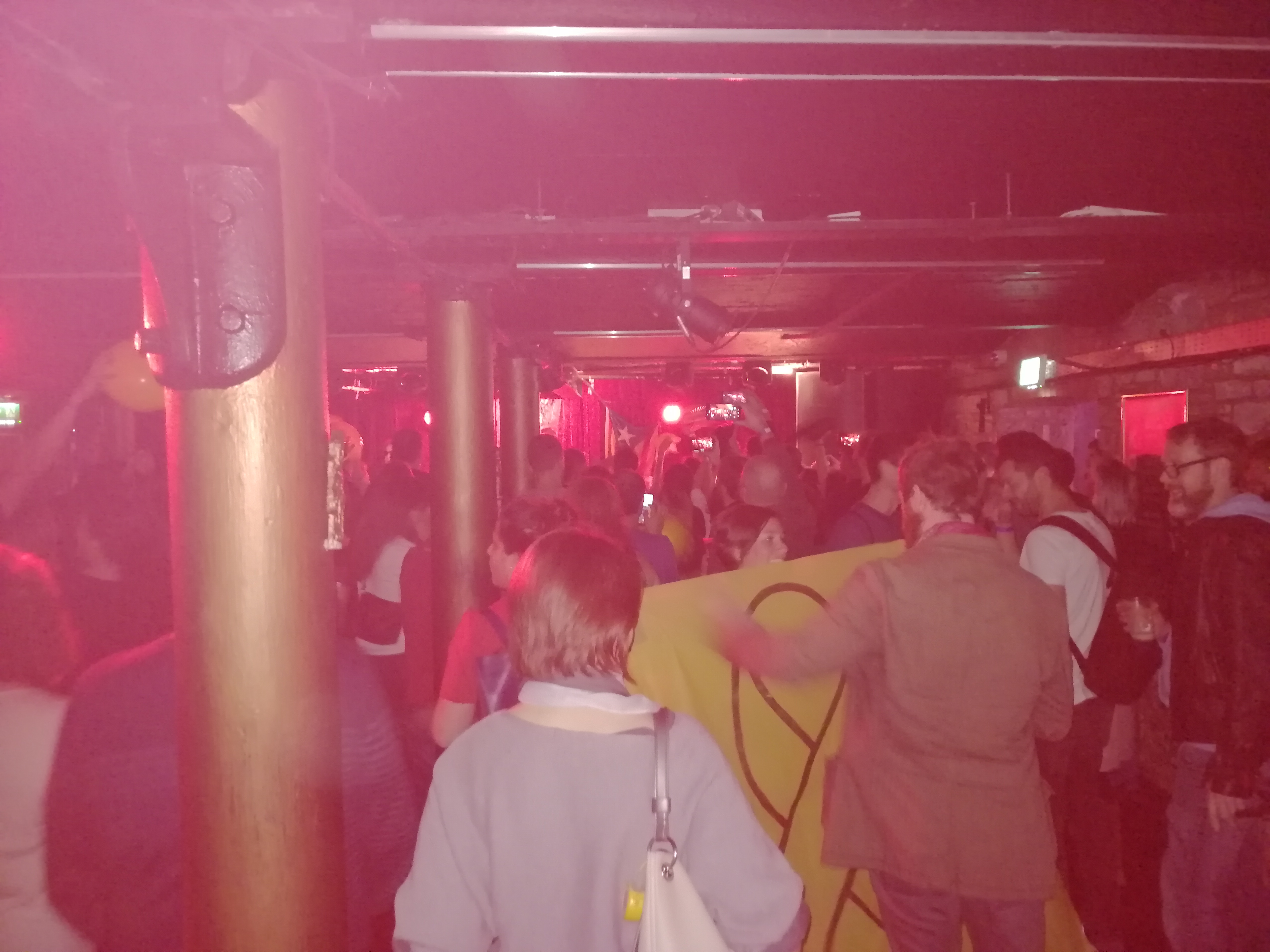
During the band’s performance, which was enthusiastically received by the mainly expatriate Catalan audience, a number of references were made from the stage to the aspiration for Catalan independence. At one point, a band member ironically sympathised with the Irish not having a king, saying “You don’t know what you’re missing.” The Spanish King is hated by many Catalans because of his personal position with regard to violent repression against Catalan Referendum voters in October 2017 but also because the monarchy was re-imposed on a Republican Catalonia by General Franco. When the satirical song “I want to be a King” was performed, members of the audience began to blow yellow balloons and to bounce them around the area (yellow is the colour designated for ribbons supporting Catalan political prisoners).

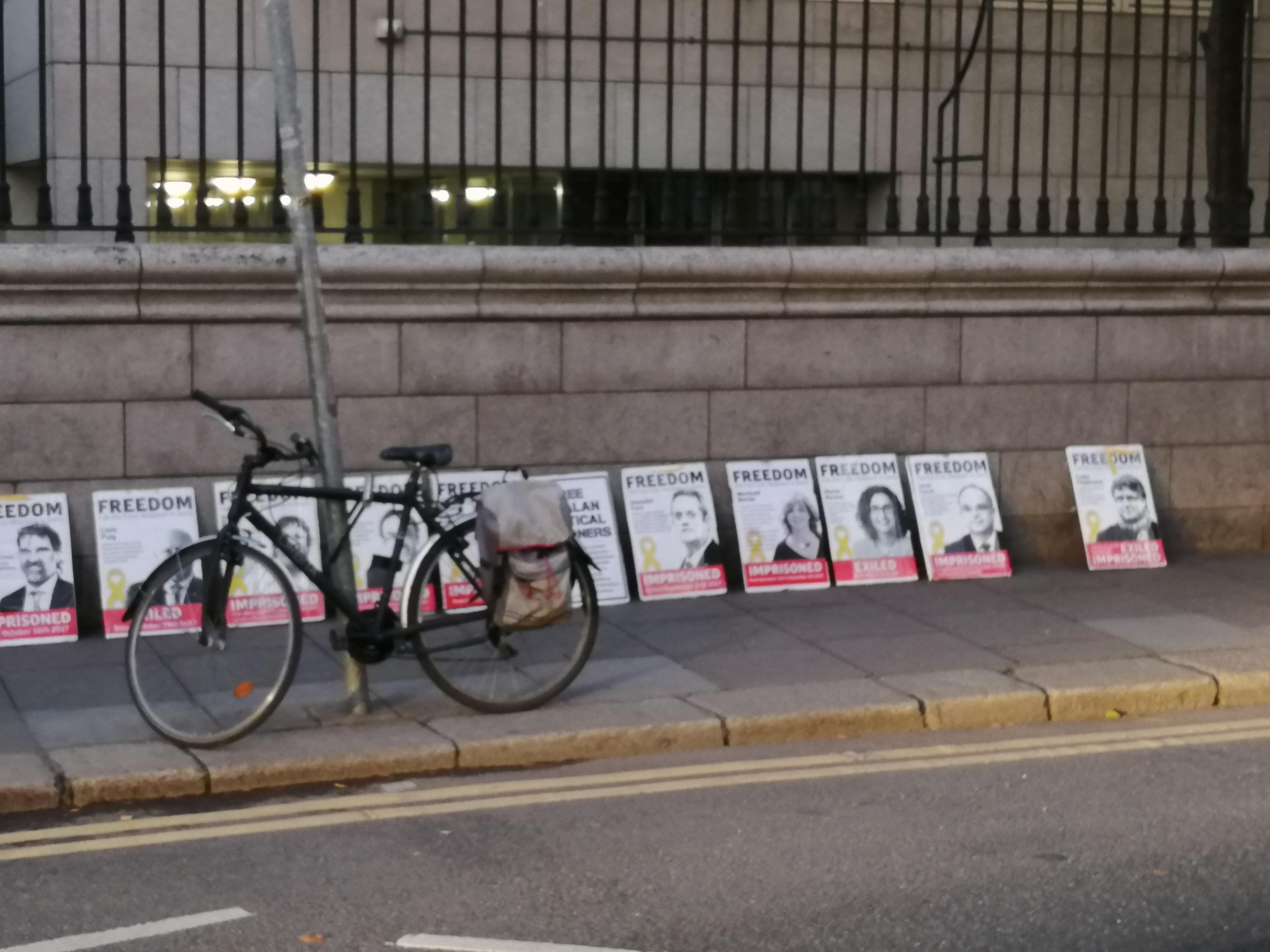
At the end of the concert, a number of supporters lined up with placards supporting the right to self-determination, also denouncing the Constitution and Spanish State repression.

The placard display at the end of the Els Pets concert.
(Photo: C.Pujol)

Note:

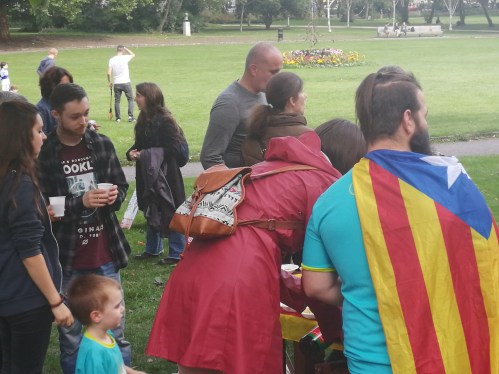
The politically-independent organisations concerned have organised more than ten public Catalan solidarity events in Dublin this year, including a cultural day in the park, film showings, talks and protest pickets.  In addition, there have been organisational meetings and external meetings with public representatives and participation in a Spanish-Embassy sponsored debate (which wasn’t!).

End.

Els Pets on stage.
(Photo: D.Breatnach)
No, it certainly is not! (Photo: D.Breatnach)
Yellow ribbon banner in solidarity with the prisoners.
(Photo: D.Breatnach)
Estelada waving among the audience.
(Photo: D.Breatnach)

Yellow balloons time!
(Photo: D.Breatnach)

CONTACT FOR INFORMATION ABOUT FUTURE EVENTS:

With Catalonia/ Leis an Chatalóin: https://www.facebook.com/WithCataloniaIreland/

ANC Ireland: https://www.facebook.com/IrlandaPerLaIndependenciaDeCatalunya/

CDR Dublin: https://www.facebook.com/CDRDublin/

JARKI – NEW BASQUE ORGANISATION FOR INDEPENDENCE AND SOCIALISM

Diarmuid Breatnach

(Reading time text: 15 minutes)

When Basque independentists celebrated Gudari Eguna this year, the Day of the Basque Soldier, some of the celebrants were affiliates of the Abertzale (Basque pro-Independence) Left while others were supporters of the Basque Nationalist Party, nominally at least and often in reality, political enemies. However, it is not the same day for each.

Flagpole with the ikurrina, Basque national flag, at Sollube, scene of a battle between the Francoist forces and the Basque Gudari during the Antifascist War. This was erected probably by the PNV for their commemoration but commemorations are also held at the site by ‘dissidents’ of the Abertzale Left.
(Photo source: D.Breatnach)
A beech seedling (native tree, sacred in folklore, of reputed medicinal qualities, e.g in helping the body to resist infection) had been planted by ‘dissidents’ at the Sollube memorial and, although the surrounding protective netting had collapsed, was still alive. Subsequently Amnistia supporters returned and tidied up the area and left stone markers too.
(Photo source: D.Breatnach)
Mount of sollube: the Francoist forces had invaded from that far background direction, coming in from Nafarroa, which had been taken over to Franco by the Basque Carlists.
(Photo source: D.Breatnach)

          The PNV (Basque Nationalist Party) commemorates the execution of 42 Basque fighters in one jail by the Franco forces on 28th October in 1937, whilst the Abertzale Left carries out their commemoration a month earlier, on the 27th of September, anniversary of the last executions under Franco (and, officially, in the Spanish state since): ETA martyrs Juan Paredes Manot (Txiki) and Ángel Otaegi Etxeberria, along with three members of FRAP (Revolutionary Antifascist Patriotic Front) Jose Luis Sanchez Bravo, Ramón Garcia Sanz and Humberto Baena, all shot by firing squads in 1975 (despite world-wide protests and riots outside Spanish embassies).

For much of the Abertzale Left, Gudari Eguna commemorates not only the martyrs of the 27th September 1975 but also all those who fought for Basque independence during the Spanish Anti-Fascist War and all who fought for it since, in particular those martyred in the struggle.

But even in agreement on that date and that purpose, there are differences too. For some years now some commemorations have been by supporters of Amnistia Ta Askatasuna (Amnesty and Freedom), who denounce the “Officials” for dropping the demand for an amnesty for political prisoners but also criticise them on many other political and cultural grounds: ceasing to push for the everyday use of Euskera (the Basque language), making political pacts with social democrats, etc.

Increasingly, ATA and the “Officials” find themselves incapable of sharing a commemoration or a platform as the latter move further down the path of accommodation to the Spanish regime, social democracy and the PNV, commemorating police killed, apologising for the ‘crimes’ of the now-defunct Basque armed organisation ETA.

A poster of the “Officials” highlights two ETA martyrs, one killed by the Policía Nacional and the other by the Guardia Civil. (Photo source: D.Breatnach)
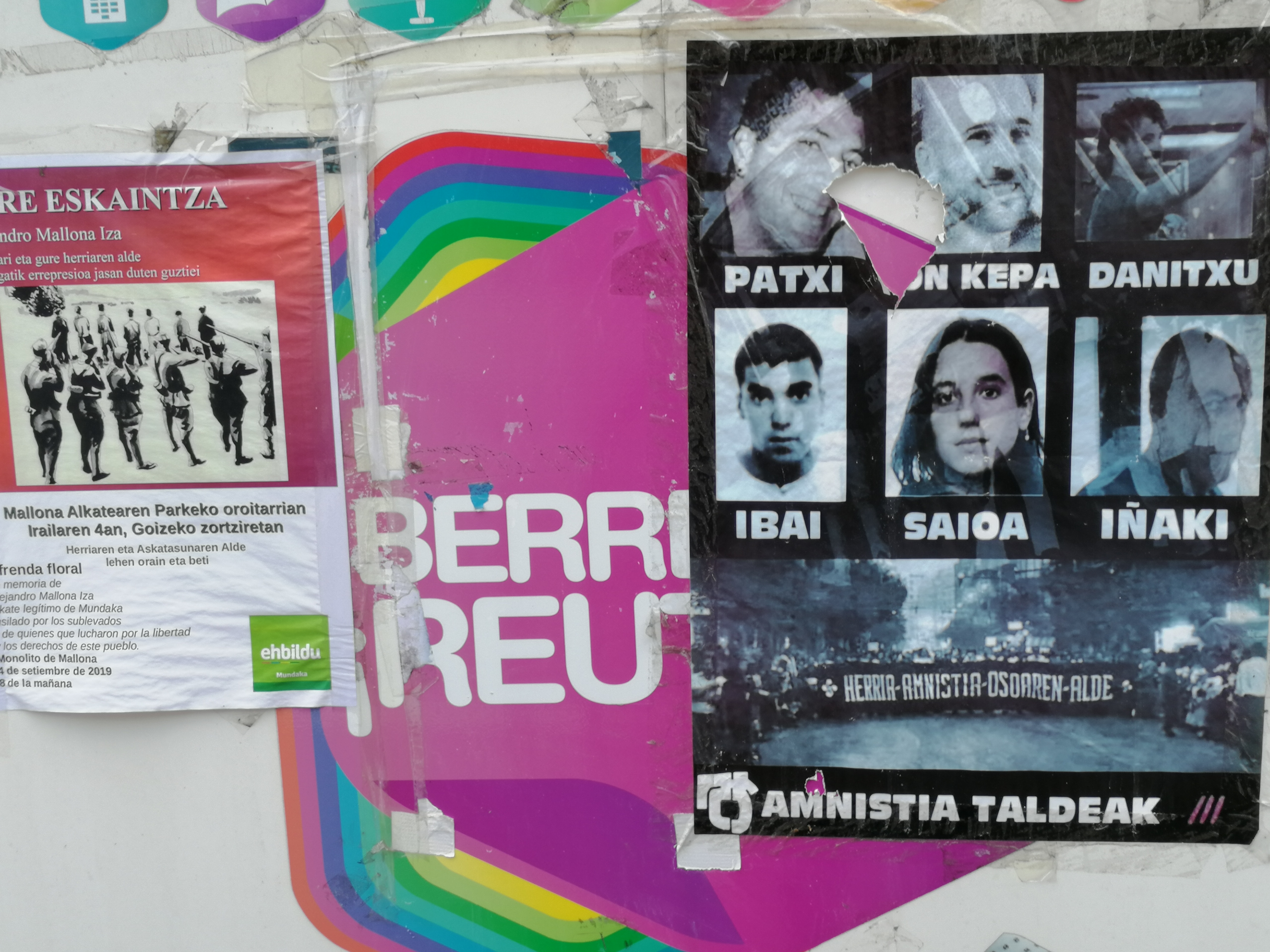
A poster for Gudari Eguna of the ‘Official’ leadership, the party EH Bildu, next to a poster of the ‘dissident’ ATA listing six prisoners whose situation is being highlighted.
(Photo source: D.Breatnach)

JARKI – A COMPARATIVELY NEW ORGANISATION REJECTING THE ABERTZALE LEFT “OFFICIAL” LEADERSHIP

          In Ireland, though they themselves might reject that appellation, the equivalent to ATA would be called “dissident Republicans” and Basques are not as touchy about being counted part of the dissidencia. But one new group has emerged which does reject that term as descriptive of themselves, while at the same time very clearly against the positions of the “Officials” and resolutely for independence and socialism.

This group is called Jarki, (of various meaning: “Resist/ Stand fast/ Push back/ Commit”; the first letter is pronounced like the Spanish “j” or the Irish “ch”).

Among other posters of factions of the Abertzale Left proclaiming Gudari Eguna in the Basque Country this September, I had seen one, very large, side by side with a declaration of position against the subjugation of the Basque nation, for socialism and class struggle. Curiously, there had been no venue advertised for a commemoration ceremony to take place. Was this group, this Jarki, not intending to have one? I made discreet enquiries, someone spoke to someone ….. who perhaps spoke to someone else ….

Jarki poster for Gudari Eguna — note no venue details
(Photo source: D.Breatnach)

On Gudari Eguna this year,

Text poster of Jarki’s alongside their image poster (Photo source: D.Breatnach)

27th September, I was met fairly early in the morning by my appointed guide. The mist gathered high upon the marshes and river and in the valleys as we drove higher, eventually coming out on a scenic site, the day cold but the climbing sun burning off the last of the mists. We rendezvoused with other carloads, then drove to another spot and parked. Asked to leave my mobile in the car, I accompanied my hosts on a long walk in unseasonal sun and heat to a field, where a temporary stage had been set up. It was to be a Gudari Eguna event organised by the Jarki organisation.

The security precautions were not excessive. This was taking place in the Spanish state, where fascism had never been defeated but had instead had a paint-over job in order to allow the Western states, after the death of Franco, to pretend it was a democracy. Until a few years ago, detentions of Basques had been like an epidemic, torture by police and army routine and just as routinely ignored by judges who sentenced the prisoners on the basis of their “confessions” or those of others to long years in jail. In contravention of EU and UN protocols for the treatment of prisoners, the political victims of the State had been dispersed to its furthest reaches, far from spouses, children, relatives and friends. And though the armed group ETA had ceased operation in 2012 and was now disbanded, persecution went on: that very month, 45 people of various organisations arrested in 2013, 2014 and 2015 for supporting the prisoners, including psychologists and lawyers, “supporting terrorism” according to the State, had been brought to trial1.

On the way to the rally, I saw many young men and women, in their middle-to-late teens or early twenties and also many others in ages ranging from late 50’s to 80s, also with a sprinkling of young adolescents. In other words, there were hardly any there of raising a family age. The sun was very hot now and I took off my jacket and tied it around my waist and, even so, was soon sweating.

I and one other were provided with a translator to Castillian (Spanish) for the speeches in Euskera – nobody else seemed to need one, a state of affairs that would not be matched in Irish Republican or Socialist circles with regard to our native language.

The heat beat down and I worried about getting sunburned, while at the same time very interested in what was going on. A large dragonfly wheeled above us, hovered a second then shot off. One of the folkloric Basque names for it translates as “Witch’s Needle” but it is important to recognise that in Basque society, sorgina or “witch” does not have the same negative connotations as can be found in much of western society, even today.

“THE STRUGGLE MUST CONTINUE — IN ONE FORM OR ANOTHER”

          A man perhaps in his 60s took to the stage and recalled his years in guerrilla resistance (i.e in ETA), his capture and the killing of his comrades (one was executed on the spot by the Guardia Civil2). He went on to talk about his years being dispersed around Spanish jails throughout the territory of the State. Speaking about the historical memory of resistance, the man commented that it was necessary to keep that alive – both of the Antifascist War and of the resistance afterwards.

Euskal Herria3 was still divided and still not free, he continued and therefore the struggle had to continue in one form or another, despite the abandonment of the path of resistance by the current leadership of the Abertzale Left. Similarly the demand had to be maintained not only for an end to dispersal but for an amnesty for political prisoners.

After his speech, a young male bertxolari stepped forward to sing his composition. This is a cultural form of social and/ or political commentary, composed by those skilled in the art to fixed rules of rhyme, length of line and a selection of airs.4

He was followed by an elderly left-wing journalist who, apologising for her inability to speak in Euskara, did so in Castillian (Spanish). She referred to her family’s history of anti-fascist struggle, both in the War and in the resistance that followed the victory of the military-fascist forces. She too spoke about the need to continue resistance to unjust regimes and for the right to self-determination.

The journalist speaker was followed by the performance of another bertxolari, this time a young female.

Last to speak was a young woman, speaking on behalf of the Jarki organisation. She recalled the anti-fascist resistance in the Basque Country in ……….. (a nearby battle during the Anti-Fascist War) and elsewhere, also by ETA in the years following the victory of the military-fascist forces. While others might try to pacify the people and to wind down the resistance, the need for active participation in resistance is as great as ever, she said. The woman ended with the call “Gora Euskal Herria askatatua eta independentzia!” (“Long live a free and independent Basque Country!”), to which all the audience (myself included) responded with a roar of “Gora!”.

The young woman then led the audience with the song Eusko Gudariak (“Basque Soldiers”, similar in content to the Irish national anthem, the Soldiers’ Song), most of us who knew the words or not with raised fists, then a couple of women let out the irrintzi5 yell, raising goose pimples on my skin.

Obviously, given my presence, not all the attendance had been Jarki activists but on the other hand, not all its supporters had been able to come either, I was told on the long walk back to the car on tired leg muscles in the blistering unseasonal heat. I joked that if I’d had my mobile with me I’d have phoned an ambulance. Some cured sausage sandwiches and a few mouthfuls of ardoa (wine) from a traditional wineskin, kindly offered where the vehicles were parked revived me somewhat for the journey back to my pickup point that morning but thankfully, we also stopped on the way for lunch and a cold beer at a Basque bar (for which my attempts to pay were kindly but firmly refused by my other travelling companions).

“MOST OF THE RESISTANCE NEEDS TO BE AT STREET LEVEL”

          Later, at an appointment with a Jarki activist, I asked what the relationship with other Basque organisations was, given that his group will not accept the appellation of “dissident” and others will. He told me that they enjoy friendly relationships with a number of other Basque political and cultural organisations that have also broken away from the “Official” leadership. Jarki is a revolutionary socialist organisation for an independent Basque country and in support of the Basque language, he told me. “Although we do not at the moment put forward electoral candidates, we are not necessarily against doing so as a tactic”, he added, speaking quietly. “But the ‘officialistas’ are only interested in the electoral path and we think most of the resistance needs to be at street level”.

The organisation expects a disciplined commitment from its members, for which it also recognises the need for political education, especially of the youth. There had been wide criticism of the lack of this kind of education within the Abertzale Left since the 1990s and earlier, right up to the present.6

The national independence and socialism of the Basque Country is of benefit to the world and the independence and socialism of other countries is of benefit to our nation,” he said in reply to my question about the issue of internationalist solidarity. He admitted that the representative of Jarki at their Gudari Eguna commemoration had not mentioned that aspect.

Jarki call for rupture with the Spanish Constitution and demonstration on 6th December.
(Photo source: Internet)

CALL FOR RUPTURE WITH THE SPANISH CONSTITUTION

          A few days ago, while I was writing this long-overdue piece from contemporary notes, Jarki issued a national call to Basque society (translated by me from a Castillian version): “The Basque working-class people responds with rupture to the Spanish Constitution.”

The Spanish Constitution, despite not being accepted in the Basque Country7, is being imposed upon us. It is a document edited by the Francoists in a pact with the Spanish political parties. This document denies the self-determination of the peoples and besides accords to the military the role of guarantor of the union of Spain.

This Constitution designed the administrative separation of the provinces of the southern Basque Country.8

Faced with this imposition it is more important than ever that the working-class population of the Basque Country creates a revolutionary alternative which should be a political vision to lead the struggle for national construction and liberation and for socialism, the struggle for a united Basque Country, without classes.

For all those reasons we call for the organisation and mobilisation against the imposition, in which the Basque working-class population should follow its own path. Because of all that, we call for participation in the demonstration to take place on 6th December (Spanish Constitution Day) in Durango.

Although they wished to silence us, they will hear us. We have enough reasons. It is time to take to the streets. This people needs a revolutionary alternative.

End.

Poster by Jarki calling for demonstration against the Spanish Constitution (Photo source: Internet)

FOOTNOTES

1The day after 50,000 demonstrated for the right to support the prisoners and in solidarity with those on trial, Basque society was shocked when those charged admitted their “guilt” in exchange for walking free or a maximum sentence of five years’ jail for the “leaders” (instead of the up to 20 years normal from the Spanish court). The reverberations of that – the act of pleading ‘guilt’ itself but also permitting 50,000 to demonstrate in ignorance of the intention — are still travelling through the Abertzale Left and are likely to cost the “Official” leadership, who must have approved or perhaps even brokered the deal, very dearly. In contrast to the 45, another four, leaders of Askapena, Basque organisation for internationalist solidarity, charged with similar ‘crimes’, had fought the case earlier, for which they had won much respect and had beat the charges. Askapena, however, had quietly split from the Abertzale Left some years previously.

2The Guardia Civil is a militarised police force of the Spanish State with a very political role, the most active in the past against the Basque national movement and now similarly against the Catalonian. In addition the Spanish State has the Policía Nacional, also armed and active against movements for self-determination. Each region also has a separate police force, for example the Policía Foral in Nafarroa, the Ertzaintza in Euskadi, Mossos d’Esquadra in Catalonia, etc. And there are urban police forces too in every town or village.

3Meaning “the country where they speak Basque”, the term is now used to describe the whole Basque nation of seven provinces, three currently within the French state and four within the Spanish territory. “Euskadi”, the former term, now only describes the “Basque Authority” area of three provinces: Bizkaia, Alava and Gipuzkoa.

4This cultural form, at one time perhaps in danger of dying out, has become very popular and national competitions are broadcast on the Basque TV network. I have witnessed two bertxolari given pieces of paper laying out their respective roles (for example an Irish landlord and a Polish tenant) and, minutes later, engage in a battle of bertxos (verses) which had a Basque audience in roars of laughter and appreciation for the wit and skill of each. Close attention is paid by Basque listeners to bertxolari which, for a nation not culturally given to admiration for the song of the single voice (unless they can join to sing along), is truly remarkable. The Irish “comhrá beirte” is a similar performance art form but much less developed, certainly now, in Irish tradition.

5It is a long ullulating or yodelling cry, by males or females, said to be a call to war or to encourage Basques while fighting (it was also the name of a short-lived Basque resistance organisation functioning in the “French” Basque provinces). Such calls are common for communication of different kinds among mountain people, the sound carrying from one mountain to another and echoing but curiously enough it is also a feature of Arab culture in the desert and of some Native Americans. Example with a commentary in Castillian: https://www.youtube.com/watch?v=gcSaW6JUnUc

6That this has been neglected for decades in the Abertzale Left is a fact admitted even by many who remain within the “official” line.

7The Spanish Constitution was presented on a “take it or leave it” basis during the Transition period after the death of Franco, with much violence from police and fascist organisations and the fear of a return to the full-blown fascist dictatorship. The Spanish Communist Party with its huge and then militant trade union, Comisiones Obreras and the social-democratic PSOE, with its smaller Unión General de Trabajadores, were both legalised on condition they supported the monarchist and unitary state Constitution. In such circumstances it was hardly surprising that the referendum on 6th December 1978 brought in a huge majority for the Constitution – but not in the Basque Country, where it was rejected.

8Three of the four southern provinces, i.e those currently within the Spanish State, are under one regional government administration while the fourth, Nafarroa, has its own.

“GOD SAVE IRELAND!” CRIED THE HEROES

Diarmuid Breatnach

(Reading time text: 7 minutes)

Artist’s representation of the public hanging of the Manchester Martyrs. (Image source: Internet)

The 23rd November is the anniversary of the hanging of the Manchester Martyrs by the English State in 1867 in front of Belle Vue Gaol, Salford1, Manchester.

The “noble-hearted three” were Phillip Allen, William Larkin and Michael O’Brien.

The Wikipedia page on the Manchester Martyrs says they were hanged for the murder of Constable Brett but this is completely incorrect. Although it was indeed the verdict, no murder occurred and, it is doubtful if even a verdict of manslaughter would have been correct.

On the 18th December of that year, Colonel Thomas J. Kelly and Captain Deasy, Fenian Brotherhood officers and Union Army veterans of the American Civil War, who had been arrested in England, were being transported in a horse-drawn prison van from the courthouse to Belle Vue Gaol.

Manchester was an industrial town with a large working class population, of which at least a 10% of the population was of Irish origin. A large group of Fenians ambushed the prison van at a place since called locally “Fenian Arch”, as a railway line ran overhead.

The Irish rescue party drove off the 12-man mounted police escort but failed to break open the van door with hatchets and crowbars and one of them fired a pistol shot at the lock.

Artists’ impression of the rescue of the Fenian prisoners.
(Image source: Internet)

It was unfortunate that just at that moment, Constable Charles Brett was peering through the keyhole – the bullet entered his brain through his eye and killed him.

The lock was not broken and keys were still inside with the dead policeman but a female prisoner recovered them from his body and passed them out to the rescue party through a grille.

Kelly and Deasy were spirited away. A reward of £300 (£24,000 as of 2015, according to Wikipedia) was offered for information leading to their recapture but was never paid.

Friedrich Engels, communist revolutionary lived in Manchester at the time with his common-law Irish patriot wife, Mary Burns and some say they were involved in hiding the fugitives (the Fenian Brotherhood had been welcomed by Marx and Engels into the First International Workingmen’s Association). Kelly and Deasy were never recaptured, getting back eventually to the USA.

A heritage plaque marks the spot.
(Phot sourced: Internet)

A WAVE OF ANTI-IRISH HYSTERIA

          But a huge wave of British State repression descended upon the working class areas of Manchester, in particular upon “Little Ireland” and scores of people were arrested. The British media named the events the “Manchester outrages”.

Twenty-six were sent for trial in a wave of anti-Irish hysteria and and eventually five were convicted of murder and sentenced to hang. As noted earlier, without any intention to kill the officer, there should not have been even a charge of murder, never mind a conviction.

Thomas O’Meagher Condon and Thomas Maguire had their sentences overturned; the first through the offices of the USA (of which he was a citizen) and the second was a Royal Marine and had a cast-iron alibi, as they say and the witnesses against him were exposed in lies.

No convincing evidence was ever produced against the remaining three, Allen, Larkin and O’Brien and of those, only one had probably even been present at the rescue. But they hanged them all the same.

Artist’s impression of the trial of the five convicted including the three Manchester Martyrs.
(Image source: Internet)

When their sentences were passed down by the judge, they cried “God Save Ireland!” and it was that which inspired TD Sullivan, an Irish constitutional nationalist politician, to write the lyrics to the ballad, known and sung to this day.

TD Sullivan remarked that within a month of the executions, the song could be heard performed in pubs in England and Ireland, a remarkable feat for a time without radio, not to speak of mobile phones and the Internet!  (Listen to Youtube video of the song being performed by the Dubliners ballad group).

(Image sourced: Internet)

Commemorations of the Manchester Martyrs became part of the events on the Irish Republican and Nationalist calendars and formed part of the tradition and history that helped form subsequent Irish revolutionaries. Six Irish counties hold monuments to the three, two of those counties holding two each.

The Irish community in Manchester commissioned a memorial to them in Moston Cemetery, Manchester, which was several times defaced by fascists and an annual commemorative march was held there for years (sometimes too clashing with British fascists). There is a grand memorial to them too in Dublin’s Glasnevin Cemetery.

The monument erected in Moston Cemetery, Manchester, by the Irish community. (Photo sourced: Internet)

FOOTNOTES

The plaque on the Monument to the Manchester Martyrs in Glasnevin, work of that wonderful voluntary organisation, the National Graves Association. (Photo: Wikipedia)

1Salford has received a number of uncomplimentary literary references, one in Frederik Engels’ The Condition of the Working Class in England (1845) and another being in Ewan McColl’s song Dirty Old Town (1949).

COLOUR, NOT CLUTTER – Grafton Street flower sellers

Diarmuid Breatnach

(Reading time: 4 minutes)


We bring colour to Grafton Street, not ‘clutter’!” was the response of street traders in Grafton Street to a request from multinational property company Hines to Dublin City Council to remove the street trading stalls away from Grafton Street, to which Hines allege they bring “clutter”. The street traders also pointed out that they and their predecessors had been on that street much longer than Hines.

Catherine Claffey, a Grafton Street flower seller, from whom I took the “Colour, not ‘clutter'” quotation. (Photo: D.Breatnach)

          Although the request to Dublin City Council had been made in August, it only hit the news earlier this week and brought a swift response of outrage from the street traders, some public representatives and ordinary members of the public. Broadcaster Joe Duffy joined the chorus and also referred to the difficulties experienced by the street traders on Moore Street with an unhelpful DCC Management.

Hines PR people soon found themselves removing their feet from their mouths and eating not only their words in public but very humble pie.

Dublin architecture, history and soul is under constant attack by property speculators, both native and foreign, to whom everything is a potential ‘development site’ and a possible source of profit – and without the production of a single commodity.

Victoria Dempsey, Grafton Street flower-seller, hugs a friend.
(Photo: D.Breatnach)

GRAFTON STREET THEN AND NOW

          Dublin’s Grafton Street was a premier Dublin residential street as the upper classes deserted the north for the south side of Liffey river in the late 18th and early 19th Centuries. Perhaps that was the spur for the street becoming known for prostitution in the period.  According to Wikipedia: “In the 1870s, 1,500 prostitutes were reputed to work in the street.”

When the O’Connell Bridge (then the Carlisle Bridge) was completed in 1795 (just in time to hang United Irishmen from it), it led not only to the doubling of the length of Drogheda Street, which then became Sackville Street but also to much traffic backwards and forwards across the river to both sides of the city centre. Grafton Street soon became a premier shopping street with many Irish-based companies selling fresh, preserved and tinned food, higher end male and female clothing, jewelry and ‘exotic’ imports such as coffee through Bewley’s Oriental Café (1927). This state of affairs persisted into the late 1960s but in the decades since then however, the profile of the street has changed to feature mostly British high street outlets and a Mac Donalds fast food place.

For two centuries there have been street traders selling a variety of products on the street, of which the flower-sellers, newspaper stand and a hat and jewelry stall are all that remains.

The street was very narrow to accommodate both pedestrian and vehicle traffic both sides of the street and pedestrianisation of Grafton Street began in 1971, however at an extremely pedestrian rate (pun intended), not being completed until 1983 and it was paved the following year, repaved in 1988 and then partially again more recently. The pedestrianisation facilitated performance by buskers (street musicians) and music and song of high quality may be heard any day in different genres from Irish traditional to world rock and classical. Perhaps they would have been the next to be accused of “clutter”?

Flower Sellers, Grafton Street by Norman Teeling.
(Image sourced: Internet)

The Dice Man (Thom McGinty 1952–1995) regularly carried out his performances there too. Dublin world-famous musician Phil Lynott (1949-1986) had a statue commemorating him placed in Harry Street, just off the north end of Grafton Street in 2005 while the statue of fictional sea-food street trader Molly Malone was moved from the north end of Grafton Street to a less crowded space in Suffolk Street in 2014.

The street features in much of Irish literature and some song but also in images: two are particularly striking: IRA men walking up a wet Grafton Street during the Civil War and Flower Sellers, Grafton Street by impressionist Irish artist (and musician) Norman Teeling (b. 1944). It was also the scene of the shooting dead by the IRA of a G-man, the political plain-clothes branch of the Dublin Metropolitan Police, in 1921.

Famous photograph of the IRA proceeding up a rainy Grafton Street in June 1922.

WE BRING COLOUR TO THE STREET, NOT ‘CLUTTER’

          Talking briefly to some street traders there on Wednesday about the threat to move them, one of them remarked: “We bring colour to Grafton Street, not ‘clutter’” and reiterated their declaration that they and their predecessors had been on that street long before Hines.

Another controversial recent initiative in Moore Street has been the changing of the traditional Irish-language Christmas lighting decoration and the ‘renaming’ of the street to “the Grafton Quarter”. Irish language comment on the new design? “Tá sé gránna!” Indeed. Sometimes it seems as though the poor property magnates can’t put a foot right.

Perhaps Hines had ideas of greater expansion, changing the street into a “quarter” which, as some Dublin City Councillors have pointed out, does not exist.

All that aside, doing away with Irish language Christmas lighting and wanting to get rid of flower-sellers doesn’t accord very well with Point Four of Hines’ own Guiding Principles: “Hines is committed to fostering an inclusive culture where diversity is respected and valued.” 

Another comment in Irish?  “Seafóid!”

end/ a chríoch

Irish language Christmas illumination now removed.
(Photo sourced: Internet)
The new Christmas lighting (Source image: extra.ie)

REFERENCES

https://www.98fm.com/news/grafton-street-flower-sellers-not-moving-927575?fbclid=IwAR0SX4Nn2Ujr1bOQjN9ao2tHt3lOz5C9nFTpqu4RvLX9C-PHKYF09I4rjxE

https://www.98fm.com/news/grafton-street-flower-sellers-not-moving-927575?fbclid=IwAR0SX4Nn2Ujr1bOQjN9ao2tHt3lOz5C9nFTpqu4RvLX9C-PHKYF09I4rjxE

https://www.hines.com/about

https://en.wikipedia.org/wiki/Grafton_Street

https://www.normanteeling.com/

https://www.irishtimes.com/news/consumer/pressure-increases-to-remove-grafton-quarter-christmas-lights-1.4083339


NULLIFYING FASCISM IN IRELAND

Diarmuid Breatnach

(Reading time10 mins)

As fascism begins again to raise its ugly head in Ireland, it is necessary for all its opponents, whether social-democrats, revolutionary socialists of various types or democrats, to consider effective means to restrain its growth and to nullify its influence upon the ordinary masses of Irish society. These masses are at this point generally hostile to fascism and to racism (a seed-bed of fascism) but that can change and in history, has changed before, not just in other lands but in Ireland too during the 1930s.

          Traditionally, the views on effective means of defeating fascism in western european society have varied between defeating their arguments, legislating against them or denying them any public space within which to grow. It might be useful to briefly examine the premise and experience of these different approaches in order to evaluate their efficacy.

DENYING FASCISM ANY PUBLIC SPACE

          Taking the last case above first, most active antifascists, whether Anarchist, Irish Republican, Communist or Socialist, proclaim the need to physically prevent fascists gathering in public spaces or on platforms. This approach puts these elements into direct confrontation with the forces of the State which see the methods of the Antifa as illegal, as subverting their own roles and, often enough at different times, as a threat to their own plans for repression of resistance to regimes of austerity. 1

In 1970s Britain, those who advocated such an approach, despite the fairly recent history of the War Against Fascism and the 1930s struggles in Britain, were in a small minority and seen, not just by social-democrats and liberals but also by most of the socialist and communist Left, as “ultra-leftists”, “adventurists” or just plain “hooligans and thugs”.

Attempt by Sir Oswald Mosely, leader of the British Union of Fascists (Blackshirts) to rebuild the fascist movement meets clear resistance in 1960s Manchester.
(Photo source: Internet)
Depiction of an earlier anti-fascist event, the Battle of Cable Street 1936, mainly against London Metropolitan Police escorting Blackshirts to Jewish settlement area in East London.
(Photo source: Internet)

A small English marxist-leninist party2, with its African, Asian and Latin American student connections, promoted the “no free speech for fascists” policy and managed, for awhile, to have the similar “no platform for fascists” policy adopted by the National Union of Students. Some revolutionary Communists, Socialists and Anarchists combined with some militant groups of the ethnic minorities targeted by the fascists to pursue this policy on the streets. The National Front and the British Movement found their marches, meetings, concerts3 and rallies attacked and they were eventually driven off the streets, with many sacrifices in the antifascist movement from the deaths of at least two antifascists4 to jail sentences, heavy fines and physical injuries.

In 2016, the islamophobic party Pegida was prevented by popular direct action from launching itself in Dublin. This approach does seem to have been successful in Britain, at least for decades, and in some other European areas, with ethnic and other minorities gaining a space in which to promote their culture and develop their politics. At the same time, it has to be acknowledge that many of the concerns of the ruling British elite had been successfully addressed or contained during the 1980s: restriction on the trade unions through industrial relations legislation, defeat of the National Union of Miners (1984-’85), of the printing unions at Wapping (1986-87), of the dockers through buy-outs and redundancies; repression of the Irish community through the operation of the Prevention of Terrorism (sic) Act 1974 and the jailing of nearly two score Irish people framed on bombing charges in five separate trials; increasing workers’ insecurity and dependence through large-scale change from being renter-occupiers to mortgage holders.

The sinking instead of launching of Pegida in Dublin, 2016.
Cartoon by D.Breatnach)

LEGISLATING AGAINST FASCISM

          Legislating against fascism in western european democracies has largely been imposed opportunistically, as with France, Spain and the UK, as the ruling elites faced up to war with states where fascism was already dominant. In the Spanish state it proved ineffective and heroic popular resistance was ferociously overcome by a military-fascist uprising backed by the resources of two fascist states, while the ‘democracies’ stood by or imposed a blockade on relief for the beleaguered Republic. In France, any measures were nullified by the German Nazi invasion. In the UK, the measures proved effective due to the wartime posture of the ruling elites, facing a possible invasion and needing a mobilisation of the entire population to resist that possibility5. In the Irish state, where a new quasi-Republican government was facing the real possibility of a fascist coup aided by elements in the military, some banning measures were effective but these were preceded and assisted by popular mobilisation and direct action against the Blueshirts.

After the defeat of fascism by war and popular resistance, antifascist legislation was imposed on the defeated fascist states by victorious insurgents or by conquering forces. But today, fascism is on the rise in all those states that have been the subject of antifascist legislation. In the Spanish state, where fascism was victorious and remained so for three decades, fascists and their crimes were actually protected and, despite the democratic veneer of the “Transition”, no action was taken against fascists openly parading, displaying fascist paraphernalia and honouring fascist leaders such as General Franco and Primo Rivera (founder of the fascist Falange).

Liberal, social-democratic and even some socialist elements call for the State to bring in and to enforce legislation against “hate speech”. However, apart from being an insufficient answer, the label of “hate speech” has been used in the Spanish state to penalise denunciation of the Spanish State and its police forces.

DEFEATING THE ARGUMENTS OF FASCISM

          Defeating the arguments of fascism, such as racist propaganda against ethnic minorities and for special rights for one section of the population, conservative and homophobic ideology, arguments in favour of male superiority, are argued to be necessary to defeat fascism since legal repression and active suppression can only drive those forces temporarily underground, from where sooner or later, they will emerge again.

Not quite the same but a similar non-State and pacific line is that the fascists need to be over-awed by the mobilisation of their opponents and their pariah status demonstrated to a passive public by the mass of anti-fascist numbers.

In the 1970s and 1980s in Britain, this was the dominant line among anti-fascists, among social-democrats such as the Labour Party, liberals, the Communist Party of Great Britain and the Trotskyists of the Workers’ Revolutionary Party and of the Socialist Workers’ Party6. Their first tactic upon hearing of a plan for a fascist mobilisation was to build an antifascist mobilisation near the same point, to show large numbers opposing and hopefully outnumbering the fascists.

However, the fascists were already attacking ethnic minorities and other groups and hanging around oppositional mobilisations to pick off individuals or small groups. They had also attacked a number of antifascist public meetings with clubs and bottles and even a gas spray into eyes. Left-wing paper sellers were targeted on the street. Irish solidarity and other solidarity marches and meetings were also attacked and though certainly the Irish proved able to defend themselves, during the scuffles, the police were able to find an excuse to arrest the Irish marchers.

The leaders of the peaceful opposition to fascism policy refused to change their line and, as the likelihood of violent confrontations between fascists and their opponents increased, would call for a rally near the fascist mobilisation and then lead the antifascist march away from the fascists. The SWP promoted youth concerts under the banner of Rock Against Racism, but the fascists continued to mobilise.

In retrospect, it did seem as though the small and large-scale pitched battles with with fascists and with the police escorting and protecting them were what was demoralising the fascists and leading to splits within their organisation, ultimately defeating the fascist offensive of those decades.

Even so, the leaders of AFA (Anti-Fascist Action) which mobilised most of the successful actions against the British fascist organisations and their mobilisations, certainly in London, argued that it was necessary also to defeat fascism politically7 and that failure to do so would ensure a resurgence of fascism at some time in the future. This prediction has surely come true in Britain with EDL and UKIP, for example.

One of the successful antifascist battles in Portland USA, June 2018.
(Photo source: Internet)

EVALUATING CONCLUSION

          In my opinion, each of these approaches is necessary but overall reliance on any individual approach is likely to bring the democratic forces to tragic defeat.

The model of active denial of a public space has a position of central importance; the action to prevent the launch of Pegida proved successful and no doubt such actions will be necessary again in the future (though perhaps learning from that action to prevent or at least minimise arrests of antifascists).

I do not believe it is the role of antifascists to call for capitalist state action against fascists and any prohibitive legislation should be specifically anti-racist, anti-homophobic etc. A wide catch-all “anti-hate speech” legislation will find revolutionaries its targets more often than it does fascists (as is happening in the Spanish state at the moment).

Defeating the arguments of fascism must have a role in denying the fascists many of their recruits. As in European countries in the 1930s including Ireland and Germany in particular, some of the foot soldiers of the fascists are the oppressed poor, the educationally disadvantaged, the misguided as to who their real enemies are and where they are to be found.

In the 1930s the enemy was portrayed as being the Jews, Communists and homosexuals inside the country, whilst today those bogeymen are replaced by migrants, moslems, gays and supporters the right to choose abortion. In the 1930s the external enemy was the then-dominant European powers, France and the UK, as well as the Soviet Union; today, it is the EU.

It is not the role of anti-fascists to defend the EU (which to my mind is indefensible and which in any case will gain us nothing) but rather to point towards the real enemy, Irish capitalism and foreign imperialism. We need to show that through constant demonstration of examples and by leading struggles against those institutions.

In particular in Ireland it is of the utmost necessity to expose the nationalist posture of the fascists and racists. In two showings of Gemma Doherty supporters in Dublin recently, they flew many Irish tricolours, played ‘rebel songs’ and sang the Irish National Anthem (The Soldiers’ Song, by Republican Peadar Kearney). In a confrontation between them and the anti-fascists, it can seem that the fascists and the racists are upholding the honour of the nation. However the Blueshirts actually upheld the partition of the nation and the granting of a portion to a foreign power and fascists will end up supporting our foreign-dependent capitalist class. In addition, Irish fascists have been seen making overtures to Loyalists in the Six Counties, forces loyal to an occupying power.

James Connolly monument, Dublin. This Irish working-class martyr did not see Ireland until he was sent there in the British Army, from which he soon enough deserted.
(Photo source: Internet)
Constance Markievicz in Irish Citizen Army officer uniform. She was born in England to a planter family.
(Photo source: Internet)
Robert Erskine Childers and wife Molly, bringing rifles into Howth for the Irish Volunteers. Molly was from the USA. Childers was English, later he joined the IRA in the War of Independence and in the Civil War. He was executed by the Irish Free State in 1922.

Apart from the fact that we are all descended from migrants, many of those historic heroes celebrated in ‘rebel songs’ were born abroad, were descended from recent migrants or had at least one foreign parent; that list would include Wolfe Tone, Henry Joy and Mary McCracken, Thomas Davis, Tom Clarke, Patrick Pearse, James Connolly, Jim Larkin, Constance Markievicz, Eamon De Valera, Erkine and Molly Childers …..

We need to deny the fascists any place in popular anti-capitalist struggles, as successfully done with the brief flare of Yellow Vests organisation in Dublin and will no doubt need to be done again, for example in housing demonstrations.

Migrants need to organise themselves against attacks and increased exploitation and we need to be active in their support. This is the case too for other targeted groups; liberal cries for justice or for the application of “anti-hate speech” legislation will avail them not at all in the long run.

Recent racist and fascist demonstration at the Dáil against proposed legislation banning “hate speech”.
(Photo source: Internet)

Having said that active denial of a public space for fascists is necessary, I would add that secret mobilisations should be for work that needs to be secret; however it is ludicrous to gather secretly and then to march out to stand in front of the fascists shouting at them. That work of visible opposition does need to be done but publicly, with mass mobilisations – antifascist forces should be able to outnumber the fascist and racist mobilisations in Ireland by a factor of ten to one. We should have effective amplification systems, play antifascist songs, and fly relevant flags (in particular, in my opinion, the Starry Plough, flag of the Irish working class in struggle in 1913 and in 1916).

It is crucial for us to realise that without revolutionary answers to crisis, fascism will present false solutions and diversions, calculated to have an appeal to sections of the population. And the revolutionary answers need to be not only theoretical but seen in practice also, actions that seem as though the revolutionaries and their allies are seriously fighting the system to advance the cause of the working people.

Fascism is one of the faces of Capitalism in specific circumstances. Ultimately, as long as capitalism exists, the danger of Fascism will never be far away.

End.

FOOTNOTES:

1Recently the media reported judgement against a number of people who had allegedly attacked Irish fascists while the latter were on their way to the 2016 attempt to launch the Islamophobic party Pegida in Dublin. Others are currently awaiting trial for allegedly attacking apparently Polish fascists who were trying support the same launch. Of all the European countries where the launch of Pegida had been planned, Ireland may be the only one where this was signally unsuccessful.

2English Communist Movement (Marxist-Leninist), which became the EC Party (m-l). It was mostly active in London and Birmingham. The NUS currently has a a “No Platform” policy but which applies to specific organisations and individuals, including some British fascist and racist organisations.

3For example of the fascist skinhead band Skrewdriver.

4Both were killed by London Metropolitan Police truncheons: Kevin Gately, Leeds student of Irish parents, 1974; Blair Peach, New Zealand teacher, 1979.

5In the USA, fascism was only repressed to any great extent when the USA decided to enter the Second World War, which was after the bombing by the Imperial Japanese of Pearl Harbour.

6There were elements within all these sections that did not agree with official line and some acted in opposition to it. The SWP expelled those who practiced direct action against fascists and many of those elements went on to form Red Action and Anti-Fascist Action.

7For this premise and a partial history of the physical struggle against fascist organisations in 1980s and 1990s Britain, see for example, Beating the Fascists – the untold story of Anti-Fascist Action, by Sean Birchall, Freedom Press, 2010.

NATIONALISM AND FASCISM

Diarmuid Breatnach

(Reading time: 10 minutes )

All kinds of socialists deride nationalism, as do some republicans. It is often seen as a recruiting base for fascism, for imperialism and the cause or justification for war. Indeed it has been all those things. And yet …. Perhaps the way in which nationalism has been viewed by the Left and Republicans is one-sided and its progressive potential overlooked. And perhaps taking a look at Basque, Catalan and Irish nationalism can demonstrate this.

James Connolly (Photo sourced: Internet)

Was James Connolly1 being reactionary when he upheld the rights of the Irish nation to separation from the United Kingdom, to self-determination? Was Thomas Davis being reactionary when he composed the words

Oh can such hope be vain?

That Ireland, long a province be

a nation once again!”2

Thomas Davis monument, statue and fountain, College Green/ Dame St, Dublin.
(Photo: D.Breatnach)

Recently I began to question some of the criticisms of nationalism politically while at the same time I had struggled with them culturally for much longer. A few people may say that it matters nothing to them whether they are Irish, Italian or Iraqi. But most Irish people identify themselves quite strongly as “Irish”. I think that is primarily a cultural question. They have accents, sayings and history they share, character flaws and positive aspects, heroes, songs, poems, writers …. It is not the same for everyone but some of those aspects, in some kind of mix, are there for each person who identifies themselves as Irish. And of course, the sadly neglected Irish language. I don’t believe identifying oneself as Irish (or Icelandic, Iranian or Indonesian) makes one any less an internationalist.

OK,” the socialist and the republican might say, especially the socialist, “but what does that matter? You can have regional cultures too. They do not detract from the fact that we are all socialists, fighting for the working class everywhere.”

And I would agree.

But the socialist is not finished. “It’s a different matter entirely when you elevate that cultural distinction to a political one, which is nationalism. That creed puts your nation above others and is a breeding ground for fascism and war and, in powerful nations, for imperialism.”

He has a strong case – but we’ll see.

Fascism is on the rise all across Europe and many other parts of the world and we see signs of its resurgence here in Ireland, with discourses against migrants, moslems and social freedoms on the rise. The fascists and the racists working among those discourses are indeed using nationalism as a cover and at the same time as some kind of a base. Recently, supporting Gemma Doherty, they were playing the Soldiers’ Song and Irish Republican ballads and they were waving the Tricolour. Some of them approached the antifa opposing them, asking questions like “Are we not all Irish?” 3

Now, as it happens, the national flag, the Tricolour, is not only about inclusiveness, i.e of a unity (white) between the descendants of colonists (orange) with those of the indigenous (green), but was also made by foreigners and presented by them to the Irish. It was in fact republican women of Paris, which was then amid revolution, who presented it to Thomas Francis Meagher in 1848.

The Irish tricolour flag, design presented to the Irish nation by French women revolutionaries in 1848.
(Photo sourced: Internet)

Of the heroes and martyrs mentioned in the ballads, many were born outside of Ireland, including two of the signatories of the 1916 Proclamation of Independence: Tom Clarke and James Connolly. Constance Markievicz too was born in England, daughter of a colonist family in Ireland; Wolfe Tone and Henry Joy McCracken, Republican leaders and martyrs of the 1798 United Irish uprising, were descendants of French Protestants. Many too were the sons of a non-Irish parent, such as Thomas Davis, whose father was Welsh and Patrick and William Pearse, whose father was English., also Eamonn De Valera, son of a Cuban father. The man who organised the sea journey to Howth with German Mausers as illicit cargo for the Irish Volunteers in 1914, Erkine Childers, was English and his wife and one of his crew, Molly, was from the USA.

On the other hand, those who made the deal with the British ruling class after years of liberation struggle were Irish — in 1921 they paralysed the revolutionary struggle, agreed to the partition of the country and in 1922 set out, even using artillery on loan from the British, to slaughter their opposition, their former comrades who wished to continue the revolution. Childers, the English gun-runner to Howth, joined the IRA in the War of Independence and in the Civil War, during which the new Irish State executed him.

The conservative forces, political and religious, that were the base of the new state and gave rise to the Civil War, had a kind of nationalism but it was quite weak. Most of Ireland became part of the British Dominions4, owed allegiance to the British Crown and “God Save the King” continued to be played at state occasions even while the Tricolour waved overhead. And it was from that seedbed that Irish fascism sprung for the first time, in the form of the Army Comrades Association, popularly known as “The Blueshirts”.

Irish fascists, the “Blueshirts”, at Bluebell Cemetery 1934.
(Photo sourced: Internet)

And because this fascism came from what was perceived as a State that had sold out the struggle to the foreign oppressing power, the Irish Republican movement found itself obliged to fight it and did so. From the most anti-communist right-wing Republicans to the most left-wing, they fought the fascists with publicity and physically, with fists and boots and, occasionally, with pistol shots. Socialists and democrats fought them too but it was the Republican-nationalist Government of Fianna Fáil5 that banned the Blueshirt march intended to lead to a coup and forced the organisation to back down, after which, despite enthusiastic support of the Catholic Church hierarchy, it did not again pose a serious threat of assuming state power.

Since those years and particularly since the end of WWII, Irish society has been on the whole anti-fascist in sentiment and the Irish Republican movement, with some exceptions, particularly so.

It seems to me, upon reflection, that although much of this sentiment is based on democratic and even socialist ideals, it is also, in part, a defence of Irish nationalism, a deep-seated wish for independence and self-determination, a memory that fascism in Ireland serves British domination.

And not only a memory but current reality: British Loyalism in Ireland, the militant force that garrisons and underpins colonial possession of the Six Counties (one-sixth of the area of Ireland) by Britain, is extremely reactionary. Apart from the numerous links with British (and even European) fascist groups over the years, Loyalism is deeply socially and politically reactionary. British Loyalism in Ireland is opposed to immigration, has been implicated in racist attacks on migrants, is opposed to any state recognition of the Irish language or civil rights for people of Catholic background, in addition to being against the struggles of the Palestinians, Basques, Catalans; also to gay rights and to the right to choose abortion.

SPAIN AND “THE RISE OF THE RIGHT”

          In another part of Europe, there is a state which had experienced a military-fascist coup and war, after which it suffered four decades of fascist repression. Spain, after the death of the dictator Franco, went through a supposed Transition to democracy but the fascists remained in their positions of power which they handed down to their sons and daughters, these making room for a few social-democratic climbers at the table.

The November 10th elections this year in the Spanish State saw the rise, it is being widely said, of the far-right. It would seem so on the surface but one needs to understand that all the parties of the Right in the Spanish state have their origins in the Dictatorship: the allegedly “conservative” Partido Popular was created by followers of Franco; the allegedly “centre-right” Ciudadanos was formed by deserters of the Partido Popular, while the “ultra-Right” Vox was formed by deserters of Partido Popular and of Ciudadanos. There is in fact little political difference between those who vote for different parties of the Right and certainly none between those who voted for Ciudadanos before and those who have now voted for Vox. Most of the trumpeted “rise of the Right” in the Spanish territory is in fact a re-allocation of votes from one right-wing quasi-fascist Spanish party to another, rather than an increase of votes for fascism. Of course, that does not at all mean that there is no danger to popular and democratic forces but still …..

Map of voting results in the November elections in the Spanish state.
(Image source: Wikipedia)

Viewing the rise of those votes for Vox and their pattern across the territory of the Spanish State, one can see that Catalonia and the Basque Country remain untouched, as any map of voting results will show. Basque and Catalan independentists tend to be proud of this, no doubt justifiably so but perhaps there is a danger here too. Do they think that at base, Basque and Catalan people are superior to those in the rest of the Spanish state? If so, they should think again …. and think deeply.

The Basque Country was, until the military-fascist coup, ruled by deeply conservative and Catholic elites. When Franco and the other Generals struck with German Nazi and Fascist Italian assistance in 1936, of the four Basque provinces within the territory, only two unequivocally decided to fight it: Bizkaia and Gipuzkoa. Alava’s resistance was half-hearted and in Nafarroa, the conservative Carlists wiped out three thousand socialists, anarchists and democrats and joined the fascist-military forces.

Until very recently, the Nafarroan regional government has been dominated by the UPN, a Basque version of the Partido Popular and, after a brief interval, they are in power again. The other three southern Basque provinces have a separate regional government which, for most of its existence, has been in the hands of the right-wing Basque Nationalist Party and the only time it has not, has been a brief period under the Basque version of the Spanish social-democratic party, the PSOE.

In 1936 the attempt to bring Catalonia into the fascist-military side was only prevented by a workers’ uprising and actual street battles. After the death of Franco Catalonia was also run, until very recently, by right-wing Catalan forces which, not so long ago, sent its regional police force, the Mossos d’Esquadra, to beat social and economic protesters off the streets and to shoot them at close range with rubber bullets, causing around a dozen young men and women to lose an eye.

On the other hand, the regional Government of Andalusia, now seen as a stronghold of the Vox party, has been ruled by the social-democratic PSOE from the moment the region had democratic elections after the Transition. However years of corruption and lack of concern for the fate of working people and high unemployment in the region has whittled away the electoral lead of the PSOE until this year, when Vox and Ciudadanos were able to combine and to take over the regional government.

FOR NATION, AGAINST FASCISM

          Within both Catalonia and the Basque Country, independentist forces, which is to say, those of a nationalist and republican motivation, have evolved to be led by groups espousing left-wing ideology. Generally, the young activists and supporters are atheist or agnostic, anti-racist, liberal socially and environmentally conscious. But they also defend their language, enjoy their cultural expressions and either support independence or at least the right to self-determination. The opposition of these forces to fascism seems to me to rest on two pillars: 1) left-democratic ideology and 2) defence of the nation.

Similarly to the case of Ireland, those of unionist ideology and opposed to self-determination in Catalonia and the Basque Country tend to be on the Right with a fascist core and the major support for those fascists and unionists comes directly from the Spanish State through its police, military and judicial systems, as well as from fascist groups mobilised from outside Basque and Catalan territories. English and English-colonist nationalism tends to be based on colonial and imperialist history and thinking, to be reactionary and even fascist, features which it shares with Spanish nationalism, with the added factor that the forces creating and managing the Spanish state in its current form have been actually fascist and fascist-collusive.

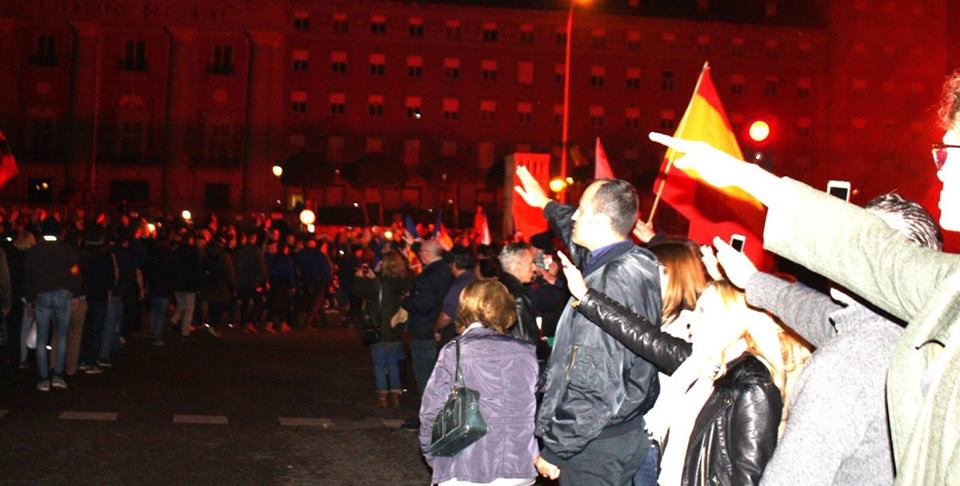
A fairly recent Spanish fascist commemoration in Madrid, including Spanish colours and fascist salutes.
(Photo sourced: Internet)

I have therefore come to the conclusion that Basque, Catalan and Irish people are no better than anyone else fundamentally, including the English and the Spanish, but that the conditions governing the development of their culture and their resistance to foreign occupation and domination have given rise to a different kind of nationalism. This nationalism tends to be progressive, democratic, inclusive and anti-fascist …. and is playing a progressive role in the world.

End.

FOOTNOTES

1James Connolly (1868-1916), born into the Irish diaspora in Edinburgh, is considered by many the foremost revolutionary socialist thinker in western Europe in his time but he was also a trade union organiser, founder of political parties, journalist, historian, author and song-writer. He was a co-founder of the Irish Citizen Army, the first worker’s army in the world, which also recruited women on an equal basis.

2A Nation Once Again, published in The Nation, by Thomas Davis (1814-1845), Irish Republican journalist and song-writer.

3Protest of racist campaigner Gemma Doherty against proposed restrictions on “hate speech” at the Irish Department of Justice, Stephens’ Green, Dublin at the beginning of November this year.

4This however changed in 1937 with De Valera’s new Bunreacht (Constitution) which declared the Irish State to be a Republic and the Articles 2 and 3 of which laid claim to the Six Counties (overturned in 1999).

5A 1926 split from Sinn Féin on the issue of occupying seats in the Dáil (the Irish Parliament), it grew quickly and was soon elected to government (1932) and, as the preferred party of the native Irish capitalist class, has been in government more years than any other Irish political party. Despite its Republican origins and rhetoric, it continued to support the capitalist-Catholic Church alliance of its predecessor until very recently, when it criticised abuses by the Church of those in its care and failure to pay adequate compensation.

CONSPIRACIES AND CONVERGENCE OF INTERESTS

(Reading time: 10 mins)

Diarmuid Breatnach

Conspiracy theorists get laughed at which, since some of the theories are indeed laughable, seems fair enough. Conspiracy deniers, on the other hand, get an easy time of it, which is a pity – because there are conspiracies going on. All of the time.

People wearing reptile masks — one of the more laughable conspiracy theories but believed by many in the US is that they are being ruled by lizard people.
(Image source: Internet)

Then there’s simple convergence of interests, which give rise to conspiracies but can also operate independently.

A current example of convergence of interests: The EU and all its constituent governments decide that the struggle between Catalonia and the Spanish State is an internal matter for the Spanish ruling class and can they please sort it out without dragging most of Europe into the mess? In fact, if they don’t sort it out, it endangers a number of key players in the EU and, inevitably, the EU itself.

As the current President of the EU Commission, Jean-Claude Junker reminded everyone on the question of Catalonian independence in 2017, there are member states of the EU other than the Spanish one that are vulnerable to the same kind of ‘problem’, i.e that of a bid for separation and independence of some part (or parts) of the state in question.

And if we look at Europe outside the Spanish State, we can see what he might have meant. There’s the French state, which contains within it three provinces out of the seven of the Basque Country, a part of Catalonia, also Brittany, Occitania and Corsica. Each of those regions was at one time an independent kingdom or part of a kingdom other than that of France; each also has its own language and each has struggled against French domination at some time or other.

Italy is a state with huge differences between its north and south, a composite of many different parts that did not come under one state rule even formally until 1871, at which time the spoken language of one region could hardly be understood in another. And there is Sardinia, still with its own language and currently engaged in another struggle for independence.

The UK is in the process of ceasing to become part of the EU now but it is still a part of the pattern of alliances (and hostilities) that forms part of modern Europe. And the UK contains the Six Counties of Northern Ireland, not long out of the three-decades guerrilla war, also Scotland with a strong popular movement for independence. In addition the Celtic nation of Wales was subjugated but still has a strong language movement and there are some stirrings of nationalism in the Celtic nation of Cornwall.

Belgium is a united state but containing the French-speaking Waloons and the Dutch-speaking Flemish and, although both languages are officially recognised, as polities, the two groups don’t get on very well together.

Even the separation of Catalonia from the Spanish State’s territory on its own would be bad enough from the point of view of EU leaders – but it could also precipitate the separation of the four southern Basque provinces, also of Galicia and Asturies. Which would certainly attract the interest of the southern regions of the French state.

In summary then, a successful bid for independence by Catalonia would start an “infection” (which is what Borrell, the Spanish Foreign Minister to the EU called Catalan independentism) which has the potential to cause the breakup of a number of major and medium states of the EU. And Junker also said that he didn’t want “an EU of ninety-nine states”. Of course not, such a union would be very difficult for the big European states to dominate and, in fact, those same European states would not be so big any more.

Conspiracy? Probably not – just convergence of interests. The ruling elites would have no need to get together, decide what they wanted their politicians to do, then have their various ministers sit down, formulate the policy of each state, have the foreign ministers of each get together and then inform the managers of the EU. The politicians have been trained and schooled, they know in general what their ruling elites want, without having to be told. They would react to Catalonian independence almost instinctively – with rejection. They view nationalism and independence, if it breaks up a rival power (such as the Eastern Bloc), as a good thing – but not in their own group!

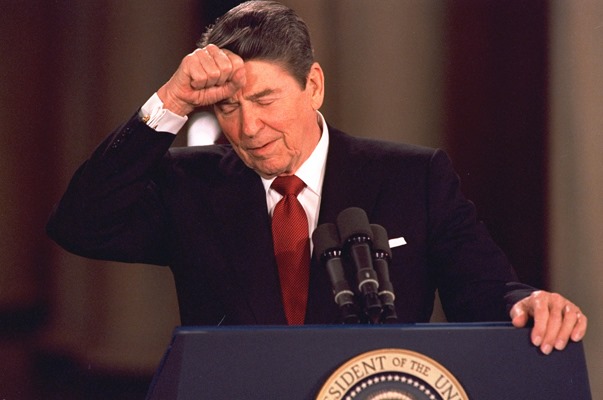
President Reagan of the USA lied when he denied any truth in the allegations of arms being sold to Iran to fund the Contra war against the Nicaraguan state. (Photo source: Internet)

THE USA IRAN-CONTRA CONSPIRACY

However, conspiracies do indeed happen, of course they do – and often. We have just passed by the anniversary of a key point in one huge one, the point when the “Iran-Contra” scandal began to break, in early November 1986. And President Reagan of the USA said that “the speculation that the US has sold arms to Iran has no foundation”, which was of course a lie. Basically, the US sold arms to the fundamentalist theocratic regime in Iran but, due to a US Congress embargo on such exports there, had to do it through Israel. They did so for two reasons, one for money to fund a military terrorist campaign against the government of Nicaragua which the US Congress would not approve, second in order to seduce the Iranian military (as they have done with the Egyptian military) and having them overthrow the Iranian regime. And the US wanted the Nicaraguan revolutionary government overthrown because it was not aligning itself with US foreign policy in what the USA considers its back yard (and a major source of raw materials) and also because a successful state of the type which Nicaragua was (then) would provide a ‘bad example’ to the other states of Latin America.

The Israeli Zionist ruling elite went for the deal because they too hoped the Iranian military would overthrow the theocratic regime and bring Iran back under the western-imperialist umbrella, as it once had been so secure that the CIA had its HQ for the whole Middle East located right there (and got caught with its pants down, or its secret documents in the process of shredding). And besides, the USA is the No.1 supporter of the Israeli Zionist regime in the world (another example of convergence of interests).

But despite the convergence of interests between the ruling elites of the USA and Israel, along with former Nicaraguan military, right-wing groups (for terrorist personnel) and US client regimes such as Honduras (for Contra bases) and Panama (for drug money to also fund the Contras, apparently through the CIA to sell in California – another conspiracy theory), a conspiracy was necessary to execute the operation. This was because of the unusual nature of the arms deal, its illegality according to US (and presumably Israeli) law and the number of partners involved. And the silent complicity of the US mass media was necessary, at least until a CIA plane delivering weapons was shot down by Nicaraguan forces over their territory and an operative, Eugene Hasenfus, captured alive.

A COMMON KIND OF CONSPIRACY

          Another example of conspiracy is that of price-fixing between big companies on given products. There have been a number of these exposed over the years. A conspiracy is necessary in this case because normally, the interest of big companies is to increase their share of the market over that of the competition. But at times, they perceive that it is in their joint interests to cease cutting one another’s throats and to regulate the prices of their products by agreement among themselves. Not only is this illegal in most administrations but it runs counter to the philosophy of capitalism, i.e that competition, instead of the cooperation advocated by socialists, is good for society. The fact that price-fixing is out of the norm of capitalism requires coming to formal agreement between the participants and the fact that it is illegal and undermines capitalist propaganda, requires secrecy – hence conspiracy.

However, most of what goes on in the world when government or other reactionary elements cooperate is probably just the result of convergence of interests, easily recognised by the participants.

(Image source: Internet)

A CONVERGENCE OF VERY DIFFERENT INTERESTS

Generally speaking, it is when their partnerships are put under pressure that the established convergence begins to crack; when one partner or another decides that the price of remaining in it is too high or that it’s time for sauve qui peut (everyone for himself). What can achieve that level of pressure is another kind of convergence of interests, that of the masses of wage-earners, small business people, peasants and indigenous people, recognising that by acting together, they can overthrow the existing system and set up an alternative that corresponds to their needs.

End.

REFERENCES:

Noam Chomsky short excerpt: https://libcom.org/history/the-iran-contra-affair

More detailed summary from Wikipedia: https://en.wikipedia.org/wiki/Contras

Concern about price-fixing in the insurance sector: https://www.independent.ie/irish-news/insurance-pricefixing-allegations-to-be-probed-by-watchdog-38405133.html

A case of price-fixing for contract bidding in Ireland: https://www.irishtimes.com/news/crime-and-law/sentencing-in-price-fixing-case-should-be-increased-to-encourage-whistleblowers-dpp-1.3515484

MARGARETTA D’ARCY SPEAKS IN THE BASQUE COUNTRY

Diarmuid Breatnach

(Reading time: 7 minutes)

An anti-fascist bookfair was held in Portugalete1, not far from Bilbo (Bilbao) in the southern Basque Country on Saturday 29th and Sunday 30th September. There was ample room for the many stalls in the old disused indoor market in the town’s Casco Viejo (old town quarter), along with a curtained-off play area for children. One of the events in the two-day bookfair was a launch of the translation into Castillian (Spanish) of D’Arcy’s book “Tell Them Everything”(“Di Les Todo”). The translation was published by Sare Antifascista, one of the organisers of the bookfair and D’Arcy spoke in English at the launch, her talk translated into Castillian; also speaking was Basque ex-political prisoner Ziortza Fernandez Larrazabal. 

Section of the audience at the talk (Photo: D.Breatnach)

          Trembling from the illness that has affected her for a number of years (which she later commented resulted from attacks by fascists during the Greenham Common protest and later in Ireland by police) D’Arcy spoke clearly and coherently about her activism, the founding of Women Against Imperialism, the Greenham Common protest camp, her period in jail with Republican women and her activism against the USA’s military use of Ireland’s international airport at Shannon (despite the country’s constitutional neutrality).

Going on to speak about Ireland today, D’Arcy outlined some of the aspects of the notorious Direct Provision Centres for asylum seekers in the Irish state, the issues arising from the location of such centres and the opportunistic intervention of fascists against immigration. She went on to talk about the targeting on social media of those who spoke up welcoming asylum seekers or against racism and commented that the worrying thing about this development was that the fascists had a youth wing. Recalling the referendum on conditions of nationality in 2014 which had removed the rights of people born in Ireland to Irish citizenship unless they had an Irish citizen parent or grandparent, D’Arcy concluded by saying that Ireland is a racist country.

Referring to the Six Counties, D’Arcy criticised Sinn Féin for using the proposed Irish Language Act as a political football and as something with which to attack their political opposition, the Democratic Unionist Party2. Continuing, she said that “Scottish Irish”3 also existed in the Six Counties and asked why that could not be included in the Act, also quoting James Connolly that he didn’t care what language people spoke as long as they could communicate together.

Whatever about the issues in the Brexit question, the speaker said, Britain had used Ireland as a military training ground and had many bases in the Six Counties and these needed to be dismantled.

D’Arcy concluded by advising Basques to approach the Irish Consulate in the Basque Country to enquire whether it would be safe to travel to Ireland, given the US military use of Shannon Airport and the growth of fascism and racism in the country.

Ziortza Fernandez Larrazabal speaking. (Photo: D.Breatnach)

After the Irish speaker and speaking in Castillian, Ziortza Fernandez Larrazabal, ex-political prisoner from the locality, spoke first in tribute to D’Arcy’s record of activism. Moving on to her own activism in support of Basque independence and socialism and her five years in jail, Ziortza recounted being moved through a number of jails as part of the Spanish State’s policy and practice of dispersing political prisoners far from their homes and the strain this places on their friends and relations.

Commenting on the effects of imprisonment in Spanish jails, Ziortza said that some political prisoners had died through neglect, some had killed themselves but some had come out stronger, clearer in their minds and confirmed in their political views, which is what she felt had happened in her case. Ziortza said that some prisoners had 40 years of jail sentence and that they should be released.

After applause for the speakers, the Sare Antifaxista chairperson opened the meeting to questions from the audience. After a silence of some minutes, one man spoke in praise of the courage and commitment of both women and their record of activism. Speaking in Castillian with an Irish accent, he said he felt he had to distance himself from some of D’Arcy’s words. He felt it was important not to confuse government with people and that the Irish people were not, on the whole, racist and in fact racists and fascists had found it very difficult to organise within the territory of the Irish State.

Recounting the historical experience with the fascist Blueshirts in the 1930s, the Irishman said that they had been fought on the streets and defeated. When Pegida tried to launch their fascist and islamophobic group in the capitals of European states in 2016, they had failed in Ireland because firstly their gathering point had been occupied in advance by anti-fascists and anti-racists and, secondly the fascists themselves had been physically attacked and beaten. He talked also about a recent initiative to launch a “yellow vest” movement in Ireland but which fascists and racists had moved in to lead – that initiative had, as a result, been rejected and had faded away. Fascists are active on social media but find it difficult to hold events in public. The danger of racism and fascist organising should not be dismissed, the Irishman said but so far, in Ireland, racism and fascism was being repulsed among the people.

(Photo: D.Breatnach)

While it was true that the Government had proposed changing the nationality clause in the Constitution in 2014, he said, this had been part of a process across the whole of Europe. The referendum was held on that question along with another at the same time and only the social democrats and trotskyists had noticeably campaigned against the change. The vote in favour had to be seen in that context.

Moving on to the question of nation and language, he said that nations had a right to self-determination which, in many cases, was opposed by imperialism, which also damaged many languages. The loss of a language, he said, means the loss of a way of thinking and seeing, of literature, poetry and song; the loss of such is a loss for entire humanity.

A Basque woman also spoke from the floor, partly in Castillian and partly in Euskera (Basque), expressing her admiration for the record of both women speakers and referring to her own involvement in her youth in Greenham common. She went on to speak about the danger of nationalism but also in support of the rights of language and said that if there were no states in the world, she would not want one either but as long as there are, she wanted one for her own nation.

She also said that at this time it was important to support the struggles for self-determination not only of the Basques but also of the Catalans.

Poster advertising the book launch and talk

The event came to an end and people moved off for lunch in various bars, or to chat or to browse the bookstalls. The latter were run by a number of organisations: Inugorria Liburodenda (Gernika revolutionary and progressive bookshop), Sare Antifaxista; CNT, Mujeres Libres, IPEs, Baskale, FAI, DDT Banaketak, Periko Solabarria Elkartea, Komite Internazionalistak, Jazz Oi!, Templando el acero, Amnistía Ta Askatasuna, SRI.

FOOTNOTES

1 Portugalete has a Metro station, reachable from Bilbao. The Casco Viejo (old town) is a number of narrow streets lined by bars and shops heading steeply downwards from the Metro station towards the river front, where there are a number of restaurants and bars and a nearby port museum. The interesting Puente Colgante is nearby; a pedestrian bridge across the river worked something like a horizontal lift.

2 Given that Sinn Féin makes no effort to ensure its own membership is Irish-speaking, or even its leaders (despite some of them being very proficient in the language), also that all its internal and nearly all public meetings are conducted through English, this would seem to be a correct assessment by D’Arcy.

3 D’Arcy probably meant Ulster Scots or Ullans, which is not any kind of Irish but a variant of Scots, the Germanic-English dialect once prevalent in the Scottish Lowlands (often called “Lallands”), in which for example Robbie Burns wrote. It has Minority Language Status in the Six Counties and while Irish-speakers generally have no opposition to the promotion of that dialect, hardly anyone speaks it today and it was raised as an issue by Unionists purely as a counter to the rights of Irish-language speakers. Scotland does have Scottish Gaedhlig, with over 57,000 recorded speakers (2011 Census) but this is not spoken in the Six Counties.

Gernika bookshop stall in foreground
(Photo: D.Breatnach)
Other stalls
(Photo: D.Breatnach)


REFERENCES AND FURTHER INFORMATION

Sare Antixista: http://sareantifaxista.blogspot.com/

Dissidence in the Basque Country: https://rebelbreeze.wordpress.com/2019/09/27/dissidence-in-the-basque-pro-independence-movement/

Basque political prisoners:

Amnistia Garrasi: https://www.facebook.com/profile.php?id=100013870776872

Etxerat: https://www.facebook.com/Etxerat-Elkartea-255302801219340/

(Photo: D.Breatnach)

(Photo: D.Breatnach)
Buying at stall at the Bookfair
(Photo: D.Breatnach)
Nearby poster honouring “Argala”, an ETA leader assassinated by GAL, the Spanish State death squad.
(Photo: D.Breatnach)

APOLOGIA FOR REPRESSION BY SPANISH STATE IN DUBLIN

Diarmuid Breatnach

(Reading time: 10 minutes)

The “Global Spain” initiative of the Spanish State to 215 Spanish embassies and its sub-title “Touch Democracy” was presented to a small audience at the Instituto Cervantes in Dublin on Monday while Catalan and Basque solidarity demonstrators picketed outside.

While some people, perhaps in the know, were directed straight to the auditorium, a number of others, not regular users of the Instituto’s services, were asked to wait in another area but when the start time had been exceeded by 20 minutes without sign of the event, they went to make enquiries again at Reception and learned where the event was being held, entering to find it had already started.

Portraits of Catalan political prisoners and exiles displayed across the street from the Instituto Cervantes on Monday.
(Photo: D.Breatnach).

PROPAGANDA VIDEO         

          Mr. Ildefonso Castro,the Spanish State’s Ambassador to Ireland was speaking and shortly launched the event with a showing of a short video which, he said, would bring out the main questions in the initiative. In this video, Lucía Mendez, journalist for the right-wing Spanish daily El Mundo seemed to be interviewing Gabriela Ybarra about the novel she had written (The Dinner Guest). But actually later in the film Mendez began a speech about how good was the Spanish democracy while her interviewee was left with little to say. The author had said earlier that though her grandfather (a Mayor of Bilbao who had fought in Franco’s Army and supported the Dictator regime, not mentioned in the video), had been killed by the Basque armed group ETA in 1973, this was not discussed in her family. She felt that the memory of “terrorism” was disappearing and that children in school were not being taught about it, which is why she wrote her book.

In fact, Spanish media constantly refers in negative terms to ETA and a 2016 case of a brawl between Basque youth and off-duty Spanish policemen in a late-night bar, in which no-one was seriously hurt and no weapons used, was being treated in the media and by the State Prosecutors as a case of terrorism! Although the judge rejected the accusation of “terrorism”, in 2018 the youth receive a range of sentences between two and 13 years jail. An important part of the silence and lack of teaching children history is in fact about the almost four decades of Franco dictatorship and the conduct of the victors in the military-fascist uprising against the democratically-elected government of the Spanish Popular Front in 1936. And of the State assassinations and torture of captured ETA fighters and arrested Basque activists. And of the continued legal battles to uncover mass graves of Franco’s victims and try to identify the remains for the relatives.

Considering that ETA ceased its armed activities in 2012 and has since dissolved itself, the relevance and intention of the film seems to be to show an embattled Spanish “democracy”, fighting against Basque independentist “terrorism” in the past as it is now embattled with the Catalan independentists (seven activists of which it has also accused of “terrorism” a couple of weeks ago).

Some demonstrators and banner by Trinity College exit across the street from Instituto Cervantes on Monday.
(Photo: D.Breatnach).

DISCUSSION BUT NO DEBATE

          There was no discussion on the content of the film and, after its end, Víctor Andresco Peralta, Director of the Instituto Cervantes, cultural body of the Spanish Embassy, took to the stage and invited five people by name to take chairs laid out around a table. Launching into a chatty monologue full of jokey self-deprecatory comments (so many that they were actually self-promotional), he eventually asked his questions of his picked panel.

Questions included what were their earliest memories of consciousness of being Spanish, what reactions they had received about Spain from people in Ireland, or in other countries (positive and negative), what they valued about Spain, what they thought about the coup attempt in 1981 (lots of jokes about that), etc.

Referring to his father’s recent stay in hospital, Peralta asked for comparison of the Spanish health service with the Irish one (apparently the former is far better, which would not be difficult) and for other comparisons.

The discussion was skillfully managed by the showmaster to bring his group to paint a picture of a wonderful pluralist Spanish State, of freedom of expression, and of a democracy which had been able to defeat the coup attempt without much difficulty but even so, some discourse arose at times to shake the equilibrium, as when one referred to a relative telling him about the horrors of the Francoist suppression as they entered Barcelona and when another referred to the perception (mistaken, of course!) of many people outside Spain that the State was undemocratic and had violent police.

One of the panel, who appears to be an employee of the Spanish State, said she was proud of the defeat of ETA by the “Spanish democracy”.  Another said she was proud of Spanish history and culture, without explaining further. She might have meant the foremost writer of Castillian-language literature, Cervantes himself, who was exiled from the Spanish kingdom because of his anti-feudal views. Or the Andalusian poet Federico Lorca, who was executed by Franco’s soldiers; or the Malagan artist in exile Picasso, who created the famous painting of the Nazi and Fascist aerial bombing of Gernika (most of the poets, writers and artists of the era were against the military-fascist coup and the four decades of dictatorship that followed). Or about the dramatist Alfonso Sastre, whose distaste for the Spanish State’s behaviour towards the Basques was such that he moved to the Basque Country.

Perhaps the woman was proud of the defeat of the learned and tolerant Moorish colony of Al Andalus and its replacement by the racist Spanish Christian Inquisition, along with the expulsion of Arabs and Jews? Or of the centuries-long suppression of the governments of the Basques, Galicians and Catalans, along with their languages? Or of the invasion, massacre, enslavement and plunder of the indigenous people of America, the Caribbean and the Philippines? Or the invasion and colonisation of the Rif in North Africa, when the French saved the Spanish colony after the Spanish army had been wiped out by lesser-armed (and often less numerous) Berber guerrillas.

Of course she might have been referring to the revolt of the Reapers in Catalonia or of the Comuneros in Castille; or of the resistance of Spanish, Catalans and Basques to the military-fascist coup and the four decades of dictatorship …. We don’t know because she did not say.

A view of some of the protesters outside the Instituto Cervantes on Monday.
(Photo: D.Breatnach).

WHAT ABOUT THE RIGHT TO SELF-DETERMINATION?

          The event had been advertised as a debate but no debate took place. Nor was there a question-and-answer session, nor engagement with the audience except to send them witty asides from Peralta and to thank them at the end.

This was too much for at least one of the small audience, an Irishman who interrupted the concluding remarks of the Director by saying, in Castillian (Spanish) that it was a pity that the question of self-determination had not been discussed. The event was taking place in Ireland, he commented, where another state had denied the people the right to self-determination on grounds of that state’s constitution also. Denied permission to exercise their right, the Irish people had to fight for it and eventually won part-independence.

Peralta commented that the Spanish people were cognizant of Irish history and appreciated it.

The Irishman replied that in the Spanish state things were the complete opposite.

Peralta commented that unfortunately there was no time left for that debate, thanked participants and audience and brought the event to a close.

Sticker on pole near the Instituto Cervantes on Monday.
(Photo: D.Breatnach).

WHAT WAS THE POINT?

          Outside the meeting up to dozen protesters had taken up positions on both sides of the street. On the Trinity College side a couple of protesters stood beside portraits of the Catalan grass-roots activists and politicians who are in jail awaiting sentence or in exile. On the Instituto side, a larger group of protesters held two banners and a Basque Antifa flag.

One of the Catalan supporters, an Irishwoman, addressed several of the panel participants as they exited. It emerged that they had not understood the nature of the event and that they thought it had to do with October 12th, which is a Spanish State celebration of its former empire and spreading of the Castillian language1 (and for which one of the panel, who seems to work for the Instituto, is organising an event in Rathmines). They said they had not seen the “Global Spain” publicity (81 pages of propaganda justifying the actions of the Spanish State and attacking the principle of Catalan self-determination and the pro-independence movement!).

There was in truth not much point in attending the event unless one wanted receive a smooth-talking patter about an imaginary State occupying most of the Iberian Peninsula. For the protesters, it was important to give a response to the paint-over job. For the producers of the show, the importance was to try to distract an Irish audience from the reality of what is an unreconstructed fascist state with a thin veneer of democracy that is constantly peeling away.

Poster seen on Dublin street near Instituto Cervantes on Monday.
(Photo: D.Breatnach).

End.

FOOTNOTES:

1 El Dia de la Hispanidad was formerly called “El Dia de la Raza Española” (Day of the Spanish Race). It is also the Spanish Armed Forces Day, obviously not inappropriately in context!

REFERENCES AND FURTHER INFORMATION

Article by El Nacional, independent and pro-independence Catalan newspaper: https://www.elnacional.cat/en/news/global-spain-advertising-campaign-democracy_426827_102.html

The Instituto Cervantes, Dublin: https://dublin.cervantes.es/en/about_us_spanish.htm

CDR Dublin: https://www.facebook.com/CDRDublin/

ANC Irlanda: https://www.facebook.com/IrlandaPerLaIndependenciaDeCatalunya/
With Catalonia/ Leis an Chatalóin: https://www.facebook.com/WithCataloniaIreland/

Catalan resistance day celebrated in Dublin

(Reading time: less than 10 minutes)

Clive Sulish

The Diada, national day of Catalan identity and of resistance was celebrated in Dublin’s Merrion Square on Saturday 7th September with traditional food, drink, games and music. Catalan independentist flags and banners were also on display as were portrait placards of Catalan political prisoners of the Spanish State.

Lineup People Banners & Placards Diada Merrion Square 7 Sept 2019
Some of the attendance at the Dublin Diada lined up with banners etc (photo: D.Breatnach)

dav

THE DIADA

          The Diada Nacional de Catalunya (Diada for short) is the National Day of Catalonia, a one-day event celebrated annually on the 11th of September. It commemorates the fall of Barcelona during the War of the Spanish Succession in 1714, which resulted in Catalonia’s institutions and legal system being abolished and coming under the domination of the Spanish crown.

The Army of Catalonia backed the Habsburg claim to the Spanish throne, believing thereby that Cataloni’s national autonomy would be respected. However, the army of the Bourbon King Philip V of Spain was successful and Barcelona fell after a siege of 14 moths.

It Diada first began to be celebrated in 1888 and gained in popularity over succeeding year and in 1923 was a mass event with events all over Catalonia. However clashes with the Spanish police resulted in 12 protesters and five police being wounded and a number of arrests. Primo Rivera’s dictatorship banned it but during the 2nd Spanish Republic (1931-1939) the Catalan Generalitat (Government) made it an institutional festival. With the fall of Catalonia to the military-fascist forces of Franco and others, it was banned and celebrated only in people’s homes.

The first renewed public celebration of the festival was in 1976, following the death of Franco the preceding year and in 1977 was the occasion for a huge demonstration demanding independence for Catalonia and in 1980 was made official by the Generalitat.

With the renewed growing push for Catalan independence, the day has been the occasion for huge demonstrations demanding self-determination. For some years now the ANC (National Assembly of Catalonia), which claims to be the largest grass-roots organisation not only in Catalonia but in the world, has been the main organiser of the Diada and has used it as part of its mobilisation for indpendence (which presumably is the reason the Spanish State has put its former President, Jordi Sanchez, on trial on charges of sedition and rebellion and in detention since 2017, the verdict expected this month or next.

Although the Diada commemorates a crushing defeat for Catalan self-determination, its celebration has become an occasion of re-affirmation of that desire, a public sign of resistance. Massive demonstrations once again have been held and, as in Dublin, expatriate and Catalan diaspora communities around much of the world have celebrated it publicly this year, particularly in Europe but also in Latin America and in the USA.

Diada 2019 aerial views: https://youtu.be/qewQSS3KWyw

oznor
“So now you skip while I turn the rope.” (Photo: D.Breatnach)
child-bemused-skipping.jpg
“Ok — but what is ‘skip’?” (Photo: D.Breatnach)
dav
A good time to plan. (Photo: D.Breatnach)


THE DUBLIN EVENT

          Merrion Square, a public park in the Dublin city centre, was the venue for the Diada event organised by Catalans in the Irish branch of the ANC and by Dublin CDR (Comite de Defensa de la Republica) on a the 7th, which was a Saturday.

oznor
Photo: D.Breatnach

The area was decked out with estelladas (Catalan independence flags) and placards bearing portraits of the Catalan political prisoners (see following section on the Situation in Catalonia). Parents attended with their children and games were played with them as well as a traditional Catalan game being available for adults and a few engaged in a version of the poc fada Irish activity with camáin (hurley sticks).

flag-placards-jumble.jpg

Traditional food and drink was provided also.  Commenting on the event, a spokesperson for the organisers said:
“We had a festive and family-oriented Diada (National Catalan Day) in Dublin. We also publicised a call for freedom for the political prisoners and the right of self-determination for Catalonia.”

xavo-hitting-sliotar.jpg
Not a Catalan sport but when in Ireland …. (Photo: D.Breatnach)
oznor
(Photo: D.Breatnach)

dav

SUMMARY OF SITUATION IN CATALONIA

          The Catalan Parliament has twice passed a number of legal measures which have been judged “unconstitutional” by the Spanish Court and therefore cancelled. These included:

  • Increased taxes on large companies

  • a “sugar tax” on sweet soft drinks

  • ban on bullfighting

  • access to public medical care for migrants

  • ban on evictions and high rents

The growing push for Catalan self-determination found expression in a number of growing public events and in October 2017 a referendum was held. The Spanish State banned the referendum and its police raided the Government offices and other places for ballot boxes. On the day of the Referendum, October 1st, Spanish police attacked voters and referendum supporters with a reported nearly one thousand seeking medical attention. They also fired rubber bullets, which are banned in Catalonia, at peaceful demonstrators.

The Catalan right-wing anti-independence parties had called for a boycott of the referendum and many ballots were confiscated by the Spanish police. The majority of those available gave a high majority for an independent Catalonian republic (there were no other options other than “No”).

The then President Puigdemont, backed by the pro-independence majority in the Catalan Parliament, acting on their mandate, in 2017 declared an independent Catalan Republic but immediately suspended it, urged by EU advisers to seek talks with Madrid (which he reflects now was a mistake).

Subsequently the Spanish State prorogued the Catalan Parliament until new elections were held and also charged a number of politicians and social activists with sedition, rebellion and misuse of public funds (allegedly to fund the Referendum). Some, like Puigdemont, went into exile and others to jail without bail; their trial is now over and the verdict is expected later this month or next. In addition, numbers of secondary school teachers have been called to testify because of their responses to the questions of pupils about the Referendum and the destruction to their schools by police and around 700 town mayors are also called to testify for allegedly facilitating the Referendum.

The elections forced by the Spanish State returned a broad political backing for Catalan independence from right to left which finds expression in a number of coalition parties (Junts per Catalonia, Esquerra Republican and Candidatura d’Unidad Popular), opposed by a substantial but minority hard-right unionist opposition coalition too (mostly Ciudadanos). The coalition based on the Catalan version of Podemos also has seats but its actual position on independence is not easy to define.

Since then, the Spanish State elections and the European elections have also returned pro-independence candidates but EU senior officials blocked Catalan MEPs who are in exile from taking their seats and another is in Spanish jail, awaiting a verdict.

End.

Freedom for all Catalan political prisoners & exiles long banner
Message in Merrion Square (Photo: ANC Irlanda)

REFERENCES:

Diada: https://en.wikipedia.org/wiki/National_Day_of_Catalonia

ANC: https://assemblea.cat/?lang=en

USEFUL CONTACTS:

ANC Irlanda: https://www.facebook.com/IrlandaPerLaIndependenciaDeCatalunya

CDR Dublin:  https://www.facebook.com/CDRDublin/

With Catalonia/ Leis an Chatalóin: With Catalonia/ Leis an Chatalóin https://www.facebook.com/WithCataloniaIreland/
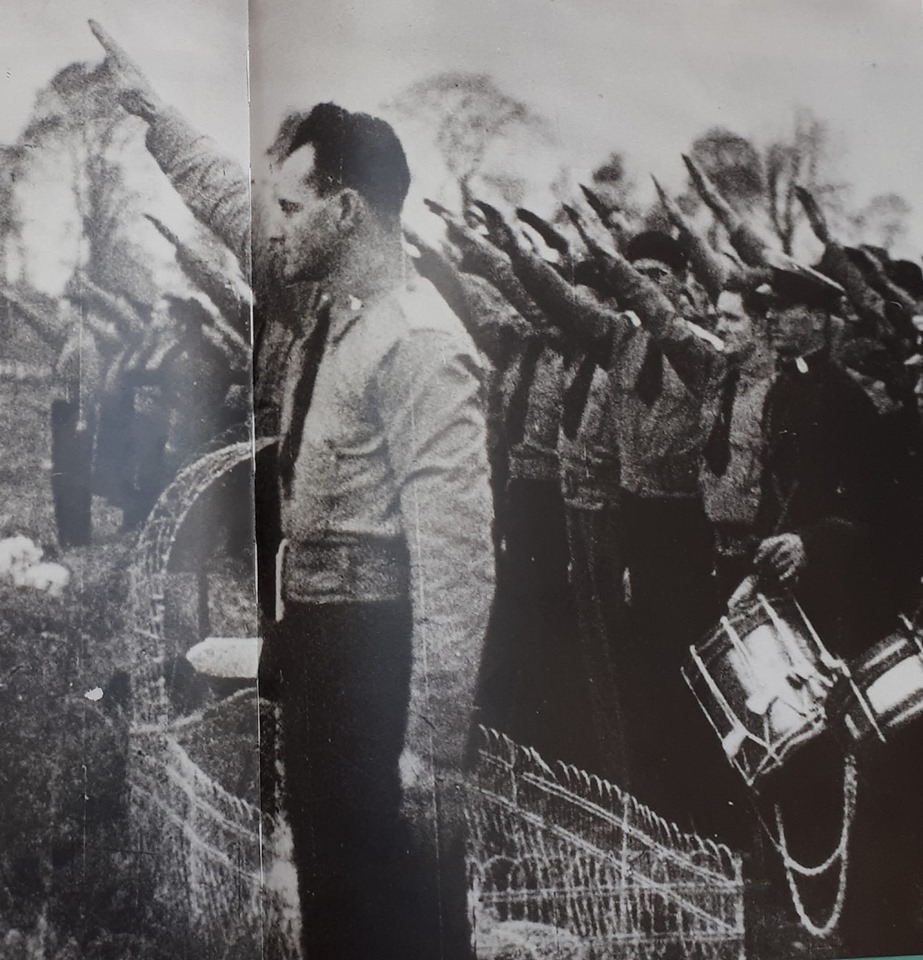
Casal Catalan d’Irlanda https://www.facebook.com/casalcatalairlanda/