SPANISH FASCISM EXTENDS ITS CLAWS

Diarmuid Breatnach

This weekend fascist activities took place across the Spanish state with some more to follow next week. In Madrid fascists demonstrated on two different occasions, i.e to commemorate the dictator Franco and the founder of the fascist Falange, Primo Rivera. They also demonstrated for the unity of the current Spanish state territory and against any interference in General Franco’s shrine. These demonstrators flew Spanish fascist flags, gave fascist salutes and shouted fascist slogans – all illegal under Spanish law — but the Spanish police stood quietly by. Wait! They did intervene — to remove antifascist Femen demonstrators (see El Nacional photo and NBC video link)!

          The weekend included anti-fascist events also. On Saturday afternoon there was a march organised by Dignidad Antifascista (‘Antifascist Dignity’), with a rally on Sunday at the entrance to the fascist shrine, the Valley of the Fallen, called by the campaign #NiValleNiAlmudena (‘Neither Valley nor Almudena’, i.e that Franco be buried neither in the Valley nor in the Almudena, the largest cemetery in Madrid).

Fascist Spanish-nationalist regalia and fascist salutes during the Primo Rivera homage on Friday evening in Madrid. Much of this is illegal according to Spanish law but, as usual, the police take no action. (Photo source: Internet)

The specific occasion for the fascist (and hence, the anti-fascist) events are the anniversaries of the deaths on 20th November of the dictator Franco (1975) and of Primo Rivera (1936), the founder of the Spanish fascist organisation, the Falange.

The Falange began with their traditional march of homage to Rivera (yes, the fascist Falange have “traditional” public events in the Spanish state), leaving Madrid around 9pm on Friday night to arrive at the Valley on Saturday morning.

Fascist women in the uniform of the Falange during the Primo Rivera homage on Friday evening in Madrid.
(Photo source: Internet)

“The Falange returns to the streets to show that the flag of the Homeland and Social Justice is upheld and is more necessary than ever,” they declared in a statement.

On Saturday, the Madrid Antifascist Coordination held its own anti-fascist traditional march under the slogan of Dignidad Antifascista, changing their route to start from Plaza del Sol to arrive at Plaza de España, apparently because of the location of the neo-Nazi group Hogar Social Madrid (Social Home Madrid) in the former HQ of the Comisiones Obreras trade union (see History of the Spanish State Appendix), Plaza de España (see video in media link).

Illegal fascist salutes but as usual no action from Spanish police on Friday evening in Madrid.
(Photo source: Internet)

On Sunday a number of groups gathered at the entrance to the Valley of the Fallen to call for “the removal of the tombs of Francisco Franco and José Antonio Primo de Rivera, the withdrawal of fascist symbols from the Sierra de Madrid, the converting of the site into an anti-fascist memorial and the dismantling of the Cross of the Valley,” according to a statement by the Forum for the Memory (historical) of the Madrid Region in a statement. This action is part of the campaign #NiValleNiAlmudena and it was the thirteenth time that the Forum for (historical) Memory and the Social Forum of the Sierra have demonstrated against the graves of Franco and Primo de Rivera in the Valley of the Fallen.

On the other hand, the Abbey of the Valley of the Fallen organised a praying of the holy rosary also on Sunday, at 10.30a.m in the basilica, “for the hope of youth and family in Spain,” as they do every Sunday (this might seem harmless but these are specifically traditional concerns of fascists, the traditional patriarchal family and a fascist youth movement). Also, the (fascist) Association for the Repeal of the Historical Memory (Law) convened a demonstration at 11.30a.m on Sunday to take place between Callao and the Plaza de Oriente, to hold their traditional act of Franco homage. A Femen group who tried to disrupt this demonstration, stripped to the waist and with anti-fascist statements painted on their upper bodies were violently thrown to the ground by fascists in the crowd and repeatedly kicked and punched while the women shouted defiance. Spanish police removed the anti-fascist Femen demonstrators and took no action against the fascists.

Masses will be celebrated throughout Spain for the soul of the dictator and, in Madrid, a “Legionary Mass” (i.e for a fascist organisation descended from the Spanish Foreign Legion) is scheduled to take place in the church of Santiago on Tuesday the 20th and the same day at 8:00 pm in the parish of San Francisco de Borja on Serrano Street, as reported by the Francisco Franco Foundation on its website, in which they also announced an annual dinner on November 30th somewhere in El Pardo.

WHAT DOES IT ALL MEAN?

          Is all this just the strutting of some crackpots we don’t need to worry about, as some liberals and social-democrats think? Or the last gasps of a dying creed as some others believe?

Some of the participants may be crackpots and the creed may be expiring but that does not make it less dangerous – the lashings of a dying monster’s tail are capable of killing and maiming many people. And it may not be dying.

Fascism has been part of the Spanish State since the 1930s (see following section) and only underwent an essentially cosmetic transformation (or “Transition”) in the 1970s but now it feels itself threatened by important counter-trends within the state. Chief among these in practical content is undoubtedly the strong grassroots Catalan independentist movement but in symbolic content, the democratic demand that Franco’s tomb be removed and his current resting place ended as a rallying shrine for Spanish fascists (hence the events that took place around it this weekend) is huge.

Symbols are important for all peoples and movements and Franco’s mausoleum at the Valle de Los Caidos is one very important for Spanish fascists. For anti-fascists, it is an abomination, built through the sweat of half-starved and abused political prisoners to the glory of their oppressor, an unknown number of which died doing so.

The bunch of arrows and that double-headed eagle on their version of the Spanish flag are also symbols of Spanish fascism, as is the straight-arm salute. Accordingly, these were made illegal in the Spanish state, not without some resistance but everyone knowing that no action was going to be taken against the actual fascists. And so it has proven. The Spanish fascists march, display their fascists symbols, give their fascist salutes, shout fascist slogans and they are never arrested for doing so.

On the other hand anti-fascists, revolutionaries, independentists are constantly under surveillance, often detained and tortured and from time to time jailed for long sentences, often for comparatively minor offences or actions or words that would not be classed as a criminal act anywhere else in Europe.

But of course, Europe is growing more fascist too, in governments in the East and in the rise of fascist movements across most of Europe. And Spanish fascism will inevitably give encouragement to those movements as well as drawing encouragement from them.

Across the Spanish state there are streets named after fascists and monuments to them and some of the regular events glorifying fascism there were listed earlier. Add to that a section of the national media that is very right-wing and legal organisations that are fascist in all but name and most of the support structures for a fascist state are in place. All, if one adds the military and police.

The main Spanish police forces, the Guardia Civil and the Policía Nacional, have a history of brutality on the street and torture in their police stations. The GC is actually a militarised police force. The military itself has a history of violent suppression of colonial resistance and, according to the Constitution, is the guarantor of the territorial integrity of the State. And that integrity is threatened by the pro-independence movements of Catalonia and of the southern Basque Country.

“Long live the Unity of Spain” slogan on Spanish flag colours at the Primo Rivera homage on Friday evening in Madrid. The Spanish Right and much of the Left share this objective which is opposed by some of the Left and the Catalan and Basque independence movements.
(Photo source: Internet)

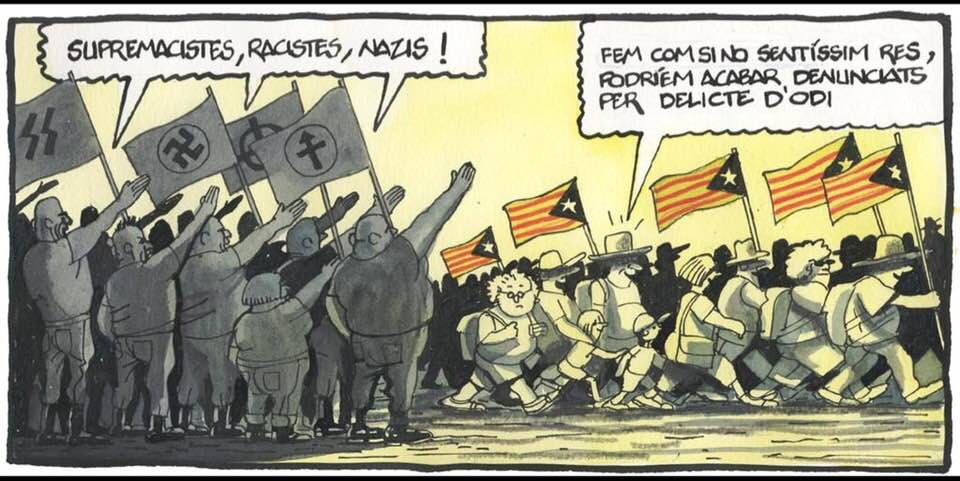
The Spanish fascists are not just defending their symbols and history but also the integrity of the State of the whole Spanish ruling class. And fear, dislike or even hate the fascists as they may, many on the Spanish Left find themselves here on the same side as the fascists. Neither the PSOE, nor Podemos, nor the CPE, nor many sections of Izquierda Unida (the misnamed “United Left”) support the independentist movements, whether from “the good of the economy” or from the credo of “the unity of the working class”. And many of them go further, accusing the independentists of being “nazis”, an accusation which is also thrown, hilariously, by the Spanish Right.

This of course makes any genuine resistance to the fascist movement very complicated for large sections of the Spanish Left, i.e those that actually agree with them on one central plank of Spanish fascism – the territorial unity of the Spanish state.

End.

APPENDIX: SHORT HISTORY OF THE MODERN SPANISH STATE

          Like within a number of European states, fascism was the chosen way to go of the majority of the Spanish bourgeoisie, the ruling class, in the 1920s and 1930s. At first this involved military coups and dictatorships but in 1936, a full-blown military-fascist uprising against the elected Government of the state took place, with sections of the Basque and Catalan middle and ruling classes in support. Other sections of Catalan and southern Basque Country society stood by the Republican elected government and fought hard against the military-fascist coup. And the anti-fascists would have won but for the assistance of transport, bombers, weapons and men from Nazi Germany and Fascist Italy, while the other European states (apart from the USSR) enforced a “non-interventionist” blockade of the fighting Republic.

The Republic overthrown, there followed a period of intense repression of any form of leftist or democratic ideology as well as of the Basque and Catalan languages and national aspirations and, though the intensity faded in time, the repression was always very much there during the 40 years of the Franco dictatorship (and increased in the Basque Country).

The Franco-fascist repression was not only physical, with imprisonment, torture and executions; was not only against national cultures but also moral and political, intensely patriarchal and pro-fascist and with the very enthusiastic support and at times leadership of the Spanish Catholic Church hierarchy and most of its clergy, monks and nuns, imposed through school and church. And of course the judicial and legal system.

As Franco’s life-term was clearly drawing towards its end, concern began to be raised about his successor and how Spain would be ruled afterwards. These concerns were expressed not only internally but also from abroad, especially by the USA which was building military bases across the state and by the EU, which was concerned to have an ultimately unstable state on its southern flank. Franco had designated Admiral Carrero Blanco as his successor and Juan Carlos, of the Bourbon royal dynasty, to be King. In 1973 ETA, the Basque armed leftist national liberation organisation, assassinated Carrero Blanco in Madrid and a few years later, in 1975, Franco died.

The rush was on now by modernist elements of the Spanish ruling class, in particular advised internally by Opus Dei, to carry the State through this crisis. This was achieved by the legalisation of the banned political parties, the social-democratic PSOE and the Communist Party, which was absolutely necessary for the project since they controlled the two biggest trade unions, the Unión General de Trabajadores and the Comisiones Obreras (these were being legalised too). And Juan Carlos was made king of a country that had been without one for over four decades with the agreement of both those formerly republican parties.

The Basque and Catalan nationalist parties were also legalised but, although the new Constitution being pressed on the people was accepted overall, it was rejected by majority in the Basque Country. The Constitution made secession illegal without a majority in the Spanish Parliament in favour.

And this “Transition” was also accompanied by repression, including even the murder of its union lawyers which the CPE tolerated.

Subsequently the PSOE got elected into Government, replacing the Francoist party but showed itself fit to govern an essentially unreconstructed fascist state by running assassinations squads (“GAL, BVE”) against the Basque independence movement. And of course implementing whatever economic measures required by the Spanish ruling class.

The UGT and Comisiones Obreras are the main trade unions in the Spanish State, the largest in membership everywhere but in Galicia and the Basque Country, with their leaderships generally following the social-democratic lead, colluding with the ruling class, mounting mostly show strikes from time to time but no real resistance. One can expect somewhat more resistance from them when the other main political party, the formerly Francoist Partido Popular, is in government, but as soon as the PSOE is back in, even that dies down.

SOURCES AND REFERENCES

https://www.infolibre.es/noticias/politica/2018/11/16/manifestaciones_muy_distinto_signo_discurriran_por_madrid_este_fin_semana_por_20n_88913_1012.html

https://www.elnacional.cat/es/politica/incidentes-manifestacion-fascista-madrid_325803_102.html

Video of fascist demonstration and disruption by anti-fascists (including violence towards them by fascists and no police action against them): https://www.facebook.com/NBCNews/videos/517780425363019/

Short media report which includes video of anti-fascist demonstration on Saturday in downtown Madrid: https://www.presstv.com/Detail/2018/11/18/580334/Spain-Antifa-march-on-Madrid-ahead-of-anniversary-of-Francos-death
RECENT HISTORY: DEEP SOUTH & DEEP NORTH

Report by Diarmuid Breatnach

Two very interesting talks were given last night as part of a series of history talks at the Sean O’Casey Community Centre in East Wall, Dublin. The theme was black civil rights in the USA and Catholic civil rights in the Six Counties of Ireland (‘Northern Ireland’ according to some).

Joe Mooney of the East Wall History Society introduced the speakers and chaired the question-and-answer session afterwards.

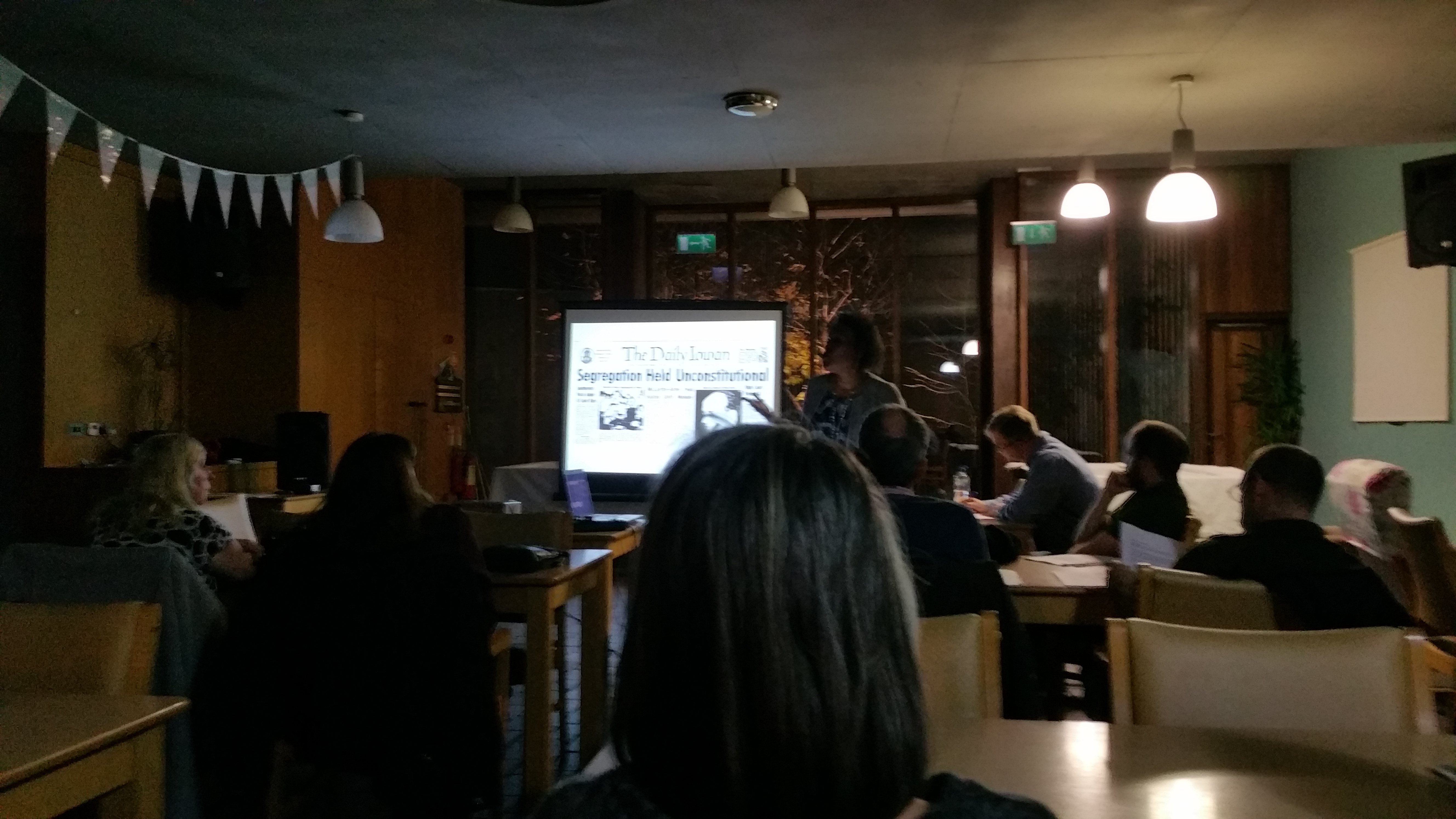
The session opened at 8pm and Cecilia Hartsell had a lot of ground to cover. She spoke on the history of the Civil Rights movement of blacks in the USA, going through the history of seminal events, illustrated with Powerpoint slides and recordings of two White House phone calls between President JF Kennedy and Ross Barnett, Governor of Mississippi and key figure trying to prevent the historic enrollment of James Meredith, a black man, into the University of Mississippi.

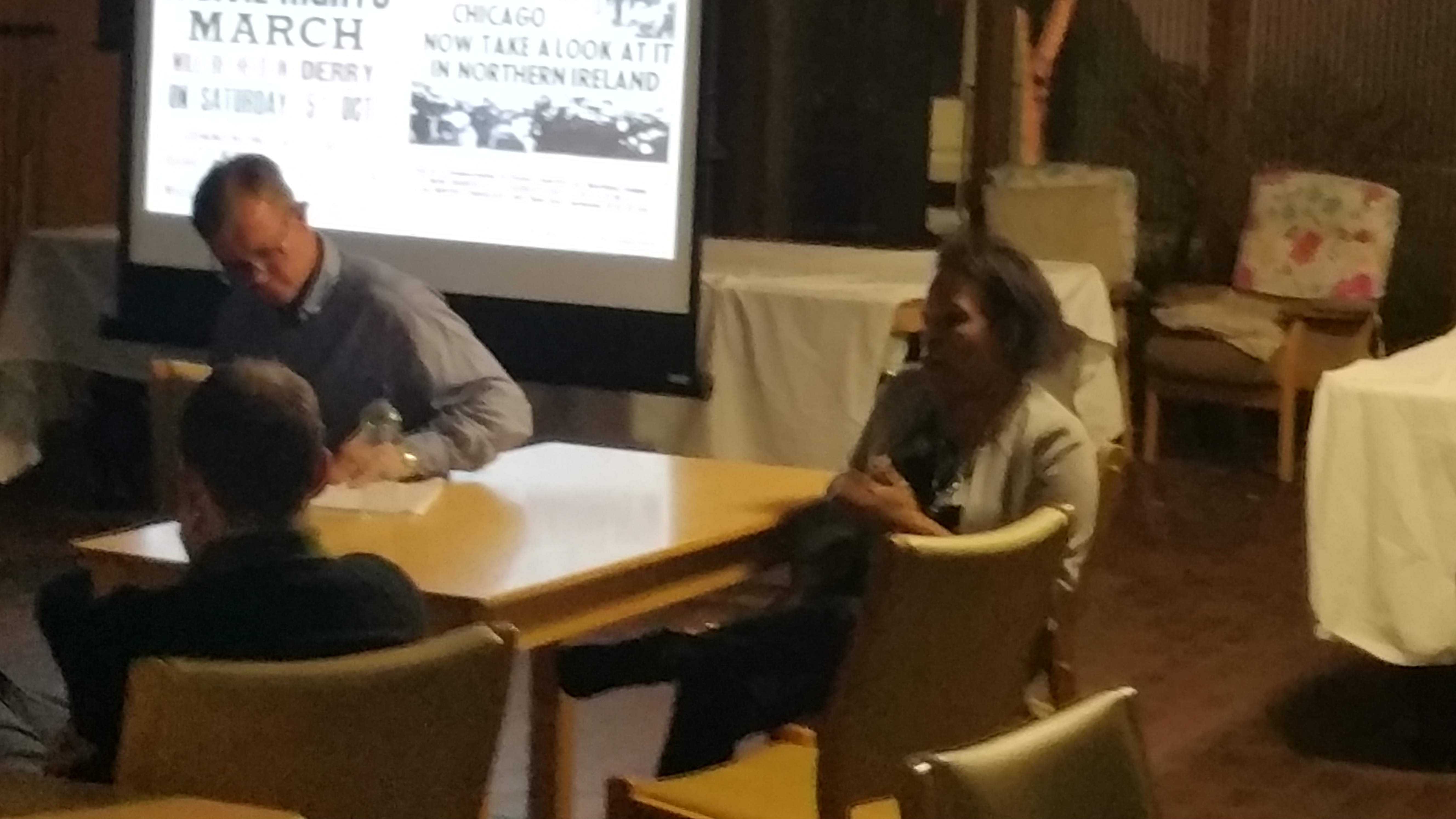
Cecilia Hartsell delivering her talk on the black civil rights movement in the USA

Recalling that in the first two years of his term, JF Kennedy had little to say about black civil rights but was focusing on other issues,Cecilia Hartsell somewhat undermined the (incorrect) image we tend to have in Ireland of Kennedy as an ardent civil rights fighter. In fact he was enforcing Federal legislation on equality and trying to go slowly, while the black campaigners were pushing the agenda along and white racist reaction was holding the USA up to international ridicule and opprobrium during the Cold War with the Soviet Union.

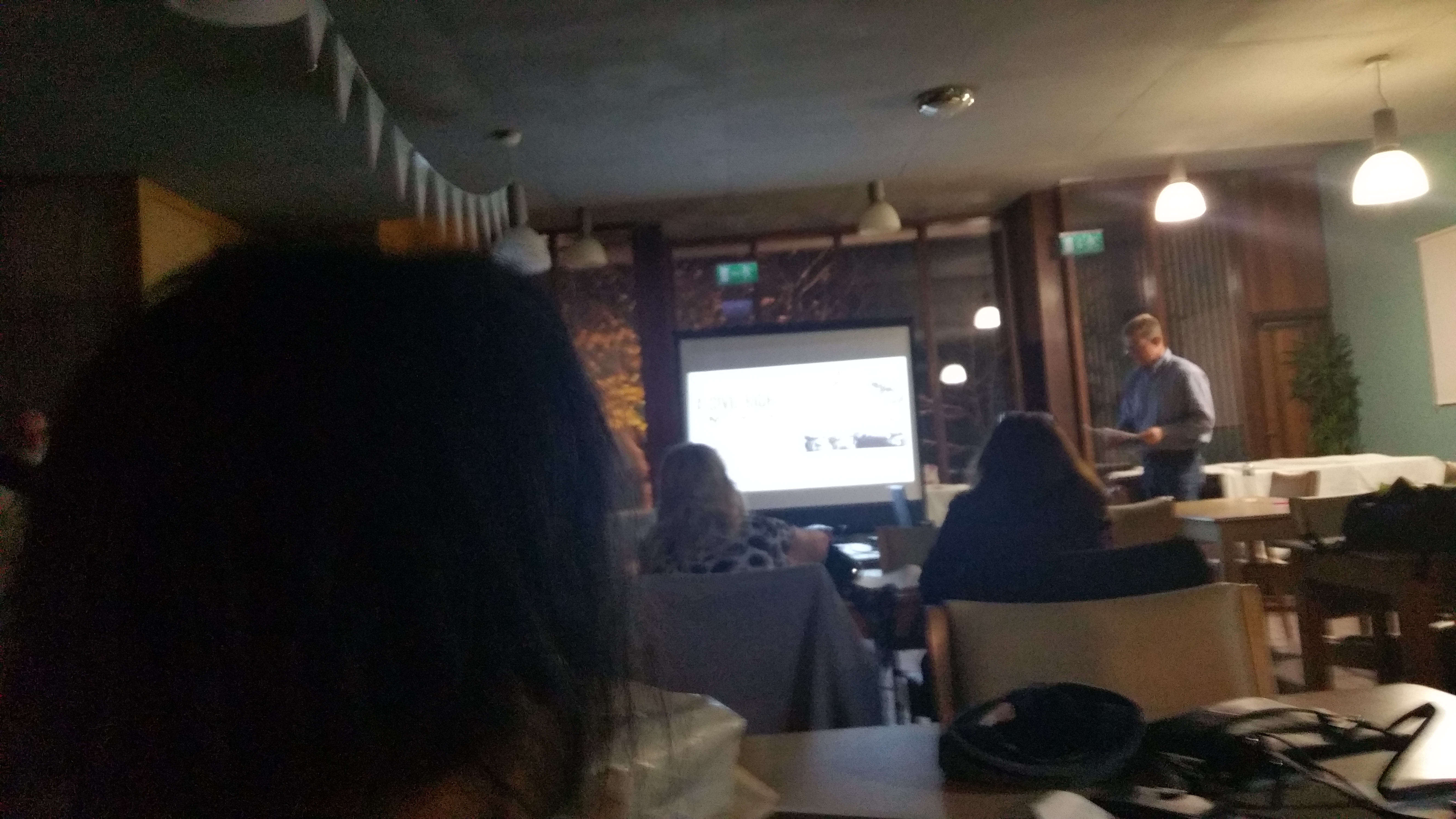
When Brian Hanley took the floor for his talk he fairly zipped along, which he does very well. Hanley undermined some myths or wrong impressions too. Early organisers of the civil rights marches and other events such as the Dungannon house occupation were Irish Republicans; Loyalists had killed four people before the first Civil Rights march. The rhetoric of SDLP and Labour Party notables was much more militant in the early years and Fine Gael was agitating more about issues of discrimination in the Six Counties than was Fianna Fáil, the party in government. And FF had been pushing a referendum to do away with the proportional representation electoral system at the same time that the PR system was among the demands of civil rights campaigners in the Six Counties.

Brian Hanley delivering his talk on the civil rights movement in the Six Counties.

In the session for questions, answers and contributions later, Hanley pointed out that the Southern Democratic Party was the pro-slavery party historically and, after the Civil War, anti-integration and civil rights, whereas the Republican Party was anti-slavery (debunking another false image we tend to have in Ireland).

Both historians made the point that a hundred years is not as long as some might think (this is especially true in ‘historical memory’).  The 1940s, when some historians would say, as Hartsell told us, is the date from which to date the renewed fight for black equality in the USA, as surviving black soldiers returned from WWII, was only 80 years from when Federal troops were withdrawn from the former Confederate states.  The partitioning of Ireland had been carried out less than 50 years before the Civil Rights protests broke out in the Six Counties, Hanley reminded his audience and many Catholics still lived who remembered vividly the fierce repression that had accompanied it.

It also emerged that albeit there were many similarities, there were also profound differences between the two movements. The black campaigners in the USA were saying that they were citizens of the USA State and demanding the same rights as other citizens, they often marched with the Stars and Stripes flag and even called for the intervention of US troops to defend their rights. The Catholics marching for civil rights in the Six Counties mostly saw themselves as Irish citizens and would never march with the Union Jack. Some did call for the intervention of British troops but many did not; it was mostly Irish troops they hoped would intervene.

The importance of the presence of news photographers at events and their covering in newspaper reports and on television broadcasts was an important factor in both struggles.

USA soldiers facing unarmed marchers for black civil rights.  (Source: Internet).

Cecilia Hartsell did not feel that the Black Power movement could have survived Southern racist repression in the 1940s, ’50s and early ’60s and most of the big gains on desegregation of education, public transport, eateries and voter registration and effective right to vote in the Southern States were won during those years with peaceful marches and pickets and legislation (which however were met by much racist violence, including a number of murders). By the time the Black Power movement was coming on to the political stage, so was the Vietnam War and huge changes were taking place in the US, including many mass violent struggles on race and other issues.

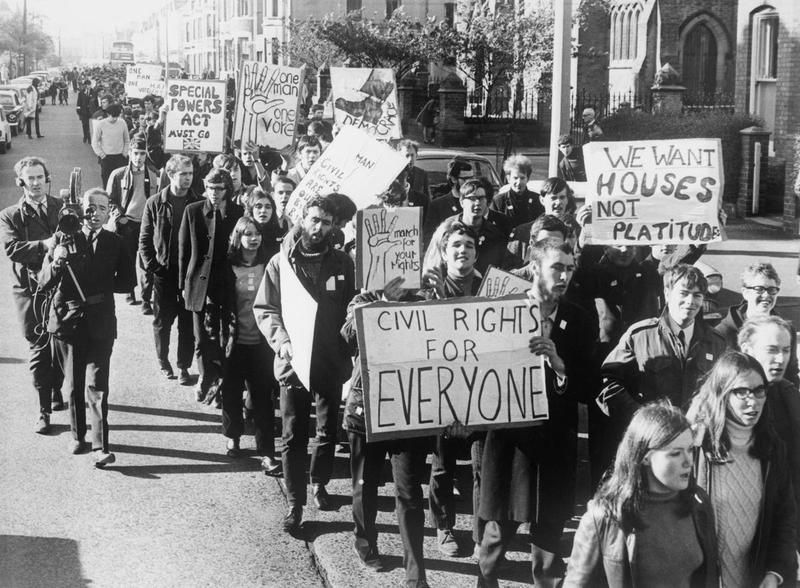
Section of march for civil rights in the Six Counties (Source: Internet).

TERMINOLOGY AND DEEPER MEANING

Wikipedia: “Though often used in history books to refer to the seven states that originally formed the Confederacy, the term “Deep South” did not come into general usage until long after the Civil War ended. Up until that time, “Lower South” was the primary designation for those states. When “Deep South” first began to gain mainstream currency in print in the middle of the 20th century, it applied to the states and areas of Georgia, southern Alabama, Florida, Mississippi, north Louisiana, and East Texas, all historic areas of cotton plantations and slavery. This was the part of the South many considered the “most Southern”.”

Later, the general definition expanded to include all of South Carolina, Georgia, Alabama, Mississippi, and Louisiana, and often taking in bordering areas of East Texas and North Florida. In its broadest application today, the Deep South is considered to be “an area roughly coextensive with the old cotton belt from eastern North Carolina through South Carolina west into East Texas, with extensions north and south along the Mississippi”.

Lower South” probably originally referred to its location on the typical north-orientated map of the USA. But I speculate that “Deep” has another meaning – a deeper psychological one, in fact. It suggests that this is a place difficult to understand for people not from there, which means most people. Different rules apply there, we might believe.

I speculate further that after the initial first years of the Civil Rights movement in the Six Counties, that area and the people living in it came to be seen as “different” too. Of course, it was different in that it was a colony (as had the whole country been only 50 years earlier) and that it was run along blatantly sectarian lines, the Catholics a minority there, unlike in the rest of Ireland. And of course, people in a different environment respond differently. But they were still people and the substantial Catholic minority were so clearly oppressed in a statelet into which the Irish ruling class had delivered them. For many people in the 26 Counties it became easier to think of them as somehow foreign in a foreign kind of land, hence my description as “Deep North”.

Cecilia Hartsell and Brian Hanley during the question-and-answer session.

THE SPEAKERS (as posted by EWHG)

Cecelia Hartsell is a researcher of American history. She has been a contributor to the RTE History Show and Radio Kerry on topics in U.S. history and frequently gives U.S. history talks for the Dublin Festival of History and in the Dublin Public Libraries. Cecelia has a Masters degree in U.S. history from Fordham University and a Masters degree in History from UCD.

Brian Hanley is an historian and author. He is currently a Research Fellow at the School of Classics, History and Archaeology, University of Edinburgh . He has lectured at a number of major Irish universities and was Historian in Residence at Dublin City Library and Archives . His books include “A Documentary History of the IRA, 1916-2005” (Dublin, Gill and MacMillan, 2010) with his most recent being “The impact of the Troubles on the Republic of Ireland, 1968-79: boiling volcano?” (Manchester University Press, 2018).

NEXT HISTORY TALK

There will be another talk in the series next week when Dr. Mary Muldowney will present a talk on “The 1918 Election – the Woman Who Stood for a Worker’s Republic.”

SPANISH TV CHANNEL COMPARES CATALAN INDEPENDENCE MOVEMENT WITH NAZI POGROM

Diarmuid Breatnach


On the anniversary of Kristalnacht, the Spanish TV channel Telecinco showed a program about the Nazi attack on Jewish premises and people on 9-10 November 1938 which, because of the breaking of shop windows and looting, came to be be known by that name, which translates as Broken Glass Night. In showing the program, they inserted shots of Catalan independentist events, drawing a clear parallel between the two.


A journalist at a German television channel denounced the Spanish TV station for this and challenged them to explain their actions.

https://www.elnacional.cat/ca/politica/esbroncada-periodista-tele5-senyeres-nazis_323184_102.html

KRISTALLNACHT: NAZI ANTI-SEMITIC GENOCIDAL POGROM

Wikipedia: Estimates of the number of fatalities caused by the pogrom have varied. Early reports estimated that 91 Jews were murdered during the attacks. Modern analysis of German scholarly sources by historians …. puts the number much higher. When deaths from post-arrest maltreatment and subsequent suicides are included, the death toll climbs into the hundreds. Additionally, 30,000 Jewish men were arrested and incarcerated in concentration camps.

Jewish homes, hospitals, and schools were ransacked, as the attackers demolished buildings with sledgehammers. The rioters destroyed 267 synagogues throughout Germany, Austria, and the Sudetenland, and over 7,000 Jewish businesses were either destroyed or damaged.

SPANISH UNIONISTS CALLING CATALAN INDEPENDENTISTS “NAZIS”

Spanish unionists have often accused the Catalan independentist movement of being Nazi or Fascist. No evidence has ever emerged of the Catalan pro-independence movement being anti-semitic or even right wing. A few years ago the Catalan Parlament, with a pro-independence majority, passed a law to give migrants equal access to health care with Catalan nationals but the Spanish High Court ruled the law illegal. The Parlament passed the law again this year. Giving migrants equal rights in health services hardly sounds typical of fascists.

But logic has nothing to do with this. Nor has history.

In accusing the Catalan movement of being fascist in nature, Spanish unionists not only exhibit their ignorance of the nature of Catalan society and the independence movement, but also their ignorance of the history of the Spanish State.

It is in fact the Spanish unionist forces which have a very close connection with fascism.

It was the military coup and fascist forces in the Spanish Civil War (or more correctly, the Anti-Fascist War) which sought the overthrow of the democratically-elected Popular Front Government and which, in order to succeed, called in the German Nazis and Italian Fascists for military assistance. Catalonia ndependentists were a major component of the anti-fascist alliance but Barcelona eventually fell to the fascist forces and a fascist dictatorship under General Franco followed. After Franco died, the right-wing forces put together a political party to participate in forthcoming ‘democratic’ elections and named it the Partido Popular.

Franco & Hitler reviewing fascist troops in the northern Basque Country during the Iberian Antifascist War
(Image source: Internet)

This party gathered most of the old regime and die-hard fascists into it and is one of the two main political parties of the Spanish state. From December 2011 until it was unseated recently in a no-confidence vote due to corruption scandals, the PP was in Government of the Spanish state. It was that Government that sent Spanish police searching for referendum ballot boxes in September last year and on 1st August 2017 to attack voters with truncheons, boots, fists and rubber bullets. It was the PP Government which charged and jailed without bail Catalan independence activists and began proceedings against hundreds of others including a great many Catalan town mayors, which the current PSOE Government is processing.

The PP has been nearly eliminated electorally in Catalonia but another political party with similar ideology is strong there, also Spanish unionist, criticising the Catalan independence movement at every opportunity and supporting Spanish repression of the movement.

There are also actual openly-fascist organisations in the Spanish state which have representation inside the police and military and which regularly flaunt their banned fascist emblems, salutes and slogans with impunity. As well as being anti-semitic and otherwise racist, Spanish state unity is a central them with these too.

(Source of image: Internet)

All of these elements – along with many Spanish unionists of other political types, such as many in the PSOE – have denied the democratic right to self-determination of the Catalan people and supported fascist-type attacks on their activists and movement.

In summary then, although of course one may – as anywhere else – find some anti-semites and nazi types in Catalan society, even in the independence movement, the greatest number and natural home of this type is to be found in the Spanish unionist movement and its various political parties – the very ones who are accusing the Catalans of being fascists.

But drawing parallels, no matter how irrational, between the Nazi Kristalnacht and the democratic Catalan independence movement is a new low, even for them.

End


REFERENCES

https://en.wikipedia.org/wiki/Telecinco

Short news report on the issue: https://www.elnacional.cat/ca/politica/esbroncada-periodista-tele5-senyeres-nazis_323184_102.html


SEX AND THE NOVEL DETECTIVE

Diarmuid Breatnach

Most modern criminal detectives have sex – I know this from reading, thankfully not from personal experience.


          The older set, Holmes, Inspector Maigret, Nero Wolfe, Miss Marple – they didn’t. Holmes was into a barely-concealed opium habit and Wolfe had an obsession with orchids; Poirot was obsessive-compulsive and probably fetish-obsessed with his patent-leather shoes. Miss Marple, who first appeared in a novel published in 1930, reflected her times even when the times passed her (Nemesis was published as late as 1971) and as to a suggestion of sex: “Good God! What kind of a degenerate are you? A woman detective having sex? And a pensioner?”

In modern times we might reflect that “of course there was her live-in maid … and that succession of young women she trained as maids ….”

Not only did they not have sex on paper, they were all single except for Maigret, so there was an absence of potential sexual activity to distract one. Maigret of course was French so like many middle-class men of his time would have had not only a wife but a mistress too but …. we don’t talk about that.

Yet sex is one of the most basic driving instincts – it governs procreation of species and, working in tandem with natural selection, rules on evolution of all species. How come it was left out?

The characters reflect their times and their class, of course, as well as what was expected of their class, sometimes with a little added taste of the unexpected – but not in sex. Yes, we know that DH Lawrence’s sexually-explicity (and trans-class) Lady Chatterly’s Lover was published two years before Agatha Christie Miss Marple’s first appearance in a novel, in Murder at the Vicarage (1930) – but Lawrence was published in Italy. Sniff! — those Continentals! A year later Chatterly was published again in France and – interestingly – in Australia. But all that publishing was done privately. In 1960, when an unexpurgated edition was finally published in the “United Kingdom”1, Penguin, the publishers, were subjected to a famous obscenity trial but, when they won, sold three million copies. It was still banned in the Irish State, of course but we weren’t alone – the USA, Canada, Australia, India and Japan all banned it too.

Romantic and gothic novels of the time didn’t have sex either, except in the mention of a child born out of wedlock, though the suggestion of or even history of rape was there at times. Sexual feelings of the heroine (and sometimes of the hero) were conveyed through descriptions of a blushing cheek, longing looks, palpitating heart and breast (but no mention of nipples!), feeling faint in the head …. all above-board and more importantly, all above the waist (though still allowing the reader’s imagination to eroticise, of course).

The most important point to grasp here I think is that something being published does not necessarily reflect the dominant social mores – it is its acceptance by society and its popularity that tells us most. There has always been material around that transgressed socially-dominant sexual standards but those standards were still dominant – and the material may even have worked as a pressure-release valve, as for example with the huge numbers of sex-workers, female and male, that walked the streets or entertained in special houses in sexually-repressed Victorian Britain, particularly in London.

The 1960s brought about a huge jump in tolerance of explicit sexuality, partly fueled by a decade of expanding consumerism and a push for more of the same and partly by the rise of the youth and student movement and its challenge to hierarchical values and control.

THE NEW DETECTIVES

          But for decades already, the new criminal detectives had arrived – or at least their advance skirmishers. One of the most influential, beating the later pack of the 1960s by a good three decades, Dashiel Hammett was hugely influential with the creation of what became known as the “hard-boiled” genre of detective stories and also in the “talking detective” style, in which the central character is also the narrator.

Hammett, a left-wing activist who got blacklisted as well as a popular crime fiction writer, had been employed by the Pinkerton Detective Agency2 and wrote many published stories but only five novels, all between 1929 and 1934 (even though he lived to 1961): Red Harvest, The Dain Curse, The Maltese Falcon, The Glass Key and the The Thin Man3.

Paperback cover for a Dashiel Hammmett novel, Red Harvest (pub. 1952), this one showing the dangerous gun-toting males (detectives? gangsters?) but also typically the heterosexual male erotic object of the female, dressed in bodily-revealing attire.
(Source: Internet)

Raymond Chandler, who acknowledged his debt to Hammett, had The Big Sleep published in 1939, based on a couple of short stories (he’d been writing those for decades). He banged them out pretty regularly after that: Farewell My Lovely (1940), The High Window (1941), The Lady in the Lake (1942); then a break until The Little Sister (1949), another gap until The Long Goodbye (1953) and Playback in 1958, a year before he died.4 at the age of 71.

Cover for Raymond Chandller’s paperback novel, The Big Sleep (pub. 1939), this one showing only part of the presumed detective, the ‘femme fatale’ prominently portrayed, holding a gun but dressed in bodily-revealing attire and ‘already’ in bed.
(Source: Internet)

The gap in the 1940s is easily explained by the film scripts for Double Indemnity along with And Now Tomorrow (both 1944), The Unseen (1945), The Blue Dahlia (1946). Strangers On A Train was produced in 1951.

James M. Cain (1892-1977) published The Postman Always Rings Twice in 1934 and, as well as short stories, another fourteen novels during his lifetime. Among those was Double Indemnity which, like Postman etc, was made into a film.

Mickey Spillane published his first novel, I, the Jury in 1947 and went on to publish another twelve before he died in 20065.

Cover for a Mickey Spillane novel, Kiss Me Deadly (pub. 1952), this one showing the iconic ‘femme fatale’, holding a gun but dressed in bodily-revealing attire.
(Source: Internet)

The new private detectives novels between the 1920s and the 1960s introduced detectives who had or were tempted by hetero sex but, however graphically the allure might be described, the sex was never described in detail. These novels also featured the femme fatale, the attractive and sexy woman who was also dangerous – capable of murder and treacherous. The detective was more likely to have the sex-interest woman jailed or even killed, or walk out on her, than claim her as the prize. And yes, the detectives in this genre were all male.

These novels featured violence – not just the violence to the homicide victim but regular knockouts with a pistol butt across the head, graphic physical fights with fists and feet (and even teeth!), shootouts … the detective characters not only suffered violence but engaged in it too (particularly Mickey Spillane’s Mike Hammer).

During the 1940s and ’50s the novels were paperbacks, low-priced, produced on cheap paper to a size that could fit into a man’s jacket or coat pocket (and some handbags or, in the USA, “purses”). This form of private detective and some other kind of publishing came to be called “pulp fiction”, from cheap magazines of short stories, i.e destined to be turned back into paper pulp soon after reading).6

The covers (or “jackets”) of “pulp fiction” novels were often lurid, portraying violence and heterosexual sex. Women dressed in revealing deshabille, often with seductive expression and posture, tended to share the cover with a “hunky” type of man, with a gun visible in the hand of either. Sometimes a dead body, male or female, lay on the ground too.

This kind of writing was baptised “Noir”, i.e “black”, mainly reflecting the dark sides of the detective’s character and especially of his clients and of surrounding society, cynical, corrupt, characters often morally-flawed, doomed, dogged by ill-luck and bad choices.7 Production in film of that writing came to be called “film noir”, the content reflected in low-light shots in black & white filming, which later transferred (with some difficulty) even to colour film. But still, the sex was never graphic in the writing and was more pruriently hinted at than witnessed by the reader.

Film ‘Noir’: Still photo from opening sequence of the film production (1941) of Chandler’s novel The Maltese Falcon. Typically, the ‘hard-boiled’ private detective is in his pokey office and the heterosexual male’s ‘sex interest’ has already arrived to ask for his help.  (Image sourced: Internet)

The writing could be elegant in descriptions and it could also be tight; dialogue was very important, with the detective and his adversaries dueling in verbal repartee, which the detective usually won in the verbal category but for which he often paid physically.

Of course, some cities in the United States had seen a lot of violence in reality, in particular during the ill-fated years of alcohol Prohibition (1920-1933) and the attendant rise of crime syndicates seeded in the working class immigrant communities of Irish, Jews, Italians, Sicilians …. Reading about such events as arrests, trials and mobster shoot-outs in newspaper reports provided also an audience for the material in the form of short stories, novels and later films. That audience grew during the succeeding decades and is still a wide one today, with a diversification of sub-genres and detectives in countries other than the USA or Britain, usually also in translation from their native languages.

But … back to sex and the detective. As the years rolled on past the 1960s towards the end of that millennium, the sexual activity of the private detectives became not only implicit but often explicit (with the possible exception of the Nordic detective novels). And we now had some female protagonists too: police detectives, uniformed police officers, private detectives and forensic pathologists. And if none of the main characters were ever gay, lesbian, transgender or transvestite, such characters did appear, usually treated more gently than in the past and at times actual second-line “good guy” actors in the stories.

It appeared that all previous sexual taboos in the detective story – all legal ones at any rate – had been broken.

Well, not all. Not masturbation.

Not even modern private detectives masturbate. Which is truly remarkable, when one considers, according to all research, how common that activity is in the non-detective population.

End.

REFERENCES & SOURCES:


For dates of authors’ birth and deaths, also of bibliography, Wikipedia entries on the authors.

Also: https://en.wikipedia.org/wiki/Pulp_magazine

Other:

Particularly for the footnote on Rebel Frontier: https://subjectguides.library.american.edu/dashiellhammett

FOOTNOTES

1I somehow doubt it would have got far in the Six Counties (“Northern Ireland”)

2 See Rebel frontier [electronic resource (video)] : organized labor vs. the Anaconda Copper Company / Network Ireland Television. New York, N.Y. : Films Media Group, [2006], c2004.1 streaming video file (66 min.) : Martin Sheen – impersonating the voice of author Dashiell Hammett – narrates this compelling docudrama on immigrant labor and anti-war politics in 1917. As a young employee of the Pinkerton Detective Agency, Hammett spied for the Anaconda Copper Mining Company in Butte, Montana, during the height of labour struggles there. AU STREAMING MEDIA http://digital.films.com/PortalViewVideo.aspx?xtid=35494.

3 The Maltese Falcon, The Glass Key and the The Thin Man were made into films.

4All based on earlier short stories, except the last, which was based on an unpublished screenplay.

5A number of others, based on previously-unpublished material or short stories, were published posthumously.

6Even after the pulp fiction heyday ended in the 1950s, paperback novels are still being produced in roughly the same size, albeit with somewhat better quality paper pages and covers.

7“Noir” also came to be a literary descriptive term and is often used to describe a certain kind of writing today.

“Another martyr for old Ireland …”

Clive Sulish

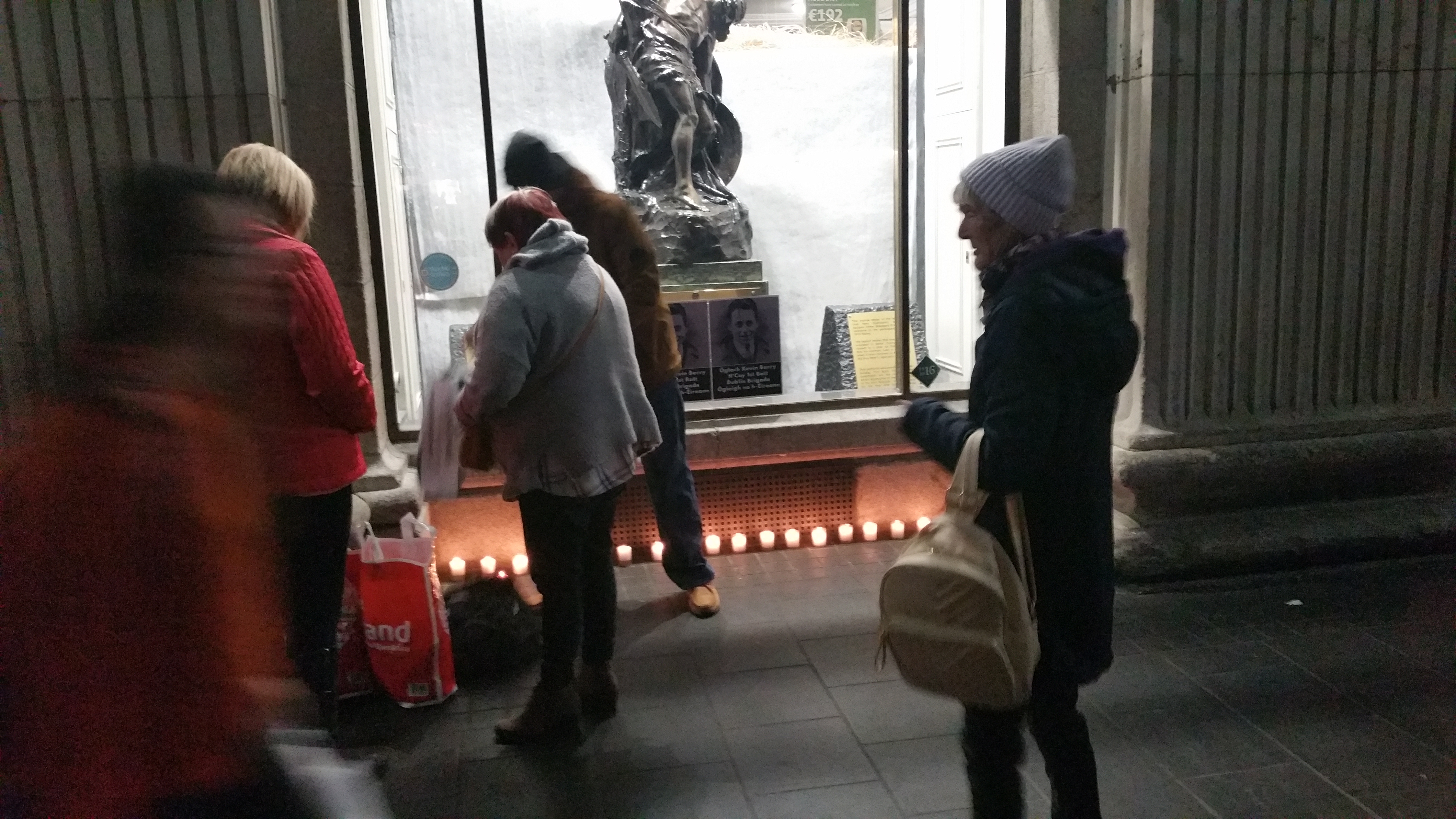
          Socialists and Socialist Republicans gathered outside the General Post Office in Dublin on Thursday (Nov 1st) to honour the memory of Volunteer Kevin Barry on the 98th anniversary of his execution. Copies of his portrait were on display with candles lit and the ballad honouring his memory was sung.

Display of images of Kevin Barry and lit candles outside the GPO at the event. (Photo: D.Breatnach)

          The event was organised by the Irish Socialist Republicans organisation. Asked about the reason for the commemoration and speaking on behalf of the organisation, Pádraig Drummond said “It is important to honour people in our history who have played an important role, who have displayed characteristics worthy of emulation such as resolution, courage and loyalty. People like Kevin Barry are more worthy of interest for the youth of today than clothing brands or pop idols.”`

Gathering to beign the vigil outside the GPO (Photo: D.Breatnach)


Some members of the public stopped in passing to listen to the song or to engage picketers in conversation.

People carrying out the vigil (Photo: D.Breatnach)


At the time of Kevin Barry’s execution the whole of Ireland was under a centuries-old British occupation and the defeat of the Easter Rising was three years in the past, most of its leaders executed and prisoners released. The first World War had ended. But the Irish Volunteers had reorganised and the War of Independence had begun in January of 1919. The ICA had seen a partial reorganisation and Cumann na mBan had never disbanded and, though it had suffered a few notable resignations, had experienced no split. The UK General Election of December 1918 had delivered a huge majority in Ireland to the newly-organised nationalist-republican coalition of Sinn Féin and in January of 2019 the successful SF delegates set up the Dáil, the first independent Irish Parliament, in defiance of the rule that all delegates elected in a UK election attended the Westminster Parliament in London.

On the same day in a separate development, the War of Irish Independence had begun. To wage war against the British occupation, the Irish Volunteers needed arms so some of its operations were carried out in order to seize arms from the occupiers. Kevin Barry joined the IRA at 15 in Dublin and not much later the IRB and had been on a number of successful raids to seize weapons.

Kevin Barry portrait graffiti of some years on wall in Dublin city centre.
(Photo: D.Breatnach)

On 20th September 1920 his unit was to ambush a British unit collecting bread from a bakery and relieve them of their weapons. Collecting bread rations from Patrick Monk’s Bakery at 79-80, Upper Church Street, near the corner of North King Street, Dublin.

Barry was a medical student and had an examination scheduled for that day which he expected to attend after the operation. Having attended mass that morning, he joined the unit in nearby Bolton Street and when the British Army lorry arrived the volunteers, armed with pistols, ordered the soldiers in the back to drop their rifles, which they did. However a shot rang out, possibly from the front of the lorry and the volunteers opened fire but Barry’s gun jammed twice and he jumped under the truck, being left behind when his comrades retreated. He was discovered and arrested. All five of the British soldiers in the rear of the lorry had been hit and one, 15 years of age, was dead – another two died later.

Kevin Barry attested that he had been beaten up when captured and tortured for information later in Army custody. On 20th October he was tried by military tribunal under the provisions of the Restoration of Order Act of August that year. Brigadier-General Onslow presided on the tribunal and Barry had legal representation who, after Barry announced he would not recognise the court, withdrew. The sentence of the court, given to the Volunteer in his Mountjoy Prison cell that evening, was death by hanging. The sentence became publicly known on the 28th and a fierce campaign began to save his life, not only in Ireland. Terence McSwiney, author, playwright, Lord Mayor of Cork and IRA Volunteer, had died after a hunger strike of 74 days on 25th October and public opinion, especially in Ireland, was highly excited. Nonetheless, Kevin Barry was hanged on November 1st 1920, eighteen years of age. According the priest who accompanied him the gallows, who was not a republican, he went calmly to his death.

On 14 October 2001, the remains of Barry’s body and others were given an Irish state funeral and moved from Mountjoy Prison to be re-interred at Glasnevin Cemetery in Dublin. A stained glass window in his honour was unveiled in 1934 at the Earlsford Terrace address of University College Dublin and was later moved to their new address in the Belfield Camput and restored in 2007.

The Ballad of Kevin Barry, which was sung at the commemoration by Diarmuid Breatnach, was composed around the time of the Volunteer’s execution and has been very popular in Ireland and among the Irish diaspora abroad. The author is unknown despite efforts by his family and others to trace him or her but there were some indications that it had been composed in Glasgow. The song has been recorded by many performers, including non-Irish singers Paul Robeson and Leonard Cohen.

End 

TRUE WORDS FROM A RIGHT-WING EX-MINISTER

Diarmuid Breatnach


Quite a few pro-Catalan independence people have expressed horror and indignation at the statements of Spanish politician José Manuel García-Margallo in an interview recently. They should instead that be grateful that he spoke much of the truth and dispelled unrealistic illusions about the way forward for Catalonia.

Ex-Foreign Minister of the Spanish State José Garcia-Margallo, photographed recently.
(Photo source: VilaWeb)

Did he threaten the independence movement with violence? Yes and not too subtly. That was no doubt his purpose as well as perhaps reassuring Spanish unionists, whether fascist or otherwise.  But nevertheless, he spoke an important truth.

Spanish ex-Foreign Minister José Manuel García-Margallo said that Spain would not withdraw ‘peacefully’ from the Principality. ‘It will not deliver the keys to the dependencies and furl up the flag’, he told ‘El morn de Catalunya Ràdio’. He expressed support for the accusations of ‘rebellion’ against the Government of Puigdemont, President Forcadell, Jordi Cuixart, Jordi Sànchez and the General Secretary of ERC, Marta Rovira. According to him, the unilateral way to achieve independence ‘necessarily’ implies violence.

His statement may be listened to on the link.

https://www.vilaweb.cat/noticies/audio-lex-ministre-margallo-amenaca-que-lestat-no-es-retirara-mai-pacificament-de-catalunya/?fbclid=IwAR0aUcpJzPkLdVhJ3g-qakPXRrjq36stNhcJ2_TYUteBm0ta2Yys9Wgw_3Y

Margallo was raised in a family with close military relatives, two of which died in the anti-colonial Rif uprising, one of whom was a colonial Governor of a town there. The ex-Minister of Foreign Affairs was educated (and presumably brought up in) a part of the occupied Basque Country which must have helped condition him and his early adult life was spent under the Franco dictatorship. His early political career was there too and took shape during the Transition and since.

His statement may be listened to on the link.

http://https://www.vilaweb.cat/noticies/audio-lex-ministre-margallo-amenaca-que-lestat-no-es-retirara-mai-pacificament-de-catalunya/?fbclid=IwAR0aUcpJzPkLdVhJ3g-qakPXRrjq36stNhcJ2_TYUteBm0ta2Yys9Wgw_3Y

Translation of the transcript of the excerpt below:

-Mónica Terribas: Crime of ‘rebellion’, does it exist there are or not, José Manuel? (DB: one of the charges against the Catalan activists but which requires the use of violence).

-García-Margallo: I think there is a crime of rebellion. I share the theses of Llarena, that is, I believe that what we saw on the streets during the course of the (events outside the) Ministry of Economy was violent. I think that, by definition, unilateral secession can only be achieved by violence. That is, I say that hypothetically this leads to violence. Because? We have discussed it many times and we all agree: the Constitution does not allow secession. Therefore there will be no referendum agreed. Secondly, the Spanish state will not withdraw peacefully, that is, it will not deliver the keys to the dependencies and furl up the flag. So how is the Catalan Republic proclaimed? If it cannot be by agreement and it can not be by unilateral abandonment, then it will have to be by violence. And that necessarily leads to rebellion.”

Margallo’s political party, the Partido Popular is of course a coalition of a number of Franco-fascist organisations, put together to operate in the ‘new’ Spanish state. But the greater truth about the Spanish ruling class is more important than all this.

The Dictatorship ruled as the only face available of the Spanish ruling class – representing “old money”, from the expropriation of the labour power of workers and the plunder of its colonies but also “new money”, appropriated from the losers in the Spanish Anti-Fascist War.

In the 1960s and 1970s the Spanish State began to receive substantial US and other investment, particularly in military form. But the concern of investors was that with the rise of national liberation movements and the upsurge of the youth and student movement around the world, that an unyielding dictatorship would lead to revolution, so pressure began to be applied, although it was understood that attempts at reform after so much repression could also precipitate a revolution. Given the prevailing circumstances within the Spanish state, such a revolution could only be a socialist one.

When General Franco died in November 1975 two years and one month after his chosen successor Admiral Carerro Blanco had been assassinated, the reformers got room to move (internally Opus Dei and externally the US and others, especially the EU or Common Market as it was then). Reform and normalisation of control meant bringing on board of the ship of State two significant political forces with their corresponding large trade unions, illegal until then: the social-democratic PSOE with their UGT trade union and the Marxist CPE with their more militant Comisiones Obreras union. And imposing a Monarchy.

Both those illegal opposition forces agreed, accepted the monarchy and were legalised; then controlled and even sacrificed their own members. They pushed for agreement of the monarchist and unionist Constitution of 1978, in which the majority of a dazed and hopeful population of the state (but not in the Basque Country) voted in favour of it (and which is now being used to illegalise Catalan bids for independence).

Subsequently the PSOE gained an electoral majority and while in government in the 1980s ran assassination squads against the Basques (chiefly GAL and BVE groups, although foreign fascist gunmen were also brought in for individual jobs).

Under alternating governments of the PSOE and of the PP, the State forces regularly used repression, particularly in the Basque Country, including torture of detainees and jailing people on the basis of ‘confessions’ tortured from them and which they repudiated in court. And they dispersed political prisoners throughout the jails of the State, hundreds or thousands of kilometres from their families.

This Spanish State is one that had at one time ruled much of the world and never ceded territory without a fight — with the English, the French, the Dutch, the North Americans; with native resistance and liberation movements from the Canaries to the Caribbean, to America, the Philippines and Africa. As a monarchy and feudal system, it overthrew the Arab colony of generations and expelled Arabs and Jews, brought in the terror of the Inquisition (the worst of all the states that had it), suppressed the rising of the Comuneros and resistance of the Basque and Catalan nations. As a semi-feudal capitalist monarchy, it overthrew a Republic and then raised a military coup with foreign fascist aid to overthrow another.

So this José Manuel García-Margallo is being on the whole brutally honest here and shattering the illusions many people had, especially those of a liberal or social-democratic turn of mind, that somehow Catalonia would win genuine independence without having to fight a Spanish military repression. But they should look on his utterances as doing them a favour, forcing them to look at reality.

In fact, for all that I have recounted about the particular nature of the Spanish State and its history, the more general historic truth is also that NO capitalist state (not to mention an imperialist one) is going to stand by and see itself being dismembered and losing huge chunks of what it considers its territory and economy.

Nations that won true independence had to fight for it. In the last century alone, how did Algiers win independence from the French? How did Kenya in Africa and Aden in the Middle East expel the British occupation forces? How did the Vietnamese expel the French occupation forces and defeat the US aggressors? How were the Nazi and Italian fascist and Japanese invaders of so many countries defeated?

People who hear the truth, no matter how bitter it tastes, should spend no time in bewailing it but instead concentrate on preparation.

End.

“GET OUT OF HERE!” MESSAGE FROM MARCHERS IN IRUNA/ PAMPLONA

Diarmuid Breatnach

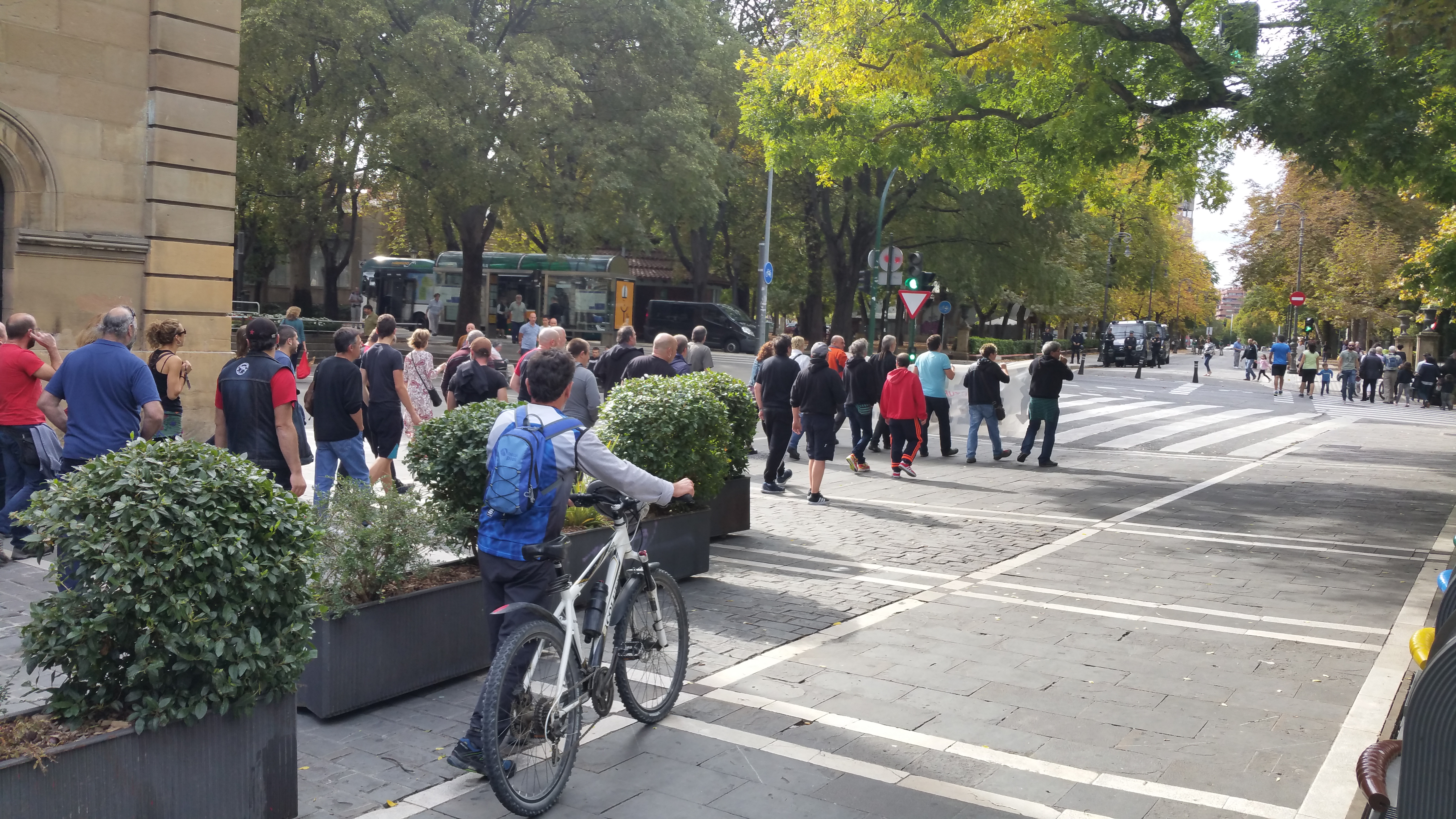
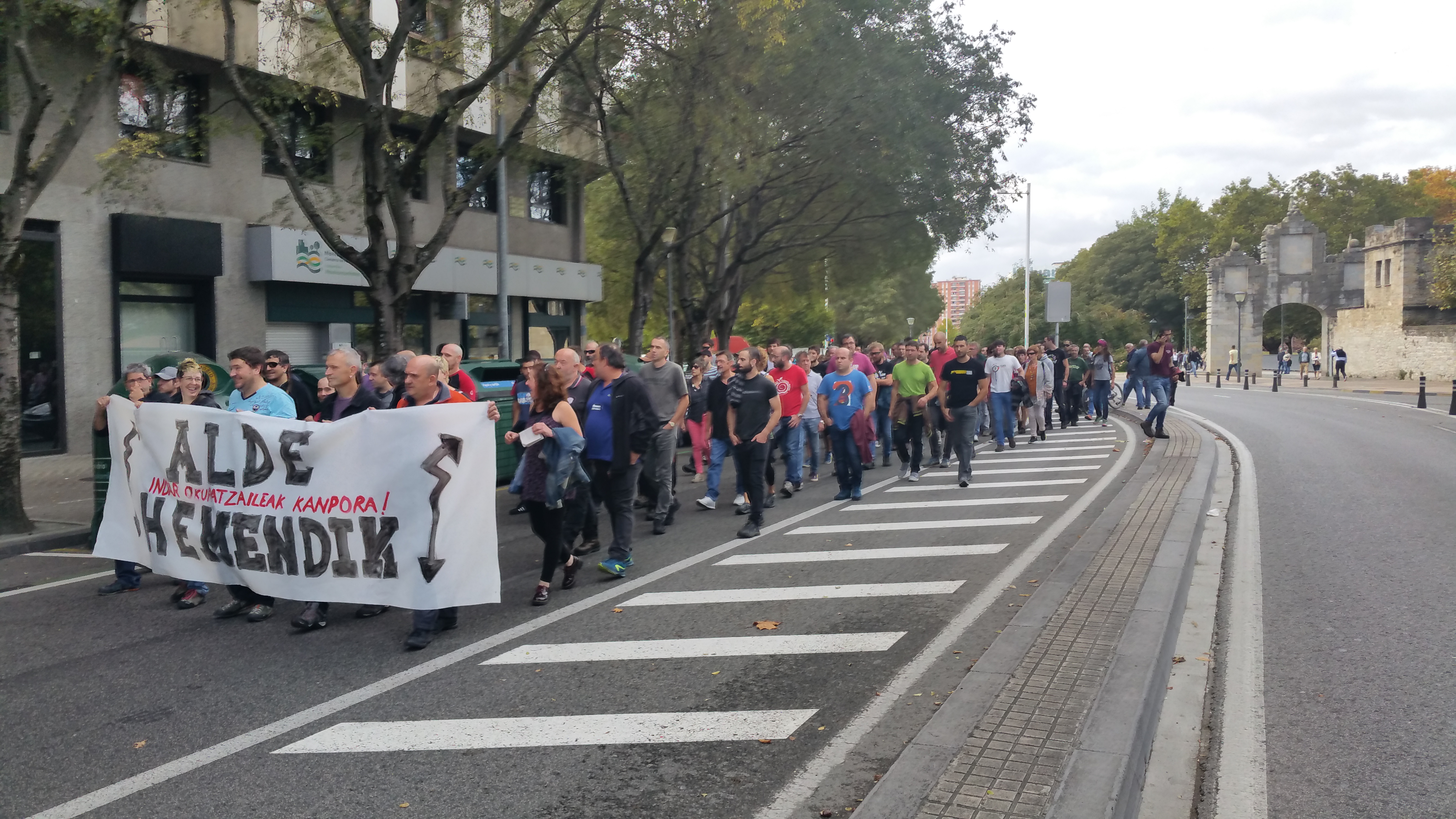
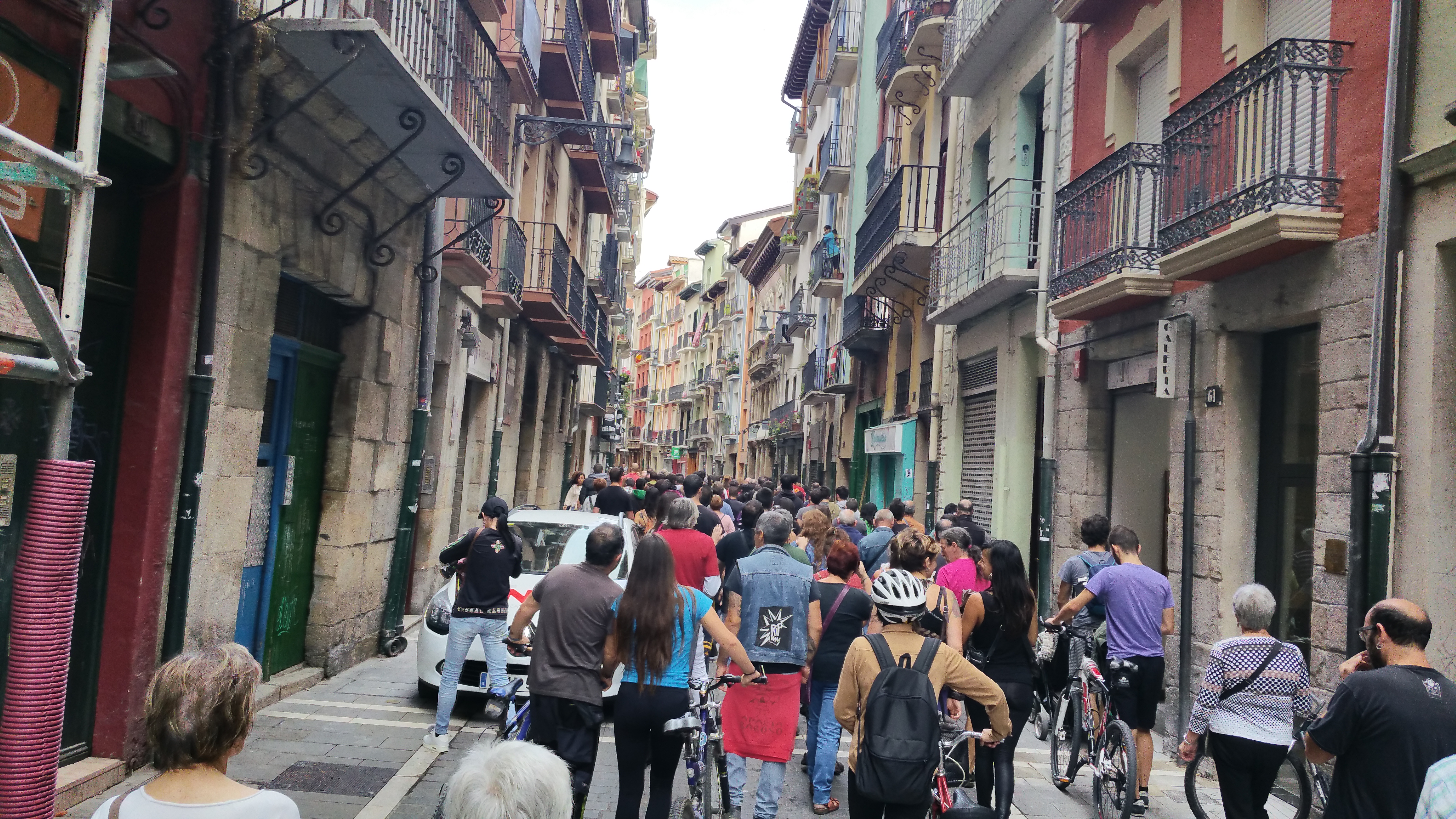
Marchers in Iruňa (Spanish: Pamplona) called “Alde Hemendik!” for the Spanish occupation forces to get out of their country and also called the Nafarroan police “murderers”, in addition to calling for the liberation of Basque political prisoners.

Posters for the march seen in a number of locations in the town
(Photo: D.Breatnach)

The marchers were obliged to seek permission from the authorities for the demonstration and route as otherwise, from past experience, a police attack would have been certain. Even when approved, marchers in the past had to pass by ranks of police in full riot gear, which earned the latter the nickname “Romanos”, from their superficial resemblance to Roman Legionaires. Of course the police are given many other names too. On this occasion, the police presence was not as intimidatory as is normally the case.

The event took place on October12th which is national Spanish holiday, the Día de la Hispanidad, in which the State celebrates the spread of the Castillian language through conquest of the Canaries, Americas and part of North Africa. Naturally enough, forces that are opposed to the character of the Spanish State or to its presence in their country tend to hold counter-demonstrations on that day.

The marchers form up and begin (Photo: D.Breatnach)
View from almost rear of march (Photo: D.Breatnach)

Although I did see one poster of the ‘official’ Basque Abertzale (pro-Independence) Left in the town I saw no other sign of them except banners on their local HQ (at least that’s what I was told it was). There seemed to be no intention of their holding a demonstration on that day.

The size of the march was perhaps somewhat less than had been hoped for but it made a good show going through the old town. Curiously, the march seemed much reduced by the time it reached the end square.

Front banner and march turning back into the old town after passing the police twice. (Photo: D.Breatnach)

The marchers set the tone from the start with their banner and slogans and did not hesitate to call out “Policia asesina!” (‘police murderers’ in Castillian) as they approached and passed the police. Later people within the march began to lead chants also, some in Castillian and many in Catalan. The march did not pass by the nearby local HQ of the ‘official’ leadership of the Basque Abertzale Left. A marcher told me the were not permitted to do so but I was unsure whether that was an assumption taken for granted or whether they had been refused. However, the march leaders took people on a winding route through the old town, passing by residences, bars, businesses and many tourists.

March wending its way through streets of the old town (Photo: D.Breatnach)
In the Plaza de San Francisco singing Basque song ((Photo: D.Breatnach)

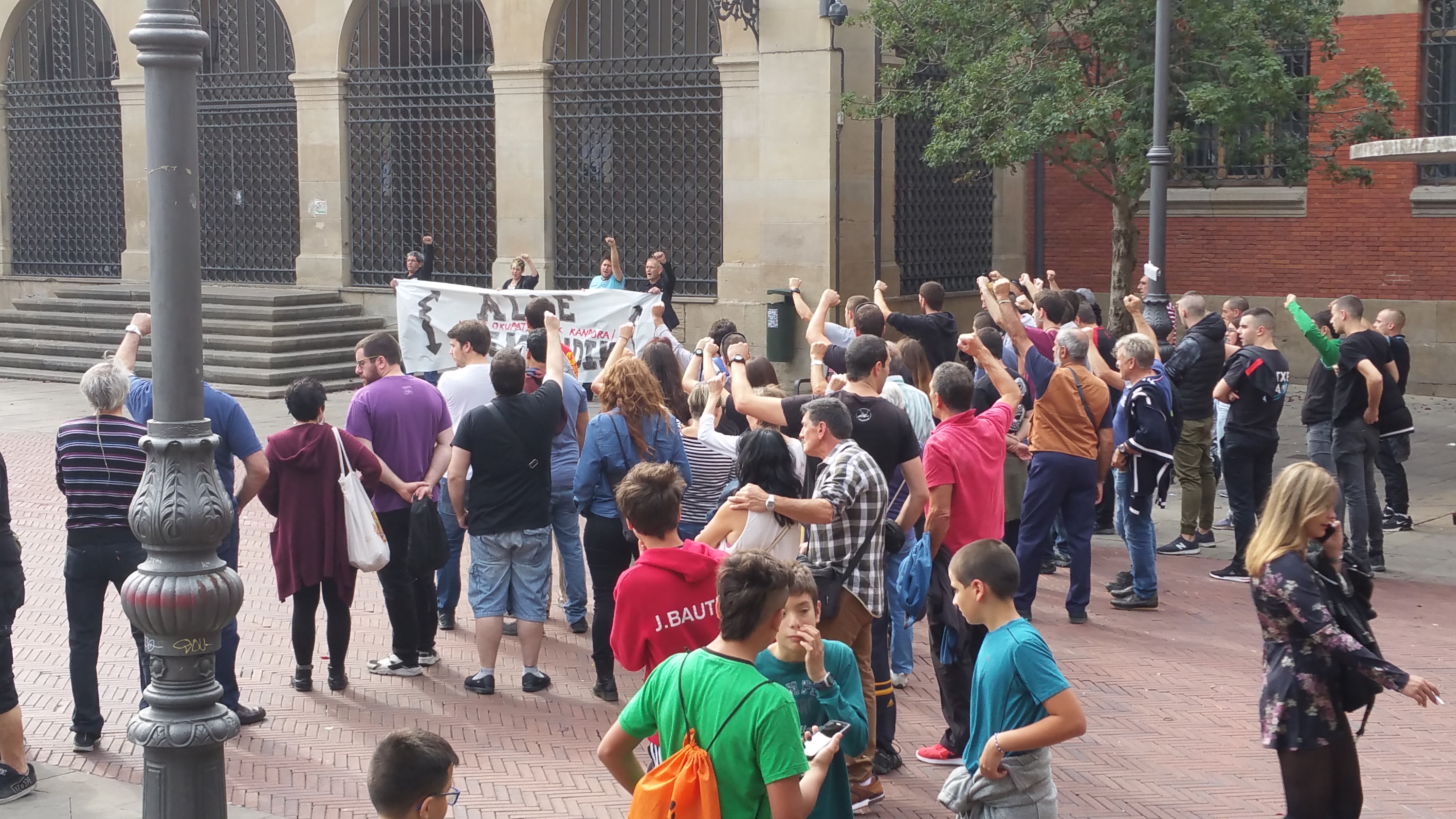
Concluding in the Plaza de San Francisco (St. Francis [of Assisi1] square) opposite the Municipal School, to the security bars of which the banner was secured, no speech was given but the marchers sang “Eusko Gudariak” (‘Basque Soldiers’), a Basque song of resistance (and anthem) with clenched fists, at the end of which a woman let out a long irrintzi.

IRUŇA AND NAFFAROA

Iruňa is the capital of the ‘autonomous’ southern Basque province of Nafarroa/ Navarra (and according to some, to be the capital of an independent Basque Country though by no means agreed by all). The Basque Kingdom of the Middle Ages was called the Kingdom of Nafarroa (Navarra in Castillian, Navarre in French). The present-day province is located at the north end of the Spanish state, on the border with the French state, much of that border area in the Pyrenees mountain range. The province has the other southern Basque ‘autonomous’ region of Euskadi (three provinces) to its west and the Aragon region to its east (with Basque provinces on the other side of the French Border too).

“ALDE HEMENDIK!  (GET OUT OF HERE!)  “Indar okupatzaileak kanpora!  (Occupying forces out!)                                          The march banner is left hanging on the security bars of the Municipal School (staff will probably remove it on their first shift after the holiday). (Photo: D.Breatnach)


Until recently, the majority political party there was the mainstream Spanish unionist party, the Partido Popular, now outnumbered and ousted by a coalition of pro-independence Basque parties.

The legal linguistic provision of Nafarroa is unique in the Basque Country as its territory is divided into three distinct linguistic regions: all Castillian-speaking; Castillian and Euskera bilingual; Euskera-speaking. Access to services, education and facilities through Euskera depends on in which area one lives or works, which might seem fair until one remembers that official services through Castillian are available always, no matter the region – it is the official language of the Spanish state. Euskera speakers also complain that in the bilingual region they are not getting the provision which they need and to which their numbers entitle them.

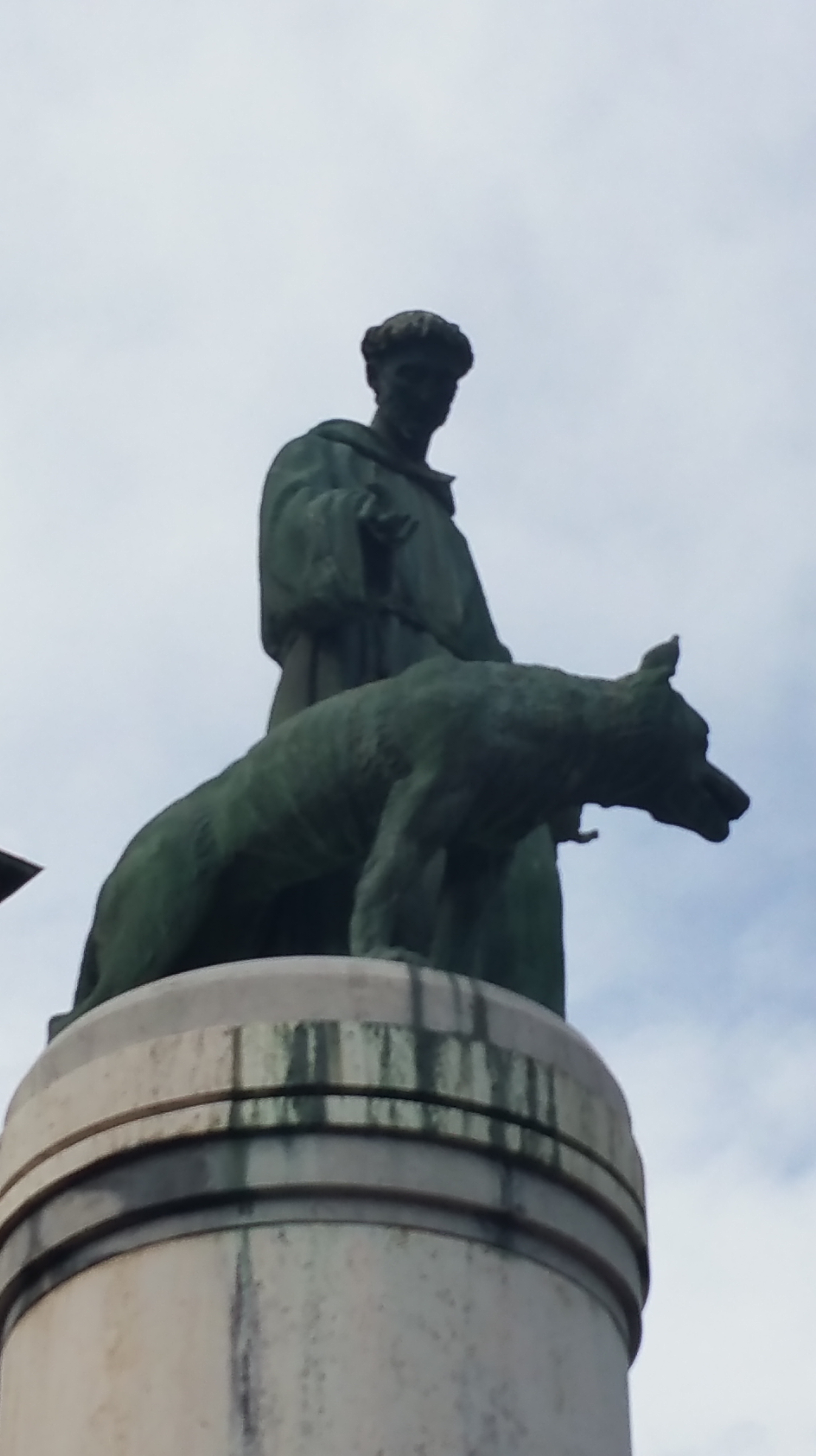
Monument statue of St. Francis of Assisi in the square named after him. (Photo: D.Breatnach)

Nafarroa was the only part of the Basque Country which can be said to have experienced what is called “the Spanish Civil War” (i.e an internal war) since the right-wing Carlists there slaughtered the 3,000 or so active Republicans, Communists and Anarchists — or just anti-fascists — before any of Franco’s troops or the Falange arrived there. As a result, the province was treated more lightly by the Franco dictatorship than the other three southern Basque provinces. This did not prevent repression of the Basque language in Nafarroa nor the armed attack on the more progressive Carlist movement of the 1980s during the “Transition” after Franco’s death.

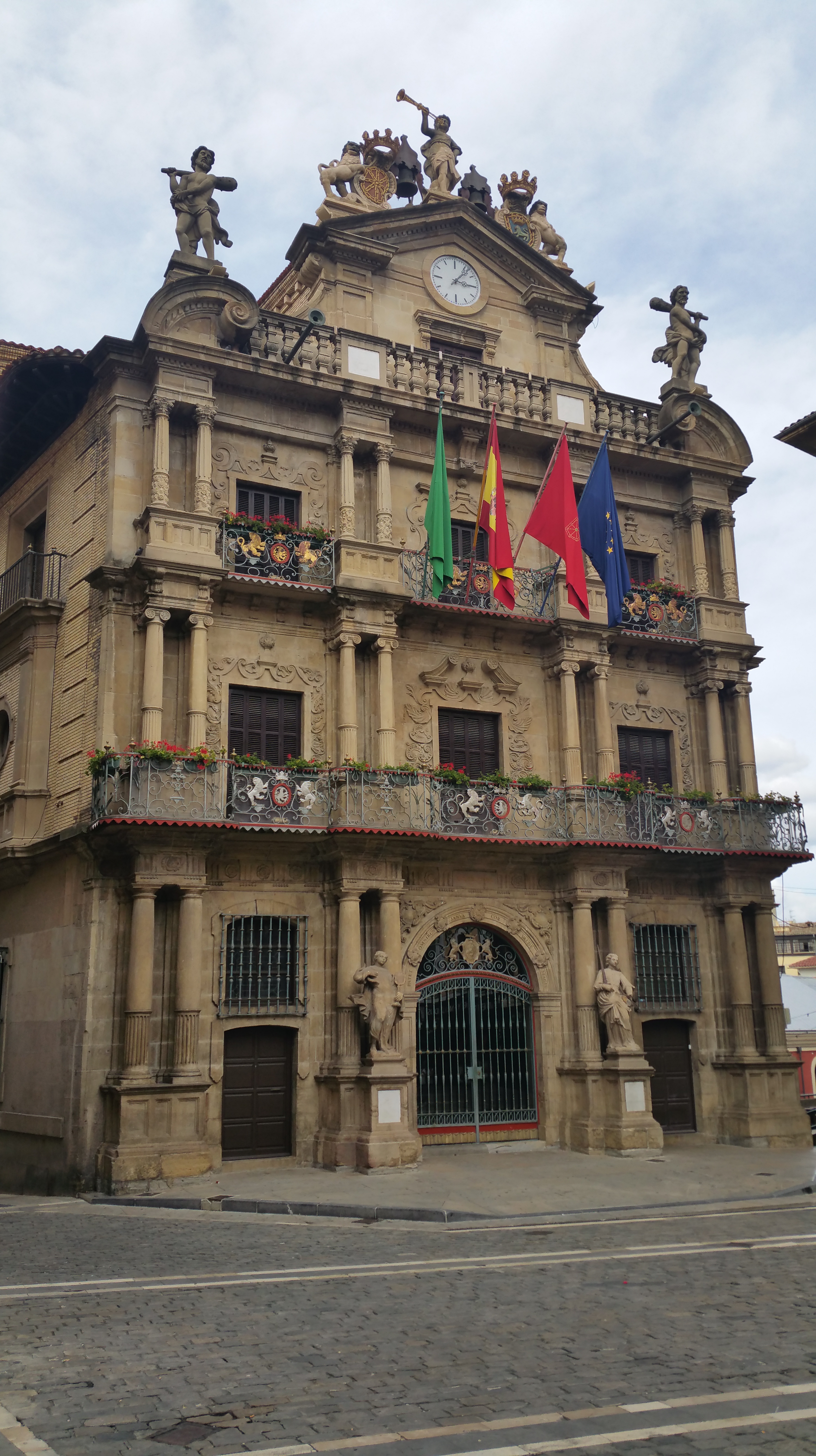
The Town Hall. All such municipal buidlings throughout the Spanish state are required by law to fly the Spanish State flag which must be at equal or higher elevation than all others. (Photo: D.Breatnach)

Many political and physical battles have been fought by pro-independence Basques since the 1930s, even around bringing a giant Basque flag into the main square for the ceremony to begin the San Fermines festival in Iruna/ Pamplona and at this festival too, many women have been molested and one gang-raped in 20162. The shocking nine-years jail sentence over a barroom brawl with Guardia Civil was imposed some months ago on youth from Altsasu, a town in Nafarroa.

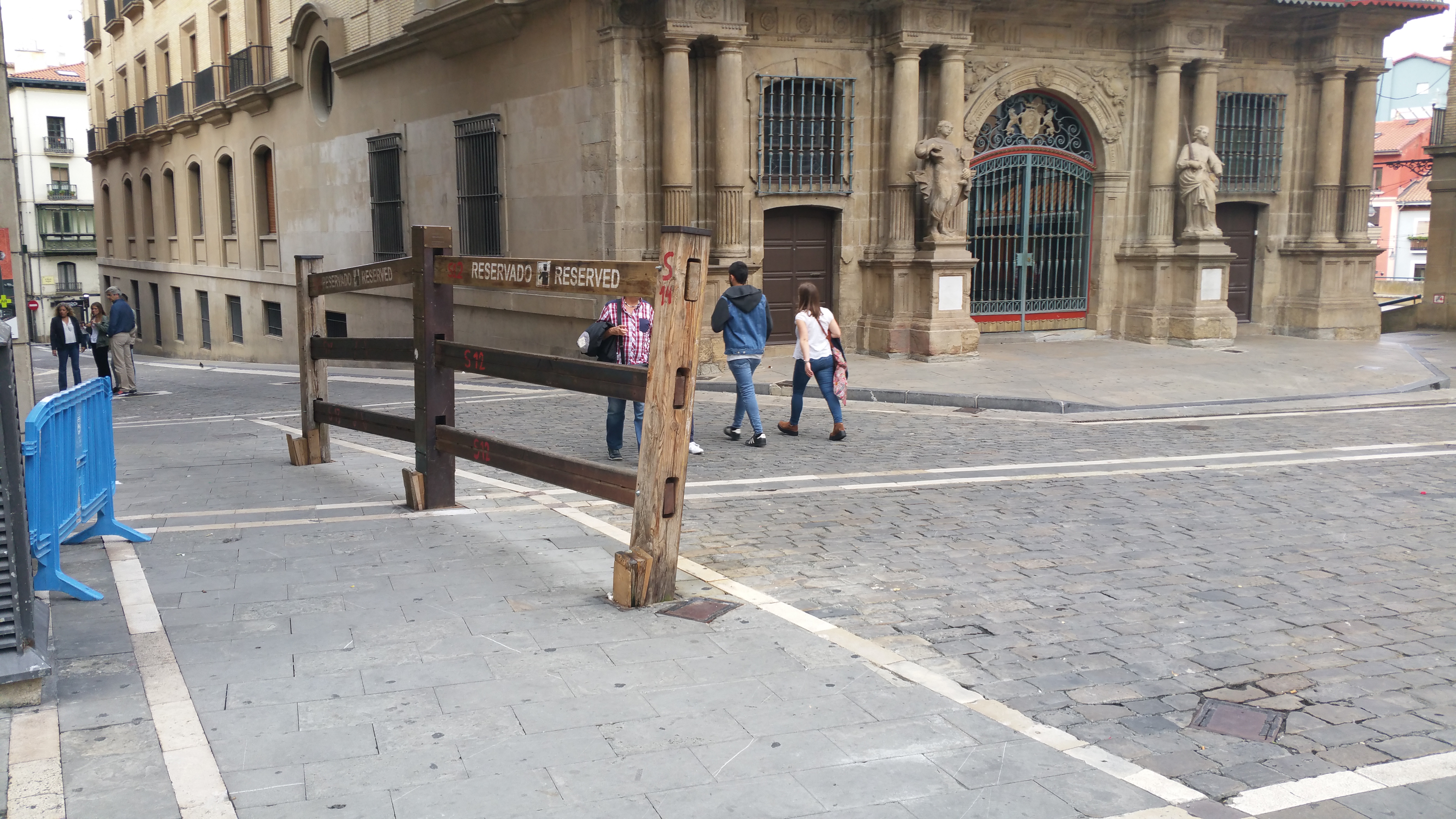
Area through which the bulls run as part of the San Fermines festival. (Photo: D.Breatnach)

FOOTNOTES

1St. Francis Xavier (1506-1562), born in Nafarroa, is the more common St. Francis to find referred to in the Spanish state and many Basques are called Xavier. St. Francis of Assisi (1881/2-1226) was Italian. There’s a story that an airman is falling out of the sky, his parachute having failed and he calls desperately for St. Francis to help him. A giant hand appears under him and as he comes to rest on it, a voice booms from the sky: “Which St. Francis did you mean, my son?” “Of Assisi”, gasps the airman. “I was named after him. Thank you!” “Alas,” the voice replies, “I am St. Francis Xavier.” And the hand is removed ….

2See the ongoing “Manada” case.

A BASQUE COUNTRY REGION – BIODIVERSITY AND CULTURE

Diarmuid Breatnach

          People visit the Basque Country for different reasons — among the touristic reasons are cuisine, folk culture and beach-type tourism including surfing. For some there may be business reasons and possibly on the other end of the spectrum from them there is the political aspect – interest in and solidarity with their struggle for independence and to a lesser extent perhaps, socialism. Eco-tourism and archaeological interest are probably not high on the list for most people but I’d suggest it would be worthwhile to include sites dealing with such aspects in any itinerary.

Many Basques would tell you that their country has a long way to go in environmentally-friendly practices – or at least in those less harmful to the environment; if true, it serves to illustrate just how far behind the desirable are the practices common in Ireland. Everywhere in Basque village or town, one sees the recycling containers in their five different colours for paper, plastic, metal, glass and organic waste. One frequent complaint is about timber-production forestation practices and though much of the Basque country is green with trees, many of those trees are conifers or, even worse, Basques will say, eucalypts in mono-cultural acres. The latter are indeed widespread and are said to suck the moisture out of the soil so that after they are felled, little else can grow there.

Environmentally-friendly timber production is less intensive and more diverse in species, less harmful to biodiversity of plant and animal life and more protective of the soil from erosion, flooding and desiccation. But to business — and therefore mainstream political interests — it is slower in turnover of profit. The perils of this concentration on early profit gain have been underlined this year with the infestation of the main crop pines, the “Monterey pine” (Pinus radiata) by the ‘Mycosphaerella dearnessii’ fungi and ‘Mycosphaerella pini’, said to have originated in Central America, which turns the foliage (needles) brown, eventually leading to the destruction of the tree.

Pines infected by fungi in the southern Basque Country (Photo: El Correo)

That all said, at grassroots (forgive the unintended pun) and often municipal level, there is great interest and support for biodiversity in the Basque Country and discussion around the subject is much more socially widespread than one would find in Ireland or in most of Britain (though perhaps not in some other parts of Europe). There are many national parks and reserves of great beauty and even city Basques tend to have a culture of collecting edible fungi in the woods in the autumn and of hill-walking or mountain-climbing at various times of the year. And small farms can be found dotted throughout the countryside.

Education about the environment for adults, children and even tourists is taken seriously and, apart from schools, centres promoting environmental care can be found in many areas. One such site of interest is the bio-diversity and heritage centre of Madariaga, the Ekoetxea, in the Axpe de Busturia area between the towns of Bermeo and Gernika These are interesting towns in themselves of the coast of Bizkaia (Biscay) province and Gernika was of course made famous by its bombing by the Nazi Luftwaffe, in the service of the fascist generals (Franco et al) in 1937, during what probably most people call the the Spanish Civil War and others, the Iberian Anti-Fascist War. Bus and train services connects both towns and pass through Busturia, both services having a stop or station in Axpe. The bus and train services run at mostly half-hourly intervals, the train all the way to Bilbao, on a single track for much of the line, up and down trains alternating.

I dropped in to a charming tavern in Axpe named after the Basque flower, Eguzkilore: literally “Sun Flower”. This is not the “sunflower” which Van Gogh famously painted, so named because it turns to follow the sun through its journey across the sky; the Basque flower (Carlina acaulis) is a member of the thistle family and is thought to resemble an idealised image of the sun. Dried specimens are often found hanging over the front door of Basque houses as a good-luck symbol, quite probably a remnant of pagan sun-worship (like the Irish “St. Bridget’s Cross” and indeed the traditional Basque symbol of the lauburru is very like that Irish symbol too and interestingly, the Basque tradition related to me was that it was borrowed from the Iberian Celts).

Dried Eguzkilore attached to the outside of a Basque house near the front door (Image sourced: Internet).

The Eguzkilore tavern is owned by a friendly young couple, a Catalan woman and Basque man: he of course speaks Euskera and Castillian (Spanish) fluently, whereas she is fluent in Catalan, Castillian and English, speaks Euskera well and smatterings of other languages. Although I know from experience that their cuisine is excellent, I ordered only a simple kafe esnea there and after finishing it and a chat, set off up the road to the Madariaga Ekoetxea (“eco-house”), an easy walk of perhaps fifteen minutes. Turning left at the roundabout at the crest of the hill the centre was easily visible by the clock-bell tower and the taller viewing tower.

This latter was a defensive construction quite similar to the keeps constructed in Britain and Ireland by the Norman invaders, livestock quartered below and people living on floors above; one of the staff told me that it had been inhabited until the 1930s. Now the floors have been ripped out except for the top one, accessible by a short journey in a lift and once there one can view around something like 160 degrees: steep hills close by beyond the road, land sloping away towards Gernika and distant mountains on another side, beach of the estuary and some marshlands on another.

A view of estuary and marshlands from the Tower observatory — it was a rainy day and the photograph is taken through glass
(Photo: D.Breatnach)
Closeup view of estuary and marshlands from the Tower observatory — it was a rainy day and the photograph is taken through glass
(Photo: D.Breatnach)
A view of river/ inlet mouth and headland eastward from the Tower observatory — it was a rainy day and the photograph is taken through glass (Photo: D.Breatnach).
The view southward from the Tower observatory is not so appetising but shows the steepness of the hills there. From those wooded slopes owls hooting may be heard night after night.
(Photo: D.Breatnach)

The Tower was in fact the last part of the centre which I experienced. It was a showery Sunday in mid-October and the centre was fairly quiet, less that ten vehicles in the car park and nobody but a receptionist immediately available upon entering the building. I used my limited Euskera in addressing her, which is my practice in the Basque Country, and which is usually – but not always – appreciated. The native language has become “politicised” here (as some say it has also in the case of Irish in Ireland), which is another way of saying that it was banned under the Franco dictatorship, that people of a Spanish unionist turn of mind often resent it and native speakers, learners and independentists want to encourage its spread and use in everyday life. Of course in a cultural type of centre in the Basque Country I would not expect any negative response and I was answered politely in Euskera with a quick conversion to Castillian when my limited store of Euskera ran out.

WATER AND BIODIVERSITY

I had seen a small charge advertised outside but there was none on that day or perhaps that time of year to see two standard exhibitions, one on water and the other on biodiversity. The one on water informs visitors that water is a circulatory system: 1) most of it falls from the air in rain or humidity, some of it on to land and some on to lakes or on to the sea; 2) some of that which falls on land is taken up by soil and vegetation and excess runs off into streams, rivers and lakes; 3) some also soaks through permeable or semi-permeable strata of soil and rock and forms underwater reservoirs and lakes. 4) The excess runs out in underground rivers and streams, emerging eventually to empty into seas and lakes, where 5) the sun heats up the top layers again, creating clouds, many of which precipitate on to land, renewing the circle.

Photo panel of rock and limestone deposit formations in a Basque cave.

The diagrams, photos and videos demonstrated this process well and attractively and there were samples of varieties of sandstone and limestone to examine at close quarters. For me, the photos of underground caves formed by the water wearing away the limestone and the various and sometimes fantastic formations caused by chemical-rich water dripping for millenia were the most impressive along with the few examples of invertebrates adapted to life without light and mammals using natural caves were the most interesting, while others might have found the supplying of water to the public of greater interest (and certainly this is an important issue in many countries and not least so in Ireland).

Photo panel of troglodyte spider eating something.
Sleeping bat hanging from stalactite in cave.


One of the fantastic shapes created by decades or even centuries of chemically-laden drips. (Photo: D.Breatnach)
Photo panel of cave chambers with humans present for scale.

The section dedicated to bio-diversity is divided into different parts, including a room with video screens showing different types of humans (ethnic, gender, possibly sexuality, culture, age) and others dealing with plant, fungi and animal life. Passing through a type of broad corridor with explanations of what is a definition of biodiversity in many languages, one enters a brightly-lit room seemingly constructed entirely of panels, each one of an animal: birds, mammals, fish, reptiles, insects and other invertebrates. Not only the walls but floor and ceiling appear constructed of the panels, a vibrant bright room somewhat evoking the effect of stained glass with light shining through, a church celebrating the diversity of animal life, perhaps.

A kind of foyer before the rest of the exhibition (Photo: D.Breatnach)
The room “made of” panels of bio-diverse life, like stained glass: ceiling and two walls.
(Photo: D.Breatnach)
Floor in the illuminated panels room.
(Photo: D.Breatnach)

Walking onwards, one finds a hall filled with large cubes, standing haphazardly upon one another, each carrying the image of an animal or plant. The names of the species are given in Euskera, Castillian and Latin. I find myself at times wishing to see the names in English and then chiding myself for the unreasonableness of this wish. There are images of plants to be seen too, some of plants which we are informed are native to the country and one found only there.

The “Life Cube Hall” (as I think of it).
(Photo: D.Breatnach)

ATTRACTIONS IN THE WIDER AREA

A slim informational folded leaflet is available in a number of languages, one version being in English and French, not only about this centre but about a network of them managed by the “Basque Government” (i.e the Government of three of the southern Basque provinces, Biskaia, Gipuzkoa and Alava). These are visited every year by 100,000 people, the booklet informs us, 25,000 of which are schoolchildren; the ekoetxea which I visited receives 2,000 schoolchildren out of a total of 45,000 visitors annually.

Dragonfly and Water-Scorpion panel. The first lives in the water as infant, hunting prey , before its metamorphosis to flying hunter. The second lives always in the water, usually in the higher reaches, also hunting. Its “tail” does not sting people but its proboscis can, though not seriously.
(Photo: D.Breatnach)
A view of the ‘Cube Life Room’ between cubes. (Photo: D.Breatnach)

Another, more substantial booklet available in English which shows signs of translation probably from Castillian gives more information on the Urdaibai Biosphere Reserve, the wider area in which the Madariaga Ekoetxea is located. This booklet advertises nature trails for hiking or biking, restaurants for Basque cuisine, a cave occupied by prehistoric humans, the Gernika Tree and General Assembly building and museum, markets and folk festivals, cider and wine-houses, painted forest, hermitages, bird-watching and sea activities including surfing and whale and dolphin-watching. Strangely (or not), in its caption about Gernika, it has nothing to say about the bombing of the town in 1937 nor, in its references to human habitation and culture of the wider area, nothing either to say about the Spanish Civil (i.e Anti-Fascist) war or about the occupation of the area by the fascist troops and the repression that followed, nor about the suppression of their language under Franco.  

An information panel tells visitors that there are 3,335 different mammal, bird, fish, reptile, amphibian, fungi and plant species etc. in the the Urdaibai reserve and that 85 are in danger of extinction or are of special interest.  Some panels showing examples of these would be welcome as would more about the wildlife native to the area (like what species are the owls one can hear hooting at intervals through the night from the forested hill above Axpe, for example).

End

FURTHER INFORMATION:

Eguzkilore plant: 

https://en.wikipedia.org/wiki/Carlina_acaulis

Ekoetxea Urdaibai: info@urdaibai@ekoetxea.eus 0034 946 870 402

Madariaga Ekoetxea: http://www.ingurumena.ejgv.euskadi.eus/informacion/madariaga-tower-basque-biodiversity-centre/r49-madaria/en/

The Monterey Pine and fungal infection: https://en.wikipedia.org/wiki/Pinus_radiata

The Pine infection in the Basque Country (article in Castillian): 

https://www.diariovasco.com/gipuzkoa/pinos-gipuzkoa-heridos-20180607001828-ntvo.html


Extant and Extinct mollusc shells.
(Photo: D.Breatnach)


Different species’ seeds containers.
(Photo: D.Breatnach)
European Mink cube.
The centuries-old clock tower; the clock is on the other side but the bell rings out the hour. Also visible are the solar panels.
(Photo: D.Breatnach)
The Madariaga Tower (Photo: D.Breatnach)
The estuary and trees (Photo: D.Breatnach)

VIVA LA QUINZE BRIGADA

Clive Sulish


From Eoin O’Donnel’s filming and editing via Joe Mooney of East Wall History Group, a recording of Diarmuid Breatnach singing Christy Moore’s wonderful song Viva La Quinze Brigada (also known as Viva la Quinta Brigada which, however, is also the title of another song from the same conflict but in Castillian or Spanish language).  The Fifteenth Brigade of the Spanish Republican Army was also the Fifth International Brigade, the mostly English-speaking one.  It contained volunteers from English-speaking USA, Canada, Australia, Scotland, Wales, England and ireland but due to high Irish emigration, all those countries also contained Irish diaspora and they were to be found in the contingents from those countries.

The video also contains photos of the commemoration of Jack Nalty, resident of East Wall’s, the last Irishman to die in action during the Iberian Anti-Fascist War (usually known as the “Spanish Civil War”).  The day-long event on 28th September (anniversary of his death) included songs and poems, a march led by a lone piper, unveiling of a plaque, booklet launch and showing of two films. It was a celebration in particular of Jack Nalty’s life but more generally of the Irish who, against the position of their Government, the Church of the majority, the dominant media and even, for those in the IRA, against their own organisation’s orders, went to fight against a fascist military uprising against the elected Republican Government of the Spanish state.

It was also a celebration of antifascist resistance around the world and of the principle and practice of internationalist solidarity.

A plaque to the fallen of the Irish volunteers of the International Brigade (containing many names but by no means all of the Irish who fell there). The plaque is on the wall of the Theatre side of Liberty Hall, HQ of SIPTU, Dublin.
(Photo D.Breatnach).


EAST WALL REMEMBERS ANTI-FASCIST BRIGADISTA JACK NALTY

Clive Sulish

On the 80th Anniversary of his death in the Anti-Fascist War in ‘Spain’, the East Wall History Group organised a remembrance of a local man from that dockland Irish area who was the last Irishman to die fighting in the war against Franco and Spanish Fascism. The event was attended by relatives of that Irish antifascist fighter and of another, by a cross-section of Left and Irish Republicans, including historians and by a number of elected representatives from the Dublin City Council and the Dáil (Irish Parliament).

Crowd assembling outside school before event. (Photo: D.Breatnach)

Jack Nalty was the last Irish and one of the last International Brigaders to fight and die in that war. The rest of the Brigaders, those not held as prisoners by Franco’s forces, were withdrawn soon afterwards as the indigenous anti-fascist forces fought on, losing against the Spanish military coupists with their German Nazi and Italian fascist allies.

Those commemorating Jack Nalty met at the St. Joseph’s Co-Educational School on the East Wall Road at 1pm on Sunday (23rd September) and included a cross-section of members of organisations and independent activists, socialists, republicans, communists and anarchists and other members of the local community. At the front entrance of the School a number of relatives of Jack Nalty held a banner along with a son of an Irish International Brigader and the crowd was addressed by Joe Mooney, of the East Wall History Group.

Joe Mooney speaking at start of event, relatives of International Brigaders beside him holding the banner in the colours of the Spanish Republic (Photo: D.Breatnach)

Mooney told the crowd that John Nalty came to the area at the age of six from Galway and on 31st August 1908 entered the East Wall National School on the Wharf Road. Just over thirty years later, 23rd September 1938, he would die on a Spanish battlefield, shot down in a hail of fascist bullets as he engaged in one last heroic act.

A member of the IRA during the War of Independence, Jack was a Republican, Socialist and trade unionist”, Mooney said, “representing 600 oil workers in Dublin Port. But in 1936 when the Spanish Civil War — or Anti-Fascist War as it should more accurately be called1 – began, he volunteered for the International Brigades to join the fight against European fascism. He was badly wounded and came back to Ireland, but would again go into action and was killed at the Battle of the Ebro. Having being among the first Irish volunteers to travel to Spain, he would die on their last day as they were preparing to withdraw from combat.

Nalty’s unit had been called to retreat when it was realisted that two machine-gunners had been left behind and he went back to collect them. On their retreat they were fired at and Jack Nalty was killed.

Section of crowd lined up in front of house where Jack Nalty had lived (Photo: D.Breatnach)

Mooney also asked those present to remember not only Jack Nalty but the ‘comradeship of heroes’ from Dublin’s Docklands and North Inner City – Dinny Coady, Tommy Wood and others.

The crowd then set off in a march led by a piper to East Road to unveil a memorial plaque. Across the road from Jack Nalty’s former house, the crowd paused to hear Diarmuid Breatnach sing a few verses of Christy Moore’s tribute to the Irish “Brigadistas”: “Viva La Quinze Brigada”.2

UNVEILING THE PLAQUE

Joe Mooney unveiling the plaque not far from Jack Nalty’s former house (Photo: D.Breatnach)
The plaque (text difficult to read in photograph)
(Photo: D.Breatnach)

The plaque could not be attached to Jack Nalty’s house and was affixed a little further down the road. Joe Mooney siad a few words there and introduced James Nugent who gave a speech he had prepared and the plaque was unveiled. Nugent concluded by saying that “the history of the past helps us to understand the present and to create the future.”

Kate Nugent read a message from the daughters of Steve Nugent (sadly died 2017) who researched the story of his uncle Jack and Mary Murphy read a short post from Vicky Booth (granddaughter of Syd Booth, who was with Jack when he died).

(Photo: D.Breatnach)
Piper plays lament by plaque
(Photo: D.Breatnach)

Harry Owens gave a short tribute speech on behalf of Friends of the International Brigades and Manus O’Riordan, son of Irish communist and International Brigade Volunteer, sang the chorus of Amhrán na bhFiann (“The Soldiers’ Song”, Irish national anthem) and the Internationale.

Section of crowd a location of the plaque (Photo: D.Breatnach)
At the unveiling ceremony (Photo: D.Breatnach)
Also at the unveiling ceremony
(Photo: D.Breatnach)

Joe Mooney acknowledged the presence of elected representatives Mary Lou McDonald, Sean Crowe and Cieran Perry and asked people to march to the nearby Sean O’Casey Centre to see the art exhibition and see two short films.


Marching from the plaque site, heading for the SO’C Centre
(Photo: D.Breatnach)(Photo: D.Breatnach)
Section of the attendance relaxing at the Sean O’Casey Centre between the plaque event and the films to be shown, also examining the art exhibition [see photos at end of post]

Back at the Sean O’Casey Community Centre, two short films were shown. One was a school project film in which a descendant of Jack Nalty interviews the latter’s nephew about his famous uncle. The second was dramatic film in which a Spanish trumpet player joins the fight against the fascist military uprising by Franco and other generals and features also actors playing two Irish International Brigaders, O’Connor and Charlie Donnelly3. When the former trumpet player is shot he sees into the future ….

Eddie O’Neill talked about the pulling out of the International Brigades in October 1938 in a bid to have the “non-interventionist” Western democracies put pressure on Nazi Germany and Fascist Italy to have them withdraw too, which did not happen. They marched through Barcelona on 17th October and were addressed in an emotional rally by La Pasionara4 and Eddie asked Nerea Fernández Cordero to read an English translation.

Nerea on stage just after reading translation of La Pasionara’s farewell to the Brigaders
(Photo: D.Breatnach)
Eddie O’Neill at the SO’C Centre with concluding speech: “We can’t afford to forget.”
(Photo: D.Breatnach)

Nerea told the audience that she is from Extremadura (a province of the Spanish state next to the Border with Portugal) and her grandfather, Antonio Fernández had fought against Franco, been captured, escaped to the mountains but was in time recaptured. Upon his release he had married Nerea’s grandmother and lived a peaceful life. Nerea said that she was proud of her grandfather and those who fought Franco and that “ we know La Pasionara’s speech in Spanish by memory.”

Reading of translation of La Pasionara’s speech to English from Youtube:

At the event the newly published pamphlet “In Pursuit of an Ideal – from East Wall to the Ebroabout Jack Nalty was made available for the first time and copies are available from the organisers.

Eddie O’Neill recalled being in the Spanish state with a group from Friends of the International Brigades to commemorate those who fought against Franco during that war and afterwards searching for an appropriate pub in which to socialise. They found a pub with a Guinness sign and went there which however turned out to be one of the most fascist pubs in the area but undeterred, they continued to celebrate the memory of the antifascist fighters there. A lone man in suit and tie asked people as they passed him to use the toilet why they were commemorating people who had died so long ago but when they explained he said he could not understand English.

We can’t afford to forget,” O’Neill told his audience, “least of all when the forces of fascism are gathering again.”

To conclude the event O’Neill called on Diarmuid Breatnach who sang the whole of Christy Moore’s “Viva La Quinze Brigada”, calling on the audience to join him in the chorus, remembering those who fought and gave their lives in the struggle against fascism.

Eddie O’Neill close at right of photo at unveiling ceremony
(Photo: D.Breatnach)

AN ANNUAL EVENT?

The organisers are reputedly considering making this an annual event – it is to be hoped that they do so.

Another section of the crowd at the plaque unveiling.
(Photo: D.Breatnach)
Also at the plaque unveiling ceremony
(Photo: D.Breatnach)

POSTCRIPT: JACK NALTY – ATHLETE COMPETING FOR IRELAND

In publicity prior to the event, the East Wall History group posted the following:
“In addition to his political and trade union activity, Jack Nalty was also a busy athlete, a regular competitor and medal winner with the Dublin Harriers. In 1931 he represented his country at the International Cross Country Championship, held at Baldoyle. Fellow competitor Tim Smyth became the first Irishman to win this competition.

(The full Irish Group for the event held on 22nd March 1931 is listed as: Frank Mills, J. Behan, John Nalty, J.C. McIntyre, John Timmins, T. King, T. O’Reilly, Thomas Kinsella, Tim Smythe).

This British Pathe footage shows the runners in action. Somewhere in the group is John (Jack) Nalty, East Wall resident, Republican and hero of the International Brigades. (The Pathe footage is viewable on post on the East Wall History Group event — CS)

Ironically, the same year as the competition the future leader of Irish Fascism, General Eoin O’Duffy had become the President of the National Athletic and Cycling Association (NACA) , and apparently was an admirer of Jack Nalty as an athlete!”

(Photo: D.Breatnach)


FOOTNOTES


1Basques in the provinces of Bizkaia, Guipuzkoa and Alava say it was not a civil war there, i.e between different sections of Basque society — the fascist forces came from outside.  In the fourth southern Basque province of Nafarroa, where the Carlists took control, they wiped out around 2,000 antifascists but it was hardly a war. The Catalans also say that the fascist forces invaded them and that it was not a civil war but an antifascist one. In some other places in the Spanish state many also say that the presence of Nazi German and Fascist Italian military in such numbers invalidated the term “civil war”.

2Also known as “Viva La Quinta Brigada”, which is however also the title of a different song from the Anti-Fascist War. Both titles are correct for this song since the Irish were in the Fifth of the International Brigades but when added to the ten indigenous Brigades (Spanish, Basque, Catalan etc), that became the Fifteenth. Wikipedia quotes authors to report an estimate that “during the entire war, between 32,000 and 35,000 members served in the International Brigades, including 15,000 who died in combat; however, there were never more than 20,000 brigade members present on the front line at one time.”

3Charlie Donnelly was a poet and member of the Republican Congress. He went to Spain to fight against Franco, where he died in February of 1937 at the Battle of Jarama. He is also one of those 19 names mentioned in Christy Moore’s song (“Viva La Quinta Brigada” or “Viva La Quinze Brigada”).

4Isidora Dolores Ibárruri Gómez (9 December 1895 – 12 November 1989), born and brought up in the Basque Country to a Basque mother and Spanish father, founder-member of the Spanish Communist Party and known for her political writing and speeches. She wrote an article when quite young under the pen-name “La Pasionara” (the Passion Flower) and was known by that nickname throughout her life.