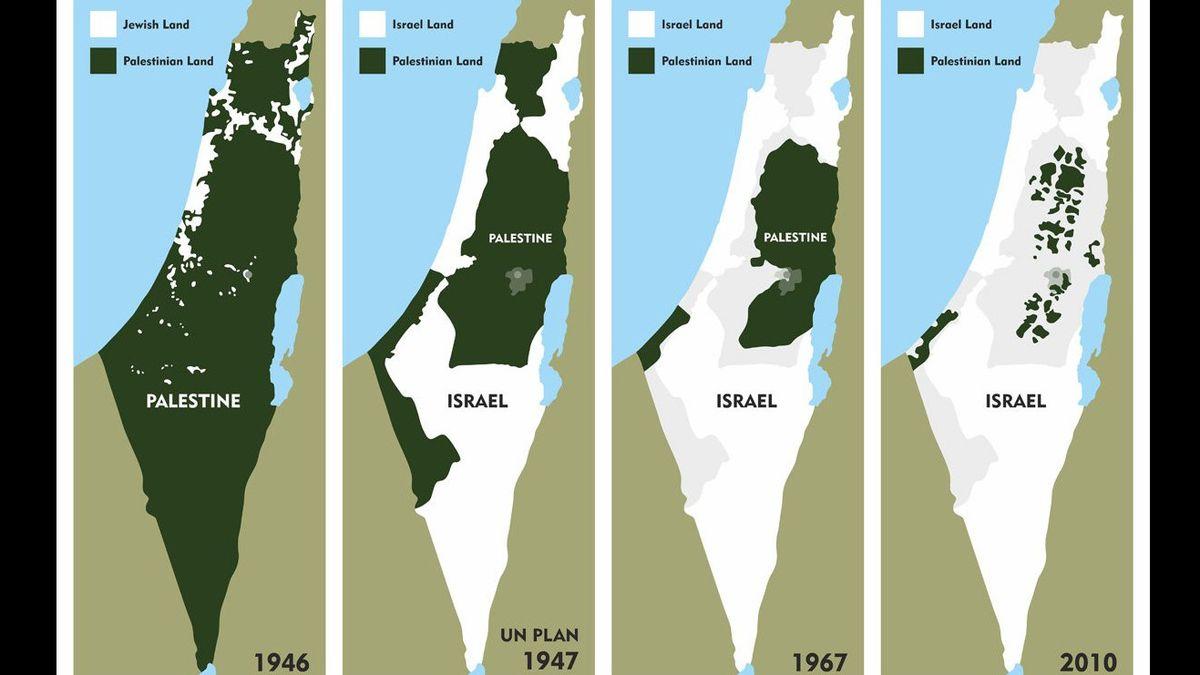
Changes in the Palestinian territories and Israel.
Occasionally in the “debates” on the Arab world and Palestine in particular statements are made that “they want to destroy Israel” as a criticism or “Israel has the right to exist” as if it were a human being.
The Left abandoned any discussion on the issue following the Oslo Accord where the Palestine Liberation Organisation (PLO) surrendered and agreed to govern some Bantustans(1) in the name of peace.
The Palestinian “problem” was resolved through the half-measure of autonomy where the Palestinian Authority has less power than a small municipality anywhere in the world and the left replicated and took on as its own the right-liberal demand for Two States.
It is worth looking at the question of destroying Israel and its supposed right to exist. We should be clear though that no state has a right to exist. States exist because they exist, through force, popular support, or cunning and guile. States come and go.
In the 19th Century two states came into being, ten years apart, one being Italy through the struggles of Garibaldi and others and Germany, unified under Bismarck. These two states underwent various important changes in their nature, borders and ideological discourse on unity.
In the case of Italy (1861), the Papal States were reduced in size and a significant part of what we now call Italy belonged to Austria. It wasn’t until after the First World War that Italy came to have borders similar to what it now has and changed from a monarchy to a republic.
In the case of Germany, its borders waxed and waned throughout the 19th Century until unification under Bismarck in 1871. Later Hitler would expand them once again under the Third Reich or as it was officially called since 1871, the German Reich.
Following the Second World War, nobody argued that the Nazi state had a right to exist. It was partially dismantled. Poland recovered a part of its land, the Sudetenland, once again, became part of Checoslovakia, Austria recovered its independence.
The great racial nation of Germans was wiped off the face of the earth. The Allies divided the rest into four parts, with three of them becoming the Federal Republic of Germany in 1949 and the other the German Democratic Republic, until 1991 when they were united.
Other states such as the Austro-Hungarian and Ottoman empires also disappeared after the First World War.
These were not the only states to undergo dramatic change. There are more interesting examples from the anti-imperialist struggles. The Vietnamese guerrillas wiped off the face of the earth the reactionary (North American) state of South Vietnam.
The Algerian revolutionaries wiped off the face of the earth the French colonial department of Algeria and erected in its place the Republic of Algeria.
So, is the state of Israel immutable? Does it have a right to exist? Should that right be defended? It is easier to answer that question if we ask ourselves what defending that right means.
Israel’s existence is the theft of land, it is the Nakba, the displacement of 750,000 people in 1948. It is the invasion of the West Bank and Gaza in 1967. It is also the current genocide the modern-day Nazis are trying to carry out in Gaza.
Israeli destruction 31 October 2023 of Jabalia Refugee Camp, which was Gaza Strip’s largest of 8 camps. 150 were injured in this attack and 50 killed. (Photo cred: Anas al-Shareef/Reuters)
On that point, there are those who don’t propose to wipe Israel off the face of the earth, but rather to set up two states.
Amongst those who sometimes wave that flag is the USA and others who are more serious about it, such as Al Fatah, the dominant faction in what was the PLO, European liberals and the press.
There are also those who believe it is a pragmatic solution, but they are usually people who ignore the question of class as a factor in the Arab world.
Two states means acknowledging and accepting the invasion of 1948, the Nakba, the systematic theft, murder and torture. It also means not accepting the right of return of those displaced in 1948 i.e. to accept and reward the mass violation of the human rights of the Palestinian people.
It was worth recalling that the PLO and the various organisations that formed part of it were founded before the 1967 war, so propose two states is to propose the Zionist victory over the territory stolen in 1948.
It is to accept that if you commit mass human rights violations and crimes against humanity, the solution is to commit even more, so that some liberal or former leftist can come along and say we have to accept some degree of crime and blood.
So, what is the solution? It is not easy, though it is simple, at least conceptually. It is the historic Palestinian demand of One State. The Palestinians themselves proposed this from the word go, knowing that it brought up the problem of what to do with the Jews who had arrived.
One of the old factions of the PLO stated:
However, the DFLP had come to a premature recognition that as well as the Palestinian national question there was also a “Jewish question” which inevitably has to be resolved if one aims to reach a democratic solution to the conflict, emphasising that the resolution of the Jewish question was conditional on freeing itself from the zionist project and the necessary coexistence with the Palestinian Arabs on an equal footing under the slogan of a “Popular Democratic State” which would be built on the ruins of the State of Israel; but, how would this aim be achieved in the light of the overwhelming superiority of Israel and its firm commitment to North American Imperialism?
The answer is to be found in the “prolonged people’s war throughout the all Palestinian and Arab territories”.(2)
Such voices were, back then and continue to be, a minority, but what they say is true. Those millions of Arabs that have come out on to the streets to protest against the Zionist regime face various enemies, one of them being their own bourgeoisies, the Arab states that have betrayed the Palestinian people time and again.
However, a Pan-Arabist revolution is a far way off but not impossible. None of the Arab regimes are progressive and they exist because they repress their own people, their own working class. But what would happen to the Jews who lived in the new state?
Well, many of them, Netanyahu style Nazis would flee to the USA alongside the Yanks that have arrived in recent decades, those from Western Europe, and the Ukrainians, amongst others. Something similar happened with whites when the racist apartheid regime in Rhodesia was overthrown in 1979.
The white population fell from 240,000 to 28,000 now. In Algeria a million Pieds-Noirs fled. Others, those that descend from families that have been in the region for centuries will stay, others will have to negotiate their future in the new state.
But not an inch can be given on the right of return of ALL the Palestinians, not only to the country, but also to their farms, olive and lemon fields, their rural and urban houses in the whole country.
So, should Israel be wiped off the face of the earth? Of course it should, and a new Palestinian secular democratic state should be built on the ruins of Zionism and Apartheid. The Arab states and elites should also be wiped off the face of the earth.
Later the war criminals and those responsible for crimes against humanity will have to be tried. The Zionists rightly put the German Nazi Adolf Eichmann in the dock. It was an act of justice.
Now the Palestinians and the rest of us have to put Nethanyahu and the other criminals in the dock, perhaps with the same consequences.
Though whether they spend the rest of their miserable lives in prison or they go to the gallows may be up for discussion, what is beyond debate is whether they should be tried for crimes against humanity. They should be tried as such.
Long live Palestine Free and United!
Notes
(1) The Bantustans were segregated zones set aside for blacks in South Africa under Apartheid. They were supposedly independent from the regime but in reality had no autonomy. They were governed by black “leaders” that supported the regime, or at least were not very critical in the same way as the Palestinian Authority.
(2) F. Suleiman, (n/d), La Izquierda Palestina Revolucionaria: Tres décadas de exp eriencia de lucha (1969-1999), FDLP http://www.fdlpalestina.org/index.htm
Israel is justifying its bombardment of Gaza as the right to defend the state, effectively in the right to take revenge, with which the western states are in agreement.
Leaving aside the question of whether bombing homes, bakeries, markets and hospitals constitutes ‘defence’, what should we think about the right of a state to defend itself as a principle?
It seems natural that every state should have the right to defend itself; perhaps that right is extrapolated from the generally-agreed right of the individual to self-defence. In bourgeois law, the need to defend oneself can be a valid legal defence even against a murder charge.
The individual is generally understood to have the right of self-defence particularly in their home but also in public places. However, it is important to note that this right, even in bourgeois law, is not considered valid in every conceivable case.
For example, the right of one individual to use violence in their defence can be cancelled by the right of their victim to self-defence if the latter is being seriously harmed by the former, so that violence by the victim might be considered a reasonable response in their own self-defence.
People carrying out a robbery or kidnapping, to take another instance, are not considered to have the right to use violence if attacked in the course of the robbery by the victim or by security forces or even a passer-by.
Proceeding to the question of the rights of states to defence, we might say that the UK had the right to defend itself from Nazi attack during WWII and certainly so did the USSR, so too later with the rights of Vietnam, Laos and Cambodia from the USA’s invasions and bombings in the 1970s.
But did the Cambodian state have the right to defend itself from Vietnamese invasion when the Pol Pot regime was carrying out mass exterminations of sections of its population? Or the did the states of Nazi Germany and Fascist Italy have the right to defence against the Allied forces?
Continuing in consideration of the right of a state to defence, how does that go when the attack comes from within the territory of the state itself?
Most Irish and democratic people outside would probably deny that the English Crown had the right to defend itself against the Irish rebellions of the clans (1167-1690s) or of the United Irish republicans, or against the Fenian insurrections, the 1916 Rising and the War of Independence (1919-1921).
Similarly, most would deny the right of the English or French monarchies to defend themselves against the internal republican uprisings of 1649 and 1789, respectively.
When the “internal” force attacking is a nation, then national rights of self-determination counter and supersede the rights of the state to self-defence. The case of the United Irishmen has already been noted but slave colony Haiti and colonial Algeria against France could be listed there too.
ISRAEL
The Israeli State is a colonial regime sitting on the Palestinian people’s land. It is in addition a state which is deeply religiously sectarian on the basis of Judaeism, in a sense which is far more racial than it is religious and, in many cases, may have no religious aspect at all.
Aftermath of Israeli militia massacre of Palestinian village Deir Yassin (9th April 1948 – five weeks before the the founding of the Israeli state). After the massacre, the Zionists took over the village, and in 1980 the occupation established settlement units on top of the original buildings of the village, and gave the names of the “Argon”, “Etzel”, “Palmach” and “Haganah” murder gangs to places in it. 700,000 Palestinians were expelled or forced to flee the land. (Source photos: Internet)
Being able to claim Jewish descent is the qualification for Israeli citizenship, not religious practice or even belief. As for the Palestinians, whether Muslim or Christian, Arab or Berber, they are ‘other’, second-class or even third-class at best.
Third-class because the Ashkenazi Jewish colonists discriminate against other Jews too, for example the Ethiopian (because many are black), the Sephardic and Mizrahi (because they are not Ashkenazi). They will all speak Hebrew now but many additional languages are spoken too.
The Zionist trend in the Jewish world insisting that Jews had a right to a state of their own on a land of their own, even if some other people already lived there, was a minority trend among Jews until fairly recently, though it gained dominance in the West over years after the establishment of Israel.
Indeed there are sections of Jewish society that consider the creation of a Jewish state to be contrary to the teachings of the Torah. But as observed earlier, Zionism is not really about religion.
The establishment of the Zionist state was achieved at the price of the expulsion of 700,000 Palestinians, the imposition of racist and sectarian laws, apartheid, massacres,1 oppression of the Palestinians and repression of their resistance.
The story of the state of Israel in the land of Palestine until now can be characterised by two images: the murder of Palestinian people along with the expulsion of 700,000 Palestinians in 1948 as the Zionist state came into being – and the genocidal bombing of Gaza these three weeks.
As of some hours ago, over 7,000 Palestinians have been killed in the past three weeks – including nearly 3,000 children.
Medical staff in Gaza treating children and woman injured by Israeli bombing, uploaded 26 October. (Source image: Al Jazeera)
There are many ways to kill, including despair, lack of or obstruction to medical treatment or access to good water and food. But from 1948 to 2021 (i.e excluding the killings since then and this year’s), well over 20,000 Palestinian civilians have been directly killed by the Israeli state’s military and settlers.
To claim that “Israel has the right to defence” is to say that all those things are justified and must be defended, must be perpetuated, that we must be complicit in it and that the best we can do is to ask Israel to practice its racism, colonialism, oppression and repression somewhat more gently.
Israeli bombing wide-scale destruction of Gaza, October 2023 (Photo sourced: Internet)
Israel – which is to say the Zionist project — has absolutely no right to defence.
End.
FOOTNOTES
1When hostilities erupted in 1948, the villagers of Deir Yassin and those of the nearby Jewish village of Giv’at Shaul signed a pact, later approved at Haganah headquarters, to maintain their good relations, exchange information on movement of outsiders through village territory, and ensure the safety of vehicles from the village. The inhabitants of Deir Yassin upheld the agreement scrupulously, resisting infiltration by Arab irregulars. Though this was known to the Irgun and Lehi forces, they attacked the village on April 9, 1948. The assault was beaten off initially, with the attackers suffering 40 wounded. Only the intervention of a Palmach unit, using mortars,[20] allowed them to occupy the village. Houses were blown up with people inside and people shot: 107 villagers, including women and children, were killed. The survivors were loaded on trucks that were driven through Jerusalem in a victory parade,[19][21] with some sources describing further violence by Lehi soldiers.[22] Four Irgun or Lehi men were killed.[23] The incident became known as the Deir Yassin massacre.
On April 10, 1948, one day after the Deir Yassin massacre, Albert Einstein wrote a critical letter to the American Friends of Fighters for the Freedom of Israel (the U.S chapter of Lehi) refusing to assist them with aid or support to raise money for their cause in Palestine.[24][25] On December 2, 1948, many prominent American Jews signed and published an op-ed article in The New York Times critical of Menachem Begin and the massacre at Deir Yassin. (Wikipedia)
Diarmuid Breatnach – previously published in the Pensive Quill
(Reading time main text: 6 mins.)
At the end of last month, in Johannesburg, South Africa, over 76 residents perished in a fire sweeping through one of a number of “illegal” buildings, home to some of the city’s poor who are desperate for somewhere to live.
How is this possible we may ask. Didn’t the South African people win their struggle after many years of sacrifice? Didn’t Mandela and the ANC lead them to victory in 1994?
The huge South African majority people fought a long and hard struggle against the domination and exploitation of a European settler minority and institutional racism. But they also fought against capitalist exploitation and imperialist plunder of their rich natural resources.
Some of the results of the Sharpeville Massacre, 1960 after South African police opened fire without warning at unarmed black people protesting the pass (apartheid) laws. In total, 69 people were killed and more than 180 people were injured, mostly shot in the back as they fled the violence. A later report would state over 700 bullets had been fired, all by police. (Photo sourced: Internet)
Despite the riches of those natural resources in gems, precious metals and minerals,1 most non-white Africans2 in South Africa lived in abject poverty with poor health care, scarce or non-existent infrastructures and services, including education and training.
In the decades leading up to the fall of the formal apartheid system, that struggle was led by the ‘triple alliance’ of the (banned) African National Congress,3 the National Union of Mineworkers (of S.A.) and the (banned) Communist Party of South Africa.
Township in South African photographed in 2018, over 20 years after enfranchisement and ANC government (Photo credit: Andrea Lindner/ Getty Images)
Their struggles defeated the apartheid system and in April 1994 all residents of South Africa were enfranchised. National elections brought 1990, was elected President of the country.
Yet shortly after that great change, it was noted that the living standards of the mass of people were even lower than before, that the settler capitalists continued to reap their profits and that imperialism had actually intensified their penetration of the South African economy.5
Today approximately 55.5 percent (30.3 million people) of the S.A population is living in poverty at the national upper poverty line (~ZAR 992) while a total of 13.8 million people (25 percent) are experiencing food poverty. Municipal services to the huge ‘townships’ are unreliable at best.
Almost one in every three of work-available people is unemployed and only 95% of the population have basic literacy, which means that one in 20 doesn’t have it.
It is in that context that we can begin to understand hundreds of people living in an “illegal” building without even a fire escape, obliged to take the risk of such accommodation, in a land that continues to be rich in great wealth which however, never comes near the mass of people.
PACIFICATION PROCESSES
In the 1990s a number of people began to promote processes to resolve a number of long-ongoing conflicts around the world, mostly where imperialism or colonial settlers were oppressing the people of a country. The promoters called them “peace processes”.
Palestine was the first of those in which a “peace process” was introduced and South Africa was next in 1994, followed by Ireland in 1998. As it took root in one country, former resistance activists went from there to other conflicts to encourage people there to embrace the process too.
In fact the progress of this process seemed like the US imperialist ‘dominoes’ theory, only in reverse: rather than ‘communism’ in one country influencing people in another to go the same way, capitulation in one country was used to infect the next.
Palestinian and South African delegates attended Sinn Féin congresses to promote their ‘peace process’ to the party’s membership; subsequently SF delegates in turn joined South African ones in selling the process to the Basque national liberation movement.6
Arnaldo Otegi (centre photo) foremost of the Basque movement’s ‘official leadership’ and EH Bildu party in 2019 – the banner behind asks for “one further step” in Castilian (Spanish) and “yes” in Euskera (Basque). (Photo cred: EFE)
Some movements declined to imbibe the process wine but those that drank it found their movements split, their leaderships increasingly accommodated to their people’s exploiters and nowhere at all were any of the movement’s principal objectives achieved.
Except, that is, in South Africa, where at least the people were enfranchised. But the right to vote is intended to help shape the polity for improvement and that has not happened in South Africa. The ANC, NUM and CPSA of the ‘triple alliance’ have become part of the system instead.
THE OPPOSITION BECAME THE SYSTEM’S GUARDIANS
Western imperialism recognised the vulnerability and isolation of the minority settler regime, convincing its leadership to concede mass enfranchisement rather than suffer revolution. And in order to prevent the mass going ‘too far’, they brought the resistance leaders into the deal.
Bishop Tutu7 once remarked that “The ANC stopped the gravy train just long enough to get on it”, which angered his friend, Nelson Mandela. But when forty striking miners were murdered by police of the ANC Government with NUM collusion in 2012, Mandela did not condemn them.
The kopje or hillock at Marikana, near the Lonmin mine, South Africa, where the striking miners were massacred by police of the ANC government in 2012. Over a decade later, plans for a memorial park have still not borne fruit. (Photo sourced: Internet)
This corruption did not grow overnight. Jacob Zuma,8 while President of the ANC, has been formally accused of rape, indicted a number of times and eventually convicted of financial corruption. Winnie, Mandela’s ex-wife led a clique accused of political corruption and murder.
Cyril Ramaphosa, now President, was a millionaire even during the apartheid regime while General Secretary of the National Union of Mineworkers and, because the striking mineworkers in 2012 were rejecting the NUM as corrupt, is widely believed to have organised the massacre.
There should have been many signs of this corruption in the ANC prior to entering government – and there were.
The ANC ran concentration camps notably in Angola, Zambia, Tanzania and Uganda where they punished and even killed “dissidents”.9 And in South Africa perhaps they had their own ‘Steak Knife’10 to organise “Pirelli necklacing”11 for alleged informers.
Mandela knew about the camps and the “necklacing” but did not condemn them, possibly out of mistaken solidarity or ‘the greater good’ theory, as acted upon by some of the solidarity movement abroad.
Ronnie Kasrills, a senior member of the Communist Party of SA and formerly on the ANC’s National Executive Council, who now criticises the pacification process, claims they were concentrating on the political process and took their eye off the economic one.
And no doubt many at home and abroad thought all this could be sorted out once the domination of the white settler regime was broken and African majority had the vote. But political plants grown in contaminated soil do not grow healthy fruit.
And so we come to 76 or more poverty-stricken dead and well over a hundred injured by fire in a building owned by the City, which is run by a black South-African administration that doesn’t care, in a state run by a corrupt black South African government in partnership with the settler class.
Plastic-shrouded bodies of some of the 76 fatal victims of the fire in the housing block in Johannesburg, South Africa. (Photo cred: Jerome Delay/AP )
Armed resistance campaigns, uprisings and revolutions kill but they have in their favour that they are striving for a better world. Pacification processes kill without any chance of achieving a substantial improvement.
Pacification processes murder dreams but kill physically too: in massacres and avoidable disasters but also by overwork, ill-health, work injury, despair, substance abuse, suicide, and the many ways in which the capitalist-imperialist system causes misery wherever it lives.
End.
FOOTNOTES
1South Africa holds the world’s largest reported reserves of gold, platinum group metals, chrome ore and manganese ore, and the second-largest reserves of zirconium, vanadium and titanium. In 2021, South Africa’s diamond production amounted to 9.7 million carats, an increase on the previous year’s 8.5 million carats. The country ranked fifth among the world’s largest diamond producers by volume.
2The racialcategories introduced by the Apartheid regime remain ingrained in South African society with South Africans officially continuing to classify themselves, and each other, as belonging to one of the four defined race groups (Blacks, Whites, Coloureds and Indians).
3Banned by the South African settler government from 1960 until early 1990; now a mass party in government.
4The ANC is still in government at the time of writing, without a break since 1994.
5See The Shock Doctrine – the rise of disaster capitalism by Naomi Klein (2007).
6Palestine faded as a promoter of the pacification process since it had failed spectacularly there, its mass rejection resulting in the resistance upsurge of the Second Intifada followed by the fall of Al Fatah and the Palestinian Authority from their leadership position and the huge turn to the Islamist Hamas by a society generally voting along political rather than religious lines.
The Spanish ruling class was interested only in crushing the Basque resistance and made little attempt to sweeten the surrender of the leadership (Arnaldo Otegi and company) who nevertheless capitulated. Other areas where the process landed or attempted to do so were Colombia, Sri Lanka, Turkey (Kurdish national liberation movement), India, Phillipines (both latter agrarian movements). Only in Colombia was it adopted by both the rulers and the resistance and proved a disaster for the latter.
7A Christian bishop and campaigner for most of his life against the rule of the settler minority.
8South African politician who served as the fourth President of South Africa from 2009 to 2018. Zuma was a former anti-apartheid activist, member of the ANC’s military wing Umkhonto we Sizwe, and president of the ANC from 2007 to 2017.
10MI5 codename for senior Provisional IRA member Freddie Scappaticci who led the guerrilla organisation’s internal security department, which tortured and executed alleged informers.
11A car tyre, doused in flammable fuel, was placed over the terrified victim while still alive and set alight, often in front of a crowd.
“Six innocent men” … “Garda oppression and perjury’ … “Longest case in the history of the State”
Four leading human rights organisations this week delivered a petition to the Irish Government asking the Minister for Justice to establish an inquiry into the abuse suffered by six innocent men in the Sallins case almost half a century ago.
Not to do hold such an inquiry, maintained Liam Herrick of the Irish Council for Civil Liberties at a press conference on Tuesday, is to continue the abuse of the victims’ human rights and to fail to prevent such an abuse in the future.
Osgur Breatnach, Liam Herrick and Nicky Kelly at the petition launch press conference (Photo: Rebel Breeze)
Apart from the ICCL, the other three organisations pushing the petition are the Committee for the Administration of Justice (CAJ), the Pat Finucane Centre (PFC) and Fair Trials; the first three are Ireland-based organisations and Fair Trials is a global criminal justice watchdog.
The six innocent men were named as Osgur Breatnach, Michael Barrett, John Fitzpatrick, Nicky Kelly, Brian McNally and Michael Plunkett (deceased1).
At the time in 1976 all were members of a legal political party (the Irish Republican Socialist Party) but were tortured and some jailed in the Irish state.
In the longest series of trials in the history of the State, three of the men were sentenced at the end of 1978 to prison terms of between nine and twelve years each on the basis of no ‘evidence’ but their confessions obtained by torture and which in court they completely retracted.
Michael Plunkett, who had signed no confession walked free while Nicky Kelly absconded the day before the sentence, eventually reaching the USA where he remained until a strong campaign saw Breatnach and McNally freed, whereupon Kelly returned to Ireland and was immediately jailed.
Although the nature of the ‘evidence’ against Kelly was of the same kind as that which had been declared ‘unsafe’ for Breatnach and McNally, Kelly remained in jail forfour-and-a-half years, despite another strong campaign2 and was only freed eventually on ‘humanitarian grounds’3.
PRESS CONFERENCE
ICCL’s Liam Herrick chaired the conference in Buswell’s Hotel4 flanked by survivors Osgur Breatnach and Nicky Kelly, while Chris Stanley of KRW Law sat nearby, all facing the audience which included Sinn Féin’s Pa Daly TD5 and Fionna Crowley of Amnesty International.
Opening the proceedings, Herrick listed the four organisations backing the call for an inquiry and pointed out the present-day relevance of that call, both in terms of the survivors and their families and in terms of wider society.
Not to have that inquiry would be an ongoing violation of human rights, Herrick maintained and pointed out that the ICCL was founded arising out of concerns regarding the post-Sallins robbery arrests and the activities of the Garda CID unit colloquially known as the “Heavy Gang”.
The ICCL Director stated that they could not rest until the demand for an inquiry was met and referenced also “crucial legislation before the Oireachtas”6 and recognition of past injustices in a series of TV documentaries linking the cases, in particular through actual Garda individuals.
Introducing Osgur Breatnach, Herrick acknowledged the leading role he had played in keeping the demand for the inquiry going over the years.
Breatnach read from a prepared statement that there had been cases of torture, perjury and framing innocent people in England, Northern Ireland and the Republic.
It was wrong and hypocritical of the State raising concerns about cases elsewhere not to hold an inquiry into the Sallins case, of which there had been five trials, one the longest in the history of the State.
Breatnach said he went through the process expecting to be jailed but to expose the political nature of their persecution; his and McNally’s convictions were overturned, the ‘confessions’ having been obtained by oppression but despite that none were indicted for that oppression.
Breatnach concluded saying that the State’s refusal to hold an inquiry amounted to cruel and inhuman treatment of the victims and their families and that without the investigation of an inquiry a similar scenario could be repeated at some point ahead.
Nicky Kelly, introduced by Herrick thanked the ICCL for organising the events that day. Speaking apparently ex-tempore with perhaps reference to some bullet-points, he expressed the opinion that the State wanted the victims to die so that they had no need to hold an inquiry.
“Ireland has an impeccable reputation with regard to foreign relations,” Kelly said, but not so within the state. He believed that the Sallins case is “too big in its implications for politicians, judiciary and police force” and all attempts to investigate were obstructed by successive governments.
Liberal politicians in government have been “no different from the rest”, the Wicklow man said and referred to his own personal battle even to get out of jail after the ‘evidence’ to convict him had been discredited and how he had been obliged to undertake a hunger strike to be freed.
Now, rather than hold the inquiry into what went on, they were waiting for him “to be over and done with” Kelly said in conclusion.
Herrick introduced Chris Stanleyof KRW Law who said that cases such as the Birmingham pub bombings and the Dublin and Monaghan bombings, like the Sallins one, all related to the recent conflict and required investigation for the sake of the victims.
Chris Stanley of KRW Law speaking at the petition launch press conference (Photo: Rebel Breeze)
Stanley commented that perhaps the State had been too reliant on the Good Friday Agreement for resolution of these matters.
Commenting on the UK’s new legislation blocking much resolution of historic cases, all but become law, the solicitor regretted the UK had chosen to disengage from Europe but remarked that that they remained signed up to the European Commission of Human Rights.
From among the seated audience, Fionna Crowley of Amnesty International spoke to underline the importance of having an inquiry into the case and that her organisation had been in support of the victims’ campaigns and was fully in support of the current petition for an inquiry.
Breatnach acknowledged that within one week of the arrests, Amnesty had raised public concerns about them.
DELIVERY OF PETITION TO DEPARTMENT OF JUSTICE
After the conclusion of the press conference with Herrick’s summing-up and thanks to those in attendance, Herrick and ICCL staff along with Chris Stanley, Breatnach, Kelly and a couple of others walked to the Dept. of Justice’s offices on the south side of Stephens Green.
Delivering the petition to the Department of Justice: (from bottom up) Nicky Kelly, Osgur Breatnach, Chris Stanley, Liam Herrick. (Photo: Rebel Breeze)
Pausing for some photos to be taken, a delegation entered the building and presented the petition. Then some more photos were taken outside and Breatnach was interviewed by a TG4 reporter in Irish and Nicky Kelly in English while a light rain began to fall.
TG4 (Caoimhe Ní Laighin) interviews Osgur Breatnach outside the Department of Justice in Stephen’s Green (Diarmuid, brother of Osgur is centre photo and Nicky Kelly to the right). (Photo: Rebel Breeze)
The group split up into smaller groups then, the ICCL staff returning to their office to issue a press statement and others to hope, perhaps with further pushing, for positive developments further – but not too far – down the road. For all and for some much more than others, it’s been a long haul.
End.
Outside the Department of Justice with copies of the four-agency petition (right to left): Liam Herrick of ICCL, Chris Stanley of KRW Law, victims/ campaigners Osgur Breatnach and Nicky Kelly (Photo: Rebel Breeze)
APPENDIX (A): BACKGROUND
The IRSP was the result of a split from what had remained in Sinn Féin after an earlier split in 1969, the group leaving the party then calling themselves ‘Provisional Sinn Féin’.
Not all who had become unhappy with the direction of Sinn Féin departed into Provisional Sinn Féin because they perceived the new group as being much more nationalist than socialist and being also socially conservative.
After some internal struggle that section remaining within what became known as “Official Sinn Féin” left in 1974 under the leadership of Séamus Costello to form the IRSP.
The armed wing of the Republican movement had split along the same lines into Provisional IRA, Official IRA and the Irish National Liberation Army, the latter loyal to the perspective of the IRSP.7
Bernadette Devlin (now McAlliskey) and Tony Gregory (now deceased) were on the IRSP’s Executive but however departed soon afterwards from the party on what they perceived as the dominant relationship of the armed group INLA to the political party.
It appears that the Irish State at that time viewed the IRSP as more dangerous than the two Sinn Féin parties and determined to ensure its demise, framing them for the Sallins Mail Train Robbery in March 1976.8 And framing, rather than mistaking, it was.
The 40 arrested included IRSP members who, tortured by the SDU Garda unit known colloquially as the “Heavy Gang”, confessed to participating in the robbery but who could not possibly have been there. The State decided to put on trial those whose only alibis were with family.
The court chosen was the Special Criminal Court, set up under the Offences Against the State Act in the panic of the 1974 Loyalist and British Intelligence Bombing of Dublin and Monaghan which somehow got blamed on Irish Republicans. The SCC has three judges and no jury.
Until the SCC moved to the court building near the main gate to Phoenix Park, it was located in Green Street, in the very same building where Robert Emmet was tried in 1803 and sentenced to death, his sentence carried out in public in Thomas Street, in the Dublin Liberties area.
The Four IRSP eventually selected for the second of what became four trials included senior member of the party’s Executive and the Editor of its newspaper, The Starry Plough, Osgur Breatnach.9
In the second trial, one of the three judges hearing the case was regularly seen to be sleeping. Only after the judge died suddenly was there another retrial ordered.
In the fourth trial, Kelly being tried in his absence, the judges accepted as fact10 the Prosecution case that the injuries of the accused were due to beating one another up (in Breatnach’s case, that he’d beaten himself up) and that their withdrawn confessions were true.
Mick Plunkett, in the absence of a ‘confession’, was found not guilty but the other three were sentenced to 12 years in jail. In May 1980 Breatnach and McNally were freed by the Appeal Court on grounds that they had suffered ‘oppression’ and that their confessions could not be relied upon.
No investigation took place into who had carried out the ‘oppression’ or how the judiciary had jailed the victims purely on withdrawn confessions and Garda perjury or which political decisions by whom were behind it.
Nicky Kelly returned to Ireland in 1980 — but to jail.
He was only freed by a Minister of Justice on ‘humanitarian’ grounds after four-and-a-half years in jail, a strong campaign seeking his release and finally a hunger strike of 38 days which pushed the European Court of Human Rights to agree to hear his case.
He received a presidential pardon in 1992 from Mary Robinson and in 1993 Breatnach, McNally and Kelly were awarded compensation, allegedly a six-figure amount. But to get that, they had to forgo any litigation on torture or police brutality.
No official inquiry has ever been carried out in the whole set of State actions and in fact some of the Heavy Gang went on to force false confessions from others, most notably the Joanna Hayes and relatives case.11
APPENDIX (B): SUPPORTING STATEMENTS FROM OTHER ORGANISATIONS
Also speaking elsewhere on the day, Director Daniel Holder of the Campaign for the Administration of Justicesaid they support this call and that
“an inquiry into the case of the Sallins Men is long overdue.”
He went on to say that “Over the last few years inquests and other legacy mechanisms in the north have been finally delivering like never before for families who have had to wait decades.
“They are providing important historical clarification for victims and accountability for past human rights violations but now face being shut down by the notorious UK Legacy Bill.”
Pat Finucane Centre (PFC) Director Paul O’Connor said that
“PFC welcomes this demand to the Irish Government for a human rights compliant investigation into the miscarriage of justice that followed the Sallins Trains Robbery 1976.
For too long human rights violations that occurred in the Republic of Ireland during the Conflict have been at best marginalised or at worst ignored.
Successive Irish governments have either relied upon the British to address the investigatory deficit of the Conflict or deflected it as an inconvenient non-issue.
“Now the human rights deficit created by those successive Irish governments is clear – and will be clearer when the legislative effect of the British Legacy Act starts to bite.
The Irish Government was right to challenge the British about the use of torture suffered by the Hooded Men; now it must look to its own police and criminal justice system and acknowledge the torture suffered by the Sallins Men.”
Verónica Hinestroza, Senior Legal Advisor at Fair Trials said:
“According to international standards, States must investigate complaints and reports of torture or ill-treatment.
We call on the Minister for Justice to ensure that a prompt, impartial and independent investigation is conducted into the allegations made by Mr Osgur Breatnach, Mr Michael Barrett, Mr John Fitzpatrick, Mr Nicky Kelly, Mr Brian McNally and Mr Michael Plunkett (deceased), considering that torture and ill-treatment violations are not to be subject to any statutes of limitation.”
2 The campaign PRO was CaoilteBreatnach, a brother of Osgur’s and was supported by many people in the fields of politics and culture, including the band Moving Hearts who performed Christy Moore’s song about the Nicky Kelly case, The Wicklow Boy.
3 By Minister of Justice Michael Noonan after Kelly’s hunger strike of 36 days. According to law, Kelly had exceeded the time period after conviction permitted for registering an appeal and it was claimed that only a ‘pardon’ could set him free.
4 Buswell’s is across the road from Leinster House, the Irish Parliament building and is frequently host to political meetings and press conferences.
5 Recently appointed to Sinn Féin’s front bench as spokesperson on Justice, he is by profession a solicitor.
7 The history of the IRSP is a separate and contentious story but suffice it to say that of the ten hunger strike martyrs in 1981, three were INLA; at one point a number of INLA factions were feuding within it leading to a number of fraternal murders. After the Provisional prisoners embraced the Good Friday Agreement and left the jails renouncing armed resistance, the much smaller contingent of INLA prisoners did the same. The IRSP remains a legal though much reduced political party.
8 The robbery was carried out by a unit of the Provisional IRA which however did not acknowledge operations carried out within the Irish State, to which ion 27th April 1980 they made an exception in a public statement taking responsibility for the robbery. The Irish State chose to ignore their statement as had the British State when the Balcolme Street group ibn 1977 admitted in court their responsibility forthe Guildford Pub Bombingsfor which the UK had jailed the innocent Guildford Four and Maguire Seven.
9 Apart from anything else, the notion that prominent Executive members under constant police surveillance, including one regularly working on the newspaper in the Dublin office (in the days before this could be done from anywhere else), could carry out such an operation, was clearly ridiculous.
10 According to the Court of Criminal Appeal in the “Madden” Case in November 1976, Appeal Courts should usually accept as a finding of fact anything decided by the Special Criminal Court (SCC) to be a fact. Therefore although a court verdict of guilt or innocence can be overturned on appeal, a decision as to fact made in the non-jury Special Court cannot be overturned in any appeal court.
11 Three separate cases of false confessions obtained by Gardaí, including the Sallins and Joanna Hayes cases, were covered in the three-part documentary series Crimes and Confessions by the Irish TV channel RTÉ July 2022- January 2023: https://www.rte.ie/player/series/crimes-and-confessions/SI0000012595?
The Irish State has issued a new commemorative stamp to celebrate its joining the League of Nations in 1923 to which its representative referred as commemorating “the significance of Ireland taking our place among our fellow nations.”1
Well, sorry to poop on your party, Gombeen Government and to point out your lie. The truncated IrishState was admitted to the League of Nations, not “Ireland”, of which one-fifth was held in arms by the British occupier – who was one of the founders of the League.
Furthermore, the Gombeen state’s management committee entered the League as the victors in the Civil War – Britain’s proxy war in Ireland – dripping in the blood of those who fought for Ireland’s freedom. But that was not unfitting for the League was full of blood-drenched governments too.
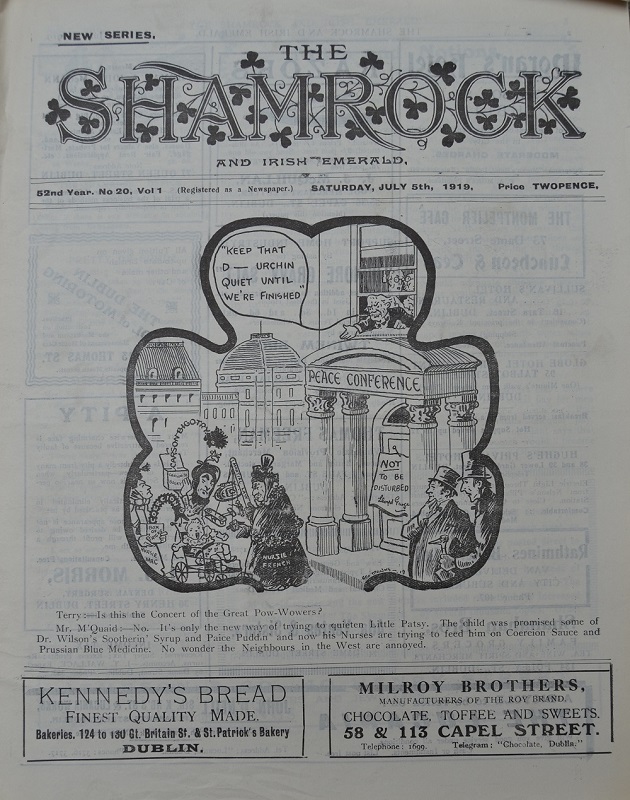
The League was formed in 1920 and though the true government of the Irish nation, the First Dáil,2 applied for membership, its emissaries were not even received. At the Paris Peace Conference, US President Woodrow Wilson did not even reply to the Irish Delegation’s letter.3
Irish nationalist media commentary on the exclusion of Ireland by Lloyd George from the Paris Conference (Image sourced: Internet)
The original permanent members of the League’s Executive Council (it had four non-permanent members too) were Britain, France, Italy and Japan and its languages reflected those of the dominant European and American powers: English and French.
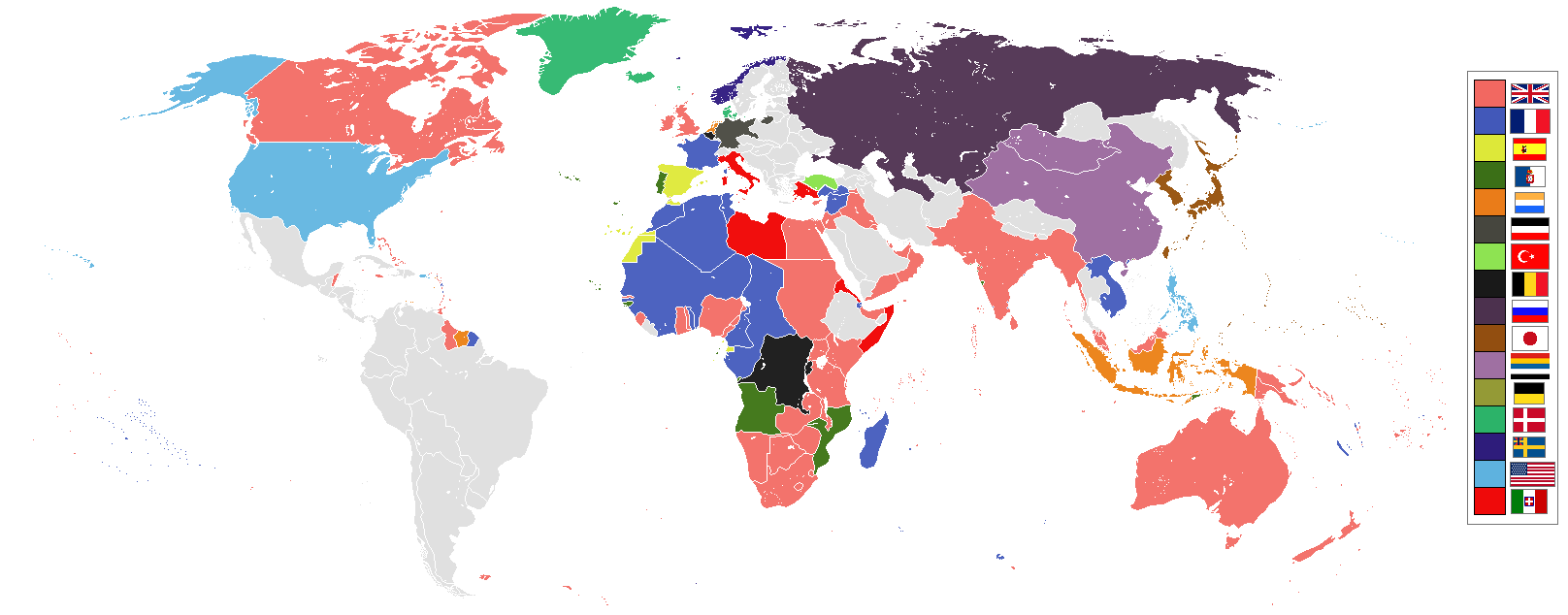
Britain came into the League with its Empire of allegedly independent states: Australia, Canada, India (which incorporated present-day Pakistan and Bangladesh), New Zealand and South Africa.
Map showing empires and colonies in the world in 1920 but there were also areas of influence apart from colonies. (Image sourced: Wikicommons)
PEACE?
Allegedly about peace, the League was formed as a club to discuss the areas of the world owned by the European colonial powers and to create a space where the losers and winners could discuss those lines, over which they had just fought a four-year bloody war.
Henceforth, there would be many, many wars, but mostly of colonial conquest and repression of resistance – but the European powers would not war among themselves, leastways except by finance and diplomacy. Until another 19 years, that is.
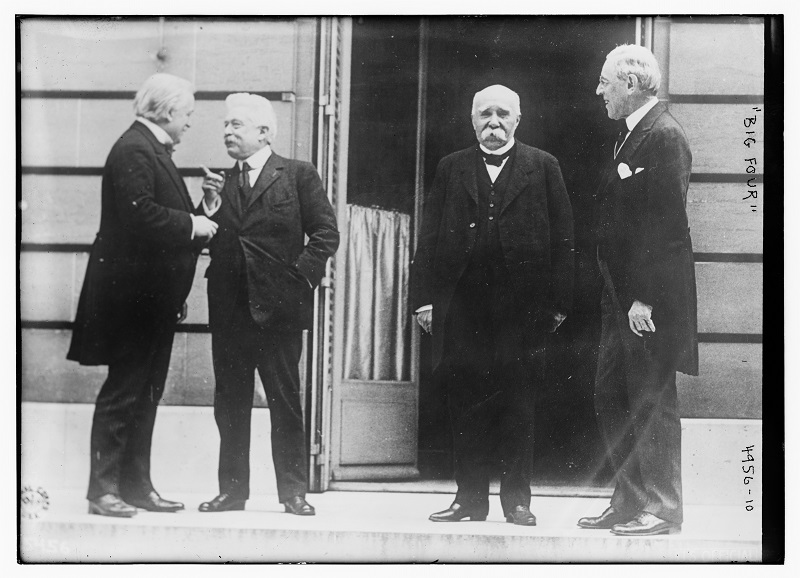
In fact, one of the major causes of WWII was the Treaty of Versailles, containing the crushing and humiliating WWI reparations demanded of Germany by the British and French imperialist powers. That Treaty was incorporated into the terms of the League of Nations.
The Big Four that framed the Treaty of Versailles; L-R: Lloyd George of Britain, Vittorio Emanuele Orlando of Italy, Georges Clemenceau of France, and Woodrow Wilson of the U.S. (Photo sourced: Internet)
Ireland would see short armed liberation struggles in the 1930s, 1940s and of three decades from 1969. Hundreds of armed liberation struggles would break out across the rest of the world, in every continent except Antartica. And yes, including Europe.
The League of Nations was a club, chiefly of European colonial powers in which the conquest and suppression of a huge number of other nations was agreed and ratified. It was followed by the hugely-expanded United Nations after the next World War.
The UN has much the same role and of its 193 members, its only binding decisions are made by five Security Council Permanent Members voting without dissent: USA, UK, France, Russia and China. The vast majority of the other states are clients of one or other of those five.
The Irish state joined that earlier League not as one of the colonial powers but as a defeated nation, a neo-colonial client regime, an experiment in native self-government under external colonial control, one to be adopted by the other imperial powers and replicated across the world.
The Irish state joined the United Nations in December 1955 in exactly the same client relationship to its old masters but over time the yearly tribute has been shared among new part-masters, first the USA and then EU imperialism.
Neither the state’s advent to the League of Nations nor to its successor, the United Nations, has anything whatsoever of which to be proud. An opportunity for Irish real independence and world friendship of nations was squandered.
The new stamp should carry a black border in mourning.
End.
FOOTNOTES
1Words of Mícheál Martin, the Tánaiste (Deputy Prime Minister) of the Irish Government quoted in numerous media reports.
2The First Dáil was founded in January 1919 in defiance of British occupation, based on the results of the UK’s December 1918 General Election results in Ireland which returned 73 MPs of the newly-reconstituted Sinn Féin party out of a total of 101 MPs elected in Ireland. The SF members set about organising an Irish Government and, though declared illegal by the British occupiers shortly afterwards, continued to operate as a government until it split over whether to accept the terms of the British offer in 1921, which led to the Civil War of 1922-1923.
3 Seehttps://www.irishtimes.com/culture/heritage/how-the-plea-for-irish-independence-made-its-way-to-paris-1.3742328. Though interestingly, Wilson did reply to the young Ho Chi Minh’s in respect of Vietnam (Ho Chi Minh, while working in Britain, had commented admiringly on the Irish capacity for resistance at the time of Mac Swiney’s funeral march in London from Brixton Jail to Southwark Cathedral). Most of Indochina at the time was a French colonial possession.
News reaches us that military forces in Gabon, yet another colony (say neo-colony) of French imperialism in West Africa, have carried out a coup, deposed the titular President and put him under house arrest.
Actually, some of the reporting called it “an attempted coup” which seems strange: the military in control of its own bases, national broadcastings stations and with the former leadership under arrest seems a lot more than an “attempt”.
Map of African states and cities (By: GISGeography Last Updated: August 9, 2023). Gabon is located on the west coast (down from Cameroun and up from Angola).
Given recent nationalist military coups in a number of former French colonies, a lot of speculation is taking place as to whether this case is a harbinger of future uprisings against French imperialism and also as to whether the new apparently nationalist administration of Gabon has a future.
CENTURIES OF SCRAMBLE FOR AFRICAN RESOURCES
Throughout the 17th, 18th 19th centuries, European colonial powers scrambled for control of African natural resources, including slaves (and slave-like labour after the abolition of slavery). Vast resources of oil, valuable metals, minerals and gem stones are still being extracted from Africa.
Much of Africa was conquered and occupied by French colonialism1 and in most of those countries French is a ‘national’ language of the state and sometimes the only one so recognised. After “independence” France continued to extract natural resources and labour power from the regions.
Recently2 the military of some of those neo-colonies carried out coups and overthrew their France-aligned rulers, accusing them of being effectively administrators of French neo-colonialism. Niger was the most recent in July 2003, Burkina Faso in January 2022 Mali in August 2020.
There have been others too but those three countries border one another and have also declared an alliance against any invasion, such as that threatened by the pro-imperialist alliance of ECOWAS3 of which the dominant member is Nigeria.
NEO-COLONIALISM
There have been historically more than one method of effectively colonising a country. It may be invaded and resistance crushed, the administration (taxation etc) henceforth being managed directly from the invading country or from a government dependent on the invader.
The system may include large-scale settlement of land (as in Ireland and Algeria) but in any case the cities will include enclaves of invader settlers and administrators, charitable, religious and educational institutions, nearly always teaching a curriculum based on the occupiers’ culture.
Deposed President Ali Bongo Ondima in Residence Libreville 30 September 2023 (Photo cred: BTP Advisors to the President via AP)
There were also ‘protectorates’, such as Palestine for example, under British control and accepted so by other powers, without a direct system of colonial occupation or administration.
Ireland had the colonial-settler-parliament system under the British occupation until 1800 when by bribery and self-interest, the Irish Parliament4 dissolved itself and almost immediately joined the United Kingdom, Irish elected MPs then having to attend parliament in Westminster.
In 1921, that system continued for the British colony of the Six Counties but control of the rest of Ireland was exercised a distance through the governments and State departments of the majority section of the Irish national capitalist class, the Gombeens.5
That system was developed by British imperialism throughout its Empire, piece by piece. The French followed but the ruling classes of Belgium, Holland and Portugal were slower to adapt. After WWII, the USA used the system increasingly in Latin America6, Africa and Asia.
GABON HISTORY
Gabon of course has a long history before Africa was ever occupied and settled by European powers. Africa after all is the cradle of humanity.
Bantu migrants settled the area in the early 14th century. In the late 15th century Portuguese explorers and traders arrived in the area and in the 16th century the coast became a centre of the transatlantic slave trade with European slave traders arriving to the region.
France occupied Gabon in 1885, but did not administer it until 1903. In 1910 Gabon became one of the four territories of French Equatorial Africa. On 15 July 1960 France agreed to Gabon becoming an independent state but the reality was that it became one of France’s neo-colonies.
Unexpectedly perhaps, there was a WWII battle there: in November 1940 Free French forces were sent by De Gaul to take the area from the Vichy-loyal administration there. The Battle of Gabon lasted four days and ended in victory for De Gaulle’s forces.
WHERE TO NOW?
Whether Gabon’s neighbours would invade remains to be seen and the country is separated by over 2,000 km distance from Niger, the nearest one of the three Sahel French colonies in rebellion, a shortest distance that traverses the currently hostile major state of ECOWAS, Nigeria.
Crowds celebrating the army coup in Libreville, capital of Gabon, 30 August 2023 (Photo cred: Al Jazeera)
The three Sahel colonies themselves seem somewhat more secure in so far as they can support one another7 and also in so far as the clients of the Western powers are reluctant to take military action against them, a reluctance already demonstrated by the failure of ECOWAS to invade to date.8
Overall, these developments cannot but have given heart to national liberation forces, including revolutionary ones, across Africa and even beyond. French client regimes will be looking over their shoulder but so too will the client regimes of the British and the USA.
2Not so recent was Algiers, where the people fought a hard and bitter struggle against the colonists and France and declared independence in 1954. Some other countries also declared independence but were subverted or imperial client regimes came to power in them, often also by coup.
4For most of its history since the Reformation, only Anglican MPs had been admitted to this Parliament and for much of that time too, only Anglicans could vote. Progressive national bourgeoisie such as Grattan and Tone had failed to overturn this exclusiveness and it was that which convinced Wolfe Tone and other United Irishmen that a revolution was necessary. They rose unsuccessfully in 1798 and again in 1803.
5Na Gaimbíní, the Irish capitalist class that arose under British occupation to which it was subservient. Some at least of the wealth accumulated by this class was through gaining control of lands abandoned or having to be sold at a loss by their occupants during the Great Hunger of 1845-1849. The name has now passed on to describe the foreign-dependent client capitalist class of the Irish state, first subservient to British colonialism, then to US imperialism and finally to EU imperialism.
6As we recognise USA dominance of Latin America today through invasions, sponsored coups and financial controls, we are likely to be surprised to find that Latin America was largely a British imperialist preserve through much of the 19th Century and up until WWII, when it had to cede much of it to the USA in exchange for war material support.
The leaders of the Nigerien coup of 31st July, breaking the bondage of the country to its neo-colonial French masters, may be applying lessons from French history all the same.
Not from the Liberté, Egalité et Fraternité of the French Revolution of 17891, however.
No, instead they may be remembering the history of the Paris Commune on 18th March 1871, the first city in the world to come under a revolutionary socialist regime.2
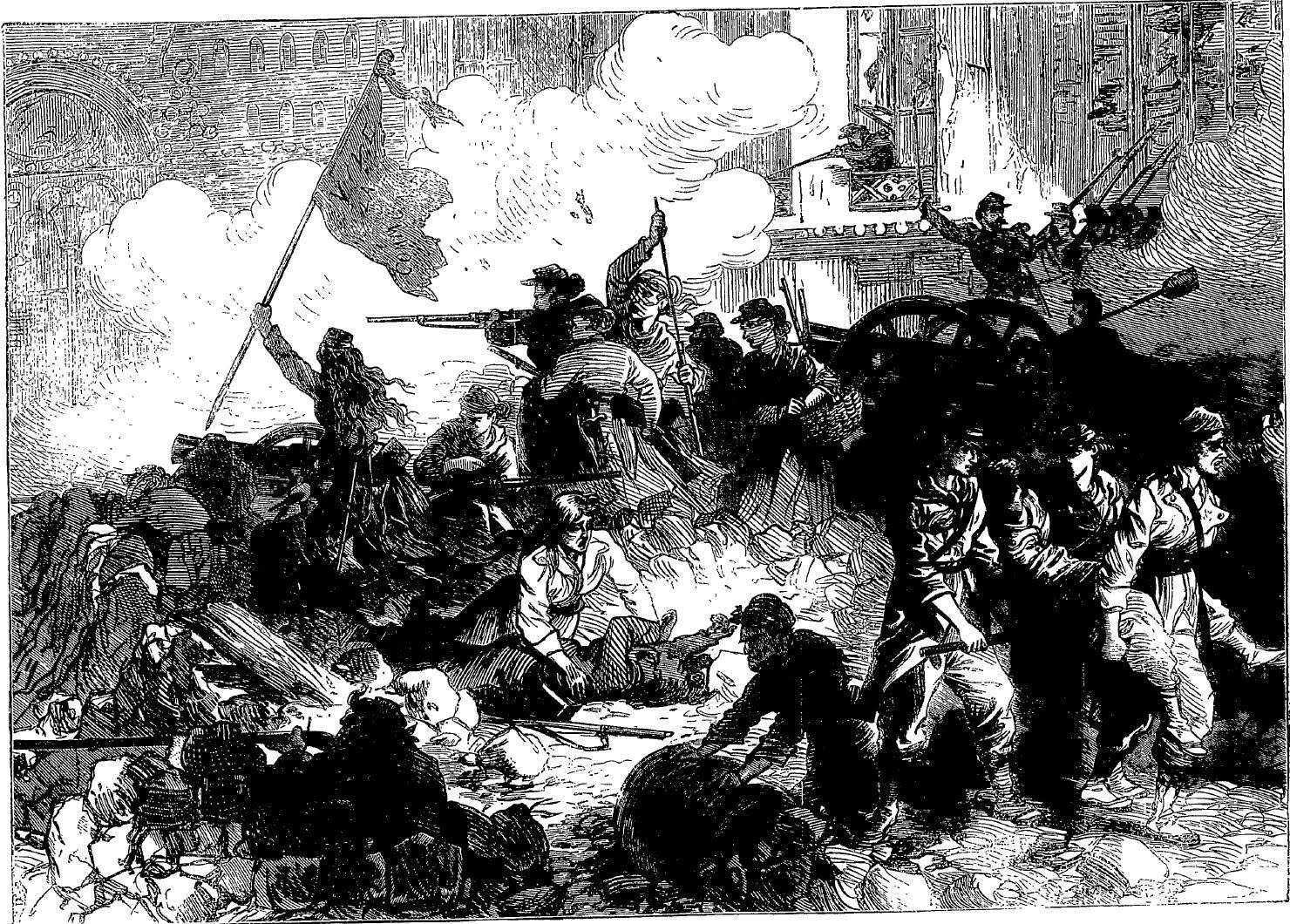
The final battle in defence of the Paris Commune 1871 (Image sourced: Internet)
In the midst of a crisis impelled by the defeat of France by Prussia under Bismark and Paris being under siege, along with crushing armistice terms for France accepted by Chief Executive Adolphe Thiers, Paris was experiencing much social and political unrest.
The authorities under the leadership of Thiers moved to disarm the people by removing canon that had been paid for by popular subscription. Crowds refused to allow this and protests grew into insurrection as soldiers of the National Guard3 joined the demonstrators.
The Communards overthrew the authorities in Paris but failed to prevent many of their enemies leaving the city.
Advised by General Vinoy, Thiers ordered the evacuation to Versailles of all the regular forces in Paris, some 40,000 soldiers, including those in the fortresses around the city; the regrouping of all the army units in Versailles; and the departure of all government ministries from the city.
Thiers set up his government in Versailles where he and his advisors plotted the retaking of Paris and the defeat of the Commune, which showed all the signs of becoming permanent.
However, Thiers lacked sufficient armed forces to fight through the Prussians. In the end he reaffirmed their crushing armistice terms in defeat and begged the Prussians to allow his armed forces (partly composed of released POWs) through the Prussian encirclement to attack Paris.
Bismark agreed and the French troops under Marshall Mahon4 (who had himself escaped from Paris) were given safe conduct towards Paris and through the besieging Prussians so that they could attack the city.
After fierce fighting but often under inefficient military leadership, the Commune was defeated by French troops on 28th May 1871, with wounded defenders bayoneted and prisoners executed en masse or, in the cases of some leaders, tried and executed or exiled.5
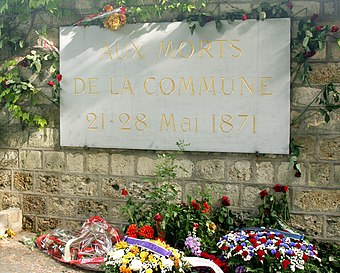
Plaque in Paris at the scene of many of the French executions of Communards (Image sourced: Internet)
NIGER TODAY
The Niger coup leaders today are holding the former elected President, Mohamed Bazoum, the neo-colonial puppet of the French, along with his family, under house arrest. Western leaders call for their release, which no doubt seems humanitarian, but the coup leaders refuse.
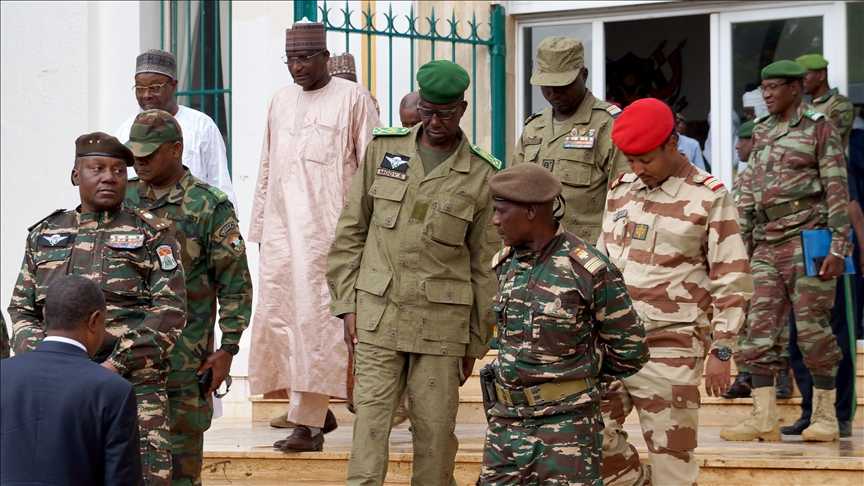
Nigerian military including coup leaders and civilian administrators (Photo sourced: Internet)
Certainly the coup leaders are treating their captives better than have been many leaders of former regimes overthrown by coup or invasion.
General Franco’s regime tortured and murdered around 200,000 civilians in his military-fascist coup 1936-1939, most of them after the war in Spain.
Nationalist elected President Patrice Lumumba of the Congo was murdered in 1961 by the Belgian-USA puppet Moise Tshombe’s forces.
When South Vietnam’s USA-friendly President Ngô Đình Diệm began to show tendencies towards independence in 1963, he was murdered in a coup by General Dương Văn Minh with CIA collusion. Salvador Allende was murdered in the 1976 CIA-masterminded coup in Chile.
National leader of Iraq Saddam Hussein6 (2006) and Muammar Ghadaffi of Libya (2011) were murdered by internal but USA-allied forces.
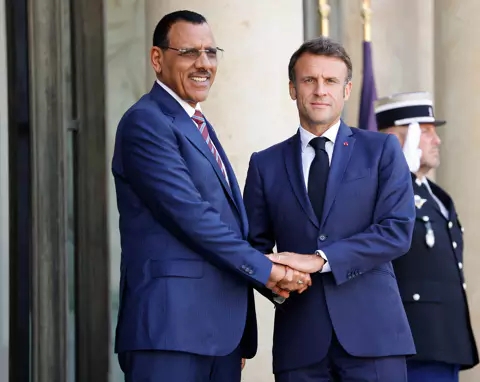
MohamedBazoum, deposed President of Niger and Emmanuel Macron, President of France, photographed in happier days for them both (Photo cred: Ludovic MARIN / AFP)
Mohamed Bazoum is alive and under house arrest with his wife and son, reportedly with canned food but without electricity and running water, though he is permitted regular contact with the West and recently met with the premier of Chad on 31st July.
Although Niger is a land extremely rich in natural resources including oil, gold and uranium being exploited by foreign companies, 80% of the population ruled under Bazoum’s presidency have never had electrity or domestic running water.
Despite demands from the Western powers, the coup leaders, perhaps remembering the history of the Paris Commune, refuse free Mohamed Bazoum, perhaps to act as a figurehead to lead a western-supported army back to ‘liberate’ Niger and to ‘restore democracy’.
End.
FOOTNOTES
1 These principles were of course not applied to France’s colonies, as the sad history of Haiti demonstrates. The African slaves there took the principles seriously but Napoleon waged war upon them and eventually, through the treachery of captains of Toussaint L’Ouverture, leader of the successful slave insurrection, delivered L’Ouverture and his family to end their days in French dungeons. Haiti was returned to French rule, where it remained until eventually overthrown again but under French neo-colonial, later USA neo-colonial dominion where it remains today.
prohibition of fines imposed by employers on their workmen.
3 The National Guard had defended Paris while the French Army was in the field and became the army of the Commune.
4 Patrice de Mac Mahon, of part of the Mac Mathúna/ Mac Mahon clan from Ireland emigrated to and settled in France (14 members of the family served in the army).
5 The national forces killed in battle or quickly executed between 10,000 and 15,000 Communards, though one unconfirmed estimate from 1876 put the toll as high as 20,000. Fifteen thousand were tried, 13,500 of whom were found guilty. Ninety-five were sentenced to death, 251 to forced labor, and 1,169 to deportation (Wikipedia).
6 Saddam Hussein at least had a trial and the question is not whether, if one agrees with a death penalty, he deserved to die but that it was the ‘justice of the victor’, in this case that being the USA, certainly guilty of many more murders and tortures than was Hussein. Ghadaffi was murdered most painfuly without any trial by his captors.
Diarmuid Breatnach (Reading time main text: 11 mins.)
LANGUAGE IS A TREASURE CHEST – 2
I observed in Language Is a Treasure Chest 1 that while language is full of wonders, it has some horrors in it too. And I found that to be true again.
I was reading a novel in which the word “Cimarron” appeared and, doing some quick research on the word, I came across a 2004 query in an email website or page called Word Wizard:
What is the etymology of the word cimarron? I’ve always been told that it means “runaway slave” in Mexican Spanish. Can anyone verify this?
The reply is dated the same day:
From Greek. It refers to people who live in perpetual mist and darkness, akin to the ‘land of the dead’. Latin ‘Cimmerius’, Greek ‘Kimmerios’, Assyrian ‘Gimirri’ even the bible ‘Gomer’ Gen.10:2 and Esk. 38:6.
In Western United States it refers to a stretch of land that gets rainfall when other near by areas are desert year round.
Apart from the topographical reference, I thought the expert’s explanation highly dubious. And in fact I happen to know something about the Spanish-language origins of the word.
The searcher replied:
Thanks, Jim. I just wonder what connection this word has to Hispanics of Mexican origin because it shows up in their surnames (although not as common as Lopez or Vargas or Garcia).
Is it just Mexican in origin or did that also come from Spain? So the “runaway slave” theory has no foundation then?
The expert’s reply did come back with a Spanish-language connection and he may be on to something with the topography, though I think he has it the wrong way around (as we shall see).
The “runaway slave” theory is not so obsolete. Mexico did not have slaves (outlawed in 1810) but American slaves who fled to Mexico had to pass through lands with water, or else parish (sic).
When relating their tales of woe to the locals the word ‘cimmaron’ arose to describe their flight through the South West desert.
Very curiously, there was no further contribution to the discussion. I tried to leave one of my own but was required to register, which I did (though wondering if worth the trouble) and never received confirmation1.
“A view of the Cimarron National Grassland, the largest piece of public land in Kansas, a 108,175-acre property in the southwestern part of the state. It was recovered from the Dustbowl ecological devastation by soil recovery and management practices.” (Photo source: The Armchair Explorer – Kansas)
THE FOLK MEMORY WAS TRUE
Continuing with a little light online research I found that the Castilian-language (Spanish) origin is the explanation most often given, with rarely a reference to Greek or other classical or archaic languages. For example, in yourdictionary.com:
American Spanish cimarrón, wild, unruly (from Old Spanish cimarra, thicket): probably origin, originally referring to the wild sheep (bighorn) found along its banks.
(Latin America, of animals) feral (having returned to the wild)
Synonyms: alzado, bagual, feral
(Latin America, of people) rural; campestral
(Latin America, of plants) of a wild cultivar.
But …. what about the “runaway slaves”? Under the title Cimarron People, Wikipedia has this to say: The Cimarrons in Panama were enslaved Africans who had escaped from their Spanish masters and lived together as outlaws.
In the 1570s, they allied with Francis Drake of England to defeat the Spanish conquest.
In Sir Francis Drake Revived (1572), Drake describes the Cimarrons as “a black people which about eighty years past fled from the Spaniards their masters, by reason of their cruelty, and are since grown to a nation, under two kings of their own.
The one inhabiteth to the west, the other to the east of the way from Nombre de Dios”. (location in Panama — DB)
We may indulge ourselves in a sardonic smile at commissioned pirate Francis Drake talking about the cruelty of others, or about slave-owning by a country other than England in 1570.
But we remember also that at the time Spain was the main competitor with England in the rush to plunder the Americas – and had got there well before them.2 Both colonial powers were already plundering Africa for raw materials and slaves.
The meanings of animals having gone “feral” or “returned to the wild” would easily have been applied by the society of the time to escaped African slaves.
A European society which, despite evidence to the contrary including agriculture in Africa, would have considered indigenous inhabitants of Africa as people living in the “wild”. Once escaped and no longer under European control, they would be seen as “returning to the wild”.
So what happened to the Cimarron People? Their settlements were subject to punitive raids by the Spanish, killing people and burning crops, so that in the end they came to a treaty with their old enemy.
The Wikipedia entry says no more except that the “Cimarrons” and the English quarrelled (not surprising, given that they were of no further use to the latter).
I believe some of their settlements in Florida were raided and burned by US “pioneers” and soldiers, the remainder becoming part of the Seminoles, a native American tribe that resisted the USA in the longest and most costly of the USA’s wars against the indigenous people.
The Seminole had many tribe members of part-African origin in their midst.
And here – a surprise: The word “Seminole” is derived from the Muscogee word simanó-li, which may itself be derived from the Spanish word cimarrón, meaning “runaway” or “wild one”!
So, in line with what that on-line searcher back in 2004 had heard, no doubt a folk belief, the word cimarronis, in Mexico (and in the USA), of Castillian (Spanish) language origin and is connected to escaped slaves of African origin.
Some of the sources for “cimarron” also give us “marron” or “marrón” which is also related to escaped slaves and, in English, became “Maroons”. These were escaped slaves inhabiting mountainous regions of Jamaica and elsewhere and became a great problem to English settlers.
The latter had taken the island from the Spanish but they failed totally to quell the Maroons, these emerging victorious in many military engagements.
In the Cockpits area of Jamaica, I have read, there is a place called Nanny Town, which is believed to be one of the settlements of the Maroons; their chief was said to be a woman called “Granny Nanny”3, whether because of her former slave occupation or for other reason4.
In the end, like the Spanish with the Cimarron People, the English had to treat with them. Sadly the treaty required the Maroons to return newly-escaped slaves, which they did and for which they received payment.
Maroons in treaty with the British, shown here in a reversal of the actual power relations in the “Pacification with Maroons on the Island of Jamaica”, by Agostino Runias (1728-96). (Source image: Internet)
However if instead of being a voluntary escapee to go to a wild place, you were forced by people or circumstance, well then, like Alexander Selkirk’s “Crusoe”, you’d be “marooned”!
Well then, what about the “cimarron strips” in the southwest of the USA? Could the word refer to strips of land “gone wild”? Or could the expert replying to the question in 2004 have been on to something?
If the slaves escaping through the desert from the USA to Mexico did indeed make their way through strips of watered land (not just for the water, as the expert speculates but for vegetation to conceal them), then there is a connection between escaped slaves and these strips of land.
But not as the expert sees it, rather the other way around: since the escaped slaves, the “cimarrones” were travelling the strips, they would be called by those who knew about it (escapee hunters, escapee helpers and just observers), “cimarron strips”.
Or in other words, “those strips through which the runaway slaves travel.”
2. CHRISTIAN ETHNIC PREJUDICE
However, if the word comes from Castilian (Spanish) what were the origins of the word in that language?
Perhaps a year before this word-quest, I was reading a book that described the Spanish State as having been characterised, contrary to many other European states, by mass expulsions and exiles on a number of occasions throughout its history5.
First on the list of expulsions was the well-known example of the Moors and the Jews.
Those who were not slaughtered by the forces of the “Christian Monarchs” of Ferdinand and Isabella in the “reconquest” were obliged to convert to Christianity or to leave “with only the clothes on their backs”. This also occurred in Portugal.
Those Jews who left were the Sephardim or Sephardic Jews, who spoke Ladino, an archaic kind of Iberian Romance6 language with Aramaic and Hebrew words, along with the Moors, who spoke an Iberian-Arabic mixture or Arabic.
The key of their houses or gates have been handed down to this day in families of both groups.7
Many converted, often referred to by Christians as “conversos” (Jews) or “moriscos” (Muslims) but were constantly under suspicion of reverting to their old religion even with the threat and constant trials and torture of the Spanish Inquisition.
According to what I have read the latter too were sometimes called “marronos”, i.e in the eyes of the Spanish Christian ruling class, those who had been “domesticated” (Christianised) but had “returned to the their wild way” (Moslem), i.e “gone feral”.
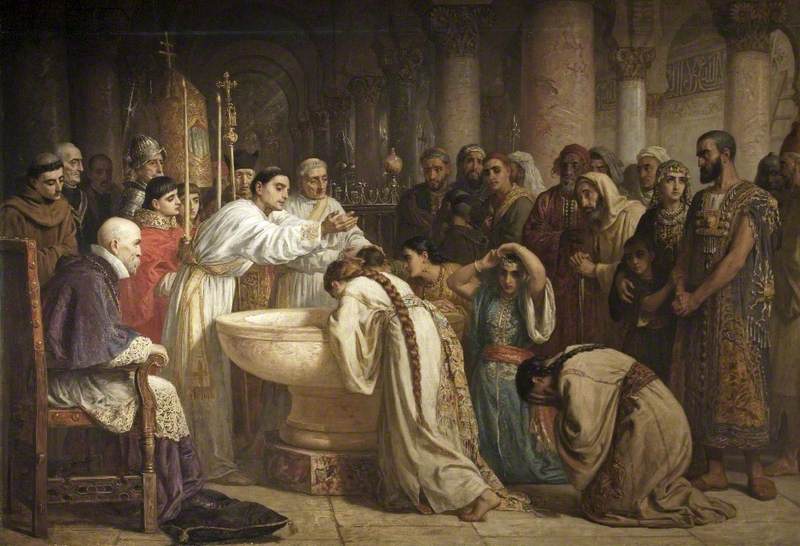
Forcedconversionsthat had to appear genuine: “The Moorish Proselytes of Archbishop Ximenes”, Granada, 1500 by Edwin Long (1829–1891). (Image source: Internet)
Wikipedia on Marrones in Iberia confirms: The (Spanish) Inquisition was aimed mostly at Jews and Muslims who had overtly converted to Christianity but were thought to be practicing their faiths secretly. They were respectively called marranos and moriscos.
However, in 1567 King Phillip II directed Moriscos to give up their Arabic names and traditional dress, and prohibited the use of Arabic. In reaction, there was a Morisco uprising in the Alpujarras from 1568 to 1571. In the years from 1609 to 1614, the government expelled Moriscos.
3. THE BUSH FROM THE NUT?
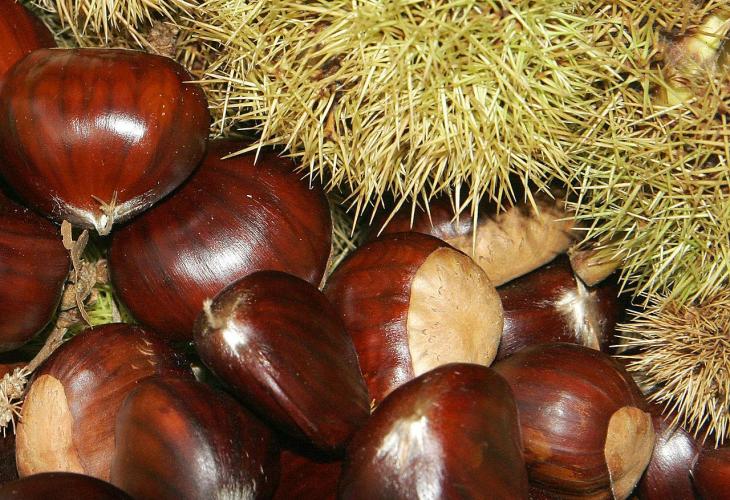
And is “ci” or “cy” in “cimarron” then merely a prefix? The word “marrón” exists as a colour in Castilian and a number of Romance languages and came into English as the colour “maroon”.
Its development is taken as originating from the colour of the large ripe edible chestnut, rather than given to it later. Of course there are a number of words for colours or tints which have a botanical origin, “orange” being an obvious one.
Castanea Silva, the edible or Sweet Chestnut in Mallora. (Image source: Internet)
Alright, then the nut and tree might have been associated with uncultivated or “wild” areas, similar to those to which the “cimarrons” would escape.
But where did the “ci” suffix come from? Somewhere in the midst of what I have been researching I came across an explanation, derived from Latin, meaning “towering”, “high” etc. But can I find it now? No.
The online sources are telling me that the relevant pages are up for deletion and I can join the discussion. No thanks, I do not have anything like sufficient knowledge to enter a debate on that, nor the patience of an academic to research it thoroughly.
But “high” and “wild” could easily correspond, given that valleys and plains lend themselves more easily to cultivation, as a rule, than mountainy areas, which might remain wooded or with with thick undergrowth.
And that might also give us the “bush” or “thicket” referred to in a number of references for “cimarron”, which in turn might describe the “cimarron strips”. In parts of Latin America such as Chile (and for all I know, in all of them), a “cimarra” is also a thicket or densely-grown area.
The article in the Language Journal (see reference) comments that the “arra” cannot be a Romance language word-ending.
But even if true it seems to me that the author (or authors) quoted might be unaware that among those from Iberia who colonised or settled in the Americas, Romance language speakers were not alone. There were also Basques who spoke Euskera/ Euskara.
And for evidence, they applied a number of toponyms and left family names from the Basque Country (Basque descendants make up to 10% of the population of some Latin American countries). And “-arra” would be a common enough suffix or word-ending in Euskera.8
Opening title for the weekly TV Western series ‘Cimarron Strip’, starring Stuart Whitman, Judy Gleeson, Percy Herbert and Randy Boone. Though popular, only a years’ worth of episodes were screened. (Image source: Internet)
OKLAHOMA PANHANDLE AND THE CIMARRON STRIP
In the 19th Century wars between the Mexican Republic, the USA and the Native Americans in the area, the area was carved up with less and less left to the Native Americans.
Prior to the American Civil War, white Texas wanted to join the Union as a slave state and due to a US federal law prohibiting slavery north of 36°30′ parallel north, white Texas surrendered a strip of land north of that latitude.
The settlement (temporary of course), left a strip as “Neutral Territory” (one can only imagine the temptation for African slaves in Texas to make for there). After the Civil War big cattle ranchers moved in, disregarding treaties and named the area the Cimarron Strip.
Map of Oklahoma territory and “Neutral Strip” before the American Civil War. (Image source: Wikipedia, Texas Panhandle)
But that was because the word ‘Cimarron’ was already in the area, from the “Cimarron Cutoff” leading to a crossing of the ‘Cimarron’ river.
And yes, there was a popular 1967-1968 TV series called “Cimarron Strip”, starring Stuart Whitman. But, though I have watched it, that is only faintly related to the story of the word that set me out on this quest.
End.
FOOTNOTES
1Which days later had still not arrived – perhaps the site is no longer in operation, which would explain the silence after those two posters.
2Columbus voyage to America 1641 and Spain’s first colonial settlement 1565 (now Florida); Mayflower expedition to America with English settlers 1587 (now Virginia). However, Europeans had founded settlements much earlier, as with the Norse in the 10th Century and very likely Irish monks in the 6th Century. But it was the English and Spanish who conquered most, the Dutch, French and Portuguese less. The descendants of the English settlers after gaining independence from England completed the seizure and colonisation of most of the North American continent, while English colonists remaining loyal to the English Crown seized land to form what is now Canada.
4All the folk tradition, albeit conflicting on some points, declares that she had not been a slave which leaves one to wonder how she might have reached Jamaica from Africa without having been enslaved.
5I borrowed the book from the public library and cannot remember its title at the moment. Interestingly it mentioned Ireland as having the only comparable history (though of course there the ‘expulsions’ were due to colonial occupation rather than actions of the indigenous state.
6“Romance languages” is a name given to the group of Indo-European languages including Castilian (Spanish), Catalan, Galician, Portuguese, Romanian, Italian and French. They are sometimes called “Latin-based” or “Latin Languages” but there is some dispute about the origins and developments of these languages.
7Ironically, the door or gate “key” is also a symbol of return for Palestinian refugees driven from their homes by Zionist massacres, threats and fear during the founding of the State of Israel.
8Among toponyms of North America’s southwest, Durango (Colorado and Mexico), Navarro and Zavala Counties (Texas) are perhaps the best known; while Aguirre, Arana, Bolívar (Bolibar), Cortazar (Kortazar), Duhalde, Echevarria (Etxebarria), García, Guevara (Gebarra), Ibarra, Larrazábal, Mendiata, Muzika, Ortiz, Salazar, Ugarte, Urribe and Zabala are but some among a host of family names of Basque origin from the American south-west in Latin America. And of course the country of Bolivia, from Simon Bolívar, a Basque surname from a Basque toponym.
Excerpt on-line from Language journal, Linguistic Society of America, Leo Spitzer, Vol. 14, No. 2 (Apr. – Jun., 1938), pp. 145-147: https://www.jstor.org/stable/408879?seq=1
A heart-breaking story with courage and a heart-warming ending.
Report by Luciana Bertoia from Pagina 12 published through arrangement with Publico.es Translation by D.Breatnach
The last time Julio Santucho saw his wife, Cristina Navajas, was on June 14, 1976. Appointed as head of international policy for the Revolutionary Workers’ Party (Partido Revolucionario de los Trabajadores), he had to leave Argentina for six months.
They had been married for almost five years then and had two children: Camilo, three years old, and Miguel, who had not yet turned one. The three accompanied him to the Retiro terminal, where he took a bus to Sao Paulo and then arrived in Rome.
In the terminal, Cristina had Miguel in her arms and Camilo by the hand. When saying goodbye to him, she insisted on a promise:
– I only ask you one thing. If something happens to me, you have to take the boys with you. They shouldn’t stay with your mom, with my mom, or with other comrades. They have to stay with you.
– But, Cris, we’ve been living in hiding for a long time, and nothing has ever happened to us.
“Now it’s different,” she cut him off.
One day before a month had passed since Julio’s departure, Cristina was kidnapped by the Dictatorship. She was in the apartment at 735 Warnes Avenue, where her sister-in-law Manuela Santucho lived.
Another comrade from the PRT-ERP, Alicia D’Ambra, also lived with them. All three were kidnapped that day. The oppressors left Cristina’s two sons, Camilo and Miguel, and Manuela’s son, Diego, in the apartment.
Cristina managed to ask a neighbour to call her mother, Nélida Navajas. When the phone rang, Nélida had to ask where the boys were. For security reasons, she did not know their address.
When she arrived, she heard the screams of the two youngest, Miguel and Diego, from the street. Camilo was asleep.
Nélida found her daughter’s bag on the ground. Inside was a series of letters that she had written to Julio, waiting to receive an address to to which to send them. She had started writing the last one on Saturday, July 10, but had finished it the next day:
“Miguel is much better, he hardly coughs anymore, but he is more of a bandit and wilder every day. Cami is calmer and doesn’t give me work, the only thing is that he is getting clingy to me. He asked again which house we are going to, which house is this, etc.
Now the one who is not well is me, I do not know if I am pregnant,” she told her husband.
Julio found out about the kidnappings the next day, when he called to greet his brother-in-law on his birthday.
Refugee from Argentinian Dictatorship accompanied by a son as he attends a press conference about his reunion with another son, abducted by the regime, 43 years ago. (Photo: Enrique Garcia Medina/ EFE)
That day he spoke ten times with his mother-in-law. He would not hesitate to return to Buenos Aires to collect his children, but the PRT sent two comrades who, pretending to be a couple , took the children out and abroad to their father.
Forty-six years later, Julio managed to meet his third child, the baby that Cristina had while she was kidnapped in the Pozo de Banfield, after having gone through Coordinación Federal and Orletti Automotive (places of detention of the fascist regime – Trans.).
He is the 133rd grandchild found by the Grandmothers of the Plaza de Mayo (group of women who began the campaign to trace those made missing by the fascist regime – Trans.)
In an interview with Página 12, Julio Santucho relates how he was reunited with his youngest son, now a 47-year-old adult.
How was the search?
The main heroine in this story is Cristina, who for eight or nine months was pregnant in the most inhumane conditions: mistreatment, torture, bad food. She put up with all of this with willpower and finally gave birth to our son.
My son began to question his (new family – Trans.) relationship based on references from those close to the family. A sister who lived with him for 20 years told him “these are not your parents.”
From the way he was treated by the appropriator who raised him, he came to realise that he was not his father.
In 2019, he began to search, although stopped during the pandemic and then resumed. He had a birth certificate from another province. Finally this year he managed to have his DNA tested.
We searched but we had no approximation or probability of discovering my son. It was an exceptional case: he was born in the Pozo de Banfield, but police doctor Jorge Bergés did not sign the certificate. He surprised us.
What is it like to meet a son who is 46 years old?
It is good. The bad thing is that they took 46 years from us. It is a victory for the human rights organizations that have fought for this and it is a defeat for the dictatorship. They wanted to steal my son but I, later than ever, got him back.
My mother-in-law, Nélida Navajas, joined the Abuelas (Grandmothers’ group – Trans.) to look for her grandson. Abuelas is an irreplaceable institution, it is an enormous benefit to society because it is precisely the place where people who have doubts can recover their identity.
In July 1976, you lost much of your family and now, another July but 47 years later, you have your son back.
You strike a chord. On July 13, Cristina, Manuela and Alicia were kidnapped. She was a comrade that I also knew because she worked in the party schools.
On the 19th, six days later, they killed my brother “Roby” (Mario Roberto Santucho, leader of the PRT-ERP), and later my brother Carlos.
It was a tragic week for the family. We are not better-off than others. All the 30,000 disappeared were brave, generous and devoted themselves to a fight for the well-being of society and humanity.
What could he know about Cristina during her captivity?
There are testimonies like that of Adriana Calvo. The Santuchos were visited by all the mothers that were in the Pozo de Banfield. Adriana asked to spend a day with them.
She had her baby in her arms and so as not to worry her Cristina did not tell her that she had had a child and that it had been taken from her.
Adriana, afterwards, spoke at the trial of Cristina’s tremendous generosity in not telling her anything so she wouldn’t worry about her because they could take the baby away from her. Do you realise how far thinking about the welfare of others went?
They were screwed. But they told her: “We are Santucho, we don’t have any possibility of leaving, but they are going to release you.”
And then there is that scene that Adriana recounts: when the officers arrived, all the women made a human wall – led by Manuela, Cristina and Alicia – and the men had to leave without being able to take their baby from her.
They were in a concentration camp. They knew they could shoot them all at that moment.
And now how is the reunion going?
Some ask me about the appropriator of my son, all I say is that I hope that Justice intervenes. For now, this is all like walking on clouds. We talk to my son every day, we see each other often. Now we have the commitment to make a video call to my granddaughters. Let’s go little by little.
Joy is infinite. Besides, we have time. I am 78 years old. My father died at 89. I have a brother in Santiago del Estero who is 101, another who is 96. If they don’t kill us Santucho, we live a long time. So I look forward to enjoying my son for a few more years.
End.
ADDITIONAL NOTESby D. Breatnach
The Argentinian dictatorship lasted from 1976 to 1983 and apart from banning dissenting newspapers and organisations, detained, tortured and killed thousands.
But not only that, very young children and babies were abducted and given to couples who supported the regime to raise as their own. This was also done by other dictatorships, including the Spanish Franco regime of four decades.
In a time when a week-old military coup in Niger is threatened with invasion by France and by some western-allied African states, it is well to remember how other military dictatorships have been viewed by western states.
The lack of democratic elections and opposition parties did not matter to the western states who in fact fully supported the Argentinian and many other coups and dictatorships.
The military dictatorship of Argentina only became a problem to the UK’s ruling class when Argentina’s military invaded the British colony of the Malvinas/ Falkland Islands in 1982, the same year that the USA stopped supporting the junta for the first time.
Original Breaking News article: DAVID YOUNG, PA (with commentary in italics by Diarmuid Breatnach)
The rededication of a memorial to the National Army soldiers killed in the Civil War enables their memory to be rehabilitated, a ceremony in Dublin has heard.
Defence Forces Chief of Staff Lieutenant General Sean Clancy paid tribute to the some 810 soldiers killed serving on the Free State side in the 1922-2023 conflict as he addressed the event at Glasnevin Cemetery on Sunday.
Descendants of some of those who died, representative of all four provinces, were invited guests at the ceremony, among them relatives of Michael Collins, the commander in chief of the National Army who under direction by Churchill, gave the orders that began the Irish Civil War and who was killed in 1922.
Taoiseach Leo Varadkar and Tánaiste Micheál Martin, the leaders of Fine Gael and Fianna Fáil, the two main parties forged from the divisions of the Civil War, also attended the rededication of the National Army Monument.
Sinn Féin TD Matt Carthy also attended the military commemoration, as did Dublin Lord Mayor Daithí de Róiste.
This neatly brought together political parties of the neo-colonial and neo-liberal Irish State with opposing histories: Varadkar to represent the pro-British and fascist neo-colonial origins of Fine Gael; Mícheál Martin and De Róiste representing Fianna Fáil, the allegedly Republican but in reality Irish Gombeen split from the previous iteration of Sinn Féin; Carthy for the current neo-colonial, neo-liberal and colonial servant Sinn Féin.
Taoiseach Varadkar (Fine Gael) and Tánaiste Martin (Fianna Fáil) unveiling monument to soldiers of the ‘Free State’ killed in the Civil War 1922-1923. (Photo cred: Brian Lawless/ PA)Matt Carthy TD, who represented his party Sinn Féin at the unveiling and dedication of the monument to soldiers of the Free State killed in the Civil War 1922-1923. (Photo sourced: Internet)
Prior to the ceremony, there was no monument in the country specifically dedicated to the soldiers of the National Army who fought against the anti-Treaty side in the Civil War.
Weeks after the war ended, on August 3rd, 1923, the Oireachtas passed legislation that led to the creation of the modern-day Defence Forces, Óglaigh na hÉireann. That is, the defence forces of the neo-colonial ruling class who created the Irish state.
The rededication event for the forgotten fallen of the National Army, which had already robbed the Irish language version name of the IRA, adopted the name Óglaigh na hÉireann during the Civil War, took place on the Sunday prior to the centenary of that date.
“It is appropriate then, in the spirit of real inclusiveness, of ethical remembering, and with a full desire to deal with some of the more uncomfortable aspects of our shared history, that we remember some of 810 uniformed members of Óglaigh na hÉireann who gave their lives in the service of the State during the tragic and critical period at the foundation of our democracy,” Lt Gen Clancy told the ceremony.
It is necessary, in order to bury any idea of achieving the Republic declared at the start of the 1916 Rising, that we honour some of the 810 men we recruited to bury that Republic in 1922, kitted out in uniforms, armed and transported by our ancient enemy. We wish to pass over quickly over not only the kidnappings, torture, murders, killing of disarmed prisoners and even sexual assaults by this fine body of men – the precursors to the current army of the Irish State – but also their terrorising of major part of the country with raids on homes and internment of men and women. Although this fine body of men were fighting to establish a neo-colony not even covering the whole of Ireland, we make no apology for calling them what they clearly were not, Óglaigh na hÉireann, i.e “Warriors of Ireland”.
The monument in Glasnevin to soldiers of the Free State killed during the Civil War – apart from the Free State Army having appropriated the name in Irish of the IRA, the legend claims they “died for their country”, a clearly inaccurate statement since at best they were fighting for the government and state of the 26 Counties, which excludes the UK colony of the Six Counties (‘Northern Ireland’ sic). (Photo cred: PA)
“For far too long there has been no memorial of any kind, nor any complete listing of the National Army war dead.” Understandably.
“Indeed, this year represents perhaps the last real opportunity to rectify that.”
As we prepare to commit this armed force to NATO at some point in the future and to PESCO in the nearer future, it is important to take a further step in legitimising this armed force of the neo-colonial state.
The remains of some 180 of the 810 soldiers who died serving in the National Army are buried at the plot in Glasnevin Cemetery. Uncomfortably close to graves of many of their victims.
“Sources at the archives show that the average soldier buried here was in his early 20s, was unmarried and from a working-class background,” said Lt Gen Clancy. In other words, the typical recruitment profile of lower-rank soldiers in capitalist and imperialist armies.
“Many had previously served in the IRA during the War of Independence, some even in the 1916 rising, many others had served in the British Army, underlying yet again how complex is the weave of Irish history.”
Actually, “many” is a questionable though vague estimate of the numbers who had “served in the IRA during the War of Independence”, though some had, including some of the most vicious, such as Major-General Paddy Daly, torturer and murderer.
The chief of staff highlighted the “poignant example” of two young Belfast-born Dublin-raised brothers – Frederick (18) and Gerald McKenna (16) – who were buried in Glasnevin after being killed together in action in Cork in August 1922 only a month after joining the National Army.
Aye, two men born in Belfast, a city which the Free State was fighting to ensure remained a direct colony of the United Kingdom.
“Whatever the often very legitimate reasons our forebears may have had for forgetting in the intervening 100 years, I think it’s appropriate now that I as the 32nd Chief of Staff of Oglaigh na h Eireann should finally take this opportunity to rehabilitate their memory,” said Lt Gen Clancy.
Especially as I try to establish a legitimate background to the armed force of an illegitimate State preparing to enter foreign imperialist wars and suppression of legitimate uprisings.
After all, we have great experience in all that, as the history behind this monument shows.