CONSPIRACIES AND CONVERGENCE OF INTERESTS

(Reading time: 10 mins)

Diarmuid Breatnach

Conspiracy theorists get laughed at which, since some of the theories are indeed laughable, seems fair enough. Conspiracy deniers, on the other hand, get an easy time of it, which is a pity – because there are conspiracies going on. All of the time.

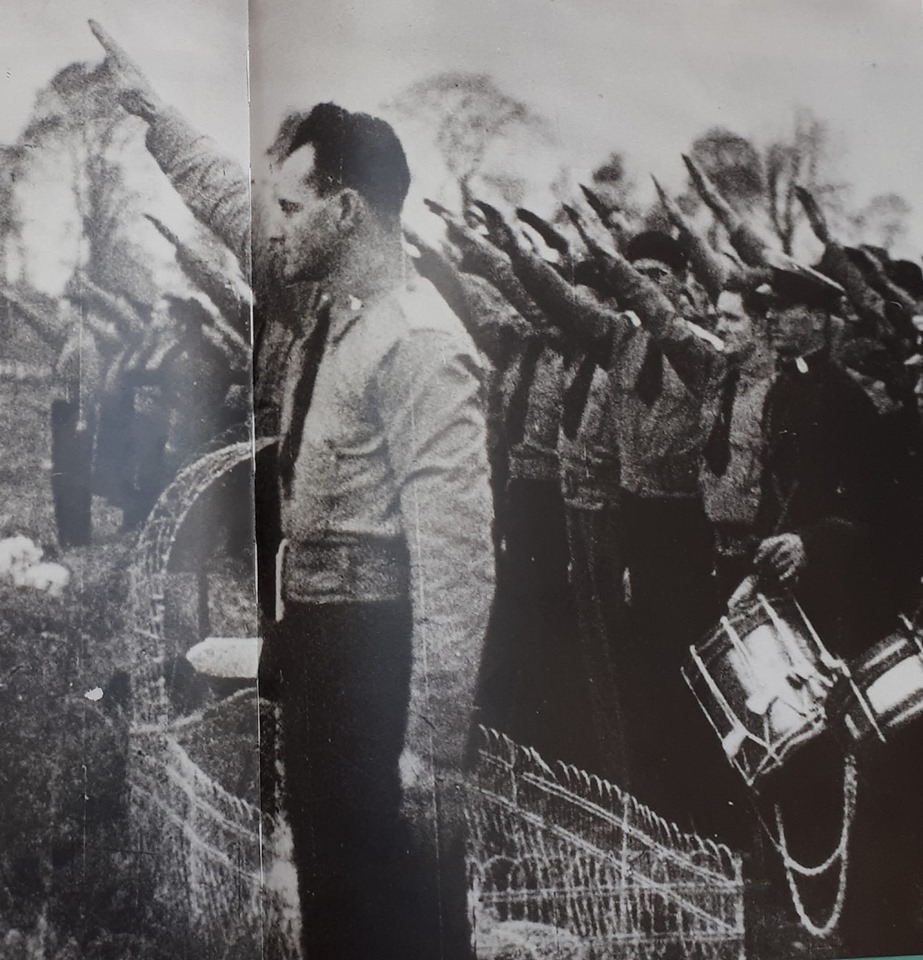
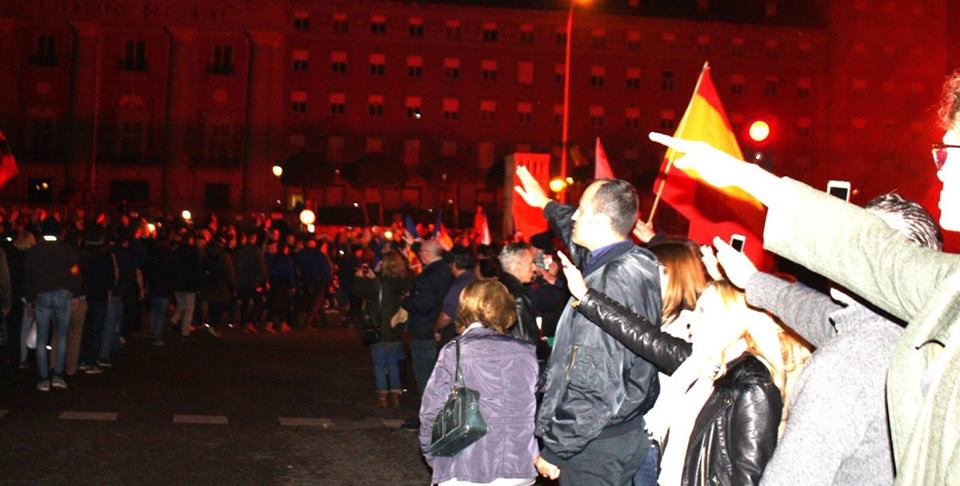
People wearing reptile masks — one of the more laughable conspiracy theories but believed by many in the US is that they are being ruled by lizard people.
(Image source: Internet)

Then there’s simple convergence of interests, which give rise to conspiracies but can also operate independently.

A current example of convergence of interests: The EU and all its constituent governments decide that the struggle between Catalonia and the Spanish State is an internal matter for the Spanish ruling class and can they please sort it out without dragging most of Europe into the mess? In fact, if they don’t sort it out, it endangers a number of key players in the EU and, inevitably, the EU itself.

As the current President of the EU Commission, Jean-Claude Junker reminded everyone on the question of Catalonian independence in 2017, there are member states of the EU other than the Spanish one that are vulnerable to the same kind of ‘problem’, i.e that of a bid for separation and independence of some part (or parts) of the state in question.

And if we look at Europe outside the Spanish State, we can see what he might have meant. There’s the French state, which contains within it three provinces out of the seven of the Basque Country, a part of Catalonia, also Brittany, Occitania and Corsica. Each of those regions was at one time an independent kingdom or part of a kingdom other than that of France; each also has its own language and each has struggled against French domination at some time or other.

Italy is a state with huge differences between its north and south, a composite of many different parts that did not come under one state rule even formally until 1871, at which time the spoken language of one region could hardly be understood in another. And there is Sardinia, still with its own language and currently engaged in another struggle for independence.

The UK is in the process of ceasing to become part of the EU now but it is still a part of the pattern of alliances (and hostilities) that forms part of modern Europe. And the UK contains the Six Counties of Northern Ireland, not long out of the three-decades guerrilla war, also Scotland with a strong popular movement for independence. In addition the Celtic nation of Wales was subjugated but still has a strong language movement and there are some stirrings of nationalism in the Celtic nation of Cornwall.

Belgium is a united state but containing the French-speaking Waloons and the Dutch-speaking Flemish and, although both languages are officially recognised, as polities, the two groups don’t get on very well together.

Even the separation of Catalonia from the Spanish State’s territory on its own would be bad enough from the point of view of EU leaders – but it could also precipitate the separation of the four southern Basque provinces, also of Galicia and Asturies. Which would certainly attract the interest of the southern regions of the French state.

In summary then, a successful bid for independence by Catalonia would start an “infection” (which is what Borrell, the Spanish Foreign Minister to the EU called Catalan independentism) which has the potential to cause the breakup of a number of major and medium states of the EU. And Junker also said that he didn’t want “an EU of ninety-nine states”. Of course not, such a union would be very difficult for the big European states to dominate and, in fact, those same European states would not be so big any more.

Conspiracy? Probably not – just convergence of interests. The ruling elites would have no need to get together, decide what they wanted their politicians to do, then have their various ministers sit down, formulate the policy of each state, have the foreign ministers of each get together and then inform the managers of the EU. The politicians have been trained and schooled, they know in general what their ruling elites want, without having to be told. They would react to Catalonian independence almost instinctively – with rejection. They view nationalism and independence, if it breaks up a rival power (such as the Eastern Bloc), as a good thing – but not in their own group!

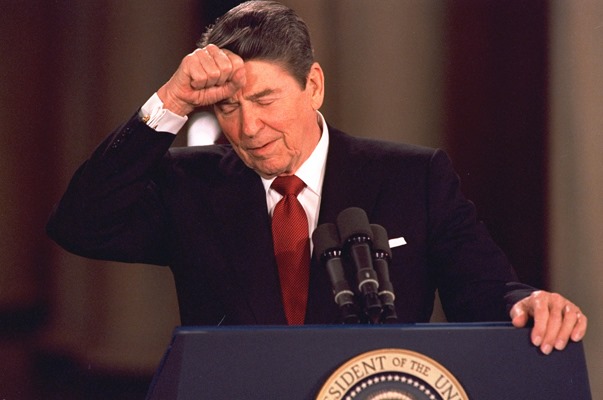
President Reagan of the USA lied when he denied any truth in the allegations of arms being sold to Iran to fund the Contra war against the Nicaraguan state. (Photo source: Internet)

THE USA IRAN-CONTRA CONSPIRACY

However, conspiracies do indeed happen, of course they do – and often. We have just passed by the anniversary of a key point in one huge one, the point when the “Iran-Contra” scandal began to break, in early November 1986. And President Reagan of the USA said that “the speculation that the US has sold arms to Iran has no foundation”, which was of course a lie. Basically, the US sold arms to the fundamentalist theocratic regime in Iran but, due to a US Congress embargo on such exports there, had to do it through Israel. They did so for two reasons, one for money to fund a military terrorist campaign against the government of Nicaragua which the US Congress would not approve, second in order to seduce the Iranian military (as they have done with the Egyptian military) and having them overthrow the Iranian regime. And the US wanted the Nicaraguan revolutionary government overthrown because it was not aligning itself with US foreign policy in what the USA considers its back yard (and a major source of raw materials) and also because a successful state of the type which Nicaragua was (then) would provide a ‘bad example’ to the other states of Latin America.

The Israeli Zionist ruling elite went for the deal because they too hoped the Iranian military would overthrow the theocratic regime and bring Iran back under the western-imperialist umbrella, as it once had been so secure that the CIA had its HQ for the whole Middle East located right there (and got caught with its pants down, or its secret documents in the process of shredding). And besides, the USA is the No.1 supporter of the Israeli Zionist regime in the world (another example of convergence of interests).

But despite the convergence of interests between the ruling elites of the USA and Israel, along with former Nicaraguan military, right-wing groups (for terrorist personnel) and US client regimes such as Honduras (for Contra bases) and Panama (for drug money to also fund the Contras, apparently through the CIA to sell in California – another conspiracy theory), a conspiracy was necessary to execute the operation. This was because of the unusual nature of the arms deal, its illegality according to US (and presumably Israeli) law and the number of partners involved. And the silent complicity of the US mass media was necessary, at least until a CIA plane delivering weapons was shot down by Nicaraguan forces over their territory and an operative, Eugene Hasenfus, captured alive.

A COMMON KIND OF CONSPIRACY

          Another example of conspiracy is that of price-fixing between big companies on given products. There have been a number of these exposed over the years. A conspiracy is necessary in this case because normally, the interest of big companies is to increase their share of the market over that of the competition. But at times, they perceive that it is in their joint interests to cease cutting one another’s throats and to regulate the prices of their products by agreement among themselves. Not only is this illegal in most administrations but it runs counter to the philosophy of capitalism, i.e that competition, instead of the cooperation advocated by socialists, is good for society. The fact that price-fixing is out of the norm of capitalism requires coming to formal agreement between the participants and the fact that it is illegal and undermines capitalist propaganda, requires secrecy – hence conspiracy.

However, most of what goes on in the world when government or other reactionary elements cooperate is probably just the result of convergence of interests, easily recognised by the participants.

(Image source: Internet)

A CONVERGENCE OF VERY DIFFERENT INTERESTS

Generally speaking, it is when their partnerships are put under pressure that the established convergence begins to crack; when one partner or another decides that the price of remaining in it is too high or that it’s time for sauve qui peut (everyone for himself). What can achieve that level of pressure is another kind of convergence of interests, that of the masses of wage-earners, small business people, peasants and indigenous people, recognising that by acting together, they can overthrow the existing system and set up an alternative that corresponds to their needs.

End.

REFERENCES:

Noam Chomsky short excerpt: https://libcom.org/history/the-iran-contra-affair

More detailed summary from Wikipedia: https://en.wikipedia.org/wiki/Contras

Concern about price-fixing in the insurance sector: https://www.independent.ie/irish-news/insurance-pricefixing-allegations-to-be-probed-by-watchdog-38405133.html

A case of price-fixing for contract bidding in Ireland: https://www.irishtimes.com/news/crime-and-law/sentencing-in-price-fixing-case-should-be-increased-to-encourage-whistleblowers-dpp-1.3515484

MARGARETTA D’ARCY SPEAKS IN THE BASQUE COUNTRY

Diarmuid Breatnach

(Reading time: 7 minutes)

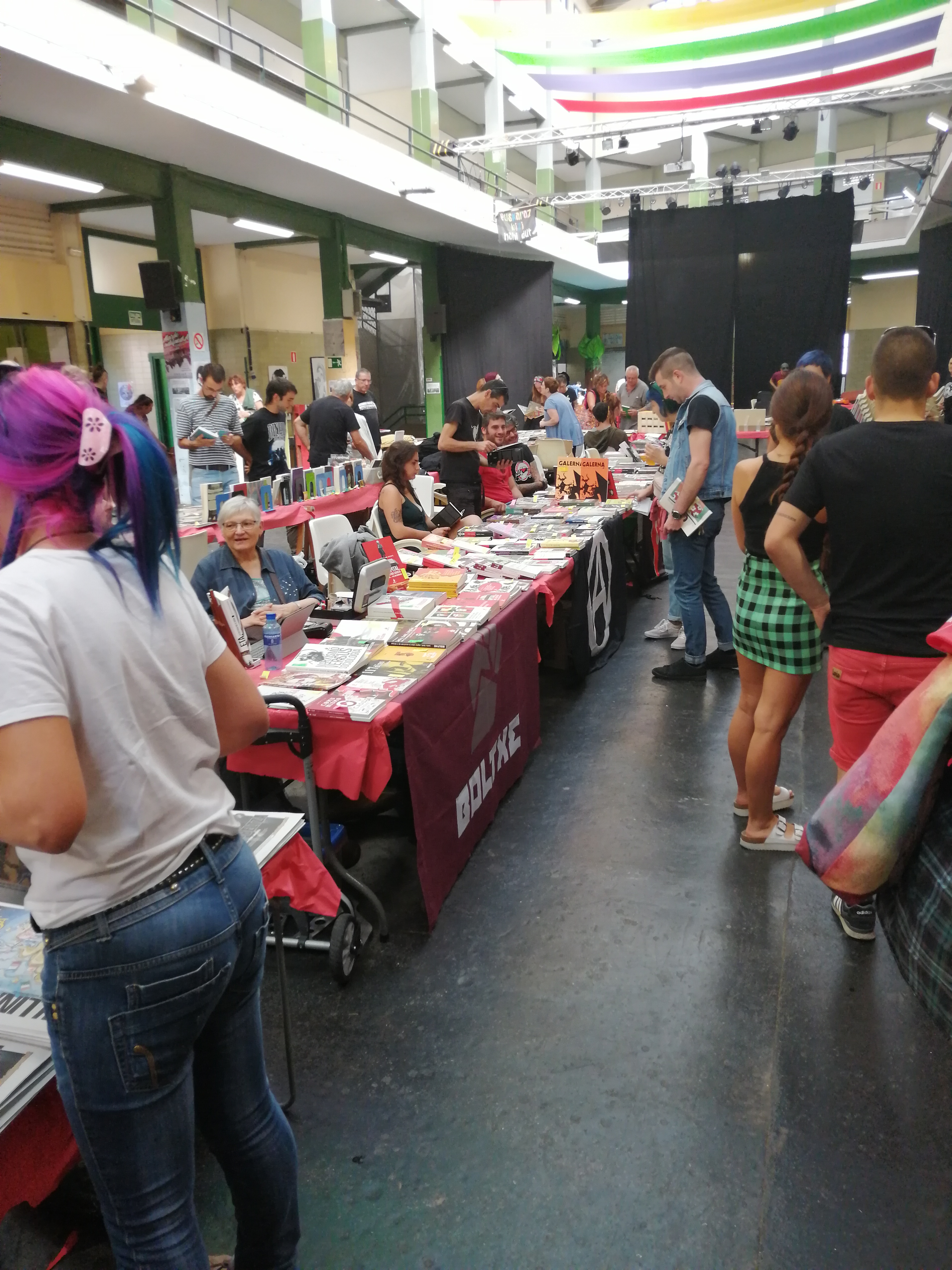
An anti-fascist bookfair was held in Portugalete1, not far from Bilbo (Bilbao) in the southern Basque Country on Saturday 29th and Sunday 30th September. There was ample room for the many stalls in the old disused indoor market in the town’s Casco Viejo (old town quarter), along with a curtained-off play area for children. One of the events in the two-day bookfair was a launch of the translation into Castillian (Spanish) of D’Arcy’s book “Tell Them Everything”(“Di Les Todo”). The translation was published by Sare Antifascista, one of the organisers of the bookfair and D’Arcy spoke in English at the launch, her talk translated into Castillian; also speaking was Basque ex-political prisoner Ziortza Fernandez Larrazabal. 

Section of the audience at the talk (Photo: D.Breatnach)

          Trembling from the illness that has affected her for a number of years (which she later commented resulted from attacks by fascists during the Greenham Common protest and later in Ireland by police) D’Arcy spoke clearly and coherently about her activism, the founding of Women Against Imperialism, the Greenham Common protest camp, her period in jail with Republican women and her activism against the USA’s military use of Ireland’s international airport at Shannon (despite the country’s constitutional neutrality).

Going on to speak about Ireland today, D’Arcy outlined some of the aspects of the notorious Direct Provision Centres for asylum seekers in the Irish state, the issues arising from the location of such centres and the opportunistic intervention of fascists against immigration. She went on to talk about the targeting on social media of those who spoke up welcoming asylum seekers or against racism and commented that the worrying thing about this development was that the fascists had a youth wing. Recalling the referendum on conditions of nationality in 2014 which had removed the rights of people born in Ireland to Irish citizenship unless they had an Irish citizen parent or grandparent, D’Arcy concluded by saying that Ireland is a racist country.

Referring to the Six Counties, D’Arcy criticised Sinn Féin for using the proposed Irish Language Act as a political football and as something with which to attack their political opposition, the Democratic Unionist Party2. Continuing, she said that “Scottish Irish”3 also existed in the Six Counties and asked why that could not be included in the Act, also quoting James Connolly that he didn’t care what language people spoke as long as they could communicate together.

Whatever about the issues in the Brexit question, the speaker said, Britain had used Ireland as a military training ground and had many bases in the Six Counties and these needed to be dismantled.

D’Arcy concluded by advising Basques to approach the Irish Consulate in the Basque Country to enquire whether it would be safe to travel to Ireland, given the US military use of Shannon Airport and the growth of fascism and racism in the country.

Ziortza Fernandez Larrazabal speaking. (Photo: D.Breatnach)

After the Irish speaker and speaking in Castillian, Ziortza Fernandez Larrazabal, ex-political prisoner from the locality, spoke first in tribute to D’Arcy’s record of activism. Moving on to her own activism in support of Basque independence and socialism and her five years in jail, Ziortza recounted being moved through a number of jails as part of the Spanish State’s policy and practice of dispersing political prisoners far from their homes and the strain this places on their friends and relations.

Commenting on the effects of imprisonment in Spanish jails, Ziortza said that some political prisoners had died through neglect, some had killed themselves but some had come out stronger, clearer in their minds and confirmed in their political views, which is what she felt had happened in her case. Ziortza said that some prisoners had 40 years of jail sentence and that they should be released.

After applause for the speakers, the Sare Antifaxista chairperson opened the meeting to questions from the audience. After a silence of some minutes, one man spoke in praise of the courage and commitment of both women and their record of activism. Speaking in Castillian with an Irish accent, he said he felt he had to distance himself from some of D’Arcy’s words. He felt it was important not to confuse government with people and that the Irish people were not, on the whole, racist and in fact racists and fascists had found it very difficult to organise within the territory of the Irish State.

Recounting the historical experience with the fascist Blueshirts in the 1930s, the Irishman said that they had been fought on the streets and defeated. When Pegida tried to launch their fascist and islamophobic group in the capitals of European states in 2016, they had failed in Ireland because firstly their gathering point had been occupied in advance by anti-fascists and anti-racists and, secondly the fascists themselves had been physically attacked and beaten. He talked also about a recent initiative to launch a “yellow vest” movement in Ireland but which fascists and racists had moved in to lead – that initiative had, as a result, been rejected and had faded away. Fascists are active on social media but find it difficult to hold events in public. The danger of racism and fascist organising should not be dismissed, the Irishman said but so far, in Ireland, racism and fascism was being repulsed among the people.

(Photo: D.Breatnach)

While it was true that the Government had proposed changing the nationality clause in the Constitution in 2014, he said, this had been part of a process across the whole of Europe. The referendum was held on that question along with another at the same time and only the social democrats and trotskyists had noticeably campaigned against the change. The vote in favour had to be seen in that context.

Moving on to the question of nation and language, he said that nations had a right to self-determination which, in many cases, was opposed by imperialism, which also damaged many languages. The loss of a language, he said, means the loss of a way of thinking and seeing, of literature, poetry and song; the loss of such is a loss for entire humanity.

A Basque woman also spoke from the floor, partly in Castillian and partly in Euskera (Basque), expressing her admiration for the record of both women speakers and referring to her own involvement in her youth in Greenham common. She went on to speak about the danger of nationalism but also in support of the rights of language and said that if there were no states in the world, she would not want one either but as long as there are, she wanted one for her own nation.

She also said that at this time it was important to support the struggles for self-determination not only of the Basques but also of the Catalans.

Poster advertising the book launch and talk

The event came to an end and people moved off for lunch in various bars, or to chat or to browse the bookstalls. The latter were run by a number of organisations: Inugorria Liburodenda (Gernika revolutionary and progressive bookshop), Sare Antifaxista; CNT, Mujeres Libres, IPEs, Baskale, FAI, DDT Banaketak, Periko Solabarria Elkartea, Komite Internazionalistak, Jazz Oi!, Templando el acero, Amnistía Ta Askatasuna, SRI.

FOOTNOTES

1 Portugalete has a Metro station, reachable from Bilbao. The Casco Viejo (old town) is a number of narrow streets lined by bars and shops heading steeply downwards from the Metro station towards the river front, where there are a number of restaurants and bars and a nearby port museum. The interesting Puente Colgante is nearby; a pedestrian bridge across the river worked something like a horizontal lift.

2 Given that Sinn Féin makes no effort to ensure its own membership is Irish-speaking, or even its leaders (despite some of them being very proficient in the language), also that all its internal and nearly all public meetings are conducted through English, this would seem to be a correct assessment by D’Arcy.

3 D’Arcy probably meant Ulster Scots or Ullans, which is not any kind of Irish but a variant of Scots, the Germanic-English dialect once prevalent in the Scottish Lowlands (often called “Lallands”), in which for example Robbie Burns wrote. It has Minority Language Status in the Six Counties and while Irish-speakers generally have no opposition to the promotion of that dialect, hardly anyone speaks it today and it was raised as an issue by Unionists purely as a counter to the rights of Irish-language speakers. Scotland does have Scottish Gaedhlig, with over 57,000 recorded speakers (2011 Census) but this is not spoken in the Six Counties.

Gernika bookshop stall in foreground
(Photo: D.Breatnach)
Other stalls
(Photo: D.Breatnach)


REFERENCES AND FURTHER INFORMATION

Sare Antixista: http://sareantifaxista.blogspot.com/

Dissidence in the Basque Country: https://rebelbreeze.wordpress.com/2019/09/27/dissidence-in-the-basque-pro-independence-movement/

Basque political prisoners:

Amnistia Garrasi: https://www.facebook.com/profile.php?id=100013870776872

Etxerat: https://www.facebook.com/Etxerat-Elkartea-255302801219340/

(Photo: D.Breatnach)

(Photo: D.Breatnach)
Buying at stall at the Bookfair
(Photo: D.Breatnach)
Nearby poster honouring “Argala”, an ETA leader assassinated by GAL, the Spanish State death squad.
(Photo: D.Breatnach)

CATALONIA PREPARES FOR GENERAL STRIKE AGAINST REPRESSION AND FOR REFORMS

Diarmuid Breatnach

(Reading time: article 5 mins; strike manifesto 5 mins.)

Catalans have been preparing for a one-day general strike since Monday’s announcement of the Spanish National Court sentences against the nine Catalan independence activists, who between them received almost 100 years in jail. Today’s will be the fourth Catalan general strike since the Spanish police attacks on Catalans in October 2017. This strike, according to its main trade union organiser, is not only against repression but also demanding social, economic, political and legal reforms and promises to have massive participation. The trade union organising it is a relatively new one, Intersindical CSC, a class union, which has been growing rapidly.

Photos of faces of the nine sentenced Catalan independence political and grass-roots activists. Between them they have been condemned to virtually 100 years of jail.
(Photo source: Internet)

TSUNAMI OF PROTESTS

          On Monday the Spanish National Court announced the sentences on seven Catalan politicians and two leaders of grassroots organisations on charges of ‘sedition’ and ‘misuse’ of public funds. The ‘sedition’ charges relate to demanding Catalan independence from the Spanish State and the financial ‘misuse’ charge to allegedly funding the Referendum from Catalan Government funds. They were also charged with ‘rebellion’ but since that had already been ruled out of order in test extradition cases for Catalans in exile, the Court had no realistic choice other than to clear them of that charge. The Spanish State is now proceeding with extradition warrants against other Catalan activists known to be in exile in Europe.

In addition, two senior members of the Catalan police force are on trial, 700 town mayors are to be investigated for their role in the Referendum, along with schoolteachers for discussing with their pupils police damage to their school buildings (used as polling stations). Recently seven alleged activists of the Committees for the Defence of the Republic were arrested on “terrorism” charges and two remain incommunicado, long after the usual five days permitted in Spanish State legislation. And others have been arrested in protests against Spanish State repression.

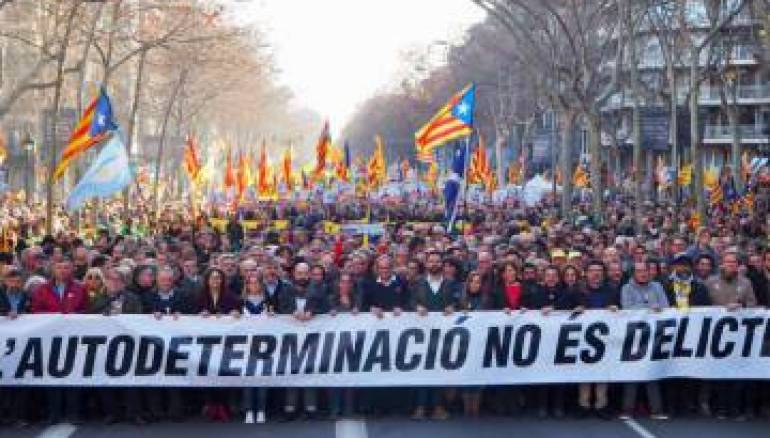
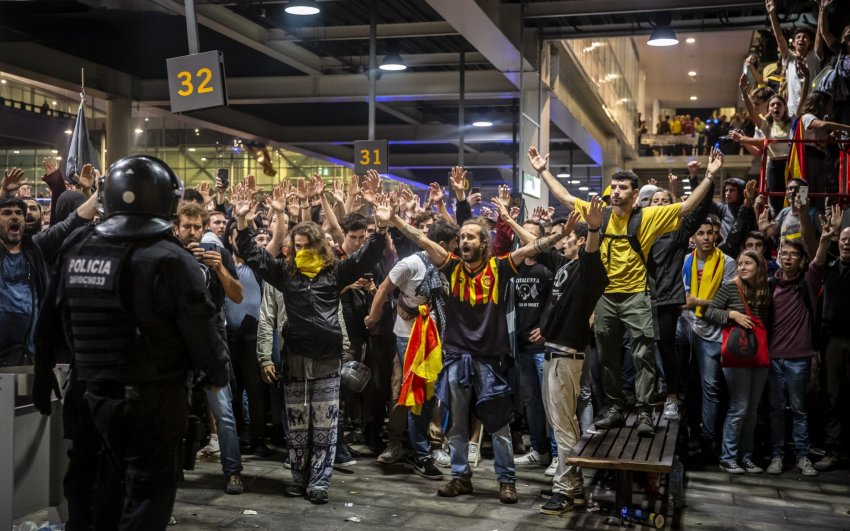
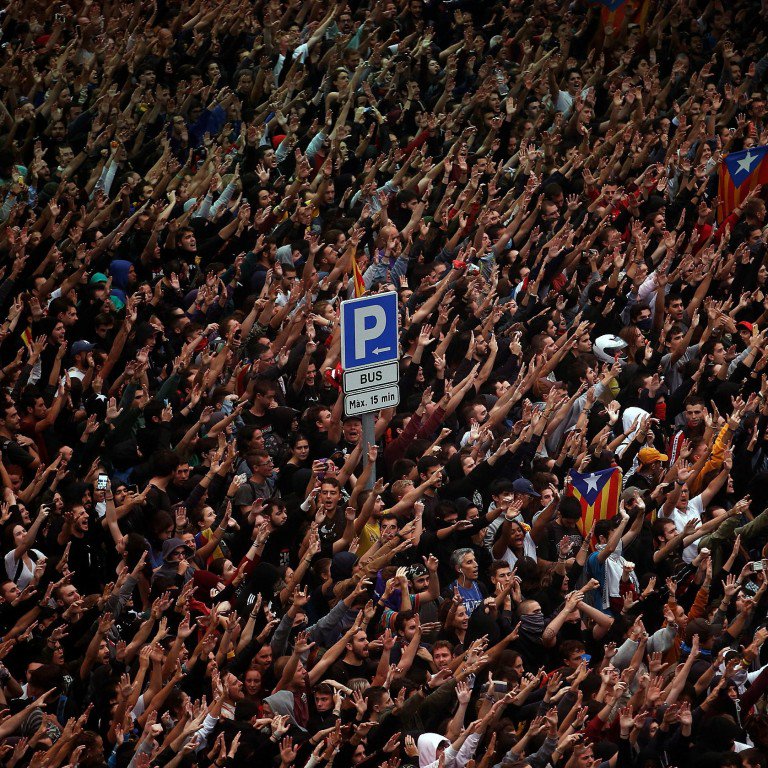
The self-styled “Tsunami” of protests began immediately the sentences were made public. Thousands walked, drove or rode bicycles to the El Prat Airport for Barcelona and effectively closed it down until they lifted the blockade at 10pm. Many others took to the streets of their cities to protest, particularly in front of institutions of the Spanish State, which had mobilised nearly 1,000 police in preparation against them. These were reinforced by the Catalan police, the Mossos D’Escuadra, who were seen as relatively benign during the Referendum and immediately afterwards but are now reverting to their past image — some years ago nearly a dozen of Catalan protesters lost eyes from rubber bullet impacts at close range, which led to a successful popular Catalan campaign to have them banned – but that ban does not apply to Spanish police. Already one young man lost an eye on Monday night while another appears to have lost one testicle and 150 were treated by paramedics. The toll grows and includes two youth run down by police vehicles and more arrests. These figures are certain to grow in the days ahead.

Riot police confront Catalan airport blockaders on Monday (Photo source: Internet)

Thousands are also walking along motorways to other towns in a protest procession, horns of cars, lorries and buses being sounded in solidarity, while different protests gather every night.

Section of the massive crowd of protesters that shut down Barcelona’s airport on Monday.
(Photo source: Internet)

PARALYSIS OF POLITICIANS

          This huge popular wave of resistance contrasts with the seeming paralysis of the pro-independence politicians, who are in three different political coalition parties: Junts X Cat (Together for Catalonia), Esquerra Republicana de Catalunya (Republican Left) and Candidatura de Unidad Popular (People’s Unity Candidacy). The three together form a narrow enough majority in the Catalan regional Parlament against the Spanish unionist delegates of the PP, Ciudadanos and the PSOE, as well as the ‘neutral’ “Communs”, a coalition around the Podemos party. Although the CUP delegates will defend any pro-independence motions etc in the Parlament, they are officially in opposition. JuntsXCat and ERC run the Government together on a slim majority but they disagreed on a number of important issues, including whether to give the minority Spanish PSOE Government qualified support without any concessions from the latter and also, about their resistance campaign being directed by ex-Catalan President Carles Puigdemont, in exile in Brussels, and the group he has collected there.

But their paralysis is more fundamental: despite the activity of some of them in popular movements before they became politicians, their focus has been on electoral strategies and campaigning, preparing legislation for the Parlament and running the Government. For a number of years now the power of the street has been growing and it is clearly in the ascendant now – and that is not where the politicians feel most comfortable. Not only that — but where else now has the Spanish State left any cards to play?

THE TRADE UNIONS

          The main trade unions in the Spanish State are the Unión General de Trabajadores (UGT) and the Commisiones Obreras (CCOO). After Franco’s death, their legalisation and incorporation into the system was felt essential for the smooth operation of the ‘Transition” and for that reason, the major political party of each was legalised too – the social democratic PSOE and the Communist Party of Spain – so that they could control their unions. They did and they have, despite a history of republicanism and antifascism, and in 1978 ensured votes in favour of a the new monarchical and unionist Constitution while their members and others were being clubbed and shot – or blown up — in the street.

The big SEAT factory in Catalonia has majority representation in the CCOO and UGT trade unions and neither union officially supported the previous recent general strikes. However, there was leeway for ‘allowing’ an early leaving of work to attend strike day demonstrations and UGT has already this week officially condemned the Spanish State repression. How they will react later today remains to be seen.

Intersindical CSC is a ‘class union’ (i.e does not recruit personnel from the repressive arms of the State nor from management) and is in favour of the right to self-determination. Its history is recent but it organised the previous general strikes in conjunction with grass-roots independentist organisations (like the ANC and Omnium) and will do so again. The growth of Intersindical is a a source of worry for the UGT and CCOO in Catalonia.

Catalans blocking railway lines in protest.
(Photo source: Internet)

Later today we can expect blockades of all major motorways and train lines passing through Catalonia, general closures of business, services and public transport of Catalonia’s cities and massive demonstrations in cities, not just Barcelona. What will happen at the docks, airport and the SEAT plant remains to be seen. There will almost certainly be confrontations between strike supporters and the police, both Spanish and Catalan. Whether that will escalate further cannot be forecast but is very possible.

Meanwhile, outside of Catalonia in the Spanish State, both Madrid and the Basque Country hosted massive shows of solidarity on the streets while other cities, for example Caceres in Extremadura and Granada in Andalucia (the two poorest regions of the Spanish state), have seen demonstrations on the streets in solidarity with Catalonia and against the repression of the Spanish State.

Catalan protesters on Tuesday use metal fences as protection against rubber bullets.
(Photo source: Internet)

GENERAL STRIKES — COMMENT

          General strikes, if successful in mobilisation, show the collective strength of the organised workers, ideally in conjunction with their communities (families, relatives, friends, local shops, churches, sport clubs etc).

While that is extremely important in the longer run, they are not always successful in the shorter run or, to be more precise, they often fail to achieve their stated objectives. The stated objectives of this strike cannot be achieved in the short run since they confront not only a capitalist but a neoliberal Spanish ruling class and, furthermore, one in which the majority are undefeated descendants of a fascist-military uprising, civil war and four decades of dictatorship.

The overcoming of these obstacles requires, arguably, a social and political revolution and Catalonia is not at that point yet. But it may be in time, especially if the Spanish State continues to pursue its path of repression (and it is sure to do so). One-day general strikes sometimes grow into longer and sometimes even indefinite ones. Such situations are almost pre-revolutionary situations, with workers’ committees having to organise vast forces and control, manage and defend large areas.

For a Catalonia to be successful in revolution or in secession from the Spanish State alone would require that the State faces challenges on a number of fronts, including internally, that severely restricts its ability to send sufficient repressive forces to Catalonia. Such an outcome would depend completely on mobilisations in other parts of the Spanish state, which is why Spanish State, media and fascist parties’ are practically racist in their hysterical condemnation of Catalan independentism and culture, trying to whip up anti-Catalan feeling to distract from the woeful economic, social and political mess to which most of the Spanish regions have been driven.

End.

Demonstration Barcelona, part of general strike in February, protesting the start of the trial of the independence activists.
(Photo source: Internet)

APPENDIX:

GENERAL STRIKE MANIFESTO OCTOBER 18, 2019 (English language translation)

For rights and freedoms, general strike!

A new Spanish government and a new disappointment. Whether led by the PP or the PSOE, the

social gains never reach the workers. Neoliberal austerity policies persist whoever resides in the Moncloa (Spanish Government), while authoritarian repression against the common classes and, especially, against the Catalan people become the tools to curb any struggle for better living conditions and justice for the majority. As in popular times, state “socialism” now also wraps itself in the Spanish flag and patriotism to cover the miseries of a ’78 regime which strangled the bulk of the population and which is showing more and more cracks.

During election campaign times, certain parties declare limited progressive proposals, which, if they are elected to govern, will be stored again in a drawer to be sold again to the designs of an Ibex 35 (Spanish Stock Market benchmark) that does not tolerate any kind of agreement with forces that question minimally the foundations of the Spanish monarchy: the unalterable privileges of the elites and an indissoluble and centralist state model. Therefore, despite all the changes that the PSOE promised before grasping power, they faded to pass again from opposition to status quo, in another turn of the eternal Spanish political carousel so that nothing changes.

Minimum measures such as derogations from the PP’s labor reform or of the gag law, the withdrawal of vetoes against the social laws of Parliament, the already agreed reception of refugees, the imposition of rent ceilings, the setting up of a tax on banks, the renewal of the regional financing model or the publication of the list of evaders that were covered by the Montoro tax amnesty, all of those became elusive despite previously having been defended vehemently by Pedro Sánchez.

The Catalan working classes know that rights and freedoms are not only begged through voting. We learned that a century ago, after the “Canadian strike” allowed us to achieve the greatest of the victories of that era, the 8-hour working day and retirement at age 65 (The 44-day strike 1919 originating at the principal electricity company in Barcelona, Riesgos y Fuerzas del Ebro, popularly known as La Canadenca because its major shareholder was the Canadian Commercial Bank of Toronto). But not only then – history has stubbornly shown that social advances have only been achieved through struggle. Peaceful, massive and nonviolent, with the general strike as one of the clearest tools of the workers.

And on October 18 we have a new date, a new call for a general strike that should be massive to make it clear that we will not remain unresponsive to the continuing attacks upon us. The disappointment of Sánchez’s brief mandate at the head of the Government, unable to repeal the most damaging measures of Mariano Rajoy’s period, should receive a blunt response in the street, the popular masses need to empower themselves and to declare that they will not allow themselves to be stepped on again, despite the growing criminalization of protest and growing repression against anyone who dares to raise their voice.

Intersindical CSC is clear that the Catalan Republic is an essential tool to overthrow the regime of ’78 and to move towards a horizon of well-being, equality and social justice but even with this horizon always present, the struggle for rights and freedoms of the popular classes cannot cease before any institution. We will remain on our feet, once again on this October 18, to demand all rights and freedoms:

– For a minimum Catalan salary and pensions of at least 1,200 euros to be increased depending on the Catalan Consumer Price Index.

– For the repeal of the labor reforms of 2010 and 2012 and the recovery of all lost labor rights.

– For a Labor Inspection with adequate resources to deal effectively with rights violations.

– For the end of labor inequalities and the wage gap suffered by women, starting with the recovery of the annulled articles of the equality law and which referred to the world of work.

– For a Social Rescue Plan that guarantees free and universal public services, food and housing for the entire population, the comprehensive application of a guaranteed income for the citizenship and a plan for the internalising of public services which are now outsourced.

– For the application of a climate emergency agreement that reduces to zero as quickly as possible the net emissions of greenhouse gases, starting with the reinstatement of the law against climate change which was partially annulled by the Constitutional Court.

– For the approval of the scheduling of payment, unanimously agreed by Parliament, and the setting of a maximum rent level.

– For the reception of refugees, the closure of the Refugee Secure Centres and the repeal of the immigration law, to make Catalonia a truly host country and without second-class citizenship.

– For the recovery of all social laws and taxes approved by Parliament and nullified or suspended by the Spanish courts.

– For the repeal of the gag law

Intersindical-CSC http://www.intersindical-csc.cat G59792226

APOLOGIA FOR REPRESSION BY SPANISH STATE IN DUBLIN

Diarmuid Breatnach

(Reading time: 10 minutes)

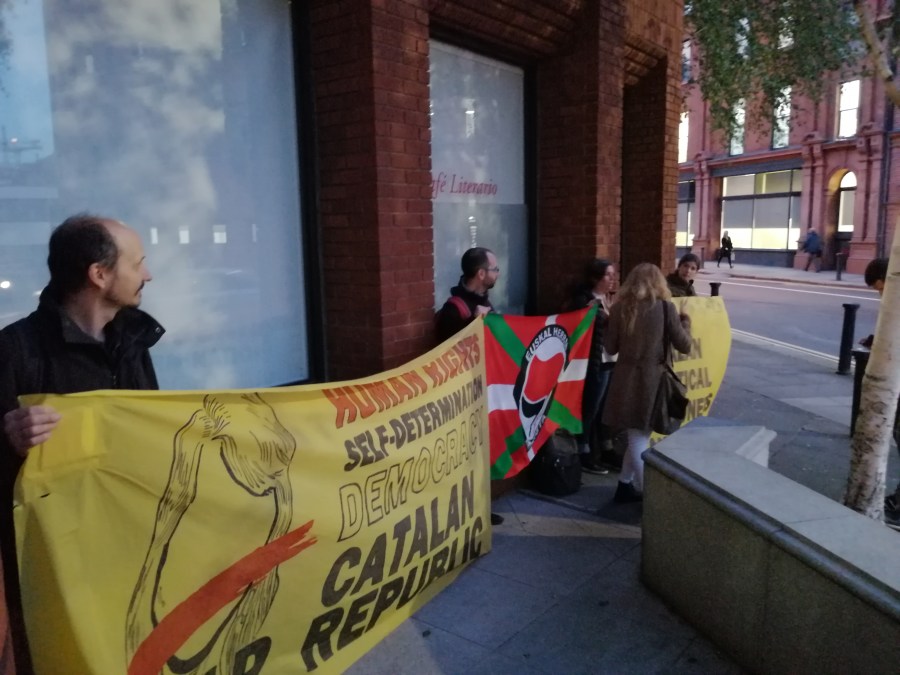
The “Global Spain” initiative of the Spanish State to 215 Spanish embassies and its sub-title “Touch Democracy” was presented to a small audience at the Instituto Cervantes in Dublin on Monday while Catalan and Basque solidarity demonstrators picketed outside.

While some people, perhaps in the know, were directed straight to the auditorium, a number of others, not regular users of the Instituto’s services, were asked to wait in another area but when the start time had been exceeded by 20 minutes without sign of the event, they went to make enquiries again at Reception and learned where the event was being held, entering to find it had already started.

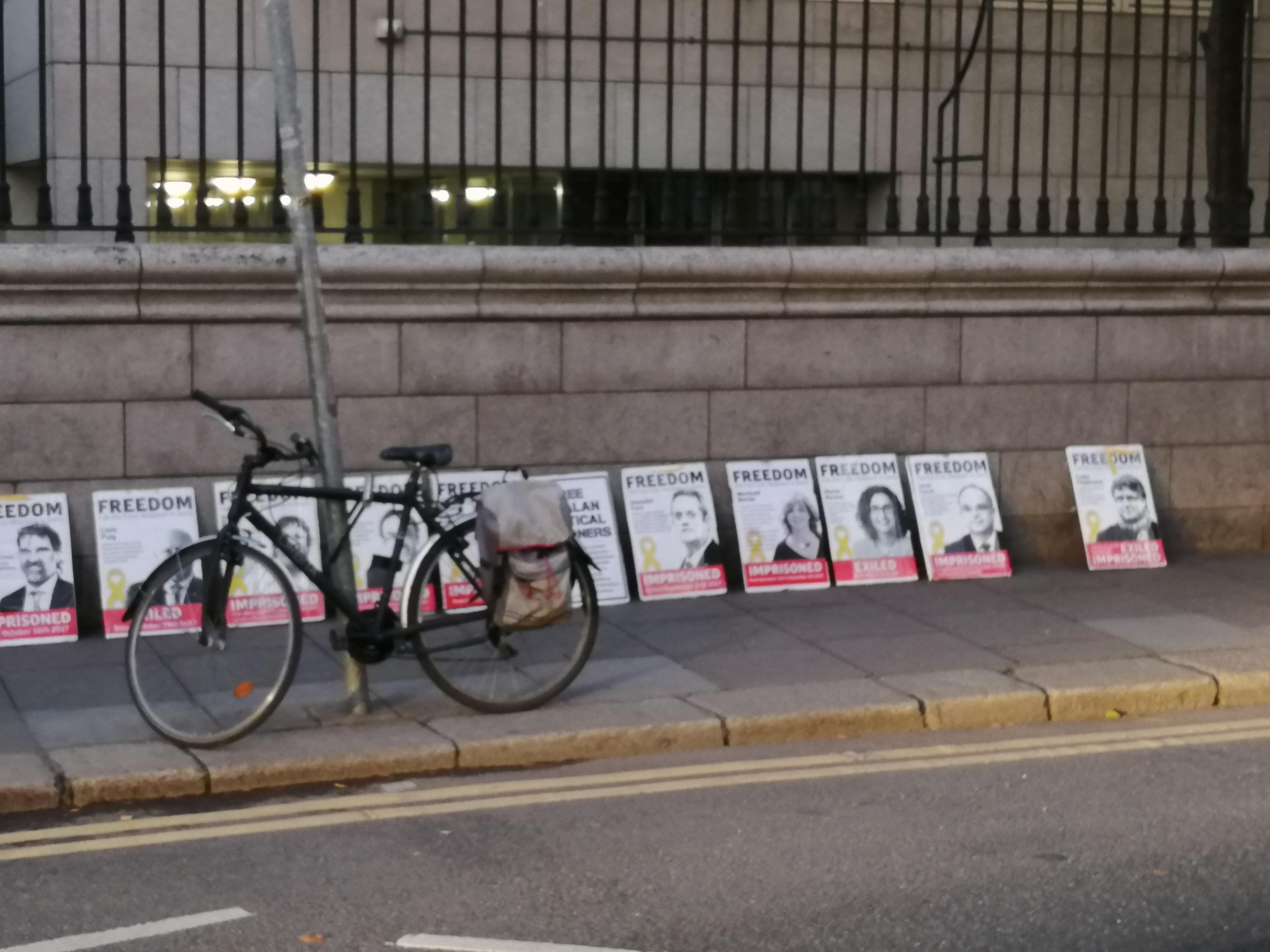
Portraits of Catalan political prisoners and exiles displayed across the street from the Instituto Cervantes on Monday.
(Photo: D.Breatnach).

PROPAGANDA VIDEO         

          Mr. Ildefonso Castro,the Spanish State’s Ambassador to Ireland was speaking and shortly launched the event with a showing of a short video which, he said, would bring out the main questions in the initiative. In this video, Lucía Mendez, journalist for the right-wing Spanish daily El Mundo seemed to be interviewing Gabriela Ybarra about the novel she had written (The Dinner Guest). But actually later in the film Mendez began a speech about how good was the Spanish democracy while her interviewee was left with little to say. The author had said earlier that though her grandfather (a Mayor of Bilbao who had fought in Franco’s Army and supported the Dictator regime, not mentioned in the video), had been killed by the Basque armed group ETA in 1973, this was not discussed in her family. She felt that the memory of “terrorism” was disappearing and that children in school were not being taught about it, which is why she wrote her book.

In fact, Spanish media constantly refers in negative terms to ETA and a 2016 case of a brawl between Basque youth and off-duty Spanish policemen in a late-night bar, in which no-one was seriously hurt and no weapons used, was being treated in the media and by the State Prosecutors as a case of terrorism! Although the judge rejected the accusation of “terrorism”, in 2018 the youth receive a range of sentences between two and 13 years jail. An important part of the silence and lack of teaching children history is in fact about the almost four decades of Franco dictatorship and the conduct of the victors in the military-fascist uprising against the democratically-elected government of the Spanish Popular Front in 1936. And of the State assassinations and torture of captured ETA fighters and arrested Basque activists. And of the continued legal battles to uncover mass graves of Franco’s victims and try to identify the remains for the relatives.

Considering that ETA ceased its armed activities in 2012 and has since dissolved itself, the relevance and intention of the film seems to be to show an embattled Spanish “democracy”, fighting against Basque independentist “terrorism” in the past as it is now embattled with the Catalan independentists (seven activists of which it has also accused of “terrorism” a couple of weeks ago).

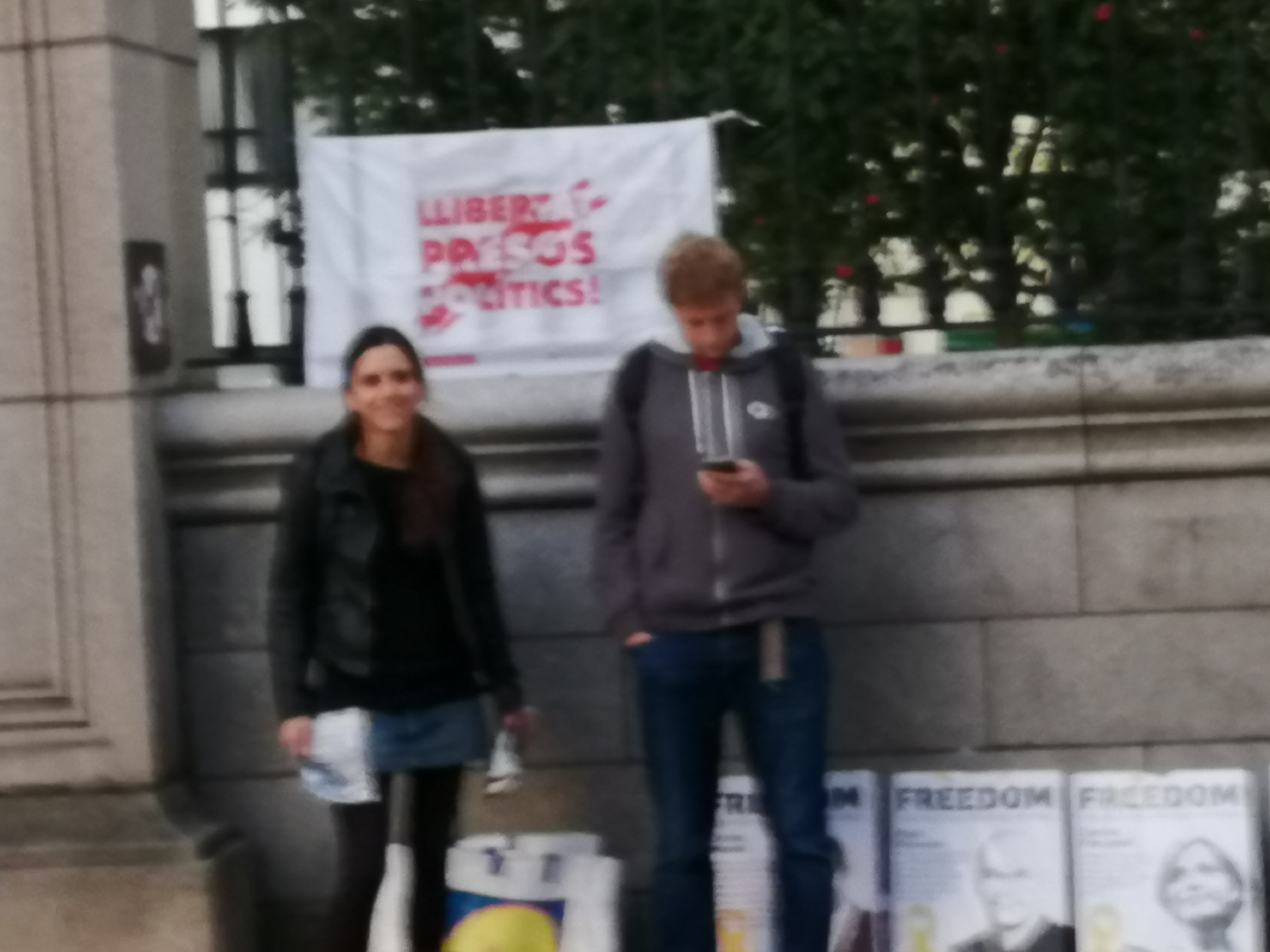
Some demonstrators and banner by Trinity College exit across the street from Instituto Cervantes on Monday.
(Photo: D.Breatnach).

DISCUSSION BUT NO DEBATE

          There was no discussion on the content of the film and, after its end, Víctor Andresco Peralta, Director of the Instituto Cervantes, cultural body of the Spanish Embassy, took to the stage and invited five people by name to take chairs laid out around a table. Launching into a chatty monologue full of jokey self-deprecatory comments (so many that they were actually self-promotional), he eventually asked his questions of his picked panel.

Questions included what were their earliest memories of consciousness of being Spanish, what reactions they had received about Spain from people in Ireland, or in other countries (positive and negative), what they valued about Spain, what they thought about the coup attempt in 1981 (lots of jokes about that), etc.

Referring to his father’s recent stay in hospital, Peralta asked for comparison of the Spanish health service with the Irish one (apparently the former is far better, which would not be difficult) and for other comparisons.

The discussion was skillfully managed by the showmaster to bring his group to paint a picture of a wonderful pluralist Spanish State, of freedom of expression, and of a democracy which had been able to defeat the coup attempt without much difficulty but even so, some discourse arose at times to shake the equilibrium, as when one referred to a relative telling him about the horrors of the Francoist suppression as they entered Barcelona and when another referred to the perception (mistaken, of course!) of many people outside Spain that the State was undemocratic and had violent police.

One of the panel, who appears to be an employee of the Spanish State, said she was proud of the defeat of ETA by the “Spanish democracy”.  Another said she was proud of Spanish history and culture, without explaining further. She might have meant the foremost writer of Castillian-language literature, Cervantes himself, who was exiled from the Spanish kingdom because of his anti-feudal views. Or the Andalusian poet Federico Lorca, who was executed by Franco’s soldiers; or the Malagan artist in exile Picasso, who created the famous painting of the Nazi and Fascist aerial bombing of Gernika (most of the poets, writers and artists of the era were against the military-fascist coup and the four decades of dictatorship that followed). Or about the dramatist Alfonso Sastre, whose distaste for the Spanish State’s behaviour towards the Basques was such that he moved to the Basque Country.

Perhaps the woman was proud of the defeat of the learned and tolerant Moorish colony of Al Andalus and its replacement by the racist Spanish Christian Inquisition, along with the expulsion of Arabs and Jews? Or of the centuries-long suppression of the governments of the Basques, Galicians and Catalans, along with their languages? Or of the invasion, massacre, enslavement and plunder of the indigenous people of America, the Caribbean and the Philippines? Or the invasion and colonisation of the Rif in North Africa, when the French saved the Spanish colony after the Spanish army had been wiped out by lesser-armed (and often less numerous) Berber guerrillas.

Of course she might have been referring to the revolt of the Reapers in Catalonia or of the Comuneros in Castille; or of the resistance of Spanish, Catalans and Basques to the military-fascist coup and the four decades of dictatorship …. We don’t know because she did not say.

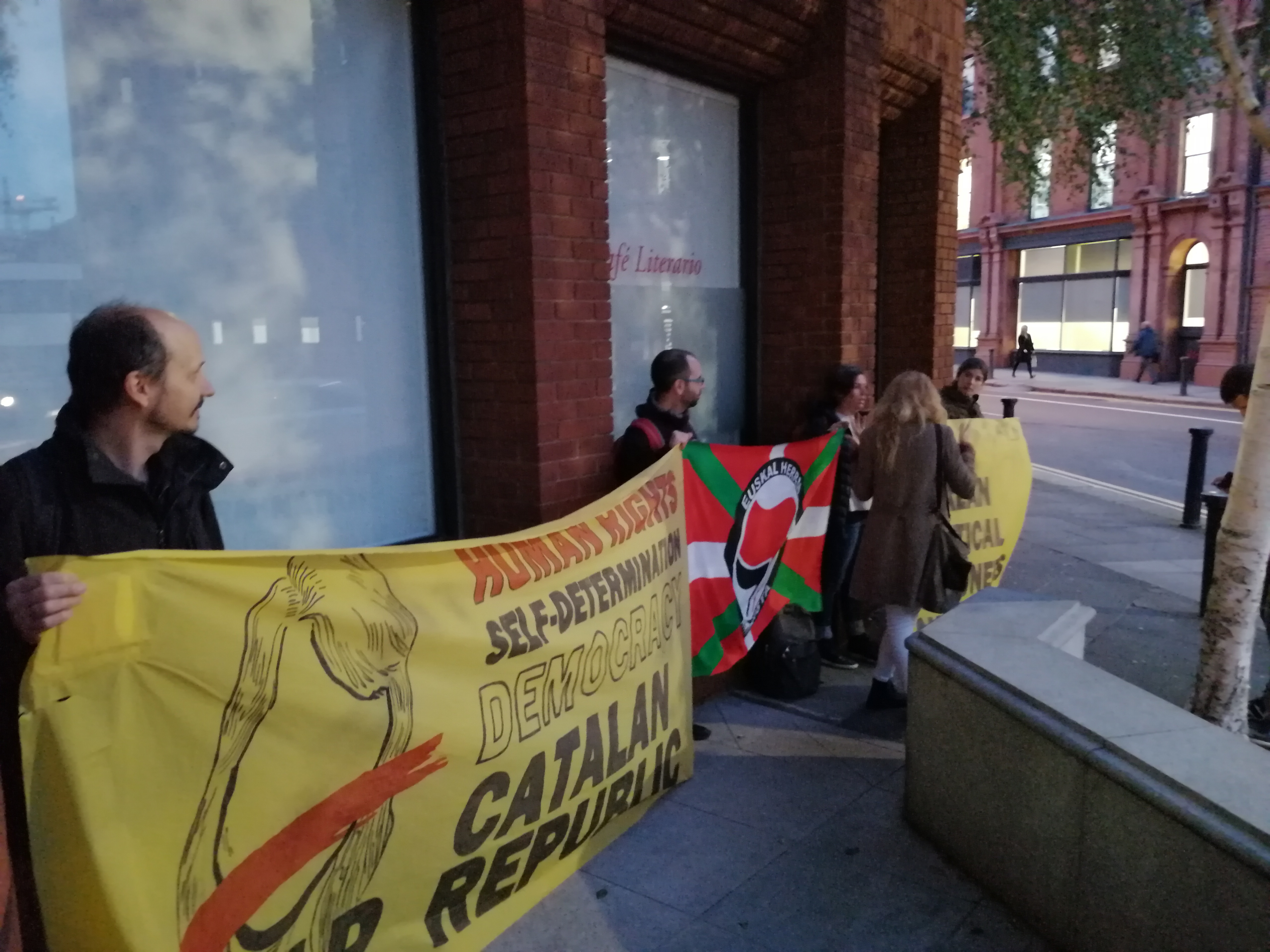
A view of some of the protesters outside the Instituto Cervantes on Monday.
(Photo: D.Breatnach).

WHAT ABOUT THE RIGHT TO SELF-DETERMINATION?

          The event had been advertised as a debate but no debate took place. Nor was there a question-and-answer session, nor engagement with the audience except to send them witty asides from Peralta and to thank them at the end.

This was too much for at least one of the small audience, an Irishman who interrupted the concluding remarks of the Director by saying, in Castillian (Spanish) that it was a pity that the question of self-determination had not been discussed. The event was taking place in Ireland, he commented, where another state had denied the people the right to self-determination on grounds of that state’s constitution also. Denied permission to exercise their right, the Irish people had to fight for it and eventually won part-independence.

Peralta commented that the Spanish people were cognizant of Irish history and appreciated it.

The Irishman replied that in the Spanish state things were the complete opposite.

Peralta commented that unfortunately there was no time left for that debate, thanked participants and audience and brought the event to a close.

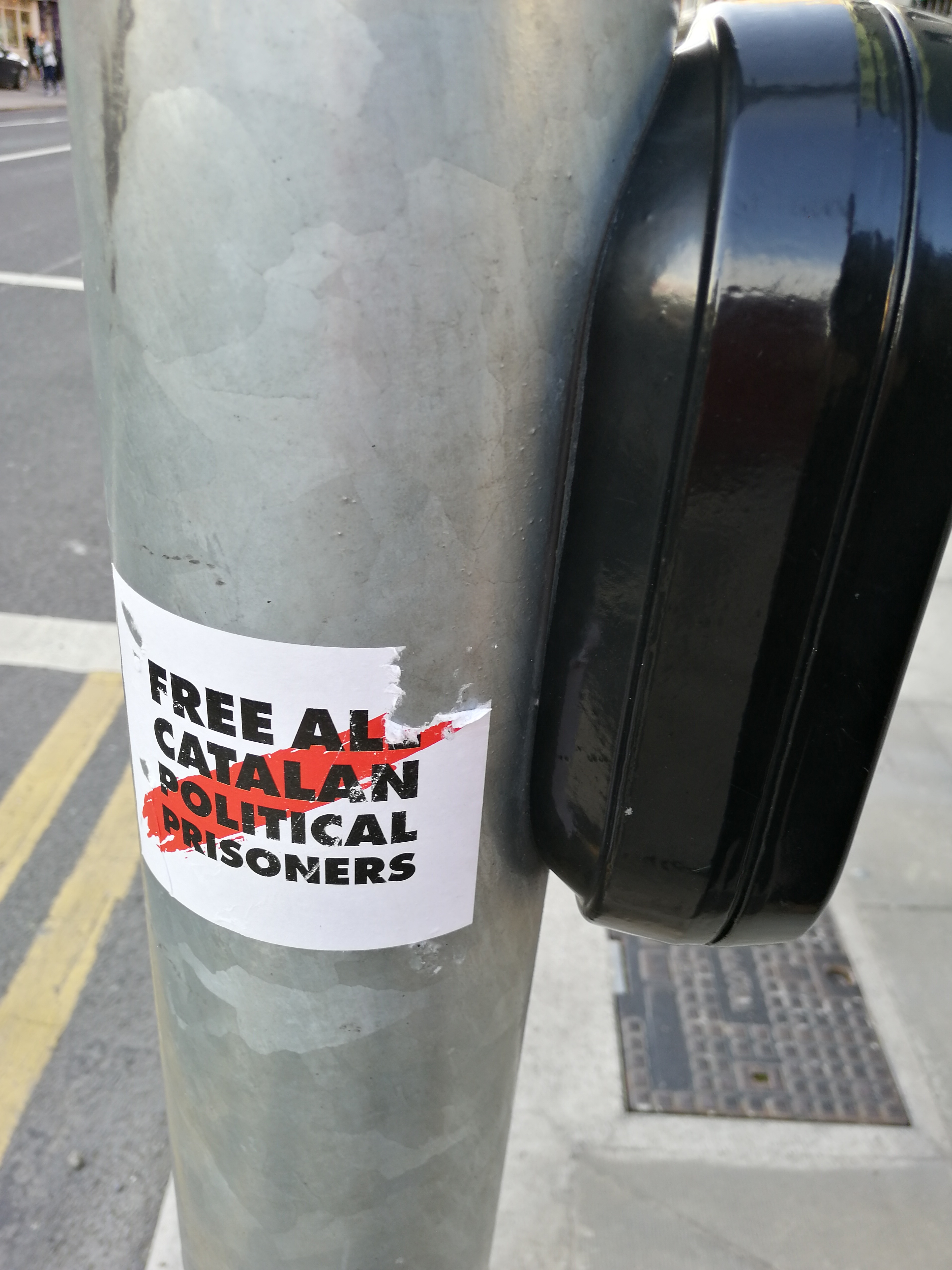
Sticker on pole near the Instituto Cervantes on Monday.
(Photo: D.Breatnach).

WHAT WAS THE POINT?

          Outside the meeting up to dozen protesters had taken up positions on both sides of the street. On the Trinity College side a couple of protesters stood beside portraits of the Catalan grass-roots activists and politicians who are in jail awaiting sentence or in exile. On the Instituto side, a larger group of protesters held two banners and a Basque Antifa flag.

One of the Catalan supporters, an Irishwoman, addressed several of the panel participants as they exited. It emerged that they had not understood the nature of the event and that they thought it had to do with October 12th, which is a Spanish State celebration of its former empire and spreading of the Castillian language1 (and for which one of the panel, who seems to work for the Instituto, is organising an event in Rathmines). They said they had not seen the “Global Spain” publicity (81 pages of propaganda justifying the actions of the Spanish State and attacking the principle of Catalan self-determination and the pro-independence movement!).

There was in truth not much point in attending the event unless one wanted receive a smooth-talking patter about an imaginary State occupying most of the Iberian Peninsula. For the protesters, it was important to give a response to the paint-over job. For the producers of the show, the importance was to try to distract an Irish audience from the reality of what is an unreconstructed fascist state with a thin veneer of democracy that is constantly peeling away.

Poster seen on Dublin street near Instituto Cervantes on Monday.
(Photo: D.Breatnach).

End.

FOOTNOTES:

1 El Dia de la Hispanidad was formerly called “El Dia de la Raza Española” (Day of the Spanish Race). It is also the Spanish Armed Forces Day, obviously not inappropriately in context!

REFERENCES AND FURTHER INFORMATION

Article by El Nacional, independent and pro-independence Catalan newspaper: https://www.elnacional.cat/en/news/global-spain-advertising-campaign-democracy_426827_102.html

The Instituto Cervantes, Dublin: https://dublin.cervantes.es/en/about_us_spanish.htm

CDR Dublin: https://www.facebook.com/CDRDublin/

ANC Irlanda: https://www.facebook.com/IrlandaPerLaIndependenciaDeCatalunya/
With Catalonia/ Leis an Chatalóin: https://www.facebook.com/WithCataloniaIreland/

PAUL MURPHY, SPLITS, PARTIES AND ALLIANCES

Diarmuid Breatnach

(Reading time: 4 minutes)

Paul Murphy speaking at his trial and that of others after the famous water protest at Jobstown against Minister Joan Burton (which led to his arrest and long trial before he and others were found not guilty by a jury).       (Photo image: D.Breatnach)

Most people within the Irish state will now be aware that that socialist Paul Murphy, TD (member of Irish parliament, the Dáil), has left the Socialist Party and, with some others, intends to set up a new socialist organisation called RISE. His statement on his Facebook page was covered by a host of the capitalist media with little comment by most while left-wing chat room the Cedar Lounge had more comment than I found time or interest in reading.

A common reaction on the street was one of bewilderment at the splitting actions of left-wing parties. Elements of that were to be found in the relevant piece by Miriam Lord (see References), who comments on Dáil politics and politicians in her Irish Times column (though her sharpest treatment was of Brendan Ogle, who had mocked Murphy’s action).

I am myself, if a little surprised, not shocked nor indeed very engaged with the matter and consider it generally of little import on the prospect of a revolution in Ireland.

It strikes me, with little personal knowledge of him but based on material in the public domain, that Paul Murphy is in general a principled socialist politician and furthermore an activist who has not shirked from putting himself physically in the resistance line in Rossport, on the seas to Gaza, in Turkey against its government and in Dublin on water and housing protests. Furthermore, in the short period he was an MEP or supporting Joe Higgins when the latter had the seat, Murphy has had questions asked about the treatment of Basque political prisoners which few other politicians are willing to touch, lest they be associated with the armed liberation organisation ETA (now defunct).

However, I see no prospect of even one step towards revolution in the general conduct of any of the socialist organisations of any size in Ireland, splits or no. Of course it is helpful to have awkward questions asked of the Government in the Dáil and to gain media coverage of issues that would likely remain unmentioned, or to have their critical comments reported where yours or mine would never see the light of day. And Murphy remains in that ambit in Dáil, along with the Solidarity-PBP group — and Independents for Change are there also (now sadly missing Clare Daly and Mick Wallace, who have gone to the EU).

But that is not necessarily revolutionary work.

Meeting of the (First) International Workingmen’s Association. In Britain, the Fenians were accepted into the First International.

A TASK FOR SERIOUS REVOLUTIONARIES

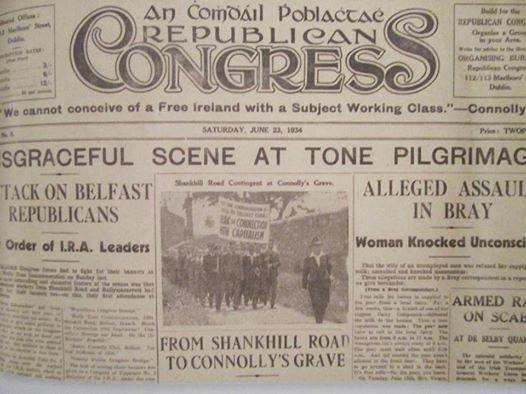
Front page of the newspaper of the short-lived Republican Congress in 1934

Without a conjunction of revolutionary Socialists with revolutionary Republicans, I can see no hope for revolution in Ireland and, without revolution, no hope of a solution to many of the ills in our society, whether in culture, economy, environment or government. In other words, in anything really. That conjunction was a project attempted in part by British socialists and some of the Fenians of the 1840s, later by Connolly and the Irish Citizen Army (1913-’16), later still by the Republican Congress (1934-’36). It remains the unfinished task for serious revolutionaries.

Neither the Socialist Party/ AAA/ Solidarity nor the Socialist Worker/ People Before Profit/ Solidarity formations have made any effort to take up that task (nor have the Republicans, lest my criticism be thought of one part of the equation only). Nor did the anarchist Worker’s Solidarity when it was an active force. The Communist Party of Ireland does not do so nor does the Workers’ Party. So great is the disdain of these formations for revolutionary Republicans that they refuse to even challenge the daily civil rights violations of the Gardaí and PSNI upon active Republicans, or their treatment in the non-jury special courts or jails on both sides of the Border. Indeed, in case they should somehow be accused of siding with these elements, they rarely even allude to the unfinished national liberations struggle of Ireland, nor to the colonial occupation of one-sixth of its territory, while instead fully prepared to support the just national liberation struggles of nations far away.

Interestingly therefore, from public comment, it appears that Murphy wanted more cooperation with “other elements on the Left” or “Left-leaning”, in which context was mentioned Sinn Féin, while the majority in the Socialist Party refused such a project. Some people will view this aspiration of Murphy’s as a laudable attempt to mould a fragmented Left into at least some kind of united action for Irish social and political progress. I do not.

I am not against a temporary alliance of revolutionaries with social democratic forces at certain points for certain objectives. But that does not include Irish political parties who are or have been part of Irish governments or, if possible even less, so a party that is part of the administration of a colonial occupying power. In the latter category I clearly place Sinn Féin and, in the former, the Labour Party, Fianna Fáil and Fine Gael.1 In addition, SF has clearly marked a path for itself to a future coalition partnership with a capitalist, pro-imperialist party or parties in Government.

It says something about the Irish socialists that an important question for them is whether or not to ally with a constitutional capitalist and colonial collaborationst party such as Sinn Féin, whereas the question of whether to ally with revolutionary Republicans is not even on the agenda for discussion.

End.

FOOTNOTES:

1 One might make a temporary exception of the Greens, which have been in Government but once for a short while, admittedly shamefully so but with an honourable resignation.

REFERENCES:

Miriam Lord: https://www.irishtimes.com/news/politics/miriam-lord-brendan-ogle-eager-to-get-back-in-the-leftie-limelight-1.4033061

Paul Murphy TD Faeebook page: https://www.facebook.com/paulmurphytd/

DISSIDENCE IN THE BASQUE PRO-INDEPENDENCE MOVEMENT

Diarmuid Breatnach

(Reading time: 5 minutes)

When ETA, the armed Basque Left pro-Independence group) abandoned armed resistance and decommissioned its weapons, many wondered at the absence of public dissent among its ranks. A dissident trend did appear in the Basque pro-independence movement but it took longer than it had in Ireland; it is in existence now and growing.


In using the term “dissident”, a description not always accepted by those to whom it is applied, I mean those who disagree with the direction taken by the leadership of the organisation and who have therefore separated themselves from the organisation. It becomes a problematic term when it is implied that the “dissidents” have diverged from the original path – on the contrary, those who have left the organisation would say, it is the leadership which has left the path and it is those being called “dissidents” who remain on the “true path”.

ATA demonstration in Donosti/ San Sebastian, 8th September 2019.
(Photo source: Amnistia Garrasia FB page)


In the Basque pro-independence movement, as in the Irish Republican movement, the “dissidents” are in a minority but that should not be taken to mean that those who have remained within the “official” movement are in complete agreement with the leadership nor happy with the state of affairs within the movement. Indeed, within the Izquierda Abertzale (Basque Left pro-Independence movement), many are very unhappy indeed. Some do not agree with alliances with social democrats or attempted with the PNV (Basque Nationalist Party), others with complete disarmament, some with disarmament without concessions in return, yet others with particular decisions at various junctures (such as pleading guilty to “terrorism” when the work they had been doing was nothing of the sort, as happened recently in the mass trial of prisoner solidarity activists arrested back in 2013). Or with “apologising to the victims” as the Spanish State has been pressing on prisoners and detainees (the Spanish State of course apologises for nothing, neither the fascist-military uprising of Franco and company, nor the Dictatorship of almost four decades, nor executions, nor recent torture).

There were splits enough in the Irish Republican movement even soon after the Civil War but they also came thick and fast in the early 1970s, out of which grew the Provisionals (Sinn Féin and PIRA) and the IRSP and INLA, leaving Official Sinn Féin and OIRA as a rapidly-diminishing and eventually disintegrating remainder. Another split came about as a result of the electoral path of Provisional SF in 1986, out of which came Republican Sinn Féin. But it was the Good Friday Agreement and its effects which caused the most splits and desertions from the ranks of the Provisionals, leading to the creation of a number of organisations over time: éirigi, 32 County Sovereignty Movement, 1916 Societies, Saoradh and others.

POLITICAL PRISONERS, IRELAND & BASQUE COUNTRY

Most unfortunately, the number of Republican organisations led also to a number of political prisoner support groups and currently there are three main ones: Cabhair (RSF), Cogus (mainly 32 CSM) and Irish Republican Prisoners’ Welfare Association (mainly Saoradh).

In the Basque movement, the Izquierda Abertzale, although there were the abiding split has come over the issue of the Republican prisoners. The traditional line of the IA has always been that the prisoners, whether captured ETA volunteers or political activist victims of repression, are political prisoners. It follows that they should be released in any settlement of the Basque national question. But in the meantime, if prisoners, they should be kept in prisons near their homes so that they can be visited without too much difficulty by relatives and friends. That is not only a humane principle but is underwritten by EU and UN policy recommendations on the treatment of prisoners. The Spanish State, however, keeps its political prisoners dispersed throughout its territory, hundreds and even a thousand kilometres away from the family and friends of the prisoners (as does the French State). This is not only an additional punishment on the prisoners, one which was not a specified part of their sentence but also – and perhaps principally – on their relatives, children, partners and friends.

The organisation Amnistia (Gestoras pro Amnistia) was created in 1970 within the movement to agitate for a total amnesty for the prisoners. As is usual with the Spanish State, in 2002 it banned this organisation also as one “assisting terrorism”, threatened its activists with prison and the organisation ceased to exist publicly, their trial beginning in 2008. The State’s outlook was fully expressed in the infamous statement of the former judge and overseer of torture but so beloved of liberals, Baltazar Garzon: “Everything is ETA”.

The organisation of relatives of prisoners on the movement’s “official” list, Etxerat (Homeward) continued to exist and to organise visits, share information and agitate about the prisoners’ treatment but it is not a political organisation as such, which is difficult to combine with welfare work.

To carry out the specifically political work around the prisoners, the organisation Herrira (to the Homeland) was created some years ago. The Spanish State reacted in the usual manner and arrested a number of its activists – for “assisting terrorism”, of course. After that, it was noted that the official line had changed – while not specifically abandoning the call for amnesty, now only the call for and end to dispersal was heard (along with of course the repatriation of seriously or terminally-ill political prisoners).

View from the rear of ATA demonstration in Donosti/ San Sebastian, 8th September 2019.
(Photo source: Amnistia Garrasia FB page)

LEADERSHIP CHANGE IN LINE AND DISSIDENCE

The change in line, the dropping of the demand for amnesty, led to the creation of a new Amnestia, but with the addition of Ta Askatasuna (and Freedom), this time in the hands of “dissidents”. The “oficialistas”, the current leadership of the main body of the pro-independence movement, Otegi, EH Bildu etc, say this is pure opportunism on the part of the dissidents, who are expressing their disagreement with the abandonment of armed struggle and dissolution of ETA by seizing on the issue of amnesty for political prisoners. They could be right, of course, at least in part. But unlike the leadership of SF and PIRA, the Basque “oficialistas” got no deal whatsoever for their prisoners.

Recently, a significant part of their youth section Ernai left the “oficialistas” and maintains a working relationship with the new ATA. Their issue was that they had prepared a position paper for discussion at the annual congress and the “oficialistas” had refused to permit it to be discussed, since it was critical of current leadership positions.

Another group, Jarki, is revolutionary, socialist, for independence, internationalist and in defence of the language and has been organising.

Apart from those three trends, there also exist anti-authoritarian, ecological etc trends that owe no allegiance to the official leadership of the movement. These are national in the sense that they are spread across the Basque Country and also in that they speak and write in Euskera (Basque language); they are also for social justice, feminist, anti-racist and anti-sexuality discrimination.

It remains to be seen to what degree these various trends will coalesce and whether the “official” movement will continue to see defections from its ranks.

End.

BRIGADISTA PETER DALY COMMEMORATED IN HIS HOME TOWNLAND

(Reading time: 20 mins)

Clive Sulish

SPEAKERS WARN OF RISING FASCISM, CALL FOR UNITY OF ANTI-FASCISTS

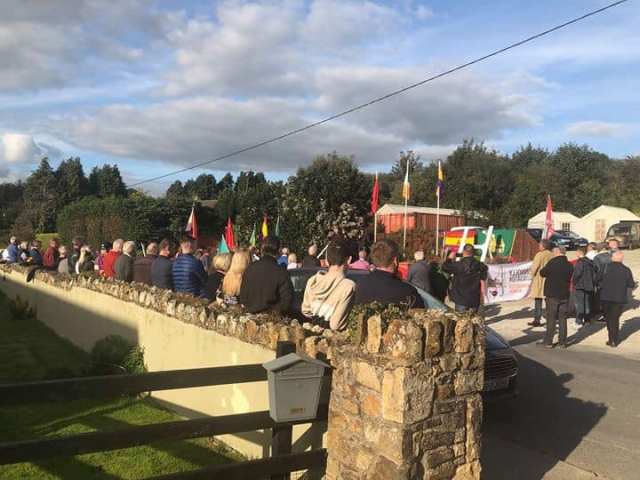
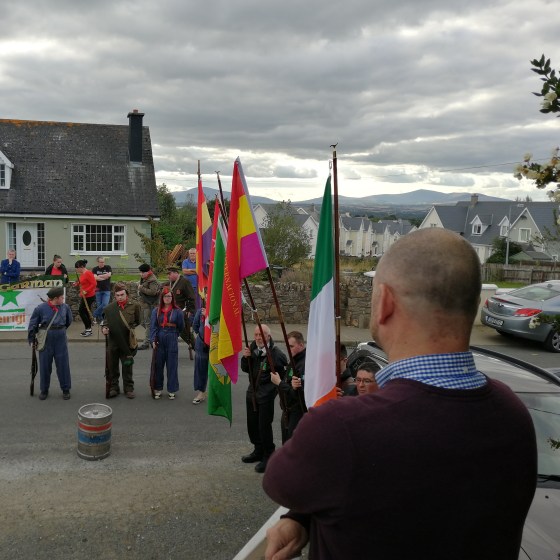
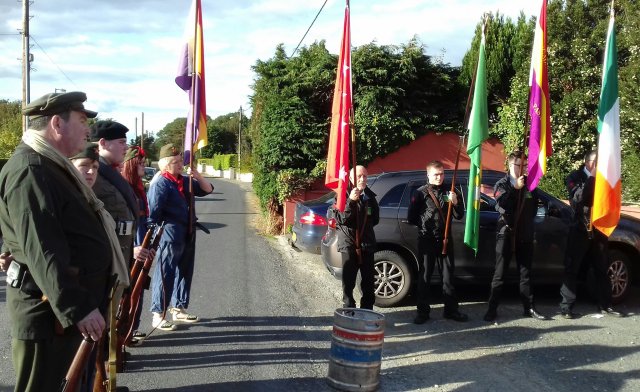
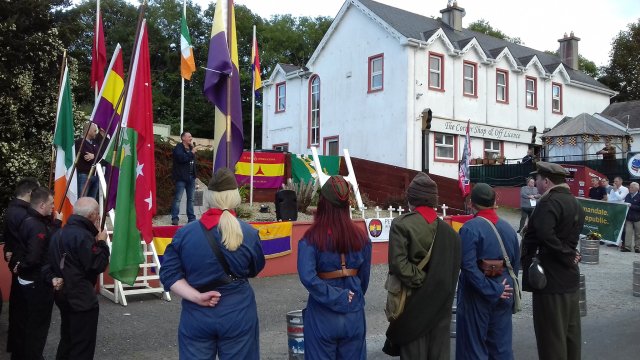
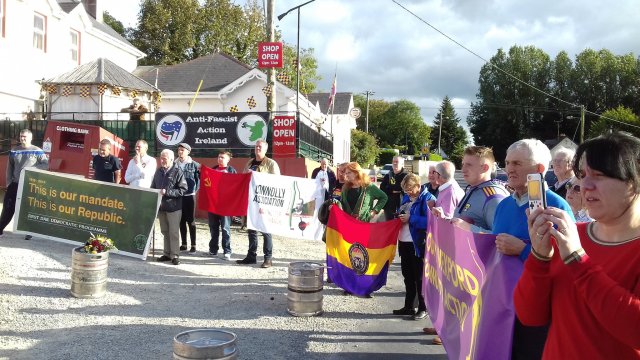
          Flags of various kinds flew above a gathering in Monagear, Co. Wexford on Saturday 7th September, while a number of banners were visible among the crowd: Peter Daly Society, Connolly Association Manchester, Wexford Community Action, Anti-Imperialist Action Ireland, Friends of International Brigades Ireland, Éirigí, Connolly Column. Also in attendance was a group of young men and women dressed to represent the International Brigaders and the POUM1 milita, organised by the Cavan Volunteers group. The event had been organised by the Peter Daly Society with support from the Peadar O’Donnell Forum.

Monagear Commemoration from behind wall
Long view of Peter Daly commemoration seen from the back (Photo source: Peter Daly Society)
moin-na-gcaor-1798-banner.jpg
A reminder of even older struggles — banner inside the Monageer Tavern. (Photo source: D.Breatnach)

Monagear is a small village in the centre of Co. Wexford, a few kilometres north-east of Wexford town. Also known a Monageer, both words are, like most place-names in Ireland, from the original Irish language: Móin na gCaor, “the bogland of the berries” (probably of the Rowan or Mountain Ash, which in Irish is Crann Caorthainn). Not far from it are the historic place-names associated with the United Irishmen uprising of 17982 in that county, such as Boolavogue and Enniscorthy and indeed, a small commemoration garden in the village has memorial stones dedicated to that struggle and to others since.

sdr
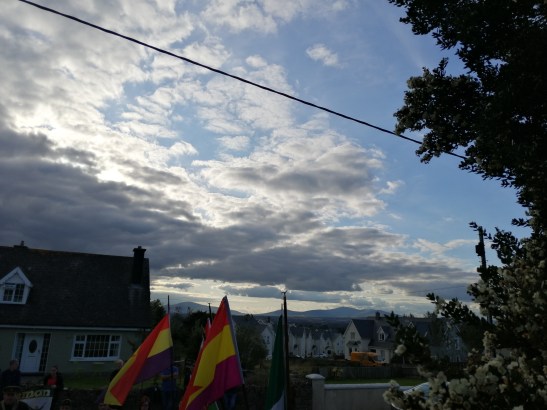
View in a cloud-darkened moment over the crowd, past the new houses in the village and to the hills and mountains in the distance. (Photo source: D.Breatnach)

At a signal, the gathering of people with flags and banners, led by a colour party flying the Irish Tricolour, the flag of the 2nd Spanish Republic, a red starry flag and the Irish workers’ Starry Plough, moved in procession down into the village area and assembled outside the raised platform containing the tasteful simple memorial to Peter Daly, International Brigader killed in the War Against Fascism in the territory of Spain (1936-1939).

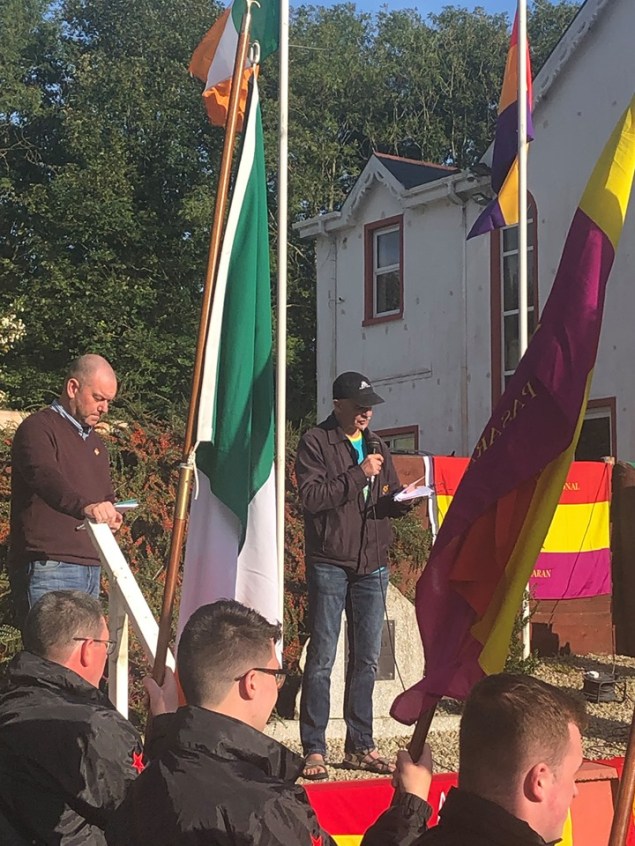
Steve McCann, Chairman of the Peter Daly Society, with another man beside him, opened the ceremony from the memorial platform by briefly outlining the history of the Peter Daly commemorations and of the Society (founded in 2011) which he said had from the beginning welcomed the involvement and participation of Irish Republicans, Communists, Socialists, Anarchists and plain anti-fascists. After outlining the program of speeches and songs for the day, he called Gearóid Ó Machaill to give the first speech, on behalf of the Friends of the International Brigades, Ireland.

sdr
Steve McCann addressing crowd with colour party and reenactment group visible below (Photo source: D.Breatnach)

“THE IRISH ARE NOT IMMUNE TO FASCISM”

          Ó Machaill opened his speech in Ulster Irish, thanking the organisers for giving him the opportunity to speak there at the cradle of Peter Daly, Irish Republican, socialist, anti-fascist. Continuing, he said that the conditions that gave rise to fascism in the 1930s are very similar to those of today. Speaking of the Republican Congress of 1936-1938, he said it had worked to overcome divisions in the working class and in the anti-imperialist movement. But it had fallen apart in disunity, unfortunately and in Ireland today, the anti-fascist forces are as divided too.

The Irish were not immune to fascism and had a strong fascist movement in the 1930s, supported for awhile by the State, X said. In the years since the defeat of fascism around most of the world, attempts to set up a fascist movement in Ireland had been smashed, said Ó Machaill but cautioned against complacency.

In some other parts of the world, workers betrayed by social democracy and hurt by capitalism, turned to hard right parties and outright fascists and it was entirely possible that such fascists would become popular while leading a campaign against bankers and even imperialism, pushing a line of “Irish for the Irish”.

“We cannot afford the divisions and need to unite ….. as Republicans and Socialists did in preventing the attempted launch of Pegida in 2016,|” said the speaker.

Colour Party & side view Militia GOM
Colour Party facing photographer, POUM and Brigader reenacters to the left. (Photo source: G. Ó Machaill)

MIGRANT DEPORTEES

          Steve McCann introduced the man beside him as Diarmuid Breatnach and called him to sing the first song of the selection for the ceremony and to say a few words about its content. Breatnach pointed out that migrants are often a prime target of fascists and the song he was to sing was about migrants and their treatment. On 28th January 1948, a DC-9 transporting Latino illegal migrants and “guest workers” crashed in the Los Diablos region of California and all 32 on board were killed. The radio news reported the crash but only gave the names of the crew members and the Immigration Department guard, saying the others killed were “deportees”. The names of the dead were known in their localities and were printed in local newspapers but were not deemed worthy of mention on the radio.

DB Reading Intro Song Platform Peter Daly Monageer Sep 2019
Diarmuid Breatnach reading introduction before singing a song. Steve McCann is standing to the left of the photo on the stage. (Photo source: Ado Perry)

Wood Guthrie wrote a poem called “Deportee” about the tragedy which was put to music by Martin Hoffman, the song since called Deportees or Plane Wreck at Los Gatos. Breatnach then sang the song, the chorus of which says:

Goodbye to my friends,

Farewell Rosalita

Adios mis amigos, 

Jesús y Maria;

You won't have a name 

When you ride the big airplane --

All they will call you 

Will be “deportees”.

LESSON OF HISTORY – NOT LIBERALISM BUT ROBUST ACTION IS NEEDED

          Mags Glennon was called to read a statement on behalf of Anti-Fascist Action. Moving on from the background to the fascist upsurge of the 1930s and the background of those who fought to defeat it, Glennon read: Far-right parties have risen from minor subculture to government across Europe in recent years, showing the glaring need for principled and active opposition to fascist and far right forces. The most concerning aspect of this political resurgence is the support it has received from young people and large sections of the traditional working class, due to the abandonment of these people by social democrats, and other parties who claimed to ‘represent’ them. Well meaning liberalism has never defeated fascism. It never will.”
Reading from the statement, Glennon called for a “re-energising” of the struggle to defeat those “aiming to distract our communities and young people from fighting their real enemy. Where there are fascists we must oppose them.”

Glennon concluded by reading: “Appeals to the police, to parliament or to Google to censor fascists have no place in anti-fascist struggle. History has shown that robust action against fascists in Ireland has always sent them running back to the gutters to think again. Long may it continue. La lucha continua!

Militia GOM
POUM militia and International Brigader reenacters seen from behind, centre photo. (Photo source: G. Ó Machaill)

“MUST ORGANISE IN WORKING-CLASS COMMUNITIES”

          The MC, Steve McCann, introduced the anti-fascist and community activist as well as Independent Dublin City Councillor, Ciaran Perry. Speaking without notes, Perry outlined the historical necessity of defeating fascism politically and physically.

Echoing a previous speaker’s comments, Perry too called for unity of the antifascist forces against fascism but also against capitalism and imperialism. He said that working-class communities, betrayed by social democracy and distracted by identity politics, had become prey to the propaganda of fascists.

ciaran-perry-speaking.jpg
Ciaran Perry speaking

Fascism is a facet of capitalism”, Perry said “and therefore the enemy of the working class.  The working class should be our natural constituency.”

Going on to suggest that if fascists build bases in working class communities it is because of the failure of the Left, he called on socialists and antifascists go into those communities and to build their bases there.

ESCAPE FROM DACHAU AND DEATH IN SPAIN

          Breatnach stepped forward to sing a combination of two songs from the German side of the anti-fascist struggle. The German political prisoners in the concentration camps were forbidden to sing socialist songs and had written their own, one of which became famous around the world was The Peat Bog Soldiers, lyrics written by Johann Esser, a miner and Wolfgang Langhoff, an actor and melody composed by Rudi Guguel.

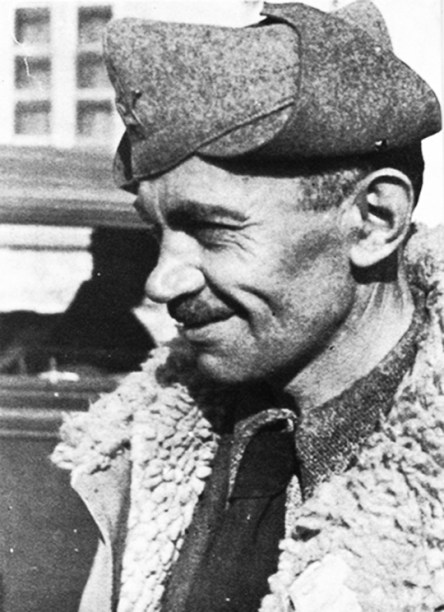
“Hans Beimler (1895-1936) was a WWI veteran, a Communist, a Deputy elected to the Reichstag in 1932,” said Breatnach. “In January 1933 Hitler came to power in Germany. The Communist Party was banned and in April 1933 Beimler was arrested and sent to Dachau extermination camp where, in May, he strangled his SA guard and, putting on the man’s uniform, escaped. He went to Spain where he was a Commissar with the International Brigades and was killed in the Battle of Madrid on 1st December 1936.”

He would sing two verses of the Peat Bog Soldiers, Breatnach explained, combined with the Hans Beimler song.

Hans Beimler Photo Spain maybe
Photo of Hans Beimler, WWI veteran, Communist, escapee from Dachau, International Brigader, killed in the Battle of Madrid 1936.                      (Photo source: Internet)

“THE NORM WAS FOR ALL CAPTURED INTERNATIONAL BRIGADERS TO BE EXECUTED”

          The sun sinking towards the west shone over the heads of the attendance on to the raised bed of the memorial stone and its flagpoles and, except when covered by clouds, into the eyes of those on the platform. Outside the nearby pub some locals gathered and behind those gathered around the monument, others in attendance lined a low wall while nearby other local people, mostly youth, congregated for a time. Occasionally a passing car drove carefully along the street past the crowd. House martins darted above, a wasp occasionally bothered the speakers and the smokey-blue soft curves of the Silvermine Hills and Knockmealdown Mountains rose to the west.

Harry Owens Speaking
Harry Owens speaking from the platform (Monagheer Tavern to the right of photo)

The Chair of the event called Harry Owens to speak.

Harry ‘s speech traced the history of world events that had led up to the fascist coup and war in Spain. He also spoke about the kind of people the Brigadistas had been, quoting from their comrades, journalists and opponents. That Captain Frank Ryan had his life spared was unusual, he explained, as the tendency was for all anti-fascist officers to be executed and all International Brigaders of all ranks. Whilst the Spanish fascists wanted to execute them, the Italian soldiers tended to keep them alive in order to exchange them for Italian prisoners of the Republican side.

The death toll among officers and men in the International Brigades had been higher than the norm in warfare and the average in the Irish contingent higher still, Owens said. The food and armament supply conditions of the Republican side had been poor in many areas but almost to a man they had fought on until death, capture or demobilisation. It was their conviction, that they knew what they were fighting for and believed in it that accounted for that.

After Owens’ speech, Breatnach stepped forward to sing, without introduction, Viva la Quinze Brigada3 (the song written by Christy Moore about the Irish who fought in the 15th International Brigade). The song mentions Peter Daly in the verse:

This song is a tribute to Frank Ryan,

Kit Conway and Dinny Coady too,

Peter Daly, Charlie Reagan and Hugh Bonner,

Though many died, I can but name a few.

Danny Doyle, Blazer Brown and Charlie Donnelly,

Liam Tumlinson, Jim Straney from the Falls,

Jack Nalty, Tommy Patton and Frank Conroy,
Jim Foley, Tony Fox and Dick O’Neill.

The words of Moore’s chorus rang out along the street:

Viva la Quinze Brigada!

No Pasarán!” the pledge that made them fight;

Adelante” is the cry around the hillside,

Let us all remember them tonight.

…. and concluded with the cry “Viven!” (“They live!”)

WREATHS, THE INTERNATIONALE AND AMHRÁN NA BHFIANN

          McCann called for those who wished to lay wreaths on behalf of organisations and the following came to lay floral tributes: John Kenny, activist of the Peter Daly Society; Mags Glennon for Anti-Fascist Action; Seán Doyle for Anti-Imperialist Action Ireland (who had provided the colour party); Connolly Association Manchester; and Gary O’Brien for Éirigí. Messages of support had been received from the CPI, IRSP and the Connolly Association Manchester.

Closeup Peter Daly Monument & Wreaths
Closeup of Peter Daily memorial with floral tributes laid. (Photo source: Peter Daly Society)

McCann then called Breatnach forward to sing the Internationale, the international anthem of the working class, the lyrics of which Breatnach explained had been composed by Anarchist Eugene Pottier of the Paris Commune, in 1871, the first time the working class had seized a city. It had been written to the air of the Marsellaise but later put to its own melody by worker-composer Pierre de Gayter.

“It was written in French”, said Breatnach, “which is why I propose to sing the chorus once in French at the start but it has been translated into many languages. Youtube has a post with 95 translations ….. and there are at least three versions of it in English and people are welcome to sing along in any version they know,” Breatnach concluded before singing the French chorus, followed by two English verses and chorus.

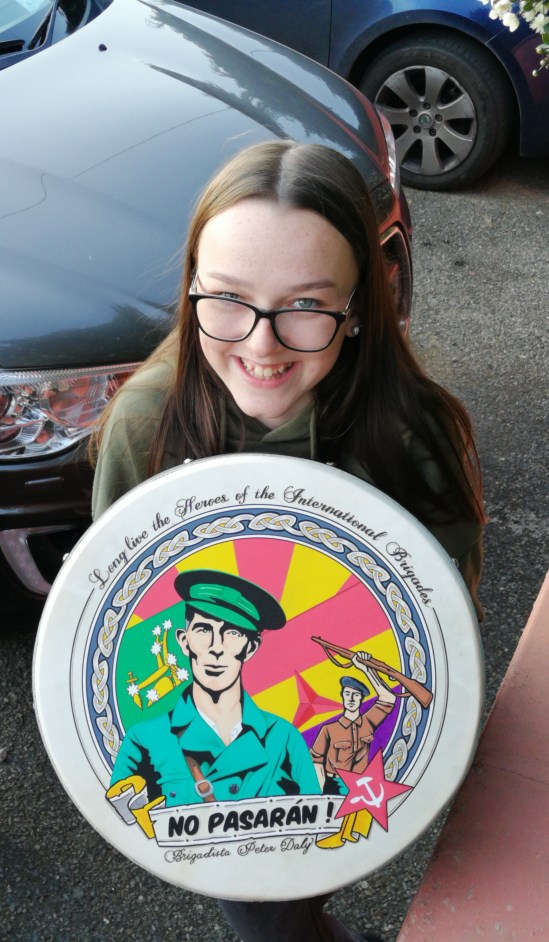
The MC Steve directed attention to a bodhrán decorated with a dedication to Peter Daly by Barry O’Shea which was displayed by Erin McCann and which would be raffled as a fund-raising exercise at the reception inside the pub.

girl-with-p-daly-bodhran.jpg
Ciara McCann with the bodhrán decorated by Barry O’Shea (Photo source: D.Breatnach)

Steve McCAnn then called Marie Kenny Murphy and Marilyn Harris up on to the stage, where they played the Irish national anthem on flutes, with many people singing along in its Irish translation4:

Anocht a théim sa bhearna baoil,

Le gean ar Ghael chun báis no saol;

Le gunnaí scréach, faoi lámhach na bpiléar,

Seo libh, canaig’ Amhrán na bhFiann.


Part Crowd Close GOM
Section of crowd around monument (Photo source: G. O Machaill)

REFRESHMENTS, EXHIBITION, RAFFLE, SONG AND CONVERSATION

          All the speakers had referenced the historical memory of the Anti-Fascist War on Spanish territory to the struggles of today and even of tomorrow and the selection of songs had been deliberately chosen to emphasise internationalism and workers’ solidarity from the past and needed today.

McCann thanked all the performers, speakers and participants and in particular welcomed the participation of the Connolly Association contingent from Manchester, encouraging them to attend again the following year. Inviting all to enter the local Monageer Tavern to view the Antifascist War memorabilia and to have some food, the MC brought the ceremony to an end.

Inside the local pub, the Monageer Tavern, food had been made available by the owners and the function hall was provided for the commemoration participants.

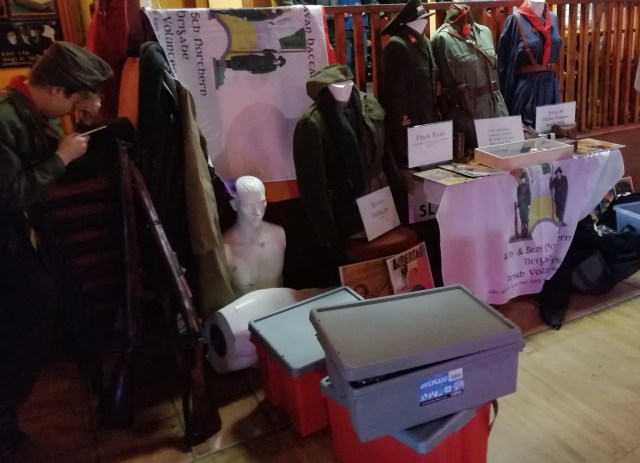
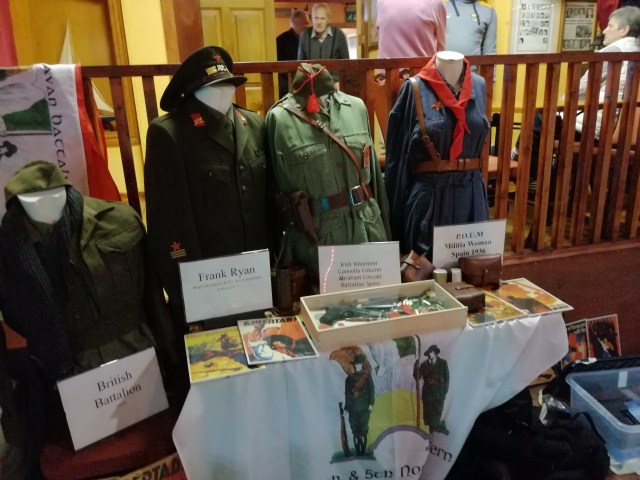
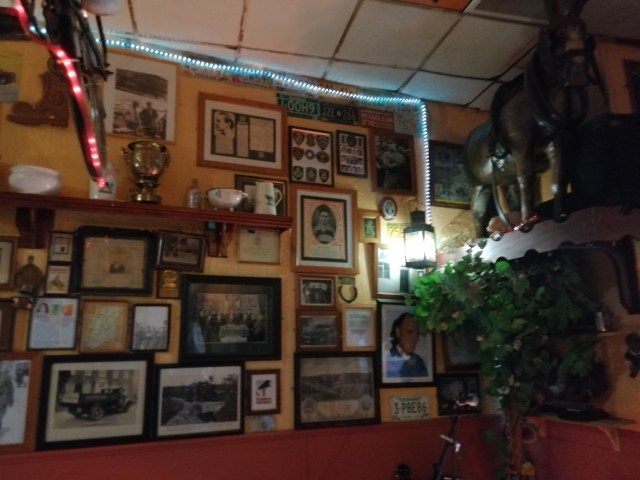
An interesting display of memorabilia of the Spanish Anti-Fascist War had been erected inside by the Cavan Volunteers history group. The walls of the function room on one side were also covered with permanent framed photographs and other images of Irish history, among which Joe Mooney, anti-fascist, community worker and activist of the East Wall History Group, spotted a photo of the Dublin docks with a docker well-known to his community in the foreground!

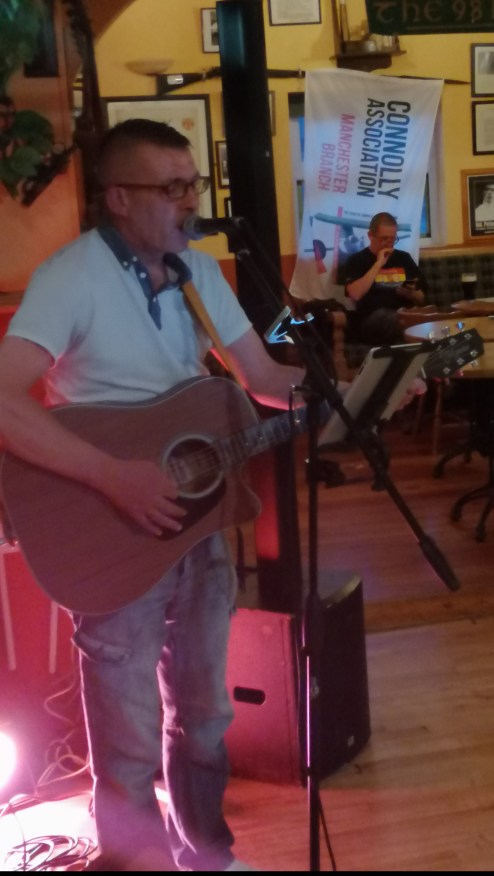
Music was provided by Tony Hughes with voice and guitar, singing a selection of songs including anti-racist and Irish Republican ballads, also Viva La Quinze Brigada.

solo-performer-pub.jpg
Tony Hughes playing and singing at the event inside the Monageer Tavern                                       (Photo source: D.Breatnach)
antif-war-memorabilia-wider.jpg
Spanish Anti-Fascist War memorabilia organised by the Cavan Volunteer history and re-enactment group (Photo source: D.Breatmach)

dav

When the raffle was held a search went on for the winning number ticket which eventually unearthed it in the possession of Helena Keane, seller of the tickets and who adamantly refused to take the prize. Another dip into the stubs brought Gearóid Ó Machaill’s ticket out, ensuring the decorated bodhrán would find a new home somewhere in the occupied Six Counties.

mde
Section of the function room wall in the Monageer Tavern. (Photo source: D.Breatnach)
mde
Another section of the function room wall. (Photo source: D.Breatnach)
lineup-people-banners-peter-daly-monument-7-aug-2019.jpg
(Photo source: Ado Perry)

FOOTNOTES

1The International Brigades were organised through the Comintern and Communist parties in various parts of the world but a number of International Volunteers came also through the mainly Trotskyist POUM, including Anarchists. One Irish volunteer went to join the Basque Gudaris and was killed fighting the fascists there.

2First Republican rising in Ireland, organised and led for the most part by Protestants, descendants of British colonists.

3Christy Moore called this “Viva la Quinta Brigada” (i.e the Fifth) but in later versions sang in English a line in the first verse calling it “the 15th International Brigade”. It appears that from different chronological perspectives one can call it either the Fifth or the Fifteenth but the mostly English-speaking brigade of the International Brigades is usually named the Fifteenth. Quinze is the Spanish word for “fifteen” and Viva la Quinze Brigada scans in the song while “decimoquinta Brigada” has too many syllables to fit.

4The Soldier’s Song was written originally in English by Peadar Kearney, an Irish Republican worker with socialist sympathies and put to music by worker-composer Patrick Heeny. It was translated to Irish by Liam Ó Rinn under the title Amhrán na bhFiann and published in 1923. Only the chorus became the anthem of the Irish State and that was not until later. The Irish-language version is the one most commonly sung at non-State occasions now.

LINKS FOR FURTHER INFORMATION:

Organisers
Peter Daly Association: https://www.facebook.com/PeterDalyCommemoration/

with help from the Peadar O’Donnel Forum: https://www.facebook.com/Peadar-ODonnell-Socialist-Republican-Forum-1538296709833402/

Colour Party by Anti-Imperialist Action Ireland: https://www.facebook.com/AIAIreland2/

Memorabilia and kitting out of POUM militia and International Brigade reenacters by Cavan Volunteers group: https://www.facebook.com/groups/242987949412133/

End .

PART ONE: THE THIRTY-YEARS’ WAR – DOOMED TO LOSE

(Reading time this section: less than 5 minutes)

Part of the series HOW TO WIN THE WAR — GETTING INTO POSITION

See also:

INTRODUCTION: https://rebelbreeze.wordpress.com/2019/08/07/how-to-win-the-war-getting-into-position/

PART TWO: COLLECTING THE FORCES FOR REVOLUTION https://rebelbreeze.wordpress.com/2019/08/07/part-2-collecting-the-forces-for-revolution/

PART THREE: THE ABSOLUTE NEED FOR UNITY – BUT HOW AND WHAT KIND? WITH WHOM?

PART FOUR: UNITY AGAINST REPRESSION

The national liberation war that began in 1969 in the Six Counties and ended in 1998 (though some armed incidents continue from time to time) began as a civil rights struggle and changed into a war of communal defence and of national liberation. The military part of the struggle for the most part took place in the occupied Six Counties. The political element of the struggle was waged all over Ireland (and abroad) but in the main consisted of support for the struggle in the Six occupied Counties.

Free Derry Corner Gas Mask Images
Derry Monument and Mural of the Civil Rights struggle which preceded the armed struggle in the Six Counties. (Image sourced: Internet)

Fought in that way, the struggle was bound to lose. It could never win. How could anyone imagine that they could win a struggle fought against a world power in one-sixth of the country, where even the population there was divided against them? What could they have been thinking?
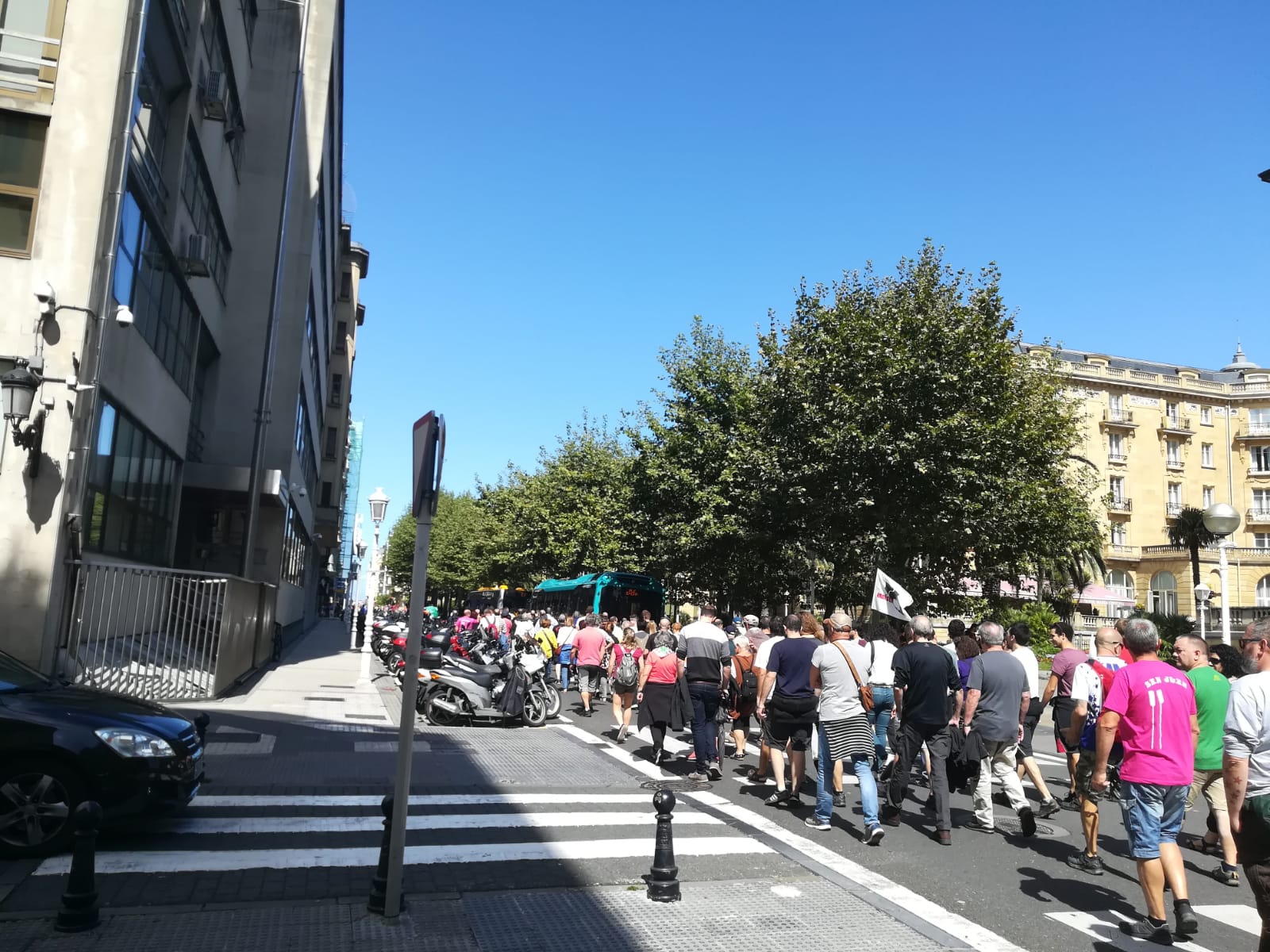
To my mind, there are only two possible sane replies to that question, which is that they believed: 1) that the British ruling class would get worn down by struggle and leave and/ or 2) that the Irish ruling class would intervene in some way to assist the struggle and make continued British occupation untenable.

1) ‘The British ruling class would get worn down and leave’: This theory must have depended on British repression being condemned abroad and being unpopular at home but had to rest fundamentally on the British having no great stake in continuing its possession of its colony there.

Anyone who thought that (and there were many who did and still many who do, not just Irish Republicans) made a fundamental error. Time and again the British ruling class has shown its determination to hang on to what might be considered its first colony, even as its ruling class’ composition changed from feudal-colonialist to capitalist-imperialist and as the world changed around it.

Collusion State Murder Mural
Mural in nationalist area in the Six Counties (Image sourced: Internet)

Even when the British ruling class, weakened by WW1 and facing an Irish guerrilla war with the support of the vast majority of Irish people, with national liberation uprisings breaking out across its Empire and with its repression in Ireland increasingly unpopular at home, entered into negotiations with the Irish resistance, it held on to a foothold, the Six Counties.

Subsequently, it had that colony managed in a permanent state of emergency laws, with institutionalised sectarian discrimination at all official levels and outbreaks of pogroms in the street and workplace.

That became even more exposed during the civil rights struggle and the national liberation war that followed when the British State compromised whatever good international reputation its Armed Forces had, its judiciary, its legal establishment, its media and its very legal framework.

Even now, when many believe that the Good Friday Agreement means that a 50% plus one vote in favour in the Six Counties will be sufficient to end Partition, they do not realise that such a decision will have to also obtain a majority in the British Parliament and be endorsed by the British Monarch. They are also forgetting the broken promises that surrounded Partition in the first place.

When analysing what holding on to the Six Counties has cost the British State in terms of reputation, military and financial contributions, one can only rationally assume that continuing to hold on to that foothold is of great importance to the British State. One may speculate as to the reasons underlying that but the central fact cannot be denied.

2) that the Irish ruling class would intervene in some way to assist the struggle and make continued British occupation untenable:

There was some basis for this belief in that a section of Fianna Fáil, a party that had emerged from a split in Sinn Féin in the 1930s and had become one of the mainstream parties in the Irish state, had retained some traditional commitment to seeking a united Ireland. However it was a thin enough basis on which to depend in a national liberation struggle since that section had no majority within the party itself, to say nothing of the foreign-dependent nature of the Irish native capitalist class, the Gombeens, as a whole.

British Soldiers Helmeted Belfast 1969
British Army in Belfast 1969 (bayonets and guns pointed towards nationalist area). (Image sourced: Internet)

The question came to a trial of strength in the Arms Crisis of 1970, in which at least two Fianna Fáil Government Ministers were involved in secretly buying arms for the defence of nationalist areas in the Six Counties (since the IRA had insufficient weapons at the time) from rampaging Loyalist mobs and the Royal Ulster Constabulary (including the part-time B-Specials). The Ministers alleged that they had acted in the full knowledge of the rest of the Government. By the time the whole affair was over, two Ministers had been sacked and another two resigned in protest.

If it had not been clear before that the Gombeens, the native Irish capitalist class was no patriotic capitalist class but rather a neo-colonial one, it should have been clear after that. But the armed struggle in the Six Counties intensified, especially after the massacres of unarmed civilians carried out by British Paratroopers the following year, 1971 in Belfast and again in Derry in 1972. And the war lasted until 1998.

If, as had been demonstrated to be the case that the British ruling class were determined to hold on to the Six Counties and the Irish ruling class was not going to seriously challenge that possession, did the Republican movement have any other option than to fight on a war that they could not possibly win?

I am clear that they did.  

Clearly, in order to have a chance of success, the war had to be extended to the other five-fifths of the country, which is to say into the territory under the control of the Irish native capitalist class. This class had seized power after the War of Independence 1919-1921 and had beaten and suppressed its opposition during the Civil War (1922-1923) and after and furthermore was supported by a powerful ally, the Irish Catholic Church. Since the founding of the first Irish Republican organisation, the United Irishmen of the late 1790s, the Catholic Church hierarchy had opposed Irish Republicanism; it had condemned four Irish priests who participated in the uprising of 1798, excommunicated the Fenians, had at first condemned the 1916 Rising and the War of Independence only to latch on to it at the end along with the Gombeen class.

The general Irish

population likely would not have supported or sustained an armed struggle in the 1970s against the Gombeen class but that class could have been fought politically, through agitation and mobilisation, on many social, political and economic fronts. Without going into the specific details of each, these were:

  1. against the huge wastage of Irish youth through emigration

  2. to remedy the shortage of affordable housing (which in part contributed to the above)

  3. to end unemployment (also contributing hugely to emigration)

  4. to raise the level of wages and lower wage earners’ taxation

  5. for the right to divorce

  6. for equality for women in law

  7. for the right to contraception devices and medication for men and women

  8. against decriminalisation and for equal rights for gay and lesbians

  9. to halt the decline of the Irish language, in particular of the rural Irish-speaking areas

  10. to improve services for the rural areas

  11. to oppose the open-door policy for foreign multinationals to exploit Irish natural and human resources

  12. to secularise the education service

  13. and the health service.

  14. to remove the privileged status of the Catholic Church within the state.

The Republican movement in general, with some exceptions, declined to take on any of those struggles. They did not organise in the trade union movement, left the social struggles to others and most of all, declined to take on the Catholic Church on any issue except its opposition to the national liberation struggle. Even there, it was happy to publicly avail of the services of members of the Church clergy who supported them. Republicanism was, from its very beginning, as well as anti-monarchist, about separation of Church and State but it was difficult to see that in the Irish Republican movement, particularly after the War of Independence.

Irish Womens Liberation Connolly Station
Irish women photographed at Connolly Station 1971, about to board train to Belfast to purchase contraceptives to bring back to the Irish state, illegal at the time. There was no right to abortion either or divorce and a husband’s signed permission was necessary to take out a hire purchase agreement. (Image sourced: Internet)

A full half of those fourteen points above (nos. 5,6, 7, 8, 12, 13 and 14) would have meant taking on the Church head-on and no doubt the hierarchy would have hindered the struggle over most of the others too, due to its strong links with the State and its ruling class.

Because of its tactical and no doubt ideological refusal to take up those struggles, the Republican movement could do little more in the 26-County state than to agitate for solidarity with the beleaguered nationalist population inside the British colony.

Though this could be effective for a time it could become a mass movement, nor survive a long struggle, without any remedy being sought to the issues facing the population within the state.

The wonder is not that the majority leadership of the Republican Movement threw in the towel on the military struggle in 1998 but that they had waited so long to do it. Of course, they never admitted the true nature of what they were doing: abandoning the armed struggle and revolution in total and instead, using their negotiating position to advance themselves politically – not in the economic, social and political struggle envisioned above but rather in a political struggle to find themselves a place among the Gombeen political class in the Irish state and as accomplices in the governing of the colonial state.

Diarmuid Breatnach is a veteran independent revolutionary activist, currently particularly active in committees against repression, in some areas of internationalist solidarity and in defence of historical memory.

BASTILLE DAY ANTI-INTERNMENT PROTEST IN DUBLIN

Published by kind permission of Dublin Anti-Internment Committee from their Facebook page End Internment

INTERNATIONAL FLAVOUR ON IRISH ANTI-INTERNMENT PICKET

Clive Sulish

The Dublin Anti-Internment Committee was out again on Saturday 13 July (the day before Bastille Day, which marks the French Revolution, the taking of the Bastille prison in Paris in 1789 and the freeing of political prisoners by revolutionary forces).


The campaigners were out on their monthly picket to raise awareness that, as their leaflet headline says: INTERNMENT CONTINUES IN IRELAND BUT BY OTHER NAMES. When political activists (at the moment Irish Republicans) are arrested and refused bail, that is effectively internment without trial. When political ex-prisoners released under the Good Friday Agreement have their licenses revoked and are taken to jail without charge or hearing, that is also effectively internment.


The picketers lined up with their banners and some placards outside the St. Stephen’s Green Shopping Centre which is at the top of Grafton Street and facing the main entrance arch to the Stephen’s Green park. The official name of this monument is Fusiliers’ Arch as it carries the names of many of the Dublin Fusiliers who were killed in the Second Boer War fighting for the British; for the same reason it also widely known as Traitors’ Arch.

dav
Stephen’s Green Shopping Centre in backgroun
sdr
Basque couple joins the protest
sdr
Catalan supporter inlcuded in photo with west side of Stephen’s Green Park in the background
DB & DAIC Picket Stephens Green Grafton July 1919
DAIC supporter hands out leaflets to passers-by (part of Fusiliers’/ Traitors’ Arch in background)

Stephen’s Green also contains monuments to people who were political prisoners in their time: Ó Donnobháin Rosa, a Fenian who survived where many died as a result of the conditions of their long imprisonment; United Irishmen Emmet and Tone, both before execution and ICA officer Markievicz, who was an officer in the 1916 Rising Garrison here (and whose death sentence was commuted).

Just over a hundred years ago, this whole area was a battleground under the command of the Irish Citizen Army, the workers’ army created in 1913 to defend striking workers from the Dublin Metropolitan Police. Some of the structures here carry the marks of many bullet impacts.

The area chosen for the picket on Saturday is a very busy one with a constant flow of pedestrians shopping in Grafton Street and Stephen’s Green Centre, tourists and people relaxing walking through, going to and coming from the Green. Many leaflets were distributed.

The protester were joined today by the Abolish the Special Courts campaign and appropriately so, since many Republican activists are charged and taken before these courts where they may be denied bail and kept in jail until their trial so that in the unlikely event of their being found not guilty by these no-jury political courts a couple of years later, they will already have spent that time in jail anyway. The Special “Criminal” Courts are the Irish state’s equivalent of the Diplock Court in the Six County colony.

There was something of an international flavour to the picket on Saturday, with a Catalan comrade supporting the picket and distributing leaflets and briefly a Basque couple supporting it too.

The Dublin Anti-Internment Committee expects to be at another location in Dublin town in some weeks’ time and welcomes support from across the democratic spectrum.

End.

U.S. VETERANS STILL FIGHTING – BUT NOW AGAINST THE MACHINE

Clive Sulish

DUBLIN AUDIENCE AT AFRI PUBLIC MEETING CHARMED AND INSPIRED BY FORMER MEMBERS OF USA ARMED FORCES WHO ARE ON TRIAL FOR BREACH OF SHANNON AIRPORT SECURITY ZONE.

Veterans for Peace Members Ken Mayers and Tarak Kauff, US-based anti-war campaigners, last Wednesday evening clearly impressed members of a Dublin audience by their dedication. Both men are awaiting trial in Ireland for exposing U.S. war crimes and the violation of Irish neutrality at Shannon Airport and are at liberty only within the jurisdiction of the Irish State on a combined bail of €5,000.

          The bail was paid by anti-war campaigner Ed Horgan, a former army commandant and UN peace keeper and the sum is twice the amount of criminal damage they are accused of having caused to the airport’s perimeter fence, as well as unlawfully trespassing into a taxiway. They did so in order to inspect a US plane to ensure it was not carrying war material or personnel, in violation of Ireland’s Constitutional neutrality. Campaigners have long demanded that the Irish State itself carry out these inspections but despite evidence that the State’s neutrality is indeed being violated by US Planes landing at Shannon, successive Irish governments have insisted in taking USA Government denials on trust.

oznor
Tarak Kauff addressing the audience at the public meeting organised by Afri.

The public meeting was opened by Joe Murray, Coordinator of Afri and Emer Lynam, newly-elected Vice-Chairperson of Afri Ireland, introduced the speakers.

The elderly campaigners, in their “Veterans for Peace” sweatshirts, addressed the audience about the reasons for their actions and their commitment to opposing US militarism which they stated was a major cause of misery around the world, including to serving members of the military themselves (quoting a figure of 22 suicides per day), along with being a major cause of world pollution. Ken Mayers explained that the USA has 800 military bases around the world in addition to its 400 on its own territory, the infrastructure, fuel expenditure and waste of the total which he stated is a major cause of pollution. (This is presumably without even taking into account the use of nuclear-generated power and disposal of radioactive material, or depleted uranium projectiles, such as used in Iraq or the Agent Orange defoliant used in the Vietnam War.)

Both men belong to an organisation called Veterans for Peace which campaigns against the US militarisation of the economy, war, interference in the affairs of other states and for better treatment of veterans. Recently they also supported a campaign against concentration camps for migrants along the US-Mexico border.

13 DAYS IN JAIL THEN BAIL ON CONDITION THEY DON’T APPROACH ANY AIRPORTS

          Ken Mayers, 82 years of age and Tarak Kauff 77, spent 13 days on remand in Limerick jail, where their toilet did not flush unless they poured buckets of water into it. Other than that, they said they were treated well and the other prisoners treated them “like celebrities”.

The reason for their bail being refused during that period was Garda objections that they would flee the jurisdiction. Tarak Kauff exposed the illogicality of this fear to the Dublin audience, explaining that they had taken their action at Shannon knowing that they would be arrested and wanting to use the trial to expose what was going on at Shannon airport: “For us not to attend that trial, they would have to physically drag us away from there!”

ken-mayer-standing-speaking.jpg
Ken Mayer of US Veterans for Peace, addressing the public meeting

They were eventually granted bail on condition they remain within the Irish state and having to surrender their passports, due to Garda objections again that they might flee, also not to approach any airports. On July 10th the High Court turned down their appeal against these conditions, though the judge said that he might review that decision if the case were to be moved to the Dublin District Court, where the waiting list was much longer. The defendants and their solicitor, Michael Finucane, will be seeking to have the case heard outside Clare, where it is believed a fair trial relating to a Shannon protest is unlikely. A trial date is expected in September or October.

oznor

THEY POSTPONED MY HONEYMOON”

          Ed Horgan took the floor after Mayers and Kauff to speak about the one million total of children killed in the Middle East as a result of war and sanctions and urged action to prevent further loss of children’s lives.

Then Emer Lynam opened the meeting to questions.

In reply to questions from the audience about the cost to themselves, Ken Mayers revealed he was due to be on his honeymoon by now with his bride.

Ken Mayers was born in New York City and grew up on Long Island. From Princeton University he entered the US military as a Second Lieutenant in the US Marine Corps, rising to Major until he left the organisation in 1966 in disgust with US foreign policy. In Berkeley University, California he gained a PhD in political science where, according to the AFRI event page, he became a peace and justice activist, which he has been ever since and six years on the Veterans For Peace (USA) Board of Directors, five of them as national treasurer.

Tarak Kauff, ex-military too and also from New York, said that he missed his wife and daughter but both were supportive of what he was doing, being activists also (see short letter from his wife in Links and References). According to Afri’s FB page, he’s a former U.S. Army paratrooper (1959 – 1962), a member of Veterans For Peace, the managing editor of VFP’s quarterly newspaper Peace in Our Times and was a member of the VFP National Board of Directors for six years. He has organized and led delegations of veterans to Okinawa; Jeju Island, South Korea; Palestine; Ferguson, Missouri; Standing Rock …. and Ireland.

Asked what kept them going, they stated the importance to act against injustice. Kauff in particular declared that “to resist is human” and that he wished to be fully human. He said that no-one could tell another what he or she could do but one only had have the courage to ask oneself that question …. and then the courage to act upon the answer.

sdr
Section of audience at the public meeting

IRISH PEOPLE JUST COME UP AND SHAKE OUR HANDS, THANK US FOR WHAT WE ARE DOING”

          Both expressed gratitude and a degree of amazement at the warmth of their welcome and appreciation by members of the Irish public. Kauff gave an instance of the Lisdoonvarna pub where the management would not accept payment for their food and drinks. “People just come up to us and shake our hands and thank us for what we’re doing,” the veteran said, “and we don’t get that in the USA.”

Donations from the public fund them and, at the moment, they live in student accommodation at Limerick University, rent free – though they will need to find alternative accommodation in September.

oznor


oznor
Emer Lynam, Vice-Chairperson Afri.

Asked about popular feeling in the USA, Ken Mayer explained that the US public are exposed to a systematic system of propaganda and misinformation. However their anti-war organisation is very wide with many members and that there were optimistic signs with popular protest about the treatment of migrants along the US-Mexican border and fuel pipeline resistance in New York State and in Standing Rock. However, a little later, Tarak Kauff said that the outlook was not promising but that not resisting was no choice — even if he knew the world was going to end next week, he would feel he had to resist in order to fulfill his human potential.

Earlier in their presentations, Kauff alluded to Ireland’s historic struggle to overthrow its powerful oppressor and called people to oppose the most powerful enemy in the world today – the US State. He said that a stance taken by the Irish Government today would have a strong progressive ripple-effect around the world.

RESISTANCE IN MUSIC AND SONG

          Music for the evening was provided by veteran campaigner John Maguire who sang a song he had composed back at the first demonstration at Shannon airport, with a chorus that the audience soon got the hang of and joined in.

oznor
Musical accompaniment on the evening, l-r: Paul O’Toole, Nimal Blake, RoJ (Roger Whelan).

RoJ performed a song also of his own composition, accompanied by Paul O’Toole on guitar and Nimal Blake on cajón. Later, O’Toole also sang a song of his own, about the child who lost both his arms to US imperialist ‘smart-targeted’ bombing, then going on to sing one of Dylan’s numbers. Both RoJ and O’Toole are long-time professional performers and have produced CDs of their material.

All performers were warmly applauded.

The evening was a fund-raiser and it could be seen that the collection bucket, although covered, was stuffed with notes. Ken and Tarak also have a Fund Me appeal and Afri is also receiving some donations for them through the Internet.

End.

mde
A line up of activists, military veterans and musicians

LINKS AND REFERENCES:

Event notification by Afri: https://www.facebook.com/events/344492786248155/

https://www.irishtimes.com/news/crime-and-law/surprisingly-humane-elderly-us-veterans-arrested-at-shannon-describe-their-prison-stay-1.3843401

http://www.stopthesewars.org/kenandtarak/

Letter to the Broadsheet by Ellen Davidson, wife of Tarak Kauff: https://www.broadsheet.ie/2019/04/03/story-of-why/

Summary of events and explanation by Ken Mayers: http://claredaly.ie/us-veterans-for-peace-forced-to-remain-in-ireland-pending-trial/

US Veterans for Peace: https://www.veteransforpeace.org/

Suicides in US Military: https://en.wikipedia.org/wiki/United_States_military_veteran_suicide

mde
The huge banner “US War Machine Out of Shannon” (sadly, out of focus)