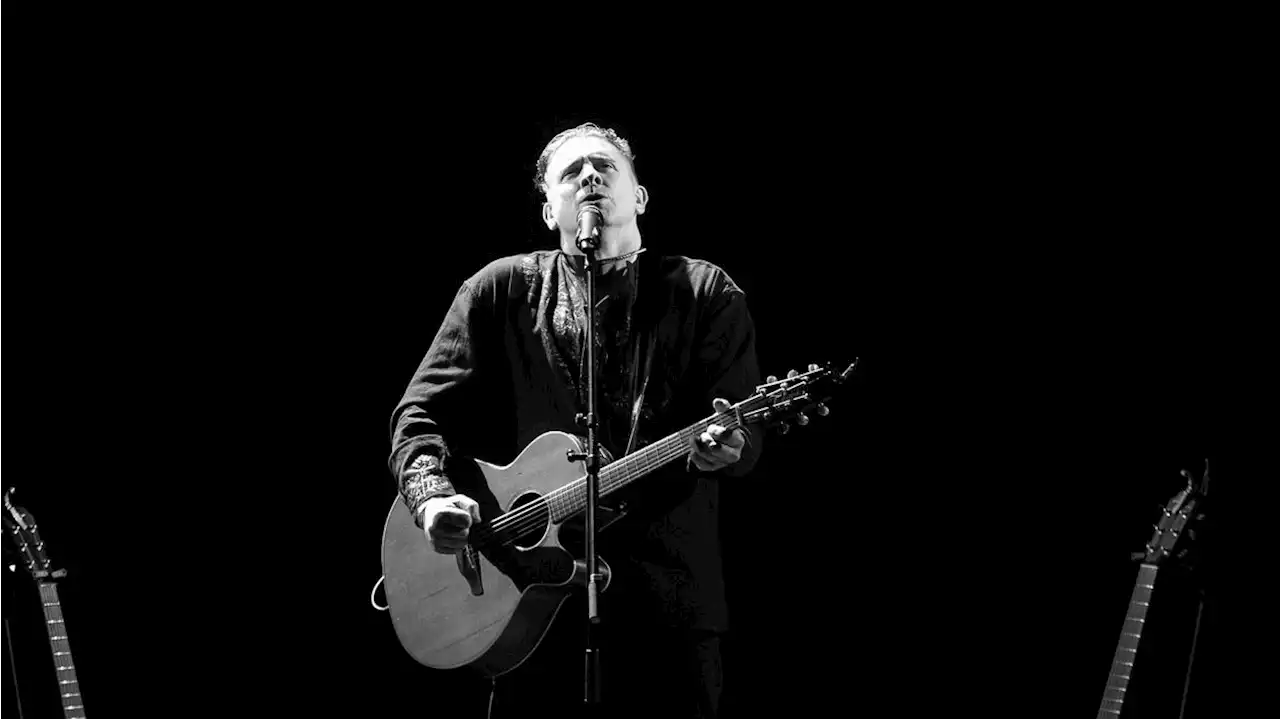
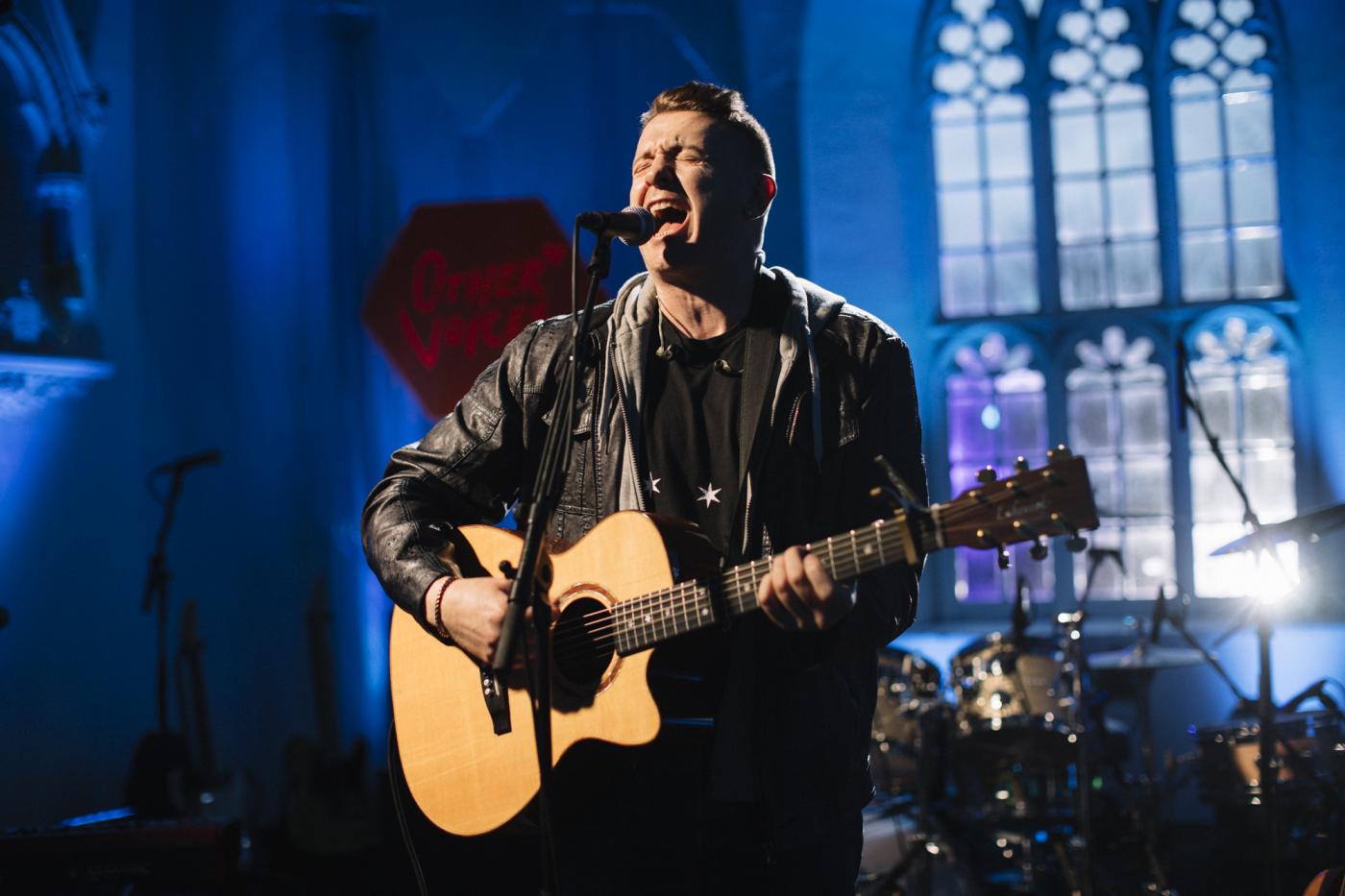
The stage production of Tales From the Holywell, written and performed by Damien Dempsey, is currently running at the Abbey until the 18th – and possibly beyond. Once advertised it was booked out for three weeks (with possible access through cancellations).
It was through cancellations that I and a few others faithfully waiting got in to see the performance on the 7th (it was closed on the bank holiday of the 6th). I really enjoyed it and cried laughing at times.
The whole audience gave him a standing ovation at the end and joined in singing one of his songs during his encore.
The stage set was bare and without background, with stage lighting showing Dempsey alone at times and at others, revealing players of keyboard, violin, double bass and percussion. Dempsey accompanied himself, alternating between two guitars.
The production consisted of Dempsey talking about his upbringing, his difficulties with his father but with whom he went to live when his mother left home, childhood and adolescent battles, his struggles and desires as an artist – all interjected with humorous cracks and songs.
He comes across as a man committed to his art and with integrity.
Dempsey performing at Abbey Theatre (Photo sourced: Internet; audience photos were prohibited)
Dempsey was raised in Holywell Crescent, a collection of local authority houses constructed on the site of an ancient holy freshwater well. This was one of probably thousands of wells across Ireland, each thought to be inhabited by a pagan spirit and then given a saint’s name by Christianity.
The well after which Dempsey’s street was named was St. Donagh’s Well (probably misnamed, see Links below) near Killbarrack and as the area became anglicised, called only “the Holy well”, then “Holywell” and the pool itself filled in and built over.
Whether he can speak it or not I have no idea but the Irish language made an appearance from time to time in Dempsey’s narrative, always with respect and, one might say, even reverence. And I was amazed to hear him sing a verse from An Cúlfhionn a capella, totally in Irish.
His song Colony – some might say masterpiece – gives a clear indication of what Dempsey feels about the long colonisation of Ireland and its parallels elsewhere in the world. I hoped he might take the opportunity to comment on the growing racist mobilisations in Ireland but was disappointed.
Dempsey performing (Photo sourced: Internet)
Conor McPherson directed the production which was written and performed by Damien Dempsey.
Apart from Dempsey’s, other music was provided by Lucia McPartlin (fiddle, vocals), Aura Stone (double bass) and Courtney Cullen (drums, percussion, vocals). I noted no name given in the theatre program for the keyboard and vocals performer.
I’m a great fan of Damo’s lyrics but less so of his singing; a question of musical and cultural taste, I suppose. But still I rose, wholeheartedly with the rest, to applaud his performance.
Whether its run will be extended I don’t know but currently it’s advertised to end on 18th February. If you haven’t booked, it’s well worth getting there early and hoping for a cancellation.
Thousands of people gathered on Sunday 29th January in Derry City’s Creggan area and marched through rain and gusts of strong wind in the annual Bloody Sunday March for Justice to Free Derry Corner.
The march commemorates the Derry Bloody Sunday Massacre of the last Sunday in January 1972, when the Parachute Regiment opened fire on unarmed Civil Rights marchers, killing 14 and injuring a great many, claiming the soldiers had only returned fire on paramilitaries.
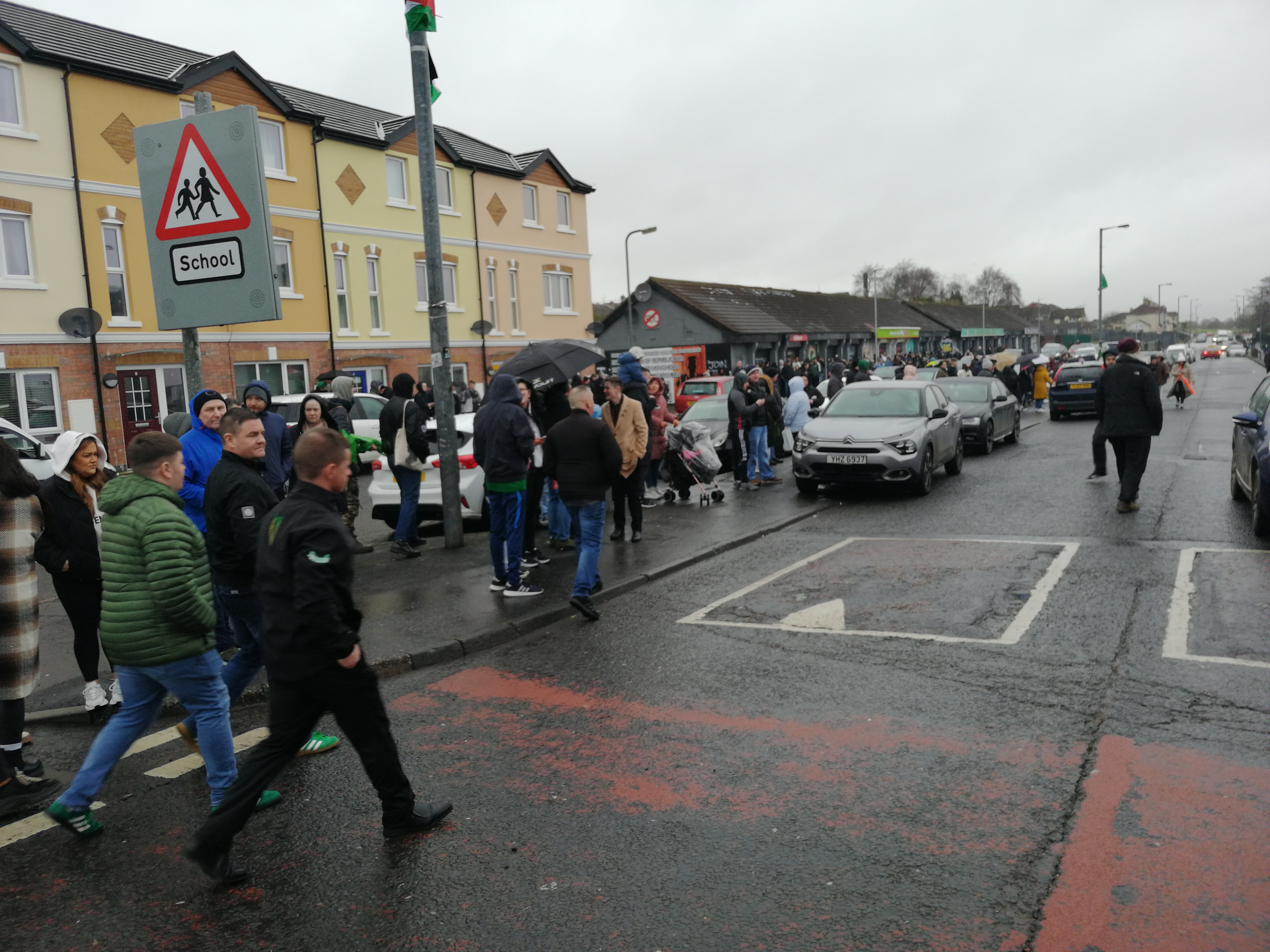
By the Creggan shops, people still arriving, others waiting to march (Photo: D.Breatnach
Other side of the road. (Photo: D.Breatnach)
British Governments for decades stood by those claims, refuted by many hundreds of witnesses to the actual shootings and though the city’s coroner called it “sheer unadulterated murder”, the inquiry under Lord Chief Justice Widgery declared in favour of the Paras’ version.
The 1972 march organised by the Northern Ireland Civil Rights Association had been protesting the introduction of internment without trial in August 19711 and the Paras had already killed 11 unarmed protesting people that month in the Ballymurphy housing estate, Belfast.2
Among the scheduled speakers and organisers in Derry in 1972 had been leading activists of the time, Bernadette Devlin (now McAlliskey) of People’s Democracy3 and Eamon McCann of the Socialist Worker’s Party (now People Before Profit).
The Commemoration this year
Participating organisations this year included Anti-Imperialist Action Ireland, Communist Party Ireland, Éirigí, Irish Republican Socialist Party, Irish Republican Welfare Association, Lasair Dhearg, People Before Profit, Republican Network for Unity, Saoradh, 1916 Societies.
Also marching were an IWW/ Anarchist contingent and a number of campaign groups: Ireland Anti-Internment Campaign, Ballymurphy Justice, Justice for the Craigavon Two, Justice for Manus Deery, with a number of environmental groups were represented also.
Derry Trades Council and IWW seemed to have the only trade union banner present or flags present.
A broad domestic and internationalist solidarity sweep was evidenced by the poster for the event with the slogan: “An injury to one is an injury to all” and also by the banner of the Derry branch of the Ireland Palestine Solidarity Campaign.
Poster for the 2023 march (Sourced: Internet)
Public support from Britain came with a banner of the Fight Racism/Fight Imperialism periodical and leaflets from Republican Socialist Platform4 were distributed among the marchers also.
Some years can reveal the misfortunes of particular organisations with a much smaller contingent than previously due to drop outs, defections and splits. Equally it has not been unknown for an organisation to draft in people to inflate its numbers specifically for the annual march.
The annual march takes the twisting route of the original one in 1972, covering much of the Derry nationalist housing areas.
Marchers rally at the Creggan heights and march down to the bottom of the hill, then along and up another steep hill, turning right at its top, along and then right down again and, at the bottom, turning right and along to the Free Derry Corner5 monument where speakers address the crowd.
Kate Nash chaired the rally there and Liam Wray, relative of murdered James Ray spoke as did also Ria, niece of John Paul Wooton who, with Brendan, are the Craigavon Two, framed for the killing of a colonial policeman.
The numbers this year were a huge drop from the previous year’s but 2022 was the 50th anniversary of the massacre and the participants are estimated to have numbered well over 10,000, including maybe 10 marching Republican Flute Bands6 from Ireland and Scotland.
Nevertheless the mass media’s coverage of last year’s march varied from minimal to nil.7
Probably4,000 actually marched this year, but perhaps nearly another 1,000 gathered on the roadsides to watch the marchers, greet people they know and so on. Many children are brought by their parents to watch while their older siblings gather and sometimes accompany marchers too.
The day had begun sunny and crisp but by march time the weather had deteriorated to constant rain and gusts of wind and, as the march reached the Lecky Road, to a heavy downpour. It was bad but veteran marchers have experienced worse in previous years, including snow and sleet.
Waiting to begin the march (Photo: D.Breatnach)
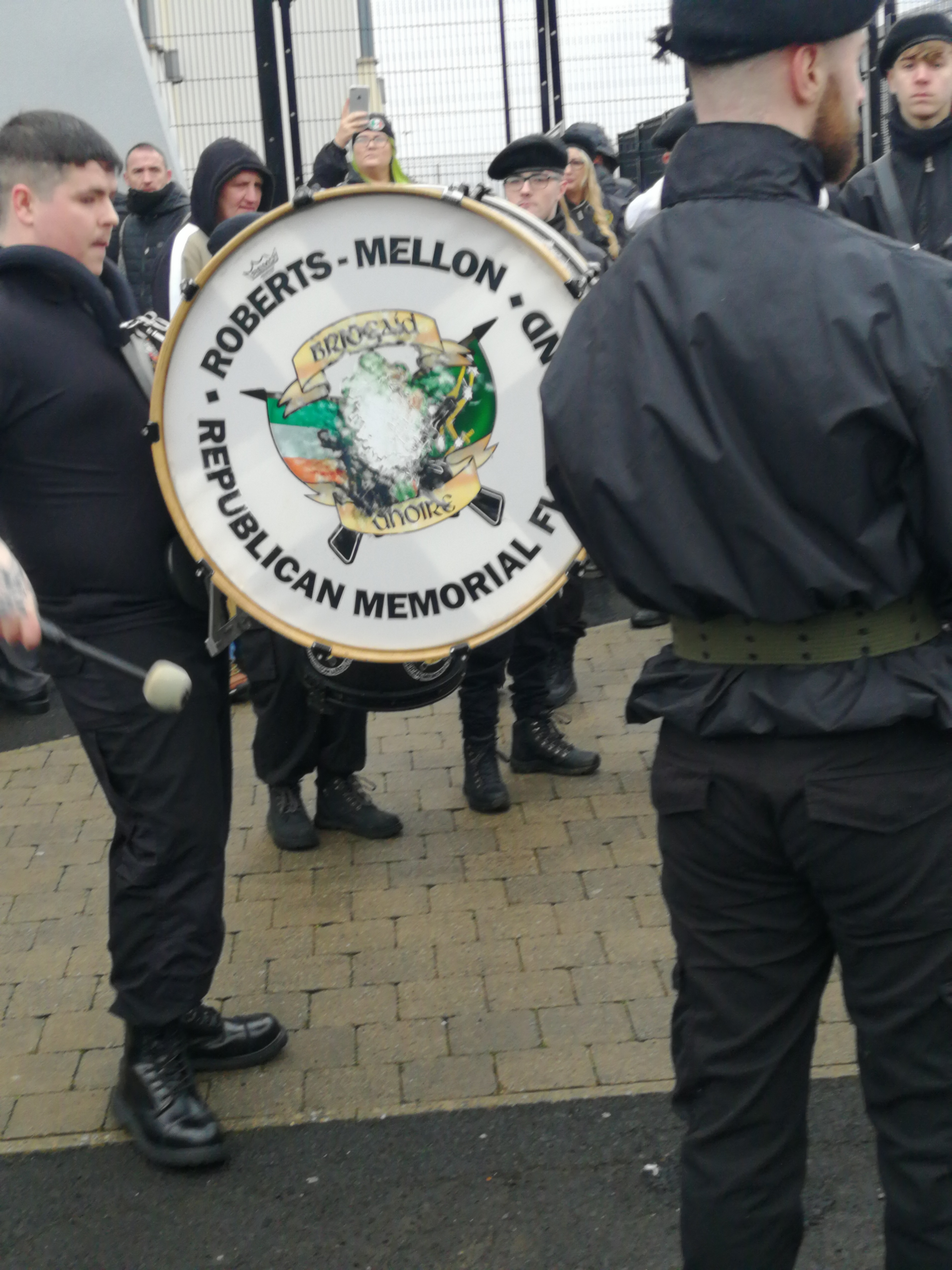
Three Derry-based Republican Flute Bands formed part of the march: James Connolly RFB, Kevin Lynch RFB and Tommy Roberts Stevie Mellon RFB, along with the Banna Cuimhneachán Thomáis Uí Chléirigh (Thomas Clarke Memorial RF Band) from Dungannon.
Although in recent years members wear more weather-appropriate uniforms, they still do an amazing job marching and playing in bad and sometimes atrocious weather.
A Deal with the Devil
The Sinn Féin political party, once prominent among the march organisers and speakers at the rally, sought to end the annual march in 2011 and have not supported the event since.8 This was after the British Government publicly apologised for the massacre that same year.
Part of the process leading to that Governmental apology was the setting up of the Saville Tribunal in London in 1998, although it took unexpectedly long to deliver its verdict.9 The Good Friday Agreement was also concluded in 1998, giving the Tribunal the appearance of a concession.
Indeed, the whole has the marks of a deal with the Provisional IRA’s leadership, with the British side saying: “You give up the armed struggle and control your people. We’ll make it easier for you by releasing your prisoners on licence10 and admitting we were wrong in Derry in 1972.”
Whether ceasing the annual commemoration was part of the deal or whether that was Sinn Féin’s own leadership’s decision is difficult to guess. It may have suited SF to scale a colonial reminder event down or simply to scratch one big annual event from their organisational calendar.
On the other hand, it has lost Sinn Féin all control of an important historical commemorative event on the Irish Republican calendar and their abstention again at the 50th anniversary march was a massive exposure of their collaborationist position.
The Bloody Sunday Trust also boycotts the march, in the sense that it does not promote it nor record its annual march or other events opposed by Sinn Féin. It does organise and promote its own events during every anniversary but that seems to be as a counter to the march organisers.
The BST of course receives funding and employs a Director and staff for its museum. Nobody pays Kate Nash or other members of the Bloody Sunday Commemoration committee; they rely on public donations and sale of items such as commemorative T-shirts to fund the march11.
A number of relatives of the murdered and injured civilians continue to support the march and are counterered among its organisers, for example Kate Nash, sister of murdered William murdered on Bloody Sunday and daughter of Alex Nash seriously injured by the troops the same day.
The Derry Trades Council and two of the original organisers and speakers support the continuation of the commemorative march as do most Irish Republican and Socialist organisations.
In formation ready to march. Note the presence of female members in the prestigious and ceremonial colour (flags) party, more commonly seen in recent years. (Photo: D.Breatnach)
Most Irish people call the city “Derry13” from the ancient monastic settlement located there, “Doire Cholmcille”14 but most Unionists and the British officially call it “Londonderry”. Many think the latter do that to annoy but there is a historical basis for it.
Large parcels of land in the city and surrounds were the payoff to the City of London for bankrolling Cromwell and the English Parliament’s campaign in Ireland to crush support for King Charles and the resistance of the Irish clans and Norman-Irish magnates.
Commemoration of the crimes of the oppressor forms an important part of the resistance of the oppressed around the world. Such events say “Our oppressors committed this atrocity here and we remember, will always remember and constantly deny them any legitimacy in occupation.”
If that is so, what gives any liberation organisation the right to call an end to such commemorations? Yet that is what the formerly liberation Sinn Féin did in 2011 after a British Prime Minister apologised in public for the massacre (but as some kind of serious ‘error’).
Some of the guilty – poster for the 2020 march. (Image sourced: Internet)
Not a single Minister or civil servant who organised the Derry or Ballymurphy massacres, nor judge who condoned them, nor officers who ordered them, nor soldiers who carried them out have been even tried, never mind convicted or jailed in the thirteen years elapsed since that ‘apology’.
Derry’s Bloody Sunday will continue to be commemorated at least until British colonialism has left Ireland and probably as long as imperialism continues to exist.
Remembering is part of resistance; commemoration makes it collective.
End.
A plethora of flags in what seems to be the Anarchist and IWW section. (Photo: D.Breatnach)
Head of the march reaches the bottom from Creggan and turns into the Bogside (Photo: George Sweeney inDerry Journal)
FOOTNOTES
1Abandoned on 5 December 1975. During this time a total of 1,981 people were interned for a period without trial, many of them physically assaulted, some grossly beaten and a small number tortured (the “hooded men” whose campaign for justice is yet another example of courage and determination against British State lies, prevarication and delays). 1,874 were from an Irish nationalist background, while 107 were from a unionist background.
2A similar British Army story, “returning fire” and again witnesses’ accounts ignored. The British State has yet to admit the gross inaccuracy of the official account.
3The party grew out of the Civil Rights movement of which it represented a more radical section. It ceased to exist after a few years.
4Previously unknown in Ireland, the RSP claims members in Derry and Belfast and the leaflet states it is part of the Radical Independence Campaign in Scotland.
5The monument in the shape of a gable end of a two-storey house mimics its original inspiration on the blank gable end of a row of houses in 1968 when John Caker Casey or Liam Hillen painted upon it YOU ARE NOW ENTERING FREE DERRY. The Bogside enclave had been barricaded in 1968 to deny the sectarian and brutal colonial police entry and continued to exist as an area from which the police were barred and British troops, even after the official removal of the barricades, entered only in force and at their peril for years afterwards.
6Typically flute players, side and bass drums, led by a colour (flags) party, all in the band uniform.
7Instead the media concentrated on the presence of a small group of Irish Government Minister and politicians of main parties at an earlier event at the monument to the massacre and a cultural event in the Guildhall.
8No doubt some of SF’s supporters in Derry and many more of its voters ignore the party ban and attend nevertheless.
9An almost unbelievable 8 years after a delay of two years before hearings began and £400 million in costs (mostly in fees to law practitioners) even through years when no hearings were being conducted.
10Release on licence meant they could be returned to jail to complete their original sentence at the discretion of the Minister of State for Northern Ireland, without a hearing or entitlement to know the specific reason for that decision. At first only the Provisional’s prisoners signed up to it but were followed by those with allegiance to other Republican groups, along with Loyalist paramilitaries. As they were leaving the jails, a new crop was entering due to new or alleged acts of resistance, rising to 70 between jails in both states and never falling much below 50.
12Popular Irish balladeer Christy Moore, on a British tour in the 1980s, greeted his London audience by calling the city “Derrylondon” to wild cheering. Shortly afterwards an Irish activist produced Christmas cards displaying London sights in snow, titled “Christmas greetings from Derrylondon”.
13Derry City FC is also the name of the local soccer club which enjoys cross-community support.
14“Colmcille’s (“Dove of the Church”, real name possibly Crimthann of the Cenel Connail) Oakwood”.
Monday was a new bank holiday in Ireland and two demonstrations of about equal size took place at the same time in Dublin that afternoon, one anti-racist and welcoming refugees, the other anti-refugee and with substantial racist and even fascist elements.
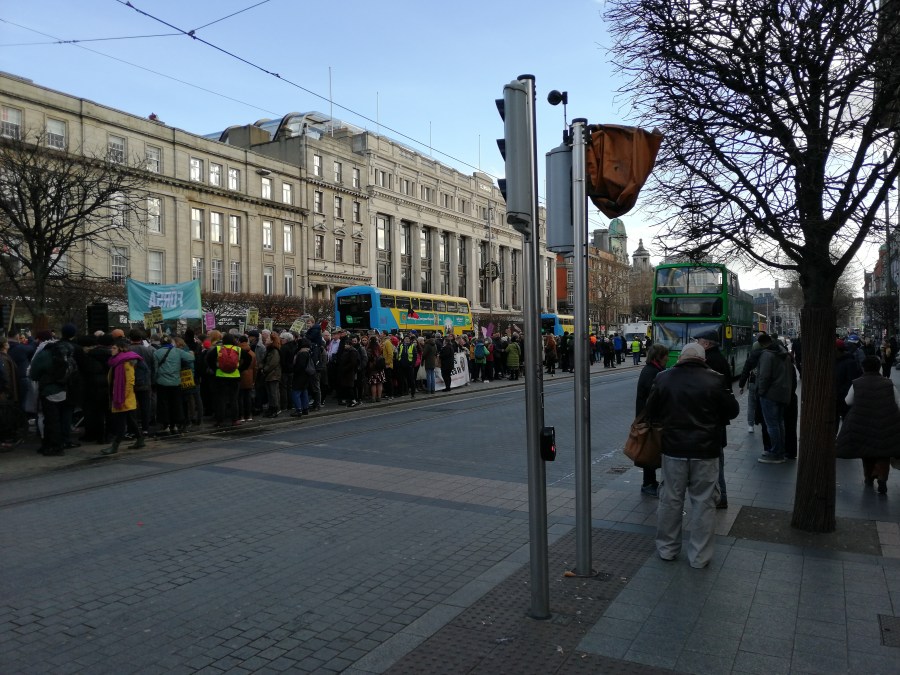
The pro-refugee event gathered on the central pedestrian strip on Dublin City centre’s main street, O’Connell Street, across the road from the iconic General Post Office, the building which served as the HQ of the 1916 Rising. Numerous placards and banners could be seen there.
Section of the Le Chéile pro-refugee demonstration in O’Connell Street (Photo: D.Breatnach)
The tightly-packed crowd stretched from the Spire southward almost to the Jim Larkin monument and were addressed by speakers. I knew the event had been organised by Le Chéile, a broad anti-fascist coalition of essentially pacifist nature with regard to fascism.
Closer view of section of the Le Chéile pro-refugee demonstration in O’Connell Street (Photo: D.Breatnach)
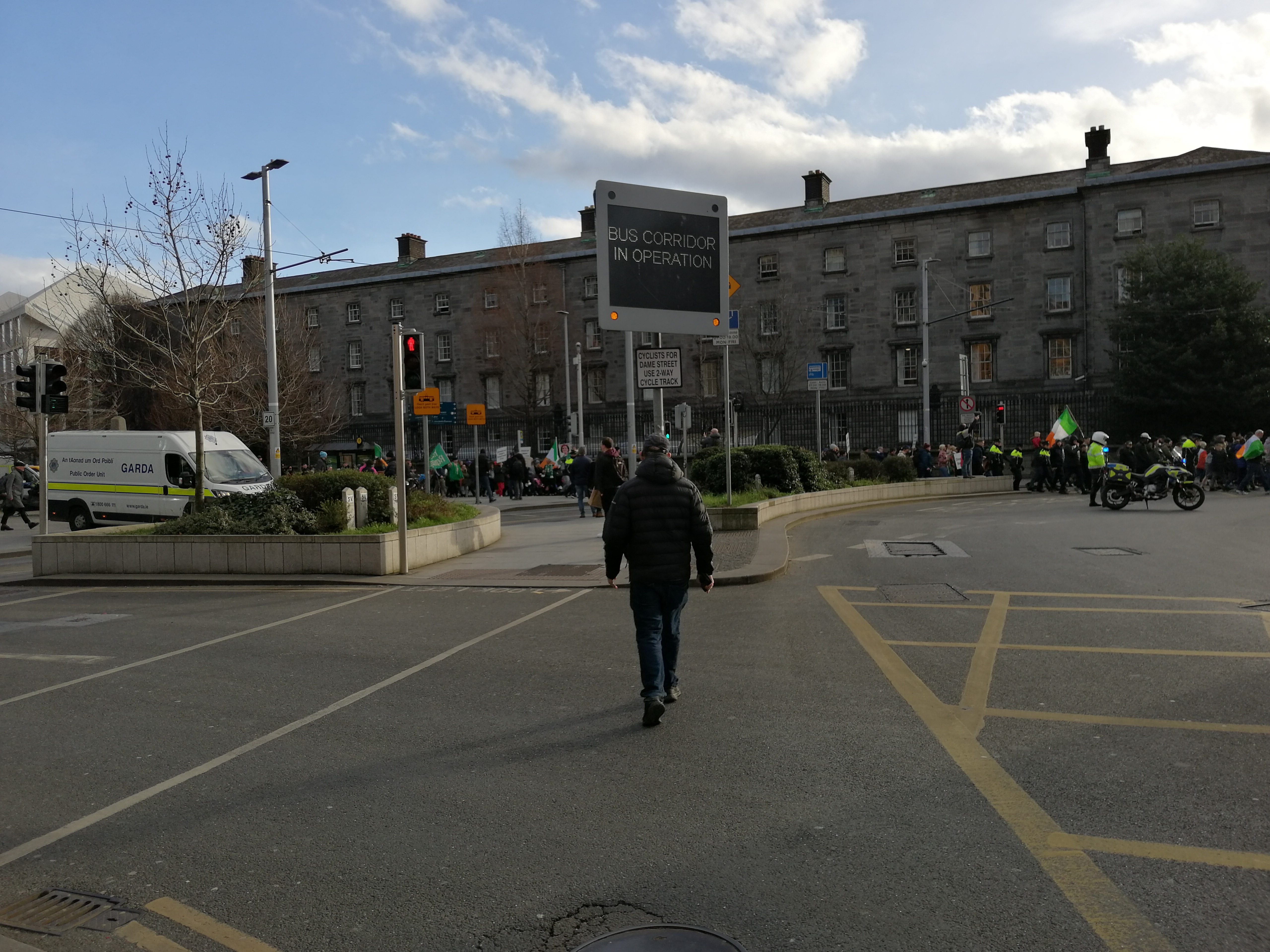
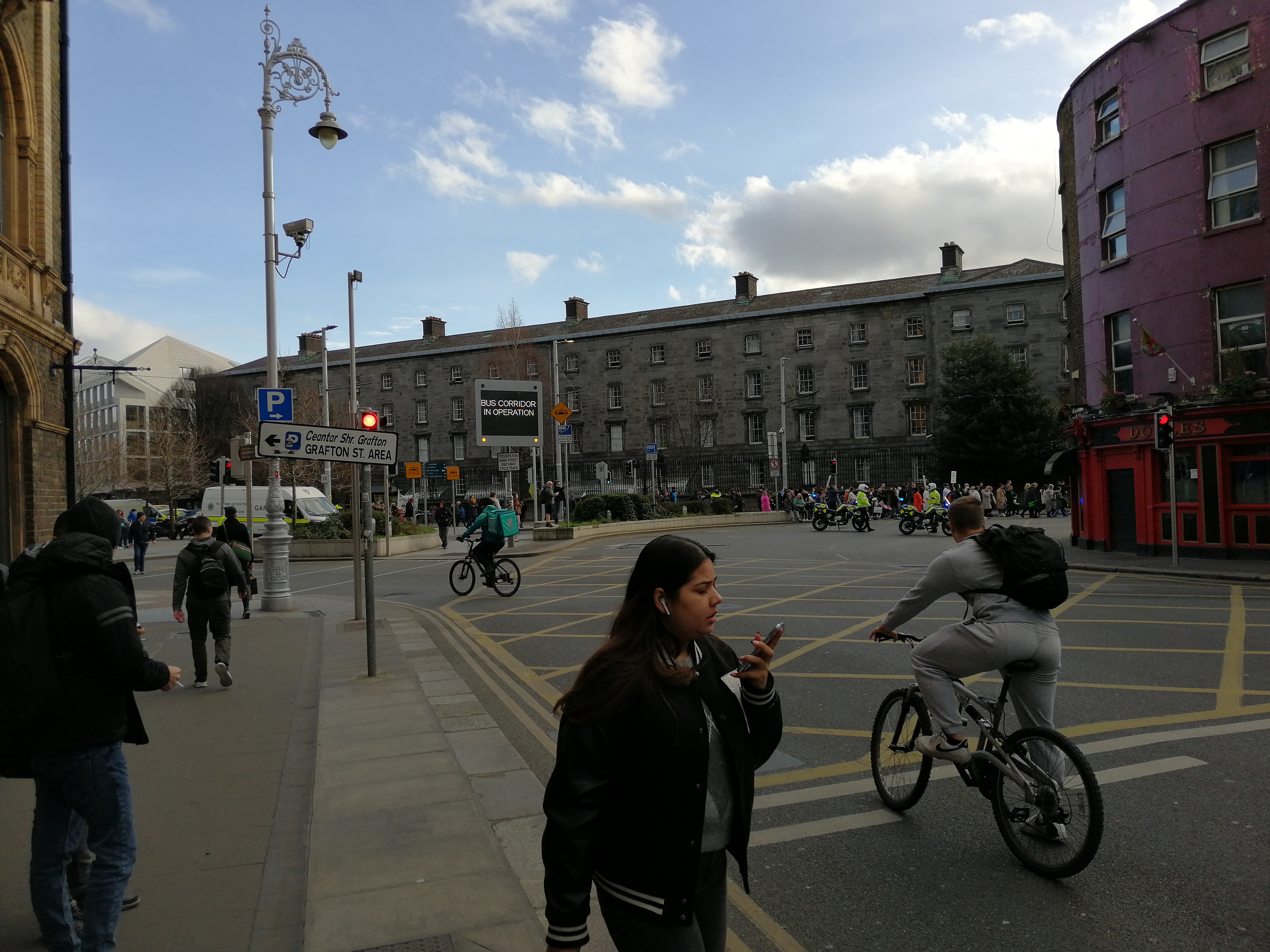
I passed them by in a hurry on my way to attend to a family commitment. While waiting to catch a bus in D’Olier Street, a number of Garda vans and motorcycles drawing up attracted my attention and soon afterwards the anti-refugee demonstration came from Pearse Street.
Cops arriving at Pearse Street/ D’Olier Street intersection just prior to arrival of the anti-refugee march. (Photo: D.Breatnach)
They passed along by Trinity College’s wall and soon after they had gone from my view, my bus arrived. I surmised the anti-refugee march had gone to demonstrate in front of Leinster House, the building that holds the parliament of the Irish State.
Front of the anti-refugee demonstration marching through the intersection (Photo: D.Breatnach)
As I was in a hurry and one group was tightly-packed and the other in extended line walking, it was difficult to compare the numbers but I made them both to be somewhat the same — between 500 and 700 each.
end.
Middle of the anti-refugee demonstration marching through the intersection (Photo: D.Breatnach)End of the anti-refugee demonstration marching through the intersection (Photo: D.Breatnach)Longer view of the Le Chéile-organised pro-refugee demonstration on O’Connell Street (Photo: D.Breatnach)
Eamon McGrath (31 October 1955 – 11 January 1923) singer and song lyrics-writer, activist in areas of housing, water and national sovereignty, historical memory and anti-fascism.
He was getting buried on Saturday and I wasn’t able to be at the service nor at the celebration of his life with comrades afterwards.
I hope this eulogy, if that’s the right word for this, will make up for my absence to his family, comrades and friends and, of course, to me.
Eamon came into my life through the Moore Street occupation in January of 2016. The property speculator Joe O’Reilly (Chartered Land) and the State were about to collude in the demolition of three buildings in the 1916 Terrace.
The State had declared only four buildings in the 16-building terrace, after a long struggle, to be a historical monument and even later, purchased – but around 300 men and women hadn’t occupied just four buildings in 1916.
The Save Moore Street From Demolition campaign group had called emergency demonstrations on to the street following which the buildings had been occupied by protesting conservationists.
The weather was bitterly cold but the occupiers held firm for a week until a stay of demolition had been imposed by the High Court. Despite his health status and challenged mobility, Eamon was there throughout, with humour and song.
Eamon McGrath to far right of photo while Dave Swift (centre) in Irish Volunteer uniform reads a historical document April 2017 in Moore Street, during historical commemoration event (the hoarding behind is covering the extension of the ILAC further into Moore Street, killing the market appearance for that side of the street for the block).
Subsequently, to prevent internal damage by contractors, a six-weeks’ blockade was imposed on the building by conservationists from 6.30am to 4.30pm each weekday. Eamon was very much a part of that too, driving himself and his close comrade Sean Doyle up from Wicklow every day.
Eamon was intensely loyal to close friends and comrades. On occasion I found him prickly or grumpy (especially at 6.30 am) but throughout any disagreements he never lost sight of who were his comrades and other people he respected.
Though a proud man, when he recognised himself in error, he didn’t hesitate to apologise.
A new broader group came out of the occupation and blockade, called Save Moore Street 2016 and Eamon attended and contributed to internal organising meetings and events we called on to the street – re-enactments, fake funerals of history, pickets, demonstrations and rallies.
As others drifted or were called away from the group by other commitments, Eamon remained with the active core.
(L-R) Paddy Reilly and Eamon McGrath in period costumes having a conversation during a history education event and anniversary commemoration of the founding of the Save Moore Street From Demolition campaign group. (Photo from Save Moore Street From Demolition FB page)
Of course, Eamon had been active before 2016: certainly very much so in the general awareness-raising and mass campaign against planned privatisation of our water and the installation of water meters.
He was to continue that activism, which resulted in assaults by a water contractor on him and Seán Doyle, court appearances for both and in May 2016 both of them went to jail for a period but remained unbowed.
Eamon was one of the original occupiers of Apollo House in December 2016 in protest against homelessness and as a co-founder of the Anti Eviction Flying Column, Eamon was to the fore in resisting evictions across the country and also a co-founder of the Bring It to Their Doors campaign.
The State authorities were making things awkward for Eamon by then, both in terms of working as a taxi driver and claiming benefit when he was not. His ability to reach events in Dublin declined but he still got there often enough on public transport, while remaining active nearer to home.
As his physical mobility declined further, comrades in Carlow started an on-line collection to buy him an electric wheelchair. Even as I made enquiries to contribute, the fund had already reached its target, so quickly did people support it.
Later still, his family installed a new chairlift for his home so he could access the room where he recorded his songs with lyrics commenting on the ongoing political struggles, adapted to popular airs.
Though our voices didn’t go well together, we sang together a couple of times – outside the GPO and outside Dublin City Hall.
Eamon McGrath, centre right after April 2016 event in Moore Street after which we brought it to in front of the General Post Office in Moore Street for awhile. Myself near centre, Glenda further to the left of photo, Sean Doyle nearly out of shot.
He remained active on social media but in particular in keeping an eye on the activities of right-wing people, covid-deniers, racists, fascists …. Eamon was a handy source for a quick update on the status of many of them.
Eamon arranged an interview for us both with the Dublin Near FM radio station, the interviewer being then a former drug addict who sadly returned later to his addiction and died on the street. It was on the way back from the interview that Eamon told me a little about his earlier years.
He had a difficult time in his childhood, including institutional confinement and his formal education suffered as a result. However, he educated himself about many things by reading, listening, discussing and viewing on line.
I think the last time I saw Eamon was at a commemoration at the Peter Daly monument in Wexford inSeptember 2022, in his electric wheelchair and attached oxygen cylinder for his lung condition and all in good cheer, asking me for Moore Street campaign updates in detail.
Eamon McGrath, centre in wheelchair, at Peter Daly commemoration in Wexford, September 2022 (Photo from Peter Daly FB page)
His comrades in Anti-Imperialist Action Ireland, which he had joined at its foundation in 2017 correctly called him “one ot the most dedicated political activists of the last decade” and no-one who knew him could argue with that.
I knew little of Eamon’s family life but he often emphasised how important family was, not just to him but in general. Though I do not know them tá mé i gcomhbhrón leo, offering them my condolences along with the many they have received and are no doubt still arriving.
A partner, father, grandfather, great-grandfather, extended family member and friend to many.
Eamon McGrath of Kenmare Heights, Greystones & formerly Wolfe Tone Square, Bray, Co. Wicklow, was buried in Radford Cemetery, Greystones Saturday after a service in the Holy Rosary Church, Bray, attended by family, comrades and friends.
Working people have experienced many betrayals in history and the struggle for self-determination of the Irish nation has been – and is being – betrayed also.
When such betrayals occur, a range of common reactions is evoked; thinking about those responses may help the betrayed at least to moderate the harm and turn the experience to some benefit.
Equally, some ways of handling the experience can magnify and deepen the harm already caused.
Betrayal is a difficult experience for the betrayed certainly but not without some cost to the betrayer too and each has a number of common responses. This applies to the personal as well as to the political but there are some differences.
The betrayers have their followers to different degrees and these too have psychological reactions to the betrayal — and to criticism of the betrayal. We can observe these reactions in a number of recent historical cases of high levels of resistance subsequently betrayed.
The most recent phase of high degree resistance in Ireland took place largely in the British colony of the Six Counties, beginning with mass struggles for civil rights before passing through protracted guerrilla war and intense struggles of political prisoners in the jails.
In the Basque Country, the corresponding phase began with ideological-cultural struggle and mass industrial actions against the Franco dictatorship, quickly developing into a guerrilla campaign combined with street battles, resistance to conscription and struggles around prisoners in the jails.
The leadership of the Irish struggle came to political agreement with the colonial occupier, disbanded and decommissioned its guerrilla forces and acceding to its right of conquest, joined the occupier’s colonial administration, concentrating thereafter on building up its electoral base.
A similar process took place in the Basque Country but with important differences: the imprisoned activists were not released and the movement’s political leadership was not even admitted into joint management of the colonial administration.
Each nation witnessed splits, recrimination, dissidence, repression on groups continuing resistance but also a range of psychological responses which at best did not assist recuperation and in fact often deepened the harm of betrayal by the leadership.
STANDARD RESPONSES BY THE BETRAYED
DISMAY is a common reaction: How could he/ she/ they? I never thought they would. We’re finished now.
BLAME is another also common response: It was that leader’s or leadership’s fault. We didn’t fight hard enough. Those comrades criticised too much.
SELF-CENSORSHIP And EXCESSIVE CAUTION: We can see the harm in some of the leadership’s actions but we must be careful not to step too far out of the movement, where we will be marginalised and unable to have an effect1.
DESPAIR: That’s the end of everything. There’s no way out of this. It was all for nothing – all those sacrifices, all that pain.I’ll never trust people or get involved again.
APATHY: So I/ we might as well forget about it all. Just think about ourselves/ myself/ family. Drop out. Drink. Take drugs.
DENIAL: We’ve not really been betrayed. It’s just another way to go for the same thing. This is the only reasonable choice. We couldn’t keep on that way any longer, this is just a change of method. We’re just having a pause. The leadership is clever and has tricks up their sleeves. This is just to fool the authorities. It’s just going to take a little longer to win than we thought.
Those are defensive constructions in emotion and, in so far as that takes place, in thinking. But defensiveness can turn to aggression – and frequently does. The betrayers – and often the duped also – resent being reminded of what and where they are. It makes them uncomfortable.
HOSTILITY: How dare those people criticise us/ the leadership? They don’t understand and just want continual conflict. They’re endangering our secret plan. Who do they think they are? They’re just wrecking everything, undermining our new plans. They need to be taught a lesson.
PERSONAL ATTACKS: That critic is no great activist. S/he hasn’t suffered as some of us have. They were always troublemakers. Jealous, that’s what they are. They’re not very bright; no idea about real politics. They are in fact traitors, helping our enemies.
MARGINALISATION: We are not going to listen to those critics. We will not allow them space on our media. We’ll try to make sure they don’t get venues in which to spread their poison. If people are friends with them they can’t be our friends too. Such people will not enjoy our hospitality or invitations to our events. People should not even talk to them. If the authorities attack those dissidents, we are not going to trouble ourselves about them – it’s their own look out.
MANAGING THE BETRAYAL
PROMOTING LEADER ADULATION is a useful tool in shutting down the opportunities for criticism and in repressing them when they arise. “Who are we to criticise this great comrade’s thinking or actions?” becomes an implicit question, clearing the way for betrayal.
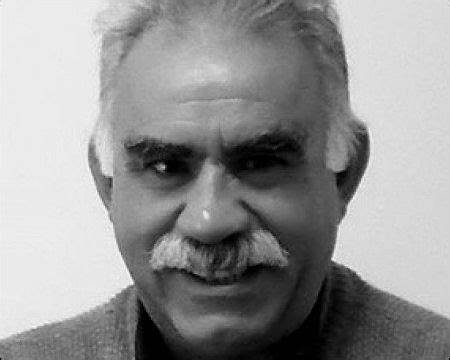
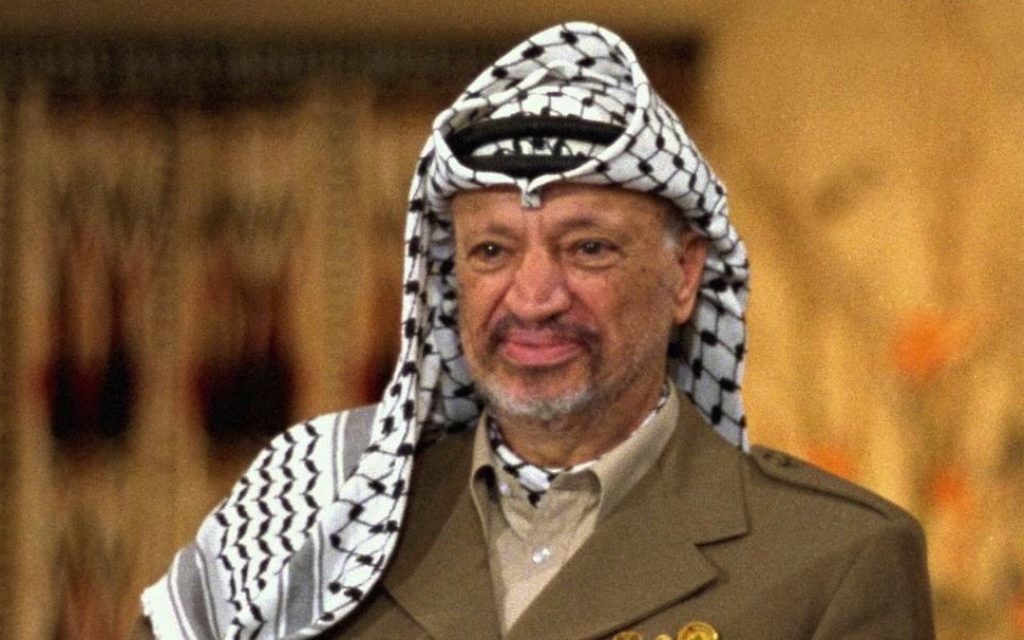
Leaders who have surrendered or compromised the struggle, L-R: Gerry Adams and Martin McGuinness of the Provisionals, Arnaldo Otegi of the Basque Patriotic Left, Abdullah Ocalan of the PKK and Yasser Arafat of Al Fatah. The latter seemed to be attempting to to turn back from the path of betrayal when he became very ill (quite probably poisoned) and died.
SEEKING COUNTER-REVOLUTIONARY ALLIANCES is engaged upon so as to appear to its members to make the organisation’s influence greater, or to outflank and isolate more revolutionary tendencies and often ultimately to make the leadership acceptable to the ruling circles.
BEGGING FOR CONCESSIONS when the revolutionary path has been abandoned can often be observed, as in “we’ve abandoned our militant struggle, please stop repressing us”, for example, a frequent response to repression of the Basque leadership once it abandoned the revolutionary path.
COLLUDING WITH THE OCCUPIER becomes a new second nature to a leadership abandoning revolution, not only in abandoning armed struggle, for example but in destroying weapons and suppressing elements still in resistance.
PROVING THEIR READINESS TO COLLUDE FURTHER, revolutionaries turned collaborators denounce continued resistance, try to convince revolutionaries to desist (or threaten or physically attack them), promote the repressive arms of the State such as the police and so on.
INTOLERANCE OF CRITICISM becomes default position; such criticism tends to expose the contradiction between the original purpose of the organisation and its concrete actions in the present. Censorship, expulsion and misrepresentation become common.
MARGINALISATION OF CRITICS follows from intolerance of criticism – the individuals or groups must be made pariahs so as to nullify or at least reduce their influence. Association with them, socially or politically – even in agitating around civil rights – must be discouraged.
REPRESSION OF DISSIDENTS finally becomes necessary, whether by threats or by actual violence or, when admitted to governing circles, by use of repressive state machinery.
DEALING WITH BETRAYAL RATIONALLY
The first necessary step is to analyse how the betrayal came about: how was it organised? What were the conditions that made it possible? What were the early signs?
Then, proceed to: what could we have done differently? What WILL we do differently in future?
Electoral work
One common assumption here in Ireland, especially in Irish Republican circles, is that the rot began with standing in elections. This is not logical and it is in effect making a negative fetish of electoral work, a taboo to be avoided.
It is often useful to the revolution in many ways to have representation in the parliament and local authorities, for example in promoting or blocking practical or legislative measures, getting media air time, visiting prisons — all without ever promoting reformism as a way forward.
Certainly the prioritisation of electoral work over other aspects is a sign that something has gone wrong: the strength of the popular revolutionary movement is on the street, in workplaces, communities, places of education, rather than in parliaments and local authorities.
The drive towards electoral representation can encourage bland slogans of the soap powder kind (“new improved” or “washes even better”) rather than those with revolutionary content and also the promotion of more bourgeois individuals in preference to grass-roots organisers.
Anodyne election slogan in both languages for Sinn Féin.
But none of that means that representation in those bodies cannot be used to further the popular struggles or that such aberrations cannot be avoided. And in fact, the concentration on criticism on the electoral factor served to distract from a more fundamental error.
Of course, electoral work should never, for revolutionaries, be about entering government under the current socio-economic system, i.e sharing in the administration of the State.
Leader adulation & intolerance of criticism
If criticism is not tolerated when errors are committed, they can hardly be corrected. Again and again it has been observed that the party/ organisation faithful refuse to accept external criticism from non-enemies. Internally the leadership inhibits criticism by the members.
The cult of the leader also inhibits criticism and therefore correction of errors. And behind this image others can hide and also commit errors. Problematic as dead icons may be, living ones are many times more dangerous – deceased ones at least do not change their trajectories.
Such created living icons have been Mandela in South Africa, Yasser Arafat among Palestinians, Gerry Adams and Martin McGuinness in Ireland, Arnaldo Otegi in the Basque Country and Abdullah Ocalan among Kurds (particularly in the Turkish and Syrian states).
Nobody knows everything or is always right. Bothersome as being criticised may be, its total absence is worse, allowing us no opportunity to question ourselves as activists and in particular as revolutionary organisations.
The revolutionary leadership, party or organisation is not the people
The revolutionary leadership, party or organisation does not have all the answers and is not the people. This might seem obvious but from the behaviour of such leaderships and their followers in the past it is clear that the opposite philosophy has been dominant.
Confusing the organisation with the people or with revolution itself, we assume that what is good for the organisation is also good for the people and the revolution. This however is not always so and leads to placing the perceived well-being of the organisation above the needs of the revolution.
Indulging this confusion leads to political opportunism and sectarianism, bad relations with other revolutionaries, ignoring all external criticism and placing the needs of the leadership higher than those of the membership and of the membership higher than those of the mass movement.
Internationalist solidarity
In internationalist solidarity work we build the unity of the people across borders and against the same or different enemies than those against which we are struggling.
One feature observed in a number of organisations where the leadership is moving towards betrayal is a reduction or elimination of such work.
To those in our ranks seeking an accommodation with imperialism and capitalism, those internationalist solidarity alliances are either a) unimportant or b) a hindrance to the alternative reactionary alliances to which they aspire.
The latter was very much the case with the Provisionals’ attitude to US imperialism. For decades, their leadership maintained apparently mutually-contradictory positions on what is the biggest imperialist superpower in the world.
On the one hand, for example, there could be involvement in solidarity with Cuba against the US economic blockade and, in the past, against US sabotage and terrorism against the Sandinista regime in Nicaragua.
On the other hand, the leadership sought the support of the US elite against British colonialism, which is occupying a part of Ireland and against which the movement was waging, in that colony, an armed and popular struggle.
Seeking support from the US imperialist elite entailed distancing from left-wing Irish USA and dropping support for even long-term inmates of US jails, such as American Indian Leonard Peltier and Black American Mumia Abu Jamal, arising out of popular struggles inside the US.2
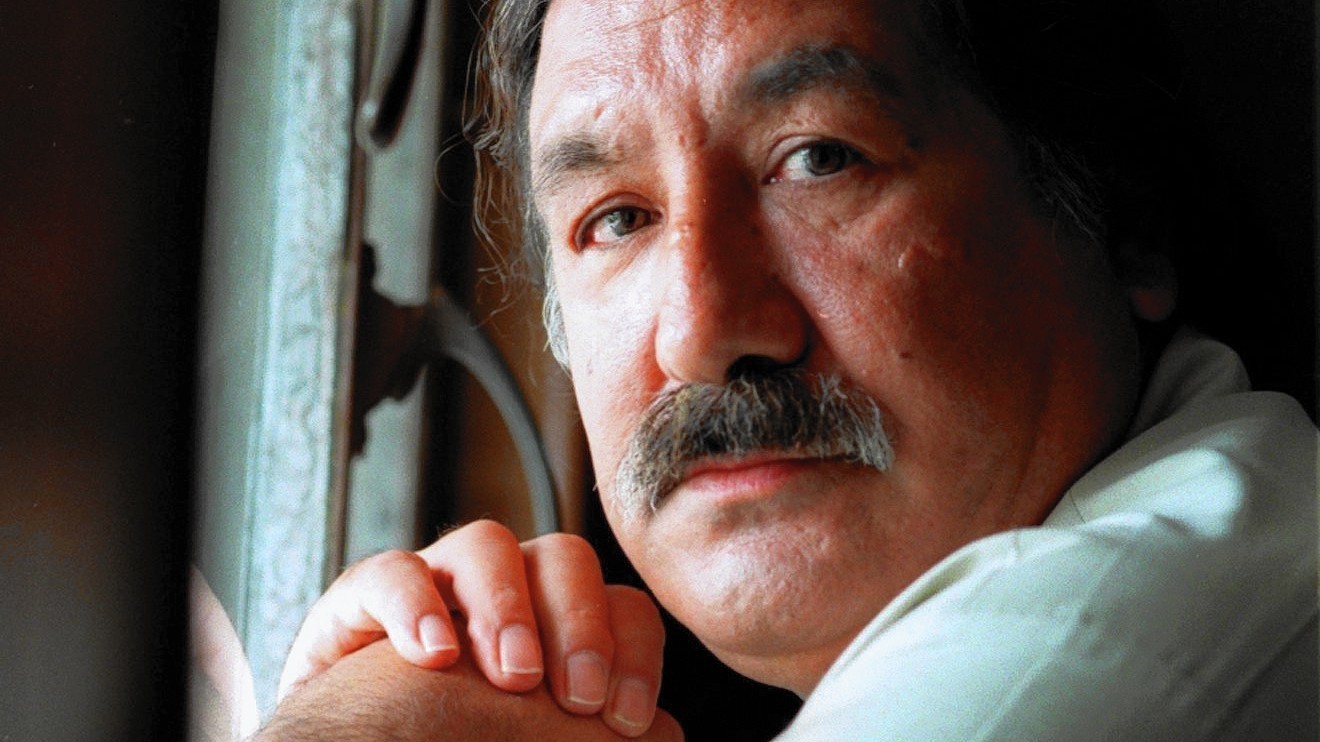
Leonard Peltier, Native American convicted in 1977 in deeply flawed trial for murder of two FBI agents in 1975 shootout on Pine Ridge Reservation. Nearly 80 years of age now and with multiple health issues, even release on clemency grounds is constantly blocked. His is one of many campaigns in the USA which SF cannot support as they seek to remain friends with the Democratic Party elite there.
Black American journalist and activist, framed for the murder of a corrupt Philadelphia policeman in 1981 and sentenced to death in 1982, sentence commuted to imprisonment for life without parole in 2011. Mumia is nearly 70 years of age now with a number of health issues. Another of the type of injustice in the USA about which SF cannot campaign as they seek to stay close to the Democratic Party elite. Anecdotally, a SF Councillor who was regularly writing to him was obliged to desist on instruction from her party leadership.
Unprincipled alliances
Another warning sign is the founding of unprincipled alliances with other organisations in struggle. For example, although it is correct to have a position of support for the Palestinian people, that should not necessarily bind us to exclusively support the fighters of one organisation only.
The Provisionals made their alliance with the Al Fatah organisation to the exclusion of all others in Palestine but worse was to come, for Al Fatah shoved aside the idea of a free Palestine and the right of return in exchange for administrative partial autonomy and funding.3
From there, Al Fatah became so corrupt that the Palestinian people, that had long supported a secular leadership, voted overwhelmingly for an islamic fundamentalist party, Hamas4. The unprincipled alliance with Al Fatah and the ANC was used to ‘sell’ the GFA to Irish Republicans.5
In the Basque Country, the mass movement’s leadership developed close links with the leadership of the Provisionals and refused links with Irish Republican organisations that dissented from the Provisionals’ position or with Republican prisoners after the Good Friday Agreement.
That should have sounded alarm trumpets in the Basque movement but if it did, it remained largely without practical effect. Askapena, the Basque internationalist solidarity organisation did split from the main movement but did not go so far as to support ‘dissident’ Irish Republican prisoners.
LESSONS
On the basis of the preceding I think we can draw a number of primary lessons.
LESSON ONE: ANALYSE THE MISTAKES OF THE PAST AND SEEK TO AVOID REPLICATING THEM
The type of struggle, location, timing, peripheral situation, long, medium and short-term objectives, experience and expertise of personnel, resources … all need to be analysed, in conjunction with the strengths and weaknesses of the enemy.
In carrying out this kind of analysis on the Irish struggle, we see that we faced one of the military superpowers, also well linked into the western imperialist world. The Republican movement’s battle area was in total one-sixth of the nation’s territory and the location deeply divided.
The rest of the nation was ruled by a weak foreign-dependent ruling class.
Map of Ireland showing the British colony of the Six Counties. The Provisionals took on the British state, mostly confining their struggle in that deeply divided politically and culturally region shown in yellow.
A movement cannot choose when it has to step forward in defence but it can choose how it develops the struggle afterwards. It seems obvious that in order to be victorious, at the very least the struggle would have to be spread throughout the nation.
That in turn would entail putting forward social and economic objectives to attract wider support which, in turn, would mean taking on the Catholic Church hierarchy.
In addition, the question of effective external allies was relevant here but even more so in the Basque Country, located across the borders of two powerful European states.
The total population of the portion of the Basque nation within the Spanish state is far short of three million, that of the rest of the state over 44 million.
Clearly allies external to the Basque nation would be essential for victory and these would have to come from across most of the Spanish state at least.
Map showing the ‘autonomous’ regions of the Spanish State; the southern Basque Country is shown in pink at the top, including ‘Navarre’ shown in yellow next to it. Essentially, the Basque Patriotic Left without allies confronted the Spanish state from there.
Such an assumption would entail, in turn, outlining objectives to attract considerable numbers from across the Spanish state which in turn would mean creating alliances with revolutionary and other progressive forces across the state.
LESSON TWO: REFRAIN FROM PERSONALISING THE ISSUES
When criticism of the counter-revolutionary line put forward by individual leaders becomes personalised, the political essence of the criticism becomes lost or at least obscured. It can seem as though the critics have personal reasons for their hostility or even jealousy of the individuals.
Much of what one sees publicly posted by opponents of pacification programs in Ireland and the Basque Country often seems more about hostility to the personalities of MaryLou MacDonald, Gerry Adams, Martin McGuinness or Arnaldo Otegi than about specific policies and actions.6
Crucially, focusing criticism on individual leaders serves to conceal other underlying causes of failure and betrayal that are usually more fundamental: problems in objectives, errors of strategy, in particular and also of tactics along with unhealthy organisational dynamics.
LESSON THREE: DEVELOP INTERNATIONALISM AND AVOID UNPRINCIPLED ALLIANCES
In the face of imperialist and other reactionary alliances, revolutionaries need internationalist solidarity, the basis for which should be revolutionary positions and action. Exclusive alliances are generally to be avoided as is uncritical support or unquestioning approval of all actions.
LESSON FOUR: CONTRIBUTE TO BROAD FRONTS WITHOUT SURRENDERING THE REVOLUTIONARY LINE
A broad front is essential not only for successful revolution but also often for defence against repression. Such fronts should be built on a principled basis with respect for the participating groups and individuals but without surrendering the revolutionary line.
At the same time, the possibility of betrayal, opportunism or sabotage and marginalisation by partners in broad fronts need to be guarded against and, if occurring, to be responded to in a principled and measured manner.
Broad fronts not only increase the numbers in resistance in a unified manner but also expose the activities of the constituent groups to the members of other parts of the broad front. Activists can then evaluate organisations and one another on the basis of experience rather than of reputation.
The revolutionary line should not be abandoned or concealed when in a broad front with organisations and individuals who have varying lines. At the same time, it is not necessary to be pushing the revolutionary line every minute.
LESSON FIVE: DON’T GIVE UNCONDITIONAL TRUST TO LEADERS
Of course, our leaders and activists must be trusted – but always in the knowledge that no-one is perfect or above the possibility of error. The shutting down of opportunity to voice criticism should sound alarm bells in any revolutionary movement.
There are of course “time and place” considerations in criticism; for example, the capitalist mass media, police interrogation or trial in court are hardly appropriate places to criticise a revolutionary movement’s leadership.
LESSON SIX: TOLERATE INTERNAL CRITICISM AND CAUCUSES IN BALANCE WITH COLLECTIVE RESPONSIBILITY
The above touches upon this area too. People who follow us without question may equally do so with another.
The right to caucus, i.e to collect around a particular revolutionary trend or focus needs to be acknowledged and formalised. Like-minded people will naturally associate and it is far healthier to have this occur in the open rather than in secret.
At the same time, when a discussion reaches democratic decision, the minority whose positions were rejected need to present a common front with the rest of the organisation or movement.
Similarly, political and organisation criticism needs to be welcomed or at least tolerated within the organisation or movement because it may be correct and point an alternative way forward and even if it isn’t, the discussion around the criticism will help to clarify matters.
Such openess to criticism and discussion encourages a conscious and thinking membership which by that measure alone and organisationally makes it more difficult for some individual or clique to manipulate the membership.
1“Outside the broad movement it is very cold”, said a Basque to me once. He was a member of a small Left group critical of the leadership’s approach but unwilling to completely rupture with them.
3With the Camp David (1978) and Oslo Accords (1993 & 1995).
4In 2006 (the most recent) Palestinian parliamentary elections, Change and Reform (Hamas) won 74 seats and Al Fatah 45. In Gaza Al Fatah rejected the result and tried to seize power but were defeated in a short battle, though Hamas did not battle their assumption of power in the West Bank. All dates for elections to Palestinian Parliament since have passed without polling.
5And since then, unprincipled alliances with Provisional Sinn Féin have been used by the main Basque organisation leadership and ditto with Colombia to ‘sell’ pacification processes in those countries (which have been even worse for them than has the GFA been in Ireland).
6As a historical note, it is said that some of the delegates who voted for the Anglo-Irish Treaty in January 1922 were moved to do so by the nature of the attacks of Cathal Brugha, for the anti-Treaty side on Michael Collins, leader of those for the Treaty. The majority of delegates voting in favour was only seven.
Christmas shoppers on Saturday 17th in Dublin’s O’Connell Street, the city’s main boulevard, were interested to see a long picket line displaying banners, flags and placards.
The event was a jointly-organised public reminder of the continuing existence of political prisoners in Ireland and as a gesture of solidarity to the prisoners too.
The joint organisers were the Ireland Anti-Internment Campaign, the Irish Republican Prisoners Welfare Association and the Anti-Imperialism Action organisation. The attendance were mostly Irish Republicans but there were also some from the socialist/ anarchist traditions present.
Long line looking southward of joint Republican prisoners’ solidarity event (Photo: Rebel Breeze)
There are currently 40 Irish Republican prisoners in jails in Ireland, on both sides of the British Border. As a speaker noted at the end, all had been sentenced or refused bail by no-jury special courts of the Irish and British states.
The Irish Tricolour and the Starry Plough were displayed of course but also a Palestinian flag and two Basque ones; the latter attracted the attention of a number of young people from the Spanish state who were pleased and approached the picketers for discussion.
Section of the joint Republican prisoners’ solidarity event showing the Latuff cartoon on a banner (Photo: Rebel Breeze)Section of the joint Republican prisoners’ solidarity event showing couple of Basque flags and Palestinian one in the middle distance (Photo: Rebel Breeze)
Two banners called for and end to the extradition of Irish Republicans and one figured cartoonist Carlos Latuff’s illustration of solidarity between Irish and Palestinian political prisoners.
Leaflets of the IRPWA and of the IAIC were distributed to passers-by.
Section of the joint Republican prisoners’ solidarity event (Photo: Rebel Breeze)
As the event came to an end a representative of each organising group read out a short statement; both the IAIC and the AIA emphasised the need for unity in resisting repression and each along with the IRPWA called for support for Irish Republican prisoners.
End.
Section of the joint Republican prisoners’ solidarity event (Photo: Rebel Breeze)Section of the joint Republican prisoners’ solidarity event (Photo: Rebel Breeze)
First published in “Socialist Democracy” December 2022, republished here with kind permission of author.
The death of Vicky Phelan on November 14th was announced by the media. They were full of praise for a woman who was a victim in the cervical smear scandal.
She was one of over 200 women whose cervical smear tests were outsourced to a private US company, which gave back erroneous results.
Women who could have received treatment went on to develop cancer and in the case of Vicky Phelan die. But she didn’t just die. She was murdered.
Engels in his famous tract The Condition of the Working Class in England stated that
When one individual inflicts bodily injury upon another such that death results, we call the deed manslaughter; when the assailant knew in advance that the injury would be fatal, we call his deed murder.
But when society places hundreds of proletarians in such a position that they inevitably meet a too early and an unnatural death, one which is quite as much a death by violence as that by the sword or bullet; when it deprives thousands of the necessaries of life, places them under conditions in which they cannot live – forces them, through the strong arm of the law, to remain in such conditions until that death ensues which is the inevitable consequence – knows that these thousands of victims must perish, and yet permits these conditions to remain, its deed is murder just as surely as the deed of the single individual; disguised, malicious murder, murder against which none can defend himself, which does not seem what it is, because no man sees the murderer, because the death of the victim seems a natural one, since the offence is more one of omission than of commission.(1)
The Irish state has for a long time deprived its population of the necessaries, as Engels put it, of life in relation to health care. One of the first politicians to wreak havoc in the health system in pursuit of her ideology and profit was Mary Harney.
Mary Harney, former Health Minister who set up the Irish health service for privatisation – guilty of murder through neglect. (Photo sourced: Internet)
She and her party the Progressive Democrats were ideological in their commitment to the privatisation of health care. Under her rule and that of successive governments, the health service was privatised.
First, they ran it down, closing hospital wards and reducing the number of beds in the health service, paying Consultant Doctors extravagant salaries, allowing them to moonlight as private consultants, whilst there are now around one million people on public waiting lists.
The system is a shambles and compares poorly in terms of speed and quality of care to even Third World countries.
At the same time a private health care sector has arisen and expanded, all the time promoted by the state through tax breaks and discounts for the companies with affiliates being able to write off part of their private health insurance against tax.
In other words, a public subsidy to the health companies paid for through the taxes of many people who cannot afford to use these services. The Irish health service does not exist to provide health care but rather to generate profit. It is important to understand what this means in practice.
If profit is the motive, then the law of supply and demand takes over and prices and the quantity of services are calculated on the same or similar basis to the sale of a car. It also means that in order for some to be treated and live, others must die.
It is an intrinsic part of the system and they know it. For health care to be profitable some must not have full access to it, some must die in order for others to make profits. If everyone can access cancer treatment without problems then there is no need for private medicine.
This is not the situation in Ireland. Public services are run down in order to encourage private medicine and profit.
It is in this context that the Health Service Executive outsourced the testing of cervical smear tests not only to a private company, but to one in another jurisdiction. Money was to be made, and to hell with the consequences.
Dr David Gibbons, a former member of the screening programme, said he expressed concerns about the outsourcing of smear tests to the US in 2008 but they were dismissed.
Tony O’Brien, former head of the National Cancer Screening Service and Director General of the HSE until 2018 — another one of the guilty (Photo sourced: Internet)
Gibbons, chair of the cytology/histology group within the programme’s quality assurance committee, brought up his worries with Tony O’Brien, then chief executive of the National Cancer Screening Service and director general of the HSE until 2018, but they were not listened to.
Dr Gibbons resigned as a result. O’Brien defended the decision to outsource the testing saying that tests would have otherwise been left idle for a year or been examined by doctors “on their kitchen table”.(2)
Why would they lie idle for a year? Because they had decided not to spend money on it. Why would doctors end up examining them on their kitchen table? Because the facilities weren’t there.
When it all went wrong, they dragged their heels on informing the women, and this is where Vicky Phelan comes in.
She was diagnosed with cancer in 2014, but only informed of the false negative from the unapproved labs used by the HSE in 2011 and sued the US company and the HSE, but her case against the HSE was struck out.
The cat was out of the bag, however, but they continued to drag their heels on informing women that they may in fact have cancer and they stuck by their accountancy guns and continued to outsource the tests.
As Engels stated they know these victims will perish and yet permit the conditions to continue.
When she died, the great and good in Irish society expressed their praise for her. The murderers came back to the crime scene in a perverse act to say “It wasn’t me, I didn’t do it”. The Taoiseach, Micheál Martin stated on Twitter
Very saddened at the passing of Vicky Phelan, a woman of great courage, integrity, honesty & generosity of spirit. She will be long remembered as someone who stood up for the women of Ireland, & globally.(3)
The Tánaiste Leo Varadkar, for his part, was brazen in his Janus-like abilities.
Today Ireland has lost a woman of limitless courage, compassion and strength. I want to extend my deepest sympathies to Vicky’s family, particularly to her children on the loss of their incredible mother.
Vicky was a shining example of the power of the human spirit. Her fight to uncover the truth and the courage with which she faced her illness made her an inspiration to us all. We mourn her as a nation, as a society, and as individuals.(4)
Both of these men bear responsibility for what happened. To listen to them you would swear they were talking about some social justice warrior in a far-off land who stood up to a government that the Irish state is not on good terms with.
Condolences from murderers by neglect, Taoiseach Mícheál Martin and Tánaiste Leo Varadkar, presiding over the privatisation and degradation of the Irish health service. (Photo sourced: Internet)
Varadkar was a government minister in 2011 when Vicky Phelan was tested. He was Minister for Health when she was diagnosed with cancer and he was Minister for Social Protection when she was eventually informed about the mess up with her results.
Martin has been a T.D. in the Irish parliament (Dáil) since 1989 and has served as a minister on and off since 1997 and is the current Taoiseach.
They oversaw the dismantling of the health system, they made up the rules and implemented them. What happened to Vicky Phelan was on their watch. In other jurisdictions functionaries can be held liable for decisions they take, but not in Ireland.
They took decisions on the health service which affect the lives of millions, not just Vicky Phelan. Every year countless patients die in Ireland due to a lack of access to proper healthcare; Varadkar and Martin know this and yet they proceed with their actions.
In a criminal court case where a person carries out an act knowing it could result in the death of a person and decides to proceed nonetheless, they would be liable for that person’s death through recklessness.
Yet, politicians take decisions that kill people knowing that this is the likely outcome. They are guilty of what Engels termed social murder.
Vicky Phelan didn’t just die, Fine Gael and Fianna Fáil along with the Greens murdered her. No amount of praise from Vlad the Impaler a.k.a Leo Varadkar can hide the fact that he bears responsibility for death.
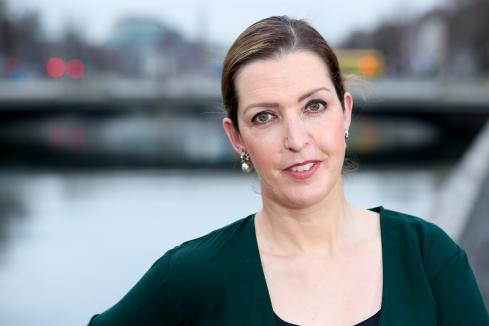
Vicky Phelan, cervical cancer campaigner, 1974-2022.
People may remember that McGeough and an assortment of other far-Rightists and fascists (such as Niall McConnell) were rosary-protesting a local Gay Pride march in the small Co. Tyrone town of Cookstown in September last year, the first ever in the town it seems. Michelle just walked up to Gerry and punched him in the face.
Well, not quite – she did say “Hello, Gerry” a second before she smacked him.
There was some confusion initially, as many thought Michelle was an antifascist or at least an LGBT rights supporter but it turns out that she and Gerry had history that had turned nasty in the branch of the Ancient Order of Hibernians of which Gerry had been a member – hence the knuckle complaint.
Anyway, this allegedly ex-Republican and definitely ex-Provo (both military and political wings — he had been on the Ard-Choiste, equivalent to Executive Committee) took his case to the courts of the British colony but failed as the judge in Dungannon took the view that the punch was a “one-off” (which is perhaps why some people prefer the old “one, two”).
It is remarkable how many of our native far right-wing and fascist stalwart fighters, constantly calling out the corrupt political system and the need to overthrow it, seek the endorsement of the State’s legal system, whether British colonial, as in the Six Counties, or Irish Gombeen, as in the Twenty-Six.
Gemma O’Doherty and John Waters for a while seemed to have season tickets for the High Court; Dee Wall “The Screaming Crutch” of QAnon was heard enough times threatening legal action, as was Right-Wing Ranter-in-a-Vehicle Carey; Ben Gilroy was a frequent (and ineffective) defence representative for people being evicted from their homes.
Gerry McGeough claimed in court that the assault was not merely an attack on him but was also an attack on the Virgin Mary. News & Views staff attempted to contact the Mary in question to hear her views but she failed to respond.
Actually, her main support organisation, the Irish Catholic Hierarchy, was keeping quiet on the matter too, although they are known to share Gerry’s view on the alleged sins of consenting LGBT adults.
It’s just that the ICH management board like to tone it down these days since their position of moral superiority has been eroded over the years, largely but not alone due to exposés of the sexual practices of many of the ICH’s employees with non-consenting minors.
Gerry claimed that on the occasion he had just been there in Cookstown to pray in public, as he does and that he should have the right to do so without being assaulted. Ah Gerry, now, really? News & Views investigative staff enquiries in the locality have found not one local who has ever seen Gerry praying there on any other day.
Which of course leads one to suspect that he and the other fascists and right-wingers were there to protest against the Gay Pride parade and using religion as a cover.
In fact, we recall Niall McConnell and other fascists and far Right-wingers on a number of occasions objecting to the right to pray in semi-public, when Muslims hired Dublin’s Croke Park to celebrate their Eid festival.
Which reminds us, on the occasion that Dublin Republicans Against Fascism organised a counter-protest in July 2020, women were accused of punching or slapping some of the fascists too.
And Niall McConnell, Fuehrer-of-Five of Síol na hÉireann1 took one of the women to court, requiring her to attend court a number of times and then failed to attend himself when the case was to be tried.
There does seem to be a thing about male fascists and women, come to think of it.
At the recent bust-up of the also fascist National Party’s congress at a luxury resort in Co. Fermanagh, the only injuries of consequence inflicted on the anti-fascists were on three female comrades, while five of the would-be stormtroopers – all male — ended up in hospital in exchange.
End.
FOOTNOTES
1The title means “Seed of Ireland” but ‘seedling’ might be a more accurate description and one suffering from damping-off or withering in recent times.
We see and often hear “viva la Quinta Brigada” but this is usually a mistake – the reference is not to the Fifth but to the 15th International Brigade. The word for fifteen in Spanish is “quince”1 whereas “quinta” means “fifth”. The brigade being referred to, the Fifteenth International Brigade, was one formed at the instigation of the Communist International (Comintern) in 1936 from volunteers from more than 55 countries2.
The estimates of numbers of participants in the International Brigades range from 40,000 to 59,000 with a death toll of around 10,0003 and of course many more injured.
Not all the Irish-born and Irish diaspora antifascists who fought4 in what is called the Spanish Antifascist (or Civil) War fought in the 15th Brigade5 but most of them did, whether in the British, Commonwealth or US Battalions (“Abraham Lincoln” and “Washington”, later combined), chiefly because these were the English-speaking battalions of the 15th International Brigade, which also included specific battalions for French, German, Italian, Spanish (from Mexico, Caribbean and Latin America) Czechoslovak, Hungarian and Polish languages6.
International Brigaders crossing the Ebro for the battle. The one in the bows of the boat appears to be Irish communist Michael O’Riordan, carrying the Senyera, the recognised Catalan flag of its time (red and yellow stripes without a star). O’Riordan survived the Civil War and returned to Ireland to lead the Communist Party of Ireland. (Image sourced: Internet)
The familiar songs in English were always about the 15th International Brigade, no other. So why and how has this mistake arisen of referring to the 5th?
The chief transmission of this error in recent time has been through that song with the wonderful lyrics and air created by the Irish balladeer and most famous folk performer, Christy Moore.
And he called his song “Viva La Quinta Brigada”. Recorded and performed under that title, with numerous videos repeating the error, even though he has himself corrected the reference in later performances.7 And in fact there are a number of Quinta Brigada versions of the Ay Carmela song on Youtube. So we can hardly blame all those people who are now singing the incorrect version, can we?
But before we arraign Comrade Christy Moore before a People’s Tribunal, it’s worth looking at the longer process of the error’s transmission. In fact, the incorrect wording was around long before Christy composed his song and it almost certainly informed his lyrics.
TRACING THE ERROR: THE AY CARMELA SONG AND SPIN-OFF
I remember thinking one time, when I became aware of the error in the title and refrain, that Christy should have consulted some Spanish-speaking people in Ireland. But I and my siblings are all Spanish-speaking and I recall even some of us singing a different song with a repeated line: Viva la Quinta Brigada, rumba la rumba la rumba la.
We were Spanish-speaking, yes and very sympathetic to the Republican side in that war — but at that time clearly not clued enough historically to detect the error,
That Rumba la rumba etc was a song in Spanish from the Republican side in the Civil/ Antifascist War, itself a spin-off or readaptation of a Spanish folk song about the crossing of the Ebro against Napoleonic troops in the 1800s. In this case the adaptation was fashioned to record the Republican forces’ crossing of the same river in attack on the advancing military-fascist forces in 1938.
The Battle of the Ebro was the largest ever fought on Spanish soil and lasted from 25th July to 16th November. The International Brigade song to the same air is generally known as Ay Manuela! and clearly refers to the International Brigade, not only by the lyrics in the final verse but by its alternative title, Viva La Quince Brigada!
Somewhere along the line someone made the error of replacing the Quince with Quinta. And so when Christy came to write his wonderful tribute to the Irish who went to the Spanish territory to fight against the fascist-military coup, the mistaken name had already been current for decades.
Re-enactment with partipants playing the parts of soldiers of the Spanish Republic advancing in the Battle of the Ebro. (Image sourced: Internet)
CORRECTING IT NOW
So no-one to blame for repeating the error and whoever caused it originally is long in the past. But we are here now and we know – so we have a responsibility not to perpetuate the error. We can do this quite simply in three ways:
Call the song “Viva la Quince8 Brigada” on all occasions
If we sing it, replace Quinta with Quince in the lyrics
Inform others about the correct version
End.
FOOTNOTES
1Fifteenth is “decimoquinta” in Castillian (Spanish) but, that being five syllables and therefore three too long for the song, “quince” (fifteen) must be sung instead.
2One of the many sources gives the figure of “55 Countries” but that probably means “55 states” and a number of states such as the UK, France, Belgium and Russia in Europe contain other nations, as do China, states in the Middle East, etc. In addition, many Jews also fought, one estimate putting them at one-quarter of the total of the “Brigadistas”.
3The very high casualty rate had a number of contributory factors but chief among them was the superiority of war-machines on the fascist-military side, in particular of aircraft, most of which were supplied, with pilots, by fascist Italy and Nazi Germany, while Britain and France blockaded Spain.
5Some fought as part of the POUM, largely Trotskyist antifascist organisation or may have fought in anarchist militia and one that we know of fought alongside the Basques (and gave his life there).
6There were other language groups but their numbers did not usually rate a whole battalion and they were integrated into battalions primarily of some other language.
7And even later still, amended the historically incorrect “the bishops blessed the Blueshirts in Dun Laoghaire
8Pronunciation guide for Quince: keen-the or keen-se.
9I’ve translated Ay! as Oh! but it’s more like Alas!, only hard to see that in the song’s context perhaps.
10I’ve translated Ay as Oh but it’s more like Alas, only hard to see that in the song’s context perhaps.
11The “Moors” were native North African troops raised by Spain’s Foreign Legion. Franco had been sent there by the Republican Government probably to get him out of the way after his ferocious suppression of the Asturias miners’ revolt. From there Franco’s troops were airlifted to the Canary Islands and from there to Andalucia in southern Spain, carving their way in the blood of mostly unarmed civilians.
El Ejército del Ebro, Rumba la rumba la rumba la. El Ejército del Ebro, Rumba la rumba la rumba la Una noche el río pasó, ¡Ay Carmela! ¡Ay Carmela! Una noche el río pasó, ¡Ay Carmela! ¡Ay Carmela!
The Army of the Ebro, rumba la rumba la, rumba la etc One night crossed the river, Oh9 Carmela, Oh Carmela!
Y a las tropas invasoras, Rumba la rumba la rumba la. Y a las tropas invasoras, Rumba la rumba la rumba la Buena paliza les dio, ¡Ay Carmela! ¡Ay Carmela! Buena paliza les dio, ¡Ay Carmela! ¡Ay Carmela!
And to the invading troops rumba la rumba la, rumba la etc Gave a good beating, Oh Carmela, Oh Carmela!
El furor de los traidores, Rumba la rumba la rumba la. El furor de los traidores, Rumba la rumba la rumba la Lo descarga su aviaciónes, ¡Ay Carmela! ¡Ay Carmela! Lo descarga su aviaciónes, ¡Ay Carmela! ¡Ay Carmela!
The fury of the traitors, rumba la rumba la, rumba la etc Is dropped from their ‘planes, Oh Carmela, Oh Carmela!
Pero nada pueden bombas, Rumba la rumba la rumba la. Pero nada pueden bombas, Rumba la rumba la rumba la Donde sobra corazón, ¡Ay Carmela! ¡Ay Carmela! Donde sobra corazón, ¡Ay Carmela! ¡Ay Carmela!
But bombs have no power, rumba la rumba la, rumba la etc Where exists excess of heart, Oh Carmela, Oh Carmela!
Contraataques muy rabiosos, Rumba la rumba la rumba la. Contraataques muy rabiosos, Rumba la rumba la rumba la Deberemos resistir, ¡Ay Carmela! ¡Ay Carmela! Deberemos resistir, ¡Ay Carmela! ¡Ay Carmela!
Ferocious counterattacks, rumba la rumba la, rumba la etc We must resist, Oh Carmela, Oh Carmela!
Pero igual que combatimos, Rumba la rumba la rumba la. Pero igual que combatimos, Rumba la rumba la rumba la Prometemos resistir, ¡Ay Carmela! ¡Ay Carmela! Prometemos resistir, ¡Ay Carmela! ¡Ay Carmela!
But as we fight, rumba la rumba la, rumba la etc We promise to resist, Oh10 Carmela, Oh Carmela!
Ay Manuela!/ Viva La Quince Brigada – International Brigades version in Spanish
Viva la quince brigada, -Rumba, la rumba, la rumba, la-, Viva la quince brigada, -Rumba, la rumba, la rumba, la-, Que sea cubierta de gloria Ay Manuela, ay Manuela! Que sea cubierta de gloria Ay Manuela, ay Manuela!
Long live the fifteen(th) Brigade -Rumba, la rumba, la rumba, la etc May it be covered in glory, -Rumba, la rumba, la rumba, la etc.
Luchamos contra los moros -Rumba, la rumba, la rumba, la-, Luchamos contra los moros -Rumba, la rumba, la rumba, la-, Mercenarios y fascistas Ay Manuela, ay Manuela Mercenarios y fascistas Ay Manuela, ay Manuela
We fight against the Moors11 -Rumba, la rumba, la rumba, la etc Mercenaries and fascists. -Rumba, la rumba, la rumba, la etc,
En el frente de Jarama -Rumba, la rumba, la rumba, la-, En el frente de Jarama -Rumba, la rumba, la rumba, la-, No tenemos ni aviones Ni tanques ni camiones Ay Manuela! No tenemos ni aviones Ni tanques ni camiones Ay Manuela!
On the Jarama front -Rumba, la rumba, la rumba, la etc We have neither planes, tanks or lorries, -Rumba, la rumba, la rumba, la etc
Ya salimos de España -Rumba, la rumba, la rumba, la-, Ya salimos de España -Rumba, la rumba, la rumba, la-, Pa luchar en otros frentes Ay Manuela ay manuela Pa luchar en otros frentes Ay Manuela ay manuela.
Now we are leaving Spain -Rumba, la rumba, la rumba, la etc To fight on other fronts -Rumba, la rumba, la rumba, la etc
Viva la quince brigada, -Rumba, la rumba, la rumba, la-, Viva la quince brigada, -Rumba, la rumba, la rumba, la-, Que sea cubierta de gloria Ay Manuela, ay Manuela Que sea cubierta de gloria Ay Manuela, ay Manuela.
Long live the fifteen(th) Brigade -Rumba, la rumba, la rumba, la etc May it be covered in glory, Oh Manuela, Oh Manuela! etc
Viva La Quince Brigada! Lyrics and musical arrangement by Christy Moore.
Ten years before I saw the light of morning A comradeship of heroes was laid: From every corner of the world came sailing The Fifteenth International Brigade.
They came to stand beside the Spanish people To try and stem the rising fascist tide; Franco’s allies were the powerful and wealthy – Frank Ryan’s men came from the other side.
Even the olives were bleeding As the battle for Madrid it thundered on, Truth and love against the force of evil Brotherhood against the fascist clan.
(Chorus) Viva la Quince Brigada! “No Pasarán“, the pledge that made them fight “Adelante!” is the cry around the hillside Let us all remember them tonight.
Bob Hilliard was a Church of Ireland pastor, From Killarney across the Pyrenees he came; From Derry came a brave young Christian Brother, Side by side they fought and died in Spain. Tommy Woods, age seventeen died in Cordoba, With Na Fianna he learned to hold his gun, From Dublin to the Villa del Rio, Where he fought and died beneath the blazing sun.
(Chorus) Viva la Quince Brigada! “No Pasarán“, the pledge that made them fight “Adelante!” is the cry around the hillside Let us all remember them tonight.
Many Irishmen heard the call of Franco, Joined Hitler and Mussolini too; Propaganda from the pulpit and newspapers Helped O’Duffy to enlist his crew. The word came from Maynooth, “support the Nazis” – The men of cloth failed again, When the Bishops blessed the Blueshirts down in Galway As they sailed beneath the swastika to Spain.
(Chorus) Viva la Quince Brigada! “No Pasarán“, the pledge that made them fight “Adelante!” is the cry around the hillside Let us all remember them tonight.
This song is a tribute to Frank Ryan Kit Conway and Dinny Coady too Peter Daly, Charlie Regan and Hugh Bonar, Though many died I can but name a few: Danny Boyle, Blaser-Brown and Charlie Donnelly, Liam Tumilson and Jim Straney from the Falls, Jack Nalty, Tommy Patton and Frank Conroy, Jim Foley, Tony Fox and Dick O’Neill.
(Chorus) Viva la Quince Brigada! “No Pasarán“, the pledge that made them fight “Adelante!” is the cry around the hillside Let us all remember them tonight.
The intensively mediated death of Elizabeth Windsor, accompanied by the relentlessly maudlin and invasive coverage of official mourning and her funeral, had an intensity that can only be described as imperial. Forced as it was into every corner of public discourse, this coercive atmosphere of state sorrow had a distinctly colonising thrust and meaning. Unleashed during a moment of total class warfare within her very disunited kingdom, it also marked an endpoint in the trajectory of her most obedient servants: the formerly Irish but now thoroughly British political party, Sinn Féin. During Windsor’s reign colonial chickens came home to roost as the woman who presided over British forces while they rampaged across the six counties of British-occupied Ireland then became over the past decade and a half the queen of foodbanks in her own country. (1) Her reign spanned a long period during which overt political violence in Ireland was…
















 rebelbreeze