CONSPIRACIES AND CONVERGENCE OF INTERESTS

(Reading time: 10 mins)

Diarmuid Breatnach

Conspiracy theorists get laughed at which, since some of the theories are indeed laughable, seems fair enough. Conspiracy deniers, on the other hand, get an easy time of it, which is a pity – because there are conspiracies going on. All of the time.

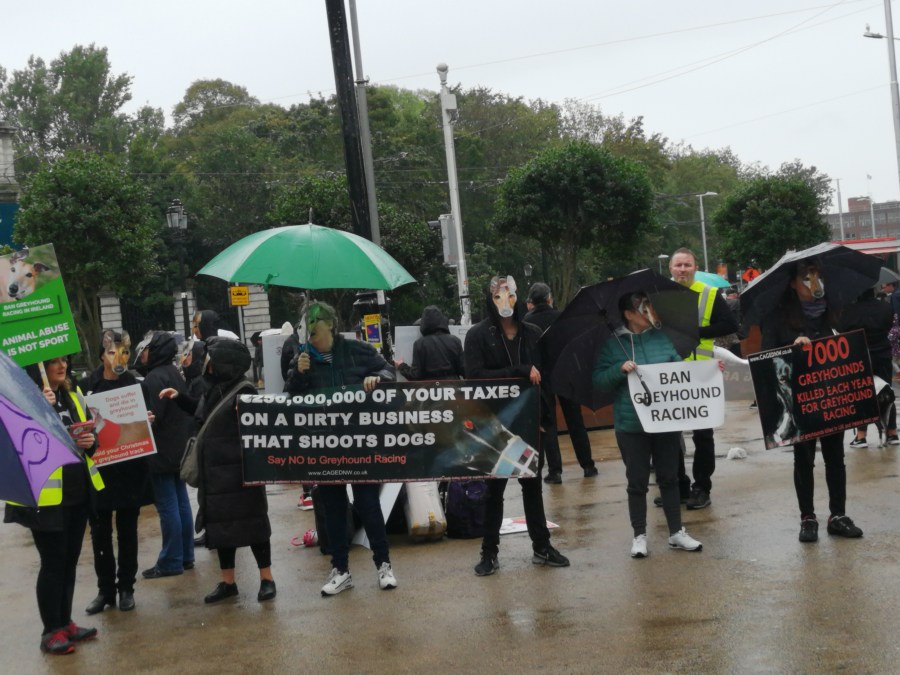
People wearing reptile masks — one of the more laughable conspiracy theories but believed by many in the US is that they are being ruled by lizard people.
(Image source: Internet)

Then there’s simple convergence of interests, which give rise to conspiracies but can also operate independently.

A current example of convergence of interests: The EU and all its constituent governments decide that the struggle between Catalonia and the Spanish State is an internal matter for the Spanish ruling class and can they please sort it out without dragging most of Europe into the mess? In fact, if they don’t sort it out, it endangers a number of key players in the EU and, inevitably, the EU itself.

As the current President of the EU Commission, Jean-Claude Junker reminded everyone on the question of Catalonian independence in 2017, there are member states of the EU other than the Spanish one that are vulnerable to the same kind of ‘problem’, i.e that of a bid for separation and independence of some part (or parts) of the state in question.

And if we look at Europe outside the Spanish State, we can see what he might have meant. There’s the French state, which contains within it three provinces out of the seven of the Basque Country, a part of Catalonia, also Brittany, Occitania and Corsica. Each of those regions was at one time an independent kingdom or part of a kingdom other than that of France; each also has its own language and each has struggled against French domination at some time or other.

Italy is a state with huge differences between its north and south, a composite of many different parts that did not come under one state rule even formally until 1871, at which time the spoken language of one region could hardly be understood in another. And there is Sardinia, still with its own language and currently engaged in another struggle for independence.

The UK is in the process of ceasing to become part of the EU now but it is still a part of the pattern of alliances (and hostilities) that forms part of modern Europe. And the UK contains the Six Counties of Northern Ireland, not long out of the three-decades guerrilla war, also Scotland with a strong popular movement for independence. In addition the Celtic nation of Wales was subjugated but still has a strong language movement and there are some stirrings of nationalism in the Celtic nation of Cornwall.

Belgium is a united state but containing the French-speaking Waloons and the Dutch-speaking Flemish and, although both languages are officially recognised, as polities, the two groups don’t get on very well together.

Even the separation of Catalonia from the Spanish State’s territory on its own would be bad enough from the point of view of EU leaders – but it could also precipitate the separation of the four southern Basque provinces, also of Galicia and Asturies. Which would certainly attract the interest of the southern regions of the French state.

In summary then, a successful bid for independence by Catalonia would start an “infection” (which is what Borrell, the Spanish Foreign Minister to the EU called Catalan independentism) which has the potential to cause the breakup of a number of major and medium states of the EU. And Junker also said that he didn’t want “an EU of ninety-nine states”. Of course not, such a union would be very difficult for the big European states to dominate and, in fact, those same European states would not be so big any more.

Conspiracy? Probably not – just convergence of interests. The ruling elites would have no need to get together, decide what they wanted their politicians to do, then have their various ministers sit down, formulate the policy of each state, have the foreign ministers of each get together and then inform the managers of the EU. The politicians have been trained and schooled, they know in general what their ruling elites want, without having to be told. They would react to Catalonian independence almost instinctively – with rejection. They view nationalism and independence, if it breaks up a rival power (such as the Eastern Bloc), as a good thing – but not in their own group!
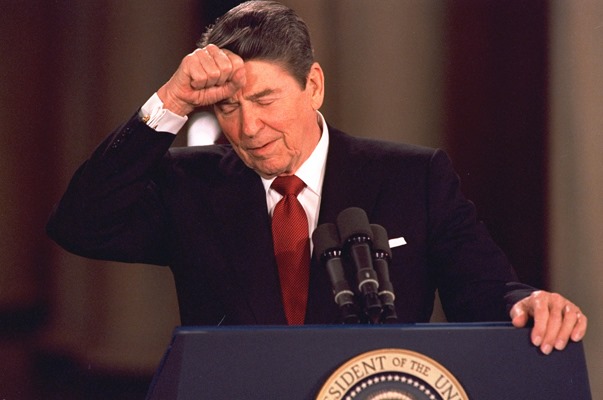
President Reagan of the USA lied when he denied any truth in the allegations of arms being sold to Iran to fund the Contra war against the Nicaraguan state. (Photo source: Internet)

THE USA IRAN-CONTRA CONSPIRACY

However, conspiracies do indeed happen, of course they do – and often. We have just passed by the anniversary of a key point in one huge one, the point when the “Iran-Contra” scandal began to break, in early November 1986. And President Reagan of the USA said that “the speculation that the US has sold arms to Iran has no foundation”, which was of course a lie. Basically, the US sold arms to the fundamentalist theocratic regime in Iran but, due to a US Congress embargo on such exports there, had to do it through Israel. They did so for two reasons, one for money to fund a military terrorist campaign against the government of Nicaragua which the US Congress would not approve, second in order to seduce the Iranian military (as they have done with the Egyptian military) and having them overthrow the Iranian regime. And the US wanted the Nicaraguan revolutionary government overthrown because it was not aligning itself with US foreign policy in what the USA considers its back yard (and a major source of raw materials) and also because a successful state of the type which Nicaragua was (then) would provide a ‘bad example’ to the other states of Latin America.

The Israeli Zionist ruling elite went for the deal because they too hoped the Iranian military would overthrow the theocratic regime and bring Iran back under the western-imperialist umbrella, as it once had been so secure that the CIA had its HQ for the whole Middle East located right there (and got caught with its pants down, or its secret documents in the process of shredding). And besides, the USA is the No.1 supporter of the Israeli Zionist regime in the world (another example of convergence of interests).

But despite the convergence of interests between the ruling elites of the USA and Israel, along with former Nicaraguan military, right-wing groups (for terrorist personnel) and US client regimes such as Honduras (for Contra bases) and Panama (for drug money to also fund the Contras, apparently through the CIA to sell in California – another conspiracy theory), a conspiracy was necessary to execute the operation. This was because of the unusual nature of the arms deal, its illegality according to US (and presumably Israeli) law and the number of partners involved. And the silent complicity of the US mass media was necessary, at least until a CIA plane delivering weapons was shot down by Nicaraguan forces over their territory and an operative, Eugene Hasenfus, captured alive.

A COMMON KIND OF CONSPIRACY

          Another example of conspiracy is that of price-fixing between big companies on given products. There have been a number of these exposed over the years. A conspiracy is necessary in this case because normally, the interest of big companies is to increase their share of the market over that of the competition. But at times, they perceive that it is in their joint interests to cease cutting one another’s throats and to regulate the prices of their products by agreement among themselves. Not only is this illegal in most administrations but it runs counter to the philosophy of capitalism, i.e that competition, instead of the cooperation advocated by socialists, is good for society. The fact that price-fixing is out of the norm of capitalism requires coming to formal agreement between the participants and the fact that it is illegal and undermines capitalist propaganda, requires secrecy – hence conspiracy.

However, most of what goes on in the world when government or other reactionary elements cooperate is probably just the result of convergence of interests, easily recognised by the participants.

(Image source: Internet)

A CONVERGENCE OF VERY DIFFERENT INTERESTS

Generally speaking, it is when their partnerships are put under pressure that the established convergence begins to crack; when one partner or another decides that the price of remaining in it is too high or that it’s time for sauve qui peut (everyone for himself). What can achieve that level of pressure is another kind of convergence of interests, that of the masses of wage-earners, small business people, peasants and indigenous people, recognising that by acting together, they can overthrow the existing system and set up an alternative that corresponds to their needs.

End.

REFERENCES:

Noam Chomsky short excerpt: https://libcom.org/history/the-iran-contra-affair

More detailed summary from Wikipedia: https://en.wikipedia.org/wiki/Contras

Concern about price-fixing in the insurance sector: https://www.independent.ie/irish-news/insurance-pricefixing-allegations-to-be-probed-by-watchdog-38405133.html

A case of price-fixing for contract bidding in Ireland: https://www.irishtimes.com/news/crime-and-law/sentencing-in-price-fixing-case-should-be-increased-to-encourage-whistleblowers-dpp-1.3515484

MARGARETTA D’ARCY SPEAKS IN THE BASQUE COUNTRY

Diarmuid Breatnach

(Reading time: 7 minutes)

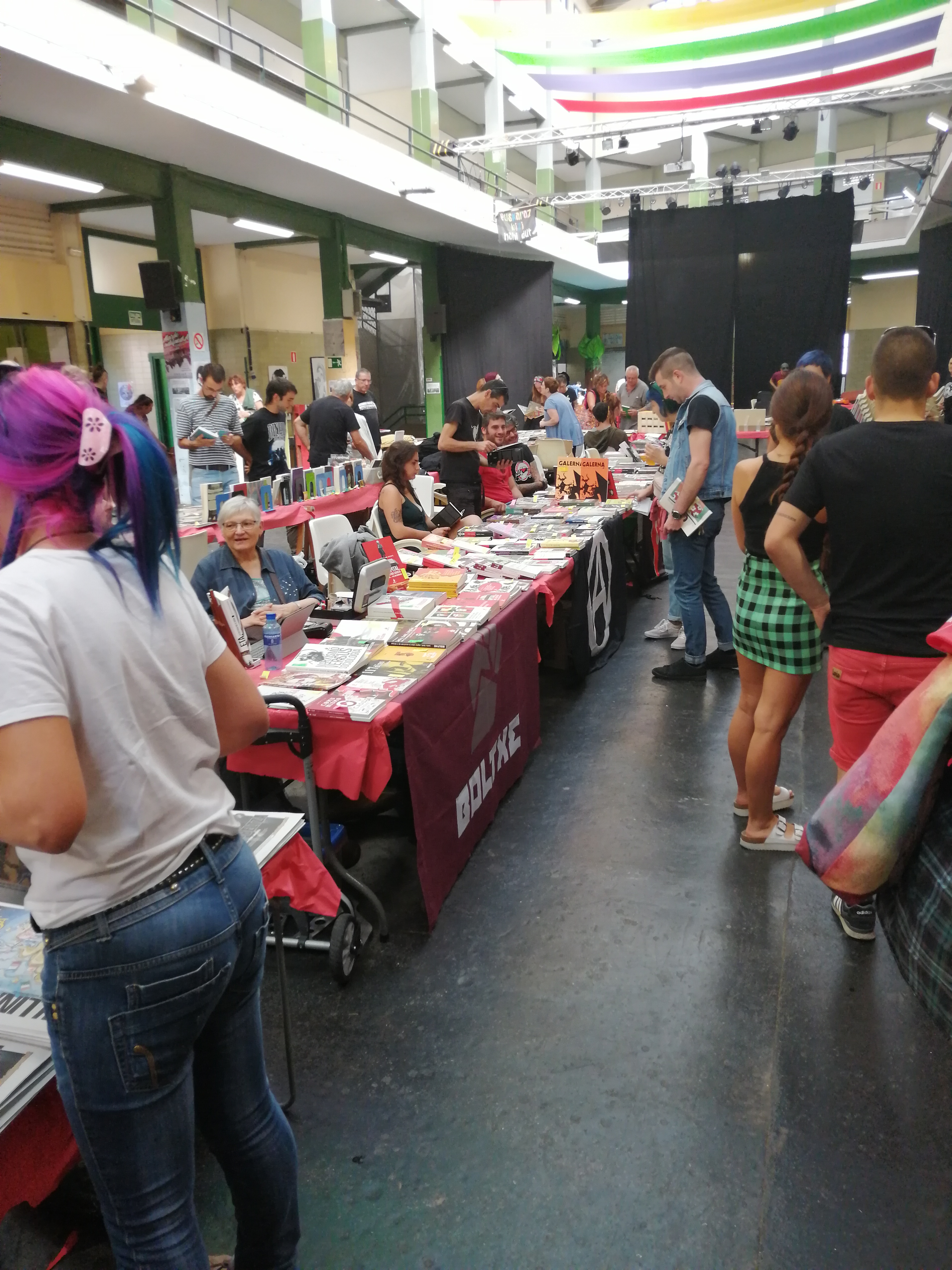
An anti-fascist bookfair was held in Portugalete1, not far from Bilbo (Bilbao) in the southern Basque Country on Saturday 29th and Sunday 30th September. There was ample room for the many stalls in the old disused indoor market in the town’s Casco Viejo (old town quarter), along with a curtained-off play area for children. One of the events in the two-day bookfair was a launch of the translation into Castillian (Spanish) of D’Arcy’s book “Tell Them Everything”(“Di Les Todo”). The translation was published by Sare Antifascista, one of the organisers of the bookfair and D’Arcy spoke in English at the launch, her talk translated into Castillian; also speaking was Basque ex-political prisoner Ziortza Fernandez Larrazabal. 

Section of the audience at the talk (Photo: D.Breatnach)

          Trembling from the illness that has affected her for a number of years (which she later commented resulted from attacks by fascists during the Greenham Common protest and later in Ireland by police) D’Arcy spoke clearly and coherently about her activism, the founding of Women Against Imperialism, the Greenham Common protest camp, her period in jail with Republican women and her activism against the USA’s military use of Ireland’s international airport at Shannon (despite the country’s constitutional neutrality).

Going on to speak about Ireland today, D’Arcy outlined some of the aspects of the notorious Direct Provision Centres for asylum seekers in the Irish state, the issues arising from the location of such centres and the opportunistic intervention of fascists against immigration. She went on to talk about the targeting on social media of those who spoke up welcoming asylum seekers or against racism and commented that the worrying thing about this development was that the fascists had a youth wing. Recalling the referendum on conditions of nationality in 2014 which had removed the rights of people born in Ireland to Irish citizenship unless they had an Irish citizen parent or grandparent, D’Arcy concluded by saying that Ireland is a racist country.
Referring to the Six Counties, D’Arcy criticised Sinn Féin for using the proposed Irish Language Act as a political football and as something with which to attack their political opposition, the Democratic Unionist Party2. Continuing, she said that “Scottish Irish”3 also existed in the Six Counties and asked why that could not be included in the Act, also quoting James Connolly that he didn’t care what language people spoke as long as they could communicate together.

Whatever about the issues in the Brexit question, the speaker said, Britain had used Ireland as a military training ground and had many bases in the Six Counties and these needed to be dismantled.

D’Arcy concluded by advising Basques to approach the Irish Consulate in the Basque Country to enquire whether it would be safe to travel to Ireland, given the US military use of Shannon Airport and the growth of fascism and racism in the country.

Ziortza Fernandez Larrazabal speaking. (Photo: D.Breatnach)

After the Irish speaker and speaking in Castillian, Ziortza Fernandez Larrazabal, ex-political prisoner from the locality, spoke first in tribute to D’Arcy’s record of activism. Moving on to her own activism in support of Basque independence and socialism and her five years in jail, Ziortza recounted being moved through a number of jails as part of the Spanish State’s policy and practice of dispersing political prisoners far from their homes and the strain this places on their friends and relations.

Commenting on the effects of imprisonment in Spanish jails, Ziortza said that some political prisoners had died through neglect, some had killed themselves but some had come out stronger, clearer in their minds and confirmed in their political views, which is what she felt had happened in her case. Ziortza said that some prisoners had 40 years of jail sentence and that they should be released.

After applause for the speakers, the Sare Antifaxista chairperson opened the meeting to questions from the audience. After a silence of some minutes, one man spoke in praise of the courage and commitment of both women and their record of activism. Speaking in Castillian with an Irish accent, he said he felt he had to distance himself from some of D’Arcy’s words. He felt it was important not to confuse government with people and that the Irish people were not, on the whole, racist and in fact racists and fascists had found it very difficult to organise within the territory of the Irish State.

Recounting the historical experience with the fascist Blueshirts in the 1930s, the Irishman said that they had been fought on the streets and defeated. When Pegida tried to launch their fascist and islamophobic group in the capitals of European states in 2016, they had failed in Ireland because firstly their gathering point had been occupied in advance by anti-fascists and anti-racists and, secondly the fascists themselves had been physically attacked and beaten. He talked also about a recent initiative to launch a “yellow vest” movement in Ireland but which fascists and racists had moved in to lead – that initiative had, as a result, been rejected and had faded away. Fascists are active on social media but find it difficult to hold events in public. The danger of racism and fascist organising should not be dismissed, the Irishman said but so far, in Ireland, racism and fascism was being repulsed among the people.

(Photo: D.Breatnach)

While it was true that the Government had proposed changing the nationality clause in the Constitution in 2014, he said, this had been part of a process across the whole of Europe. The referendum was held on that question along with another at the same time and only the social democrats and trotskyists had noticeably campaigned against the change. The vote in favour had to be seen in that context.

Moving on to the question of nation and language, he said that nations had a right to self-determination which, in many cases, was opposed by imperialism, which also damaged many languages. The loss of a language, he said, means the loss of a way of thinking and seeing, of literature, poetry and song; the loss of such is a loss for entire humanity.

A Basque woman also spoke from the floor, partly in Castillian and partly in Euskera (Basque), expressing her admiration for the record of both women speakers and referring to her own involvement in her youth in Greenham common. She went on to speak about the danger of nationalism but also in support of the rights of language and said that if there were no states in the world, she would not want one either but as long as there are, she wanted one for her own nation.

She also said that at this time it was important to support the struggles for self-determination not only of the Basques but also of the Catalans.

Poster advertising the book launch and talk

The event came to an end and people moved off for lunch in various bars, or to chat or to browse the bookstalls. The latter were run by a number of organisations: Inugorria Liburodenda (Gernika revolutionary and progressive bookshop), Sare Antifaxista; CNT, Mujeres Libres, IPEs, Baskale, FAI, DDT Banaketak, Periko Solabarria Elkartea, Komite Internazionalistak, Jazz Oi!, Templando el acero, Amnistía Ta Askatasuna, SRI.

FOOTNOTES

1 Portugalete has a Metro station, reachable from Bilbao. The Casco Viejo (old town) is a number of narrow streets lined by bars and shops heading steeply downwards from the Metro station towards the river front, where there are a number of restaurants and bars and a nearby port museum. The interesting Puente Colgante is nearby; a pedestrian bridge across the river worked something like a horizontal lift.

2 Given that Sinn Féin makes no effort to ensure its own membership is Irish-speaking, or even its leaders (despite some of them being very proficient in the language), also that all its internal and nearly all public meetings are conducted through English, this would seem to be a correct assessment by D’Arcy.

3 D’Arcy probably meant Ulster Scots or Ullans, which is not any kind of Irish but a variant of Scots, the Germanic-English dialect once prevalent in the Scottish Lowlands (often called “Lallands”), in which for example Robbie Burns wrote. It has Minority Language Status in the Six Counties and while Irish-speakers generally have no opposition to the promotion of that dialect, hardly anyone speaks it today and it was raised as an issue by Unionists purely as a counter to the rights of Irish-language speakers. Scotland does have Scottish Gaedhlig, with over 57,000 recorded speakers (2011 Census) but this is not spoken in the Six Counties.

Gernika bookshop stall in foreground
(Photo: D.Breatnach)
Other stalls
(Photo: D.Breatnach)


REFERENCES AND FURTHER INFORMATION

Sare Antixista: http://sareantifaxista.blogspot.com/

Dissidence in the Basque Country: https://rebelbreeze.wordpress.com/2019/09/27/dissidence-in-the-basque-pro-independence-movement/

Basque political prisoners:

Amnistia Garrasi: https://www.facebook.com/profile.php?id=100013870776872

Etxerat: https://www.facebook.com/Etxerat-Elkartea-255302801219340/

(Photo: D.Breatnach)

(Photo: D.Breatnach)
Buying at stall at the Bookfair
(Photo: D.Breatnach)
Nearby poster honouring “Argala”, an ETA leader assassinated by GAL, the Spanish State death squad.
(Photo: D.Breatnach)

THE DÁIL: IRISH ESTABLISHMENT SUPPORTS THE SPANISH STATE’S ATTACK ON CATALAN SELF-DETERMINATION

Clive Sulish

A representative of the Irish (Fine Gael) Government’s Minister for Foreign Affairs and Trade last night not only called for non-interference in the “internal affairs” of the Spanish State but defended the Spanish Constitution of 1978 and the “independent Spanish judiciary”. She was answering a question regarding the Spanish State and Catalan independence movement and her stance was supported by representatives of the two other traditional parties of Irish Government, Fianna Fáil and Labour. Five Teachtaí Dála, elected members of the Irish Parliament, argued passionately against them.

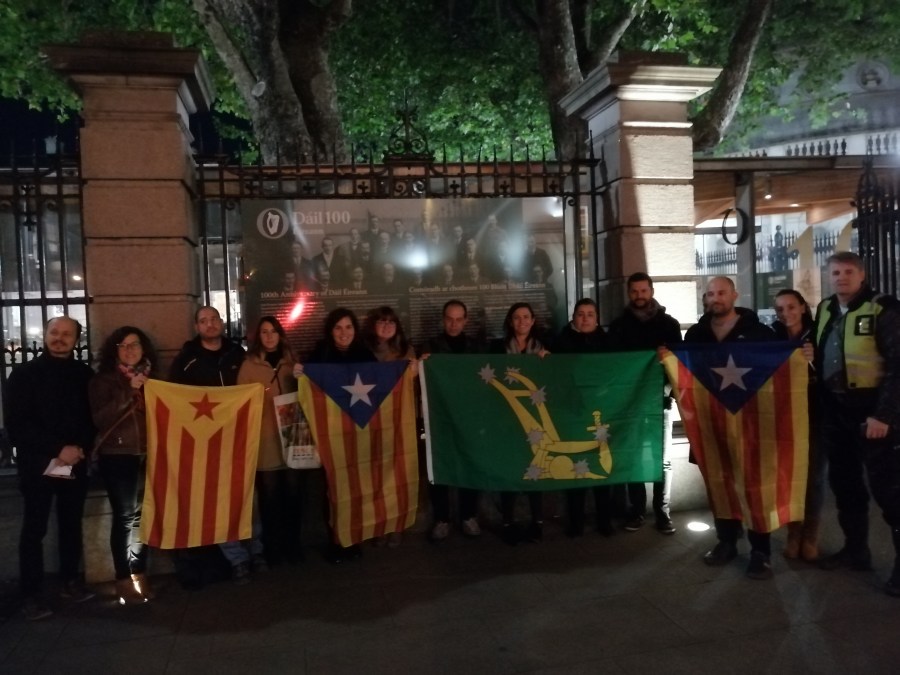
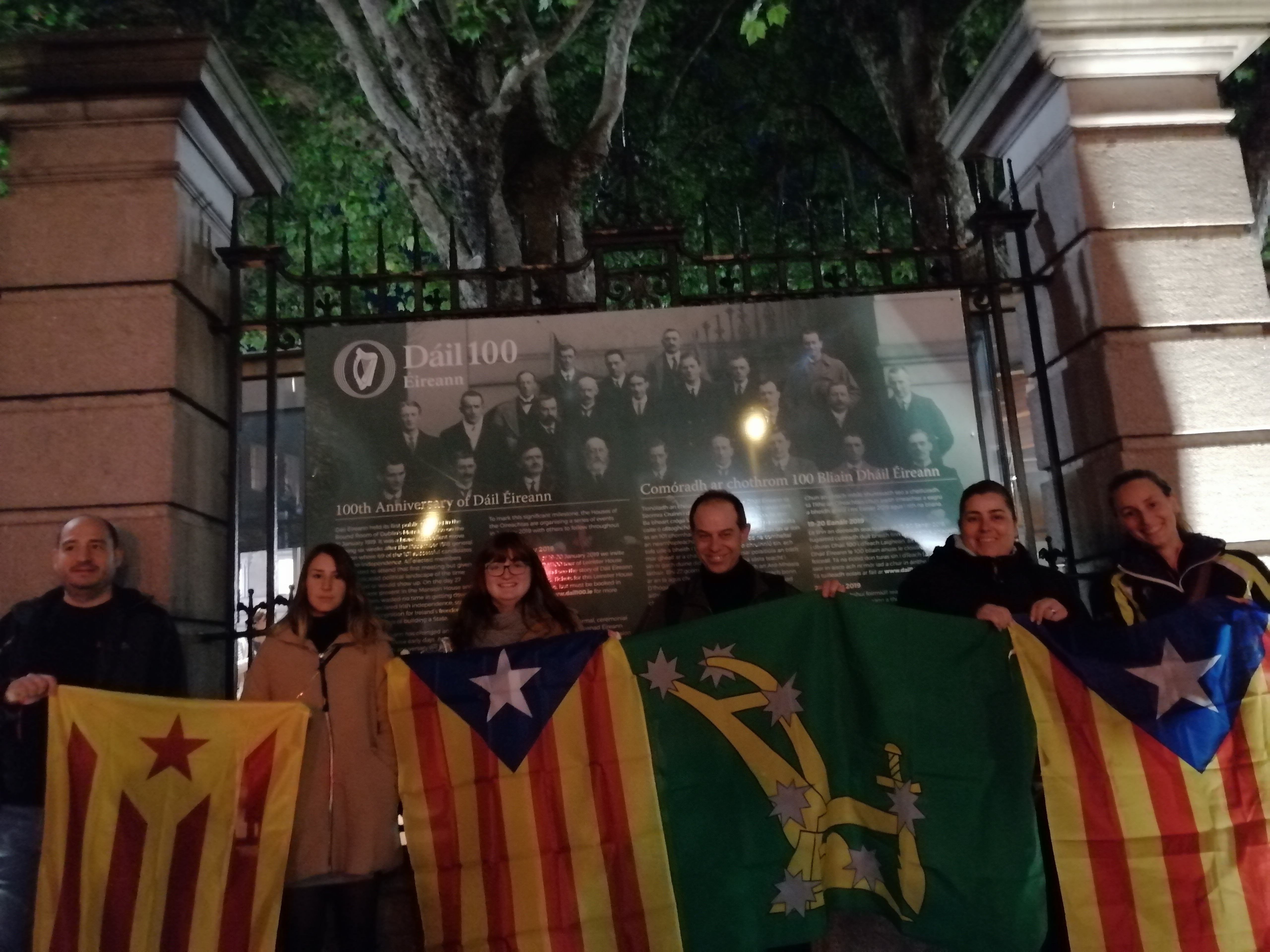
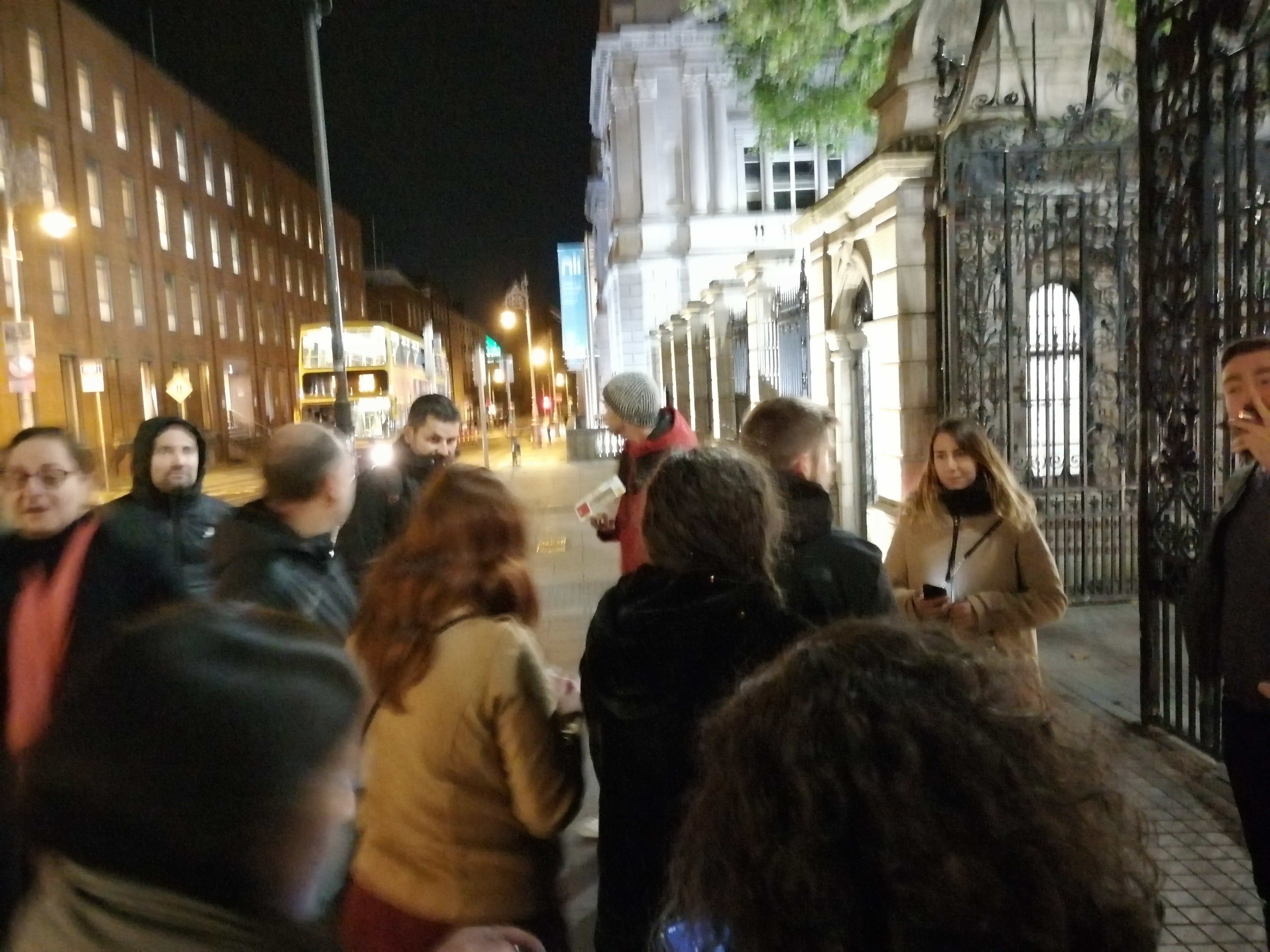
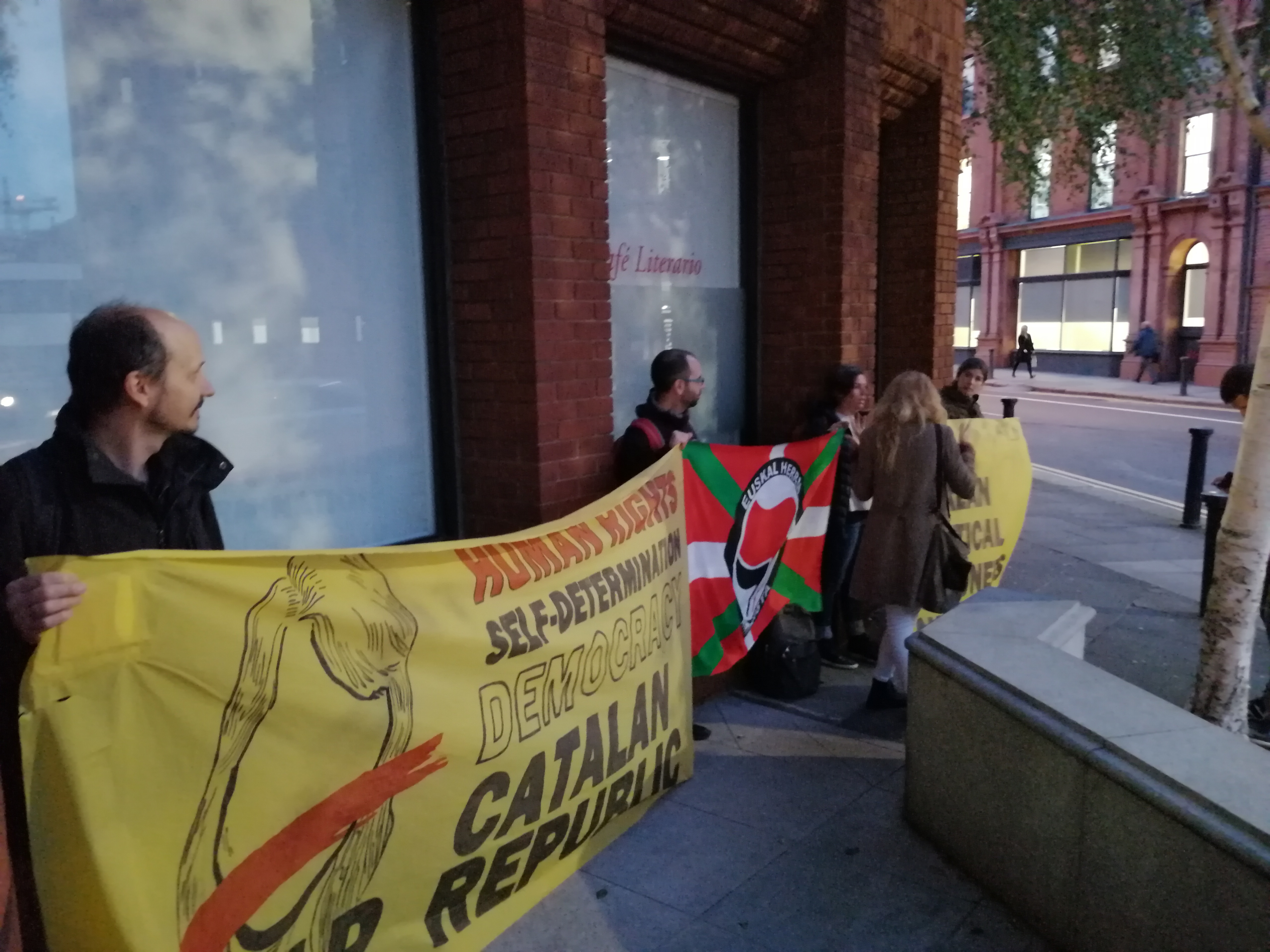
Section of Catalonia supporters in Kildare St. waiting to attend the Foreign Affairs Minister’s Question time.
(Photo: Rebel Breeze)

THE VOICES OF THE ESTABLISHMENT

This was Minister’s Question time, when Ministers (or their representatives) appear in the Chamber to answer questions about areas of the remit of their Departments and earlier, Ministers had been quizzed about areas of childcare, social care funding, local government funding ……

The Dáil chamber looked mostly deserted but in the public gallery sat a score of Catalans and some Irish, listening intently. Normally, these sessions are attended only by the TDs asking the questions and the relevant Ministerial spokesperson – and only for the question being asked. And of course also in attendance is the Ceann Comhairle, the presiding person acting as Chair – and secretaries. Sometimes by members of the media but by no means always, since reporters can monitor the televised broadcasts of the session.

The Minister’s reply on the question of Catalan self-determination delivered by Minister of State Helen McEntee TD followed a predictable pattern – predictable because it is so often trotted out: the Irish and Spanish Governments have a long history of good relations and friendly links, lots of Irish people go there on holidays, lots of people from there come to Ireland every year, Spain is a democracy, its constitution must be abided by, it would be wrong to interfere in its internal affairs. Inclusions to that in litany in recent times are that the question of Catalonia is emotive throughout the Spanish State and that Catalan society is divided over it, that the rule of law must be upheld and that violence has no place in politics.

The Fianna Fáil representative, Seán Haughey TD, echoed that line, adding also that the Spanish Constitution of 1978 is unitary and does not allow any part to become independent. He also quoted some survey results that he claimed indicated that support for independence was now in a minority among Catalans.

The Labour Party representative, Jan O’Sullivan TD, went further and specifically supported the present Government of her “sister party in Spain”, the PSOE and suggested that the “inflexible” previous government of Rajoy (of the PP) had helped to bring the current situation about and that Sanchez, the Prime Minister, would help calm the whole situation down. The only concessions she made were to suggest that the lengthy jail sentences were perhaps not the best way to deal with the issue and to include the police by mention in her call for “end to violence by all sides”. However, she went further than others in the Establishment parties with a specific condemnation of the jailed activists when she said that “it is not acceptable for politicians to lead citizens into conflict”.

Early arrivals for the Minister’s Question time
line up in Kildare St. below a photo of the First Dáil 1919.
(Photo: Rebel Breeze)

THE OPPOSITION

“Reactionary Spanish nationalism”

          The first TD to speak in reply to the Establishment politicians was Eoin Ó Broin, a comparatively recent Sinn Féin Deputy (2016) for Dublin Mid-West. Ó Broin was in Catalonia as one of the international observers of the Catalan Referendum on Independence on 1st October, which was attacked by Spanish police with around 1,000 Catalans injured.1

Speaking about his experiences there, Ó Broin related his meeting with 83-year-old Antonio, bruised and with his fractured arm in a sling, beaten while trying to vote earlier that day, queuing again at a polling station in Barceloneta. The SF TD spoke about what he had seen there and the “increasingly reactionary Spanish nationalism”, then went on to list the elected politicians and their jail sentences. Denying it was an internal matter for Spain, Ó Broin said it was about human rights and required international independent mediation. The Dáil would be implicitly in collusion with the Spanish Government if it left the matter to internal resolution only.

“The working class are the incorruptible heirs …”

          Paul Murphy TD, a socialist activist2 who has recently left the Socialist Party of Ireland to form a platform called Rise, shared speaking time with Eoin Ó Broin. Calling for a “reality check” he said that jailing politicians and activists for organising a peaceful ballot could hardly be the work of a normal democracy. Responding to the Labour Party spokesperson with regard to the Spanish PSOE Prime Minister, he said that “Sanchez is in Government” and that he was “sending thousands of troops and police” to suppress the Catalan independence movement and mounting “a publicity campaign” to blame the convicted leaders.

The Spanish Government would one day come to be haunted, Murphy said, by the words of James Connolly in 19143 when he said:

“If you strike at, imprison or kill us, out of our graves or prisons we will still evoke a spirit that will thwart you, and perhaps, create a force that will rise up and destroy you. We defy you! Do your worst.”

Murphy said that the Catalan popular movement was impressive with their demonstrations, marches and the recent general strike. Against that, the Spanish police and army were carrying out “a campaign of terror” injuring hundreds and anyone who didn’t believe it only had to go on line and see the videos. “Francoism is baring its ugly head”, Murphy said and pointed out that the Spanish legal systems is riddled with a contempt for democracy, echoed by those at the top in the European Union.

The recent Catalan General Strike, according to Murphy, “showed the way forward” and he quoted again from Connolly, that “the working class are the incorruptible heirs of Irish freedom”. The Spanish State had a long history of suppression of national self-determination, including those of the Basques, Murphy said and the way forward would be for a voluntary socialist federation.

Catalan independence supporters gathering in Kildare St. waiting to attend the Foreign Affairs Minister’s Question time.
(Photo: Rebel Breeze)

“The judicialisation of politics”

          Next to speak was Thomas Pringle, Independent TD for Donegal since 2011, with a socialist Irish Republican background, a member of Sinn Féin for few years but who left the party in 2004. He opened his contribution by referring to “the judicialisation of politics” in the Spanish state and, in reference to the scale of the Spanish repression, mentioned the 700 Catalan town mayors who await judicial process due to their support for the Catalan Referendum in 2017.

Pringle said the Spanish Constitution purported to guarantee the rights of different people within the state, which would be a joke if the reality were not so grim. “The EU continues to ignore” what is going on in its member Spanish State, “as it did in the Six Counties,” he said.

“Catalonia in 2019 is Ireland  a century ago”

          “Self-determination is a human right,” said the next to speak: Peadar Tóibín, TD for Meath West since 2011, who left Sinn Féin in 2018 and went on to form Aontú in January 2019. Tóibín reminded all that the First Dáil had sent out a call to the world for recognition of Irish independence in 1919 and that most states had not done so then4.

“Catalonia in 2019 is Ireland a hundred years ago”, Tóibín said and went on to say that if the Irish Government remained silent on repression by the Spanish State then it shared culpability for it.

“ … a short memory in this House”

          “We sometimes have a short memory in this House” said Mattie McGrath when it was his turn to speak, a TD since 2007 who has been an Independent since he left the Fianna Fáil party in 2011. McGrath referred to the recent long war in the north-east of Ireland and said that conflict resolution process was the only way to resolve the issue.

McGrath referred to Clare Daly (elected MEP this year after being a socialist TD for some years) and her statements on the issue. “Self-determination is a fundamental human right”, McGrath said, and went on to speak about “the right of freedom of assembly”, which was under attack by the Spanish State.

“Ireland is a small island nation”, Mc Grath said, “very sympathetic to the rights of people” (apparently contrasting this to the attitude of the Establishment in the Dáil).

In the time allowed by procedure for final response from the Minister, her representative reiterated the position she had outlined earlier and, though she conceded that most of the Catalan demonstrations had been peaceful, said that some recent “scenes of violence” had been “of concern”.

Section of Catalonia supporters in Kildare St. waiting to attend the Foreign Affairs Minister’s Question time. Behind them, enlarged photo of the First Dáil, 1919.
(Photo: Rebel Breeze)

COMMENT

Fianna Fáil‘s origins are in the split with Sinn Féin led by De Valera in 1926 over the question of taking seats in the “partitionist” Irish parliament, the Dáil, and rapidly became the preferred party of the native Irish capitalist class, having been in government since more than any other Irish party.

The origins of Fine Gael, currently in minority Government at the tolerance of Fianna Fáil, has its origin in the setting up of the Irish State after the War of Independence and represents the victors of the Civil War against the Republicans. It was composed of a coalition of a right-wing Irish Republican party (followers of Michael Collins, Griffiths etc), a small right-wing farmer’s party and the fascist Blueshirts (a name by which FG are still often called by their enemies).

Hard to believe today, the Irish Labour Party was founded by, among others, James Connolly and is the oldest of the three parties. A progressive party in the early days, it was not a participant in the Civil War, during which its representatives criticised the Free State Government about its abuse of civil rights, repression, large-scale arrests, internment without trial, torture and murder. Over the years it lost more and more of its socialist credentials and has been in coalition government with the right-wing Fine Gael on two separate occasions. The main trade unions in Ireland retain connections to the Labour Party, with the possible exception of the rapidly-growing British-based UNITE.

(Photo: Rebel Breeze)

The supposed inviolability of the Spanish Constitution of 1798 is one of the questions at the heart of the matter. The boast of the Spanish Government and its supporters abroad is that the majority of the people within the Spanish State voted for it. Well, so they did, except in the Basque Country – but what of it? If in a wedding, one of the partners says “I do”, does that mean that person is forever forbidden from leaving? Do we not have the right to divorce acknowledged now in most states around the world and certainly in “the democracies”? If one agrees to join a club or organisation, does that mean one can never choose to leave? Well, maybe in the Mafia, or the Cosa Nostra ….

Furthermore, that monarchist Constitution was put forward to a population that had endured four decades of fascist dictatorship, with the collusion of the allegedly socialist and republican PSOE and the allegedly communist and republican Communist Party of Spain, restraining their trade union and party members in the wave of state repression and murders during the Transition to “democracy”. Isn’t there something about the invalidity of agreements made under duress?

The issue of non-interference in the internal affairs of another state is a bogus one, since all governments do that at one time and another and Irish governments and political parties are no exception. In 1936, the representatives of Fine Gael loudly supported the military-fascist uprising led by Franco against the democratically-elected Government of the Spanish State. The Irish Government of Fianna Fáil did nothing to prevent the Blueshirts going off to fight for Franco and the Bishops of the Irish Catholic Church blessed them as they sailed off. The reality is that states that agree with one another generally do not interfere in one another’s internal affairs.

The constant mantra of reference to “the rule of law” and the condemnation of “violence in politics” is not only an irrelevance but turning truth on its head. It was not illegal according to the Spanish Constitution or laws to hold a referendum on independence 5. It is also against the Spanish law to use violence against others and even the police are not legally empowered to do so except in self-defence or in defence of others. On October 1st the actions of the Spanish police had 1,000 people requiring treatment and another few hundred have been injured in recent days. The Internet is full of videos of different incidents of gratuitous Spanish police violence, often the perpetrators showing no fear of being filmed – clearly because Spanish (and more recently, Catalan) police know they have impunity. Recently, however, it seems that some Spanish police have become sensitive to being filmed during their violent acts and have begun to target photo-journalists, both with personal violence and with rubber bullets.

A total of five people have now lost an eye from the impact of the rubber bullets of the Spanish police. Apart from the fact that these are banned in Catalonia, the bullets are supposed to be fired to ricochet and not directly at people, nor are they supposed to be fired at close quarters. Clearly, the rules are not being adhered to and nobody is enforcing them, granting impunity to the Spanish police.

When the representative of the Minister for Foreign Affairs acknowledged the overall peaceful nature of Catalan independence demonstrations but expressed concern over some recent scenes of violence, what was she really saying? It was this: that the violence of the police against the peaceful demonstrators could continue but the victims using force in defence or in retaliation is a cause for concern!

End.

FOOTNOTES

1  Eoin Ó Broin, often described as on the (small) left wing of Sinn Féin (a wing badly needed by that party) has in the past had relations with the Abertzale Left in the Basque Country and wrote a book on the movement there in his time, Matxinada – Basque Nationalism and Radical Basque Youth Movements. He is also author of Sinn Féin and the Politics of Left Republicanism.

2  Paul Murphy has been, while a Socialist Party TD, dragged by police out of a housing protest and with others faced serious charges arising out of a protest about Irish water against a Labour Party Minister, of which he and the others were acquitted by the jury after an infamous trial. He remains in the PBP-Solidarity parliamentary coalition.

3  James Connolly (1868-1916) was at that time active in the Irish Labour Party and leader of the Irish Transport & General Workers’ Union, which was struggling to recover from an 8-month fight against a group of employers that had set out to crush the union (Dublin Lockout). Connolly was a revolutionary socialist, republican, journalist, historian, author and organiser and was horrified by the very idea of the First World War which began in 1914. He was shot dead by British firing squad, along with other leaders and some others of the 1916 Rising.

4  This reference seems particularly appropriate. In January 1919 the majority of MPs elected in Ireland in the UK General Elections of December 1918, carried out the “Sinn Féin” platform’s election promise not to go to Westminster and convened a parliament in Dublin. This is known as “The First Dáil” even by the Irish State, which numbers its parliaments from then onwards. The First Dáil declared independence and called on the states of the world to recognise Irish independence (see References) but only the young USSR did so. Ireland had no legal right under British law to break away from the UK unless it were agreed by majority in Westminster (where the Irish MPs would always be outnumbered by the British). The First Dáil was banned by the British in September of that year and its members were arrested if they could be found.

5  Though possibly the declaration of Republic was – but that was suspended in less than five minutes.

REFERENCES & FURTHER INFORMATION

Clip of Eoin Ó Broin TD reply: https://www.facebook.com/EoinOBroinTD/videos/1138199326378630/

Clip of Paul Murphy TD reply: https://www.facebook.com/paulmurphytd/videos/424540844872189/?t=11

Clip of Thomas Pringle TD reply: https://www.facebook.com/ThomasPringleTD/videos/416766079224197/

Clip of Peadar Tóibín TD reply: https://www.facebook.com/740004202875853/videos/738458029959798/?t=124

(currently seeking remaining TD, also footage of the whole debate)

Text of all contributions to the debate: https://www.oireachtas.ie/en/debates/debate/dail/2019-10-22/34/

First Dáil’s Message to the Free Nations of the World: https://en.wikipedia.org/wiki/Message_to_the_Free_Nations_of_the_World

Some organisations of Catalan solidarity in Ireland:

ANC Ireland: https://www.facebook.com/IrlandaPerLaIndependenciaDeCatalunya/

CDR Dublin: https://www.facebook.com/CDRDublin/

With Catalonia/ Leis an Chatalóin: https://www.facebook.com/WithCataloniaIreland/

DUBLIN PROTESTS SPANISH SENTENCES ON CATALANS

DUBLIN PROTEST AT UNJUST AND SAVAGE SENTENCES ON CATALAN INDEPENDENCE LEADERS

Diarmuid Breatnach

(Reading time 5 mins)

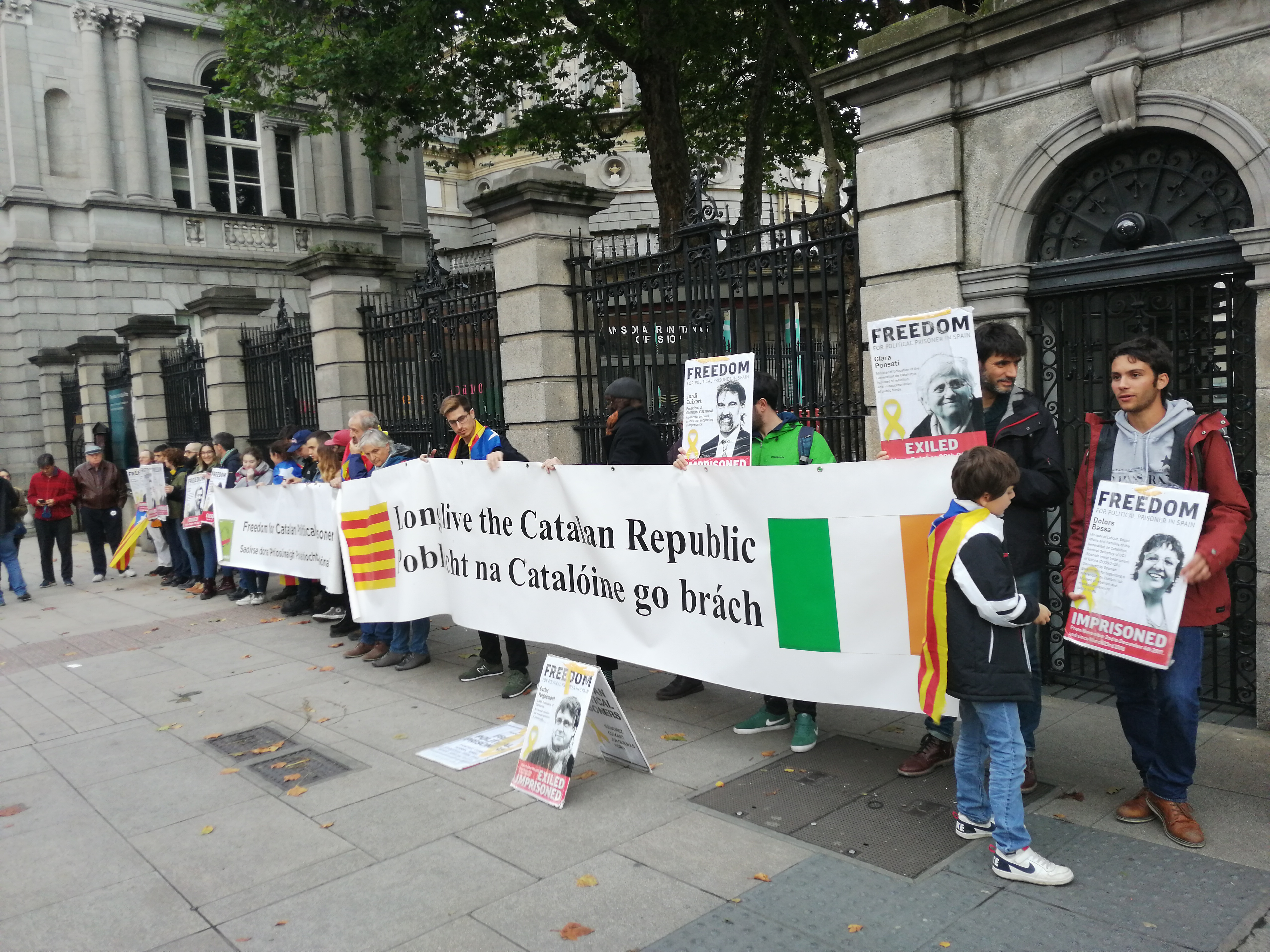
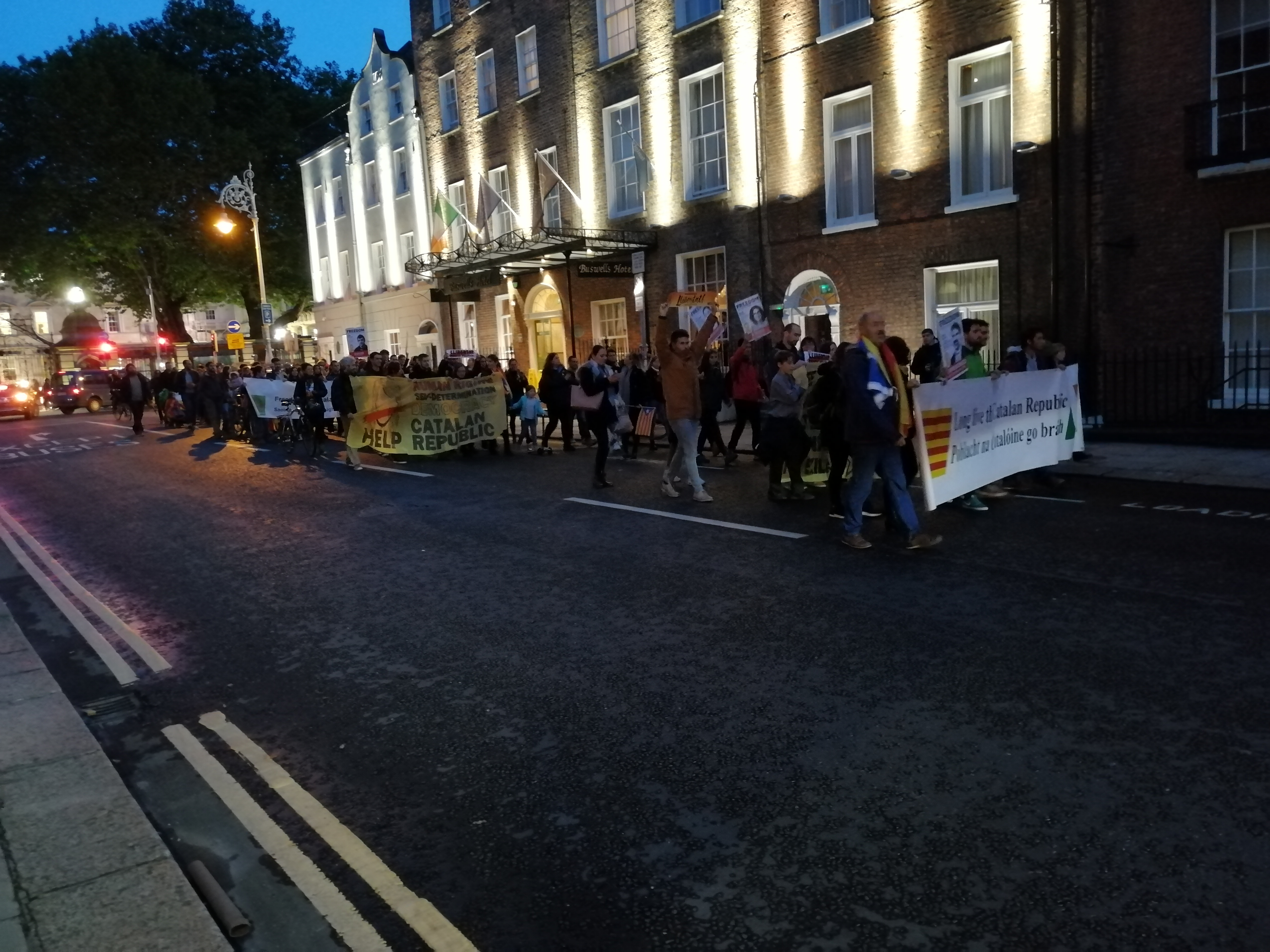
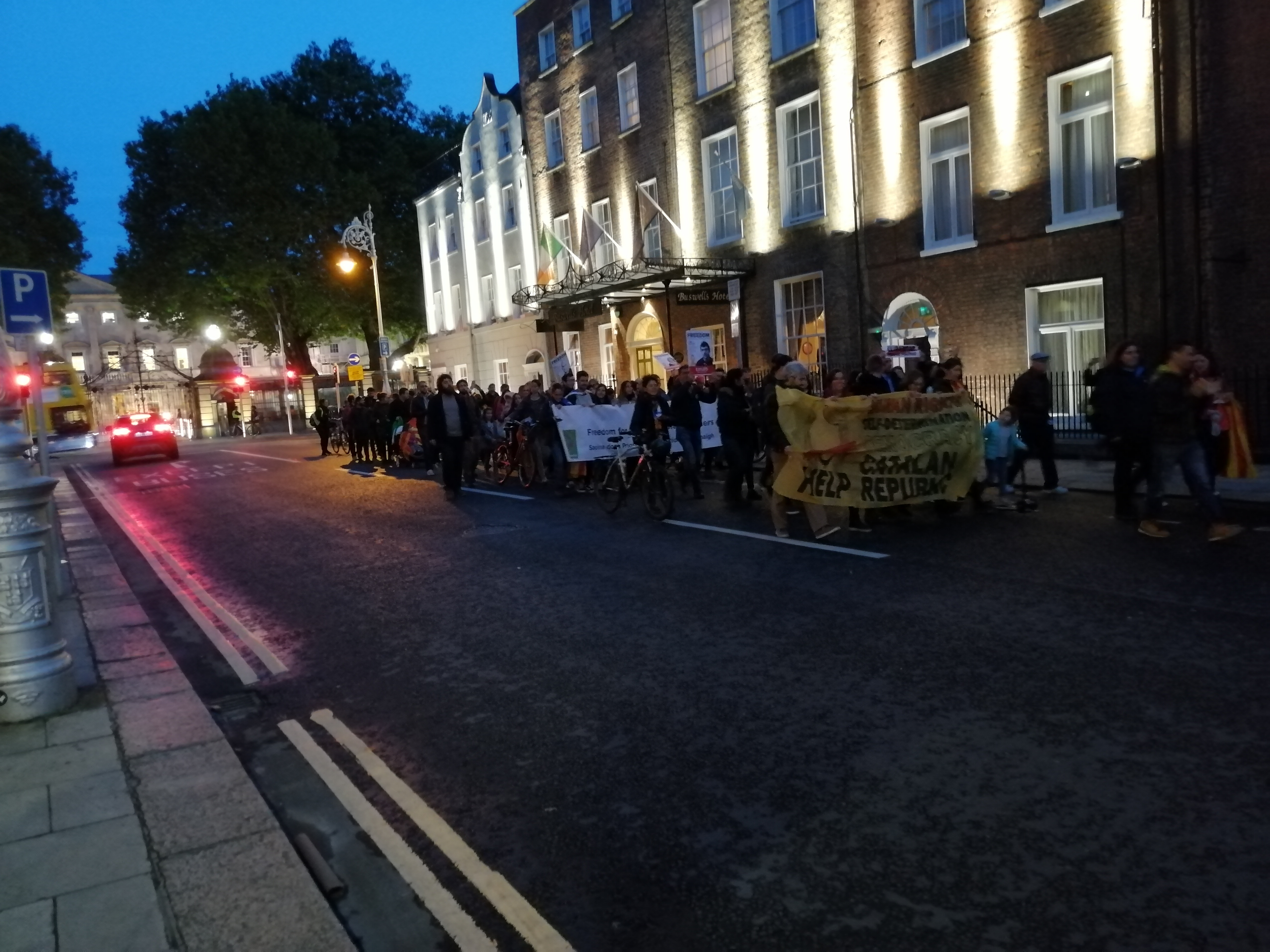
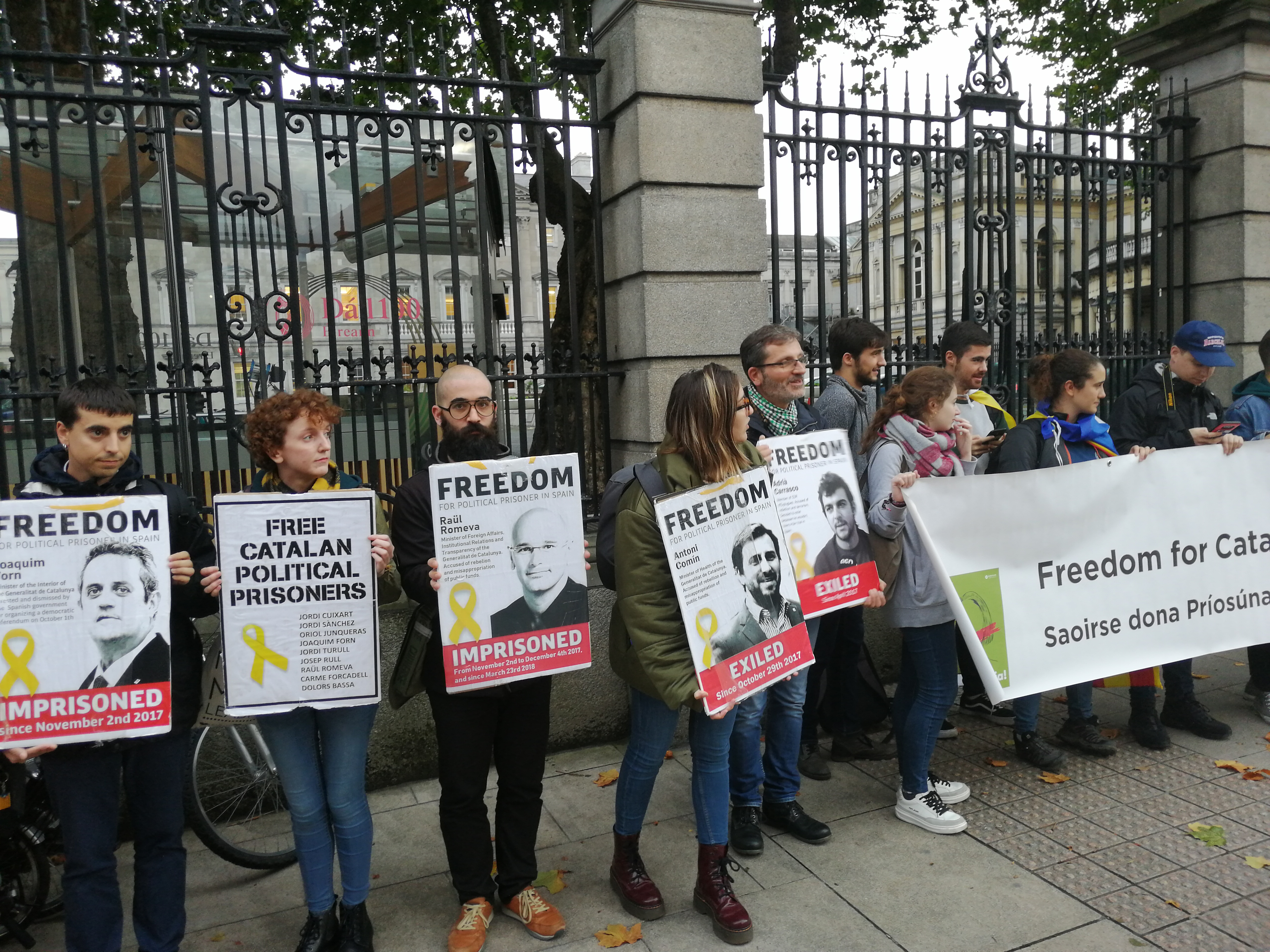
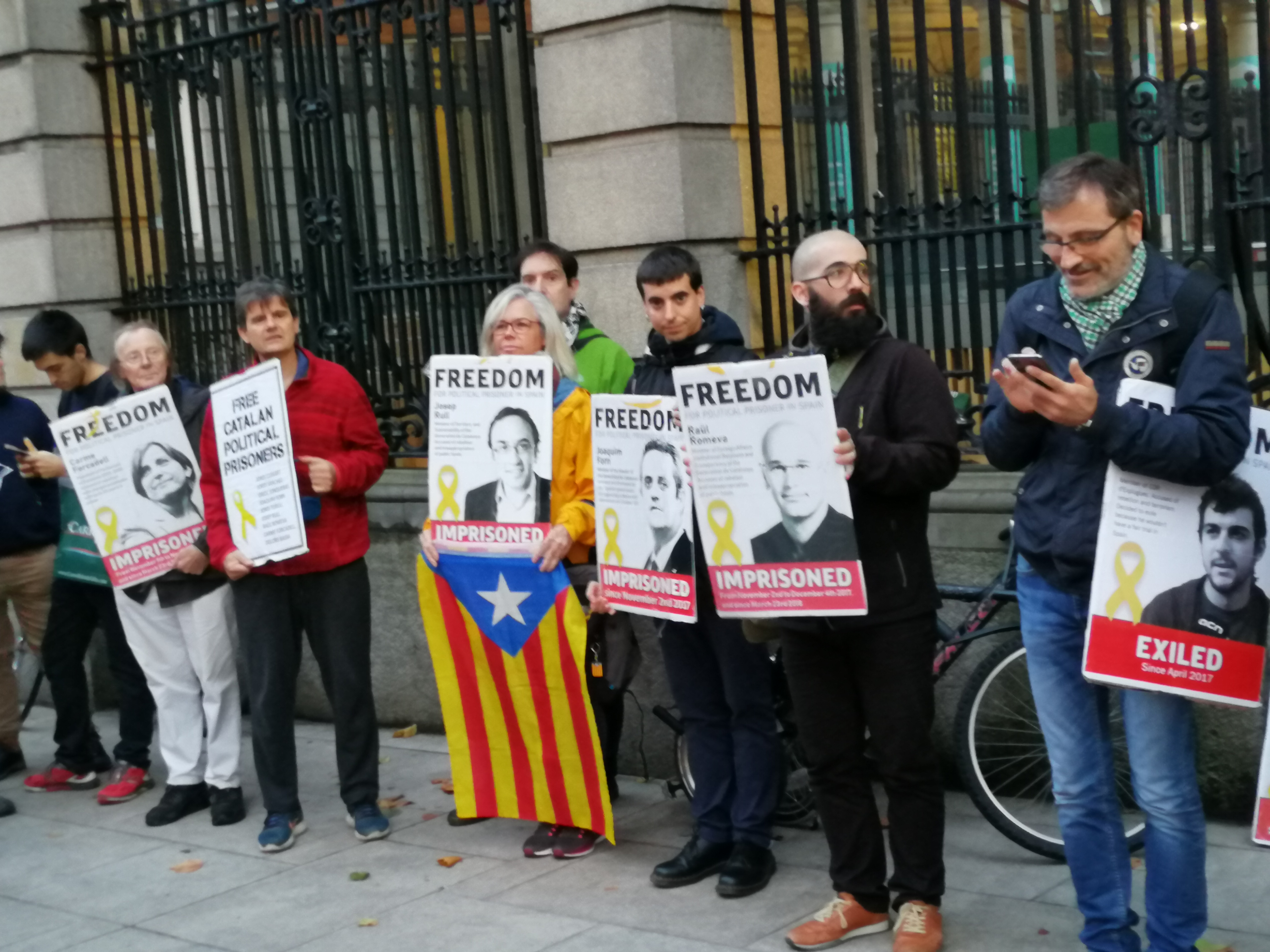
Protests erupted on Monday across the world at the unjust and savage sentences by Spanish judges on the Catalan independence activists, elected politicians and grass roots leaders. Dublin was no exception and around two hundred people gathered in solidarity protest outside the Dáil (Irish Parliament). Then they marched from there to the General Post Office building in O’Connell Street, Dublin city centre’s main street, outside of which they held a short rally.

          In October 2017, after a build-up of some years, the Catalan regional Government, by majority approved the holding of a Referendum on an independent Catalan Republic. The Spanish State through its ‘justice’ court declared the referendum illegal and sent police into Catalonia to seize election literature, ballot papers and ballot boxes. In the latter case the police were unsuccessful and on October 1st the Referendum went ahead and, despite savage police attacks on voters and people protesting the invasion (a thousand injured — one losing an eye — and one dead), a majority of voters voted Yes. Subsequently pro-independence politicians and grass-roots leaders were arrested by the Spanish State while others went into exile. Those arrested were charged with organising a Rebellion, Sedition and Misuse of Public Funds (allegedly to fund the Referendum).

On Monday, while they were found not guilty of Rebellion, the nine received the following sentences (and bans from public office of many years):

Junqueras 13 years

Romeva, Turul and Bassa 12 years

Forcadel 11.5 years

Forn and Rul 10.5 years

Cuixart, Sanchez 9 years

Three others were fined and banned from public office for a period.

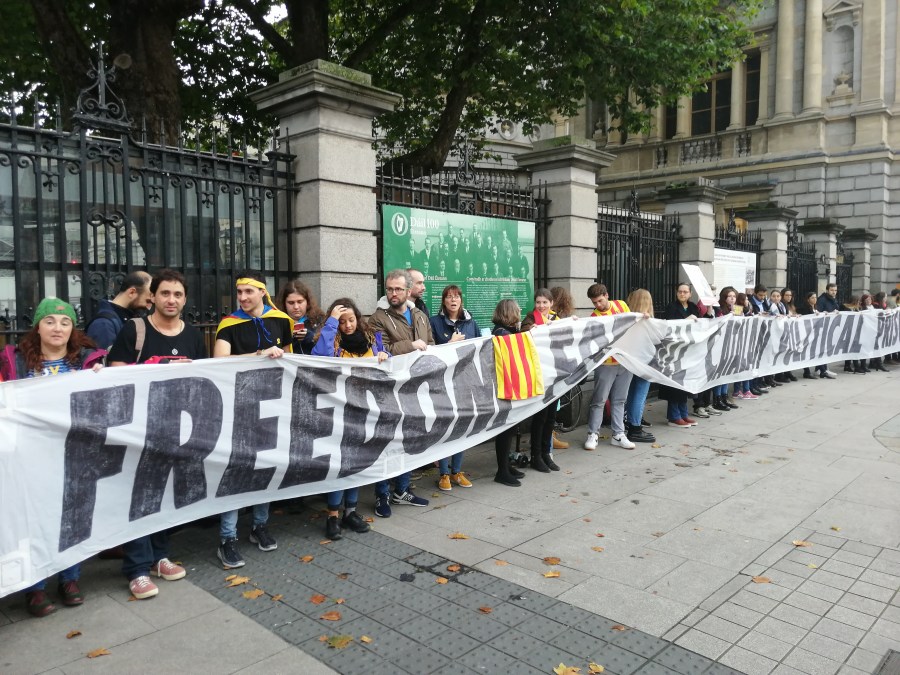
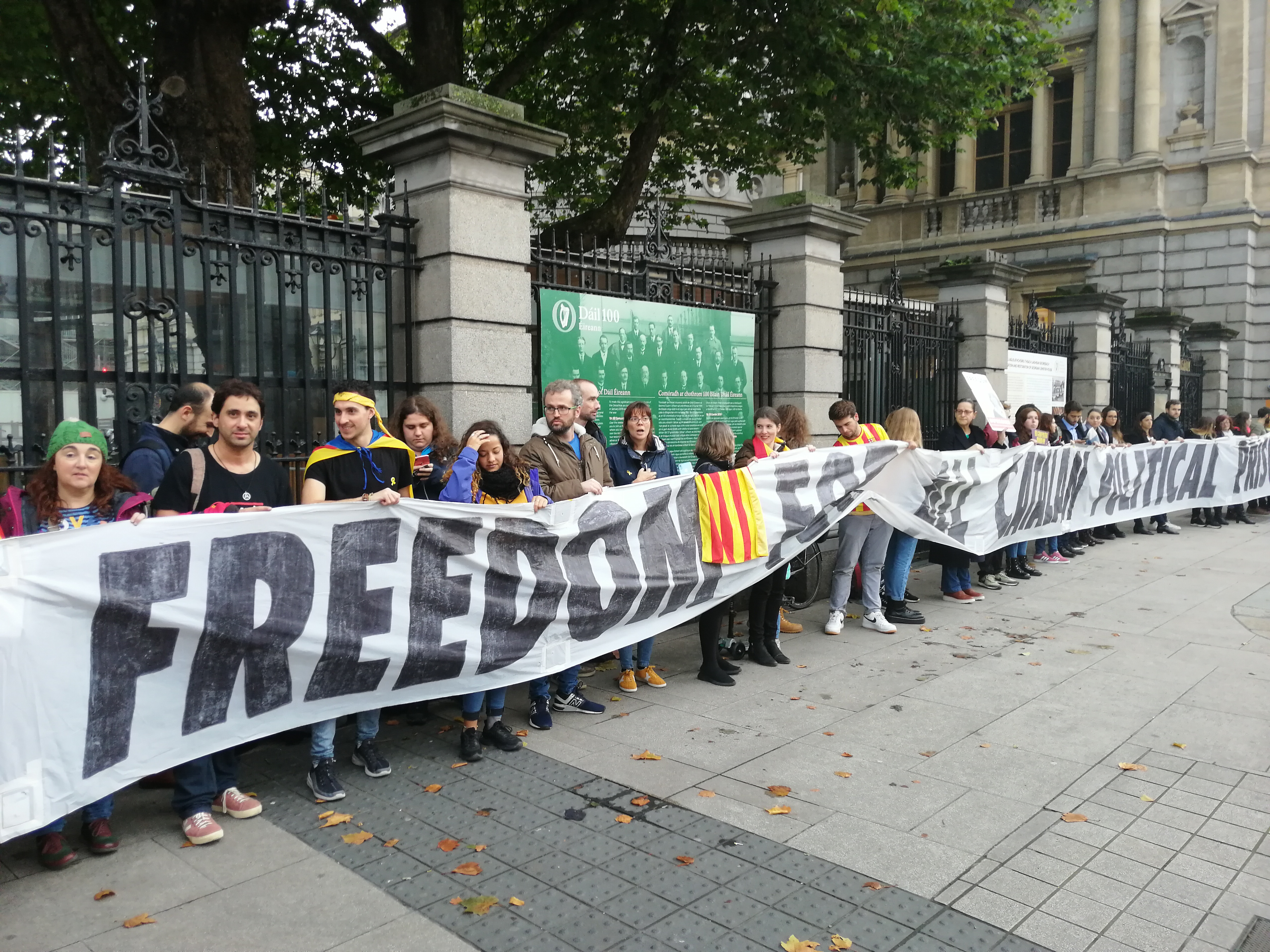
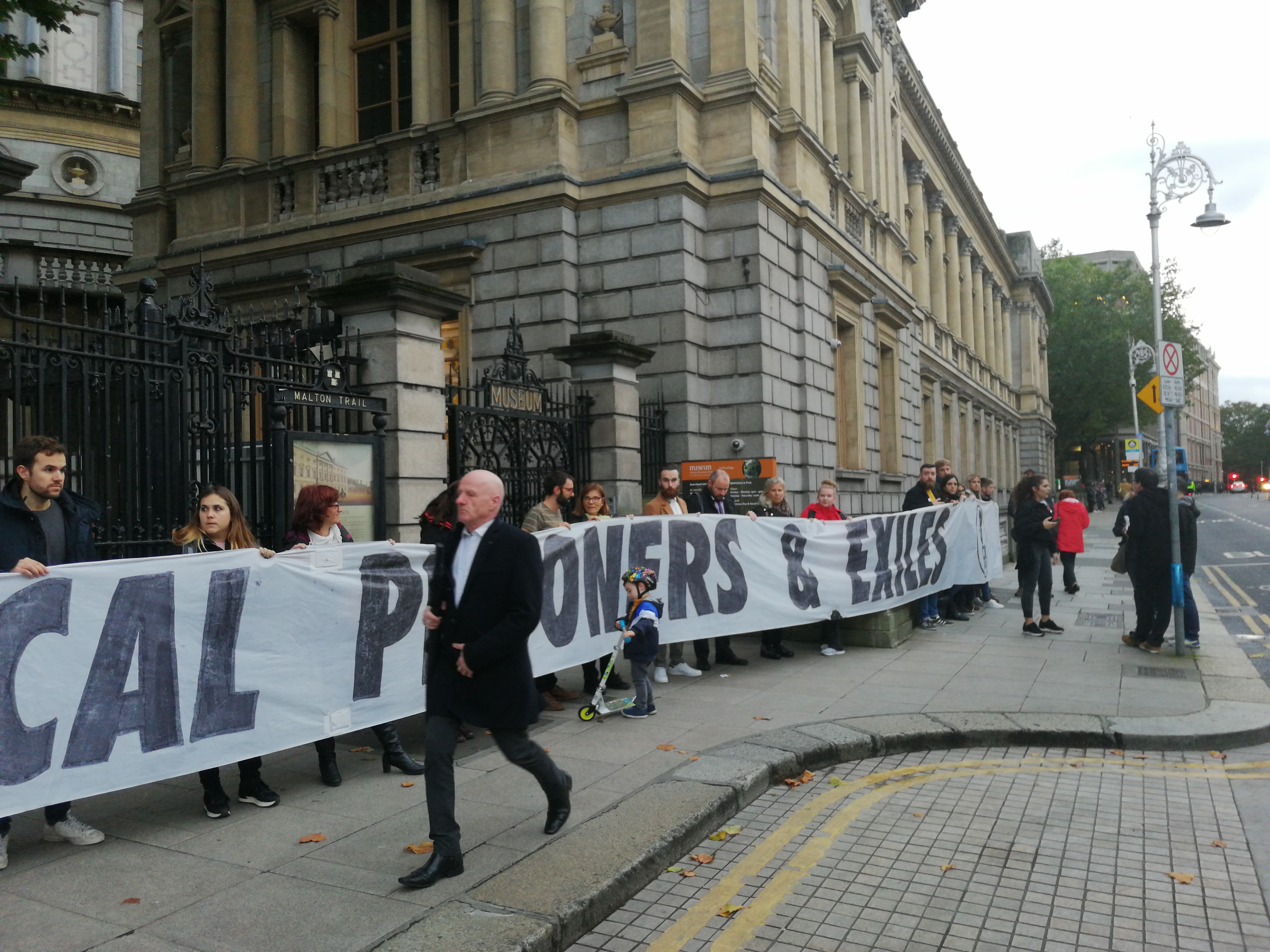
Part of the long banner outside Leinster House.
(Photo: D.Breatnach)
One end of the long banner outside Leinster House.
(Photo: D.Breatnach)

DUBLIN PROTEST

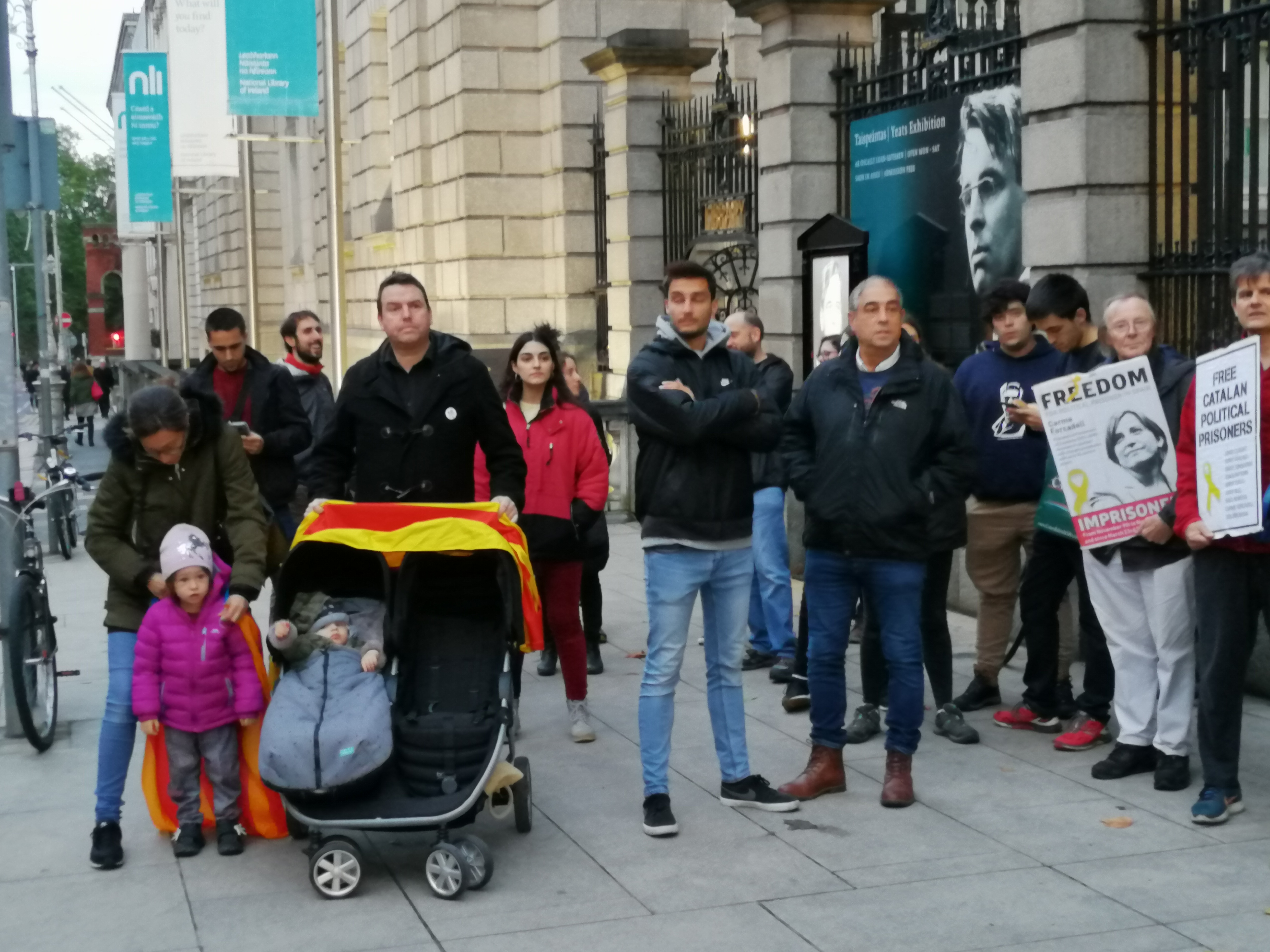
          Around 200 protesters gathered outside Leinster House today after hearing of the sentences. They were mostly Catalans and had been asked by ANC (National Assembly of Catalonia) en Irlanda and CDR (Committee for the Defence of the Republic) Dublin to stand by for the verdict and, if anything less than Not Guilty, to assemble there at 6pm. The protest was supported by the With Catalonia/ Leis an Chatalóin committee. People were still arriving from work at 6.30 pm and later, while some had gone to collect their children to bring them there too.

Section of crowd to left of the Leinster House gates.
(Photo: D.Breatnach)

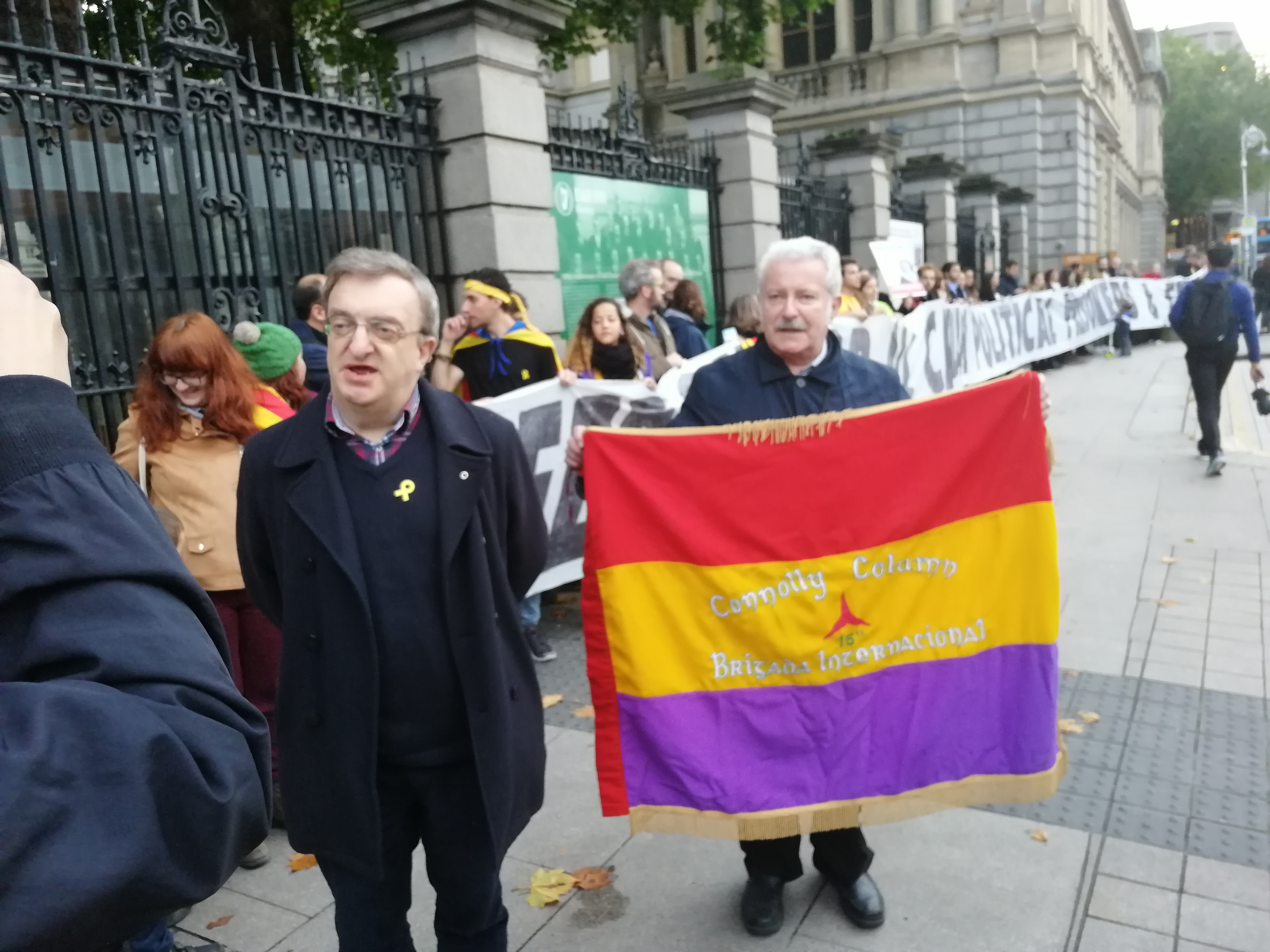
Though the vast majority were Catalans, not all were: there was a very light sprinkling of Irish, a few Basques and some people from other parts of the Spanish State. A Sinn Féin Councillor gave an interview in solidarity, as did an activist of WCLC and Manus O’Riordan, son of Brigadista Michael O’Riordan, who brandished a flag in Spanish Republican colours bearing the legend “Connolly Column”. A member of PBP was also noted there.

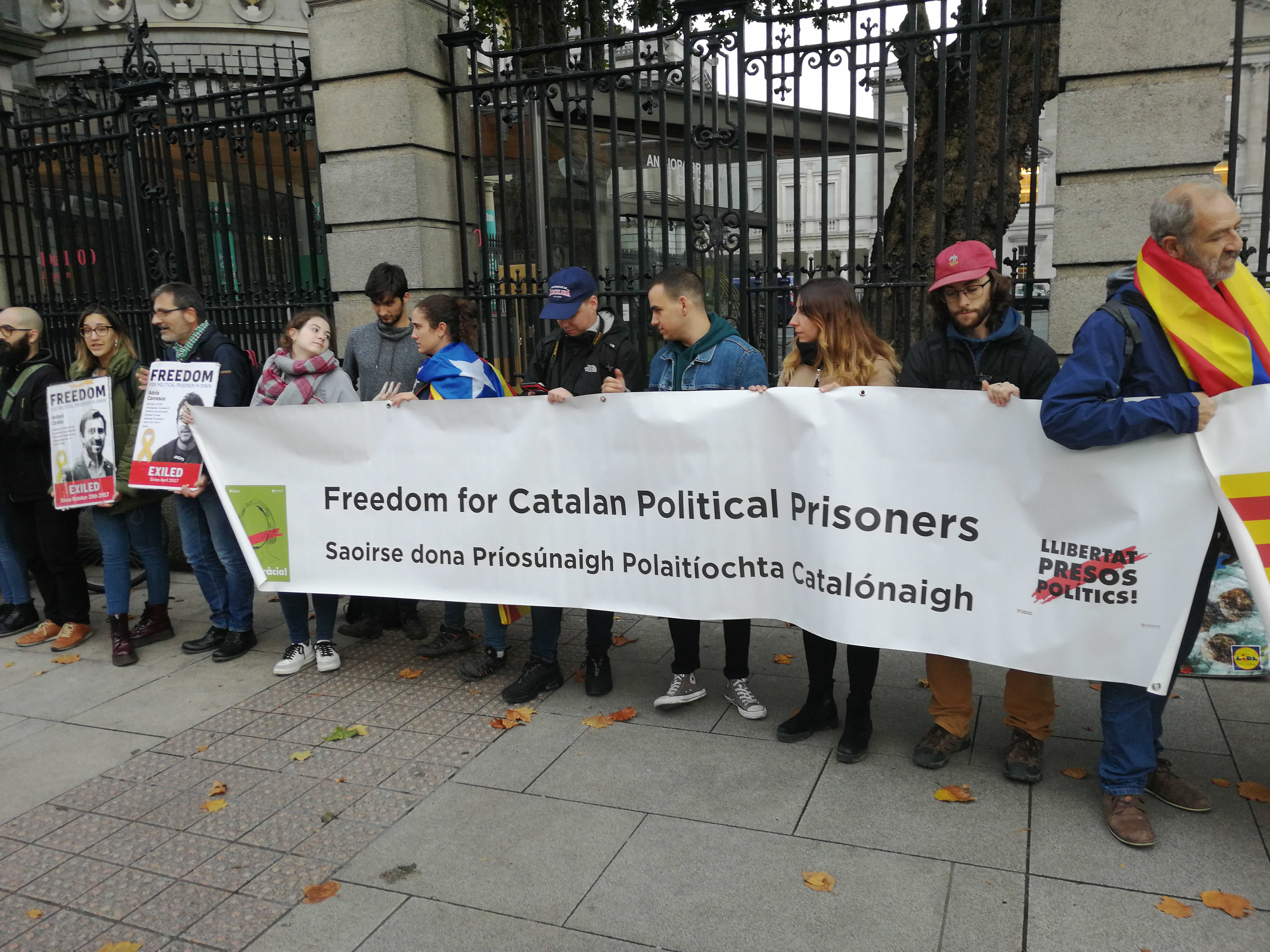
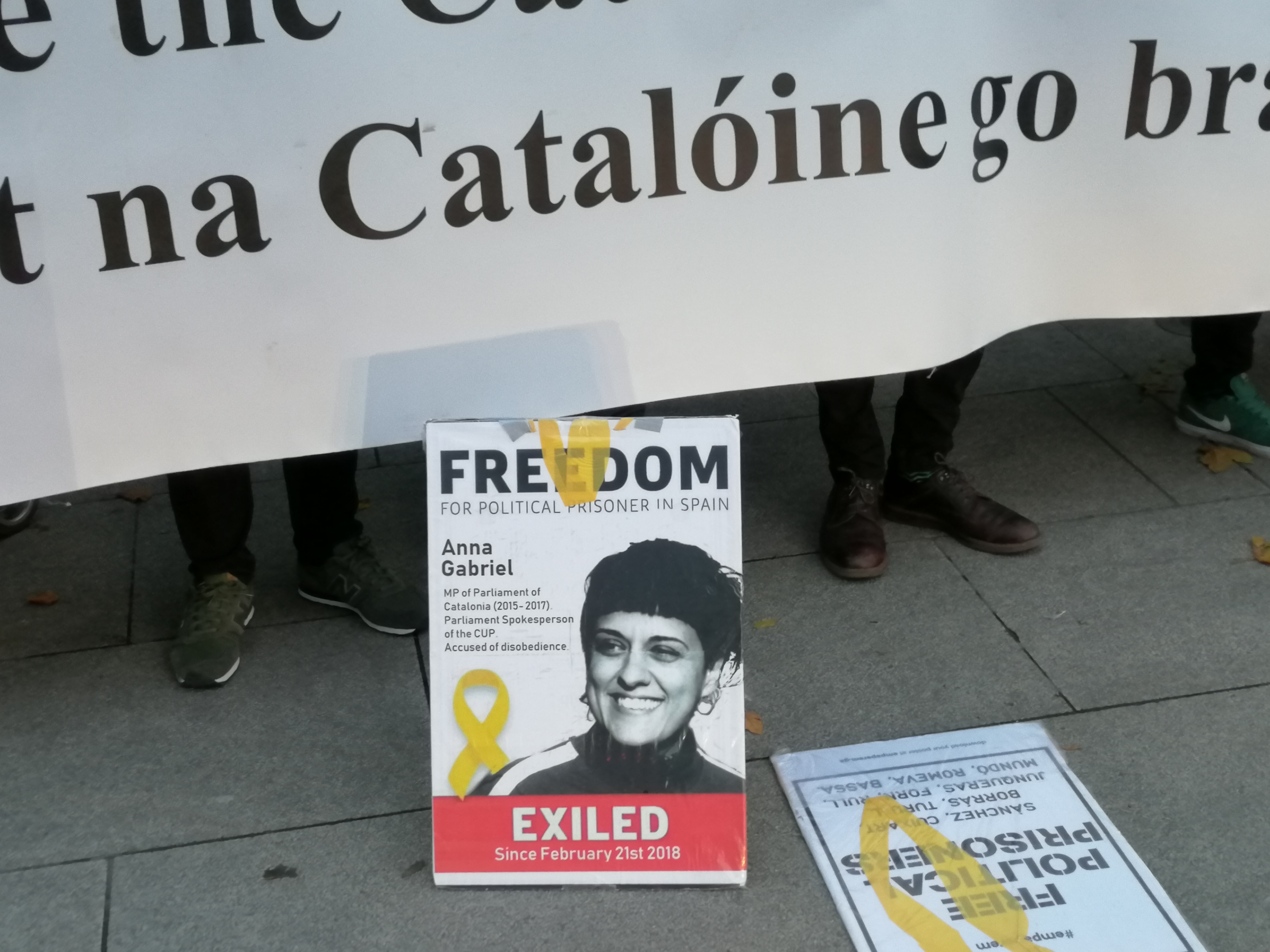
The flags displayed were the Estelada and the Vermelha, both standing for different trends in the Catalan movement for independence. One very long banner called for Freedom for Political Prisoners and Exiles while two shorter ones had bilingual English and Irish legends calling for freedom for the Catalan Republic and for political prisoners. A large home-made banner also called for freedom for political prisoners.

Another section of crowd to left of Leinster House gates.
(Photo: D.Breatnach)

While outside Leinster House the crowd took turns chanting slogans in Catalan that translated into such as The Streets Will Always Be Ours!, Freedom for Political Prisoners! and Long Live Catalunya! to which the response was Free!

After some time the crowd was addressed in Catalan by the Coordinator of the ANC in Ireland.  He said that they were there to denounce the injustice of the Spanish State and to let the world know that the Catalan representatives cannot be imprisoned purely for pursuing the right of self-determination.

“We will continue until we cut the chains that the Spanish State puts on us,” he said in Catalan and vowed to continue to raise their voices until the Spanish State recognises that Catalonia is a sovereign country.

After the applause followed by cries of Visca Catalunya!  Lliure! died down, the crowd the sang the Catalan national anthem, Els Segadors (The Reapers), with its roots in a popular agrarian rebellion in the 17th Century.

It seemed then that an impromptu decision was taken to march.

THE PROTESTERS TAKE TO THE STREETS

          Chanting slogans in Catalan and in English, with banners in front, the crowd marched along Molesworth and into Dawson Street, then into Grafton Street and proceeded to the General Post Office building, which is located in the middle of O’Connell Street, main street of the city centre. Although at some junctions they stopped traffic and in some streets no traffic could pass them, no hostility was displayed to them. One bus driver beeped her horn in solidarity, as did some cars. In some places people stopped to applaud the marchers.

The crowd takes to the streets in marching order (Leinster House in far background).
(Photo: D.Breatnach)

When they reached the GPO, the marchers drew up in two lines on the central pedestrian reservation, facing the different streams of traffic with placards, many containing portraits of the sentenced activists. After a while they gathered for a short rally, where they were addressed by two representatives of the ANC, a man and a woman, to remind them of the solidarity walk to the Sugarloaf on Sunday (see FB event pages for details).

Another section of crowd marching from Leinster House.
(Photo: D.Breatnach)

After that, they were addressed by an Irish representative of With Catalonia/ Leis an Chatalóin, who told them that they were gathered opposite the headquarters of the Easter Rising in 1916.

The Irish had been ruled by a more powerful neighbour, he told the rally, that under its constitution, would not allow them independence. The Irish had had to fight for it and eventually was partly successful. The Catalans were also being denied their right to self-determination by a more powerful neighbour under its constitution and were resisting.

Section of crowd displaying placards
(Photo: D.Breatnach)
Section of crowd to left of the Leinster House gates with estelada and placards. (Photo: D.Breatnach)

But were the nine jailed because they had hurt someone? he asked. Or lifted a weapon against anyone? Or even damaged buildings or property? To each question, the crowd shouted “NO!” They had been sentenced for upholding the Catalan right to self-determination, the speaker said, then applauded the Catalans for their continuing resistance and for their response here and in Catalonia to repression.

The crowd broke up after that, people talking about other solidarity actions, such as the paralysing tonight of Barcelona airport by thousands of protesters and the savage attacks on them there by police. Also that there are seven alleged CDR activists in jail awaiting trial in Madrid, 700 Catalan Town Mayors have been marked for investigation, as have also a number of school teachers.

BUT

          Borrell, the Spanish Minister for Europe commented after the sentences that now would be a time to return to normality, while the Spanish Prime Minister, PSOE (social democrat) part leader Sanchez, praised Spanish ‘democracy’.

End.

FB pages of organisations for more information

ANC en Irlanda: https://www.facebook.com/IrlandaPerLaIndependenciaDeCatalunya/

CDR Dublin: https://www.facebook.com/CDRDublin/

With Catalonia/ Leis an Chatalóin: https://www.facebook.com/WithCataloniaIreland/

SF Cnclr Mac Donncha being interviewe outside Leinster House and behind him, displaying the Spanish Republic colours with the legend The Connolly Column, Manus, son of Brigadista Michael O’Riordan.
(Photo: D.Breatnach)


(Photo: D.Breatnach)


(Photo: D.Breatnach)
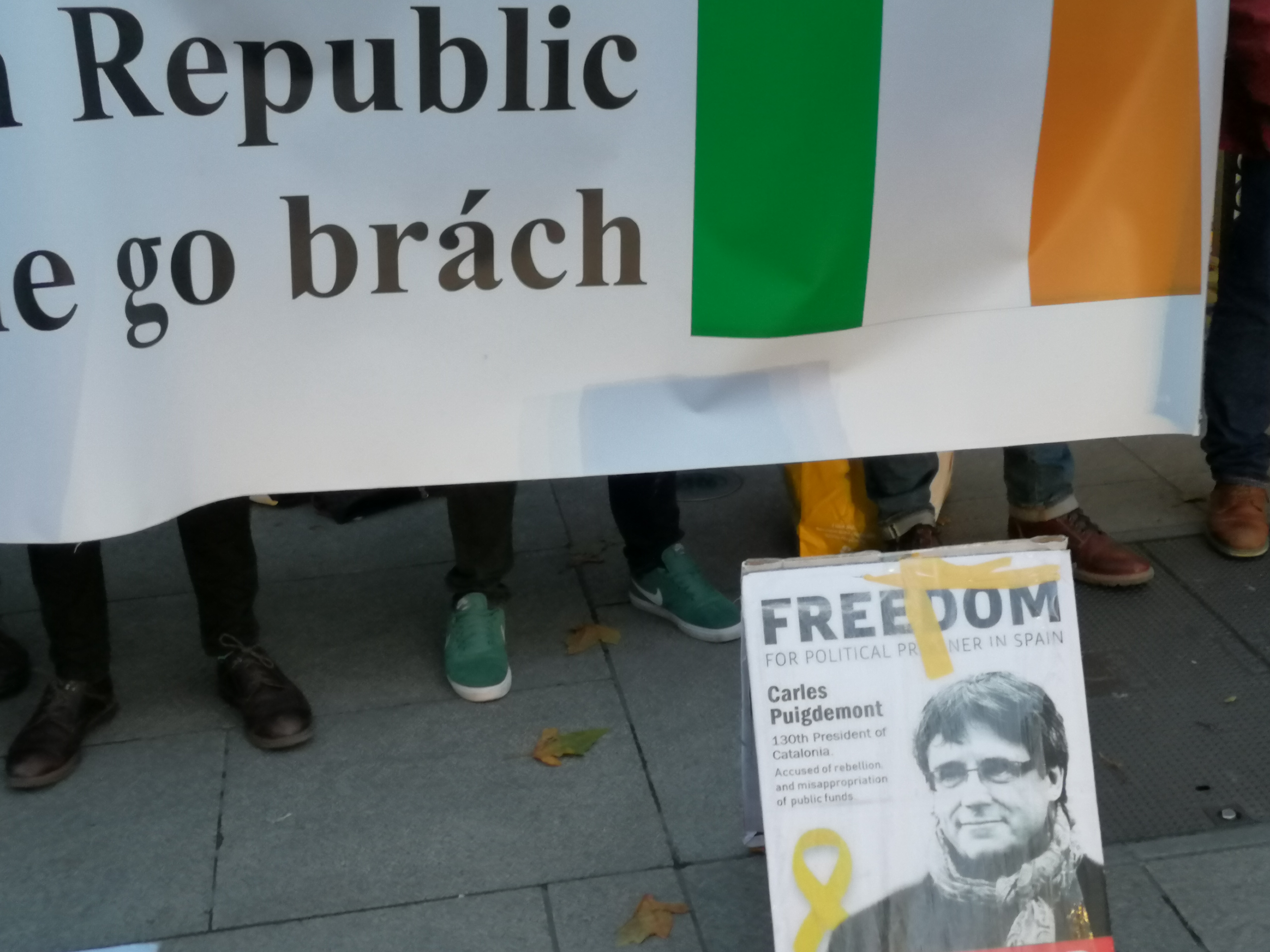
Carles Puigdemont, currently in exile in Brusssels, for whom the Spanish State have now issued an extradition warrant (also for other exiles).
(Photo: D.Breatnach)

APOLOGIA FOR REPRESSION BY SPANISH STATE IN DUBLIN

Diarmuid Breatnach

(Reading time: 10 minutes)

The “Global Spain” initiative of the Spanish State to 215 Spanish embassies and its sub-title “Touch Democracy” was presented to a small audience at the Instituto Cervantes in Dublin on Monday while Catalan and Basque solidarity demonstrators picketed outside.

While some people, perhaps in the know, were directed straight to the auditorium, a number of others, not regular users of the Instituto’s services, were asked to wait in another area but when the start time had been exceeded by 20 minutes without sign of the event, they went to make enquiries again at Reception and learned where the event was being held, entering to find it had already started.

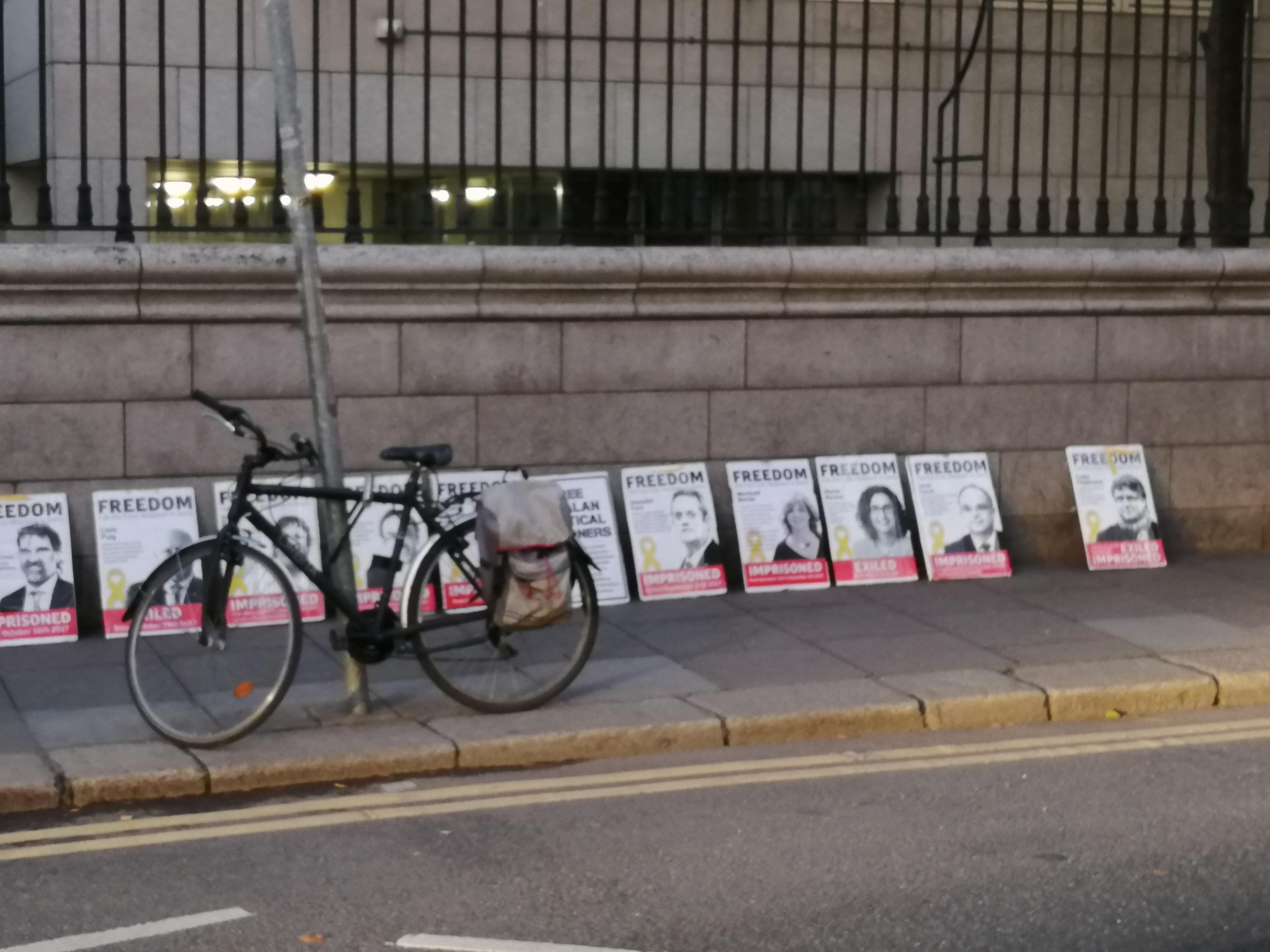
Portraits of Catalan political prisoners and exiles displayed across the street from the Instituto Cervantes on Monday.
(Photo: D.Breatnach).

PROPAGANDA VIDEO         

          Mr. Ildefonso Castro,the Spanish State’s Ambassador to Ireland was speaking and shortly launched the event with a showing of a short video which, he said, would bring out the main questions in the initiative. In this video, Lucía Mendez, journalist for the right-wing Spanish daily El Mundo seemed to be interviewing Gabriela Ybarra about the novel she had written (The Dinner Guest). But actually later in the film Mendez began a speech about how good was the Spanish democracy while her interviewee was left with little to say. The author had said earlier that though her grandfather (a Mayor of Bilbao who had fought in Franco’s Army and supported the Dictator regime, not mentioned in the video), had been killed by the Basque armed group ETA in 1973, this was not discussed in her family. She felt that the memory of “terrorism” was disappearing and that children in school were not being taught about it, which is why she wrote her book.

In fact, Spanish media constantly refers in negative terms to ETA and a 2016 case of a brawl between Basque youth and off-duty Spanish policemen in a late-night bar, in which no-one was seriously hurt and no weapons used, was being treated in the media and by the State Prosecutors as a case of terrorism! Although the judge rejected the accusation of “terrorism”, in 2018 the youth receive a range of sentences between two and 13 years jail. An important part of the silence and lack of teaching children history is in fact about the almost four decades of Franco dictatorship and the conduct of the victors in the military-fascist uprising against the democratically-elected government of the Spanish Popular Front in 1936. And of the State assassinations and torture of captured ETA fighters and arrested Basque activists. And of the continued legal battles to uncover mass graves of Franco’s victims and try to identify the remains for the relatives.

Considering that ETA ceased its armed activities in 2012 and has since dissolved itself, the relevance and intention of the film seems to be to show an embattled Spanish “democracy”, fighting against Basque independentist “terrorism” in the past as it is now embattled with the Catalan independentists (seven activists of which it has also accused of “terrorism” a couple of weeks ago).

Some demonstrators and banner by Trinity College exit across the street from Instituto Cervantes on Monday.
(Photo: D.Breatnach).

DISCUSSION BUT NO DEBATE

          There was no discussion on the content of the film and, after its end, Víctor Andresco Peralta, Director of the Instituto Cervantes, cultural body of the Spanish Embassy, took to the stage and invited five people by name to take chairs laid out around a table. Launching into a chatty monologue full of jokey self-deprecatory comments (so many that they were actually self-promotional), he eventually asked his questions of his picked panel.

Questions included what were their earliest memories of consciousness of being Spanish, what reactions they had received about Spain from people in Ireland, or in other countries (positive and negative), what they valued about Spain, what they thought about the coup attempt in 1981 (lots of jokes about that), etc.

Referring to his father’s recent stay in hospital, Peralta asked for comparison of the Spanish health service with the Irish one (apparently the former is far better, which would not be difficult) and for other comparisons.

The discussion was skillfully managed by the showmaster to bring his group to paint a picture of a wonderful pluralist Spanish State, of freedom of expression, and of a democracy which had been able to defeat the coup attempt without much difficulty but even so, some discourse arose at times to shake the equilibrium, as when one referred to a relative telling him about the horrors of the Francoist suppression as they entered Barcelona and when another referred to the perception (mistaken, of course!) of many people outside Spain that the State was undemocratic and had violent police.

One of the panel, who appears to be an employee of the Spanish State, said she was proud of the defeat of ETA by the “Spanish democracy”.  Another said she was proud of Spanish history and culture, without explaining further. She might have meant the foremost writer of Castillian-language literature, Cervantes himself, who was exiled from the Spanish kingdom because of his anti-feudal views. Or the Andalusian poet Federico Lorca, who was executed by Franco’s soldiers; or the Malagan artist in exile Picasso, who created the famous painting of the Nazi and Fascist aerial bombing of Gernika (most of the poets, writers and artists of the era were against the military-fascist coup and the four decades of dictatorship that followed). Or about the dramatist Alfonso Sastre, whose distaste for the Spanish State’s behaviour towards the Basques was such that he moved to the Basque Country.

Perhaps the woman was proud of the defeat of the learned and tolerant Moorish colony of Al Andalus and its replacement by the racist Spanish Christian Inquisition, along with the expulsion of Arabs and Jews? Or of the centuries-long suppression of the governments of the Basques, Galicians and Catalans, along with their languages? Or of the invasion, massacre, enslavement and plunder of the indigenous people of America, the Caribbean and the Philippines? Or the invasion and colonisation of the Rif in North Africa, when the French saved the Spanish colony after the Spanish army had been wiped out by lesser-armed (and often less numerous) Berber guerrillas.

Of course she might have been referring to the revolt of the Reapers in Catalonia or of the Comuneros in Castille; or of the resistance of Spanish, Catalans and Basques to the military-fascist coup and the four decades of dictatorship …. We don’t know because she did not say.

A view of some of the protesters outside the Instituto Cervantes on Monday.
(Photo: D.Breatnach).

WHAT ABOUT THE RIGHT TO SELF-DETERMINATION?

          The event had been advertised as a debate but no debate took place. Nor was there a question-and-answer session, nor engagement with the audience except to send them witty asides from Peralta and to thank them at the end.

This was too much for at least one of the small audience, an Irishman who interrupted the concluding remarks of the Director by saying, in Castillian (Spanish) that it was a pity that the question of self-determination had not been discussed. The event was taking place in Ireland, he commented, where another state had denied the people the right to self-determination on grounds of that state’s constitution also. Denied permission to exercise their right, the Irish people had to fight for it and eventually won part-independence.

Peralta commented that the Spanish people were cognizant of Irish history and appreciated it.

The Irishman replied that in the Spanish state things were the complete opposite.

Peralta commented that unfortunately there was no time left for that debate, thanked participants and audience and brought the event to a close.

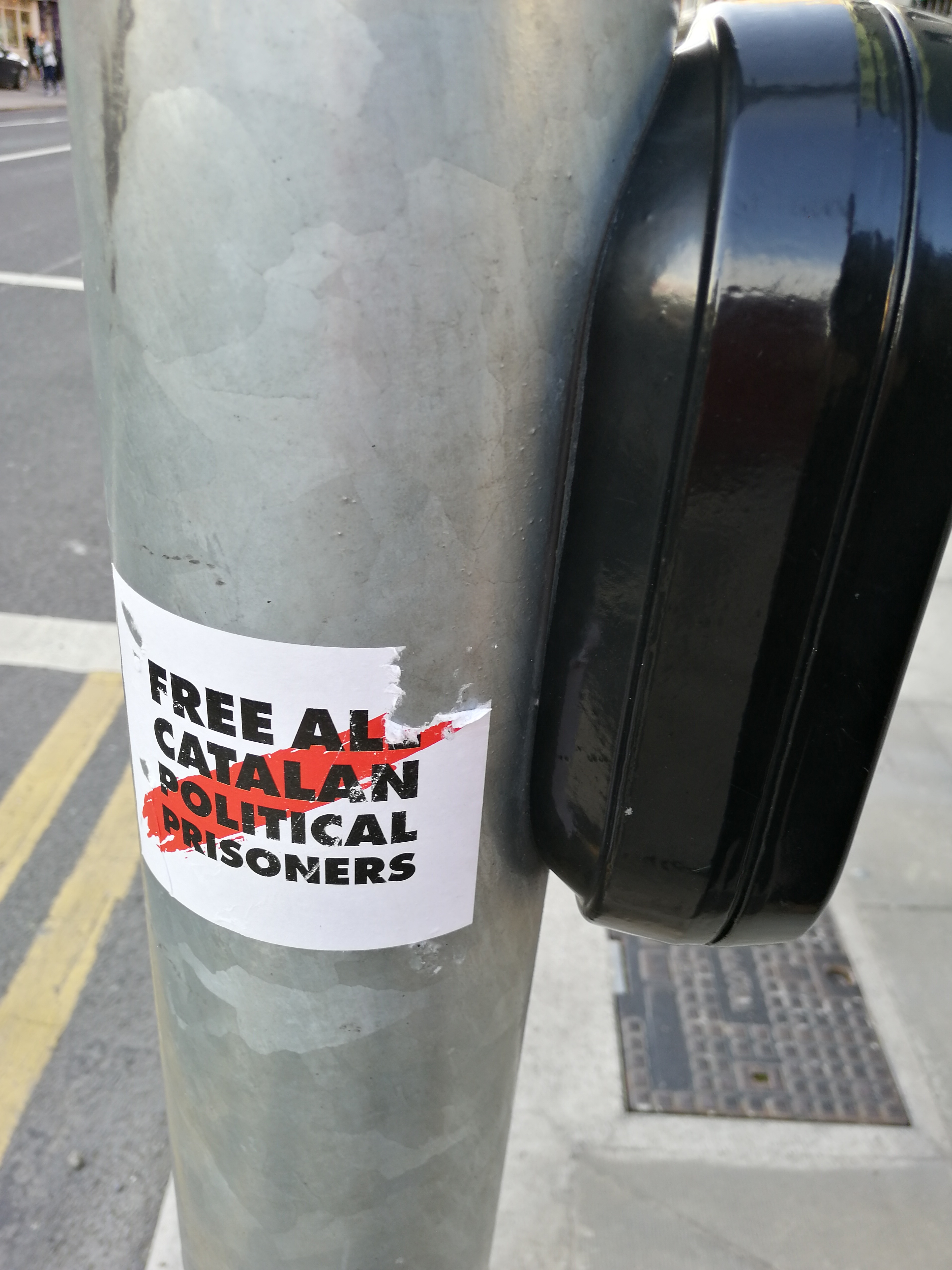
Sticker on pole near the Instituto Cervantes on Monday.
(Photo: D.Breatnach).

WHAT WAS THE POINT?

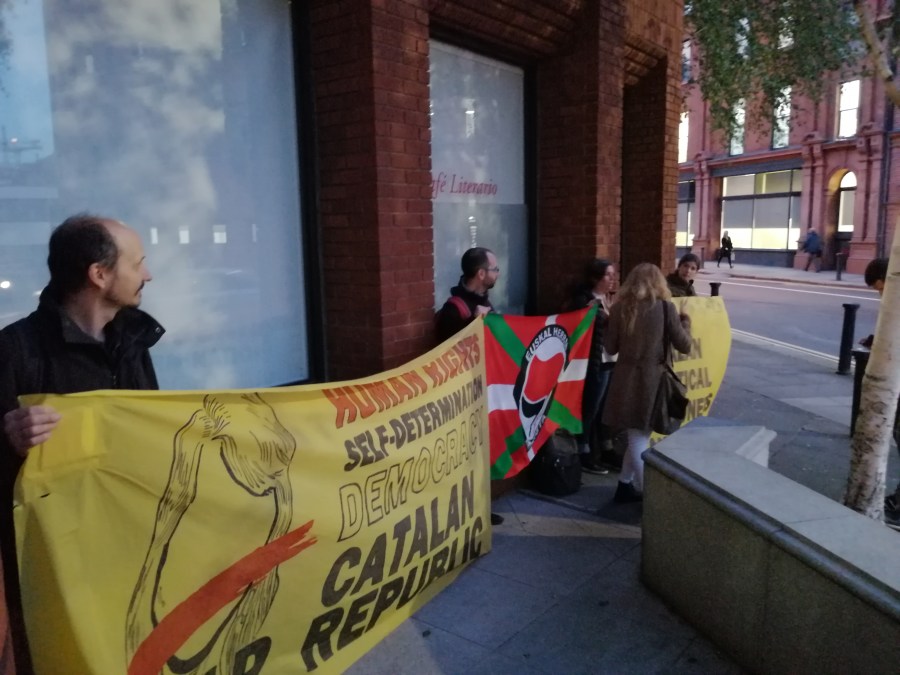
          Outside the meeting up to dozen protesters had taken up positions on both sides of the street. On the Trinity College side a couple of protesters stood beside portraits of the Catalan grass-roots activists and politicians who are in jail awaiting sentence or in exile. On the Instituto side, a larger group of protesters held two banners and a Basque Antifa flag.

One of the Catalan supporters, an Irishwoman, addressed several of the panel participants as they exited. It emerged that they had not understood the nature of the event and that they thought it had to do with October 12th, which is a Spanish State celebration of its former empire and spreading of the Castillian language1 (and for which one of the panel, who seems to work for the Instituto, is organising an event in Rathmines). They said they had not seen the “Global Spain” publicity (81 pages of propaganda justifying the actions of the Spanish State and attacking the principle of Catalan self-determination and the pro-independence movement!).

There was in truth not much point in attending the event unless one wanted receive a smooth-talking patter about an imaginary State occupying most of the Iberian Peninsula. For the protesters, it was important to give a response to the paint-over job. For the producers of the show, the importance was to try to distract an Irish audience from the reality of what is an unreconstructed fascist state with a thin veneer of democracy that is constantly peeling away.

Poster seen on Dublin street near Instituto Cervantes on Monday.
(Photo: D.Breatnach).

End.

FOOTNOTES:

1 El Dia de la Hispanidad was formerly called “El Dia de la Raza Española” (Day of the Spanish Race). It is also the Spanish Armed Forces Day, obviously not inappropriately in context!

REFERENCES AND FURTHER INFORMATION

Article by El Nacional, independent and pro-independence Catalan newspaper: https://www.elnacional.cat/en/news/global-spain-advertising-campaign-democracy_426827_102.html

The Instituto Cervantes, Dublin: https://dublin.cervantes.es/en/about_us_spanish.htm

CDR Dublin: https://www.facebook.com/CDRDublin/

ANC Irlanda: https://www.facebook.com/IrlandaPerLaIndependenciaDeCatalunya/
With Catalonia/ Leis an Chatalóin: https://www.facebook.com/WithCataloniaIreland/

PAUL MURPHY, SPLITS, PARTIES AND ALLIANCES

Diarmuid Breatnach

(Reading time: 4 minutes)

Paul Murphy speaking at his trial and that of others after the famous water protest at Jobstown against Minister Joan Burton (which led to his arrest and long trial before he and others were found not guilty by a jury).       (Photo image: D.Breatnach)

Most people within the Irish state will now be aware that that socialist Paul Murphy, TD (member of Irish parliament, the Dáil), has left the Socialist Party and, with some others, intends to set up a new socialist organisation called RISE. His statement on his Facebook page was covered by a host of the capitalist media with little comment by most while left-wing chat room the Cedar Lounge had more comment than I found time or interest in reading.

A common reaction on the street was one of bewilderment at the splitting actions of left-wing parties. Elements of that were to be found in the relevant piece by Miriam Lord (see References), who comments on Dáil politics and politicians in her Irish Times column (though her sharpest treatment was of Brendan Ogle, who had mocked Murphy’s action).

I am myself, if a little surprised, not shocked nor indeed very engaged with the matter and consider it generally of little import on the prospect of a revolution in Ireland.

It strikes me, with little personal knowledge of him but based on material in the public domain, that Paul Murphy is in general a principled socialist politician and furthermore an activist who has not shirked from putting himself physically in the resistance line in Rossport, on the seas to Gaza, in Turkey against its government and in Dublin on water and housing protests. Furthermore, in the short period he was an MEP or supporting Joe Higgins when the latter had the seat, Murphy has had questions asked about the treatment of Basque political prisoners which few other politicians are willing to touch, lest they be associated with the armed liberation organisation ETA (now defunct).

However, I see no prospect of even one step towards revolution in the general conduct of any of the socialist organisations of any size in Ireland, splits or no. Of course it is helpful to have awkward questions asked of the Government in the Dáil and to gain media coverage of issues that would likely remain unmentioned, or to have their critical comments reported where yours or mine would never see the light of day. And Murphy remains in that ambit in Dáil, along with the Solidarity-PBP group — and Independents for Change are there also (now sadly missing Clare Daly and Mick Wallace, who have gone to the EU).

But that is not necessarily revolutionary work.

Meeting of the (First) International Workingmen’s Association. In Britain, the Fenians were accepted into the First International.

A TASK FOR SERIOUS REVOLUTIONARIES

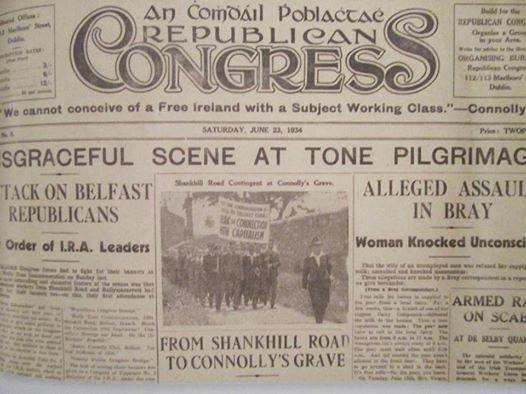
Front page of the newspaper of the short-lived Republican Congress in 1934

Without a conjunction of revolutionary Socialists with revolutionary Republicans, I can see no hope for revolution in Ireland and, without revolution, no hope of a solution to many of the ills in our society, whether in culture, economy, environment or government. In other words, in anything really. That conjunction was a project attempted in part by British socialists and some of the Fenians of the 1840s, later by Connolly and the Irish Citizen Army (1913-’16), later still by the Republican Congress (1934-’36). It remains the unfinished task for serious revolutionaries.

Neither the Socialist Party/ AAA/ Solidarity nor the Socialist Worker/ People Before Profit/ Solidarity formations have made any effort to take up that task (nor have the Republicans, lest my criticism be thought of one part of the equation only). Nor did the anarchist Worker’s Solidarity when it was an active force. The Communist Party of Ireland does not do so nor does the Workers’ Party. So great is the disdain of these formations for revolutionary Republicans that they refuse to even challenge the daily civil rights violations of the Gardaí and PSNI upon active Republicans, or their treatment in the non-jury special courts or jails on both sides of the Border. Indeed, in case they should somehow be accused of siding with these elements, they rarely even allude to the unfinished national liberations struggle of Ireland, nor to the colonial occupation of one-sixth of its territory, while instead fully prepared to support the just national liberation struggles of nations far away.

Interestingly therefore, from public comment, it appears that Murphy wanted more cooperation with “other elements on the Left” or “Left-leaning”, in which context was mentioned Sinn Féin, while the majority in the Socialist Party refused such a project. Some people will view this aspiration of Murphy’s as a laudable attempt to mould a fragmented Left into at least some kind of united action for Irish social and political progress. I do not.

I am not against a temporary alliance of revolutionaries with social democratic forces at certain points for certain objectives. But that does not include Irish political parties who are or have been part of Irish governments or, if possible even less, so a party that is part of the administration of a colonial occupying power. In the latter category I clearly place Sinn Féin and, in the former, the Labour Party, Fianna Fáil and Fine Gael.1 In addition, SF has clearly marked a path for itself to a future coalition partnership with a capitalist, pro-imperialist party or parties in Government.

It says something about the Irish socialists that an important question for them is whether or not to ally with a constitutional capitalist and colonial collaborationst party such as Sinn Féin, whereas the question of whether to ally with revolutionary Republicans is not even on the agenda for discussion.

End.

FOOTNOTES:

1 One might make a temporary exception of the Greens, which have been in Government but once for a short while, admittedly shamefully so but with an honourable resignation.

REFERENCES:

Miriam Lord: https://www.irishtimes.com/news/politics/miriam-lord-brendan-ogle-eager-to-get-back-in-the-leftie-limelight-1.4033061

Paul Murphy TD Faeebook page: https://www.facebook.com/paulmurphytd/

“YOU BET – THEY DIE!”

Clive Sulish

(Reading time: 8 mins.)

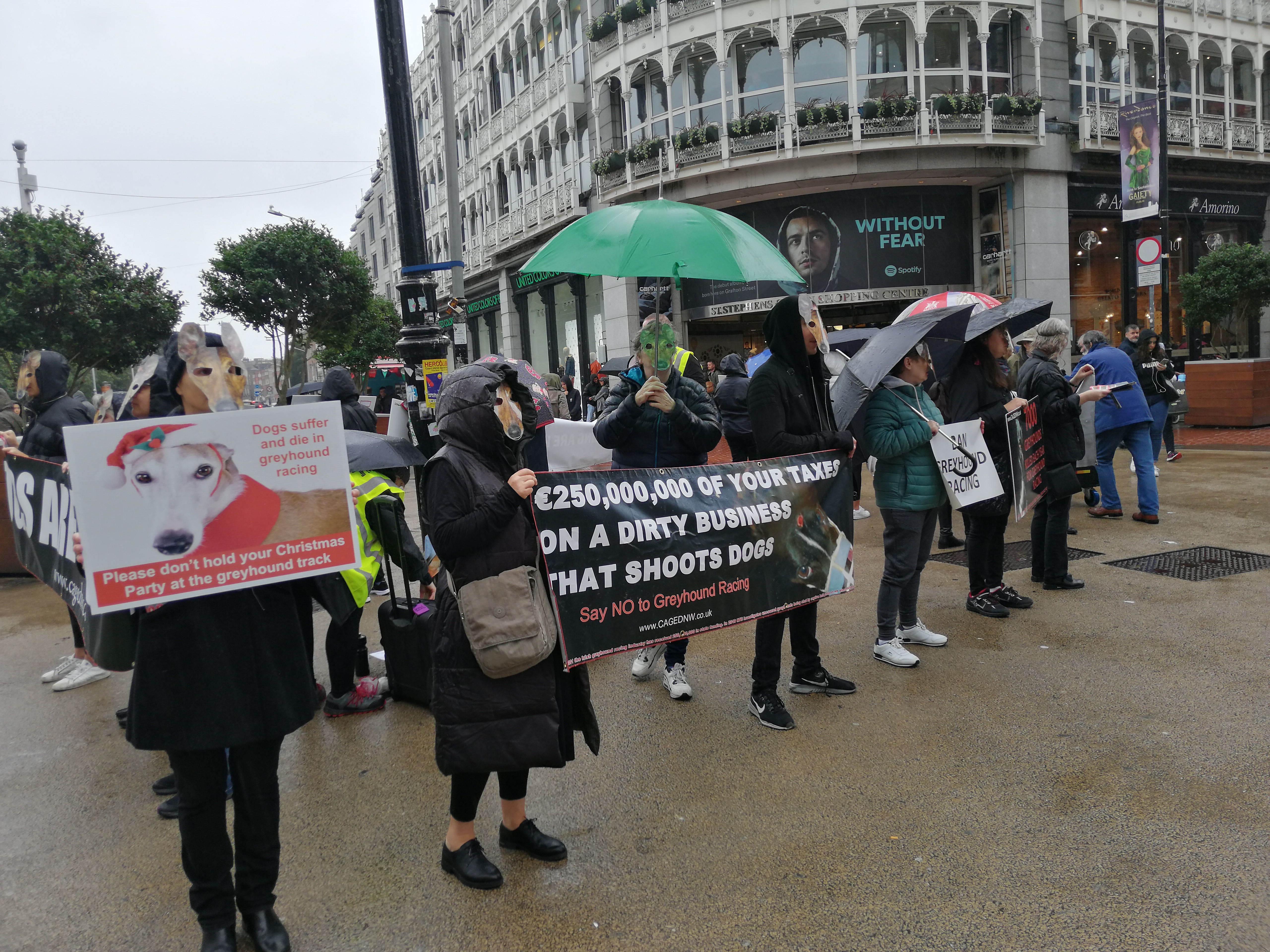
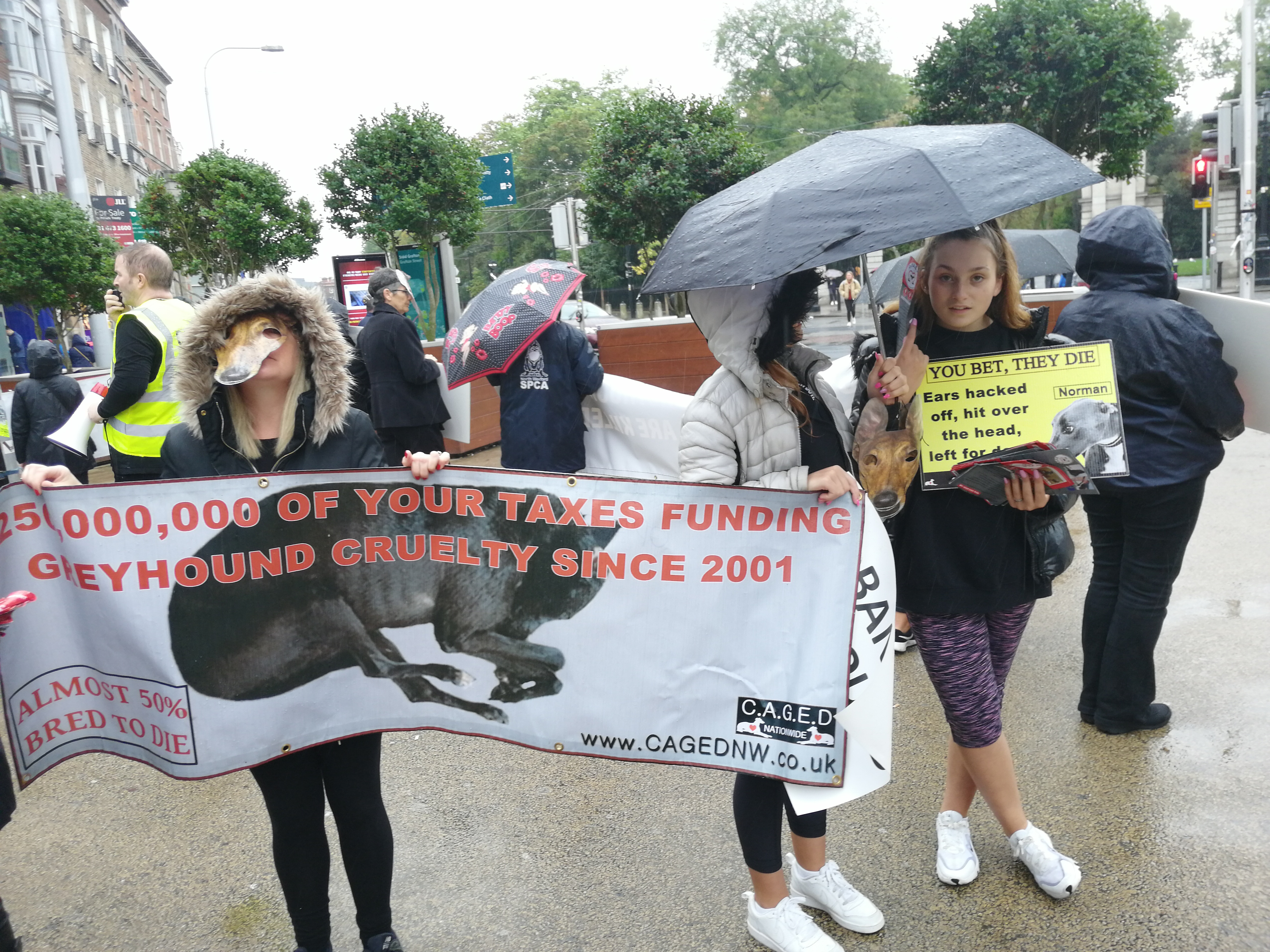
The sight of more than a score of people standing in the rain at the top of Dublin’s Grafton Street drew a lot of attention. And it wasn’t just the dog masks that most of them were wearing. This wasn’t near enough to Hallowe’en, nor was it a carnivale, nor a masque as such: the message projected had nothing of the freedom and joy of carnivale, none of the sexual play and mystery of masque and was darker than the usual one of Hallowe’en. The grim message was on the banners, in the leaflets, in the slogans and the amplified speech.

One of the banners of protesters on Saturday at the top of Grafton St. (Photo: C.Sulish

“You bet – they die” was one of the slogans chanted, illustrating the grim reality of commercial greyhound racing. This slogan was developed for protests outside greyhound racing stadia, notably at Shelbourne Park, near the south Dublin docklands (and, incidentally, not far from the Aviva Rugby Stadium).

Public perception

          The reactions of passers-by seemed to vary between amusement, interest, support, surprise and even shock. People who tend to view animal welfare protesters as cranks who are likely to be middle-class might be somewhat amused or dismissive and it is no doubt to counter this perceived image that the group organising this event is called “Ordinary People Against Greyhound Exploitation”. The support likely came from those who had watched the RTÉ documentary in June, while other reactions might have been from Irish people as yet unaware of the treatment of greyhounds by the industry or by visitors to Ireland who are not only ignorant of the issues but even of the existence of the industry itself.

One onlooker seemed to be demonstrating to his companion the pole lassoo dragging of a dog and then shooting it with a pistol, probably recounting a secretly-filmed incident featured in the RTÉ film. Popular opposition to the greyhound racing industry has been gathering since the screening of the exposure program by the “RTÉ Investigates” team of the Irish television company in the last week of June. The revelations were a shock to people who understood the dogs racing to be a harmless spectator sport with not even a live hare being pursued, a relatively cheap night out (providing the betting was not too heavy) or gambling based on a mixture of luck and previous form knowledge, or even just the communal sport of a few rural people who owned a few hunting dogs.

View of a section of the protesters, viewer facing south. (Photo: C.Sulish)

The industry breeds many dogs in order to ensure a constant supply of fast-running animals and flow of profits and, as a result, bitches are put to breed litter after litter. Pups showing any disabilities will be “culled” and, as the survivors grow, those not considered fast enough will face the same fate. Later, as age begins to take its toll, they will be killed also except for some that might get a few more years as stud or breeder. Campaigners claim that over 6,000 dogs are killed annually and some animal welfare organisations believe the figure may be as high as 10,000. It is the commercial drive that brings these results and the support of the betting public that sustains it – but not that alone, since the Irish State supports the industry with an annual grant of 16.8 million euro.  This fact was also highlighted by campaigners in voice and leaflet, while pointing out other better uses for the funding, including relieving the homeless and housing crisis.

Few countries outside of Ireland an Britain have greyhound racing stadia but campaigners claim – and the RTÉ program revealed – that many Irish dogs are sent abroad in inhumane conditions, some at least of which will end up for human consumption.

Section of protesters facing south (Stephens Green Shopping Centre in background). (Photo: C.Sulish)

The campaigners call for the greyhound racing stadia to be closed and, in Dublin particular, the Shelbourne Park stadium, outside of which are held regular demonstrations. They call also for sponsorship by commercial enterprises to cease, a call heeded by a number of companies fearful of a negative commercial impact upon their reputations. This drive was clearly successful when, audibly fearful of a negative impact on the tourism industry, Irish Minister for Tourism Shane Ross called for a suspension of State support in advertising which was followed by Bord Fáilte and Tourism Ireland’s1 removal of greyhound racing from their promotions for visitors to Ireland.

Tourism and Greyhound Racing

     The tourist industry is of course vulnerable to the image of the country abroad, which is why campaigners for democratic rights often strive to alter precisely that image, in order to exert pressure on the ruling regimes. Tourists, as they concentrate on sun, sea and possibly Turkish or Iberian food, may be able to set aside images of Spanish police bashing Catalan voters or Turkish police jailing Kurdish campaigners. Ireland has little sun to sell and though plenty of sea, without the sun it can be too cold for most to bathe. What Ireland has for most tourists is an ambience of welcome, of traditional and folk culture and scenery – but the ill-treatment and slaughter of dogs in an Irish industry could quite possibly offset those positive points.

Ross might indeed have been, as he said he was, “shocked” by the revelations but it was clearly the financial rather than principled humanitarian objectives which forced his hand. Martin Ferris, Sinn Féin TD for Kerry, wasn’t motivated by humanitarian principles either when he confronted Ross in the Dáil (see Links below). Although his SF Dáil position is as Spokesperson for Marine and Fisheries, in his intervention he was clearly representing rural support for greyhound racing including, no doubt, commercial dog breeding and racing interests. He claimed the industry was being tarred with the brush of “the actions of a few individuals” and that he was speaking up for “the small boys and girls” (well done for getting that gender equality in, Ferris!) of the rural industry.

“A few individuals” may have been caught red-handed and exposed but the issues are clearly endemic to the industry, the governing board of which suppressed a critical report which it had itself commissioned. Ferris’ public support for that industry and criticism of the Minister’s actions in this case may win him some votes in some parts of Kerry but will hardly be a help to Sinn Féin, increasingly seeking to project itself in the Irish state as a social-democratic party leaning slightly to the Left.

Section of younger protesters facing west. (Photo: C.Sulish)

And the employment figures which Ferris quoted arising from the greyhound racing industry might well be offset by possible negative impact on the Kerry tourism economy.

The dogs in the streets will be talking about what he said ….

end.

FOOTNOTES:

1Bord Fáilte promotes tourism in throughout the Irish state, i.e the Twenty-Six Counties, while Tourism Ireland promotes the same but throughout “the island of Ireland”, i.e including the Six Counties. Tourism NI cooperates with the latter organisation, particularly with regard to tourism in the Six Counties and maintains an information office in Dublin city centre. The first two above are in receipt of funding from the Irish State while the third is funded by the British State.

View of section of protesters facing northwards, down Grafton St.
(Photo: C.Sulish)

LINKS FOR REFERENCES AND FURTHER INFORMATION:

Ordinary People Against Greyhound Exploitation: https://www.facebook.com/OrdinaryPeopleAgainstGreyhoundExploitation/

Irish Greyhound Board: https://www.igb.ie/

RTÉ documentary “Running for their Lives” (contains disturbing images): https://rebelbreeze.wordpress.com/wp-admin/post-new.php

Sponsors “horrified” by RTÉ exposure of greyhound racing industry: https://www.irishtimes.com/news/ireland/irish-news/sponsors-horrified-by-rt%C3%A9-programme-on-greyhound-racing-1.3942232

Irish Tourism Minister suspends promotion of greyhound racing; Sinn Fein TD objects: https://www.irishtimes.com/news/politics/oireachtas/greyhound-racing-promotion-stopped-due-to-disgusting-behaviour-in-sector-ross-1.4039470

Catalan resistance day celebrated in Dublin

(Reading time: less than 10 minutes)

Clive Sulish

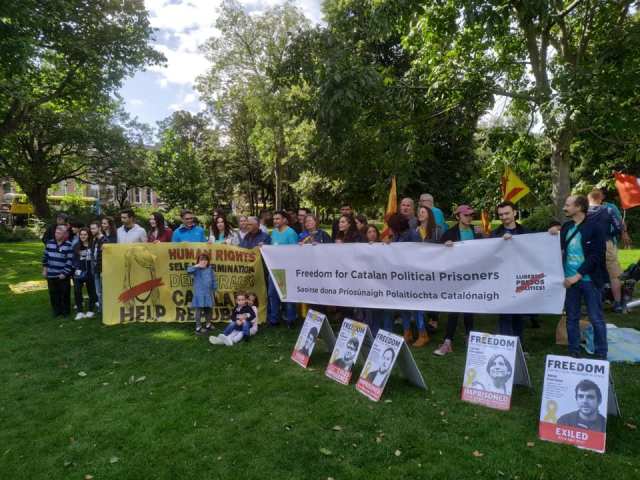
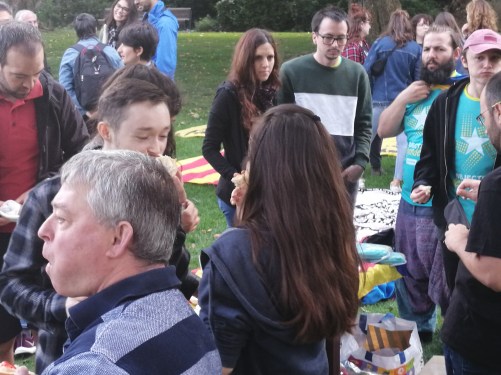
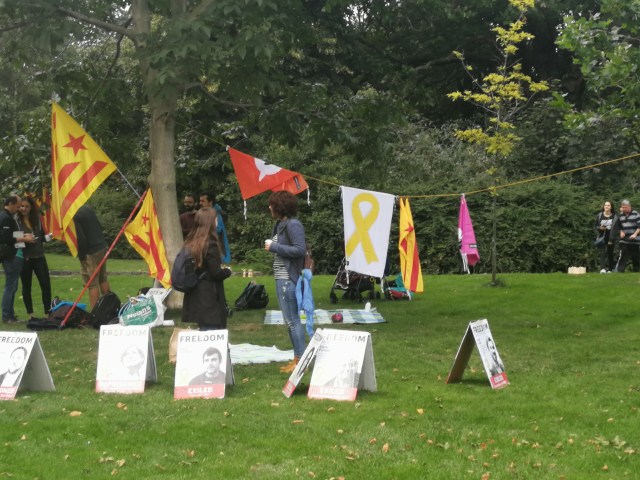
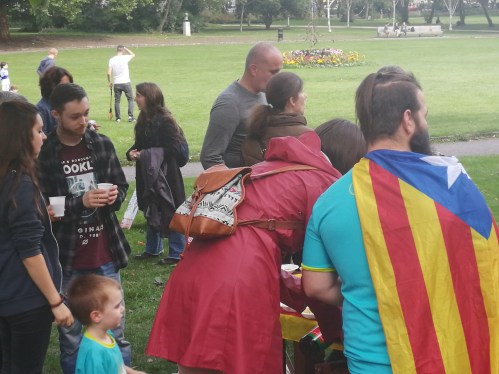
The Diada, national day of Catalan identity and of resistance was celebrated in Dublin’s Merrion Square on Saturday 7th September with traditional food, drink, games and music. Catalan independentist flags and banners were also on display as were portrait placards of Catalan political prisoners of the Spanish State.

Lineup People Banners & Placards Diada Merrion Square 7 Sept 2019
Some of the attendance at the Dublin Diada lined up with banners etc (photo: D.Breatnach)

dav

THE DIADA

          The Diada Nacional de Catalunya (Diada for short) is the National Day of Catalonia, a one-day event celebrated annually on the 11th of September. It commemorates the fall of Barcelona during the War of the Spanish Succession in 1714, which resulted in Catalonia’s institutions and legal system being abolished and coming under the domination of the Spanish crown.

The Army of Catalonia backed the Habsburg claim to the Spanish throne, believing thereby that Cataloni’s national autonomy would be respected. However, the army of the Bourbon King Philip V of Spain was successful and Barcelona fell after a siege of 14 moths.

It Diada first began to be celebrated in 1888 and gained in popularity over succeeding year and in 1923 was a mass event with events all over Catalonia. However clashes with the Spanish police resulted in 12 protesters and five police being wounded and a number of arrests. Primo Rivera’s dictatorship banned it but during the 2nd Spanish Republic (1931-1939) the Catalan Generalitat (Government) made it an institutional festival. With the fall of Catalonia to the military-fascist forces of Franco and others, it was banned and celebrated only in people’s homes.

The first renewed public celebration of the festival was in 1976, following the death of Franco the preceding year and in 1977 was the occasion for a huge demonstration demanding independence for Catalonia and in 1980 was made official by the Generalitat.

With the renewed growing push for Catalan independence, the day has been the occasion for huge demonstrations demanding self-determination. For some years now the ANC (National Assembly of Catalonia), which claims to be the largest grass-roots organisation not only in Catalonia but in the world, has been the main organiser of the Diada and has used it as part of its mobilisation for indpendence (which presumably is the reason the Spanish State has put its former President, Jordi Sanchez, on trial on charges of sedition and rebellion and in detention since 2017, the verdict expected this month or next.

Although the Diada commemorates a crushing defeat for Catalan self-determination, its celebration has become an occasion of re-affirmation of that desire, a public sign of resistance. Massive demonstrations once again have been held and, as in Dublin, expatriate and Catalan diaspora communities around much of the world have celebrated it publicly this year, particularly in Europe but also in Latin America and in the USA.

Diada 2019 aerial views: https://youtu.be/qewQSS3KWyw

oznor
“So now you skip while I turn the rope.” (Photo: D.Breatnach)
child-bemused-skipping.jpg
“Ok — but what is ‘skip’?” (Photo: D.Breatnach)
dav
A good time to plan. (Photo: D.Breatnach)


THE DUBLIN EVENT

          Merrion Square, a public park in the Dublin city centre, was the venue for the Diada event organised by Catalans in the Irish branch of the ANC and by Dublin CDR (Comite de Defensa de la Republica) on a the 7th, which was a Saturday.

oznor
Photo: D.Breatnach

The area was decked out with estelladas (Catalan independence flags) and placards bearing portraits of the Catalan political prisoners (see following section on the Situation in Catalonia). Parents attended with their children and games were played with them as well as a traditional Catalan game being available for adults and a few engaged in a version of the poc fada Irish activity with camáin (hurley sticks).

flag-placards-jumble.jpg

Traditional food and drink was provided also.  Commenting on the event, a spokesperson for the organisers said:
“We had a festive and family-oriented Diada (National Catalan Day) in Dublin. We also publicised a call for freedom for the political prisoners and the right of self-determination for Catalonia.”

xavo-hitting-sliotar.jpg
Not a Catalan sport but when in Ireland …. (Photo: D.Breatnach)
oznor
(Photo: D.Breatnach)

dav

SUMMARY OF SITUATION IN CATALONIA

          The Catalan Parliament has twice passed a number of legal measures which have been judged “unconstitutional” by the Spanish Court and therefore cancelled. These included:

  • Increased taxes on large companies

  • a “sugar tax” on sweet soft drinks

  • ban on bullfighting

  • access to public medical care for migrants

  • ban on evictions and high rents

The growing push for Catalan self-determination found expression in a number of growing public events and in October 2017 a referendum was held. The Spanish State banned the referendum and its police raided the Government offices and other places for ballot boxes. On the day of the Referendum, October 1st, Spanish police attacked voters and referendum supporters with a reported nearly one thousand seeking medical attention. They also fired rubber bullets, which are banned in Catalonia, at peaceful demonstrators.

The Catalan right-wing anti-independence parties had called for a boycott of the referendum and many ballots were confiscated by the Spanish police. The majority of those available gave a high majority for an independent Catalonian republic (there were no other options other than “No”).

The then President Puigdemont, backed by the pro-independence majority in the Catalan Parliament, acting on their mandate, in 2017 declared an independent Catalan Republic but immediately suspended it, urged by EU advisers to seek talks with Madrid (which he reflects now was a mistake).

Subsequently the Spanish State prorogued the Catalan Parliament until new elections were held and also charged a number of politicians and social activists with sedition, rebellion and misuse of public funds (allegedly to fund the Referendum). Some, like Puigdemont, went into exile and others to jail without bail; their trial is now over and the verdict is expected later this month or next. In addition, numbers of secondary school teachers have been called to testify because of their responses to the questions of pupils about the Referendum and the destruction to their schools by police and around 700 town mayors are also called to testify for allegedly facilitating the Referendum.

The elections forced by the Spanish State returned a broad political backing for Catalan independence from right to left which finds expression in a number of coalition parties (Junts per Catalonia, Esquerra Republican and Candidatura d’Unidad Popular), opposed by a substantial but minority hard-right unionist opposition coalition too (mostly Ciudadanos). The coalition based on the Catalan version of Podemos also has seats but its actual position on independence is not easy to define.

Since then, the Spanish State elections and the European elections have also returned pro-independence candidates but EU senior officials blocked Catalan MEPs who are in exile from taking their seats and another is in Spanish jail, awaiting a verdict.

End.

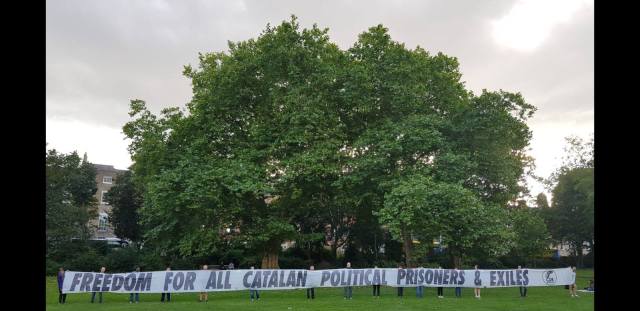
Freedom for all Catalan political prisoners & exiles long banner
Message in Merrion Square (Photo: ANC Irlanda)

REFERENCES:

Diada: https://en.wikipedia.org/wiki/National_Day_of_Catalonia

ANC: https://assemblea.cat/?lang=en

USEFUL CONTACTS:

ANC Irlanda: https://www.facebook.com/IrlandaPerLaIndependenciaDeCatalunya

CDR Dublin:  https://www.facebook.com/CDRDublin/

With Catalonia/ Leis an Chatalóin: With Catalonia/ Leis an Chatalóin https://www.facebook.com/WithCataloniaIreland/
Casal Catalan d’Irlanda https://www.facebook.com/casalcatalairlanda/

CHINESE PROTESTS AND COUNTER-PROTESTS IN DUBLIN

(Reading time: 10 mins.)

Diarmuid Breatnach

Chinese people protesting the proposed extradition law in Hong Kong and the repression of protests there by the authorities were outnumbered, out-coloured and out-sung by their Chinese opponents in O’Connell Street on Saturday 31st August. However the counter-protesters gave the impression of having been mobilised through the Chinese Embassy.

          Those protesting the proposed Hong Kong legislation outside the GPO seemed somewhat cowed by the counter-protesters facing them in the central pedestrian reservation. The former had some printed placards while their opponents had a massive banner bearing the legend “We Love Hong Hong”. They also had an effective public address system and a cheer-leader with a microphone and every now and again he got the whole crowd to burst into some Chinese song. Their numbers and coordination made one think of the cast of the film version of the Chinese revolutionary opera “The East Is Red.”

sdr
Counter demonstration in Dublin to Hong Kong protests solidarity demonstration. (Photo: D.Breatnach)

I chanced upon the protest by accident, cycling up O’Connell Street, not having heard about it in advance. As I neared to take a photo, I noted that among the Chinese protesting about Hong Kong, there were some placards of the People Before Profit organisation and some familiar faces.


Upon commenting to their leader that they had been outsung (a flippant comment, I’ll admit), he told me that those protesting about events in Hong Kong had felt apprehensive and had asked for solidarity. He commented to me that he would “always support people struggling for democracy, against extradition” etc. Perhaps – but I don’t recall seeing him (or most of his party) on pickets calling for civil rights for Irish Republicans or against their extradition from the Irish state to British administration.

I don’t believe for one minute he and his party prefer Chinese to Irish people but I do think they are much readier to take up cases of injustice where the target is not either the Irish or the British state. Which is curious for an organisation that declares a revolution in Ireland to be necessary.

SOME HONG KONG BACKGROUND

          Hong Kong has a population of around 7,300,000, which includes many who are not nationals. It is a port city of 1,104 sq. Kilometres (426 sq. Miles) and one of the most densely-populated areas in the world.

Hong Kong was occupied by the British in 1812 after they beat the Chinese in the First Opium War, fought by the British in support of their right to sell opium through Chinese ports to the Chinese, which the Emperor unreasonably thought was destroying the Chinese aristocracy and administrative classes.

The British extended their territorial base in Hong Kong to Kowloon in 1860 after beating the Chinese again in the Second Opium War (there were still unreasonable Chinese who didn’t want the British selling opium to them). From 1898 the British ran Hong Kong on the ‘legal’ basis of a 99-year lease (which actually, the British forced the Chinese to grant them) which ran out in 1997. In 1941 the British surrendered Hong Kong to Imperial Japanese forces which remained there until 1945, after which the British took it over again.

The Chinese Emperor having long gone by 1997 and the Taiwan western-supported authorities having no legitimate or believable claim, once the lease ran out, Hong Kong reverted to the main Chinese authorities, i.e the Government of China. Unfortunately for the Hong Kong people, that is the People’s Republic of China which, though flaunting communist symbols, has long ago ceased to be any kind of Communist regime but is not a capitalist democracy either.

However, under arrangements made when the British lease expired, Hong Kong maintains separate governing and economic systems from those of mainland China, expressed in the phrase “one country, two systems.”

DEMOCRACY?

          Headlines in the leaflet being distributed by the Hong Kong protesters in Dublin declared that the fight is about democracy and democratic rights. Many media commentators agree with them. Some even talk about restoring democracy to that region.

In fact, Hong Kong has never had democracy. Before Britain annexed it, the port city was run by officials appointed by the Chinese Emperor. After the British took it over, not only was there no democracy for Chinese working people but the administration was openly racist and some “public” areas there declared that no Chinese were permitted entry. In 1925, British troops and police opened fire to suppress a dock strike and demonstrations in Shanghail resulting in over 60 killed in two separate incidents. The resistance spread to Hong Kong and the port was also boycotted, which cost the British dearly.

Even in modern times, the Hong Kong administration was known to be highly corrupt and the special anti-corruption police squad became known as “the graveyard of corruption complaints”, for that is where the allegations and complaints were buried by those supposedly investigating them.

In 1967 Leftist demonstrations grew out of a strike and became wide-scale riots when Hong Kong Police moved to brutally repress them and many of the demonstrators’ leaders were arrested.

In 2013 a dockers’ strike in Hong Kong fought a hard battle against shipping transport companies for 40 days, out of which they emerged victorious. The working conditions that came to light during the struggle revealed aspects that organised workers would not accept in any capitalist democracy or even in some dictatorships.

CURRENT STRUGGLE

          The present Hong Kong authorities seem to have come to an arrangement with the mainland Chinese Government, since Carrie Law, the Chief Executive of Hong Kong, introduced the bill which has sparked three months of protest. Under the provisions of this bill, an alleged lawbreaker in Hong Kong could be extradited to mainland China. When people protested in Hong Kong, the authorities sent their police to beat up the protesters and to arrest them, just as the British used to do in the old days.

And the laws that are being used to attack and jail demonstrators are exactly the same ones that have been in force for decades in British Hong Kong, as the Financial Times points out, although it suggests they were OK under the British but are “outdated now” (see References)!

Hong Kong Placards Police Don't Shoot
Photo taken on demonstration in Hong Kong (Photo source: Internet)

The opposition to the bill has seen demonstrations, occupations and strikes. On 5 August, there was a strike, this time successful, with the airport and flight industry employees playing a prominent role. The Communist Party of China is now asking for the list of Cathay Pacific employees who went on strike but the union won’t release the list. Estimates of participation in the strike vary between 300,000 and 400,000 people.

Airport public areas have also been occupied en masse which of course hits tourism and personal contact business, along with some exports and imports. On 12 August, another huge occupation of the airport brought about a threatening response from the PRC State; it sent about 10,000 armed police to the border with Hong Kong.

Carrie Law recently stated that she has withdrawn the bill which satisfies one of the demands of demonstrators but another four have been put forward:

  • Retract the classification of the protests as ‘riot’ ” (presumably with legal consequences)

  • Appointment of an independent commission to inquire into the excessive violence used by the police in the protests”

  • Dropping charges against demonstrators” (but what about those already jailed?)

  • Implement a Dual Universal suffrage to elect a truly democratic government”

WHO OR WHAT SHOULD WE SUPPORT?

          As in many of these types of struggles there are likely to be a number of elements involved among the demonstrators and strikers, including leftists, basic democrats, anti-communists (even fascists) and pro-western imperialists.

I do not see any reason to defend the current or past administration of Hong Kong – quite the contrary. Nor do I see any reason to defend the Chinese State administration which has lost all content of communism it once had and in which only some of its form survives. As far as democracy goes, the People’s Republic of China has suppressed demonstrations against corruption or by defenders of their environment, as well as hundreds of strikes and sent tanks to suppress a demonstration in Tienamen Square, resulting in an unknown number of dead, injured and jailed. On the other hand, Hong Kong is not even a bourgeois — to say nothing of a workers’ – democracy as is shown at present and in its past.

Huge Hong Kong Protest
Photo of demonstration in Hong Kong (Photo source: Internet)

It is natural that people in Hong Kong would not want to be extradited to the PRC and it seems to me that resistance to that is worthy of support along with in general the other four demands (although what “independent commission” to enquire into “excessive violence by police” can be appointed in this setup?). But the fundamental problem is that working people in Hong Kong do not control the fruits of their labour and the granting of not even all of the five demands can possibly change that. Where workers are in that situation, their rulers will alway keep repressive measures on hand for use whenever they feel the need to employ them.

Clearly the solution is not for the intervention of the USA or any other imperialist state either.

Therefore what I think we should support most is the mobilisation of the working people for socialist revolution and their participation in these current struggles will educate them as well as giving their most class-conscious elements the opportunity to enhance that education and, necessarily, organisation.

End.

REFERENCES AND FURTHER INFORMATION

1925 strike, massacres and boycott: https://en.wikipedia.org/wiki/Canton%E2%80%93Hong_Kong_strike

1967 anti-British rule demonstrations (somewhat biased): https://en.wikipedia.org/wiki/Hong_Kong_1967_leftist_riots

Hong Kong repressive legislation is from the British: https://www.ft.com/content/d66d69aa-6ef4-11e8-8863-a9bb262c5f53

Hong Kong Dock Strike 2013: https://www.ft.com/content/80a0d4ea-ae46-11e2-bdfd-00144feabdc0

Hong Kong Police and the demonstrations: https://www.theatlantic.com/international/archive/2019/09/hong-kong-police-lost-trust/597205/

History of corruption in Hong Kong Police: https://en.wikipedia.org/wiki/Lui_Lok

BRIGADISTA PETER DALY COMMEMORATED IN HIS HOME TOWNLAND

(Reading time: 20 mins)

Clive Sulish

SPEAKERS WARN OF RISING FASCISM, CALL FOR UNITY OF ANTI-FASCISTS

          Flags of various kinds flew above a gathering in Monagear, Co. Wexford on Saturday 7th September, while a number of banners were visible among the crowd: Peter Daly Society, Connolly Association Manchester, Wexford Community Action, Anti-Imperialist Action Ireland, Friends of International Brigades Ireland, Éirigí, Connolly Column. Also in attendance was a group of young men and women dressed to represent the International Brigaders and the POUM1 milita, organised by the Cavan Volunteers group. The event had been organised by the Peter Daly Society with support from the Peadar O’Donnell Forum.

Monagear Commemoration from behind wall
Long view of Peter Daly commemoration seen from the back (Photo source: Peter Daly Society)
moin-na-gcaor-1798-banner.jpg
A reminder of even older struggles — banner inside the Monageer Tavern. (Photo source: D.Breatnach)

Monagear is a small village in the centre of Co. Wexford, a few kilometres north-east of Wexford town. Also known a Monageer, both words are, like most place-names in Ireland, from the original Irish language: Móin na gCaor, “the bogland of the berries” (probably of the Rowan or Mountain Ash, which in Irish is Crann Caorthainn). Not far from it are the historic place-names associated with the United Irishmen uprising of 17982 in that county, such as Boolavogue and Enniscorthy and indeed, a small commemoration garden in the village has memorial stones dedicated to that struggle and to others since.

sdr
View in a cloud-darkened moment over the crowd, past the new houses in the village and to the hills and mountains in the distance. (Photo source: D.Breatnach)

At a signal, the gathering of people with flags and banners, led by a colour party flying the Irish Tricolour, the flag of the 2nd Spanish Republic, a red starry flag and the Irish workers’ Starry Plough, moved in procession down into the village area and assembled outside the raised platform containing the tasteful simple memorial to Peter Daly, International Brigader killed in the War Against Fascism in the territory of Spain (1936-1939).

Steve McCann, Chairman of the Peter Daly Society, with another man beside him, opened the ceremony from the memorial platform by briefly outlining the history of the Peter Daly commemorations and of the Society (founded in 2011) which he said had from the beginning welcomed the involvement and participation of Irish Republicans, Communists, Socialists, Anarchists and plain anti-fascists. After outlining the program of speeches and songs for the day, he called Gearóid Ó Machaill to give the first speech, on behalf of the Friends of the International Brigades, Ireland.

sdr
Steve McCann addressing crowd with colour party and reenactment group visible below (Photo source: D.Breatnach)

“THE IRISH ARE NOT IMMUNE TO FASCISM”

          Ó Machaill opened his speech in Ulster Irish, thanking the organisers for giving him the opportunity to speak there at the cradle of Peter Daly, Irish Republican, socialist, anti-fascist. Continuing, he said that the conditions that gave rise to fascism in the 1930s are very similar to those of today. Speaking of the Republican Congress of 1936-1938, he said it had worked to overcome divisions in the working class and in the anti-imperialist movement. But it had fallen apart in disunity, unfortunately and in Ireland today, the anti-fascist forces are as divided too.

The Irish were not immune to fascism and had a strong fascist movement in the 1930s, supported for awhile by the State, X said. In the years since the defeat of fascism around most of the world, attempts to set up a fascist movement in Ireland had been smashed, said Ó Machaill but cautioned against complacency.

In some other parts of the world, workers betrayed by social democracy and hurt by capitalism, turned to hard right parties and outright fascists and it was entirely possible that such fascists would become popular while leading a campaign against bankers and even imperialism, pushing a line of “Irish for the Irish”.

“We cannot afford the divisions and need to unite ….. as Republicans and Socialists did in preventing the attempted launch of Pegida in 2016,|” said the speaker.

Colour Party & side view Militia GOM
Colour Party facing photographer, POUM and Brigader reenacters to the left. (Photo source: G. Ó Machaill)

MIGRANT DEPORTEES

          Steve McCann introduced the man beside him as Diarmuid Breatnach and called him to sing the first song of the selection for the ceremony and to say a few words about its content. Breatnach pointed out that migrants are often a prime target of fascists and the song he was to sing was about migrants and their treatment. On 28th January 1948, a DC-9 transporting Latino illegal migrants and “guest workers” crashed in the Los Diablos region of California and all 32 on board were killed. The radio news reported the crash but only gave the names of the crew members and the Immigration Department guard, saying the others killed were “deportees”. The names of the dead were known in their localities and were printed in local newspapers but were not deemed worthy of mention on the radio.

DB Reading Intro Song Platform Peter Daly Monageer Sep 2019
Diarmuid Breatnach reading introduction before singing a song. Steve McCann is standing to the left of the photo on the stage. (Photo source: Ado Perry)

Wood Guthrie wrote a poem called “Deportee” about the tragedy which was put to music by Martin Hoffman, the song since called Deportees or Plane Wreck at Los Gatos. Breatnach then sang the song, the chorus of which says:

Goodbye to my friends,

Farewell Rosalita

Adios mis amigos, 

Jesús y Maria;

You won't have a name 

When you ride the big airplane --

All they will call you 

Will be “deportees”.

LESSON OF HISTORY – NOT LIBERALISM BUT ROBUST ACTION IS NEEDED

          Mags Glennon was called to read a statement on behalf of Anti-Fascist Action. Moving on from the background to the fascist upsurge of the 1930s and the background of those who fought to defeat it, Glennon read: Far-right parties have risen from minor subculture to government across Europe in recent years, showing the glaring need for principled and active opposition to fascist and far right forces. The most concerning aspect of this political resurgence is the support it has received from young people and large sections of the traditional working class, due to the abandonment of these people by social democrats, and other parties who claimed to ‘represent’ them. Well meaning liberalism has never defeated fascism. It never will.”

Reading from the statement, Glennon called for a “re-energising” of the struggle to defeat those “aiming to distract our communities and young people from fighting their real enemy. Where there are fascists we must oppose them.”

Glennon concluded by reading: “Appeals to the police, to parliament or to Google to censor fascists have no place in anti-fascist struggle. History has shown that robust action against fascists in Ireland has always sent them running back to the gutters to think again. Long may it continue. La lucha continua!

Militia GOM
POUM militia and International Brigader reenacters seen from behind, centre photo. (Photo source: G. Ó Machaill)

“MUST ORGANISE IN WORKING-CLASS COMMUNITIES”

          The MC, Steve McCann, introduced the anti-fascist and community activist as well as Independent Dublin City Councillor, Ciaran Perry. Speaking without notes, Perry outlined the historical necessity of defeating fascism politically and physically.

Echoing a previous speaker’s comments, Perry too called for unity of the antifascist forces against fascism but also against capitalism and imperialism. He said that working-class communities, betrayed by social democracy and distracted by identity politics, had become prey to the propaganda of fascists.

ciaran-perry-speaking.jpg
Ciaran Perry speaking

Fascism is a facet of capitalism”, Perry said “and therefore the enemy of the working class.  The working class should be our natural constituency.”

Going on to suggest that if fascists build bases in working class communities it is because of the failure of the Left, he called on socialists and antifascists go into those communities and to build their bases there.

ESCAPE FROM DACHAU AND DEATH IN SPAIN

          Breatnach stepped forward to sing a combination of two songs from the German side of the anti-fascist struggle. The German political prisoners in the concentration camps were forbidden to sing socialist songs and had written their own, one of which became famous around the world was The Peat Bog Soldiers, lyrics written by Johann Esser, a miner and Wolfgang Langhoff, an actor and melody composed by Rudi Guguel.

“Hans Beimler (1895-1936) was a WWI veteran, a Communist, a Deputy elected to the Reichstag in 1932,” said Breatnach. “In January 1933 Hitler came to power in Germany. The Communist Party was banned and in April 1933 Beimler was arrested and sent to Dachau extermination camp where, in May, he strangled his SA guard and, putting on the man’s uniform, escaped. He went to Spain where he was a Commissar with the International Brigades and was killed in the Battle of Madrid on 1st December 1936.”

He would sing two verses of the Peat Bog Soldiers, Breatnach explained, combined with the Hans Beimler song.

Hans Beimler Photo Spain maybe
Photo of Hans Beimler, WWI veteran, Communist, escapee from Dachau, International Brigader, killed in the Battle of Madrid 1936.                      (Photo source: Internet)

“THE NORM WAS FOR ALL CAPTURED INTERNATIONAL BRIGADERS TO BE EXECUTED”

          The sun sinking towards the west shone over the heads of the attendance on to the raised bed of the memorial stone and its flagpoles and, except when covered by clouds, into the eyes of those on the platform. Outside the nearby pub some locals gathered and behind those gathered around the monument, others in attendance lined a low wall while nearby other local people, mostly youth, congregated for a time. Occasionally a passing car drove carefully along the street past the crowd. House martins darted above, a wasp occasionally bothered the speakers and the smokey-blue soft curves of the Silvermine Hills and Knockmealdown Mountains rose to the west.

Harry Owens Speaking
Harry Owens speaking from the platform (Monagheer Tavern to the right of photo)

The Chair of the event called Harry Owens to speak.

Harry ‘s speech traced the history of world events that had led up to the fascist coup and war in Spain. He also spoke about the kind of people the Brigadistas had been, quoting from their comrades, journalists and opponents. That Captain Frank Ryan had his life spared was unusual, he explained, as the tendency was for all anti-fascist officers to be executed and all International Brigaders of all ranks. Whilst the Spanish fascists wanted to execute them, the Italian soldiers tended to keep them alive in order to exchange them for Italian prisoners of the Republican side.

The death toll among officers and men in the International Brigades had been higher than the norm in warfare and the average in the Irish contingent higher still, Owens said. The food and armament supply conditions of the Republican side had been poor in many areas but almost to a man they had fought on until death, capture or demobilisation. It was their conviction, that they knew what they were fighting for and believed in it that accounted for that.

After Owens’ speech, Breatnach stepped forward to sing, without introduction, Viva la Quinze Brigada3 (the song written by Christy Moore about the Irish who fought in the 15th International Brigade). The song mentions Peter Daly in the verse:

This song is a tribute to Frank Ryan,

Kit Conway and Dinny Coady too,

Peter Daly, Charlie Reagan and Hugh Bonner,

Though many died, I can but name a few.

Danny Doyle, Blazer Brown and Charlie Donnelly,

Liam Tumlinson, Jim Straney from the Falls,

Jack Nalty, Tommy Patton and Frank Conroy,
Jim Foley, Tony Fox and Dick O’Neill.

The words of Moore’s chorus rang out along the street:

Viva la Quinze Brigada!

No Pasarán!” the pledge that made them fight;

Adelante” is the cry around the hillside,

Let us all remember them tonight.

…. and concluded with the cry “Viven!” (“They live!”)

WREATHS, THE INTERNATIONALE AND AMHRÁN NA BHFIANN

          McCann called for those who wished to lay wreaths on behalf of organisations and the following came to lay floral tributes: John Kenny, activist of the Peter Daly Society; Mags Glennon for Anti-Fascist Action; Seán Doyle for Anti-Imperialist Action Ireland (who had provided the colour party); Connolly Association Manchester; and Gary O’Brien for Éirigí. Messages of support had been received from the CPI, IRSP and the Connolly Association Manchester.

Closeup Peter Daly Monument & Wreaths
Closeup of Peter Daily memorial with floral tributes laid. (Photo source: Peter Daly Society)

McCann then called Breatnach forward to sing the Internationale, the international anthem of the working class, the lyrics of which Breatnach explained had been composed by Anarchist Eugene Pottier of the Paris Commune, in 1871, the first time the working class had seized a city. It had been written to the air of the Marsellaise but later put to its own melody by worker-composer Pierre de Gayter.

“It was written in French”, said Breatnach, “which is why I propose to sing the chorus once in French at the start but it has been translated into many languages. Youtube has a post with 95 translations ….. and there are at least three versions of it in English and people are welcome to sing along in any version they know,” Breatnach concluded before singing the French chorus, followed by two English verses and chorus.

The MC Steve directed attention to a bodhrán decorated with a dedication to Peter Daly by Barry O’Shea which was displayed by Erin McCann and which would be raffled as a fund-raising exercise at the reception inside the pub.

girl-with-p-daly-bodhran.jpg
Ciara McCann with the bodhrán decorated by Barry O’Shea (Photo source: D.Breatnach)

Steve McCAnn then called Marie Kenny Murphy and Marilyn Harris up on to the stage, where they played the Irish national anthem on flutes, with many people singing along in its Irish translation4:

Anocht a théim sa bhearna baoil,

Le gean ar Ghael chun báis no saol;

Le gunnaí scréach, faoi lámhach na bpiléar,

Seo libh, canaig’ Amhrán na bhFiann.


Part Crowd Close GOM
Section of crowd around monument (Photo source: G. O Machaill)

REFRESHMENTS, EXHIBITION, RAFFLE, SONG AND CONVERSATION

          All the speakers had referenced the historical memory of the Anti-Fascist War on Spanish territory to the struggles of today and even of tomorrow and the selection of songs had been deliberately chosen to emphasise internationalism and workers’ solidarity from the past and needed today.

McCann thanked all the performers, speakers and participants and in particular welcomed the participation of the Connolly Association contingent from Manchester, encouraging them to attend again the following year. Inviting all to enter the local Monageer Tavern to view the Antifascist War memorabilia and to have some food, the MC brought the ceremony to an end.

Inside the local pub, the Monageer Tavern, food had been made available by the owners and the function hall was provided for the commemoration participants.

An interesting display of memorabilia of the Spanish Anti-Fascist War had been erected inside by the Cavan Volunteers history group. The walls of the function room on one side were also covered with permanent framed photographs and other images of Irish history, among which Joe Mooney, anti-fascist, community worker and activist of the East Wall History Group, spotted a photo of the Dublin docks with a docker well-known to his community in the foreground!

Music was provided by Tony Hughes with voice and guitar, singing a selection of songs including anti-racist and Irish Republican ballads, also Viva La Quinze Brigada.

solo-performer-pub.jpg
Tony Hughes playing and singing at the event inside the Monageer Tavern                                       (Photo source: D.Breatnach)
antif-war-memorabilia-wider.jpg
Spanish Anti-Fascist War memorabilia organised by the Cavan Volunteer history and re-enactment group (Photo source: D.Breatmach)

dav

When the raffle was held a search went on for the winning number ticket which eventually unearthed it in the possession of Helena Keane, seller of the tickets and who adamantly refused to take the prize. Another dip into the stubs brought Gearóid Ó Machaill’s ticket out, ensuring the decorated bodhrán would find a new home somewhere in the occupied Six Counties.

mde
Section of the function room wall in the Monageer Tavern. (Photo source: D.Breatnach)
mde
Another section of the function room wall. (Photo source: D.Breatnach)
lineup-people-banners-peter-daly-monument-7-aug-2019.jpg
(Photo source: Ado Perry)

FOOTNOTES

1The International Brigades were organised through the Comintern and Communist parties in various parts of the world but a number of International Volunteers came also through the mainly Trotskyist POUM, including Anarchists. One Irish volunteer went to join the Basque Gudaris and was killed fighting the fascists there.

2First Republican rising in Ireland, organised and led for the most part by Protestants, descendants of British colonists.

3Christy Moore called this “Viva la Quinta Brigada” (i.e the Fifth) but in later versions sang in English a line in the first verse calling it “the 15th International Brigade”. It appears that from different chronological perspectives one can call it either the Fifth or the Fifteenth but the mostly English-speaking brigade of the International Brigades is usually named the Fifteenth. Quinze is the Spanish word for “fifteen” and Viva la Quinze Brigada scans in the song while “decimoquinta Brigada” has too many syllables to fit.

4The Soldier’s Song was written originally in English by Peadar Kearney, an Irish Republican worker with socialist sympathies and put to music by worker-composer Patrick Heeny. It was translated to Irish by Liam Ó Rinn under the title Amhrán na bhFiann and published in 1923. Only the chorus became the anthem of the Irish State and that was not until later. The Irish-language version is the one most commonly sung at non-State occasions now.

LINKS FOR FURTHER INFORMATION:

Organisers
Peter Daly Association: https://www.facebook.com/PeterDalyCommemoration/

with help from the Peadar O’Donnel Forum: https://www.facebook.com/Peadar-ODonnell-Socialist-Republican-Forum-1538296709833402/

Colour Party by Anti-Imperialist Action Ireland: https://www.facebook.com/AIAIreland2/

Memorabilia and kitting out of POUM militia and International Brigade reenacters by Cavan Volunteers group: https://www.facebook.com/groups/242987949412133/

End .