Introduction and translation by Diarmuid Breatnach
The San Fermines Festival in Iruña (Pamplona in Castillian) is renowned around much of the world for its colour and also danger with the running (corrida) of the bulls. But for many years it has been the occasion and site of sharp political struggle and there have been other dangers too.
ANTI-BASQUE NATIONALISM IN NAFARROA
Although the city is Basque, centre of the medieval kingdom of Nafarroa (Navarre), it was run for decades by UPN (Union of Navarrese People), what some considered the Basque version of the Partido Popular, post-Franco Spanish political party founded by the Dictator’s supporters. Although in 2008 UPN broke from its fraternal relations with the PP, the party remains Spanish-unionist and conservative, strongly opposed to Basque independentism and wishing to remain separate from the rest of the Basque Country, whether the other three southern provinces or the three across the French border.
During the Spanish Republic of 1936, the ruling political interests in Nafarroa broke with the Basque nationalists and opted for supporting the military-fascist coup of Franco and the other three generals – the reactionary Nafarroan Carlists murdered 3,000 Basque nationalists, republicans, communists, anarchists and social democrats in their province alone. They also took part in fighting as part of the military-fascist forces.
For many years, the first day of the San Fermines festival has been the scene of struggle between those who sought to bring the Basque national flag, the Ikurriña, into the main square, to be present during the launch of the week of festivities. And beatings and for Basque independentists have resulted, even fines and jail sentences, especially when they have been successful.
But in the elections of 2015, a coalition of political parties of Basque independentism, nationalism, and left-social democracy took power in the Navarrese regional Government and began to change matters on a number of fronts. In 2017 the Ikurrina was flown from the official balcony and the the Spanish Government Delegation in the region took a judicial case against those responsible and the same people in 2018, EH Bildu, refrained from flying it, displaying instead a bare flagpole. However, that coalition lost its majority of seats in the elections this year and the UPN came back into power, with the resumption of ‘business as usual’.
ASSAULT AND RAPE
In recent years, another menace has come to the fore, with some men assaulting women in the press of the crowd. Most horrifying was the multiple rape of an 18-year-old woman on July 7th, during the San Fermines festival of 2016. The woman, who approached a few men to help her find her way and was apparently under the influence of intoxicants, was led into a doorway, her phone taken off her and raped in a number of ways by each, who also videoed the event and put it up on the Internet. Due to the description to the Nafarroan police by the victim and their promotion of their act on social media, the perpetrators were soon arrested. But they were tried not for the more serious crime of rape but for sexual abuse, because she appeared not to resist and therefore no violence was necessary to restrain her – a feature of Spanish law.
The group of five violators and rapists had given themselves the boastful title of La Manada (the Wolf-Pack) contained a Spanish Army soldier and a Spanish Guardia Civil policeman among its members. And they on a previous occasion filmed themselves having sex with an intoxicated woman on the flat bed of a truck and put that too out on social media.
Gang-rapists, the self-styled La Manada (“the wolf-pack”) (Photo source: Internet)
The Pack claimed that their victim was willing but found it difficult to explain that she had only met them seven minutes before the assaults or their taking of her mobile phone and some other matters and were found guilty and sentenced to nine years jail but allowed bail when they appealed. Since their appeal might find them not guilty, one might argue that they were entitled to bail while awaiting the hearing.
BASQUE AND CATALAN INDEPENDENTISM V. RAPE
However, the youth from Alsasua (Basque town in Nafarroa), who were accused of assaulting off-duty Guardia Civil policemen who entered a Basque independentist late-night bar as a provocation in October 2016, were not only kept in jail while awaiting trial in Madrid but also four of them while awaiting an appeal hearing (against sentences of between two and 13 years jail!). And the Catalan independence grass-roots campaign leaders and elected politicians who were charged with sedition, rebellion and misuse of public funds for organising a referendum on independence in October 2017, were kept in jail until their trial and are there still, now awaiting judgement. They include one who was elected an MP while in jail and another who was elected an MEP (Jordi Sanchez and Oriol Junqueras).
Many aspects of the Manada case led to an outcry over the whole Spanish state. Although the Prosecution had asked for sentences of 22 year and 10 months, they were sentenced to nine year jail. On December 5th 2018 their sentences were confirmed to those nine years, although two judges on the panel disagreed, wishing for sentences of a little over 14 years as they felt that there had been intimidation and coercion, there had been “degrading acts” and she had been left half-naked on the ground with her mobile phone taken (and memory cards removed). The five-judge panel however ordered the first court that tried them to issue another sentence for the filming and publishing of the rape as her privacy had been violated. The Defence lawyer has indicated that his clients would appeal the sentence as did also the City of Iruna (Pamplona).
THE BATTLE OF THE FLAGS
The town square of Iruna/ Pamplona, traditional site of the launch of the San Fermines folk festival, this year showing, despite threats of the UPN Mayor, Ikurrinak and banner against the dispersal of Baque political prisoners prominently displayed. (Photo sourced: publico.es)
Translation of short article in Publico.es
In the end, the ikurriña was present. The images of the first Sanfermines after the return of the Right to the City Council of Pamplona are already crossing the world and they do it with the ikurriña and the flag of Navarre displayed among the public. The earlier threats of Mayor Enrique Maya (UPN) had no effect, nor did the police deployment in the surrounding area.
Under an intense sun and in a crowded square, the txupinazo (firing of ceremonial rocket — Translator) of the Sanfermines – the act that marks the beginning of the festivities — took place at 12.00 o’clock. Minutes before, (many of) the attendees managed to deploy a ikurriña of great proportions, accompanied by the Flag of Navarra. A white placard also appeared in which the return of the ETA prisoners was demanded (i.e end of the dispersal of independentist prisoners all over the Spanish state — Trans).
“UPN, kanpora” (UPN, out!) was heard in the square when the Mayor was on the balcony. A few days before, Maya had issued a notice announcing that entering with fabric of large proportions was strictly forbidden, citing security reasons. However, the same Councilor said shortly after in an interview in the newspaper El Mundo that there would also be “a device” to prevent the EH Bildu councilors unfurling the Basque flag on the balcony of the town hall.
POLICE SEIZURE OF FLAGS
One hour before the txupinazo, journalist Gara Aritz Intxusta reported by Twitter that local police had seized “150 small ikurriñas that were going to be used in a kalejira” (festival parade) that was going to be performed in the streets of the city to protest against the Mayor’s party.
of daring event as the hour for the launch approached, Basque independentists in “disguise” of anglers, cast a line across from the rooftop on one side of the square to the other and then a stronger line was taken across with a giant ikurrina attached. One can see earlier, police rushing to confiscate a flag or banner and a giant political prisoners’ banner being held above many in the crowd. In 2013 the UPN Mayor deliberately delayed the launch past the traditional hour of noon so as to give secret police time to cut the line and not to have it happening with the Ikurrina hanging over the square.
About Franco: “I pay homage to his memory; and I believe that the best way to interpret his legacy is to march without stopping towards social justice objectives, that give strength and unity to our people.”
Translation by Diarmuid Breatnach from article in Castillian by DANILO ALBIN @danialri BILBAO 06-30-2019 08:17 AM Updated: 06-30-2019 08:17
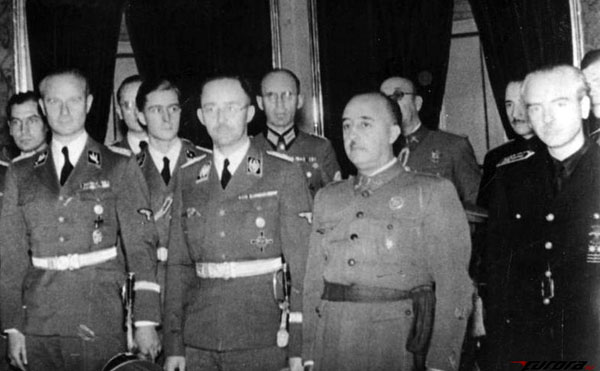
Franco with leading German Nazis. He was greatly admired by the former Spanish King, father of the current one. (Photo source: Internet)
There are things that time cannot erase. Words and phrases that seem forgotten but, nevertheless, are still there. Written and permanent. The Royal House offers the collection of speeches by Juan Carlos de Borbón in its digital archive. In those archives, available for those who wish to find them, are the Francoist statements that the now emeritus king pronounced in the first steps of his reign and about which, according to what different historians emphasise, he never made any self-criticism.
November 22, 1975. Two days after the death of the Dictator, Juan Carlos offers his message of remembrance: “An exceptional figure enters history. The name of Francisco Franco will be a milestone of Spanish events and a milestone to which it will be impossible not to refer in order to understand the key to our contemporary political life,” the King proclaimed.
There he showed his “respect and gratitude” towards he who “for so many years assumed the heavy responsibility of leading the government of the State”. “His memory will be for me a demand for behavior and loyalty to the functions I assume in the service of the country. It is a feature of great and noble peoples to know how to remember those who dedicated their lives to the service of an ideal. Spain will never be able to forget who, as a soldier and statesman, consecrated all his existence to its service,” he added.
Hitler and Franco reviewing invader Nazi troops in Hendaye, French Basque Country. (Photo source: Internet)
The file on the website of Casa Real offers another speech by the King of that same day, in that case addressed to the Armed Forces. “I express my gratitude and gratitude to our Generalissimo Franco, who with so much dedication and commitment has led you until now, giving us a unique example of love for Spain and a sense of responsibility,” he said then.
Twenty-four hours later, Juan Carlos went to the National Brotherhood of Combatants, another self-declared Francoist entity. He promised them “to march forward with determination on the path traced, perfecting and complementing the work Franco did“. “Today, before you, who were his soldiers, I pay homage to his memory; and I believe that the best way to interpret his legacy is to march without stopping towards social justice objectives, that give strength and unity to our people,” he said.
For the historian and researcher Pablo Sánchez León, these speeches by the monarch “show a preconstitutional legitimacy (? Trans) of the Royal Household”. In any case, Sánchez León believes that if they are available in the digital archive, the monarchical institution “has an opportunity to tell a different story of itself”. How? “If they want to preserve those speeches there, something must be added,” he says.
In his opinion, these historical documents should be accompanied by a “furious criticism”. In that sense, he points out that there is a “repository” of Juan Carlos as former monarch, and that “the speeches that speak of Franco should be accompanied by a text in which he is allowed to say that it is abhorrent that there was been a king who once said those things”.
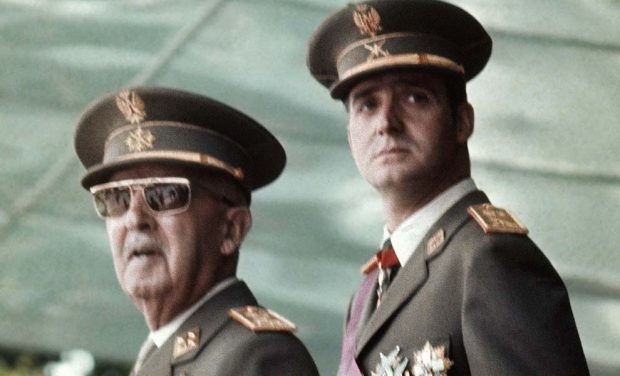
Juan Carlos, crowned by Franco, seen here with his mentor shortly before the latter’s demise. (Photo source: Internet)
None of that is in the list of of the king’s speeches. “The year that ends has left us with a stamp of sadness, which has had as its centre the illness and the loss of what was our Generalissimo for so many years”, can be read in the Christmas speech of 1975, which also highlighted “the enormous human qualities and feelings full of patriotism” on which Franco “wanted to base all his performance at the head of our nation.”
For Emilio Silva, president of the Association for the Recovery of Historical Memory (ARMH), the Royal House should also include in its file “the video of King Juan Carlos swearing to uphold the principles of the Movement” (i.e the Spanish fascist Movement – Trans). “If there were an exercise in real transparency, it would be told where that (Head of State – Trans) succession comes from,” he told Público.
“The reality is that the king was installed as successor by Franco”.
“Surely it is not the best thing for a democratic system to see texts extolling Franco on the website of of the Head of State,” says Julián Sanz, professor of Contemporary History at the University of Valencia. In any case, he remarks that “the reality is that the King was installed as successor by Franco and Juan Carlos’s relationship with the dictatorship has never been officially reviewed, nor has he abjured it.”
“Generalissimo” and “Head of State”
“My memory of the Generalissimo, who presided over this Military Passover for so many years and so much satisfaction when he met his comrades-in-arms,” reads the document “Words of His Majesty the King on the occasion of the Military Passover“, dated six January 1976. The following month, in Berga (Catalonia) he took advantage of the inauguration of the Baells Reservoir to argue that “the transformation that Spain has had in recent years of Franco’s mandate, cannot be stopped and all steps will be taken to allow this process to continue. “
The King kept referring to Franco as “Generalissimo” in July 1976, when he went to Santiago de Compostela to make the offering to the Apostle St. James. “Generalissimo Franco, who preceded me in the leadership of the State, personally presented this offering to you on several occasions,” he said then. Something similar happened that same month in Ferrol, where he recalled that this Galician town “was the birthplace of the Generalissimo, a great figure of our history, to whom I am honored to renew a public tribute in this city whose egregious name is forever linked to that of the most illustrious of his children. “
In February 1977 – just four months before the first democratic elections – the king took advantage of a visit to the General Military Academy to “pay tribute to the efforts of two great soldiers who had already gone down in history and who were the architects of the event that we celebrate: General Primo de Rivera, creator of the General Military Academy, and Generalissimo Franco, its first director”. (Primo de Rivera was also the founder of the fascist Falange organisation, which murdered unknown multitudes during and after the Anti-Fascist War, also known as the “Spanish Civil War” – Trans.)
In fact, the official biography of Juan Carlos de Borbón presented by the Royal House on its website also avoids referring to Franco as a dictator. “After the death of the former Head of State, Francisco Franco, Don Juan Carlos was proclaimed King on November 22, 1975, and delivered his first message to the nation in the Cortes, in which he expressed the basic ideas of his reign: democracy and to be the King of all Spaniards, without exception, “says the text.
“Reflects the past”
For Sánchez León, the inclusion of these discourses without nuances is nothing more than “another example of the thin line of shadow that separates the absolutely abject and unconstitutional, typical of a criminal regime, from a constitutional order.”
The historian José Babiano does not object to the fact that “there is a set of discourses”, since “it reflects a past without twisting it”. In fact, he maintains that “it can help to contradict a sweetened version of the period, its role and of its transition”. “The first speeches are linked to the origin, and the origin is that it was Franco who appointed him. It would have been worse to remove them, because it would have been an attempt at a whitewash,” he said.
In this context, Babiano points out that while “he never repeated the praise (of Franco–Trans) of 1976, there was no self-criticism” about this type of discourse on the part of the King. “He did it when he had no choice in order to be the Head of State and once he gets there, all that is forgotten,” he said.
Público also contacted the Royal House to know if the possibility of contextualizing these speeches has ever been considered. To date we have received no response.
Franco with leading German Nazis. He was greatly admired by the former Spanish King, father of the current one. (Photo source: Internet)
COMMENT — A SUPREME IRONY
Diarmuid Breatnach
Taking the history of the current Spanish monarchy into account (as referred to above) along with the judgement of the Supreme Court in June last, it is abundantly clear from the mouths of the executives of the State that the “Transition” to democracy, as many of its critics have said, was only ever the drawing of a veil over the fascist essence of the State. Of course, the actions of the State down through the years, whether under social-democratic government of the PSOE or right-wing of the PP, have given ample evidence of its nature.
In a judgement delivered last month (4th June), the Spanish Supreme Court halted the planned exhumation of Franco’s remains and their transfer from the mausoleum in the Monument to the Fallen built by prisoner labour during the Dictator’s regime. In justification of its halting the operation that was to take place on June 10th by order of Government, the Supreme Court declared that General Franco had been the Head of State since 1st October 1936, that is to say, two months after the date on which he and other Generals, with the aid of military transport, armaments and personnel from two foreign powers (i.e Nazi Germany and Fascist Italy), launched their military-fascist armed coup against a democratically-elected government of the Spanish State, resulting in a bitter war of over two years with huge loss of life.
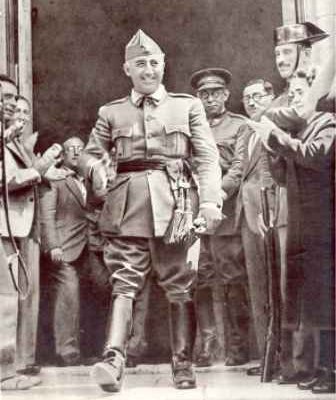
General Franco on 1st October 1936, having just been made Generalissimo and Head of the Fascist coup forces. The Spanish Supreme Court in June 2019 claimed he was then the legitimate Head of the Spanish State!
This decision of the Supreme Court constitutes a supreme irony. A dozen Catalan social and political activists have been on trial for months and are now awaiting verdict – the main charge against them is of “Rebellion”, which entails an attempt to overthrow the State through violent uprising. The Catalans in question called, not for the overthrow of the Spanish State but rather for independence for Catalonia — and did so peacefully; nevertheless they were charged with rebellion, kept in jail awaiting trial and are still there, awaiting verdict. In answer to a legal challenge by the Catalans’ Defence team, the Supreme Court decided the Catalans did have a case to answer on “rebellion”. Now the same court, in the same year, decides that Franco, who DID lead a violent overthrow of the State, was the legitimate Head of State barely two months after the coup he led and while the the democratically-elected government he was rebelling against still had another two years to go before it was overthrown.
Dublin Castle, located in the south city centre, has been the centre of the British occupation of Ireland since 1171 until 1921 (and even after that, some would say).The site offers one-hour guided tours to the public for much of the day, at approximately an hour apart, seven days a week and last year claimed a visitor total of nearly half a million. As a Dubliner interested in history and a walking tour guide, I was well overdue to take an official guided tour of the place, which I did recently.
Overall the State Rooms Tour was interesting and I did learn some things but I was also aware of many gaps. Was this unavoidable in a tour of one hour covering more than eleven hundred years (given that Viking Dublin was also covered) of history? Of course – but in the choices of what to leave out, was there an ideology at play, one that sought to diminish the repressive history of the institution and the struggle against it?
An artist’s impression of Viking Dublin in 9th Century
The first presentation to us by the tour guide was of Viking Dublin, the settlement of which took place in the 7th Century. The Vikings had a confrontational occupation of England but this had not been the case here, we were told – the Vikings settled amongst us, intermarried, introduced personal and family names, place-names, etc.
Well, somehow the tour spiel had ignored the many battles between the Vikings and the natives in Ireland even after the settlement in Dublin (and other areas), leading up the famous Battle of Clontarf in 1014, fought on what is now the north side of Dublin city. The 12-hour battle was important enough to be recorded elsewhere in Europe and in a Viking saga. Yes, it had also been an inter-Irish battle, in particular between the King of Leinster and the High King of Ireland but Viking Dublin played an important part, as did Viking allies and mercenaries from Manx and the Orkneys – and its result had ended forever any possibility of a Viking takeover of Ireland.
A noticeable gap in Irish-Viking history of Dublin to omit it, one might say.
Nevertheless, the tour guide gave us interesting information about the Viking settlement and a map showed an artist’s impression of how it would have looked.
Down in the base of what had been the Powder Tower, it was interesting to see the stone work, to hear the guide talk about the foundation of the Viking wall below us and how the cement used to bind the stones was a mixture of sand, oxblood, horsehair and eggshells. To me it was also interesting to see the stone course lines of one pointed arch above a curved one but unsure what I was looking at — and we were a big group, the tour guide some distance away to ask.
Powder Tower base incorporating some of the original Viking wall.Two separate arch stone courses, one above the other in the base of the Powder Tower.
Down below the walkway, where water lay on the ground a couple of inches deep, some green plant was growing in the lights illuminating the work. This was above the route of the Poddle, I supposed, which once fed the Linn Dubh (black pool) and which now runs underneath Castle and city before emptying into the Liffey.
“BEYOND THE PALE”
The Normans reached Dublin in 1171 after landing in Wexford in 1169, our guide informed us but we were not told that in the process they defeated Irish resistance and the Dublin Vikings and, most curiously, there was no mention of the Pale. That would have been an interesting explanation to visitors of the origin of the expression “beyond the Pale” and what it implied1.
The guide did tell us later in the St. Patrick’s Hall (the State banquet room) that the paintings on the ceiling were to demonstrate to the Irish that all the civilising influences had come from the English to the Irish savages, that if the Irish were now civilised, their ranking was definitely below the English.
One of the ceiling paintings in St. Patrick’s Hall, where the Uachtarán is inaugurated and which is also the State’s banqueting hall
That might have been an appropriate time to mention of the Statutes of Killkenny 1366, nearly two centuries after the Norman invasion and how the Irish Normans had, outside Dublin, adopted ‘uncivilised’ Gaelic tongue, custom and even law, so that their cousins in England were now calling them “the degenerate English” who had become “more Irish than the Irish themselves”.
If the English Reformation got a mention I must have missed it but certainly there was nothing said about the imposition of the new religion on Ireland, colonists and natives alike and the many wars that resulted. Anglicanism had become the religion of the English State, with its monarch at the head of the Church but none of the Irish natives and most of the colonists did not wish to adopt that religion. So it led to many uprisings, first notably from the Irish Normans (Gall-Ghael), then by the Irish and a number of major wars, including the Cromwellian and Williamite ones, also to the Penal Laws. That State religion was the reason that Elizabeth I had founded Trinity College, so that the sons of the colonists would be educated in the “true faith”. Religion had been used by the coloniser to try to undermine unity among the inhabitants of Ireland and had been employed to physically divide the island in 1922, which had also led to a much more recent war of nearly three decades.
The Reformation and its effects seemed a quite significant portion to leave out of Irish history in general and of Dublin history in particular.
Apparently a Lord Lieutenant of Tudor times riding out of (or returning to) the Castle with his knights and soldiers to deal (or having dealt) with the troublesome Irish natives (a representation on display in the Castle).
As the Castle had briefly been acknowledged as being, among other things, a prison, it seemed strange to omit the escape after four years of captivity of Red Hugh O’Donnel and two O’Neill brothers in 1592 — particularly so since the whole experience had left O’Donnell with a seething hatred of the English occupation which only ended years later in a poisoned death in Spain at the hands of an English agent. Aodh Ruadh Ó Domhnaill, as he was known then to most of Ireland (and Scotland), fought the English occupation from 1591 to 1602. Apart from being an important part of the Castle’s history one would have thought it would make an exciting and interesting story for tourists.
Aodh Rua Ó Domhnaill monument (Photo source: Internet)
However, the story was omitted – but then so were the tortures carried out in the Castle, the severed heads erected on spikes on Castle walls and, although it was said that it took the English 400 years to conquer the rest of Ireland, this was apparently because “there were no roads and there were lots of bogs”!
Commenting on later medieval Dublin city, the guide told us about the many diseases that were endemic, due to lack of sanitation in the city, along with blood-letting being the major medical treatment. It was strange that she did not mention the effects of the Black Death or Bubonic Plaque, which travelled through Ireland in 1634. The plague, carried by fleas on the black rat, affecting almost alone the city populations, almost wiped out the English colony in Ireland.
Artist’s impression of medieval Dublin City (perhaps 17th Century?). The guide told us it would have been pretty smelly.
IRISH WOOD, FAKE STONE COLUMNS
Chapel main stained glass window, looking east
In the Chapel, the guide pointed out the names and coats of arms on each side as being those of Lord Lieutenants of Ireland, i.e the representatives of the English monarch in governing Ireland. There were of course no native Irish names among them and few even of the Gall-Ghael.
One that took my attention, near the doorway, was that of Cornwallis, dated 1798. Lord Cornwallis (“Cornwall’” in the traditional ballad The Croppy Boy) was in charge of the suppression of the United Irishmen uprising in 1798, at which he was successful but less so in the Thirteen Colonies of North America, which he lost to rebellious colonists, some of whom were relatives and friends of the beaten republicans in Ireland.
Among the other Lord Lieutenants of Ireland, Lord Cornwallis’ coat of arms; he was suppressor of the 1798 Rising in Ireland but lost the war against the 13 Colonies of North America.The ‘fake stone’ columns and one line of coats of arms of former Lord Lieutenants of Ireland.
In response to an enquiry as to whether there were any questions, I asked who were represented by the sculpted heads along the chapel wall on the outside. Some represented Christian saints and some kings, such as Brian Boru2, she replied. Is there a list available of who they all are? No, I was told, only of some of them and I could consult that later.
Amazingly, only the floor and walls in the chapel were stone. The columns, she told us, were Irish oak plastered over to look like stone.
Section of ceiling and columns in the Chapel.
MONARCHS AND PRESIDENTS
In her introduction to the tour, our guide had informed us that Lords, Kings, Queens and Presidents had visited the Castle. The creation of the role of President in the 1937 Constitution, she told us later, had been to replace that of the English Monarch. I had not been aware of that. She told us that he commanded the Army, which was news to me too (or I had forgotten) and it turns out to be true, though more so in form than in substance for, as she informed us, real power is vested in the Taoiseach (Prime Minister).
An extremely heavy chandelier in the Throne Room, mostly solid brass, with the emblems of the English Rose, the Scottish Thistle and the Irish Shamrock worked into it.The ceremonial throne upon which Queen Victoria had to be lifted.
In the Throne Room we were told that Queen Victoria had visited Ireland 1n 1849 and had to be lifted up to the Throne, as she was so small (bit of a deflater for the lines in the “Monto” song!3).
In her visit to Ireland the guide told us, the Monarch had been shocked by the scenes of hunger during the “Famine” (the Great Hunger) and that aid to the starving improved after her visit. Well, perhaps but the effects of the Great Hunger were covered in newspapers and appeals long before 1849 and the worst of the holocaust was over before then, the statistics of which the guide gave us; in our folk history Victoria is referred to as “the Famine Queen”.
The guide made much of the fact that Queen Elizabeth II (who might be known in a republic as: “Ms. Elizabeth Windsor”), had visited the Castle, had spoken in Irish at the reception banquet and how this was the first time an English monarch had spoken English at a State occasion, though Elizabeth I she told us knew a few Irish phrases.4 The guide attached no little importance to Elizabeth I’s gesture and to the whole visit as an act of reconciliation and we know that no less than the Irish President at the time, Mary Mac Aleese, had looked around mouthing “Wow!” when the monarch spoke five words in Irish: “A Uachtaráin agus a chairde … (“President and friends” …).
Such is the sycophancy of the Castle Irish mentality, that five words in the native language of a country being visited by a head of a foreign state should evoke such wonder and gratitude in their hearts. Forgetting that the very colonial regime of that state had for centuries worked to stamp out that language, barring it from all public arenas and educational institutions. One must wonder that a monarch whose armed forces are in occupation of one-sixth of the nation’s territory should be so honoured by the head of this state and other dignitaries from the areas of politics and visual, written and performing arts!5
I could have commented that during the Monarch’s visit, huge areas of the city centre had been barred to traffic by the police force of this “republic” in a huge negation of civil liberties; that police had been taking down posters against the visit and ripping even Irish tricololour flags from the hands of protester to stuff them in rubbish bins and truck; that Dublin City Council workmen had been removing anti-Royal graffiti while workers’ housing estates had been waiting for years for a cleanup service.
Guiding a small Latin American tour through the Castle grounds a few days before the scheduled banquet-reception, we were accosted by secret police who required us to state and prove our identities, state our reasons for being there (!) and the tour group to hand over their cameras for the agents to scroll through their histories. And the agents seemed surprised when I failed to agree with them that their actions had been reasonable.
I could have said that during Elizabeth Windsor’s reception banquet I had been with others in Thomas Street protesting her Castle reception and that at the corner with Patrick Street, we had been prevented by lines of riot Gardai from proceeding any further – not out of concern for her security but so that Her Majesty should not even hear any sound or see anything to disturb the serenity of her visit.
I did not say any of that – I still had a tour to finish and, besides, no doubt this is the Castle Tour Discourse, not to be blamed on one guide.
We were shown too the two banquet halls, the original and the one for state visits nowadays as the original was “too small”.6 And the sights of hunger outside the Castle walls in 1849 had not seemed to intrude on the guests enjoying the five-course meal served at Victoria’s welcoming banquet.
St. Patrick’s Hall, where the Uachtarán is inaugurated and which is also the State banquet room.
Seeming somewhat out of place, there was also an exhibition of Irish painting of the modernist school.
Portraits of the Presidents of the Irish State lined the corridor through which we passed to St. Patrick’s Hall (also the Irish State banquet room) and I could not help but contemplate that of the nine Presidents to date, one had been a founder of an organisation banned by the British occupation, another two had been soldiers against the British occupation but had since taken part in the suppression of their erstwhile comrades.
Portrait of Erskine Childers, one of the past Presidents of Ireland. His mother was a UStater, his father, also Erskine, was English and ran guns into Howth for the Irish Volunteers and later joined to fight for Ireland in the War of Independence. In the Irish Civil War he fought against the State, which captured and executed him.
Another was the son of an Englishman who became an Irish Republican and was executed by the Irish state and another had resigned after being insulted in the Dáil by a Minister of the Government.
Not surprisingly, perhaps, nothing was said about any of that, either.
NO CASTLE CATHOLICS OR COPS?
Coming into more modern times, the I916 Rising got a reference, unsurprisingly as a detachment of the Irish Citizen Army had besieged the Castle for a couple of days, mostly from the nearby City Hall; the ICA’s leader, ironically, had been brought a wounded prisoner from Moore Street and treated in the Castle too. That was James Connolly and he was mentioned — though the ICA was not, nor were we informed that he was a revolutionary socialist. We were told we could visit the room named after him in which he had been held and treated on a bed there. After the end of the guided tour I went there and although it was an experience to enter the room of course the actual display was disappointingly sparse.
View of the Connolly Room with the supposed hospital bed on which he was treated for gangrene and also courtmartialed prior to being taken to Kilmainham Gaol and shot. (Photo source: Internet)
As headquarters of the British occupation of Ireland and necessarily of repression of resistance, the Castle always had soldiers stationed or passing through there. But it also held a police force, the secret service of the Dublin Metropolitan Police. Usually unarmed with more than a truncheon up until 1916, the uniformed DMP maintained order and bourgeois public morality in Dublin but also repressed public resistance to the British occupation. Not only sex workers and drunks were arrested but so were singers of patriotic ballads, protesters and public speakers. During times of Fenian activity, the DMP also worked to counter the influence of Irish patriots in the city and the plain-clothes G Division was created in 1874 to recruit informers and hunt down active Fenians.
A section of the Fenians were however prepared to counter this with assassinations of informers, some DMP and attempts on the lives of senior DMP officials in the city7 during the mid 19th Century. In the early years of the 20th Century it was G Division which also spied on activists in the trade union and labour movement, nationalists, republicans, the Irish language movement and suffragettes and it was they who identified Irish insurgent prisoners captured by the British Army in 1916, ensuring the death sentence for many (though 14 were eventually executed in Dublin).
The DMP, mostly the uniformed officers, could in fact be credited with being the inspiration to form the Irish Citizen Army: the vicious and sometimes murderous attacks of the DMP on workers’ assemblies during the 1913 Dublin Lockout had decided James Connolly and Jim Larkin to call for the creation of the workers’ militia. During the Rising, it seems that three DMP were shot dead, all by members of the ICA, one of them being at the Dublin Castle entrance.
On Bloody Sunday 1920, during the War of Independence, two IRA officers and an Irish language enthusiast prisoners were tortured and killed in Dublin Castle by police, including the specially-recruited terrorists of the Auxiliary Division. In order to cover up their actions, the police staged photos which they claimed depicted the prisoners not properly guarded and then jumping their guards to seize their weapons, which is how they came by their deaths, according to the cover story.
Plaque commemorating the police murder of three prisoners on Bloody Sunday (erected by the independent National Graves Association).
Soon after that, G Division detectives were being killed in various parts of the city by Collins’ Squad and the Dublin IRA. In fact, a number of the officers and of British Army spies took up residence in the Castle itself, for protection.
After the creation of the Irish Free State in 1921, the independence movement split and in the following Civil War (1922-1923) the repression of the continuing resistance was mostly the work of the Irish National Army. However, when the Irish police force was established, the Gardaí Síochána, their Special Branch detectives were again based in Dublin Castle,8 though they are based elsewhere now.
First in the series of staged photos allegedly showing the three prisoners and their guards on Bloody SundayThe second of the staged photos to cover up the police murders, even more ridiculous than the first.
Since there was no mention of any this on our tour, a significant part of Castle history was being omitted.
CASTLE CATHOLIC IDEOLOGY?
There existed during the British occupation a social group — or perhaps more than one — that in the commentary of most Irish, perhaps, were referred to as “Castle Catholics”. This was not a reference to Catholics who owned a castle but to those of the native and Norman-Irish stock, i.e nearly all Catholics who, while maintaining their religion, bowed to the English occupation in everything else. And particularly the more elevated echelons among that group, for whom attendance at functions in the Castle were the high point of their social calendars and indeed their lives. Ag sodar i ndiaidh na n-uaisle9, as the Irish have it in their native tongue.
With some exceptions, I thought the tour and commentary, although interesting and of course catering to the expectations of foreign tourists, had more than a little of “Castle Catholic” or, better said, “Castle Irish” to it.
And it therefore lost a lot in the telling.
End.
FOOTNOTES:
1Effectively an English anti-Irish racist term: “The Pale” referred at first to the areas enclosed by the Normans by an earthworks surmounted by a wooden palisade, i.e the area of colonist control. “Beyond the Pale” were the areas still under control of the Irish clans, uncivilised in the viewpoint of the colonists and the expression survives in English today to describe something as being a horror.
2A missed opportunity to mention the Battle of Clontarf and the defeat of the Dublin Viking and Irish Leinster forces!
4Apparently Elizabeth I had a fair bit of linguistic ability, being fluent in English, Latin and French. It is believed by some that she knew more than a few phrases of Irish, having been taught by a tutor she recruited.
5Among them were the musicians The Chieftains and the poet laureate Heaney who had, some decades earlier written that “no glass was ever raised in our house to an English King or Queen”!
6There were 172 dinner guests at the banquet to welcome Elizabeth I of the UK.
7For a good atmospheric account of the struggle between the two forces, see The Shadow of the Brotherhood – the Temple Bar shootings by Barry Kennerc, Mercer (2010)
8An Irish Republican ballad of the early 1970s based on an earlier song had it thus:
“Oh the Special Branch in Dublin,
They’re something for to see:
They crawl out from the Castle
To inform on you and me.
But the day is coming soon me boys
And the rifles they will bark –
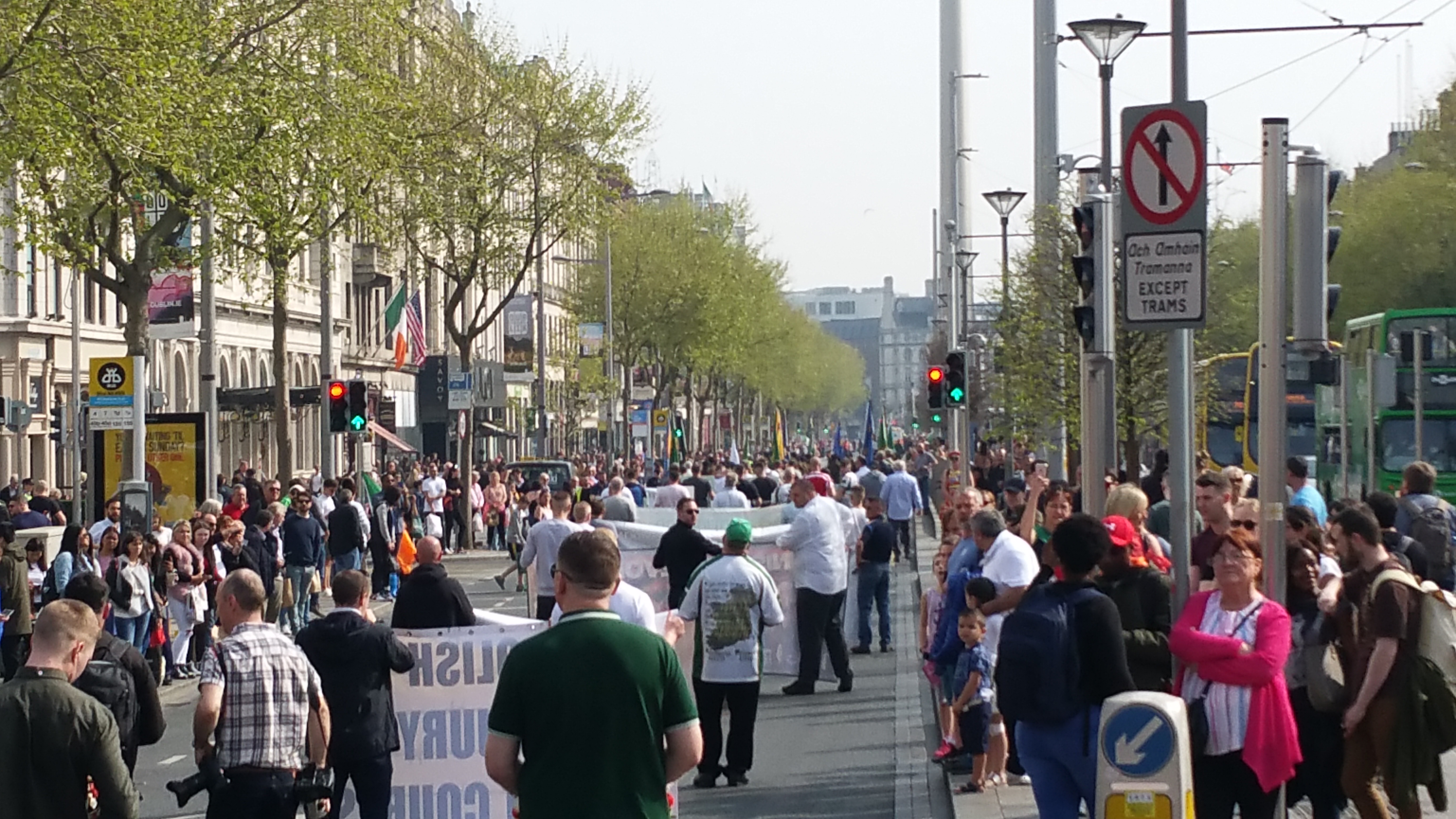
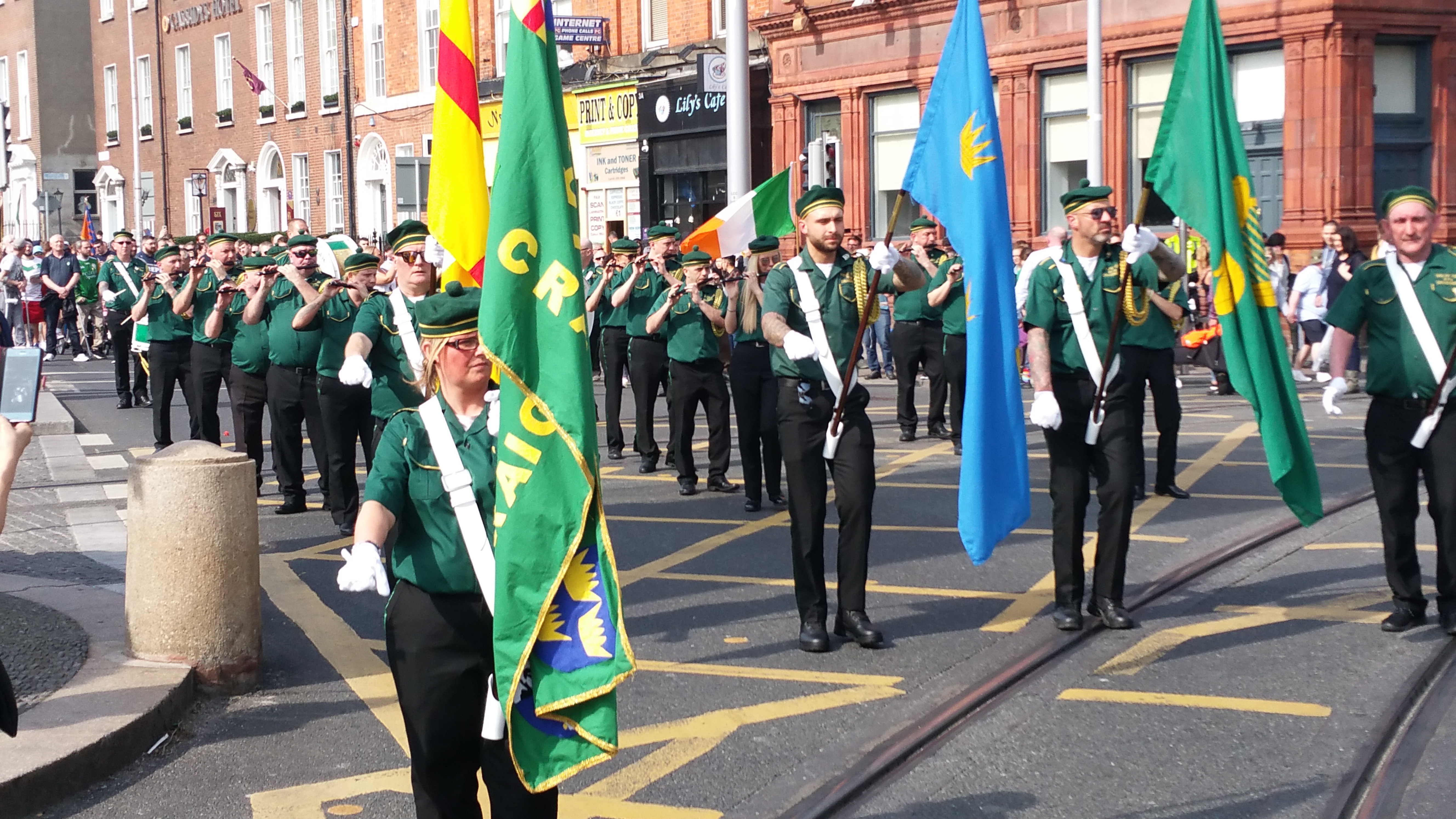
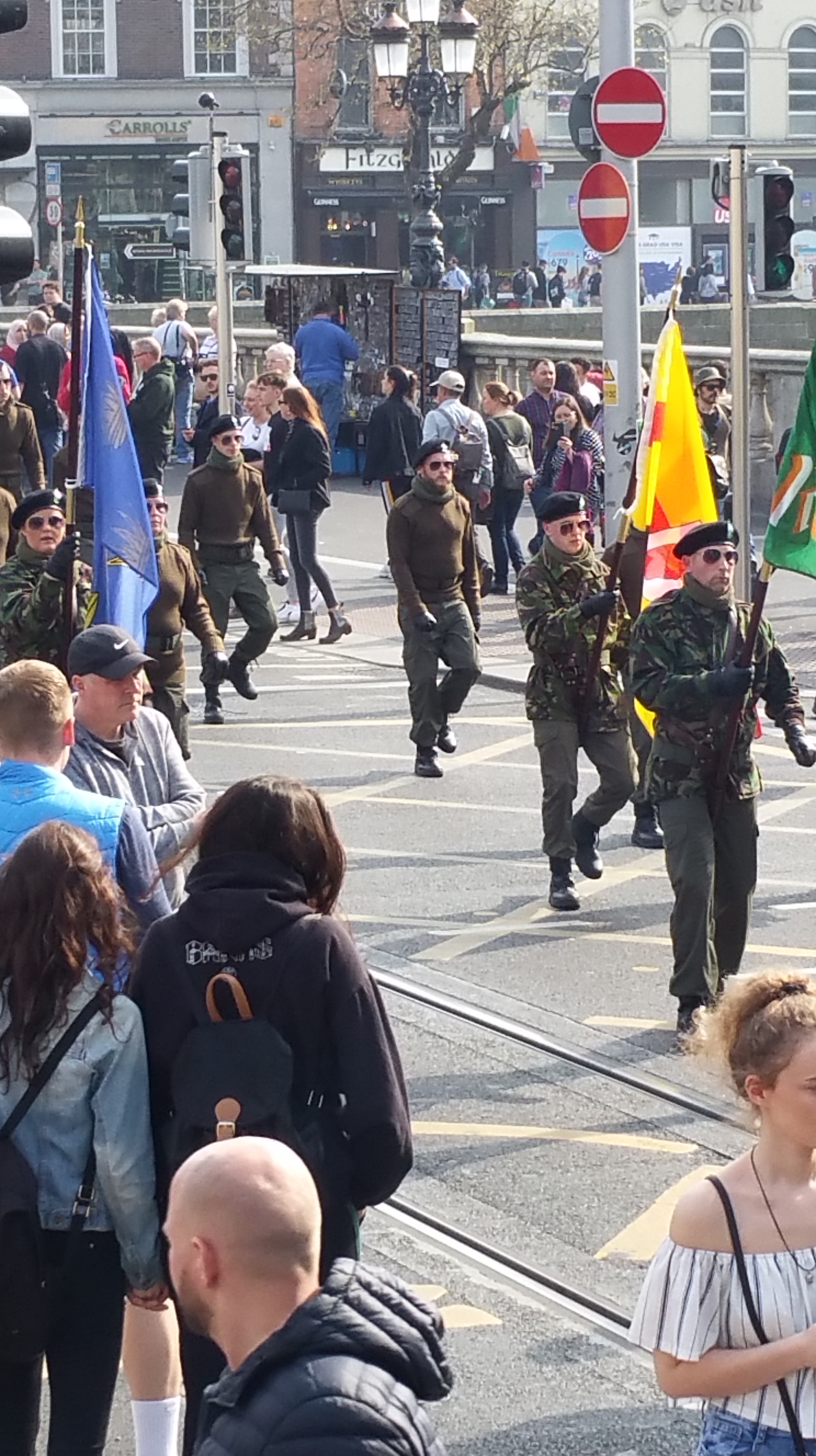
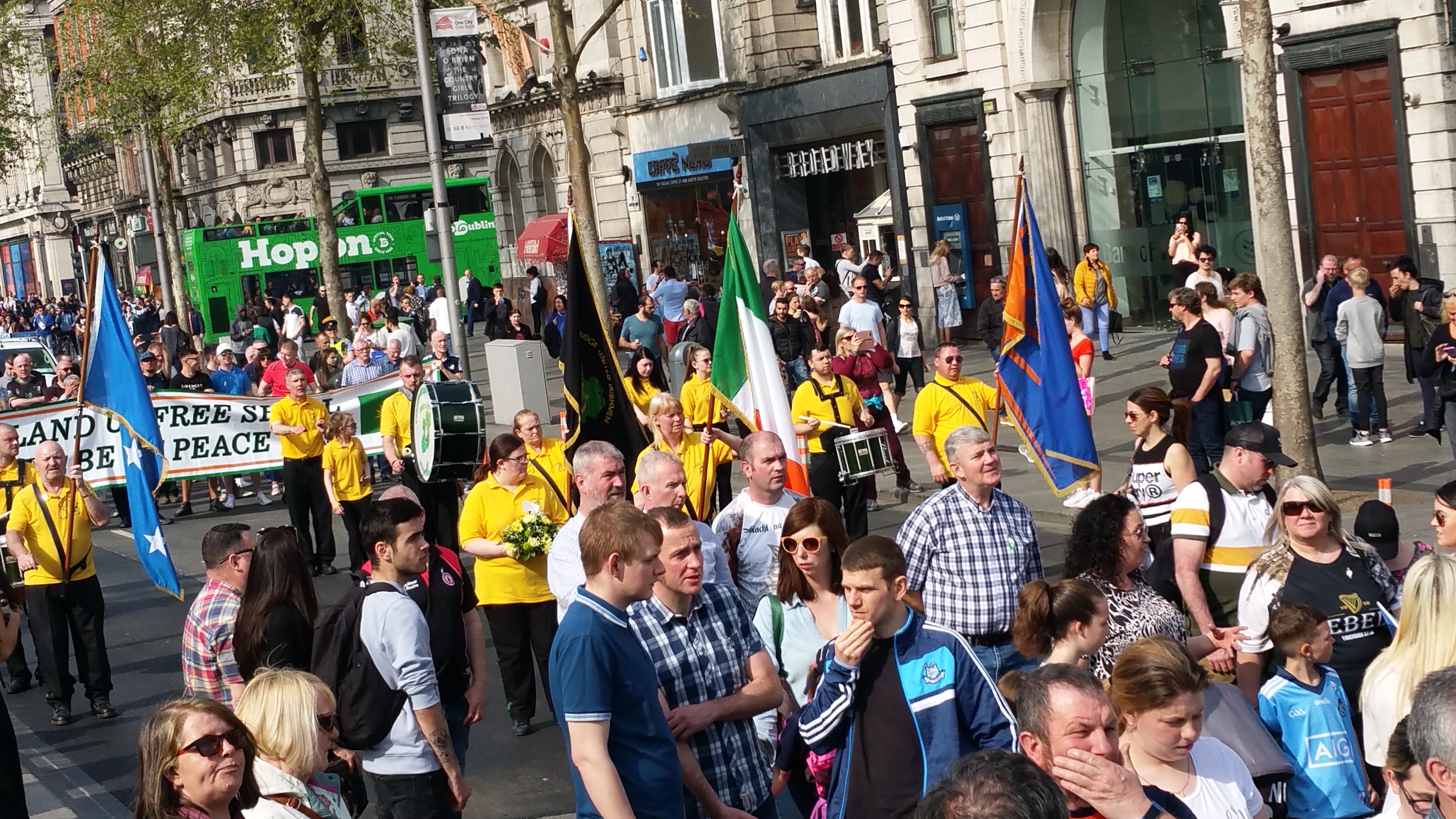
The Irish Republican organisation Saoradh staged a large demonstration of its support on Dublin’s O’Connell Street on Saturday afternoon (20th April). Republican marching bands and hundreds of supporters followed the traditional ‘colour party’ flags and lines of men and some women dressed in green-brown military-style clothing, black berets and dark sunglasses.
view section of parade proceeding south along east side of O’Connell St.
Beginning at the Garden of Remembrance, the procession, carrying large portraits of the executed martyrs of the 1916 Rising, wound its way down the main street past thousands of viewers, many of those taking photos and filming, down to the wall of Trinity College and the Bank of Ireland building, then back up Westmoreland street and up the west side of O’Connell Street to the GPO building, the site of the HQ of the Rising in 1916, for speeches as the ceremony of the commemoration.
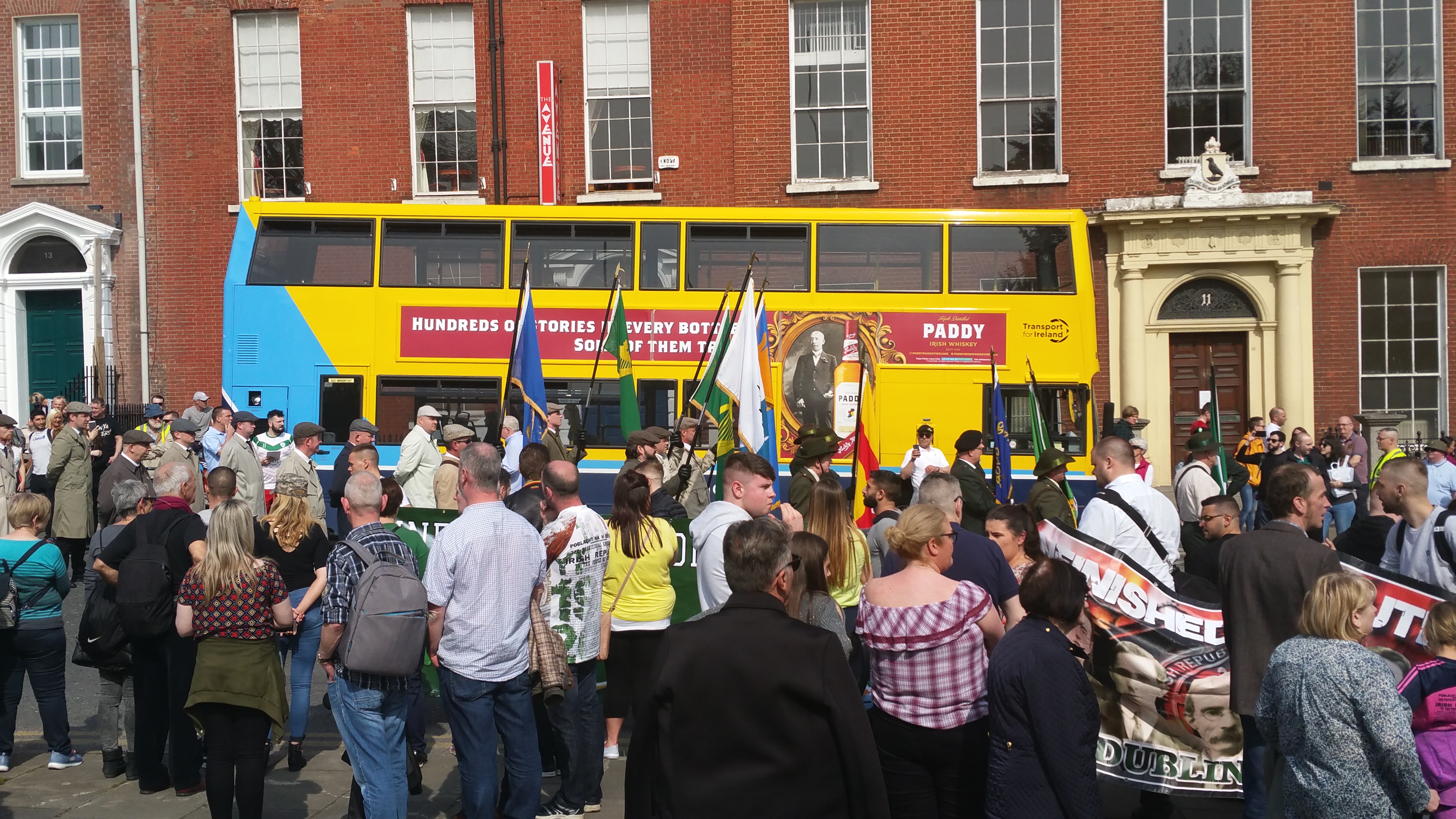
Parade forming up at Garden of RemembranceThe Wolfe Tone RFB from Craigneuk, Glasgow, at the Parnell St/ O’Connell St. junctionLong view of section of the parade proceeding south along the east side of Parnell Square.
The parade assembled at Dublin’s Garden of Remembrance and remained there for some time without the reason being clear, until the arrival of the participants dressed in green-brown military-style clothing, black berets and dark sunglasses, which many in the waiting crowd applauded. Presumably these were meant to represent the IRA but from the physical appearance of many it was clear that their active duty days, if they had them, were behind them. Presumably too, any organisation that did have an armed section would be reluctant to offer them up to the State for arrest on a parade and their all appearing at the last minute like that was also perhaps to reduce the opportunity for Garda harassment.
Another colur party but in War of Independence (1919-1921) period costume at the Garden of Remembrance, waiting to begin.
However, the uniformed Garda presence was in low numbers and although the Special Branch had officers there, they did not appear to be harassing Republicans for their names and addresses, as is their usual wont.
The route of the parade had been prepared placards bearing the words “The Unfinished Revolution” and “Saoradh” with tricolour flags attached at intervals to traffic sign and street light posts, including also at least one Palestinian flag. As the colour party and people in uniform lined up with banners and a band behind them and set off down towards the city centre, people joined in behind the band, with another band bringing up the rear.
TRAGEDY AND CONDEMNATION
The crowd appeared to contain many different elements, mostly men but quite a few women, some parents with small children and some teenagers, young men and older. Included among the attendance were a number of independent Republicans and socialists and a number expressed their decision to attend as having been influenced by the tragedy of the previous Thursday and the media campaign against ‘dissident’ Republicans, along with the apprehension that the Gardaí might take advantage of that to block or harass the paraders.
A scheduled Easter commemoration by a committee including apparently members of Saoradh to be held in Derry on Easter Monday had been cancelled as a result of a tragic incident. The armed British colonial police force in the Six Counties, the PSNI, had been carrying out house searches in the Galiagh and Creggan areas of Derry, allegedly for arms, to which youth had responded with stones and petrol bombs. During that incident, a gun was fired from the direction of the youth towards the colonial police but struck Lyra McKee, a young female reporter standing near them instead. Tragically the wound was fatal.
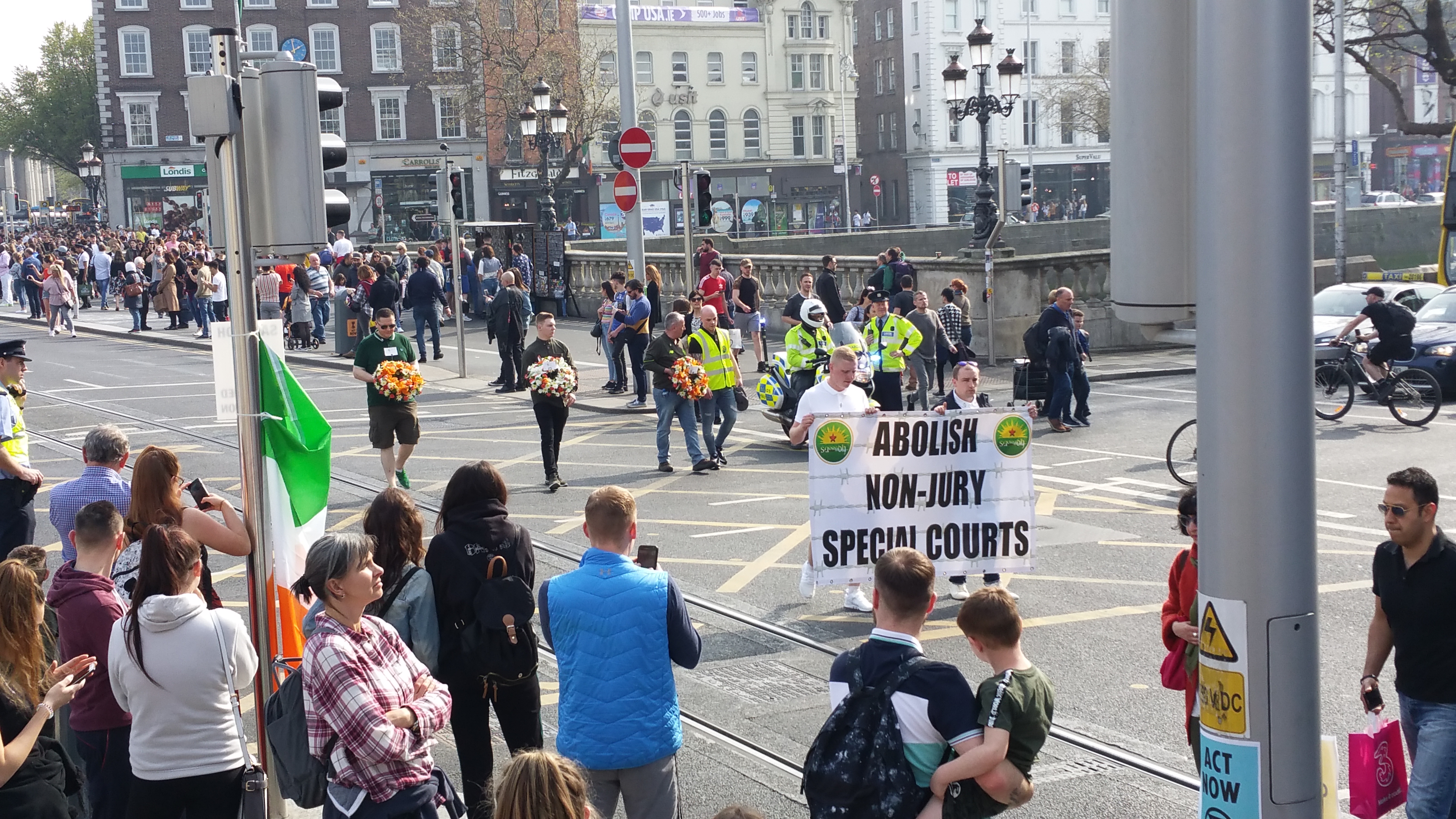
Section of banners coming back across O’Connell Bridge towards the GPO
Saoradh had issued a statement after the event expressing regret for the death and extending condolences to Lyra McKee’s family and friends but also putting the incident in the context of regular harassing raids by the PSNI on houses in ‘nationalist’ areas and the always likely result of resistance (see Links for full statement).
Possibly in reference to that tragedy, a very tall long-haired man stepped in front of a section of marchers with his hands in the air. Stewards quickly blocked him peacefully and diverted participants around him.
Past the objector and into O’Connell Street, both the east side pavement and the pedestrian middle reservation were thronged with people watching, photographing and filming. The parade passed on to O’Connell Bridge, into D’Olier Street, turned right towards the Bank of Ireland building and back up Westmoreland Street to the General Post Office, location of the HQ of the Rising in 1916, outside of which the 1916 Proclamation had been read on 24th April by Patrick Pearse with James Connolly by his side.
At the GPO, Saoradh party chairman Brian Kenna welcomed the participants.
Portraits of the executed 1916 martyrs being carried back across O’Connell Bridge
Section of the Coatbridge Unitedmen RFB, Glasgow, marching southward in O’Connell Street.
THE SPEECHES AND CEREMONY
At the GPO, Saoradh party chairman Brian Kenna welcomed the participants. Republican Easter Rising commemorations tend to follow an established pattern, no matter which organisation is involved: the reading of the Proclamation; messages of solidarity from Republican prisoners; a speech by a representative of the organisation; the lowering of the flags to a drum roll and their raising again, in honour of the fallen; the singing of Amhrán na bhFiann, the Irish National Anthem. In the past, a statement from the IRA was also read but in recent years this have not been customary, for a number of reasons.
The usual components of the ceremony were present on Saturday outside the GPO with a few variations: a poem by a supporter read out, “James Connolly, the Irish Rebel” sung by another and “Róisín Dubh” played on the uileann pipes. The James Connolly song, with some powerful imagery and an attractive slow air, gives no indication whatsoever of the man’s revolutionary socialism and seems to incorporate him into the IRA, instead of the Irish Citizen Army which he co-founded or even of the Irish Volunteers, with which he joined forces only weeks before the Rising.
In the distance at the GPO, Chairperson of Saoradh Brian Kenna, MC of the event
The RFB (Republican Flute Band) marching bands were from Scotland: The Wolfe Tone RFB Craigneuk and theCoatbridge Unitedmen RFB. One of the bands played “Take It Down From the Mast, Irish Traitors”, the lyrics of which deny the Tricolour to the Free Staters who waged the Civil War against the Republicans, the legitimate bearers of the flag. A participant remarked that the song was sung first against Free Staters, later against Fianna Fáil, later still against the “Stickies” and more recently against Sinn Féin.
In his speech on behalf of Saoradh, Dee Fennel from Belfastbegan by sending solidarity messages to Republican prisoners in Irish jails and to the relatives of all those who had fallen in the struggle against British imperialim. He said that the objectives set out in the 1916 Proclamation had not been achieved and referred to those participants in the struggle who had left it along the way, some to collude in upholding the two failed states of the divided nation.
(at right of photo) Dee Fennel of Saoradh delivering the main oration at the GPO
Referring to his own activism, Fennel recollected how four years previously he had spoken at an Easter commemoration as an independent Republican, i.e not a member of any political party. He had spoken of the need for Republican activists to engage more with one another and also in the struggles of communities, women and trade unions. Fennel said that as a result of a discussion among Republicans, some had formed Saoradh, building on “maturity and commitment” while others “retreated to their flags” and went on to list the wide areas of struggle in which he said Saoradh activists could be found.
Fennel also referred to the activity of the IRA and said that while British imperialism remains in possession of a part of Ireland and prevents the exercise of sovereignty of the nation, there will be some form of armed resistance and that this is borne out by history.
Referring to the harassment and persecution to which Fennel said Saoradh activists were being subjected, including “tens of thousands of stop-and-searches, hundreds of house raids”, he linked that to the PSNI raids in the Creggan area of Derry earlier that week and the tragic accidental killing of Lyra McKee when “a Volunteer fired shots at PSNI forces”. Going on to say that the IRA do make mistakes from time to time, and referring to two women killed by the Provisional IRA in error years before, Fennel said that the IRA should admit and apologise for their mistakes (NB: The New IRA did later issue an apology and express condolences), though he also said that no words could compensate for the feeling of loss.
In reference to Brexit, Fennel said that the discussion is being focused on what kind of Border is to be imposed, while Republicans object to any kind of Border whatsoever. He stated that as socialists they also object to “the increasingly neo-liberal EU” and concluded with a call for solidarity with Irish Republican prisoners “in Maghaberry, Portlaoise and Mountjoy” who “are in captivity for no other reason thantheir commitment to Republicanism and a 32-county, secular socialist Republic.”
Salute to the fallen as drums roll and flags are lowered slowly and then raised slowly.
TRADITION OF THE PAST AND CLAIM ON TOMORROW
Republican organisations tend to commemorate the Easter Rising not only as a historic event but also to highlight that for which the Rising was fought has yet to be achieved. But they also do so to show that they are here, present, working for those objectives and often, to promote their organisation, to attract support.
The display involved in this Easter commemoration was impressive (despite a media claim that the numbers were only “around two hundred”), particularly in view of the inevitable bad press following the death in Derry and the system politicians’ statements on what a social media poster dubbed “The Opportunist Condemnatory Bandwagon”. It also seemed to show an organisation not much harmed overall in Ireland by a recent split over an alleged lack of internal democracy.
end.
Floral wreath carriers re-crossing O’Connell Bridge in the parade on their way to the GPOFloral wreath from the Information Group of SwedenFloral wreaths deposited outside the GPO (at the window where the Cúchulainn sculpture symbolises the 1916 Rising.
The campaign against continuing internment in Ireland had a visible presence in Dublin’s premier and busy shopping area, Henry Street on Saturday 6th April.
Photo: Dublin Anti-Internment Committee
Republicans and socialists from a number of organisations — and none — supported the picket, called by Dublin Anti-Internment Committee as part of its ongoing campaign to raise awareness that internment without trial of political activists continues in Ireland, though on a much-smaller scale.
Hundreds of leaflets were distributed to shoppers and sightseers and only one complaint was received – that there wasn’t a petition to sign!
DAIC member handing out leaflets to passing members of the public (Photo: Dublin Anti-Internment Committee
If any reminder were needed that internment is continuing in Ireland, it was provided recently with the case of former Republican prisoner Alan Lundy, who was recently jailed without charge and released some weeks later, being yet again detained and put straight into jail, again without trial or even charge.
IF YOU WANT TO HELP
If you live in Dublin and would like to help, why not join the DAIC at the next picket? These are roughly on a monthly basis. The DAIC is completely independent of any political party or organisation and organises itself in a democratic manner – however, it is a participative democracy, in that the people who attend public awareness-raising events are those who make the decisions at notified committee meetings.
If you don’t live in Dublin, you could share our posts from time to time ….
Photo: Dublin Anti-Internment Committee
HISTORICAL NOTES
The Proclamation of Independence was signed in what was then an Irish foods and coffee shop, No.21 Henry Street, about a week before the Rising.
During the actual Rising, the street saw much firing from British troops closing in on the GPO from both directions, east and west. An advance of British soldiers from the west was halted by a Volunteers’ ambush somewhere near where this picket was.
end.
Photo: Dublin Anti-Internment CommitteeThe plaque commemorating the signing of the 1916 Proclamation of Independence at No.21 Henry Street. (Photo: D.Breatnach)
A brief account of the fascist horror between Cantalpino and Villoruela (Salamanca) during the Spanish War, forwarded to me for translation from Castillian (Spanish). I will post the original separately.
Diarmuid Breatnach
Comment: If another reason were ever needed to ensure we crush fascism before it gets strong! Stories like this illustrate how fascism was not defeated, much less rooted out in the Spanish State and remains at its heart to this day. No progress can be made towards democracy in that state without taking that fact into account. DB.
(Translator’s note: Villoruela is a municipality located in the province of Salamanca, Castille and León, in western Spain).
Alejandra, the interviewee, who was raped in front of her husband, next to her while a gun was held to his chest.
Fear ravaged Cantalpino, where the Falangist hordes killed a woman and 22 men; where they robbed and raped. Mrs. Alejandra tells the story and her eyes seem to look inside herself: “They murdered many here and Eladia Pérez, the Jaboneta, too. They went looking for her son Guillermo, whom they “took for a walk” later, and she did not want to open for them; so the bastards shot and killed her; then they took her to the cemetery and her body did not fit in the hole and the bastards cut off her head with the shovel … the murderers were people from the town and strangers, Falangists, priests, friars and that kind. The priest was the worst, he gave his blessing to the “walks” .. They also cut the hair of about a hundred women to the scalp and, in the rain and everything, they took them in procession, the music playing and the Falangists shouting “Up Spain!” and “Long live Franco!” and … I shit on the mother who gave birth to them! “
Alejandra continues with her story: “… they did a lot to me, they raped others. Five Falangists raped me. They took my husband out of bed, may the poor man rest in peace, and they pushed a pistol against him, in the chest, and there, in front of him, they raped me. Some had me by the arms and others, by the legs, and here, Saint Ines, to what they wanted to do, and the guns on the bed in the presence of my Desiderio. Poor Desiderio! They also stole everything they could. Yes, yes, they were from here, from Cantalpino. Unfortunately, this violation was not an isolated incident. In Poveda de las Cintas, a few kilometers from Cantalpino, the story was repeated, this time with the wife of the secretary of the town hall .. “
On August 24, 1936 the blood did not stop in Cantalpino, the impunity of the murders encouraged the Francoists. That same afternoon they appeared in Villoruela, less than 10 kilometers from Cantalpino, 3 Falangists accompanied by fascist neighbors of the town: They arrested the following people: Eustasio Ramos (51 years old), Elías Rivas (43), the brothers Leonardo (43) , and Leoncio Cortés (41), Daniel Sánchez (35), Esteban Hernández (29) Francisco García (25) and Benigno Hidalgo (18).
The fascists gave criminal replies to the families of the detainees when they went to look for them at home: Leonardo Cortés’ wife was asked where her husband was; she replied that she did not know and they answered: “Do not worry, even though he were underground, we will find him”. Daniel Sanchez had been risking his life to save the lives of other people with his mules and his cart to cross the flood, regardless of what color or what party they were. When they went to look for him at home, the woman said to them: “Wait, he is taking off his clothes, he is all wet”; the answer was: “Do not worry, he will get it all the same”. When they went to Esteban Hernández’s house, his mother told them: “wait, he does not have socks”; the answer was: “Do not worry, he will not need them”. When they went to look for Benigno Hidalgo, his mother told them: “I have to give him an injection”; “Do not worry, we’re going to give it to him,” they replied.
Once captured, they were arrested at the City Hall tied hand and foot with ropes. The members of the City Council called a meeting and decided that the 8 detainees should be shot. So bound, they were put on a truck in Villoruela, after midnight, and they were moved to the end of Salvadiós, a town in the province of Ávila. There, at a crossroads, they were shot and left lying in a ditch. Right there they were buried by neighbors from Salvadiós. The murderers were 7 from the town, the one that drove the truck and the 3 outsider Falangists.
Two of the detainees’ wives, María Engracia Cortés and Angeles del Pozo, went to ask for help from the nuns of the convent. They told the nuns what was happening and the nuns answered that this was a crusade, and that if they had not done anything why had they had been fleeing, to which the neighbors correctly answered: “Jesus Christ was also persecuted and though had done nothing, was crucified. “
Jaime Cortés, the son of one of those shot, said that “after the suffering they caused, the fascists appointed among the townspeople a policeman, allegedly civic, to control our movements from home, the demonstrations of suffering. We spent the whole night crying with my mother and my grandparents in the kitchen .. it takes a lot of patience and resignation to live a lifetime with the criminals who shot your father .. We had to go through calamities and sufferings … I always remembered very well a phrase that my mother told us very often: “Children, I never want to see you with blood on your hands” … the only reasons for which they were shot were their way of thinking differently from the Franco regime, that is, to defend freedom, the rights of workers, social security and education … they were shot for defending the largest right of all person: freedom .. “
From the date August 15, 1936 to June 16, 1939, there is no document or record book of the Villoruela archives. Who were the ones who made that documentation disappear? In the book of death certificates for March 13, 1937 the entry inscribed by the judge Iñigo de la Torre these 8 people shot dead are listed as missing.
Originals by Ángel Montoro in Jiminiegos36 and Foro por la memoria (Intervíu nº 177, 4-10 October 1979). Photo by Xavier Miserachs
On Tuesday March 5th a meeting in the Teachers’ Club, Parnell Square, was addressed by representatives of the Western Sahara people and by experts in human rights matters.
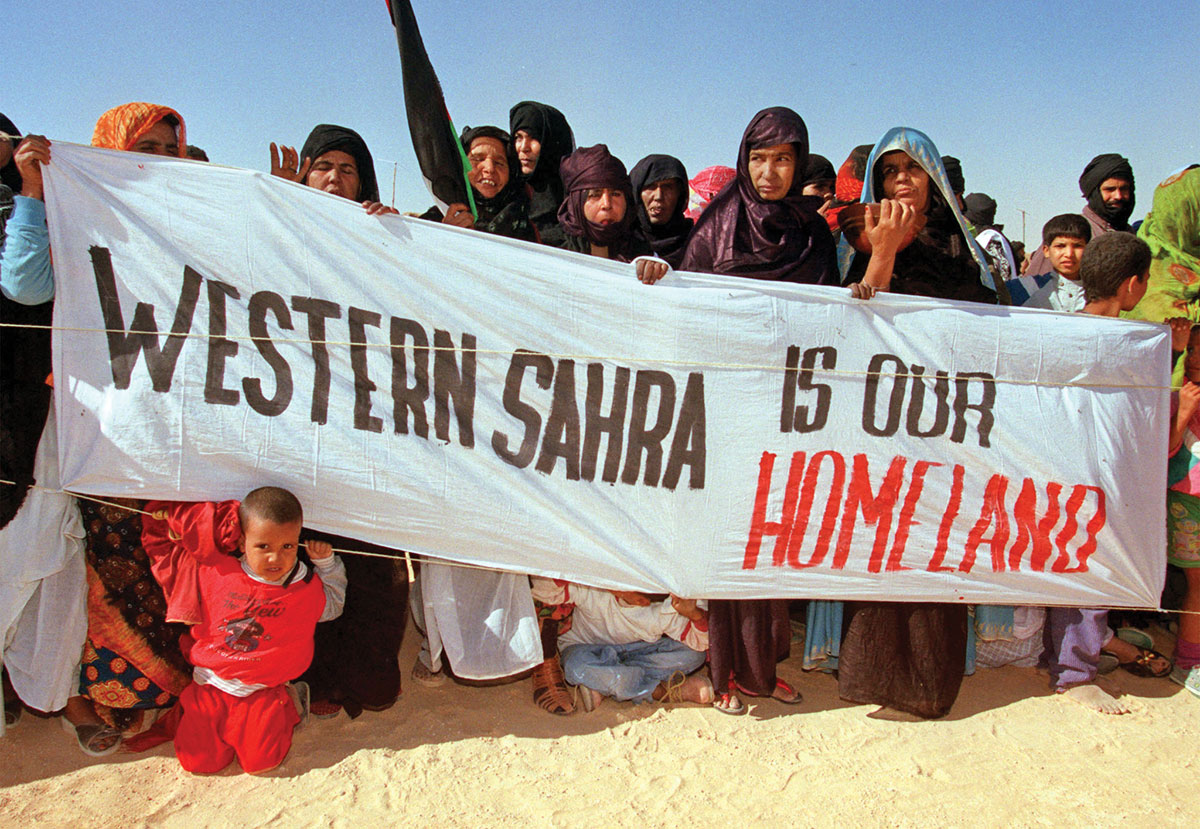
2015 protest by Saharawis, mostly women. (Photo source: Internet)
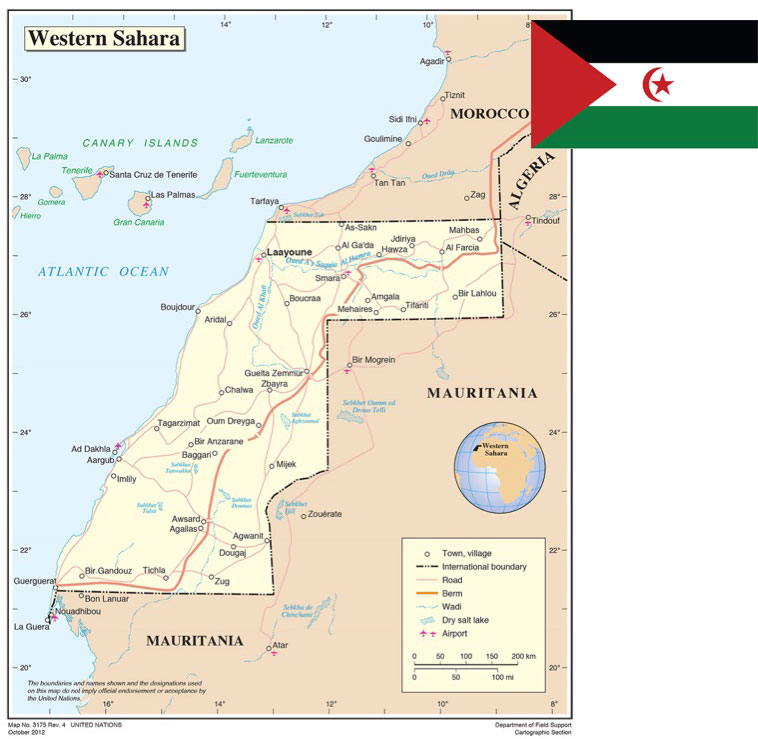
Western Sahara, a territory of 266,000 square kilometers (103,000 sq. miles) in the Maghreb, was part of Europe’s carve-up of North Africa, when it was known among most states as Spanish Sahara, in acknowledgement of the European state that occupied it. Its people speak Arabic and Castillian (Spanish) and some also speak French, an influence from neighbouring French ex-colonies. Few speak Berber.
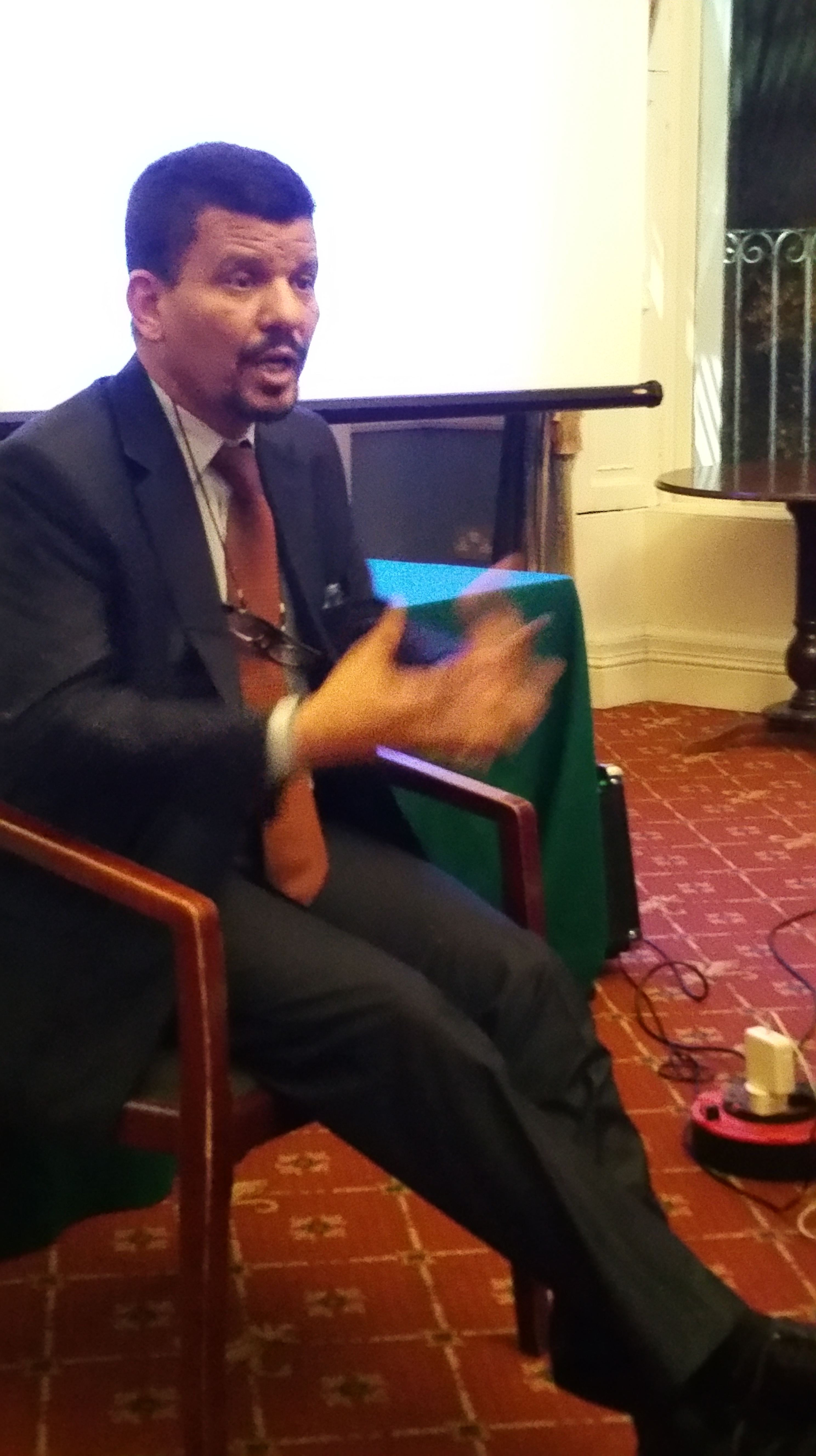
Mohamed Belsat of the Polisario speaking at the event (Photo: D.Breatnach)
The UN General Assembly in 1964 called on Spain to hold a referendum there which the Franco fascist regime declined to do but in 1975, after the dictator’s death, the new regime pulled out of the territory, practically handing it over to Morocco and Mauritania. After a conflict between those two states, Morocco emerged as the sole occupier and the conflict since then has been between the Kingdom of Morocco and the Saharawi people, who seek independence.
Chaired by Mark McLoughlin, filmmaker, the Dublin meeting had been arranged at short notice and its advertising further hampered by cancellation of a booking at Trinity College.
TRACING THE PLUNDER OF SAHARAWI NATURAL RESOURCES
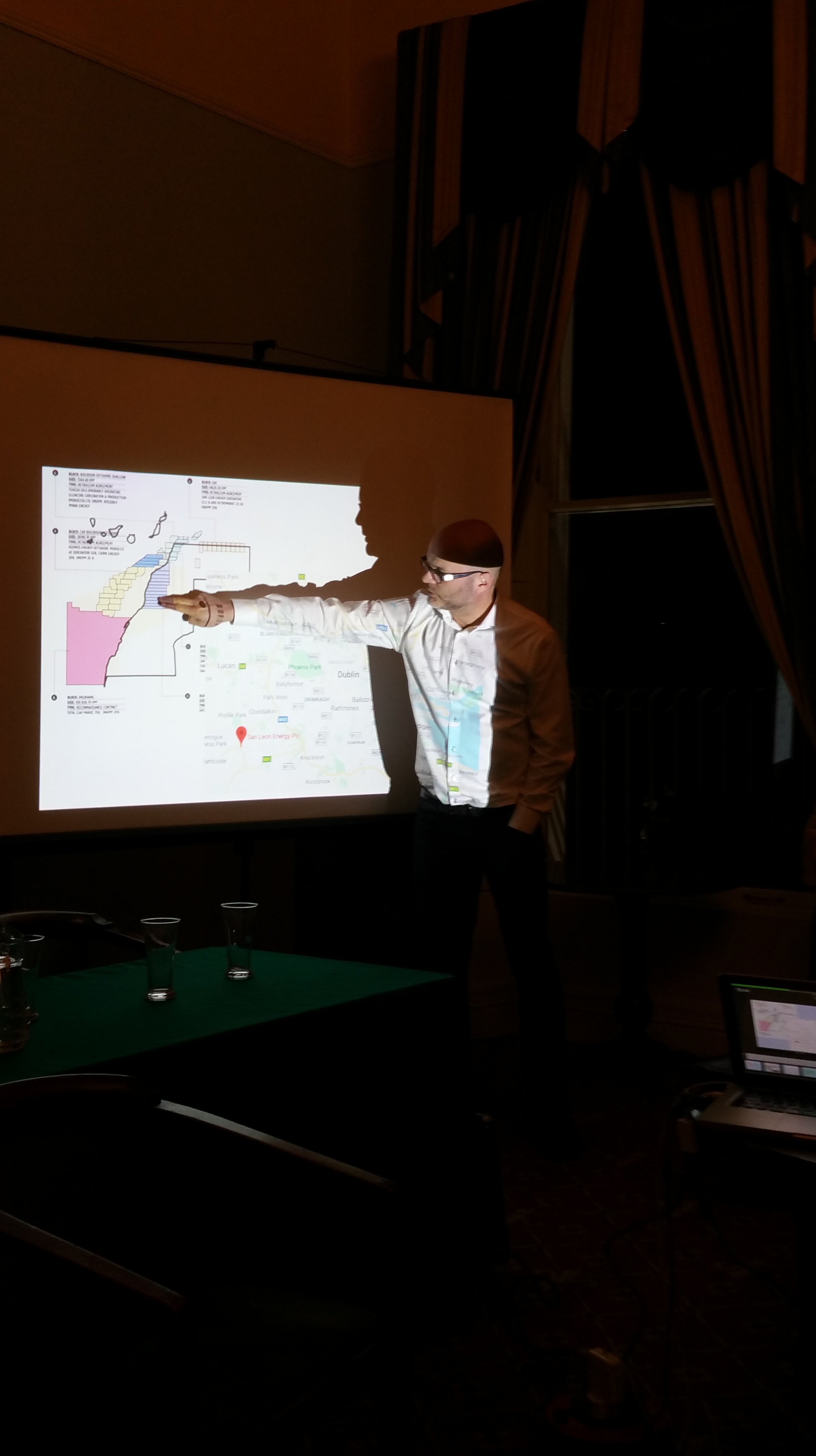
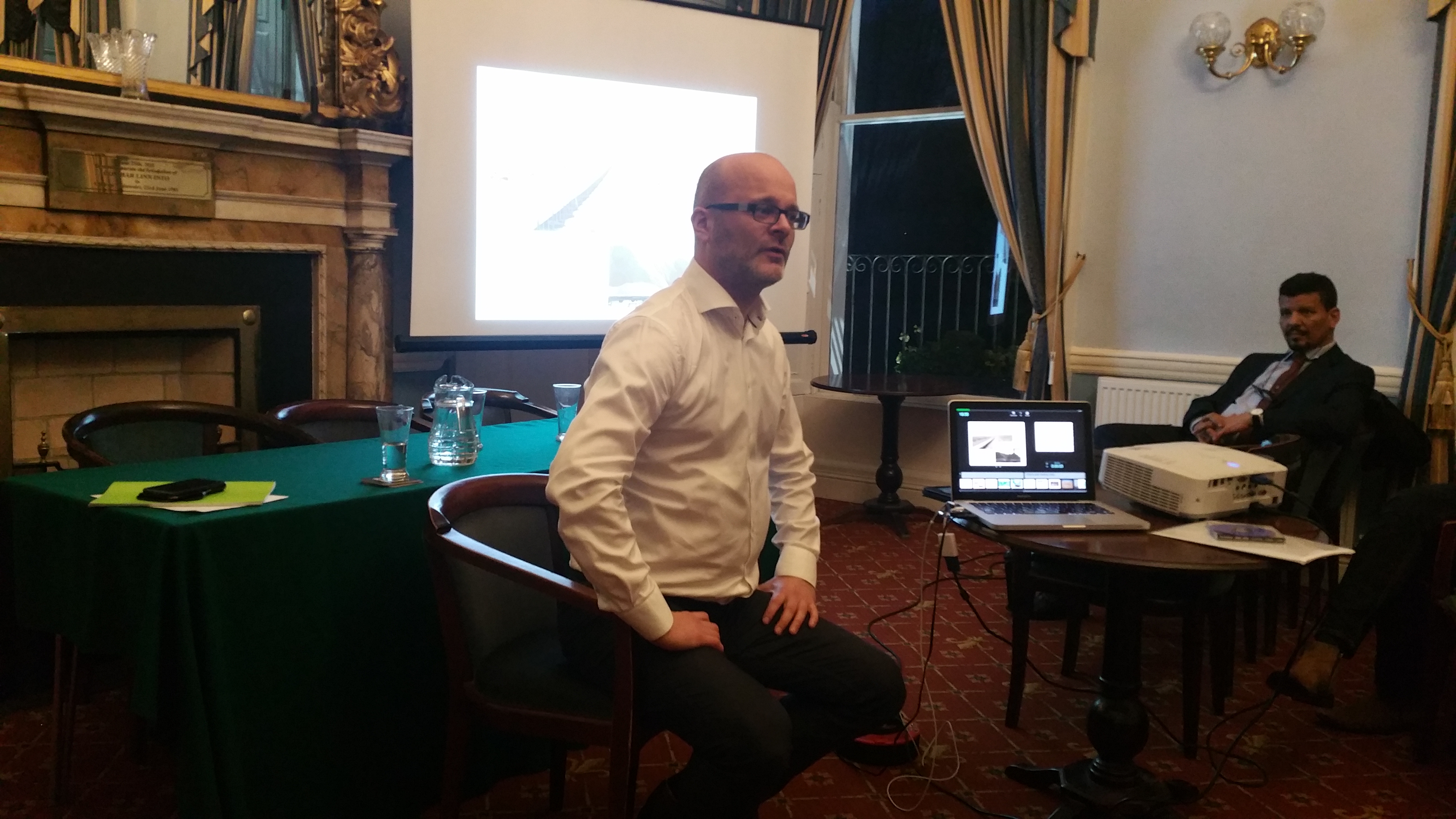
Erik Hagen, of Western Sahara Resource Watch, with a display projected on a screen, showed how his organisation traces the ships arriving at the territory and departing with phosphates mined there to their destinations. From the registered tonnage of the ships, the amount of phosphates plundered can be calculated. The companies involved claim that they are doing no wrong, since they pay Morocco for the cargoes.
Mark Hagen illustrating a point with reference to the display. (Photo: D.Breatnach)
But according to the UN, no state may extract resources from a disputed territory without the consent of the people. Hagen talked about how EU had changed the wording to replace “consent of” with “being of benefit to” and then went on to effectively falsify agreement on ‘benefit‘, using a document on consultation with huge majority – and a total of Saharawi organisations – voting against as evidence for.
The only company currently exploring for oil in Western Sahara is San Leon, an Irish company, although they failed to find any and are currently fighting in financial difficulties.
Clive Symmonds, expert in international law talked about the policy of isolating produce from occupied territories, by first compelling their labeling as such, which, although that would not ban the products, would facilitate a ban if such were decided. The Control of Economic Activity (Occupied Territories) Bill 2018 introduced to the Oireachtas (Irish legislature) and currently being processed with cross-house support despite Government opposition, is an example of how such a ban may be implemented (and Senator Black’s Bill will also be valid for Western Sahara). Of course, as Symmonds pointed out, such labeling is left to the exporter which in this case would be the Kingdom of Morocco.
Clive Symmonds speaking on human rights legislation and W. Sahara (Photo: D.Breatnach)
Symmonds also referred to the EU Fisheries Agreement which, in permitting fishing within what Morocco claims as its territorial waters without reference to the Saharawi people, is permitting the plunder of the Saharawi people’s fish stocks – and the Irish State is a party to this, having signed the Agreement. Symmonds pointed out that the judgement of the European Court of Justice on 21st December 2016, stated that Western Sahara is a “separate and distinct” territory from Morocco and that trade agreements between the EU and Morocco do not apply to the occupied territory. The EU is in violation of this judgement.
“A REFERENDUM IS THE ONLY DEMOCRATIC WAY”
Mohamed Belsat, Frente Polisario Ambassador to Europe, talked about the policies of the Irish state, the EU and, in particular, France. Belsat said that they were in collusion with the Kingdom of Morocco and that in particular, France often seemed to be the opponent of the Saharawi people even more than Morocco.
Referring to what he said was the only democratic of ascertaining the will of the Saharawi people, Belsat said that it was a referendum. Morocco had called for this since they had flooded Western Sahara with Moroccans but, since the process of registration of genuine and historical residents of the area had been completed by the UN, the Moroccan Kingdom had withdrawn all support for a referendum.
(Photo: D.Breatnach)
“The cost of the occupation to the Moroccan kingdom is huge, in terms of military presence maintenance and so on,” Belsat said, adding that the cost of every litre of water supplied to the occupation forces was equal to four times the price of a litre of whiskey.Furthermore, the cost to the Kingdom exceeded the benefits it extracted from the colony. In January, Morocco had at last joined and signed up to the constitution of the African Union, the organisation of African states, of which Western Sahara is a founding member and which has a long-standing position on Western Sahara being an occupied colonyFor all these and other reasons, including dissatisfaction with the regime among the Moroccan general population, he felt that a campaign of pressure on Morocco and on the EU might well bear fruit in terms of the decolonisation of this “last colony in Africa”.
Later, Belsat’s response to a question from the audience amounted to an admission that there was no “peace process.” (sic) in operation (despite a reference to it by a number of speakers) and that as a result of this and the conditions under which they were kept by their oppressors, it was increasingly difficult to restrain the youth from resorting to armed resistance. At this a member of the audience commented that armed struggle against the army of the Moroccan Kingdom backed up by France would be “suicidal”.
“57 POLITICAL PRISONERS BUT MANY MORE HAVE DISAPPEARED WITHOUT TRACE”
ElGhalia Djimi, Vice-President of ASDH (Saharawi Association of Victims of grave violations of human rights by the Moroccan State), which cooperates with the League for the Protection of Western Sahara Political Prisoners in Moroccan Jails (LPPS), who had arrived in Ireland that day, made her presentation next. Speaking in French through a translator, Djimi talked about the conditions of life under occupation for the Saharawi people. Djimi showed a compilation of clips of soldiers, police and people in civilian clothes physically assaulting protesting Saharawi women, pulling their hair, punching and kicking them and informed the meeting that those in plainclothes were Moroccan police.
ElGhalia Djimi speaking on Moroccan Kingdom repression of Saharawi people (Photo: D.Breatnach)
“There are 57 Saharawi political prisoners in Moroccan jails,” ElGhalia Djimi said, “but many more that have disappeared without trace.”
Unemployment is high among the Western Sahara people and as a result of that and other deficiencies in their lives, a drug problem has arisen, she told her audience. There are no third-level education facilities in the territory, obliging them to go to institutions in Morocco. Although they can study to gain professional qualifications for civil employment, those available are not usually those required by the employers, which is not true for their equivalent in Morocco, with the result that often Moroccans fit into the administrative jobs better than do the Saharawi people. In terms of their treatment by the authorities, all Sahawaris carry a Moroccan ID card but letters on it indicate their ethnic origin (which Belsat likened to the Nazi State’s requirement that German Jews by identifiable in their national ID documentation).
Moroccan citizen settlement in Layoune, the capital of Western Sahara, had now placed the indigenous people, once the majority, in a minority.
Mark Hagen, of Western Sahara Resources Watch. (Photo: D.Breatnach)
SOLIDARITY IN DUBLIN
In conclusion of the speakers’ presentations, Mohamed Belsat asked for support from the Irish people with their “history of struggle for freedom and solidarity with other struggling nations”‘
A couple of members of the audience mentioned that there had been an active solidarity committee with Western Sahara in Dublin in the past and one wondered about the possibility of resuscitating it.
Comment: The solidarity Committee in Dublin was independent of any political party or organisation, its name was Western Sahara Action Ireland and its FB page is still in existence. Between 2011 and 2012, the group organised a number of public events, including: two protests about Moroccan repression of Saharawi protesters, one in Dame Street and another in O’Connell Street; a protest against the EU’s Fisheries Agreement outside the Dublin offices of the EU in Dawson Street; the construction and maintenance of a “Western Sahara Tent” at the Electric Picnic of 2012, along with an exhibition of photographs taken in the territory. The latter was visited by Michael O’Higgins who was then campaigning for the Presidency of Ireland (he also appeared in the film shown at the beginning of public meeting in Dublin).
On each of the Dublin street events, a small group of Moroccans had attended to harass and attempt to intimidate the protesters, almost certainly sent by the Moroccan Embassy but their efforts were to no avail.
Flag of the Western Sahara liberation movement. (Photo source: Western Sahara Action Ireland)
BACKGROUND
There had been many uprisings against colonial rule in the history of Western Sahara and the last Rif War, from 1920 to 1927, had cost the Spanish State military 23,000 casualties, of which 18,000 were fatalities. Only for the intervention of the French1, the forces led by Abd el Krim would have kicked the Spanish colonialists out of the footholds to which they were still clinging.2
Like the French in their North African colonies, the Spanish occupiers had suppressed risings not only by military force against insurgents and torture of captives, including electric shocks, but also by terror against the civilian population, including assassinations, massacres, rape and internment without trial.
Both European states also developed their own Foreign Legions. Forget about the 1924 Beau Geste novel by PC Wren and the various screenplays3 to which it gave rise; the Foreign Legions were tough terrorists in uniform, founded not to fight in open war but against resisting colonial peoples.
Since 1963, Western Sahara has been on the United Nations’ list of “non self-governing nations”. In 1965, the UN General Assembly, in its first declaration on Western Sahara, called on the Spanish State to decolonise the territory and, in 1967, to hold a referendum on self-determination but Spain refused. From 1973 to 1975, the Frente Polisario fought an armed struggle for national liberation.
Western Sahara in context. (Source image: Internet)
After the Spanish State abruptly pulled out in 1975 (following the death of its fascist dictator General Franco) and – without allowing elections of an independent Saharawi government before doing so – it relinquished control to the Kingdom of Morocco (which had formally claimed the territory since 1957) and Mauritania and conflict broke out between those states. Mauritania in time abandoned its claim and Morocco moved in and seized Western Sahara.
The Saharawi people protested Morocco’s occupation of their land and were suppressed by military and police. The Frente Polisario fought the occupying Moroccan military from 1975until a UN-brokered ceasefire in 1991, since which there has been no Saharawi armed struggle but plenty of Moroccan repression. One of the features of the struggle was the displacement of a large part of the Saharawi population as people fled the Moroccan military, many to Algeria (which had won independence from France in 1962 after a fierce and dirty war), where they remain in a refugee camp. The Moroccan Kingdom then built a wall to prevent Saharawis from returning, which it guards by troops and miles of landmines.
End.
FOOTNOTES
1The casualties of the French, according to Wikipedia, amounted to 10,000 with 2,500 killed in battle. The casualties of the insurgents and of the indigenous civilian population, as usual in these situations, is difficult to determine but, according to Wikipedia, came to 30,000, of which 10,000 were fatalities.
2For more on the Rif War 1920, read the article about it (see link in Resources and Useful Links).
3Including those of 1939 starring Gary Cooper and Ray Miland, 1966 with Telly Savalas and Doug McClure and the BBC serial of 1982.
With thanks from Dublin Anti-Internment Committee’s FB page End Internment
DUBLIN PICKET PROTESTS CONTINUING INTERNMENT IN IRELAND WHILE EXPRESSING INTERNATIONALIST SOLIDARITY WITH PALESTINIAN PRISONERS.
PALESTINIAN Y0UNG WOMAN PRESENTS PICKETERS WITH BUQUET OF FLOWERS.
HUNGER STRIKER MARTYRS OF 1981 REMEMBERED.
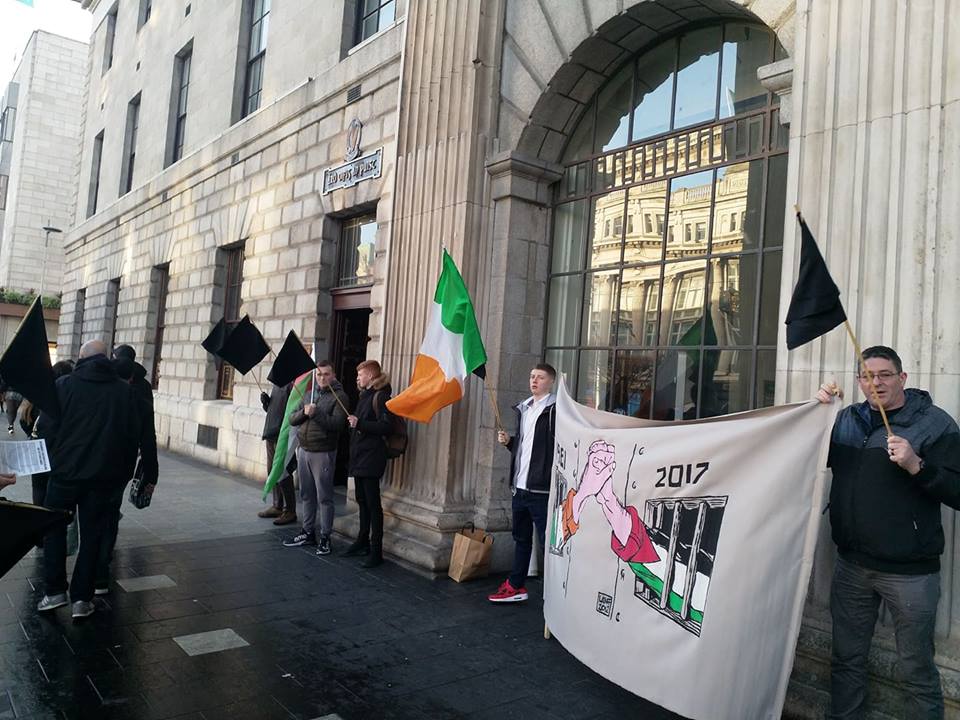
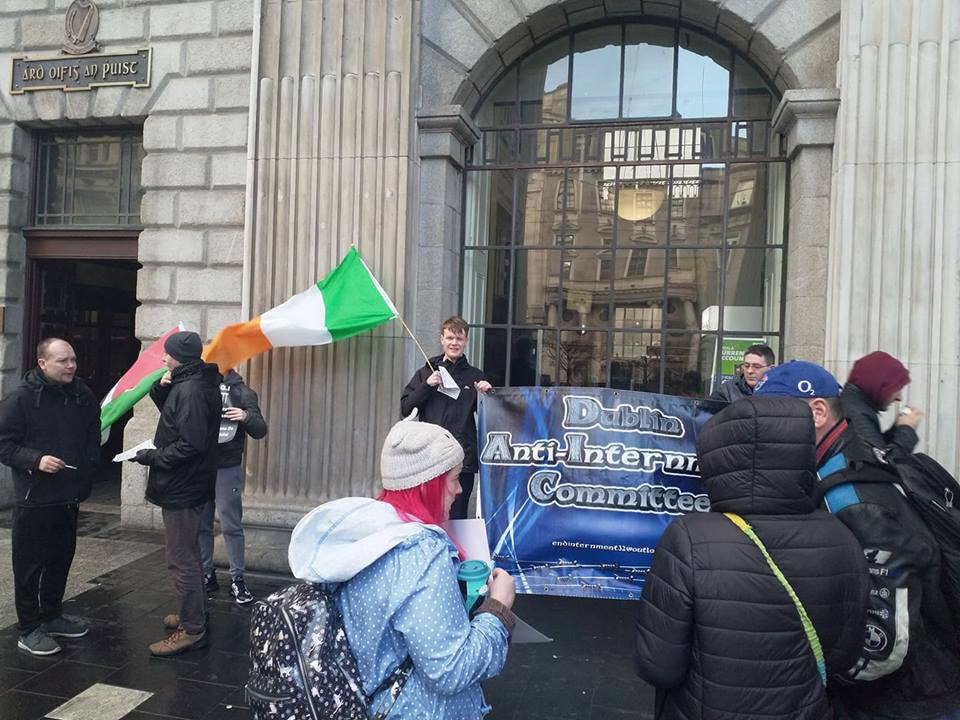
Section of the protest outside the GPO building (photo: Dublin Anti-Internment Committee)
On a cold and wet late Saturday afternoon (2/03/2019) in Dublin city’s main thoroughfare, O’Connel Street, hurrying shoppers and tourists were treated to the sight of protesters outside the General Post Office. One group was flying small flags of a green, white and orange tricolour but not the Irish one – the colour bands were horizontal.
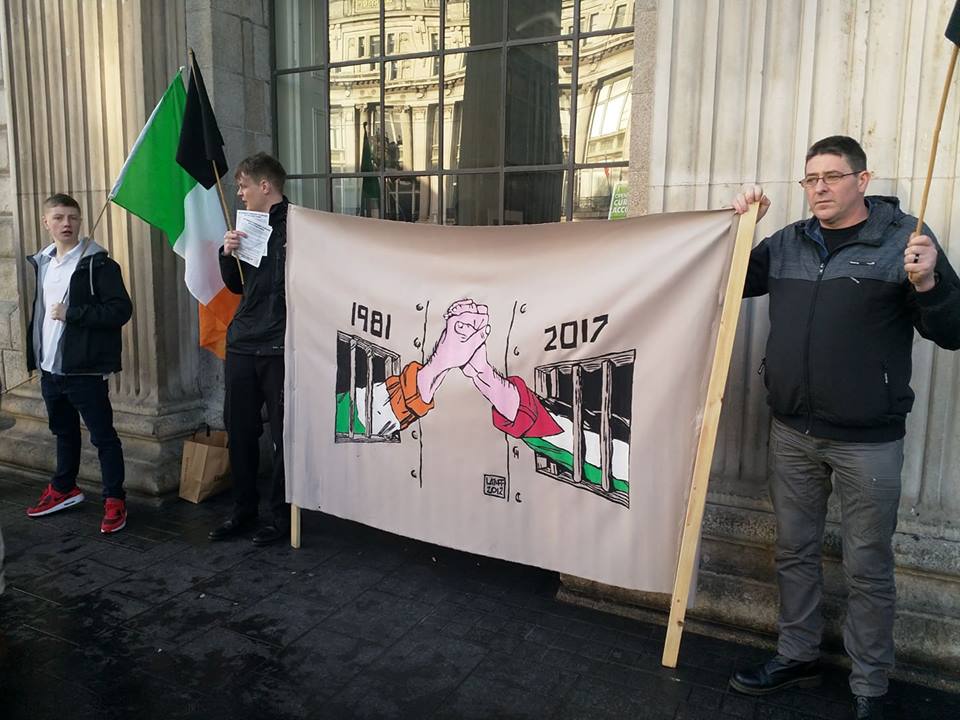
The other group flew a larger tricolour, the Irish national flag, the colours horizontal – and also a Palestinian flag. One of their banners was an enlargement of the cartoon by Brazilian graphic artist Carlos Latuff , showing an Irish hand reaching through prison bars to clasp that of a Palestinian, also emerging through bars.
The first group was of Indians in a protest related to the current tensions between the states of Pakistan and India, while the other had been organised by the Dublin Anti-Internment Committee and was supported by other Republicans and unaligned socialists. The presence of both outside the GPO was a coincidence and they were separated by a little distance.
INTERNMENT WITHOUT TRIAL CONTINUES IN IRELAND
One of the monthly pickets of the DAI Committee to raise awareness of the ongoing internment in Ireland, the picketers combined their action with expressing solidarity with Palestinian political prisoners of which many are held without charge, in “administrative detention”.
The banner depicting Irish and Palestinian political prisoner solidarity, from a cartoon by Latuff. (photo: Dublin Anti-Internment Committee)
In Ireland, there are other kinds of “administrative detention” but they are not called that; instead they go under the names of “revoking of licence” and “refusal of bail”.
The first category relates only to the occupied Six Counties, where those political prisoners were released under the terms of the Good Friday Agreement; however their licence may be revoked at any time in which case the unfortunate person will be brought straight to jail without trial and held there indefinitely. This has been the fate of a number of former prisoners who remain Republican activists. One of those, Tony Taylor, was released without charge at the end of November last year, having spent nearly a thousand days in custody.
The second category and by far the most common, both in the British colony and the Irish state, is that of refusing bail to Irish Republicans while they await trial on as yet unproven charges. In these circumstances the accused, if judged “not guilty” at their trial, may have spent more than two years in prison by that time. A recent example of refusal of bail was that of Republican activist Alan Lundy arrested for alleged armed burglary on 18th February, despite an alibi apparently confirmed by CCTV footage placing him 40 miles away at the time and highly contradictory evidence from the alleged victims.
The intention of these totally undemocratic measures is an attack on the basic civil rights of Republicans to peacefully organise and to assemble in protest. When bail is granted, the intention is made clear since regularly the conditions attached are that the accused wear an electronic tag, may not participate in political meetings or demonstrations and must observe a curfew. Furthermore, the accused are brought before the no-jury Special Courts of both administrations, where special rules of “evidence” apply.
The Dublin Anti-Internment Committee maintains that these measures amount to internment without trial, a continuation of the policy in which courts are used, as Brigadier Kitson of the British Army proudly declared, as “a propaganda cover for the removal of unwanted members of the public”.
The Dublin Committee has also repeatedly pointed out that these measures are a danger to the civil rights of any and all movements of opposition to the State or its policies and should therefore be opposed by all democratic people, whatever their particular political alignment might be.
The solidarity bouquet (photo: Dublin Anti-Internment Committee)
FLOWERS PRESENTED FOR SOLIDARITY
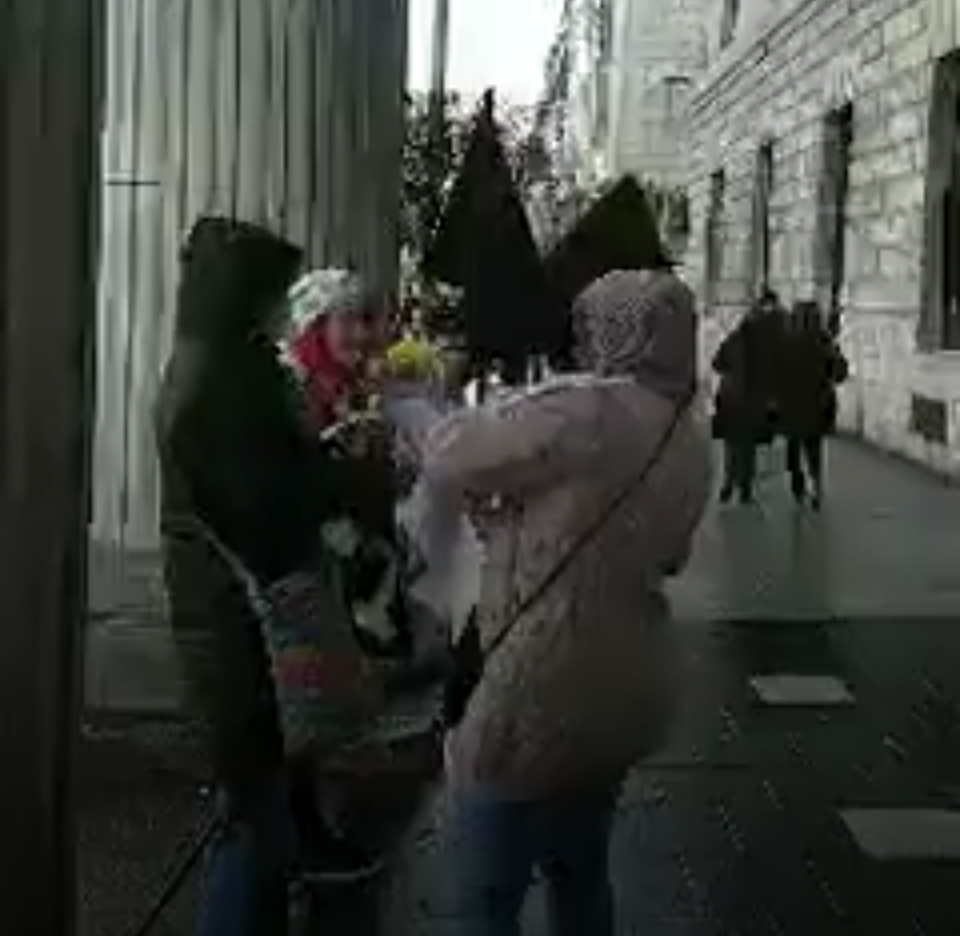
The picketers distributed leaflets to passers-by, some of which took photographs. Two young women who had taken photographs returned a second time, one of them presenting a bouquet of flowers to the surprised protesters. She said that she was doing so in gratitude for she was of Palestinian backround.
Palestinian young woman presenting the flowers to picketers. (photo: Dublin Anti-Internment Committee)
There are approaching 5,000 Palestinian political prisoners in Israeli jails, of which around 170 are held without trial, in “administrative detention”.
REMEMBERING THE HUNGER STRIKES
At a certain point during the event, the picketers took up black flags and displayed them until the end of the event in remembrance of the ten dead hunger-strikers of 1981 (seven Provisional IRA and three INLA). March 1st was the anniversary of the first day of the hunger strikes of that year fighting British attempts to paint them as criminals, when Bobby Sands embarked on his 66 days of hunger, the first of ten Republican political prisoners to give their lives. Bobby Sands, revolutionary and poet, died on May 5th and over 100,000 people lined the route of his funeral in Belfast, protests took place throughout much of the world and official marks of respect were given, including a statement of solidarity by Palestinian prisoners of the Israeli State. During his hunger strike Bobby Sands had been elected an MP to the British Parliament and two more, Kieran Doherty and Paddy Agnew, were elected members of the Dáil (Irish Parliament) in Cavan-Monaghan, while Joe McDonnell was narrowly defeated in the Sligo-Leitrim constituency.
These events had long term effects even in electoral politics. The British changed electoral law to prevent prisoners ever being elected again (Representation of the People Act 1981), Sinn Féin became a predominantly constitutional party and every Irish Government since 1981 has been a coalition of some kind.
A chríoch.
Another view of a section of the picketers. (photo: Dublin Anti-Internment Committee)
Leading up to the start date of the trials in Madrid of 12 Catalan independence activists, nine of whom have been in jail for 15 months awaiting trial, 40 cities around Europe were to hold solidarity protests. Today, 9th February, was the turn of some, including Berlin, Germany and Dublin, Ireland.
(Photo source: Rebel Breeze)
The defendants are charged with ‘rebellion’, ‘sedition’ and ‘misuse of public funds’ arising out of organising peaceful demonstrations and a referendum and later supporting a declaration of independence — and the Spanish State has refused to make provision for international observers.
Though the call for international actions came from the leadership of the grass-roots organisation ANC (Catalan National Assembly) in Catalonia, the action in Dublin was organised in cooperation by CDR (Comitè de defensa de la República) Dublin and With Catalonia/ Leis an Chatalóin. This followed very soon after organising to welcome Puigdemont to Dublin to take part in a debate at Trinity College and also to meet politicians at the Dáil (Irish Parliament).
Placards displayed in Merchant’s Arch (Photo: Rebel Breeze)Placards displayed in Merchant’s Arch (Photo: Rebel Breeze)Placards displayed in Merchant’s Arch (Photo: Rebel Breeze)Placards with images of exiled (Photo: Rebel Breeze)
The solidarity protesters met in Merchant’s Arch, a well-known spot for people living in Dublin and well-trodden by tourists, leading from Temple Bar to the Ha’penny Bridge on the other side of the road. This iconic pedestrian bridge crosses the Liffey river from south to north in the heart of Dublin city.
Some displays were set up inside the Arch by CDR, which also draped a huge banner over the railing of the boardwalk on the north side of the river, which read “Freedom for All Catalan Political Prisoners and Exiles!”. Over the same railing WCLC hung large bunting with the word “SÍ” on each flag, a reminder of the verdict for an independent republic in the referendum on 1st October 2017.
Catalan Estelades (pro-independence flags) were attached near the entrance to the Arch as was a small banner calling for freedom for political prisoners. Placards of the Catalan pro-independence activists on trial were also on display.
Supporters handed out informational leaflets and engaged members of the public in discussion before untying the banner and streamers from the riverside, packing up the displays and placards in Merchant’s Arch and heading off for warm food (and possibly drink).
“Si” bunting hung along north riverside (Photo: Rebel Breeze)
The 12 go on trial in Madrid on 12th February, a day when further solidarity protest actions will take place in various European cities and a General Strike in Catalunya.
CDR Dublin and WCLC will continue to organise in Ireland, according to their spokespersons and welcome involvement from others of whatever ethnic background. “Contrary to what the Spanish State and its supporters claim, we are not anti-Spanish” their spokespersons said. “We are for the right of self-determination and as democrats must be against the repressive behaviour of the Spanish State, so reminiscent of its previous dictator General Franco.”
End.
Merchant’s Arch entrance seen from Ha’penny Bridge steps (Photo: Rebel Breeze)Setting up in Merchant’s Arch (Photo: Rebel Breeze)Banner-minding duty (Photo: Rebel Breeze)
Section of audience queuing to enter the auditorium
A debate on the above theme was organised in Trinity College for the 29th January and advertised at less than a week’s notice, which however gave rise to such interest that the venue had to be changed from the 160-seat Robert Emmett Theatre to the Edmund Burke and people were turned away after the 406 seats had been filled.
Trinity College is a prestige university in Dublin and in the world generally, though its history in Dublin was for centuries of a religious sectarian and colonialist nature, founded as it was by Elizabeth I to ensure the education of the male children of English colonists in what she considered the ‘true faith’ of Anglicanism (which was and is still the State religion of England and of which the English monarch is Head). Its location too is very central to the city, being just across the Liffey on the south side and in 1916 served as a Headquarters for the British suppression of the Rising.
Section of audience waiting to back left of the auditorium in Trinity College, Dublin (Photo: D.Breatnach)View of audience to the left and front of the auditorium. (Photo: D.Breatnach)View of audience to the rear of the auditorium. (Photo: D.Breatnach)View of section of audience to the right of the auditorium. (Photo: D.Breatnach)
Huge human rights solidarity banner unfurled in the auditorium for photo but not while the debate was in session. (Photo: D.Breatnach)
Puigdemont had been invited to take part in a debate on Independence, Nationalism and Democracy by TRISS, the Trinity Research in Social Sciences department, whose MC for the evening was clearly taken aback by the numbers who had pre-booked tickets and most of whom queued for half an hour outside the lecture theatre – and some for even longer waiting to get in.
A quick photo opportunity for some supporters of Catalan (and Basque) independence outside the Trinity College’s main gate before entering to hear the debate on “Nationalism, Independence and Democracy”. (Photo: Marina Dolcet)
Members and supporters of the campaign group With Catalonia/ Leis an Chatalóin, Comite de Defensa de la República and the cultural organisation Casal Catalá de Irlanda were there of course but so were a great many others; mostly Catalans with some Irish and people from other countries sprinkled among them and including some from elsewhere in the Spanish state. The overall feeling was clear when, as soon as Puigdemont was spotted entering the auditorium from a side entrance, along with other participants, he was applauded in what turned out to be a mostly standing ovation.
The MC or chairperson, Gail McElroy, Professor in Political Science and Head of the School of Social Sciences and Philosophy, made a special plea for good behaviour from the audience and also revealed that she had experienced some trepidation in preparation for the event. These expressions led to speculation among sections of the audience that the organisers of the debate had been subjected to a bombardment of hostile electronic communication. People in the Spanish state and sometimes abroad are familiar with this behaviour from right-wing Spanish nationalists, including outright fascists and even state-orchestrated trolls but for someone encountering it for the first time, no doubt it can be intimidating.
Puigdemont at lectern.
PUIGDEMONT: IT IS NOT ACCEPTABLE IN EUROPE
Puigdemont began by saying that some of those present might want to know why Catalans do not want to be part of Spain. He could answer that question by recalling the history of Catalonia as a nation, its struggles, its language and its culture. That would be the discourse of 19th-20th Century nationalism, he said. However he preferred to outline it as modern process in the 21st Century, rooted in Europe and in democracy.
The President-in-exile surprised some of his listeners, no doubt, by pointing out that as recently as four years ago, the majority of the Catalan independentist parties had been asking only for greater autonomy from the Spanish State. The history of recent growth towards a majority demand for independence has been as a result of the refusal of the Spanish State to concede any greater autonomy and of the Spanish Court revoking laws passed by the Catalan Government.
“But the Spanish response to Catalan demands has always been “no”, to everything”, said Puigdemont. “No” to dialogue. “No” to negotiation. “No” to reaching a democratic solution. Given the refusal, and obeying the mandate given to us by the majority of Catalan citizens, the Government of Catalonia, which it was my honour to preside, called a referendum on self–determination on 1 October 2017, with the legal backing of the Parliament of Catalonia. We did so while observing the basic principles of universal rights.”
And the world had seen the violence of the Spanish police inflicted upon people wishing peacefully to vote.
“The aim was not just to confiscate ballot boxes and ballot slips”, Puigdemont maintained but instead “to make people give up their right to vote. But this ignominious act backfired on the politicians responsible for it. Over 2.4 million citizens overcame their fear and went out to vote. We do not know how many tried to do so unsuccessfully, but we do know the polling stations that were violently closed represented a further 770,000 voters.”
Puigdemont continued: “Today, democracy in Spain is at risk because basic rights have been “de facto” suspended, and this represents a major threat to all Catalan and Spanish citizens, as well as to the European Union. Today, an EU member state cannot guarantee the judicial rights of its citizens, given that in recent months Spain has contravened international treaties ratified by the Spanish state itself, such as the International Covenant on Civil and Political Rights, the European Convention for the Protection of Human Rights and Fundamental Freedoms.”
Referring to the Spanish State taking direct control of the Catalan government administration and preparing criminal charges against grass-roots organisation leaders and elected representatives, taking some as prisoners while others went into exile, Puigdemont said that this was not an internal Spanish problem but instead a Europan one. Seven hundred others, mostly town mayors, are under investigation too. Those independence activists, who have done nothing wrong and even according to Spanish law are innocent until proven guilty, have been kept in prison for over a year.
Concluding, Puigdemont said: “We will not falter. I have often said that what threatens democracy is not disagreement; indeed, democracy needs disagreements. What really threatens it is a lack of tools to solve disagreements democratically. We Catalans hope and trust that the political conflict over our self–determination can be resolved peacefully, without war, without violence, without winners and losers, without victims and thugs. We reject all the violence used in the last century in any part of the planet to resolve political conflict.
“As Pau Casals, a well-known Catalan, reminded us in a memorable speech to the United Nations Assembly in 1971, Catalans in the eleventh century met ‘to talk about peace, because at that time, the Catalans were already against war’. Ten centuries later, we maintain these same values of peace and harmony.”
THE OTHER SPEAKERS IN THE DEBATE
Located as the debate was in the capital city of Ireland and in the centenary of the founding of the first democratically-elected Irish Parliament, an Chéad Dáil, it was most noticeable that neither Puigdemont nor the other speakers referred to the experience of Ireland’s struggle for independence.
Dr Marvin Suesse – Assistant Professor in Economics, Trinity College Dublin spoke on“The Economic Costs of Sovereignty”, from his research on the political economy of separatism and nationalism. He said that while the benefits of independence in terms of feelings of pride, promotion of culture etc. were difficult to measure, the economic benefits were not. Suesse went on to give examples which indicated that the costs of independence were greater than the benefits.
Dr Michelle D’Arcy – Assistant Professor in Political Science, Trinity College Dublin. spoke on “Secession and the Fiscal Contract: Reflections from the Post-Colonial World.”
D’Arcy teaches African politics and the political economy of development to undergraduate and postgraduate students and her research broadly focuses on understanding how politics and institutions enable and constrain human development and more specifically on democratization in Africa and state-building in Europe historically. Though she made some interesting points and believes that independence movements engage in a “fiscal contract”, it was difficult to see where she stood on the question under discussion.
Dr, Coman’s screen displayDr. Coman at lectern.
Dr Emanuel Coman – Assistant Professor in Political Science, Trinity College Dublin spoke on “When does the Right to Self-Determination Actually Apply?”
Emanuel Coman is Assistant Professor in Political Science at Trinity College Dublin, teaching courses in comparative institutions and American Politics. His research is primarily in the fields of party politics and elections, with empirics driven primarily from Eastern Europe.
Coman, from Rumania as he told his audience, analysed the European nations that were successful in gaining independence after WWI. Most had been under the rule of the defeated belligerents. His thesis seemed to be that a nation’s bid for independence required the support of the big powers exerting influence in the area.
“ONE MUST ALSO WEIGH THE COST OF NOT DECLARING INDEPENDENCE!”
Commenting on the presentations of the other speakers and responding to questions after his presentation, Puigdemont was more lively than when reading his speech and at times showed some fire, particularly when he responded that as well as weighing the costs of independence, one must consider the costs of not becoming independent, which brought some applause from sections of the audience. Aside from anything else, he said, it is a question of dignity: the Catalans had the right to make their own decisions, whether they be correct ones or mistaken.
A much greater applause and cheers broke out when Puigdemont denied that the Spanish State could be described as “a democracy” and stated that this was not opinion but fact, given that the Monarch and Head of State (father of the current monarch) had been personally appointed as his successor by the fascist coupist General Franco, whose mausoleum is a national monument of the State.
Responding to a suggestion that the Catalan pro-independence movement might benefit from employing the tactics of the “Yellow Vests” of Paris, Puigdemont was most emphatic that his movement was peaceful and would never under any circumstances resort to violence.
One member of the audience criticised the panel (other than Puigdemont) for not addressing the actual issues in Catalan independence and the Spanish State’s opposition.
Asked by a member of the audience to describe his feelings of exile, Puigdemont replied that he could not indulge those feelings since he would be unable to continue the struggle if he did so. He revealed that his own grandfather, in a concentration camp in France after the fall of Barcelona to Franco’s military-fascist forces, had written to his family so that they were aware of the feelings of exile even though they never saw him again. His voice seemed to gain a heightened emotion when he remarked that when he compared his situation to that of refugees, like those from Syria, launching themselves on the hazardous journey to European shores, survivors arriving often to be badly treated, he felt he had little of which to complain.
Puigdemont surrounded by well-wishers and the curious after the debate while others are in excited conversation.
AUDIENCE REACTION
The audience gave Puigdemont and, one supposes, the other speakers and TRISS for having organised the debate, sustained applause and cheers, during which one could hear some pro-independence slogans in Catalan. Afterwards, many remained in the auditorium to speak to Puigdemont or to chat amongst themselves in a general buzz of excitement.
Views expressed by a number of listeners afterwards on the content of the debate were in general positive though these varied through a continuum from “excellent” to “all right but somewhat disappointing”. All feedback received agreed that on two points Puigdemont had been excellent: on the question of calculating the cost of NOT seceding from the Spanish state and also on the characterisation of the Spanish State as not being a democracy, as one that had failed to break properly with its Franco-fascist past. Few gave positive feedback on the other debaters.
Crowds delayed leaving for around half an hour, gathering talking among themselves or queuing up to shake Puigdemont’s hand, talk to him etc. and Casals Catala presented him with some books on Irish history.
COMMENT:
Puigdemont comes across as quite genuine in his convictions and as an able debater, even in a language which cannot be his first or second. His vision of Europe does not perhaps coincide with the views of some others and one may doubt the practicality of his commitment to non-violence. One may also question whether anyone has the right to commit the movementto peaceful resistance alone, even if it were to be attacked violently.
I did not hear him speak any words in Irish but the written text of Puigdemont’s speech did contain some. Although it was good to see some Irish there, for the few words he was going to speak in the language, Puigdemont (or his advisors) might have taken the trouble to formulate them correctly. Addressing “mná agus uasal” although addressing women first, suggests that the audience was an almost all-female one and who were not “uasal” (noble, important), but was surely unintended. And “dea-trathnóna leat (‘to you’, singular) go léir” (to all of you) is a conflation of singular and plural in the same address; likewise with the “go raibh maith agat” which thanks one person rather than the audience which was the intention and “go mór” which if not incorrect is clumsy and straight from Google Translate for “thanks a lot”.
Standing outside the auditorium with a placard announcing the Catalan solidarity demonstration on Saturday 9th April, at one point I noticed Puigdemont standing some metres away with some others. As he caught my eye, he stepped towards me, hand outstretched.
I gripped his hand and smiling, said: “Fáilte go Baile Átha Cliath!”
“Thank you,” he replied, smiling also and stepped back.
Whatever else he may be, I suspect he is what we in Dublin would call (with a meaning remote from any kind of subservience) “A gentleman.”
End.
BIOGRAPHICAL NOTES ON PUIGDEMONT:
Born in Amer, a village in the province of Girona and fifty-seven years of age last December, Carles Puigedemont is a journalist by trade and ex-Mayor of Girona, a major Catalonian city of over 100,000, just under 100 kilometres (62 miles) north-east of Barcelona. In 2006, after a track record of activism in Catalan culture and nationalist activism, he was adopted as a political candidate by the CIU (Convergence and Union) political party and later to represent the reformation of that party in the Junts per Si (Together for Yes) coalition, composed of mostly nationalist capitalist elements. He has been successful in every election and currently heads the uneasy Junts per Cat (Together for Catalonia) coalition. The current Govern is made up of a coalition between JuntsXCat and ERC (Republican Left of Catalonia), with the other pro-independence party, CUP (Popular Unity Candidacy) in opposition, though not voting with the Spanish-unionist opposition.
In what seems an action contradictory to his political position, in January 2019 Puigdemont filed a constitutional application for amparo (remedy, to put right) directed against the President of the Catalan Parliament, Roger Torrent and the Board of the Chamber, to the Spanish Constitutional Court. The application argues Puigdemont had been denied the use of his political rights as Torrent did not allow him to delegate his vote from Belgium after Puigdemont’s criminal indictment and suspension of his parliamentary position by Supreme Court judge Pablo Llarena.
Despite constant Spanish-unionist claims from both Right and Left, the Catalan pro-independence movement has shown itself more tolerant of migrants and diversity than can be said in general of much of the rest of the Spanish State; one of the laws of the Govern sought to give migrants equal access to Catalan national health care but was twice squashed by the Spanish Supreme Court. Puigdemont is himself married to Romanian journalist (Marcela Topor in 2000) and they have two daughters, Magali and Maria, the family home in Girona. His children are multi-lingual and Puigdemont himself speaks Catalan and Castillian (Spanish), as do most Catalans but also English, French and Romanian.