THE BOARDING SCHOOLS OF FEAR

(Reading time: 10 minutes)
(
Translation by Diarmuid Breatnach of review in Castillian in 2016 of the book of that title and interview with one of the authors in El Confidencial).
Para versión original en Castellano mirase al enlace al fin.

Boarding school children in assembly being addressed by Catholic priest or religious order member (Photo source: original article).

‘The boarding schools of fear’ (Ed. Now Books) came into our hands a few days ago. We devoured the 300-page book in just three afternoons. Each page that we turned was leaving us more exhausted, confused and horrified. How is it possible that even today there are no consequences following what happened then?


We talked about sexual abuse, psychological abuse, physical abuse, experimental operations, baby theft and slavery, among other things, that thousands of children experienced during the Franco regime only because they were classified as ‘children of sin’. These children were children of single mothers, they came from poor families or, what was even worse at the time, their parents were Republicans.

The State ‘hunted’ these children and interned them in centres, of which the vast majority were managed by religious orders by government grant. Judging from the research in the book, in what more than boarding schools looked like prisons and torture rooms for minors. In the text we read a dozen testimonies of victims that leave us nauseous: boys raped by priests, nuns who mistreated hundreds of girls until they tired of it, Salesians who employed all kinds of torture, children who died of beatings, minors who were sold as slaves for 100,000 pesetas (600 euros today), young people locked up in psychiatric hospitals who were subjected to injections the nature of which remains unknown … A series of horrors that have never been recognized by the State (it was the entity in overall charge of the centres and had the judicial guardianship of minors), nor by the Church (according to the book, hundreds of Salesians, priests and nuns committed atrocities with children), much less by companies that benefited from the slave labour of these imprisoned children.

Boarding school children praying at night — cover of book being reviewed (Photo source: original article).

We have many doubts and we want to know more. We need someone to explain to us how even still this can be silenced. That is why we get in touch with Ricard Belis, one of the authors of the book, together with Montse Armengou, who offers us his view of the past, present and future of this situation. Ricard is an expert in Franco’s history, a subject to which he has dedicated decades of journalistic research. After chatting with him, we come to a valuable conclusion: the damage is already done, but to make known the history of these children and that those responsible for it be known publicly can heal the pain of many victims of the ‘boarding schools of fear’.

QUESTION: As soon as we begin the book we find a statement. You say that, contrary to what happens in other countries – from Argentina to South Africa through the Congo, Bosnia and other places – here in Spain there is no state agency responsible for investigating complaints that arise from people who, from one way or another, themselves suffered from the Franco dictatorship. Why is there no such body in Spain?

ANSWER: Everything is the result of the transition to democracy in Spain. It was done with a system that, although in the first years had its reason for being, decided not to look back at any time. In this way, one enters into a dynamic of many years of silence, which leaves all the victims of the regime forgotten and separated. That has done terrible damage to the victims themselves – for the fact of not being able to express their pain and having it remain inside them – and to Spanish society in general – because the fact of not knowing well what happened would be quite unthinkable in another democratic country.

Boarding school children marching (Photo source: original article).

Q: Do you think that at some point such a state agency could be created or do you consider it something utopian?

A: Well, I would like to see it … but I see it as impossible in near future. This book is the offspring of a documentary that was screened in Catalonia, where it was successful in terms of viewing figures, but nothing happened. There were signatures to a petition demanding that the Church ask for forgiveness, but nothing more. I think it is of greater importance that the Spanish State make these apologies, because it is ultimately responsible for the majority of these boarding schools, centres that were run by religious orders but by state concession. That task remains pending.

I will recount you an anecdote. We took this documentary to a very famous festival in France, in which reports from other countries were screened. After viewing our investigation, the French public did not understand how the Spanish State never apologised or accepted what happened to those interned. Then, by coincidence in the same room a Swiss documentary of a similar theme was projected (child abuse in Swiss boarding schools). The big difference is that this documentary began with the current Swiss Government asking for forgiveness for what previous governments had done.

Boarding school child in internal hospital bed — to what experiments were some of them subjected? (Photo source: original article).


TV3 DOCUMENTARY ON WHICH THE BOOK IS BASED

Q: In the absence of policies on historical memory, in a country denounced by different international organizations (UN, Amnesty International and the Council of Europe) and with a Partido Popular Government that fulfilled its electoral promise to close the office of Victims of the Civil War and Dictatorship, associations and the media are the only platforms to which those affected can go. Could this situation change with a new government? If, for example, a new political party like Podemos won the elections, do you think they would be willing to investigate all these cases and apply pressure for the creation of such an organization?

A: I am not optimistic for two reasons: first because there is no survey that predicts victory for Podemos, which, although it is one of the few parties presenting at state-level which contains this in its electoral program, it is hardly going to obtain an absolute majority to implement the policies they propose; and second, in this country we have had more years of left-wing than right-wing governments and both have been very shy and inactive on this issue, including the PSOE. It is true that Zapatero brought in a Law of Historical Memory, but it fell short and has hardly been applied. Anyway, I’m not very optimistic. I hope that some year something will happen, although at this rate I fear it will be when the victims are no longer alive.

Boarding school children marching
(Photo source: original article).

Q: Why does the Spanish Government not pronounce on this? Is it afraid of the reaction of society?

A: I don’t know very well how to answer that question, because its inactivity is incomprehensible. Because it does not matter if a government is right-wing or left-wing, what cannot be consented to is that the victims of a dictatorship are forgotten and the pain they have suffered is not recognised. I give the example of Angela Merkel, who strongly condemns the crimes committed in the Nazi era.

P: The children of these boarding schools were mistreated both psychologically and physically. They burned their bums with a candle, were forced to eat their own vomit full of insects, were subjected to sexual abuse … Is this perhaps the worst episode that has happened in the history of Spain?

A: The theme of childhood is one of the toughest episodes. When abuse, violence and ill-treatment is employed against a child, it is very traumatic. And not only the pain left inside them but also in their families. It is difficult to rank the hardest moments in the history of this country.

One of the things that has impressed me most doing this research, beyond the abuse, violence and ill-treatment is the fear and lack of affection felt by most children who lived in these boarding schools. Such was this lack of affection that many of those children came to confuse the first symptoms of sexual abuse as affection. I think it’s a terrible perversion. Some children who have never received a caress, accustomed to receiving beatings, when a priest arrives, touches them and that ends in sexual abuse … it has to mark them for a lifetime.

We always emphasise that this is not a historical investigation, but that it is current, because the damage that was done is still present. That the State does not recognize what happened only increases and magnifies the damage to the victims. The damage that the Dictatorship did is multiplied by the neglect of democracy.

Q: The Church played a great role in that drama. Do you think that with your research, like the one in this book, you will end up engendering a total rejection of the Church in the new generations?

A: I believe that the Church, on a global level, is beginning the process of acknowledging its guilt. The previous Pope, Benedict XVI, has already begun a firm policy against child abuse and sexual abuse, and in that sense it can be said that they are beginning to clean up their house. Late, yes, but we already know that the Church goes a little slower in everything. Here in Spain, there has not been any movement yet. The Church needs a modernization and many duties remain to be carried out, therefore it is normal for new generations to find it harder to believe in the Church.

We have testimonies of victims who ask that the Church apologize, because they are believers and for them it would be of great significance and even very restorative. Others, on the other hand, do not want to know anything about the religious orders, since they are never going to forgive them. In this regard, I think it would be good for the Church to ask for forgiveness, but I think it is more important for the Government to do so, because it is the one ultimately responsible. Although the Popular Party, which currently governs, has no responsibility for what happened, it is the heir of that State. It would be Mariano Rajoy who should ask for forgiveness, but not for anything on his own behalf but rather because he is the current President of Spain (since this was written Sanchez of the PSOE has been the President of the Spanish State – Trans.).

Q: If Mariano Rajoy recognized and apologized for what happened in those boarding schools, would it benefit him in any way with regard to public opinion?

A: In any case it would not hurt him. That a leader recognizes that the State did something wrong, but has no responsibility for it himself, is worthy of admiration. So I think it would mostly be to his benefit. I do not think that it would seem bad to any well-intentioned person that he apologized for the abuses that were committed at that time. Rajoy has no responsibility for it but he is the heir of that dictatorship.

Q: A lot of money was generated around the boarding schools. The Church received huge amounts from the State for the support of the little ones (and only a small part of it reached the minors, since they lived in subhuman conditions and were very hungry) and also pocketed millions of pesetas with the sale and labour exploitation of these children…

A: Yes, the Church took advantage of the situation and profited by it. The minors were a source of funding. The Church found a workforce to which they taught trades with the excuse of training, but the situation resulted in pure and hard exploitation. This situation reminds me of what happens in other countries, where thousands of children, such as from India or Asia, are exploited.

Q: In addition to the Church, large companies in our country also took advantage of the situation and hired this cheap workforce. In the book you mention El Corte Inglés – which at that time were the Almacenes Preciados (Precious Stores – Trans.) – and even Banco Popular and Caja Madrid. Did these companies know that they were hiring exploited children who lived as ‘prisoners’ in boarding schools?

A: I give you the example of El Corte Inglés (chain of shopping malls in the Spanish State – Trans.). They went to religious orders and paid the nuns for labour. They paid little, but they paid. They never hired a child directly. What happens is that, of course, we could say that they could suspect or intuit something with regard to the service being provided so cheaply. I could not tell you that these department stores are directly responsible, because they did not hire the children, although they have some social responsibility. They could imagine what was happening there.

Cortes Ingles, Marbella, one of a chain of shopping malls that profited from the work of the boarding school inmates.
(Photo source: Internet)

Q: You spoke with those responsible for El Corte Inglés about the subject. And, although at the beginning of the conversations they were pleasant, they ended abruptly with a total refusal on their part to collaborate with your investigation. Do you think that if it was shown that these department stores made use of these children for their business, it would affect their reputation or sales?

A: I think it has been a long time. They are tactics that are currently being used by numerous countries abroad. And, in addition, it could not prove more than than that the Cortes Inglés had a contract with religious orders. The company did not have to know what was done with these children or if they were paid. They could intuit what was happening, but they did nothing illegal. It would be more of a moral issue.

Q: As for you, after gathering so many testimonies and talking to more than 200 victims of these abuses, do you feel that this investigation has taken its toll in some way?

A: We are not made of stone. When you talk to a person who has suffered these abuses you are making her return to one of the worst episodes of her life. Sometimes you leave the interviews affected. But on the other hand it is very comforting, because the victims feel relief through having the opportunity to tell their story to their fellow citizens. In addition, these investigations are doing what the State should do, in the sense of making it known and recognizing it, which is the start of repairing the damage caused.

End.

REFERENCES:

Article in El Confidencial: https://www.elconfidencial.com/amp/alma-corazon-vida/2016-06-12/internado-miedo-abusos-sexuales-esclavos-victimas-horror_1214802/?fbclid=IwAR2t7DJU7DL25nec-KgIAphJG_Qn_ByzlQ9LR56p7yTbVUMaIrdwwWgWZmc

The book (The Boarding Schools of Fear), Now Books: Los internados del miedo

SPANISH SECRET SERVICE AND TERROR CELL: INCOMPETENCE – OR SOMETHING ELSE?

Diarmuid Breatnach

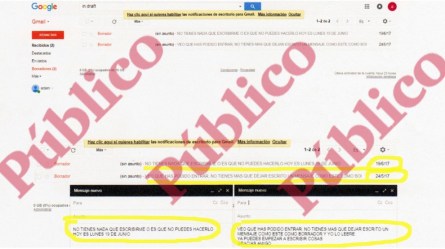
Recently the left-wing Spanish on-line newspaper, Publico, got a scoop on other media when it broke the story of the Spanish secret service and the terrorist1 cell in Catalonia, the one that carried out the killing spree in La Rambla in Barcelona in October 2017. Publico revealed that the head of the cell had been recruited as an informant while in jail on drug smuggling charges and that the secret service had helped him become an imam, a Muslim priest, in the province of Girona. Not only that but that they had the photos and mobile phone numbers of a number of the Ramblas terrorists and had been following them up to days before the attack.

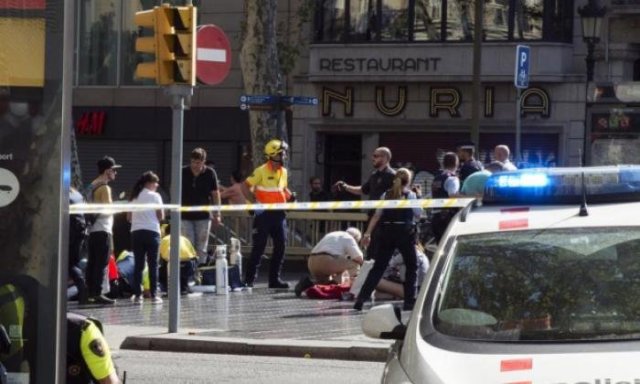
Aftermath Rambla Attack
Aftermath of terrorist attack in the Rambla, Barcelona in 2017. (Photo image sourced: Internet)

So why had the whole lot not been apprehended? It’s a question many people are asking, along with the Catalonian and many foreign newspapers – but, strangely, only one of the main Madrid newspapers.

THE LEADER OF THE TERRORISTS WAS WORKING FOR THE SPANISH SECRET POLICE

          Abdelbaki Es Satty came to the Spanish State in 2002 and was around 44 years of age when he died in an explosion in Catalonia. According to Wikipedia,

Es Satty was implicated in the 2006 Operation Chacal, in which five Islamists were arrested for sending jihadis to fight in Iraq. From 2003 he had shared an apartment with Islamists connected to the Moroccan Islamic Combatant Group (GICM) and the 2003 Casablanca bombings.

In 2012, (he) completed a four-year prison sentence for drug trafficking in Castellón. While in prison, he is reported to have established a “special friendship” with Rachid Aglif, who was serving an 18-year sentence for his role in the 2004 Madrid train bombings.

He was convicted of drug smuggling in 2014 and was to be deported from Spain, but …… A successful asylum application in November 2014 facilitated him moving freely in the 26 EU countries of the Schengen area.

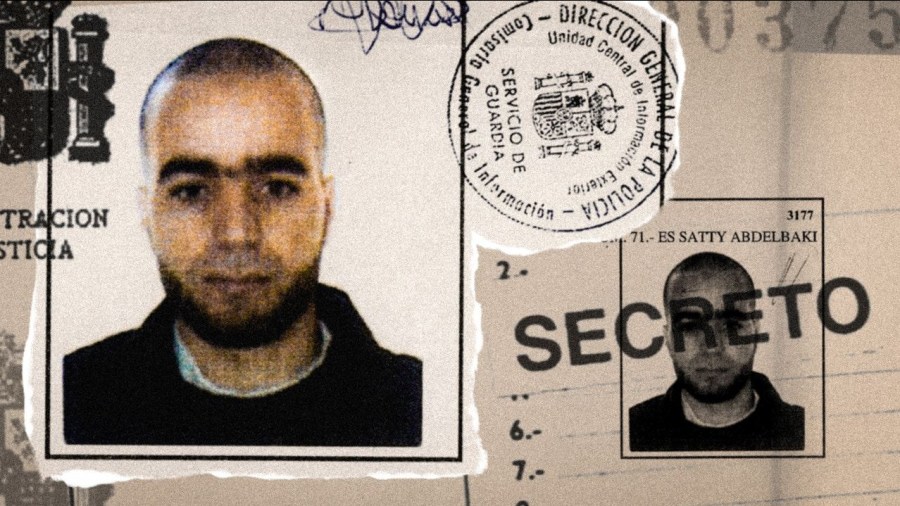
catalonia-bomber-leader-es-satty.jpg
Es Sattty, believed leader of the terror cell that carried out the attacks in Catalonia in 2017. He was an informant of the Spanish Secret Service (CNI). (Photo image sourced: Internet)

The suggestion in the Publico articles is that Es Satty was recruited by the Spanish secret service (CNI) while in jail and that they ensured that he was not deported, also that they assisted him in getting employed as an imam (a Muslim priest) at the mosque in Ripol in 2015, a post he suddenly resigned in June of 2017. Ripol is a town in the province of Girona, Catalonia.

Publico now reports that the CNI file on Es Satty has been “wiped”!

THE EVENTS

          On the evening of 16 October 2017, El Satys and another man were killed, presumably by a premature explosion while handling the material. There were over 120 gas canisters which appeared stored for a number of terrorist bombs. The explosion occurred in the town of Alcanar, the southernmost of Catalonia and almost on the border with the province of Valencia.

When other in the cell heard that El Satys had been killed and another with him while handling the explosives, it seems they decided on a ‘revenge’ spree to honour their ‘martyr’ and carried out the attacks on innocent civilians in Catalonia.

La Rambla is in Barcelona city centre, a medium-length wide street heading towards the port, with a tree-shaded pedestrian reservation down the middle, where stalls sell all kinds of ware and coffees, snacks etc. It is a favourite destination of tourists (and pickpockets).

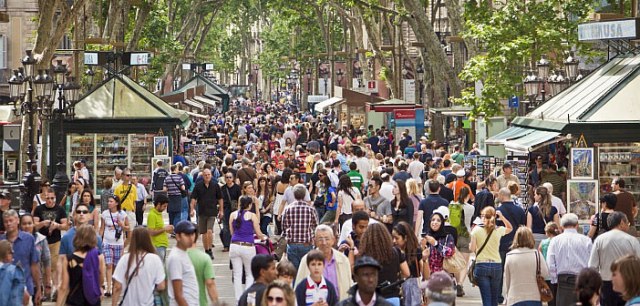
Barcelona Rambla Packed
La Rambla, Barcelona, on a happier day.

On the late afternoon of 17 October, a member of the terrorist cell driving a van zigzagged down the Rambla, running down pedestrians and cyclists. During his escape from the scene, he hijacked a car and fatally stabbed the driver, bringing his total death-toll to 15 and injuring 131.

Later that evening, five men, apparently of the same cell, purchased knives and an axe and, at 1.00 am, drove into the Catalonian coastal town of Cambrils (not far from the popular tourist destination of Salou) and into a crowd of pedestrians, where they fatally stabbed a 63-year old woman and injured another six, before being shot by Catalan police. Four died at the scene and the fifth later of his injuries.

On 21st August, five days after the Alcanar explosion and four after the Barcelona massacre, the Rambla killer was fatally shot by the Mossos, the Catalan police, in Subirats, about 25 miles (40 Km) from Barcelona.

Initially, Catalan police believed the first violent event, the Alcanar explosion, had been caused by an accidental gas leakage but once they discovered the explosions and other events had occurred, connected them. Not only did the Spanish secret service, the CNI, fail to inform the Catalan police about the existence of this cell prior to the Alcanar explosion but it seems that at no time during the subsequent operations of the Catalan police did the CNI give them any information whatsoever.

Publico On Line Image
The on-line newspaper that broke the story. (Photo image sourced: Internet)

THE DIRTY WORLD OF STATE SECRET SERVICES

          Secret services penetrate cells and movements opposed to the status quo as a matter of course, whether they have an armed agenda or not. But when they do have such an agenda, typically they try to recruit some inside people for information, building up a wider and more detailed picture as time goes on. This takes time and meanwhile the informants’ ‘handlers’ will typically give their insider ‘asset’ money, protect him or her from prosecution, feed the informant’s fear or ego – or both.

As not-so-distant history shows with the British and US secret services (and probably all others around the world), these informants are permitted to break the law, even to kill, in order to keep up their cover. Yes and even to kill another, less-valued or more exposed informant, as the British had at least one informant do inside the Provisional IRA.

But it goes even further and informants or deep-cover agents also often act as agents provocateurs. They actually incite people around them to carry out armed actions. This can vary from encouraging them to attack where, unknown to the victims, the state forces are ready and waiting to kill them, as is believed happened at Loughgall, in occupied Co. Armagh in 1987. The informant can also be used to incite a group of political activists to carry out armed actions to facilitate the breaking up of the organisation2. Or to set off bombs that will, intentionally or not, kill uninvolved civilians, thereby losing insurgents popular support. Or that might set off inter-communal violence in an occupied country.

And religion-based organisations have long been recognised by secret services as useful opposition to leftist national liberation movements. Or against the USSR, for example, when the latter were invited into Afghanistan by the ruling circles. They may also be used to incite inter-communal violence in a country occupied by a foreign power or to help overthrow a ruling group which a foreign power wishes to replace with another more amenable to the power concerned — or in a country it wishes to invade.

The role of the Phalangist militias, Christian, in Lebanon is well-known, in their war against the growing power of the Muslim community. The CIA and Israel3 armed the Phalangists and encouraged them in their attacks Lebanese Muslims and on Palestinian refugee camps, not only against fighters but also massacres of the elderly, women and children. The CIA funded, supplied and even often trained Islamic fundamentalist jihadists4 and warlord bands in Afghanistan, Al Qhaeda among them, as they did also in Iraq. They did it in Syria too but ended up having to fight one such jihadist group, ISIS, which threatened to take the whole cake and the commanders of which were unpredictable in terms of future policy. But many of the war bands in the NATO-led Alliance fighting Assad and ISIS were themselves Jihadists too.

SUSPICIONS AND SILENCE

          There are many people within the Spanish state territory that distrust the State and Catalans, due in particular to their recent experiences, would figure prominently among them. When Publico broke the story about the CNI and their close connection to the terrorist cell, it was inevitable that speculation would take off and that it would not stop at the secret service’s ineptitude.

Some thought that the original intention had been to discredit the Mossos, who were later accused by some Spanish politicians of not cooperating fully with the Spanish police operations against Catalan independence campaigners. Presumably the explosions planned by the terrorist cell would leave the Catalan police looking useless.

Another theory went that explosions would be blamed in some way on the Catalan independence movement, which has until the present been remarkably peaceful in the face of Spanish police violence. In fact Aznar, the Spanish Prime Minister at the time of the Madrid train bombing by another cell, immediately blamed the bombing on the Basque armed group ETA. When it was proven to be an Islamist fundamentalist cell, his false claim contributed to his party losing the elections soon afterwards.

No doubt there were other theories speculated also and the response from Madrid did not help to quell them.

Many commentators have wondered at the Spanish state’s silence on the matter but even more so at the silence of all but one of the Madrid main newspaper. Surely this is a really big story? If the Government says that “it’s not a big issue (for them) to investigate”, would one not expect the Spanish media to be hounding them? That media silence is, really, the most puzzling aspect. One can readily see that the Government might not want to expose the ineptitude and dirty work of their State’s secret service … but the media?

The only answer that makes any sense is its Catalonia connection, that all locations in which the events occurred are in Catalonia. And that the independence movement for Catalonia is locked in a struggle with the Spanish unionist State. Therefore reporting on Spanish secret service ineptitude in Catalonia could well go to justify separatist wishes in Catalonia.

Or have the editors been made aware that this terrorist cell had an important role to play in that independentist conflict and asked to keep quiet? What if a campaign of terrorist massacres in Catalonia gave a plausible excuse for the Spanish State to impose emergency legislation on Catalonia, an excuse that would be thought convincing not only within the Spanish state but abroad also?5 Of course, if that was the gameplan, it did not work out for the Spanish State since the cell messed up and it was finished off by the Catalan police, the Mossos d’Escuadra.6

So, to answer the question in the title of this piece: in my opinion it is incompetence – and something else. But probably not the various “something elses” that are being most widely speculated.

However, the Spanish media silence tells us something about the Spanish state too. In what other European state would its media remain silent about its secret service penetrating a terrorist cell but then failing to prevent attacks on its citizens by members of that cell?

End.

FOOTNOTES

1The word “terrorist” is frequently applied in the mass media to a wide range of organisations employing armed, from small cells to popular movements, of a wide variety of ideological motivation ranging from fascist to communist or just national liberationist. There can even be paid terrorists, such as the Contras run by the CIA against the Sandinista-run Nicaragua. Even some animal liberation organisations have come under this term and, indeed individuals without an organisation backing them (such as the Australian who carried out the massacre in New Zealand last year). In addition, some states have been labelled “terrorist” by others. Therefore the term cannot have a precise definition and I use it here only to describe small or larger organisations that target uninvolved civilians in order to cause terror among a population and instability among the rulers.

2British secret services did this in a case in England where they got a member of the local Sinn Féin branch (the party had branches in Britain at the time) to incite them to raise funds for the cause by carrying out a bank robbery, during which the robbers were arrested. Then he incited breaking them out of jail and that group got arrested too. After that he feared he was exposed and confessed to, strangely enough Jazz musician George Melly and then to the National Council for Civil Liberties (now Liberty). Very shortly after that he was killed, whether by the IRA or by his handlers is unclear. Though a famous case at the time several Google searches have failed to turn it up for me.

3The French may well have done so too as many of the Lebanon Christians had their origins in former French colonisation.

4From Jihad, a term meaning “struggle”, usually used in religious contexts. It can mean a moral struggle in society, within oneself or against “the enemies of Islam”, when it is sometimes characterised as a religious war, which may be defensive, or offensive (as with the Christian Crusades). In the political sense, especially when used in the West, it can be either defensive (e.g repelling or overthrowing a non-Islamic invader) or aggressive (e.g invading territories under non-Islamic rulers or under a different Islamic sect, or overthrowing such) but is always military and that is the sense in which I am employing it here.

5After the Twin Towers and other bombings by Al Qhaeda, US legislators were able to introduce the Patriot Act 2001 which gave the US State wide powers violating many civil rights.

6Whose Chief is currently on trial in Madrid, accused of undermining Spanish police operations against Catalan independentism through lack of cooperation.

REFERENCES

https://www.irishtimes.com/news/world/europe/spanish-intelligence-knew-of-terror-cell-ahead-of-barcelona-attack-say-reports-1.3959554

https://en.wikipedia.org/wiki/Abdelbaki_Es_Satty

MAJOR SPANISH UNION “BETRAYED WORKERS”

(Reading time text: 2 minutes; comment: 4)

(Translation from article in Castillian by Diarmuid Breatnach)

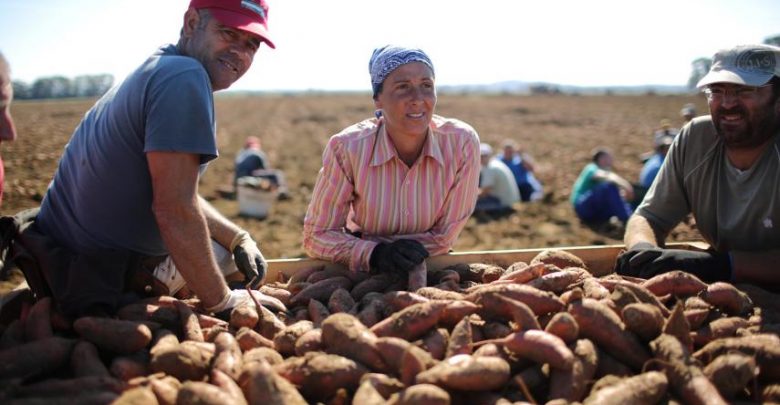
The Andalusian Union of Workers (SAT) has accused CCOO (Comisiones Obreras, major Spanish trade union – Translator) of “betraying” agricultural workers with the signing of an agreement with the Asaja employers — the signing took place last Thursday in Seville — where hard-won rights have been surrendered, including the 15-minute sandwich break. Accordingly, it will propose a common front to all trade unions to promote the fight for an (alternative) Andalusian agreement.

Migrant workers in a sweet potato plantation in Jerez, Andalusia.
(Source photo: Juan Carlos Toro, La Voz del Sur)

The SAT “cannot endorse an agreement where you give up the 15 minutes sandwich break, a workers’ victory from a long time back, which has been respected for generations, even during the Franco regime. An achievement that the employer, Asaja, has always wanted to eliminate and has succeeded now thanks to the betrayal of bureaucrats who never got their hands dirty or set foot on the field in their life”.

To this, adds the union, “you cannot endorse a de facto wage loss since the Pyrrhic rise of 1.25% per year does not compensate for the loss of the 15-minute sandwich break, which amounts to 3.8%. In other words, in reality, what CCOO has signed is a salary reduction of two and a half points” (per cent). “This is an outrage and a complete betrayal. There is no other name for it. We would like to say something very different, but above all our duty is to the workers who have been sold and betrayed once more”, they added.

The situation in the Andalusian countryside and the province of Seville, in particular, where some 120,000 people work in the sector, is very precarious. The economic crisis has hit the countryside and its workers hard. The working conditions implemented in the Andalusian countryside, according to the SAT, “seem from other times, thankfully now past.” Breach of agreements is the rule, piece-work predominates, which sometimes means that after a long day of work you only take 20 euros home, well below the salary established in the agreements.

Map showing Andalucia region (in red), Spanish State (in cream) also Canaries and part of coast of North Africa.
(Source image: Internet)

There are situations, they add, where fraud is evident by not declaring the workers employed. A fraud that can make a millionaire, since it can mean millions of undeclared euros that put health, pensions and our social protection system at risk. In addition to situations of genuine exploitation of workers — which in many cases border on pure slavery — there continues to be a significant reduction in income to Social Security, as well as a smaller amount of peonages that subsequently give the right to recognition of the subsidy and other benefits (? — Trans).

The reality that is being imposed not only affects labour rights, it is also “strategic suicide”. “The reality,” explains SAT, “is that with these mafia practices they are dropping the market price, so the product loses added value and undermines the market. The final result is to depreciate the product having a direct impact on the living conditions of day-labourers and on the economy of the towns. There have been innumerable complaints filed in the Labour Inspectorate, some of which have led to criminal proceedings being taken for crimes against the rights of workers.”

Accordingly, an Andalusian agreement that puts in place a minimum is necessary and urgent: six hours of work (sandwich break included); 60 euros for the normal working day; 84 on Sundays and holidays; effective ban on piece-work; wage of 69 euros for work with machinery; 96, on Sundays and holidays; on rainy days (when work is not possible) 50% will be paid for showing up at work, and the full wage from two hours of work; 0.27 euros mileage.

It is fundamental, they state in concluding their communiqué, to establish “a common front to fight for an Andalusian agreement with these minimums. It is also necessary and urgent to change the system of union elections in the field, a measure approved in the Congress of Deputies, and grant voting rights to non-permanent workers who represent more than 95% of the workforce in the Andalusian countryside.”

COMMENT:

Diarmuid Breatnach

The CCOO, Comisiones Obreras is one of the two mega-unions in the Spanish State, the other being the UGT. The CCOO was controlled by the Communist Party of Spain (PCE) and the UGT by the social-democratic PSOE; both parties and their affiliated unions were outlawed during Franco’s time. When the Transition to “democracy” was being engineered after Franco’s death, it was considered necessary to legalise the PSOE in order to have a two-party system and therefore necessary to legalise the UGT. However, it was the other way around for the CCOO and the CP. The Comisiones Obreras were by far the largest and most militant trade union and, though illegal, had built up a substantial following among the workers of the Spanish State. To effect as smooth a Transition as possible, it was crucial to legalise the CCOO and therefore to bring the Communist Party on board. Both political parties agreed to a deal, including recognising a monarchy with a King chosen by Franco and publicly supporting a forced union of all nations within the state by a new constitution.

The southern Basque Country and Galicia have a majority of unions of their own nation but everywhere else within the state, the CCOO and the UGT have the majority of workers as members and the majority of elected representatives. Although the CP’s control of CCOO has slipped over the years, the UGT is still strongly associated with the PSOE. There are also some independent trade unions, like the SAT above and also some others based on specific work locations.

SAT has a history of militancy, fighting for its mainly agricultural work force in which, as it states above, the vast majority are migrant workers. The union also campaigns for efficient and socialised use of Andalusian land, much of which is owned by banks and left empty; in addition its spokesperson was arrested last year for “insulting the Monarchy”. It is worth remembering that Andalusia was in medieval times the famed Moorish caliphate of Al Andalus, in many ways the jewel of the Iberian peninsula.

When Franco’s troops were ferried to Andalusia from the Canaries by German Nazi transport, largely without armed opposition in 1936, they butchered 55,000 republicans, socialists, communists, communists, trade unionists and anti-fascists.

As soon as the “Transition” went through after the death of Franco, the PSOE was voted into power in the Andalusian regional government, where it has held the absolute majority ever since – until the regional elections this year. Years of corruption and complacency saw its voting base diminish and, though it still holds the most seats, a right-wing coalition of the Partido Popular, Ciudadanos and Vox, all of which can trace their origins to Franco, has taken over. Many observers think is therefore all the stranger that the CCOO should bring in this agreement at this time.

End.

LINKS AND REFERENCES:

Source article in Castillian: https://www.lavozdelsur.es/no-habra-15-minutos-de-bocadillo-para-los-jornaleros-del-campo-andaluz/?fbclid=IwAR1EwH5Uox-Qb87XNjZBvS1nlJ-YD21EbGHAQKqCPRkvFgEgZZOu_nI05bM

Arrest of SAT spokesperson in November 2018:

https://rebelbreeze.wordpress.com/2018/11/15/union-spokesperson-arrested-for-insulting-the-monarch/

Right-wing coalition takes over Andalusia:

https://rebelbreeze.wordpress.com/2018/12/14/gains-for-the-hard-right-in-andalusia-reason-to-panic/

Number of Andalusians murdered by Franco’s military-fascist forces:

https://rebelbreeze.wordpress.com/2019/07/12/5131/

WE REPENT EVERYTHING!

WE REPENT EVERYTHING!

(Reading time text: 3 minutes)

Diarmuid Breatnach

Versiones en castellano y en catalan de bajo

Introduction: The Spanish State requires the Basque resistance to repent.  The State refused Basque independence and suppressed the movement for self-determination and the language, arrested and tortured its activists. In response ETA (Basque Homeland and Freedom) was created and for nearly a decade carried out no armed action until finally it killed an armed policeman when stopped at a checkpoint (the activist was also killed in the incident) and later also the police chief in charge of tortures. Years of struggle and repression added hundreds of Basque prisoners to Spanish (and French) jails, dispersed all over the state.

          The Spanish State in more recent years insisted at first that in order for the repression to end, that ETA would have to end its armed activity. ETA did so in 2010 but successively the State insisted on decommissioning of arms, then disbandment of the organisation (which ETA did in 2017 and 2018 respectively), then that its prisoners and Basque leaders apologise for their armed actions. Most of the prisoners still refuse to do that and serve out their sentences or die in jail – but some of the leadership outside have done so, including taking part in commemorations of some of the agents of the Spanish State killed by ETA. Meanwhile, the Spanish State considers it a terrorist-law crime to commemorate the fallen fighters of ETA who died in prison or were gunned down by the forces of the State.

So …. this is on behalf of those who have apologised and those who are planning to.

WE REPENT EVERYTHING, SPANISH STATE!

We repent everything … everything! We beg your forgiveness for all that we have done – we have been like bad children in the face of your goodness. Even worse – much worse!

It’s difficult to know where to start ….

Firstly, we repent having come to this land before you, with our own language that was not even Indo-European. What arrogance! What an insult to your rightful sovereignty! Not even the Moors of Al Andalus, with their lofty science and their pretentious toleration of all religions, had the arrogance to arrive before you. We beg your forgiveness.

We are sorry also for having fought for the independence and rights of the Kingdom of Navarra and for even having supplied some of your early royal families. Again, what arrogance! We beg your forgiveness once more.

We regret not having participated wholeheartedly in your rightful, restrained and proportionate Inquisition. We heartily repent leaving so many witches unburned. Please, please forgive us for that, though in truth it was unpardonable.

And throughout, still speaking that language, probably the oldest in Europe! What shameful arrogance. What lack of gratitude for the Indo-European language you offered us!

We regret – oh, how we regret! — having stood against that wonderful, righteous and Christian leader, Generalisimo Franco. We find it hard to believe now that we had the arrogance to stand with a government elected by the people against the rightful military intervention of the Four Generals and especially his exalted self, General Franco. What could we have been thinking of? How right he was to have his German allies – may they be blessed! — bomb Gernika (sorry, Guernica)!

We apologise for those priests, monks and nuns who did not embrace the Christian Crusade of the Caudillo and the Spanish hierarchy, who persisted in defending the indefensible ideas of nationhood, of giving aid to prisoners and in teaching our accursed language. Of course it was right to shoot some of them – they should all have been shot!

We feel ashamed and deeply repent that even after Franco and his troops showed us the correct way — having had to shoot thousands to do it – that we continued to speak that unChristian language and to teach it in secret in houses, even when you had lawfully forbidden it.

We humbly apologise for the industrial strikes we have carried out in protest against your wise guidance and are very sorry that we forced you to shoot or imprison us.

We can hardly continue, we are so choked with grief and yet must do so; we beg your indulgence, for in some ways, our worst is to come.

On bended knee — no, prostrate on the ground – we beg your forgiveness for having formed the organisation “Land and Freedom”. To have banded together to spread ideas of independence and socialism – independence from you! Atheistic socialism! Your police were quite right to hound us, arrest, torture us and even shoot us. But did we learn? No – instead we took up arms! Against the Power in the land!

For our newspapers that you rightly banned, for our radio stations you rightly shut down; for our activists you rightly forced to confess and jailed, for our other activists who had the temerity to flee so that you had to send assassination squads after them into another state’s administration; for the disgraceful conduct of relatives of people imprisoned who traveled hundreds of kilometres to visit them and had the temerity to campaign for an end to their dispersal; for the prisoners who continued to resist and those who had the arrogance to shame you by ending their own lives; for the refugees whom you had to pursue to Latin America, to Canada and to states of Europe; for continuing to speak that accursed language, for singing it and for even developing an art form of impromptu dialogues in it …..

For all of that, we repent, we apologise, we humbly beg your forgiveness, even though we know we are not worthy of it.

If you allow us, in your benevolence and forbearance, undeserving as we are, although we know we can never achieve it properly and will be but pale imitations, we will try – really, really try – to become like you.

End.

EH Bildu (Abertzale Left party) Mayor of Errentería, Julen Mendoza (nearest to viewer) in commemoration ceremony for four Guardia Civil killed by ETA in the area in 1982 (Source photo: Internet)

CASTELLANO

NOS ARREPENTIMOS DE TODO, ESTADO ESPANOL! 

Lo arrepentimos de todo … pero de todo! Pedimos vuestro perdón por todo lo que hemos hecho, hemos sido como niños malos ante su bondad. Aún peor, mucho peor!

Es difícil saber por dónde empezar …

En primer lugar, lamentamos haber llegado a esta tierra antes que ustedes, con nuestro propio lenguaje que ni siquiera era indoeuropeo. Qué arrogancia! Qué insulto a vuestra soberanía legítima! Ni siquiera los moros de Al-Andalus, con su gran ciencia y su pretendida tolerancia a todas las religiones, tuvieron la arrogancia de llegar antes que ustedes. Pedimos perdón.

Arrepentimos también haber luchado por la independencia y los derechos del Reino de Navarra e incluso por haber proporcionado algunas de sus familias reales. Otra vez, qué arrogancia! Pedimos vuestro perdón una vez más.

Lamentamos no haber participado de manera sincera en vuestra Inquisición legítima, moderada y proporcionada. Lamentamos profundamente dejar muchas brujas y herejes sin quemar. Por favor, perdónenos por ello, aunque, en en realidad, es imperdonable.

Y encima, hablando este idioma vasco, probablemente el más antiguo de Europa! Qué vergonzosa arrogancia. Qué falta de gratitud por la lengua indoeuropea que nos ofrecisteis!

Lamentamos – oh, como lo lamentamos! – habernos mantenido en contra de ese maravilloso, justo y cristiano líder, el Generalísimo Franco. Nos resulta difícil creer ahora que teníamos la arrogancia de apoyar a un gobierno elegido por la gente contra la legítima intervención militar de los Cuatro Generales y sobre todo su exaltado persona, el general Franco. En que podíamos haber estado pensando? ¿Que acertado estuvisteis con sus aliados alemanes – ! benditos sean! – en bombardear a Gernika (perdoname, Guernica)!

Nos disculpamos por nuestros sacerdotes, monjes y religiosas que no aceptaron la cruzada cristiana del Caudillo y la jerarquía Española, que persistieron en la defensa de las ideas indefendibles de la nacionalidad, de dar ayuda a los prisioneros y de enseñar nuestro idioma torpe. Por supuesto, era correcto disparar a algunos de ellos: todos debían de haber sido fusilados!

Nos sentimos avergonzados y profundamente arrepentidos de que, incluso después que Franco y sus tropas nos mostraran el camino correcto — habiendo tenido que disparar miles para ello — seguimos hablando de esta lengua no cristiana y la enseñamos en secreto en las casas , incluso cuando había estado ya prohibido legalmente.

Humildemente nos disculpamos por las huelgas industriales que hemos llevado a cabo en protesta contra vuestra sabia dirección y lamentamos mucho haberles obligado a dispararnos o encarcelarnos.

Apenas podemos continuar, estamos tan abrumados por el dolor y, sin embargo, debemos hacerlo; rogamos su indulgencia, porque de alguna manera, nuestro peor final ha llegado.

De rodillas – no! postrado en el suelo! – le pedimos perdón por haber formado la organización “Tierra y Libertad”. Reunirse para difundir ideas de independencia, socialismo –¡independencia de ustedes! ¡Socialismo ateo! Su policía tenía toda la razón para perseguirnos, arrestarnos y torturarnos e incluso dispararnos. Pero, ¿aprendimos? No, en cambio tomamos las armas! ¡Contra el poder de la tierra!

Para nuestros periódicos que con tanta razón prohibisteis, para nuestras estaciones de radio cerrados correctamente, para nuestros activistas a los que con razón obligasteis confesar y encarcelar, para nuestros otros activistas que tuvieron la temeridad de huir, por lo que tuvisteis que enviar escuadrones de asesinatos en la tierra de otro estado, por la vergonzosa conducta de familiares de personas encarceladas que viajaron cientos de kilómetros para visitarlos y tuvieron la temeridad de hacer campaña para poner fin a su dispersión, por los prisioneros que continuaron resistiendo y los que tenían la arrogancia para avergonzarles por poniendo fin a sus propias vidas, a los refugiados que tuvisteis que perseguir en América Latina, a Canadá y a los estados de Europa, por continuar hablando ese lenguaje maldito, por cantarlo e incluso por desarrollar una forma de arte de diálogos improvisados en él. …

Por todo eso, nos arrepentimos, nos disculpamos, pedimos humildemente vuestro perdón, aunque sabemos que no somos dignos de ello.

Si nos permiten, en vuestra benevolencia y paciencia, sin merecer lo que somos, aunque sepamos que nunca podremos lograrlo correctamente y seremos solo imitaciones pálidas, intentaremos, realmente, realmente intentaremos llegar a ser como vosotros.

Basque victim of Spanish police tortue, Joxe Arregi Izagirre, who incredibly survived until brought to hospital but died quickly afterwards, February 1981.

CATALAN

ENS PENEDIM DE TOT, ESTAT ESPANYOL!

Ens penedim de tot … pero de tot! Demanem el vostre perdó per tot el que hem fet, hem estat com a nens dolents davant la vostra bondat. Encara pitjor, molt pitjor!

És difícil saber per on començar …

En primer lloc, lamentem haver-nos arribat a aquesta terra abans que tu, amb el nostre propi llenguatge que ni tan sols era indoeuropeu. Quina arrogància! Quin insult a la vostra sobirania legítima! Ni tan sols els moros d’Al-Andalus, amb la seva gran ciència i la seva pretesa tolerància a totes les religions, van tenir l’arrogància d’arribar abans que vosaltres. Demanem perdó.

Sentim també haver lluitat per la independència i els drets del Regne de Navarra i fins i tot per haver subministrat algunes de les seves famílies reals. Una altra vegada, quina arrogància! Demanem el perdó una vegada més.

Lamentem no haver participat de manera sincera en la vostra Inquisició legítima, moderada i proporcionada. Lamentem profundament deixar que moltes bruixes i heretges sense cremar. Si us plau, perdoneu-nos per això, encara que, en veritat, no era vàlid.

I tot, parlant encara aquest idioma basc, probablement el més antic d’Europa! Quina vergonyosa arrogància. Quina falta de gratitud per la llengua indoeuropea que ens vau oferir!

Lamentem – oh, com ho lamentem! – Davant d’aquest meravellós, just i líder cristià, el Generalíssim Franco. Ens resulta difícil creure ara que teníem l’arrogància d’estar amb un govern elegit per la gent contra la legítima intervenció militar dels Quatre Generals i sobretot el seu exaltat general, el general Franco. En què podíem estar pensant? Quin dret era tenir els seus aliats alemanys, que beneïts siguin! – Bombardejar Gernika (ho sento, Guernica)!

Ens disculpem pels nostres sacerdots, monjos i religioses que no van acceptar la creuada cristiana del Caudillo i la jerarquia Espanyola, que va persistir en la defensa de les idees indefensables de la nacionalitat, de donar ajuda als presoners i d’ensenyar el nostre idioma maldestre. Per descomptat, era correcte disparar alguns d’ells: tots haurien estat disparats!

Juan Mañas Morales, Luis Montero García and Luis Manuel Cobo Mier, uninvolved Basques tortured and killed by Guardia Civil in 1981. Their bodies were then placed in a car, shot at and the car set on fire. (Source images: Internet)

Ens sentim avergonyits i profundament penedits que, fins i tot després que Franco i les seves tropes ens mostressin la manera correcta: havent hagut de disparar milers per fer-ho, continuem parlant d’aquesta llengua cristiana i ensenyem-la en secret a les cases, fins i tot quan tenies ho ha prohibit legalment.

REFERENCES

A Councillor of the official Abertzale (Basque pro-Independence) Left attends memorial of victim of ETA and lays flowers at memorial: https://www.efe.com/efe/espana/politica/eh-bildu-asiste-por-primera-vez-en-19-anos-al-homenaje-a-miguel-angel-blanco/10002-2984272

EH Bildu, party of the Abertzale Left, declares it wished to attend commemoration of victim of ETA: https://www.europapress.es/nacional/noticia-eh-bildu-afirma-ausencia-homenaje-blanco-nadie-deberia-ir-sitio-donde-no-bienvenido-20140714112609.html

A Mayor of the Abertzale Left attends commemoration of four Guardia Civil killed by ETA in Errentería (an area somtimes nicknamed “the Basque Belfast”, where resistance was strong and many Basques were killed by police, by state-sponsored murder gangs, including kidnappings and rapes): https://www.eldiario.es/norte/navarra/Ongi-Jose-Miguel-Maria-Dolores_0_814718789.html

ANDALUSIAN CITY COUNCIL TO DIG UP MASS GRAVE OF FRANCO VICTIMS

(Reading time entire text 5-10 minutes)

Report by RAÚL BOCANEGRA in Publico.es (translation and comment by Diarmuid Breatnach).

Mass grave of victims of Francoist repression, Burgos.
(Photo source: Internet)

“The City Council of Seville has guaranteed on its own to provide the necessary funding — 1.2 million euros — to exhume the Pico Reja pit, in which historians believe that there are at least 1,103 bodies of of victims of the repression, led by the General Queipo de Llano, following the military coup of July 18, 1936.

This exhumation will be the largest ever to be undertaken in Spain, following that which that was carried out in Malaga, in the San Rafael Trench, between 2006 and 2009, and may indicate the path to take for the other capitals (of Spanish state regions – Trans).

The Mayor of Seville, Juan Espadas (PSOE), guaranteed that the grave will be exhumed throughout the mandate of the current Council. “It is a truly historic step in Seville and one of national importance, since it is perhaps the biggest mass grave that [at this moment] has a definite project for its exhumation,” the Councilor said at a press conference.

“And, therefore, it is also one of the most important projects in terms of Historical Memory to be undertaken in our land, due to the importance and volume of the Pico Reja mass grave. It was a commitment that this Government (i.e of the Andalusian region) gave during the past mandate to relatives and memorial groups and today it is made a reality with this tender,” added Espadas.

“Next Friday the City Council of Seville, through the Governing Board will approve the specifications and, therefore, the public tender for a technical service for the exhumation and genetic identification of the bodies of the Pico Reja mass grave, in the Cemetery of San Fernando,” reads a statement issued by the City Council. “The ultimate goal [of the exhumation] is to dignify the memory of the people who were thrown there, give them a dignified burial and attend to the requests of their families,” adds the Council (statement – Trans).”

Militia Women of the Anarchist FAI -CNT in Catalonia, early years of the Spanish Anti-Fascist War. Women in areas captured by the Franco forces were exposed to endemic rape and many female prisoners were shot after being raped.
(Photo source: Internet).

BEGINNING AND COMPLETION OF WORK

          “Accordingly, Espadas will not wait for the Council of Andalucía or the Regional Government to sign the agreement, to which they had committed themselves. Confirming now, at the start of the mandate, the works, the Mayor ensures that the exhumation will not be delayed and will be carried out throughout this term. Municipal sources assured Público of their belief that both the Council and the Andalusian Government will collaborate with the exhumation, the Andalusian Council not before September.

Should they contribute money, the amount would be deducted from the 1.2 million that the Council calculates as necessary to carry out the works. Espadas recalled that the signing of an agreement in this regard with the Board and the County Council to finance these works is still outstanding. “And let’s hope that it is signed as soon as possible.”

“This contract guarantees the beginning of the work and its conclusion, without waiting for the remaining public administrations –- provincial, Andalusian and national — to finalise their contributions,” reads the Council’s note.

Espadas and the Delegate for the Department for Equality, Education, Citizen Participation and District Coordination, Adela Castaño, related the details of this contract to relatives of the victims and to the different organisations involved in the area of Historical Memory in Seville. “Do not fear, the exhumation and the identification of bodies will be done,” the Mayor assured them.

THE DETAILS

          The company that gains the contract must include at least one historian, five professionals in Forensic and Physical Anthropology, five in Archeology and 10 auxiliary support workers. “With the maximum guarantees of scientific rigor, a survey will be performed, material collected on the surface, excavations made in the pit, exhumations and recovering of bodies and remains,” says the City Council in the note. “Likewise, it must preserve and safeguard, also with all scientific guarantees, the samples of bone remains and biological samples taken from the family members until delivery to the University of Granada for genetic identification,” the City Council insists.

The project will be be completed in three phases, explained the Council. The first concerns the exhumation itself and the identification of the bodies, along with works including: the archaeological excavation; dealing with the remains found (the excavation and the direct and individualized identification of these bodies will determine whether or not they are relatives); exhumation (identification, recording of traces of violence and individual extraction of each body or remains); forensic anthropology (that is, determining sex, age, pathologies or anomalies); anthropological analysis in a laboratory manner; and conservation and protection to preserve these skeletal remains and DNA analysis.

The second phase will consist of the presentation of a final report as a logical contribution to the history of Franco’s repression. And the last phase will be the final destination of the remains.

The City Council will respect at all times the wishes of relations about the identified remains. The unidentified remains and those which the relatives wish to remain in the same place, “will be buried in an authorised space with appropriate technical indications for future identification”.

After finishing the works, “the area will be restored as an expository and explanatory site of the historical significance of the Pico Reja pit”. The successful bidder must submit a proposal for reconstruction of the current site that includes a columned monument to honor the victims.

Exhumation work on mass grave of Franco’s victims in Burgos.
(Photo source: Unai Aranzadi)

COMMENT:

(Diarmuid Breatnach)

          According to official figures, 120,000 victims have been identified (not exhumed) from 2,591 unmarked graves around the Spanish state. The areas with the largest number of graves are Andalusia in the south and the northern regions of Aragón and Asturias – in Andalusia alone, 55,000.

Map of grave sites of victims of Francoist repression in Andalucia (Photo source: Internet)

A mapping work undertaken by the Council of Andalusia region, which was presented publicly in the regional capital in 2011, illustrates 614 mass graves in 359 Andalusian municipalities. Only around half of the 47,000 bodies that were discovered have been identified due to there being no relatives available for DNA tracing or because calcium oxide (quicklime) had been thrown over the bodies.1

In Malaga province alone there are 76 mass graves in 52 towns, containing the remains of 7,471 people who were killed by General Franco’s forces. The largest of these mass graves was discovered in Malaga city’s San Rafael cemetery. 2,840 bodies were exhumed in early 2010, although more than 4,500 are registered as having been buried there”.2

The usual figure given for the total of non-combat killing by Franco’s forces is 150,000 and which does not include those who died of malnutrition and lack of adequate medical care in prisons and “penal battalions” or through confiscations, or economic and financial sanctions in areas occupied by his forces. Nor does it include the civilian victims of bombing by military-fascist air force, whether of cities or of refugee columns.

Against that, the total figure for non-combat killings by the forces against Franco are estimated at around 50,000. Also, while the latter killings for the most part took place in the early months of the military uprisings, before Republican Government control could be established, most of the non-combat killings by Franco’s forces were carried out after they had beaten the resistance and occupied the area and much of it also after the war was over. Typically too, according to Paul Preston (The Spanish Holocaust (2012), Harper Press), women were routinely raped before they were shot.3

The issue of the executed after a cursory military trial or simply taken out and murdered by Franco’s forces is a live one in the Spanish state today. Before Franco’s death it was not even possible to discuss it publicly and bereaved relatives were not permitted to mourn publicly – to hold a funeral or to have a mass said for their souls according to Catholic custom or even to mark their graves.

The Transition process to convert Franco’s Spain into a “democracy” accorded legal impunity to the perpetrators of even the worst atrocities during the Civil War but unofficially extended beyond, to the years afterwards and even to murders carried out during the “Transición” itself. And why not, when all the upper echelons of police, army, judiciary, civil service, Church, media and business were and are for the most part the same people as before or their sons and daughters? When the Head of State and of the Armed Forces, the King Juan Carlos, was specifically chosen by Franco to be his successor and even after the Dictator’s death glorified him and his political trajectory.

‘LET THE DEAD STAY BURIED’

          The fascists and their descendants want the dead and their stories to stay buried and even when a very senior judge like Baltasar Garsón, who presided over the repression and torture of many Basque and Catalan political detainees (but is incredibly lauded as “a foremost human rights defender” by liberals!) decided to play a power and publicity game and and became a problem by authorising the opening of some mass graves in 2012, he was slapped with legal appeals, charges of wire-tapping and disbarred from office for 11 years.

The other graves they don’t want opened are the mausoleum of Franco himself and of Rivera, founder of the Spanish fascist Falange, who lie in the memorial park built by political prisoner slave labour to honour Dictatorship and Fascism, a shrine for fascists today. The order of the PSOE Government to exhume and transfer them to a family graveyard has been paralysed by the Spanish Supreme Court after protests by Franco’s descendants.

If the Pico Reja exhumation in Seville goes ahead and is properly documented, it will be as the PSOE-controlled Seville City Council says, of huge historical — but also of huge political – importance. Can this happen in the same region where the corrupt PSOE administration has lost power after decades without se

The “Valle de Los Caidos” memorial park, constructed by slave prisoner labour, which contains the mausoleum containing the bodies of Franco and Rivera
(Photo: Paul Hanna, Reuters)

rious challenge and is now ruled by a de facto coalition of all the main parties descended from Franco, the Partido Popular, Ciudadanos and Vox? The Seville City Council says it can and that if necessary they will fund it all themselves. We can hope.

End.

FOOTNOTES:

1See “Mass graves in Andalusia” in References.

2As above.

3See Review of Paul Preston’s book in References.

REFERENCES AND SOURCES:

Main article: https://www.publico.es/politica/memoria-publica-alcalde-sevilla-garantiza-dinero-exhumar-mandato-fosa-pico-reja-hay-1100-represaliados.html

Review Paul Preston’s The Spanish Holocaust: https://elpais.com/elpais/2011/04/04/inenglish/1301894444_850210.html

Mass graves in Andalusia: http://www.surinenglish.com/20110107/news/andalucia/mass-graves-201101071754.html

Map of mass grave sites in Andalusia: https://www.theolivepress.es/spain-news/2011/01/14/terror-map/

SAN FERMINES 2019: RETURN OF THE OLD REGIME AND THE BATTLE OF THE FLAGS

Introduction and translation by Diarmuid Breatnach

The San Fermines Festival in Iruña (Pamplona in Castillian) is renowned around much of the world for its colour and also danger with the running (corrida) of the bulls. But for many years it has been the occasion and site of sharp political struggle and there have been other dangers too.

ANTI-BASQUE NATIONALISM IN NAFARROA

          Although the city is Basque, centre of the medieval kingdom of Nafarroa (Navarre), it was run for decades by UPN (Union of Navarrese People), what some considered the Basque version of the Partido Popular, post-Franco Spanish political party founded by the Dictator’s supporters. Although in 2008 UPN broke from its fraternal relations with the PP, the party remains Spanish-unionist and conservative, strongly opposed to Basque independentism and wishing to remain separate from the rest of the Basque Country, whether the other three southern provinces or the three across the French border.

During the Spanish Republic of 1936, the ruling political interests in Nafarroa broke with the Basque nationalists and opted for supporting the military-fascist coup of Franco and the other three generals – the reactionary Nafarroan Carlists murdered 3,000 Basque nationalists, republicans, communists, anarchists and social democrats in their province alone. They also took part in fighting as part of the military-fascist forces.

For many years, the first day of the San Fermines festival has been the scene of struggle between those who sought to bring the Basque national flag, the Ikurriña, into the main square, to be present during the launch of the week of festivities. And beatings and for Basque independentists have resulted, even fines and jail sentences, especially when they have been successful.

But in the elections of 2015, a coalition of political parties of Basque independentism, nationalism, and left-social democracy took power in the Navarrese regional Government and began to change matters on a number of fronts. In 2017 the Ikurrina was flown from the official balcony and the the Spanish Government Delegation in the region took a judicial case against those responsible and the same people in 2018, EH Bildu, refrained from flying it, displaying instead a bare flagpole. However, that coalition lost its majority of seats in the elections this year and the UPN came back into power, with the resumption of ‘business as usual’.

ASSAULT AND RAPE

          In recent years, another menace has come to the fore, with some men assaulting women in the press of the crowd. Most horrifying was the multiple rape of an 18-year-old woman on July 7th, during the San Fermines festival of 2016. The woman, who approached a few men to help her find her way and was apparently under the influence of intoxicants, was led into a doorway, her phone taken off her and raped in a number of ways by each, who also videoed the event and put it up on the Internet. Due to the description to the Nafarroan police by the victim and their promotion of their act on social media, the perpetrators were soon arrested. But they were tried not for the more serious crime of rape but for sexual abuse, because she appeared not to resist and therefore no violence was necessary to restrain her – a feature of Spanish law.

The group of five violators and rapists had given themselves the boastful title of La Manada (the Wolf-Pack) contained a Spanish Army soldier and a Spanish Guardia Civil policeman among its members. And they on a previous occasion filmed themselves having sex with an intoxicated woman on the flat bed of a truck and put that too out on social media.

Gang-rapists, the self-styled La Manada (“the wolf-pack”) (Photo source: Internet)

The Pack claimed that their victim was willing but found it difficult to explain that she had only met them seven minutes before the assaults or their taking of her mobile phone and some other matters and were found guilty and sentenced to nine years jail but allowed bail when they appealed. Since their appeal might find them not guilty, one might argue that they were entitled to bail while awaiting the hearing.

BASQUE AND CATALAN INDEPENDENTISM V. RAPE

          However, the youth from Alsasua (Basque town in Nafarroa), who were accused of assaulting off-duty Guardia Civil policemen who entered a Basque independentist late-night bar as a provocation in October 2016, were not only kept in jail while awaiting trial in Madrid but also four of them while awaiting an appeal hearing (against sentences of between two and 13 years jail!). And the Catalan independence grass-roots campaign leaders and elected politicians who were charged with sedition, rebellion and misuse of public funds for organising a referendum on independence in October 2017, were kept in jail until their trial and are there still, now awaiting judgement. They include one who was elected an MP while in jail and another who was elected an MEP (Jordi Sanchez and Oriol Junqueras).

Many aspects of the Manada case led to an outcry over the whole Spanish state. Although the Prosecution had asked for sentences of 22 year and 10 months, they were sentenced to nine year jail. On December 5th 2018 their sentences were confirmed to those nine years, although two judges on the panel disagreed, wishing for sentences of a little over 14 years as they felt that there had been intimidation and coercion, there had been “degrading acts” and she had been left half-naked on the ground with her mobile phone taken (and memory cards removed). The five-judge panel however ordered the first court that tried them to issue another sentence for the filming and publishing of the rape as her privacy had been violated. The Defence lawyer has indicated that his clients would appeal the sentence as did also the City of Iruna (Pamplona).

THE BATTLE OF THE FLAGS

The town square of Iruna/ Pamplona, traditional site of the launch of the San Fermines folk festival, this year showing, despite threats of the UPN Mayor, Ikurrinak and banner against the dispersal of Baque political prisoners prominently displayed.
(Photo sourced: publico.es)

Translation of short article in Publico.es

          In the end, the ikurriña was present. The images of the first Sanfermines after the return of the Right to the City Council of Pamplona are already crossing the world and they do it with the ikurriña and the flag of Navarre displayed among the public. The earlier threats of Mayor Enrique Maya (UPN) had no effect, nor did the police deployment in the surrounding area.

Under an intense sun and in a crowded square, the txupinazo (firing of ceremonial rocket — Translator) of the Sanfermines – the act that marks the beginning of the festivities — took place at 12.00 o’clock. Minutes before, (many of) the attendees managed to deploy a ikurriña of great proportions, accompanied by the Flag of Navarra. A white placard also appeared in which the return of the ETA prisoners was demanded (i.e end of the dispersal of independentist prisoners all over the Spanish state — Trans).

“UPN, kanpora” (UPN, out!) was heard in the square when the Mayor was on the balcony. A few days before, Maya had issued a notice announcing that entering with fabric of large proportions was strictly forbidden, citing security reasons. However, the same Councilor said shortly after in an interview in the newspaper El Mundo that there would also be “a device” to prevent the EH Bildu councilors unfurling the Basque flag on the balcony of the town hall.

POLICE SEIZURE OF FLAGS

          One hour before the txupinazo, journalist Gara Aritz Intxusta reported by Twitter that local police had seized “150 small ikurriñas that were going to be used in a kalejira” (festival parade) that was going to be performed in the streets of the city to protest against the Mayor’s party.

Source: https://www.publico.es/politica/ikurrina-acto-presencia-sanfermines-gritos-upn-fuera.html

Video posted 2013

of daring event as the hour for the launch approached, Basque independentists in “disguise” of anglers, cast a line across from the rooftop on one side of the square to the other and then a stronger line was taken across with a giant ikurrina attached. One can see earlier, police rushing to confiscate a flag or banner and a giant political prisoners’ banner being held above many in the crowd. In 2013 the UPN Mayor deliberately delayed the launch past the traditional hour of noon so as to give secret police time to cut the line and not to have it happening with the Ikurrina hanging over the square.

End.

PRAISE OF FRANCO IN ARCHIVE OF FORMER SPANISH KING’S SPEECHES

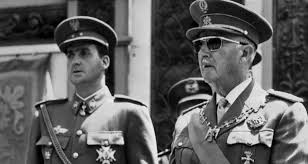
About Franco: “I pay homage to his memory; and I believe that the best way to interpret his legacy is to march without stopping towards social justice objectives, that give strength and unity to our people.”

Translation by Diarmuid Breatnach from article in Castillian by DANILO ALBIN @danialri BILBAO 06-30-2019 08:17 AM Updated: 06-30-2019 08:17

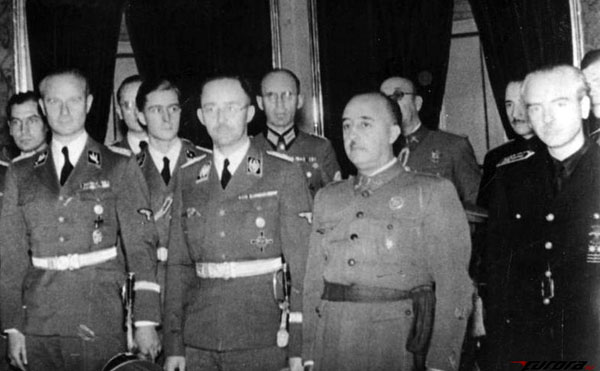
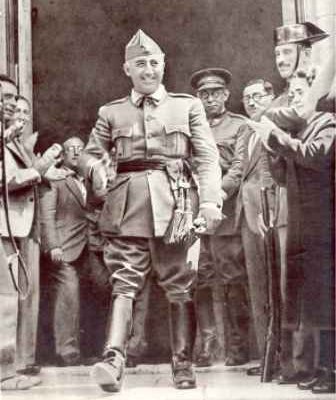
Franco with leading German Nazis. He was greatly admired by the former Spanish King, father of the current one.
(Photo source: Internet)

          There are things that time cannot erase. Words and phrases that seem forgotten but, nevertheless, are still there. Written and permanent. The Royal House offers the collection of speeches by Juan Carlos de Borbón in its digital archive. In those archives, available for those who wish to find them, are the Francoist statements that the now emeritus king pronounced in the first steps of his reign and about which, according to what different historians emphasise, he never made any self-criticism.

November 22, 1975. Two days after the death of the Dictator, Juan Carlos offers his message of remembrance: “An exceptional figure enters history. The name of Francisco Franco will be a milestone of Spanish events and a milestone to which it will be impossible not to refer in order to understand the key to our contemporary political life,” the King proclaimed.

There he showed his “respect and gratitude” towards he who “for so many years assumed the heavy responsibility of leading the government of the State”. “His memory will be for me a demand for behavior and loyalty to the functions I assume in the service of the country. It is a feature of great and noble peoples to know how to remember those who dedicated their lives to the service of an ideal. Spain will never be able to forget who, as a soldier and statesman, consecrated all his existence to its service,” he added.

Hitler and Franco reviewing invader Nazi troops in Hendaye, French Basque Country.
(Photo source: Internet)

The file on the website of Casa Real offers another speech by the King of that same day, in that case addressed to the Armed Forces. “I express my gratitude and gratitude to our Generalissimo Franco, who with so much dedication and commitment has led you until now, giving us a unique example of love for Spain and a sense of responsibility,” he said then.

Twenty-four hours later, Juan Carlos went to the National Brotherhood of Combatants, another self-declared Francoist entity. He promised them “to march forward with determination on the path traced, perfecting and complementing the work Franco did“. “Today, before you, who were his soldiers, I pay homage to his memory; and I believe that the best way to interpret his legacy is to march without stopping towards social justice objectives, that give strength and unity to our people,” he said.

For the historian and researcher Pablo Sánchez León, these speeches by the monarch “show a preconstitutional legitimacy (? Trans) of the Royal Household”. In any case, Sánchez León believes that if they are available in the digital archive, the monarchical institution “has an opportunity to tell a different story of itself”. How? “If they want to preserve those speeches there, something must be added,” he says.

In his opinion, these historical documents should be accompanied by a “furious criticism”. In that sense, he points out that there is a “repository” of Juan Carlos as former monarch, and that “the speeches that speak of Franco should be accompanied by a text in which he is allowed to say that it is abhorrent that there was been a king who once said those things”.

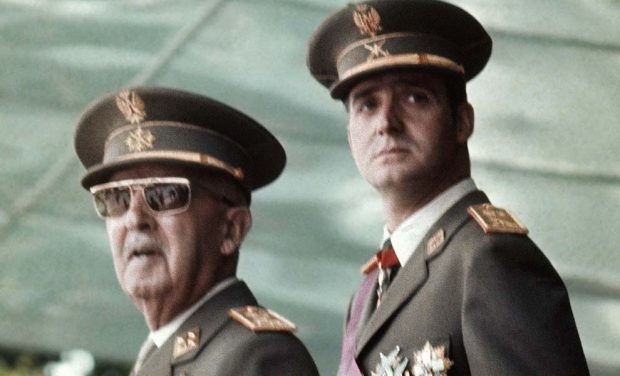
Juan Carlos, crowned by Franco, seen here with his mentor shortly before the latter’s demise.
(Photo source: Internet)

None of that is in the list of of the king’s speeches. “The year that ends has left us with a stamp of sadness, which has had as its centre the illness and the loss of what was our Generalissimo for so many years”, can be read in the Christmas speech of 1975, which also highlighted “the enormous human qualities and feelings full of patriotism” on which Franco “wanted to base all his performance at the head of our nation.”

For Emilio Silva, president of the Association for the Recovery of Historical Memory (ARMH), the Royal House should also include in its file “the video of King Juan Carlos swearing to uphold the principles of the Movement” (i.e the Spanish fascist Movement – Trans). “If there were an exercise in real transparency, it would be told where that (Head of State – Trans) succession comes from,” he told Público.

“The reality is that the king was installed as successor by Franco”.

“Surely it is not the best thing for a democratic system to see texts extolling Franco on the website of of the Head of State,” says Julián Sanz, professor of Contemporary History at the University of Valencia. In any case, he remarks that “the reality is that the King was installed as successor by Franco and Juan Carlos’s relationship with the dictatorship has never been officially reviewed, nor has he abjured it.”

“Generalissimo” and “Head of State”

          “My memory of the Generalissimo, who presided over this Military Passover for so many years and so much satisfaction when he met his comrades-in-arms,” reads the document “Words of His Majesty the King on the occasion of the Military Passover“, dated six January 1976. The following month, in Berga (Catalonia) he took advantage of the inauguration of the Baells Reservoir to argue that “the transformation that Spain has had in recent years of Franco’s mandate, cannot be stopped and all steps will be taken to allow this process to continue. “

The King kept referring to Franco as “Generalissimo” in July 1976, when he went to Santiago de Compostela to make the offering to the Apostle St. James. “Generalissimo Franco, who preceded me in the leadership of the State, personally presented this offering to you on several occasions,” he said then. Something similar happened that same month in Ferrol, where he recalled that this Galician town “was the birthplace of the Generalissimo, a great figure of our history, to whom I am honored to renew a public tribute in this city whose egregious name is forever linked to that of the most illustrious of his children. “

In February 1977 – just four months before the first democratic elections – the king took advantage of a visit to the General Military Academy to “pay tribute to the efforts of two great soldiers who had already gone down in history and who were the architects of the event that we celebrate: General Primo de Rivera, creator of the General Military Academy, and Generalissimo Franco, its first director”. (Primo de Rivera was also the founder of the fascist Falange organisation, which murdered unknown multitudes during and after the Anti-Fascist War, also known as the “Spanish Civil War” – Trans.)

In fact, the official biography of Juan Carlos de Borbón presented by the Royal House on its website also avoids referring to Franco as a dictator. “After the death of the former Head of State, Francisco Franco, Don Juan Carlos was proclaimed King on November 22, 1975, and delivered his first message to the nation in the Cortes, in which he expressed the basic ideas of his reign: democracy and to be the King of all Spaniards, without exception, “says the text.

“Reflects the past”

          For Sánchez León, the inclusion of these discourses without nuances is nothing more than “another example of the thin line of shadow that separates the absolutely abject and unconstitutional, typical of a criminal regime, from a constitutional order.”

The historian José Babiano does not object to the fact that “there is a set of discourses”, since “it reflects a past without twisting it”. In fact, he maintains that “it can help to contradict a sweetened version of the period, its role and of its transition”. “The first speeches are linked to the origin, and the origin is that it was Franco who appointed him. It would have been worse to remove them, because it would have been an attempt at a whitewash,” he said.

In this context, Babiano points out that while “he never repeated the praise (of Franco–Trans) of 1976, there was no self-criticism” about this type of discourse on the part of the King. “He did it when he had no choice in order to be the Head of State and once he gets there, all that is forgotten,” he said.

Público also contacted the Royal House to know if the possibility of contextualizing these speeches has ever been considered. To date we have received no response.

Franco with leading German Nazis. He was greatly admired by the former Spanish King, father of the current one.
(Photo source: Internet)

COMMENT — A SUPREME IRONY

Diarmuid Breatnach

Taking the history of the current Spanish monarchy into account (as referred to above) along with the judgement of the Supreme Court in June last, it is abundantly clear from the mouths of the executives of the State that the “Transition” to democracy, as many of its critics have said, was only ever the drawing of a veil over the fascist essence of the State. Of course, the actions of the State down through the years, whether under social-democratic government of the PSOE or right-wing of the PP, have given ample evidence of its nature.

In a judgement delivered last month (4th June), the Spanish Supreme Court halted the planned exhumation of Franco’s remains and their transfer from the mausoleum in the Monument to the Fallen built by prisoner labour during the Dictator’s regime. In justification of its halting the operation that was to take place on June 10th by order of Government, the Supreme Court declared that General Franco had been the Head of State since 1st October 1936, that is to say, two months after the date on which he and other Generals, with the aid of military transport, armaments and personnel from two foreign powers (i.e Nazi Germany and Fascist Italy), launched their military-fascist armed coup against a democratically-elected government of the Spanish State, resulting in a bitter war of over two years with huge loss of life.

General Franco on 1st October 1936, having just been made Generalissimo and Head of the Fascist coup forces. The Spanish Supreme Court in June 2019 claimed he was then the legitimate Head of the Spanish State!

This decision of the Supreme Court constitutes a supreme irony. A dozen Catalan social and political activists have been on trial for months and are now awaiting verdict – the main charge against them is of “Rebellion”, which entails an attempt to overthrow the State through violent uprising. The Catalans in question called, not for the overthrow of the Spanish State but rather for independence for Catalonia — and did so peacefully; nevertheless they were charged with rebellion, kept in jail awaiting trial and are still there, awaiting verdict. In answer to a legal challenge by the Catalans’ Defence team, the Supreme Court decided the Catalans did have a case to answer on “rebellion”. Now the same court, in the same year, decides that Franco, who DID lead a violent overthrow of the State, was the legitimate Head of State barely two months after the coup he led and while the the democratically-elected government he was rebelling against still had another two years to go before it was overthrown.

end. 

SOURCES REFERENCE:

Original article in Castillian: https://www.publico.es/politica/casa-real-ofrece-matices-discursos-franquistas-rey-juan-carlos.html

Decision of Supreme Court re Franco “Head of State”: https://www.publico.es/politica/supremo-reconoce-franco-jefe-1-octubre-1936-plena-guerra-civil.html

HORROR FASCISTA EN VILLORUELA — BORRADO?

Una historia de crímenes del fascismo espanol, si nos hacia falta recordarnos de nunca jamás dar les la oportunidad de alcanzar el poder de nuevo.  Y nos demuestra además que el fascismo nunca fue vencido en el Estado espanol, sin hablar de haberlo despedido.  Sin entender esa verdad no es posible arreglar las problemas del ahí.

He traducido este relato al inglés y subido separadamente. 

Diarmuid Breatnach

El miedo asoló Cantalpino, donde las hordas falangistas mataron a una mujer y a 22 hombres; donde se robó y violó. La señora Alejandra cuenta la historia y sus ojos parecen mirar hacia dentro de si misma: “ Aquí asesinaron a muchos y a la Eladia Pérez, la Jaboneta, también. Fueron a buscar a su hijoGuillermo, a quien «pasearon» más tarde, y ella no quiso abrirles; así que el Cagalubias le disparó y la mató; luego la llevaron al cementerio y su cuerpo no cabía en la hoya y el Cagalubias le cortó la cabeza con la pala…los asesinos fueron gente del pueblo y forasteros, falangistas, curas, frailes y hostias. El cura, era de lo peor, daba la bendición a los «paseos»..También les cortaron el pelo al cero a unas cien mujeres y, lloviendo y todo, las sacaron en procesión, la música tocando y los falangistas gritando arribaespaña y vivafranco y… ¡me cago en la madre que los parió!..”

Alejandra sigue con su relato: “..A mi me hicieron muchas, a otras las violaron..A mi me violaron 5 falangistas, sacaron de la cama a mi marido, que en paz descanse, el pobre, y le plantaron una pistola en el pecho, y allí, delante de él, me violaron. Unos me tenían cogida por los brazos y otros, por las piernas, y aquí Santa Inés, a lo que quieran hacer, y las pistolas encima de la cama en presencia de mi Desiderio ¡El pobre Desiderio! Además nos robaron todo lo que pudieron..Si, si, eran de aquí, de Cantalpino. Por desgracia, esta violación no fue un hecho aislado. En Poveda de las Cintas, a pocos kilómetros de Cantalpino, la historia se repitió, esta vez con la mujer del secretario del ayuntamiento..”

El 24 de agosto de 1936 la sangre no paró en Cantalpino, la impunidad de los asesinatos animó a los franquistas. Esa misma tarde se presentaron en Villoruela, a menos de 10 kilómetros de Cantalpino, 3 falangistas acompañados por fascistas vecinos del pueblo: Detuvieron a las siguientes personas: Eustasio Ramos (51 años), Elías Rivas (43), los hermanos Leonardo (43), y Leoncio Cortés(41), Daniel Sánchez (35), Esteban Hernández (29) Francisco García (25) y Benigno Hidalgo (18).

Los fascistas dieron contestaciones de carácter criminal a los familiares de los detenidos cuando iban a buscarles a sus casas: A la mujer de Leonardo Cortés le preguntaron que dónde estaba su marido; ella respondió que no sabía y le contestaron: “No se preocupe, que aunque esté bajo tierra le encontraremos”. Daniel Sánchez había estado jugándose la vida para salvar la de otras personas con sus mulas y su carro para cruzar la riada de la era, sin tener en cuenta de qué color ni de qué partido eran. Cuando le fueron a buscar a casa les dijo la mujer: “Esperen ustedes, que se está quitando la ropa, está todo calado”; la contestación fue: “No se preocupe usted, que lo mismo le va a dar”. Cuando fueron a la casa de Esteban Hernández, les dijo su madre: “esperen, que no tiene calcetines”; la contestación fue: “no se preocupe, que no le van a hacer falta”. Cuando fueron a buscar a Benigno Hidalgo, les dijo su madre: “le tengo que poner una inyección”; “no se preocupe usted, se la vamos a poner nosotros”, le contestaron.

Una vez capturados, quedaron arrestados en el Ayuntamiento atados de pies y manos con cuerdas. Los componentes del Ayuntamiento convocaron una reunión y decidieron que los 8 detenidos debían ser fusilados. Así amarrados, los hicieron subir a un camión en Villoruela, ya pasada la medianoche, y los trasladaron al término de Salvadiós, un pueblo de la provincia de Ávila. Allí, en un cruce de caminos, los fusilaron y los dejaros tirados en una cuneta. Allí mismo los enterraron unos vecinos de Salvadiós. Los asesinos fueron 7 del pueblo, el que llevaba el camión y los 3 falangistas forasteros.

Dos de las mujeres de los detenidas, María Engracia Cortés y Angeles del Pozo, se fueron a pedir ayuda a las monjas del convento. Contaron a las monjas lo que estaba pasando y ellas contestaron que aquello era una cruzada, y que si no habían hecho nada por qué habían estado huyendo, a lo que muy acertadamente las vecinas citadas contestaron: “A Jesucristo también lo persiguieron y por nada lo crucificaron”.

Jaime Cortés, hijo de uno de los fusilados contaba que “..después del sufrimiento que causaron, los fascistas nombraron entre los vecinos del pueblo una guardia llamada cívica para controlar nuestras salidas de casa, las demostraciones de sufrimiento. Nos pasábamos las noches enteras llorando con mi madre y mis abuelos en la cocina..hace falta tener mucha paciencia y resignación para convivir toda una vida con los criminales que fusilaron a tu padre..tuvimos que pasar por calamidades y sufrimientos..he tenido siempre muy presente una frase que mi madre nos decía con mucha frecuencia: “Hijos, no quiero veros nunca con las manos manchadas de sangre”…los únicos motivos por los que los fusilaron tuvieron fueron la forma de pensar diferente al franquismo, es decir, por defender la libertad, los derechos de los trabajadores, la seguridad social y la educación..los fusilaron por defender el derecho más grande de toda persona: la libertad..”

Desde la fecha 15 de agosto de 1936 al 16 de junio de 1939 no existe ningún documento, ni libro de actas de los archivos de Villoruela ¿Quiénes fueron los que hicieron desaparecer dicha documentación? En el libro de actas de defunciones aparecen con fecha 13 de marzo de 1937 inscritos por el juez Iñigo de la Torre estos 8 fusilados como personas como desaparecidas.


Originales de Ángel Montoro en Jiminiegos36 y Foro por la memoria (Intervíu nº 177, 4-10 octubre 1979). Foto de Xavier Miserachs

Documento original:

https://documentalismomemorialistayrepublicano.wordpress.com/2019/01/27/el-inmenso-rompecabezas-del-horror-fascista-entre-cantalpino-y-villoruela-salamanca/?fbclid=IwAR2Ha_X552tk86E3B4b5WVoA9m1_1gMZc8xnaThBs__Dv2N7eUZ31wr6KUI

FASCIST HORROR IN WESTERN SPAIN

A brief account of the fascist horror between Cantalpino and Villoruela (Salamanca) during the Spanish War, forwarded to me for translation from Castillian (Spanish).  I will post the original separately.  

Diarmuid Breatnach

Comment: If another reason were ever needed to ensure we crush fascism before it gets strong!  Stories like this illustrate how fascism was not defeated, much less rooted out in the Spanish State and remains at its heart to this day.  No progress can be made towards democracy in that state without taking that fact into account.  DB.

(Translator’s note: Villoruela is a municipality located in the province of Salamanca, Castille and León, in western Spain).

Alejandra, the interviewee, who was raped in front of her husband, next to her while a gun was held to his chest.

Fear ravaged Cantalpino, where the Falangist hordes killed a woman and 22 men; where they robbed and raped. Mrs. Alejandra tells the story and her eyes seem to look inside herself: “They murdered many here and Eladia Pérez, the Jaboneta, too. They went looking for her son Guillermo, whom they “took for a walk” later, and she did not want to open for them; so the bastards shot and killed her; then they took her to the cemetery and her body did not fit in the hole and the bastards cut off her head with the shovel … the murderers were people from the town and strangers, Falangists, priests, friars and that kind. The priest was the worst, he gave his blessing to the “walks” .. They also cut the hair of about a hundred women to the scalp and, in the rain and everything, they took them in procession, the music playing and the Falangists shouting “Up Spain!” and “Long live Franco!” and … I shit on the mother who gave birth to them! “

Alejandra continues with her story: “… they did a lot to me, they raped others. Five Falangists raped me. They took my husband out of bed, may the poor man rest in peace, and they pushed a pistol against him, in the chest, and there, in front of him, they raped me. Some had me by the arms and others, by the legs, and here, Saint Ines, to what they wanted to do, and the guns on the bed in the presence of my Desiderio. Poor Desiderio! They also stole everything they could. Yes, yes, they were from here, from Cantalpino. Unfortunately, this violation was not an isolated incident. In Poveda de las Cintas, a few kilometers from Cantalpino, the story was repeated, this time with the wife of the secretary of the town hall .. “

On August 24, 1936 the blood did not stop in Cantalpino, the impunity of the murders encouraged the Francoists. That same afternoon they appeared in Villoruela, less than 10 kilometers from Cantalpino, 3 Falangists accompanied by fascist neighbors of the town: They arrested the following people: Eustasio Ramos (51 years old), Elías Rivas (43), the brothers Leonardo (43) , and Leoncio Cortés (41), Daniel Sánchez (35), Esteban Hernández (29) Francisco García (25) and Benigno Hidalgo (18).

The fascists gave criminal replies to the families of the detainees when they went to look for them at home: Leonardo Cortés’ wife was asked where her husband was; she replied that she did not know and they answered: “Do not worry, even though he were underground, we will find him”. Daniel Sanchez had been risking his life to save the lives of other people with his mules and his cart to cross the flood, regardless of what color or what party they were. When they went to look for him at home, the woman said to them: “Wait, he is taking off his clothes, he is all wet”; the answer was: “Do not worry, he will get it all the same”. When they went to Esteban Hernández’s house, his mother told them: “wait, he does not have socks”; the answer was: “Do not worry, he will not need them”. When they went to look for Benigno Hidalgo, his mother told them: “I have to give him an injection”; “Do not worry, we’re going to give it to him,” they replied.

Once captured, they were arrested at the City Hall tied hand and foot with ropes. The members of the City Council called a meeting and decided that the 8 detainees should be shot. So bound, they were put on a truck in Villoruela, after midnight, and they were moved to the end of Salvadiós, a town in the province of Ávila. There, at a crossroads, they were shot and left lying in a ditch. Right there they were buried by neighbors from Salvadiós. The murderers were 7 from the town, the one that drove the truck and the 3 outsider Falangists.

Two of the detainees’ wives, María Engracia Cortés and Angeles del Pozo, went to ask for help from the nuns of the convent. They told the nuns what was happening and the nuns answered that this was a crusade, and that if they had not done anything why had they had been fleeing, to which the neighbors correctly answered: “Jesus Christ was also persecuted and though had done nothing, was crucified. “

Jaime Cortés, the son of one of those shot, said that “after the suffering they caused, the fascists appointed among the townspeople a policeman, allegedly civic, to control our movements from home, the demonstrations of suffering. We spent the whole night crying with my mother and my grandparents in the kitchen .. it takes a lot of patience and resignation to live a lifetime with the criminals who shot your father .. We had to go through calamities and sufferings … I always remembered very well a phrase that my mother told us very often: “Children, I never want to see you with blood on your hands” … the only reasons for which they were shot were their way of thinking differently from the Franco regime, that is, to defend freedom, the rights of workers, social security and education … they were shot for defending the largest right of all person: freedom .. “

From the date August 15, 1936 to June 16, 1939, there is no document or record book of the Villoruela archives. Who were the ones who made that documentation disappear? In the book of death certificates for March 13, 1937 the entry inscribed by the judge Iñigo de la Torre these 8 people shot dead are listed as missing.

Originals by Ángel Montoro in Jiminiegos36 and Foro por la memoria (Intervíu nº 177, 4-10 October 1979). Photo by Xavier Miserachs

“THE LAST COLONY IN AFRICA” — REPRESENTATIVES SPEAK IN DUBLIN

(Approx. reading time: report 10 mins; background 2 mins.)

Report by Diarmuid Breatnach

On Tuesday March 5th a meeting in the Teachers’ Club, Parnell Square, was addressed by representatives of the Western Sahara people and by experts in human rights matters.

2015 protest by Saharawis, mostly women.
(Photo source: Internet)

          Western Sahara, a territory of 266,000 square kilometers (103,000 sq. miles) in the Maghreb, was part of Europe’s carve-up of North Africa, when it was known among most states as Spanish Sahara, in acknowledgement of the European state that occupied it. Its people speak Arabic and Castillian (Spanish) and some also speak French, an influence from neighbouring French ex-colonies.  Few speak Berber.

Mohamed Belsat of the Polisario speaking at the event (Photo: D.Breatnach)

The UN General Assembly in 1964 called on Spain to hold a referendum there which the Franco fascist regime declined to do but in 1975, after the dictator’s death, the new regime pulled out of the territory, practically handing it over to Morocco and Mauritania. After a conflict between those two states, Morocco emerged as the sole occupier and the conflict since then has been between the Kingdom of Morocco and the Saharawi people, who seek independence.

Chaired by Mark McLoughlin, filmmaker, the Dublin meeting had been arranged at short notice and its advertising further hampered by cancellation of a booking at Trinity College.

TRACING THE PLUNDER OF SAHARAWI NATURAL RESOURCES

          Erik Hagen, of Western Sahara Resource Watch, with a display projected on a screen, showed how his organisation traces the ships arriving at the territory and departing with phosphates mined there to their destinations. From the registered tonnage of the ships, the amount of phosphates plundered can be calculated. The companies involved claim that they are doing no wrong, since they pay Morocco for the cargoes.

Mark Hagen illustrating a point with reference to the display. (Photo: D.Breatnach)

But according to the UN, no state may extract resources from a disputed territory without the consent of the people. Hagen talked about how EU had changed the wording to replace “consent of” with “being of benefit to” and then went on to effectively falsify agreement on benefit, using a document on consultation with huge majority – and a total of Saharawi organisations – voting against as evidence for.

The only company currently exploring for oil in Western Sahara is San Leon, an Irish company, although they failed to find any and are currently fighting in financial difficulties.

Clive Symmonds, expert in international law talked about the policy of isolating produce from occupied territories, by first compelling their labeling as such, which, although that would not ban the products, would facilitate a ban if such were decided. The Control of Economic Activity (Occupied Territories) Bill 2018 introduced to the Oireachtas (Irish legislature) and currently being processed with cross-house support despite Government opposition, is an example of how such a ban may be implemented (and Senator Black’s Bill will also be valid for Western Sahara). Of course, as Symmonds pointed out, such labeling is left to the exporter which in this case would be the Kingdom of Morocco.

Clive Symmonds speaking on human rights legislation and W. Sahara (Photo: D.Breatnach)

 Symmonds also referred to the EU Fisheries Agreement which, in permitting fishing within what Morocco claims as its territorial waters without reference to the Saharawi people, is permitting the plunder of the Saharawi people’s fish stocks – and the Irish State is a party to this, having signed the Agreement. Symmonds pointed out that the judgement of the European Court of Justice on 21st December 2016, stated that Western Sahara is a “separate and distinct” territory from Morocco and that trade agreements between the EU and Morocco do not apply to the occupied territory. The EU is in violation of this judgement.

A REFERENDUM IS THE ONLY DEMOCRATIC WAY”

          Mohamed Belsat, Frente Polisario Ambassador to Europe, talked about the policies of the Irish state, the EU and, in particular, France. Belsat said that they were in collusion with the Kingdom of Morocco and that in particular, France often seemed to be the opponent of the Saharawi people even more than Morocco.

Referring to what he said was the only democratic of ascertaining the will of the Saharawi people, Belsat said that it was a referendum. Morocco had called for this since they had flooded Western Sahara with Moroccans but, since the process of registration of genuine and historical residents of the area had been completed by the UN, the Moroccan Kingdom had withdrawn all support for a referendum.

(Photo: D.Breatnach)

The cost of the occupation to the Moroccan kingdom is huge, in terms of military presence maintenance and so on,” Belsat said, adding that the cost of every litre of water supplied to the occupation forces was equal to four times the price of a litre of whiskey. Furthermore, the cost to the Kingdom exceeded the benefits it extracted from the colony. In January, Morocco had at last joined and signed up to the constitution of the African Union, the organisation of African states, of which Western Sahara is a founding member and which has a long-standing position on Western Sahara being an occupied colonyFor all these and other reasons, including dissatisfaction with the regime among the Moroccan general population, he felt that a campaign of pressure on Morocco and on the EU might well bear fruit in terms of the decolonisation of this “last colony in Africa”.

Later, Belsat’s response to a question from the audience amounted to an admission that there was no “peace process.” (sic) in operation (despite a reference to it by a number of speakers) and that as a result of this and the conditions under which they were kept by their oppressors, it was increasingly difficult to restrain the youth from resorting to armed resistance. At this a member of the audience commented that armed struggle against the army of the Moroccan Kingdom backed up by France would be “suicidal”.

57 POLITICAL PRISONERS BUT MANY MORE HAVE DISAPPEARED WITHOUT TRACE”

          ElGhalia Djimi, Vice-President of ASDH (Saharawi Association of Victims of grave violations of human rights by the Moroccan State), which cooperates with the League for the Protection of Western Sahara Political Prisoners in Moroccan Jails (LPPS), who had arrived in Ireland that day, made her presentation next.  Speaking in French through a translator, Djimi talked about the conditions of life under occupation for the Saharawi people. Djimi showed a compilation of clips of soldiers, police and people in civilian clothes physically assaulting protesting Saharawi women, pulling their hair, punching and kicking them and informed the meeting that those in plainclothes were Moroccan police.

ElGhalia Djimi speaking on Moroccan Kingdom repression of Saharawi people (Photo: D.Breatnach)

There are 57 Saharawi political prisoners in Moroccan jails,” ElGhalia Djimi said, “but many more that have disappeared without trace.”

Unemployment is high among the Western Sahara people and as a result of that and other deficiencies in their lives, a drug problem has arisen, she told her audience. There are no third-level education facilities in the territory, obliging them to go to institutions in Morocco. Although they can study to gain professional qualifications for civil employment, those available are not usually those required by the employers, which is not true for their equivalent in Morocco, with the result that often Moroccans fit into the administrative jobs better than do the Saharawi people. In terms of their treatment by the authorities, all Sahawaris carry a Moroccan ID card but letters on it indicate their ethnic origin (which Belsat likened to the Nazi State’s requirement that German Jews by identifiable in their national ID documentation).

Moroccan citizen settlement in Layoune, the capital of Western Sahara, had now placed the indigenous people, once the majority, in a minority.

Mark Hagen, of Western Sahara Resources Watch.
(Photo: D.Breatnach)

SOLIDARITY IN DUBLIN

          In conclusion of the speakers’ presentations, Mohamed Belsat asked for support from the Irish people with their “history of struggle for freedom and solidarity with other struggling nations”

A couple of members of the audience mentioned that there had been an active solidarity committee with Western Sahara in Dublin in the past and one wondered about the possibility of resuscitating it.

Comment: The solidarity Committee in Dublin was independent of any political party or organisation, its name was Western Sahara Action Ireland and its FB page is still in existence. Between 2011 and 2012, the group organised a number of public events, including: two protests about Moroccan repression of Saharawi protesters, one in Dame Street and another in O’Connell Street; a protest against the EU’s Fisheries Agreement outside the Dublin offices of the EU in Dawson Street; the construction and maintenance of a “Western Sahara Tent” at the Electric Picnic of 2012, along with an exhibition of photographs taken in the territory. The latter was visited by Michael O’Higgins who was then campaigning for the Presidency of Ireland (he also appeared in the film shown at the beginning of public meeting in Dublin).

On each of the Dublin street events, a small group of Moroccans had attended to harass and attempt to intimidate the protesters, almost certainly sent by the Moroccan Embassy but their efforts were to no avail.

Flag of the Western Sahara liberation movement.
(Photo source: Western Sahara Action Ireland)

BACKGROUND

          There had been many uprisings against colonial rule in the history of Western Sahara and the last Rif War, from 1920 to 1927, had cost the Spanish State military 23,000 casualties, of which 18,000 were fatalities. Only for the intervention of the French1, the forces led by Abd el Krim would have kicked the Spanish colonialists out of the footholds to which they were still clinging.2

Like the French in their North African colonies, the Spanish occupiers had suppressed risings not only by military force against insurgents and torture of captives, including electric shocks, but also by terror against the civilian population, including assassinations, massacres, rape and internment without trial.

Both European states also developed their own Foreign Legions. Forget about the 1924 Beau Geste novel by PC Wren and the various screenplays3 to which it gave rise; the Foreign Legions were tough terrorists in uniform, founded not to fight in open war but against resisting colonial peoples.

Since 1963, Western Sahara has been on the United Nations’ list of “non self-governing nations”.  In 1965, the UN General Assembly, in its first declaration on Western Sahara, called on the Spanish State to decolonise the territory and, in 1967, to hold a referendum on self-determination but Spain refused. From 1973 to 1975, the Frente Polisario fought an armed struggle for national liberation.

Western Sahara in context. (Source image: Internet)

After the Spanish State abruptly pulled out in 1975 (following the death of its fascist dictator General Franco) and – without allowing elections of an independent Saharawi government before doing so – it relinquished control to the Kingdom of Morocco (which had formally claimed the territory since 1957) and Mauritania and conflict broke out between those states. Mauritania in time abandoned its claim and Morocco moved in and seized Western Sahara.

The Saharawi people protested Morocco’s occupation of their land and were suppressed by military and police. The Frente Polisario fought the occupying Moroccan military from 1975 until a UN-brokered ceasefire in 1991, since which there has been no Saharawi armed struggle but plenty of Moroccan repression. One of the features of the struggle was the displacement of a large part of the Saharawi population as people fled the Moroccan military, many to Algeria (which had won independence from France in 1962 after a fierce and dirty war), where they remain in a refugee camp. The Moroccan Kingdom then built a wall to prevent Saharawis from returning, which it guards by troops and miles of landmines.

End.

FOOTNOTES

1The casualties of the French, according to Wikipedia, amounted to 10,000 with 2,500 killed in battle. The casualties of the insurgents and of the indigenous civilian population, as usual in these situations, is difficult to determine but, according to Wikipedia, came to 30,000, of which 10,000 were fatalities.

2For more on the Rif War 1920, read the article about it (see link in Resources and Useful Links).

3Including those of 1939 starring Gary Cooper and Ray Miland, 1966 with Telly Savalas and Doug McClure and the BBC serial of 1982.


REFERENCES AND USEFUL LINKS

Sahara Press Service: https://www.spsrasd.info/news/en

Western Sahara Resources Watch: https://www.wsrw.org/

Western Sahara Action Ireland facebook page (please bear in mind that at the time of writing this group is not active): https://www.facebook.com/groups/256377861125569/

Article on the Rif War 1920 by me: https://rebelbreeze.wordpress.com/2018/08/09/an-old-war-with-a-lesson-for-today/

Recent Amnesty International report on Western Sahara under Moroccan rule: https://www.refworld.org/docid/5a9938ac4.html