Gearóid Ó Loingsigh (republished from Socialist Democracy November 2022 with kind permission of the author)
(Reading time: 8 mins.)
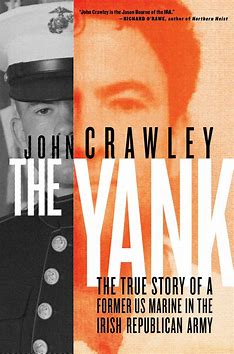
At first when I heard about this book, I thought it would be some spoof by a wannabe and wasn’t inclined to take it seriously. That was a mistake. The Yank is an entertaining and informative tale of the exploits of a Yank who joined the IRA.
That in itself would be a story worth telling, except John Crawley’s life in the IRA was no ordinary story. He comes across as a committed and dedicated Irish republican and even a veritable James Bond, though he might not like the comparison with the fictional agent of British imperialism and murder at her majesty’s request.
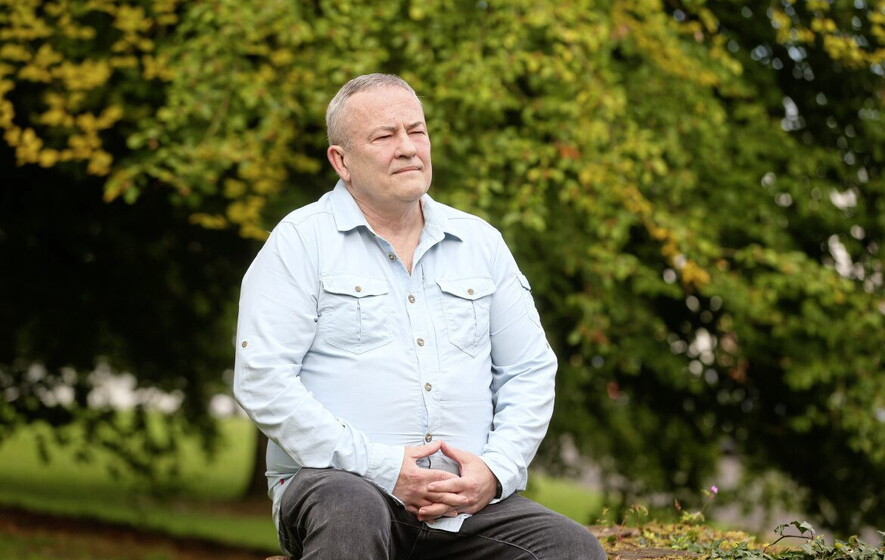
John Crawley, former US Marine and subsequently Provisional IRA Volunteer (Photo sourced: Irish News)
Crawley was a young man raised in the US, who when his family moved back to Ireland eventually decided to go back to the US and joined the Marines, with just one purpose in mind, to become a fighting and killing machine and return to Ireland to join the IRA.
By fighting and killing machine, I don’t mean some mindless grunt as the Yankee military might put it. He was determined and trained hard and excelled, to such a point that the US intelligence services wanted to recruit him and when he took the decision to come back to Ireland the US military were sorry to see him go.
He was one of their best, something they recognised and tried to take advantage of. Sadly, his undisputable abilities were not recognised by the IRA and Martin McGuinness in particular. They had apparently little use for his rather unique skill set, which would be considered to be invaluable in any armed organisation, except in the IRA under Adams and McGuinness.
Crawley tells his autobiographical story in a very readable fashion; at times you feel you are having a fireside chat with a rather likeable man. It is an easy read and worth it.
The book has received some criticism from bourgeois critics who would rather that he just told his story of a Yank in the IRA, much like Mark Twain’s A Connecticut Yankee in King Arthur’s Court.
But his tale is not one of fiction and the politics of Ireland are intimately bound up with his decision to join the IRA and remain in it, even after a lengthy prison sentence following his capture on the Marita Anne, when he and former Sinn Féin T.D. Martin Ferris tried to import arms to Ireland.
His politics are important to the story. He is at times quite blunt and even clumsy in how he states them, sounding very much like Ruari Ó Bradaigh at times, though in the last chapter his explanation of why he rejected the Good Friday Agreement is much better, sincere and at times hits the nail on the head.
He dedicated his life to an ideal and fought for it. He had never suffered at the hands of the Brits, nor does he seem to be caught up some dewy-eyed nationalist dream but rather he made an ideological decision to commit to something and stuck with it. This ideal was betrayed and part of how it was betrayed is shown in his story.
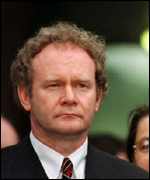
The late Martin McGuinness, Commander Derry’s IRA, one of SF’s main leaders and Deputy First Minister or Her Majesty’s Irish colony. Crawley found much to make him uneasy in McGuinness’ military leadership which also gave rise to other doubts. (Photo sourced: Internet)
He doesn’t set out to besmirch McGuinness and I have to admit that I never took seriously any of the conspiracy tales around McGuinness and Adams, but there are many details in the book that call into question what McGuinness was about and with whom in later years and I am now more sympathetic to some of these stories.
Crawley had a military expertise that few if anyone else in the IRA had and yet McGuinness the head honcho in the IRA whose later reputation as a military man would help sway the IRA towards the GFA and disarmament did not value his expertise or indeed listen to him.
He describes him as military illiterate, something I am inclined to agree with. But McGuinness could not only not be questioned politically, but militarily. He remarks at one point about IRA operations and weaponry that
Martin went silent. I could see he was seething, but he said no more about it. I shut my mouth. The last thing I wanted to do was alienate him. I wanted to help the IRA beat the Brits. I wasn’t there to criticise him personally, although I believe that’s how he interpreted it. My heart fell into my boots.
I had expected to be led by skilled professionals, men who were technically and tactically proficient. A true professional would value the correction and pass it on to the men on the ground but not this fellow. He took it as an insult.
Because of his status and prestige in the movement, I knew that if Martin McGuinness said the rocket didn’t explode then, as far as the IRA was concerned, it didn’t explode.
Nobody was going to listen to what I had to say about it. It didn’t matter to me personally whether or not I was believed, but the real damage was to volunteers’ confidence in the weapon.
He deals with the politics of betrayal in the GFA, and though he laments and rails against the lack of professionalism from the IRA leadership and the consequences of the illiteracy of McGuinness & Co.
Crawley doesn’t deal with the politics of a movement where McGuinness and others who were undoubtedly careerists from the beginning were able to hold sway.
How could a movement get away with sending out men and women to fight, die and kill and not try to do their best for them? This question goes beyond the individuals concerned, though they played a major role in it. This question is not answered.
But he gives us a lot of information, some of which should raise questions about the IRA leadership in the minds of the reader and indeed Crawley who also deals with the issue.
Crawley made many suggestions to the IRA and McGuinness in particular about things they could do. They ranged from simple stuff that every sniper have their own rifle adjusted for them, to other things.
His ideas were, and pardon the pun, shot down. Most of them were basic common-sense things, others were based on his extensive and intense experience in the US military.
Perhaps McGuinness and Adams watched the wrong documentaries and war films, but some of his suggestions were not a million miles from common sense, but yet the military expert of the IRA, McGuinness rejected them. Why? we do not know, though he does hint at it later in the book.
The politics aside, his book is a fascinating look at the life of an IRA volunteer, one who has not bowed down to the political correctness of the SF leadership. His description of his time in England would be riveting, except we obviously know the outcome. It is nevertheless interesting.
Crawley has a gift for writing, and he should not stop now. In all conflicts Historic Memory, as it is termed is important and just another battlefield. His is a voice that deserves to be heard and one which has to date been drowned out by Adams and McGuinness loyalists. He should write more about his experiences.
There has been a slew of publications and memoirs by IRA volunteers, many of them by Adams loyalists. This is not one of them. Prior to this, our only insight on the inner workings and politics of individual volunteers was through the Boston College.
At the time Sinn Féin described it as a “touts’ charter”, due to the criticism levelled, by those who gave their testimony, at Adams and co. Martin McGuinness is dead and there have been too many publications, sanctioned by the IRA, or at least not meeting with its disapproval for Crawley’s book to be placed in that category.
Instead, they have opted, unsuccessfully, to ignore it, hoping just like the IRA it will go away. That hasn’t happened and the book is doing well and deserves to be read.
People may remember that McGeough and an assortment of other far-Rightists and fascists (such as Niall McConnell) were rosary-protesting a local Gay Pride march in the small Co. Tyrone town of Cookstown in September last year, the first ever in the town it seems. Michelle just walked up to Gerry and punched him in the face.
Well, not quite – she did say “Hello, Gerry” a second before she smacked him.
There was some confusion initially, as many thought Michelle was an antifascist or at least an LGBT rights supporter but it turns out that she and Gerry had history that had turned nasty in the branch of the Ancient Order of Hibernians of which Gerry had been a member – hence the knuckle complaint.
Anyway, this allegedly ex-Republican and definitely ex-Provo (both military and political wings — he had been on the Ard-Choiste, equivalent to Executive Committee) took his case to the courts of the British colony but failed as the judge in Dungannon took the view that the punch was a “one-off” (which is perhaps why some people prefer the old “one, two”).
It is remarkable how many of our native far right-wing and fascist stalwart fighters, constantly calling out the corrupt political system and the need to overthrow it, seek the endorsement of the State’s legal system, whether British colonial, as in the Six Counties, or Irish Gombeen, as in the Twenty-Six.
Gemma O’Doherty and John Waters for a while seemed to have season tickets for the High Court; Dee Wall “The Screaming Crutch” of QAnon was heard enough times threatening legal action, as was Right-Wing Ranter-in-a-Vehicle Carey; Ben Gilroy was a frequent (and ineffective) defence representative for people being evicted from their homes.
Gerry McGeough claimed in court that the assault was not merely an attack on him but was also an attack on the Virgin Mary. News & Views staff attempted to contact the Mary in question to hear her views but she failed to respond.
Actually, her main support organisation, the Irish Catholic Hierarchy, was keeping quiet on the matter too, although they are known to share Gerry’s view on the alleged sins of consenting LGBT adults.
It’s just that the ICH management board like to tone it down these days since their position of moral superiority has been eroded over the years, largely but not alone due to exposés of the sexual practices of many of the ICH’s employees with non-consenting minors.
Gerry claimed that on the occasion he had just been there in Cookstown to pray in public, as he does and that he should have the right to do so without being assaulted. Ah Gerry, now, really? News & Views investigative staff enquiries in the locality have found not one local who has ever seen Gerry praying there on any other day.
Which of course leads one to suspect that he and the other fascists and right-wingers were there to protest against the Gay Pride parade and using religion as a cover.
In fact, we recall Niall McConnell and other fascists and far Right-wingers on a number of occasions objecting to the right to pray in semi-public, when Muslims hired Dublin’s Croke Park to celebrate their Eid festival.
Which reminds us, on the occasion that Dublin Republicans Against Fascism organised a counter-protest in July 2020, women were accused of punching or slapping some of the fascists too.
And Niall McConnell, Fuehrer-of-Five of Síol na hÉireann1 took one of the women to court, requiring her to attend court a number of times and then failed to attend himself when the case was to be tried.
There does seem to be a thing about male fascists and women, come to think of it.
At the recent bust-up of the also fascist National Party’s congress at a luxury resort in Co. Fermanagh, the only injuries of consequence inflicted on the anti-fascists were on three female comrades, while five of the would-be stormtroopers – all male — ended up in hospital in exchange.
End.
FOOTNOTES
1The title means “Seed of Ireland” but ‘seedling’ might be a more accurate description and one suffering from damping-off or withering in recent times.
Who’d have thought that my grandfather was into Futurism? That’s correct – into Post-Impressionism, Cubism and Futurism. And how do I know that? Well, I was in the Kilmainham Gaol Museum last week and I saw his yellowing copybook (see below), and there it was, a lecture on modern art from the 5th of August, 1923.
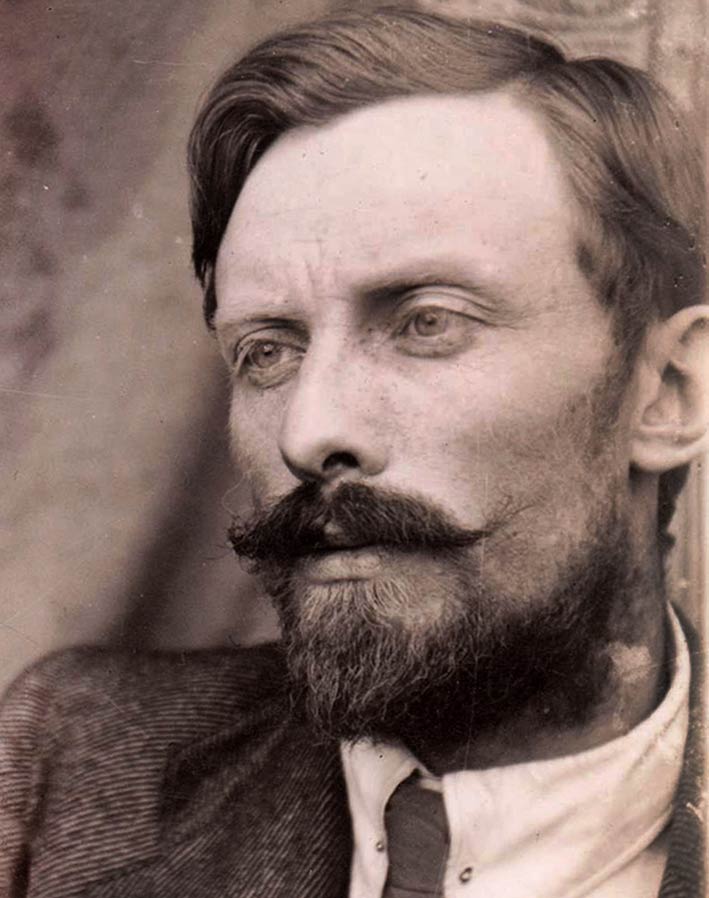
Yes, my grandfather Ailfrid Mac Lochlainn was imprisoned in various prisons during the Irish Civil War (he was never charged with a specific offence) but to pass the time, he was often called upon to deliver lectures to his fellow prisoners. He also made several pencil sketches of his comrades on small scraps of paper, some of which you see in this post. The originals can be seen in “Intervals of Peace”, a special exhibition curated by Brian Crowley at the museum.
We see and often hear “viva la Quinta Brigada” but this is usually a mistake – the reference is not to the Fifth but to the 15th International Brigade. The word for fifteen in Spanish is “quince”1 whereas “quinta” means “fifth”. The brigade being referred to, the Fifteenth International Brigade, was one formed at the instigation of the Communist International (Comintern) in 1936 from volunteers from more than 55 countries2.
The estimates of numbers of participants in the International Brigades range from 40,000 to 59,000 with a death toll of around 10,0003 and of course many more injured.
Not all the Irish-born and Irish diaspora antifascists who fought4 in what is called the Spanish Antifascist (or Civil) War fought in the 15th Brigade5 but most of them did, whether in the British, Commonwealth or US Battalions (“Abraham Lincoln” and “Washington”, later combined), chiefly because these were the English-speaking battalions of the 15th International Brigade, which also included specific battalions for French, German, Italian, Spanish (from Mexico, Caribbean and Latin America) Czechoslovak, Hungarian and Polish languages6.
International Brigaders crossing the Ebro for the battle. The one in the bows of the boat appears to be Irish communist Michael O’Riordan, carrying the Senyera, the recognised Catalan flag of its time (red and yellow stripes without a star). O’Riordan survived the Civil War and returned to Ireland to lead the Communist Party of Ireland. (Image sourced: Internet)
The familiar songs in English were always about the 15th International Brigade, no other. So why and how has this mistake arisen of referring to the 5th?
The chief transmission of this error in recent time has been through that song with the wonderful lyrics and air created by the Irish balladeer and most famous folk performer, Christy Moore.
And he called his song “Viva La Quinta Brigada”. Recorded and performed under that title, with numerous videos repeating the error, even though he has himself corrected the reference in later performances.7 And in fact there are a number of Quinta Brigada versions of the Ay Carmela song on Youtube. So we can hardly blame all those people who are now singing the incorrect version, can we?
But before we arraign Comrade Christy Moore before a People’s Tribunal, it’s worth looking at the longer process of the error’s transmission. In fact, the incorrect wording was around long before Christy composed his song and it almost certainly informed his lyrics.
TRACING THE ERROR: THE AY CARMELA SONG AND SPIN-OFF
I remember thinking one time, when I became aware of the error in the title and refrain, that Christy should have consulted some Spanish-speaking people in Ireland. But I and my siblings are all Spanish-speaking and I recall even some of us singing a different song with a repeated line: Viva la Quinta Brigada, rumba la rumba la rumba la.
We were Spanish-speaking, yes and very sympathetic to the Republican side in that war — but at that time clearly not clued enough historically to detect the error,
That Rumba la rumba etc was a song in Spanish from the Republican side in the Civil/ Antifascist War, itself a spin-off or readaptation of a Spanish folk song about the crossing of the Ebro against Napoleonic troops in the 1800s. In this case the adaptation was fashioned to record the Republican forces’ crossing of the same river in attack on the advancing military-fascist forces in 1938.
The Battle of the Ebro was the largest ever fought on Spanish soil and lasted from 25th July to 16th November. The International Brigade song to the same air is generally known as Ay Manuela! and clearly refers to the International Brigade, not only by the lyrics in the final verse but by its alternative title, Viva La Quince Brigada!
Somewhere along the line someone made the error of replacing the Quince with Quinta. And so when Christy came to write his wonderful tribute to the Irish who went to the Spanish territory to fight against the fascist-military coup, the mistaken name had already been current for decades.
Re-enactment with partipants playing the parts of soldiers of the Spanish Republic advancing in the Battle of the Ebro. (Image sourced: Internet)
CORRECTING IT NOW
So no-one to blame for repeating the error and whoever caused it originally is long in the past. But we are here now and we know – so we have a responsibility not to perpetuate the error. We can do this quite simply in three ways:
Call the song “Viva la Quince8 Brigada” on all occasions
If we sing it, replace Quinta with Quince in the lyrics
Inform others about the correct version
End.
FOOTNOTES
1Fifteenth is “decimoquinta” in Castillian (Spanish) but, that being five syllables and therefore three too long for the song, “quince” (fifteen) must be sung instead.
2One of the many sources gives the figure of “55 Countries” but that probably means “55 states” and a number of states such as the UK, France, Belgium and Russia in Europe contain other nations, as do China, states in the Middle East, etc. In addition, many Jews also fought, one estimate putting them at one-quarter of the total of the “Brigadistas”.
3The very high casualty rate had a number of contributory factors but chief among them was the superiority of war-machines on the fascist-military side, in particular of aircraft, most of which were supplied, with pilots, by fascist Italy and Nazi Germany, while Britain and France blockaded Spain.
5Some fought as part of the POUM, largely Trotskyist antifascist organisation or may have fought in anarchist militia and one that we know of fought alongside the Basques (and gave his life there).
6There were other language groups but their numbers did not usually rate a whole battalion and they were integrated into battalions primarily of some other language.
7And even later still, amended the historically incorrect “the bishops blessed the Blueshirts in Dun Laoghaire
8Pronunciation guide for Quince: keen-the or keen-se.
9I’ve translated Ay! as Oh! but it’s more like Alas!, only hard to see that in the song’s context perhaps.
10I’ve translated Ay as Oh but it’s more like Alas, only hard to see that in the song’s context perhaps.
11The “Moors” were native North African troops raised by Spain’s Foreign Legion. Franco had been sent there by the Republican Government probably to get him out of the way after his ferocious suppression of the Asturias miners’ revolt. From there Franco’s troops were airlifted to the Canary Islands and from there to Andalucia in southern Spain, carving their way in the blood of mostly unarmed civilians.
El Ejército del Ebro, Rumba la rumba la rumba la. El Ejército del Ebro, Rumba la rumba la rumba la Una noche el río pasó, ¡Ay Carmela! ¡Ay Carmela! Una noche el río pasó, ¡Ay Carmela! ¡Ay Carmela!
The Army of the Ebro, rumba la rumba la, rumba la etc One night crossed the river, Oh9 Carmela, Oh Carmela!
Y a las tropas invasoras, Rumba la rumba la rumba la. Y a las tropas invasoras, Rumba la rumba la rumba la Buena paliza les dio, ¡Ay Carmela! ¡Ay Carmela! Buena paliza les dio, ¡Ay Carmela! ¡Ay Carmela!
And to the invading troops rumba la rumba la, rumba la etc Gave a good beating, Oh Carmela, Oh Carmela!
El furor de los traidores, Rumba la rumba la rumba la. El furor de los traidores, Rumba la rumba la rumba la Lo descarga su aviaciónes, ¡Ay Carmela! ¡Ay Carmela! Lo descarga su aviaciónes, ¡Ay Carmela! ¡Ay Carmela!
The fury of the traitors, rumba la rumba la, rumba la etc Is dropped from their ‘planes, Oh Carmela, Oh Carmela!
Pero nada pueden bombas, Rumba la rumba la rumba la. Pero nada pueden bombas, Rumba la rumba la rumba la Donde sobra corazón, ¡Ay Carmela! ¡Ay Carmela! Donde sobra corazón, ¡Ay Carmela! ¡Ay Carmela!
But bombs have no power, rumba la rumba la, rumba la etc Where exists excess of heart, Oh Carmela, Oh Carmela!
Contraataques muy rabiosos, Rumba la rumba la rumba la. Contraataques muy rabiosos, Rumba la rumba la rumba la Deberemos resistir, ¡Ay Carmela! ¡Ay Carmela! Deberemos resistir, ¡Ay Carmela! ¡Ay Carmela!
Ferocious counterattacks, rumba la rumba la, rumba la etc We must resist, Oh Carmela, Oh Carmela!
Pero igual que combatimos, Rumba la rumba la rumba la. Pero igual que combatimos, Rumba la rumba la rumba la Prometemos resistir, ¡Ay Carmela! ¡Ay Carmela! Prometemos resistir, ¡Ay Carmela! ¡Ay Carmela!
But as we fight, rumba la rumba la, rumba la etc We promise to resist, Oh10 Carmela, Oh Carmela!
Ay Manuela!/ Viva La Quince Brigada – International Brigades version in Spanish
Viva la quince brigada, -Rumba, la rumba, la rumba, la-, Viva la quince brigada, -Rumba, la rumba, la rumba, la-, Que sea cubierta de gloria Ay Manuela, ay Manuela! Que sea cubierta de gloria Ay Manuela, ay Manuela!
Long live the fifteen(th) Brigade -Rumba, la rumba, la rumba, la etc May it be covered in glory, -Rumba, la rumba, la rumba, la etc.
Luchamos contra los moros -Rumba, la rumba, la rumba, la-, Luchamos contra los moros -Rumba, la rumba, la rumba, la-, Mercenarios y fascistas Ay Manuela, ay Manuela Mercenarios y fascistas Ay Manuela, ay Manuela
We fight against the Moors11 -Rumba, la rumba, la rumba, la etc Mercenaries and fascists. -Rumba, la rumba, la rumba, la etc,
En el frente de Jarama -Rumba, la rumba, la rumba, la-, En el frente de Jarama -Rumba, la rumba, la rumba, la-, No tenemos ni aviones Ni tanques ni camiones Ay Manuela! No tenemos ni aviones Ni tanques ni camiones Ay Manuela!
On the Jarama front -Rumba, la rumba, la rumba, la etc We have neither planes, tanks or lorries, -Rumba, la rumba, la rumba, la etc
Ya salimos de España -Rumba, la rumba, la rumba, la-, Ya salimos de España -Rumba, la rumba, la rumba, la-, Pa luchar en otros frentes Ay Manuela ay manuela Pa luchar en otros frentes Ay Manuela ay manuela.
Now we are leaving Spain -Rumba, la rumba, la rumba, la etc To fight on other fronts -Rumba, la rumba, la rumba, la etc
Viva la quince brigada, -Rumba, la rumba, la rumba, la-, Viva la quince brigada, -Rumba, la rumba, la rumba, la-, Que sea cubierta de gloria Ay Manuela, ay Manuela Que sea cubierta de gloria Ay Manuela, ay Manuela.
Long live the fifteen(th) Brigade -Rumba, la rumba, la rumba, la etc May it be covered in glory, Oh Manuela, Oh Manuela! etc
Viva La Quince Brigada! Lyrics and musical arrangement by Christy Moore.
Ten years before I saw the light of morning A comradeship of heroes was laid: From every corner of the world came sailing The Fifteenth International Brigade.
They came to stand beside the Spanish people To try and stem the rising fascist tide; Franco’s allies were the powerful and wealthy – Frank Ryan’s men came from the other side.
Even the olives were bleeding As the battle for Madrid it thundered on, Truth and love against the force of evil Brotherhood against the fascist clan.
(Chorus) Viva la Quince Brigada! “No Pasarán“, the pledge that made them fight “Adelante!” is the cry around the hillside Let us all remember them tonight.
Bob Hilliard was a Church of Ireland pastor, From Killarney across the Pyrenees he came; From Derry came a brave young Christian Brother, Side by side they fought and died in Spain. Tommy Woods, age seventeen died in Cordoba, With Na Fianna he learned to hold his gun, From Dublin to the Villa del Rio, Where he fought and died beneath the blazing sun.
(Chorus) Viva la Quince Brigada! “No Pasarán“, the pledge that made them fight “Adelante!” is the cry around the hillside Let us all remember them tonight.
Many Irishmen heard the call of Franco, Joined Hitler and Mussolini too; Propaganda from the pulpit and newspapers Helped O’Duffy to enlist his crew. The word came from Maynooth, “support the Nazis” – The men of cloth failed again, When the Bishops blessed the Blueshirts down in Galway As they sailed beneath the swastika to Spain.
(Chorus) Viva la Quince Brigada! “No Pasarán“, the pledge that made them fight “Adelante!” is the cry around the hillside Let us all remember them tonight.
This song is a tribute to Frank Ryan Kit Conway and Dinny Coady too Peter Daly, Charlie Regan and Hugh Bonar, Though many died I can but name a few: Danny Boyle, Blaser-Brown and Charlie Donnelly, Liam Tumilson and Jim Straney from the Falls, Jack Nalty, Tommy Patton and Frank Conroy, Jim Foley, Tony Fox and Dick O’Neill.
(Chorus) Viva la Quince Brigada! “No Pasarán“, the pledge that made them fight “Adelante!” is the cry around the hillside Let us all remember them tonight.
Gearóid Ó Loingsigh looks at the new government in Colombia and how it talks of peace while increasing militarisation. English language version first published in Redline, 24th November, reprinted with kind permission of author.
(Reading time: 8 mins.)
The Petro–Márquez government is one which proposes to bring us to what they term Total Peace.
The term and the proposal as such have been subjected to justifiable criticism, not least because it places the insurgency of the ELN on the same footing as armed drug trafficking groups.
But there is another aspect of their government that calls upon us to reflect on what Petro – Márquez understand as peace and a demilitarized society that breaks with the past and the present of a repressive state where the answer to everything is a military response.
A first step would be to remove the military from civilian settings. But Petro has already made statements that indicate that neither he nor Márquez think that.
Shortly after taking on the presidency, he declared that the answer to deforestation of the Amazon was not only military, but Yankee.
In their electoral campaign their proposal was different, they did not talk about the military anywhere, but rather of democracy, autonomy, measures against drug trafficking and money laundering.
We will stop the deforestation and the burning of the jungle. We will dismantle the engines of deforestation, amongst them: displacement of the unemployed and landless peasants from the interior of the country towards the Amazon; land grabbers and promoters of extensive cattle ranching and other monocultures; corruption in public bodies; laundering of foreign currency through the purchase of deforested land, a by-product of drug trafficking and corruption; the uncontrolled extraction of wood etc.[1]
And he also said that the pacts to protect the jungle would be with the communities and not national or foreign militaries.
We will build a broad national pact of regional and global importance for the environmental defence of the Amazon, Orinoco and the biogeographic corridor of the Pacific. We will set up community agreements for the regeneration and ecological restoration of these eco-systems based on organisational processes, proposing to increase the size of collective territories, registry of plots and the strengthening of traditional and ancestral authorities. We will recognise the rural communities’ own lifestyle in strategic eco-systems and their own ecological and economic forms of production in these habitats, as well as their own environmental management.[2]
It all sounds very nice, but it goes hand in hand with militarisation. He proposed a sort of military alliance with the USA to avoid the burning of the jungle, copying the already existing model in Brazil where the USA has a base from which to put out fires.
Of course, in Brazil the mining and logging companies, etc. invade the territory with the approval of the government. The presence of north American troops never prevented any of the extractionist policies and less still poverty under the governments of Lula, Dilma and Bolsonaro.
As others have pointed out, it is nothing more than the militarisation of environmentalism and it is an old slogan of the imperialists that they should be in charge wherever they want and that includes the Amazon.
They used to brandish the anti-narcotics struggle as an excuse and now it is global warming. Al Gore once said that “The Amazon is not their property, it belongs to us all”. Of course, by us, this miscreant means Yankee imperialism: the USA.
It is the same discourse they have in relation to oil; it does not belong to the countries that have it but rather to all of us i.e. the US and European companies. Al Gore’s fame as an environmentalist is undeserved but his reputation as an old imperialist is completely justified.
Other governments have come out with similar feelings, Gore’s was not an individual outburst. Macron, NATO as such and the influential magazine Foreign Policy have argued for a military intervention in the region with the aim of protecting the planet.[3]
For the moment, Petro is not in favour of Colombia becoming a member of NATO, rather he proposes a regional military alliance.[4] Against whom would this alliance fight is not at all clear, or whether it would simply be an unofficial appendage to NATO.
We should be concerned and not just a little bit. In November he met with representatives of the US Embassy and the Subsecretary of Political Affairs, Victoria Nuland. Following the meeting Nuland tweeted.
Thank you, Gustavo Petro President of Colombia for our productive meeting reaffirming the importance of our continued partnership on security, peace, progress for Venezuela and protecting our planet.[5]
Bearing in mind the murky past of Nuland in Ukraine in 2014, we should be very careful with her, but there are those who believe that Petro is charge.
It is not the only issue where he proposes military rather than civilian solutions. Faced with the lack of access to healthcare in the territories of the Pacific, he also proposed to militarise the response. The Pacific is one of the regions with the worst indicators in the area of healthcare.
Nobody doubts about the need for an urgent and comprehensive response for the region. The military boat USNS Comfort visited Colombia to provide medical assistance.
It was not the first time, the said boat has visited the country four times as part of the Continuing Promise[6] mission, a medical and public relations initiative of the US, deploying its Soft Power.
This boat also took part in the two wars in Iraq as a military hospital, and in the invasion of Haití in 1994. Petro’s response on Twitter was:
I am grateful for this support in healthcare from the US government to the people of the Caribbean. It is important that we think about the Pacific. A mission for the National Navy, along with the building of the first frigate “made in Colombia” will be the building of a hospital ship.[7]
In a non-militarised state healthcare should be under the remit of the Ministry of Health and not the Ministry of Defence, but Petro – Márquez want to bring healthcare to the Pacific through military rather than civilian institutions.
Such incoherence with his public discourse!
In previous governments the military has used its economic power and civic-military days as part of its military and armed operations.
The mobilisation of troops and the demand for collaboration from the civilian population is justified on the basis of access to medical services that are provided for by civilians in Bogotá and other parts of the country without the need to explain themselves to military institution in the midst of a war.
The Petro – Márquez government is also going to continue with the proposal of the Santos government to build a military base on the Gorgona Island. It is worth remembering that Santos was one of these other men of peace that are in abundance in Colombia: hawks dressed as doves.
The Gorgona Island was, for many years, a penal colony, the Colombian version of the infamous Devil’s Island immortalised in Papillon film with Steve McQueen. In 1982 it was declared a world heritage site by UNESCO due to it high ecological value.
A deserted beach in Gorgona National Park, an island 21 miles off Colombia’s Pacific coast and a UNESCO World Heritage ecological site — Petro plans to put a military base there. (Image sourced: Internet)
Now they want to go ahead with the plan to place a military base there. What is new in the Petro – Márquez government is that there is a rumour that the USA will have access to the base.
It is not an absurd idea, as the project has anti-narcotic aims and is financed by the US Embassy in the country.[8] With absolute certainty, the DEA will at least have access to it.
There are alternatives, such as a warship as a centre of operations. Petro wants the Navy to build a hospital ship but is not up to telling them to build a ship for what does fall within its remit.
He says he wants peace but he wants to promote the military at every turn, even turning up every time he can wearing military caps.
So far, he hasn’t acted ridiculous like Iván Duque dressing up as a police officer in the midst of the National Strike of 2021, but as his supporters point out he has only been president for a little more than 100 days and we have to give him time.
In every circus you have to wait for the clowns to come in. We can’t always see the lion-tamer but clowns and clownish antics are always there.
Some social climbers from social and human rights organisations ran to take up posts in the ministries of Defence and also the Interior.
They used to be critics of the armed forces and police of the state, now they look out for its good name in the area of human rights and international humanitarian law. They also promote the military at each turn.
The recently appointed Alexandra González, a former functionary of the Committee for Solidarity with Political Prisoners, who is now the Cabinet Secretary of the Ministry of National Defence published an effusive tweet full of praise of the Ministry of Defence that stated “Military engineers will build tertiary road to benefit the peasant population.”[9]
She doesn’t understand that the armed forces are never for anything other than war, even in peace time they are preparing for war. It is their only function. In any case, no one can explain why the military have to the ones that are building those roads.
But as a good political opportunist she claims as her own that which does not belong to her. On twitter they replied to her, pointing out that those projects were old ones.
A retired military officer and former advisor to the High Commissioner for Peace pointed her in the direction of an article in the regional newspaper El Quindiano written by himself, speaking of the beginning of these civic – military projects in the 1960s.[10]
All governments have carried out infrastructural projects through the Ministry of Defence and in all governments, they were referred to as peace projects.
Perhaps the fugitives from the human rights organisations feel the need to say that it is new in order not to make evident that there is a continuity between this government and all of the previous ones.
I don’t understand why they signed up to the non-binding declaration on safe schools, if they are promoting the military presence in all other aspects of civilian life.
The ideal situation would be to not permit the military to use schools as bases or human shields in the midst of fighting nor use the military to build infrastructural projects.
If the government was really progressive (an imprecise term) it would remove the civilian contracts from the military, healthcare would be the exclusive responsibility of health bodies and not the military, it would not propose a military alliance in a world with an excess of them.
And the symbols that Peto would put on a pedestal would be civilian ones, from the people, the communities, even from some trade union, even if it were just out of pure nostalgia, as when he was Mayor of Bogotá he didn’t think much of unions.
Delighted to repost with thanks another contribution to recent discussion of the British monarchy — delayed by technological difficulties.
Gearóid Ó Loingsigh
11 September 2022
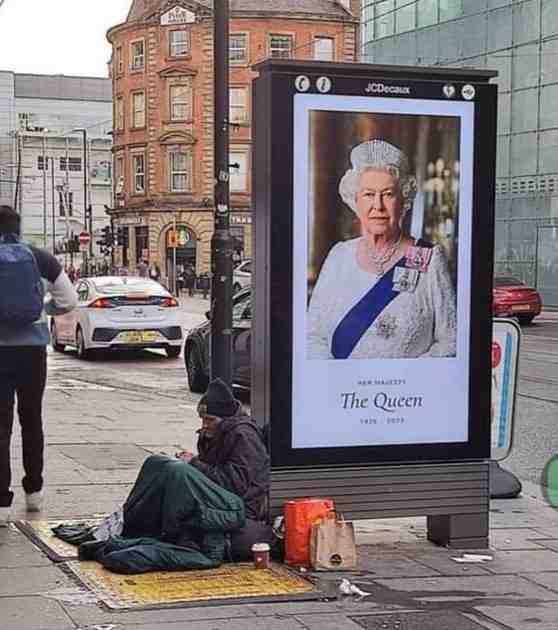
The British monarch Elizabeth Windsor, formerly Saxe Coburg Gotha, has died at the grand old age of 96, thanks in no small part to the subsidised lifestyle and medical care she enjoyed throughout her long life. Her death has produced the usual outpouring of manufactured grief from the media and also “genuine” grief from a sector of that population groomed by that same media.
But what is to be said of her passing? There has been some reaction to her death that concentrated on her being a mother and grandmother. But we were not invited to mourn the passing of mothers or grandmothers, but the death of a monarch and all that monarchy represented. So, before we look at the legacy of Elizabeth Windsor we should ask ourselves what is monarchy. The Irish revolutionary James Connolly, executed by the British state under the reign of George V, stated in relation to that same king’s visit to Ireland.
What is monarchy? From whence does it derive its sanction? What has been its gift to humanity? Monarchy is a survival of the tyranny imposed by the hand of greed and treachery upon the human race in the darkest and most ignorant days of our history. It derives its only sanction from the sword of the marauder, and the helplessness of the producer, and its gifts to humanity are unknown, save as they can be measured in the pernicious examples of triumphant and shameless iniquities.(1)
In this, Connolly only described monarchies in general as the most ignorant and backward manifestations of humanity. It is a point that bourgeois revolutionaries such as Rousseau and Voltaire would not have disagreed with. In fact, it was a standard capitalist argument for much of history. However, various capitalist nations hung on to their royal households, either as symbolic figures or as propaganda figures for their campaigns and conquests.
Much is now made of the contribution of Mrs Windsor to society, the arts, and even peace through her now celebrated handshake with Martin McGuinness, though who gave more in that handshake is not questioned. Connolly was very clear about the contribution of monarchies to the progress of society.
Every class in society save royalty, and especially British royalty, has through some of its members contributed something to the elevation of the species. But neither in science, nor in art, nor in literature, nor in exploration, nor in mechanical invention, nor in humanizing of laws, nor in any sphere of human activity has a representative of British royalty helped forward the moral, intellectual or material improvement of mankind. But that royal family has opposed every forward move, fought every reform, persecuted every patriot, and intrigued against every good cause. Slandering every friend of the people, it has befriended every oppressor. Eulogized today by misguided clerics, it has been notorious in history for the revolting nature of its crimes.(2)
Connolly had no truck with royalty. No time for tales of cute old grannies who shook the hands of erstwhile enemies. Any evaluation of the queen of the British state has to go beyond her supposed personal qualities. Criticisms of royals are not well received. When the then British diplomat and future Irish revolutionary, Roger Casement, exposed the atrocities of the Belgium king Leopold II in Congo and his mass murder of over ten million Congolese, the report was not well received initially and the descendants of the man who murdered more than Hitler are the actual monarchs in Belgium and are apparently a lovely couple and third cousins of Mrs. Windsor. Discussions about royalty are not about the individual qualities of the monarchs but the system as such. Though even on this point Mrs. Windsor comes a cropper.
In 1972 the British army murdered 14 civilians in Derry on what was to be the last Civil Rights march in the country. The British quickly engaged in a cover up which basically blamed those murdered as having been armed members of the IRA. Everyone now accepts that this was not true. Even the Saville Inquiry which stopped short of blaming the British state directly for the murders accepted they were all unarmed civilians. But Elizabeth Windsor nonetheless decorated Lt Colonel Derek Wilford, the man in charge on the day and has never apologised for that. Her role in this is often forgotten.
So, any question of looking at the death of Elizabeth Windsor cannot be ahistorical. Though Sinn Féin have issued statements that are breath taking in their servility. The Sinn Féin leader Mary Lou McDonald tweeted.
To the Royal Family and all who mourn the death of Queen Elizabeth, especially Irish Unionists, I extend sincere sympathy. She lived a long, full life. In her lifetime relationships between our countries were changed and changing. I salute her contribution to this transformation.(3)
She is of course, referring to the Peace Process and her handshake with Martin McGuinness. This says more about Sinn Féin than it does about Elizabeth Windsor. As a monarch she never had a problem dealing with people she saw as her inferiors, or those bowed in deference to her. Michele O’ Neill was equally effusive about the queen acknowledging the apparently profound sorrow of Unionists. And added that.
Having met Queen Elizabeth on a number of occasions alongside my colleague, the late Martin McGuinness, I appreciated both her warmth and courtesy.(4)
Her courtesy is a diplomatic ploy, as for her warmth that is not the image given in any of her public engagements, not even when greeting her son Charles after a long trip. The poor kid did not get a hug, he was made genuflect. But we can take O’Neill’s word for it. It is not important. Neither her courtesy or alleged warmth are political evaluations. Whether we should mourn a monarch does not depend on such personal qualities. Henry Kissinger the Butcher of Cambodia and Chile comes across as an affable, even charming old man, and he may well be in real life, but that is not how we judge him. Likewise, George Bush the Lesser (as Arundhati Roy dubbed him) also comes across as likeable, though it would be hard to convince the dead of Iraq that this mattered one jot: it doesn’t.
The press coverage of her death and much of the commentaries indicate that there is clear obfuscation on the part of the press and ignorance on the part of the population about the nature of the English royal family and the role of Elizabeth Windsor as queen. One of the myths is that she is just a mere figurehead, with little or no power. It is true that most power rests with Parliament and the Prime Minister and the Cabinet. But she has powers that she has exercised from time to time. She has instructed governors of overseas territories not to sign laws. In 1975, through John Kerr, her governor general in Australia, she dismissed the then prime minister Gough Whitlam.(5) It was a rarely used power, but it exists as do other powers she never had to invoke, like her control over the military. She has invoked the Queen’s Consent more frequently to prevent parliament discussing Bills she was not happy with. She also was the last port of call for those sentenced to death, when capital punishment was still on the statute book.
In the 1950s three Greek Cypriots were sentenced to death, Michalaki Karaolis, Andreas Dimitriou and Evagora Pallikaridis. The last of these was a particularly notable case. Pallikardis confessed under torture to carrying weapons. His lawyers pleaded to Elizabeth Windsor for clemency. She refused. The warmth that Sinn Féin leader O’ Neill felt was not on display for the 18-year-old, nor was she the loveable old grandmother that others have referred to. Likewise, the other two were also hanged. On the rare occasions that she has had to exercise power she has shown herself to be of the same pedigree as her blood thirsty forebears who raped and pillaged their way across the planet.
She never spoke out about the situation in Kenya and the Mau Mau rebellion, which kicked off early in her reign. The Pipeline, as it was known, that the British set up in Kenya was a camp system in which prisoners were moved up and down it according to the degree of torture that was required to break them. That matter was raised in Parliament at the time by some Labour MPs. The prisoners even managed to smuggle out letters to MPs and other officials, amongst them Elizabeth Windsor.(6) She knew what was happening. She was fully aware. She exercised no powers to bring an end to it. She just didn’t talk about it publicly, ever. It was not the only situation that she kept quiet about. Her relationship with the issue of race has never been a good one. She negotiated exemptions to racial and sexual discrimination laws and employs very few non-whites.
In 1990 the journalist Andrew Morton reported in the Sunday Times that “a black face has never graced the executive echelons of royal service – the household and officials” and “even among clerical and domestic staff, there is only a handful of recruits from ethnic minorities”.
The following year, the royal researcher Philip Hall published a book, Royal Fortune, in which he cited a source close to the Queen confirming that there were no non-white courtiers in the palace’s most senior ranks.(7)
In her Christmas speeches she tended to talk of banal matters and family. However, she did wade into politics some times and these speeches, unlike the speeches when she opens Parliament, are hers.
In her Christmas speech of 1972, she referred to various situations around the world and also the North of Ireland. Her take on it was simple.
We know only too well that a selfish insistence upon our rights and our own point of view leads to disaster. We all ought to know by now that a civilised and peaceful existence is only possible when people make the effort to understand each other.(8)
Exactly who was selfishly insisting on their rights was not explicitly spelt out, but it was obvious that she didn’t mean the British state, but uppity Paddies and others around the world. This was made clear when in 1973 she awarded an OBE to Lt Col Wilford, the officer in charge of the Bloody Sunday massacre in Derry in 1972. The families of those murdered and injured on that day called upon her to apologise.(9) She did not do so. The nearest she came to it was a banal statement on history during a visit to Ireland in 2011 when she stated “It is a sad and regrettable reality that through history our islands have experienced more than their fair share of heartache, turbulence and loss… with the benefit of historical hindsight we can all see things which we wish had been done differently, or not at all.”(10) She did not accept Britain’s actual role in that and there was no specific reference to the Bloody Sunday massacre.
There is no shortage of sycophants and royalists who claim she had no powers, when in fact, she did as her son Charles now has. Others have preferred to go the route of she didn’t do it, it was others. Not quite true. She did preside over the dying days of Empire and gave succour to the troops busy murdering and torturing people in places she liked to visit on the Royal Yacht. But the many atrocities committed before she acceded to the throne are also hers. The Irish revolutionary James Connolly said of the visit to Ireland of one of her predecessors in the role.
We will not blame him for the crimes of his ancestors if he relinquishes the royal rights of his ancestors; but as long as he claims their rights, by virtue of descent, then, by virtue of descent, he must shoulder the responsibility for their crimes.(11)
And she did claim them. One of her other forays into matters of Empire was her Christmas speech of 1982.
Earlier this year in the South Atlantic the Royal Navy and the Merchant Navy enabled our sailors, soldiers and airmen to go to the rescue of the Falkland Islanders 8,000 miles across the ocean; and to reveal the professional skills and courage that could be called on in defence of basic freedoms.(12)
It should be remembered that Britain gained control of the Malvinas in a colonial war, in 1833, against the newly independent Argentina. In 1982, what was at stake was mineral wealth in the sea. She, like Thatcher, rejoiced at the sinking of the General Belgrano ship, lest we forget that those who now joke about her death are not that far removed from her own sense of mourning people she sees as enemies of her dwindling Empire. She had no sense of shame. In 1990, following Saddam Hussein’s invasion of Iraq she stated without any sense of irony that
The invasion of Kuwait was an example on an international scale of an evil which has beset us at different levels in recent years – attempts by ruthless people to impose their will on the peaceable majority.(13)
This was the queen of a country that had imposed itself on more of humanity than any other previous empire had ever done. Of course, Hussein had been a friend of Britain. In 1953, the CIA and the British overthrew the democratically elected government of Iran, which had nationalised the oil industry dealing a blow to the Anglo Persian Oil Company, now known as B.P. This set in motion a chain of events that would see Britain install another royal, the Shah of Iran, Reza Pahlavi whose despotic rule would lead to the Islamic Revolution of 1979. Enter Saddam. He launched a brutal and bloody war against Iran, invading it in 1980. The war lasted 8 years and cost 500,000 lives. It was bankrolled by the west through the Saudis. There was no one claiming that he had imposed his will, nor were British troops sent to attack this important ally.
Part of her role is that of cheerleader for empire and war. British troops serve under her, not Parliament. They are called upon to serve Queen/King and country and a major part of her role is to encourage young men (and lately women) to throw their lives away in places like Iraq as part of imperial exercises in power and the theft of natural resources.
It is also laughable that the English monarch talks of the peaceable majority when Britain is one of the major arms manufacturers and exporters in the world, supplying despots around the world with the necessary wherewithal to keep local populations in line. Her own son Andrew was appointed Special Representative for International Trade and Investment for the UK Trade & Investment (UKTI) in 2001 and in that role he promoted arms sales. When he was forced by circumstances surrounding his role in the abuse of young girls alongside Jeffrey Epstein to step back from a public role, Andrew Smith of the Campaign Against the Arms Trade commented that:
The news that Prince Andrew will step back from Royal duties is unlikely to provoke feelings of sorrow or regret for most British citizens – but for despots, dictatorships and arms dealers around the world it will be a sad day. They have lost one of their most high profile and influential supporters.(14)
During Mrs. Windsor’s reign Britain exported almost 135 billion (in current prices for each year) of arms and is the fourth largest exporter of arms in the world.(15) Some British companies with operations outside of Britain also export arms. These figures do not include what Britain manufactures for its own armed forces or what it buys from other countries.
Remarkably even feminists in Britain and Ireland have publicly lamented the death of Mrs. Windsor ignoring her role in her son’s abuse of young girls. What little action she took against him was due to public outcry and pressure helped along by a disastrous interview in which his sense of entitlement oozed out of the pores he claims not to sweat from. She also forked out part of the money that was paid as part of the settlement with Virginia Guiffre, one of his and Epstein’s victims, though her part could not be used directly to pay the victim but only for the part that went to charities.(16) Not a minor point for feminists, you would have thought. Nonetheless, they lament the death of the loving mother and grandmother. One who showed none of the warmth Sinn Féin claim she shows.
Monarchies are inherently reactionary, even without the atrocities committed by them or in their name. They are hereditary positions occupied by parasites living off the public purse. A lavish funeral and later coronation of Charles will be held, costing millions of pounds. Other old grandmothers will go hungry this winter or die of hypothermia as energy prices soar, a fate Elizabeth did not face and neither will Charles. The old grandmothers around England, who will die of hypothermia this year, through their taxes ensure that Charles will see the winter through, unless a horse-riding accident upsets his plans. Monarchy is all that is rotten in society, the sycophantic outpouring of fake grief is of a people who do not seek a better society, who are enthralled to their masters and their betters, those who bow down to the great and the good. But it was again James Connolly who had said “the great appear great because we are on our knees, let us rise!”
The idea of rising off our knees has been abandoned by most. Sinn Féin is lavish in its praise for her, one of the political and cultural shifts that results from the Good Friday Agreement. The rot has even spread to their friends in Colombia. Timochenko the former FARC guerrilla leader tweeted his condolences to the people of Great Britain and also mentioned that handshake with McGuinness.(17) Britain’s trade unions through the TUC have also bowed down to the royals. The ideological role of the Windsors in class conflict is ignored. Even the otherwise militant RMT has called off strikes planned for September 15th and 17th. There was a time calling for the abolishment of the monarchy was a no brainer for progressives. In the 1980s Arthur Scargill made just that call and when questioned as to what the royals would do then, he replied, “they can work in Sainsburys”. Though some of them have pilots licences, maybe they can do the Gatwick – Dublin route with Ryanair.
Those who mourn Elizabeth Windsor are complicit in what she represents: privilege, war, torture, racism. There are no ifs or buts to that. It is as Robespierre said, “The King must die so the country can live”. It is time to abolish the monarchy and throw onto the putrid rubbish pile of history all that it represents and Charles and William can, as Scargill suggested, get a job and sycophants can go back to worrying about Madonna or Beyoncé.
Many tunnels in Dublin too, including the remnants in the top floor of houses in the Nos.10-25 Moore Street terrace (the one chiefly threatened by property speculation).
I’d have been interested to know which ‘armed men’ used the tunnels to enter houses and kill the occupants, though I have my suspicions and it’s not the IRA.
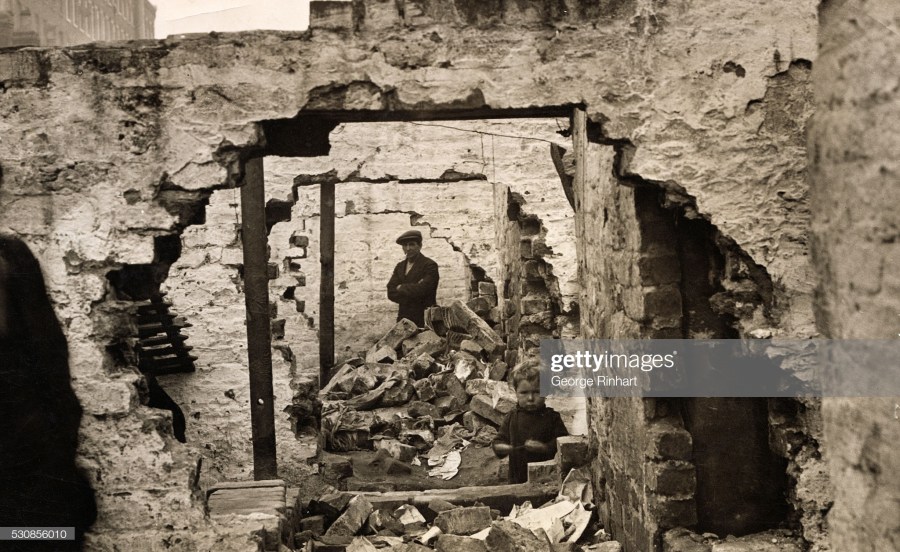
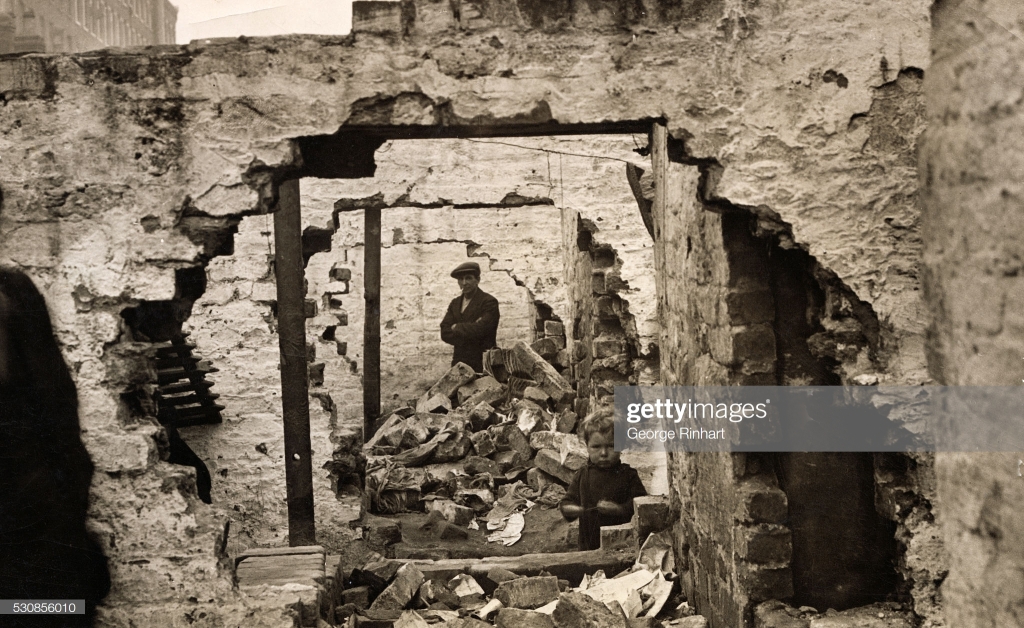
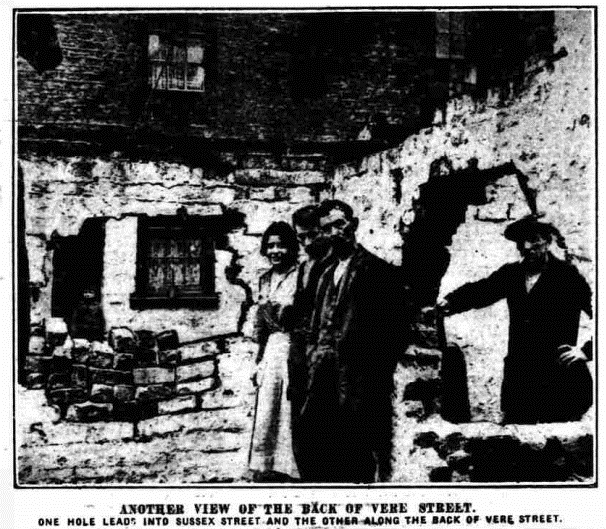
In the summer of 1922, police and soldiers carrying out raids in the Grove Street area (off North Queen) reported that “…the search revealed that the yards on the Grove Street side were tunnelled the whole length of the street, and access to Grove Street could be made from Vere Street through another tunnel.” (Belfast Newsletter, 21/8/1922). The photograph above and below shows some of those yard walls in Grove Street and Vere Street (the next street over – note the same man in the cap in both photos), and appeared in the contemporary press coverage. In each case the brickwork was removed from the walls that separated the back yards of houses from each other. By doing so, people could move from back yard to back yard while hidden from view by the exterior walls.
The intensively mediated death of Elizabeth Windsor, accompanied by the relentlessly maudlin and invasive coverage of official mourning and her funeral, had an intensity that can only be described as imperial. Forced as it was into every corner of public discourse, this coercive atmosphere of state sorrow had a distinctly colonising thrust and meaning. Unleashed during a moment of total class warfare within her very disunited kingdom, it also marked an endpoint in the trajectory of her most obedient servants: the formerly Irish but now thoroughly British political party, Sinn Féin. During Windsor’s reign colonial chickens came home to roost as the woman who presided over British forces while they rampaged across the six counties of British-occupied Ireland then became over the past decade and a half the queen of foodbanks in her own country. (1) Her reign spanned a long period during which overt political violence in Ireland was…
(Edited from a longer in-depth piece published in 2014 and divided into parts).
(Reading time main text: 8 mins.)
The dominant class in the UK and in some of the British Commonwealth will shortly be calling people to join in a cultural festival which they call “Remembrance” – but that’s not at all what it’s really about.
The organisation fronting this festival in the ‘UK’ is the Royal British Legion and their symbol for it (and registered trademark) is the Red Poppy, paper or fabric representations of which people are encouraged to buy and wear.
And in some places, such as the BBC for personnel in front of the camera, or civil servants in public, or sports people representing the UK, forced or bullied into wearing.1
In many schools and churches throughout the ‘UK’, Poppies are sold and wreaths are laid at monuments to the dead soldiers in many different places. The pressure to wear and display one of the symbols is intense and public figures declining to do so are metaphorically pilloried2.
Prominent individuals, politicians and the media take part in a campaign to encourage the wearing of the Poppy and observance of the day of remembrance generally and for a decade now, to extend the Festival for a yet longer period.
This alleged “Festival of Remembrance” includes concerts at the Royal Albert Hall and the military and veterans’ parades to the Cenotaph memorial in Whitehall, London, on “Remembrance Sunday”.
The Royal Albert Hall concert is replete with military uniforms, British Royals’ presence and “Poppy” symbols everywhere. The big Saturday evening concert starts and ends with the UK state’s anthem, God Save the Queen/ King played by military bands.
Tickets for the big event are restricted to members of the Legion and their families, and senior members of the British Royal Family (the reigning monarch, royal consort, Prince of Wales, the Duke of York and the Earl of Wessex). The event is televised.3
BUT WHAT IS IT ALL FOR?
We are told it’s for charitable purposes – the money raised from the sale of the “Poppies” and associated merchandise is to be used to support former military service people in need and the families of those killed in conflict.
We surely can’t object to that, can we? And isn’t putting up with the military and royal pomp a small price to pay for such charitable and worthwhile purposes?
Yet the main purpose of this festival and the symbol is neither remembrance nor charity but rather the exact opposite: to gloss over the realities of organised deadly violence on a massive scale, to make us forget the experience of the world’s people of war.
Worse, its purpose is to prepare the ground for recruitment of more people for the next war or armed imperialist venture – and of course more premature deaths and injuries, including those of soldiers taking part.
Video and song by Vincent Burke, “On Remembrance Day” from Veterans for Peace lists British conflicts (including Ireland) and condemns the Church of England for supporting the wars, calling also on people to wear the White Poppy.
The Veterans for Peace at the Cenotaph in London’s Whitehall in 2014. Jim Radford, singer and D-Day veteran had been there for the first of the VfP Remembrance Day events and every year since until Covid-19 got him. He was a friend and comrade of mine and I marched with the civilian supporters of VfP contingent in
PARTIAL REMEMBRANCE – obscuring the perpetrators and the realities of war
The Royal British Legion is the overall organiser of the Festival of Remembrance and has the sole legal ‘UK’ rights to use the Poppy trademark and to distribute the fabric or paper poppies in the ‘UK’.
According to the organisation’s website, “As Custodian of Remembrance” one of the Legion’s two main purposes is to “ensure the memories of those who have fought and sacrificed in the British Armed Forces live on through the generations.”4
By their own admission, the purpose of the Legion’s festival is to perpetuate the memories only of those who fought and sacrificed in the British Armed Forces – it is therefore only a very partial (in both senses of the word) remembrance.
It is left to others to commemorate the dead in the armies of the British Empire and colonies which the British ruling class called to its support: in WWI, over 230,500 non-‘UK’ dead soldiers from the Empire and, of course, the ‘UK’ figure of 888,246 includes the upper figure of 49,400 Irish dead.5
Cossack soldier volunteers WWI. Imperial Russia was an ally of Britain and France; the war was one of the causes of the Russian Socialist Revolution 1917. The following year, the war ended. (Photo sourced: Internet)
The Festival of Remembrance excludes not only the dead soldiers of the British Empire and of its colonies but also those of Britain’s allies: France, Belgium, Imperial Russia, Japan, USA – and their colonies.
Not to mention thousands of Chinese, African, Arab and Indian labourers, mule drivers, porters and food preparation workers employed by the army.
No question seems to arise of the Festival of Remembrance commemorating the fallen of the “enemy” but if the festival were really about full “remembrance”, it would commemorate the dead on each side of conflicts.
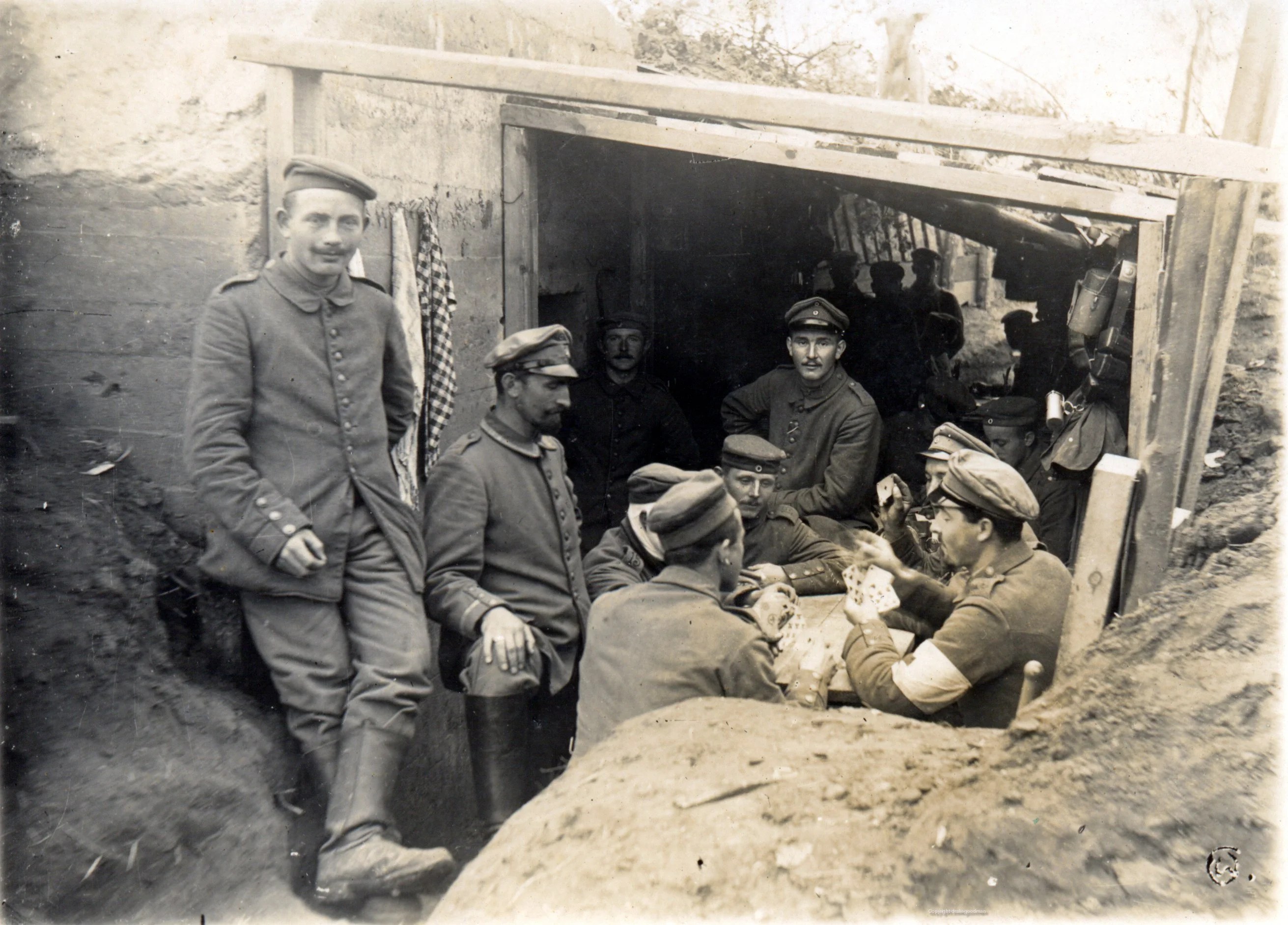
German soldiers playing cards during WWI. Photos of Germans in WWI more readily available show them wearing masks and looking like monsters. (Photo sourced: Internet)
That would particularly be appropriate in WWI, an imperialist war in every aspect. But of course they don’t commemorate both sides; if we feel equally sorry for the people of other nations, it will be difficult to get us to kill them in some future conflict.
CIVILIAN CASUALTIES IN WAR
A real festival of remembrance would commemorate too those civilians killed in war (seven million in WWI), the percentage of which in overall war casualty statistics has been steadily rising through the century with increasingly long-range means of warfare.
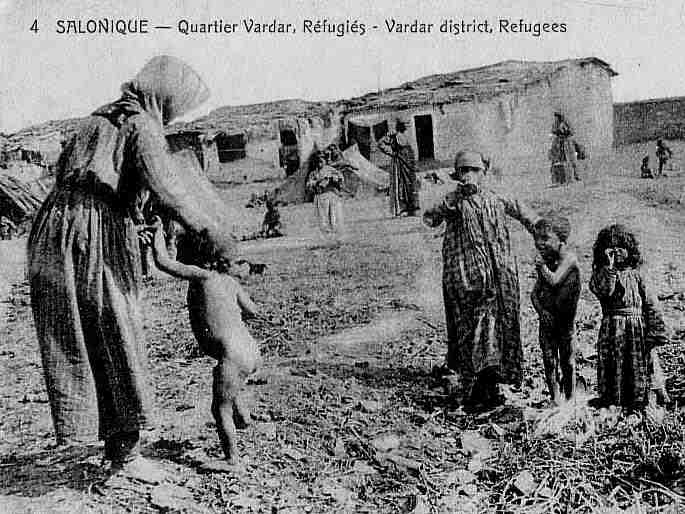
Civilian war refugees in Salonika, NW Greece, WWI
Civilians in the First World War died prematurely in epidemics and munitions factory explosions as well as in artillery and air bombardments, also in sunk shipping and killed in auxiliary logistical labour complements in battle areas.
They died through hunger too, as feeding the military became the priority in food production and distribution and as farmhands became soldiers.
In WWII 50-55,000,000 civilians died in extermination camps or forced labour units, targeting of ethnic and social groups, air bombardments, as well as in hunger and disease arising from the destruction of harvests and infrastructure.6
Air bombardments, landmines, ethnic targeting and destruction of infrastructures continue to exact a high casualty rate among civilians in war areas: a Reuters study gave over one million killed by the war in Iraq and another study gave between 184,382 and 207,156 civilians killed in Iraq during the war and aftermath.7
That figure for Iraq does not include dead from pre-US invasion western trade sanctions (yes, economic sanctions frequently kill) or the 46,319 dead civilians in Afghanistan8.
The number of civilians injured, many of them permanently disabled, is of course higher than the numbers killed. Most of those will bring an additional cost to health and social services where these are provided by the state and of course to families, whether state provision exists or not.
Real and impartial “remembrance” would include civilians but not even British civilians killed and injured are included in the Festival of Remembrance, revealing that the real purpose of the Festival is to support the armed forces and their activities.
The 2014 slogan “shoulder to shoulder with our armed forces” underlines that purpose9 while contributing at the same time to a certain militarisation of society and of the dominant national culture.
The propaganda is more sophisticated this year: “Our red poppy is a symbol of both Remembrance and hope for a peaceful future” but “Poppies are worn as a show of support for the Armed Forces Community.”10
WEAPONS AND INJURIES
If the Festival were really about “remembrance”, they would commemorate the numbers of injuries and detail the various types of weapons that caused them.
But that might reflect unfavourably on the armaments manufacturers, who run a multi-trillion industry11 in whatever currency one cares to name, so of course they don’t. And if really concerned about death and injury in war, they would campaign to end imperialist war.
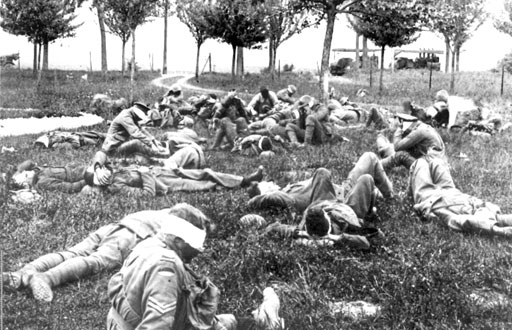
Gassed Australian soldiers awaiting hospitalisation 1916
But then how else would the various imperial states sort out among themselves which one could extract which resources from which countries in the world and upon the markets of which country each imperial state could dump its produce?
So of course the Royal British Legion doesn’t campaign against war.
SANITISED HISTORY, MILITARY PROPAGANDA AND PUBLIC RELATIONS
Partial remembrance was indeed embodied in the song chosen by the British Legion to promote its Festival in the WWI centenary festival in 2014.
No Man’s Land, sung by Joss Stone, is actually a truncated version of the song of the same title (better known in Ireland as the Furey’s The Green Fields of France), composed by Scottish-raised and Australian-based singer-songwriter Eric Bogle.
The Joss Stone version contains the lyrics of the chorus as well as of one verse and one-half of another, omitting two and-a-half verses of Bogle’s song.
Some of the British media created a kind of controversy, at the behest of who knows whom, to have the British Legion’s song included top of BBC’s Radio One playlist. The song is reproduced in entirety below, with the lines sung by Joss Stone in italics and those she omitted in normal type.
I. Well, how do you do, young Willie McBride?
Do you mind if I sit here down by your graveside?
And rest for a while in the warm summer sun,
I’ve been walking all day, and I’m nearly done.
I see by your gravestone you were only 19
When you joined the great fallen in 1916,
I hope you died well and I hope you died clean
Or, Willie McBride, was it slow and obscene?
(Chorus) Did they beat the drum slowly, did they play the fife lowly?
Did they sound the death march as they lowered you down?
Did the band play The Last Post in chorus?
And did the pipes play the Flowers of the Forest?
II. Did you leave a wife or a sweetheart behind
In some faithful heart is your memory enshrined?
Although, you died back in 1916,
In that faithful heart are you forever 19?
Or are you a stranger without even a name,
Enclosed forever behind the glass frame,
In an old photograph, torn, battered and stained,
And faded to yellow in a brown leather frame?
(Chorus)
III. The sun now it shines on the green fields of France;
There’s a warm summer breeze that makes the red poppies dance.
And look how the sun shines from under the clouds
There’s no gas, no barbed wire, there’s no guns firing now.
But here in this graveyard it’s still No Man’s Land
The countless white crosses stand mute in the sand
To man’s blind indifference to his fellow man.
To a whole generation that were butchered and damned.
(Chorus)
IV. Ah young Willie McBride, I can’t help wonder why,
Do those that lie here know why did they die?
And did they believe when they answered the cause,
Did they really believe that this war would end wars?
Well the sorrow, the suffering, the glory, the pain,
The killing and dying, were all done in vain.
For Willie McBride, it all happened again,
And again, and again, and again, and again.
(Chorus)
It’s easy to see why the Royal British Legion might shy away from the omitted lyrics, which would hardly encourage recruitment or support for war.
Interviewed on video, Joss Stone herself said how important it was to be “true to the lyrics” and that “the last thing one would want to do would be to disrespect the lyric”.
Incredibly, she and John Cohen, the record producer, both separately claimed that they had captured the essence of the song lyrics in the British Legion’s version.12
Although Bogle stated that he did not think the Joss Stone version glorifies war, he did say that it did not condemn it and was ultimately a sentimentalised version that went against the intention and central drive of the lyrics.
“Believe it or not I wrote the song intending for the four verses of the original song to gradually build up to what I hoped would be a climactic and strong anti-war statement,” Bogle said.
“Missing out two and a half verses from the original four verses very much negates that intention.” (apparently in a reply from Bogle to a blogger’s email and quoted in a number of newspaper reports).13
The truncation of the song and the removal in particular of the anti-war lyrics epitomises partial “remembrance” and stands as a metaphor for it, the production of a lie by omission and obscuration.
Sanitised history, military recruitment propaganda and public relations is what this “Remembrance” is about.
12Videos containing quotations from Joss Stone and John Cohen about how they have stayed “true to the song” or “lyric” of No Man’s Land by Eric Bogle https://www.youtube.com/watch?v=ez1WBJaZZ7U#t=10and
Videos containing quotations from Joss Stone and John Cohen about how they have stayed “true to the song” or “lyric” of No Man’s Land by Eric Bogle were accessed at the following in 2014 but now appear to have been taken down: https://www.youtube.com/watch?v=ez1WBJaZZ7U#t=10and
I can’t tell you how relieved I was to hear of the prompt action of the Irish Government in closing down an alleged Chinese police station operating in Dublin’s Capel Street.
It’s very important to keep Ireland neutral.
If those Chinese had been allowed to get away with that, next you’d have some country thinking they could run their warplanes and prisoners through Shannon airport. Or some other country allowed to fly over Irish airspace in their military helicopters. Or thinking they could set up a militarised colony on Irish soil.



 my grandfather Ailfrid Mac Lochlainn
 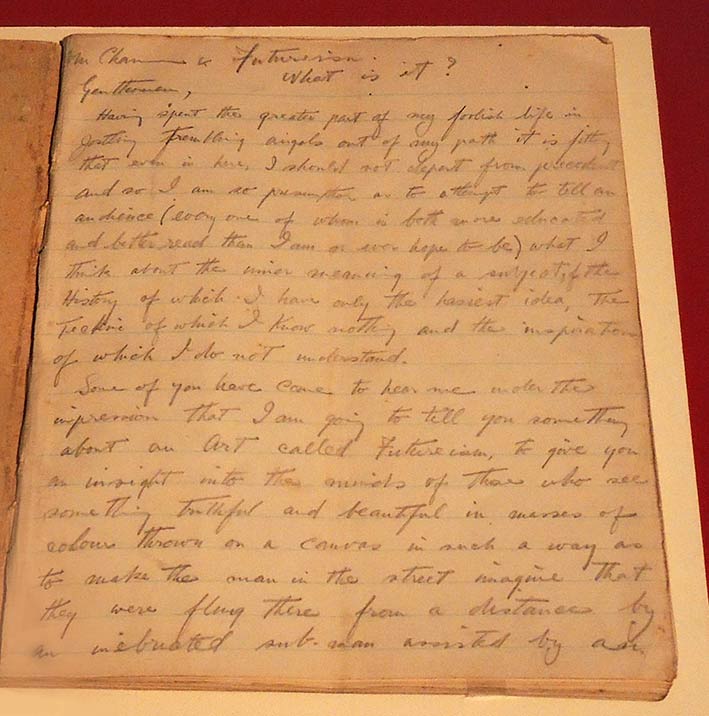 the beginning of his lecture: “On…





 rebelbreeze
