JARDUN CALL FOR REVOLUTION ON BASQUE NATIONAL DAY IN GERNIKA

Diarmuid Breatnach

(Reading time main text: 10 mins.)

The revolutionary Basque socialist coordination organisation Jardun Koordinadora organised a celebration of Aberri Eguna, the Basque national day, combining political, social and cultural forms. Aberri Eguna takes place annually on Easter Sunday, a date chosen by its founder Elias Gallestegi based on a traditional commemoration day of the Easter Rising in Ireland. Aberri Eguna was first celebrated in Bilbo in 1932 attended by 65,000 people, including members of Emakume Abertzale Batza1, the Basque nationalist women’s organisation founded by Gallestegi also in emulation of the Irish organisation Cumann na mBan. Around 1,000 people, with a high representation of youth but also of veterans of the struggle, attended the events in Gernika2.

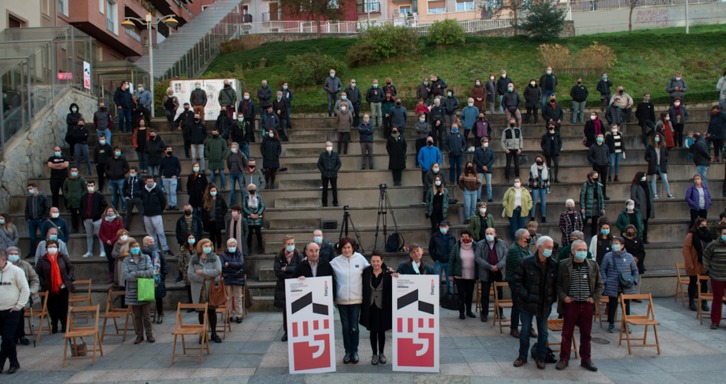
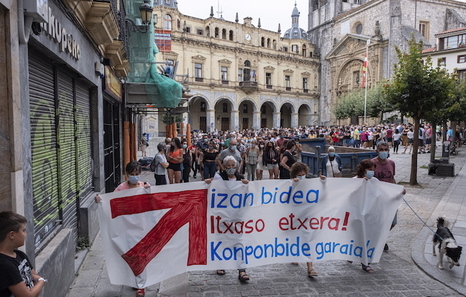
Jardun-organised Aberri Eguna procession passing through Gernika (Photo courtesy Jardun)

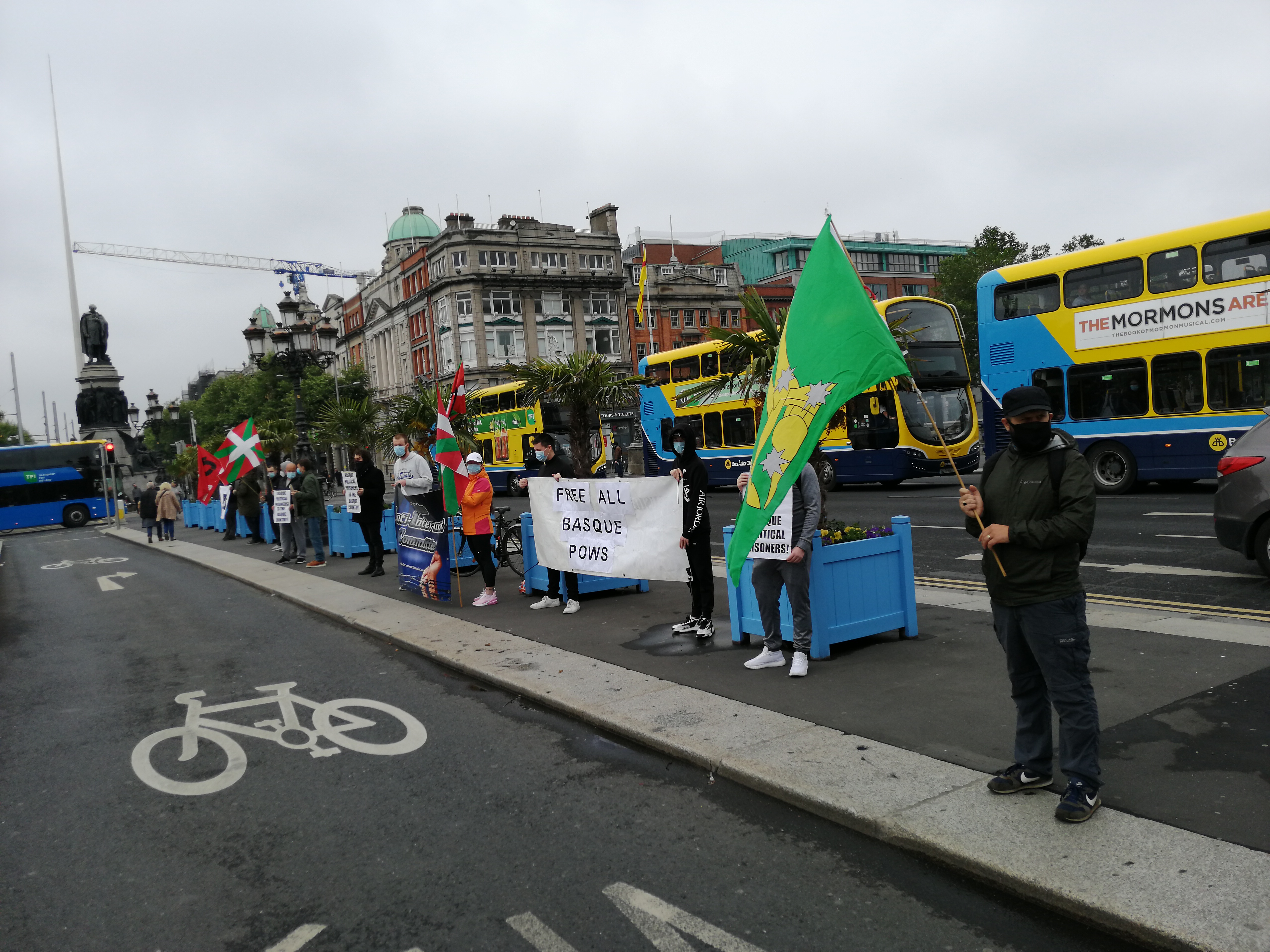
The Irish connection was reiterated on Sunday by the reading at the political rally of messages of solidarity from three Irish-based sources: Anti-Imperialist Action, Anti-Internment Committee of Ireland and Dublin Basque Solidarity Committee.

Jardun Koordinatora is a relatively new initiative which is a sharp departure from the trajectory in recent decades of the official leadership of the Abertzale Left, a trajectory which has served to dismember and dishearten the movement.

La Haine Report

(Translation by Dublin Basque with explanatory notes in italics)

The different organisations comprising this Coordination (Jardun) demonstrated in Gernika under the slogans “Aberri gorria, biharko Euskal Herria, “Independentzia eta Sozialismoa”, “Euskal Herrilangilea Aurrera”, “Presoak Kalera Amnistia osoa” and “Amnistiarik gabe bakerik ez” (“Bright future in tomorrow’s Basque Country” “Independence and Socialism”, “Forward Basque workers”, “Prisoners Free with Full Amnesty” and “No Peace Without Amnesty”).

This Sunday, April 17, the JARDUN Coordination convened the Aberri Eguna (Basque National Day) gathering some 1,000 people to claim the national objective of the Basque Working People.

Along with a Zanpantzar group (performers with bells in traditional costumes representing animals), the event began with a march starting from Plaza Mercurio and during the journey different acts were carried out to demand prisoner amnesty and rights for working women. The event ended with the speeches read in Pasealeku Plaza: the first two were messages of solidarity sent by Anti-Imperialist Action and Anti-Internment Committee (both of Ireland) and ended with the political statement of the JARDUN Coordination.

Tradition Zapantzarak lead the procession (Photo courtesy Jardun)

The demonstration went smoothly. However, the bus that departed from Irunea/ Pamplona had problems getting there because the National Police stopped it in Urdiain, taking details of the occupants.

To conclude, JARDUN Coordination stated that the only alternative for the Basque Working People will come from the hand of independence and socialism. To conclude, the Internationale and the Eusko Gudariak (Basque Soldier) were sung.
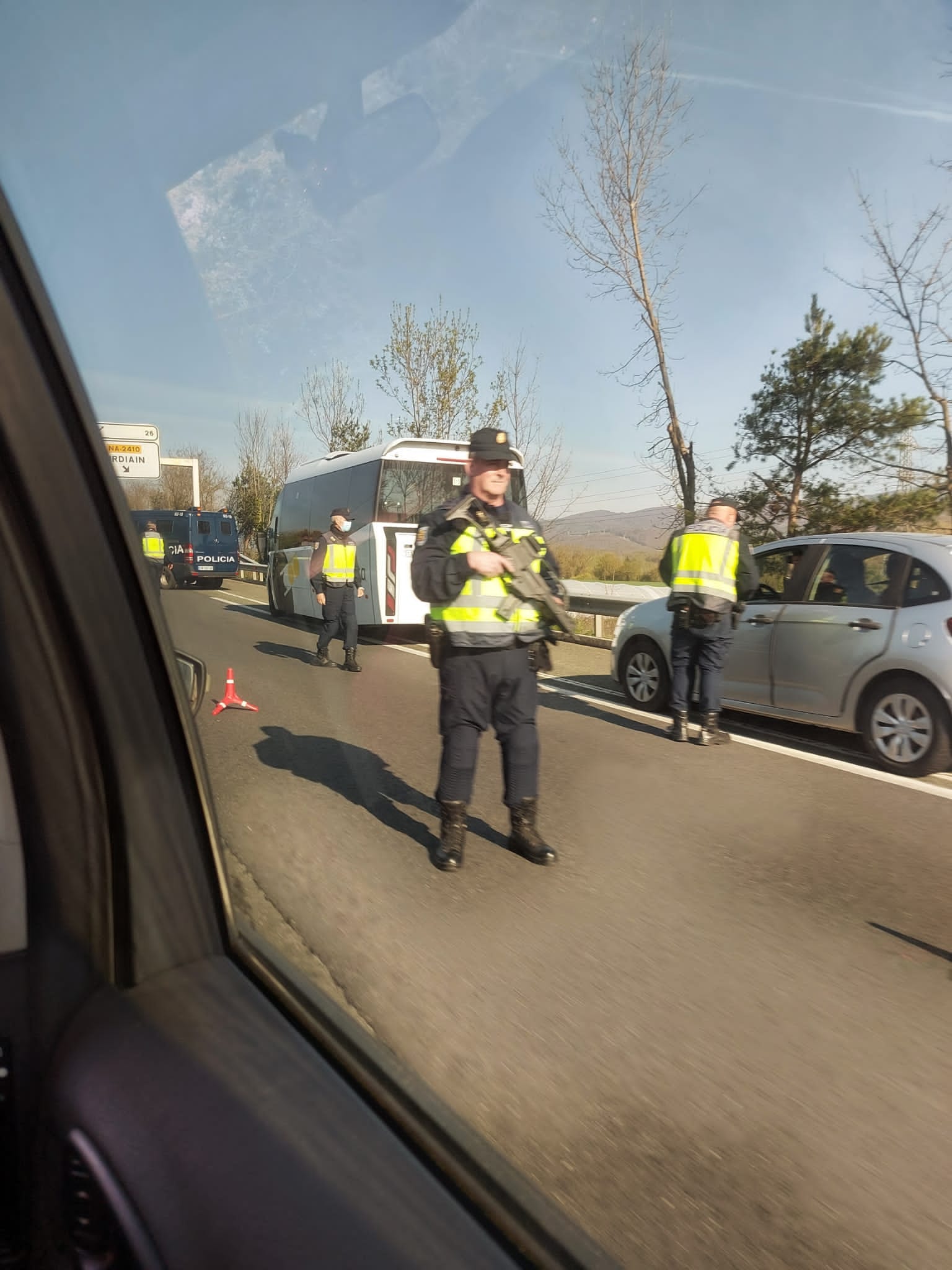
Spanish armed police stopped the contingent from Irunea/ Pamplona heading for Gernika and recorded their details. (Courtesy of Jardun)


Jardun Statement for Aberri Eguna 2022
(Translated by D.Breatnach from text supplied in Castillian Spanish)

Under capitalism, we workers are condemned to survive. We build our lives around work and the exploitation we suffer in it, while the bourgeoisie lives at the expense of this work. Such is the dynamic of capital. This is the logic of the economic system currently in force in the world. That is why it is important to clearly identify and point out the adversary facing us; because the capitalist system, the bourgeoisie, normalises and legitimises the fears and the repression that it produces daily to absorb the blood of the workers.
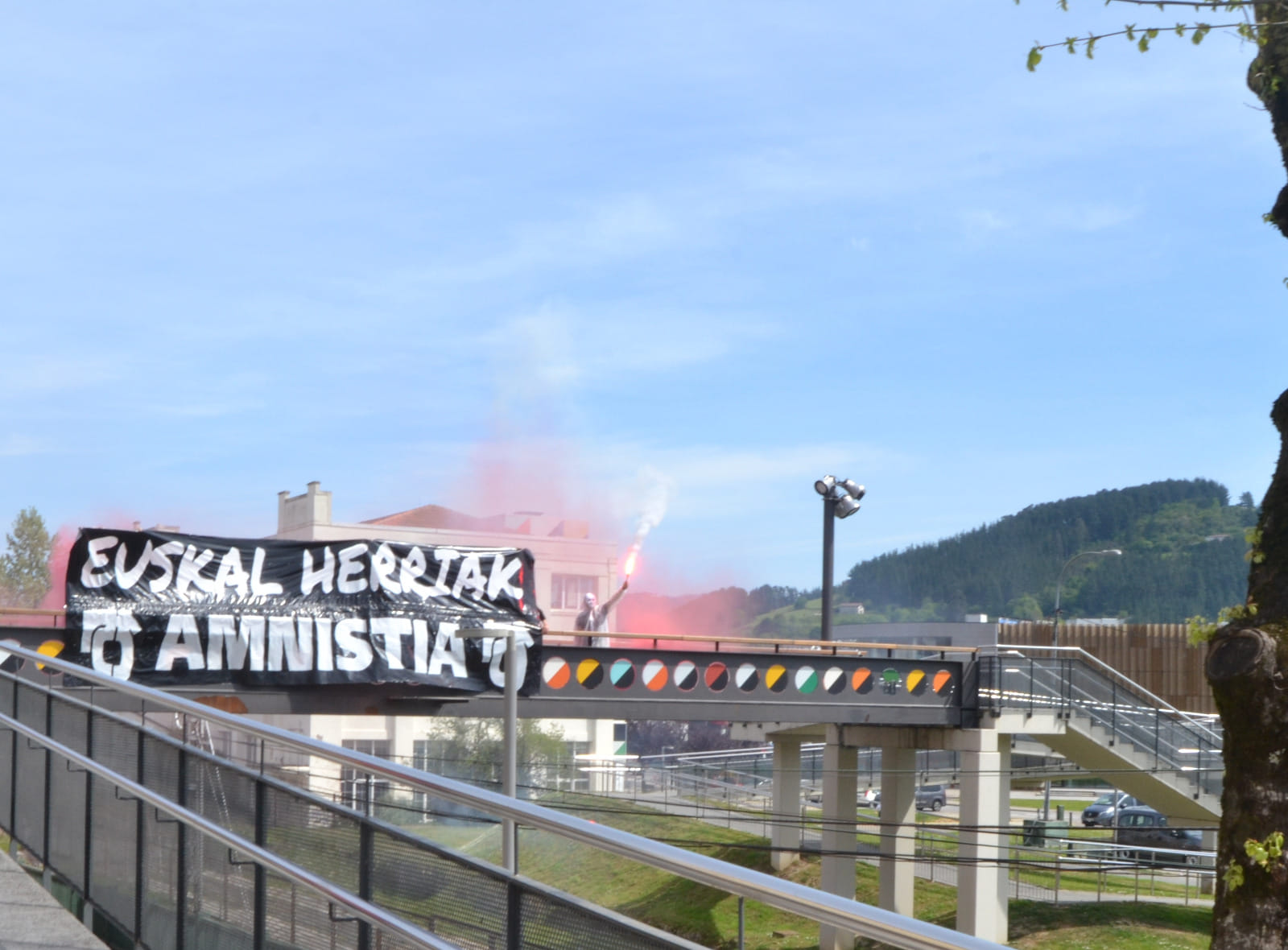
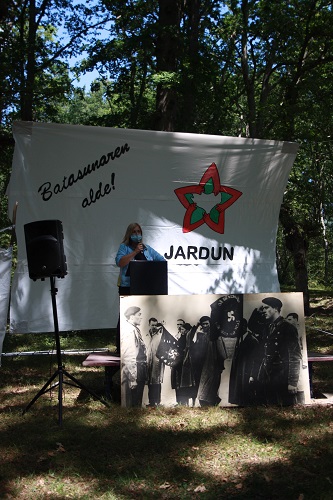
(Photo courtesy Jardun)

But with 19 years in prison for the freedom of his people, the murder of Iván Colona, a direct consequence of the criminal French prison policy, is not normal. The situation of the working people of Ireland, suffering from crushing British occupation for more than 800 years, is not normal. After eight long years of war, the situation of the working people of Donbass, who experience bombings, murders and massacres on a daily basis, is not normal. And much more heinous, outside of the norm, are the attempts to whitewash and legitimise criminal institutions such as NATO murderers.

We must situate ourselves in that context, understand within that reality, the situation that Euskal Herria (the Basque Country) is experiencing. Today our country are controlled by both the French and Spanish states. Not only do both these states not recognise Euskal Herria but they carry out an oppression based on that denial against the working class of Euskal Herria. In effect, we must understand well that, beyond the national question providing the a joint market for the states, the working class can only use the political project of the bourgeoisie as an element of unity to support and protect it, promoting interclassist attitudes.

“We, the organized women workers, will overcome all oppression!” (Photo courtesy Jardun)

The aforementioned denial, as well as the attacks carried out by the Spanish and French States against the Basque Working People, must be understood as an ideological motivation of the national State. We must, therefore, situate the oppression of Euskal Herria in the very creation of the Spanish and French capitalist states; because the objective of the denial is clear, the assimilation of Euskal Herria. To do this, the states take advantage of the institutions aimed at creating divisions and gaps in the Basque consciousness. And to protect these institutions and guarantee the supremacy of the bourgeoisie, they take advantage of dogs of various colours to attack the working people. To promote alienation and renounce our identity, in addition to normalising the attacks against the language, they have turned the Basque language and culture into souvenirs of a territory that today wants to dedicate itself to tourism, since for the bourgeoisie everything is business, to the point of commodifying our places of residence.

This being the case, given that denial is a decision of a political nature, we must cover with a political character the oppression experienced by Euskal Herria to view it with a class vision. We have to be clear about the concept of the political nature with regard to Euskal Herria nationality. Therefore, we have to fight against normalised oppression. Along this path, it is up to the workers of Euskal Herria to build our own political project and in response to this we have to equip ourselves with our own institutions that have to arise out of the counter-power that we need to form. And for this it is necessary for a Workers’ Euskal Herria to break politically with the Spanish and French states.

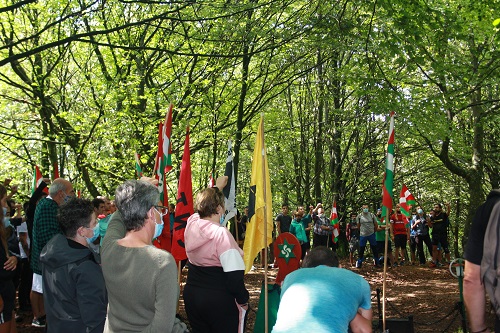
Photo shows a substantial following by veterans of the struggle (Photo courtesy Jardun)

These States offer the working people the use and threat of both persecution and violence, within the capitalist system that condemns the working class to servitude for the benefit of the bourgeoisie. For this reason, to carry out the aforementioned political rupture, political confrontation must be a valued concept in order to carry out the political project of the workers of Euskal Herria. Political confrontation must also be the engine of the revolutionary process aimed at achieving an independent and socialist Basque state in Euskal Herria.

For this, it is necessary to take the revolutionary process to the extreme and form a political body that must feed the revolutionary alternative. Specifically, a political body to be formed by organised workers in favour of national and social liberation and the sale of their labour power in the Basque Country. A political body that is committed to achieving an independent and socialist Basque State. Because the Basque Working People cannot be limited to the forms of work authorised by the capitalist system. These not only destroy the revolutionary potential of the working class, but are aimed at sustaining and reproducing the ideology of the bourgeoisie; because the enemy will not give, in any way, more than he is willing to give. The bourgeoisie will not voluntarily give up its privileges.

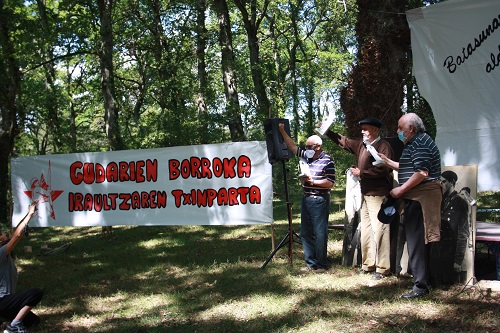
(Photo courtesy Jardun)

It is essential to set in motion the revolutionary process that must take place on the path of a classless society, towards the acquisition of political power by the working class; the aforementioned subject will only be achieved through the confrontation carried out with the capitalist state. Through the counter-power built in the confrontation, the Basque Working People must articulate revolutionary structures that wear down the centres of power of the oppressor and guarantee his liberation against the exploiters, to guarantee the achievements obtained during the revolutionary process. Because the political power of the Basque Working People must be based on counter power. In other words, the revolutionary alternative of the working people will be built and take root as the control and power of the capitalist states over the workers of the Basque Country is annulled. The revolutionary alternative must be a comprehensive political alternative that satisfies the needs of the Basque Working People.

It must be understood that this will be capable of leading struggles based on the activation and commitment of the workers. Therefore, in order to weave and build a revolutionary alternative at this time, the priority is the activation of workers aimed at promoting the ideological struggle and mobilization, understanding the JARDUN coordinator as an instrument to achieve this. In short, JARDUN is a framework created with the aim of promoting the organisation of bodies and militants to win the freedom of Euskal Herria. Its objective is that, under a common political project and strategic approach, each organisation carries out its contribution in specific political areas, but that all act within the framework of a common strategy and direction.

We have to be aware that this will be achieved through gradual activation and participation through the awareness of the Basque Working People. In this process, the revolutionary process itself will be carried out gradually, and the Alternative of the Basque Working People must carry out struggles based on the different forces, conditions and problems of the moment. As its political work deepens and Basque workers’ participation in the Coordination increases, JARDUN will create new framework organisations and acquire comprehensiveness and integrity, with the revolutionary movement’s priority being to create the conditions to achieve it.
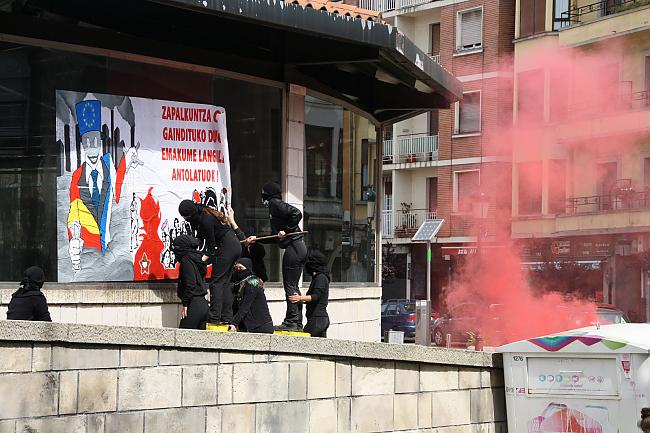
(Photo courtesy Jardun)

When talking about the liberation of Euskal Herria, self-determination is a frequently mentioned term: self-determination, a term that appears many times when a nation is subjected to the sovereignty of another against its will. But when we speak of self-determination, considering the revolutionary process developed under a counter-power based on political rupture, we are not referring, in any way, to the vote marked, accepted and facilitated by the States that persecute Euskal Herria, but to the process of separation of one nation from the state structures of another nation. Self-determination as synonymous with the revolutionary process that must be carried out to achieve an independent and socialist Basque State, in the case of Euskal Herria.

Autonomism, because it is a struggle based on the management of the remains provided by the states, is not an option. It is not a legitimate choice on the table for the revolutionary movement, since this implies reformism and the strengthening of the position of power and subjugation of the States, together with the renunciation of the strategic objectives aimed at the liberation of the Basque Working People. However, it would be a serious mistake to believe that, through national liberation, the liberation of the workers will take place mechanically. This must be understood within the class struggle, in which we must place self-determination itself within the class conflict.

On the other hand, there exists the denial, underestimation or rejection of the national question, the strengthening of the repression that the capitalist states carry out and accepting the framework of the oppressive nation imposed, in the name of socialism, with the argument of unity of the workers. Regarding the national issue, the lack of correct position also allows the French and Spanish States to continue applying unjust laws and coercion, helping to hide the dimension of oppression suffered by the working class of Euskal Herria. Keeping silent before a crushing stomp, since taking a neutral position means protection from crushing; taking neutral positions allows oppressive power relations to continue unchanged over time and space, perpetuating them.

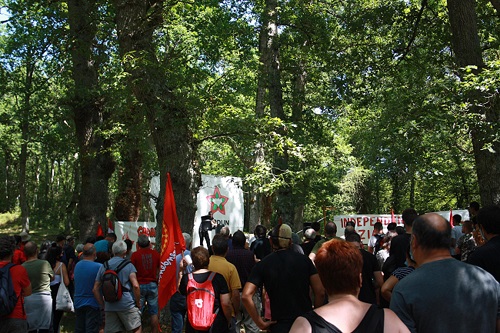
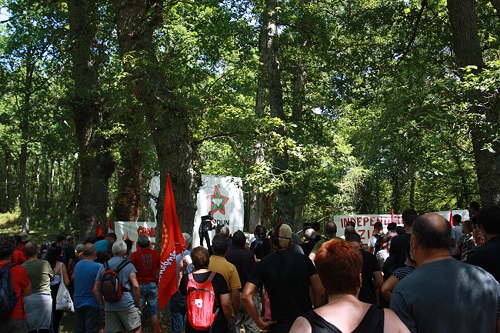
The political rally of Jardun’s celebration of Aberri Eguna in Gernika (Photo courtesy Jardun)

Consequently, the mere demand for independence only benefits the interest and political project of the bourgeoisie of the Basque Country. And the socialism that in Euskal Herria does not address the national question goes hand-in-hand with denial, denying in class parameters the revolutionary potential of the national question. The achieving of the independent and socialist State must be the result of the revolutionary process of Euskal Herria due to the national oppression suffered by the Basque workers. Revolutionary alternatives beyond the essential defence of independence and socialism must be the basis of the political position of the Basque Working People. They are only alternative for the Basque Working People, because it inevitably comes hand-in-hand with independence and socialism.

Long live a free Basque Country!

Long live a socialist Basque Country!

End.

FOOTNOTES

1A strong organisation in the antifascist resistance to the fascist-military uprising against the Spanish Republic but no longer in existence.

2Guernica, in Spanish.

SOURCES

Jardun Koordinadora: https://www.facebook.com/Jardun_koordinadora-100598125431163

https://eh.lahaine.org/eusk-cast-jardun-koordinadorak-2022ko

Basque Solidarity for Corsican Patriot Murdered in French Jail

Clive Sulish

(Reading time: 2 mins.)

SPEECH DELIVERED AT THE RALLIES ORGANISED BY JARDUN IN RESPONSE TO THE MURDER OF CORSICAN POLITICAL PRISONER YVAN COLONNA (Se encuentra la versión anterior en castellano/español al fondo)

Yvan Colonna was from a young age a member of the Corsican liberation movement. After being forced to remain in hiding for four years, he was arrested in 2003, accused of participating in an action carried out by an anonymous group. The accusation was based on statements of several of the movement’s members detained at the police station, who later rejected the statements but Yvan was sentenced to life imprisonment.

Posters demanding justice for Yvan Colonna after his arrest (Photo sourced: Internet)

Colonna was left in a very serious coma after the beating by a jihadist prisoner in Arles prison. On Monday of this week, Yvan passed away after three weeks in hospital. During that time there were riots denouncing the role of the French state in Yvan’s murder.

Yvan was murdereded by the penitentiary policy of dispersal and the conditions of the prison. We in the JARDUN Coordination charge that the beating and death received by Yvan was a direct consequence of the penitentiary policy of the French State. Likewise, we want to underline the need to create an organisation in support of the freedom of political prisoners and the fight against oppression and exploitation.

It should not be forgotten that in Corsica, the struggle for independence has been ongoing for decades with the aim of overcoming the political-economic system imposed by the French State and fighting for a popular and democratic government that would act in favour of the Corsican people. The struggle of the Corsicans is the struggle against French imperialism, against the oppression of the local working people and against the exploitation they suffer.

In Euskal Herria (the Basque Country – Trans.) we are well aware of the repression and oppression by oppressive states and we are witnesses to the massacres committed so many times by the French State. Because we cannot forget the imperialist attitude of the French State in Algiers and other colonies, becoming, together with the United States, the main promoters of contemporary torture.

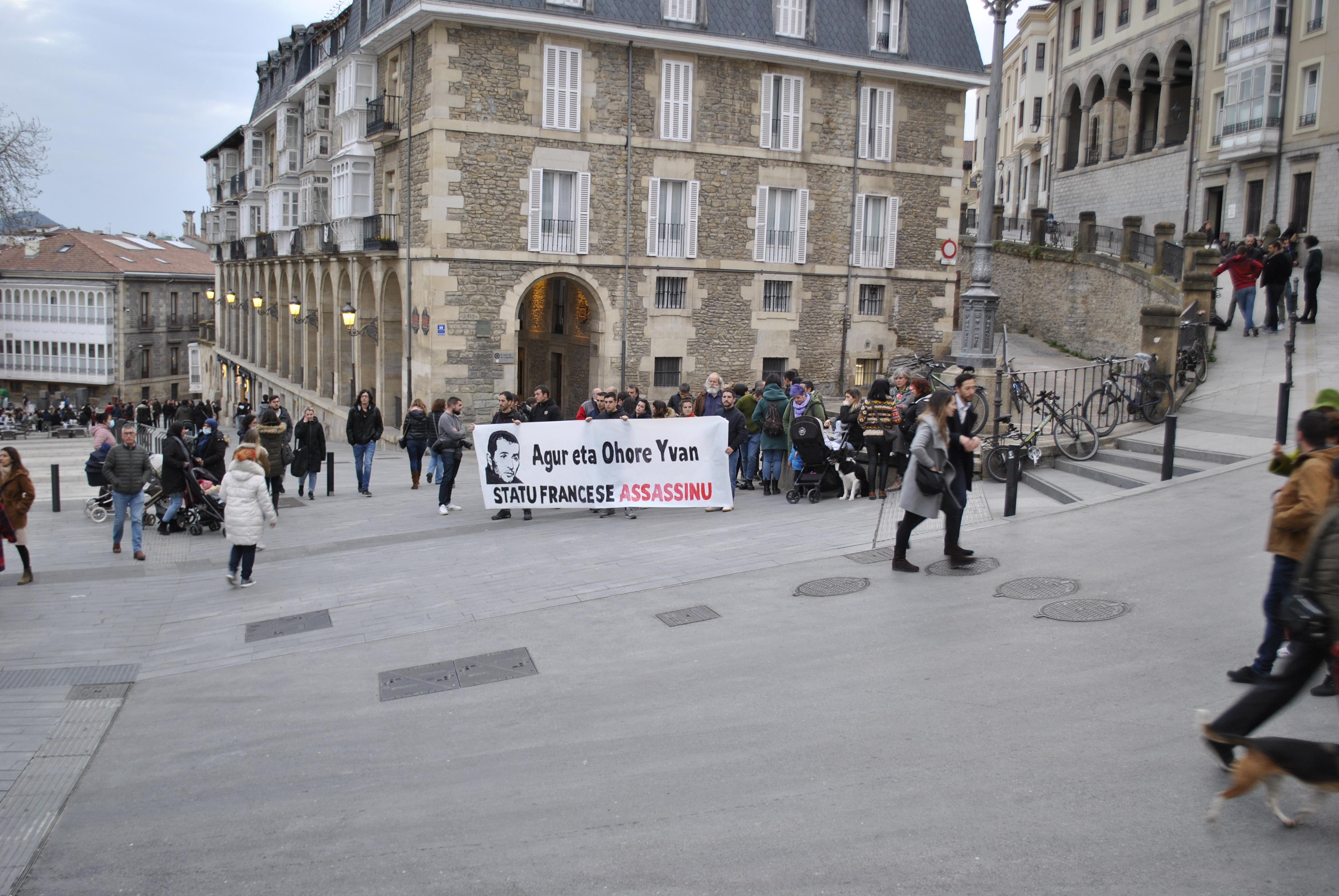
Solidarity picket in Gastheiz/ Vitoria, southern Basque Country, on Friday 25th (Photo: Jardun Koordinadora)

All of this shows us nothing less than the need for the organisation of the working class. It is evident that both the imperialist power and the oppressive States exercise a monopoly on violence to defend their economic interests and, in every nation, those who pay are always the working class.

It is time to denounce the fraud of social peace, it is time to denounce the warlike attitude of NATO, in Donbass, the Sahara, Palestine, today they are waging endless wars in defence of the interests of imperialism and its servants — and in view of this, it is time to awaken internationalist solidarity!

For this reason, we in JARDUN proclaim that it is time to turn to revolutionary organisation for all working people! Because only the organised people can offer real help and, as far as we are concerned, only the Basque working people can obstruct the participation of the Spanish and French States, organizing themselves in Euskal Herria to face the enemy, working for a political system in favour of the Basque working people.

We are clear that struggle is the only way and we will loudly proclaim that we have to confront the enemy, exploitation and class oppression. That is why we encourage you to join the organisation, because it is time to fight, it is essential to resist!

AGUR ETA OHORE YVAN! (Farewell with Honour Yvan!)

GORA KORSIKAKO HERRI LANGILEAREN BORROKA! (Long live the struggle of the Corsican working people!)

GORA EUSKAL HERRIA ASKATUTA! (Long live a free Basque Country!).

end.

Solidarity picket in Donosti/San Sebastian, southern Basque Country, on 26th March (Photo: Jardun Koordinadora)

Lectura lanzada en las concentraciones organizadas por JARDUN ante el asesinato de Yvan Colonna

Yvan Colonna era miembro del movimiento de liberación corso, en el que militó desde joven. Tras ser obligada a permanecer 4 años en la clandestinidad, fue detenida en 2003 acusada de participar en una acción llevada a cabo por un grupo anónimo. La acusación se fundamenta en la declaración de varios de los miembros detenidos en la comisaría, que posteriormente rechazaron la declaración, pero Yvan fue condenado a cadena perpetua.

Colonna quedó en coma muy grave tras la paliza de un preso yihadista en la cárcel de Arlés. El lunes de esta semana, Yvan falleció cuando llevaba 3 semanas hospitalizado. Con el objetivo de denunciar el papel del Estado francés en el asesinato de Yvan desde que ingresó en hospital, durante ese tiempo  ha habido disturbios.

Yvan fue asesinado por la política penitenciaria por la dispersión vivida y las condiciones de la prisión. Desde la  coordinadora JARDUN  denunciamos que la paliza y la muerte recibida por Yvan ha sido consecuencia directa de la política penitenciaria del estado francés. Asimismo, queremos subrayar la necesidad de articular una organización a favor de la libertad de los presos políticos y de la lucha contra la opresión y la explotación.

No hay que olvidar que en Córcega, la lucha por la independencia se ha dado durante décadas con el objetivo de superar el sistema político económico impuesto por el Estado francés y luchar por un gobierno popular y democrático que actuara en favor del pueblo corso. La lucha de los corsos es la lucha contra el imperialismo francés, la opresión del pueblo obrero local y la lucha contra la explotación que sufren.

En Euskal Herria conocemos bien la represión y la opresión de los estados opresores y somos testigos de las masacres cometidas tantas veces por el Estado francés. Porque no podemos olvidar la actitud imperialista del Estado francés en Argel y otras colonias, llegando a ser, junto con los Estados Unidos, los principales impulsores de la tortura contemporánea.

Todo ello no nos demuestra más que la necesidad de la organización de la clase trabajadora.. Es evidente que tanto la potencia imperialista como los Estados opresores ejercen el monopolio de la violencia para defender sus intereses económicos, y en todo pueblo, su pagador, es siempre la clase obrera.

Es hora de denunciar el fraude de la paz social, es tiempo de denunciar la actitud guerrera de la OTAN, Donbass, el Sáhara, Palestina, hoy en día están dando un sinfín de guerras en defensa de los intereses del imperialismo y de sus siervos, ¡y ante eso es tiempo de despertar la solidaridad internacionalista!

Para ello, desde JARDUN proclamamos que es hora de volcarse en la organización revolucionaria para todo pueblo obrero!! ¡Porque sólo el pueblo organizado puede ofrecer una verdadera ayuda, y en lo que a nosotros se refiere, sólo el pueblo trabajador vasco puede interrumpir la participación de los Estados Español y Francés, organizándose en Euskal Herria para hacer frente al enemigo, trabajando por un sistema político a favor del pueblo trabajador vasco.

Nosotros tenemos claro que la lucha es el único camino y proclamaremos en voz alta que tenemos que enfrentar al enemigo, a la explotación y la opresión de clase. Por eso os animamos a uniros a la organización, porque es tiempo de lucha, ¡es imprescindible resistir!

AGUR ETA OHORE YVAN!

GORA KORSIKAKO HERRI LANGILEAREN BORROKA!

GORA EUSKA HERRIA ASKATUTA!

FALLEN BASQUE FIGHTERS COMMEMORATED AMIDST ATMOSPHERE OF REPRESSION

(Reading time: main text 1 min, overall 2 mins)

(Report by Jardun Koordinadora translated by Dublin Basque Solidarity Committee)

The atmosphere was tense on September 25, 2021 in Leitza due to the presence from the early hours of the morning of the Civil Guard and the secret police. To this must be added the checkpoint and identification by the GAR (Guardia Civil “anti-terrorist” Rapid Response Organisation – Translator) of many of those attending the political event organized by the revolutionary organization JARKI. In the same way, the Civil Guard had no problem in stopping and subjecting to identification those who traveled by bus organized from Bilbao and Gernika. This was not the only episode of police repression since several JARDUN activists from Leitza complain of having been followed by the secret police over recent days.

One of the posters for the event (Photo source: Jardun Koordinadora)

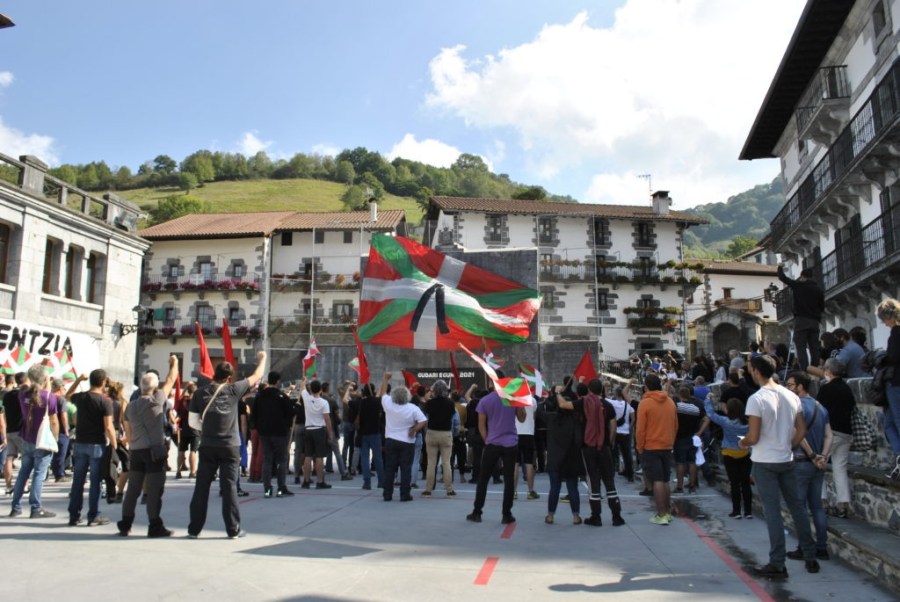
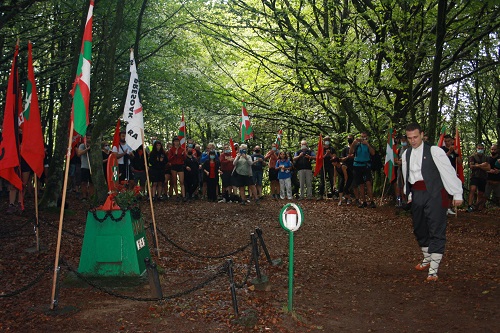
The event organized by the revolutionary organization JARKI gathered hundreds of people in Leitza square. Once the flame was lit, to the sound of the adarras and the txalapartaris (traditional ox horns blown and wooden percussion instrument played – Trans.), the act began, under a gigantic ikurriña (flag of the Basque Country – Trans.). Next, the dantzaris exhibited the “agintariena” (see Notes) while a gust of wind snapped the rope securing the ikurriña and two young people had to climb the pediment to hold it for the rest of the act. Later, two bertsolaris took the stage asserting with their verses independence, socialism and amnesty, as the legitimacy of the fight of the gudaris (volunteer liberation fighters).

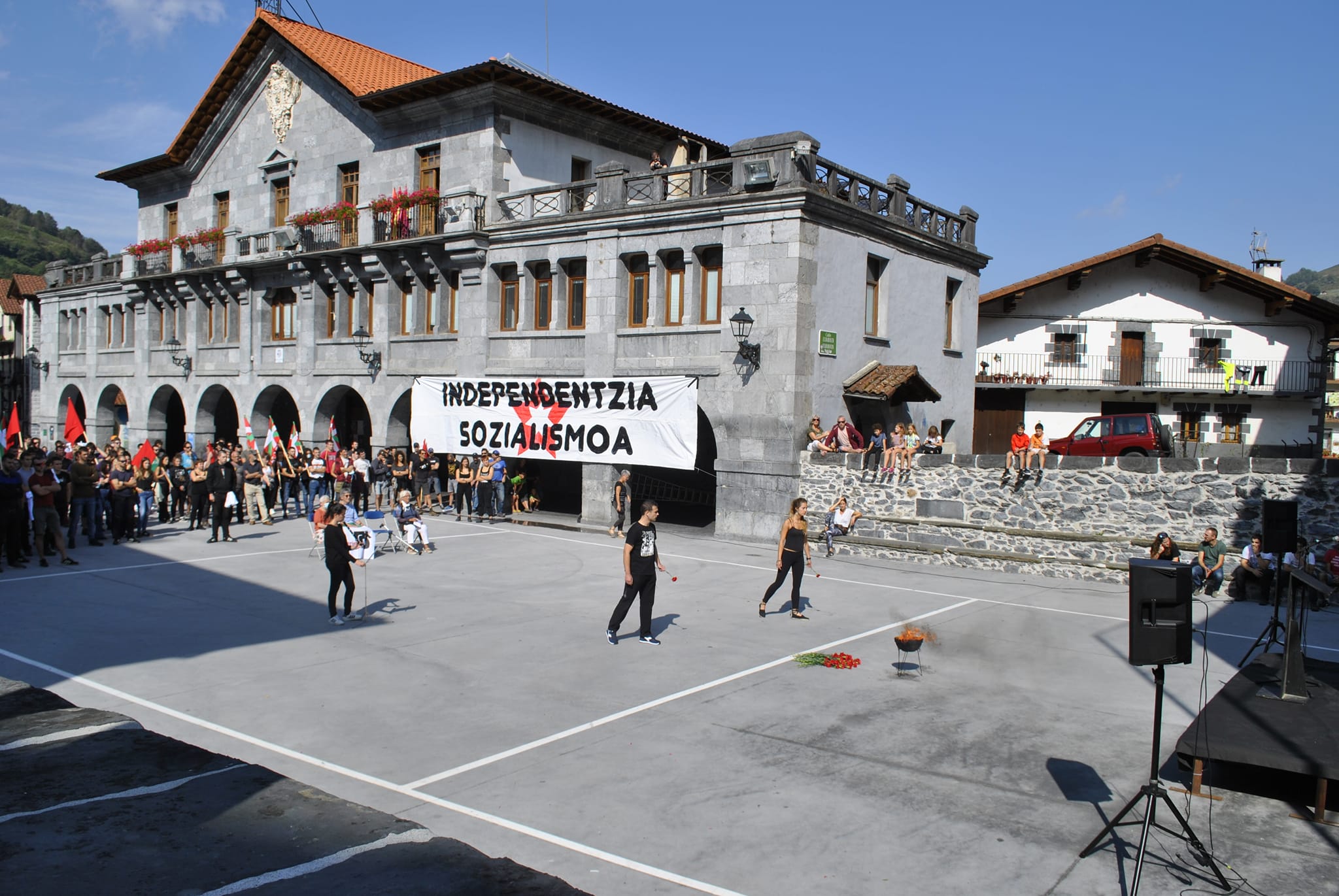
Dancing the Aurresku, the honour dance and presenting red flowers to the memory of the martyrs of the Basque struggle for independence and socialism. (Photo source: Jardun Koordinadora)

To conclude the ceremony, a member of JARKI read a statement in reference to the commemoration of Gudari Eguna. The statement among many other things vindicated the struggle for memory of Euskal Herria, and of those who have given all in for it, thus legitimizing their struggle and the celebration of this day. He also mentioned the presence of ‘dogs’ in different uniforms that act with total impunity, making it clear that there is no type of coexistence between the oppressed and the oppressors. To the revolutionary organization JARKI this underlines a clear principle: confronting who is oppressing you and who is keeping you under their control is not an option, but a necessity.

End of the event, singing the Internationale and the Eusko Gudariak (Photo source: Jardun Koordinadora)
The act ended with the singing of the Internationale and the Eusko Gudariak.

End.

SOURCES:

https://eh.lahaine.org/jarki-k-antolatutako-2021eko-gudari

https://www.facebook.com/Jardun_koordinadora-100598125431163

DIBSC explanatory NOTES:

  1. The Gudari Eguna (Day of the Soldier) originally celebrated the Basques who fell fighting the fascist-military coup in the ‘Spanish’ Anti-Fascist War or who were executed when captured or died as a result of their prison conditions. The martyrs in the struggle against the Franco dictatorship and after required that they also be included in the Gudari Eguna celebrated in October but since the Basque Nationalist Party dominates that commemoration and excludes the later martyrs, the patriotic left movement has changed the date to the last weekend in September and celebrates all the Basque martyrs. The last weekend in September was chosen because of the Franco regime’s execution of two ETA and three FRAP volunteers on 27th September 1975.
  2. Jarki is a revolutionary socialist organisation for Basque independence. Statement on who Jardun are: “It is an image that includes a group of organizations fighting for the achievement of the Basque socialist state, operating under common agreed ideological bases and minimums. JARDUN is a meeting place for different organizational frameworks, a movement that promotes their collaboration. To this end, it provides a common framework for the adoption, coordination and decision-making of the various organizations that make it up. Therefore, at different levels, it is a tool for solidarity between militancy, organizations and groups within it. Using these coordination frameworks, the ACTION will be made up of sectoral organizations with specific functions and well-defined roles to carry out in a sector-specific way. The aim of this sectoral framework is to promote the efficiency of the organizations, which, in turn, incorporate the Basque Country Workers’ Alternative in the field in which they work. In this way, all the organizations that make up JARDUN work within the framework of the same objective and strategic line, each of which deals autonomously with its own line of work.As long as we understand that the workers are the subject of the struggle for an independent, socialist and united Basque state. So, when we talk about the Basque Country Workers’ Alternative, we are talking about a comprehensive political alternative that meets the needs of the Basque Country Workers. Its aim is to reach all areas of Basque society as a tool for activating and organizing the critical pro-independence and socialist masses in the Basque Country. In other words, the Basque Workers’ Alternative must be a tool for confrontation that will lead us to a break with the states. Ultimately, JARDUN must be the organizational framework for the Basque Revolutionary Workers. In order to achieve the strategic goals of the Basque Revolutionary Workers, which must carry out the Basque socialist revolution, it must be a comprehensive alternative that must provide the means to carry out the necessary struggles.”
  3. Leitza is a town in northern Nafarroa (Navarra), one of four provinces of the Basque nation within the Spanish state.
  4. The Guardia Civil are a Spanish state-wide gendarmerie or militarised police force, armed and living in barracks. They were the physical backbone of Franco’s dictatorship and continued in a repressive political role following the “Transition to democracy”.
  5. The Agintariena is a ‘dance’ which resembles a short military parade with ‘arms’ to music; two lines of dancers march while a flag-bearer proceeds between them. At a particular point the dancers all go down on one knee with heads bent while the flag-bearer waves the flag over them all, seemingly in blessing over the fallen in battle. A mass example in a festival can be seen in the video clip https://www.youtube.com/watch?v=kfoTmQZC_gs with the irrintzi (traditional ullulating call) thrown in for good measure.
  6. Bertxolaris are performers of a traditional format of expression in song and rhyme on any theme. Competitions among these are held in the Basque Country in which the performers must extemporise rhyming verses on a given theme; these receive great public interest.
  7. “dogs in uniform” — “txakkurak” (dogs), a pejorative slang name given for generations to the police in the Basque Country.
  8. The Internationale is a song of revolutionary socialist struggle with lyrics written by an Anarchist activist in the Paris Commune of 1871 and put to music later by Marxist; it has been translated into a great many languages with examples in every populated continent. Eusko Gudariak (Basque Soldiers) is a Basque national anthem (in theme somewhat like the Irish national anthem “The Soldiers’ Song”). It was reputedly sung by ETA martyr Juan Paredes Manot (Txiki) while being executed by Guardia Civil firing squad in 1975, even continuing while mortally wounded by the first volley.

BASQUES MARK THE 50th ANNIVERSARY OF THE BURGOS MILITARY TRIALS

Diarmuid Breatnach

(Reading time: 8 mins.)

Basques marked the 50th anniversary of the Burgos military trials by the Franco dictatorship of 16 members of ETA, the armed Basque socialist independentist organisation. A few days ago a group went to the town of Burgos itself and posted slogans on the wall of the Spanish Ministry of Defence building there declaring that the Spanish State had not succeeded in its repression in 1970 and would not do so in future. In the Basque Country itself events were also held in commemoration.

The military trials of 16 members of ETA took place between 3rd and 9th December 1970 in the Spanish city of Burgos in Castille (north-central Spain). The trial concluded on the 28th with sentences of death on six and sentences up to 70 years on the remaining ten. Intended to be a mortal blow to ETA and to Basque resistance the trials instead inspired greater and more united resistance in the Basque Country and became an international publicity debacle for the Franco dictatorship.

Within the Basque Country, demonstrations and pickets took place and a general strike saw 100,000 workers there out on strike. ETA distributed pamphlets and leaflets among the people and in its repressive measures the Spanish police beat many workers and killed a number, as in Etxarri in Nafarroa (Navarra) province.

Internationally, protest demonstrations took place across Europe and other parts of the world, particularly outside Spanish Embassies, often leading to battles with the police of the host country. Pope Paul VI appealed for the death sentences to be commuted and Jean-Paul Sartre, a leading intellectual of the French Left and with an international literary reputation congratulated the defendants on having brought the situation of the Basque Country under Franco to international attention.

ETA hired prominent lawyers of Left and Human Rights reputation to defend the sixteen. The organisation also kidnapped the German honorary Consul as a hostage (and later released him unharmed). The defendants themselves used the trial politically, turning it into an exposure of the Franco regime and its repression. A number described the tortures to which they had been subjected, all of them declared their commitment to socialist freedom and some even stated that they were fighting for the rights of all working people.

Protest demonstration in front of Spanish Embassy, Caracas, Venezuela in December 1970 (Photo sourced: Internet)

The military judges, aware that the publicity of the trial was going against the Dictatorship, began to clamp down and restrict the defendants from saying anything that was not directly, as they saw it, pertinent to the charges, after which the defendants refused to speak at all. At one point during the trial the defendants all stood and sang the battle-song and national anthem of the Basque nation, Eusko Gudariak1. An even greater sensation occurred in a brief incident when the final defendant to speak, Mario Onaindia, attempted to attack the judges with an axe.2

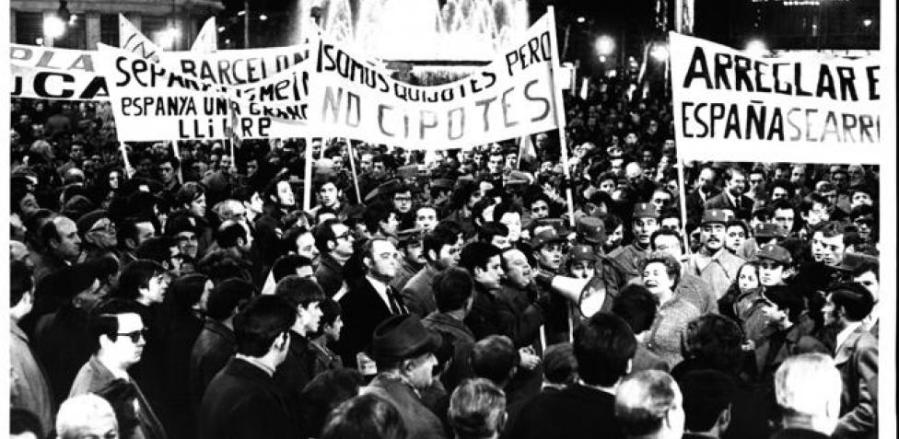
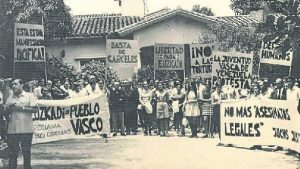
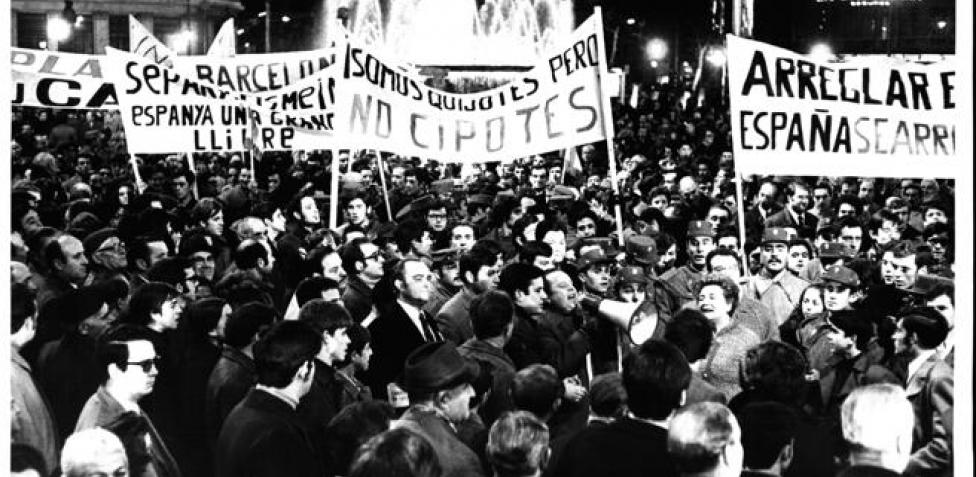
Demonstration in Barceloneta, Catalonia in solidarity with Burgos defendants, December 1970
(Photo sourced: Internet)

BACKGROUND

A military-fascist uprising against the elected Popular Front government of Spain took place in 1936 and in the Spanish Antifascist War that followed, the Spanish Republic was defeated by the military with substantial assistance from Nazi Germany and Fascist Italy, while the UK and France blockaded the Republican forces.

Hitler and Franco reviewing invader Nazi troops in Hendaye, French Basque Country. (Photo source: Internet)

A military-fascist dictatorship with the strong assistance of the Spanish Catholic Church followed amongst huge repression, making Spain the state with the most mass graves in Europe and second only to Cambodia in the world.

The Popular Front Government had granted autonomy to the Basque Nation (and to Catalonia) for the first time in centuries of the Spanish State, although Nafarroa province had sided with the military-fascist forces. Any notion of autonomy was withdrawn under the Dictatorship and even use of the Basque and Catalan languages in public or in education was forbidden.

Some guerrilla resistance continued for a period in the mountains of the Basque Country, Catalonia and other parts of the Spanish state territory but the fighters were hunted down or fled the Spanish state. The Communist Party and some socialist organisations continued an underground existence and built illegal trade unions but the CP of Spain did not support independence for the Basque Country or for Catalonia, on the theory that this would “break up the Spanish working class” (however later they all mobilised against the Franco Dictatorship and in solidarity with the Burgos defendants).

Euskadi3 Ta Asakatasuna (Basque Land and Freedom) was formed in 1959 out of a coalition between a left-wing Basque youth group and the youth wing of the Basque Nationalist Party (PNV) who were discontented with the lack of action of their elders. In June 1968 ETA carried out its first armed action against Spanish police when killing a police officer asking for their identification papers at a checkpoint and shortly afterwards one of the ETA pair was gunned down by police. Two months later the organisation carried out its first planned attack when they killed Melitón Manzanas, Commander the Political Police Brigade in Alava Province. Manzanas was a notorious fascist and torturer who had hunted down Jewish refugees to turn them over to the Nazis during WWII.

The Burgos trials was intended to smash ETA completely but as outlined above, had an entirely opposite effect. The death sentences were commuted in an attempt to reduce the damage the trials had caused the international reputation of the Spanish State.4

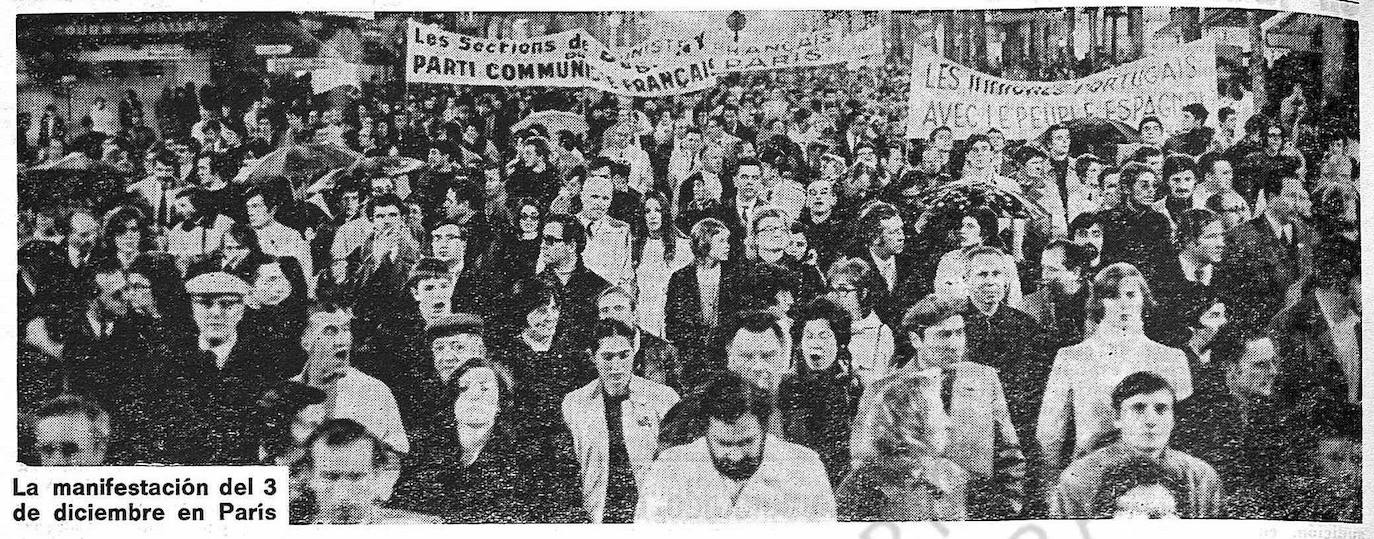
Solidarity with Burgos Defendants in Paris, Dec. 3rd 1970 (Photo sourced: Internet)
Angry Brigade Communique on machine-gunning of Spanish Embassy, London on 3rd December 1970. (Photo sourced: Internet)

AFTER BURGOS AND TODAY

ETA continued its armed and non-military actions and other revolutionary armed communist resistance began to take shape elsewhere in the Spanish territory.

Despite the huge success of the Basque solidarity mobilisations to prevent the executions in 1970, five years later a similar wave failed to prevent the executions of another two ETA members and three FRAP (Revolutionary Anti-Fascist Patriotic Front) members: Ángel Otaegui Etxeberria; Juan “Txiki” Paredes Manot; José Humberto Baena; Ramón García Sanz; and José Luis Sánchez Bravo.

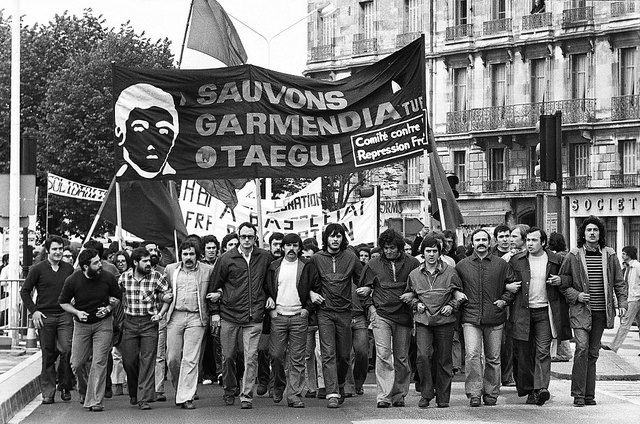
French solidarity with ETA defendants 1975. This time the international campaign was unsuccessful and the Spanish State executed the two ETA and three FRAP activists (Photo sourced: Internet)

ETA counted some actions notable for the harmful effect on them but also some spectacular successes in its armed campaign. Included in the latter were the assassination in Madrid in 1973 of Admiral Carrillo Blanco, Franco’s appointed successor and the abandonment of the nuclear reactor project in Lemoiz5 in Bizkaia in 1983. Blanco’s assassination and the death of the Dictator Franco in 1975 hastened the Transition of the Spanish State to an alleged democracy and a monarchical and unitary state constitution in 1978.

The Basque resistance constructed a network which beyond the armed group consisted of trade unions, youth organisation, social centres, daily bilingual newspaper and political parties. The Spanish State waged war against that movement with repressive laws, arrests, torture, jailings, closure of organisations and media, along with armed action against ETA. In addition, it organised and funded a terror and assassination campaign over a period of 26 years6.

In the late 1990s the Basque Left-Independentist movement began a process of unilateral disarmament and change in political direction which led first to an indefinite ETA truce in 2010, then to decommissioning of arms and finally to the dissolution of ETA in 2018. However around 250 Basque political prisoners remain in jail, a tiny group of which have declared their dissidence from the leadership’s path and are supported outside the jails by a growing movement which has a very different line to that of the “official” leadership.

The Spanish State insists that the only possible relaxation of prison conditions, end of dispersal7 or granting of parole for the prisoners is “if they recant their beliefs and apologise to the victims.”

Political repression continues at some level within the Basque Country. There is no indication that there is any intention in Spanish ruling circles to grant independence to the southern Basque Country – quite the contrary (as seen also in Catalonia).

THE 50th ANNIVERSARY

A group of activists from the official Abertzale Left carried out a publicity commando raid in Burgos recently (see video below) and attached a banner poster to the Spanish Ministry of Defence building which read: “NEITHER WERE YOU ABLE to repress the struggle of the people NOR WILL YOU BE ABLE” and LONG LIVE THE REPUBLIC!

A number of public meeting and on-line events were also held this month, including the commemoration in Etxarri of two Basques who were killed by Spanish police during the Burgos Trials protests.

In Eibar city in Gipuzkoa province around 100 people assembled despite Covid19 restrictions in the open air to mark the anniversary and included one of the Burgos trial defendants who, along with another woman, read out a manifesto which has been signed by many in the Basque independentist movement.

Burgos Trials 50th Anniversary Commemoration in Eibar, Gipuzkoa, Dec.2020. (Photo source: Naiz.eu)

“The Franco regime wanted to prosecute, punish and subdue again a people that in the darkness of the dictatorship had dared to rise from the ashes of war,” they read, introducing the manifesto.

Recalling the moment when the defendants rose in court and with upraised clenched fists sang the Eusko Gudariak, the manifesto commented: “With their courage, that handful of young militants taught us to stand up even when it seems impossible, and their example lives on today in us and in the future in the actions and dreams of the new generations.”8

The manifesto also states that the Burgos Trials were “a milestone” for the survival of Euskal Herria. However today, 50 years later, the substantive process has not concluded, since “they continue to take Basque youth to court, thinking that by disciplining them they will quench the desire for freedom of this people, and the states that surround us have not abandoned their strategy against the independence movement.”

The anniversaries of milestones in the struggle, of successes and failures, of martyrs, continue to be marked. And the journey is far from finished.

End.

FOOTNOTES

1“Soldiers of the Basque Country”, very similar in title and theme to the Irish national anthem, Amhrán na bhFiann/ The Soldiers’ Song.

2How Onaindia managed to get his hands on an axe in court is one question but the significance of the axe cannot be underestimated – it was a traditional tool of foresters but also of ancient Basques in war and formed one part of ETA’s emblem, the other being the snake, representing wisdom.

3Formerly used to describe the whole Basque nation, “Euskadi” nowadays mainly describes the Basque Autonomous Region of the provinces of Bizkaia, Alaba and Gipuzkoa. “Euskal Herria” (The Country of Basque Language”) is more commonly used today to describe the whole seven provinces of the Basque nation, four currently within the Spanish and three within the French states.

4It also increased the pressure on the Spanish ruling class from the USA and European states to become more moderate politically and less vulnerable to revolution.

5This was in addition to frequent large protest mobilisations.

6Much more than the notorious GAL – see for example https://rebelbreeze.com/2020/12/23/november-month-of-murders-of-basque-activists/

7The vast majority of the prisoners are in jails dispersed throughout the Spanish and French states, between hundreds and even a thousand kilometres from their homes, placing a huge burden on their families and friends in visiting them.

8Comment: One wonders whether they felt any sense of irony in reading that out, considering that only in September last year 47 Basque prisoner solidarity activists pleaded guilty in a plea deal that ended their trial in 25 minutes with suspended sentences for all except for a few months’ jail for a couple of them. The deal came as a total shock to the estimated 50,000 people who had, only two days earlier, marched in solidarity with the accused, defending their right to do solidarity work without being persecuted or prosecuted.

SOURCES

https://www.naiz.eus/eu/info/noticia/20201228/ni-pudieron-ni-podreis-mensaje-en-la-an-y-el-gobierno-militar-de-burgos-50-anos-despues

https://en.wikipedia.org/wiki/Burgos_trials

https://www.naiz.eus/en/info/noticia/20201129/personalidades-del-ambito-independentista-recuerdan-el-50-aniversario-del-proceso-de-burgos

ALTERNATIVE BASQUE LIBERATION ORGANISATIONS UNITE

Diarmuid Breatnach

(Reading time: 3 mins.)

Press release, founding of Jardun (translated by D.Breatnach)

Photo source: Jardun

On Saturday August 15, two events were held on Mount Albertia in Legutiano.

“At 12 noon, at the top of Mount Albertia, the Eusko Lurra Foundation remembered the Gudari activists who fell in the war of ’36 fighting against fascism. This year the participation of women who fought for freedom and for the rights of workers in the war of ’36 was especially remembered, since women are have been greatly overlooked in this war.

“Later, in the surrounding of the Gaztelua oak grove, a political act was held. There, to begin the act, three veteran Ekintzales militants who maintained their militancy for decades were honoured. Later the organizations Eusko Ekintza and Jarki presented the new coordination called “JARDUN”, as an initiative for the union of forces of the pro-Independence Left.

Three veteran activists honoured.
Photo source: Jardun

____________________________

“Today in Albertia, we bring to mind the gudaris (patriotic soldiers – Trans.) who, faced with fascism, fought for the freedom of Euskal Herria (Basque Country) in the war of ’36. Even so, we cannot, in any way, bring them to mind in a folklorist type of perspective. Passing beyond tears, we must approach today’s event from the point of view of the working people, whose only desire is to win and fight. That is why today, beyond only memory, we proclaim the legitimacy of the struggle of all those who in Albertia and in different parts of Euskal Herria have fallen fighting for this people. Precisely, the Albertia Day of 2020 has been organized along the line of that desire to continue fighting, in which its organizers want to make public a new tool that must respond to the aspirations of the Basque Working People. A tool that should function as a space for activation and organization.

Photo source: Jardun

“Due to fractures that have occurred for different reasons following the end of the previous cycle, the various organizations have not been able to overcome our differences and mistrust in order to agree on spaces for unity and coordination. Today, Eusko Ekintza and the revolutionary organization JARKI want to present a coordination space called JARDUN to the Basque Working People. JARDUN is not a split from anything, rather a framework that should shelter different national and local organizations, combining them in a political project and a strategy of a revolutionary independence and socialist nature. So that everyone can, from their space of struggle, organize individually or collectively.

Performance of the Auresku, the honour dance.
Photo source: Jardun

“Today’s presentation, far from being what certain organizations are raving about, is in line with the capacity that the Basque Working People has historically shown when it comes to self-organisation in the face of the oppression it suffers. JARDUN is not a brand for the organizations that compose it to impose their ideology or their political project. It is a meeting point whose objective is to encompass and coordinate the Basque Working People, and all the organizations that work in favor of it, around broad but defined ideological principles. Its strategic objectives are clear: The construction of an Independent and Socialist state that integrates Araba, Bizkaia, Gipuzkoa, Lapurdi, Nafarroa Behera, Nafarroa Garaia and Zuberoa.”

(i.e the seven provinces of the Basque Country, including those on both sides of the Border between the Spanish and French states – Translator).

SOURCE:

https://eh.lahaine.org/eusk-cast-recuerdan-en-albertia

COMMENT:

HISTORY

          Albertia is the site of a battle in the Anti-Fascist war in Araba province from 30 November to 24 December 1936. The Basque Government’s forces launched an offensive on Villareal to take the town from coupist military-fascist forces and relieve the pressure on Madrid. Though the Basque forces significantly outnumbered their opponents, the latter were in defensive positions and had substantial air cover, while the Basque forces had hardly any. Eventually the siege was relieved by which time the Basques had lost 1,000.

CURRENTLY

          Clearly a revolutionary movement needs to unite within itself different organisations and groups if it is to succeed. The official Abertzale Left had succeeded in this to a large degree, including under its umbrella a daily newspaper, a trade union, along with its welfare, political, cultural and social organisations. However, in taking the road of not only abandoning armed struggle but also focusing on the electoral path above all else, the official Abertzale leadership has taken some of its parts down that ruined road, causing confusion and fragmentation around it.

Photo source: Jardun

Is this Jardun a first step in the process of unification of the revolutionary alternative? Will it include the Amnistia and youth movements? Can it also include different elements such as anti-authoritarian self-organising groups? Will the internationalist arm of Basque national liberation, Askapena, be re-activated on a revolutionary basis? And can the mistakes of the past be overcome?

We shall have to hope, wait and see.

End.

Photo source: Jardun

INTO SPANISH JAIL AFTER THREE YEARS FREE FROM FRENCH JAIL

Diarmuid Breatnach

(Reading time: 5 mins.)

Basque independentist militant Itxaso Zaldua was arrested on Tuesday in Hernani, in the Basque province of Gipuzkoa and according to media is to be charged with complicity in the killing of a senior right-wing politician in 2001. She has spent only three years at liberty in the southern Basque Country after nearly twelve in a French jail and is now back in custody pending trial. Her arrest has been denounced by both wings of the Basque pro-independence movement but from different perspectives.

           As according to the bilingual GARA newspaper Zaldua was not held incommunicado, i.e without access to friends and relations, lawyer or doctor of choice, it is not likely that she will be tortured. Until a few years ago the use of a variety of types of torture during the five-day incommunicado period under the “anti-terror” (sic) laws was the rule rather than the exception. However, all detainees charged under the terrorism laws of the Spanish State are always taken to Madrid for interrogation by the Guardia Civil and then for court appearance, the distance from their homes placing an additional burden on friends, relatives and supporters (it is 450 km from Hernani). Some of those will be given temporary accommodation and support by Madrid organisations in solidarity.

TWELVE YEARS IN JAIL

          Back in April 2005 Itxaso Zaldua was arrested in the Lannemezan area of the Occitan region of the French state, along with her comrade José Segurola Querejeta. They were charged with membership of ATAKA (sub-structure of the armed Basque resistance organisation ETA), of which she was accused of leading and duly convicted and jailed in the French system (which also disperses political prisoners to jails throughout the territory).

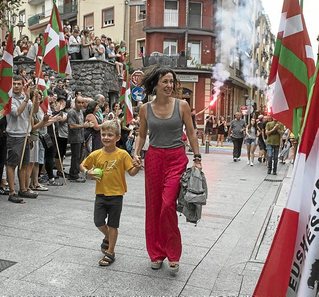
Zaldua was released in 2017 and right-wing Spanish unionist organisations including the “Association of Victims of Terrorism”, many of their members relatives of Spanish police or military, complained at the traditional honouring reception she received upon her return home from French jail. Zaldua walked hand-in-hand with her young daughter down a street with well-wishers on both sides cheering, was presented with a floral bouquet, two women danced the aurresku (honour dance) before here and another shouted the irrintzi, the high-pitched yodeling cry reputed to have been a battle-cry (see embedded video) and the Eusko Gudariak (“Basque Soldiers”, similar to the Irish “Soldiers’ Song”) was sung by all.

https://www.vozpopuli.com/espana/instituciones-permiten-homenaje-etarra-Itxaso-Zaldua-yihadista_0_1057095289.html (apologies for the use of video from a right-wing source but it was the only one I was able to access).

2017-08-23, Hernani. Itsaso, euskal preso politikoa aske, ongi etorria.
23-08-2017, Hernani. Itsaso, presa politica vasca libre, recibimiento.

“TIME TO BE EMPTYING THE JAILS, NOT FILLING THEM”

          The “official” Basque independentist movement responded quickly to the ex-prisoner’s new arrest: the Sare organisation convened a demonstration in Hernani the same afternoon demanding Zaldua’s release and the trade union works committee of her place of employed also denounced her arrest. The official movement’s political party EH Bildu (headed by Arnaldo Otegi), issued a statement that “It is time to be emptying the jails, not filling them,” a reference to the nearly 250 Basque political prisoners still in jail.

2020-07-21, Demonstration Tuesday afternoon in Hernani in protest at arrest of Itxaso Zaldua in the town earlier that day.
(Photo sourced: Naiz.info)

The party’s statement called the arrest “another obstacle in the path chosen by this nation towards peace, coexistence and freedom; a path which, cost whatever it may, we are determined to follow”.

However the ‘dissident’ organisation Amnistia (Movement for Amnesty and Against Repression), which also condemned the arrest, issued a statement declaring that “There will be no peace until the reasons that are at base of the conflict are resolved and until all the militants who are punished as a consequence of said conflict are free.

Both organisations called the people to action, with EH Bildu referring to “the participation and activation of Basque society” and Amnistia in contrast stating that “the working class need to organize”.

“THEY WANT TO HUMILIATE THE BASQUE COUNTRY”

          The Basque organisation ETA ended its armed struggle in 2012 as part of a unilateral bid for a peace process of the movement under the leadership of Arnaldo Otegi. However, a peace process requires the participation of at least both antagonists and the Spanish State has shown no interest in negotiation. Whatever one may say about such processes in Ireland or in South Africa, the resistance organisations in those countries ensured the freedom of their imprisoned members before they signed up to the deal. This was not so in the Basque case.

It is no doubt difficult for observers to understand why the Spanish State is now pursuing an ex-prisoner for alleged complicity in an assassination nineteen years ago when State has gained not only the ETA’s abandonment of armed struggle but even its dissolution. Nor is there any sign that Zaldua is a sympathiser of the “dissident” movement; the statements in her support from across the “official” movement and the speed of response is in stark contrast to the “officials’” response to the hunger and thirst strike of political prisoner Patxi Ruiz in May. Ruiz had denounced the “official” leadership some years ago and been expelled from the collective that leadership controls (and which precipitated the resignations of another four Basque prisoners in solidarity).

Ironically, it is the assessment of the “dissident” Amnistia which seems correct: “This arrest, like other previous ones, shows that the States (i.e French and Spanish) want to humiliate the Basque Country. By means of life sentences against a specific against a specific model of resistance, they want to intimidate the new generations that join the struggle.”

Itxaso Zaldua, photographed a year after her release from 12 years in French jails.
(Photo sourced: Internet)

DIFFERENT PATHS

          Whatever the eventual outcome of the judicial process against Zaldua in the no-jury National Court in Madrid, it is clear that the struggle against the Spanish State is far from finished in the southern Basque Country, though its armed stage seems over at least for the present.

The “official” leadership has been following an electoral path and quoting the support of external political figures such as Bertie Ahern, Gerry Adams, Kofi Anan, Tony Blair and Brian Currin of South Africa.

In the Euskadi regional government elections on Sunday in the southern Basque Country, the “official” party led by Otegi, EH Bildu, as expected came in second. The PNV, the Basque Nationalist Party, came in first and the PSE, Basque version of the Spanish unionist PSOE, in third place. Despite periodic approaches by the EH Bildu leadership, the PNV will govern the three provinces either in coalition with the PSE or in “confidence and supply” agreement with the party.

Even if EH Bildu in years to come were able to reach first place in Euskadi regional elections, what of the other region, Nafarroa? And the three northern provinces of the Basque Country, under French rule? And, even with an eventual majority in all seven provinces, if the Spanish State were still to deny independence, as it does with an independentist majority in Catalonia, what then?

Over to the Amnistia movement, which advocates street power: “If we are to achieve peace, it will come from the full implementation of total amnesty, with the unconditional release of prisoners, refugees and political deportees, with the expulsion of the occupation forces and with the overcoming of the reasons that pushed so many people to fight. That will be the only guarantee to end arrests like today and other similar repressive actions.”

That seems a realistic enough assessment. But as to how to achieve their objectives against the opposition of the Spanish and French states, neither section of the Basque independentist movement seems to have an answer.

End.

Workmates of Itxaso Zaldua at company CAF Besain demand her release.
(Photo sourced: Internet)

SOURCES:

Movement for Amnesty and Against Repression statement: https://www.amnistiaaskatasuna.com/index.php/es/articulo/ante-la-detencion-de-itxaso-zaldua

Report on-line GARA (naiz): https://www.naiz.eus/en/actualidad/noticia/20200721/detienen-a-la-expresa-itxaso-zaldua-en-hernani

VOX LEADER EXPOSED TO RIDICULE BY ATTACK ON BASQUE LANGUAGE

Diarmuid Breatnach

(Reading time: mins.)

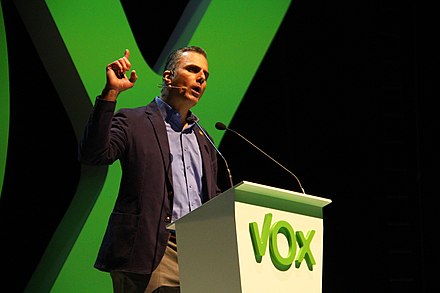
Javier Ortega Smith, No.2 in the leadership of the fascist Spanish party Vox recently attacked the Basque language, he did more than reveal the hatred of the core of Spanish unionism for the diversity of national cultures currently in existence within the Spanish state – he revealed his abysmal depth of ignorance about how languages, including his own are formed. And got lambasted and ridiculed in comment even in some conservative media as also social media, especially in tweets.

“Vox in the Battle for Spain” (uncertain whether this meme is intended in irony or not).
(image source: social media)

Javier Ortega Smith, No.2 in the leadership of Vox, speaking at a party rally.
(Photo source: Internet)

Vox was on an expedition into what is for them electorally virgin territory in the run up to the elections in the Basque Country Autonomous Region this weekend, where they have no elected representation at all. Far from what might have been expected, their presence and speeches seemed calculated to arouse hostility and expose their few supporters there to embarrassment.

Gaining the prize for generating hostility was Javier Ortega Smith, No.2 of the Vox party, speaking in Vitoria/ Gastheiz in Alava, one of the three provinces of the “Basque Autonomous Region”. Calling the second party in electoral strength in the region “terrorists” would cause little surprise, since EH Bildu is descended from Herri Batasuna, which was once associated with the armed group ETA and considered by some to be terrorists (by others, freedom fighters). But to say of the party of main electoral strength, the Basque Nationalist Party, that they are only “four cats”, equivalent in English to “three men and a dog”, this in a region where Vox has failed to get even one delegate elected …. well!

But Ortega Smith really put his hoof in it when he blundered into linguistics. “Asturian (language) is invented and Euskera (Basque language) also,” he declared, going on to declare that Batua, the standarised form of the Basque language, was formed “from dialects” of communities “who would not even have understood one another.”

Asturias, to the north-west of the Spanish state, with a population of around 1.02 million, is in some cultural expressions a Celtic nation but their language is of the Romance group, like Castillian (Spanish), with contributions from the Iberian-Celtic of the Astures tribe and later Germanic languages of the conquering Visi-Goths and Suevi. Euskera, the Basque language, is of uncertain origin but certainly ancient and currently spoken over the seven provinces of the Basque nation, three under French and four under Spanish control (total population a little over 2.17 million). All languages in the Spanish Kingdom other than Castillian have come under suppression at one time or another and most widely and rigorously under the four decades of the Franco dictatorship, a period nostalgically recalled by fascists and by even many conservatives in the Spanish state. What language has rights where and at what level is a battleground of struggle with the central State and a preoccupation for Spanish unionists.

Anyone who understands even the basics of how languages and their vocabularies are formed and developed would not have dared make such a statement as did Ortega Smith.

One would not even need to know that English, belonging to the Germanic group and currently a dominant world language, has a vocabulary which is 60% from French, with heavy sprinklings of words of Greek and Latin origin. Latin, which was a ‘world language’ before English, French or Spanish, started life as a Romance language in small province of Italy called Latium. Latin influenced heavily the development of Castilian, which includes many words of Arabic origin as well as from other languages and yes, even from Euskera! Nearly all European languages are thought to have developed from an Asian ancestor something like Sanskrit, so that they are grouped together as ‘Indo-European’. And what language was spoken in Europe before the advent of those Asian-influenced tongues? None other than Euskera, probably the original language of the early early Neolithic settlers!

Still, who needs knowledge when prejudice is king!

Some of the social media comments are sarcastically amusing, reproduced here in translation:

Asturian is invented and Euskera also. Unlike Spanish which already existed in the time of the dinosaurs” or

unlike Spanish, which came out of the Big Bang” or

unlike all the other languages, that only use words growing on trees” or

Unlike Castillian (Spanish) which arrived in Noah’s Ark with all the words”.

Do you know how to say Ortega Smith in the Valencian tongue? ‘IGNORANT’”

Well now, Ortega Smith, the vocabulary of all the languages of the world are invented, like your patriotism.”

Ortega Smith is sure that the Basque Language has been taken from The Lord of the Rings.”

The Vox party was formed in 2013 from an extremely right-wing political core that has contributed in turn to the creation of the Partido Popular, from former supporters of Franco and Ciudadanos before going on to the creation of Vox. It has campaigned for the abolition of the statutes of autonomy for regions, for the right of parents to withdraw their children from liberal sex and gender education, spoken against a focus on male violence against women. The party climbed in popularity in recent years, in particular in the more economically depressed regions and now has 52 deputies in the Spanish Parliament and four MEPs.

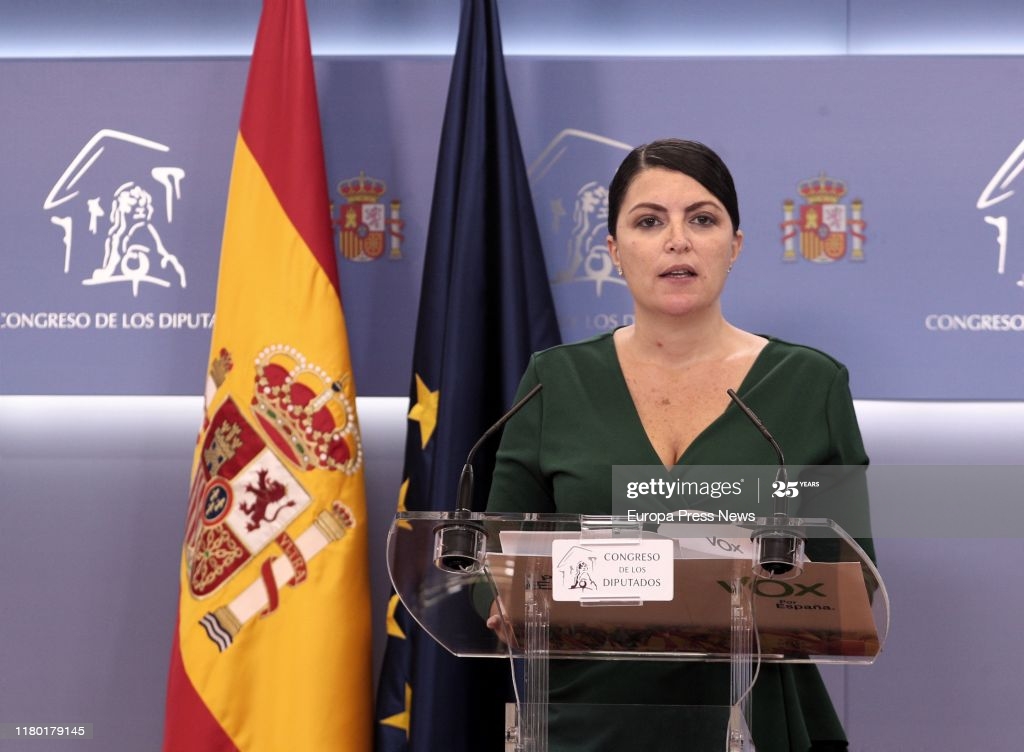
Spokeswoman of Vox party Macarena Olona, who also spoke in the Basque Country.
(Photo source: Internet)

Still intent on their version of making friends and influencing people, on Wednesday in Oñati in Gipuzkoa province, where Vox carried out a ceremony to honour the militarised Spanish police force, the Guardia Civil, spokeswoman for the fascist party Macarena Olona screamed at protesters that “Oñate is in Spain, you crockful of ETA! Oñate is in Spain!” In this township of 11,000 people Vox received, in the last general election, a total of 21 votes.

Basque opposition to Vox back in June in Donosti/ San Sebastian when the party representatives left under police escort.
(Photo source: Internet)

Basque riot police confronting Basque crowd hostile to Vox. Later the police charged the crowd.
(Photo source: Internet)

Throughout their visits to the Basque Country, Vox representatives were surrounded by Basque police and left quickly after their rallies.

end.

SOURCE:

https://www.publico.es/tremending/2020/07/06/el-euskera-es-un-idioma-inventado-no-como-el-espanol-que-se-formo-en-el-big-bang-los-tuiteros-responden-a-la-ultima-de-ortega-smith/

POLLS PREDICT COALITION GOVERNMENT FOR EUSKADI WHILE AMNISTIA CONCENTRATES ON STREET POWER

Diarmuid Breatnach

(Reading time: 7 mins)

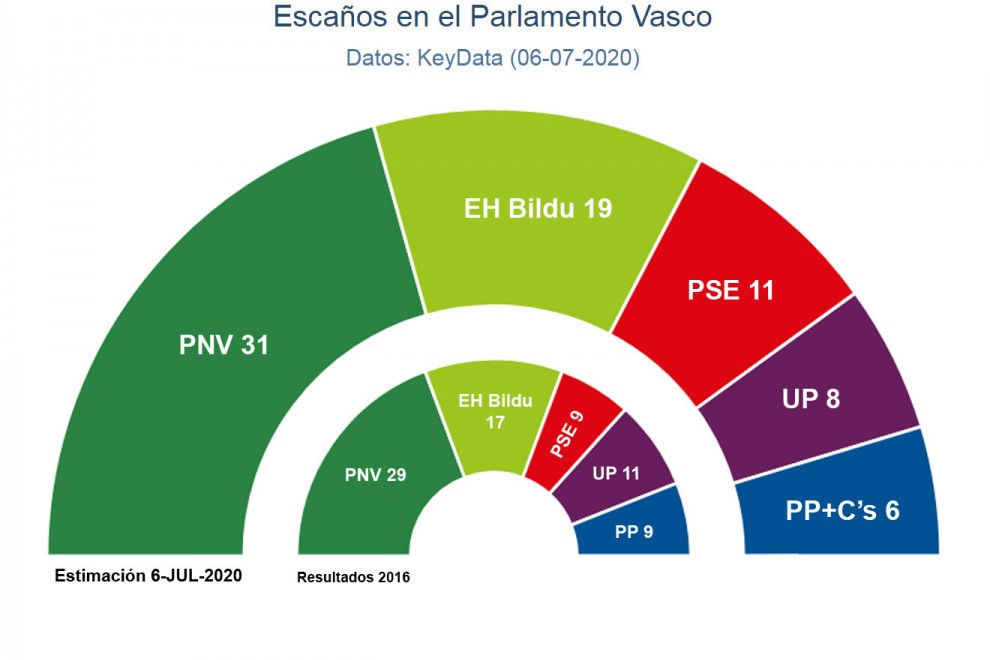
The results of opinion polls prior to the the elections for the government of Euskadi predict a majority for the Basque Nationalist Party. The predictions have EH Bildu, the party of the official Abertzale Left leadership, coming second with third place going to the social-democratic PSE, the Basque version of the PSOE, currently governing the Spanish State in coalition with Podemos Izquierda (whose Basque version will come a very poor fourth).

Maddalena Iriarte, EH Bildu’s candidate for Lehendakari (President) of the Euskadi regional government.
(Photo source: Internet)

          The elections on Sunday, although they usually described as for “the government of the Basque Country” are nothing of the sort. The are for the government of what is termed “the Basque Autonomous Region”, which covers only the Basque provinces of Bizkaia, Alava and Guipuzkoa – the fourth province within the Spanish state, Nafarroa (Navarra), has its own autonomous regional government. The remaining three provinces of Euskal Herria, the true Basque Country, are over the border in the territory controlled by the French State. And the Spanish State allows the Basque regions autonomy only to a point, as with all the “autonomous regions”, ultimately answerable to the Spanish State.

The PNV, Basque Nationalist Party, many of whose ancestors fought Franco in the Spanish Anti-Fascist War, have long accommodated themselves to this situation and given up the dream of Basque independence and the party has hardly any representation even in Nafarroa, to say nothing of the three northern provinces, across the Border. Since their fiefdom was granted autonomy after the death of Franco, they have dominated it electorally and used that domination to the commercial and financial advantage, both legal and illegal, of the Euskadi capitalist class (Irish readers will readily see a parallel with the Fianna Fáil party).

EH Bildu is the official party of the Abertzale Left, political descendants of the Herri Batasuna party, substantially changed and the main internal opposition to the PNV, at least on the electoral front. Herri Batasuna evolved as the political expression of ETA, the left-wing movement for Basque independance that in the 1960s developed an armed wing against the armed might of the Spanish State. Under the leadership of Arnaldo Otegi and others, ETA gave up armed struggle in 2012 and the EH Bildu and Sortu parties developed a theory of a “Basque Peace Process” which had no substance, since the Spanish State’s only interest was in surrender and never even ceased repression or released its around 900 Basque political prisoners (now around 700 as prisoners served their sentences – or died).

Prediction electoral distribution of seats in Euskadi elections 2020 based on opinion polls. (Image sourced: Publico.es)

Batasuna and its iterations over the years in the face of bannings by the Spanish State have at many times sought alliance on a nationalist basis with the PNV (the Irish parallel holds here again, as with periodic overtures of the leadership of the Provisional Sinn Féin party to the Fianna Fáil party), which on the whole have been rejected by the leadership of the PNV. The Basque Nationalist Party has preferred to rule in coalition with the PSE and even to allow the Spanish-unionist party to rule Euskadi on its own. Therefore the call from some Basque nationalist quarters for a PNV-EH Bildu coalition is very unlikely to bear fruit.

At least as unlikely is the raising by the electronic media Publico of the possibility in Euskadi of a “Government of the Left”, on the basis of the poll results. The left-wing Publico itself conceded it an unlikely eventuality, based on a coalition of EH Bildu/ PSE/ Unidas Podemos (the Basque version of Podemos Izquierda). Whatever one may say of the “Left” credentials of EH Bildu and of Unidas Podemos, one can hardly credit the PSOE or its Basque version with any. No doubt there are genuine people of the Left in that social-democratic party, as there are within the Irish and British Labour Parties too – but that does not affect the character of the parties in government, which have always been servants of capitalism and, in the cases of the UK and Spanish state, of their imperialist ruling classes.

On the poll results therefore it is certain that the PNV will be in government, whether in coalition with the PSE or with its tactical support. EH Bildu looks no nearer to achieving its dream of governing even Euskadi, not to mention all four southern provinces of the Basque Country.

MEANWHILE, ON THE STREETS

          The Amnistia movement meanwhile has shown little interest in the elections, apart from chiding EH Bildu for its focus on elections and neglect of resistance anywhere else, including the jails. The Basque struggles for independence and against repression have paid a price in huge numbers of political prisoners and, though down to around 700 now from its height of 900, the Basque nation probably has the highest percentage of political prisoners of anywhere in the world. After all, the total population of the Basque Country is under 1.5 million and such a high concentration of political prisoners means that there is hardly a Basque who does not know a relation or friend of a prisoner, if not indeed the prisoner him or herself.

When Arnaldo Otegi and others led the majority of the Abertzale Left to the institutional road, they kept referring to the Good Friday Agreement in Ireland and the release of political prisoners. However, the Provisionals ensured that the release of political prisoners of their allegiance was delivered before finally decommissioning their weapons. The Otegi initiative went in reverse and their prisoners are still in jail. For some years now the leadership has been telling the prisoners that basically they are on their own and must negotiate with the prison authorities their reduction from Grade 1 down to Grades 2 and 3 and eventual release on parole. And telling the families that they have no hope of an amnesty so to stop asking for it and instead demand an end to the dispersal of political prisoners all over the jails of the Spanish (and French states), hundreds of kilometres from their families. There is no sign of even that basic human right being granted.

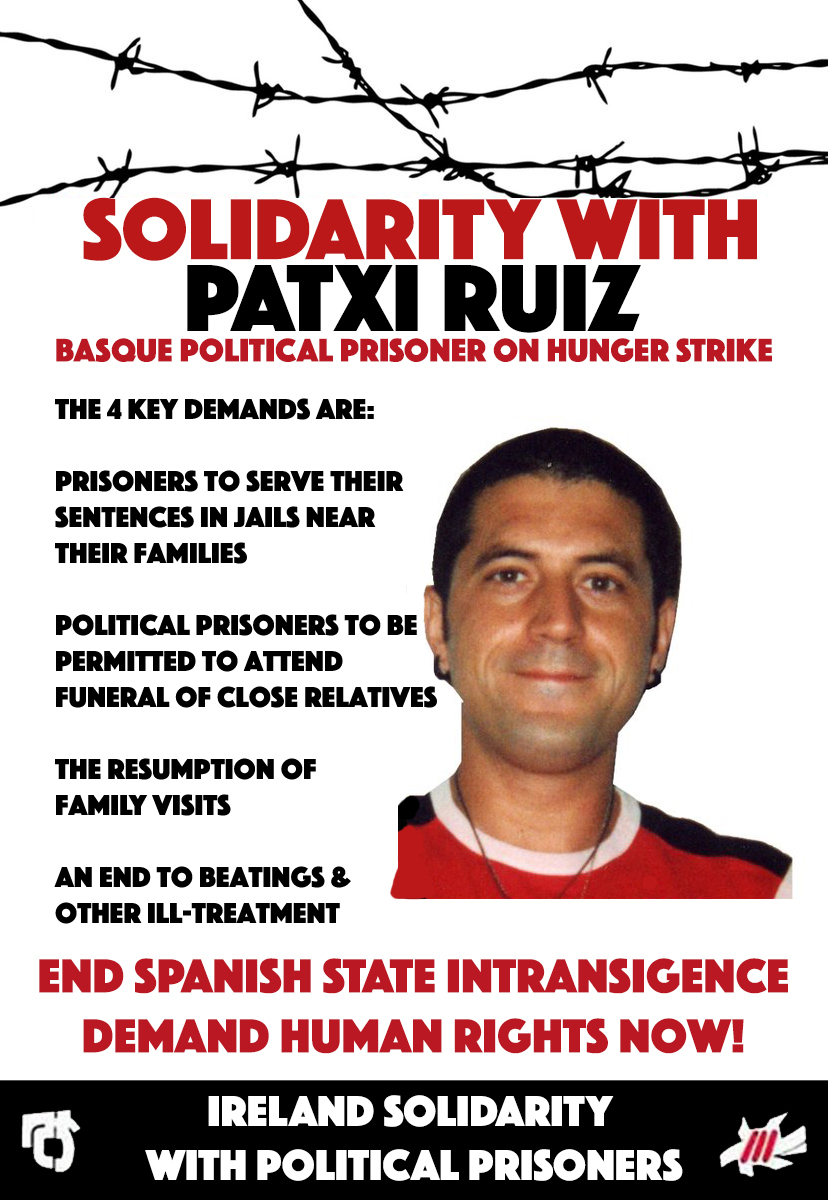
One of the Basque political prisoners, Patxi Ruiz, publicly denounced the new path of the movement and, after attempts to silence him were unsuccessful, he was expelled from the Basque Political Prisoners’ Collective. His treatment caused another four to break with the Otegi leadership too. Amnistia supported them and criticised the leadership of the movement which, in turn, accused them of using the prisoners for their own ends, since they did not agree with the new direction.

Persecution by the prison authorities including beatings by guards and refusal to allow him to attend his father’s funeral drove Ruiz last month to a hunger-and-thirst strike. After 8 days he abandoned the thirst strike but continued refusing food, ceasing that protest too after 31 days. His support movement led by Movement for Amnesty and Against Repression (to give Amnestia’s full title in English) brought Basque political prisoner solidarity back on to the streets, from which it had largely disappeared apart from the ritual demonstration each January and weekly pickets by families and friends, diminishing in attendance.

Solidarity actions were taken in the jails too, not only by the other four “dissidents” but by some of those still in the Collective and by a number of political prisoners from other struggles, GRAPO and PCE(r).

In a number of statements, Amnistia acknowledged that some of their support in street actions has come from progressive sectors not traditionally from within their own ranks. There is a substantial autonomous movement in the Basque country consisting of youth occupations of empty buildings, anarchists, feminists, LGBT campaigners, animal rights campaigners, environmental activists …..

On Saturday 4th July, in spite of a ban by the Spanish State’s Delegation in the city and a heavy police presence at an expected starting location, Amnistia led a fairly large demonstration through streets of Irunea/ Pamplona, capital city of Nafarroa, calling for complete amnesty for the prisoners and that “the struggle does not cease”.

http://https://www.youtube.com/watch?v=xSHd98HiFUc&feature=youtu.be

Today, the 11th, they led a march to the Murcia jail (where Patxi Ruiz is held currently). In a brief report on the event and their reasons for undertaking it, they commented even more briefly on the elections due tomorrow:

There will be elections tomorrow in a part of Euskal Herria (the Basque Country) but none of the political parties will propose any alternative to bring to an end the capitalism that tramples on and murders the working class or to destroy the imperialism that occupies peoples and makes them disappear but will instead debate different ways to manage the same system and the same misery.

None of them will demand amnesty for those who endure repression for fighting for these goals. The strength and pressure exerted by the people on the street will be the key to reversing the situation. With the popular struggle amnesty, independence and socialism.”

End.

Amnistia picket on Murcia Jail in solidarity with Basque political prisoners.
(Image source: Amnistia Garassi FB page).

REFERENCES & INFORMATION LINKS

Publico.es report on the opinion poll predictions for the Euskadi elections: https://www.publico.es/politica/urkullu-ganaria-euskadi-primera-vez-seria-posible-tripartito-vasco-mayoritario-izquierdas.html

Short report in Castillian on the Irunea demonstration: https://www.amnistiaaskatasuna.com/es/articulo/por-encima-de-las-prohibiciones-se-manifiestan-en-irunea-favor-de-la-amnistia

Report on the march to Murcia jail and statement: https://www.amnistiaaskatasuna.com/es/articulo/senalan-frente-la-carcel-de-murcia-ii-los-responsables-de-los-ataques-contra-los-presos-y

Amnistia web page (Castillian Spanish language; there is also a Basque language page): https://www.amnistiaaskatasuna.com/es

THE LONG ROAD

Diarmuid Breatnach

(Reading time: 8 mins)

Looking back along the road we’ve travelled, I can see we have come a long way to get where we are today. I’ve traveled a long way. I was very young then, when I started. We all were. In particular, I remember, Carl and Eva and I, we were in secondary school, fifteen years of age.

          We discussed the situation often and pretty quickly became revolutionaries. We knew people in the Party – well, we called it the Old Party after awhile, you’ll see why soon. Yes and they wanted to recruit us. If enough of us joined them, voted for them, they would be able to change things, they told us. And they had some credibility because some of them had fought in the old days, when things were even worse. Some had  lost relatives killed and some had gone to jail.

But we were not taken in, we weren’t fooled. It wasn’t just that theirs looked a really slow way to change things; we didn’t believe it would ever succeed. And we thought they knew that, deep inside and were just prepared to settle for things much as they were. Make the best of it (which for some of them meant shady deals and lining their pockets).

And we were never going to do that.

We weren’t in the armed group, the three of us but we supported them. The armed group were our heroes, the sharp end of our resistance. Over time they would weaken our oppressors and in the end we’d get the freedom we wanted. And these young men and women, they really fought. They paid for their resistance too; plenty of them were killed and if caught, they were tortured and sent to jail for really long sentences.

We delighted in their successes, marched in their funerals, supported them in their struggles in the jails and, later, honoured them when eventually they were released. We did the best we could ourselves against the oppression and general injustice but without actually taking up the gun: put up posters, painted graffiti slogans on wall, held protest marches and pickets, gave out leaflets, held public meetings. Of course, the oppressors went after us and we were out there, in plain sight, more or less.

Our oppressors had made some laws under which they could declare just about anything we did illegal. Unless we sat at home and did nothing. Or joined the Old Party. They called that group of laws the Anti-Terrorist Legislation.

ARREST AND TORTURE

          One night while were out postering in memory of a couple of our martyrs, on the anniversary of their being killed by the police, we got caught. They gave us a bit of a beating and took us to the police station, telling us on the way what they were going to do to us.

Under the ATL they could keep us in a police station for five days without access to any of our friends and relatives or even a lawyer. I’m sorry to say they broke me in the first 24 hours. You might think that was a pretty short period – it didn’t seem like it at the time. Being held in a dark windowless cell, hooded, being threatened with all kinds of horrible things you know they can do, listening to the screams of other people having some of those things done to them, having a plastic bag put over your head until you can’t breathe anymore and you feel sure you’re going to die, your lungs straining ….. It’s amazing how long 24 hours can seem. And even if you lasted that 24 hours, you knew there were another 96 hours to go after that.

Yes, I signed a “confession”, what they told me to say. According to the confession, we were honouring the martyrs because they wanted to overthrow the State, which is why we were putting up posters about them. We wanted more people to join the fighters to help recruitment. Not really about honouring their memory at all. “Glorifying and Supporting Terrorism” was what I was going to be charged with which, if convicted, would get me three years in jail. And the others: my “confession” was not only about me but about Eva and Carl too.

After I signed the “confession” they left me more or less alone but somewhere I could hear shouting and screaming. I thought it might be Eva and Carl, hoped it wasn’t. And I still had to wear a hood whenever any of the guards came in the cell or their doctor examined me. Well, they told me he was a doctor. I told him I felt ok – I knew the guards were listening and I’d get repeat treatment if I said anything against them. And it wouldn’t do any good anyway.

By the third day, or what I thought might the third day, I didn’t hear what sounded like a female screaming any more but could still hear shouting. And sometimes someone crying.

I know it was the fifth day when they brought us to court, put us all in the same cell, waiting for our trial to start. Eva and Carl looked pretty rough and I suppose I did a bit too. Eva burst into tears and told us she had signed a confession against us after the second day. We put our arms around her and held her while she cried. I admitted I had signed too, assuming we all had. I didn’t say I had only held out for about 24 hours, though.

Well, women detainees, they get it especially hard. As well as the rest of it, they are kept naked or semi-naked and, if on their monthly periods, refused tampons or cloths. They are fondled in their private parts, threatened with rape, humiliated and sometimes have something pushed inside them ….. The police don’t do things like that to male detainees ….. well, occasionally, if they know one is gay ….

A frequent method of combining asphyxiation torture with humiliation for female political prisoners in number of jurisdictions.
(Photo source: Basque Country social media)

The shock was that Carl had not signed a confession – he hadn’t broken. So how come they had brought him to trial early on the fifth day with the rest of us? Well, they must have decided he wasn’t going to break; apparently most people break by the fourth day, which is why the limit is set at five. And anyway they had our statements implicating him.

We swore we would retract our statements during the trial, declare they had been obtained under torture. That would invalidate the statements, surely?

We were tried together in a special Anti-Terrorist Legislation court. One judge, no jury. No public. We had lawyers our family and friends had got for us but they were only given five minutes with us before the trial. The Prosecutor produced the statements against us all, those of the police who arrested us and my “confession” and Eva’s. Lied through their teeth that we had made them voluntarily. They produced a statement too for Carl but his lawyer objected it didn’t have his signature, so the police couldn’t show that they hadn’t made it all up.

When we gave our evidence, Carl denied he had made any statement whatsoever and we retracted ours, talked about the torture we had suffered. Eva was magnificent, denouncing them through her tears and shaking. The Prosecutor brought the police back to testify who of course denied not only the torture but any kind of coercion. Some of them even appeared shocked at the allegations. And the doctor – his voice sounded familiar so he probably had been the man who had “examined” me — said I had made no complaint (true) and had seemed calm and rested (not possible).

Image source: Internet

The courtroom is a funny place. Things the whole world knows are not true appear reasonable while the preposterous can seem logical. Not only had they not tortured us, the police witnesses said, but they had never heard of it being done. So why had we made such detailed statements and then retracted them, accusing them of torture. Well, they were mystified about that. Except …. some had heard that this was a propaganda tactic popular among our group, to smear the police. But why then had we given them a statement at all …. well, at least two of us? Skilled interviewing, was the reply. Trained interrogators, going over the suspect’s stories again and again, exposing every contradiction.

The only thing skilled about them was in making sure they stopped short of killing us and generally left no bruises, especially on our faces. Oh yeah, and the acting in court – that was very skilled.

The case against us, with our repudiation of the statements, should have got us at most a few months or maybe even a fine for postering agitational material on public property. Eva and I got three years each, while Carl got nearly four. I suppose the fact they hadn’t broken him pissed them off and they made out he was our leader so the judge gave him extra.

PRISON

          Prison was bad but it was a relief after the police station. They moved us around jails a few times over the years, we didn’t often see one another and our families and friends had to travel long distances to visit us. When they were permitted to or we hadn’t been moved the day before the visit. We learned later, though no-one told us at the time, that Carl’s aunt had a serious accident on the motorway. Long distances, tiring, unaccustomed to motorway driving, bad luck …. With a couple of operations and time, she was able to walk again but the family had to invent excuses why she couldn’t visit him, especially because they had always been close.

Most of the prison warders were hostile but some were sadists, constantly trying to provoke me, finding ways to frustrate whatever little pleasure or diversion I was permitted. Sometimes it was “too wet” to go in the exercise yard for my permitted two hours daily. Sometimes the library was “closed for stocktaking” or “due to staff shortages.” All prisoner mail is opened before being given to or sent by the prisoner but sometimes I got a letter that looked like it had been spat on. Or it smelled bad. Often, it would be two weeks later than the date stamp. Some letters were returned to the sender, I learned later, marked “UNSUITABLE”. I had one returned to me, although I was always careful what I wrote, this one marked “BREACHING PRISON SECURITY” — I had made some remarks about the prison food.

Image source: Internet

Some of the social prisoners were ok whenever I was in contact with them, some were hostile, seemed fascist. Sometimes a warder would make comments about me in the hearing of those kinds of prisoners. Anytime out of my cell I felt I had to be alert, with 180 degrees vision.

I did physical exercises in my cell to keep my body healthy and studied for the sake of my mind. Law was the subject I studied most, so I could represent activists in court and file motions and so on but I also studied politics and economics.

When I got out, I enrolled in a law studies course. I wrote to Carl – I hadn’t been allowed to previously. From his letters, he seemed ok but you never know for sure, do you? Not when you know the letters have to pass the prison censor and the prisoner has to keep up a strong front also. I met Eva too, she was released same time as I but a long distance away; she was subdued, a kind of frightened look in her eyes. Not surprising but she still kept in the movement, though we each took a step back from the more illegal street work, where we could be isolated – like postering. I qualified to practice law at a basic level.

THE POLITICAL PARTY

          We began to discuss founding a political party and standing in elections. The armed struggle would go on, we thought, but over time we could push the Old Party back, take a lot of their votes. After all, what were they doing (except some of their leaders and contacts lining their pockets)? We could really expose them with our policies.

So we formed a political party, a New Party, for which we had to agree to respect the Constitution. We were doing well but, just before the elections, our party was disqualified by the State. “Connections with terrorism” was the reason given. We were furious and so were our supporters. And we formed another party. The State disqualified that one and, for good measure, banned it. Now one could go to jail for being a member.

This kind of thing went on over years, different versions of the New Party and more people going to jail and we rarely got a chance to stand in elections, much less to build up momentum.

We tried forming a coalition with some more moderate elements, even some we had called “collaborationist” in the old days but the State said we would have to denounce the armed struggle to be a legal constitutional party. We couldn’t do that because we’d be turning our back on not only our martyrs but on hundreds of activists in jail. And our own people wouldn’t stand for it. By this time I had risen to General Secretary of our underground Party.

After long discussions with the leaders of the armed wing, eventually we all agreed to announce an end to the armed struggle and to hope for the legalisation of our Party and early release of prisoners. It was a hard decision but not as hard as one might think because we were all pretty worn down and our military wing hadn’t been doing all that well for some time. The State had penetrated both sides of our movement with agents and people turned informer — hundreds were in jail or awaiting trial.

What was harder was getting our supporters to agree but by managing a few meetings, ensuring we had people with a militant reputation to speak in favour of the plan, ensuring people for the idea got more time to talk than those who didn’t and a few other things, we got it through. Besides, a lot of them believed us when we whispered that it was all a game to fool our oppressors.

Eventually, after we declared our total opposition to any armed struggle and total commitment to the electoral process, we got legalised and now we are chipping away at the Old Party, though it looks like it may take a long time to supplant them.

But some of the young people, and some older ones like Carl, are saying we have compromised too much, that the road we’ve chosen is too long and anyway is never going to get us justice. These people do things we’d rather they didn’t, that we’ve dropped, like illegal postering and spraying slogans, holding illegal commemorations for martyrs, protest marches, getting into trouble with the police ….. Making us look bad.

And what’s more, unbelievable as it might seem, they’re calling us “The Old Party”!!!

end.

Image source: Internet

TWO SEPARATE BASQUE PRISONER SOLIDARITY PICKETS IN DUBLIN SATURDAY

Clive Sulish

(Reading time:  )

Two separate political prisoner solidarity pickets took place Saturday 13th in Dublin City centre, one on O’Connell Bridge and the other at the Instituto Cervantes, the cultural arm of the Spanish Embassy, on the one-way traffic system at Lincoln Place, linking Nassau Street and Westland Row.

The Basque political prisoner solidarity protest on O’Connell Street last Saturday, looking northward (Photo: C.Sulish)

          The first, at 2pm on the pedestrian reservation on O’Connell Bridge, was the fourth weekly one organised by a broad coalition in solidarity with Patxi Ruiz, who had ended his hunger strike in a Spanish jail on its 31st day earlier in the week. The second picket, outside the Instituto Cervantes at 3pm, was organised by the Irish Republican group Saoradh, not only in solidarity with Basque prisoners but with all political prisoners, although Patxi’s struggle had given the original impulse for a picket at this time. In addition, Irish Republican prisoners in Port Laoise had on Friday embarked on a 72-hour solidarity fast.

Patxi Ruiz is one of around 200 Basque political prisoners serving sentences in the Spanish and French states, almost invariably, in jails far from their homes, their families and friends, if not too sick, elderly or too young, having to travel long distances to visit them. Ending the dispersal policy was one of Ruiz’s demands, the end of beatings by warders another. He also called for the automatic right to attend funerals of close family (he had been denied permission to attend his father’s funeral) and the resumption of family visits. It is not known whether any of those demands have been conceded but thought unlikely.

Poster produced in Derry for Patxi Ruiz solidarity mobilisation (Image source: Internet)

Although Ruiz is one of five prisoners who have publicly rejected the new path of their movement’s official leadership announced in 2012, his struggle was supported during the hunger-strike by protest mobilisations across the Basque Country, involving pickets, solidarity fasts and sit-ins, protest marches and car-cavalcades. After ten days the official leadership criticised his following through statements by the political parties Sortu and EH Bildu (the latter may be seen as a successor to Herri Batasuna). More recently, the leader of EH Bildu Arnaldo Otegi, generally seen as the main architect of the shift in 2012, publicly attacked the hunger-striker and his support movement, including the Amnistia group, accusing them of directing the whole thing against his party. Amnistia, whose full name translates as “Movement for Amnesty and Against Repression”, replied that they had more important things to focus on than damaging that party’s electoral chances, such as conditions in the prisons, the liberation of their nation and of the working class.

INTERNATIONAL SUPPORT

Plainclothes political police and uniformed Gardaí harassing protesters on O’Connell Bridge on June 6th.

          Patxi Ruiz’s struggle found support internationally: a monster petition in Argentina, a rally in Italy, a mass picket in Barcelona and a number of public expressions of solidarity in Ireland. An ad-hoc coalition of four groups composed of Anti-Internment Group of Ireland, Dublin Basque Solidarity Committee and Anti-Imperialist Flying Column, all in Dublin, along with Derry Anarchists mobilised to support the prisoner’s hunger and thirst strike.  A hunger strike can be sustained by a healthy individual for a number of weeks without irreparable harm, however going without fluids is not only painful but hastens collapse of a number of bodily organs. Fortunately Patxi Ruiz decided to end the thirst part of his strike on the 18th of May.

A Patxi Ruiz solidarity picket in Derry (Photo: Derry Anarchists)

The method political prisoners choose to protest is their choice, not ours,” one of the organisers said in Dublin on Saturday; “our role is to support them and publicise their situation. We don’t have access to the mass media, so if we need to highlight something, what we have is our social media along with whoever shares our posts — and our presence on the street.”

Their first picket was on O’Connell Street in front of the GPO on May 23, the second by the Jim Larkin monument in the same street on the 30th and the last two on O’Connell Bridge in June, while in Derry people gathered at the Free Derry Corner monument every Saturday. Each week photos were taken, some sent to the Basque Country and some published on social media, with an update on the situation.

SECRET POLICE HARASSMENT IN DUBLIN

One of the secret policemen who was harassing the protesters on Saturday. (Photo credit: Clive Sulish)

          During a number of those pickets, participants were approached by plainclothes Gardaí, of the political surveillance section colloquially known as “the Special Branch” and required to give their names and addresses. Although the Special Powers Act does give the Gardaí quite extensive powers to question and even detain suspects, they are supposed to have a reasonable suspicion that the suspects are committing – or about to commit — a crime. It is hard to imagine in this case that such reasonable suspicion existed in the minds of these Gardaí and much easier to believe that the purpose is a cross between intimidation and amassing files on people who are carrying out a peaceful protest and breaking no law. Meanwhile a vocal group of far-Right people demonstrating against pandemic restrictions have been staging protests in front of the GPO, reportedly without any interference by the Special Branch. A number of participants commented that the Irish Council for Civil Liberty should be doing something about this abuse of Garda powers.

One of the Special Branch officers questioning a protester who is holding a placard (Photo credit: Clive Sulish)

The secret political police were again very much in evidence at the second political prisoner solidarity picket on Saturday. Organised by the Irish Republican organisation Saoradh, it began at 3pm and soon collected a half-dozen of these gentlemen who proceeded to demand names and addresses from all present. Unable or unwilling to state which crime they suspected the picketers were committing or about to commit ensured that in the case of a couple of strong-willed individuals who understood the provisions of the quoted Act, the ‘Branch officer was unsuccessful. In a couple of other cases their inability to question in the Irish language left them also without success when confronted with some who were fluent and insisted upon their Constitutional right to have the whole exchange conducted “i nGaeilge”. Some of those problems the ‘Branch had encountered before with the picketers in O’Connell Street and on O’Connell Bridge.

Another view of one of the secret police at his harassment work.  The building centre middle distance is Oriel House, interrogation, torture and murder-planning centre of the Irish Free State during the Civil War.
(Photo credit: Clive Sulish)

Neither Gardaí nor protesters remarked upon the irony of the presence of Oriel House less than 100 metres away on the corner of Westland Row. The building, which operated as a police station during the Irish Civil War, was notorious for the torture inflicted on detainees within, as well as being used as an operations base for kidnapping and murder by the Free State Army and Gardaí.

IRISH REPUBLICAN PRISONERS IN PORTLAOISE ON 72-HOUR FAST

          The protesters, who included some from the earlier protest on O’Connell Street, were spread following the curve of the pavement outside the Instituto, which was closed. A number of Basque flags were in evidence, along with a Palestinian one and a number of Irish ones too. Banners and placards completed the display.

One of the banners on the second picket. The non-jury special courts both sides of the Border are where Republicans are convicted on palry or non-existent evidence and sentenced to terms of imprisonment. (Photo credit: Clive Sulish)

Some time into the protest, the picketers gathered to hear a statement read out on behalf of the Irish Republican prisoners in Portlaoise prison, Co.Laois, Ireland. The statement had been published on social media earlier in the week as part of an announcement of a 72-hour fast of Republican prisoners en Portlaoise, commencing on Friday and expressed solidarity with Patxi Ruiz and other political prisoners arising from the struggles of the Basques, Catalans, Palestinians, Kurds and socialists in Turkey.

One of the banners on the Saoradh picket (Photo credit: Clive Sulish)

The Portlaoise prisoners’ statement went on to point out that they too are political prisoners as are those in Maghaberry and to denounce the strip-searching and sectarian abuse in the latter, along with the antiquated conditions in Portlaoise, as well as the special courts that are used to jail them on both sides of the Border. It also criticised people who campaign about faraway struggles without seeing those at home, along with some ex-prisoners who had signed a recent appeal in solidarity with Patxi Ruiz but who, according to the statement, did nothing about the current Irish political prisoners.  (The End Internment Facebook page of the Anti-Internment Group of Ireland lists around 70 Irish Republican prisoners, mostly in Portlaoise or in Maghaberry).

View of the protest outside the Instituto Cervantes, cultural centre of the Spanish Embassy, Dublin.
(Photo: C.Sulish)

Solidarity with Patxi Ruiz placard in Irish on the 2nd picket last Saturday.   (Photo credit: Clive Sulish).

A statement from the Saoradh group was read out too which, though shorter, covered much of the same ground. Both statements were applauded by those present and the protesters dispersed soon afterwards.

End.