NATIONALISM AND FASCISM

Diarmuid Breatnach

(Reading time: 10 minutes )

All kinds of socialists deride nationalism, as do some republicans. It is often seen as a recruiting base for fascism, for imperialism and the cause or justification for war. Indeed it has been all those things. And yet …. Perhaps the way in which nationalism has been viewed by the Left and Republicans is one-sided and its progressive potential overlooked. And perhaps taking a look at Basque, Catalan and Irish nationalism can demonstrate this.

James Connolly (Photo sourced: Internet)

Was James Connolly1 being reactionary when he upheld the rights of the Irish nation to separation from the United Kingdom, to self-determination? Was Thomas Davis being reactionary when he composed the words

Oh can such hope be vain?

That Ireland, long a province be

a nation once again!”2

Thomas Davis monument, statue and fountain, College Green/ Dame St, Dublin.
(Photo: D.Breatnach)

Recently I began to question some of the criticisms of nationalism politically while at the same time I had struggled with them culturally for much longer. A few people may say that it matters nothing to them whether they are Irish, Italian or Iraqi. But most Irish people identify themselves quite strongly as “Irish”. I think that is primarily a cultural question. They have accents, sayings and history they share, character flaws and positive aspects, heroes, songs, poems, writers …. It is not the same for everyone but some of those aspects, in some kind of mix, are there for each person who identifies themselves as Irish. And of course, the sadly neglected Irish language. I don’t believe identifying oneself as Irish (or Icelandic, Iranian or Indonesian) makes one any less an internationalist.

OK,” the socialist and the republican might say, especially the socialist, “but what does that matter? You can have regional cultures too. They do not detract from the fact that we are all socialists, fighting for the working class everywhere.”

And I would agree.

But the socialist is not finished. “It’s a different matter entirely when you elevate that cultural distinction to a political one, which is nationalism. That creed puts your nation above others and is a breeding ground for fascism and war and, in powerful nations, for imperialism.”

He has a strong case – but we’ll see.

Fascism is on the rise all across Europe and many other parts of the world and we see signs of its resurgence here in Ireland, with discourses against migrants, moslems and social freedoms on the rise. The fascists and the racists working among those discourses are indeed using nationalism as a cover and at the same time as some kind of a base. Recently, supporting Gemma Doherty, they were playing the Soldiers’ Song and Irish Republican ballads and they were waving the Tricolour. Some of them approached the antifa opposing them, asking questions like “Are we not all Irish?” 3

Now, as it happens, the national flag, the Tricolour, is not only about inclusiveness, i.e of a unity (white) between the descendants of colonists (orange) with those of the indigenous (green), but was also made by foreigners and presented by them to the Irish. It was in fact republican women of Paris, which was then amid revolution, who presented it to Thomas Francis Meagher in 1848.

The Irish tricolour flag, design presented to the Irish nation by French women revolutionaries in 1848.
(Photo sourced: Internet)

Of the heroes and martyrs mentioned in the ballads, many were born outside of Ireland, including two of the signatories of the 1916 Proclamation of Independence: Tom Clarke and James Connolly. Constance Markievicz too was born in England, daughter of a colonist family in Ireland; Wolfe Tone and Henry Joy McCracken, Republican leaders and martyrs of the 1798 United Irish uprising, were descendants of French Protestants. Many too were the sons of a non-Irish parent, such as Thomas Davis, whose father was Welsh and Patrick and William Pearse, whose father was English., also Eamonn De Valera, son of a Cuban father. The man who organised the sea journey to Howth with German Mausers as illicit cargo for the Irish Volunteers in 1914, Erkine Childers, was English and his wife and one of his crew, Molly, was from the USA.

On the other hand, those who made the deal with the British ruling class after years of liberation struggle were Irish — in 1921 they paralysed the revolutionary struggle, agreed to the partition of the country and in 1922 set out, even using artillery on loan from the British, to slaughter their opposition, their former comrades who wished to continue the revolution. Childers, the English gun-runner to Howth, joined the IRA in the War of Independence and in the Civil War, during which the new Irish State executed him.

The conservative forces, political and religious, that were the base of the new state and gave rise to the Civil War, had a kind of nationalism but it was quite weak. Most of Ireland became part of the British Dominions4, owed allegiance to the British Crown and “God Save the King” continued to be played at state occasions even while the Tricolour waved overhead. And it was from that seedbed that Irish fascism sprung for the first time, in the form of the Army Comrades Association, popularly known as “The Blueshirts”.
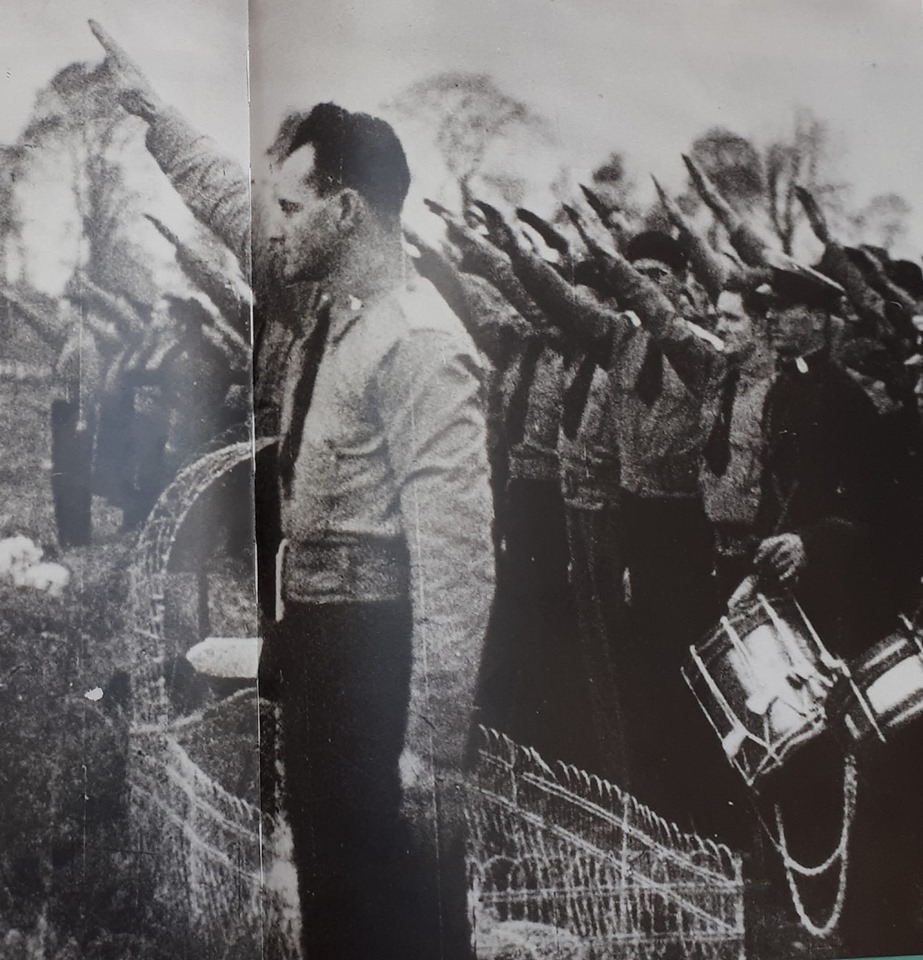
Irish fascists, the “Blueshirts”, at Bluebell Cemetery 1934.
(Photo sourced: Internet)

And because this fascism came from what was perceived as a State that had sold out the struggle to the foreign oppressing power, the Irish Republican movement found itself obliged to fight it and did so. From the most anti-communist right-wing Republicans to the most left-wing, they fought the fascists with publicity and physically, with fists and boots and, occasionally, with pistol shots. Socialists and democrats fought them too but it was the Republican-nationalist Government of Fianna Fáil5 that banned the Blueshirt march intended to lead to a coup and forced the organisation to back down, after which, despite enthusiastic support of the Catholic Church hierarchy, it did not again pose a serious threat of assuming state power.

Since those years and particularly since the end of WWII, Irish society has been on the whole anti-fascist in sentiment and the Irish Republican movement, with some exceptions, particularly so.

It seems to me, upon reflection, that although much of this sentiment is based on democratic and even socialist ideals, it is also, in part, a defence of Irish nationalism, a deep-seated wish for independence and self-determination, a memory that fascism in Ireland serves British domination.

And not only a memory but current reality: British Loyalism in Ireland, the militant force that garrisons and underpins colonial possession of the Six Counties (one-sixth of the area of Ireland) by Britain, is extremely reactionary. Apart from the numerous links with British (and even European) fascist groups over the years, Loyalism is deeply socially and politically reactionary. British Loyalism in Ireland is opposed to immigration, has been implicated in racist attacks on migrants, is opposed to any state recognition of the Irish language or civil rights for people of Catholic background, in addition to being against the struggles of the Palestinians, Basques, Catalans; also to gay rights and to the right to choose abortion.

SPAIN AND “THE RISE OF THE RIGHT”

          In another part of Europe, there is a state which had experienced a military-fascist coup and war, after which it suffered four decades of fascist repression. Spain, after the death of the dictator Franco, went through a supposed Transition to democracy but the fascists remained in their positions of power which they handed down to their sons and daughters, these making room for a few social-democratic climbers at the table.

The November 10th elections this year in the Spanish State saw the rise, it is being widely said, of the far-right. It would seem so on the surface but one needs to understand that all the parties of the Right in the Spanish state have their origins in the Dictatorship: the allegedly “conservative” Partido Popular was created by followers of Franco; the allegedly “centre-right” Ciudadanos was formed by deserters of the Partido Popular, while the “ultra-Right” Vox was formed by deserters of Partido Popular and of Ciudadanos. There is in fact little political difference between those who vote for different parties of the Right and certainly none between those who voted for Ciudadanos before and those who have now voted for Vox. Most of the trumpeted “rise of the Right” in the Spanish territory is in fact a re-allocation of votes from one right-wing quasi-fascist Spanish party to another, rather than an increase of votes for fascism. Of course, that does not at all mean that there is no danger to popular and democratic forces but still …..

Map of voting results in the November elections in the Spanish state.
(Image source: Wikipedia)

Viewing the rise of those votes for Vox and their pattern across the territory of the Spanish State, one can see that Catalonia and the Basque Country remain untouched, as any map of voting results will show. Basque and Catalan independentists tend to be proud of this, no doubt justifiably so but perhaps there is a danger here too. Do they think that at base, Basque and Catalan people are superior to those in the rest of the Spanish state? If so, they should think again …. and think deeply.

The Basque Country was, until the military-fascist coup, ruled by deeply conservative and Catholic elites. When Franco and the other Generals struck with German Nazi and Fascist Italian assistance in 1936, of the four Basque provinces within the territory, only two unequivocally decided to fight it: Bizkaia and Gipuzkoa. Alava’s resistance was half-hearted and in Nafarroa, the conservative Carlists wiped out three thousand socialists, anarchists and democrats and joined the fascist-military forces.

Until very recently, the Nafarroan regional government has been dominated by the UPN, a Basque version of the Partido Popular and, after a brief interval, they are in power again. The other three southern Basque provinces have a separate regional government which, for most of its existence, has been in the hands of the right-wing Basque Nationalist Party and the only time it has not, has been a brief period under the Basque version of the Spanish social-democratic party, the PSOE.

In 1936 the attempt to bring Catalonia into the fascist-military side was only prevented by a workers’ uprising and actual street battles. After the death of Franco Catalonia was also run, until very recently, by right-wing Catalan forces which, not so long ago, sent its regional police force, the Mossos d’Esquadra, to beat social and economic protesters off the streets and to shoot them at close range with rubber bullets, causing around a dozen young men and women to lose an eye.

On the other hand, the regional Government of Andalusia, now seen as a stronghold of the Vox party, has been ruled by the social-democratic PSOE from the moment the region had democratic elections after the Transition. However years of corruption and lack of concern for the fate of working people and high unemployment in the region has whittled away the electoral lead of the PSOE until this year, when Vox and Ciudadanos were able to combine and to take over the regional government.

FOR NATION, AGAINST FASCISM

          Within both Catalonia and the Basque Country, independentist forces, which is to say, those of a nationalist and republican motivation, have evolved to be led by groups espousing left-wing ideology. Generally, the young activists and supporters are atheist or agnostic, anti-racist, liberal socially and environmentally conscious. But they also defend their language, enjoy their cultural expressions and either support independence or at least the right to self-determination. The opposition of these forces to fascism seems to me to rest on two pillars: 1) left-democratic ideology and 2) defence of the nation.

Similarly to the case of Ireland, those of unionist ideology and opposed to self-determination in Catalonia and the Basque Country tend to be on the Right with a fascist core and the major support for those fascists and unionists comes directly from the Spanish State through its police, military and judicial systems, as well as from fascist groups mobilised from outside Basque and Catalan territories. English and English-colonist nationalism tends to be based on colonial and imperialist history and thinking, to be reactionary and even fascist, features which it shares with Spanish nationalism, with the added factor that the forces creating and managing the Spanish state in its current form have been actually fascist and fascist-collusive.
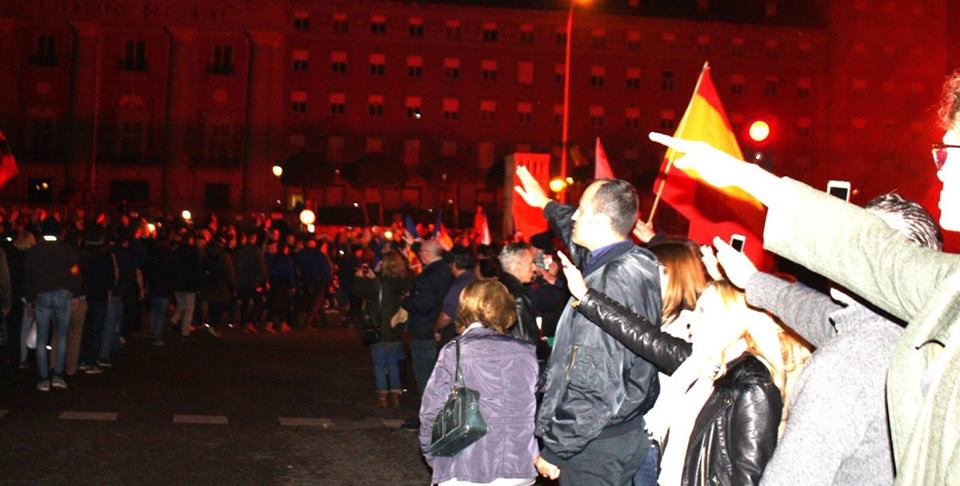
A fairly recent Spanish fascist commemoration in Madrid, including Spanish colours and fascist salutes.
(Photo sourced: Internet)

I have therefore come to the conclusion that Basque, Catalan and Irish people are no better than anyone else fundamentally, including the English and the Spanish, but that the conditions governing the development of their culture and their resistance to foreign occupation and domination have given rise to a different kind of nationalism. This nationalism tends to be progressive, democratic, inclusive and anti-fascist …. and is playing a progressive role in the world.

End.

FOOTNOTES

1James Connolly (1868-1916), born into the Irish diaspora in Edinburgh, is considered by many the foremost revolutionary socialist thinker in western Europe in his time but he was also a trade union organiser, founder of political parties, journalist, historian, author and song-writer. He was a co-founder of the Irish Citizen Army, the first worker’s army in the world, which also recruited women on an equal basis.

2A Nation Once Again, published in The Nation, by Thomas Davis (1814-1845), Irish Republican journalist and song-writer.

3Protest of racist campaigner Gemma Doherty against proposed restrictions on “hate speech” at the Irish Department of Justice, Stephens’ Green, Dublin at the beginning of November this year.

4This however changed in 1937 with De Valera’s new Bunreacht (Constitution) which declared the Irish State to be a Republic and the Articles 2 and 3 of which laid claim to the Six Counties (overturned in 1999).

5A 1926 split from Sinn Féin on the issue of occupying seats in the Dáil (the Irish Parliament), it grew quickly and was soon elected to government (1932) and, as the preferred party of the native Irish capitalist class, has been in government more years than any other Irish political party. Despite its Republican origins and rhetoric, it continued to support the capitalist-Catholic Church alliance of its predecessor until very recently, when it criticised abuses by the Church of those in its care and failure to pay adequate compensation.

THE LIBERAL AND THE REVOLUTIONARY

The Liberal and the Revolutionary both uphold struggle and dialogue — but disagree on emphasis and occasion, as this conversation illustrates.

Struggle
(Image source: Internet)

No, you don’t understand. Let me put it this way ….

I do understand. I just don’t agree.

If I could only explain …. I’m sure you would …..

No, we won’t agree because we have a different view of the world, what goes on there and especially what the reasons are.

But surely we can discuss it?

We have.

Don’t you believe in dialogue?

Of course, up to a point and depending on the circumstances.

What do you mean by that?

Well, when the enemy is about to attack your barricades, for example, I believe the time is right to place your defenders and your weapons – not an appropriate time for dialogue.

That’s so dramatic.

Discussion, argument, dialogue (Image source: Internet)

Well, drama happens too.

What if dialogue could prevent the attack on your barricades?

Well, then I’d be for it but I can’t see how that would happen.

That’s because you close your eyes to the possibilities of dialogue.

No, it’s because I open my eyes to the current reality and to history. Let’s look at the barricade situation. Most likely the barricades have gone up to defend an area where the people have seized power. Right?
Well, that’s one possibility.

OK, well let’s explore that possibility. The State sends police and/or troops to attack the barricades, in order to take back control of the area. Right?

Well, yes. They might be under pressure to do so. Concerns about property in the area, law and order and such.

So they want to take control back and we don’t want to give it to them. What’s to be gained by dialogue?

You could persuade them that their concerns about property, law and order and so on are unfounded. You could let a couple of them in to see for themselves. Or you could try to get an intermediary.

Someone like yourself?

Well, actually I have done a mediation course.

Hmmm. And then they’d let us run the area ourselves?

They might. They might not. But without dialogue, how would you know?

Listen, their main concern is to get back control. The better we run our area the more worrying it is for them because it shows another alternative to their capitalist model. And the longer they leave ours running, the more chance that other areas might take the example. So they have to crush us and we have to defend. No middle ground whatsoever. And letting some of them into our area would only give them additional intelligence to better plan their assault and target leaders afterwards, if they are successful.

God! You’re so negative and defensive. There’s no point in trying to persuade you.

Now, that last sentence is something we both agree on. See? No point in dialogue here.

End.

Murder of peasant leader Wat Tyler by King’s man during negotiations 1381, Smithfield
(Image source: unknown artist 20th Century, Internet)

CONSPIRACIES AND CONVERGENCE OF INTERESTS

(Reading time: 10 mins)

Diarmuid Breatnach

Conspiracy theorists get laughed at which, since some of the theories are indeed laughable, seems fair enough. Conspiracy deniers, on the other hand, get an easy time of it, which is a pity – because there are conspiracies going on. All of the time.

People wearing reptile masks — one of the more laughable conspiracy theories but believed by many in the US is that they are being ruled by lizard people.
(Image source: Internet)

Then there’s simple convergence of interests, which give rise to conspiracies but can also operate independently.

A current example of convergence of interests: The EU and all its constituent governments decide that the struggle between Catalonia and the Spanish State is an internal matter for the Spanish ruling class and can they please sort it out without dragging most of Europe into the mess? In fact, if they don’t sort it out, it endangers a number of key players in the EU and, inevitably, the EU itself.

As the current President of the EU Commission, Jean-Claude Junker reminded everyone on the question of Catalonian independence in 2017, there are member states of the EU other than the Spanish one that are vulnerable to the same kind of ‘problem’, i.e that of a bid for separation and independence of some part (or parts) of the state in question.

And if we look at Europe outside the Spanish State, we can see what he might have meant. There’s the French state, which contains within it three provinces out of the seven of the Basque Country, a part of Catalonia, also Brittany, Occitania and Corsica. Each of those regions was at one time an independent kingdom or part of a kingdom other than that of France; each also has its own language and each has struggled against French domination at some time or other.

Italy is a state with huge differences between its north and south, a composite of many different parts that did not come under one state rule even formally until 1871, at which time the spoken language of one region could hardly be understood in another. And there is Sardinia, still with its own language and currently engaged in another struggle for independence.

The UK is in the process of ceasing to become part of the EU now but it is still a part of the pattern of alliances (and hostilities) that forms part of modern Europe. And the UK contains the Six Counties of Northern Ireland, not long out of the three-decades guerrilla war, also Scotland with a strong popular movement for independence. In addition the Celtic nation of Wales was subjugated but still has a strong language movement and there are some stirrings of nationalism in the Celtic nation of Cornwall.

Belgium is a united state but containing the French-speaking Waloons and the Dutch-speaking Flemish and, although both languages are officially recognised, as polities, the two groups don’t get on very well together.

Even the separation of Catalonia from the Spanish State’s territory on its own would be bad enough from the point of view of EU leaders – but it could also precipitate the separation of the four southern Basque provinces, also of Galicia and Asturies. Which would certainly attract the interest of the southern regions of the French state.

In summary then, a successful bid for independence by Catalonia would start an “infection” (which is what Borrell, the Spanish Foreign Minister to the EU called Catalan independentism) which has the potential to cause the breakup of a number of major and medium states of the EU. And Junker also said that he didn’t want “an EU of ninety-nine states”. Of course not, such a union would be very difficult for the big European states to dominate and, in fact, those same European states would not be so big any more.

Conspiracy? Probably not – just convergence of interests. The ruling elites would have no need to get together, decide what they wanted their politicians to do, then have their various ministers sit down, formulate the policy of each state, have the foreign ministers of each get together and then inform the managers of the EU. The politicians have been trained and schooled, they know in general what their ruling elites want, without having to be told. They would react to Catalonian independence almost instinctively – with rejection. They view nationalism and independence, if it breaks up a rival power (such as the Eastern Bloc), as a good thing – but not in their own group!

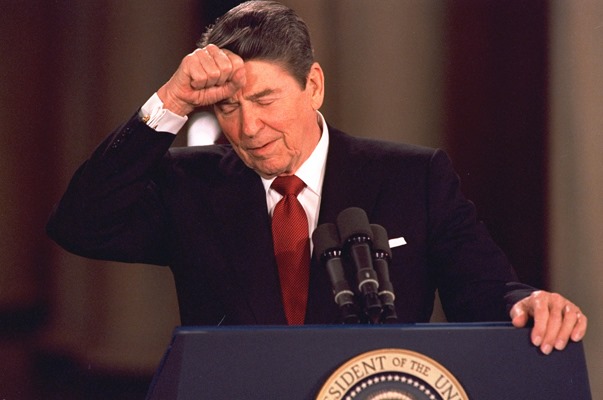
President Reagan of the USA lied when he denied any truth in the allegations of arms being sold to Iran to fund the Contra war against the Nicaraguan state. (Photo source: Internet)

THE USA IRAN-CONTRA CONSPIRACY

However, conspiracies do indeed happen, of course they do – and often. We have just passed by the anniversary of a key point in one huge one, the point when the “Iran-Contra” scandal began to break, in early November 1986. And President Reagan of the USA said that “the speculation that the US has sold arms to Iran has no foundation”, which was of course a lie. Basically, the US sold arms to the fundamentalist theocratic regime in Iran but, due to a US Congress embargo on such exports there, had to do it through Israel. They did so for two reasons, one for money to fund a military terrorist campaign against the government of Nicaragua which the US Congress would not approve, second in order to seduce the Iranian military (as they have done with the Egyptian military) and having them overthrow the Iranian regime. And the US wanted the Nicaraguan revolutionary government overthrown because it was not aligning itself with US foreign policy in what the USA considers its back yard (and a major source of raw materials) and also because a successful state of the type which Nicaragua was (then) would provide a ‘bad example’ to the other states of Latin America.

The Israeli Zionist ruling elite went for the deal because they too hoped the Iranian military would overthrow the theocratic regime and bring Iran back under the western-imperialist umbrella, as it once had been so secure that the CIA had its HQ for the whole Middle East located right there (and got caught with its pants down, or its secret documents in the process of shredding). And besides, the USA is the No.1 supporter of the Israeli Zionist regime in the world (another example of convergence of interests).

But despite the convergence of interests between the ruling elites of the USA and Israel, along with former Nicaraguan military, right-wing groups (for terrorist personnel) and US client regimes such as Honduras (for Contra bases) and Panama (for drug money to also fund the Contras, apparently through the CIA to sell in California – another conspiracy theory), a conspiracy was necessary to execute the operation. This was because of the unusual nature of the arms deal, its illegality according to US (and presumably Israeli) law and the number of partners involved. And the silent complicity of the US mass media was necessary, at least until a CIA plane delivering weapons was shot down by Nicaraguan forces over their territory and an operative, Eugene Hasenfus, captured alive.

A COMMON KIND OF CONSPIRACY

          Another example of conspiracy is that of price-fixing between big companies on given products. There have been a number of these exposed over the years. A conspiracy is necessary in this case because normally, the interest of big companies is to increase their share of the market over that of the competition. But at times, they perceive that it is in their joint interests to cease cutting one another’s throats and to regulate the prices of their products by agreement among themselves. Not only is this illegal in most administrations but it runs counter to the philosophy of capitalism, i.e that competition, instead of the cooperation advocated by socialists, is good for society. The fact that price-fixing is out of the norm of capitalism requires coming to formal agreement between the participants and the fact that it is illegal and undermines capitalist propaganda, requires secrecy – hence conspiracy.

However, most of what goes on in the world when government or other reactionary elements cooperate is probably just the result of convergence of interests, easily recognised by the participants.

(Image source: Internet)

A CONVERGENCE OF VERY DIFFERENT INTERESTS

Generally speaking, it is when their partnerships are put under pressure that the established convergence begins to crack; when one partner or another decides that the price of remaining in it is too high or that it’s time for sauve qui peut (everyone for himself). What can achieve that level of pressure is another kind of convergence of interests, that of the masses of wage-earners, small business people, peasants and indigenous people, recognising that by acting together, they can overthrow the existing system and set up an alternative that corresponds to their needs.

End.

REFERENCES:

Noam Chomsky short excerpt: https://libcom.org/history/the-iran-contra-affair

More detailed summary from Wikipedia: https://en.wikipedia.org/wiki/Contras

Concern about price-fixing in the insurance sector: https://www.independent.ie/irish-news/insurance-pricefixing-allegations-to-be-probed-by-watchdog-38405133.html

A case of price-fixing for contract bidding in Ireland: https://www.irishtimes.com/news/crime-and-law/sentencing-in-price-fixing-case-should-be-increased-to-encourage-whistleblowers-dpp-1.3515484

“YOUR STRUGGLE IS OURS TOO!” — CATALONIA’S STRUGGLE IS WAKING SPAIN

Diarmuid Breatnach

(Reading time: 3 minutes (not including video))

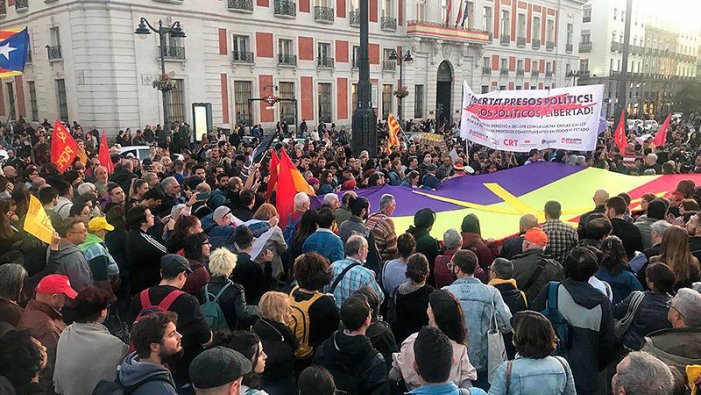
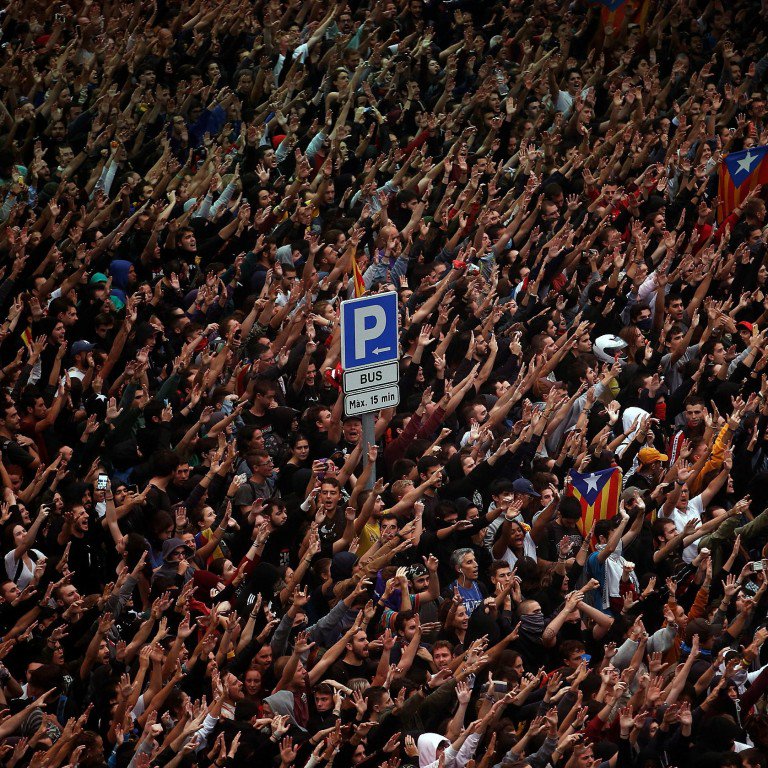
A Catalan solidarity demonstration of thousands in Madrid, in the big central square called Puerta Del Sol, shouted for “freedom for the political prisoners” and declared that Catalonia’s struggle was theirs too. A small crowd of Vox and smaller fascist groups tried to disrupt the rally but were repelled and the crowd turned towards them chanting: “Here are the antifascists!” (daring the fascists to come forward). Later, Spanish police charged the solidarity demonstrators and some running battles took place in the city’s streets.

There are two Spains – one of them is the Spain of an imperial and racist history, of expulsions, of plunder of colonies, of repression at home and abroad, the Inquisition, military-fascist uprising against an elected government, mass executions, rape and plunder, four decades of fascist dictatorship, followed by another four of a fake transition to democracy. That is the Spain that is in power now.

The other Spain is the one of popular resistance to exploitation of the Comuneros, the anti-feudal writing of Cervantes, the struggle against the military-fascist uprising supported by Nazi Germany and Fascist Italy, the mounting resistance to the Dictatorship that forced the ruling class to change their style of management, on the face of it ….. That Spain had largely been beaten, jailed or shot in to silence, crushed by treason and division and hopelessness. But there were always embers, embers that burst into little flames from time to time, not only in the nations of the Basque Country, where a fire burned for two decades, or in Catalonia, or Galicia …. but also in places like Asturias in the north, Andalucia in the south and in Madrid itself, in the centre.

The struggle of Catalonia for independence and against fascist police and judicial repression, is waking that other Spain and calling her to the fight. Waking her latent anti-fascists, her democrats; waking those who are unemployed, in precarious jobs, fighting to hold on to their homes or being evicted; waking its youth who want a better future.

It is the opposite of what was wanted by the Falangists, Vox, Ciudadanos, the Partido Popular, the Monarchy – all of them heirs of the fascist dictator Franco – and the PSOE, which climbed aboard with them. These have railed against the Catalan independence movement in order to distract the people from their real problems and real enemies. In Andalucia, Vox and Ciudadanos joined forces to oust the corrupt PSOE government and to progress towards a fascist regional government. In Extremadura they moved towards the same objectives but fell out among themselves.

Section of crowd in the Catalan solidarity demonstration in Madrid on Wednesday. The really large banner in the middle is the flag of the Second Spanish Republic with the yellow ribbon of freedom for the Catalan political prisoners across it. (Photo:see Source at end article)

But recently both those regions have seen courageous people take to the streets, proudly declaring solidarity with Catalunya. And Madrid on Wednesday saw another part of that awakening. A Catalan solidarity demonstration of thousands in Madrid, in the big central square called Puerta Del Sol, shouted for “freedom for the political prisoners” and declared that Catalonia’s struggle was theirs too. And chanted that “Monarchy is filth!”

The Spanish Government – and also other spokespersons of the parliamentary ambit – is calling for respect for the judgement (ie againts the Catalan activists – Trans.). The judgement is not respectable, neither in its genesis nor in its conclusions and therefore cannot be respected,” declared the conveners of the solidarity protest.

That is why this evening we are holding this assembly for freedoms, for democracy and against repression,” declared one of the speakers at the event. “And for that reason we salute and send all our internationalist solidarity to all the people who these days are coming out in various parts of Catalonia, especially to those who have suffered repression, with blows, arrests or in addition once again, a person has lost an eye through the brutal and illegal use of rubber bullets.”

A young woman spoke “on behalf of the youth of Spain to the youth of Catalunya”, saying that their struggle was waking up that of the Spanish, against unemployment, precarious employment, against fascism and the Monarchy.

She said that the democratic parties and trade unions needed to decide whether they were on their side in that struggle or on the others. The young woman read out a long list of organisations supporting the Madrid demonstration and ended with the call, in which all joined in: “Catalunya, listen: Your struggle is our struggle!”

end.

SOURCE (report on the Madrid demonstration and video):

http://www.izquierdadiario.es/El-Madrid-del-No-Pasaran-desborda-la-Puerta-del-Sol-en-solidaridad-con-Catalunya?fbclid=IwAR0i82WbXmmeU2V_IDRdLpVBBmcVConHYrSAcVuFbrW5RUAv_FNVPBGz4OQ

CATALONIA PREPARES FOR GENERAL STRIKE AGAINST REPRESSION AND FOR REFORMS

Diarmuid Breatnach

(Reading time: article 5 mins; strike manifesto 5 mins.)

Catalans have been preparing for a one-day general strike since Monday’s announcement of the Spanish National Court sentences against the nine Catalan independence activists, who between them received almost 100 years in jail. Today’s will be the fourth Catalan general strike since the Spanish police attacks on Catalans in October 2017. This strike, according to its main trade union organiser, is not only against repression but also demanding social, economic, political and legal reforms and promises to have massive participation. The trade union organising it is a relatively new one, Intersindical CSC, a class union, which has been growing rapidly.

Photos of faces of the nine sentenced Catalan independence political and grass-roots activists. Between them they have been condemned to virtually 100 years of jail.
(Photo source: Internet)

TSUNAMI OF PROTESTS

          On Monday the Spanish National Court announced the sentences on seven Catalan politicians and two leaders of grassroots organisations on charges of ‘sedition’ and ‘misuse’ of public funds. The ‘sedition’ charges relate to demanding Catalan independence from the Spanish State and the financial ‘misuse’ charge to allegedly funding the Referendum from Catalan Government funds. They were also charged with ‘rebellion’ but since that had already been ruled out of order in test extradition cases for Catalans in exile, the Court had no realistic choice other than to clear them of that charge. The Spanish State is now proceeding with extradition warrants against other Catalan activists known to be in exile in Europe.

In addition, two senior members of the Catalan police force are on trial, 700 town mayors are to be investigated for their role in the Referendum, along with schoolteachers for discussing with their pupils police damage to their school buildings (used as polling stations). Recently seven alleged activists of the Committees for the Defence of the Republic were arrested on “terrorism” charges and two remain incommunicado, long after the usual five days permitted in Spanish State legislation. And others have been arrested in protests against Spanish State repression.

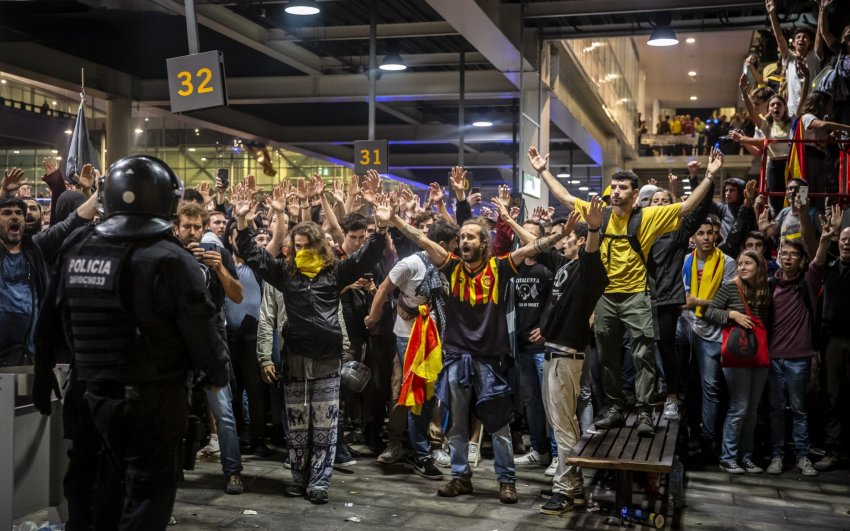
The self-styled “Tsunami” of protests began immediately the sentences were made public. Thousands walked, drove or rode bicycles to the El Prat Airport for Barcelona and effectively closed it down until they lifted the blockade at 10pm. Many others took to the streets of their cities to protest, particularly in front of institutions of the Spanish State, which had mobilised nearly 1,000 police in preparation against them. These were reinforced by the Catalan police, the Mossos D’Escuadra, who were seen as relatively benign during the Referendum and immediately afterwards but are now reverting to their past image — some years ago nearly a dozen of Catalan protesters lost eyes from rubber bullet impacts at close range, which led to a successful popular Catalan campaign to have them banned – but that ban does not apply to Spanish police. Already one young man lost an eye on Monday night while another appears to have lost one testicle and 150 were treated by paramedics. The toll grows and includes two youth run down by police vehicles and more arrests. These figures are certain to grow in the days ahead.

Riot police confront Catalan airport blockaders on Monday (Photo source: Internet)

Thousands are also walking along motorways to other towns in a protest procession, horns of cars, lorries and buses being sounded in solidarity, while different protests gather every night.

Section of the massive crowd of protesters that shut down Barcelona’s airport on Monday.
(Photo source: Internet)

PARALYSIS OF POLITICIANS

          This huge popular wave of resistance contrasts with the seeming paralysis of the pro-independence politicians, who are in three different political coalition parties: Junts X Cat (Together for Catalonia), Esquerra Republicana de Catalunya (Republican Left) and Candidatura de Unidad Popular (People’s Unity Candidacy). The three together form a narrow enough majority in the Catalan regional Parlament against the Spanish unionist delegates of the PP, Ciudadanos and the PSOE, as well as the ‘neutral’ “Communs”, a coalition around the Podemos party. Although the CUP delegates will defend any pro-independence motions etc in the Parlament, they are officially in opposition. JuntsXCat and ERC run the Government together on a slim majority but they disagreed on a number of important issues, including whether to give the minority Spanish PSOE Government qualified support without any concessions from the latter and also, about their resistance campaign being directed by ex-Catalan President Carles Puigdemont, in exile in Brussels, and the group he has collected there.

But their paralysis is more fundamental: despite the activity of some of them in popular movements before they became politicians, their focus has been on electoral strategies and campaigning, preparing legislation for the Parlament and running the Government. For a number of years now the power of the street has been growing and it is clearly in the ascendant now – and that is not where the politicians feel most comfortable. Not only that — but where else now has the Spanish State left any cards to play?

THE TRADE UNIONS

          The main trade unions in the Spanish State are the Unión General de Trabajadores (UGT) and the Commisiones Obreras (CCOO). After Franco’s death, their legalisation and incorporation into the system was felt essential for the smooth operation of the ‘Transition” and for that reason, the major political party of each was legalised too – the social democratic PSOE and the Communist Party of Spain – so that they could control their unions. They did and they have, despite a history of republicanism and antifascism, and in 1978 ensured votes in favour of a the new monarchical and unionist Constitution while their members and others were being clubbed and shot – or blown up — in the street.

The big SEAT factory in Catalonia has majority representation in the CCOO and UGT trade unions and neither union officially supported the previous recent general strikes. However, there was leeway for ‘allowing’ an early leaving of work to attend strike day demonstrations and UGT has already this week officially condemned the Spanish State repression. How they will react later today remains to be seen.

Intersindical CSC is a ‘class union’ (i.e does not recruit personnel from the repressive arms of the State nor from management) and is in favour of the right to self-determination. Its history is recent but it organised the previous general strikes in conjunction with grass-roots independentist organisations (like the ANC and Omnium) and will do so again. The growth of Intersindical is a a source of worry for the UGT and CCOO in Catalonia.

Catalans blocking railway lines in protest.
(Photo source: Internet)

Later today we can expect blockades of all major motorways and train lines passing through Catalonia, general closures of business, services and public transport of Catalonia’s cities and massive demonstrations in cities, not just Barcelona. What will happen at the docks, airport and the SEAT plant remains to be seen. There will almost certainly be confrontations between strike supporters and the police, both Spanish and Catalan. Whether that will escalate further cannot be forecast but is very possible.

Meanwhile, outside of Catalonia in the Spanish State, both Madrid and the Basque Country hosted massive shows of solidarity on the streets while other cities, for example Caceres in Extremadura and Granada in Andalucia (the two poorest regions of the Spanish state), have seen demonstrations on the streets in solidarity with Catalonia and against the repression of the Spanish State.

Catalan protesters on Tuesday use metal fences as protection against rubber bullets.
(Photo source: Internet)

GENERAL STRIKES — COMMENT

          General strikes, if successful in mobilisation, show the collective strength of the organised workers, ideally in conjunction with their communities (families, relatives, friends, local shops, churches, sport clubs etc).

While that is extremely important in the longer run, they are not always successful in the shorter run or, to be more precise, they often fail to achieve their stated objectives. The stated objectives of this strike cannot be achieved in the short run since they confront not only a capitalist but a neoliberal Spanish ruling class and, furthermore, one in which the majority are undefeated descendants of a fascist-military uprising, civil war and four decades of dictatorship.

The overcoming of these obstacles requires, arguably, a social and political revolution and Catalonia is not at that point yet. But it may be in time, especially if the Spanish State continues to pursue its path of repression (and it is sure to do so). One-day general strikes sometimes grow into longer and sometimes even indefinite ones. Such situations are almost pre-revolutionary situations, with workers’ committees having to organise vast forces and control, manage and defend large areas.

For a Catalonia to be successful in revolution or in secession from the Spanish State alone would require that the State faces challenges on a number of fronts, including internally, that severely restricts its ability to send sufficient repressive forces to Catalonia. Such an outcome would depend completely on mobilisations in other parts of the Spanish state, which is why Spanish State, media and fascist parties’ are practically racist in their hysterical condemnation of Catalan independentism and culture, trying to whip up anti-Catalan feeling to distract from the woeful economic, social and political mess to which most of the Spanish regions have been driven.

End.

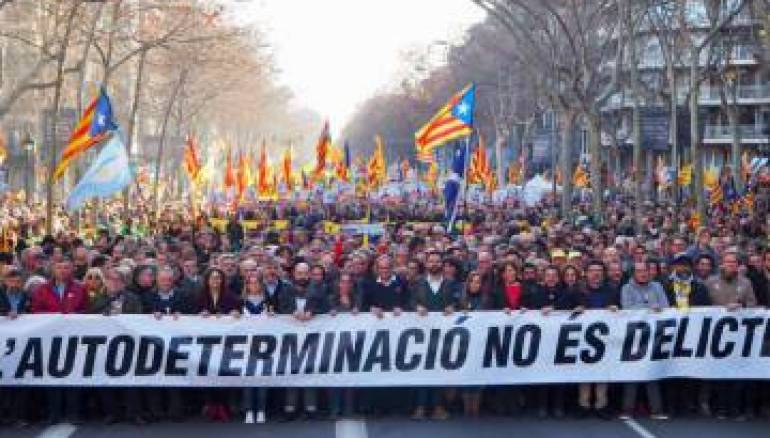
Demonstration Barcelona, part of general strike in February, protesting the start of the trial of the independence activists.
(Photo source: Internet)

APPENDIX:

GENERAL STRIKE MANIFESTO OCTOBER 18, 2019 (English language translation)

For rights and freedoms, general strike!

A new Spanish government and a new disappointment. Whether led by the PP or the PSOE, the

social gains never reach the workers. Neoliberal austerity policies persist whoever resides in the Moncloa (Spanish Government), while authoritarian repression against the common classes and, especially, against the Catalan people become the tools to curb any struggle for better living conditions and justice for the majority. As in popular times, state “socialism” now also wraps itself in the Spanish flag and patriotism to cover the miseries of a ’78 regime which strangled the bulk of the population and which is showing more and more cracks.

During election campaign times, certain parties declare limited progressive proposals, which, if they are elected to govern, will be stored again in a drawer to be sold again to the designs of an Ibex 35 (Spanish Stock Market benchmark) that does not tolerate any kind of agreement with forces that question minimally the foundations of the Spanish monarchy: the unalterable privileges of the elites and an indissoluble and centralist state model. Therefore, despite all the changes that the PSOE promised before grasping power, they faded to pass again from opposition to status quo, in another turn of the eternal Spanish political carousel so that nothing changes.

Minimum measures such as derogations from the PP’s labor reform or of the gag law, the withdrawal of vetoes against the social laws of Parliament, the already agreed reception of refugees, the imposition of rent ceilings, the setting up of a tax on banks, the renewal of the regional financing model or the publication of the list of evaders that were covered by the Montoro tax amnesty, all of those became elusive despite previously having been defended vehemently by Pedro Sánchez.

The Catalan working classes know that rights and freedoms are not only begged through voting. We learned that a century ago, after the “Canadian strike” allowed us to achieve the greatest of the victories of that era, the 8-hour working day and retirement at age 65 (The 44-day strike 1919 originating at the principal electricity company in Barcelona, Riesgos y Fuerzas del Ebro, popularly known as La Canadenca because its major shareholder was the Canadian Commercial Bank of Toronto). But not only then – history has stubbornly shown that social advances have only been achieved through struggle. Peaceful, massive and nonviolent, with the general strike as one of the clearest tools of the workers.

And on October 18 we have a new date, a new call for a general strike that should be massive to make it clear that we will not remain unresponsive to the continuing attacks upon us. The disappointment of Sánchez’s brief mandate at the head of the Government, unable to repeal the most damaging measures of Mariano Rajoy’s period, should receive a blunt response in the street, the popular masses need to empower themselves and to declare that they will not allow themselves to be stepped on again, despite the growing criminalization of protest and growing repression against anyone who dares to raise their voice.

Intersindical CSC is clear that the Catalan Republic is an essential tool to overthrow the regime of ’78 and to move towards a horizon of well-being, equality and social justice but even with this horizon always present, the struggle for rights and freedoms of the popular classes cannot cease before any institution. We will remain on our feet, once again on this October 18, to demand all rights and freedoms:

– For a minimum Catalan salary and pensions of at least 1,200 euros to be increased depending on the Catalan Consumer Price Index.

– For the repeal of the labor reforms of 2010 and 2012 and the recovery of all lost labor rights.

– For a Labor Inspection with adequate resources to deal effectively with rights violations.

– For the end of labor inequalities and the wage gap suffered by women, starting with the recovery of the annulled articles of the equality law and which referred to the world of work.

– For a Social Rescue Plan that guarantees free and universal public services, food and housing for the entire population, the comprehensive application of a guaranteed income for the citizenship and a plan for the internalising of public services which are now outsourced.

– For the application of a climate emergency agreement that reduces to zero as quickly as possible the net emissions of greenhouse gases, starting with the reinstatement of the law against climate change which was partially annulled by the Constitutional Court.

– For the approval of the scheduling of payment, unanimously agreed by Parliament, and the setting of a maximum rent level.

– For the reception of refugees, the closure of the Refugee Secure Centres and the repeal of the immigration law, to make Catalonia a truly host country and without second-class citizenship.

– For the recovery of all social laws and taxes approved by Parliament and nullified or suspended by the Spanish courts.

– For the repeal of the gag law

Intersindical-CSC http://www.intersindical-csc.cat G59792226

HOW TO WIN THE WAR – GETTING INTO POSITION

(Reading time: Introduction, one minute; Part One: 5 mins; Part Two 2 mins: Part Three: 3 mins; Part Four: 2 mins; Total: 13 mins.)

Diarmuid Breatnach

INTRODUCTION:

Although I often think about the big questions – and am generally guided by my philosophy on them, my mind and energy are usually too occupied with specific struggles to focus on them for long. Recently however I had the opportunity and the need to think about the war, the one we have yet to win.

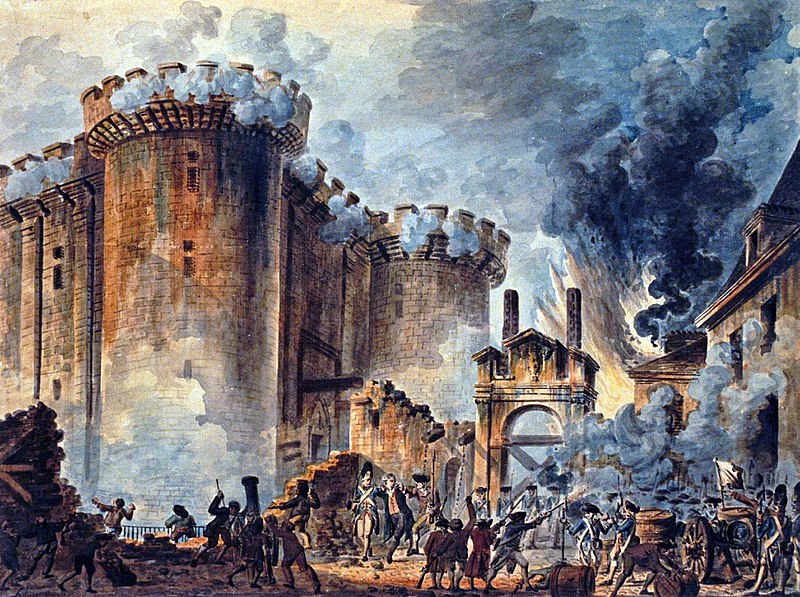
Storming Bastille Painting Jean-Pierre Houel
The Storming of the Bastille (translation), French Revolution, 1789 by Jean-Pierre Houel. (Image sourced: Internet)

But to which war am I referring? The Irish war of national liberation that has been flaring up for centuries, being lost each time before flaring up again? Or the class war, which has had a few sharp Irish episodes but has been, for the most part in Ireland, in abeyance? The answer is BOTH, though it may seem that my emphasis in the discussion, certainly in the early part, is on the national liberation war.

In order to imagine how we might win, it is helpful to examine past struggles and analyse what went wrong with them. Pessimists love to focus on those things I know – but in order to push us towards reformism or just surrender; my approach instead is from a revolutionary perspective.

Generally, Socialists analysing the class struggle don’t even ask themselves why we have not had a revolution yet. From week to week, month to month, they tend to focus on this or that particular trade union or social struggle but without going into the big picture. It seems as though they can’t even imagine a socialist uprising in Ireland, it’s just too far away to think about, apparently. But if one can’t even imagine such a revolution, how could one consider the necessary steps to get there?

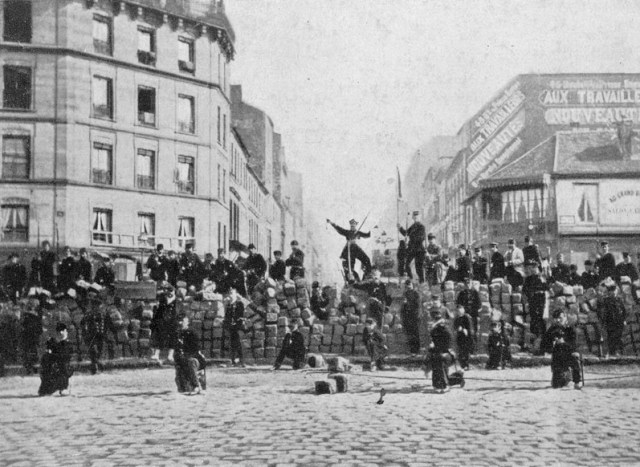
Communards Paris Barricade 1871
Communards at barricade, Paris Commune 1871. (Image source: Internet)

Irish Republicans on the other hand are often thinking in terms of revolution, usually including armed struggle. However it seems to me that Irish Republicans don’t like analysing past failures of the movement but when they do, their verdicts tend to be that the leaders betrayed the struggle or that taking part in public elections corrupted the movement; or that infiltration, spies and informers was the problem. And some other reasons. The thing is, although all those things played a particular part, they are not the fundamental reason.

Defeat Rebels Vinegar Hill Drawing George Cruikshank
“Defeat of the Rebels at Vinegar Hill” by George Cruikshanks, i.e United Irishmen last major position in Wexford overrun, 1798.

PART ONE: THE THIRTY-YEARS’ WAR – DOOMED TO LOSE

(Reading time this section: less than 5 minutes)

Free Derry Corner Gas Mask Images
Derry Monument and Mural of the Civil Rights struggle which preceded the armed struggle in the Six Counties. (Image sourced: Internet)

          The national liberation war that began in 1969 in the Six Counties and ended in 1998 (though some armed incidents continue from time to time) began as a civil rights struggle and changed into a war of communal defence and of national liberation. The military part of the struggle for the most part took place in the occupied Six Counties. The political element of the struggle was waged all over Ireland (and abroad) but in the main consisted of support for the struggle in the Six occupied Counties.

Fought in that way, the struggle was bound to lose. It could never win. How could anyone imagine that they could win a struggle fought against a world power in one-sixth of the country, where even the population there was divided against them? What could they have been thinking?

To my mind, there are only two possible sane replies to that question, which is that they believed: 1) that the British ruling class would get worn down by struggle and leave and/ or 2) that the Irish ruling class would intervene in some way to assist the struggle and make continued British occupation untenable.

1) ‘The British ruling class would get worn down and leave’: This theory must have depended on British repression being condemned abroad and being unpopular at home but had to rest fundamentally on the British having no great stake in continuing its possession of its colony there.

Anyone who thought that (and there were many who did and still many who do, not just Irish Republicans) made a fundamental error. Time and again the British ruling class has shown its determination to hang on to what might be considered its first colony, even as the ruling class’ composition changed from feudal-colonialist to capitalist-imperialist and as the world changed around it.

Collusion State Murder Mural
Mural in nationalist area in the Six Counties (Image sourced: Internet)

Even when the British ruling class, weakened by WW1 and facing an Irish guerrilla war which enjoyed the support of the vast majority of Irish people, with national liberation uprisings breaking out across its Empire and with its repression in Ireland increasingly unpopular at home, entered into negotiations with the Irish resistance, it held on to a foothold, the Six Counties.

Subsequently, it had that colony managed in a permanent state of emergency laws, with institutionalised sectarian discrimination at all official levels and outbreaks of pogroms in the street and workplace.

That became even more exposed during the civil rights struggle and the national liberation war that followed when the British State compromised whatever good international reputation remained to its Armed Forces, its judiciary, its legal establishment, its media and its very legal framework.

Even now, when many believe that the Good Friday Agreement means that a 50% plus-one-vote in favour in the Six Counties will be sufficient to end Partition, they do not realise that such a decision will have to also obtain a majority in the British Parliament and be endorsed by the British Monarch. They are also forgetting the broken promises that surrounded Partition in the first place.

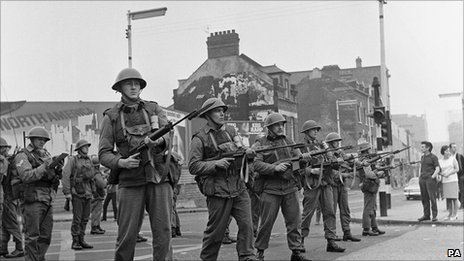
British Soldiers Helmeted Belfast 1969
British Army in Belfast 1969 (bayonets and guns pointed towards nationalist area). (Image sourced: Internet)

When analysing what holding on to the Six Counties has cost the British State in terms of reputation, military and financial contributions, one can only rationally assume that continuing to hold on to that foothold is of great importance to the British State. One may speculate as to the reasons underlying that but the central fact cannot be denied.

2) ‘The Irish ruling class would intervene in some way to assist the struggle and make continued British occupation untenable’:

There was some basis for this belief in that a section of Fianna Fáil, a party that had emerged from a split in Sinn Féin in the 1930s and had become one of the mainstream parties in the Irish state, had retained some traditional commitment to seeking a united Ireland. However it was a thin enough basis on which to depend in a national liberation struggle since that section had no majority within the party itself, to say nothing of the foreign-dependent nature of the Irish native capitalist class, the Gombeens, as a whole.

The question came to a trial of strength in the Arms Crisis of 1970, in which at least two Fianna Fáil Government Ministers were involved in secretly buying arms for the defence of nationalist areas in the Six Counties (since the IRA had insufficient weapons at the time) from rampaging Loyalist mobs and the Royal Ulster Constabulary (including the part-time B-Specials). The Ministers alleged that they had acted in the full knowledge of the rest of the Government. By the time the whole affair was over, two Ministers had been sacked and another two resigned in protest.

If it had not been clear before that the Gombeens, the native Irish capitalist class was no patriotic capitalist class but rather a neo-colonial one, it should have been clear after that. But the armed struggle in the Six Counties intensified, especially after the massacres of unarmed civilians carried out by British Paratroopers the following year, 1971 in Belfast and again in Derry in 1972. And the war lasted until 1998.

If, as had been demonstrated to be the case that the British ruling class were determined to hold on to the Six Counties and the Irish ruling class was not going to seriously challenge that possession, did the Republican movement have any other option than to fight on a war that they could not possibly win?

I am clear that it did.

Clearly, in order to have a chance of success, the war had to be extended to the other five-fifths of the country, which is to say into the territory under the control of the Irish native capitalist class. This class had seized power after the War of Independence (1919-1921) and had beaten and suppressed its opposition during and after the Civil War (1922-1923) and furthermore was supported by a powerful ally, the Irish Catholic Church. Since the founding of the first Irish Republican organisation, the United Irishmen of the late 1790s, the Catholic Church hierarchy had opposed Irish Republicanism; it had condemned four Irish priests who participated in the uprising of 1798, excommunicated the Fenians, had at first condemned the 1916 Rising and the War of Independence only to latch on to it at the end along with the Gombeen class.

The general Irish population likely would not have supported or sustained an armed struggle in the 1970s against the Gombeen class but that class could have been fought politically, through agitation and mobilisation, on many social, political and economic fronts. Without going into the specific details of each, these were:

  1. against the huge wastage of Irish youth through emigration

  2. to remedy the shortage of affordable housing (which in part contributed to the above)

  3. to end unemployment (also contributing hugely to emigration)

  4. to raise the level of wages and lower wage earners’ taxation

  5. for the right to divorce

  6. for equality for women in law

  7. for the right to contraception devices and medication for men and women

  8. against decriminalisation and for equal rights for gay and lesbians

  9. to halt the decline of the Irish language, in particular of the rural Irish-speaking areas

  10. to improve services for the rural areas

  11. to oppose the open-door policy for foreign multinationals to exploit Irish natural and human resources

  12. to secularise the education service

  13. and the health service.

  14. to remove the privileged status of the Catholic Church within the state.

Irish Womens Liberation Connolly Station
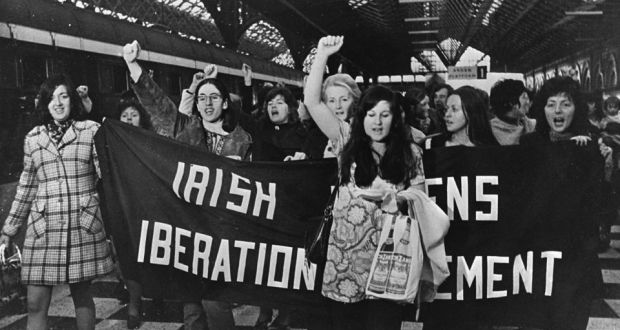
Irish women photographed at Connolly Station 1971, about to board train to Belfast to purchase contraceptives to bring back to the Irish state, illegal at the time. There was no right to abortion either or divorce and a husband’s signed permission was necessary to take out a hire purchase agreement. (Image sourced: Internet)

The Republican movement in general, with some exceptions, declined to take on any of those struggles. They did not organise in the trade union movement, left the social struggles to others and most of all, declined to take on the Catholic Church on any issue except its opposition to the national liberation struggle. Even there, it was happy to publicly avail of the services of members of the Church clergy who supported them. Republicanism was, from its very beginning, as well as anti-monarchist, about separation of Church and State but it was difficult to see that in the Irish Republican movement, particularly after the War of Independence.

A full half of those fourteen points above (nos. 5,6, 7, 8, 12, 13 and 14) would have meant taking on the Church head-on and no doubt the hierarchy would have hindered the struggle over most of the others too, due to its strong links with the State and its ruling class.

Because of its tactical and no doubt ideological refusal to take up those struggles, the Republican movement could do little more in the 26-County state than to agitate for solidarity with the beleaguered nationalist population inside the British colony.

Though this could be effective for a time it could not become a mass movement, nor survive a long struggle, without any remedy being sought for the issues facing the population within the state.

The wonder is not that the majority leadership of the Republican Movement threw in the towel on the military struggle in 1998 but that they had waited so long to do it. Of course, they never admitted the true nature of what they were doing: abandoning the armed struggle and revolution in total and instead, using their negotiating position to advance themselves politically – not in the economic, social and political struggle envisioned above but rather in a political struggle to find themselves a place among the Gombeen political class in the Irish state and as accomplices in the governing of the colonial state.

PART 2: COLLECTING THE FORCES FOR REVOLUTION

(Reading time this section: 2 minutes)

          A successful revolution in Ireland, as in most places, would require the involvement of a mass movement. That mass movement would be unlikely to be one that had national self-determination as its only aim – certainly not in the 26 Counties (the Irish state). Mass movements arise at times around different issues and exist as long as the issue does or instead until the movement gets worn down or broken up. Such movements arose around the Household Tax and, later, around the additional Water Charges.

Water Protest Long View 29 Aug 2015
Section of protest against water charges, O’Connell Street, Dublin, 29 Aug. 2015 (Image source: Internet)

Even though the objectives of such movements are often not revolutionary, the participation in them by revolutionaries is necessary if, in the future, there is to be a revolution. Revolutionary activists can make contacts and prove themselves by the way they participate whilst at the same time pointing out that a revolution is necessary in order to resolve all these issues completely and permanently. Such activists can also influence the movement (or sections of it) to act in more revolutionary ways, so that the movement can be guided by – and imbued with — revolutionary spirit.

Working people in struggles come up against concrete problems which need to be resolved in order to move forward. Prior to 1913 in Ireland, workers learned the need for unity in struggle which was emphasised by the employers’ attempts to break the Irish Transport and General Workers’ Union in August 1913. The attacks on them by the Dublin Metropolitan Police illustrated the need for organised defence and Larkin and Connolly called for the formation of what became the Irish Citizen Army, which later also fought prominently in the 1916 Rising.

Packed Workers Liberty Hall 1913
Members and supporters of the Irish Transport & General Workers’ Union cheering outside the union’s HQ, Liberty Hall, August 1913. Later the union formed the ICA to defend themselves from the DMP; the ICA took a prominent part in the 1916 Rising. (Image source: Internet)

Trade unions are the only mass organisations of the working class in Ireland and it is necessary for revolutionaries to be active within them. Currently, other than social democrats, it is mainly members of both trotskyist parties and independent activists who engage politically with the trade unions. Those members are mostly in clerical work and their political work tends to concentrate on employment demands around wages and working conditions. When they introduce politics it is generally to get some motion passed by their branch. Also at times, they will campaign to get a perceived left-wing candidate elected to some position within the trade union bureaucracy.

None of the above are without value but they remain disjointed in terms of program and often confined to just one trade union. Not only that, but often the Left party involved will engage in order to recruit some new members and in order also to retain their own members by providing them with activity. When broad front trade union groups are formed, they tend to become an arena where the dominant trotskyist parties compete for dominance.

If we are to have a successful revolution – and in particular a socialist one – participation in the struggles of workers in the trade union movement is absolutely necessary. But participation should be primarily among the rank and file of the trade union and also across trade unions, focused on providing solidarity to members of whichever union is in struggle – in addition to encouraging unorganised workers to organise and become active. The objective is not to help make one trade union or one section more militant but rather to create a militant workers solidarity movement within the whole trade union movement. It is essential to have members in the ‘blue-collar’ work unions or departments as well as in the clerical unions or sections. And the cross-union organisation I advocated should be independent — the preserve of no political party.

Participation in such struggles provides an opportunity for revolutionaries to make contact with people who are activists but not yet revolutionaries and to give those people an opportunity to evaluate the revolutionaries in terms of their actual practice. Revolutionaries can support the people struggling for worthwhile reforms while at the same time pointing to their partial and temporary nature. Revolutionary activists can play an educational role in the mass movements while at the same time becoming educated themselves by the daily reality faced by the masses in this system.

PART 3: THE ABSOLUTE NEED FOR UNITY – BUT WHAT KIND?

(Reading time this section: 3 minutes)

          It is, most people would think, a ‘no-brainer’ (i.e an obvious truth) that unity is necessary in the struggle to overthrow the current system. It might be thought surprising, therefore, that disunity is more the rule among those who aspire to revolution.

Generally, those who claim to be revolutionary socialists will not unite with Irish Republicans. In addition, those socialists of one party will often fail to unite with those of a different party. The same dynamic is to be seen among Irish Republicans also.

There have been many attempts to overcome this problem. In the 1930s the Republican Congress sought to unite Irish Republicans with revolutionary socialists. In the face of hostility within the mainstream Republican movement and also with divisions among the communist element in Ireland at the time, faced in addition with anti-communist hysteria whipped up by the Catholic Church, the experiment failed. The leadership of the Sinn Féin and the IRA of the later 1960s tried to combine socialism and republicanism within one party and military organisation, an attempt that crashed when it was discovered that the arms necessary to defend ‘nationalist’ community areas in the Six Counties, particularly in Belfast, were unavailable, leading to an acrimonious split in the movement. A subsequent attempt to combine the socialist and republican elements in another organisation survived a little longer but also failed for a number of reasons, some internal and also due to Irish State repression.

Shankhill Rd Republican Congress WT Commemoration 1934
Socialist Republicans, members of Republican Congress from Shankhill Road, marching to annual Wolfe Tone commemoration, Bodenstown 1934. They were attacked by conservative Republicans. (Photo source: Internet)

There have been some attempts to unite the non-republican Left itself also, which usually failed due in part to ideological differences but also to political sectarianism and personality clashes. Currently both trotskyist parties have an uneasy working relationship, the small grouping of Independents for Change exists also, the Communist Party is very small too and the anarchists are scattered and unable for years now, for the most part, to mount united action.

Attempts to unite the various parts of the Irish Republican movement have, in general, focused on creating a new organisation or absorbing activists unhappy with one organisation into another.

A frequent approach has been for some people to sit down and produce what they consider solid policy and a constitution, then to propose this format to others around which to unite. Even when accepting amendments from the elements they seek to recruit, these attempts too have largely failed.

It seems a rational approach: if we want unity, surely first we have to agree on what for, how, etc, etc before we can go into action? I believe, contrary though it may seem, that actually we should unite in action first. Uniting in action tends to break down barriers of mistrust that are built on hearsay or suspicions fostered by sectarian elements. Action also tends to clarify certain questions that until then are theoretical only. Of course, at some point, action will need to be guided by worked out policy but initially the action itself can be sufficient guide, especially since approaching the question the other way around has been so generally unproductive.

Unity Is Strength Image copy

The question then arises: with whom to unite? In general, I would say that the answer is: with all with whom we can, in actual practice, unite: different types of revolutionary socialists (including anarchists), Irish Republicans, Left social democrats, human and civil rights activists.

There are some exceptions I think necessary to mention: fascists, racists, religious sectarians and parties that participate in Government. Fascists seek to impose an undemocratic regime completely hostile to the interests of working people and, far from our uniting with them, need to be defeated; racists and religious sectarians seek to divide the movement along lines of ethnicity or religious affiliation. Revolutionaries need to draw a clear line of distinction between the movements of resistance and those who participate in a native capitalist or colonial government, i.e the management organisations of the enemy.

Many issues lend themselves to united action but perhaps none more so, and none are more essential, than against repression.

PART FOUR: UNITY AGAINST REPRESSION

(Reading time this section: 3 minutes)

          All revolutionary movements – and many that are progressive but not revolutionary – face repression at some point in their existence. Not to recognise that fact and to have some kind of preparation for it, even if very basic, is indicative of a non-revolutionary attitude to the State. Nor have we any reason in Ireland to be complacent on this question.

The Irish State turned to military suppression in the first year of its existence as did also the colonial statelet. Detentions, torture, murders and official executions were carried out by Free State forces over a number of years, followed by censorship and arrests, all facilitated by emergency repressive legislation. In the Six Counties, in addition to similar even more repressive legislation, there were two sectarian militarised police forces and sectarian civilian organisations.

After a change of government, the Irish State introduced internment without trial during the Emergency (1939-1946), the Offences Against the State Act in 1939, Special Criminal (sic) Courts in 1972 and the Amendment to the OAS in that same year.

Bloody Sunday march Derry 2014
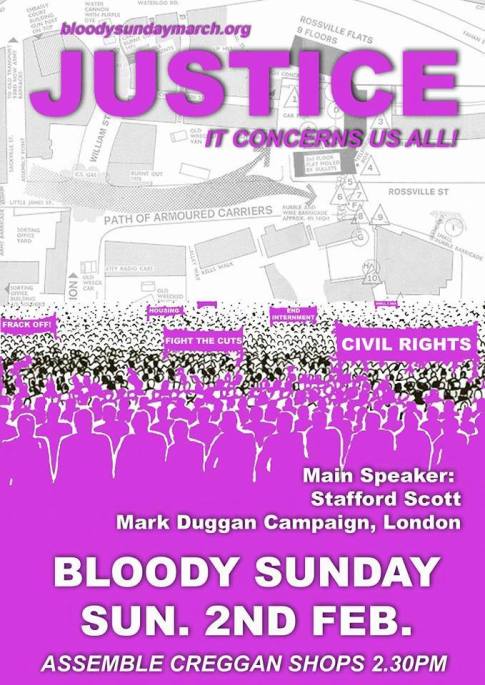
Poster for 2014 Commemoration of Bloody Sunday massacre, Derry 1972. The poster calls for unity. (Image source: Internet)

The Six County statelet had the Special Powers Act (1922) and brought in internment without trial in 1971 (the Ballymurphy Massacre that year and the Derry Massacre the following year, both by the Parachute Regiment, were of people protesting the introduction of internment). The statelet also introduced the Emergency Provisions Act and the no-jury Diplock Courts in 1973 and, though technically abolished in 2007, non-jury trials can and do take place up to today.

The British state targeted the Irish diaspora in Britain in 1974 with the Prevention of Terrorism (sic) Act and that same year and the following, framed and convicted nearly a score of innocent people of bombings in five different cases – had the death penalty not been previously abolished for murder, most of them would have been executed. It took the victims over 15 years to win their freedom, by which time one had died in jail. Brought in as a temporary measure, the PTA continued in force until 1989 but a general Terrorism Act was brought into British Law in 2000 and remains in force today.

Birmingham Six Photos Bruises
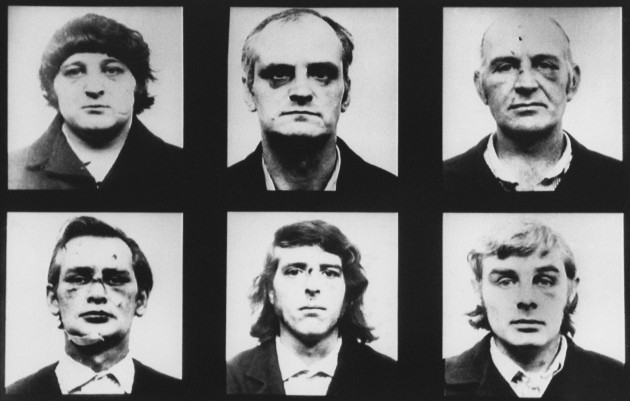
Photos of the Birmingham Six, Irishmen resident in England, showing bruises from police beatings after their arrest in 1974; they were also beaten by jailers. Also arrested, brutalised, framed and convicted were the Guildford Four, Maguire Seven and Giuseppe Conlon and Judith Ward. (Photo source: Internet)

State repression rarely targets the whole population and, particularly in a capitalist “democracy” focuses on particular groups which it fears or feels it can safely persecute. However, we should also recall Pastor Niemoller’s words about the creeping repression which even the German Nazi state instituted, going after first one group, then another, and another …. Among the list of groups targeted eventually by the Nazis were Jews, Roma, Communists, Socialists, Anarchists, Social Democrats, Jehova’s Witnesses, Free Masons, Gays and Lesbians, Mentally Ill or challenged, physically challenged ….

It is in the interests of the vast majority of the population to oppose repression of different groups, whether those groups be based on ethnicity, gender, sexuality, citizenship status or democratic politics. Not everyone recognises this of course but one might expect that political activists challenging the status quo would do so. Sadly, experience shows that they do not in practice (though they may acknowledge it intellectually).

Lineup Clenched Fists & Banner
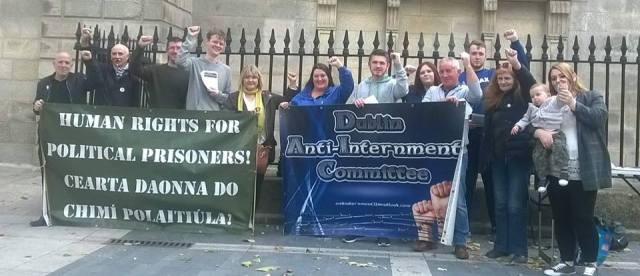
Anti-Internment and political prisoner solidarity picket September 2016 at Kilmainham Jail, Dublin (a former place of detention and execution for political prisoners under both the British occupation and the Irish State, now a museum). (Photo source: Rebel Breeze)

With some periodic exceptions, socialist groups in Ireland do not support protests against repression of republicans. Furthermore, some republican groups will not support others when the latter are subjected to repression. Yet at any time, Republicans of any group can be and are regularly harassed in public or raided at home; their employers may be warned about them by the political police; they may be detained on special repressive legislation, denied bail, effectively interned; they can be easily convicted in the non-jury Special Criminal Courts or Diplock Courts; ex-prisoners released on licence in the Six Counties can be returned to jail without any charge or possibility of defence.

The Irish State’s non-jury Special Criminal Court is a tempting facility for putting away people whom the State finds annoying and it is widely thought it was considered for the trials of the Jobstown protesters. The result of the trial, where the jury clearly took a different view to the presiding judge, may well have justified the opinion of those in the State who considered sending the defendants to the SCC.

solidarity woodcut

Unity against repression is a fundamental need of a healthy society and of movements that challenge the status quo. Practical unity in any kind of action also tends to break down barriers and assists general revolutionary broad unity. Unity against repression is so basic a need that agreement with this or that individual is unnecessary, nor with this or that organisation in order to defend them against repression. Basic democratic rights were fought for by generations and have to be defended; in addition they give activists some room to act without being jailed. On this basis, all must unite in practice and political sectarianism has no place in that.

Without some basic unity in practice across the sector challenging the status quo, there can be no revolution. But more than that: we stand together against repression ….. or we go to jail separately.

End.

Diarmuid Breatnach is a veteran independent revolutionary activist, currently particularly active in committees against repression, in some areas of internationalist solidarity and in defence of historical memory.

MAJOR SPANISH UNION “BETRAYED WORKERS”

(Reading time text: 2 minutes; comment: 4)

(Translation from article in Castillian by Diarmuid Breatnach)

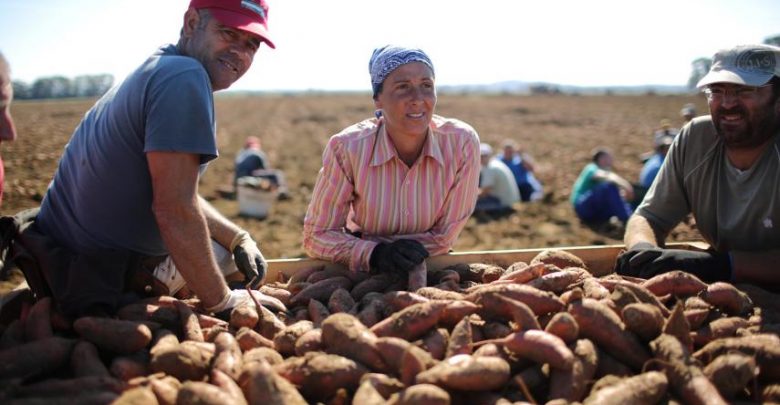
The Andalusian Union of Workers (SAT) has accused CCOO (Comisiones Obreras, major Spanish trade union – Translator) of “betraying” agricultural workers with the signing of an agreement with the Asaja employers — the signing took place last Thursday in Seville — where hard-won rights have been surrendered, including the 15-minute sandwich break. Accordingly, it will propose a common front to all trade unions to promote the fight for an (alternative) Andalusian agreement.

Migrant workers in a sweet potato plantation in Jerez, Andalusia.
(Source photo: Juan Carlos Toro, La Voz del Sur)

The SAT “cannot endorse an agreement where you give up the 15 minutes sandwich break, a workers’ victory from a long time back, which has been respected for generations, even during the Franco regime. An achievement that the employer, Asaja, has always wanted to eliminate and has succeeded now thanks to the betrayal of bureaucrats who never got their hands dirty or set foot on the field in their life”.

To this, adds the union, “you cannot endorse a de facto wage loss since the Pyrrhic rise of 1.25% per year does not compensate for the loss of the 15-minute sandwich break, which amounts to 3.8%. In other words, in reality, what CCOO has signed is a salary reduction of two and a half points” (per cent). “This is an outrage and a complete betrayal. There is no other name for it. We would like to say something very different, but above all our duty is to the workers who have been sold and betrayed once more”, they added.

The situation in the Andalusian countryside and the province of Seville, in particular, where some 120,000 people work in the sector, is very precarious. The economic crisis has hit the countryside and its workers hard. The working conditions implemented in the Andalusian countryside, according to the SAT, “seem from other times, thankfully now past.” Breach of agreements is the rule, piece-work predominates, which sometimes means that after a long day of work you only take 20 euros home, well below the salary established in the agreements.

Map showing Andalucia region (in red), Spanish State (in cream) also Canaries and part of coast of North Africa.
(Source image: Internet)

There are situations, they add, where fraud is evident by not declaring the workers employed. A fraud that can make a millionaire, since it can mean millions of undeclared euros that put health, pensions and our social protection system at risk. In addition to situations of genuine exploitation of workers — which in many cases border on pure slavery — there continues to be a significant reduction in income to Social Security, as well as a smaller amount of peonages that subsequently give the right to recognition of the subsidy and other benefits (? — Trans).

The reality that is being imposed not only affects labour rights, it is also “strategic suicide”. “The reality,” explains SAT, “is that with these mafia practices they are dropping the market price, so the product loses added value and undermines the market. The final result is to depreciate the product having a direct impact on the living conditions of day-labourers and on the economy of the towns. There have been innumerable complaints filed in the Labour Inspectorate, some of which have led to criminal proceedings being taken for crimes against the rights of workers.”

Accordingly, an Andalusian agreement that puts in place a minimum is necessary and urgent: six hours of work (sandwich break included); 60 euros for the normal working day; 84 on Sundays and holidays; effective ban on piece-work; wage of 69 euros for work with machinery; 96, on Sundays and holidays; on rainy days (when work is not possible) 50% will be paid for showing up at work, and the full wage from two hours of work; 0.27 euros mileage.

It is fundamental, they state in concluding their communiqué, to establish “a common front to fight for an Andalusian agreement with these minimums. It is also necessary and urgent to change the system of union elections in the field, a measure approved in the Congress of Deputies, and grant voting rights to non-permanent workers who represent more than 95% of the workforce in the Andalusian countryside.”

COMMENT:

Diarmuid Breatnach

The CCOO, Comisiones Obreras is one of the two mega-unions in the Spanish State, the other being the UGT. The CCOO was controlled by the Communist Party of Spain (PCE) and the UGT by the social-democratic PSOE; both parties and their affiliated unions were outlawed during Franco’s time. When the Transition to “democracy” was being engineered after Franco’s death, it was considered necessary to legalise the PSOE in order to have a two-party system and therefore necessary to legalise the UGT. However, it was the other way around for the CCOO and the CP. The Comisiones Obreras were by far the largest and most militant trade union and, though illegal, had built up a substantial following among the workers of the Spanish State. To effect as smooth a Transition as possible, it was crucial to legalise the CCOO and therefore to bring the Communist Party on board. Both political parties agreed to a deal, including recognising a monarchy with a King chosen by Franco and publicly supporting a forced union of all nations within the state by a new constitution.

The southern Basque Country and Galicia have a majority of unions of their own nation but everywhere else within the state, the CCOO and the UGT have the majority of workers as members and the majority of elected representatives. Although the CP’s control of CCOO has slipped over the years, the UGT is still strongly associated with the PSOE. There are also some independent trade unions, like the SAT above and also some others based on specific work locations.

SAT has a history of militancy, fighting for its mainly agricultural work force in which, as it states above, the vast majority are migrant workers. The union also campaigns for efficient and socialised use of Andalusian land, much of which is owned by banks and left empty; in addition its spokesperson was arrested last year for “insulting the Monarchy”. It is worth remembering that Andalusia was in medieval times the famed Moorish caliphate of Al Andalus, in many ways the jewel of the Iberian peninsula.

When Franco’s troops were ferried to Andalusia from the Canaries by German Nazi transport, largely without armed opposition in 1936, they butchered 55,000 republicans, socialists, communists, communists, trade unionists and anti-fascists.

As soon as the “Transition” went through after the death of Franco, the PSOE was voted into power in the Andalusian regional government, where it has held the absolute majority ever since – until the regional elections this year. Years of corruption and complacency saw its voting base diminish and, though it still holds the most seats, a right-wing coalition of the Partido Popular, Ciudadanos and Vox, all of which can trace their origins to Franco, has taken over. Many observers think is therefore all the stranger that the CCOO should bring in this agreement at this time.

End.

LINKS AND REFERENCES:

Source article in Castillian: https://www.lavozdelsur.es/no-habra-15-minutos-de-bocadillo-para-los-jornaleros-del-campo-andaluz/?fbclid=IwAR1EwH5Uox-Qb87XNjZBvS1nlJ-YD21EbGHAQKqCPRkvFgEgZZOu_nI05bM

Arrest of SAT spokesperson in November 2018:

https://rebelbreeze.wordpress.com/2018/11/15/union-spokesperson-arrested-for-insulting-the-monarch/

Right-wing coalition takes over Andalusia:

https://rebelbreeze.wordpress.com/2018/12/14/gains-for-the-hard-right-in-andalusia-reason-to-panic/

Number of Andalusians murdered by Franco’s military-fascist forces:

https://rebelbreeze.wordpress.com/2019/07/12/5131/

ANDALUSIAN CITY COUNCIL TO DIG UP MASS GRAVE OF FRANCO VICTIMS

(Reading time entire text 5-10 minutes)

Report by RAÚL BOCANEGRA in Publico.es (translation and comment by Diarmuid Breatnach).

Mass grave of victims of Francoist repression, Burgos.
(Photo source: Internet)

“The City Council of Seville has guaranteed on its own to provide the necessary funding — 1.2 million euros — to exhume the Pico Reja pit, in which historians believe that there are at least 1,103 bodies of of victims of the repression, led by the General Queipo de Llano, following the military coup of July 18, 1936.

This exhumation will be the largest ever to be undertaken in Spain, following that which that was carried out in Malaga, in the San Rafael Trench, between 2006 and 2009, and may indicate the path to take for the other capitals (of Spanish state regions – Trans).

The Mayor of Seville, Juan Espadas (PSOE), guaranteed that the grave will be exhumed throughout the mandate of the current Council. “It is a truly historic step in Seville and one of national importance, since it is perhaps the biggest mass grave that [at this moment] has a definite project for its exhumation,” the Councilor said at a press conference.

“And, therefore, it is also one of the most important projects in terms of Historical Memory to be undertaken in our land, due to the importance and volume of the Pico Reja mass grave. It was a commitment that this Government (i.e of the Andalusian region) gave during the past mandate to relatives and memorial groups and today it is made a reality with this tender,” added Espadas.

“Next Friday the City Council of Seville, through the Governing Board will approve the specifications and, therefore, the public tender for a technical service for the exhumation and genetic identification of the bodies of the Pico Reja mass grave, in the Cemetery of San Fernando,” reads a statement issued by the City Council. “The ultimate goal [of the exhumation] is to dignify the memory of the people who were thrown there, give them a dignified burial and attend to the requests of their families,” adds the Council (statement – Trans).”

Militia Women of the Anarchist FAI -CNT in Catalonia, early years of the Spanish Anti-Fascist War. Women in areas captured by the Franco forces were exposed to endemic rape and many female prisoners were shot after being raped.
(Photo source: Internet).

BEGINNING AND COMPLETION OF WORK

          “Accordingly, Espadas will not wait for the Council of Andalucía or the Regional Government to sign the agreement, to which they had committed themselves. Confirming now, at the start of the mandate, the works, the Mayor ensures that the exhumation will not be delayed and will be carried out throughout this term. Municipal sources assured Público of their belief that both the Council and the Andalusian Government will collaborate with the exhumation, the Andalusian Council not before September.

Should they contribute money, the amount would be deducted from the 1.2 million that the Council calculates as necessary to carry out the works. Espadas recalled that the signing of an agreement in this regard with the Board and the County Council to finance these works is still outstanding. “And let’s hope that it is signed as soon as possible.”

“This contract guarantees the beginning of the work and its conclusion, without waiting for the remaining public administrations –- provincial, Andalusian and national — to finalise their contributions,” reads the Council’s note.

Espadas and the Delegate for the Department for Equality, Education, Citizen Participation and District Coordination, Adela Castaño, related the details of this contract to relatives of the victims and to the different organisations involved in the area of Historical Memory in Seville. “Do not fear, the exhumation and the identification of bodies will be done,” the Mayor assured them.

THE DETAILS

          The company that gains the contract must include at least one historian, five professionals in Forensic and Physical Anthropology, five in Archeology and 10 auxiliary support workers. “With the maximum guarantees of scientific rigor, a survey will be performed, material collected on the surface, excavations made in the pit, exhumations and recovering of bodies and remains,” says the City Council in the note. “Likewise, it must preserve and safeguard, also with all scientific guarantees, the samples of bone remains and biological samples taken from the family members until delivery to the University of Granada for genetic identification,” the City Council insists.

The project will be be completed in three phases, explained the Council. The first concerns the exhumation itself and the identification of the bodies, along with works including: the archaeological excavation; dealing with the remains found (the excavation and the direct and individualized identification of these bodies will determine whether or not they are relatives); exhumation (identification, recording of traces of violence and individual extraction of each body or remains); forensic anthropology (that is, determining sex, age, pathologies or anomalies); anthropological analysis in a laboratory manner; and conservation and protection to preserve these skeletal remains and DNA analysis.

The second phase will consist of the presentation of a final report as a logical contribution to the history of Franco’s repression. And the last phase will be the final destination of the remains.

The City Council will respect at all times the wishes of relations about the identified remains. The unidentified remains and those which the relatives wish to remain in the same place, “will be buried in an authorised space with appropriate technical indications for future identification”.

After finishing the works, “the area will be restored as an expository and explanatory site of the historical significance of the Pico Reja pit”. The successful bidder must submit a proposal for reconstruction of the current site that includes a columned monument to honor the victims.

Exhumation work on mass grave of Franco’s victims in Burgos.
(Photo source: Unai Aranzadi)

COMMENT:

(Diarmuid Breatnach)

          According to official figures, 120,000 victims have been identified (not exhumed) from 2,591 unmarked graves around the Spanish state. The areas with the largest number of graves are Andalusia in the south and the northern regions of Aragón and Asturias – in Andalusia alone, 55,000.

Map of grave sites of victims of Francoist repression in Andalucia (Photo source: Internet)

A mapping work undertaken by the Council of Andalusia region, which was presented publicly in the regional capital in 2011, illustrates 614 mass graves in 359 Andalusian municipalities. Only around half of the 47,000 bodies that were discovered have been identified due to there being no relatives available for DNA tracing or because calcium oxide (quicklime) had been thrown over the bodies.1

In Malaga province alone there are 76 mass graves in 52 towns, containing the remains of 7,471 people who were killed by General Franco’s forces. The largest of these mass graves was discovered in Malaga city’s San Rafael cemetery. 2,840 bodies were exhumed in early 2010, although more than 4,500 are registered as having been buried there”.2

The usual figure given for the total of non-combat killing by Franco’s forces is 150,000 and which does not include those who died of malnutrition and lack of adequate medical care in prisons and “penal battalions” or through confiscations, or economic and financial sanctions in areas occupied by his forces. Nor does it include the civilian victims of bombing by military-fascist air force, whether of cities or of refugee columns.

Against that, the total figure for non-combat killings by the forces against Franco are estimated at around 50,000. Also, while the latter killings for the most part took place in the early months of the military uprisings, before Republican Government control could be established, most of the non-combat killings by Franco’s forces were carried out after they had beaten the resistance and occupied the area and much of it also after the war was over. Typically too, according to Paul Preston (The Spanish Holocaust (2012), Harper Press), women were routinely raped before they were shot.3

The issue of the executed after a cursory military trial or simply taken out and murdered by Franco’s forces is a live one in the Spanish state today. Before Franco’s death it was not even possible to discuss it publicly and bereaved relatives were not permitted to mourn publicly – to hold a funeral or to have a mass said for their souls according to Catholic custom or even to mark their graves.

The Transition process to convert Franco’s Spain into a “democracy” accorded legal impunity to the perpetrators of even the worst atrocities during the Civil War but unofficially extended beyond, to the years afterwards and even to murders carried out during the “Transición” itself. And why not, when all the upper echelons of police, army, judiciary, civil service, Church, media and business were and are for the most part the same people as before or their sons and daughters? When the Head of State and of the Armed Forces, the King Juan Carlos, was specifically chosen by Franco to be his successor and even after the Dictator’s death glorified him and his political trajectory.

‘LET THE DEAD STAY BURIED’

          The fascists and their descendants want the dead and their stories to stay buried and even when a very senior judge like Baltasar Garsón, who presided over the repression and torture of many Basque and Catalan political detainees (but is incredibly lauded as “a foremost human rights defender” by liberals!) decided to play a power and publicity game and and became a problem by authorising the opening of some mass graves in 2012, he was slapped with legal appeals, charges of wire-tapping and disbarred from office for 11 years.

The other graves they don’t want opened are the mausoleum of Franco himself and of Rivera, founder of the Spanish fascist Falange, who lie in the memorial park built by political prisoner slave labour to honour Dictatorship and Fascism, a shrine for fascists today. The order of the PSOE Government to exhume and transfer them to a family graveyard has been paralysed by the Spanish Supreme Court after protests by Franco’s descendants.

If the Pico Reja exhumation in Seville goes ahead and is properly documented, it will be as the PSOE-controlled Seville City Council says, of huge historical — but also of huge political – importance. Can this happen in the same region where the corrupt PSOE administration has lost power after decades without se

The “Valle de Los Caidos” memorial park, constructed by slave prisoner labour, which contains the mausoleum containing the bodies of Franco and Rivera
(Photo: Paul Hanna, Reuters)

rious challenge and is now ruled by a de facto coalition of all the main parties descended from Franco, the Partido Popular, Ciudadanos and Vox? The Seville City Council says it can and that if necessary they will fund it all themselves. We can hope.

End.

FOOTNOTES:

1See “Mass graves in Andalusia” in References.

2As above.

3See Review of Paul Preston’s book in References.

REFERENCES AND SOURCES:

Main article: https://www.publico.es/politica/memoria-publica-alcalde-sevilla-garantiza-dinero-exhumar-mandato-fosa-pico-reja-hay-1100-represaliados.html

Review Paul Preston’s The Spanish Holocaust: https://elpais.com/elpais/2011/04/04/inenglish/1301894444_850210.html

Mass graves in Andalusia: http://www.surinenglish.com/20110107/news/andalucia/mass-graves-201101071754.html

Map of mass grave sites in Andalusia: https://www.theolivepress.es/spain-news/2011/01/14/terror-map/

SIGNIFICANT VICTORY FOR DELIVEROO RIDERS

The first great collective victory of the ‘riders’ against Deliveroo.

A judgment of the Social Court No. 5 of Valencia recognizes the existing contractual relationship between Roodfoods Spain S.L.U., parent company of the British multinational, and 97 delivery riders of València.

(Valencia is in the Paisos Catalans region but not part of the Catalonia region — Translator(

Translated from article in Castillian of PILAR ARAQUE CONDE @ pilarac4 in the on-line newspaper Publico by Diarmuid Breatnach.


The complaints presented by Social Security’s General Finance in different courts against the Deliveroo labour model begin to be resolved. A judgment from Social court No.5 of Valencia ruled that 97 riders of the delivery company are employees and not self-employed, this being the first great collective victory of the workers of the platform Riders x Drets (Riders for Rights) and Intersindical Valenciana, according to the collective’s statement on Thursday.

Some of the Riders for Rights, now recognised as employees of Deliveroo, pose for a photo.
(Source: Publico)

Last year, Víctor Sánchez became the first worker in Spain to obtain a final judgment against Deliveroo, after Social court Number 6 of València declared his dismissal “unfair”. Deliveroo then accepted the ruling that for the first time questioned the legality of the business model of the distribution firm, maintaing that the riders are falsely self-employed.

The titular magistrate of Social Court No. 5 of València now recognises the existing contractual relationship between Roodfoods Spain S.L.U., the company that owns Deliveroo, and the 97 workers in Turia city. The ruling states that the workers “provide their personal services, inserted in the business organization to which the means of production belong – Deliveroo’s digital platform – according to the criteria and distributions that it establishes and assigns, receiving remuneration, which also establishes the company “, according to the text accessed by eldiario.es.

The judge adds that “the real means of production in this activity are not the bicycle and the mobile phone that the rider uses, but the digital platform of matching supply to demand owned by the company and without which which the provision service is not feasible”. In this way, Deliveroo is the one who determines the orders and schedules of the workers, and not the employees themselves, despite being categorised and taxed as self-employed.

“It is intended that the rider is free or not to accept an order without unfavorable consequences, but it was proved that the service of the rider is valued at different grades, which obviously will be taken into consideration by the order allocation algorithms” explains the judge. And she refutes the argument used by Deliveroo: “The fact of being able to reject orders does not constitute a capability or power that can condition the business activity,” he stresses.

SEVERAL PENDING LAWSUITS

The ruling, made public this Thursday, responded to the lawsuit filed in April 2018 by Social Security against Deliveroo, following a notification from the Labour Inspectorate. The state agency claimed more than 160,000 euros for Social Security contributions that were not paid by the company. Later, the Labour Inspectorate offices in Madrid, Barcelona, Alicante and Zaragoza, among other cities, did the same in the various courts.

Social Court No. 29 of Madrid will be the next to rule on whether these workers should be considered salaried employees of the British multinational and not self-employed, since the trial, which affects more than 500 delivery people in the region, was held for sentencing on May 31st.

GLOVO’S LABOUR MODEL, ALSO CHALLENGED

Glovo’s labour model has also been challenged before the courts. In this case, several judgments have determined that the company’s distributors had an “employment relationship” with the company and ordered their reinstatement.

This digital platform is also involved in the controversy after a worker died when being run over by a garbage truck while delivering. The young man, 23 years old, “was not a collaborator” of Glovo, although he carried its backpack. His death sparked protests about the precariousness of the sector.

And the fact is that Glovo, Deliveroo and Uber Eats continue to operate without a regulation that guarantees the rights of their workers. Also, taking into account that the number of employees in the sector is around 17,000, UGT (one of the major trade unions in the Spanish state – Translator) estimates that Social Security loses a potential 93 million per year due to this situation, figures that it estimates will be three times greater in 2020.

SOURCE REFERENCE:

https://www.publico.es/sociedad/deliveroo-primera-victoria-colectiva-riders-frente-deliveroo-jueza-valencia-considera-97-repartidores-falsos-autonomos.html

NOT BLIND TO THE TRUTH – IVY MANAGEMENT CONTINUE TO TAKE TIP MONEY FROM STAFF

Diarmuid Breatnach

Solidarity protest picket lines up outside the The Ivy restaurant in Dublin city centre’s Dawson Street and, as management draw the blinds to hide the event from their customers, passers-by take photos and passing traffic sound horns in solidarity.

Solidarity protester with placard outside the Ivy Restaurant on Saturday.
(Photo image: protester)

          On Saturday afternoon (8th June) round a score of men and women participated in a picket outside the The Ivy restaurant in protest against management deducting a percentage of the waiting staff’s tips. The management are able to take this action when customers pay by bank card for their meals as well as the service charge. The protesters were also in solidarity with two sacked workers who protested the practice.

The business pays minimum wage every day except Sunday and staff expect to make a decent wage up from tips ….. but, much of the tips money is being taken by the management.

Picket line outside The Ivy restaurant on Saturday afternoon.
(Photo: D.Breatnach)

The protesters held up large placards bearing the slogans: “Ivy: stop robbing your staff!”, “Vote Ivy No.1 for unfair dismissal”; “Ivy, stop tip theft!”; “Solidarity with sacked workers” and also displayed a banner which, as well as reading “Stop tip theft” also called for “fair pay and union rights”. The picketers later also held up large letters to display the message STOP TIPS THEFT.

Dawson Street, in which the Ivy Restaurant is located, is an upper-class southside city centre street of mostly old architecture, filled with eateries, art galleries and bookshops and also containing the Mansion House, a historic building and the Lord Mayor’s business residence. It is one of two public bus routes from the south-east into the city centre and also contains a LUAS (tramline) stop.

Section of picket seen closer and front door of The Ivy (note the blinds!) (Photo: D.Breatnach)


Drivers of a number of passing private and public transport vehicles sounded their horns in solidarity while passing the picket while tourists and others took photos and promised to post them on social media. A number of tourists from the Spanish state asked about the protest and I when I explained, were fully supportive.

Since I participated in this protest myself, I was able to identify participants from a range of political allegiances and independents and they included a number of recently-elected Dublin City Councillors (a previous picket I wrote about included a TD – member of the Irish Parliament).

ONGOING STRUGGLE

          This controversy has been going on for some time and has been reported in the Irish Times (see Links and References). Since the protests began, management of the once-highly-patronised restaurant had blinds installed so that they could shield their customers from the sight of the picketers but even so, they could not avoid hearing the bullhorns and the chanting outside.

Chants included “Shame, shame, shame on you; pay the workers what they’re due!”

Reports indicate that business at the restaurant in fashionable Dawson Street is down by as much as 40% on many days which bodes ill not only for the restaurant at present but also if the owners try to sell it, since the reputation associated with the business will be of a negative kind.

Catering workers through much of the world are typically unorganised into trade unions, have insecure employment, are often immigrants to the country and are particularly vulnerable to extra exploitation. Ireland is no exception to this rule and there are many examples of it in Dublin. Campaigners for better conditions of employment and pay for catering workers are aware that the Ivy is one among many but hope that breaking the tip-deducting practice at this high-visibility eatery will spread a beneficial effect around the rest of the industry.

Meanwhile the two workers sacked by The Ivy are awaiting their day in the Labour Court.

End.

LINKS AND REFERENCES

Explanation of many of the issues: https://www.irishtimes.com/life-and-style/food-and-drink/restaurant-reviews/tips-at-the-ivy-restaurant-following-the-money-1.3714844

Link to Irish Times article (and photo): https://www.irishtimes.com/life-and-style/food-and-drink/protest-held-outside-ivy-restaurant-in-dublin-over-waiters-tips-1.3827055

More recent Irish Time article with good explanation: https://www.irishtimes.com/life-and-style/food-and-drink/just-because-it-is-legal-for-restaurants-to-keep-tips-does-not-make-it-right-1.3917220?fbclid=IwAR3s_e1b9B4E0WZje04qTUGpbj9SL-BHyb0FWtcitYP6shyU-9pTPb2tuak

Previous article by me on this subject: https://rebelbreeze.wordpress.com/2019/05/02/tipping-the-bosses/