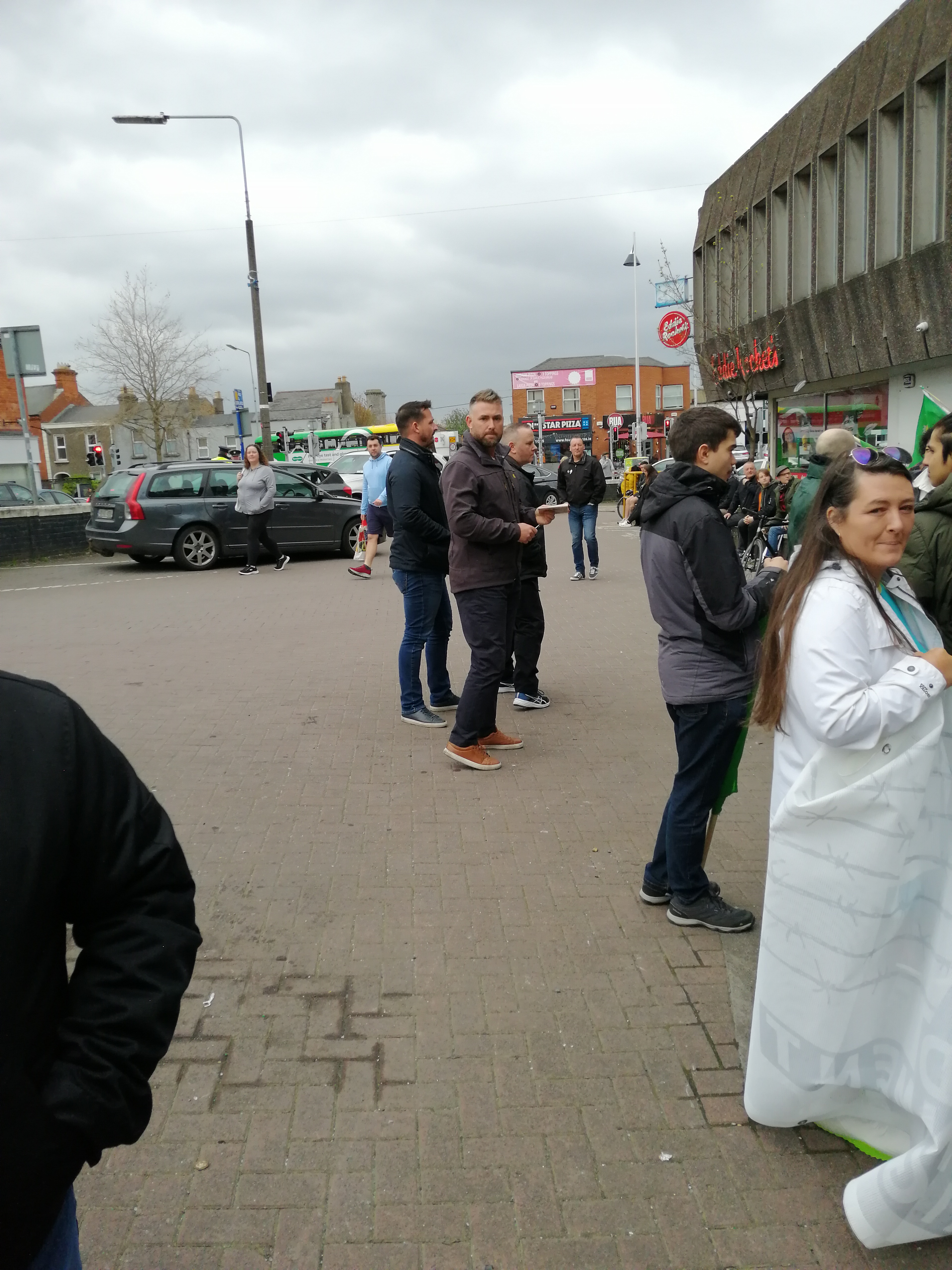
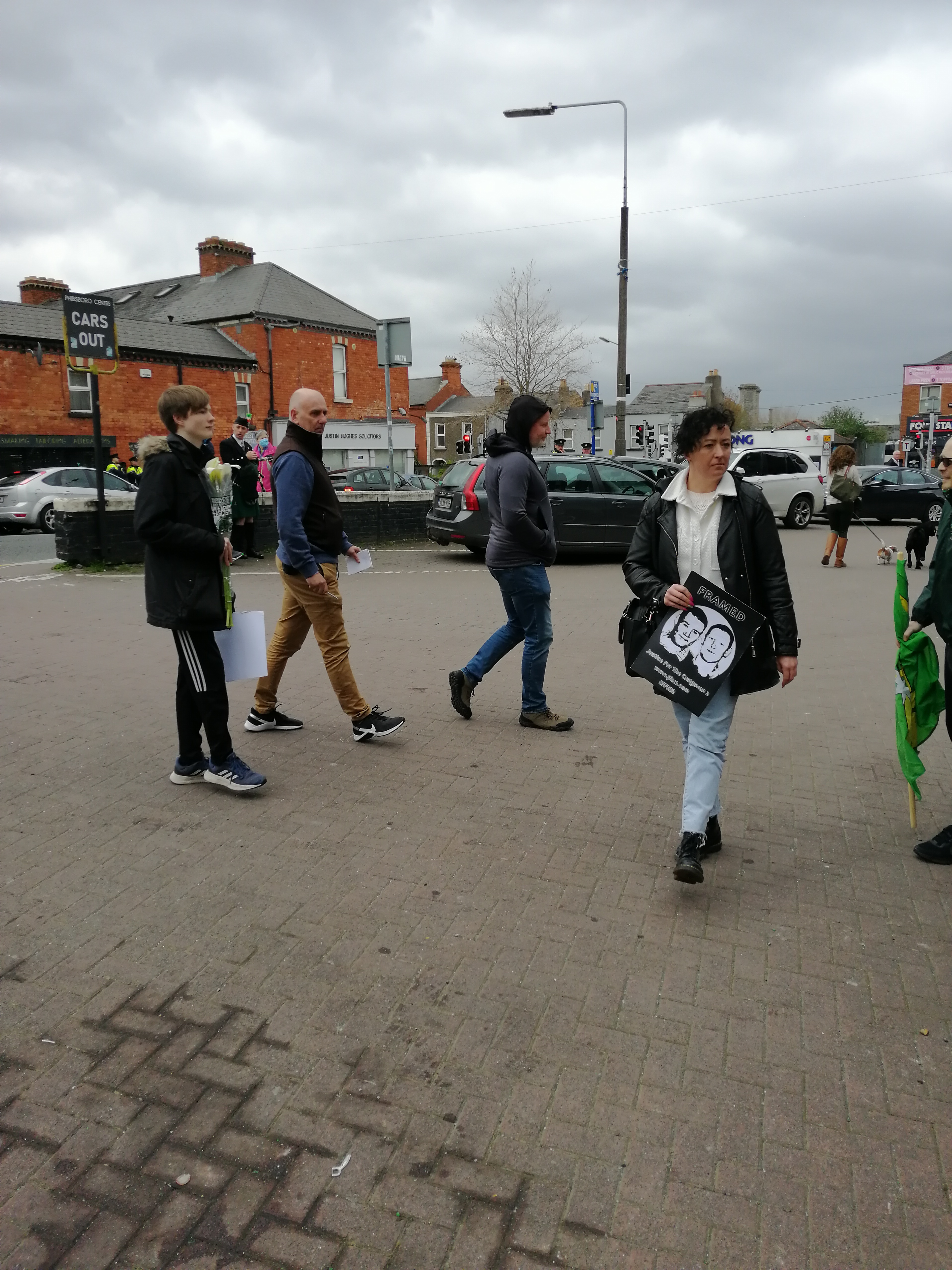
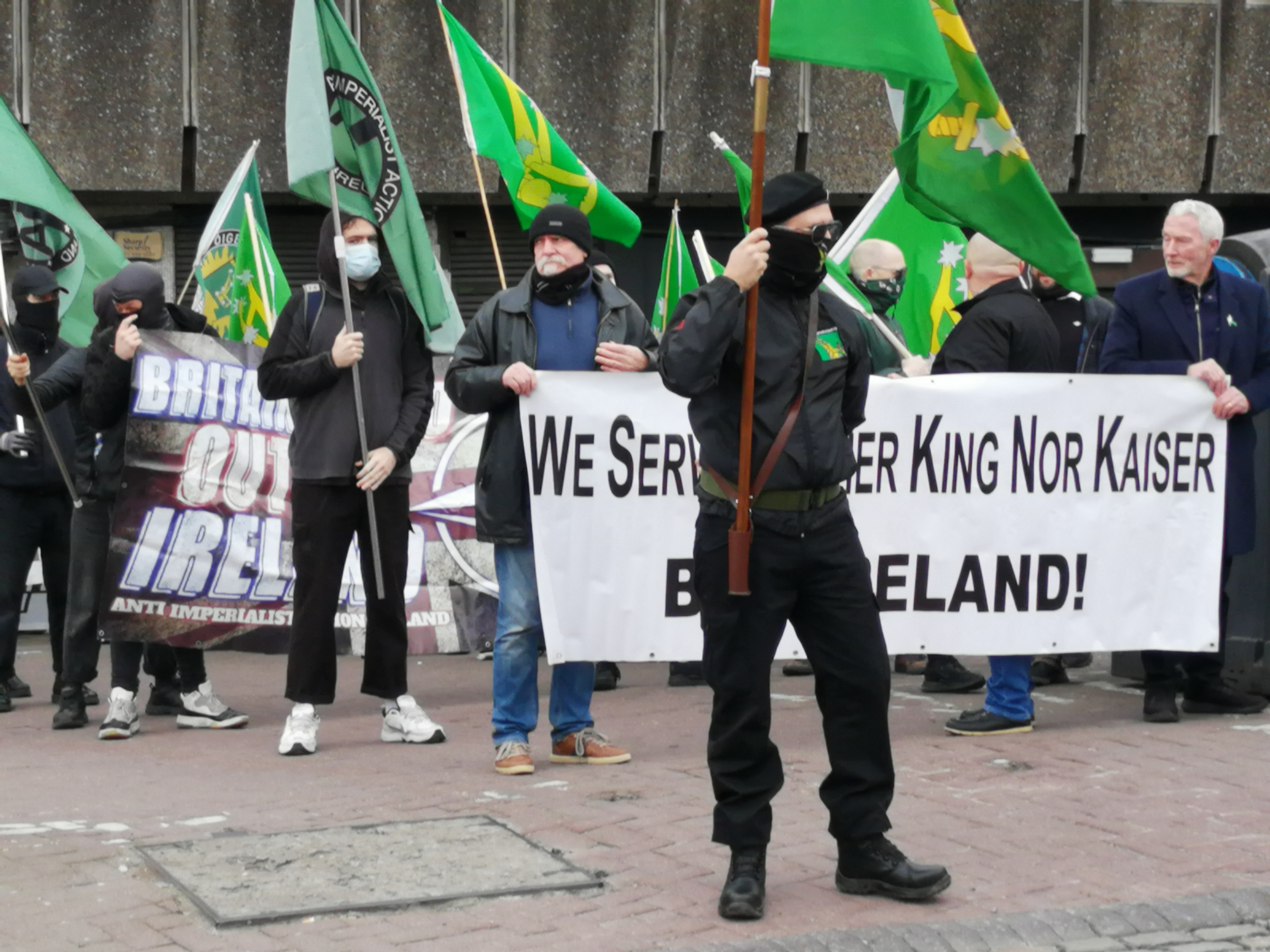
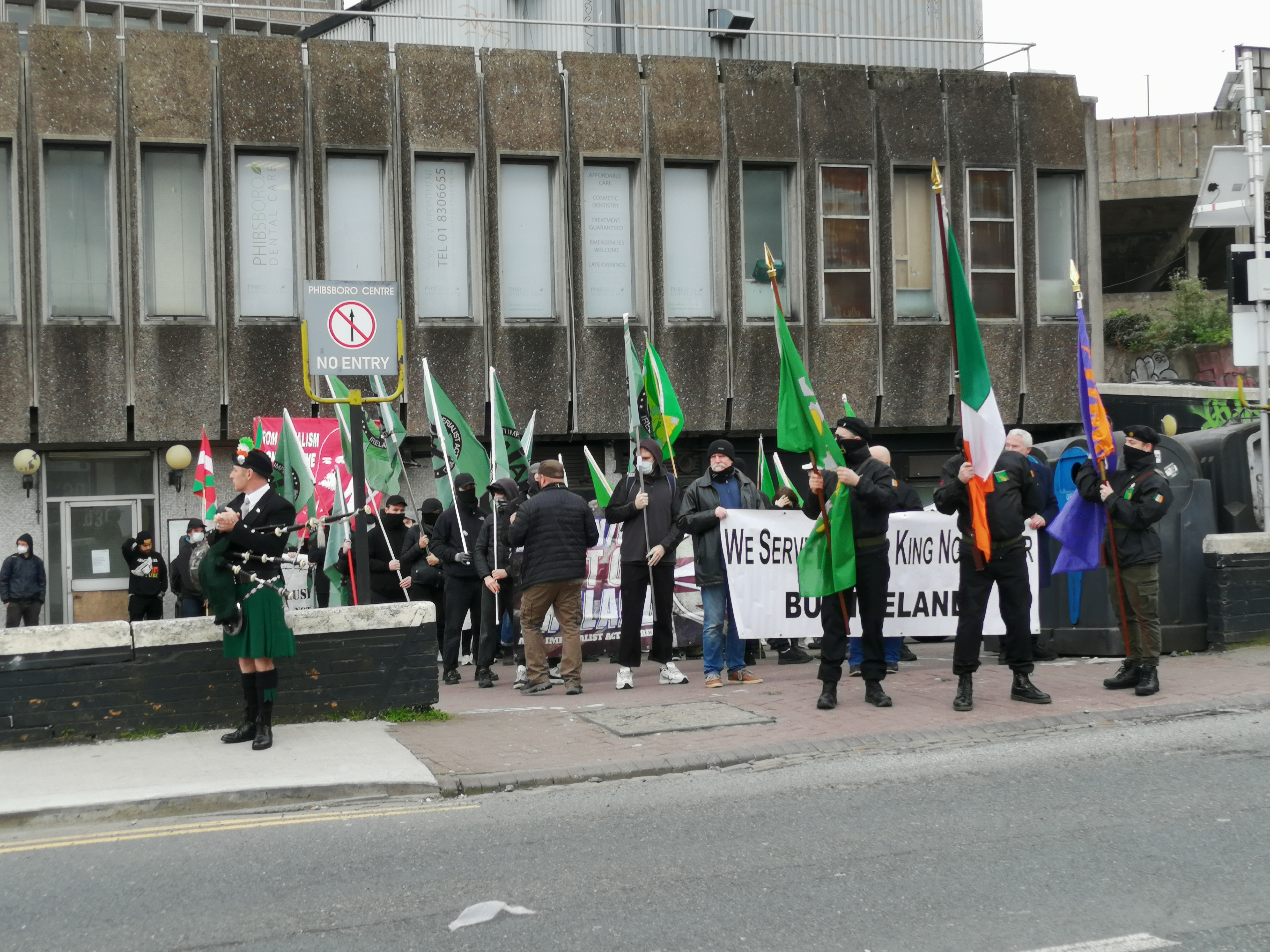
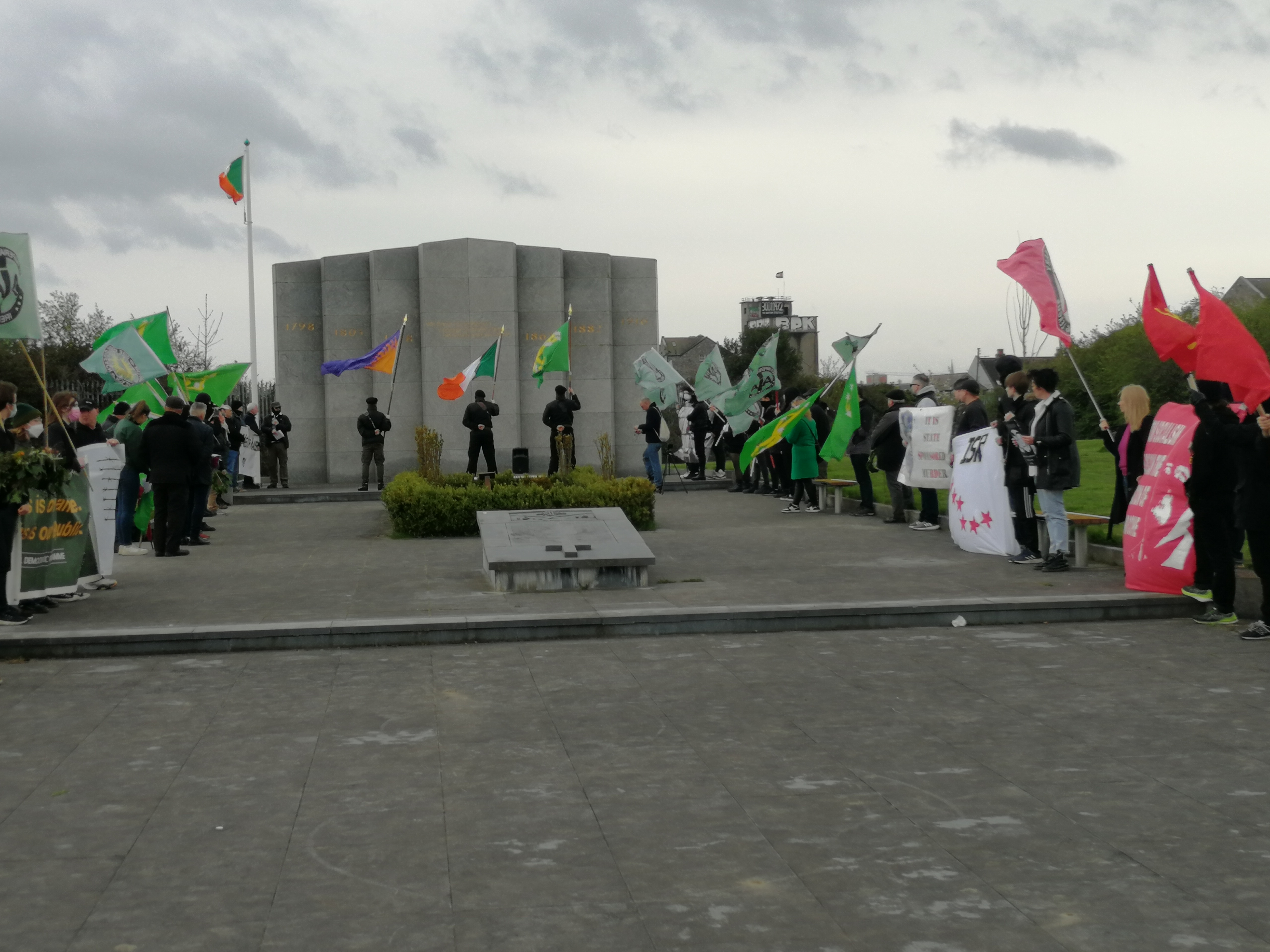
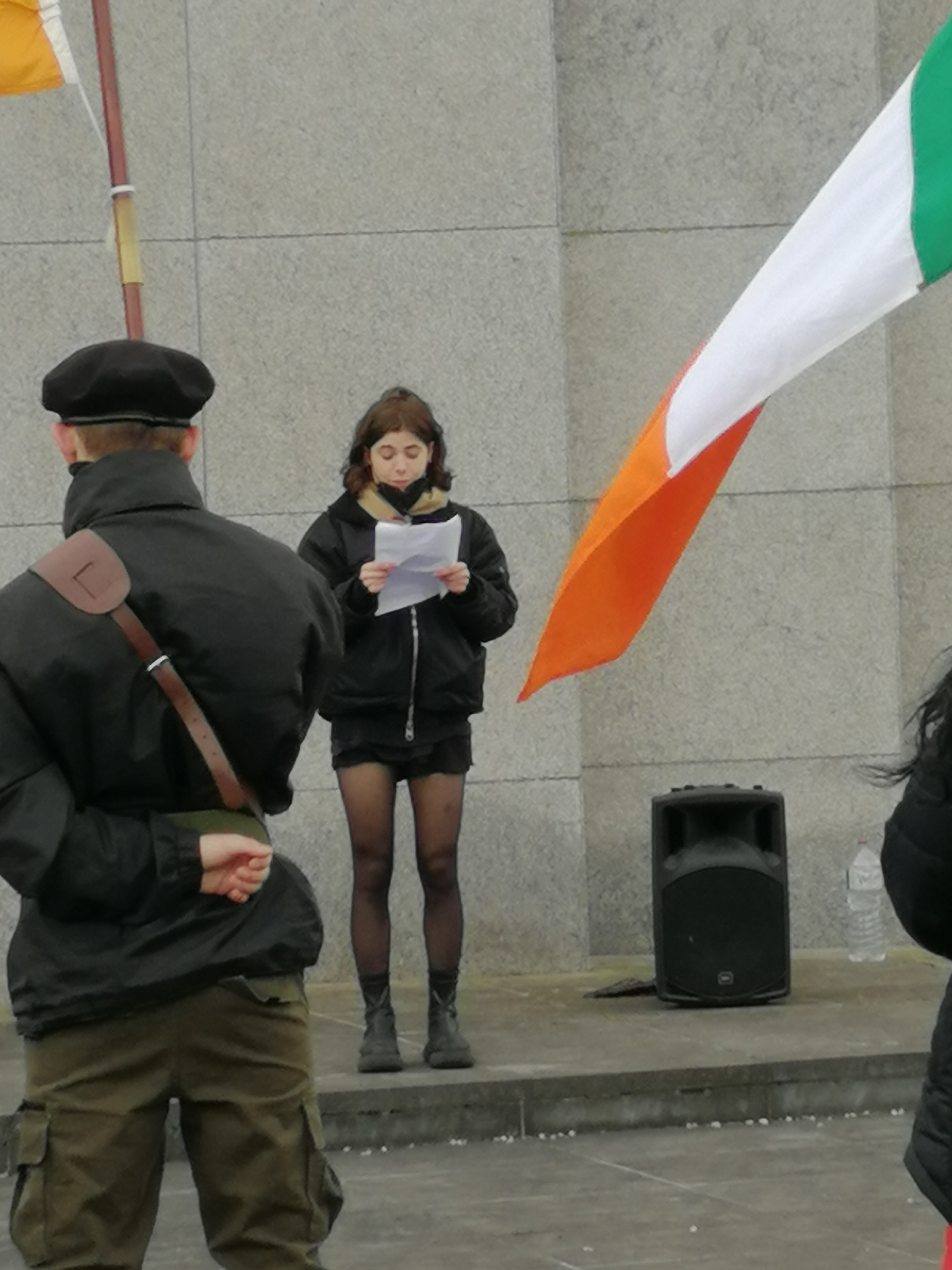
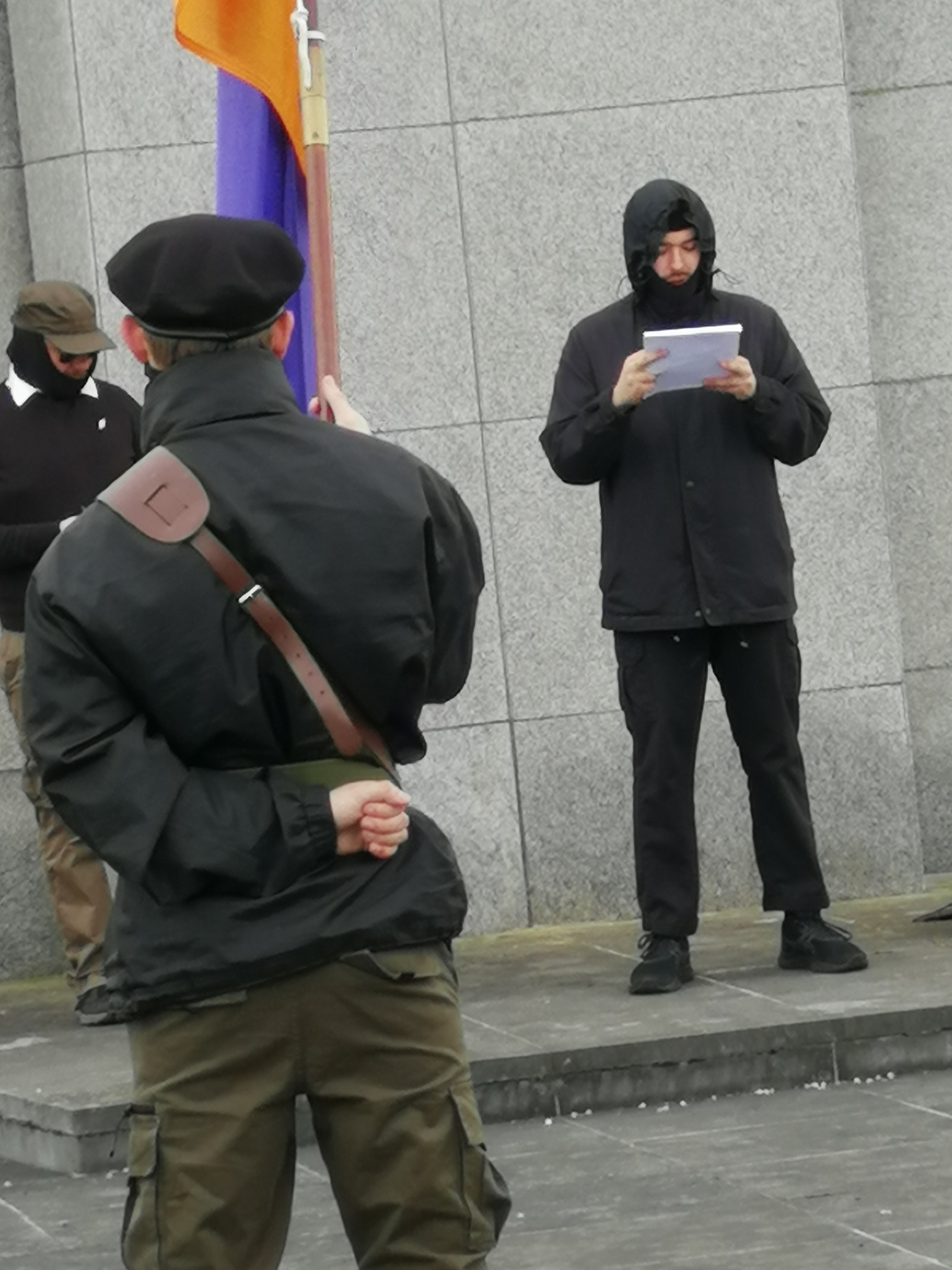
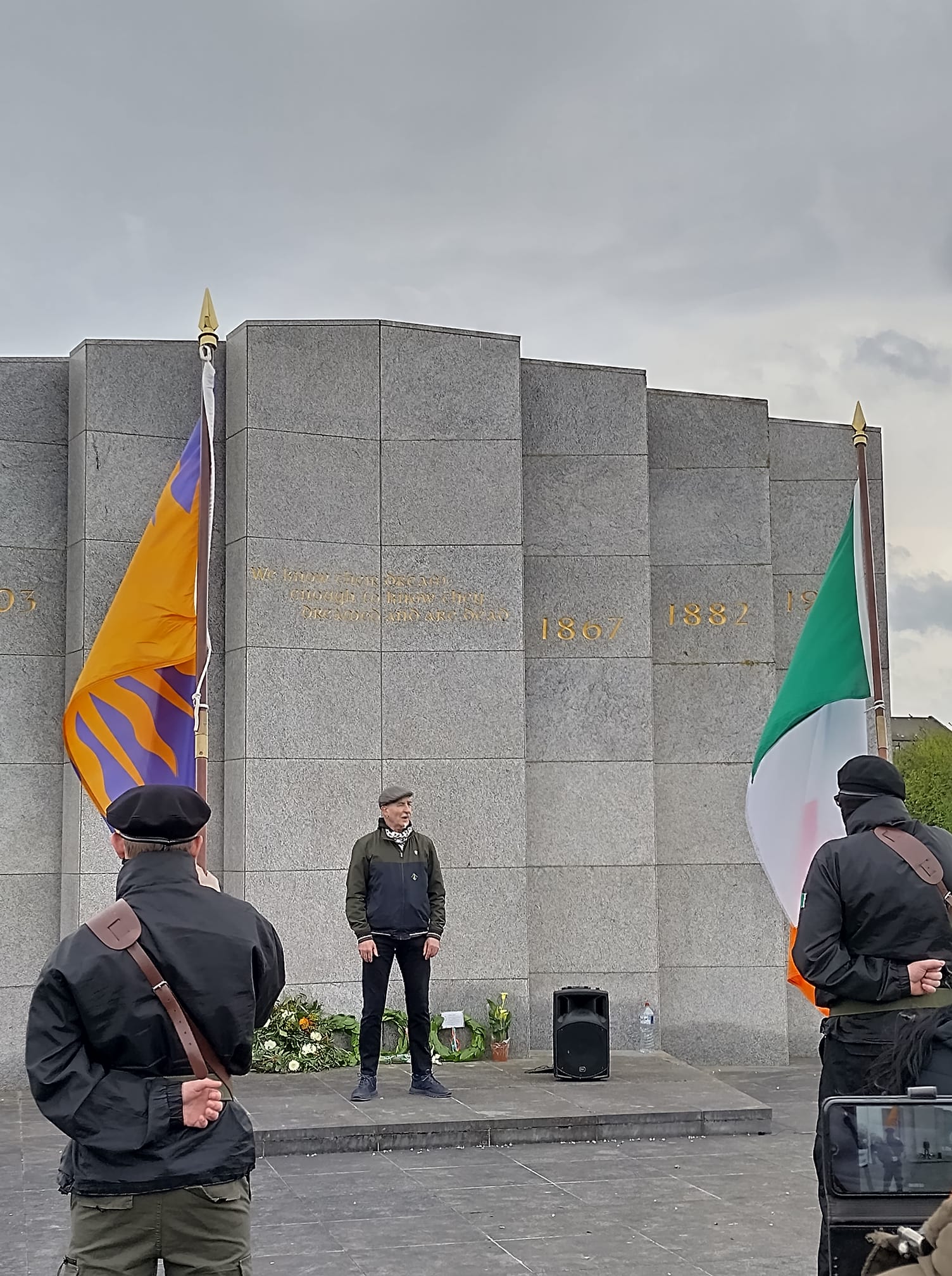
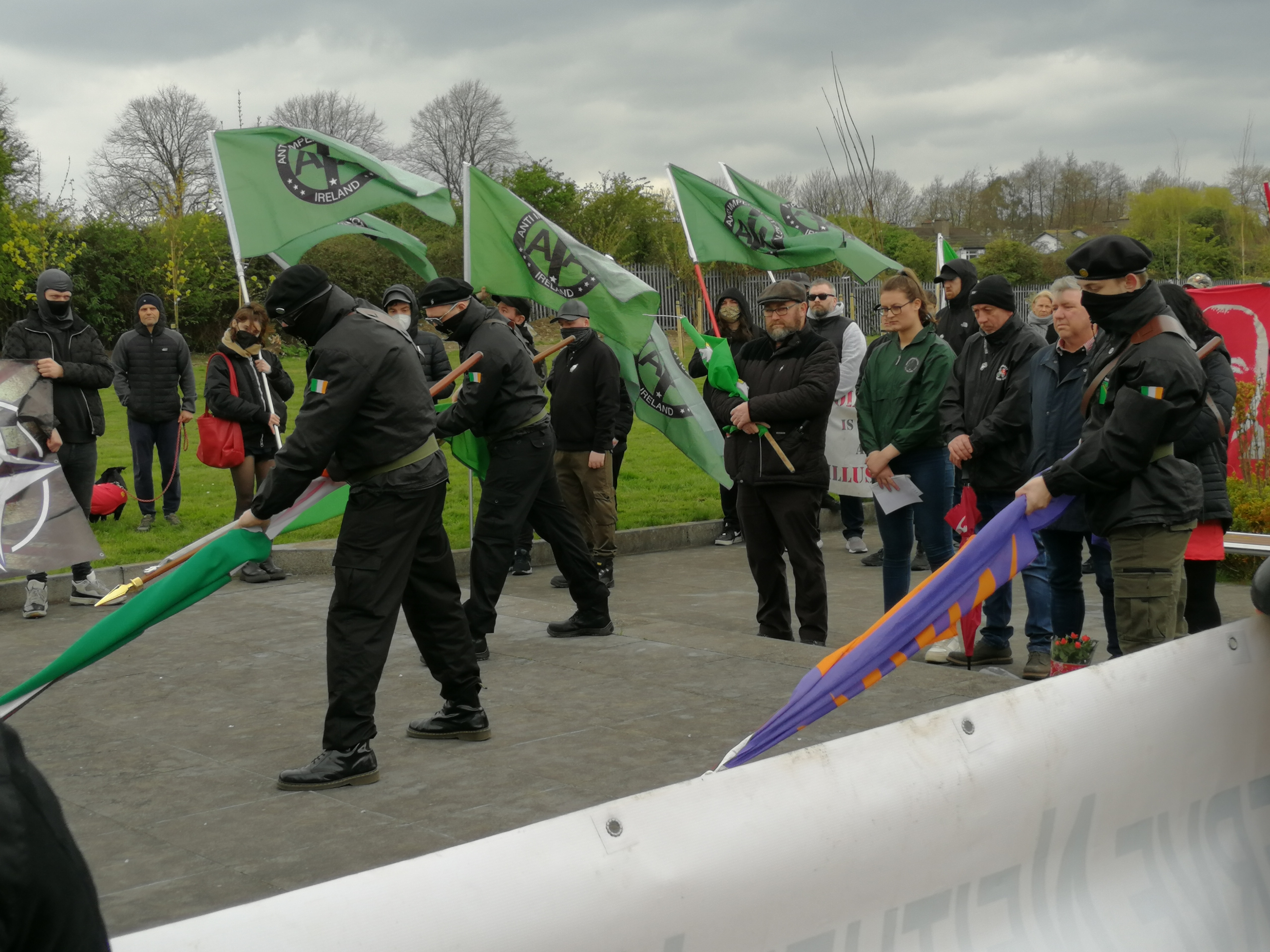
A broad group of socialist Republicans gathered at the grave of Theobald Wolfe Tone on Sunday 2nd July to honour his memory and to reiterate their commitment to an independent and socialist Ireland outside of imperialist military alliances.
Wolfe Tone’s grave in the Bodenstown Church graveyard has been a place of pilgrimage for Irish Republicans at least since the days of Thomas Davis1 of the Young Irelanders of the 1840s, who wrote of his own visit to the grave and composed the song “In Bodenstown’s Churchyard”.
The late 1960s saw huge numbers of people in attendance at annual commemorations there near the village of Sallins, Co. Kildare, including not only Sinn Féin2, who led them, but many political and social organisations, GAA clubs, along with many non-aligned people.
Over the years, the voluntary and unfunded National Graves Association has improved the site comprehensively and sensitively, leaving the ruins of the Protestant church as they are but building a stage attached to one side, fronted with plaques and commemorative flag stones.
Commemorations currently are usually organised around a Sunday near the date of the patriot leader’s birthday on 20th June but have to be managed between different groups wishing to hold their own commemorations.
Speeches, songs and Garda harassment
The Annual Wolfe Tone commemoration organised by the Wolfe Tone Commemoration Committee took place over the weekend with members of a number of groups and Independent Republicans in attendance.
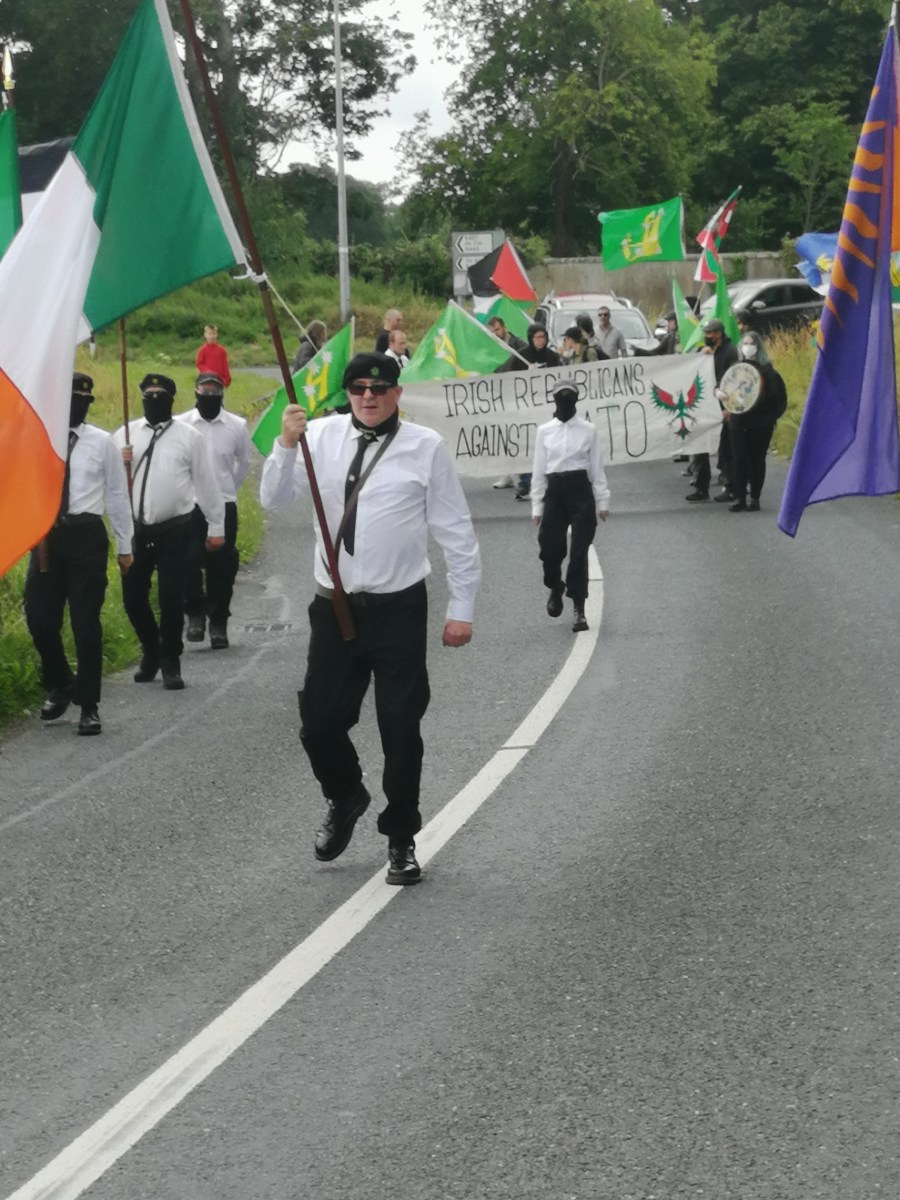
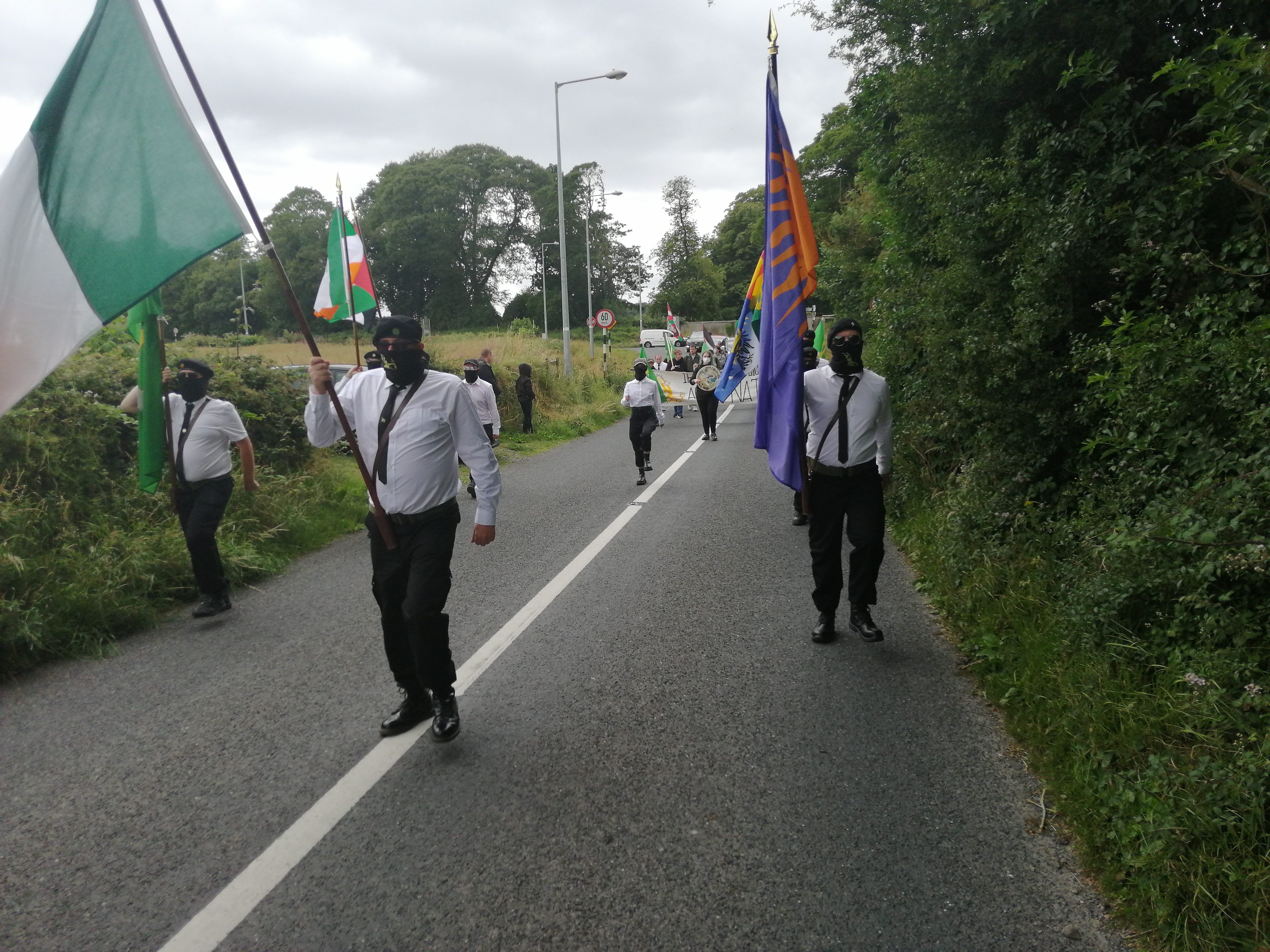
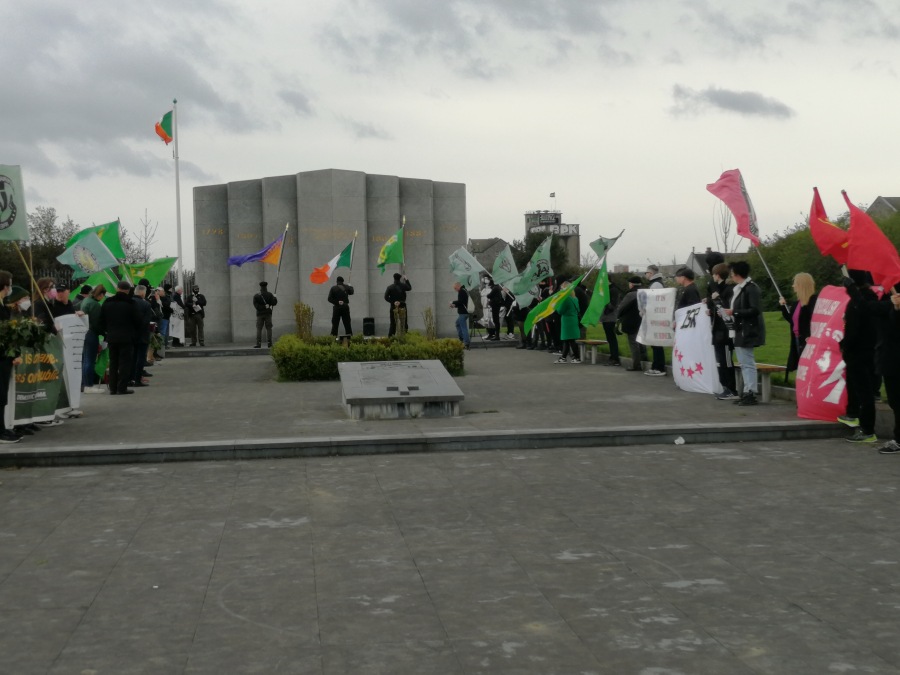
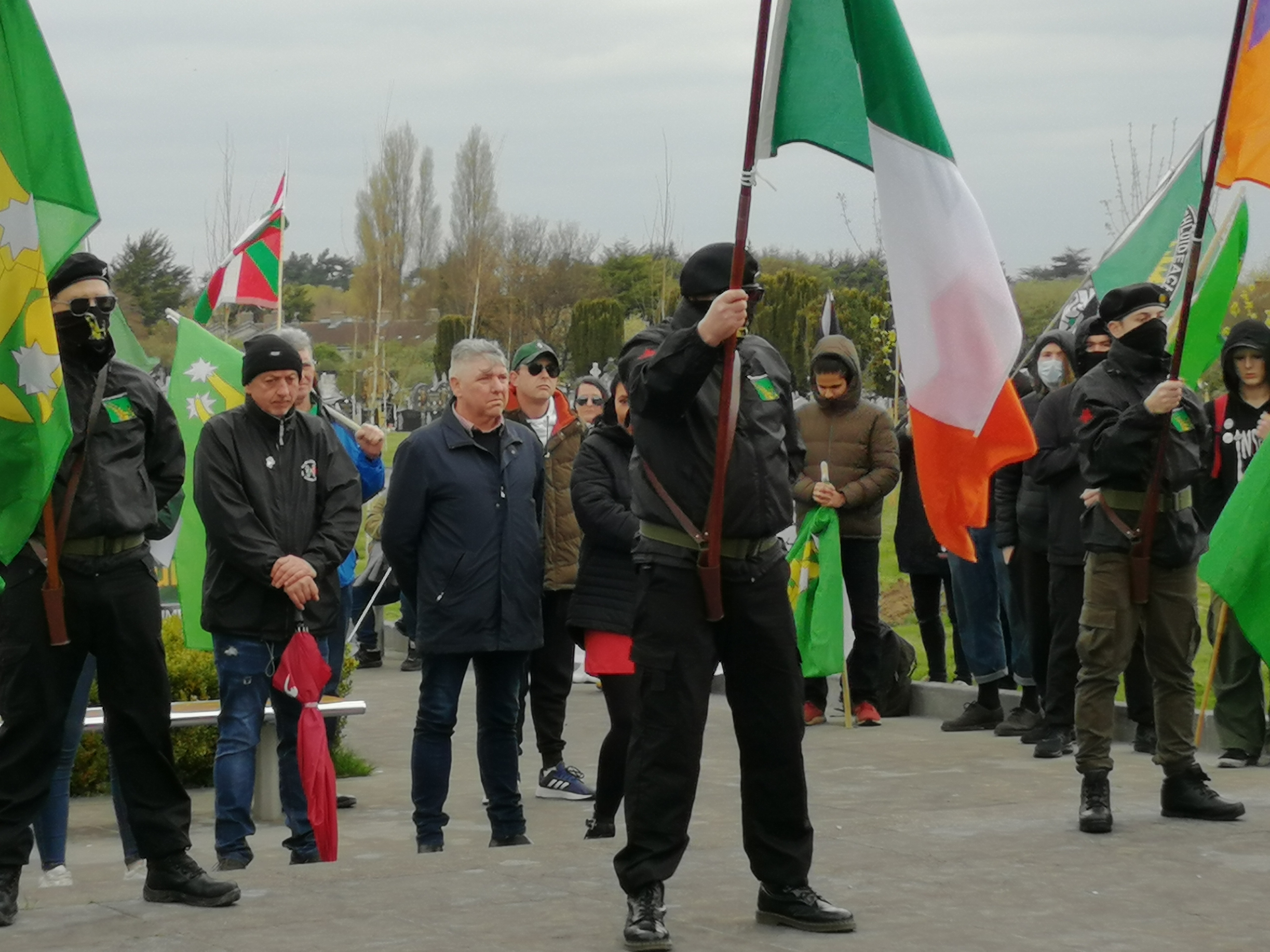
A Socialist Republican Colour party led the march up from the bottom of the road, turning in to the graveyard through a side gate and taking up positions in front and to one side of the monument, at ordú scíthe (parade rest) position but with flags held high.
Colour party in front of Wolfe Tone monument, Bodenstown Churchyard (Photo: Rebel Breeze)
Behind the colour party followed a crowd carrying banners bearing the legends “Irish Republicans against NATO”, “We serve Neither King nor Kaiser but Ireland” and an assortment of flags including green-and-gold Starry Ploughs, Irish Tricolour, Palestinian and Basque national flags.
The event was chaired by a young Socialist Republican who spoke about the importance of the event before introducing a representative of a midland Republican commemoration group who read a short message of solidarity.
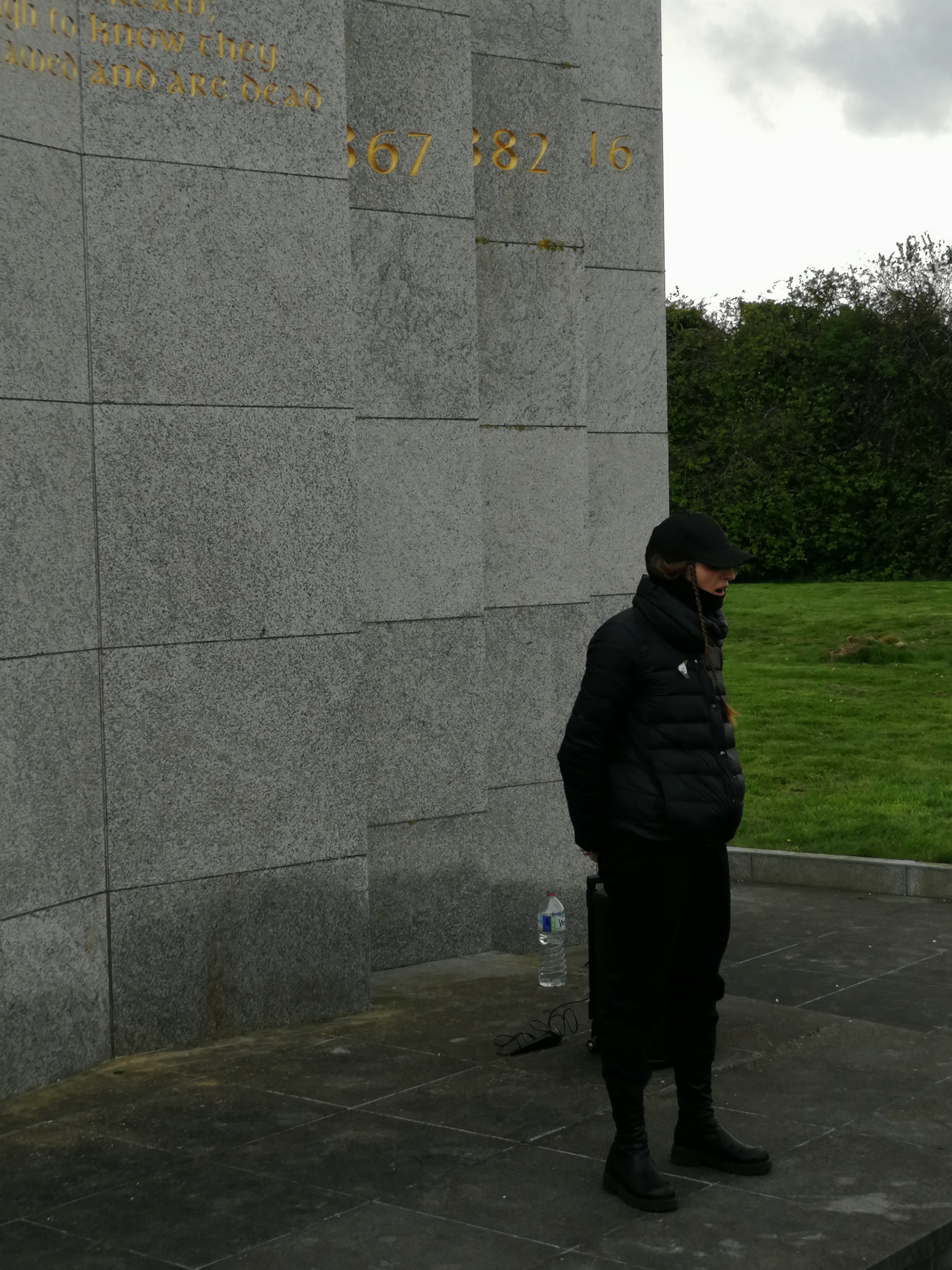
This was followed by a socialist republican accompanying himself on guitar singing The Three Flowers.3
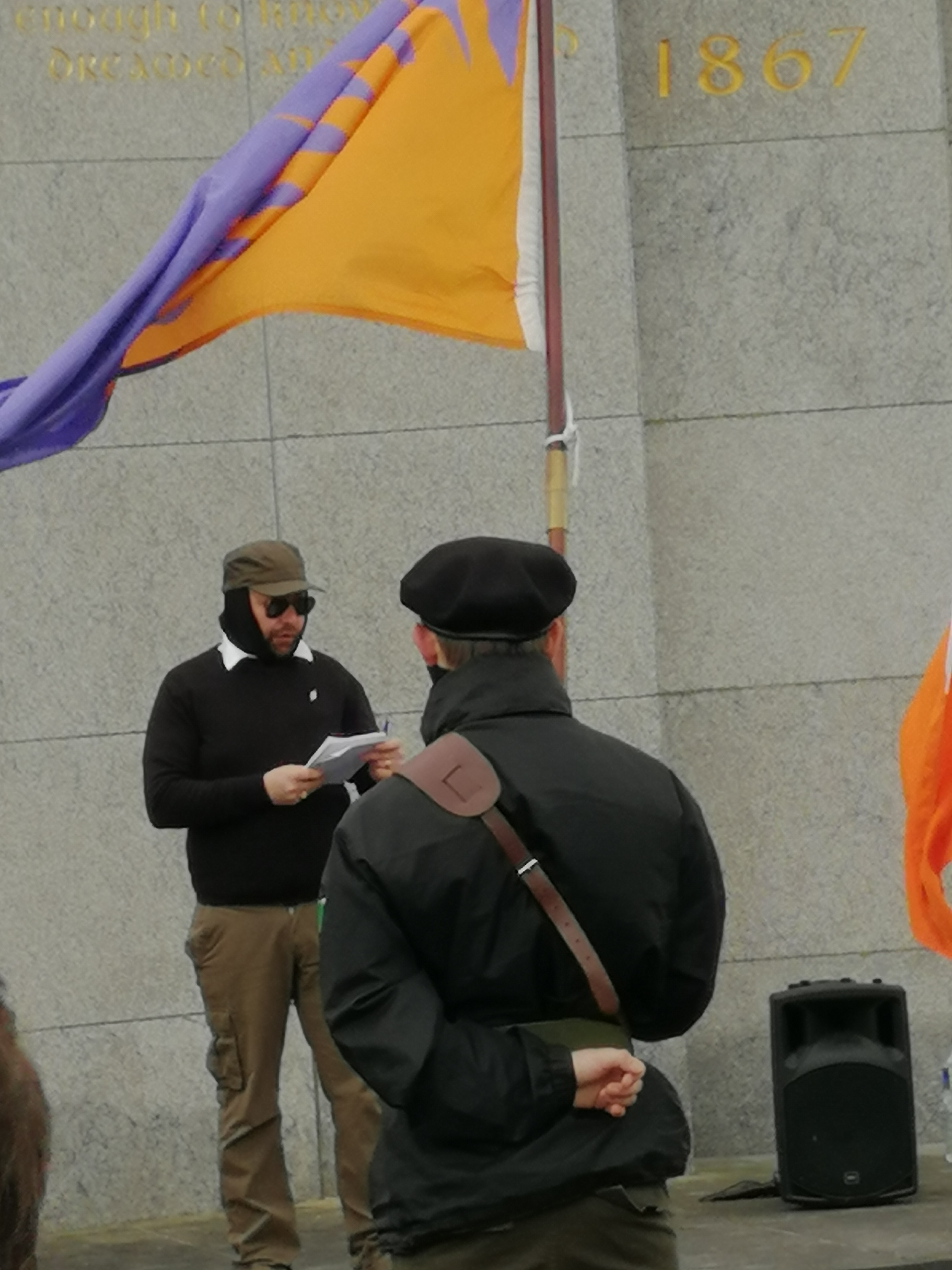
The main oration was delivered by veteran Independent East Tyrone Republican Margaret McKearney who linked the past with the present, including the current housing crisis, the British occupation and the Irish State’s push to join PESCO and NATO military alliances.
Musician performing The Three Flowersat the Wolfe Tone monument (Photo: Rebel Breeze)Veteran Republican from Tyrone delivering the oration at the commemoration event (Photo: Rebel Breeze)
There was a clear message at the event that the push towards NATO will be energetically resisted at every turn by the people of Ireland.
Wreaths were laid and a minute’s silence was observed, while the colour party lowered the flags in memory of all those who paid the ultimate sacrifice in the ongoing struggle for Irish Freedom. The event was brought to a close with the musician playing and singing Amhrán na bhFiann.
A handful of Gardaí4 in uniform and in plainclothes (Special Branch, the political police) were parked outside the graveyard watching people arriving and leaving but at that point having no direct interaction with those attending the event.
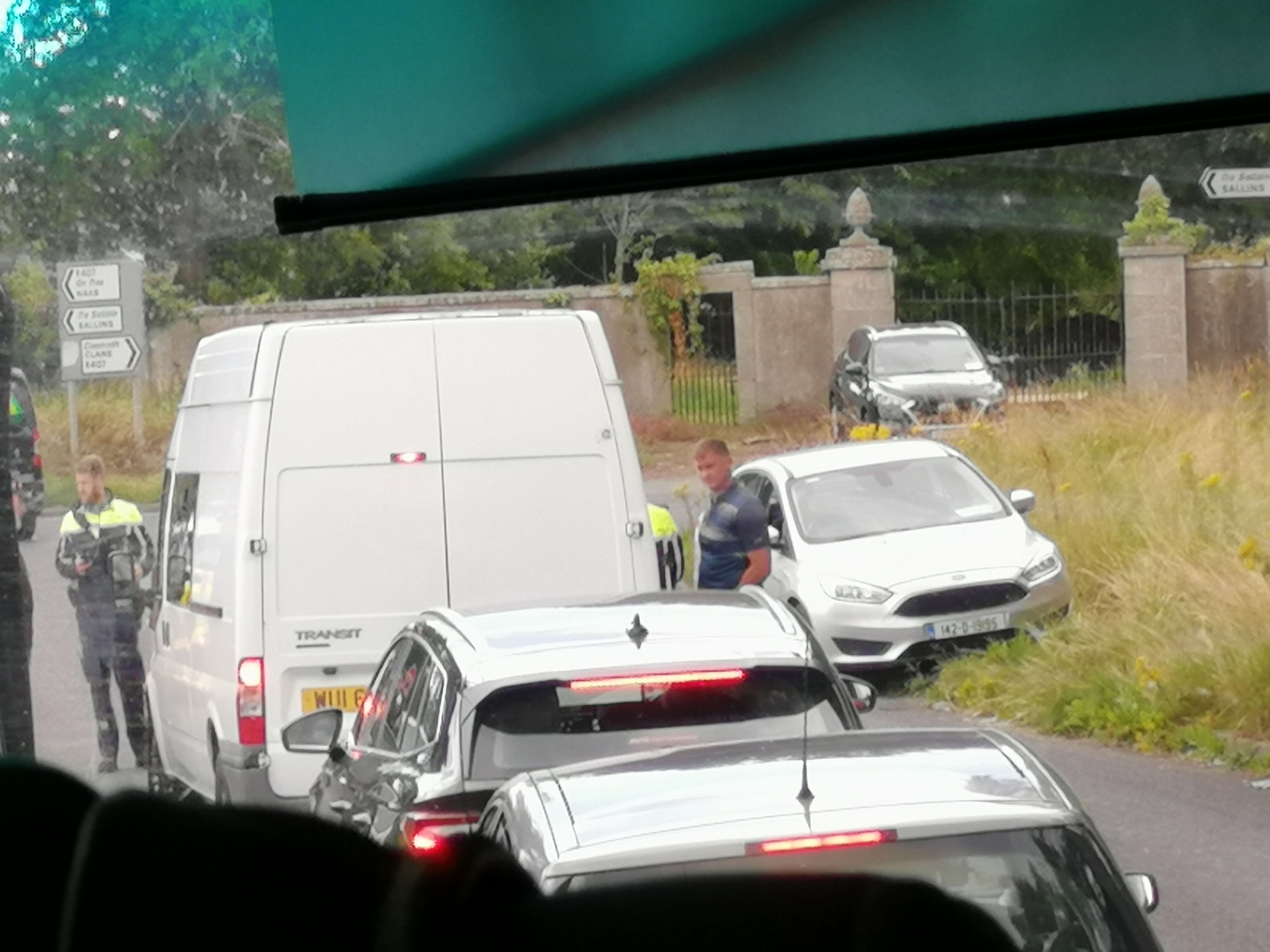
Part of long tail-back cause by Garda checkpoint very near to Bodenstown Churchyard after the commemoration event (Photo: Rebel Breeze)Gardaí in uniform and Special Branch in plain clothes harassing and attempting to intimidate people who had attended the commemoration event (Photo: Rebel Breeze)
However, once the event concluded, the Gardaí set up a checkpoint at the bottom of the road and began to harass and attempt to intimidate drivers of vehicles, stopping them, asking for identification, where they were from etc, causing a long tailback.
This is part of the regular harassment of Irish Republicans by police on both sides of the British Border.
“The Father of Irish Republicanism”
Theobald Wolfe Tone (1763-1798) was formally a member of the Church of Ireland5 congregation (Anglican), in his time the dominant religious group in England-occupied Ireland but also one of the smallest.
No-one could be elected to the Irish Parliament unless of that congregation.
In the early 19th Century a section of the Irish bourgeoisie, nearly all Anglican or of the other Protestant churches, “dissenters”, wished to develop the Irish economy free of interference, control, patronage and bribery associated with being an English colony.
Many of them understood the need for a strong base in the population, for which they recognised the need to include representation for the majority population in the country, the Catholics, along with the most populous of the Protestants, the Presbyterians.6
When the liberal but pro-English Crown Henry Grattan brought the issue to a vote in the Westminster Parliament, his motion failed due to many MPs’ sectarianism or vested interests, a situation which continued for decades afterwards.7
That seemed to point to revolution as the only logical way forward.
Theobald Wolfe Tone was one of the founders of the Society of United Irishmen in October 1971, the first broad Republican organisation in Ireland, which soon developed a comprehensive revolutionary agenda, for Irish independence and a Republic based on universal male suffrage.8
In order to accomplish a successful uprising, they invited assistance from Republican France and planned a simultaneous uprising across Ireland, with particular concentration on Antrim (largely Presbyterian and Anglican), Wexford and Wicklow, Midlands and Mayo (largely Catholic).
Colour party leading a march towards the Wolfe Tone monument (Photo: Rebel Breeze)
Spies and informers working for the English occupation betrayed some of their plans and most of the Leinster Directorate of the United Irishmen, including Wolfe Tone, were arrested, a disaster for uprising plans in Dublin but also for overall leadership in Leinster.
The 1798 Rising had initial great success in the south-east, particularly in Wexford but was quickly and bloodily suppressed in the Midlands and in Antrim. Mayo rose when a too-small detachment of French soldiers arrived under Humbert in Kilalla but they were outnumbered and beaten.
Tone was was unapologetic at his trial, was sentenced to death by hanging but appears to have attempted to take his own life while awaiting execution, surviving for a few days in great pain before dying on 19th November 1798 as British and Orange loyalist repression swept the country9.
Wolfe Tone Monument by Edward Delaney (d.2009) at S.E entrance to Stephen’s Green, Dublin city centre (image sourced: Internet)
Many leaders of the United Irishmen are honoured in song, writing and in commemorative events to this day but Theobald Wolfe Tone is still the most widely remembered of them all.
End.
The Colour Party and some of the participants line up for a group photo by the monument (Photo: AIA)
FOOTNOTES
1Thomas Davis (1814-1845), journalist, author of the song A Nation Once Again and other works, also co-founder of The Nation newspaper.
2Prior to its split resulting in Provisional Sinn Féin and the later split resulting in the Irish Republican Socialist Party.
3Composed by Norman G. Reddin, a Republican ballad honouring the memory of three United Irish leaders, Robert Emmet, Michael Dwyer and Wolfe Tone. Both Tone and Emmet were sentenced to execution, the latter carried out in 1803 on Thomas Street in Dublin. Dwyer was transported to exile in Australia where he was later accused of planning an uprising in New South Wales for which he was twice imprisoned and tried but exonerated, became Police Chief in Liverpool, Sydney in 1813 but was imprisoned again in 1825 for alleged non-payment of a £100 debt, contracted dysentery, was released again and died very soon afterwards.
5A branch of the Church of England, the state religion of the UK of which their Monarch is the titular head (in addition to being the commander-in-chief of the Armed Forces).
6“Catholic, Protestant and Dissenter”, as Wolfe Tone famously called the alliance.
7In May 1808 Grattan proposed emancipation in the House of Commons, with certain qualifications, but his motion was defeated by 281 votes to 128. In June 1812 the Commons accepted, by 225 votes to 106, a motion in favour of considering Catholic claims. An emancipation Bill, introduced in February 1813, received a second reading but was lost in committee by a narrow margin. Frustration at this lack of progress led to the formation of the Catholic Association in 1823 (of which Wolfe Tone was an active member). Parliament passed an Act to restrict the Association’s activities two years later.
8Very few radical or revolutionary individuals, not to mention movements of the 18th (or even much of the 19th or early 20th) Centuries proposed universal female suffrage, one reason why the 1916 Proclamation of Irish Independence is such a remarkable document, beginning its address with the words “Irishmen and Irish women”.
9Which many, in particular Protestants, fled the country to escape, some settling in the United States and in Canada. The great Catholic emigration from Ireland did not occur until the Great Hunger of the mid-19th Century and later.
Recently the Taoiseach1 of the Irish State criticised people protesting the Government’s plans to slide the state into external military alliances of “misappropriating” the Irish Tricolour and, incredibly, even of “weaponising” it.
The Irish tricolour was a weapon from the moment it was sewn – a psychological weapon, laden with political meaning, sewn by French revolutionaries, presented to and flown by Irish Republican revolutionaries from generation to generation.
Painting by Philoppoteaux depicting the revolutionaries of the French 1848 Revolution outside the Paris Town Hall and Lamartine rejecting the Red Flag in favour of the French Republican one. Women participants in this revolution presented the Irish Tricolour sewn in silk to Young Irelanders including Thomas Francis Meagher (Source photo: Wikipeda) [When Paris rose again in 1871 under the Paris Commune, the preference was for the Red flag.]
Prior to the advent of the Tricolour, the Irish Republican flag was typically the gold harp on a green background2 but when a group of Young Irelanders went to Paris in solidarity with the revolution of 1848 there, the Tricolour sewn in silk was presented to them by revolutionary French women.
The symbolism of the Tricolour was firstly in its form; the French Revolution adopted a tricolour in opposition to the monarchist Fleur-de-Lison a blue background and different tricolours became popular as flags of new republics.
In the Irish Tricolour, the ancient Irish and the Norman-Irish, basically Catholics, were represented symbolically by green, with orange for the settlers (after William of Orange) of one sect or another of the Protestant faith; the colour white, symbolised peaceful national unity in an Irish Republic.
And it presented an equal unity, as opposed to the unity of Scotland and Ireland with England but under the clear domination of the latter, as represented in the Union Jack, which incorporates the St. Andrew’s and St. Patrick’s crosses with the English one of St. George.
THE TRICOLOUR UNFURLED IN IRELAND
The Irish Tricolour we know was first unfurled by Thomas Francis Meagher “of the Sword” at the Wolfe Tone Club in Wexford on 7th March 1848 and in Dublin in Lower Abbey Street on 13th April 1848.
Meagher’s nickname was due to his renunciation of the Gombeens of his day trying to deny the right to resort to arms if necessary to win freedom3.
Meagher and other Young Irelanders were arrested around the failed uprising of 1848, just after the worst year of the Great Hunger and, after wide-scale international and domestic protests at the sentences of execution, transported to penal colonies, from which many escaped.
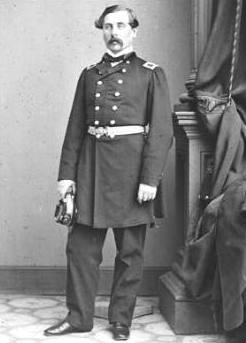
Taking his Republicanism and inclusivity seriously, both in Ireland and abroad, Meagher raised and commanded the Irish Brigade (composed of five regiments4) in the United States, fondly nicknamed Mrs. Meagher’s Own, to fight for the Union against the Confederacy and slavery.
As the years of struggle progressed, the Tricolour took its place among the ranks of Irish Republicans alongside the older Harp on Green or, for some Fenians, the gold or orange Sunburst on a blue background and so it was in the 1916 Rising when it began to be the most chosen.
Other flags were flown during the 1916 Rising also but the Tricolour was one of two erected on the roof of the GPO, headquarters of the Rising and became the most prominent during the War of Independence (1919-1921).
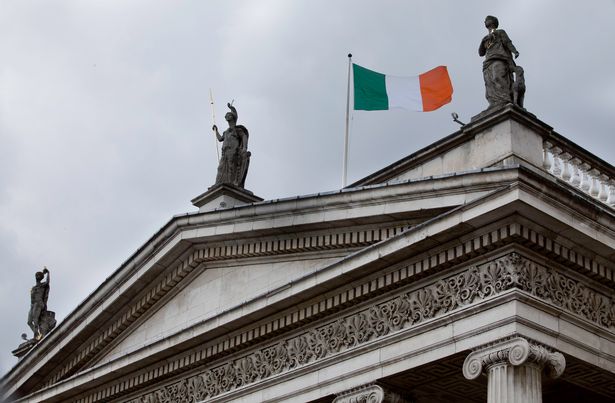
The Irish Tricolour in modern times flying over the General Post Office building in Dublin City’s main street (Source photo: Internet)
During the Irish Civil war by the British-supported, armed and provisioned Free State Army against the Republican movement (1922-1923), it was flown by both sides. Even after the defeat of the Republican movement and repression, it was not immediately named the state’s flag.
Though it was displayed by the Free State when joining the League of Nations in 1923, and denounced by the Republican movement as an usurpation, it did not seem that the new state was too attached to it5 and some Irish ships flew the British Red Ensign until 1939 and WW2.
The first time the Tricolour was formally adopted by the Irish State was in the 1937 Bunreacht (Constitution) which was brought in by De Valera’s Fianna Fáil6 Government and even then it was under a pretence of Republicanism with claim laid to the whole of Ireland.
Display of the Tricolour was suppressed in the Six Counties colony from 1922 and officially banned under the Flags and Emblems Acts (1954). Many a battle was fought with the colonial police by people asserting their right to display it, the Act not being repealed until 1987.7
“A FLAG OF INCLUSIVITY, MISAPPROPRIATED BY A MINORITY”
One must agree with Varadkar that the flag signifies inclusivity and was misappropriated by fascists and other racists in recent years but it is shameful of him to attribute similar exclusivity to Republicans, who in many cases fought those same fascists to which he referred.
Leo Varadkar, current Taoiseach of the Irish Government, who accused protesters for Irish neutrality of “weaponising” the Irish Tricolour (Source photo: Internet)
Not only fought them in recent years but also back in the 1930s, when Irish fascists were called the Blueshirts. Surely Varadgar is familiar with the latter’s history also, since they were one of three reactionary groups that joined to create Fine Gael – yes, Varadkar’s own political party.
And the first Irish Republicans, the United Irishmen, sought the unity of “Catholic, Protestant (Anglican) and Dissenter (other Protestant sects)” for an independent Republic, an ideology carried on by all Republican groups thereafter and given expression in the 1916 Proclamation.
But this is not the first time that people in authority have tried to equate Irish Republicans with fascists, as a few years ago Garda Commissioner Drew Harris issued a press statement in which he accused Republicans of having organised a far-Right demonstration — which he later recanted.
One would think Drew Harris, ex-Assistant Commissioner of the British colonial police force, the PSNI8, well-known for their sectarianism and collusion with the colonial brand of fascism, the Loyalists, would be able to distinguish between Irish Republicans and fascists with ease.
Varadkar is ridiculous in accusing Republicans of “weaponising” the Tricolour since it wasalways an ideological weapon from the moment of its creation and then eventually used by the State to try, with monumental lack of success, to deny it to Republicans.
But Varadkar is right in that the Irish Tricolour has been misappropriated by a minority; but rather than Republicans, that minority is the Gombeen ruling class, foreign-dependent, neo-liberal, selling out the country’s resources and networks to foreign capitalist monopolies.
And causing homelessness, or rent and mortgage hopelessness, emigration and austerity for the vast majority of the people in the Irish state, both native and immigrant, for the benefit of a tiny minority of parasites incapable of even developing a viable Irish national economy.
Republican groups, like all groups are minorities but so are the elites, though even smaller. But in representation? Republicans, whatever faults they may have from time to time clearly represent a much larger and wider section of society than do the Gombeens.
This has been evidenced by the militant opposition of wide Irish society to triple water taxation and privatisation, repugnance for the celebration of British occupation forces and the wide opposition to joining a military alliance, all projects pushed by the Gombeens in different governments.
The Irish Tricolour has been commented upon in a number of Irish Republican songs, sometimes even in the song title: White, Orange and Green and Green, White and Gold.
Probably it is most appropriately referenced in the chorus of a song directed at the Gombeens, the very minority who have misappropriated it:
Take it down from the mast, Irish Traitors, It’s the flag we Republicans claim; It can never belong to Free Staters For you’ve brought on it nothing but shame9.
End.
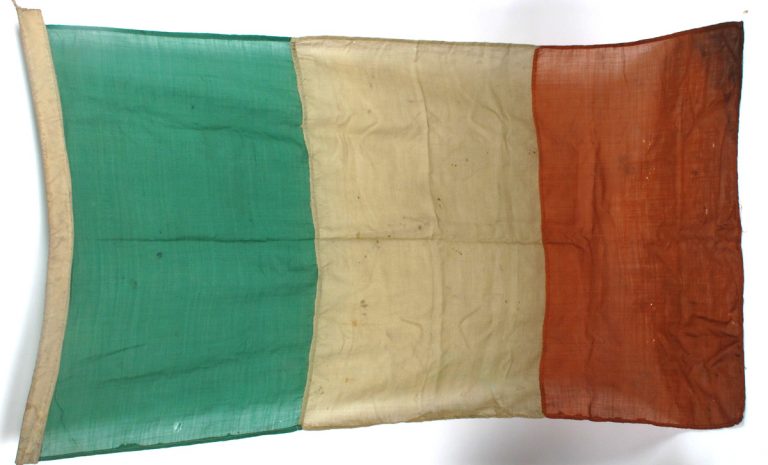
The Irish Tricolour that was flown over the GPO in 1916 (Source photo: 1916 Rebellion Tours)
FOOTNOTES
1 Currently Prime Minister of the Coalition Government of Fianna Fáil, Fine Gael and the Greens.
2 Flag of the Society of United Irishmen, who led insurrections in 1798 and 1803.
3 Daniel O’Connell’s son intended to force a motion of that kind on the Irish Repeal Association founded by his father and also sought to have the motion passed without debate. O’Meagher said that while he did not exalt violence, neither would he allow his sword to be taken from him in case it should be needed. He and others such as Thomas Davis left the Association at that point and became known as “the Young Irelanders”, first mockingly and later with pride.
4 Including the 69th New York Infantry or “Fitghting 69th”. 7,715 men served in the brigade, 961 were killed or mortally wounded and around 3,000 were wounded. (Wikipedia The Irish Brigade)
5 A 1928 British document said: The government in Ireland have taken over the so called Free State Flag in order to forestall its use by republican element and avoid legislative regulation, to leave them free to adopt a more suitable emblem later. (Wikipedia)
6 The party was a split from the losers of the Civil War of which De Valera had been leader, formed in order to participate in elections for Government and presented itself as Republican. The 1937 Bunreacht also laid claim in Articles 2 & 3 to the whole of Ireland which were removed in
7 During a period of direct rule by the British Government.
8 The colonial gendarmerie, formerly the Royal Ulster Constabulary for the Six Counties, preceded by the Royal Irish Constabulary for the whole of Ireland.
9 Soldiers of ‘22 by Brian Ó hUigín, acclaiming the Republican resistance to the counter-revolution of the Free State during the Civil War.
Pat Reynolds gave this oration in East London Cemetery on Sunday 21st May 2023 for Michael Barrett, the last man publicly hanged in Britain
A cháirde agus a chomrádaíthe,
Tá fáilte go leor romhaibh chun chruinnithe i gcuimhne Michael Barrett inniu. Welcome friends and comrades to this commemoration today for Michael Barret and Patrick O’Donnell. I have been asked to speak of Michael Barret and the movement he represented.
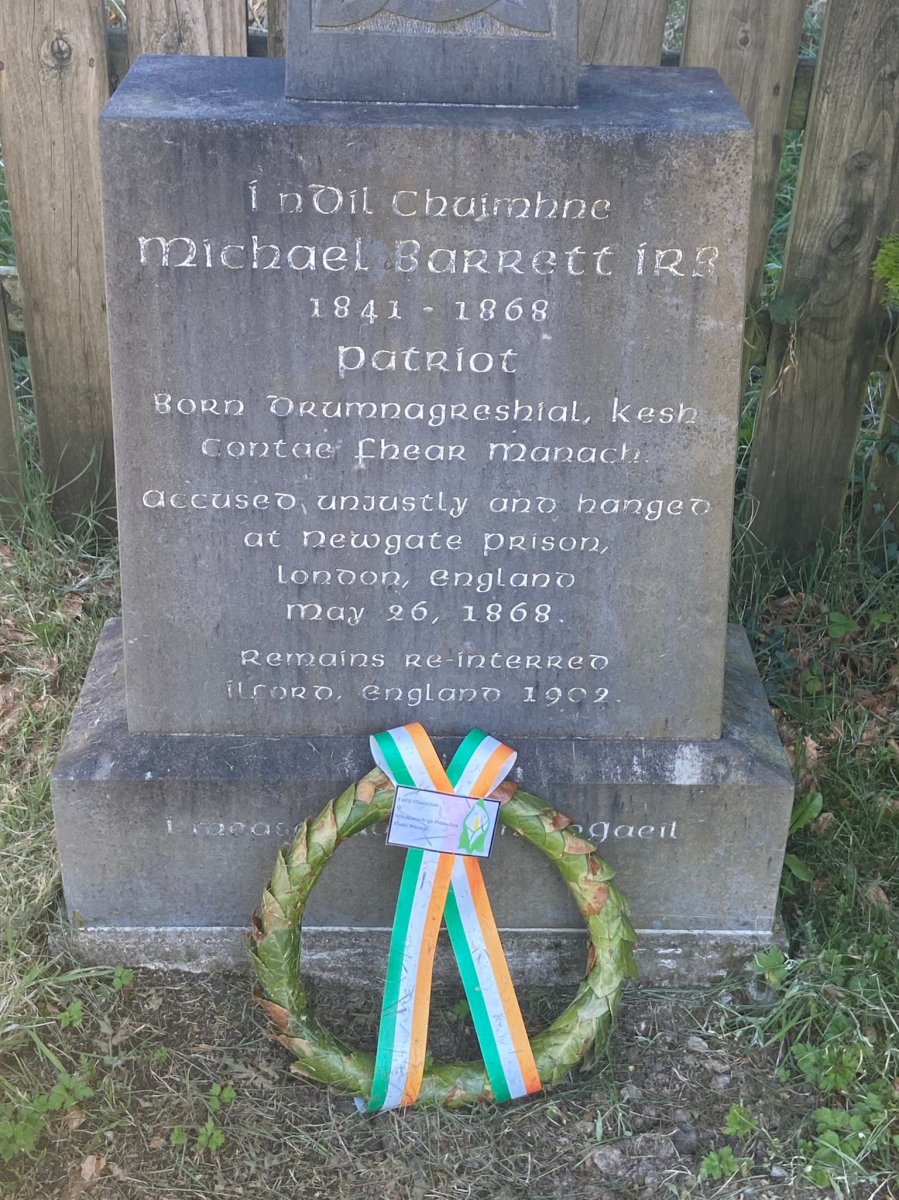
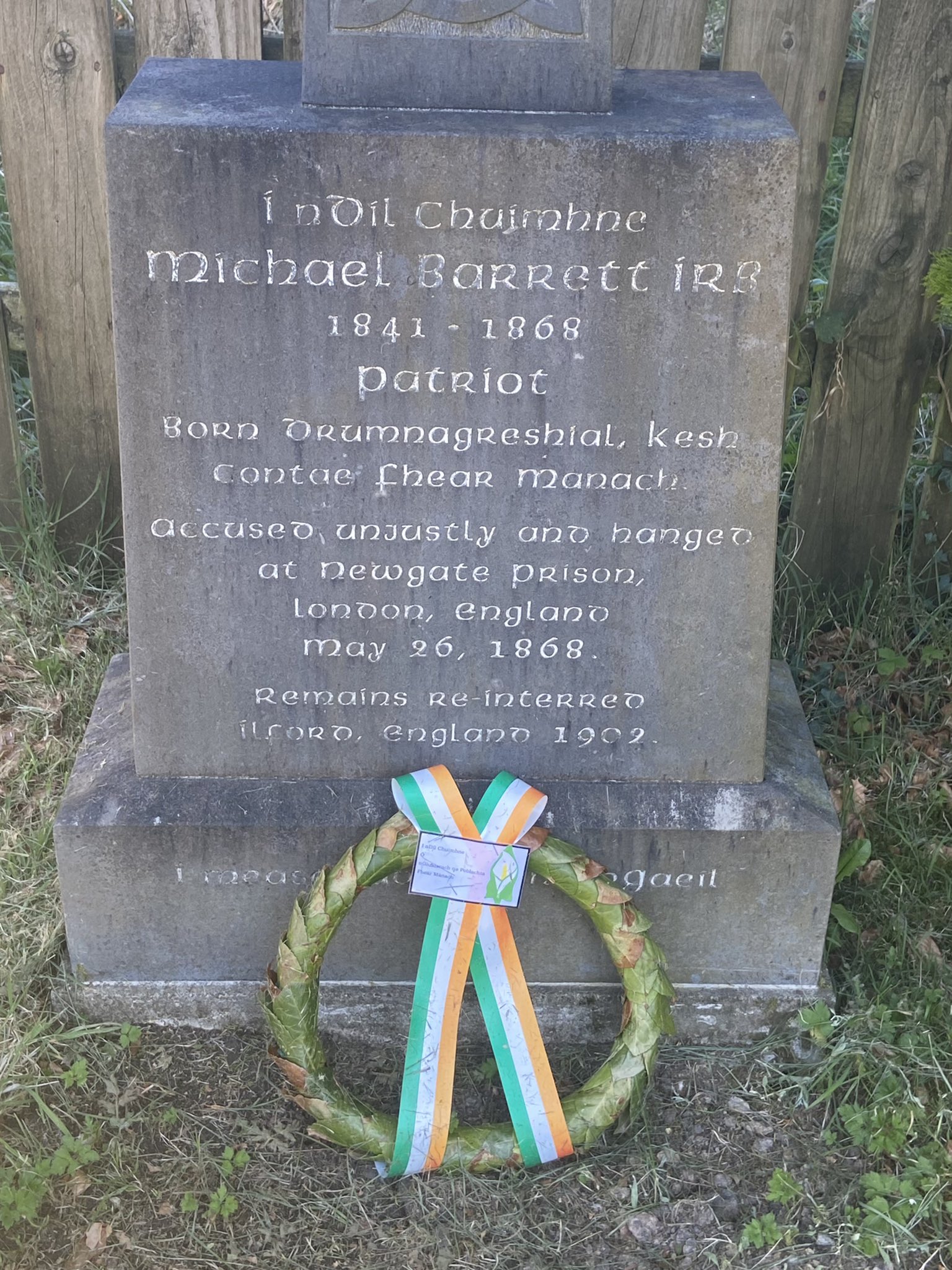
Michael was born in Ederney in the Maguire County of Fermanagh in 1841 and was judicially hanged though innocent by the British Government in 1868 at Newgate Prison, where the Old Bailey now stands.
Newgate prison was closed in 1903 and his remains with others were interred here in this cemetery. He was the last person to be publicly hanged in Britain.
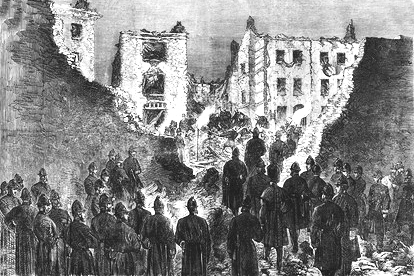
A Fenian bombing took place on 13th December 1867 to try and rescue O’Sullivan Burke the Fenian who planned the successful prison van escape in Manchester.
The bombing blew a huge hole in the wall and demolished nearby tenement buildings, killing 12 people and injuring many others. It led to a huge State-engineered backlash in Britain against the Fenians and put their cause back some 10 years.
Michael Barret, who had gone to Glasgow to work was an innocent man and was in Glasgow at the time of the incident.
False evidence given by a police informer Patrick Mullaly who was given a free passage to Australia implicated Barrett, but he had compelling evidence that he was in Glasgow at that time. After two hours the jury declared him guilty.
One of the trial lawyers Montagu Williams stated of Barrett:
‘On looking at the dock, one’s attention was attracted by the appearance of Barrett, for whom I must confess I felt great commiseration. He was a square built fellow, scarcely five feet eight in height and dressed like a well-to-do farmer.
This resemblance was increased by the frank, open, expression on his face. A less murderous countenance than Barrett’s I have not seen. Good humour was latent in his every feature and he took the greatest interest in the proceedings’.
Barrett ended his speech from the dock thus:
‘I am far from denying, nor will the force of circumstances compel me to deny my love of my native land. I love my country and if it is murderous to love Ireland dearer than I love my life, then it is true, I am a murderer.
If my life were ten times dearer than it is and if I could by any means, redress the wrongs of that persecuted land by the sacrifice of my life, I would willingly and gladly do so.’
The Daily Telegraph the next day stated that Barrett had:
‘Delivered a most remarkable speech, criticising with great acuteness evidence against him, protesting that he had been condemned on insufficient grounds, and eloquently asserting his innocence.’
Michael Barrett monument detail, Co. Fermanagh (Sourced: Internet)
In Fermanagh his aged mother had walked many miles to appeal to the local Tory MP Captain Archdale, a noted Orangemen, who rejected her. Barrett was hanged in front of 2,000 jeering people singing Rule Britannia. The following day Reynolds’ News recorded that;
‘Millions will continue to doubt that a guilty man had been hanged at all; and the future historian of the Fenian panic may declare that Michael Barrett was sacrificed to the exigencies of the police, and the vindication of the good Tory principle, that there is nothing like blood.’
His hangman was the notorious Calcraft who had botched the hanging of the Manchester Martyrs, Allen, Larkin and O’Brien.
There is a huge difference between an accident leading to deaths by patriots fighting tyranny and the deliberate actions of the imperialists, which is why patriots have to be always careful to avoid civilian deaths.
There are many similarities between the Clerkenwell bombing and the Birmingham bombing of 1974.
In both cases they set back the cause of Irish freedom for many years, deeply harmed the Irish community in Britain and was used by the State for repressive measures against the community and to divide off the Irish community from the English working classes.
Disraeli brought in the Habeas Corpus Act and created the Special Branch. Of interest is that their first definition of Irishness was ‘Persons who were born in Ireland or whose recent forebears came from Ireland.” Back in the 1980s the GLC adopted the same definition.
We also had the Birmingham Six case with the ‘appalling vista’ of Lord Denning the Appeal Judge, who later regretted that the six innocent men were not hanged. For Gladstone it set him on his mission ‘to pacify Ireland’.
I ask you two questions today, what kind of people and community gave rise to patriots like Michael Barrett and the Manchester Martyrs, and the second question, what kind of regime or government would hang knowingly innocent men.
To understand the Fenians we have to understand the colonisation of Ireland and in particular the Great Starvation of Ireland An Gorta Mór. Over one and a half million people were starved to death by British imperialism and another two million forced to emigrate to Britain and the USA.
There was no famine in Ireland at this time, and it is imperialistic propaganda to call it such. It was clearly genocide in a land overflowing with food.
The potato crop made up under 25% of the agricultural produce of Ireland, but at this time Ireland was part of the UK where the potato crop was about 5% of the total produce of the UK. I know of no country where there was famine because of a 5% failure of the crops.
Michael Davitt back in 1904 called the Great Starvation a ‘Holocaust’ as did others. Ken Livingstone drew some comparison between the Great Starvation and the experience of the Jewish community during the Second World War.
Hitler named his strategy ‘The Hunger Plan’ where he starved Poles and Jews and others groups of food, and these victims are included in the Holocaust figures including also his starvation of the Warsaw Ghetto.
The shipment of food grown by the people of Ireland to Britain during the Great Starvation was a clear decision by the British government to starve the Irish people.
The Nazi Governor in Poland Hans Frank wrote of the starvation of Jews ‘that we sentence 1.2 million Jews to die of hunger should be noted only marginally’.
The economic theory of laissez-faire is a total invention, within years they could spend millions in Crimea, a place most English had never heard of.
I recall the great Irish writer Frank O’Connor stating ‘Famine is a useful word when you do not wish to use words like ‘genocide’ or ‘extermination’, and again ‘It was not that the people were too simple to realise the Dachau-like nightmare of their circumstances’.
He goes on ‘The word famine itself is a question begging for its meaning ‘an extreme and general shortage of food’, and to use it of a country with a vast surplus of food, cows, sheep, pigs, poultry, eggs and corn, is simply to debase a language’.
O’Connor went further: ‘Irish historians who are firmly convinced that the Famine was all a mistake in the office, explain it in terms of an economic theory called laissez-faire. This is another cock that won’t fight.
Anyone who can believe that the British government maintained a garrison of 100,00 men in Ireland for the purpose of not interfering in trade and industrial affairs attaches some meaning to the word history that escapes me’.
The Great Starvation of the Irish people was a daily planned strategic intervention by the English government which is borne out by the evictions and forced migrations which followed and by the white supremacist and racist beliefs held in England at that time, which has largely been ignored by the historians.
The failure of the Young Ireland movement in the 1848 rebellion led to the deportation of their leaders and a flight of others to France and the USA. From this came the Fenian movement and the Irish Republican Brotherhood set up in the USA and Ireland in 1858.
There was of course also the French Revolution of 1848 which inspired people all over the world and which also inspired the Fenians.
The American Civil War of 1861-65 was to inspire the Irish in the USA. Over 30,000 Irishmen were to lose their lives in War the vast majority fighting for the Union and for the abolition of Slavery.
Revisionists question whether the Irish were really fighting for the abolition of Slavery, yet the same historians in hindsight claim that the British and Irish who fought in the 2nd World war were fighting against fascism and the Nazis.
The Irish men who died firing against slavery are entitled to the same respect from history.
The 1867 rebellion in Ireland did not really take off. Frantz Fanon stated: ‘Each generation must, out of relative obscurity, discover its mission, fulfil it, or betray it’. The Fenians took a more measured road and passed it on to the next generation, but not without a fight.
In the USA they invaded the British Canadian Dominion twice in 1867 with about 700 Fenian soldiers, veterans of the American Civil War. They held a convention in in 1867 with 6,000 armed men present.
In Britain the Fenians massed near Chester Castle in an attempt to seize the guns there and get them to Ireland via Holyhead for the Fenian Rising. As in the USA they were betrayed by spies and with Chester Castle reinforced by soldiers, the raid was called off in February 1967.
In September Colonel Kelly was arrested in Manchester and was released when Fenians attacked the prison coach which later led to the Manchester Martyrs, Allen Larkin and O’Brien who were innocent men framed up by the English government.
The impact of the Manchester Martyrs in Ireland was huge with some 17 monuments put up in their honour and with the Catholic Church forced to backtrack on their anti-Fenian stance and allow masses and commemorations to be widely held in Ireland.
Michael Barrett is part of this sacrifice of the Irish abroad to Irish freedom made within a year of each other. My call is for Michael Barrett to be included within the Manchester Martyrs’ history and commemoration.
By the 1870s the Irish had moved to parliamentary means to move their fight for liberation onwards. You will notice that the fight for Irish freedom goes in flows, a rebellion often followed by political and parliamentary activity along with agitation. Both means were effective for their times.
In Ireland we had Michael Davitt and the Land League, again we have the huge contribution from Britain to this effort from Davitt. We also had the bombing campaign in Britain by O’Donovan Rossa and Tom Clarke from 1880-87, the Invincibles in Dublin and the execution of Lord Cavendish in 1882.
We have the great Irish Literary and Gaelic revival. Again, the Irish Literary Society was founded in Southwark, SE London in the 1880s which spread to Dublin, Belfast and Cork.
We had the Gaelic League and the GAA as part of this revival which led on to the 1916 Rising and the founding of the nation.
What kind of regime or government could knowingly judicially murder innocent men like Michael Barrett and the Manchester Martyrs? We know the history of British colonisation of Ireland and British Imperialism.
This is the same British Imperialism which would in 1919 lead to the Amritsar massacre in India. But let us stay in 1860s iwith this colonial Empire.
In 1865 the Jamaican people rose up against British colonial rule in Jamaica which left 400 dead in a colonial reign of state terrorism. They hung the leader Paul Bogle and 14 others and executed seven women and prosecuted George William Gordon who had nothing to do with the Rebellion.
They executed him. The Fenians at the time raised funds to help the survivors bring action against the English government. You see here a long history of hanging both Irish and Black people across their colonies.
Today I salute the Irish in Britain who marched in the 1980’s against apartheid in South Africa and who today march with the Palestinian people following a noble Fenian internationalist tradition.
British rule in Ireland was based on Imperialism, White Supremacy and Racism. This was first formulated by Gerald of Wales in 1187 some 700 years before they hanged Barrett and the Manchester Martyrs.
Gerald in his books Topography of Ireland and Conquest of Ireland used racism to justify the conquest of Ireland and portrayed the Irish as inferior, backward, inhuman, uncivilised, feckless and lazy.
This was a litany of manufactured racist lies when Ireland had been the ‘Island of Saints and Scholars’ and the seat of learning in Western Europe bringing enlightenment to Europe during the Dark Ages.
Gerald’s views were published across Europe and held sway until around 1650 for about 500 years. This first racialisation of the Irish did not require any religious framework.
When Henry 8th split with Rome in 1534 the racist code used for conquest in Ireland was then overlaid with a state-sponsored sectarian religious code.
Irish scholars were driven out of Oxford where they were a dominant force and Henry sought to build up his fleet to destroy Irish fleets on the south coast to control trading in Irish sea ports and towns.
There followed the Plantation of Elizabeth 1st who knighted Gilbert the mass murderer of Munster who later founded a British colony in Newfoundland.
Later on, we had the Cromwellian conquest of Ireland with large-scale massacres at Drogheda and Wexford, widespread smaller massacres and the forced transporting of Irish slaves to the Caribbean.
Revisionists deny this history and seem to wrongly believe that these people were on some kind of ‘Cromwell Tours of the Caribbean’. For the record these forced transported people were not indentured people.
It is of interest that Gerald of Wales’ views on the Irish were not held of African people from 1200 onwards but were lifted from the Irish situation and applied to African people on the advent of enslavement to justify what the European colonial powers were doing.
So now Africans can be perceived in the same way as the Irish, as backward, inferior, childlike and have their freedoms taken away.
Let us now look at racism and the White Supremacist views of British Imperialism in the 1800s which gave rise to the great Starvation, the Manchester and London hangings of innocent men.
Robert Knox in The Races in 1850 described the Celts as an inferior race which became part of the ‘scientific’ racism of the day, with Knox updating Gerald of Wales.
Even Engels came out with his racist views of the Irish ‘The race that live in these ruinous cottages in measureless filth, and stuck in this atmosphere penned in, as if on purpose, this race must have reached the lowest stages of humanity’, instead of seeing what British imperialism and racism had done to the Irish people at home and abroad.
John Bedoe in his Races of Britain in 1862 views the Irish as Africanoid and having African roots, and again as ‘European Negroes’. Punch portrayed the Irish as apes and monsters, even Parnell, and the Irish as Aboriginals and on the same level as gorillas.
Charles Kingsley on visits to Ireland in the 1860’s states ‘I am haunted by the human chimpanzees I saw’ and ‘to see white chimpanzees is dreadful’. A new Gorilla at London Zoo is called ‘Paddy’ and the ‘Irish Yahoo’ is seen as the missing link between man and gorilla.
The Irish are described ‘as half naked savages who retain a vast amount of their primitive savagery to this day’.
We can see how scientific racism is now applied equally to Black and Irish for the purpose of colonisation and oppression.
In this context we can see the mindset of the British establishment who committed genocide against the Irish people, and who over centuries had murdered Irish people at random. We can see how the same regime of government can hang innocent people at home and abroad.
Michael Barrett, a self-educated man emerges from this dunghill of White Supremacy and pure racism as a heroic figure, like the Manchester Martyrs a true patriot as shown in his speech from the dock. He should be remembered with the Manchester Martyrs and not separated from their heroic end.
Barrett, a Christlike figure and a Cúchulainn who died on behalf of his people and for his political beliefs.
He was part of an Irish tradition in Britain of being in the forefront of democratic rights for liberty justice and freedom, not just for the Irish but also the British people.
We see in the Chartist movement of the 1840s being led by Irishmen Fergal O’Connor and Bronterre O’Brien that fight for liberty and the rights of man.
Also the leadership of Donegal man Doherty leading the workers of Lancashire and the ongoing links in the trade union movement to today from leaders like Mick Lynch inspired by James Connolly to Pat Cullen of the RCN.
We see it in the gift of The Red Flag song from a County Meath man and The Ragged Trousered Philanthropists novel by Noonan to the British working class.
In honouring Michael Barrett today, we stand full square for a United Ireland as proclaimed in the Fenian and 1916 Proclamations and for working class liberty in Britain.
I will finish today by reading the Fenian Proclamation of 10th February 1867 from the Irish People to the World. In it we can see what the 1916 Proclamation borrowed and built on. It is also what Michael Barrett lived and in the end died for.
Fenian Proclamation, 1867
Proclamation of the Irish Republic, issued February 10th, 1867, by the Irish Republican Brotherhood.
I.R. — PROCLAMATION! —
THE IRISH PEOPLE TO THE WORLD
We have suffered centuries ofoutrage, enforced poverty, and bitter misery. Our rights and liberties have been trampled on by an alien aristocracy, who, treating us as foes, usurped our lands and drew away from our unfortunate country all material riches.
The real owners of the soil were removed to make room for cattle, and driven across the ocean to seek the means of living, and the political rights denied to them at home, while our men of thought and action were condemned to loss of life and liberty.
But we never lost the memory and hope of a national existence. We appealed in vain to the reason and sense of justice of the dominant powers. Our mildest remonstrances were met with sneers and contempt. Our appeals to arms were always unsuccessful.
Today, having no honourable alternative left, we again appeal to force as our last resource. We accept the conditions of appeal, manfully deeming it better to die in the struggle for freedom than to continue an existence of utter serfdom.
All men are born with equal rights, and in associating together to protect one another and share public burthens, justice demands that such associations should rest upon a basis which maintains equality instead of destroying it.
We therefore declare that, unable longer to endure the curse of Monarchical Government, we aim at founding a Republic based on universal suffrage, which shall secure to all the intrinsic value of their labour.
The soil of Ireland, at present in the possession of an oligarchy, belongs to us, the Irish people, and to us it must be restored.
We declare also in favour of absolute liberty of conscience, and the complete separation of Church and State.
We appeal to the Highest Tribunal for evidence of the justice of our cause. History bears testimony to the intensity of our sufferings, and we declare, in the face of our brethren, that we intend no war against the people of England —
our war is against the aristocratic locusts, whether English or Irish, who have eaten the verdure of our fields — against the aristocratic leeches who drain alike our blood and theirs.
Republicans of the entire world, our cause is your cause. Our enemy is your enemy. Let your hearts be with us. As for you, workmen of England, it is not only your hearts we wish, but your arms. Remember the starvation and degradation brought to your firesides by the oppression of labour.
Remember the past, look well to the future, and avenge yourselves by giving liberty to your children in the coming struggle for human freedom.
Can you tell which of the clovers growing wild in Ireland is the genuine Shamrock (Seamair óg)?
Now, while it is still in bloom, is a good time to spot the plant, the smaller leaves and the yellow (buí) flower on it is what really distinguishes it from its clover cousins, with their bigger leaves and flowers in white (S. Bhán, T. repens) or pink-red-purple (S. Dhearg, T. Pratense).
How do we know that the Seamair Bhuí (Lesser clover, Trifolium dubium) is the genuine “shamrock”? Well, perhaps we can’t be certain but in the 1890s out of a survey of opinions of people in a still quite traditional Irish society, T. Dubium emerged as the first choice.
The shamrock, Seamair Bhuí/ Trifolium dubium/ Lesser trefoil, about real size, photographed in Dublin city with grass growing through it. (Photo: D.Breatnach)
Amateur botanist and zoologist Nathaniel Colgan (1851-1919) asked people from around Ireland send him specimens of what they believed to be an Irish shamrock, of which the two most common were the yellow clover followed by the white.1
A hundred years later, Dr Charles Nelson repeated the experiment in 1988 and found that yellow clover was still the most commonly chosen.2 According to Wikipeida, the yellow clover is the species nominated by the Department of Agriculture as the “official” shamrock of Ireland.
If you want to pick your own for St. Patrick’s Day, you’ll need to learn to identify it by its leaves because in Ireland it won’t be flowering in March. However, you can spot it now by its flowers and get a mental picture of the size of its leaves to retain in your memory.
THE IRISH AND THE SHAMROCK
What is it with the shamrock and the Irish anyway? The children’s fable of the Christian missionary Patrick using the leaf to explain the Christian Holy Trinity is just that, a fable, although repeated in one of the Wikipedia entries for “shamrock”.
Neither the Celts in general nor the Gaels in particular needed anyone to explain a three-in-one deity, since they had their own pagan trinities (Éiriu, Fódlha, Banba; the Mór-Righean/ Morrigu). Researchers have found no reference to any importance of the shamrock prior to 1681.3
Patrick himself, in what is considered his genuine autobiographical Confessio, never mentioned the shamrock once. My suspicion is that the shamrock-Christian-Trinity fable was fancifully created either by British settlers such as botanist Caleb Threkeld or by native Irish Christians around 1726.4
Although a few sources on line have claimed medicinal properties or druidic use for the shamrock, they never quote the actual original sources which may indicate that the references are undependable or obscure, if they exist at all.
Interestingly, writing a little before the 1798 Rising, Drogheda Presbyterian and United Irishman John Sheil used the shamrock as a reference for a different trinity, i.e that of Catholic, Protestant (Anglican) and Dissenter (all the non-Anglican Protestant denominations).
“ ….. the three-leaved plant …. It is three in one To prove its unity In that community That holds with impunity To the Rights of Man.”5
However, green was the colour of the United Irishmen and at times of repression by the occupation forces and the Loyal Orange Order, a sprig of shamrock on St. Patrick’d Day could be a useful way of indicating resistance while also claiming it was a harmless obeisance to a Christian saint.
Nevertheless, even wearing it on St. Patrick’s Day might have been dangerous in some quarters as when TheWearing of the Green reported, in reference to the shamrock, that
“… It’s the most distressful country that you have ever seen For they’re hanging men and women for the wearing of the Green.”
5The Rights of Man, by John Sheils. The air to which it is most commonly sung is that of the Irish Language song Eanach Cuain/ Anach Cuan but I have composed an original air for it and sing it a little faster than the song about that boat sinking tragedy.
The Irish State recently commemorated the end of the Irish Civil War but what it was really doing was celebrating its victory over the democratic national liberation forces.
The Irish national bourgeoisie, the Gombeen ruling class, armed and supplied by British Imperialism and colonialism, in 1922 launched a war against the forces that had brought the British Occupiers to the negotiation table.
In that short war or counterrevolution, the Irish State formally executed over 80 Irish Republican Volunteers – many more than had the British during the War of Independence 1919-1921. It also shot dead and blew up surrendered Volunteers and kidnapped, tortured and murdered others.
The Irish government of the day put the financial cost of the Civil War at 50 million sterling which today would be near to 3 billion euro.
A curtain of repression settled over Ireland, in the Irish state and in the colony in the Six Counties (in particular from the RIC re-baptised as RUC and the State-armed Loyalists of the B-Specials). Many Republicans were in jail and if not, could not find work and so emigrated.
The political party allegedly representing the Republicans, Fianna Fáil, led by a former leader of the forces attacked by the State, joined the Gombeen system and became in fact the preferred party of the Irish ruling class.
Though the Republican forces recovered and returned to the struggle in the 1930s (with the Communists against the fascist Blackshirts), again in the 1940s and onwards, they never again came close to winning control over the State.
What the Irish State has given us since its inception, even after the Civil War, has been generations of underdevelopment; unemployment and emigration; a huge decline in the Irish-speaking areas; inequality and social repression of women and LGBT people.
The latter was due to Catholic Church domination in every sphere of life, resulting in institutional physical, mental and sexual abuse, along with censorship in printed, audio and visual media and in banning of contraception.
The ruling class of the Irish State, the Gombeens, tolerated the foreign occupation and control of more than one-fifth of the island’s land mass and abandoned the large Catholic minority in the colony to discrimination and pogroms.
It tolerated also institutional and media racism against the Irish diaspora in Britain, the repressive legislation of the Prevention of Terrorism Act and the jailing for long sentences of a score of innocent Irish people in five different cases in the 1970s.
The Irish State tolerated Loyalist/ British Intelligence bombing inside its territory, failed to protect its citizens from terrorist bombing in the 1970s and covered up its complicity, for example with regard to the Dublin and Monaghan Bombings.
In addition, it used a Loyalist bombing to disarm the opposition to repressive legislation, not against Loyalists but against Irish Republicans, sending Republican activists to jail on the unsupported word of a senior police officer.
More recently this Irish State that we inherited has given us a housing crisis while it makes the territory a rich hunting ground for property speculators, bankers, landlords and vulture funds and also sells off/ gives away our natural resources, public transport and other infrastructures.
The selling-off includes our health service which is also in crisis while the private companies chop off parts of it and sell service back to the State at a profit. And a country that was able to feed 8.5 million prior to 1845 (and export foodstuffs) cannot now feed 5 million without huge imports.
They have given us nothing to celebrate but as always, there is a choice. We can bemoan the situation or we can “take back the nation they’ve sold” (Soldiers of Twenty-Two). And that cannot be done through electing any party or parties into the system.
While the Gardaí face accusations of treating far-Right violence too lightly, the State plans to increase the maximum sentence for assault on members of the force to 12 years in jail, nearly double the current maximum of seven years.1
Minister for Justice Simon Harris was seeking approval today for the increase as amendments to the Criminal Justice (Miscelaneous Provisions) Bill which has passed all stages in the Irish Parliament and is now going through the Seanad.
Irish Government Minister for Justice, Simon Harris (Photo sourced: Internet)
The increase in maximum sentence lumps emergency services such as paramedics and firefighters with State repressive forces of police, prison officers and armed forces.
This is a disguising measure since forces of repression are not the same as those of emergency services, even if in the event of a disaster all may be employed together. The State expects increased resistance from working people and therefore feels a need for increased repression.
According to some media reports there have been complaints that the Gardaí have been failing to respond adequately to crimes committed by fascists and other far-Rightists, including threatening behaviour and arson.2
Garda Commissioner Drew Harris, former British colonial police (PSNI) Assistant Commissioner3 responded that getting tough with the far-Right would be playing into their hands and that the Garda response is measured appropriately.
One must wonder how permitting threats of violence, acts of assault and arson against refugees and their supporters can be considered appropriately measured from any viewpoint other than that of the perpetrators.
Much harder Garda responses have been seen through the years to striking workers, water-meter and housing protesters, Irish Republican events and – yes – antifascist counter-protests against fascists and other far-Rightists.
Not giving the fascists the confrontation they’re allegedly looking for might disappoint some of them but on the other hand many will be encouraged and get to feel that they can do more or less what they like without repercussions from the Gardaí.
According to Saturday’s Irish Times, some of the criticism of Garda tolerance of far-Right crimes comes from confidential sources within the force itself.
The discourse that policing these protests is ‘complex’ is a distraction from the fact that vulnerable people who are harming no-one are entitled to live without fear of violence to their person or to their meagre belongings, about which there is nothing ‘complex’ at all.
Having to live on the street due to the failings of the State is bad enough without being subjected to additional threats.
On a number of occasions Gardaí have attacked and threatened antifascists confronting the far-Right, revealing where the general sympathies of the State lie, despite condemnations of the far-Right by Government Ministers, politicians and the Garda Commissioner.
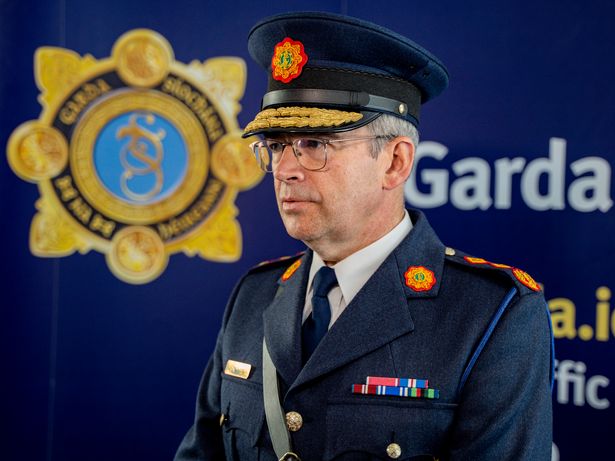
Garda not going lightly here but then it’s directed at ANTI-fascists counter-protesting Irish Yellow Vests on Custom House Quay, after they were attacked by fascists armed with metal and wooden clubs, many disguised as flags (note the captured Tricolour) 22 August 2020.(Photo: Rebel Breeze)Garda Commissioner Drew Harris (Photo sourced: Internet)
Historically, capitalism has turned to fascism to suppress the resistance of the working class to being made to pay for crises in the system. And fascists have often enough been found within the police force themselves.
Indeed, in Ireland it was the ex-Commissioner of the police, Eoin O’Duffy, who led the fascist Blueshirts, while the religous sectarian, racist and murderous nature of the colonial police in the Six Counties is a long established fact.
The police are the first physical force agency of the State and the armed forces its second. Increasing the penalty for assaults on these means the State is anticipating an increase of assault charges in days to come, quite probably as people defend themselves from police attack.
In fact, it is well known that if the police assault people, they regularly charge their victims with assault, so that the police can explain the injuries of their victims as inflicted in ‘self-defence’ or in measures taken against a person ‘resisting arrest’.
End.
FOOTNOTES
1Sentences for assaults on gardaí to rise, Irish Times, 23 May 2023.
Refugees living in tents on streets in Dublin were targeted last week by fascists and antifascists have confronted the latter in defence. Shelters of refugees have been torched.
There’s been some anti-immigrant discourse in Ireland, especially promoted by fascists and racists for a few years but it really took off during the Government’s handling of the Ukrainian refugee influx.
The Irish Government for pro-NATO reasons prioritised these over other refugees, also placing the Ukrainians in empty buildings in working class areas already low on social infrastructure and without consultation with the local community, some of whom reacted angrily.
The Irish Government handed the fascists and other racists a great opportunity and they grasped it.
After that issue had died down a bit, the fascists were looking for something to take its place and found it again in other refugees, this time those who were NOT being housed by the Government and were instead living in tents on streets around the IPO office in Mount Street.
Refugee tents near the International Protection Office (left of photo) in Dublin recently (credit Sasko LazarovRollingNews.ie)
The International Protection Office was supposed to organise to provide for the basic needs of refugees – in fact are legally obliged to – while their cases were being processed and had been failing to do so, hence the people it had failed living in tents around the area.
FASCISTS GO TO ATTACK THE REFUGEES
The refugees got some sympathetic coverage in articles in the Cork Examiner and Irish Times1. Perhaps it was this that stirred up well-known fascist Phillip Dwyer (known hater of women, migrants, LGBT and Muslims) to go and attack those people living on the street.
On Thursday 11th Dwyer turned up with his “security” people, i.e fascist goons, thinking to run the refugees out of there and perhaps do worse. But he was met with resistance including some people helping the refugees, two of the goons got hurt and they backed off.
According to a statement on Revolutionary Housing Action’s Twitter account, one of the defenders was ambushed when he went to collect his bike and while fighting them off, they threw a bike at him. Dwyer and his fascist hounds promised to be back.
Streetlink homeless service stated that on Friday, they were threatened and their outreach van pummelled while they packed refugee belongings and then boxed in so they had to suspend their outreach service for that evening, handing on outreach contacts to other services.
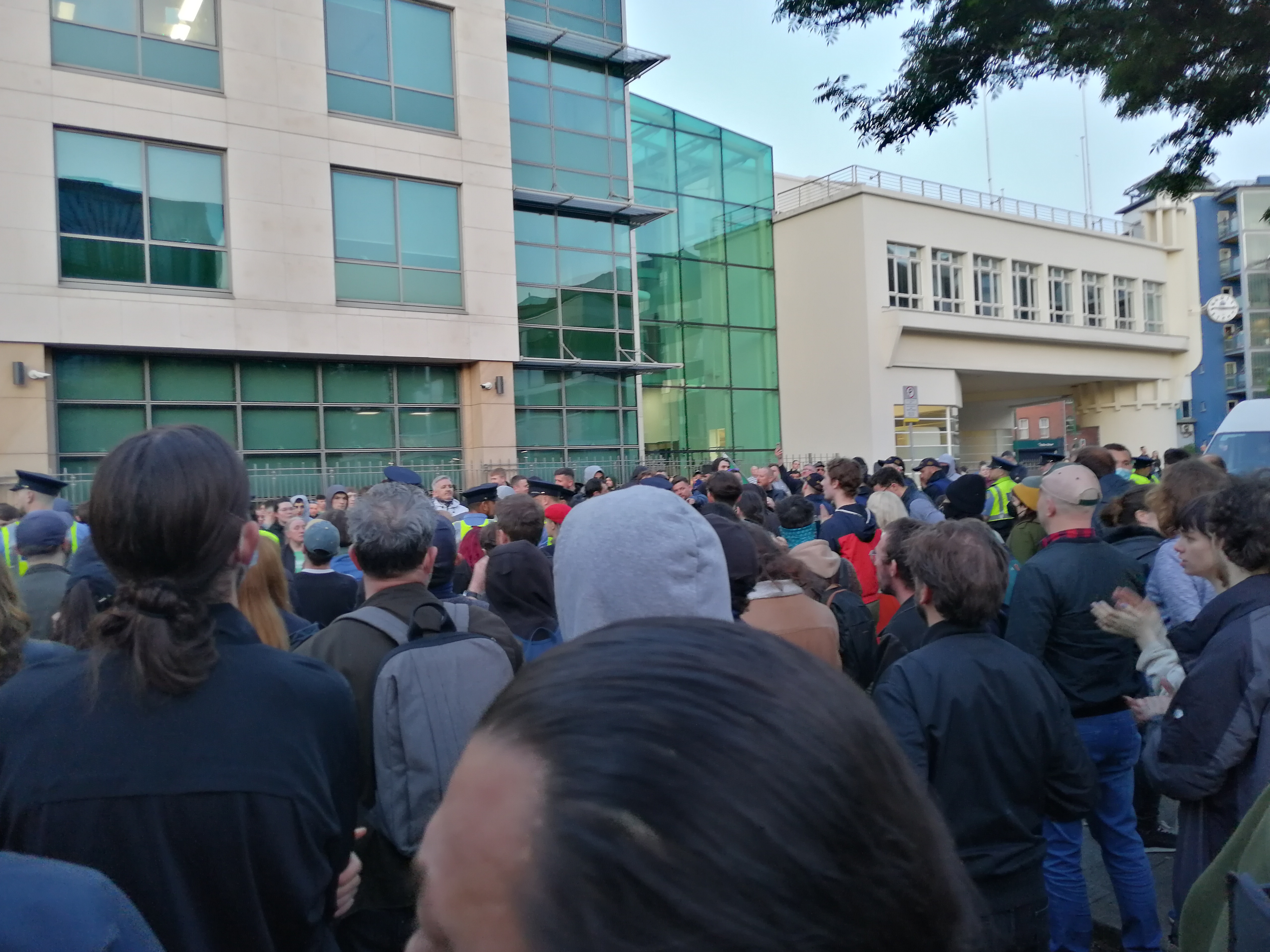
On Friday 12th Dwyer was back with a larger mob but met by a broad group of antifascists, including RHL, AIA, PBP, CATU, CYM, DCAR and independent antifascist activists2 (AIA statement onTwitter, Saturday 13 May). Dublin Republicans Against Fascism were there too.
Section of antifascists in the foreground on Friday, police in the middle distance and fascists and the curious beyond. (Photo: Rebel Breeze)
The violence against persons was now turned on the pitiful shelters and belongings which, on Friday night were set on fire.
On Saturday 13th, the fascist Irish Freedom Party held their rally on Custom House Quay against hate speech legislation being considered by the Government. From there they marched, not against the Government but against the homeless refugees.
According to local sources, the fascists distributed leaflets asking people to be electoral candidates and promising to help the inexperienced.
What was the connection between a protest allegedly about ‘free speech’ and a march on homeless refugees? Absolutely none, except the standard fascist agenda of targeting minorities to divide the working people and scream about free speech while using violence against their targets.
But in a cunning move, the NP who have never helped any area, were there afterwards cleaning up the area and placing flowerpots there.
Meanwhile, on Thursday night, the Revolutionary Housing League stated that they had opened one of the many empty buildings in Dublin to house the targeted refugees. The RHL have been opening up empty buildings for over a year now and encouraging others to do so.
Subsequently, Leo Varadkar, of the very Government that set up the conditions for this to happen, declared how unacceptable the attack on the refugees was. And following strong criticism from the Refugee Council, the State suddenly found it could house most of the refugees.
If true, hopefully good for those refugees but the fascists will now bleat about how “foreigners are getting treated better than the Irish” to the gullible and, also among themselves, be commenting that violence brings results.
The fascists have been stirring up local community fears with allegations that some of the refugees are paedophiles on the run from justice in their own countries, for which there is not a shred of evidence.
Ironically, while they attacked LGBT people as “paedophiles” some of the far-right have for decades been defending the Catholic Church hierarchy in Ireland from criticism and accusations of abuse of children and women in their institutions.
Lies spill from fascist lips as a matter of course: “immigrants are rapists and paedophiles, LGBT people are paedophiles, migrants are rapists, migrants are being treated better than the natives, the whites are being replaced by people of colour, muslims are taking over”, etc, etc.
THE GARDAÍ AND THE FASCISTS
The Gardaí, including the Public Order Unit, stood between the antifascists and the fascist-led mob on Friday, then kettled the antifascists for awhile, then followed the antifascist contingent up Pearse Street with fascists tailing along. When the antifascists dispersed, some of them were attacked.
The Irish Times on Monday 15th reported on a complaint from the Garda Representative Association that they are unable to police these events, don’t know about refugees, need training, etc.3
What is there to know? Refugees are as entitled as anyone else to be kept free from violence and the Gardaí could have arrested a number of fascists, had they wanted to, under the Public Order Act, which they regularly use against left-wing protests.
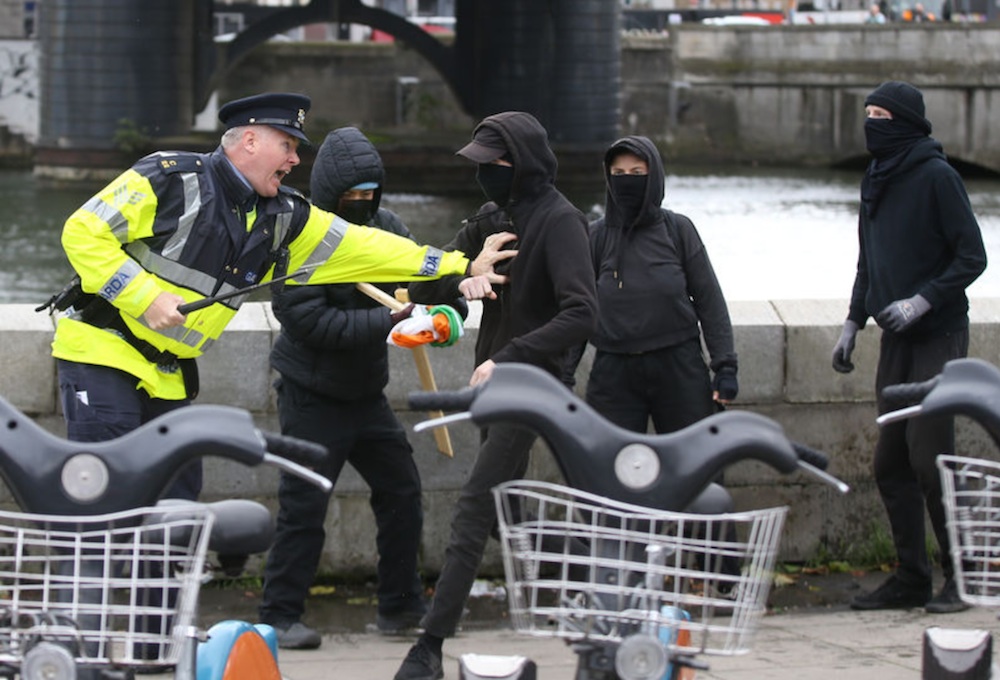
In September 2020, when unarmed antifascists went to counter-protest a Yellow Vest4 rally against masking5 and were attacked by masked (!) thugs recruited by the National Party with wooden and metal clubs, the POU understood enough to draw batons and attack – the antifascists!
Scene on Butt Bridge in September 2020 after armed fascists had attacked the unarmed counter-protesters at Custom House Quay and then the Public Order Unit had attacked them also, pushing them back off the Quay with raised batons, threatening to strike. (Photo: Dublin Republicans Against Fascism)
The following week, the Gardaí allowed NP fascists in Kildare Street to jostle and threaten a handful of LGBT campaigners and to club one of them to the ground. The Gardaí then ordered the woman, blood streaming from her head, to leave.
On both occasions the Garda press office issued statements saying that there had been no serious incidents. But the videos of the woman being assaulted and then ordered away went wide on social media and within a few hours, the Gardaí had changed their story.
In September 2020, longtime fascist and member of the National Party Michael Quinn (left, carrying wooden club disguised as Irish Tricolour flag) attacked veteran LGBT campaigner Izzy Kamikaze while she observed fascists in Kildare Street. The Gardaí forced Izzy to leave and later told the media nothing of any note had occurred, later having to change their press statement after the circulation of video footage. Quinn was later convicted of the attack and jailed for two years. (Images sourced: Internet).
However, it was ‘up to the victim’ whether she made a complaint (for an armed attack in a public place seen on video?)! She did, and eventually the particular assailant, Michael Quinn of the NP, was jailed for two years.6 But for Gardaí collusion with fascists and lying to the press? Nothing.
WHAT NOW?
Given the wars instigated by US/NATO and EU around the world and deprivation by foreign exploitation of people’s natural resources, refugees and other migrants will continue coming to Europe, including Ireland.
The fascists will continue to target minorities and wave their fake patriotism and social concern while they recruit for their parties, diverting attention from the housing profiteers and the facilitating ruling class while they strive to drive wedges into the working people.
The local working class residents, for example in the block of flats overseeing the site of the conflict, will gain nothing except an undeserved bad reputation for what happened in their area and in which perhaps a few teenagers were opportunistically involved.
Already the recently-completed block of apartments just down the road from them is advertising one-bed apartments for 2,000 euro a month and two-beds for 3,000. None of the local working people of course will be renting those.
The cause of the housing crisis in Dublin will continue: property speculators, vulture funds and multi-unit landlords will continue to rake in profits because the Government won’t build housing for affordable rent in case it should compete with them.
Unless, that is, a real hard struggle including militant occupations and defiance of court orders is taken to them forcing a change, be it reform or revolution. This is a task for the Left which of course can never be carried out by fascists.
But hopefully many anti-fascists have learned or had reaffirmed the need for unity in a broad front against fascism and that confrontation and preparedness for physical defence against fascists is needed, while also discussing the most appropriate tactics for different situations.
A deadly disease has struck some people in Ireland, affecting tendons in the legs, control of the tongue and causing partial amnesia. By a strange twist, some of those affected are attracted to the very site of the first outbreak of the disease.
The effect on the tendons in the legs of those affected is dramatic: they can no longer stand up straight and find themselves bending a knee or even collapsing on to both knees, the tongue protruding in bizarre licking motion.
Less visible but in many ways more striking is the amnesia effect. Those affected lose memories of parts of what they learned in school or what they themselves thought and said in the past – even in recent years.
According to Dr. P O’Neill of the Institute of Research and Adjustment, a new symptom was observed recently: “Affected people spent four hours staring vacantly at a film of some anachronistic ritual”.
Dr. T.W.Tone, who has been studying similar outbreaks in the past observed on the affinity of the disease for people of higher social classes: “No-one is guaranteed immunity but it does seem that the lower the social class, the less likely the person is to contract this disease.”
Commenting on the low recovery rate of those who contract the disease, Dr. J.Connolly pointed to the crucial importance of prevention, for which community programs of education can be very effective. “We rely especially on Volunteers,” he said, “men and women who are dedicated to preventing the spread of this disease.”
Revolutionary greetings on the First of May! It is International Workers’ Day, for recalling of the struggles of working people down the centuries past and of resolution to carry the struggle forward until we succeed in building and defending a socialist society.
On that Mayday too we are aware that in some parts of the world, those wishing to mark the date in public will be subject to intimidation or worse: arrest, baton charge or being fired upon. Possibly even trial and death sentence.
HISTORY OF MAYDAY
The day dates from an incident in Chicago 1886, USA, when trade unions and socialist groups of various kinds organised a campaign in many cities of the USA to exchange the common 10-hour1 working day for the 8-hour day. May 1st was set for the start of the campaign
On May 3rd in Chicago, a city central to the campaign for an eight-hour working day, a demonstration as part of the campaign took place outside the McCormick Harvesting Machine company. The police opened fire on striking workers, killing one of them and injuring many.
The anarchists and anarcho-syndicalists organised a demonstration for May 4th to protest the killing of workers. When the police advanced on the peaceful crowd ordering dispersal, a bomb was thrown at them and police opened fire on the crowd, some of whom returned fire.
Some of the police are believed to have shot some of their colleagues by mistake.
Sixty police were injured and one killed; the police chief gave his opinion that more than that number of demonstrators were injured. The media was mostly hostile and many demonstrators wounded would have feared to attend hospital for fear of arrest or worse by police.
Contemporary engraving of the seven originally sentenced to death (Image: Wikipedia)
Subsequently, amidst a wave of police repression, including raids on union halls and people’s homes, eight Anarchists were framed, charged with conspiracy to murder and convicted. One of them was sentenced to 15 years in jail.
The sentences of Schwab and Fielden were commuted to life imprisonment. Linng took his own life in jail but August Spies, Albert R. Parsons, Adolph Fischer and George Engel were hanged by the Chicago State authorities.
Artist’s impression of the hanging of the four (Image: Wikipedia)
In 1889 the (Second) International Workingmen’s Association, a federation of trade unions and socialist organisations, agreed that in memory of that struggle and its martyrs, the First of May should be marked by all socialists around the world as International Workers’ Day.2
The site of the incident was designated a Chicago landmark in 1992 and a sculpture made in 1893 was dedicated there in 2004. In addition, the Haymarket Martyrs’ Monument was designated a National Historic Landmark in 1997 at the defendants’ burial site in Forest Park.
THE FIRST OF MAY BEFORE THAT
In European agricultural society the First of May was celebrated firstly as a pagan festival and later as an allegedly secular one or named for a Christian saint. It celebrated the coming of summer, of growing of crops and of livestock.
Industrial workers originated in agricultural societies or, in the case of early miners, were located near to such. It was natural that they should participate in such festivals and also even generations later create their own around a similar calendar.
European settlers in the USA, many of them from agricultural societies3, brought those traditions with them. That was probably one of the reasons for the date of the Chicago demonstration, although certainly there had been others on other dates.
MAYDAY IN IRELAND
My father took me as a child on my first Mayday march in Dublin. He was an active member of the NUJ and some members of his union and of others participated in a small march through the city centre led by a brass band.
Returning to Ireland in 2003 after decades working in England and marching there on May 1st, I was disappointed by the very small size of Mayday demonstrations in Dublin, though I participated in some and on at least one occasion as part of a Basque contingent.
The oppositional movement to the status quo in Ireland, because of our history of anti-colonial struggle, is dominated by Irish Republicanism. And though all of that movement’s parts would claim to be socialist too, the First of May is not of great importance in their annual calendar.
This is unfortunate because the mass of Irish workers who are not members of the Republican movement need leadership for their class and also, as it happens, most Irish Republicans are workers. And practically all immigrants are workers too.
While fighting for an independent Ireland, do we as workers want to exchange one group of exploiters for another? And is a struggle for an independent Ireland even remotely winnable without enlisting the working class fighting as a class in its own class interests?
James Connolly thought not and our history since his day has certainly attested to the correctness of his view.
NATIONAL HOLIDAY?
On 1st of May for years I took the day off work – unpaid, of course and went into the centre of London, the city in which I was living and working. My destination was usually Hyde Park Corner and if I was then in an organisation I met up others and if not, just joined in as an individual.
Thousands of people met there to rally and perhaps to march and I was aware that around the world not just thousands, or hundreds of thousands but millions were marking that day also. As a day to recall struggles in their own particular countries and in solidarity with others around the world.
Generally the various organisations and tendencies marched with those of their own affiliation but in the same demonstration, with the exception of the Workers’ Revolutionary Party, which on at least one occasion marched in as everyone was leaving.
The WRP was an extremely internally dictatorial and externally politically sectarian trotskyist organisation that at one time up to the mid 1980s was probably the largest socialist organisation,4 certainly outside the ranks of the Communist Party of Great Britain.
The latter organisation, with the support of some other socialists, many of them left social-democrats, began to push for Mayday to become a national holiday, an objective they achieved in 19785 (followed by the Irish State 15 years later)6.
So now I could go to the demonstrations and not lose pay. Great, right?
No, not really. For a start, the holiday was no longer on May 1st but instead on the nearest Monday to the date. More importantly, people tended to treat it as a holiday rather than a day of international workers’ solidarity. Of course people are entitled to holidays but the essence of the day was gone.
And rather than being larger, the demonstrations grew smaller.
Sculpture made in 1893 known as The Haymarket Martyrs’ Monument (Photo: Wikipedia)
A DAY TO RECALL AND AVOW WORKERS’ STRUGGLE
This is not a day for class collaborationists, politicians or union leaders who try to undermine the struggles, water down demands and act as the ruling class’ police on union activists. It is a date for those at minimum in support of militant resistance.
The essence of the day is what we need to keep. A day upholding our struggle, that of the working class against its exploiters, native and foreign. A day remembering our long history of struggle, of victories and defeats, of sacrifices and why the colour of the workers’ flag is red.
It is a day to remember our internationalist duty of solidarity, not as charity or altruism but as partners in struggle across the world, as on a picket line or demonstration we would shield the person beside us and strike out at the company goon, fascist or policeman attacking us.
And rightfully expect the same from those next to us as we ourselves are the subject of assault.
End.
Current mural in Portugal
Footnotes
1That was for a six-day week and 14-hour days were not unknown and in rural areas, even a seven-day week.
2Five years later, U.S. Pres. Grover Cleveland, uneasy with the socialist origins of Workers’ Day, signed legislation to make Labor Day—already held in some states on the first Monday of September—the official U.S. holiday in honour of workers. Canada followed suit not long afterward.
3That would certainly have included most Irish, Italians, Sicilians and East Europeans in the 19th and early 20th Centuries.
4The WRP was the result of a split in socialist organisations and by the mid-1980s was disintegrating in many smaller organisations. It exists still in name but as shade or sliver of its earlier form.
5May Day became an official public holiday all across the UK in 1978 with provisions for it being made in the Banking and Financial Dealings Act. Prior to that time it had been a holiday only in Scotland. The May Day Bank Holiday was instituted by Michael Foot, then the Labour Employment Secretary to coincide with International Labour Day.
6In the Irish State, the first Monday of May became a public holiday following the Public Holiday Regulations 1993 Act. The holiday was first observed in 1994.
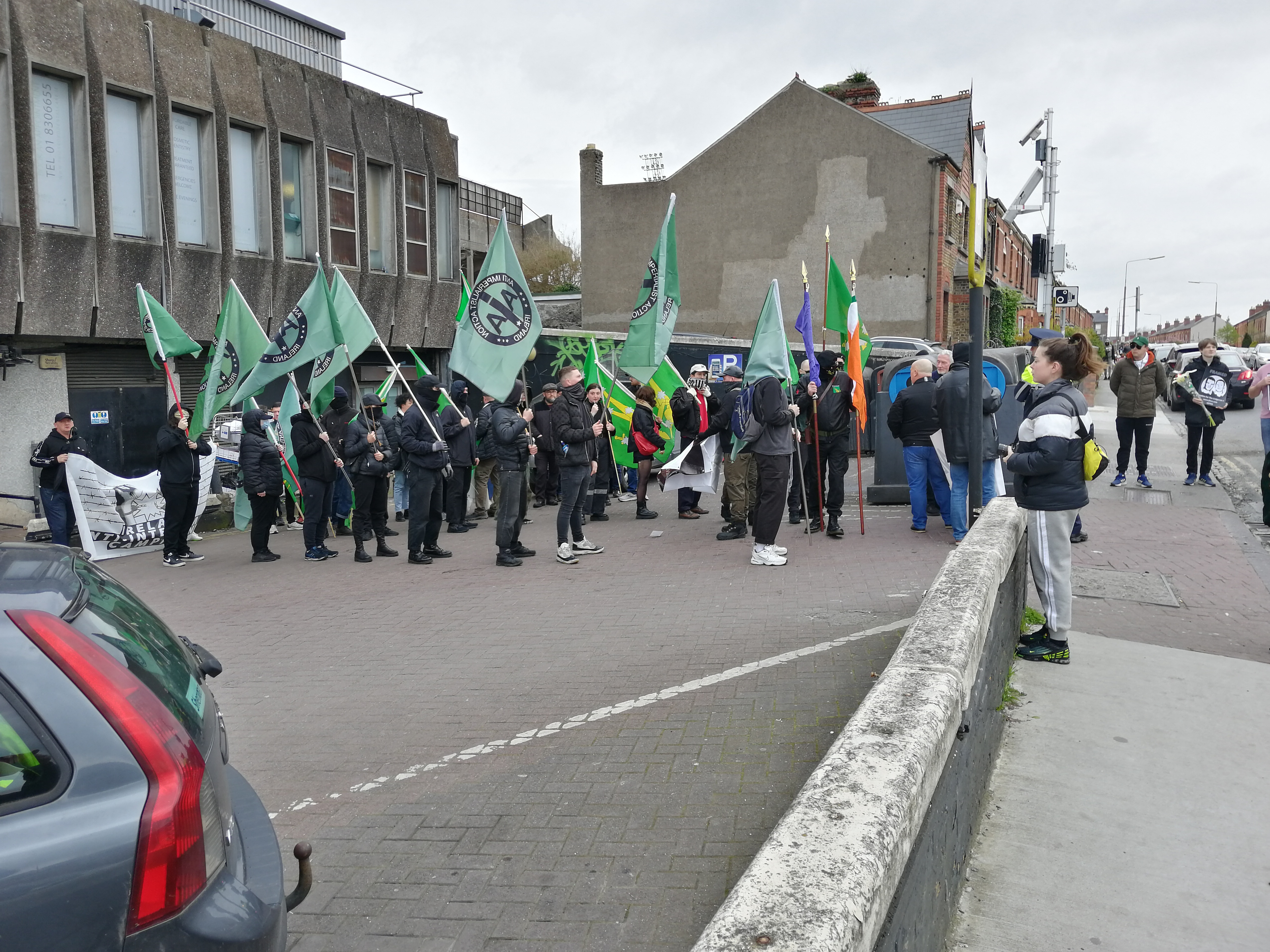
On Sunday participants in a 1916 Rising Commemoration organised by the Irish organisation Anti-Imperialist Action were harassed by police as they gathered to march to the Irish Citizen Army Republican plot in Glasnevin Cemetery.
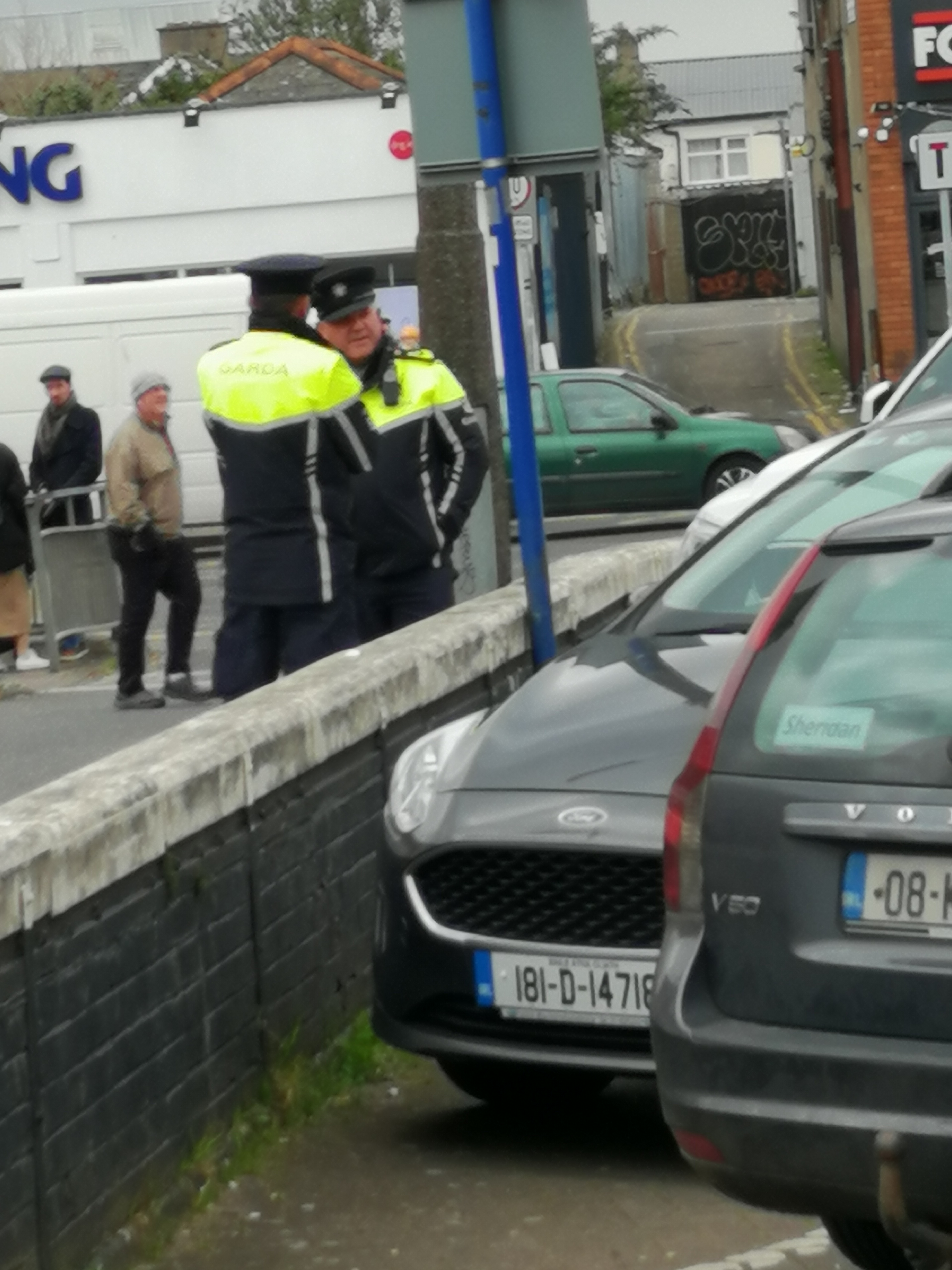
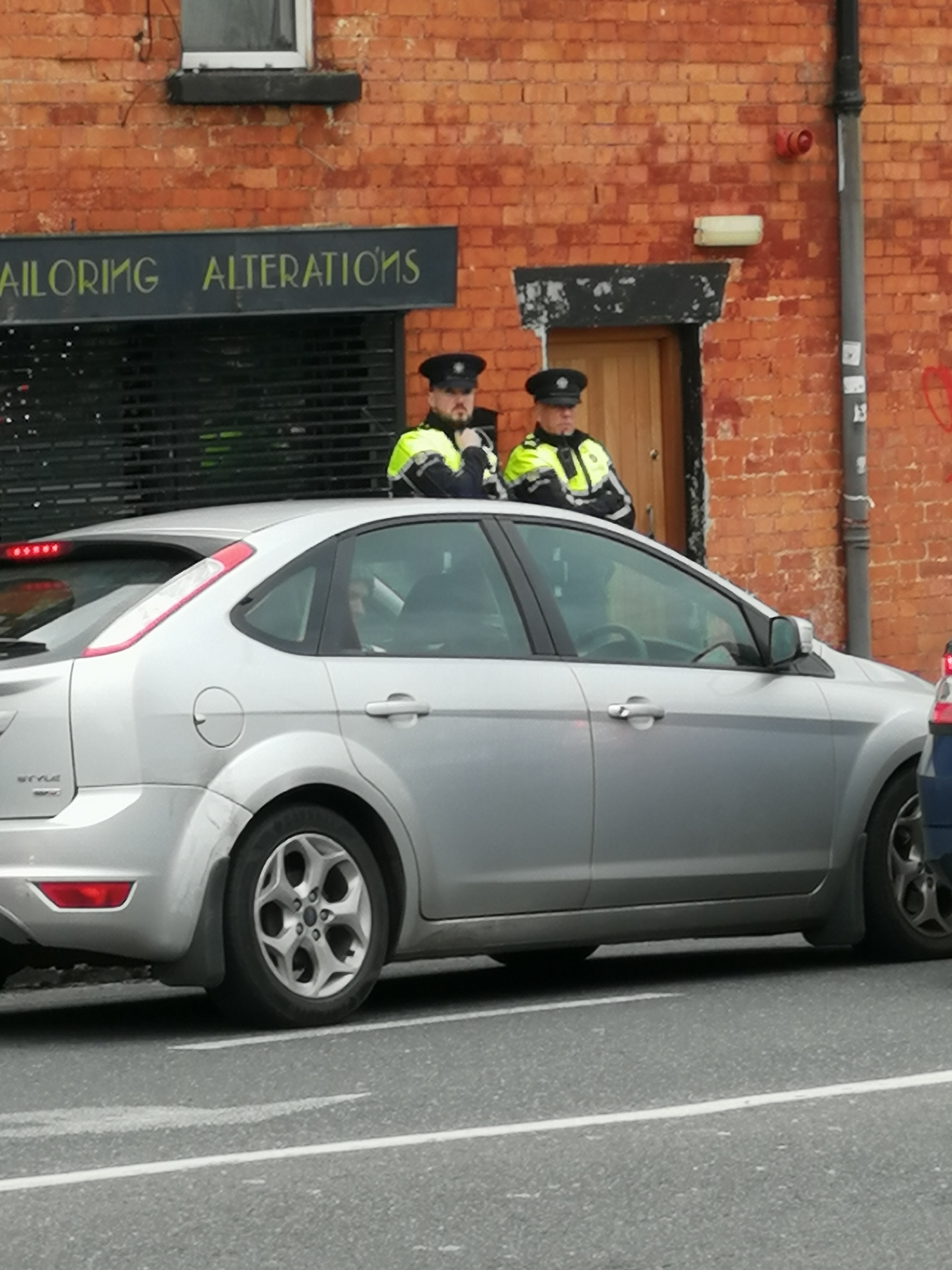
Six political police in plain clothes walked among those gathered beside Phibsborough shops demanding names and addresses of the participants, most of whom were fairly young. Four uniformed Gardaí also stood nearby and a Public Order Unit van parked at the cemetery entrance.
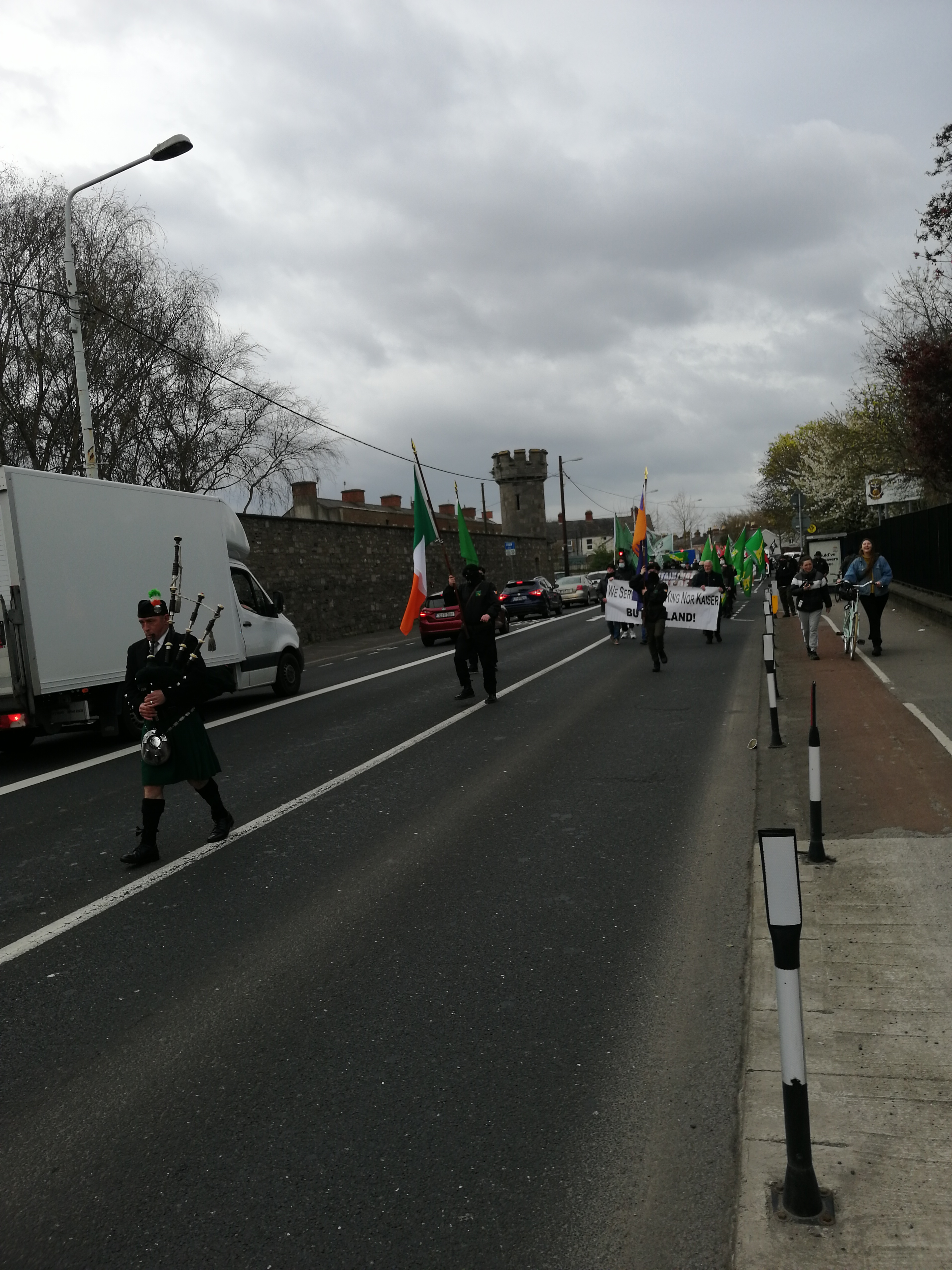
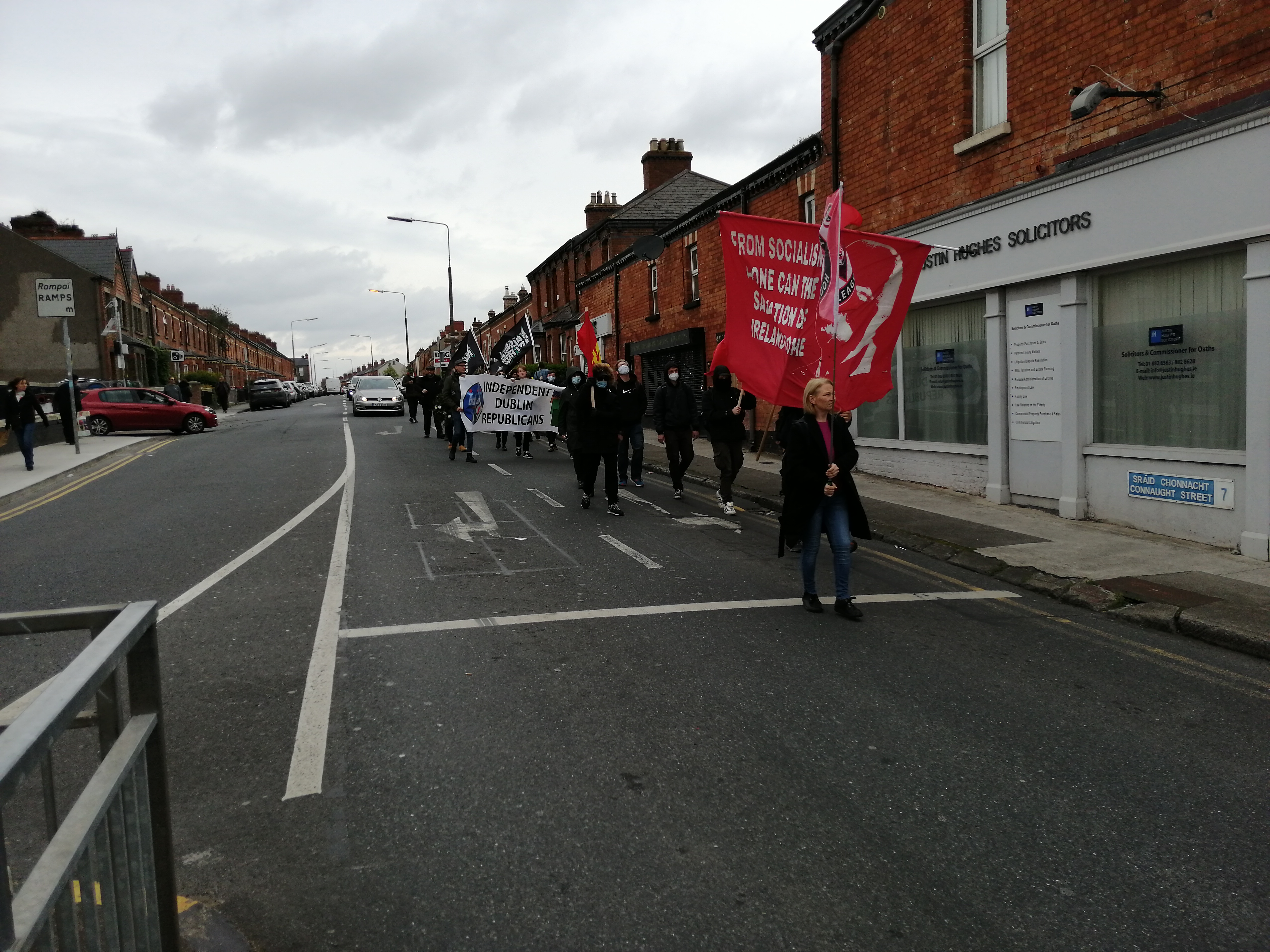
The participants declined to be intimidated and set off on their march, led by a lone piper playing Irish marching airs, followed by a colour party with different banners interspersed among the marchers, among which fluttered many flags.
Organisers had learned that the coach carrying members of the Republican Flute Band from Scotland that was to lead the parade had been prevented by police there from taking the ferry to Ireland.
Centre photo: Four of the six plainclothes political police violating the civil rights of the peaceful people commemorating the Easter Rising. (Photo: D.Breatnach)Centre photo, another two plainclothes political police. The bald man joked while he harassed people. (Photo: D.Breatnach) (Photo: D.Breatnach)
Historical background
In 1916 a broad alliance the Irish Volunteers, Irish Citizen Army, Cumann na mBan, na Fianna Éireann and Hibernian Rifles1 took part in a Rising organised by the Irish Republican Brotherhood against British rule in Ireland and against world war.
Due to a number of unfortunate circumstances, the leader of the Volunteers cancelled the Rising which however went ahead a day later than planned and was for the most part confined to Dublin, where a third of the numbers in the original plan took part and fought for a week.
The occupying British Army shelled the city centre from a gunship in the river Liffey and also from artillery on land. Explosions and resulting fires destroyed much of the city centre including the General Post Office in the main street, which had been the headquarters of the insurrection.2
After a week with the city centre including the GPO in flames, the rebel garrison evacuated to Moore Street where the following day, surrounded and vastly outnumbered, the decision was taken to surrender.3 A British military court passed death sentences on nearly a hundred prisoners.
All but fifteen of those sentences were commuted to long jail periods but the seven Signatories of the 1916 Proclamation4 and another seven were shot by British firing squad in Dublin, a fifteenth in Cork and after trial months later a sixteenth was hanged in Pentonville Jail, London.
At Easter 1917 Irish Republican and Socialist women commemorated the 1916 Rising; ever since then Irish Republicans and sometimes Socialists in Ireland and in many parts of the diaspora have commemorated the Rising, whether legally5 or otherwise, in jail or at liberty.
The War of Independence began in 1919 with many of the Rising’s survivors participating6.
(Photo: D.Breatnach)
(Photo: D.Breatnach)
(Photo: D.Breatnach)
The Parade on Sunday – local and national historical memory marked
At Cross Guns Bridge over the Royal Canal the parade halted and flares were lit in memory of events there in 1916.
Marching along the Cabra Road, the wall and a watchtower of the north side of Glasnevin Cemetery on the left of photo. (Photo: D.Breatnach)
On Easter Monday 1916 a small group of Irish Volunteers had marched from Maynooth along the canal bank to join the Rising in Dublin and found guarding the bridge two Irish Volunteers who advised them to wait until the following day to go into the city centre.
The Maynooth group spent the night in Glasnevin and the following day marched into the GPO, passing an empty Cross Guns Bridge on the way. Back towards Phibsborough, British artillery had blown a barricade and killed Seán Healy, a Fianna member at the Nth. Circular Road crossroads.
Later, the Dublin Fusiliers unit of the British Army blockaded the bridge, preventing people from crossing it in either direction. They shot dead a deaf local man who failed to heed their challenge because he did not hear it.
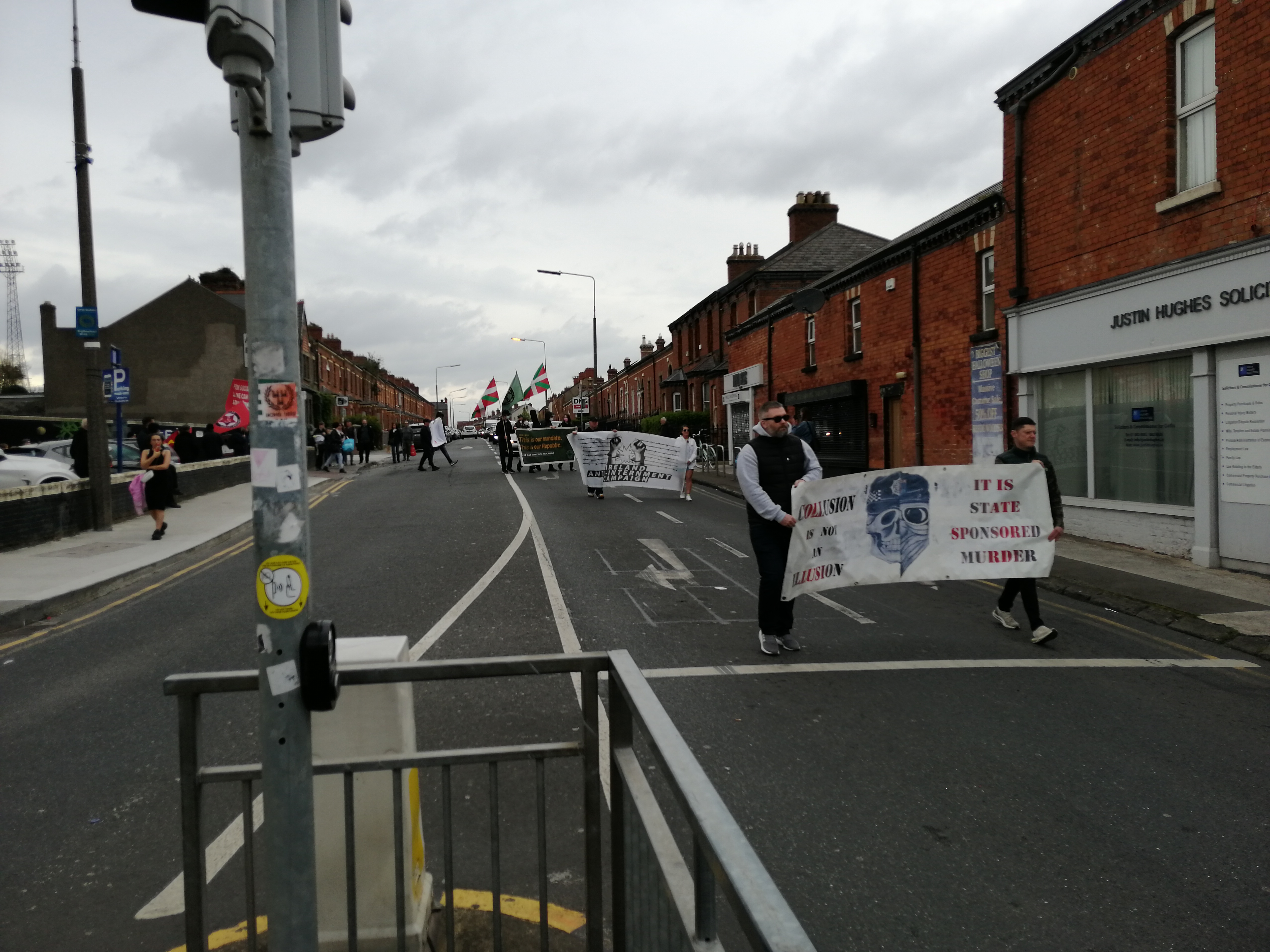
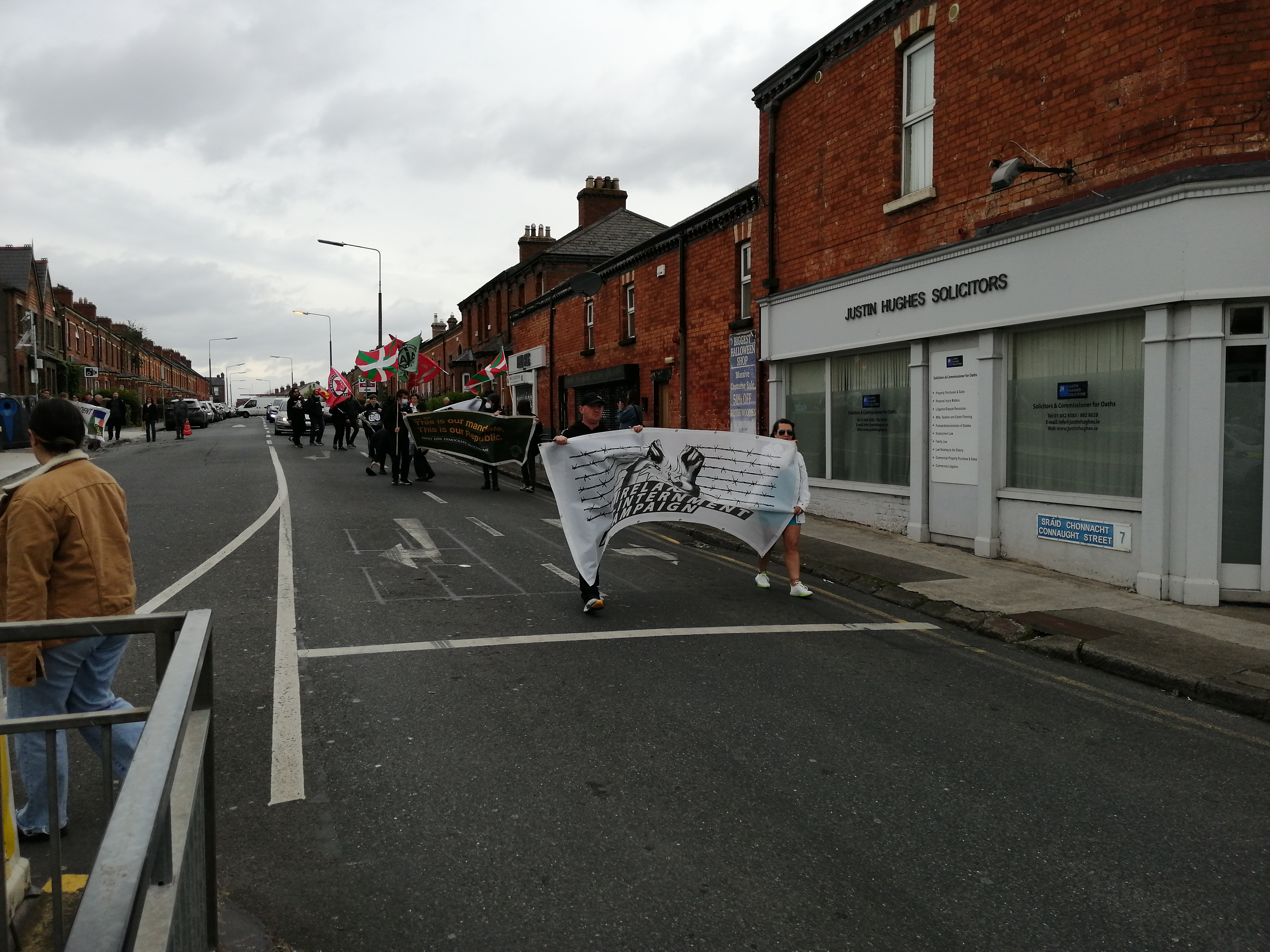
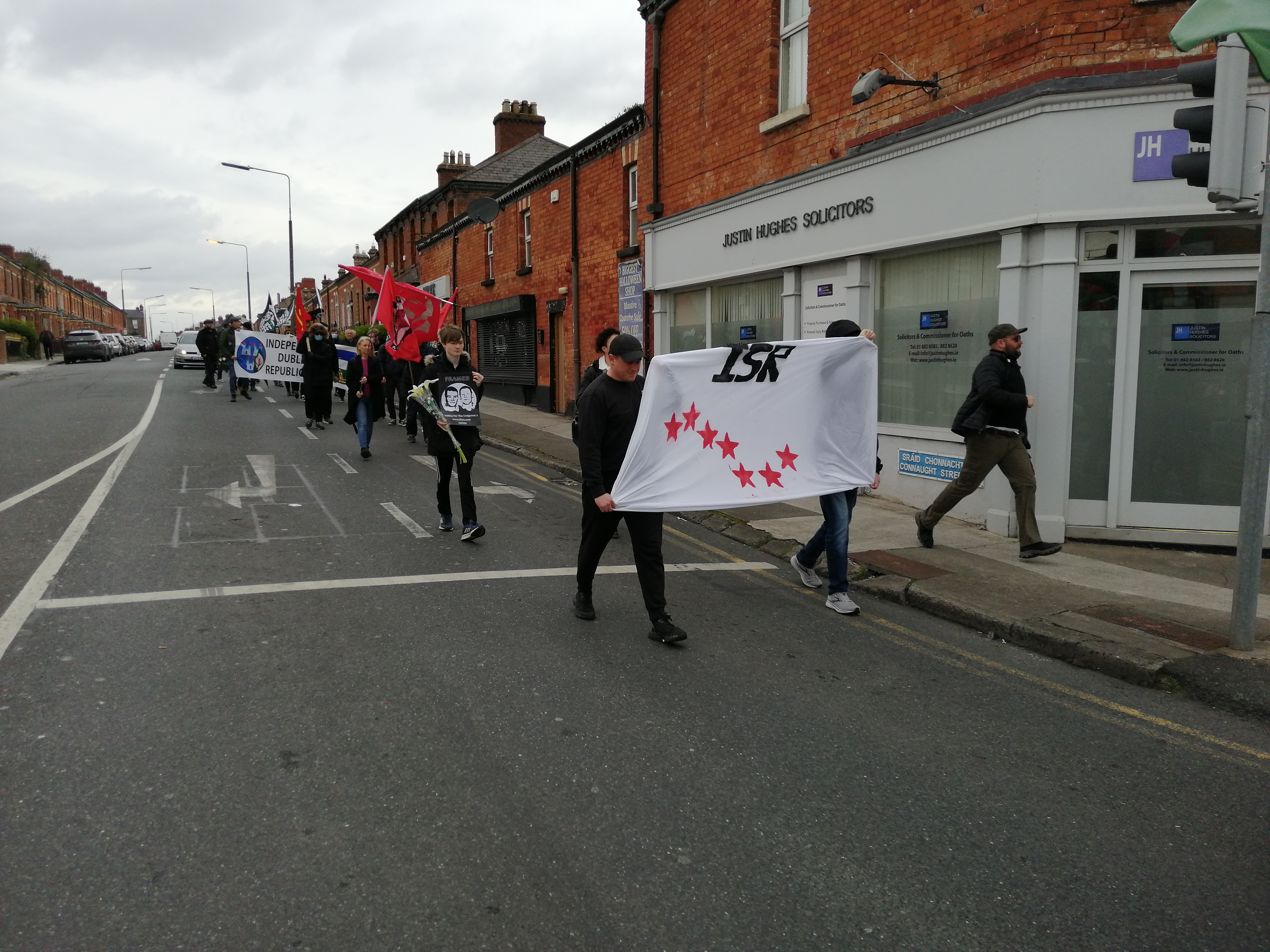
We Serve Neither King nor Kaiser but Ireland declared one banner carried last Sunday, Britain/NATO Out of Ireland another, This Is Our Mandate7, Our Republic and Collusion Is No Illusion, It Is State-Sponsored Murder were another two.
A large banner also declared alongside the image of James Connolly that Only Socialism Can Be the Solution for Ireland. Some organisations also carried their own banners, such as those of Dublin Independent Republicans, Ireland Anti-Internment Campaign and Irish Socialist Republicans.
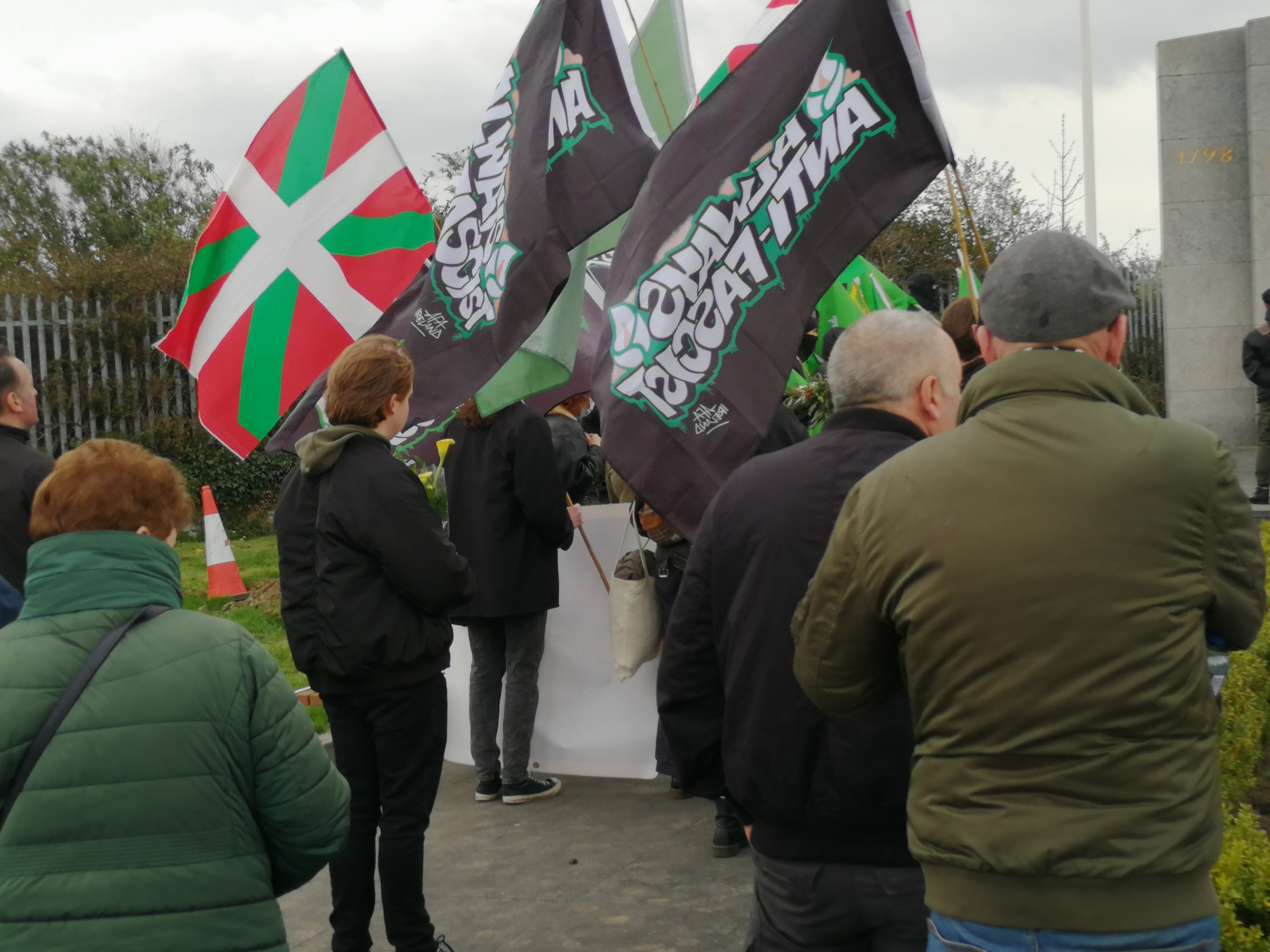
Flags fluttering included those bearing the logo of the organising group Anti-Imperialist Action and others bearing the slogan “Always Anti-Fascist”, green-and-gold Starry Ploughs, a couple of Ikurrinak (Basque flags) and another two of Red with Hammer & Sickle in yellow.
Basque and antifascist flags (Photo: D.Breatnach)
At the Monument: speeches and songs
At the monument (Photo: D.Breatnach)
Glasnevin Cemetery (ReiligGhlas Naíonn) covers over 120 acres in North Dublin city and is in two parts, each with Republican Plots separated by the Cabra Road and contains the graves of both famous and ordinary people.
On the north side there is also access to the Botanic Gardens, both on the south banks of the Tolka river. The imposing Monument to numerous Republican uprisings and the Irish Citizen Army Republican plot is on the south side, across the pedestrian bridge over the railway line.
(Photo: D.Breatnach)
A man chaired the event for Anti-Imperialist Action and spoke briefly, introducing people for readings (all of which were from James Connolly) and for orations. The presentations of these were evenly divided between men and women, three of those being of young people.
Three songs were sung: a woman sang The Foggy Dew (by Charles O’Neill) and Erin Go Bragh (by Peadar Kearney), while a man sang Patrick Galvin’s Where Is Our James Connolly? Two women read out pieces by James Connolly and another read out the 1916 Proclamation.
Person chairing the event (Photo: D.Breatnach)
The words of the chairperson and of those giving orations were different but there were common themes: upholding the historic Irish spirit of resistance, the importance of the working class in history and the objective of a socialist Republic encompassing the whole of the Irish nation.
These words were balanced by denunciation of US and British imperialism and the colonial/ NATO occupation of the Six Counties by the latter; the Irish client regime; the special no-jury courts8 of both administrations in Ireland and repression by police forces and occupation army.
One of the singers (Photo: D.Breatnach)
One of the readers (Photo: D.Breatnach)
One of the readers (Photo: D.Breatnach)
Also denounced were those political parties that had abandoned the struggle for the Republic and instead had become part of the colonial and neo-colonial administrations or, in the latter case, were on their way to becoming so.9
Floral tributes were laid by representatives of a number of announced organisations and then others came forward to lay floral tributes also. The colour party lowered flags for a minute’s silence in homage and salute before slowly raising them again and the piper played Amhrán na bhFiann.
The other singer Lowering of the colour party flags in homage to the fallen in the struggle (Photo: D.Breatnach)Colour party raises flags again in symbolism of the struggle continuing (Photo: D.Breatnach)
The chairperson thanked all for attendance, listing organisations by name and cautioning all to stay close together as they left, due to the threatening presence of Gardaí and in particular the Public Order Unit. In the event, the celebrants exited the cemetery and dispersed without incident.
1A small unit, an armed wing of a split from the more socially conservative USA version of the Ancient Order of Hibernians, their participation in the Rising was notable.
2Photos of much of the destruction are available on the Internet and accessible by search browser.
3The terrace they occupied still stands and is the object of a historical memory and conservation struggle against property speculator plans approved by the municipal city managers and Government political parties (see smsfd.ie).
4A remarkable document, the text of which is available from many postings on the Internet.
5Irish women commemorated it in public in contravention of British WWI martial legislation in 1917 and 1918 and for decades the public commemoration of the 1916 Rising (and even the flying of the Irish Tricolour) was forbidden in the British colony of the Six Counties with attendant colonial police attacks on any attempt to do so.
6Sometimes inaccurately called “the Tan War” (reference to a special colonial police auxiliary force that became known as the “Black n’ Tans”), the war saw the birth of the IRA and lasted from 1919-1921. A British “peace” proposal opened deep divisions in the nationalist coalition and was followed by a Civil War 1922-1923, in which the pro-Treaty government and armed forces were armed and supplied by the British to defeat the Republicans in a campaign of repression and jailing, military actions, kidnapping and torture, murder of prisoners, assassinations and over 80 formal executions.
7Also displaying text referring to the First Dáil’s Democratic Program of 1919.
8The Diplock court in the colony and the Special Criminal Courts in the Irish State, political special courts in all but name, with low proof bar and abnormally high conviction rate and refusal of bail while awaiting trial.
9References to 1) the 1930s split from the Sinn Féin party, the Fianna Fáil political party that became a preferred Government party of the foreign-dependent Irish ruling bourgeoisie and 2) to the Provisional Sinn Féin party who endorsed the British pacification plan in 1998 and embarked on the road to becoming a party of reformist nationalism in the colony and is heading for neo-colonial (and neo liberal capitalist) coalition government at the moment.