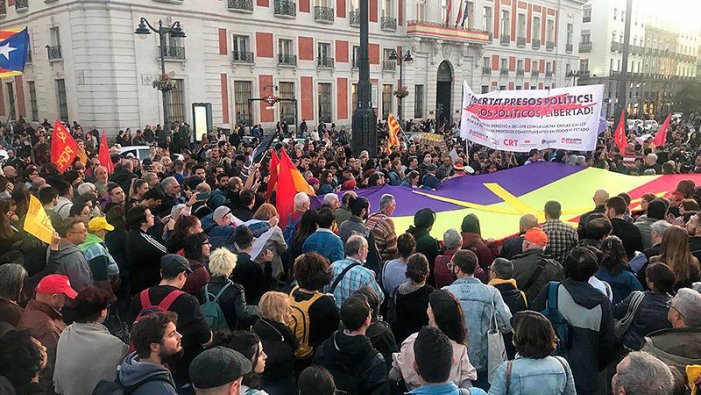
IS THE BASQUE SLEEPING GIANT AWAKENING?

Diarmuid Breatnach

(Reading time: 15 mins.)

The Basque pro-independence movement, the Abertzale Left, fought the Spanish State for over four decades. in 2012 its leadership renounced armed struggle without any reciprocal agreement with the Spanish State, declaring its faith in an imagined “Basque peace process”, sought alliances with social democratic and capitalist-nationalist parties and publicly apologised for its past actions of resistance. The movement sank into general inactivity except on the electoral front. But in recent weeks there have been signs of awakening, though under a different leadership – or is the giant merely muttering and twitching in its sleep?

Map of the Basque Country showing the provinces; the three to the north-east are inside the French state, while the other and larger four are in the Spanish state. (Image source: Internet)

THE GIANT

          How does the description “Giant” fit a resistance movement in a total population of less than three million people? A nation divided between the Spanish and French states? Part of the answer is precisely in those features, also in its history during the Spanish Civil / Anti-Fascist War and “French” Maquis and earlier. Also in its long struggle in defence of its native language Euskera, almost certainly the oldest in Europe and perhaps the first to reach it in neolithic times.

This is a movement that carried out general strikes against the Franco dictatorship, ensured that three of its provinces rejected the 1978 Constitution of the Spanish State which, in atmosphere of fear and murderous repression and with the collusion of the newly-legalised social-democratic (PSOE) and communist (CPE) political parties, was voted in by a majority in every other region of the Spanish State (population another 35 million people).

The serpent of wisdom and the axe of armed struggle, symbol of ETA.
(Image sourced: Internet)

Inspired by the examples of the Algerian independence struggle and socialist Cuba, the Abertzale Left movement rose from the defeat of the nation in the Spanish Civil/ Anti-Fascist War and the terrible repression under the fascist dictator General Franco and in 1959, formed the ETA (Land and Freedom) organisation. The youth wing of the conservative Basque Nationalist Party conceded the Left-inclination in order to join with them. Enduring arrests and torture of its supporters, it was not until 1968 that ETA took an armed action; halted at a police checkpoint and determined not to be arrested, Txabi Etxebarrieta shot a policeman dead and was in turn killed himself by pursuing police.

Mural honouring Txabi Etxebarrieta, first ETA martyr. (Image sourced: Internet)

The first planned armed action carried out was also that year when an ETA squad shot dead Meliton Manzanas, head of the political police in the Basque Country, a notorious torturer of prisoners and a Nazi sympathiser in the past.

A woman dressed in the Basque national colours dances the aurresku, ceremonial honour dance, in commemoration of ETA martyrs. Organising or participating in such an event could easily lead to torture and a prison sentence under the “anti-terrorism” laws of the Spanish State.
(Image sourced: Internet)

A number of other actions were taken by ETA over the years, some of them spectacular but, like many armed resistance groups, some also questionable in value or even in justification from a revolutionary point of view. But in December 1973 an ETA squad in Madrid assassinated Admiral Carrero Blanco, General Franco’s nominated successor, an action which many credited with hastening the progress of the Transition of the Spanish State to nominal democracy. General Franco died without a strong agreed political replacement almost exactly two years later, in December 1975 and the Transition process ran from then until 1978.

Admiral Carrero Blanco, Franco’s intended replacement, assassinated by ETA in Madrid in December 1973.
(Image sourced: Internet)

The struggle continued after the Transition, since the new Constitution declared any breakaway from the unity of the Spanish State a crime unless a majority in the Spanish Parliament voted in favour. The military and police repression in the Basque Country was huge. In the 1980s the social-democratic (PSOE) Spanish Government was exposed as heavily implicated in a number of terrorist groups operating against Basques through kidnapping, torture, gun and bomb attacks (see GAL) and eventually the Minister of the Interior and a number of high-ranking officers were given jail sentences.

In 1983 mass demonstrations and armed actions by ETA brought about the abandonment of the Spanish State’s nuclear reactor at the picturesque coastal spot at Lemoiz, followed by a new Spanish government declaring a moratorium on all building of nuclear reactors.
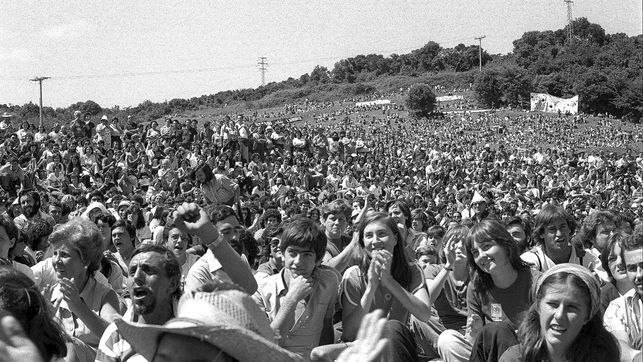
1975 mass demonstration against nuclear reactor being built by the Spanish State at Lemoiz.
(Image sourced: Internet)

Another aspect of the struggle was against compulsory military service, which the Spanish State only ended in 2002. People not only evaded it but also protested publicly against it.

Many people in the Spanish state opposed being part of NATO in the 1986 referendum but the Basque Country was highly represented in the vote against, around double the vote of those in favour and along with Catalonia being the only regions with a majority voting “no”.1

Photo taken of me by my guide on my camera above the abandoned nuclear site at scenic Lemoiz, possiblt 2016. Not many people can claim to have halted a nuclear reactor building program.

The ideology of the movement which found expression in ETA was national liberationist and socialist and this was reflected to a greater or lesser degree in all its parts, whether military or civilian. The Abertzale Left during the period organised itself into one political party after another after each in turn was banned by the Spanish State and forbidden to field candidates in elections.

Women industrial workers in Basque anti-fascist armaments factory, Spanish Civil/ Anti-Fascist War, 1936. (Image sourced: Internet)

But the movement had a huge social following too, in youth movements, punk and heavy metal bands, social-cultural centres, pirate radio stations and promoters of Euskera as a spoken language (all leaders of the Abertzale Left were required to be able to speak the language and all public meetings were addressed in Euskera and Spanish or even Euskera alone). There was even a popular Abertzale style of haircut and dress. The Abertzale Left also had a sizeable trade union, LAB which, along with ELA, a union founded by the Basque Nationalist party, recruited the majority of unionised Basque workers2. Feminist, LBGT, linguistic, eco-friendly, anti-animal cruelty sectors all contained many people broadly in support of the Abertzale Left or at least of its stated objectives.

The movement also had newspapers, radio stations and internet sites and many of these were closed down by the Spanish State, alleging that they were “collaborating with terrorism”. Currently the Spanish State is moving towards the closure of the movement’s social-cultural centres, the Herriko Tabernak (People’s Taverns). This arises from a judgement by the National Court in 2011, a judgement corresponding to an infamous statement by Baltazar Garcón, at the time a prominent Judge of that Court, that “Everything is ETA”. The closures are to be carried out now although ETA ceased armed activity permanently in 2012 and disbanded itself a little later.

Annual January prisoners’ solidarity march, Bilbao, 2016. (Image sourced: Internet)

Repression by the Spanish State has included executions and clandestine assassinations and led to relatively huge numbers of Basque political prisoners, not all by any means military fighters and conviction with “confessions” extracted through torture during the five-day incommunicado period ensured a problem-free conveyor belt for the Spanish State. That conveyor belt delivered its victims to jails dispersed all over the Spanish state, nearly every one hundreds of kilometres and sometimes over a thousand from the prisoners’ homes. The financial, physical and mental strains on friends and relatives, including elderly and children having to travel such distances to visit their loved ones are hard to imagine, often facing abuse or harassment on the way or at their destination, apart from serious accidents on motorways (including fatalities). Many pickets and demonstrations are held in the Basque Country throughout the year and each January a monster march clogs the streets of Bilbao.

The issue of the prisoners has always been a big one for the Abertzale Left and despite dispersal the prisoners built an organisation within the jails, responding to their situation in a disciplined manner.

SLEEPING

          During the first decade of this century it was clear that ETA was not doing well and the Abertzale Left in general was facing many more years of struggle against an unyielding state with repression everywhere and hundreds of political prisoners in jails.

The leadership was attracted to the much-advertised pacification/ peace processes of South Africa, Palestine and Ireland. By any estimation the Palestine process soon collapsed and its rejection by most of Palestinian society was clearly indicated first by the Intifada and secondly by the electoral gains of Hamas, pushing Al-Fatah into second place. To undiscerning eyes the Irish and South African3 processes seemed to be doing well and both the ANC and Sinn Féin lent strong support to the Abertzale Left’s imagined “peace process”. Despite that support and that of such prominent imperialist figures as Tony Blair and Kofi Annan, the Spanish ruling class was not interested in playing and eventually the Abertzale Left’s leadership was left with nowhere to go. However, they persisted in trying to build alliances with the majority Basque National Party and with smaller nationalist-social-democratic groups; they succeeded with the second sector but failed with the first and seem condemned to second-party status electorally in a Spanish colony, a nation divided by the French-Spanish border.

However, in their search for acceptance by the above-mentioned sectors, the Abertzale Left not only renounced armed struggle but apologised for past actions, ended street confrontations and called on the prisoners to negotiate their progress individually through prison system grades to eventual parole. Some of Abertzale Left public representatives even attended events commemorating Guardia Civil and Ertzaintza (Basque police) killed by ETA in the past.

EH Bildu Mayor of Errenteria participates in commemoration of a Guardia Civil killed by ETA.
(Image sourced: Internet)

When the struggle for independence broke out again recently in Catalonia with the 2017 Referendum and the Spanish State responded with a violent Guardia Civil invasion and jailing of politicians and social activists, the Abertzale Left leadership noticeably declined to open up a second front of struggle.

STIRRING

          There were early but sporadic signs that not all movement was happy with the Abertzale Left’s new path. Askapena, an organisation set up within the Abertzale Left to work on internationalist solidarity, which at one time could list affiliated groups in Ireland, Germany, Italy4, Paris, Brittany, Barcelona, Madrid, Switzerland, Denmark, Sweden and a number of Latin American countries, broke quietly with with the Abertzale Left over its change of policies5. Notably also, when four members of Askapena were accused of “assisting terrorism” in 2010, they refused to apologise for their work and fought the case, being eventually cleared of all charges in 2016.6

In addition, many Basques were critical of the process, feeling that even if they were prepared to go down the new road, it had been handled badly by the leadership.

A leading Marxist theoretician of the movement, Inaki Gil, resigned from the national leadership years ago, though not from the movement; however he may well be persona non-grata in it now due to a published interview in which he criticised the decision of the 47 on trial in September last year to apologise for past actions of the Basque liberation movement, even after 50,000 had marched through Bilbao streets in their support two days earlier.

When Arnaldo Otegi — generally seen as the architect of the new road for the Abertzale Left7 – was arrested with others in 2009 and, while on pre-trial detention began a hunger strike only to end it soon afterwards, it did not reflect well on him. While he beat a charge of “glorifying terrorism”, he was convicted in 2011 for allegedly reorganising Batasuna, banned political party of the Abertzale Left and sentenced to ten years, reduced on appeal to six and walked free in 2016. In the meantime a Free Otegi campaign (2015) attracted some notable foreign support (including Desmond Tutu) but was criticised in the Basque liberation movement for highlighting the case of one political prisoner above many others8 (including those who were serving much longer sentences).

Arnaldo Otegi, leader of the official Abertzale Left.
(Image sourced: Internet)

Some years ago a new Basque political prisoner solidarity organisation came into being, calling itself ATA (Amnistia Eta Askatasuna – Amnesty and Freedom9). They enjoyed a good showing at their first demonstration but came under public attack not only by the Abertzale Left leadership but by a number of ETA members on trial in France. They were accused of using the prisoners as a stalking horse when what they really wanted was to attack the new line of the movement’s leadership. Censorship and condemnation in the Abertzale Left’s daily newspaper GARA followed.
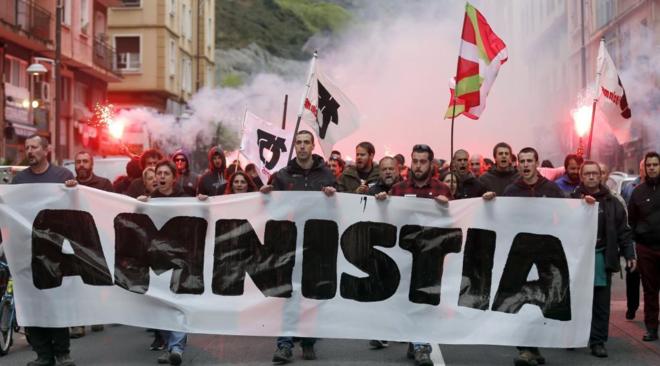
Amnistia Ta Askatasuna demonstration Bilbo 2016.
(Image sourced: Internet)

Although their public support waned for awhile, in 2018 a youth group of the Abertzale Left was expelled after they had publicly denounced their annual conference managers for refusing to put their position paper forward for discussion; this youth organisation now collaborates with ATA. Last year, a new Basque revolutionary group called Jarki was formed and drew a sizable crowd to their commemoration of the annual Gudari Eguna (Basque Soldier Day)10.

ATA demonstration Donosti/ San Sebastian, September 2019.
(Photo: D.Breatnach)

However the issue of development remained in doubt and no-one could predict with confidence that the movement would be rebuilt along revolutionary lines under a new leadership.

WAKING

          The week before last, Basque political prisoner Patxi Ruiz embarked upon a hunger and thirst strike and although he abandoned the thirst component after 11 days he continues on the hunger strike. He took this action in protest against harassment and beatings by the prison administration and jailers and highlighted the fact that prisoners

Patxi Ruiz, Basque political prisoner, now on hunger strike.
(Image sourced: Internet)

were being refused virus-protection clothing or testing and that the jailers were not being tested either. He also wanted visits from his family to be permitted and prisoners allowed to attend funerals of family members (he had been refused permission to attend his father’s funeral). More recently he has demanded that prisoners be relocated to jails near their homes, a long-standing demand of the movement and which is entirely in accordance with model rules for prisons in the EU and the UN. Despite the official leadership of the Abertzale Left firstly ignoring the situation and then condemning his supporters, Ruiz’s struggle galvanised the mostly dormant Abertzale movement.

Patxi Ruiz solidarity march, Durango, Basque Country.
(Photo source: Amnistia Garrasi FB page)

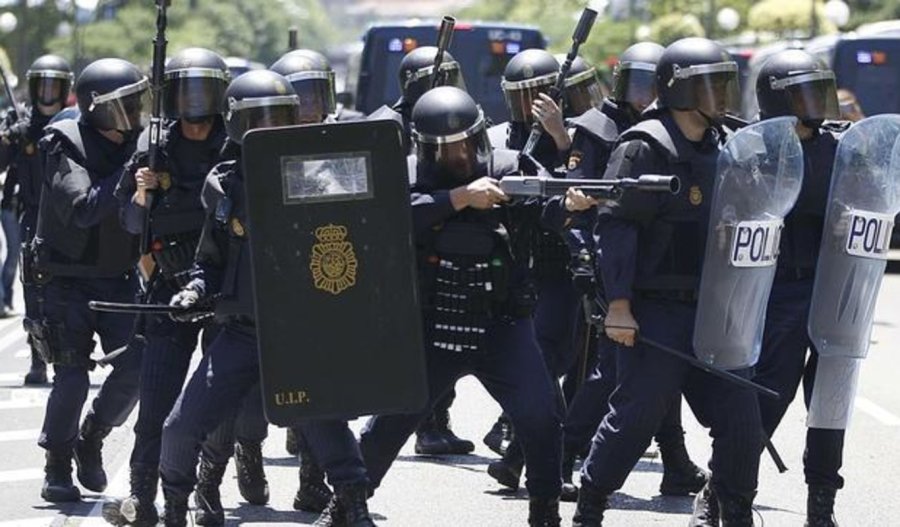
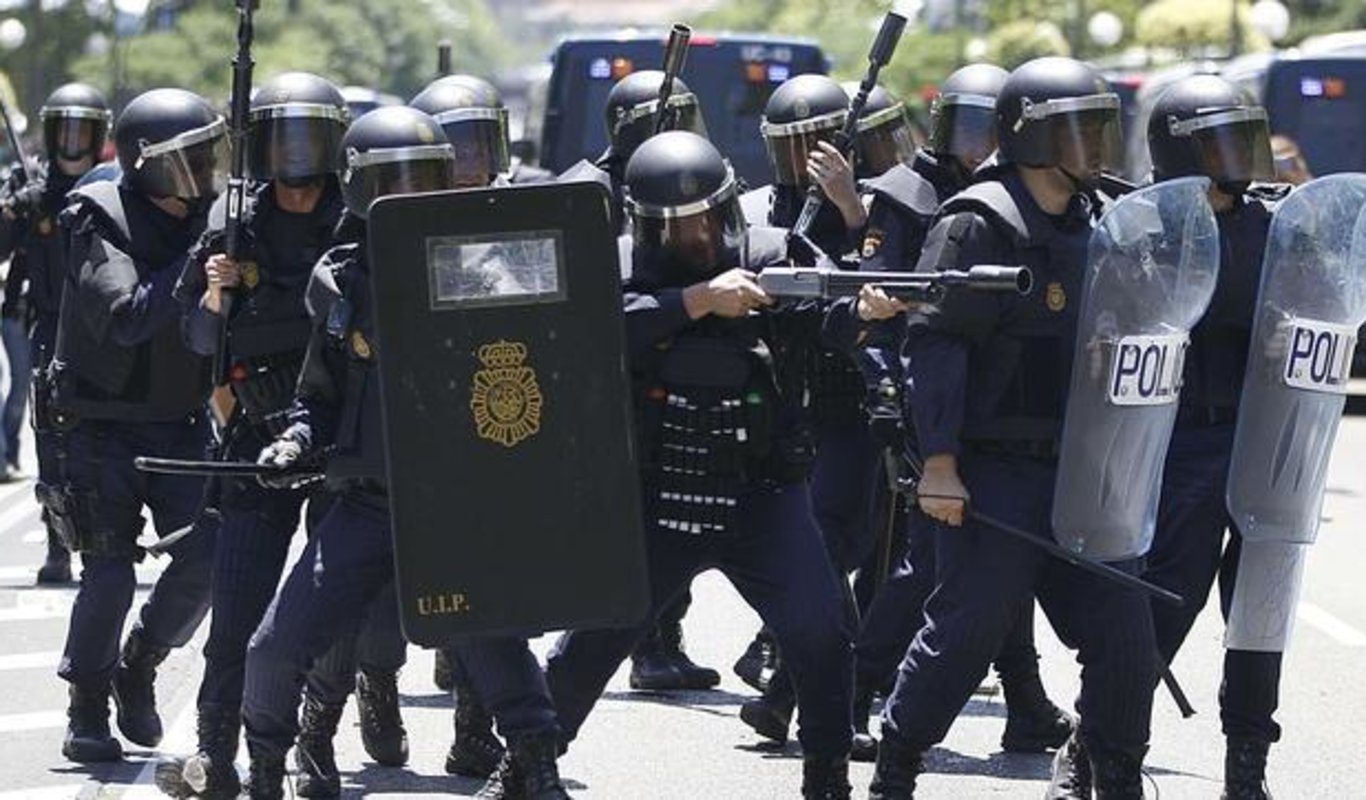
Every day has seen small actions across the Basque Country, including protest pickets on bridges, beaches, town squares etc; solidarity fasts; slogans painted … Large solidarity marches have been held in Irunea/ Pamplona (Nafarroa province), Donosti/ San Sebastian (Guipuzkoa), Baiona (Bayonne), Bilbao and Durango (Bizkaia). ATA’s web page is full of developing news and the facebook page, which had fallen into silence, is active again.  Last Sunday in Pamplona/ Irunea, police attacked demonstrators with batons and fired rubber bullets at close quarters.Patxi Ruiz solidarity demonstration 24 May 2020 attacked by police with batons and rubber bullets

Patxi Ruiz solidarity march in Bayonne, northern Basque Country.
(Image source: Internet)

Some of the Basque prisoners who are part of the “official list” have begun taking solidarity action, refusing food or to leave their cells for periods in Almería, Brevia-Ávila, Castelló I, Córdoba, Huelva, Murcia (where Patxi is), Puerto III, Rennes, Sevilla II, Topas-Salamanca …. refusal to leave one’s cell also means forgoing family phone calls. Patxi had been expelled from the Abertzale prisoners’ collective in 2017 for speaking out against the new line of the official leadership which another four prisoners have repudiated also11.

Patxi Ruiz solidarity seaside picket, Plentzia, Basque Country.
(Image source: Amnestia Garrasi

However the mass of Basque political prisoners have so far remained quiet, “concentrating on moving through their grades while Patxi lies dying”, in a quotation from an ATA commentary which blamed this new lack of unity on the fragmentation engendered by the official leadership.

Patxi Ruiz solidarity seaside picket, Lekeito harbour Basque Country.
(Photo source: Amnistia Garrasi FB page)

A group of ex-prisoners has now also called for solidarity with Ruiz.

COULD NOT SINK LOWER”

          According to a public statement by ATA denouncing political parties Sortu and EH Bildu, the official Abertzale leadership made no comment until Patxi Ruiz was into his fifth day of hunger and thirst strike and then it was to mention him only in passing, while denouncing the spray-painting of political parties’ buildings by protesters and the burning of an ATM. On the 10th day the official leadership again released a statement, saying they were trying to organise one of their elected politicians to visit the prisoner but condemning the mobilisations across the Basque Country and accusing them of endangering Patxi Ruiz’s life. “They could not sink lower”, commented ATA, who also pointed out how late the official leadership had come to comment and that without the public-space protests, neither the media nor the official leadership would have taken any notice whatsoever.

What the future holds for Patxi Ruiz in the short-term is hard to predict, already weakened by ten days of thirst strike and now into his 16th day of hunger strike. What the near and medium-term future holds for the Basque movement is also an open question, depending to some extent on how ATA is able to capitalise on this upsurge and build an organisation or a network of coherence and unity, at least in action.

Patxi Ruiz solidarity march Bilbo 23 May 2020.
(Source image: Boltxe)

The official Abertzale leadership will do what they can to destroy any such movement but they have already yielded the streets, one of the main arenas of the movement in the past. Both groups are mutually exclusive and the advance of one in the wider Basque movement can only be at the expense of the other.

The Spanish State too will be watching developments and no doubt considering its own options of repression, although not so easily done as before, without even an ETA existence to justify their response to the public.

Meanwhile the Catalan independence struggle simmers on and if both should link up in mutual solidarity …..

end.

FOOTNOTES

2The main unions in the Spanish state, Unión General de Trabajadores and Comisiones Obreras were founded respectively by the PSOE and the CPE. Both are Spanish unionist and have the majority of unionised workers in every region of the Spanish state except the southern Basque Country and Galicia.

3While the people in South Africa have the vote and the ANC political party has done well out of the deal, going almost straight into Government, the mass of people struggle on low level income, high level violent crime, unemployment and badly-delivered services, while an ANC clique wallow in riches gained through corruption. Sinn Féin went first into the British colony’s government and now has the most elected parliamentary delegates from the February 2020 General Election in the Irish State; however over two decades after the Good Friday agreement the country is no nearer unification or nation-wide independence and is run by neo-liberal capitalist classes selling out the natural resources and services of the nation.

4Germany and Italy had a number of these; in Ireland the cities of Belfast, Dublin and Cork each had one.

5This organisation effectively ceased to exist due to the new line of the Abertzale Left. Although a number of foreign committee delegates did not disagree with the new line (some certainly did) nevertheless it began to fade away from then on.

6In marked contrast to the apology in September last year for previous actions of the movement by 47 members of a number of Abertzale Left organisations, including those against repression and in solidarity with prisoners, before they had even been tried by the court. This shameful action was taken two days after 50,000 had taken to the streets to support them and left deep hurt, bewilderment and shame throughout the movement. https://www.theguardian.com/world/2019/sep/16/mass-trial-of-basque-activists-in-spain-ends-with-plea-deal

7He had come into the political leadership with Joseba Permach of the Abertzale Left in 1997 after 23 members of the Batasuna leadership were jailed for seven years by the Spanish State. He was elected General Secretary of the political party Sortu in 2013.

8The Abertzale Left had never previously endorsed any campaign focusing on individual prisoners except in the case of terminally and seriously-ill prisoners, of which at one time there were as many as 15 who, even under Spain’s own prison regulations, should have been paroled home or to hospital.

9Though now it gives the translation as “Amnesty and Against Repression”. An Amnistia organisation had existed earlier but dissolved or reformed after banning by the Spanish State and one of the accusations of the Abertzale Left is that dissidents misappropriated the name.

USEFUL LINKS & FURTHER INFORMATION:

AMNESTIA ETA ASKATASUNA

Webpage: https://www.amnistiaaskatasuna.com/es (Spanish language version, also available in Euskera).

Facebook: https://www.amnistiaaskatasuna.com/es (Spanish and Euskera languages, lots of photos and videos)

JARKI: No media link available.

IBRG at the WCML; A Welcome for IBRG at St.Brendan’s Irish Centre.

Dem were de days …. hard days and nights but busy!  1970s Britain in relation to Ireland was the decade in which the British troops were sent into the Six Counties, the war with the IRA began, internment without trial was introduced, Army massacres of civilian protesters took place and the IRA took the war to Britain.  The British State introduced legislation to terrorise the Irish community, the Prevention of Terrorism Act and framed 20 Irish people on murder and murder-related charges.  1980s Britain was the decade in which, due to the hunger strikes, the Irish community stood up, shrugged off the terror of the PTA and took to the streets.  At the start of that decade too, the Irish in Britain Representation Group was founded.

lipstick socialist's avatarlipstick socialist

In the 1980s when IBRG branches were being   set up across the country one of the biggest problems was finding somewhere to meet. There were many  Irish Centres,  but most of them did not want an Irish group with a political agenda meeting there. Most of them were attached to Catholic churches who promoted a reactionary agenda or they were commercial venues who worried about their alcohol licence as well as  police surveillance and threats to their future.

Manchester IBRG found a home at St. Brendan’s Irish  Centre in Stretford.  Originally the Lyceum Cinema, it opened as an Irish Centre on  25th April 1961. Surrounded by streets of Victorian houses it became the home for many of the  Irish who emigrated to the Manchester district in the 1960s.

St Brendans St. Brendan’s Irish Centre

St.Lawrence’s Church which was located next to the Centre organised an Irish community care organisation which met Irish…

View original post 937 more words

“CATALAN TERRORISM” MEDIA HYSTERIA COLLAPSES

Diarmuid Breatnach

(Reading time: 5 minutes)

In September this year the Spanish newspapers were bleating that Catalans had been discovered preparing a terrorist attack with explosives — and some foreign media even picked up the reports. Nine alleged members of CDRs (Committees for the Defence of the Republic) were arrested under terrorism legislation while the media showed exciting footage and photos of a big Guardia Civil operation with police breaking down doors. Some right-wing Spanish newspapers even claimed to know the target of the “terrorist cell”. Five months later, no charges of possession of explosives have emerged and all but two have been released on bail.

Spanish State Security Forces conducting a search as part of “Operation Judas” (Source: Spanish State Ministry of Information (sic))

          At least 500 members of the Spanish State’s Security Forces and Corps took part in the well-publicised operation against the CDRs on 23 September. In the usual Spanish judicial disregard for the concept of “innocent until proven guity”, the National Court Prosecuting office and Spanish media declared that the arrested had “advanced plans” for attacks over the forthcoming days.

El Mundo (daily of the editorial line of the right-wing PP), for example, opened its paper edition with the headline “The CDR intended a terrorist attack in Catalonia ‘on D-Day’”. Seven of the arrested were sent to jail without bail and the scare-story of Catalan independence terrorists ready to attack ran like wildfire through news and social media. El Confidencial was able to go further and to disclose that the intended explosive “thermite” (which is not even an explosive) was intended to blow up a barracks of the Guardia Civil.

El Confidencial might have the scoop on the target but El Mundo scooped the actual date for the explosion: “on the second day of the Trial” (i.e of the Catalan independentists).

Another right-wing journal, carrying without any sense of irony the title La Razón (“Reason”) was able not only to confirm the target but to identify even more actors in the conspiracy, with their headline that “The CDR of Torra squeeze: they were going to attack a barracks with explosives”. Quim Torra is currently President of the Catalan Government and the most he has been accused of by the Spanish State is “disobedience” for delaying in removing yellow prisoner solidarity bunting from the Government’s building during the last elections.

Not to be outdone, another media with the unassuming (but surely at most aspirational) title of El Periódico, somehow knew that not only Quim Torra was involved but also Carles Puigdemont, who was over in Brussels.

Nobody can accuse most of the Spanish media of failing to appreciate fantasy and though such “reporting” may be laughable to us, it is sobering to reflect that this is what is being fed daily to the broad Spanish public and used to justify all kinds of repression against oppositional movements and even critical individuals.

Anyway, where is all this hysteria of a CDR bombing plot now, three months later?

Nowhere.

FIVE “TERRORISTS” RELEASED ON BAIL

Five of the seven members of what had been called ‘Technical Response Team’ have been released on bail coming up to the Christmas holidays; the first three on 5,000 euros bail, on December 20th. The National Court’s rationale was somewhat bizarre for a “terrorist” case, categorising two subgroups among the seven, one being the “producer” of the explosives, consisting of four people, and another the “executor.” So the Court released on bail those they considered to be the members of the “executor” team: Eduard Garzón, of which the Guardia Civil had stated that he was “the second most important member of the criminal organization”, Guillermo Xavier Duch and Xavier Bugas.

Just six days later, the National Court also released Ferrán Jolis, on bail of 5,000 euros, also stating that he did not belong to the subgroup responsible for the preparation of explosives. However, on the same day, despite opposition from the Prosecutor’s Office, another judgement ordered the release on bail of Alexis Codina on 10,000 bail. The Guardia Civil “investigations” had earlier declared Codina the owner of a “clandestine laboratory” where explosive compounds were prepared!

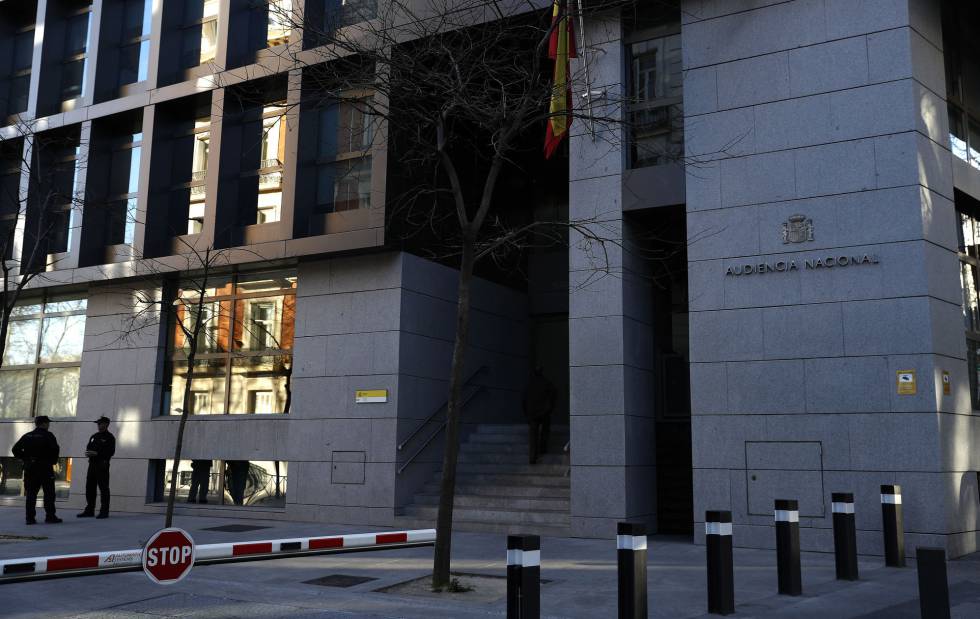
The dreaded Audiencia Nacional, the special Spanish State court for “terrorism” charges, located in Madrid.
(Source photo: Internet)

But wait a minute! So perhaps these were people low down in the terrorist organisation? Or even perhaps the police were mistaken about their involvement? But there WAS a terrorist cell, right? There were explosives found, right?

The National Court, with a special brief to deal with ‘national security crimes’, found many words to answer that question in a resounding negative: “The Court declares “the objective non-existence of explosives held by Mr. Codina” since it only found “precursors” of the thermite and also that the defendant has “documents with information to make explosives.”

Or in other words, no explosives. Or lots of other stuff you might find around a house or garage. Thermite itself is not even an explosive but combustible material, such as one might find in fireworks or flares, for example. Which, strangely enough, was what many Catalans were insisting back in September was all that the police had found. But who listens to Catalans, anyway? Especially pro-self-determination ones.

OK, OK, but a terrorist organisation was discovered, right?

The National Court had something to say about that: “The Court, at this time of resolution of an appeal against a precautionary measure, with a broad, but limited knowledge of the proceedings that are in ongoing investigation, without the existence of a previous criminal organization of a terrorist character thus judicially declared of reference, cannot issue a definitive judgment sufficiently founded on the nature or non-terrorist of the facts, or the existence of an organization that would have been constituted ex novo, nor from the point of view of its purposes, structuring, previous criminal manifestations, or degree of development in its possible conformation.”

That sounds like another “No”, too.

So why are two Catalans still in jail and on what charges are the nine to be tried eventually? Surely the Spanish State will find something? If only they still had the Baltazar Garzón judge still in office, with his mantra of “everything is ETA”!

Former Judge Baltazar Garzón, who ignored accusations of torture while sentencing Basque independentists on the basis of “confessions” and closed down all kinds of social, political and media agencies under the mantra that “everything is ETA”. Sadly he was lauded as a progressive by many liberals when he ordered the exhumation of one of the many mass graves of Franco’s era.
(Photo source: Internet)

And concerning the two still in jail, who were denied access to solicitors for weeks and one of whom refused legal assistance of the Catalan movement, there is something of a smell about that whole business too. Was that guy an informer? Or one who was turned by threats or even worse? Why would he, as the State claims he did, admit to things that even the Court is now saying were not done nor going to be done? And was the code name of the police operation, “Judas”, though somewhat unimaginative, a clue?

TERRORISTS EVERYWHERE!

          Painting oppositional movements — especially those for national self-determination – as “terrorist” is an old game of the Spanish State, going right back to Franco’s regime (a bit ironical really since his regime was certainly terrorist). It was done with the Basques for decades, banning political parties, closing down social centres, banning newspapers, radio stations and social media pages. In fact, creating a climate of terror amongst Basque pro-independence activists of all types.

Of course, the Spanish State itself has been caught out in terrorism, even after the death of Franco, when the social-democratic PSOE government in the 1980s was running terrorist kidnap and murder gangs against the Basques, with Government Ministers, senior police and army officers instructing and paying hired assassins.

The great thing about the “terrorism” brush is that once the State and the media begin to paint oppositional people with it, all one sees of those sometimes troublesome liberals is dust-clouds as they depart at speed – and not by any means only in the Spanish state.

Maybe you can’t teach an old dog new tricks – but in the Spanish State, the old tricks are usually good enough.

End.

MAIN SOURCE:

https://www.publico.es/politica/tesis-oficial-terrorismo-catalunya-desinfla-5-7-cdr-encarcelados-libertad-fianza.html

SPANISH CONSTITUTION DENOUNCED IN DUBLIN

Clive Sulish

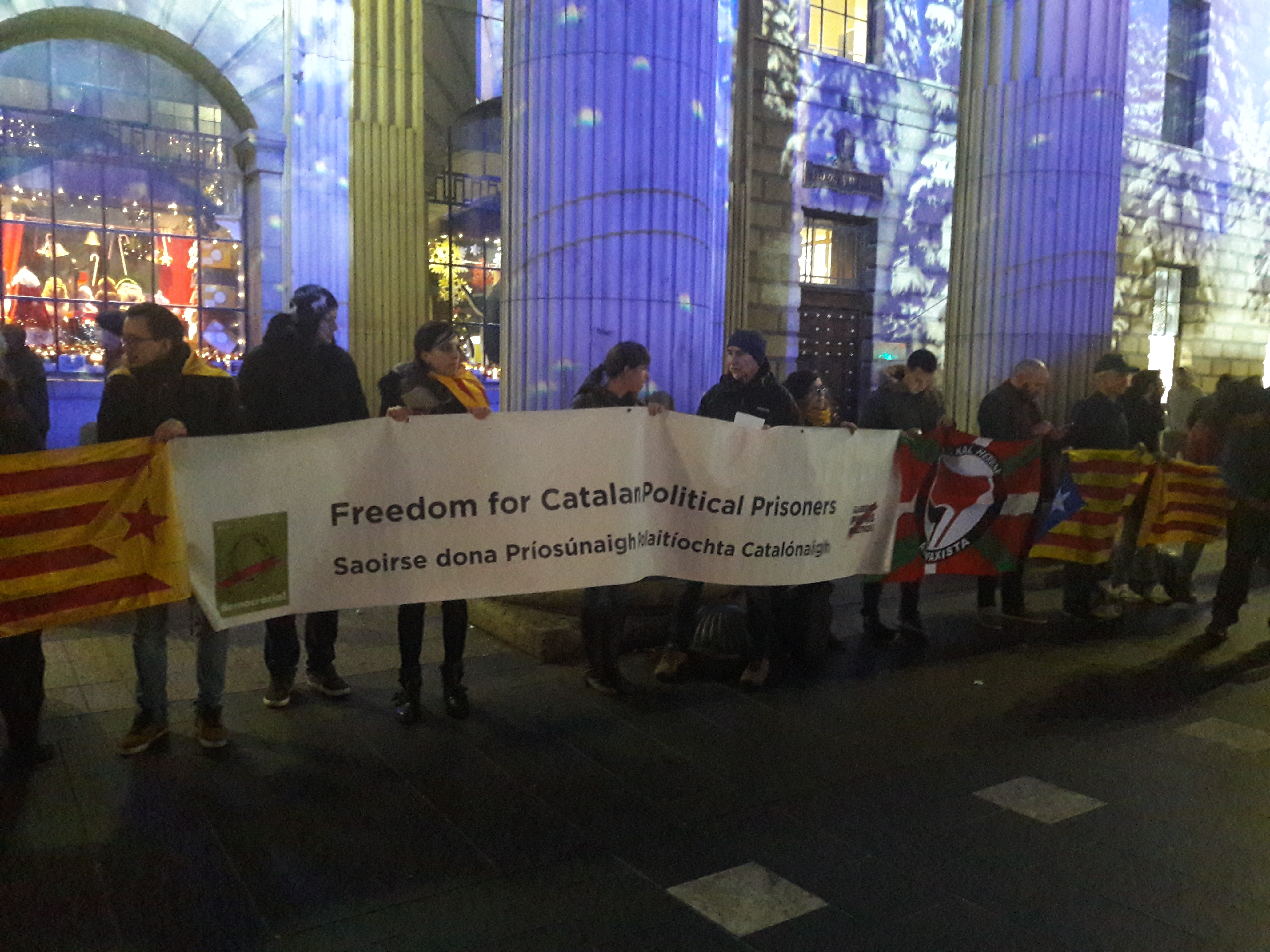
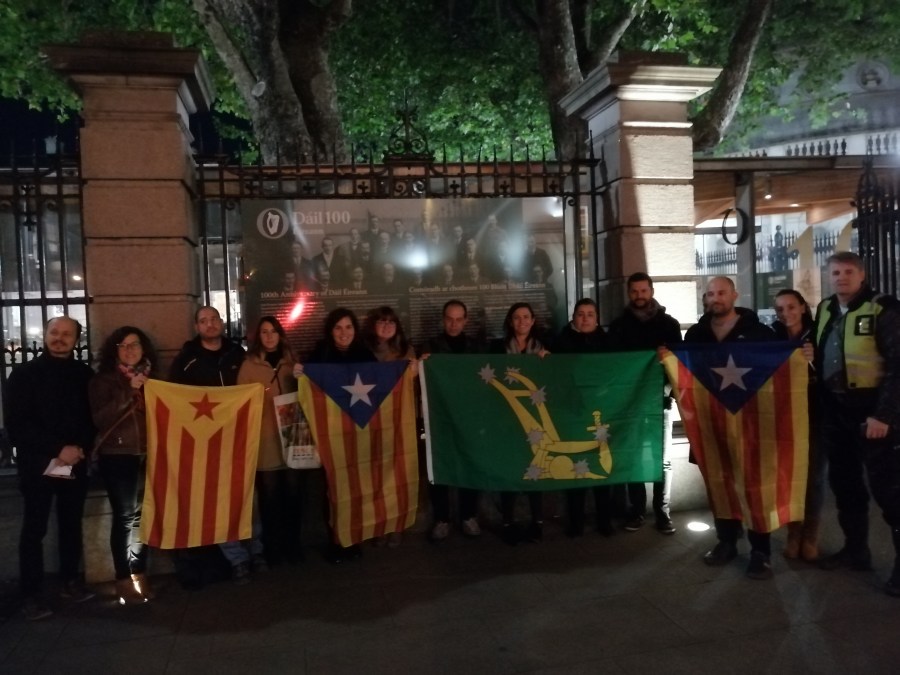
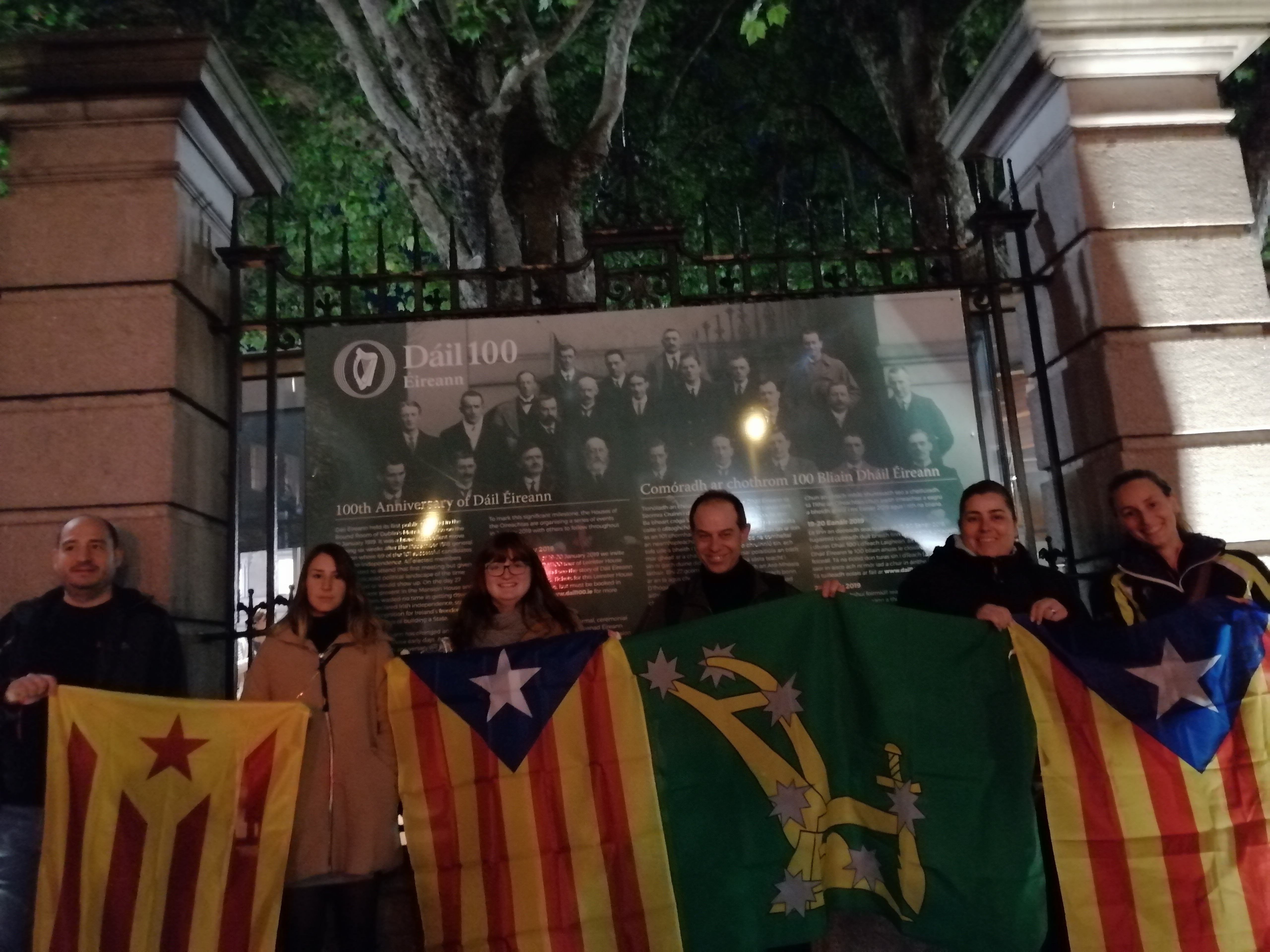
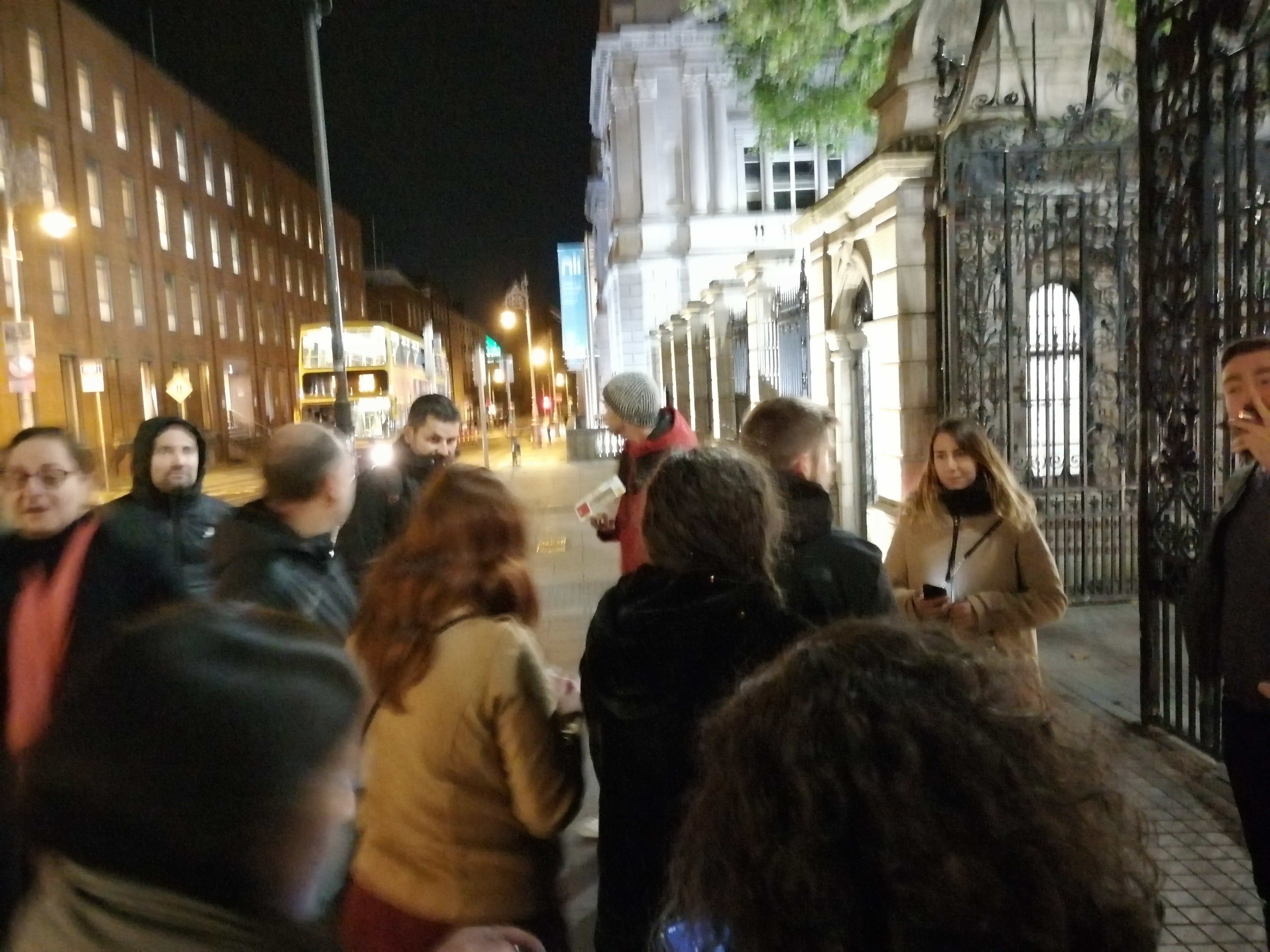
At little over a week’s notice, a protest picket took place on the evening of Friday, 6th December in Dublin City’s main street in protest at the lack of democracy of the Spanish Constitution. The date chosen was the same as the public holiday designated by the Spanish State to celebrate the adoption of the Spanish Constitution by majority in 1978.

(Photo: D.Breatnach)

           The protest was organised by three Catalonia-solidarity organisations in Dublin: With Catalonia/ Leis an Chatalóin, ANC Ireland and CDR Dublin. Calling the Constitution “a forced marriage without right to divorce”, the organisers published a statement in advance explaining the background to the Constitution and calling on people to support the protest.

The statement explained that when General Franco, the fascist-military dictator of the Spanish state, died near the end of 1975, opposition of various kinds that had illegal under the dictatorship – trade union, anti-fascist, republican, national-independentist – had been building for some time and took encouragement from his death. But State repression intensified with attacks by police, military and by fascist gangs.

Centre view of picket on Friday with GPO Christmas Nativity scene in background
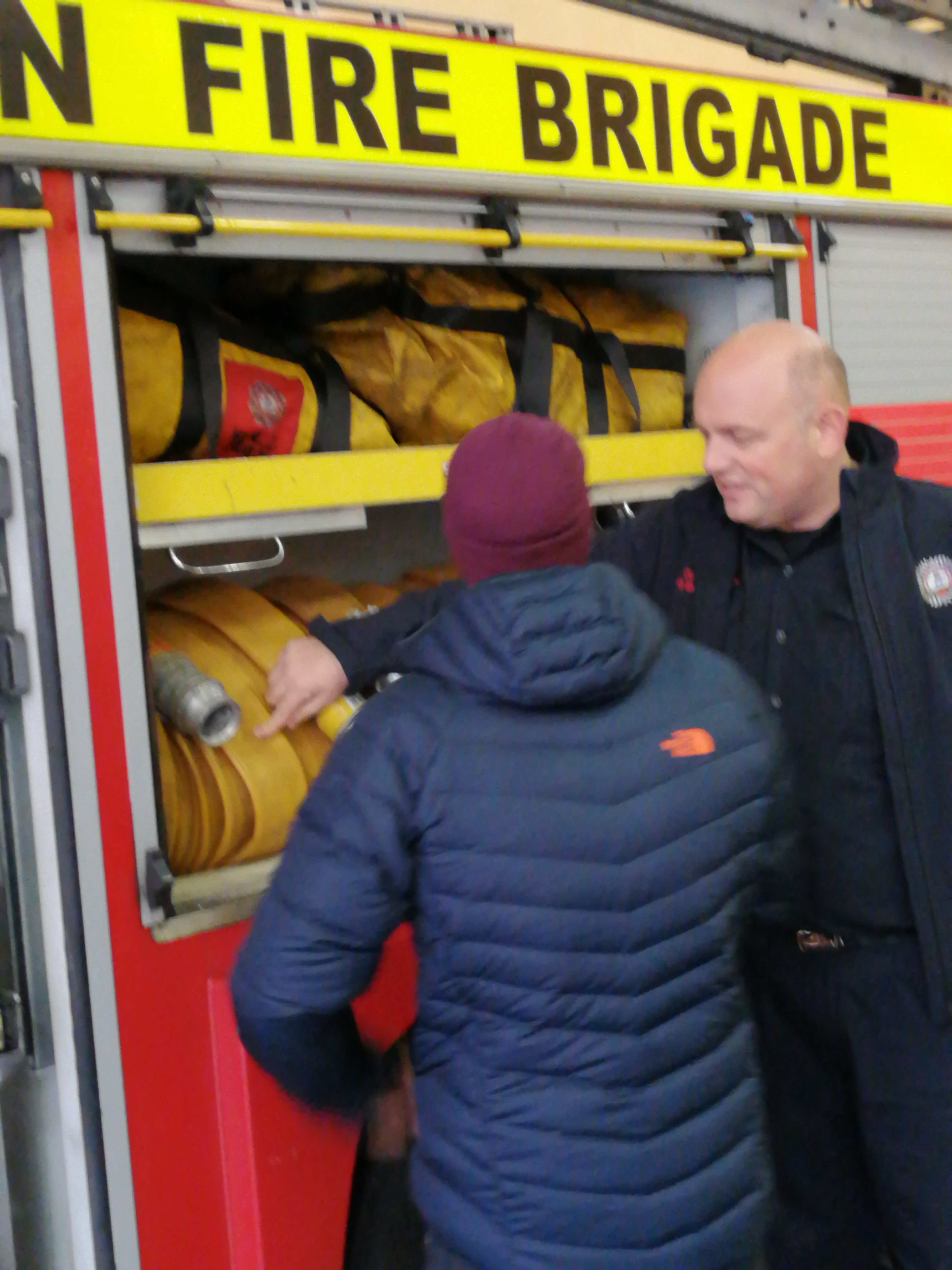
(Photo: C.Pujol)

“In 1977 the regime proposed to legalise their opposition parties, the PSOE and the Communist Party – on condition those parties agreed to support the installation of Franco’s nominee as King and Head of State and to control their affiliated (illegal) trade unions, the UGT and Comisiones Obreras.” This was the price for prisoners being released but no action could be taken against the torturers and murderers of thousands during the Anti-Fascist War or the Dictatorship or against those who had stolen children, raped and plundered. The (republican!) party leaders agreed and recommended the 1978 monarchical and unionist Constitution to their members and affiliated trade unions. Amid a wave of repression the take-it or leave-it Constitution was agreed in the Parliament and then in Referendum on 6th December 1978 by a large majority throughout the Spanish state, except in the Basque Country.

The statement pointed out that while the Constitution guarantees the right to self-determination, tht can be only if the majority of the Spanish Parliament agrees. in 1919 when Ireland had a majority of pro-independence delegates elected, as Catalonia has now, the text recalled that they declared independence. The statement went out to point out the close parallels of Ireland 100 years ago and Catalonia today, as the British proclaimed the declaration illegal, banned the First Dáil (Irish Parliament) and jailed elected delegates it could catch.

Poster for the event (creation D.Breatnach & B.Hoppenbrouwers)

Although the Catalan Government has not yet been declared illegal, the statement pointed out that “seven of its Ministers and elected officers have been jailed for 13 years and others heavily fined (two grass-roots organisation leaders have also been jailed for nine years); 700 town mayors are to be judicially processed for allowing the Referendum on independence to go ahead in their towns on 1st October 2017, a Referendum when many polling stations witnessed a savage Spanish police attack that was seen around the world (but much of it not in the Spanish state, outside of Catalonia and the Basque Country). Opinion polls have shown that 70-80% of people in Catalonia want to have a referendum on independence, free from attack or threat but the Spanish State uses the excuse of the Constitution to deny them that opportunity.”

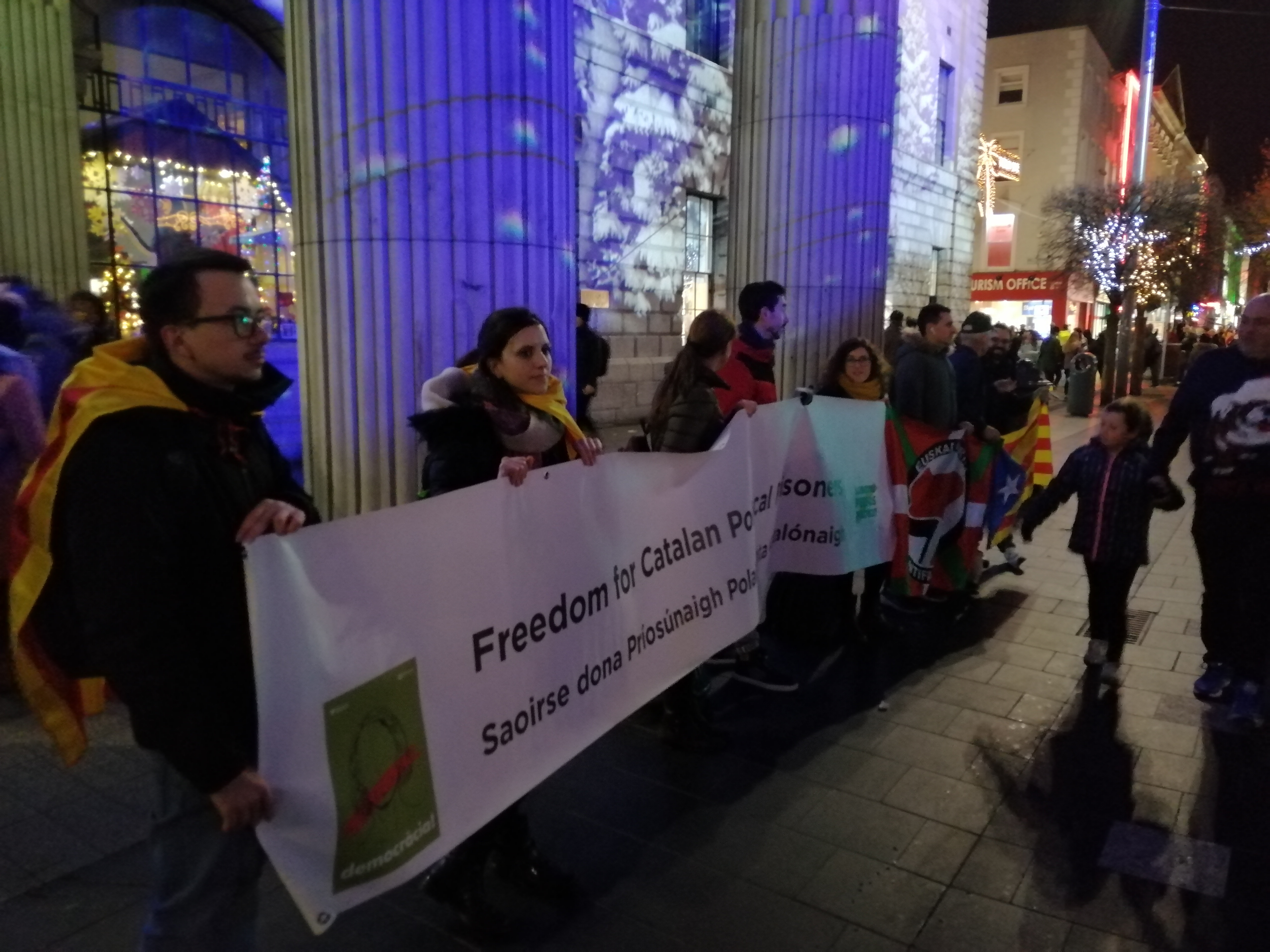
On the picket in Dublin a banner was displayed in Irish and English supporting Catalan political prisoners, along with a number of estelades (flags supporting Catalan independence), most of them of the red star variety (rather than the more common white star in a blue triangle). There was also a Basque Antifascist flag.

View of picket looking northwards
(Photo: D.Breatnach)

As the protest drew to a close, outlining their reasons for supporting the protest, a number of individuals gave short video interviews; one in Irish and Marc Loan of CDR Dublin gave one in in English.

Carles Pujol of ANC Ireland thanked everyone for attending and said a few words about the need for the protest and referred also to the Catalan political prisoners in Spanish jails. Diarmuid Breatnach of WCLC spoke briefly about the appropriateness of the protest taking place in front of of the General Post Office building, which had been the HQ of the 1916 Easter Rising against British domination. He went on to point out some of the parallels between Catalan and Irish history and concluded by saying that Catalonia today is in the same situation as Ireland was a century before.

VIDEO INTERVIEWS

http://https://drive.google.com/file/d/1BFayV3T0pS6DbrEzbVYq1NGbxEFgxUSH/view?usp=sharing

https://drive.google.com/file/d/1B7p1S14TiPD4Zy1R-HBJaGl-D7i9KpEV/view?usp=sharing

THE CONCERT

          As the protest began to conclude, another picket began to assemble in solidarity with Irish Republican prisoners and there was some friendly interaction between both groups. However the Catalan solidarity protesters were heading off for a performance in Dublin by Els Pets, a long-standing Catalan band in a kind of folk-rock genre.

(Photo: D.Breatnach)
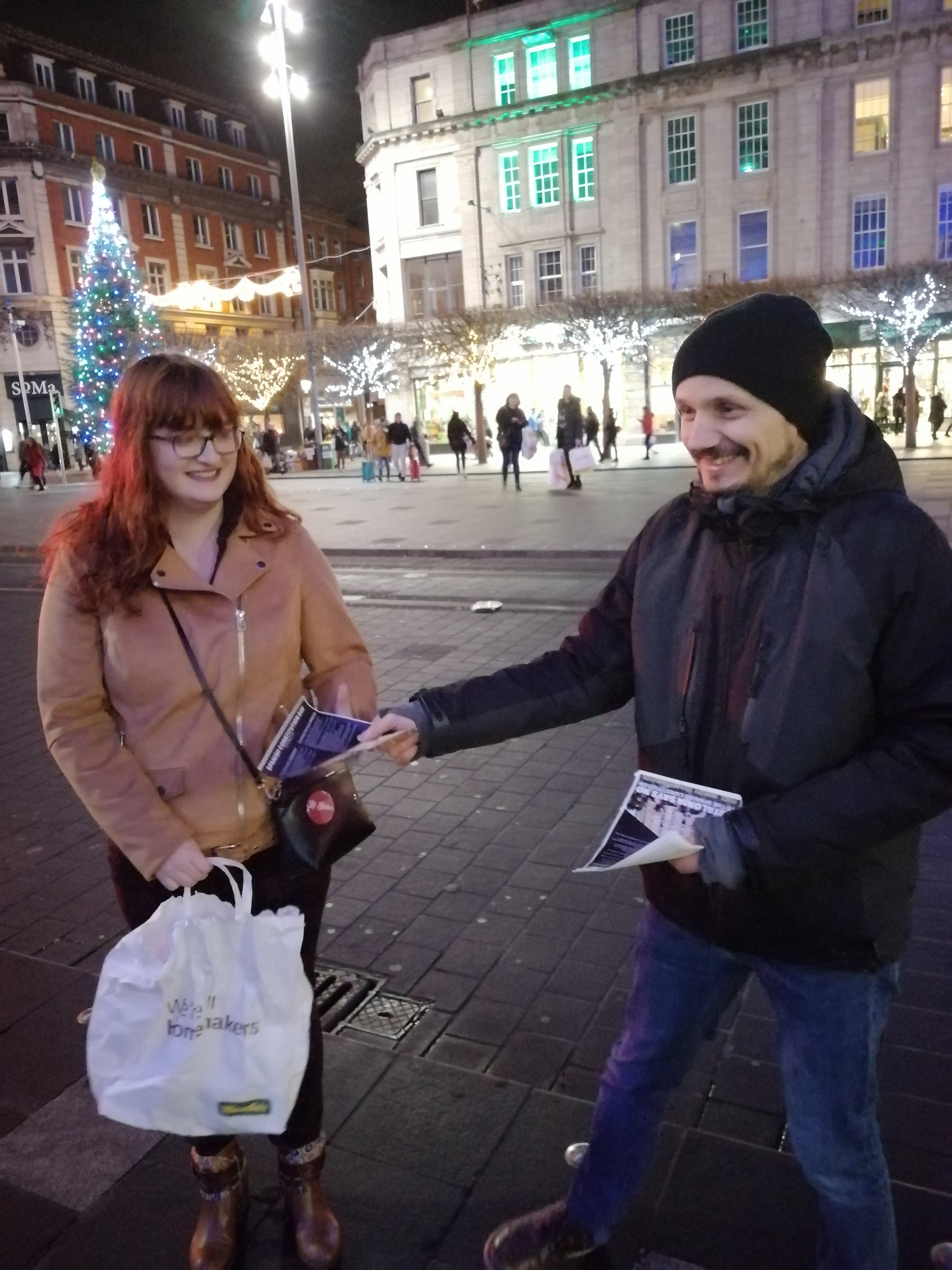
Leafleting passers-by (Photo: D.Breatnach)


(Photo: D.Breatnach).


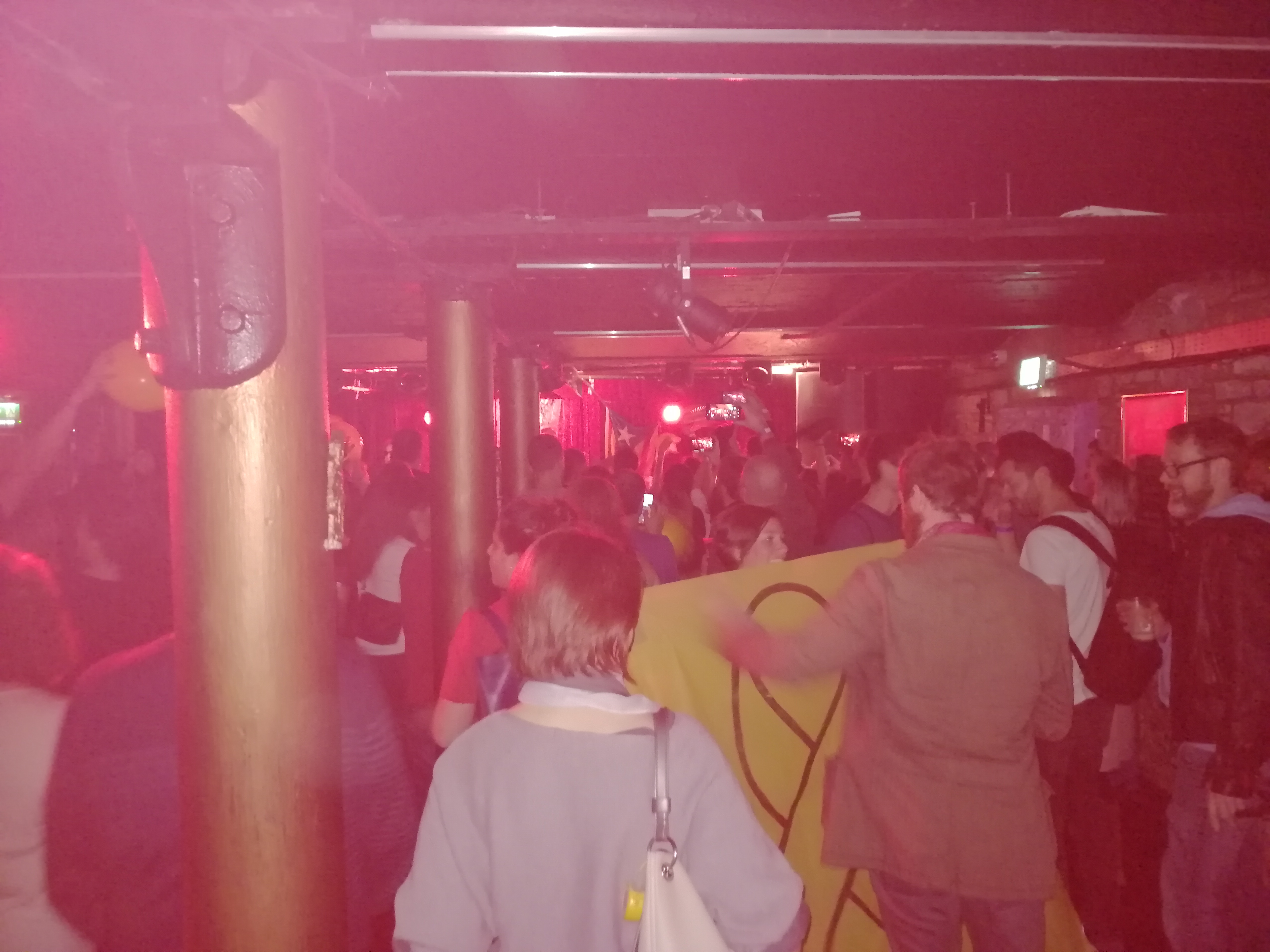
During the band’s performance, which was enthusiastically received by the mainly expatriate Catalan audience, a number of references were made from the stage to the aspiration for Catalan independence. At one point, a band member ironically sympathised with the Irish not having a king, saying “You don’t know what you’re missing.” The Spanish King is hated by many Catalans because of his personal position with regard to violent repression against Catalan Referendum voters in October 2017 but also because the monarchy was re-imposed on a Republican Catalonia by General Franco. When the satirical song “I want to be a King” was performed, members of the audience began to blow yellow balloons and to bounce them around the area (yellow is the colour designated for ribbons supporting Catalan political prisoners).

At the end of the concert, a number of supporters lined up with placards supporting the right to self-determination, also denouncing the Constitution and Spanish State repression.

The placard display at the end of the Els Pets concert.
(Photo: C.Pujol)

Note:

The politically-independent organisations concerned have organised more than ten public Catalan solidarity events in Dublin this year, including a cultural day in the park, film showings, talks and protest pickets.  In addition, there have been organisational meetings and external meetings with public representatives and participation in a Spanish-Embassy sponsored debate (which wasn’t!).

End.

Els Pets on stage.
(Photo: D.Breatnach)
No, it certainly is not! (Photo: D.Breatnach)
Yellow ribbon banner in solidarity with the prisoners.
(Photo: D.Breatnach)
Estelada waving among the audience.
(Photo: D.Breatnach)

Yellow balloons time!
(Photo: D.Breatnach)

CONTACT FOR INFORMATION ABOUT FUTURE EVENTS:

With Catalonia/ Leis an Chatalóin: https://www.facebook.com/WithCataloniaIreland/

ANC Ireland: https://www.facebook.com/IrlandaPerLaIndependenciaDeCatalunya/

CDR Dublin: https://www.facebook.com/CDRDublin/

JARKI – NEW BASQUE ORGANISATION FOR INDEPENDENCE AND SOCIALISM

Diarmuid Breatnach

(Reading time text: 15 minutes)

When Basque independentists celebrated Gudari Eguna this year, the Day of the Basque Soldier, some of the celebrants were affiliates of the Abertzale (Basque pro-Independence) Left while others were supporters of the Basque Nationalist Party, nominally at least and often in reality, political enemies. However, it is not the same day for each.

Flagpole with the ikurrina, Basque national flag, at Sollube, scene of a battle between the Francoist forces and the Basque Gudari during the Antifascist War. This was erected probably by the PNV for their commemoration but commemorations are also held at the site by ‘dissidents’ of the Abertzale Left.
(Photo source: D.Breatnach)
A beech seedling (native tree, sacred in folklore, of reputed medicinal qualities, e.g in helping the body to resist infection) had been planted by ‘dissidents’ at the Sollube memorial and, although the surrounding protective netting had collapsed, was still alive. Subsequently Amnistia supporters returned and tidied up the area and left stone markers too.
(Photo source: D.Breatnach)
Mount of sollube: the Francoist forces had invaded from that far background direction, coming in from Nafarroa, which had been taken over to Franco by the Basque Carlists.
(Photo source: D.Breatnach)

          The PNV (Basque Nationalist Party) commemorates the execution of 42 Basque fighters in one jail by the Franco forces on 28th October in 1937, whilst the Abertzale Left carries out their commemoration a month earlier, on the 27th of September, anniversary of the last executions under Franco (and, officially, in the Spanish state since): ETA martyrs Juan Paredes Manot (Txiki) and Ángel Otaegi Etxeberria, along with three members of FRAP (Revolutionary Antifascist Patriotic Front) Jose Luis Sanchez Bravo, Ramón Garcia Sanz and Humberto Baena, all shot by firing squads in 1975 (despite world-wide protests and riots outside Spanish embassies).

For much of the Abertzale Left, Gudari Eguna commemorates not only the martyrs of the 27th September 1975 but also all those who fought for Basque independence during the Spanish Anti-Fascist War and all who fought for it since, in particular those martyred in the struggle.

But even in agreement on that date and that purpose, there are differences too. For some years now some commemorations have been by supporters of Amnistia Ta Askatasuna (Amnesty and Freedom), who denounce the “Officials” for dropping the demand for an amnesty for political prisoners but also criticise them on many other political and cultural grounds: ceasing to push for the everyday use of Euskera (the Basque language), making political pacts with social democrats, etc.

Increasingly, ATA and the “Officials” find themselves incapable of sharing a commemoration or a platform as the latter move further down the path of accommodation to the Spanish regime, social democracy and the PNV, commemorating police killed, apologising for the ‘crimes’ of the now-defunct Basque armed organisation ETA.

A poster of the “Officials” highlights two ETA martyrs, one killed by the Policía Nacional and the other by the Guardia Civil. (Photo source: D.Breatnach)
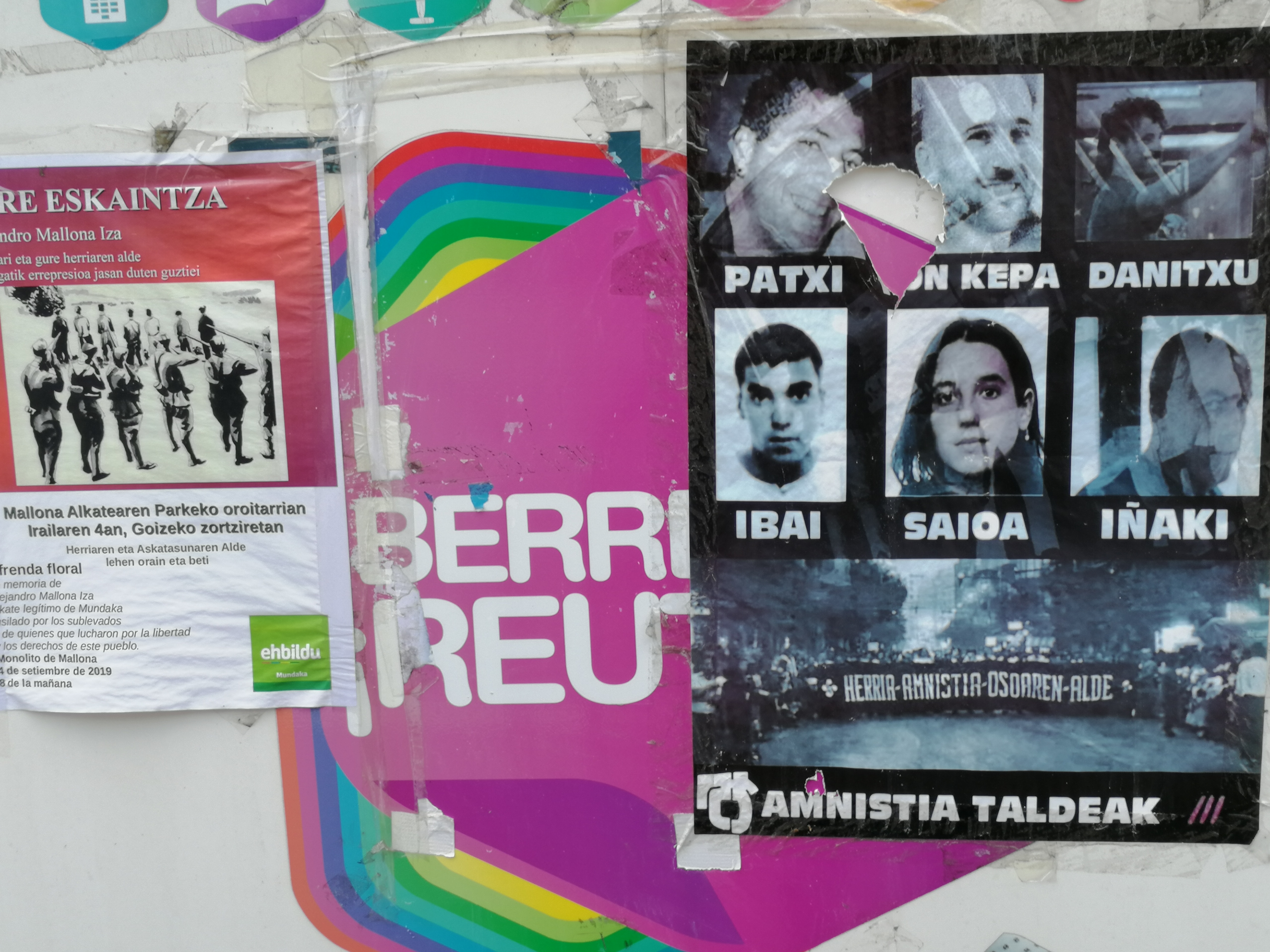
A poster for Gudari Eguna of the ‘Official’ leadership, the party EH Bildu, next to a poster of the ‘dissident’ ATA listing six prisoners whose situation is being highlighted.
(Photo source: D.Breatnach)

JARKI – A COMPARATIVELY NEW ORGANISATION REJECTING THE ABERTZALE LEFT “OFFICIAL” LEADERSHIP

          In Ireland, though they themselves might reject that appellation, the equivalent to ATA would be called “dissident Republicans” and Basques are not as touchy about being counted part of the dissidencia. But one new group has emerged which does reject that term as descriptive of themselves, while at the same time very clearly against the positions of the “Officials” and resolutely for independence and socialism.

This group is called Jarki, (of various meaning: “Resist/ Stand fast/ Push back/ Commit”; the first letter is pronounced like the Spanish “j” or the Irish “ch”).

Among other posters of factions of the Abertzale Left proclaiming Gudari Eguna in the Basque Country this September, I had seen one, very large, side by side with a declaration of position against the subjugation of the Basque nation, for socialism and class struggle. Curiously, there had been no venue advertised for a commemoration ceremony to take place. Was this group, this Jarki, not intending to have one? I made discreet enquiries, someone spoke to someone ….. who perhaps spoke to someone else ….

Jarki poster for Gudari Eguna — note no venue details
(Photo source: D.Breatnach)

On Gudari Eguna this year,

Text poster of Jarki’s alongside their image poster (Photo source: D.Breatnach)

27th September, I was met fairly early in the morning by my appointed guide. The mist gathered high upon the marshes and river and in the valleys as we drove higher, eventually coming out on a scenic site, the day cold but the climbing sun burning off the last of the mists. We rendezvoused with other carloads, then drove to another spot and parked. Asked to leave my mobile in the car, I accompanied my hosts on a long walk in unseasonal sun and heat to a field, where a temporary stage had been set up. It was to be a Gudari Eguna event organised by the Jarki organisation.

The security precautions were not excessive. This was taking place in the Spanish state, where fascism had never been defeated but had instead had a paint-over job in order to allow the Western states, after the death of Franco, to pretend it was a democracy. Until a few years ago, detentions of Basques had been like an epidemic, torture by police and army routine and just as routinely ignored by judges who sentenced the prisoners on the basis of their “confessions” or those of others to long years in jail. In contravention of EU and UN protocols for the treatment of prisoners, the political victims of the State had been dispersed to its furthest reaches, far from spouses, children, relatives and friends. And though the armed group ETA had ceased operation in 2012 and was now disbanded, persecution went on: that very month, 45 people of various organisations arrested in 2013, 2014 and 2015 for supporting the prisoners, including psychologists and lawyers, “supporting terrorism” according to the State, had been brought to trial1.

On the way to the rally, I saw many young men and women, in their middle-to-late teens or early twenties and also many others in ages ranging from late 50’s to 80s, also with a sprinkling of young adolescents. In other words, there were hardly any there of raising a family age. The sun was very hot now and I took off my jacket and tied it around my waist and, even so, was soon sweating.

I and one other were provided with a translator to Castillian (Spanish) for the speeches in Euskera – nobody else seemed to need one, a state of affairs that would not be matched in Irish Republican or Socialist circles with regard to our native language.

The heat beat down and I worried about getting sunburned, while at the same time very interested in what was going on. A large dragonfly wheeled above us, hovered a second then shot off. One of the folkloric Basque names for it translates as “Witch’s Needle” but it is important to recognise that in Basque society, sorgina or “witch” does not have the same negative connotations as can be found in much of western society, even today.

“THE STRUGGLE MUST CONTINUE — IN ONE FORM OR ANOTHER”

          A man perhaps in his 60s took to the stage and recalled his years in guerrilla resistance (i.e in ETA), his capture and the killing of his comrades (one was executed on the spot by the Guardia Civil2). He went on to talk about his years being dispersed around Spanish jails throughout the territory of the State. Speaking about the historical memory of resistance, the man commented that it was necessary to keep that alive – both of the Antifascist War and of the resistance afterwards.

Euskal Herria3 was still divided and still not free, he continued and therefore the struggle had to continue in one form or another, despite the abandonment of the path of resistance by the current leadership of the Abertzale Left. Similarly the demand had to be maintained not only for an end to dispersal but for an amnesty for political prisoners.

After his speech, a young male bertxolari stepped forward to sing his composition. This is a cultural form of social and/ or political commentary, composed by those skilled in the art to fixed rules of rhyme, length of line and a selection of airs.4

He was followed by an elderly left-wing journalist who, apologising for her inability to speak in Euskara, did so in Castillian (Spanish). She referred to her family’s history of anti-fascist struggle, both in the War and in the resistance that followed the victory of the military-fascist forces. She too spoke about the need to continue resistance to unjust regimes and for the right to self-determination.

The journalist speaker was followed by the performance of another bertxolari, this time a young female.

Last to speak was a young woman, speaking on behalf of the Jarki organisation. She recalled the anti-fascist resistance in the Basque Country in ……….. (a nearby battle during the Anti-Fascist War) and elsewhere, also by ETA in the years following the victory of the military-fascist forces. While others might try to pacify the people and to wind down the resistance, the need for active participation in resistance is as great as ever, she said. The woman ended with the call “Gora Euskal Herria askatatua eta independentzia!” (“Long live a free and independent Basque Country!”), to which all the audience (myself included) responded with a roar of “Gora!”.

The young woman then led the audience with the song Eusko Gudariak (“Basque Soldiers”, similar in content to the Irish national anthem, the Soldiers’ Song), most of us who knew the words or not with raised fists, then a couple of women let out the irrintzi5 yell, raising goose pimples on my skin.

Obviously, given my presence, not all the attendance had been Jarki activists but on the other hand, not all its supporters had been able to come either, I was told on the long walk back to the car on tired leg muscles in the blistering unseasonal heat. I joked that if I’d had my mobile with me I’d have phoned an ambulance. Some cured sausage sandwiches and a few mouthfuls of ardoa (wine) from a traditional wineskin, kindly offered where the vehicles were parked revived me somewhat for the journey back to my pickup point that morning but thankfully, we also stopped on the way for lunch and a cold beer at a Basque bar (for which my attempts to pay were kindly but firmly refused by my other travelling companions).

“MOST OF THE RESISTANCE NEEDS TO BE AT STREET LEVEL”

          Later, at an appointment with a Jarki activist, I asked what the relationship with other Basque organisations was, given that his group will not accept the appellation of “dissident” and others will. He told me that they enjoy friendly relationships with a number of other Basque political and cultural organisations that have also broken away from the “Official” leadership. Jarki is a revolutionary socialist organisation for an independent Basque country and in support of the Basque language, he told me. “Although we do not at the moment put forward electoral candidates, we are not necessarily against doing so as a tactic”, he added, speaking quietly. “But the ‘officialistas’ are only interested in the electoral path and we think most of the resistance needs to be at street level”.

The organisation expects a disciplined commitment from its members, for which it also recognises the need for political education, especially of the youth. There had been wide criticism of the lack of this kind of education within the Abertzale Left since the 1990s and earlier, right up to the present.6

The national independence and socialism of the Basque Country is of benefit to the world and the independence and socialism of other countries is of benefit to our nation,” he said in reply to my question about the issue of internationalist solidarity. He admitted that the representative of Jarki at their Gudari Eguna commemoration had not mentioned that aspect.

Jarki call for rupture with the Spanish Constitution and demonstration on 6th December.
(Photo source: Internet)

CALL FOR RUPTURE WITH THE SPANISH CONSTITUTION

          A few days ago, while I was writing this long-overdue piece from contemporary notes, Jarki issued a national call to Basque society (translated by me from a Castillian version): “The Basque working-class people responds with rupture to the Spanish Constitution.”

The Spanish Constitution, despite not being accepted in the Basque Country7, is being imposed upon us. It is a document edited by the Francoists in a pact with the Spanish political parties. This document denies the self-determination of the peoples and besides accords to the military the role of guarantor of the union of Spain.

This Constitution designed the administrative separation of the provinces of the southern Basque Country.8

Faced with this imposition it is more important than ever that the working-class population of the Basque Country creates a revolutionary alternative which should be a political vision to lead the struggle for national construction and liberation and for socialism, the struggle for a united Basque Country, without classes.

For all those reasons we call for the organisation and mobilisation against the imposition, in which the Basque working-class population should follow its own path. Because of all that, we call for participation in the demonstration to take place on 6th December (Spanish Constitution Day) in Durango.

Although they wished to silence us, they will hear us. We have enough reasons. It is time to take to the streets. This people needs a revolutionary alternative.

End.

Poster by Jarki calling for demonstration against the Spanish Constitution (Photo source: Internet)

FOOTNOTES

1The day after 50,000 demonstrated for the right to support the prisoners and in solidarity with those on trial, Basque society was shocked when those charged admitted their “guilt” in exchange for walking free or a maximum sentence of five years’ jail for the “leaders” (instead of the up to 20 years normal from the Spanish court). The reverberations of that – the act of pleading ‘guilt’ itself but also permitting 50,000 to demonstrate in ignorance of the intention — are still travelling through the Abertzale Left and are likely to cost the “Official” leadership, who must have approved or perhaps even brokered the deal, very dearly. In contrast to the 45, another four, leaders of Askapena, Basque organisation for internationalist solidarity, charged with similar ‘crimes’, had fought the case earlier, for which they had won much respect and had beat the charges. Askapena, however, had quietly split from the Abertzale Left some years previously.

2The Guardia Civil is a militarised police force of the Spanish State with a very political role, the most active in the past against the Basque national movement and now similarly against the Catalonian. In addition the Spanish State has the Policía Nacional, also armed and active against movements for self-determination. Each region also has a separate police force, for example the Policía Foral in Nafarroa, the Ertzaintza in Euskadi, Mossos d’Esquadra in Catalonia, etc. And there are urban police forces too in every town or village.

3Meaning “the country where they speak Basque”, the term is now used to describe the whole Basque nation of seven provinces, three currently within the French state and four within the Spanish territory. “Euskadi”, the former term, now only describes the “Basque Authority” area of three provinces: Bizkaia, Alava and Gipuzkoa.

4This cultural form, at one time perhaps in danger of dying out, has become very popular and national competitions are broadcast on the Basque TV network. I have witnessed two bertxolari given pieces of paper laying out their respective roles (for example an Irish landlord and a Polish tenant) and, minutes later, engage in a battle of bertxos (verses) which had a Basque audience in roars of laughter and appreciation for the wit and skill of each. Close attention is paid by Basque listeners to bertxolari which, for a nation not culturally given to admiration for the song of the single voice (unless they can join to sing along), is truly remarkable. The Irish “comhrá beirte” is a similar performance art form but much less developed, certainly now, in Irish tradition.

5It is a long ullulating or yodelling cry, by males or females, said to be a call to war or to encourage Basques while fighting (it was also the name of a short-lived Basque resistance organisation functioning in the “French” Basque provinces). Such calls are common for communication of different kinds among mountain people, the sound carrying from one mountain to another and echoing but curiously enough it is also a feature of Arab culture in the desert and of some Native Americans. Example with a commentary in Castillian: https://www.youtube.com/watch?v=gcSaW6JUnUc

6That this has been neglected for decades in the Abertzale Left is a fact admitted even by many who remain within the “official” line.

7The Spanish Constitution was presented on a “take it or leave it” basis during the Transition period after the death of Franco, with much violence from police and fascist organisations and the fear of a return to the full-blown fascist dictatorship. The Spanish Communist Party with its huge and then militant trade union, Comisiones Obreras and the social-democratic PSOE, with its smaller Unión General de Trabajadores, were both legalised on condition they supported the monarchist and unitary state Constitution. In such circumstances it was hardly surprising that the referendum on 6th December 1978 brought in a huge majority for the Constitution – but not in the Basque Country, where it was rejected.

8Three of the four southern provinces, i.e those currently within the Spanish State, are under one regional government administration while the fourth, Nafarroa, has its own.

CATALONIAN FIREFIGHTER AND TRADE UNIONIST SPEAKS IN DUBLIN

by Clive Sulish

A Catalonian firefighter and trade unionist addressed a Dublin audience to talk about the independence for Catalonia movement and the role of the trade unions in it, the repression from the Spanish State and the how the firefighters found themselves between the rampaging Spanish police and referendum voters on the 1st of October 2017.

Panel and screen at the Dublin meeting. Oriol is seated in the middle.

With some words in Irish and then speaking in English, the Chair of the meeting, Marc Loan of CDR Dublin welcomed the mostly-Irish audience to the meeting in Club na Múinteoirí (Teachers’ Club) on 13th November and outlined how the presentation would go, before opening up to questions and contributions from the audience. The meeting was part of a short tour of Irish cities by a Catalonian firefighter and trade unionist, organised jointly by three Ireland-based organisations in solidarity with Catalonia: With Catalonia/ Leis an Chatalóin, ANC Ireland and CDR Dublin.

The room lights were dimmed and an electronic presentation operated by Carles Pujol of the Irish branch of the ANC (National Assembly of Catalonia) took the audience through dates in the history of Catalonia as a nation and its relationship with the Spanish Kingdom. Then the presentation switched to some dates in international recognition of the right to self-determination of peoples, before focusing on the fairly recent attempts of the Catalan Government to legislate for its needs, legislation reduced or eliminated by subsequent judgements of the Spanish court. And thence to the Referendum on Independence of 1st October 2017, at which point the Chair presented the guest speaker.

Section of audience in the meeting and presentation screen.

The Chair introduced the firefighter from Catalonia, a slim tanned man in his forties, with shaved and balding head and lively brown eyes. Oriol Duch had the previous day addressed an audience in Derry, hosted by Derry Trades Council and the day before that in Queen’s University Belfast, organised by Belfast ANC. Mr. Duch had worked at one job or another since the age of sixteen, had been a firefighter for 15 years and a member of his union, Intersindical CSC, for seven of those. From its website, Intersindical declares itself to be a class trade union, which is to say that it specifically excludes members of state repressive forces, senior officials of state departments or management officials of companies. Mr. Duch is employed as a firefighter at the Girona Airport, Catalonia but also volunteers for the firefighting service of the Catalan Government administration, the Generalitat.

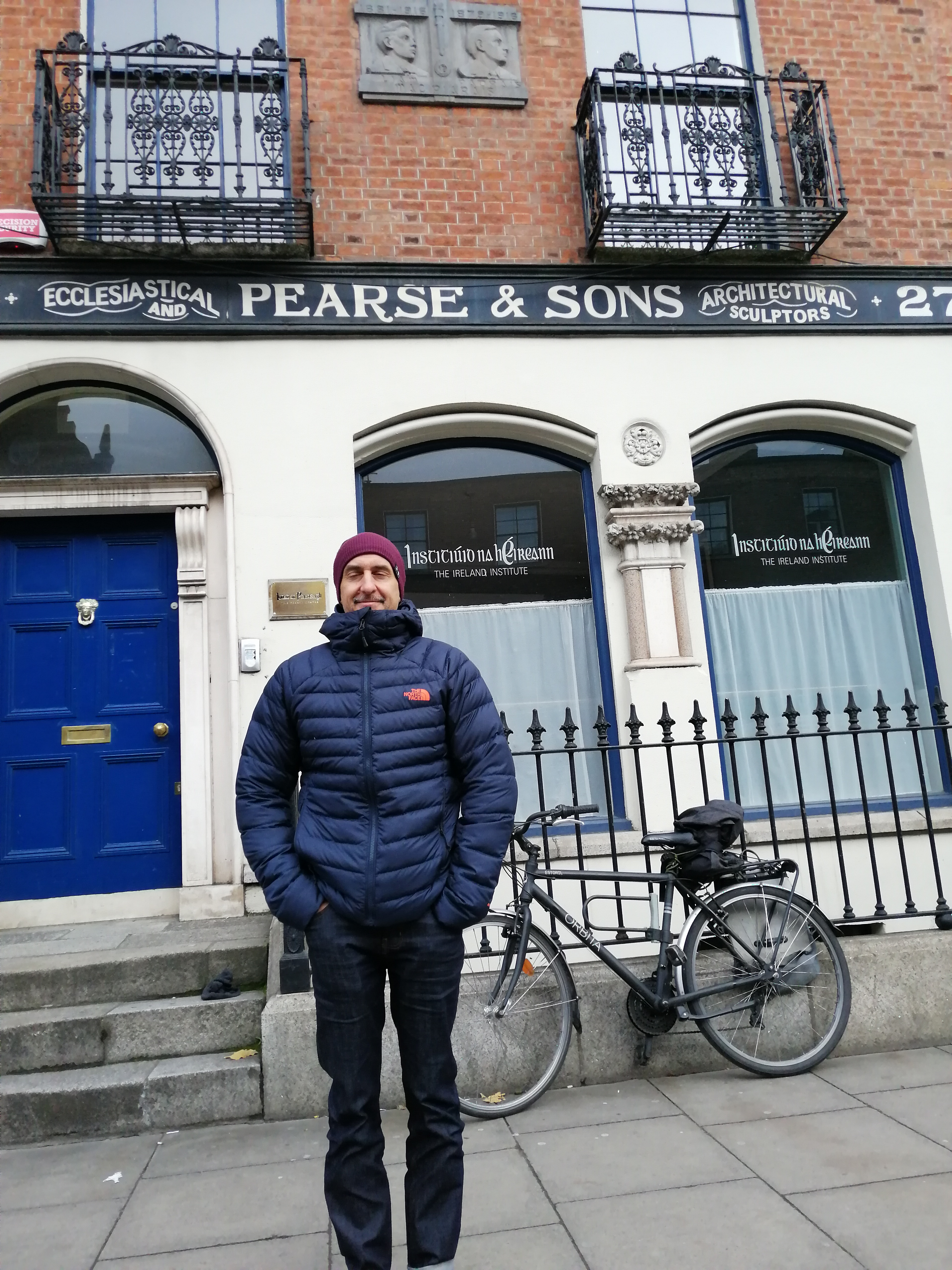
Oriol Duchs posing for a photograph outside the family and business home of the Pearse family, home of brothers Patrick and William, executed by British firing squads in 1916.
(Photo: D.Breatnach)

“WE ARE NOT HEROES”

          As Oriol Duch spoke about the involvement of the firefighters as a defensive screen for voters in the October 1st Referendum in Catalonia, the projection screen showed massive crowds marching and demonstrating for independence. Catalonian firefighters had taken part in uniform in a number of those demonstrations for the democratic right to self-determination and had organised a demonstration of their own (seen on the poster for the speaking tour). The firefighters had discussed what to do since the Spanish Government had threatened the Referendum organisers and social media was full of threats too from right-wingers, including Spanish police officers and Army members. They knew that among the masses coming out to vote, there would be vulnerable people including the elderly and children and decided that those who wished to would turn out voluntarily in their uniforms and stand between the Spanish police and the crowds wanting to vote.

Manus O’Riordan, whose father fought in the International Brigades at Gandesa, mentioned a song for Catalonia he had liked and sang his translation of it into English there and then. As the applause died down, an Irish voice called for the national song of Catalonia, a song of workers’ resistance, the Els Segadors (the Reapers), which all Catalans present sang, the whole audience standing in respect.

Bringing the meeting to a close, the Chair thanked the guest speaker, the panel and the audience for their attendance and contributions (a thanks separately expressed by Oriol Duchs too) and encouraged them to keep in touch with the three solidarity organisations. He also expressed the organisers’ gratitude to the Dublin Fire Brigade and to the Teachers’ Club.

Poster for the Catalan firefighter tour shows one of the events organised by Catalan firefighters in support of self-determination for Catalonia.
(Poster design: CDR Dublin)

On the day, the firefighters distributed themselves around in a number of places, Oriol Duch told his audience, by ad hoc arrangements, the organisers arranging by texts to send firefighters to areas where they were felt to be needed. On the Sunday in question, as voters queued outside the polling stations, mostly schools closed for the day, convoys of police arrived with Spanish police in riot gear who charged into the buildings, breaking down doors and windows, to beat people and seize ballot boxes. They also attacked people waiting to vote with batons, boots and fists, Oriol Duch said, as the firefighters attempted to stand between the unarmed civilians and the police. Over 800 people that day had required medical treatment, he said (including a number of firefighters).

As the firefighter from Catalonia spoke, the presentation began to show scenes of Spanish police beating people with their truncheons, throwing others to the ground, kicking and punching them, pulling people by their hair and putting them in choke holds

“People have called the firefighters heroes but we do not see ourselves that way,” he said. “We were doing what we could to protect people and save lives, which is what we do in our job.”

DFB officer showing Oriol some of the equipment in a DFB truck.
(Photo: D.Breatnach)
Carles Pujol, Oriol & Diarmuid Breatnach inside the Dublin Fire Brigade museum.

A MASS MOVEMENT FOR SELF-DETERMINATION

          The Catalonian movement for independence is a mass movement that has been built especially by grassroots organisations, which have pushed the Catalan independentist political parties forward. Chief among these grassroots organisations is the National Assembly of Catalonia (whose former President, Jordi Sanchez, is one of the independentist activists jailed recently by the Spanish court). Firefighters for the Republic, of which Oriol is an active member, is a sub-group of the ANC.

Since the police attacks, others have come forward to direct mass resistance, in particular after the jail sentences of 9-13 years on seven elected public representatives and two leaders of grassroots organisations (ANC and Omnium Cultural) were announced in October. The “Catalan Tsunami” organisation contacted supporters through social media and masses followed their direction. For example, when the call to flood the Barcelona Airport with people had gone out, thousands had walked kilometres to get there and despite police violence, had effectively shut the airport down for hours. More recently, people had for a weekend closed by blockade one of two main motorways from the French State into the Spanish one, which passes through Catalonia (the other, passing through the Basque Country, was more recently shut down by Basques also — CS).

Oriol Duchs told the Dublin audience that the repression of peaceful people by the Spanish State included heavy jail sentences for “sedition” and police attacks on people in the street, “including firing rubber bullets, the use of which are banned in Catalonia but that is ignored by the Spanish police”. News media has reported that victims of rubber bullets fired at close range directly at people, contrary to instructions on their use, have caused a number of people recently to lose an eye. However, the police cannot control the masses of people, Oriol said.

After the applause for the Catalan firefighter had died down, the Chair opened the meeting to questions and comments from the audience.

Among the comments was that of an Irish woman who had been in Catalonia during the Referendum and talked about the frightening advance of the Spanish police in their riot gear and with their weapons. She disagreed with what Oriol Duchs had said in only one particular: “You ARE heroes”, she said, to applause and cheering from the audience.

An Irishman who had been there too as an international observer spoke about the police attack, which he said was fascist in nature. Another Irishwoman who had been there in a similar capacity said that she had witnessed much police violence but that the scenes depicted on the screen had reminded her just how violent those had been. She asked what people in Ireland could do to help.

From the panel the advice was to support Catalonia solidarity activities, to stay in touch through of the Catalonian solidarity organisations in Dublin, whilst from the floor an Irishman said that people should tell the elected public representatives what was going on and call for statements of support and interventions to the Spanish Government.

This brought about discussion of the posture of the Irish Government, as in recent Dáil questions to the Depart of Foreign Affairs, the responsible Minister of State had reiterated the Government line, that it was an internal matter for the Spanish State, that the rule of law had to be maintained and that the Spanish State is a democratic one with separation of judiciary and government executive. An intervention from the floor pointed out that one of the TDs (parliamentary delegates) had pointed out that in 1919 the First Dáil (Irish Parliament) had declared its independence of Britain and issued a call to the democratic nations of the world asking for recognition, although it was in violation of British constitution and law. The First Dáil had been declared illegal a few months later and its delegates hunted, arrested and jailed. “Catalonia today is Ireland 100 years ago,” he had said. Without the stance taken by that First Dáil, predecessors of all other parliaments of Ireland since, the present Government would not even exist nor would that Minister’s Department, the man commented..

“The struggle in Catalonia and the repression by the Spanish State is not ‘an internal matter for the Spanish State’”, Oriol Duch said. “It is a problem for Europe.”

Manus O’Riordan, whose father fought in the International Brigades at Gandesa, mentioned a song for Catalonia he had liked and sang his translation of it into English there and then. As the applause died down, an Irish voice called for the national song of Catalonia, a song of workers’ resistance, the Els Segadors (the Reapers), which all Catalans present sang, the whole audience standing in respect.

Bringing the meeting to a close, the Chair thanked the guest speaker, the panel and the audience for their attendance and contributions (a thanks separately expressed by Oriol Duchs too) and encouraged them to keep in touch with the three solidarity organisations. He also expressed the organisers’ gratitude to the Dublin Fire Brigade and to the Teachers’ Club.

Some of the attendance stayed around in the bar area to discuss for another hour or so.

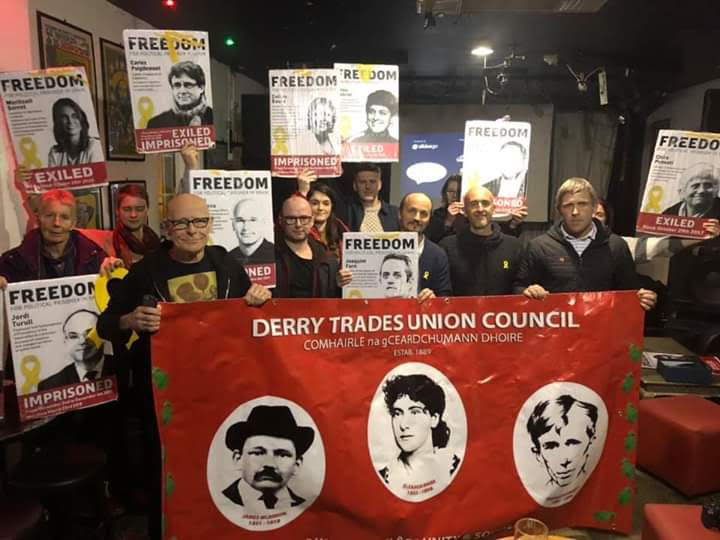
Oriol Duchs with Derry Trades Council and other Catalan solidarity supporters on 11th November.
(Photo: C.Pujol)

POSTSCRIPT

          According to information contained in a press statement issued more recently by the speaking tour organisers, Oriol Duchs the following day paid a fraternal visit to a fire station of the Dublin Fire Brigade, as well as to the DFB’s Training Centre and Museum and was given a conducted tour of all three facilities. Also in Dublin, the firefighter had visited Leinster House hosted by Independents For Change TD Thomas Pringle, where he had met TDs Maureen O’Sullivan (Ind4C), Aengus Ó Snodaigh (Sinn Féin) and Éamon Ó Cuív (Fianna Fáil) along with Senators Paul Gavan and Máire Devine (both Sinn Féin). In a related but separate building he had also met with TDs Gino Kenny and Richard Boyd Barrett (both members of Solidarity/ People Before Profit). Oriol Duchs also took part, shared with a Kurdish representative, in a seminar on international law organised by the Law faculty of Griffiths College, Dublin.

In Belfast on Monday he had spoken in Queen’s University Belfast without contact with any political representatives but in Derry had met Eamon McCann and Shaun Harkin, both members of Solidarity/ People Before Profit and public representatives on Strabane and Derry District Council, as well as Elisha McCallion, Sinn Féin MP for Foyle at Westminster,

He met too with Derry Trades Council which, indeed, had hosted his public meeting in that city. How was it then that, considering his publicity promotion as a trade unionist, member of a trade union that organised three general strikes in Catalonia since 2017, the press statement issued by the speaking tour organisers included no mention of engagement with Irish trade unionists in Dublin, in a city where so many Irish trade unions had their head offices?

“That was not for want of trying,” responded Diarmuid Breatnach, a member of With Catalonia/ Leis an Chatalóin, to the question. “We contacted a number of trade union organisations in Dublin in order to host a public meeting or to meet with Oriol privately. One trade union quoted us commercial hire prices and failed to respond afterwards, another promised a meeting but failed to make arrangements, a number simply did not reply. It was sad, really, not only for solidarity with Catalonia, for I think Irish trade unionists would have benefited much from the interaction with Oriol and his trade union.”

Hopefully they will display a different attitude to any future such visits.

End.

Oriol in Leinster House with Carles Pujol, Cnclr. Micheál Mac Donncha (left) and Senator Paul Gavan (right).

CATALAN SOLIDARITY

Oriol in meeting with TDs Richard Boyd Barrett and Gino Kenny, also present are Diarmuid Breatnach and Tina McVeigh from With Catalonia/ Leis an Chatalóin.
(Photo: C.Pujol)

ORGANISATIONS IN DUBLIN (joint organisers of the speaking tour)

With Catalonia/ Leis an Chatalóin FB: https://www.facebook.com/WithCataloniaIreland/
ANC Ireland FB: https://www.facebook.com/IrlandaPerLaIndependenciaDeCatalunya/

CDR Dublin FB: https://www.facebook.com/CDRDublin/

MARGARETTA D’ARCY SPEAKS IN THE BASQUE COUNTRY

Diarmuid Breatnach

(Reading time: 7 minutes)

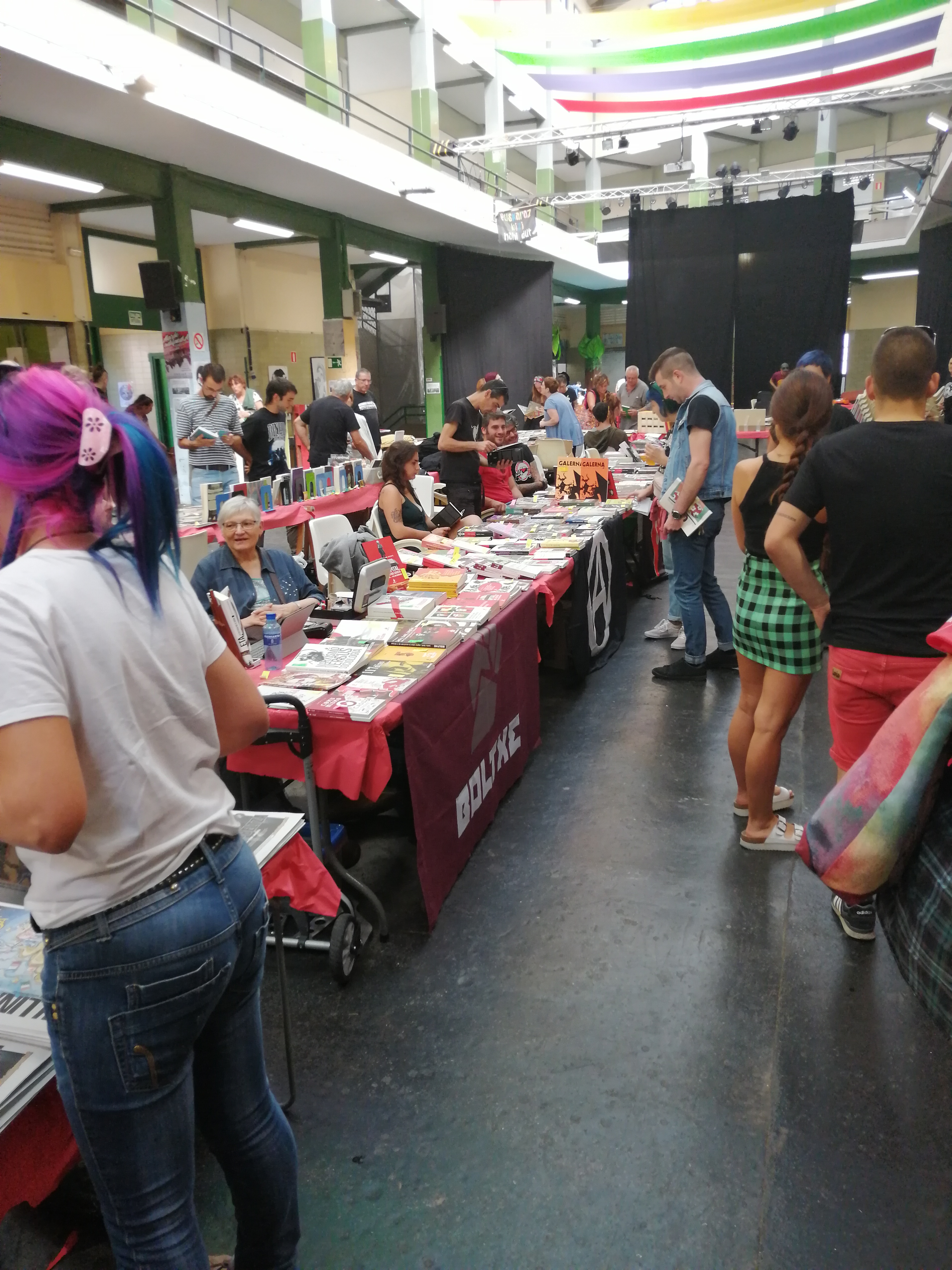
An anti-fascist bookfair was held in Portugalete1, not far from Bilbo (Bilbao) in the southern Basque Country on Saturday 29th and Sunday 30th September. There was ample room for the many stalls in the old disused indoor market in the town’s Casco Viejo (old town quarter), along with a curtained-off play area for children. One of the events in the two-day bookfair was a launch of the translation into Castillian (Spanish) of D’Arcy’s book “Tell Them Everything”(“Di Les Todo”). The translation was published by Sare Antifascista, one of the organisers of the bookfair and D’Arcy spoke in English at the launch, her talk translated into Castillian; also speaking was Basque ex-political prisoner Ziortza Fernandez Larrazabal. 

Section of the audience at the talk (Photo: D.Breatnach)

          Trembling from the illness that has affected her for a number of years (which she later commented resulted from attacks by fascists during the Greenham Common protest and later in Ireland by police) D’Arcy spoke clearly and coherently about her activism, the founding of Women Against Imperialism, the Greenham Common protest camp, her period in jail with Republican women and her activism against the USA’s military use of Ireland’s international airport at Shannon (despite the country’s constitutional neutrality).

Going on to speak about Ireland today, D’Arcy outlined some of the aspects of the notorious Direct Provision Centres for asylum seekers in the Irish state, the issues arising from the location of such centres and the opportunistic intervention of fascists against immigration. She went on to talk about the targeting on social media of those who spoke up welcoming asylum seekers or against racism and commented that the worrying thing about this development was that the fascists had a youth wing. Recalling the referendum on conditions of nationality in 2014 which had removed the rights of people born in Ireland to Irish citizenship unless they had an Irish citizen parent or grandparent, D’Arcy concluded by saying that Ireland is a racist country.

Referring to the Six Counties, D’Arcy criticised Sinn Féin for using the proposed Irish Language Act as a political football and as something with which to attack their political opposition, the Democratic Unionist Party2. Continuing, she said that “Scottish Irish”3 also existed in the Six Counties and asked why that could not be included in the Act, also quoting James Connolly that he didn’t care what language people spoke as long as they could communicate together.

Whatever about the issues in the Brexit question, the speaker said, Britain had used Ireland as a military training ground and had many bases in the Six Counties and these needed to be dismantled.

D’Arcy concluded by advising Basques to approach the Irish Consulate in the Basque Country to enquire whether it would be safe to travel to Ireland, given the US military use of Shannon Airport and the growth of fascism and racism in the country.

Ziortza Fernandez Larrazabal speaking. (Photo: D.Breatnach)

After the Irish speaker and speaking in Castillian, Ziortza Fernandez Larrazabal, ex-political prisoner from the locality, spoke first in tribute to D’Arcy’s record of activism. Moving on to her own activism in support of Basque independence and socialism and her five years in jail, Ziortza recounted being moved through a number of jails as part of the Spanish State’s policy and practice of dispersing political prisoners far from their homes and the strain this places on their friends and relations.

Commenting on the effects of imprisonment in Spanish jails, Ziortza said that some political prisoners had died through neglect, some had killed themselves but some had come out stronger, clearer in their minds and confirmed in their political views, which is what she felt had happened in her case. Ziortza said that some prisoners had 40 years of jail sentence and that they should be released.

After applause for the speakers, the Sare Antifaxista chairperson opened the meeting to questions from the audience. After a silence of some minutes, one man spoke in praise of the courage and commitment of both women and their record of activism. Speaking in Castillian with an Irish accent, he said he felt he had to distance himself from some of D’Arcy’s words. He felt it was important not to confuse government with people and that the Irish people were not, on the whole, racist and in fact racists and fascists had found it very difficult to organise within the territory of the Irish State.

Recounting the historical experience with the fascist Blueshirts in the 1930s, the Irishman said that they had been fought on the streets and defeated. When Pegida tried to launch their fascist and islamophobic group in the capitals of European states in 2016, they had failed in Ireland because firstly their gathering point had been occupied in advance by anti-fascists and anti-racists and, secondly the fascists themselves had been physically attacked and beaten. He talked also about a recent initiative to launch a “yellow vest” movement in Ireland but which fascists and racists had moved in to lead – that initiative had, as a result, been rejected and had faded away. Fascists are active on social media but find it difficult to hold events in public. The danger of racism and fascist organising should not be dismissed, the Irishman said but so far, in Ireland, racism and fascism was being repulsed among the people.

(Photo: D.Breatnach)

While it was true that the Government had proposed changing the nationality clause in the Constitution in 2014, he said, this had been part of a process across the whole of Europe. The referendum was held on that question along with another at the same time and only the social democrats and trotskyists had noticeably campaigned against the change. The vote in favour had to be seen in that context.

Moving on to the question of nation and language, he said that nations had a right to self-determination which, in many cases, was opposed by imperialism, which also damaged many languages. The loss of a language, he said, means the loss of a way of thinking and seeing, of literature, poetry and song; the loss of such is a loss for entire humanity.

A Basque woman also spoke from the floor, partly in Castillian and partly in Euskera (Basque), expressing her admiration for the record of both women speakers and referring to her own involvement in her youth in Greenham common. She went on to speak about the danger of nationalism but also in support of the rights of language and said that if there were no states in the world, she would not want one either but as long as there are, she wanted one for her own nation.

She also said that at this time it was important to support the struggles for self-determination not only of the Basques but also of the Catalans.

Poster advertising the book launch and talk

The event came to an end and people moved off for lunch in various bars, or to chat or to browse the bookstalls. The latter were run by a number of organisations: Inugorria Liburodenda (Gernika revolutionary and progressive bookshop), Sare Antifaxista; CNT, Mujeres Libres, IPEs, Baskale, FAI, DDT Banaketak, Periko Solabarria Elkartea, Komite Internazionalistak, Jazz Oi!, Templando el acero, Amnistía Ta Askatasuna, SRI.

FOOTNOTES

1 Portugalete has a Metro station, reachable from Bilbao. The Casco Viejo (old town) is a number of narrow streets lined by bars and shops heading steeply downwards from the Metro station towards the river front, where there are a number of restaurants and bars and a nearby port museum. The interesting Puente Colgante is nearby; a pedestrian bridge across the river worked something like a horizontal lift.

2 Given that Sinn Féin makes no effort to ensure its own membership is Irish-speaking, or even its leaders (despite some of them being very proficient in the language), also that all its internal and nearly all public meetings are conducted through English, this would seem to be a correct assessment by D’Arcy.

3 D’Arcy probably meant Ulster Scots or Ullans, which is not any kind of Irish but a variant of Scots, the Germanic-English dialect once prevalent in the Scottish Lowlands (often called “Lallands”), in which for example Robbie Burns wrote. It has Minority Language Status in the Six Counties and while Irish-speakers generally have no opposition to the promotion of that dialect, hardly anyone speaks it today and it was raised as an issue by Unionists purely as a counter to the rights of Irish-language speakers. Scotland does have Scottish Gaedhlig, with over 57,000 recorded speakers (2011 Census) but this is not spoken in the Six Counties.

Gernika bookshop stall in foreground
(Photo: D.Breatnach)
Other stalls
(Photo: D.Breatnach)


REFERENCES AND FURTHER INFORMATION

Sare Antixista: http://sareantifaxista.blogspot.com/

Dissidence in the Basque Country: https://rebelbreeze.wordpress.com/2019/09/27/dissidence-in-the-basque-pro-independence-movement/

Basque political prisoners:

Amnistia Garrasi: https://www.facebook.com/profile.php?id=100013870776872

Etxerat: https://www.facebook.com/Etxerat-Elkartea-255302801219340/

(Photo: D.Breatnach)

(Photo: D.Breatnach)
Buying at stall at the Bookfair
(Photo: D.Breatnach)
Nearby poster honouring “Argala”, an ETA leader assassinated by GAL, the Spanish State death squad.
(Photo: D.Breatnach)

THE DÁIL: IRISH ESTABLISHMENT SUPPORTS THE SPANISH STATE’S ATTACK ON CATALAN SELF-DETERMINATION

Clive Sulish

A representative of the Irish (Fine Gael) Government’s Minister for Foreign Affairs and Trade last night not only called for non-interference in the “internal affairs” of the Spanish State but defended the Spanish Constitution of 1978 and the “independent Spanish judiciary”. She was answering a question regarding the Spanish State and Catalan independence movement and her stance was supported by representatives of the two other traditional parties of Irish Government, Fianna Fáil and Labour. Five Teachtaí Dála, elected members of the Irish Parliament, argued passionately against them.

Section of Catalonia supporters in Kildare St. waiting to attend the Foreign Affairs Minister’s Question time.
(Photo: Rebel Breeze)

THE VOICES OF THE ESTABLISHMENT

This was Minister’s Question time, when Ministers (or their representatives) appear in the Chamber to answer questions about areas of the remit of their Departments and earlier, Ministers had been quizzed about areas of childcare, social care funding, local government funding ……

The Dáil chamber looked mostly deserted but in the public gallery sat a score of Catalans and some Irish, listening intently. Normally, these sessions are attended only by the TDs asking the questions and the relevant Ministerial spokesperson – and only for the question being asked. And of course also in attendance is the Ceann Comhairle, the presiding person acting as Chair – and secretaries. Sometimes by members of the media but by no means always, since reporters can monitor the televised broadcasts of the session.

The Minister’s reply on the question of Catalan self-determination delivered by Minister of State Helen McEntee TD followed a predictable pattern – predictable because it is so often trotted out: the Irish and Spanish Governments have a long history of good relations and friendly links, lots of Irish people go there on holidays, lots of people from there come to Ireland every year, Spain is a democracy, its constitution must be abided by, it would be wrong to interfere in its internal affairs. Inclusions to that in litany in recent times are that the question of Catalonia is emotive throughout the Spanish State and that Catalan society is divided over it, that the rule of law must be upheld and that violence has no place in politics.

The Fianna Fáil representative, Seán Haughey TD, echoed that line, adding also that the Spanish Constitution of 1978 is unitary and does not allow any part to become independent. He also quoted some survey results that he claimed indicated that support for independence was now in a minority among Catalans.

The Labour Party representative, Jan O’Sullivan TD, went further and specifically supported the present Government of her “sister party in Spain”, the PSOE and suggested that the “inflexible” previous government of Rajoy (of the PP) had helped to bring the current situation about and that Sanchez, the Prime Minister, would help calm the whole situation down. The only concessions she made were to suggest that the lengthy jail sentences were perhaps not the best way to deal with the issue and to include the police by mention in her call for “end to violence by all sides”. However, she went further than others in the Establishment parties with a specific condemnation of the jailed activists when she said that “it is not acceptable for politicians to lead citizens into conflict”.

Early arrivals for the Minister’s Question time
line up in Kildare St. below a photo of the First Dáil 1919.
(Photo: Rebel Breeze)

THE OPPOSITION

“Reactionary Spanish nationalism”

          The first TD to speak in reply to the Establishment politicians was Eoin Ó Broin, a comparatively recent Sinn Féin Deputy (2016) for Dublin Mid-West. Ó Broin was in Catalonia as one of the international observers of the Catalan Referendum on Independence on 1st October, which was attacked by Spanish police with around 1,000 Catalans injured.1

Speaking about his experiences there, Ó Broin related his meeting with 83-year-old Antonio, bruised and with his fractured arm in a sling, beaten while trying to vote earlier that day, queuing again at a polling station in Barceloneta. The SF TD spoke about what he had seen there and the “increasingly reactionary Spanish nationalism”, then went on to list the elected politicians and their jail sentences. Denying it was an internal matter for Spain, Ó Broin said it was about human rights and required international independent mediation. The Dáil would be implicitly in collusion with the Spanish Government if it left the matter to internal resolution only.

“The working class are the incorruptible heirs …”

          Paul Murphy TD, a socialist activist2 who has recently left the Socialist Party of Ireland to form a platform called Rise, shared speaking time with Eoin Ó Broin. Calling for a “reality check” he said that jailing politicians and activists for organising a peaceful ballot could hardly be the work of a normal democracy. Responding to the Labour Party spokesperson with regard to the Spanish PSOE Prime Minister, he said that “Sanchez is in Government” and that he was “sending thousands of troops and police” to suppress the Catalan independence movement and mounting “a publicity campaign” to blame the convicted leaders.

The Spanish Government would one day come to be haunted, Murphy said, by the words of James Connolly in 19143 when he said:

“If you strike at, imprison or kill us, out of our graves or prisons we will still evoke a spirit that will thwart you, and perhaps, create a force that will rise up and destroy you. We defy you! Do your worst.”

Murphy said that the Catalan popular movement was impressive with their demonstrations, marches and the recent general strike. Against that, the Spanish police and army were carrying out “a campaign of terror” injuring hundreds and anyone who didn’t believe it only had to go on line and see the videos. “Francoism is baring its ugly head”, Murphy said and pointed out that the Spanish legal systems is riddled with a contempt for democracy, echoed by those at the top in the European Union.

The recent Catalan General Strike, according to Murphy, “showed the way forward” and he quoted again from Connolly, that “the working class are the incorruptible heirs of Irish freedom”. The Spanish State had a long history of suppression of national self-determination, including those of the Basques, Murphy said and the way forward would be for a voluntary socialist federation.

Catalan independence supporters gathering in Kildare St. waiting to attend the Foreign Affairs Minister’s Question time.
(Photo: Rebel Breeze)

“The judicialisation of politics”

          Next to speak was Thomas Pringle, Independent TD for Donegal since 2011, with a socialist Irish Republican background, a member of Sinn Féin for few years but who left the party in 2004. He opened his contribution by referring to “the judicialisation of politics” in the Spanish state and, in reference to the scale of the Spanish repression, mentioned the 700 Catalan town mayors who await judicial process due to their support for the Catalan Referendum in 2017.

Pringle said the Spanish Constitution purported to guarantee the rights of different people within the state, which would be a joke if the reality were not so grim. “The EU continues to ignore” what is going on in its member Spanish State, “as it did in the Six Counties,” he said.

“Catalonia in 2019 is Ireland  a century ago”

          “Self-determination is a human right,” said the next to speak: Peadar Tóibín, TD for Meath West since 2011, who left Sinn Féin in 2018 and went on to form Aontú in January 2019. Tóibín reminded all that the First Dáil had sent out a call to the world for recognition of Irish independence in 1919 and that most states had not done so then4.

“Catalonia in 2019 is Ireland a hundred years ago”, Tóibín said and went on to say that if the Irish Government remained silent on repression by the Spanish State then it shared culpability for it.

“ … a short memory in this House”

          “We sometimes have a short memory in this House” said Mattie McGrath when it was his turn to speak, a TD since 2007 who has been an Independent since he left the Fianna Fáil party in 2011. McGrath referred to the recent long war in the north-east of Ireland and said that conflict resolution process was the only way to resolve the issue.

McGrath referred to Clare Daly (elected MEP this year after being a socialist TD for some years) and her statements on the issue. “Self-determination is a fundamental human right”, McGrath said, and went on to speak about “the right of freedom of assembly”, which was under attack by the Spanish State.

“Ireland is a small island nation”, Mc Grath said, “very sympathetic to the rights of people” (apparently contrasting this to the attitude of the Establishment in the Dáil).

In the time allowed by procedure for final response from the Minister, her representative reiterated the position she had outlined earlier and, though she conceded that most of the Catalan demonstrations had been peaceful, said that some recent “scenes of violence” had been “of concern”.

Section of Catalonia supporters in Kildare St. waiting to attend the Foreign Affairs Minister’s Question time. Behind them, enlarged photo of the First Dáil, 1919.
(Photo: Rebel Breeze)

COMMENT

Fianna Fáil‘s origins are in the split with Sinn Féin led by De Valera in 1926 over the question of taking seats in the “partitionist” Irish parliament, the Dáil, and rapidly became the preferred party of the native Irish capitalist class, having been in government since more than any other Irish party.

The origins of Fine Gael, currently in minority Government at the tolerance of Fianna Fáil, has its origin in the setting up of the Irish State after the War of Independence and represents the victors of the Civil War against the Republicans. It was composed of a coalition of a right-wing Irish Republican party (followers of Michael Collins, Griffiths etc), a small right-wing farmer’s party and the fascist Blueshirts (a name by which FG are still often called by their enemies).

Hard to believe today, the Irish Labour Party was founded by, among others, James Connolly and is the oldest of the three parties. A progressive party in the early days, it was not a participant in the Civil War, during which its representatives criticised the Free State Government about its abuse of civil rights, repression, large-scale arrests, internment without trial, torture and murder. Over the years it lost more and more of its socialist credentials and has been in coalition government with the right-wing Fine Gael on two separate occasions. The main trade unions in Ireland retain connections to the Labour Party, with the possible exception of the rapidly-growing British-based UNITE.

(Photo: Rebel Breeze)

The supposed inviolability of the Spanish Constitution of 1798 is one of the questions at the heart of the matter. The boast of the Spanish Government and its supporters abroad is that the majority of the people within the Spanish State voted for it. Well, so they did, except in the Basque Country – but what of it? If in a wedding, one of the partners says “I do”, does that mean that person is forever forbidden from leaving? Do we not have the right to divorce acknowledged now in most states around the world and certainly in “the democracies”? If one agrees to join a club or organisation, does that mean one can never choose to leave? Well, maybe in the Mafia, or the Cosa Nostra ….

Furthermore, that monarchist Constitution was put forward to a population that had endured four decades of fascist dictatorship, with the collusion of the allegedly socialist and republican PSOE and the allegedly communist and republican Communist Party of Spain, restraining their trade union and party members in the wave of state repression and murders during the Transition to “democracy”. Isn’t there something about the invalidity of agreements made under duress?

The issue of non-interference in the internal affairs of another state is a bogus one, since all governments do that at one time and another and Irish governments and political parties are no exception. In 1936, the representatives of Fine Gael loudly supported the military-fascist uprising led by Franco against the democratically-elected Government of the Spanish State. The Irish Government of Fianna Fáil did nothing to prevent the Blueshirts going off to fight for Franco and the Bishops of the Irish Catholic Church blessed them as they sailed off. The reality is that states that agree with one another generally do not interfere in one another’s internal affairs.

The constant mantra of reference to “the rule of law” and the condemnation of “violence in politics” is not only an irrelevance but turning truth on its head. It was not illegal according to the Spanish Constitution or laws to hold a referendum on independence 5. It is also against the Spanish law to use violence against others and even the police are not legally empowered to do so except in self-defence or in defence of others. On October 1st the actions of the Spanish police had 1,000 people requiring treatment and another few hundred have been injured in recent days. The Internet is full of videos of different incidents of gratuitous Spanish police violence, often the perpetrators showing no fear of being filmed – clearly because Spanish (and more recently, Catalan) police know they have impunity. Recently, however, it seems that some Spanish police have become sensitive to being filmed during their violent acts and have begun to target photo-journalists, both with personal violence and with rubber bullets.

A total of five people have now lost an eye from the impact of the rubber bullets of the Spanish police. Apart from the fact that these are banned in Catalonia, the bullets are supposed to be fired to ricochet and not directly at people, nor are they supposed to be fired at close quarters. Clearly, the rules are not being adhered to and nobody is enforcing them, granting impunity to the Spanish police.

When the representative of the Minister for Foreign Affairs acknowledged the overall peaceful nature of Catalan independence demonstrations but expressed concern over some recent scenes of violence, what was she really saying? It was this: that the violence of the police against the peaceful demonstrators could continue but the victims using force in defence or in retaliation is a cause for concern!

End.

FOOTNOTES

1  Eoin Ó Broin, often described as on the (small) left wing of Sinn Féin (a wing badly needed by that party) has in the past had relations with the Abertzale Left in the Basque Country and wrote a book on the movement there in his time, Matxinada – Basque Nationalism and Radical Basque Youth Movements. He is also author of Sinn Féin and the Politics of Left Republicanism.

2  Paul Murphy has been, while a Socialist Party TD, dragged by police out of a housing protest and with others faced serious charges arising out of a protest about Irish water against a Labour Party Minister, of which he and the others were acquitted by the jury after an infamous trial. He remains in the PBP-Solidarity parliamentary coalition.

3  James Connolly (1868-1916) was at that time active in the Irish Labour Party and leader of the Irish Transport & General Workers’ Union, which was struggling to recover from an 8-month fight against a group of employers that had set out to crush the union (Dublin Lockout). Connolly was a revolutionary socialist, republican, journalist, historian, author and organiser and was horrified by the very idea of the First World War which began in 1914. He was shot dead by British firing squad, along with other leaders and some others of the 1916 Rising.

4  This reference seems particularly appropriate. In January 1919 the majority of MPs elected in Ireland in the UK General Elections of December 1918, carried out the “Sinn Féin” platform’s election promise not to go to Westminster and convened a parliament in Dublin. This is known as “The First Dáil” even by the Irish State, which numbers its parliaments from then onwards. The First Dáil declared independence and called on the states of the world to recognise Irish independence (see References) but only the young USSR did so. Ireland had no legal right under British law to break away from the UK unless it were agreed by majority in Westminster (where the Irish MPs would always be outnumbered by the British). The First Dáil was banned by the British in September of that year and its members were arrested if they could be found.

5  Though possibly the declaration of Republic was – but that was suspended in less than five minutes.

REFERENCES & FURTHER INFORMATION

Clip of Eoin Ó Broin TD reply: https://www.facebook.com/EoinOBroinTD/videos/1138199326378630/

Clip of Paul Murphy TD reply: https://www.facebook.com/paulmurphytd/videos/424540844872189/?t=11

Clip of Thomas Pringle TD reply: https://www.facebook.com/ThomasPringleTD/videos/416766079224197/

Clip of Peadar Tóibín TD reply: https://www.facebook.com/740004202875853/videos/738458029959798/?t=124

(currently seeking remaining TD, also footage of the whole debate)

Text of all contributions to the debate: https://www.oireachtas.ie/en/debates/debate/dail/2019-10-22/34/

First Dáil’s Message to the Free Nations of the World: https://en.wikipedia.org/wiki/Message_to_the_Free_Nations_of_the_World

Some organisations of Catalan solidarity in Ireland:

ANC Ireland: https://www.facebook.com/IrlandaPerLaIndependenciaDeCatalunya/

CDR Dublin: https://www.facebook.com/CDRDublin/

With Catalonia/ Leis an Chatalóin: https://www.facebook.com/WithCataloniaIreland/

TWEETS OF FATHER WHOSE DAUGHTER WAS BEATEN BY MADRID POLICE GETS HUGE RETWEETING

Translated and compiled by D. Breatnach

Spanish riot police. (Photo sourced: Internet)

After his teenage daughter was clubbed by Madrid police on Wednesday last, Angel Barrancos sent a tweet to the Madrid police that is being retweeted extensively in the Spanish state. His daughter’s injuries followed a Spanish police charge on a large demonstration in solidarity with the Catalan prisoners and calling for fundamental changes in the Spanish state as a whole.


“Hi, Police! I was in the Madrid demonstration today and your sons of bitches colleagues of the UIP
(mobile units of the Policía Nacional – Trans.) laid my daughter’s head open. Note my name well. I’m coming after you. I used to respect you – no longer. Now I am going to the hospital – you’ll hear from me later.”

Shit police! The girl is 16 years of age, is 1.60 meters high and weighs 40 Kg. She is a young person in solidarity with those of her age. She must have surely been putting your lives in great danger. I am going in a taxi to the hospital, Samur (the ambulance company) cannot carry all the wounded!!! Beware!!!”

The CTC scan ok, baton blows to the body and some stitches to the head. Thank you those who have taken an interest and my condolences to the inhuman fascists who have written barbarities, I will respond to you …. you do not deserve my time.”

One of the reporters covering the events, Alicia Armestro of Kaos en la Red, alternative Internet news media, was attacked by police and her equipment thrown into the air. She sent a brief report on the event and a video of the start of the police charge before going for treatment and recovery of her injuries.

End item.

“YOUR STRUGGLE IS OURS TOO!” — CATALONIA’S STRUGGLE IS WAKING SPAIN

Diarmuid Breatnach

(Reading time: 3 minutes (not including video))

A Catalan solidarity demonstration of thousands in Madrid, in the big central square called Puerta Del Sol, shouted for “freedom for the political prisoners” and declared that Catalonia’s struggle was theirs too. A small crowd of Vox and smaller fascist groups tried to disrupt the rally but were repelled and the crowd turned towards them chanting: “Here are the antifascists!” (daring the fascists to come forward). Later, Spanish police charged the solidarity demonstrators and some running battles took place in the city’s streets.

There are two Spains – one of them is the Spain of an imperial and racist history, of expulsions, of plunder of colonies, of repression at home and abroad, the Inquisition, military-fascist uprising against an elected government, mass executions, rape and plunder, four decades of fascist dictatorship, followed by another four of a fake transition to democracy. That is the Spain that is in power now.

The other Spain is the one of popular resistance to exploitation of the Comuneros, the anti-feudal writing of Cervantes, the struggle against the military-fascist uprising supported by Nazi Germany and Fascist Italy, the mounting resistance to the Dictatorship that forced the ruling class to change their style of management, on the face of it ….. That Spain had largely been beaten, jailed or shot in to silence, crushed by treason and division and hopelessness. But there were always embers, embers that burst into little flames from time to time, not only in the nations of the Basque Country, where a fire burned for two decades, or in Catalonia, or Galicia …. but also in places like Asturias in the north, Andalucia in the south and in Madrid itself, in the centre.

The struggle of Catalonia for independence and against fascist police and judicial repression, is waking that other Spain and calling her to the fight. Waking her latent anti-fascists, her democrats; waking those who are unemployed, in precarious jobs, fighting to hold on to their homes or being evicted; waking its youth who want a better future.

It is the opposite of what was wanted by the Falangists, Vox, Ciudadanos, the Partido Popular, the Monarchy – all of them heirs of the fascist dictator Franco – and the PSOE, which climbed aboard with them. These have railed against the Catalan independence movement in order to distract the people from their real problems and real enemies. In Andalucia, Vox and Ciudadanos joined forces to oust the corrupt PSOE government and to progress towards a fascist regional government. In Extremadura they moved towards the same objectives but fell out among themselves.

Section of crowd in the Catalan solidarity demonstration in Madrid on Wednesday. The really large banner in the middle is the flag of the Second Spanish Republic with the yellow ribbon of freedom for the Catalan political prisoners across it. (Photo:see Source at end article)

But recently both those regions have seen courageous people take to the streets, proudly declaring solidarity with Catalunya. And Madrid on Wednesday saw another part of that awakening. A Catalan solidarity demonstration of thousands in Madrid, in the big central square called Puerta Del Sol, shouted for “freedom for the political prisoners” and declared that Catalonia’s struggle was theirs too. And chanted that “Monarchy is filth!”

The Spanish Government – and also other spokespersons of the parliamentary ambit – is calling for respect for the judgement (ie againts the Catalan activists – Trans.). The judgement is not respectable, neither in its genesis nor in its conclusions and therefore cannot be respected,” declared the conveners of the solidarity protest.

That is why this evening we are holding this assembly for freedoms, for democracy and against repression,” declared one of the speakers at the event. “And for that reason we salute and send all our internationalist solidarity to all the people who these days are coming out in various parts of Catalonia, especially to those who have suffered repression, with blows, arrests or in addition once again, a person has lost an eye through the brutal and illegal use of rubber bullets.”

A young woman spoke “on behalf of the youth of Spain to the youth of Catalunya”, saying that their struggle was waking up that of the Spanish, against unemployment, precarious employment, against fascism and the Monarchy.

She said that the democratic parties and trade unions needed to decide whether they were on their side in that struggle or on the others. The young woman read out a long list of organisations supporting the Madrid demonstration and ended with the call, in which all joined in: “Catalunya, listen: Your struggle is our struggle!”

end.

SOURCE (report on the Madrid demonstration and video):

http://www.izquierdadiario.es/El-Madrid-del-No-Pasaran-desborda-la-Puerta-del-Sol-en-solidaridad-con-Catalunya?fbclid=IwAR0i82WbXmmeU2V_IDRdLpVBBmcVConHYrSAcVuFbrW5RUAv_FNVPBGz4OQ