Revolutionary socialist & anti-imperialist; Rebel Breeze publishes material within this spectrum and may or may not agree with all or part of any particular contribution. Writing English, Irish and Spanish, about politics, culture, nature.
Gearóid Ó Loingsigh (with kind donation of photos)
(Reading time: 7 mins.)
08 March 2023
Photo Coca Plants Northern Colombia: G.O.L.
The drugs issue in Colombia supposedly occupies the time of and is a concern to the government.
It has been an important issue for all the governments and as was to be expected it is one that has come up again in the dialogues with the ELN, despite this organisation denying any links to the drugs trade.
The author (left) and Pablo Beltran, the ELN negotiator (centre) and representative of social movement in Ecuador (right) in 2017 conference in University of Simon Bolivar, Quito, Ecuador. (Photo: GOL)
In the peace process with the FARC, agreement was reached on the issue. What was agreed to in Point 4 of the Havana Accord was abysmal and showed that the FARC did not understand the problem nor the possible solutions.
Of course, there could be a difference between what the FARC understood and what it agreed to, as at the end of the day the state won the war and imposed the greater part of what the FARC signed up to.
Following the agreement in the declarations of the main FARC commanders there is nothing to be seen that indicates that they really understood the problem. Will it be any different with the ELN?
One of the main concerns of the ELN has been to put a distance between themselves and the drugs trade.
Whilst it is true that the ELN is not the FARC, it is also true that in their areas of influence or those contiguous there are coca and poppy crops and the USA is not going to believe them that they have nothing to with it, whether they like it or not. The ELN accepts that it places taxes on economic activities and for the USA that is drug trafficking.
So, some time ago, the ELN issued a statement where they restated that they have nothing to do with drugs and invited an international commission to visit the country to see the reality for itself.(1) They ask that a UN delegate take part in the delegation. They also make a series of proposals in relation to the issue as such.
On the first point, the ELN feels sure of itself regarding its ability to show in practice that they are not drug traffickers. The ELN correctly states that:
When the Colombian government and the USA accuse the ELN of having an active role in the trade, they are lying, but above all they are covering up for those really responsible and the deep-seated problems, which indicate their unwillingness to take real and effective measures.(2)
ELN guerrilla camp, Colombia (Photo: GOL)
But for the USA, it is not about whether they are guilty or not, it is a political tool and weapon and to give them a voice and vote in the affair is extremely dangerous. When the USA accuses the ELN of being drug traffickers, it is not making a mistake.
A mistake on their part would be to say something they believe and be wrong about it, but they accuse the ELN for political reasons on the basis of their strategic needs and the legal basis to their accusations is the least of it: it is just propaganda. By inviting them into the country, the ELN falls into their trap.
The UN participated in the commissions of investigation for supposed weapons of mass destruction in Iraq. The lack of evidence of such weapons wasn’t of much use.
The USA played around with supposed or real non-compliance by Saddam and did what they always wanted to do: invade Iraq. In this they counted on the explicit support of Great Britain and the tacit support of others.
There is a myth in Colombia that the only baddies are the USA and that other imperialist powers such as Canada (a country that is not seen as imperialist by many sections of the “Colombian left”), and other countries of the European Union are good, or at least not really that bad to the point they are friends of the Colombian people.
In the case of Colombia, the EU competes with the US in almost everything. The EU is Colombia’s second commercial partner and its companies are dominant in sectors such as mining, health and oil, amongst others.
The ELN also asks for the legalization of drugs. The demand is justified and quite opportune, but their counterparts i.e. the Colombian state is not sovereign in the matter and furthermore there is a need to clarify what is understood by legalization.
If by legalization they mean legalizing production for medical purposes, the bad news is that medical production is already legal. The thing is, that it is controlled. In fact, in many jurisdictions they don’t talk of illegal drugs but rather controlled substances.
Cocaine is a controlled substance. Its production for medical reasons is authorized by the International Narcotics Control Board (INCB) and production is almost exclusively carried out in Peru. And the market is quite small, not even reaching 400 kilos per year as I pointed out in an earlier article.(3) It solves nothing in relation to Colombia.
If on the other hand, they are talking about legalizing recreational use, something which could positively impact the Colombian countryside, then it is a matter of international jurisdiction. Colombia cannot legalise it on its own.
Colombia is a signatory to the Single Convention of 1961 that holds sway in the matter and in addition there are power relationships at play.
It doesn’t matter whether it legalises production for recreational use, it will never be able to legally export it, not only without the consent of the other country, but also the whole setup of the UN and its bodies such as the INCB i.e. at the end of the day, the USA.
Even if it is legalized for internal consumption, there are other problems that have already arisen in countries such as Uruguay which legalised recreational use of marijuana or some of the states in the USA.
The banking system dare not receive funds from those legalised markets and the producers resort to old methods more akin to money laundering to deposit legal funds in legal accounts in a legal banking system.
Even in the hypothetical case of the USA and the EU agreeing, the legalisation of cocaine would go far beyond Colombian cocaine and would include other drugs such as opium and its derivatives such as heroin. It is worth looking at the drugs market and its production.
According to the UN, cocaine is produced directly or indirectly in eight Latin American countries (Colombia, Peru and Bolivia account for almost all of it), whilst 57 countries produce opium, the Asian countries being the largest producers (Afghanistan, Myanmar and Mexico dominate the market).
A bucket of opium poppy seed (Photo: GOL)
Cannabis, which is the most widely consumed drug in the world is produced in 154 countries.
For 2020, the UN calculated that there were 246,800 hectares of opium and 234,000 of coca.(4) They also calculate a production of 7,930 tonnes in 2021(5) and 1,982 tonnes of cocaine in 2020.(6) We are not talking about small quantities of production or land. Almost half a million hectares between these two drugs and 64 countries.
Any proposal of legalisation has to include these countries and their peasantry.
The number of drug users is also large. The UN calculates that in 2020 there were 209 million cannabis consumers, 61 million people who had consumed opiates, 24 million amphetamine users, 21 million cocaine consumers and 20 million users of ecstasy.(7)
They say that in 2020, they had calculated that 284 million people between the ages of 15-64 years used drugs, i.e. one in every 18 people in this cohort.(8)
There are consequences to this, in economic but also cultural terms regarding the use and abuse of substances. But there also consequences in terms of health. Some 600,000 people received some treatment for drug problems.(9)
So when the ELN says that “Drug addicts are ill and should be cared for by the states and not pursued as delinquents”(10) their idea is correct, however, the size of the problem is greater than the real capacity of the health systems in the countries that have large numbers of users.
Photo Opium Poppy Nariño Colombia: G.O.L.
The total number of people injecting drugs is 5,190,000 in Asia, 2,600,000 in Europe and 2,350,000 in the Americas (almost 75% of which is in north America).(11)
Of those who inject, 5.5 million have Hepatitis C, 1.4 million are HIV positive and 1.2 million are HIV positive and also have Hepatitis C.(12) These are not minor problems and are high-cost illnesses.
Of course, these figures do not include the unlawful abuse of legal pharmaceuticals. In the USA almost 80% of the overdoses are from the consumption of legal opiates such as fentanyl, which caused 78,238 deaths in 2021 in that country.
But the issue does require legalisation and not other means that the FARC aimed for. The peasants of Colombia did not make a mistake in choice of crop when they planted coca. Coca was and continues to be a very profitable crop, despite all the difficulties that it generates.
There is no need to substitute it with another crop such as cocoa or African palm etc. It is not about the crop but rather the production model and the political and economic context.
The increase in coca production in Colombia, is not due to subjective factors such as the decisions of peasants, not even of the drug barons and less still of the insurgencies but rather objective economic factors.
This is a key point. It was the decisions of northern countries that impacted the countryside and pushed thousands of peasants around the world to grow opium poppy and coca. The neoliberal cutback policies in the north also contributed to the dramatic rise in problem drug use due to the increase in misery in those countries.
Bedding, equipment and reading material in an ELN guerrilla camp, Colombia (Photo: GOL)
In any discussion we should distance ourselves from the idea that the drugs problem can be solved in a negotiation with the ELN, although they could negotiate some points that would contribute positively to a solution.
But the problem is political and the free trade agreements and other measures that had a negative impact on the countryside have to be looked at again.
Also, they have to reach an agreement with the Colombian government, not for some perks for peasants nor corrupt projects and budgets such as those the FARC agreed to, but rather a political agreement where the government argues and campaigns for the derogation of the Single Convention of 1961.
We began the previous manifesto talking about emergencies. We said that it was essential to reclaim an anti-imperialist and internationalist Euskal Herria2.
And that urgency, that need, is what has brought together comrades from all corners of Euskal Herria here today. Well done all of us!
Capitalism is going through a systemic crisis. They speak to us of a “extraordinary period” but the truth is rather that we find ourselves in a permanent crisis. As we have supposedly departed one, they have already placed us in another.
As of 2020, moreover, we have entered a phase of exceptionality in which States take advantage to impose economic, social and disciplinary policies that point towards a war scenario. Therefore, we cannot separate the capitalist decomposition from the increase in repression and censorship.
Banner reading “Condemning us to war and misery” and section of the anti-NATO march in Bilbao 11 March. (Photo sourced: organisers)
The rise of fascism that is taking place throughout Europe is a direct consequence of the bourgeoisie’s fear of losing the control it exercises over an increasingly exploited and angry population.
In the field of international relations, we are also witnessing the increasing loss of hegemony of the Empire that has controlled the world practically without opposition for the last 30 years.
The bloc led by the United States and NATO, far from accepting the end of its historical cycle, seems determined to increase armed conflicts. In addition to giving a boost to the arms industry, they intend to hinder the growth of emerging powers such as China or Russia.
For this phase of confrontation, they have finally achieved the support of the lobby led by Ursula Von der Layen, the “gardener” Borrell3 and company.
NATO and the EU, together with the Zionist entity that redoubles its attacks on the Palestinian people, are today the main props of this dark period in history.
As far as NATO is concerned, we have to understand that its role goes beyond being a mere military organization. It is true that it is mainly the army of the bourgeoisie (and it is demonstrating this in Donbass, as it has also demonstrated in Yugoslavia, Libya or Syria).
But it has the superior function of being the military arm against anyone who opposes the policies of capital. Today these translate into the over-exploitation and precarity of the working class (especially women and people of colour).
And changes in labour rights to deprive us of material concessions wrested through class struggle, change of laws to increase the repression of those struggles, etc.
A clear example of this is the latest General Budget of the Spanish State, supported by all the social democratic parties4.
The budget supports the deterioration of the material conditions of working peoples to benefit NATO, giving it more control capacity and recognizing their right to appropriate civil infrastructures to defend the interests of the bourgeoisie.
The support for these militaristic policies, at the dawn of a world war, is a real shame and demonstrates the total lack of commitment of the leadership of these parties to the future of the Working Peoples of the world.
In Euskal Herria we are well aware of what NATO represents:
in addition to the military training industrial estate in Las Bardenas or the military exercises carried out at the Araka base (Gasteiz), we have recently witnessed blatant support from the Government of Gasteiz for war industries such as SENER or SAPA.
Nor can we forget the historical support of NATO, through the Gladio network, to the Spanish and French States in their legal and illegal repression5 against the struggle in Euskal Herria.
If we add to this the economic and social exception measures imposed on us by Brussels (private pension funds, increase in the retirement age, dismantling of public health) …
It becomes increasingly clear to us that neither as a nation nor as working class do we have a future within NATO or the EU. The need to destroy these instruments of domination by the bourgeoisie, as well as the Spanish and French States, is more than evident if we aspire to build a future in freedom.
These are not good times, of course not. The situation is becoming more and more complicated throughout the world. And that is why we here today are calling for the activation in each town and each neighborhood of the anti-imperialist Euskal Herria.
Today, we not only reaffirm this rejection, but we once again make an urgent call to join forces with the rest of the working peoples and oppressed nations of the world to stop the imperialist offensive promoted by this criminal organization along with its allies in the European Union.
From Chile to Donbass, passing through Laos, Mali or Vietnam…
LONG LIVE THE STRUGGLE OF THE WORKING PEOPLE!
AN ANTI-IMPERIALIST BASQUE COUNTRY!
Front of march heading towards the Bridge across the Nervión river and the old city (Photo sourced: organisers)
COMMENT: A GIANT STEP FORWARD
Diarmuid Breatnach
(Reading time:One min.)
The estimated 2,000 turnout in support of this demonstration must have exceeded the expectations of the organisers and greatly encouraged them. Two thousand is not a huge number in the highly-politicised Basque Country, even with a total population of less than three million, north and south.
But this is a nation which has for decades been under a political leadership, the surviving members of which have now taken the road of pacificaction, of accommodation to capitalism and the Spanish and French states, of social-democratic ‘opposition’.
This movement had a united national political leadership, an armed guerrilla movement, a daily newspaper, a trade union and smaller affiliated groups; it had café/bars/social centres throughout the southern provinces.
Though in decline and fragmented with the leadership’s embracing of the pacification process (through which, unlike the Provos, they did not even gain the release of their hundreds of imprisoned comrades), it still exercises a heavy influence on politics in the Basque Country.
That is today the ambit of Otegi, EH Bildu and Geroa Bai and neither did their parties participate in Saturday’s demonstration nor as an individual any of senior responsibility in their structures, though certainly individuals in their social and cultural sectors were seen in the march.
In that context and after 25 years of pacification, 2,000 in open attendance is a giant step forward for the Basque resistance. ‘Tús maith, leath na hoibre‘, it is said in Irish: ‘A good beginning is half the work’ and indeed, a beginning is how the organisers view the event.
“Dissident” groups such as Amnistia ta Askatasuna, Amnistia Garrasia, Tinko and Jardun have arisen in the last decade and youth have been very prominent in these and others disparate groupings, which is important for any revolutionary movement.
The photos and videos of Saturday’s demonstration show older and mature faces too, veterans of the struggle and also those active during the pacification period and this too is important, for it brings a certain continuity to the movement and the awareness of mistakes made in the past.
More than 50 organisations in the Basque Country supported the call for this demonstration.
The road ahead will not be easy (when has it ever been for the Basque nation or the working class in general?) but a giant step forward has been taken.
End.
FOOTNOTES
1Askapena is the internationalist arm of the Basque movement for independence and was responsible for a number of years for maintaining a network of Basque solidarity organisations (which in some cases it founded) in Mexico and across a number of European cities, including Belfast, Dublin and Cork. In 2011 five of its leading activists were arrested on charges of supporting the guerrilla organisation ETA, through Askapena’s solidarity with political prisoners. The five defended their right to work with prisoner and internationalist solidarity and were finally acquitted in 2016 earning much admiration for their stance (in stark contrast to the 47 activists in a number of prisoner support organisations who apologised for their activity in a Spanish court in September 2019 in exchange for non-custodial sentences for the majority).
2The current Basque name for their nation, “the Basque-speaking country”, replacing the former “Euskadi”, now used to refer only to the three-province ‘autonomous’ region of Bizkaia, Araba and Gipuzkoa.
3Josep Borrell, Foreign Minister of the EU Parliament who has described the EU as “a garden”. A Catalan member of the PSOE, hostile to Catalan independence who after five minutes stormed out of an English-language interview by Tim Sebastian on the German TV program Conflict Zone regarding the struggle in Catalonia.
4This is a reference not only to the social-democratic coalition government of the PSOE and Podemos but also of the Basque EH Bildu and Catalan ERC, the votes of which MPs supported the Budget.
5A reference not only to banning of parties, organisations and demonstrations but also to routine torture and the kidnapping and assassinations of the State-sponsored GAL of the 1980s.
6In the 1986 Referendum on whether the Spanish state should join NATO, the southern Basque Country gave a majority vote against, the only region to do so (though the vote against was high in some regions), the total vote being 52.54% in favour.
According to reports, a Dublin City Councillor and former Lord Mayor, Niall Ring, along with his son, were racially abused and assaulted in a pub in Fulham, a part of SW London in which the Chelsea FC stadium is located.
Ring recounted how, having a pint after watching a game at the Chelsea stadium, first his son was racially abused and then, as they tried to leave, each assaulted, requiring a hospital attendance for both.
Decades ago I was active in a building occupation for homeless families five minutes’ walk from the stadium as Fulham became gentrified and even then, though like many parts of London it had its Irish community with pubs and trad music, Chelsea FC was particularly known for its fascist ultras.
Whether affiliated to the National Front or its successor the British Movement, they took part in attacks on migrants and ethnic minorities, including the Irish and in particular on marches in Irish solidarity, when groups like AFA, Red Action and some Irish Republicans led the counterattack.
And the police usually restricted themselves to attack the Irish and antifascists.
Some years after that period in Fulham, I joined the Irish in Britain Representation Group and soon after was elected to the Ard-Choiste, which had meetings approximately monthly. Since the branches ranged from NE Lancashire to London, the meeting city venues were rotated.
Consequently I was often enough on a train journey between London and Manchester and on one occasion was unfortunate enough to share a carriage on a full train with a load of racist and fascist Chelsea FC fans returning to London.
I plugged my walkman leads into my ears to avoid getting into conversation with any of them but played no music so I could listen to what went on. In the course of that horror journey I heard racist chants against the martyred Bobby Sands and even against the population of Liverpool.
I also noted their use of the term “Fenians”, not at all common among the English, presumably learned from equally racist Rangers and Linfield FC fans. A white man walking through the carriage with a dark woman elicited hisses of “race traitor”.
This is the kind of scum that the boot-boys of fascism everywhere are and which are trying to get a foothold here in Ireland through the protests against refugees (which Ring referenced briefly).
2022 was a busy year for the anti-internment campaign organisation, involving, along with its public awareness-rising events, a reorganisation with a new constitution, a new name and expansion of membership.
Origins
The formation of an anti-internment campaign was sparked by the revoking of the licence of ex-political prisoner Marian Price in May 2011 for the “crime” of steadying the written speech of an IRA speaker during a windy Easter Rising commemoration in Milltown Cemetery, Belfast.
In addition to revocation of the licence under which Republican prisoners were released under the Good Friday Agreement, other activists were also being charged under “anti-terrorist” legislation and routinely being refused bail, if not granted it under severe restrictions.
The wait for a trial is often two years and regardless of the eventual outcome, the individuals had already spent two years in jail or at home, barred from travel or political activity and harassed by police visits to their homes.
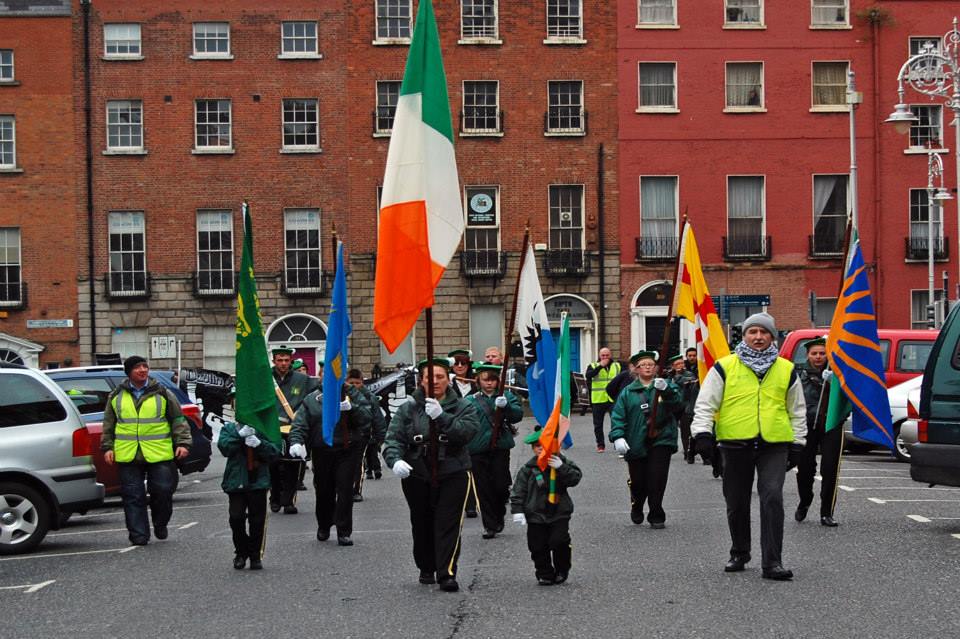
Early banner-placard protesting the internment of Marian Price (Image sourced: Libcom.org)Front section of Anti-Internment March, coming into top part of Parnell Square, Dublin 2013. (Image sourced: IAIC archives)
These conditions were considered to be in effect the same as internment without trial and the campaign against internment was founded as an independent one, a status it maintained despite a number of attempts to take it over or to intimidate with threats and State harassment.
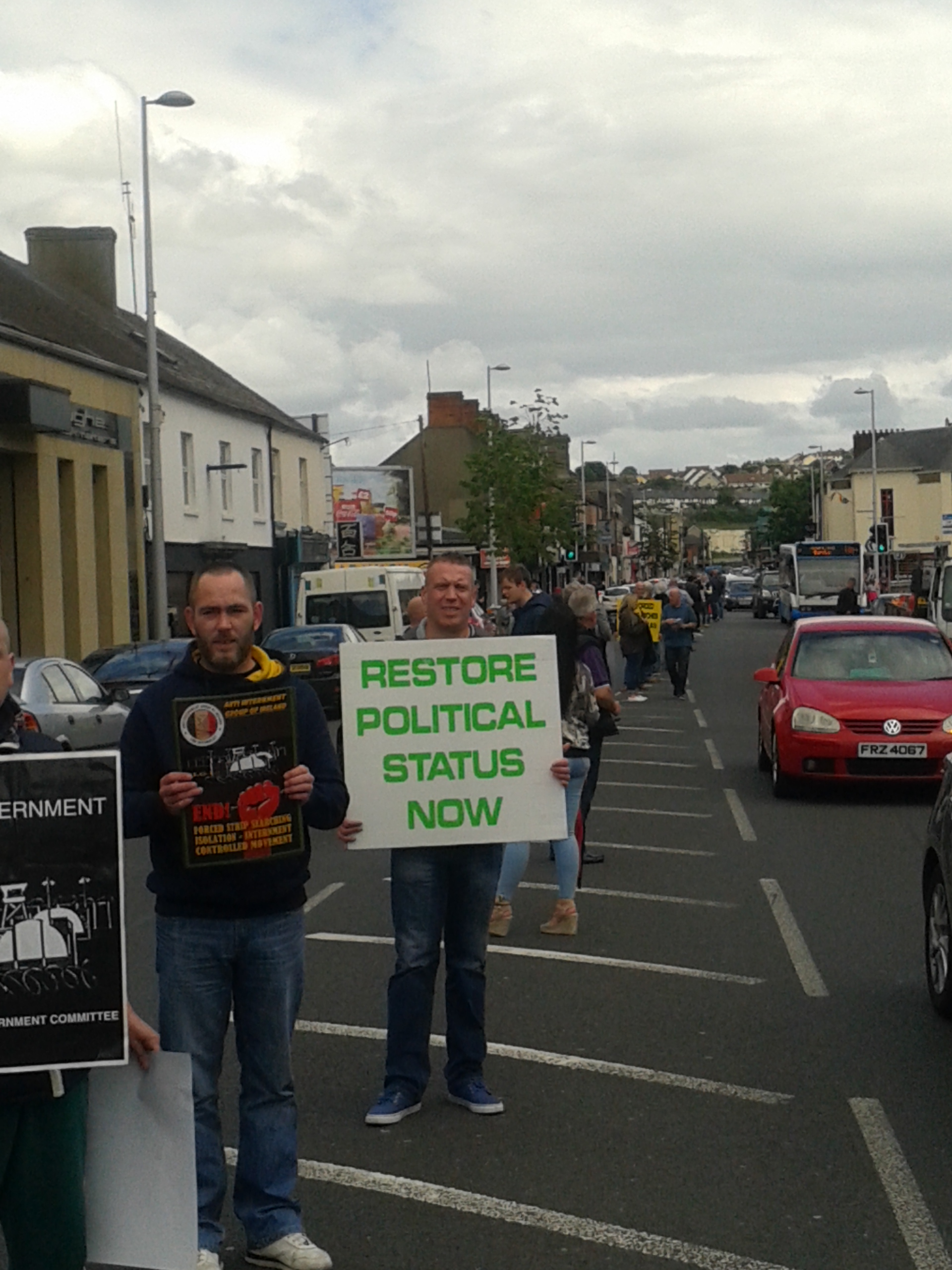
Throughout its history the Anti-Internment Campaign has organised the annual Newry event (not since 2021 unfortunately), many pickets (including in protest against Amnesty Ireland) and a march in Dublin, spoken at or participated in public events in Belfast, Cork, Derry, Glasgow and Wexford.
It has also organised and hosted conferences and public meetings, for example with speakers from the campaigns for the Craigavon Two, Munir Farooqi and Tony Taylor and about the Right to Protest with a speaker from the Irish Council for Civil Liberties.
Section of the annual Anti-Internment white-line picket Newry, August 2016 (Image sourced: IAIC archives)
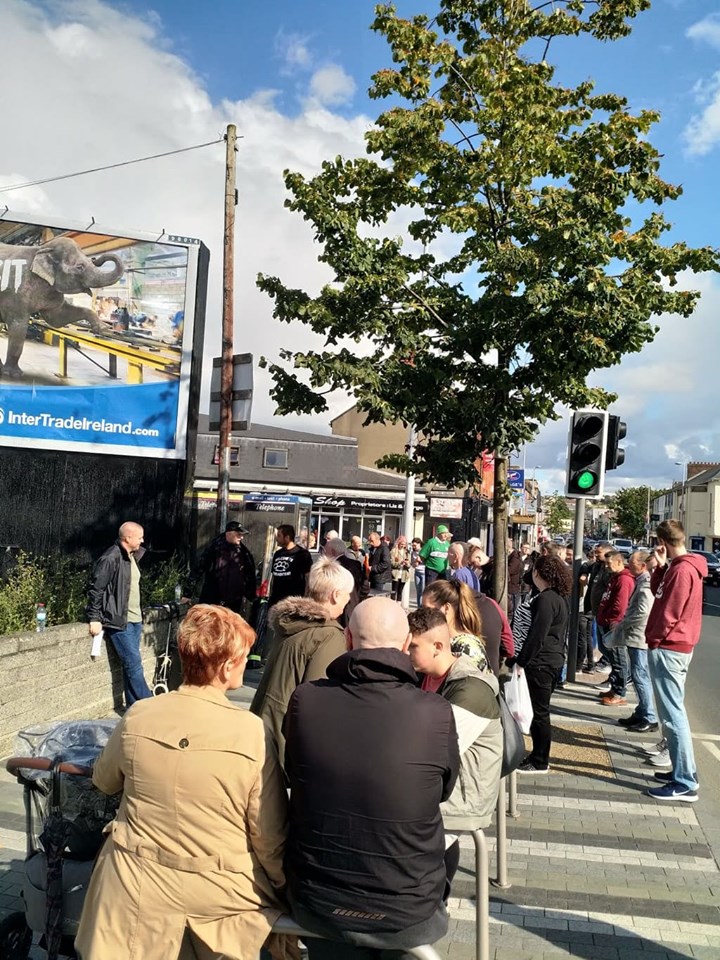
Annual Anti-Internment, Newry, rallying after white-line picket, August 2019 (Image sourced: IAIC archives)
A busy year
As stated in the introduction above, 2022 was a busy year for the anti-internment campaign group, involving, along with its public awareness-rising events a reorganisation with a new constitution and a new name. The campaign organised nine public events and participated in more.
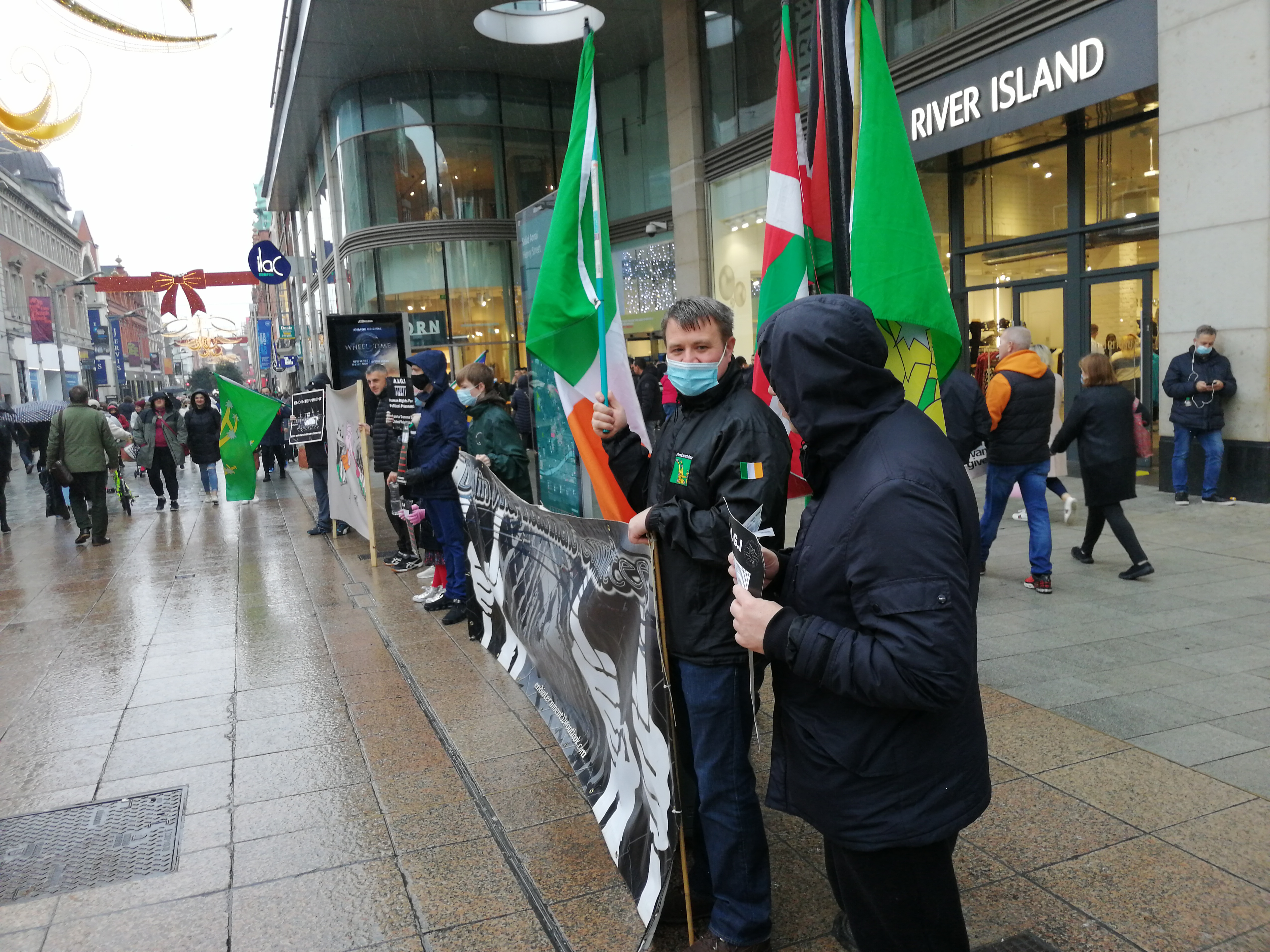
Most of those public events were awareness-raising pickets with placards, banners, flags and leaflet distribution. Usually the pickets alternated between the Henry Street/ Liffey Street junction and at Crown Alley by the square in the Temple Bar area, both areas busy with shoppers and tourists.
Anti-Internment picket in Henry Street, November, Dublin 2022 (Photo: IAIC)
The campaign carried out pickets in Henry Street on 9th April, 6th August and 19th November and in Temple Bar on 5th March, 21st May, 2nd July and 27th August. On 22nd October, with a special focus on Palestinian prisoners, we were on the iconic Ha’penny Bridge.
It has always been of particular interest to the campaign group to reach working people and large numbers of that class of all ages pass through those areas. Of interest also are people from other lands and the Basque and Palestinian flags alongside the Irish ones often stimulate discussion.
In September the campaign attended the Peter Daly commemoration in Wexford and provided a speaker at the Dublin meeting to re-launch the End State Repression campaign which our group had supported in the past but which had waned over the Covid epidemic period since.
Our campaign group also took part in the planning of and participation in the joint prisoner’s solidarity picket in Dublin on 17th December 2022.
Reorganisation
It had been clear for some time that the organisation was in need of reorganisation to facilitate expansion but the process had been difficult.
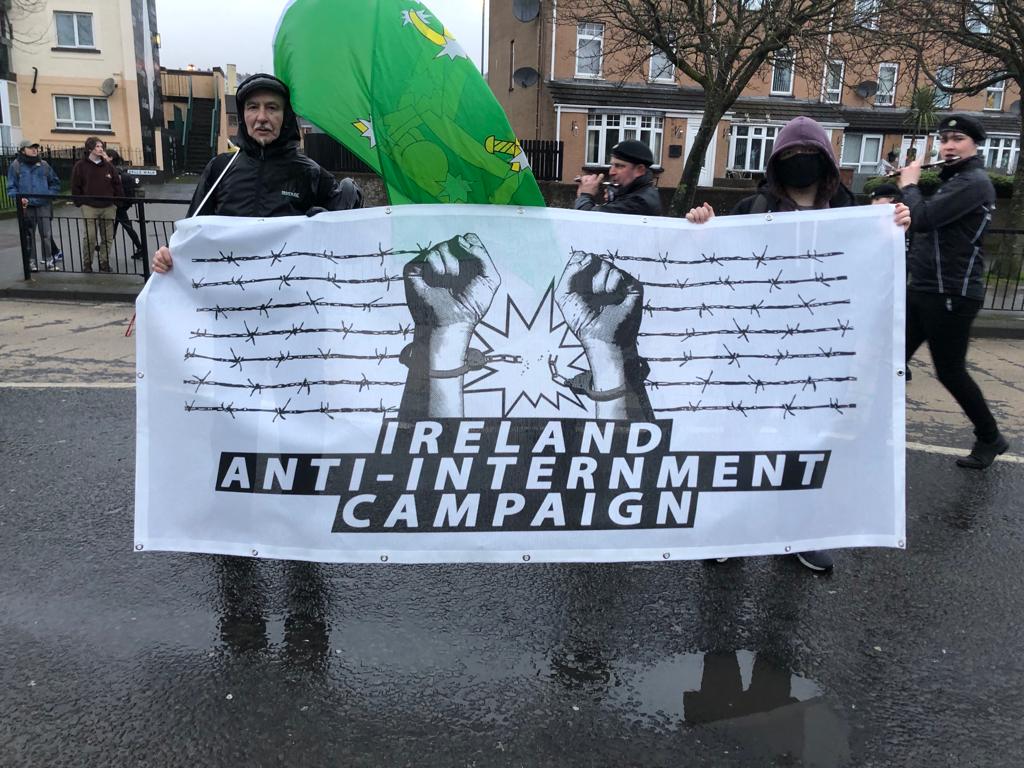
Eventually in July the decision was taken to close down the Anti-Internment Group of Ireland and to reform under another name. This was done and, after democratic consultation process a new constitution was agreed, with the Ireland Anti-Internment Campaign as the new name.
According to agreed decisions, a new banner with the organisation’s new name was commissioned (though it would take some time to come to fruition). A new Facebook identity for the group was constructed with a statement explaining the development.
The new constitution, more explicitly democratically-based than had been previously the case, was published.
Anti-Internment picket in Temple Bar, Dublin, March 2022 (Photo: IAIC)
Year planning
In the reorganisation process, the IAIG lost one member but gained three new activists and the return of two lapsed members. With renewed energy, members began planning for the rest of the year, to conclude with participation in the annual Bloody Sunday March for Justice in Derry.
Issuing a statement to explain the reorganisation, commissioning a new banner, scheduling a number of pickets in Dublin and organising the annual Prisoners’ Solidarity Picket in Dublin December were part of the planning and most of the target actions were completed.
In December and in good time, the campaign’s members organised to purchase, sign and mail Christmas cards to all Irish Republican prisoners, also a number of non-complying Basque political prisoners and the Catalan jailed revolutionary Catalonian rapper Pablo Hasel.
The proposal to organise the annual Prisoners’ Solidarity picket in December jointly with the Irish Republican Prisoners’ Welfare Association and with Ireland Anti-Imperialist Action was agreed and the joint event went ahead on 17th December with around 40 participating.
Section of the joint AICI, AIA and IRPWA Republican Prisoners’ solidarity picket 17 December 2022, O’Connell Street, Dublin 2022 (Photo: IAIC)
The picket with placards and banners, including the illuminated words of the IAIC’s “SAOIRSE” (“Freedom”) attracted attention and passers-by, both Irish and from abroad engaged leafleters and other participants in discussion. A speaker from each group gave a short statement.
The year’s programming ended with the specific scheduling of participation with a new banner in the annual Bloody Sunday March for Justice in Derry.
New Banner Aired at Bloody Sunday March for Justice in Derry
The new banner got its first public airing at the annual march in Derry, commemorating the massacre of unarmed civilians by the British Army in Derry in January 1972 and was carried as part of the march from the Creggan, through a large part of Derry and down to Free Derry Corner.
The marchers in different political parties, campaign organisations and independent individuals marched trough cold rain and strong wind-gusts through the nearly 5-kilometre walk. The members of four Republican Flute Bands played bravely throughout.
The new banner of the Ireland Anti-Internment Committee carried in the Bloody Sunday March for Justice in Derry in January 2023. (Photo: IAIC archives)
The IAIC will shortly begin its year-planning for the rest of the year, its calendar again probably ending at 2024’s Bloody Sunday March for Justice and meanwhile organising events to publicise the on-going undemocratic jailing of activists without trial both sides of the British Border.
The IAIC considers that the jailing of people without trial by both administrations is, in addition to political repression, a significant assault on civil rights and a threat to all opposition groups and that it is in the interests of all to unite in opposing the practice.
The Campaign welcomes the active support of all democratically-minded individuals at its public events.
The mass media is not great for accuracy or wide coverage and even less so for trustworthy analysis but it does often provide entertainment. Not always even intentionally.
Like when the western mass media reported one day that the Russians were shelling the nuclear reactor in the Russian-held sector of the Donbas area and, within hours, that the Russians were shelling from there.
We’ve all seen examples of the unreliability of the mass media (run by capitalists for the capitalist system so what can we expect, after all?) in our own country but hard to imagine more consistently unreliable and biased than its coverage of the war in the Ukraine.
Take for example the bombing of the Nord Stream pipeline on 26 September last year. The undersea pipeline was delivering Russian gas to Germany; its owners are Russian in financing partnership with European companies and it cost around $9.5 Billion euros to build.
It’s a twin pipeline stretching 1,230 km through the Baltic Sea. Each line comprises around 100,000 individual pipes, each 12 m in length.
So who did the wmm (western mass media) line up to blame, or at least to suggest might have carried out this sabotage? Yep, Russia, major shareholders in the pipeline and major route for exporting of their gas for sale to Europe!
Made no sense at all but to a public marinated in msm propaganda for months …
Now, if you were a reasonable detective, you’d be asking yourself: “Who stands to gain from this?” And you’d have to conclude “enemies of Russia”. Next, who would have the capability and opportunity to do it?
Well, states near the sea there who are not friendly to Russia, obviously. Like Sweden and Norway, whose states have reportedly been investigating for months without any apparent results..
But not just them, also US NATO, who has ships nearby and who carried out the BALTOPS 22 major naval exercise not long before the explosions – including underwater exercises. Sweden and Norway had both participated in the BALTOPS 22 joint NATO exercise.
Ships participating in NATO’s BALTOPS 22 exercise last year. (Images sourced: Internet)
Who would point the finger of suspicion at them? Not the western mass media, that’s for sure.
However a big fly has very recently landed in the ointment. Seymour Hersh, a long-established USA journalist, who has in his CV a Pullitzer Prize for the exposure of the 1968 US massacre of the Mai Lai village in Vietnam, published a report pointing the finger at the USA.
Of course Russia jumps on that – it’s their pipeline and they consider that the US is fighting a proxy war against them in Ukraine. The US and its allies in turn accuse Russia of just using the accusation to divert attention away from their continued invasion of Ukraine and war there.
Sure, that’s possible. But the blowing of the pipeline is an acknowledged fact and it was blown up by somebody – and the US are looking more and more like the most likely suspects. But don’t expect much help in clearing this up from the wsm.
A naval diver surfaces during NATO’s BALTOP 22 exercise last year. (Images sourced: Internet)
Apparently Hersch’s report is not reliable because he didn’t name his inside sources. Really? He didn’t burn his whistleblowing sources on whom, apart from any considerations of decency, he might need to use in future? Or for reason to be trusted by future whistleblowers?!
Now we have a new version. No, not Russia in the frame any more but some “pro-Ukrainian group” or “anti-Putin Russian group”. And the source for this? An unnamed (but suddenly that’s not a problem any more) US Intelligence agency. Yeah, sure.
Neither wsm massaging nor US laundering is going to clean this story up. In pursuance of its drive for world hegemony, the ruling class of the US has been pushing Russia, its main obstacle in Europe, into war.
Well, despite the dangers, the European allies of the USA can go along with that, some (e.g. Poland) more enthusiastically than others, but ok overall. But to sabotage the pipeline delivering gas to Germany, the big power in the EU?
Reckless, US ruling class, reckless. And not just environmentally.
SOURCES
Spare a thought for a family being tortured by the Irish State, which has jailed one of its sons already and went and jailed another one more recently. Yes, you’ve heard of them, the Burke family.
First of all, their son Enoch who was a teacher, objected to a pupil identifying themselves by another gender.
The school required him to refer to this person not as ‘he’ or ‘she’ but as ‘they’. Oh, you can imagine the torment suffered by poor Enoch!
The Burke family leaving from one of Enoch Burke’s court appearances. Enoch is on the far left (not politically) and Simeon in the centre (not politically either). (Images sourced: Internet)
True, he might only have to refer to this person a dozen times in the year but … being forced to say “they”. This is a sin against Enoch’s religion! His religious rights are at stake here!
So naturally Enoch had to take a stand and naturally too had to do it in a public situation in the school, for which he got suspended while awaiting a disciplinary hearing.
Enoch’s religious principles required him to refuse the suspension and keep attending the school and to disobey a court order, for which (and for his stalwart protests in court) he was sent to prison in contempt of court.
Eventually, of course, he was sacked but he applied to the High Court to prevent that, during which attendance he and his family antagonised the judge by their interruptions and manner.
Then the younger son, Simeon, emulating his older brother, refused to be silent and accused the judge of “forcing the people of Ireland to accept transgender”, obviously an attack on his religion too.
The judge was “shoving transgenderism down the throats of the people of Ireland, not only in the schools but in the universities”, cried out the younger Burke. The judge ordered him to leave the court and when he declined, the Gardaí were called.
Young Simeon was removed, during which he was, he told the Judge, “shocked and shaken to the core” and had “been treated in a brutal fashion” by a “mob of Gardaí”. And charged with breach of the Public Order.
Left: Enoch Burke; right: Simeon Burke leaving the High Court. (Images sourced: Internet)
This raised unkind comments on social media from people alleging that they knew Garda “brutal treatment” in Dublin and in Rossport and that Simeon simply had no idea (some going so far as to cruelly dub him “Simple Simeon”, a reference to a similar-sounding children’s game).
Simeon was offered bail in his own name for a paltry sum and with no conditions except to stay away from the High Court but the brave young Burke refused to sign his bail form. So he went to jail too.
Simeon Burke should know something about the law, having studied it at University of Ireland, Galway. He ran for Student Union President there against the Left in general, where, according to Isaac Burke’s media, out of 2,500 votes cast, he received 482 first preference votes.
The legalisation of contraception, divorce and gay marriage are all presumably “crimes against God” too in the eyes of the Burke family and the High Court judges are sworn to protect those decisions.
Some unkind people are pointing out that if the Burkes consider the High Court to be wrong and its operation against their religion, why take their case there for adjudication? Yes, that is puzzling.
But the substantive and original issue remains: should a man of religious conviction be forced to use the third person plural pronoun to refer to any person?
And, come to think of it, did the Burkes object when Christianity was being “shoved down the throats of the people of Ireland, not only in the schools but in the universities”?
Car alarms are mostly of a kind, emitting shrill noise. But why not have them use voice? And why not allow the car-owner to choose from a variety of voice alarms, find one perhaps more suited to their own personality?
Don’t forget, you saw this idea and this selection here first!
SIX CATEGORIES, VARIOUS MODELS
Insistent (2 models)
(in English public school accent – not recommended for certain areas of Ireland, Scotland, Wales or inner-city England) You are crowding me. Please desist. In other words, stop!
B. (gradually increasing in volume)
This is not your car. You are not an authorised driver. You are performing an illegal act. There are serious consequences. You must stop now.
This is not your car. You are not an authorised driver. You are performing an illegal act. There are serious consequences. You must stop now.
This is not your car. You are not an authorised driver. You are performing an illegal act. There are serious consequences. You must stop now. (etc.)
Threateningselection (6 models)
A. (in northern USA accent) Step away from the car. STEP AWAY FROM THE CAR. DO IT NOW!
B. SMILE. THANK YOU. YOUR PHOTO IS ON ITS WAY TO THE POLICE.
C. God does not like you standing too near me or trying my door handle. He sees everything you do.
D. Stand back. You are about to receive a mega electric shock. Charging …
E. SCRATCH MY CAR AND PREPARE TO DIE. (available in a selection of accents, from Russian mafia to LA Gangsta).
F. That spike you have just received from my door handle has taken a sample of your DNA and carries a powerful sleep drug. You have seconds before you collapse. Find somewhere safe to lie down.
Sinister (1 model)
Yes, come in, come in! Welcome! Welcome! I’ve been waiting for someone like you. Just like you. Never mind the bloodstains. Just an accident. Or two. Come in, come in! (Available in a variety of voices, creaky, sibilant, etc.)
Persuasiveselection (2 models)
A. You’d steal a Metro? Seriously?
B. Yes, yes, listen to my voice. Breathe deeply. Lisssten to my voice. You feel com-fort-ably warrrrm and relaxed. Tot-all-y rel-axed. You don’t want to steal a car any more. Certainly not this one. You want to find a cafe and sit in it. Tot-all-y rel-axed. You will leave now.
Attention-attracting with Embarrassment Deterrence selection (5 models)
A. HELP! I AM BEING BROKEN INTO! HELP!
B. BARRRP! (Yes, a loud fart-noise. With sewer smell). BRAAPP! BARRRP!
C. I HAVE DISCHARGED A BAG OF URINE ON YOUR LEG. IT CARRIES A PERMANENT PURPLE DYE TOO.
D. EVERYBODY! THE PERSON STANDING BY THIS CAR IS A CHILD MOLESTER AND TORTURES PUPPIES AND KITTENS!
E. Ooh! Ah, stop. That tickles. No. Ahahahaha! No, please! No! AHAHAHAHAHA! Oh gosh, stop, please stop. Ahahahahaha!
Other
Think about what you’re doing. Do you really want to steal this car? Think about the conseq …
The Irish State nominally rules over the 26-Counties land territory and its corresponding sea and airspace. Yet these have been and are repeatedly violated by the US and UK military with Irish ruling class secret collusion.
Now a Senator in Leinster House is seeking a hearing in the High Court to have the behaviour of successive Irish Governments in allowing UK military overflights declared unconstitutional.
The Sea, oh the sea … and the air!
As stipulated by international law, a sovereign state’s area includes the sea up to 12-miles from its border1 and therefore Ireland has a 12 mile territorial sea, a 200 mile exclusive economic zone before any additional claims are made to the continental shelf including the Rockall Bank.2
According to media report, a comprehensive survey of the Irish State’s territorial waters was not undertaken until 2014, i.e nearly a century after its foundation, which in itself is an indictment of an allegedly independent island state.
According to The Geological Survey of Ireland (GSI) says potential territorial waters stretch to 898,442km sq – an area bigger than the oil rich North Sea.3
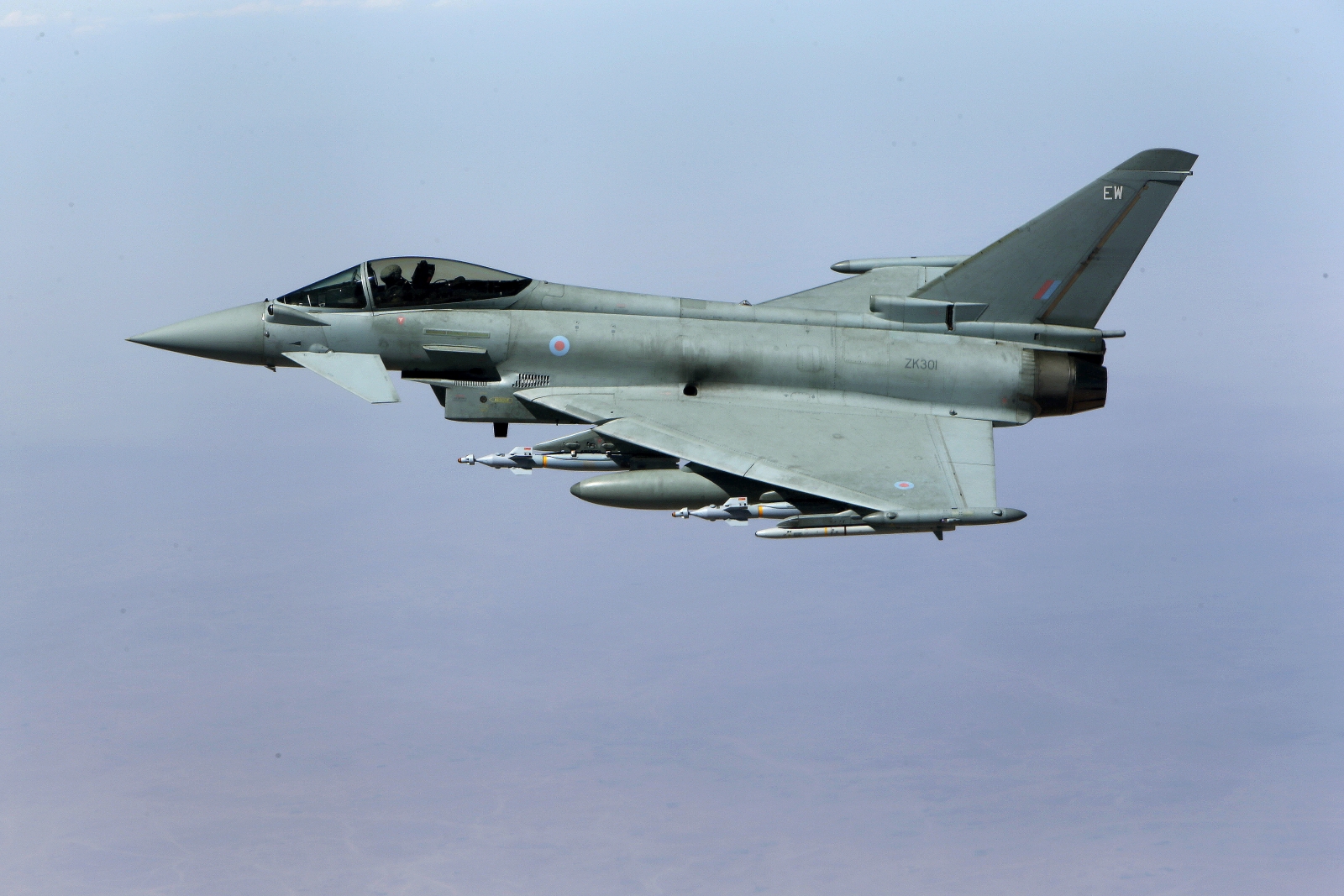
Royal Air Force fighter jet – the Irish State is reported to have secretly agreed to allow these to overfly Irish airspace (Photo sourced: Internet)
Through the decades when Ireland was a fishing nation and fresh fish was eaten weekly in most homes, Irish fishing boats had to compete with those from many other states fishing illegally inside Irish sea limits.
The Irish Navy was the only policing enforcement agency and through much of that time it had only three corvettes to patrol 12 miles out from the whole coastline of the Irish state. Subsequent EU legislation then left Irish seas more open to foreign-based fishing than it did to Irish boats.
The sovereign air space of a state corresponds to that over its land and 12-miles out to sea from its coastline.4
The use of Shannon airport by the US military in transit of troops, weapons and prisoners has long been known and protested.
Shannon Airport protests
Over the years there have been many highly-publicised protests over the US military use of Shannon, ranging from mass protests outside the airport buildings to deliberate trespass and even damage to a US warplane.
The response from the Government Minister to questions in Leinster House is always that the US is not violating Irish sovereignty, arms, military and prisoners are not being transported through there – because the US authorities have assured the Irish Government that they are not.
In February 2003 five members of the Catholic Workers’ Movement under the name Pitstop Ploughshares gained access to a hanger in Shannon Airport and damaged a USAF warplane there. They were Deirdre Clancy, Nuin Dunlop, Karen Fallon, Ciaron O’Reilly and Damien Moran.
They were jailed for up to 11 weeks awaiting committal for trial to which they were finally sent in Dublin Circuit Court in March and October 2005 on two counts of criminal damage, €100 and US $2.5 million. The faced a maximum 10 years if convicted.
Two aborted trials followed as one judge after another revealed their bias and partiality. In July 2006 after twelve days a mixed male and female jury acquitted the accused on all charges on the grounds that they had taken the action to save lives in Iraq and were justified in doing so.
In October 2012 dramatist, writer, former Republican prisoners and veteran activist Margaretta D’Arcy was arrested with Niall Farrell for scaling the fence and entering the grounds of Shannon Airport.
Four convicted Shannon Airport protestors, L-R Mick Wallace, Margarett D’Arcy, Niall Farrell, Clare Daly. (Photo sourced: The Journal.ie)
In June 2014 at the age of 80 and suffering from Parkinson’s disease D’Arcy was jailed for two weeks in Limerick Prison for refusal to pay the fine and remained defiant.
In July 2014 then members of the Irish Parliament Clare Daly and Mick Wallace5 used a rope ladder to climb over a perimeter fence and enter the grounds of Shannon Airport and made no attempt to avoid arrest.
They were both fined by a court for trespass in February 2015 and refused to pay the fine, eventually being taken to Limerick jail by Gardaí in December 2015 and released less than two hours later.
On 25 April 2017 anti-war activists Edward Horgan, a retired Irish soldier of 78, and civil servant Dan Dowling, 39, were arrested in the airport grounds and charged with criminal trespass and malicious damage (felt-tip graffiti slogan on a warplane).
In a very low-level publicity case in January this year (2023), a jury in Dublin found both guilty of trespass but not of criminal damage at the airport and were ordered to pay €5,000 each to a women’s refuge in Co Clare.
On St. Patrick’s Day 2019 two ex-USA military Ken Mayers and Tarak Kauff, now anti-war campaigners of the US chapter of Veterans for Peace, cut a hole in the airport’s perimeter fence, entered Shannon airfield with a banner and were arrested.
In May last year, a majority jury verdict found Mayers (85) and Kauff (80) guilty of interfering with the running of the airport but unanimously not of criminal damage to an airport perimeter fence and of trespassing the airport with the intent to commit an offence or interfere with property.
Ex-USA military Kauf and Mayers of Veterans for Peace (US) protesting US military use of Shannon Airport (Photo sourced: Internet)
The judge fined the anti-war activists 5,000 euro each. Both had spent 11 weeks in prison and had been required to spend nine months in Ireland awaiting trial, despite clear indications that they had no intention of absconding and indeed were looking forward to the trial to publicise the issue.
Senator Craughwell’s case to the High Court.
Less well-known is that successive Irish governments have for decades by secret agreement permitted permitted UK air force planes to fly over Irish airspace and to interdict, i.e. force or shoot down other aircraft. This is what has led to Senator Craughwell’s taking a case to the High Court.
The Independent Senator maintains that although not the case of a formal military alliance, granting permission to fly over Irish State airspace, unless validated by referendum, is a violation of Ireland’s neutrality and sovereignty and is seeking a number of declarations from the Court.
Craughwell, who is a former member of the Irish Defence Forces and the British Army, as well as being an ex-President of the Teachers Union of Ireland, said that his belief in the existence of a secret agreement is based on a reply from then Taoiseach Brian Cowen to Enda Kenny in 2005.
The Senator seeks High Court declarations including that the agreement between Ireland and the UK allowing armed British military aircraft to intercept aircraft over Irish airspace amounts to an impermissible dilution and breach of Articles 1, 5, 6, 13, 15, and 28 of the Irish Constitution.
He also seeks a declaration that the Government’s failure to exercise control over Ireland’s territorial waters, airspace and exclusive economic zone breaches Article 5 of the Constitution which declares that Ireland is a sovereign independent democratic state.
Craughwell further seeks an order restraining the government from bringing in legislation to give effect to the agreement, unless it has been passed by a referendum.
Aerial view of Ireland (Image sourced: Internet)
Irish State Neutral?
Most Irish people mistakenly believe that Ireland’s military neutrality is specifically enshrined in Bunreacht na hÉireann, the Irish Constitution. However Article 29, section 4, subsection 9° underlines the neutrality of the Irish State in respect of a military force of the EU:
The State shall not adopt a decision taken by the European Council to establish a common defence pursuant to Article 42 of the Treaty on European Union where that common defence would include the State.6
“This was originally inserted by the 2002 amendment ratifying the Treaty of Nice and updated by the 2009 amendment ratifying the Treaty of Lisbon. An earlier bill intended to ratify the Treaty of Nice did not include a common defence opt-out, and was rejected in the first Nice referendum, in 2001.”7
It is fairly clear that the citizens of the Irish state are generally in favour of retaining Irish neutrality but there are elements within the state frequently trying to undermine that policy, chiefly the native Gombeen ruling class.
The Irish State has never been truly independent; it came into existence agreeing to the partition of the nation and in waging war against the forces of national liberation, during which it executed more Irish Republicans than the British had during the War of Independence.
Subsequently, the Irish State has been characterised as neo-colonialist, dominated firstly by British capital, then by the US and finally by the EU.
There are elements within Irish upper circles who long to join the EU military and political club while some others share a nostalgia for the British Empire and Commonwealth and the kind of supporting and sharing role to which John Redmond and his Irish Nationalist Party aspired.
Finally, there are of course elements in the Irish armed forces that are attracted by career advancement through joint military operations with other armed forces along with greater weaponry, such as would be available in a joint European armed force or as part of NATO.
Worryingly, Mícheál Martin during questions in Leinster House some months ago denied that the population would have to be consulted in referendum before the State could join some military alliance.
What now?
Whatever formal position the State may take on neutrality in future, it has been undermining it for decades and doing so in secret.
Why the secrecy? Presumably because the ruling class is aware that most Irish people want to remain militarily neutral and would wish to get rid of a government that was trying to ditch the neutrality policy.
Ireland needs to be independent of all imperialist alliances. Should the Gombeen ruling class succeed in committing the State’s armed forces to some military alliance, the choice is certain to be either imperialist NATO or imperialist EU.
In the latter case, it is entirely possible that Irish troops would be sent to suppress social or national risings in Europe – for example in Catalunya or the Basque Country, with Spanish troops being sent to quell mass protests in Ireland.
Or in either case, that Irish troops would become part of some joint imperialist force in Latin America, Africa or Asia.
Meanwhile the Gombeens, because of the State’s allowing US and UK military aircraft over Irish skies and in Shannon airport, are potentially painting a target for retribution on to the Irish population.
End.
FOOTNOTES
1Except obviously where it intersects with another state’s borders (seeAirspace – Wikipedia)
4Airspace – Wikipedia and obviously this currently ends at the borders of the Six County colony, whose own 12-mile UK zone also ends where it meets the Irish borders on land, sea and air.
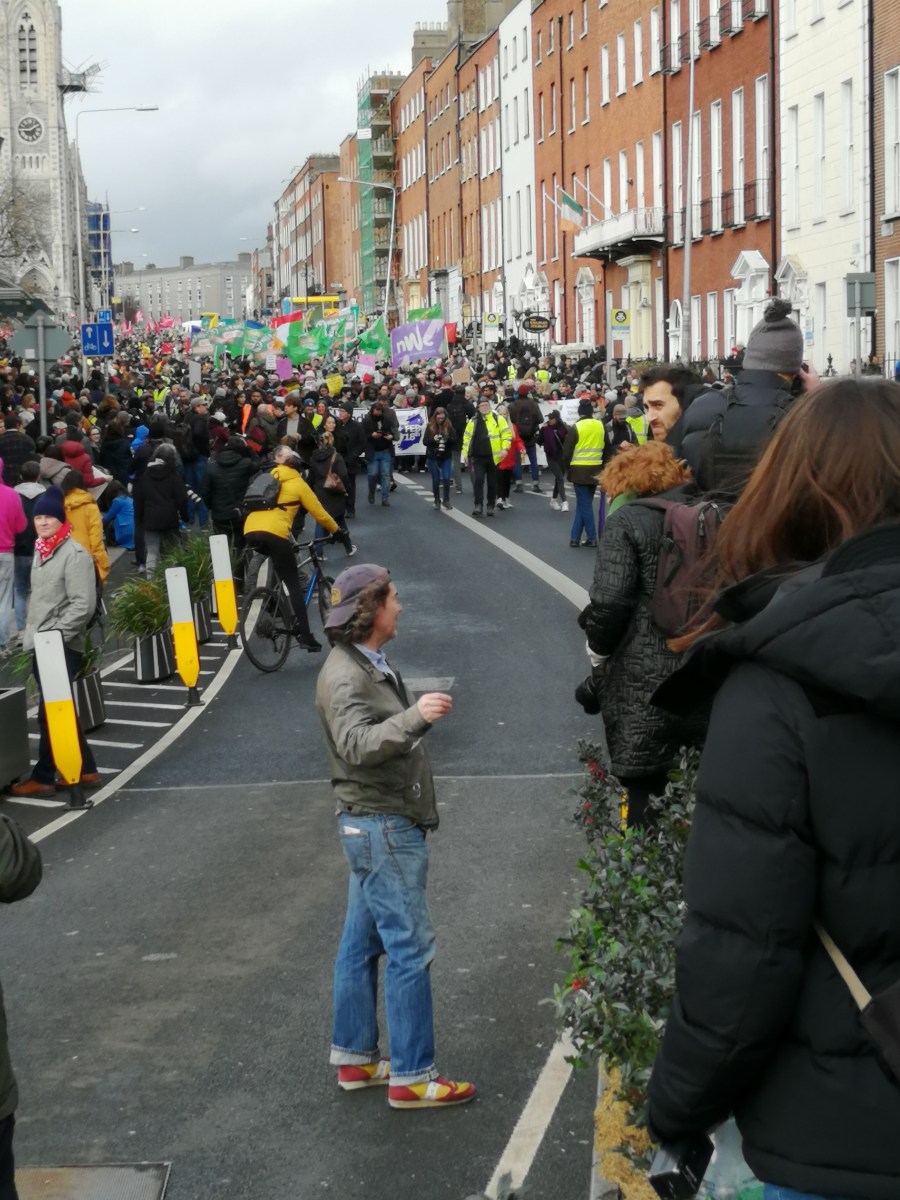
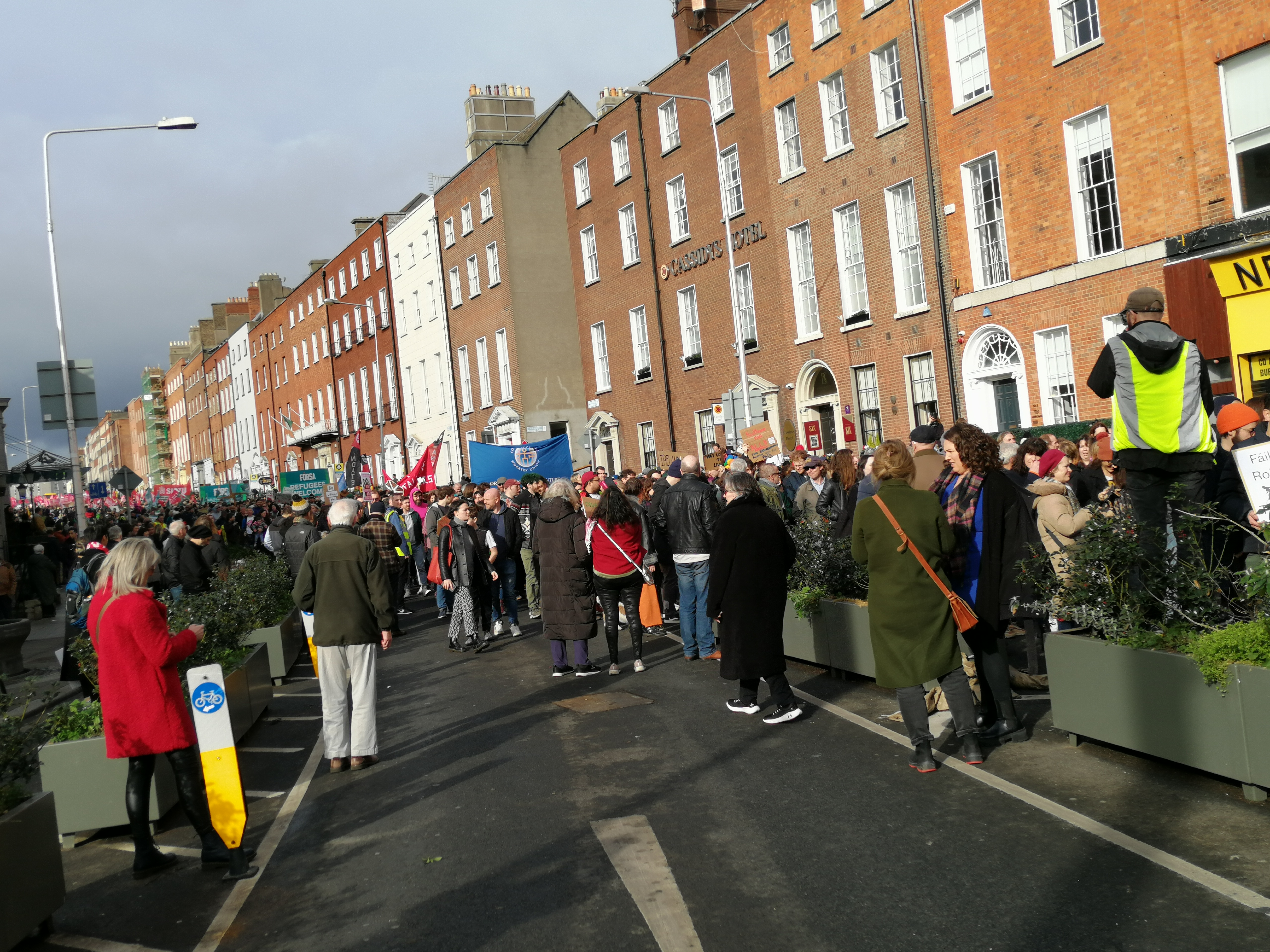
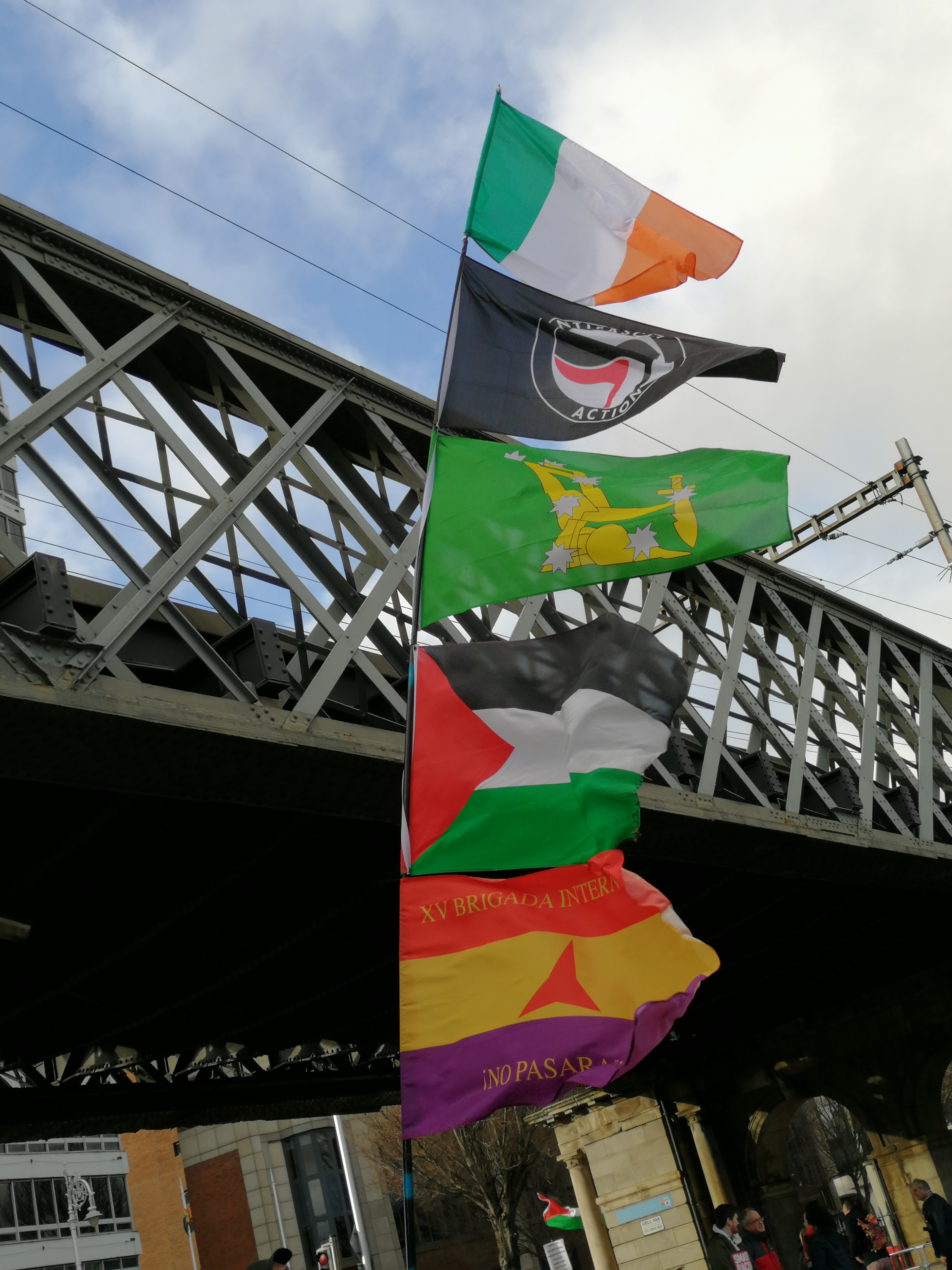
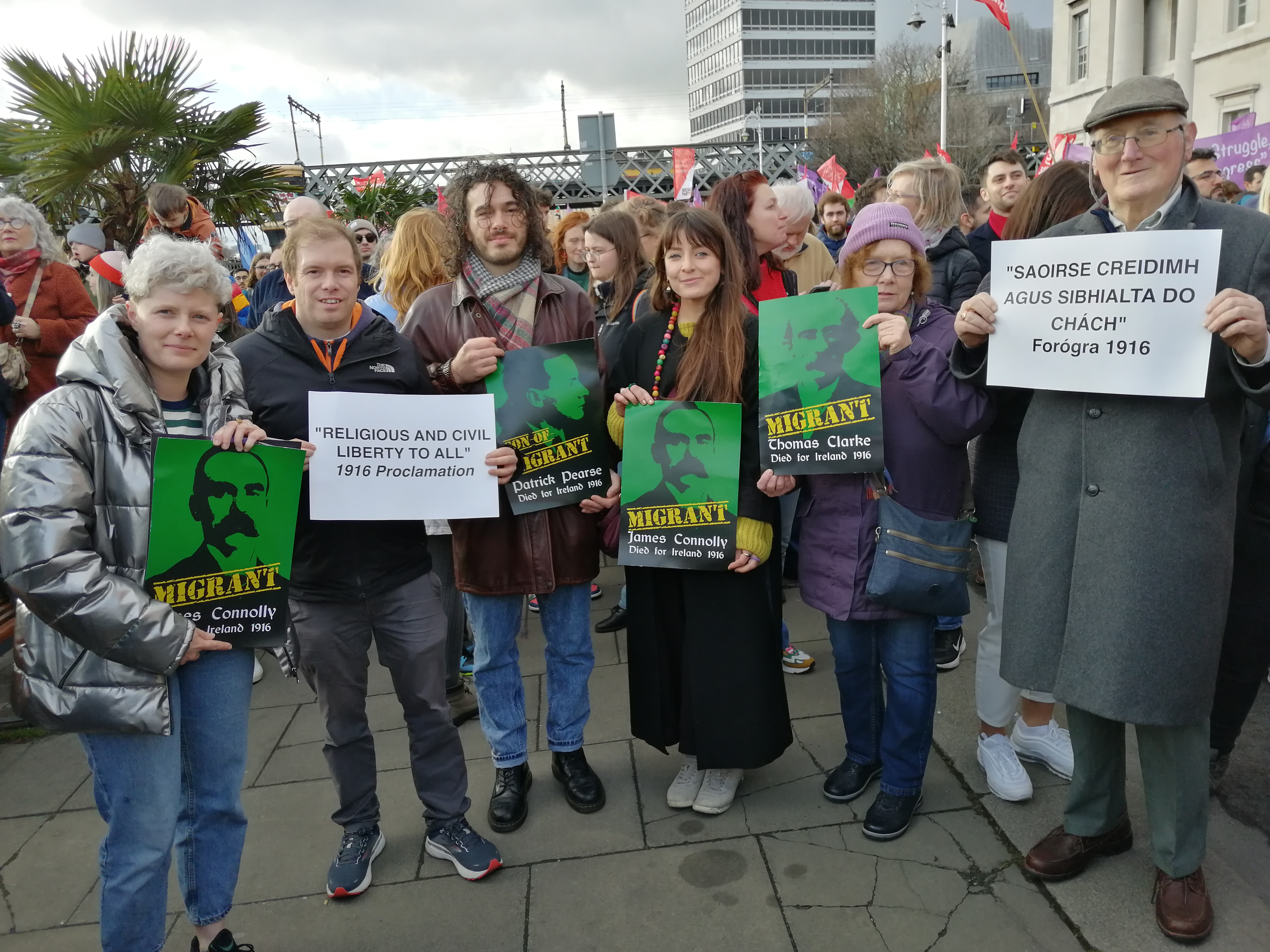
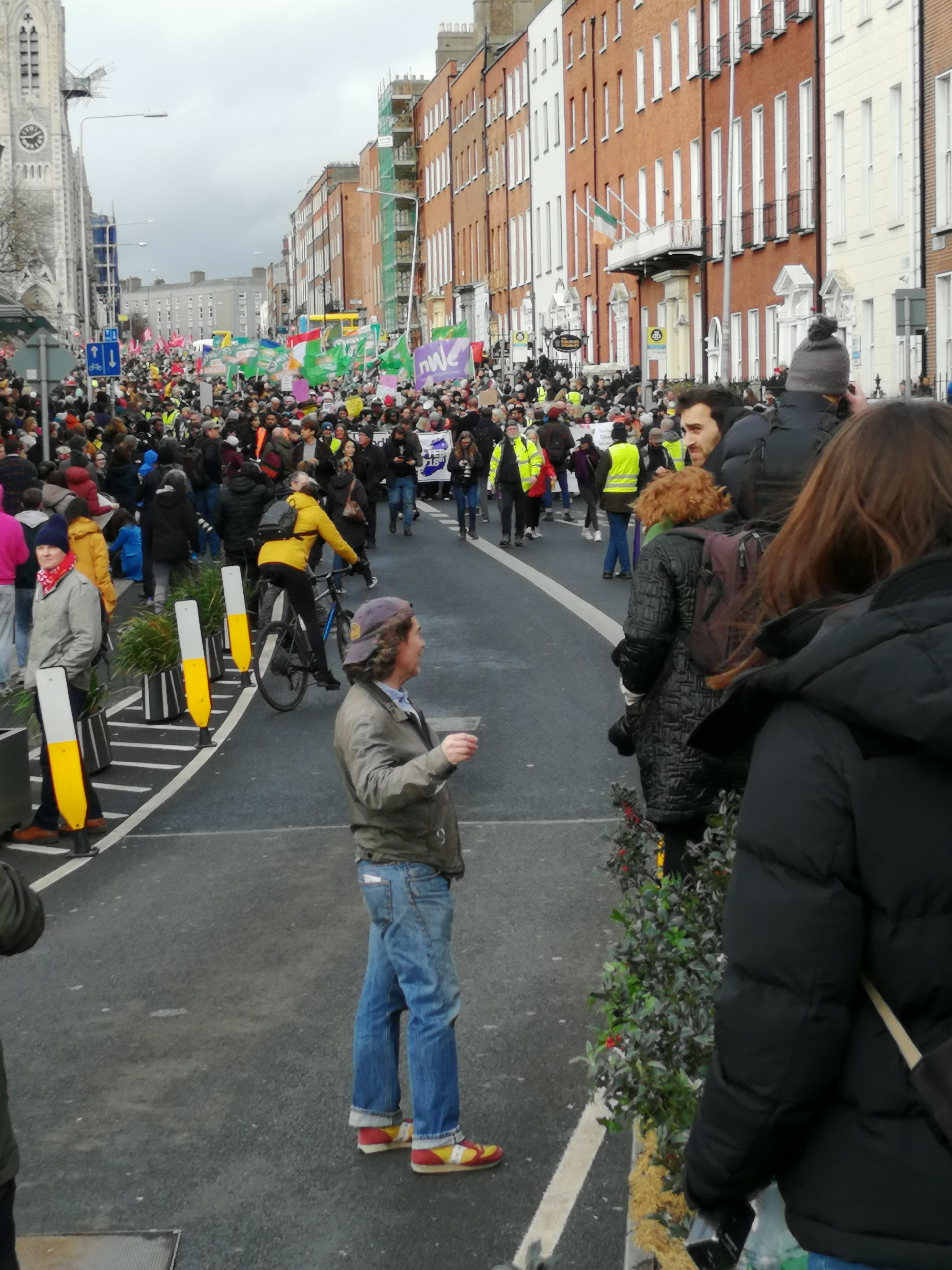
Migrant support organisations, trade unions, some political parties — over 50,000 marched in Dublin on Sunday to protest at anti-immigrant demonstrations and the crises in housing, the health service and prices rising higher than wages.
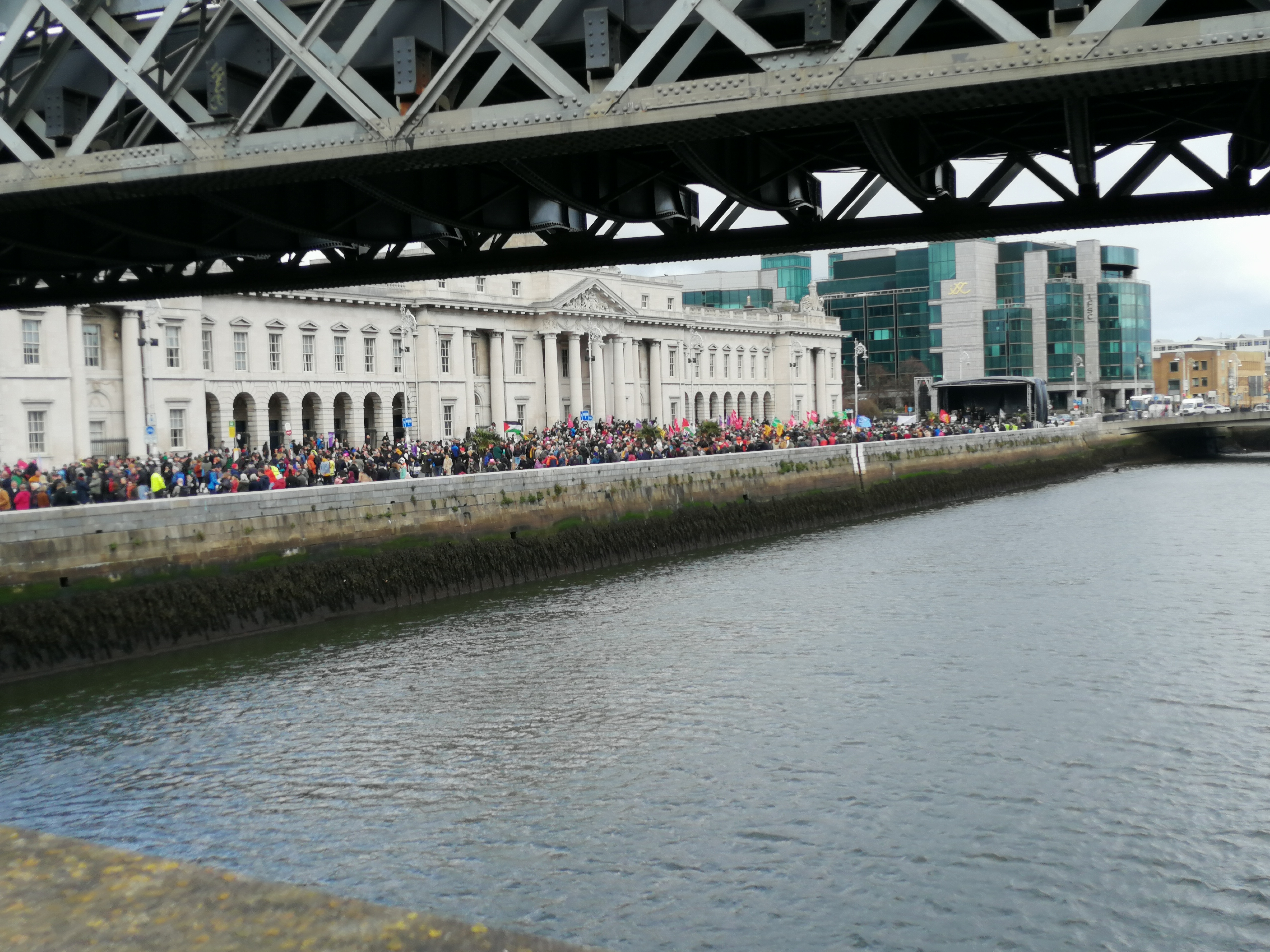
Famous folk singer Christy Moore and veteran civil rights campaigner Bernadette McAlliskey (formerly Devlin) were among the speakers who addressed the rally on Custom House Quay.
Long view of the rally along Custom House Quay after some had already left. (Photo: D.Breatnach)A large section of the march as passed and still they come. (Photo: D.Breatnach)
Context and background
Anti-migrant and anti-refugees demonstrations, including threats of violence, have been seen and heard in recent months in a number of locations around the Irish state with active participation and promotion by fascist and far-Right organisations and individuals.
The anxieties of people about the housing crisis have been exploited by elements of the far-Right in Ireland, attempting to blame migrants and the refugees for this crisis and claiming that “Ireland is full” in addition to fabricating stories about abductions and rape by migrants.
In addition, the Government’s lack of consultation with local communities and attempts at secrecy when moving refugees from the Ukraine into buildings in Ireland have exacerbated the situation and facilitated the work of racist and fascist demagogues.
Some far-Right elements had threatened to counter-protest the anti-racist march but only a handful appeared at the departure point and soon vanished and one lone far-rightist protested along the route. Gardaí were in evidence but in low numbers.
Long-time Irish folk-singer and songwriter Christy Moore said he was disgusted by the racist demonstrations, sang a composed ditty talking about “a Gombeen Ireland” before singing a few verses of his Viva La Quince Brigada, celebrating the Irish who died fighting fascism in Spain.
Veteran socialist Republican Bernadette McAlliskey gave a militant speech in which she called on people to identify whether they were on the side of migrants or of the slide to fascism. As a survivor of nine British proxy bullets in 1981, McAlliskey can speak from some personal experience.
A number of speakers made the point that march was a 32-county event, meaning that it represented not only people in the Irish state but also in the British colony. In addition, most Irish trade unions are whole Ireland-wide, as are the main sports associations.3
Traveller4 activist Rose Marie Maugham spoke against racism and of her community’s experience of discrimination and Leon Diop of the Black and Irish group, formed after the Irish mobilisation of Black Lives Matter after the US Police killing of George Floyd.
Ailbhe Smythe, an academic and active anti-racist, pointed out that the antifascist and anti-racist movement is a 32-county one, i.e covering the whole nation. That statement and the presence of McAlliskey reminds us of something very important but often overlooked.
Ireland’s home-grown fascists, the Loyalists, have been here since even before the partition of Ireland and the creation of the Six-County colony. And historically, especially during the 30 Years War here, they linked up with British fascists to attack the Irish solidarity movement in Britain.
The attempts of Justin Barret’s fascist National Party to hold rallies in the Six Counties have been opposed by Irish Republicans and socialists and only succeeded behind colonial police protection (which did not prevent their November congress in Fermanagh being broken up by anti-fascists).
British-based fascists such Herman Kelly, formerly PRO for Nigel Farage’s UK Independence Party, is now head of the “Irish Freedom Party” (sic) and British fascist Jim Dowson has also had a presence with Irish fascists such as Niall McConnell and his “Síol na hÉireann” (sic) party.
Very recently long-time British fascist activist Tommy Robinson has been promoting himself as a “friend of the Irish people” and was welcomed to Ireland by some fascists (e.g. Dara O’Flaherty) but also opposed by some others who fear Robinson’s reputation5 will do them no favours.
Possibly even those Irish blinded by racist propaganda might balk at uniting with one who defended the British Parachute Regiment’s massacres of unarmed civilians in Ballymurphy (August 1971), Derry (January 1972) and Springhill (July 1972).
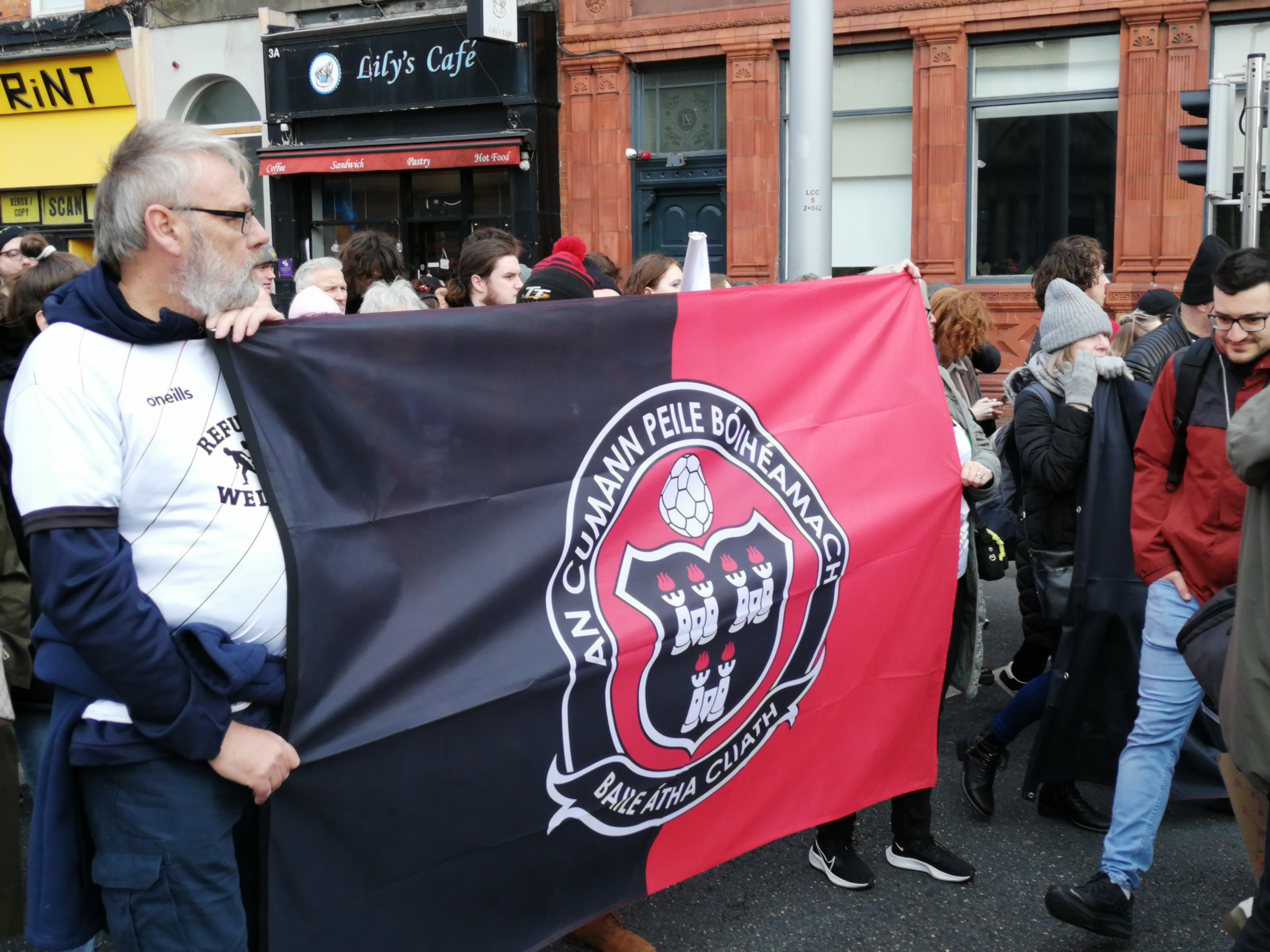
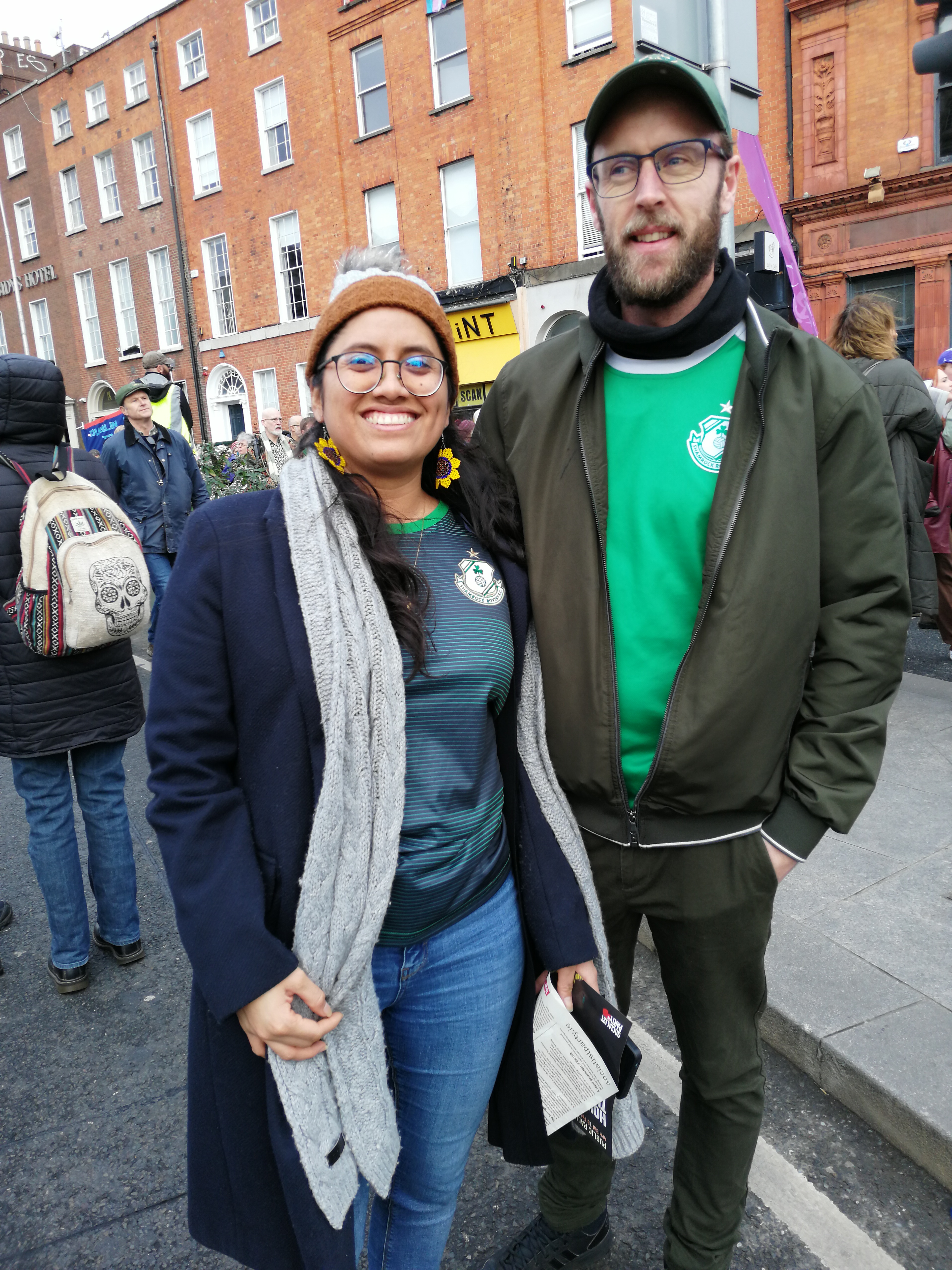
The march beginning, just leaving the area around the Garden of Remembrance (Photo: D.Breatnach)Bohemians FC banner in Irish (Photo: D.Breatnach)Of course, then to demonstrate football club impartiality, these Shamrock Rovers FC supporters needed to be photographed.
Comment
What struck me most apart from the numbers was that the vast majority of the organisations overwhelmingly represented those who had NOT been opposing the far-Right in their many mobilisations through the years against migrants, Muslims, LBGT people etc.
Indeed, when Le Chéile was being founded, its organisers took care not to invite those who HAD been actively confronting the racists and fascists in the preceding period.
When I asked at the time whether Republican groups and Anarchists had been invited, a Le Chéile representative said they didn’t know but would ask. I heard no more of the matter. At a subsequent rally of theirs, a speaker denounced those who confronted the fascists.
Possibly in response to that situation, Saturday’s march was notable for the absence of such Republican groups6 but if so this was a serious error, in my view. I feel they should have marched there with their organisational banners and one promoting militant opposition to fascism.
If fascism begins to get a hold in Ireland as it did for awhile in the 1930s, the antifascist struggle will need to be a broad one and active antifascists need to participate in broad demonstrations to advertise their program of active and militant confrontation with fascists.
Richard Boyd Barrett was quoted in the Irish Times today calling for people to resist the far-Right causing racist division. However his party, People Before Profit is one of those that has chosen not to confront the Far-Right.
Unfortunately Barrett was also quoted saying that “This State was born in the struggle against oppression.”7 It would be more accurate to say that this Gombeen State was born in the struggle to crush the nascent Irish Republic which, for the time being, it has succeeded in doing.
A number of Anarchists have confronted the fascists in the past, at least in Dublin and there was a strong Anarchist contingent on the march. Unfortunately, one of their shouted slogans was “No borders, no nations!”
This seems to deny Ireland’s right to nationhood and could easily be seized upon by fascists portraying themselves as patriots and defenders of the nation. Nor does it seem reasonable in the age of imperialist aggression to call for the dismantling of borders at this time.
Those observations aside, the turnout of such numbers on an anti-racist demonstration is to be greatly welcomed and must be discouraging for the fascist and racists. However, it will not mean the end of them and while the danger of fascism exists they need to be militantly confronted.
While the Left fails to force the Gombeen class even to undertake the reform of a crash building program of public housing for rent, capitalist attacks on working people’s standard of living look to continue and may provide opportunities for fascists to divert and divide the people.
Equally, the Gombeen class may seek to use the fascists in their historical role as a force to divide the working class in attacking its more vulnerable elements while, simultaneously targeting socialists and socialist republicans, i.e. those with the capacity to provide revolutionary leadership.
End.
Section of the march containing trade union flags and banners (Photo: D.Breatnach)
FOOTNOTES
1For which possibly the original inspiration was a group calling itself East Wall for All, in response to the early anti-refugee demonstrations in the East Wall area.
2“Red with Anger”, a broad campaign demanding rights for the Irish language in the British colony but also for greater promotion of the language throughout the Irish state.
3This is the case not only in the Gaelic Athletic Association but also in the soccer and rugby federations.
4Irish Travellers are an ethnic minority of nomadic lifestyle history experiencing racism and discrimination in Ireland and in Britain.
5Robinson is a long-term British fascist convicted of assault, theft and fraud and was subject to a five-year anti-stalking order. He was a member of the fascist anti-black, anti-Irish (BNP) from 2004 to 2005 and for a short time in 2012, joint vice-chairman of the British Freedom Party (BFP). Robinson led the English Defence League from 2009 until 8 October 2013. In 2015 became involved with the development of Pegida UK, a now defunct British chapter of the German-based Islamophobic organisation Pegida (which was prevented from establishing in Ireland by antifascists in February 2016).
As expected of fascists, many-false-names Robinson is a habitual liar but was caught out when he publicly lied about a refugee teenager attacked by racists, was convicted of libel in 2021 and ordered to pay 100,000 Stg. and costs, on which he defaulted by declaring bankruptcy.
6Sinn Féin is clearly just another Gombeen (i.e. Irish neo-colonial capitalist class) party now and it never confronted the fascists though in October 2020 one of its members was knocked unconscious after he accompanied some friends to oppose the Yellow Vests on Custom House Quay when we were attacked by club-wielding fascist thugs and then by the Public Order Unit.
The stage production of Tales From the Holywell, written and performed by Damien Dempsey, is currently running at the Abbey until the 18th – and possibly beyond. Once advertised it was booked out for three weeks (with possible access through cancellations).
It was through cancellations that I and a few others faithfully waiting got in to see the performance on the 7th (it was closed on the bank holiday of the 6th). I really enjoyed it and cried laughing at times.
The whole audience gave him a standing ovation at the end and joined in singing one of his songs during his encore.
The stage set was bare and without background, with stage lighting showing Dempsey alone at times and at others, revealing players of keyboard, violin, double bass and percussion. Dempsey accompanied himself, alternating between two guitars.
The production consisted of Dempsey talking about his upbringing, his difficulties with his father but with whom he went to live when his mother left home, childhood and adolescent battles, his struggles and desires as an artist – all interjected with humorous cracks and songs.
He comes across as a man committed to his art and with integrity.
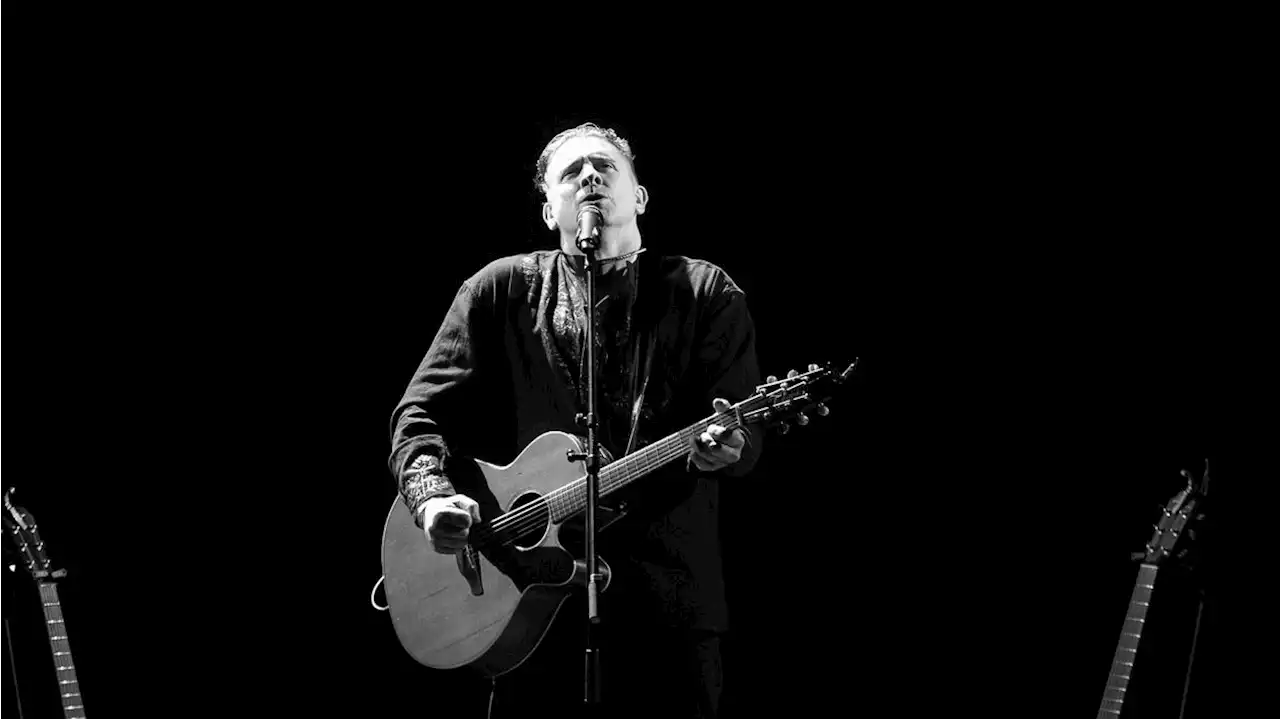
Dempsey performing at Abbey Theatre (Photo sourced: Internet; audience photos were prohibited)
Dempsey was raised in Holywell Crescent, a collection of local authority houses constructed on the site of an ancient holy freshwater well. This was one of probably thousands of wells across Ireland, each thought to be inhabited by a pagan spirit and then given a saint’s name by Christianity.
The well after which Dempsey’s street was named was St. Donagh’s Well (probably misnamed, see Links below) near Killbarrack and as the area became anglicised, called only “the Holy well”, then “Holywell” and the pool itself filled in and built over.
Whether he can speak it or not I have no idea but the Irish language made an appearance from time to time in Dempsey’s narrative, always with respect and, one might say, even reverence. And I was amazed to hear him sing a verse from An Cúlfhionn a capella, totally in Irish.
His song Colony – some might say masterpiece – gives a clear indication of what Dempsey feels about the long colonisation of Ireland and its parallels elsewhere in the world. I hoped he might take the opportunity to comment on the growing racist mobilisations in Ireland but was disappointed.
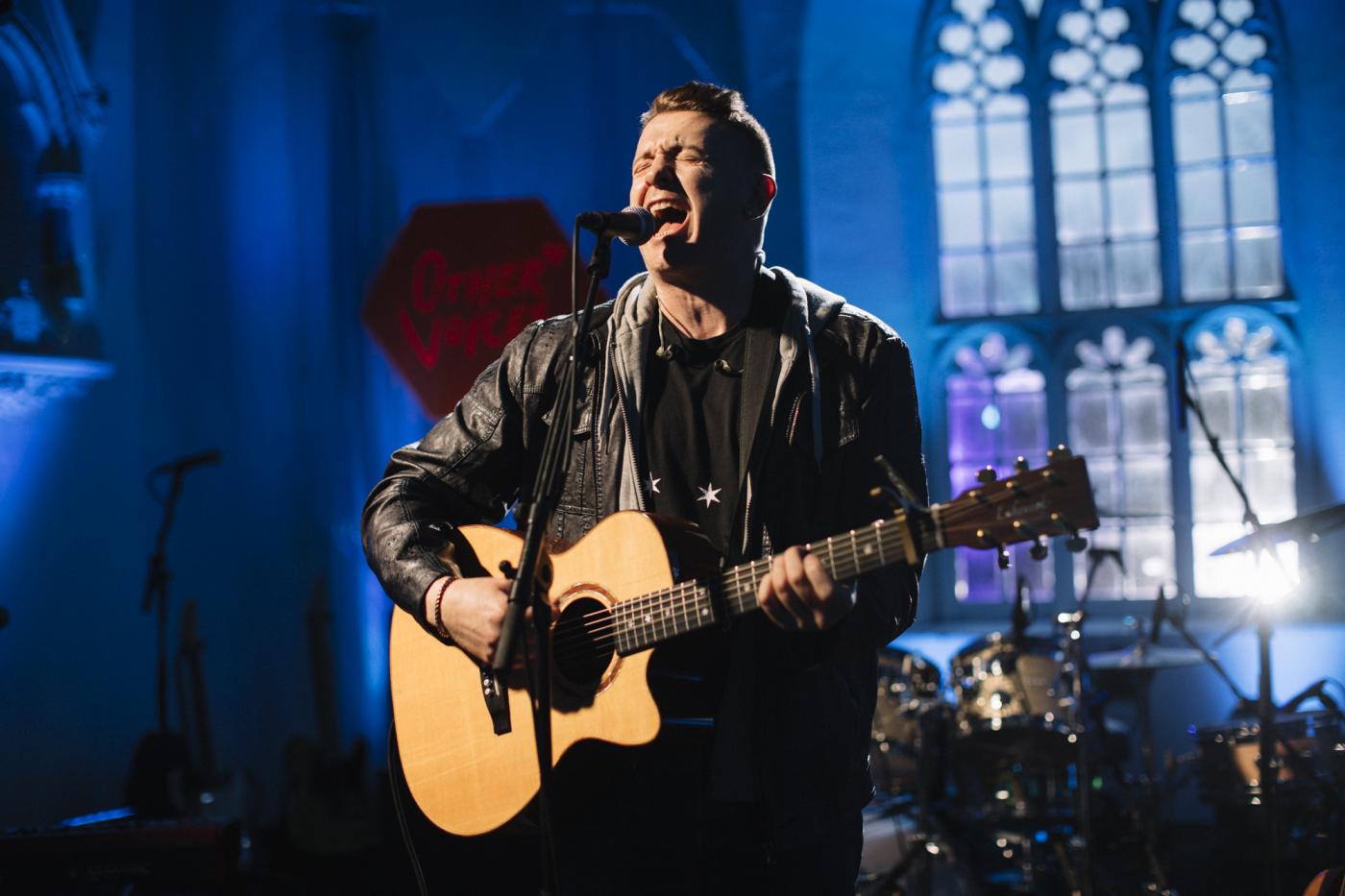
Dempsey performing (Photo sourced: Internet)
Conor McPherson directed the production which was written and performed by Damien Dempsey.
Apart from Dempsey’s, other music was provided by Lucia McPartlin (fiddle, vocals), Aura Stone (double bass) and Courtney Cullen (drums, percussion, vocals). I noted no name given in the theatre program for the keyboard and vocals performer.
I’m a great fan of Damo’s lyrics but less so of his singing; a question of musical and cultural taste, I suppose. But still I rose, wholeheartedly with the rest, to applaud his performance.
Whether its run will be extended I don’t know but currently it’s advertised to end on 18th February. If you haven’t booked, it’s well worth getting there early and hoping for a cancellation.
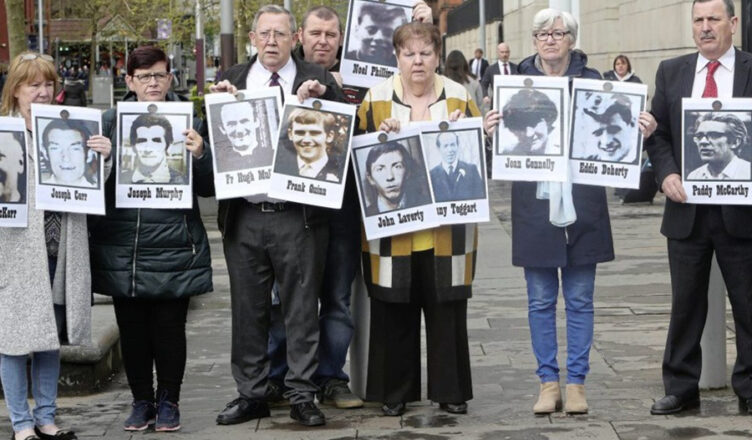
After fifty years the truth is beginning to emerge about the massacre of eleven people in West Belfast by the Parachute Regiment of the British Army.
A coroner has found that nine of the ten had been shot by them, whilst in the case of the tenth, John McKerr, there was doubt as to who had killed him, it either being a Loyalist paramilitary or more probably a British soldier. The coroner found that there was a distinct lack of evidence volunteered by the authorities as regards his death, hinting at the cover-up that had taken place over a span of fifty years.
The families of those murdered have had to wait a half century for this. John Teggart, the son of one of those murdered, Daniel Teggart, went on record to state, “It has taken us 50 years to get to this point. We are just…












 rebelbreeze