Revolutionary socialist & anti-imperialist; Rebel Breeze publishes material within this spectrum and may or may not agree with all or part of any particular contribution. Writing English, Irish and Spanish, about politics, culture, nature.
E. Conde NOTICIAS DE NAVARRA (translation by D.Breatnach)
Never could a coffee have been so bitter. This Wednesday the First Section of the Provincial Court of Navarra is to judge a Guardia Civil officer, belonging to the Citizen Security Unit of the Command of Navarra, accused by the Prosecutor’s Office and the private prosecution of the crime of illegal detention by a public official after he arrested a waitress at a gas station, with whom he argued because the coffee was not to his liking. They ask for him to be fined a sum of 2,160 euros and that he be disqualified for nine years from his post. In addition, they demand that he compensate the victim with 1,000 euros for moral damage.
The events occurred around 10:30 p.m. on July 27, 2019 when the defendant, a Guardia Civil since 2005, in command of a unit arrived with his colleague at the Acciona service station on the A-12, in the area of Legarda. There they went into the café and ordered some coffees. According to the Prosecutor’s Office, “since he did not like the coffee, he argued with the waitress and manager, who was serving the rest of the customers.”
Neither the complaint form nor her driver’s license was acceptable to him
He did not restrict himself to mere protest. He requested the complaint sheet, arguing with her to give it to him immediately. The defendant considered that said sheet was not the corresponding one and asked for her National ID and the woman gave him her driving license. The Guardia insisted that this sheet was not the correct one and considered her driving licence identification insufficient.
The waitress continued working, but the defendant called her, made her step outside away from where the customers could see what was happening and “with abuse of authority, telling her that she was disrespectful”, proceeded to arrest her at around 10:45 p.m. and to put her in the patrol car. She was taken to the Puente la Reina barracks, and handcuffed as a detainee. She was held until 2:00 am, when a statement was taken and she was released. As a result, the victim suffered from anxiety.
During the investigation of the case there was an attempt to resolve the matter by the criminal mediation procedure but as this was unsuccessful, it goes to trial. In principle, any possibility of agreement is ruled out since the officer, if convicted of said crime, would be disqualified from any similar job for a relevant period of time.
COMMENT
by Diarmuid Breatnach
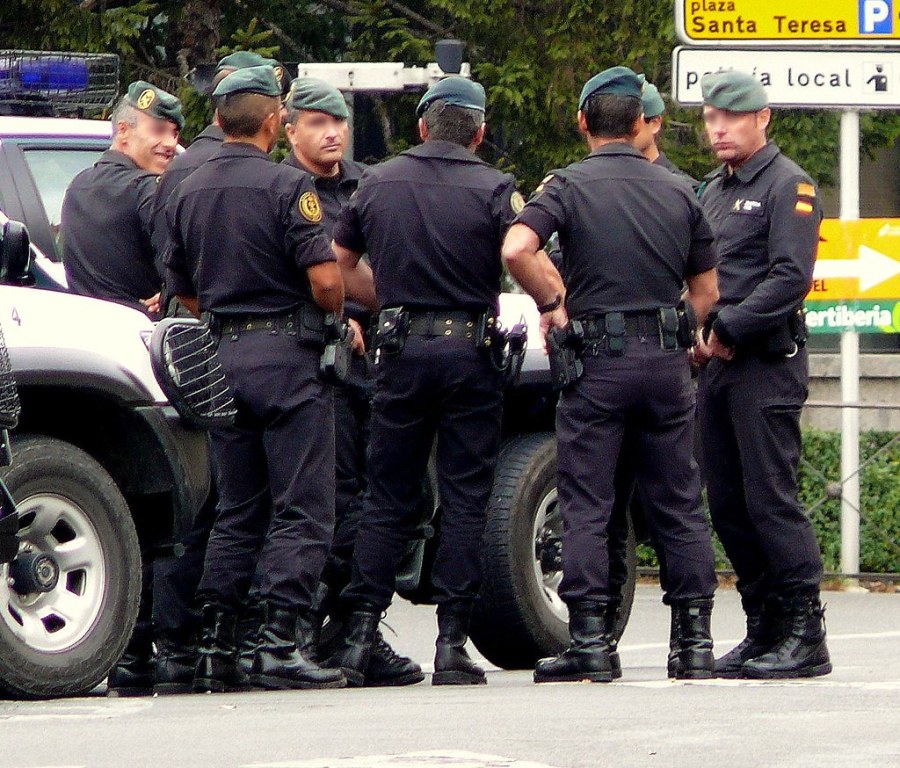
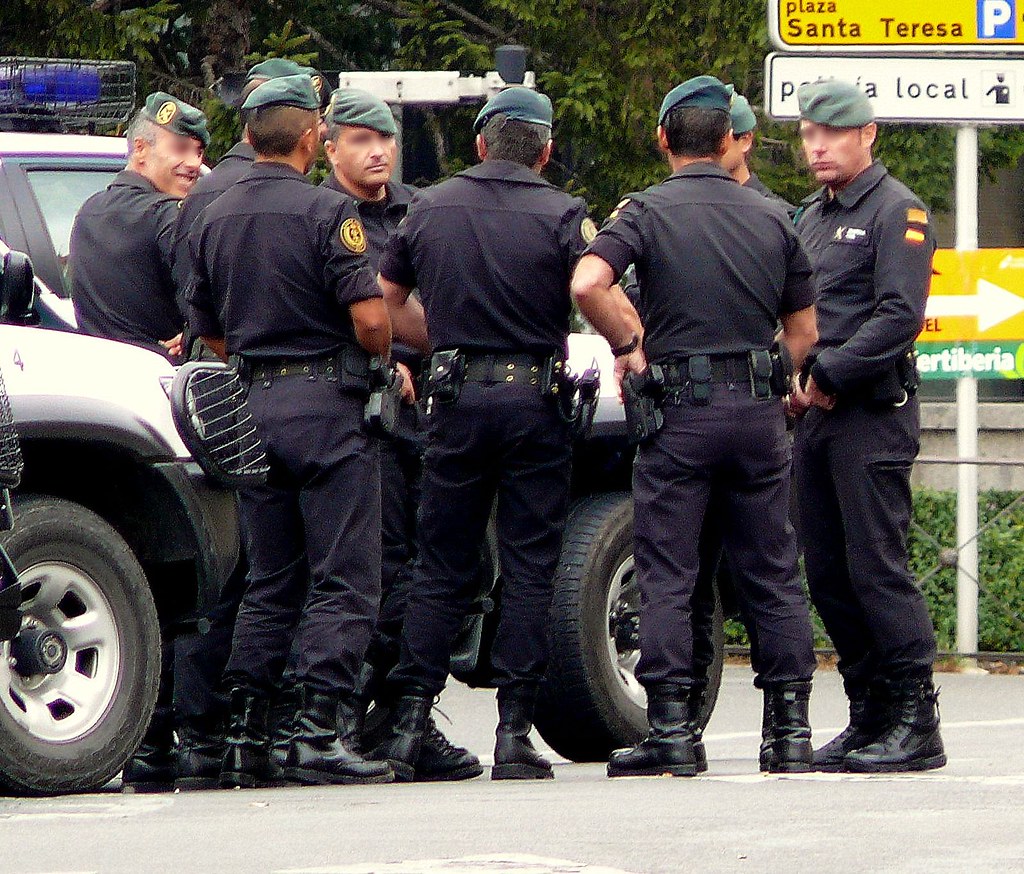
The case is an extreme example of a common aspect of the Guardia Civil – arrogance, a sense of entitlement and impunity and lack of respect for issues of justice or ordinary people. Contempt and hostility towards socialists, LGBT and aspirations of the nations within the state are common too but, although this took place in Nafarroa, in one of the Basque regional autonomies, the report does not reveal whether this played a part.
The Guardia Civil is one of two “national” police forces of the Spanish State and the oldest police force of the kingdom. It is a gendarmerie, an armed police force with military organisation and role in addition to a civil one, such as the Gendarmerie of the French state, Carabinieri of the Italian state and the Royal Irish Constabulary all over Ireland until 1921 and its remnant, the Police Force of Northern Ireland (British colony) today. The force is quartered in barracks for accommodation with police station facilities, cells etc.
GUARDIA CIVIL AND FASCISM
When the fascist-military coup was launched against the republican Popular Front Government of the Spanish state in 1936, the Guardia Civil split evenly between those who remained loyal to the Government and those who defected to the fascist-military, with those loyal becoming the Guardia Republicana. However, that percentage was in the lowest order of police force loyalty to the republican Government, with elected government loyalty in other police forces at around 70% of membership. After the defeat of the republican forces, the superior officer of the Guardia Republicana, General José Aranguren was tried by Francoist military court, sentenced to death and executed in Barcelona.
Often thought to be of Franco prisoners during the Civil War, in fact this photo is of prisoners of the Guardia Civil during the suppression of the Asturias Miners’ Strike in 1934 by General Franco during the right-wing period of the Republican Government, which was overturned in the 1936 elections of the Popular Front. (Photo sourced: Internet)
In the areas conquered by the fascist-military forces and in the whole state after the defeat of the republican forces, the Guardia Civil were one of the chief forces seeking out and rounding up former supporters of the republican Government along with communists, socialists, anarchists, republicans, Basque, Catalan and Galician nationalists. Most of the detainees were brought before military courts and either sentenced to death, to penal servitude or to heavy fines and confiscations of property. Some never made it to court, being summarily executed. Rapes were also recorded and infants of murdered parents were trafficked to fascist childless families.
In the nations that had shown wishes for independence or autonomy, such as Catalonia and the southern Basque Country (of which Navarre is a part), along with other areas where antifascist resistance had been strong such as some areas of Madrid, the Guardia Civil was a constant and visible force of surveillance and repression of the civil population in terms of culture, morality and politics.
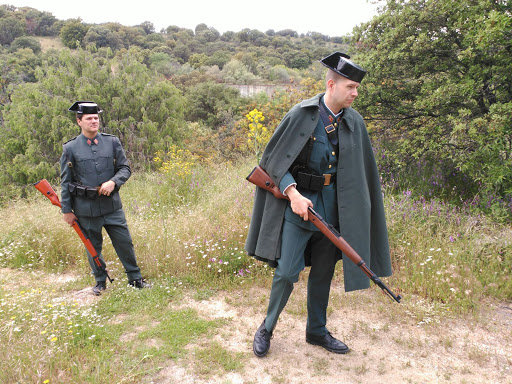
Guardia Civil searching country area during the later decades of the Franco regime. (Photo sourced: Internet)
During times of guerrilla conflict, the Guardia at times killed prisoners and routinely tortured detainees during interrogation (the Wikipedia entry says that they were accused of “heavy-handedness”!). Colonel Tejero of the Guardia Civil led 200 of that force in a failed attempted coup in 1981 which included an armed invasion of the Spanish Parliament. Several Guardia including very high-ranking officers were convicted of organising the fascist murder squads of the 1980s (GAL etc) run by the Spanish PSOE Government.
The Guardia until recently was the primary police force acting against the Basque national resistance and numerous of their detainees over decades have testified to being tortured, humiliated (including sexually) and threatened almost immediately after arrest, during their transportation by the Guardia to the force’s barracks in Madrid, where the torture etc continued up to the five days incommunicado detention permitted under Spanish State “anti-terrorist” legislation. The treatment usually produced “confessions” which were then used to secure a conviction and long prison sentence. The European Court of Human Rights has a number of times found the Spanish State guilty of not investigating allegations of torture by detainees and a number of human rights organisations such as Amnesty International have condemned the impunity of the torturers.
Guardia Civil in action in Catalonia during the Referendum on independence there on 1st October 2017. (Photo sourced: Internet)
The Guardia Civil frequently break up demonstrations and in 2017 both they and the Policía Nacional invaded Catalonia in force, the Guardia Civil seizing ballot boxes in the Catalonia Independence Referendum and beating voters and people protesting their actions (also firing rubber bullets which are banned by the regional Government).
Since 2020, actions against Basque and Catalan independence campaigners have been carried out mostly by their autonomous regional police forces (Ertzaintza and Forales in the Basque autonomous regions and Mossos d’Escuadra in Catalonia) but, if charged with “terrorism” or “security crimes”, detainees were delivered to the Guardia Civil who then took them to Madrid for interrogation.
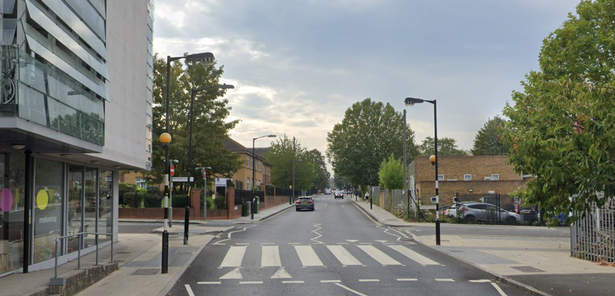
In the early hours of May 23rd, according to reports, four men gained uninvited access to a social event in Consort Road, a residential street in the Peckham area in SE London’s Borough of Southwark. One of them fired one shot from a gun and the bullet struck prominent BLM activist Sacha Johnson in the head. She remains in critical condition in hospital. There are unresolved questions about this incident and about the subsequent actions and statement by the London Metropolitan Police.
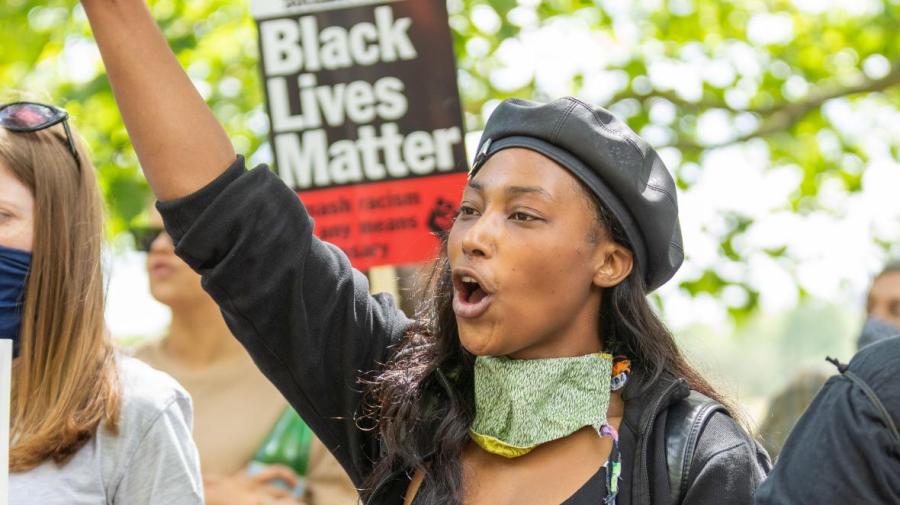
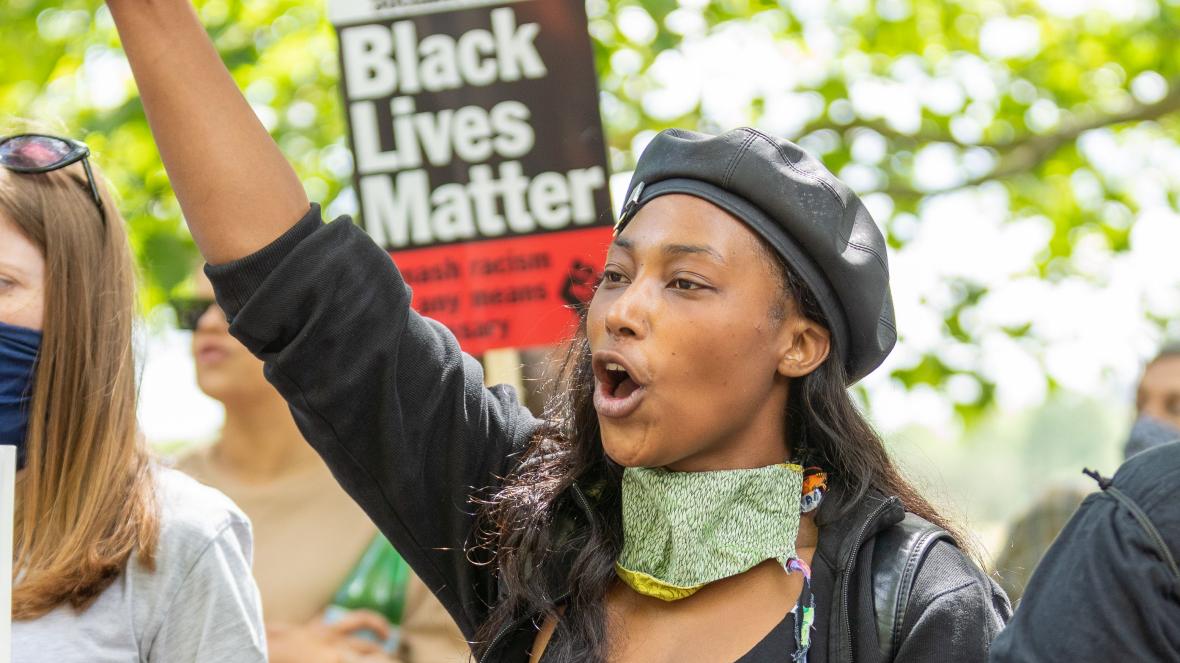
Sasha Johnson and others in London recently protesting about racism and inequality (Photo sourced: Internet)
THE AREA
Peckham is mostly a residential and shopping area in a SE London suburb, in a mix of predominantly pre-war terraced housing and post-war blocks of flats. It is well off the London Underground network but served by an overground train station and bus depot with a number of bus routes traversing it. There is a medium-sized park area called Peckham Rye and a branch of the canal network ran through a part of Peckham but no longer does so (filled in during the time I lived there). I lived in Peckham on two different occasions during my decades working in England (nearly all of which were spent based in SE London) in one period of which my daughter was born. I was politically active there and for a time worked not far away from Peckham variously in furniture removal, factories and in a number of foundries.
Consort Road, Peckham, SE London, where the shooting took place (Photo sourced: Internet)
Peckham and many nearby areas of SE London are mixed ethnically having been settled by successive waves of Irish migrants, Afro-Caribbeans, then some South Asians, followed by Africans. Throughout its history there have been frequent conflicts between people living there and the police and also between communities and fascist organisations.
Irish Socialist and Republican activist and journalist Jim Connell wrote a draft of the Red Flag in 1989 on a train journey from London Bridge to his home in the SE London Borough of Lewisham, a 15-minute bicycle ride from Peckham. During the 1926 General Strike a scab tram was overturned in nearby Camberwell by strikers and a policeman reputedly pushed down a manhole. Clashes occurred between Mosley’s Blackshirts and antifascists, with one of the big battles of the 1930s taking place in Long Lane, at the further limits of SE London, approaching the Thames river.
Much nearer to Peckham, after WW2, Blackshirts attempting to set up public speaking in East Street outdoor market (“East Lane” as it was known locally) were attacked by antifascists and clashes occurred there again in the 1970s between antifascists and the National Front. The early post-War migrants from the Caribbean in New Cross, very close on the other side of Peckham, had frequent clashes with racists and with the police. In the 1970s clashes occurred often in New Cross and nearby Deptford between antifascists and the National Front, while not far away again was the scene of the famous 1977 Battle of Lewisham, in which antifascists denied the National Front passage through and fought also, in particular, the London Metropolitan Police.
During the 1970s, ‘80s and ‘90s there were public meetings organised in various parts of SE London in solidarity with Irish struggles and with Irish political prisoners, including the framed prisoners such as the Birmingham Six. There are predominantly Irish pubs dotted throughout the whole area and weekly traditional music sessions have been held in some of them, while New Cross had an Irish dance hall and Lewisham still has an Irish community centre, founded by a local branch of the Irish in Britain Representation Group. Individuals from the Irish community were active in trade union and left-wing activism and in particular in antifascism.
QUESTIONS
There are a number of questions arising out of the Metropolitan Police investigation into the shooting of Sasha Johnson and their public statement.
The Met said they did not believe Sasha Johnson was the target. In a statement made before even an arrest of suspects, this would seem to be at least premature. It would also be a substantially suspect coincidence for the only firearm discharge to hit Johnson and, in addition, in the head.
Sasha Johnson supporters say she had received death threats and another activist, interviewed by an ABC reporter (see video in CNN link) on a demonstration a few weeks before the shooting, said that she had received a number of threats. However the Met statement said Sasha Johnson had not received credible death threats. What is “a credible death threat”? Antifascists and left-wing activists all over the world regularly receive death threats and, in Ireland, the targets would include Irish Republicans. Some of those threats have been carried out historically and fascists have gone on shooting or bombing sprees against ethnic and LGBT minorities, often after issuing threats on social media, without police prevention.
The TTIP statement (see Sources) said that according to their information the Met had not carried out house-to-house enquiries in the area of the shooting.
The arrest of five individuals and their charging with conspiracy to murder (two) and affray and attempted murder (all five), along with drug possession with intent to supply etc would serve to support an narrative of black-on-black crime related to drugs supplying. But how does that narrative fit with an invasion of a social event and the shooting in the head of a prominent black lives matter activist?
If the Met maintains that Johnson was not the intended target, how can they charge someone with conspiracy to murder her (unless they allege that some other person was the intended victim, which they have not said)?
And if the shooting of Sasha Johnson was by black individuals and she was the target, does that raise the possibility of politically-motivated action through proxies, as has occurred a number of times in the USA (and in the Six Counties of Ireland)?
HISTORICAL USA CONTEXT
Regarding the last question above, the TTIP has reached nowhere near the political impact where it seems likely the UK State would arrange such an action — but it remains a possibility.
In the USA the city and state police departments have a history of surveillance and repression of Black militant organisations and at times their actions have been more extreme. In 1985 Philadelphia police in an operation approved by its black Mayor, bombed the radical black MOVE organisation with a C4 explosive satchel from a helicopter, resulting in the deaths of 11 people including five children, aged 7 to 13. The police bombing and subsequent fire destroyed 61 homes and made 250 Philadelphia residents homeless.
The Federal State itself, in particular through the FBI, set out to infiltrate the left-wing Black Panthers and Black nationalist organisations with agents not only for surveillance but also to cause dissension and feuds.
The FBI also with direct homicidal intent targeted militant black activists as in the case of Fred Hampton, a prominent Black Panther activist and public speaker: in December 1969, (Fred) Hampton was drugged, shot and killed in his bed during a predawn raid at his Chicago apartment by a tactical unit of the Cook County State’s Attorney’s Office in conjunction with the Chicago Police Department and the FBI. Law enforcement sprayed more than 90 gunshots throughout the apartment; the occupants fired once. (Wikipedia). Though incredibly a Cook County Coroners’ Court ruled his killing and that of another victim to be “justifiable homicide”, a civil suit on behalf of nine plaintiffs was settled in 1982 with a payment of $1.85 million, the City of Chicago, Cook County and the Federal Government each paying one-third.
In addition the FBI monitored the activities of the Nation of Islam organisation of Black muslims in the USA and, through its agents in the organisation was well aware of hostilities towards Malcolm X, who had left the organisation. As Malcolm X began to develop a thesis that black people in the USA needed to unite with oppressed people of any colour anywhere, he was assassinated by gunmen of the Black Muslims with FBI collusion (if not outright organisation) on 21st February 1965.
Martin Luther King Jnr. was a world-famous black civil rights campaigner. However in later years he also sought to unite the concerns of poor whites with the cause of black civil rights and also opposed the USA’s War in Vietnam. The FBI and the State itself (through Robert F. Kennedy, the former Attorney General) were recruiting agents in his movement and electronically bugging his hotel rooms during campaigns. King was murdered by a sniper’s bullet on April 4th 1968 and the white man arrested who confessed to the murder, James Earl Ray, later recanted and alleged his solicitors had advised him to plead guilty. King’s family supported Ray in seeking a retrial and clearly suspected the US State of having arranged the killing but Ray died before any such retrial took place.
IN CONCLUSION
The London Metropolitan Police have a long history of racism towards Irish and Black people, which was known long before the Stephen Lawrence murder case but officially admitted regarding black people in the McPherson report into the Met’s handling of that murder investigation. There had long been complaints of discriminatory policing and racial profiling, harassment of Irish and Black people in police stop-and-question actions and house raids and there were also incidents where the Met had killed black and Irish people during arrests (many deaths also in police station custody).
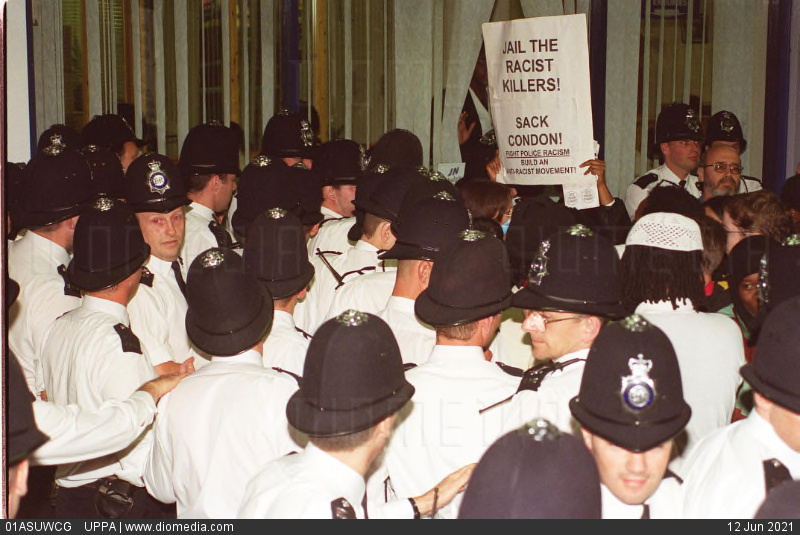
Stephen Lawrence Murder Inquiry in 1998 was attended by protesters against the handling of the case by the Metropolitan Police. Sir Paul Condon, named on the placard, was knighted 1994, Commissioner of the Met 1993-2000 and was made a life peer in 2001, Baron Condon. (Photo credit: Diomedia)
In addition, the Met have a long history of collusion with fascist organisations, from Sir Oswald Moseley’s “Blackshirt” (British Union of Fascists) to the more recent National Front, British Movement and others. In just one event in 1936, over 7,000 Met officers, including all their mounted police, attempted to force a Blackshirt march through a part of East London where there was a high occupation rate of East European migrant Jewish people. The result was a pitched battle against a defensive mobilisation of ethnic Jews and Irish, along with communists and anarchists. The fascists did not get through but most of the fighting was actually with the police.
The Mangrove restaurant in Notting Hill, West London, opened in 1968 serving Caribbean cuisine and became a meeting place for black activists and intellectuals. It was frequently raided by the Metropolitan police. In 1970 the community organised a protest march to the local police station and violence broke out between police and the protesters, after which the Met charged nine activists with inciting a riot. The trial of the Mangrove Nine lasted 55 days, included a number of challenges to court, exposed the racism of the police and ended in the acquittal of all nine on the more serious charges.
In 1974, an attempt to disrupt a National Front meeting in London ended with many antifascists injured by the Met and Kevin Gately, a student from Leeds of Irish background clubbed to death by police. In a successful large-scale mobilisation to prevent a fascist invasion by the National Front of the SE London Lewisham town centre in 1977, an area of relatively high Afro-Caribbean ethnic settlement (also of significant Irish), the main battles were with Met who were determined to bring the fascists through. In another defensive mobilisation in 1979 in the West London town centre of Southall, an area of high South Asian settlement, Australian antifascist Blair Peach, working in London was also killed by Met police baton.
We do not need to jump to conspiracy assassination attempt theories but we should keep an open mind in this case, consider the possibilities and question the Metropolitan Police handling of the case and their public statements. We also need to treat media handling with suspicion, particularly their non-critical acceptance of Metropolitan Police statements and even suggestions of “drive-by shooting” in US gang-banger tradition.
And to wish the victim a full and timely recovery.
End.
Sasha Johnson on a recent protest March in London (Credit photo: Times UK)
A black American traveling entertainer, boxer and trainer, soldier in two world wars for two different countries, awarded 14 French military medals, airplane pilot, nightclub owner, musician, civil rights activist, associate of famous writers and musicians.
Bullard’s biography is so amazing I cannot believe it has never been made into a movie. Like the lives of many African Americans, it is also a tale full of suffering and pain that highlights the horrible racism that pervaded America in his day. He is such a remarkable person that more people should know about the achievements of this unique figure.
Bullard was born in 1895 in Columbus, Georgia, the seventh of 10 children born to William (Octave) Bullard, a black Caribbean and Josephine (“Yokalee”) Thomas, a Native American Creek woman. Georgia at the time of his birth was a dangerous place for “uppity” African Americans and tragically lynchings were common. His father’s people were Haitians who revolted against French slavery and following the revolution, Bullard’s ancestors left the Caribbean for the United States and took refuge with the Native American Creek people.
As a young boy, he was traumatized by the sight of a white mob attempting to lynch his father over a workplace dispute. A proud man, his father imbued his son with the conviction that African Americans had to maintain their dignity and self-respect, despite all the indignities heaped upon them. Bullard fell in love with his father’s stories of France where slavery had been abolished and blacks were treated equally. At age eleven, Bullard ran away from home hoping to reach France. In Atlanta, he joined a family of English gypsies and traveled throughout Georgia with them, tending their horses and learning to be a horse jockey. The gypsies told him that there was also racial equality in England and Bullard determined to go there instead of to France.
Bullard found work with the Turner family in Dawson, Georgia. Because he was hard-working as a stable boy, young Bullard won the Turners’ affection and was asked to ride as their jockey in the 1911 County Fair races, where he was victorious. Eventually, he made his way to Norfolk, Virginia where he stowed away on a ship to England.
In 1912, Bullard arrived in Scotland and soon went on to London where he boxed and performed in humiliating racist pieces for the Freedman Pickaninnies, an African American troupe. While in London, he trained under the then-famous boxer Dixie Kid who arranged a bout for Bullard in Paris. Bullard fell in love with the “city of light” and decided to settle there. He continued to box in Paris and worked in a music hall until the start of the First World War.
Eugene Bullard showcase (Photo source: Internet)
A SOLDIER IN WWI
When the War broke out Bullard enlisted in the French Foreign Legion and by 1915 had become a machine gunner, seeing combat on the Somme front in Picardy. He served in a regiment known as the “hirondelles de la mort” (“swallows of death”) and saw combat at Verdun where he was severely wounded on March 5, 1916. During his convalescence, Bullard was cited for acts of valor at the orders of the regiment on July 3rd 1917 and was awarded the Croix de Guerre.
After recovering, he volunteered on October 2nd 1916 for the French Air Service and became a machine gunner. He joined a group of American aviators fighting for France on November 15, 1916, called the Lafayette Flying Corps and became the first African American aviator in World War I. He took part in over twenty French combat missions, and is sometimes credited with shooting down one or two German aircraft.
When the USA entered the war, The United States Air Service created a medical board to recruit Americans serving in the Lafayette Flying Corps to fly for the United States. Bullard went through the medical examination but he was not accepted, because in the segregated American military only white pilots were chosen. Sometime later, while off duty in Paris, Bullard allegedly got into an argument with a French officer and was punished by being transferred out of his combat unit and into a service battalion. Before he left the French military, the French government awarded him three different medals for his heroism in battle.
NIGHT CLUB OWNER
After his discharge, Bullard went back to Paris, where he started to play drums in a jazz band at a nightclub named “Zelli’s”, which was owned by Joe Zelli. Bullard worked with Robert Henri, a lawyer and friend, to get Zelli’s a club license, which allowed it to stay open past midnight. Zelli’s soon became the most celebrated nightclub in Montmartre because few other clubs could stay open so late. With the money he saved from playing at Zellis, Bullard traveled to Egypt, where he played with a jazz ensemble at Hotel Claridge and fought two prize fights.
Missing Paris, Bullard returned to the City of Lights where his career was about to take off. He became an entrepreneur hiring jazz musicians for private parties with Paris’ social elites, worked as a masseur and exercise trainer. Bullard then got a job managing the nightclub “Le Grand Duc”, where he hired the famous American poet, Langston Hughes. Around 1928, Bullard had saved enough money to enable him to purchase “Le Grand Duc.” Thanks to being the owner of a hot Parisian club, Bullard made many famous friends, including the dancer-actress Josephine Baker, poet Langston Hughes and jazz musician Louis Armstrong. He eventually became the owner of another nightclub, “L’Escadrille” where he got to know writer Ernest Hemingway, who based a minor character on Bullard in his novel “The Sun Also Rises.” Bullard also opened his own gym and gave boxing lessons, training successful fighters such as “Panama” AL Brown and “Young” Perez. In 1923, he married Marcelle Straumann, a striking French woman from a wealthy family. The marriage ended in divorce in 1935, with Bullard gaining custody of their two surviving children, Jacqueline and Lolita.
A SOLDIER IN WWII
When World War II began in September 1939, Bullard, who also spoke German, agreed to a request from the French government to spy on the German citizens who still frequented his nightclub. When the Germans attacked France, Bullard volunteered and served with the 51st Infantry Regiment and was severely wounded in the battle for Orleans. When the Nazis took over Paris, he slipped over the border into Spain and then headed back to the United States.
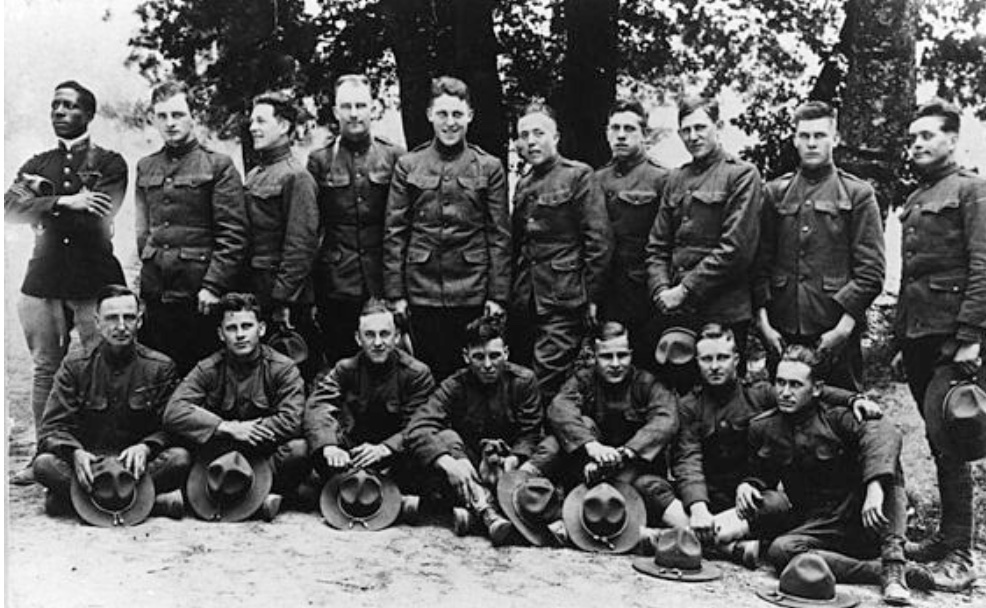
Eugene Bullard with US Army comrades, WW2 (Photo source: Internet)
Bullard spent some time in a New York hospital and never fully recovered from his wound. He missed Paris and his minor celebrity there. In New York, he had no celebrity and had to work menial jobs. He longed to return to Paris but learned that his nightclub had become a casualty of the battle for Paris. The French government gave him a financial settlement with which he purchased an apartment in Harlem.
CIVIL RIGHTS
Returning to America after World War II, Bullard was active in the civil rights movement. During one confrontation, a bus driver ordered him to sit in the back of the bus. In 1949, Bullard was a victim of one of the most notorious incidents in New York State history, the Peekskill riots. Bullard was a fan of African American communist entertainer Paul Robeson who was scheduled to sing at a Civil Rights benefit. Before Robeson arrived, however, a mob attacked the concertgoers with baseball bats and stones. Thirteen people were seriously injured including Bullard who was knocked to the ground and beaten by an angry mob, which included members of the state and local law enforcement. The attack was captured on film in the 1970s documentary The Tallest Tree in Our Forest and the Oscar-winning narrated documentary Paul Robeson: Tribute to an Artist. Despite photographic evidence, none of his attackers were prosecuted. Graphic pictures of Bullard being beaten by two policemen, a state trooper, and a concert-goer were later published in Susan Robeson’s biography of her grandfather, The Whole World in His Hands: a Pictorial Biography of Paul Robeson.
Eugene Bullard clubbed to the ground by rioter and cops during the racist Peekskill Riots in 1949; captured on film and photograph but no-one was arrested for this and other assaults. (Photo source: Internet)
The 1950s were difficult years for Bullard whose daughters had married and he lived alone in his apartment, which was decorated with pictures of his famous friends and a framed case containing his 14 French war medals. His final job was as an elevator operator at Rockefeller Center, where no one suspected he had once been the “Black Swallow of Death.” In 1954, the French government invited Bullard to Paris to be one of the three men chosen to rekindle the everlasting flame at the Tomb of the Unknown Soldier under the Arc de Triomphe and in 1959 he was made a Chevalier (Knight) of the Legion De Honeur by President Charles De Gaulle, who called Bullard a “véritable héros français” (“true French hero”). He also was awarded the Medaille Militaire, another high military distinction. On December 22, 1959, he was interviewed on NBC’s Today Show presenting his amazing biography and received hundreds of fan letters.
Eugene Bullard in military uniform (Photo source: Internet)
Bullard died in New York City of stomach cancer on October 12, 1961, at the age of 66. He was buried in the French Veteran’s section of Flushing Cemetery, where nine years later his good friend Louis Armstrong would also be interred. On August 23rd 1994, 33 years after his death and 77 years to the day after the physical that should have allowed him to fly for his own country, Bullard was posthumously commissioned a Second Lieutenant in the United States Airforce.
End.
Unveiling of Eugene Bullard statue monument in Georgia near the USAF base that refused to enlist him as a pilot for WW2 because he was black, even though he had already flown in France.
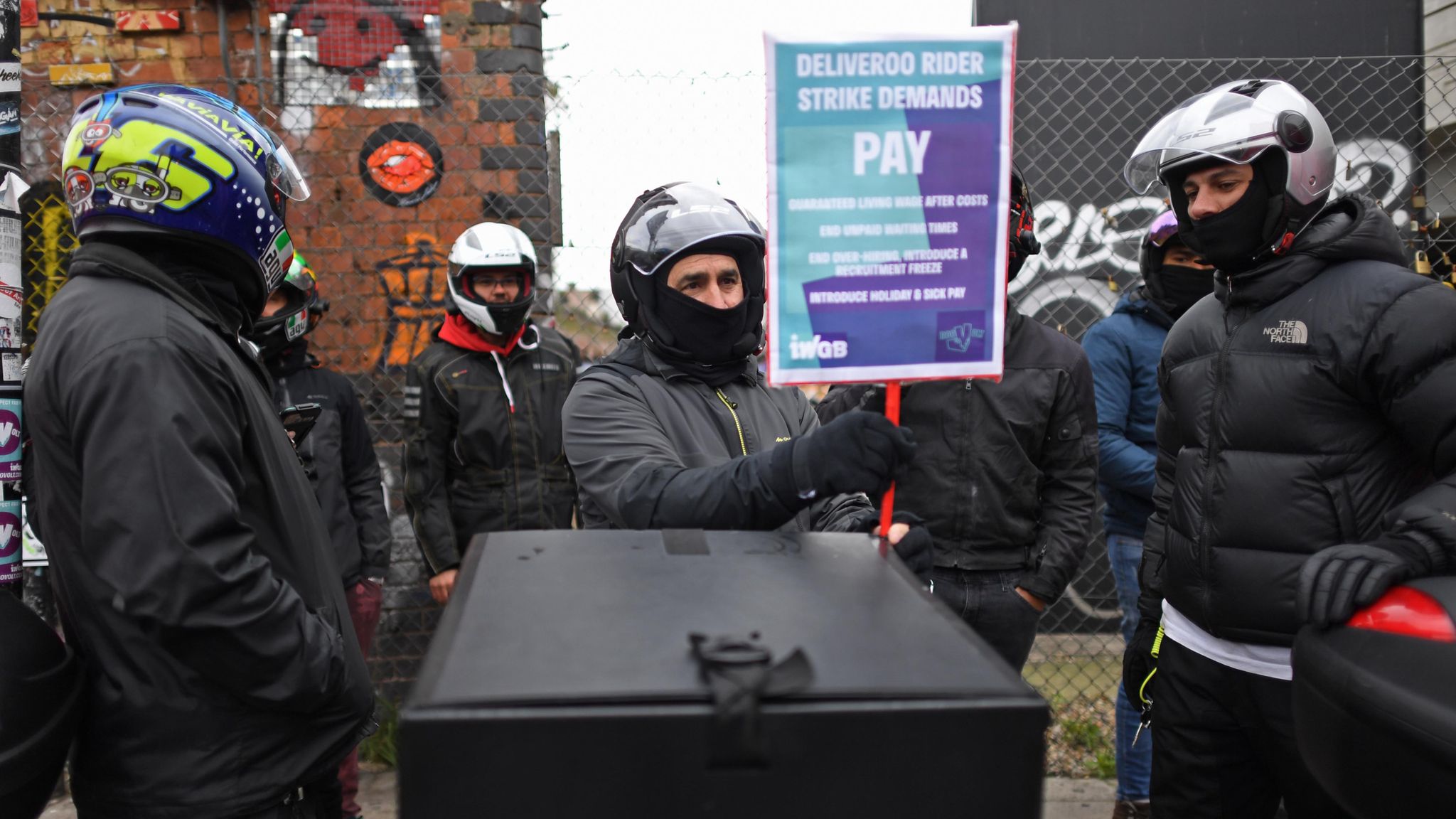
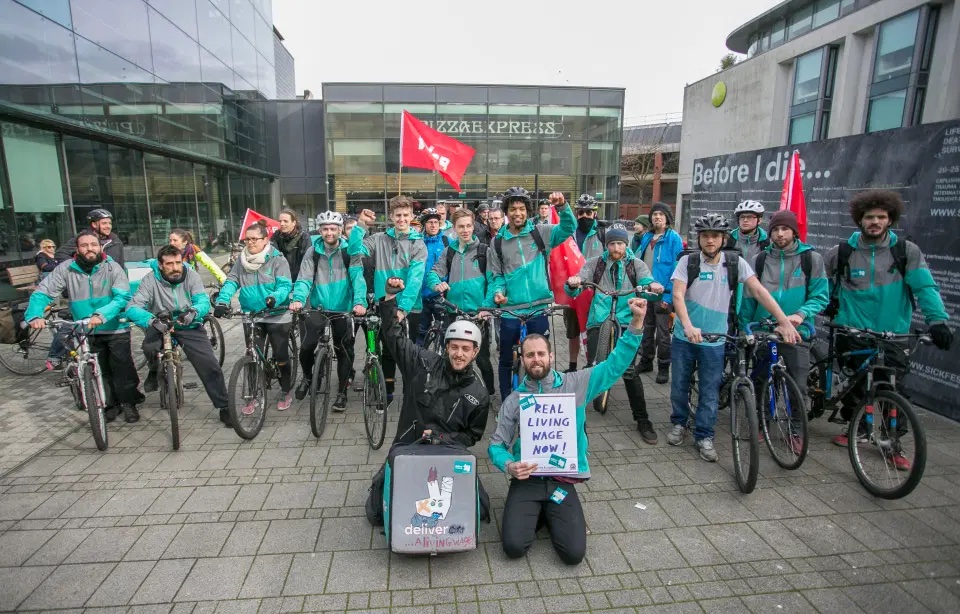
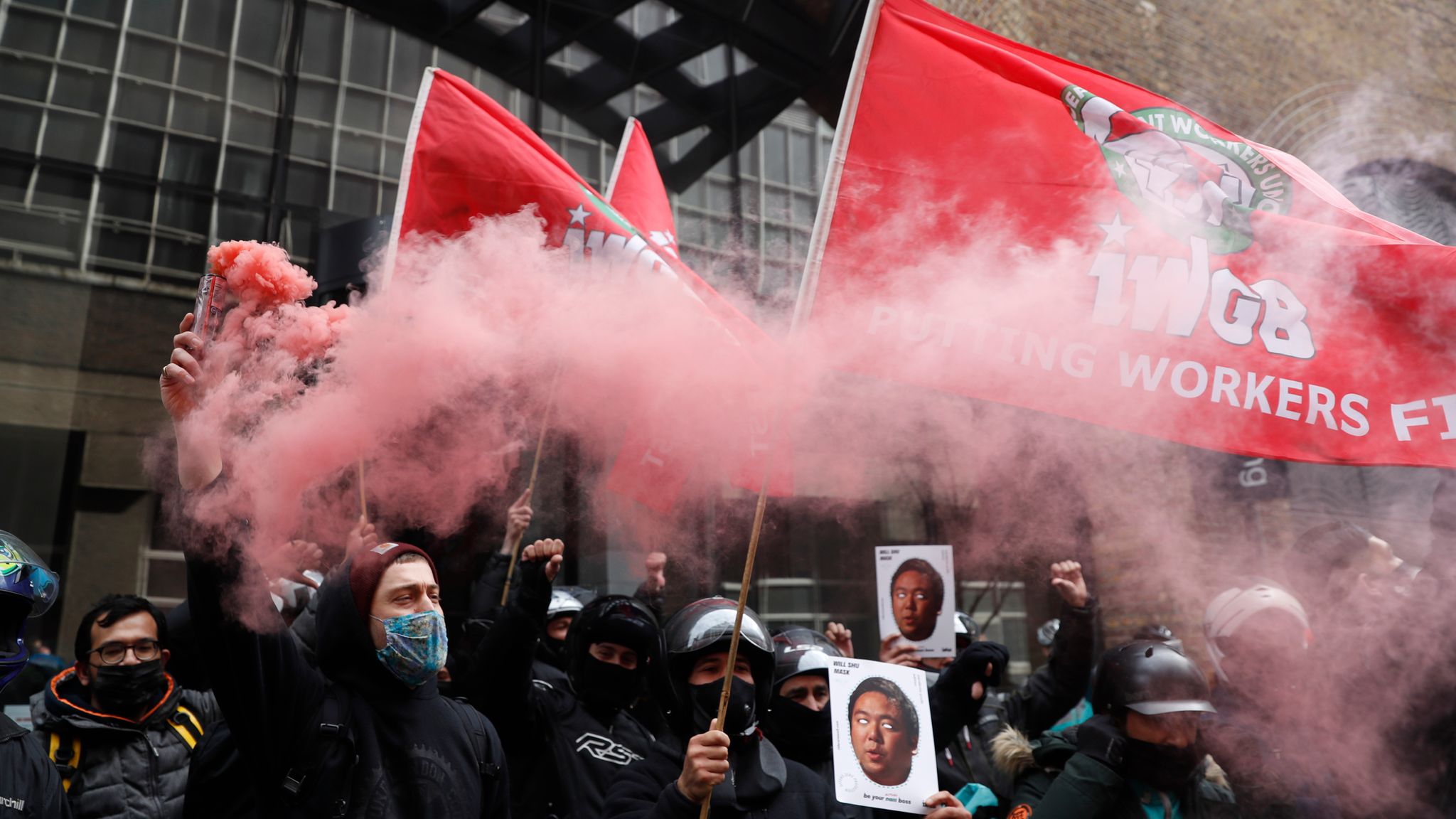
Across Europe, Deliveroo riders have been organising and protesting about their lack of employment rights and low pay. In April the riders struck and protested in Britain while in May, they won a number of victories against the company in the courts of the Spanish state. In February, a group of 25 drivers for Uber taxis won a UK Supreme Court decision that they are employees and not self-employed. Also, last month agency contract workers cleaning rooms for the second-largest hotel in Paris won a struggle too, with pay rise, reduced workloads, overtime pay and two sacked workers reinstated. These are important victories for the workers involved themselves but are also important in precedent and example for all workers in these kinds of precarious employment conditions and ultimately for all workers everywhere.
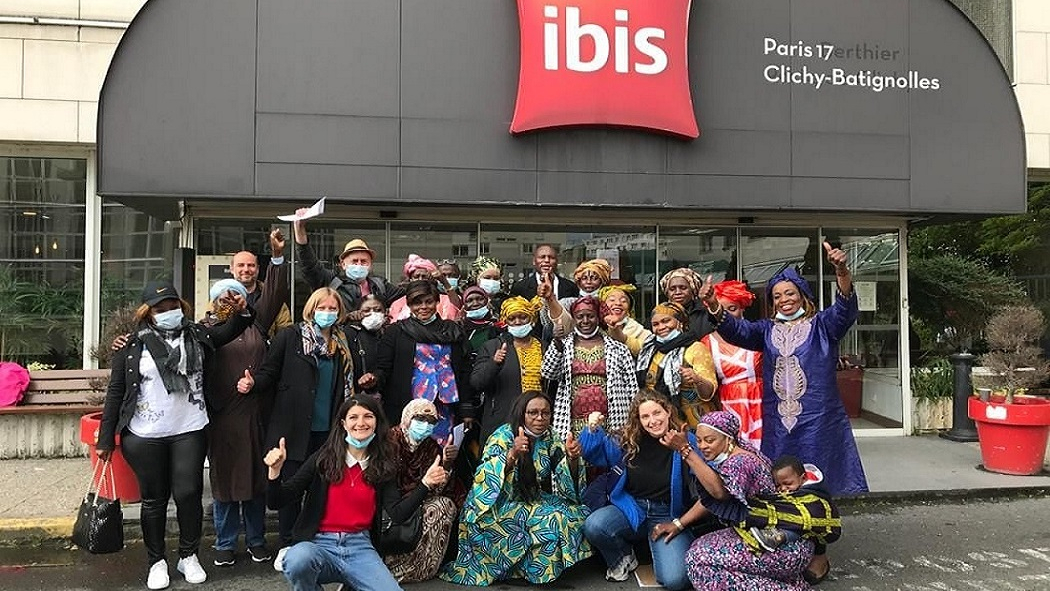
Victory celebration by Ibis housekeeping worker picketers on the street last month. (Source photo: Internet)
DELIVERY SERVICE WORKERS
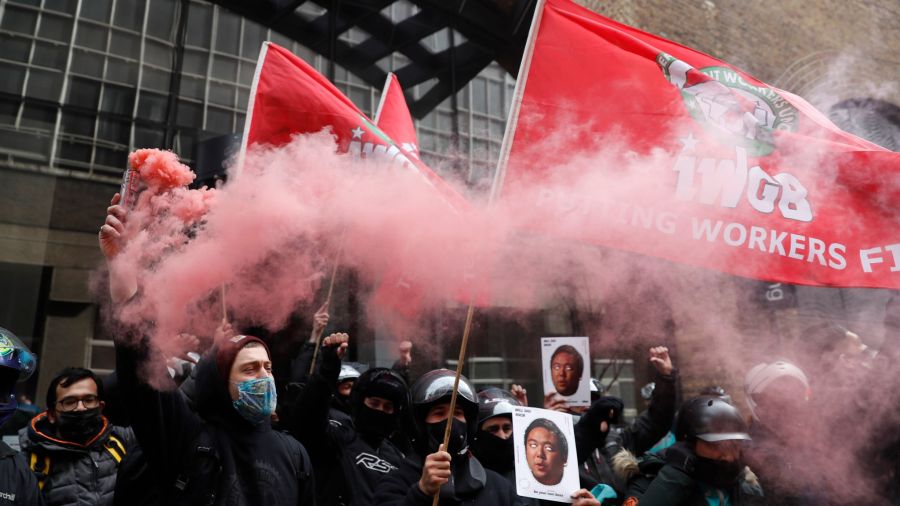
In Britain, as the fast-food delivery company Deliveroo floated itself for public shares, its riders staged public protests and strikes demanding decent working conditions and pay. Speaking ahead of the planned campaign, organiser Alex Marshall of the Independent Workers’ Union of Great Britain stated: “They said it couldn’t be done but by getting organised and speaking out, riders have triggered a domino effect which already slashed £3bn from Deliveroo’s valuation and that should give pause to any corporation that thinks precarious workers can be endlessly exploited without consequence.” Subsequently strikes and demonstrations were held in cities across Britain.
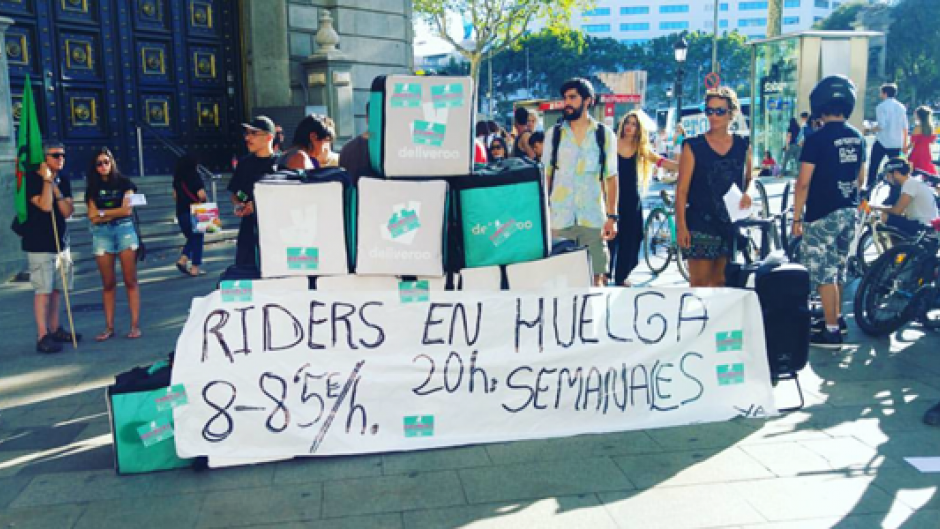
Deliveroo workers in protest Barcelona 2017 before setting up the riders’ cooperative in 2018 (Photo sourced: Internet)
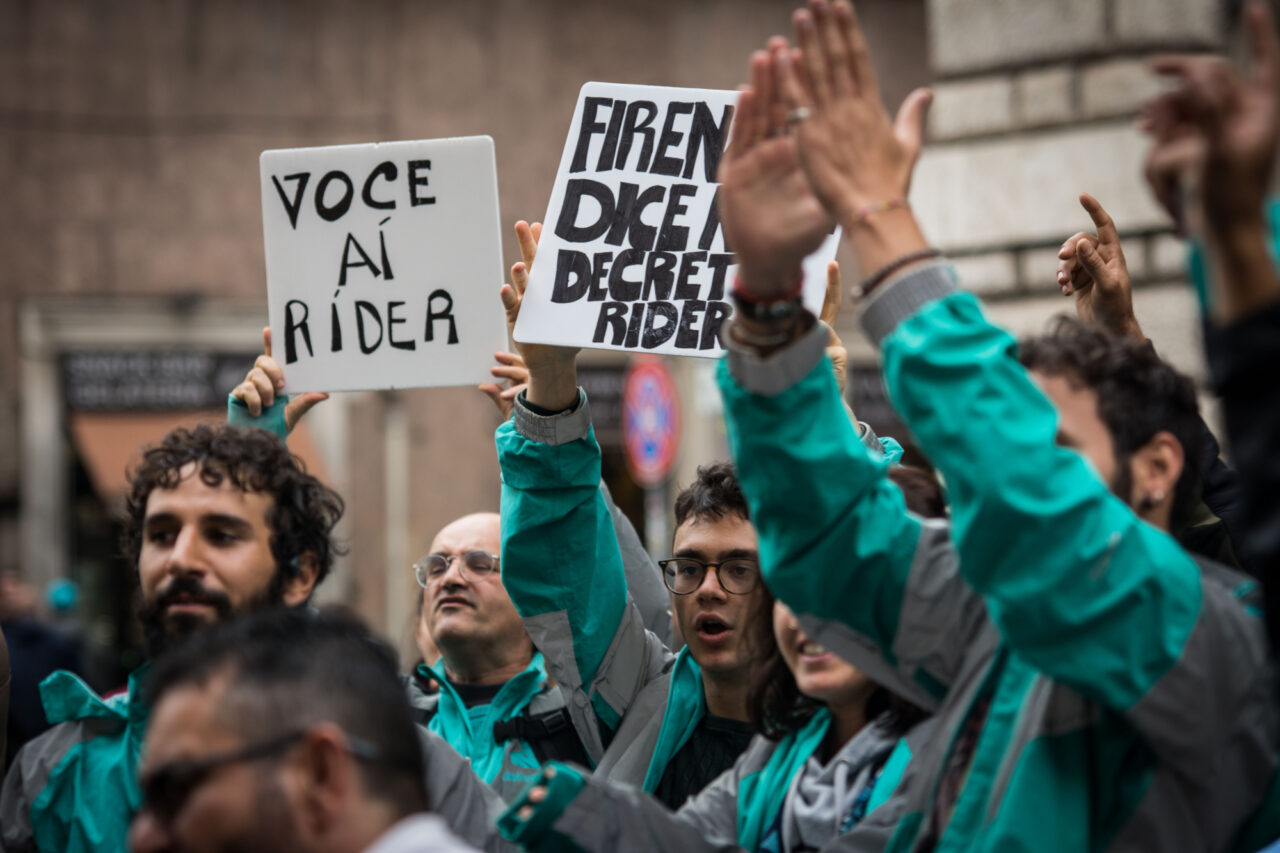
Deliveroo riders have been organising over recent years in a number of countries, holding public protests, strikes and calling one-day boycotts. In Barcelona, Deliveroo, Uber and Glovo Eats’ dissatisfied riders or sacked for organising set up their own cooperative in 2018. Last month the Spanish state’s state’s Supreme Court, having denied Deliveroo’s contention that their riders are self-employed, once again reiterated their position on 25th May, which means that their riders are entitled to employment contracts with paid holidays, sick pay and pensions (see Publico.es article below).
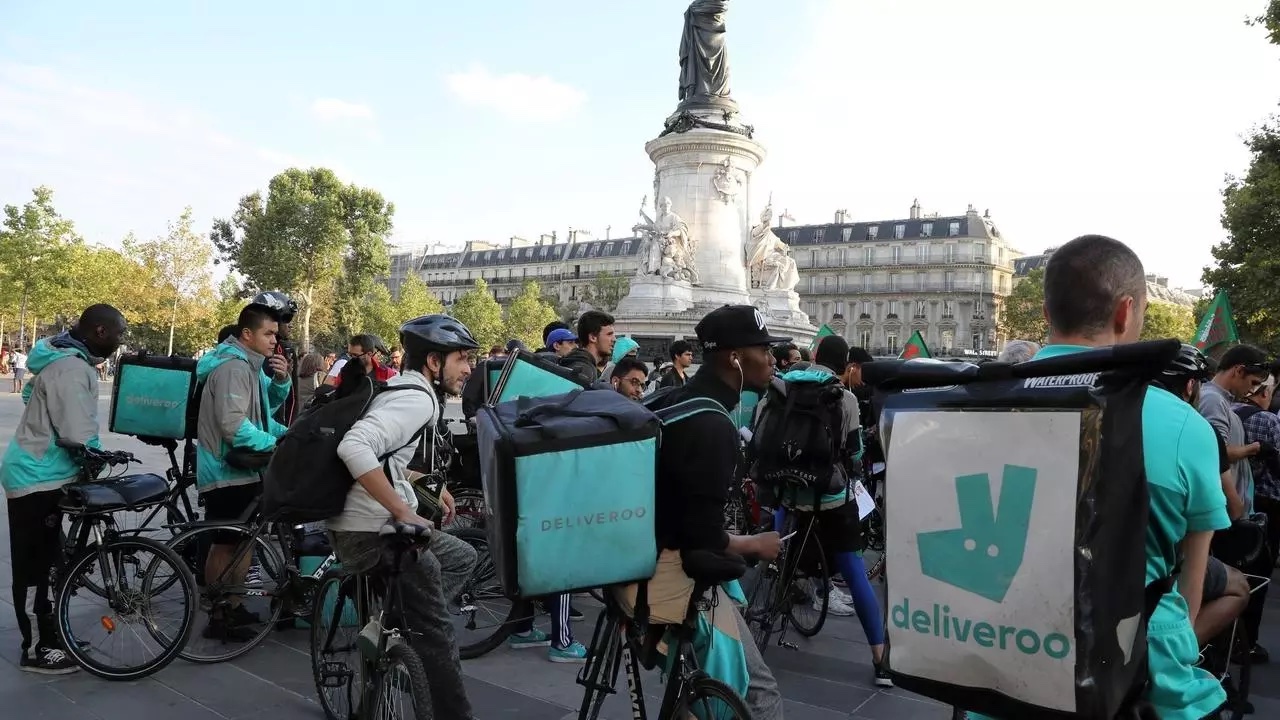
Deliveroo Riders Protest at Place de la Republique, Paris August 2019 (Photo credit: Jacques Demarthon AFP)
Spanish Supreme Court reiterates that Deliveroo riders are company employees, not self-employed.
Alejandra De la Fuente in Publico.es (translation by D. Breatnach from Castillian)
MADRID 05/26/2021 16: 39EFE
The Supreme Court rejected the appeal filed by the fast food delivery company, Deliveroo against a January 2020 ruling – which classified more than 500 of its delivery riders in Madrid as “false self-employed” – and has confirmed its conclusions.
The ruling, to which Efe had access this Wednesday, recalls that the Supreme Court already unified its judgement in September 2020, when it ruled in a similar case — although then the defendant was Glovo — that the relationship between these platforms and their riders is actually of a labour nature.
Company sources recalled that the events judged took place between 2015 and 2017 — when it began to operate in Spain — and maintained that its relationship with the delivery riders has changed since then.
The Supreme Court’s decision not to admit Deliveroo’s appealto unify judgements endorses the position of the Superior Court of Justice (TSJ) of Madrid, which already in January of last year rejected an appeal from the company on this same case.
The Court rejected the company’s arguments, including a ruling in its favour obtained in the Cantabrian courts, and stressed that the current position is marked by the ruling of the Supreme Court in September against Glovo by “responding to the new reality that supposes the provision of services through digital platforms “. In their ruling, the judges recall that the Chamber then ruled “in favour of the labour nature of the relationship between the delivery person and the digital platform” after analysing the existing jurisprudence and the “indications of employment” found by the Labour Inspection.
The judgment of the Supreme Court in Madrid specified that one of the key points was that the freedom of the delivery worker not to work “is not as wide as some would like to make out, since if they decline orders (…) they receive a penalty”, which results in fewer services being granted from there and, therefore, their income drops.
It also cited as an argument that the delivery person could not carry out the activity if he only had his own bicycle or mobile phone, since the Deliveroo structure and its platform, which connects customers, restaurants and riders, is essential for the operation.
The delivery company, for its part, issued a statement in which it claims to “respect but not share” the Supreme Court’s decision to “not analyse” the case and insists that the events date back to the period 2015-2017, when it used “a different model of collaboration” with its riders. “This model does not reflect the way in which couriers collaborate with Deliveroo today. This ruling only affects contracts that stopped being used more than three years ago,” these same sources stated.
Home delivery platforms such as Deliveroo, Glovo or Ubereats will be forced to stop using self-employed workers as delivery riders if the so-called Rider Law goes ahead, agreed by the Ministry of Labour with employers and unions. The regulations oblige these companies to use salaried distributors – either with staff contracts, or subcontracting to third parties – and is scheduled to come into force in August.
Deliveroo motorcyle riders in East London protest (Photo sourced: Internet)
LABOUR SUPPLY AGENCIES
As much as delivery coordinating companies — the “gig economy” — lower workers’ rights, pay and conditions through false “self-employment”, labour-supplying agencies do so also and supply workers from industrial to healthcare to hospitality sectors, being used not only by private companies but by State departments and municipal authorities too. Workers employed by agencies rarely or even never meet many others employed by their agency, which makes it extremely difficult for them to organise to improve their employment conditions or pay. In addition a number of agencies may supply staff to the same site so that they don’t even have the same employer.
Hotels employ workers for different tasks: service management, finance, reception/ bookings, food/ drink preparation and service, portering, maintenance and housekeeping (room and common area cleaning). Every person who uses hotel accommodation enters a room prepared by staff who will then clean the room after they leave, changing bedding, remaking beds, checking for lost property, emptying bins, replacing towels and bathroom materials, wiping down surfaces, vacuuming etc.
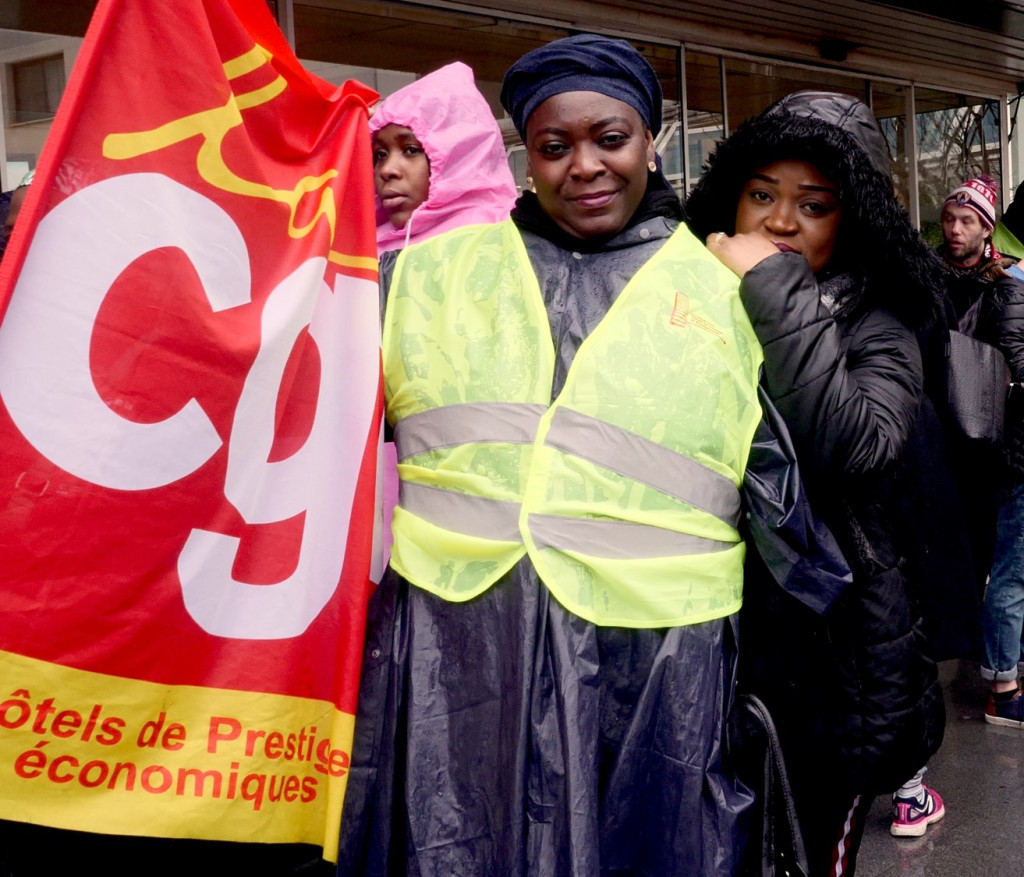
A cold rainy day in Paris during the 2-years struggle of the Ibis housekeeping workers (Photo sourced: Libcom)
While some hotels employ the housekeeping staff directly many, including the large hotels and hotel chains, use staffing agencies to supply them. This arrangement relieves the hotel of responsibility for the employment conditions or pay of these staff while at the same time allowing them to dictate the working arrangements of those workers.
The 700-bed Ibis Batignolles Hotel, the second-largest in Paris uses the Accor and STN agencies to supply its housekeeping staff and in July 2019 twenty of those workers at the hotel began their agitation, complaining of a cleaning workload rate of 3.5 rooms per hour, or one room in 17 minutes, which was forcing them to work at great speed and even on unpaid overtime to complete their allocation. Ten workers who had occupational illnesses and were unable to keep to that workload were threatened with transfer to lower-paid jobs and this precipitated the resistance.
Last month these workers signed an agreement giving them a pay rise, reduced workloads, overtime pay and two sacked workers reinstated.
The Prestige and Budget hotels section of the General Confederation of Labour (CGT-HPE) supported the workers – mostly migrants from sub-Saharan Africa – throughout the struggle and also raised a solidarity fund to support the workers during the course of the strike, raising €240,000 on line. Claude Lévy, leader of the union, who claims more than thirty years of activism commented: “It is the longest strike that I have seen in my career”.
One of the workers, Rachel Keke, speaking to French media said: “We’re proud of what we’ve achieved because we fought through to the end, we never gave up. I kept saying to my colleagues we have to hang on, we’ll win in the end. And now we have this wonderful victory.”
The success of the striking workers directly benefits not just themselves but the working conditions of some sixty subcontractors employed by STN which will be raised now to the level of the workers directly employed by the hotel. The striking workers have also been paid compensation in undisclosed sums.
One unusual feature has been the installation of a card-clock to record the hours worked by each worker, demanded by the workers themselves. A union organiser commented that it was strange to see such clocks that were hated by workers in the past being sought by workers today.
The victory of these Paris Ibis housekeeping workers is indeed notable and will serve as example and encouragement to others in the sector, as one of the workers also said. However, they did not win direct employment and the whole contract labour issue remains to be addressed.
A statement issued by the CGT-HPE praised the struggle of the women but also criticised “collaborators in the union bureaucracy who work against sincere militants to destroy and silence them.”
OVERALL SUMMARY COMMENT
One cannot pass through any city centre in Ireland without seeing cyclists and sometimes motorcyclists of for example Deliveroo or Just Eat on the road. In addition, there are a large number of courier services at work delivering other items although not always so noticeable.
Delivery companies allocate delivery jobs to the workers on their register. Those workers have to supply their own bikes and mobile phones, get no sickness pay – whether from injury incurred in the course of their work or not – and no holiday pay or pension. Nor are they paid while waiting to be allocated a delivery job.
In Ireland these workers are often migrants who either find it difficult to get other work or for whom such work seems convenient as they don’t intend to stay long (quite often a fallacy, as Irish migrants to other countries can testify, myself included). An important pressure on especially migrant workers is the high cost of rented accommodation in Ireland and particularly in Dublin.
The Spanish Court left Deliveroo and other companies the option not to employ their drivers but instead to contract with a staffing agency to supply the required labour. Staffing agencies supply workers from industrial to healthcare to hospitality sectors, being used not only by private companies but also by State departments and municipal authorities. I’ve been supplied as a worker by agencies for cleaning and social/ health care and had to employ them myself as a manager for staffing cover in hostels for homeless people and drug and alcohol misusers.
Deliveroo riders in Britain in protest March 2021 (Photo sourced: Internet)
As a directly-employed municipal worker and (unpaid) union organiser in London, when my union branch got ready to strike in defence of holiday and sick pay which the municipal authority was planning to cut for the mostly manual services (sanitation, road maintenance and park/ tree etc maintenance), we found this sector was nearly 50% staffed by agency workers. Even had the leaders of their unions been willing to strike, such a weakness in their numbers would have given them pause. Their unions did not join our strike and their workers lost, of course.
Workers in the hospitality industry (bars, hotels, restaurants/ cafés) are historically some of the worst paid with worst conditions and are often female and migrant. As a contract cleaner and kitchen porter on a number of occasions in my working life I can personally testify to this and any examination of available data will verify the facts.
Such workers tend to be in small workforces in individual work-places, even when each such site is part of a chain and for that reason and others are difficult to organise which in turn makes them easier to exploit.
(Photo credit: Euractiv.com)
WORKERS’ STRUGGLES AND THE LAW
Workers in the past fought for and in many cases gained “closed shop” agreements, meaning that every worker employed had to be a member of the union. This was often attacked by liberals as undemocratic but in fact proved necessary to prevent the employer using non-unionised workers to undermine union struggles. Of course, when unionised workers did win struggles, those gains went to the benefit of all workers in the company including the non-unionised and indeed often across wider society. Governments now tend to make “closed shops” illegal (along with another useful weapon, the “sympathy” or solidarity strike).
Just as in the past it has been necessary for workers to defy the laws that forbade organising of trade unions or of strikes, unions today will need to do so in order to remove these restrictions on their ability to effectively improve workers’ conditions and pay. The notion that to preserve the union structure and funds is more important than defending the purpose for which it was founded needs to be challenged.
Many union leaders and officials became complacent and allowed the creeping “agencisation” of workplaces and in doing so abrogated their responsibilities not only to workers employed by agencies but also, in the longer run, to their own directly-employed members. Wide-scale unionisation will need to address and reverse this trend as this sector continues do be a threat to workers’ rights and conditions and in fact even to trade union recruitment.
The Deliveroo decision In the Spanish Supreme Court presumably brings an end to a long legal battle about the status of the workers there which has seen a number of regional court decisions in favour of the the workers, e.g. in Madrid and in Catalonia but a reversal in another region, Cantabria. The Supreme Court has now ruled in the case of Deliveroo and also Glovo: the workers are not self-employed and therefore are entitled to contracts of employment, holiday and sick pay, etc.
The legal process in the UK however went against the workers and in favour of the Deliveroo company until the recent decision of the UK Supreme Court in favour of 25 of Uber’s drivers indicates that it is likely to end up the same with regards to Deliveroo, Just Eats etc (whereupon the Irish courts will probably follow suit).
In the case of the agency workers in Paris, they suffered an initial defeat in the French courts on the issue of in reality working for Ibis rather than the agency but won much of their demands through action at a time when the company wants to be able to take full advantage of the lifting of Covid19 restrictions and the busy tourist season months. The union official Lévy called off an appeal against the French court decision but indicated that the legal process is still one avenue open to them and that the issue needs to be resolved for many other workers.
Although legal cases have long been one avenue of workers’ progress one needs to remember that in a capitalist economic system the legal system favours the rich and also that most legal reforms benefiting workers have been won on the back of direct action, concessions often ultimately motivated by fear of revolution. The Deliveroo struggle was not won in the Spanish courts alone but was supported by a long campaign of demonstrations and even strikes; the Ibis Batignolles struggle was won by a two-year strike and publicity actions.
Victorious Ibis housekeeping workers pose for photo outside the Paris Ibis hotel on the day of their victory (Photo via CGT/ HPE)
A niche for smaller, left-wing unions?
Statistics suggest in Ireland, with a union membership of below 24% (in a country which once had around 40% membership even with much less employment opportunities), that a general union membership recruitment drive is needed now.
While some smaller sections of large unions have done effective work in fighting for the rights of workers in smaller workplaces, or in agencies or “self-employed” areas as in the two main examples cited above, these sectors are often neglected by union organisers who find large workplaces easier or more rewarding in terms of results.
This failure does provide a niche for smaller and possibly specifically left-wing unions which would allow them to grow as well as to make a significant contribution to the unionisation of workers and to improvements in workers’ rights, conditions and pay.Organising these workers will not be easy and may even require bike-riding organisers but the examples above show that success is possible and the Independent Workers’ Union of Great Britain may be showing the way.
End.
Deliveroo workers protest in London recently (Photo credit: Sky News)
Cur síos ar bheagán d’obair ealaíona na Gaeltachta agus macnamh air ag ealantóir Eoin Mac Lochlainn a bhfuil a thaispeántas féin aige i mBaile Átha Cliath.
A description of a little of the art work from the Gaeltacht along with ruminations upon it my artist Eoin Mac Lochlainn who has his own exhibition in Dublin.
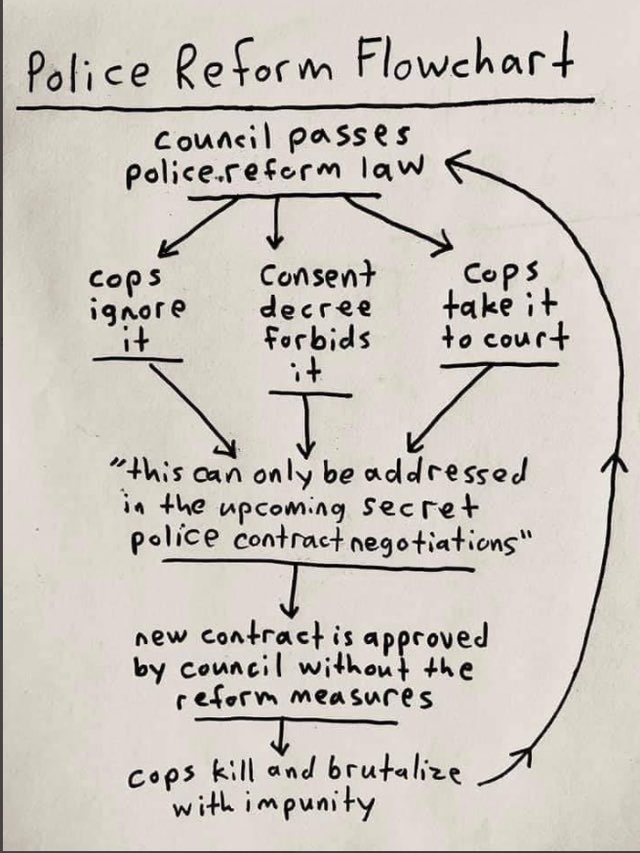
“20-year old Daunte Wright was killed on April 11th, 2021 in Brooklyn Center, a suburb of Minneapolis, Minnesota by a cop (26 year veteran) who allegedly mistook their own gun for a taser. On March 3rd, 2021, Daisha Smalls’ 1 year old child was shot in the head by cops in Houston, Texas while they were chasing a robbery suspect. On March 29th, 13 year old Adam Toledo was shot and killed in Chicago after being chased down by a cop. The Atlanta, Georgia mass shooter who targeted Asian women in massage parlours was said to have “had a bad day” in a statement from Captain Jay Baker, a cop with a history of anti-Asian social media posts. Capitol police were caught taking pictures with domestic terrorists and QAnon fuckwits (oh sorry… “protestors”) in January as they stormed the Capitol Building to protest Biden’s inevitable presidency. These are just some examples from 2021.”
According to Mapping Police Violence, 319 people have been killed by police in the USA alone since January 1st, 2021. Hell, there were only 18 days in 2020 when cops didn’t kill somebody. Lots of people aren’t going home to their families, their spouses, or their friends because of run-ins with the “thin blue line” and we’re supposed to accept it. We’ve been conditioned to believe that cops are always making the best call and actively keeping communities safe from bad guys and miscreants. Anyone who dies at their hands probably had a good reason to be shot, tased, beaten, or otherwise neglected. “They should have complied” we hear. “They shouldn’t have run” they argue. “Just be polite” they claim again and again.
Image with thanks from Order & Anarchy (see link for article)
I recently refused to sign a letter/petition to Irish Americans asking them got get President Biden to look at the “Irish peace process” as an encouragement to for whatever he was to do in Palestine. I was shocked at some of the signatories I saw on this, never imagining that they would support such sentiments.
But as for this article, I agree entirely. I know neither of the authors but for what they have written here I commend them with all my heart. “No justice, no peace” is not just a slogan or a wish but absolute 100% reality.
image
Israeli Police cordoned off an incident area in the Sheik Jarrah section of Jerusalem, city occupied by Israel since their war of 1967 against Jordan, Egypt and Syria. The Zionists want an all-Jewish Jerusalem (city holy to Christians, Muslims and Jews) and to make it their capital city, which is why they are forcing Palestinians out (one of the two attacks on Palestinians that led directly to the recent “war”). (Photo credit: Ahmad Gharabli/ AFN, via Getty)
This is indeed a good article but hardly brilliant — it is pretty much what many have been saying for years about Ireland but marginalised by the authorities and those that bought into the “process”. It IS ‘brilliant’ — and very surprising — that the Irish Times published it.
I concur completely with the authors’ view on Ireland and Palestine and would add every other place on this globe where the imperialists spread that disease they call “peace processes” and, by the way, the Palestinians have already had one dose of it in Madrid and Oslo which hurt them badly and from which they are still working on their recovery. So it is not only misleading but incredibly patronising to say that “it is time the same happened in Palestine” as that letter/ petition did.
The Palestinian movement under the leadership of Al Fatah got conned into this pacification process shortly before the did Irish under the Provisionals. Al Fatah did not get independence or their land or the return of the refugees from the deal but they did get their own colonial ‘home rule’ (the Palestinian Authority) which they ran with nepotism and corruption. The Intifada (Palestinian uprising of civil disobedience, street protests and riots) followed when it became clear nothing fundamental was going to change.
In the first elections afterwards for that colonial home rule in 2006, the normally secular-voting Palestinian public overwhelmingly rejected those they had supported for decades, Al Fatah and voted instead for Muslim fundamentalist Hamas. For the simple reason that it looked to be the only organisation of any size that was going to fight for the Palestinians and not be bought out. Let’s nail that media lie right now: Hamas did not “seize power in Gaza” — they won overwhelmingly in the whole Palestinian territories. It was Al Fatah that tried to seize the power they had lost in the elections — they were allowed to do so on the West Bank but not in Gaza where, after a short and brutal battle, Hamas took the seats which the population had voted them. Whether we dislike them or not, they were the people’s democratic choice. And very likely would be again — it’s just that elections since then have been put off, put off and put off again by Mahmoud Abbas and his supporters, probably in fear of a repeat.
When one resistance movement or organisation fell to the infection of the pacification processes, it was used to try to infect others. So the ANC and Al Fatah representatives attended Provisional Sinn Féin Ard-Fheiseanna (annual congresses), PSF got in with the Otegi leadership of the Abertzale Left in the Basque Country (along with Tony Blair, Bertie Ahern, Kofi Annan and South African players), the PSF and others sold it to the FARC in Colombia, to the Kurds and tried to sell it to the Philippines, Sri Lankans and the Indian movement. None of those last three bought it and are still fighting on, except for the Sri Lankans who were massacred, raped and tortured. The Turks weren’t interested in a deal with the Kurds and the Spanish state didn’t even relocate the Basque prisoners to prisons near their homes, not to speak of releasing them. South African blacks got the vote but in continuing poverty in a very rich state run by the same imperialists and settlers but with corrupt African politician-businessmen sharing in the booty. Colombia got ongoing oppression, repression and shooting of human rights and social campaigners by state-sponsored murder squads.
NOBODY, but NOBODY ANYWHERE got what the people had been fighting for — nor anything near it. But they did get subornation, corruption and collusion among their leadership and fragmentation in their own movement.
The authors of the Irish Times article are absolutely right and “No justice, no peace” is not just a slogan or a wish but absolute 100% reality.
Marching in a Palestine solidarity demonstration or standing in some prominent spot in Ireland amidst Palestinian flags, solidarity banners and placards and listening to the beeping of horns in approval from passing traffic is a great feeling.
Some visitors from other lands are often surprised at the extent of support here for the Palestinians. “It must be because of the Irish history of fighting colonialism and occupation”, they speculate. And some Irish people will nod eagerly in agreement.
But it wasn’t always like this. There was a time when most Irish people sympathised or even empathised with the Israelis. And we need to be aware of that and of the journey the Irish people have made from there to here and how that happened.
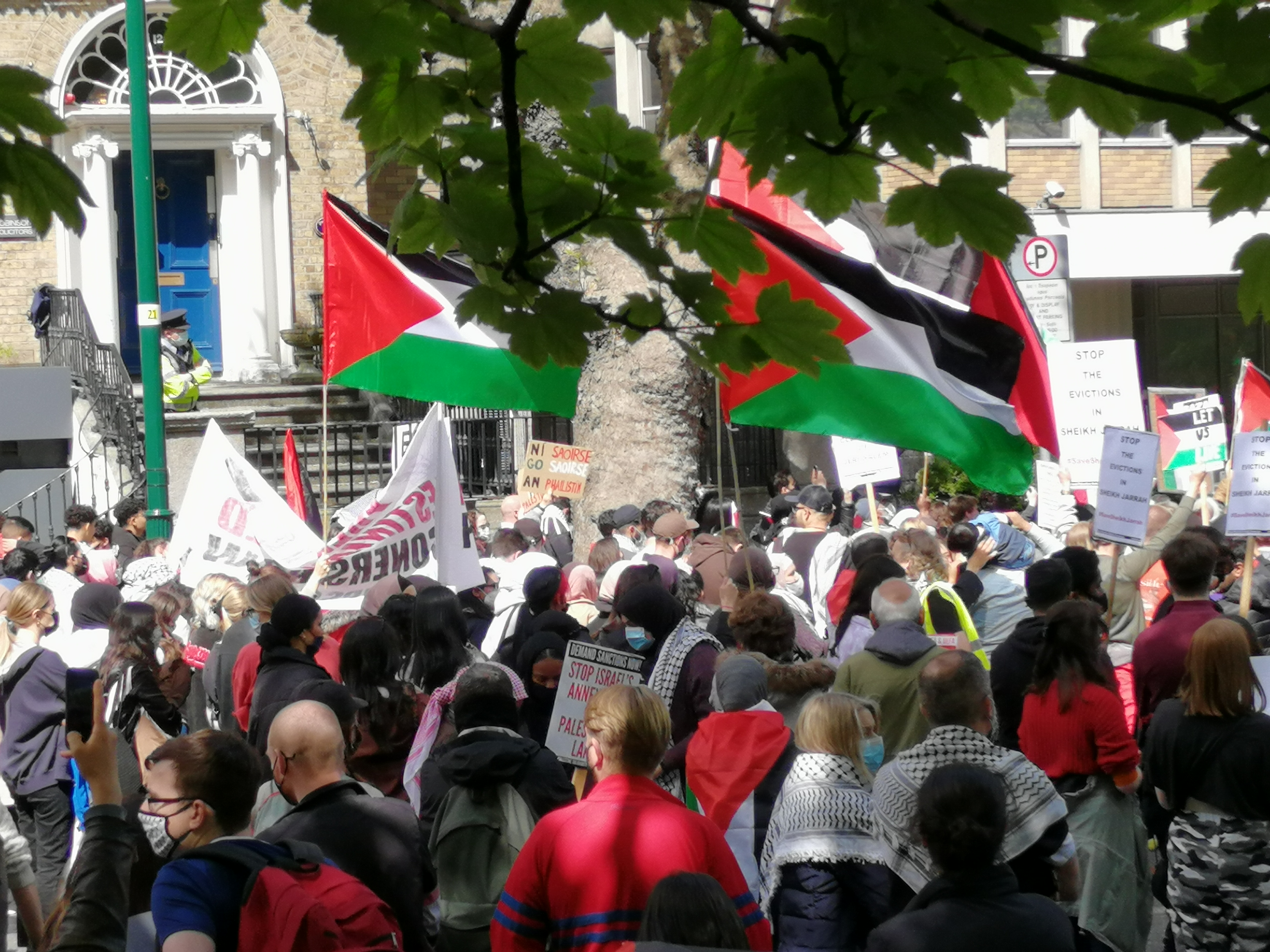
Irish solidarity with Palestine rally outside the Israeli Embassy in Dublin, Tuesday 18 May 2021 (Photo: D.Breatnach)
Last night (26 May) the Dáil, the Irish Parliament, declared in unopposed vote that the “illegal”1 Israeli settlements amount to an annexation. The Breaking News.ie report on the vote called Ireland “the first EU member state to do so”, hinting that others may follow.
And some of the northern European states might, indeed, unhappy with their support for Israeli atrocities through toeing the USA line – but someone always has to be first.
The motion, put forward by the Sinn Féin party, passed unopposed, while an amendment by the People Before Profit party calling for the Israeli Ambassador and staff to be expelled2 failed by a comfortable majority of almost two to one.
However, 46 Dáil votes in favour of the expulsion of the Israeli Ambassador would have been unthinkable just a few decades ago.
The vote and previous cross-party support, with the exception of Fine Gael, predicts a very smooth run for the “Occupied Territories” Bill soon to reach its third and final reading in the Dáil3.
An Israeli Ambassador to Ireland some years ago accused the Irish people of being “the most anti-semitic” in Europe.
I think that was around the time of the Israeli Zionist State’s previous war with Gaza in 2014, when the extent of Irish society’s solidarity with the Palestinians was evident and, of course, for a number of decades now the Zionists have been working hard to appropriate Jewry and to daub anyone criticising Israel as being “against Jews”, i.e “anti-semitic”4.
However, Maurice Cohen, Chairperson of the Jewish Representative Council was quoted in an Irish Times article that same year saying that there was no major anti-semitism in Ireland and that Irish people were able to distinguish between people who are Jewish and the Israeli State.5
That attitude, of the Irish sympathy with the oppressed Jews not equating support for the Israeli state, required some change, since for decades the majority view had been supportive of Israel.
Anti-Semitism in modern Ireland
Christianity has often played a part in whipping up anti-Jewish feeling, using the New Testament story of Jews denouncing the Christ figure and their responsibility for his alleged crucifixion by the Romans.
The Catholic and Protestant religions in Ireland played some part in that demonisation. But no notable medieval Irish writer gave us a Jew who would exact a pound of flesh from a human in revengeful debt repayment. Gaelic society had no Jewish ghettoes, no laws against Jews6.
Anti-semitism has existed in Ireland as in all other European countries but not to the extent that it has in some of those countries, for example in England. The 1904 Limerick Boycott or Pogrom is sometimes pointed out to counter such an assessment but the the full story needs to be known.
Fr. John Creagh of the Redemptorist Order was an anti-semitic bigot and liar and did succeed in whipping up anti-Semitism against the few Jewish families settled in Limerick. But the Bishop of Limerick, Dr. O’Dwyer denounced the bigotry, as did the Church of Ireland Bishop, Thomas Bunbury and a man who assaulted a rabbi was jailed.
Nevertheless, the boycott and hostility continued for two years with the support of sections of the media (Limerick Leader, Irish Independent, Munster News)7 and a number of families left Limerick to emigrate from Cork port.
However, passing through the city on their way, they were welcomed by people in Cork and given accommodation; such was the welcome that some decided to stay and David Marcus, a novelist and literary editor of the Irish Press and Louis Marcus, filmmaker, were descendants of those refugees, as was Gerald Goldberg, 1977 Mayor of Cork8.
The period of modern active anti-semitism in Ireland was the 1930s which reflected the rise of fascism and attendant anti-semitism around the world.
The Catholic Church often saw fascism as a bulwark against atheism and communism and sections of the Irish ruling class regarded it as a defence against advances by the working class and socialism, additionally against Irish republicanism.
The Church and ruling class alliance had crushed the Republican resistance in the Civil War but the Republican movement, despite executions, jailing, internment, exile and repression, remained viable and began to reorganise itself.
It did so militarily but also politically and despite the split in Sinn Féin and the formation of Fianna Fáil in 1926, the latter began to pick up electoral support and, by 1932 was in Government, albeit in a minority.9
The previous Government had produced hysterical propaganda against it, even suggesting the party was communist.
The Army Comrades Association, formed to counter Republicans after Fianna Fáil was elected to Government in 1932, went through a number of name changes but has been known as “the Blueshirts” collectively, although they did not adopt the blue shirt as part of their uniform until 1933.
Despite their uniform style and “Roman salute” adopted from the Italian fascists, academics and some political activists have denied that the Blueshirts were a fascist organisation. However some of their leaders, including the former Garda Commissioner O’Duffy and a number of Government Ministers and supporters definitely were fascists and anti-semitic.
Blueshirts at Bluebell Cemetery, Dublin County 1934 (Photo sourced: Internet)
Irish Republicans and socialists fought the Blueshirts on the streets. In 1933 the De Valera Government banned a march on Dublin planned by the Blueshirts and later banned the organisation itself, which led to the formation of a right-wing coalition including the Blueshirts to form the Fine Gael political party10.
Irish Republicans and socialists went to fight against Franco in the Spanish Antifascist War (1936-39) and though outnumbered in the order of ten to one by those recruited by the Blueshirts11 to fight for Franco, it was only the Irish fighting on the Republican side who acquitted themselves well, fighting in many major battles and losing about a quarter of their number in action
In comparison, the Blueshirts gained a reputation for drunkenness, lack of discipline or of general military merit and saw little military action.
Shankill Road Belfast contingent of the antifascist socialist Republican Congress, at the annual Republican Wolfe Tone commemoration at Bodenstown, Co. Kildare, 1934. (Photo sourced: Internet)
During WWII the German Nazis ran a radio station, Irland-Redaktion, aimed at the Irish population and even containing some broadcasts in Irish but I gain the impression (without having reviewed its material) that it concentrated on anti-Allies propaganda, in particular probably anti-British and also on maintaining Irish state neutrality. It did contain broadcasts in the Irish language12.
ISRAEL IN IRISH POLITICS AND SOCIETY
POLITICS AND DIPLOMACY
The 1937 Constitution established under De Valera specifically mentioned Judaism in Article 44.1 and protected it from persecution while De Valera himself had good relations with the first Chief Rabbi of Ireland, Chaim Herzog (mentioned later here in relation to the founding of Israel).
The State under De Valera remained officially neutral through WWII but, despite the IRA, actively friendly towards the Allies. Some anti-Semitism survived and has been picked up and incorporated in attempts to form fascist groups within Ireland which, since the 1930s defeat of the Blueshirts have been tiny and also prevented from having any great influence in society.13
But most of Irish society, especially after the horrors of the Nazi death-camps became common knowledge after WWII, empathised with the Jews. This continued to be the case as waves of Jewish refugees went to Palestine, often battling British soldiers and police who were trying to stop them landing.14
The State of Israel was created by Jewish settlers on Palestinian land in 1948 and was quickly recognised by two world powers – the USA and the USSR but the Irish state, like many others, was reluctant to follow suit, conscious that Palestine had been an Arab colonial possession or “mandate” of the UK, many of whose possessions around the world were being de-colonised.
In Irish eyes the Israeli Air Force attack on Egypt in 195315, two years before the Irish state was admitted to the United Nations, didn’t help Israel’s case.
Israel struck without declaring war in support of the French and British attempt to maintain control of the Suez Canal against an Egyptian government’s intention to nationalise it. And the USA, keen to show that the balance of world powers had changed since WWII, publicly condemned the attack, especially chastising the old colonial powers and previous world masters, the British and French16.
President Nasser of Egypt making a speech (Image sourced: Internet). Nasser led the Egyptian nationalisation of the Suez Canal. (Photo sourced: Internet)
The Irish state of course had friendly relations with the USA but the Zionist State had some important Irish connections too. The Chief Rabbi of Palestine was a Zionist, Yitzhak Herzog – late of Belfast and Dublin, where he had also been Chief Rabbi of Ireland. One of his sons, Chaim Herzog, also a Zionist and though born in Belfast and raised in Dublin, became the 6th President of Israel.
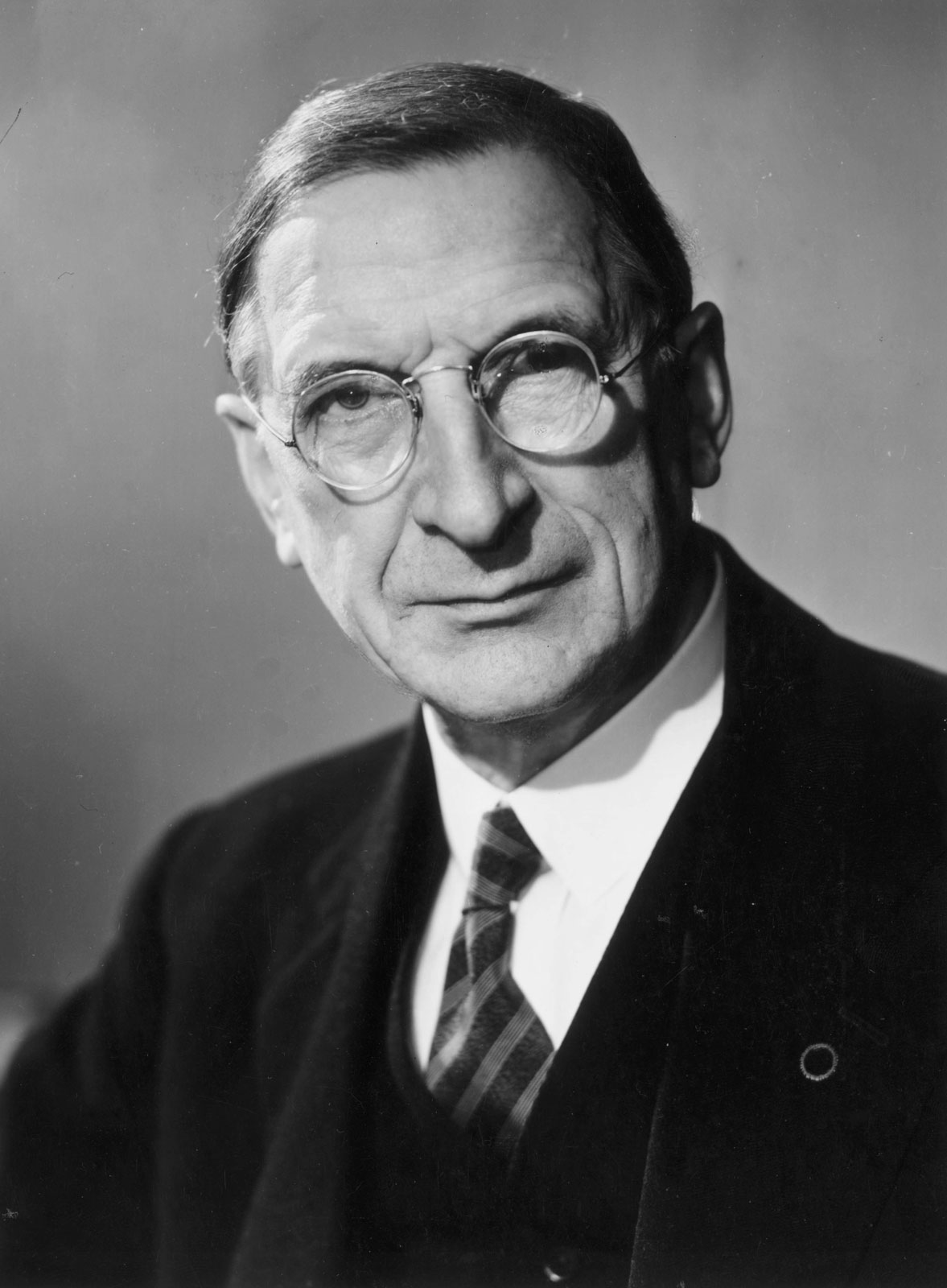
De Valera, former IRA leader, founder of Fianna Fáil, later President of Ireland and friendly with Zionist Chaim Herzog (Photo sourced: Britannica)
Chaim Herzog, Zionist, Chief Rabbi of Ireland and later of Israel, friendly with De Valera. One of his sons was sixth President of Israel (Photo sourced: Internet)
Robert Briscoe (1894-1967), an Irish Republican and Zionist, a former prominent IRA Volunteer and TD (1927-1961 member of the Irish Parliament), twice Lord Mayor of Dublin (1956/’57, 1961/’62)17, not only supported the creation of the Israeli State but was a special adviser to Menachim Begin18 after the Second World War.
He advised Begin in the transformation of the terrorist Irgun organisation into a parliamentary political movement in the form of Herut in the new Israeli state; the party later became Likud. Briscoe had also fund-raised for the Irgun in the USA.
Robert Briscoe, former IRA Volunteer and TD, as Lord Mayor of Dublin meeting USA President John F. Kennedy on the latter’s visit to Ireland in 1963 (shortly before Kennedy’s assassination in Dallas, Texas). (Photo sourced: Internet)
His son, Ben Briscoe (b.1934), also a TD (1965-2002) and Lord Mayor (1988-1989), was a Zionist too. Both Briscoes were members of the Fianna Fáil party, the party most often in government of the Irish state.
Alan Shatter (b.1951), was a Zionist from a Jewish family and TD (1981-2002; 2007-2016) and former member19 of Fine Gael, the party most times in government after Fianna Fáil (and now in coalition with it). Shatter was Minister for Equality and Minister for Defence from 2011 to 2014.
Though controversial even within his own party (and at times, Government) Shatter was influential in Irish politics and a public defender of Israel, during the 2009 Gaza War calling an opposing TD “anti-semitic” and on another occasion clashing with Ilan Pappé, expatriate Israeli, anti-Zionist and Professor of History at University of Exeter, England and refuting his scholarship.
Alan Shatter as Minister for Justice with Garda Commissioner Martin Callinan behind him before both were obliged to resign in 2014 over the Garda McCabe whistleblower case. Shatter is a Zionist and defender of the Israeli State who this week alone had a letter defending the state in the Irish Times newspaper. (Photo credit: Brenda Fitzsimmons, Irish Times)
MEDIA
Pathé newsreel film with narration in English was shown regularly in Irish cinemas before WWII and up to the 1970s, sometimes before the main feature film but more often, when two films were shown, between them. Irish audiences on occasion between the end of the War and the founding of the Israeli state, saw British troops and police struggling with Jewish refugees at ports, or ships crammed with refugees being forbidden to land after the War.
Even without their own long and recent history with the British, Irish sympathies would naturally go to the refugees, many of them survivors of Nazi death-camps.
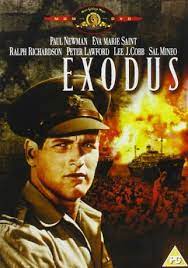
The Zionist epic film Exodus starring Paul Newman (1960), purporting to depict the events in the creation of the Israeli State has been credited with being enormously influential in swinging USA popular opinion in support of Israel; it had a significant impact on Irish opinion also. It glorified the Zionist terrorist Haganah organisation (which later became the core of the Israeli Army) and was very anti-British and anti-Arab.
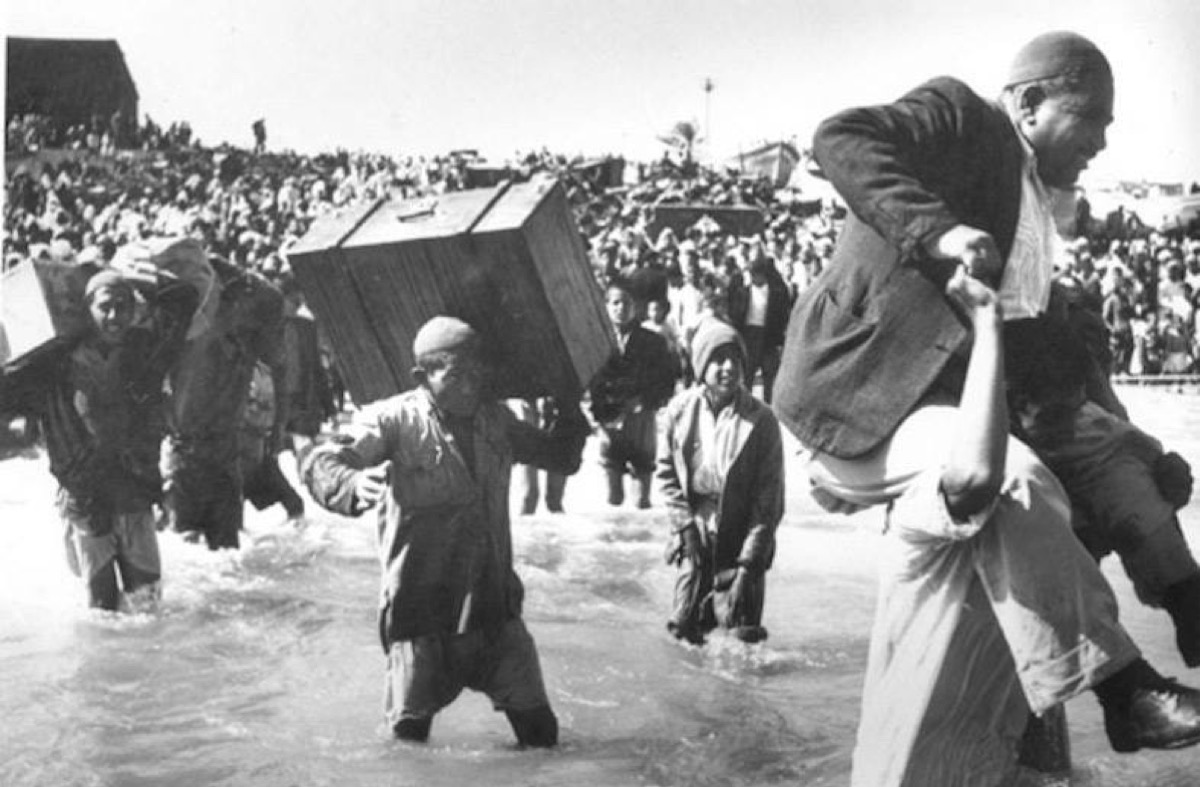
One of the realities of the formation of the Israeli State in 1948, the Nakba (Catastrophe), mass expulsion of Palestinians. (Image sourced: Internet)
Despite whatever concerns might have existed in its upper echelons, the Irish State recognised Israel de jure in 1963.
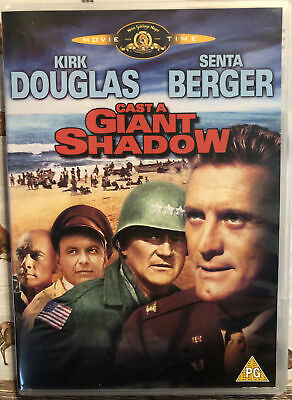
In 1966 the film Cast a Giant Shadow was produced in the USA and was soon showing in Britain and in Ireland. The film took as its human interest base story that of David Daniel “Mickey” Marcus, a true-life USA Zionist and WWII veteran but in its depiction of the formation of the State of Israel was wildly inaccurate, of course showing none of the massacres or evictions of Palestinians20 carried out by the Zionists, in particular their armed gangs.
“Mickey” was a member of one of those terrorist gangs, the Haganah and was played by Kirk Douglas with Senta Berger as the love interest, while even Frank Sinatra, Yul Brynner, John Wayne and Angie Dickinson had cameo roles in the film.
Despite its number of Hollywood stars and the support of the Israeli State and their armed forces, it reputedly flopped in terms of financial return on investment.
English language poster for the 1960 Exodus film, featuring Paul Newman at a high point in his career. (Image sourced: Internet)
Cover for the 1966 Cast A Giant Shadow film as a DVD (allegedly deleted and rare, according to EBay advertisement). (Image sourced: Internet)
Both films were popular in Ireland (showing Jewish paramilitaries fighting uniformed British troops and police didn’t hurt) and strengthened feeling of sympathy with Israel.
Also in the 1960s a number of socialist-type communities called “kibbutzim” were established on land in Palestine under Israeli rule and many young people, Jewish and Gentile, went to work in them for some months, out of idealism, to experience change, new cultures, comradeship (and possibly get laid, as the Yanks say).
Christian pilgrims to the Holy Land21 went by permission of the Israeli State and had a very narrow and sanitised experience (if at all) of what life was like there for the Palestinians.
In the 1967 June War and the 1973 Yom Kippur War in Palestine, the media reporting represented the inaccurate image of the plucky little Jewish State fighting against and overcoming aggression by combined Arab states. This was more easily done in the case of the 1973 war when Egypt and Syria attacked first, but the fact was that Israel had been the aggressor in the ‘67 war, striking at Egypt, Jordan and Syria and the Zionists were now in occupation of land conquered in that war.22
All those ingredients together helped create a culture of Irish society friendliness towards the Israeli State and no Israeli Ambassador was complaining at that time of the words of Irish Government Ministers, much less of the general attitude of the Irish population.
The friendly attitude was reflected also in much of the Irish nationalist movement. Irish language supporters and campaigners, who wished to make Irish a language spoken throughout Ireland and not only in the Gaeltacht areas, admired the Israeli State for its achievement in restoring Hebrew as a daily spoken language, a language that for centuries had been used only in religion.23
IRISH SOCIETY’S VIEW OF ISRAEL BEGINS TO CHANGE
However, people were beginning to see beyond the pro-Israel narrative. In 1974 the United Nations General Assembly recognised the Palestinian right to self-determination, along with the Palestine Liberation Organisation as the legitimate representative of the Palestinian people, as did the Arab League. The following year the UN General Assembly recognised Zionism as a racist ideology24 (which was not overturned until 1991).
In the Left and Republican movement
By the late 1960s most left-wing organisations around Europe were clear that the Israeli State was a Zionist one, not legitimate and that the Palestinians were oppressed and fighting a liberation struggle. Official Sinn Féin sent a delegate to conferences in Jordan and Kuwait in 1970/‘71; in 1970 too an article in the party’s weekly United Irishman saw Ireland, like Palestine in a national liberation struggle25.
The Official IRA prisoners in Mountjoy Jail supported the Palestinians in their journal An Eochair in 1973 and Palestinians were among the guerrilla groups represented in the second Anti-Imperialist Festival organised by the Officials in July 1976.26
Nevertheless the election manifesto of the Workers’ Party in 1983, successor to Official SF, argued for the recognition of the State of Israel, although that was contrary to party policy and to the involvement of WP members in the Irish Friends of Palestine organisation, which was committed to supporting the PLO.
However, party policy was soon publicly and internally reinstated in solidarity with Palestine.
Around this time, the British & Irish Communist Organisation, a small but influential organisation, had a pro-Israel position which however it reversed in the late 1980s, shortly before the party’s demise.
In the 1970s the Provisional Sinn Féin weekly newspaper An Phoblacht often featured articles sympathetic to the Irish struggle from a USA-based correspondent signing himself as Fred Burns O’Brien.
An Irish anti-imperialist working in London noted, in one of those articles, a favourable reference to the Israeli state and penned a protest letter to the Republican newspaper, pointing out that the Palestinians and not the Israeli Zionists were the natural allies of the Irish people and of anti-imperialists in general.27
The letter was not published and for some time O’Brien’s articles continued to appear in An Phoblacht.
However, once the Provisionals declared themselves to be in favour of socialism, they became pro-Palestinian and in the 1990s the PLO would have representatives attending Provisional Sinn Féin’s Ard Fheiseanna (Annual Congresses).28
Ireland today – the bloody path to being overwhelmingly pro-Palestinian
Large numbers of Irish people were becoming pro-Palestinian and against the Israeli state from the 1970s onwards, a process that accelerated through the decades.
After an air force, naval and ground artillery bombardment in 1972, Israel’s infantry and armoured forces invaded south Lebanon with the support of its right-wing Christian militia ally. That action resulted in between 1,100-2,000 Palestinian and Lebanese Muslims dead and 100,000-250,000 internally displaced.29
In 1982 the Israeli armed forces were back in Lebanon again, allied to right-wing Lebanese Christian militia. Estimates of Palestinian and Lebanese killed during that conflict vary from 1,100 to other sources quoting about 2,000 killed, most of them Palestinian and Lebanese.
From 100,000 to 250,000 people were displaced internally due to the invasion and fighting and that and other events contributed hugely to the ongoing Lebanese Civil War (1975-1990). However on this occasion the Israeli armed forces suffered considerable casualties, often in ground struggle with Hizbollah fighting from tunnels.
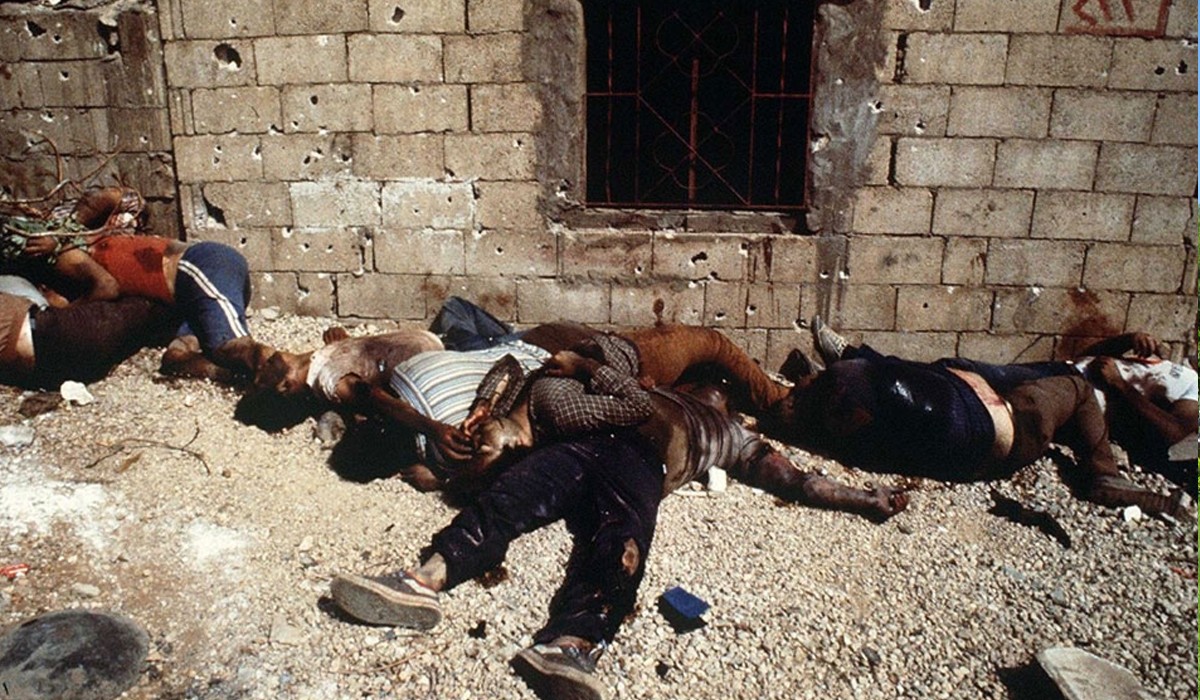
Massacres of civilians in refugee camps became part of the war in Lebanon, with both Syrian and Israeli culpability.
A scene from the aftermath of the Sabra and Shatila Massacre 1982 facilitated by Israel (Image sourced: Internet)
On 12 August 1976, supported by Syria, Christian Maronite forces managed to overwhelm the Palestinian and leftist militias defending the Tel Al Zaatar refugee camp in east Beirut, which had been under siege since January.
The Christian militia massacred 1,000–1,500 civilians, which unleashed heavy criticism against Syria from the Arab World.
Six years later, on 18th September 1982, the right-wing Christian Phalange (also known as Kataeb Party), in the presence and under the protection of the Israeli armed forces, its ally, massacred occupants of the Sabra and Shatila refugee camp in Beirut.
Estimates of the number of massacre victims vary with the highest number at 3,500, mostly Palestinians and Lebanese Shiites.
1987 saw the beginning of the First Intifada of strikes, civil disobedience and riots (which did not end until 1991). That year alone 289 Palestinians in the West Bank and Gaza were killed by Israeli state forces with another 15 by Israeli zionist civilians, while only ten were killed on the Israeli side, six civilians and four of the armed state forces.
In addition, Mossad agents shot the Palestinian cartoonist Naji al-Ali in the head in a London street. Overall during the First Intifada the Israeli army killed more than 1,000 Palestinians whilst 164 Israelis were killed.
The Second Intifada began nine years later and ran from 2000 to 2005 with a death-toll of 3,000 Palestinians and 1,000 Israelis, as well as 64 foreigners.
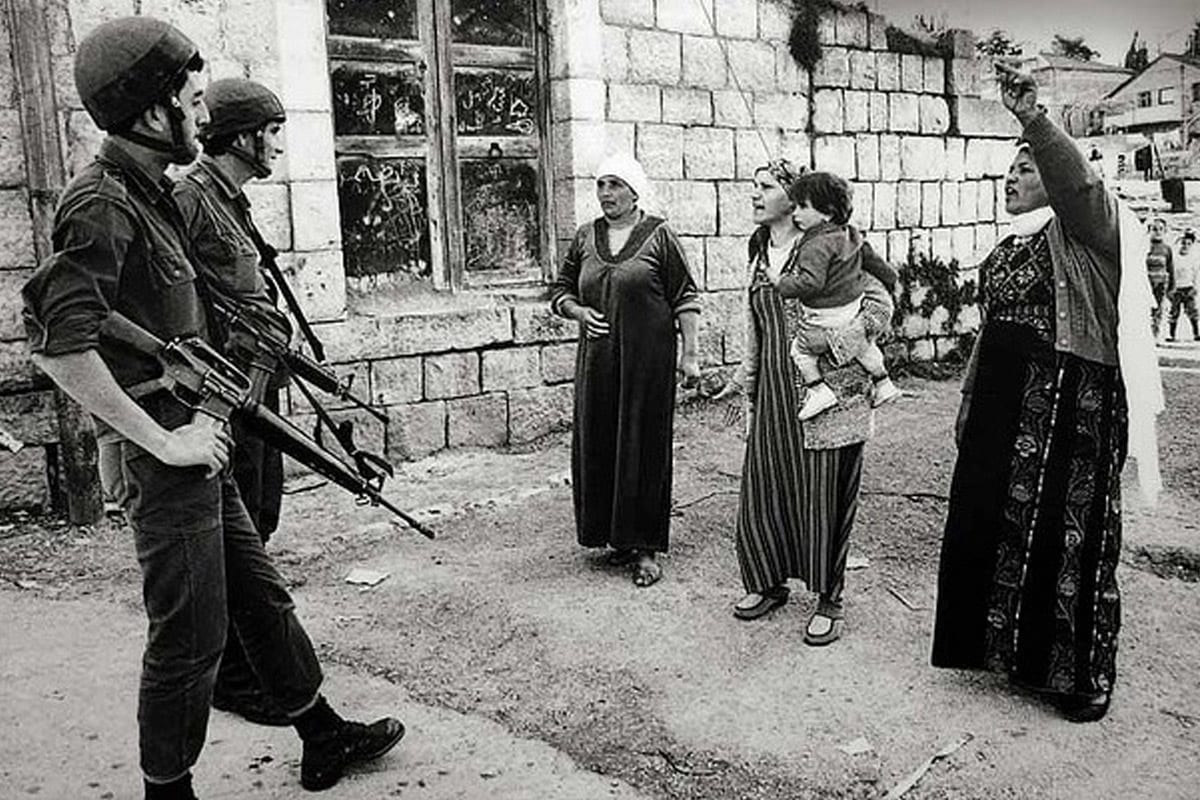
Unarmed Palestinian women confront armed Israeli soldiers in December 1987, during the first Intifada. (Photo credit: Robert Croma, Mary Scully Reports).
After Hamas won their landslide victory in the 2007 elections to the Palestinian Authority, Al Fatah denied them taking administrative power in the West Bank but a similar attempt failed to do so in Gaza.
The Israeli armed forces withdrew from Gaza but kept control of one of its gates, its air space and sea. Minor armed conflicts continued until 2009, when Israel launched an intensive attack on the enclave, dubbing it Operation Cast Lead.
Over the 22 days of the assault, in which Israel used white phosphorous shells against civilian areas (against international law), 1,400 Palestinians had been killed, of which 431 were children.
In 2010 the Israeli Navy intercepted ships, one of which sailed from Ireland, bringing aid to Gaza on the high seas, boarded them under arms, killing ten Palestinian solidarity activists on a Turkish ship and sailed the ships into Israeli port.
In the process they jammed the radar and radio of the ships, confiscated the cargoes (though some were eventually released to Gaza), confiscated the mobile phones and laptops of crew and passengers (the memories of which they inspected, wiping many photos and film), seized the ships, detained the passengers and crew in jail and deported them.
Carlos Latuf cartoon draws on the film Jaws to depict the Israeli Navy’s stalking and attack on the Irish aid-to-Gaza ship, the Rachel Corrie. (Image sourced: Internet)
In November 2013, Palestine was accorded “non-member observer status” in the United Nations and would henceforth be referred to officially as “the State of Palestine”.
When the Israeli Ambassador called Ireland “the most anti-semitic country in Europe was I think, as I said, 2014, during or soon after his state’s assault on Gaza that year.
On the Palestinian side 2,251 were killed during that war, of which 551 were children and 299 women; in addition 11,231 Palestinians were injured, including 3,436 children and 3,540 women. More than 1,500 Palestinian children were orphaned.
18,000 housing units were destroyed in whole or in part and 73 medical facilities and many ambulances were damaged.30 There was widescale damage to electricity generation and supply and to sewage treatment plants, which resulted in heavy sea pollution; factories also were destroyed.
On the Israeli side, the casualties were 67 Israeli soldiers, five Israeli civilians (including one child) and one Thai civilian killed, while 469 IDF soldiers and 261 Israeli civilians were injured. Hardly an Israeli building was damaged despite the approximately 300 rockets fired by Palestinian guerrilla groups.
This was not war of two belligerents and the casualty statistics underlined that; the Israelis had an airforce, the Palestinians have none; the Israelis had a navy, the Palestinians have none.
The Israelis had sophisticated long-range and even remotely-controlled weapons; all the Palestinians have is their home-made rockets, most of which fall short or are destroyed by Israeli defence systems. Of course, the Palestinians have no anti-air attack defence systems whatsoever.
The only effective armed response that Palestinians have is their guerrilla forces which are only effective within firearm reach of the enemy, when they can certainly take their toll, as the Israeli Occupation Forces found when they invaded Gaza and were forced to retreat.
Irish society saw enough of this, on videos, in reporting on TV and in print and drew their conclusions despite the media bias nearly always in favour of the Israelis and against the Palestinians.
The solidarity activist organisations helped educate the Irish people but it was mostly what the latter saw and heard and the process of their own brains that transformed their view.31
In 2017 the Palestinian flag was flown above Dublin’s City Hall by majority vote of Dublin City councillors for one month in solidarity with the Palestinians.
The latest Gaza “War” just concluded was another in a long list and the current truce can only be, as those before it, a temporary one. The Zionist State project requires oppression and repression of Palestinians which in turn can only give rise to continued resistance.
The Zionist State cannot defeat the Palestinian will to resist but nor can the Palestinian resistance defeat the militarily far superior Israeli State with its huge military, economic and political support from the United States of America.
The states of the world that would wish to support the Palestinians or at least end the periodic bloodbaths will need to withdraw their support from the US-led alliance that supports the Zionist State.
THE ATTITUDE OF IRISH SOCIETY TODAY
Altogether, the opinion of most of Irish society today on the Israel-Palestine conflict is vastly different to what it was in the 1950s, 1960s and even 1970s – a sea-change has taken place of which Irish politicians have had to take note.
People today have alternative sources of information to the Irish and British mainstream written and TV media, with major news networks such as Al Jazeera and RT. In addition, some mainstream media has decided to expose Israeli’s actions.
But also video and photographs from smaller organisations and individuals get shared on social media and are seen by hundreds, thousands or even hundreds of thousands.
Part of the Ha’Penny Bridge, Dublin annual New Year’s Day Palestine solidarity demonstration organised by the Ireland Palestine Solidarity Campaign 2020 (Photo: D.Breatnach)
The Palestinian solidarity activities of what has been broadly the largest oppositional movement to the State, the Republican Movement, through its publicity and the activism of its members of course helped develop awareness in Irish society of the justice of the Palestinian cause and, conversely, of the injustice of that of the Zionist State. The small socialist and communist organisations also played a part.
Although all those, including in particular in more recent times solidarity groups and individual activists, have made a huge contribution, the main element responsible for the change has been the visible behaviour of the Zionist State itself, along with its Zionist supporters, both inside and outside Israel.
And the “sea-change” has become now a tsunami.
End.
FOOTNOTES
1Declared illegal by the United Nations, since they are all on land seized in conquest by Israel in 1967. Many Zionists however regard them as the logical extension of the Israeli state, a kind of Zionist “manifest destiny”. On the other hand, many others consider the Israeli state itself to be illegal, a racist, religious state on ground seized from the Palestinians.
2A traditional diplomatic way of expressing extreme displeasure with the state represented by an embassy.
3Sponsored by Irish Senator Frances Black, a singer, social and human rights campaigner, its full title is Control of Economic Activity (Occupied Territories) Bill 2018 and has been proceeding slowly since 2018. The Bill would it make it illegal to import, repackage or sell products from the ‘Occupied Territories’ within the territory of the Irish State, liable on conviction to heft fines. Its passage and implementation would represent another ‘first’ in the EU for Ireland.
4Originally it meant “against the semitic people” and since the Arabs are “semitic people” too, it would mean being hostile to them also — which would make Zionists anti-semitic, in part. But we’ll use the term here to mean “anti-Jewish”, which is how most people understand it these days (except for the Zionists, for which it means “criticising Israel”).
6Shakespeare’s play The Merchant of Venice, written during the reign of Elizabeth I of England, figures the Jewish financier demanding the pound of flesh from the Christian merchant, a terrible portrayal and it is that which remains in the memory and even in the language, while the Jew’s recounting of the insults he has received before that are mostly forgotten. England had anti-semitic laws in terms of settlement, trade and other rights until the 1930s and semi-official tolerance/ encouragement of active anti-semitism right up to WWII.
7And Arthur Griffiths, shortly before he founded the original Sinn Féin party.
8While it is stated in many sources that some families remained in Cork and although I can recall recently reading about the welcome the city gave them, I regret that a number of searches have failed to date to reveal that source.
9Fianna Fáil remained governing in minority until 1938 when it was in majority, was in minority again in 1943, in majority in 1944 until ‘48 when it was in Opposition.
10The party is often to this day called “Blueshirts” by opponents.
11And blessed by many Irish bishops and priests as “crusaders for the Catholic Faith”.
12See link for in SOURCES at end of article for review of Hitler’s Irish Voices: The Story of German Radio’s Wartime Irish Service by David O’Donoghue (Beyond the Pale Publications) in History Ireland.
13The difficulties of capitalism recently, the breakdown of the two-party system and the Covid19 pandemic have provided opportunities for far-Right and outright fascists organising in Ireland and anti-semitism features among them in particular in the three tiny fascist parties. However, they tend not to promote their anti-semitism, preferring instead to concentrate on anti-immigration, homophobia and islamophobia.
14Even though the British had been encouraging Jewish migration to Palestine since at least the Declaration by the British Prime Minister Arthur Balfour in 1917.
15The British had previous control over Egypt, having fought the French and the Egyptians and in fact still had troops there until June 1956. But their days were numbered there from the Arab nationalist coup in the Egyptian Army in 1952, which is what led to the nationalisation of the Suez Canal.
16President Eisenhower threatened to hurt the UK financially and the British Prime Minister, Anthony Eden, was forced to resign.
17The Lord Mayorship of Dublin is a largely ceremonial position but of course not without some influence; the chosen candidate is elected by City councillors at their Annual Meeting in the summer and occupies the position until the election of the successor the following year.
18Leader of the Irgun and sixth President of the Israeli State.
19Shatter resigned his membership in 2018; he was the sitting TD with the largest property portfolio of any member of Ireland’s cabinet while a cabinet minister (2011-2014).
20And even rape before murder, as was acknowledged officially a few years ago.
21Because of its location in much of the Christian Bibles, Palestine is considered the “Holy Land”. However it holds sites revered by Jews and Muslims too.
22It was in that war that Jerusalem and much additional land was occupied by Israel and part of the Zionist project is to make Jerusalem the Jewish-only capital of the Israeli State (hence the recent Zionist civilian harassment of Palestinian families living there).
23Other Jewish languages were used such a Yiddish – mostly German in composition — by the Ashkenazi Jews and Ladino — mostly medieval Spanish-Portuguese but with many other influences — by the Sephardic Jews.
27I wrote the letter and it was not the only one they didn’t publish. My father Deasún Breatnach, who was Editor of the paper for a couple of years, told me that he had been refused permission to publish another letter I had written.
28The PLO at the time was controlled by the Al Fatah organisation and in 1989 signed up to the disastrous Oslo Agreement, which in time led to their losing their place in the leadership of the Palestinian movement and of the Palestinian Authority to Hamas. Both Palestine and South Africa were initially seen in some quarters as great examples of the alleged benefits of “peace processes” and both the PLO and ANC delegates at the Ard-Fheis were employed to help swing the Provisionals’ membership between the Irish version of the “process”.
31A notable exception to this whole process has been the Unionist section of the British colony in Ireland, the Six Counties. In particular the Loyalists love to hate anything the Republicans support and for that reason profess to hate the Palestinians and to support the Israeli state, despite some connections of theirs with British and Irish fascist groups who are anti-semitic.
Taoiseach Micheál Martin has described comments by the Government of Israel as “nonsense”. “We all know what happened here. Don’t be hiding behind excuses,” he told RTÉ radio’s Today with Claire Byrne show.
Mr Martin said that the action of the Israeli authorities was contrary to decency and democratic values. The Taoiseach said he was worried about the growing authoritarianism in the world. “It was not acceptable. Democratic countries had to stand up.”
Referring to the armed boarding of Irish relief ships bound for Gaza in 2010, he said it had been a “State-sponsored” coercive act, it was absolutely unacceptable.
The Taoiseach (Prime Minister) Mícheál Martin denouncing action by the regime (Photo sourced: Internet)
Mr Martin said he was meeting with Ministers from Lithuania and Greece to discuss a coordinated EU response and a strong response from the EU was now required.
Coveney condemned Israel for ‘hijacking’ of Irish ship
The Israeli armed boarding of an Irish ship amounted to “piracy”, the Foreign Affairs Minister has said. Simon Coveney said the incident in 2010, which saw a relief ship from Ireland to Gaza boarded over a supposed security concern, was a “state-sponsored hijacking”.
Minister for Foreign Affairs, Simon Coveney who denounced the regime (Photo sourced: Internet)
Mr Coveney said that the Israeli regime “has no democratic legitimacy” and called on the EU to show a “clear and tough response”. He told RTE radio he “would like to speak to” the Israeli consul in Dublin, but stopped short of advocating the banishment of all diplomats across the EU.
There has to be “a real edge” to any sanctions imposed and the EU must go beyond “strong press releases”, he added.
REALITY
Yes, reader, you’re right, that response from Irish Government Ministers was regarding the recent Belarus forcing down of a plane and never occurred during the recent Israeli attack on Gaza (nor in 2014, nor in 2008), nor during its illegal armed boarding and seizing control of an Irish relief ship on the high seas in 2010. Because the Irish State generally takes its line from the USA, which in turn backs up Israel. Belarus however has only Russia backing it and the EU and the USA power blocs are opposed to the Russian one.
In May 2010, when the Gaza flotilla relief convoy was seized (and Turkish citizens killed) by Israeli armed forces, the Irish ship was delayed and sailed later but was also seized in June, forced to go to an Israeli port, the possessions of all crew and passengers seized, their computer and phone memories inspected and they were kept in jail until sent back by plane (often without their possessions). The Irish Government did complain but without denouncing the Israeli Government in the same terms, nor did it call for EU-wide action and, once the Irish citizens were returned, quietly dropped the whole matter.
Thousands rallied in the centre of Dublin today, Saturday 22nd May, to express their solidarity with the Palestinian people and their outraged opposition to the murderous attacks on them by the Israeli State. From O’Connell Street they marched across O’Connell Bridge, into Dawson Street and from there straight along Mount Street, across the Grand Canal and on to the Israeli Embassy. Speakers emphasised that the ceasefire, even if it holds, is in essence temporary, since the Israeli occupation has led to war after war and must inevitably lead to another, stating the need therefore to work for an end to the apartheid and similar policies of the Israeli state.
The event was organised by the Ireland Palestine Solidarity Campaign, which had an acapella singing group perform a few songs at the Spire and a number of speakers before they set off on the 3 km march and more speakers outside the Embassy too. Conservative estimates put the number on the march at over 5,000. The slogans shouted for the most part were: “Free, free Palestine!” “One, two, three four – Occupation no more!”; “Five, six, seven, eight – Israel is a terrorist state!” and “Boycott Israel!” “From the river to the sea, Palestine will be free” was another slogan.
(Photo: D.Breatnach)
The ceasefire is now in place since early yesterday (Friday). The current war began with two offensives by the Israeli Zionists on Palestinians in Jerusalem: the first by Israeli settlers harassing and threatening Palestinian residents in the Sheik Jarrah district that they are going to have them evicted because “all of Jerusalem should be Jewish only”; the other nearby in the vicinity of Al Aqsa mosque, where Israeli police harassed Muslims coming to celebrate the religious festival of Eid (this year on May 12th– 13th), culminating in an armed invasion of the temple by Israeli police firing rubber-tipped bullets and stun grenades at the devotees. However the dates fell close also to the anniversary of the Nakba, the Castastrophe of 15 May 1948, the founding of the Zionist state, massacres of Palestinians and expulsion of more than 700,000 refugees whose descendants are in many parts of the world today, forbidden by the Israeli authorities to return.
In the 11 days of war just past at least 232 Palestinians, including 65 children, have been killed by the Israeli forces, whilst on the Israeli side, despite hundreds of home-made Palestinian rockets fired at Israel, 12 people, including two children, have been killed. Many buildings in the Palestinian enclave of Gaza have been destroyed or part-destroyed, including hospitals and medical centres and there is major disruption to electrical service and water supply in a city which often experienced power and water flow cuts even in what passed for “normal” times in Gaza. Those killed were mostly in Gaza but Israeli forces killed 11 unarmed civilians in the West Bank also and wounded many, as they came on to the streets in solidarity with those in Gaza and in Jerusalem.
Street events in solidarity with Palestine were also held in cities and towns across Ireland, including Cork, Limerick, Galway, Belfast, Derry and in fact in most counties.
Section immediately in front of the Spire, O’Connell Street during rally and before march (Photo: D.Breatnach)
POLICE
The police on this occasion did not carry out harassment of demonstrators1 but in at least one instance, in Northumberland Road, stopped a section of the march to wave through traffic across it, putting uninvolved pedestrians crossing on a green light in danger. This occurred despite two marchers attempting to block the traffic, the Garda calling one a pejorative name and ordering him to stand aside.
Section of the march near just entering Northumberland Avenue, the front of the march away in the distance (Photo: D.Breatnach)
This was a job for official stewards and in fact, there were far too few of these. I saw perhaps around 20 getting instructions from the Chief Steward before the march at the Spire, some of whom seemed inexperienced but around 50 stewards were needed for a march this size, with a core of around 30 experienced. Stewards could be seen at times enforcing the rule to wear masks, as some young people removed them to shout slogans but once the middle of the march neared the Canal it was rare to see a steward.
A section of the crowd facing back from above photo, approaching along Mount Street towards the Bridge over the Grand Canal (Photo: D.Breatnach)
FAR-RIGHT
A Far-Right group calling themselves “Rise Up Eireann” (sic — who apparently don’t even know the official name of their country) had called for events in various parts of Ireland and had advertised the GPO as being one of the venues.
With apparent lack of awareness they scheduled theirs in Dublin for the same time as the Palestine solidarity rally, 2pm. No far-Right group was seen but one individual, a prominent QAnon activist posted a video of the Palestine solidarity marchers while voicing her disgust that the cops were not batoning or even harassing the demonstrator as they allegedly do to demonstrators demonstrating “for our civil rights.”2.
SPEAKERS
Speaker after speaker at the event pointed out that Israeli massacres and other onslaughts are often followed by ceasefires and back to “normal” oppression and theft of land, until the next war. As long as Israel is an apartheid occupying state, war is inevitable and so is oppression. Some speakers urged those present to encourage people in their social, educational, community and trade union groups to sign up to boycott, divestment and sanctions against Israel. A much more specific direction was given by Richard Boyd Barrett TD, who urged people to write emails to their TDs (parliamentary representatives) in advance of Tuesday’s debate in the Dáil, asking them to vote in favour of the “Occupied Territories” Bill.3
Richard Boyd Barrett TD speaking at the Spire prior to the march (Photo: D.Breatnach)
Aisling Micklethwaite, Vice-Chair of IPSC spoke in place of Fatin Al Tamimi, the Chairperson of the IPSC, who could not be present. (Photo: D.Breatnach)
A young Palestinian speaker from a Jerusalem district spoke with passion and made an interesting point, that a demonstration such as this one would be labelled “terrorist” by the Israelis and people would be liable to be shot with live rounds as well as with less lethal projectiles and gas.
Clara McCormack, Trinity BDS Campaign addresses the crowd outside the Israeli Embassy, Dublin (Photo: D.Breatnach)
It is a terrible statistical fact that in Israeli attacks on Gaza, one quarter have been children. Outside the Israeli Embassy the crowd grew quiet as a child read out the names of the children killed in Gaza, which was followed by a call for a minute’s silence in respect. The crowd was so big that out on one of the fringes, they did not hear the call and were chanting slogans.
Other speakers included a Palestinian young woman Ola at the Spire and Mags O’Brien of SIPTU outside the Embassy, where Martin Quigley, former Chairperson of the IPSC launched into a denunciation of Israel and of the Biden and the USA’s role in Palestine.
YOUTH & STARRY PLOUGH
As with other Palestine solidarity marches recently, a significant part of the whole consisted of Palestinians and other Arabs, among which the youth were particularly noticeable with young women very much to the fore and vociferous. One group of young Arab women shouted slogans non-stop from O’Connell Street to Northumberland Road, where I parted company with them to take up another position and could hear them chanting still as they marched on.
One would hope these youth have opportunities to become organised and gain experience to be leaders of the future.
Starry Plough seen during rally in front of the Israeli Embassy after march (Photo: D.Breatnach)
I brought two flags, a “Starry Plough”4 and one in Palestinian national colours, a friend carrying the ‘Plough most of the time. There was I heard only one other on the march. It is natural and proper that we carry and fly the Palestinian national colours but it seems to me that we should carry indications of Irishness too, to represent Ireland in solidarity with Palestine. This was represented in some placards but flags are more visible and it would be good to see more of them on Palestine solidarity demonstrations.
The Starry Plough flag also aroused interest with many asking what it represented and it was good to be able to tell them that it was the flag of the army of the Irish Citizen Army, the first working class army in the world, one which recruited women and that some of them were officers.
End.
Palestinian from Jerusalem speaking during rally in front of the Israeli Embassy after march (Photo: D.Breatnach)
Section crowd to left of Zionist Embassy (Photo: D.Breatnach, balancing on spiked railings because cops occupied the nearby steps to houses across the street)
Section middle crowd in front of Zionist Embassy (Photo: D.Breatnach)
PLACARDS & BANNERS
(Photo: D.Breatnach)
(Photo: D.Breatnach)
(Photo: D.Breatnach)
(Photo: D.Breatnach)
(Photo: D.Breatnach)(Photo: D.Breatnach)
On one side of the placard while ….. (Photo: D.Breatnach)
1Prior to last Saturday (15th) the Irish police threatened the IPSC with intervening to stop the march and huge fines for responsible individuals under Covid19 legislation; luckily the Trinity BDS Campaign took on the risk of repercussions and called the demonstration instead. On Tuesday, for a smaller march, the Gardaí kept the Pembroke Road open despite the danger of rush-hour traffic to the crowd, then continually urged demonstrators in towards the Embassy, forcing them into close contact with others and, when this was pointed out to them, just shrugged.
2In actual fact, Far-Right groups seemed to enjoy complete impunity for months as they held rallies, pickets and marches, without wearing masks or socially distancing, including at the GPO, while nearby, people picketing is solidarity with political prisoners and Debenhams picketers were harassed by Gardaí. Also, at a Yellow Vests rally in August 2020 a mob organised by the fascist National Party attacked unarmed counter-protesters with iron bars and wooden clubs while the Gardaí, instead of arresting them, attacked the victims and drove them off the quay with raised batons and violent shoves (see “There Will Be Another Day” article on the Rebel Breeze blog). A few weeks later, the cops allowed members of the NP to attack a handful of women opponents in Kildare Street and to club one of them, then again drove the victims back. On both occasions the Gardaí told press afterwards that there had been no violence but in the second case had to amend their statement hours later and weeks later charge a fascist individual with the assault.
3Under international law, it is illegal for Israel or Israeli settlers to sell products from the Occupied territories in Palestine, since they are even by UN law illegally occupied. However, the products are exported and sold in many parts of the world including all over Europe. The “Occupied Territories” Bill, if passed into Irish law, would make it an offence to import or re-sell products from those territories and would have an economic as well as a political impact. Although the Bill was framed in 2018 and supported by all political parties except Fine Gael, the Government has dragged its heels about bringing it before the Dáil to be discussed and Tuesday’s will be its Third Reading after which, with enough votes in favour, it will become law.
4“The Starry Plough” is modeled on the shape of the Ursa Mayor constellation. The original version has a green field with a plough in gold following the shape of the constellation, with the seven stars in white or silver. The plough has a sword in the position of the ploughshare. The later version, from the Republican Congress, is on a blue field with the the seven stars only in white (or silver) following the shape of Ursa Mayor and no other feature.
East side O’Connell Street during rally and before march (Photo: D.Breatnach)
Middle section of central pedestrian reservation O’Connell Street during rally and before march (Photo: D.Breatnach) Where the far-right group had planned to set up, west side O’Connell Street and front of GPO during Palestinian solidarity rally and before march (Photo: D.Breatnach)Section of rally in front of the Israeli Embassy after march (Photo: D.Breatnach)