An organisation by the name of Anti-Imperialist Action yesterday held an anti-monarchist march and rally in Dublin, including a mock execution of royalty, where their speaker was arrested by Gardaí.
The protesters met first at the James Connolly monument in Beresford Place and after some words marched up Abbey Street to Dublin’s main street and to the General Post Office building to hold their anti-monarchy rally.
Royalty and guillotine beside James Connolly monument at start of event (Photo: AIA)
At the GPO the gathering of socialist republicans, socialists and anarchists had grown. As the mock-up guillotine carried out mock execution of the dummy representing royalty, a large force of Gardaí arrested the speaker. Participants then went to Store Street Garda station to demand his release.
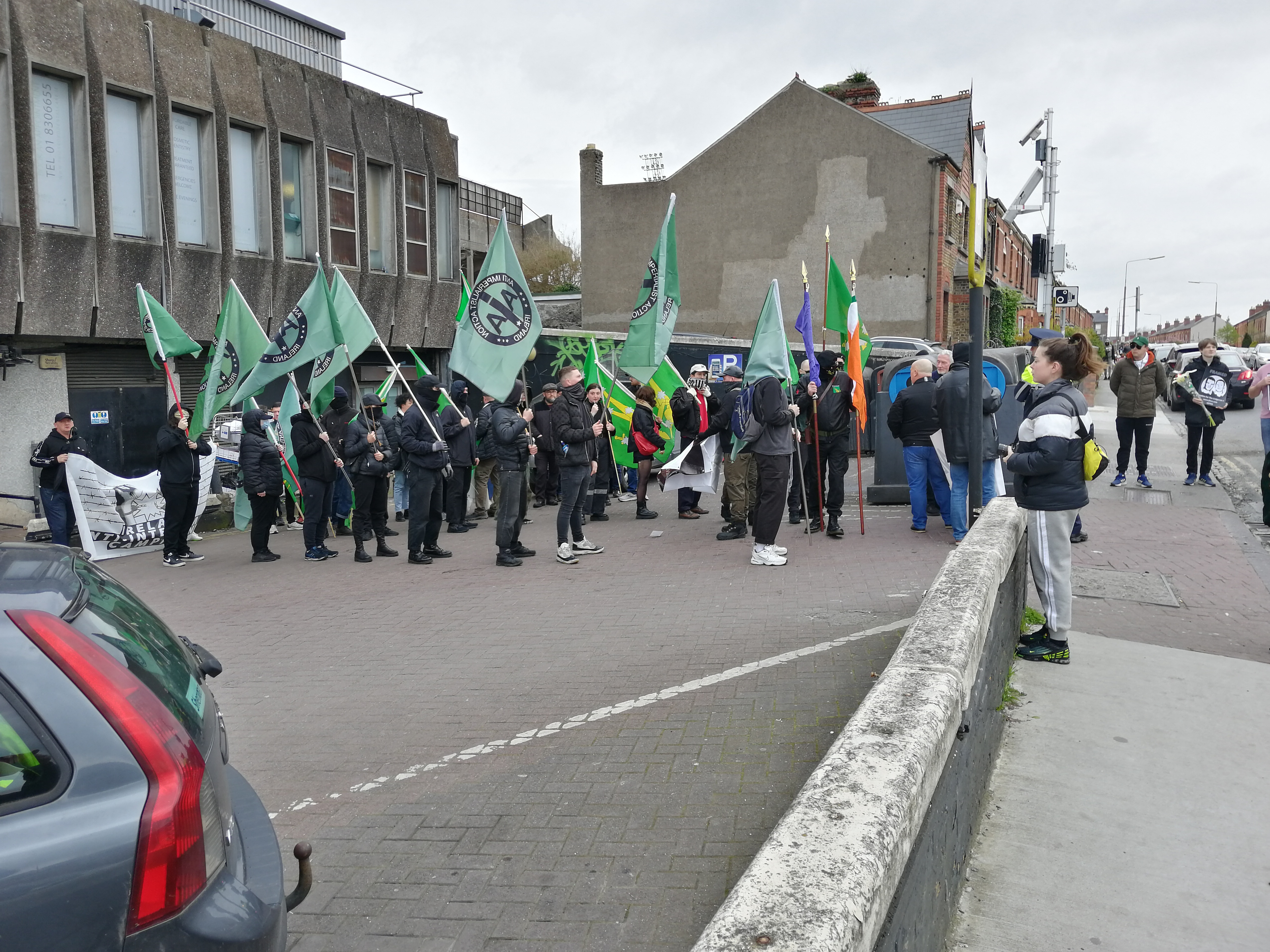
At Store Street the protesters were met by a line of Gardaí1 drawn up in front of the entrance to the police station. In speeches and slogans, the protestors denounced the police for the arrest of the speaker at the GPO, also denouncing the monarchy and the State.
Line of Gardaí barring entrance to Store Street Garda Station (Photo:Rebel Breeze)View of protesters outside Store Street Garda Station (Photo: Rebel Breeze)
Some speakers criticised also the national broadcaster RTÉ which was devoting four hours to the coronation.
The most frequent chants were: When Republicans are under attack – stand up, fight back!2 One, Two, Three, Four – Occupation no more; Five, Six, Seven Eight – Smash the Free State!3 Brit King – Guillotine! No democracy – under a monarchy! No democracy – in the Free State4!
One of the protesters, accompanying himself on guitar, sang the Republican ballad popularly known as “Come Out Yez Black ‘n Tans”, the attendance joining in on the chorus. They displayed a banner with a slogan from Liberty Hall5 in WW1: We serve neither King nor Kaiser but Ireland.
Using a loudhailer, another protester read out James Connolly’s6 1911 denunciation of the monarchy. Yet another speaker quoted Garda Commissioner Drew Harris’ recent words saying the Gardaí were the “biggest gang”, the protester calling them “an MI5-directed gang”.
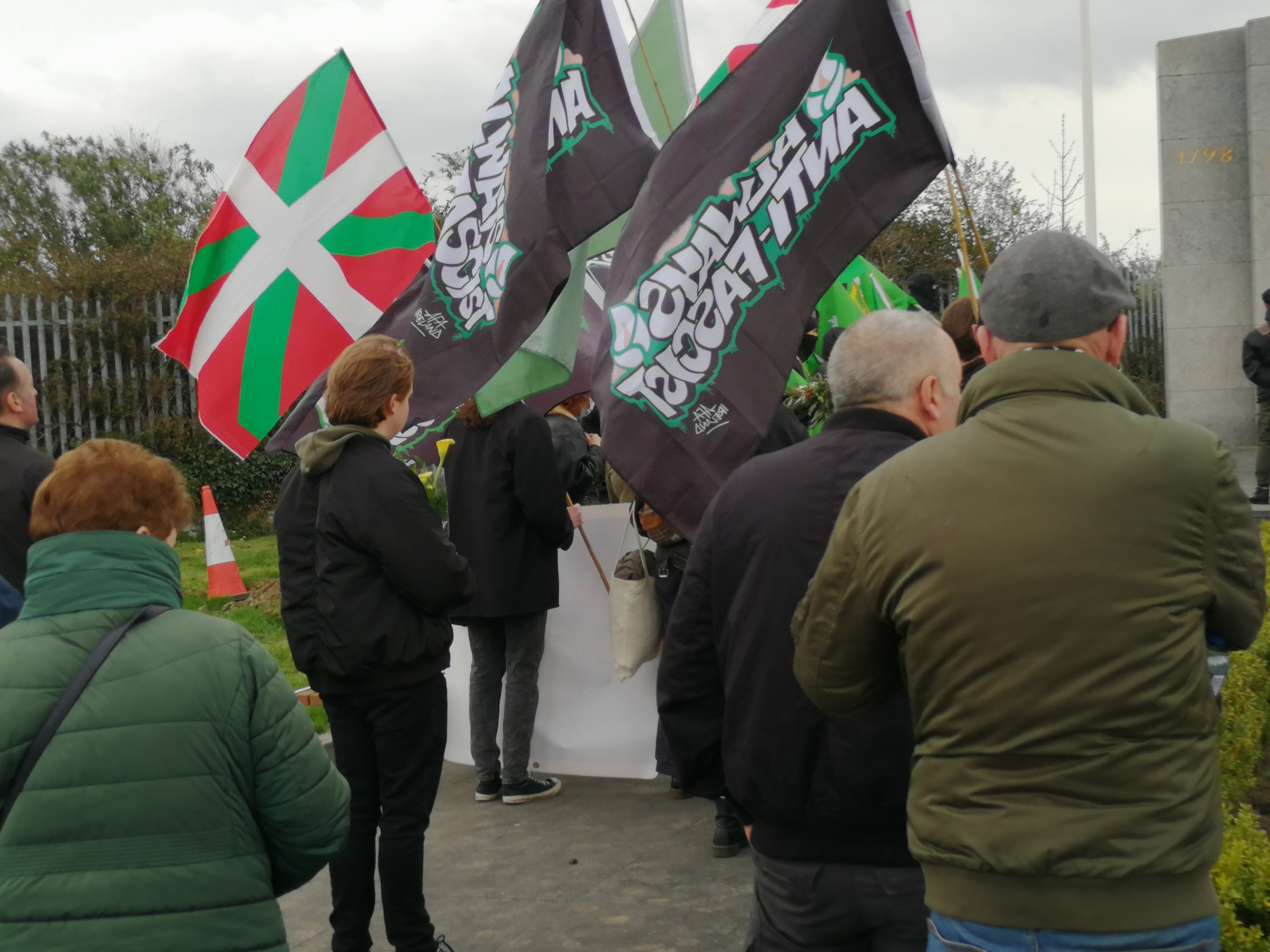
Eventually news of the release of the arrested man reached the protestors and they marched up Talbot Street with Starry Plough7 flags and a Basque Ikurrina flying, back to the GPO, outside of which they held an impromptu rally.
Along with portraits of Irish hunger-strike martyrs of 1981 there was a portrait of Palestinian martyr Khader Adnan carried also in recognition of the international role of British imperialism and its Head of State.
Many looked on in interest while some applauded them, both in Talbot Street, where a taxi driver enquired the reason for the protest and wished them well and also outside the GPO. Gardaí arrived and stood across from the building to watch the protesters but in smaller numbers than before.
The protestors return to the GPO for an impromptu rally in place of the planned one interrupted by the Garda attack and arrest of speaker (Photo: Rebel Breeze)
Another speaker said the protesters were “health workers, working to rid Ireland of a dangerous disease affecting politicians, media and State forces, a disease that makes them go to their knees in front of royalty and a foreign state, extending their tongues to lick a certain part of the anatomy.”
Interest from the pedestrian reservation in O’Connell Street across from the GPO, including much smaller number of uniformed Gardaí (Photo: Rebel Breeze)
The speaker said they were working “to rid Ireland of this dangerous disease, to enable the people to stand up straight once more, to claim their Republic, celebrate their history and speak out against foreign domination and monarchy”.
He drew attention also to arrest of a Republican speaker outside the iconic GPO, headquarters of the 1916 Rising8 and which still bears the scars of British bullets9.
Reference was also made a number of times by protesters to the arrests of English Republicans in London who were prevented by from holding a protest against the monarchy.
The victim of the police attack returned from police custody and briefly spoke thanking those who had demanded his release; people who had stopped to listen applauded and the group dispersed without further arrest.
End.
Photo taken at GPO before police attack (Photo: AIA)
2This seems adapted from a slogan often chanted by Irish socialist groups.
3This too seems an adaptation but from the Palestine solidarity movement.
4The new state of 26 Counties (missing six, which are in the British colony) and which fought a Civil War against the Republicans was called “the Free State” and though the name was changed (and to a ‘republic’) Irish Republicans and many nationalists in the British colony call it the “Free State” in irony and in negation of its legitimacy.
5Liberty Hall is a very tall building housing SIPTU but the trade union’s ancestor, the ITGWU had purchased the previous building on the same site which was destroyed by the British during the 1916 Rising. The slogan “We serve neither …” etc had been displayed across the front earlier during WWI.
6Revolutionary socialist leader, trade union organiser, writer and historian who brought the Irish Citizen Army to participate in the Rising, during which he was made Dublin Commandant, afterwards being shot by British firing squad.
7Originally flag of the Irish Citizen Army, the first workers’ Army in the world, formed to defend the workers in 1913 Lockout against police attacks and which also took part in the 1916 Rising.
8The rising 24-29 April 1916 was the first against world war and contained many other ‘firsts’ – six different organisations played a prominent part in it, including women. The Rising is regarded as leading to the War of Independence 1919-1922.
9One of many buildings in Dublin that bear the scars of conflict, this one is an imposing building in the city’s main thoroughfare, O’Connell Street. With the building in flames from British artillery on Easter Friday, the garrison, including five of the Seven Signatories of the Proclamation of Independence (which was read out at the start of the Rising) relocated to nearby Moore Street, where the decision was taken to surrender.
Useful link and Reference:
"We confess to having more respect and honour for the raggedest child of the poorest labourer in Ireland today than for any, even the most virtuous, descendant of the long array of murderers, adulterers and madmen who have sat upon the throne of England." – James Connolly pic.twitter.com/o8inKRr5Fi
— Anti Imperialist Action Ireland (@AIAIreland) May 6, 2023
Kontxi Arana, code name “Rita”, was a fighter of the Basque armed organisation ETA and also of the Sandinista movement. A ceremony of homage to her memory on 22nd April was also the occasion of an antifascist conference with representatives from a number of European countries.
The event took place in Gernika, the SW Basque town infamously bombed by German and Italian Nazi and Fascist squadrons during the Spanish Civil/ Ant-Fascist War, the act which inspired the Catalan painter Picasso´s famous piece on the event (which he called by its Spanish name, “Guernica” (sic)). The venue was the disused Astra factory, formerly manufacturer of handguns.
The Origins and Nature of Fascism
The day-long anti-fascist conference began with a talk on the origins and basic nature of fascism by Iñaki Gil de San Vincente, Marxist theoretician and veteran of the Basque Left Patriotic Movement from which leadership of however he has broken for a number of years.
Speaking in Castillian, he declared the essential nature of fascism to be authoritarianism, deriving from the development of the bourgeois family. The central authority figure in that family, later reproduced in other social classes including the working class is the Father, represented in capitalist society by the employer and the Church.
It is an authority to which all are required to submit: patriarchical, homophobic and intolerant of criticism or deviation.
De San Vincente spoke at length about this development and about early descriptions of fascism, for example by Clara Zetkin and Lukacs and described it as a production of capitalism and imperialism and therefore represented today most clearly in the actions of US Imperialism and the NATO over which it exercises hegemony.
The speaker also highlighted the development of NATO and its recruitment of Nazis as well as the development of its Vatican route for Nazis to leave Europe and enter Latin American countries where they would form fascist centres.
This talk was followed by a representative of Ezkerraldea Antifaxistako (Antifascist Left) who, speaking mostly in Castilian, outlined the history of the development of fascism in the Spanish state following the military-fascist uprising and the four decades of dictatorship, and how the organisation he represented responded to that.
The final speaker of the morning session was from Mugimendu Socialistako (the Socialist Movement – organisation with a large membership, according to a participant) who spoke entirely in Euskera (Basque language). Although simultaneous translation was provided into Castilian (Spanish), the volume of such was too low to be understood by many.
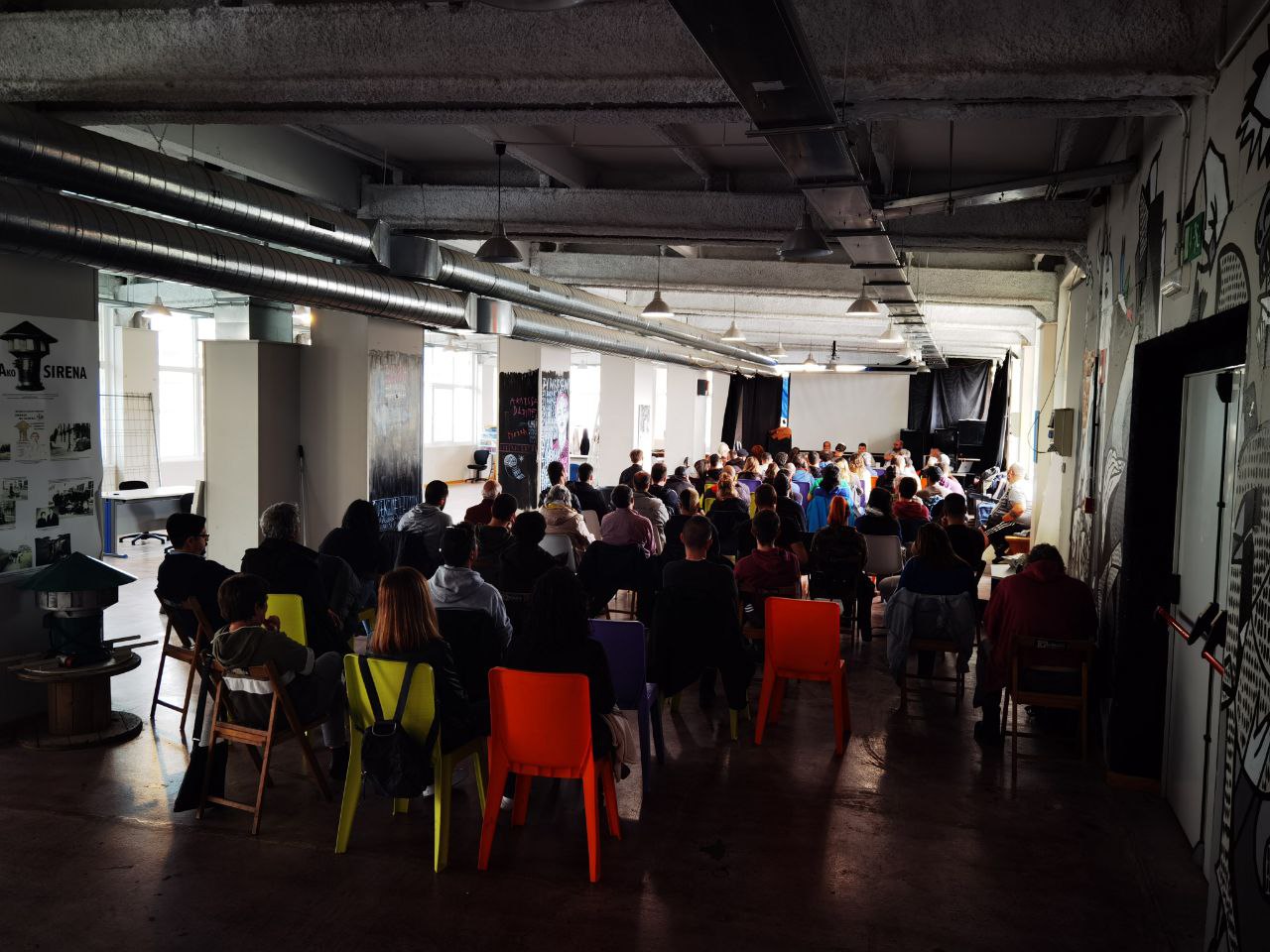
Morning session of the anti-fascist conference in Gernika (Photo: DRAF)
According to a participant, the content of that speaker´s contribution was similar to that of the previous speaker, although he mentioned the existence of Frente Obrero (Workers´Front), a Basque organisation which, despite its name, is a fascist organisation. The existence of that latter group appeared to be news to many present.
These talks were followed by a break and, upon resumption, there were some contributions from the floor and some responses from the panel, after which all repaired to the green outside the Astra building to where the ceremony of respect to the memory of Kontxi “Rita” Arana was to take place.
Kontxi Arana: A leading Basque liberation fighter who also joined the Sandinistas in the liberation struggle of Nicaragua
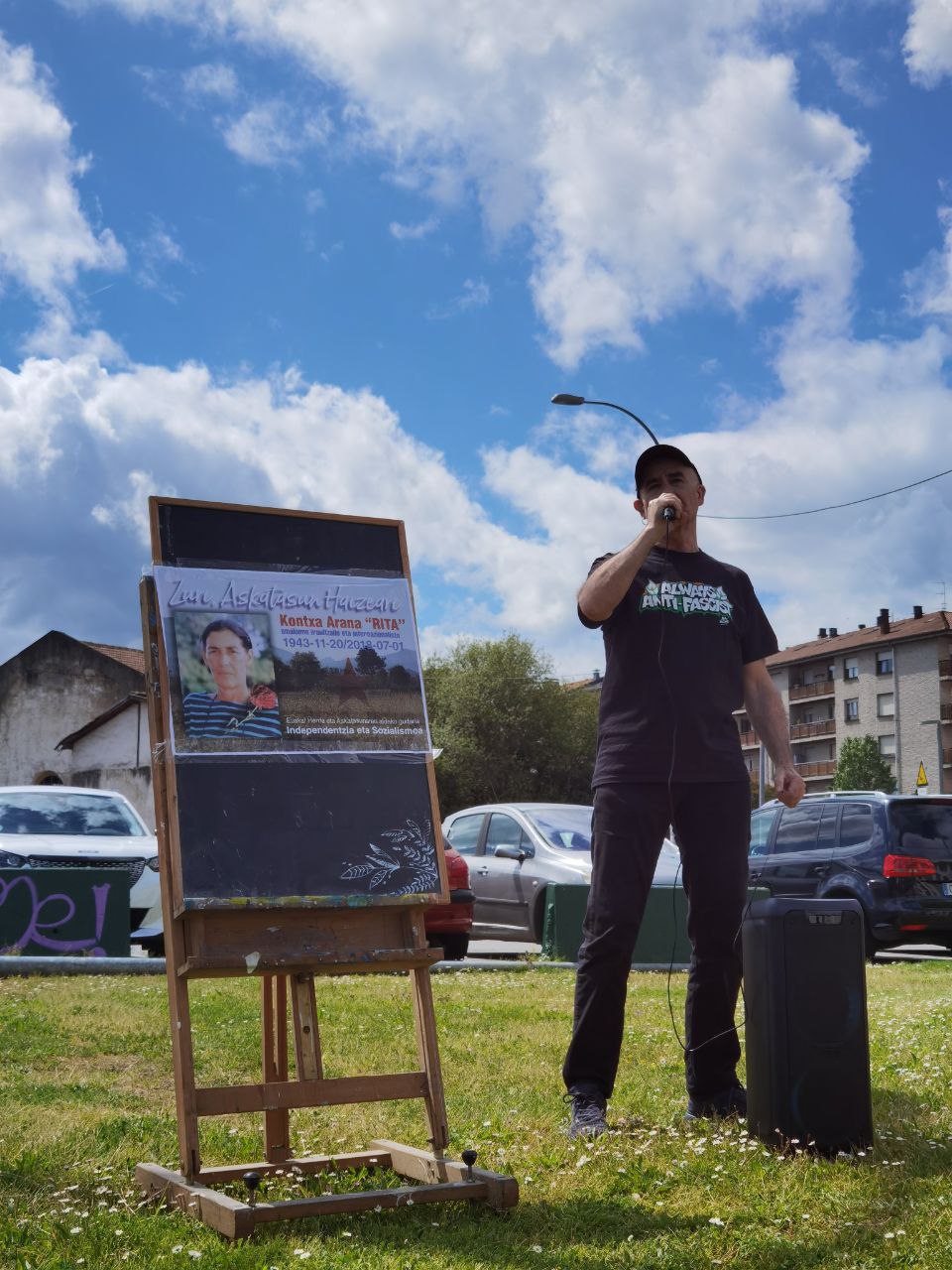
A Basque woman of the independent Patriotic Left movement blew the traditional cow or bull horn to summon attention, while the speaker in the Basque language introduced the program and speakers along with a short history of this internationalist anti-imperialist and anti-fascist fighter.
Kontxi Arana was an active member of the Basque armed liberation organisation ETA who avoided capture while on operations in the Spanish State but was arrested in the French state and exiled to an island, from which she and others escaped. Sometime later she surfaced in Nicaragua, where she had joined the Sandinista armed liberation movement.
Around the end of the 1990s, the leadership of the Basque Patriotic Left asked some exiles to return to the Basque Country to help push the pacification process and release of prisoners but the Spanish State refused to play, though they did not arrest Kontxi (however according to reports arrangements were not well organised to support her).
Most of the crowd present at the Gernika commemoration and homage to Kontxi “Rita” Arana, with the Astra building in the background and the railway line fence just visible in the left background.
The homage to her memory
A man formerly of the official patriotic Left movement spoke in Spanish about the need for internationalist solidarity, through which however mistakes can be made (e.g. in supporting corrupt leadership) which however does not alter the importance of such solidarity, without which the revolution cannot advance.
This was followed by a man from Dublin Republicans Against Fascism who briefy explained in Castilian (Spanish) the history behind Christy Moore´s “Viva La Quince Brigada“, which the Dubliner then sang in its original English.
Dublin Republicans Against Fascism representative singing Christy Moore’s Viva La Quinze Brigada.
The homage event concluded with red carnations being laid by members of the audience in front of a portrait of Kontxi “Rita” Arana. Two ex-political prisoners played the ´txistu´ (Basque three-hole flute), one of them also beating a rhythm on a small drum (´tamborina´). A young woman stepped forward and danced the ´aurresku´, a traditional honour dance.
Crowd queuing to lay red carnations in front of a portrait of Kontxi Arana
This dance was traditionally danced by a male, then by male dancers, then by male and female dancers until today, when it may be performed by any of those combinations or by a lone female, as in this case, and often enough in ordinary clothing as was the case on this occasion, though she did wear dancing shoes laced to the ankles.
The young woman performing the honour Aurresku dance in one of the high kicks of the dance with, to the far right, the ex-political prisoner txistulari (players of the Basque flute). In the immediate background, participants and organisers. (Photo: DRAF)
The musicians then played the air of The Internationale, which most could be heard singing in Euskera, followed by Eusko Gudariak (“Basque Soldiers”), the Basque national resistance song, similar to the Soldiers’ Song/ Amhrán na bhFiann of Ireland in content. Many had raised clenched fists as the songs were sung.
Suddenly, a wild high-pitched yodelling cry rang out from a female throat, the Irrintzi, traditional Basque battle-cry which probably echoed around the mountains in olden days.
All the audience then repaired to the Astra building where a hot meal was served to all on long tables with a bottle of wine to share among each group of several people (those present had purchased tickets to the event either in advance or upon attendance).
Afternoon session: Presentations from Turkish, Irish and Catalan antifascists.
The afternoon session started a little late as people straggled in. The chairperson, speaking in Euskera, introduced the theme of the session which was for antifascists from Turkey, Ireland and Catalonia to describe the situation with regard to fascism in their countries and how it was being confronted.
Turkey
Two people from the Turkish-based revolutionary organisation Anti-Imperialist Front presented their contribution while using a video of images, some subtitled in Castilian but where not, spoken by the woman in English while her comrade translated simultaneously into Castilian.
Overall, the presentation was about the development of state fascism in Turkey and the failed military coup of 2016. The DHKP/C organisation had resisted this on the streets but a major struggle with the Erdogan government took place in trials and in the jails.
Through hunger strikes and physical resistance in the jails, hundreds of martyrs had lost their lives, said the speaker but had remained undefeated. Also martyred had been members of the Group Yorum music group which has played revolutionary songs heard by millions.
Another struggle was carried out through public hunger strikes by elderly relatives seeking the uncovering of mass graves in the bodies of fighters, their sons, had been thrown by the Turkish military.
As a result two mass graves had been eventually disinterred, permitting the remains of fighters of the DHKP/C and of the PKK (Kurdish patriotic socialist organisation) to be returned to their families for respectful re-burial.
The Turkish speakers concluded by stating the necessity for anti-fascism to be anti-imperialist and calling for internationalist solidarity and victory to peoples’ struggles.
Section of audience at afternoon session of the anti-fascist conference in Gernika, Basque Country.
Ireland
The next speaker was from Dublin Republicans Against Fascism, explaining that eight centuries of occupation of his country by England has ensured that the dominant struggle had been one of national liberation and that all armed struggles since 1798 had been led by Republicans of various kinds: 1801, 1848, 1867, 1882 and 1916.
The Irish State that came into being after the War of Independence in 1921 had been a client of the UK, conceding over one-fifth of its national territory as a direct colony. The armed forces of the State had formally executed over 80 of the IRA and instituted a wave of repression including kidnappings, torture, murders including of prisoners.
In keeping with the rise of fascism across 1930s Europe, Ireland saw the Blueshirt movement, led by former police chief Eoin O’Duffy. The Republican movement and socialists fought these on the streets, the speaker said.
The Dubliner recounted briefly the history of Irish Republicans and socialists going to fight Franco in the Spanish state and the Irish diaspora fighting the British fascists, the Blackshirts, in British cities and in defence of Eastern European Jews in famous Battle of Capel Street in the East End of London against over 7,000 police.
He went on to recount some more recent successful physical attacks by joint Republican groups against fascist organisations, the Pegida group in 2016 and even more recently the National Party. Recently too, Republican ex-prisoners had released a video stating the opposition of Republicanism to fascism with a growing list of signatures.
In conclusion, the speaker said that Ireland’s history made it difficult for fascism to advance in Ireland (except in the Loyalist areas) but as long as capitalism exists so too does the danger of fascism, particularly if the progressive forces do not fight effectively against the attacks of Capital on working people.
Catalonia
The representative of the Anti-Repression Platform of Catalonia, speaking in Castilian (Spanish), explained their organisation had come into existence after the repression of the Independence Referendum in 2017 and the subsequent frame-ups and allegations of terrorism against the Committees for the Defence of the Republic.
The speaker alluded to the jailing of the revolutionary socialist rapper Pablo Hasel and comrades who were charged with terrorism merely for expressing and organising solidarity for those being repressed.
“Don’t try to frighten us with threats of a fascist party getting into government”, he said in a reference to the growth of the Spanish fascist party Vox, because we have had a fascist government in the Spanish state since 1939!” (The year that the military-fascist forces defeated the Second Republic and founded four decades of dictatorship).
The Catalan went on to denounce the social-democratic party PSOE (currently in coalition government with Podemos Unitas), pointing out that it has had more political prisoners in jail and fatal victims than any other party in Spanish government (he was probably including the sponsoring the GAL terrorists of the 1980s).
“There has not been a year in which there were no political prisoners in the Spanish state”, he went on to say but also denounced the current Catalan Government, led by the allegedly pro-independence and leftist ERC party and its repression of socialists and independence activists.
He pointed out that fascists would make no distinction between communists and anarchists and asked “so then why should we?” He declared that all who resist repression now, regardless of before, are welcome to take part in their organisation.
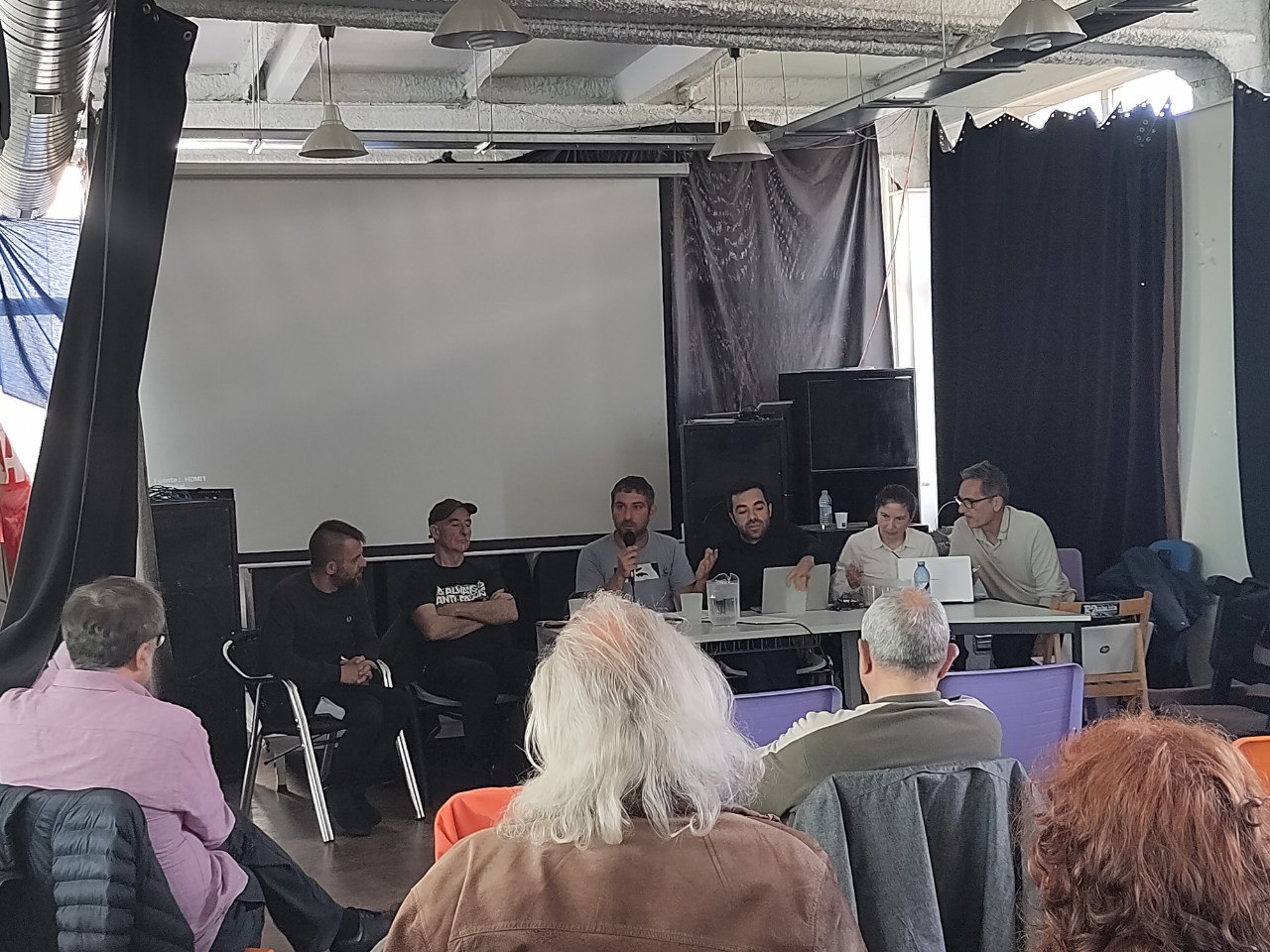
The panel at the afternoon session: from left to right: speakers from Catalonia and Ireland, Basque chairperson, Turkish speakers and translator.
Prisoners on hunger-strike
The chairperson of the panel thanked the speakers and drew together elements from each of their presentations.
He went on to announce the declared intention of a small group of Basque political prisoners to embark on a hunger strike and to outline solidarity events being organised. The prisoners concerned are in the non-compliance minority of Basque political prisoners with a regime that forbids them referring to themselves as political prisoners.
The prison authorities intended to make the prisoners share a cell with other political prisoners who are however in compliance, intending to undermine the resistance of the small group and also posing the danger of conflicts within the cell. (A few days later news came that the hunger-striking prisoners had won their demands).
Amnistia organisation solidarity poster announcing forthcoming hunger-strike of political prisoners, now over because they won their demand.
Summary
The conference in its organisation and content of contributions drew anti-fascism together with imperialism and internationalist solidarity, all from an anti-capitalist perspective. It also drew connections between solidarity with political prisoners and resistance to repression.
All of the Basque organisations represented are in opposition to the trajectory of the leadership of what had been the Basque Left Patriotic movement, now represented by the EH Bildu party led by Otegi (with daily newspaper GARA, its trade union organisation LAB) and many of the older people were ex-supporters of that leadership.
That included some prominent ones such as Inaki Gil de San Vincente and the speakers and organisers of the conference and of the homage to the memory of Kontxi “Rita” Arana. The younger participants might have included ex-members or had come into political consciousness in opposition to that leadership.
Taken together, they are what many call ‘dissidents’ though some reject that term, saying that they are in fact sticking to the original line of independence and socialism and that it is the official leadership and their followers who have deviated. Their numbers are comparatively small at the moment but they are growing.
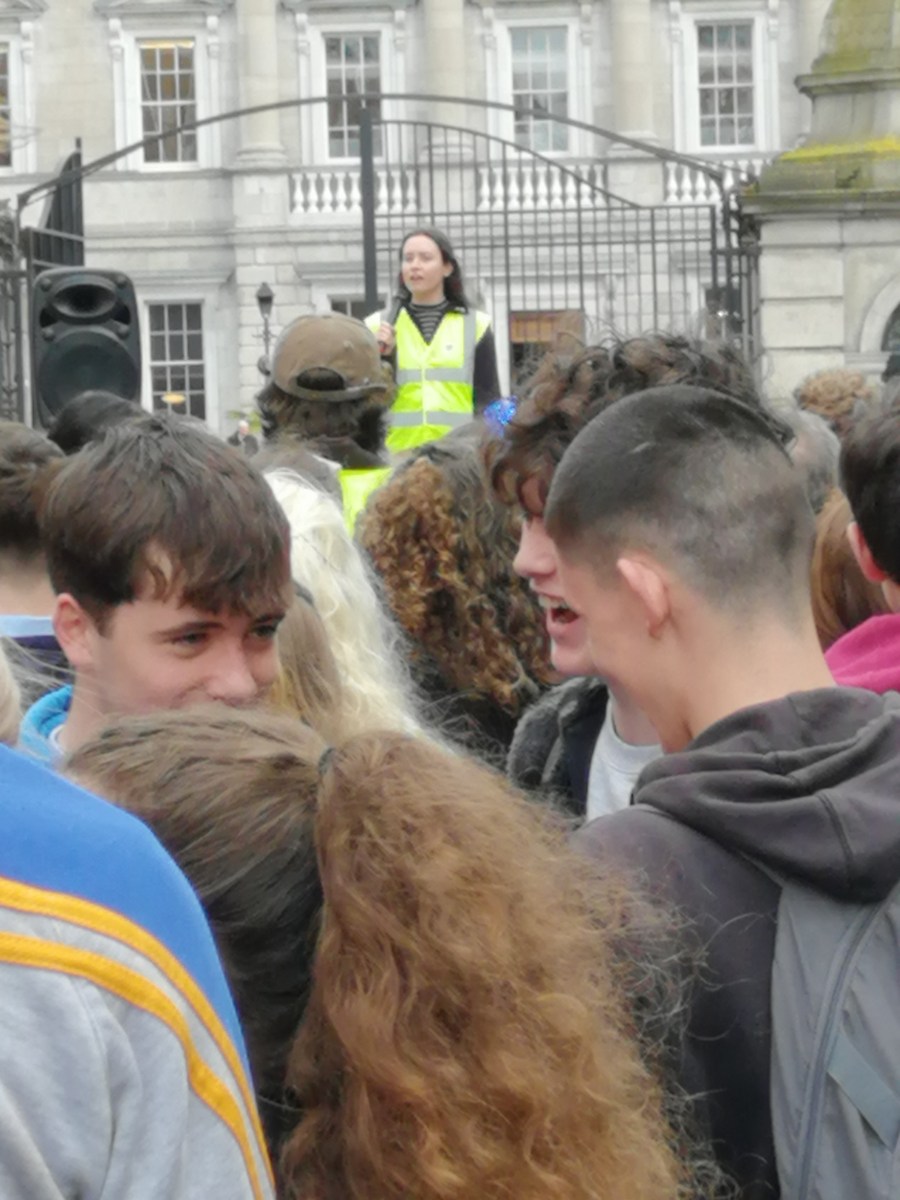
Hundreds of primary and secondary school students demonstrated on 29th April outside the Irish Parliament, to protest the decisions on the Irish language curriculum and lack of State support for education through the Irish language.
Teenagers and younger, many in their school uniforms, led by a few organisers, shouted slogans and some carried placards and banners. There was a sprinkling of a few older adults in their midst also, some long-time campaigners for the Irish language in society.
Primary and secondary school pupils attended from at least six colleges, all Gaelscoileanna, i.e those where instruction in all subjects (except English) is through Irish. Led in by an adult and spontaneously, they chanted slogans such as: Tír gan teanga, tír gan anam!
Confirmed in attendance were pupils from schools in three counties: Coláiste Íosagáin and Coláiste Eoin, from South Co. Dublin; Coláiste na Mara (Co. Wicklow); Coláiste Rachrann (North Dublin), Coláiste Chill Dara (Co. Kildare).
Julian de Spáinn, General Secretary of Conradh na Gaeilge (Gaelic League), a state-funded organisation for the promotion of the Irish language, speaking in Irish, said that the education system is “broken in relation to the Irish language.”
“A comprehensive policy needs to be developed for Irish within the education system from pre-school to third level”, De Spáinn stated. Irish within the education system has been surrounded by controversy in recent years from teachers, parents, students and language organisations.
Concretely, De Spáinn called for the immediate establishment of a working committee “composed of people who understand Irish within the education system and that have experience of it.” He said that the specifications and syllabus for the Junior and Senior Cycles are “nonsensical”.
He went on to claim that more than 90% of those teaching the Senior Cycle are unhappy with it and went on to criticise Minister Foley’s decision to move Paper 1 of the Irish exam for the Leaving Certificate to the fifth year (although its implementation has now been delayed).
In addition to criticising the lack of Gaelscoileanna throughout the state, De Spáinn stated that the exemptions from Irish language study are “out of control” and that pupils with special needs were not receiving the necessary service that they may be facilitated in studying Irish at school.
Shane Ó Coinn, Chairperson of An Gréasán do Mhúinteoirí Gaeilge, the website for teachers of Irish, stated that Irish in the education system was suffering, for which the main cause is that the Education Department had ignored the opinions of teachers and of pupils.
“It is clear from the results of SEALBHÚ”, he continued, “that an oral examination in the third year is urgently needed, the marks for which should account for 40% of the total.”
Gráinne Ní Ailín, officer of the Irish Union of Post-Primary Students, said that an integrated approach of the education authorities was missing and that a proposal from one agency was conflicting with another.
“On the one hand, the Education Minister is intent on moving Paper 1 of Irish to the fifth year, while the state agency, the National Council for Curriculum and Measurement is working on changing the entire curriculum specifications for the Leaving Certificate.”
“It is not possible to carry out both actions simultaneously,” Ní Ailín said and recommended taking a step back and putting together a comprehensive plan.
Pictiúr: Leon Farrell / Photocall Ireland
Status of the Language in the Irish State
Many may be surprised to know that Irish is not only an official language in the Irish state but, according to the Constitution, the language of first status. Nevertheless, Irish-speakers have become a minority in the state and the Irish-speaking areas are all shrinking.
Despite the official position of the State and which Governments and civil servants are obliged to support nominally, many people report a lack of services through Irish at all levels of State and in public services, with even official public notices in Irish often garbled or even incorrect1.
In the 1960s and ‘70s it was only through campaigns including civil disobedience and supporters being fined or even jailed that the State provided an Irish-language radio station and a TV channel and legislation obliged State departments to provide services through Irish on request.
When the Irish state joined the EU (formerly EEC) it did not request that Irish be an official language of the organisation but it became so on 31st December 2021 — and may well reveal a large gap in availability of translators.
The Gaelscoil (school teaching through Irish) movement may be said to be the only visible success for the language within the territory of the Irish state but, as the protests and many other factors reveal, it has struggled against the State system of which it is a part.
In 2020-’21 academic year, there were 152 Gaelscoileanna outside the Gaeltachtaí (Irish-speaking areas), with at least one or two in each county and catering for 7% of all children at that level outside the Gaeltachtaí in the Irish state.2
Out of 700 post-primary education facilities in the Irish state outside the Gaeltachtaí only 29 are Gaelcholáistí, or 2.8% of the total. Ten of those are in Co. Dublin, four in Co. Cork and some other counties have one or at most two.
But twelve counties out of the 26 in the Irish state do not have even one Gaelcholáiste (post-primary level), i.e. approaching half of the counties in the state.3 In a tragic irony, this includes Co. Clare, from which the Irish-speaking Aran Islands are believed to have been colonised4.
In addition there are some units and streams teaching through Irish in other schools and colleges but of course outside of the classroom, even within the school, the dominant environment is an English-language one.
Twenty-eight Gaelcholáistí, representing 18% of total Gaelscoileanna are DEIS, i.e addressing educational disadvantage integratedly. Although 31% of Gaelcholáistí are of Catholic ethos, 69% are multi-nominational or non-denominational.
However, outside the Gaeltachtaí, even with fully-immersive Gaelscoileanna, how is daily use of the language in society to be promoted when the pupils find themselves surrounded by exclusively English language in their lives outside the school gates?
The Irish Language in the Colony
The British colony in Ireland (incorrectly named “Northern Ireland”) from its creation in May 1921 was hostile to the Irish language, as indeed it was to all expressions of ethnic Irish culture. Unionist MPs openly mocked the Irish language even inside their parliament.
Nevertheless following substantial pressure, its parliament passed the Identity and Language (Northern Ireland) Act 2022, giving the language a legal status within the colonial statelet5.
However, as we have seen even in the Irish state, legal status is not necessarily followed by appropriate implementation and unionists have thrown up obstacles against even the erection of bilingual street names within the colony.
(Photo: Leon Farrell/ Photocall Ireland)
Comment
The Irish language has been a part of all movements for national independence of Ireland. The occupier sought to ban its use among its colonisers and degraded its importance and use in all legal, educational and religious spheres.
Though the Irish state formally defended and promoted Irish, it presided over huge emigration for most of its existence. This combined with lack of development of the rural Irish-speaking areas encouraged a drift away from Irish for those whose language it had been at home.
Despite the activity of earnest individuals no major political party in practice moves itself energetically to promote the language. It is not required of their members or even representatives and none run any major language acquisition program – even for their own members6.
The same is true of all Irish Left and Republican political parties and organisations at this time.
Most advances have been won by political activism and the work of volunteers, across a number of parties and none. The movement continues to call on the State to put its money where its mouth is, as the saying goes, or the equivalent in Irish, to commit “beart de réir a bhriathair.”7
Footnotes
1The State used incompetent translation for its Irish language version of its video on the 100th anniversary of the 1916 Rising. The whole video was withdrawn after wide-scale criticism of even the general content in English. Notices urging people to remain safe from Covid, when translated to Irish urged them instead to besaved!
4There are a number of indicators for this instead of from Conamara but one is the pronunciation of the lenited M followed by a broad vowel, which would sound like a W in Conamara but a V in the Aran Islands. This Clare dialect can be seen in place-names extending into Co. Galway, for example Cinn Mhara pronounced Kinvara (it would be pronounced Kinwara in Conamara).
5Even then, to placate Unionist opposition, it had to share equal space with the promotion of Ulster Scots dialect, widely known to be spoken in actuality by less than tens of people.
6This is true even of Sinn Féin, the political party most in support of the Irish language. Their activity in its support within the Irish state comes nowhere near matching the same within the Six County colony, suggesting that for them the Irish language is principally a useful stick with which to beat their Unionist opposition.
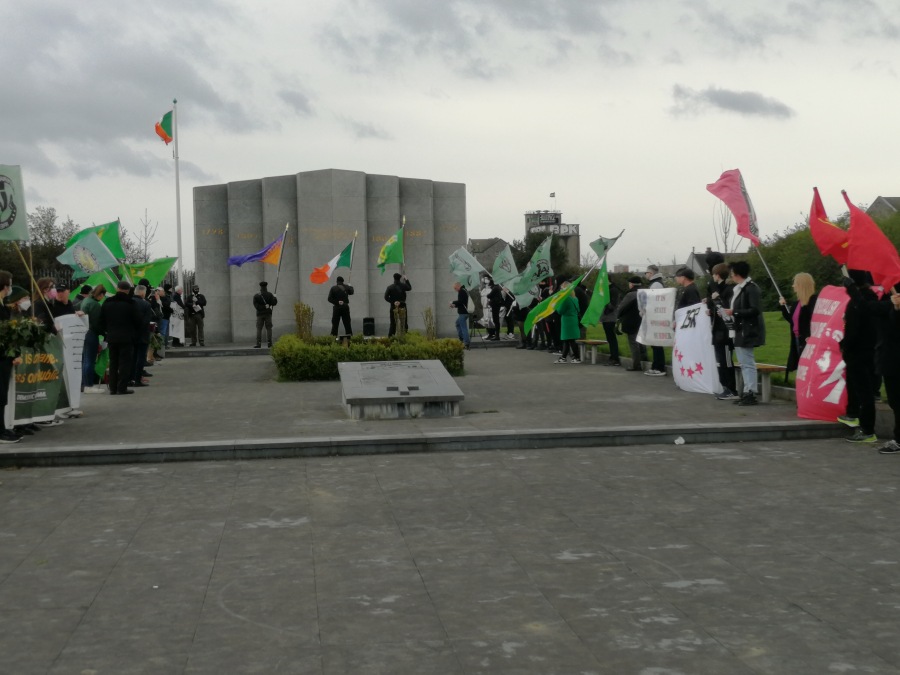
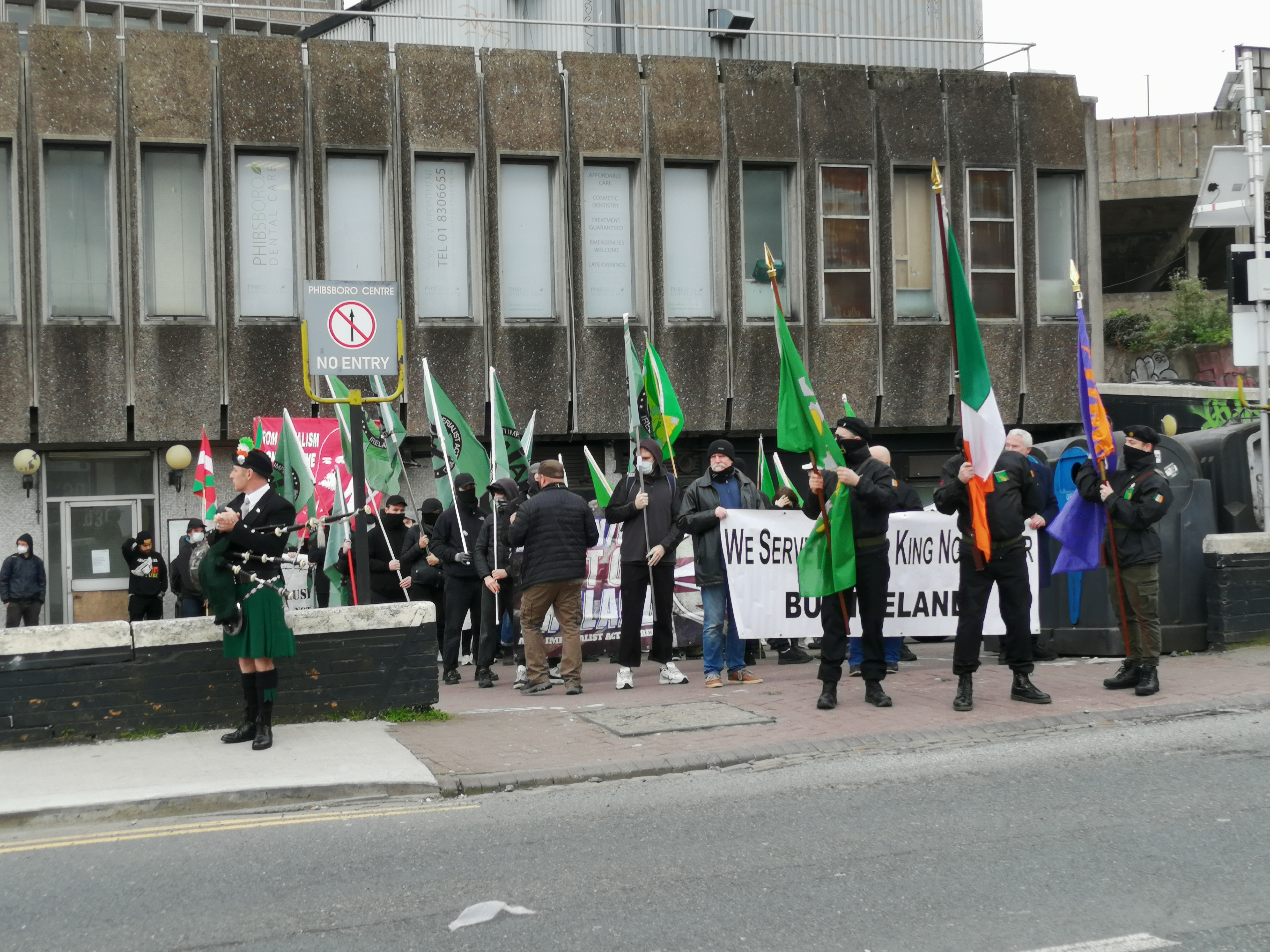
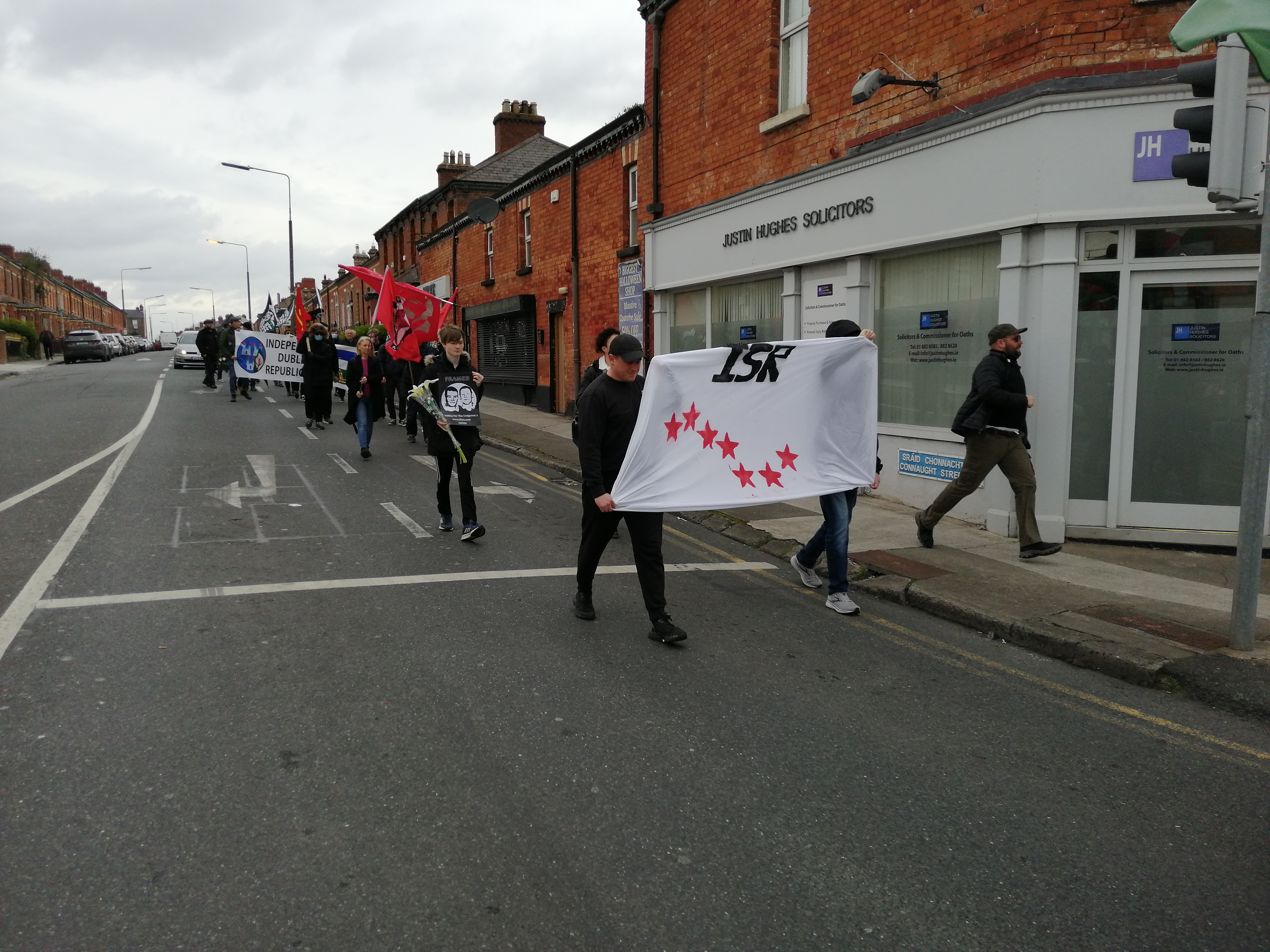
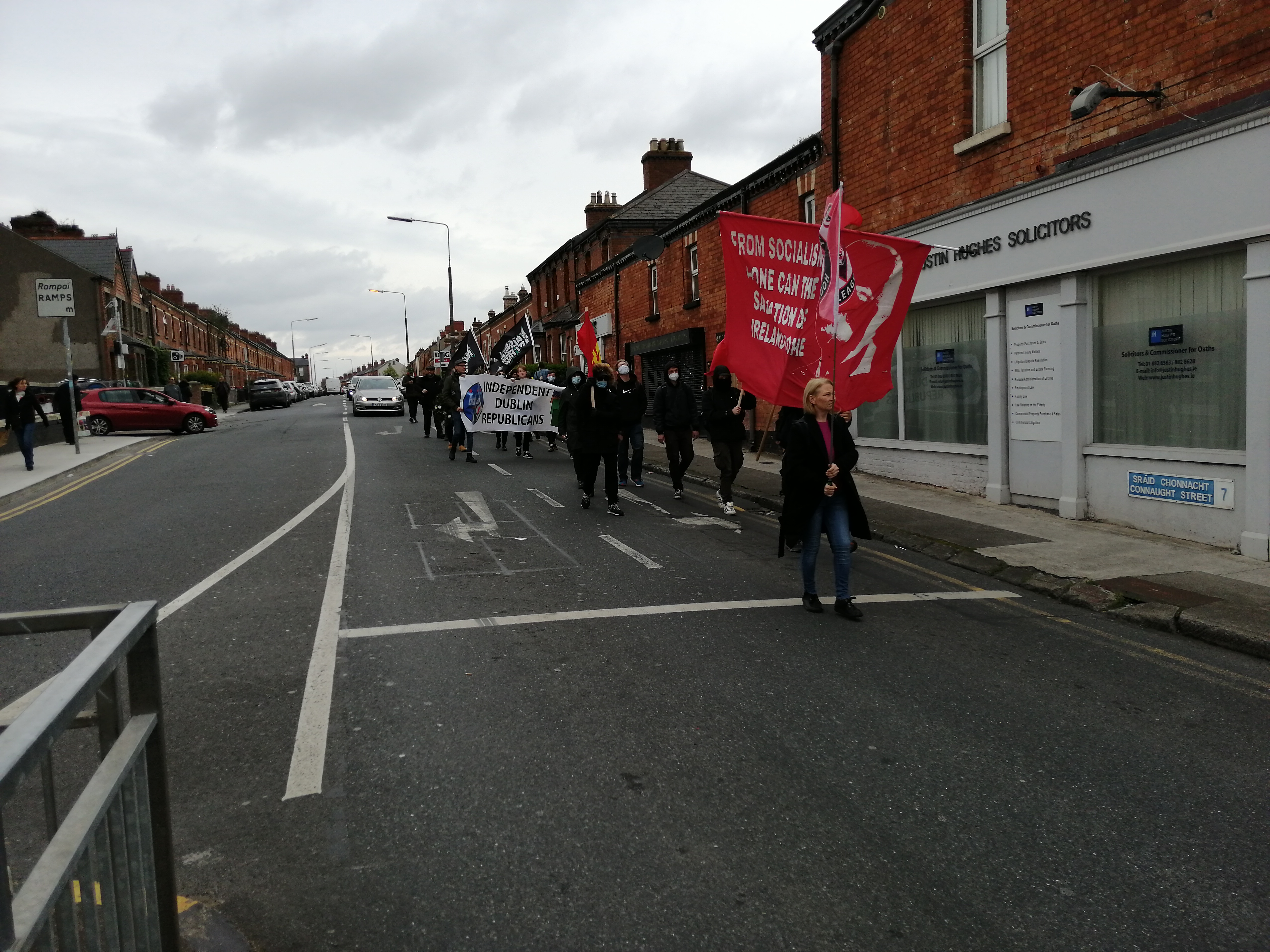
On Sunday participants in a 1916 Rising Commemoration organised by the Irish organisation Anti-Imperialist Action were harassed by police as they gathered to march to the Irish Citizen Army Republican plot in Glasnevin Cemetery.
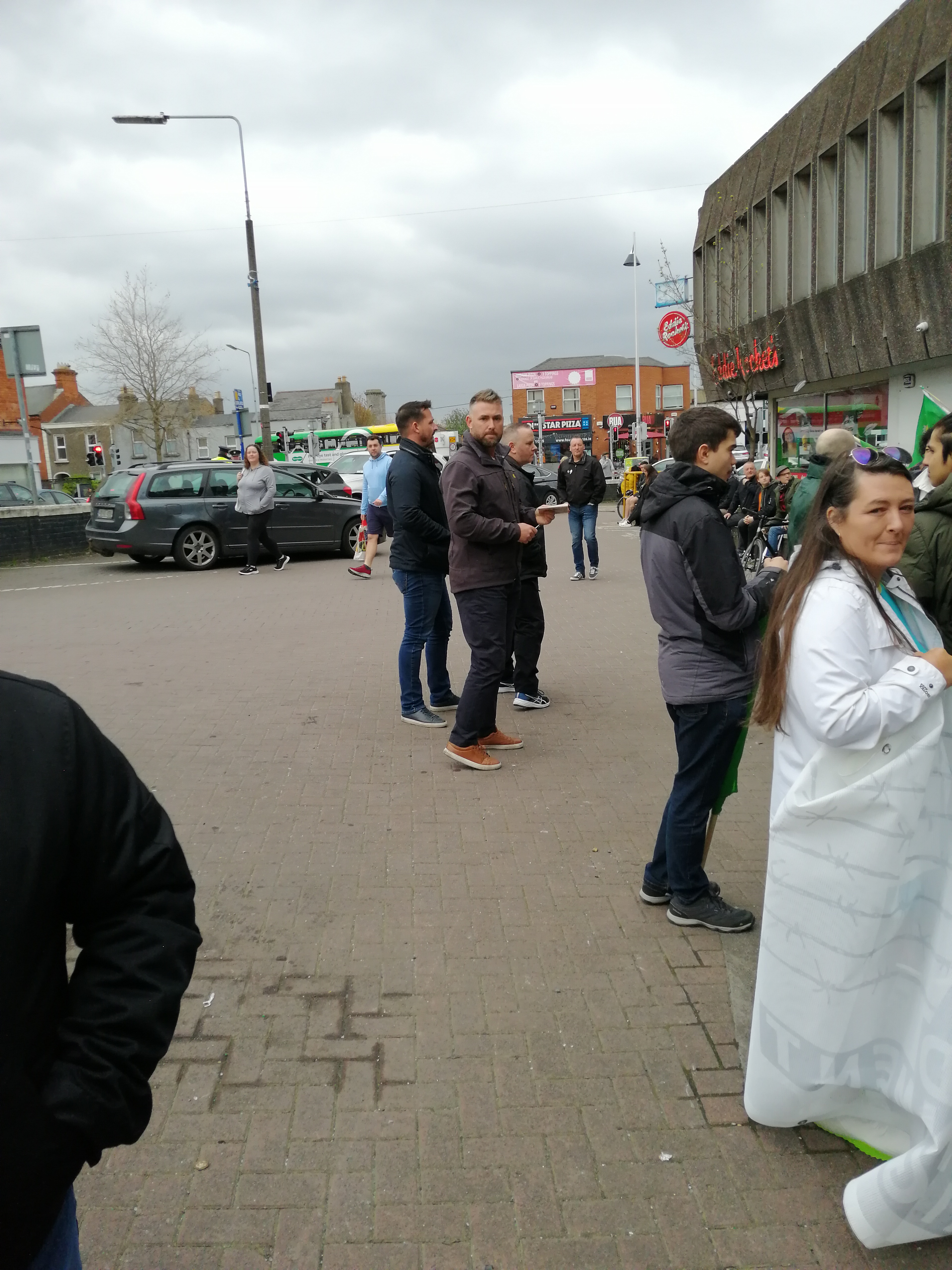
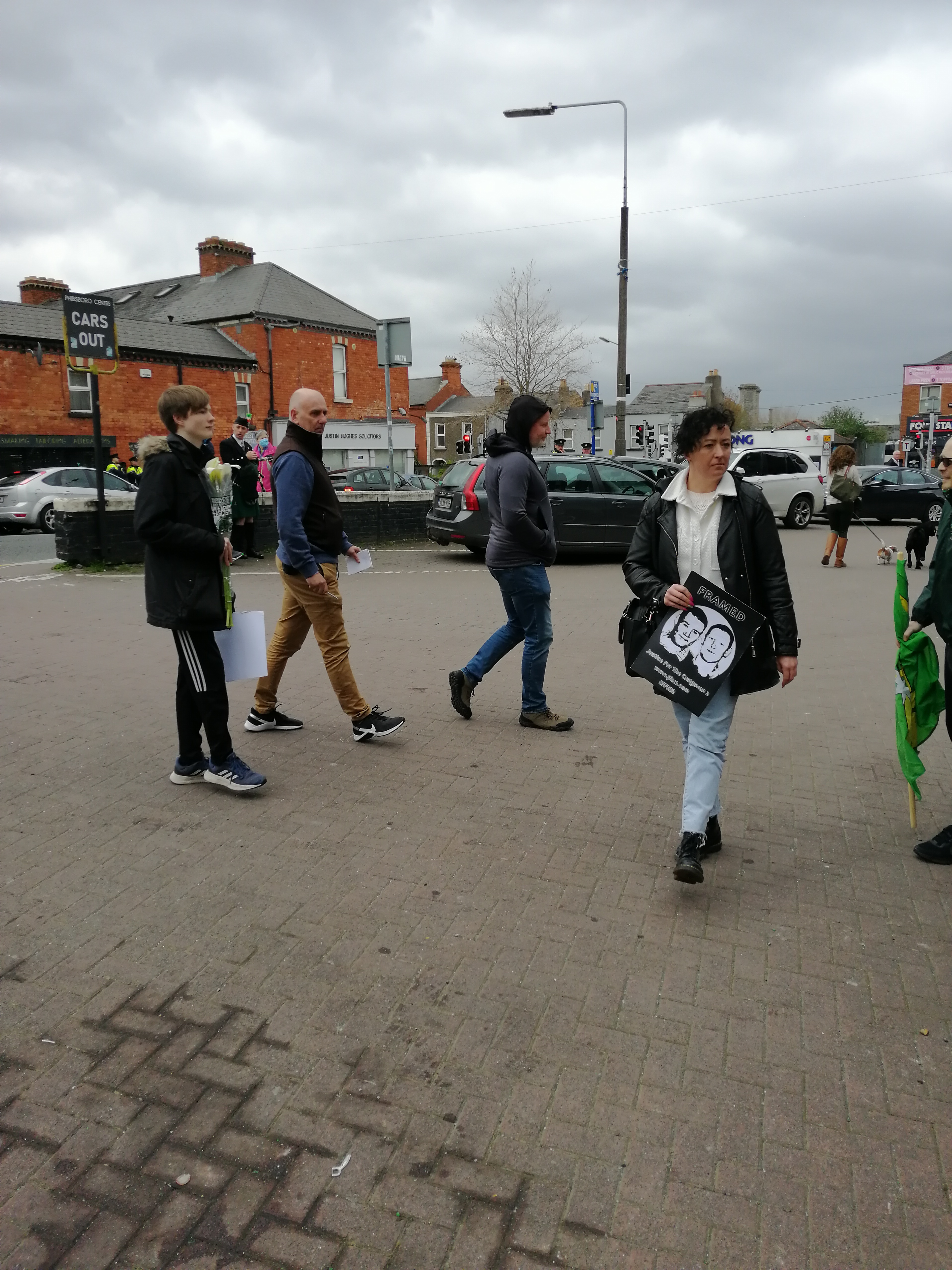
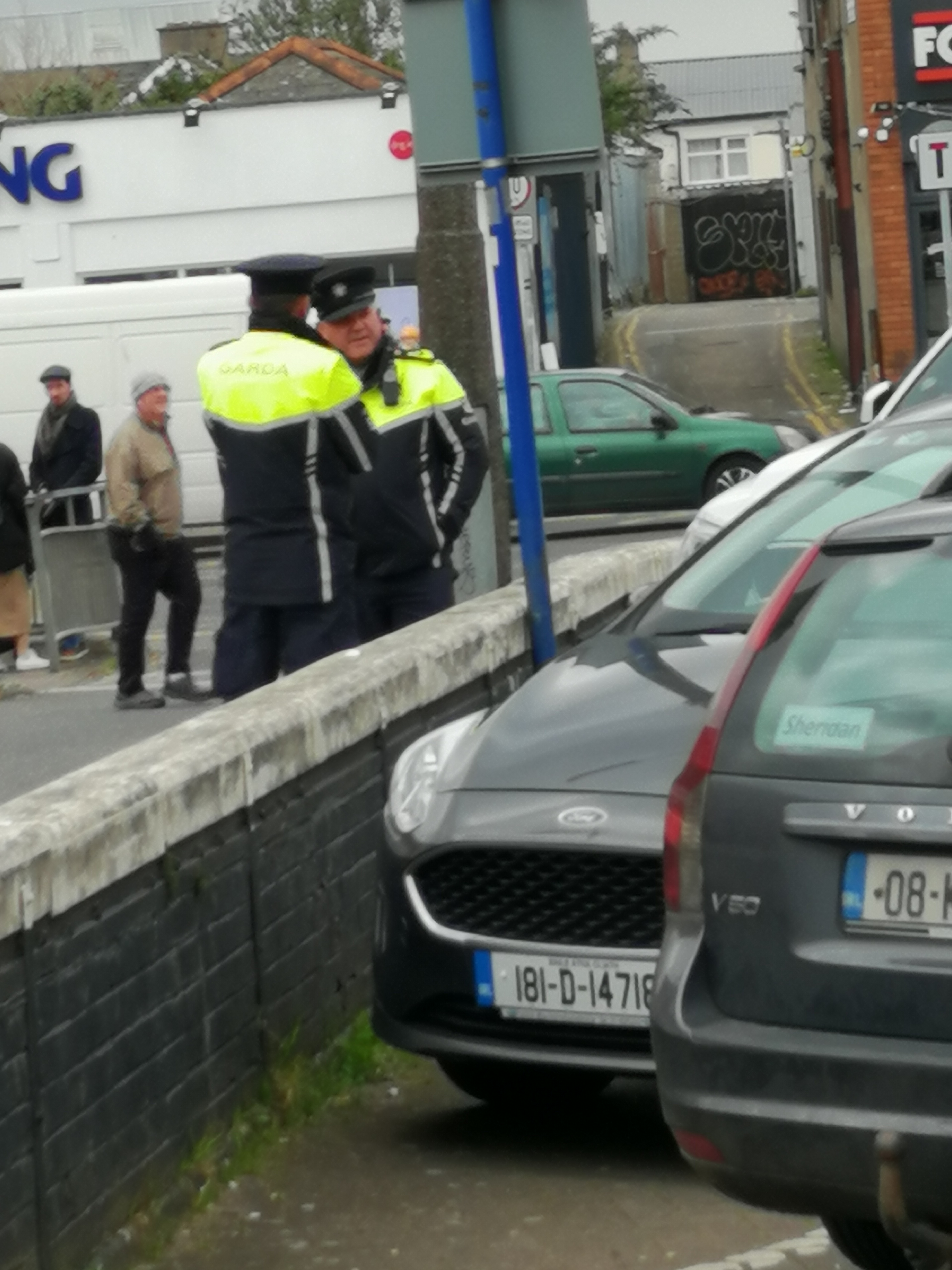
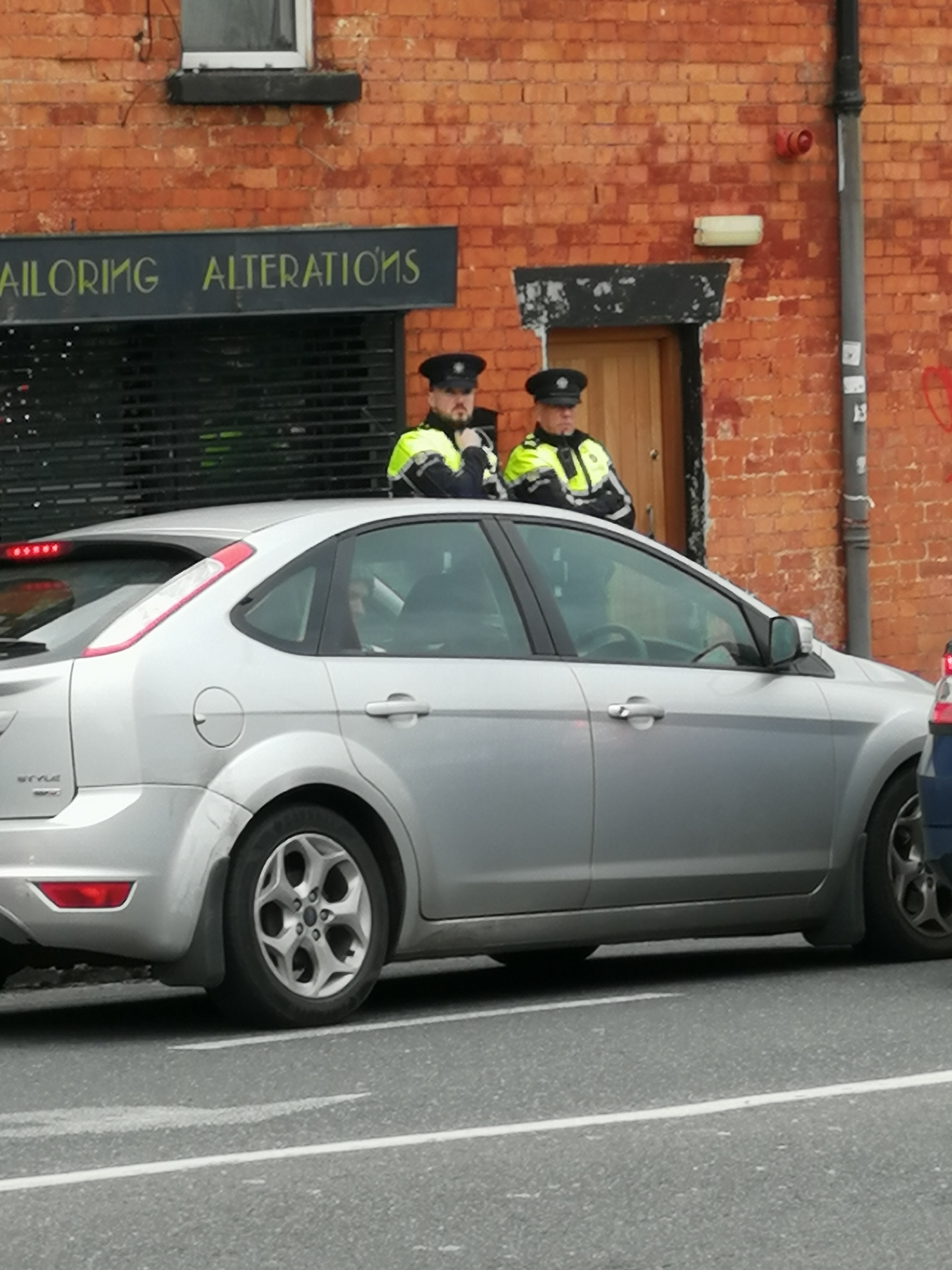
Six political police in plain clothes walked among those gathered beside Phibsborough shops demanding names and addresses of the participants, most of whom were fairly young. Four uniformed Gardaí also stood nearby and a Public Order Unit van parked at the cemetery entrance.
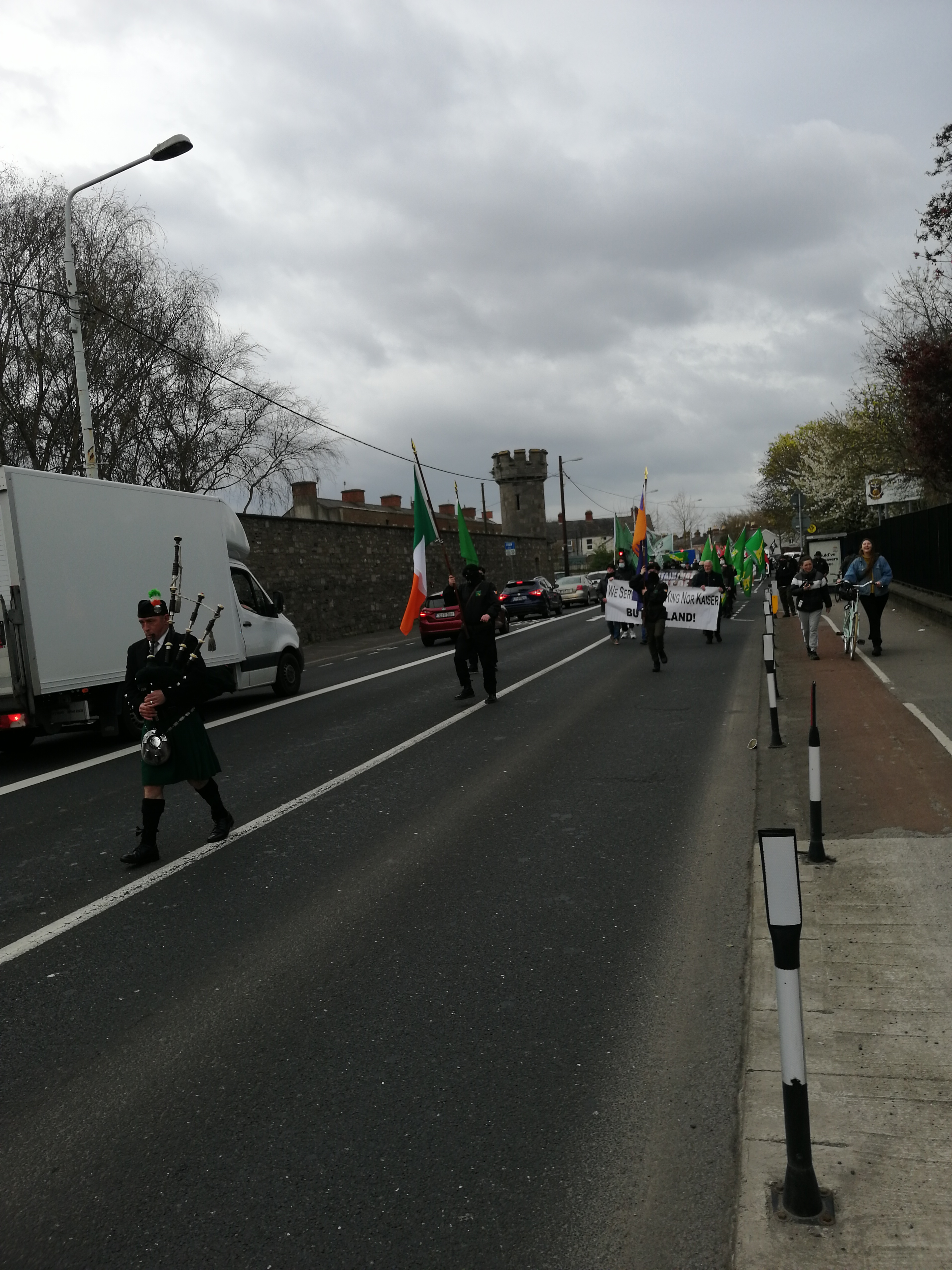
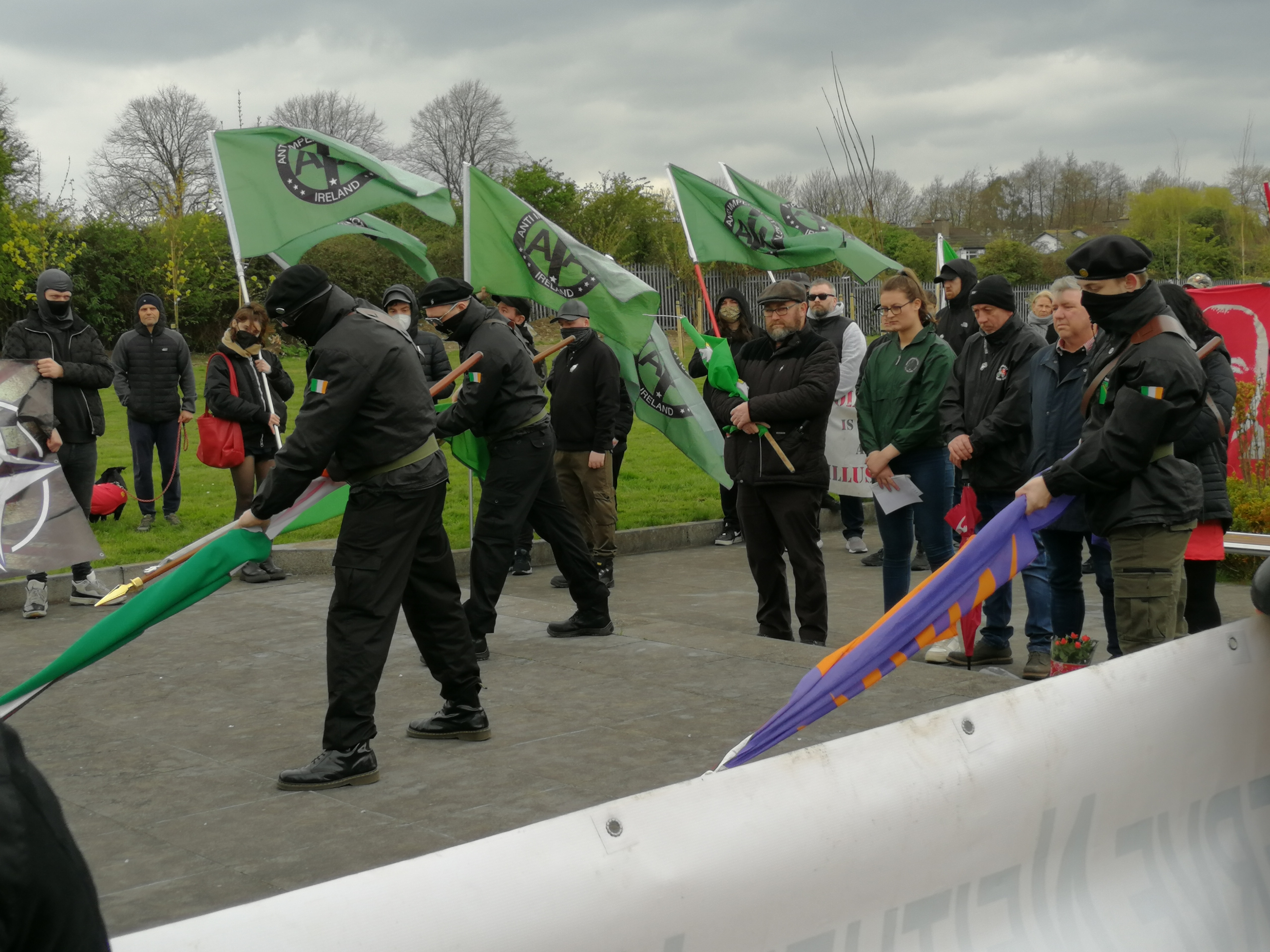
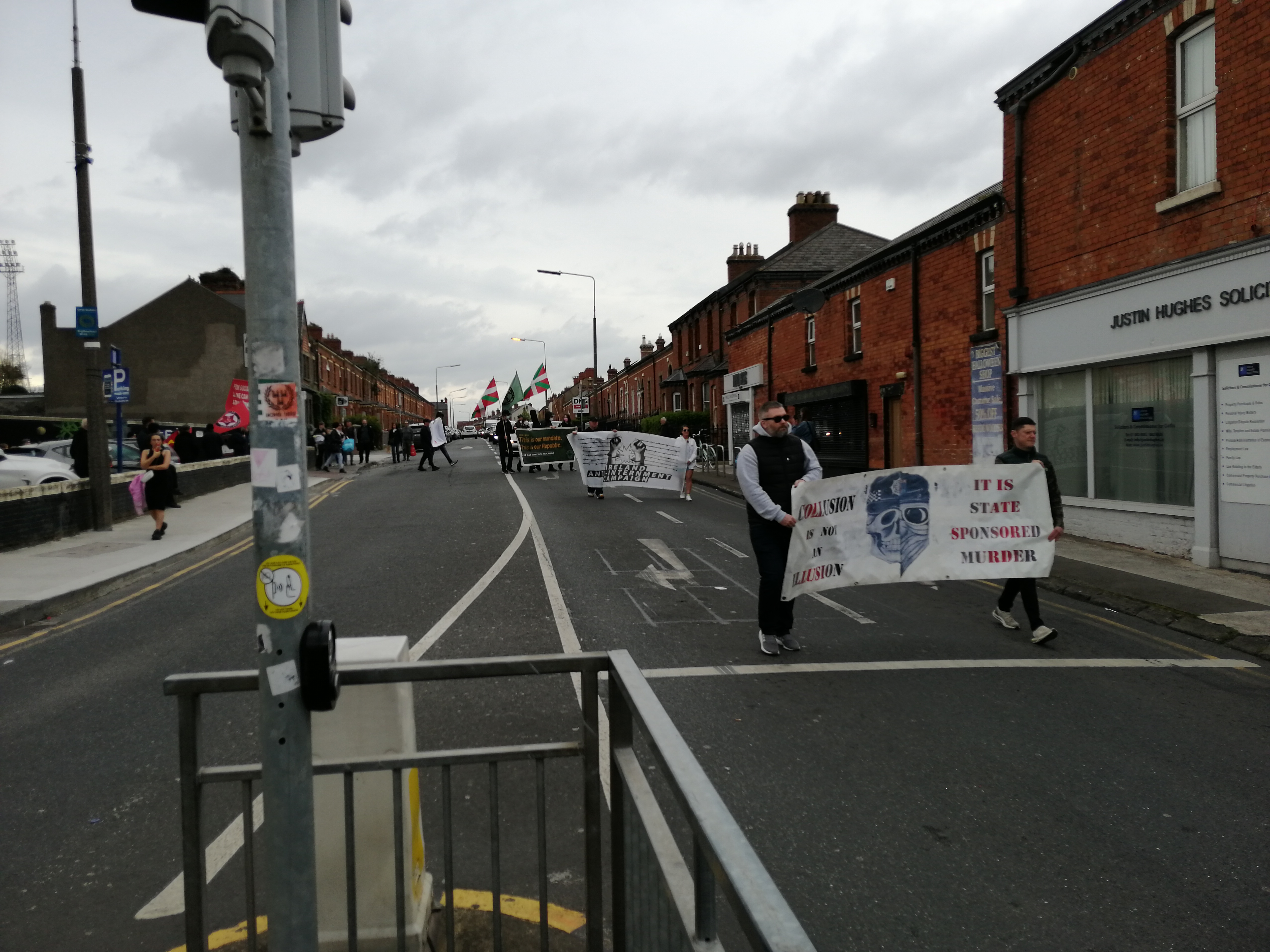
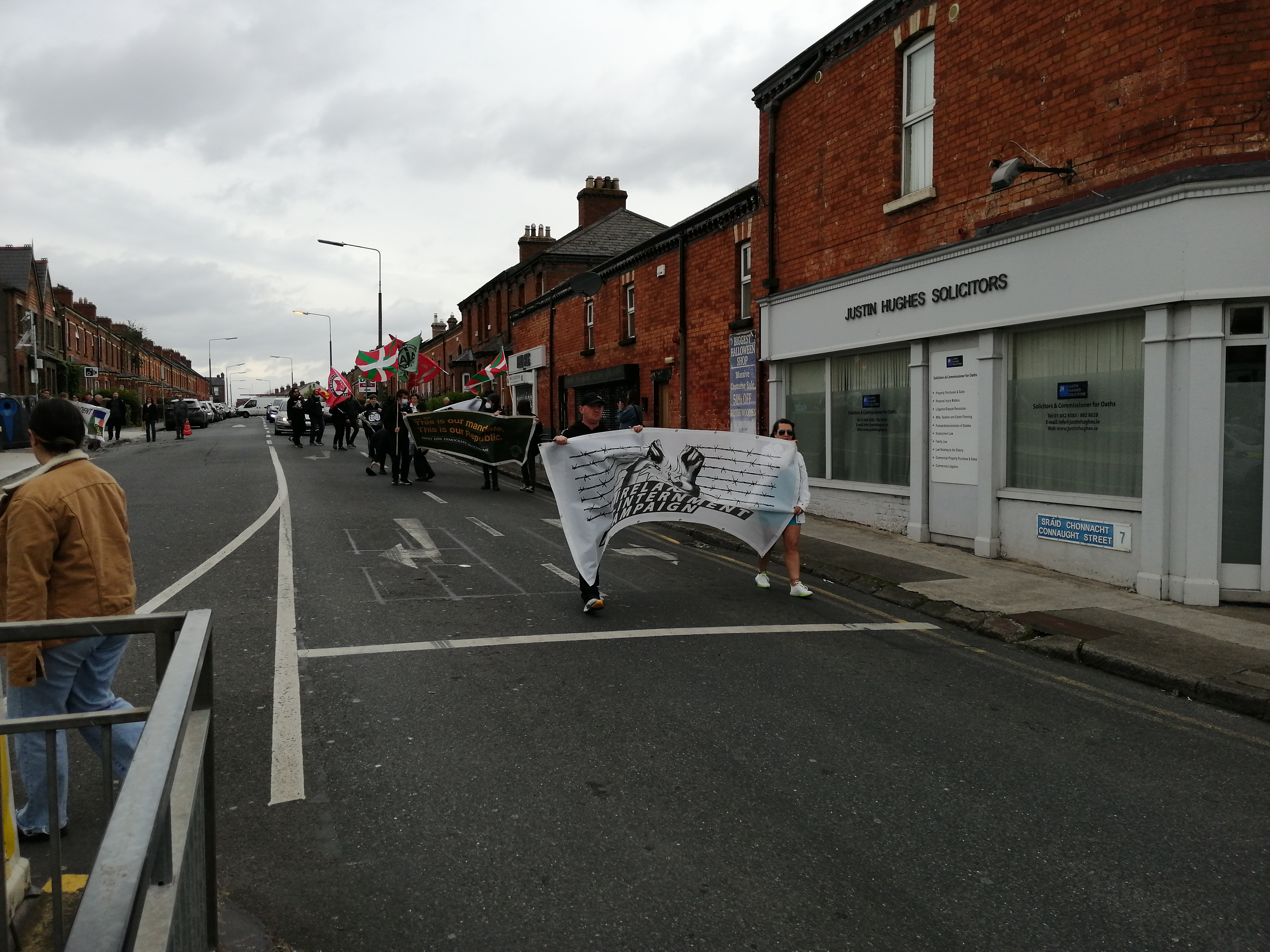
The participants declined to be intimidated and set off on their march, led by a lone piper playing Irish marching airs, followed by a colour party with different banners interspersed among the marchers, among which fluttered many flags.
Organisers had learned that the coach carrying members of the Republican Flute Band from Scotland that was to lead the parade had been prevented by police there from taking the ferry to Ireland.
Centre photo: Four of the six plainclothes political police violating the civil rights of the peaceful people commemorating the Easter Rising. (Photo: D.Breatnach)Centre photo, another two plainclothes political police. The bald man joked while he harassed people. (Photo: D.Breatnach) (Photo: D.Breatnach)
Historical background
In 1916 a broad alliance the Irish Volunteers, Irish Citizen Army, Cumann na mBan, na Fianna Éireann and Hibernian Rifles1 took part in a Rising organised by the Irish Republican Brotherhood against British rule in Ireland and against world war.
Due to a number of unfortunate circumstances, the leader of the Volunteers cancelled the Rising which however went ahead a day later than planned and was for the most part confined to Dublin, where a third of the numbers in the original plan took part and fought for a week.
The occupying British Army shelled the city centre from a gunship in the river Liffey and also from artillery on land. Explosions and resulting fires destroyed much of the city centre including the General Post Office in the main street, which had been the headquarters of the insurrection.2
After a week with the city centre including the GPO in flames, the rebel garrison evacuated to Moore Street where the following day, surrounded and vastly outnumbered, the decision was taken to surrender.3 A British military court passed death sentences on nearly a hundred prisoners.
All but fifteen of those sentences were commuted to long jail periods but the seven Signatories of the 1916 Proclamation4 and another seven were shot by British firing squad in Dublin, a fifteenth in Cork and after trial months later a sixteenth was hanged in Pentonville Jail, London.
At Easter 1917 Irish Republican and Socialist women commemorated the 1916 Rising; ever since then Irish Republicans and sometimes Socialists in Ireland and in many parts of the diaspora have commemorated the Rising, whether legally5 or otherwise, in jail or at liberty.
The War of Independence began in 1919 with many of the Rising’s survivors participating6.
(Photo: D.Breatnach)
(Photo: D.Breatnach)
(Photo: D.Breatnach)
The Parade on Sunday – local and national historical memory marked
At Cross Guns Bridge over the Royal Canal the parade halted and flares were lit in memory of events there in 1916.
Marching along the Cabra Road, the wall and a watchtower of the north side of Glasnevin Cemetery on the left of photo. (Photo: D.Breatnach)
On Easter Monday 1916 a small group of Irish Volunteers had marched from Maynooth along the canal bank to join the Rising in Dublin and found guarding the bridge two Irish Volunteers who advised them to wait until the following day to go into the city centre.
The Maynooth group spent the night in Glasnevin and the following day marched into the GPO, passing an empty Cross Guns Bridge on the way. Back towards Phibsborough, British artillery had blown a barricade and killed Seán Healy, a Fianna member at the Nth. Circular Road crossroads.
Later, the Dublin Fusiliers unit of the British Army blockaded the bridge, preventing people from crossing it in either direction. They shot dead a deaf local man who failed to heed their challenge because he did not hear it.
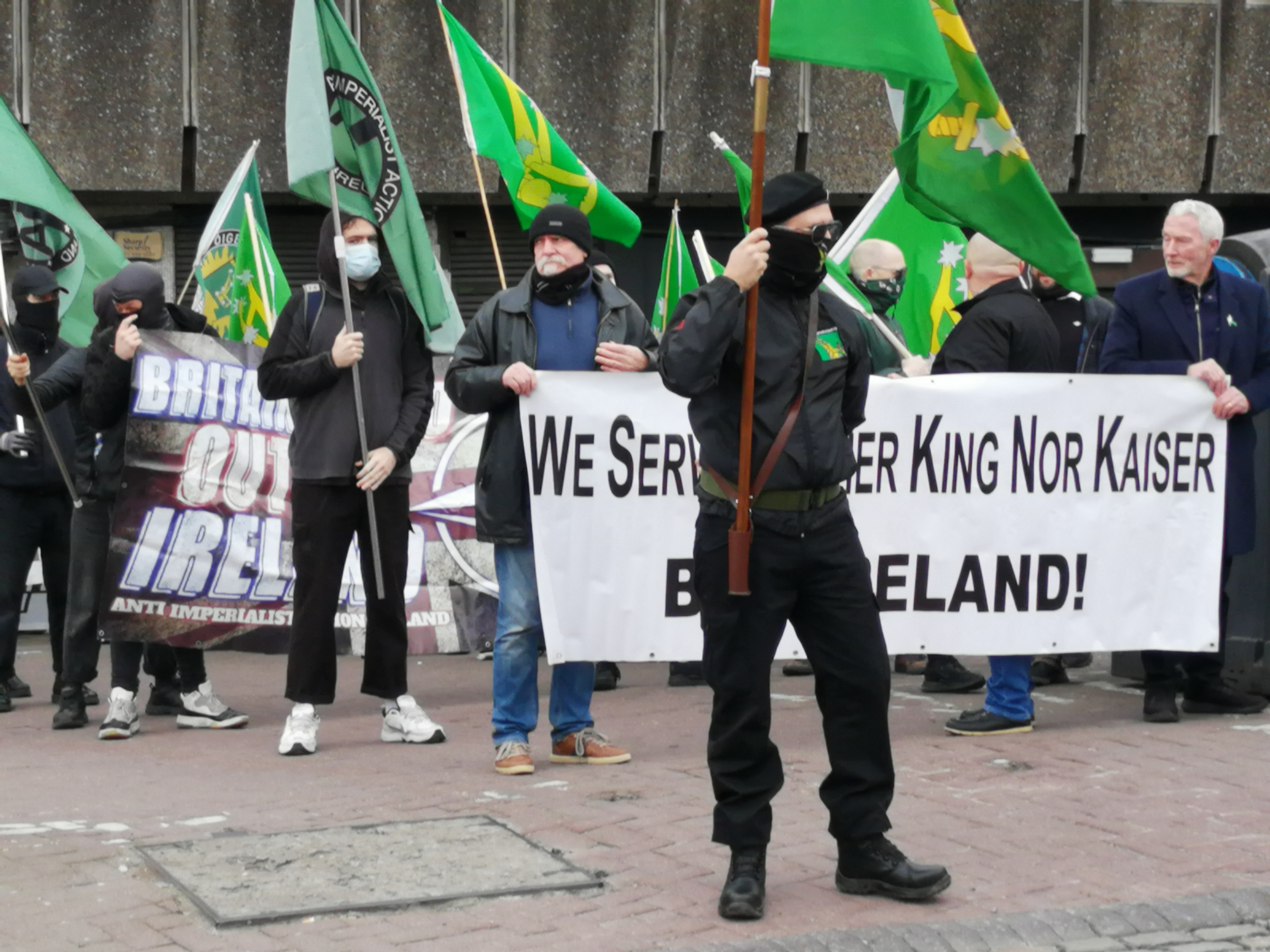
We Serve Neither King nor Kaiser but Ireland declared one banner carried last Sunday, Britain/NATO Out of Ireland another, This Is Our Mandate7, Our Republic and Collusion Is No Illusion, It Is State-Sponsored Murder were another two.
A large banner also declared alongside the image of James Connolly that Only Socialism Can Be the Solution for Ireland. Some organisations also carried their own banners, such as those of Dublin Independent Republicans, Ireland Anti-Internment Campaign and Irish Socialist Republicans.
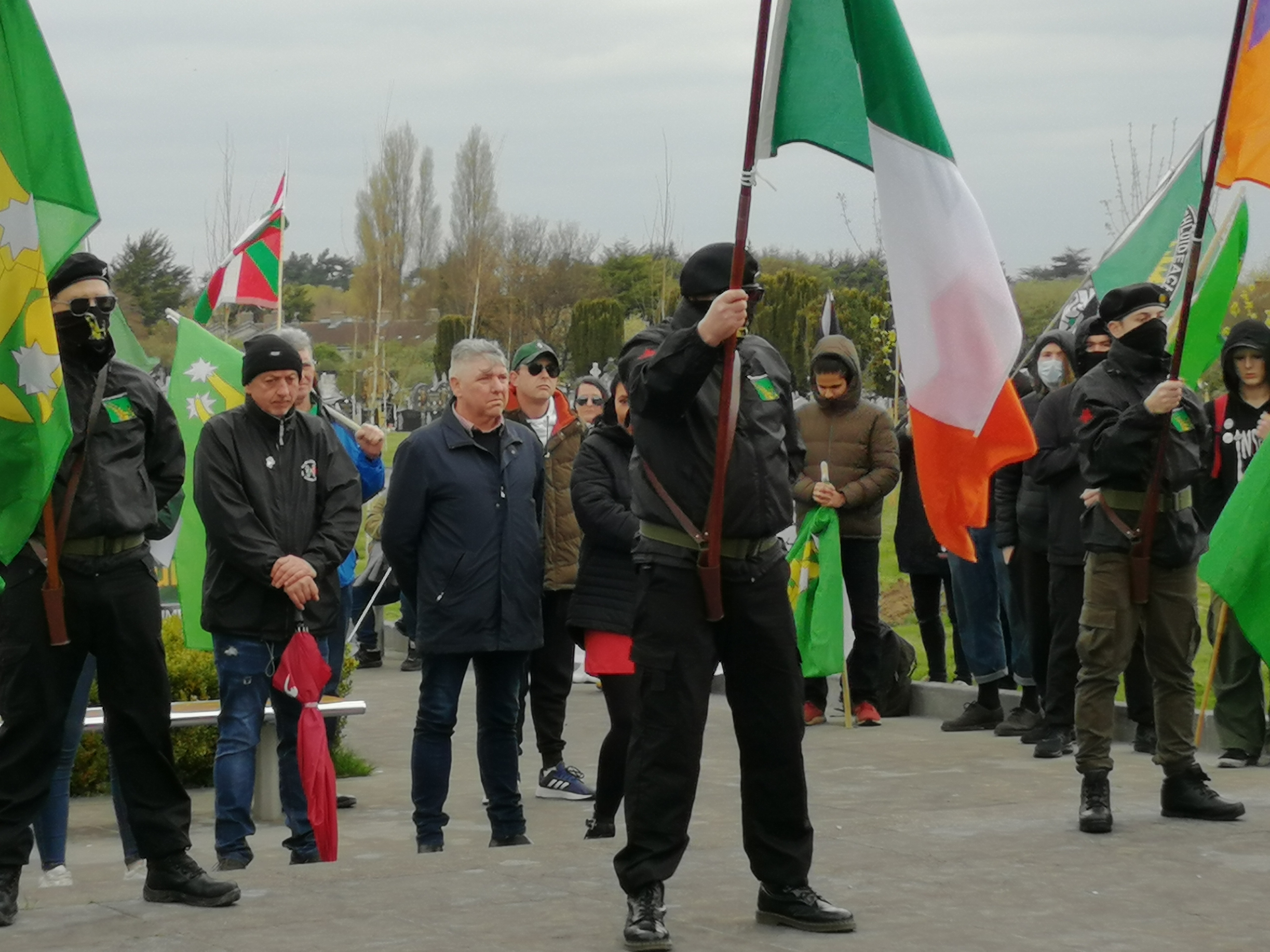
Flags fluttering included those bearing the logo of the organising group Anti-Imperialist Action and others bearing the slogan “Always Anti-Fascist”, green-and-gold Starry Ploughs, a couple of Ikurrinak (Basque flags) and another two of Red with Hammer & Sickle in yellow.
Basque and antifascist flags (Photo: D.Breatnach)
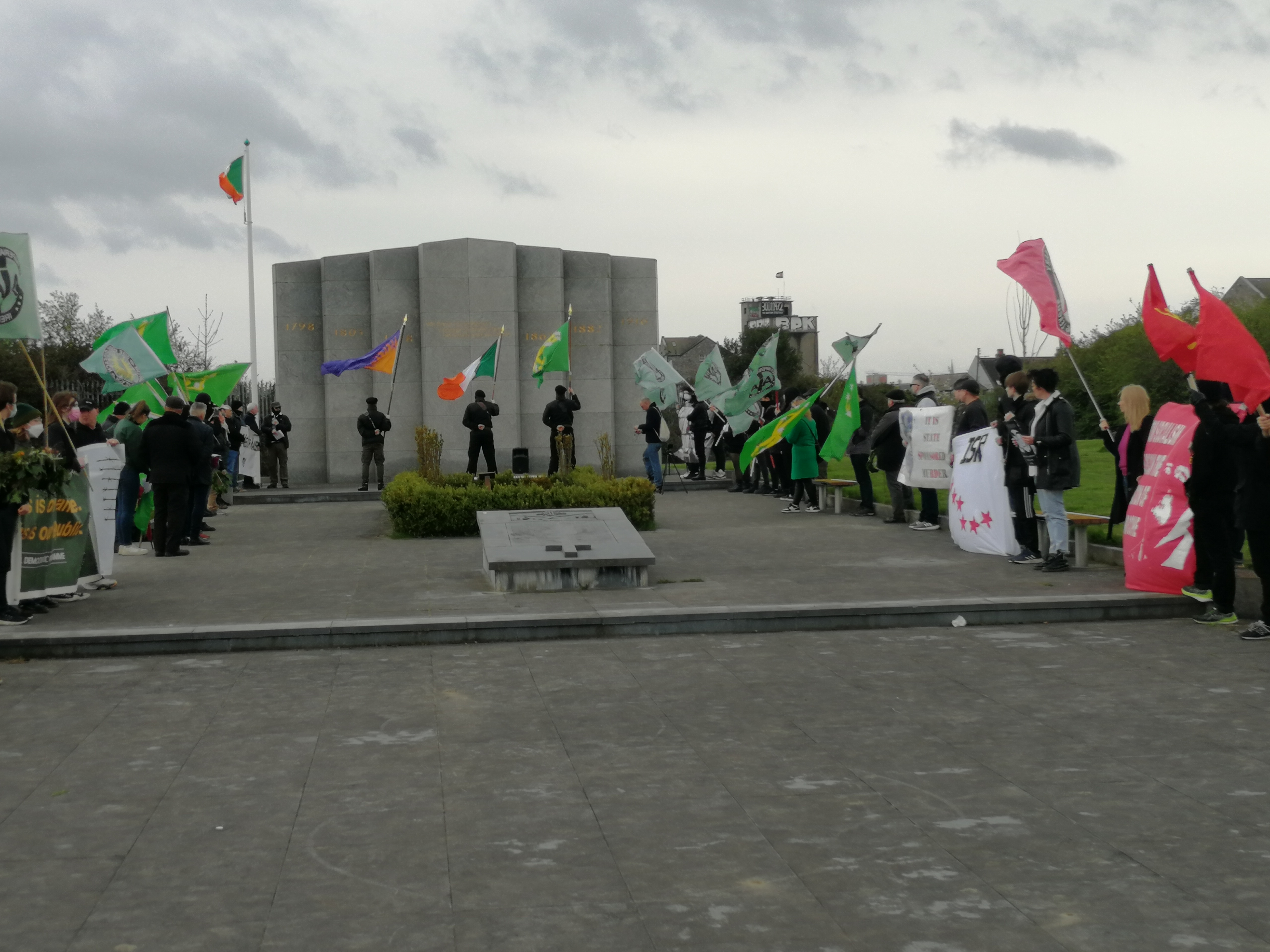
At the Monument: speeches and songs
At the monument (Photo: D.Breatnach)
Glasnevin Cemetery (ReiligGhlas Naíonn) covers over 120 acres in North Dublin city and is in two parts, each with Republican Plots separated by the Cabra Road and contains the graves of both famous and ordinary people.
On the north side there is also access to the Botanic Gardens, both on the south banks of the Tolka river. The imposing Monument to numerous Republican uprisings and the Irish Citizen Army Republican plot is on the south side, across the pedestrian bridge over the railway line.
(Photo: D.Breatnach)
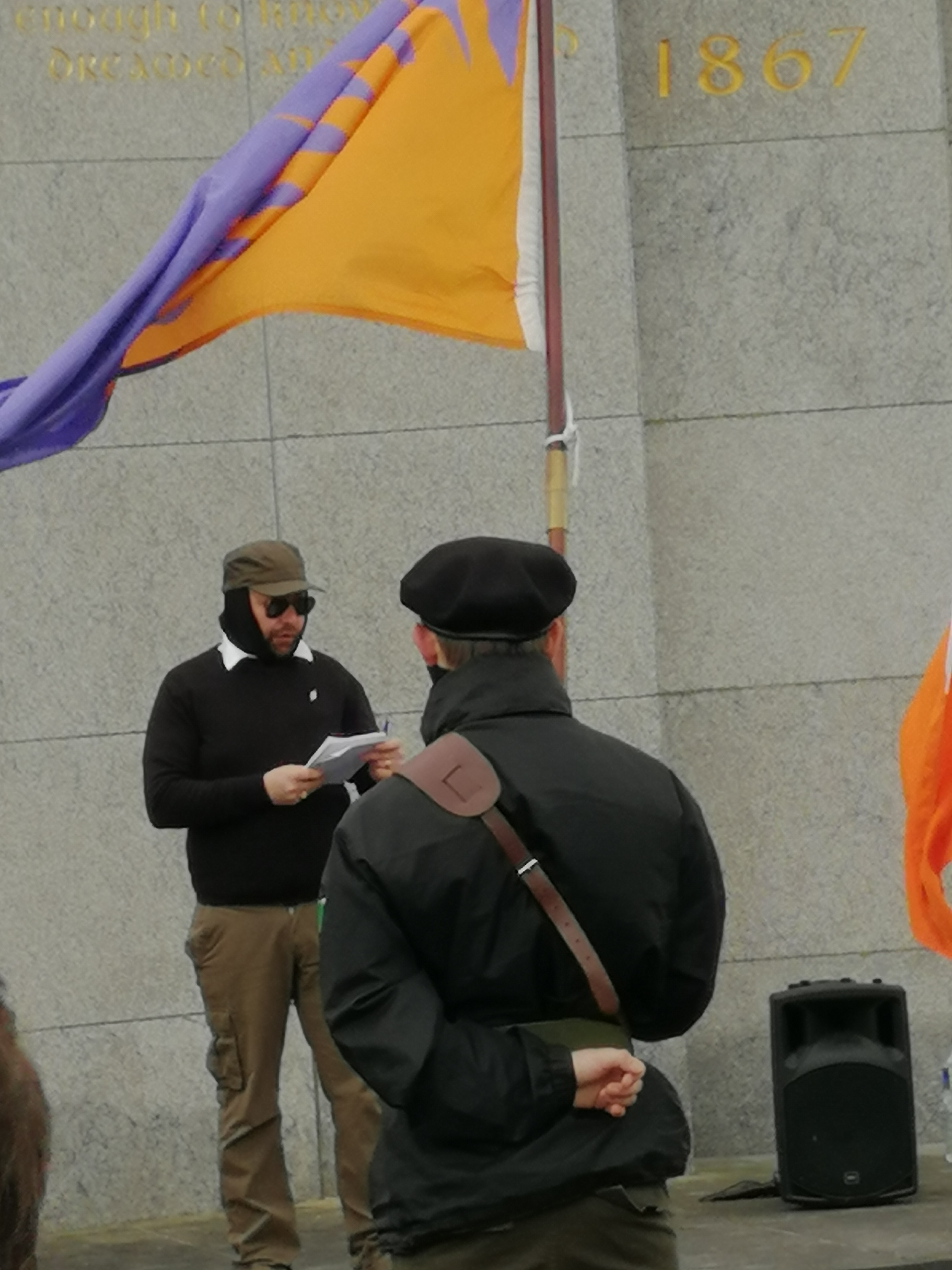
A man chaired the event for Anti-Imperialist Action and spoke briefly, introducing people for readings (all of which were from James Connolly) and for orations. The presentations of these were evenly divided between men and women, three of those being of young people.
Three songs were sung: a woman sang The Foggy Dew (by Charles O’Neill) and Erin Go Bragh (by Peadar Kearney), while a man sang Patrick Galvin’s Where Is Our James Connolly? Two women read out pieces by James Connolly and another read out the 1916 Proclamation.
Person chairing the event (Photo: D.Breatnach)
The words of the chairperson and of those giving orations were different but there were common themes: upholding the historic Irish spirit of resistance, the importance of the working class in history and the objective of a socialist Republic encompassing the whole of the Irish nation.
These words were balanced by denunciation of US and British imperialism and the colonial/ NATO occupation of the Six Counties by the latter; the Irish client regime; the special no-jury courts8 of both administrations in Ireland and repression by police forces and occupation army.
One of the singers (Photo: D.Breatnach)
One of the readers (Photo: D.Breatnach)
One of the readers (Photo: D.Breatnach)
Also denounced were those political parties that had abandoned the struggle for the Republic and instead had become part of the colonial and neo-colonial administrations or, in the latter case, were on their way to becoming so.9
Floral tributes were laid by representatives of a number of announced organisations and then others came forward to lay floral tributes also. The colour party lowered flags for a minute’s silence in homage and salute before slowly raising them again and the piper played Amhrán na bhFiann.
The other singer Lowering of the colour party flags in homage to the fallen in the struggle (Photo: D.Breatnach)Colour party raises flags again in symbolism of the struggle continuing (Photo: D.Breatnach)
The chairperson thanked all for attendance, listing organisations by name and cautioning all to stay close together as they left, due to the threatening presence of Gardaí and in particular the Public Order Unit. In the event, the celebrants exited the cemetery and dispersed without incident.
1A small unit, an armed wing of a split from the more socially conservative USA version of the Ancient Order of Hibernians, their participation in the Rising was notable.
2Photos of much of the destruction are available on the Internet and accessible by search browser.
3The terrace they occupied still stands and is the object of a historical memory and conservation struggle against property speculator plans approved by the municipal city managers and Government political parties (see smsfd.ie).
4A remarkable document, the text of which is available from many postings on the Internet.
5Irish women commemorated it in public in contravention of British WWI martial legislation in 1917 and 1918 and for decades the public commemoration of the 1916 Rising (and even the flying of the Irish Tricolour) was forbidden in the British colony of the Six Counties with attendant colonial police attacks on any attempt to do so.
6Sometimes inaccurately called “the Tan War” (reference to a special colonial police auxiliary force that became known as the “Black n’ Tans”), the war saw the birth of the IRA and lasted from 1919-1921. A British “peace” proposal opened deep divisions in the nationalist coalition and was followed by a Civil War 1922-1923, in which the pro-Treaty government and armed forces were armed and supplied by the British to defeat the Republicans in a campaign of repression and jailing, military actions, kidnapping and torture, murder of prisoners, assassinations and over 80 formal executions.
7Also displaying text referring to the First Dáil’s Democratic Program of 1919.
8The Diplock court in the colony and the Special Criminal Courts in the Irish State, political special courts in all but name, with low proof bar and abnormally high conviction rate and refusal of bail while awaiting trial.
9References to 1) the 1930s split from the Sinn Féin party, the Fianna Fáil political party that became a preferred Government party of the foreign-dependent Irish ruling bourgeoisie and 2) to the Provisional Sinn Féin party who endorsed the British pacification plan in 1998 and embarked on the road to becoming a party of reformist nationalism in the colony and is heading for neo-colonial (and neo liberal capitalist) coalition government at the moment.
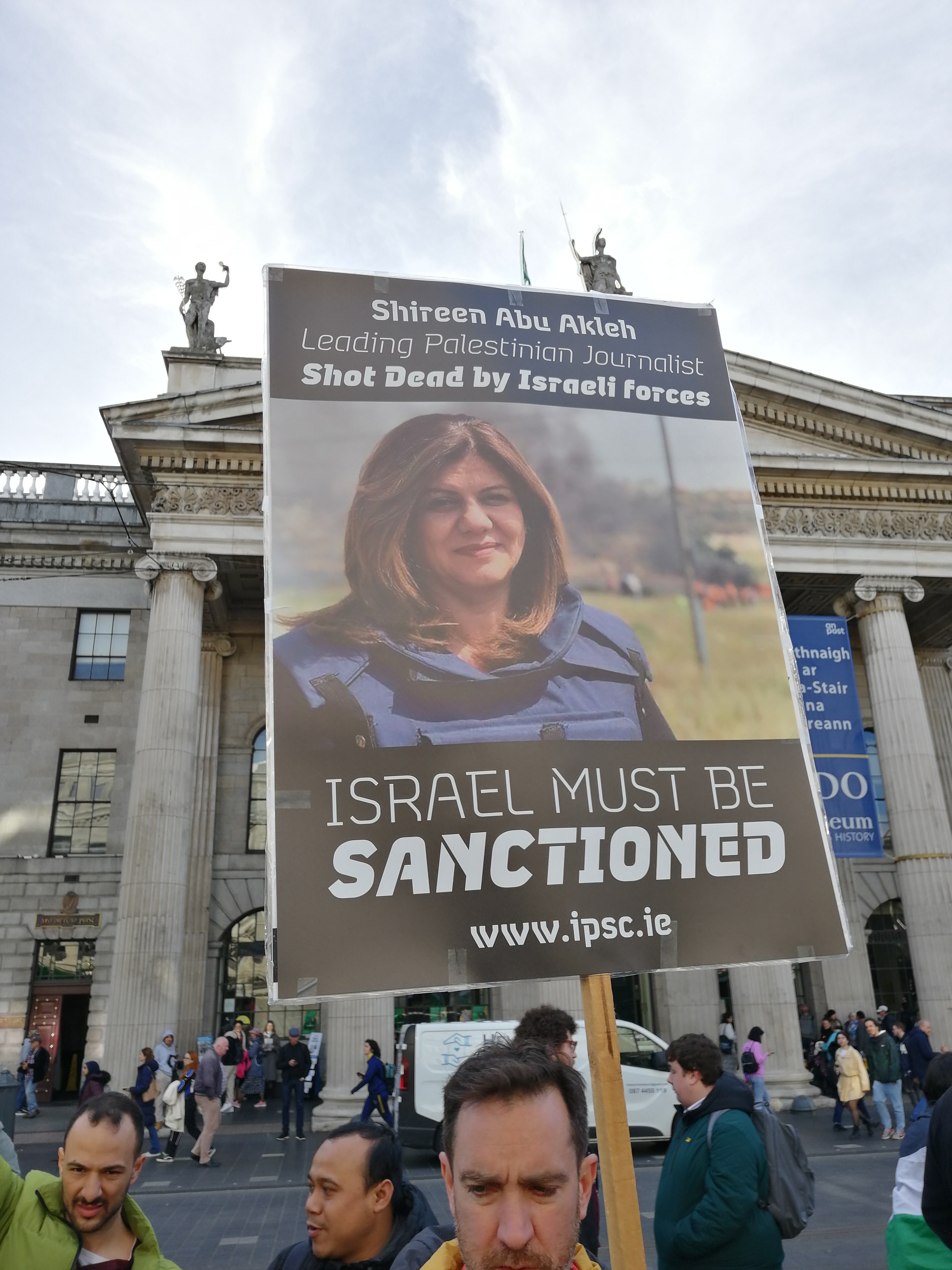
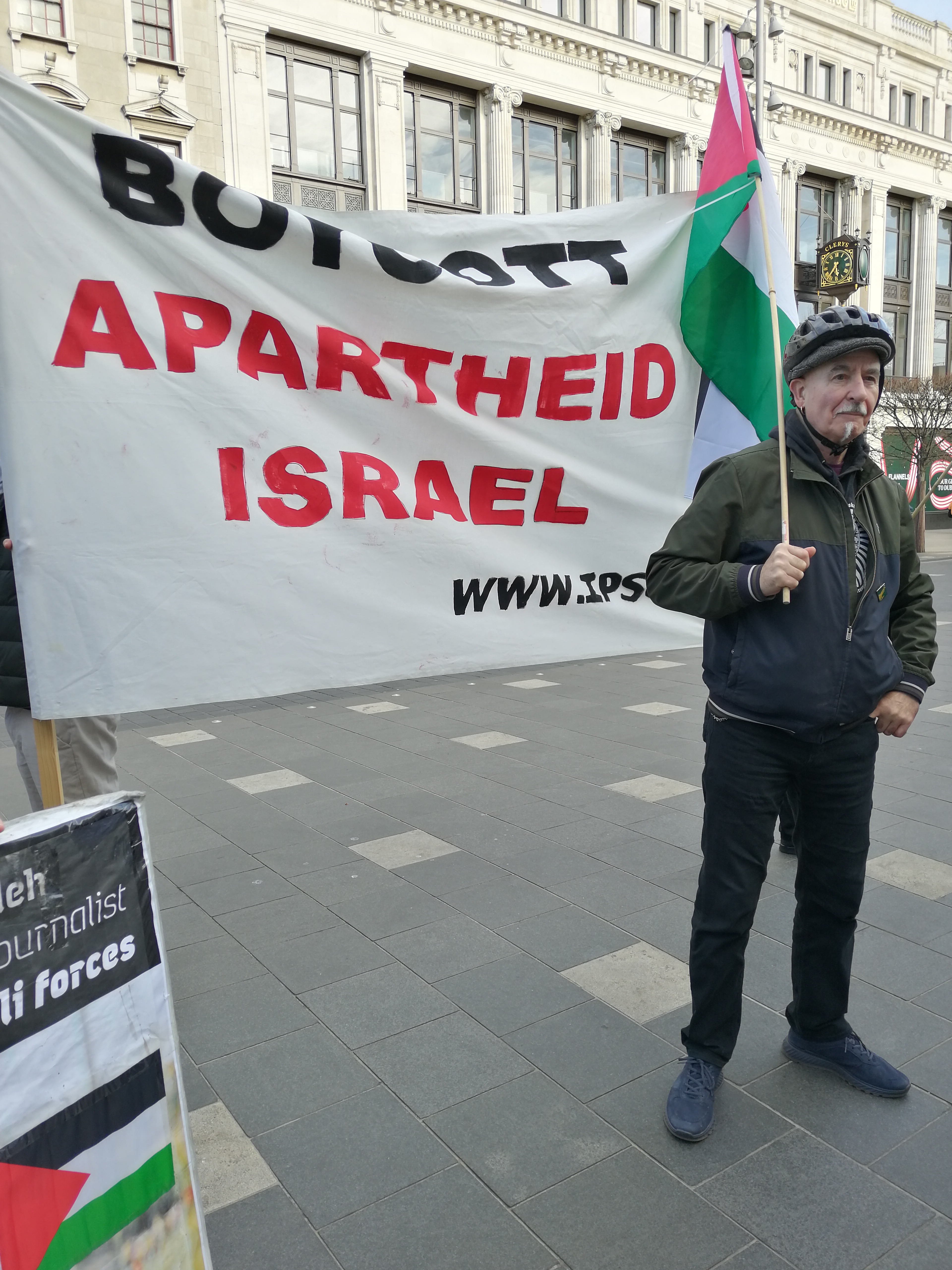
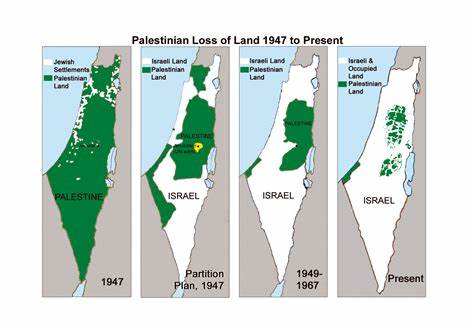
Palestinian flags waved as people gathered on the pedestrian reservation in Dublin’s main thoroughfare, O’Connell Street, to mark Palestinian Land Day March 30th, anniversary of the 1976 confiscation of Palestinian land by the Israeli Zionist State.
Naturally, the event also addresses the continual threat to additional Palestinian land by Zionist settler occupation, Israeli judicial and army demolition of Palestinian housing and intimidation, harassment and terrorism against Palestinians in Jerusalem.
Palestine supporters gathering for Land Day (Photo: D.Breatnach)
The Dublin event was organised by the Ireland Palestine Solidarity Campaign, a broad organisation that receives broad support not only across the Irish Left and Republican spectrum but also from a great many non-aligned Irish people and even many among voters for mainstream political parties.
This support was emphasised by frequent drivers in passing traffic, both public, taxis and entirely private, blowing their horns in approval of the rally. The population of the Irish state has gone from being in general support of the Israeli State to being generally hostile to its behaviour.1
Zionists tend to depict anti-Israeli Zionism as being anti-Jewish and therefore, according to them, “anti-semitic”2. Quite apart from the wide inapplicability of the term and some isolated historical examples dredged up3, it fails to account for the change in public attitudes over recent decades.
The iconic GPO in the background (Photo: D.Breatnach)
It has been years of viewing even media-sanitised coverage of massacres of Palestinians by the Israeli armed forces with international impunity that has radically altered the opinion of the public in Ireland, in all probability drawing on their own historical experience of foreign occupation.
An elderly Irishman voicing anti-Jewish views did in fact approach the rally but was confronted by other Irish people who emphasised that they were against the Zionist state and not against Jews, soon causing the first man to depart unhappily.
The continual occupation of Palestinian land by Zionist settlers has invalidated even the “two-state solution” (sic) beloved of liberals, making it a practical impossibility, undermining the main ‘concession’ of the supposed solution of the USA-mediated “Palestinian peace process” of 1991.
(Photo: D.Breatnach)
The refusal of the Israeli authorities to permit the return of Palestinian exiles while welcoming Jewish settlers, most of whom had no even ancestral connection to Palestine, means that the future for Palestinians in the Israeli state can be at best as an oppressed minority.4
(Photo: D.Breatnach)
Other Palestine news
Even as preparations for the Dublin rally took place, Israeli police shot dead a Palestinian they claimed had tried to wrest a gun from them at the Al Haq Mosque but whom Palestinian eye-witnesses said had merely been protesting the police harassment of a woman.
Since the rally, another two Palestinians have been killed in an by Israeli armed forces raid on Nablus. This brings the total number of Palestinians killed by Israeli forces this year alone to over 90, with a high proportion of them children.
Mass protests and even mini-riots by Israeli Jews are currently expressing opposition to the current government’s plans to ‘reform’ the judiciary, to bring it under the greater control of the Executive.
While Israeli Jews are deeply divided on this question the vast majority are agreed on the need to suppress Palestinians, to enforce apartheid and to keep the State as ‘Jewish’ one.
Meanwhile an April 1st Fool’s Day hoax depicting an executive of the sports shoe manufacturer company Puma declaring a boycott of the Zionist state was widely shared on the Twitter social media to overwhelmingly welcoming comment.
Exposure of the hoax received mixed responses, with wide condemnation from pro-Israeli and even some pro-Palestinian sources but others claiming it helped to widely publicise the manufacturer Puma’s close links to the Zionist State and that would enhance its boycott by many.
End.
(Image accessed: Internet)
Footnotes
1Dublin City has had Jewish municipal Councillors and the sixth President of Israel, Chaim Herzog (Hebrew: חיים הרצוג; 17 September 1918 – 17 April 1997) was an Irish-born Israeli politician, general, lawyer and author who served as the 6th President of Israel between 1983 and 1993. He was born in Belfast and raised primarily in Dublin; his father was Ireland’s Chief rabbi Yitzhak HaLevi Herzog, who immigrated to the British protectorate of Palestine in 1935 and served in the Haganah Zionist paramilitary group, later the Israeli Army where he reached the rank of Major-General. As recently as 1967 the prevailing Irish public opinion seemed sympathetic to the Israeli State and the fictional propaganda and wildly inaccurate historical Hollywood films Exodus (1960) and Cast a Giant Shadow (1966) were widely viewed sympathetically in Ireland.
2The term originally included hatred or fear of all Semitic people, including Arabs and Jews but has come to be understood as exclusively meaning a racist attitudes towards Jews. By no means all Jews are Zionist though Zionists have worked long and hard to make both descriptions interchangeable with a great deal of success among the world Jewish population with possible unfortunate consequences for Jewish populations outside Israel. However many Jews have criticised the behaviour of the Zionist State towards Palestinians, earning the hatred of the Zionists, who cannot label them as anti-semitic and therefore call them “self-hating Jews”.
An event was held on a busy Saturday afternoon in Dublin’s city centre to commemorate IRA volunteer Patrick O’Brien, killed by soldiers of the Irish State.
The event included bagpipe airs, a colour party, speeches and a resistance song.
A colour party with Irish Tricolour and the flags of the four provinces, led by a lone piper marched into and a short distance westward up Talbot Street towards where a crowd waited beside a memorial sign that had been erected shortly earlier. The colour party took up station on the opposite side of the road.
Led by a piper playing Irish airs, the colour party (i.e carrying the flags – the Irish Tricolour and those of the four provinces of Ireland) approaches as the start of the commemoration. (Photo: D.Breatnach)
Among the airs being played on the short march were Thomas Moore’s Let Erin Remember and The Wearing of the Green or The Rising of the Moon, the same traditional air to both different songs referring to the 1798 Rising.
THE SHORT LIFE OF A LOYAL REPUBLICAN
Framed portrait photo of Vol. Patrick O’Brien on display at the commemoration (Photo: D.Breatnach)
Gina Nicoletti, chairing the event, recounted to the crowd a short history of Volunteer Patrick O’Brien who was born on 17 August 1898 in the townland of Woodlands near Castledermot in County Kildare to a local agricultural working couple.
The O’Brien family had 16 children, all of whom survived and ten of whom lived with Patrick and his parents in a three-room house at the time of the 1911 Census.
An obituary published in a Republican newspaper on the anniversary of his death suggests that Patrick moved to Dublin in 1915, joining the Irish Volunteers in December of that year aged 17. He took part in the 1916 Easter Rising under the command of Edward Daly.
Evading capture in 1916 and returning home, O’Brien joined the local Irish Volunteers company in Castledermot but returned to Dublin in May 1917 and became attached to E Company, 3 Battalion, Dublin Brigade, Irish Volunteers, which was based on the south side of the city.
Sean Óg sings The Foggy Dew while accompanying himself on guitar and centre of photo is Gina Nicoletti, who chaired the event. (Photo: D.Breatnach)
An active IRA member during the War of Independence, Vol. O’Brien took the anti-Treaty side in the IRA split in March 1922.
In a response to a renewal of executions of IRA men by the Free State government, Liam Lynch (IRA Chief of Staff) issued the ‘Amusements Order’ on 13 March 1923 banning all cinema, theatre and sports events “at a time of national mourning” with action threatened against non-compliance.
At midnight on 23 March 1923, Patrick took part in an operation to blow up the Carleton Picture House, O’Connell Street (then near the Parnell Monument opposite the Savoy Cinema). The cinema had closed an hour before a landmine at the front entrance shattered the glass of several windows.
There were no injuries but newspaper articles reported that the sound of the explosion was heard several miles away. Accounts of what happened afterwards were gathered from one of the IRA unit, Volunteer Joseph Doody in his pension application.
The unit unexpectedly encountered Free State soldiers coming from the Parnell Monument who opened fire on them and another patrol was approaching from the southern end of O’Connell Street and the unit retreated through Findlater Place and out to Marlborough Street.
In the running firefight in Talbot Street, O’Brien was hit by at least four bullets (three in his left leg and one in his right leg). He fell wounded on the pavement between Speidel’s pork butchers and the Masterpiece Picture Palace at 99 Talbot Street and died about 30 minutes after arrival at hospital.
The colour party lowers the flags in honour of a martyr as the piper plays a lament (Photo: D.Breatnach)
Patrick O’Brien was 24 and his death certificate listed his occupation as an employee of a railway company. His address was 28 Cadogan Road, Fairview which is a cul de sac of Victorian redbrick houses close to Annesley Bridge and opposite the Sean Russell statue.
Only three weeks before Patrick’s death, the Free State CID1 had raided no. 43 Cadogan Road and captured the press used to print the Sinn Féin2 paper An Phoblacht along with eight people who were on site. A number of prominent IRA families lived in the vicinity, including the Brughas.
Patrick O’Brien was buried in the Republican Plot, Glasnevin Cemetery and a volley was fired over his grave, presumably following the funeral in the cover of darkness as the IRA could not have risked such a public display during the burial, in a time of martial law.
The colour party raise the flags again in symbolism of the struggle carrying on after honouring a martyr (Photo: D.Breatnach)
Despite the hard repression by the Irish State on combatants, their relatives and friends, O’Brien’s family were proud of Patrick as displayed in an anniversary notice placed in The Nationalist & Leinster Times.
The Irish Independent reported on 27 March 1923 that at the inquest of Patrick’s death, his brother James told those present:
“[My brother] … belonged to the IRA since 1915 being then about 15 years of age. He had never changed his principles since then. He always intended to die as he did … rather than change his principles as he swore allegiance to the Republic in 1916.”
FLORAL WREATH, SONG AND SPEECH
A representative of Anti-Imperialist Action was called upon and stepped forward to attach a green, white and orange floral wreath to the pole beneath the commemorative sign.
The plaque/ placard commemorating Vol. Patrick O’Brien attached in Talbot Street by Independent Republicans with the floral wreath from Anti-Imperialist Action attached below it (Photo: D.Breatnach)
Seán Óg accompanied himself on guitar singing The Foggy Dew, a popular Republican ballad about the 1916 Rising composed by Fr. Charles O’Neill.
Dublin City Councillor Cieran Perry gave a fairly short speech stressing the importance of these acts of remembrance upholding traditions of resistance in the Dublin working class, also denouncing the fake patriots who stir up racist divisions and hostility in the community.
Perry’s speech also listed some of the crimes of the Irish state, facts underlined when Joe Mooney read out the list of 70 IRA Volunteers formally executed by the Irish state along with those killed in battle or after they surrendered, or were abducted, tortured and murdered in Dublin 1922-’23.
Cnclr. Cieran Perry speaking at the commemoration. (Photo: D.Breatnach)
TRAFFIC AND PEOPLE
Traffic was light along the narrow Talbot Street during the event and slowed down to ease past the crowd that had spilled from the pedestrian pavement into the street. A few minutes’ eastward of the spot is the plaque commemorating the killing of Sean Treacy by the British in November 1920.
There was a substantial number of people in support of the event on both pavements of the one-way street but others gathered too, whether out of curiosity or in sympathy. Some of those present consisted of visitors from other countries, whether as students, tourists or workers.
The crowd grew and spilled on to Talbot Street. [The plaque to Vol. Sean Treacy killed by British soldiers in 1920 is high on the front of a building just beyond the tree on the right of photo] (Photo: D.Breatnach).
Not for the first time I thought that having leaflets to distribute summarising the event and the reason for it would be useful. I spent a little time explaining some aspects of the event and its history to a couple of visitors from Sweden who seemed very interested.
The uniformed Gardaí kept away from the event, though no doubt the plain-clothed political Special Branch had a few of their own in the vicinity to collect faces and try to match names.
THE ORGANISERS: INDEPENDENT REPUBLICANS
The commemorative event was organised by a group by the name Independent Republicans which has been doing great work in conserving and promoting historical memory associated with events such as the 1916 Rising, the War of Independence and the Civil War.
The Irish Free State came to power as an instrument of British imperialism which clothed, armed and otherwise supplied the state’s National (sic) Army. Independent Republicans have collected the names of 70 Irish Republicans killed in Dublin by that Army.
The group has also devoted time and effort to researching the backgrounds and circumstances of death of many on that list, a substantial undertaking for which we owe them a great debt. Their erection of ‘plaque’ signs around the city at the spot where the fighters fell is also great work.
The commemorative plaque/ placard to Vol. Patrick O’Brien’s memory being erected shortly before the start of the event (Photo: D.Breatnach)
On Easter Saturday (8 April) Independent Republicans will be holding a 1916 Rising commemoration in Dublin city centre, details below.
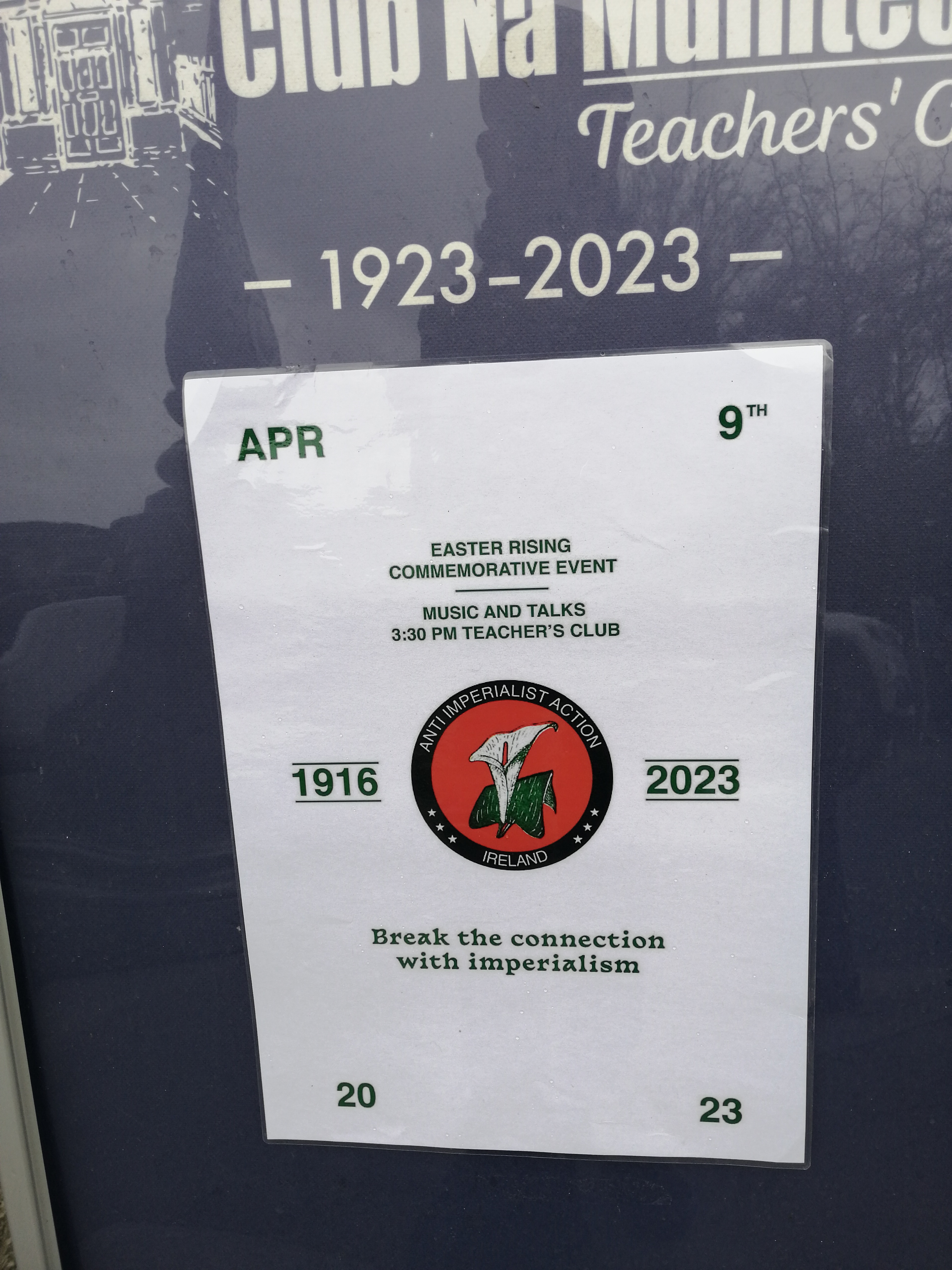
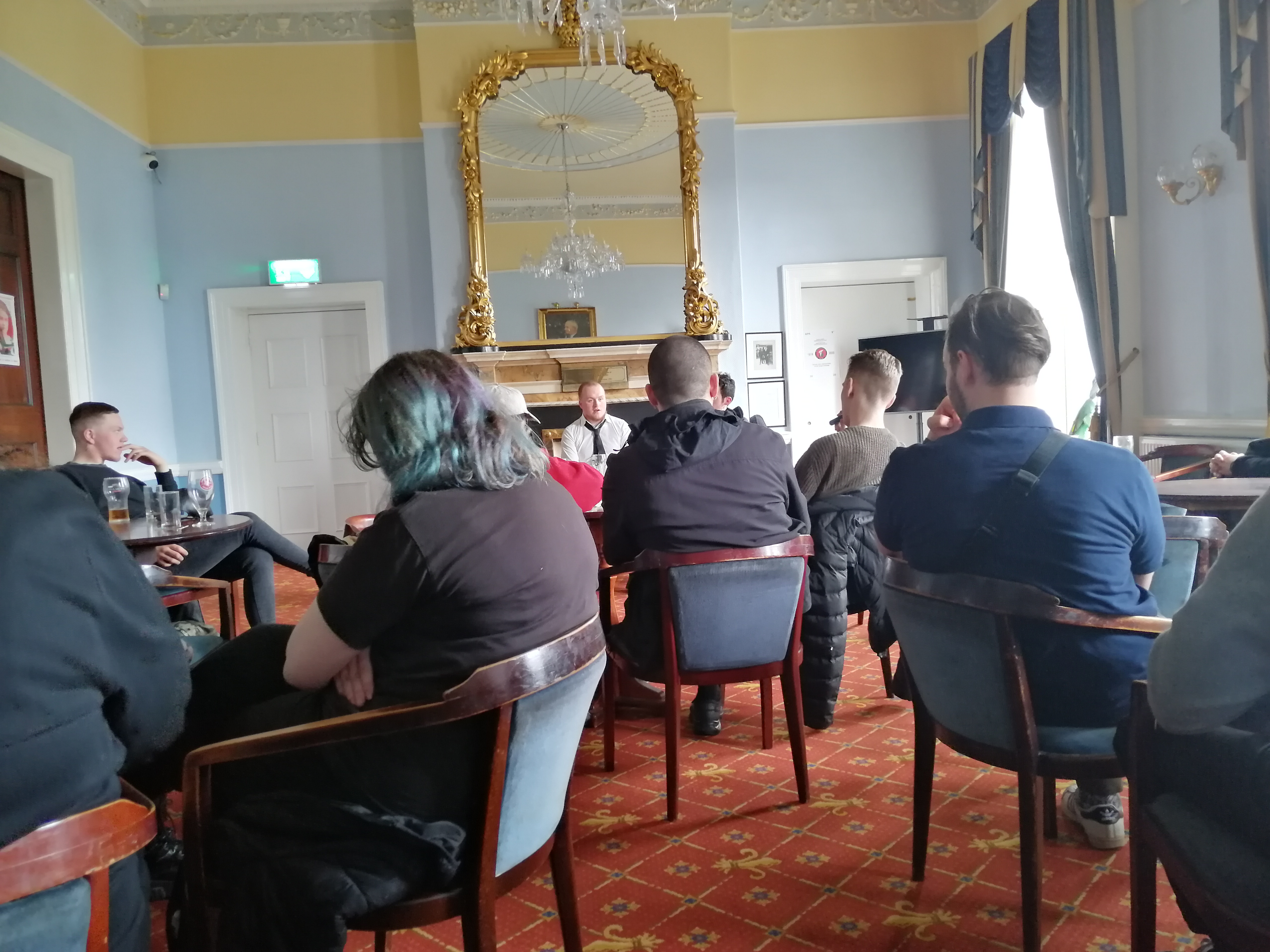
Anti-Imperialist Action will be holding theirs on Easter Sunday (9 April), details below.
End.
FOOTNOTES:
1Criminal Investigation Department, based at Oriel House, where police detectives and some soldiers of the Free State organised operations against Republicans including raids, assassinations, abductions and torture.
2This is not the party of the same name today. Sinn Féin began as a dual-monarchy Irish nationalist party, adopting Republicanism later in 1918. Those who later supported the anti-Republican status of the country and partition by England left the party and another large number left to join the Fianna Fáil party upon the latter’s founding. Briefly in the 1960s the party espoused socialism but split at the end of the decade and Sinn Féin under the Provisionals briefly adopted socialism again during the 1970s. The party of that name today is neither socialist nor even Republican.
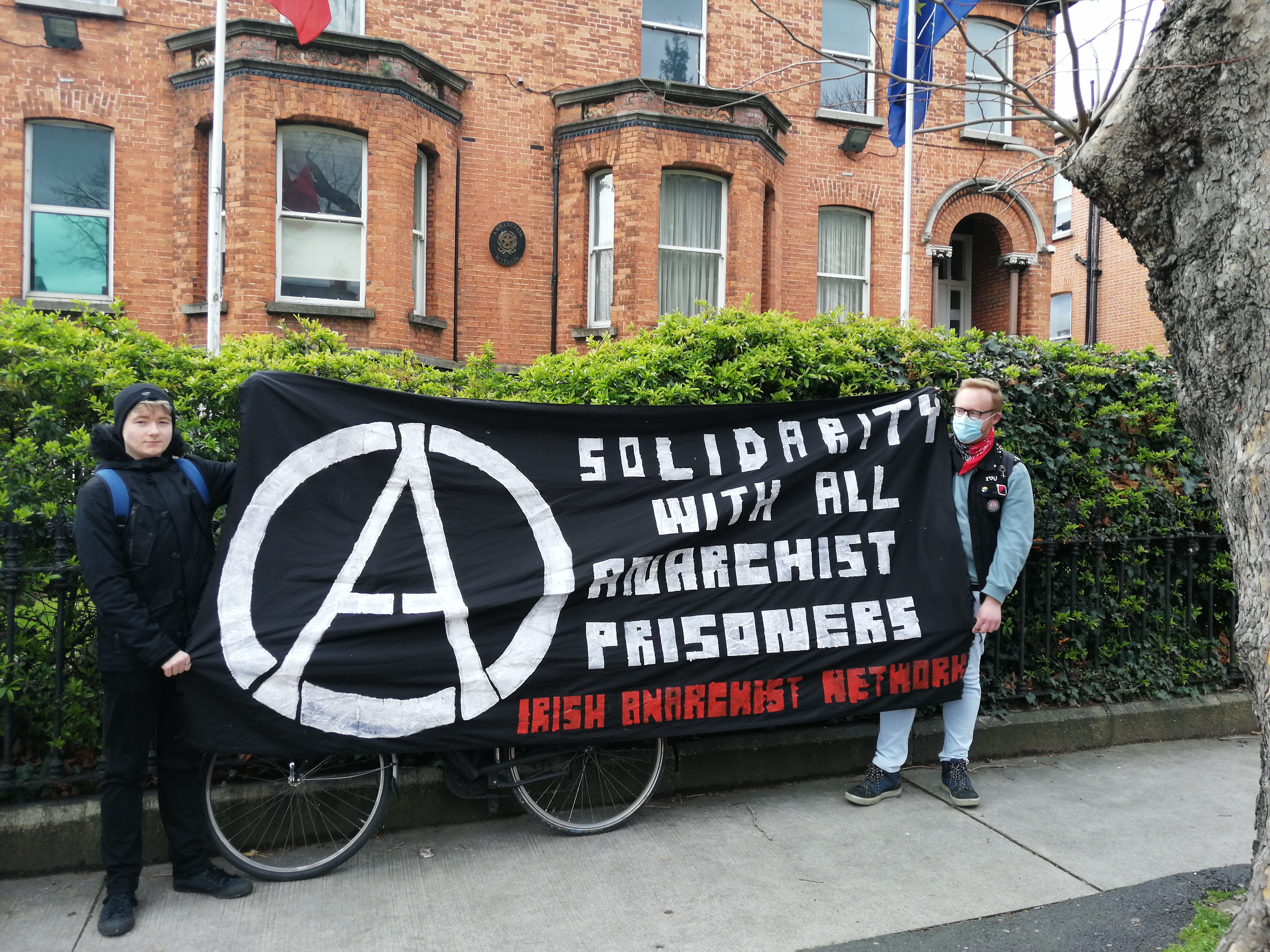
A picket outside the Italian Embassy in Dublin on Thursday (23rd) was part of a day of action across Europe in solidarity with an Anarchist prisoner on hunger strike since October in a struggle for more humane prison conditions.
The picket, organised at short notice, included Irish Republicans, Anarchists and revolutionary Socialists. Banners and placards indicated the presence of Saoradh, Irish Anarchist Network and Ireland Anti-Internment Campaign.
At one point five uniformed Gardaí stood near the Embassy’s gate while three plain-clothes Special Branch (i.e. political police) watched from a car across the road. The police numbers may have been due to a request from the Embassy in the midst of attacks on some Italian Embassies in Europe.
Despite the presence of Gardaí, Embassy staff appeared nervous, meeting one visitor at the gate to check her reason for attendance after speaking to her on her mobile phone, rather than first allowing her to enter the garden and approach the main entrance.
Some of the uniformed Gardaí attending the solidarity picket and some of the protesters. (Photo: IAIC)
Three Special Branch Gardaí (political police) parked across from the picketers, surveilling them (Photo: IAIC)
THE HARSHEST ITALIAN PRISON CONDITIONS
Alfredo Cospito is an Italian political prisoner kept under the harshest Italian prison conditions, “41-bis”, which include solitary confinement for most of the day, family visit once a month through glass, no reading matter sent from outside and no phone calls in either direction or lawyer privacy.
According to information on the Internet, these inhumane conditions were developed for Mafiosa leaders, in order to prevent them running their organisations from inside jail and also to pressure them into breaking ranks and informing on their colleagues.
Whatever we may say about that, what can be the intention of subjecting a political prisoner to those conditions, except to break him or to destabilise him mentally? EU recommended rules on prisoner management don’t recommend more than three weeks in solitary confinement.
Lawyers for political prisoner Nadia Lioce, who has been living under the 41-bis regime for two decades, have said due to limited hours permitted contact, she has effectively only interacted with people for a total of 15 hours in the space of a year.
Italian media reported Lioce’s lawyers as saying she is now so “psychologically isolated” that, when her mother and sister visit, she is unable to speak to them for more than a few minutes.
Some of the picketers, the Italian Embassy in the background (Photo: IAIC)
Amnesty International and the European Court of Human Rights have both criticised several aspects of the 41-bis, and in 2007 a US court refused to extradite a convicted Mafia drug trafficker on the grounds that the 41-bis regime he would face in Italy would have “constituted torture”.
The Anti-Imperialist Front gave a call for an international solidarity day of action which found an active response in many countries.
Alfredo Cospito’s case is up for review by the Italian prison system this month and pickets and other actions have been organised around Europe to exert pressure on the Italian penal authorities to release Cospito into house arrest in his sister’s home.
The picket displayed not only internationalist solidarity but exemplary broad unity of disparate political forces in solidarity with an Anarchist political prisoner. Hopefully this unity will continue to be built upon as time goes on, for the unfolding struggles of class and nation demand it.
Hopefully the international actions will cause the Italian authorities to relax the inhumane conditions of Alfredo Cospito’s incarceration but now Italian authorities are claiming that Cospito is somehow coordinating violent actions from within his extreme isolation.
Another two of the picketers (Photo: IAIC)
A side trip into history
The Italian Embassy is in Northumberland Road, on the south side of the Grand Canal (near the Israeli and US Embassies).
As they were leaving, some of the picketers took time to look at a plaque and monument to the Mount Street Bridge Battle between Irish Volunteers and British soldiers in 1916. Four Volunteers were killed and between 26 and 30 Sherwood Foresters, with 134 more wounded.
Mount Street Battle Monument, on the Bridge over the Grand Canal itself. The English explanation is on the reverse. (Photo: IAIC)
A number of Volunteers were captured but a number got away also. Two of the buildings from which the Volunteers fought remain, bearing the marks of bullet strikes. The third, Clanwilliam House was set on fire by the British and was replaced by a 1960s-type office building later.
We began the previous manifesto talking about emergencies. We said that it was essential to reclaim an anti-imperialist and internationalist Euskal Herria2.
And that urgency, that need, is what has brought together comrades from all corners of Euskal Herria here today. Well done all of us!
Capitalism is going through a systemic crisis. They speak to us of a “extraordinary period” but the truth is rather that we find ourselves in a permanent crisis. As we have supposedly departed one, they have already placed us in another.
As of 2020, moreover, we have entered a phase of exceptionality in which States take advantage to impose economic, social and disciplinary policies that point towards a war scenario. Therefore, we cannot separate the capitalist decomposition from the increase in repression and censorship.
Banner reading “Condemning us to war and misery” and section of the anti-NATO march in Bilbao 11 March. (Photo sourced: organisers)
The rise of fascism that is taking place throughout Europe is a direct consequence of the bourgeoisie’s fear of losing the control it exercises over an increasingly exploited and angry population.
In the field of international relations, we are also witnessing the increasing loss of hegemony of the Empire that has controlled the world practically without opposition for the last 30 years.
The bloc led by the United States and NATO, far from accepting the end of its historical cycle, seems determined to increase armed conflicts. In addition to giving a boost to the arms industry, they intend to hinder the growth of emerging powers such as China or Russia.
For this phase of confrontation, they have finally achieved the support of the lobby led by Ursula Von der Layen, the “gardener” Borrell3 and company.
NATO and the EU, together with the Zionist entity that redoubles its attacks on the Palestinian people, are today the main props of this dark period in history.
As far as NATO is concerned, we have to understand that its role goes beyond being a mere military organization. It is true that it is mainly the army of the bourgeoisie (and it is demonstrating this in Donbass, as it has also demonstrated in Yugoslavia, Libya or Syria).
But it has the superior function of being the military arm against anyone who opposes the policies of capital. Today these translate into the over-exploitation and precarity of the working class (especially women and people of colour).
And changes in labour rights to deprive us of material concessions wrested through class struggle, change of laws to increase the repression of those struggles, etc.
A clear example of this is the latest General Budget of the Spanish State, supported by all the social democratic parties4.
The budget supports the deterioration of the material conditions of working peoples to benefit NATO, giving it more control capacity and recognizing their right to appropriate civil infrastructures to defend the interests of the bourgeoisie.
The support for these militaristic policies, at the dawn of a world war, is a real shame and demonstrates the total lack of commitment of the leadership of these parties to the future of the Working Peoples of the world.
In Euskal Herria we are well aware of what NATO represents:
in addition to the military training industrial estate in Las Bardenas or the military exercises carried out at the Araka base (Gasteiz), we have recently witnessed blatant support from the Government of Gasteiz for war industries such as SENER or SAPA.
Nor can we forget the historical support of NATO, through the Gladio network, to the Spanish and French States in their legal and illegal repression5 against the struggle in Euskal Herria.
If we add to this the economic and social exception measures imposed on us by Brussels (private pension funds, increase in the retirement age, dismantling of public health) …
It becomes increasingly clear to us that neither as a nation nor as working class do we have a future within NATO or the EU. The need to destroy these instruments of domination by the bourgeoisie, as well as the Spanish and French States, is more than evident if we aspire to build a future in freedom.
These are not good times, of course not. The situation is becoming more and more complicated throughout the world. And that is why we here today are calling for the activation in each town and each neighborhood of the anti-imperialist Euskal Herria.
Today, we not only reaffirm this rejection, but we once again make an urgent call to join forces with the rest of the working peoples and oppressed nations of the world to stop the imperialist offensive promoted by this criminal organization along with its allies in the European Union.
From Chile to Donbass, passing through Laos, Mali or Vietnam…
LONG LIVE THE STRUGGLE OF THE WORKING PEOPLE!
AN ANTI-IMPERIALIST BASQUE COUNTRY!
Front of march heading towards the Bridge across the Nervión river and the old city (Photo sourced: organisers)
COMMENT: A GIANT STEP FORWARD
Diarmuid Breatnach
(Reading time:One min.)
The estimated 2,000 turnout in support of this demonstration must have exceeded the expectations of the organisers and greatly encouraged them. Two thousand is not a huge number in the highly-politicised Basque Country, even with a total population of less than three million, north and south.
But this is a nation which has for decades been under a political leadership, the surviving members of which have now taken the road of pacificaction, of accommodation to capitalism and the Spanish and French states, of social-democratic ‘opposition’.
This movement had a united national political leadership, an armed guerrilla movement, a daily newspaper, a trade union and smaller affiliated groups; it had café/bars/social centres throughout the southern provinces.
Though in decline and fragmented with the leadership’s embracing of the pacification process (through which, unlike the Provos, they did not even gain the release of their hundreds of imprisoned comrades), it still exercises a heavy influence on politics in the Basque Country.
That is today the ambit of Otegi, EH Bildu and Geroa Bai and neither did their parties participate in Saturday’s demonstration nor as an individual any of senior responsibility in their structures, though certainly individuals in their social and cultural sectors were seen in the march.
In that context and after 25 years of pacification, 2,000 in open attendance is a giant step forward for the Basque resistance. ‘Tús maith, leath na hoibre‘, it is said in Irish: ‘A good beginning is half the work’ and indeed, a beginning is how the organisers view the event.
“Dissident” groups such as Amnistia ta Askatasuna, Amnistia Garrasia, Tinko and Jardun have arisen in the last decade and youth have been very prominent in these and others disparate groupings, which is important for any revolutionary movement.
The photos and videos of Saturday’s demonstration show older and mature faces too, veterans of the struggle and also those active during the pacification period and this too is important, for it brings a certain continuity to the movement and the awareness of mistakes made in the past.
More than 50 organisations in the Basque Country supported the call for this demonstration.
The road ahead will not be easy (when has it ever been for the Basque nation or the working class in general?) but a giant step forward has been taken.
End.
FOOTNOTES
1Askapena is the internationalist arm of the Basque movement for independence and was responsible for a number of years for maintaining a network of Basque solidarity organisations (which in some cases it founded) in Mexico and across a number of European cities, including Belfast, Dublin and Cork. In 2011 five of its leading activists were arrested on charges of supporting the guerrilla organisation ETA, through Askapena’s solidarity with political prisoners. The five defended their right to work with prisoner and internationalist solidarity and were finally acquitted in 2016 earning much admiration for their stance (in stark contrast to the 47 activists in a number of prisoner support organisations who apologised for their activity in a Spanish court in September 2019 in exchange for non-custodial sentences for the majority).
2The current Basque name for their nation, “the Basque-speaking country”, replacing the former “Euskadi”, now used to refer only to the three-province ‘autonomous’ region of Bizkaia, Araba and Gipuzkoa.
3Josep Borrell, Foreign Minister of the EU Parliament who has described the EU as “a garden”. A Catalan member of the PSOE, hostile to Catalan independence who after five minutes stormed out of an English-language interview by Tim Sebastian on the German TV program Conflict Zone regarding the struggle in Catalonia.
4This is a reference not only to the social-democratic coalition government of the PSOE and Podemos but also of the Basque EH Bildu and Catalan ERC, the votes of which MPs supported the Budget.
5A reference not only to banning of parties, organisations and demonstrations but also to routine torture and the kidnapping and assassinations of the State-sponsored GAL of the 1980s.
6In the 1986 Referendum on whether the Spanish state should join NATO, the southern Basque Country gave a majority vote against, the only region to do so (though the vote against was high in some regions), the total vote being 52.54% in favour.
According to reports, a Dublin City Councillor and former Lord Mayor, Niall Ring, along with his son, were racially abused and assaulted in a pub in Fulham, a part of SW London in which the Chelsea FC stadium is located.
Ring recounted how, having a pint after watching a game at the Chelsea stadium, first his son was racially abused and then, as they tried to leave, each assaulted, requiring a hospital attendance for both.
Decades ago I was active in a building occupation for homeless families five minutes’ walk from the stadium as Fulham became gentrified and even then, though like many parts of London it had its Irish community with pubs and trad music, Chelsea FC was particularly known for its fascist ultras.
Whether affiliated to the National Front or its successor the British Movement, they took part in attacks on migrants and ethnic minorities, including the Irish and in particular on marches in Irish solidarity, when groups like AFA, Red Action and some Irish Republicans led the counterattack.
And the police usually restricted themselves to attack the Irish and antifascists.
Some years after that period in Fulham, I joined the Irish in Britain Representation Group and soon after was elected to the Ard-Choiste, which had meetings approximately monthly. Since the branches ranged from NE Lancashire to London, the meeting city venues were rotated.
Consequently I was often enough on a train journey between London and Manchester and on one occasion was unfortunate enough to share a carriage on a full train with a load of racist and fascist Chelsea FC fans returning to London.
I plugged my walkman leads into my ears to avoid getting into conversation with any of them but played no music so I could listen to what went on. In the course of that horror journey I heard racist chants against the martyred Bobby Sands and even against the population of Liverpool.
I also noted their use of the term “Fenians”, not at all common among the English, presumably learned from equally racist Rangers and Linfield FC fans. A white man walking through the carriage with a dark woman elicited hisses of “race traitor”.
This is the kind of scum that the boot-boys of fascism everywhere are and which are trying to get a foothold here in Ireland through the protests against refugees (which Ring referenced briefly).
The stage production of Tales From the Holywell, written and performed by Damien Dempsey, is currently running at the Abbey until the 18th – and possibly beyond. Once advertised it was booked out for three weeks (with possible access through cancellations).
It was through cancellations that I and a few others faithfully waiting got in to see the performance on the 7th (it was closed on the bank holiday of the 6th). I really enjoyed it and cried laughing at times.
The whole audience gave him a standing ovation at the end and joined in singing one of his songs during his encore.
The stage set was bare and without background, with stage lighting showing Dempsey alone at times and at others, revealing players of keyboard, violin, double bass and percussion. Dempsey accompanied himself, alternating between two guitars.
The production consisted of Dempsey talking about his upbringing, his difficulties with his father but with whom he went to live when his mother left home, childhood and adolescent battles, his struggles and desires as an artist – all interjected with humorous cracks and songs.
He comes across as a man committed to his art and with integrity.
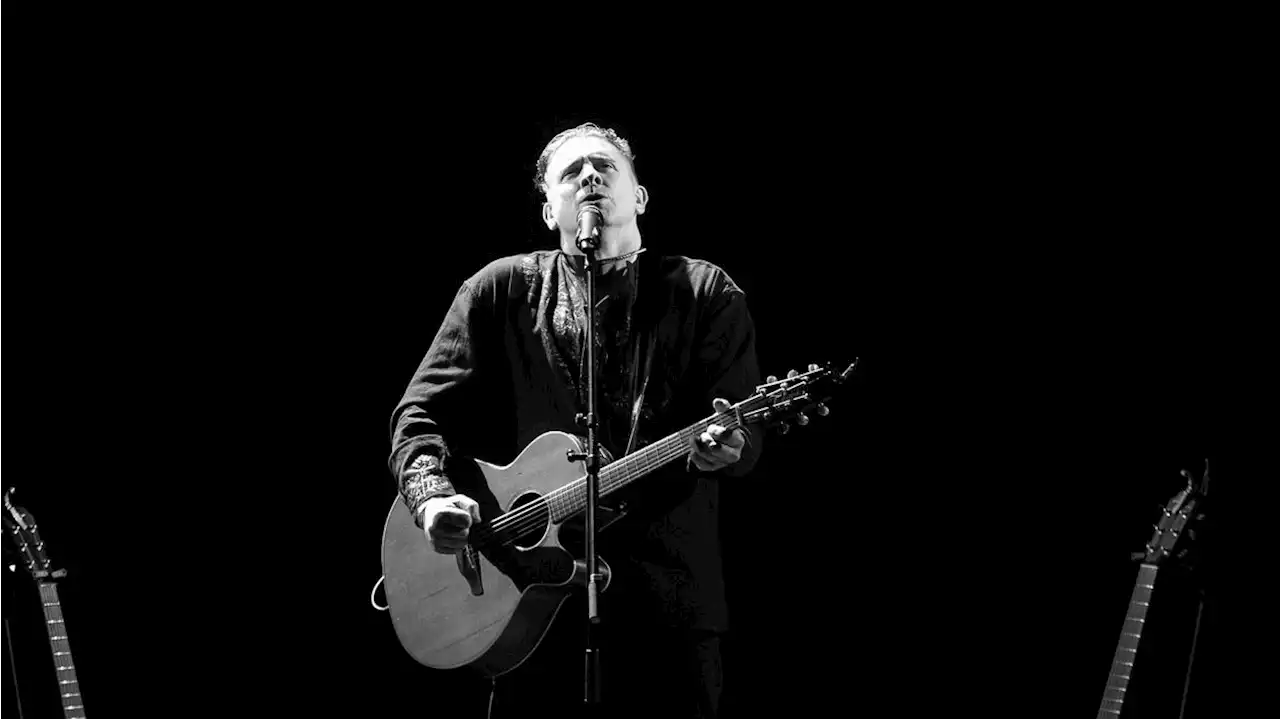
Dempsey performing at Abbey Theatre (Photo sourced: Internet; audience photos were prohibited)
Dempsey was raised in Holywell Crescent, a collection of local authority houses constructed on the site of an ancient holy freshwater well. This was one of probably thousands of wells across Ireland, each thought to be inhabited by a pagan spirit and then given a saint’s name by Christianity.
The well after which Dempsey’s street was named was St. Donagh’s Well (probably misnamed, see Links below) near Killbarrack and as the area became anglicised, called only “the Holy well”, then “Holywell” and the pool itself filled in and built over.
Whether he can speak it or not I have no idea but the Irish language made an appearance from time to time in Dempsey’s narrative, always with respect and, one might say, even reverence. And I was amazed to hear him sing a verse from An Cúlfhionn a capella, totally in Irish.
His song Colony – some might say masterpiece – gives a clear indication of what Dempsey feels about the long colonisation of Ireland and its parallels elsewhere in the world. I hoped he might take the opportunity to comment on the growing racist mobilisations in Ireland but was disappointed.
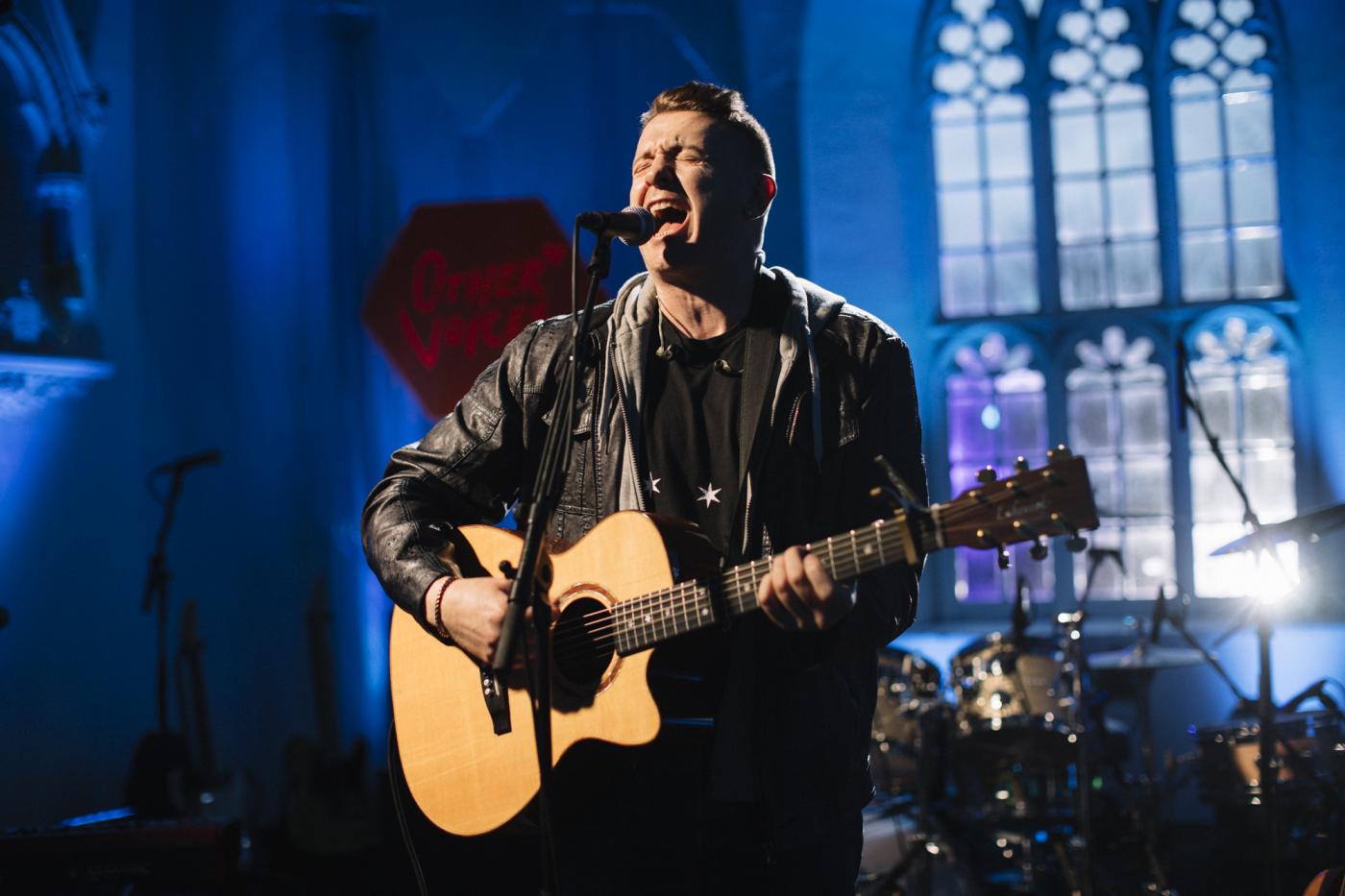
Dempsey performing (Photo sourced: Internet)
Conor McPherson directed the production which was written and performed by Damien Dempsey.
Apart from Dempsey’s, other music was provided by Lucia McPartlin (fiddle, vocals), Aura Stone (double bass) and Courtney Cullen (drums, percussion, vocals). I noted no name given in the theatre program for the keyboard and vocals performer.
I’m a great fan of Damo’s lyrics but less so of his singing; a question of musical and cultural taste, I suppose. But still I rose, wholeheartedly with the rest, to applaud his performance.
Whether its run will be extended I don’t know but currently it’s advertised to end on 18th February. If you haven’t booked, it’s well worth getting there early and hoping for a cancellation.
















 rebelbreeze