Basque Solidarity for Corsican Patriot Murdered in French Jail

Clive Sulish

(Reading time: 2 mins.)

SPEECH DELIVERED AT THE RALLIES ORGANISED BY JARDUN IN RESPONSE TO THE MURDER OF CORSICAN POLITICAL PRISONER YVAN COLONNA (Se encuentra la versión anterior en castellano/español al fondo)

Yvan Colonna was from a young age a member of the Corsican liberation movement. After being forced to remain in hiding for four years, he was arrested in 2003, accused of participating in an action carried out by an anonymous group. The accusation was based on statements of several of the movement’s members detained at the police station, who later rejected the statements but Yvan was sentenced to life imprisonment.

Posters demanding justice for Yvan Colonna after his arrest (Photo sourced: Internet)

Colonna was left in a very serious coma after the beating by a jihadist prisoner in Arles prison. On Monday of this week, Yvan passed away after three weeks in hospital. During that time there were riots denouncing the role of the French state in Yvan’s murder.

Yvan was murdereded by the penitentiary policy of dispersal and the conditions of the prison. We in the JARDUN Coordination charge that the beating and death received by Yvan was a direct consequence of the penitentiary policy of the French State. Likewise, we want to underline the need to create an organisation in support of the freedom of political prisoners and the fight against oppression and exploitation.

It should not be forgotten that in Corsica, the struggle for independence has been ongoing for decades with the aim of overcoming the political-economic system imposed by the French State and fighting for a popular and democratic government that would act in favour of the Corsican people. The struggle of the Corsicans is the struggle against French imperialism, against the oppression of the local working people and against the exploitation they suffer.

In Euskal Herria (the Basque Country – Trans.) we are well aware of the repression and oppression by oppressive states and we are witnesses to the massacres committed so many times by the French State. Because we cannot forget the imperialist attitude of the French State in Algiers and other colonies, becoming, together with the United States, the main promoters of contemporary torture.

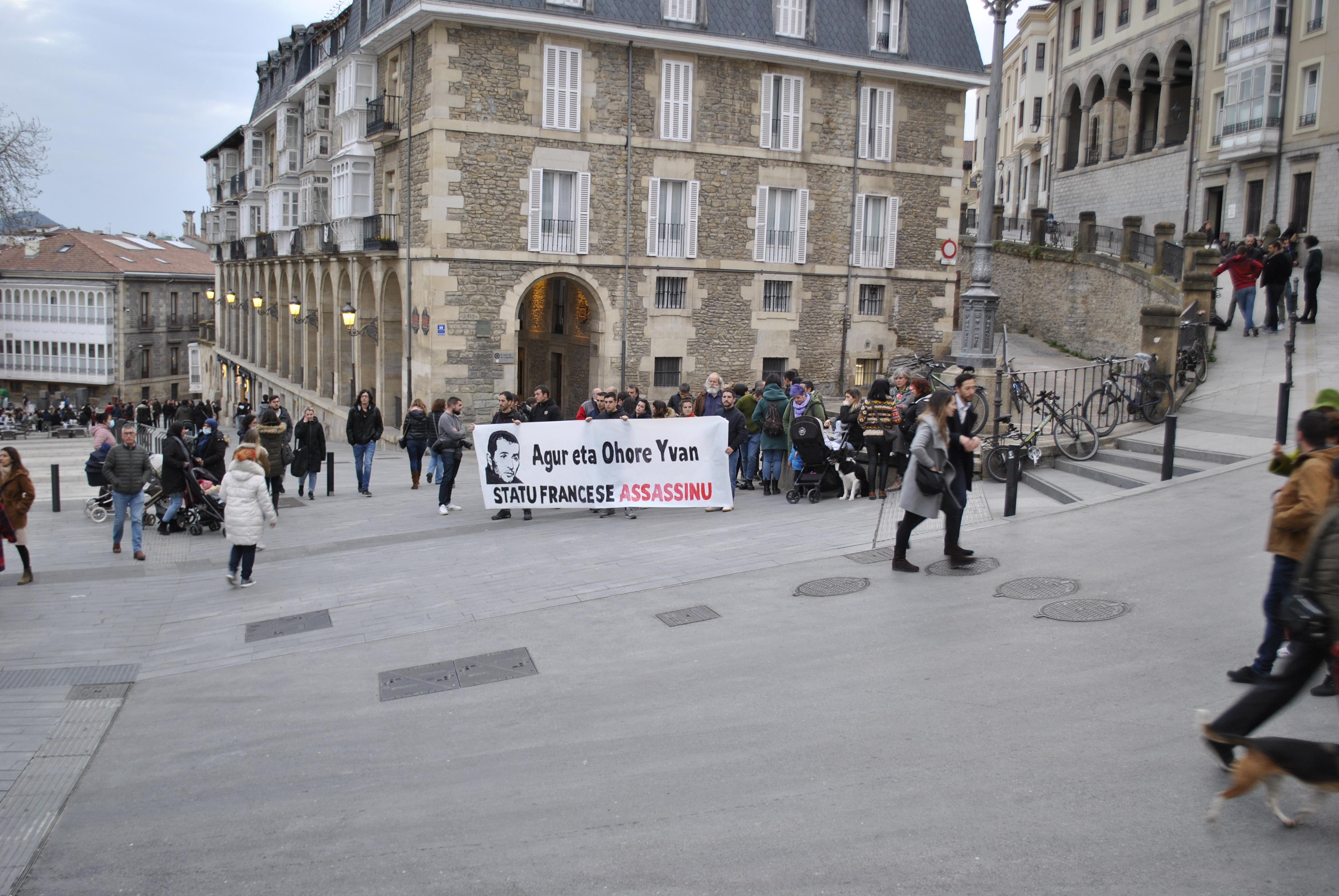
Solidarity picket in Gastheiz/ Vitoria, southern Basque Country, on Friday 25th (Photo: Jardun Koordinadora)

All of this shows us nothing less than the need for the organisation of the working class. It is evident that both the imperialist power and the oppressive States exercise a monopoly on violence to defend their economic interests and, in every nation, those who pay are always the working class.

It is time to denounce the fraud of social peace, it is time to denounce the warlike attitude of NATO, in Donbass, the Sahara, Palestine, today they are waging endless wars in defence of the interests of imperialism and its servants — and in view of this, it is time to awaken internationalist solidarity!

For this reason, we in JARDUN proclaim that it is time to turn to revolutionary organisation for all working people! Because only the organised people can offer real help and, as far as we are concerned, only the Basque working people can obstruct the participation of the Spanish and French States, organizing themselves in Euskal Herria to face the enemy, working for a political system in favour of the Basque working people.

We are clear that struggle is the only way and we will loudly proclaim that we have to confront the enemy, exploitation and class oppression. That is why we encourage you to join the organisation, because it is time to fight, it is essential to resist!

AGUR ETA OHORE YVAN! (Farewell with Honour Yvan!)

GORA KORSIKAKO HERRI LANGILEAREN BORROKA! (Long live the struggle of the Corsican working people!)

GORA EUSKAL HERRIA ASKATUTA! (Long live a free Basque Country!).

end.

Solidarity picket in Donosti/San Sebastian, southern Basque Country, on 26th March (Photo: Jardun Koordinadora)

Lectura lanzada en las concentraciones organizadas por JARDUN ante el asesinato de Yvan Colonna

Yvan Colonna era miembro del movimiento de liberación corso, en el que militó desde joven. Tras ser obligada a permanecer 4 años en la clandestinidad, fue detenida en 2003 acusada de participar en una acción llevada a cabo por un grupo anónimo. La acusación se fundamenta en la declaración de varios de los miembros detenidos en la comisaría, que posteriormente rechazaron la declaración, pero Yvan fue condenado a cadena perpetua.

Colonna quedó en coma muy grave tras la paliza de un preso yihadista en la cárcel de Arlés. El lunes de esta semana, Yvan falleció cuando llevaba 3 semanas hospitalizado. Con el objetivo de denunciar el papel del Estado francés en el asesinato de Yvan desde que ingresó en hospital, durante ese tiempo  ha habido disturbios.

Yvan fue asesinado por la política penitenciaria por la dispersión vivida y las condiciones de la prisión. Desde la  coordinadora JARDUN  denunciamos que la paliza y la muerte recibida por Yvan ha sido consecuencia directa de la política penitenciaria del estado francés. Asimismo, queremos subrayar la necesidad de articular una organización a favor de la libertad de los presos políticos y de la lucha contra la opresión y la explotación.

No hay que olvidar que en Córcega, la lucha por la independencia se ha dado durante décadas con el objetivo de superar el sistema político económico impuesto por el Estado francés y luchar por un gobierno popular y democrático que actuara en favor del pueblo corso. La lucha de los corsos es la lucha contra el imperialismo francés, la opresión del pueblo obrero local y la lucha contra la explotación que sufren.

En Euskal Herria conocemos bien la represión y la opresión de los estados opresores y somos testigos de las masacres cometidas tantas veces por el Estado francés. Porque no podemos olvidar la actitud imperialista del Estado francés en Argel y otras colonias, llegando a ser, junto con los Estados Unidos, los principales impulsores de la tortura contemporánea.

Todo ello no nos demuestra más que la necesidad de la organización de la clase trabajadora.. Es evidente que tanto la potencia imperialista como los Estados opresores ejercen el monopolio de la violencia para defender sus intereses económicos, y en todo pueblo, su pagador, es siempre la clase obrera.

Es hora de denunciar el fraude de la paz social, es tiempo de denunciar la actitud guerrera de la OTAN, Donbass, el Sáhara, Palestina, hoy en día están dando un sinfín de guerras en defensa de los intereses del imperialismo y de sus siervos, ¡y ante eso es tiempo de despertar la solidaridad internacionalista!

Para ello, desde JARDUN proclamamos que es hora de volcarse en la organización revolucionaria para todo pueblo obrero!! ¡Porque sólo el pueblo organizado puede ofrecer una verdadera ayuda, y en lo que a nosotros se refiere, sólo el pueblo trabajador vasco puede interrumpir la participación de los Estados Español y Francés, organizándose en Euskal Herria para hacer frente al enemigo, trabajando por un sistema político a favor del pueblo trabajador vasco.

Nosotros tenemos claro que la lucha es el único camino y proclamaremos en voz alta que tenemos que enfrentar al enemigo, a la explotación y la opresión de clase. Por eso os animamos a uniros a la organización, porque es tiempo de lucha, ¡es imprescindible resistir!

AGUR ETA OHORE YVAN!

GORA KORSIKAKO HERRI LANGILEAREN BORROKA!

GORA EUSKA HERRIA ASKATUTA!

BASQUE JOURNALIST REMAINS HELD BY POLAND ACCUSED OF SPYING FOR RUSSIA

Diarmuid Breatnach

(Reading time: 3 mins.)

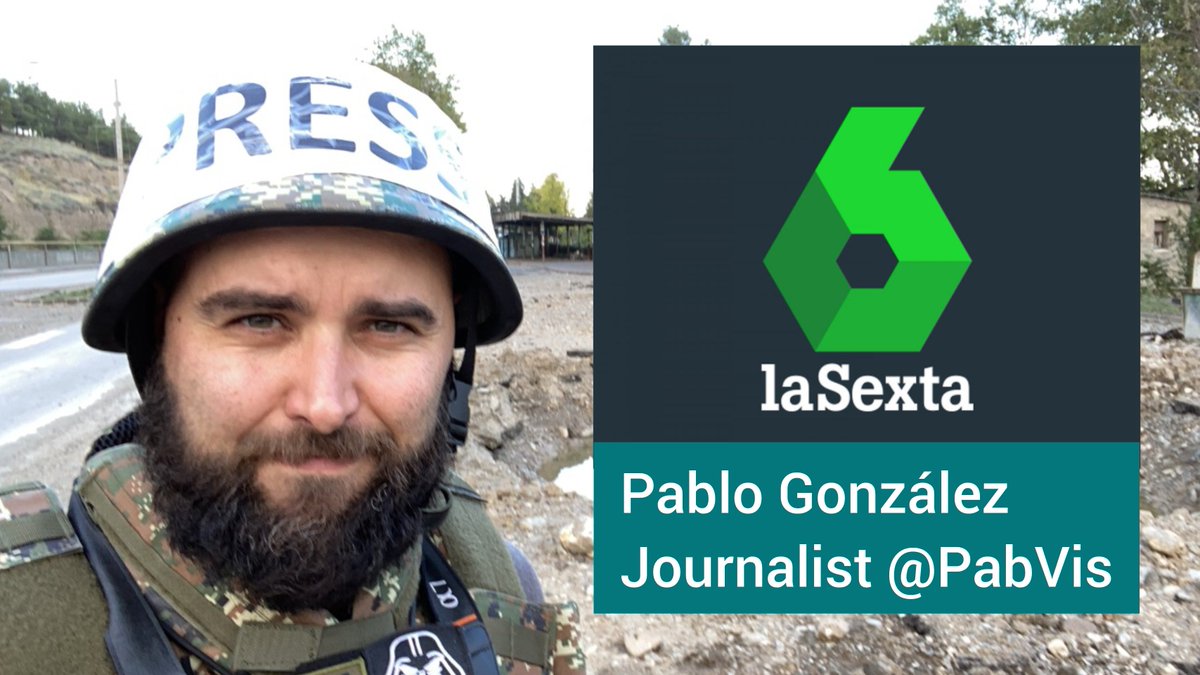
Pablo Gonzalez, a Basque journalist who includes working for Basque and Spanish left-wing media, was covering the war in Ukraine when he was interrogated by the Ukrainian authorities, the Spanish intelligence services approached his family and friends and he was subsequently arrested in Poland on 28th February and charged with spying against Poland. He has been denied access to his lawyer and no evidence has yet been presented to back up the charge but after his four-hour Ukrainian interrogation, Gonzalez reported that he had been accused of spying for Russia on the basis that he had been born in Russia1, that he reported for the mildly left-wing Basque nationalist newspaper GARA (he also reports for Publico.es) and that he had a bank card for a Basque cooperative bank. Journalist defence organisations have expressed concern at the detention.

I am not aware of having seen Gonzalez’s reporting but it may be that his material did not align with the dominant discourse as apparently the International Federation of Journalists reported that González had been accused of being pro-Russian in his coverage for a Spanish newspaper. On the other hand, several of his colleagues say that his reporting has been anti-Putin. Clearly the secret services of at least three pro-NATO countries, Ukraine, Spain and Poland have been in communication regarding Gonzalez. After his interrogation in Ukraine, he had been released but it seems awarned to leave Ukraine. He went to Poland and had been just about to re-enter Ukraine with a group of other reporters when arrested by the Polish authorities. “Legal threats and smear campaigns are a daily menace to outspoken journalists, and journalists covering the migration crisis on the Belarusian border have been detained and harassed,” the Europe representative of the Commitee to Protect Journalists, Atilla Mong told Voice Of America2.

I am no supporter of Pablo Iglesias or of his Podemos party3 but I offer my translation of his piece in Publico.es in the hope that it will a) encourage some to follow the case and perhaps lift their voices for Gonzalez’s release and b) become aware that censorship and misinformation is rampant in the media around this conflict.

MADRID

24/03/2022 18:22

PABLO IGLESIAS@PABLOIGLESIAS

On the 14th of this month, the photojournalist Juan Teixeira, a friend of Pablo González, wrote a column in Público entitled “About Pablo González and the diminishing freedom of the press.”4 There he talks about his relationship with Pablo, his work with him in the Ukraine and his arrest. I recommend, in fact, that you read his entire column, but allow me to read you two paragraphs:

It was precisely in one of these connections with Ferreras that everything began to go wrong. Pablo decided to do the direct clip of him with the military in the background, which is always more televisable. From La Sexta they had him waiting for more than 45 minutes under snow and with the soldiers increasingly tense wondering what that bald man was doing standing in front of a mobile on a tripod.

Until the military got tired and invited us to leave, but not before erasing all the material and taking a photo of Pablo’s passport. That same night, he received a call from the SBU (Ukrainian intelligence services), telling him that he should report to their headquarters as soon as possible. Despite the fact that there was work to be done, we returned to Kyiv. There Pablo was interrogated for 4 long hours, and accused of being a Russian agent with such convincing evidence as writing for Gara and having a Caja Laboral Kutxa bank card, according to them both financed by Russia. All so crazy that Pablo didn’t take it too seriously. He thought that they were simply “tightening the nuts” so that he would be more cautious with his words.

Until he found out that at that very moment, CNI5 agents had appeared at his family home, at his mother’s and at that of a childhood friend to question them and inform them that Pablo was a Russian agent.

I’m sorry that Ferreras appears here, the poor man has no fault in this, beyond the time the duplex took6, but it seemed important to me that the arguments of the Ukrainian secret services be known. I find it amazing that being the son of a Russian, writing for Gara and having an account in the Kutxa7 is something that makes you a suspect of being a secret agent of Putin. By this rule of thumb, there would be more evidence that would determine that Minister Albares8 is, on the one hand, an agent of the Vatican (he studied at Deusto, the Jesuits rule there and Pope Francis is a Jesuit, put it all together) and, on the other, he is also Moroccan agent (he lived for a long time in France and is married to a French judge who advises Emmanuel Macron, put it together)… Albares may sympathize with the Jesuits and put forward a pro-Moroccan9 line but it would be delusional to present him as an agent. Well, González is an even more delusional case.

The problem is that the logic of war contaminates everything and it is destroying the quality of the already highly-reviled conventional journalism. At the same time that we hear multi-award-winning journalists like Antonio Papell calling for Russia to be attacked with nuclear bombs or the famous and “progressive” Elisa Beni losing her temper with a professor of international law who committed the terrible crime of saying on the radio that, in geopolitics, values do not operate, we see that a correspondent who provided training and knowledge of the field, is accused of being a secret agent. Crazy.

I can only tell you that here at La Base we are going to continue reporting and analyzing rigorously, dismantling propaganda wherever it comes from and defending the freedom to inform without simplifying the complex and always paying attention to the context. At La Base kapuscinski style: rigor and commitment.

end.

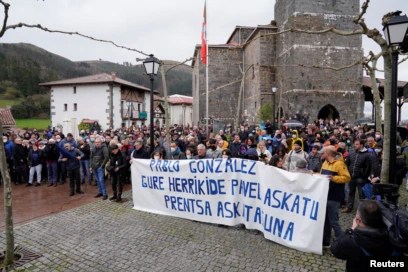
Protest in the Basque Country at Gonzalez’s arrest (Photo credit Reuters)

MY FOOTNOTES

1Gonzalez’s grandparents had sought asylum in the USSR from fascist dictator General Franco and Gonzalez had been born there. His parents split up and his mother took him to the Spanish state when he was seven (as a result of which he is fluent in several languages. He specialises in reporting on Eastern Europe but has been living in the Basque province of Bizkaia town of Nabarniz with his wife, Oihana Goiriena of sixteen years.

2https://www.voanews.com/a/spanish-journalist-denies-spying-for-russia/6477466.html

3Pablo Iglesias had been leader of the Podemos party and a minister in the Spanish coalition government but resigned and works as a journalist for La Base, a podcast of the Spanish left-wing on-line newspaper Publico.

4I have yet to read that article.

5Spanish Intelligence Service.

6I am guessing that Ferreras was the contact for Sexta, the Spanish free-to-air TV channel and that the “duplex” is a reference to the electronic connection when they were trying to broadcast.

7A Basque cooperative bank.

8 Albares is the Minister of Foreign Affairs in the current Spanish Government.

9Albares caused outrage recently by proposing that Western Sahara, a former Spanish colony, accept becoming a region of the Kingdom of Morrocco, which has been illegally and violently occupying it for decades.

MY SOURCES

CATALAN PROMOTES NEW INDEPENDENCE STRATEGY IN DUBLIN MEETING

Clive Sulish

(Reading time: 3 mins.)

In Dublin on Friday, prominent Catalan journalist Vicent Partal departed from the advertised subject of his Irish tour to talk specifically about the struggle for Catalan1 independence and to propound a new tactical departure for the nation in conflict with the Spanish state. In three-night speaking tour organised by ANC Ireland, Partal spoke also in Belfast and Cork, in which venues he stuck reportedly more closely to the advertised subject.

ANC Ireland is an Irish-based iteration of Asamblea Nacional de Catalonia, a mass grassroots pro-independence Catalan organisation which has been primarily responsible for the massive demonstrations on the Diada, the Catalan national Day and for the organisation and promotion of the Referendum on 1st October 2017, when scenes of Spanish police attacking voters shocked many around the world. The President of the ANC at the time, Jordi Sanchez, was later jailed by a Spanish court along with Jordi Cuixart, the President of another Catalan grassroots organisation, Omnium Cultural2.

Carles Pujol of ANC Ireland (right) introducing Vicent Partal (left)

Vicent Partal, who began his tour in Queen’s University in Belfast on the 9th continuing on to Cork University on the 10th, spoke in Dublin on the 11th in the Teachers’ Club in the City centre. Partal has been a journalist since the early 1980s, in which career he has covered the Balkan War, the Demolition of the Berlin Wall, the Beijing Students’ Protests and other events of international prominence. His publishing ventures in Catalonia progressed to the founding in 1995 of the electronic newspaper Infopista catalana that later became VilaWeb, publishing mainly in Catalan but from time to time in English also. In 2007 VilaWeb TV opened as a web TV initiative and nowadays is available as a YouTube channel and on iTunes. Partal is also Chairperson of the European Journalism Centre.

THE NEW TACTIC

In Dublin, Carles Pujol, of ANC Ireland, introduced Vicent Partal to the 50 or so of mostly Catalans in attendance at the talk on Friday in the Teachers’ Club.

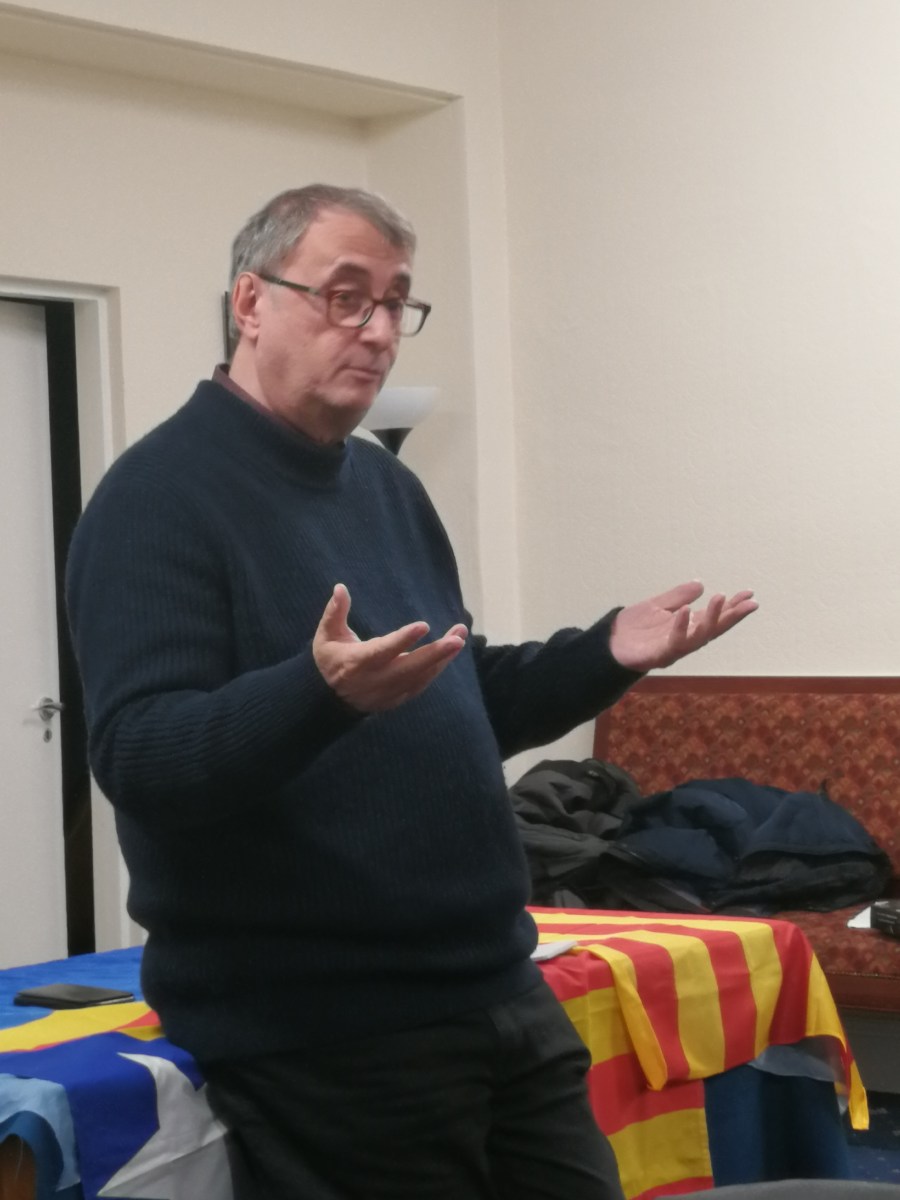
Vicent Partal addressing the audience in Dublin

Partal came out from behind the speakers’ table covered in Esteladas, independentist flags, and leaning informally against it behind him, faced his audience. Instead of covering the advertised subject of “minoritised languages” and their promotion through the Internet, he addressed recent features of the struggle for independence of the Catalan nation and proposed tactics which he believed would lead to success. His audience was no doubt surprised but seemed engaged and no-one objected. Partal remarked that he had a somewhat blunt habit of stating what he believed but wished to encourage debate. He stated that the “monster” that is “the real Spain” needed to be exposed to the Catalan people and, now that has been done, needs to be exposed to the EU. Catalonia had the credit of having exposed the Spanish State as none else had done, he maintained and had stood up to the regime as none else after the fake Transition from the fascist dictatorship of General Franco.

In essence, Partal stated, a further exposure would come when the exiled Catalan Members of the European Parliament returned to Catalonia and were arrested by the Spanish State. This violation of their immunity as MEPs under the laws of the EU would be condemned by the European Court of Justice which would order their release. The exposure of the true fascist nature of the Spanish State, in addition to mobilisations on the streets would bring about irresistible pressures for the independence of Catalonia.

After the applause for his presentation had died down, Carles Pujol called for questions or statements and approximately ten members of the audience obliged, with Partal replying to each. The first question related to censorship and pressures against publication which Partal may have faced, to which he replied that pressures only work if one gives in to them. With regard to State threats he had disobeyed an instruction to the media from the Spanish State and time would tell what would be the outcome in that regard.

Another question was whether it would not be better to keep building up the numbers of votes for pro-independence parties, currently represented by 52%, in order to win independence? Partal replied that once the Spanish State had attacked a Referendum, the question of numbers for validation ceased to exist – “after that, even 5,000 people on the street for independence would be enough!” Besides, the Catalans need to return to the position they had when Puigdemont declared a Republic on 10th October (but suspended it) and to follow it through.

A scenario of increasing repression and no advance towards independence was what another person saw and Vicent replied that freedom was not without cost and that the repression needed to be faced and defeated. The Catalan journalist also denied there was anything to be gained by participation in talks with the Spanish state when independence was ruled out in advance.

Another member of the audience disagreed with the statement that Catalonia was the first to stand up in rupture from the Spanish State since the Transition, pointing out that the only region to reject the monarchist and unitary state Constitution forced on to the people in Spanish State after the death of Franco had been the Basques3, to which Partal conceded. The man also asked whether with the two main trade unions in Catalonia4 being being in favour of union with the Spanish State, effective general strikes could be organised in Catalonia. Vicent replied that he did not see the traditional approach favouring trade union organisation and action in popular protests as useful any longer. The youth in the Battle of Urquinaona5 had proved that they were able to drive the Spanish Police out and they had done so without trade union organisation, perhaps even without ever having employment to become union members.

An Irishman asked how Partal would define or describe democracy. The Catalan journalist said that there are a number of ways of looking at that question but his most basic one would be that no-one lived in fear.

To the question of what the Catalan journalist saw as an effective organisational political approach to take the struggle for independence forward, he said that all three pro-independence parties6 are now in a position of not struggling for independence and a new formation is necessary. At a recent conference, the pro-independence party with most elected members of the Catalan Government was talking about progressing to independence in 40 years! It was unclear whether the new approach should be just a platform for independence or a new fourth party but he did not at present support the latter option. It was clear that the independence movement needs to be in opposition to the Catalan Government, Partal said.

One section of the crowd in the bar area before the talk

The meeting ended with thanks to the campaigning Catalan journalist and to the meeting’s participants, along with some notifications and a request for people to get involved in Catalan solidarity work. However discussions continued informally for hours afterwards in the bar area.

End.

A small section of the crowd in the bar area before the meeting

FOOTNOTES

1Catalonia is usually understood to comprise the territory of the autonomous region of that name (Catalunya in their own language) within the Spanish state. However the region of Pau within the French state territory is often included and the term Paisos Catalans (Catalan Countries) includes not only Paul but also the autonomous region of Valencia and the Balearic Islands.

2Tried after two years in jail without bail, they were convicted of the crime of sedition and in October 2019 sentenced to nine years in jail, arising out of their efforts to manage peacefully a large spontaneous protest at Spanish police invasion of Catalan Government offices. They were pardoned in June 2021 and released.

3He might also have mentioned the decades of struggle of the southern Basque Country on military and political levels, with a huge number of Basques as political prisoners.

4Comisiones Obreras formed by the Communist Party during the Franco dictatorship but no longer under the party’s control and UGT, very much allied to the social-democratic Partido Socialista Obrero, by far the main trade unions in the Spanish state. Far behind in membership in Catalonia but growing is Intersindical CSC, a class trade union.

5https://www.theguardian.com/world/2019/oct/18/catalonia-general-strike-protests-independence

6Esquerra Republicana (Republican Left), Junts per Cat (Together for Cat(alonia) and CUP (Popular Unity Candidacy); the first two made up the pro-independence majority in the Catalan parliament, with CUP in opposition but supporting them with their delegates votes in clashes with the Spanish unionist parties.

FURTHER INFORMATION & REFERENCES

Wiki on Partal (but “Spanish journalist”!): https://en.wikipedia.org/wiki/Vicent_Partal

ANC in Ireland: https://www.facebook.com/IrlandaPerLaIndependenciaDeCatalunya/

Other Irish-Catalan people solidarity groups: https://www.facebook.com/WithCataloniaIreland

https://www.facebook.com/profile.php?id=100066691386630

The “Two Jordis”: https://www.washingtonpost.com/world/europe/meet-the-two-jailed-activists-behind-catalonias-independence-movement/2017/10/20/a0a10e4a-b4e0-11e7-9b93-b97043e57a22_story.html

Vila Web: https://www.vilaweb.cat/

and in English: https://english.vilaweb.cat/

POLITICAL POLICE QUESTION AND FILM PEOPLE AT ANTI-INTERNMENT PICKET IN DUBLIN

(Reading time: 5 mins.)

Clive Sulish

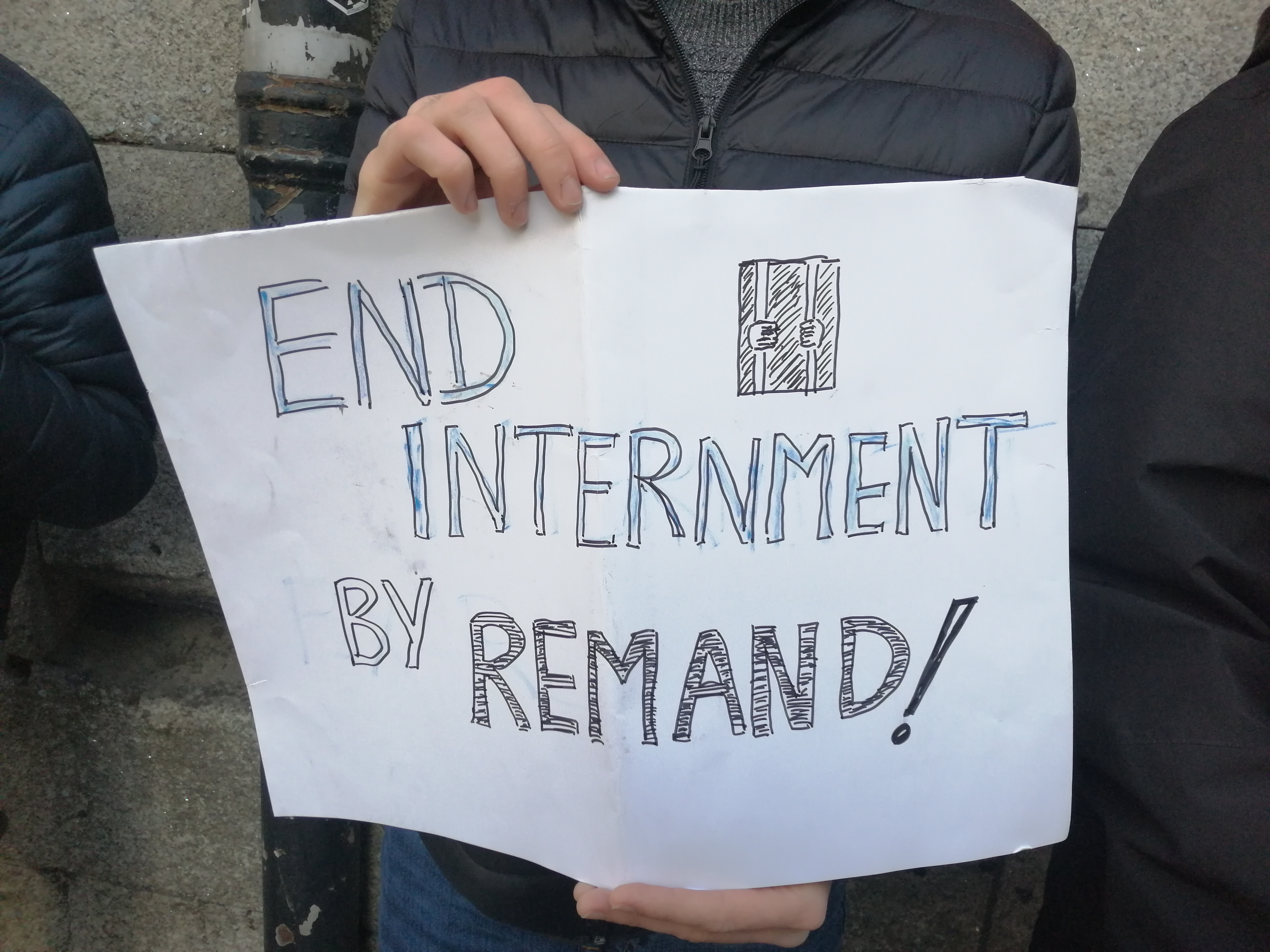
The Dublin Anti-Internment Committee held a well-attended picket on Saturday (5th March) against the continuing practice of interning Irish Republicans without trial and also in support of human rights for political prisoners. At one point the picket was subjected to the unwelcome attention of the Irish political police.

(Photo: C.Sulish)

The event was in furtherance of the Committee’s advertised intention to hold monthly public events to highlight the deprivation of civil rights from Irish Republicans — on both sides of the British border — through the operation of special legislation and in particular of the no-jury political courts (Special Criminal Courts in the Irish state and Diplock Court in the British colony). The Committee has admitted that it does not always succeed in holding a public event every month and in fact its most recent public appearance was during the December festive season, in solidarity with Irish Republican prisoners, when it was supported by a number of organisations and independent activists.

(Photo: C.Sulish)

WHY THESE PUBLIC EVENTS?

The Dublin Committee holds these public events because it believes that most people are unaware of the abuse of civil rights in Ireland, the civil right to belong to an organisation that criticises the State and seeks profound change. The reaction of people receiving a leaflet at their public events would seem to bear this out.

(Photo: C.Sulish)

Choosing a couple of extracts from their current leaflet: ‘At various times in Ireland’s history, people have been rounded up and jailed without bothering with a trial – people whom the government found troublesome and wished removed. Today the same process carries on although they don’t call it “internment” now – other names such as “due process”, “remanded in custody” are used ….”

‘Even when Republican activists are granted bail, it is on outrageous conditions such as not being permitted to reside in their own home, having to observe a curfew and wear an electronic tag, not being permitted to attend meetings and demonstrations …..’

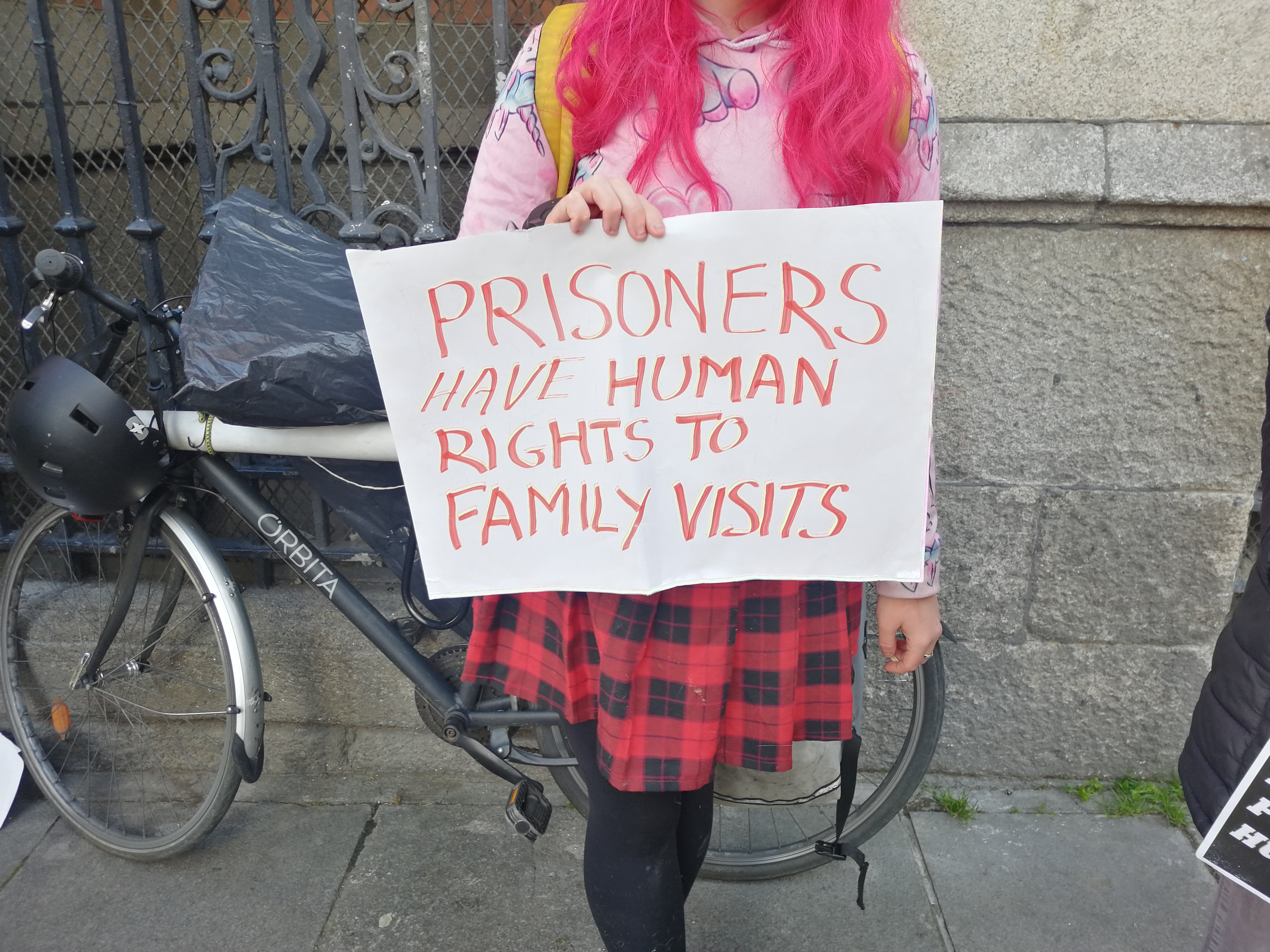
The leaflet text makes the point that one doesn’t have to agree with the politics of Irish Republicans to see that these injustices are profoundly undemocratic abuses of civil rights — and “are ultimately a danger to all oppositional movements, whether Republican or not”. One aspect of their protest was against the denial of open family visits to Republican prisoners in the jails of the British colony in the north-east of Ireland — a violation of human rights.

The surprise in learning the facts is not confined to Irish people because often it is expressed by tourists or migrants, even if they have encountered such practices in their own countries of origin.

INTERNATIONALIST DIMENSION

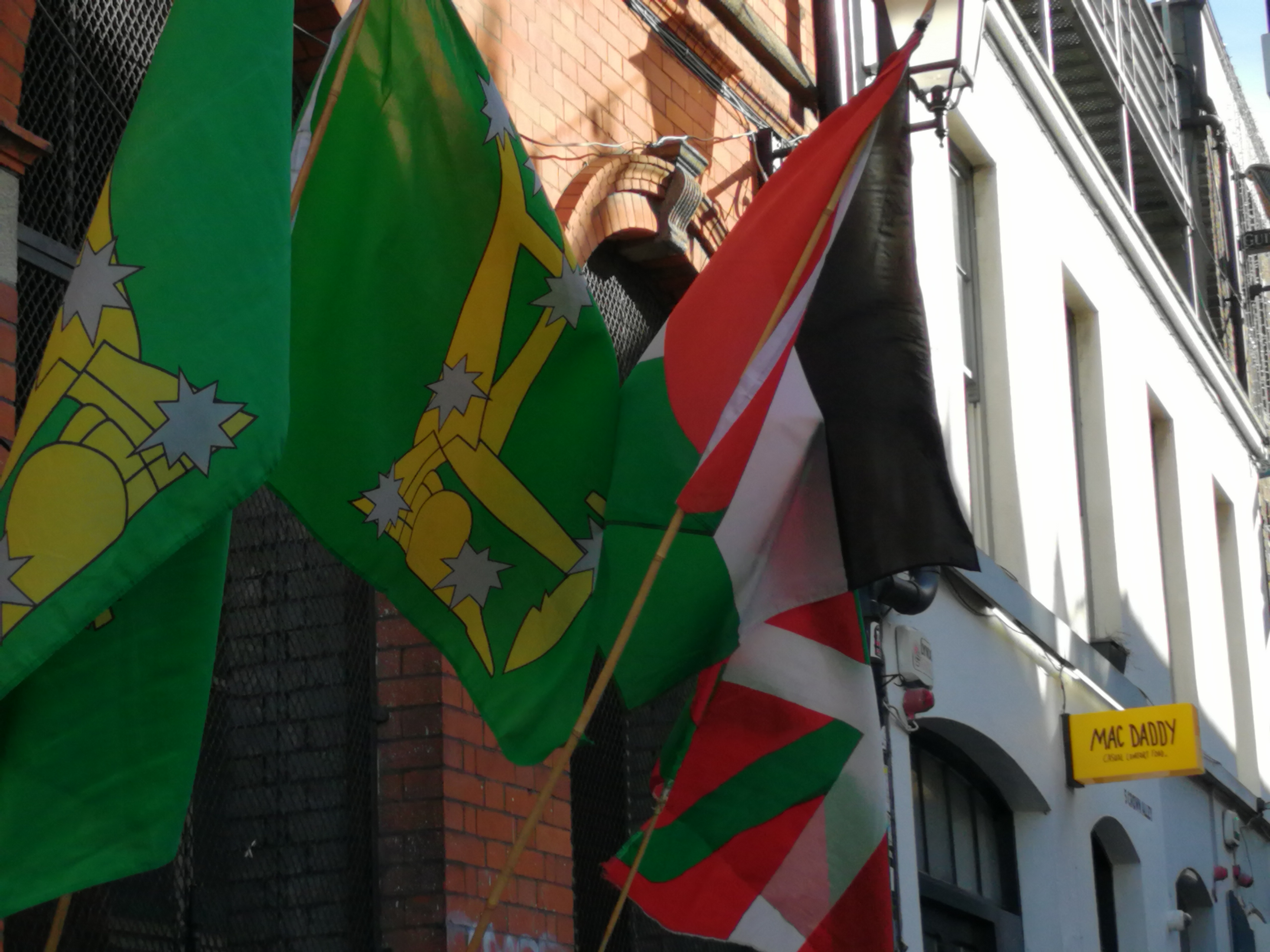
An example of the interest from abroad on Saturday was of a Basque man and, separately, of two young Basque women, reacting warmly to seeing the Basque flag among the picketers. The Dublin Committee objects not only to the incarceration of Irish Republicans but also of people seeking freedom in many other parts of the world, for which reason the Palestinian and Basque flags are frequently flown on their pickets, next to the revolutionary Irish workers’ flag of the Starry Plough.

A person who expressed support for the right to campaign without state repression was, interestingly, from Barcelona. However he did not wish for Catalan independence, wanting instead a unitary but democratic Spanish state – a position held by some communists and the main socia-democratic parties there. Although his position did not concur with that of the picketers, who tend to support the struggles for self-determination, the conversation was conducted without hostility.

Not so with another individual, who approached some picketers to argue for their support for the Ukrainian state in the current armed conflict there, a question that has deeply divided the Irish Left and Republican movements. He went further and announced his support for the Azov Battalion, an East European fascist organisation integrated into the Ukrainian state’s military, at which point the tolerance of the picketers for his intervention ended and he was urged to depart.

Starry Plough flags next to Palestinian and Basque Ikurrina flags at the picket in Temple Bar. (Photo: C.Sulish)

POLITICAL POLICE INTIMIDATION

Another temporary presence unwelcome to the picketers was of three members of the Irish State’s political police. These are members of what used to be called the Special Branch but are now officially called the Special Detective Unit, formerly C3 and successor to the CID when the Irish State was created. This type of political police force is modelled on the Irish Special Branch of Scotland Yard, the HQ of the British police, founded to spy on the influence and activities of the “Fenians” (i.e the Irish Republican Brotherhood) in the cities of Victorian-era Britain. However, in Dublin under British occupation, their parallel force was the G Division of the Dublin Metropolitan Police, known as “G-men”; it was they who identified many Republican and other prisoners of the British military after the 1916 Rising, ensuring death sentences for many (though most commuted to life imprisonment) and jail sentence for many others. During the War of Independence (1919-1921 they were identified as the intelligence service of the British occupation and many were selectively assassinated by the IRA of the time.

The Garda “Branch” (as they are known colloquially) of the Irish State have a long history of harassment of and spying on Irish Republicans, sometimes associated with violence and often with perjury in court. Their unsupported observations through the mouth of a Garda officer at the rank of Superintendent has been enough “evidence”, in the no-jury Special Criminal Court, to send many Irish Republicans to jail on a charge of “membership of an illegal organisation.”

Two picketers confront the plainclothes political police officer harassing a young leafletter on Saturday (Photo: C.Sulish)

One of these gentlemen on Saturday approached the youngest supporter of the picket, who was distributing leaflets to passers-by, identified himself as a Gárda officer in plain-clothes and demanded the young activist’s name. His accosting of the leafletter attracted the attention of others on the picket and two went quickly to support the subject of State harassment. The Branchman demanded no further information and sone moved away. However, when he had reached about half-way along the picketters, he stopped and began filming them.

At that point one of the picketers began to call out to passers-by, many of whom were tourists, that this man was a member of the secret political police, who was filming and attempting to intimidate people on a legal political protest, that this is the kind of ‘democracy’ that exists in the Irish state, etc, etc. Shortly thereafter, the Branchman departed, along with another two of his colleagues that had been observed further down towards Temple Bar.

A picketer loudly denounces the political policeman’s filming of the picketers. (Photo: C.Sulish)

According to picket participants this intervention of the political police represented an escalation of their attentions in recent times, though not in the least unusual in the past, when every picketer might have their name (and even their address) demanded and jotted down.

A spokesperson of the Dublin Anti-Internment Committee stated that it is independent of any political party or organisation and that it welcomes the participation at its public events of democratic individuals, whether independent activists or members of organisations and had distributed many of its leaflets. It regrets that a number of political activists — who should have an interest, even if only in self-preservation – in defending the democratic rights to organise and to protest, decline to support their events.

(Photo: C.Sulish)
(Photo: C.Sulish)
Picketers and leafletters (Photo: C.Sulish)

End.

FURTHER INFORMATION

Anti-Internment Group of Ireland: https://www.facebook.com/End-Internment-581232915354743

Azov Battallion: https://en.wikipedia.org/wiki/Azov_Battalion

MOORE STREET SEES BROAD RALLY FOR CONSERVATION AND AGAINST DEMOLITION

Clive Sulish

(Reading time: 3 mins.)

Between 400 and 500 people gathered in Moore Street on Saturday 22nd January 2022 to hear a number of speakers declare their complete opposition to the plans of the Hammerson property group, most of which had been approved by the chief officer of Dublin City Council’s Planning Department, in the face of a great many formal and informal objections and against even decisions of the elected councillors. Musicians also played and sang a number of songs at the event.

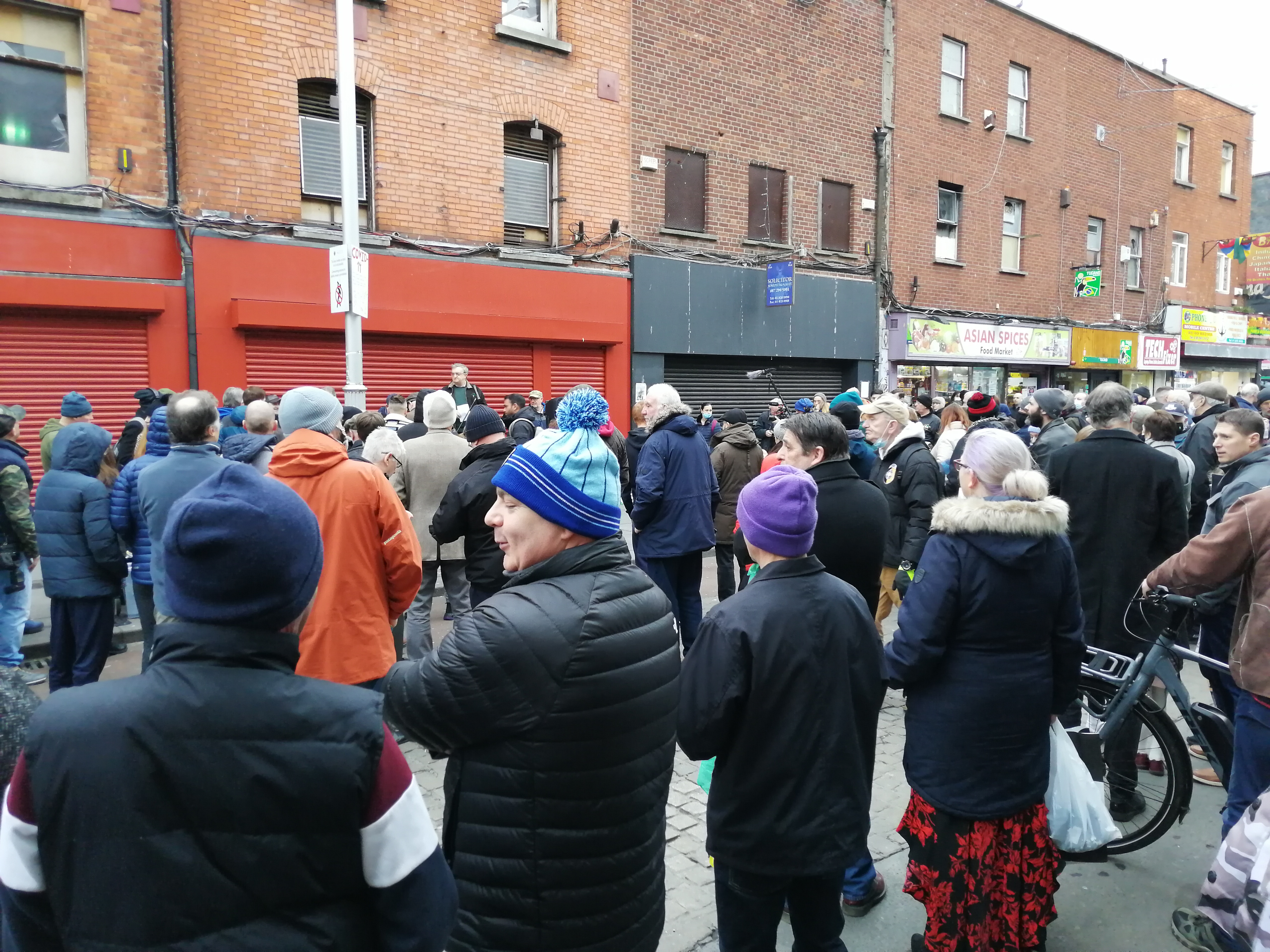
Section of the crowd at the rally. (Photo: Rebel Breeze)

SPEAKERS AND SPEECHES

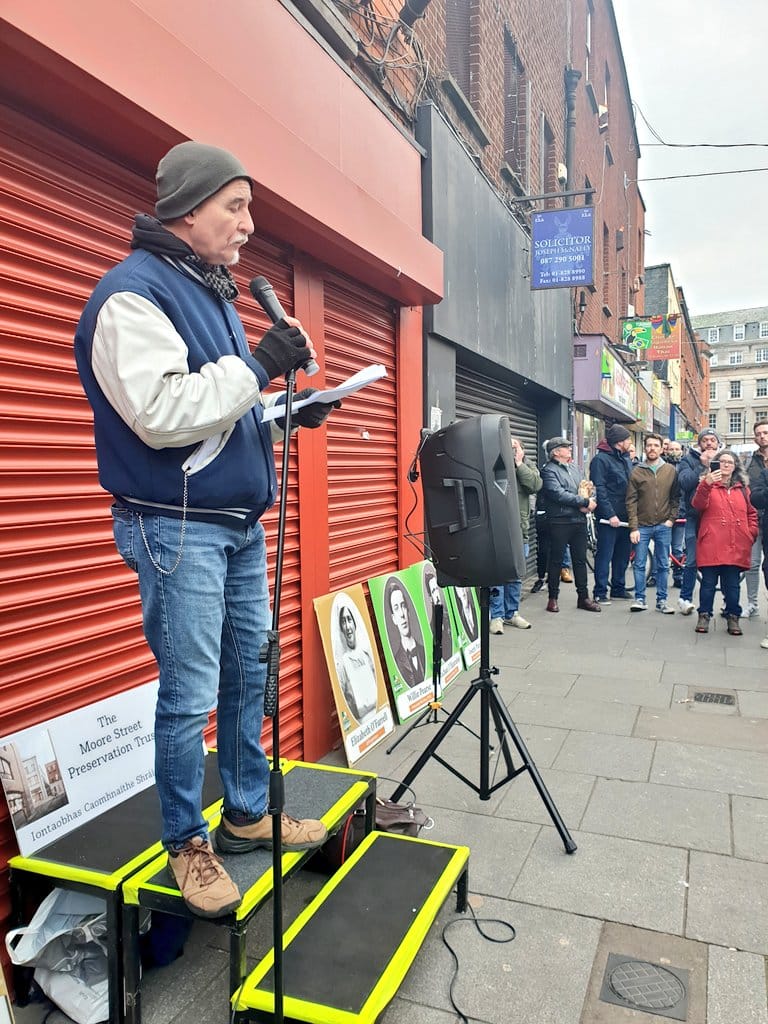
Chaired by the Secretary of the Moore Street Preservation Trust, Mícheál Mac Donncha (Sinn Féin Councillor), the crowd listened to a range of speakers: dramatist and campaigner for decades Frank Allen, 1916 relatives Brendan Mulvihill and Donna Cooney (latter a long-time campaigner and also Green Party Councillor), Diarmuid Breatnach for the Save Moore Street From Demolition campaign group (with a campaign stall every Saturday), Carolyn Alright (fourth-generation street trader), Stephen Troy (2nd generation local butcher) and Aengus Ó Snodaigh (Sinn Féin TD [member of the Irish Parliament]).

Micheál Mac Donncha, Secretary of the Moore Street Preservation Trust (also SF Dublin Councillor) chairing the event. (Photo: Rebel Breeze)

Each speech was different but of course sharing such themes as the struggle for Irish independence, historical memory and conservation but also closely linked to issues very much of the day: lack of justice in economic and social policy, lack of democracy in decision-making, reference to the housing crisis, property speculators, vulture funds, the banks ….. A number also made reference to the recent deaths of two homeless people in the vicinity.

Diarmuid Breatnach, of the Save Moore Street From Demolition campaign group, speaking at the rally (Photo sourced: Internet).
Independent businessman in Moore Street Stephen Troy speaking during the rally (Photo: Rebel Breeze)

There were some additional points made, for example Frank Allen called on people to tell the Fianna Fáil party they’d never get a vote in Dublin again if they didn’t act to save the area from demolition; Donna Cooney pointed out that demolition of buildings had a much worse effect on the environment than restoration; Diarmuid Breatnach stated that the area was of international historical importance and merited world heritage status; Stephen Troy spoke about the disaster for small businesses next to a 15-year building site; Caroline Alright pleaded for the future of the street to be taken out of the hands of the developers and Ó Snodaigh expected a more supportive attitude from the next Government (widely predicted to be a coalition with Sinn Féin as the larger partner).

Pat Waters, performing at the rally. (Photo: Rebel Breeze)
Donna Cooney, long-time campaigner for Moore Street and relative of Volunteer Elizabeth O’Farrell (see her portrait next to Donna) speaking at the rally. (Photo: Rebel Breeze)

Live music for the event was provided by Pat Waters, performing his own compositions, including a song about the O’Rahilly who was fatally wounded in 1916 in Moore Street leading a charge against a British Army barricade; also two musicians from the Cobblestone Pub, including the son of the owner, Tom Mulligan who performed Pete St. John’s Dublin in the Rare Aul’ Times.

Musicians of the Cobblestone performing (note Frank Allen in left background, who was a passionate speaker at the event). (Photo: Rebel Breeze)

There was speculation in some quarters as to why the rally had been called at such short notice; with prominent members of the Moore Street Preservation Trust absent1 and having an incorrect Irish name of the street2 on the event poster and promotional merchandise did seem to indicate a rushed event.

For some too, the Trust is being increasingly seen as closely linked to Sinn Féin, which for some is a positive factor but for others is not. The closeness has been evident on a number of occasions: a SF public meeting some years ago at which Jim Connolly Heron, prominent member of the Trust was the only speaker representing campaigners and more recently the promotion of the Trust’s Alternative Moore Street plan by SF, including the party President, Mary Lou Mac Donald, speaking at its launch a few months ago. At the rally on Saturday, the speaker for the Save Moore Street From Demolition campaign group made a point of saying that their group is independent of any political party.

Aengus Ó Snodaigh, SF TD and sponsor of Bill on Moore Street in the Dáil, speaking at the rally (Photo: Rebel Breeze)

However, the Bill to make the area a cultural quarter, currently proceeding with glacial slowness through the Dáil (Irish Parliament) is sponsored by a Sinn Féin TD, Aengus Ó Snodaigh, who spoke at the rally. Others counter by pointing out that Darragh O’Brien, a Minister of a party now in Government, Fianna Fáil, had sponsored a very similar bill back in 2015; however, with that party now the leading member of the current coalition Government, their leaders have welcomed the speculator’s plan for Moore Street.

A view of the crowd at the very start of the rally (Photo: Rebel Breeze)

GOVERNMENT

The Government department most concerned with the Moore Street issues is the Department of Heritage, part of the Department of Housing, Local Government and Heritage3. When Heather Humphries was the Minister responsible for Heritage she championed the bid of property speculator Joe O’Reilly to get control of Nos. 24-25 (owned by DCC) at the end of the central Moore Street terrace in exchange for the four buildings the State had declared a National Monument (Nos.14-17).

When Dublin City councillors voted not to allow that “land-swap”, against the recommendation of the City Managers, she castigated them publicly. She also instructed her legal team to appeal the High Court Judgement of March 2016 that the whole area is a National Historical Monument and in February was successful in having the judgement set aside.4 When Humphries attended Moore Street during the Easter 2016 events she was picketed and booed when she spoke. However, the current Minister for Housing, Local Government and Heritage Darragh O’Brien actually put in a submission against the proposed demolition of a building at the south end of Moore Street; however the Planning Department of Dublin City Council approved it.

Section of the crowd in front of the rally (Photo: Rebel Breeze)

As Minister 1n 2016, Humphries set up a Consultative Group on Moore Street on which all the Dáil political parties had a seat, along with a couple of councillors. From the campaigners, only the Jim Connolly Heron group had representation on it. The Minister’s group (latterly “Advisory”) has been in operation from 2016 until late last year but seems to have achieved nothing. The Hammerson Plan was welcomed by its Chairperson and by some of its members, including Brian O’Neill, Chairperson of the 1916 Relatives Association which seems a volte-face of that organisation, which had the conservation of the Moore Street battlefield as a central point of the Association’s constitution. However, the Hammerson plan was strongly opposed by others in the Minister’s Group, including Jim Connolly Heron. Outside the Minister’s Group, the opposition is even more widescale.

Street traders and independent businessman in Moore Street chatting at the rally. Photo: Rebel Breeze)

THE FUTURE

The planning permission given to Hammerson will be appealed to An Bord Pleanála but the Bord has a bad reputation with conservation campaigners, who see it as generally favouring the property developers5. Scheduling the appeal would take at least two months and possibly much longer. Should the campaigners not succeed at that stage, a legal challenge is also a possibility. Alongside the exploring of these options, street activities such as the rally on Saturday are likely. In 2016 conservation campaigners occupied the buildings for six days, blockaded them for six weeks, organised marches, rallies, pickets, re-enactments, concerts, history tours and public meetings.

Moore Street might be in for a hot summer. Or, given how long some processes have taken to date, even a hot Autumn.

End item.

FOOTNOTES

1 Including Jim Connolly Heron

2 The name they used was Sráid Uí Mhórdha, which is also the one on DCC’s street nameplate. However, it has been widely accepted in recent years that the correct name in Irish is Sráid an Mhúraigh, which is the one recorded in the State’s database for place-names, logainm.ie and furthermore is the version used in Sinn Féin’s own Bill currently proceeding through the Dáil.

3 Over the years it has had different names.

4 The Appeal Court verdict did not discuss whether it was or was not but instead declared that a High Court Judge was not empowered to declare a National Monument.

5 In fact, the Bord approved the O’Reilly plan for a giant “shopping mall” in the area (forerunner to the current Hammerson Plan) even though the Bord’s own officer recommended rejecting it.

SOURCES

https://www.fiannafail.ie/blog/fianna-fail-publishes-bill-to-redevelop-moore-street-area

https://www.gov.ie/en/organisation/department-of-housing-local-government-and-heritage/

1922 Unemployed Workers’ Occupation of the Dublin Rotunda Commemorated

Diarmuid Breatnach

(Reading time main text: 4 mins.)

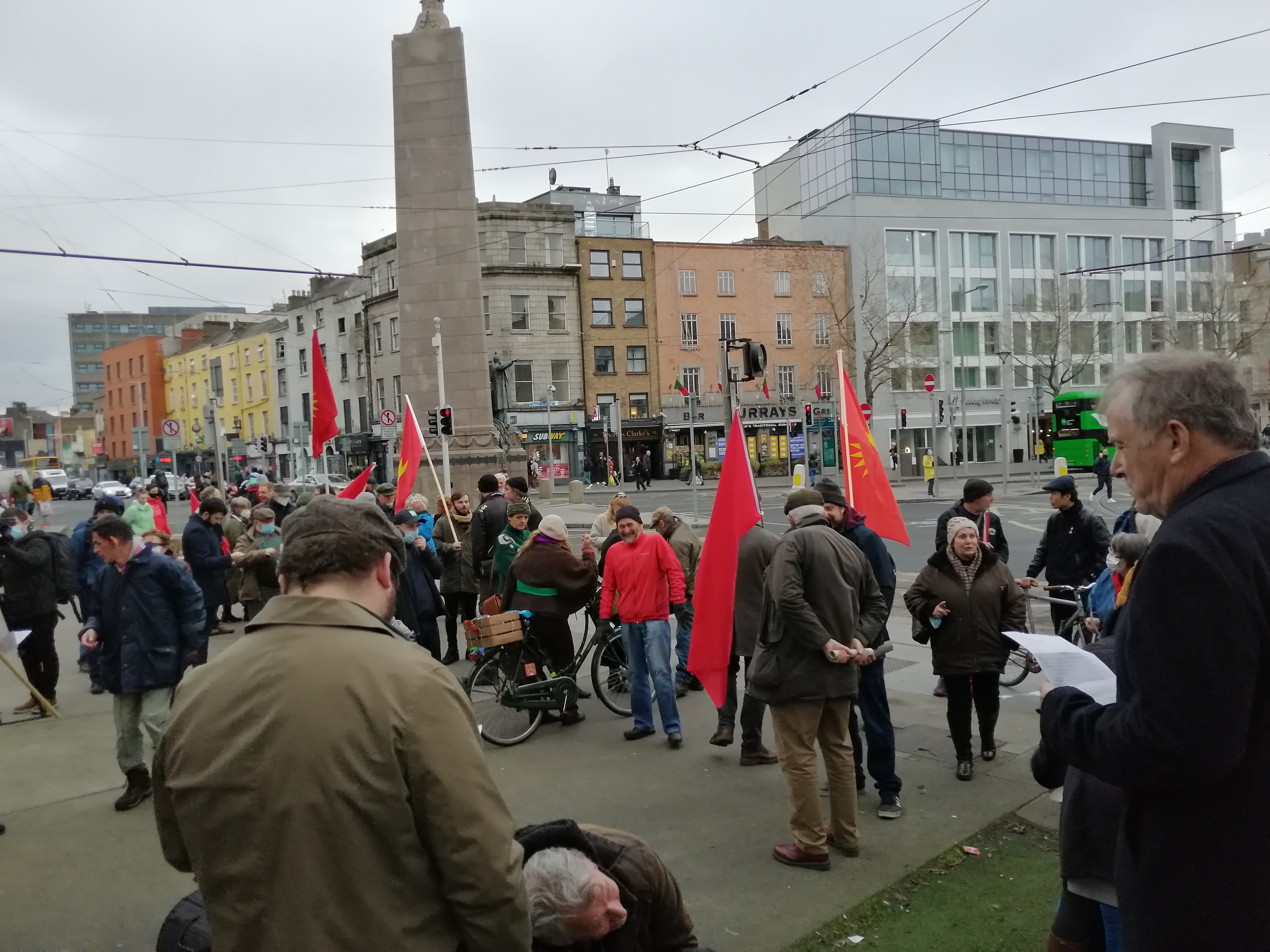
On Saturday 22nd January 2022 an event was held to commemorate the centenary year of the occupation of the Rotunda building in Dublin by 150 unemployed workers led by Liam Ó Flaithearta, a Republican and Communist and writer from Inis Mór (off the Galway Coast). The occupation took place two days after the formation of the Free State and was attacked by an anti-communist crowd while after a number of days the occupiers were forced out by the police force of the new state of the dismembered nation1. The event last week was organised by the Liam and Tom O’Flaherty Society.

The event began with a gathering at 1.30pm in North Great George’s Street, where the Manifesto had been printed in 1922.2 People then proceeded to the nearby Rotunda, site of the occupation in 1922.3

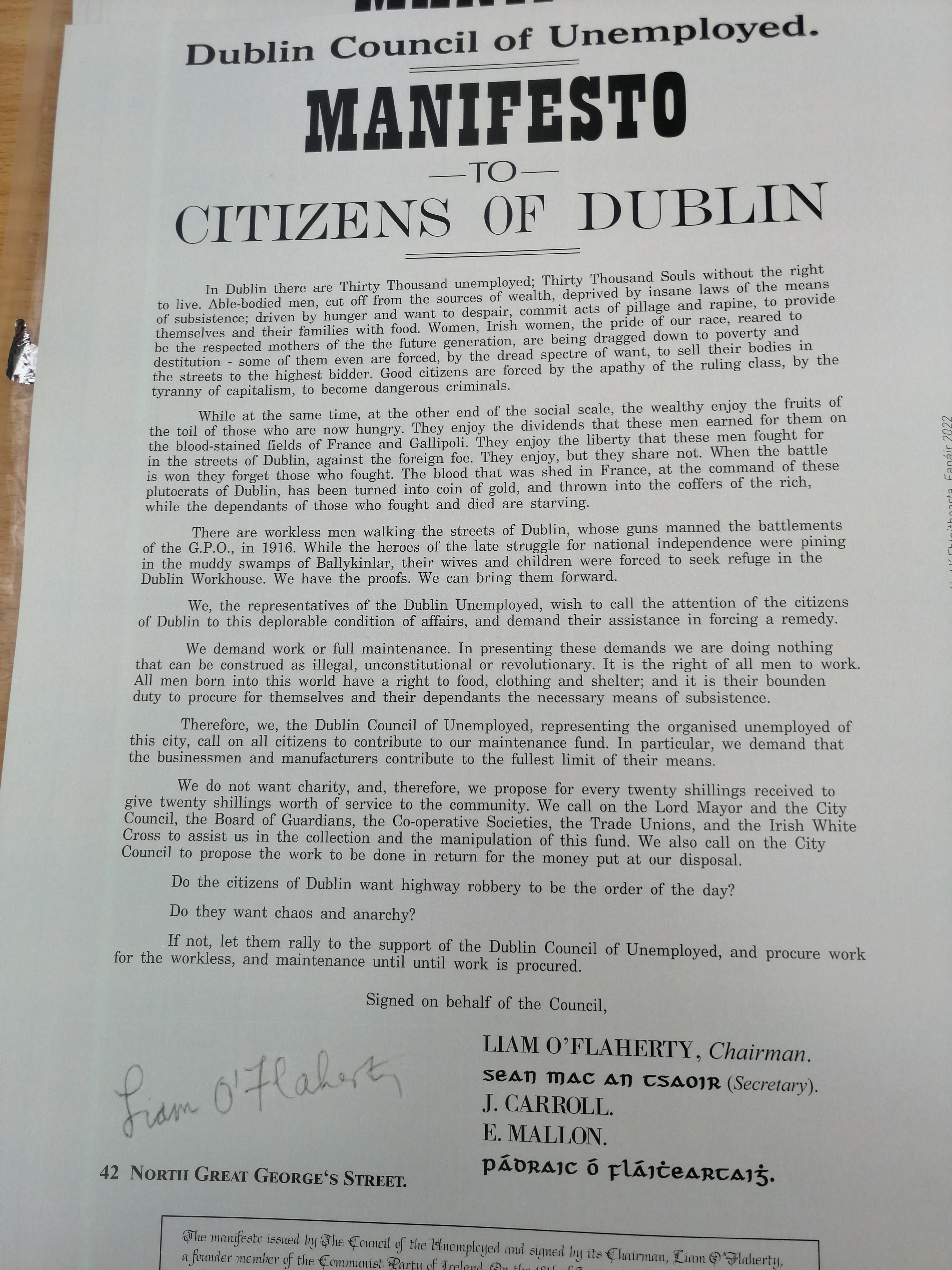
Copy of the manifesto available at the event (Photo: D.Breatnach)
Seosamh Ó Cuaig (Photo: D.Breatnach)

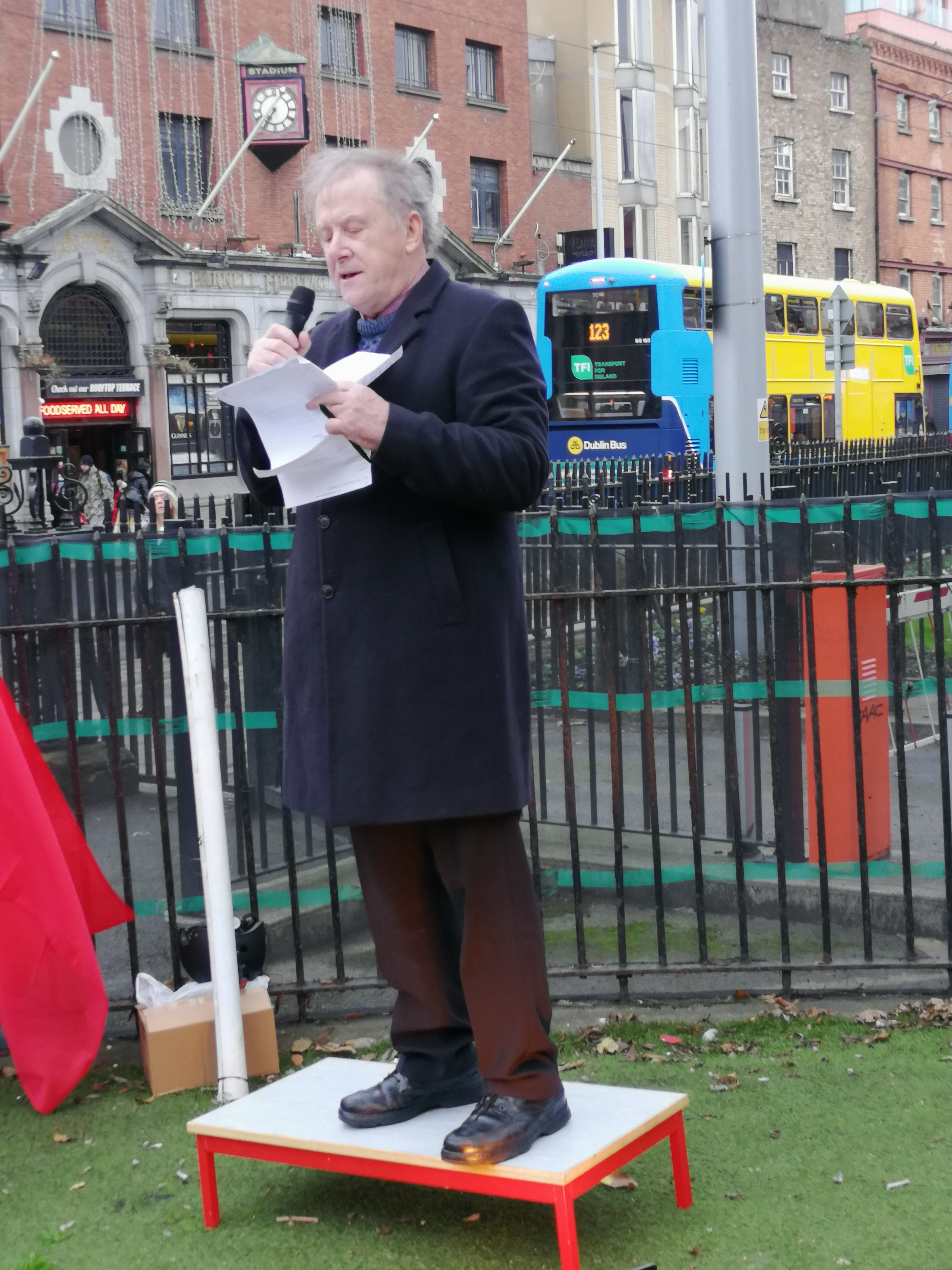
Seosamh Ó Cuaig from Cill Chiaráin, Carna, Conamara, opened the proceedings as Chairperson, ag cur fáilte roimh dhaoine i nGaeilge agus i mBéarla, briefly introducing the historical occasion and recounting how some companies, including Boland’s, had supplied bread, sugar and tea to the occupiers, before he introduced published historian and blogger Donal Fallon.

Fallon not only recounted the events of that occupation 100 years ago but also placed it in context of a number of other factors: the unemployment then in the State (30,000 in Dublin) and to follow through into the 1930s, the upsurge in workers’ occupations and local soviets, the reactionary nature of the government of the new state and of the hierarchy of the Catholic Church at the time, which was very supportive of the new regime and extremely hostile to any kind of socialism, along with the cultivation of a reactionary social and political attitude among sections of the population.

Donal Fallon speaking at the event (Photo: D.Breatnach)

Fallon also commented on the censorship and otherwise neglect of Liam Ó Flaithearta as an accomplished modern Irish writer and hoped for his writing to become more popularised now.

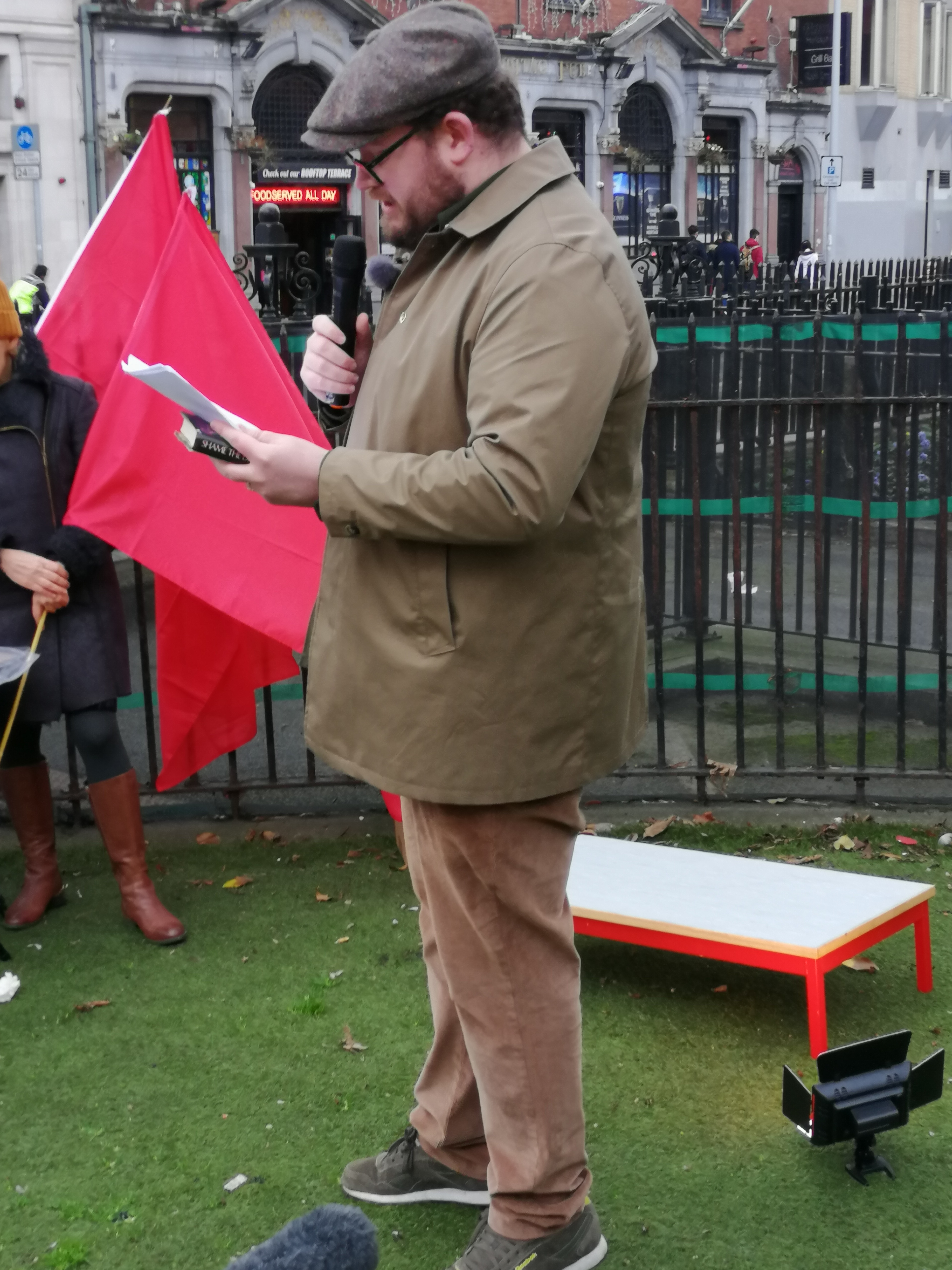
Alan O’Brien reading O’Flaherty’s Manifesto (Photo: D.Breatnach)

Alan O’Brien, Dublin poet and dramatist, was welcomed on to the stage to read the Manifesto which had been issued at the time, copies of which were available at a nearby stall. One of the aspects of that document was a call for Dublin City Council to set up public works to provide paid employment for those out of work in exchange for services to the community.

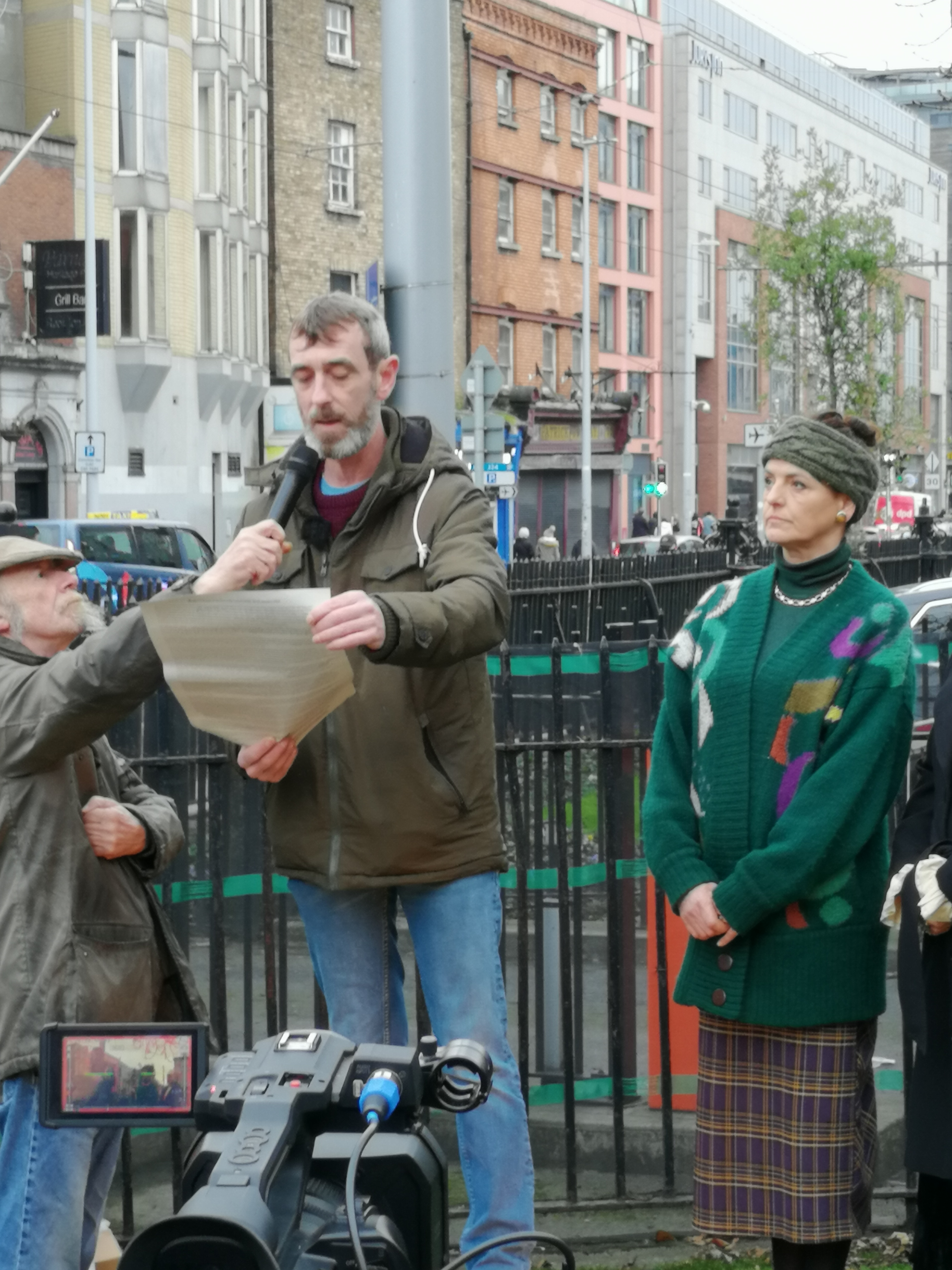
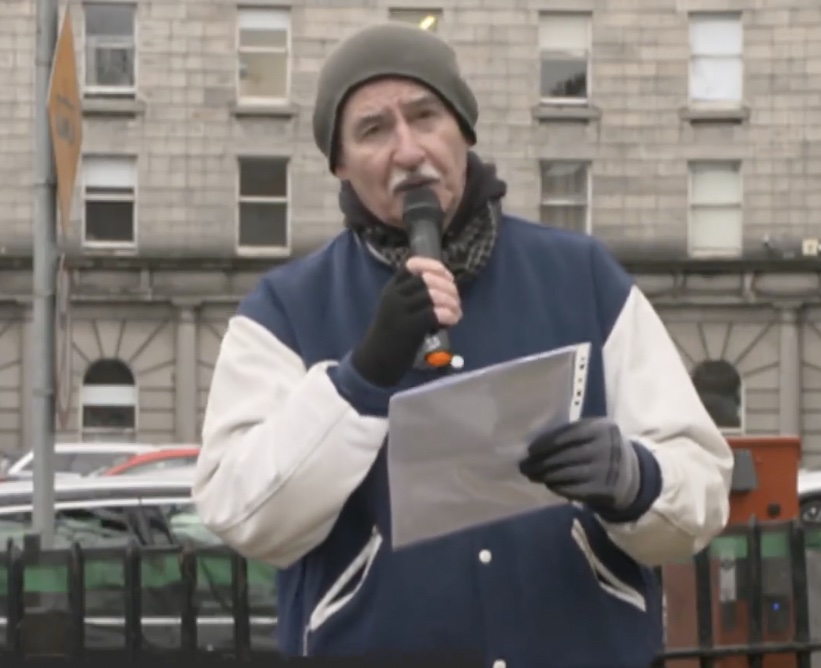
Diarmuid Breatnach, singer and blogger was invited to the stage to sing “The Red Flag” because it had been sung there during the occupation. No doubt those in the Government, Church hierarchy and generally among reactionary people at that time would have been horrified by the lyrics and would have asserted that they were foreign to Irish culture and thinking. However, as Breatnach explained, the lyrics had been composed by an Irishman (see Appendix 1), Jim Connell from Meath. Connell wrote the lyrics to the air of The White Cockade and was appalled to hear it sung to the air of Oh Tannebaum, a Christmas carol. Breatnach had never heard it sung to the White Cockade air but had been practicing it for days and hoped he would be faithful to the original air.

Diarmuid Breatnach singing The Red Flag to the air of The White Cockade

Called by the Chairperson to sing a follow-up song, Breatnach sang most of the verses of “Be Moderate”, satirical lyrics published by James Connolly in 1907 in New York. There had been no air published for the song and it has been sung to a number of airs but he would sing it to the air of A Nation Once Again, which provides a chorus:

We only want the Earth,
we only want the Earth,
And our demands most moderate are –
We only want the Earth!

https://www.facebook.com/watch/?v=637274744281164

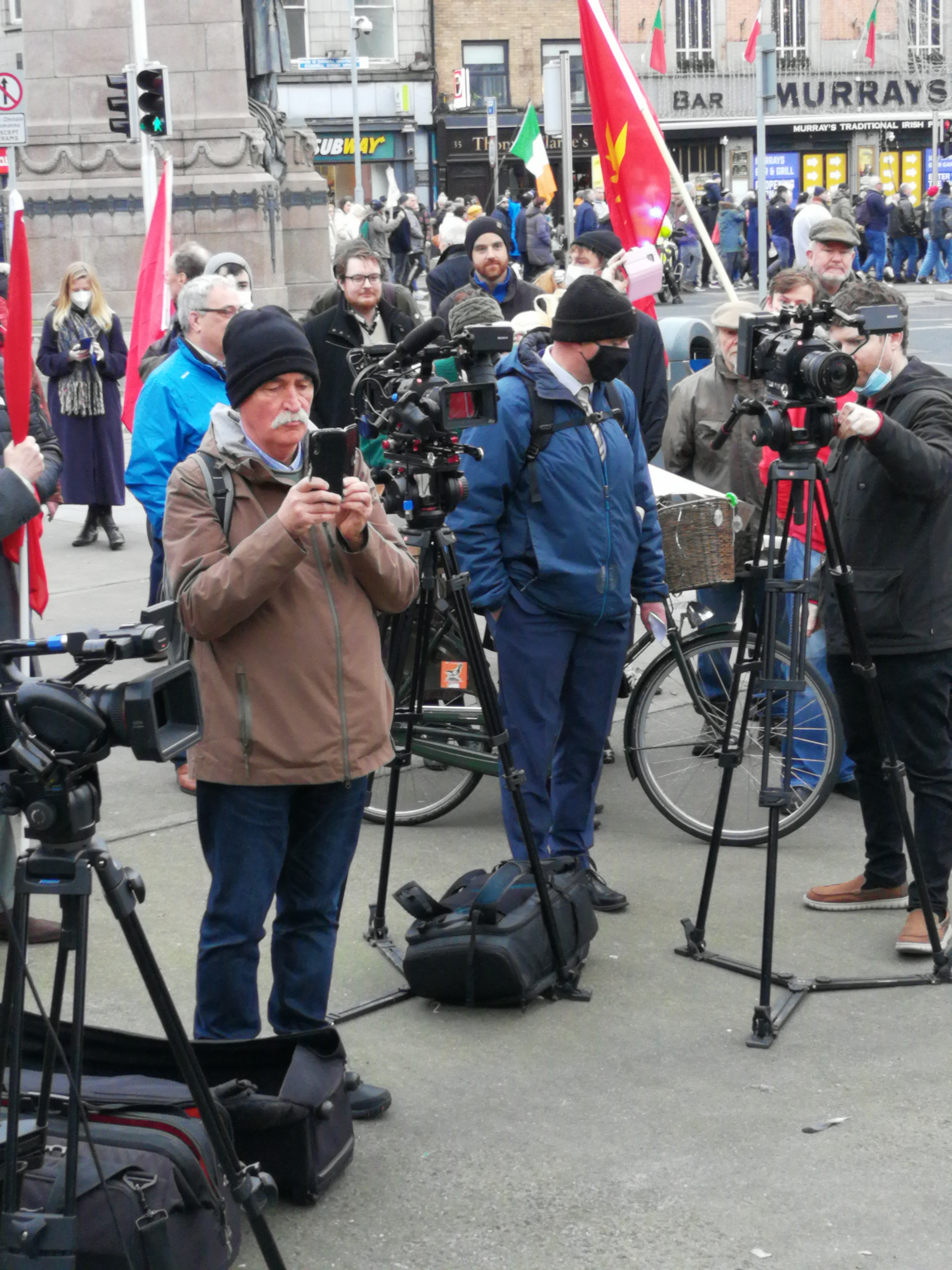
The event was later reported by RTÉ briefly in English on the Six O’Clock News and also by video on TG4’s Nuacht in Irish including interviews with Fallon an a number of participants.

End main report.

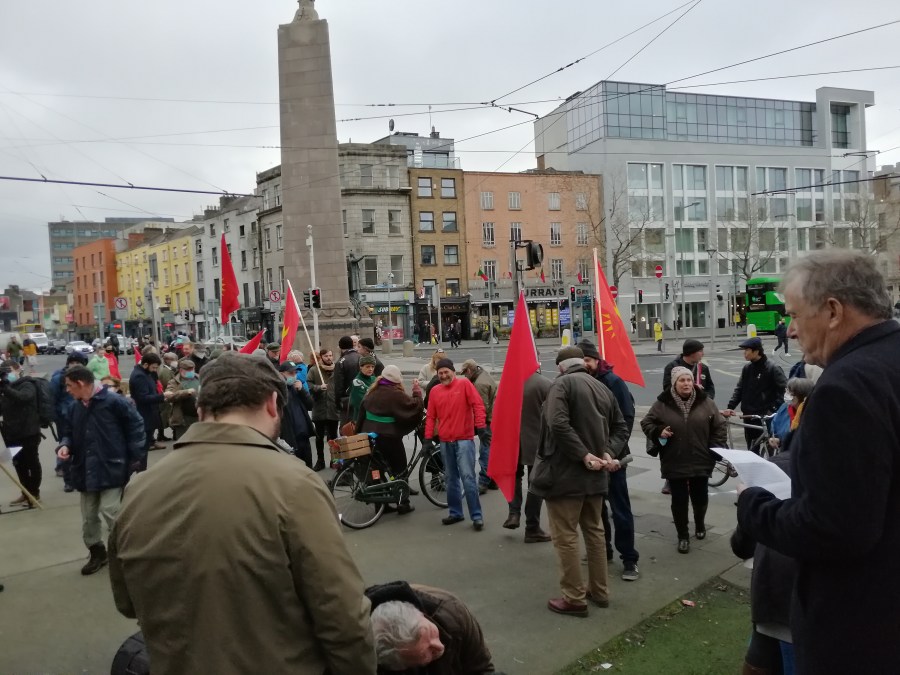
Early arrivals at the event with the plinth of Parnell monument in background centre left (Photo: D.Breatnach)
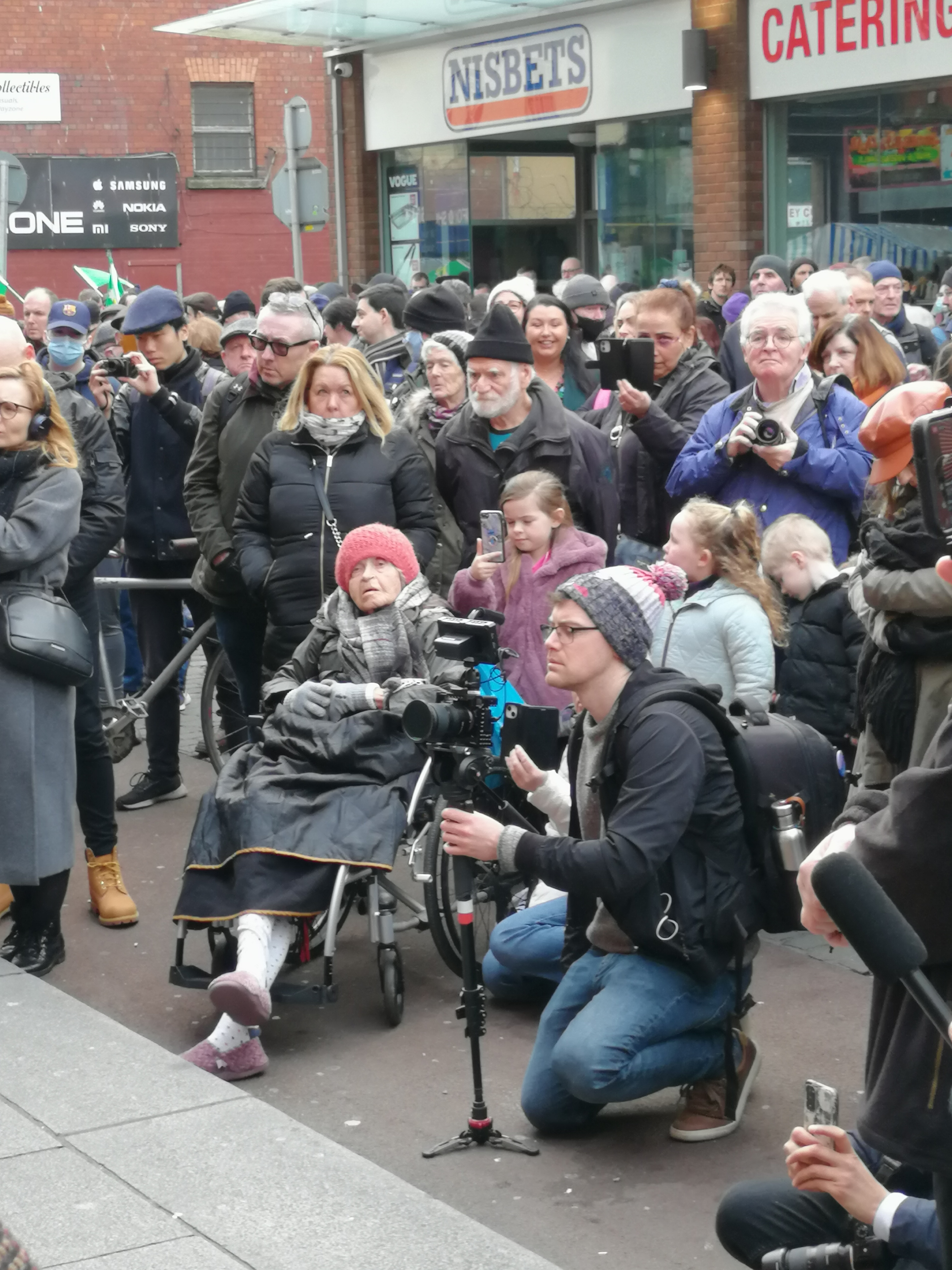
Section of the crowd and media filmers at event (anti-vaccine etc march in background) (Photo: D.Breatnach)

APPENDIX 1:

THE RED FLAG: AUTHOR, LYRICS AND AIR

After the Rotunda occupation was terminated, Liam Ó Flaithearta emigrated to London, which is where the Red Flag lyrics had been composed twenty-three years earlier. The lyrics were composed by Meath man Jim Connell in London in 1889 to the air of the Scottish Jacobite march The White Cockade — he was reported livid when he learned that it was being sung to the air of Oh Tannebaum, protesting: “Ye ruined me poem!”

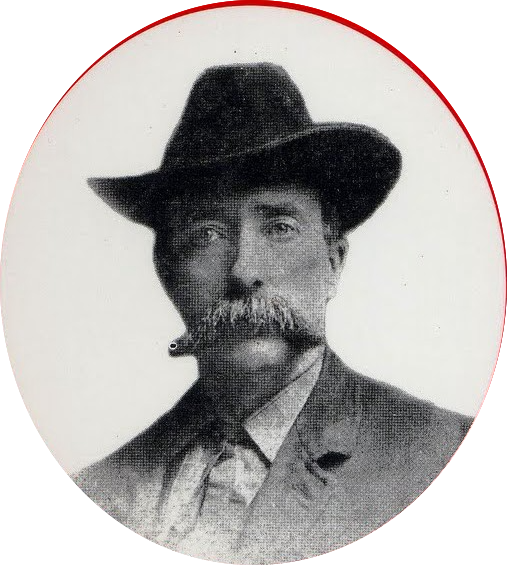
Jim Connell was a Socialist Republican (he had taken the Fenian oath), activist and journalist who emigrated to England in 1875 after being blacklisted in Dublin for his efforts in unionising the docks in which he worked. Apparently he began to write the song lyrics on his way home from a demonstration in London city centre, on the train from Charing Cross to Honor Oak in SE London, where he lived and completed it in the house of a fellow Irishman and neighbour, Nicholas Donovan.

Photo of Jim Connell, author of The Red Flag (Photo: D.Breatnach)

The lyrics have been sung by revolutionary and social-democratic (the latter less so now) activists all over the English-speaking world but also in some other languages in the years since.

Not mentioned in the Wikipedia entry on Jim Connell is the fact that he also wrote a book, apparently a best-seller in his time, called something like “The Poacher’s Handbook“. I’ve been looking for that book for years without success (DCC Library could find no reference to it).

UNVEILING PLAQUE ON JIM CONNELL’S HOME

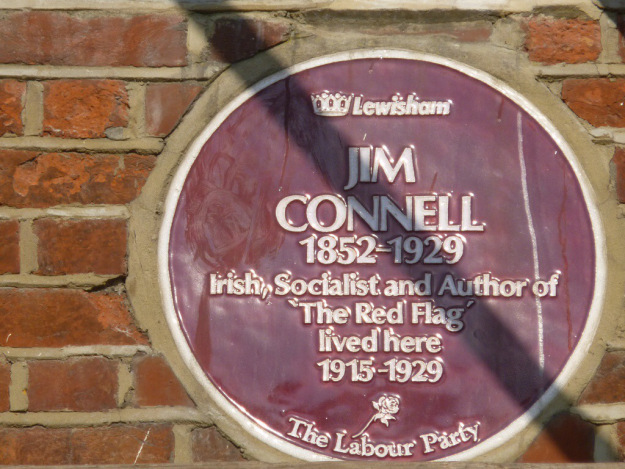
Today there is a plaque on the two-storey house where Connell lived until his death in 1929, having been awarded the Red Star Medal by Lenin in 1922.

Plaque on house in which Jim Connell lived in SE London when he wrote the lyrics (Photo: D.Breatnach, sorry about the shadow)

In the late 1980s a history archivist with the London Borough of Lewisham contacted the Lewisham branch of the Irish in Britain Representation Group, of which I was Secretary, to consult us about the erection of a history plaque on the house and the wording to use4. We attempted to have the words “Irish Republican” added to “Socialist” after his name on the plaque and were successful with “Irish” but not with “Republican”.

There was a handful at the unveiling at midday on a weekday, including a representative of the local Council, a couple from the Greater London Council including its Irish section, a trumpeter (who played the Oh Tannebaum air) and Gordon Brown (then just an MP). I believe this was 1989, the centenary of the song being written.

Brown’s speech did not mention Ireland once but as he finished, I jumped up on a nearby garden wall and while thanking those in attendance said that it was sad to see the country of Jim Connell’s birth omitted along with his views on Irish independence, particularly at a time when British troops were fighting to suppress a struggle for that independence.

This was during the age before mobile phones and I have no photos, sadly. So no big deal but the next edition of the Irish Post, a weekly paper for the Irish community in Britain, carried a report on the ceremony and my intervention. It was written by the columnist Dolan, who was the alter ego of the Editor, Brendan Mac Alua (long dead now) and a supporter of much of the IBRG’s activities.

I lived in Catford then, five minutes by bicycle from the site of the house and have photographed the plaque.

FENIAN CONNECTION BETWEEN LYRICS ACROSS TWO DECADES

The words and sentiment “Let cowards flinch or traitors sneer” in the Red Flag mirror some in a song celebrating Irish political prisoners, The Felons of Our Land: “While traitors shame and foes defame” and “Let cowards mock and tyrants frown”. Arthur Forrester wrote that song 20 years before Connell’s and it would be surprising indeed had Connell not consciously or unconsciously borrowed the construction and sentiment.

Arthur Forrester was himself of great interest as were his poet sisters, both raised by their Irish nationalist mother, also very interesting person and poet in her own right, in Manchester, known to Michael Davitt. Arthur was a Fenian and did time in prison for it5. He was also for a period proof-reader for the Irish Times! Frank McNally wrote an article about the song but I don’t have access to anything except the first few lines.

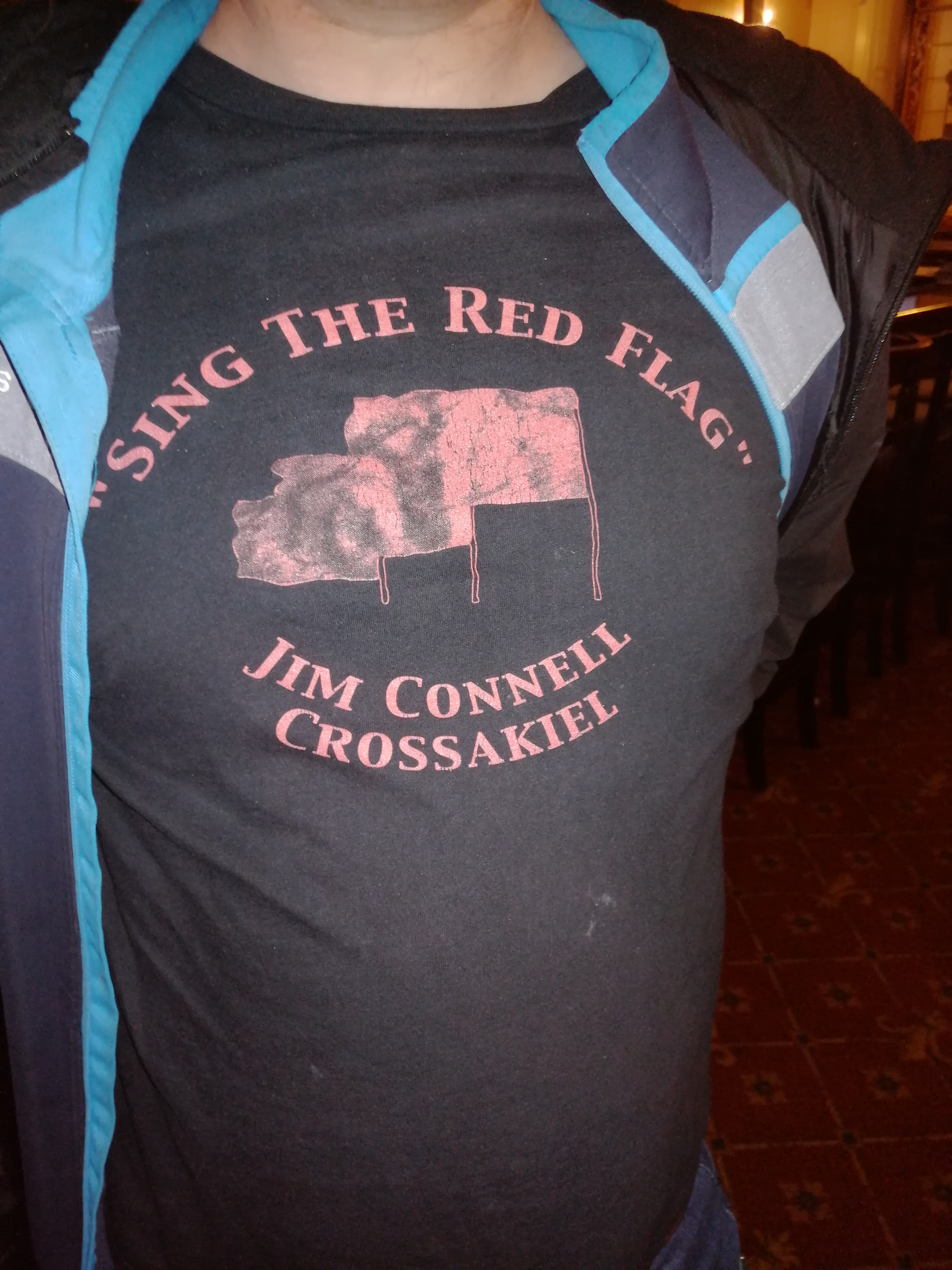
T-shirt worn by one of those in attendance (Photo: D.Breatnach)

APPENDIX 2:

Lyrics of The Red Flag:

The People's Flag is deepest red,
It shrouded oft our martyred dead, 
And ere their limbs grew stiff and cold, 
Their hearts' blood dyed its every fold. 
Chorus: 
Then raise the scarlet standard high. 
Beneath its shade we'll live and die, 
Though cowards flinch and traitors sneer, 
We'll keep the red flag flying here. 
 
Look round, the Frenchman loves its blaze, 
The sturdy German chants its praise, 
In Moscow's vaults its hymns were sung,
Chicago swells the surging throng. 
(chorus)
It waved above our infant might, 
When all ahead seemed dark as night; 
It witnessed many a deed and vow, 
We must not change its colour now. 
(chorus)
 It well recalls the triumphs past, 
It gives the hope of peace at last; 
The banner bright,  the symbol plain, 
Of human right and human gain. 
(chorus) 
It suits today the weak and base, 
Whose minds are fixed on pelf and place 
To cringe before the rich man's frown, 
And haul the sacred emblem down. 
(chorus) 
With head uncovered swear we all 
To bear it onward till we fall; 
Come dungeons dark or gallows grim, 
This song shall be our parting hymn.

FOOTNOTES

1Not long afterwards, the new Free State’s National Army, under the orders of Michael Collins, attacked a protest occupation by Irish Republicans of the Four Courts which began the Civil War of the State against the IRA, lasting until 1923 with over 80 executions of Republicans by the State along with many kidnappings and assassinations (such as Harry Boland’s and of course others killed in battle (excluding the shooting of surrendered prisoners, which the National Army also did on occasion). Some were even murdered AFTER the war had ended, for example Noel Lemass, his body left in the Dublin mountains.

2Possibly this was the same location which had housed the James Connolly College (raided by the Auxiliaries in 1921).

3Also the location of the first public meeting to launch the Irish Volunteers in 1913 and where much of the GPO garrison and others were briefly kept prisoner after the surrender in nearby Moore Street in 1916. And just beside it the Parnell Monument, across the street the location of the founding of the Irish Ladies Land League (where members were arrested) and diagonally in SE direction, Tom Clarke’s tobacconist and newsagent shop (occupied by the British Army during the Rising).

4The Lewisham branch of the IBRG had been founded in 1986 and founded the Lewisham Irish Centre in 1992, I think. It was a very active branch in campaigning, community and political work, ceasing to exist around 2002. The IBRG itself was founded in 1981 and was active on many issues, including anti-Irish racism, representation for the diaspora, release of the framed Irish prisoners, British withdrawal from Ireland, against anti-Traveller racism, plastic bullets and strip-searches. It was also for equality in general, being against all racism, gender discrimination and homophobia and one year shared a march with the Broadwater Farm campaign.

5 Despite the Irish diaspora having given the working class in Britain its anthem (The Red Flag), its classic novel (The Ragged-Trousered Philanthropists) and, among many social and trade union activists and leaders, two leaders of the first genuine mass workers’ movement in Britain (the Chartists — O’Brien and O’Connor), and having fought against the Blackshirts at the Battle of Cable Street, there is no BA in Irish Studies alone available in British Universities. The Irish diaspora is also the first migrant community in Britain and for centuries the largest, has made significant contribution to the arts and a huge one to rock, punk and pop music. It would seem that the British ruling class does not want its population to know in any depth about the Irish.

SOURCES

https://www.facebook.com/OFlahertySociety

Report before the event by TG4: https://www.facebook.com/NuachtTG4/videos/247647487386768

Report after the event by TG4 and clips of the singing of The Red Flag: https://www.facebook.com/watch/?v=637274744281164

The chorus of The Red Flag sung to the original air, i.e of The White Cockade: https://www.facebook.com/OFlahertySociety/videos/459751325864989

https://www.historyireland.com/20th-century-contemporary-history/jim-connell-and-the-red-flag/

The Felons of Our Land song: https://www.irishtimes.com/opinion/the-felons-of-our-land-frank-mcnally-on-the-various-lives-of-a-republican-ballad-1.4185803

Ellen Forrester, nationalist and mother of Arthur Forrester: https://en.wikipedia.org/wiki/Ellen_Forrester

DUBLIN NEW YEAR SOLIDARITY GREETINGS TO PALESTINE

Diarmuid Breatnach

(Reading time: 3 mins.)

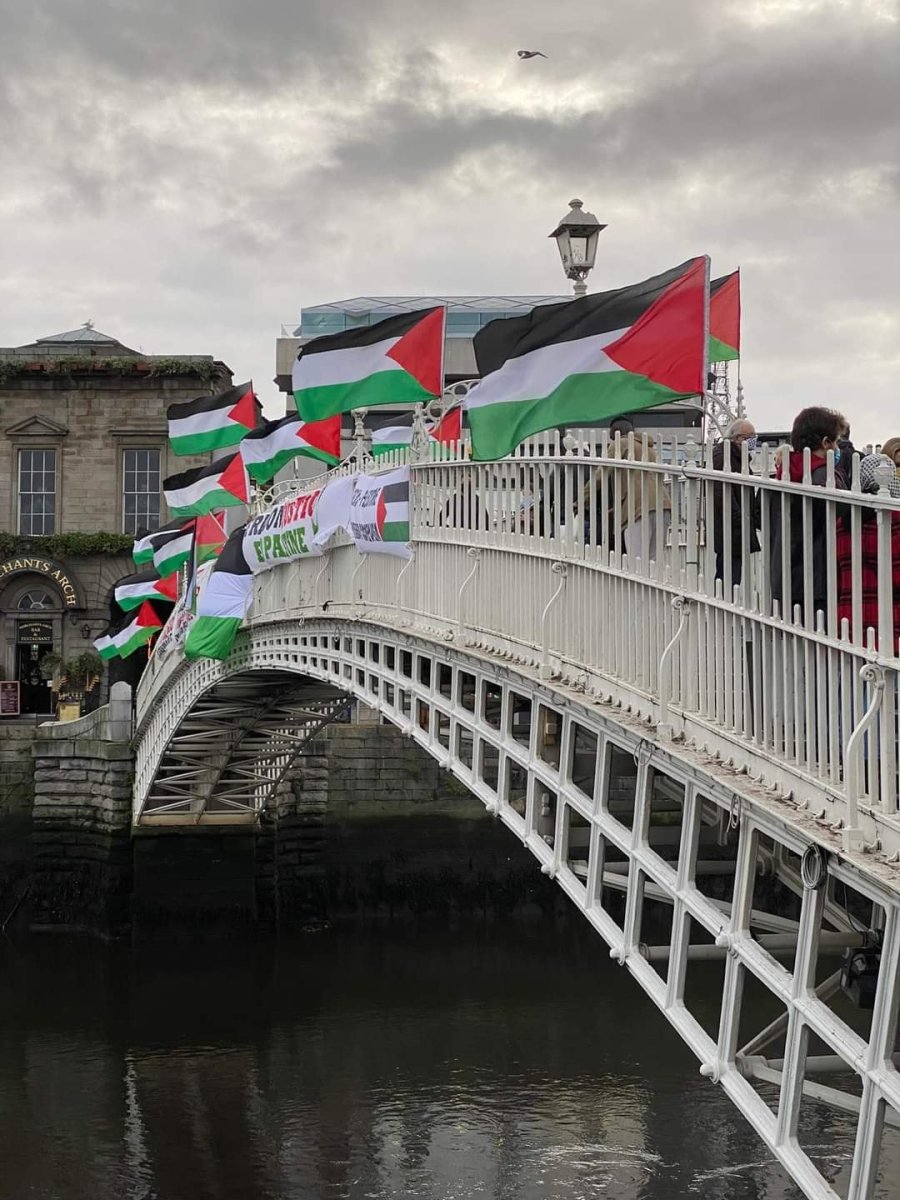
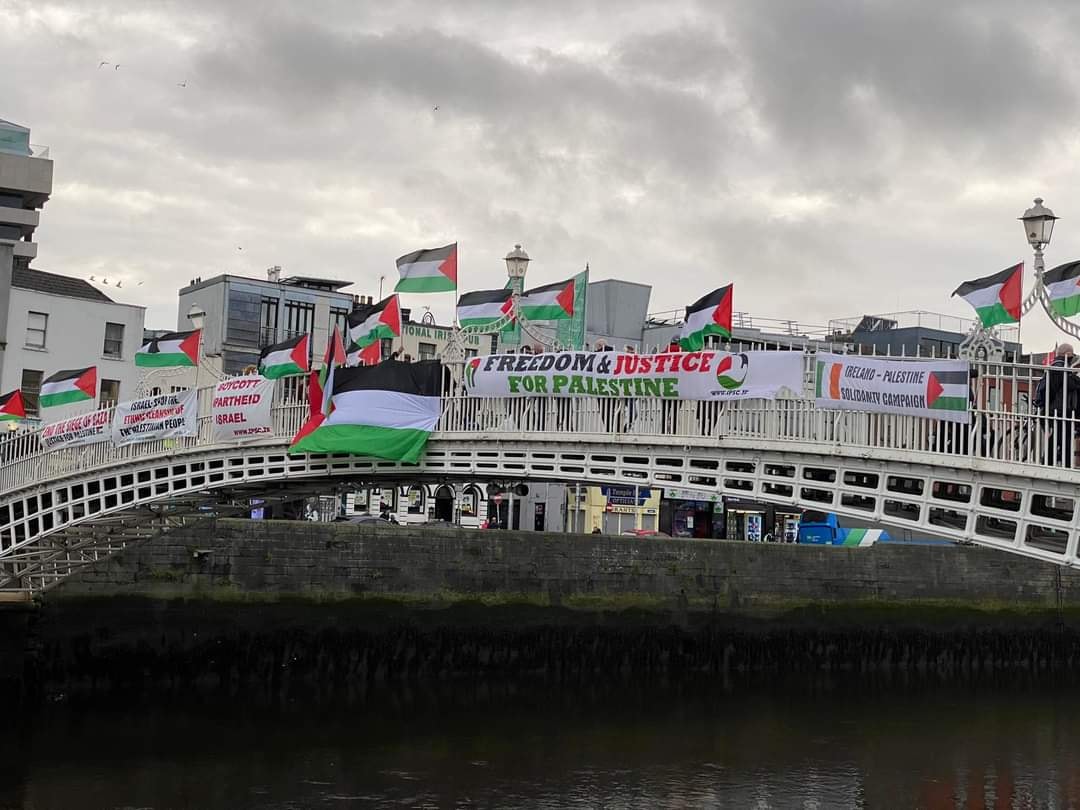
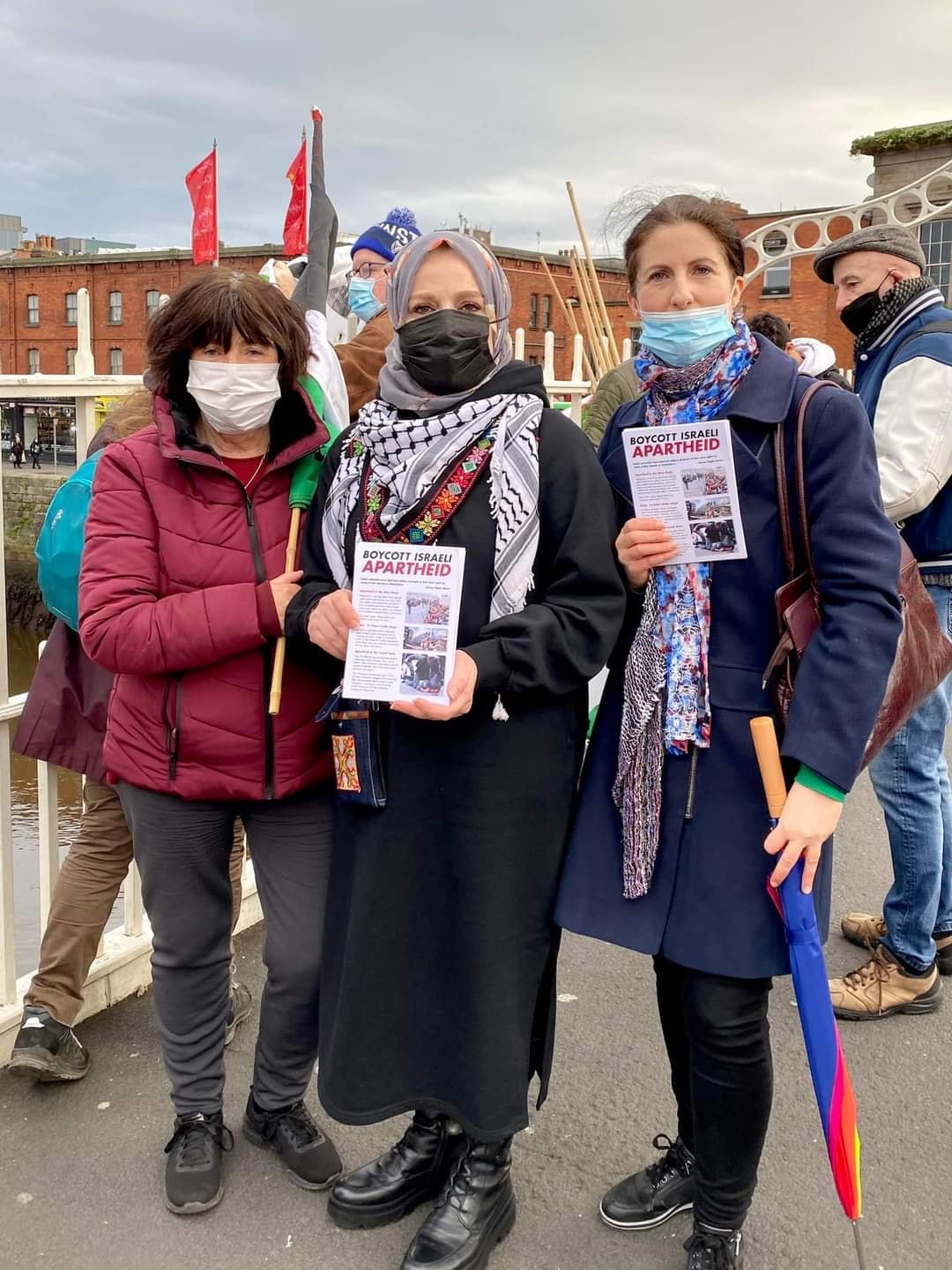
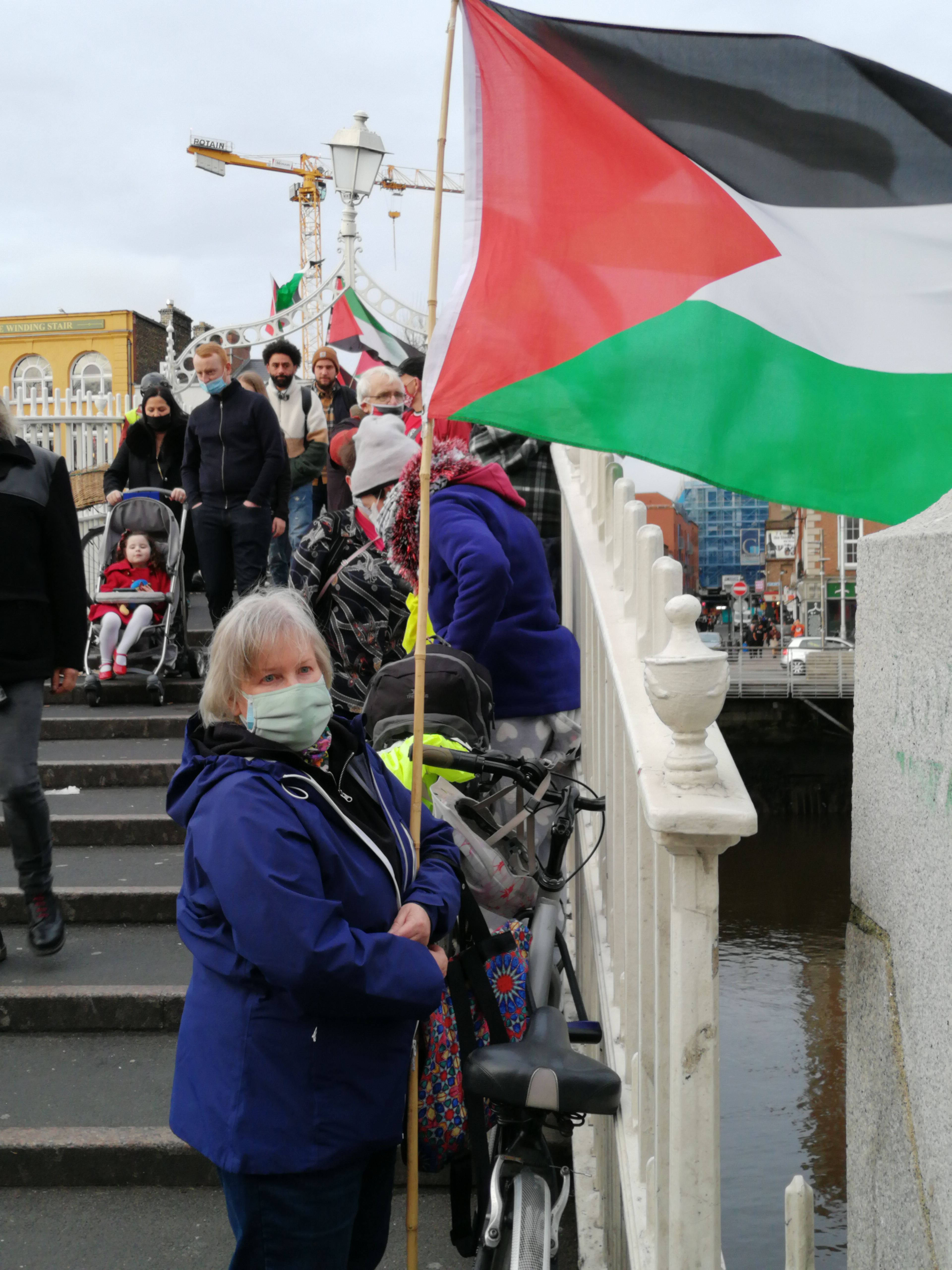
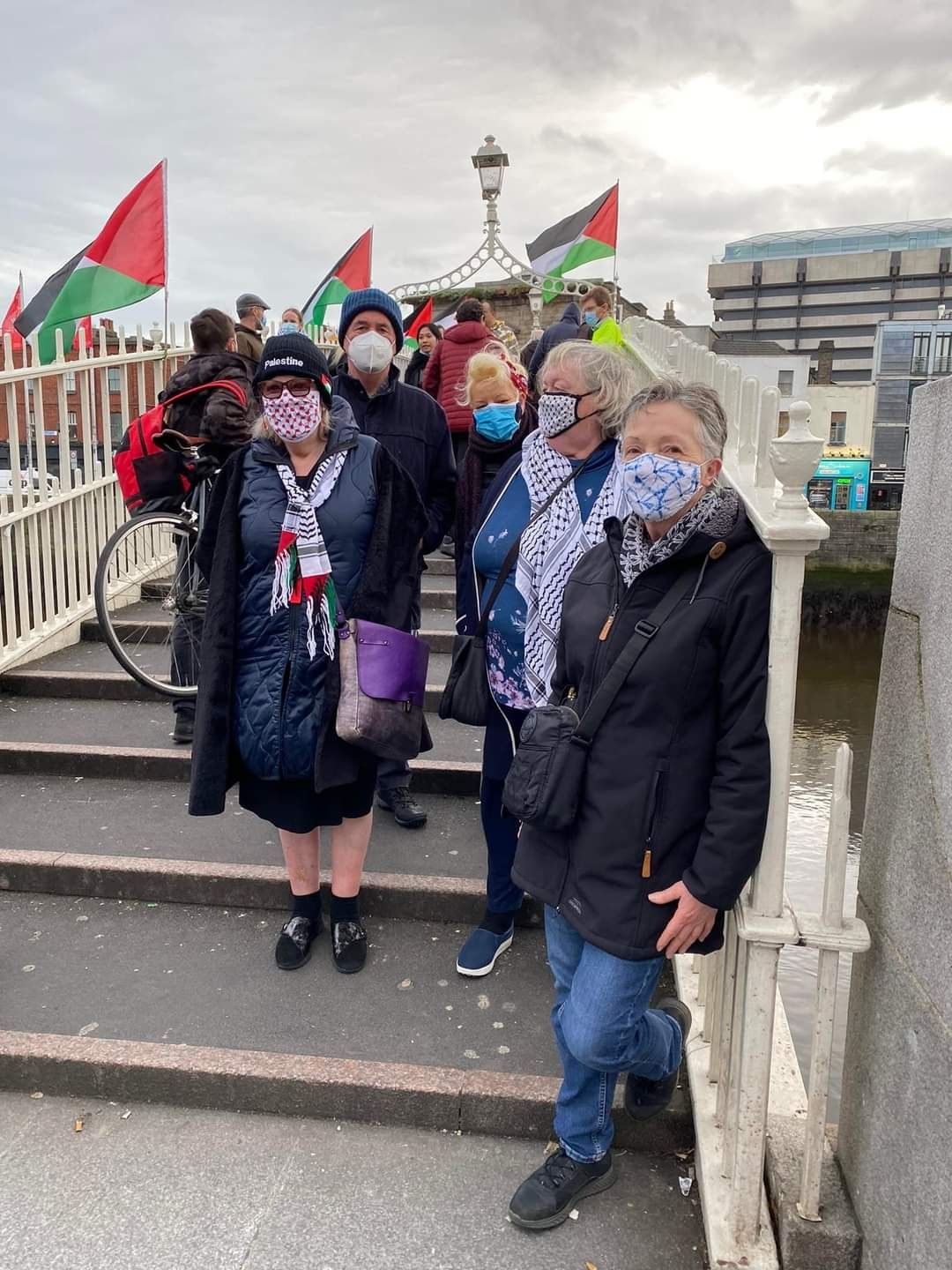
Palestinian flags fluttered in the breeze over the iconic Ha’penny Bridge in Dublin City centre, while banners festooned its length on New Year’s Eve. The numbers were down from previous years, more likely from the soaring Covid19 infection rate than from any lessening of the long-running Ireland solidarity with the oppressed Palestinians. This was ironic since, unlike previous years, this was not a rally braving sleet, snow, rain or icy wind – in fact, the very mild weather raised only the amount of breeze necessary to set the flags fluttering.

(Photo by Tamin Al Fatin, IPSC)
Tamin Al Fatin, IPSC Chairperson, centre photo (Photo by IPSC))

The event is organised every year for New Year’s Eve at the same location by the Ireland Palestine Solidarity Campaign and supporters, among which were Irish and Palestinians, handed out leaflets encouraging BDS (boycott, divestment and sanctions) of Israel, an apartheid ste. Martin Quigley, for the IPSC led some chants on a megaphone, which were taken up by people on the pedestrian Bridge, among which were that “Israel is a terrorist state”, that “Palestine will be free” and in solidarity that “we are ALL Palestinians”.

Each year more Palestinian land is stolen, more of their homes demolished or under threat of eviction, in Gaza they have periods without electricity, they are restricted in importing fuel for heating or cooking (never mind transport), or building materials (so much has been destroyed by the Israeli bombardments), they continue to be harassed and made have lengthy waits at checkpoints, their inshore sea is polluted, their fishing boats further out are attacked and harassed ….

(Photo by Tamin Al Fatin, IPSC)
  • As of 2019, more than 5.6 million Palestinians were registered with UNRWA as refugees, of which more than 1.5 million live in UNRWA-run camps.
  • According to prisoners’ rights group Addameer, there are currently (2021) 4,650 Palestinians held in Israeli jails in Israel and the occupied territories. Palestinians view them as political prisoners attempting to end Israel’s illegal occupation. Of those: 520 are being held without charge or trial.
  • At the end of September 2020, 157 Palestinian minors were held in Israeli prisons as security detainees and prisoners, at least two of whom were held in administrative detention. Another 2 Palestinian minors were held in Israel Prison Service facilities for being in Israel illegally. The IPS considers these minors – both detainees and prisoners – criminal offenders. In addition, a small number of minors are held in IDF-run facilities for short periods of time. (And the Israeli Prison Service since October 2020 has been refusing to publish figures or to supply Palestinian human rights groups with them).

BIG POWERS BACKING ISRAELI ZIONISM

The United States is the major power backing the Israeli Zionists and partly because of its position in the world and partly also for their own economic or political interests, most of the European states back the Zionists too.

In 2018 Donald Trump, as US President, moved the US Embassy for Israel into Jerusalem, endorsing the Zionist claim that the multi-faith city is Jewish and Zionist, although it is an occupied city even in international law. Shortly before he reluctantly left the office of the US Presidency, Donald Trump also endorsed Morocco’s illegal occupation of Western Sahara in exchange for Morocco recognising Israel. So far, Joe Biden, Trump’s successor, has not reversed either of those decisions.

(Photo by D.Breatnach)

THE PEOPLE OF THE WORLD SUPPORT THE PALESTINIANS

As is usually the case, it is the ordinary people in Ireland and around the world that support the Palestinians, while the big capitalists and imperialists, while occasionally criticising the Israeli Zionists, continue to support them politically, economically, culturally and militarily. Even in the United Nations, an organisation controlled by the big powers, a majority condemned the Zionist state in 17 separate motions in 2020 and last year formally ratified another six resolutions criticising Israel.

So why has international action not been taken against this terrorist state? The answer is that although the UN has 193 member states, only its Security Council decisions have to be carried out and there are only five permanent members of the Security Council: USA, UK, France, Russia and China. And what’s more, their decisions have to be unanimous.

(Photo by Tamin Al Fatin, IPSC)

On the other hand, so many civil organisations around the world have declared themselves in solidarity with the Palestinians and in Ireland. Hundreds of thousands have marched in so many countries and sports people, many popular culture stars and academics have refused to perform or attend conferences in Israel. One can no longer find Israeli goods in most shops or supermarkets (and when on occasion they are on sale, their country of origin is not marked on the product).

End.

(Photo by Tamin Al Fatin, IPSC)

Video (playable only on Facebook: https://www.facebook.com/100001732057139/videos/pcb.4926773100723710/647305976619628

POLITICAL PRISONERS’ SOLIDARITY PICKET IN DUBLIN

Clive Sulish

(Reading time: 3 minutes)

Amidst festive season lights, passing Santa Clauses on horse-drawn carriages and hungry people being fed by volunteers in the Dublin city centre, Irish Republicans and Socialists gathered to send a public message of solidarity to political prisoners in Ireland and elsewhere.

Photo: Rebel Breeze

The event is an annual one organised by the Anti-Internment Group of Ireland, an independent non-aligned group raising awareness that internment without trial continues in Ireland, through revoking of licence of ex-prisoners and through refusal of bail in the no-jury courts both sides of the British Border. The Dublin committee of the AIGI holds monthly public awareness-raising pickets in the city centre.

The annual picket on Thursday early evening was supported by activists of the Irish Republican Prisoners’ Welfare Association and of the Anti-Imperialist Action organisation, along with some independents and took place in front of the iconic GPO building, on Dublin’s main street.

Photo: Rebel Breeze

The picketers and passers-by were addressed by a representative of the Anti-Internment Group outlining the participants’ presence to send solidarity greeting to political prisoners in Ireland and around the world. The speaker drew particular attention to three prisoners: Leonard Peltier, Native American, 45 years in jail and Black American Mumia Al Jamaal, 40 years in prison, both framed by police in the USA. Also highlighted was the case of Ali Osman Kose, 37 years in jail, 21 of which he has spent in solitary confinement. The speaker informed the audience that those three political prisoners, apart from their very long years of incarceration, have multiple health issues and should be released, he said on humanitarian grounds alone. “But no ….. they want them to die in jail”, he said.

Photo: Rebel Breeze

Going on to speak about political prisoners in Ireland, the speaker said that they and hostages had existed almost from the moment Ireland had been invaded by its neighbour and from the defeated United Irishmen up to the Fenians, had included not only dungeons and prison cells but also penal colonies on the other side of the world, after which they had been confined in special prisons and concentrations camps.

The creation of the Irish State on a partitioned Irish country a century ago this month had not brought freedom nor an end to the struggle, the speaker said and pointed out that the Irish State had executed 80 Irish Republicans during the years of the Civil War, which was more than the British had done during the War of Independence preceding it.

Photo: Rebel Breeze

“Whether we are religious or not ….. in our culture at this time of year we expect to be with our families, our partner, children and friends,” the AIGI representative said but pointed out that this opportunity is not available to the prisoners, which makes this a particularly difficult time of year for them, which is why the Group and others hold this event every year.

The speaker then called a young boy forward “to send a message to the prisoners from this younger generation who hopefully will see a free and united Ireland with social justice and equality. The young boy stepped forward and through the PA, asked all at this time of year to think of the Republican prisoners.

Photo: AIGI

The Starry Plough, the Palestinian flag and the Basque Ikurrina were flown by participants and among the banners of the IRPWA and Dublin Committee of the AIGI there was also one displaying the Carlos Latuff graphic of Palestinian and Irish Republican prisoner solidarity. The centrepiece in the picket line was the word Saoirse (‘freedom’ in Irish) picked out by lights on a dark background. Appropriate music was also played during the picket from a PA system, except while being addressed by the speaker.

The event concluded with thanks to all the attendance and the singing the first verse and chorus of the battle-song Amhrán na bhFiann (The Soldiers’ Song in Irish, which is also the National Anthem).

It is understood that seasonal greeting cards have also been sent by AIGI to political prisoners in prisons in the Irish state and in the colonial statelet.

End.

Photo: Rebel Breeze
Signing Christmas cards for the prisoners. (Photo: AIGI)
Photo: Rebel Breeze

Further information:

https://www.facebook.com/End-Internment-581232915354743

“BRITAIN OUT OF IRELAND!” ON ANNIVERSARY OF THE ANGLO-IRISH TREATY

Clive Sulish

(Reading time: 3 mins.)

Socialist Republicans gathered in Dublin’s main O’Connell Street on Saturday 4th December to reaffirm their commitment that Britain has no right to be in Ireland. The event, taking place on the nearest weekend to the centenary of the signing of the Anglo-Irish Treaty, was organised by the Anti-Imperialist Action Ireland organisation and supported by other socialist Republicans including the Anti-Internment Group of Ireland.

View of the picket with the GPO at the back of the photographer (Photo: Rebel Breeze)

One of the participants sang Irish revolutionary songs, accompanying himself by guitar, his unamplified voice ringing across the street and bouncing off the General Post Office opposite, location of the headquarters of the 1916 Rising. Another singer’s voice accompanied him in some of the songs.

Despite the cold, people passing on the street stopped to look, to take photos or video and, in some cases, to applaud. Some individuals also approached the participants to talk, while gestures of approval were being made from some passing public and private transport.

(Photo: Rebel Breeze)

The event concluded with the singing in Irish of the first verse and chorus of The Soldiers’ Song, a patriotic fighting song, the air of the chorus of which was adopted as the national anthem of the Irish state (but regarded by many as the property of the unfinished national liberation struggle).

The Anglo-Irish Agreement was signed on 6th December 1921 in London by negotiators of the Irish resistance movement. What was conceded by the British ruling class fell far short of what the armed movement had been fighting for since January 1919 and led soon afterwards to civil war (1922-1923). Clearly the negotiators should have brought back the terms for approval or rejection by the Dáil (the banned Irish parliament), instead of first signing the document, which is what they did.

The Treaty offered Dominion status for Ireland as a member of the Commonwealth under the British Crown, i.e akin to that of the “white”-governed colonies such as Australia, Canada and South Africa. It also offered the British Unionists in the north of Ireland the right to secede.

(Photo: Rebel Breeze)

The subsequent debate on whether to ratify the Treaty was at times bitter. Some felt the terms were the best they were likely to get, other that they offered a base on which to build for greater gains while others still felt they were a betrayal of Ireland’s long struggle for independence and the sacrifices of two years of guerrilla struggle against state repression. The vast majority of the military organisations of the movement, the IRA and Cumann na mBan, were opposed to the Treaty terms but those in favour of signing gained a slim majority in the Dáil (64 in favour and 57 against).

The British unionists swiftly availed themselves of the terms, leading to the partition of Ireland early in 1922, six of the 32 Counties becoming a permanent British colony.

(Photo: Rebel Breeze)

Some have seen the positioning around the Treaty in most of Ireland as signifying a trend led by the native Irish capitalist class and supported by the Irish Catholic Church hierarchy of putting the brakes on the national liberation movement and elements of its social content. From that perspective, the signing of the document in London signalled the first overt move of the counterrevolution which was sealed with armed force by the new neo-colonialist state through war, repression, imprisonment, kidnappings, torture and executions, both official and unofficial.

Both states in Ireland henceforth would be socially conservative, the colonial one religiously sectarian and the Irish one with the Catholic Church hierarchy as the regime’s arm of social control. The Irish state remained for decades under-industrialised and generally under-developed with constant emigration maintaining the population at its post-Great Hunger low point until near the close of the Century (and even today has not fully recovered).

(Photo: Rebel Breeze)

Since the Anglo-Irish Treaty was signed there have been armed challenges by Irish Republicans during the Civil War of 1922-1923, during the 1930s, WWII, the “Border Campaign” of 1959-1962 and of course the more recent war of thirty years.

In addition there have strong struggles for social rights against censorship and around gender and sexuality: the right to purchase prophylactics, divorce, female equality, homosexuality, pregnancy termination and gay marriage. Struggles have also taken place around housing, wages and workers’ rights, in defence of natural resources, infrastructures and the environment.

The Six County colonial statelet remains socially conservative and sectarian religiously. Both administrations maintain no-jury special courts for dealing with some political cases.

Clearly, the Treaty left much unfinished business.

End.

A southward view of the banner and flags on the picket, the Starry Plough of the Irish Citizen Army and the Sunburst of the Fianna Éireann, with the Jim Larkin monument in the background. A LUAS tram is approaching to right of photo. (Photo: Rebel Breeze)

USEFUL LINKS

https://www.facebook.com/AIAI-For-National-Liberation-and-Socialist-Revolution-101829345633677

https://www.facebook.com/End-Internment-581232915354743

DUBLIN HOSTS TURKISH REVOLUTIONARY MUSIC GROUP

Clive Sulish

(Reading time: 3 mins.)

Last Saturday in the Teachers’ Club in Dublin (26/11/21), the revolutionary music Grup Yorum from Turkey, with some Irish musician input, played to an audience of up to two hundred. In between performing different numbers from their repertoire, band members spoke to the audience of the history of the struggles of their people and of the band.

The Irish tour of the band was organised by the Anti-Imperialist Action Ireland organisation; earlier that week Yorum played in a small music venue in Belfast to around 40 people. The attendance in Dublin was so large that the location had to be changed from a large room on the first floor to the much larger hall down below.

Grup Yorum performing in Dublin (Photo: Rebel Breeze)

BELFAST

In Belfast in the Sunflower Lounge, Bobby Fields from Armagh and Séan Óg from Dublin entertained those in attendance with songs of Irish resistance followed by Grup Yorum coming on afterwards. The Grup’s performance was enthusiastically received and was followed by a questions-and-answers session to learn more about the situation in Turkey.

The Grup members toured some of the area and visited the famous international solidarity wall along with the grave of Bobby Sands, where paying their respects included singing a song at the graveside.

DUBLIN

In the large hall in the Teachers’ Club, Dublin, Séan Óg took to the stage first, playing guitar to accompany himself on guitar to sing The Killmichael Ambush, Viva la Quinze Brigada, Back Home in Derry1 and The Internationale. Veteran activist and traditional singer Diarmuid Breatnach followed, singing unaccompanied the Anne Devlin Ballad, I’ll Wear No Convict’s Uniform2 and James Connolly’s satirical song Be Moderate3. Some of the audience sang along with some of the lyrics sung by each singer.

Be Moderate, satirical song by James Connolly, sung by Diarmuid Breatnach at the event (the link can be played on Facebook).

The four members of Grup Yorum present then took to the stage to huge applause and addressed the audience in Turkish, their words being translated into English by a member of their entourage. In the performance that followed, two guitars, flute and cajón were the instruments with a male and female leading voices. Each song was preceded by an explanation placing the piece in historical and political context.

Some of the songs in particular were clearly known to Turkish and Kurdish people in the audience and at some points they sang along, often waving an arm in the air. Towards the end of their performance the crowd got more and more excited and then Seán Óg joined them for a couple of numbers.

(Photo: Rebel Breeze)
oznor

The Grup’s interpreter made a special appeal for help from those in attendance to pressurise the Turkish authorities to release political prisoner Ali Osman Köse who has been in solitary confinement for 20 years and has multiple health issues. There are fears for the man’s life as he has had a cancerous kidney removed in May of this year without any follow-up treatment and despite everything has been pronounced “fit” to continue in jail.

This was followed by members of the Resistance Choir taking to the stage to join Grup Yorum in a rendition of the Italian antifascist Bella Ciao! Song before Diarmuid Breatnach returned to the stage to bring the evening to a close with the first verse and chorus of Amhrán na bhFiann4 with members of the audience joining in (including some from Anatolia)

The Resistance Choir from Dublin on stage with Grup Yorum to perform the Bella Ciao song (Photo: Rebel Breeze)

THE GRUP YORUM BAND

A revolutionary music band from Turkey, Grup Yorum members compose their own material and the band has has released twenty-three albums and one film since 1985. The band has suffered repression with some concerts and albums banned and members have been arrested, jailed and tortured, two members also dying on hunger strike. The band is popular in Turkey and as well as their albums selling well in Turkey and internationally, it has also given concerts in Germany, Austria, Australia, France, Italy, the Netherlands, Belgium, Denmark, United Kingdom, Greece and Syria.

Grup Yorum publishes an art, culture, literature, and music magazine entitled Tavir, and several group members manage a cultural centre called İdil Kültür Merkez in the Okmeydani neighbourhood of Istanbul.

Section of the crowd in Dublin saluting the Grup Yorum performers (Photo: Rebel Breeze)

FOOTNOTES:

1The lyrics and air of Viva la Quinze Brigada are by famous Irish folk musician Christy Moore, who also arranged Bobby Sands’ poem to the air of the Wreck of the Edmund Fitzgerald (by Gordon Lightfoot) as Back Home in Derry.

2Diarmuid sings this song to an air he composed himself.

3Diarmuid sings this to the air of A Nation Once Again (by Thomas Davis).

4Written by Peadar Kearney originally under the title The Soldiers’ Song and sung by insurgents during the 1916 Rising, its chorus is the official national anthem of the Irish State. However, it is also sung by many who are opposed to the State, particularly by Irish Republicans. Normally only the chorus is heard, sung in Irish (translation).

USEFUL LINKS:

https://www.facebook.com/grupyorum1985

https://www.facebook.com/Anti-Imperialist-Action-Dublin-North-City-110852710835826

https://www.facebook.com/socialistrepublicanballyfermot

https://freealiosmankose.wordpress.com/