JARDUN CALL FOR REVOLUTION ON BASQUE NATIONAL DAY IN GERNIKA

Diarmuid Breatnach

(Reading time main text: 10 mins.)

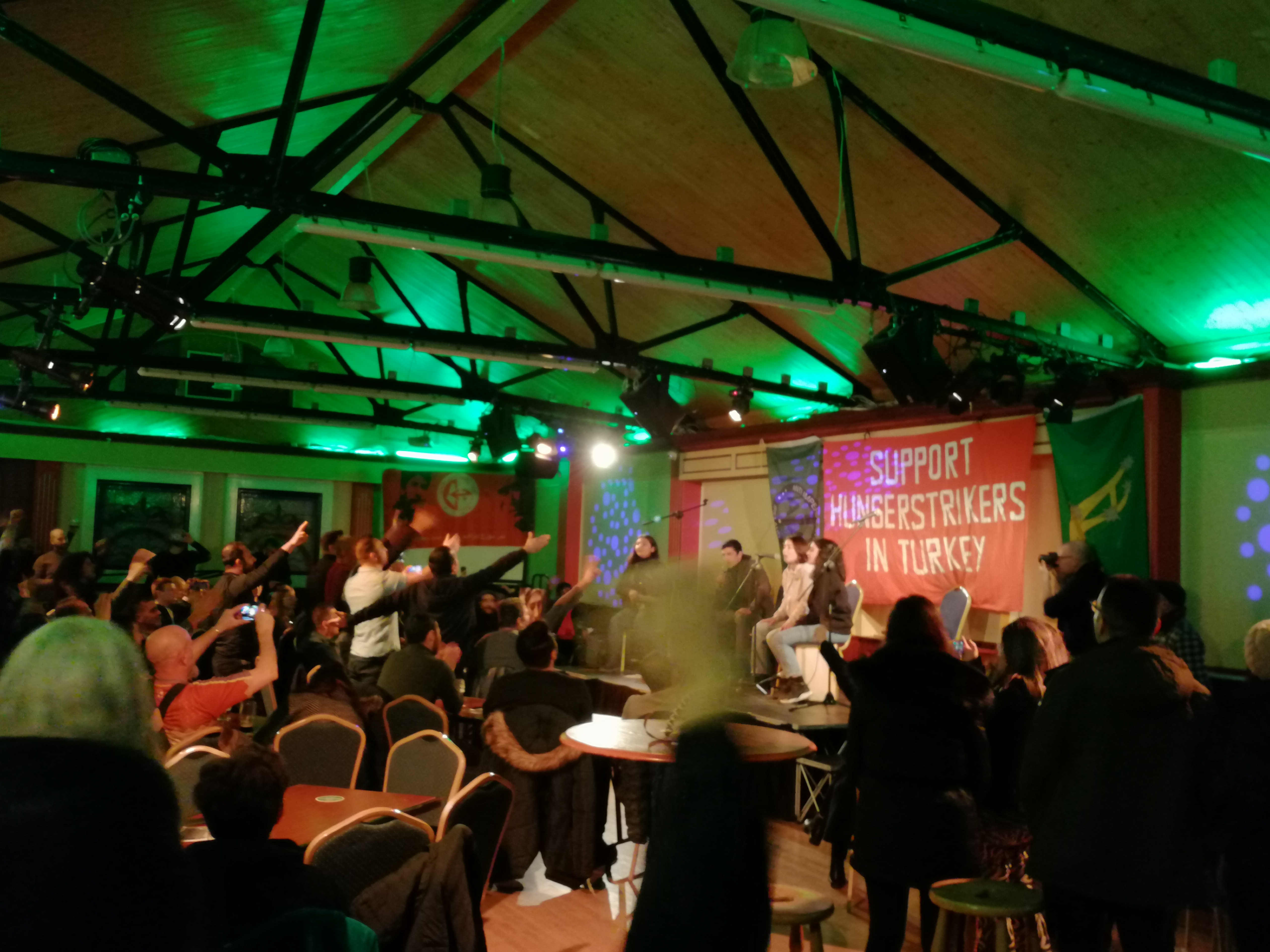
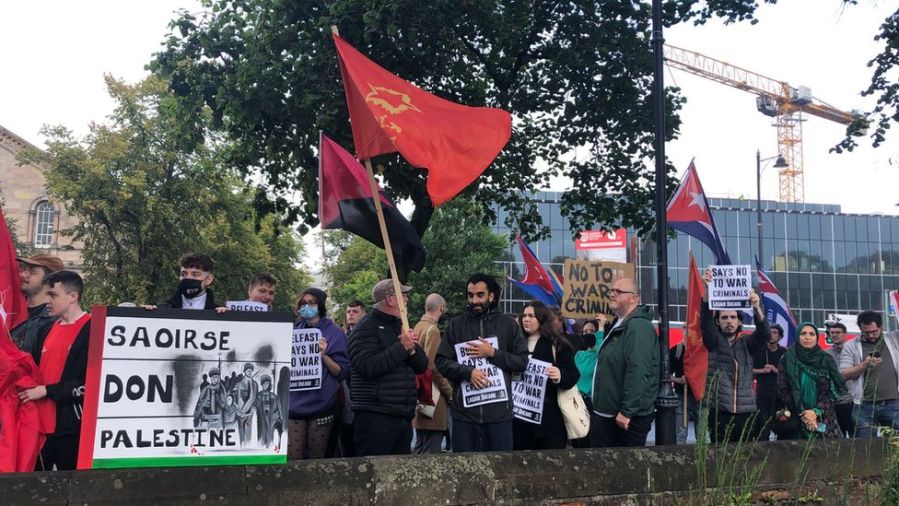
The revolutionary Basque socialist coordination organisation Jardun Koordinadora organised a celebration of Aberri Eguna, the Basque national day, combining political, social and cultural forms. Aberri Eguna takes place annually on Easter Sunday, a date chosen by its founder Elias Gallestegi based on a traditional commemoration day of the Easter Rising in Ireland. Aberri Eguna was first celebrated in Bilbo in 1932 attended by 65,000 people, including members of Emakume Abertzale Batza1, the Basque nationalist women’s organisation founded by Gallestegi also in emulation of the Irish organisation Cumann na mBan. Around 1,000 people, with a high representation of youth but also of veterans of the struggle, attended the events in Gernika2.

Jardun-organised Aberri Eguna procession passing through Gernika (Photo courtesy Jardun)

The Irish connection was reiterated on Sunday by the reading at the political rally of messages of solidarity from three Irish-based sources: Anti-Imperialist Action, Anti-Internment Committee of Ireland and Dublin Basque Solidarity Committee.

Jardun Koordinatora is a relatively new initiative which is a sharp departure from the trajectory in recent decades of the official leadership of the Abertzale Left, a trajectory which has served to dismember and dishearten the movement.

La Haine Report

(Translation by Dublin Basque with explanatory notes in italics)

The different organisations comprising this Coordination (Jardun) demonstrated in Gernika under the slogans “Aberri gorria, biharko Euskal Herria, “Independentzia eta Sozialismoa”, “Euskal Herrilangilea Aurrera”, “Presoak Kalera Amnistia osoa” and “Amnistiarik gabe bakerik ez” (“Bright future in tomorrow’s Basque Country” “Independence and Socialism”, “Forward Basque workers”, “Prisoners Free with Full Amnesty” and “No Peace Without Amnesty”).

This Sunday, April 17, the JARDUN Coordination convened the Aberri Eguna (Basque National Day) gathering some 1,000 people to claim the national objective of the Basque Working People.

Along with a Zanpantzar group (performers with bells in traditional costumes representing animals), the event began with a march starting from Plaza Mercurio and during the journey different acts were carried out to demand prisoner amnesty and rights for working women. The event ended with the speeches read in Pasealeku Plaza: the first two were messages of solidarity sent by Anti-Imperialist Action and Anti-Internment Committee (both of Ireland) and ended with the political statement of the JARDUN Coordination.

Tradition Zapantzarak lead the procession (Photo courtesy Jardun)

The demonstration went smoothly. However, the bus that departed from Irunea/ Pamplona had problems getting there because the National Police stopped it in Urdiain, taking details of the occupants.

To conclude, JARDUN Coordination stated that the only alternative for the Basque Working People will come from the hand of independence and socialism. To conclude, the Internationale and the Eusko Gudariak (Basque Soldier) were sung.
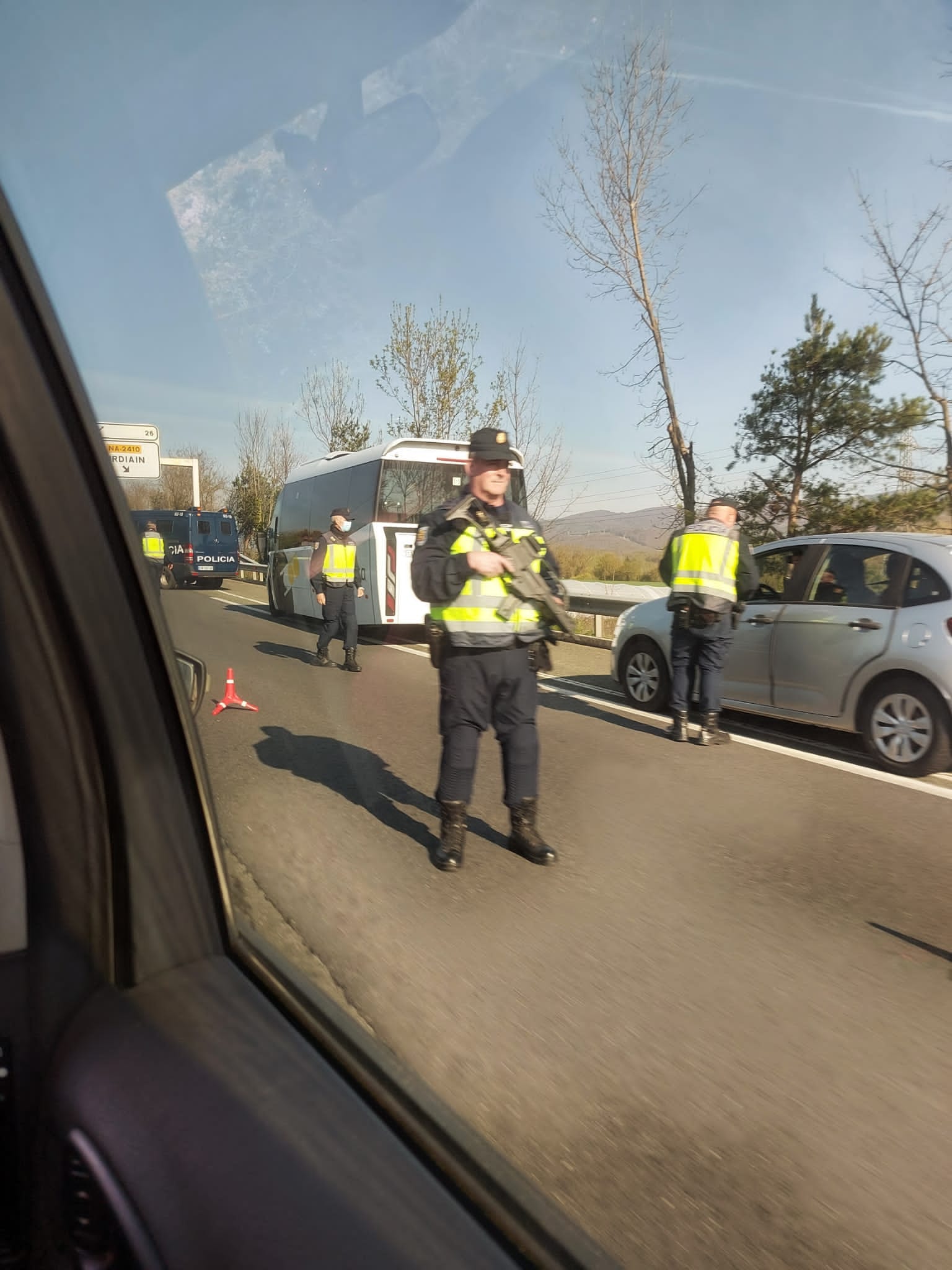
Spanish armed police stopped the contingent from Irunea/ Pamplona heading for Gernika and recorded their details. (Courtesy of Jardun)


Jardun Statement for Aberri Eguna 2022
(Translated by D.Breatnach from text supplied in Castillian Spanish)

Under capitalism, we workers are condemned to survive. We build our lives around work and the exploitation we suffer in it, while the bourgeoisie lives at the expense of this work. Such is the dynamic of capital. This is the logic of the economic system currently in force in the world. That is why it is important to clearly identify and point out the adversary facing us; because the capitalist system, the bourgeoisie, normalises and legitimises the fears and the repression that it produces daily to absorb the blood of the workers.
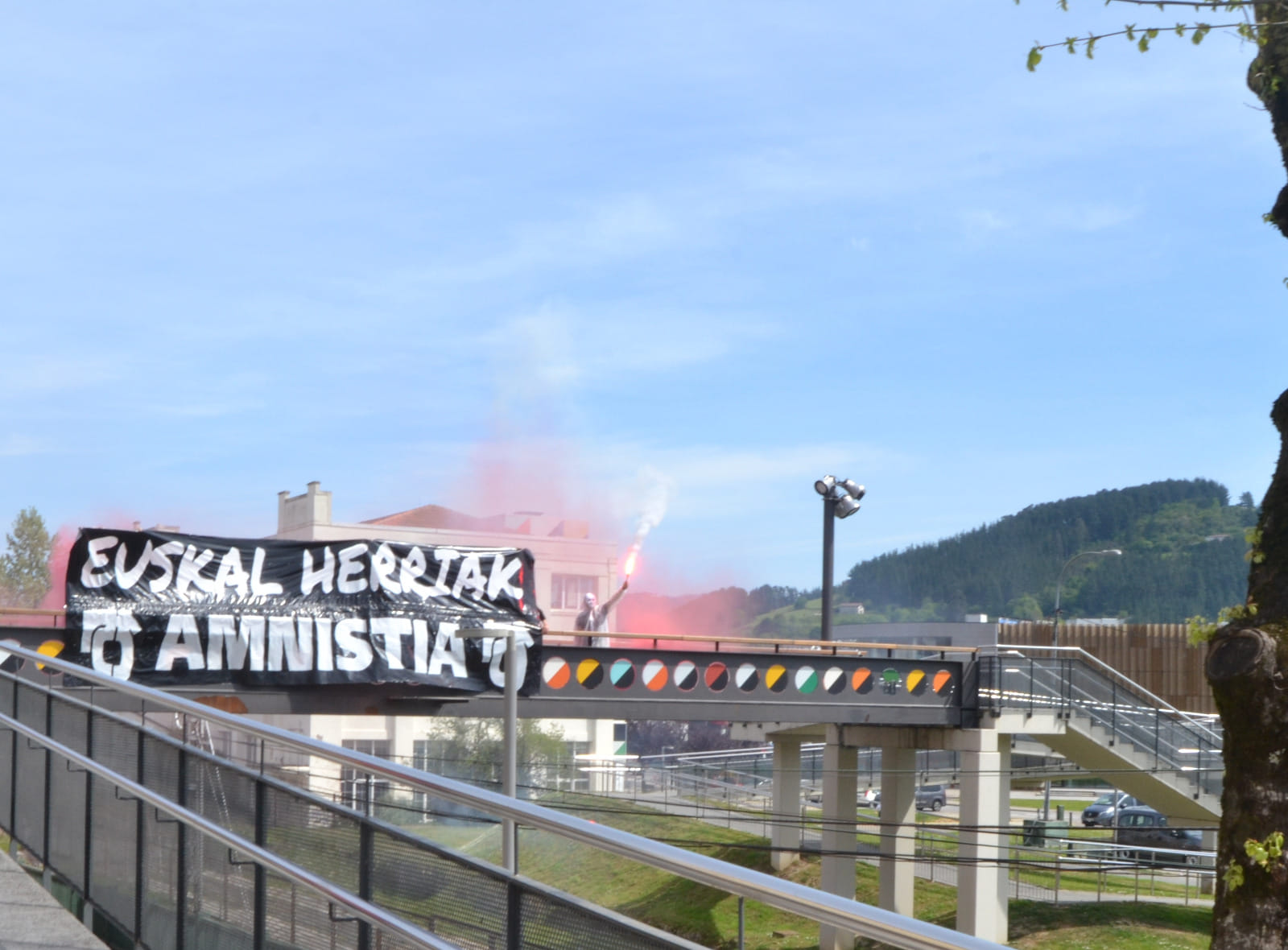
(Photo courtesy Jardun)

But with 19 years in prison for the freedom of his people, the murder of Iván Colona, a direct consequence of the criminal French prison policy, is not normal. The situation of the working people of Ireland, suffering from crushing British occupation for more than 800 years, is not normal. After eight long years of war, the situation of the working people of Donbass, who experience bombings, murders and massacres on a daily basis, is not normal. And much more heinous, outside of the norm, are the attempts to whitewash and legitimise criminal institutions such as NATO murderers.

We must situate ourselves in that context, understand within that reality, the situation that Euskal Herria (the Basque Country) is experiencing. Today our country are controlled by both the French and Spanish states. Not only do both these states not recognise Euskal Herria but they carry out an oppression based on that denial against the working class of Euskal Herria. In effect, we must understand well that, beyond the national question providing the a joint market for the states, the working class can only use the political project of the bourgeoisie as an element of unity to support and protect it, promoting interclassist attitudes.

“We, the organized women workers, will overcome all oppression!” (Photo courtesy Jardun)

The aforementioned denial, as well as the attacks carried out by the Spanish and French States against the Basque Working People, must be understood as an ideological motivation of the national State. We must, therefore, situate the oppression of Euskal Herria in the very creation of the Spanish and French capitalist states; because the objective of the denial is clear, the assimilation of Euskal Herria. To do this, the states take advantage of the institutions aimed at creating divisions and gaps in the Basque consciousness. And to protect these institutions and guarantee the supremacy of the bourgeoisie, they take advantage of dogs of various colours to attack the working people. To promote alienation and renounce our identity, in addition to normalising the attacks against the language, they have turned the Basque language and culture into souvenirs of a territory that today wants to dedicate itself to tourism, since for the bourgeoisie everything is business, to the point of commodifying our places of residence.

This being the case, given that denial is a decision of a political nature, we must cover with a political character the oppression experienced by Euskal Herria to view it with a class vision. We have to be clear about the concept of the political nature with regard to Euskal Herria nationality. Therefore, we have to fight against normalised oppression. Along this path, it is up to the workers of Euskal Herria to build our own political project and in response to this we have to equip ourselves with our own institutions that have to arise out of the counter-power that we need to form. And for this it is necessary for a Workers’ Euskal Herria to break politically with the Spanish and French states.

Photo shows a substantial following by veterans of the struggle (Photo courtesy Jardun)

These States offer the working people the use and threat of both persecution and violence, within the capitalist system that condemns the working class to servitude for the benefit of the bourgeoisie. For this reason, to carry out the aforementioned political rupture, political confrontation must be a valued concept in order to carry out the political project of the workers of Euskal Herria. Political confrontation must also be the engine of the revolutionary process aimed at achieving an independent and socialist Basque state in Euskal Herria.

For this, it is necessary to take the revolutionary process to the extreme and form a political body that must feed the revolutionary alternative. Specifically, a political body to be formed by organised workers in favour of national and social liberation and the sale of their labour power in the Basque Country. A political body that is committed to achieving an independent and socialist Basque State. Because the Basque Working People cannot be limited to the forms of work authorised by the capitalist system. These not only destroy the revolutionary potential of the working class, but are aimed at sustaining and reproducing the ideology of the bourgeoisie; because the enemy will not give, in any way, more than he is willing to give. The bourgeoisie will not voluntarily give up its privileges.

(Photo courtesy Jardun)

It is essential to set in motion the revolutionary process that must take place on the path of a classless society, towards the acquisition of political power by the working class; the aforementioned subject will only be achieved through the confrontation carried out with the capitalist state. Through the counter-power built in the confrontation, the Basque Working People must articulate revolutionary structures that wear down the centres of power of the oppressor and guarantee his liberation against the exploiters, to guarantee the achievements obtained during the revolutionary process. Because the political power of the Basque Working People must be based on counter power. In other words, the revolutionary alternative of the working people will be built and take root as the control and power of the capitalist states over the workers of the Basque Country is annulled. The revolutionary alternative must be a comprehensive political alternative that satisfies the needs of the Basque Working People.

It must be understood that this will be capable of leading struggles based on the activation and commitment of the workers. Therefore, in order to weave and build a revolutionary alternative at this time, the priority is the activation of workers aimed at promoting the ideological struggle and mobilization, understanding the JARDUN coordinator as an instrument to achieve this. In short, JARDUN is a framework created with the aim of promoting the organisation of bodies and militants to win the freedom of Euskal Herria. Its objective is that, under a common political project and strategic approach, each organisation carries out its contribution in specific political areas, but that all act within the framework of a common strategy and direction.

We have to be aware that this will be achieved through gradual activation and participation through the awareness of the Basque Working People. In this process, the revolutionary process itself will be carried out gradually, and the Alternative of the Basque Working People must carry out struggles based on the different forces, conditions and problems of the moment. As its political work deepens and Basque workers’ participation in the Coordination increases, JARDUN will create new framework organisations and acquire comprehensiveness and integrity, with the revolutionary movement’s priority being to create the conditions to achieve it.
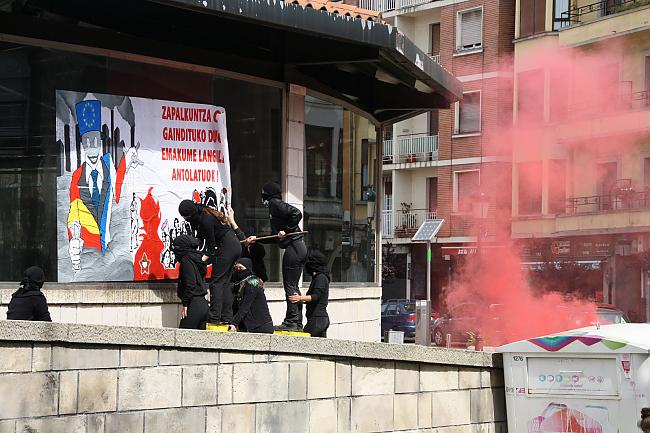
(Photo courtesy Jardun)

When talking about the liberation of Euskal Herria, self-determination is a frequently mentioned term: self-determination, a term that appears many times when a nation is subjected to the sovereignty of another against its will. But when we speak of self-determination, considering the revolutionary process developed under a counter-power based on political rupture, we are not referring, in any way, to the vote marked, accepted and facilitated by the States that persecute Euskal Herria, but to the process of separation of one nation from the state structures of another nation. Self-determination as synonymous with the revolutionary process that must be carried out to achieve an independent and socialist Basque State, in the case of Euskal Herria.

Autonomism, because it is a struggle based on the management of the remains provided by the states, is not an option. It is not a legitimate choice on the table for the revolutionary movement, since this implies reformism and the strengthening of the position of power and subjugation of the States, together with the renunciation of the strategic objectives aimed at the liberation of the Basque Working People. However, it would be a serious mistake to believe that, through national liberation, the liberation of the workers will take place mechanically. This must be understood within the class struggle, in which we must place self-determination itself within the class conflict.

On the other hand, there exists the denial, underestimation or rejection of the national question, the strengthening of the repression that the capitalist states carry out and accepting the framework of the oppressive nation imposed, in the name of socialism, with the argument of unity of the workers. Regarding the national issue, the lack of correct position also allows the French and Spanish States to continue applying unjust laws and coercion, helping to hide the dimension of oppression suffered by the working class of Euskal Herria. Keeping silent before a crushing stomp, since taking a neutral position means protection from crushing; taking neutral positions allows oppressive power relations to continue unchanged over time and space, perpetuating them.

The political rally of Jardun’s celebration of Aberri Eguna in Gernika (Photo courtesy Jardun)

Consequently, the mere demand for independence only benefits the interest and political project of the bourgeoisie of the Basque Country. And the socialism that in Euskal Herria does not address the national question goes hand-in-hand with denial, denying in class parameters the revolutionary potential of the national question. The achieving of the independent and socialist State must be the result of the revolutionary process of Euskal Herria due to the national oppression suffered by the Basque workers. Revolutionary alternatives beyond the essential defence of independence and socialism must be the basis of the political position of the Basque Working People. They are only alternative for the Basque Working People, because it inevitably comes hand-in-hand with independence and socialism.

Long live a free Basque Country!

Long live a socialist Basque Country!

End.

FOOTNOTES

1A strong organisation in the antifascist resistance to the fascist-military uprising against the Spanish Republic but no longer in existence.

2Guernica, in Spanish.

SOURCES

Jardun Koordinadora: https://www.facebook.com/Jardun_koordinadora-100598125431163

https://eh.lahaine.org/eusk-cast-jardun-koordinadorak-2022ko
INVASION – RIGHT OR WRONG?

Diarmuid Breatnach

(Reading time: 7 mins.)

We are a people – or nation – that has been invaded; we have resisted and suffered in that resistance. Naturally we tend to sympathise with other countries who have been – or are being – invaded too. Many other peoples have been invaded more often than has Ireland; the Book of Invasions and Occupations of some of those would run to many pages. Few however have been occupied for nearing a millenium by what has been essentially the same invader – as has our little nation. So the question as to whether invasions are always wrong is bound to arouse an emotional feeling of rejection in us, of hostility to the questioner, even. Still, I ask the question and turn to history for the answer, our own history and that of other places.

INVASIONS OF IRELAND

The Vikings invaded Ireland (a sovereign state or collection of states) in successive waves from Norway and Denmark areas, took people to be sold as slaves, pillaged and looted and in time occupied parts of our land. They were hardly welcome but after their defeat at the Battle of Clontarf (sic) in 1014, left little permanent damage.

The Normans, invading in 1169, were a different matter, with less pillaging but wreaking far-reaching adverse changes, especially as they became the English ruling class, a mixing of Norman and Anglo-Saxon elites. Our land was turned into a colony, competing industries destroyed, the majority population turned into second-class subjects, our produce used to fuel the British industrial revolution, followed by famine here, mass emigration, our resistance repressed ……

In our strivings to be free from the English Occupation, we invited an invasion from the Spanish Kingdom to Ireland and one arrived in 1601, which was followed by the Siege and Battle of Kinsale (2nd October 1601-3rd January 1602) between Irish clans and their Spanish allies against the English. The latter’s victory resulted in English conquest over the whole island and the destruction of the remains of the Gaelic social and legal order in Ireland.

Battle of Kinsale map (Image sourced: Internet)

During the Jacobite War (1689-1691), the Irish and Anglo-Irish clans invited Royal French forces to invade Ireland in order to assist them in supporting King James II his bid to regain the English Crown1 and that too ended badly for the Irish with the Limerick Treaty, the flight of the Wild Geese and the religious Penal Laws.

In the late 1790s, the United Irishmen once again invited the French forces — but this time Republican – to assist them in overthrowing English rule in Ireland in what was a semi-sovereign state. The planned French invasion failed due to adverse weather conditions in 1796 and a smaller force successfully landed in Mayo in the closing weeks of the 1798 Rising, joined with Irish insurgents and defeated English military units but was soon surrounded and, massively outnumbered, surrendered.

DURING WWI

During WWI sovereign states in large areas of the world, in particular in Europe and in the Middle East, were invaded by the armies of many states, comprising those of the Central Powers of Germany, Austro-Hungary and Turkey on one side and those of the Entente — UK, France, USA, Turkey, Russia, Italy and Japan – on the other. The cause of the war was contention between imperial powers and no side could be said to have been justified in the alliance they joined or in invasions carried out as a result. One revealing example of the gap between justication propaganda and reality was that the UK claimed that it was waging war with Germany in defence of the little nation of Belgium, while it repressed a rising of the little nation of Ireland. Likewise, the USA, which claimed to want a post-war world of peace and security for small nations, refused to receive the delegations of a number of small or weaker nations, including that of Ireland, to the Paris Peace Conference2.

AND WWII

In the runup to WWII and during it, parts of Africa, Asia and most of Europe, including many sovereign states3, were invaded by the Nazis and Fascist powers of Germany, Italy or Japan4, with horrific consequences for the people who lived in the invaded lands.

German motorised Nazi troops invading the USSR during WWII(Image sourced: Internet)

Would we have countenanced an invasion of Nazi Germany to prevent what it was going to do? In any case, during the War, the counter-attack of the Allies also invaded huge parts of the world, including sovereign states that had colluded with the Nazis, as well countries totally dominated by them: the USSR invaded Eastern Europe beyond the USSR’s earlier borders, also sovereign Germany and sovereign Austria; the USA and UK invaded France (part-sovereign, part-occupied) and Italy (part-liberated by popular revolt) and all three invaded sovereign Germany and Austria too, but also North Africa; the USA invaded the Phillippines and Indo-China. Had we been alive then, most of us would have cheered those invasions – they brought down the terrible Axis forces, liberated death camps, freed people from fascist rule.

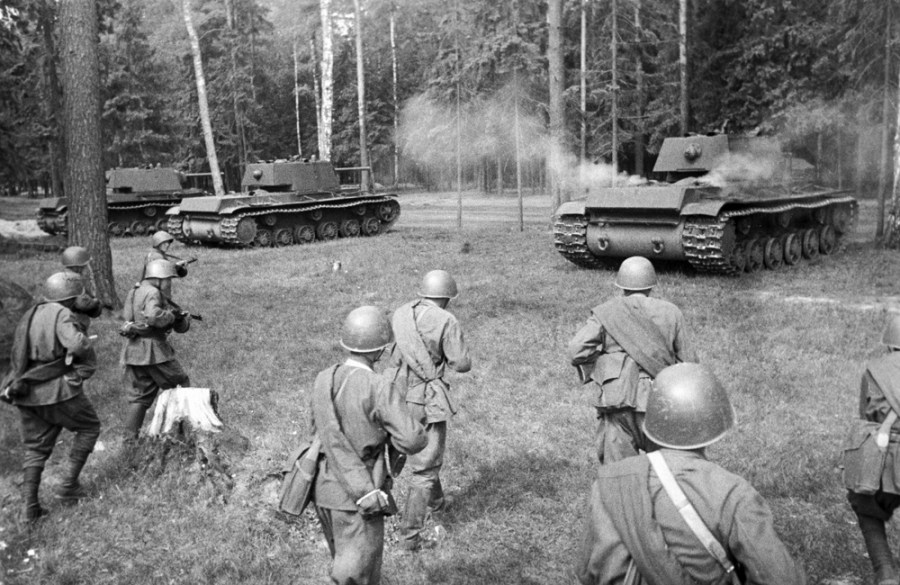
Soviet infantry follow Soviet tanks in counterattack on Nazi forces during WWII. (Image sourced: Internet)
US troops invading France in the Normandy Landings during WWII (Image sourced: Internet)

But the UK and France retook their colonies, where they had been suppressing and repressing the people for generations.5 The UK and USA prevented the Greeks from stopping the return of their monarch (their sovereign) and, combining former fascist police with their own armed forces, suppressed the Greek rising. And the USA installed themselves in the Phillippines, making them their neo-colonies. The USA also began to cultivate elites as clients in Indo-China, particularly in Korea and Vietnam.

The reoccupations of colonies and transfer of control to new masters were the cause of a wave of anti-colonial struggles and wars of repression in India and Malaya with the UK; in North Africa with the French; in Korea with the USA; in Vietnam with the French first and then with the USA; in the Middle East and West Africa with the UK and France. They also facilitated the creation of the Zionist state of Israel with horrific consequences (including invasions by it) that continue to be played out to this day.

The struggles of people resulted in the eventual national liberation of areas of the world, including part of Korea and later, Vietnam, creating states. Cambodia and Laos, having been bombed by the USA in its war with the Vietnamese people, came under new national regimes. But the new rulers of Cambodia’s sovereign state, under the Pol Pot regime, developed a new kind of horrific rule resulting in the distinction of becoming the country with most mass graves in the world6. That sovereign regime was toppled by an intervention of Vietnamese forces and those of us alive then cheered that invasion.

The Portuguese colonies in Angola and Mozambique were freed by liberation struggles but in Mozambique were assisted by Cuban troops, which also helped them resist invasion by South African troops and proxies.7

Much closer to our own time, the UK and USA/NATO, leading coalitions of other states, invaded Afghanistan, Iraq and Libya, destabilising them and destroying for years the development potential of those countries8. They attempted the same with Syria and that conflict is ongoing. The excuse given was always along the lines of countering a threat to the world (Iraq: “Weapons of mass destruction”, “Al Khaeda”) or liberating their populations (Afghanistan, Iraq, Libya, Syria).

US tanks and soldiers in Iraq, six days after the fall of Baghdad (Photo credit: John Moore/ AP)

INVASIONS GENERALLY — AND WHAT ABOUT UKRAINE?

So, reviewing the historical record, very few would say that invading another region — even a sovereign state — is wrong on every occasion. Most would say, I think, that it would depend on the motivation for the invasion, how it is conducted and what the invaders do afterwards.

Hopefully this can help us to mediate the automatic Irish sympathetic reaction to the war in the Ukraine and with regard to the Western-dominated discourse that Russia is automatically wrong – purely because its troops invaded the Ukrainian sovereign state. Russia may indeed be wrong – but not purely on the fact that it invaded.

Which then moves the evaluation on to a more productive and rational basis. Was the reason for the invasion justified? How did Russian troops conduct themselves during the invasion? What is intended as the longer-term outcome of the invasion?

Here, unfortunately we are in a marsh of propaganda, fake news, partial accounts, censorship9 ….. and the war has not yet concluded. But we can try to navigate our way across this marsh relying on the fairly firm patches we can find and hopefully avoiding getting stuck or even sucked down.

Justification for the invasion?

Russia says it invaded because it was being encircled and threatened by NATO, while the latter denies this. The evidence is however on the side of Russia in this disagreement10.

Putin also says that he did so to “de-nazify” the Ukraine. Considering the number of active fascists in Russia, this does not ring true, though the presence of nazi militia in the Azov Battalion is undeniable and the the Ukrainian regime is certainly glorifying Nazis in its past.

Conduct during the invasion

When Russia invaded it says that it fought to confront military units and to keep civilian casualties to a minimum. In the early days of the war this does seem to have been the case. As the fighting grew fiercer around Kyiv and Mariupol, it was harder to ascertain the truth, with Ukranian claim the Russians were targeting civilian structures and Russian counter-claim that, in Mariupol in particular, the Ukrainian forces were firing from civilian structures, which naturally attracted Russian return fire. And of course, bombardment of any large area is going to result, whether intended or not, in damage to civilian structures.

Another Ukrainian accusation, widely covered in the western media, is that the Russians were kidnapping civilians and transporting them back to Russia. The latter responded that they were facilitating the evacuation of civilians from danger areas. A similar Ukranian removal of civilians, on the face of it, is represented as a humanitarian action. Humanitarian evacuation or kidnapping? By one or the other, or by both?

There have been Ukranian accusations that the Russians executed captured Ukrainian soldiers and civilians and the Western media and political leaders have repeated those accusations. What appears to be bodies of civilians have been photographed in the streets of Bucha and Irpin after the Russians forces retreated, some of which appeared to have their hands tied behind their backs.

The Russians have rejected the whole story as fake news, pointing out that the Mayor of Bucha had smilingly recorded a video message after the Russian military evacuation of his town, during which he had made no mention at all of any such executions. Also that the reports of the alleged executions did not emerge until four days after they had evacuated the town.

However the Ukrainians also say that a mass grave containing 410 bodies has been uncovered outside Kyiv. Russia has said it wants the issue discussed at the UN Security Council11 but so far have been blocked by another permanent member, the UK (the latter holds the Presidency of the Security Council at the moment)12.

We must await some kind of even semi-independent investigation but if any of these allegations turn out to be true it will certainly be a powerful indictment of Russia’s conduct during the invasion.

Post-invasion actions

We do not know for certain what the situtation will look like post-conflict but it looks likely that Russia will withdraw from most of the Ukraine, which will remain outside NATO and with much-reduced armament, which was part of what Russia was seeking even years before the conflict. But it also looks as though Russia will retain the Crimea and the Donbas area.

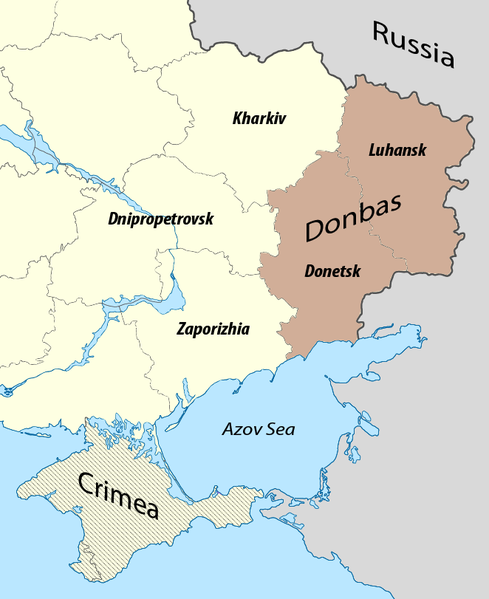
Simple neutral map showing the Ukraine in yellow with Donetsk and Luhansk areas in brown (together known as Donbas) and the Crimea (lined pattern) with the western shore of the Sea of Azov running between the two enclaves. East of that Sea and of Donbas is Russia (shown in grey). Kiyv is far to the north-west in Ukraine. (Image sourced: Internet)

To judge whether that retention is just or not, one has to choose between two narratives (or some synthesis of both).

The Russian narrative is that after the change of government in 2014 there was a campaign against ethnic and linguistic minorities, in particular Russian-speakers, by the Ukrainian authorities, aided by fascist forces. These attacked the Russian-speaking areas, the latter mobilised to defend themselves and asked Russia to come to their defence.

The Western narrative is that Russia egged on Russian speakers to fight the Ukrainians and to secede and that the whole thing was just a Russian land grab.

But one way or another, the bare fact of Russian invasion is not sufficient to decide against them, much less to agree with what is essentially the dominant US/NATO discourse of the western media – the bigger and longer picture needs to be examined.

End.

FOOTNOTES

1Both Irish and Anglo-Irish sought an end to religious oppression of Catholics and retention of their lands; the Irish clans may have also sought recovery of some of their ancestral lands.

2More about the division of the world between victorious powers and punishing the losers, than about peace.

3The Austrian state was subverted under threat by the Nazis, as was also the Norwegian, followed quickly by invasion.

4Nazi Germany also recruited fascist units from Spain, Ukraine and Romania into their army and Japan recruited Koreans; in addition an Indian natiolal liberation army fought the English occupation in coalition with the Japanese.

5The Japanese were asked to hold on to their conquered territory in parts of SE Asia until the French could move back in, for example in Vietnam.

6Spain is the second, dating from its Civil War/ Anti-fascist War, a sovereign monarchical state evolving from a successful fascist-military coup against an elected Republican government.

7A highly simplified description, as there were civil war elements also with fighting for control between different factions of the former liberation movement.

8The UK holds the record for countries invaded, while the USA holds the record for involvement in military conflicts since WWII.

9Twitter has taken down an archive of six years of Chris Hedges’ Contact programs, Netflix has removed the Oliver Stone documentary “Ukraine Is Burning”, the US and UK has banned RT and Russia then banned BBC, China has banned BBC and Facebook, the latter has unbanned the fascist Ukrainian Azov Battallion …. And the Western Left is ignoring Naom Chomsky.

10Just Google “Map NATO states in Eastern Europe”.

11The United Nations is a body containing essentially two general decision-making bodies, the General Assemby of every full member nation — currently 193 – and the 15-member Security Council, which makes the only binding decisions. However, the decisions of the rest can be vetoed by any of the five Permanent Members of the Security Council: USA, UK, France, Russia and China.

12Any entering of the words “Russia” combined with “war-crimes” or “executions” into a search engine will bring an avalanche of western reporting of the allegations but scant treatment of the Russian response. As balance I have included only two rare more balanced western reports in the Sources section.

SOURCES

Rare balanced western media coverage of Russian response to allegations of war-crimes: https://www.reuters.com/world/europe/kremlin-denies-ukrainian-allegations-its-forces-killed-civilians-near-kyiv-2022-04-04/

https://www.reuters.com/world/europe/russia-ask-un-security-council-again-discuss-bucha-provocations-2022-04-04/

Not Russia-friendly Al Jazeera: https://www.aljazeera.com/news/2022/4/6/ukraine-as-russia-faces-genocide-charge-experts-urge-caution

Basque Solidarity for Corsican Patriot Murdered in French Jail

Clive Sulish

(Reading time: 2 mins.)

SPEECH DELIVERED AT THE RALLIES ORGANISED BY JARDUN IN RESPONSE TO THE MURDER OF CORSICAN POLITICAL PRISONER YVAN COLONNA (Se encuentra la versión anterior en castellano/español al fondo)

Yvan Colonna was from a young age a member of the Corsican liberation movement. After being forced to remain in hiding for four years, he was arrested in 2003, accused of participating in an action carried out by an anonymous group. The accusation was based on statements of several of the movement’s members detained at the police station, who later rejected the statements but Yvan was sentenced to life imprisonment.

Posters demanding justice for Yvan Colonna after his arrest (Photo sourced: Internet)

Colonna was left in a very serious coma after the beating by a jihadist prisoner in Arles prison. On Monday of this week, Yvan passed away after three weeks in hospital. During that time there were riots denouncing the role of the French state in Yvan’s murder.

Yvan was murdereded by the penitentiary policy of dispersal and the conditions of the prison. We in the JARDUN Coordination charge that the beating and death received by Yvan was a direct consequence of the penitentiary policy of the French State. Likewise, we want to underline the need to create an organisation in support of the freedom of political prisoners and the fight against oppression and exploitation.

It should not be forgotten that in Corsica, the struggle for independence has been ongoing for decades with the aim of overcoming the political-economic system imposed by the French State and fighting for a popular and democratic government that would act in favour of the Corsican people. The struggle of the Corsicans is the struggle against French imperialism, against the oppression of the local working people and against the exploitation they suffer.

In Euskal Herria (the Basque Country – Trans.) we are well aware of the repression and oppression by oppressive states and we are witnesses to the massacres committed so many times by the French State. Because we cannot forget the imperialist attitude of the French State in Algiers and other colonies, becoming, together with the United States, the main promoters of contemporary torture.

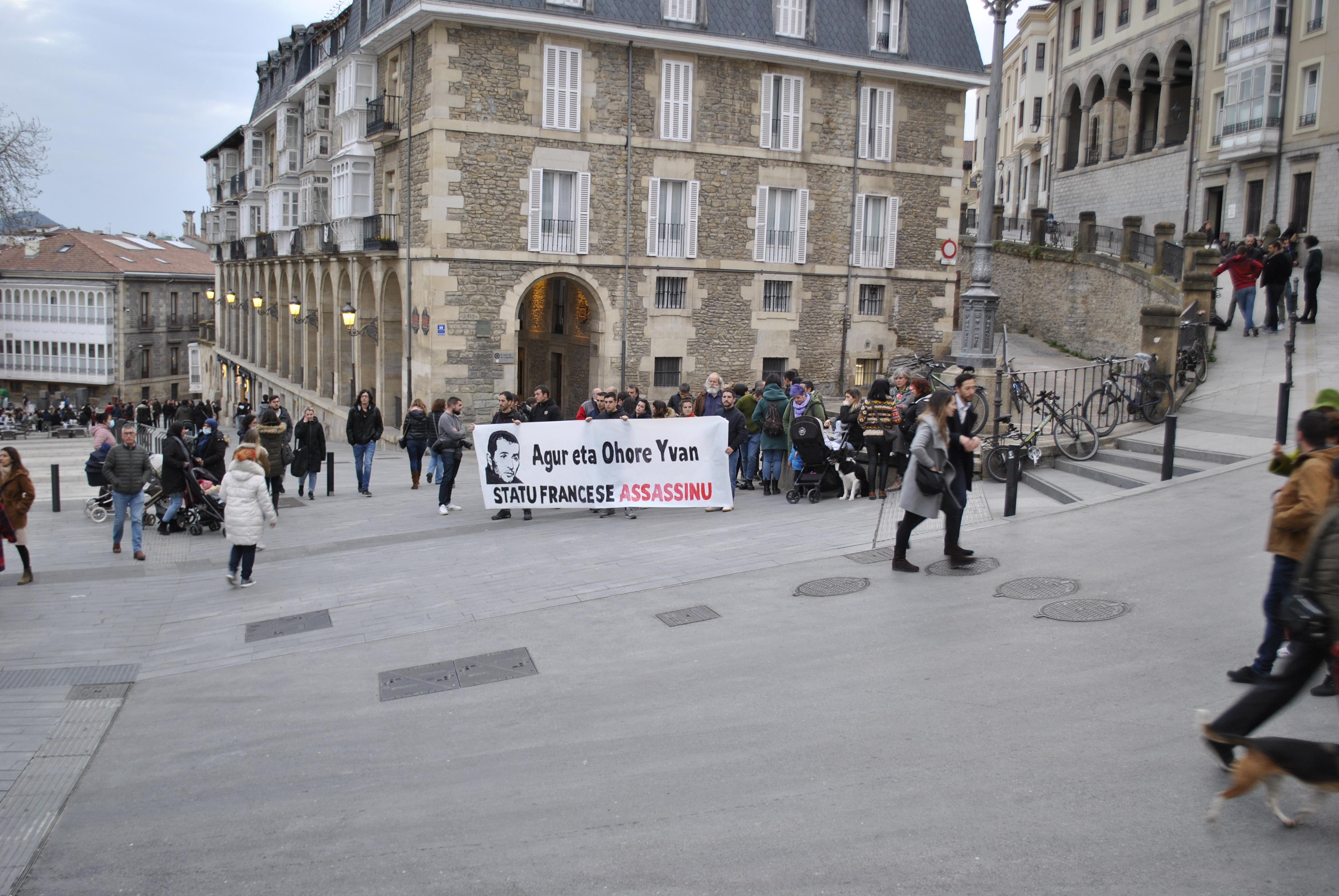
Solidarity picket in Gastheiz/ Vitoria, southern Basque Country, on Friday 25th (Photo: Jardun Koordinadora)

All of this shows us nothing less than the need for the organisation of the working class. It is evident that both the imperialist power and the oppressive States exercise a monopoly on violence to defend their economic interests and, in every nation, those who pay are always the working class.

It is time to denounce the fraud of social peace, it is time to denounce the warlike attitude of NATO, in Donbass, the Sahara, Palestine, today they are waging endless wars in defence of the interests of imperialism and its servants — and in view of this, it is time to awaken internationalist solidarity!

For this reason, we in JARDUN proclaim that it is time to turn to revolutionary organisation for all working people! Because only the organised people can offer real help and, as far as we are concerned, only the Basque working people can obstruct the participation of the Spanish and French States, organizing themselves in Euskal Herria to face the enemy, working for a political system in favour of the Basque working people.

We are clear that struggle is the only way and we will loudly proclaim that we have to confront the enemy, exploitation and class oppression. That is why we encourage you to join the organisation, because it is time to fight, it is essential to resist!

AGUR ETA OHORE YVAN! (Farewell with Honour Yvan!)

GORA KORSIKAKO HERRI LANGILEAREN BORROKA! (Long live the struggle of the Corsican working people!)

GORA EUSKAL HERRIA ASKATUTA! (Long live a free Basque Country!).

end.

Solidarity picket in Donosti/San Sebastian, southern Basque Country, on 26th March (Photo: Jardun Koordinadora)

Lectura lanzada en las concentraciones organizadas por JARDUN ante el asesinato de Yvan Colonna

Yvan Colonna era miembro del movimiento de liberación corso, en el que militó desde joven. Tras ser obligada a permanecer 4 años en la clandestinidad, fue detenida en 2003 acusada de participar en una acción llevada a cabo por un grupo anónimo. La acusación se fundamenta en la declaración de varios de los miembros detenidos en la comisaría, que posteriormente rechazaron la declaración, pero Yvan fue condenado a cadena perpetua.

Colonna quedó en coma muy grave tras la paliza de un preso yihadista en la cárcel de Arlés. El lunes de esta semana, Yvan falleció cuando llevaba 3 semanas hospitalizado. Con el objetivo de denunciar el papel del Estado francés en el asesinato de Yvan desde que ingresó en hospital, durante ese tiempo  ha habido disturbios.

Yvan fue asesinado por la política penitenciaria por la dispersión vivida y las condiciones de la prisión. Desde la  coordinadora JARDUN  denunciamos que la paliza y la muerte recibida por Yvan ha sido consecuencia directa de la política penitenciaria del estado francés. Asimismo, queremos subrayar la necesidad de articular una organización a favor de la libertad de los presos políticos y de la lucha contra la opresión y la explotación.

No hay que olvidar que en Córcega, la lucha por la independencia se ha dado durante décadas con el objetivo de superar el sistema político económico impuesto por el Estado francés y luchar por un gobierno popular y democrático que actuara en favor del pueblo corso. La lucha de los corsos es la lucha contra el imperialismo francés, la opresión del pueblo obrero local y la lucha contra la explotación que sufren.

En Euskal Herria conocemos bien la represión y la opresión de los estados opresores y somos testigos de las masacres cometidas tantas veces por el Estado francés. Porque no podemos olvidar la actitud imperialista del Estado francés en Argel y otras colonias, llegando a ser, junto con los Estados Unidos, los principales impulsores de la tortura contemporánea.

Todo ello no nos demuestra más que la necesidad de la organización de la clase trabajadora.. Es evidente que tanto la potencia imperialista como los Estados opresores ejercen el monopolio de la violencia para defender sus intereses económicos, y en todo pueblo, su pagador, es siempre la clase obrera.

Es hora de denunciar el fraude de la paz social, es tiempo de denunciar la actitud guerrera de la OTAN, Donbass, el Sáhara, Palestina, hoy en día están dando un sinfín de guerras en defensa de los intereses del imperialismo y de sus siervos, ¡y ante eso es tiempo de despertar la solidaridad internacionalista!

Para ello, desde JARDUN proclamamos que es hora de volcarse en la organización revolucionaria para todo pueblo obrero!! ¡Porque sólo el pueblo organizado puede ofrecer una verdadera ayuda, y en lo que a nosotros se refiere, sólo el pueblo trabajador vasco puede interrumpir la participación de los Estados Español y Francés, organizándose en Euskal Herria para hacer frente al enemigo, trabajando por un sistema político a favor del pueblo trabajador vasco.

Nosotros tenemos claro que la lucha es el único camino y proclamaremos en voz alta que tenemos que enfrentar al enemigo, a la explotación y la opresión de clase. Por eso os animamos a uniros a la organización, porque es tiempo de lucha, ¡es imprescindible resistir!

AGUR ETA OHORE YVAN!

GORA KORSIKAKO HERRI LANGILEAREN BORROKA!

GORA EUSKA HERRIA ASKATUTA!

BASQUE JOURNALIST REMAINS HELD BY POLAND ACCUSED OF SPYING FOR RUSSIA

Diarmuid Breatnach

(Reading time: 3 mins.)

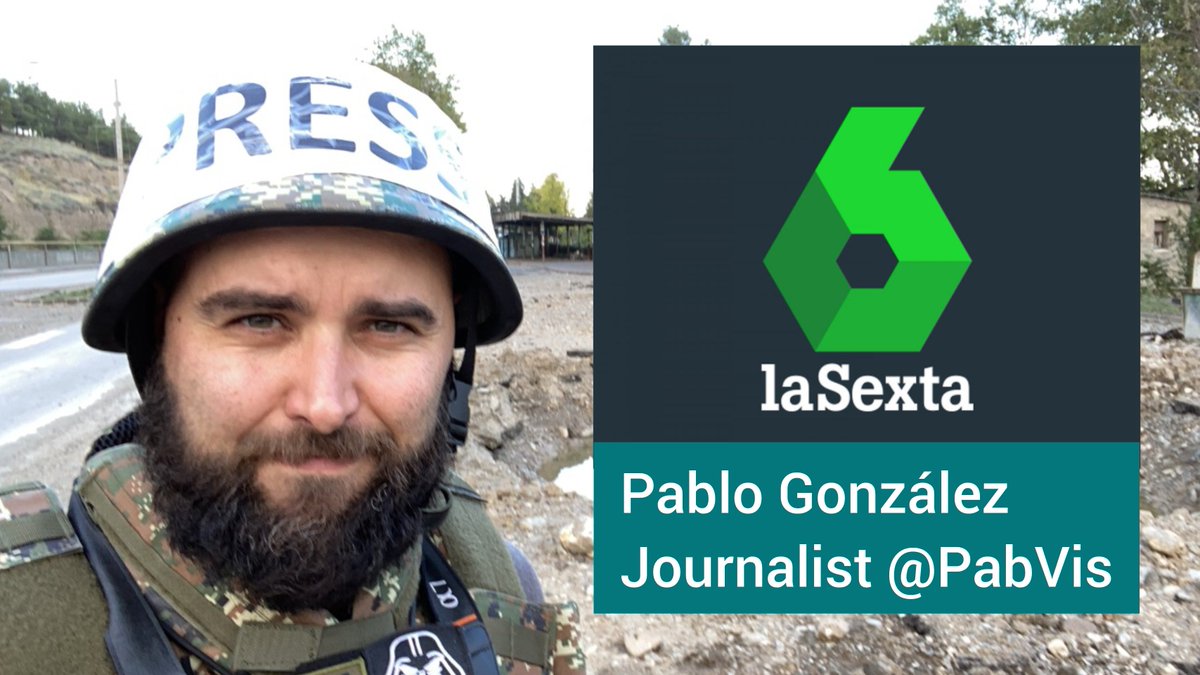
Pablo Gonzalez, a Basque journalist who includes working for Basque and Spanish left-wing media, was covering the war in Ukraine when he was interrogated by the Ukrainian authorities, the Spanish intelligence services approached his family and friends and he was subsequently arrested in Poland on 28th February and charged with spying against Poland. He has been denied access to his lawyer and no evidence has yet been presented to back up the charge but after his four-hour Ukrainian interrogation, Gonzalez reported that he had been accused of spying for Russia on the basis that he had been born in Russia1, that he reported for the mildly left-wing Basque nationalist newspaper GARA (he also reports for Publico.es) and that he had a bank card for a Basque cooperative bank. Journalist defence organisations have expressed concern at the detention.

I am not aware of having seen Gonzalez’s reporting but it may be that his material did not align with the dominant discourse as apparently the International Federation of Journalists reported that González had been accused of being pro-Russian in his coverage for a Spanish newspaper. On the other hand, several of his colleagues say that his reporting has been anti-Putin. Clearly the secret services of at least three pro-NATO countries, Ukraine, Spain and Poland have been in communication regarding Gonzalez. After his interrogation in Ukraine, he had been released but it seems awarned to leave Ukraine. He went to Poland and had been just about to re-enter Ukraine with a group of other reporters when arrested by the Polish authorities. “Legal threats and smear campaigns are a daily menace to outspoken journalists, and journalists covering the migration crisis on the Belarusian border have been detained and harassed,” the Europe representative of the Commitee to Protect Journalists, Atilla Mong told Voice Of America2.

I am no supporter of Pablo Iglesias or of his Podemos party3 but I offer my translation of his piece in Publico.es in the hope that it will a) encourage some to follow the case and perhaps lift their voices for Gonzalez’s release and b) become aware that censorship and misinformation is rampant in the media around this conflict.

MADRID

24/03/2022 18:22

PABLO IGLESIAS@PABLOIGLESIAS

On the 14th of this month, the photojournalist Juan Teixeira, a friend of Pablo González, wrote a column in Público entitled “About Pablo González and the diminishing freedom of the press.”4 There he talks about his relationship with Pablo, his work with him in the Ukraine and his arrest. I recommend, in fact, that you read his entire column, but allow me to read you two paragraphs:

It was precisely in one of these connections with Ferreras that everything began to go wrong. Pablo decided to do the direct clip of him with the military in the background, which is always more televisable. From La Sexta they had him waiting for more than 45 minutes under snow and with the soldiers increasingly tense wondering what that bald man was doing standing in front of a mobile on a tripod.

Until the military got tired and invited us to leave, but not before erasing all the material and taking a photo of Pablo’s passport. That same night, he received a call from the SBU (Ukrainian intelligence services), telling him that he should report to their headquarters as soon as possible. Despite the fact that there was work to be done, we returned to Kyiv. There Pablo was interrogated for 4 long hours, and accused of being a Russian agent with such convincing evidence as writing for Gara and having a Caja Laboral Kutxa bank card, according to them both financed by Russia. All so crazy that Pablo didn’t take it too seriously. He thought that they were simply “tightening the nuts” so that he would be more cautious with his words.

Until he found out that at that very moment, CNI5 agents had appeared at his family home, at his mother’s and at that of a childhood friend to question them and inform them that Pablo was a Russian agent.

I’m sorry that Ferreras appears here, the poor man has no fault in this, beyond the time the duplex took6, but it seemed important to me that the arguments of the Ukrainian secret services be known. I find it amazing that being the son of a Russian, writing for Gara and having an account in the Kutxa7 is something that makes you a suspect of being a secret agent of Putin. By this rule of thumb, there would be more evidence that would determine that Minister Albares8 is, on the one hand, an agent of the Vatican (he studied at Deusto, the Jesuits rule there and Pope Francis is a Jesuit, put it all together) and, on the other, he is also Moroccan agent (he lived for a long time in France and is married to a French judge who advises Emmanuel Macron, put it together)… Albares may sympathize with the Jesuits and put forward a pro-Moroccan9 line but it would be delusional to present him as an agent. Well, González is an even more delusional case.

The problem is that the logic of war contaminates everything and it is destroying the quality of the already highly-reviled conventional journalism. At the same time that we hear multi-award-winning journalists like Antonio Papell calling for Russia to be attacked with nuclear bombs or the famous and “progressive” Elisa Beni losing her temper with a professor of international law who committed the terrible crime of saying on the radio that, in geopolitics, values do not operate, we see that a correspondent who provided training and knowledge of the field, is accused of being a secret agent. Crazy.

I can only tell you that here at La Base we are going to continue reporting and analyzing rigorously, dismantling propaganda wherever it comes from and defending the freedom to inform without simplifying the complex and always paying attention to the context. At La Base kapuscinski style: rigor and commitment.

end.

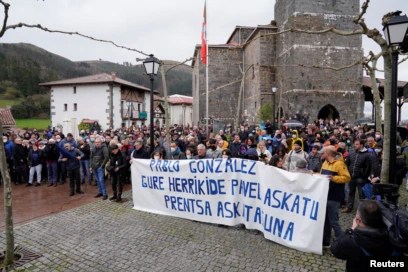
Protest in the Basque Country at Gonzalez’s arrest (Photo credit Reuters)

MY FOOTNOTES

1Gonzalez’s grandparents had sought asylum in the USSR from fascist dictator General Franco and Gonzalez had been born there. His parents split up and his mother took him to the Spanish state when he was seven (as a result of which he is fluent in several languages. He specialises in reporting on Eastern Europe but has been living in the Basque province of Bizkaia town of Nabarniz with his wife, Oihana Goiriena of sixteen years.

2https://www.voanews.com/a/spanish-journalist-denies-spying-for-russia/6477466.html

3Pablo Iglesias had been leader of the Podemos party and a minister in the Spanish coalition government but resigned and works as a journalist for La Base, a podcast of the Spanish left-wing on-line newspaper Publico.

4I have yet to read that article.

5Spanish Intelligence Service.

6I am guessing that Ferreras was the contact for Sexta, the Spanish free-to-air TV channel and that the “duplex” is a reference to the electronic connection when they were trying to broadcast.

7A Basque cooperative bank.

8 Albares is the Minister of Foreign Affairs in the current Spanish Government.

9Albares caused outrage recently by proposing that Western Sahara, a former Spanish colony, accept becoming a region of the Kingdom of Morrocco, which has been illegally and violently occupying it for decades.

MY SOURCES

POLITICAL POLICE QUESTION AND FILM PEOPLE AT ANTI-INTERNMENT PICKET IN DUBLIN

(Reading time: 5 mins.)

Clive Sulish

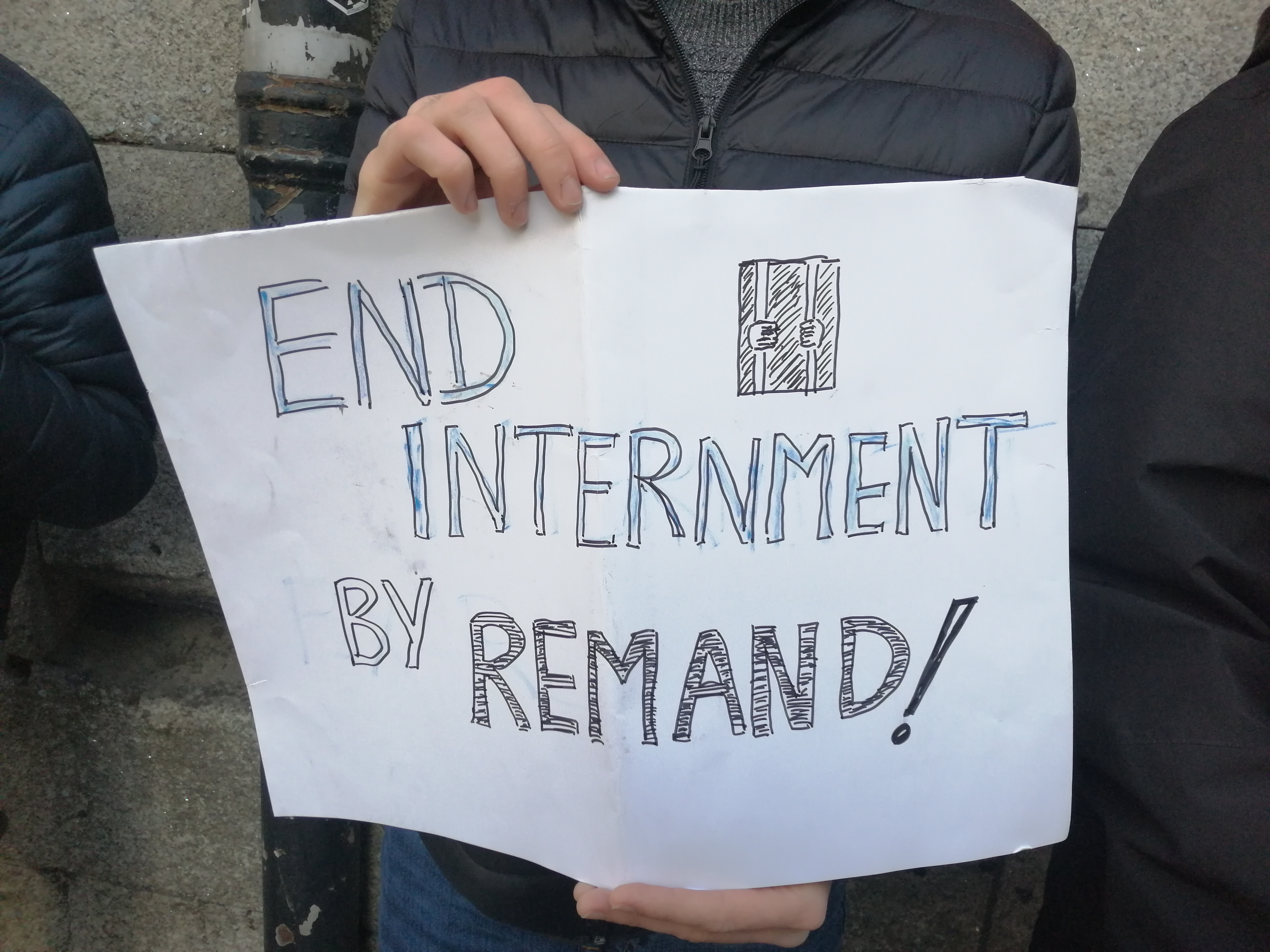
The Dublin Anti-Internment Committee held a well-attended picket on Saturday (5th March) against the continuing practice of interning Irish Republicans without trial and also in support of human rights for political prisoners. At one point the picket was subjected to the unwelcome attention of the Irish political police.

(Photo: C.Sulish)

The event was in furtherance of the Committee’s advertised intention to hold monthly public events to highlight the deprivation of civil rights from Irish Republicans — on both sides of the British border — through the operation of special legislation and in particular of the no-jury political courts (Special Criminal Courts in the Irish state and Diplock Court in the British colony). The Committee has admitted that it does not always succeed in holding a public event every month and in fact its most recent public appearance was during the December festive season, in solidarity with Irish Republican prisoners, when it was supported by a number of organisations and independent activists.

(Photo: C.Sulish)

WHY THESE PUBLIC EVENTS?

The Dublin Committee holds these public events because it believes that most people are unaware of the abuse of civil rights in Ireland, the civil right to belong to an organisation that criticises the State and seeks profound change. The reaction of people receiving a leaflet at their public events would seem to bear this out.

(Photo: C.Sulish)

Choosing a couple of extracts from their current leaflet: ‘At various times in Ireland’s history, people have been rounded up and jailed without bothering with a trial – people whom the government found troublesome and wished removed. Today the same process carries on although they don’t call it “internment” now – other names such as “due process”, “remanded in custody” are used ….”

‘Even when Republican activists are granted bail, it is on outrageous conditions such as not being permitted to reside in their own home, having to observe a curfew and wear an electronic tag, not being permitted to attend meetings and demonstrations …..’

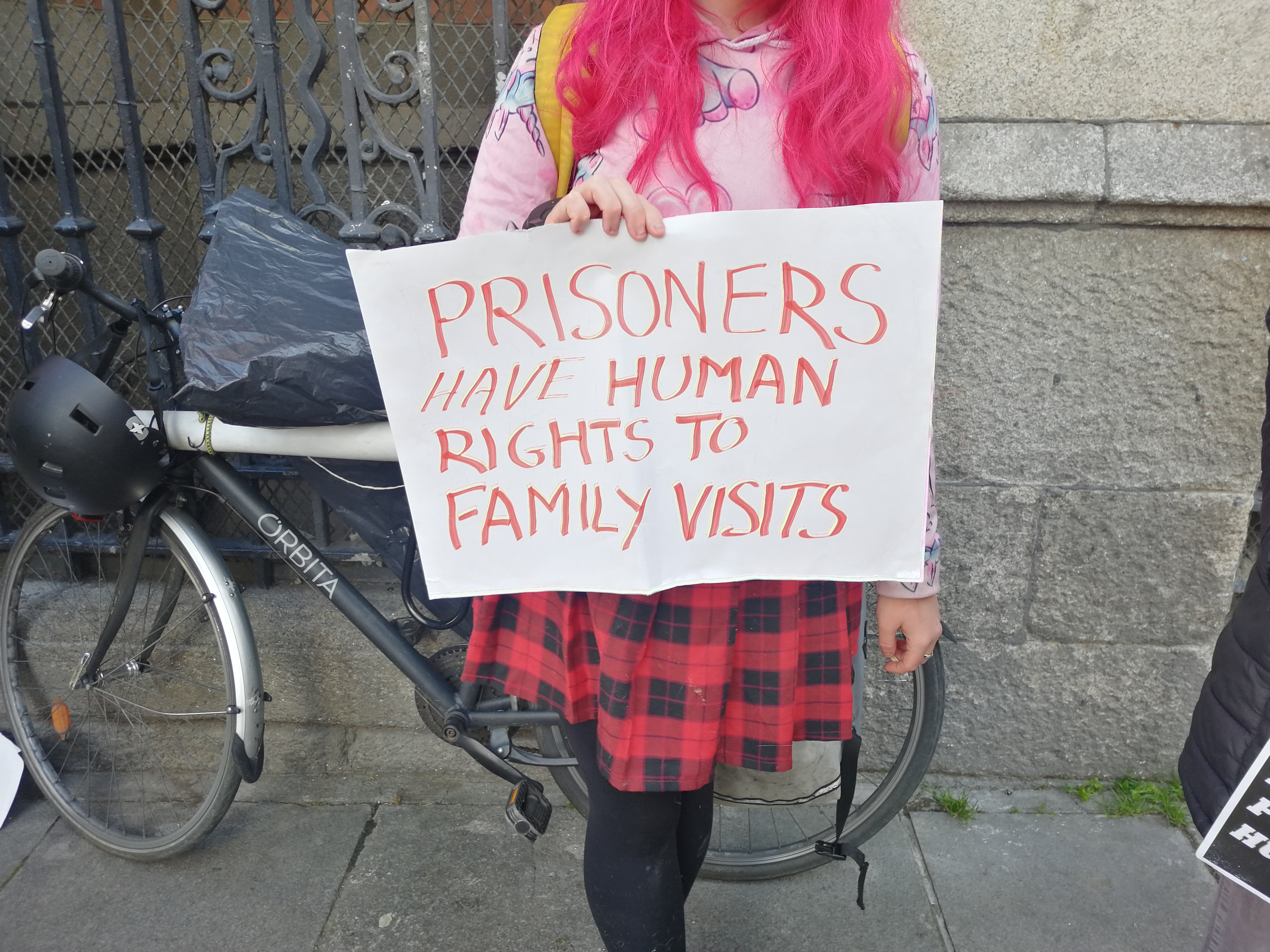
The leaflet text makes the point that one doesn’t have to agree with the politics of Irish Republicans to see that these injustices are profoundly undemocratic abuses of civil rights — and “are ultimately a danger to all oppositional movements, whether Republican or not”. One aspect of their protest was against the denial of open family visits to Republican prisoners in the jails of the British colony in the north-east of Ireland — a violation of human rights.

The surprise in learning the facts is not confined to Irish people because often it is expressed by tourists or migrants, even if they have encountered such practices in their own countries of origin.

INTERNATIONALIST DIMENSION

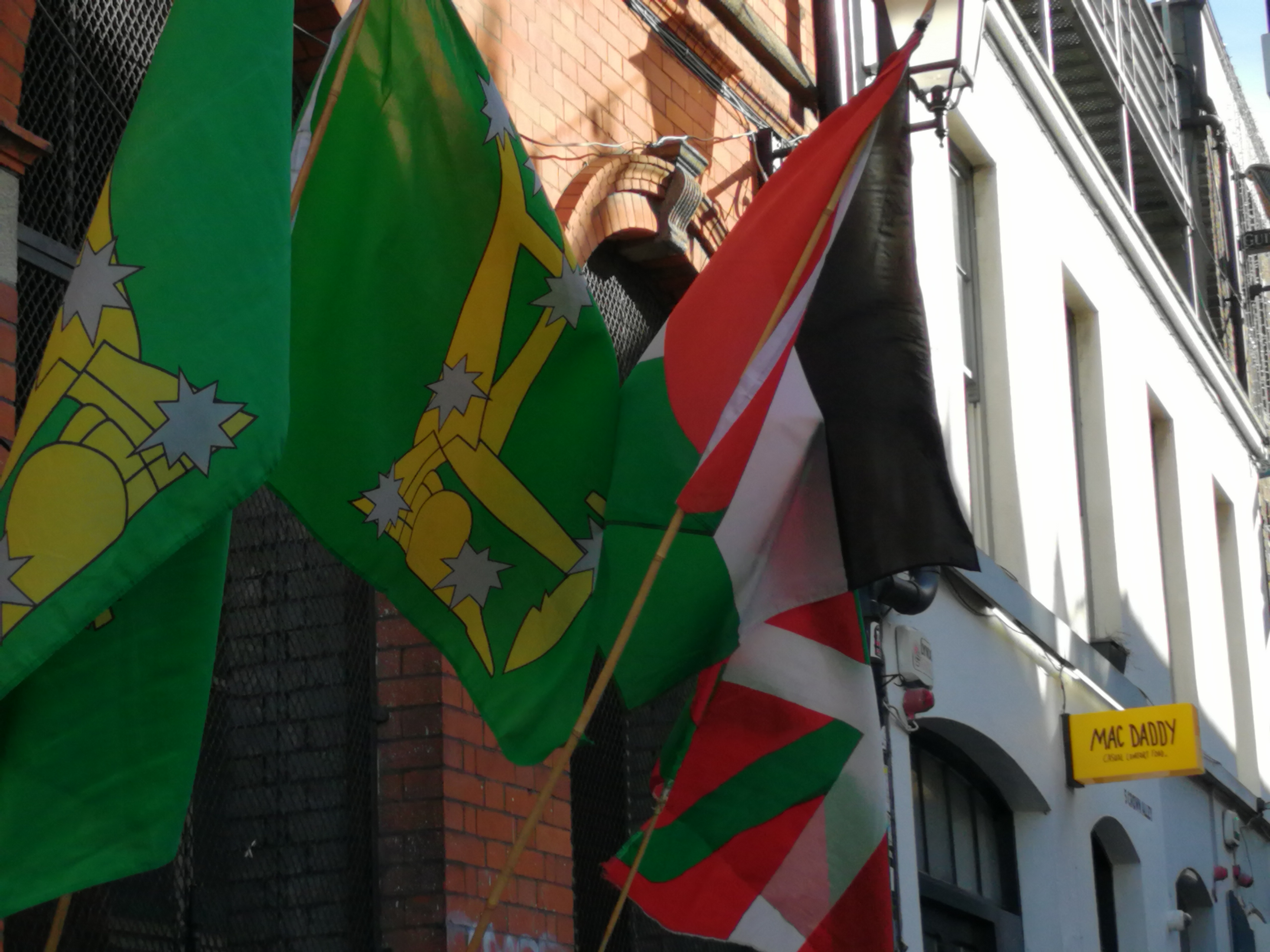
An example of the interest from abroad on Saturday was of a Basque man and, separately, of two young Basque women, reacting warmly to seeing the Basque flag among the picketers. The Dublin Committee objects not only to the incarceration of Irish Republicans but also of people seeking freedom in many other parts of the world, for which reason the Palestinian and Basque flags are frequently flown on their pickets, next to the revolutionary Irish workers’ flag of the Starry Plough.

A person who expressed support for the right to campaign without state repression was, interestingly, from Barcelona. However he did not wish for Catalan independence, wanting instead a unitary but democratic Spanish state – a position held by some communists and the main socia-democratic parties there. Although his position did not concur with that of the picketers, who tend to support the struggles for self-determination, the conversation was conducted without hostility.

Not so with another individual, who approached some picketers to argue for their support for the Ukrainian state in the current armed conflict there, a question that has deeply divided the Irish Left and Republican movements. He went further and announced his support for the Azov Battalion, an East European fascist organisation integrated into the Ukrainian state’s military, at which point the tolerance of the picketers for his intervention ended and he was urged to depart.

Starry Plough flags next to Palestinian and Basque Ikurrina flags at the picket in Temple Bar. (Photo: C.Sulish)

POLITICAL POLICE INTIMIDATION

Another temporary presence unwelcome to the picketers was of three members of the Irish State’s political police. These are members of what used to be called the Special Branch but are now officially called the Special Detective Unit, formerly C3 and successor to the CID when the Irish State was created. This type of political police force is modelled on the Irish Special Branch of Scotland Yard, the HQ of the British police, founded to spy on the influence and activities of the “Fenians” (i.e the Irish Republican Brotherhood) in the cities of Victorian-era Britain. However, in Dublin under British occupation, their parallel force was the G Division of the Dublin Metropolitan Police, known as “G-men”; it was they who identified many Republican and other prisoners of the British military after the 1916 Rising, ensuring death sentences for many (though most commuted to life imprisonment) and jail sentence for many others. During the War of Independence (1919-1921 they were identified as the intelligence service of the British occupation and many were selectively assassinated by the IRA of the time.

The Garda “Branch” (as they are known colloquially) of the Irish State have a long history of harassment of and spying on Irish Republicans, sometimes associated with violence and often with perjury in court. Their unsupported observations through the mouth of a Garda officer at the rank of Superintendent has been enough “evidence”, in the no-jury Special Criminal Court, to send many Irish Republicans to jail on a charge of “membership of an illegal organisation.”

Two picketers confront the plainclothes political police officer harassing a young leafletter on Saturday (Photo: C.Sulish)

One of these gentlemen on Saturday approached the youngest supporter of the picket, who was distributing leaflets to passers-by, identified himself as a Gárda officer in plain-clothes and demanded the young activist’s name. His accosting of the leafletter attracted the attention of others on the picket and two went quickly to support the subject of State harassment. The Branchman demanded no further information and sone moved away. However, when he had reached about half-way along the picketters, he stopped and began filming them.

At that point one of the picketers began to call out to passers-by, many of whom were tourists, that this man was a member of the secret political police, who was filming and attempting to intimidate people on a legal political protest, that this is the kind of ‘democracy’ that exists in the Irish state, etc, etc. Shortly thereafter, the Branchman departed, along with another two of his colleagues that had been observed further down towards Temple Bar.

A picketer loudly denounces the political policeman’s filming of the picketers. (Photo: C.Sulish)

According to picket participants this intervention of the political police represented an escalation of their attentions in recent times, though not in the least unusual in the past, when every picketer might have their name (and even their address) demanded and jotted down.

A spokesperson of the Dublin Anti-Internment Committee stated that it is independent of any political party or organisation and that it welcomes the participation at its public events of democratic individuals, whether independent activists or members of organisations and had distributed many of its leaflets. It regrets that a number of political activists — who should have an interest, even if only in self-preservation – in defending the democratic rights to organise and to protest, decline to support their events.

(Photo: C.Sulish)
(Photo: C.Sulish)
Picketers and leafletters (Photo: C.Sulish)

End.

FURTHER INFORMATION

Anti-Internment Group of Ireland: https://www.facebook.com/End-Internment-581232915354743

Azov Battallion: https://en.wikipedia.org/wiki/Azov_Battalion

BRITISH SUPREME COURT VINDICATES TORTURED “HOODED MEN” – CRITICISES POLICE CHIEF

Diarmuid Breatnach

(Reading time up to ‘Background’: 4 mins.)

A group of Irish people were jubilant in London’s Little George Street on 15th December. The location was that of the UK’s Supreme Court and it was unusual for Irish people to be happy at a judgement of a British court. But the judges inside had quashed an appeal by the Police Service of Northern Ireland1 against a judgement of the High Court in Belfast, that the colonial police force had been wrong not to investigate the claims of fourteen men of being tortured in the British colony in 19712.

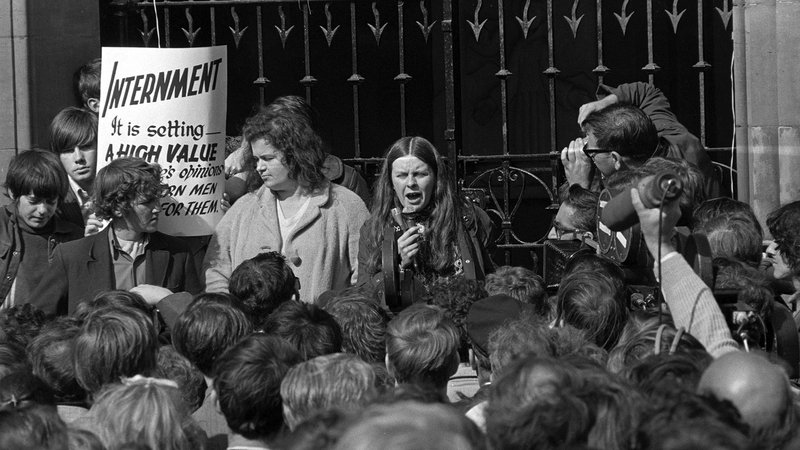
Bernadette Devlin (now McAlliskey) addressing an anti-internment rally in Derry in August 1971 (Photo cred: Popperfoto, Getty Images)

The claims related to what happened during the introduction of internment without trial in the occupied Six Counties in August 1971. What many internees experienced ranged from brutal treatment to torture: “Many of those arrested reported that they and their families were assaulted, verbally abused and threatened by the soldiers. There were claims of soldiers smashing their way into houses without warning and firing rubber baton rounds through doors and windows. Many of those arrested also reported being ill-treated during their three-day detention at the holding centres. They complained of being beaten, verbally abused, threatened, harassed by dogs, denied sleep, and starved. Some reported being forced to run a gauntlet of baton-wielding soldiers, being forced to run an ‘obstacle course’, having their heads forcefully shaved, being kept naked, being burnt with cigarettes, having a sack placed over their heads for long periods, having a rope kept around their necks, having the barrel of a gun pressed against their heads, being dragged by the hair, being trailed behind armoured vehicles while barefoot, and being tied to armoured trucks as a human shield” (for the soldiers against attack by the IRA). (Wikipedia)

(Photo sourced: Internet)

Some were hooded, beaten and, having been told they were hundreds of feet in the air, were then thrown from a helicopter — but were actually only a few feet from the ground. In addition, they were subjected to disorientating “white noise”, forced to remain in stress positions for long periods and deprived of food, water and sleep. Fourteen men who endured this for seven days became known as the “Hooded Men” and have been campaigning for over 50 years to have the British State admit that in its Irish colony, it had tortured them. Interestingly, some of those techniques have also been complained of more recently – by prisoners of the British military in Iraq3 — and this despite a statement by the UK’s Attorney General in 1977 that the techniques would not be used by them again.4

(Photo sourced: Internet)

Unusually, the Irish State5 took the case of the Fourteen to the European Court of Human Rights in Strasbourg and in 1976 obtained a judgement that “the five interrogation techniques” were torture.

The British State appealed the ECHR judgement and in 1978 won a judgement that although the treatment of the Hooded Men amounted to “inhuman and degrading treatment” and breached Article 3 of the European Convention of Human Rights it nevertheless fell short of torture6.

When documentation came to light proving that British Government Ministers had approved the treatment, the Irish State appealed the revised judgement of the ECHR but in 2018 was unsuccessful.

Meanwhile, the legal team of the Hooded Men pursued their case through the legal system of the UK’s Irish colony. In October 2014 the PSNI formally decided not to investigate the allegations, following which in 2015 judicial review proceedings against the PSNI, Secretary of State for Northern Ireland and Department of Justice were initiated by Francis McGuigan, one of the ‘Hooded Men’. A co-appellant was Mary McKenna, the daughter of Sean McKenna, another of the Hooded Men, who died in 1975, never having fully recovered from his mistreatment. The proceedings followed the discovery of additional documentary materials relevant to the mistreatment of the men, which were featured in a 2014 RTÉ Documentary, The Torture Files.7

Following this Documentary, the Chief Constable stated that the PSNI would assess “any allegation or emerging evidence of criminal behaviour, from whatever quarter” concerning the ill-treatment of the Hooded Men “with a view to substantiating such an allegation and identifying sufficient evidence to justify a prosecution and bring people to court’”. However in October 2014 the PSNI took the decision not to investigate. In late 2017, the High Court ruled that the failure by the Police Service of Northern Ireland (PSNI) to investigate the allegations of torture was unlawful.

Some of the Hooded Men in London for the Supreme Court judgement. (Photo sourced: Internet)

Instead of accepting the judgement however the PSNI sought to appeal the High Court decision but in September 2019 the Court of Appeal ruled that the decision should stand. One would have to contrast the determination of the colonial police in the courts to their appalling record in investigating collusion between their own force and Loyalist murder gangs, for the PSNI then appealed to the UK Supreme Court. In November 2019 the UK Supreme Court upheld the decision of the colony’s Court of Appeal and the PSNI appealed that judgement too. The decision last week in London marks the end of the legal options of the colonial gendarmerie.

The very month the decision not to investigate the allegations of the Hooded Men was taken by the colonial police force, October 2014, Drew Harris had been appointed Deputy Chief Constable of the PSNI.

IMPLICATIONS OF JUDGEMENT

The implications of the High Court judgement for Britain and its colonial administration are that once again they have been shown to have deployed barbarous methods in their repression of resistance by the nationalist minority in the colony and that they have exceeded or ignored even their own laws.

As has been the case throughout the recent 30 Years’ War, with the system lying and trying to cover up the reality of its actions, then delaying by all available means, the judgement comes too late for a number of the victims, as only nine of the 14 are still alive.

Nevertheless, the judgement adds to a number of other judgements and admissions over the years, such as those surrounding the Bloody Sunday Massacre in Derry in 1972 and the Ballymurphy Massacre in 1971. On 13 December this year, the British Ministry of Defence and PSNI agreed to a £1.5m out-of-court settlement to compensate victims of the Miami Showband Massacre over suspected state collusion with loyalist terrorists.

Three members of the band died from explosions and bullets after they were forced to get out of their bus at a fake police checkpoint on their return to Dublin from the Six Counties. Stephen Travers, who was injured in the attack, said he was convinced he would have won his civil action to prove that there was collaboration between the State and terrorists but that the Government’s decision to “dispense with justice rather than to dispense justice” had motivated the out-of court settlement.

Had the UK’s Supreme Court rejected the Hooded Men’s case, the latter would have been free to take the case to the European Court of Human Rights – not that they had been tortured but that the police should have investigated their claims that they were. And, based on a similar case by the manager of a Basque newspaper against the Spanish State8, they would probably have won their case with damages awarded against the UK.

On the other hand, the Supreme Court decision puts the onus of investigating the accusations of the Hooded Men on to the PSNI, the very organisation deeply implicated in the treatment of the victims, the organisation which declined to investigate them previously and which justified its decision through the courts in the Six Counties and then in the Supreme Court of the UK.

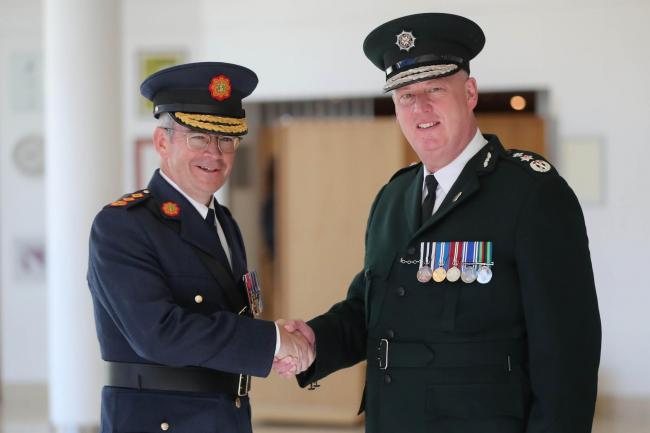
But not only the British state and its colony are put into the dock by the Supreme Court judgement – Drew Harris, formerly Deputy Chief Constable of the PSNI is currently in charge of the police force of the Irish State, where he was appointed Chief Commissioner of the Gardaí in September 2018 on a yearly salary of €250,000.

Drew Harris (Left) as Garda Commissioner with his former boss, George Hamilton, Chief Constable of the colonial police, the PSNI, on the occasion they both received an honour from the British Monarch. (Photo sourced: Internet)

APPENDIX — BACKGROUND

Creation of “Northern Ireland”:

The statelet of “Northern Ireland”9 was created in 1922 after Ireland was partitioned by the British Government at the end of 1921. Ireland had been invaded from Britain in 1169 and gradually entirely occupied and colonised by the invaders, albeit with its own semi-autonomous parliament which had been abolished in 1801, after the United Irish uprisings of 179810. Subsequently Members of Parliament elected in Ireland were required to attend the Westminster Parliament.

Following the rise of Irish nationalist sentiment after the suppression of the 1916 Rising, the 1918 UK General Election returned a huge majority of MPs in Ireland sworn to establish an independent Irish Republic. These formed their own parliament in Dublin, at first ignored but then later banned by the British. The guerrilla War of Independence of 1919-1921 convinced the British rulers to offer Ireland autonomy as a “Dominion” within the British system and under the Crown. However, at the same time, the British conceded to the demand of the unionist minority in Ireland to secede from the new Irish state and to remain a colony of Britain and in the UK. The Irish Free State was set up in December 1921 on 26 counties and the Northern Ireland statelet of six counties in January 192211.

From the outset the colonial statelet had been marked by the religious sectarianism of its local rulers, Presbyterians and Anglicans by religion and of unionist ideology, against a very large nationalist minority of mostly Catholics, representing the majority in Ireland as a whole. A raft of special powers empowered the statelet in repression of the nationalist minority; the colonial gendarmerie, abolished in the Irish state, continued in existence, with a part-time wing and even unofficial Loyalist militia in support and de facto anti-nationalist discrimination existed in every sphere: law, housing allocation, education.

In 1968 a campaign for civil rights for the nationalist minority began, to be met by truncheons, water-cannon, tear gas and bullets which however, merely drove parts of the minority into open insurrection. The colonial gendarmerie (the Royal Ulster Constabulary), even with the active support of the part-time B-Specials and Loyalist paramilitaries, was unable to suppress the uprising primarily in Derry but also in West Belfast and in August 1969 the British Government sent in the British Army to take control.

Initially the soldiers were represented to the nationalist population as being present to protect them from the sectarian colonial police and from the Loyalists but it soon became clear that their primary focus was to repress the risen nationalist population and the IRA began to take action against them.

Introduction of Internment Without Trial:

The Prime Minister of the “Northern Ireland” statelet, Brian Faulkner, recommended to his colonial masters that internment without trial be introduced against the nationalist population; this was agreed and “Operation Demetrius” began on 9th August and continuing over the 10th 1971 with British Army raids into nationalist areas, forcing their way into homes and dragging their captives away to be interrogated by RUC Special Branch, after which they were jailed. In the initial sweep the occupation forces arrested 342 men, sparking four days of violence in which 20 civilians, two IRA members and two British soldiers were killed and 7,000 people fled their homes. All of those interned were from the nationalist community.

Poster by the Anti-Internment League of Ireland – the internees in the photo are handcuffed together. (Photo sourced: Internet)

The detentions without charge continued until December 1975 and by that time 1,981 people had been interned, of which 1,874 were from the nationalist community. Only 107 were Loyalists and none of those had been interned until February 1973. Resistance to internment continued after the initial sweep and from 9th to 11th August, British Paratroopers caused the death of 11 unarmed people in the Ballymurphy area of Belfast. In January the following year the Paras and other units attacked people marching against internment in Derry, killing 14 and injuring 12.

Internment was protested in the rest of Ireland and in other countries, including Britain. The Men Behind the Wire, an anti-internment song composed in 1971 by Paddy McGuigan and recorded by the Barleycorn group in Belfast, was pressed into disc in Dublin and shot to the top of the Irish charts, greatly exceeding in numbers of sales any record previously released in Ireland.

Excerpt:

Through the little streets of Belfast,
In the dark of early mo
rn,
British soldiers came marauding
Wrecking little homes with scorn.

Heedless of the crying children,
Dragging fathers from their beds;
Beating sons while helpless mothers
Watched the blood flow from their heads.

Armoured cars and tanks and guns
Came to take away our sons
But every man will stand behind
The Men Behind the Wire.

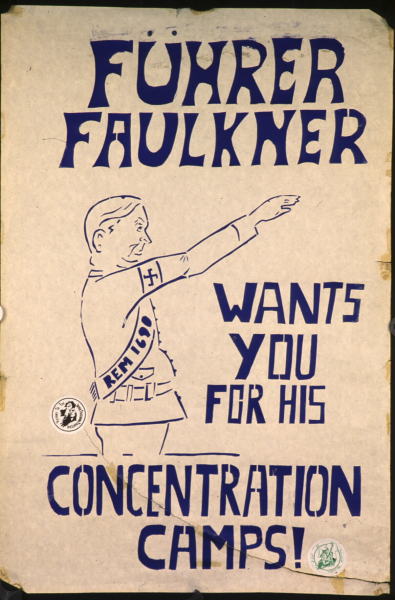
Poster by People”s Democracy, believed in 1970, prior to introduction of internment. (Photo sourced: Internet)

Brian Faulkner, unionist Prime Minister of the statelet, who had asked the British to introduce internment, was hated by a great many people. When he died in March 1977 following an accident during a stag hunt, thrown by his horse Cannonball, an English communist composed a short song he named “Cannonball”.

Excerpt:

Lord Faulkner was a hunter of men and of deer

And both have good reason to laugh and to cheer

At the death of a tyrant whose interests were clear

Those of imperialism that have cost Ireland dear.

Cannonball, Cannonball has many a friend,

From the top of old Ireland right down to its end,

Where the brave people struggle

In one resolute bid

To throw off their oppressors —

Just as Cannonball did!

End.

FOOTNOTES

  1. The colonial gendarmerie formerly known as the Royal Ulster Constabulary.

2 (see “Background” section).

3. The Court’s ruling that the five techniques did not amount to torture was later cited by the United States and Israel to justify their own interrogation methods, which included the five techniques. British agents also taught the five techniques to the forces of Brazil’s military dictatorship. During the Iraq War, the illegal use of the five techniques by British soldiers contributed to the death of at least one detainee, Baha Mousa.

4 “The Government of the United Kingdom have considered the question of the use of the ‘five techniques’ with very great care and with particular regard to Article 3 (art. 3) of the Convention. They now give this unqualified undertaking, that the ‘five techniques’ will not in any circumstances be reintroduced as an aid to interrogation.”

5 Unusually, because during the three decades of ill-treatment by a foreign power of people who were, according to the Irish Constitution its citizens, only in one other case did the Irish State bring a complaint against the UK to an international arena.

6 I admit that I fail completely to understand the distinction.

7. Rita O’Reilly, the journalist who led that program, also commented extremely well on the UK Supreme Court decision and the whole case on Prime Time on RTÉ this week (see Links).

8. Martxelo Otamendi, along with others detained, was tortured by his Guardia Civil captors when the Basque newspaper of which he was manager was closed by the Spanish State, alleging that it had been cooperating with terrorists. He was freed eventually and even later in 2010 the Spanish Supreme Court admitted that there had been no evidence against him or the newspaper – but neither admitted the torture nor ordered his allegations be investigated. Otamendi filed a complaint with the European Court of Human Rights in 2012 and in 2014 the ECHR found the Spanish State guilty of not having investigated Otamendi’s allegation of being tortured and awarded him €24,000 in damages and expenses from the Spanish state.

9. A misnomer since the British colony is not the northernmost part of Ireland, which is in County Donegal, inside the Irish state. “Ulster”, a name given by the Unionists to the statelet and frequently repeated in the British media, is also a misnomer since the Province of Ulster contains nine counties, six of which are in the colonial statelet but three of which are within the Irish state.

10. There were many uprisings prior to 1798, which was the first Republican one and there were many of that kind afterwards too.

11. Shortly after that the Free State, supplied with weapons and transport by the British, attacked the Republicans, who had been demonstrating their dissatisfaction with the Anglo-Irish Treaty. This precipitated a Civil War in which the Republicans were defeated.

USEFUL LINKS FOR MORE INFORMATION

Unusually excellent (for RTÉ) report by Rita O’Reilly: https://www.rte.ie/news/primetime/2021/1217/1267343-uk-supreme-court-decision-on-hooded-men/

https://www.irishtimes.com/news/ireland/irish-news/hooded-men-uk-court-finds-psni-decision-not-to-investigate-case-unlawful-1.4755885

https://en.wikipedia.org/wiki/Operation_Demetrius

POLITICAL PRISONERS’ SOLIDARITY PICKET IN DUBLIN

Clive Sulish

(Reading time: 3 minutes)

Amidst festive season lights, passing Santa Clauses on horse-drawn carriages and hungry people being fed by volunteers in the Dublin city centre, Irish Republicans and Socialists gathered to send a public message of solidarity to political prisoners in Ireland and elsewhere.

Photo: Rebel Breeze

The event is an annual one organised by the Anti-Internment Group of Ireland, an independent non-aligned group raising awareness that internment without trial continues in Ireland, through revoking of licence of ex-prisoners and through refusal of bail in the no-jury courts both sides of the British Border. The Dublin committee of the AIGI holds monthly public awareness-raising pickets in the city centre.

The annual picket on Thursday early evening was supported by activists of the Irish Republican Prisoners’ Welfare Association and of the Anti-Imperialist Action organisation, along with some independents and took place in front of the iconic GPO building, on Dublin’s main street.

Photo: Rebel Breeze

The picketers and passers-by were addressed by a representative of the Anti-Internment Group outlining the participants’ presence to send solidarity greeting to political prisoners in Ireland and around the world. The speaker drew particular attention to three prisoners: Leonard Peltier, Native American, 45 years in jail and Black American Mumia Al Jamaal, 40 years in prison, both framed by police in the USA. Also highlighted was the case of Ali Osman Kose, 37 years in jail, 21 of which he has spent in solitary confinement. The speaker informed the audience that those three political prisoners, apart from their very long years of incarceration, have multiple health issues and should be released, he said on humanitarian grounds alone. “But no ….. they want them to die in jail”, he said.

Photo: Rebel Breeze

Going on to speak about political prisoners in Ireland, the speaker said that they and hostages had existed almost from the moment Ireland had been invaded by its neighbour and from the defeated United Irishmen up to the Fenians, had included not only dungeons and prison cells but also penal colonies on the other side of the world, after which they had been confined in special prisons and concentrations camps.

The creation of the Irish State on a partitioned Irish country a century ago this month had not brought freedom nor an end to the struggle, the speaker said and pointed out that the Irish State had executed 80 Irish Republicans during the years of the Civil War, which was more than the British had done during the War of Independence preceding it.

Photo: Rebel Breeze

“Whether we are religious or not ….. in our culture at this time of year we expect to be with our families, our partner, children and friends,” the AIGI representative said but pointed out that this opportunity is not available to the prisoners, which makes this a particularly difficult time of year for them, which is why the Group and others hold this event every year.

The speaker then called a young boy forward “to send a message to the prisoners from this younger generation who hopefully will see a free and united Ireland with social justice and equality. The young boy stepped forward and through the PA, asked all at this time of year to think of the Republican prisoners.

Photo: AIGI

The Starry Plough, the Palestinian flag and the Basque Ikurrina were flown by participants and among the banners of the IRPWA and Dublin Committee of the AIGI there was also one displaying the Carlos Latuff graphic of Palestinian and Irish Republican prisoner solidarity. The centrepiece in the picket line was the word Saoirse (‘freedom’ in Irish) picked out by lights on a dark background. Appropriate music was also played during the picket from a PA system, except while being addressed by the speaker.

The event concluded with thanks to all the attendance and the singing the first verse and chorus of the battle-song Amhrán na bhFiann (The Soldiers’ Song in Irish, which is also the National Anthem).

It is understood that seasonal greeting cards have also been sent by AIGI to political prisoners in prisons in the Irish state and in the colonial statelet.

End.

Photo: Rebel Breeze
Signing Christmas cards for the prisoners. (Photo: AIGI)
Photo: Rebel Breeze

Further information:

https://www.facebook.com/End-Internment-581232915354743

ANTI-MASKERS NOT GOING FAR ENOUGH

Diarmuid Breatnach

(Reading time: 3 minutes)

For quite some time now certain people have been protesting inside shops and other spaces, along with marching up and down streets insisting on their right to enter places and to travel without wearing a mask or without displaying proof that they have been vaccinated. Those anti-maskers have been quite proud of what they see as their stand for personal freedom and against authoritarian rules. I on the other hand think they have been very tame and don’t go nearly far enough. So I’ve listed some other rules and regulations they should be rebelling against.

ADDITIONAL UTHORITARIAN RULES AND REGULATIONS TO REBEL AGAINST

Driving

  • Being obliged to have a driving licence
  • Being obliged to have motor insurance
  • Having to drive on one side of the road
  • Having to obey traffic lights and signs
  • Being obliged to have working lights on one’s vehicle and using them in dark conditions

Domestic(ated) animals

  • Having to clean up your dog’s excreta in a public place
  • Not importing pets without their vaccinations
  • Not importing wild animals without a licence
  • Not being allowed to keep animals in whatever condition one feels like

Children

  • Having to send children to school
  • Not being permitted to have children working full time
  • Not being permitted to serve underage children alcohol
  • Not being permitted to sell underage children tobacco and cigarettes
  • Having to take action in cases of bullying
  • Not being permitted to beat children in school

General social

  • Having to wear clothing covering sexual parts in public
  • Not being allowed to excrete in the street
  • Not being permitted to smoke in some areas
  • Not being permitted to drop trash wherever and whenever one feels like it
  • Being forbidden from playing loud music, operating power tools or creating noise in general in communities between certain hours
  • Being forbidden from emitting large amounts of smoke or other noxious gasses in a community
  • Not being able to say whatever one likes about anyone else without being subject to libel or slander laws (or a smack in the mouth)
  • Having to adhere to fire prevention and control regulations in communal or community living
  • Having to adhere to published standards in construction

Food hygiene

  • Not serving food past its advertised sell-by date
  • Food-preparation staff being required to be qualified in the practice
  • Food-serving premises being obliged to store food according to regulations
  • Food preparation and processing having to adhere to published standards
  • Being required to advertise the contents of products
  • Being required to advertise a safe “sell by” date on food products

Working Health & Safety

  • Workplaces having to adhere to Health & Safety regulations
  • Being required to wear safety helmet on construction sites
  • Being required to wear goggles or industrial spectacles and/or ear protectors for certain operations
  • Being required to clip on a safety line on boats in rough conditions
  • Being required to wear a flotation jacket on board boats
  • Not being permitted to smoke in some areas
  • Having to adhere to fire prevention and control regulations

Environmental

  • Having to avoid or control pollution from any procedures
  • Not being allowed to dump whatever material one wants to wherever one feels like it
  • Not being allowed to light open fires in certain areas at certain times of the year
  • Not being permitted to trim hedgerows during the bird nesting period
  • Being restricted in hunting or fishing during certain periods of the year

Hospital

  • Having to adhere to anti-contamination procedures in ICU and generally in hospital

DOWN WITH AUTHORITARIAN CONTROLS!

DUBLIN HOSTS TURKISH REVOLUTIONARY MUSIC GROUP

Clive Sulish

(Reading time: 3 mins.)

Last Saturday in the Teachers’ Club in Dublin (26/11/21), the revolutionary music Grup Yorum from Turkey, with some Irish musician input, played to an audience of up to two hundred. In between performing different numbers from their repertoire, band members spoke to the audience of the history of the struggles of their people and of the band.

The Irish tour of the band was organised by the Anti-Imperialist Action Ireland organisation; earlier that week Yorum played in a small music venue in Belfast to around 40 people. The attendance in Dublin was so large that the location had to be changed from a large room on the first floor to the much larger hall down below.

Grup Yorum performing in Dublin (Photo: Rebel Breeze)

BELFAST

In Belfast in the Sunflower Lounge, Bobby Fields from Armagh and Séan Óg from Dublin entertained those in attendance with songs of Irish resistance followed by Grup Yorum coming on afterwards. The Grup’s performance was enthusiastically received and was followed by a questions-and-answers session to learn more about the situation in Turkey.

The Grup members toured some of the area and visited the famous international solidarity wall along with the grave of Bobby Sands, where paying their respects included singing a song at the graveside.

DUBLIN

In the large hall in the Teachers’ Club, Dublin, Séan Óg took to the stage first, playing guitar to accompany himself on guitar to sing The Killmichael Ambush, Viva la Quinze Brigada, Back Home in Derry1 and The Internationale. Veteran activist and traditional singer Diarmuid Breatnach followed, singing unaccompanied the Anne Devlin Ballad, I’ll Wear No Convict’s Uniform2 and James Connolly’s satirical song Be Moderate3. Some of the audience sang along with some of the lyrics sung by each singer.

Be Moderate, satirical song by James Connolly, sung by Diarmuid Breatnach at the event (the link can be played on Facebook).

The four members of Grup Yorum present then took to the stage to huge applause and addressed the audience in Turkish, their words being translated into English by a member of their entourage. In the performance that followed, two guitars, flute and cajón were the instruments with a male and female leading voices. Each song was preceded by an explanation placing the piece in historical and political context.

Some of the songs in particular were clearly known to Turkish and Kurdish people in the audience and at some points they sang along, often waving an arm in the air. Towards the end of their performance the crowd got more and more excited and then Seán Óg joined them for a couple of numbers.

(Photo: Rebel Breeze)
oznor

The Grup’s interpreter made a special appeal for help from those in attendance to pressurise the Turkish authorities to release political prisoner Ali Osman Köse who has been in solitary confinement for 20 years and has multiple health issues. There are fears for the man’s life as he has had a cancerous kidney removed in May of this year without any follow-up treatment and despite everything has been pronounced “fit” to continue in jail.

This was followed by members of the Resistance Choir taking to the stage to join Grup Yorum in a rendition of the Italian antifascist Bella Ciao! Song before Diarmuid Breatnach returned to the stage to bring the evening to a close with the first verse and chorus of Amhrán na bhFiann4 with members of the audience joining in (including some from Anatolia)

The Resistance Choir from Dublin on stage with Grup Yorum to perform the Bella Ciao song (Photo: Rebel Breeze)

THE GRUP YORUM BAND

A revolutionary music band from Turkey, Grup Yorum members compose their own material and the band has has released twenty-three albums and one film since 1985. The band has suffered repression with some concerts and albums banned and members have been arrested, jailed and tortured, two members also dying on hunger strike. The band is popular in Turkey and as well as their albums selling well in Turkey and internationally, it has also given concerts in Germany, Austria, Australia, France, Italy, the Netherlands, Belgium, Denmark, United Kingdom, Greece and Syria.

Grup Yorum publishes an art, culture, literature, and music magazine entitled Tavir, and several group members manage a cultural centre called İdil Kültür Merkez in the Okmeydani neighbourhood of Istanbul.

Section of the crowd in Dublin saluting the Grup Yorum performers (Photo: Rebel Breeze)

FOOTNOTES:

1The lyrics and air of Viva la Quinze Brigada are by famous Irish folk musician Christy Moore, who also arranged Bobby Sands’ poem to the air of the Wreck of the Edmund Fitzgerald (by Gordon Lightfoot) as Back Home in Derry.

2Diarmuid sings this song to an air he composed himself.

3Diarmuid sings this to the air of A Nation Once Again (by Thomas Davis).

4Written by Peadar Kearney originally under the title The Soldiers’ Song and sung by insurgents during the 1916 Rising, its chorus is the official national anthem of the Irish State. However, it is also sung by many who are opposed to the State, particularly by Irish Republicans. Normally only the chorus is heard, sung in Irish (translation).

USEFUL LINKS:

https://www.facebook.com/grupyorum1985

https://www.facebook.com/Anti-Imperialist-Action-Dublin-North-City-110852710835826

https://www.facebook.com/socialistrepublicanballyfermot

https://freealiosmankose.wordpress.com/

PROTESTS GREET PRESENTATION OF CHANCELORSHIP TO HILLARY CLINTON

Diarmuid Breatnach

(Reading time: mins.)

Queen’s University Belfast appointed Hillary Clinton as the institution’s Chancellor1. On 24th September 2021 the University authorities organised an event to mark her formal inauguration; however a large and voluble crowd gathered to protest the inauguration and the authorities’ choosing her as Chancellor of the University. Among the shouts of protesters were “War criminal!” and “Hillary, Hillary, Hillary – Out, out, out!” (This story is now “old”, apologies but nevertheless worth posting for those who might not be aware of it as media coverage was muted)

Although the Belfast Telegraph’s coverage of the event made no mention whatsoever of protests, they were reported in a number of other media. The protest saw Irish Republican and Left socialist groups come together to carry out the protest, with a number of them taking turns to speak.

The speakers at the protest included Pól Torbóid of Lasair Dhearg; Aidan Moran, a former ISM activist in Occupied Palestine, on behalf of Cairde Palestine; Conal MacMathúna on behalf of the Connolly Youth Movement; Local Councillor Michael Collins from People Before Profit; and Dr. Azadeh Sobout, Scholar of Transitional Justice and Peace building and Member of Academics for Palestine.

In addition to Irish organisations’ banners and flags, the national flags of Palestine and Cuba were also in evidence.

Hillary Clinton has been a member of the USA Congress from 2001 to 2009, followed by Secretary of State from 2009 to 2013, having also held the ceremonial position of First Lady during her husband Bill Clinton’s tenure as President of the USA 1993-2001. The Secretary of State of the USA, appointed by the President with the advice and consent of the Senate, is the President’s chief foreign affairs adviser. The Secretary carries out the President’s foreign policies through the State Department and the Foreign Service of the United States.

Lasair Dhearg’s Pól Torbóid, who helped organise and also spoke at the event, said, “Queen’s University’s complicity in the whitewashing of Hillary Clinton and her war crimes further epitomises the university’s role in an international framework of imperialism that sees it not only glorify warmongers like Clinton, but have immense financial investment in military contracts and companies guilty of immense environmental destruction.”

“Queen’s has facilitated the visitation of many war criminals and parasites over the years, but arguably none as big as the visit of Hillary Clinton as its chancellor. A proud Zionist and imperialist; with a war record as long as your arm, Clinton has helped oversee US bombing campaigns in over 9 countries.”

“As US secretary for war, she authorised over 400 drone strikes across multiple nations, which overwhelmingly killed civilians and even children at a proportion of almost 90%.”

“She labelled black men ‘super-predators’ when she helped lobby for the 1994 US Clinton Crime Bill, which was immensely important in creating the mass incarceration levels that exists today in the US to benefit the prison-industrial complex – which is a system of slavery by new means.”

Section of the protest as seen from the inside of the University (Photo sourced: Internet)

“A Zionist, Hillary Clinton has shown herself to be an enemy of Palestinian liberation, siding with the oppressor every time it mattered, like during the 2014 Israeli bombing campaign of Gaza. She increased annual US funding to Israel from 2.5billion, to 3.1 billion US dollars whilst she was US Secretary of State, and she stated that countering the BDS movement globally should be a priority for Israel’s defence.”

“All this – and Queen’s award her chancellor for her Peace and Reconciliation efforts. For all the books Queen’s have at its disposal, I don’t think their management have ever read one! PEACE IS SOMETHING HILLARY CLINTON CAN’T EVEN SPELL, NEVER MIND DISPENSE!”

Full video below (with thanks to Lasair Dhearg organisation):

(Photo sourced: Internet)

FOOTNOTES

  1. In the UK university system, the office of Chancellor is held by a distinguished individual, from academia or public life, who is not usually resident and does not hold any other University office.

SOURCES

https://www.thejournal.ie/hillary-clinton-installed-chancellor-queens-university-belfast-5557234-Sep2021/

https://www.v-c.admin.cam.ac.uk/chancellors-role