BASQUE JOURNALIST REMAINS HELD BY POLAND ACCUSED OF SPYING FOR RUSSIA

Diarmuid Breatnach

(Reading time: 3 mins.)

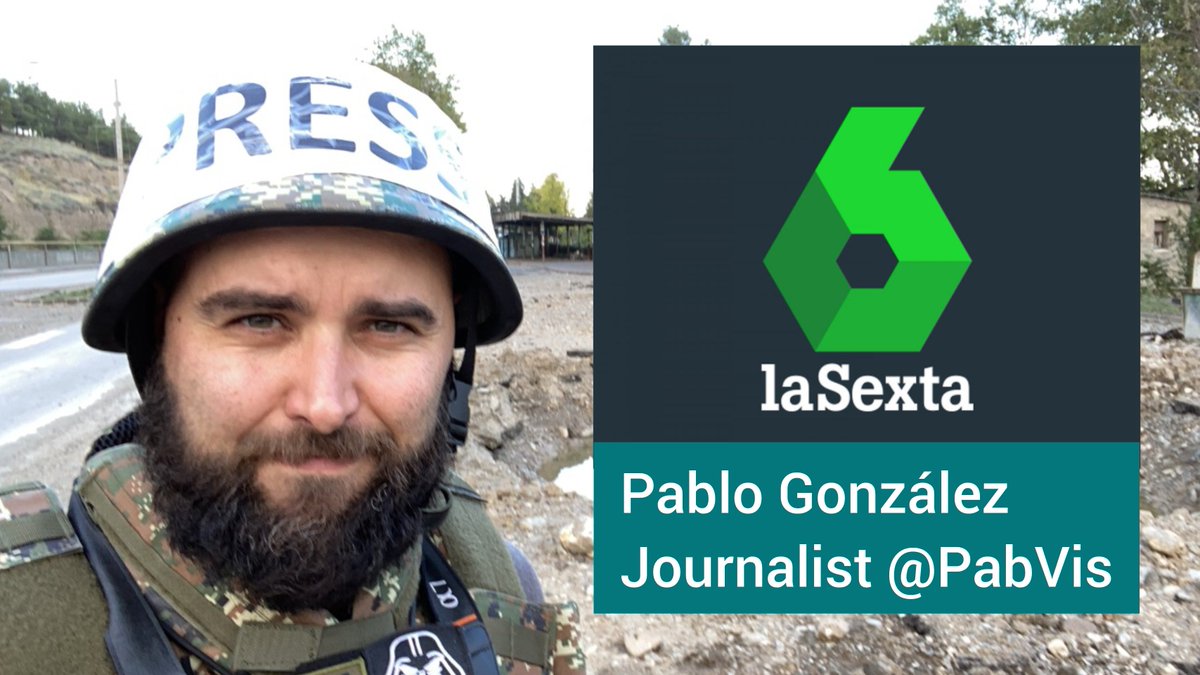
Pablo Gonzalez, a Basque journalist who includes working for Basque and Spanish left-wing media, was covering the war in Ukraine when he was interrogated by the Ukrainian authorities, the Spanish intelligence services approached his family and friends and he was subsequently arrested in Poland on 28th February and charged with spying against Poland. He has been denied access to his lawyer and no evidence has yet been presented to back up the charge but after his four-hour Ukrainian interrogation, Gonzalez reported that he had been accused of spying for Russia on the basis that he had been born in Russia1, that he reported for the mildly left-wing Basque nationalist newspaper GARA (he also reports for Publico.es) and that he had a bank card for a Basque cooperative bank. Journalist defence organisations have expressed concern at the detention.

I am not aware of having seen Gonzalez’s reporting but it may be that his material did not align with the dominant discourse as apparently the International Federation of Journalists reported that González had been accused of being pro-Russian in his coverage for a Spanish newspaper. On the other hand, several of his colleagues say that his reporting has been anti-Putin. Clearly the secret services of at least three pro-NATO countries, Ukraine, Spain and Poland have been in communication regarding Gonzalez. After his interrogation in Ukraine, he had been released but it seems awarned to leave Ukraine. He went to Poland and had been just about to re-enter Ukraine with a group of other reporters when arrested by the Polish authorities. “Legal threats and smear campaigns are a daily menace to outspoken journalists, and journalists covering the migration crisis on the Belarusian border have been detained and harassed,” the Europe representative of the Commitee to Protect Journalists, Atilla Mong told Voice Of America2.

I am no supporter of Pablo Iglesias or of his Podemos party3 but I offer my translation of his piece in Publico.es in the hope that it will a) encourage some to follow the case and perhaps lift their voices for Gonzalez’s release and b) become aware that censorship and misinformation is rampant in the media around this conflict.

MADRID

24/03/2022 18:22

PABLO IGLESIAS@PABLOIGLESIAS

On the 14th of this month, the photojournalist Juan Teixeira, a friend of Pablo González, wrote a column in Público entitled “About Pablo González and the diminishing freedom of the press.”4 There he talks about his relationship with Pablo, his work with him in the Ukraine and his arrest. I recommend, in fact, that you read his entire column, but allow me to read you two paragraphs:

It was precisely in one of these connections with Ferreras that everything began to go wrong. Pablo decided to do the direct clip of him with the military in the background, which is always more televisable. From La Sexta they had him waiting for more than 45 minutes under snow and with the soldiers increasingly tense wondering what that bald man was doing standing in front of a mobile on a tripod.

Until the military got tired and invited us to leave, but not before erasing all the material and taking a photo of Pablo’s passport. That same night, he received a call from the SBU (Ukrainian intelligence services), telling him that he should report to their headquarters as soon as possible. Despite the fact that there was work to be done, we returned to Kyiv. There Pablo was interrogated for 4 long hours, and accused of being a Russian agent with such convincing evidence as writing for Gara and having a Caja Laboral Kutxa bank card, according to them both financed by Russia. All so crazy that Pablo didn’t take it too seriously. He thought that they were simply “tightening the nuts” so that he would be more cautious with his words.

Until he found out that at that very moment, CNI5 agents had appeared at his family home, at his mother’s and at that of a childhood friend to question them and inform them that Pablo was a Russian agent.

I’m sorry that Ferreras appears here, the poor man has no fault in this, beyond the time the duplex took6, but it seemed important to me that the arguments of the Ukrainian secret services be known. I find it amazing that being the son of a Russian, writing for Gara and having an account in the Kutxa7 is something that makes you a suspect of being a secret agent of Putin. By this rule of thumb, there would be more evidence that would determine that Minister Albares8 is, on the one hand, an agent of the Vatican (he studied at Deusto, the Jesuits rule there and Pope Francis is a Jesuit, put it all together) and, on the other, he is also Moroccan agent (he lived for a long time in France and is married to a French judge who advises Emmanuel Macron, put it together)… Albares may sympathize with the Jesuits and put forward a pro-Moroccan9 line but it would be delusional to present him as an agent. Well, González is an even more delusional case.

The problem is that the logic of war contaminates everything and it is destroying the quality of the already highly-reviled conventional journalism. At the same time that we hear multi-award-winning journalists like Antonio Papell calling for Russia to be attacked with nuclear bombs or the famous and “progressive” Elisa Beni losing her temper with a professor of international law who committed the terrible crime of saying on the radio that, in geopolitics, values do not operate, we see that a correspondent who provided training and knowledge of the field, is accused of being a secret agent. Crazy.

I can only tell you that here at La Base we are going to continue reporting and analyzing rigorously, dismantling propaganda wherever it comes from and defending the freedom to inform without simplifying the complex and always paying attention to the context. At La Base kapuscinski style: rigor and commitment.

end.

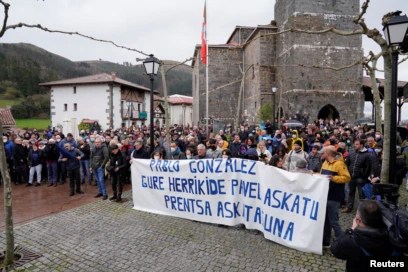
Protest in the Basque Country at Gonzalez’s arrest (Photo credit Reuters)

MY FOOTNOTES

1Gonzalez’s grandparents had sought asylum in the USSR from fascist dictator General Franco and Gonzalez had been born there. His parents split up and his mother took him to the Spanish state when he was seven (as a result of which he is fluent in several languages. He specialises in reporting on Eastern Europe but has been living in the Basque province of Bizkaia town of Nabarniz with his wife, Oihana Goiriena of sixteen years.

2https://www.voanews.com/a/spanish-journalist-denies-spying-for-russia/6477466.html

3Pablo Iglesias had been leader of the Podemos party and a minister in the Spanish coalition government but resigned and works as a journalist for La Base, a podcast of the Spanish left-wing on-line newspaper Publico.

4I have yet to read that article.

5Spanish Intelligence Service.

6I am guessing that Ferreras was the contact for Sexta, the Spanish free-to-air TV channel and that the “duplex” is a reference to the electronic connection when they were trying to broadcast.

7A Basque cooperative bank.

8 Albares is the Minister of Foreign Affairs in the current Spanish Government.

9Albares caused outrage recently by proposing that Western Sahara, a former Spanish colony, accept becoming a region of the Kingdom of Morrocco, which has been illegally and violently occupying it for decades.

MY SOURCES

POLITICAL POLICE QUESTION AND FILM PEOPLE AT ANTI-INTERNMENT PICKET IN DUBLIN

(Reading time: 5 mins.)

Clive Sulish

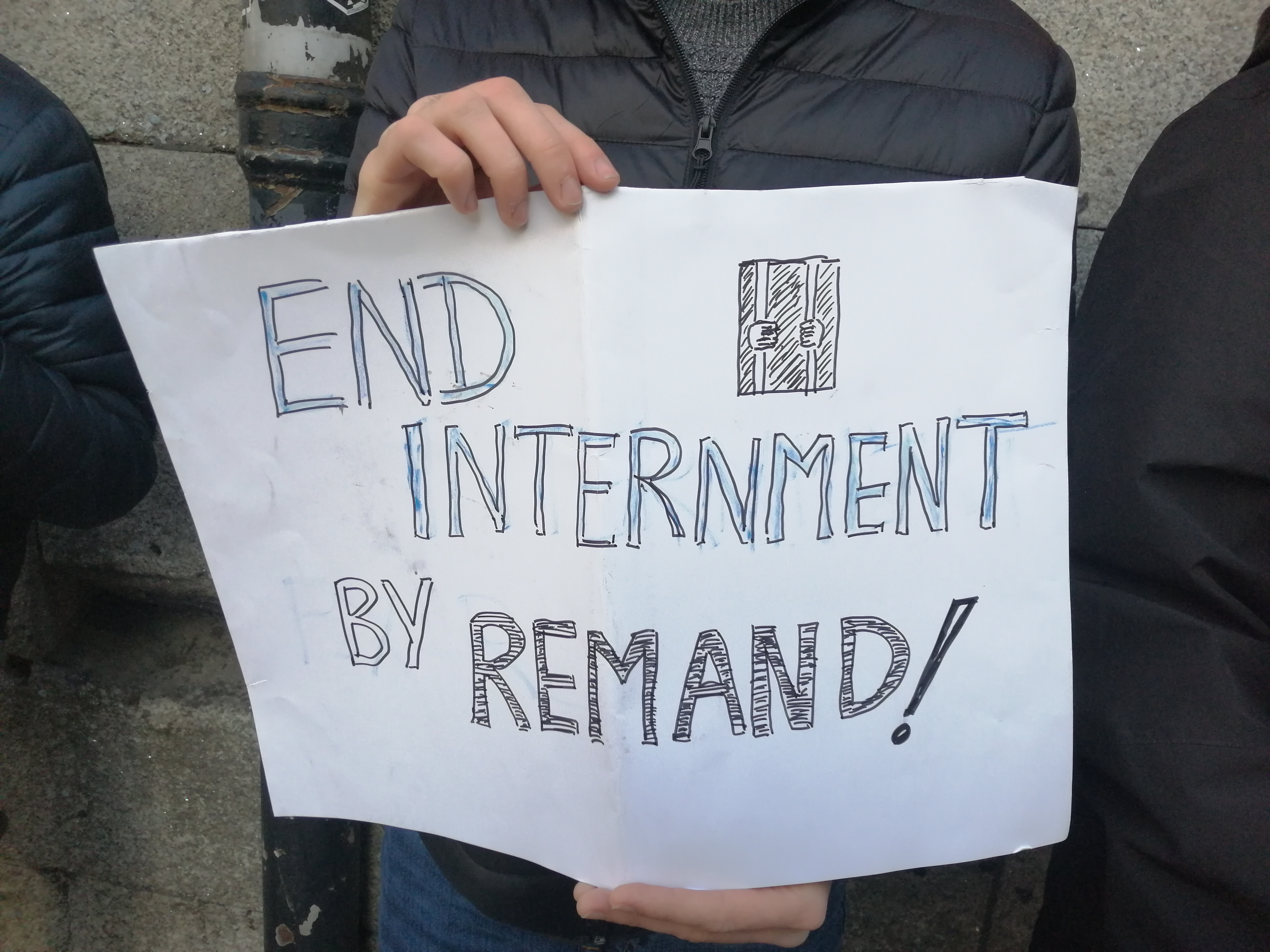
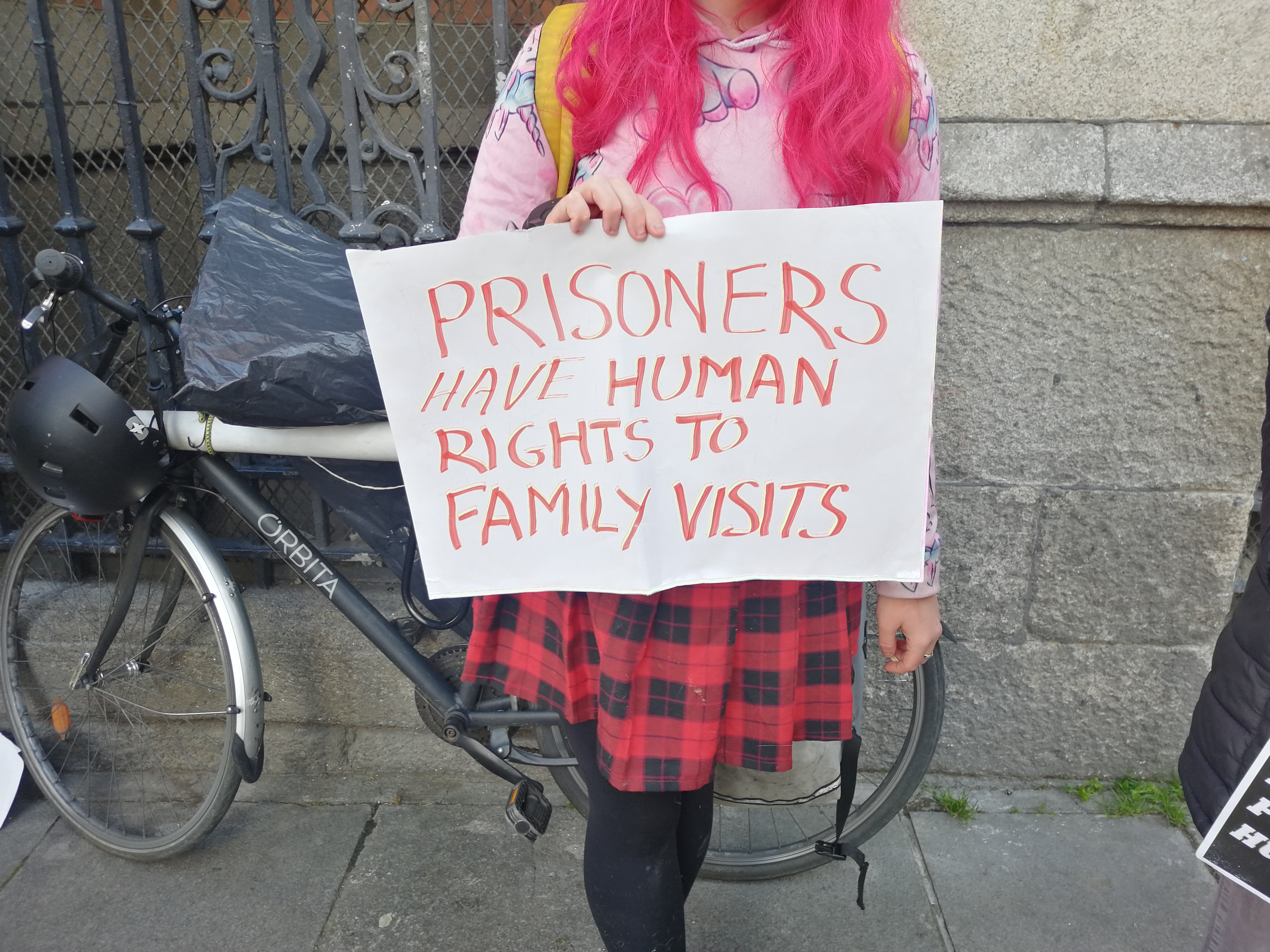
The Dublin Anti-Internment Committee held a well-attended picket on Saturday (5th March) against the continuing practice of interning Irish Republicans without trial and also in support of human rights for political prisoners. At one point the picket was subjected to the unwelcome attention of the Irish political police.

(Photo: C.Sulish)

The event was in furtherance of the Committee’s advertised intention to hold monthly public events to highlight the deprivation of civil rights from Irish Republicans — on both sides of the British border — through the operation of special legislation and in particular of the no-jury political courts (Special Criminal Courts in the Irish state and Diplock Court in the British colony). The Committee has admitted that it does not always succeed in holding a public event every month and in fact its most recent public appearance was during the December festive season, in solidarity with Irish Republican prisoners, when it was supported by a number of organisations and independent activists.

(Photo: C.Sulish)

WHY THESE PUBLIC EVENTS?

The Dublin Committee holds these public events because it believes that most people are unaware of the abuse of civil rights in Ireland, the civil right to belong to an organisation that criticises the State and seeks profound change. The reaction of people receiving a leaflet at their public events would seem to bear this out.

(Photo: C.Sulish)

Choosing a couple of extracts from their current leaflet: ‘At various times in Ireland’s history, people have been rounded up and jailed without bothering with a trial – people whom the government found troublesome and wished removed. Today the same process carries on although they don’t call it “internment” now – other names such as “due process”, “remanded in custody” are used ….”

‘Even when Republican activists are granted bail, it is on outrageous conditions such as not being permitted to reside in their own home, having to observe a curfew and wear an electronic tag, not being permitted to attend meetings and demonstrations …..’

The leaflet text makes the point that one doesn’t have to agree with the politics of Irish Republicans to see that these injustices are profoundly undemocratic abuses of civil rights — and “are ultimately a danger to all oppositional movements, whether Republican or not”. One aspect of their protest was against the denial of open family visits to Republican prisoners in the jails of the British colony in the north-east of Ireland — a violation of human rights.

The surprise in learning the facts is not confined to Irish people because often it is expressed by tourists or migrants, even if they have encountered such practices in their own countries of origin.

INTERNATIONALIST DIMENSION

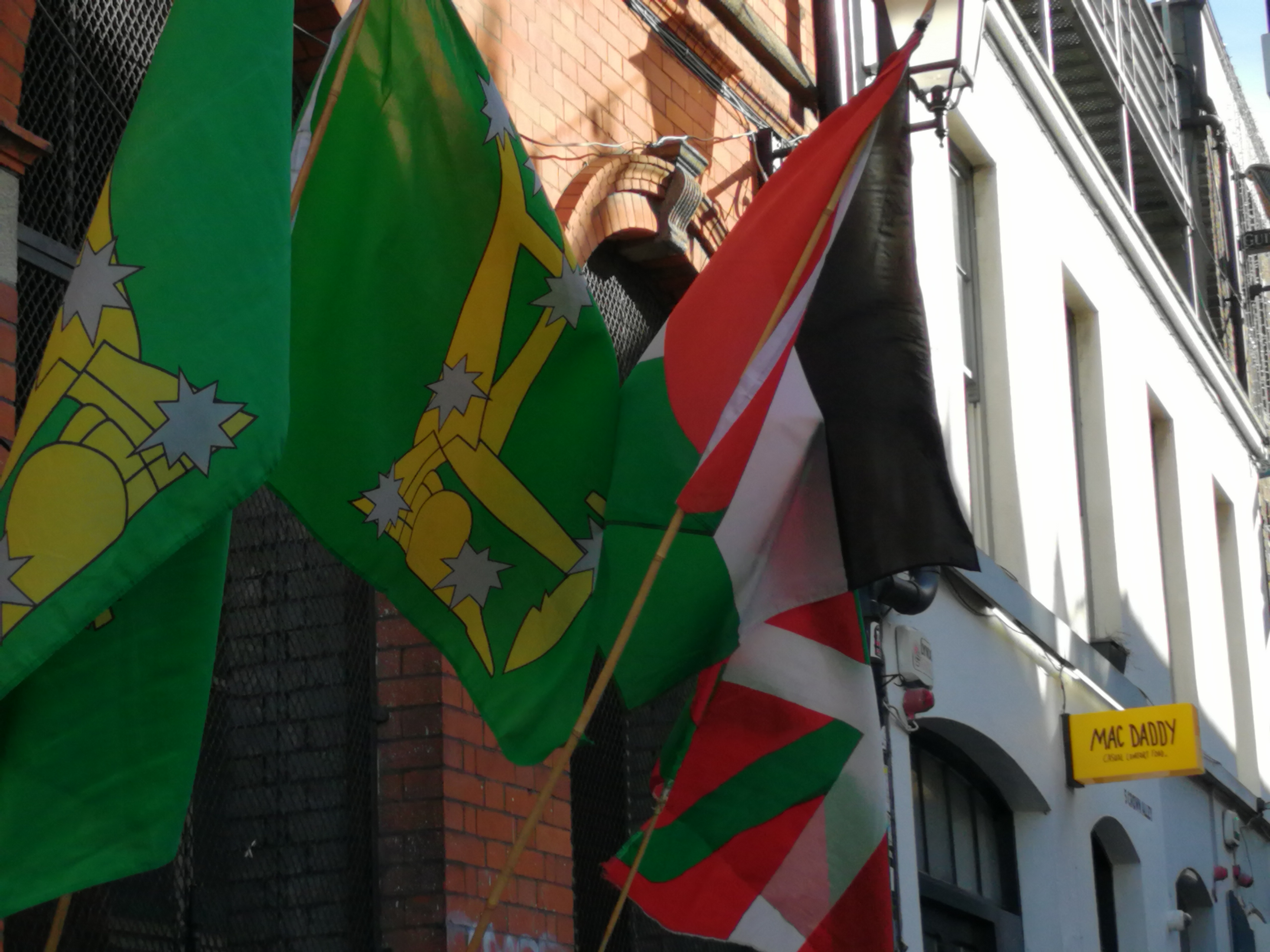
An example of the interest from abroad on Saturday was of a Basque man and, separately, of two young Basque women, reacting warmly to seeing the Basque flag among the picketers. The Dublin Committee objects not only to the incarceration of Irish Republicans but also of people seeking freedom in many other parts of the world, for which reason the Palestinian and Basque flags are frequently flown on their pickets, next to the revolutionary Irish workers’ flag of the Starry Plough.

A person who expressed support for the right to campaign without state repression was, interestingly, from Barcelona. However he did not wish for Catalan independence, wanting instead a unitary but democratic Spanish state – a position held by some communists and the main socia-democratic parties there. Although his position did not concur with that of the picketers, who tend to support the struggles for self-determination, the conversation was conducted without hostility.

Not so with another individual, who approached some picketers to argue for their support for the Ukrainian state in the current armed conflict there, a question that has deeply divided the Irish Left and Republican movements. He went further and announced his support for the Azov Battalion, an East European fascist organisation integrated into the Ukrainian state’s military, at which point the tolerance of the picketers for his intervention ended and he was urged to depart.

Starry Plough flags next to Palestinian and Basque Ikurrina flags at the picket in Temple Bar. (Photo: C.Sulish)

POLITICAL POLICE INTIMIDATION

Another temporary presence unwelcome to the picketers was of three members of the Irish State’s political police. These are members of what used to be called the Special Branch but are now officially called the Special Detective Unit, formerly C3 and successor to the CID when the Irish State was created. This type of political police force is modelled on the Irish Special Branch of Scotland Yard, the HQ of the British police, founded to spy on the influence and activities of the “Fenians” (i.e the Irish Republican Brotherhood) in the cities of Victorian-era Britain. However, in Dublin under British occupation, their parallel force was the G Division of the Dublin Metropolitan Police, known as “G-men”; it was they who identified many Republican and other prisoners of the British military after the 1916 Rising, ensuring death sentences for many (though most commuted to life imprisonment) and jail sentence for many others. During the War of Independence (1919-1921 they were identified as the intelligence service of the British occupation and many were selectively assassinated by the IRA of the time.

The Garda “Branch” (as they are known colloquially) of the Irish State have a long history of harassment of and spying on Irish Republicans, sometimes associated with violence and often with perjury in court. Their unsupported observations through the mouth of a Garda officer at the rank of Superintendent has been enough “evidence”, in the no-jury Special Criminal Court, to send many Irish Republicans to jail on a charge of “membership of an illegal organisation.”

Two picketers confront the plainclothes political police officer harassing a young leafletter on Saturday (Photo: C.Sulish)

One of these gentlemen on Saturday approached the youngest supporter of the picket, who was distributing leaflets to passers-by, identified himself as a Gárda officer in plain-clothes and demanded the young activist’s name. His accosting of the leafletter attracted the attention of others on the picket and two went quickly to support the subject of State harassment. The Branchman demanded no further information and sone moved away. However, when he had reached about half-way along the picketters, he stopped and began filming them.

At that point one of the picketers began to call out to passers-by, many of whom were tourists, that this man was a member of the secret political police, who was filming and attempting to intimidate people on a legal political protest, that this is the kind of ‘democracy’ that exists in the Irish state, etc, etc. Shortly thereafter, the Branchman departed, along with another two of his colleagues that had been observed further down towards Temple Bar.

A picketer loudly denounces the political policeman’s filming of the picketers. (Photo: C.Sulish)

According to picket participants this intervention of the political police represented an escalation of their attentions in recent times, though not in the least unusual in the past, when every picketer might have their name (and even their address) demanded and jotted down.

A spokesperson of the Dublin Anti-Internment Committee stated that it is independent of any political party or organisation and that it welcomes the participation at its public events of democratic individuals, whether independent activists or members of organisations and had distributed many of its leaflets. It regrets that a number of political activists — who should have an interest, even if only in self-preservation – in defending the democratic rights to organise and to protest, decline to support their events.

(Photo: C.Sulish)
(Photo: C.Sulish)
Picketers and leafletters (Photo: C.Sulish)

End.

FURTHER INFORMATION

Anti-Internment Group of Ireland: https://www.facebook.com/End-Internment-581232915354743

Azov Battallion: https://en.wikipedia.org/wiki/Azov_Battalion

BRITISH SUPREME COURT VINDICATES TORTURED “HOODED MEN” – CRITICISES POLICE CHIEF

Diarmuid Breatnach

(Reading time up to ‘Background’: 4 mins.)

A group of Irish people were jubilant in London’s Little George Street on 15th December. The location was that of the UK’s Supreme Court and it was unusual for Irish people to be happy at a judgement of a British court. But the judges inside had quashed an appeal by the Police Service of Northern Ireland1 against a judgement of the High Court in Belfast, that the colonial police force had been wrong not to investigate the claims of fourteen men of being tortured in the British colony in 19712.

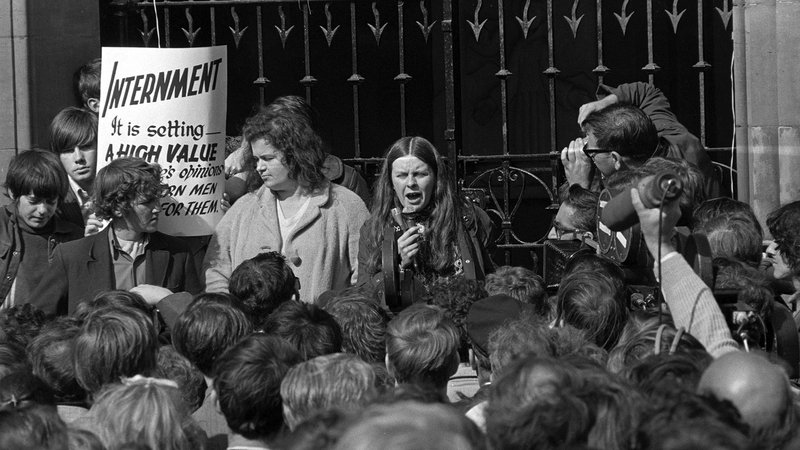
Bernadette Devlin (now McAlliskey) addressing an anti-internment rally in Derry in August 1971 (Photo cred: Popperfoto, Getty Images)

The claims related to what happened during the introduction of internment without trial in the occupied Six Counties in August 1971. What many internees experienced ranged from brutal treatment to torture: “Many of those arrested reported that they and their families were assaulted, verbally abused and threatened by the soldiers. There were claims of soldiers smashing their way into houses without warning and firing rubber baton rounds through doors and windows. Many of those arrested also reported being ill-treated during their three-day detention at the holding centres. They complained of being beaten, verbally abused, threatened, harassed by dogs, denied sleep, and starved. Some reported being forced to run a gauntlet of baton-wielding soldiers, being forced to run an ‘obstacle course’, having their heads forcefully shaved, being kept naked, being burnt with cigarettes, having a sack placed over their heads for long periods, having a rope kept around their necks, having the barrel of a gun pressed against their heads, being dragged by the hair, being trailed behind armoured vehicles while barefoot, and being tied to armoured trucks as a human shield” (for the soldiers against attack by the IRA). (Wikipedia)

(Photo sourced: Internet)

Some were hooded, beaten and, having been told they were hundreds of feet in the air, were then thrown from a helicopter — but were actually only a few feet from the ground. In addition, they were subjected to disorientating “white noise”, forced to remain in stress positions for long periods and deprived of food, water and sleep. Fourteen men who endured this for seven days became known as the “Hooded Men” and have been campaigning for over 50 years to have the British State admit that in its Irish colony, it had tortured them. Interestingly, some of those techniques have also been complained of more recently – by prisoners of the British military in Iraq3 — and this despite a statement by the UK’s Attorney General in 1977 that the techniques would not be used by them again.4

(Photo sourced: Internet)

Unusually, the Irish State5 took the case of the Fourteen to the European Court of Human Rights in Strasbourg and in 1976 obtained a judgement that “the five interrogation techniques” were torture.

The British State appealed the ECHR judgement and in 1978 won a judgement that although the treatment of the Hooded Men amounted to “inhuman and degrading treatment” and breached Article 3 of the European Convention of Human Rights it nevertheless fell short of torture6.

When documentation came to light proving that British Government Ministers had approved the treatment, the Irish State appealed the revised judgement of the ECHR but in 2018 was unsuccessful.

Meanwhile, the legal team of the Hooded Men pursued their case through the legal system of the UK’s Irish colony. In October 2014 the PSNI formally decided not to investigate the allegations, following which in 2015 judicial review proceedings against the PSNI, Secretary of State for Northern Ireland and Department of Justice were initiated by Francis McGuigan, one of the ‘Hooded Men’. A co-appellant was Mary McKenna, the daughter of Sean McKenna, another of the Hooded Men, who died in 1975, never having fully recovered from his mistreatment. The proceedings followed the discovery of additional documentary materials relevant to the mistreatment of the men, which were featured in a 2014 RTÉ Documentary, The Torture Files.7

Following this Documentary, the Chief Constable stated that the PSNI would assess “any allegation or emerging evidence of criminal behaviour, from whatever quarter” concerning the ill-treatment of the Hooded Men “with a view to substantiating such an allegation and identifying sufficient evidence to justify a prosecution and bring people to court’”. However in October 2014 the PSNI took the decision not to investigate. In late 2017, the High Court ruled that the failure by the Police Service of Northern Ireland (PSNI) to investigate the allegations of torture was unlawful.

Some of the Hooded Men in London for the Supreme Court judgement. (Photo sourced: Internet)

Instead of accepting the judgement however the PSNI sought to appeal the High Court decision but in September 2019 the Court of Appeal ruled that the decision should stand. One would have to contrast the determination of the colonial police in the courts to their appalling record in investigating collusion between their own force and Loyalist murder gangs, for the PSNI then appealed to the UK Supreme Court. In November 2019 the UK Supreme Court upheld the decision of the colony’s Court of Appeal and the PSNI appealed that judgement too. The decision last week in London marks the end of the legal options of the colonial gendarmerie.

The very month the decision not to investigate the allegations of the Hooded Men was taken by the colonial police force, October 2014, Drew Harris had been appointed Deputy Chief Constable of the PSNI.

IMPLICATIONS OF JUDGEMENT

The implications of the High Court judgement for Britain and its colonial administration are that once again they have been shown to have deployed barbarous methods in their repression of resistance by the nationalist minority in the colony and that they have exceeded or ignored even their own laws.

As has been the case throughout the recent 30 Years’ War, with the system lying and trying to cover up the reality of its actions, then delaying by all available means, the judgement comes too late for a number of the victims, as only nine of the 14 are still alive.

Nevertheless, the judgement adds to a number of other judgements and admissions over the years, such as those surrounding the Bloody Sunday Massacre in Derry in 1972 and the Ballymurphy Massacre in 1971. On 13 December this year, the British Ministry of Defence and PSNI agreed to a £1.5m out-of-court settlement to compensate victims of the Miami Showband Massacre over suspected state collusion with loyalist terrorists.

Three members of the band died from explosions and bullets after they were forced to get out of their bus at a fake police checkpoint on their return to Dublin from the Six Counties. Stephen Travers, who was injured in the attack, said he was convinced he would have won his civil action to prove that there was collaboration between the State and terrorists but that the Government’s decision to “dispense with justice rather than to dispense justice” had motivated the out-of court settlement.

Had the UK’s Supreme Court rejected the Hooded Men’s case, the latter would have been free to take the case to the European Court of Human Rights – not that they had been tortured but that the police should have investigated their claims that they were. And, based on a similar case by the manager of a Basque newspaper against the Spanish State8, they would probably have won their case with damages awarded against the UK.

On the other hand, the Supreme Court decision puts the onus of investigating the accusations of the Hooded Men on to the PSNI, the very organisation deeply implicated in the treatment of the victims, the organisation which declined to investigate them previously and which justified its decision through the courts in the Six Counties and then in the Supreme Court of the UK.

But not only the British state and its colony are put into the dock by the Supreme Court judgement – Drew Harris, formerly Deputy Chief Constable of the PSNI is currently in charge of the police force of the Irish State, where he was appointed Chief Commissioner of the Gardaí in September 2018 on a yearly salary of €250,000.

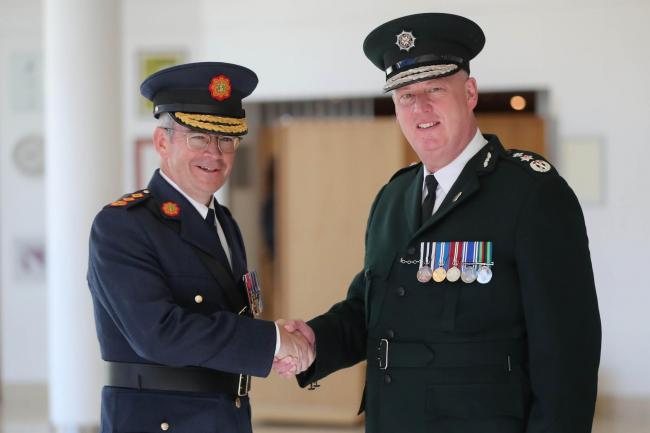
Drew Harris (Left) as Garda Commissioner with his former boss, George Hamilton, Chief Constable of the colonial police, the PSNI, on the occasion they both received an honour from the British Monarch. (Photo sourced: Internet)

APPENDIX — BACKGROUND

Creation of “Northern Ireland”:

The statelet of “Northern Ireland”9 was created in 1922 after Ireland was partitioned by the British Government at the end of 1921. Ireland had been invaded from Britain in 1169 and gradually entirely occupied and colonised by the invaders, albeit with its own semi-autonomous parliament which had been abolished in 1801, after the United Irish uprisings of 179810. Subsequently Members of Parliament elected in Ireland were required to attend the Westminster Parliament.

Following the rise of Irish nationalist sentiment after the suppression of the 1916 Rising, the 1918 UK General Election returned a huge majority of MPs in Ireland sworn to establish an independent Irish Republic. These formed their own parliament in Dublin, at first ignored but then later banned by the British. The guerrilla War of Independence of 1919-1921 convinced the British rulers to offer Ireland autonomy as a “Dominion” within the British system and under the Crown. However, at the same time, the British conceded to the demand of the unionist minority in Ireland to secede from the new Irish state and to remain a colony of Britain and in the UK. The Irish Free State was set up in December 1921 on 26 counties and the Northern Ireland statelet of six counties in January 192211.

From the outset the colonial statelet had been marked by the religious sectarianism of its local rulers, Presbyterians and Anglicans by religion and of unionist ideology, against a very large nationalist minority of mostly Catholics, representing the majority in Ireland as a whole. A raft of special powers empowered the statelet in repression of the nationalist minority; the colonial gendarmerie, abolished in the Irish state, continued in existence, with a part-time wing and even unofficial Loyalist militia in support and de facto anti-nationalist discrimination existed in every sphere: law, housing allocation, education.

In 1968 a campaign for civil rights for the nationalist minority began, to be met by truncheons, water-cannon, tear gas and bullets which however, merely drove parts of the minority into open insurrection. The colonial gendarmerie (the Royal Ulster Constabulary), even with the active support of the part-time B-Specials and Loyalist paramilitaries, was unable to suppress the uprising primarily in Derry but also in West Belfast and in August 1969 the British Government sent in the British Army to take control.

Initially the soldiers were represented to the nationalist population as being present to protect them from the sectarian colonial police and from the Loyalists but it soon became clear that their primary focus was to repress the risen nationalist population and the IRA began to take action against them.

Introduction of Internment Without Trial:

The Prime Minister of the “Northern Ireland” statelet, Brian Faulkner, recommended to his colonial masters that internment without trial be introduced against the nationalist population; this was agreed and “Operation Demetrius” began on 9th August and continuing over the 10th 1971 with British Army raids into nationalist areas, forcing their way into homes and dragging their captives away to be interrogated by RUC Special Branch, after which they were jailed. In the initial sweep the occupation forces arrested 342 men, sparking four days of violence in which 20 civilians, two IRA members and two British soldiers were killed and 7,000 people fled their homes. All of those interned were from the nationalist community.

Poster by the Anti-Internment League of Ireland – the internees in the photo are handcuffed together. (Photo sourced: Internet)

The detentions without charge continued until December 1975 and by that time 1,981 people had been interned, of which 1,874 were from the nationalist community. Only 107 were Loyalists and none of those had been interned until February 1973. Resistance to internment continued after the initial sweep and from 9th to 11th August, British Paratroopers caused the death of 11 unarmed people in the Ballymurphy area of Belfast. In January the following year the Paras and other units attacked people marching against internment in Derry, killing 14 and injuring 12.

Internment was protested in the rest of Ireland and in other countries, including Britain. The Men Behind the Wire, an anti-internment song composed in 1971 by Paddy McGuigan and recorded by the Barleycorn group in Belfast, was pressed into disc in Dublin and shot to the top of the Irish charts, greatly exceeding in numbers of sales any record previously released in Ireland.

Excerpt:

Through the little streets of Belfast,
In the dark of early mo
rn,
British soldiers came marauding
Wrecking little homes with scorn.

Heedless of the crying children,
Dragging fathers from their beds;
Beating sons while helpless mothers
Watched the blood flow from their heads.

Armoured cars and tanks and guns
Came to take away our sons
But every man will stand behind
The Men Behind the Wire.

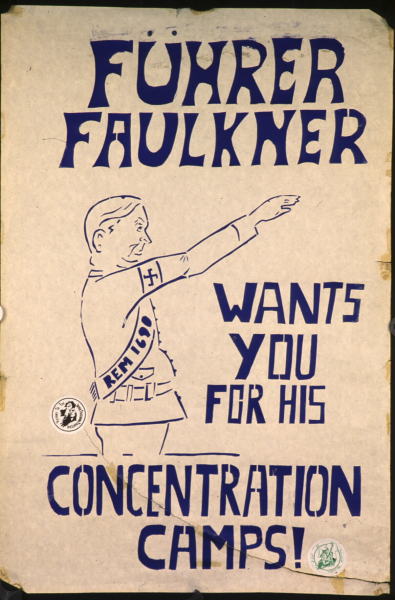
Poster by People”s Democracy, believed in 1970, prior to introduction of internment. (Photo sourced: Internet)

Brian Faulkner, unionist Prime Minister of the statelet, who had asked the British to introduce internment, was hated by a great many people. When he died in March 1977 following an accident during a stag hunt, thrown by his horse Cannonball, an English communist composed a short song he named “Cannonball”.

Excerpt:

Lord Faulkner was a hunter of men and of deer

And both have good reason to laugh and to cheer

At the death of a tyrant whose interests were clear

Those of imperialism that have cost Ireland dear.

Cannonball, Cannonball has many a friend,

From the top of old Ireland right down to its end,

Where the brave people struggle

In one resolute bid

To throw off their oppressors —

Just as Cannonball did!

End.

FOOTNOTES

  1. The colonial gendarmerie formerly known as the Royal Ulster Constabulary.

2 (see “Background” section).

3. The Court’s ruling that the five techniques did not amount to torture was later cited by the United States and Israel to justify their own interrogation methods, which included the five techniques. British agents also taught the five techniques to the forces of Brazil’s military dictatorship. During the Iraq War, the illegal use of the five techniques by British soldiers contributed to the death of at least one detainee, Baha Mousa.

4 “The Government of the United Kingdom have considered the question of the use of the ‘five techniques’ with very great care and with particular regard to Article 3 (art. 3) of the Convention. They now give this unqualified undertaking, that the ‘five techniques’ will not in any circumstances be reintroduced as an aid to interrogation.”

5 Unusually, because during the three decades of ill-treatment by a foreign power of people who were, according to the Irish Constitution its citizens, only in one other case did the Irish State bring a complaint against the UK to an international arena.

6 I admit that I fail completely to understand the distinction.

7. Rita O’Reilly, the journalist who led that program, also commented extremely well on the UK Supreme Court decision and the whole case on Prime Time on RTÉ this week (see Links).

8. Martxelo Otamendi, along with others detained, was tortured by his Guardia Civil captors when the Basque newspaper of which he was manager was closed by the Spanish State, alleging that it had been cooperating with terrorists. He was freed eventually and even later in 2010 the Spanish Supreme Court admitted that there had been no evidence against him or the newspaper – but neither admitted the torture nor ordered his allegations be investigated. Otamendi filed a complaint with the European Court of Human Rights in 2012 and in 2014 the ECHR found the Spanish State guilty of not having investigated Otamendi’s allegation of being tortured and awarded him €24,000 in damages and expenses from the Spanish state.

9. A misnomer since the British colony is not the northernmost part of Ireland, which is in County Donegal, inside the Irish state. “Ulster”, a name given by the Unionists to the statelet and frequently repeated in the British media, is also a misnomer since the Province of Ulster contains nine counties, six of which are in the colonial statelet but three of which are within the Irish state.

10. There were many uprisings prior to 1798, which was the first Republican one and there were many of that kind afterwards too.

11. Shortly after that the Free State, supplied with weapons and transport by the British, attacked the Republicans, who had been demonstrating their dissatisfaction with the Anglo-Irish Treaty. This precipitated a Civil War in which the Republicans were defeated.

USEFUL LINKS FOR MORE INFORMATION

Unusually excellent (for RTÉ) report by Rita O’Reilly: https://www.rte.ie/news/primetime/2021/1217/1267343-uk-supreme-court-decision-on-hooded-men/

https://www.irishtimes.com/news/ireland/irish-news/hooded-men-uk-court-finds-psni-decision-not-to-investigate-case-unlawful-1.4755885

https://en.wikipedia.org/wiki/Operation_Demetrius

POLITICAL PRISONERS’ SOLIDARITY PICKET IN DUBLIN

Clive Sulish

(Reading time: 3 minutes)

Amidst festive season lights, passing Santa Clauses on horse-drawn carriages and hungry people being fed by volunteers in the Dublin city centre, Irish Republicans and Socialists gathered to send a public message of solidarity to political prisoners in Ireland and elsewhere.

Photo: Rebel Breeze

The event is an annual one organised by the Anti-Internment Group of Ireland, an independent non-aligned group raising awareness that internment without trial continues in Ireland, through revoking of licence of ex-prisoners and through refusal of bail in the no-jury courts both sides of the British Border. The Dublin committee of the AIGI holds monthly public awareness-raising pickets in the city centre.

The annual picket on Thursday early evening was supported by activists of the Irish Republican Prisoners’ Welfare Association and of the Anti-Imperialist Action organisation, along with some independents and took place in front of the iconic GPO building, on Dublin’s main street.

Photo: Rebel Breeze

The picketers and passers-by were addressed by a representative of the Anti-Internment Group outlining the participants’ presence to send solidarity greeting to political prisoners in Ireland and around the world. The speaker drew particular attention to three prisoners: Leonard Peltier, Native American, 45 years in jail and Black American Mumia Al Jamaal, 40 years in prison, both framed by police in the USA. Also highlighted was the case of Ali Osman Kose, 37 years in jail, 21 of which he has spent in solitary confinement. The speaker informed the audience that those three political prisoners, apart from their very long years of incarceration, have multiple health issues and should be released, he said on humanitarian grounds alone. “But no ….. they want them to die in jail”, he said.

Photo: Rebel Breeze

Going on to speak about political prisoners in Ireland, the speaker said that they and hostages had existed almost from the moment Ireland had been invaded by its neighbour and from the defeated United Irishmen up to the Fenians, had included not only dungeons and prison cells but also penal colonies on the other side of the world, after which they had been confined in special prisons and concentrations camps.

The creation of the Irish State on a partitioned Irish country a century ago this month had not brought freedom nor an end to the struggle, the speaker said and pointed out that the Irish State had executed 80 Irish Republicans during the years of the Civil War, which was more than the British had done during the War of Independence preceding it.

Photo: Rebel Breeze

“Whether we are religious or not ….. in our culture at this time of year we expect to be with our families, our partner, children and friends,” the AIGI representative said but pointed out that this opportunity is not available to the prisoners, which makes this a particularly difficult time of year for them, which is why the Group and others hold this event every year.

The speaker then called a young boy forward “to send a message to the prisoners from this younger generation who hopefully will see a free and united Ireland with social justice and equality. The young boy stepped forward and through the PA, asked all at this time of year to think of the Republican prisoners.

Photo: AIGI

The Starry Plough, the Palestinian flag and the Basque Ikurrina were flown by participants and among the banners of the IRPWA and Dublin Committee of the AIGI there was also one displaying the Carlos Latuff graphic of Palestinian and Irish Republican prisoner solidarity. The centrepiece in the picket line was the word Saoirse (‘freedom’ in Irish) picked out by lights on a dark background. Appropriate music was also played during the picket from a PA system, except while being addressed by the speaker.

The event concluded with thanks to all the attendance and the singing the first verse and chorus of the battle-song Amhrán na bhFiann (The Soldiers’ Song in Irish, which is also the National Anthem).

It is understood that seasonal greeting cards have also been sent by AIGI to political prisoners in prisons in the Irish state and in the colonial statelet.

End.

Photo: Rebel Breeze
Signing Christmas cards for the prisoners. (Photo: AIGI)
Photo: Rebel Breeze

Further information:

https://www.facebook.com/End-Internment-581232915354743

ANTI-MASKERS NOT GOING FAR ENOUGH

Diarmuid Breatnach

(Reading time: 3 minutes)

For quite some time now certain people have been protesting inside shops and other spaces, along with marching up and down streets insisting on their right to enter places and to travel without wearing a mask or without displaying proof that they have been vaccinated. Those anti-maskers have been quite proud of what they see as their stand for personal freedom and against authoritarian rules. I on the other hand think they have been very tame and don’t go nearly far enough. So I’ve listed some other rules and regulations they should be rebelling against.

ADDITIONAL UTHORITARIAN RULES AND REGULATIONS TO REBEL AGAINST

Driving

  • Being obliged to have a driving licence
  • Being obliged to have motor insurance
  • Having to drive on one side of the road
  • Having to obey traffic lights and signs
  • Being obliged to have working lights on one’s vehicle and using them in dark conditions

Domestic(ated) animals

  • Having to clean up your dog’s excreta in a public place
  • Not importing pets without their vaccinations
  • Not importing wild animals without a licence
  • Not being allowed to keep animals in whatever condition one feels like

Children

  • Having to send children to school
  • Not being permitted to have children working full time
  • Not being permitted to serve underage children alcohol
  • Not being permitted to sell underage children tobacco and cigarettes
  • Having to take action in cases of bullying
  • Not being permitted to beat children in school

General social

  • Having to wear clothing covering sexual parts in public
  • Not being allowed to excrete in the street
  • Not being permitted to smoke in some areas
  • Not being permitted to drop trash wherever and whenever one feels like it
  • Being forbidden from playing loud music, operating power tools or creating noise in general in communities between certain hours
  • Being forbidden from emitting large amounts of smoke or other noxious gasses in a community
  • Not being able to say whatever one likes about anyone else without being subject to libel or slander laws (or a smack in the mouth)
  • Having to adhere to fire prevention and control regulations in communal or community living
  • Having to adhere to published standards in construction

Food hygiene

  • Not serving food past its advertised sell-by date
  • Food-preparation staff being required to be qualified in the practice
  • Food-serving premises being obliged to store food according to regulations
  • Food preparation and processing having to adhere to published standards
  • Being required to advertise the contents of products
  • Being required to advertise a safe “sell by” date on food products

Working Health & Safety

  • Workplaces having to adhere to Health & Safety regulations
  • Being required to wear safety helmet on construction sites
  • Being required to wear goggles or industrial spectacles and/or ear protectors for certain operations
  • Being required to clip on a safety line on boats in rough conditions
  • Being required to wear a flotation jacket on board boats
  • Not being permitted to smoke in some areas
  • Having to adhere to fire prevention and control regulations

Environmental

  • Having to avoid or control pollution from any procedures
  • Not being allowed to dump whatever material one wants to wherever one feels like it
  • Not being allowed to light open fires in certain areas at certain times of the year
  • Not being permitted to trim hedgerows during the bird nesting period
  • Being restricted in hunting or fishing during certain periods of the year

Hospital

  • Having to adhere to anti-contamination procedures in ICU and generally in hospital

DOWN WITH AUTHORITARIAN CONTROLS!

DUBLIN HOSTS TURKISH REVOLUTIONARY MUSIC GROUP

Clive Sulish

(Reading time: 3 mins.)

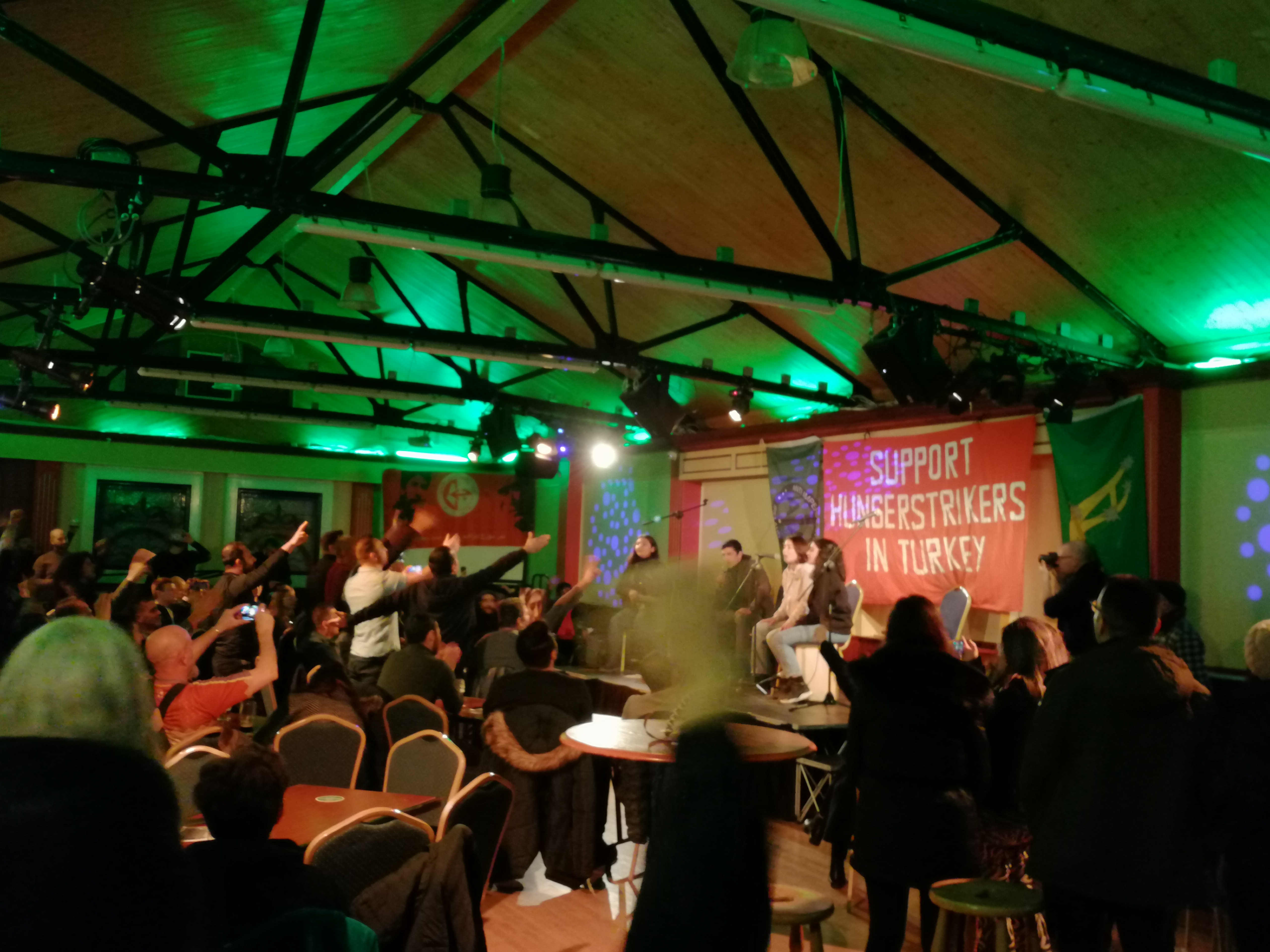
Last Saturday in the Teachers’ Club in Dublin (26/11/21), the revolutionary music Grup Yorum from Turkey, with some Irish musician input, played to an audience of up to two hundred. In between performing different numbers from their repertoire, band members spoke to the audience of the history of the struggles of their people and of the band.

The Irish tour of the band was organised by the Anti-Imperialist Action Ireland organisation; earlier that week Yorum played in a small music venue in Belfast to around 40 people. The attendance in Dublin was so large that the location had to be changed from a large room on the first floor to the much larger hall down below.

Grup Yorum performing in Dublin (Photo: Rebel Breeze)

BELFAST

In Belfast in the Sunflower Lounge, Bobby Fields from Armagh and Séan Óg from Dublin entertained those in attendance with songs of Irish resistance followed by Grup Yorum coming on afterwards. The Grup’s performance was enthusiastically received and was followed by a questions-and-answers session to learn more about the situation in Turkey.

The Grup members toured some of the area and visited the famous international solidarity wall along with the grave of Bobby Sands, where paying their respects included singing a song at the graveside.

DUBLIN

In the large hall in the Teachers’ Club, Dublin, Séan Óg took to the stage first, playing guitar to accompany himself on guitar to sing The Killmichael Ambush, Viva la Quinze Brigada, Back Home in Derry1 and The Internationale. Veteran activist and traditional singer Diarmuid Breatnach followed, singing unaccompanied the Anne Devlin Ballad, I’ll Wear No Convict’s Uniform2 and James Connolly’s satirical song Be Moderate3. Some of the audience sang along with some of the lyrics sung by each singer.

Be Moderate, satirical song by James Connolly, sung by Diarmuid Breatnach at the event (the link can be played on Facebook).

The four members of Grup Yorum present then took to the stage to huge applause and addressed the audience in Turkish, their words being translated into English by a member of their entourage. In the performance that followed, two guitars, flute and cajón were the instruments with a male and female leading voices. Each song was preceded by an explanation placing the piece in historical and political context.

Some of the songs in particular were clearly known to Turkish and Kurdish people in the audience and at some points they sang along, often waving an arm in the air. Towards the end of their performance the crowd got more and more excited and then Seán Óg joined them for a couple of numbers.

(Photo: Rebel Breeze)
oznor

The Grup’s interpreter made a special appeal for help from those in attendance to pressurise the Turkish authorities to release political prisoner Ali Osman Köse who has been in solitary confinement for 20 years and has multiple health issues. There are fears for the man’s life as he has had a cancerous kidney removed in May of this year without any follow-up treatment and despite everything has been pronounced “fit” to continue in jail.

This was followed by members of the Resistance Choir taking to the stage to join Grup Yorum in a rendition of the Italian antifascist Bella Ciao! Song before Diarmuid Breatnach returned to the stage to bring the evening to a close with the first verse and chorus of Amhrán na bhFiann4 with members of the audience joining in (including some from Anatolia)

The Resistance Choir from Dublin on stage with Grup Yorum to perform the Bella Ciao song (Photo: Rebel Breeze)

THE GRUP YORUM BAND

A revolutionary music band from Turkey, Grup Yorum members compose their own material and the band has has released twenty-three albums and one film since 1985. The band has suffered repression with some concerts and albums banned and members have been arrested, jailed and tortured, two members also dying on hunger strike. The band is popular in Turkey and as well as their albums selling well in Turkey and internationally, it has also given concerts in Germany, Austria, Australia, France, Italy, the Netherlands, Belgium, Denmark, United Kingdom, Greece and Syria.

Grup Yorum publishes an art, culture, literature, and music magazine entitled Tavir, and several group members manage a cultural centre called İdil Kültür Merkez in the Okmeydani neighbourhood of Istanbul.

Section of the crowd in Dublin saluting the Grup Yorum performers (Photo: Rebel Breeze)

FOOTNOTES:

1The lyrics and air of Viva la Quinze Brigada are by famous Irish folk musician Christy Moore, who also arranged Bobby Sands’ poem to the air of the Wreck of the Edmund Fitzgerald (by Gordon Lightfoot) as Back Home in Derry.

2Diarmuid sings this song to an air he composed himself.

3Diarmuid sings this to the air of A Nation Once Again (by Thomas Davis).

4Written by Peadar Kearney originally under the title The Soldiers’ Song and sung by insurgents during the 1916 Rising, its chorus is the official national anthem of the Irish State. However, it is also sung by many who are opposed to the State, particularly by Irish Republicans. Normally only the chorus is heard, sung in Irish (translation).

USEFUL LINKS:

https://www.facebook.com/grupyorum1985

https://www.facebook.com/Anti-Imperialist-Action-Dublin-North-City-110852710835826

https://www.facebook.com/socialistrepublicanballyfermot

https://freealiosmankose.wordpress.com/

PROTESTS GREET PRESENTATION OF CHANCELORSHIP TO HILLARY CLINTON

Diarmuid Breatnach

(Reading time: mins.)

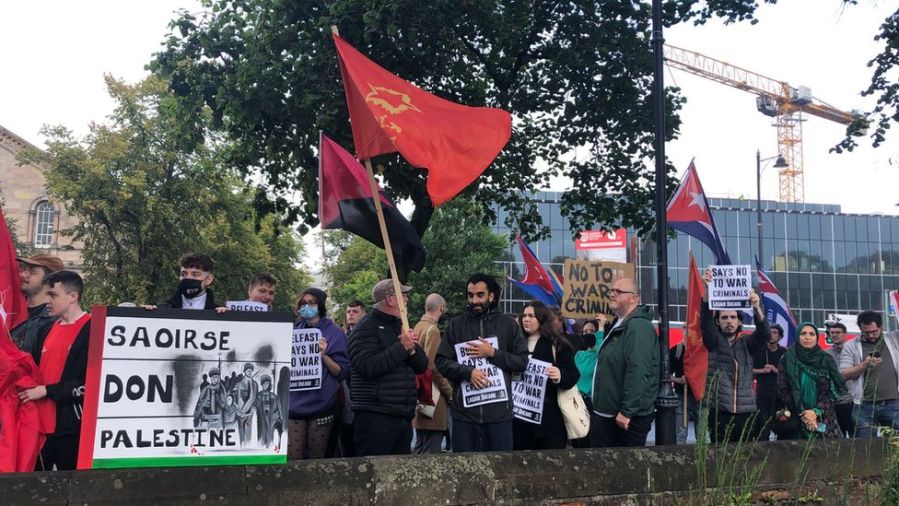
Queen’s University Belfast appointed Hillary Clinton as the institution’s Chancellor1. On 24th September 2021 the University authorities organised an event to mark her formal inauguration; however a large and voluble crowd gathered to protest the inauguration and the authorities’ choosing her as Chancellor of the University. Among the shouts of protesters were “War criminal!” and “Hillary, Hillary, Hillary – Out, out, out!” (This story is now “old”, apologies but nevertheless worth posting for those who might not be aware of it as media coverage was muted)

Although the Belfast Telegraph’s coverage of the event made no mention whatsoever of protests, they were reported in a number of other media. The protest saw Irish Republican and Left socialist groups come together to carry out the protest, with a number of them taking turns to speak.

The speakers at the protest included Pól Torbóid of Lasair Dhearg; Aidan Moran, a former ISM activist in Occupied Palestine, on behalf of Cairde Palestine; Conal MacMathúna on behalf of the Connolly Youth Movement; Local Councillor Michael Collins from People Before Profit; and Dr. Azadeh Sobout, Scholar of Transitional Justice and Peace building and Member of Academics for Palestine.

In addition to Irish organisations’ banners and flags, the national flags of Palestine and Cuba were also in evidence.

Hillary Clinton has been a member of the USA Congress from 2001 to 2009, followed by Secretary of State from 2009 to 2013, having also held the ceremonial position of First Lady during her husband Bill Clinton’s tenure as President of the USA 1993-2001. The Secretary of State of the USA, appointed by the President with the advice and consent of the Senate, is the President’s chief foreign affairs adviser. The Secretary carries out the President’s foreign policies through the State Department and the Foreign Service of the United States.

Lasair Dhearg’s Pól Torbóid, who helped organise and also spoke at the event, said, “Queen’s University’s complicity in the whitewashing of Hillary Clinton and her war crimes further epitomises the university’s role in an international framework of imperialism that sees it not only glorify warmongers like Clinton, but have immense financial investment in military contracts and companies guilty of immense environmental destruction.”

“Queen’s has facilitated the visitation of many war criminals and parasites over the years, but arguably none as big as the visit of Hillary Clinton as its chancellor. A proud Zionist and imperialist; with a war record as long as your arm, Clinton has helped oversee US bombing campaigns in over 9 countries.”

“As US secretary for war, she authorised over 400 drone strikes across multiple nations, which overwhelmingly killed civilians and even children at a proportion of almost 90%.”

“She labelled black men ‘super-predators’ when she helped lobby for the 1994 US Clinton Crime Bill, which was immensely important in creating the mass incarceration levels that exists today in the US to benefit the prison-industrial complex – which is a system of slavery by new means.”

Section of the protest as seen from the inside of the University (Photo sourced: Internet)

“A Zionist, Hillary Clinton has shown herself to be an enemy of Palestinian liberation, siding with the oppressor every time it mattered, like during the 2014 Israeli bombing campaign of Gaza. She increased annual US funding to Israel from 2.5billion, to 3.1 billion US dollars whilst she was US Secretary of State, and she stated that countering the BDS movement globally should be a priority for Israel’s defence.”

“All this – and Queen’s award her chancellor for her Peace and Reconciliation efforts. For all the books Queen’s have at its disposal, I don’t think their management have ever read one! PEACE IS SOMETHING HILLARY CLINTON CAN’T EVEN SPELL, NEVER MIND DISPENSE!”

Full video below (with thanks to Lasair Dhearg organisation):

(Photo sourced: Internet)

FOOTNOTES

  1. In the UK university system, the office of Chancellor is held by a distinguished individual, from academia or public life, who is not usually resident and does not hold any other University office.

SOURCES

https://www.thejournal.ie/hillary-clinton-installed-chancellor-queens-university-belfast-5557234-Sep2021/

https://www.v-c.admin.cam.ac.uk/chancellors-role

The International Criminal Court Has Gone — Who Will Save Us Now?

Gearóid Ó Loingsigh

(Reading time: 3 mins.)

There is a long tradition amongst NGOs, sectors of the reformist left, trade unionists and others in Colombia that someone outside the country will save us. The saviours are the North Americans (despite their role in the conflict), the European Union (despite their role as well and that of their companies), and international institutions such as the International Criminal Court, or the mechanisms set up in the peace accord (national ones but financed internationally). So, the decision by the ICC to shut down its preliminary investigation of Colombia was like a bucket of cold water to them. But it was to be expected.

Banner carrying faces and names of youth from Soacha and Bogotá murdered by the Colombian National Army. The banner was displayed in a march in Bogatá on the 6th March, the Day of Victims of State Violence. (Photo credit: GOL)

When Obama was elected as US president, various journalists and representatives of the left and NGOs announced that he would solve Colombia’s problems and now they have come back to say the same about Biden. A constant feature of this discourse of seeking a foreign saviour is the possibility of taking Uribe (not his Defence Minister, Juan Manuel Santos) to the ICC. They sold a false hope to the victims of the state that there they could obtain justice. They knew it was unlikely, as they knew what the ICC was like and its not very encouraging record in the matter.

To date the ICC has only convicted African leaders. It is not the case that these African leaders are saints or innocent, but rather that the ICC does not go after other criminals. It has procrastinated for many years on its case against Israel and has no authority to investigate the USA. The Court’s website currently indicates that it has 15 ongoing preliminary investigations, ten of them in African countries and five others in Georgia, Afghanistan, the Philippines, Bangladesh and the State of Palestine. This last case will not succeed, of that we can be certain. It has pursued a total of 30 individuals, resulting in 4 convictions.1 The ICC is the opium of the people, it has a soporific effect on people in the midst of their struggles and the NGOs promise Heaven and Divine Justice in a coming future.

A boy carries photos of victims in a march in Bogatá on the 6th March, the Day of Victims of State Violence. (Photo credit: GOL)

There were diverse reactions to the decision to shut down the preliminary investigation. Whilst the victims of the False Positives2 criticised the decision, others such as Senator Iván Cepeda and Eamon Gilmore, the EU envoy to the peace process celebrated it. The Movement of Victims of State Crimes (MOVICE) lamented the decision, though in a very confusing manner. It continued to praise the Special Jurisdiction for Peace (JEP), when it is precisely the existence of the JEP that the ICC used as an excuse to shut down the case.3

Iván Cepeda stated that:

A direct consequence of the agreement signed by Duque’s government with the International Criminal Court’s prosecutor is that once and for all the possibility of reforming the JEP has been discarded. It puts an end to that obsessive aim of the Uribistas. A victory for the peace process.4

A few years ago, he would have denounced the closure of the case as an act of impunity and now he claims it is a victory. As the Greek philosopher Plutarch put it, Another victory like this and all will be lost. Many of us denounced the impunity of the JEP, little did we think that not only would it guarantee impunity in the trials it deals with or excludes from its remit, but that its very existence would be the perfect excuse to shut down international cases against the regime. But the peace acolytes are determined to announce their defeat as a victory.

Protestors holding aloft photos of those murdered and disappeared in a march in Bogatá on the 6th March, the Day of Victims of State Violence. (Photo credit: GOL).

It seems that Senator Gustavo Petro didn’t have much to say about the matter and neither did Senator Alexander López. Piedad Córdoba, however, echoed the statements of Iván Cepeda and said:

They took issue with the JEP and tried to cut its budget, discredit it, dirty propaganda and all in order to cover their own backs. Today the ICC forced the government to strengthen it.5

A young woman carries photos of victims in a march in Bogatá on the 6th March, the Day of Victims of State Violence. (Photo credit: GOL)

It is clear that there are those who in the name of peace would justify any defeat, including a defeat of a proposal they themselves promoted. So, the ICC will not proceed against Colombia, but relax, we have the JEP where the military who, unlike the guerrillas, do not have to tell the whole truth about their crimes and where the businesspeople are excluded.

Of course, the president of the JEP, who once upon a time was the NGOs’ favourite said that he was very pleased with the ICC decision. According to Cifuentes the closure of the investigation against Colombia is a victory won by the JEP,6 i.e. those who for many years talked about how the ICC was going to put the Colombian State in its place, now tell us that the fact the ICC will not proceed against Colombia is a victory.

I really find it difficult to understand their logic, or better still I can’t understand their shamelessness. In the name of their pathetic peace accord, they justify everything and describe it as a victory. Poor Plutarch. If he had to deal with the leaders of the supposed left in Colombia today he would have been more vulgar, but he died many centuries ago, so allow me Plutarch: Another victory like this and the turncoats will be making money like never before.

So, to answer the question posed by this article, who will save us? The answer is no one, or rather, the Colombian people will save themselves, there are no international institutions, nor presidents in other countries who are going to fix the crisis that country has suffered for decades. The only ones who will put Uribe, Santos, Pastrana, Samper and the others in jail are the Colombian people.

“Forget them? That would be a crime against conscience” with images and names of the “disappeared” since 1998. The banner was carried on a march in Bogatá on the 6th March, the Day of Victims of State Violence. (Photo credit: GOL)

Next year is an electoral one and some of those who told us the ICC would do miracles and now celebrate the slap in the face it gave to the victims, will be candidates. They will promise a thousand miracles and when some foreign institution or president says no, they will celebrate it and try to convince us that the defeat was a victory. Changing the saying by Mao, they go from victory to victory to final defeat. Plutarch is as relevant today as ever.

End.

“NOT FORGOTTEN” banner carried on a march in Bogatá on the 6th March, the Day of Victims of State Violence. (Photo credit: GOL)

FOOTNOTES:

1 Information on cases can be consulted at https://www.icc-cpi.int/Pages/Home.aspx

2 People shot dead by Colombian state forces who were untruthfully claimed as “positives”, i.e guerrilla fighters.

3 RCN (29/10/2021) Falsos positivos: víctimas rechazan cierre del caso contra Colombia en Corte Penal Internacional https://www.rcnradio.com/judicial/falsos-positivos-victimas-rechazan-cierre-del-caso-contra-colombia-en-corte-penal

4 https://twitter.com/IvanCepedaCast/status/1453792170855604235?s=20

5 https://twitter.com/piedadcordoba/status/1454135519194005504?s=20

6 Wradrio (29/10/2021) Gracias la JEP cierran el examen preliminar de la CPI: Eduardo Cifuentes https://www.wradio.com.co/noticias/actualidad/justicia-de-la-jep-esta-dando-resultados-dice-su-presidente/20211029/nota/4174696.aspx

FURTHER INFORMATION:

https://en.wikipedia.org/wiki/International_Criminal_Court

MOROCCO OCCUPATION USING DRONES AGAINST SAHARAWI RESISTANCE

POLISARIO FIGHTER WOUNDED IN DRONE-GUIDED ATTACK

JAIRO VARGAS MARTÍN@JAIROEXTRE

(Reading time: 3 mins.)

SPECIAL REPORT FROM THE SAHARAWI REFUGEE CAMPS IN TINDUF (ALGERIA)

(Report in https://www.publico.es/internacional/drones-marroquies-combatiente-saharaui-herido-guerras-marruecos-me-ataco-dron-gran-diferencia.html translated by D.Breatnach)

Mohamed Fadel states that he was seriously injured last April by a Moroccan drone, during the same action in which the head of the Saharawi National Guard was killed. Morocco is silent on the use of these unmanned devices that have become the obsession of the Polisario Front troops.

Mohamed Fadel, ‘Mundi’, in a tent in the Saharawi refugee camp of Bojador, in Tindouf, Algeria, on October 15.

Mohamed Fadel can say that he has firsthand experience of the changes between the two wars against Morocco in which he was wounded. The first was in 1985, when a shell fragment hit him in the arm. But he recovered and returned to the front in no time. The second time was the recent April one and “it was more serious,” he says, showing the marks on his body under his military jacket.

Polisario female fighters (Photo cred: Dominique Faget/ Getty)

Burns to his face, hands and arms, two scars the size of a coin on his right side and an incision of more than a foot long across the middle of his belly. “They had to open me up to remove the three pieces of shrapnel that I had inside. It took me three months to fully recover,” he explains in perfect Spanish. “It was a drone attack. That is now the big difference,” insists this seasoned 64-year-old Saharawi fighter.

But Mundi, as everyone knows him in the refugee camps in Tindouf, Algeria, does not like to talk about two different wars. This, he says, the one that the Polisario Front declared on November 13 after 30 years of ceasefire, “is just a continuation of the previous one”, the one that began in 1975, after the military occupation of the former Spanish Sahara by part of Morocco. “The enemy is the same and the objective is the same: the referendum that has not been held and the independence of the Sahara. The only things that have changed are the means, the technology,” explains the Saharawi fighter, in the shade of a tent in the Bojador refugee camp.

“They are neither seen nor heard, but they are there and attack at any moment”

Moroccan drones are the worst nightmare in this new stage of hostilities, according to all the Sahrawi fighters interviewed by Público during the Polisario-organized trip to the camps last week.

“They are neither seen nor heard, but they are there and attack at any moment,” insists Mundi, although at the moment they have not shown any documentary evidence certifying the presence of armed or surveillance drones. The two parties accuse each other of using them, although both deny it, according to the latest report on this conflict by the UN Secretary General, Antonio Guterres.

Saharawi women living in Gastheiz (San Sebastian) in the south-west Basque Country demonstrate in solidarity with their people’s struggle and the Polisario Front (“askatu” = “free”) in May 2020. (Photo source: Internet)

An almost paranoid obsession

After each Sahrawi attack against the defensive Wall built by Morocco, all eyes are on the sky. Drones feel close almost always, even if they are not there, like an almost paranoid obsession. One of the main military directives of the Polisario is to stay away from cars when they halt, because they are their main target. When they believe that a drone is following behind, the old Sahrawi vehicles separate, stop and the unit that was on board runs away.

Morocco has embraced the purchase of Turkish-made armed drones, according to ‘Reuters’

These unmanned devices make up much of modern warfare and have been instrumental in recent conflicts. One of the most recent, for example, was the capture by Azerbaijani troops of Nagorno Karabakh last year. They defeated the Armenians thanks to Turkish-made drones, deploying practically no soldiers to the front, recalls the arms trade expert Tica Font, from the Delàs Center for Peace Studies.

Font emphasizes that Turkey, Azerbaijan’s main ally in the conflict, is one of the few countries that manufacture and sell drones capable of loading and firing missiles, along with the United States, Rabat’s main military supplier, followed by France and Spain.

Indeed, as Reuters recently revealed, Turkey has expanded the sale of armed drones to Morocco. Specifically, several sources cited by the British agency speak of purchase requests from Rabat of the Bayraktar TB2 model, of which they would have already received a first batch ordered in May.

The Moroccan Army attack on the protest camp at Guergat on 13 Nov. 2020 which sparked the long-delayed renewal of Polisario armed struggle (Photo source: Internet)

As we moved away, a drone followed us

Although that was two months after the attack Mundi is talking about. According to him, the bombing that wounded him was on April 11. “In broad daylight, at four in the afternoon. We were near the Wall, we had just carried out an operation against a Moroccan base and they responded. First with artillery and, later, when we were moving away, a drone followed us,” he described.

His vehicle stopped and his three companions followed the rules of dispersing, but Mundi had no time to get to safety. “The missile landed very close to the car and I was level with the front wheel,” he recalls. He claims that that afternoon he was able to see one of the aircraft in the air, although he did not see it fire. He believes there had to be more than one, “because eight or nine missiles were launched, and that cannot be carried by a single drone,” he maintained.

Mohamed Fadel ‘Mundi’, wounded Saharawi Fighter photographed in Saharawi refugee camp, Tinduf, Algeria 15 Oct 2021 (Photo cred: Jairo Vargas)

In that Moroccan bombardment, Mundi explained, the esteemed head of the Saharawi National Guard, Adah el Bendir, 61, a noted military strategist expert in engineering and combat, died. The Polisario announced the important loss. Morocco, for its part, opted for its most effective tactic since the resumption of hostilities: silence and indifference. Only the Alawite news portal Le Desk reported that an Israeli-made Harfang model drone had participated in the attack on El Bendir. Morocco did not even want to claim a goal in a war that does not exist for Rabat.

However, the Delàs Center expert warned that most of the marketed drones are for surveillance and monitoring, and that they do not need to carry weapons to attack a target. “Many have all kinds of built-in radar and sensors that send information to a central computer. With that data, you can open fire with precision from any platform, be it a ship, an aircraft or a ground unit. Tens of kilometers from the target” says Font.

Saharawi struggle supporters in Bordeaux, France on 11 December 2020 (AFP). France is a Permanent Member of the UN Security Council and is the main European state supporting Morocco.

That’s Le Desk‘s version of the attack in which Mundi was wounded and El Bendir killed. According to this Moroccan portal, the drone laser marked the target and an F-16 fighter launched the projectiles.

“They do not scare us, because with fear nothing is done in war. But there is a lot of uncertainty, a lot of anxiety and tension,” he affirms after 46 years as a soldier in the Saharawi people’s army.

Mundi is confident that sooner or later they will find the formula to detect and demolish the Moroccan aircraft. “We learned to fight them when they raised the wall, we learned to shoot down their planes and we learned to capture their armour,” he says. “We are still starting. At the moment we are using a tactic of attrition. We attacked bases and retreated. In the 80s we also started that way when they built the wall. Until 1984 we did not carry out large-scale attacks. War has its times,” he says. This one has already lasted more than 40 years.

End.

USEFUL LINKS

SOLIDARITY

Western Sahara Action Ireland: https://www.facebook.com/groups/256377861125569/?

Algargarat Media

OTHER MEDIA ARTICLES

Youth yearning for independence fuel Western Sahara clashes: https://apnews.com/article/middle-east-africa-united-nations-algeria-morocco-507429fe13915902668f589179ce0c67?

https://www.mondaq.com/human-rights/1021716/war-resumes-in-occupied-western-sahara-an-interview-with-polisario-representative-kamal-fadel

https://www.euronews.com/2020/11/17/sahrawi-arab-democratic-republic-declares-war-on-morocco-over-western-sahara-region

https://www.middleeasteye.net/news/morocco-western-sahara-european-court-annuls-eu-deals

Dublin City Council Threatens Charity Food Tables

Diarmuid Mac Dubhghlais

(Reading time: 5 mins.)

DRHE threaten to clamp down on food tables feeding the homeless

Diarmuid Mac Dubhghlais

(Reading time: mins.)

Rebel Breeze editorial introduction: Through its agency Dublin Regional Homeless Executive, Dublin City Council recently threatened to close down the charity services delivering food and bottled water to homeless and hungry people. On the back of scandal about the alleged sexual predation of the deceased founder of the Inner City Homeless organisation, the Council issued a press statement which implied the threat, supported also by indications of Garda cooperation. Diarmuid Mac Dubhghlais, founder and organiser of the Éire Nua Food Initiative, one of the many charity services engaged in the work, has responded in a detailed article, reprinted here with the author’s permission.

THE 26-County State released figures on September 24 showing that there are currently 8,212 people accessing emergency accommodation in the State, a total of 6,023 adults and 2,189 children who are homeless.

A homeless person’s bed outdoors, cardboard as insulation underneath sleeping bag, this one located under the arch of the GPO (the building that was the HQ of the 1916 Rising). (Photo: Éire Nua Initiative)

These figures of homelessness have long been disputed by many others who work within the homeless sector as the State refuses to count those who are couch-surfing, or otherwise sharing accommodation with friends/family. The vast majority of the nation’s homeless are in the capital with 4,220 people accessing accommodation. 953 families are homeless in Ireland, according to the report.

Homelessness charities have warned that more families face losing their homes in the coming months due to private rental market constricts and evictions rise. This has already been borne out with reports of new faces showing up at the many soup runs/food tables that are in the city centre.
Pat Doyle, CEO of Peter McVerry Trust, said “Any increase is disappointing because it means more people impacted by homelessness. However, we are now at the busiest time of year for social housing delivery and we would hope that the number of people getting access to housing will significantly increase in the coming months.”

Dublin Simon CEO Sam McGuiness cited the toll on the physical and mental health of people trapped in long-term homelessness. He said: “This population is desperate to exit homelessness and yet they are spending longer than ever before in emergency accommodation. This group deserves far better lives than the ones they are currently living. We see first-hand the toll this is taking in the increased demands for our treatment services, counselling services and the increase in crisis counselling interventions. Outcomes for people in emergency accommodation will not improve until they have a secure home of their own. Until this happens there is scant hope of a better future for this vulnerable group.”

MANY CHILDREN NOW SPEND THEIR FORMATIVE YEARS IN HOMELESSNESS”

Éire Nua food initiative founder Diarmuid Mac Dubhghlais pointed out at a homelessness protest that many children now spend their formative years in homelessness and have no real idea of what it is like to have a traditional “Sunday dinner” or their own bedroom/play area. This will severely impact their personalities far into the future.

A report published on September 14 by the Irish Human Rights and Equality Commission and the Economic and Social Research Institute (ESRI) found that lone parents and their children account for 53% of all homeless families. The report said that lone parents and their children are much more likely to experience poor housing than other household types. The report also highlights the disadvantages experienced by young people, migrants, people with disabilities and Travellers in the Irish housing system. Researchers looked at six dimensions of housing adequacy – accessibility, affordability, security of tenure, cultural adequacy, quality, and location. They found that less than 25% of lone parents reported home-ownership, compared with 70% of the total population.
Lone parents had higher rates of affordability issues (19%) when compared to the general population (5%) and were particularly vulnerable to housing quality problems such as damp and lack of central heating (32% compared to 22%).

Ethnic minority groups had a significantly higher risk of over-crowding, the research found. Over 35% of Asian/Asian Irish people, 39% of Travellers and over 40% of Black/Black Irish people live in over-crowded accommodation, compared to 6% of the total population. Almost half of all migrants in Ireland live in the private rental sector, compared to 9% of those born in Ireland. Migrants, specifically those from Eastern Europe (28%) and non-EU countries (27%), are more likely to live in over-crowded conditions.

One of the queues for free food and water at a charity food table outside the GPO building. (Photo: Éire Nua Initiative)

The research found that almost one third of persons living with a disability experience housing quality issues, compared to 21% of those without a disability. Researchers said there remains a real risk that levels of homelessness will worsen after the pandemic restrictions are lifted and they raised concern about rents increasing faster than mean earnings in Dublin and elsewhere. In 2020, mean monthly rent in Ireland was estimated to be 31% of mean monthly earnings. “Adequate housing allows people to not only survive but thrive and achieve their full potential, whilst leading to a more just, inclusive and sustainable society.”

Meanwhile, the Dublin Regional Homeless Executive (DRHE) said on September 28 that it is to seek greater regulation of organisations providing services for homeless people in the capital as soon as possible in the wake of the Inner City Helping Homeless (ICHH) controversy. Dublin City Council’s deputy chief executive Brendan Kenny, who has responsibility for the Dublin Regional Homeless Executive (DRHE) in his role, said that due to the high number of informal homeless organisations set up in recent years there is “currently no vetting, no controls, on many people who are actually interacting directly with homeless people”. Kenny said he doesn’t want “over-regulation” to lead to certain groups disbanding but added: “At the moment there’s nothing and that’s not good enough.”

In a statement, the DRHE said it is “strongly of the view that greater regulation, vetting, and scrutiny is required for organisations/charities that set themselves up as service providers for homeless persons, including the provision of on-street food services”. “Several such organisations not funded by the DRHE have come into existence in recent years and the DRHE and our partner agencies will be endeavouring in the coming months to bring the necessary expanded scrutiny and regulation to all such organisations.”

Garda Commissioner Drew Harris said there will be a review of Garda vetting procedures for the homelessness sector. Kenny said a report commissioned by Dublin City Council into the impact of unvetted charities is near completion and will provide further insight on the matter.
It has been pointed out several times over the past four months that the DRHE, DCC and others have long tried to close the soup runs/food tables in the city centre and many now fear that what has been revealed through the ICHH debacle will be used to close many of these down. The DRHE are ignoring the fact that it is their rules and the oversight bodies recognised by them that has let the homeless down, not the food tables. Much of the work done by the food tables is done in the open and in full public view.

The issues highlighted through the ongoing ICHH investigation show it is what went on behind closed doors that is the problem. Those in oversight positions didn’t do their jobs; people were put in positions of authority without relevant qualifications. The DRHE, DCC and the police should look to how they can improve safety within their “regulated” organisations before seeking to regulate the volunteers who serve a need without any remuneration.

Many of the volunteers at food tables would have difficulty meeting the requirements of police vetting as some would be former addicts, and many others have no desire to become registered charities.

Again, it was pointed out by Diarmuid that many of these “regulated” charities will have high overheads such as transport insurance, maintenance and fuel costs. Some will have CEO wages and petty cash expenses to cover before any donations can be spent on the service user, whereas the Éire Nua food initiative and some others do not seek cash donations. All is done voluntarily and any costs are borne by the volunteers themselves. He cited that many registered charities are little more than businesses operating within the homelessness sector.

Diarmuid has been quoted in the past citing that “there are now many businesses making huge money out of those who are in homelessness” and “that the volunteer ethos that surround many food tables is not to be found within some charities”.

IMPROVE THE STANDARD OF REGISTERED ACCOMMODATION, NOT SHUT DOWN THE VOLUNTARY ORGANISATIONS”

Kenny said the large number of pop-up soup runs mean some people are less likely to engage with the larger charities funded by the DRHE and in turn, less likely to engage with their support services. The DRHE views sleeping in a homeless hostel, rather than on the street, as a “much safer” option. However, he acknowledged that some homeless people don’t want to stay in a hostel, for a variety of reasons.

“We fully understand that but we’re strongly of the view that a hostel bed is absolutely safer and more hygienic than sleeping in a sleeping bag on the side or a street or in a tent. We know there are some people that just won’t go to a hostel – it may be that they have mental health issues.
“We are also aware that some people would prefer to stay in a tent in order to stay involved in drugs and be taking drugs because they may not be able to do it in the hostel.” Kenny added that while hostels provide shelter and food, they “wouldn’t be the nicest place to sleep” but are still “far safer” than being on the street.

He totally ignores the many testimonies from residents, former residents and former workers within these hostels of the theft of personal property, the numerous assaults on residents by other residents, the bullying of residents by some staff members, low hygiene standards, open drug and alcohol abuse and the arbitrary nature operating within some hostels where a resident can be denied access on the whim of staff.

It is incumbent of the State, DRHE and the various councils to bring the standard of these types of accommodation up to a better standard and NOT try to shut those organisations who look after the many who fear staying within State accommodation.

Kenny also noted that sometimes tourists or those who are not homeless queue up to get food from the soup runs. He said fights also break out sometimes. “We’ve come across situations of tourists maybe going up to a food van and getting food, and maybe other people that are not in need of services. And the reality is that anybody that’s sleeping in a hostel, food is provided for them so there is not a shortage of food in the hostel services.

“[Soup runs] do attract a lot of people. I know there are times when large numbers of vulnerable people congregate and you end up with disputes and fights as well.”

Éire Nua free food service workers with table, outside the GPO. (Photo: Éire Nua Initiative)

On the issue of tourists queuing for food, he may well be right, but as the Éire Nua group has pointed out, “we feed the homeless AND hungry, we will not discriminate or question anyone who stands waiting for some food”.

Also pointed out by many residents of various hostels is the small proportions of meals given; while enough to sustain it is often not enough to keep that empty stomach feeling at bay.
And for the five to six years that Diarmuid has volunteered alone, with the Éire Nua group or on another soup run, he or other volunteers have never had to call the police. On the few occasions where trouble has occurred, it is often rectified within seconds as the majority of people awaiting food know that: (1) the volunteers are their friends and out there to help them and (2) causing disruption to the smooth running of the tables can result in being denied food.
The final word to Kenny from the Éire Nua food initiative: “Let the DRHE look to itself and those under its umbrella before looking to those outside their group; let them ensure the regulations in force within are enforced. Do not blame those who volunteer out of the goodness of their hearts for the sins of those who worked for them.”

End.

EDITORIAL COMMENT:

It may be that the primary concerns of the Dublin municipal authorities and the Gardaí are to remove the visible signs of poverty and homelessness, rather than protection of the vulnerable among these. DCC Brendan Kenny’s comments in mid-August against the proliferation of homeless people living in tents may be seen as a concern that the charity food services constitute an unwelcome reflection on the performance of the Irish State and the municipal authorities of its capital city, visible not only to the city’s inhabitants — at all levels of society — but also to its visitors.

USEFUL LINKS

https://www.thejournal.ie/drhe-call-for-more-regulation-of-homeless-organisations-5560886-Sep2021/

Kenny previous comments against homeless in tents: https://www.joe.ie/news/dublin-city-council-ceo-criticised-following-comments-homeless-tents-dublin-728819

The Inner City Homeless scandal: https://www.irishtimes.com/news/ireland/irish-news/homeless-charity-faces-uncertain-future-following-death-of-co-founder-1.4688838