ZIONIST GENOCIDAL BOMBARDMENTS IS BRINGING REVOLUTION CLOSER

Diarmuid Breatnach

(Reading time: 8 mins.)

There is no doubt that the genocidal bombing of Palestine has radically politicised people around the world, exposing the Zionist colonial state of ‘Israel’ and its US and other imperialist backers to a greater degree than ever before.

The effect has been hugely but not alone on the mass of people and especially the young, it has been felt also on democratic organisations, pushing them towards more revolutionary positions and actions. Even representatives of states have had to pay close attention to what they say and do.1

There probably has not been a situation of anti-imperialist radicalisation to a similar degree around the world since the USA’s war in Indochina (Vietnam, Laos, Cambodia – of which the death of Kissinger this month was a reminder, if one were needed).2
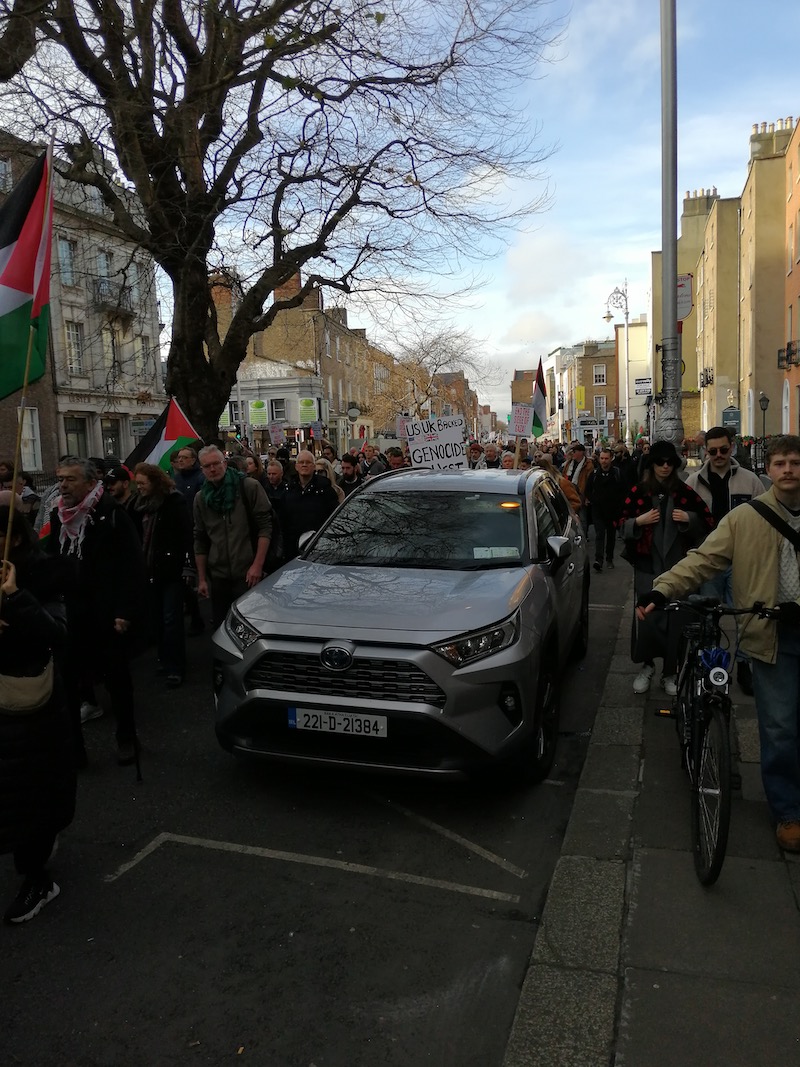
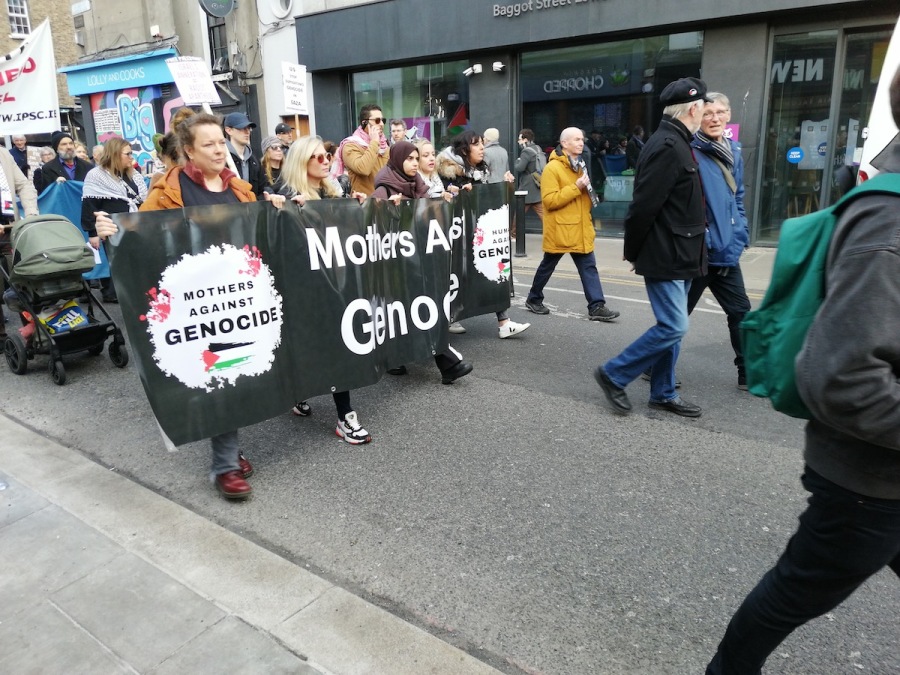
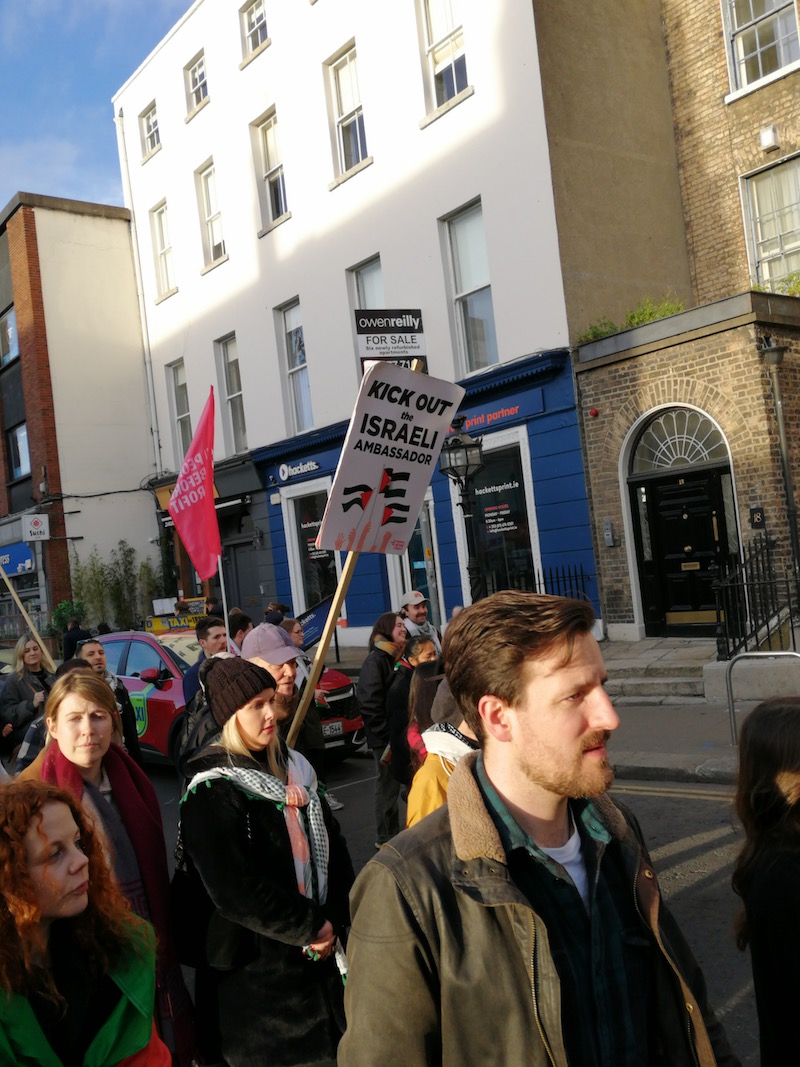
Section of the march to the US Embassy passing through Baggot Street on Saturday (Photo: D.Breatnach)
(Photo: D.Breatnach) (Photo: D.Breatnach)

Dublin saw thousands on its streets again at the weekend in a march towards the US Embassy, while Axa Insurance was occupied and picketed during the week for its investment in genocide. It seemed that every town across the land also saw a demonstration or picket.

The US Ambassador to Ireland’s residence was also picketed on the occasion he had invited Irish politicians and “VIPs” to a meal.

On Tuesday the broad Saoirse Don Phalaistín group organised an occupation of the Israeli Embassy with a picket of about sixty people outside, of different groups and individual activists. Furthermore, it became clear that the State was reluctant to create ‘martyrs’ with arrests.

Picket outside the Zionist Embassy Tuesday with some protesters in occupation before those were removed by Public Order Unit Gardaí (Photo sourced: Anti-Imperialist Action)

THE “FREE PRESS”

The mass media is an integral part of the imperialist system and that too has come under huge criticism.

The western mass media, “the free press” of the western capitalist world, has undergone a huge exposure of its biased reporting (and censorship, particularly on social media). Every atrocity committed by Israel has been represented as ‘caused’ by the Palestinian attack of 7th October.

On the other hand, the attacks of the Palestinian resistance have never been presented as what they truly are and have always been: responses to occupation, genocide, banishment, racism, murder, torture, land-theft and massive bombings by Israel.

Every lie of the Zionist administration and of its imperialist allies, including such patently ridiculous horror stories as ‘beheading of Israeli babies’ and ‘rape and mutilation of Israeli women’ has been repeated while entirely likely accusations by Palestinians have been treated as dubious.

Conversely, within the settler colony itself, some parts of its mass media have exposed the panicky reaction of its military to the October 7th incursion, in killing hostages along with their Palestinian captors and the very recent killing of three escaped or released Israeli hostages.

(Photo: D.Breatnach)

THE “DEMOCRATIC INSTITUTIONS”

The allegedly democratic state institutions have fared no better. The European Union was exposed in its voting and by words of its Commission President Ursula Von Der Leyen, as a profoundly imperialist backer of Israeli Zionism (e.g fulsomely celebrating the anniversary of the state’s founding3).

According to reports, the EU last week failed even to call for a ceasefire, despite a large majority of states being in favour. The opposition of the minority was so strong that they decided to completely avoid formally discussing the matter at all!4

The United Nations was exposed as a profoundly undemocratic body in that the vast majority of its member states wished the Israeli bombing to stop but were unable to force the Zionist state to comply, even with formally registered votes.
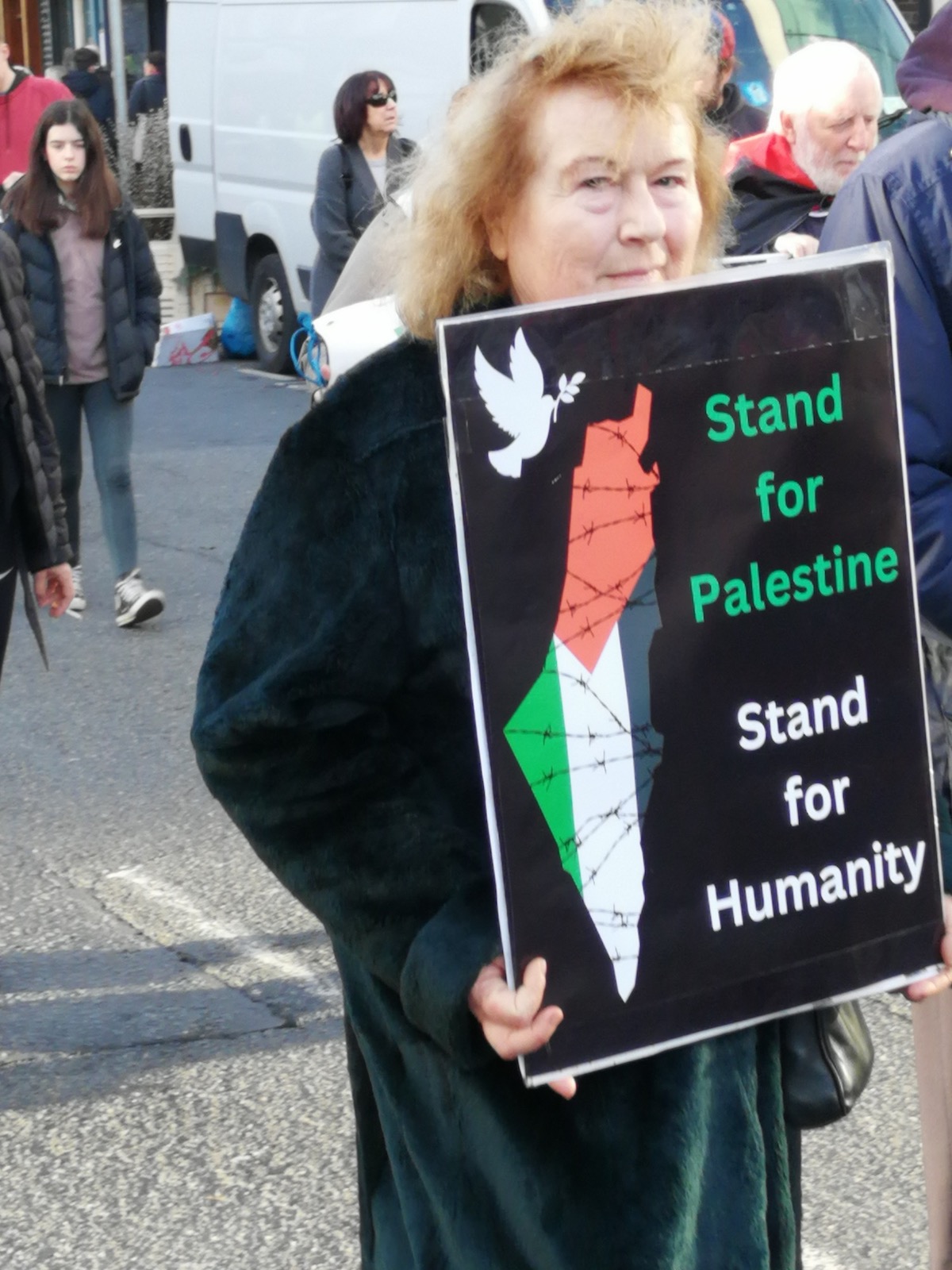
(Photo: D.Breatnach)

Only decisions of the Security Council are compulsory on the 193 members and any Permanent Member of that Council can veto any resolution. There are only five of those: UK, France, USA, Russia and China — and the USA vetoed the call for unilateral Israeli ceasefire.

The USA has consistently opposed any resolution that went counter to what Israel intends and recently twice vetoed a resolution calling for a humanitarian ceasefire to allow food, medicine and water to reach the besieged and displaced Palestinians in Gaza.

This was countered last week by a massive majority of the General Assembly voting for such a motion, which however has no obligatory effect by UN rules, thereby exposing the inherent undemocratic nature of the institution but also isolating the USA from its clients and allies.5

(Photo: D.Breatnach)

In fact, the voting in the Security Council and in the General Assembly exposed fractures in European imperialist unity too, since the UK abstained and France voted for the ceasefire.

The allies of the USA fear that the actions of Israel are destabilising the Middle East and feel that the USA should be pressurising rather than backing the Zionist state.

When put under pressure reactionary alliances tend to strain and fracture and this too is a sign that events are developing along lines favourable to revolution.

The International Criminal Court, which a number of liberals and social democrats hope will try Israel for war crimes and genocide was also exposed, not only by its own record to date but by the biased actions of its Prosecutor Karim Khan on a recent visit to the Zionist state.6

Despite the overwhelmingly majority sympathy for and empathy with the Palestinians in many states, their rulers have not responded to anything like the degree wished for and demanded by their citizens, neither in states of the “western world” nor in those of the Arab or Muslim worlds.

(Photo: D.Breatnach)

The rulers of the German and French “democracies” have widened the gap by banning Palestine solidarity demonstrations and persecuting people wearing the keffiyeh (and in the case of France, previously outlawing wearing of traditional muslim dress in public places by women).

In Britain, the idea of banning the slogan “From the River to the Sea, Palestine will be Free!” as “antisemitic” was proposed by the Home Secretary7 and a number of direct activists and even posterers on social media have been arrested under criminal and even anti-terrorist legislation.

The British imperialist Labour Party has been exposed too by the words of its leader Keir Starmer; denunciations during his visit to his party’s organisation in Scotland exposed not only Starmer’s unpopularity but his party’s too, along with the massive support for Palestine there.

THEIR ACTIONS MAKE THINGS WORSE FOR THEM

When the enemy’s repressive actions make things worse, rather than better for them, it is a sign that revolutionary opportunities are on the rise.

Direct actions are an essential component of revolution and such have been on the rise too, from occupations of Government offices and buildings complicit with Zionism in Ireland, for example, to occupations and blockades of arms companies in Britain and of shipments in the USA.

Whether these actions are motivated in part by frustration at the lack of progress by other means or through revolutionary understanding, they put the system under greater pressure and tend to isolate the reformists while the activists gain deeper education about the nature of the system.

(Photo: D.Breatnach)

The world has witnessed unity in action too, with Hezbollah8 missiles launched from Lebanon against the Israelis causing casualties; but 60 martyrs of the resistance organisation have also fallen to Israeli bombs and missiles9 and Lebanese non-combatants have also, including journalists.

Houthi attacks on shipping off Yemen have caused disruption and financial cost to several major freight companies – including MSC and Maersk – which have begun to sail around Africa instead.

About 15% of shipping traffic regularly transited via the Suez Canal, the shortest shipping route between Europe and Asia. Combined, the companies that have diverted vessels “control around half of the global container shipping market,” ABN Amro analyst Albert Jan Swart told Reuters.10

Oil major extractor British Petroleum has also temporarily paused all transits through the Red Sea following the attacks over the weekend.11

Most impressive of all however has been the unity and coordination of the Palestinian armed resistance itself.

The Izz ad-Din al-Qassam Brigades is Hamas’ armed wing and the party is a Muslim fundamentalist organisation, as are also Palestine Islamic Jihad. But the Lion’s Den, Jenin Brigades and Al-Nasser Salah al-Deen Brigades of the Popular Resistance Committees are mixed.

The Peoples Front for the Liberation of Palestine12 and the Democratic Front for the Liberation of Palestine are secular, socialist organisations yet they and the Islamic organisations are fighting the Israeli state in unity coordinated through the Joint Operations Room.
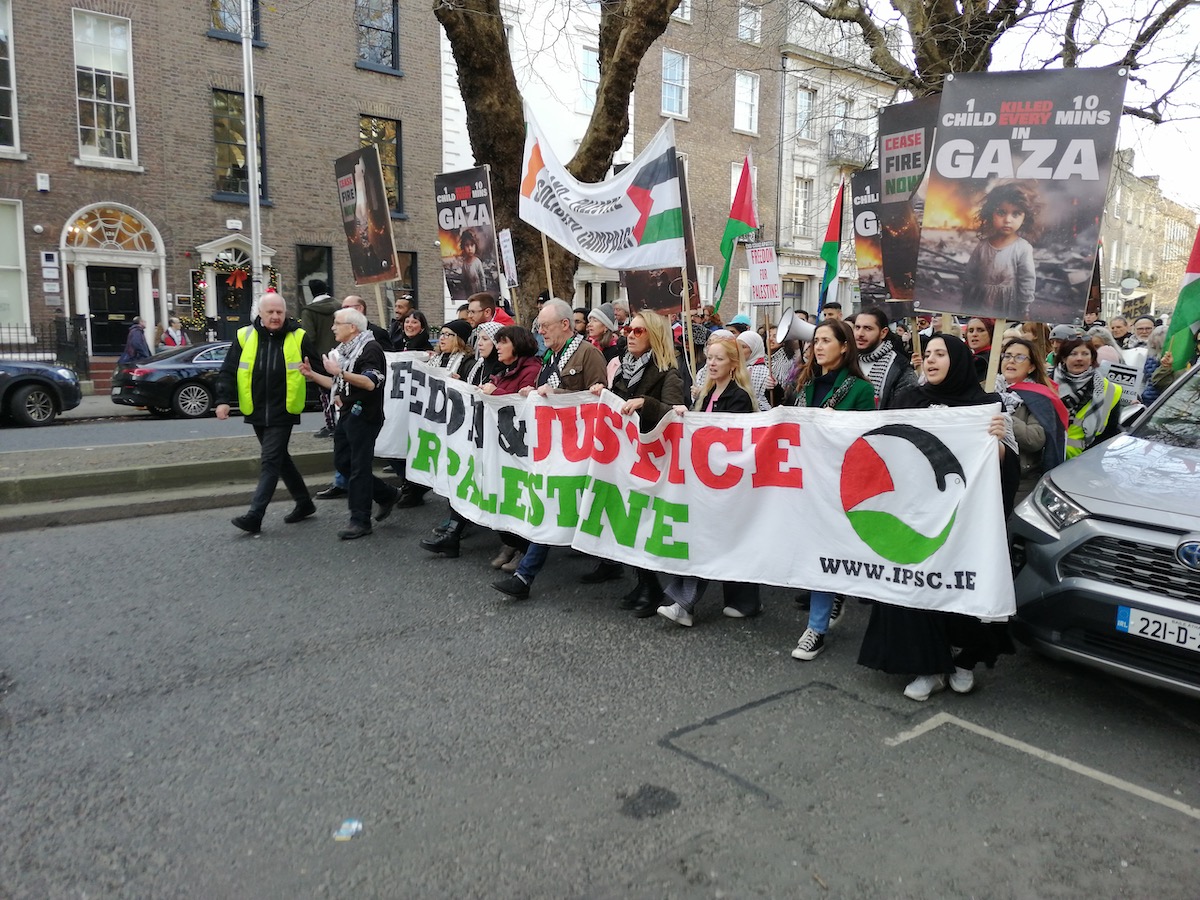
(Photo: D.Breatnach)

PRISONERS, HOSTAGES, CIVILIANS

The current struggle has also brought to light the huge numbers and treatment of Palestinian prisoners of the Zionist state, including women and children, when some of the latter were exchanged with prisoners taken by the Palestinian forces in their incursion on 7th October.

This issue also challenged the discourse about ‘rules of war’ regarding civilians about which politicians and media commentators made much in attacking the Palestinian incursion.

The question must be posed as to why the Zionist state can take “prisoners” while the Palestinians take “hostages”?13 Outside the US Embassy on Saturday, an IPSC speaker called Israel’s prisoners “freedom fighters” to loud applause, the first such public stance by the organisation.14

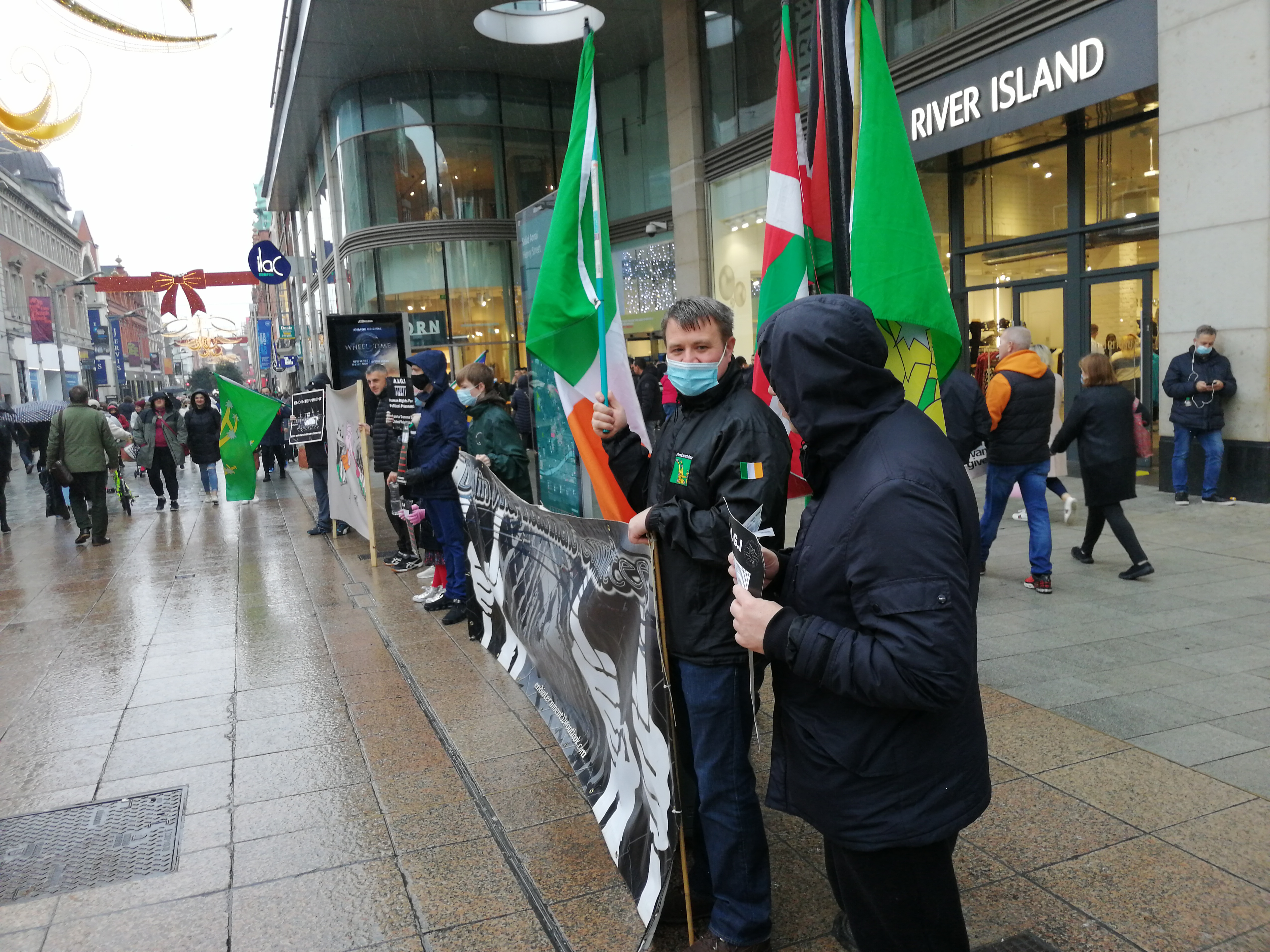
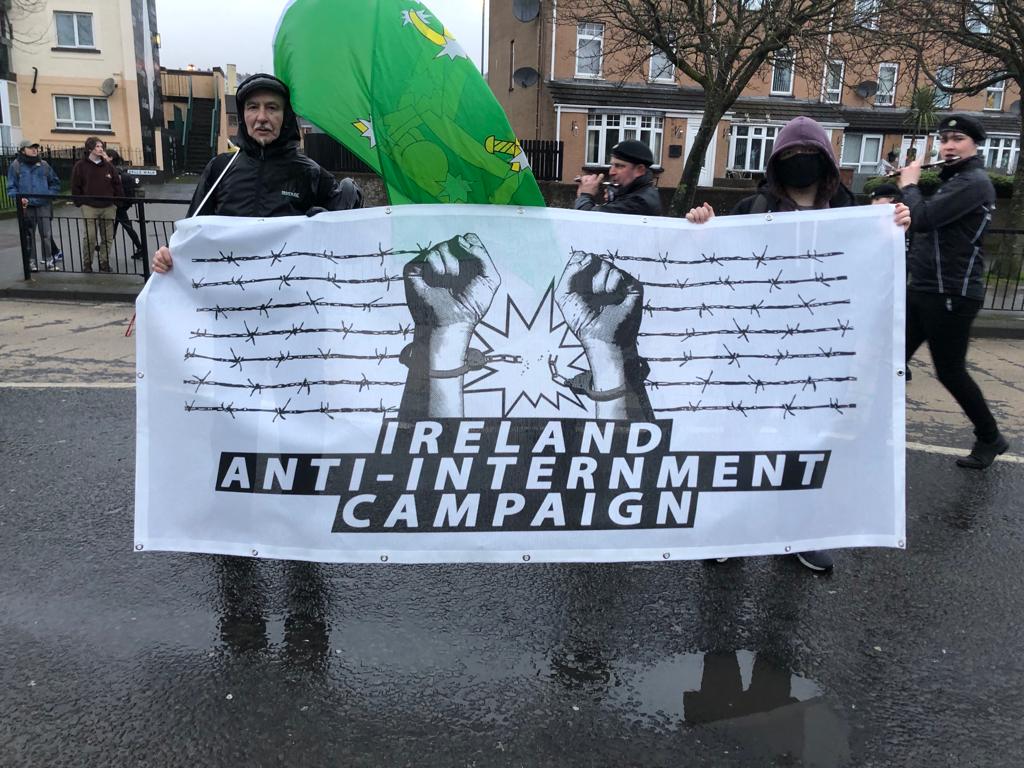
Here in Ireland it is a Republican tradition in December to focus on its members incarcerated in prisons within the Irish neo-colonial and British colonial states. The Ireland Anti-Internment Campaign held its annual event in front of the GPO on Thursday 23rd including Palestinian flags.

Annual Prisoners’ picket for Christmas organised by the Ireland Anti-Internment Committee showing Palestinian and Irish flags (Photo: D.Breatnach)

Sadly it was not only officials embedded in the system but also liberals and some of the Left who condemned the Palestinians for ‘attacks on civilians’, ignoring the fact that civilians and soldiers were being captured to exchange for the many Palestinian civilians behind Israeli prison bars.

Then too, rarely mentioned in the media is the fact that most Israeli men and women are military reservists. On the other hand, of over 20,000 Palestinians killed by Israeli bombing, at least a third are women and children, which shows who it is who really are attacking civilians.15

The draft requirement applies to any citizen or permanent resident, male or female fit to serve and who has reached the age of 18; many of the soldiers who complete their mandatory military service are later obligated to serve in a reserve unit in accordance with the military’s needs.16
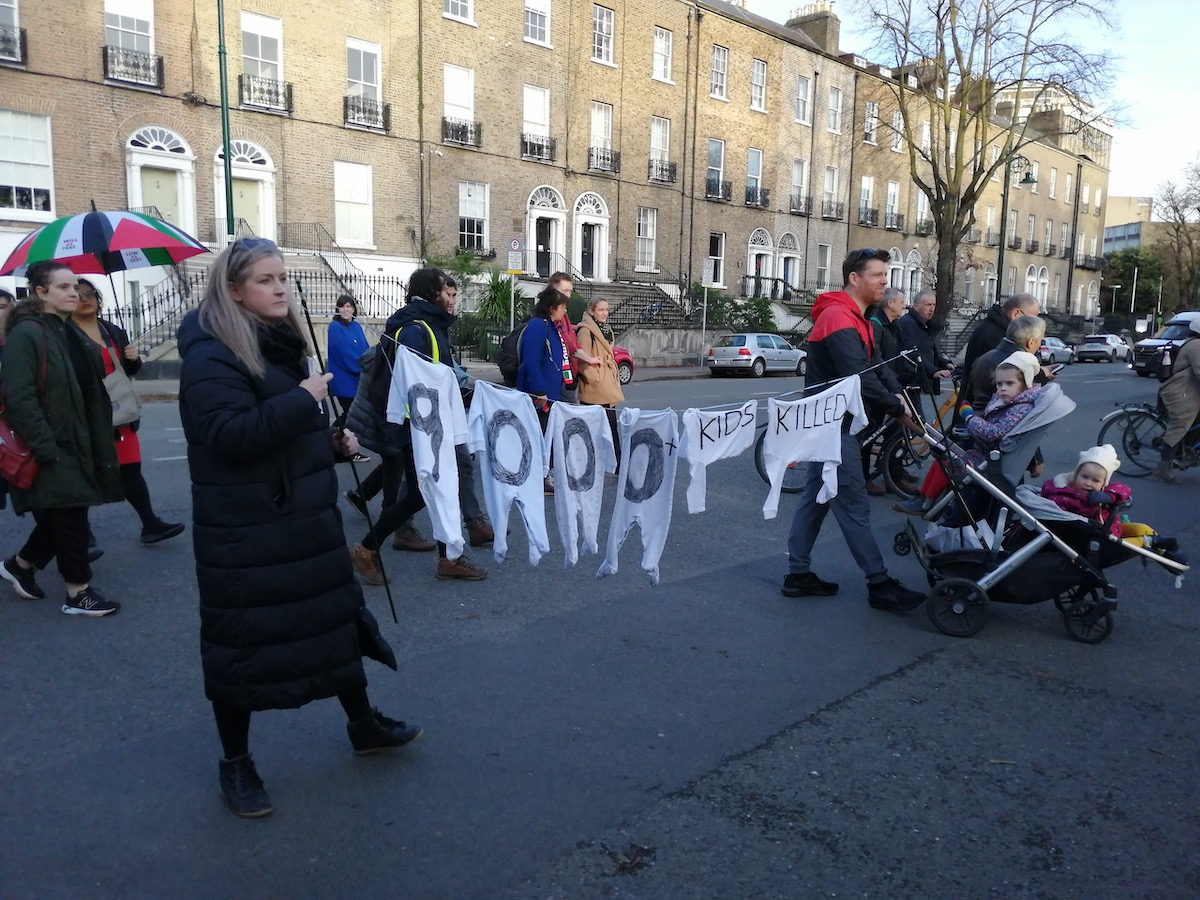
(Photo: D.Breatnach)

IN CONCLUSION

The pain, loss and suffering inflicted upon the Palestinians is a horror almost too hard to grasp; it is intended to demoralise the Palestinians and destroy their resistance to colonisation and can create a feeling of helplessness in us, viewing it from afar.

But it is not destroying the resistance of the heroic Palestinian people who are teaching the world a lesson in resistance, an important attribute of humanity. We should not let our resolve be undermined either.

The oppressed people of the world are a step closer to revolution and liberation as a result of this struggle. Let us push forward together.

End.
(Photo: D.Breatnach)

FOOTNOTES

SOURCES

EU ceasefire call blocked by “minority”: https://www.irishtimes.com/politics/2023/12/15/eu-call-for-ceasefire-in-gaza-blocked-by-minority-despite-overwhelming-support/

https://www.euronews.com/my-europe/2023/12/15/no-eu-call-for-gaza-ceasefire-despite-belgium-and-irelands-pleas

UN ceasefire blocked, then delayed: https://news.sky.com/story/un-security-council-vote-on-gaza-aid-delayed-again-over-talks-with-us-on-ceasefire-13034723

Accusation of bias towards Israel in International Criminal Court: https://www.aljazeera.com/features/2023/12/9/alarming-palestinians-accuse-icc-prosecutor-of-bias-after-israel-visit

Israel’s callup for reservists (with pro-Israel undertones): https://www.washingtonpost.com/world/2023/10/10/israel-military-draft-reservists/

1This has been particularly the case with regard to the Irish State but not only there.

2Kissinger was a US imperialist strategist and chief advisor to US President Nixon but was awarded the Nobel Peace Prize for his steering the US out of their disaster in Indochina and thereby devaluing the Nobel Peace Prize forever hence.

3Without of course any mention of the 750,000 Palestinians expelled forever during the creation of the state.

4https://www.euronews.com/my-europe/2023/12/15/no-eu-call-for-gaza-ceasefire-despite-belgium-and-irelands-pleas

5https://news.sky.com/story/un-security-council-vote-on-gaza-aid-delayed-again-over-talks-with-us-on-ceasefire-13034723

6https://www.aljazeera.com/features/2023/12/9/alarming-palestinians-accuse-icc-prosecutor-of-bias-after-israel-visit#:~:text=While%20Khan%20ended%20up%20listening,months%20of%20a%20deadly%20war.

7Suella Braverman; she has since been sacked but not for that, rather for suggesting that the London Metropolitan Police have been “soft” on Palestinian solidarity demonstrators in contrast to their policing of the far-Right. The latter took advantage of her comments to stage a number of actions including some attacks on police and Braverman’s comments were widely criticised by politicians as having helped set that up.

8And, according to Wikipedia, also Islamic Jihad.

9Hizbollah casualties in Lebanon: https://www.aa.com.tr/en/middle-east/hezbollah-says-2-members-killed-bringing-total-since-oct-8-to-60/3044699

10https://www.breakingnews.ie/world/red-sea-attacks-force-rerouting-of-vessels-disrupting-supply-chains-1565940.html

11Ibid.

12According to Wikipedia, PFLP is the second-largest organisation in the PLO. However, the PLO has long been dominated by Al Fatah and, due to the latter’s collusion with Israel and imperialism, the PLO has come to lose much support. Hamas and the Islamic fighting organisations are not part of the PLO.

13There is a long Irish history of political prisoners of the English occupation which were often in the earlier centuries named “hostages” and a Republican prisoners’ newspaper

14Of course it may not be that but rather a personal position of the speaker.

15Nor does the figure include the over 8,000 missing, most of which may be dead or dying beneath rubble of bombed buildings. https://www.aljazeera.com/news/longform/2023/10/9/israel-hamas-war-in-maps-and-charts-live-tracker
16https://en.wikipedia.org/wiki/Conscription_in_Israel

POLICING THE PALESTINE SOLIDARITY MOVEMENT

Diarmuid Breatnach

(Reading time: 8 mins.)

Demonstrations, like many organised activities, require a certain discipline: time and place set, conduct along the way, speakers and time allocated, dispersing afterwards. But just as discipline helps avoid dangers, its imposition also bring dangers.

I’ve been one of the organisers, or a steward on a number of public events over the years but more often a participant without any particular role.

Once, in London as a steward I was called “a State agent” as I moved to prevent a couple of people leading others out of an Irish demonstration to attack some British fascists and Loyalists who were chanting against us.

For us, the main objective was to hold an Irish solidarity demonstration in London from its start to its finish without giving the London Metropolitan Police and Special Branch the opportunity to disrupt it.1 Attacking fascist jeerers was secondary to our objective on that occasion.

And if those guys really wanted to attack fascists, they should have been travelling parallel to the march (as the Red Action group often did, for example) instead of inside the march body. Then they could have attacked the fascists without any disruption of the march.

I have also been a party on a broad antifascist mobilisation to a refusal to organisers’ direction to march away from the fascists, instead heading towards them with others.2 In those cases the organisers were, in effect, colluding with the State.

PALESTINE SOLIDARITY IN IRELAND

The main organisation for Palestine solidarity in Ireland for decades has been and continues to be the Ireland Palestine Solidarity Campaign. Its steering group or executive committee is entirely unpaid and works with energy and determination over the years and at times more intensively.

Those intensive times have been with us again since last month in the horrific genocidal Zionist bombing of Gaza and the murderous ground attacks in the West Bank and the IPSC activists have organised large – sometimes huge – marches of solidarity in Dublin every week.

These have been combined with other events such as rallies, concerts and public meetings in the city and marches, rallies and pickets elsewhere to the south, the west and the north of the country.

No organisation however is perfect or right all the time and there are a number of areas and occasions that deserve constructive criticism for improvement.

I do believe that the cancelation of a Palestine solidarity march scheduled for 25th November was a serious error tactically and strategically.

Section of a midweek demonstration in persistent rain organised by the IPSC outside Leinster House, seat of the parliament of the Irish State in October. (Photo: D.Breatnach)

In terms of strategy we must strive as far as is possible not to give ground in the public arena to fascists and other racists since as we vacate ground, they step forward to occupy it. To move the rallying point from the Garden of Remembrance3 made sense but the cancellation not at all.

Tactically, the absence of a Palestine solidarity march that weekend broke the momentum of large public Palestinian solidarity events occurring at least weekly throughout the capital city.4

WHICH SLOGAN?

The IPSC now calls for the expulsion of the Israeli Ambassador but earlier on in October it refrained from doing so. That was a mistake but what was worse was the attempt to influence others also not to do so, for example with regard to speakers from their platform.

During that period the presence of non-stop chant-leaders shouting the approved slogans, one after another, particularly near groups who might chant for the expulsion of the Ambassador seemed more than a coincidence.

It is good to hear now the ubiquitous “Israeli Ambassador – Out, out, out!” from the IPSC slogan-callers and, though perhaps not the IPSC’s choice, may the one stating that “There is only one solution – Intifada revolution!” be accepted in toleration.

WHICH FLAGS?

At the recent much-diminished Palestine solidarity march in Dublin5 – the first since the cancellation – I witnessed a man and woman acting for the IPSC organisers, they said, approaching a person with a PLFP6 flag, to ask not to fly any flag other than the Palestinian national one.

They were polite and not in any way intimidating; their manner was not the problem but the content of their message was.

Palestinians participate in a rally marking the 52nd anniversary of the Popular Front for the Liberation of Palestine (PFLP), in Gaza City, December 7, 2019. (Photo cred: Hatem Moussa/ AP)

There are issues where the IPSC should be giving a lead and are of course doing so but just as there are some where they should but are not, this is one where they seem to be attempting to impose a discipline and uniformity that is both unnecessary and unhealthy.

There are organisations that send sacks of their group’s flags and placards to demonstrations to be carried by random participants, swamping the event to make it appear as though their organisation is bigger and more prevalent than is the case, a practice I detest.

It is not as though people are flooding the demonstration with PFLP flags or, indeed, Irish Tricolours and Starry Ploughs, though it seemed that they were not as worried about the latter two.

There are people who support different organisations in Palestine and why should it be a problem for them to fly the flag of the organisation of their choice?

Why should it be a problem for people to realise that there are many Palestinian organisations of struggle in opposition to the one of collusion?

In a demonstration for Irish independence would we demand that only the Tricolour7 could be flown? Or for Catalan independence, only accepting the display of the Senyera?8

WHAT KIND OF PALESTINIAN STATE?

The IPSC is formally neutral on the issue of what kind of Palestinian state to which to aspire, which in some respects is fair enough since that is a matter for the people there to choose. But it is not OK to be neutral on whether the ‘two-state solution’ (sic) is acceptable, never mind viable.

Yes, we know that the imperialists of the EU, USA and UK support that ‘solution’. We know that their allies do, including the Irish Government. We also know that the collaborationist Palestinian organisation9 and most Arab states’ leaders also support that arrangement.

BUT

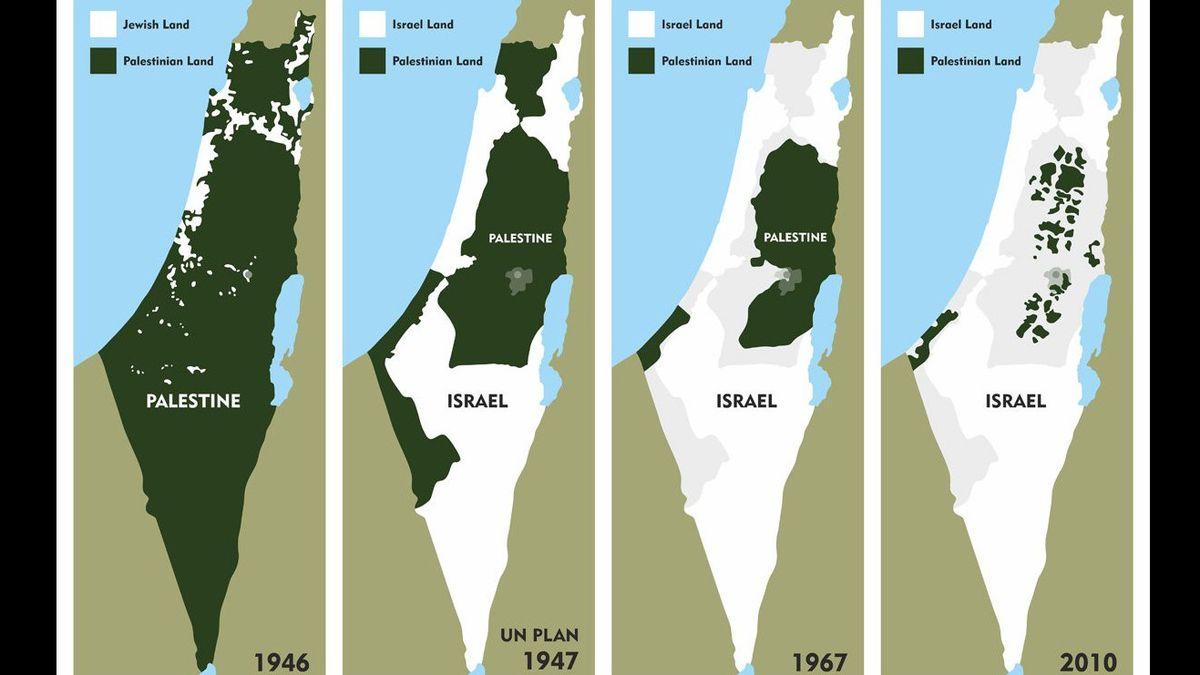
The two-state solution is one where the settler-occupier gets to keep what he robbed and murdered to get while the indigenous receives less than 40% of her original land and the worst of it, with the least water and, furthermore, under the constant guns of the robbers and murderers.

The diminished part of Palestine being offered to Palestinians under “the 2-state solution” (Image sourced: Internet)

MOST PALESTINIANS POLLED IN PALESTINE REJECT IT.10 And you can guarantee, without polling, that the vast majority of the exiled Palestinian refugees reject it too, since it would close for ever any hope for a return to Palestine for most of them.

The IPSC supports the slogan “From the River to the Sea, Palestine will be free!” This is, one might say, an implicit rejection of the two-state proposal since it must mean a free Palestine from the River Jordan to the Mediterranean and Red Seas. But how many understand that?

In a world where imperialism is the main support of the European Zionist colonial (and genocidal) project, it is essential that the mass of people understand for what it is that the Palestinians are fighting and what we support, as distinct from what the imperialists want to foist upon them.

PALESTINIAN POLITICAL PRISONERS

In the struggle for independence and for social justice, right across the world, many people are taken by those in power and put in jail. Solidarity with those prisoners, objections to their conditions and demands for their release have been an important part of those struggles.

This has been well-illustrated in Irish history too and in Britain, the First International (Workingmen’s Association) founded by Marx, Engels and others campaigned in solidarity with the Fenians incarcerated in English jails.

The “blanket protests” and in particular the hunger strikes in colonial jails in Ireland a little over 40 years ago drew huge attention and wide support not only in Ireland but across the world.

All the Palestinian prisoners in Israeli jails are there as a result of the European Zionist occupation of Palestine and the natural resistance of the indigenous people.

When Hamas recently obtained the release of 180 prisoners from Israeli jails, most were women and children. Furthermore, many had not even been convicted in the Israeli military courts but were held in “administrative detention”, in effect, interned without trial.

Palestinian prisoner solidarity protest in Nablus 17 April 2023 (Photo credit: Jaafar Ashtiyeh /AFP)

Though the IPSC has highlighted the number of children in Israeli jails and those in administrative detention, it does not have a position of overall solidarity with the rest of the 100,000 Palestinian prisoners nor in calling for their blanket release.

The organisation has however covered the release of prisoners in the recent exchange and shared reports of the brutality inflicted upon many, particularly after the Hamas offensive on 7th October. One must hope that this process will be extended to solidarity with all the Palestinian prisoners.

Solidarity with political prisoners does not necessarily imply support for their previous actions or for their organisations; what it does is to recognise that all liberation struggles produce martyrs and prisoners due to the repression of resistance to colonialism and occupation.

The existence of the prisoners is a direct result of the colonial occupation and if we oppose that occupation we should stand in solidarity with the prisoners, agitate around their conditions and demand their freedom, along with the departure of the colonists.

IN CONCLUSION

All organisations and movements need to instil some discipline around their activities. All also commit errors from time to time and it is crucial to learn from those in order to improve their effectiveness and to bring nearer the objectives for which they strive.

In their attempt to mediate between the different pressures upon them it is necessary to distinguish between what the dominant system wants or would like and what the movement’s supporters wish, between what is most welcome and what is most necessary.

Rally after large IPSC march 10 October 2023 (Photo sourced: Internet)

The IPSC is an important and valuable organisation in Ireland doing crucial work in the area of solidarity with the Palestinians and, in doing so, contributing to an atmosphere of internationalist solidarity which is essential for the advance of humanity.

While I have not for some years been part of its Dublin organisation I will of course continue to support its marches, rallies and pickets as I have been doing for decades, both in promotion and in attendance.

End.

FOOTNOTES

1The police used attacks by fascists and resistance to them on Irish solidarity marches as opportunities to disrupt the march and to arrest march participants.

2The Communist Party of Great Britain despite the history of many of its members in the 1930s, did not wish to physically attack fascists from the late 1960s and tried to steer demonstrations away from direct confrontation, often leading them away from where the fascists were gathered.

3That place is less than 100 metres from the scene of the attack on the children and the march began there the participants would have to pass by the site.

4It also left exposed to attack any small group that went ahead with Palestine solidarity or anti-racism pickets, as some did, in the city centre.

52nd December 2023.

6Popular Front for the Liberation of Palestine.

7There is nothing wrong with the Tricolour but some Republicans and socialists prefer the Starry Plough, signifying a more socialist republicanism and also a separation from the State, which has appropriated the Tricolour.

8The original flag of Catalan independence, red stripes on a yellow field — but on Catalan demonstrations the Estelada Blava, including a blue triangle surrounding a white star, for left Republicans, is much more common and the Vermella, with a red star on yellow instead of the white one on blue is quite common also, especially among revolutionary socialists.

9The Al Fatah-dominated PLO from which a number of Palestinian resistance organisations are excluded. They also dominate the Palestinian Authority which has not held elections since Hamas won them in 2008.

10https://www.washingtoninstitute.org/policy-analysis/new-polling-and-legacy-oslo-accords

SOURCES

Cancellation of march: https://www.irishexaminer.com/news/arid-41276554.html

Polls on two-state ‘solution’: https://www.washingtoninstitute.org/policy-analysis/new-polling-and-legacy-oslo-accords

Israeli Palestinian prisoners: https://www.aljazeera.com/news/2023/11/24/who-were-the-palestinian-prisoners-israel-released-on-friday

https://edition.cnn.com/2023/11/29/middleeast/palestinian-prisoners-israeli-judicial-system-west-bank-mime-intl/index.html

https://www.aljazeera.com/features/2023/10/21/number-of-palestinian-prisoners-in-israel-doubles-to-10000-in-two-weeks

IRISH SAVED PUBLIC SPEAKING AREA FOR LONDONERS

Diarmuid Breatnach

(Reading time main text: 6 mins.)

November 17th is the anniversary of the date when a demonstration, mainly of Irish in solidarity with Fenian prisoners in British jails, saved the public Speakers’s Corner in Hyde Park from State control for everyone.

‘Frederick’ (Friedrich) Engels was there and reported on it (see below) with great admiration for the Irish diaspora. In his seminal The Condition of the Working Class in England (1845) he had not had that feeling for the Irish but had matured as a person and a revolutionary since.1

The Clerkenwell jail wall blown by Fenians (Photo sourced: Internet)

Frederick Engels and Karl Marx, both exiles from Germany, one by choice and the other as a refugee, came to form a strong corresponding, writing and organising partnership. Together they formed the International Working Men’s Association.

The First International, as it came to be called, took a position on many international questions but did not shirk the Irish one and indeed exposed and agitated about the terrible conditions under which Fenians were being held in British jails.

Jeremiah O’Donovan Rossa (1831-1915), a Fenian prisoner, wrote that he was for a period chained to the wall and had to eat his food from a bowl on the floor like a dog. It is also recorded that a third of the prisoners died in jail or went insane.

Frederick Engels as a young man (Photo sourced: Internet)

The Irish Republican Brotherhood had been founded in Dublin and in New York on St. Patrick’s Day, 1858 and in the USA quickly became better known as “the Fenian Brotherhood”. In Ireland they were frequently referred to as “the Fenians” or, by those on ‘the inside’ as ‘the IRB’.

Clearly from Engels’ description, “Fenians” was also the common description in Britain too. The Fenians took the war to Britain; the Crown responded by organising a specific police department, the Special Irish Branch of Scotland Yard, to spy on the Irish diaspora and to arrest suspects.

The “Special Branch” became known henceforth as the political department of the British police force but also of British colonial police forces in Ireland, Commonwealth countries such as Australia, and colonies such as Kenya, Uganda, Hong Kong …

We know that that the Fenian prisoners were not forgotten in Ireland, with campaigns for their freedom including articles, public events and even songs composed for them. But evidently they were not forgotten by the Irish diaspora in Britain nor by their socialist and democratic allies.

On November 17th 1872 the First International organised a march to Speakers’ Corner in London to protest the conditions under which those Fenian convicts were having to exist. Engels reported on the march and that he public speaking area was under threat of State control.

The Irish diaspora in Britain, the Irish-born migrants and descendants, contributed hugely to society and especially so to the working class in Britain, including presenting its anthem,2 its classic novel3 and two leaders4 of the Chartists, the working class’ first first genuinely mass movement.

In addition, members of the Irish diaspora helped build up the trade unions and were present in every movement against state repression, police violence, fascism, racism, colonialism and imperialism, fighting in organisations for housing, wages, free speech, political and civil rights.

Depiction of Speakers’ Corner meeting about the Fenian prisoners (Photo sourced: Internet)

Frederick Engels:

III
Meeting in Hyde Park

London, November 14, 1872

The Liberal5 English Government has at the moment no less than 42 Irish political prisoners in its prisons and treats them with quite exceptional cruelty, far worse than thieves and murderers.

In the good old days of King Bomba, the head of the present Liberal cabinet, Mr. Gladstone, travelled to Italy and visited political prisoners in Naples; on his return to England he published a pamphlet which disgraced the Neapolitan Government before Europe for its unworthy treatment of political prisoners.

This does not prevent this selfsame Mr. Gladstone from treating in the very same way the Irish political prisoners, whom he continues to keep under lock and key.

The Irish members of the International in London decided to organise a giant demonstration in Hyde Park (the largest public park in London, where all the big popular meetings take place during political campaigns) to demand a general amnesty.

They contacted all London’s democratic organisations and formed a committee which included MacDonnell (an Irishman), Murray (an Englishman) and Lessner (a German) — all members of the last General Council of the International.

A difficulty arose: at the last session of Parliament the government passed a law which gave it the right to regulate public meetings in London’s parks.

It made use of this and had the regulation posted up to warn those who wanted to hold such a public meeting that they must give a written notification to the police two days prior to calling it, indicating the names of the speakers.

This regulation carefully kept hidden from the London press destroyed with one stroke of the pen one of the most precious rights of London’s working people — the right to hold meetings in parks when and how they please.

To submit to this regulation would be to sacrifice one of the people’s rights.

The Irish, who represent the most revolutionary element of the population, were not men to display such weakness.

The committee unanimously decided to act as if it did not know of the existence of this regulation and to hold their meeting in defiance of the government’s decree.

Last Sunday at about three o’clock in the afternoon two enormous processions with bands and banners marched towards Hyde Park.

The bands played Irish songs and the Marseillaise6; almost all the banners were Irish (green with a gold harp in the middle) or red.

There were only a few police agents at the entrances to the park and the columns of demonstrators marched in without meeting with any resistance. They assembled at the appointed place and the speeches began.

The spectators numbered at least thirty thousand and at least half had a green ribbon or a green leaf in their buttonhole to show they were Irish; the rest were English, German and French.

The crowd was too large for all to be able to hear the speeches, and so a second meeting was organised nearby with other orators speaking on the same theme.

Forceful resolutions were adopted demanding a general amnesty and the repeal of the coercion laws which keep Ireland under a permanent state of siege.

At about five o’clock the demonstrators formed up into files again and left the park, thus having flouted the regulation of Gladstone’s Government.

This is the first time an Irish demonstration has been held in Hyde Park; it was very successful and even the London bourgeois press cannot deny this.

It is also the first time the English and Irish sections of our population have united in friendship.

These two elements of the working class, whose enmity towards each other was so much in the interests of the government and wealthy classes, are now offering one another the hand of friendship; this gratifying fact is due principally to the influence of the last General Council of the International,[307] which has always directed all its efforts to unite the workers of both peoples on a basis of complete equality.

This meeting, of the 3rd November, will usher in a new era in the history of London’s working-class movement.

You might ask: “What is the Government doing? Can it be that it is willing to reconcile itself to this slight? Will it allow its regulation to be flouted with impunity?”

Well, this is what it has done: it placed two police inspectors and two agents by the platforms in Hyde Park and they took down the names of the speakers.

On the following day, these two inspectors brought a suit against the speakers before the ustice of the Peace. The justice sent them a summons and they have to appear before him next Saturday.

This course of action makes it quite clear that they don’t intend to undertake extensive proceedings against them.

The government seems to have admitted that the Irish or, as they say here, the Fenians have beaten it and will be satisfied with a small fine. The debate in court will certainly be interesting and I shall inform you of it in my next letter.[308]

Of one thing there can be no doubt: the Irish, thanks to their energetic efforts, have saved the right of the people of London to hold meetings in parks when and how they please.

Notes


307 By the “last” General Council Engels means the London Council that existed before the Hague Congress of the International at which a decision was adopted to transfer the scat of the General Council to New York.

308 In the fourth article of the Letters from London series: “Meeting in Hyde Park. — The Position in Spain,” written on December 11, 1872, Engels reported that the Justice of the Peace could do no more than impose the smallest possible fine, and since his decision anyway ran contrary to the rules governing behaviour in Hyde Park the accused demanded that the case be brought before a court of appeal.

Engels’s Letters from London appeared in La Plebe, the newspaper of the International’s sections in Italy, early in April 1872, and continued throughout the year.

Early in 1873, Engels’s co-operation with La Plebe was temporarily interrupted due to government reprisals against the paper’s editors.

La Plebe was published under the editorship of E. Bignami in Lodi between 1868 and 1875, and in Milan between 1875 and 1883. Up to the early seventies the newspaper followed a bourgeois-democratic line, later it became socialist.

In 1872-73 La Plebe played an important role in the struggle against the anarchist influence in the Italian working-class movement. Engels’s contributions greatly promoted the paper’s success.

In 1882, the first independent party of the Italian proletariat the Workers’ Party — formed around La Plebe.


FOOTNOTES

SOURCES

https://www.marxists.org/archive/marx/works/1872/11/17.htm?fbclid=IwAR1BNFtIJtykuVT0fPrlhyQVOky5W8kUX7YDup55_aP0opQTI6QLF3ycyPc

Source: Marx and Engels on Ireland, Progress Publishers, Moscow 1971;
First Published: in Italian in La Plebe, November 17, 1872;
Transcribed: by Andy Blunden.

1Aided by the Burns sisters Lizzie and Mary when he lived in Manchester, one of whom was his partner until she died and the other, subsequently his wife.

2The Red Flag, by Jim Connell, from Co. Meath

3The Ragged-Trousered Philanthropists, by Robert Noonan aka Tressel, from Dublin.

4Fergus O’Connor and Bronterre O’Brien.

5The two main bourgeois political parties in Britain at the time were the Conservatives and Liberals; over time the latter declined and was replaced in its counterpoint to the Conservatives by the British Labour Party.

6French national anthem now but originally song of the French Republican uprising of 1789. In addition the air has been used for the lyrics other revolutionary songs.

50 YEARS OF DAMAGE – VICTIMS SEEK INDEPENDENT STATUTORY INQUIRY

Clive Sulish

(Reading time main report: 6 mins.)

“Six innocent men” … “Garda oppression and perjury’ … “Longest case in the history of the State”

Four leading human rights organisations this week delivered a petition to the Irish Government asking the Minister for Justice to establish an inquiry into the abuse suffered by six innocent men in the Sallins case almost half a century ago.

Not to do hold such an inquiry, maintained Liam Herrick of the Irish Council for Civil Liberties at a press conference on Tuesday, is to continue the abuse of the victims’ human rights and to fail to prevent such an abuse in the future.

Osgur Breatnach, Liam Herrick and Nicky Kelly at the petition launch press conference (Photo: Rebel Breeze)

Apart from the ICCL, the other three organisations pushing the petition are the Committee for the Administration of Justice (CAJ), the Pat Finucane Centre (PFC) and Fair Trials; the first three are Ireland-based organisations and Fair Trials is a global criminal justice watchdog.

The six innocent men were named as Osgur Breatnach, Michael Barrett, John Fitzpatrick, Nicky Kelly, Brian McNally and Michael Plunkett (deceased1).

At the time in 1976 all were members of a legal political party (the Irish Republican Socialist Party) but were tortured and some jailed in the Irish state.

In the longest series of trials in the history of the State, three of the men were sentenced at the end of 1978 to prison terms of between nine and twelve years each on the basis of no ‘evidence’ but their confessions obtained by torture and which in court they completely retracted.

Michael Plunkett, who had signed no confession walked free while Nicky Kelly absconded the day before the sentence, eventually reaching the USA where he remained until a strong campaign saw Breatnach and McNally freed, whereupon Kelly returned to Ireland and was immediately jailed.

Although the nature of the ‘evidence’ against Kelly was of the same kind as that which had been declared ‘unsafe’ for Breatnach and McNally, Kelly remained in jail forfour-and-a-half years, despite another strong campaign2 and was only freed eventually on ‘humanitarian grounds’3.

PRESS CONFERENCE

ICCL’s Liam Herrick chaired the conference in Buswell’s Hotel4 flanked by survivors Osgur Breatnach and Nicky Kelly, while Chris Stanley of KRW Law sat nearby, all facing the audience which included Sinn Féin’s Pa Daly TD5 and Fionna Crowley of Amnesty International.

Opening the proceedings, Herrick listed the four organisations backing the call for an inquiry and pointed out the present-day relevance of that call, both in terms of the survivors and their families and in terms of wider society.

Not to have that inquiry would be an ongoing violation of human rights, Herrick maintained and pointed out that the ICCL was founded arising out of concerns regarding the post-Sallins robbery arrests and the activities of the Garda CID unit colloquially known as the “Heavy Gang”.

The ICCL Director stated that they could not rest until the demand for an inquiry was met and referenced also “crucial legislation before the Oireachtas”6 and recognition of past injustices in a series of TV documentaries linking the cases, in particular through actual Garda individuals.

Introducing Osgur Breatnach, Herrick acknowledged the leading role he had played in keeping the demand for the inquiry going over the years.

Breatnach read from a prepared statement that there had been cases of torture, perjury and framing innocent people in England, Northern Ireland and the Republic.

It was wrong and hypocritical of the State raising concerns about cases elsewhere not to hold an inquiry into the Sallins case, of which there had been five trials, one the longest in the history of the State.

Breatnach said he went through the process expecting to be jailed but to expose the political nature of their persecution; his and McNally’s convictions were overturned, the ‘confessions’ having been obtained by oppression but despite that none were indicted for that oppression.

Breatnach concluded saying that the State’s refusal to hold an inquiry amounted to cruel and inhuman treatment of the victims and their families and that without the investigation of an inquiry a similar scenario could be repeated at some point ahead.

Nicky Kelly, introduced by Herrick thanked the ICCL for organising the events that day. Speaking apparently ex-tempore with perhaps reference to some bullet-points, he expressed the opinion that the State wanted the victims to die so that they had no need to hold an inquiry.

“Ireland has an impeccable reputation with regard to foreign relations,” Kelly said, but not so within the state. He believed that the Sallins case is “too big in its implications for politicians, judiciary and police force” and all attempts to investigate were obstructed by successive governments.

Liberal politicians in government have been “no different from the rest”, the Wicklow man said and referred to his own personal battle even to get out of jail after the ‘evidence’ to convict him had been discredited and how he had been obliged to undertake a hunger strike to be freed.

Now, rather than hold the inquiry into what went on, they were waiting for him “to be over and done with” Kelly said in conclusion.

Herrick introduced Chris Stanley of KRW Law who said that cases such as the Birmingham pub bombings and the Dublin and Monaghan bombings, like the Sallins one, all related to the recent conflict and required investigation for the sake of the victims.

Chris Stanley of KRW Law speaking at the petition launch press conference (Photo: Rebel Breeze)

Stanley commented that perhaps the State had been too reliant on the Good Friday Agreement for resolution of these matters.

Commenting on the UK’s new legislation blocking much resolution of historic cases, all but become law, the solicitor regretted the UK had chosen to disengage from Europe but remarked that that they remained signed up to the European Commission of Human Rights.

From among the seated audience, Fionna Crowley of Amnesty International spoke to underline the importance of having an inquiry into the case and that her organisation had been in support of the victims’ campaigns and was fully in support of the current petition for an inquiry.

Breatnach acknowledged that within one week of the arrests, Amnesty had raised public concerns about them.

DELIVERY OF PETITION TO DEPARTMENT OF JUSTICE

After the conclusion of the press conference with Herrick’s summing-up and thanks to those in attendance, Herrick and ICCL staff along with Chris Stanley, Breatnach, Kelly and a couple of others walked to the Dept. of Justice’s offices on the south side of Stephens Green.

Delivering the petition to the Department of Justice: (from bottom up) Nicky Kelly, Osgur Breatnach, Chris Stanley, Liam Herrick. (Photo: Rebel Breeze)

Pausing for some photos to be taken, a delegation entered the building and presented the petition. Then some more photos were taken outside and Breatnach was interviewed by a TG4 reporter in Irish and Nicky Kelly in English while a light rain began to fall.

TG4 (Caoimhe Ní Laighin) interviews Osgur Breatnach outside the Department of Justice in Stephen’s Green (Diarmuid, brother of Osgur is centre photo and Nicky Kelly to the right). (Photo: Rebel Breeze)

The group split up into smaller groups then, the ICCL staff returning to their office to issue a press statement and others to hope, perhaps with further pushing, for positive developments further – but not too far – down the road. For all and for some much more than others, it’s been a long haul.

End.

Outside the Department of Justice with copies of the four-agency petition (right to left): Liam Herrick of ICCL, Chris Stanley of KRW Law, victims/ campaigners Osgur Breatnach and Nicky Kelly (Photo: Rebel Breeze)

APPENDIX (A): BACKGROUND

The IRSP was the result of a split from what had remained in Sinn Féin after an earlier split in 1969, the group leaving the party then calling themselves ‘Provisional Sinn Féin’.

Not all who had become unhappy with the direction of Sinn Féin departed into Provisional Sinn Féin because they perceived the new group as being much more nationalist than socialist and being also socially conservative.

After some internal struggle that section remaining within what became known as “Official Sinn Féin” left in 1974 under the leadership of Séamus Costello to form the IRSP.

The armed wing of the Republican movement had split along the same lines into Provisional IRA, Official IRA and the Irish National Liberation Army, the latter loyal to the perspective of the IRSP.7

Bernadette Devlin (now McAlliskey) and Tony Gregory (now deceased) were on the IRSP’s Executive but however departed soon afterwards from the party on what they perceived as the dominant relationship of the armed group INLA to the political party.

It appears that the Irish State at that time viewed the IRSP as more dangerous than the two Sinn Féin parties and determined to ensure its demise, framing them for the Sallins Mail Train Robbery in March 1976.8 And framing, rather than mistaking, it was.

The 40 arrested included IRSP members who, tortured by the SDU Garda unit known colloquially as the “Heavy Gang”, confessed to participating in the robbery but who could not possibly have been there. The State decided to put on trial those whose only alibis were with family.

The court chosen was the Special Criminal Court, set up under the Offences Against the State Act in the panic of the 1974 Loyalist and British Intelligence Bombing of Dublin and Monaghan which somehow got blamed on Irish Republicans. The SCC has three judges and no jury.

Until the SCC moved to the court building near the main gate to Phoenix Park, it was located in Green Street, in the very same building where Robert Emmet was tried in 1803 and sentenced to death, his sentence carried out in public in Thomas Street, in the Dublin Liberties area.

The Four IRSP eventually selected for the second of what became four trials included senior member of the party’s Executive and the Editor of its newspaper, The Starry Plough, Osgur Breatnach.9

In the second trial, one of the three judges hearing the case was regularly seen to be sleeping. Only after the judge died suddenly was there another retrial ordered.

In the fourth trial, Kelly being tried in his absence, the judges accepted as fact10 the Prosecution case that the injuries of the accused were due to beating one another up (in Breatnach’s case, that he’d beaten himself up) and that their withdrawn confessions were true.

Mick Plunkett, in the absence of a ‘confession’, was found not guilty but the other three were sentenced to 12 years in jail. In May 1980 Breatnach and McNally were freed by the Appeal Court on grounds that they had suffered ‘oppression’ and that their confessions could not be relied upon.

No investigation took place into who had carried out the ‘oppression’ or how the judiciary had jailed the victims purely on withdrawn confessions and Garda perjury or which political decisions by whom were behind it.

Nicky Kelly returned to Ireland in 1980 — but to jail.

He was only freed by a Minister of Justice on ‘humanitarian’ grounds after four-and-a-half years in jail, a strong campaign seeking his release and finally a hunger strike of 38 days which pushed the European Court of Human Rights to agree to hear his case.

He received a presidential pardon in 1992 from Mary Robinson and in 1993 Breatnach, McNally and Kelly were awarded compensation, allegedly a six-figure amount. But to get that, they had to forgo any litigation on torture or police brutality.

No official inquiry has ever been carried out in the whole set of State actions and in fact some of the Heavy Gang went on to force false confessions from others, most notably the Joanna Hayes and relatives case.11

APPENDIX (B): SUPPORTING STATEMENTS FROM OTHER ORGANISATIONS

Also speaking elsewhere on the day, Director Daniel Holder of the Campaign for the Administration of Justice said they support this call and that

an inquiry into the case of the Sallins Men is long overdue.”

He went on to say that “Over the last few years inquests and other legacy mechanisms in the north have been finally delivering like never before for families who have had to wait decades.

They are providing important historical clarification for victims and accountability for past human rights violations but now face being shut down by the notorious UK Legacy Bill.”

Pat Finucane Centre (PFC) Director Paul O’Connor said that

PFC welcomes this demand to the Irish Government for a human rights compliant investigation into the miscarriage of justice that followed the Sallins Trains Robbery 1976.

For too long human rights violations that occurred in the Republic of Ireland during the Conflict have been at best marginalised or at worst ignored.

Successive Irish governments have either relied upon the British to address the investigatory deficit of the Conflict or deflected it as an inconvenient non-issue.

“Now the human rights deficit created by those successive Irish governments is clear – and will be clearer when the legislative effect of the British Legacy Act starts to bite.

The Irish Government was right to challenge the British about the use of torture suffered by the Hooded Men; now it must look to its own police and criminal justice system and acknowledge the torture suffered by the Sallins Men.”

Verónica Hinestroza, Senior Legal Advisor at Fair Trials said:

According to international standards, States must investigate complaints and reports of torture or ill-treatment.

We call on the Minister for Justice to ensure that a prompt, impartial and independent investigation is conducted into the allegations made by Mr Osgur Breatnach, Mr Michael Barrett, Mr John Fitzpatrick, Mr Nicky Kelly, Mr Brian McNally and Mr Michael Plunkett (deceased), considering that torture and ill-treatment violations are not to be subject to any statutes of limitation.”

FOOTNOTES

1 Michael Plunkett died last year; his memorial services were reported on in Rebel Breeze: https://rebelbreeze.com/2022/05/04/death-of-a-retired-warrior/

2 The campaign PRO was CaoilteBreatnach, a brother of Osgur’s and was supported by many people in the fields of politics and culture, including the band Moving Hearts who performed Christy Moore’s song about the Nicky Kelly case, The Wicklow Boy.

3 By Minister of Justice Michael Noonan after Kelly’s hunger strike of 36 days. According to law, Kelly had exceeded the time period after conviction permitted for registering an appeal and it was claimed that only a ‘pardon’ could set him free.

4 Buswell’s is across the road from Leinster House, the Irish Parliament building and is frequently host to political meetings and press conferences.

5 Recently appointed to Sinn Féin’s front bench as spokesperson on Justice, he is by profession a solicitor.

6 The title of the parliament of the Irish state.

7 The history of the IRSP is a separate and contentious story but suffice it to say that of the ten hunger strike martyrs in 1981, three were INLA; at one point a number of INLA factions were feuding within it leading to a number of fraternal murders. After the Provisional prisoners embraced the Good Friday Agreement and left the jails renouncing armed resistance, the much smaller contingent of INLA prisoners did the same. The IRSP remains a legal though much reduced political party.

8 The robbery was carried out by a unit of the Provisional IRA which however did not acknowledge operations carried out within the Irish State, to which ion 27th April 1980 they made an exception in a public statement taking responsibility for the robbery. The Irish State chose to ignore their statement as had the British State when the Balcolme Street group ibn 1977 admitted in court their responsibility forthe Guildford Pub Bombingsfor which the UK had jailed the innocent Guildford Four and Maguire Seven.

9 Apart from anything else, the notion that prominent Executive members under constant police surveillance, including one regularly working on the newspaper in the Dublin office (in the days before this could be done from anywhere else), could carry out such an operation, was clearly ridiculous.

10 According to the Court of Criminal Appeal in the “Madden” Case in November 1976, Appeal Courts should usually accept as a finding of fact anything decided by the Special Criminal Court (SCC) to be a fact. Therefore although a court verdict of guilt or innocence can be overturned on appeal, a decision as to fact made in the non-jury Special Court cannot be overturned in any appeal court.

11 Three separate cases of false confessions obtained by Gardaí, including the Sallins and Joanna Hayes cases, were covered in the three-part documentary series Crimes and Confessions by the Irish TV channel RTÉ July 2022- January 2023: https://www.rte.ie/player/series/crimes-and-confessions/SI0000012595?

SOURCES & USEFUL LINKS

https://www.irishtimes.com/ireland/social-affairs/2023/09/19/human-rights-groups-call-for-inquiry-into-sallins-train-robbery-trial-in-the-1970s/

https://www.irishlegal.com/articles/irish-government-urged-to-establish-inquiry-into-sallins-train-robbery

TV & Radio:

https://x.com/nuachttg4/status/1704558300228980980?s=48

https://www.rte.ie/news/nuacht/2023/0919/1406193-imscrudu-reachtuil-faoi-iomrall-ceartais-cailiuil-a-eileamh/

https://www.rte.ie/radio/radio1/drivetime/programmes/2023/0919/1406233-drivetime-tuesday-19-september-2023/ (from 1.39 minutes)

The Campaign site: https://sallinsinquirynow.ie/

Timeline of events: https://sallinsinquirynow.ie/timeline/

Cormac Breatnach’s multimedia production about the case: https://www.thewhistleblower.ie/

One Year of Petro

Gearóid Ó Loingsigh

(07/07/2023) (Reading time: 8 mins.)

The Petro government has reached the end of its first year in which it promised a lot, came through on some things and changed a lot of other things, particularly its position on certain issues.

Before taking a look at it, it should be pointed out that the Historic Pact (PH) is not the first left-wing government in Colombia. The country is still waiting for that. It is a remould of liberalism in the style of Ernesto Samper.

Even so, it is worth looking at its proposals and what it did in this year, as unlike Samper, it did give a lot of hope to the people.

It is generally accepted that Petro would not have been elected President if it were not for the big popular revolt that began on April 28th 2021, an uprising that cost the life of over 80 youths.

We don’t know the exact number of dead and disappeared and less still of the number of young women who were raped and sexually abused by the Police as part of the repression. Even the number of political prisoners is a matter of dispute.

Not due to the absence of the number of people detained but because the amongst Prosecutor’s Office, the press and sections of the PH there are those who seek to divest the detained youths of any political motivations.

They simply paint them as criminals and vandals, the last of these words having been covered in glory during those protests.1

The heroic ‘vandals’: Demonstrators clash with riot police during a protest against a tax reform bill launched by Colombian President Ivan Duque, in Bogota, on April 28, 2021. (Photo cred: Juan Barreto/ AFP). (Photo choice and caption by Rebel Breeze)

So, it comes as no surprise that Petro, like Boric in Chile, did not free the political prisoners from the revolt. He made a few lukewarm attempts to get a handful of them out, but a long way from all of them.

They are still in prison, despite his electoral victory being thanks to their struggle and actions that led them to prison.

It is perhaps the most symbolic transgression as it says sacrifice yourselves but don’t expect anything from me, not even when I owe you everything. Petro has defended himself by saying that it is not his decision to free or imprison anyone.

Recently he stated:

There are still many youths in prison and I get blamed, as if it were up to me to imprison or free them. State bodies and people inside them have decided that these youths should not be freed.

Not because they are terrorists, who would think protesting is terrorism? If not a dictator or Fascist. No, but because they want to punish the youths who rebel.2

Some may feel that he is right in a technical sense, i.e. that it is the Prosecution and the judges who imprison them. But that is to ignore reality.

He himself denigrated them when he referred to them as ‘vandals’ during the protests and since taking office, neither Petro nor the PH have been the visible heads of any initiative to free the prisoners. They washed their hands of the issue.

He didn’t even disband the specialised riot squad, the ESMAD. Unlike other proposals he didn’t even try to.

He changed its name and promised a couple of human rights courses for its members, as if the problem was their lack of attendance at a course or two given by some NGO and not a deep-rooted problem. The ESMAD is a unit that murdered many youths.

It is a body whose name is synonymous with violence, torture, sexual abuse and murder. A name change won’t wash away the blood.

the promise to put an end to the ESMD was just lip service during the presidential campaign. It wasn’t carried out and the government will fail to carry through on its commitment to the youths who brought the president to power, through the existence of a repressive violent force like this one.

The temptations to infiltrate the marches in order to justify confrontations with the kids will continue to be part of the landscape.3

Petro gives his voters a clenched fist on his inauguration as President in August last year but many remain in jail and the rest get little or nothing. (Photo sourced: Internet) (Photo choice and caption by Rebel Breeze)

In economic terms the government promised a lot during the campaign, but once in power, it quickly softened its proposals and in some other cases they didn’t get a majority of votes in Congress.

The lack of votes in Congress is not a simple one of not coming through, nor is it due to betrayals by the PH nor manoeuvres by other forces that Petro can’t control.

The PH is a coalition of sectors of the right with sectors of what passes for social democracy in Colombia. It was not inevitable, but rather Petro actively advocated that it be like that.

It is worth recalling that at first, he wasn’t going to choose Francia Márquez as his vice-president but rather a right winger like Roy Barreras.

However there are economic aspects that are under his control, but for the moment they remain as just proposals, rather than real policies that have gone through Congress. On the land question, Petro proposes monocultures and agribusiness.

This was clearly to be seen in the proposal to buy three million hectares from the cattle ranchers.

Petro’s vision of the countryside is one of it being at the service of big money and the promotion of cash crops, despite some references to the production of foodstuffs for internal consumption and the so-called bio-economy.

Something similar can be seen with his proposals for clean energy. He spoke a great deal about it during the electoral campaign and some of his proposals, or outlines as they stand, look good.

That Colombia no longer depend on oil and coal is not a bad idea and that it be replaced with alternative energy sources such as solar and wind power looks good, until we actually examine the details.

One of his first stumbles, in that sense, was with the Indigenous people, as La Guajira is a poor area that has suffered the consequences of coal mining.

He did not take them into account and they reminded him that what is proposed for their territory should have their support, though legally it is not quite the case, and that it should also benefit them.

He partially rectified the case, but the big question is, if he wants an energy transition why does he have to seek out French and other foreign capital to finance it. Does he want to hand over the wind and solar power as they are still doing with oil and coal?

It would seem so. According to Petro:

We need investments that help us carry this out: we would have a matrix of foreign investment centred on the construction of clean energies in South America, with a guaranteed market, if we have direct link to the United States and by sea with the rest of the world.4

If you substitute oil and coal for clean energy, you begin to see the problem: the resources of Colombia in the service of big money and the countries of the North.

If we are to have a real change and energy transition, we must end the idea of Northern energy consumption regardless of where it comes from as sustainable and that countries such as Colombia must supply energy for a planet-destroying consumption model.

Neither have there been great advances on the issue of peace. He did reactivate the dialogue with the ELN, but stumbled with something that is still an integral part of his policy, the so-called Total Peace.

In his proposal he compared the insurgent group, the ELN to the drug gangs and paramilitary groups such as the Clan de Golfo. It was not a mistake, Petro really does see the ELN as a criminal gang.

He made it clear in his speech to the military and he reaffirmed it when he named the blood thirsty Mafia boss and former Murderer-in-Chief of the paramilitaries, Salvatore Mancuso as a Peace Promoter.

With that he placed the ELN leadership on the same plane as the paramilitaries. And they have implicitly accepted it for the moment.

In Petro’s discourse Colombia is a violent country and there is no way to understand it and peace has to be made with everyone as they are all the same, the insurgency and the narcos. Not even Santos was that creative in delegitimising the guerrillas.

Mancuso took on his role and once again spoke of the land they had stolen, the disappeared etc. He has been telling us for two decades now that tomorrow he will reveal all, but tomorrow never comes.

When Uribe invited Mancuso to the Congress of the Republic, Petro had a different attitude.

His response was blunt and he described Uribe as a president that was captured by the paramilitaries and that Mancuso manipulated the Congress stating that “if under this flag of peace, dirtied by cocaine what is essentially being proposed is an alliance with genocidal drug traffickers and political leaders… then we are not contributing to any sort of peace.”5

And we end the year with a scandal. I have on many occasions compared Petro and the PH to Samper and the Liberal Party of the 90s. But not in my most fertile delirium could I imagine that Petro and his son would give us another Process 8000.

Samper managed to reinvent himself as a statesman and human rights defender, despite his government’s dreadful record, following the outcry over drug money in his election campaign. He has publicly supported Petro and the PH.

Now he can advise them on how to deny what is as plain as day. Illicit funds went into the PH’s campaign as has happened with all election campaigns.

Petro finds himself in the eye of the storm due to the manoeuvres of his son in asking for and receiving money. His ambassador in Caracas has boasted about obtaining 15,000 million pesos [3.3 million euros] that were not reported to the authorities.

Those on the “left” who gave Petro unconditional support defend him, saying that it all happened behind his back.

The only thing left to say about that is, a little bit of respect for Samper please! He established his copyright, authorship of that expression in relation to dirty money. They will have to come up with another one.

For the moment Petro says, I didn’t raise him, which is true. But his son is the beneficiary of a type of political nepotism. As was the case with Samper, the only doubt is whether Petro knew or not.

That a government which is supposedly progressive has found itself entangled in such a storm is revealing of a government in which politics is a family business.

Something similar happened to the FARC commander Iván Márquez with his nephew who turned out to be a DEA informant.

On the drugs issue it is clear that the discourse and reality do not match at any point. Petro went to the UN to announce a new drugs policy. He put forward various aims for his government and criticised the war on drugs.6

It seems like a bad joke that the said policy has not yet been published. What we have seen is that the fumigations continue, the Yanks smile on and occasionally there is talk of going after the big fish, without saying who they are.

We know that he is not talking about the banks, and less still of the European companies that supply the precursor chemicals. The big fish will turn out to be middle ranking thugs in the cities of Colombia, at best.

So, it has been a year that wasn’t that different to others. Yes, there were changes, some proposal or other that was half interesting, but even the right wing does that occasionally.

The vote of confidence cast in the ballot box is still waiting to see the promised changes. But we increasingly see a government without a clear aim and reinventing old policies as new ones, with the same results as before.

End.

FOOTNOTES

1 See Ó Loingsigh’s article Long Live the Vandals – R.B.

2 Infobae (06/08/2023) Petro se defendió por los casos de los presos del Paro Nacional: “Como si yo encarcelara o pudiera liberar”. Juan Camilo Rodríguez Parrado.
https://www.infobae.com/colombia/2023/08/03/petro-se-defendio-por-los-casos-de-los-presos-del-paro-nacional-como-si-yo-encarcelara-o-pudiera-liberar/

3 Pares (11/10/2023) Cambio de aviso: gobierno Petro echa para atrás desmonte del Esmad. Miguel Ángel Rubio Ospina. https://www.pares.com.co/post/cambio-de-aviso-gobierno-petro-echa-para-atrás-desmonte-del-esmad

4 Portafolio (18/01/2023) El plan que propone Petro para lograr inversión en energías limpias. https://www.portafolio.co/economia/gobierno/gustavo-petro-su-propuesta-para-lograr-inversion-en-energias-limpias-577102

5 See https://www.youtube.com/watch?v=Wg3av8Oeujk

6 See https://www.youtube.com/watch?v=J35_vqekWcc

INTERNATIONAL DAY OF THE PRISONER – DUBLIN

Clive Sulish

(Reading time: mins.)

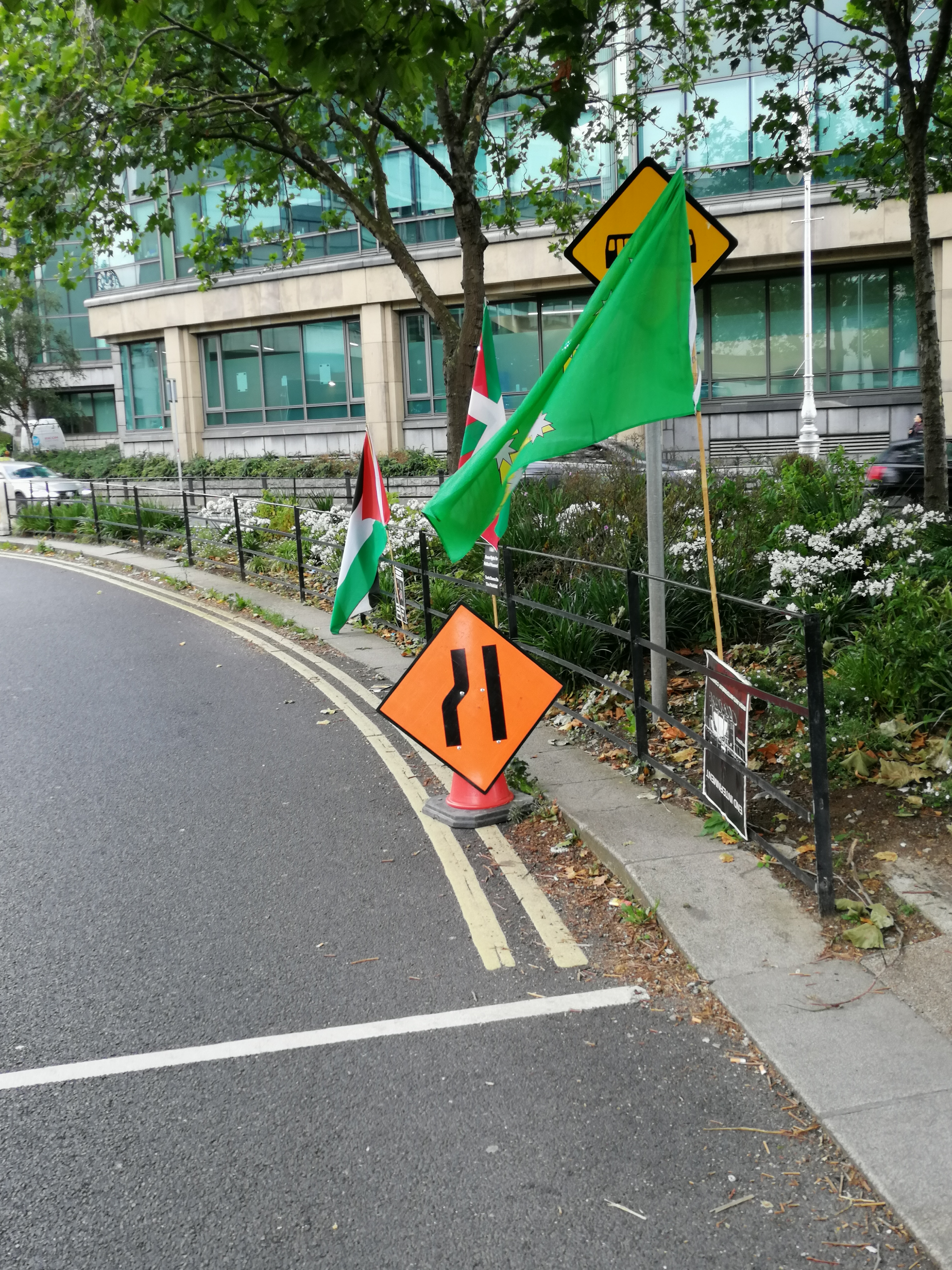
Socialist republicans and communists gathered on a traffic island in Dublin’s city centre to mark the International Day of the Prisoner. They flew flags to represent prisoners in Ireland (‘Starry Plough’), the Basque Country and Palestine.

They also displayed a number of placards.

(Photo: IAIC).

The choice of location, apart from being passed by road traffic in three directions, was because of the presence there of the Universal Links on Human Rights memorial sculpture with an eternal flame, commissioned by the Amnesty International organisation.

A plaque near the sculpture bears the following words: “The candle burns not for us but for all those whom we failed to rescue from prison. Who were tortured. Who were kidnapped. Who disappeared. That is what the candle is for.”

Plaque in the ground on the approach to the sculpture. (Photo: IAIC).

Somewhat ironically, one of the placards carried the words: “Amnesty International, do Irish Republican prisoners not have human rights too?” Irish Republicans have long complained that the organisation in question does not raise any issues with regard to Irish political prisoners.

Some have indicated as a possible reason or part-reason the location of the head office of Amnesty International being based in London, capital city of the occupying power. Its interventions on Ireland even during three decades of war in the colony have been very few indeed.

Other placards displayed referred to political prisoners from the liberation wars in India and in the Philippines, the innocent Craigavon Two still in jail and ongoing internment through refusal of bail to Republicansappearing before the no-jury special courts in both administrations.

Some leaflets were distributed about ongoing internment in Ireland through long remands in custody of Republican activists. Between convicted and awaiting trial there are close to 50 political prisoners in jails in Ireland between both administrations.

The Universal Links sculpture by Tony O’Malley (welding by Jim O’Connor) commissioned by Amnesty International. (Photo: IAIC)

The Zionist Israeli state holds 5,000 political prisoners (almost all Palestinian), of which over 1,132 are not even charged (‘administrative detention’). There are 33 female Palestinian political prisoners and 160 child prisoners. Philippines has 803 political prisoners.

The Spanish and French states hold between them around 170 Basque political prisoners.

The event to mark International Day of the Prisoner was organised by the Ireland Anti-Internment Campaign and a spokesperson gave a short explanation on video of the reason for the event with the human rights sculpture in the background.

End.

Some of the flags displayed (Photo: IAIC).
Passer-by in conversation with a leafleter. (Photo: IAIC).
(Photo: IAIC).

LEGACY of ARGENTINIAN STATE FASCISM

A heart-breaking story with courage and a heart-warming ending.

Report by Luciana Bertoia from Pagina 12 published through arrangement with Publico.es
Translation by D.Breatnach

The last time Julio Santucho saw his wife, Cristina Navajas, was on June 14, 1976. Appointed as head of international policy for the Revolutionary Workers’ Party (Partido Revolucionario de los Trabajadores), he had to leave Argentina for six months.

They had been married for almost five years then and had two children: Camilo, three years old, and Miguel, who had not yet turned one. The three accompanied him to the Retiro terminal, where he took a bus to Sao Paulo and then arrived in Rome.

In the terminal, Cristina had Miguel in her arms and Camilo by the hand. When saying goodbye to him, she insisted on a promise:

I only ask you one thing. If something happens to me, you have to take the boys with you. They shouldn’t stay with your mom, with my mom, or with other comrades. They have to stay with you.

But, Cris, we’ve been living in hiding for a long time, and nothing has ever happened to us.

“Now it’s different,” she cut him off.

One day before a month had passed since Julio’s departure, Cristina was kidnapped by the Dictatorship. She was in the apartment at 735 Warnes Avenue, where her sister-in-law Manuela Santucho lived.

Another comrade from the PRT-ERP, Alicia D’Ambra, also lived with them. All three were kidnapped that day. The oppressors left Cristina’s two sons, Camilo and Miguel, and Manuela’s son, Diego, in the apartment.

Cristina managed to ask a neighbour to call her mother, Nélida Navajas. When the phone rang, Nélida had to ask where the boys were. For security reasons, she did not know their address.

When she arrived, she heard the screams of the two youngest, Miguel and Diego, from the street. Camilo was asleep.

Nélida found her daughter’s bag on the ground. Inside was a series of letters that she had written to Julio, waiting to receive an address to to which to send them. She had started writing the last one on Saturday, July 10, but had finished it the next day:

“Miguel is much better, he hardly coughs anymore, but he is more of a bandit and wilder every day. Cami is calmer and doesn’t give me work, the only thing is that he is getting clingy to me. He asked again which house we are going to, which house is this, etc.

Now the one who is not well is me, I do not know if I am pregnant,” she told her husband.

Julio found out about the kidnappings the next day, when he called to greet his brother-in-law on his birthday.

Refugee from Argentinian Dictatorship accompanied by a son as he attends a press conference about his reunion with another son, abducted by the regime, 43 years ago. (Photo: Enrique Garcia Medina/ EFE)

That day he spoke ten times with his mother-in-law. He would not hesitate to return to Buenos Aires to collect his children, but the PRT sent two comrades who, pretending to be a couple , took the children out and abroad to their father.

Forty-six years later, Julio managed to meet his third child, the baby that Cristina had while she was kidnapped in the Pozo de Banfield, after having gone through Coordinación Federal and Orletti Automotive (places of detention of the fascist regime – Trans.).

He is the 133rd grandchild found by the Grandmothers of the Plaza de Mayo (group of women who began the campaign to trace those made missing by the fascist regime – Trans.)

In an interview with Página 12, Julio Santucho relates how he was reunited with his youngest son, now a 47-year-old adult.

How was the search?

The main heroine in this story is Cristina, who for eight or nine months was pregnant in the most inhumane conditions: mistreatment, torture, bad food. She put up with all of this with willpower and finally gave birth to our son.

My son began to question his (new family – Trans.) relationship based on references from those close to the family. A sister who lived with him for 20 years told him “these are not your parents.”

From the way he was treated by the appropriator who raised him, he came to realise that he was not his father.

In 2019, he began to search, although stopped during the pandemic and then resumed. He had a birth certificate from another province. Finally this year he managed to have his DNA tested.

We searched but we had no approximation or probability of discovering my son. It was an exceptional case: he was born in the Pozo de Banfield, but police doctor Jorge Bergés did not sign the certificate. He surprised us.

What is it like to meet a son who is 46 years old?

It is good. The bad thing is that they took 46 years from us. It is a victory for the human rights organizations that have fought for this and it is a defeat for the dictatorship. They wanted to steal my son but I, later than ever, got him back.

My mother-in-law, Nélida Navajas, joined the Abuelas (Grandmothers’ group – Trans.) to look for her grandson. Abuelas is an irreplaceable institution, it is an enormous benefit to society because it is precisely the place where people who have doubts can recover their identity.

In July 1976, you lost much of your family and now, another July but 47 years later, you have your son back.

You strike a chord. On July 13, Cristina, Manuela and Alicia were kidnapped. She was a comrade that I also knew because she worked in the party schools.

On the 19th, six days later, they killed my brother “Roby” (Mario Roberto Santucho, leader of the PRT-ERP), and later my brother Carlos.

It was a tragic week for the family. We are not better-off than others. All the 30,000 disappeared were brave, generous and devoted themselves to a fight for the well-being of society and humanity.

What could he know about Cristina during her captivity?

There are testimonies like that of Adriana Calvo. The Santuchos were visited by all the mothers that were in the Pozo de Banfield. Adriana asked to spend a day with them.

She had her baby in her arms and so as not to worry her Cristina did not tell her that she had had a child and that it had been taken from her.

Adriana, afterwards, spoke at the trial of Cristina’s tremendous generosity in not telling her anything so she wouldn’t worry about her because they could take the baby away from her. Do you realise how far thinking about the welfare of others went?

They were screwed. But they told her: “We are Santucho, we don’t have any possibility of leaving, but they are going to release you.”

And then there is that scene that Adriana recounts: when the officers arrived, all the women made a human wall – led by Manuela, Cristina and Alicia – and the men had to leave without being able to take their baby from her.

They were in a concentration camp. They knew they could shoot them all at that moment.

And now how is the reunion going?

Some ask me about the appropriator of my son, all I say is that I hope that Justice intervenes. For now, this is all like walking on clouds. We talk to my son every day, we see each other often. Now we have the commitment to make a video call to my granddaughters. Let’s go little by little.

Joy is infinite. Besides, we have time. I am 78 years old. My father died at 89. I have a brother in Santiago del Estero who is 101, another who is 96. If they don’t kill us Santucho, we live a long time. So I look forward to enjoying my son for a few more years.

End.

ADDITIONAL NOTES by D. Breatnach

The Argentinian dictatorship lasted from 1976 to 1983 and apart from banning dissenting newspapers and organisations, detained, tortured and killed thousands.

But not only that, very young children and babies were abducted and given to couples who supported the regime to raise as their own. This was also done by other dictatorships, including the Spanish Franco regime of four decades.

In a time when a week-old military coup in Niger is threatened with invasion by France and by some western-allied African states, it is well to remember how other military dictatorships have been viewed by western states.

The lack of democratic elections and opposition parties did not matter to the western states who in fact fully supported the Argentinian and many other coups and dictatorships.

The military dictatorship of Argentina only became a problem to the UK’s ruling class when Argentina’s military invaded the British colony of the Malvinas/ Falkland Islands in 1982, the same year that the USA stopped supporting the junta for the first time.

SOURCE MAIN STORY

https://www.publico.es/internacional/julio-santucho-dictadura-me-quiso-robar-mi-hijo-recupere.html?

Anti-Fascist Event in Gernika Pays Homage to a Basque-Nicaraguan Revolutionary

Clive Sulish

(Reading time: 9 mins.)

Kontxi Arana, code name “Rita”, was a fighter of the Basque armed organisation ETA and also of the Sandinista movement. A ceremony of homage to her memory on 22nd April was also the occasion of an antifascist conference with representatives from a number of European countries.

The event took place in Gernika, the SW Basque town infamously bombed by German and Italian Nazi and Fascist squadrons during the Spanish Civil/ Ant-Fascist War, the act which inspired the Catalan painter Picasso´s famous piece on the event (which he called by its Spanish name, “Guernica” (sic)). The venue was the disused Astra factory, formerly manufacturer of handguns.

The Origins and Nature of Fascism

The day-long anti-fascist conference began with a talk on the origins and basic nature of fascism by Iñaki Gil de San Vincente, Marxist theoretician and veteran of the Basque Left Patriotic Movement from which leadership of however he has broken for a number of years.

Speaking in Castillian, he declared the essential nature of fascism to be authoritarianism, deriving from the development of the bourgeois family. The central authority figure in that family, later reproduced in other social classes including the working class is the Father, represented in capitalist society by the employer and the Church.

It is an authority to which all are required to submit: patriarchical, homophobic and intolerant of criticism or deviation.

De San Vincente spoke at length about this development and about early descriptions of fascism, for example by Clara Zetkin and Lukacs and described it as a production of capitalism and imperialism and therefore represented today most clearly in the actions of US Imperialism and the NATO over which it exercises hegemony.

The speaker also highlighted the development of NATO and its recruitment of Nazis as well as the development of its Vatican route for Nazis to leave Europe and enter Latin American countries where they would form fascist centres.
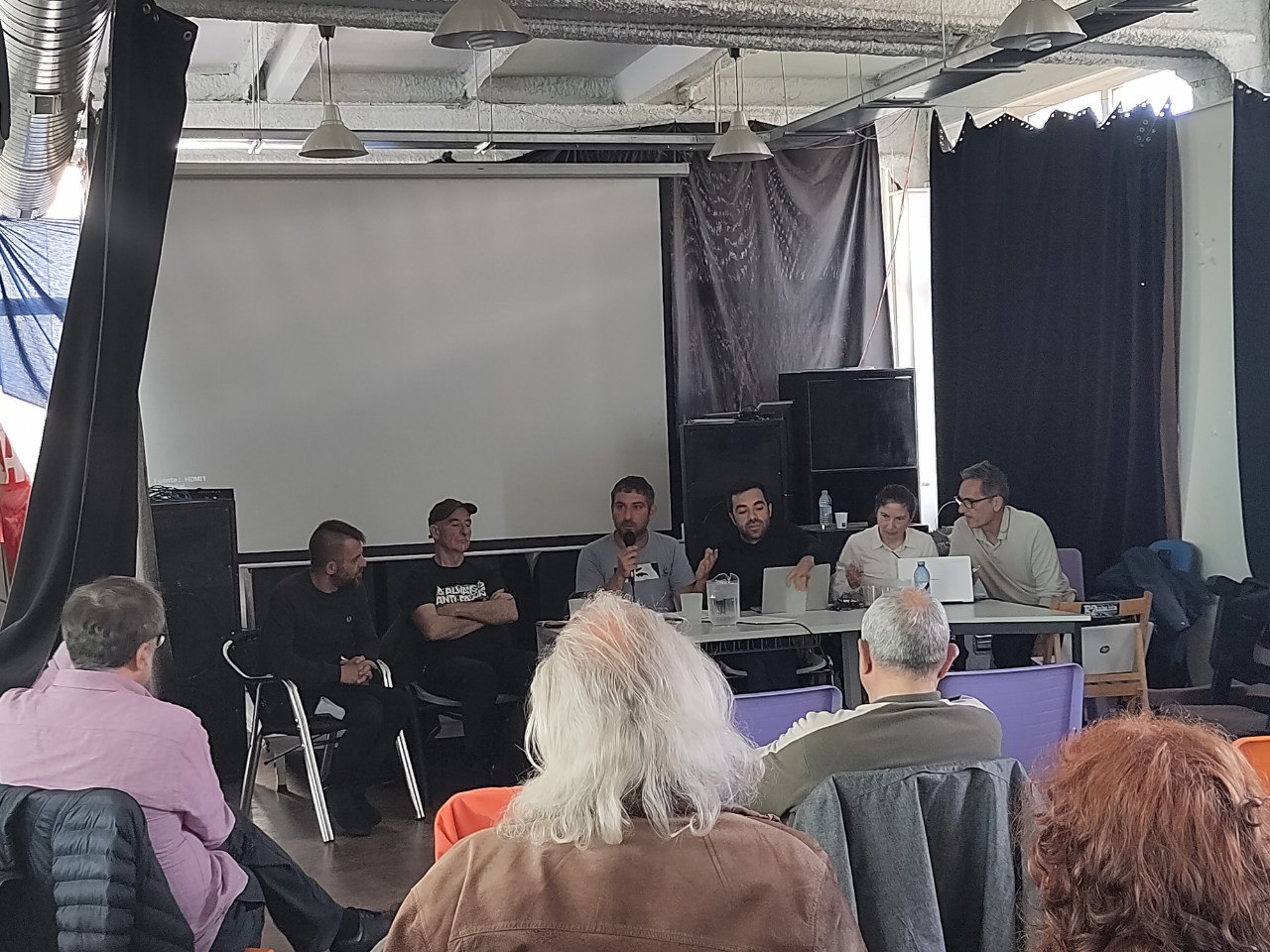
This talk was followed by a representative of Ezkerraldea Antifaxistako (Antifascist Left) who, speaking mostly in Castilian, outlined the history of the development of fascism in the Spanish state following the military-fascist uprising and the four decades of dictatorship, and how the organisation he represented responded to that.

The final speaker of the morning session was from Mugimendu Socialistako (the Socialist Movement – organisation with a large membership, according to a participant) who spoke entirely in Euskera (Basque language). Although simultaneous translation was provided into Castilian (Spanish), the volume of such was too low to be understood by many.

Morning session of the anti-fascist conference in Gernika (Photo: DRAF)

According to a participant, the content of that speaker´s contribution was similar to that of the previous speaker, although he mentioned the existence of Frente Obrero (Workers´Front), a Basque organisation which, despite its name, is a fascist organisation. The existence of that latter group appeared to be news to many present.

These talks were followed by a break and, upon resumption, there were some contributions from the floor and some responses from the panel, after which all repaired to the green outside the Astra building to where the ceremony of respect to the memory of Kontxi “Rita” Arana was to take place.

Kontxi Arana: A leading Basque liberation fighter who also joined the Sandinistas in the liberation struggle of Nicaragua

A Basque woman of the independent Patriotic Left movement blew the traditional cow or bull horn to summon attention, while the speaker in the Basque language introduced the program and speakers along with a short history of this internationalist anti-imperialist and anti-fascist fighter.

Kontxi Arana was an active member of the Basque armed liberation organisation ETA who avoided capture while on operations in the Spanish State but was arrested in the French state and exiled to an island, from which she and others escaped. Sometime later she surfaced in Nicaragua, where she had joined the Sandinista armed liberation movement.

Around the end of the 1990s, the leadership of the Basque Patriotic Left asked some exiles to return to the Basque Country to help push the pacification process and release of prisoners but the Spanish State refused to play, though they did not arrest Kontxi (however according to reports arrangements were not well organised to support her).

Most of the crowd present at the Gernika commemoration and homage to Kontxi “Rita” Arana, with the Astra building in the background and the railway line fence just visible in the left background.

The homage to her memory

A man formerly of the official patriotic Left movement spoke in Spanish about the need for internationalist solidarity, through which however mistakes can be made (e.g. in supporting corrupt leadership) which however does not alter the importance of such solidarity, without which the revolution cannot advance.

This was followed by a man from Dublin Republicans Against Fascism who briefy explained in Castilian (Spanish) the history behind Christy Moore´s “Viva La Quince Brigada“, which the Dubliner then sang in its original English.

Dublin Republicans Against Fascism representative singing Christy Moore’s Viva La Quinze Brigada.

The homage event concluded with red carnations being laid by members of the audience in front of a portrait of Kontxi “Rita” Arana. Two ex-political prisoners played the ´txistu´ (Basque three-hole flute), one of them also beating a rhythm on a small drum (´tamborina´). A young woman stepped forward and danced the ´aurresku´, a traditional honour dance.

Crowd queuing to lay red carnations in front of a portrait of Kontxi Arana

This dance was traditionally danced by a male, then by male dancers, then by male and female dancers until today, when it may be performed by any of those combinations or by a lone female, as in this case, and often enough in ordinary clothing as was the case on this occasion, though she did wear dancing shoes laced to the ankles.

The young woman performing the honour Aurresku dance in one of the high kicks of the dance with, to the far right, the ex-political prisoner txistulari (players of the Basque flute). In the immediate background, participants and organisers. (Photo: DRAF)

The musicians then played the air of The Internationale, which most could be heard singing in Euskera, followed by Eusko Gudariak (“Basque Soldiers”), the Basque national resistance song, similar to the Soldiers’ Song/ Amhrán na bhFiann of Ireland in content. Many had raised clenched fists as the songs were sung.

Suddenly, a wild high-pitched yodelling cry rang out from a female throat, the Irrintzi, traditional Basque battle-cry which probably echoed around the mountains in olden days.

All the audience then repaired to the Astra building where a hot meal was served to all on long tables with a bottle of wine to share among each group of several people (those present had purchased tickets to the event either in advance or upon attendance).

Afternoon session: Presentations from Turkish, Irish and Catalan antifascists.

The afternoon session started a little late as people straggled in. The chairperson, speaking in Euskera, introduced the theme of the session which was for antifascists from Turkey, Ireland and Catalonia to describe the situation with regard to fascism in their countries and how it was being confronted.

Turkey

Two people from the Turkish-based revolutionary organisation Anti-Imperialist Front presented their contribution while using a video of images, some subtitled in Castilian but where not, spoken by the woman in English while her comrade translated simultaneously into Castilian.

Overall, the presentation was about the development of state fascism in Turkey and the failed military coup of 2016. The DHKP/C organisation had resisted this on the streets but a major struggle with the Erdogan government took place in trials and in the jails.

Through hunger strikes and physical resistance in the jails, hundreds of martyrs had lost their lives, said the speaker but had remained undefeated. Also martyred had been members of the Group Yorum music group which has played revolutionary songs heard by millions.

Another struggle was carried out through public hunger strikes by elderly relatives seeking the uncovering of mass graves in the bodies of fighters, their sons, had been thrown by the Turkish military.

As a result two mass graves had been eventually disinterred, permitting the remains of fighters of the DHKP/C and of the PKK (Kurdish patriotic socialist organisation) to be returned to their families for respectful re-burial.

The Turkish speakers concluded by stating the necessity for anti-fascism to be anti-imperialist and calling for internationalist solidarity and victory to peoples’ struggles.

Section of audience at afternoon session of the anti-fascist conference in Gernika, Basque Country.

Ireland

The next speaker was from Dublin Republicans Against Fascism, explaining that eight centuries of occupation of his country by England has ensured that the dominant struggle had been one of national liberation and that all armed struggles since 1798 had been led by Republicans of various kinds: 1801, 1848, 1867, 1882 and 1916.

The Irish State that came into being after the War of Independence in 1921 had been a client of the UK, conceding over one-fifth of its national territory as a direct colony. The armed forces of the State had formally executed over 80 of the IRA and instituted a wave of repression including kidnappings, torture, murders including of prisoners.

In keeping with the rise of fascism across 1930s Europe, Ireland saw the Blueshirt movement, led by former police chief Eoin O’Duffy. The Republican movement and socialists fought these on the streets, the speaker said.

The Dubliner recounted briefly the history of Irish Republicans and socialists going to fight Franco in the Spanish state and the Irish diaspora fighting the British fascists, the Blackshirts, in British cities and in defence of Eastern European Jews in famous Battle of Capel Street in the East End of London against over 7,000 police.

He went on to recount some more recent successful physical attacks by joint Republican groups against fascist organisations, the Pegida group in 2016 and even more recently the National Party. Recently too, Republican ex-prisoners had released a video stating the opposition of Republicanism to fascism with a growing list of signatures.

In conclusion, the speaker said that Ireland’s history made it difficult for fascism to advance in Ireland (except in the Loyalist areas) but as long as capitalism exists so too does the danger of fascism, particularly if the progressive forces do not fight effectively against the attacks of Capital on working people.

Catalonia

The representative of the Anti-Repression Platform of Catalonia, speaking in Castilian (Spanish), explained their organisation had come into existence after the repression of the Independence Referendum in 2017 and the subsequent frame-ups and allegations of terrorism against the Committees for the Defence of the Republic.

The speaker alluded to the jailing of the revolutionary socialist rapper Pablo Hasel and comrades who were charged with terrorism merely for expressing and organising solidarity for those being repressed.

“Don’t try to frighten us with threats of a fascist party getting into government”, he said in a reference to the growth of the Spanish fascist party Vox, because we have had a fascist government in the Spanish state since 1939!” (The year that the military-fascist forces defeated the Second Republic and founded four decades of dictatorship).

The Catalan went on to denounce the social-democratic party PSOE (currently in coalition government with Podemos Unitas), pointing out that it has had more political prisoners in jail and fatal victims than any other party in Spanish government (he was probably including the sponsoring the GAL terrorists of the 1980s).

“There has not been a year in which there were no political prisoners in the Spanish state”, he went on to say but also denounced the current Catalan Government, led by the allegedly pro-independence and leftist ERC party and its repression of socialists and independence activists.

He pointed out that fascists would make no distinction between communists and anarchists and asked “so then why should we?” He declared that all who resist repression now, regardless of before, are welcome to take part in their organisation.

The panel at the afternoon session: from left to right: speakers from Catalonia and Ireland, Basque chairperson, Turkish speakers and translator.

Prisoners on hunger-strike

The chairperson of the panel thanked the speakers and drew together elements from each of their presentations.

He went on to announce the declared intention of a small group of Basque political prisoners to embark on a hunger strike and to outline solidarity events being organised. The prisoners concerned are in the non-compliance minority of Basque political prisoners with a regime that forbids them referring to themselves as political prisoners.

The prison authorities intended to make the prisoners share a cell with other political prisoners who are however in compliance, intending to undermine the resistance of the small group and also posing the danger of conflicts within the cell. (A few days later news came that the hunger-striking prisoners had won their demands).

Amnistia organisation solidarity poster announcing forthcoming hunger-strike of political prisoners, now over because they won their demand.

Summary

The conference in its organisation and content of contributions drew anti-fascism together with imperialism and internationalist solidarity, all from an anti-capitalist perspective. It also drew connections between solidarity with political prisoners and resistance to repression.

All of the Basque organisations represented are in opposition to the trajectory of the leadership of what had been the Basque Left Patriotic movement, now represented by the EH Bildu party led by Otegi (with daily newspaper GARA, its trade union organisation LAB) and many of the older people were ex-supporters of that leadership.

That included some prominent ones such as Inaki Gil de San Vincente and the speakers and organisers of the conference and of the homage to the memory of Kontxi “Rita” Arana. The younger participants might have included ex-members or had come into political consciousness in opposition to that leadership.

Taken together, they are what many call ‘dissidents’ though some reject that term, saying that they are in fact sticking to the original line of independence and socialism and that it is the official leadership and their followers who have deviated. Their numbers are comparatively small at the moment but they are growing.

end.

USEFUL LINKS

Speaking at the Conference:

Boltxe: https://www.boltxe.eus/

Inaki Gil de San Vincente:

Socialist Movement (Socialist Councils) of the Basque Country: LANGILE KAZETA (gedar.eus)

Antifascist Left: Ezkerraldea Antifaxistasta
https://www.facebook.com/profile.php?id=100069359823294

???

Anti-Imperialist Front (Turkey): https://anti-imperialistfront.org/

Dublin Republicans Against Fascism: https://www.facebook.com/profile.php?id=100067893558778

Anti-Repression Platform of Barcelona: https://twitter.com/antirepreBCN
Plataforma Antirepressiva de Barcelona | Barcelona | Facebook

More to come later

Others in Ireland:

Dublin Basque Solidarity Committee: https://www.facebook.com/dublinbasque

Anti-Fascist Action: https://www.facebook.com/afaireland/

Republicans Against Fascism: https://www.facebook.com/profile.php?id=100090617432158

There are also other local antifascist groups and organisations that include antifascist activity in their programs

2022: Busy Year for the Ireland Anti-Internment Campaign

Ireland Anti-Internment Campaign

(Reading time main text: 5 mins.)

2022 was a busy year for the anti-internment campaign organisation, involving, along with its public awareness-rising events, a reorganisation with a new constitution, a new name and expansion of membership.

Origins

The formation of an anti-internment campaign was sparked by the revoking of the licence of ex-political prisoner Marian Price in May 2011 for the “crime” of steadying the written speech of an IRA speaker during a windy Easter Rising commemoration in Milltown Cemetery, Belfast.

In addition to revocation of the licence under which Republican prisoners were released under the Good Friday Agreement, other activists were also being charged under “anti-terrorist” legislation and routinely being refused bail, if not granted it under severe restrictions.

The wait for a trial is often two years and regardless of the eventual outcome, the individuals had already spent two years in jail or at home, barred from travel or political activity and harassed by police visits to their homes.

Early banner-placard protesting the internment of Marian Price (Image sourced: Libcom.org)
Front section of Anti-Internment March, coming into top part of Parnell Square, Dublin 2013. (Image sourced: IAIC archives)

These conditions were considered to be in effect the same as internment without trial and the campaign against internment was founded as an independent one, a status it maintained despite a number of attempts to take it over or to intimidate with threats and State harassment.

Throughout its history the Anti-Internment Campaign has organised the annual Newry event (not since 2021 unfortunately), many pickets (including in protest against Amnesty Ireland) and a march in Dublin, spoken at or participated in public events in Belfast, Cork, Derry, Glasgow and Wexford.

It has also organised and hosted conferences and public meetings, for example with speakers from the campaigns for the Craigavon Two, Munir Farooqi and Tony Taylor and about the Right to Protest with a speaker from the Irish Council for Civil Liberties.

Section of the annual Anti-Internment white-line picket Newry, August 2016 (Image sourced: IAIC archives)
Annual Anti-Internment, Newry, rallying after white-line picket, August 2019 (Image sourced: IAIC archives)

A busy year

As stated in the introduction above, 2022 was a busy year for the anti-internment campaign group, involving, along with its public awareness-rising events a reorganisation with a new constitution and a new name. The campaign organised nine public events and participated in more.

Most of those public events were awareness-raising pickets with placards, banners, flags and leaflet distribution. Usually the pickets alternated between the Henry Street/ Liffey Street junction and at Crown Alley by the square in the Temple Bar area, both areas busy with shoppers and tourists.

Anti-Internment picket in Henry Street, November, Dublin 2022 (Photo: IAIC)

The campaign carried out pickets in Henry Street on 9th April, 6th August and 19th November and in Temple Bar on 5th March, 21st May, 2nd July and 27th August. On 22nd October, with a special focus on Palestinian prisoners, we were on the iconic Ha’penny Bridge.

It has always been of particular interest to the campaign group to reach working people and large numbers of that class of all ages pass through those areas. Of interest also are people from other lands and the Basque and Palestinian flags alongside the Irish ones often stimulate discussion.

In September the campaign attended the Peter Daly commemoration in Wexford and provided a speaker at the Dublin meeting to re-launch the End State Repression campaign which our group had supported in the past but which had waned over the Covid epidemic period since.

Our campaign group also took part in the planning of and participation in the joint prisoner’s solidarity picket in Dublin on 17th December 2022.

Reorganisation

It had been clear for some time that the organisation was in need of reorganisation to facilitate expansion but the process had been difficult.

Eventually in July the decision was taken to close down the Anti-Internment Group of Ireland and to reform under another name. This was done and, after democratic consultation process a new constitution was agreed, with the Ireland Anti-Internment Campaign as the new name.

According to agreed decisions, a new banner with the organisation’s new name was commissioned (though it would take some time to come to fruition). A new Facebook identity for the group was constructed with a statement explaining the development.

The new constitution, more explicitly democratically-based than had been previously the case, was published.

Anti-Internment picket in Temple Bar, Dublin, March 2022 (Photo: IAIC)

Year planning

In the reorganisation process, the IAIG lost one member but gained three new activists and the return of two lapsed members. With renewed energy, members began planning for the rest of the year, to conclude with participation in the annual Bloody Sunday March for Justice in Derry.

Issuing a statement to explain the reorganisation, commissioning a new banner, scheduling a number of pickets in Dublin and organising the annual Prisoners’ Solidarity Picket in Dublin December were part of the planning and most of the target actions were completed.

In December and in good time, the campaign’s members organised to purchase, sign and mail Christmas cards to all Irish Republican prisoners, also a number of non-complying Basque political prisoners and the Catalan jailed revolutionary Catalonian rapper Pablo Hasel.

The proposal to organise the annual Prisoners’ Solidarity picket in December jointly with the Irish Republican Prisoners’ Welfare Association and with Ireland Anti-Imperialist Action was agreed and the joint event went ahead on 17th December with around 40 participating.

Section of the joint AICI, AIA and IRPWA Republican Prisoners’ solidarity picket 17 December 2022, O’Connell Street, Dublin 2022 (Photo: IAIC)

The picket with placards and banners, including the illuminated words of the IAIC’s “SAOIRSE” (“Freedom”) attracted attention and passers-by, both Irish and from abroad engaged leafleters and other participants in discussion. A speaker from each group gave a short statement.

The year’s programming ended with the specific scheduling of participation with a new banner in the annual Bloody Sunday March for Justice in Derry.

New Banner Aired at Bloody Sunday March for Justice in Derry

The new banner got its first public airing at the annual march in Derry, commemorating the massacre of unarmed civilians by the British Army in Derry in January 1972 and was carried as part of the march from the Creggan, through a large part of Derry and down to Free Derry Corner.

The marchers in different political parties, campaign organisations and independent individuals marched trough cold rain and strong wind-gusts through the nearly 5-kilometre walk. The members of four Republican Flute Bands played bravely throughout.

The new banner of the Ireland Anti-Internment Committee carried in the Bloody Sunday March for Justice in Derry in January 2023. (Photo: IAIC archives)

The IAIC will shortly begin its year-planning for the rest of the year, its calendar again probably ending at 2024’s Bloody Sunday March for Justice and meanwhile organising events to publicise the on-going undemocratic jailing of activists without trial both sides of the British Border.

The IAIC considers that the jailing of people without trial by both administrations is, in addition to political repression, a significant assault on civil rights and a threat to all opposition groups and that it is in the interests of all to unite in opposing the practice.

The Campaign welcomes the active support of all democratically-minded individuals at its public events.

End.

USEFUL LINK

Ireland Anti-Internment Campaign:https://www.facebook.com/profile.php?id=100063166633467

BRITISH STATE MURDER OF IRISH CIVILIANS COMMEMORATED IN DERRY

Clive Sulish

(Reading time main text: 6mins.)

Thousands of people gathered on Sunday 29th January in Derry City’s Creggan area and marched through rain and gusts of strong wind in the annual Bloody Sunday March for Justice to Free Derry Corner.

The march commemorates the Derry Bloody Sunday Massacre of the last Sunday in January 1972, when the Parachute Regiment opened fire on unarmed Civil Rights marchers, killing 14 and injuring a great many, claiming the soldiers had only returned fire on paramilitaries.

By the Creggan shops, people still arriving, others waiting to march (Photo: D.Breatnach
Other side of the road. (Photo: D.Breatnach)

British Governments for decades stood by those claims, refuted by many hundreds of witnesses to the actual shootings and though the city’s coroner called it “sheer unadulterated murder”, the inquiry under Lord Chief Justice Widgery declared in favour of the Paras’ version.

The 1972 march organised by the Northern Ireland Civil Rights Association had been protesting the introduction of internment without trial in August 19711 and the Paras had already killed 11 unarmed protesting people that month in the Ballymurphy housing estate, Belfast.2

Among the scheduled speakers and organisers in Derry in 1972 had been leading activists of the time, Bernadette Devlin (now McAlliskey) of People’s Democracy3 and Eamon McCann of the Socialist Worker’s Party (now People Before Profit).

The Commemoration this year

Participating organisations this year included Anti-Imperialist Action Ireland, Communist Party Ireland, Éirigí, Irish Republican Socialist Party, Irish Republican Welfare Association, Lasair Dhearg, People Before Profit, Republican Network for Unity, Saoradh, 1916 Societies.

Also marching were an IWW/ Anarchist contingent and a number of campaign groups: Ireland Anti-Internment Campaign, Ballymurphy Justice, Justice for the Craigavon Two, Justice for Manus Deery, with a number of environmental groups were represented also.

Derry Trades Council and IWW seemed to have the only trade union banner present or flags present.

A broad domestic and internationalist solidarity sweep was evidenced by the poster for the event with the slogan: “An injury to one is an injury to all” and also by the banner of the Derry branch of the Ireland Palestine Solidarity Campaign.

Poster for the 2023 march (Sourced: Internet)

Public support from Britain came with a banner of the Fight Racism/Fight Imperialism periodical and leaflets from Republican Socialist Platform4 were distributed among the marchers also.

Some years can reveal the misfortunes of particular organisations with a much smaller contingent than previously due to drop outs, defections and splits. Equally it has not been unknown for an organisation to draft in people to inflate its numbers specifically for the annual march.

The annual march takes the twisting route of the original one in 1972, covering much of the Derry nationalist housing areas.

Marchers rally at the Creggan heights and march down to the bottom of the hill, then along and up another steep hill, turning right at its top, along and then right down again and, at the bottom, turning right and along to the Free Derry Corner5 monument where speakers address the crowd.

Kate Nash chaired the rally there and Liam Wray, relative of murdered James Ray spoke as did also Ria, niece of John Paul Wooton who, with Brendan, are the Craigavon Two, framed for the killing of a colonial policeman.

The numbers this year were a huge drop from the previous year’s but 2022 was the 50th anniversary of the massacre and the participants are estimated to have numbered well over 10,000, including maybe 10 marching Republican Flute Bands6 from Ireland and Scotland.

Nevertheless the mass media’s coverage of last year’s march varied from minimal to nil.7

Probably4,000 actually marched this year, but perhaps nearly another 1,000 gathered on the roadsides to watch the marchers, greet people they know and so on. Many children are brought by their parents to watch while their older siblings gather and sometimes accompany marchers too.

The day had begun sunny and crisp but by march time the weather had deteriorated to constant rain and gusts of wind and, as the march reached the Lecky Road, to a heavy downpour. It was bad but veteran marchers have experienced worse in previous years, including snow and sleet.

Waiting to begin the march (Photo: D.Breatnach)

Three Derry-based Republican Flute Bands formed part of the march: James Connolly RFB, Kevin Lynch RFB and Tommy Roberts Stevie Mellon RFB, along with the Banna Cuimhneachán Thomáis Uí Chléirigh (Thomas Clarke Memorial RF Band) from Dungannon.

Although in recent years members wear more weather-appropriate uniforms, they still do an amazing job marching and playing in bad and sometimes atrocious weather.

A Deal with the Devil

The Sinn Féin political party, once prominent among the march organisers and speakers at the rally, sought to end the annual march in 2011 and have not supported the event since.8 This was after the British Government publicly apologised for the massacre that same year.

Part of the process leading to that Governmental apology was the setting up of the Saville Tribunal in London in 1998, although it took unexpectedly long to deliver its verdict.9 The Good Friday Agreement was also concluded in 1998, giving the Tribunal the appearance of a concession.

Indeed, the whole has the marks of a deal with the Provisional IRA’s leadership, with the British side saying: “You give up the armed struggle and control your people. We’ll make it easier for you by releasing your prisoners on licence10 and admitting we were wrong in Derry in 1972.

Whether ceasing the annual commemoration was part of the deal or whether that was Sinn Féin’s own leadership’s decision is difficult to guess. It may have suited SF to scale a colonial reminder event down or simply to scratch one big annual event from their organisational calendar.

On the other hand, it has lost Sinn Féin all control of an important historical commemorative event on the Irish Republican calendar and their abstention again at the 50th anniversary march was a massive exposure of their collaborationist position.

The Bloody Sunday Trust also boycotts the march, in the sense that it does not promote it nor record its annual march or other events opposed by Sinn Féin. It does organise and promote its own events during every anniversary but that seems to be as a counter to the march organisers.

The BST of course receives funding and employs a Director and staff for its museum. Nobody pays Kate Nash or other members of the Bloody Sunday Commemoration committee; they rely on public donations and sale of items such as commemorative T-shirts to fund the march11.

A number of relatives of the murdered and injured civilians continue to support the march and are counterered among its organisers, for example Kate Nash, sister of murdered William murdered on Bloody Sunday and daughter of Alex Nash seriously injured by the troops the same day.

The Derry Trades Council and two of the original organisers and speakers support the continuation of the commemorative march as do most Irish Republican and Socialist organisations.

In formation ready to march. Note the presence of female members in the prestigious and ceremonial colour (flags) party, more commonly seen in recent years. (Photo: D.Breatnach)

Derrylondon12 and annual commemorations

Most Irish people call the city “Derry13” from the ancient monastic settlement located there, “Doire Cholmcille”14 but most Unionists and the British officially call it “Londonderry”. Many think the latter do that to annoy but there is a historical basis for it.

Large parcels of land in the city and surrounds were the payoff to the City of London for bankrolling Cromwell and the English Parliament’s campaign in Ireland to crush support for King Charles and the resistance of the Irish clans and Norman-Irish magnates.

Commemoration of the crimes of the oppressor forms an important part of the resistance of the oppressed around the world. Such events say “Our oppressors committed this atrocity here and we remember, will always remember and constantly deny them any legitimacy in occupation.”

If that is so, what gives any liberation organisation the right to call an end to such commemorations? Yet that is what the formerly liberation Sinn Féin did in 2011 after a British Prime Minister apologised in public for the massacre (but as some kind of serious ‘error’).

Some of the guilty – poster for the 2020 march. (Image sourced: Internet)

Not a single Minister or civil servant who organised the Derry or Ballymurphy massacres, nor judge who condoned them, nor officers who ordered them, nor soldiers who carried them out have been even tried, never mind convicted or jailed in the thirteen years elapsed since that ‘apology’.

Derry’s Bloody Sunday will continue to be commemorated at least until British colonialism has left Ireland and probably as long as imperialism continues to exist.

Remembering is part of resistance; commemoration makes it collective.

End.

A plethora of flags in what seems to be the Anarchist and IWW section. (Photo: D.Breatnach)

Head of the march reaches the bottom from Creggan and turns into the Bogside (Photo: George Sweeney in Derry Journal)

FOOTNOTES

1Abandoned on 5 December 1975. During this time a total of 1,981 people were interned for a period without trial, many of them physically assaulted, some grossly beaten and a small number tortured (the “hooded men” whose campaign for justice is yet another example of courage and determination against British State lies, prevarication and delays). 1,874 were from an Irish nationalist background, while 107 were from a unionist background.

2A similar British Army story, “returning fire” and again witnesses’ accounts ignored. The British State has yet to admit the gross inaccuracy of the official account.

3The party grew out of the Civil Rights movement of which it represented a more radical section. It ceased to exist after a few years.

4Previously unknown in Ireland, the RSP claims members in Derry and Belfast and the leaflet states it is part of the Radical Independence Campaign in Scotland.

5The monument in the shape of a gable end of a two-storey house mimics its original inspiration on the blank gable end of a row of houses in 1968 when John Caker Casey or Liam Hillen painted upon it YOU ARE NOW ENTERING FREE DERRY. The Bogside enclave had been barricaded in 1968 to deny the sectarian and brutal colonial police entry and continued to exist as an area from which the police were barred and British troops, even after the official removal of the barricades, entered only in force and at their peril for years afterwards.

6Typically flute players, side and bass drums, led by a colour (flags) party, all in the band uniform.

7Instead the media concentrated on the presence of a small group of Irish Government Minister and politicians of main parties at an earlier event at the monument to the massacre and a cultural event in the Guildhall.

8No doubt some of SF’s supporters in Derry and many more of its voters ignore the party ban and attend nevertheless.

9An almost unbelievable 8 years after a delay of two years before hearings began and £400 million in costs (mostly in fees to law practitioners) even through years when no hearings were being conducted.

10Release on licence meant they could be returned to jail to complete their original sentence at the discretion of the Minister of State for Northern Ireland, without a hearing or entitlement to know the specific reason for that decision. At first only the Provisional’s prisoners signed up to it but were followed by those with allegiance to other Republican groups, along with Loyalist paramilitaries. As they were leaving the jails, a new crop was entering due to new or alleged acts of resistance, rising to 70 between jails in both states and never falling much below 50.

11See Useful Links and References at end.

12Popular Irish balladeer Christy Moore, on a British tour in the 1980s, greeted his London audience by calling the city “Derrylondon” to wild cheering. Shortly afterwards an Irish activist produced Christmas cards displaying London sights in snow, titled “Christmas greetings from Derrylondon”.

13Derry City FC is also the name of the local soccer club which enjoys cross-community support.

14Colmcille’s (“Dove of the Church”, real name possibly Crimthann of the Cenel Connail) Oakwood”.

USEFUL LINKS & REFERENCES

Bloody Sunday Campaign for Justice: (10) Bloody Sunday March | Facebook

Bloody Sunday (1972) – Wikipedia

T-Shirts, free delivery, all proceeds to fund March: Bloody Sunday Derry Campaign (teemill.com)

Craigavon Two Campaign: https://www.facebook.com/mrsmcconville

Justice for Manus Deery: https://www.facebook.com/profile.php?