A heart-breaking story with courage and a heart-warming ending.
Report by Luciana Bertoia from Pagina 12 published through arrangement with Publico.es Translation by D.Breatnach
The last time Julio Santucho saw his wife, Cristina Navajas, was on June 14, 1976. Appointed as head of international policy for the Revolutionary Workers’ Party (Partido Revolucionario de los Trabajadores), he had to leave Argentina for six months.
They had been married for almost five years then and had two children: Camilo, three years old, and Miguel, who had not yet turned one. The three accompanied him to the Retiro terminal, where he took a bus to Sao Paulo and then arrived in Rome.
In the terminal, Cristina had Miguel in her arms and Camilo by the hand. When saying goodbye to him, she insisted on a promise:
– I only ask you one thing. If something happens to me, you have to take the boys with you. They shouldn’t stay with your mom, with my mom, or with other comrades. They have to stay with you.
– But, Cris, we’ve been living in hiding for a long time, and nothing has ever happened to us.
“Now it’s different,” she cut him off.
One day before a month had passed since Julio’s departure, Cristina was kidnapped by the Dictatorship. She was in the apartment at 735 Warnes Avenue, where her sister-in-law Manuela Santucho lived.
Another comrade from the PRT-ERP, Alicia D’Ambra, also lived with them. All three were kidnapped that day. The oppressors left Cristina’s two sons, Camilo and Miguel, and Manuela’s son, Diego, in the apartment.
Cristina managed to ask a neighbour to call her mother, Nélida Navajas. When the phone rang, Nélida had to ask where the boys were. For security reasons, she did not know their address.
When she arrived, she heard the screams of the two youngest, Miguel and Diego, from the street. Camilo was asleep.
Nélida found her daughter’s bag on the ground. Inside was a series of letters that she had written to Julio, waiting to receive an address to to which to send them. She had started writing the last one on Saturday, July 10, but had finished it the next day:
“Miguel is much better, he hardly coughs anymore, but he is more of a bandit and wilder every day. Cami is calmer and doesn’t give me work, the only thing is that he is getting clingy to me. He asked again which house we are going to, which house is this, etc.
Now the one who is not well is me, I do not know if I am pregnant,” she told her husband.
Julio found out about the kidnappings the next day, when he called to greet his brother-in-law on his birthday.
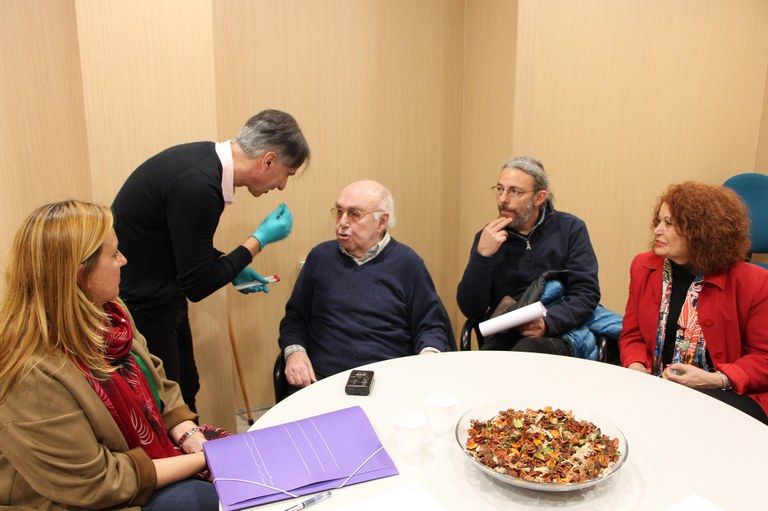
Refugee from Argentinian Dictatorship accompanied by a son as he attends a press conference about his reunion with another son, abducted by the regime, 43 years ago. (Photo: Enrique Garcia Medina/ EFE)
That day he spoke ten times with his mother-in-law. He would not hesitate to return to Buenos Aires to collect his children, but the PRT sent two comrades who, pretending to be a couple , took the children out and abroad to their father.
Forty-six years later, Julio managed to meet his third child, the baby that Cristina had while she was kidnapped in the Pozo de Banfield, after having gone through Coordinación Federal and Orletti Automotive (places of detention of the fascist regime – Trans.).
He is the 133rd grandchild found by the Grandmothers of the Plaza de Mayo (group of women who began the campaign to trace those made missing by the fascist regime – Trans.)
In an interview with Página 12, Julio Santucho relates how he was reunited with his youngest son, now a 47-year-old adult.
How was the search?
The main heroine in this story is Cristina, who for eight or nine months was pregnant in the most inhumane conditions: mistreatment, torture, bad food. She put up with all of this with willpower and finally gave birth to our son.
My son began to question his (new family – Trans.) relationship based on references from those close to the family. A sister who lived with him for 20 years told him “these are not your parents.”
From the way he was treated by the appropriator who raised him, he came to realise that he was not his father.
In 2019, he began to search, although stopped during the pandemic and then resumed. He had a birth certificate from another province. Finally this year he managed to have his DNA tested.
We searched but we had no approximation or probability of discovering my son. It was an exceptional case: he was born in the Pozo de Banfield, but police doctor Jorge Bergés did not sign the certificate. He surprised us.
What is it like to meet a son who is 46 years old?
It is good. The bad thing is that they took 46 years from us. It is a victory for the human rights organizations that have fought for this and it is a defeat for the dictatorship. They wanted to steal my son but I, later than ever, got him back.
My mother-in-law, Nélida Navajas, joined the Abuelas (Grandmothers’ group – Trans.) to look for her grandson. Abuelas is an irreplaceable institution, it is an enormous benefit to society because it is precisely the place where people who have doubts can recover their identity.
In July 1976, you lost much of your family and now, another July but 47 years later, you have your son back.
You strike a chord. On July 13, Cristina, Manuela and Alicia were kidnapped. She was a comrade that I also knew because she worked in the party schools.
On the 19th, six days later, they killed my brother “Roby” (Mario Roberto Santucho, leader of the PRT-ERP), and later my brother Carlos.
It was a tragic week for the family. We are not better-off than others. All the 30,000 disappeared were brave, generous and devoted themselves to a fight for the well-being of society and humanity.
What could he know about Cristina during her captivity?
There are testimonies like that of Adriana Calvo. The Santuchos were visited by all the mothers that were in the Pozo de Banfield. Adriana asked to spend a day with them.
She had her baby in her arms and so as not to worry her Cristina did not tell her that she had had a child and that it had been taken from her.
Adriana, afterwards, spoke at the trial of Cristina’s tremendous generosity in not telling her anything so she wouldn’t worry about her because they could take the baby away from her. Do you realise how far thinking about the welfare of others went?
They were screwed. But they told her: “We are Santucho, we don’t have any possibility of leaving, but they are going to release you.”
And then there is that scene that Adriana recounts: when the officers arrived, all the women made a human wall – led by Manuela, Cristina and Alicia – and the men had to leave without being able to take their baby from her.
They were in a concentration camp. They knew they could shoot them all at that moment.
And now how is the reunion going?
Some ask me about the appropriator of my son, all I say is that I hope that Justice intervenes. For now, this is all like walking on clouds. We talk to my son every day, we see each other often. Now we have the commitment to make a video call to my granddaughters. Let’s go little by little.
Joy is infinite. Besides, we have time. I am 78 years old. My father died at 89. I have a brother in Santiago del Estero who is 101, another who is 96. If they don’t kill us Santucho, we live a long time. So I look forward to enjoying my son for a few more years.
End.
ADDITIONAL NOTESby D. Breatnach
The Argentinian dictatorship lasted from 1976 to 1983 and apart from banning dissenting newspapers and organisations, detained, tortured and killed thousands.
But not only that, very young children and babies were abducted and given to couples who supported the regime to raise as their own. This was also done by other dictatorships, including the Spanish Franco regime of four decades.
In a time when a week-old military coup in Niger is threatened with invasion by France and by some western-allied African states, it is well to remember how other military dictatorships have been viewed by western states.
The lack of democratic elections and opposition parties did not matter to the western states who in fact fully supported the Argentinian and many other coups and dictatorships.
The military dictatorship of Argentina only became a problem to the UK’s ruling class when Argentina’s military invaded the British colony of the Malvinas/ Falkland Islands in 1982, the same year that the USA stopped supporting the junta for the first time.
Kontxi Arana, code name “Rita”, was a fighter of the Basque armed organisation ETA and also of the Sandinista movement. A ceremony of homage to her memory on 22nd April was also the occasion of an antifascist conference with representatives from a number of European countries.
The event took place in Gernika, the SW Basque town infamously bombed by German and Italian Nazi and Fascist squadrons during the Spanish Civil/ Ant-Fascist War, the act which inspired the Catalan painter Picasso´s famous piece on the event (which he called by its Spanish name, “Guernica” (sic)). The venue was the disused Astra factory, formerly manufacturer of handguns.
The Origins and Nature of Fascism
The day-long anti-fascist conference began with a talk on the origins and basic nature of fascism by Iñaki Gil de San Vincente, Marxist theoretician and veteran of the Basque Left Patriotic Movement from which leadership of however he has broken for a number of years.
Speaking in Castillian, he declared the essential nature of fascism to be authoritarianism, deriving from the development of the bourgeois family. The central authority figure in that family, later reproduced in other social classes including the working class is the Father, represented in capitalist society by the employer and the Church.
It is an authority to which all are required to submit: patriarchical, homophobic and intolerant of criticism or deviation.
De San Vincente spoke at length about this development and about early descriptions of fascism, for example by Clara Zetkin and Lukacs and described it as a production of capitalism and imperialism and therefore represented today most clearly in the actions of US Imperialism and the NATO over which it exercises hegemony.
The speaker also highlighted the development of NATO and its recruitment of Nazis as well as the development of its Vatican route for Nazis to leave Europe and enter Latin American countries where they would form fascist centres.
This talk was followed by a representative of Ezkerraldea Antifaxistako (Antifascist Left) who, speaking mostly in Castilian, outlined the history of the development of fascism in the Spanish state following the military-fascist uprising and the four decades of dictatorship, and how the organisation he represented responded to that.
The final speaker of the morning session was from Mugimendu Socialistako (the Socialist Movement – organisation with a large membership, according to a participant) who spoke entirely in Euskera (Basque language). Although simultaneous translation was provided into Castilian (Spanish), the volume of such was too low to be understood by many.
Morning session of the anti-fascist conference in Gernika (Photo: DRAF)
According to a participant, the content of that speaker´s contribution was similar to that of the previous speaker, although he mentioned the existence of Frente Obrero (Workers´Front), a Basque organisation which, despite its name, is a fascist organisation. The existence of that latter group appeared to be news to many present.
These talks were followed by a break and, upon resumption, there were some contributions from the floor and some responses from the panel, after which all repaired to the green outside the Astra building to where the ceremony of respect to the memory of Kontxi “Rita” Arana was to take place.
Kontxi Arana: A leading Basque liberation fighter who also joined the Sandinistas in the liberation struggle of Nicaragua
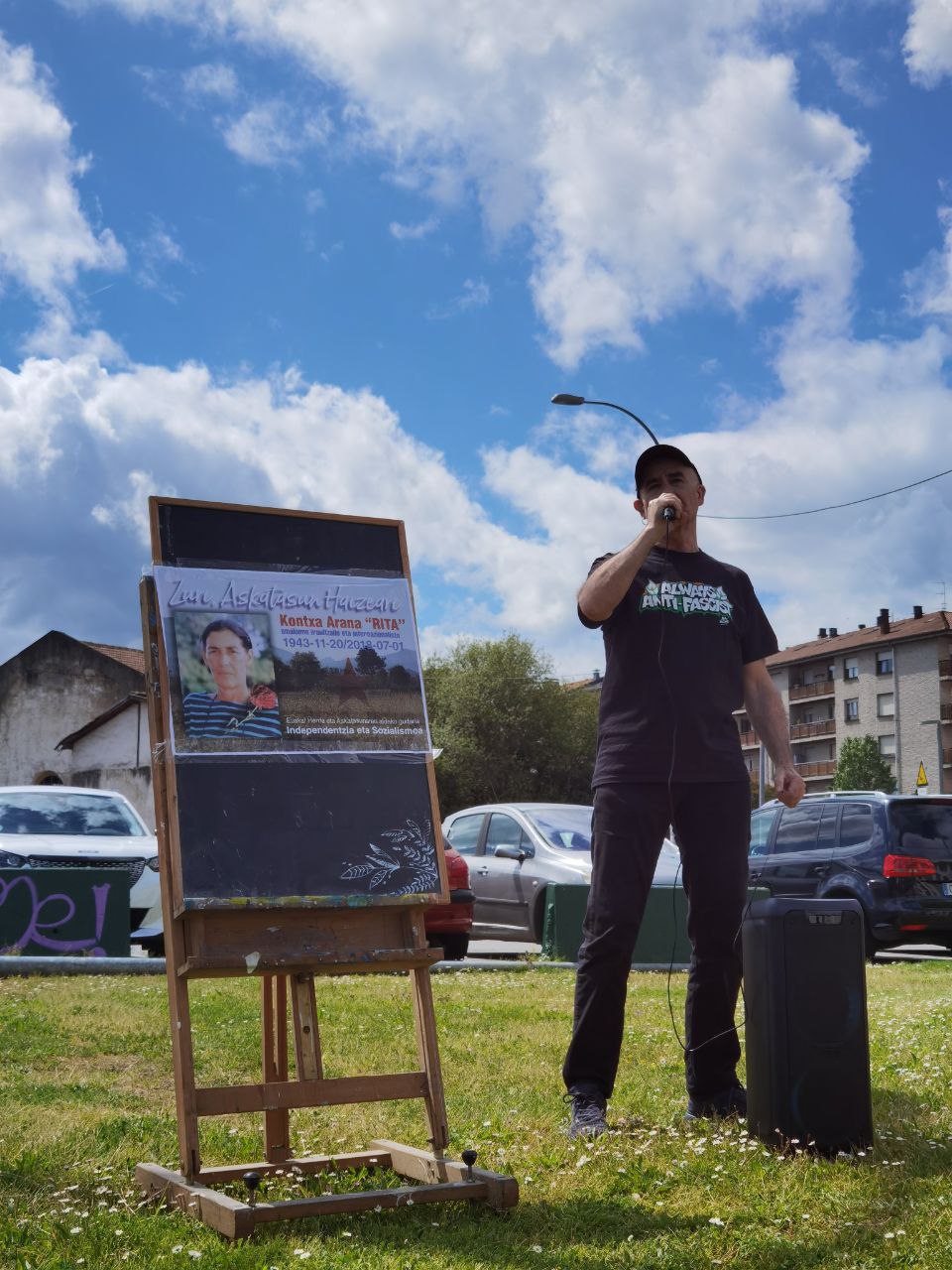
A Basque woman of the independent Patriotic Left movement blew the traditional cow or bull horn to summon attention, while the speaker in the Basque language introduced the program and speakers along with a short history of this internationalist anti-imperialist and anti-fascist fighter.
Kontxi Arana was an active member of the Basque armed liberation organisation ETA who avoided capture while on operations in the Spanish State but was arrested in the French state and exiled to an island, from which she and others escaped. Sometime later she surfaced in Nicaragua, where she had joined the Sandinista armed liberation movement.
Around the end of the 1990s, the leadership of the Basque Patriotic Left asked some exiles to return to the Basque Country to help push the pacification process and release of prisoners but the Spanish State refused to play, though they did not arrest Kontxi (however according to reports arrangements were not well organised to support her).
Most of the crowd present at the Gernika commemoration and homage to Kontxi “Rita” Arana, with the Astra building in the background and the railway line fence just visible in the left background.
The homage to her memory
A man formerly of the official patriotic Left movement spoke in Spanish about the need for internationalist solidarity, through which however mistakes can be made (e.g. in supporting corrupt leadership) which however does not alter the importance of such solidarity, without which the revolution cannot advance.
This was followed by a man from Dublin Republicans Against Fascism who briefy explained in Castilian (Spanish) the history behind Christy Moore´s “Viva La Quince Brigada“, which the Dubliner then sang in its original English.
Dublin Republicans Against Fascism representative singing Christy Moore’s Viva La Quinze Brigada.
The homage event concluded with red carnations being laid by members of the audience in front of a portrait of Kontxi “Rita” Arana. Two ex-political prisoners played the ´txistu´ (Basque three-hole flute), one of them also beating a rhythm on a small drum (´tamborina´). A young woman stepped forward and danced the ´aurresku´, a traditional honour dance.
Crowd queuing to lay red carnations in front of a portrait of Kontxi Arana
This dance was traditionally danced by a male, then by male dancers, then by male and female dancers until today, when it may be performed by any of those combinations or by a lone female, as in this case, and often enough in ordinary clothing as was the case on this occasion, though she did wear dancing shoes laced to the ankles.
The young woman performing the honour Aurresku dance in one of the high kicks of the dance with, to the far right, the ex-political prisoner txistulari (players of the Basque flute). In the immediate background, participants and organisers. (Photo: DRAF)
The musicians then played the air of The Internationale, which most could be heard singing in Euskera, followed by Eusko Gudariak (“Basque Soldiers”), the Basque national resistance song, similar to the Soldiers’ Song/ Amhrán na bhFiann of Ireland in content. Many had raised clenched fists as the songs were sung.
Suddenly, a wild high-pitched yodelling cry rang out from a female throat, the Irrintzi, traditional Basque battle-cry which probably echoed around the mountains in olden days.
All the audience then repaired to the Astra building where a hot meal was served to all on long tables with a bottle of wine to share among each group of several people (those present had purchased tickets to the event either in advance or upon attendance).
Afternoon session: Presentations from Turkish, Irish and Catalan antifascists.
The afternoon session started a little late as people straggled in. The chairperson, speaking in Euskera, introduced the theme of the session which was for antifascists from Turkey, Ireland and Catalonia to describe the situation with regard to fascism in their countries and how it was being confronted.
Turkey
Two people from the Turkish-based revolutionary organisation Anti-Imperialist Front presented their contribution while using a video of images, some subtitled in Castilian but where not, spoken by the woman in English while her comrade translated simultaneously into Castilian.
Overall, the presentation was about the development of state fascism in Turkey and the failed military coup of 2016. The DHKP/C organisation had resisted this on the streets but a major struggle with the Erdogan government took place in trials and in the jails.
Through hunger strikes and physical resistance in the jails, hundreds of martyrs had lost their lives, said the speaker but had remained undefeated. Also martyred had been members of the Group Yorum music group which has played revolutionary songs heard by millions.
Another struggle was carried out through public hunger strikes by elderly relatives seeking the uncovering of mass graves in the bodies of fighters, their sons, had been thrown by the Turkish military.
As a result two mass graves had been eventually disinterred, permitting the remains of fighters of the DHKP/C and of the PKK (Kurdish patriotic socialist organisation) to be returned to their families for respectful re-burial.
The Turkish speakers concluded by stating the necessity for anti-fascism to be anti-imperialist and calling for internationalist solidarity and victory to peoples’ struggles.
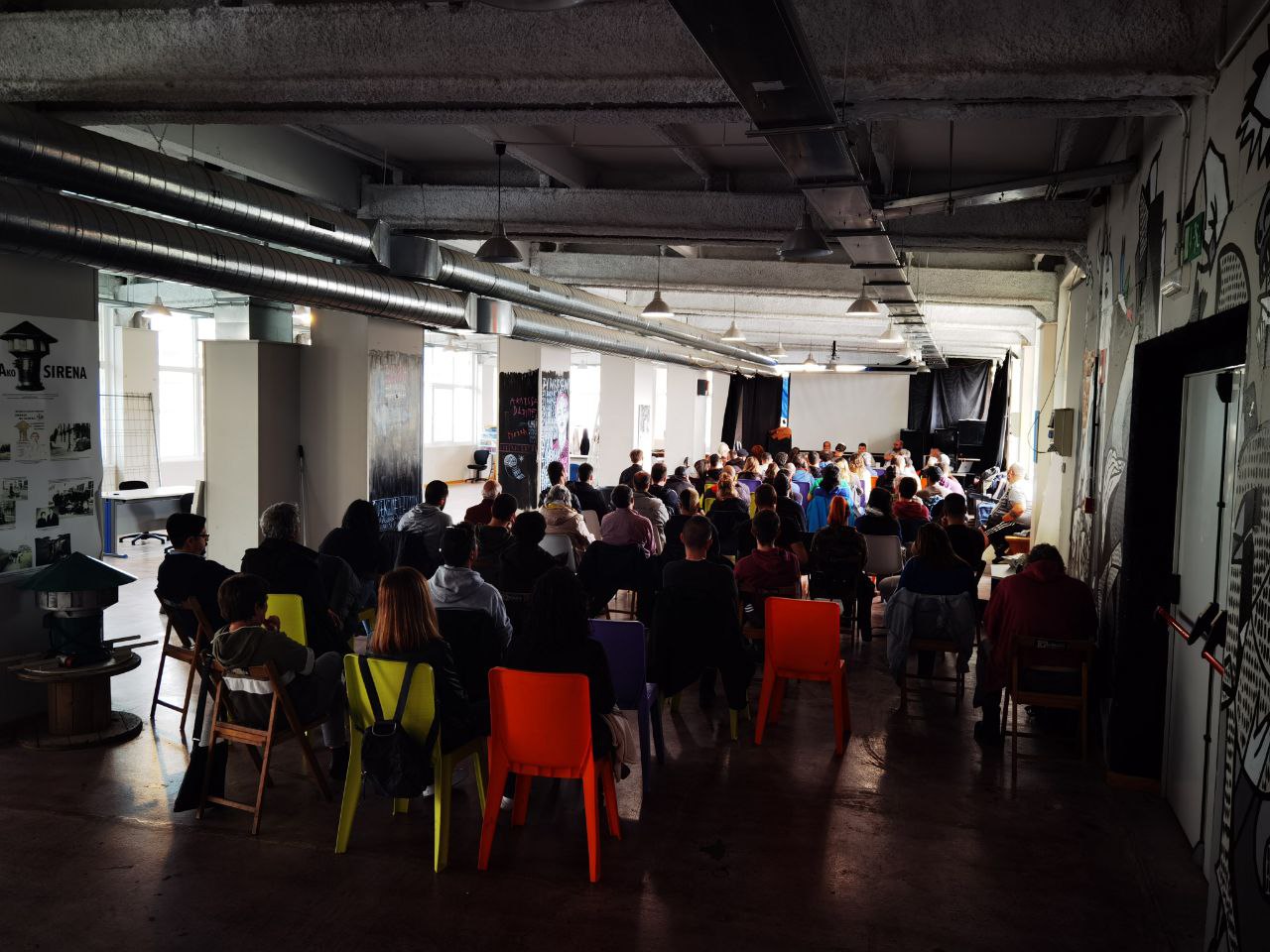
Section of audience at afternoon session of the anti-fascist conference in Gernika, Basque Country.
Ireland
The next speaker was from Dublin Republicans Against Fascism, explaining that eight centuries of occupation of his country by England has ensured that the dominant struggle had been one of national liberation and that all armed struggles since 1798 had been led by Republicans of various kinds: 1801, 1848, 1867, 1882 and 1916.
The Irish State that came into being after the War of Independence in 1921 had been a client of the UK, conceding over one-fifth of its national territory as a direct colony. The armed forces of the State had formally executed over 80 of the IRA and instituted a wave of repression including kidnappings, torture, murders including of prisoners.
In keeping with the rise of fascism across 1930s Europe, Ireland saw the Blueshirt movement, led by former police chief Eoin O’Duffy. The Republican movement and socialists fought these on the streets, the speaker said.
The Dubliner recounted briefly the history of Irish Republicans and socialists going to fight Franco in the Spanish state and the Irish diaspora fighting the British fascists, the Blackshirts, in British cities and in defence of Eastern European Jews in famous Battle of Capel Street in the East End of London against over 7,000 police.
He went on to recount some more recent successful physical attacks by joint Republican groups against fascist organisations, the Pegida group in 2016 and even more recently the National Party. Recently too, Republican ex-prisoners had released a video stating the opposition of Republicanism to fascism with a growing list of signatures.
In conclusion, the speaker said that Ireland’s history made it difficult for fascism to advance in Ireland (except in the Loyalist areas) but as long as capitalism exists so too does the danger of fascism, particularly if the progressive forces do not fight effectively against the attacks of Capital on working people.
Catalonia
The representative of the Anti-Repression Platform of Catalonia, speaking in Castilian (Spanish), explained their organisation had come into existence after the repression of the Independence Referendum in 2017 and the subsequent frame-ups and allegations of terrorism against the Committees for the Defence of the Republic.
The speaker alluded to the jailing of the revolutionary socialist rapper Pablo Hasel and comrades who were charged with terrorism merely for expressing and organising solidarity for those being repressed.
“Don’t try to frighten us with threats of a fascist party getting into government”, he said in a reference to the growth of the Spanish fascist party Vox, because we have had a fascist government in the Spanish state since 1939!” (The year that the military-fascist forces defeated the Second Republic and founded four decades of dictatorship).
The Catalan went on to denounce the social-democratic party PSOE (currently in coalition government with Podemos Unitas), pointing out that it has had more political prisoners in jail and fatal victims than any other party in Spanish government (he was probably including the sponsoring the GAL terrorists of the 1980s).
“There has not been a year in which there were no political prisoners in the Spanish state”, he went on to say but also denounced the current Catalan Government, led by the allegedly pro-independence and leftist ERC party and its repression of socialists and independence activists.
He pointed out that fascists would make no distinction between communists and anarchists and asked “so then why should we?” He declared that all who resist repression now, regardless of before, are welcome to take part in their organisation.
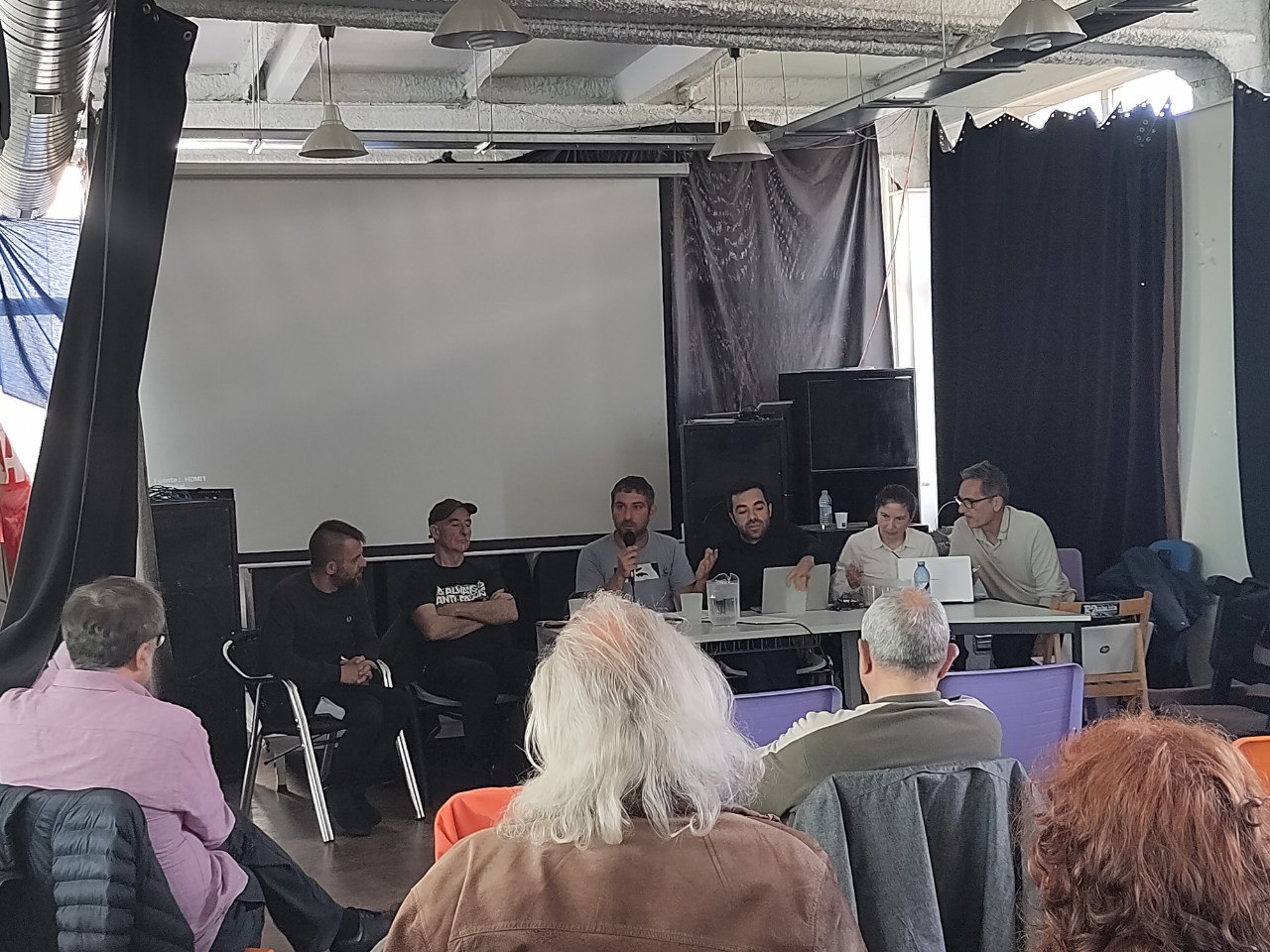
The panel at the afternoon session: from left to right: speakers from Catalonia and Ireland, Basque chairperson, Turkish speakers and translator.
Prisoners on hunger-strike
The chairperson of the panel thanked the speakers and drew together elements from each of their presentations.
He went on to announce the declared intention of a small group of Basque political prisoners to embark on a hunger strike and to outline solidarity events being organised. The prisoners concerned are in the non-compliance minority of Basque political prisoners with a regime that forbids them referring to themselves as political prisoners.
The prison authorities intended to make the prisoners share a cell with other political prisoners who are however in compliance, intending to undermine the resistance of the small group and also posing the danger of conflicts within the cell. (A few days later news came that the hunger-striking prisoners had won their demands).
Amnistia organisation solidarity poster announcing forthcoming hunger-strike of political prisoners, now over because they won their demand.
Summary
The conference in its organisation and content of contributions drew anti-fascism together with imperialism and internationalist solidarity, all from an anti-capitalist perspective. It also drew connections between solidarity with political prisoners and resistance to repression.
All of the Basque organisations represented are in opposition to the trajectory of the leadership of what had been the Basque Left Patriotic movement, now represented by the EH Bildu party led by Otegi (with daily newspaper GARA, its trade union organisation LAB) and many of the older people were ex-supporters of that leadership.
That included some prominent ones such as Inaki Gil de San Vincente and the speakers and organisers of the conference and of the homage to the memory of Kontxi “Rita” Arana. The younger participants might have included ex-members or had come into political consciousness in opposition to that leadership.
Taken together, they are what many call ‘dissidents’ though some reject that term, saying that they are in fact sticking to the original line of independence and socialism and that it is the official leadership and their followers who have deviated. Their numbers are comparatively small at the moment but they are growing.
2022 was a busy year for the anti-internment campaign organisation, involving, along with its public awareness-rising events, a reorganisation with a new constitution, a new name and expansion of membership.
Origins
The formation of an anti-internment campaign was sparked by the revoking of the licence of ex-political prisoner Marian Price in May 2011 for the “crime” of steadying the written speech of an IRA speaker during a windy Easter Rising commemoration in Milltown Cemetery, Belfast.
In addition to revocation of the licence under which Republican prisoners were released under the Good Friday Agreement, other activists were also being charged under “anti-terrorist” legislation and routinely being refused bail, if not granted it under severe restrictions.
The wait for a trial is often two years and regardless of the eventual outcome, the individuals had already spent two years in jail or at home, barred from travel or political activity and harassed by police visits to their homes.
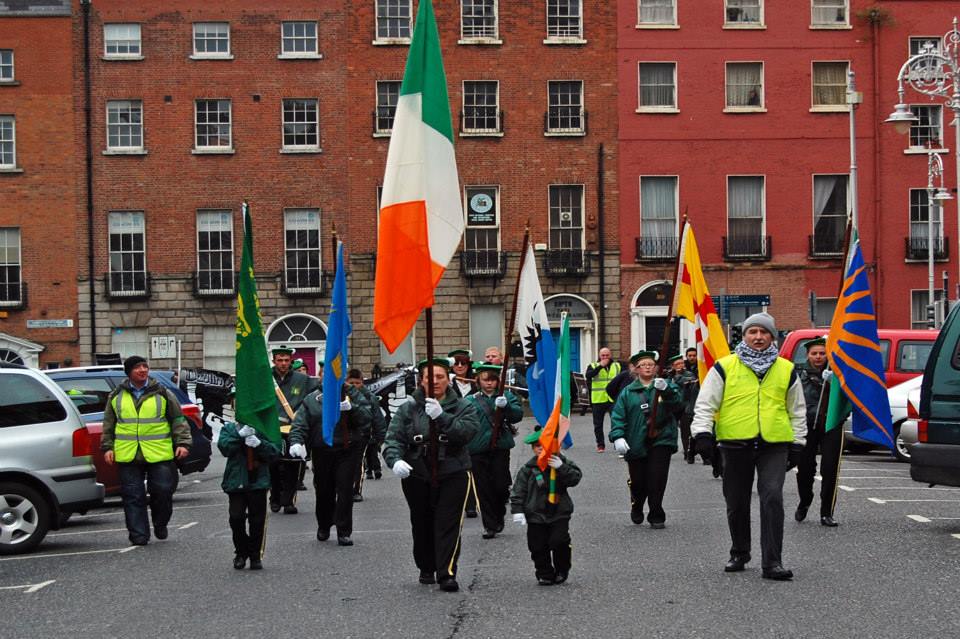
Early banner-placard protesting the internment of Marian Price (Image sourced: Libcom.org)Front section of Anti-Internment March, coming into top part of Parnell Square, Dublin 2013. (Image sourced: IAIC archives)
These conditions were considered to be in effect the same as internment without trial and the campaign against internment was founded as an independent one, a status it maintained despite a number of attempts to take it over or to intimidate with threats and State harassment.
Throughout its history the Anti-Internment Campaign has organised the annual Newry event (not since 2021 unfortunately), many pickets (including in protest against Amnesty Ireland) and a march in Dublin, spoken at or participated in public events in Belfast, Cork, Derry, Glasgow and Wexford.
It has also organised and hosted conferences and public meetings, for example with speakers from the campaigns for the Craigavon Two, Munir Farooqi and Tony Taylor and about the Right to Protest with a speaker from the Irish Council for Civil Liberties.
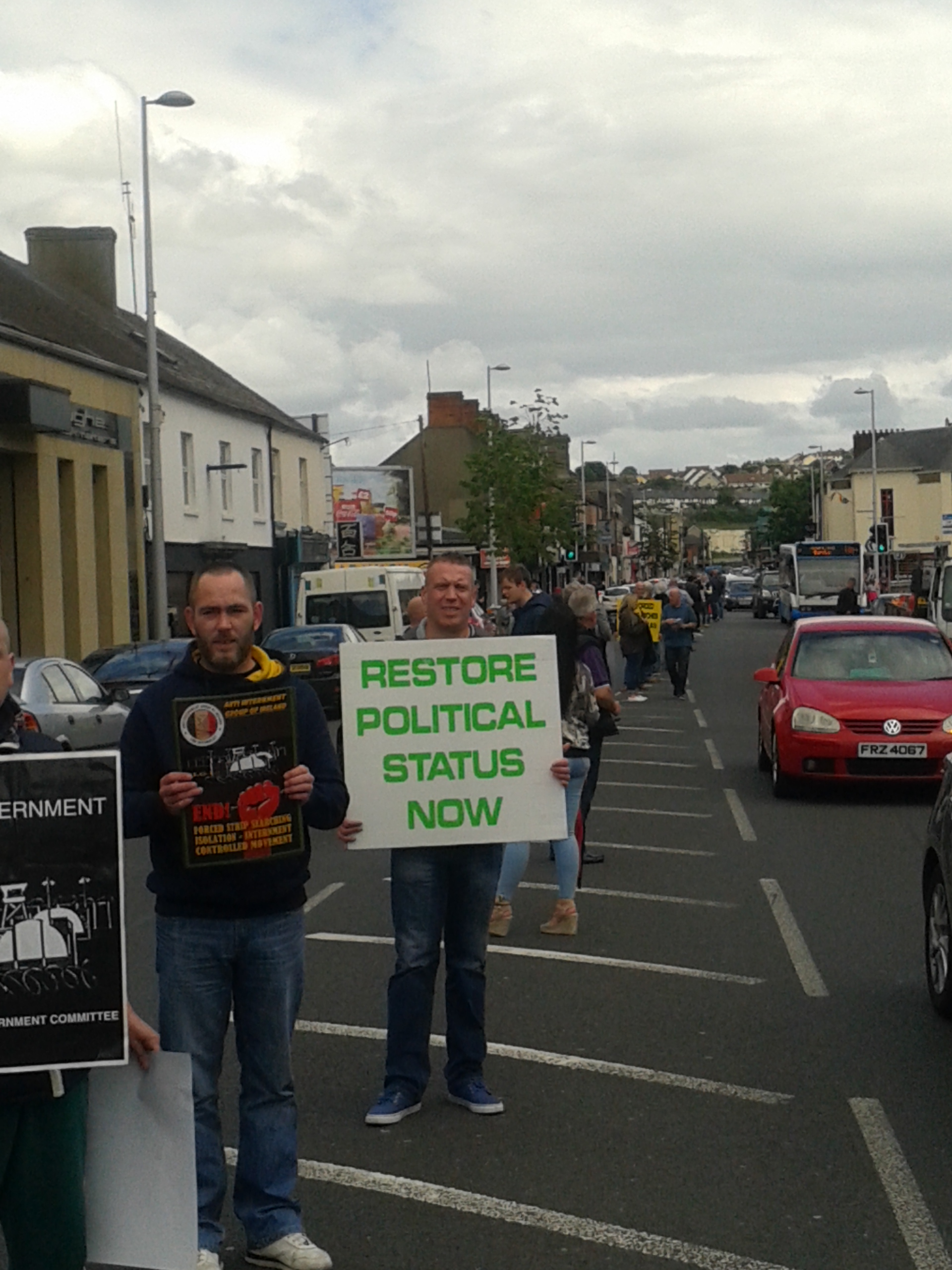
Section of the annual Anti-Internment white-line picket Newry, August 2016 (Image sourced: IAIC archives)
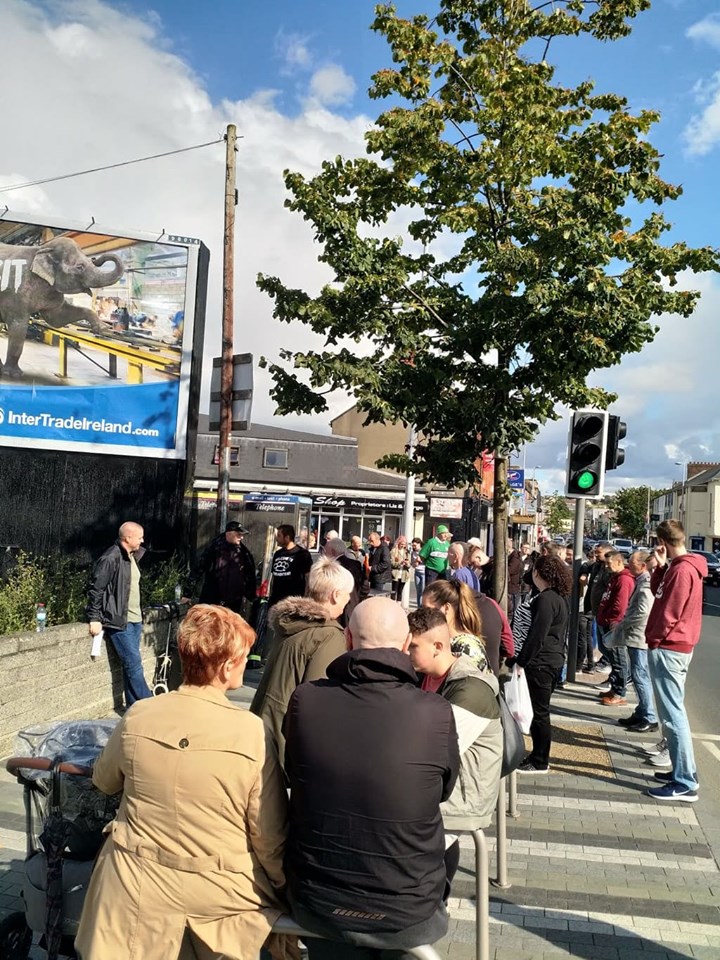
Annual Anti-Internment, Newry, rallying after white-line picket, August 2019 (Image sourced: IAIC archives)
A busy year
As stated in the introduction above, 2022 was a busy year for the anti-internment campaign group, involving, along with its public awareness-rising events a reorganisation with a new constitution and a new name. The campaign organised nine public events and participated in more.
Most of those public events were awareness-raising pickets with placards, banners, flags and leaflet distribution. Usually the pickets alternated between the Henry Street/ Liffey Street junction and at Crown Alley by the square in the Temple Bar area, both areas busy with shoppers and tourists.
Anti-Internment picket in Henry Street, November, Dublin 2022 (Photo: IAIC)
The campaign carried out pickets in Henry Street on 9th April, 6th August and 19th November and in Temple Bar on 5th March, 21st May, 2nd July and 27th August. On 22nd October, with a special focus on Palestinian prisoners, we were on the iconic Ha’penny Bridge.
It has always been of particular interest to the campaign group to reach working people and large numbers of that class of all ages pass through those areas. Of interest also are people from other lands and the Basque and Palestinian flags alongside the Irish ones often stimulate discussion.
In September the campaign attended the Peter Daly commemoration in Wexford and provided a speaker at the Dublin meeting to re-launch the End State Repression campaign which our group had supported in the past but which had waned over the Covid epidemic period since.
Our campaign group also took part in the planning of and participation in the joint prisoner’s solidarity picket in Dublin on 17th December 2022.
Reorganisation
It had been clear for some time that the organisation was in need of reorganisation to facilitate expansion but the process had been difficult.
Eventually in July the decision was taken to close down the Anti-Internment Group of Ireland and to reform under another name. This was done and, after democratic consultation process a new constitution was agreed, with the Ireland Anti-Internment Campaign as the new name.
According to agreed decisions, a new banner with the organisation’s new name was commissioned (though it would take some time to come to fruition). A new Facebook identity for the group was constructed with a statement explaining the development.
The new constitution, more explicitly democratically-based than had been previously the case, was published.
Anti-Internment picket in Temple Bar, Dublin, March 2022 (Photo: IAIC)
Year planning
In the reorganisation process, the IAIG lost one member but gained three new activists and the return of two lapsed members. With renewed energy, members began planning for the rest of the year, to conclude with participation in the annual Bloody Sunday March for Justice in Derry.
Issuing a statement to explain the reorganisation, commissioning a new banner, scheduling a number of pickets in Dublin and organising the annual Prisoners’ Solidarity Picket in Dublin December were part of the planning and most of the target actions were completed.
In December and in good time, the campaign’s members organised to purchase, sign and mail Christmas cards to all Irish Republican prisoners, also a number of non-complying Basque political prisoners and the Catalan jailed revolutionary Catalonian rapper Pablo Hasel.
The proposal to organise the annual Prisoners’ Solidarity picket in December jointly with the Irish Republican Prisoners’ Welfare Association and with Ireland Anti-Imperialist Action was agreed and the joint event went ahead on 17th December with around 40 participating.
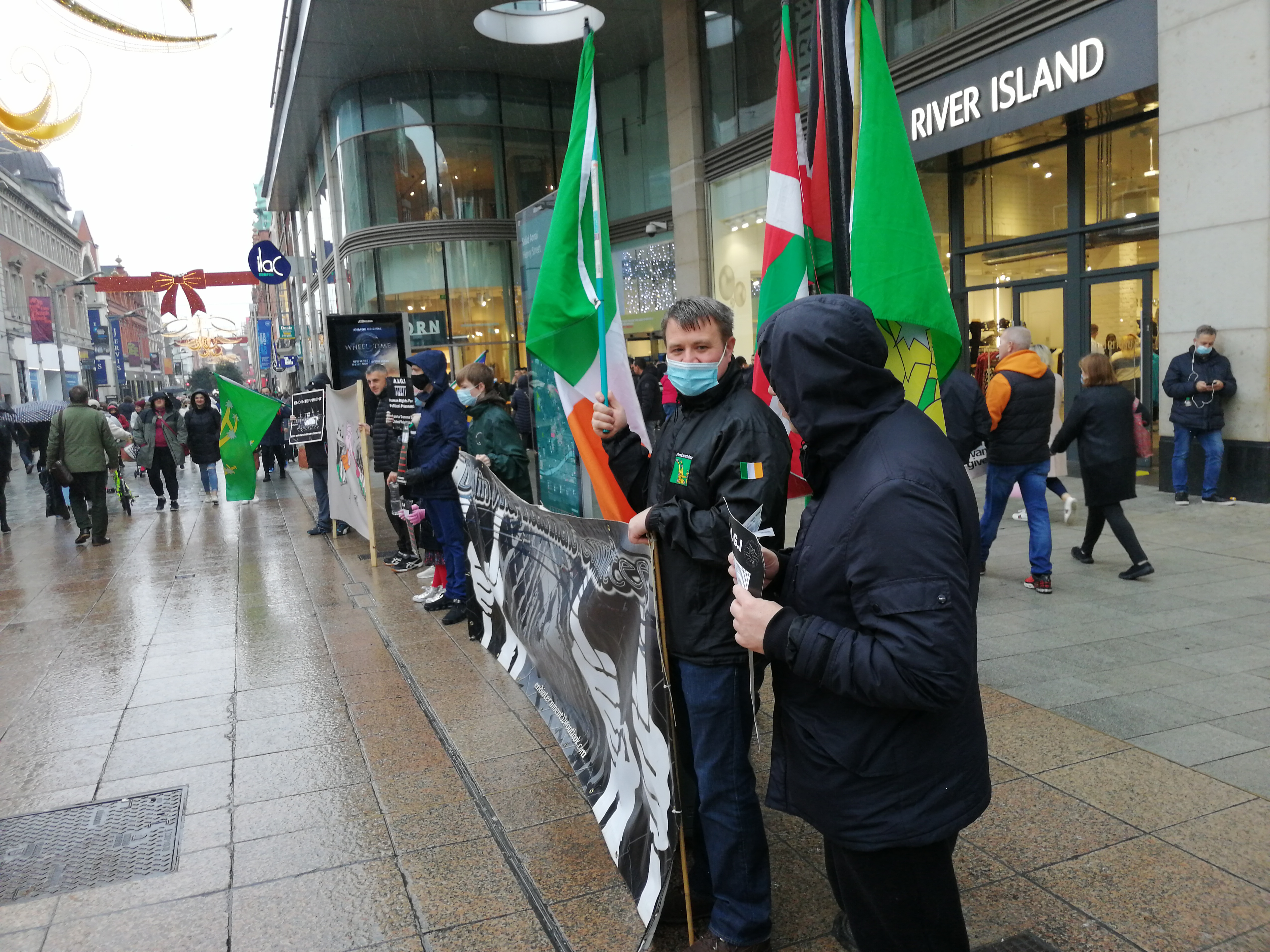
Section of the joint AICI, AIA and IRPWA Republican Prisoners’ solidarity picket 17 December 2022, O’Connell Street, Dublin 2022 (Photo: IAIC)
The picket with placards and banners, including the illuminated words of the IAIC’s “SAOIRSE” (“Freedom”) attracted attention and passers-by, both Irish and from abroad engaged leafleters and other participants in discussion. A speaker from each group gave a short statement.
The year’s programming ended with the specific scheduling of participation with a new banner in the annual Bloody Sunday March for Justice in Derry.
New Banner Aired at Bloody Sunday March for Justice in Derry
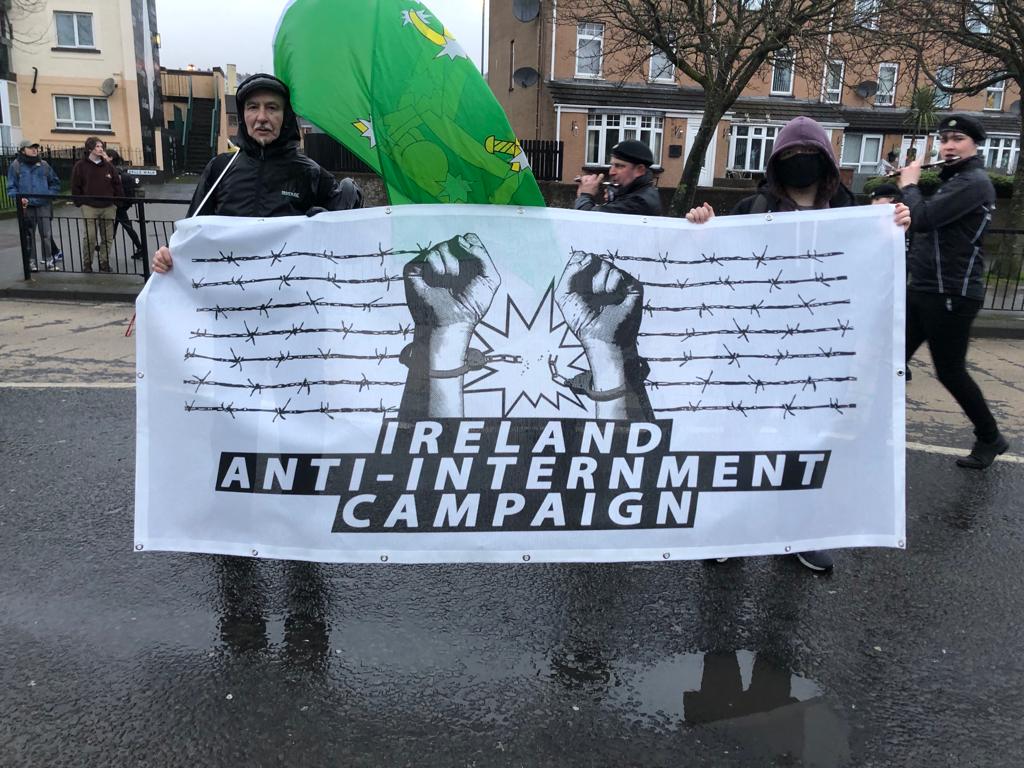
The new banner got its first public airing at the annual march in Derry, commemorating the massacre of unarmed civilians by the British Army in Derry in January 1972 and was carried as part of the march from the Creggan, through a large part of Derry and down to Free Derry Corner.
The marchers in different political parties, campaign organisations and independent individuals marched trough cold rain and strong wind-gusts through the nearly 5-kilometre walk. The members of four Republican Flute Bands played bravely throughout.
The new banner of the Ireland Anti-Internment Committee carried in the Bloody Sunday March for Justice in Derry in January 2023. (Photo: IAIC archives)
The IAIC will shortly begin its year-planning for the rest of the year, its calendar again probably ending at 2024’s Bloody Sunday March for Justice and meanwhile organising events to publicise the on-going undemocratic jailing of activists without trial both sides of the British Border.
The IAIC considers that the jailing of people without trial by both administrations is, in addition to political repression, a significant assault on civil rights and a threat to all opposition groups and that it is in the interests of all to unite in opposing the practice.
The Campaign welcomes the active support of all democratically-minded individuals at its public events.
Thousands of people gathered on Sunday 29th January in Derry City’s Creggan area and marched through rain and gusts of strong wind in the annual Bloody Sunday March for Justice to Free Derry Corner.
The march commemorates the Derry Bloody Sunday Massacre of the last Sunday in January 1972, when the Parachute Regiment opened fire on unarmed Civil Rights marchers, killing 14 and injuring a great many, claiming the soldiers had only returned fire on paramilitaries.
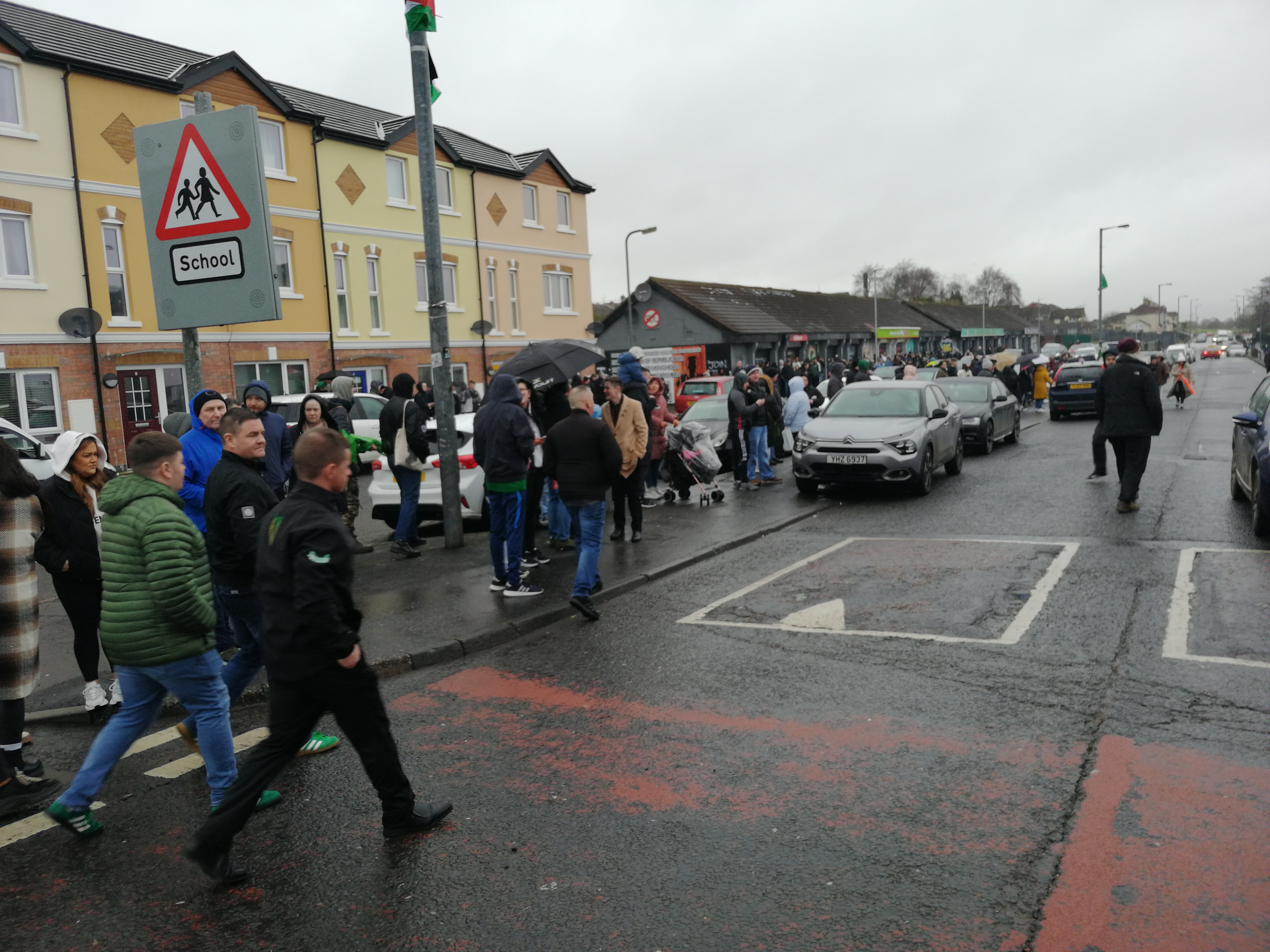
By the Creggan shops, people still arriving, others waiting to march (Photo: D.Breatnach
Other side of the road. (Photo: D.Breatnach)
British Governments for decades stood by those claims, refuted by many hundreds of witnesses to the actual shootings and though the city’s coroner called it “sheer unadulterated murder”, the inquiry under Lord Chief Justice Widgery declared in favour of the Paras’ version.
The 1972 march organised by the Northern Ireland Civil Rights Association had been protesting the introduction of internment without trial in August 19711 and the Paras had already killed 11 unarmed protesting people that month in the Ballymurphy housing estate, Belfast.2
Among the scheduled speakers and organisers in Derry in 1972 had been leading activists of the time, Bernadette Devlin (now McAlliskey) of People’s Democracy3 and Eamon McCann of the Socialist Worker’s Party (now People Before Profit).
The Commemoration this year
Participating organisations this year included Anti-Imperialist Action Ireland, Communist Party Ireland, Éirigí, Irish Republican Socialist Party, Irish Republican Welfare Association, Lasair Dhearg, People Before Profit, Republican Network for Unity, Saoradh, 1916 Societies.
Also marching were an IWW/ Anarchist contingent and a number of campaign groups: Ireland Anti-Internment Campaign, Ballymurphy Justice, Justice for the Craigavon Two, Justice for Manus Deery, with a number of environmental groups were represented also.
Derry Trades Council and IWW seemed to have the only trade union banner present or flags present.
A broad domestic and internationalist solidarity sweep was evidenced by the poster for the event with the slogan: “An injury to one is an injury to all” and also by the banner of the Derry branch of the Ireland Palestine Solidarity Campaign.
Poster for the 2023 march (Sourced: Internet)
Public support from Britain came with a banner of the Fight Racism/Fight Imperialism periodical and leaflets from Republican Socialist Platform4 were distributed among the marchers also.
Some years can reveal the misfortunes of particular organisations with a much smaller contingent than previously due to drop outs, defections and splits. Equally it has not been unknown for an organisation to draft in people to inflate its numbers specifically for the annual march.
The annual march takes the twisting route of the original one in 1972, covering much of the Derry nationalist housing areas.
Marchers rally at the Creggan heights and march down to the bottom of the hill, then along and up another steep hill, turning right at its top, along and then right down again and, at the bottom, turning right and along to the Free Derry Corner5 monument where speakers address the crowd.
Kate Nash chaired the rally there and Liam Wray, relative of murdered James Ray spoke as did also Ria, niece of John Paul Wooton who, with Brendan, are the Craigavon Two, framed for the killing of a colonial policeman.
The numbers this year were a huge drop from the previous year’s but 2022 was the 50th anniversary of the massacre and the participants are estimated to have numbered well over 10,000, including maybe 10 marching Republican Flute Bands6 from Ireland and Scotland.
Nevertheless the mass media’s coverage of last year’s march varied from minimal to nil.7
Probably4,000 actually marched this year, but perhaps nearly another 1,000 gathered on the roadsides to watch the marchers, greet people they know and so on. Many children are brought by their parents to watch while their older siblings gather and sometimes accompany marchers too.
The day had begun sunny and crisp but by march time the weather had deteriorated to constant rain and gusts of wind and, as the march reached the Lecky Road, to a heavy downpour. It was bad but veteran marchers have experienced worse in previous years, including snow and sleet.
Waiting to begin the march (Photo: D.Breatnach)
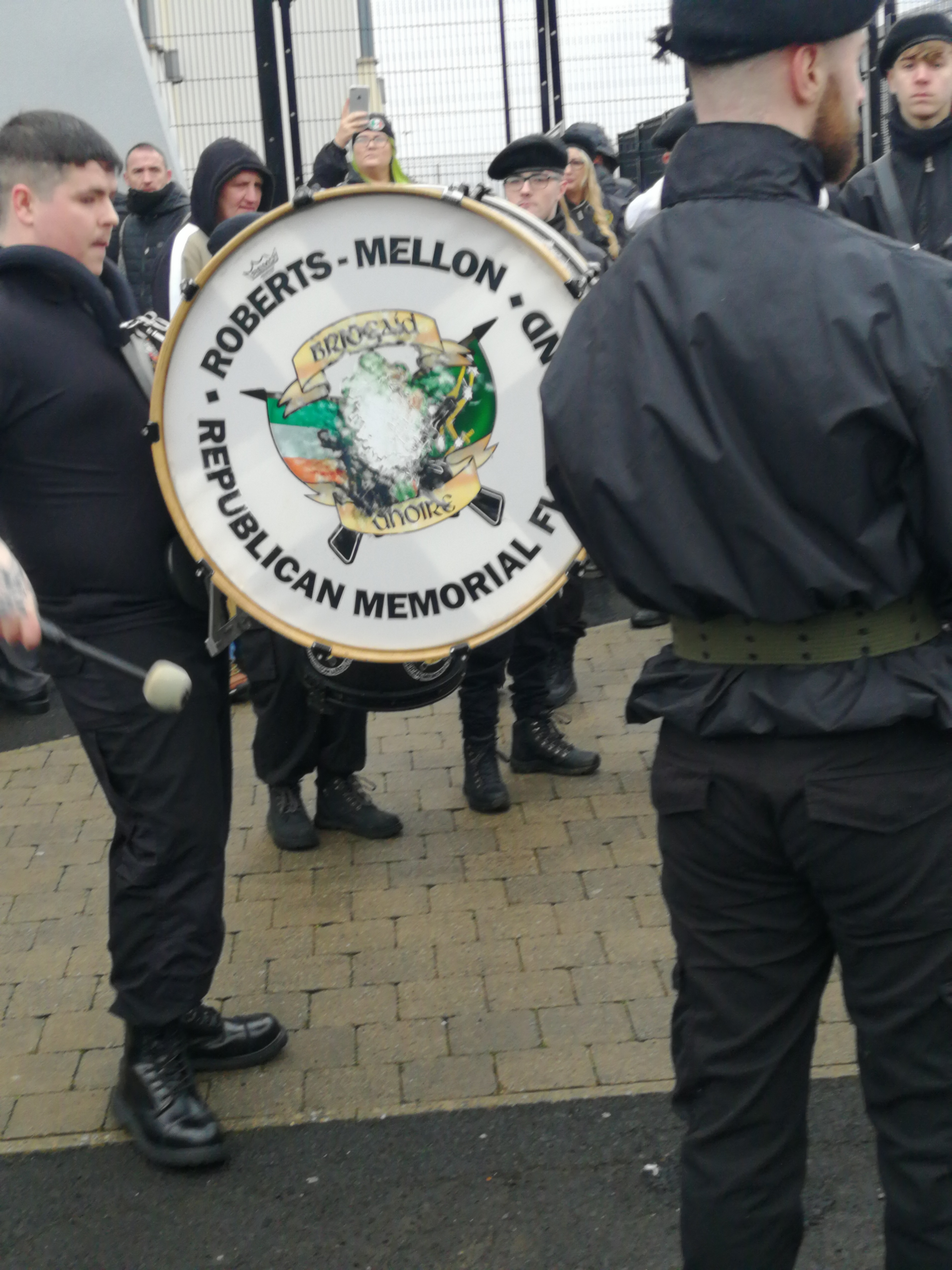
Three Derry-based Republican Flute Bands formed part of the march: James Connolly RFB, Kevin Lynch RFB and Tommy Roberts Stevie Mellon RFB, along with the Banna Cuimhneachán Thomáis Uí Chléirigh (Thomas Clarke Memorial RF Band) from Dungannon.
Although in recent years members wear more weather-appropriate uniforms, they still do an amazing job marching and playing in bad and sometimes atrocious weather.
A Deal with the Devil
The Sinn Féin political party, once prominent among the march organisers and speakers at the rally, sought to end the annual march in 2011 and have not supported the event since.8 This was after the British Government publicly apologised for the massacre that same year.
Part of the process leading to that Governmental apology was the setting up of the Saville Tribunal in London in 1998, although it took unexpectedly long to deliver its verdict.9 The Good Friday Agreement was also concluded in 1998, giving the Tribunal the appearance of a concession.
Indeed, the whole has the marks of a deal with the Provisional IRA’s leadership, with the British side saying: “You give up the armed struggle and control your people. We’ll make it easier for you by releasing your prisoners on licence10 and admitting we were wrong in Derry in 1972.”
Whether ceasing the annual commemoration was part of the deal or whether that was Sinn Féin’s own leadership’s decision is difficult to guess. It may have suited SF to scale a colonial reminder event down or simply to scratch one big annual event from their organisational calendar.
On the other hand, it has lost Sinn Féin all control of an important historical commemorative event on the Irish Republican calendar and their abstention again at the 50th anniversary march was a massive exposure of their collaborationist position.
The Bloody Sunday Trust also boycotts the march, in the sense that it does not promote it nor record its annual march or other events opposed by Sinn Féin. It does organise and promote its own events during every anniversary but that seems to be as a counter to the march organisers.
The BST of course receives funding and employs a Director and staff for its museum. Nobody pays Kate Nash or other members of the Bloody Sunday Commemoration committee; they rely on public donations and sale of items such as commemorative T-shirts to fund the march11.
A number of relatives of the murdered and injured civilians continue to support the march and are counterered among its organisers, for example Kate Nash, sister of murdered William murdered on Bloody Sunday and daughter of Alex Nash seriously injured by the troops the same day.
The Derry Trades Council and two of the original organisers and speakers support the continuation of the commemorative march as do most Irish Republican and Socialist organisations.
In formation ready to march. Note the presence of female members in the prestigious and ceremonial colour (flags) party, more commonly seen in recent years. (Photo: D.Breatnach)
Most Irish people call the city “Derry13” from the ancient monastic settlement located there, “Doire Cholmcille”14 but most Unionists and the British officially call it “Londonderry”. Many think the latter do that to annoy but there is a historical basis for it.
Large parcels of land in the city and surrounds were the payoff to the City of London for bankrolling Cromwell and the English Parliament’s campaign in Ireland to crush support for King Charles and the resistance of the Irish clans and Norman-Irish magnates.
Commemoration of the crimes of the oppressor forms an important part of the resistance of the oppressed around the world. Such events say “Our oppressors committed this atrocity here and we remember, will always remember and constantly deny them any legitimacy in occupation.”
If that is so, what gives any liberation organisation the right to call an end to such commemorations? Yet that is what the formerly liberation Sinn Féin did in 2011 after a British Prime Minister apologised in public for the massacre (but as some kind of serious ‘error’).
Some of the guilty – poster for the 2020 march. (Image sourced: Internet)
Not a single Minister or civil servant who organised the Derry or Ballymurphy massacres, nor judge who condoned them, nor officers who ordered them, nor soldiers who carried them out have been even tried, never mind convicted or jailed in the thirteen years elapsed since that ‘apology’.
Derry’s Bloody Sunday will continue to be commemorated at least until British colonialism has left Ireland and probably as long as imperialism continues to exist.
Remembering is part of resistance; commemoration makes it collective.
End.
A plethora of flags in what seems to be the Anarchist and IWW section. (Photo: D.Breatnach)
Head of the march reaches the bottom from Creggan and turns into the Bogside (Photo: George Sweeney inDerry Journal)
FOOTNOTES
1Abandoned on 5 December 1975. During this time a total of 1,981 people were interned for a period without trial, many of them physically assaulted, some grossly beaten and a small number tortured (the “hooded men” whose campaign for justice is yet another example of courage and determination against British State lies, prevarication and delays). 1,874 were from an Irish nationalist background, while 107 were from a unionist background.
2A similar British Army story, “returning fire” and again witnesses’ accounts ignored. The British State has yet to admit the gross inaccuracy of the official account.
3The party grew out of the Civil Rights movement of which it represented a more radical section. It ceased to exist after a few years.
4Previously unknown in Ireland, the RSP claims members in Derry and Belfast and the leaflet states it is part of the Radical Independence Campaign in Scotland.
5The monument in the shape of a gable end of a two-storey house mimics its original inspiration on the blank gable end of a row of houses in 1968 when John Caker Casey or Liam Hillen painted upon it YOU ARE NOW ENTERING FREE DERRY. The Bogside enclave had been barricaded in 1968 to deny the sectarian and brutal colonial police entry and continued to exist as an area from which the police were barred and British troops, even after the official removal of the barricades, entered only in force and at their peril for years afterwards.
6Typically flute players, side and bass drums, led by a colour (flags) party, all in the band uniform.
7Instead the media concentrated on the presence of a small group of Irish Government Minister and politicians of main parties at an earlier event at the monument to the massacre and a cultural event in the Guildhall.
8No doubt some of SF’s supporters in Derry and many more of its voters ignore the party ban and attend nevertheless.
9An almost unbelievable 8 years after a delay of two years before hearings began and £400 million in costs (mostly in fees to law practitioners) even through years when no hearings were being conducted.
10Release on licence meant they could be returned to jail to complete their original sentence at the discretion of the Minister of State for Northern Ireland, without a hearing or entitlement to know the specific reason for that decision. At first only the Provisional’s prisoners signed up to it but were followed by those with allegiance to other Republican groups, along with Loyalist paramilitaries. As they were leaving the jails, a new crop was entering due to new or alleged acts of resistance, rising to 70 between jails in both states and never falling much below 50.
12Popular Irish balladeer Christy Moore, on a British tour in the 1980s, greeted his London audience by calling the city “Derrylondon” to wild cheering. Shortly afterwards an Irish activist produced Christmas cards displaying London sights in snow, titled “Christmas greetings from Derrylondon”.
13Derry City FC is also the name of the local soccer club which enjoys cross-community support.
14“Colmcille’s (“Dove of the Church”, real name possibly Crimthann of the Cenel Connail) Oakwood”.
The remains of more than 1,700 victims have already surfaced, twice as many as expected
Report from Info Libre, by Angel Munarriz, Seville — January 6, 2023 7:39 p.m. @angel_munarriz (translation and editing for publication here, also Footnotes and Glossary by D.Breatnach)
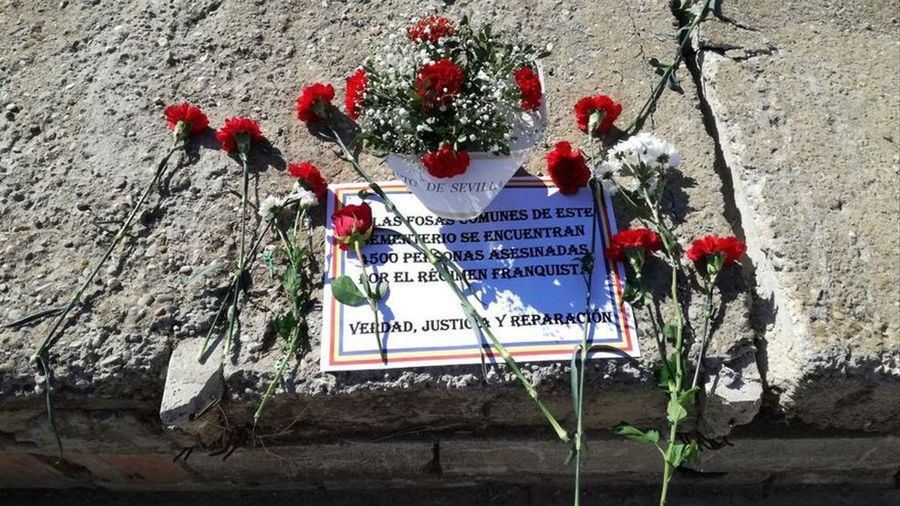
The mass graves in the Seville cemetery are a puzzle. Historiographical research has concluded that thousands and thousands of victims of Francoism lie dumped without order or recognition, but there is hardly full certainty of a few hundred names registered in the municipal registry.
What is underground is a sordid totum revolutum1 of bones of those shot right there and on nearby walls, of those killed in prisons and concentration camps or in confrontations with the rebel troops, or of victims of hunger and poverty who were was buried free of charge along with those who suffered repression.
Today the puzzle is still far from complete; it will probably never be so, because part of the mission of the placing of graves in the San Fernando cemetery was to erase the traces of the crime.
But some pieces are beginning to fit. It is even possible already to glimpse some forms. What is observed goes beyond any hypothesis.
Not everything in this story is summed up in numbers, because behind each number there is a human being. But numbers are essential to understand its dimension.
There they go: the search in the mass graves of the Franco regime led by the Seville City Council is now extended to more than 4,000 possible victims, according to the calculations of the consistory itself, based on historiographical sources.
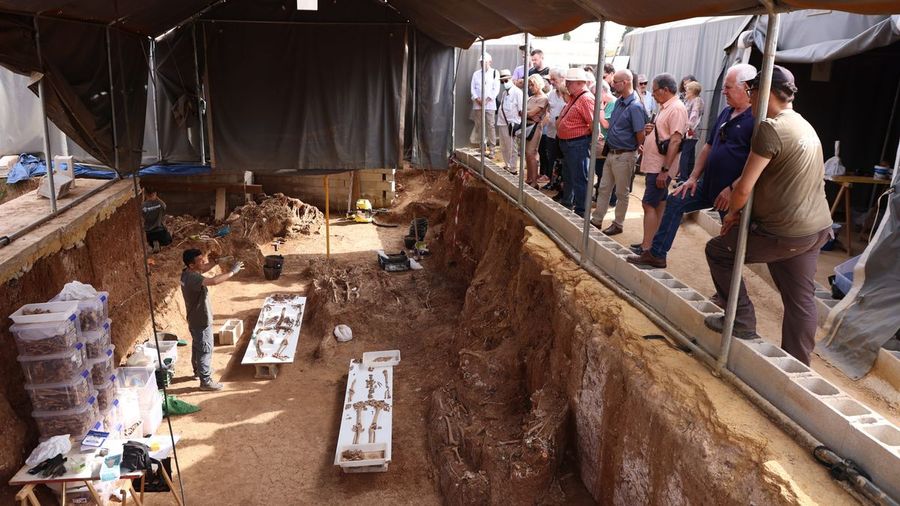
In the first excavated burial, Pico Reja, the remains of more than 1,700 victims have already surfaced, twice as many as expected, making it “the largest open mass grave in Western Europe since Srebrenica”, as the City Council highlights.
In the second, called Monumento, pending opening, there could be more than 2,600. The horror revealed in what was the fiefdom of Gonzalo Queipo de Llano2 seems to have no end.
Overflowing forecasts in Pico Reja
The exhumation work in the Pico Reja grave, which began a little less than two years ago, is nearing completion.
“The idea [of the City Council] is to carry out an act of symbolic closure of the pit before the end of January. We are going to do everything possible,” explains Juan Manuel Guijo, director of the excavation, which is in charge of the science society Aranzadi, a benchmark in this field.
Guijo is not certain about the deadlines.”The pit must be left clean, without remains,” he says. In addition, “a huge amount of funerary material is coming out.”
The anthropologist uses scientific jargon: “Huge amount of funerary material.” They are human bones.
The initial forecast for the number of deaths was just over 1,100, of which between 850 and 900 would be victims of Franco’s repression, according to the City Council. But reality has broken any forecast.
Guijo advances to InfoLibre the figures as of December 30: the remains of 8,600 individuals have been located, almost eight times more than previously thought; of these, 1,718 are victims of the Franco regime, around twice as many as expected.
The two figures, says Guijo, “will be exceeded” at the end of the excavation.
“We can reach 9,000 people exhumed. All this was impossible to foresee. It is beyond any possible forecast,” he says.
The mayor of Seville, Antonio Muñoz (PSOE), has said it in other words: “The reality was much worse than what was estimated in the initial forecasts.”
Visitors to the Pico Reja mass grave excavation in May 2022 (Photo sourced: InfoLibre)
An explanation? The grave “was not filled up shortly after the coup, as was thought, but was open until 1940, or at least it was opened punctually in 1940,” explains Councilor Juan Tomás de Aragón.
The remains –wires and shackles– or the posture allow us to conclude that a victim was tied up, either with the wrists together or with the hands behind the back. Clips found appeared to hold several in a row with rope or wire.
The skull is the most frequent area of impact of the projectile, especially from behind, but also on the face. There is an abundance of long-arm projectiles used for the Mauser rifle, as well as short-arm bullets, mainly 9 mm.
In addition to the unmistakable bullet holes, there are “simple” fractures that point to “illtreatment” and “cruelty,” Guijo explains. The extreme fragmentation, mutilation, shrapnel and grenade remains seem to be attributable to “high energy trauma”, typical of combat.
500 families waiting: from Blas Infante to Horacio Gómez
One of the pieces of the puzzle fell into place in June.
The technicians confirmed the existence of evidence that certifies the remains of at least thirty of the victims who were members of what is known as the Mining Column, a group of volunteer fighters from the Huelva mining area that arrived in Seville bringing dynamite.
The characteristics of some burials –bodies without a coffin, grouped and face down– and the evidence that they had been retaliated against –shots to the neck, ties, perimortem fractures– allowed, together with some specific findings, to outline the hypothesis that they were members of the Miners Column.
There was a way to confirm it. How? These workers breathed, drank and ate in a mining environment without current security measures, so there could be a transfer of heavy metals to their bodies.
Indeed, the analyses carried out at the University of Santiago de Compostela have ratified it.
Much remains to be confirmed. Some 500 relatives have offered DNA samples, which must be compared with the remains of the victims, especially femurs, with signs of repression. You can’t always. There are more than 300 victims who do not present viable skeletal remains.
They are practically pulverized. This, added to the fact that the percentage of identifications with respect to the total number of bodies exhumed in this type of work is usually around 10%, caution is advised.
This same month of December, Horacio Hermoso, son of the former mayor of the city of the same name, a member of the Republican Left, assassinated in September 1936, died. Horacio Jr. gave his DNA, but did not arrive in time to see the end of the remains matching process.
DNA collection in 2019 from Horacio Hermoso, son of the former Republican mayor of Seville, of the same name, assassinated in September 1936. Sadly he died before his father’s remains were identified. (Photo sourced: InfoLibre)
Among the relatives who are still waiting is Estanislao Naranjo, grandson of Blas Infante, considered the father of Andalusianism, murdered in August 1936. “Things are going slowly, because it is a difficult grave,” he says.
Do you see the identification of his grandfather as possible? “In theory, yes. Due to the dates, they had to throw it into that pit. Now, it is difficult to know who was victimised and who was not. If the bullet hit a bone, you can see it. If it only touched soft parts, no,” he says.
Historical investigations maintain that, in addition to Infante, the remains of other political and union figures of the time rest in the grave, as well as loyal soldiers – Captain Ignacio Alonso – and assault guards3.
Councilor Juan Tomás de Aragón (PSOE) emphasises that all the victims will have a “dignified burial.” The City Council will build a memorial and a columbarium over the grave.
The Mayor tries not to generate excessive expectations about the identifications, so as not to pivot on this last phase the success or failure of the works. The truth is that the exhumation of Pico Reja has involved much more than exhumations and possible identifications.
For example, it has led to the making of several documentaries, such as Pico Reja. The truth that the earth hides. Students from schools, institutes and universities, from Seville and abroad, have organized visits to the work area.
Numerous university researchers have taken an interest in the process.
Monumento: the emblematic grave of Cruz de Lolo
The opening will not be limited to Pico Reja. The City Council plans to put out to tender in 2023 the excavation work for a second grave. It is known as the Alpargateros or Monumento pit.
According to available studies, it was open between September 1936 and January 1940 and no less than 7,440 bodies of deaths from different causes were deposited there, of which some 2,613 would be victims of Francoism.
Among them are believed to be the eight convicted of a plot against General Gonzalo Queipo de Llano, during which Concha Morón was arrested as part of The Resistence in Sevilla. An attempt to overthrow Queipo (Aconcagua, 2013).
Carmen Díaz may also be there, sister of the general secretary of the PCE, José Díaz.
If the forecasts of victims of the Franco regime in the Monumento pit are met, the total of the two burials would easily exceed 4,000. After Pico Reja‘s surprise, no one dares to say so. Perhaps, says the archaeologist Guijo, bodies attributed to Monumento were in Pico Reja.
Flowers in memory of the victims of Francoism buried in mass graves in the Seville cemetery. (Image sourced: InfoLibre)
Graves (and more matters) pending
The City Council trusts that the collaboration of the Diputación, the Junta de Andalucía4 and the Government in Pico Reja, where they have invested 1.5 million euros, will be repeated in Monumento, so called because of a commemorative monument raised there in 2003 by initiative of the Association of former Political Prisoners and Victims of the Franco regime.
Almost everyone who remembers that in this entire area crime reached inhuman levels hovers around the Monument pit.
In addition to the monument, in its paved area there is a cross placed by a communist blacksmith in the early 50s, tolerated by the authorities and known as the Cruz de Lolo. For the rest, no one would say. Seville has lived for decades in a democracy with back turned to the memory of its horrors.
The remains of Blas Infante, named by Parliament “father of the Andalusian homeland”, was not begun to be searched for until 2020.
Those of Queipo, head of the repression in southern Spain, the coup leader who called for “raping Reds”, have only recently left the place of honour they occupied in the basilica of La Macarena,5 in compliance with a state law.
This was without the confraternity with the most members in the city acting on its own initiative. Apart from this exhumation, the honours granted to him still stain the city.
Councilor Juan Tomás de Aragón highlights the “normality” with which the exhumation of Pico Reja has been carried out, which he is sure will be repeated in the Monumento.
“Nobody has clutched their heads in their hands. People are more intelligent and mature than is sometimes thought,” he says. He believes that the key has been respect: “We have not hidden what we were doing, nor have we used it to confront anyone.”
There are more graves in the complex, in addition to Pico Reja and Monumento. Antigua –delimited and where it has been verified that there are no remains of victims, according to the councilor–, Rotonda de los Fusilados, Disidentes y Judíos, some extensions of filled graves…
“Francoism never admitted that there were graves, that’s why they were known by popular names. If it had admitted them, they would be called San Rafael, Santa Águeda …”, explains Juan Morillo, a reference to the memorialist movement in Andalusia.
He sees the exhumation process of Pico Reja as “exemplary”, but at the same time stresses: “All this, it must be remembered, has been done due to the pressure of family members and associations. No party had it on their pprogram.
“Memory continues to be the great democratic deficit in this country, where there are still unopened graves and streets with Francoist names”.
The City Council does not plan to disinter these graves, at least not while the largest ones are open. According to the available evidence, they have much fewer victims than Pico Reja and Monumento.
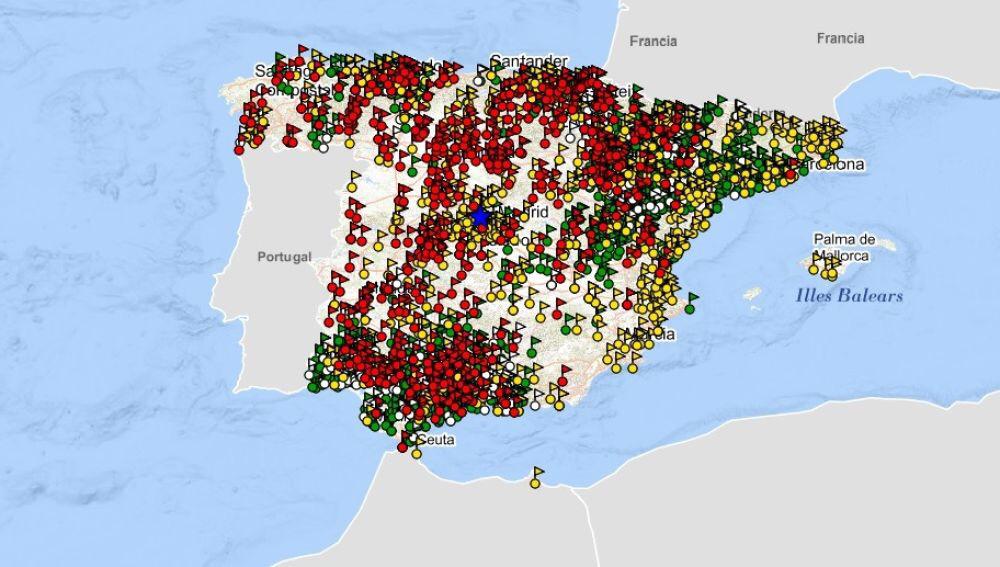
Known locations of mass and smaller graves from the Spanish Civil War and during the Dictatorship repression afterwards. (Image sourced: Internet)
Comment byDiarmuid Breatnach
It is important to note that most of the executions by the fascist-military forces during the Civil War took place outside combat zones, in which the fascist-military were in no danger whatsoever. They were punishing not only soldiers of the Second Republic but political activists and functionaries.
This is in contrast to the much lower number of executions in the zones under control of the Republic and, furthermore, as their authorities exercised greater control, the executions were reduced considerably.
Many executions also took place after the fall of the Republic and the terrible conditions of the vastly overcrowded jails and prison camps added their contribution to the fascist military harvest. Their purpose was revenge, deterrence of others and elimination of a democratic generation.
Generations growing up afterwards knew little of the extent of the horror unless informed by their family and communities, though may of these in turn felt obliged to remain silent unless they – or their sons and daughters – were to also become victims.
The subject is not taught in the schools and during the Dictatorship children were taught and expected to salute the icon of the Dictator Franco.
Unlike in Germany and even in Portugal, fascism was never defeated in the Spanish state and the Transition from Dictatorship brought the military, police, judges, civil servants, media moguls, university dons and Catholic hierarchy safely into the new “democracy”.
In addition, most of those who seized land, buildings, machinery and equipment, vehicles and personal wealth of the victims of the coup and war, were allowed to keep them
As Juan Morillo reminds us (see article), it is not the Spanish State that has pushed the process of disinterment and documentation of these mass graves, but relatives, communities and concerned citizens. And for a long time it was even dangerous to pursue such activities.
Fascism remains alive and strong in the Spanish state.
2Gonzalo Queipo de Llano y Sierra (5 February 1875 – 9 March 1951) was a Spanish military leader who rose to prominence during the July 1936 coup and soon afterwards the Spanish Civil War and the White Terror that followed. Capturing Seville with a force of at least 4,000 troops and ordering mass killings, he later made ridiculous claims, including that the city had been defended by 100,000 armed communists and that the fascist military troops had taken the city with as few as fifteen men. Quiepo de Llano publicly called for women of the Republican opposition to be raped.
3From Wikipedia: The Cuerpo de Seguridad y Asalto (English: Security and Assault Corps) was the heavy reserve force of the blue-uniformed urban police force of Spain during the Spanish Second Republic. (for more, see Glossary)
Andalusia: One of the ‘autonomous regions’ of the Spanish state, large southern region, from Al Andalus, province of the Moorish conquest of large areas of the Spanish state. After the Canary Islands it was the easiest for Franco’s troops to reach from the Spanish colony in North Africa; its defenders lacked time to prepare and did not last long against a well-armed and large invasion force.
Assault Guards (From Wikipedia): The Cuerpo de Seguridad y Asalto (English: Security and Assault Corps) was the heavy reserve force of the blue-uniformed urban police force of Spain during the Spanish Second Republic.The Assault Guards were special police and paramilitary units created by the Spanish Republic in 1931 to deal with urban and political violence. Most of the recruits in the Assault Guards were ex-military personnel, many of which were veterans.
At the onset of the Spanish Civil War there were 18,000 Assault Guards. About 12,000 stayed loyal to the Republican government, while another 5,000 joined the rebel faction.[1] Many of its units fought against the Franco supporting armies and their allies. Their siding with the former Spanish Republic’s government brought about the disbandment of the corps at the end of the Civil War. The members of the Guardia de Asalto who had survived the war and the ensuing Francoist purges were made part of the Policía Armada, the corps that replaced it.
Diputación: Regional administrative body in most regions of the Spanish state.
Izquierda Republicana Republican Left (from Wikipedia, translated): Izquierda Republicana (IR) was a Spanish left-wing republican political party founded by Manuel Azaña in 1934. It played a prominent role during the Second Spanish Republic and in the moments preceding the start of the Civil War. Azaña became President of the Republic between 1936 and 1939. During the Franco dictatorship the party practically disappeared from the political scene except in the sphere of Republican exile in Mexico, where it continued to have some activity. As of 1977 it was reconstituted in Spain again, although without having the (degree of) importance of the historical party.
La Macarena: Basilica of Nuestra Señora de la Esperanza Macarena (Our Lady of Hope of Macarena, base of the Holy Week Confraternity of that Catholic church. The procession on the early morning of Good Friday is one of the largest, most popular, and fervent in the whole of the Spanish state. The wooden statue of Our Lady of Hope of Macarena dates from the 17th century.
PCE:Partido Comunista de España (Communist Party of Spain) is a communist party, banned by Franco but supported the Transition from the Dictatorship and the monarchist Constitution, subsequently experiencing a number of splits. Comisiones Obreras (CCOO), one of the two main trade unions in the Spanish state, its associated trade union movement was the main underground workers’ element in forcing the change from dictatorship but is no longer under its control.
PSOE:Partido Socialista Obrero de España (Socialist Workers Party of Spain) is a social-democratic party, banned by Franco but supported the Transition from the Dictatorship and the monarchist Constitution, subsequently one of two main parties of government in the Spanish state, at the time of writing the senior member in coalition government with the Podemos party. Its associated trade union, Unión General de Trabajadores (UGT), is one of the two main trade unions in the Spanish state.
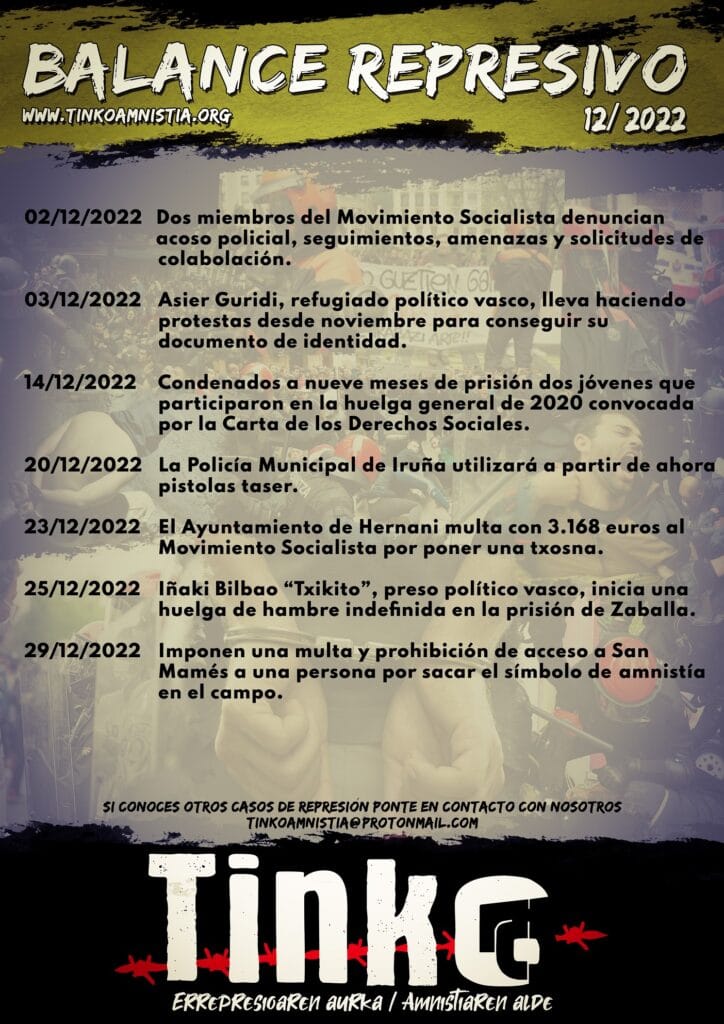
TINKO is an independent organization created to work for COMPLETE AMNESTY. As an amnesty organization, it intends to create the necessary means to fight against repression with its scope of work being the Basque Country.
As its name indicates2, it intends to reflect the attitude of determination and commitment of some political prisoners3 in these difficult times. Along with the dignity and toughness that is being maintained, there must be constant struggle in the streets.
It is our responsibility to keep the flame of the struggle burning; for this reason, we see it more necessary than ever to organise ourselves.
Drop-banners against repression in different locations in the southern Basque Country/ Spanish state (Photo: Tinko)
TINKO’s understanding of repression goes beyond reporting each case in isolation, since each of these cases responds to a general repressive situation.
The states are the ones that speak of the individualised treatment of prisoners, denying their political nature and hindering solidarity. Therefore, our duty in this regard is to promote unity and solidarity.
It is the slogan of COMPLETE AMNESTY that offers this overview of the aforementioned repression, as well as the political solution that opposes this repression.
Full amnesty includes freedom from all political repression without exclusion, as well as overcoming the underlying causes of repression, such as national and social oppression.
Therefore, TINKO is an organization made up of ideologically-conscious activists, who want to make their contribution in the field of anti-repression towards a Basque Socialist State.
If the intensity of the struggle is met with repression, it will be our task to counter that repression, to try to facilitate the conditions for the struggle.
It is necessary to take a broader reading of repression, paying attention to reality with the intention of joining our forces.
We aim to create a broad movement against the repression that upholds the interests of the political victims of the struggle cycles of yesterday, today and tomorrow, that will always be in accord with the declaration of complete amnesty and not establish differences according to the struggles carried out.
It is necessary to underline the enormous generosity of the militants who suffered the repression of the previous phase. They have been our compass even in the bleakest times and they continue to be so today.
Total amnesty is our strategic objective and we do not define it in a purely legal way but instead in a political way.
Amnesty includes the unconditional release and freedom of prisoners, fugitives, refugees and political deportees and also the resolution of the reasons that motivated these people to fight for their fundamental rights, in the case of the Basque Country, against national and social oppression by the Spanish and French states.
Only ending the denial of our rights can ensure that prisons do not fill up anew after they have been emptied. These are the other measures that a full amnesty should include, along with the aforementioned freedom from political repression:
The right to self-determination
Abolition of repressive laws against the working class. Repeal the labour reform laws, the muzzle law, the party law and the anti-terrorism law4.
Dismantle and expel the repressive and occupying forces from the Basque Country.
Press conference in November in solidarity with 18 people from Berango accused of “glorification of terrorism” (sic) for organising an “ongi etorri” (welcome) event for a released political prisoner. (Photo: Tinko)
ANTI-REPRESSION NETWORK
As we said at the beginning, TINKO intends to create the necessary means to combat repression.
We consider it necessary to create useful tools to organise in cases of repression, which allow the creation of effective solidarity networks for the protection of those who suffer repression for being active in different fields.
Monthly summary of repression (Castilian language version) December 2022, including: 9 months jail for two youth participants in the 2020 General Strike; municipal police in Irunea/ Pamplona are to get taser pistols; the municipal council in Hernani fine Socialist Movement 3,168 euro for running a street stall; Basque political prisoner initiates indefinite hunger strike in the Zabala prison. (Source: Tingo)
In addition to organising instruments for protection in the courts, insisting on repression as being general and calling for total amnesty. While the net would be politically wide, victims of repression would receive protection according to the following minimum essentials:
Joining the call for total amnesty.
Feeding the network itself, that is, strengthening the network against other cases of repression.
Putting the collective before the individual.
Not denying access to basic political rights in a possible trial: the right to political organization, the right to demonstrate, the right to assembly and the right to freedom of expression.5
End.
FOOTNOTES
1Tinko was founded some months after an internal dispute inside the Amnistia organisation in the autumn of 2020 about whether to support a demonstration in Madrid or not. Amnistia itself, as with Tinko, grew out of the perceived necessity to resist repression in order to move forward in struggle, while the official leadership of the left-nationalist movement was adapting itself to the requirements of the Spanish State.
2“Tinko” means ‘firmness’ in the sense of ‘resolved/ standing firm’.
3Note the qualification “some”: the leadership of the Basque prisoners’ organisation and of the relatives’ support group, Etxerat, followed the abandonment of the revolutionary path by the leadership of the Basque Izquierda Abertzale mass movement. Most of the prisoners followed the leaders’ line, which entailed prisoners not calling themselves “political” prisoners, not joining any protests and seeking parole as individuals, including apologising for their previous actions. The leadership dropped the call for Amnesty and confined their demands to an end to the dispersal of prisoners away from their home areas.
4In brief, laws restricting the right to strike and to record and disseminate police violence, along with laws permitting repression of political activists.
5There is a practical reason for the inclusion of this requirement: The Spanish State demands the political activists it arrests apologise for their resistance and undertake not to repeat it. Shamefully and to the shock of many, in September 2019, 47 activists in three organisations engaged in prisoner solidarity work, including officials of the Basque Left Movement, in exchange for non-custodial sentences on all but two (who received relatively light sentences) pleaded “guilty” to ‘anti-terrorism’ charges. Doing so endorsed the criminalisation by the Spanish State of prisoner solidarity work and was a great shock to many Basques, including the 50,000 who had demonstrated in Bilbao in solidarity with the accused only days before the trial and had been kept in ignorance of the deal. (SeeEuskal Herria. Iñaki Gil de San Vicente: “Es inadmisible engañar a 50.000 personas, pactando a sus espaldas” – Resumen Latinoamericano)
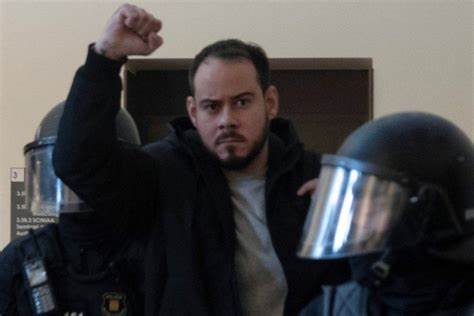
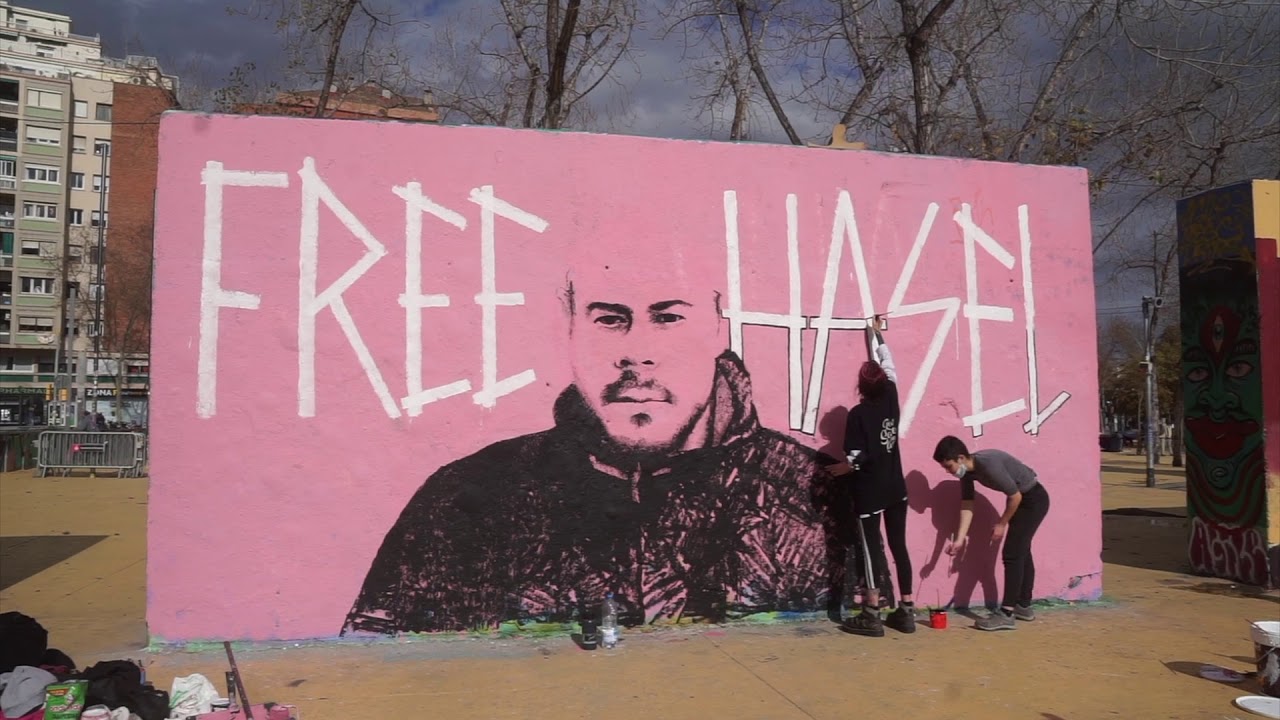
Despite complaining of stomach pain, political prisoner and rapper Pablo Hasel waited over a year for a medical examination, according to excerpts of a letter of his being shared on social media, in which he complains of medical neglect.
Hasel, a Catalan marxist, was jailed for the content of videos in which he denounced the Spanish State, its history and its former King. He was also convicted of a physical attack with others on Spanish fascists.
In the past the rapper has also created a video rap in which he celebrated Irish resistance to English colonialism and promoted the IRA. Hasel’s description of the former King as a criminal has been largely vindicated by what is known publicly.
Hasel views his ongoing medical neglect, despite frequent complaints of stomach pains, as additional punishment by the system. Although according to public penal policy the deprivation of liberty is the full content of sentence, to that is being added humiliation and neglect, he says.
The rapper had to refuse a scheduled colonoscopy because the Mossos d’Escuadra, Catalan regional police, insisted they would have to be present in the room with him while he was naked with a tube inserted into his rectum and during which although sedated he would be handcuffed.
Indeed, though serious enough, deprivation of liberty is rarely the only content of penal punishment. For political prisoners in particular, humiliation, as in strip searches is a frequent attendant, as also can be violence by guards or by social prisoners.
Other frustrations are known too as solitary confinement, harassment, refusing access to educational or creative opportunities or materials, blocking visits by family and friends, harassing the visitors themselves, even deliberate dispersal to prisons located far from their social environment.
Medical neglect can have consequences beyond worry for the prisoner and their friends and family but can also be the cause of pain, discomfort and even early death. Hasel says that he is “being treated worse than rapists or paedophiles.”
Political prisoners often endure these privations silently in the knowledge of the intentions of their tormentors and of the reality of their powerlessness as prisoners of the State. However, resistance against the conditions in prison is also a well-documented part of revolutionary struggle.
In solidarity with political prisoners, those on the outside disseminate information about the prisoners’ conditions, organise pickets and demonstrations, write to or visit prisoners. Complaining to the responsible authorities is also another avenue, informing them that they are under scrutiny.
When prisoners concerned are within the administration of another state, it can sometimes be effective to register a complaint with the embassy of the relevant state. Embassies are obliged to inform their state of concerns about their government raised in the state where they are located.
UPDATE
Good news from the Free Pablo Hasel Facebook page in Catalan but translation here:
👋 Good news! 🗣 Pablo Hasél, will have a visit from a specialist on January 23, respecting his right to privacy. We achieved it with the pressure in the streets. We will have to be alert so that Esquerra Republicana de Catalunya does not violate any rights again ❗ 🔥 Thanks to all the supporters, like Plataforma Antirepressiva de Barcelona, for making it possible ❗ 💥 Today as yesterday, solidarity is our best weapon ❗
NB: ERC, the Esquerra Republicana (Republican Left) de Catalunya party is currently in power in the Government of the Catalunya autonomous region of the Spanish State.
End.
Spanish Embassy in Ireland, 17A Merlyn Park, Ballsbridge, Dublin 4 Ireland
Telephone Number:
(+353) 1 269 1640 / 2597 (+353) 1 283 9900
Fax Number:
(+353) 1 269 1854
Email:
emb.dublin@maec.es
Writing to Pablo Hasel: Pablo Hasel, Centre Penitenciari Ponent, Módul 7, Victoria Kent, s/n 25071, Lleida, Catalunya, Spanish State.
Christmas shoppers on Saturday 17th in Dublin’s O’Connell Street, the city’s main boulevard, were interested to see a long picket line displaying banners, flags and placards.
The event was a jointly-organised public reminder of the continuing existence of political prisoners in Ireland and as a gesture of solidarity to the prisoners too.
The joint organisers were the Ireland Anti-Internment Campaign, the Irish Republican Prisoners Welfare Association and the Anti-Imperialism Action organisation. The attendance were mostly Irish Republicans but there were also some from the socialist/ anarchist traditions present.
Long line looking southward of joint Republican prisoners’ solidarity event (Photo: Rebel Breeze)
There are currently 40 Irish Republican prisoners in jails in Ireland, on both sides of the British Border. As a speaker noted at the end, all had been sentenced or refused bail by no-jury special courts of the Irish and British states.
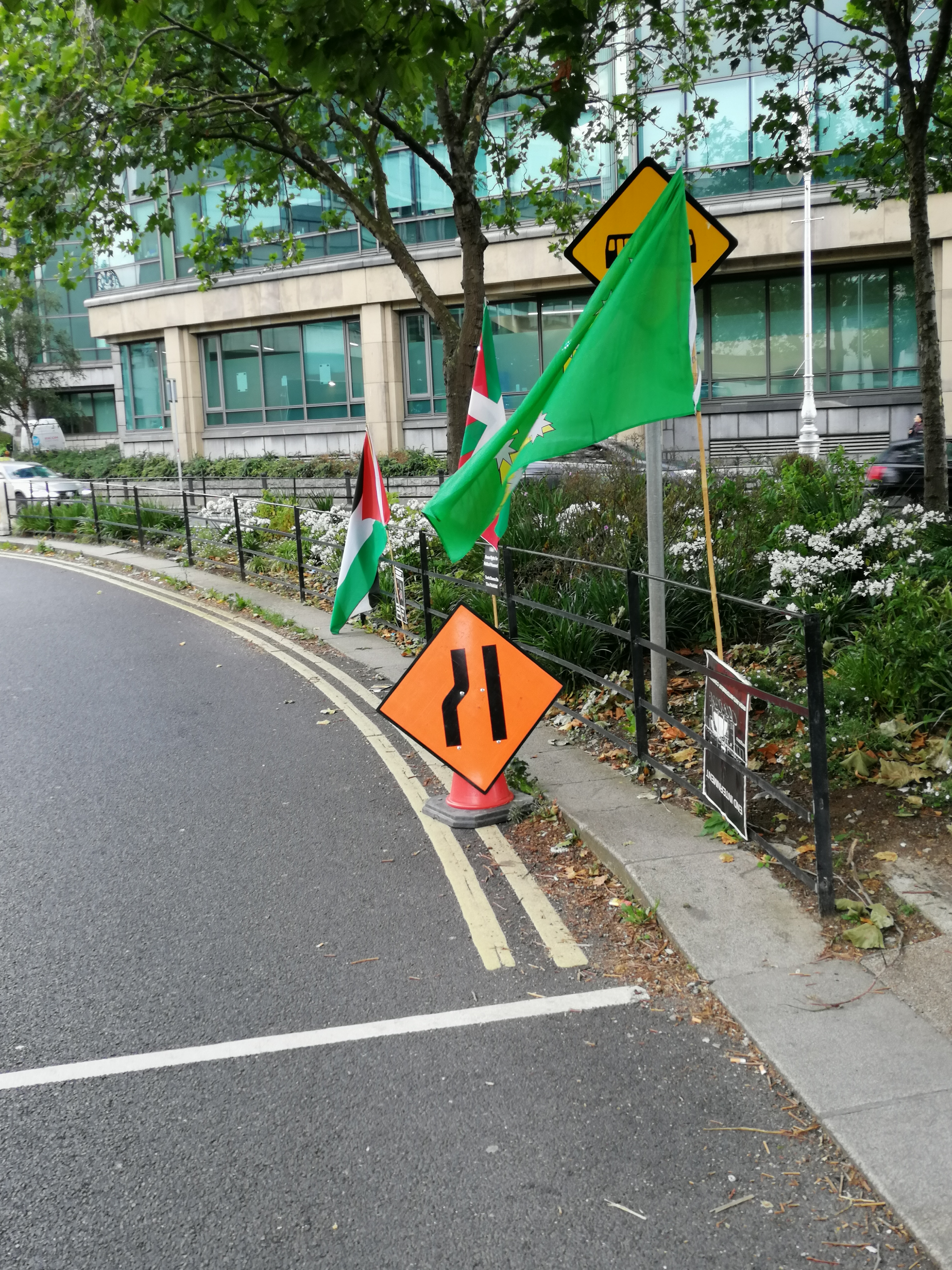
The Irish Tricolour and the Starry Plough were displayed of course but also a Palestinian flag and two Basque ones; the latter attracted the attention of a number of young people from the Spanish state who were pleased and approached the picketers for discussion.
Section of the joint Republican prisoners’ solidarity event showing the Latuff cartoon on a banner (Photo: Rebel Breeze)Section of the joint Republican prisoners’ solidarity event showing couple of Basque flags and Palestinian one in the middle distance (Photo: Rebel Breeze)
Two banners called for and end to the extradition of Irish Republicans and one figured cartoonist Carlos Latuff’s illustration of solidarity between Irish and Palestinian political prisoners.
Leaflets of the IRPWA and of the IAIC were distributed to passers-by.
Section of the joint Republican prisoners’ solidarity event (Photo: Rebel Breeze)
As the event came to an end a representative of each organising group read out a short statement; both the IAIC and the AIA emphasised the need for unity in resisting repression and each along with the IRPWA called for support for Irish Republican prisoners.
End.
Section of the joint Republican prisoners’ solidarity event (Photo: Rebel Breeze)Section of the joint Republican prisoners’ solidarity event (Photo: Rebel Breeze)
The founding of the Irish Citizen Army, the first workers’ army in the world1, was commemorated in Dublin at the site of Wolfe Tone monument in Stephens Greeen, in song and speech on 23rd November 2022.
Organised by the Connolly Youth Movement, the other participating organisations represented were the Irish Communist Party, Independent Workers Union, Lasair Dhearg2 and Welsh Socialist Republican Solidarity (Ireland) – the Irish branch of the Welsh Underground Network.
In addition, a number of independent activists were also present.
CYM speaker beside the Wolf Tone Monument (by Edward Delaney) which was blown up by Loyalists in 1969; it was recast and the surviving head incorporated. (Photo: Rebel Breeze)
THE IRISH CITIZEN ARMY
The Irish Citizen Army was founded on 23rd November 1913 on a call from Jim Larkin and James Connolly, both leading the Irish Transport and General Workers’ Union in its titanic struggle against the federation of Dublin Employers’ plan to break and disperse the union.
The call for the formation of the ICA arose due to the attacks of the Dublin Metropolitan Police on the workers and their supporters; already in August 1913 the DMP had killed two workers by truncheon blows and injured many, including a youth who would die later as a result.
The ICA’s initial organiser was the writer and dramatist Seán O’Casey, later succeeded by Boer War veteran Jack White.3 In addition to requiring its recruits to be union members, the ICA enrolled women as well as men and some of the former were officers commanding both genders4.
While the ITGWU was defeated in the eight months of the Lockout, it was not smashed and came back stronger in a relatively short period. The ICA faded away then but was reorganised over following years and approximately 120 took part as a unit in the 1916 Rising, alongside other units.5
SPEECHES AND SONG
A small crowd had gathered at the advertised location, the Wolfe Tone Monument in Stephen’s Green and the chairperson of the event called people to order.
Diarmuid Breatnach, an independent activist, was asked to sing one of Connolly’s compositions, ironically titled Be Moderate, often referred to instead by its refrain, “We only Want the Earth”.
An older man with a Dublin accent, Breatnach told his audience that Connolly published the lyrics in New York in 1907, going on to sing the five verses to the air of Thomas Davis’ A Nation Once Again6, using the chorus part to repeat the refrain that “ … we only want the Earth!”7
A representative of the Independent Workers’ Union, a young man with an Ulster accent, spoke about the need for workers to have a trade union and for that union not to align itself with employers or with the State.
In order to truly represent the interests of the workers, the union needs to be independent, he maintained and also democratic in its decision-making.
In conclusion, the speaker said that the IWU is the union that is needed and called on people present to join it and to support it.
“MAKE THE VISION A REALITY”
Amy Margaret, a young woman, also with an Ulster accent, delivered a speech on behalf of the organisers of the event, the Connolly Youth Movement.
“The Citizen Army was a direct response to the brutality carried out by the RIC and Dublin Metropolitan Police during the Dublin Lockout” she said; “the police killed two workers, injured hundreds more with baton charges, and frequently ransacked the tenements where strikers lived.”
“The Citizen Army fought back with some succes” she continued “and as one pointed out, a hurley has a longer reach than a baton. It was in the Citizen Army that the working-class stood up to the RIC and employers,” she continued.
“The same RIC that torched farmer’s homes during the Land war, the same employers who often owned the slums where workers lived; it was here at Stephen’s Green (and elsewhere in the city) that the Citizen Army stood up to the British Empire, alongside comrades in the Irish Volunteers.”
She told her audience that when, during a dockers’ strike in 1915, scabs were imported and police harassed picketers, Connolly sent a squad of the ICA with fixed bayonets to the scene, resulting in the dispute’s resolution with “a considerable increase in wages to the dockers concerned”.
“The Citizen Army was not simply workers armed with guns,” the speaker said, “but also armed with culture” and referred to weekly concerts in Liberty Hall (the ITGWU’s HQ) and to the dramatic acting history of Seán Connolly and whistle-playing of Michael Malin, both 1916 martyrs
“What the ICA stood and fought for in their own words, “… is but one ideal – an Ireland ruled and owned by Irish men and women, sovereign and independent, from the centre to the sea.”
“Connolly was clear however that such a Republic would have no place for the “rack-renting, slum-owning landlord” or the “profit-grinding capitalist”, but should rather be a “beacon-light to the oppressed of every land”.
“The most fitting tribute for the ICA then is to make that Republic a reality. To do so we must learn from the past and their examples. We can learn from them to never be cowed by the odds against us, we can learn from their comradeship to each other.
We can learn from how they combined political, economic and cultural methods to advance the cause of a worker’s republic. But more importantly we must be able to learn from their shortcomings.
After the Rising and the loss of its leadership the ICA began to devolve into a social club and whilst some members played an important role during the Tan War, the ICA was not the revolutionary workers’ army it once was.
Therefore we must build a truly mass movement – not just a committed core of activists, and we must build a movement not reliant upon key personalities so that it can function no matter what.
We all know that things must change in Ireland, and so we reaffirm the principle that the Citizen Army stood by; only the Irish working class is capable of waging the revolutionary struggle necessary to change things; not capitalists and landlords.
Helena Molony of the ICA, said, “We saw a vision of Ireland, free, pure and happy. We did not realise that vision. But we saw it.”
As the socialist-republican youth of today, we commit ourselves to make that vision a reality and to build a Republic that the men and women of the Citizen Army would gladly call their own.”
Some of the gathering at the Wolfe Tone Monument (out of shot to the right) to commemorate the creation of Irish Citizen Army (Photo: Rebel Breeze)
MARKIEVICZ: “RESOLUTION, COURAGE AND COMMITMENT“
Breatnach was called back to the microphone and talked about the lessons to be learned from Constance Markievicz, co-founder of Na Fianna Éireann, the Irish Citizen Army and of Cumann na mBan, born in Britain “as were a number of our national and class heroes”, he said.
“Constance was born into a settler landlord family, the Gore-Booths”, he told the audience and her experience of witnessing deprivation, along with her sister Eva, during the Great Hunger, had a strong effect on both, inclining them to social reform and they became also suffragettes.
The speaker said that in that latter aspect and as a poet Eva became well-known particularly in England but Constance was better known as a revolutionary and for her allegiance to the working class and to the Irish nation.
He reminded his listeners that Markievicz was artistic and apt to strike poses; O’Casey, founder of the ICA had been hostile to her and co-founder of Cumann na mBan and wife of Tom Clarke of the IRB, Kathleen Clarke, had found her irritating.
Breatnach said that Markievicz was 3rd in 1916 garrison command at Stephen Green and had been accused not only shooting dead there a member of the DMP but of exulting in it; however according to witness accounts she had not even been present when the officer was killed.8
Bust of Volunteer Markievicz in Stephen’s Green (Photo: Rebel Breeze).
A British officer at her court-martial after the surrender of the 1916 Rising had claimed that she begged for her life at the court-martial but the official British records published later gave the lie to that and her own account that she demanded equal treatment with the executed leaders rings true.
“Her life as an example,” Breatnach continued, “teaches us not to judge people only by their background or indeed by their idiosyncrasies but primarily by their resolution, courage and commitment, all of which Constance Markievicz had by the bucket-load.”
The speaker also reminded those present that the very Wolfe Tone monument beside which he stood had been blown up in a number of British Loyalist bombings of the city during the 1970s, a number of which would soon be commemorated on the December anniversary of one of them.
The Irish State had prosecuted not a single one of the perpetrators, not even for the Dublin and Monaghan bombings, with the highest death toll9 of any one day during the recent 30 Years War. Instead, they had used the 1972 bombing to pass emergency legislation to attack Irish Republicans!10
Speaking briefly as a historical memory conservation activist, primarily active in the campaign to save the Moore Street market and 1916 battleground from speculators, Breatnach remarked that it was fortunate that the area behind him was a public park.
Otherwise it would all have been a prime target for property speculators. People sometimes express surprise that Irish governments do so little to protect areas of insurrectionary history. He stated however that this was natural since it was not their history but that of the struggling people.
“The history of the Irish ruling class is of a foreign-dependent one”, Breatnach stated, “rather than that of a national bourgeoisie willing to fight for independence. The last time Ireland had such a bourgeoisie was in 1798, mostly led by descendants of settlers and planters.”
“This is why Connolly pointed out that the Irish working class are the true inheritors of the Irish struggle for freedom. National independence and socialism are two different objectives but interdependent in Ireland and for the struggles to succeed they must be led by the working class.”
CONCLUDING
Wreaths were laid on behalf of a number of organisations, including Lasair Dhearg and the chairperson thanked all for their attendance, leaving people to their various ways into the mild autumn-like afternoon.
End.
(Cropped photo: Rebel Breeze)
(Photo: Rebel Breeze)
FOOTNOTES
SOURCES
1Clearly not the first army composed of workers, since these are the members of most armies; nor the first to fight for the workers, as did some for the Paris Commune in 18th March-28th May1871. However, the ICA was founded specifically for the defence of workers, the first in the world to be so, though its constitution was largely Irish nationalist.
2Socialist and anti-fascist Irish Republican organisation mostly represented in Belfast. The name means “Red Flame”.
3A number of Irish were veterans of the Boer War, the British against Dutch colonists in South Africa, most like White were on the British side but some fought for the Boers, to the extent of forming an Irish Brigade for the purpose. Later, a number from both groups ended up fighting alongside one another in the 1916 Rising (and no doubt against others who remained in the British Army).
5The Irish Volunteers, Cumann na mBan, Na Fianna Éireann, the Hibernian Rifles and of course the Irish Republican Brotherhood, the chief architects of the Rising, its members fighting as members of other units, chiefly the Volunteers and the Fianna (the membership of both those organisations was exclusively male though its couriers were often female but Tom Clarke’s wife, Kathleen Clarke, was the IRB’s liaison from Dublin with the sister organisation in the USA.
6James Connolly (1868-1916) did not prescribe any air for the lyrics and they have been sung to several. A Nation Once Again was composed by leading member of the Young Irelanders, Thomas Davis (1814–1845) and published in 1844, for many years considered a candidate for Irish national anthem.
7“For our demands most moderate are: we only want the Earth!”
8Breatnach also said that least two and probably three members of the DMP were killed during the Rising, each one in an area under the control of the ICA, who no doubt remembered well the force’s actions during the 1913 Lockout.
91974: 33 male and female civilians and a full-term unborn baby.
10The Amendment to the Offences Against the State Act, including the introduction of the no-jury Special Courts, essentially for trying Irish Republicans with a much lower quality of evidence required to convict, including the unsupported word of a senior Garda officer.
In atrocious weather conditions, Irish Republicans of a number of organisations and of none gathered at the Liam Mellows monument in Finglas today (Sunday 4 December 2022) to honour four Republicans executed by the Irish State in 1922.
Liam Mellows, Rory O’Conor, Joe McKelvey and Richard Barrett were all prominent IRA Volunteers during the War of Independence and rejected the Anglo-Irish Agreement to create a subservient state in a partitioned country.
The Irish State chose the four prisoners in retaliation for the assassination of Seán Hales TD, himself shot in retaliation for Free State executions of Republican prisoners. By coincidence or intent, each one of the four had been born in a different one of Ireland’s four provinces.
Section of the crowd seen from behind, the monument ahead in background and the flags of the colour parties visible to the left. (Photo: D.Breatnach)
THE COMMEMORATION EVENT
A part of the commemoration marched with colour parties, led by lone piper, from Finglas village to the Mellows Monument.
Ado Perry chaired the event, one of a series of Irish Civil War commemorations in Dublin organised by Independent Republicans, which group also erected commemorative panels in various locations around the city, often marking the location where Free State troops killed an IRA Volunteer.
Three colour parties attended the event and a list of all the known Republican victims of the Free State was read out.
Seán Óg performing with Ado Perry in the foreground. (Photo: D.Breatnach)
Sean Óg, accompanying himself on guitar, sang Brian Ó hUigínn’s Soldiers of ‘22 and James Ryan’s Take It Down From the Mast, two of the best-known of a very limited number of songs about the Irish Civil War. A number present joined in on the chorus of the second song:
Take it down from the mast, Irish Traitors,
It’s the flag we Republicans claim;
It can never belong to Free Staters,
For you’ve brought on it nothing but shame.
(Photo: D.Breatnach)
Mags Glennon gave a speech on behalf of the organisers but it was difficult to make out its content (kindly supplied since and given in full in Appendix.
The main speaker advertised for the event was John Crawley, who has found recent fame in Republican circles with the publication of his biographical book The Yank, about his enlisting with the US Marine Corps and attempting to pass on his military skills to the Provisional IRA.
John Crawley speaking (Photo: D.Breatnach)
It was a shame that the volume of the PA was only turned up at around the last quarter or so of his speech. Despite the limited audibility of most of it, the attendance endured the rain and stood there in good order1.
Ado Perry thanked speakers and musicians for participation and all for attendance, making special mention of the colour parties. He announced that the event commemorative event would be at Kilmainham Jail early in January.
A lone piper played a lament and swung into the national anthem, Amhrán na bhFiann. Representatives of the National Graves Association addressed the crowd briefly before the event finally concluded and the wet and the weary headed home or to a warm pub or restaurant.
(Photo: D.Breatnach)
A local resident assured us that the sun does sometimes shine in Finglas. I assured him I believed him as I had seen some photographs to verify it.
The weather really was atrocious, raining almost non-stop and on one occasion during the event, lashing down heavily upon the gathering. One had to feel sympathy for the men and women of the three colour parties, who had to endure the downpour without the shelter of even an umbrella.
Indeed this reporter felt the need to break his bicycle journey away from the event for a bowl of hot soup in a nice eatery across the motorway bridge in Finglas village, before pushing on to my destination in the Glasnevin area.
(Photo: D.Breatnach)
BACKGROUND: THE FREE STATE
The State that came into existence in 1922 was a creation of those forces that accepted Dominion status within the British Commonwealth instead of an Irish Republic, accepting also the partition of Ireland for the first time with six counties becoming a British colony.
While the pro-Treaty position had a majority of votes in the Irish parliament, a large part of the civilian population and the vast majority of the fighters (Irish Volunteers, Cumann na mBan, Na Fianna) rejected the Treaty and their representation left the Government in protest.
Although Anti-Treaty forces had occupied the Four Courts in Dublin, the Civil War was started by the Free State military, shelling the Republican occupants with artillery on loan from the British military and going on to use British transport and weapons to defeat the Republicans.
Rory O’Connor, Joe McKelvey, Richard Barrett and Liam Mellows were already in jail when Seán Hales was killed and could not be considered guilty by any stretch of causality; nevertheless they were executed on 9th December 1922.
oznor
From Century Ireland:
In a statement issued by the National Army’s General Headquarters, the latest round of executions are explained as a ‘reprisal for the assassination…. of Brigadier Sean Hales, TD, and as a solemn warning to those associated with them who are engaged in a conspiracy of assassination against the representatives of the Irish people.’
The executions took place at 9.20 am. The prisoners were marched blindfolded to the rear of the Mountjoy Prison buildings with three clergymen in attendance. They were shot by firing squad and their bodies were subsequently interred within the grounds of the prison.
Commenting on these developments, the Irish Times has editorialised that the ‘Free State Government has committed itself to an act of ‘reprisal’ which eclipses in sudden and tragic severity the sternest measures of the British Crown during the conflict with Sinn Féin.’
The first executions carried out by the Free State took place on 17 November 1922, and then continued a week later with that of Erskine Childers.
On the last day of November, the number of those executed increased to eight when three Dubliners – Joseph Spooner (21), Patrick Farrelly (21), John Murphy (19) – were killed at Beggars Bush Barracks.
The three men were captured on 30 October after an attempt was made to blow up Oriel House, the headquarters of the Criminal Investigation Department (CID)2.
Following the deaths of Spooner, Farrelly and Murphy, the leader of the Labour Party, Thomas Johnston, called for an end to executions as a method of punishment. Mr Johnston, speaking in the Dáil on 30 November, stated:
‘We have been told pretty frequently during the last few weeks that it is the intention of the ministry to re-establish the reign of law, and we were told yesterday, as we have been told frequently, that unless this kind of thing is done anarchy will prevail. I want to make the charge that this kind of trial, this kind of sentence, is, in fact, anarchy. It is not law. It is anarchy- lynch law once removed.’
Colour Parties at the event (Photo: D.Breatnach)
By the time the Civil War ended, the Free State had formally executed around 80 Irish Republicans (many more than had the British occupation 1916-1921) and at least another 20 killed as surrendered fighters or kidnapped, sometimes tortured, then taken somewhere and shot.
Post-Civil War, the class nature of the State became even clearer: led by a foreign-dependent capitalist class, handing over healthcare and education to the Catholic Church, upon the institutions of which it leaned heavily for social control of the masses.
The foreign dependency was at first on the British who helped create the State but subsequently first the USA and then the EU have been added to the list of economic masters. This is the inheritance of the Anglo-Irish Agreement and of the victory of the Free State in the Civil War.
end.
(Photo: D.Breatnach)(Photo: D.Breatnach)
APPENDIX (reading time approx 11 minutes):
SPEECH BY MAGS GLENNON FOR INDEPENDENT REPUBLICANS GROUP
Today we gather to remember and honour Liam Mellows, Rory O’Connor, Joe McKelvey and Dick Barrett, four dedicated volunteers who were executed without even the pretence of a trial by a Free State regime bent on revenge and determined to use any methods to defeat the principles and spirit of Irish Republicanism.
In this case the brutal elimination not just of key IRA military leaders but also the articulate political voices who could expose the betrayal of the revolutionary republican ideals by the Free State.
As the Civil War grew increasingly bitter in the autumn of 1922 the Free State implemented the Public Order Act, allowing for summary execution from anyone caught in possession of weapons. Kevin O Higgins stated that “what was needed to put down the Irregulars were more local executions, and we should just kill them anyway”.
It is important to recognize the context in which these four brave men met their deaths. They were murdered to ensure the supremacy of the Free State elite who felt it was their right to betray the principles of the 1916 Rising and the Democratic Programme of the 1st Dail.
The prosperous catholic and moderate nationalist class had seen their Home Rule party practically eliminated in the 1919 election. Mass campaigns against conscription, transport strikes against British militarism as well as sporadic strikes and workers Soviet revolts worried what Mellows called ‘the state in the country people’.
The political interests of the prosperous middle class catholic merchants, professionals and big farmers were well served by acceptance of the British Treaty, which would ensure they held social, economic and political power in the new Free State. They cared not for partition or royal oaths as they had achieved their Home Rule.
The Free State elite saw the role of working people, many of whom had been at the forefront of the war, was to retreat once more to the slums and to obey their masters.
The democratic and egalitarian basis of a Republicanism expressed in the founding documents of the struggle promised a radical and democratic future, appealing in particular to working people in Dublin who had been fighting since the Lockout of 1913.
WT Cosgrave famously described the urban and rural poor as the ‘sweepings of the workhouses’ and desired that they emigrate as quickly as possible. The original Sinn Fein of Arthur Griffith had supported the employers in 1913 but piggy backed to prominence on the back of the 1916 Rising.
The elimination of men like Mellows – Brugha and Childers were already dead – was to ensure the political head was cut off the Republican movement.
The execution of military commanders like O Connor, Barrett and McKelvey was to send a message to all provinces that the IRA rank and file would suffer similar deaths to their commanding officers.
The terror Dublin had suffered in 1922 was intensified across the south in 1923 with dozens of young volunteers (many just boys) disappeared, tortured, shot at roadsides and dumped behind ditches. Yet Fine Gael still today parrots rubbish about republican ‘violence’, to cover up the savage war crimes on which they built their Free State.
We must all openly question the narrative being put forward by the Free State establishment today, completely ignoring the centenary of the Civil War. Remembering the deaths and honouring the lives of the republican volunteers has been carried out by their families and small local Commemoration groups.
Any further publicity would reveal the betrayal of the democratic and revolutionary principles of Republicanism which the Free State attempted to wipe out in the Civil War. We must rededicate ourselves to the revolutionary, internationalist and anti-imperialist traditions of Irish Republicanism.
As we work to advance these ideas in our communities, we must reject the conservative and xenophobic brands of nationalism, whether orange or green, that seek to deflect the blame for our social and economic problems away from the establishment figures benefiting from and promoting such conflict.
We remember today the sacrifice made 100 years ago by Liam Mellows, Rory O Connor, Joe McKelvey and Dick Barrett. May they rest in peace and their ideas and example form the basis of a strong, principled and united Irish Republicanism into the future. Beir Bua!
SPEECH BY JOHN CRAWLEY, MAIN SPEAKER AT EVENT
At 3:30 am on Friday, the 8th of December 1922, IRA volunteers Liam Mellows, Rory O’Connor, Dick Barrett, and Joe McKelvey were informed they were to be summarily executed by the Free State government in retaliation for the killing of Sean Hales, the previous day.
Hales had voted for the ‘Murder Bill’ permitting the execution of those bearing arms in defence of the Irish Republic.
The Free State made great play of the fact Hales was a T.D. even though the first T.D. slain in the Civil War had been shot by Free Staters when they killed Cathal Brugha, who presided over the first meeting of Dáil hÉireann in January 1919 and had served as Minister for Defence. Free Staters had murdered Harry Boland T.D. in August, and of course, Liam Mellows was a T.D.
Captured as part of the Four Courts garrison the previous June, these four IRA volunteers had been in prison since then. They held no responsibility for IRA operations on the outside.
Those Free Staters who hadn’t the resolve to stand by the Republic demonstrated vicious zeal in proving to the British they had the cruelty to murder those who did.
They attempted to justify these killings by claiming they were implementing the will of the Irish people who approved the Anglo-Irish Treaty under Britain’s threat of immediate and terrible war if it were not ratified.
But it was not the will of the Irish people that led to the bombardment of the Four Courts the previous June with artillery provided by the British army. It was the will of British Prime Minister Lloyd George and Winston Churchill.
The firing squad that shot Rory, Liam, Dick, and Joe that cold December morning was manned by Irishmen who had all served in the British army. They carried rifles and wore uniforms supplied by the British government.
The Free State government called its armed wing the National Army, but it was no national army.
It was an exclusively 26-County force set up under Article 8 of the Anglo-Irish Treaty to fight the only war they ever engaged in – the war to overthrow the Irish Republic. Had it been a national army, the British government would never have permitted it to exist.
Bernard Law Montgomery, who became a Field Marshall during the Second World War and had commanded British forces in Cork during the Irish civil war, wrote in 1923:
‘We [the British Army] could probably have squashed the [IRA 1919-21] rebellion as a temporary measure, but it would have broken out again like an ulcer the moment we removed the troops…
The only way, therefore, was to give them [the Irish] some form of self-government and let them squash the rebellion themselves; they are the only people who could really stamp it out, and they are still trying to do so and as far as one can tell they seem to be having a fair amount of success.’
By May 1923, the Free State Army would have 58,000 men who were armed, equipped, and uniformed by the British government.
Of this number, more than 30,000 were Irishmen who were former British soldiers, approximately 3,000 were IRA deserters who had defected from the Republic, and the remaining 25,000 had no prior experience on either side.
James Connolly had written in 1915, ‘When a foreign invader plants himself in a country which he holds by military force his only hope of retaining his grasp is either that he wins the loyalty of the natives, or if he fails to do so that he corrupts enough of them to enable him to disorganise and dishearten the remainder…The chief method of corruption is by an appeal to self-interest.
The self-interest of the Free Staters lay in the opportunity to achieve managerial control of a state with the pay, pensions, patronage, and prestige that went with it. A state whose parameters had been determined by a Tory-dominated cabinet committee that consulted nobody in Ireland except unionists.
Contrary to what partitionist propagandists would have us believe, the Treaty was not the result of a decision that had to be taken for pragmatic reasons in the face of overwhelming odds that any rational person in Ireland could recognise and accept.
Nor was the Dáil split down the middle. The Treaty passed by only seven votes in January 1922. Had the vote been taken before the Christmas recess, as many had expected, the Treaty would almost certainly have been rejected.
Unfortunately, the Christmas break gave powerful pro-Treaty interests like the Catholic Church, big farmers, big business, and an assortment of gombeen men the opportunity to wear down the resolve of a number of T.D.s.
Liam Mellows presided over an IRA convention held in the Mansion House in Dublin in March 1922. The IRA voted more than 80% against the Treaty and passed a resolution declaring, ‘That the Army reaffirms its allegiance to the Irish Republic…’
Cumann na mBan voted overwhelmingly against the Treaty by 419 votes to 63, and the vast majority of the active IRA units in the field also rejected it.
In a letter to his mother written shortly before his execution, Liam Mellows declared, ‘I die for the truth.
That truth was spoken by James Connolly at his court martial in 1916 when he said, ‘The British Government has no right in Ireland, never had any right in Ireland, and never can have any right in Ireland . . .’
That truth was also spoken by Pádraig Pearse while inspecting Irish Volunteers at Vinegar Hill in Wexford in the early autumn of 1915 when he said, ‘We, the Volunteers, are formed here not for half of Ireland, not to give the British Garrison control of part of Ireland. No! We are here for the whole of Ireland.’
As has been shown so many times in Irish history and is being demonstrated today in a different context, in a revolutionary struggle, the choice one often confronts is whether to do what counts or to make what you can do count.
To do what mattered proved too daunting for many Free Staters, so they made the Treaty count, saved their skins, opened career paths, and shifted the goalposts from the 32-County Irish Republic to a 26-County Dominion of the British Empire moulded by British strategic interests.
In 1948 Fine Gael Taoiseach John A. Costello declared that the Irish Free State would become the Republic of Ireland – a republic that would tell the world Ireland is Ireland without the Six Counties.
In the future, when any Dublin politician would proudly assert, ‘I stand by the Republic,’ they were referring exclusively to the twenty-six-county Republic of Ireland announced by this former Blueshirt in 1948, not the thirty-two-county Irish Republic proclaimed in 1916 and ratified by the First Dáil in 1919.
Again today, Britain is attempting to shape the political environment to suit its strategic interests. Just as in Liam Mellows day, former comrades who swore they would lead us to the Republic are leading us in the opposite direction.
All talk of the Republic is now gone because the Republic was never on the negotiating table in 1998. We no longer hear Ireland referred to as our country but as this island. Our country is one nation. This island has two.
Great play is made about the potential of a united Ireland as outlined in the Good Friday Agreement. We had a united Ireland during the Famine. We had a united Ireland when the Republic was proclaimed in 1916. We had a united Ireland when the United Irishmen was formed in 1791.
So what did the 28 Protestants who founded the Irish republican movement mean by a United Ireland? Not territorial unity, which already existed, but the only unity that matters and the unity the British would never countenance – a unity of Irish citizens across the sectarian divide.
The united Ireland defined by the Good Friday Agreement is not a republic. It envisions a polity where the sectarian dynamic remains intact and the cleavage in national loyalties between Ireland and Britain is constitutionally enshrined.
Consequently, many supporters of this strategy propose a continuing and symbolic role for the British royal family as an institutional point of reference for the loyalties of those who would prefer to see themselves as a civic outpost of Britain rather than as equal citizens of a national democracy within an all-Ireland republic.
Debates and discussions are taking place on changing the Irish national flag, discarding the Irish national anthem, and re-joining the British Commonwealth. Instead of breaking the connection with England, we are being relentlessly conditioned into becoming more closely incorporated into a British sphere of influence on a national level.
When former comrades meet and greet British royalty in Ireland, they are sending out an unambiguous message that Ireland is not one nation but two. That Britain has legitimacy in Ireland and a role to play in influencing the political trajectory of our country.
Our goal as IRA volunteers was to break the connection with England. Not to convince the rest of Ireland to re-join the British Commonwealth.
There are many happy clappy euphemisms being employed to describe the Ireland of the future. A shared island, an agreed Ireland, and a new Ireland. Who in their right mind could be against the concept of sharing and new and agreed arrangements?
When we drill down into it, however, we see the trap being laid for us by the British government. A shared island means we share in Britain’s analysis of the nature of the conflict, we share in the colonial legacy of sectarian apartheid, and we share in the imperial project of divide and rule.
We do this by recognising Ulster unionists as the British presence in Ireland with the right to have their Britishness enshrined in law. Republicans know that unionists are pro-British, but we do not accept they are the British presence.
The British presence is the presence of Britain’s jurisdictional claim to Ireland and the civil and military apparatus that gives that effect. England invaded Ireland hundreds of years before the plantation of Ulster. They claimed sovereignty here long before a single unionist set foot on Irish soil. What was their excuse, then?
An agreed Ireland has come to mean the two traditions agreeing to disagree in peace and harmony about the constitutional source of Irish sovereignty and the legitimacy and extent of British influence in constraining Irish democracy.
A muddled and subversive belief that the conquest and colonisation of Ireland share reciprocal legitimacy with its struggle for independence.
The new Ireland we are being asked to work towards is not new. It is predicated on all the old divisions. Divisions that Britain nurtured to retain the sectarian dynamic and resultant cleavage in national loyalties as this policy of divide and rule is the key to their control in Ireland.
It is designed to prevent us from developing the national cohesion required to achieve a 32-County republic. To make us permanently susceptible to British influence and manipulation.
During the Dáil debates on the Anglo-Irish Treaty, a persistent theme was that a pro-treaty vote was a vote for peace, with the resulting implication that those who stood firmly for the Republic were out for war. Liam Mellows replied:
‘If peace was the only object, why, I say, was this fight ever started? Why did we ever negotiate for what we are now told is impossible?
Why should men have ever been led on the road they travelled if peace was the only object? We could have had peace and could have been peaceful in Ireland a long time ago if we were prepared to give up the ideal for which we fought…’
Today those who stand resolutely for the Republic are accused of being against the peace process. Few republicans are against peace, but many are rightly critical of a process that cannot lead to the republican goals for which countless patriots sacrificed their lives.
A united Ireland rooted in British/Irish identity politics cannot be a republic. That is why the British government is all over this. It is their best opportunity to retain maximum influence in Ireland with a minimum footprint when the demographics eventually prove incontestable.
No one has been preparing more diligently to shape the strategic architecture of a future united Ireland than the British government.
One hundred years ago this week, Liam Mellows, Rory O’Connor, Dick Barrett, and Joe McKelvey were dragged from their cells and murdered in cold blood because they stood for what weaker and more personally ambitious Irishmen could not summon the courage to defend any longer.
We honour them today. We remember with pride all Ireland’s patriots from their day to this who never forgot who they were or what they represented.
Long Live the Irish Republic!
FOOTNOTES
1Thanks to Independent Republicans for posting a copy of his speech and that by Mags Glennon on their behalves.