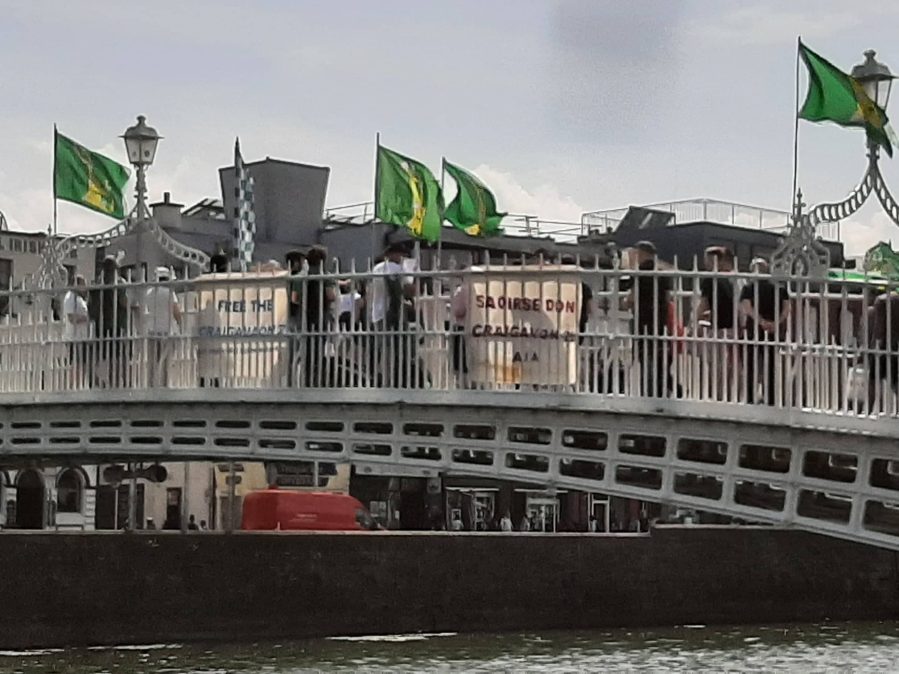
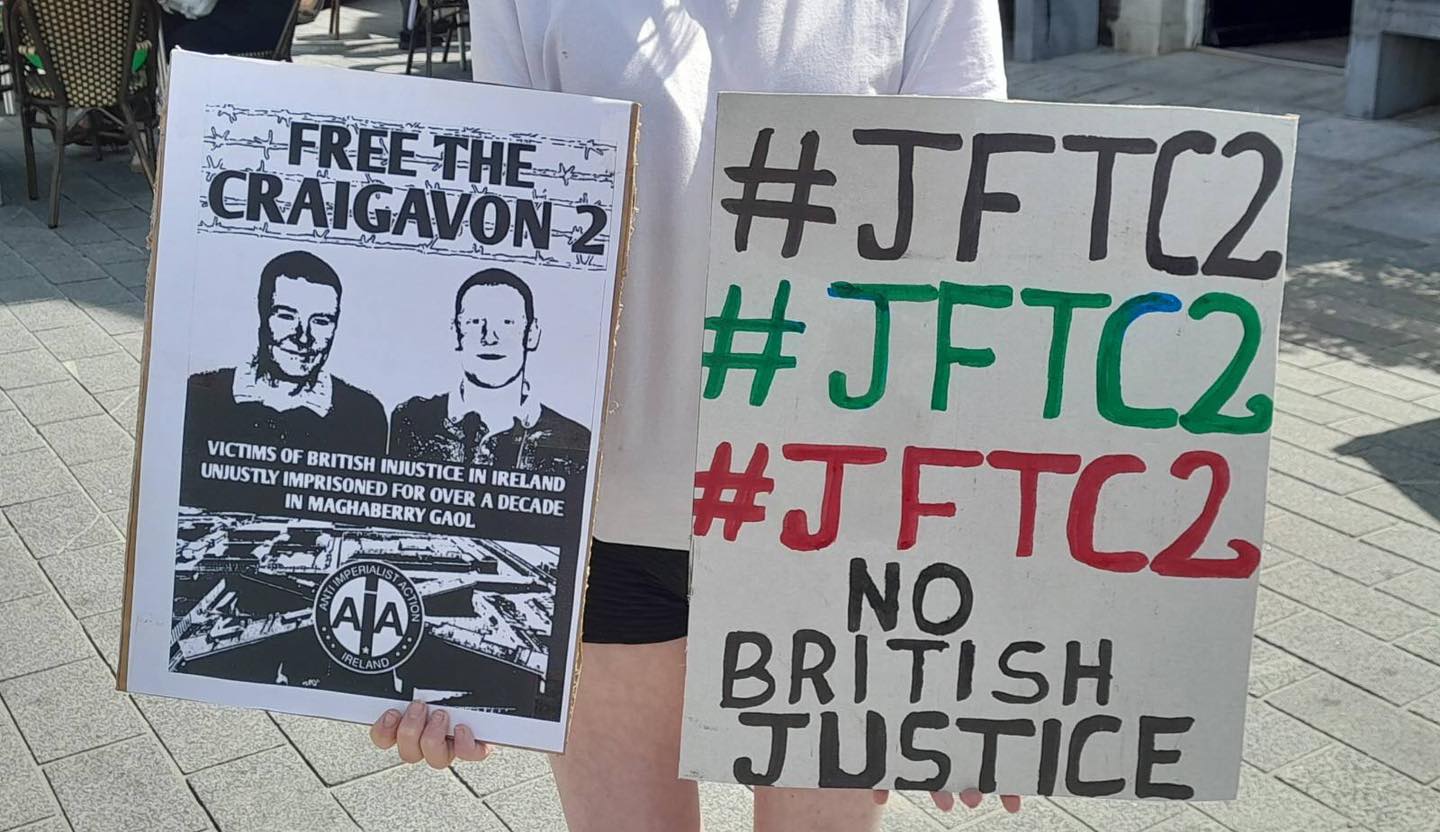
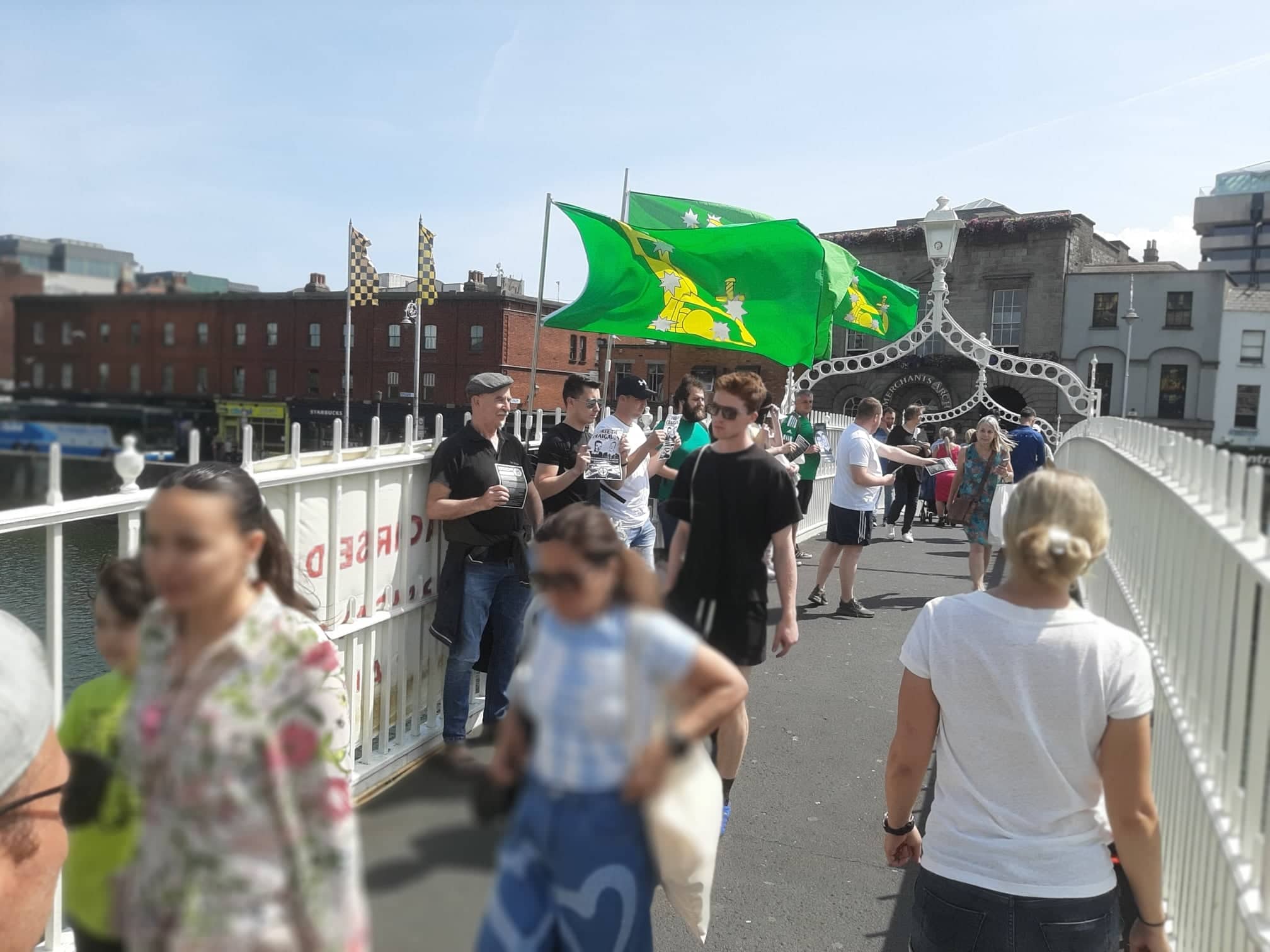
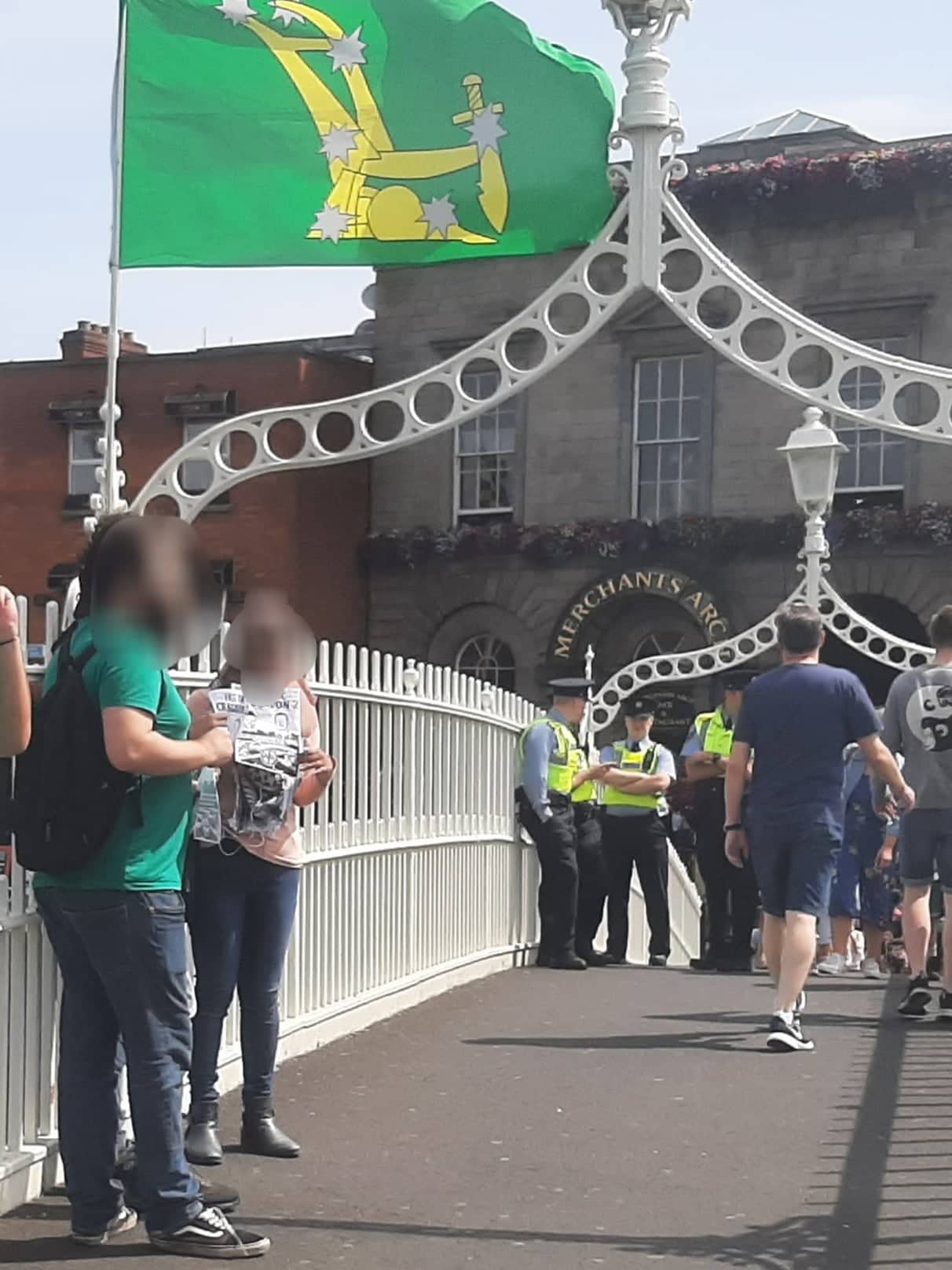
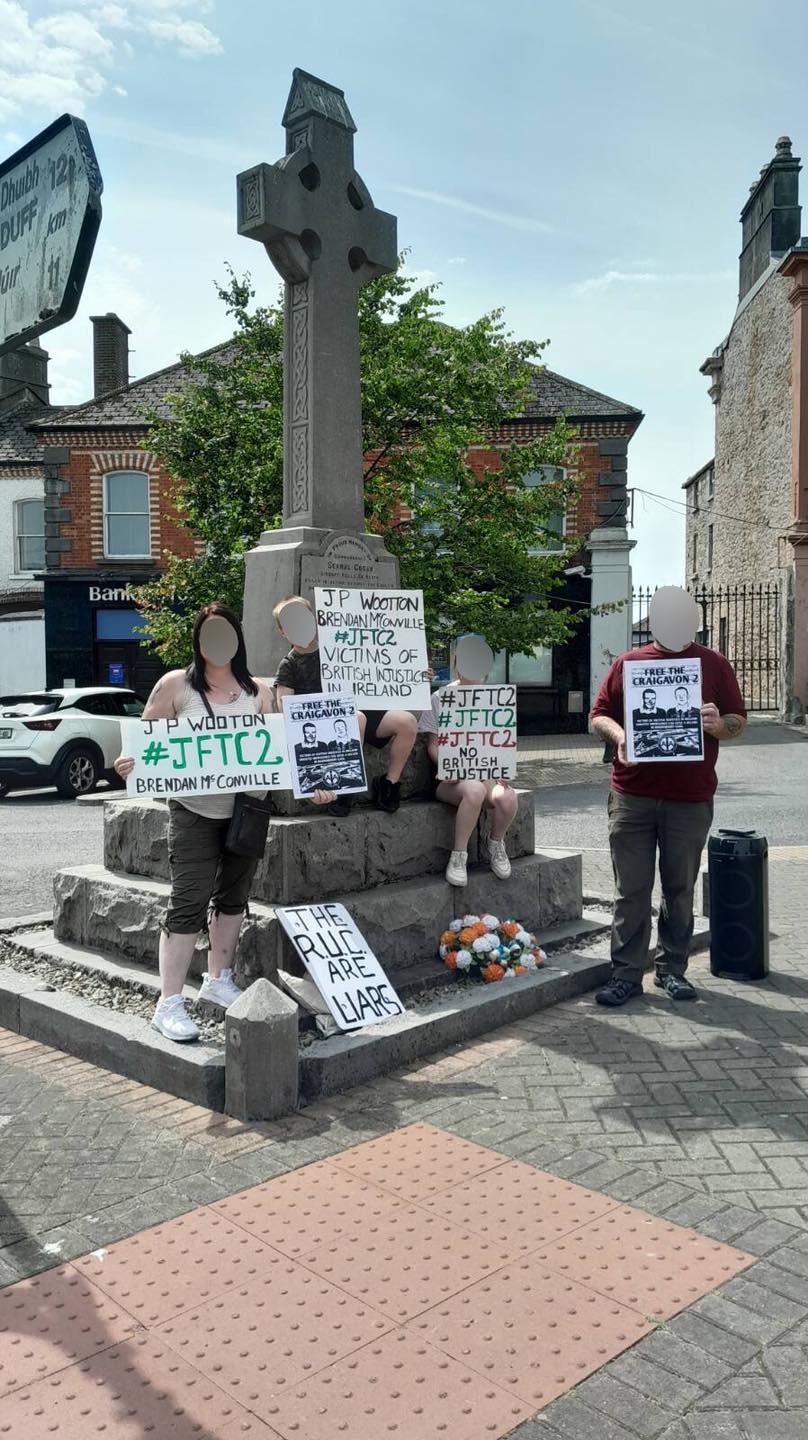
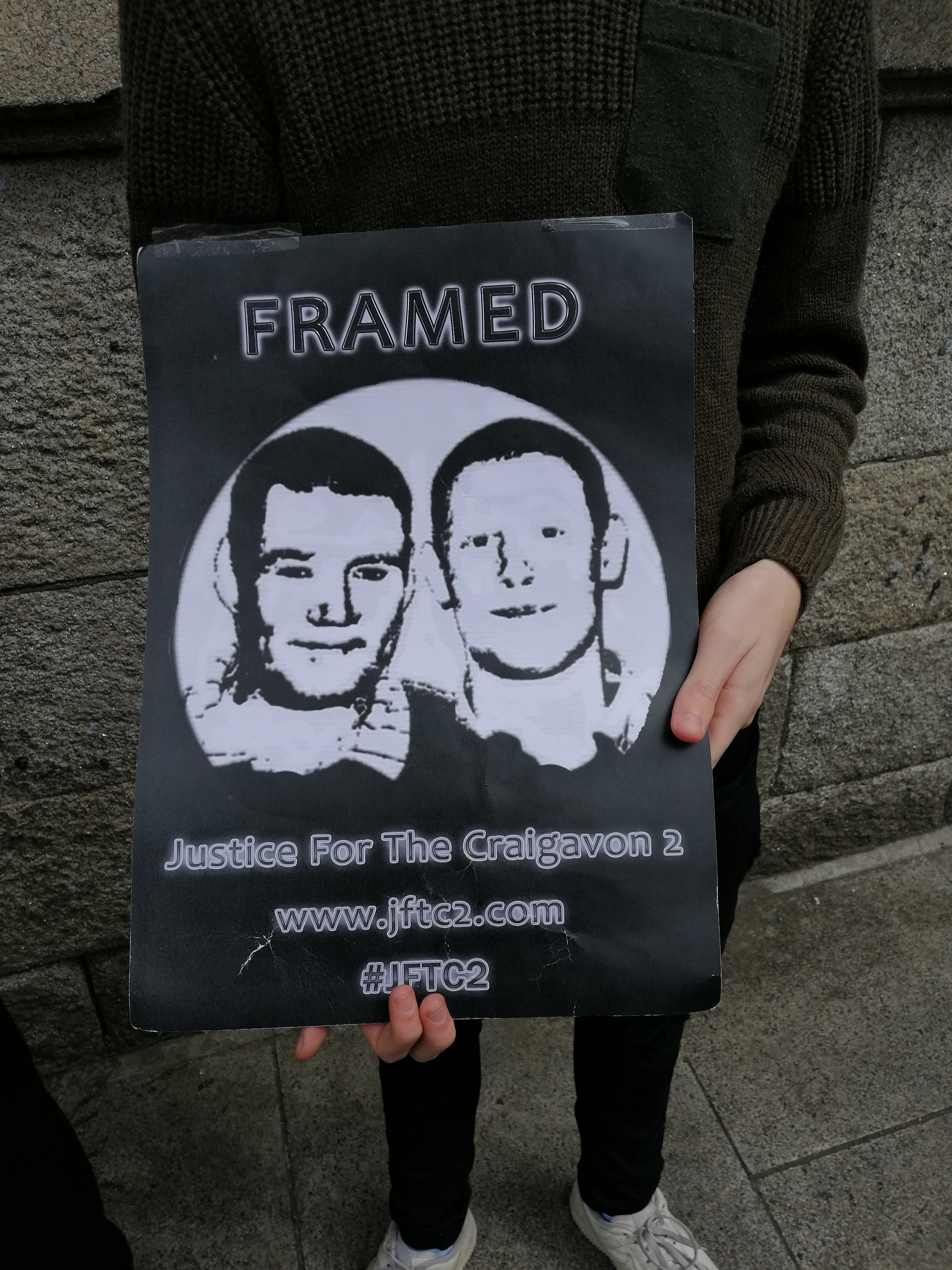
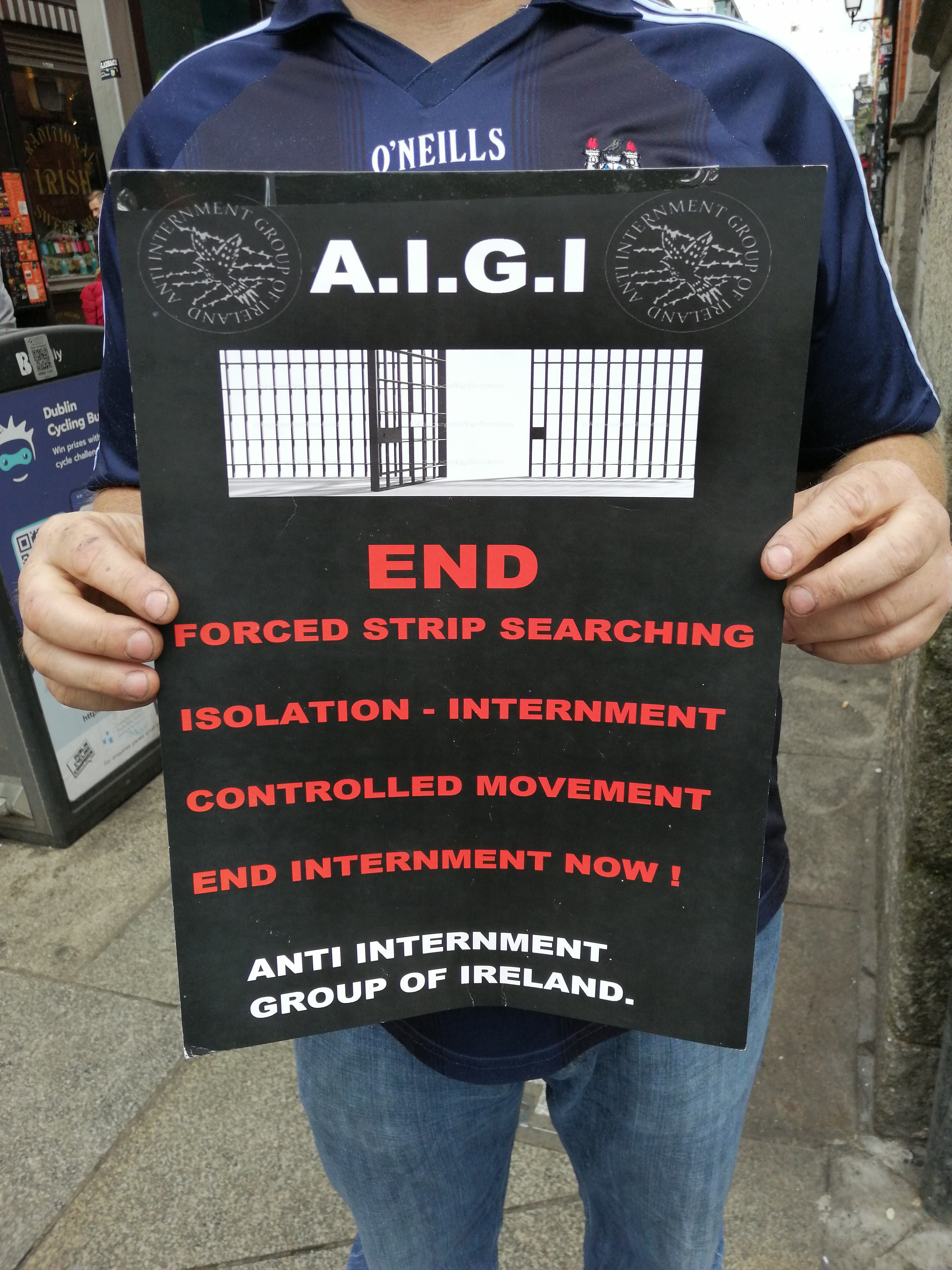
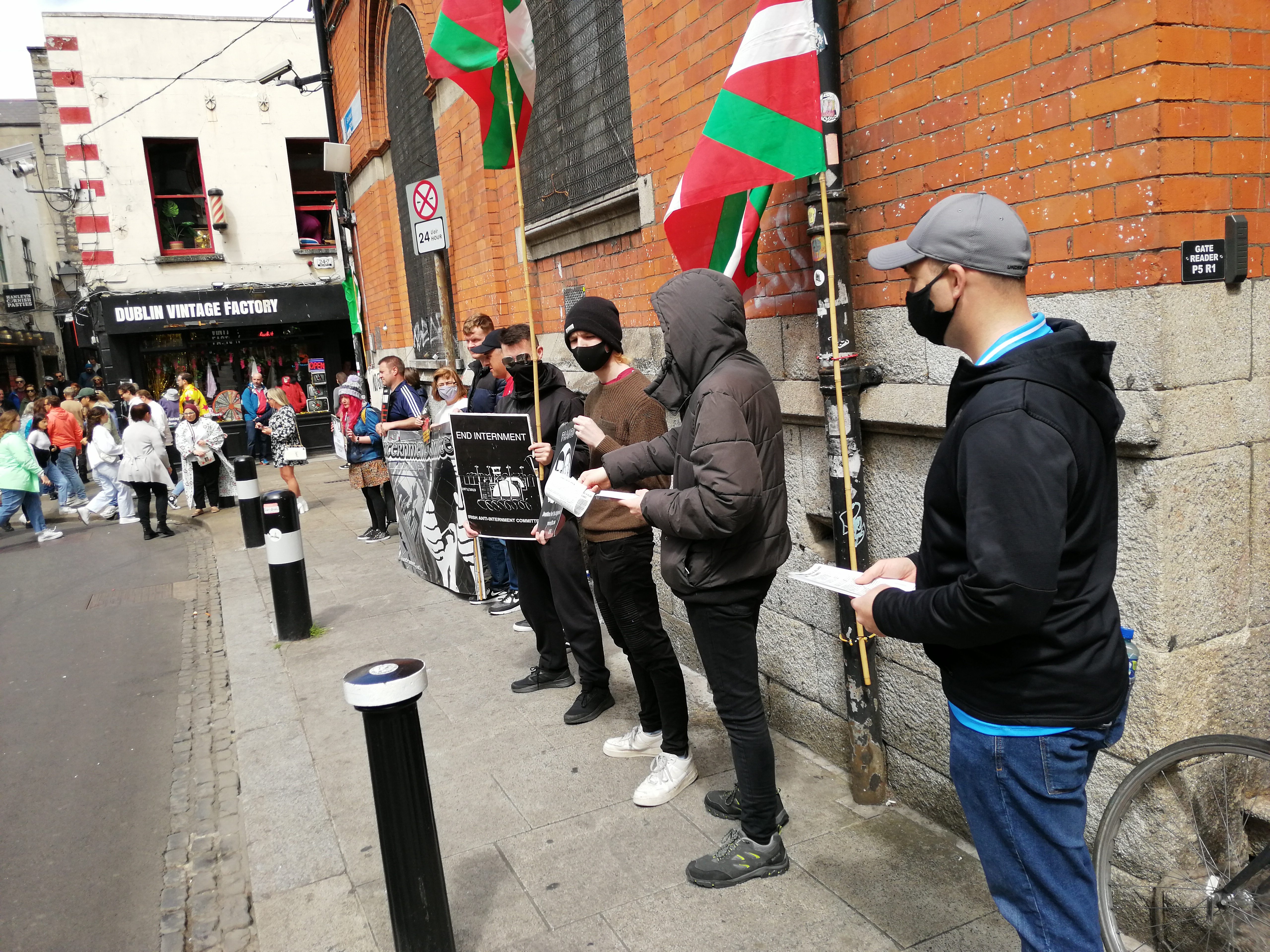
Christmas shoppers on Saturday 17th in Dublin’s O’Connell Street, the city’s main boulevard, were interested to see a long picket line displaying banners, flags and placards.
The event was a jointly-organised public reminder of the continuing existence of political prisoners in Ireland and as a gesture of solidarity to the prisoners too.
The joint organisers were the Ireland Anti-Internment Campaign, the Irish Republican Prisoners Welfare Association and the Anti-Imperialism Action organisation. The attendance were mostly Irish Republicans but there were also some from the socialist/ anarchist traditions present.
Long line looking southward of joint Republican prisoners’ solidarity event (Photo: Rebel Breeze)
There are currently 40 Irish Republican prisoners in jails in Ireland, on both sides of the British Border. As a speaker noted at the end, all had been sentenced or refused bail by no-jury special courts of the Irish and British states.
The Irish Tricolour and the Starry Plough were displayed of course but also a Palestinian flag and two Basque ones; the latter attracted the attention of a number of young people from the Spanish state who were pleased and approached the picketers for discussion.
Section of the joint Republican prisoners’ solidarity event showing the Latuff cartoon on a banner (Photo: Rebel Breeze)Section of the joint Republican prisoners’ solidarity event showing couple of Basque flags and Palestinian one in the middle distance (Photo: Rebel Breeze)
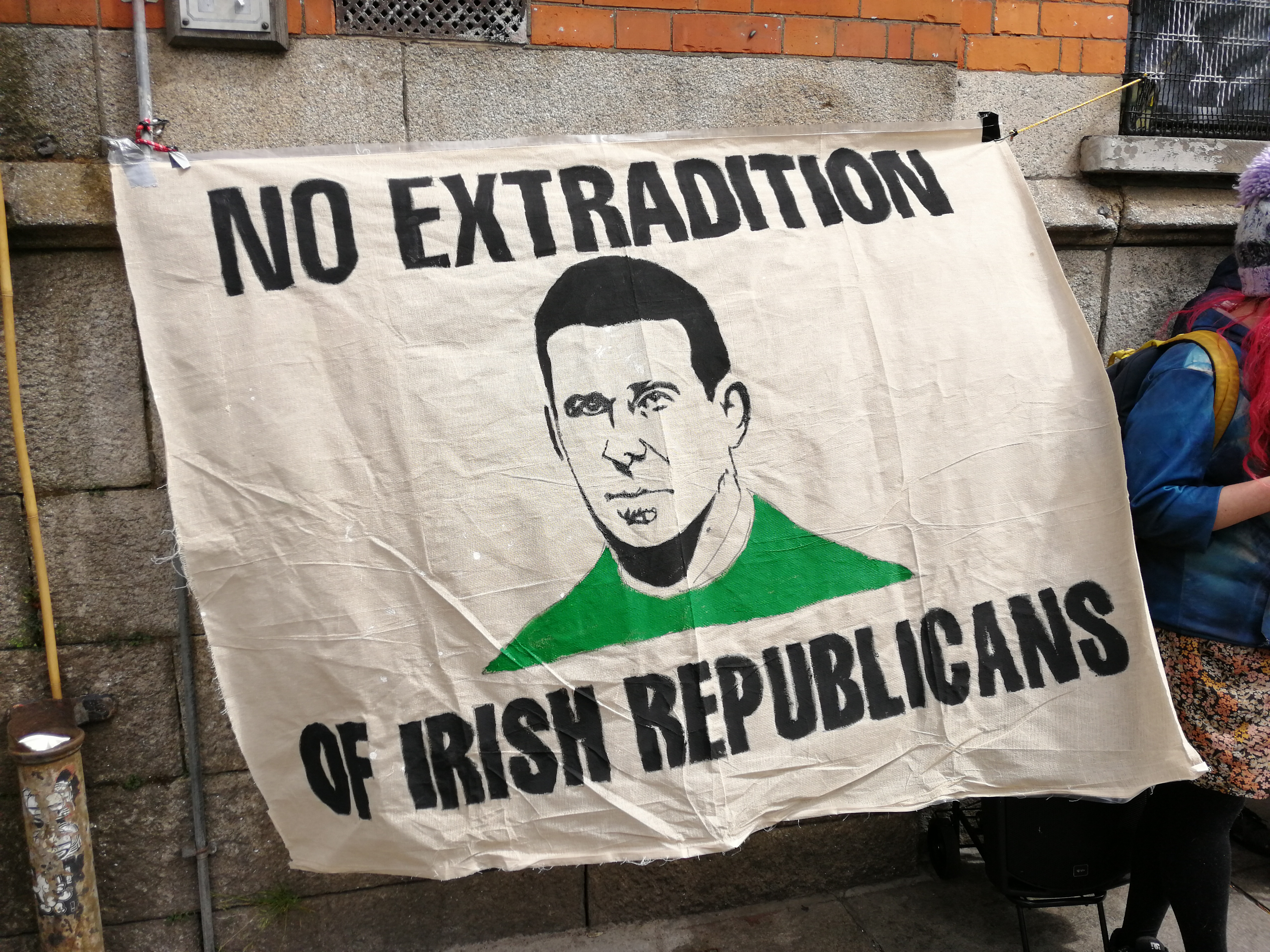
Two banners called for and end to the extradition of Irish Republicans and one figured cartoonist Carlos Latuff’s illustration of solidarity between Irish and Palestinian political prisoners.
Leaflets of the IRPWA and of the IAIC were distributed to passers-by.
Section of the joint Republican prisoners’ solidarity event (Photo: Rebel Breeze)
As the event came to an end a representative of each organising group read out a short statement; both the IAIC and the AIA emphasised the need for unity in resisting repression and each along with the IRPWA called for support for Irish Republican prisoners.
End.
Section of the joint Republican prisoners’ solidarity event (Photo: Rebel Breeze)Section of the joint Republican prisoners’ solidarity event (Photo: Rebel Breeze)
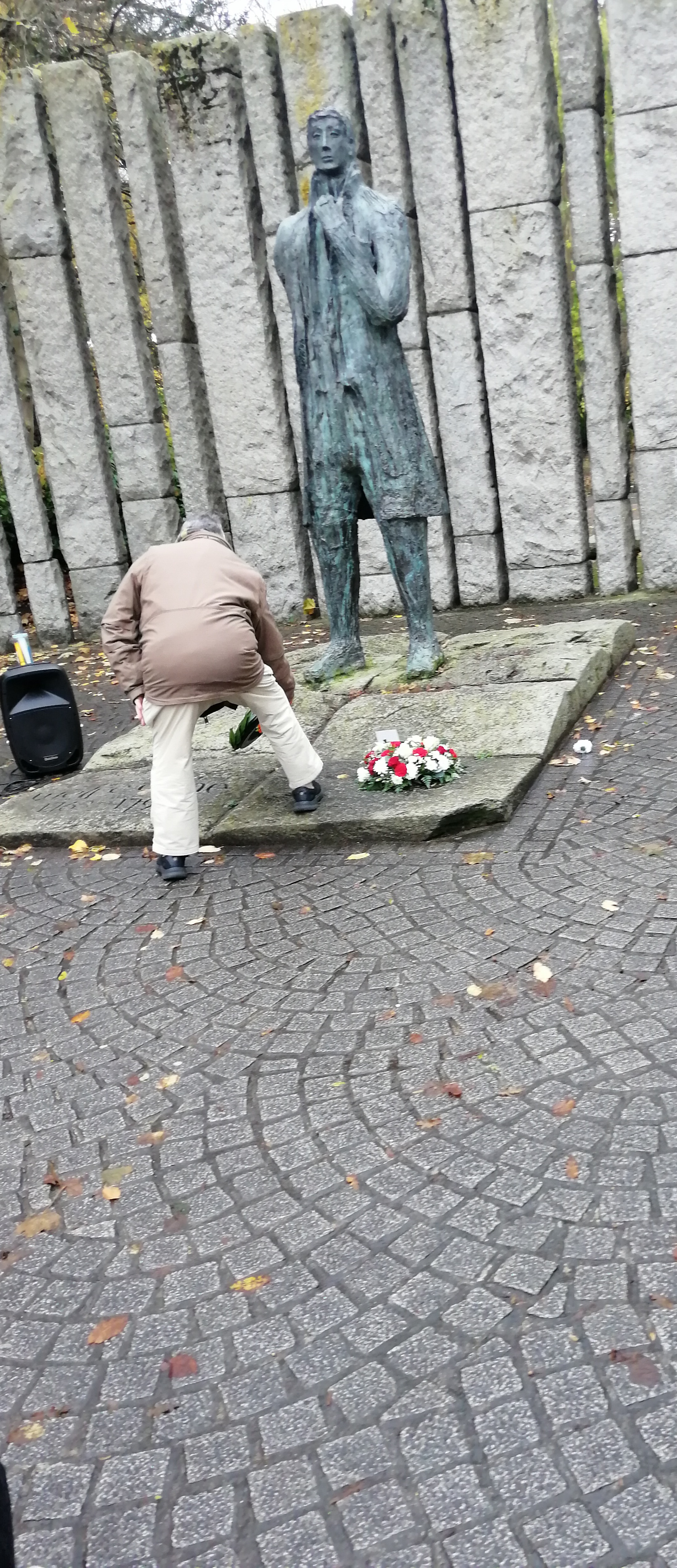
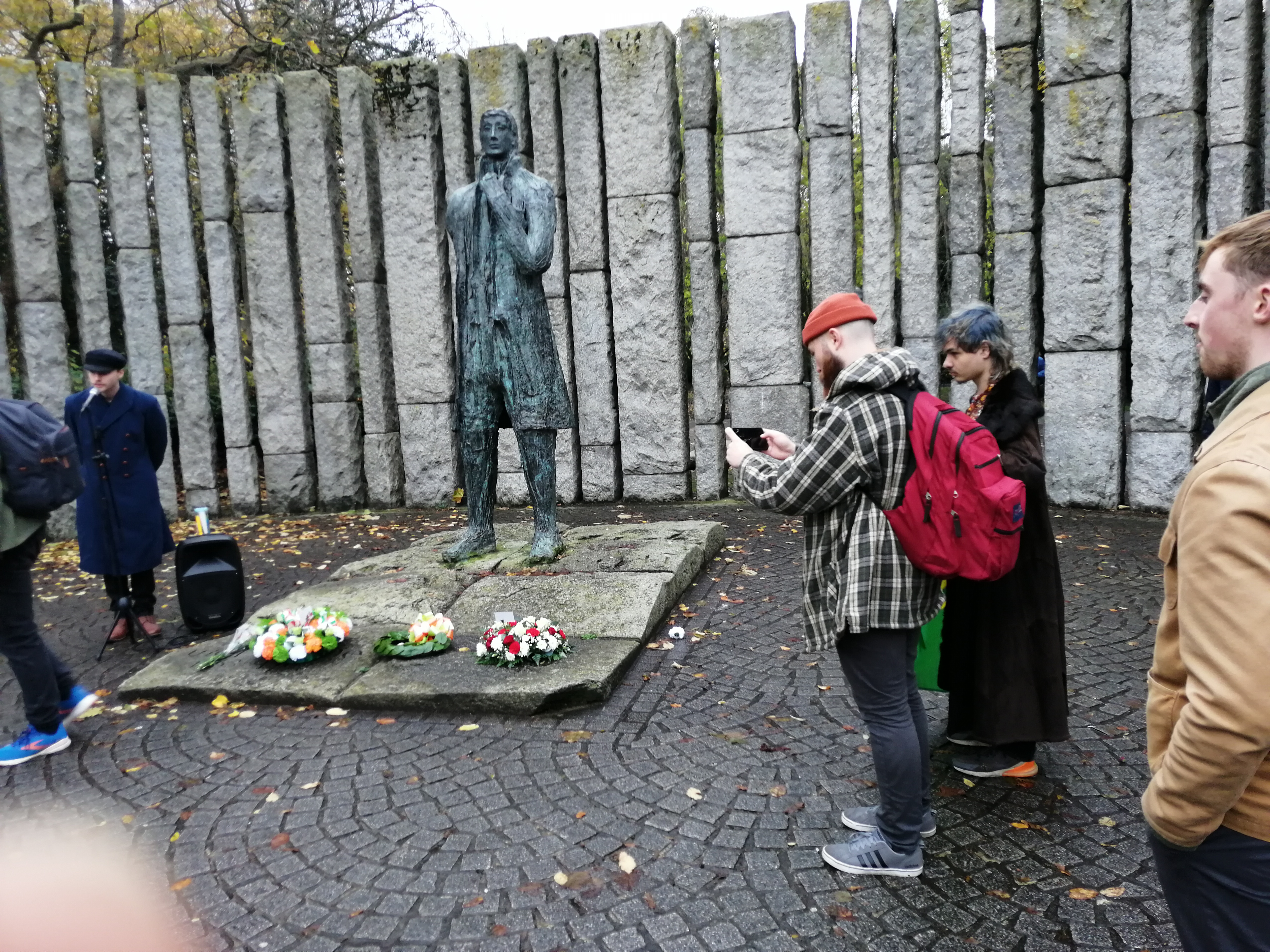
The founding of the Irish Citizen Army, the first workers’ army in the world1, was commemorated in Dublin at the site of Wolfe Tone monument in Stephens Greeen, in song and speech on 23rd November 2022.
Organised by the Connolly Youth Movement, the other participating organisations represented were the Irish Communist Party, Independent Workers Union, Lasair Dhearg2 and Welsh Socialist Republican Solidarity (Ireland) – the Irish branch of the Welsh Underground Network.
In addition, a number of independent activists were also present.
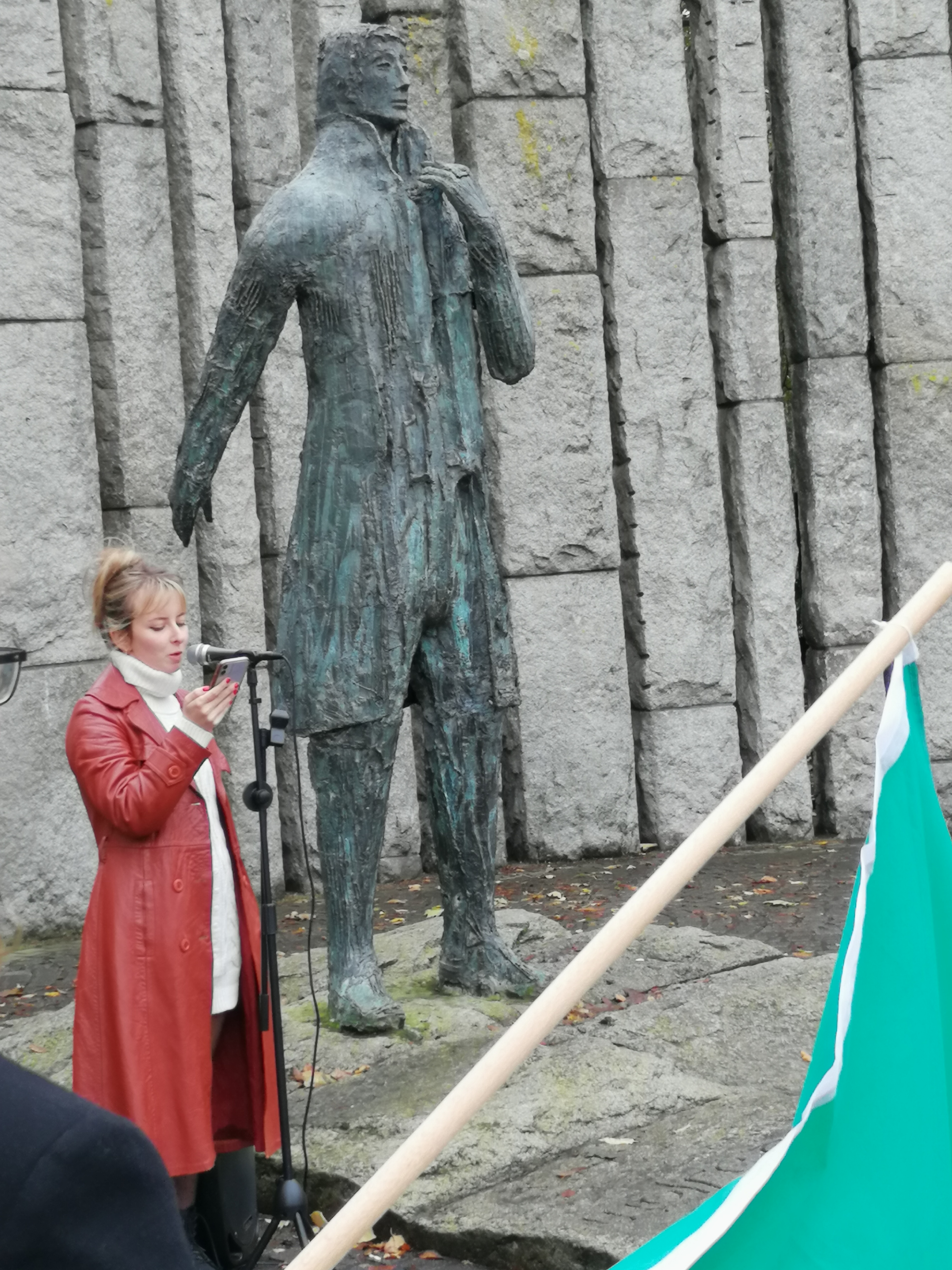
CYM speaker beside the Wolf Tone Monument (by Edward Delaney) which was blown up by Loyalists in 1969; it was recast and the surviving head incorporated. (Photo: Rebel Breeze)
THE IRISH CITIZEN ARMY
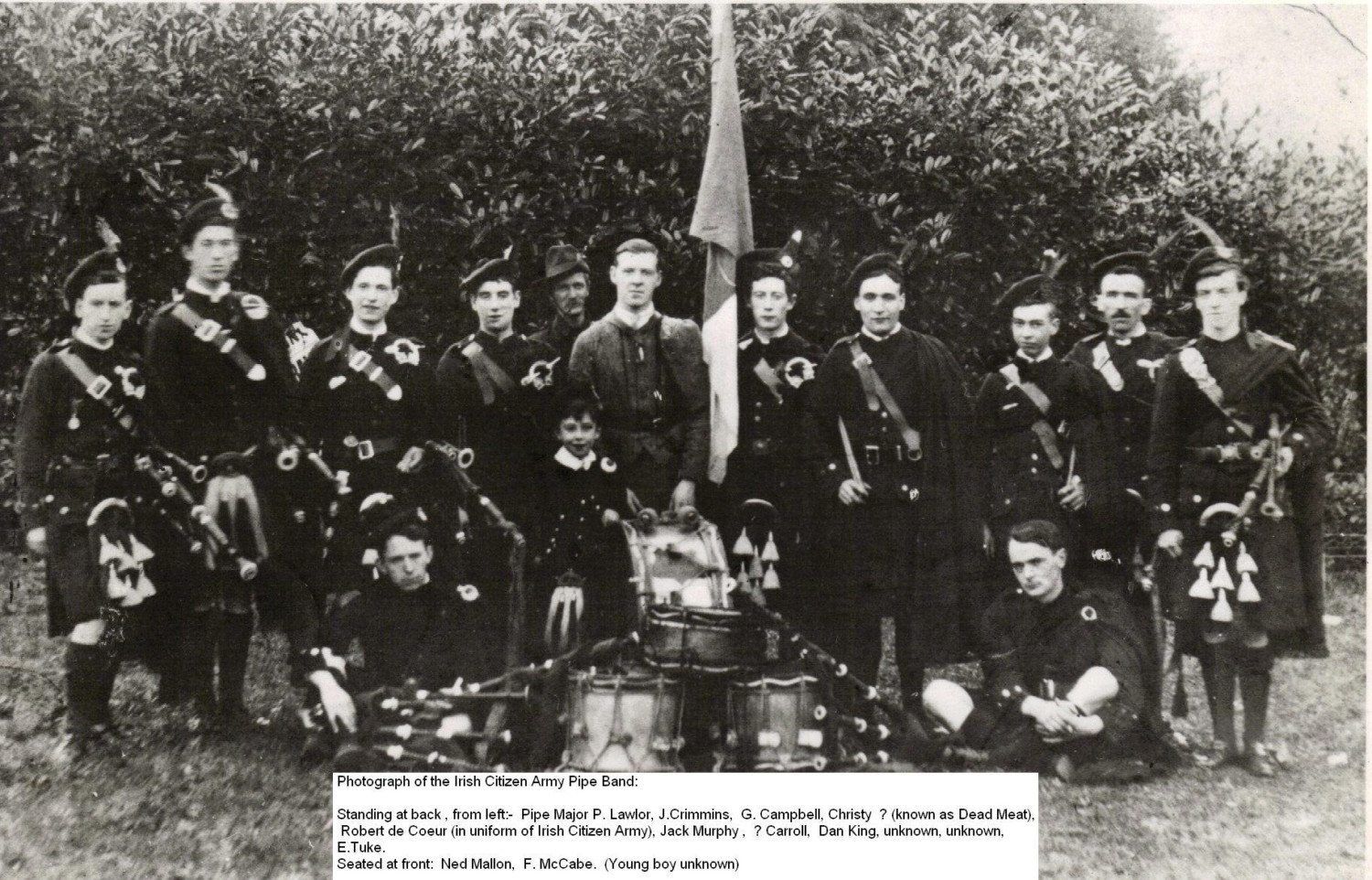
The Irish Citizen Army was founded on 23rd November 1913 on a call from Jim Larkin and James Connolly, both leading the Irish Transport and General Workers’ Union in its titanic struggle against the federation of Dublin Employers’ plan to break and disperse the union.
The call for the formation of the ICA arose due to the attacks of the Dublin Metropolitan Police on the workers and their supporters; already in August 1913 the DMP had killed two workers by truncheon blows and injured many, including a youth who would die later as a result.
The ICA’s initial organiser was the writer and dramatist Seán O’Casey, later succeeded by Boer War veteran Jack White.3 In addition to requiring its recruits to be union members, the ICA enrolled women as well as men and some of the former were officers commanding both genders4.
While the ITGWU was defeated in the eight months of the Lockout, it was not smashed and came back stronger in a relatively short period. The ICA faded away then but was reorganised over following years and approximately 120 took part as a unit in the 1916 Rising, alongside other units.5
SPEECHES AND SONG
A small crowd had gathered at the advertised location, the Wolfe Tone Monument in Stephen’s Green and the chairperson of the event called people to order.
Diarmuid Breatnach, an independent activist, was asked to sing one of Connolly’s compositions, ironically titled Be Moderate, often referred to instead by its refrain, “We only Want the Earth”.
An older man with a Dublin accent, Breatnach told his audience that Connolly published the lyrics in New York in 1907, going on to sing the five verses to the air of Thomas Davis’ A Nation Once Again6, using the chorus part to repeat the refrain that “ … we only want the Earth!”7
A representative of the Independent Workers’ Union, a young man with an Ulster accent, spoke about the need for workers to have a trade union and for that union not to align itself with employers or with the State.
In order to truly represent the interests of the workers, the union needs to be independent, he maintained and also democratic in its decision-making.
In conclusion, the speaker said that the IWU is the union that is needed and called on people present to join it and to support it.
“MAKE THE VISION A REALITY”
Amy Margaret, a young woman, also with an Ulster accent, delivered a speech on behalf of the organisers of the event, the Connolly Youth Movement.
“The Citizen Army was a direct response to the brutality carried out by the RIC and Dublin Metropolitan Police during the Dublin Lockout” she said; “the police killed two workers, injured hundreds more with baton charges, and frequently ransacked the tenements where strikers lived.”
“The Citizen Army fought back with some succes” she continued “and as one pointed out, a hurley has a longer reach than a baton. It was in the Citizen Army that the working-class stood up to the RIC and employers,” she continued.
“The same RIC that torched farmer’s homes during the Land war, the same employers who often owned the slums where workers lived; it was here at Stephen’s Green (and elsewhere in the city) that the Citizen Army stood up to the British Empire, alongside comrades in the Irish Volunteers.”
She told her audience that when, during a dockers’ strike in 1915, scabs were imported and police harassed picketers, Connolly sent a squad of the ICA with fixed bayonets to the scene, resulting in the dispute’s resolution with “a considerable increase in wages to the dockers concerned”.
“The Citizen Army was not simply workers armed with guns,” the speaker said, “but also armed with culture” and referred to weekly concerts in Liberty Hall (the ITGWU’s HQ) and to the dramatic acting history of Seán Connolly and whistle-playing of Michael Malin, both 1916 martyrs
“What the ICA stood and fought for in their own words, “… is but one ideal – an Ireland ruled and owned by Irish men and women, sovereign and independent, from the centre to the sea.”
“Connolly was clear however that such a Republic would have no place for the “rack-renting, slum-owning landlord” or the “profit-grinding capitalist”, but should rather be a “beacon-light to the oppressed of every land”.
“The most fitting tribute for the ICA then is to make that Republic a reality. To do so we must learn from the past and their examples. We can learn from them to never be cowed by the odds against us, we can learn from their comradeship to each other.
We can learn from how they combined political, economic and cultural methods to advance the cause of a worker’s republic. But more importantly we must be able to learn from their shortcomings.
After the Rising and the loss of its leadership the ICA began to devolve into a social club and whilst some members played an important role during the Tan War, the ICA was not the revolutionary workers’ army it once was.
Therefore we must build a truly mass movement – not just a committed core of activists, and we must build a movement not reliant upon key personalities so that it can function no matter what.
We all know that things must change in Ireland, and so we reaffirm the principle that the Citizen Army stood by; only the Irish working class is capable of waging the revolutionary struggle necessary to change things; not capitalists and landlords.
Helena Molony of the ICA, said, “We saw a vision of Ireland, free, pure and happy. We did not realise that vision. But we saw it.”
As the socialist-republican youth of today, we commit ourselves to make that vision a reality and to build a Republic that the men and women of the Citizen Army would gladly call their own.”
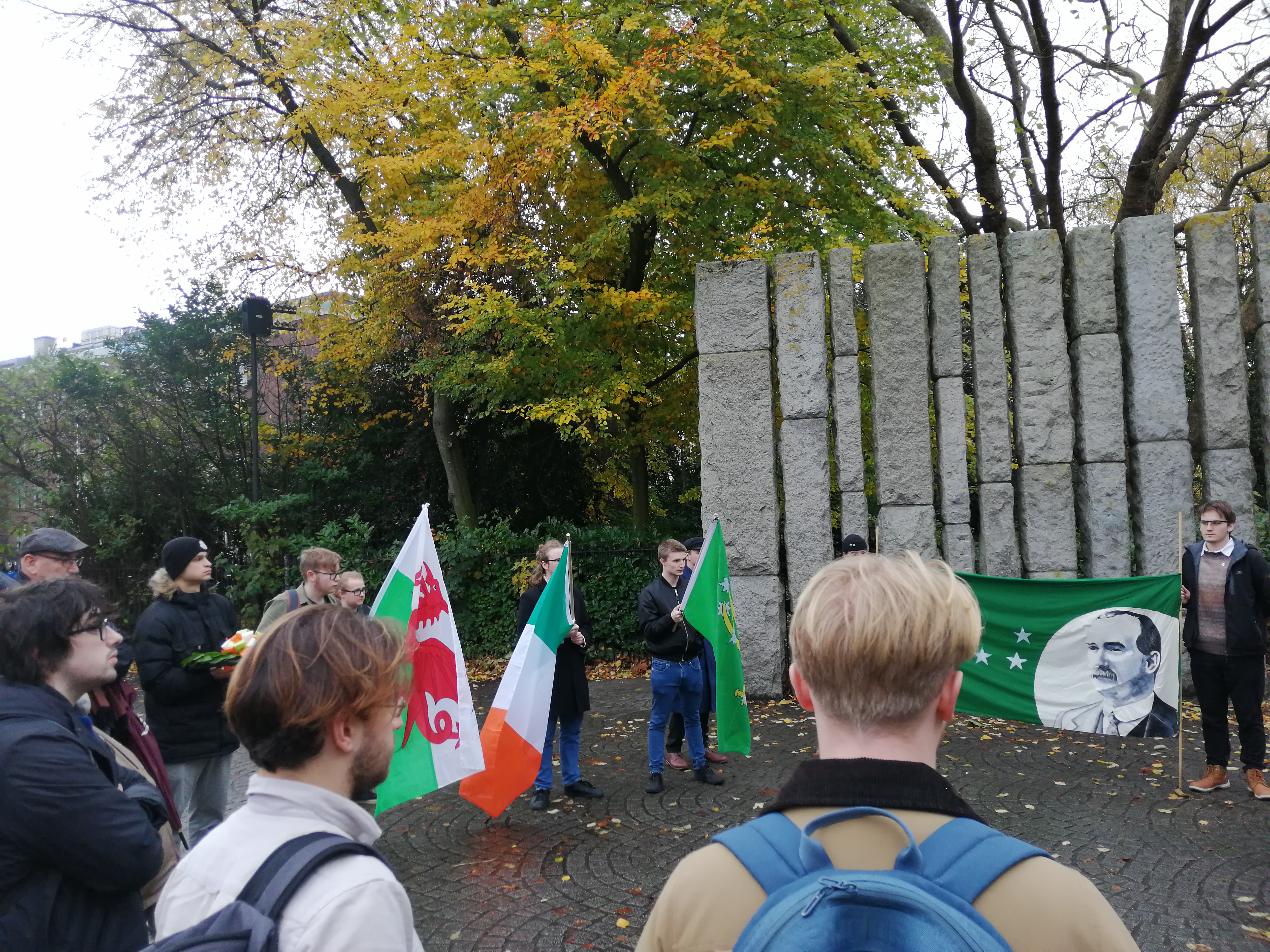
Some of the gathering at the Wolfe Tone Monument (out of shot to the right) to commemorate the creation of Irish Citizen Army (Photo: Rebel Breeze)
MARKIEVICZ: “RESOLUTION, COURAGE AND COMMITMENT“
Breatnach was called back to the microphone and talked about the lessons to be learned from Constance Markievicz, co-founder of Na Fianna Éireann, the Irish Citizen Army and of Cumann na mBan, born in Britain “as were a number of our national and class heroes”, he said.
“Constance was born into a settler landlord family, the Gore-Booths”, he told the audience and her experience of witnessing deprivation, along with her sister Eva, during the Great Hunger, had a strong effect on both, inclining them to social reform and they became also suffragettes.
The speaker said that in that latter aspect and as a poet Eva became well-known particularly in England but Constance was better known as a revolutionary and for her allegiance to the working class and to the Irish nation.
He reminded his listeners that Markievicz was artistic and apt to strike poses; O’Casey, founder of the ICA had been hostile to her and co-founder of Cumann na mBan and wife of Tom Clarke of the IRB, Kathleen Clarke, had found her irritating.
Breatnach said that Markievicz was 3rd in 1916 garrison command at Stephen Green and had been accused not only shooting dead there a member of the DMP but of exulting in it; however according to witness accounts she had not even been present when the officer was killed.8
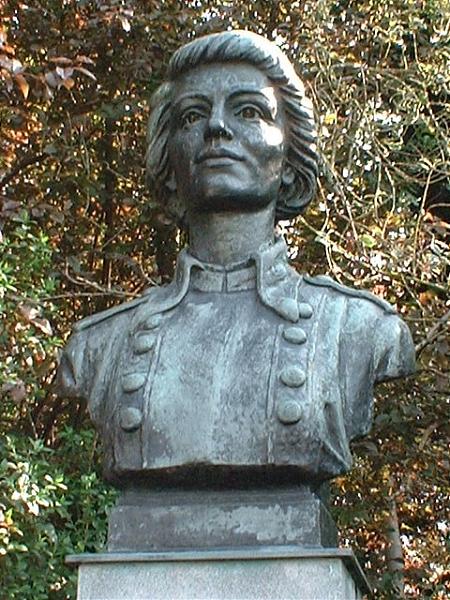
Bust of Volunteer Markievicz in Stephen’s Green (Photo: Rebel Breeze).
A British officer at her court-martial after the surrender of the 1916 Rising had claimed that she begged for her life at the court-martial but the official British records published later gave the lie to that and her own account that she demanded equal treatment with the executed leaders rings true.
“Her life as an example,” Breatnach continued, “teaches us not to judge people only by their background or indeed by their idiosyncrasies but primarily by their resolution, courage and commitment, all of which Constance Markievicz had by the bucket-load.”
The speaker also reminded those present that the very Wolfe Tone monument beside which he stood had been blown up in a number of British Loyalist bombings of the city during the 1970s, a number of which would soon be commemorated on the December anniversary of one of them.
The Irish State had prosecuted not a single one of the perpetrators, not even for the Dublin and Monaghan bombings, with the highest death toll9 of any one day during the recent 30 Years War. Instead, they had used the 1972 bombing to pass emergency legislation to attack Irish Republicans!10
Speaking briefly as a historical memory conservation activist, primarily active in the campaign to save the Moore Street market and 1916 battleground from speculators, Breatnach remarked that it was fortunate that the area behind him was a public park.
Otherwise it would all have been a prime target for property speculators. People sometimes express surprise that Irish governments do so little to protect areas of insurrectionary history. He stated however that this was natural since it was not their history but that of the struggling people.
“The history of the Irish ruling class is of a foreign-dependent one”, Breatnach stated, “rather than that of a national bourgeoisie willing to fight for independence. The last time Ireland had such a bourgeoisie was in 1798, mostly led by descendants of settlers and planters.”
“This is why Connolly pointed out that the Irish working class are the true inheritors of the Irish struggle for freedom. National independence and socialism are two different objectives but interdependent in Ireland and for the struggles to succeed they must be led by the working class.”
CONCLUDING
Wreaths were laid on behalf of a number of organisations, including Lasair Dhearg and the chairperson thanked all for their attendance, leaving people to their various ways into the mild autumn-like afternoon.
End.
(Cropped photo: Rebel Breeze)
(Photo: Rebel Breeze)
FOOTNOTES
SOURCES
1Clearly not the first army composed of workers, since these are the members of most armies; nor the first to fight for the workers, as did some for the Paris Commune in 18th March-28th May1871. However, the ICA was founded specifically for the defence of workers, the first in the world to be so, though its constitution was largely Irish nationalist.
2Socialist and anti-fascist Irish Republican organisation mostly represented in Belfast. The name means “Red Flame”.
3A number of Irish were veterans of the Boer War, the British against Dutch colonists in South Africa, most like White were on the British side but some fought for the Boers, to the extent of forming an Irish Brigade for the purpose. Later, a number from both groups ended up fighting alongside one another in the 1916 Rising (and no doubt against others who remained in the British Army).
5The Irish Volunteers, Cumann na mBan, Na Fianna Éireann, the Hibernian Rifles and of course the Irish Republican Brotherhood, the chief architects of the Rising, its members fighting as members of other units, chiefly the Volunteers and the Fianna (the membership of both those organisations was exclusively male though its couriers were often female but Tom Clarke’s wife, Kathleen Clarke, was the IRB’s liaison from Dublin with the sister organisation in the USA.
6James Connolly (1868-1916) did not prescribe any air for the lyrics and they have been sung to several. A Nation Once Again was composed by leading member of the Young Irelanders, Thomas Davis (1814–1845) and published in 1844, for many years considered a candidate for Irish national anthem.
7“For our demands most moderate are: we only want the Earth!”
8Breatnach also said that least two and probably three members of the DMP were killed during the Rising, each one in an area under the control of the ICA, who no doubt remembered well the force’s actions during the 1913 Lockout.
91974: 33 male and female civilians and a full-term unborn baby.
10The Amendment to the Offences Against the State Act, including the introduction of the no-jury Special Courts, essentially for trying Irish Republicans with a much lower quality of evidence required to convict, including the unsupported word of a senior Garda officer.
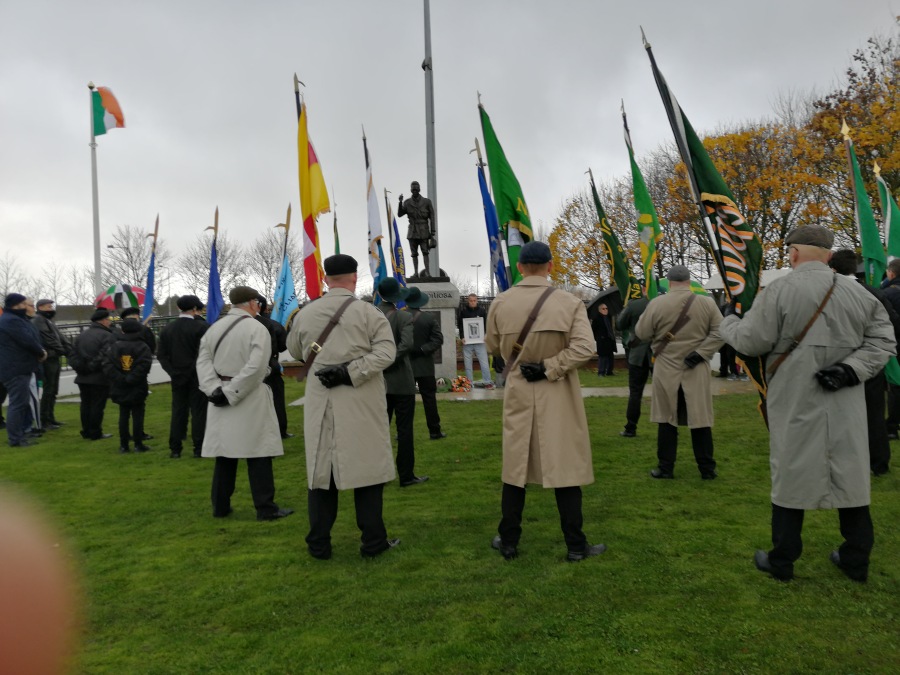
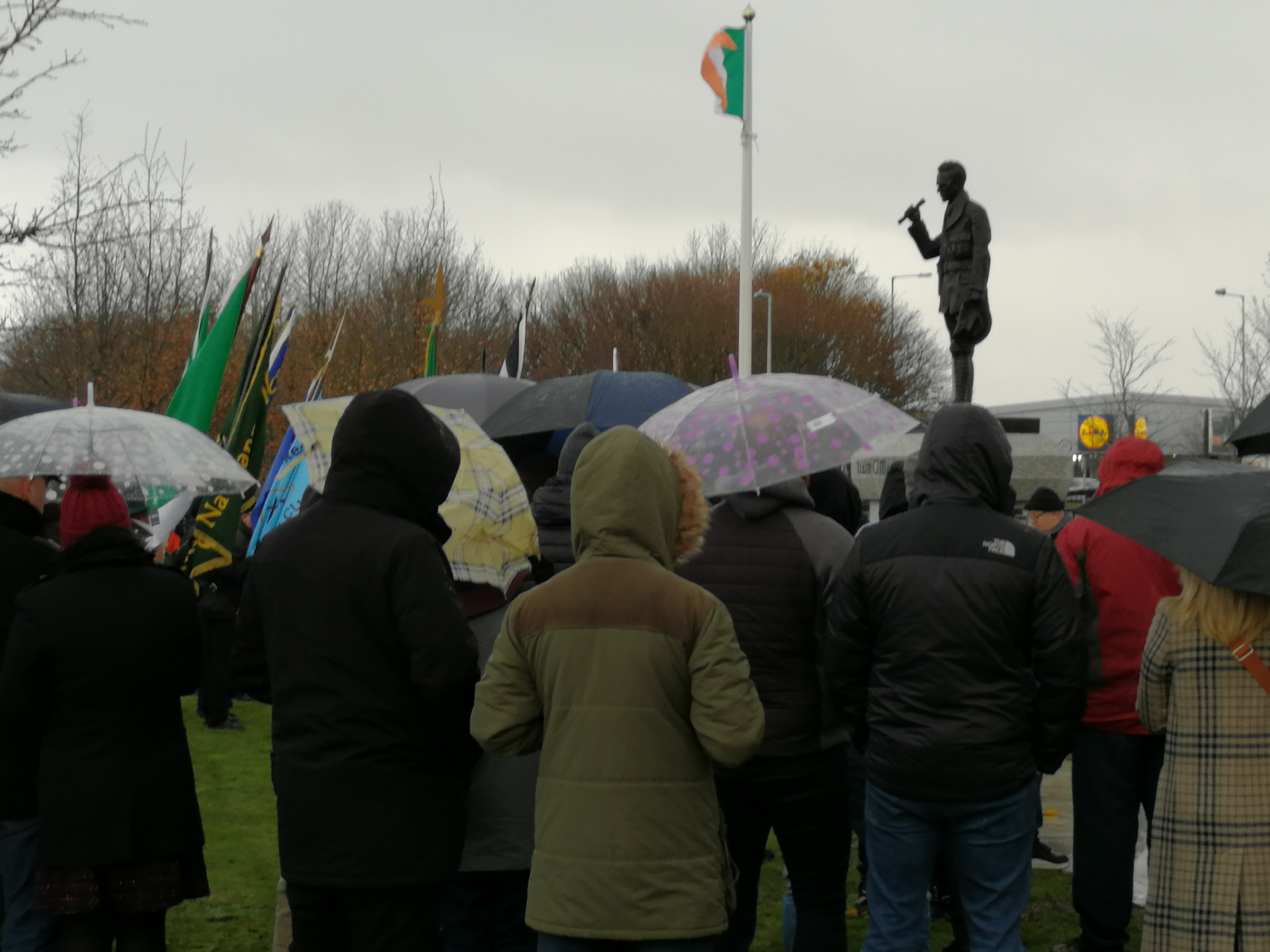
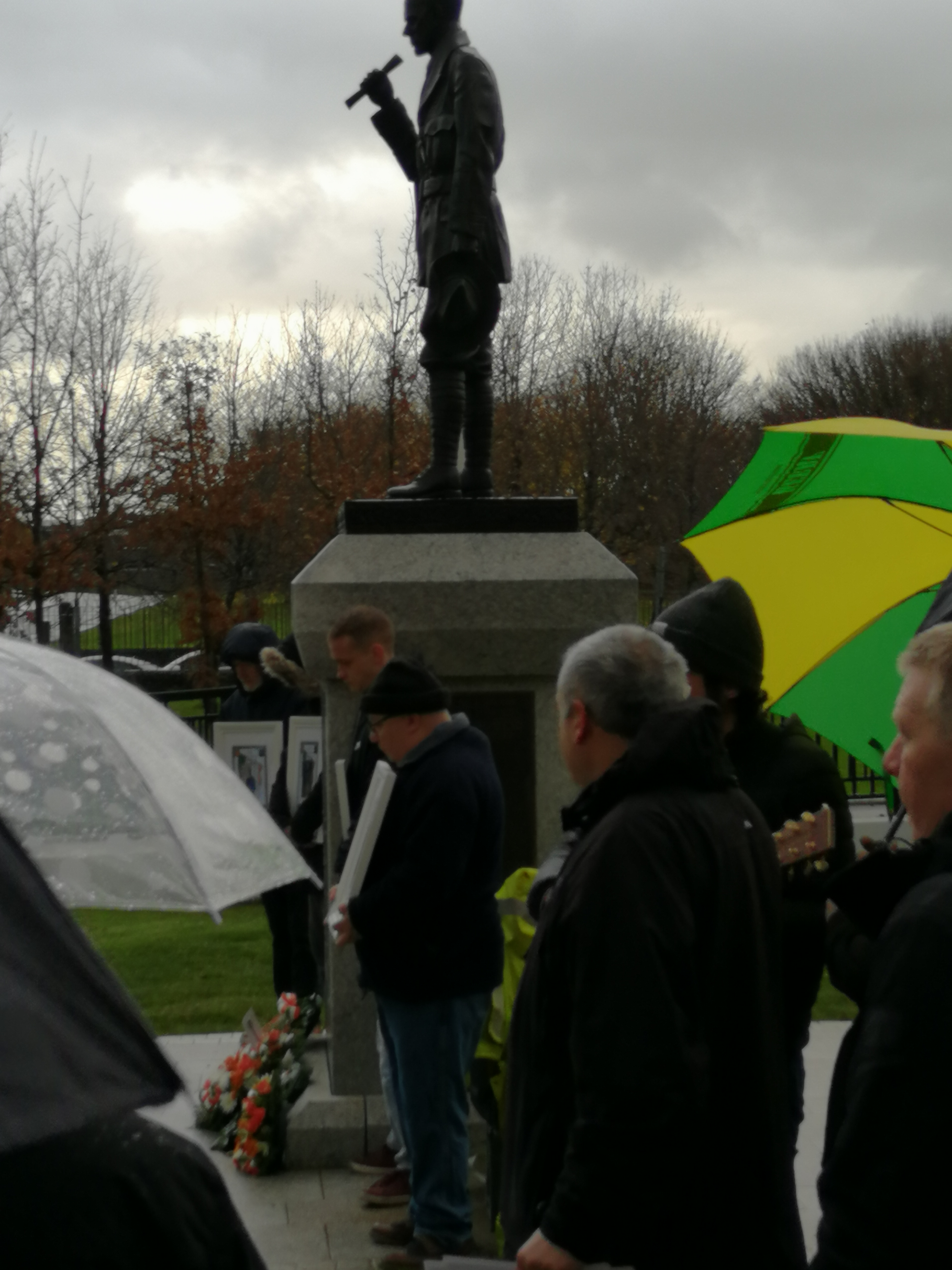
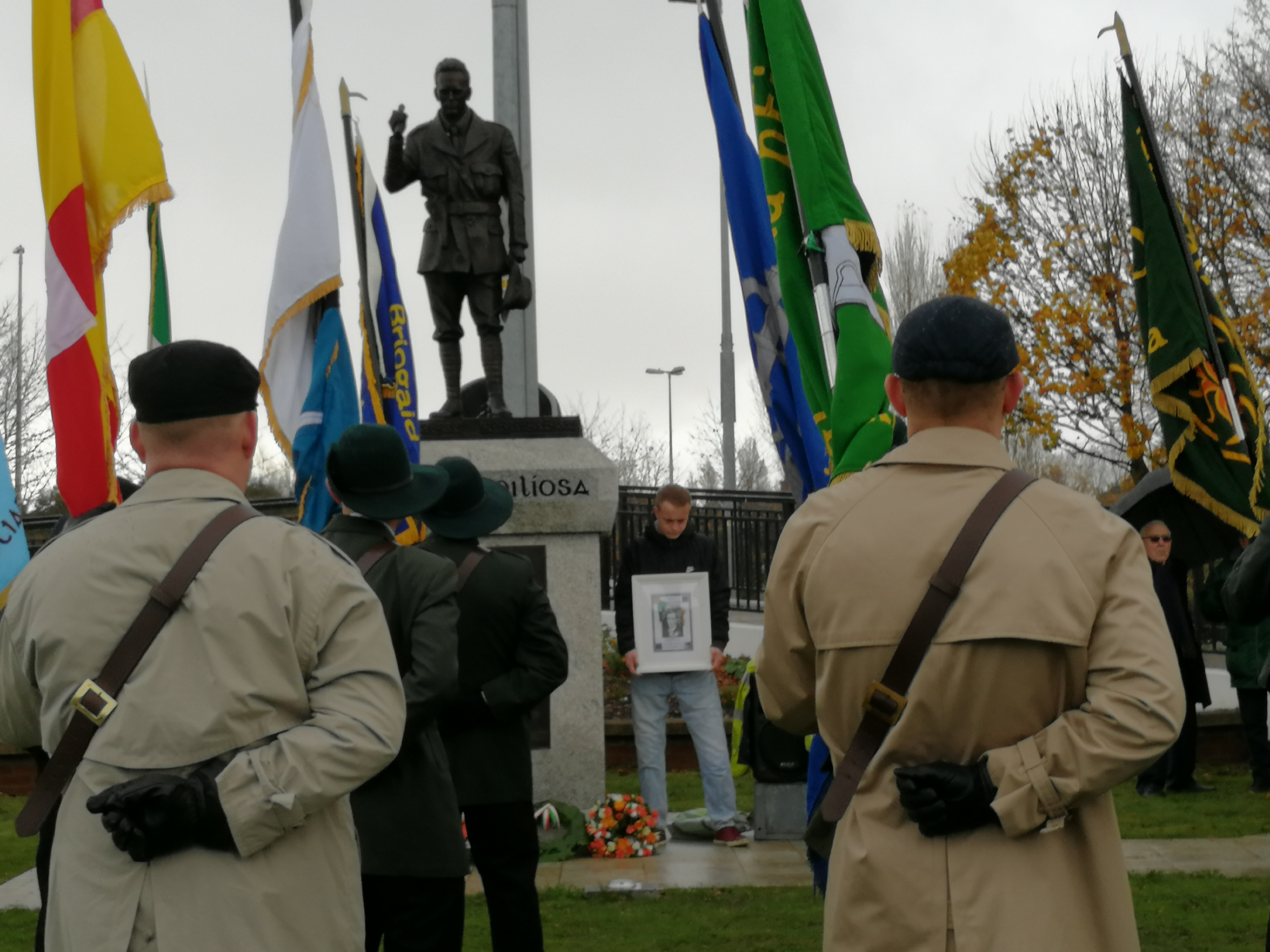
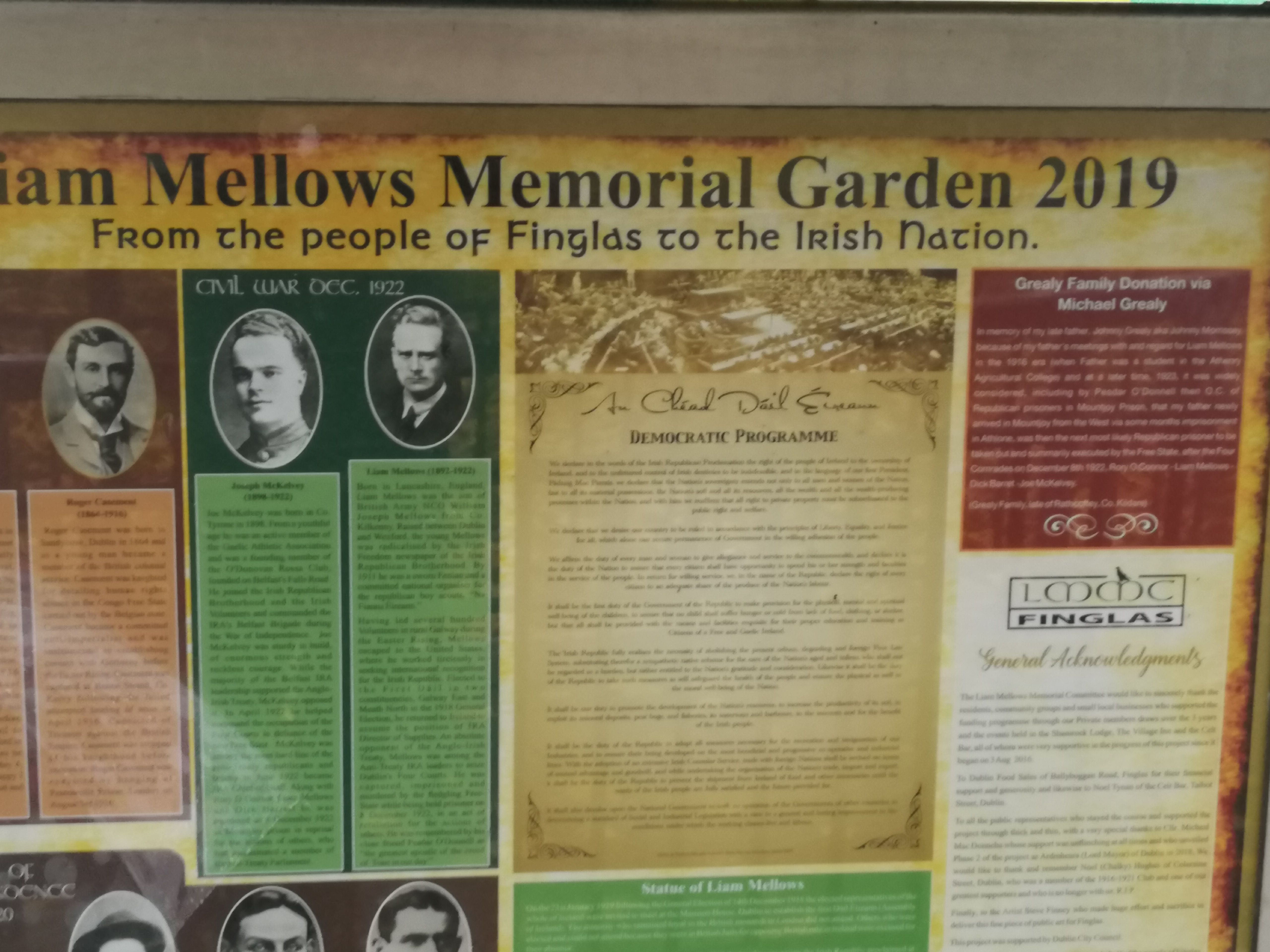
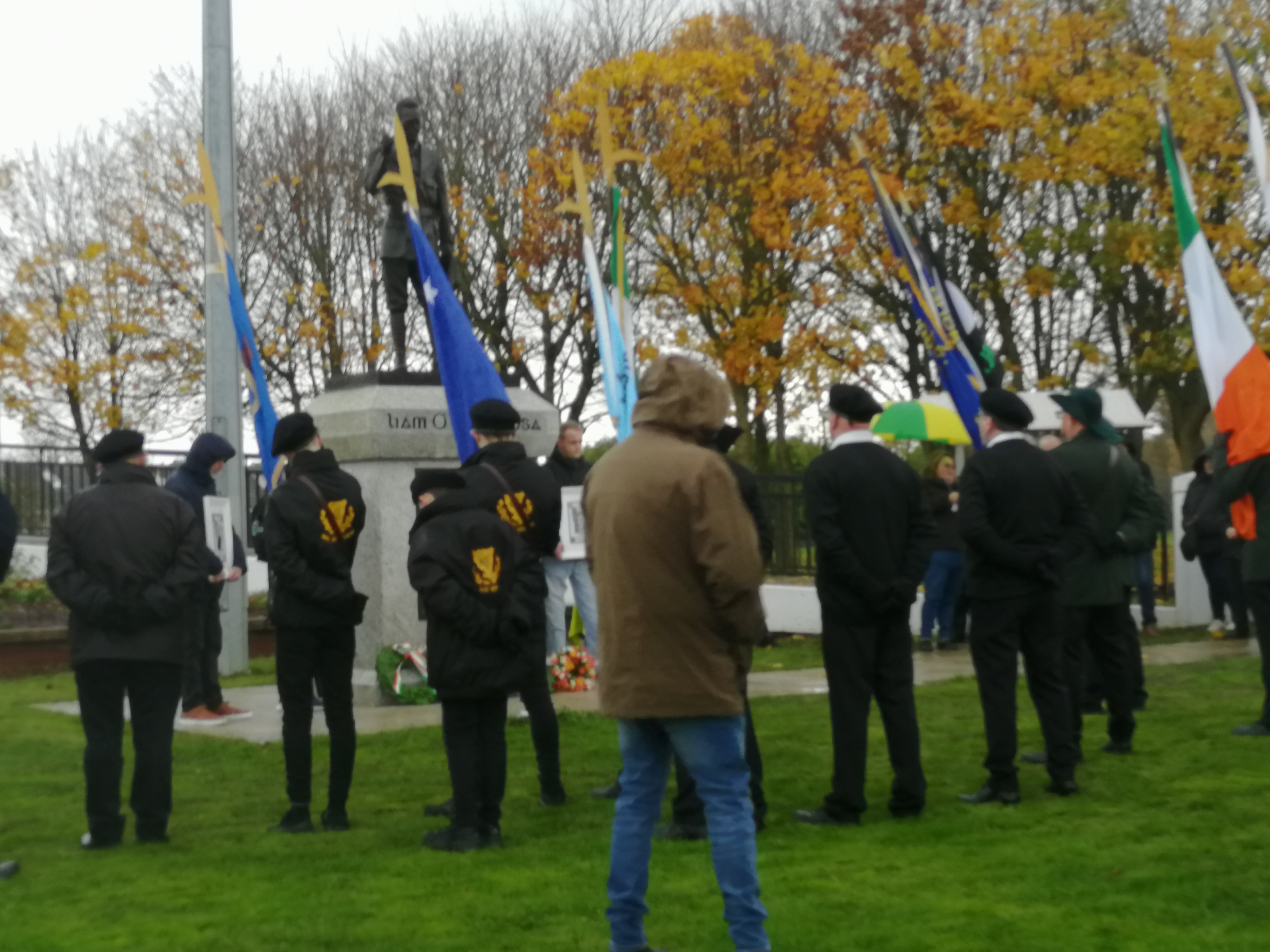
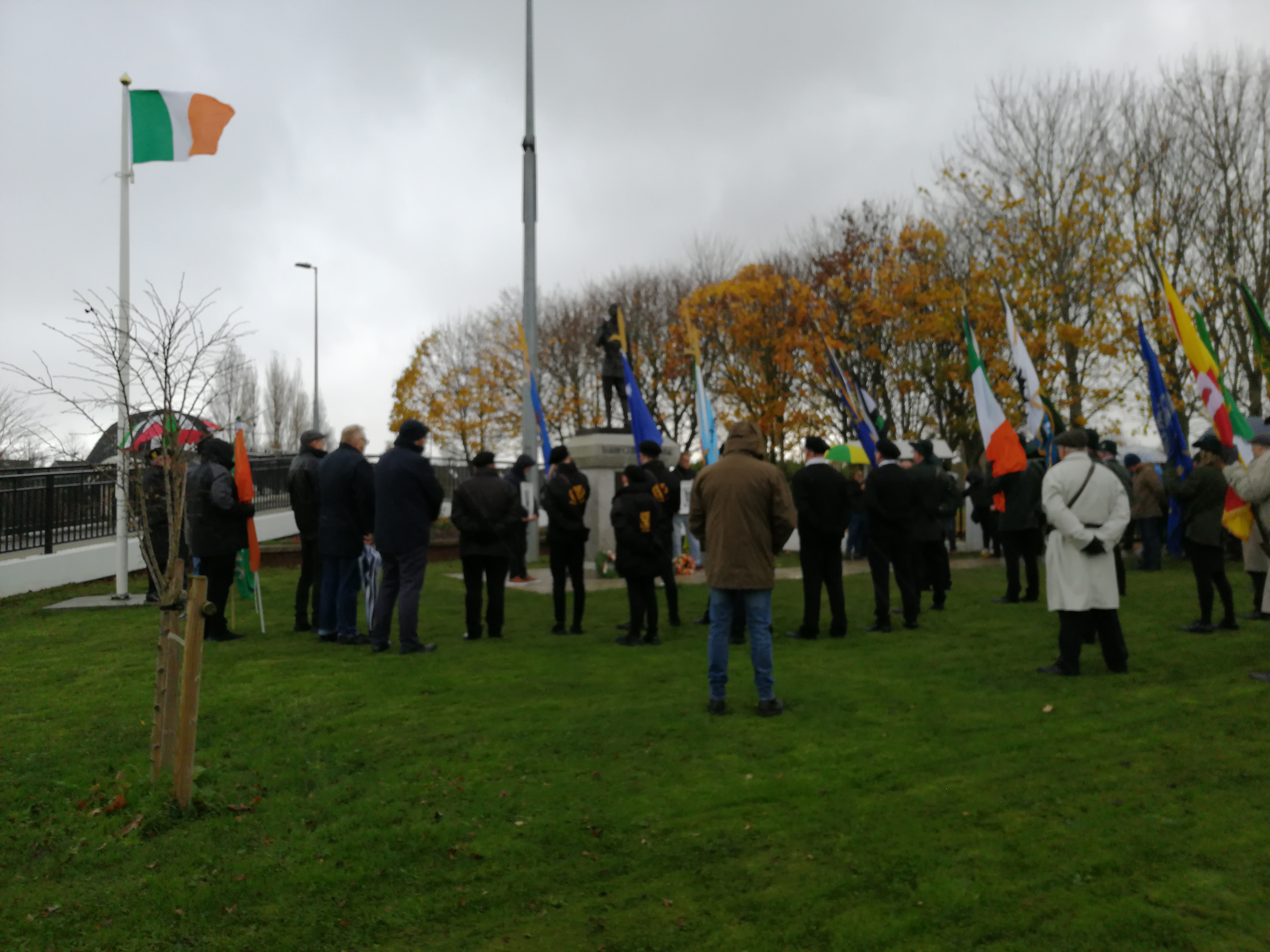
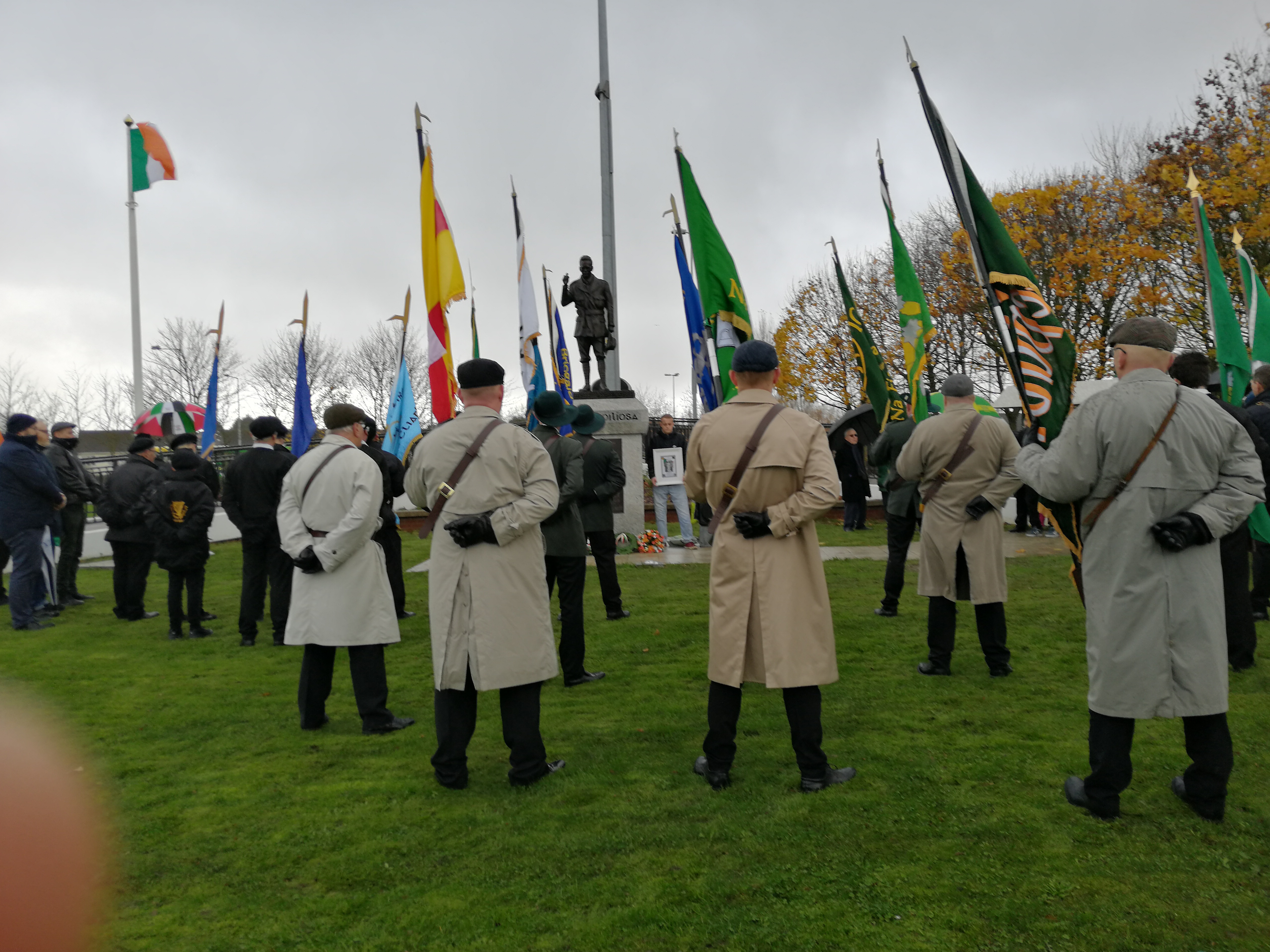
In atrocious weather conditions, Irish Republicans of a number of organisations and of none gathered at the Liam Mellows monument in Finglas today (Sunday 4 December 2022) to honour four Republicans executed by the Irish State in 1922.
Liam Mellows, Rory O’Conor, Joe McKelvey and Richard Barrett were all prominent IRA Volunteers during the War of Independence and rejected the Anglo-Irish Agreement to create a subservient state in a partitioned country.
The Irish State chose the four prisoners in retaliation for the assassination of Seán Hales TD, himself shot in retaliation for Free State executions of Republican prisoners. By coincidence or intent, each one of the four had been born in a different one of Ireland’s four provinces.
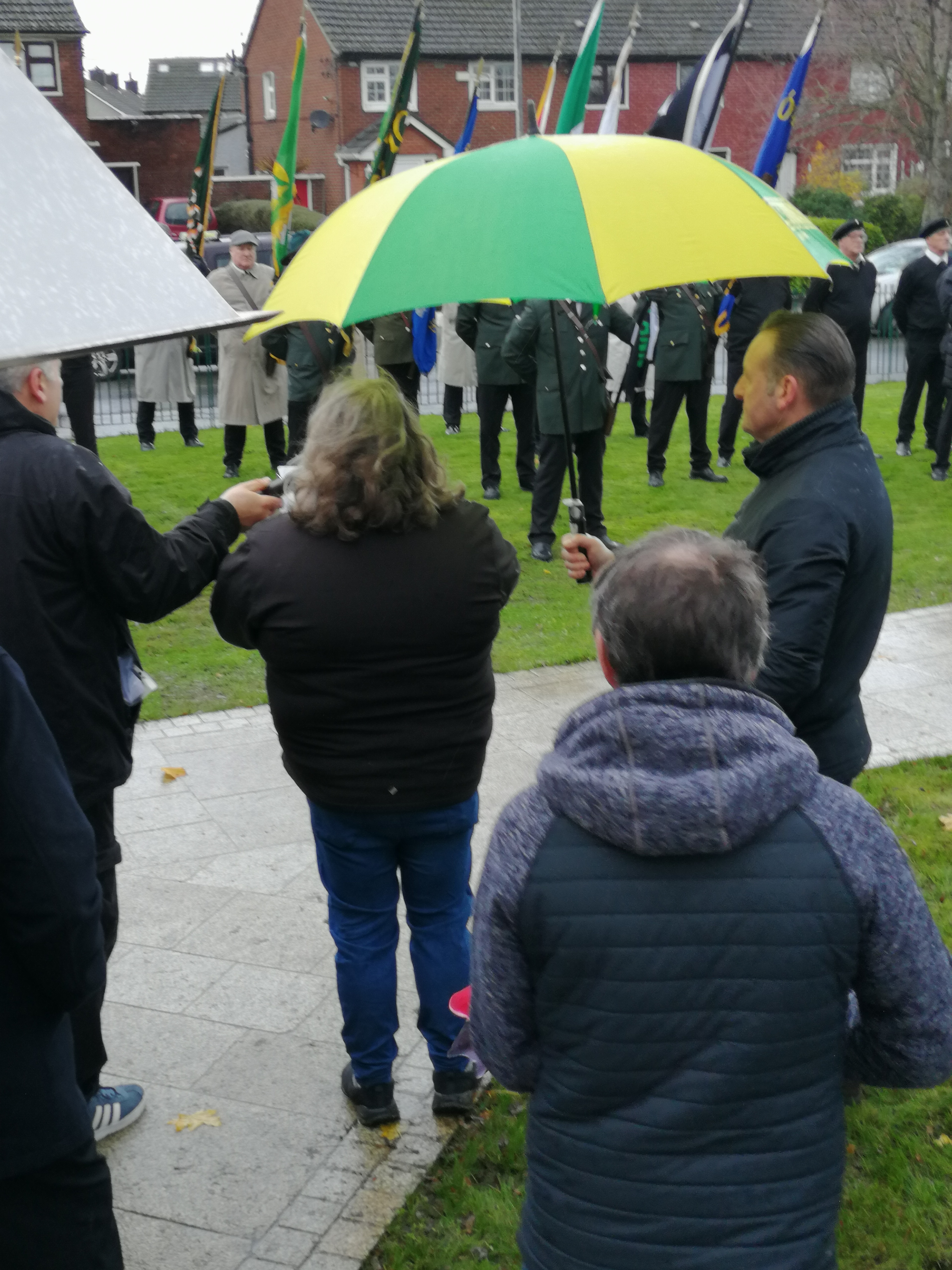
Section of the crowd seen from behind, the monument ahead in background and the flags of the colour parties visible to the left. (Photo: D.Breatnach)
THE COMMEMORATION EVENT
A part of the commemoration marched with colour parties, led by lone piper, from Finglas village to the Mellows Monument.
Ado Perry chaired the event, one of a series of Irish Civil War commemorations in Dublin organised by Independent Republicans, which group also erected commemorative panels in various locations around the city, often marking the location where Free State troops killed an IRA Volunteer.
Three colour parties attended the event and a list of all the known Republican victims of the Free State was read out.
Seán Óg performing with Ado Perry in the foreground. (Photo: D.Breatnach)
Sean Óg, accompanying himself on guitar, sang Brian Ó hUigínn’s Soldiers of ‘22 and James Ryan’s Take It Down From the Mast, two of the best-known of a very limited number of songs about the Irish Civil War. A number present joined in on the chorus of the second song:
Take it down from the mast, Irish Traitors,
It’s the flag we Republicans claim;
It can never belong to Free Staters,
For you’ve brought on it nothing but shame.
(Photo: D.Breatnach)
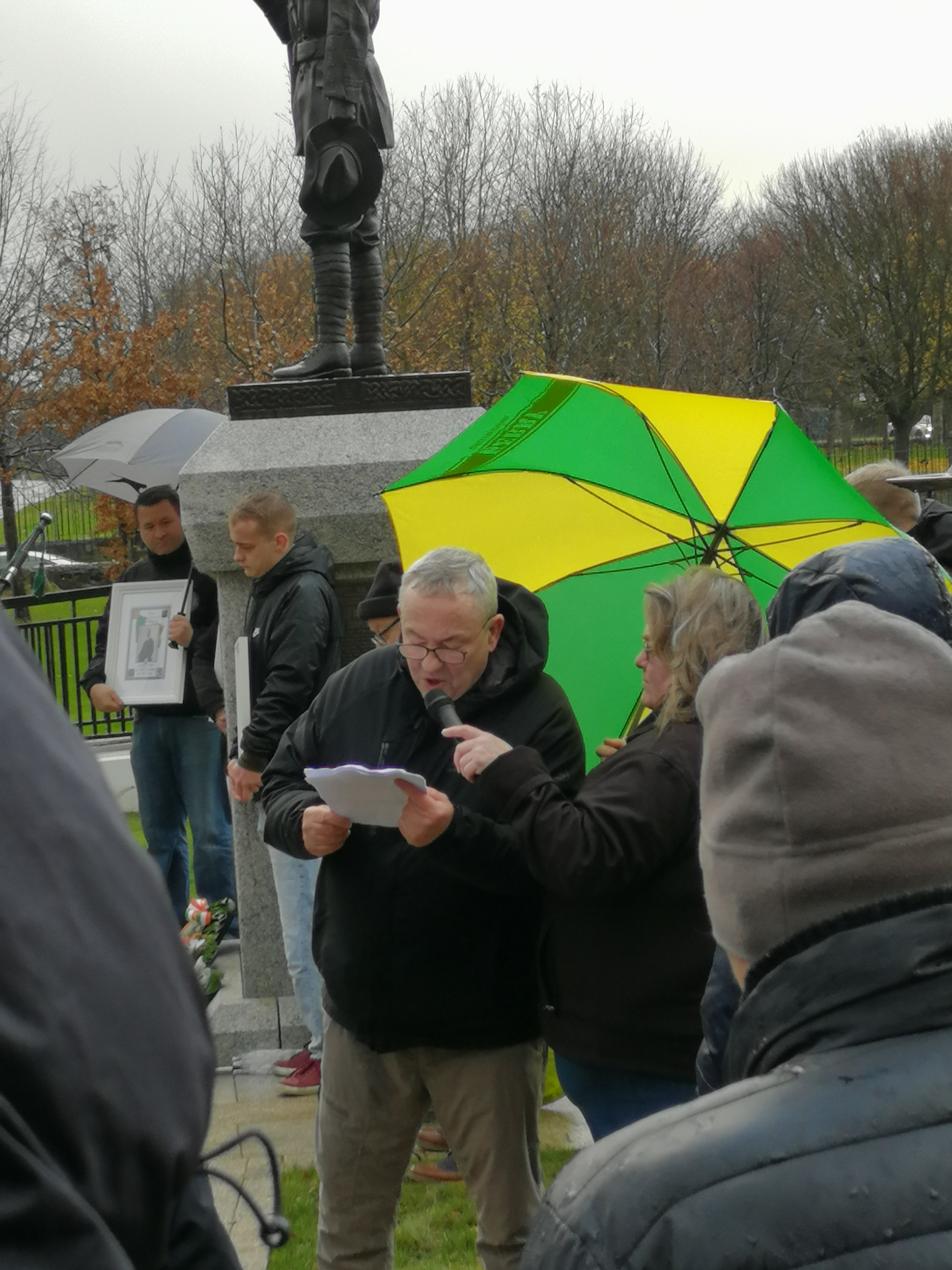
Mags Glennon gave a speech on behalf of the organisers but it was difficult to make out its content (kindly supplied since and given in full in Appendix.
The main speaker advertised for the event was John Crawley, who has found recent fame in Republican circles with the publication of his biographical book The Yank, about his enlisting with the US Marine Corps and attempting to pass on his military skills to the Provisional IRA.
John Crawley speaking (Photo: D.Breatnach)
It was a shame that the volume of the PA was only turned up at around the last quarter or so of his speech. Despite the limited audibility of most of it, the attendance endured the rain and stood there in good order1.
Ado Perry thanked speakers and musicians for participation and all for attendance, making special mention of the colour parties. He announced that the event commemorative event would be at Kilmainham Jail early in January.
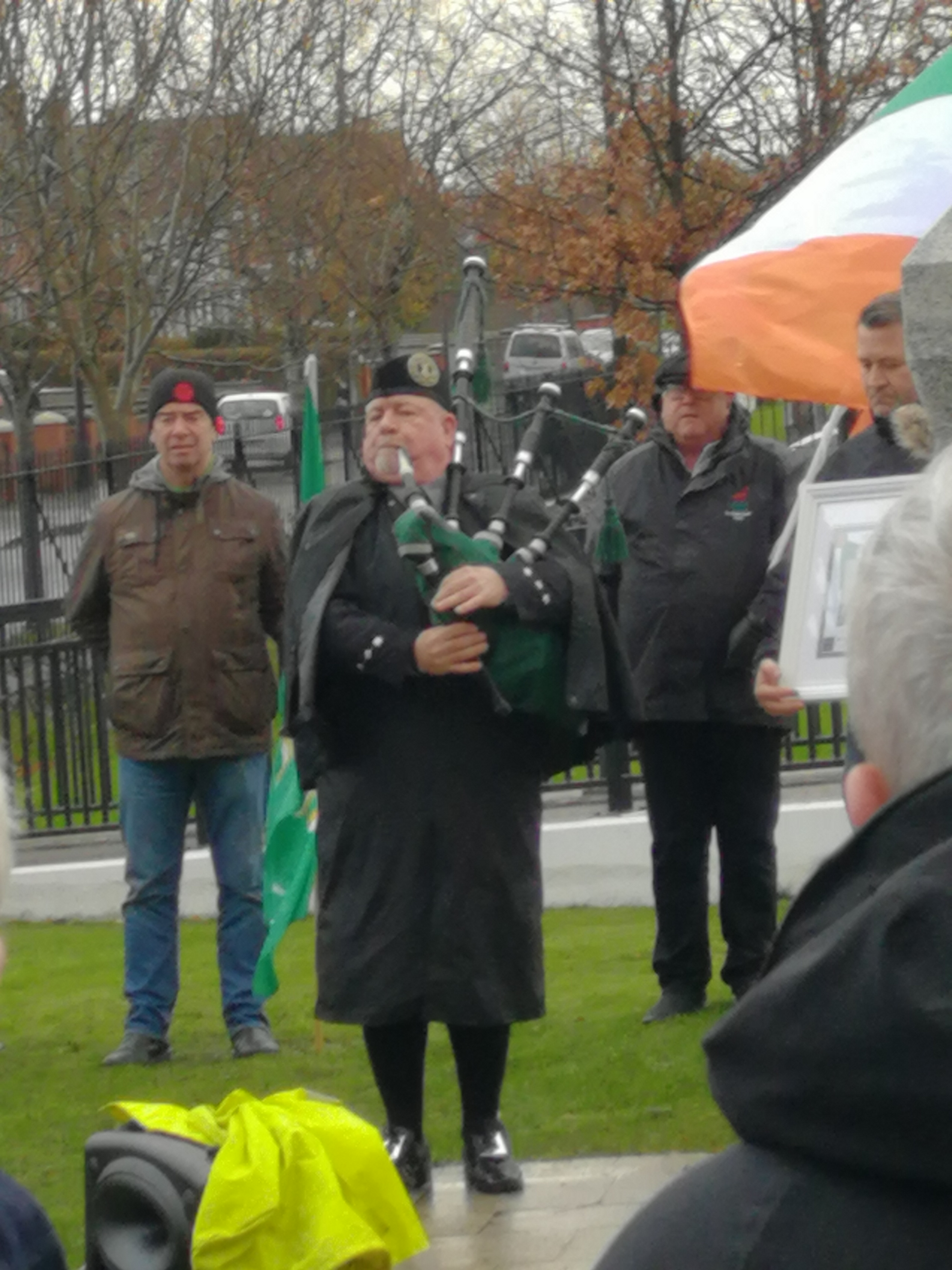
A lone piper played a lament and swung into the national anthem, Amhrán na bhFiann. Representatives of the National Graves Association addressed the crowd briefly before the event finally concluded and the wet and the weary headed home or to a warm pub or restaurant.
(Photo: D.Breatnach)
A local resident assured us that the sun does sometimes shine in Finglas. I assured him I believed him as I had seen some photographs to verify it.
The weather really was atrocious, raining almost non-stop and on one occasion during the event, lashing down heavily upon the gathering. One had to feel sympathy for the men and women of the three colour parties, who had to endure the downpour without the shelter of even an umbrella.
Indeed this reporter felt the need to break his bicycle journey away from the event for a bowl of hot soup in a nice eatery across the motorway bridge in Finglas village, before pushing on to my destination in the Glasnevin area.
(Photo: D.Breatnach)
BACKGROUND: THE FREE STATE
The State that came into existence in 1922 was a creation of those forces that accepted Dominion status within the British Commonwealth instead of an Irish Republic, accepting also the partition of Ireland for the first time with six counties becoming a British colony.
While the pro-Treaty position had a majority of votes in the Irish parliament, a large part of the civilian population and the vast majority of the fighters (Irish Volunteers, Cumann na mBan, Na Fianna) rejected the Treaty and their representation left the Government in protest.
Although Anti-Treaty forces had occupied the Four Courts in Dublin, the Civil War was started by the Free State military, shelling the Republican occupants with artillery on loan from the British military and going on to use British transport and weapons to defeat the Republicans.
Rory O’Connor, Joe McKelvey, Richard Barrett and Liam Mellows were already in jail when Seán Hales was killed and could not be considered guilty by any stretch of causality; nevertheless they were executed on 9th December 1922.
oznor
From Century Ireland:
In a statement issued by the National Army’s General Headquarters, the latest round of executions are explained as a ‘reprisal for the assassination…. of Brigadier Sean Hales, TD, and as a solemn warning to those associated with them who are engaged in a conspiracy of assassination against the representatives of the Irish people.’
The executions took place at 9.20 am. The prisoners were marched blindfolded to the rear of the Mountjoy Prison buildings with three clergymen in attendance. They were shot by firing squad and their bodies were subsequently interred within the grounds of the prison.
Commenting on these developments, the Irish Times has editorialised that the ‘Free State Government has committed itself to an act of ‘reprisal’ which eclipses in sudden and tragic severity the sternest measures of the British Crown during the conflict with Sinn Féin.’
The first executions carried out by the Free State took place on 17 November 1922, and then continued a week later with that of Erskine Childers.
On the last day of November, the number of those executed increased to eight when three Dubliners – Joseph Spooner (21), Patrick Farrelly (21), John Murphy (19) – were killed at Beggars Bush Barracks.
The three men were captured on 30 October after an attempt was made to blow up Oriel House, the headquarters of the Criminal Investigation Department (CID)2.
Following the deaths of Spooner, Farrelly and Murphy, the leader of the Labour Party, Thomas Johnston, called for an end to executions as a method of punishment. Mr Johnston, speaking in the Dáil on 30 November, stated:
‘We have been told pretty frequently during the last few weeks that it is the intention of the ministry to re-establish the reign of law, and we were told yesterday, as we have been told frequently, that unless this kind of thing is done anarchy will prevail. I want to make the charge that this kind of trial, this kind of sentence, is, in fact, anarchy. It is not law. It is anarchy- lynch law once removed.’
Colour Parties at the event (Photo: D.Breatnach)
By the time the Civil War ended, the Free State had formally executed around 80 Irish Republicans (many more than had the British occupation 1916-1921) and at least another 20 killed as surrendered fighters or kidnapped, sometimes tortured, then taken somewhere and shot.
Post-Civil War, the class nature of the State became even clearer: led by a foreign-dependent capitalist class, handing over healthcare and education to the Catholic Church, upon the institutions of which it leaned heavily for social control of the masses.
The foreign dependency was at first on the British who helped create the State but subsequently first the USA and then the EU have been added to the list of economic masters. This is the inheritance of the Anglo-Irish Agreement and of the victory of the Free State in the Civil War.
end.
(Photo: D.Breatnach)(Photo: D.Breatnach)
APPENDIX (reading time approx 11 minutes):
SPEECH BY MAGS GLENNON FOR INDEPENDENT REPUBLICANS GROUP
Today we gather to remember and honour Liam Mellows, Rory O’Connor, Joe McKelvey and Dick Barrett, four dedicated volunteers who were executed without even the pretence of a trial by a Free State regime bent on revenge and determined to use any methods to defeat the principles and spirit of Irish Republicanism.
In this case the brutal elimination not just of key IRA military leaders but also the articulate political voices who could expose the betrayal of the revolutionary republican ideals by the Free State.
As the Civil War grew increasingly bitter in the autumn of 1922 the Free State implemented the Public Order Act, allowing for summary execution from anyone caught in possession of weapons. Kevin O Higgins stated that “what was needed to put down the Irregulars were more local executions, and we should just kill them anyway”.
It is important to recognize the context in which these four brave men met their deaths. They were murdered to ensure the supremacy of the Free State elite who felt it was their right to betray the principles of the 1916 Rising and the Democratic Programme of the 1st Dail.
The prosperous catholic and moderate nationalist class had seen their Home Rule party practically eliminated in the 1919 election. Mass campaigns against conscription, transport strikes against British militarism as well as sporadic strikes and workers Soviet revolts worried what Mellows called ‘the state in the country people’.
The political interests of the prosperous middle class catholic merchants, professionals and big farmers were well served by acceptance of the British Treaty, which would ensure they held social, economic and political power in the new Free State. They cared not for partition or royal oaths as they had achieved their Home Rule.
The Free State elite saw the role of working people, many of whom had been at the forefront of the war, was to retreat once more to the slums and to obey their masters.
The democratic and egalitarian basis of a Republicanism expressed in the founding documents of the struggle promised a radical and democratic future, appealing in particular to working people in Dublin who had been fighting since the Lockout of 1913.
WT Cosgrave famously described the urban and rural poor as the ‘sweepings of the workhouses’ and desired that they emigrate as quickly as possible. The original Sinn Fein of Arthur Griffith had supported the employers in 1913 but piggy backed to prominence on the back of the 1916 Rising.
The elimination of men like Mellows – Brugha and Childers were already dead – was to ensure the political head was cut off the Republican movement.
The execution of military commanders like O Connor, Barrett and McKelvey was to send a message to all provinces that the IRA rank and file would suffer similar deaths to their commanding officers.
The terror Dublin had suffered in 1922 was intensified across the south in 1923 with dozens of young volunteers (many just boys) disappeared, tortured, shot at roadsides and dumped behind ditches. Yet Fine Gael still today parrots rubbish about republican ‘violence’, to cover up the savage war crimes on which they built their Free State.
We must all openly question the narrative being put forward by the Free State establishment today, completely ignoring the centenary of the Civil War. Remembering the deaths and honouring the lives of the republican volunteers has been carried out by their families and small local Commemoration groups.
Any further publicity would reveal the betrayal of the democratic and revolutionary principles of Republicanism which the Free State attempted to wipe out in the Civil War. We must rededicate ourselves to the revolutionary, internationalist and anti-imperialist traditions of Irish Republicanism.
As we work to advance these ideas in our communities, we must reject the conservative and xenophobic brands of nationalism, whether orange or green, that seek to deflect the blame for our social and economic problems away from the establishment figures benefiting from and promoting such conflict.
We remember today the sacrifice made 100 years ago by Liam Mellows, Rory O Connor, Joe McKelvey and Dick Barrett. May they rest in peace and their ideas and example form the basis of a strong, principled and united Irish Republicanism into the future. Beir Bua!
SPEECH BY JOHN CRAWLEY, MAIN SPEAKER AT EVENT
At 3:30 am on Friday, the 8th of December 1922, IRA volunteers Liam Mellows, Rory O’Connor, Dick Barrett, and Joe McKelvey were informed they were to be summarily executed by the Free State government in retaliation for the killing of Sean Hales, the previous day.
Hales had voted for the ‘Murder Bill’ permitting the execution of those bearing arms in defence of the Irish Republic.
The Free State made great play of the fact Hales was a T.D. even though the first T.D. slain in the Civil War had been shot by Free Staters when they killed Cathal Brugha, who presided over the first meeting of Dáil hÉireann in January 1919 and had served as Minister for Defence. Free Staters had murdered Harry Boland T.D. in August, and of course, Liam Mellows was a T.D.
Captured as part of the Four Courts garrison the previous June, these four IRA volunteers had been in prison since then. They held no responsibility for IRA operations on the outside.
Those Free Staters who hadn’t the resolve to stand by the Republic demonstrated vicious zeal in proving to the British they had the cruelty to murder those who did.
They attempted to justify these killings by claiming they were implementing the will of the Irish people who approved the Anglo-Irish Treaty under Britain’s threat of immediate and terrible war if it were not ratified.
But it was not the will of the Irish people that led to the bombardment of the Four Courts the previous June with artillery provided by the British army. It was the will of British Prime Minister Lloyd George and Winston Churchill.
The firing squad that shot Rory, Liam, Dick, and Joe that cold December morning was manned by Irishmen who had all served in the British army. They carried rifles and wore uniforms supplied by the British government.
The Free State government called its armed wing the National Army, but it was no national army.
It was an exclusively 26-County force set up under Article 8 of the Anglo-Irish Treaty to fight the only war they ever engaged in – the war to overthrow the Irish Republic. Had it been a national army, the British government would never have permitted it to exist.
Bernard Law Montgomery, who became a Field Marshall during the Second World War and had commanded British forces in Cork during the Irish civil war, wrote in 1923:
‘We [the British Army] could probably have squashed the [IRA 1919-21] rebellion as a temporary measure, but it would have broken out again like an ulcer the moment we removed the troops…
The only way, therefore, was to give them [the Irish] some form of self-government and let them squash the rebellion themselves; they are the only people who could really stamp it out, and they are still trying to do so and as far as one can tell they seem to be having a fair amount of success.’
By May 1923, the Free State Army would have 58,000 men who were armed, equipped, and uniformed by the British government.
Of this number, more than 30,000 were Irishmen who were former British soldiers, approximately 3,000 were IRA deserters who had defected from the Republic, and the remaining 25,000 had no prior experience on either side.
James Connolly had written in 1915, ‘When a foreign invader plants himself in a country which he holds by military force his only hope of retaining his grasp is either that he wins the loyalty of the natives, or if he fails to do so that he corrupts enough of them to enable him to disorganise and dishearten the remainder…The chief method of corruption is by an appeal to self-interest.
The self-interest of the Free Staters lay in the opportunity to achieve managerial control of a state with the pay, pensions, patronage, and prestige that went with it. A state whose parameters had been determined by a Tory-dominated cabinet committee that consulted nobody in Ireland except unionists.
Contrary to what partitionist propagandists would have us believe, the Treaty was not the result of a decision that had to be taken for pragmatic reasons in the face of overwhelming odds that any rational person in Ireland could recognise and accept.
Nor was the Dáil split down the middle. The Treaty passed by only seven votes in January 1922. Had the vote been taken before the Christmas recess, as many had expected, the Treaty would almost certainly have been rejected.
Unfortunately, the Christmas break gave powerful pro-Treaty interests like the Catholic Church, big farmers, big business, and an assortment of gombeen men the opportunity to wear down the resolve of a number of T.D.s.
Liam Mellows presided over an IRA convention held in the Mansion House in Dublin in March 1922. The IRA voted more than 80% against the Treaty and passed a resolution declaring, ‘That the Army reaffirms its allegiance to the Irish Republic…’
Cumann na mBan voted overwhelmingly against the Treaty by 419 votes to 63, and the vast majority of the active IRA units in the field also rejected it.
In a letter to his mother written shortly before his execution, Liam Mellows declared, ‘I die for the truth.
That truth was spoken by James Connolly at his court martial in 1916 when he said, ‘The British Government has no right in Ireland, never had any right in Ireland, and never can have any right in Ireland . . .’
That truth was also spoken by Pádraig Pearse while inspecting Irish Volunteers at Vinegar Hill in Wexford in the early autumn of 1915 when he said, ‘We, the Volunteers, are formed here not for half of Ireland, not to give the British Garrison control of part of Ireland. No! We are here for the whole of Ireland.’
As has been shown so many times in Irish history and is being demonstrated today in a different context, in a revolutionary struggle, the choice one often confronts is whether to do what counts or to make what you can do count.
To do what mattered proved too daunting for many Free Staters, so they made the Treaty count, saved their skins, opened career paths, and shifted the goalposts from the 32-County Irish Republic to a 26-County Dominion of the British Empire moulded by British strategic interests.
In 1948 Fine Gael Taoiseach John A. Costello declared that the Irish Free State would become the Republic of Ireland – a republic that would tell the world Ireland is Ireland without the Six Counties.
In the future, when any Dublin politician would proudly assert, ‘I stand by the Republic,’ they were referring exclusively to the twenty-six-county Republic of Ireland announced by this former Blueshirt in 1948, not the thirty-two-county Irish Republic proclaimed in 1916 and ratified by the First Dáil in 1919.
Again today, Britain is attempting to shape the political environment to suit its strategic interests. Just as in Liam Mellows day, former comrades who swore they would lead us to the Republic are leading us in the opposite direction.
All talk of the Republic is now gone because the Republic was never on the negotiating table in 1998. We no longer hear Ireland referred to as our country but as this island. Our country is one nation. This island has two.
Great play is made about the potential of a united Ireland as outlined in the Good Friday Agreement. We had a united Ireland during the Famine. We had a united Ireland when the Republic was proclaimed in 1916. We had a united Ireland when the United Irishmen was formed in 1791.
So what did the 28 Protestants who founded the Irish republican movement mean by a United Ireland? Not territorial unity, which already existed, but the only unity that matters and the unity the British would never countenance – a unity of Irish citizens across the sectarian divide.
The united Ireland defined by the Good Friday Agreement is not a republic. It envisions a polity where the sectarian dynamic remains intact and the cleavage in national loyalties between Ireland and Britain is constitutionally enshrined.
Consequently, many supporters of this strategy propose a continuing and symbolic role for the British royal family as an institutional point of reference for the loyalties of those who would prefer to see themselves as a civic outpost of Britain rather than as equal citizens of a national democracy within an all-Ireland republic.
Debates and discussions are taking place on changing the Irish national flag, discarding the Irish national anthem, and re-joining the British Commonwealth. Instead of breaking the connection with England, we are being relentlessly conditioned into becoming more closely incorporated into a British sphere of influence on a national level.
When former comrades meet and greet British royalty in Ireland, they are sending out an unambiguous message that Ireland is not one nation but two. That Britain has legitimacy in Ireland and a role to play in influencing the political trajectory of our country.
Our goal as IRA volunteers was to break the connection with England. Not to convince the rest of Ireland to re-join the British Commonwealth.
There are many happy clappy euphemisms being employed to describe the Ireland of the future. A shared island, an agreed Ireland, and a new Ireland. Who in their right mind could be against the concept of sharing and new and agreed arrangements?
When we drill down into it, however, we see the trap being laid for us by the British government. A shared island means we share in Britain’s analysis of the nature of the conflict, we share in the colonial legacy of sectarian apartheid, and we share in the imperial project of divide and rule.
We do this by recognising Ulster unionists as the British presence in Ireland with the right to have their Britishness enshrined in law. Republicans know that unionists are pro-British, but we do not accept they are the British presence.
The British presence is the presence of Britain’s jurisdictional claim to Ireland and the civil and military apparatus that gives that effect. England invaded Ireland hundreds of years before the plantation of Ulster. They claimed sovereignty here long before a single unionist set foot on Irish soil. What was their excuse, then?
An agreed Ireland has come to mean the two traditions agreeing to disagree in peace and harmony about the constitutional source of Irish sovereignty and the legitimacy and extent of British influence in constraining Irish democracy.
A muddled and subversive belief that the conquest and colonisation of Ireland share reciprocal legitimacy with its struggle for independence.
The new Ireland we are being asked to work towards is not new. It is predicated on all the old divisions. Divisions that Britain nurtured to retain the sectarian dynamic and resultant cleavage in national loyalties as this policy of divide and rule is the key to their control in Ireland.
It is designed to prevent us from developing the national cohesion required to achieve a 32-County republic. To make us permanently susceptible to British influence and manipulation.
During the Dáil debates on the Anglo-Irish Treaty, a persistent theme was that a pro-treaty vote was a vote for peace, with the resulting implication that those who stood firmly for the Republic were out for war. Liam Mellows replied:
‘If peace was the only object, why, I say, was this fight ever started? Why did we ever negotiate for what we are now told is impossible?
Why should men have ever been led on the road they travelled if peace was the only object? We could have had peace and could have been peaceful in Ireland a long time ago if we were prepared to give up the ideal for which we fought…’
Today those who stand resolutely for the Republic are accused of being against the peace process. Few republicans are against peace, but many are rightly critical of a process that cannot lead to the republican goals for which countless patriots sacrificed their lives.
A united Ireland rooted in British/Irish identity politics cannot be a republic. That is why the British government is all over this. It is their best opportunity to retain maximum influence in Ireland with a minimum footprint when the demographics eventually prove incontestable.
No one has been preparing more diligently to shape the strategic architecture of a future united Ireland than the British government.
One hundred years ago this week, Liam Mellows, Rory O’Connor, Dick Barrett, and Joe McKelvey were dragged from their cells and murdered in cold blood because they stood for what weaker and more personally ambitious Irishmen could not summon the courage to defend any longer.
We honour them today. We remember with pride all Ireland’s patriots from their day to this who never forgot who they were or what they represented.
Long Live the Irish Republic!
FOOTNOTES
1Thanks to Independent Republicans for posting a copy of his speech and that by Mags Glennon on their behalves.
Gearóid Ó Loingsigh looks at the new government in Colombia and how it talks of peace while increasing militarisation. English language version first published in Redline, 24th November, reprinted with kind permission of author.
(Reading time: 8 mins.)
The Petro–Márquez government is one which proposes to bring us to what they term Total Peace.
The term and the proposal as such have been subjected to justifiable criticism, not least because it places the insurgency of the ELN on the same footing as armed drug trafficking groups.
But there is another aspect of their government that calls upon us to reflect on what Petro – Márquez understand as peace and a demilitarized society that breaks with the past and the present of a repressive state where the answer to everything is a military response.
A first step would be to remove the military from civilian settings. But Petro has already made statements that indicate that neither he nor Márquez think that.
Shortly after taking on the presidency, he declared that the answer to deforestation of the Amazon was not only military, but Yankee.
In their electoral campaign their proposal was different, they did not talk about the military anywhere, but rather of democracy, autonomy, measures against drug trafficking and money laundering.
We will stop the deforestation and the burning of the jungle. We will dismantle the engines of deforestation, amongst them: displacement of the unemployed and landless peasants from the interior of the country towards the Amazon; land grabbers and promoters of extensive cattle ranching and other monocultures; corruption in public bodies; laundering of foreign currency through the purchase of deforested land, a by-product of drug trafficking and corruption; the uncontrolled extraction of wood etc.[1]
And he also said that the pacts to protect the jungle would be with the communities and not national or foreign militaries.
We will build a broad national pact of regional and global importance for the environmental defence of the Amazon, Orinoco and the biogeographic corridor of the Pacific. We will set up community agreements for the regeneration and ecological restoration of these eco-systems based on organisational processes, proposing to increase the size of collective territories, registry of plots and the strengthening of traditional and ancestral authorities. We will recognise the rural communities’ own lifestyle in strategic eco-systems and their own ecological and economic forms of production in these habitats, as well as their own environmental management.[2]
It all sounds very nice, but it goes hand in hand with militarisation. He proposed a sort of military alliance with the USA to avoid the burning of the jungle, copying the already existing model in Brazil where the USA has a base from which to put out fires.
Of course, in Brazil the mining and logging companies, etc. invade the territory with the approval of the government. The presence of north American troops never prevented any of the extractionist policies and less still poverty under the governments of Lula, Dilma and Bolsonaro.
As others have pointed out, it is nothing more than the militarisation of environmentalism and it is an old slogan of the imperialists that they should be in charge wherever they want and that includes the Amazon.
They used to brandish the anti-narcotics struggle as an excuse and now it is global warming. Al Gore once said that “The Amazon is not their property, it belongs to us all”. Of course, by us, this miscreant means Yankee imperialism: the USA.
It is the same discourse they have in relation to oil; it does not belong to the countries that have it but rather to all of us i.e. the US and European companies. Al Gore’s fame as an environmentalist is undeserved but his reputation as an old imperialist is completely justified.
Other governments have come out with similar feelings, Gore’s was not an individual outburst. Macron, NATO as such and the influential magazine Foreign Policy have argued for a military intervention in the region with the aim of protecting the planet.[3]
For the moment, Petro is not in favour of Colombia becoming a member of NATO, rather he proposes a regional military alliance.[4] Against whom would this alliance fight is not at all clear, or whether it would simply be an unofficial appendage to NATO.
We should be concerned and not just a little bit. In November he met with representatives of the US Embassy and the Subsecretary of Political Affairs, Victoria Nuland. Following the meeting Nuland tweeted.
Thank you, Gustavo Petro President of Colombia for our productive meeting reaffirming the importance of our continued partnership on security, peace, progress for Venezuela and protecting our planet.[5]
Bearing in mind the murky past of Nuland in Ukraine in 2014, we should be very careful with her, but there are those who believe that Petro is charge.
It is not the only issue where he proposes military rather than civilian solutions. Faced with the lack of access to healthcare in the territories of the Pacific, he also proposed to militarise the response. The Pacific is one of the regions with the worst indicators in the area of healthcare.
Nobody doubts about the need for an urgent and comprehensive response for the region. The military boat USNS Comfort visited Colombia to provide medical assistance.
It was not the first time, the said boat has visited the country four times as part of the Continuing Promise[6] mission, a medical and public relations initiative of the US, deploying its Soft Power.
This boat also took part in the two wars in Iraq as a military hospital, and in the invasion of Haití in 1994. Petro’s response on Twitter was:
I am grateful for this support in healthcare from the US government to the people of the Caribbean. It is important that we think about the Pacific. A mission for the National Navy, along with the building of the first frigate “made in Colombia” will be the building of a hospital ship.[7]
In a non-militarised state healthcare should be under the remit of the Ministry of Health and not the Ministry of Defence, but Petro – Márquez want to bring healthcare to the Pacific through military rather than civilian institutions.
Such incoherence with his public discourse!
In previous governments the military has used its economic power and civic-military days as part of its military and armed operations.
The mobilisation of troops and the demand for collaboration from the civilian population is justified on the basis of access to medical services that are provided for by civilians in Bogotá and other parts of the country without the need to explain themselves to military institution in the midst of a war.
The Petro – Márquez government is also going to continue with the proposal of the Santos government to build a military base on the Gorgona Island. It is worth remembering that Santos was one of these other men of peace that are in abundance in Colombia: hawks dressed as doves.
The Gorgona Island was, for many years, a penal colony, the Colombian version of the infamous Devil’s Island immortalised in Papillon film with Steve McQueen. In 1982 it was declared a world heritage site by UNESCO due to it high ecological value.
A deserted beach in Gorgona National Park, an island 21 miles off Colombia’s Pacific coast and a UNESCO World Heritage ecological site — Petro plans to put a military base there. (Image sourced: Internet)
Now they want to go ahead with the plan to place a military base there. What is new in the Petro – Márquez government is that there is a rumour that the USA will have access to the base.
It is not an absurd idea, as the project has anti-narcotic aims and is financed by the US Embassy in the country.[8] With absolute certainty, the DEA will at least have access to it.
There are alternatives, such as a warship as a centre of operations. Petro wants the Navy to build a hospital ship but is not up to telling them to build a ship for what does fall within its remit.
He says he wants peace but he wants to promote the military at every turn, even turning up every time he can wearing military caps.
So far, he hasn’t acted ridiculous like Iván Duque dressing up as a police officer in the midst of the National Strike of 2021, but as his supporters point out he has only been president for a little more than 100 days and we have to give him time.
In every circus you have to wait for the clowns to come in. We can’t always see the lion-tamer but clowns and clownish antics are always there.
Some social climbers from social and human rights organisations ran to take up posts in the ministries of Defence and also the Interior.
They used to be critics of the armed forces and police of the state, now they look out for its good name in the area of human rights and international humanitarian law. They also promote the military at each turn.
The recently appointed Alexandra González, a former functionary of the Committee for Solidarity with Political Prisoners, who is now the Cabinet Secretary of the Ministry of National Defence published an effusive tweet full of praise of the Ministry of Defence that stated “Military engineers will build tertiary road to benefit the peasant population.”[9]
She doesn’t understand that the armed forces are never for anything other than war, even in peace time they are preparing for war. It is their only function. In any case, no one can explain why the military have to the ones that are building those roads.
But as a good political opportunist she claims as her own that which does not belong to her. On twitter they replied to her, pointing out that those projects were old ones.
A retired military officer and former advisor to the High Commissioner for Peace pointed her in the direction of an article in the regional newspaper El Quindiano written by himself, speaking of the beginning of these civic – military projects in the 1960s.[10]
All governments have carried out infrastructural projects through the Ministry of Defence and in all governments, they were referred to as peace projects.
Perhaps the fugitives from the human rights organisations feel the need to say that it is new in order not to make evident that there is a continuity between this government and all of the previous ones.
I don’t understand why they signed up to the non-binding declaration on safe schools, if they are promoting the military presence in all other aspects of civilian life.
The ideal situation would be to not permit the military to use schools as bases or human shields in the midst of fighting nor use the military to build infrastructural projects.
If the government was really progressive (an imprecise term) it would remove the civilian contracts from the military, healthcare would be the exclusive responsibility of health bodies and not the military, it would not propose a military alliance in a world with an excess of them.
And the symbols that Peto would put on a pedestal would be civilian ones, from the people, the communities, even from some trade union, even if it were just out of pure nostalgia, as when he was Mayor of Bogotá he didn’t think much of unions.
The celebration of the memory of Eddie O’Neill, organised by Friends of the International Brigades Ireland was held in the Dublin Club building of the Irish National Teachers’ Union on 5th August, attended by many of his friends, relatives and comrades.
Eddie died 27th July 2021 but the commemoration had to be postponed until Covid precautions permitted a gathering of many of those who wished to attend, although messages were also received from those who inevitably could not attend this event.
Maureen Shiels opening the event (Photo: D.Breatnach)
Opening the event, speaking in Irish and in English, Maureen Shiels said that although Eddie was sorely missed, the proceedings were intended to celebrate the life of FIBI’s honorary President, with talks, reminiscences and music.
Eddie O’Neill had been a member of the Provisional IRA active in England, had been captured and jailed, had then become a part of the resistance within the prison system, not only with other IRA prisoners but also others within the jails.
After his release Eddie had worked to bring former Republican prisoners together for mutual support, going on to work on having the story of those in English prisons told and also working to strengthen the historical memory of the Irish who fought against Franco.
FILM
Joe Mooney showed a short fictional film but celebrating Tyrone socialist Republican and poet, Charley Donnelly, who was killed on 23rd September 1937 at the Battle of Jarama. Mooney is a history activist in his East Wall community and has organised walking history tours, talks and other events.
These have involved the social and political history of his area around the Fenians, 1913 Lockout, 1916 Rising, War of Independence and Civil War. But also connections to other actions in other areas, such as the Spanish Anti-Fascist War, in which local anti-fascist Jack Nalty1 was killed.
Shiels called on Ruan O’Donnell to give the main oration, historian and author, including of Vols. 1 & 2 of Special Category – the IRA inEnglish prisons, in which Eddie had organised the interviews, she had written them out in longhand and Maureen Maguire2 had then typed them up.
MAIN ORATION – RUAN O’DONNELL
Giving the main oration of the event, historian O’Donnell took the audience on a tour through the record of Eddie’s activism in England, actions of sabotage carefully calculated to cause disruption, publicise the on-going war yet without causing any civilian casualties.
O’Neill had been the impulse and some of the driving force behind O’Donnell’s two works (so far) on Irish political prisoners in jails in England during the the last decades of the former century and had been not only one of the prisoners but an organiser of escapes and other acts of resistance.
Eddie watched the paratroopers and colonial police attack the demonstrators’ protest march at Magilligan internee concentration camp from the roof on to which he had climbed; during the English prison protest at Gartree was again a rooftop protester and drew up the list of demands.
Ruan O’Donnell went on to speak of Eddie’s personal qualities of not only courage but also determination and his privacy, how he kept his family life separate from his military activities and also talked little about the illness that was going to end his life.
Seán Óg performing at the event (Photo: D.Breatnach)
MUSIC
A recording of The Mountains of Pomeroy3 was played, along with a video clip of Andy Irvine performing at a FIBI gala concert in the Workman’s Club in November 2018, played by Joe Mooney. Irvine worked Woody Guthrie’s You Fascists Bound to Lose into his own instrumentals.
At various times Sean Óg was called to sing and, accompanying himself on guitar, performed The Prisoners’ Anthem4 (celebrating the resistance of Irish Republican prisoners), Christy Moore’s Viva La Quince Brigada and The Peat Bog Soldiers5(song of revolutionary prisoners of the Nazis).
At a request from Sheils that “we should remember our own Civil War”, he sang Soldiers of ‘226. I sang the Hans Beimler song to celebrate the German trade unionist and communist who had escaped Dachau, gone to fight in Spain and was killed in the Battle for Madrid in November 19367.
Right: Diarmuid Breatnach singing Hans Beimler. Left, Brenda O’Riordan (Photo: FIBI)
Brenda O’Riordan sang a rendition of Si Me Quieres Escribir (“If You Want to Write to Me” [I’ll be on the Gandesa frontline]) and related some reminiscences of her brother Manus, a foremost activist in FIBI (1949-September 26, 2021) and of their father, International Brigader Michael O’Riordan.
PERSONAL REMINISCENCES
A number of people gave personal reminiscences of Eddie O’Neill from their own experience, including one member of his family who talked about Eddie’s sense of humour and also his observance of security with regard to his Volunteer activities.
(Photo: D.Breatnach)
Harry Owens, Spanish Civil War historian and author, said that Eddie had contributed so much to remembering the war in Spain. At a commemoration there once, they had been asked why they drag up the past; Harry had replied “So we don’t let it happen again.”
FOCAL SCOIR
There is something else about Eddie O’Neill’s political standpoint of that I do not hear said about him, which is that he was not a supporter of the pacification strategy called “the Irish Peace Process”, nor indeed of the South African or Palestinian parallel processes.
It is understandable why in a “broad church” such as the Friends of the International Brigades Ireland, there would be a reluctance to mention this. Understandable but mistaken, in my opinion. It was an important facet of Eddie that he could reflect on the struggle and his and others’ sacrifices.
Section of attendance early, centre left of room. (Photo: D.Breatnach)
But he could assess mistakes also and where the leadership had taken the movement. Specifically with regard to the South African situation, we agreed that Ramaphosa and Zuma had betrayed the struggle and that Mandela had, with his personal status and silence, facilitated that8.
Nevertheless, Eddie surprised me by calling ANC fighter Robert McBride “one of the worst gangsters”, as I was recalling how I had once campaigned to save him from execution9. It seems a weakness in us if we can’t assess our errors even when one of our fighters points them out.
Eddie was all the good things that people said about him and the event was a fitting tribute to his memory and his contribution to the struggle but also a reminder to us that we are not supposed to just honour a fallen flag but to pick it up and carry it forward as far as we can. As Eddie did.
End.
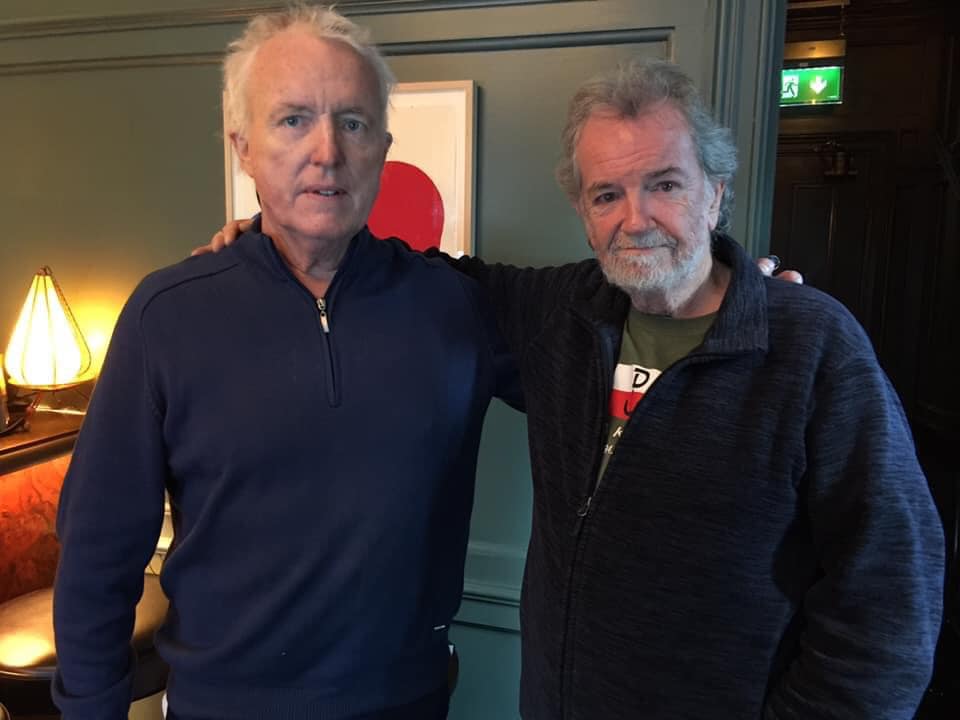
Eddie O’Neill and Andy Irvine (Photo: FIBI)
FOOTNOTES
1Jack Nalty (1902-23 September 1938), Irish Republican Volunteer, socialist, trade unionist and athlete, was the last Irish Brigader to be killed in action in that war, on the Ebro the day before the Republican forces surrendered to the military coupist and fascists under General Franco. “He died heroically, after returning into danger to rescue a machine gun crew that had been left behind. As they withdrew they were hit by a burst of fascist machine gun fire and, though Jack died instantly, thankfully both British volunteers survived”(East Wall History Group). Jack Nalty is mentioned in Christy Moore’s “Viva La Quince Brigada” and on a number of plaques in public places.
2I have personal reason to know that Maureeen Maguire also did some of the interviews.
3The mountains are in Eddie O’Neill’s County of Tyrone. The song is of resistance, lyrics penned by George Sigerson (1836-1925).
4Composed by Gerry O’Glacain of The Irish Brigade group.
5As the communists and socialists were forbidden to sing their own songs, they created this one but in some cases were threatened with death to stop singing this one too, although it is has been recorded that the guards in some cases enjoyed the singing as they marched the prisoners out to work. The lyrics have been translated into many languages.
6Lyrics by Brian “na Banban” Ó hUigínn/ O’Higgins (1882 – 10 March 1963), to the air of The Foggy Dew, a popular song about the 1916 Rising.
7Lyrics in German by Ernst Busch (22 January 1900 – 8 June 1980) to air by Friedrich Silcher (1789-1860).
8Those were leaders of the African National Congress and the National Union of Miners respectively, though Ramaphosa is currently head of the ANC and President of South Africa and Zuma is in a long process of being tried for corruption. Ramaphosa is widely believed to have organised the Marikana massacre of striking mineworkers in 2012, which Zuma colluded with and which Mandela, then at liberty, kept silent about.
9 it has been suggested that McBride was an unrecognised grandson of John McBride, Mayor in the Irish Transvaal Brigade fighting the English in the Boer War and 1916 insurgent shot by British firings squad. Robert McBride was held up by IRA/Sinn Féin leader Martin McGuinness as an example of a former combatant who moved up into a l eadership role following the political changes in South Africa. The Wikipedia entry on his career after Apartheid will shock some people.
Dedication of Friends of the International Brigades Ireland:
Eddie O’Neill 1951 – 2021
Irish Republican, Anti-Fascist, Internationalist
Éamon ‘Eddie’ Ó Néill, a true legend of the left republican and anti-fascist movement passed away peacefully in the company of his family in Connolly Hospital, Blanchardstown, Dublin, on July 27. Eddie was a proud loughshore native of Doire Treasc i gContae Thír Eoghain.
We send our condolences to his family in Dublin and Tyrone and to his many comrades and friends across Ireland, Spain, the Basque Country, Catalunya, the US, Britain, Canada, Cúba and elsewhere.
Eddie O’Neill represented the very essence of Irish republican resistance and its symbiotic relationship with international anti-fascist solidarity and activism. A warm, engaging, charismatic and intriguing individual, he represented all that is best in humanity, with his understated selflessness often masking a fearless determination.
Interned as a young man while serving his engineering apprenticeship at Shorts, he was incarcerated in Crumlin Road Jail, Belfast, and Magilligan prison Camp, Co Derry, where he witnessed the infamous precursor to Bloody Sunday, when soldiers fired plastic bullets and CS gas at anti-internment protesters on Magilligan Strand.
After his release, Eddie became a full-time republican activist, operating in Ireland, the US and England. He was arrested in London in 1974 on conspiracy charges and while on remand he was broken-hearted by the death of his close friend and Co Tyrone comrade, Hugh Coney, who was shot dead by British soldiers after an escape from Long Kesh prison camp that October.
Convicted as a member of the so-called ‘Uxbridge 8’ the following year, he received a 20 years’ sentence in maximum-security English prisons. Over the next 14 years until his eventual release in 1988, he would spend much of his time in solitary confinement in various jails, enduring unimaginable brutality.
Eddie held little regard for material things, but he did treasure a copy of Peadar O’Donnell’s The Gates Flew Open – although he never read it. It belonged to his comrade Frank Stagg who left it open on his locker before he died on hunger strike in 1976. Eddie had shared the adjoining cell in Wakefield Prison. In all the years he had it, he never turned that page.
He was classed as a Category E prisoner – one considered likely to escape. He made good on this classification in 1977 with an escape attempt from Wormwood Scrubs and the following year he took part in a rooftop protest in Gartree in pursuit of demands for repatriation and political status.
As a result of the relentless attempts to break his spirit, in May 1979 he was rushed to the prison hospital at Parkhurst on the Isle of Wight suffering from blinding headaches, insomnia, partial blindness and partial paralysis.
For the previous two years he had suffered an inhumane regime of sleep torture, consisting of his cell light being left on 24 hours a day and frequent night searches, even though he was forced to strip before going to bed and to leave his clothes outside his cell.
He had no sooner finished his treatment than he was transferred to Winson Green prison and put back into solitary. He subsequently received a severe beating from prison officers. When he complained about his injuries, he lost his remission. Ever the fighter, he appealed this capricious decision, and the lost remission was restored.
He took everything that the empire could throw at him.
Following his eventual release, he continued his republican activism but widened it to encompass internationalism and anti-fascism. This path inspired him, along with International Brigades veteran Bob Doyle, Harry Owens and a small number of others, to establish the Friends of Charlie Donnelly, in memory of a fellow republican socialist, Co Tyrone native and International Brigader who had fallen at the Battle of Jarama in defence of the Spanish Republic in February 1937.
The group’s motivation has never been purely historical in nature: Eddie and the other members believe that the best way to honour the International Brigades is to draw inspiration from them to encourage future generations to take up the fight against fascism and imperialism.
Thanks in no small part to Eddie’s single-minded dedication to getting things done and his ability to attract people to work with him, in 2010 the group evolved into Friends of the International Brigades Ireland (FIBI).
Eddie proved that neither borders nor languages were insurmountable barriers to activism. He forged strong and enduring links across Ireland, Britain, Spain, The Basque Country, Catalunya, and the US in particular. These relationships will be the backbone of FIBI’s work into the future.
In Ireland, Eddie and other FIBI members had been erecting and repairing monuments to International Brigaders for several years. His work extended to every corner of Ireland and in 2010, he fulfilled a long-term ambition to complete a cairn overlooking where Charlie Donnelly fell at Jarama.
Of course, he had already planned this many years before it happened, laying the groundwork for this initiative of such symbolic importance through close co-operation with the Ayuntamiento de Rivas Vaciamadrid local authority and activists in the Asociación de Amigos de las Brigadas Internacionales (AABI).
The cairn, comprising stones from the 32 counties of Ireland, has been maintained and restored by the local authority after frequent attacks by Franco’s heirs and successors – a backhanded compliment to its significance. This monument has become a rallying point for internationalists, socialists, republicans, communists, anarchists, and democrats who gather every year to pay homage to those who defended democracy and freedom in the 1930s.
Eddie was committed to erecting memorials to every single Irish Brigader who served the anti-fascist cause in Spain. He researched primary and secondary sources in several countries and unearthed information on previously ‘lost’ volunteers, spending countless hours researching the labyrinthine Moscow Archives.
This research forged a path for commemorations in areas where local communities had no idea of the heroism of their forebears. Many of these ‘Volunteers of Liberty’ remain buried in unknown graves on Spanish soil, but Eddie was determined that their memories would endure.
Eddie’s determination to confront fascism became emblematic of his activism and internationalist outlook. In him, it was easy to recognise the living spirit of the International Brigaders.
His name was rightfully synonymous with the anti-fascist cause in Ireland and beyond. He planned and organised commemorative events across Spain, the Basque Country and Catalunya, where he was a regular and popular visitor in his famous green Hiace van (which served simultaneously as transport, accommodation and centre of logistics). Eddie’s name is lauded in many villages, towns, and cities across the Iberian Peninsula where he rested, laughed, talked politics, cajoled, and took part in acts of international solidarity.
Eddie stayed particularly close to his many friends and comrades in the Republican Movement and he had a deep and enduring bond with his fellow ex-prisoners, many of whom joined him as he led solidarity trips to Spain and the Basque Country from 2007 onwards.
Although a committed internationalist, he remained very proud of his Co Tyrone roots. He was the force behind the recent revival of the Charlie Donnelly Winter School in Dungannon and the annual commemorations at Killybrackey and Moybridge. He was also passionate about his beloved Fir an Chnoic (Derrytresk Gaelic Football Club) in his native parish and was extremely proud to see the team reach the All-Ireland Final in Croke Park in 2012.
Eddie leaves a powerful, inspiring legacy that will endure for those of us who follow. His energy seemed boundless and, even as his final illness took a heavy toll, he continued to carry his pain with stoicism, dignity, and humour.
His loss is devastating, not only to his family and friends, but to FIBI, of which he was the founder and Honorary President. His final message to the group urged us to carry on his work in commemorating the International Brigades and continuing the anti-fascist cause, which he considered more relevant now than ever, in the face of the increasing threat from resurgent monopoly capitalism, neoliberalism and the growing confidence of the fascist foot soldiers of hate and intolerance.
In his final days, he implored us to keep following in his footsteps. We are comforted in the belief that he knew we would continue his struggle. And what an inspiration we now have! What a legacy he has left us.
La lucha continúa!
No pasarán!
The Flowering Bars
(Charlie Donnelly 1914-37)
After sharp words from the fine mind,
protest in court,
the intimate high head constrained,
strait lines of prison, empty walls,
a subtle beauty in a simple place.
There to strain thought through the tightened brain,
there weave
the slender cords of thought, in calm,
until routine in prospect bound
joy into security,
and among strictness sweetness grew,
mystery of flowering bars.
1Jack Nalty (1902-23 September 1938), Irish Republican Volunteer, socialist, trade unionist and athlete, was the last Irish Brigader to be killed in action in that war, the day before the Republican forces surrendered to the military coupist and fascists under General Franco. “He died heroically, after returning into danger to rescue a machine gun crew that had been left behind. As they withdrew they were hit by a burst of fascist machine gun fire and, though Jack died instantly, thankfully both British volunteers survived”(East Wall History Group). Jack Nalty is mentioned in Christy Moore’s “Viva La Quince Brigada” and on a number of plaques in public places.
2I have personal reason to know that Maureeen Maguire also did some of the interviews.
3The mountains are in Eddie O’Neill’s County of Tyrone. The song is of resistance, lyrics penned by George Sigerson (1836-1925).
4Composed by Gerry O’Glacain of The Irish Brigade group.
5As the communists and socialists were forbidden to sing their own songs, they created this one but in some cases were threatened with death to stop singing this one too, although it is has been recorded that the guards in some cases enjoyed the singing as they marched the prisoners out to work. The lyrics have been translated into many languages.
6Lyrics by Brian “na Banban” Ó hUigínn/ O’Higgins (1882 – 10 March 1963), to the air of The Foggy Dew, a popular song about the 1916 Rising.
7Lyrics in German by Ernst Busch (22 January 1900 – 8 June 1980) to air by Friedrich Silcher (1789-1860).
8Those were leaders of the African National Congress and the National Union of Miners respectively, though Ramaphosa is currently head of the ANC and President of South Africa and Zuma is in a long process of being tried for corruption. Ramaphosa is widely believed to have organised the Marikana massacre of striking mineworkers in 2012, which Zuma colluded with and which Mandela, then at liberty, kept silent about.
9 it has been suggested that McBride was an unrecognised grandson of John McBride, Mayor in the Irish Transvaal Brigade fighting the English in the Boer War and 1916 insurgent shot by British firings squad. Robert McBride was held up by IRA/Sinn Féin leader Martin McGuinness as an example of a former combatant who moved up into a l eadership role following the political changes in South Africa. The Wikipedia entry on his career after Apartheid will shock some people.
The above would have been the headline 100 years ago1. Well, not the main one, perhaps, which would have been MASSACRE AT BACHELOR’S WALK – TROOPS OPEN FIRE ON CIVILIANS – 4 DEAD, MANY WOUNDED2.
Then, probably, GUNS LANDED AT HOWTH! POLICE AND SCOTTISH OWN BORDERERS FACED DOWN — REPORTS OF 1,500 GERMAN RIFLES LANDED FROM AMERICAN YACHT.
JOINT OPERATION OF IRISH VOLUNTEERS, IRISH CITIZEN ARMY, CUMANN NA MBAN AND FIANNA ÉIREANN — DUBLIN CASTLE FURIOUS.
MAYOR SHOCKED AT CIVILIAN DEAD AND WOUNDED — DEMANDS INQUIRY.
Speakers at a commemoration on the West Pier, Howth on Saturday 23rd July commented on all those features of the landing of 1,500 German rifles, single-shot Mauser Model 71 (M1871), their collection by the organisations of the broad revolutionary movement — and the army massacre that followed.
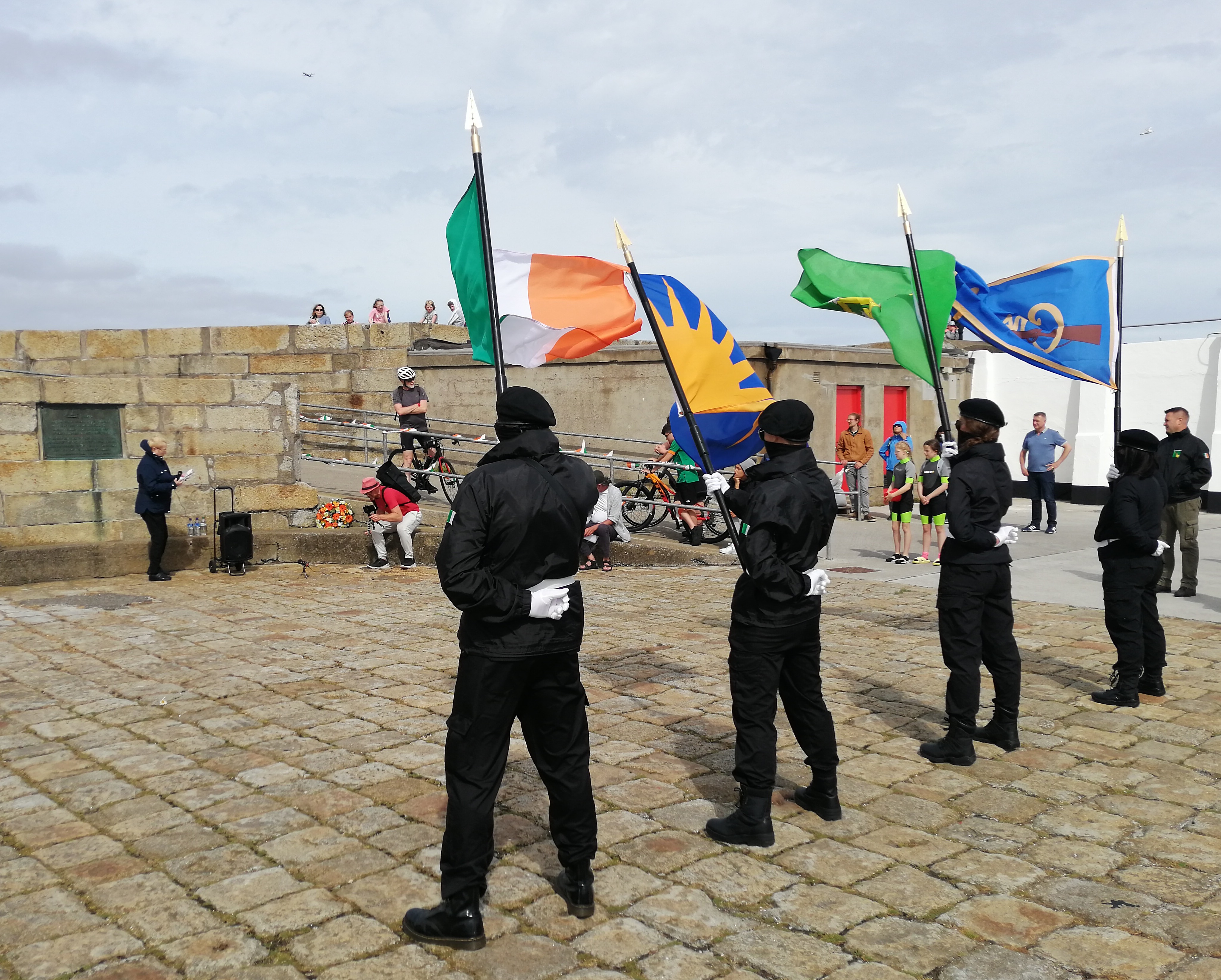
The event was organised by Irish Socialist Republicans and Anti-Imperialist Action organisations. A colour party of two men and two women led the march up to the pierhead where the event was held.
The Save Moore Street From Demolition campaign banner was displayed along the way.
Event about to begin, Margaret McKearney in distance, colour party in foreground, mostly bystanders to the right, attendance out of shot behind and to right of camera person. (Photo: Rebel Breeze)
The event was chaired by Margaret McKearney, a veteran Republican from Tyrone once described by Scotland Yard as “the most dangerous woman in Britain” and who lost three brothers in the struggle (one in SAS ambush at Loughgall and another murdered by UVF).
McKearney recalled the need of Irish nationalists for weapons when the Loyalists were arming to prevent Home Rule3 being granted to Ireland and the Loyalists with British elite complicity had received a huge shipment at Larne.
Speakers, songs and a laying of a floral wreath were the main content of the event.
THREE SPEECHES – DETAILED, DIRECT AND DEFIANT
McKearney called Phillip O’Connor to speak, a historian and local resident with a particular interest in the revolutionary period in Howth4.
O’Connor began with a quotation from C.J. O’Connell in his Lordship of the World (1924) that “Every Nation, if it is to survive as a nation, must study its own history and have a foreign policy”.
Phillip O’Connor speaking at the event — the plaque at the pier head behind him. (Photo: Rebel Breeze)
The speaker went on to relate how our rulers demote and distort our nation’s history and how for various reasons even families and communities neglect to pass on that history to following generations.
O’Connor went on to relate the extensive instances of local people’s participation in our nation’s revolutionary history. He brought out names of local people who had been active in Cumann na mBan and the Irish Volunteers and the Sinn Féin party of the time.
The speaker also drew attention to the Irish Citizen Army unit in the locality – the only one outside Dublin – that went on to participate in the 1916 Rising in Dublin and in Fingal. Of course many of that spread of revolutionary organisations had participated in the Howth guns landing.
O’Connor concluded by repeating the quotation: “Every Nation, if it is to survive as a nation, must study its own history and have a foreign policy”.5
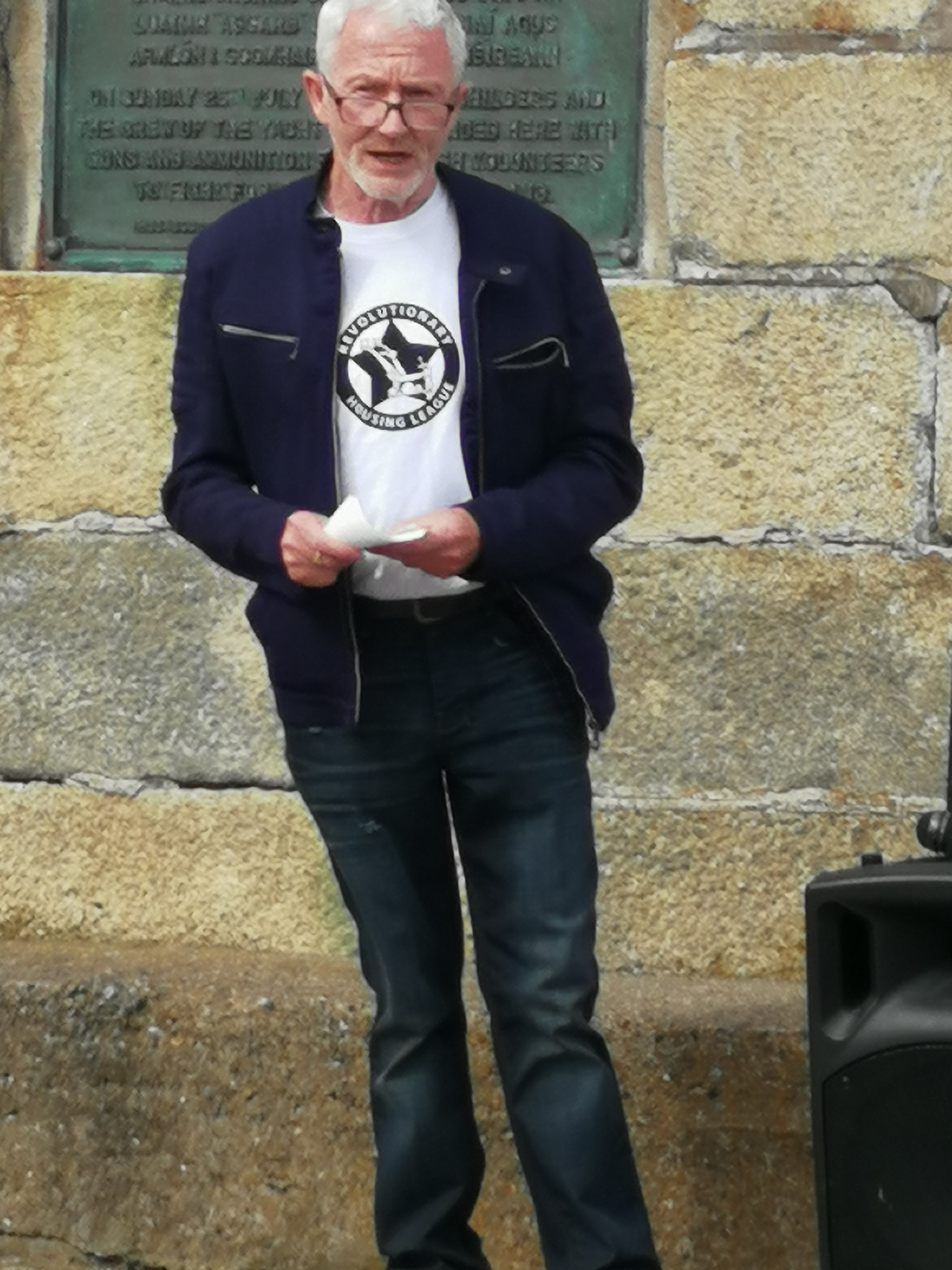
McKearney then called on Seán Doyle, a veteran socialist Republican who spoke on behalf of the Revolutionary Housing League, focusing on the housing crisis in Ireland and quoted Roger Casement1 at his trial in London in 1916:
Where all your rights become only an accumulated wrong; where men must beg with bated breath for leave to subsist in their own land, to think their own thoughts, to sing their own songs, to garner the fruits of their own labours…
then surely it is a braver, a saner and a truer thing, to be a rebel in act and deed against such circumstances as these than tamely to accept it as the natural lot of men. Doyle went on to recall James Connolly’s admiration for the struggle of the Land League and for Michael Davitt2.
However, Connolly, the speaker reminded his audience, had excoriated those who were outraged by the eviction of a tenant farmer but with “the working person locked out from his workplace or evicted from his home”, remained “at best silent if not critical.”
“We need to engender the same passion ourselves because the system does not care or share the plight of working people,” Doyle asserted and lashed “anyone who says he loves Ireland and can witness people dying on the street homeless while 180,000 houses are boarded up vacant”.
The speaker declared that the RHL would no longer remain silent, confined or recognise the ruling class’ self-serving laws or allow them to prosper, would no longer accept homelessness, nor “see our children rent an mortgage slaves for the rest of their lives”.
“We in the RHL believe that a roof over your head is not a commodity but an essential of life like water or oxygen. Houses make homes, make communities and a society we aspire to”. Doyle went on to call for a realisation “that pleading and appealing to a non-caring ruling class is futile.”
Seán Doyle speaking on behalf of the Revolutionary Housing League (Photo: Rebel Breeze)
Concluding, Doyle called on people to join the Socialist Republicans in action and quoted James Connolly6:We believe in constitutional action in normal times; we believe in revolutionary action in exceptional times. These are exceptional times, and called on people to “Build the Revolution!”
Cáit Trainor, an independent Republican activist from Armagh was called and stepped forward to give a rousing speech.
Reviewing as others had done the impelling of the arming of the Irish Volunteers by the arming of the Unionists against the prospective Irish “Home Rule”, Trainor went on to recall some of the other participants in the revolutionary movement of the time.
“Cumann na mBan with upwards of 1500 members was formed to assist the Volunteers, though some of the most radical women republicans, such as Helena Moloney and Constance Markievicz, elected to join the socialist Citizen Army instead, where they were given equal standing with the men.
“The Volunteers also had a ready-made youth wing, the Fianna Éireann, founded by Constance Markievicz7 in 1903 as an alternative to the ‘imperialist’ Boy Scouts. The Fianna were in fact to provide many of the most militant Volunteer activists.
“All of these groups would work together in the lead up to and including the 1916 rising, working together while maintaining their own autonomy with a unity of purpose.” “The Irish Volunteers had the men, the women and the youth, the next move was to secure the arms.”
Trainor referred to the arduous journey of guns-carrying yacht which included a stop in Holyhead to repair damaged sales after the Boat was hit with one of the worst storms to hit the area for decades.
The speaker attributed the success of the Howth landing to “the working together of various sections of Irish society.” “They came from varying religious backgrounds, not all were even Irish born and — even more surprising for the time — women took a leading role.”
Cáit Trainor speaking at the event on the Howth pier (Photo: Rebel Breeze)
Taking the 1916 Proclamation as an example, with its address to “Irishmen and Irish Women”, Trainor maintained that “Irish Republicanism has always been and remains to be a modern forward-thinking ideology in comparison with the outdated imperialist mindset of unionism.”
Cáit Trainor compared that address with the opening line of the unionist Ulster proclamation of 1913 that opens with “Whereas Ulstermen” and continued without any reference to women anywhere in the document.
Trainor stated that today Irish Republicanism needed to “get every section of society more involved in the struggle” and that “anyone who makes their home in Ireland must be encouraged to make their contribution and to be as passionate about Ireland and its success as an independent nation as anyone else.”
The speaker recalled Thomas Davis’ words: “It is not blood that makes you Irishbut a willingness to be part of the Irish Nation.8”
“Irish Republicanism”, stated Trainor “stands in stark contrast to the archaic outlook of British imperialists and Irish reactionaries by boasting of a diverse membership” bringing “fresh and original insights, talent and ingenuity” unlike the paradigm of “Christian, male and white”.
Trainor remarked that “Revolutions are a dirty business and revolutionaries must be armed to meet the might of their opponent” and that “the revolutionaries of today … come from the same tradition”, that “the cause and goal has not changed for any true Irish Republican.”
“Republicans in the early part of the last century did not set out to simply smash an orange state, or replace one flag for another; they were out for the Republic, an independent state for all the people, Republicans and the political prisoners who currently reside in prisons both north and South are out for the same thing9.
“It is an absolute travesty that the Republican prisoners are widely ignored by greater society, indeed most people would not even know they exist, believing falsely that with the signing of the GFA all prisoners were released and that political prisoners in Ireland were consigned to history.
“The media and constitutional nationalists along with pseudo socialist groupings like to skirt over the truth of the matter, they are more concerned with political prisoners in far-flung places around the world than political prisoners on their own doorstep.
“…. we understand that while Ireland remains occupied there will always be men and women willing to resist it, that this inevitably will ensure that political prisoners remain a reality in Ireland, and these prisoners will always have the decided and unfaltering support of Irish Republicans.
“Surrendering for seats in the enemies parliament isn’t a victory of any kind,” said Trainor, “it’s an utter defeat, the idea is to pacify with false power and notions of equality with your overlords, imperialists have used this strategy for centuries to quell rebellion and unbelievably it still works.”
Trainor dismissed the “alternatives to the Irish Republic” and condemned “reformism or British and Free State parliaments.”
(Photo: Rebel Breeze)
Pointing out that it was not an easy road for revolutionaries in the past no more than in the present, Trainor declared that “Revolutions are not won in the halls of parliaments but on the streets with the ordinary people”.
Coming back to the Howth landing of guns 100 years earlier, she said that “there is again an increase in militarism internationally and also nationally with unionist paramilitaries evidently armed and threatening violence.”
While constitutional nationalists sit on their laurels begging for British concessions unionist paramilitaries supported by unionist parties are organising again to secure their dominance and Irelands submission.
Cáit Trainor concluded with another quotation from Pádraig Pearse10: “The Orangeman11 with a gun is not as laughable as the nationalist12 without one”.
Living flowers in a pot are laid in remembrance of those who have given their lives in the struggle. (Photo: Rebel Breeze)
SONGS
Diarmuid Breatnach sang the ballad Me Old Howth Gun, written by James Doherty under the name of ‘Séamas McGallowgly’ and collected in 1921, with words that seemed extremely prescient for its time, with the civil war to come the following year:
…… There was glorious hope that we Would set old Ireland free But now you’re parted far from me, oh me old Howth gun.
Oh, the day will surely come, Oh me old Howth gun, When I’ll join the fighting men, Oh me old Howth gun; In some brave determined band I will surely take my stand For the freedom of my land, Oh me old Howth gun.
Diarmuid Breatnach singing at the Howth event (Photo: Rebel Breeze)
Afterwards many people commented that they had not heard the song before and Breatnach replied that Pádraig Drummond had sent him the lyrics to learn for the event (which he had half-managed to do, he commented ruefully).
The event ended with the lowering of the colour party’s flags in honour of those who died for Irish freedom and, introducing it as “a fighting song, sung during the Rising”, Breatnach sang the first verse and chorus of Amhrán na bhFiann (The Soldiers’ Song).
End.
View of colour party with the harbour behind them (Photo: Rebel Breeze)
FOOTNOTES
1The guns were landed in Howth Harbour on 26th July 2014 by Erskine Childers and crew in his yacht The Asgard (which has its own room with the original yacht in the National Museum at Collins Barracks, Dublin).
2On their return from Howth, the revolutionary forces were confronted by a force of Dublin Metropolitan police but they were unsuccessful in having the rifles surrendered, as were also a unit of the British Army, the King’s Own Scottish Borderers. The latter were jeered by a Dublin crowd on their empty-handed return and at Bachelor’s Walk on the quays they opened fire on the crowd and bayoneted at least one victim. A woman and three men were killed and many wounded.
3A kind of partial autonomy that was on offer but within the British Commonwealth.
4See ROAD TO INDEPENDENCE – Howth, Sutton and Baldoyle play their part (2016) by Phillip O’Connor.
5The point about studying our history is often made at Irish Republican events but the one about having a foreign policy, though so important, is rarely if ever mentioned. Having a sound revolutionary foreign policy would have militated against the Provisional organisation’s seeking an accommodation with the leaders of US Imperialism 1970-1999 or expecting better of the World imperialist leaders at the “Paris Peace Conference” in 1919. Today the broad Republican movement has no coherent foreign policy except currently for Irish State neutrality.
6Roger Casement (1864-1916), of Anglo-Irish background, British diplomat (CMG) then Irish nationalist, member of the Gaelic League, poet, important role in organising the purchase of rifles that were transported to Howth and Wicklow. He was hanged in Pentonville Jail 3rd August, the last of the 1916 executions by the British.
7Thomas Davis (1814-1845), foremost among the Young Irelanders, publisher and contributor to The Nation, composer of A Nation Once Again, The West’s Awake and other notable songs and poems; his father was Welsh.
8James Connolly (1868-1916), revolutionary socialist, trade union organiser, journalist, historian, songwriter), Commandant of the insurrectionary forces in the 1916 Rising, executed by British firing squad.
9Constance Markievicz (nee Gore-Booth), (1868-1927), socialist Republican revolutionary, suffragist, founder member of the Irish Citizen Army and Cumann na mBan, fought as officer of the Irish Citizen Army in the 1916 Rising, sentenced to death (commuted), joined Sinn Féin, took the Republican side in the Civil War, founder member of Fianna Fáil. She was the first woman elected to Westminster Parliament (on abstentionist ticket), first Cabinet Minister in Europe (in the First Dáil) and first Minister of Labour in the world.
10There are currently around 60 Irish Republican prisoners in prisons on both sides of the British border.
11Pádraig Mac Piarais/ Patrick Pearse (1879-1916), writer, poet and journalist in English and Irish, educationalist, revolutionary Republican, Commander-in-chief of the 1916 insurrectionary forces, executed by British firing squad.
12British loyalists, followers of the anti-Catholic sectarian ideology of the Orange Order (founded 1796).
13At the time most Irish Republicans, despite the long existence of the Irish Republican Brotherhood, were seen as part of the broad nationalist spectrum but at its most militant end and were described as ‘advanced nationalists’.
Different view of colour party, against the lighthouse at the East Pierhead (Photo: Rebel Breeze)
On 16th July 2022 the frame-up of the Craigavon Two was highlighted in public events in locations across all four provinces of Ireland. John Paul Wooton and Brendan McConville were framed and convicted in 2012 of the killing of colonial police officer Stephen Carroll in 2009.
The agency that framed them is the colonial police force of the Six Counties statelet but then they were railroaded through the non-jury Diblock Courts. As a result the two men have spent 14 years in jail for something they did not do.
A young woman participating in the protest on the 16th in Mulingar, Co. Westmeath displaying two placards, one home-made, to passers-by. (Photo sourced: AIA)
EVENTS
In Dublin city centre banners in Irish and in English calling for the freeing of the Craigavon Two were hung from the iconic curved pedestrian Ha’penny Bridge. Green and gold Starry Plough flags streamed in the breeze from the sea as leaflets were distributed to passers-by.
Hand-held Placards called for the men’s release and regular calls could be heard of “Justice for the Craigavon Two!” followed by “14 years in jail for something they didn’t do”. In addition there were calls to “Smash the Specials”1 and comments about “British justice”.
Strangely no artist(s) name was posted on line with the video
All the leaflets brought to the event were distributed and a number of conversations with interested people took place.
Leaflets being distributed and placards displayed on the Ha’penny Bridge, Dublin on the 16th. (Photo sourced: AIA)
At one point four members of the State’s police force, the Gardaí, walked past the picketers and gathered at the far end of the bridge, watching them. However, the picketers were not intimidated and the police took no further action.
The events in respect of the Craigavon Two were organised by the Anti-Imperialist Action Ireland organisation and took place in Waterford, Oldcastle (Meath), Naas (Kildare), Mullingar (Westmeath), Kerry, Galway, Dublin, South Derry, Armagh and Arklow (Wicklow.)
Gardaí watching the awareness-raising picket on the Ha’penny Bridge on the 16th. (Photo sourced: AIA)
A CROOKED CASE
To say that the case against the men was flimsy would be to give it too much credit. The killing weapon was recovered and the fingerprints on the weapon and magazine did not match either of the men’s. No eyewitness was found except one who claimed to have seen one of the men in the area.
The alleged eyewitness who identified one of the men, “Witness M” only came forward 11 months after the killing and long after the arrest of both men. Witness M’s inability to have identified anyone at night at the distance he claimed to have done was exposed in court.
Awareness-raising event on the 16th in Oldcastle, Co. Meath (Photo sourced: AIA)
That man’s father described him as “a Walter Mitty character” who was chronically untruthful and his own partner refused to corroborate the witness’ account of his movements on the night of the killing.
The ‘evidence’ against the second man of being in the area came from an MI5 agent who testified from behind a screen about a tracking device they claimed to have planted in the accused’s car which had unexplained gaps in its recording.
The agent declined to answer a number of questions under “public immunity” certificate related to “national security”.
The colonial police went further and detained Witness M’s father to intimidate him into not giving evidence about his son’s veracity (or lack of it) — and the witness was also paid a sum of money.
One can say that the no-jury Diplock Court was crucial in convicting the men of murder but even when they were eventually granted leave to appeal in 2014, their convictions were not overturned. The normal judicial system is bad but the no-jury courts are worse.
Another victim of being framed in the British ‘justice’ system, Gerry Conlon, 15 years in jail in the famous case of the “Guildford Four”, joined the campaign for the men and was proclaiming their innocence until a mere few days before his premature death in June 2014 (aged 60).
End.
In Naas, Co. Kildare. (Photo sourced: AIA)
Mulingar, Co. Westmeath. (Photo sourced: AIA)
A woman leafletting in Co. Waterford on Saturday talking to people in the town centre. (Photo sourced: AIA)
FOOTNOTES
1A reference to the political no-jury courts of the colony and of the Irish State, the Diplock Courts and the Irish State’s Special Criminal Courts.
The Dublin Committee of the Anti-Internment Group of Ireland held a picket yesterday to highlight the ongoing internment without trial of Irish Republicans and to protest the recent extradition of Liam Campbell to Lithuania, a country to which he has never been. The picket was held in Temple Bar, a tourist quarter of the Dublin’s south city centre.
(Photo source: Anti-Internment Group of Ireland)
(Photo source: Anti-Internment Group of Ireland)
Afterwards, the AIGI issued the following report (reposted with kind permission): “Tourists, Irish shoppers and young people socialising in Dublin city centre were interested to see the banners and placards against internment in Ireland, along with a banner against extradition of Irish Republicans. They also noted the various placards of the Anti-Internment Group of Ireland and the flags of Palestine and the Basque Country, in addition to the Starry Plough flag of the Irish Citizen Army, representing three of the many nations holding political prisoners.
(Photo source: Anti-Internment Group of Ireland)
Supporters distributed up to 200 leaflets and had a number of engagements with people wanting to know more. People were surprised and angry to learn that internment under another name continues in Ireland on both sides of the British Border.
A portable PA machine played resistance music and an AIGI speech from a previous public event which attracted some interest.“
(Photo source: Anti-Internment Group of Ireland)
The AIGI’s Facebook page lists approximately 60 political prisoners held in Ireland, mostly in Portlaoise Prison in the Irish state and Maghaberry Jail in the British colony in the north-east of the country. All of those were convicted in special no-jury courts created for the purpose of sentencing political prisoners — i.e nearly always exclusively Irish Republicans. Frequently some charged and facing trial in those special courts are denied bail and are held in custody until their trial comes up, two or three years later and if then chance to be found ‘not guilty’, they will still have spent that time in jail. When granted bail on the other hand it is always under restrictive conditions that prevent them continuing their political activity: e.g night curfew, wearing an electronic tag, banned from attending political activities, etc.
Liam Campbell, an Irish Republican from Dundalk, Co. Louth, was extradited to Lithuania last week to face charges relating to trying to obtain arms in that country. Campbell says that he has never been in that country, which Lithuania and the Irish State both seem to accept yet, after a legal battle of almost 12 years up to the Irish Supreme Court, the Irish Republican was extradited. According to unconfirmed reports Campbell has been granted bail in Lithuania but under what conditions is currently unknown.
The group campaigning against what it sees as ongoing “internment by different names” developed from the campaign to free Marian Price around six years ago and, apart from monthly pickets, has also organised conferences and concerts and representatives have travelled to Belfast, Cork, Derry, Newry and Glasgow. The group has sent messages of solidarity to a Basque liberation group which was read out at the latter’s public event and also to the Mumia Al Jamal and Leonard Peltier campaigns in the USA, Munir Farooghi campaign in England (for which AIGI spoke at public meetings in Ireland), to prisoners in Turkey, Palestine and Latin America. Its street pickets, though legal, have frequently been subject to police harassment on both sides of the British Border — in the Irish state nearly exclusively by the plain-clothes political police, the Special Branch.
The picket yesterday in Temple Bar, view southward towards the Liffey River. (Photo source: Anti-Internment Group of Ireland)
The AIGI report concluded: The Anti-Internment Group of Ireland is a democratic group independent of any political party or organisation that holds monthly awareness-raising pickets, as well as a few special public events every year. It is organised by a democratic committee composed of people who attend our pickets and who would like to become involved in running the group.
NÍ NEART GO CUR LE CHÉILE. AN INJURY TO ONE IS AN INJURY TO ALL.
He planned the spectacular helicopter escape from Dublin’s Mountjoy Jail and, a year later, planned another escape from there, blasting their way out with smuggled-in explosives. Before he began planning escapes, he operated early in his IRA career as commander of an armed robbery unit, ‘fund-raising’ for the Movement. But when he began robbing banks for himself and his family, the Movement sent assassins to kill him. Up Like a Bird is the story of that man, Brendan Hughes, nowhere near as celebrated as his other IRA namesake but certainly deserving of much more fame than he has received to date.
Brendan Hughes with his book outside Mountjoy Jail (Image sourced: Phoenix Magazine)
Douglas Dalby’s handling of Hughes’ reminiscences, told in Hughes’ voice, is masterly. The book reads like a thriller, hard to put down; we are driven to turn the next page to see what will happen – even when, through history, we know the eventual outcome. We know, for example, that the helicopter escape was carried out and yet, as readers, we tense as Hughes does his investigations, tense tighter as he identifies the components of the plan, moan with frustration at a delay or last-minute hitch, hold our breaths as the action takes place.
The helicopter escape was carried out on 31st October 1973 and from the prison exercise yard three high-level IRA officers were flown to freedom: Chief of Staff Séamus Twomey and senior Volunteers JB O’Hagan and Kevin Mallon. The following year, on 18th August 1974, 19 prisoners escaped, blasting their way through a gate with a small amount of smuggled gelignite. Not only had Hughes planned that operation – he himself was leading the escapers.
INSIGHTS
Apart from the excitement in reading, the book gives us an insight into the world of IRA volunteers active in Dublin and surrounding areas in the 1970s – the ‘safe-houses’ and network of active supporters, the ‘fund-raising’, stolen getaway cars, false identification documents, high-level awareness of the hunted, carrying concealed weapons, the even better-armed police ….
The Mountjoy helicopter escape revealed something even more important and enduring – the cultural bedrock within the Irish state, the sharp division between the elite and the mass. Although the majority of politicians had voted in 1972 for repressive legislation against Republicans and special no-jury courts to sentence them, a song celebrating the escape reached No.1 in the Irish singles disc charts, selling 12,000 copies in the first week despite being banned by the national broadcaster, RTÉ! Composed by Sean McGinley from Castlefin, Co. Donegal and performed by the folk and ‘rebel song’ band The Wolfe Tones1, Up and Away (the Helicopter Song) became the most-played and most-purchased disc for four weeks until nudged out by Slade’s Merry Christmas Everybody. It is tempting to think that if the escape had taken place a longer period before the approach of the festive season, that the recording might have remained at the top of the charts for months on end. The counterposing of the anger and embarrassment in elite circles, reflected in ranting of politicians, Garda sweeps and raids and media outrage on the one hand, with the delight and empathy at the lower levels revealed much of the tensions in Irish society and the opposing sympathies of different social classes.
The single that sold 12,000 copies in its first week, containing a jocular song celebrating the helicopter escape. (Image sourced: Internet)
Hughes was a maverick, revelling in the description and though for much of his career that was of value to the Provos, there came a time when it ceased to be so. A guerrilla army must have discipline, of course but it also needs volunteers who can quickly assess a situation and seize the initiative, without referring back to the command structure. The balance between both requirements must be very hard to strike — for individuals as well as for the organisation.
When he and other such activists fell out with their leaderships or “went solo”, they were shunned or worse. In Hughes’ final spell in Mountjoy jail, he was on the “non-aligned” wing of the jail, a Republican prisoner but not under Republican leadership control.
ISOLATION
Hughes says that assassins were sent to kill him – he stayed low and carried a loaded .44 Magnum. The leadership of the Republican movement does not always shoot or beat up its dissidents – more usually, it seeks to isolate them. Friends, neighbours, former comrades and even relatives will be advised to shun those no longer welcome, they and their families.
The family feeling, the communal solidarity in the movement becomes its opposite when the leadership brands its pariahs.
Cover of the book (Image credit: Siopa Gaeilge)
Hughes feels he was betrayed to the political police, the Special Branch of the Irish State. But what he says he felt the worst was the treatment of his family while he was in jail. No space on a Republican prison visitor communal transport was made available to his wife and children and cars containing former friends and acquaintances would pass them at the side of the road, even in the rain.
It seems Hughes finds that unforgivable — and no wonder.
As a postscript, Hughes surprisingly declares his support for the Good Friday Agreement, the pacification process. He had been a man of action and, as he said himself, not one for thinking through ideology or politics. But it doesn’t take any great grasp of ideology or politics to see that today it’s more or less business as before in a partitioned Ireland occupied by a foreign power.
End.
UP LIKE A BIRD, Hughes, Brendan; Dalby, Douglas (2022)
FOOTNOTES
1Named after Theobald Wolfe Tone, a leader of Irish republican revolutionary organisation the United Irishmen, died in prison in 1798.
On 9th April, the Dublin Anti-Internment Committee held another of its regular awareness-rising events in the city, this time on on the northside, at the junction of the busy shopping Henry Street and Liffey Street.
Section of the anti-internment picket in Dublin last week (Photo: Rebel Breeze)
Supporters lined up with the Anti-Internment Committee of Ireland banner and placards. In addition to the Starry Plough of the Irish working class, the Palestinian and the Basque flags were flown in symbols of solidarity and also as a demonstration that political prisoners are held in many countries around the world.
Going on for 200 of the AIGI’s leaflets were distributed, explaining that Irish Republicans continue to be held in custody without trial through the practice of refusal of bail and through revocation of licence. This practice by administrations on both sides of the British Border are anti-democratic suppression of the right to hold political opinions and to organise in their furtherance.
Plainclothes political policeman (in blue top, far left of photo) stood a little distance away facing the picketers but they were not intimidated (Photo: Rebel Breeze)
Recordings of relevant songs were played on a portable PA, such as The Roll of Honour, Viva la Quinze Brigada and Something Inside So Strong. Throughout the period of the event, two Special Branch (plainclothes political police) kept up an obvious surveillance which however did not deter the picketers.
The Anti-Internment Committee of Ireland is an independent broad and democratic committee, endeavouring to hold regular awareness-raising events and all democratic people are welcome to attend its public events, always advertised in advance on its Facebook page.