We are a people – or nation – that has been invaded; we have resisted and suffered in that resistance. Naturally we tend to sympathise with other countries who have been – or are being – invaded too. Many other peoples have been invaded more often than has Ireland; the Book of Invasions and Occupations of some of those would run to many pages. Few however have been occupied for nearing a millenium by what has been essentially the same invader – as has our little nation. So the question as to whether invasions are always wrong is bound to arouse an emotional feeling of rejection in us, of hostility to the questioner, even. Still, I ask the question and turn to history for the answer, our own history and that of other places.
INVASIONS OF IRELAND
The Vikings invaded Ireland (a sovereign state or collection of states) in successive waves from Norway and Denmark areas, took people to be sold as slaves, pillaged and looted and in time occupied parts of our land. They were hardly welcome but after their defeat at the Battle of Clontarf (sic) in 1014, left little permanent damage.
The Normans, invading in 1169, were a different matter, with less pillaging but wreaking far-reaching adverse changes, especially as they became the English ruling class, a mixing of Norman and Anglo-Saxon elites. Our land was turned into a colony, competing industries destroyed, the majority population turned into second-class subjects, our produce used to fuel the British industrial revolution, followed by famine here, mass emigration, our resistance repressed ……
In our strivings to be free from the English Occupation, we invited an invasion from the Spanish Kingdom to Ireland and one arrived in 1601, which was followed by the Siege and Battle of Kinsale (2nd October 1601-3rd January 1602) between Irish clans and their Spanish allies against the English. The latter’s victory resulted in English conquest over the whole island and the destruction of the remains of the Gaelic social and legal order in Ireland.
Battle of Kinsale map (Image sourced: Internet)
During the Jacobite War (1689-1691), the Irish and Anglo-Irish clans invited Royal French forces to invade Ireland in order to assist them in supporting King James II his bid to regain the English Crown1 and that too ended badly for the Irish with the Limerick Treaty, the flight of the Wild Geese and the religious Penal Laws.
In the late 1790s, the United Irishmen once again invited the French forces — but this time Republican – to assist them in overthrowing English rule in Ireland in what was a semi-sovereign state. The planned French invasion failed due to adverse weather conditions in 1796 and a smaller force successfully landed in Mayo in the closing weeks of the 1798 Rising, joined with Irish insurgents and defeated English military units but was soon surrounded and, massively outnumbered, surrendered.
DURING WWI
During WWI sovereign states in large areas of the world, in particular in Europe and in the Middle East, were invaded by the armies of many states, comprising those of the Central Powers of Germany, Austro-Hungary and Turkey on one side and those of the Entente — UK, France, USA, Turkey, Russia, Italy and Japan – on the other. The cause of the war was contention between imperial powers and no side could be said to have been justified in the alliance they joined or in invasions carried out as a result. One revealing example of the gap between justication propaganda and reality was that the UK claimed that it was waging war with Germany in defence of the little nation of Belgium, while it repressed a rising of the little nation of Ireland. Likewise, the USA, which claimed to want a post-war world of peace and security for small nations, refused to receive the delegations of a number of small or weaker nations, including that of Ireland, to the Paris Peace Conference2.
AND WWII
In the runup to WWII and during it, parts of Africa, Asia and most of Europe, including many sovereign states3, were invaded by the Nazis and Fascist powers of Germany, Italy or Japan4, with horrific consequences for the people who lived in the invaded lands.
German motorised Nazi troops invading the USSR during WWII(Image sourced: Internet)
Would we have countenanced an invasion of Nazi Germany to prevent what it was going to do? In any case, during the War, the counter-attack of the Allies also invaded huge parts of the world, including sovereign states that had colluded with the Nazis, as well countries totally dominated by them: the USSR invaded Eastern Europe beyond the USSR’s earlier borders, also sovereign Germany and sovereign Austria; the USA and UK invaded France (part-sovereign, part-occupied) and Italy (part-liberated by popular revolt) and all three invaded sovereign Germany and Austria too, but also North Africa; the USA invaded the Phillippines and Indo-China. Had we been alive then, most of us would have cheered those invasions – they brought down the terrible Axis forces, liberated death camps, freed people from fascist rule.
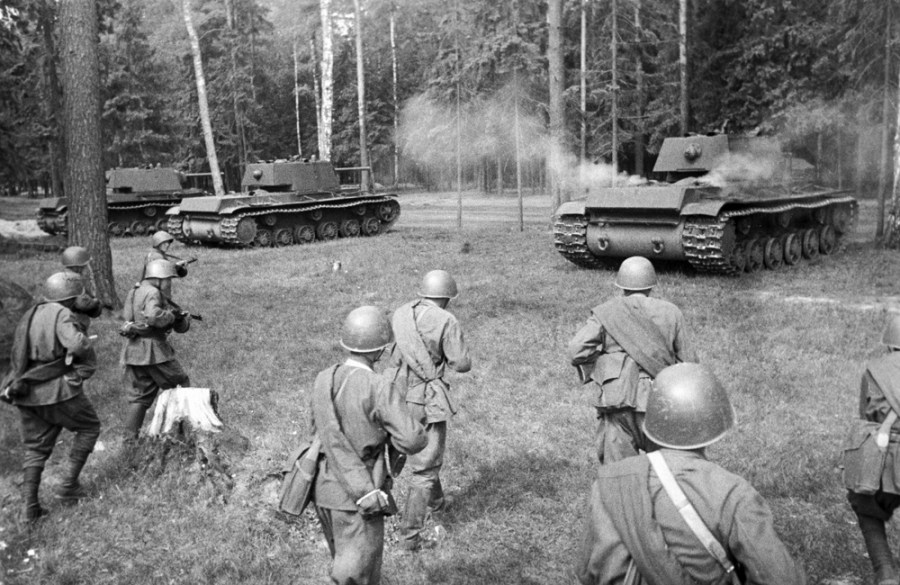
Soviet infantry follow Soviet tanks in counterattack on Nazi forces during WWII. (Image sourced: Internet)
US troops invading France in the Normandy Landings during WWII (Image sourced: Internet)
But the UK and France retook their colonies, where they had been suppressing and repressing the people for generations.5 The UK and USA prevented the Greeks from stopping the return of their monarch (their sovereign) and, combining former fascist police with their own armed forces, suppressed the Greek rising. And the USA installed themselves in the Phillippines, making them their neo-colonies. The USA also began to cultivate elites as clients in Indo-China, particularly in Korea and Vietnam.
The reoccupations of colonies and transfer of control to new masters were the cause of a wave of anti-colonial struggles and wars of repression in India and Malaya with the UK; in North Africa with the French; in Korea with the USA; in Vietnam with the French first and then with the USA; in the Middle East and West Africa with the UK and France. They also facilitated the creation of the Zionist state of Israel with horrific consequences (including invasions by it) that continue to be played out to this day.
The struggles of people resulted in the eventual national liberation of areas of the world, including part of Korea and later, Vietnam, creating states. Cambodia and Laos, having been bombed by the USA in its war with the Vietnamese people, came under new national regimes. But the new rulers of Cambodia’s sovereign state, under the Pol Pot regime, developed a new kind of horrific rule resulting in the distinction of becoming the country with most mass graves in the world6. That sovereign regime was toppled by an intervention of Vietnamese forces and those of us alive then cheered that invasion.
The Portuguese colonies in Angola and Mozambique were freed by liberation struggles but in Mozambique were assisted by Cuban troops, which also helped them resist invasion by South African troops and proxies.7
Much closer to our own time, the UK and USA/NATO, leading coalitions of other states, invaded Afghanistan, Iraq and Libya, destabilising them and destroying for years the development potential of those countries8. They attempted the same with Syria and that conflict is ongoing. The excuse given was always along the lines of countering a threat to the world (Iraq: “Weapons of mass destruction”, “Al Khaeda”) or liberating their populations (Afghanistan, Iraq, Libya, Syria).
US tanks and soldiers in Iraq, six days after the fall of Baghdad (Photo credit: John Moore/ AP)
INVASIONS GENERALLY — AND WHAT ABOUT UKRAINE?
So, reviewing the historical record, very few would say that invading another region — even a sovereign state — is wrong on every occasion. Most would say, I think, that it would depend on the motivation for the invasion, how it is conducted and what the invaders do afterwards.
Hopefully this can help us to mediate the automatic Irish sympathetic reaction to the war in the Ukraine and with regard to the Western-dominated discourse that Russia is automatically wrong – purely because its troops invaded the Ukrainian sovereign state. Russia may indeed be wrong – but not purely on the fact that it invaded.
Which then moves the evaluation on to a more productive and rational basis. Was the reason for the invasion justified? How did Russian troops conduct themselves during the invasion? What is intended as the longer-term outcome of the invasion?
Here, unfortunately we are in a marsh of propaganda, fake news, partial accounts, censorship9 ….. and the war has not yet concluded. But we can try to navigate our way across this marsh relying on the fairly firm patches we can find and hopefully avoiding getting stuck or even sucked down.
Justification for the invasion?
Russia says it invaded because it was being encircled and threatened by NATO, while the latter denies this. The evidence is however on the side of Russia in this disagreement10.
Putin also says that he did so to “de-nazify” the Ukraine. Considering the number of active fascists in Russia, this does not ring true, though the presence of nazi militia in the Azov Battalion is undeniable and the the Ukrainian regime is certainly glorifying Nazis in its past.
Conduct during the invasion
When Russia invaded it says that it fought to confront military units and to keep civilian casualties to a minimum. In the early days of the war this does seem to have been the case. As the fighting grew fiercer around Kyiv and Mariupol, it was harder to ascertain the truth, with Ukranian claim the Russians were targeting civilian structures and Russian counter-claim that, in Mariupol in particular, the Ukrainian forces were firing from civilian structures, which naturally attracted Russian return fire. And of course, bombardment of any large area is going to result, whether intended or not, in damage to civilian structures.
Another Ukrainian accusation, widely covered in the western media, is that the Russians were kidnapping civilians and transporting them back to Russia. The latter responded that they were facilitating the evacuation of civilians from danger areas. A similar Ukranian removal of civilians, on the face of it, is represented as a humanitarian action. Humanitarian evacuation or kidnapping? By one or the other, or by both?
There have been Ukranian accusations that the Russians executed captured Ukrainian soldiers and civilians and the Western media and political leaders have repeated those accusations. What appears to be bodies of civilians have been photographed in the streets of Bucha and Irpin after the Russians forces retreated, some of which appeared to have their hands tied behind their backs.
The Russians have rejected the whole story as fake news, pointing out that the Mayor of Bucha had smilingly recorded a video message after the Russian military evacuation of his town, during which he had made no mention at all of any such executions. Also that the reports of the alleged executions did not emerge until four days after they had evacuated the town.
However the Ukrainians also say that a mass grave containing 410 bodies has been uncovered outside Kyiv. Russia has said it wants the issue discussed at the UN Security Council11 but so far have been blocked by another permanent member, the UK (the latter holds the Presidency of the Security Council at the moment)12.
We must await some kind of even semi-independent investigation but if any of these allegations turn out to be true it will certainly be a powerful indictment of Russia’s conduct during the invasion.
Post-invasion actions
We do not know for certain what the situtation will look like post-conflict but it looks likely that Russia will withdraw from most of the Ukraine, which will remain outside NATO and with much-reduced armament, which was part of what Russia was seeking even years before the conflict. But it also looks as though Russia will retain the Crimea and the Donbas area.
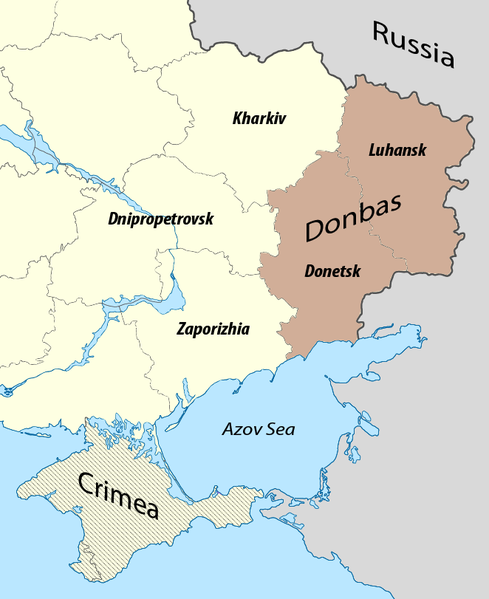
Simple neutral map showing the Ukraine in yellow with Donetsk and Luhansk areas in brown (together known as Donbas) and the Crimea (lined pattern) with the western shore of the Sea of Azov running between the two enclaves. East of that Sea and of Donbas is Russia (shown in grey). Kiyv is far to the north-west in Ukraine. (Image sourced: Internet)
To judge whether that retention is just or not, one has to choose between two narratives (or some synthesis of both).
The Russian narrative is that after the change of government in 2014 there was a campaign against ethnic and linguistic minorities, in particular Russian-speakers, by the Ukrainian authorities, aided by fascist forces. These attacked the Russian-speaking areas, the latter mobilised to defend themselves and asked Russia to come to their defence.
The Western narrative is that Russia egged on Russian speakers to fight the Ukrainians and to secede and that the whole thing was just a Russian land grab.
But one way or another, the bare fact of Russian invasion is not sufficient to decide against them, much less to agree with what is essentially the dominant US/NATO discourse of the western media – the bigger and longer picture needs to be examined.
End.
FOOTNOTES
1Both Irish and Anglo-Irish sought an end to religious oppression of Catholics and retention of their lands; the Irish clans may have also sought recovery of some of their ancestral lands.
2More about the division of the world between victorious powers and punishing the losers, than about peace.
3The Austrian state was subverted under threat by the Nazis, as was also the Norwegian, followed quickly by invasion.
4Nazi Germany also recruited fascist units from Spain, Ukraine and Romania into their army and Japan recruited Koreans; in addition an Indian natiolal liberation army fought the English occupation in coalition with the Japanese.
5The Japanese were asked to hold on to their conquered territory in parts of SE Asia until the French could move back in, for example in Vietnam.
6Spain is the second, dating from its Civil War/ Anti-fascist War, a sovereign monarchical state evolving from a successful fascist-military coup against an elected Republican government.
7A highly simplified description, as there were civil war elements also with fighting for control between different factions of the former liberation movement.
8The UK holds the record for countries invaded, while the USA holds the record for involvement in military conflicts since WWII.
9Twitter has taken down an archive of six years of Chris Hedges’ Contact programs, Netflix has removed the Oliver Stone documentary “Ukraine Is Burning”, the US and UK has banned RT and Russia then banned BBC, China has banned BBC and Facebook, the latter has unbanned the fascist Ukrainian Azov Battallion …. And the Western Left is ignoring Naom Chomsky.
10Just Google “Map NATO states in Eastern Europe”.
11The United Nations is a body containing essentially two general decision-making bodies, the General Assemby of every full member nation — currently 193 – and the 15-member Security Council, which makes the only binding decisions. However, the decisions of the rest can be vetoed by any of the five Permanent Members of the Security Council: USA, UK, France, Russia and China.
12Any entering of the words “Russia” combined with “war-crimes” or “executions” into a search engine will bring an avalanche of western reporting of the allegations but scant treatment of the Russian response. As balance I have included only two rare more balanced western reports in the Sources section.
SPEECH DELIVERED AT THE RALLIES ORGANISED BY JARDUN IN RESPONSE TO THE MURDER OF CORSICAN POLITICAL PRISONER YVAN COLONNA (Se encuentra la versión anterior en castellano/español al fondo)
Yvan Colonna was from a young age a member of the Corsican liberation movement. After being forced to remain in hiding for four years, he was arrested in 2003, accused of participating in an action carried out by an anonymous group. The accusation was based on statements of several of the movement’s members detained at the police station, who later rejected the statements but Yvan was sentenced to life imprisonment.
Posters demanding justice for Yvan Colonna after his arrest (Photo sourced: Internet)
Colonna was left in a very serious coma after the beating by a jihadist prisoner in Arles prison. On Monday of this week, Yvan passed away after three weeks in hospital. During that time there were riots denouncing the role of the French state in Yvan’s murder.
Yvan was murdereded by the penitentiary policy of dispersal and the conditions of the prison. We in the JARDUN Coordination charge that the beating and death received by Yvan was a direct consequence of the penitentiary policy of the French State. Likewise, we want to underline the need to create an organisation in support of the freedom of political prisoners and the fight against oppression and exploitation.
It should not be forgotten that in Corsica, the struggle for independence has been ongoing for decades with the aim of overcoming the political-economic system imposed by the French State and fighting for a popular and democratic government that would act in favour of the Corsican people. The struggle of the Corsicans is the struggle against French imperialism, against the oppression of the local working people and against the exploitation they suffer.
In Euskal Herria (the Basque Country – Trans.) we are well aware of the repression and oppression by oppressive states and we are witnesses to the massacres committed so many times by the French State. Because we cannot forget the imperialist attitude of the French State in Algiers and other colonies, becoming, together with the United States, the main promoters of contemporary torture.
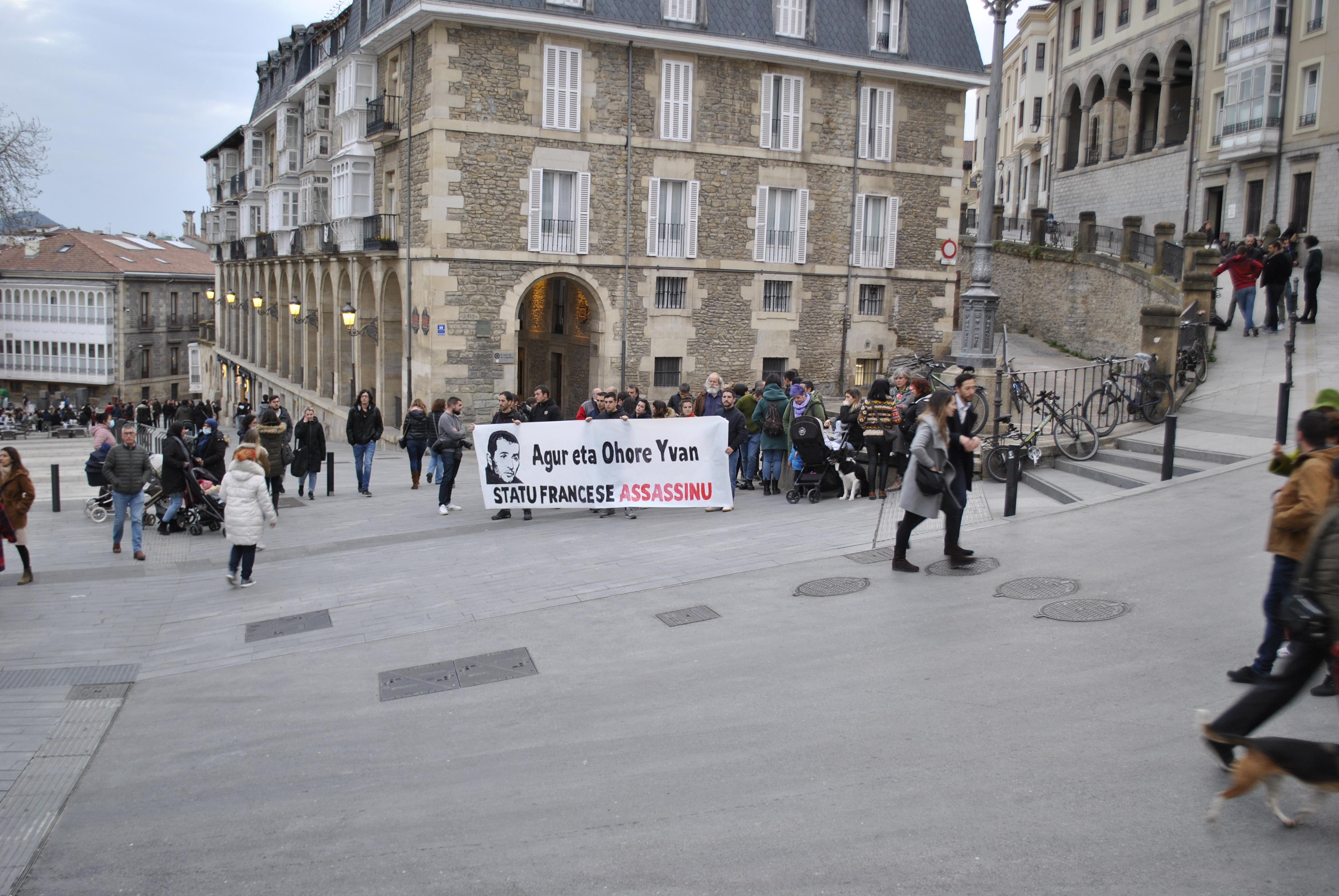
Solidarity picket in Gastheiz/ Vitoria, southern Basque Country, on Friday 25th (Photo: Jardun Koordinadora)
All of this shows us nothing less than the need for the organisation of the working class. It is evident that both the imperialist power and the oppressive States exercise a monopoly on violence to defend their economic interests and, in every nation, those who pay are always the working class.
It is time to denounce the fraud of social peace, it is time to denounce the warlike attitude of NATO, in Donbass, the Sahara, Palestine, today they are waging endless wars in defence of the interests of imperialism and its servants — and in view of this, it is time to awaken internationalist solidarity!
For this reason, we in JARDUN proclaim that it is time to turn to revolutionary organisation for all working people! Because only the organised people can offer real help and, as far as we are concerned, only the Basque working people can obstruct the participation of the Spanish and French States, organizing themselves in Euskal Herria to face the enemy, working for a political system in favour of the Basque working people.
We are clear that struggle is the only way and we will loudly proclaim that we have to confront the enemy, exploitation and class oppression. That is why we encourage you to join the organisation, because it is time to fight, it is essential to resist!
AGUR ETA OHORE YVAN! (Farewell with Honour Yvan!)
GORA KORSIKAKO HERRI LANGILEAREN BORROKA! (Long live the struggle of the Corsican working people!)
GORA EUSKAL HERRIA ASKATUTA! (Long live a free Basque Country!).
end.
Solidarity picket in Donosti/San Sebastian, southern Basque Country, on 26th March (Photo: Jardun Koordinadora)
Lectura lanzada en las concentraciones organizadas por JARDUN ante el asesinato de Yvan Colonna
Yvan Colonna era miembro del movimiento de liberación corso, en el que militó desde joven. Tras ser obligada a permanecer 4 años en la clandestinidad, fue detenida en 2003 acusada de participar en una acción llevada a cabo por un grupo anónimo. La acusación se fundamenta en la declaración de varios de los miembros detenidos en la comisaría, que posteriormente rechazaron la declaración, pero Yvan fue condenado a cadena perpetua.
Colonna quedó en coma muy grave tras la paliza de un preso yihadista en la cárcel de Arlés. El lunes de esta semana, Yvan falleció cuando llevaba 3 semanas hospitalizado. Con el objetivo de denunciar el papel del Estado francés en el asesinato de Yvan desde que ingresó en hospital, durante ese tiempo ha habido disturbios.
Yvan fue asesinado por la política penitenciaria por la dispersión vivida y las condiciones de la prisión. Desde la coordinadora JARDUN denunciamos que la paliza y la muerte recibida por Yvan ha sido consecuencia directa de la política penitenciaria del estado francés. Asimismo, queremos subrayar la necesidad de articular una organización a favor de la libertad de los presos políticos y de la lucha contra la opresión y la explotación.
No hay que olvidar que en Córcega, la lucha por la independencia se ha dado durante décadas con el objetivo de superar el sistema político económico impuesto por el Estado francés y luchar por un gobierno popular y democrático que actuara en favor del pueblo corso. La lucha de los corsos es la lucha contra el imperialismo francés, la opresión del pueblo obrero local y la lucha contra la explotación que sufren.
En Euskal Herria conocemos bien la represión y la opresión de los estados opresores y somos testigos de las masacres cometidas tantas veces por el Estado francés. Porque no podemos olvidar la actitud imperialista del Estado francés en Argel y otras colonias, llegando a ser, junto con los Estados Unidos, los principales impulsores de la tortura contemporánea.
Todo ello no nos demuestra más que la necesidad de la organización de la clase trabajadora.. Es evidente que tanto la potencia imperialista como los Estados opresores ejercen el monopolio de la violencia para defender sus intereses económicos, y en todo pueblo, su pagador, es siempre la clase obrera.
Es hora de denunciar el fraude de la paz social, es tiempo de denunciar la actitud guerrera de la OTAN, Donbass, el Sáhara, Palestina, hoy en día están dando un sinfín de guerras en defensa de los intereses del imperialismo y de sus siervos, ¡y ante eso es tiempo de despertar la solidaridad internacionalista!
Para ello, desde JARDUN proclamamos que es hora de volcarse en la organización revolucionaria para todo pueblo obrero!! ¡Porque sólo el pueblo organizado puede ofrecer una verdadera ayuda, y en lo que a nosotros se refiere, sólo el pueblo trabajador vasco puede interrumpir la participación de los Estados Español y Francés, organizándose en Euskal Herria para hacer frente al enemigo, trabajando por un sistema político a favor del pueblo trabajador vasco.
Nosotros tenemos claro que la lucha es el único camino y proclamaremos en voz alta que tenemos que enfrentar al enemigo, a la explotación y la opresión de clase. Por eso os animamos a uniros a la organización, porque es tiempo de lucha, ¡es imprescindible resistir!
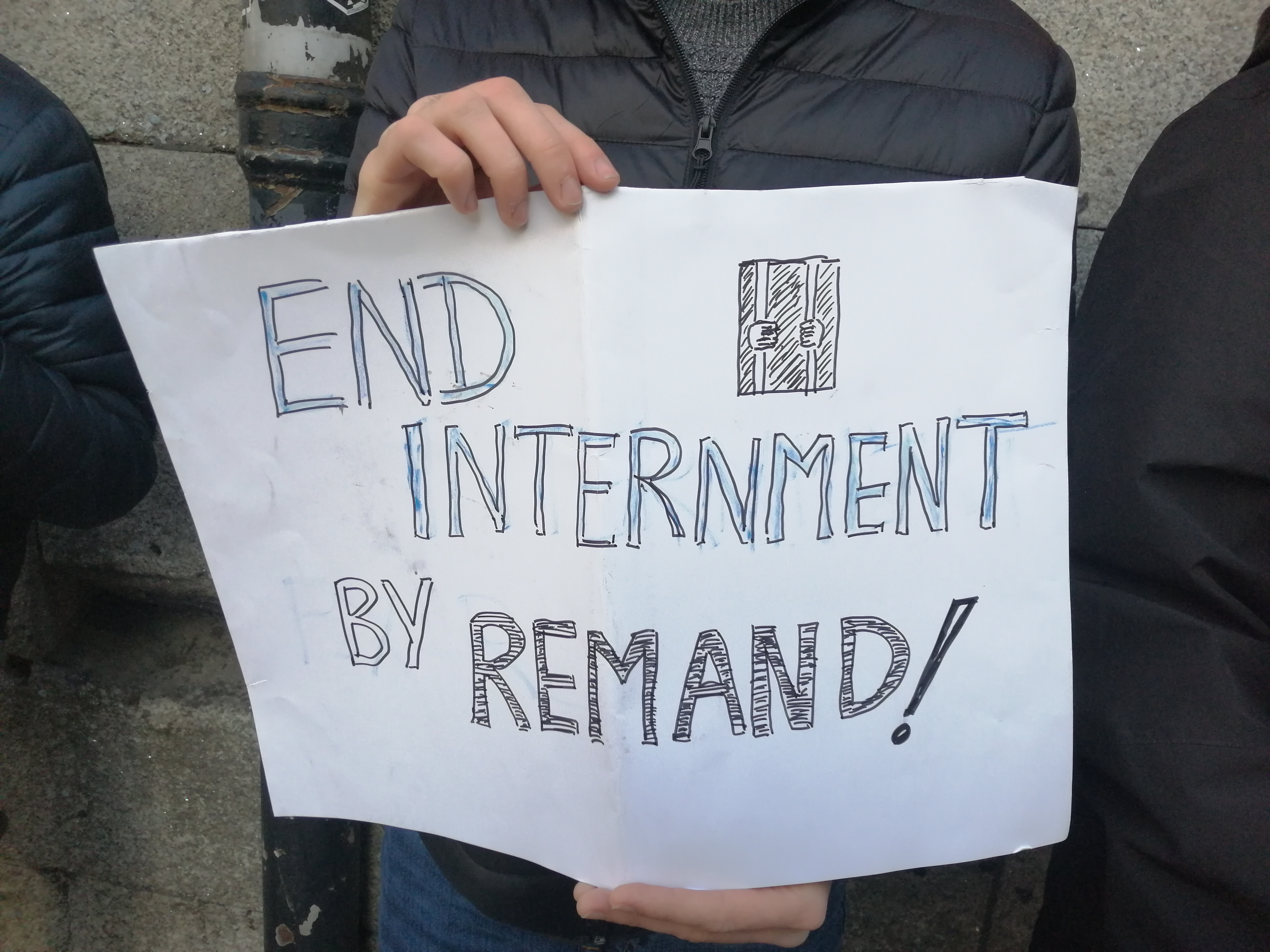
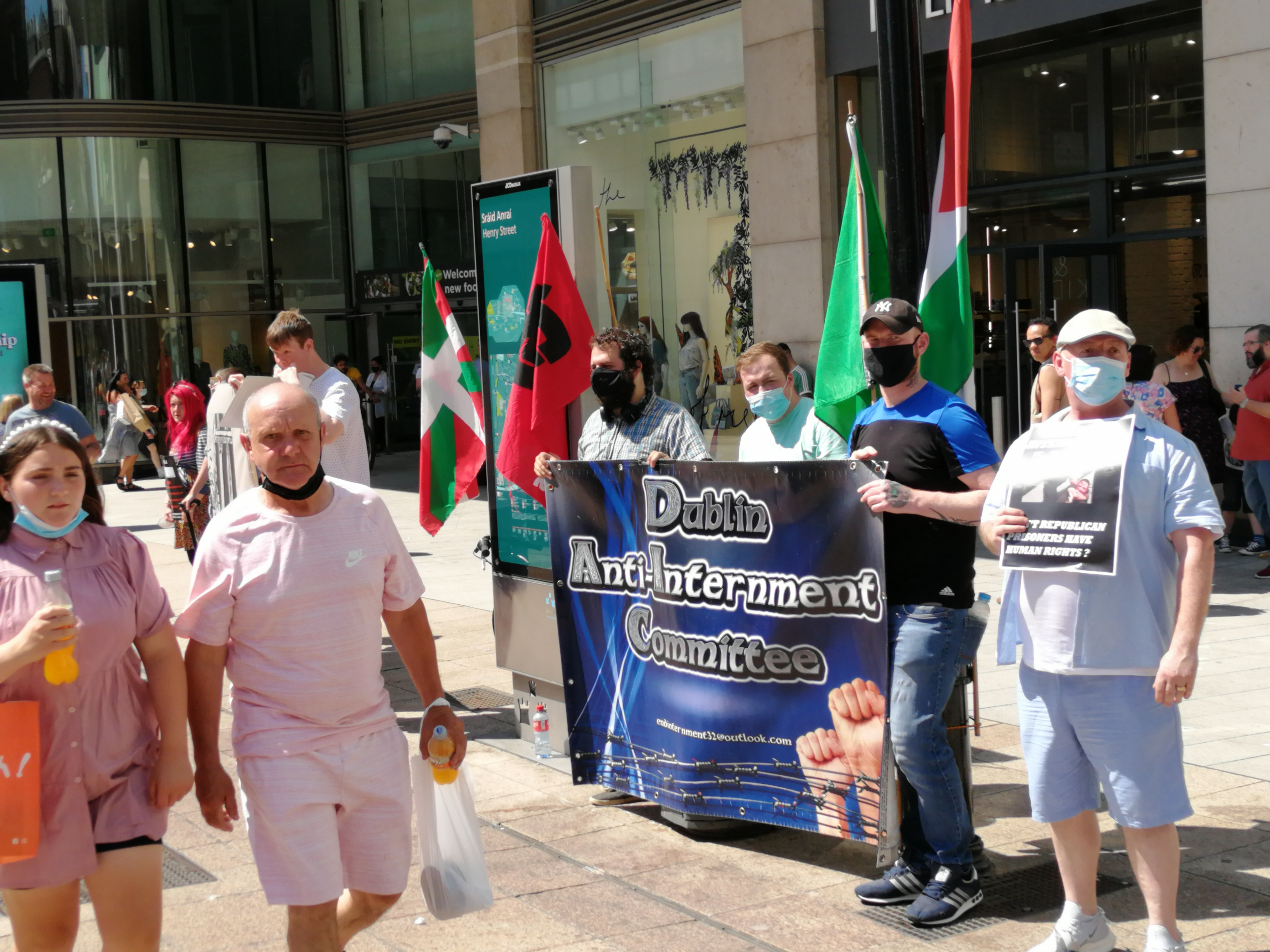
The Dublin Anti-Internment Committee held a well-attended picket on Saturday (5th March) against the continuing practice of interning Irish Republicans without trial and also in support of human rights for political prisoners. At one point the picket was subjected to the unwelcome attention of the Irish political police.
(Photo: C.Sulish)
The event was in furtherance of the Committee’s advertised intention to hold monthly public events to highlight the deprivation of civil rights from Irish Republicans — on both sides of the British border — through the operation of special legislation and in particular of the no-jury political courts (Special Criminal Courts in the Irish state and Diplock Court in the British colony). The Committee has admitted that it does not always succeed in holding a public event every month and in fact its most recent public appearance was during the December festive season, in solidarity with Irish Republican prisoners, when it was supported by a number of organisations and independent activists.
(Photo: C.Sulish)
WHY THESE PUBLIC EVENTS?
The Dublin Committee holds these public events because it believes that most people are unaware of the abuse of civil rights in Ireland, the civil right to belong to an organisation that criticises the State and seeks profound change. The reaction of people receiving a leaflet at their public events would seem to bear this out.
(Photo: C.Sulish)
Choosing a couple of extracts from their current leaflet: ‘At various times in Ireland’s history, people have been rounded up and jailed without bothering with a trial – people whom the government found troublesome and wished removed. Today the same process carries on although they don’t call it “internment” now – other names such as “due process”, “remanded in custody” are used ….”
‘Even when Republican activists are granted bail, it is on outrageous conditions such as not being permitted to reside in their own home, having to observe a curfew and wear an electronic tag, not being permitted to attend meetings and demonstrations …..’
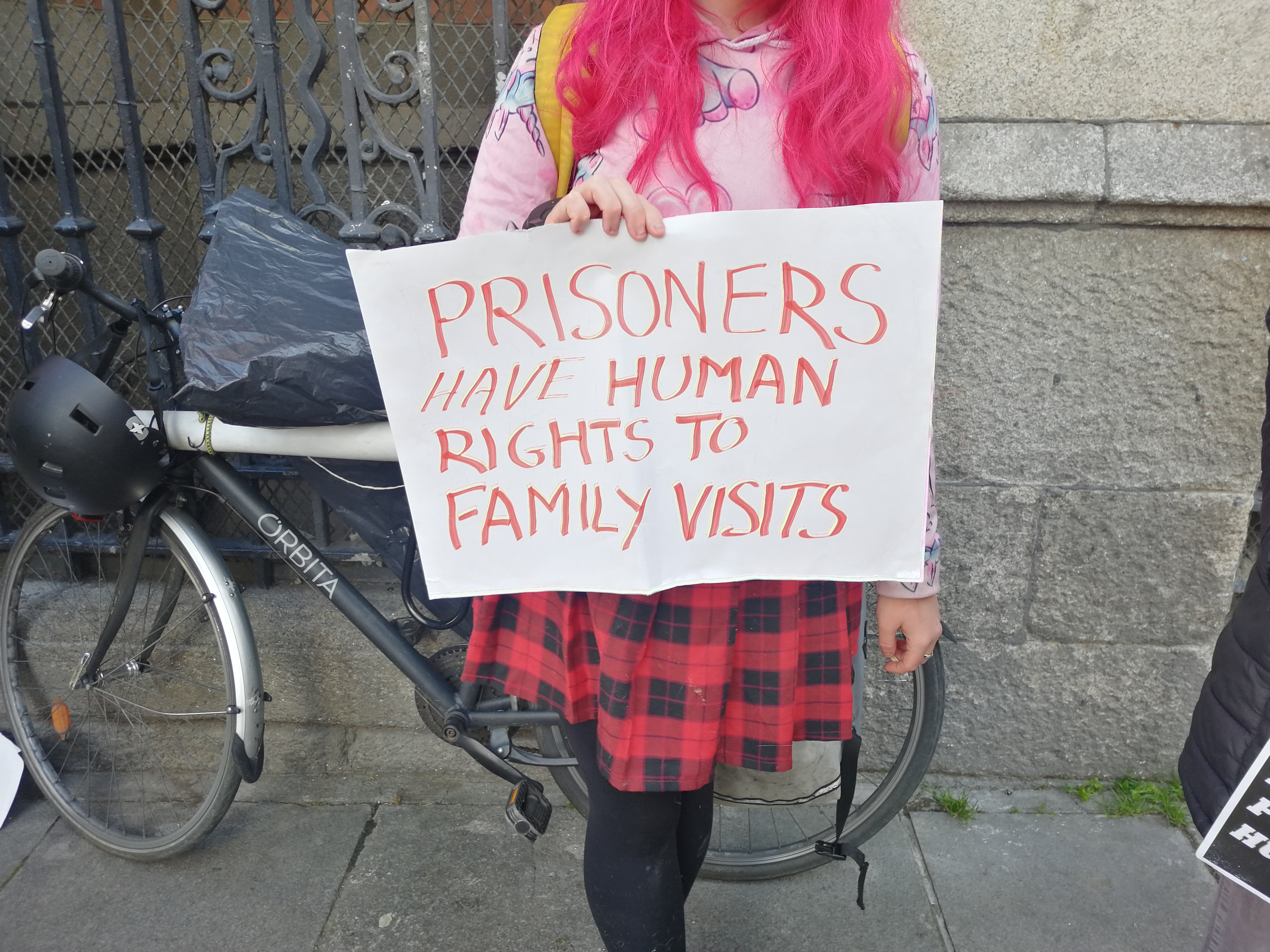
The leaflet text makes the point that one doesn’t have to agree with the politics of Irish Republicans to see that these injustices are profoundly undemocratic abuses of civil rights — and “are ultimately a danger to all oppositional movements, whether Republican or not”. One aspect of their protest was against the denial of open family visits to Republican prisoners in the jails of the British colony in the north-east of Ireland — a violation of human rights.
The surprise in learning the facts is not confined to Irish people because often it is expressed by tourists or migrants, even if they have encountered such practices in their own countries of origin.
INTERNATIONALIST DIMENSION
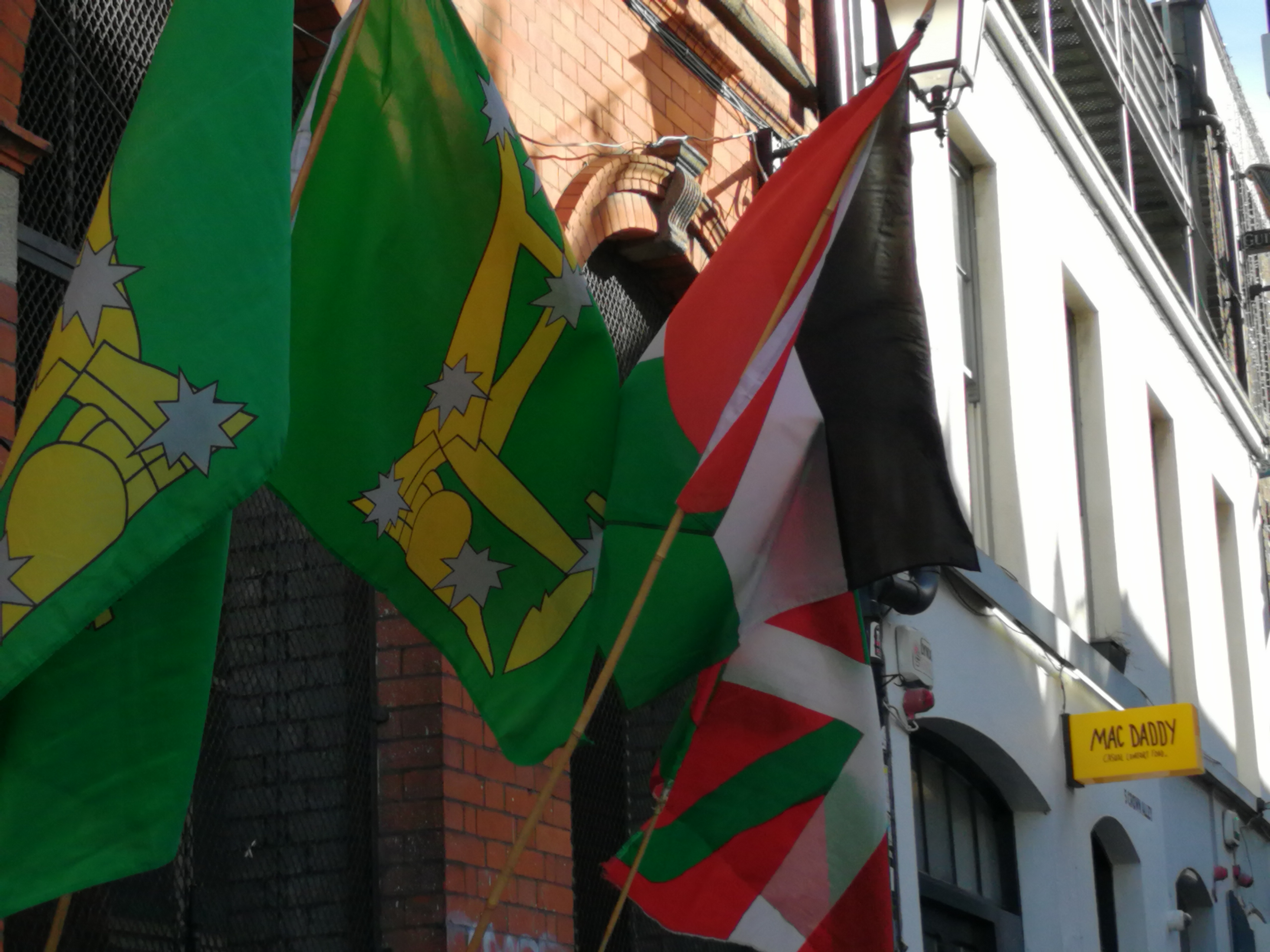
An example of the interest from abroad on Saturday was of a Basque man and, separately, of two young Basque women, reacting warmly to seeing the Basque flag among the picketers. The Dublin Committee objects not only to the incarceration of Irish Republicans but also of people seeking freedom in many other parts of the world, for which reason the Palestinian and Basque flags are frequently flown on their pickets, next to the revolutionary Irish workers’ flag of the Starry Plough.
A person who expressed support for the right to campaign without state repression was, interestingly, from Barcelona. However he did not wish for Catalan independence, wanting instead a unitary but democratic Spanish state – a position held by some communists and the main socia-democratic parties there. Although his position did not concur with that of the picketers, who tend to support the struggles for self-determination, the conversation was conducted without hostility.
Not so with another individual, who approached some picketers to argue for their support for the Ukrainian state in the current armed conflict there, a question that has deeply divided the Irish Left and Republican movements. He went further and announced his support for the Azov Battalion, an East European fascist organisation integrated into the Ukrainian state’s military, at which point the tolerance of the picketers for his intervention ended and he was urged to depart.
Starry Plough flags next to Palestinian and Basque Ikurrina flags at the picket in Temple Bar. (Photo: C.Sulish)
POLITICAL POLICE INTIMIDATION
Another temporary presence unwelcome to the picketers was of three members of the Irish State’s political police. These are members of what used to be called the Special Branch but are now officially called the Special Detective Unit, formerly C3 and successor to the CID when the Irish State was created. This type of political police force is modelled on the Irish Special Branch of Scotland Yard, the HQ of the British police, founded to spy on the influence and activities of the “Fenians” (i.e the Irish Republican Brotherhood) in the cities of Victorian-era Britain. However, in Dublin under British occupation, their parallel force was the G Division of the Dublin Metropolitan Police, known as “G-men”; it was they who identified many Republican and other prisoners of the British military after the 1916 Rising, ensuring death sentences for many (though most commuted to life imprisonment) and jail sentence for many others. During the War of Independence (1919-1921 they were identified as the intelligence service of the British occupation and many were selectively assassinated by the IRA of the time.
The Garda “Branch” (as they are known colloquially) of the Irish State have a long history of harassment of and spying on Irish Republicans, sometimes associated with violence and often with perjury in court. Their unsupported observations through the mouth of a Garda officer at the rank of Superintendent has been enough “evidence”, in the no-jury Special Criminal Court, to send many Irish Republicans to jail on a charge of “membership of an illegal organisation.”
Two picketers confront the plainclothes political police officer harassing a young leafletter on Saturday (Photo: C.Sulish)
One of these gentlemen on Saturday approached the youngest supporter of the picket, who was distributing leaflets to passers-by, identified himself as a Gárda officer in plain-clothes and demanded the young activist’s name. His accosting of the leafletter attracted the attention of others on the picket and two went quickly to support the subject of State harassment. The Branchman demanded no further information and sone moved away. However, when he had reached about half-way along the picketters, he stopped and began filming them.
At that point one of the picketers began to call out to passers-by, many of whom were tourists, that this man was a member of the secret political police, who was filming and attempting to intimidate people on a legal political protest, that this is the kind of ‘democracy’ that exists in the Irish state, etc, etc. Shortly thereafter, the Branchman departed, along with another two of his colleagues that had been observed further down towards Temple Bar.
A picketer loudly denounces the political policeman’s filming of the picketers. (Photo: C.Sulish)
According to picket participants this intervention of the political police represented an escalation of their attentions in recent times, though not in the least unusual in the past, when every picketer might have their name (and even their address) demanded and jotted down.
A spokesperson of the Dublin Anti-Internment Committee stated that it is independent of any political party or organisation and that it welcomes the participation at its public events of democratic individuals, whether independent activists or members of organisations and had distributed many of its leaflets. It regrets that a number of political activists — who should have an interest, even if only in self-preservation – in defending the democratic rights to organise and to protest, decline to support their events.
“Ayer se escapó de la custodia a importantes prisioneros y ahora se está llevando a cabo una intensa persecución. Se advierte a la gente que no los ayude so pena de un proceso penal y de sanciones severas si es condenado.
“Según fuentes confidenciales, pero no confirmadas por las autoridades, se cree que los prisioneros son Aodh Rua Ó Domhnail y Art y Henry O’Neill, del los clanes importantes de la provincia de Ulster, cuales escaparon de su confinamiento en el castillo de Dublín. Se cree que se sospecha de asistencia interna.
“Los prisioneros pueden dirigirse en una de varias direcciones o pueden haberse separado. Es probable que el frío y la nieve retrasen su avance, pero también impiden la búsqueda”.
Tal, en el lenguaje moderno, podría haber sido la respuesta de los medios de comunicación de los ocupantes ingleses a la fuga el día de Navidad de 1591 de los rehenes políticos Aodh “Rua” (“Pelirojo”) Ó Domhnail, Art & Henry O’Neill del Castillo de Dublín. Un asistente se reunió con ellos y les dio ropa ligera para que se cambiaran de las que se habían ensuciado por su escape a través del conducto del baño del castillo.
El Record Tower, Castillo de Dublín, tomado en recién anos. (Foto: D.Breatnach)
Los fugitivos estaban mal provistos y vestidos o se habían separado de las provisiones y la ropa preparadas y estaban a pie. Además, al salir de la ciudad de Dublín, uno de los hermanos Ó Néill (‘Henry’), se separó y se hizo su proprio camino.
Cuando llegaron a cierto lugar en las montañas de Wicklow, Art Ó Néill ya no pudo viajar y el asistente fue a buscar ayuda. Cuando regresó con un grupo de rescate enviado por Fiach Mac Aodh Ó Broin, su hermano Art había muerto y aunque Aodh Ó Domhnaill todavía estaba vivo, iba a perder el dedo gordo de cada pie por congelación.
Una impresión gráfica de los hombres de Fiach Mac Aodh que encuentran a Art O’Néill muerto y Aodh Rua Ó Domhnaill en una situación desesperada. (Imagen encontrado: Internet)
UN ENEMIGO FORMIDABLE
Aodh Rua Ó Domhnaill se convertiría en un enemigo formidable de los ingleses en los años venideros, primero ganando el liderazgo de su clan, luego estallando en una rebelión abierta y en una conspiración secreta con Ó Néill, quien más tarde se unió a él abiertamente en la Guerra de los Nueve Años.
En el 15 Agosto 1599, Aodh Rua Ó Domhnaill preparó emboscada a una columna de 1,700 en el Puerto (montaña) de Corrsliabh (Curlew Pass en inglés) en lo que hoy es el Condado de Ros Comáin (Roscommon). La columna invasora fue encabezado por el Señor Conyers Clifford y su cabeza fue presentado a Ó Domhnaill al fin de la batalla, cual fue una derrota para los militares ingleses en que fallecieron 1,230 de sus soldados.
“Art’s Cross” (la Cruz de Art) en las montañas de Wicklow, donde los rescatistas los encontraron. (Photo encontrada: Internet)
Aodh Ó Néill, en alianza con Aodh Rua Ó Domhnail, resistió todos los intentos de los ingleses de castigar a los clanes del Ulster, les infligió fuertes derrotas y comenzó a atraer a otros clanes a sus estandartes. La rebelión se desvaneció en la batalla de Kinsale (Cath Cinn tSáile) en 1602 en lo que hoy es el condado de Cork, lejos del territorio de ambos caciques, donde una fuerza invasora de aliados españoles había sido sitiada por los ingleses.
Tras la derrota de Kinsale, los dos líderes y muchos otros se huyeron al Reino de España de Felipe II con intención de volver a Irlanda con ayuda militar del Reino pero nunca sucedió.
La partida de Ó Néill y Ó Domhnaill provocó una evacuación a gran escala de los líderes de los clanes que se resistían y sus familias, lo que ha sido llamado “La Huida de los Condes” y abrió el camino para una profundización de la conquista inglesa.
La resistencia a gran escala volvió a estallar ostensiblemente por una cuestión de religión, aprovechando el conflicto interno inglés en 1649 y en 1688, en ambas ocasiones en las que los irlandeses apoyaron al bando inglés perdedor. Los vencedores completaron no solo su conquista, sino también la apropiación a gran escala de la tierra para la plantación de colonos que debían ser protestantes, de habla inglesa y tener prohibido emplear católicos, una guarnición colono para los ingleses en Irlanda.
Algunos creen que Aodh Rua fue envenenado por el espía anglo-irlandés, James “Spanish” Blake. Sea así o no, Aodh Rua murió el 10 de septiembre de 1602 en el Castillo de Simancas, Valladolid, España. Fue enterrado en el capítulo del monasterio franciscano de Valladolid. Aunque el edificio fue demolido en 1837, la ubicación exacta de la tumba puede haber sido descubierta después de una excavación arqueológica española en mayo de 2020. Si sus restos se identifican con éxito, serán devueltos para su entierro en el condado de Donegal.
El mensaje en palabras es sin sustancia de realidad pero el arte del mural es magnífico. En Ard Eoin, Béal Feirste (Ardoyne, Belfast). (Foto encontrado: Internet)
A group of Irish people were jubilant in London’s Little George Street on 15th December. The location was that of the UK’s Supreme Court and it was unusual for Irish people to be happy at a judgement of a British court. But the judges inside had quashed an appeal by the Police Service of Northern Ireland1 against a judgement of the High Court in Belfast, that the colonial police force had been wrong not to investigate the claims of fourteen men of being tortured in the British colony in 19712.
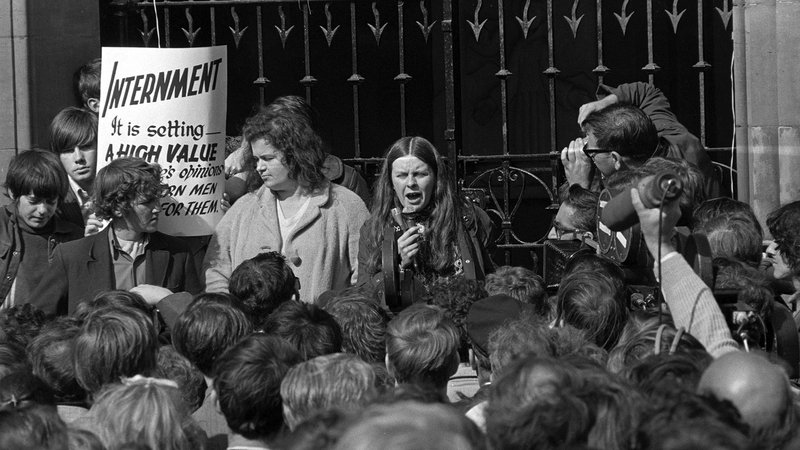
Bernadette Devlin (now McAlliskey) addressing an anti-internment rally in Derry in August 1971 (Photo cred: Popperfoto, Getty Images)
The claims related to what happened during the introduction of internment without trial in the occupied Six Counties in August 1971. What many internees experienced ranged from brutal treatment to torture: “Many of those arrested reported that they and their families were assaulted, verbally abused and threatened by the soldiers. There were claims of soldiers smashing their way into houses without warning and firing rubber baton rounds through doors and windows. Many of those arrested also reported being ill-treated during their three-day detention at the holding centres. They complained of being beaten, verbally abused, threatened, harassed by dogs, denied sleep, and starved. Some reported being forced to run a gauntlet of baton-wielding soldiers, being forced to run an ‘obstacle course’, having their heads forcefully shaved, being kept naked, being burnt with cigarettes, having a sack placed over their heads for long periods, having a rope kept around their necks, having the barrel of a gun pressed against their heads, being dragged by the hair, being trailed behind armoured vehicles while barefoot, and being tied to armoured trucks as a human shield” (for the soldiers against attack by the IRA). (Wikipedia)
(Photo sourced: Internet)
Some were hooded, beaten and, having been told they were hundreds of feet in the air, were then thrown from a helicopter — but were actually only a few feet from the ground. In addition, they were subjected to disorientating “white noise”, forced to remain in stress positions for long periods and deprived of food, water and sleep. Fourteen men who endured this for seven days became known as the “Hooded Men” and have been campaigning for over 50 years to have the British State admit that in its Irish colony, it had tortured them. Interestingly, some of those techniques have also been complained of more recently – by prisoners of the British military in Iraq3 — and this despite a statement by the UK’s Attorney General in 1977 that the techniques would not be used by them again.4
(Photo sourced: Internet)
Unusually, the Irish State5 took the case of the Fourteen to the European Court of Human Rights in Strasbourg and in 1976 obtained a judgement that “the five interrogation techniques” were torture.
The British State appealed the ECHR judgement and in 1978 won a judgement that although the treatment of the Hooded Men amounted to “inhuman and degrading treatment” and breached Article 3 of the European Convention of Human Rights it nevertheless fell short of torture6.
When documentation came to light proving that British Government Ministers had approved the treatment, the Irish State appealed the revised judgement of the ECHR but in 2018 was unsuccessful.
Meanwhile, the legal team of the Hooded Men pursued their case through the legal system of the UK’s Irish colony. In October 2014 the PSNI formally decided not to investigate the allegations, following which in 2015 judicial review proceedings against the PSNI, Secretary of State for Northern Ireland and Department of Justice were initiated by Francis McGuigan, one of the ‘Hooded Men’. A co-appellant was Mary McKenna, the daughter of Sean McKenna, another of the Hooded Men, who died in 1975, never having fully recovered from his mistreatment. The proceedings followed the discovery of additional documentary materials relevant to the mistreatment of the men, which were featured in a 2014 RTÉ Documentary, The Torture Files.7
Following this Documentary, the Chief Constable stated that the PSNI would assess “any allegation or emerging evidence of criminal behaviour, from whatever quarter” concerning the ill-treatment of the Hooded Men “with a view to substantiating such an allegation and identifying sufficient evidence to justify a prosecution and bring people to court’”. However in October 2014 the PSNI took the decision not to investigate. In late 2017, the High Court ruled that the failure by the Police Service of Northern Ireland (PSNI) to investigate the allegations of torture was unlawful.
Some of the Hooded Men in London for the Supreme Court judgement. (Photo sourced: Internet)
Instead of accepting the judgement however the PSNI sought to appeal the High Court decision but in September 2019 the Court of Appeal ruled that the decision should stand. One would have to contrast the determination of the colonial police in the courts to their appalling record in investigating collusion between their own force and Loyalist murder gangs, for the PSNI then appealed to the UK Supreme Court. In November 2019 the UK Supreme Court upheld the decision of the colony’s Court of Appeal and the PSNI appealed that judgement too. The decision last week in London marks the end of the legal options of the colonial gendarmerie.
The very month the decision not to investigate the allegations of the Hooded Men was taken by the colonial police force, October 2014, Drew Harris had been appointed Deputy Chief Constable of the PSNI.
IMPLICATIONS OF JUDGEMENT
The implications of the High Court judgement for Britain and its colonial administration are that once again they have been shown to have deployed barbarous methods in their repression of resistance by the nationalist minority in the colony and that they have exceeded or ignored even their own laws.
As has been the case throughout the recent 30 Years’ War, with the system lying and trying to cover up the reality of its actions, then delaying by all available means, the judgement comes too late for a number of the victims, as only nine of the 14 are still alive.
Nevertheless, the judgement adds to a number of other judgements and admissions over the years, such as those surrounding the Bloody Sunday Massacre in Derry in 1972 and the Ballymurphy Massacre in 1971. On 13 December this year, the British Ministry of Defence and PSNI agreed to a £1.5m out-of-court settlement to compensate victims of the Miami Showband Massacre over suspected state collusion with loyalist terrorists.
Three members of the band died from explosions and bullets after they were forced to get out of their bus at a fake police checkpoint on their return to Dublin from the Six Counties. Stephen Travers, who was injured in the attack, said he was convinced he would have won his civil action to prove that there was collaboration between the State and terrorists but that the Government’s decision to “dispense with justice rather than to dispense justice” had motivated the out-of court settlement.
Had the UK’s Supreme Court rejected the Hooded Men’s case, the latter would have been free to take the case to the European Court of Human Rights – not that they had been tortured but that the police should have investigated their claims that they were. And, based on a similar case by the manager of a Basque newspaper against the Spanish State8, they would probably have won their case with damages awarded against the UK.
On the other hand, the Supreme Court decision puts the onus of investigating the accusations of the Hooded Men on to the PSNI, the very organisation deeply implicated in the treatment of the victims, the organisation which declined to investigate them previously and which justified its decision through the courts in the Six Counties and then in the Supreme Court of the UK.
But not only the British state and its colony are put into the dock by the Supreme Court judgement – Drew Harris, formerly Deputy Chief Constable of the PSNI is currently in charge of the police force of the Irish State, where he was appointed Chief Commissioner of the Gardaí in September 2018 on a yearly salary of €250,000.
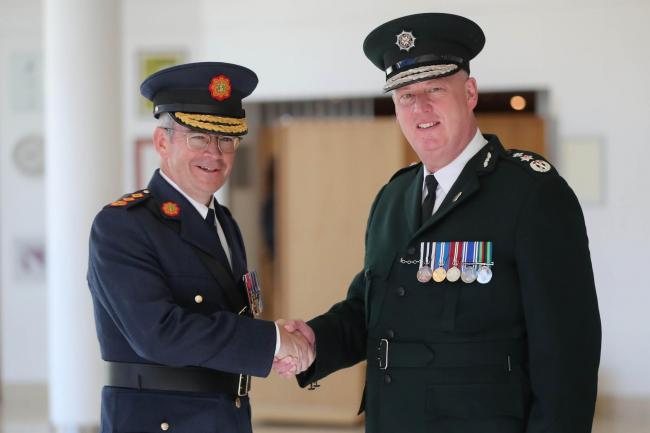
Drew Harris (Left) as Garda Commissioner with his former boss, George Hamilton, Chief Constable of the colonial police, the PSNI, on the occasion they both received an honour from the British Monarch. (Photo sourced: Internet)
APPENDIX — BACKGROUND
Creation of “Northern Ireland”:
The statelet of “Northern Ireland”9 was created in 1922 after Ireland was partitioned by the British Government at the end of 1921. Ireland had been invaded from Britain in 1169 and gradually entirely occupied and colonised by the invaders, albeit with its own semi-autonomous parliament which had been abolished in 1801, after the United Irish uprisings of 179810. Subsequently Members of Parliament elected in Ireland were required to attend the Westminster Parliament.
Following the rise of Irish nationalist sentiment after the suppression of the 1916 Rising, the 1918 UK General Election returned a huge majority of MPs in Ireland sworn to establish an independent Irish Republic. These formed their own parliament in Dublin, at first ignored but then later banned by the British. The guerrilla War of Independence of 1919-1921 convinced the British rulers to offer Ireland autonomy as a “Dominion” within the British system and under the Crown. However, at the same time, the British conceded to the demand of the unionist minority in Ireland to secede from the new Irish state and to remain a colony of Britain and in the UK. The Irish Free State was set up in December 1921 on 26 counties and the Northern Ireland statelet of six counties in January 192211.
From the outset the colonial statelet had been marked by the religious sectarianism of its local rulers, Presbyterians and Anglicans by religion and of unionist ideology, against a very large nationalist minority of mostly Catholics, representing the majority in Ireland as a whole. A raft of special powers empowered the statelet in repression of the nationalist minority; the colonial gendarmerie, abolished in the Irish state, continued in existence, with a part-time wing and even unofficial Loyalist militia in support and de facto anti-nationalist discrimination existed in every sphere: law, housing allocation, education.
In 1968 a campaign for civil rights for the nationalist minority began, to be met by truncheons, water-cannon, tear gas and bullets which however, merely drove parts of the minority into open insurrection. The colonial gendarmerie (the Royal Ulster Constabulary), even with the active support of the part-time B-Specials and Loyalist paramilitaries, was unable to suppress the uprising primarily in Derry but also in West Belfast and in August 1969 the British Government sent in the British Army to take control.
Initially the soldiers were represented to the nationalist population as being present to protect them from the sectarian colonial police and from the Loyalists but it soon became clear that their primary focus was to repress the risen nationalist population and the IRA began to take action against them.
Introduction of Internment Without Trial:
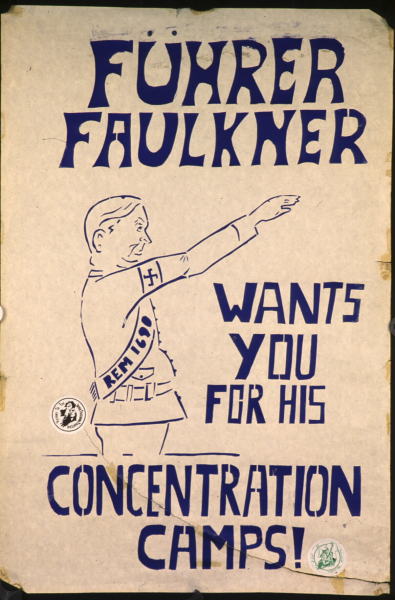
The Prime Minister of the “Northern Ireland” statelet, Brian Faulkner, recommended to his colonial masters that internment without trial be introduced against the nationalist population; this was agreed and “Operation Demetrius” began on 9th August and continuing over the 10th 1971 with British Army raids into nationalist areas, forcing their way into homes and dragging their captives away to be interrogated by RUC Special Branch, after which they were jailed. In the initial sweep the occupation forces arrested 342 men, sparking four days of violence in which 20 civilians, two IRA members and two British soldiers were killed and 7,000 people fled their homes. All of those interned were from the nationalist community.
Poster by the Anti-Internment League of Ireland – the internees in the photo are handcuffed together. (Photo sourced: Internet)
The detentions without charge continued until December 1975 and by that time 1,981 people had been interned, of which 1,874 were from the nationalist community. Only 107 were Loyalists and none of those had been interned until February 1973. Resistance to internment continued after the initial sweep and from 9th to 11th August, British Paratroopers caused the death of 11 unarmed people in the Ballymurphy area of Belfast. In January the following year the Paras and other units attacked people marching against internment in Derry, killing 14 and injuring 12.
Internment was protested in the rest of Ireland and in other countries, including Britain. The Men Behind the Wire, an anti-internment song composed in 1971 by Paddy McGuigan and recorded by the Barleycorn group in Belfast, was pressed into disc in Dublin and shot to the top of the Irish charts, greatly exceeding in numbers of sales any record previously released in Ireland.
Excerpt:
Through the little streets of Belfast, In the dark of early morn, British soldiers came marauding Wrecking little homes with scorn.
Heedless of the crying children, Dragging fathers from their beds; Beating sons while helpless mothers Watched the blood flow from their heads.
Armoured cars and tanks and guns Came to take away our sons But every man will stand behind The Men Behind the Wire.
Poster by People”s Democracy, believed in 1970, prior to introduction of internment. (Photo sourced: Internet)
Brian Faulkner, unionist Prime Minister of the statelet, who had asked the British to introduce internment, was hated by a great many people. When he died in March 1977 following an accident during a stag hunt, thrown by his horse Cannonball, an English communist composed a short song he named “Cannonball”.
Excerpt:
Lord Faulkner was a hunter of men and of deer
And both have good reason to laugh and to cheer
At the death of a tyrant whose interests were clear
Those of imperialism that have cost Ireland dear.
Cannonball, Cannonball has many a friend,
From the top of old Ireland right down to its end,
Where the brave people struggle
In one resolute bid
To throw off their oppressors —
Just as Cannonball did!
End.
FOOTNOTES
The colonial gendarmerie formerly known as the Royal Ulster Constabulary.
3. The Court’s ruling that the five techniques did not amount to torture was later cited by the United States and Israel to justify their own interrogation methods, which included the five techniques. British agents also taught the five techniques to the forces of Brazil’s military dictatorship. During the Iraq War, the illegal use of the five techniques by British soldiers contributed to the death of at least one detainee, Baha Mousa.
4 “The Government of the United Kingdom have considered the question of the use of the ‘five techniques’ with very great care and with particular regard to Article 3 (art. 3) of the Convention. They now give this unqualified undertaking, that the ‘five techniques’ will not in any circumstances be reintroduced as an aid to interrogation.”
5 Unusually, because during the three decades of ill-treatment by a foreign power of people who were, according to the Irish Constitution its citizens, only in one other case did the Irish State bring a complaint against the UK to an international arena.
6 I admit that I fail completely to understand the distinction.
7. Rita O’Reilly, the journalist who led that program, also commented extremely well on the UK Supreme Court decision and the whole case on Prime Time on RTÉ this week (see Links).
8. Martxelo Otamendi, along with others detained, was tortured by his Guardia Civil captors when the Basque newspaper of which he was manager was closed by the Spanish State, alleging that it had been cooperating with terrorists. He was freed eventually and even later in 2010 the Spanish Supreme Court admitted that there had been no evidence against him or the newspaper – but neither admitted the torture nor ordered his allegations be investigated. Otamendi filed a complaint with the European Court of Human Rights in 2012 and in 2014 the ECHR found the Spanish State guilty of not having investigated Otamendi’s allegation of being tortured and awarded him €24,000 in damages and expenses from the Spanish state.
9. A misnomer since the British colony is not the northernmost part of Ireland, which is in County Donegal, inside the Irish state. “Ulster”, a name given by the Unionists to the statelet and frequently repeated in the British media, is also a misnomer since the Province of Ulster contains nine counties, six of which are in the colonial statelet but three of which are within the Irish state.
10. There were many uprisings prior to 1798, which was the first Republican one and there were many of that kind afterwards too.
11. Shortly after that the Free State, supplied with weapons and transport by the British, attacked the Republicans, who had been demonstrating their dissatisfaction with the Anglo-Irish Treaty. This precipitated a Civil War in which the Republicans were defeated.
Amidst festive season lights, passing Santa Clauses on horse-drawn carriages and hungry people being fed by volunteers in the Dublin city centre, Irish Republicans and Socialists gathered to send a public message of solidarity to political prisoners in Ireland and elsewhere.
Photo: Rebel Breeze
The event is an annual one organised by the Anti-Internment Group of Ireland, an independent non-aligned group raising awareness that internment without trial continues in Ireland, through revoking of licence of ex-prisoners and through refusal of bail in the no-jury courts both sides of the British Border. The Dublin committee of the AIGI holds monthly public awareness-raising pickets in the city centre.
The annual picket on Thursday early evening was supported by activists of the Irish Republican Prisoners’ Welfare Association and of the Anti-Imperialist Action organisation, along with some independents and took place in front of the iconic GPO building, on Dublin’s main street.
Photo: Rebel Breeze
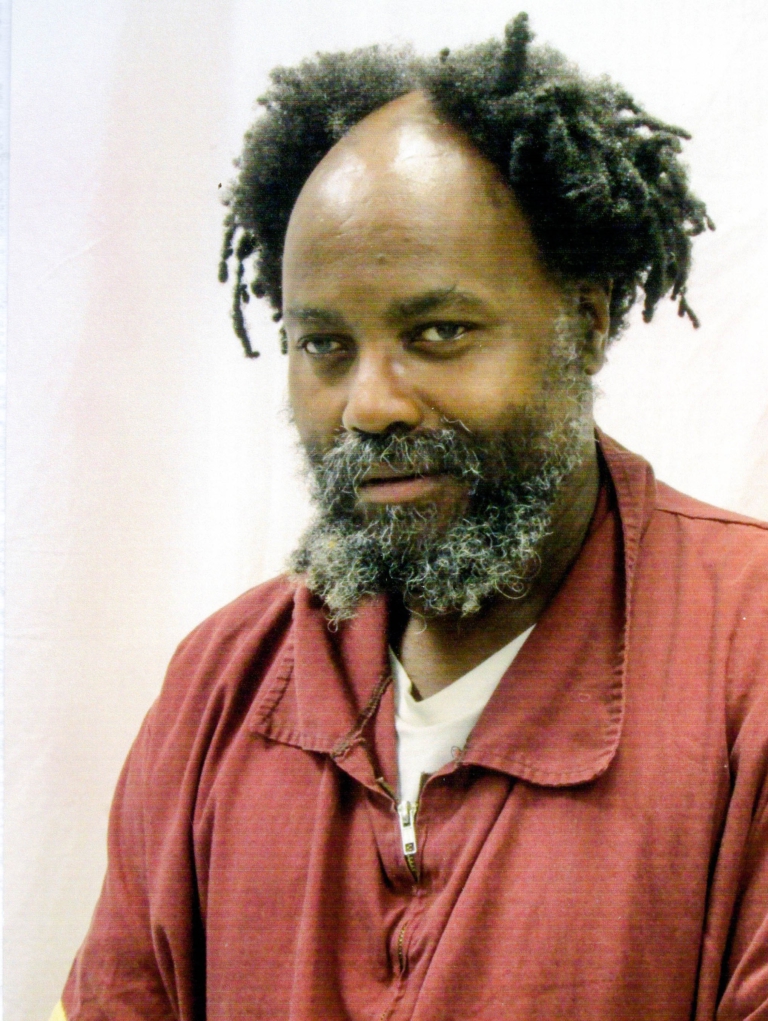
The picketers and passers-by were addressed by a representative of the Anti-Internment Group outlining the participants’ presence to send solidarity greeting to political prisoners in Ireland and around the world. The speaker drew particular attention to three prisoners: Leonard Peltier, Native American, 45 years in jail and Black American Mumia Al Jamaal, 40 years in prison, both framed by police in the USA. Also highlighted was the case of Ali Osman Kose, 37 years in jail, 21 of which he has spent in solitary confinement. The speaker informed the audience that those three political prisoners, apart from their very long years of incarceration, have multiple health issues and should be released, he said on humanitarian grounds alone. “But no ….. they want them to die in jail”, he said.
Photo: Rebel Breeze
Going on to speak about political prisoners in Ireland, the speaker said that they and hostages had existed almost from the moment Ireland had been invaded by its neighbour and from the defeated United Irishmen up to the Fenians, had included not only dungeons and prison cells but also penal colonies on the other side of the world, after which they had been confined in special prisons and concentrations camps.
The creation of the Irish State on a partitioned Irish country a century ago this month had not brought freedom nor an end to the struggle, the speaker said and pointed out that the Irish State had executed 80 Irish Republicans during the years of the Civil War, which was more than the British had done during the War of Independence preceding it.
Photo: Rebel Breeze
“Whether we are religious or not ….. in our culture at this time of year we expect to be with our families, our partner, children and friends,” the AIGI representative said but pointed out that this opportunity is not available to the prisoners, which makes this a particularly difficult time of year for them, which is why the Group and others hold this event every year.
The speaker then called a young boy forward “to send a message to the prisoners from this younger generation who hopefully will see a free and united Ireland with social justice and equality. The young boy stepped forward and through the PA, asked all at this time of year to think of the Republican prisoners.
Photo: AIGI
The Starry Plough, the Palestinian flag and the Basque Ikurrina were flown by participants and among the banners of the IRPWA and Dublin Committee of the AIGI there was also one displaying the Carlos Latuff graphic of Palestinian and Irish Republican prisoner solidarity. The centrepiece in the picket line was the word Saoirse (‘freedom’ in Irish) picked out by lights on a dark background. Appropriate music was also played during the picket from a PA system, except while being addressed by the speaker.
The event concluded with thanks to all the attendance and the singing the first verse and chorus of the battle-song Amhrán na bhFiann (The Soldiers’ Song in Irish, which is also the National Anthem).
It is understood that seasonal greeting cards have also been sent by AIGI to political prisoners in prisons in the Irish state and in the colonial statelet.
End.
Photo: Rebel BreezeSigning Christmas cards for the prisoners. (Photo: AIGI)Photo: Rebel Breeze
Last Saturday in the Teachers’ Club in Dublin (26/11/21), the revolutionary music Grup Yorum from Turkey, with some Irish musician input, played to an audience of up to two hundred. In between performing different numbers from their repertoire, band members spoke to the audience of the history of the struggles of their people and of the band.
The Irish tour of the band was organised by the Anti-Imperialist Action Ireland organisation; earlier that week Yorum played in a small music venue in Belfast to around 40 people. The attendance in Dublin was so large that the location had to be changed from a large room on the first floor to the much larger hall down below.
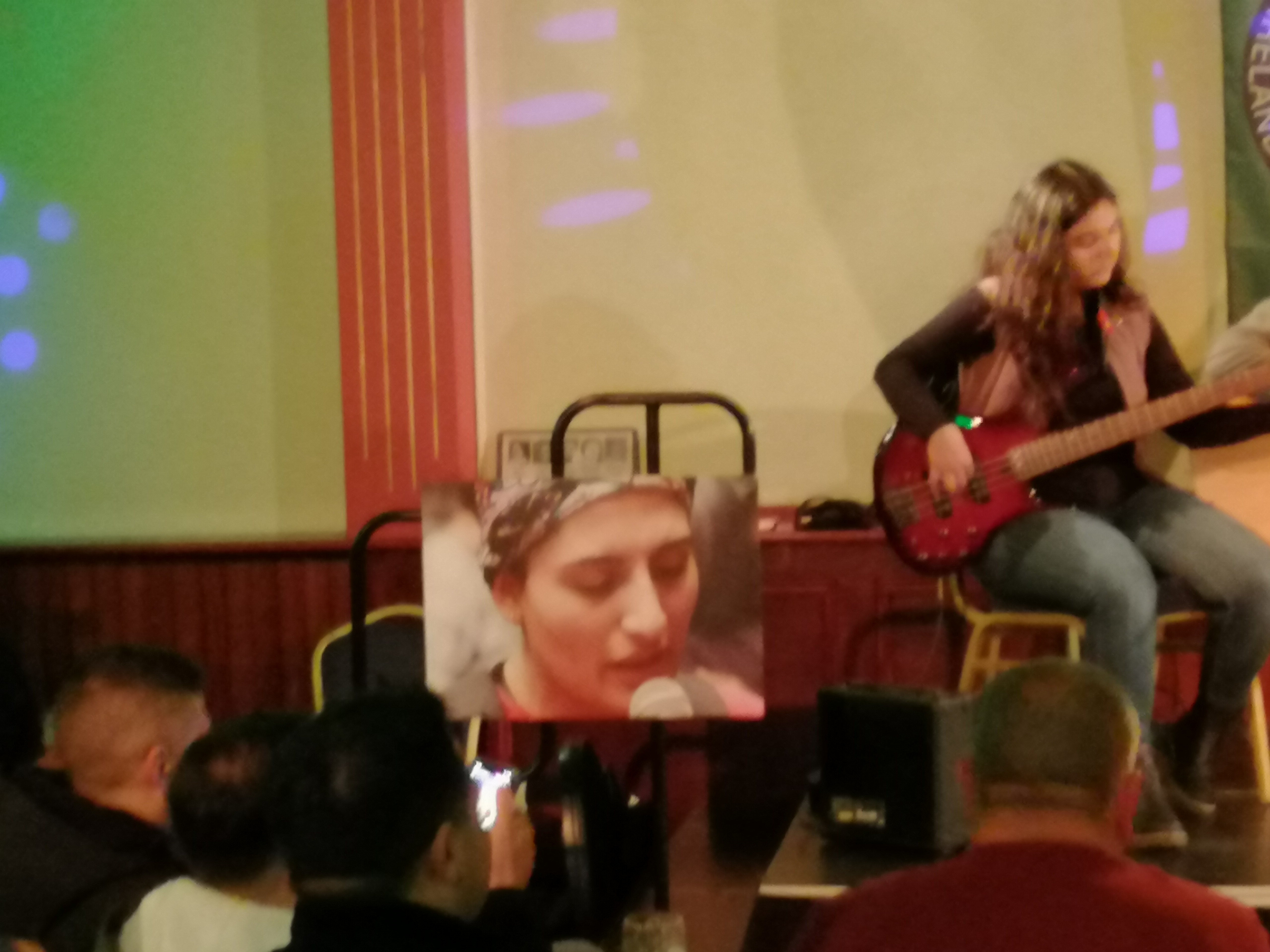
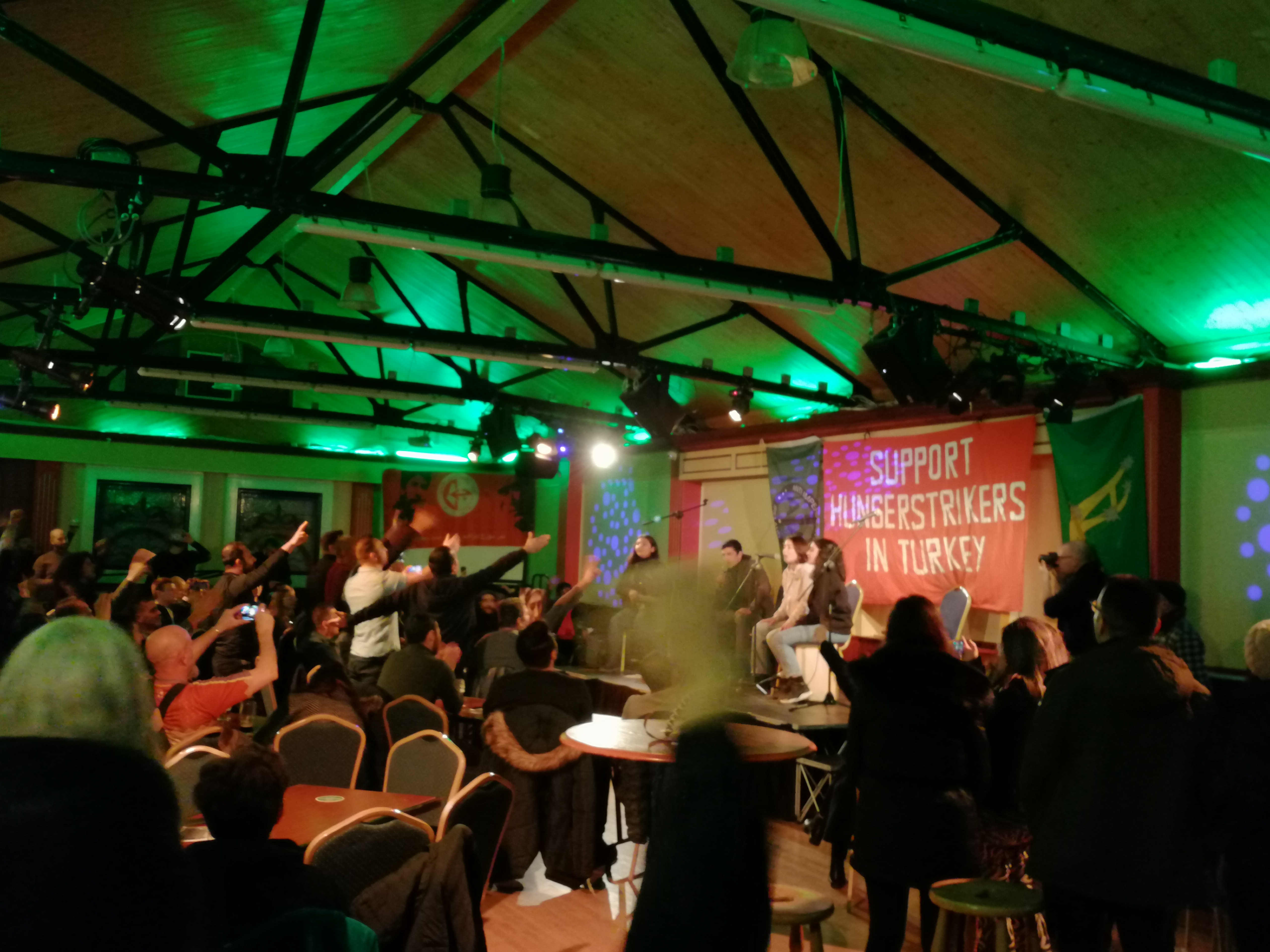
Grup Yorum performing in Dublin (Photo: Rebel Breeze)
BELFAST
In Belfast in the Sunflower Lounge, Bobby Fields from Armagh and Séan Óg from Dublin entertained those in attendance with songs of Irish resistance followed by Grup Yorum coming on afterwards. The Grup’s performance was enthusiastically received and was followed by a questions-and-answers session to learn more about the situation in Turkey.
The Grup members toured some of the area and visited the famous international solidarity wall along with the grave of Bobby Sands, where paying their respects included singing a song at the graveside.
DUBLIN
In the large hall in the Teachers’ Club, Dublin, Séan Óg took to the stage first, playing guitar to accompany himself on guitar to sing The Killmichael Ambush, Viva la Quinze Brigada, Back Home in Derry1 and The Internationale. Veteran activist and traditional singer Diarmuid Breatnach followed, singing unaccompanied the Anne Devlin Ballad, I’ll Wear No Convict’s Uniform2and James Connolly’s satirical song Be Moderate3. Some of the audience sang along with some of the lyrics sung by each singer.
Be Moderate, satirical song by James Connolly, sung by Diarmuid Breatnach at the event (the link can be played on Facebook).
The four members of Grup Yorum present then took to the stage to huge applause and addressed the audience in Turkish, their words being translated into English by a member of their entourage. In the performance that followed, two guitars, flute and cajón were the instruments with a male and female leading voices. Each song was preceded by an explanation placing the piece in historical and political context.
Some of the songs in particular were clearly known to Turkish and Kurdish people in the audience and at some points they sang along, often waving an arm in the air. Towards the end of their performance the crowd got more and more excited and then Seán Óg joined them for a couple of numbers.
(Photo: Rebel Breeze)
oznor
The Grup’s interpreter made a special appeal for help from those in attendance to pressurise the Turkish authorities to release political prisoner Ali Osman Köse who has been in solitary confinement for 20 years and has multiple health issues. There are fears for the man’s life as he has had a cancerous kidney removed in May of this year without any follow-up treatment and despite everything has been pronounced “fit” to continue in jail.
This was followed by members of the Resistance Choir taking to the stage to join Grup Yorum in a rendition of the Italian antifascist Bella Ciao! Song before Diarmuid Breatnach returned to the stage to bring the evening to a close with the first verse and chorus of Amhrán na bhFiann4 with members of the audience joining in (including some from Anatolia)
The Resistance Choir from Dublin on stage with Grup Yorum to perform the Bella Ciao song (Photo: Rebel Breeze)
THE GRUP YORUM BAND
A revolutionary music band from Turkey, Grup Yorum members compose their own material and the band has has released twenty-three albums and one film since 1985. The band has suffered repression with some concerts and albums banned and members have been arrested, jailed and tortured, two members also dying on hunger strike. The band is popular in Turkey and as well as their albums selling well in Turkey and internationally, it has also given concerts in Germany, Austria, Australia, France, Italy, the Netherlands, Belgium, Denmark, United Kingdom, Greece and Syria.
Grup Yorum publishes an art, culture, literature, and music magazine entitled Tavir, and several group members manage a cultural centre called İdil Kültür Merkez in the Okmeydani neighbourhood of Istanbul.
Section of the crowd in Dublin saluting the Grup Yorum performers (Photo: Rebel Breeze)
FOOTNOTES:
1The lyrics and air of Viva la Quinze Brigada are by famous Irish folk musician Christy Moore, who also arranged Bobby Sands’ poem to the air of the Wreck of the Edmund Fitzgerald (by Gordon Lightfoot) as Back Home in Derry.
2Diarmuid sings this song to an air he composed himself.
3Diarmuid sings this to the air of A Nation Once Again (by Thomas Davis).
4Written by Peadar Kearney originally under the title The Soldiers’ Song and sung by insurgents during the 1916 Rising, its chorus is the official national anthem of the Irish State. However, it is also sung by many who are opposed to the State, particularly by Irish Republicans. Normally only the chorus is heard, sung in Irish (translation).
Arising out of a recent discussion, I was thinking about what makes a workers’ union – when is an organisation a union and when is it not. And what does it have to do to prove that it is a union, as well as can what once was a union become defunct as a union while still not being defunct as an organisation. In the present time of low union activity as well as in higher activity periods, there are some fundamentals worth considering.
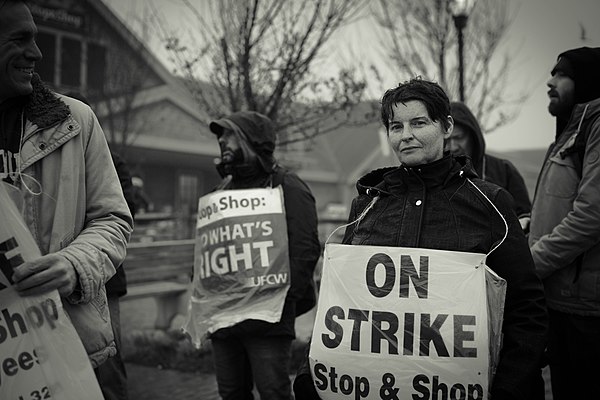
Picketers in the 2019 Stop & Shop strike (USA) in the rain in Natucket after their management forced them off company property. The workers won a victory in 11 days. (Photo credit NickleenF)
DEFINITIONS
Searching for definitions on line as to what constitutes a trade union, I came across the following:
Oxford on-line English Dictionary: an organized association of workers in a trade, group of trades, or profession, formed to protect and further their rights and interests.
Citizens Information: A trade union is an organisation that protects the rights and interests of its members. Members are employees in a particular sector or job, for example, teaching or nursing.
A trade union can:
Be an important source of information for employees
Provide employees with protection on employment issues
Negotiate with the employer for better pay and conditions
A trade union must have a negotiating licence in order to negotiate on employee wages and other conditions of employment.
The Irish Congress of Trade Unions (ICTU) is the single umbrella organisation for trade unions, representing a range of interests of ICTU members, both in Ireland and in Northern Ireland. ICTU also run the website unionconnect.ie to facilitate people to join a union.
Companies Registration Office (registration as a Friendly Society1): Trade unions are registered under the Trade Union Acts 1871-1990. Trade unions are established to represent workers in their relations with employers or to act as representative bodies for particular interest groupings.
In order to register a trade union, the grouping involved, which must consist of at least seven people, must draw up a set of rules governing the operation of the union. The rules must as a minimum contain the matters required to be provided for by the First Schedule of the Trade Union Act 1871. The rules, together with the prescribed application form and fee are submitted to the Registrar for examination and, once the rules are found to be in accordance with statute, the union is registered.
Registration as a trade union does not guarantee that a union will receive a negotiation licence; this is a matter for the Minister for Enterprise, Trade and Employment in which the Registrar of Friendly Societies has no function. Application form is available by emailing rfs@enterprise.gov.ie.
Wikipedia: A trade union (or a labor union in American English), often simply referred to as a union, is an organization of workers who have come together to achieve common goals, such as protecting the integrity of their trade, improving safety standards, and attaining better wages, benefits (such as vacation, health care, and retirement), and working conditions through the increased bargaining power wielded by solidarity among workers. Trade unions typically fund the formal organization, head office, and legal team functions of the trade union through regular fees or union dues. The delegate staff of the trade union representation in the workforce are made up of workplace volunteers who are appointed by members in democratic elections.
The trade union, through an elected leadership and bargaining committee, bargains with the employer on behalf of union members (rank and file members) and negotiates labour contracts (collective bargaining) with employers. The most common purpose of these associations or unions is “maintaining or improving the conditions of their employment“.[1] This may include the negotiation of wages, work rules, occupational health and safety standards, complaint procedures, rules governing status of employees including promotions, just cause conditions for termination, and employment benefits.
Unions may organize a particular section of skilled workers (craft unionism),[2] a cross-section of workers from various trades (general unionism), or attempt to organize all workers within a particular industry (industrial unionism). The agreements negotiated by a union are binding on the rank and file members and the employer and in some cases on other non-member workers. Trade unions traditionally have a constitution which details the governance of their bargaining unit and also have governance at various levels of government depending on the industry that binds them legally to their negotiations and functioning. ……………………………
A modern definition by the Australian Bureau of Statistics states that a trade union is “an organization consisting predominantly of employees, the principal activities of which include the negotiation of rates of pay and conditions of employment for its members.”[6]
Yet historian R.A. Lesson, in United we Stand (1971), said:
Two conflicting views of the trade-union movement strove for ascendancy in the nineteenth century: one the defensive-restrictive guild-craft tradition passed down through journeymen’s clubs and friendly societies, … the other the aggressive-expansionist drive to unite all ‘labouring men and women’ for a ‘different order of things’.
Karl Marx described trade unions thus: “The value of labour-power constitutes the conscious and explicit foundation of the trade unions, whose importance for the … working class can scarcely be overestimated. The trade unions aim at nothing less than to prevent the reduction of wages below the level that is traditionally maintained in the various branches of industry. That is to say, they wish to prevent the price of labour-power from falling below its value” (CapitalV1, 1867, p.1069).
We can note, across these definition from different sources, some constants: Trade unions (henceforth referred to by me as “unions” or “workers’ unions”) are
representative associations
of workers
that represent them in negotiations with employers
So, they have to be representative of workers (employers have their own formal associations) and they must, in general represent their worker-members. Well, few would debate the first condition and for the moment we can accept the second (though we will return to discuss this further).
I would argue however that there is another essential qualification which has not been mentioned even though for some it may be taken for granted: A union must be able to call a significant number of workers in a significant workplace, company or industry into industrial action and does so when necessary (whether that be strike, sit-down, go-slow, ban on certain kinds of work, etc.). In stating that I can quote for the moment no authority or source and yet I am adamant that if the association is not able to do so, it is not a union. I base my definition on experience and logic.
THREAT AND NEGOTIATION
We note that the “negotiation” with employers is mentioned in most if not all definitions. Present in every successful negotiation of workers with employers is a threat, that of action by the workers which will reduce or postpone the profits of the employers. This in turn is mediated by the threat of the employer to dismiss or otherwise penalise workers, to starve them into submission or to unleash private or State violence upon them2. The main reason for non-State employers to be in business of whatever kind is to make a profit and a substantial one at that and, in the case of an employer failing to avail of opportunities to do so, other employers, i.e other capitalists, will move in, outcompete and even take over the company3.
State companies have a responsibility to the ruling class to keep systems going, e.g public transport to deliver employees to work for private businesses, power supply to run the private enterprises, water and refuse collection to manage sanitation of working areas and reduce infections of the workforce, etc. So in successful negotiation with a State employer, the threat of workers’ action must be present also.
The threat may be implicit only but cannot remain effective if unrealised forever and every once in a while, employers will test it by a refusal (or procrastination) to accede to the demands of a union. In such a situation, the “negotiation” is ended or at least halted while both sides test the ability to resist of the other. If the employers are resolute and have enough resources but the workers are either not resolute or their resources are insufficient, the employers will win.
If the workers are resolute enough and are well-resourced and their action costs the employers enough so that the latter consider it better in the long run to accede to the demands, the workers will win. However, even when the workers are defeated in one battle, the action may have hurt the employers and next time there is a confrontation, they may be prepared to concede more. Even in failure in some cases, the threat of action has been shown to be a real one.
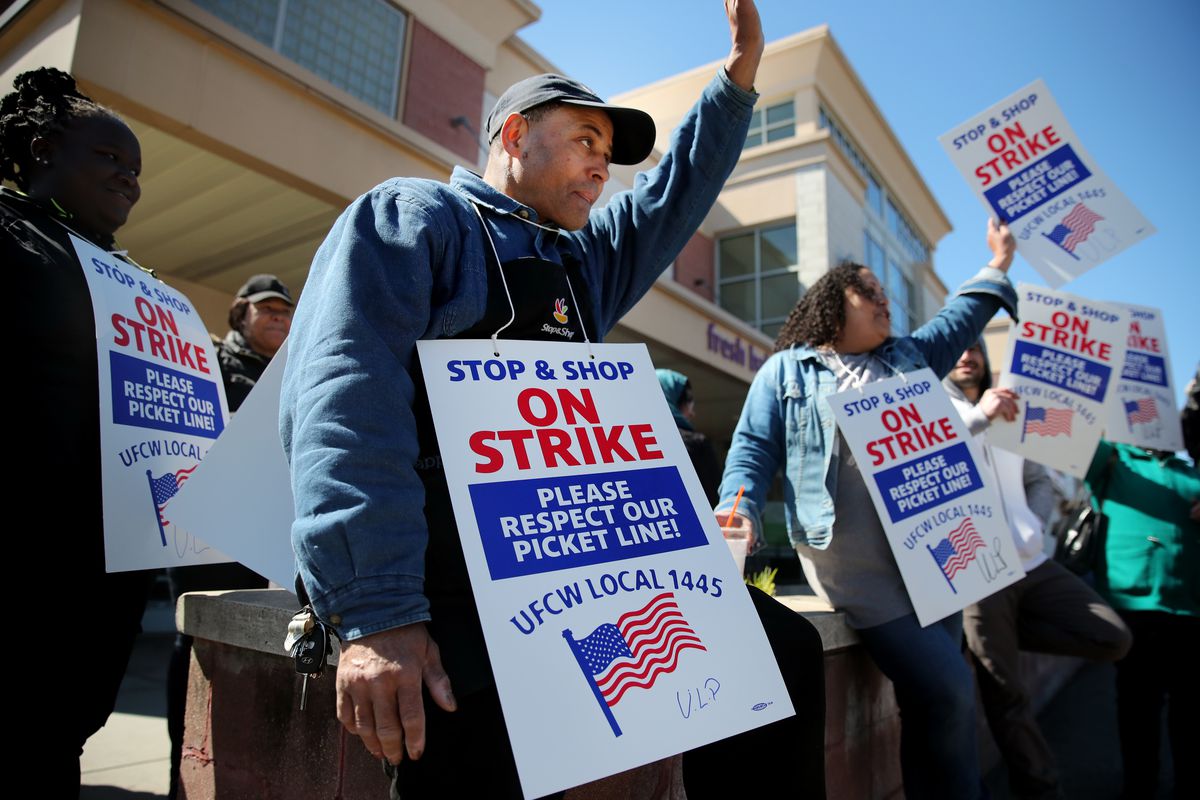
Picketers in the successful 2019 strike at the Stop & Shop chain by the United Food & Commercial Workers (USA & Canada). The Teamsters’ union instructed their members to respect the picket lines. After protracted negotiations failed, the strike began on 11 April 2019 and ended on April 21, 2019, after the company and the striking workers reached a tentative agreement, which preserved health and pension benefits and raised employee pay. The 11-day strike cost the company $224 million in lost sales and $90–100 million in lost profits. The tentative agreement was viewed by the union as a “powerful victory”. In August 2019, Ahold Delhaize reported the 11-day strike resulted in a $345 million loss in sales, with an estimated 1 in 10 customers not coming back to the store as a regular customer after the strike. (Photo sourced: Internet) https://en.wikipedia.org/wiki/2019_Stop_%26_Shop_strike
If however over a number of years the unions do not exercise their muscle while at the same time enduring reductions in the working conditions and living standards of their members, the workers, they become more and more unions in form but not in content and the employers will pay less and less attention to their demands. Indeed, the only threat perceived by the employers in such situations is that the ineffective unions may be replaced by another or others more effective or lose control of their members to “unofficial” or “wildcat” action. Better the devil that they not only know but can manage, than the one they don’t.
I repeat: A union must be able to call a significant number of workers in a significant workplace, company or industry into industrial action and does so when necessary (whether that be strike, sit-down, go-slow, ban on certain kinds of work, etc.). In that respect, the crucial condition is not whether the organisation is more or less democratic, or socialist, or egalitarian, more or less environmentalist etc, though of course all those attributes are desirable. Itmust beeffective, able to threaten and make good its threat.
Therefore calling an organisation a “union” does not of itself make it one and indeed an organisation may conversely be a workers’4 union without calling itself one, providing it is able to call a significant number of workers in a significant workplace, company or industry into industrial actionand does so when necessary.
So I have extended the definition of a union: an organisation consisting predominantly of employees to defend the interests of its members and improve their remuneration and conditions of work and that is able to call a significant number of workers in a workplace, company or industry into industrial action and which does so when necessary.
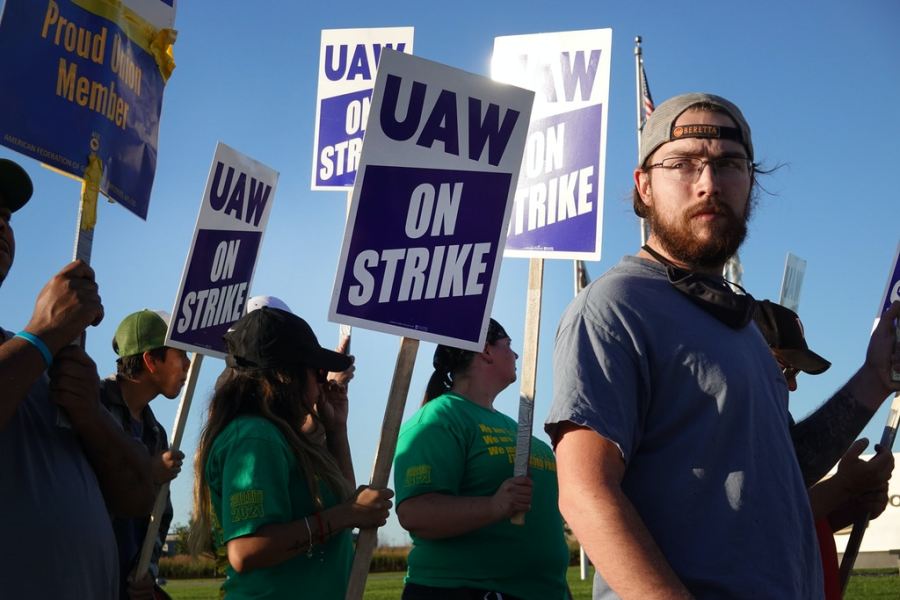
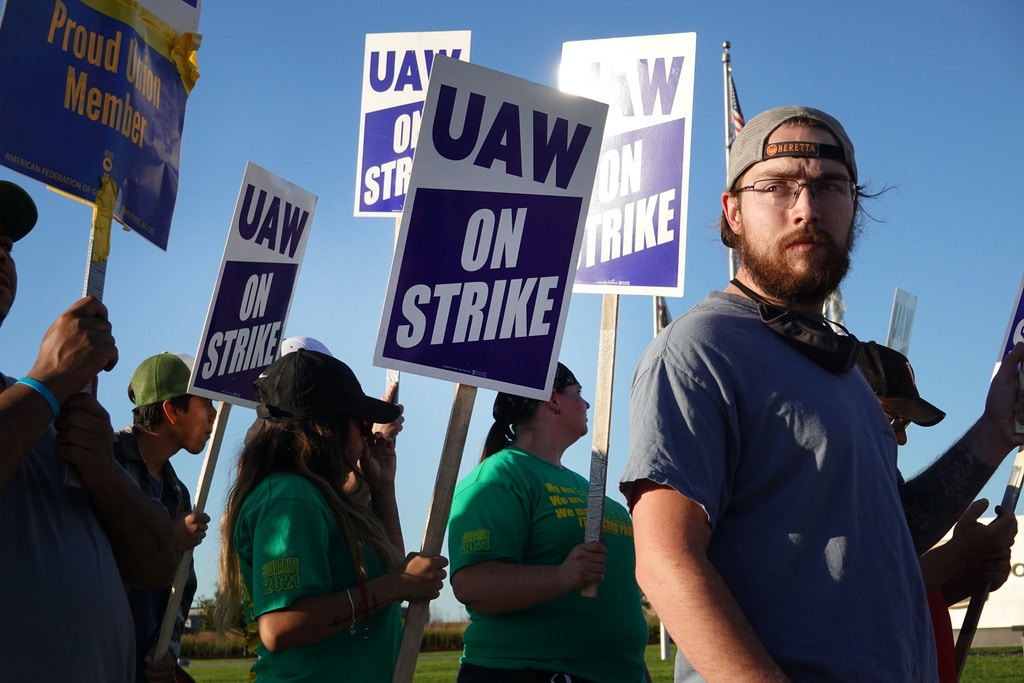
Workers of the United Auto Workers on strike picket the John Deere Harvester Works facility on Oct. 14, 2021, in East Moline, Illinois. Photo: Scott Olson/Getty Images
But what is a “significant number of workers in a significant workplace, company or industry”? Though this is more open to interpretation, it is nevertheless determined by two things, one of which is its ability to call an effective number of workers in the designated workplace into industrial action and the other is the relative size of the workplace, company or industry concerned. Of course, the workplace may be a shop or small garage or small farm, employing say around 50 people, in which all the workers are able to strike and do so, forcing the employer to accede to their demands or at least a significant (yes, that word again) number of them. The workers’ organisation in that case I would submit qualifies as a union on all grounds except one: the workplace is not a significant one in terms of industry or agriculture. It may go on from that initial success to extend to other workplaces but until it does so, it is a union only in the specific sense of that particular workplace.
However, if the organisation were to represent the majority of workers in one necessary part of a company’s production, willing to exercise its power and able to adversely affect the company’s output and profits, then that organisation would qualify as a union, according to my definition, even though it might represent only a small fraction of the total workforce.
Or if the one workplace in which the workers’ organisation is active is an extended one, for example a chain of stores or a major utility company. Or, as is sometimes the case, the workers’ organisation were to represent workers across an entire industry (“industrial unionism”), or groups of them in a number of different industries ( “general unionism”) or seeking to recruit all workers (“syndicalism”).
WHEN IS A UNION NOT A UNION?
It is important (and I would contend, crucial) also to define what a union is not. It is not
an organisation set up by a State and controlled by it
an organisation set up by employers
or the worker organisation’s offices, officers and other employees
“Unions” set up by the State
States have set up “unions”, for example in the case of corporate states, i.e fascism and when they have done so, have banned real workers’ unions.
In Nazi Germany, workers’ unions were abolished. On 2nd May 1933, (after the large annual May Day marches), their leaders were arrested, their funds confiscated and strikes declared illegal. Workers lost the right to negotiate wage increases and improvements in working conditions and all workers had to join the German Labour Front (DAF) run by Dr. Robert Ley. Within two years, under various pressures, 20 million workers had joined DAF but they had no independent rights.5
“Italian fascistswaged war on the unions between 1920 and 1922 when Mussolini took power, burning trade union offices, and beating and torturing trade unionists. In Turin, the key industrial centre, fascist squads celebrated Mussolini coming to power by attacking trade union offices and killing 22 trade unionists”6.
“The Pact of Vidoni Palace in 1925 brought the fascist trade unions and major industries together, creating an agreement for the industrialists to only recognise certain unions and so marginalise the non-fascist and socialist trade unions. The Syndical Laws of 1926 (sometimes called the Rocco Laws after Alfredo Rocco) took this agreement a step further as in each industrial sector there could be only one trade union and employers organisation. Labour had previously been united under Edmondo Rossoni and his General Confederation of Fascist Syndical Corporations, giving him a substantial amount of power even after the syndical laws, causing both the industrialists and Mussolini himself to resent him. Thereby, he was dismissed in 1928 and Mussolini took over his position as well.
“Only these syndicates could negotiate agreements, with the government acting as an “umpire”. The laws made both strikes and lock-outs illegal and took the final step of outlawing non-fascist trade unions. Despite strict regimentation, the labour syndicates had the power to negotiate collective contracts (uniform wages and benefits for all firms within an entire economic sector).”7
In Spain the communists, anarchists and social democrats had organised trade unions which supported the Popular Front Government and mobilised against the military-fascist coup in 1936. Following the victory of the military and fascists the State, under General Franco, jailed or executed many of the trade union leaders and members and declared their unions illegal.
The Franco regime set up the “vertical union” (i.e controlled from above) officially known as the Organización Sindical Obrera (OSE); industrial resistance was illegal and in any case extremely difficult to organise, due to the defeat of the republican and socialist forces and the massive repression of all democratic and socialist trends.8
Union resistance under fascism
However, when workers of various kinds of socialist thinking joined these state unions either through being forced to do so or in conscious infiltration, many maintained their old allegiances and worked to subvert fascist rule and control of the workers.
“On 5 March 1943, workers at the giant FIAT Mirafiori car plant in Turin walked out on strike. As it became clear the dictatorship could not repress the strike it spread within Northern Italy, involving one hundred thousand workers. Mussolini was forced to grant pay rises and better rations, but in conceding he struck the death knell for the regime.”9
In 1947, eight years after the victory of the military-fascists, metal workers in the Basque province of Bizkaia went on strike in spite of repression by the authorities and a clandestine trade union movement began to organise. “Another historic year in the incipient union movement was 1951, when there were strikes and demonstrations in Barcelona, Madrid and the Basque Country in the early part of the year. These were mainly spontaneous, although the clandestine unions which had grown up since 1947 did support and take part in them. An important role was also played by the Spanish Communist Party PCE, and Roman Catholic workers’ groups.” “In a context of socio-economic change in Spain in the late 1950s, as industrialisation accelerated …. there was a significant growth in the Spanish working class. In 1962 miners and industrial workers began to hold strikes all over the country.”10
The two main trade unions in the Spanish state today, the CCOO (Comisiones Obreras) and the UGT (Unión General de Trabajadores), the first originally under Communist Party direction and the smaller second under the social democratic PSOE (Partido Socialista Obrero de España) grew out of that resistance (although the UGT had been in existence prior to the military-fascist uprising). Activists had infiltrated the vertical union and workers began to elect militants to represent them in demands to the employers – this in particular was the origin of the Comisiones Obreras.
Employer-led ‘unions’:
Employers have also set up “unions” in order to undermine an existing union or in order to prevent a real union from organising workers in their enterprises.
These have been called “company unions”11 or “yellow unions”, the latter possibly after the French Fédération nationale des Jaunes de France (“National Federation of the Yellows of France”) which was created by Pierre Biétry in 1902.12
Up to the mid 1930s, ‘company’ or ‘yellow’ unions were quite common in the USA and after the Ludlow Massacre13, John D. Rockefeller had one created to improve his company’s image and to resist the struggles of mineworkers and of the United Mineworkers’ Union in Colorado; he called it the Employee Representation Plan.14
“In 1935, the National Labor Relations Act (also known as the Wagner Act) was passed, dramatically changing labour law in the United States. Section 8(a)(2) of the NLRA makes it illegal for an employer “to dominate or interfere with the formation or administration of any labor organization or contribute financial or other support to it.” Company unions were considered illegal under this code, despite the efforts of some businesses to carry on under the guise of an ‘Employee Representation Organization.’”15
Japan has company unions that are not in the RENGO federation of independent unions and the company ones appeal to an ideology of loyalty towards one’s paternalistic employer.16
In the 1930s, unions in Mexico organized the Confederation of Mexican Workers (Confederación de Trabajadores de México, CTM). The state of Nuevo Leon, however, coordinated its workers into sindicatos blancos (“white unions”), company unions controlled by corporations in the industrialised region.
Naturally a “union” of this type is unwilling and indeed unable to call a significant number of workers in a workplace, company or industry into industrial action to defend the interests of its members and improve their remuneration conditions of work (my definition of a workers’ union). Therefore I contend that they are not workers’ unions.
UNIONS INACTIVE IN STRUGGLE TODAY
But there are unions that have built themselves up in membership (and incidentally by union dues revenue) by proving themselves willing and able to call their members out in action to enforce their demands of the employers – but who have not been doing so for some time. We are increasingly seeing these in Western Europe at least and often the reason quoted is that state legislation is making it harder for the unions to organise, or to take action effectively. And rather than jail for union activists as in the past, the threat of the State is sequestration of union funds. The union leaders, officers and clerical support staff view such threats as extremely serious, evoking the possibility of the demise of the trade union or at the very least its inability to maintain its functions and payment for its superstructure of staffing, buildings and equipment.
Those are of course real threats with some states proving their ability to carry them out in the past and consequently union leaders draw back from struggles that might result in such an eventuality – or even attempt to smother them. The union leadership become, in effect, the firefighters of the employers. When they reach that position, they are not really the union any more. The union is not the organisation’s offices, officers and other employees. Its leaders are forgetting that back in the history of this or of many other unions, its organisers and members maintained only a rudimentary bureaucracy while they fought for the gains to be wrenched from the employers — organisers and even ordinary members faced sacking, police baton charges, strike-breaker violence, deportation, transportation, jail, torture and even death. When safeguarding the superstructure of the union outweighs defending and advancing the members’ interests, it is time for the union leadership to retrace its steps – or vacate the spot.
A union may fail to be recognised as such by the employers and/ or the State but (based on my definition) that does not affect its status as a union, so long as it is an organisation consisting predominantly of employees to defend the interests of its members and improve their remuneration and conditions of workandable to call a significant number of workers in a workplace, company or industry into industrial actionand does so when necessary.
To be sure, an employer refusing to recognise the right of the union to represent its employees and to negotiate on their behalves does represent an additional challenge. But we should not forget that all workers’ unions once faced that initial obduracy but nevertheless in time became accepted by the employers. And it required a long process for some of those unions, with unsuccessful industrial action and many sacrifices as part of it.
The opposition of the State, acting in the first place for the capitalist class it represents and secondly in its own interests as an employer, is another serious obstacle for unions. Currently in most of Europe and certainly in Ireland, the State does not outlaw unions but it does place many restrictions around them and, in some cases, removes their protections.
The protection received by a union that is recognised by the State exists mostly in exemption from some legal procedures such as being sued for causing loss of profits for a company and exemption from arrest for picketing (“loitering”, “obstruction”, etc). However, the laws of none of the European states exempt workers from arrest for persistently obstructing the entry of strike-breakers or goods to a workplace where the workers are on strike. In most European countries, picketing, boycott and blockade in solidarity by “non-involved” unions – i.e “secondary picketing” etc — is against the law to a greater or lesser degree. Well, such laws are made by the capitalist class to protect themselves and then processed through a parliament where most of the elected public representatives are supporters of that same class. To receive legal protection from capitalist laws the union must be recognised by the capitalist State which entails meeting the necessary requirements in order to be registered as “a friendly association” and receiving “a negotiation licence”.
However, while these provisions affect very deeply the ease or otherwise of the organisation, they do not in my opinion have anything to do with whether it is or is not a workers’ union.
Another hurdle to get over for “recognition” is that of acceptance by the Irish Trade Union Congress. A union not recognised by the ITUC will receive no support from that body in application to the State for a “negotiation licence” and members of other “recognised” unions will be encouraged to cross any picket line of an “unrecognised” union. That is obviously a serious situation for a young union that is “unrecognised” but again, it does not define whether or not it is a union.
Say what the State, employers or the ITUC leadership may say, the reality remains that a union is an organisation consisting predominantly of employees to defend the interests of its members and improve their remuneration and conditions of work and that isable to call a significant number of workers in a workplace, company or industry into industrial action and which does so when necessary. Not whether it is — or is not — recognised or facilitated by those other bodies.
Funeral of James Byrne, shop steward of the Irish Transport & General Workers’ Union, who died as a result of his hunger strike in protest at imprisonment during the 1913 Lockout (Photo sourced: Internet). The workers were defeated in an 8-month struggle but the union recovered and bounced back. The ITGWU has gone through a number of changes resulting in the largest union in Ireland today, SIPTU. But is it carrying out its responsibilities as a union today, to say nothing of living up to its inheritance?
As the unions in many states have become more and more passive (in the Irish state particularly through the years of “social partnership”17) they have lost much of their accreditation in reality. As they fail further to justify their existence they will be replaced and for example the British-based union Unite is moving into the Irish arena. But the new union, despite its local leaders speaking militantly at rallies of some campaigns and investing some of its effort into building support in the community, is demonstrating the same reluctance to take determined action against the employers, whether private or State. Should that state of affairs continue then that too will fall and be replaced.
But by what and when?
End.
FOOTNOTES
1A friendly society has nothing necessarily to do with being friendly but is is a mutual association for the purposes of insurance, pensions, savings or cooperative banking. It is a mutual organisation or benefit society composed of a body of people who join together for a common financial or social purpose.
2While some readers may be surprised or even dismissive of reference to “private or State violence”, there can hardly be a state which does not at least on occasion – some more often than others — employ police or judicial violence against striking workers. In the past in many countries and perhaps in particular in the USA, companies employed private security staff or company police to act against worker disobedience, in addition to agencies such as the Pinkerton not only to gather intelligence on union organisers but to attack them physically or to prepare cases for their conviction of law-breaking in court. In some parts of the world companies – often with their HQs in the “West” — continue to employ their own security staff against union organising, sometimes with fatal results for the union organisers.
3This applies even if the company should still be making a profit but is not maximising it. The company’s shareholders and investors, including institutions such as banks, trust funds, pension funds etc will begin to desert the company to a competitor offering a higher return on investments and said company may even engage in a “hostile takeover” bid, by bringing sufficient numbers of shareholders to vote in favour of its takeover. This is one of the laws of the operation of capitalism and one reason why it there is little point in appealing to the individual consciences of capitalists.
4Sometimes workers’ unions have called themselves by other names, including “society” and “association” in order to circumvent anti-trade union legislation for example.
11To be confused with a genuine employee’s union built up within a particular company, for example in a power-generating monopoly or state service company, whether privatised or not.
13Massacre by company guards and the National Guard of strikers and their children on 20 April 1914 during the Great Colorado Coal Strike, after which the workers took up arms. It was the subject of a song composed and sung by Woody Guthrie and others, e.g Jason Boland and Andy Irvine.
171983-???? In 2010: “Following 23 years of social partnership the Irish trades unions (ICTU) entered the new decade seriously weakened and with union employee density down to 31% compared to a density highpoint of 62% in the early 1980s preceding the series of seven corporatist social pacts.[2] Union penetration is highly imbalanced with a density approaching 80% in the public sector and around 20% in the larger private sector.”
As Limerick and Waterford county teams prepared to face one another in the GAA hurling semi-final at Croke Park stadium, anti-internment protesters and campaigners lined up outside Dublin’s General Post Office, in the city centre, to mark the 50th Anniversary on the introduction of internment without trial in the British colony of the Six Counties. Their placards, leaflets and speakers denounced the continuing practice of interning political activists in Ireland today.
Seen at the anti-internment event in Dublin today (Photo crdt: Sean Hogan)
The event was organised by the Anti-Internment Group of Ireland, an independent and non-affiliated campaigning organisation and the supporters included a mixture of socialist Irish Republicans and anarchists. The heavy and persistent rain of the morning held off and Dublin city centre was thronged as GAA hurling supporters added to the usual shoppers. The banners and placards of the picketers drew considerable interest from those passing and here and there people stopped to discuss with them.
Some young Basque girls were curious but also delighted to see their nation’s flag, the ikurrina, being flown at the event and stopped to engage one of the picketers in discussion. Also in evidence was the flag of Amnistia, Basque organisation around solidarity with its political prisoners and against repression, along with the flag of Palestine.
Flag of the Amnistia organisation (solidarity with their political prisoners) in the Basque Country seen on the anti-internment event in Dublin today (Photo crdt: Sean Hogan)
Around 200 leaflets were distributed to passers-by, discussions were held and contacts were made with people interested in supporting the work of the Anti-Internment Group Ireland.
After some time in a picket line and distributing leaflets, a representative of the organisers, speaking in Irish and in English, welcomed the attendance and introduced a speaker from the Anti-Imperialist Action organisation.
One of the leafleters outside the GPO at the anti-internment event in Dublin today (Photo: C.Sulish)
SPEAKERS
Speaking in Irish as some passers-by stopped to listen, the young man said they were there to commemorate the introduction of internment and mindful of the existence of political prisoners all over the world. The were also protesting the extradition to Lithuania of Liam Campbell to face trial in a country in which he had never previously set foot.
The organisers’ representative then spoke in English about the history of repression in the Six Counties colony, how from the moment the nationalist community there stood up to demand equal rights and justice the State had responded with violence. Since the people raised the level of their resistance in response, the State in turn raised the level of its violence higher again, in a rising spiral of violence.
The nationalist community in the Six Counties had marched for civil rights and had been met with the violence of the colonial police and of the Loyalists — the speaker said — but they had continued to resist. Internment without trial was introduced to break that resistance but, knowing that would also lead to increased resistance, the State had prepared the Paratroopers to shoot unarmed civilians dead. They had done that in Ballymurphy on the very day that internment had been introduced1, he reminded his audience and later had shot dead two unarmed Cumann na mBan Volunteers (Republican women’s organisation) who were alerting people to the raiding parties of the British Army. At the start of the following year, the British Army murdered unarmed civilians again, this time in Derry2.
That year 1972, the speaker stated, had the highest death toll of any year during the three decades of the war3 and Loyalists were also bombing streets nearby in Dublin, again in 1973, killing workers. In 1974 Loyalists and British intelligence bombed the Dublin city centre again and Monaghan, killing the highest number of people killed in one day during the war4. That year too, the IRA bombed pubs in England and killed people and the State brought in the repressive Prevention of Terrorism Act against the Irish community. They jailed a score of innocent people on extremely serious charges5 and one of them, Giuseppe Conlon, died in jail6.
The speaker went on to say that although there had been hard repression before, the introduction of internment without trial and the follow-up massacres by the British Army had lit a fuse to a chain-reaction of violence for decades to follow.
Pointing out that internment consists of jailing people without trial, the speaker stated that the practice continues today, by refusing bail to political activists awaiting trial in the non-jury courts on both sides of the British Border. The Anti-Internment Group of Ireland will continue striving to expose this reality and he called on people to support the monthly pickets in the city centre and to follow the End Internment page on Facebook.
ONGOING AGITATING AGAINST INTERNMENT
As the applause died down people began to pack away flags, banners, placards and leaflets and to catch up socially among themselves or to engage with passers-by who had stopped to listen and/ or to ask questions.
Organisers of the event said they hope to hold another picket at some venue in the city centre in a month’s time – when scheduled, the event will be announced on the End Internment FB page.
End.
Leafleter right foreground, person reading leaflet left foreground, picket line of the anti-internment event in Dublin today. (Photo: C.Sulish)
(Photo: S.Hogan)
(Photo: S.Hogan)View of the picket with a passer-by expressing solidarity with the picketers (far right of photo). (Photo: C.Sulish)
FOOTNOTES
1Between 9-11 August, British paratroopers caused the deaths of 11 unarmed civilians in Ballymurphy.
213 people were shot dead by British paratroopers on Bloody Sunday in Derry as they protested against internment and a 14th died later of his wounds.
3The period from August 1971 to the end of the year saw a huge jump to 136 violent deaths (including British and colonial armed forces) and the following year, 1972 is counted the most violent year of the conflict overall with 479 people killed (including 130 British soldiers) and 4,876 injured.
5The Birmingham Six, Guildford Four, Maguire Seven, Giuseppe Conlon and Judith Ward. All were eventually cleared after long years of campaigning around them and failed court appeals.
6Giuseppe Conlon, hearing that his son Gerry had been arrested for the Guildford Pub Bombings, came to London to help him in 1974 and was swept up into the police net to become one of the innocent framed victims. Giuseppe Conlon was not a healthy man and died in his 7th year in jail, before the verdicts on the other framed prisoners were finally overturned. His son Gerry, also an innocent man in jail, was not permitted to attend his father’s funeral.
A group of mixed political background held a picket this afternoon in Henry Street, one of the main shopping streets in Dublin’s city centre. The picket was protesting the continuing internment in Ireland of political activists and also expressing solidarity with political prisoners in different parts of the world – a Palestinian flag and a couple of Basque ones flew alongside the Irish ones. There are over 60 political prisoners in Irish jails both sides of the British Border.
Many people were out shopping or just enjoying the sun on what must have been the hottest day of the year so far. Up to 200 leaflets were distributed and passers-by occasionally stopped to discuss with the picket supporters.
Section of the picket displaying the banner of the organising group held by supporters. Also in the photo from left to right: Basque national Ikurrina; Basque Amnistia organisation; Irish Starry Plough; Palestinian flag. (Photo: C. Sulish)
MESSAGE OF SOLIDARITY TO CAMPAIGNERS FOR MUMIA ABU JAMAL
Near the end of the picket, a representative of the Anti-Internment Committee of Ireland was recorded voicing a message of solidarity for Mumia Abu Jamal, to send to an upcoming conference on Mumia and other political prisoners.
Mumia Abu Jamal in 2019 (Photo sourced: Liberation New)
Mumia is a political prisoner, a black United States activist and author who was awaiting execution but is now in his 40th year in jail. He was a popular broadcaster in 1981 when he went to the assistance of his brother, who was being harassed by a white police officer. As the incident came to an end the cop was dead of gunshot wounds and Mumia was shot in the stomach.
There are so many questions about the scenario the Prosecution laid out and which got Mumia convicted of murder and sentenced to death, which was later commuted to imprisonment for life. His gun had five bullets missing but Mumia was never tested to see whether he had fired the gun nor were the tests on the bullets in the police officer conclusively proven to come from there. The crime scene was not preserved and the police were in and out of it, with Mumia’s gun while Mumia was in hospital, undergoing an emergency operation. Photos taken of the scene by an independent press photographer did not show the presence of the taxi of a witness against Mumia, who claimed he was parked there. Not to mention the later confession of a man who claimed to have killed the police officer on behalf of other police as a contract kill (the decision not to use him as a witness divided Mumia’s legal team and two lawyers resigned as a result).
As the spokesperson of the Anti-Internment Committee said, even if people believe that he fired the shots that killed the police officer, after 40 years Mumia should be freed on humanitarian grounds. The USA is allegedly the country leading the world in democracy, as the spokesperson commented, but holds a great many political prisoners, some of them for many, many years in jail.
MORE EVENTS TO COME
Eastward view of picketers in Henry Street, Dublin, facing Liffey Street (Photo: C. Sulish)
Pandemic permitting, the AIGI intends to hold pickets on approximately a monthly basis to protest continuing internment and in solidarity with political prisoners, such events being advertised on our social media. The organisation is independent of any political party or organisation and all who oppose the jailing of activists without trial or wish to support political prisoners are welcome.
Two of the picketers with placards (Photo: C. Sulish)
Westward view of picketers in Henry Street, Dublin, facing Liffey Street (Photo: C. Sulish)