Packed Concert Commemorates Return of the Irish Brigadista Volunteers

Diarmuid Breatnach

A mixed audience of anti-fascists were entertained on 23rd November by a range of artists from the Irish trad-folk scene and a Spanish band performing to commemorate on its 80th anniversary the return of the Irish survivors of the International Brigades to Ireland. The event, “The Return of the Connolly Column” was organised by the Friends of the International Brigades in Ireland (FIBI) and the venue, the Workman’s Club on Wellington Quay of the Dublin City Centre, was packed.

The event began with Dougie Dalby introducing Harry Owens, a Spanish Civil War historian and founder member of the FIBI. Owens gave a speech, recalling how the social-democratic PSOE Government in the Spanish State in the 1980s had not wished to support the marking and conservation of graves of International Brigaders who had fallen in battle but had been convinced to do so by Edward Heath, British Prime Minister and by the leader of the Irish Labour Party at the time, Dick Spring. FIBI had become part of that commemoration effort in visiting some of the sites but also in erecting monuments and plaques in various parts of Ireland.

Colm Morgan from Co. Louth followed, with guitar and voice, with some of his own compositions, including one about Frank Ryan – excellent material in my opinion – to be followed by Mick Hanley (guitar and voice again) accompanied by Donal Lunny. Hanley and Lunny have history, of course, not least in that great band of the past, Moving Hearts; both belong to that honourable class of Irish musicians who have not been afraid to support progressive causes including some in their own country – and who have never performed for “any English King or Queen”.

(L-R) Dónal Lunny and Mick Hanley performing at the FIBI event.
(Photo source: FIBI)

Lunny accompanied various artists at different times during the evening, sometimes on keyboard and sometimes with guitar, as well as adding vocals once also. After his pairing with Hanley, he accompanied Tony Sweeney’s excellent lively accordion-playing which drew more than one whoop from the audience. All however quietened down for Justin McCarthy reading “The Tolerance of Crows” by Charlie Donnelly, Irish poet, member of Republican Congress and Field Commander of a unit of the International Brigades and who fell at the Battle of Jarama on 27th February 1937.

Muireann Ní Amhlaoibh on whistle accompanied by Dónal Lunny
(Photo source: FIBI)

After the break excellent singer Muireann Ní Amhlaoibh sang (accompanied by Lunny) and her rendition of Sliabh Geal gCua na Féile, a song composed by an Irish emigrant working in a Welsh coalmine in the late 19th Century, was particularly beautiful. It is a lament for home and language by Pádraig Ó Míléadha, from the Déise (‘Deci’) area of Wateford.

John Faulkner, virtuoso composer and singer-songwriter, raised in London of Irish background and for many years a resident of Kinvara, Co. Galway (but almost Co.Clare) accompanied himself singing a number of songs, including Patrick Galvin’s great composition Where Oh Where Is Our James Connolly? He performed an anti-war song by Eric Bogle also, All the Fine Young Men, which he introduced saying that some wars need to be fought.

Andy Irvine playing and singing at the concert (Photo source: FIBI)

Andy Irvine took the stage second-to-last of the acts for the evening, another London import to Ireland for which Irish folk and traditional music is very grateful, a composer, singer-songwriter and player of a number of instruments, accompanied once again by Lunny, who shares a history with him in Moving Hearts and Planxty. Irvine performed a number of songs, including Woody Guthrie’s All You Fascists Bound to Lose which, though not very creative in lyrics has a chorus with which the audience joined enthusiastically.

Gallo Rojo performing at the event (Photo source: FIBI)

Last on for the evening was Edinburgh-based Gallo Rojo1, anti-fascist musical collective, opening with a reading in the original Castillian of La Pasionara’s farewell speech to the International Brigaders at their demobilisation parade in Barcelona (see Links). It seemed to me that this would have worked better for an Irish audience with a simultaneous or interspersed reading in English but it received strong applause from the audience. This was followed by Ay Carmela!, then Lorca’s Anda Jaleo! I had to leave after that but I could hear the band starting on Bella Ciao, the song of Italian anti-fascist resistance of the 1940s but based on an older song of oppressed women agricultural workers.

It did occur to me at that point that among all the great material of the evening, I had heard no song to represent the International Brigaders of nations other than Ireland which is often the case at such events. More unusually, no reference I could recall was made to growing fascism in Europe and especially in the Spanish State (it never went away there), nor to antifascists facing trial arising out of mobilisation against the attempted Dublin launch of the fascist organisation Pegida in February 2012.

Immediately outside the concert hall, the bar area held a large number of people, perhaps as many as a quarter again of the audience inside. The performances inside were being conveyed by electronic speakers to them too but I am unsure how many were listening. There was a FIBI stall there too selling antifascist material.

Overall, the audience appeared to be mostly Irish with some foreign nationals and from a broad range of political backgrounds: Communist Party of Ireland, Sinn Féin, Anarchists and independent supporters and activists of mainly socialist and/or Republican ideology.

I am informed that FIBI are currently finalising the editing of a video of the concert and this will be available as soon as possible.

HISTORICAL BACKGROUND:

1. THE INTERNATIONAL BRIGADES

The International Brigades were raised through Communist parties around the world to assist in the defence of the republican Popular Front Government of the Spanish State against a military coup with Spanish fascist (and Basque Carlist) support, aided by Nazi Germany and Fascist Italy. The Brigades consisted of volunteers from at least 65 nations2 and included Jews from a number. Early Irish volunteers enlisted chiefly in units of British and USA organisation but were present in groups from Australia and Canada too but later some made their way directly from Ireland; later too some of the Irish came to be known as the Connolly Column. The English-speaking units and some others were formed3 into the 15th International Brigade (originally the Fifth, but when added to the ten indigenous brigades of the Spanish Republic – Spanish, Catalan and Basque – became the Fifteenth). Not all foreign anti-fascist volunteers enlisted through the International Brigades, some joined Anarchist or Trotkyist militias4 and at least one, an Irishman, joined a Basque unit.

The Republican Government of the Spanish state disbanded the International Brigades on 23rd September 1938 in an unsuccessful bid to have the non-fascist European powers5 pressure their German and Italian fascist counterparts to withdraw their logistics, soldiers and airforce support from the Spanish military-fascist forces. By that time many of the “Brigadistas” were dead or captured as they had borne some of the heaviest prolonged fighting at Madrid (1936); Jarama, Brunete and Belchite (all 1937); Fuentes del Ebro and the Ebro itself (1938).

Famous photo by Robert Capa, war reporter from Hungary, showing emotional face of Brigadistas saluting (and perhaps singing the Internationale) at their demobilisation parade in Barcelona.
(Photo source: Internet)

Their formal demobilisation parade with their auxiliary recruits (including women) was held in Barcelona on 28th October, where they received the famous oration from the Basque Dolores Ibárruri, “La Pasionara”, prominent anti-fascist and activist of the Communist Party of Spain (see Links). It is notable that she addressed her oration to “communists, socialists, republicans, anarchists” as not only communists fought and died in the ranks of the Brigadistas.

Section of survivors of the International Brigades at their demobilisation parade in Barcelona.  (Photo source: Internet)
Another close-up from the demobilisation parade in Barcelona
(Photo source: Internet)


2. A DIFFERENT IRELAND

The Irish Brigadistas returning to Ireland found a society very different from that of today. Anti-communist hysteria was prevalent, whipped up in particular by the Catholic Church and supported in particular – but not exclusively – by Fine Gael (which formed in part from Blueshirts6). The Fianna Fáil Government was not fascist but was of the Irish capitalist class relying heavily on Catholic Church support and so contributed to anti-communism; all of the main media was anti-communist and finally the IRA, as well as having forbidden any of its Volunteers to fight for any other cause than Ireland’s, had expelled communists from the IRA in 1934. As with the time of repression of Republicans by the Free State, the USA seemed a good option for some of the Irish Brigadistas (some had enlisted there anyway) but there too, many antifascist war veterans found themselves subject to anti-communist hysteria and even later, when the USA was fighting fascist powers, labelled as “premature antifascists”!

Today here in Ireland the general attitude is one of respect or even pride in that part of our history, when Irish Volunteers went abroad to fight in defence of democracy and socialism against fascism7. The best-known song to date about the Irish Brigadistas is undoubtedly Viva La Quinze Brigada8 by Ireland’s best-known folk singer-songwriter, Christy Moore. Published accounts by Irish participants include The Connolly Column by Michael O’Riordan (1979) and Brigadista (2006) by Bob Doyle. Moore’s song is very popular in Ireland (and among the Irish diaspora in Britain) and a plaque listing some of the Irish martyrs is fixed to the wall by the entrance to the Theatre building of the major Irish trade union, SIPTU.

Funeral in May 1983 of Michael O’Riordan, survivor Irish Brigadista and General Secretary of the Communist Party of Ireland (among other positions and activities).
(Photo source: Indymedia)

Michael O’Riordan survived the War and was prominent in the Communist Party of Ireland, dying in Dublin in 1983. Bob Doyle was the last surviving known Brigadista from Ireland; on 22nd January 2009 he died in England, where he had been living and had raised a family. On February 14th that year his ashes were carried by relatives and admirers in a march from the Garden of Remembrance in Dublin city centre to Liberty Hall, where a reception was held. An optimistic photographer with the byline of “anarchaeologist” reported the following day in Indymedia: “…. in a display of left unity and solidarity we will doubtless see more of on the streets of Dublin over the coming months ….. Groups attending the celebration included the main unions, Éirigí, the WSM, the IRSP and Dublin Sinn Féin. Banners were also carried by the International Brigades Memorial Trust and the Inistiogue George Brown Memorial Committee. Supporters of the Dublin branch of the Irish Basque Solidarity Campaign demonstrating outside the GPO dipped their flags as a mark of respect as the crowd passed by”. The DIBSC actually wheeled in behind the march as the tail end passed, though the reporter seems not to have noticed that.9

Supporters of the Dublin Basque Solidarity Committee lower Basque flags in honour as ashes of last Irish Brigadista to die are carried down O’Connell Street in procession.
(Photo source: Indymedia)
Relatives and friends leading procession with Bob Doyle’s ashes give clenched fist salute to Basque solidarity demonstrators they are passing (see other photo with Basque flags).
(Photo source: Indymedia)

FRIENDS OF THE INTERNATIONAL BRIGADES IN IRELAND


The aim of the concert was to honour the enduring legacy of the 15th International Brigade and its ongoing contribution in the war against fascism”, a spokesperson for FIBI said in a statement. “As such, it was both a commemoration of the 80th anniversary of the disbandment of the Brigade and the subsequent return of the survivors to Ireland but it was also a celebration of their spirit in choosing to sacrifice everything for working-class principles.”

FIBI is an entirely voluntary organisation but does incur costs in erecting memorials, research, promotion etc. “This concert was designed to raise a modest amount to ensure the continuation of this work without having to resort to piecemeal fundraising over the next year or two. We are delighted to say we met our twin objectives of hosting a fitting occasion to coincide with the 80th anniversary of what became known as The Connolly Column and raising funds to help us continue with our efforts to ensure those who went are never forgotten.”

With its work of commemoration ceremonies and erection of plaques and monuments around the country, a work which not only reminds us of the Irish contribution in general but also links it to specific individuals from specific areas, the Friends of the International Brigades in Ireland has been deepening the wider attitude of respect for the International Brigades and pride in the Irish volunteers which has been growing steadily.

Hopefully all of this will combine with and inform any action necessary to halt the rise of fascism throughout the world and of course to prevent it taking hold in Ireland.

End.

REFERENCES AND USEFUL LINKS

Friends of the International Brigades in Ireland:

http://fibi-ireland.com/site/

States from which volunteers went to fight against Spanish fascism:

http://www.international-brigades.org.uk/content/volunteers-63-countries

English translation of La Passionara’s speech read by Maxine Peake: https://www.youtube.com/watch?v=0Xfm3o45iIE

La Passionara’s speech read in the original Castillian in front of an audience by Esperanza Alonso:

https://www.youtube.com/watch?v=H3HtLLelVeo

Brief account of some anti-communist violence in 1930s Ireland: https://comeheretome.com/2012/07/19/anti-communism-animal-gangs-and-april-days-of-violence-in-1936/

IRA expulsion of communists:

https://en.wikipedia.org/wiki/Republican_Congress

Video compilation of concert:

FOOTNOTES

1Not to be confused with the Mexico-based rock-ska-Latin band of the same name.

2“63 countries” are listed in one reference and I have added two, Scotland and Wales, on the assumption that they are unlisted but included under “Britain” or “UK”: http://www.international-brigades.org.uk/content/volunteers-63-countries

3 The Balkan Dimitrov Battalion and the Franco-Belgian Sixth February Battallion.

4George Orwell, who wrote Homage to Catalonia, probably the most famous English-language account of the war by a participant, enlisted in the militia of the POUM (Partido Obrero de Unifacción Marxista), a coalition of Trotskyis organisations (but whose alliance with the Right Opposition was renounced by Trotsky himself). The much larger anarcho-syndicalist trade union and movement Confederación Nacional del Trabajo (CNT), closely associated with the Federación Anarquista Ibérica (FAI), also had militias, of which the Durruti Collumn was the largest and is the best known today. Some foreigners also enlisted in those militias.

5These powers, such as France and the UK, were following an allegedly “non-interventionist” policy but effectively forming part of the blockade preventing the Republican Government from receiving aid. Later the governments of those two states in particular tried a policy of appeasement of Nazi Germany and Fascist Italy which was unsuccessful (except in encouraging further aggression) and they ended up going to war.

6Former IRA leader Eoin O’Duffy had, with Irish Catholic Church endorsement, recruited many more Irishmen to fight alongside the Spanish military-fascist forces but they acquired a reputation for ill-discipline and in one of their only two brief military engagement mistakenly fired on fascists; they went home in disgrace in late June 1937 (a year before the International Brigades were demobilised and the surviving, non-prisoner Irish were able to return home.

7Republicans and Communists had fought the fascist Blueshirts in Ireland too and the significant contribution of participants from the Irish diaspora to the famous antifascist victory of the Battle of Cable Street (and following guerrilla attacks on fascists at Hyde Park) in London has more recently been recognised (though not yet on the main relevant Wikipedia entry).

8Originally written as Viva La Quinta Brigada (i.e “the Fifth”); however that is the name of a song in Castillian contemporary with the War and later versions of Moore’s song include a line acclaiming “the Fifteenth International Brigade” which would be “la Decimiquinta” which has three syllables too many and so “Quinze”, i.e ‘Fifteen’.

9The DIBSC had already scheduled and advertised a picket to take place on the same day in Dublin’s main street, protesting against Spanish State repression of the Basque independence movement and treatment of prisoners. Upon learning of the planned march to honour Bob Doyle’s memory, I suggested holding our Basque solidarity event earlier, lowering the flags in respect when the march approached and then following it as the tail end passed us. I was unsure of what the reaction of Doyle’s relatives and supporters might be but as soon as those at the front saw what we were doing, a number of them raised clenched fists. It was an emotional moment for me, certainly.

WHAT ARE WORDS? “MILITANT” AND “DISSIDENT”

Diarmuid Breatnach

Recently someone objected to my use of the word “militant” to describe a movement with which I am in solidarity, saying that the word implied “violent”. My initial reaction was that I disagreed.

          I understand “militant” to mean “determined, assertive, courageous, not awed by confrontation” and that one could even be a “militant pacifist”.

But I decided to look up some dictionary definitions online. The first two or three did indeed include violence as a possibility but not necessarily integral. Another two came closer to my way of thinking:
“aggressively active (as in a cause) : COMBATIVE “(Miriam-Webster).

You use militant to describe people who believe in something very strongly and are active in trying to bring about political or social change, often in extreme ways that other people find unacceptable.
Militant mineworkers in the Ukraine have voted for a one-day stoppage next month.
…one of the most active militant groups.
Collins Dictionary.

The meaning of words shifts from language to language, culture to culture and across time. One of the most obvious and startling examples of this is the word “gay”, up to the 1970s probably understood in English by most people as meaning “happy, light-hearted” etc but now, the first interpretation in the English-speaking world would be “homosexual” (in a non-pejorative way).

Tramp” was a verb in the 19th Century to the extent that a famous marching song of the Union Army in the American Civil War was known as “Tramp, tramp, tramp”1. By the 20th Century its use as a verb was in decline but it was becoming better known as a noun, the meaning of which was understood variously as “vagrant” or even “beggar”.

And one could fill volumes with similar examples, I am sure.

“MILITANT”

          But returning to “militant”, was I the only one who understood its meaning in the way that I had? Well, apparently not, as Wikipedia showed, for example in descriptions of “militant trade unionists” and even a political organisation within the British Labour Party before its expulsion, calling its group “Militant Labour” and its newspaper “Militant”, probably drawing a parallel with those very same trade unionists2.

It would not take much pondering to guess that “militant” had some relation to “military” and apparently the word does indeed have such an origin, from Latin “miles”, ‘a soldier.3 But over the years, as with many other words, its meaning has changed.

But apparently, violence is again becoming associated with the word, more so than in the second half of the 20th Century. How did this happen? I am not sure but it appears to have been a spin-off from the more recent imperialist wars of, in particular, the United States. It seems that organisations resisting USA control or dominance in the Middle East, most of which were Muslim in religion, began to be termed “militant” in US and western reporting. Why this became so seems hard to fathom – it was not a word that these organisations applied to themselves — but it has had that spinoff effect on the word “militant”, so that “militant trade unionists” and “militant feminists”, for example, are now likely to be associated with violence, i.e the use of physical force.

How loaded and partisan usage of the word can become is well illustrated in the definition supplied by the Oxford living Dictionary: Favouring confrontational or violent methods in support of a political or social cause.
the army are in conflict with militant groups’.

The example given is very interesting. Conflict requires, one supposes, at least two parties and both sides are listed in that quoted phrase. But the impression given is one where “the army” is an authoritative, legitimate force which is being opposed by groups that are none of those things. One almost feels that the source of “the conflict” is the “militant groups” (especially with the current loading of ‘violence’ into definition of the word “militant”).

The ‘army’ is an armed organisation at the very least latently violent (training with deadly weapons) and in this context, almost certainly practicing violence by invasion. Yet it is portrayed as somehow neutral and the opposition as violent. This is further accentuated when the army and armed police are termed “security forces”. How could one be against security? Don’t we all want to be secure? Obviously quite a lot of people don’t want whatever security is being offered by these military and militarised forces and the question of “security for whom?” is hardly ever explored in such discourse, leaving us with the impression that the good guys are the army and police, deserving of our support, while whoever opposes them must be bad and we should line up against them.

As the meaning of words shifts, we have to decide whether to stick with the meaning we had and insist on its primacy, or to adapt and move with it. Up until the 1960s it was generally considered ill-mannered among white and black people to refer to people of noticeable African descent as “black” or as “negro” and Martin Luther King’s campaigning organisation was called the National Association for the Advancement of Coloured People. Back earlier, in the 18th and early 20th centuries, “negro” would have been acceptable to most. Nowadays, “coloured” or “negro” would generally be considered either offensive or ignorant and “black” is the word, unless one is to use the Africa-derived word, e.g Afro-American, Afro-Caribbean, etc.

And in a strange reversal, whether in self-mockery or appropriation, many Afro-Americans began in the 1970s and 80s describing themselves with the word “nigger”, a word long associated with racism4.

DISSIDENTS”

          Leaving those examples and dealing with Ireland, a number of organisations advocating Irish independence and unity and denying the legitimacy of the administrations of either side of the partition Border, would happily term themselves and one another “Irish Republicans”. That term came first to exclude the supporters of the Irish Free State, who waged a Civil War against those who would not accept the British terms, including Partition, of the 1921 Treaty. Not much over a decade later, it excluded also the Fianna Fáil party, which had split from Sinn Féin, got elected into government and at different times interned Republicans without trial, executed some and passed emergency-type legislation against them.

Subsequent splits in later years were still all described, along with various versions of the Sinn Féin party, as “Irish Republicans”. After the Good Friday Agreement was endorsed by what had been Provisional Sinn Féin and they subsequently became part of the administration of the British colony of the Six Counties, all those Irish Republicans who did not agree with them on that came to be called “dissidents” in the media and in much political discourse.

Those who are called “dissidents” however did not, for the most part, agree with the term. As far as they are concerned, they are sticking to the “official line” or at least the original one and it is the Provisional Sinn Féin (which now terms itself just Sinn Féin) which has diverged from the line and furthermore, departed from the ranks of Irish Republicans.

Let’s do a trawl for definitions similar to what I did with “militant” but this time for “dissident”.

Wiktionary:A person who formally opposes the current political structure, the political group in power, the policies of the political group in power, or current laws.

(Christianity) One who disagrees or dissents; one who separates from the established religion.”

Mirriam-Webster:disagreeing especially with an established religious or political system, organization, or belief

dissident elements in the armed forces”.

Collins:people who disagree with and criticize their government, especially because it is undemocratic.

Dissident people disagree with or criticize their government or a powerful organization they belong to”

Oxford:A person who opposes official policy, especially that of an authoritarian state.

a dissident who had been jailed by a military regime’”.

And one I hadn’t used before, but which caught my eye, Vocabulary.com: If you are a dissident, you are a person who is rebelling against a government. Dissidents can do their work peacefully or with violence.

Dissident is closely related to the word, dissent, which means objecting. People who are dissidents show their dissent5. Catholic priests who advocate allowing women into the priesthood could be called dissidents, as could the Puritans who left England to live in colonial America. As an adjective, a dissident member of a group is one who disagrees with the majority of members.”

Since it is not a religious movement, one who separates from the established religion” would seem non-applicable (though when one sees how many Republicans cling to certain practices like non-recognition of the court trying them, or refusal to stand in elections, it is tempting to think of those prohibitions as religious dogma rather than tactics for particular times and place).

Most Irish Republicans would consider themselves as in opposition to the “established (political) order” of the country, i.e Ireland partitioned, with one part run by an anti-Republican Irish ruling class and the other by a colonial ruling class. They would consider the relevant governments as “authoritarian” and “undemocratic”, certainly in their treatment of Irish Republicans by harassment, intimidation, detention, subjecting them to special emergency-type legislation, non-jury courts and prison.

In that sense of “dissident”6, the Sinn Party in its various encarnations has until recently always been a party of dissidents, first against a foreign monarchy subjecting Ireland without an Irish king (the party founded by Arthur Griffiths), then to a Republican party campaigning against British rule (the coalition that was the reformed post-Rising party 1918-1921), after that a party against the Irish Free State Government and the colonial administration of the Six Counties, subsequently a Republican socialist party opposing the same forces, then after a split, a Republican party with similar objectives but supporting an armed resistance to the the British occupation. To that can be added the existence of the Republican Sinn Féin party from a split and at least one other group of similar construction for a time but with more socialist emphasis.

Clearly (formerly Provisional) Sinn Féin can no longer legitimately describe itself as dissident, should it want to, as it is now party to that repressive colonial government to which it was previously vehemently opposed and also now straining to become part of a coalition in government of the Irish state.

Many people who left the SF party did so precisely because they opposed those policies and actions7 and on most terms could legitimately claim to be “dissidents” – if they wished to. Not just dissidents recently within the party but dissidents against the State and British colonialism.

Clearly then descriptions such as rebelling against a government” and disagree with and criticize their government, especially because it is undemocratic” are not going to be the problem and formally opposes the current political structure, the political group in power, the policies of the political group in power, or current laws” seems just tailor-made for Irish Republicans.

The objection to the appellation of “dissident” then must surely be based on either a misunderstanding of the meaning of the word or a concept of some kind of historical Irish Republican authority. If the latter, then the SF party can been seen as having gone against that authority and those Irish Republicans not following the SF path as being the true and loyal followers, faithful to that historical authority. This would be an entirely understandable attitude – but is it helpful? Aren’t the most important things the aims that Irish Republicans have and how they conduct themselves in working towards them, rather than whether they are called “dissidents” or not? After all, there is nothing fundamentally pejorative in the term.

There is no doubt that “dissidents” is a handy catch-all term to describe Republicans who belong to a number of political groups or who are independent activists (the latter of which Ireland and especially Dublin has a great many) but is it conferring some kind of implicit legitimacy on the collaborationist and now constitutionalist Sinn Féin party? And if so, legitimacy in the eyes of whom? Remember how one time there was an “Official Sinn Féin” (and IRA) and the “Provisional Sinn Féin (and IRA) who split from them? It was the latter that went on to gain dominance in the Republican movement while the “Official” organisation split again and shrank to a tiny remnant.

If I were to count myself among the ranks of Irish Republicans8, would I object to the term of “dissident”? I don’t think so.

End.

SOURCES AND REFERENCES

Meaning of “militant”:

https://en.oxforddictionaries.com/definition/militant

https://www.merriam-webster.com/dictionary/militant

https://www.collinsdictionary.com/dictionary/english/militant

https://en.wikipedia.org/wiki/Militant

https://en.wiktionary.org/wiki/militant

Tramp! Tramp! Tramp!: https://en.wikipedia.org/wiki/Tramp!_Tramp!_Tramp!

Meaning of “dissident”:

https://www.merriam-webster.com/dictionary/dissident

https://en.oxforddictionaries.com/definition/dissident

https://www.collinsdictionary.com/dictionary/english/dissident

https://en.wiktionary.org/wiki/dissident

https://www.vocabulary.com/dictionary/dissident

FOOTNOTES

1Coincidentally, the word “gay” is employed in its older sense in the lyrics of the song. A lot of interesting information is contained in the Wikipedia page on this song (see link in Sources and References).

2This was an organisation run by the entryist British Trotskyist organisation which later became the Socialist Party (like its great rival, the Socialist Workers Party, it too has an offshoot in Ireland).

3Through Latin into French and from there into English. However, the word may have been of an older root, possibly Celtic: “ ‘Míle’, word in Irish, meaning ‘a warrior, a champion, a hero’” given p.23 in How the Irish Invented Slang, Daniel Cassidy (2007).

4The term is not accepted equally among black people: I recall a black workmate of mine telling me that he had punched another black man who had referred to him as “nigger”.

5Actually, as Wiktionary tells us, it means more correctly “not in agreement” and comes from the Latin word for “to sit apart”

6Lest it be thought that I dissent from this opinion, let me put on record that this is one of the things about which I entirely agree with Irish Republicans. I suspect however that this definition is generally only used by media and mainstream commentators to describe regimes other than the ‘western democracies’.

7Some people had left that party already by that time, some because they perceived its direction and some because they objected to procedures within the party, especially those they considered undemocratic. Others left over time due to decisions to contest elections in the Irish state or to take their seats in the parliaments if elected, or because of rapprochement with the colonial police, over alleged harassment, party promotions or personal reasons.

8“Irish Republican” is a specific political designation and does not describe me, although I am Irish and I do aspire to a Republic of social equality. I am a revolutionary and a socialist as well as being anti-imperialism; I am many other things as well but that will do as a basic platform on which to seek others of like mind. In the course of struggles I do of course join in a front of one or the other of those tendencies but always with an eye to the full objective. Or so I try, at least.

RECENT HISTORY: DEEP SOUTH & DEEP NORTH

Report by Diarmuid Breatnach

Two very interesting talks were given last night as part of a series of history talks at the Sean O’Casey Community Centre in East Wall, Dublin. The theme was black civil rights in the USA and Catholic civil rights in the Six Counties of Ireland (‘Northern Ireland’ according to some).

Joe Mooney of the East Wall History Society introduced the speakers and chaired the question-and-answer session afterwards.

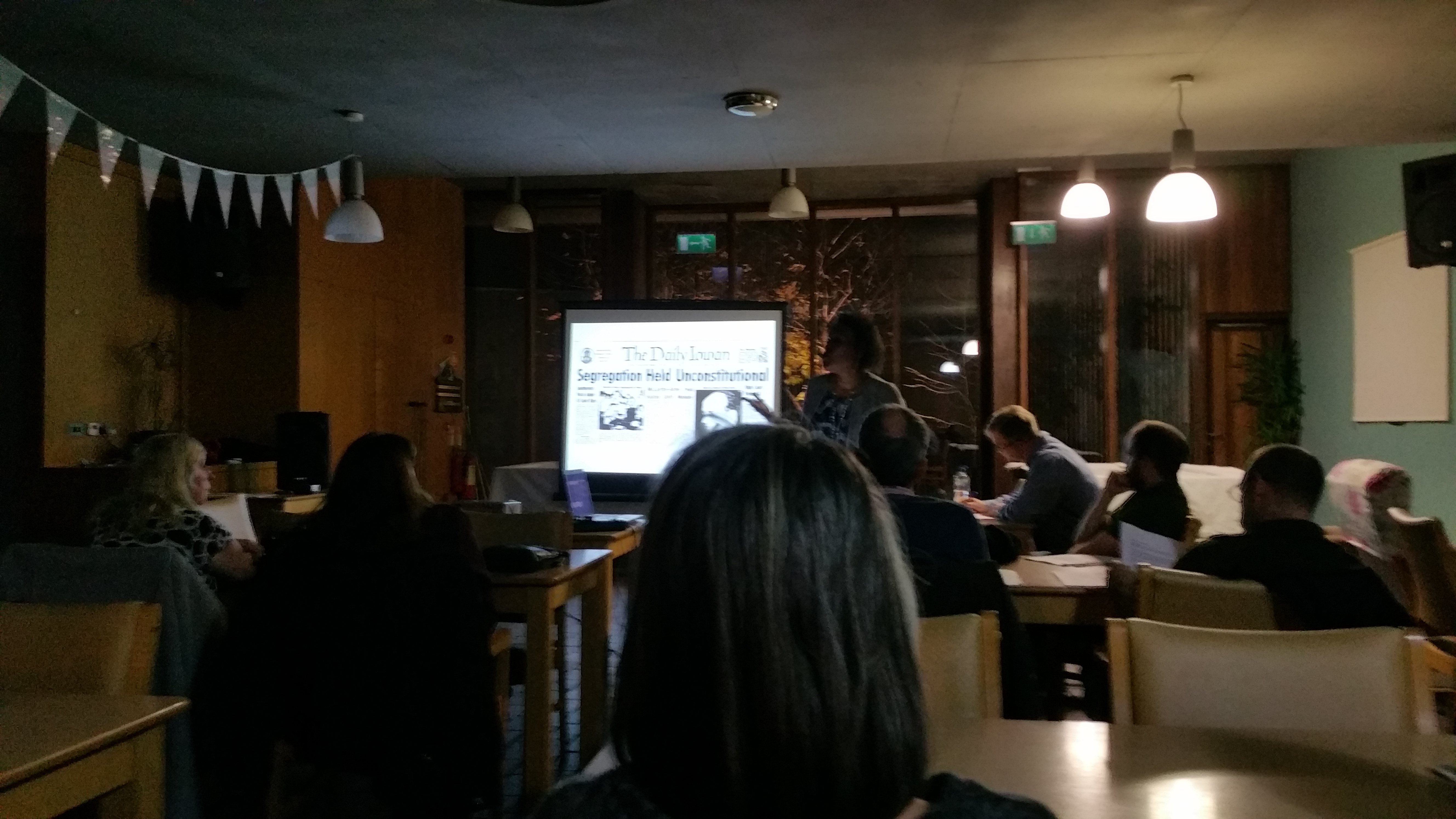
The session opened at 8pm and Cecilia Hartsell had a lot of ground to cover. She spoke on the history of the Civil Rights movement of blacks in the USA, going through the history of seminal events, illustrated with Powerpoint slides and recordings of two White House phone calls between President JF Kennedy and Ross Barnett, Governor of Mississippi and key figure trying to prevent the historic enrollment of James Meredith, a black man, into the University of Mississippi.

Cecilia Hartsell delivering her talk on the black civil rights movement in the USA

Recalling that in the first two years of his term, JF Kennedy had little to say about black civil rights but was focusing on other issues,Cecilia Hartsell somewhat undermined the (incorrect) image we tend to have in Ireland of Kennedy as an ardent civil rights fighter. In fact he was enforcing Federal legislation on equality and trying to go slowly, while the black campaigners were pushing the agenda along and white racist reaction was holding the USA up to international ridicule and opprobrium during the Cold War with the Soviet Union.

When Brian Hanley took the floor for his talk he fairly zipped along, which he does very well. Hanley undermined some myths or wrong impressions too. Early organisers of the civil rights marches and other events such as the Dungannon house occupation were Irish Republicans; Loyalists had killed four people before the first Civil Rights march. The rhetoric of SDLP and Labour Party notables was much more militant in the early years and Fine Gael was agitating more about issues of discrimination in the Six Counties than was Fianna Fáil, the party in government. And FF had been pushing a referendum to do away with the proportional representation electoral system at the same time that the PR system was among the demands of civil rights campaigners in the Six Counties.

Brian Hanley delivering his talk on the civil rights movement in the Six Counties.

In the session for questions, answers and contributions later, Hanley pointed out that the Southern Democratic Party was the pro-slavery party historically and, after the Civil War, anti-integration and civil rights, whereas the Republican Party was anti-slavery (debunking another false image we tend to have in Ireland).

Both historians made the point that a hundred years is not as long as some might think (this is especially true in ‘historical memory’).  The 1940s, when some historians would say, as Hartsell told us, is the date from which to date the renewed fight for black equality in the USA, as surviving black soldiers returned from WWII, was only 80 years from when Federal troops were withdrawn from the former Confederate states.  The partitioning of Ireland had been carried out less than 50 years before the Civil Rights protests broke out in the Six Counties, Hanley reminded his audience and many Catholics still lived who remembered vividly the fierce repression that had accompanied it.

It also emerged that albeit there were many similarities, there were also profound differences between the two movements. The black campaigners in the USA were saying that they were citizens of the USA State and demanding the same rights as other citizens, they often marched with the Stars and Stripes flag and even called for the intervention of US troops to defend their rights. The Catholics marching for civil rights in the Six Counties mostly saw themselves as Irish citizens and would never march with the Union Jack. Some did call for the intervention of British troops but many did not; it was mostly Irish troops they hoped would intervene.

The importance of the presence of news photographers at events and their covering in newspaper reports and on television broadcasts was an important factor in both struggles.

USA soldiers facing unarmed marchers for black civil rights.  (Source: Internet).

Cecilia Hartsell did not feel that the Black Power movement could have survived Southern racist repression in the 1940s, ’50s and early ’60s and most of the big gains on desegregation of education, public transport, eateries and voter registration and effective right to vote in the Southern States were won during those years with peaceful marches and pickets and legislation (which however were met by much racist violence, including a number of murders). By the time the Black Power movement was coming on to the political stage, so was the Vietnam War and huge changes were taking place in the US, including many mass violent struggles on race and other issues.

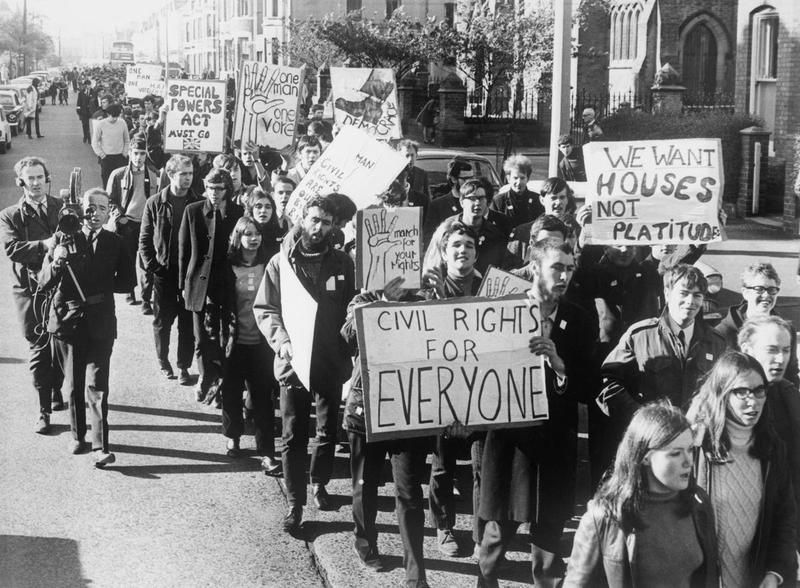
Section of march for civil rights in the Six Counties (Source: Internet).

TERMINOLOGY AND DEEPER MEANING

Wikipedia: “Though often used in history books to refer to the seven states that originally formed the Confederacy, the term “Deep South” did not come into general usage until long after the Civil War ended. Up until that time, “Lower South” was the primary designation for those states. When “Deep South” first began to gain mainstream currency in print in the middle of the 20th century, it applied to the states and areas of Georgia, southern Alabama, Florida, Mississippi, north Louisiana, and East Texas, all historic areas of cotton plantations and slavery. This was the part of the South many considered the “most Southern”.”

Later, the general definition expanded to include all of South Carolina, Georgia, Alabama, Mississippi, and Louisiana, and often taking in bordering areas of East Texas and North Florida. In its broadest application today, the Deep South is considered to be “an area roughly coextensive with the old cotton belt from eastern North Carolina through South Carolina west into East Texas, with extensions north and south along the Mississippi”.

Lower South” probably originally referred to its location on the typical north-orientated map of the USA. But I speculate that “Deep” has another meaning – a deeper psychological one, in fact. It suggests that this is a place difficult to understand for people not from there, which means most people. Different rules apply there, we might believe.

I speculate further that after the initial first years of the Civil Rights movement in the Six Counties, that area and the people living in it came to be seen as “different” too. Of course, it was different in that it was a colony (as had the whole country been only 50 years earlier) and that it was run along blatantly sectarian lines, the Catholics a minority there, unlike in the rest of Ireland. And of course, people in a different environment respond differently. But they were still people and the substantial Catholic minority were so clearly oppressed in a statelet into which the Irish ruling class had delivered them. For many people in the 26 Counties it became easier to think of them as somehow foreign in a foreign kind of land, hence my description as “Deep North”.

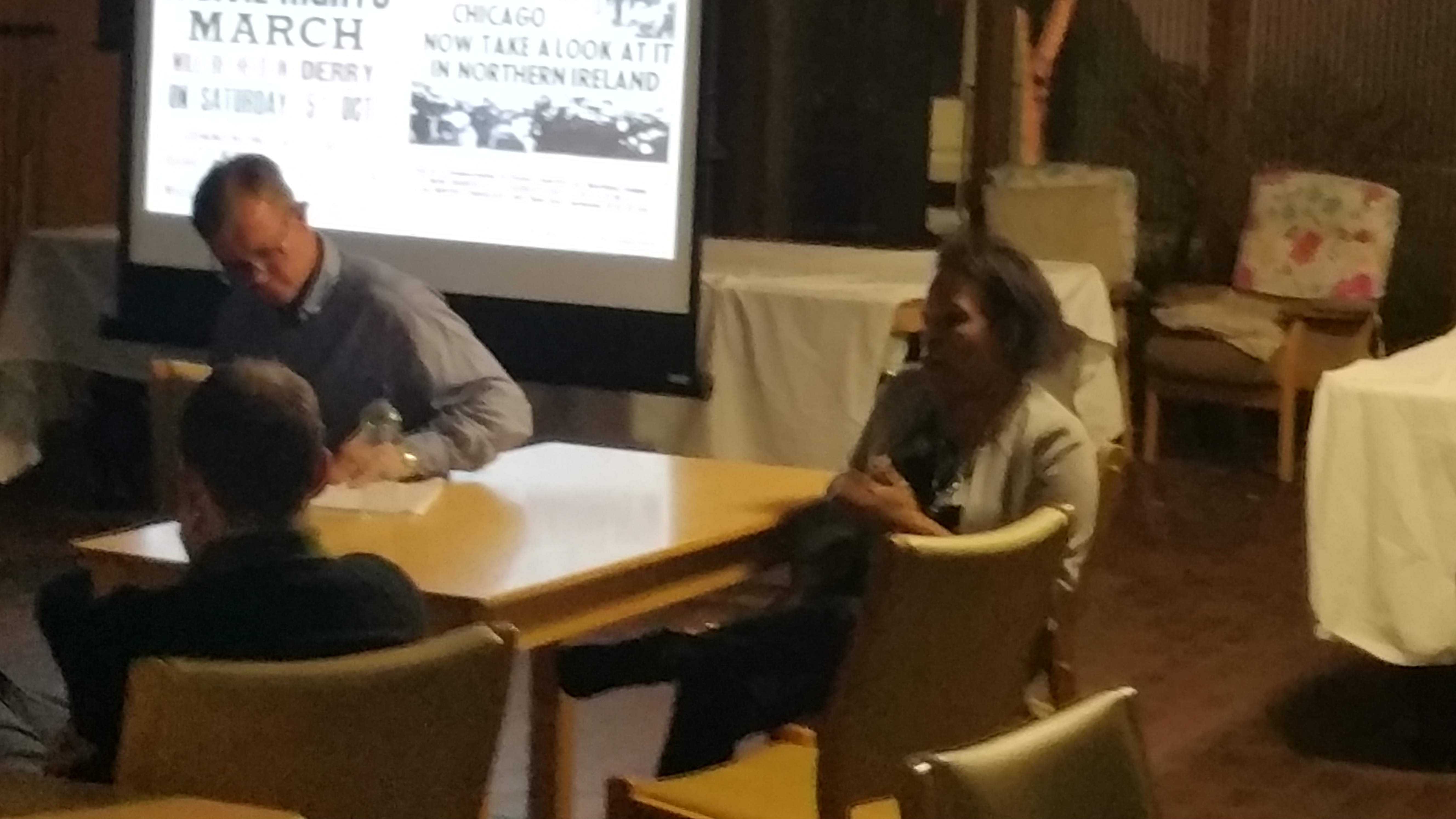
Cecilia Hartsell and Brian Hanley during the question-and-answer session.

THE SPEAKERS (as posted by EWHG)

Cecelia Hartsell is a researcher of American history. She has been a contributor to the RTE History Show and Radio Kerry on topics in U.S. history and frequently gives U.S. history talks for the Dublin Festival of History and in the Dublin Public Libraries. Cecelia has a Masters degree in U.S. history from Fordham University and a Masters degree in History from UCD.

Brian Hanley is an historian and author. He is currently a Research Fellow at the School of Classics, History and Archaeology, University of Edinburgh . He has lectured at a number of major Irish universities and was Historian in Residence at Dublin City Library and Archives . His books include “A Documentary History of the IRA, 1916-2005” (Dublin, Gill and MacMillan, 2010) with his most recent being “The impact of the Troubles on the Republic of Ireland, 1968-79: boiling volcano?” (Manchester University Press, 2018).

NEXT HISTORY TALK

There will be another talk in the series next week when Dr. Mary Muldowney will present a talk on “The 1918 Election – the Woman Who Stood for a Worker’s Republic.”

“Another martyr for old Ireland …”

Clive Sulish

          Socialists and Socialist Republicans gathered outside the General Post Office in Dublin on Thursday (Nov 1st) to honour the memory of Volunteer Kevin Barry on the 98th anniversary of his execution. Copies of his portrait were on display with candles lit and the ballad honouring his memory was sung.

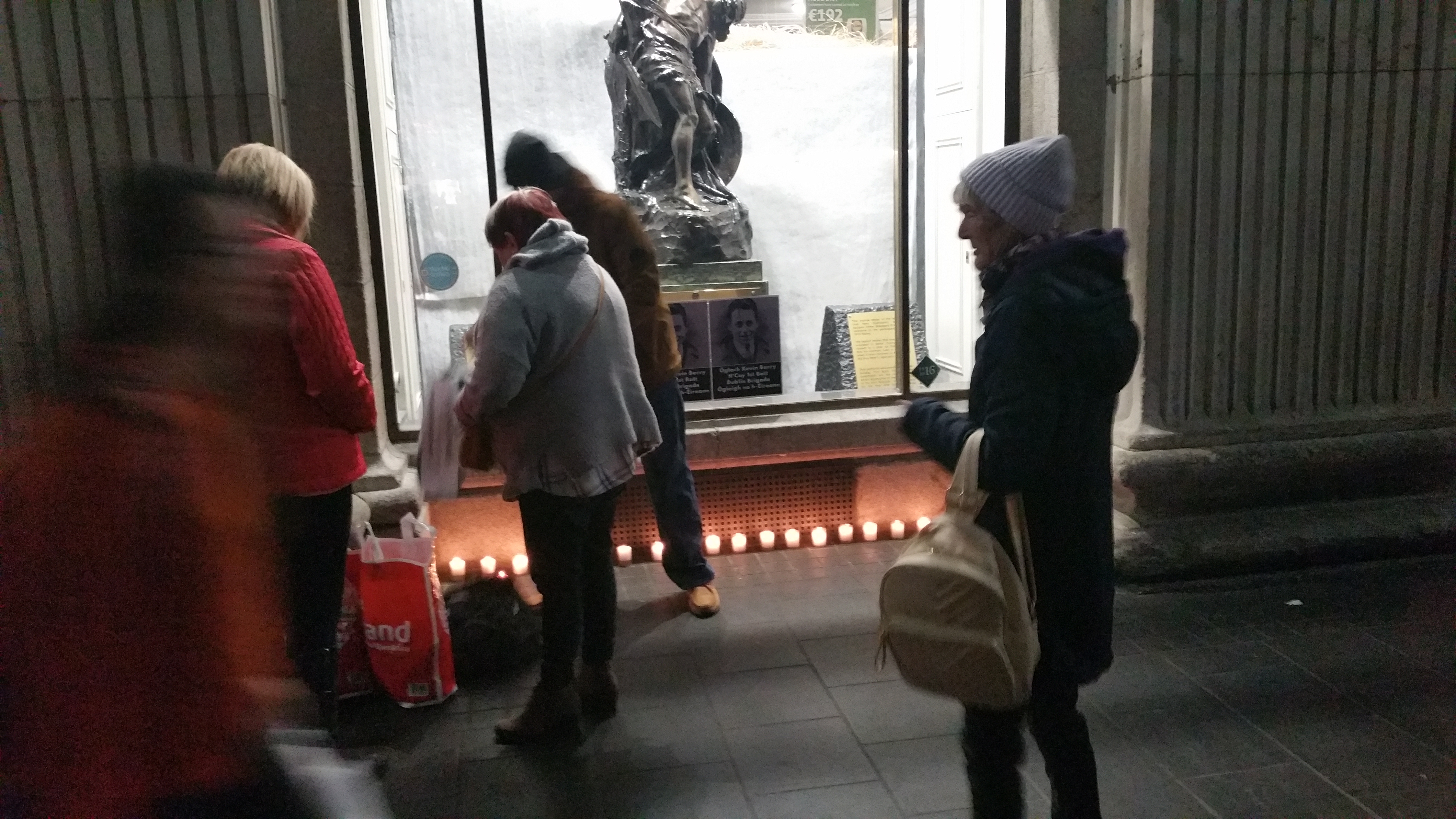
Display of images of Kevin Barry and lit candles outside the GPO at the event. (Photo: D.Breatnach)

          The event was organised by the Irish Socialist Republicans organisation. Asked about the reason for the commemoration and speaking on behalf of the organisation, Pádraig Drummond said “It is important to honour people in our history who have played an important role, who have displayed characteristics worthy of emulation such as resolution, courage and loyalty. People like Kevin Barry are more worthy of interest for the youth of today than clothing brands or pop idols.”`

Gathering to beign the vigil outside the GPO (Photo: D.Breatnach)


Some members of the public stopped in passing to listen to the song or to engage picketers in conversation.

People carrying out the vigil (Photo: D.Breatnach)


At the time of Kevin Barry’s execution the whole of Ireland was under a centuries-old British occupation and the defeat of the Easter Rising was three years in the past, most of its leaders executed and prisoners released. The first World War had ended. But the Irish Volunteers had reorganised and the War of Independence had begun in January of 1919. The ICA had seen a partial reorganisation and Cumann na mBan had never disbanded and, though it had suffered a few notable resignations, had experienced no split. The UK General Election of December 1918 had delivered a huge majority in Ireland to the newly-organised nationalist-republican coalition of Sinn Féin and in January of 2019 the successful SF delegates set up the Dáil, the first independent Irish Parliament, in defiance of the rule that all delegates elected in a UK election attended the Westminster Parliament in London.

On the same day in a separate development, the War of Irish Independence had begun. To wage war against the British occupation, the Irish Volunteers needed arms so some of its operations were carried out in order to seize arms from the occupiers. Kevin Barry joined the IRA at 15 in Dublin and not much later the IRB and had been on a number of successful raids to seize weapons.

Kevin Barry portrait graffiti of some years on wall in Dublin city centre.
(Photo: D.Breatnach)

On 20th September 1920 his unit was to ambush a British unit collecting bread from a bakery and relieve them of their weapons. Collecting bread rations from Patrick Monk’s Bakery at 79-80, Upper Church Street, near the corner of North King Street, Dublin.

Barry was a medical student and had an examination scheduled for that day which he expected to attend after the operation. Having attended mass that morning, he joined the unit in nearby Bolton Street and when the British Army lorry arrived the volunteers, armed with pistols, ordered the soldiers in the back to drop their rifles, which they did. However a shot rang out, possibly from the front of the lorry and the volunteers opened fire but Barry’s gun jammed twice and he jumped under the truck, being left behind when his comrades retreated. He was discovered and arrested. All five of the British soldiers in the rear of the lorry had been hit and one, 15 years of age, was dead – another two died later.

Kevin Barry attested that he had been beaten up when captured and tortured for information later in Army custody. On 20th October he was tried by military tribunal under the provisions of the Restoration of Order Act of August that year. Brigadier-General Onslow presided on the tribunal and Barry had legal representation who, after Barry announced he would not recognise the court, withdrew. The sentence of the court, given to the Volunteer in his Mountjoy Prison cell that evening, was death by hanging. The sentence became publicly known on the 28th and a fierce campaign began to save his life, not only in Ireland. Terence McSwiney, author, playwright, Lord Mayor of Cork and IRA Volunteer, had died after a hunger strike of 74 days on 25th October and public opinion, especially in Ireland, was highly excited. Nonetheless, Kevin Barry was hanged on November 1st 1920, eighteen years of age. According the priest who accompanied him the gallows, who was not a republican, he went calmly to his death.

On 14 October 2001, the remains of Barry’s body and others were given an Irish state funeral and moved from Mountjoy Prison to be re-interred at Glasnevin Cemetery in Dublin. A stained glass window in his honour was unveiled in 1934 at the Earlsford Terrace address of University College Dublin and was later moved to their new address in the Belfield Camput and restored in 2007.

The Ballad of Kevin Barry, which was sung at the commemoration by Diarmuid Breatnach, was composed around the time of the Volunteer’s execution and has been very popular in Ireland and among the Irish diaspora abroad. The author is unknown despite efforts by his family and others to trace him or her but there were some indications that it had been composed in Glasgow. The song has been recorded by many performers, including non-Irish singers Paul Robeson and Leonard Cohen.

End 

EAST WALL REMEMBERS ANTI-FASCIST BRIGADISTA JACK NALTY

Clive Sulish

On the 80th Anniversary of his death in the Anti-Fascist War in ‘Spain’, the East Wall History Group organised a remembrance of a local man from that dockland Irish area who was the last Irishman to die fighting in the war against Franco and Spanish Fascism. The event was attended by relatives of that Irish antifascist fighter and of another, by a cross-section of Left and Irish Republicans, including historians and by a number of elected representatives from the Dublin City Council and the Dáil (Irish Parliament).

Crowd assembling outside school before event. (Photo: D.Breatnach)

Jack Nalty was the last Irish and one of the last International Brigaders to fight and die in that war. The rest of the Brigaders, those not held as prisoners by Franco’s forces, were withdrawn soon afterwards as the indigenous anti-fascist forces fought on, losing against the Spanish military coupists with their German Nazi and Italian fascist allies.

Those commemorating Jack Nalty met at the St. Joseph’s Co-Educational School on the East Wall Road at 1pm on Sunday (23rd September) and included a cross-section of members of organisations and independent activists, socialists, republicans, communists and anarchists and other members of the local community. At the front entrance of the School a number of relatives of Jack Nalty held a banner along with a son of an Irish International Brigader and the crowd was addressed by Joe Mooney, of the East Wall History Group.

Joe Mooney speaking at start of event, relatives of International Brigaders beside him holding the banner in the colours of the Spanish Republic (Photo: D.Breatnach)

Mooney told the crowd that John Nalty came to the area at the age of six from Galway and on 31st August 1908 entered the East Wall National School on the Wharf Road. Just over thirty years later, 23rd September 1938, he would die on a Spanish battlefield, shot down in a hail of fascist bullets as he engaged in one last heroic act.

A member of the IRA during the War of Independence, Jack was a Republican, Socialist and trade unionist”, Mooney said, “representing 600 oil workers in Dublin Port. But in 1936 when the Spanish Civil War — or Anti-Fascist War as it should more accurately be called1 – began, he volunteered for the International Brigades to join the fight against European fascism. He was badly wounded and came back to Ireland, but would again go into action and was killed at the Battle of the Ebro. Having being among the first Irish volunteers to travel to Spain, he would die on their last day as they were preparing to withdraw from combat.

Nalty’s unit had been called to retreat when it was realisted that two machine-gunners had been left behind and he went back to collect them. On their retreat they were fired at and Jack Nalty was killed.

Section of crowd lined up in front of house where Jack Nalty had lived (Photo: D.Breatnach)

Mooney also asked those present to remember not only Jack Nalty but the ‘comradeship of heroes’ from Dublin’s Docklands and North Inner City – Dinny Coady, Tommy Wood and others.

The crowd then set off in a march led by a piper to East Road to unveil a memorial plaque. Across the road from Jack Nalty’s former house, the crowd paused to hear Diarmuid Breatnach sing a few verses of Christy Moore’s tribute to the Irish “Brigadistas”: “Viva La Quinze Brigada”.2

UNVEILING THE PLAQUE

Joe Mooney unveiling the plaque not far from Jack Nalty’s former house (Photo: D.Breatnach)
The plaque (text difficult to read in photograph)
(Photo: D.Breatnach)

The plaque could not be attached to Jack Nalty’s house and was affixed a little further down the road. Joe Mooney siad a few words there and introduced James Nugent who gave a speech he had prepared and the plaque was unveiled. Nugent concluded by saying that “the history of the past helps us to understand the present and to create the future.”

Kate Nugent read a message from the daughters of Steve Nugent (sadly died 2017) who researched the story of his uncle Jack and Mary Murphy read a short post from Vicky Booth (granddaughter of Syd Booth, who was with Jack when he died).

(Photo: D.Breatnach)
Piper plays lament by plaque
(Photo: D.Breatnach)

Harry Owens gave a short tribute speech on behalf of Friends of the International Brigades and Manus O’Riordan, son of Irish communist and International Brigade Volunteer, sang the chorus of Amhrán na bhFiann (“The Soldiers’ Song”, Irish national anthem) and the Internationale.

Section of crowd a location of the plaque (Photo: D.Breatnach)
At the unveiling ceremony (Photo: D.Breatnach)
Also at the unveiling ceremony
(Photo: D.Breatnach)

Joe Mooney acknowledged the presence of elected representatives Mary Lou McDonald, Sean Crowe and Cieran Perry and asked people to march to the nearby Sean O’Casey Centre to see the art exhibition and see two short films.


Marching from the plaque site, heading for the SO’C Centre
(Photo: D.Breatnach)(Photo: D.Breatnach)
Section of the attendance relaxing at the Sean O’Casey Centre between the plaque event and the films to be shown, also examining the art exhibition [see photos at end of post]

Back at the Sean O’Casey Community Centre, two short films were shown. One was a school project film in which a descendant of Jack Nalty interviews the latter’s nephew about his famous uncle. The second was dramatic film in which a Spanish trumpet player joins the fight against the fascist military uprising by Franco and other generals and features also actors playing two Irish International Brigaders, O’Connor and Charlie Donnelly3. When the former trumpet player is shot he sees into the future ….

Eddie O’Neill talked about the pulling out of the International Brigades in October 1938 in a bid to have the “non-interventionist” Western democracies put pressure on Nazi Germany and Fascist Italy to have them withdraw too, which did not happen. They marched through Barcelona on 17th October and were addressed in an emotional rally by La Pasionara4 and Eddie asked Nerea Fernández Cordero to read an English translation.

Nerea on stage just after reading translation of La Pasionara’s farewell to the Brigaders
(Photo: D.Breatnach)
Eddie O’Neill at the SO’C Centre with concluding speech: “We can’t afford to forget.”
(Photo: D.Breatnach)

Nerea told the audience that she is from Extremadura (a province of the Spanish state next to the Border with Portugal) and her grandfather, Antonio Fernández had fought against Franco, been captured, escaped to the mountains but was in time recaptured. Upon his release he had married Nerea’s grandmother and lived a peaceful life. Nerea said that she was proud of her grandfather and those who fought Franco and that “ we know La Pasionara’s speech in Spanish by memory.”

Reading of translation of La Pasionara’s speech to English from Youtube:

At the event the newly published pamphlet “In Pursuit of an Ideal – from East Wall to the Ebroabout Jack Nalty was made available for the first time and copies are available from the organisers.

Eddie O’Neill recalled being in the Spanish state with a group from Friends of the International Brigades to commemorate those who fought against Franco during that war and afterwards searching for an appropriate pub in which to socialise. They found a pub with a Guinness sign and went there which however turned out to be one of the most fascist pubs in the area but undeterred, they continued to celebrate the memory of the antifascist fighters there. A lone man in suit and tie asked people as they passed him to use the toilet why they were commemorating people who had died so long ago but when they explained he said he could not understand English.

We can’t afford to forget,” O’Neill told his audience, “least of all when the forces of fascism are gathering again.”

To conclude the event O’Neill called on Diarmuid Breatnach who sang the whole of Christy Moore’s “Viva La Quinze Brigada”, calling on the audience to join him in the chorus, remembering those who fought and gave their lives in the struggle against fascism.

Eddie O’Neill close at right of photo at unveiling ceremony
(Photo: D.Breatnach)

AN ANNUAL EVENT?

The organisers are reputedly considering making this an annual event – it is to be hoped that they do so.

Another section of the crowd at the plaque unveiling.
(Photo: D.Breatnach)
Also at the plaque unveiling ceremony
(Photo: D.Breatnach)

POSTCRIPT: JACK NALTY – ATHLETE COMPETING FOR IRELAND

In publicity prior to the event, the East Wall History group posted the following:
“In addition to his political and trade union activity, Jack Nalty was also a busy athlete, a regular competitor and medal winner with the Dublin Harriers. In 1931 he represented his country at the International Cross Country Championship, held at Baldoyle. Fellow competitor Tim Smyth became the first Irishman to win this competition.

(The full Irish Group for the event held on 22nd March 1931 is listed as: Frank Mills, J. Behan, John Nalty, J.C. McIntyre, John Timmins, T. King, T. O’Reilly, Thomas Kinsella, Tim Smythe).

This British Pathe footage shows the runners in action. Somewhere in the group is John (Jack) Nalty, East Wall resident, Republican and hero of the International Brigades. (The Pathe footage is viewable on post on the East Wall History Group event — CS)

Ironically, the same year as the competition the future leader of Irish Fascism, General Eoin O’Duffy had become the President of the National Athletic and Cycling Association (NACA) , and apparently was an admirer of Jack Nalty as an athlete!”

(Photo: D.Breatnach)


FOOTNOTES


1Basques in the provinces of Bizkaia, Guipuzkoa and Alava say it was not a civil war there, i.e between different sections of Basque society — the fascist forces came from outside.  In the fourth southern Basque province of Nafarroa, where the Carlists took control, they wiped out around 2,000 antifascists but it was hardly a war. The Catalans also say that the fascist forces invaded them and that it was not a civil war but an antifascist one. In some other places in the Spanish state many also say that the presence of Nazi German and Fascist Italian military in such numbers invalidated the term “civil war”.

2Also known as “Viva La Quinta Brigada”, which is however also the title of a different song from the Anti-Fascist War. Both titles are correct for this song since the Irish were in the Fifth of the International Brigades but when added to the ten indigenous Brigades (Spanish, Basque, Catalan etc), that became the Fifteenth. Wikipedia quotes authors to report an estimate that “during the entire war, between 32,000 and 35,000 members served in the International Brigades, including 15,000 who died in combat; however, there were never more than 20,000 brigade members present on the front line at one time.”

3Charlie Donnelly was a poet and member of the Republican Congress. He went to Spain to fight against Franco, where he died in February of 1937 at the Battle of Jarama. He is also one of those 19 names mentioned in Christy Moore’s song (“Viva La Quinta Brigada” or “Viva La Quinze Brigada”).

4Isidora Dolores Ibárruri Gómez (9 December 1895 – 12 November 1989), born and brought up in the Basque Country to a Basque mother and Spanish father, founder-member of the Spanish Communist Party and known for her political writing and speeches. She wrote an article when quite young under the pen-name “La Pasionara” (the Passion Flower) and was known by that nickname throughout her life.

GUERRA, DIVISIÓN Y PLANIFICAR LA INSURRECCIÓN

Diarmuid Breatnach


El 5 de agosto de 1914, el Consejo Supremo de la IRB1, un mes después de que los británicos declararon la guerra a Alemania, decidió en principio instigar un alzamiento por la independencia de Irlanda.

El 5 de agosto de 1914, un mes después de que los británicos declararon la guerra, el Consejo Supremo de la Hermandad Republicana Irlandesa2 decidió en principio liderar un levantamiento. Ellos imaginaron, como muchos observadores hicieron también, que la Guerra no duraría mucho y armarse y prepararse para una insurrección sería difícil dentro de ese marco de tiempo. La Guerra continuó mucho más allá del período esperado de un año, proporcionó al IRB el espacio para organizar, planificar y preparar, y también con un aliado para armarlos: Alemania.

La división en los Voluntarios Irlandeses causada por el discurso de Redmond3 en Woodenbridge, ofreciendo los Voluntarios al imperialismo británico para la guerra contra el imperialismo alemán y Turquía, dejó a la Hermandad Republicana Irlandesa secreta en una posición para tomar el control del resto, aquellos que declinaron luchar por Gran Bretaña y, en cambio, decidieron luchar por la independencia de Irlanda. Durante varios meses, Patrick Pearse se convirtió en Director de la Organización Militar, Bulmer Hobson Intendente General, Joseph Plunkett se convirtió en Director de Operaciones Militares, Éamonn Ceannt, Director de Comunicaciones, mientras que Thomas MacDonagh se convirtió en Director de Capacitación.

El académico del gaélico Eoin Mac Neill, jefe titular de los voluntarios irlandeses antes y después de la división de 1914. Más tarde sería deshonrado a los ojos de muchos por su cancelación pública del Levantamiento de 1916 que siguió sin él pero muy disminuido en número.
(imagen originada: Internet)
Bulmer Hobson en años posteriores. En 1916 se había separado del IRB que había ayudado a reorganizar e incluso fue puesto bajo detención armada por un período por el IRB. (Imagen originada: Internet)

El jefe titular de los Voluntarios, el erudito del gaélico Eoin Mac Neil, y figuras fundadoras como El O’Rahilly, mientras ocupaban puestos prominentes y se negaban a seguir a Redmond, no incorporaban la misma coherencia y determinación para la insurrección que encarnaba el IRB.

Patrick Pearse
(Imagen originada: Internet)

Esa lista de puestos de oficiales de IRB dentro de los Voluntarios contiene cuatro de los posteriores siete signatarios de la Proclamación de 19164. Que no aparecen los nombres de Seán Mac Diarmada y Thomas Clarke, aunque son figuras centrales en la reorganización del IRB en años anteriores, no es sorprendente: el Fenian mayor, veterano de 15 años en la cárcel británica en condiciones que, se dice, envió un tercio de sus camaradas locos y otro tercio a tumbas tempranas, prefirió trabajar en las sombras. Sin duda había instruido a su estudiante y enérgico organizador, Mac Diarmada, a hacer lo mismo en la medida de lo posible. Sin embargo, ellos también se unieron al ampliado Consejo Militar a fines de 1915.

Thomas Clarke, ex preso Fenian y el verdadero jefe de la IRB en Irlanda. (Imagen originada: Internet)
Seán Mac Diarmada, reclutado al IRB originalmente por Hobson se convirtió en colaborador cercano con Clarke. (Imagen originado: internet)

El quinto de los signatarios de la Proclamación que falta es James Connolly5, quien en agosto de 1914 se estaba recuperando y reconstruyendo el Sindicato de Transporte y Trabajadores Generales de Irlanda, meses después del final de la agotadora lucha de 8 meses contra el patronal de Dublín6. Pero estaba horrorizado por la guerra imperialista y el enfrentamiento de los trabajadores entre sí, dividido por las clases dominantes de sus respectivas ubicaciones, vestidos en uniformes de diferentes colores que ocultaban sus intereses comunes. Connolly quería un levantamiento, no solo por la independencia, sino también contra la próxima carnicería de la guerra. La reorganización del Ejército Ciudadano Irlandés, la milicia de la defensa obrera, comenzó a comprometer las energías de Connolly, pero el solamente tomó el juramento del IRB en enero de 1916, tres meses antes del Alzamiento.

James Connolly, foto tomada en 1900. (Imagen originada: Internet)

Tantos hilos diferentes de la vida irlandesa – cultural, política, de clase y de nación – se habían unido para tejer un tapiz que se leería de diferentes maneras durante décadas pero que aún tendría poderosos imágenes, colores y palabras para mover a mujeres y hombres un siglo después.

Fin.

Notas a pie de página

1Irish Republican Brotherhood, organización revolucionaria republicana secreta. Además de en Irlanda, tenía grande representación in Gran Bretaña y en los EEUU.

2La misma organización y a veces llamada La Hermandad Fenian.

3John Redmond, jefe del Partido Nacionalista de Irlanda, cual poco antes había obligado a los Voluntarios aceptar sus nominados en el Ejecutivo.

4Patrick Pearse, Joseph Plunkett, Thomas Mac Donagh y Éamonn Ceannt.

5Revolucionario comunista y republicano, criado en la diáspora irlandesa en Edimburgo.

6El Cierre Patronal de Dublín del 1913, que también había comenzado en el agosto.

OREGON USA: NO FREE SPEECH FOR FASCISTS!

Diarmuid Breatnach


Like fascists in many other parts of the world, those on the Oregon demonstration marched under the slogan of “free speech”.  NO FREE SPEECH FOR FASCISTS!


Police in Oakland, Oregon, went into riot police mode at a fascist march on Saturday (4th August 2018) which was opposed by anti-fascists. After maintaing a presence between the two forces for some time they eventually moved to break them up and employed ‘flash-bangs’ and other methods. The march without a permit by fascists was organised by the Patriot Prayer organisation led by Joey Gibson who is running for election to the US Senate and who declares that they are demonstrating for free speech.

Right-wing supporters of the Patriot Prayer group gather during a rally in Portland, Oregon, U.S. August 4, 2018. REUTERS/Jim Urquhart – RC1E0096DB40

Feelings in the town are already running high after a Patriot Prayer supporter was charged with stabbing a man who allegedly intervened to defend from harassment two women on a light-rail train last year, one of whom was wearing a hijab.

According to reports, Gibson declared to supporters that they were there “to teach a lesson to the country” minutes before they began to march. On June 30th, a previous Patriot Prayer event led to clashes with anti-fascist demonstrators, during which the Oakland police revoked the permit for the demonstration and declared a riot. Earlier on Saturday, in a response to Oakland Police reminding people of a city code banning carrying weapons in the public park, Gibson posted: We’ve always had guns at the rally. I cannot think of one rally when we didn’t have guns with us. Everywhere we go, we have guns.”

Anti-fascist opposition to Patriot Prayer march in Oregon USA. Note mixed attitudes of people wearing improvised riot gear and a placard apparently calling for peaceful opposition
(photo US Media).

Earlier, Portland Mayor Wheeler had expressed concern about the planned Patriot Prayer march, as had the Police Chief. Portland Police Bureau Chief Outlaw (yes, honestly) was appointed to post last year; an African-American woman, she started her career as a patrol officer and was appointed Deputy Chief to Oakland’s police department in 2013.

FASCISM AND FREE SPEECH ACROSS THE WORLD

In 2016 Tommy Robinson led a couple of hundred supporters in Birmingham, Britain to launch the anti-Muslim group Pegida UK, which he founded as part of a Europe-wide fascist initiative intending to launch Pegida in a city in every European state (they failed spectacularly in Dublin, see Rebel Breeze report in Links). Two years earlier, he had led the Islamophobic English Defence League which soon split and melted away.

(photo US Media).

Like Robinson, who was recently given a 13-month sentence for contempt of court in Britain and even more recently released on bail for retrial, the call of fascists when not in power or in position of strong dominance is always for “free speech”. Once dominance is achieved, the fascist call for “free speech” changes to slogans such as ending freedom of speech if it is considered “unpatriotic”, advocating “race-mixing” or “moral degeneracy” and, of course “communist propaganda”. When in power they enforce the elimination of what they consider undesirable free speech, including criticism of policies or leadership even from within their own ranks. When in a dominant position in a country, region or area, fascists enforce their control of “free speech” through terror attacks on their opposition or target communities, with or without collusion with the State, military or local police force. When fascists have state control, they limit free speech through laws, court and prison, in addition to extra-legal fascist attacks and assassination squads.1

Fascists seek to establish a safe “beach head” upon which to build and from which to extend. If successful, they attract more and more followers, while they intimidate their opposition and their targets. But in failure, as when driven off the street, their opposition and targets grow in confidence and the fascist organisations usually disintegrate in internal struggles between cliques and denunciations of their unsuccessful leaders.
That is the well-documented history of fascism which the fascists try to conceal while weak but in which they glorify when in power. Unfortunately, liberals, whose bodies exist in the real world but whose ideology lives in a world of make-believe, unknowingly collude with this trajectory. Again and again they insist that the fascists and racists which they abhor must be given freedom of speech and even accuse the anti-fascists of a kind of fascist authoritarianism.

When liberals do turn to wanting to control the freedom of fascists to organise, as some do at some stages, they always appeal to the State to carry out that task for them. Sometimes, according to its interests at the time, the State will oblige, with measures sometimes including a wholesale banning2 but will often simultaneously ban progressive resistance movements.  More often it will oblige liberals by fines or short prison sentences on fascists or by anti-racist or anti-”hate” legislation. And often, fascists attempt to turn these too to their advantage, projecting themselves as martyrs of “free speech”.

The only effective remedy is that anywhere and everywhere, fascists are denied free speech – not by the State (whose capitalist interests are anti-socialist and will often recognise the usefulness of fascists) but by the alliance of anti-fascist interests: ethnic minorities, LBGT groups, communists, women, trade unions. This thesis has emerged out of an ideological battle that has been largely won decades ago among the Left and Republican movement in Ireland but which the general Left at times fails to put into practice – had it been left to them, Pegida’s attempted Dublin launch would not have been quite the ignominious defeat it was.

In this context the stand of the “Resist Patriot Prayer” march must be applauded. Their Facebook event description included the following sentence: “We make no apologies for the use of force in keeping our communities safe from the scourge of right-wing violence.”


End.

LINKS

Oregon, Oakland events, report by PBSO News Hour: https://www.pbs.org/newshour/nation/portland-police-city-officials-prepare-for-right-wing-rally-and-counter-protest

and Associated Press in ABC7 News: http://abc7.com/politics/heavy-police-presence-as-right-wing-rally-begins-in-portland/3883335/

Rebel Breeze report on failed Pegida launch in Dublin: https://rebelbreeze.wordpress.com/2016/02/08/pegida-planned-launch-ends-in-sinking-survivors-take-to-lifeboats/).

Attempted coordination of Fascist movement from USA across Europe: https://www.theguardian.com/uk-news/2018/jul/29/tommy-robinson-far-right-resurgence-steve-bannon-us-support


FOOTNOTES

1 Fascist movements and states are often plagued by splits, attempted coups and conspiracies. In June 1934, the Nazi SS and Gestapo attacked their former allies, the Nazi SA (Brownshirts), wiping out the leadership and dispersing the organisation in the event often called “The Night of the Long Knives”. They also wiped out a number of conservative anti-nazis. The death-toll has been widely debated, some estimates placing it between 700 and 1,000.

2  As by the British state of the British Union of Fascists during WWII, while their leader Oswald Mosely was placed under house arrest in a comfortable country house and land (or by De Valera of the Blueshirt movement in 1930s Irish state). However, less than a decade earlier in 1936, at the Battle of Cable Street when anti-fascists defeated the Blackshirts’ attempted invasion of London’s East End, the primary force fighting the anti-fascist resistance was 7,000 foot police and all the mounted police in London.

‘PEACE’ PROCESS LESSON FROM THE PALESTINIANS

Diarmuid Breatnach


                        The ongoing slaughter by Israeli soldiers of Palestinians demonstrating at the border of the Israeli State for the right to return to their homeland has rightly received media attention and, after a motion condemning Israel in the UN Security Council was blocked by the USA, the General Assembly passed another by a huge majority. The shootings demonstrate the total disregard of the Zionist authorities for Palestinian life and also the degree to which, by refusing to condemn and by supplying finance and equipment, the USA and major European states stand in support of Israel and are therefore complicit in its murderous actions. But the whole history of the right of return of Palestinians raises another issue of international importance and provides a historical and political lesson applicable widely, far beyond Palestine or even the Middle East.

A Palestinian woman brandishes a key, symbol of the house her family left behind when forced out of Palestine. Ironically Sephardic Jewish families were forced out of medieval Spain and some still keep a key to their ancestral home.
(Photo from Internet)

Negotiations, Agreements and ….?

Back in 1993, the Palestinian Liberation Organisation was in secret negotiation with Israel in Oslo, with Norway in the ‘honest broker’ role (but a later Norwegian Foreign Office investigation concluded that the Norwegian participants had acted as “Israel’s errand boys” – see link). Later it was to be the USA playing the ‘facilitator’ role — yes, bizarre, given the USA’s major economic and strategic interests in the Middle East and its role in supporting Israel. But then, perhaps the PLO figured they’d best have both their enemies there at the same time, both tied to whatever agreement was hammered out.

What had brought the parties to the negotiation table was the First Intifada, a Palestinian uprising against Israeli occupation of Gaza and the West Bank. This uprising had begun on 9th December 1987 and had been characterised by repeated street fighting, barricades, refusal to work for the Israelis and strikes and boycotts, along with refusal to pay taxes. The Israeli state had replied with arrests and shootings, killing over 1,600 Palestinians as against 277 Israelis killed. Between 23,600–29,900 Palestinian children required medical treatment from Israeli Occupation Force beatings in the first two years (Wikipedia).

Palestinian youth throwing stones at Israeli military during First Intifada (Photo: Internet)


Palestinian women confront Israeli soldiers during First Intifada (Photo: Internet)

After signing the Oslo Accords in Washington, Yasser Arafat, Chairman of the PLO and Yitzak Rabin, Prime Minister of Israel, were photographed there shaking hands with US President Bill Clinton looking on approvingly, arms almost around them, like a big friendly uncle making peace between nephews. Yizhak Rabin, Shimon Perez and Arafat were jointly awarded the Nobel Peace Prize in 1994 (a prize already devalued ever since it had been awarded to notorious warmonger Kissinger).

Rabin, Clinton and Arafat, Washington, after signing of the Oslo Accords.
(Photo: Internet)

Much was made of the Oslo meeting and the Accords (including later meetings and agreements) in the international media with talk of coming peace in Palestine and a resolution to the conflict etc signposted and not too far ahead. These prediction proved false and hopes were dashed.

But anyone examining the situation cooly would not have been surprised. Leaving aside other issues such as whether a two-state solution was justifiable, or viable even then, or whether the legitimacy of Israel should ever have been agreed to, the right of return of Palestinian exiles had been set aside by the PLO in the final Oslo agreement, a postponement, along with a number of other big issues, such as illegal settlements, to be discussed later. The Palestinian diaspora is today estimated at 9.6 million people (see link).

Since the omissions were of issues fundamental to any solution even within the parameters of the dubious two-state solution, it would have been obvious to anyone who had their eyes open that the Oslo Accords were no solution nor even a step towards a solution. So why were they agreed by the PLO?

A belief in the Accords as a stepping-stone would not have been sustainable on its own (except for wishful-thinking liberals) and the partial withdrawal of Israeli armed forces insufficient, given that Israel controlled all borders (except the Gaza one with Egypt, in which that state colluded with Israel). In addition, the Israeli troops had the capacity to return whenever they wished (and did so many times).

The motivation has to have been status or money.

The PLO, although containing a number of Palestinian organisations at that time (but not Islamic Jihad or Hamas), was dominated by Al Fatah, a secular Palestinian national liberation organisation. Fatah had the prestige of long existence and of having withstood the Israeli armed assault at Karameh in Jordan in 1968 during which, at a huge cost, it had forced the Zionist army to retreat. The following year Fatah had reportedly racked up 2,432 guerrilla attacks on Israel too — for a population with the Zionist jackboot on its neck, that counted for a lot.

Concluding an agreement with the Israelis, who previously said they would not talk to the Palestinian resistance, might have seemed like a status-raising event to Fatah. And setting up the Palestinian Authority, which of course they would run, would definitely give them status in the eyes of many outside and even inside Palestine.

But running the PA, which would be in receipt of funds and in charge of their distribution, also managing employment, would also provide myriad opportunities for corruption and nepotism, unless the organisation were to be rigorously monitored either externally or internally. That monitoring did not happen and corruption among Fatah was rife. Only the people on the ground seemed to mind, the ones who wanted strong opposition to the Israeli occupation and whatever development could be brought about in the infrastructure and communities, along with the longer-term aims of a Palestinian state and the return of refugees and exiles. And who weren’t part of the corruption.

Failure of Agreements and Insurrection

In 2000, after the failure of the Camp David talks in the US and many failures in the Accords in the nine years of their existence, no-one seriously believed in the Oslo Accords any more and the Second Intifada began. An intifada had provided the reason to negotiate for the Israelis, however insincerely intended and now another intifada brought the negotiation period formally to a close.

As observed earlier, Fatah was the organisation to which the majority of Palestinians (certainly within Palestine) had given their support and it was a secular party (although for the first time the PLA declared the “state religion” to be Islam in 2003, where previously there had been no mention of religion whatsoever). We can assume that most Palestinians were happy to be represented by a secular organisation and perhaps even preferred it.

But in the 2005 municipal, most Palestinians voted for Hamas, a fundamentalist Moslem organisation, for the first time pushing Fatah into second place. And in the Presidential and Parliamentary elections of 2006, again. What brought about that change? Was it a sudden devotional conversion? No, it was that Al Fatah had become corrupt, was not seen to be fighting Zionism hard enough (some would have said was becoming collaborationist) and had given up on the right of refugees and exiles to return. Hamas, though not officially represented in the PLO, was running social programs, its activists seemed disciplined and it was resolutely opposing Israeli Zionism politically and militarily. And it insisted on the right of refugees and exiles to return.

Hamas won the 2006 Palestinian elections with a 3% lead over the incumbents. Unwilling to accept the popular will, Fatah staged an armed uprising against Hamas which, in the Gaza strip, Hamas decisively won (what the Wikipedia entry on Hamas calls a “takeover”!). For some reason, although Hamas was undoubtedly the winner electorally, they let Fatah hang on to power in the West Bank. And the US-led demonisation and isolation of Hamas in Gaza by the West began, along with a series of Israeli armed attacks from that year until 2014, including full-scale missile and air bombardments and infantry incursions, killing thousands of Palestinians including civilians, women and children and destroying much infrastructure.

Since then, the Gaza population is being squeezed with electricity supply reduced to four hours a day and hardly any fuel to run generators or transport allowed in past Egyptian and Israeli gates, its water supply contaminated by damaged sewage treatment plant, the inshore sea likewise contaminated and Palestinians fishing further out attacked by Israeli gunboats, factories bombed out ….

The message seems to be: “Get rid of Hamas, get back with Fatah and we’ll stop exterminating you.” But a delayed extermination is all it would be, as evidenced from the deeper penetration of Zionist colonist enclaves on to Palestinian land, the Zionist-only roads, the ongoing takeover of Jerusalem, the Israeli Wall, the continual theft of water and the harassment by settlers and Israeli Army of any populations of Palestinians living near to Israeli colonists.

The Processes outside of Palestine

Taking a trip back in time to 1993, we saw the Oslo Accords being hailed as a great step forward by the majority of commentators across the West. These coincided with the new interim constitution as a result of the negotiations in South Africa — so that then two major areas of conflict were being hailed as definitely on the way to a solution, to come sooner rather than later. “Peace process” became a buzz-word, firstly among the participants and some of the commentators, then in the agreed discourse of the rest of the media and politicians.

In Ireland, as the Provisionals’ leadership and the British looked at one another across the dance floor, the former wondered what they could get from the same kind of process but crucially, how to sell it to their rank and file. At the Sinn Féin Ard-Fheiseanna (annual congresses of the party), the ANC and Al Fatah (wearing their PLO hat) fraternal delegates were welcomed by hype from the SF leadership and enthusiastic reception from the floor of the hall. The ANC and Fatah of course talked up their parts of the Processes and no-one seemed to examine critically what either the South African blacks or the Palestinians were likely to get out of them.

Ramaphosa, Mandela & Zuma at Jo’burg Conference 2012. Zuma is now deposed from ANC for corruption and Ramaphosa is millionaire President of South Africa and ex-leader of the National Union of Mineworkers. (Photo: from Internet, by Walter Dhiadhia)

And the Pal-African partnership continued to attend congresses, to send fraternal messages to areas of ongoing anti-imperialist resistance, to sing their siren song with a Western chorus backing. The Provisionals joined the actors and took to the stage as they neared and finally accepted the Good Friday Agreement in 1998. But with the Palestinian conflict showing no sign of resolution (unless one considers a kind of genocide of Palestinians) or even a respite — and in particular after the 2006 elections victory by Hamas — the Palestinians were no longer quoted as a good example of the “peace process”. Various actors, including South Africans and Irish, went on to try to sell the “Process” to areas of stubborn anti-imperialist resistance: the southern Basque Country, Turkish Kurdistan, Columbia, Phillipines, Sri Lanka ….. But the Palestinians (or rather Fatah) had been dropped off the billing and bowed quietly out of the Traveling Peace Process Show. They had not even an illusion to portray any more.

Kurds demonstrating against Turkish dictatorship in Germany fly flags bearing image of Abdullah Ocalan. Some years ago he said he supports a peace process in Turkey but he needs to be freed from prison to lead it
(Photo: the Times in Israel).

However, the show must, as we are often reminded, go on. It failed to deliver in Kurdistan and the Basque Country, not because the leaders of the resistance movements were not amenable but because of the unwillingness to adapt of the Turkish and Spanish regimes respectively. However, the Basque armed organisation ETA threw in the towel a couple of years ago anyway, abandoning their fighters in the jails to seek their own individual ways out through begging forgiveness of the occupiers of their land and oppressors of their people. The Turkish and Syrian Kurds were drawn into partnership with the imperialist allies dominated by the US, in their war against ISIS but also for the overthrow of the Assad regime, though deep Kurdish contradictions continue with the Turkish regime, to which it looks like the US Coalition will abandon them and they may seek an accommodation of sorts with Assad.

The Colombian FARC and MIR swallowed the Processed bait and gave up the armed struggle for a promise of a political one but those of their leaders who are resolute are being hunted by the regime, the quasi-liberated areas terrorised by the Army and assassination squads, the resistance fragmenting and disorientated. The Tamil Tigers didn’t entertain the Peace Process Show but the Sri Lankan Army were able to surround their liberated areas and bombard them to defeat, murdering their leaders and raping, murdering and repressing their followers.

The Phillipines and India? The resistance groups in both these areas are led by a Maoist-type leadership and we wait to see.

And in Ireland, after two decades since the signing of the Good Friday Agreement, the colonial occupier has the leadership of Sinn Féin, the former resistance, in joint colonial government, the party’s southern arm seeking admittance to the Irish comprador capitalist club, the remaining anti-imperialist resistance fragmented and the country not one step nearer to unity and independence.

The Palestinian lesson for the world

All the issues which led to these conflicts and which the processes of pacification did not address – were never intended to address – will return again, to be struggled over anew, under new leaderships. In Palestine now, that is what has been happening. The Right of Return for exiles and refugees, put to one side by Fatah in the Oslo Accords nearly three decades ago, is being demanded again on the Israeli border, the protesters (along with the ‘collateral damage’ of journalists and paramedics) being bombarded by tear gas and shot down by Israeli snipers. The Palestinians, whose leadership nearly three decades ago were chosen by US imperialism to be among the first to accept the new round of historical pacification processes and to become complicit in being its missionaries, are teaching us the fallacy of the facile promises they were made at the time.

There is another irony here: while refusing the right of return to Palestinians who were themselves exiled or are children and grandchildren of exiles, i.e within living memory, the State of Israel offers “the right of return” (sic) to people who have never been there and cannot even prove that their ancestors were, providing only they can prove their Jewishness. And a further irony: Sephardic Jews, who were expelled by the Christian kingdoms in Spain and Portugal in the Middle Ages, were being offered a “right of return” by the Spanish Government in 2014 (see link).

Over time, the people in the other areas of anti-imperialist resistance around the world will regroup, gather strength and return to the resistance. The imperialists almost certainly know this. But they have bought themselves three decades of damage to their opposition and, since they need the people as producers and consumers, cannot eliminate the deep wells of resistance. And capitalism is not about enduring solutions – they work away at undermining the resistance on a temporary basis and as for the future, like Micawber in Dickens’ David Copperfield, believe that “something (else) will turn up”.

End.

LINKS (NB: I have deliberately chosen most background references regarding Palestine from Wikipedia, which is known to be heavily monitored by Zionist interests and also has inputs from friends of the Palestinians and therefore cannot be said to be completely favourable to either side):

Palestinian exiles and the right of return: https://en.wikipedia.org/wiki/Palestinian_diaspora

Account of the Oslo Accords: https://en.wikipedia.org/wiki/Oslo_Accords

The Oslo Accords negotiations and their legacy: https://interactive.aljazeera.com/aje/palestineremix/the-price-of-oslo.html#/14

The Palestine Liberation Organisation: https://en.wikipedia.org/wiki/Palestine_Liberation_Organization

The right of return to Palestine of Palestinians: https://en.wikipedia.org/wiki/Palestinian_right_of_return#UN_General_Assembly_Resolution_194

The right of return to Spain of Sephardic Jews: https://theconversation.com/spain-moves-to-right-a-522-year-wrong-but-still-overlooks-some-23526

I Will Stand With You — Will You Stand With Me?

Julieann Kelly

I am a proud Irish Republican woman.

I stand shoulder to shoulder with my fellow countrymen and women against the injustices wrought on the people of my beloved country, be it civil rights or human rights I will stand with you. If I ask you the people of Ireland to stand with me to ensure my civil and human rights are upheld – will you? Or will you exile me to foreign soil to seek a medical procedure that is denied to me here unless I`m at death’s door?

I grew up in the 70`s & 80`s. Abortion was not a subject that was openly discussed, the general consensus was only “floozies” had them. Abortion came into my young life when a conversation between adults was overheard: “yer one took the boat”; “she is a baby killer”; “the babbie was deformed” etc. Their victim was a mother of one who had an abortion due to FFA (fatal foetal abnormality); if she carried to term like she was advised by doctors it would have resulted in her death. This woman lived the rest of her life filled with shame and guilt not only for making the choice to terminate but because of the closed minds and nasty hateful words of those around her. Cancer claimed her life, in her words “it was God`s punishment for killing my baby”. Like so many women before and after her she had to leave her baby’s remains in a foreign clinic, forever separated because of laws that said a mother trying to save her own life was a criminal! Her husband and son had the baby’s name engraved on her headstone, uniting them again if only in name.

Here we are in 2018, a so-called new liberal age when marriage between same-sex couples is legal, they are rightfully afforded the same rights as a heterosexual married couple, yet a woman is denied the right to her own bodily autonomy. The fear-mongering is still the same, cries of “it will be used as a form of contraception!” echo the cries of “Floozie”.

I am a mother of three much wanted children; my eldest daughter from my first marriage was conceived with the help of ICSI. I miscarried two of the embryos implanted with her early in the pregnancy and in time suffered more miscarriages. I was then blessed with my son and youngest daughter with my second husband. I have also suffered because of the 8th Amendment. I was forced to have three major abdominal surgeries against my will to save the life of the baby. My eldest was delivered a month early as my waters broke but not completely. The decision was taken to deliver her by c-section when I developed an infection that they feared would put the baby at risk although she showed no signs of any ill effects. I was put under general anaesthetic and did not get to see my baby till the next day due to my reaction to the anaesthetic. I developed a massive infection in my wound in the hospital which took six months to clear. My son was delivered in the same way as I was not progressing fast enough; I was in labour a mere five hours.

After my first experience I was terrified, in the height of pain and in great fear I refused. My husband was told if I kept refusing I would be sectioned under the mental health act and he could lose me and my son. The doctor was somewhat sympathetic, he allowed my husband to try and comfort me yet at the same time booking the theatre for the c-section.

I was lucky this time, I was awake for the birth but again developed a massive wound infection while in hospital.

My third and final dance with the 8th came when I was told during my pregnancy on my youngest daughter that as my womb was so weak due to the previous sections and subsequent wound infections I would not be allowed deliver her naturally. All my children suffered with shock due to their arrival into the world. My consent was not needed for any of these major surgeries, my body was not my own because the baby`s life came before my own, I live with the consequences of the infections to this day.

RAGING DEBATES — HOW FAR HAVE WE COME?

The raging debates regarding the upcoming vote have brought out the worst in many. I have had my life threatened, been called the vilest of names, my morals and suitability as a mother called into question because I`m pro choice. Ridiculous arguments thrown at me, I answer all these arguments with “I am pro-choice be that keep, abortion or adoption”, only to be met with more scorn and a refusal to engage in a sensible debate. I have been judged without people knowing what brought me to my stand on repealing the 8th: the suffering of a mother, my own experience of the 8th, a love for the women of my country.

100 years after a minority of woman were given the right to vote, I hear about sexual equality but I have to question this when an unborn foetus up until birth shares the same if not more rights than the woman who is used as a vessel. How far have we truly come in this liberal country? How can we speak of equality or loving both when our women have no say over their own body at the most vulnerable time of her life?

Crisis pregnancies, FFA, happen each day, the support we offer these woman is to exile them in shame to face a medical procedure in many cases alone on foreign soil. We force women to procure abortion pills online putting her life at risk in fear of discovery and face up to 14 years in prison, we force women to leave the babies remains in a foreign clinic, or to smuggle it into the country to bury it in secret, to have the cremated remains delivered in the post.

I will vote to repeal the 8th as I want to live in a country where I have a say over my own body, for my daughters and all the generations to come. I will stand shoulder to shoulder with all the women in Ireland. I will stand against the shame and fear culture we inflict on our women. I will vote Yes so young girls like Ann Lovett do not die because she could tell no one she was pregnant, so young girls like the X Case have a choice, for all the women like Savita Halappanava who died unnecessarily. Ireland owes it to our women to put them first.

End

IRA VOLUNTEER, PAYROLL HEIST MAN, THRILLER WRITER


Diarmuid Breatnach


To discuss a thriller-writer who was in jail in the USA for one of the largest payroll heists in US history and who before that was in the H Blocks, an incarcerated IRA Volunteer, is to have most people thinking one is writing about a fictional character – but I’m not. The man exists and his name is Sam Millar.

WRITER

Millar has a number of novels and a memoir to his credit, all the most recent published by the O’Brien Press. Some of them are detective novels, centred around Karl Kane, a tough private investigator, back-talking cops and gangsters alike. Yes, we’re familiar with the type, from Chandler’ Philip Marlowe to Spillane’s Mike Hammer, Hammet’s Sam Spade or Towne’s Jake Gittes in Chinatown (1974). But if we’ve liked his type in print or film before, them then we tend to like him again. To be truthful, Kane is a bit different: I can’t recall or even imagine any of the others ever opening their front door dressed only in their lover’s short pink dressing gown and falling on their arse, accidentally flashing their tackle at passing schoolgirls. And Kane’s health problems are perhaps more reminiscent of some of the Scandinavian fictional police detective heroes (and heroines) than his fast riposting counterparts in the USA-based stories.

Cover Dead of Winter, a Karl Kane novel by Sam Millar.

The dialogue and commentary in the Karl Kane novels is good with some very funny lines, his plots interesting and he keeps the story moving along at a good pace, with a few twists along the way. Kane, like Marlowe has a conscience pushing through his hard exterior and though he’s tough he tends not to invite more slaps after the first few. And not every thread in the story is tidily tied up at the end of the book.

The dialogue is not so slick in some of his other novels (one set in the USA) but the conjuring of the ill-boding atmosphere is well done, as is the description of the thinking in the adolescent characters’ minds.

Belfast is where his writing is centred now:

“I have deliberately used (Belfast) as a backdrop for all my crime noir novels for a number of reasons”, he was quoted as saying in a Crime Review author profile “- mainly because I know it so well, but chiefly to bring the imaginary one-dimensional Belfast of badly written novels into the modern era.”

Sam Millar
(Photo source: Democrat and Chronicle)

His stories are dark (which is part of the meaning of “noir”) but generally not without humour or redemption, at least for some of the characters. The Police Service of Northern Ireland are not presented as shining good guys and in that Millar fits in with the general attitude to the enforcers of law and order in the detective noir stories: the cast of cops usually includes the downright nasty (and often corrupt), the in-between and the good guy – the latter being the cop who feeds the private investigator information or warns him of trouble coming his way from the cop’s superiors. For the genre and for Millar’s stories it works, providing one doesn’t step back too much to think about the sectarian and often murderous RUC now transformed by name into the PSNI.

However, Millar doesn’t try and paint a rosy picture of a post-Good Friday Agreement society and has been quite open about his own views: I hate bursting people’s bubbles, everybody wants to believe something like a fairytale has happened over here but it hasn’t”, he said in a 2014 interview with David Henessy in the Irish in Britain weekly The Irish World.

It’s changed superficially but for working-class Protestants and working-class Catholics it hasn’t changed. There’s still a lot of people out of work, a lot of poverty and it seems the politicians are the only ones who seem to benefit out of this Good Friday Agreement which has been a terrible let down, to be honest with you, especially in nationalist communities.

“But for myself being a writer, of course, I have been able to move away and I felt guilty. You don’t want to turn your back on your neighbourhood but at the same time, I’ve young children. I want them to have a better life…”

SELLING WELL ABROAD

A number of Millar’s books have been translated and sold well in France (where he was won a number of literary awards), Italy, Germany and Poland and some as far as Turkey and Bulgaria. He is not without Irish awards either: the prestigious Aisling Award for Art and Culture; Martin Healy Short Story Award; Brian Moore Award and Cork Literary Review Award, et al.

I could probably sell more books in Ireland if I kept my mouth shut about what I thought,” Millar commented more recently. Perhaps he’s right. I find it hard to believe I never heard about him until picking out a book by chance in the library, saw it was about a PI working in Belfast and with a sigh, felt obligated to read it. But without any great expectations, having come across some novels allegedly about the Six Counties that seemed to be about somewhere else in the world but also bearing Ulster place and family names. I was glad I chose it and am now working my way through his other published works.

Asking some Dublin Republicans about Millar and his writing, I was again surprised that they had not heard of him, particularly since they would share his view of the Six Counties today.

IRA VOLUNTEER AND HEIST

Millar was brought up a Catholic in Belfast (but with a Protestant grandfather), became politically active and went to jail in 1973, “the first nationalist put away under the Diplock court system. That’s a forgotten historical footnote, except for me”, he says. Released in 1975, his days of freedom were short, like many another in those days and a year later he was back inside after being caught with explosives in Belfast city centre. He joined the blanket protest against the British policy of criminalisation of Republican prisoners.

Released from the H-Blocks in 1982, he got acquainted with Bernadette, now his wife, whom he had known as a child, a few streets away from his family‘s home.

Photo source: New York Times

Moving to the USA, in 1993 Millar got involved in the New York Brinks Armoured Car Depot robbery, “the biggest in US history” (in which no-one was killed), for which he got caught a year later and served six years in a penitentiary, to be released by Clinton. Millar wrote about the heist in On the Brinks (2003) and apparently investigators believe that though Millar masterminded the robbery, he fictionalised some of the details in order to protect some accomplices.

Cover of extended version of the best-seller On the Brinks, Millar’s memoir of Republican activism, British colonial jail and the Brinks Heist of 1993.

Warner Bros. bought the rights to the book for a screenplay before backing out of making the film and a long “and draining” legal battle followed as Millar fought to win back the rights, so as to have some other company make the film.

 THRILLER WRITER AND REVIEWER

Writing for the New York Journal of Books, Millar said he had “reviewed tons of books”, in reply to an accusation by Armagh author Stuart Neville that he had indulged in “sock puppeting”, i.e using fake identities to rate his own work highly and do down some others, including Neville’s.

If you look at my books reviewed by people on Amazon,” said Millar to Nuala McCann for BBC News in September 2012, “you will see one stars and two stars, some by writers. I have never asked Amazon to remove them, nor complained on line about them.

“Ironically, the only book I’ve ever read by Mister Neville I reviewed for the influential website New York Journal of Books,” he added.

“I think if you read it, it wasn’t too bad a review. I get lousy reviews sometimes myself, but take it on the chin. I’ve reviewed ‘tons’ of fiction/crime books for writers, and never given a negative review of any of them.

“If I don’t like a book (after a few chapters) I will not review it, as I do not like to give bad reviews to fellow writers, as I know how difficult enough it is without adding grief.”

Cover of Millar’s next novel, with a new anti-hero, due out in June.

Sam Millar has another anti-hero novel (not Kane) novel due out in June, The Bespoke Hitman, as part of a three-book deal with O’Brien. I’m looking forward to reading it.

End.

BIBLIOGRAPHY:

Dark Souls (April 2003)

The Redemption Factory (July 2005)

The Darkness of Bones (2006)

Bloodstorm: A Karl Kane Book (2008)

The Dark Place: A Karl Kane Book (2009)

The Dead of Winter: A Karl Kane Book (2012)

Brothers In Arms (Stage play 2012)

Black’s Creek [originally Small Town Killing] (2014)

On The Brinks, O’Brien Press (April, 2014) [but originally by Wynkin de Worde (Sep. 2003) then bought by Millar’s present publisher, The O’Brien Press]

Past Darkness: A Karl Kane Novel (2015)

LINKS FOR SOME SOURCES:

http://crimeire.blogspot.ie/2015/03/sam-millar.html

http://www.theirishworld.com/sam-millar-back-from-the-brinks/

http://www.bbc.com/news/world-europe-19465081

https://www.nytimes.com/2016/08/14/nyregion/brinks-heist-made-for-hollywood.html

https://www.democratandchronicle.com/story/news/2016/03/21/brinks-heist-may-become-hollywood-film/82085488/

Author’s website: http://www.millarcrime.com/