A RESISTANCE SYMBOL SOWN AND GROWN BY IRISH REPUBLICAN WOMEN

(approximate reading time 10 mins.)

Diarmuid Breatnach

Women’s Day and the approach of Easter again might be appropriate times to remind ourselves of the great role women in Ireland have played in the nation’s struggles.  Most Irish people, including sadly some of those who wear it, will be unaware that the idea to create the Easter Lily was that of Republican women and that they were the first to produce and sell them.

          The Easter Lily emblem, although in close relationship to the Easter Rising of 1916, represents to some all of those who have died for Irish freedom.  Traditionally, some people will wear the emblem at Easter, whether in the paper form or enamelled metal, at Easter, while some wear the latter all year around.

THE WOMEN CONCEIVE OF THE EMBLEM IDEA

          In 1926, three years after the defeat of the Republican forces by those of the Irish Free State (sic), the Republican women’s organisation Cumann na mBan1 produced the Lily badges and sold them. They used them to raise funds for the Republican prisoners of the Free State and for their dependents but it was also a way for them and others to declare visibly their support for the Republicans at a time when the new State had an iron grip on its opposition, many of its enemies in jails or in concentration camps, in hiding or had left the country. The formal executions of prisoners by the State had ceased in 1923 but the assassinations carried out by CID and Irish Army murder squads had continued afterwards (overall 80 formal executions and up to as many as 153 shooting of captured fighters and assassinations).

It may also have been intended as a visible counterpoint to the British Legion’s “Poppy”, which was worn by thousands in Ireland in those years (tens of thousands of Irish had been killed in the British Army and a great many maimed) .

The 12,000 Republican prisoners of the Free State included around 400 women, members of Cumann na mBan, Sinn Féin or of the Irish Citizen Army but towards the end of 1923 most of these were released. However, it was a brave person who publicly declared their support for the defeated Republic — the banned Cumann na mBan, most of whose members had opposed the Treaty, stepped forward to occupy that dangerous public space.

 A SPLIT IN THE REPUBLICAN MOVEMENT

          The same year that Cumann na mBan developed the Easter Lilly, De Valera and Aiken, formerly of the Republican forces, formed the Fianna Fáil (“Soldiers of Destiny”) political party to campaign within the Dáil (the Irish Parliament) for a Republic, their elected public representatives entering in 1927, having taken the Oath of Allegiance to the Free State and of fidelity to the English monarch in Ireland.

Meanwhile, the rest of the Republican movement, IRA, most of Cumann na mBan and Sinn Féin, remained opposed to participation in what they considered to be an endorsement of the partition of Ireland. During the early period thereafter Fianna Fáil continued to grow while Sinn Féin and the IRA declined in numbers and electoral votes but largely supported Fianna Fáil electorally at first, though the IRA prohibited its members from joining the party.

While Fianna Fáil was heading towards Constitutional methods, the IRA in November 1926 captured 11 Garda Síochána barracks, in the course of which they shot dead two Gardaí. The Free State reacted immediately, interning 110 IRA men without trial the following day. The following year IRA Volunteers assassinated Free State minister Kevin O’Higgins for his responsibility in executions of Republican prisoners during the Civil War.

FROM PAPER FLOWER TO BADGE

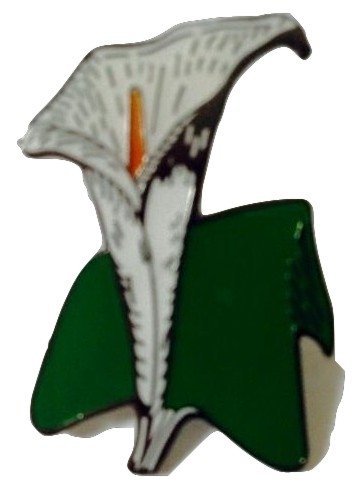
          Originally the Easter Lily was actually a three-dimensional paper flower rather than a badge.  The flower on which it was modeled was the Easter Lily but now is more imagined as the Calla Lily (Zandeteschia aethiopica).  Anne Matthews, who wrote a rather hostile history of Cumann na mBan, also wrote in her blog a good account of the origins of the Easter Lily emblem within the organisation.2

In early 1926 the reformed (fourth) Sinn Féin party3 instigated the first Day of National Commemoration, to commemorate the tenth anniversary of the 1916 Easter Rebellion at Glasnevin Cemetery on Easter Sunday. Cumann na mBan planned to take part in this event, and early in February the Executive saw an opportunity to use the event to raise some funds and perhaps increase membership and they decided to hold a flag day at the cemetery.

Over a series of meetings of the executive committee the women discussed the idea of the flag day, and decided instead to make it a ‘Flower Day’. Sighle Humphreys said they had considered flowers that bloomed in spring such as the crocus and the pansy, but eventually decided on a flower known generically as the Easter lily (botanical name is Lilium longiforum).

Within weeks Fiona Plunkett sent a circular letter to all branches of Cumann na mBan to explain the purpose of the Flower Day.

The flower we have decided upon is a lily (enclosed find sample) as we consider this would be the most suitable for Easter and it has also the Republican colours…You ought to call a meeting of all Republican women and young girls… and arrange for the collection at masses and at Commemoration Parades, football matches or fairs during the preceding week.

The Easter Lily flower, Lilium Longiflorum — this was reproduced as a paper flower, the first Easter Lily symbol by Cumann na mBan (Photo sourced: Internet)

The first Republican Easter lily was a paper flower. Cumann na mBan ordered 45,000 and asked the IRA for support by issuing a joint proclamation and assisting them in selling the flower. The men refused the invitation. The first Easter lily ‘Flower Day’ made a profit of £34 (£1,453 at today’s rates — DB4) but despite their disappointment with lack of support from the IRA, they gave them half the profits. Undaunted, the women continued with the Flower Day campaign every Easter. In 1929 and Cumann na mBan in its circular proclaimed:

Funds are needed to create an atmosphere favourable to our army… Funds are needed to educate people to resist the Free State and Northern “governments” …When you buy an Easter lily you are directly helping to overthrow foreign rule in Ireland.”

By the early 1930s the membership of Cumann na mBan had shrunk to such small numbers they could not do it alone and an Easter lily committee was formed comprising members of Cumann na mBan, the IRA, and Sinn Féin, consequently Cumann an mBan lost control of the venture.

In 1933, there was difficulty in sourcing Irish-made paper for the artificial flowers, and as Cumann na mBan were spearheading a ‘buy Irish’ campaign, a decision was taken to stop making the flowers and instead create a paper flag/badge, which could be worn on the lapel. However, the Lilium longiforum/ Easter Lily did not transfer well to the flag and the resulting image is more like the Calla Lily. The design they chose is the same design that is sold to this day.

The design of a typical (pinned) paper Easter Lily badge nowadays.
(Image sourced: Internet)

In 1937 Cumann na mBan made a statement about the money raised by the Easter lily campaign:

The men of Easter Week laid down a very definite road for the Irish people to travel towards freedom… All those who support the lily campaign can rest assured that the money raised is devoted to no other purpose than the propagation of these ideals and the securing of the necessary materials for their realisation.‘”

The Calla Lily (Zantedeschia aethiopica), which the paper badge image came mostly closely to represent.
(Image sourced: Internet)

THE LILY EXTINGUISHES THE TORCH

Fianna Fáil continued its policy of participation in the Dáil in opposition until it was able to form the Government in 1932, abolished the Oath of Allegiance and brought in a new Constitution in 1937, and soon became the political party most often in Government of the Irish State. On coming into power in 1932 Fianna Fáil unbanned the IRA, released interned Republican prisoners and during the early years Republicans largely supported the party even if they didn’t join it.
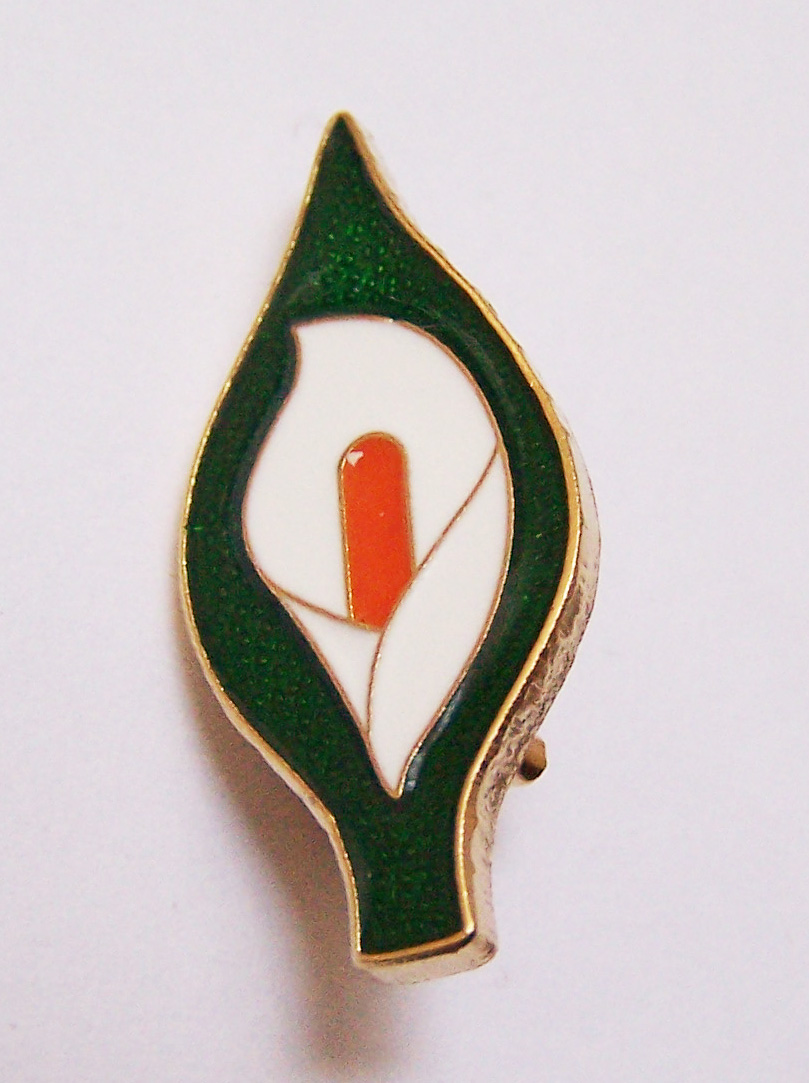
Another version of the Easter Lily enamelled badge.
(Image source: Internet)

Cumann na mBan continued to sell the Easter Lily and not only they, Sinn Féin and IRA wore and sold it but many supporters of Fianna Fáil also. But in the mid-1930s the differences between Fianna Fáil and Republicans who contested the legitimacy of the Dáil sharpened and during this period too the IRA grew considerably in numbers. Agitation around social conditions within the new state was attracting more people to the IRA as was the struggle against the “Blueshirt” fascist movement and their supporters among the original Free Staters’ political party, Cumann na nGaedheal. In 1935 the Fianna Fáil Government again banned the IRA, along with the Blueshirts.

In February 1935, after the IRA killed Richard More O’Ferrall (due to his eviction of 11 families from his lands in 1934), the Fianna Fáil Government cracked down hard including introducing trial without jury in the Special Criminal Courts and Military Courts, against the sentences of which no appeal was permitted.

The FF party’s leadership instructed its members to stop selling the Lily. However, as many would no doubt at least continue to purchase and wear the emblem, the party attempted to introduce a replacement badge, the “Easter Torch”.

Advert for FF’s “Easter Torch” or “An Lóchrann” badge (supplied by Méabh O’Leary, grma)

It was abandoned after a number of years having failed to gain popularity and many FF members and supporters continuing to wear the Lily.
An Easter Lily enamelled pin — there are a number of versions, some with a legend inscribed and some without.
(Image source: Internet)

‘STICKIES’

          In 1967 Sinn Féin produced a version of the Easter Lily paper badge with a gummed surface on the reverse. This seemed an interesting innovation, doing away with the need for a pin but as the day wearing it progressed, the badge had a tendency to become unstuck at one end or another – and sometimes both – and to curl unattractively.

Sinn Féin and the IRA both experienced an acrimonious split over a number of issues in 1969 from which emerged “Official SF” (and OIRA) and Provisional Sinn Féin (and PIRA). For the annual traditional commemoration of the Easter Rising in 1970, the ‘Officials’ continued with the new gummed version while the “Provos”, less for aesthetical than for symbolic reasons perhaps, reverted to the older pin-secured version of the badge.

Whoever baptised the Official SF and OIRA “Stickies” as a result is unknown but the use of the term became so widespread as to gain almost official (forgive the pun) status. The party continued to be known by that nickname through a number of splits and incarnations and today, the Workers’ Party have not quite shaken it off.

An attempt to baptise the other Republicans as “Pinnies” or “Pinheads”never really gained ground.

Easter Lily cloth badge — rarely seen.
(Image source: Internet)

SELLING THEN – WEARING TODAY

          Those who sold the Easter Lily in the Six Counties or who wore it were liable to arrest under the colonial statelet’s Flags and Emblems (Display) Act (1954-1987). It was not formally illegal in the Twenty-Six Counties (the Irish State) but sellers were subject to Garda Special Branch harassment under the excuse that the sellers did not have a license to sell (they declined to ask the partitioned State for permission and perhaps they would not have been be granted one). Flags and donations were seized by Gardaí and sellers at times arrested.

“Whenever they tried grabbing the Lilies and money from me, I slung it all on the ground. Let them go picking it all up if they wanted it!” commented a veteran Republican to me a couple of years ago. One can imagine that in such a situation, onlookers might pick the money and badges up, some to return to the victim or his comrades and some perhaps to keep for themselves. In either case, the Special Branch would be presented with the difficulty of badges blowing in the wind and coins rolling in all directions.
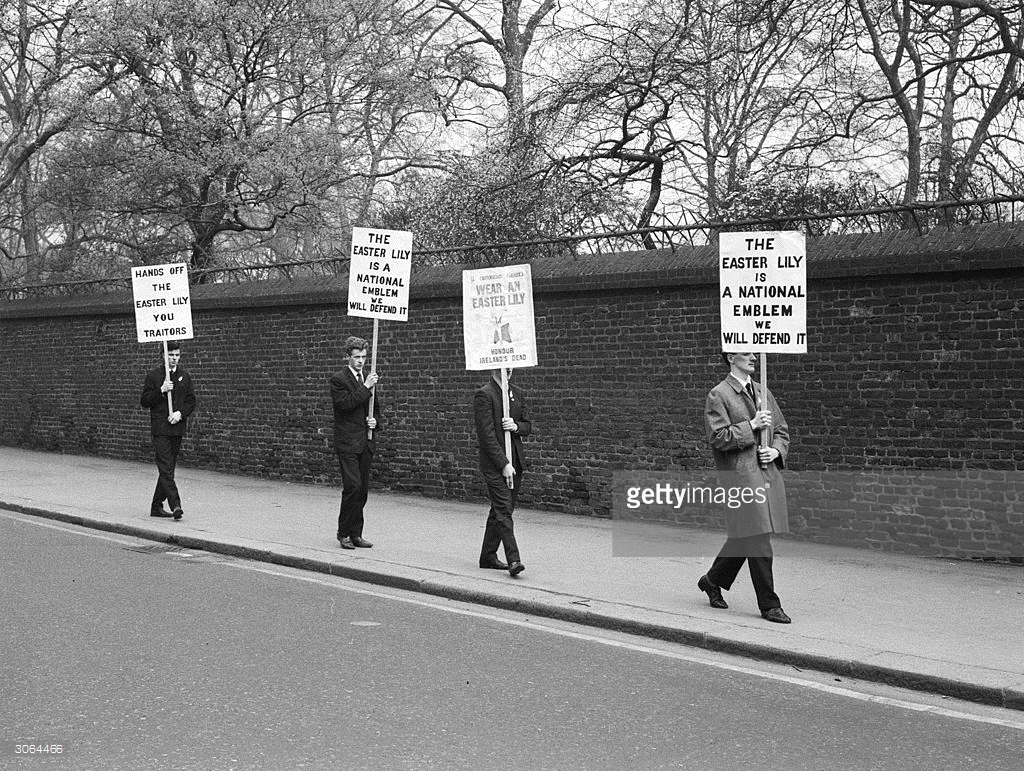
Placard parade defending right to sell and wear the Easter Lily — late 1950s/ early 1960s?
(Image source: Internet)

Today, the Easter Lily is visible much less than it was up to perhaps the 1980s. It is viewed by most people who know what it represents (many do not) largely as a Republican emblem (either SF or “dissident”). That is a pity. It should be viewed, I would submit, as a badge of national resistance, of anti-imperialism and as a commemoration honouring generations of men and women who have fought the colonial occupation and exploitation of their land. But let us also remember that it was the women who created the emblem and braved non-cooperation and repression to popularise it.

End.

References and further information:

https://en.wikipedia.org/wiki/Easter_Lily_(badge)

http://annmatthews.ie/blog-post/622/

FOOTNOTES

Cumann na mBan (“The Women’s Association”) was an Irish Republican organisation formed in 1914 in Wynne’s Hotel in response to the formation of the Irish Volunteers in 1913. It was organised, as were the Volunteers, along military lines and although set up originally as an auxiliary to the men’s organisation, it had its own uniform, structures and commanders. In that respect and in its insurrectionary intentions, it was the first women’s organisation of its kind in the world. Other revolutionary women at the time joined the Irish Citizen Army, also the first of its kind in the world, where women and men were accorded equal status. Both organisations played prominent roles in the 1916 Rising along with a number of other organisations. Cumann na mBan survived the ICA by a number of decades.

See url in References and Further Information at end of article

The word “fourth” is a reference by Matthews to the various incarnations of the party which started off as a nationalist one seeking a dual Irish and English monarchy for Ireland, with limited autonomy. The current party to which people normally refer when they say “Sinn Féin” may be seen as the party’s fifth or even sixth version, although the current party claims its origin in the first incarnation.
FOREIGNERS!

Diarmuid Breatnach

I’m sick of seeing foreigners everywhere. I mean, don’t get me wrong, I’m not racist or anything …. but they’re just everywhere. And as for Muslims building mosques! Here, in Ireland!

What’s wrong with that? We’ve got hundreds, maybe thousands of churches in Ireland.

Yeah, but we’re a Catholic country.

Do you object to Presbyterian, Anglican, Methodist and Unitarian churches too?

Er … no, they’re Christian religions. Muslim is completely different. We’re a Christian country – always have been.

Actually, no.

What do you mean?

We were pagans once. Before Christian missionaries came in.

OK, before St. Patrick. And yes, I do know he was a foreigner. But since then, we’ve been a Christian country, right?

Yes, I grant you that.

That’s what we need to go back to – Christian Gaelic Ireland.

An bhfuil Gaeilge agat?

No, I don’t speak it. No need to be smart. That’s another thing that was taken from us!

They teach it at school, though.

Not very well. And they force it, which turns people off.

They force maths on people too. And other subjects.

Yes …. well. Anyway, this is getting away from the subject. I was talking about … Getting back to the old Christian Ireland. The Ireland we fought against the British for. Which so many people died for.

James Connolly Monument, across from Liberty Hall, Beresford Place.
(Photo: D.Breatnach)

Like James Connolly, Patrick Pearse, Tom Clarke ….

Yes, exactly!

James Connolly was born in Scotland, Tom Clarke in England.

Well I knew about Connolly, but Clarke … are you sure?

Yep, Isle of Wight, SE England.

OK …. but …. they were still Irish, weren’t they …. like our soccer team?

Yes, I agree with you there.  And about Constance Markievicz ….

Listen, don’t try that one on me! She married a Polish count – but she was Irish.

She was born in England too.

Was she? Well ok, but of Irish stock too.

Gore-Booth – not exactly a Gaelic name, is it?

Look, let’s go back to Pearse – he was Irish through and through. He wrote in Irish – articles, stories and poems, didn’t he?

He most certainly did.

Well then!

His father was English, though.

What? You’re codding me!

No, seriously. James Pearse was English. And had married previously in England.

Now you’re telling me Patrick Pearse’s father was a BIGAMIST?

No, no, calm down. She died – he was a widower. Thomas Davis’ father was Welsh, by the way.

Thomas Davis Statue monument and fountain, Dame Street, Dublin, Irealand
(Photo: D.Breatnach)

Who wrote A Nation Once Again? That Thomas Davis?

Yes. And The West’s Awake.

OK, OK but Thomas himself was born in Ireland, wasn’t he?

Yes. Eamon Bulfin wasn’t though.

Bulfin? Who was he?

He hoisted the tricolour up on the GPO on Easter Monday 1916.

Did he? Was he born in England too?

No – in Argentina.

WHAT?

Yep. And De Valera’s da was apparently Cuban. Dev was born in the USA.

OK, OK, OK – but they were all part-Irish or wholly Irish …. in blood, I mean. Part of what they call the Irish diaspora.

True. But Erskine Childers wasn’t.  Totally English.

Ah now you’re trying to wind me up. He was President of Ireland – of course he was born here.

That Erskine Childers was but his Da wasn’t.

OK, so what?

Well, he’s the one who brought the Mausers into Howth. In his yacht. And he was murdered by the Free Staters in the Civil War.

That was him?

The Irish tricolour flag — presented to the ‘Young Irelanders’ by Parisian revolutionary women in 1848. (Image source: Internet)

Yeah, and part of the crew were two women – one born in England and one in the USA. By the way, the Tricolour that Bulfin hoisted on the GPO? You know what it signifies?

Yes. Peace between the original Irish, the Catholics and the descendants of the planters, the Protestants.

OK. Well, that’s not originally Irish either.

What? The Tricolour? Not Irish?

Not originally, no.

Where is it from then? Please don’t say England!

No – Paris. During the Paris uprising of 1848, French female revolutionaries presented it to an Irish Republican delegation.

So the Irish flag before that was …. just Green?

Well, Green yes, often with a harp in gold ….

Yes, Green, forever green, always the Irish colour …

Well, I hate to tell you this but …………..

End.


BLOOD ON THE STREETS OF GIBRALTAR

Diarmuid Breatnach

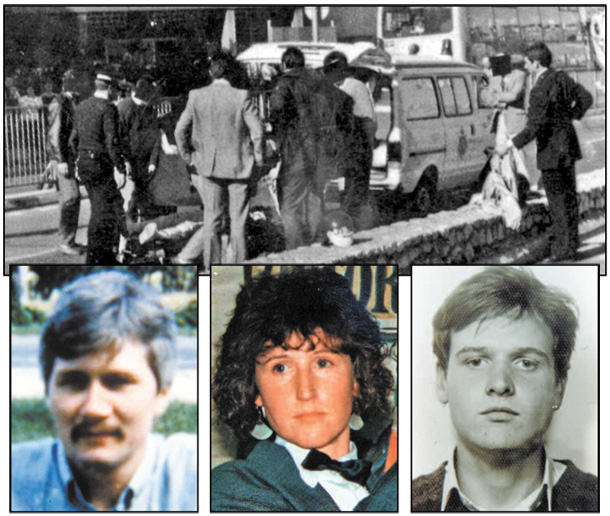
On the 6th of March 1988, an undercover unit of the IRA in the Spanish State was being tracked by Spanish police.  As the unit headed in to Gibraltar, their surveillance was taken over by a British Army unit of the Special Air Service.  Very soon afterwards, the SAS attacked the IRA unit and shot them down, shooting them again with execution shots on the street.  The IRA unit were unarmed and there was no attempt made to arrest them.  The SAS claimed that they had a bomb ready to detonate but no such bomb was ever found.  The three Volunteers were Mairéad Farrell, Seán Savage and Daniel McCann.
Above: Gibraltar 3 murder scene. Below: Daniel McCann, Mairéad Farrell, Sean Savage. (Source: Stair na hÉireann)

A Gibraltar woman, Carmen Proetta, who witnessed the murders from her flat and testified to what she had seen was villified and libelled in the British media (she successfully sued a number of them later).  A Gibraltar inquest judged the killings to have been unlawful.  Amnesty International in Britain denounced the killings — one of the few occasions in which Amnesty criticised the British Government with regard to its conduct in relation to the 30 Years’ War in Ireland.

Almost two months after the shootings Margaret Thatcher and her Foreign Secretary Geoffrey Howe tried to prevent an independent British TV company’s documentary on the killings, Death On the Rock and the career of the lead Editor, Roger Bolton,  suffered severely, although an independent investigation of the program vindicated the program.

Coffins of the Gibraltar Three being carried through West Belfast (Source image: The Irish News)

Streets of Gibraltar song

By The Irish Brigade (long version) + verse by DB*

Chorus

Oh, sad are three homes in Belfast Town,

all Ireland shares their sorrow;

as they walked in the sun, the Brits drew their guns

and they died on the streets of Gibraltar.

1

They flew out of Belfast with an ambitious plan

to carry the struggle to free Ireland –

Mairéad Farrell, Seán Savage and Daniel McCann –

and they died on the streets of Gibraltar.

Chorus

2

Hidden eyes had been watching, they followed each one
They knew they weren’t armed, that none had a gun
They
gave them no warning and no chance to run
For the three must die on Gibraltar.

3

Each of them unarmed, without mercy gunned down, *

shot again in the head as they lay on the ground

by the Special Air Service, assassins of the Crown –

they were murdered on the streets of Gibraltar.

(Chorus)

4

The SAS stood there, so proud of their deed –

three more freedom fighters shot down in the street:

Mairéad Farrell, Seán Savage and Daniel McCann –

they died on the streets of Gibraltar.

5

Mairéad, while in prison we watched you with pride;
True to all you believed in and for this you’ve died
With two fine volunteers Dan and Sean by your side —
A part of us died in Gibraltar.

(Chorus)

6

It happens each time that a Volunteer dies —
They screen out the truth with a cover of lies;
But we know what happened on that warm peaceful night
The Brits planned their deaths on Gibraltar.

(Chorus)

And their blood stained the streets of Gibraltar.

End.

The Lark

The Lark

Diarmuid Breatnach, London, May 1981.

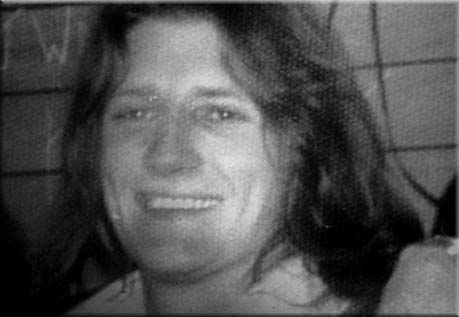
Bobby Sands, Officer Commanding Provisional IRA prisoners in H-Blocks before hunger-strike (Image source: Internet)

Last night, from afar, I watched the Lark die

and inside me, began to cry,

and outside, a little too.

There’s nothing more that can now be done,

to save the life of this toilers’ son;

another martyr – Bobby, adieu.

Imperialism takes once more its toll,

another name joins the martyrs’ roll

and a knife of sadness runs us through.

But sorrow we must watch,

for it can still,

yes, it can kill

the song that Bobby listened to.

And if his death be not in vain,

let’s fuel our anger with the pain

and raise the fallen sword anew;

and this sword to us bequeathed:

let its blade be never sheathed

’till all our foes be ground to dust

and their machines naught but rust ….

Then will the servant be the master

            and our widening horizons ever-vaster

                  and our debt

                       to Bobby

                            paid

                                 as due.


(Written in London as the death of Bobby Sands was imminent or had just occurred, after the author had attended pickets and demonstrations in solidarity with the hunger strikers in attempt to avert their deaths by pressurising the British Government to accede to their just demands. Bobby Sands died on 5th May 1981, to be followed by nine others in the weeks and months that followed. The struggle was one for the human dignity of Irish Republican political prisoners of Britain in the Six Counties British colony).

Senior Metropolitan Police officer accompanied by Constables harass Sands solidarity protesters in London
(Image source: Internet)
Skylark in Flight
(Image source: Internet)
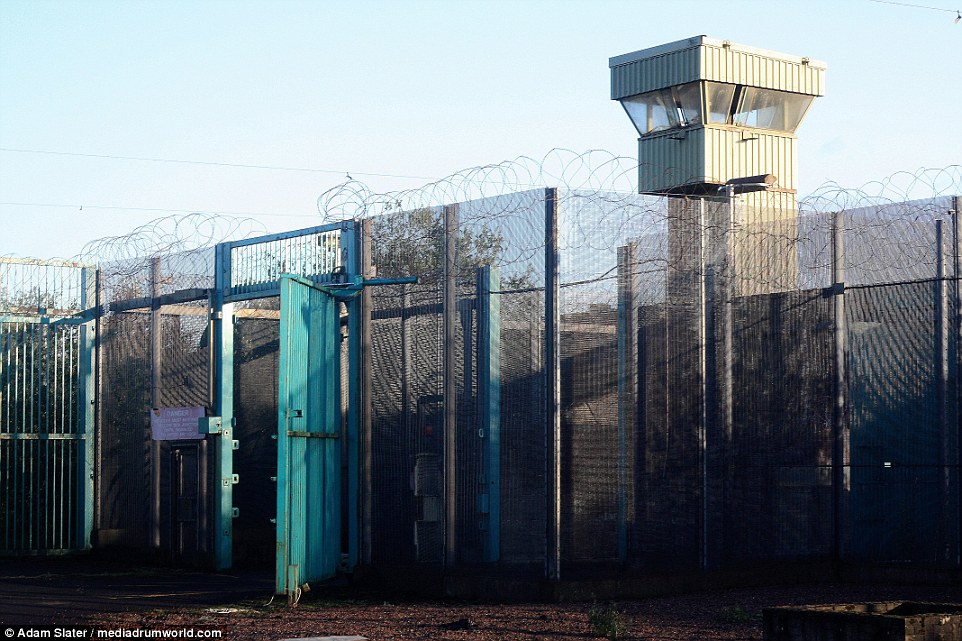
Gates Long Kesh
(Image source: Internet)


Glasgow & Dublin Joint GPO Protest Against Internment

End Internment FB page

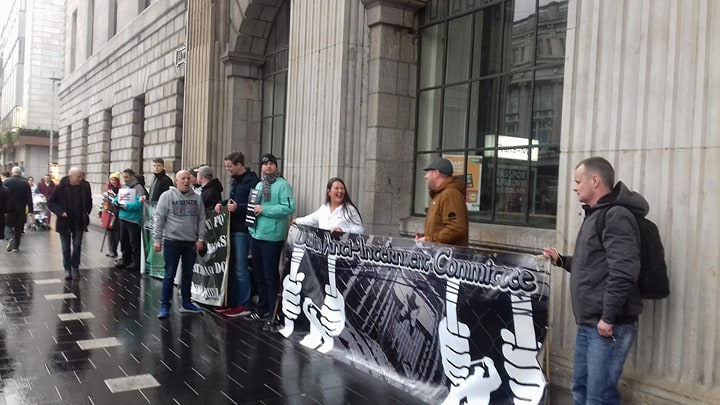
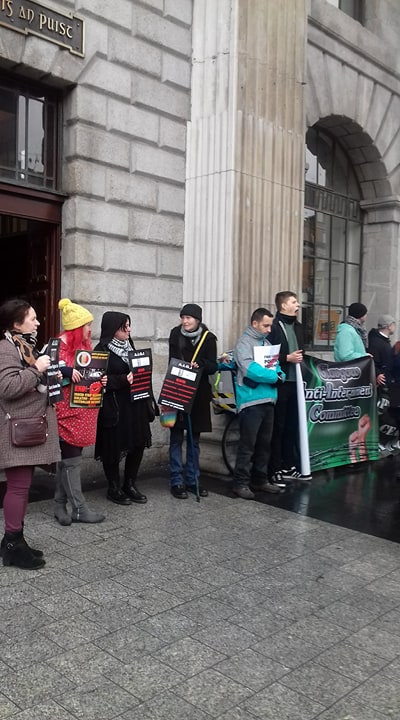
Glasgow and Dublin Anti-Internment Committees joined forces on 18th February in a protest against continuing internment without trial in Ireland. Around two score protesters gathered outside the iconic General Post Office building in Dublin city centre’s main thoroughfare, O’Connell Street. They displayed the anti-internment banners of the Dublin and Glasgow committees and placards against internment, including one against the jailing of Catalan political activists by the Spanish state (also refused bail).

Section of protesters outside the GPO building, O’Connell Street, Dublin (Photo source: End Internment FB page)
(Photo source: End Internment FB page)

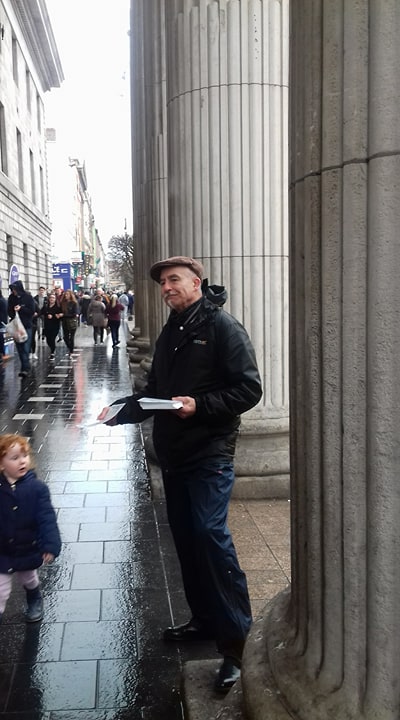
Leaflets of the Anti-Internment Group of Ireland were distributed to shoppers and visitors passing by, along with others about the conviction of Brendan McConville and John Paul Wooton (the Craigavon Two), framed and jailed in 2009 and still in jail, serving life sentences. Songs about internment and political prisoners were played on a sound system, as well as Labi Siffre’s Something Inside So Strong and Christy Moore’s Viva La Quinze Brigada.

Young passer-by accepts leaflet from Dublin Committee leafleter (Photo source: End Internment FB page)

Despite the official end of internment by the British in 19751 and by the Irish state in 19572, Republican activists continue to be jailed without trial in a number of ways: Licence revoked and bail refused or revoked.

(Photo source: End Internment FB page)

When a Republican leaves jail under license, she or he can be returned there without any court hearing or the presentation of any evidence against them; this is what has happened to Tony Taylor and Gerry Mackle, for example. Refusing bail for accused Republicans has become almost standard, despite the fact that this is supposed to be a last resort, for example when there is a serious risk of the accused fleeing the administration, or interfering with witnesses – which has rarely applied to Republicans refused bail. The real reason has usually been revealed when they have been granted bail: they are required not to attend protests, meetings or to associate with other active Republicans. In other words, they are being prevented from exercising their civil rights to express their opinions and to organise politically.

Welcoming the participation of the Glasgow Committee in Dublin, a spokesperson for the Dublin Committee stated that “members of the Dublin Committee have been proud to attend anti-internment protests in Glasgow in the past” and went on to say that “we look forward to future cooperation with the Irish diaspora and internationally against political repression, particularly of jailing without trial of political activists.”

Another Dublin Committee leafleter.
(Photo source: End Internment FB page)

The Dublin Anti-Internment Committee is entirely independent of any political party or organisation and holds regular awareness-raising protests at different locations. The Committee welcomes the participation of other organisations or individuals in their protests but asks them not to bring political party material etc to the anti-internment protests.

On its FB page the Committee also maintains a list of Republican prisoners in jails on both sides of the British Border, updating it from time to time.

FOOTNOTES

1 By then more than 1,900 people – only around 100 of them Loyalists – had been interned, many of them tortured; it was during protests against it in 1971 in Ballymurphy and 1972 in Derry that the Parachute Regiment killed 25 unarmed people.
2Introduced by De Valera’s government in July 1957 during the “Border Campaign” of the IRA.
(Photo source: End Internment FB page)

10th ANNIVERSARY OF DEATH OF FREEDOM FIGHTER COMMEMORATED IN DUBLIN

10th ANNIVERSARY OF DEATH OF VOLUNTEER BRENDAN HUGHES COMMEMORATED IN DUBLIN

(From the End Internment FB page, courtesy of the Dublin Committee of the Anti-Internment Group of Ireland)

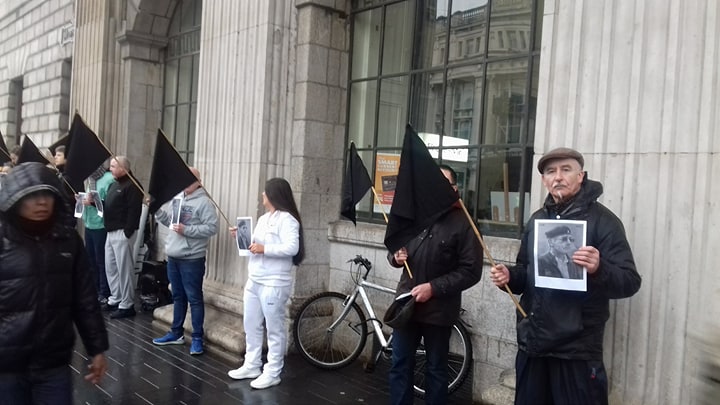
Irish Republicans (mostly independent) and a number of anarchists and socialists commemorated Brendan Hughes (“The Dark”) today (18th Feb 2018) at the General Post Office building in O’Connell Street, main street of Dublin. Republicans from Glasgow also participated.

People with black flags and portrait photos of Brendan Hughes outside the GPO building in Dublin marking the 10th anniversary of the freedom fighter’s death. (Photo source: End Internment FB page)

Around two score assembled with black flags and portraits of the IRA Volunteer who died aged only 59 ten years ago (2008). Hughes was from a Belfast Republican working class family and entered the struggle, enlisting in the Provisional IRA in 1969. He was arrested in 1973, beaten and jailed but escaped, leaving Belfast but subsequently returning to Belfast, to the Malone Road middle-class area under an assumed name while he continued in his resistance activities.

Captured again in 1974 with a number of firearms at his address he was sentenced to 15 years in jail. In 1973 he was convicted of assaulting a prison guard in the jail and was sent to Long Kesh. This was after political status had been removed from Republican prisoners and Hughes joined the “blanket protest” (refusing to wear prison uniform). Later he led the “dirty protest” (prisoners refused to “slop out” after being beaten by guards and emptied their bodily wastes out the windows until these were blocked up, then out under their cell doors, until they were swept back at them and finally on to the walls of their cells).

Hughes began hunger strike which he maintained for 53 days in 1980, ending with others only after what appeared to be a deal offered by Thatcher. It is believed his health never recovered from his prison experiences; he suffered from problems with his heart and eye problems, in addition to arthritis.

Brendan Hughes in Youtube program exposing the pacification process. (Image source: Youtube)

Released from jail after 10 years, he became a serious critic of the “Peace” (pacification) process; according to his brother, Hughes asked that his former comrade Gerry Adams not be permitted any role in his funeral. His brother admitted later that he had bent to pressure and had allowed Adams to carry Hughes’ coffin.

Brendan “The Dark” Hughes died on 16th February 1998.


LINKS:

Guardian obituary:

https://www.theguardian.com/uk/2008/feb/19/northernireland

 Youtube video with Brendan Hughes:

GEORGE GALLOWAY ADDRESSES ANTI-IMPERIALIST MARCH IN DUBLIN

Clive Sulish

A crowd gathered at the Dublin and Monaghan Bombing Monument in Talbot Street this evening for a short ceremony and the start of a march to rally at the General Post Office building in Dublin city’s main street. The event was organised by Anti-Imperialist Action Ireland “to highlight imperialist war-crimes around the world, from Ireland to Yemen and Syria.”

View of section of crowd before start of event with the Memorial in the background (Photo: D.Breatnach)

View of section of crowd near the Memorial before start of event
(Photo: D.Breatnach)
View of section of crowd near the Memorial before start of event
(Photo: D.Breatnach)
View of section of crowd near the Memorial before start of event
(Photo: D.Breatnach)

As people assembled, a crowd of European youngsters was noted passing by, no doubt part of some scheme to learn English and something of the culture outside their own country. Sadly their teacher passed by the Monument without calling their attention to it.

The bombings on 17 May 1974, killing 33 civilians and a full-term unborn child and injuring almost 300, claimed the highest toll of any event during the 30 Years War and was the deadliest attack in the history of the Irish State. The bombings were organised by British Intelligence agents with Loyalist participation and not one person was ever charged.

It was not a good day for the march and participants came prepared for the worst but the rain stopped just before the event and held off, apart from an occasional drizzle, until after the event, when it fairly lashed down.

George Galloway approaching the Monument to lay a floral (Photo: D.Breatnach)
George Galloway after laying wreath, hat removed for a moment in respect. (Photo: D.Breatnach)

Pádraig Ó Fearghaill spoke first in Irish welcoming all who had attended, outlined the order of events and then called on George Galloway, famous British anti-imperialist politician, writer and broadcaster, to lay a floral wreath at the monument, which he did. Ó Fearghaill then called on Diarmuid Breatnach to sing the Woody Guthrie song about the massacre of mineworkers in Colorado, USA, by capitalists including the imperialist John D.Rockefeller. Breatnach sang “The Ludlow Massacre”.

The march then formed up and, led by a floral wreath-holder and black flags, proceeded up Talbot Street, into North Earl Street and up to the GPO. Along the way they chanted “From Ireland to Palestine- Occupation is a Crime” and “Donald Trump/Theresa May- How many kids did you kill today?” The demonstration received a lot of support from passers by along the way and drivers of cars and buses who beeped to show support. The marchers, some of who were carrying candles or light up boards made there way to the GPO where a further crowd had already gathered.

Section of crowd at GPO (Photo: D.Breatnach)

From well-known activists participating and banners carried it was clear that the march had attracted wide support across sections of the Republican movement in parties and campaigns, with participation of independent activists of republican, anarchist and socialist background.

Section of crowd at GPO (Photo: D.Breatnach)

Outside the GPO building, Ó Fearghaill called on Máire Uí Mhaoileoin to lay a wreath in memory of those who have lost their lives as a result of imperialist war-crimes and then introduced George Galloway, who remarked that he was proud to speak outside the building that had played such a part in the first blow against the British Empire of the last century. Galloway went on to refer to continuing British occupation of the Six Counties of Ireland and imperialist interference in the Middle East and the occupation of some countries. In the latter category he praised the Palestinian Ehed Tamimi, whose 17th birthday was just that day and called her “a leader of the resistance for the whole Middle East”.

Section of crowd at GPO (Photo: D.Breatnach)

Reminding the attendance of the ongoing crime of internment, Ó Fearghaill announced a representative of a campaign around Tony Taylor, who announced he was reading a statement from Lorraine Taylor, Tony’s wife. Taylor, a Derry Republican, was detained in March 2016 and has been in jail since, without trial or even charge.

Section of crowd at GPO (Photo: D.Breatnach)

Presenting Diarmuid Breatnach again to sing the famous Eric Bogle anti-war song “The Band Played Waltzing Matilda” referencing the bush-ballad of “Waltzing Matilda”, the Australian unofficial national anthem. However, following

Section of crowd at GPO (Photo: D.Breatnach)

a suggestion from a participant, Breatnach led the crowd in singing “Happy Birthday” in English and in Irish to Palestinian child-prisoner Ehed Tamimi. After Breatnach’s rendition of Bogle’s song, Ó Fearghaill thanked all the the participants and promised that Anti-Imperialist Ireland would continue to build up resistance against imperialism in Ireland and in the world beyond.

End

Section of crowd at GPO (Photo: D.Breatnach)

“Back Home in Derry” with new air

Bobby Sands, who was the first of the ten hunger strikers to die in 1981, had written a number of articles, songs and poems.  One of the latter was arranged for song by Christy Moore, calling it “Back Home In Derry” to the air of “The Wreck of the Edmund Fitzgerald” (by Canadian singer Gordon Lightfoot).

The rendition here by Diarmuid Breatnach is to a new air composed also by Breatnach.  Although he has been singing it for some years in song sessions, this is the first time it has been posted as a video.

“I thought that the lyrics and the original author deserved a new air”, said Breatnach, a Dublin singer.  “Christy Moore did a great job arranging the lyrics for song.  I hope the new air becomes at least as popular as Gordon Lightfoot’s.”

https://www.dropbox.com/s/dosrz71cmcw1s3p/Song%20Video%20edit%20%202%20made%20jan%202018.mp4?dl=0


“Be Moderate” (or “We Only Want the Earth”) by James Connolly

The lyrics were written by James Connolly and published in his songbook Songs of Freedom in New York in 1907.  Diarmuid replaced the words “labour” with “workers” and “true men” with “true hearts”.  There was no indication of to what air the song should be sung (quite common, the expectation being that being would use a popular air at the time) and it has been put to at least three airs.

Diarmuid Breatnach here sings it to the air of A Nation Once Again (by Thomas Davis, ‘Young Irelander’) which is the air he heard it sung by Cornelius Cardew, an English communist composer.  This air suits it and the arrangement provides a chorus in which people can join.

The recording was done at the weekly Save Moore Street From Demolition campaign table (Saturdays 11.30am-1.30pm) with Bart Hoppenbrouwers videoing.

James Connolly was one of around 350 men and women who occupied the Moore Street area during the 1916 Rising after the evacuation of the burning GPO, which had been the HQ of the Rising.  Connolly was one of five signatories of the Proclamation who spent their last hours of freedom in those houses and one of six of the fourteen executed after they surrendered in Moore Street.

The Irish Government, property speculators and the Planning Dept. of Dublin City Council are all pushing that only four buildings in that battleground be saved and a huge supermarket be built over the whole area but the SMSFD campaign wants the whole quarter saved and sensitively developed.

end.

https://www.facebook.com/save.moore.st.from.demolition/