BRIGADISTA PETER DALY COMMEMORATED IN HIS HOME TOWNLAND

(Reading time: 20 mins)

Clive Sulish

SPEAKERS WARN OF RISING FASCISM, CALL FOR UNITY OF ANTI-FASCISTS

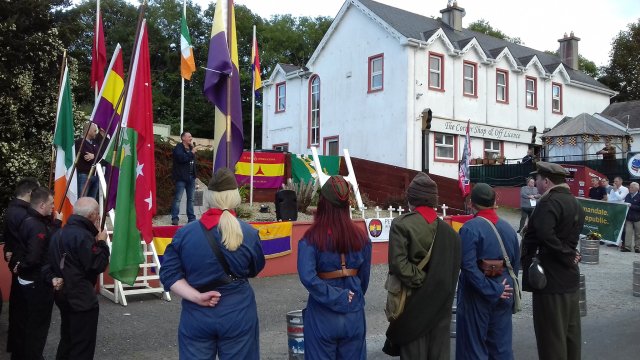
          Flags of various kinds flew above a gathering in Monagear, Co. Wexford on Saturday 7th September, while a number of banners were visible among the crowd: Peter Daly Society, Connolly Association Manchester, Wexford Community Action, Anti-Imperialist Action Ireland, Friends of International Brigades Ireland, Éirigí, Connolly Column. Also in attendance was a group of young men and women dressed to represent the International Brigaders and the POUM1 milita, organised by the Cavan Volunteers group. The event had been organised by the Peter Daly Society with support from the Peadar O’Donnell Forum.
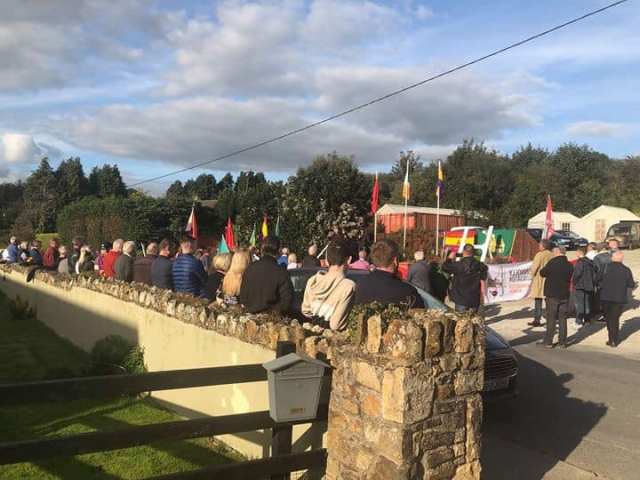
Monagear Commemoration from behind wall
Long view of Peter Daly commemoration seen from the back (Photo source: Peter Daly Society)
moin-na-gcaor-1798-banner.jpg
A reminder of even older struggles — banner inside the Monageer Tavern. (Photo source: D.Breatnach)

Monagear is a small village in the centre of Co. Wexford, a few kilometres north-east of Wexford town. Also known a Monageer, both words are, like most place-names in Ireland, from the original Irish language: Móin na gCaor, “the bogland of the berries” (probably of the Rowan or Mountain Ash, which in Irish is Crann Caorthainn). Not far from it are the historic place-names associated with the United Irishmen uprising of 17982 in that county, such as Boolavogue and Enniscorthy and indeed, a small commemoration garden in the village has memorial stones dedicated to that struggle and to others since.
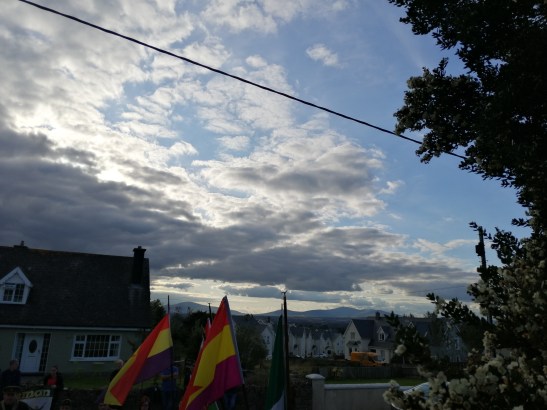
sdr
View in a cloud-darkened moment over the crowd, past the new houses in the village and to the hills and mountains in the distance. (Photo source: D.Breatnach)

At a signal, the gathering of people with flags and banners, led by a colour party flying the Irish Tricolour, the flag of the 2nd Spanish Republic, a red starry flag and the Irish workers’ Starry Plough, moved in procession down into the village area and assembled outside the raised platform containing the tasteful simple memorial to Peter Daly, International Brigader killed in the War Against Fascism in the territory of Spain (1936-1939).

Steve McCann, Chairman of the Peter Daly Society, with another man beside him, opened the ceremony from the memorial platform by briefly outlining the history of the Peter Daly commemorations and of the Society (founded in 2011) which he said had from the beginning welcomed the involvement and participation of Irish Republicans, Communists, Socialists, Anarchists and plain anti-fascists. After outlining the program of speeches and songs for the day, he called Gearóid Ó Machaill to give the first speech, on behalf of the Friends of the International Brigades, Ireland.
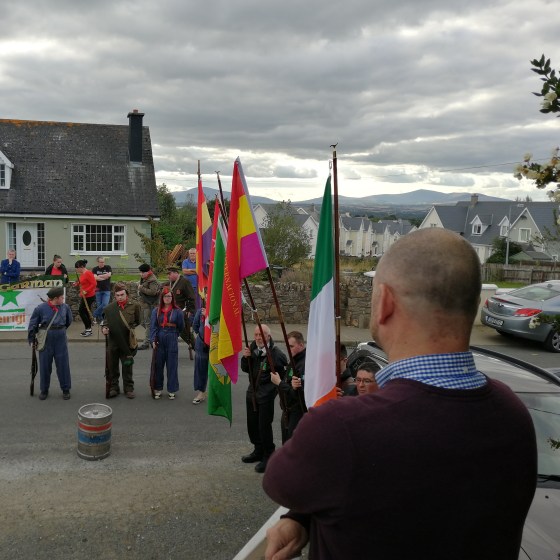
sdr
Steve McCann addressing crowd with colour party and reenactment group visible below (Photo source: D.Breatnach)

“THE IRISH ARE NOT IMMUNE TO FASCISM”

          Ó Machaill opened his speech in Ulster Irish, thanking the organisers for giving him the opportunity to speak there at the cradle of Peter Daly, Irish Republican, socialist, anti-fascist. Continuing, he said that the conditions that gave rise to fascism in the 1930s are very similar to those of today. Speaking of the Republican Congress of 1936-1938, he said it had worked to overcome divisions in the working class and in the anti-imperialist movement. But it had fallen apart in disunity, unfortunately and in Ireland today, the anti-fascist forces are as divided too.

The Irish were not immune to fascism and had a strong fascist movement in the 1930s, supported for awhile by the State, X said. In the years since the defeat of fascism around most of the world, attempts to set up a fascist movement in Ireland had been smashed, said Ó Machaill but cautioned against complacency.

In some other parts of the world, workers betrayed by social democracy and hurt by capitalism, turned to hard right parties and outright fascists and it was entirely possible that such fascists would become popular while leading a campaign against bankers and even imperialism, pushing a line of “Irish for the Irish”.

“We cannot afford the divisions and need to unite ….. as Republicans and Socialists did in preventing the attempted launch of Pegida in 2016,|” said the speaker.
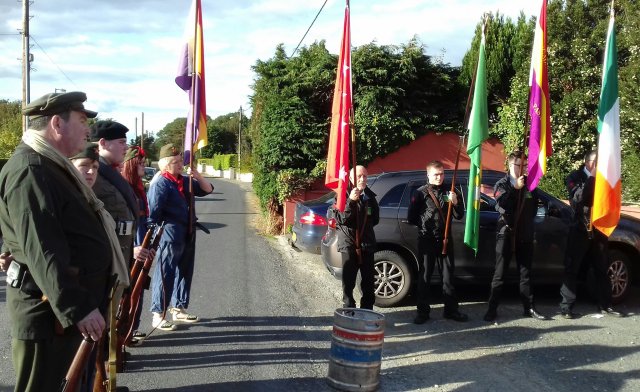
Colour Party & side view Militia GOM
Colour Party facing photographer, POUM and Brigader reenacters to the left. (Photo source: G. Ó Machaill)

MIGRANT DEPORTEES

          Steve McCann introduced the man beside him as Diarmuid Breatnach and called him to sing the first song of the selection for the ceremony and to say a few words about its content. Breatnach pointed out that migrants are often a prime target of fascists and the song he was to sing was about migrants and their treatment. On 28th January 1948, a DC-9 transporting Latino illegal migrants and “guest workers” crashed in the Los Diablos region of California and all 32 on board were killed. The radio news reported the crash but only gave the names of the crew members and the Immigration Department guard, saying the others killed were “deportees”. The names of the dead were known in their localities and were printed in local newspapers but were not deemed worthy of mention on the radio.
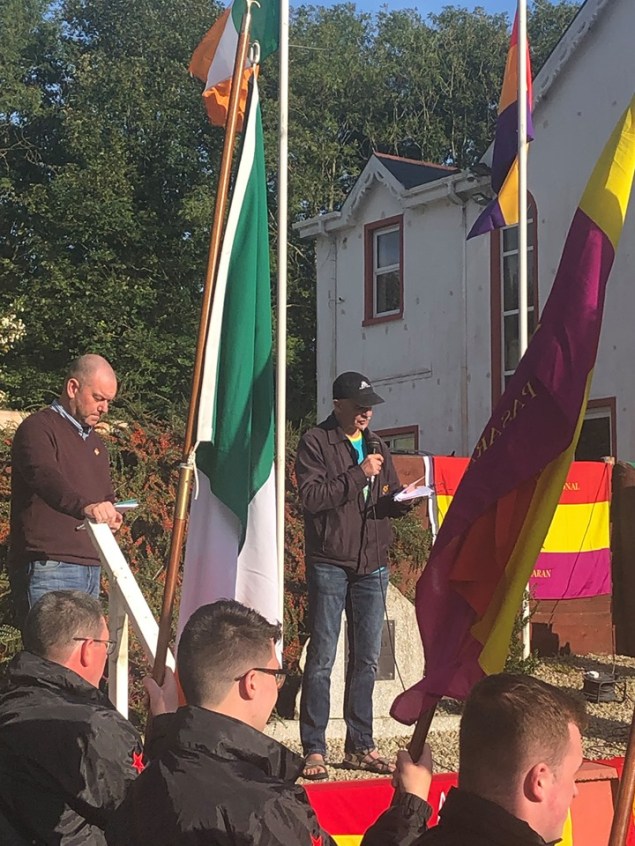
DB Reading Intro Song Platform Peter Daly Monageer Sep 2019
Diarmuid Breatnach reading introduction before singing a song. Steve McCann is standing to the left of the photo on the stage. (Photo source: Ado Perry)

Wood Guthrie wrote a poem called “Deportee” about the tragedy which was put to music by Martin Hoffman, the song since called Deportees or Plane Wreck at Los Gatos. Breatnach then sang the song, the chorus of which says:

Goodbye to my friends,

Farewell Rosalita

Adios mis amigos, 

Jesús y Maria;

You won't have a name 

When you ride the big airplane --

All they will call you 

Will be “deportees”.

LESSON OF HISTORY – NOT LIBERALISM BUT ROBUST ACTION IS NEEDED

          Mags Glennon was called to read a statement on behalf of Anti-Fascist Action. Moving on from the background to the fascist upsurge of the 1930s and the background of those who fought to defeat it, Glennon read: Far-right parties have risen from minor subculture to government across Europe in recent years, showing the glaring need for principled and active opposition to fascist and far right forces. The most concerning aspect of this political resurgence is the support it has received from young people and large sections of the traditional working class, due to the abandonment of these people by social democrats, and other parties who claimed to ‘represent’ them. Well meaning liberalism has never defeated fascism. It never will.”

Reading from the statement, Glennon called for a “re-energising” of the struggle to defeat those “aiming to distract our communities and young people from fighting their real enemy. Where there are fascists we must oppose them.”

Glennon concluded by reading: “Appeals to the police, to parliament or to Google to censor fascists have no place in anti-fascist struggle. History has shown that robust action against fascists in Ireland has always sent them running back to the gutters to think again. Long may it continue. La lucha continua!

Militia GOM
POUM militia and International Brigader reenacters seen from behind, centre photo. (Photo source: G. Ó Machaill)

“MUST ORGANISE IN WORKING-CLASS COMMUNITIES”

          The MC, Steve McCann, introduced the anti-fascist and community activist as well as Independent Dublin City Councillor, Ciaran Perry. Speaking without notes, Perry outlined the historical necessity of defeating fascism politically and physically.

Echoing a previous speaker’s comments, Perry too called for unity of the antifascist forces against fascism but also against capitalism and imperialism. He said that working-class communities, betrayed by social democracy and distracted by identity politics, had become prey to the propaganda of fascists.

ciaran-perry-speaking.jpg
Ciaran Perry speaking

Fascism is a facet of capitalism”, Perry said “and therefore the enemy of the working class.  The working class should be our natural constituency.”

Going on to suggest that if fascists build bases in working class communities it is because of the failure of the Left, he called on socialists and antifascists go into those communities and to build their bases there.

ESCAPE FROM DACHAU AND DEATH IN SPAIN

          Breatnach stepped forward to sing a combination of two songs from the German side of the anti-fascist struggle. The German political prisoners in the concentration camps were forbidden to sing socialist songs and had written their own, one of which became famous around the world was The Peat Bog Soldiers, lyrics written by Johann Esser, a miner and Wolfgang Langhoff, an actor and melody composed by Rudi Guguel.

“Hans Beimler (1895-1936) was a WWI veteran, a Communist, a Deputy elected to the Reichstag in 1932,” said Breatnach. “In January 1933 Hitler came to power in Germany. The Communist Party was banned and in April 1933 Beimler was arrested and sent to Dachau extermination camp where, in May, he strangled his SA guard and, putting on the man’s uniform, escaped. He went to Spain where he was a Commissar with the International Brigades and was killed in the Battle of Madrid on 1st December 1936.”

He would sing two verses of the Peat Bog Soldiers, Breatnach explained, combined with the Hans Beimler song.
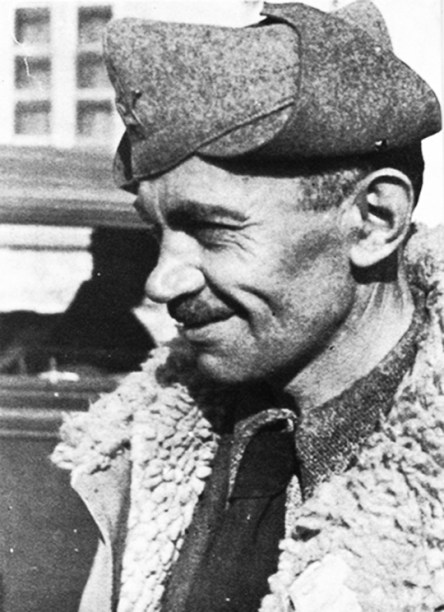
Hans Beimler Photo Spain maybe
Photo of Hans Beimler, WWI veteran, Communist, escapee from Dachau, International Brigader, killed in the Battle of Madrid 1936.                      (Photo source: Internet)

“THE NORM WAS FOR ALL CAPTURED INTERNATIONAL BRIGADERS TO BE EXECUTED”

          The sun sinking towards the west shone over the heads of the attendance on to the raised bed of the memorial stone and its flagpoles and, except when covered by clouds, into the eyes of those on the platform. Outside the nearby pub some locals gathered and behind those gathered around the monument, others in attendance lined a low wall while nearby other local people, mostly youth, congregated for a time. Occasionally a passing car drove carefully along the street past the crowd. House martins darted above, a wasp occasionally bothered the speakers and the smokey-blue soft curves of the Silvermine Hills and Knockmealdown Mountains rose to the west.

Harry Owens Speaking
Harry Owens speaking from the platform (Monagheer Tavern to the right of photo)

The Chair of the event called Harry Owens to speak.

Harry ‘s speech traced the history of world events that had led up to the fascist coup and war in Spain. He also spoke about the kind of people the Brigadistas had been, quoting from their comrades, journalists and opponents. That Captain Frank Ryan had his life spared was unusual, he explained, as the tendency was for all anti-fascist officers to be executed and all International Brigaders of all ranks. Whilst the Spanish fascists wanted to execute them, the Italian soldiers tended to keep them alive in order to exchange them for Italian prisoners of the Republican side.

The death toll among officers and men in the International Brigades had been higher than the norm in warfare and the average in the Irish contingent higher still, Owens said. The food and armament supply conditions of the Republican side had been poor in many areas but almost to a man they had fought on until death, capture or demobilisation. It was their conviction, that they knew what they were fighting for and believed in it that accounted for that.

After Owens’ speech, Breatnach stepped forward to sing, without introduction, Viva la Quinze Brigada3 (the song written by Christy Moore about the Irish who fought in the 15th International Brigade). The song mentions Peter Daly in the verse:

This song is a tribute to Frank Ryan,

Kit Conway and Dinny Coady too,

Peter Daly, Charlie Reagan and Hugh Bonner,

Though many died, I can but name a few.

Danny Doyle, Blazer Brown and Charlie Donnelly,

Liam Tumlinson, Jim Straney from the Falls,

Jack Nalty, Tommy Patton and Frank Conroy,
Jim Foley, Tony Fox and Dick O’Neill.

The words of Moore’s chorus rang out along the street:

Viva la Quinze Brigada!

No Pasarán!” the pledge that made them fight;

Adelante” is the cry around the hillside,

Let us all remember them tonight.

…. and concluded with the cry “Viven!” (“They live!”)

WREATHS, THE INTERNATIONALE AND AMHRÁN NA BHFIANN

          McCann called for those who wished to lay wreaths on behalf of organisations and the following came to lay floral tributes: John Kenny, activist of the Peter Daly Society; Mags Glennon for Anti-Fascist Action; Seán Doyle for Anti-Imperialist Action Ireland (who had provided the colour party); Connolly Association Manchester; and Gary O’Brien for Éirigí. Messages of support had been received from the CPI, IRSP and the Connolly Association Manchester.

Closeup Peter Daly Monument & Wreaths
Closeup of Peter Daily memorial with floral tributes laid. (Photo source: Peter Daly Society)

McCann then called Breatnach forward to sing the Internationale, the international anthem of the working class, the lyrics of which Breatnach explained had been composed by Anarchist Eugene Pottier of the Paris Commune, in 1871, the first time the working class had seized a city. It had been written to the air of the Marsellaise but later put to its own melody by worker-composer Pierre de Gayter.

“It was written in French”, said Breatnach, “which is why I propose to sing the chorus once in French at the start but it has been translated into many languages. Youtube has a post with 95 translations ….. and there are at least three versions of it in English and people are welcome to sing along in any version they know,” Breatnach concluded before singing the French chorus, followed by two English verses and chorus.

The MC Steve directed attention to a bodhrán decorated with a dedication to Peter Daly by Barry O’Shea which was displayed by Erin McCann and which would be raffled as a fund-raising exercise at the reception inside the pub.
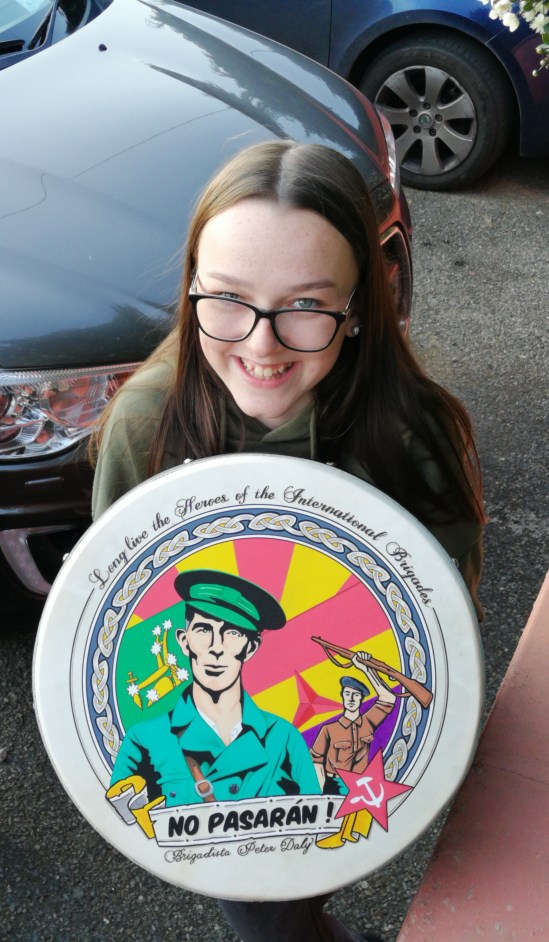
girl-with-p-daly-bodhran.jpg
Ciara McCann with the bodhrán decorated by Barry O’Shea (Photo source: D.Breatnach)

Steve McCAnn then called Marie Kenny Murphy and Marilyn Harris up on to the stage, where they played the Irish national anthem on flutes, with many people singing along in its Irish translation4:

Anocht a théim sa bhearna baoil,

Le gean ar Ghael chun báis no saol;

Le gunnaí scréach, faoi lámhach na bpiléar,

Seo libh, canaig’ Amhrán na bhFiann.
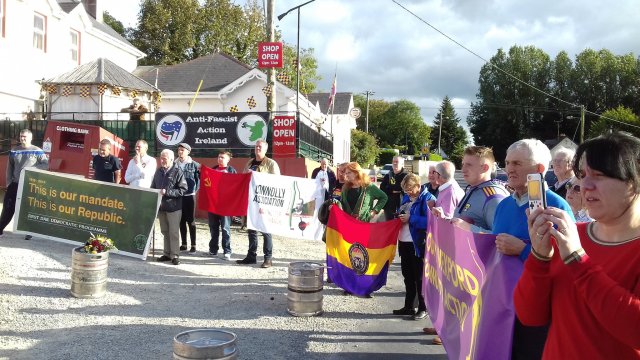


Part Crowd Close GOM
Section of crowd around monument (Photo source: G. O Machaill)

REFRESHMENTS, EXHIBITION, RAFFLE, SONG AND CONVERSATION

          All the speakers had referenced the historical memory of the Anti-Fascist War on Spanish territory to the struggles of today and even of tomorrow and the selection of songs had been deliberately chosen to emphasise internationalism and workers’ solidarity from the past and needed today.

McCann thanked all the performers, speakers and participants and in particular welcomed the participation of the Connolly Association contingent from Manchester, encouraging them to attend again the following year. Inviting all to enter the local Monageer Tavern to view the Antifascist War memorabilia and to have some food, the MC brought the ceremony to an end.

Inside the local pub, the Monageer Tavern, food had been made available by the owners and the function hall was provided for the commemoration participants.

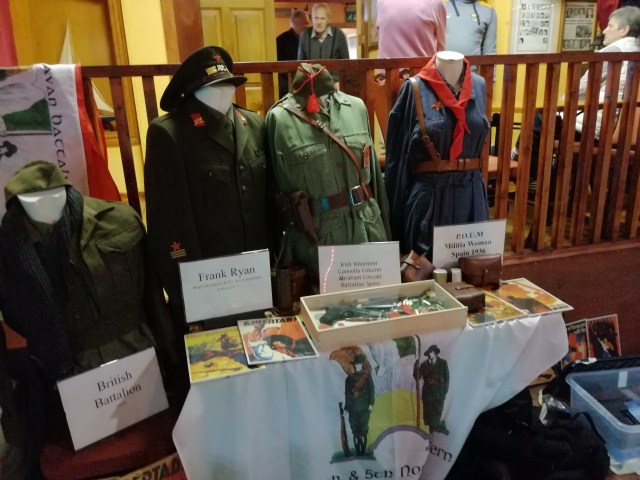
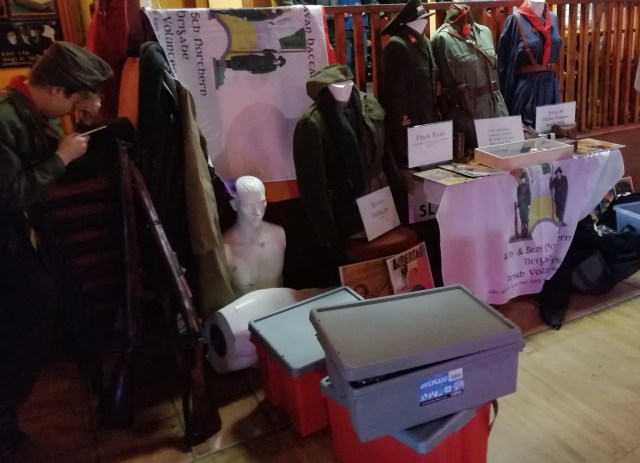
An interesting display of memorabilia of the Spanish Anti-Fascist War had been erected inside by the Cavan Volunteers history group. The walls of the function room on one side were also covered with permanent framed photographs and other images of Irish history, among which Joe Mooney, anti-fascist, community worker and activist of the East Wall History Group, spotted a photo of the Dublin docks with a docker well-known to his community in the foreground!

Music was provided by Tony Hughes with voice and guitar, singing a selection of songs including anti-racist and Irish Republican ballads, also Viva La Quinze Brigada.
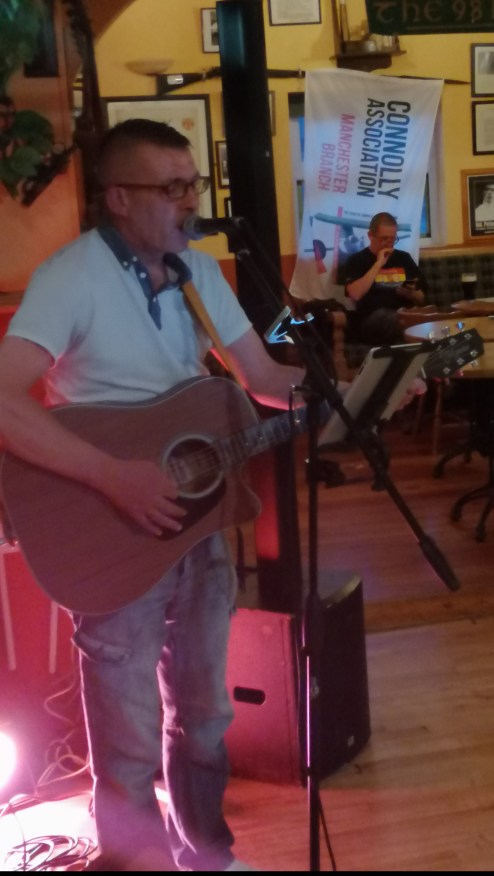
solo-performer-pub.jpg
Tony Hughes playing and singing at the event inside the Monageer Tavern                                       (Photo source: D.Breatnach)
antif-war-memorabilia-wider.jpg
Spanish Anti-Fascist War memorabilia organised by the Cavan Volunteer history and re-enactment group (Photo source: D.Breatmach)

dav

When the raffle was held a search went on for the winning number ticket which eventually unearthed it in the possession of Helena Keane, seller of the tickets and who adamantly refused to take the prize. Another dip into the stubs brought Gearóid Ó Machaill’s ticket out, ensuring the decorated bodhrán would find a new home somewhere in the occupied Six Counties.
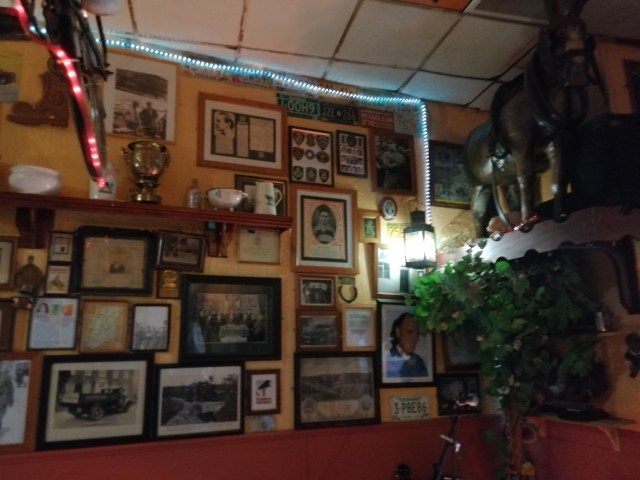
mde
Section of the function room wall in the Monageer Tavern. (Photo source: D.Breatnach)
mde
Another section of the function room wall. (Photo source: D.Breatnach)
lineup-people-banners-peter-daly-monument-7-aug-2019.jpg
(Photo source: Ado Perry)

FOOTNOTES

1The International Brigades were organised through the Comintern and Communist parties in various parts of the world but a number of International Volunteers came also through the mainly Trotskyist POUM, including Anarchists. One Irish volunteer went to join the Basque Gudaris and was killed fighting the fascists there.

2First Republican rising in Ireland, organised and led for the most part by Protestants, descendants of British colonists.

3Christy Moore called this “Viva la Quinta Brigada” (i.e the Fifth) but in later versions sang in English a line in the first verse calling it “the 15th International Brigade”. It appears that from different chronological perspectives one can call it either the Fifth or the Fifteenth but the mostly English-speaking brigade of the International Brigades is usually named the Fifteenth. Quinze is the Spanish word for “fifteen” and Viva la Quinze Brigada scans in the song while “decimoquinta Brigada” has too many syllables to fit.

4The Soldier’s Song was written originally in English by Peadar Kearney, an Irish Republican worker with socialist sympathies and put to music by worker-composer Patrick Heeny. It was translated to Irish by Liam Ó Rinn under the title Amhrán na bhFiann and published in 1923. Only the chorus became the anthem of the Irish State and that was not until later. The Irish-language version is the one most commonly sung at non-State occasions now.

LINKS FOR FURTHER INFORMATION:

Organisers
Peter Daly Association: https://www.facebook.com/PeterDalyCommemoration/

with help from the Peadar O’Donnel Forum: https://www.facebook.com/Peadar-ODonnell-Socialist-Republican-Forum-1538296709833402/

Colour Party by Anti-Imperialist Action Ireland: https://www.facebook.com/AIAIreland2/

Memorabilia and kitting out of POUM militia and International Brigade reenacters by Cavan Volunteers group: https://www.facebook.com/groups/242987949412133/

End .
IRISH GOVERNMENT FUNDS DOG-KILLING INDUSTRY

Diarmuid Breatnach

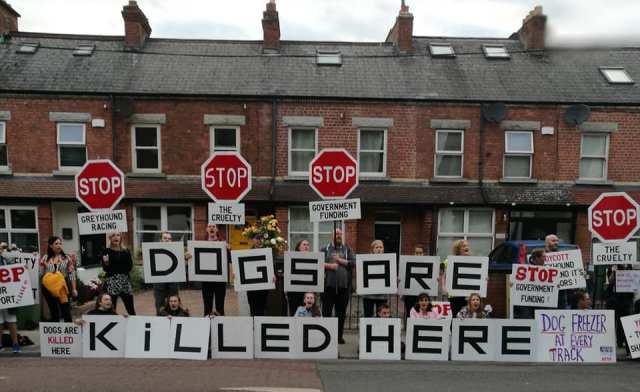
Dogs Are Killed Here Placard Letters
(Photo: G.Guilfoyle)

People attending Shelbourne Park Greyhound Stadium on Saturday last (20th July) were booed, a number of passing cars and vans blew their horns in support of protesters but one dog racing supporter assaulted a protester. The picketers quoted an RTÉ television documentary that the industry is killing large numbers of dogs annually; they want an end to Irish Government funding for the industry and dog racing banned.

dav
Section of the protesters on one side of the street outside Shelbourne Racing Stadium on Saturday 20th July.

          A quick trawl through Google reveals greyhound track or stadium protests at a number of venues in Ireland as well as Dublin, including Cork, Limerick and Newbridge and there are campaigns to ban greyhound racing in a number of other countries (although apparently dog racing only exists in another eight countries world-wide).

The protesters on Saturday chanted a number of slogans, including “You bet, they die!”, a reference to people betting on the outcome of the races and to the high death-toll of dogs bred for activity. Greyhound bitches are bred to what are considered successful dogs and breeders will choose pups to raise from the litters, killing the rest. Only some dogs are considered suitable for racing and after trial, some more will be killed (or perhaps sold abroad, which may even be worse). Finally, when their racing life is over, most will be killed also. The industry says it finds homes for old or worn-out greyhounds but there are not enough homes to take them all in.oznor

The Irish Government funds the industry to the tune 16M euro and campaigners say this is not justifiable to fund an industry killing dogs for profit-making. In addition, according to the RTÉ documentary 7,000 dogs are exported to Britain, effectively sustaining their industry – on Irish tax-payers’ money. Some of these dogs are transported from Ireland in unhygienic conditions, even by people who are banned from the greyhound industry in Britain for doping or keeping dogs in bad conditions, since their bans are only effective in Britain itself.

Doping of dogs has increased enormously in Ireland and Britain, according to people inside the industry but very few have been charged or the kennel breeders sanctioned by the industry’s regulating body. The RTÉ team found that 80% of animal doping chemicals seized over the years have come from greyhound kennels, but more than 50% seized in a three-year period came from one dog trainer, Mr. Gerry Holian in Athenry.

The film also showed dogs being badly treated abroad and produced evidence to show that restrictions on their export from Ireland and Britain are routinely evaded.

oznor
Line of protesters facing the entrance to the dog racing stadium last Saturday (another longer line on the opposite side). Two Gardaí of the Public Order Unit are visible too. (Photo: D.Breatnach)

VIOLENCE TOWARDS PROTESTERS

          Early during the protest last Saturday, a man physically attacked a woman protester outside the Shelbourne Stadium. Witnesses gave evidence to Gardaí who advised them to go to a Garda station and make a complaint, without explaining why they themselves would not act upon the reported crime. Some Public Order Unit Gardaí arrived soon afterwards and some of the protesters, including the assaulted woman, did go to the station and made a complaint.

Four days after the Dublin protest and the attack on a protester, the Irish Greyhound Board posted the following statement:

The IGB would request, and based on the strong advice from An Garda Siochana, that the greyhound community would not engage in any form of ‘counter protest’ at greyhound tracks and stadia as such activity is likely to enflame an already volatile situation and result in an unsafe environment for all. Such outcomes do not reflect well on anybody, including the greyhound community.

greyhounds-raced-to-death-dublin-bus.jpg
A Bus Átha Cliath public transport vehicle carries the message. (Photo source: Bart Hoppenbrouwers)

A SOCIAL AND CULTURAL ACTIVITY?

          Of course for many people attending dog racing, who will be unaware of the high death-toll endemic to the industry, it seems a harmless night out. Even many who do not attend dog racing will be unaware of the cost to the dogs. The RTÉ Investigates TV documentary Racing for Their Lives quoted figures from a commissioned report that 6,000 greyhounds are killed every year. That report was kept secret by the Irish Greyhound Board until the RTÉ Investigates team revealed they had a copy of the Report and then the IGP released sections of it. As the protests continue, even those who have not seen the program will become increasingly aware.

oznor
(Photo: D.Breatnach)
dav
(Photo: D.Breatnach)

In many working-class communities greyhound racing has been a participative activity for individuals owning one or two dogs, as outlined in “The Town I Love So Well”:

In the early morning the shirt-factory horn
Called women from Creggan, the Moor and the Bog
W
hile the man on the dole played the mother’s role,
F
ed the children and then trained the dogs.

This activity is not comparable in scale, turnover or treatment with the dog-racing industry of greyhound breeding and training establishments and racing stadia and, in any case, is much reduced as a passtime now.

There are 16 dog-racing stadia within the Irish state and two in the Six Counties.  Currently protests are organised outside Shelbourne Stadium for two evenings a week, Tuesdays and Saturdays, while protesters at other stadia have their own arrangements.

End.

view-far-both-sides.jpg
View facing north (the Stadium is to the left of photo, the entrance just by the visible column). (Photo: D.Breatnach)

REFERENCES AND LINKS

Petition to ask Irish food company GLANBIA, producer of the dog-food brand GAIN, to stop sponsoring Greyhound racing: https://www.change.org/p/jimtracy-glanbia-ie-tell-gain-pet-nutrition-to-stop-sponsoring-greyhound-racing/psf/promote_or_share

RTÉ Investigates program “Running For Their Lives”: https://www.youtube.com/watch?v=ZYTb2qBjlMM

Official and company reactions to the RTÉ documentary: https://www.irishtimes.com/news/ireland/irish-news/sponsors-horrified-by-rt%C3%A9-programme-on-greyhound-racing-1.3942232

BASTILLE DAY ANTI-INTERNMENT PROTEST IN DUBLIN

Published by kind permission of Dublin Anti-Internment Committee from their Facebook page End Internment

INTERNATIONAL FLAVOUR ON IRISH ANTI-INTERNMENT PICKET

Clive Sulish

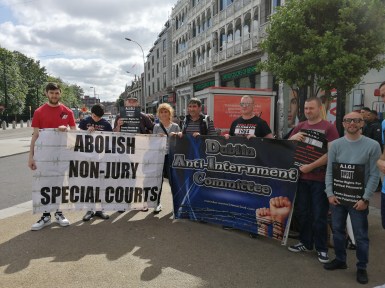
The Dublin Anti-Internment Committee was out again on Saturday 13 July (the day before Bastille Day, which marks the French Revolution, the taking of the Bastille prison in Paris in 1789 and the freeing of political prisoners by revolutionary forces).


The campaigners were out on their monthly picket to raise awareness that, as their leaflet headline says: INTERNMENT CONTINUES IN IRELAND BUT BY OTHER NAMES. When political activists (at the moment Irish Republicans) are arrested and refused bail, that is effectively internment without trial. When political ex-prisoners released under the Good Friday Agreement have their licenses revoked and are taken to jail without charge or hearing, that is also effectively internment.


The picketers lined up with their banners and some placards outside the St. Stephen’s Green Shopping Centre which is at the top of Grafton Street and facing the main entrance arch to the Stephen’s Green park. The official name of this monument is Fusiliers’ Arch as it carries the names of many of the Dublin Fusiliers who were killed in the Second Boer War fighting for the British; for the same reason it also widely known as Traitors’ Arch.

dav
Stephen’s Green Shopping Centre in backgroun
sdr
Basque couple joins the protest
sdr
Catalan supporter inlcuded in photo with west side of Stephen’s Green Park in the background
DB & DAIC Picket Stephens Green Grafton July 1919
DAIC supporter hands out leaflets to passers-by (part of Fusiliers’/ Traitors’ Arch in background)

Stephen’s Green also contains monuments to people who were political prisoners in their time: Ó Donnobháin Rosa, a Fenian who survived where many died as a result of the conditions of their long imprisonment; United Irishmen Emmet and Tone, both before execution and ICA officer Markievicz, who was an officer in the 1916 Rising Garrison here (and whose death sentence was commuted).

Just over a hundred years ago, this whole area was a battleground under the command of the Irish Citizen Army, the workers’ army created in 1913 to defend striking workers from the Dublin Metropolitan Police. Some of the structures here carry the marks of many bullet impacts.

The area chosen for the picket on Saturday is a very busy one with a constant flow of pedestrians shopping in Grafton Street and Stephen’s Green Centre, tourists and people relaxing walking through, going to and coming from the Green. Many leaflets were distributed.

The protester were joined today by the Abolish the Special Courts campaign and appropriately so, since many Republican activists are charged and taken before these courts where they may be denied bail and kept in jail until their trial so that in the unlikely event of their being found not guilty by these no-jury political courts a couple of years later, they will already have spent that time in jail anyway. The Special “Criminal” Courts are the Irish state’s equivalent of the Diplock Court in the Six County colony.

There was something of an international flavour to the picket on Saturday, with a Catalan comrade supporting the picket and distributing leaflets and briefly a Basque couple supporting it too.

The Dublin Anti-Internment Committee expects to be at another location in Dublin town in some weeks’ time and welcomes support from across the democratic spectrum.

End.

U.S. VETERANS STILL FIGHTING – BUT NOW AGAINST THE MACHINE

Clive Sulish

DUBLIN AUDIENCE AT AFRI PUBLIC MEETING CHARMED AND INSPIRED BY FORMER MEMBERS OF USA ARMED FORCES WHO ARE ON TRIAL FOR BREACH OF SHANNON AIRPORT SECURITY ZONE.

Veterans for Peace Members Ken Mayers and Tarak Kauff, US-based anti-war campaigners, last Wednesday evening clearly impressed members of a Dublin audience by their dedication. Both men are awaiting trial in Ireland for exposing U.S. war crimes and the violation of Irish neutrality at Shannon Airport and are at liberty only within the jurisdiction of the Irish State on a combined bail of €5,000.

          The bail was paid by anti-war campaigner Ed Horgan, a former army commandant and UN peace keeper and the sum is twice the amount of criminal damage they are accused of having caused to the airport’s perimeter fence, as well as unlawfully trespassing into a taxiway. They did so in order to inspect a US plane to ensure it was not carrying war material or personnel, in violation of Ireland’s Constitutional neutrality. Campaigners have long demanded that the Irish State itself carry out these inspections but despite evidence that the State’s neutrality is indeed being violated by US Planes landing at Shannon, successive Irish governments have insisted in taking USA Government denials on trust.

oznor
Tarak Kauff addressing the audience at the public meeting organised by Afri.

The public meeting was opened by Joe Murray, Coordinator of Afri and Emer Lynam, newly-elected Vice-Chairperson of Afri Ireland, introduced the speakers.

The elderly campaigners, in their “Veterans for Peace” sweatshirts, addressed the audience about the reasons for their actions and their commitment to opposing US militarism which they stated was a major cause of misery around the world, including to serving members of the military themselves (quoting a figure of 22 suicides per day), along with being a major cause of world pollution. Ken Mayers explained that the USA has 800 military bases around the world in addition to its 400 on its own territory, the infrastructure, fuel expenditure and waste of the total which he stated is a major cause of pollution. (This is presumably without even taking into account the use of nuclear-generated power and disposal of radioactive material, or depleted uranium projectiles, such as used in Iraq or the Agent Orange defoliant used in the Vietnam War.)

Both men belong to an organisation called Veterans for Peace which campaigns against the US militarisation of the economy, war, interference in the affairs of other states and for better treatment of veterans. Recently they also supported a campaign against concentration camps for migrants along the US-Mexico border.

13 DAYS IN JAIL THEN BAIL ON CONDITION THEY DON’T APPROACH ANY AIRPORTS

          Ken Mayers, 82 years of age and Tarak Kauff 77, spent 13 days on remand in Limerick jail, where their toilet did not flush unless they poured buckets of water into it. Other than that, they said they were treated well and the other prisoners treated them “like celebrities”.

The reason for their bail being refused during that period was Garda objections that they would flee the jurisdiction. Tarak Kauff exposed the illogicality of this fear to the Dublin audience, explaining that they had taken their action at Shannon knowing that they would be arrested and wanting to use the trial to expose what was going on at Shannon airport: “For us not to attend that trial, they would have to physically drag us away from there!”

ken-mayer-standing-speaking.jpg
Ken Mayer of US Veterans for Peace, addressing the public meeting

They were eventually granted bail on condition they remain within the Irish state and having to surrender their passports, due to Garda objections again that they might flee, also not to approach any airports. On July 10th the High Court turned down their appeal against these conditions, though the judge said that he might review that decision if the case were to be moved to the Dublin District Court, where the waiting list was much longer. The defendants and their solicitor, Michael Finucane, will be seeking to have the case heard outside Clare, where it is believed a fair trial relating to a Shannon protest is unlikely. A trial date is expected in September or October.

oznor

THEY POSTPONED MY HONEYMOON”

          Ed Horgan took the floor after Mayers and Kauff to speak about the one million total of children killed in the Middle East as a result of war and sanctions and urged action to prevent further loss of children’s lives.

Then Emer Lynam opened the meeting to questions.

In reply to questions from the audience about the cost to themselves, Ken Mayers revealed he was due to be on his honeymoon by now with his bride.

Ken Mayers was born in New York City and grew up on Long Island. From Princeton University he entered the US military as a Second Lieutenant in the US Marine Corps, rising to Major until he left the organisation in 1966 in disgust with US foreign policy. In Berkeley University, California he gained a PhD in political science where, according to the AFRI event page, he became a peace and justice activist, which he has been ever since and six years on the Veterans For Peace (USA) Board of Directors, five of them as national treasurer.

Tarak Kauff, ex-military too and also from New York, said that he missed his wife and daughter but both were supportive of what he was doing, being activists also (see short letter from his wife in Links and References). According to Afri’s FB page, he’s a former U.S. Army paratrooper (1959 – 1962), a member of Veterans For Peace, the managing editor of VFP’s quarterly newspaper Peace in Our Times and was a member of the VFP National Board of Directors for six years. He has organized and led delegations of veterans to Okinawa; Jeju Island, South Korea; Palestine; Ferguson, Missouri; Standing Rock …. and Ireland.

Asked what kept them going, they stated the importance to act against injustice. Kauff in particular declared that “to resist is human” and that he wished to be fully human. He said that no-one could tell another what he or she could do but one only had have the courage to ask oneself that question …. and then the courage to act upon the answer.

sdr
Section of audience at the public meeting

IRISH PEOPLE JUST COME UP AND SHAKE OUR HANDS, THANK US FOR WHAT WE ARE DOING”

          Both expressed gratitude and a degree of amazement at the warmth of their welcome and appreciation by members of the Irish public. Kauff gave an instance of the Lisdoonvarna pub where the management would not accept payment for their food and drinks. “People just come up to us and shake our hands and thank us for what we’re doing,” the veteran said, “and we don’t get that in the USA.”

Donations from the public fund them and, at the moment, they live in student accommodation at Limerick University, rent free – though they will need to find alternative accommodation in September.

oznor


oznor
Emer Lynam, Vice-Chairperson Afri.

Asked about popular feeling in the USA, Ken Mayer explained that the US public are exposed to a systematic system of propaganda and misinformation. However their anti-war organisation is very wide with many members and that there were optimistic signs with popular protest about the treatment of migrants along the US-Mexican border and fuel pipeline resistance in New York State and in Standing Rock. However, a little later, Tarak Kauff said that the outlook was not promising but that not resisting was no choice — even if he knew the world was going to end next week, he would feel he had to resist in order to fulfill his human potential.

Earlier in their presentations, Kauff alluded to Ireland’s historic struggle to overthrow its powerful oppressor and called people to oppose the most powerful enemy in the world today – the US State. He said that a stance taken by the Irish Government today would have a strong progressive ripple-effect around the world.

RESISTANCE IN MUSIC AND SONG

          Music for the evening was provided by veteran campaigner John Maguire who sang a song he had composed back at the first demonstration at Shannon airport, with a chorus that the audience soon got the hang of and joined in.

oznor
Musical accompaniment on the evening, l-r: Paul O’Toole, Nimal Blake, RoJ (Roger Whelan).

RoJ performed a song also of his own composition, accompanied by Paul O’Toole on guitar and Nimal Blake on cajón. Later, O’Toole also sang a song of his own, about the child who lost both his arms to US imperialist ‘smart-targeted’ bombing, then going on to sing one of Dylan’s numbers. Both RoJ and O’Toole are long-time professional performers and have produced CDs of their material.

All performers were warmly applauded.

The evening was a fund-raiser and it could be seen that the collection bucket, although covered, was stuffed with notes. Ken and Tarak also have a Fund Me appeal and Afri is also receiving some donations for them through the Internet.

End.

mde
A line up of activists, military veterans and musicians

LINKS AND REFERENCES:

Event notification by Afri: https://www.facebook.com/events/344492786248155/

https://www.irishtimes.com/news/crime-and-law/surprisingly-humane-elderly-us-veterans-arrested-at-shannon-describe-their-prison-stay-1.3843401

http://www.stopthesewars.org/kenandtarak/

Letter to the Broadsheet by Ellen Davidson, wife of Tarak Kauff: https://www.broadsheet.ie/2019/04/03/story-of-why/

Summary of events and explanation by Ken Mayers: http://claredaly.ie/us-veterans-for-peace-forced-to-remain-in-ireland-pending-trial/

US Veterans for Peace: https://www.veteransforpeace.org/

Suicides in US Military: https://en.wikipedia.org/wiki/United_States_military_veteran_suicide

mde
The huge banner “US War Machine Out of Shannon” (sadly, out of focus)

MAJOR SPANISH UNION “BETRAYED WORKERS”

(Reading time text: 2 minutes; comment: 4)

(Translation from article in Castillian by Diarmuid Breatnach)

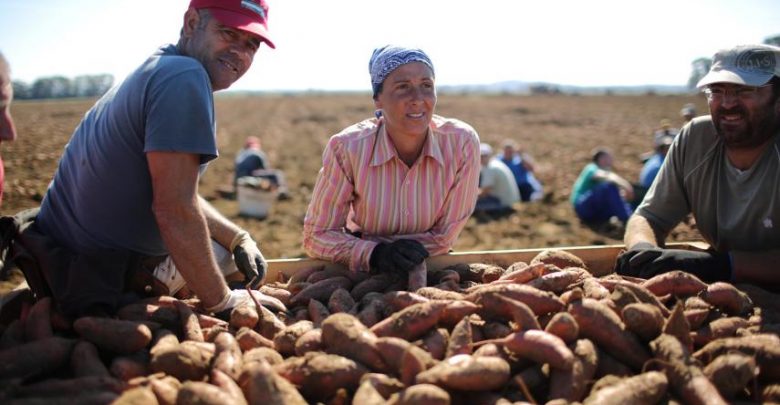
The Andalusian Union of Workers (SAT) has accused CCOO (Comisiones Obreras, major Spanish trade union – Translator) of “betraying” agricultural workers with the signing of an agreement with the Asaja employers — the signing took place last Thursday in Seville — where hard-won rights have been surrendered, including the 15-minute sandwich break. Accordingly, it will propose a common front to all trade unions to promote the fight for an (alternative) Andalusian agreement.

Migrant workers in a sweet potato plantation in Jerez, Andalusia.
(Source photo: Juan Carlos Toro, La Voz del Sur)

The SAT “cannot endorse an agreement where you give up the 15 minutes sandwich break, a workers’ victory from a long time back, which has been respected for generations, even during the Franco regime. An achievement that the employer, Asaja, has always wanted to eliminate and has succeeded now thanks to the betrayal of bureaucrats who never got their hands dirty or set foot on the field in their life”.

To this, adds the union, “you cannot endorse a de facto wage loss since the Pyrrhic rise of 1.25% per year does not compensate for the loss of the 15-minute sandwich break, which amounts to 3.8%. In other words, in reality, what CCOO has signed is a salary reduction of two and a half points” (per cent). “This is an outrage and a complete betrayal. There is no other name for it. We would like to say something very different, but above all our duty is to the workers who have been sold and betrayed once more”, they added.

The situation in the Andalusian countryside and the province of Seville, in particular, where some 120,000 people work in the sector, is very precarious. The economic crisis has hit the countryside and its workers hard. The working conditions implemented in the Andalusian countryside, according to the SAT, “seem from other times, thankfully now past.” Breach of agreements is the rule, piece-work predominates, which sometimes means that after a long day of work you only take 20 euros home, well below the salary established in the agreements.

Map showing Andalucia region (in red), Spanish State (in cream) also Canaries and part of coast of North Africa.
(Source image: Internet)

There are situations, they add, where fraud is evident by not declaring the workers employed. A fraud that can make a millionaire, since it can mean millions of undeclared euros that put health, pensions and our social protection system at risk. In addition to situations of genuine exploitation of workers — which in many cases border on pure slavery — there continues to be a significant reduction in income to Social Security, as well as a smaller amount of peonages that subsequently give the right to recognition of the subsidy and other benefits (? — Trans).

The reality that is being imposed not only affects labour rights, it is also “strategic suicide”. “The reality,” explains SAT, “is that with these mafia practices they are dropping the market price, so the product loses added value and undermines the market. The final result is to depreciate the product having a direct impact on the living conditions of day-labourers and on the economy of the towns. There have been innumerable complaints filed in the Labour Inspectorate, some of which have led to criminal proceedings being taken for crimes against the rights of workers.”

Accordingly, an Andalusian agreement that puts in place a minimum is necessary and urgent: six hours of work (sandwich break included); 60 euros for the normal working day; 84 on Sundays and holidays; effective ban on piece-work; wage of 69 euros for work with machinery; 96, on Sundays and holidays; on rainy days (when work is not possible) 50% will be paid for showing up at work, and the full wage from two hours of work; 0.27 euros mileage.

It is fundamental, they state in concluding their communiqué, to establish “a common front to fight for an Andalusian agreement with these minimums. It is also necessary and urgent to change the system of union elections in the field, a measure approved in the Congress of Deputies, and grant voting rights to non-permanent workers who represent more than 95% of the workforce in the Andalusian countryside.”

COMMENT:

Diarmuid Breatnach

The CCOO, Comisiones Obreras is one of the two mega-unions in the Spanish State, the other being the UGT. The CCOO was controlled by the Communist Party of Spain (PCE) and the UGT by the social-democratic PSOE; both parties and their affiliated unions were outlawed during Franco’s time. When the Transition to “democracy” was being engineered after Franco’s death, it was considered necessary to legalise the PSOE in order to have a two-party system and therefore necessary to legalise the UGT. However, it was the other way around for the CCOO and the CP. The Comisiones Obreras were by far the largest and most militant trade union and, though illegal, had built up a substantial following among the workers of the Spanish State. To effect as smooth a Transition as possible, it was crucial to legalise the CCOO and therefore to bring the Communist Party on board. Both political parties agreed to a deal, including recognising a monarchy with a King chosen by Franco and publicly supporting a forced union of all nations within the state by a new constitution.

The southern Basque Country and Galicia have a majority of unions of their own nation but everywhere else within the state, the CCOO and the UGT have the majority of workers as members and the majority of elected representatives. Although the CP’s control of CCOO has slipped over the years, the UGT is still strongly associated with the PSOE. There are also some independent trade unions, like the SAT above and also some others based on specific work locations.

SAT has a history of militancy, fighting for its mainly agricultural work force in which, as it states above, the vast majority are migrant workers. The union also campaigns for efficient and socialised use of Andalusian land, much of which is owned by banks and left empty; in addition its spokesperson was arrested last year for “insulting the Monarchy”. It is worth remembering that Andalusia was in medieval times the famed Moorish caliphate of Al Andalus, in many ways the jewel of the Iberian peninsula.

When Franco’s troops were ferried to Andalusia from the Canaries by German Nazi transport, largely without armed opposition in 1936, they butchered 55,000 republicans, socialists, communists, communists, trade unionists and anti-fascists.

As soon as the “Transition” went through after the death of Franco, the PSOE was voted into power in the Andalusian regional government, where it has held the absolute majority ever since – until the regional elections this year. Years of corruption and complacency saw its voting base diminish and, though it still holds the most seats, a right-wing coalition of the Partido Popular, Ciudadanos and Vox, all of which can trace their origins to Franco, has taken over. Many observers think is therefore all the stranger that the CCOO should bring in this agreement at this time.

End.

LINKS AND REFERENCES:

Source article in Castillian: https://www.lavozdelsur.es/no-habra-15-minutos-de-bocadillo-para-los-jornaleros-del-campo-andaluz/?fbclid=IwAR1EwH5Uox-Qb87XNjZBvS1nlJ-YD21EbGHAQKqCPRkvFgEgZZOu_nI05bM

Arrest of SAT spokesperson in November 2018:

https://rebelbreeze.wordpress.com/2018/11/15/union-spokesperson-arrested-for-insulting-the-monarch/

Right-wing coalition takes over Andalusia:

https://rebelbreeze.wordpress.com/2018/12/14/gains-for-the-hard-right-in-andalusia-reason-to-panic/

Number of Andalusians murdered by Franco’s military-fascist forces:

https://rebelbreeze.wordpress.com/2019/07/12/5131/

“POLICE HAVE NO POWERS TO MOVE ANYONE”, SAYS PSNI ASSISTANT CHIEF.

Diarmuid Breatnach

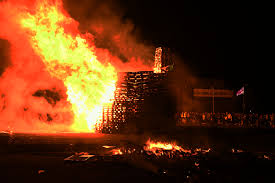
Wee bonfire in Avoniel, 11th July 2019.
(Photo: Internet)


It is highly unlikely that that happened”, said Assistant Chief Constable Gray of the PSNI, responding to an allegation that information on the names of contractors was leaked by the colonial police force. Firms contracted to remove the pallets from a stack prepared for Loyalist 11th July bonfire withdrew after their names were displayed on the bonfire stack.

In the first place, no police officer would ever leak information to anyone outside the Force,” she said. “That would be just so unprofessional. In the second place, it is well established that has never, ever been any collusion between the police force here and Loyalist paramilitaries.”

Health & Safety warning to contractors hired by Belfast City Council
((Photo: Internet)

          Asked why police did not move against the bonfire builders when the council asked the PSNI to investigate allegations of aggravated trespass, Ms Gray said police had “no powers to remove anybody.” She frowned as some reporters from nationalist areas burst into laughter and became incoherent. Eventually someone asked did that apply to members of Republican groups also.

Not if they’re dissidents,” she snapped, indicating the questioner to nearby PSNI officers with a nod of her head.

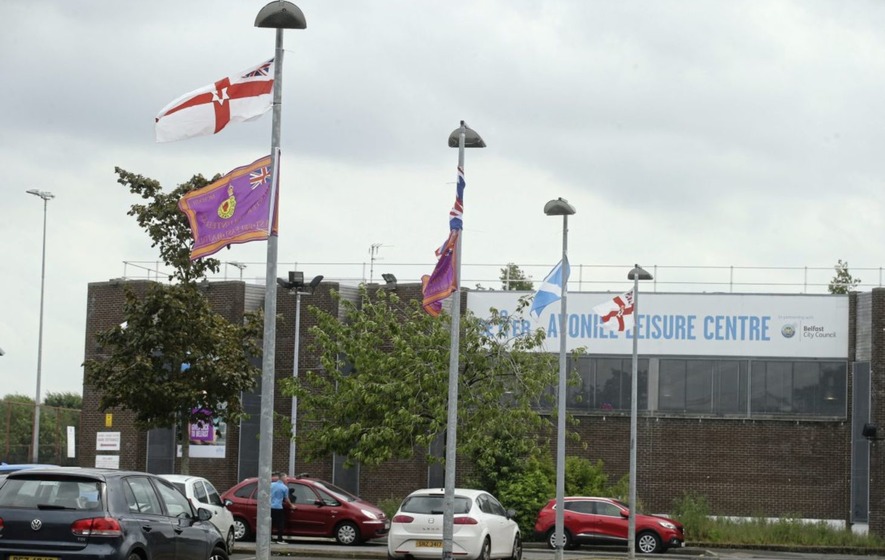
UVF and flags of Six Counties, Salterre of Scotland and English Cross of St. George flying on light poles outside the Avoniel Leisure Centre, Belfast. The Scottish Salterre being the flag associaed with Scottish independence is an irony perhaps lost on the erectors …
(Photo: Internet)

Assistant Chief Constable Gray added that any police action also had to be “proportionate”. At this, uncontrolled laughter broke out again from a section of the reporters present. ASC Gray said what sounded like “Loughisland” and indicated the offending group to some police officers present, who began to film them, at which point the reporters became very quiet.

Responding to suggestions that the burning of posters of people and flags of a country might be seen as offensive, racist and threatening, Ms Gray said the offensive material on the bonfire in Lisburn was related to election campaigns and was therefore alright.

A man who identified himself as an Avoniel community worker said that the bonfire was just “Protestants celebrating our culture” and they only had a couple of weeks a year to do it now. “Things were much simpler in the old days,” he said, “when we just did what we liked. And we had a wider choice of activities, such as chasing Taigues out of the shipyards, burning Fenian houses …. But now houses have been built near bonfires so that complaints can be made by people pretending to be scared of a wee bit of fire. After all, there was bonfires afore there was houses,” he stated. “And there was roads for us to march through Catholic areas afore there was Catholic houses …. er … anyways, it’s our culture! Our British culture!”

“But they don’t do that in Britain, do they?” someone called out, refusing to be intimidated by the man’s tattoos and his UVF and Paratrooper badges, or by Ms. Gray’s glare.

Well, maybe not,” said the community worker. “But we’ll be British even if they won’t.”

It was the United Irishmen who lit celebratory bonfires”, another Belfast man interjected. “Like to celebrate the defeat of the English in the War of American Independence. They lit them on the hills, not beside people’s houses. And they were mostly Presbyterians!”

At this last declaration, the community worker, who had begun to froth at the mouth, screamed “Sacrilege!” and made for his tormentor. The latter seemed ready to stand up to him until he caught sight of a squad of PSNI heading for him too, at which point he upended a few chairs and made his retreat through a side entrance.

Assistant Chief Constable Gray called the press conference to an end at that point.

End.

(Original material on which satire is developed: https://www.belfasttelegraph.co.uk/news/northern-ireland/no-doubt-uvf-were-involved-at-avoniel-bonfire-says-psni-38305920.html?fbclid=IwAR2SkyKvLMaguo4NfRM3bv0eky9cJ9PHqwuJ45v96yapBk-JUzQ5fc1tlyI also an exchange on a Belfast phone-in radio program).

ANDALUSIAN CITY COUNCIL TO DIG UP MASS GRAVE OF FRANCO VICTIMS

(Reading time entire text 5-10 minutes)

Report by RAÚL BOCANEGRA in Publico.es (translation and comment by Diarmuid Breatnach).

Mass grave of victims of Francoist repression, Burgos.
(Photo source: Internet)

“The City Council of Seville has guaranteed on its own to provide the necessary funding — 1.2 million euros — to exhume the Pico Reja pit, in which historians believe that there are at least 1,103 bodies of of victims of the repression, led by the General Queipo de Llano, following the military coup of July 18, 1936.

This exhumation will be the largest ever to be undertaken in Spain, following that which that was carried out in Malaga, in the San Rafael Trench, between 2006 and 2009, and may indicate the path to take for the other capitals (of Spanish state regions – Trans).

The Mayor of Seville, Juan Espadas (PSOE), guaranteed that the grave will be exhumed throughout the mandate of the current Council. “It is a truly historic step in Seville and one of national importance, since it is perhaps the biggest mass grave that [at this moment] has a definite project for its exhumation,” the Councilor said at a press conference.

“And, therefore, it is also one of the most important projects in terms of Historical Memory to be undertaken in our land, due to the importance and volume of the Pico Reja mass grave. It was a commitment that this Government (i.e of the Andalusian region) gave during the past mandate to relatives and memorial groups and today it is made a reality with this tender,” added Espadas.

“Next Friday the City Council of Seville, through the Governing Board will approve the specifications and, therefore, the public tender for a technical service for the exhumation and genetic identification of the bodies of the Pico Reja mass grave, in the Cemetery of San Fernando,” reads a statement issued by the City Council. “The ultimate goal [of the exhumation] is to dignify the memory of the people who were thrown there, give them a dignified burial and attend to the requests of their families,” adds the Council (statement – Trans).”

Militia Women of the Anarchist FAI -CNT in Catalonia, early years of the Spanish Anti-Fascist War. Women in areas captured by the Franco forces were exposed to endemic rape and many female prisoners were shot after being raped.
(Photo source: Internet).

BEGINNING AND COMPLETION OF WORK

          “Accordingly, Espadas will not wait for the Council of Andalucía or the Regional Government to sign the agreement, to which they had committed themselves. Confirming now, at the start of the mandate, the works, the Mayor ensures that the exhumation will not be delayed and will be carried out throughout this term. Municipal sources assured Público of their belief that both the Council and the Andalusian Government will collaborate with the exhumation, the Andalusian Council not before September.

Should they contribute money, the amount would be deducted from the 1.2 million that the Council calculates as necessary to carry out the works. Espadas recalled that the signing of an agreement in this regard with the Board and the County Council to finance these works is still outstanding. “And let’s hope that it is signed as soon as possible.”

“This contract guarantees the beginning of the work and its conclusion, without waiting for the remaining public administrations –- provincial, Andalusian and national — to finalise their contributions,” reads the Council’s note.

Espadas and the Delegate for the Department for Equality, Education, Citizen Participation and District Coordination, Adela Castaño, related the details of this contract to relatives of the victims and to the different organisations involved in the area of Historical Memory in Seville. “Do not fear, the exhumation and the identification of bodies will be done,” the Mayor assured them.

THE DETAILS

          The company that gains the contract must include at least one historian, five professionals in Forensic and Physical Anthropology, five in Archeology and 10 auxiliary support workers. “With the maximum guarantees of scientific rigor, a survey will be performed, material collected on the surface, excavations made in the pit, exhumations and recovering of bodies and remains,” says the City Council in the note. “Likewise, it must preserve and safeguard, also with all scientific guarantees, the samples of bone remains and biological samples taken from the family members until delivery to the University of Granada for genetic identification,” the City Council insists.

The project will be be completed in three phases, explained the Council. The first concerns the exhumation itself and the identification of the bodies, along with works including: the archaeological excavation; dealing with the remains found (the excavation and the direct and individualized identification of these bodies will determine whether or not they are relatives); exhumation (identification, recording of traces of violence and individual extraction of each body or remains); forensic anthropology (that is, determining sex, age, pathologies or anomalies); anthropological analysis in a laboratory manner; and conservation and protection to preserve these skeletal remains and DNA analysis.

The second phase will consist of the presentation of a final report as a logical contribution to the history of Franco’s repression. And the last phase will be the final destination of the remains.

The City Council will respect at all times the wishes of relations about the identified remains. The unidentified remains and those which the relatives wish to remain in the same place, “will be buried in an authorised space with appropriate technical indications for future identification”.

After finishing the works, “the area will be restored as an expository and explanatory site of the historical significance of the Pico Reja pit”. The successful bidder must submit a proposal for reconstruction of the current site that includes a columned monument to honor the victims.

Exhumation work on mass grave of Franco’s victims in Burgos.
(Photo source: Unai Aranzadi)

COMMENT:

(Diarmuid Breatnach)

          According to official figures, 120,000 victims have been identified (not exhumed) from 2,591 unmarked graves around the Spanish state. The areas with the largest number of graves are Andalusia in the south and the northern regions of Aragón and Asturias – in Andalusia alone, 55,000.

Map of grave sites of victims of Francoist repression in Andalucia (Photo source: Internet)

A mapping work undertaken by the Council of Andalusia region, which was presented publicly in the regional capital in 2011, illustrates 614 mass graves in 359 Andalusian municipalities. Only around half of the 47,000 bodies that were discovered have been identified due to there being no relatives available for DNA tracing or because calcium oxide (quicklime) had been thrown over the bodies.1

In Malaga province alone there are 76 mass graves in 52 towns, containing the remains of 7,471 people who were killed by General Franco’s forces. The largest of these mass graves was discovered in Malaga city’s San Rafael cemetery. 2,840 bodies were exhumed in early 2010, although more than 4,500 are registered as having been buried there”.2

The usual figure given for the total of non-combat killing by Franco’s forces is 150,000 and which does not include those who died of malnutrition and lack of adequate medical care in prisons and “penal battalions” or through confiscations, or economic and financial sanctions in areas occupied by his forces. Nor does it include the civilian victims of bombing by military-fascist air force, whether of cities or of refugee columns.

Against that, the total figure for non-combat killings by the forces against Franco are estimated at around 50,000. Also, while the latter killings for the most part took place in the early months of the military uprisings, before Republican Government control could be established, most of the non-combat killings by Franco’s forces were carried out after they had beaten the resistance and occupied the area and much of it also after the war was over. Typically too, according to Paul Preston (The Spanish Holocaust (2012), Harper Press), women were routinely raped before they were shot.3

The issue of the executed after a cursory military trial or simply taken out and murdered by Franco’s forces is a live one in the Spanish state today. Before Franco’s death it was not even possible to discuss it publicly and bereaved relatives were not permitted to mourn publicly – to hold a funeral or to have a mass said for their souls according to Catholic custom or even to mark their graves.

The Transition process to convert Franco’s Spain into a “democracy” accorded legal impunity to the perpetrators of even the worst atrocities during the Civil War but unofficially extended beyond, to the years afterwards and even to murders carried out during the “Transición” itself. And why not, when all the upper echelons of police, army, judiciary, civil service, Church, media and business were and are for the most part the same people as before or their sons and daughters? When the Head of State and of the Armed Forces, the King Juan Carlos, was specifically chosen by Franco to be his successor and even after the Dictator’s death glorified him and his political trajectory.

‘LET THE DEAD STAY BURIED’

          The fascists and their descendants want the dead and their stories to stay buried and even when a very senior judge like Baltasar Garsón, who presided over the repression and torture of many Basque and Catalan political detainees (but is incredibly lauded as “a foremost human rights defender” by liberals!) decided to play a power and publicity game and and became a problem by authorising the opening of some mass graves in 2012, he was slapped with legal appeals, charges of wire-tapping and disbarred from office for 11 years.

The other graves they don’t want opened are the mausoleum of Franco himself and of Rivera, founder of the Spanish fascist Falange, who lie in the memorial park built by political prisoner slave labour to honour Dictatorship and Fascism, a shrine for fascists today. The order of the PSOE Government to exhume and transfer them to a family graveyard has been paralysed by the Spanish Supreme Court after protests by Franco’s descendants.

If the Pico Reja exhumation in Seville goes ahead and is properly documented, it will be as the PSOE-controlled Seville City Council says, of huge historical — but also of huge political – importance. Can this happen in the same region where the corrupt PSOE administration has lost power after decades without se

The “Valle de Los Caidos” memorial park, constructed by slave prisoner labour, which contains the mausoleum containing the bodies of Franco and Rivera
(Photo: Paul Hanna, Reuters)

rious challenge and is now ruled by a de facto coalition of all the main parties descended from Franco, the Partido Popular, Ciudadanos and Vox? The Seville City Council says it can and that if necessary they will fund it all themselves. We can hope.

End.

FOOTNOTES:

1See “Mass graves in Andalusia” in References.

2As above.

3See Review of Paul Preston’s book in References.

REFERENCES AND SOURCES:

Main article: https://www.publico.es/politica/memoria-publica-alcalde-sevilla-garantiza-dinero-exhumar-mandato-fosa-pico-reja-hay-1100-represaliados.html

Review Paul Preston’s The Spanish Holocaust: https://elpais.com/elpais/2011/04/04/inenglish/1301894444_850210.html

Mass graves in Andalusia: http://www.surinenglish.com/20110107/news/andalucia/mass-graves-201101071754.html

Map of mass grave sites in Andalusia: https://www.theolivepress.es/spain-news/2011/01/14/terror-map/

SAN FERMINES 2019: RETURN OF THE OLD REGIME AND THE BATTLE OF THE FLAGS

Introduction and translation by Diarmuid Breatnach

The San Fermines Festival in Iruña (Pamplona in Castillian) is renowned around much of the world for its colour and also danger with the running (corrida) of the bulls. But for many years it has been the occasion and site of sharp political struggle and there have been other dangers too.

ANTI-BASQUE NATIONALISM IN NAFARROA

          Although the city is Basque, centre of the medieval kingdom of Nafarroa (Navarre), it was run for decades by UPN (Union of Navarrese People), what some considered the Basque version of the Partido Popular, post-Franco Spanish political party founded by the Dictator’s supporters. Although in 2008 UPN broke from its fraternal relations with the PP, the party remains Spanish-unionist and conservative, strongly opposed to Basque independentism and wishing to remain separate from the rest of the Basque Country, whether the other three southern provinces or the three across the French border.

During the Spanish Republic of 1936, the ruling political interests in Nafarroa broke with the Basque nationalists and opted for supporting the military-fascist coup of Franco and the other three generals – the reactionary Nafarroan Carlists murdered 3,000 Basque nationalists, republicans, communists, anarchists and social democrats in their province alone. They also took part in fighting as part of the military-fascist forces.

For many years, the first day of the San Fermines festival has been the scene of struggle between those who sought to bring the Basque national flag, the Ikurriña, into the main square, to be present during the launch of the week of festivities. And beatings and for Basque independentists have resulted, even fines and jail sentences, especially when they have been successful.

But in the elections of 2015, a coalition of political parties of Basque independentism, nationalism, and left-social democracy took power in the Navarrese regional Government and began to change matters on a number of fronts. In 2017 the Ikurrina was flown from the official balcony and the the Spanish Government Delegation in the region took a judicial case against those responsible and the same people in 2018, EH Bildu, refrained from flying it, displaying instead a bare flagpole. However, that coalition lost its majority of seats in the elections this year and the UPN came back into power, with the resumption of ‘business as usual’.

ASSAULT AND RAPE

          In recent years, another menace has come to the fore, with some men assaulting women in the press of the crowd. Most horrifying was the multiple rape of an 18-year-old woman on July 7th, during the San Fermines festival of 2016. The woman, who approached a few men to help her find her way and was apparently under the influence of intoxicants, was led into a doorway, her phone taken off her and raped in a number of ways by each, who also videoed the event and put it up on the Internet. Due to the description to the Nafarroan police by the victim and their promotion of their act on social media, the perpetrators were soon arrested. But they were tried not for the more serious crime of rape but for sexual abuse, because she appeared not to resist and therefore no violence was necessary to restrain her – a feature of Spanish law.

The group of five violators and rapists had given themselves the boastful title of La Manada (the Wolf-Pack) contained a Spanish Army soldier and a Spanish Guardia Civil policeman among its members. And they on a previous occasion filmed themselves having sex with an intoxicated woman on the flat bed of a truck and put that too out on social media.

Gang-rapists, the self-styled La Manada (“the wolf-pack”) (Photo source: Internet)

The Pack claimed that their victim was willing but found it difficult to explain that she had only met them seven minutes before the assaults or their taking of her mobile phone and some other matters and were found guilty and sentenced to nine years jail but allowed bail when they appealed. Since their appeal might find them not guilty, one might argue that they were entitled to bail while awaiting the hearing.

BASQUE AND CATALAN INDEPENDENTISM V. RAPE

          However, the youth from Alsasua (Basque town in Nafarroa), who were accused of assaulting off-duty Guardia Civil policemen who entered a Basque independentist late-night bar as a provocation in October 2016, were not only kept in jail while awaiting trial in Madrid but also four of them while awaiting an appeal hearing (against sentences of between two and 13 years jail!). And the Catalan independence grass-roots campaign leaders and elected politicians who were charged with sedition, rebellion and misuse of public funds for organising a referendum on independence in October 2017, were kept in jail until their trial and are there still, now awaiting judgement. They include one who was elected an MP while in jail and another who was elected an MEP (Jordi Sanchez and Oriol Junqueras).

Many aspects of the Manada case led to an outcry over the whole Spanish state. Although the Prosecution had asked for sentences of 22 year and 10 months, they were sentenced to nine year jail. On December 5th 2018 their sentences were confirmed to those nine years, although two judges on the panel disagreed, wishing for sentences of a little over 14 years as they felt that there had been intimidation and coercion, there had been “degrading acts” and she had been left half-naked on the ground with her mobile phone taken (and memory cards removed). The five-judge panel however ordered the first court that tried them to issue another sentence for the filming and publishing of the rape as her privacy had been violated. The Defence lawyer has indicated that his clients would appeal the sentence as did also the City of Iruna (Pamplona).

THE BATTLE OF THE FLAGS

The town square of Iruna/ Pamplona, traditional site of the launch of the San Fermines folk festival, this year showing, despite threats of the UPN Mayor, Ikurrinak and banner against the dispersal of Baque political prisoners prominently displayed.
(Photo sourced: publico.es)

Translation of short article in Publico.es

          In the end, the ikurriña was present. The images of the first Sanfermines after the return of the Right to the City Council of Pamplona are already crossing the world and they do it with the ikurriña and the flag of Navarre displayed among the public. The earlier threats of Mayor Enrique Maya (UPN) had no effect, nor did the police deployment in the surrounding area.

Under an intense sun and in a crowded square, the txupinazo (firing of ceremonial rocket — Translator) of the Sanfermines – the act that marks the beginning of the festivities — took place at 12.00 o’clock. Minutes before, (many of) the attendees managed to deploy a ikurriña of great proportions, accompanied by the Flag of Navarra. A white placard also appeared in which the return of the ETA prisoners was demanded (i.e end of the dispersal of independentist prisoners all over the Spanish state — Trans).

“UPN, kanpora” (UPN, out!) was heard in the square when the Mayor was on the balcony. A few days before, Maya had issued a notice announcing that entering with fabric of large proportions was strictly forbidden, citing security reasons. However, the same Councilor said shortly after in an interview in the newspaper El Mundo that there would also be “a device” to prevent the EH Bildu councilors unfurling the Basque flag on the balcony of the town hall.

POLICE SEIZURE OF FLAGS

          One hour before the txupinazo, journalist Gara Aritz Intxusta reported by Twitter that local police had seized “150 small ikurriñas that were going to be used in a kalejira” (festival parade) that was going to be performed in the streets of the city to protest against the Mayor’s party.

Source: https://www.publico.es/politica/ikurrina-acto-presencia-sanfermines-gritos-upn-fuera.html

Video posted 2013

of daring event as the hour for the launch approached, Basque independentists in “disguise” of anglers, cast a line across from the rooftop on one side of the square to the other and then a stronger line was taken across with a giant ikurrina attached. One can see earlier, police rushing to confiscate a flag or banner and a giant political prisoners’ banner being held above many in the crowd. In 2013 the UPN Mayor deliberately delayed the launch past the traditional hour of noon so as to give secret police time to cut the line and not to have it happening with the Ikurrina hanging over the square.

End.

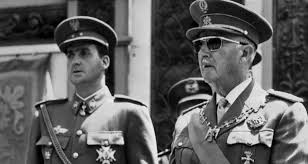
PRAISE OF FRANCO IN ARCHIVE OF FORMER SPANISH KING’S SPEECHES

About Franco: “I pay homage to his memory; and I believe that the best way to interpret his legacy is to march without stopping towards social justice objectives, that give strength and unity to our people.”

Translation by Diarmuid Breatnach from article in Castillian by DANILO ALBIN @danialri BILBAO 06-30-2019 08:17 AM Updated: 06-30-2019 08:17

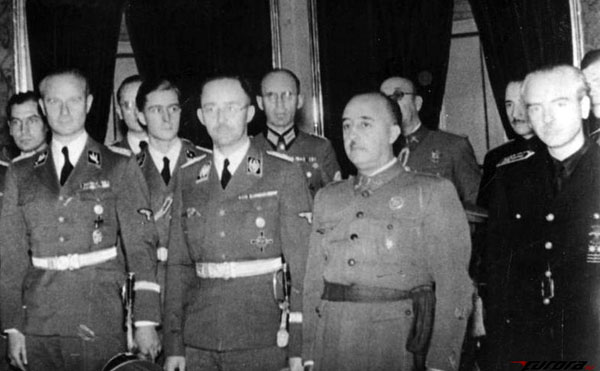
Franco with leading German Nazis. He was greatly admired by the former Spanish King, father of the current one.
(Photo source: Internet)

          There are things that time cannot erase. Words and phrases that seem forgotten but, nevertheless, are still there. Written and permanent. The Royal House offers the collection of speeches by Juan Carlos de Borbón in its digital archive. In those archives, available for those who wish to find them, are the Francoist statements that the now emeritus king pronounced in the first steps of his reign and about which, according to what different historians emphasise, he never made any self-criticism.

November 22, 1975. Two days after the death of the Dictator, Juan Carlos offers his message of remembrance: “An exceptional figure enters history. The name of Francisco Franco will be a milestone of Spanish events and a milestone to which it will be impossible not to refer in order to understand the key to our contemporary political life,” the King proclaimed.

There he showed his “respect and gratitude” towards he who “for so many years assumed the heavy responsibility of leading the government of the State”. “His memory will be for me a demand for behavior and loyalty to the functions I assume in the service of the country. It is a feature of great and noble peoples to know how to remember those who dedicated their lives to the service of an ideal. Spain will never be able to forget who, as a soldier and statesman, consecrated all his existence to its service,” he added.

Hitler and Franco reviewing invader Nazi troops in Hendaye, French Basque Country.
(Photo source: Internet)

The file on the website of Casa Real offers another speech by the King of that same day, in that case addressed to the Armed Forces. “I express my gratitude and gratitude to our Generalissimo Franco, who with so much dedication and commitment has led you until now, giving us a unique example of love for Spain and a sense of responsibility,” he said then.

Twenty-four hours later, Juan Carlos went to the National Brotherhood of Combatants, another self-declared Francoist entity. He promised them “to march forward with determination on the path traced, perfecting and complementing the work Franco did“. “Today, before you, who were his soldiers, I pay homage to his memory; and I believe that the best way to interpret his legacy is to march without stopping towards social justice objectives, that give strength and unity to our people,” he said.

For the historian and researcher Pablo Sánchez León, these speeches by the monarch “show a preconstitutional legitimacy (? Trans) of the Royal Household”. In any case, Sánchez León believes that if they are available in the digital archive, the monarchical institution “has an opportunity to tell a different story of itself”. How? “If they want to preserve those speeches there, something must be added,” he says.

In his opinion, these historical documents should be accompanied by a “furious criticism”. In that sense, he points out that there is a “repository” of Juan Carlos as former monarch, and that “the speeches that speak of Franco should be accompanied by a text in which he is allowed to say that it is abhorrent that there was been a king who once said those things”.

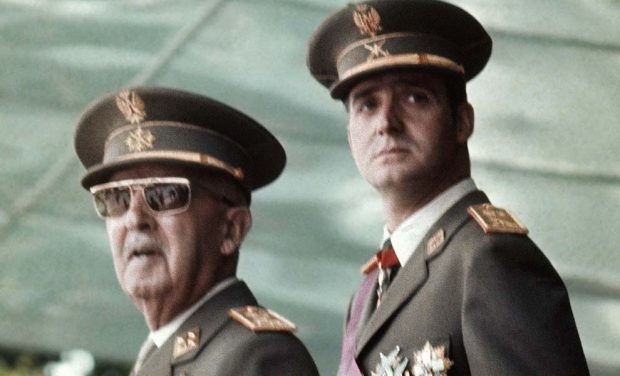
Juan Carlos, crowned by Franco, seen here with his mentor shortly before the latter’s demise.
(Photo source: Internet)

None of that is in the list of of the king’s speeches. “The year that ends has left us with a stamp of sadness, which has had as its centre the illness and the loss of what was our Generalissimo for so many years”, can be read in the Christmas speech of 1975, which also highlighted “the enormous human qualities and feelings full of patriotism” on which Franco “wanted to base all his performance at the head of our nation.”

For Emilio Silva, president of the Association for the Recovery of Historical Memory (ARMH), the Royal House should also include in its file “the video of King Juan Carlos swearing to uphold the principles of the Movement” (i.e the Spanish fascist Movement – Trans). “If there were an exercise in real transparency, it would be told where that (Head of State – Trans) succession comes from,” he told Público.

“The reality is that the king was installed as successor by Franco”.

“Surely it is not the best thing for a democratic system to see texts extolling Franco on the website of of the Head of State,” says Julián Sanz, professor of Contemporary History at the University of Valencia. In any case, he remarks that “the reality is that the King was installed as successor by Franco and Juan Carlos’s relationship with the dictatorship has never been officially reviewed, nor has he abjured it.”

“Generalissimo” and “Head of State”

          “My memory of the Generalissimo, who presided over this Military Passover for so many years and so much satisfaction when he met his comrades-in-arms,” reads the document “Words of His Majesty the King on the occasion of the Military Passover“, dated six January 1976. The following month, in Berga (Catalonia) he took advantage of the inauguration of the Baells Reservoir to argue that “the transformation that Spain has had in recent years of Franco’s mandate, cannot be stopped and all steps will be taken to allow this process to continue. “

The King kept referring to Franco as “Generalissimo” in July 1976, when he went to Santiago de Compostela to make the offering to the Apostle St. James. “Generalissimo Franco, who preceded me in the leadership of the State, personally presented this offering to you on several occasions,” he said then. Something similar happened that same month in Ferrol, where he recalled that this Galician town “was the birthplace of the Generalissimo, a great figure of our history, to whom I am honored to renew a public tribute in this city whose egregious name is forever linked to that of the most illustrious of his children. “

In February 1977 – just four months before the first democratic elections – the king took advantage of a visit to the General Military Academy to “pay tribute to the efforts of two great soldiers who had already gone down in history and who were the architects of the event that we celebrate: General Primo de Rivera, creator of the General Military Academy, and Generalissimo Franco, its first director”. (Primo de Rivera was also the founder of the fascist Falange organisation, which murdered unknown multitudes during and after the Anti-Fascist War, also known as the “Spanish Civil War” – Trans.)

In fact, the official biography of Juan Carlos de Borbón presented by the Royal House on its website also avoids referring to Franco as a dictator. “After the death of the former Head of State, Francisco Franco, Don Juan Carlos was proclaimed King on November 22, 1975, and delivered his first message to the nation in the Cortes, in which he expressed the basic ideas of his reign: democracy and to be the King of all Spaniards, without exception, “says the text.

“Reflects the past”

          For Sánchez León, the inclusion of these discourses without nuances is nothing more than “another example of the thin line of shadow that separates the absolutely abject and unconstitutional, typical of a criminal regime, from a constitutional order.”

The historian José Babiano does not object to the fact that “there is a set of discourses”, since “it reflects a past without twisting it”. In fact, he maintains that “it can help to contradict a sweetened version of the period, its role and of its transition”. “The first speeches are linked to the origin, and the origin is that it was Franco who appointed him. It would have been worse to remove them, because it would have been an attempt at a whitewash,” he said.

In this context, Babiano points out that while “he never repeated the praise (of Franco–Trans) of 1976, there was no self-criticism” about this type of discourse on the part of the King. “He did it when he had no choice in order to be the Head of State and once he gets there, all that is forgotten,” he said.

Público also contacted the Royal House to know if the possibility of contextualizing these speeches has ever been considered. To date we have received no response.

Franco with leading German Nazis. He was greatly admired by the former Spanish King, father of the current one.
(Photo source: Internet)

COMMENT — A SUPREME IRONY

Diarmuid Breatnach

Taking the history of the current Spanish monarchy into account (as referred to above) along with the judgement of the Supreme Court in June last, it is abundantly clear from the mouths of the executives of the State that the “Transition” to democracy, as many of its critics have said, was only ever the drawing of a veil over the fascist essence of the State. Of course, the actions of the State down through the years, whether under social-democratic government of the PSOE or right-wing of the PP, have given ample evidence of its nature.

In a judgement delivered last month (4th June), the Spanish Supreme Court halted the planned exhumation of Franco’s remains and their transfer from the mausoleum in the Monument to the Fallen built by prisoner labour during the Dictator’s regime. In justification of its halting the operation that was to take place on June 10th by order of Government, the Supreme Court declared that General Franco had been the Head of State since 1st October 1936, that is to say, two months after the date on which he and other Generals, with the aid of military transport, armaments and personnel from two foreign powers (i.e Nazi Germany and Fascist Italy), launched their military-fascist armed coup against a democratically-elected government of the Spanish State, resulting in a bitter war of over two years with huge loss of life.

General Franco on 1st October 1936, having just been made Generalissimo and Head of the Fascist coup forces. The Spanish Supreme Court in June 2019 claimed he was then the legitimate Head of the Spanish State!

This decision of the Supreme Court constitutes a supreme irony. A dozen Catalan social and political activists have been on trial for months and are now awaiting verdict – the main charge against them is of “Rebellion”, which entails an attempt to overthrow the State through violent uprising. The Catalans in question called, not for the overthrow of the Spanish State but rather for independence for Catalonia — and did so peacefully; nevertheless they were charged with rebellion, kept in jail awaiting trial and are still there, awaiting verdict. In answer to a legal challenge by the Catalans’ Defence team, the Supreme Court decided the Catalans did have a case to answer on “rebellion”. Now the same court, in the same year, decides that Franco, who DID lead a violent overthrow of the State, was the legitimate Head of State barely two months after the coup he led and while the the democratically-elected government he was rebelling against still had another two years to go before it was overthrown.

end. 

SOURCES REFERENCE:

Original article in Castillian: https://www.publico.es/politica/casa-real-ofrece-matices-discursos-franquistas-rey-juan-carlos.html

Decision of Supreme Court re Franco “Head of State”: https://www.publico.es/politica/supremo-reconoce-franco-jefe-1-octubre-1936-plena-guerra-civil.html

SIGNIFICANT VICTORY FOR DELIVEROO RIDERS

The first great collective victory of the ‘riders’ against Deliveroo.

A judgment of the Social Court No. 5 of Valencia recognizes the existing contractual relationship between Roodfoods Spain S.L.U., parent company of the British multinational, and 97 delivery riders of València.

(Valencia is in the Paisos Catalans region but not part of the Catalonia region — Translator(

Translated from article in Castillian of PILAR ARAQUE CONDE @ pilarac4 in the on-line newspaper Publico by Diarmuid Breatnach.


The complaints presented by Social Security’s General Finance in different courts against the Deliveroo labour model begin to be resolved. A judgment from Social court No.5 of Valencia ruled that 97 riders of the delivery company are employees and not self-employed, this being the first great collective victory of the workers of the platform Riders x Drets (Riders for Rights) and Intersindical Valenciana, according to the collective’s statement on Thursday.

Some of the Riders for Rights, now recognised as employees of Deliveroo, pose for a photo.
(Source: Publico)

Last year, Víctor Sánchez became the first worker in Spain to obtain a final judgment against Deliveroo, after Social court Number 6 of València declared his dismissal “unfair”. Deliveroo then accepted the ruling that for the first time questioned the legality of the business model of the distribution firm, maintaing that the riders are falsely self-employed.

The titular magistrate of Social Court No. 5 of València now recognises the existing contractual relationship between Roodfoods Spain S.L.U., the company that owns Deliveroo, and the 97 workers in Turia city. The ruling states that the workers “provide their personal services, inserted in the business organization to which the means of production belong – Deliveroo’s digital platform – according to the criteria and distributions that it establishes and assigns, receiving remuneration, which also establishes the company “, according to the text accessed by eldiario.es.

The judge adds that “the real means of production in this activity are not the bicycle and the mobile phone that the rider uses, but the digital platform of matching supply to demand owned by the company and without which which the provision service is not feasible”. In this way, Deliveroo is the one who determines the orders and schedules of the workers, and not the employees themselves, despite being categorised and taxed as self-employed.

“It is intended that the rider is free or not to accept an order without unfavorable consequences, but it was proved that the service of the rider is valued at different grades, which obviously will be taken into consideration by the order allocation algorithms” explains the judge. And she refutes the argument used by Deliveroo: “The fact of being able to reject orders does not constitute a capability or power that can condition the business activity,” he stresses.

SEVERAL PENDING LAWSUITS

The ruling, made public this Thursday, responded to the lawsuit filed in April 2018 by Social Security against Deliveroo, following a notification from the Labour Inspectorate. The state agency claimed more than 160,000 euros for Social Security contributions that were not paid by the company. Later, the Labour Inspectorate offices in Madrid, Barcelona, Alicante and Zaragoza, among other cities, did the same in the various courts.

Social Court No. 29 of Madrid will be the next to rule on whether these workers should be considered salaried employees of the British multinational and not self-employed, since the trial, which affects more than 500 delivery people in the region, was held for sentencing on May 31st.

GLOVO’S LABOUR MODEL, ALSO CHALLENGED

Glovo’s labour model has also been challenged before the courts. In this case, several judgments have determined that the company’s distributors had an “employment relationship” with the company and ordered their reinstatement.

This digital platform is also involved in the controversy after a worker died when being run over by a garbage truck while delivering. The young man, 23 years old, “was not a collaborator” of Glovo, although he carried its backpack. His death sparked protests about the precariousness of the sector.

And the fact is that Glovo, Deliveroo and Uber Eats continue to operate without a regulation that guarantees the rights of their workers. Also, taking into account that the number of employees in the sector is around 17,000, UGT (one of the major trade unions in the Spanish state – Translator) estimates that Social Security loses a potential 93 million per year due to this situation, figures that it estimates will be three times greater in 2020.

SOURCE REFERENCE:

https://www.publico.es/sociedad/deliveroo-primera-victoria-colectiva-riders-frente-deliveroo-jueza-valencia-considera-97-repartidores-falsos-autonomos.html